Privilege,
Oppression, and
Race
“Privilege exists when one group has something
of value that is denied to others simply because of
the groups they belong to, rather than because of
anything they’ve done or failed to do. Access to
privilege doesn’t determine one’s outcomes, but it
is definitely an asset that makes it more likely that
whatever talent, ability, and aspirations a person
with privilege has will result in something positive
for them.”
–Peggy McIntosh
On Privilege
What does it mean to have privilege?
• It is defined as “unearned access to resources (social power) only readily 

available to some people as a result of their advantaged social group 

membership”.
• Determining who has privilege or disadvantage is complex because 

cultural, social, and historical changes affect which groups are privileged and which groups are
not.
• Some may pass as members of an advantaged group:
- For example, some people may change their names to protect themselves from
discrimination.
• Some may be given privileged because they are assumed to be members of an advantaged
group.
- For example: a bisexual person in a heterosexual relationship may be assumed to be
heterosexual and thus treated differently.
Understanding Privilege
On Oppression
“All, too, will bear in mind this sacred principle,
that though the will of the majority is in all cases
to prevail, that will to be rightful must be
reasonable; that the minority possess their equal
rights, which equal law must protect, and to
violate would be oppression.”
–Thomas Jefferson
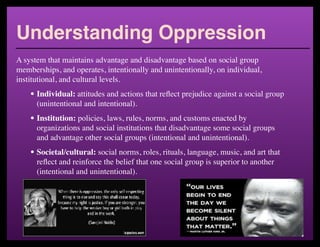
A system that maintains advantage and disadvantage based on social group
memberships, and operates, intentionally and unintentionally, on individual,
institutional, and cultural levels.
• Individual: attitudes and actions that reflect prejudice against a social group
(unintentional and intentional).
• Institution: policies, laws, rules, norms, and customs enacted by
organizations and social institutions that disadvantage some social groups
and advantage other social groups (intentional and unintentional).
• Societal/cultural: social norms, roles, rituals, language, music, and art that
reflect and reinforce the belief that one social group is superior to another
(intentional and unintentional).
Understanding Oppression
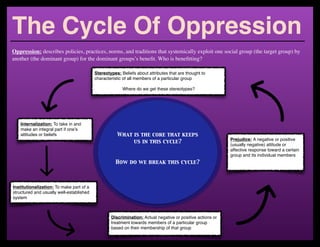
The Cycle Of Oppression
Stereotypes: Beliefs about attributes that are thought to
characteristic of all members of a particular group
Where do we get these stereotypes?
Internalization: To take in and
make an integral part if one’s
attitudes or beliefs
Institutionalization: To make part of a
structured and usually well-established
system
Discrimination: Actual negative or positive actions or
treatment towards members of a particular group
based on their membership of that group
Prejudice: A negative or positive
(usually negative) attitude or
affective response toward a certain
group and its individual members
What is the core that keeps
us in this cycle?
How do we break this cycle?
Oppression: describes policies, practices, norms, and traditions that systemically exploit one social group (the target group) by
another (the dominant group) for the dominant groups’s benefit. Who is benefitting?
On Race
“Whether the color of your skin is black, white,
yellow, brown or purple -- the extent of this
tragedy is so incredibly devastating that we had to
do something.”
- Bart McCracken
Understanding Race
Biological Definition:
• A group or population that
shares common genetic
characteristics physical
features
Sociological Definition:
• Socially constructed
category of people who share
certain inherited physical
biological traits
• Race is both a myth and a
reality
THAT’S A WRAP!
THANK YOU FOR PARTICIPATING ! KEEP MAKING CHANGE AND AS
ALWAYS BONNER LOVE!

Privilege, Oppression, and Race Understanding

  • 1.
  • 2.
    “Privilege exists whenone group has something of value that is denied to others simply because of the groups they belong to, rather than because of anything they’ve done or failed to do. Access to privilege doesn’t determine one’s outcomes, but it is definitely an asset that makes it more likely that whatever talent, ability, and aspirations a person with privilege has will result in something positive for them.” –Peggy McIntosh On Privilege
  • 3.
    What does itmean to have privilege? • It is defined as “unearned access to resources (social power) only readily 
 available to some people as a result of their advantaged social group 
 membership”. • Determining who has privilege or disadvantage is complex because 
 cultural, social, and historical changes affect which groups are privileged and which groups are not. • Some may pass as members of an advantaged group: - For example, some people may change their names to protect themselves from discrimination. • Some may be given privileged because they are assumed to be members of an advantaged group. - For example: a bisexual person in a heterosexual relationship may be assumed to be heterosexual and thus treated differently. Understanding Privilege
  • 4.
    On Oppression “All, too,will bear in mind this sacred principle, that though the will of the majority is in all cases to prevail, that will to be rightful must be reasonable; that the minority possess their equal rights, which equal law must protect, and to violate would be oppression.” –Thomas Jefferson
  • 5.
    A system thatmaintains advantage and disadvantage based on social group memberships, and operates, intentionally and unintentionally, on individual, institutional, and cultural levels. • Individual: attitudes and actions that reflect prejudice against a social group (unintentional and intentional). • Institution: policies, laws, rules, norms, and customs enacted by organizations and social institutions that disadvantage some social groups and advantage other social groups (intentional and unintentional). • Societal/cultural: social norms, roles, rituals, language, music, and art that reflect and reinforce the belief that one social group is superior to another (intentional and unintentional). Understanding Oppression
  • 6.
    The Cycle OfOppression Stereotypes: Beliefs about attributes that are thought to characteristic of all members of a particular group Where do we get these stereotypes? Internalization: To take in and make an integral part if one’s attitudes or beliefs Institutionalization: To make part of a structured and usually well-established system Discrimination: Actual negative or positive actions or treatment towards members of a particular group based on their membership of that group Prejudice: A negative or positive (usually negative) attitude or affective response toward a certain group and its individual members What is the core that keeps us in this cycle? How do we break this cycle? Oppression: describes policies, practices, norms, and traditions that systemically exploit one social group (the target group) by another (the dominant group) for the dominant groups’s benefit. Who is benefitting?
  • 7.
    On Race “Whether thecolor of your skin is black, white, yellow, brown or purple -- the extent of this tragedy is so incredibly devastating that we had to do something.” - Bart McCracken
  • 8.
    Understanding Race Biological Definition: •A group or population that shares common genetic characteristics physical features Sociological Definition: • Socially constructed category of people who share certain inherited physical biological traits • Race is both a myth and a reality
  • 9.
    THAT’S A WRAP! THANKYOU FOR PARTICIPATING ! KEEP MAKING CHANGE AND AS ALWAYS BONNER LOVE!