A11Y AND INCLUSIVE DESIGN SERIES
@ALENAHUANG
Principles of
Universal Design
1. Defining Universal Design
2. Universal Design: The Seven Principles with
Examples
Let’s get started!
What will this guide cover?
Defining
Universal Design
Universal design is the design of environments
and products to be accessible and usable for
all people, regardless of age, ability or
disability, etc.
Although it’s impossible to meet the needs of
all people, striving for universal design and
applying its principles from the beginning of
the design process will reduce many barriers
and the need for future accommodations.
Defining Universal Design
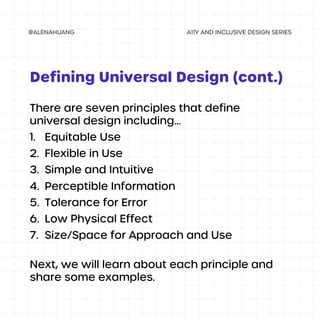
There are seven principles that define
universal design including...
1. Equitable Use
2. Flexible in Use
3. Simple and Intuitive
4. Perceptible Information
5. Tolerance for Error
6. Low Physical Effect
7. Size/Space for Approach and Use
Next, we will learn about each principle and
share some examples.
Defining Universal Design (cont.)
The Seven
Principles
Universal Design:
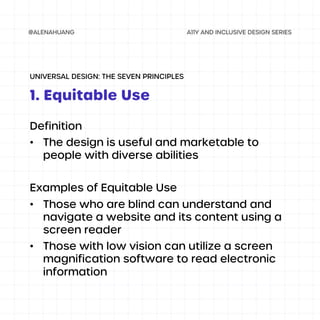
Definition
• The design is useful and marketable to
people with diverse abilities
Examples of Equitable Use
• Those who are blind can understand and
navigate a website and its content using a
screen reader
• Those with low vision can utilize a screen
magnification software to read electronic
information
1. Equitable Use
UNIVERSAL DESIGN: THE SEVEN PRINCIPLES
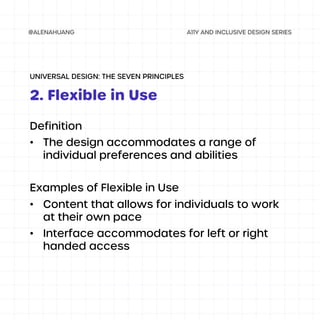
Definition
• The design accommodates a range of
individual preferences and abilities
Examples of Flexible in Use
• Content that allows for individuals to work
at their own pace
• Interface accommodates for left or right
handed access
2. Flexible in Use
UNIVERSAL DESIGN: THE SEVEN PRINCIPLES
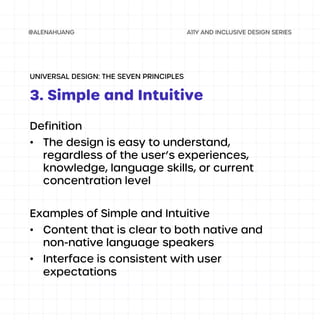
Definition
• The design is easy to understand,
regardless of the user’s experiences,
knowledge, language skills, or current
concentration level
Examples of Simple and Intuitive
• Content that is clear to both native and
non-native language speakers
• Interface is consistent with user
expectations
3. Simple and Intuitive
UNIVERSAL DESIGN: THE SEVEN PRINCIPLES
Definition
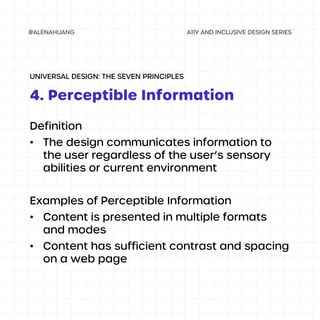
• The design communicates information to
the user regardless of the user’s sensory
abilities or current environment
Examples of Perceptible Information
• Content is presented in multiple formats
and modes
• Content has sufficient contrast and spacing
on a web page
4. Perceptible Information
UNIVERSAL DESIGN: THE SEVEN PRINCIPLES
Definition
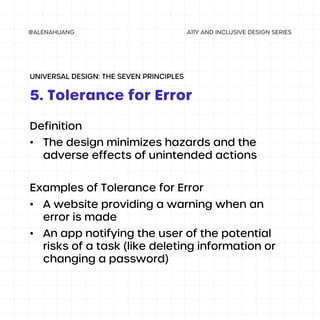
• The design minimizes hazards and the
adverse effects of unintended actions
Examples of Tolerance for Error
• A website providing a warning when an
error is made
• An app notifying the user of the potential
risks of a task (like deleting information or
changing a password)
5. Tolerance for Error
UNIVERSAL DESIGN: THE SEVEN PRINCIPLES
Definition
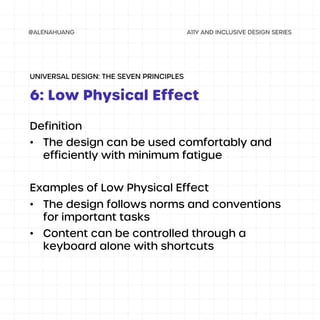
• The design can be used comfortably and
efficiently with minimum fatigue
Examples of Low Physical Effect
• The design follows norms and conventions
for important tasks
• Content can be controlled through a
keyboard alone with shortcuts
6: Low Physical Effect
UNIVERSAL DESIGN: THE SEVEN PRINCIPLES
Definition
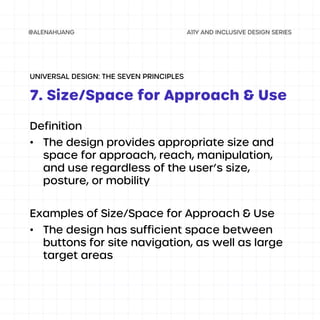
• The design provides appropriate size and
space for approach, reach, manipulation,
and use regardless of the user’s size,
posture, or mobility
Examples of Size/Space for Approach & Use
• The design has sufficient space between
buttons for site navigation, as well as large
target areas
7. Size/Space for Approach & Use
UNIVERSAL DESIGN: THE SEVEN PRINCIPLES

Principles of Universal Design

  • 1.
    A11Y AND INCLUSIVEDESIGN SERIES @ALENAHUANG Principles of Universal Design
  • 2.
    1. Defining UniversalDesign 2. Universal Design: The Seven Principles with Examples Let’s get started! What will this guide cover?
  • 3.
  • 4.
    Universal design isthe design of environments and products to be accessible and usable for all people, regardless of age, ability or disability, etc. Although it’s impossible to meet the needs of all people, striving for universal design and applying its principles from the beginning of the design process will reduce many barriers and the need for future accommodations. Defining Universal Design
  • 5.
    There are sevenprinciples that define universal design including... 1. Equitable Use 2. Flexible in Use 3. Simple and Intuitive 4. Perceptible Information 5. Tolerance for Error 6. Low Physical Effect 7. Size/Space for Approach and Use Next, we will learn about each principle and share some examples. Defining Universal Design (cont.)
  • 6.
  • 7.
    Definition • The designis useful and marketable to people with diverse abilities Examples of Equitable Use • Those who are blind can understand and navigate a website and its content using a screen reader • Those with low vision can utilize a screen magnification software to read electronic information 1. Equitable Use UNIVERSAL DESIGN: THE SEVEN PRINCIPLES
  • 8.
    Definition • The designaccommodates a range of individual preferences and abilities Examples of Flexible in Use • Content that allows for individuals to work at their own pace • Interface accommodates for left or right handed access 2. Flexible in Use UNIVERSAL DESIGN: THE SEVEN PRINCIPLES
  • 9.
    Definition • The designis easy to understand, regardless of the user’s experiences, knowledge, language skills, or current concentration level Examples of Simple and Intuitive • Content that is clear to both native and non-native language speakers • Interface is consistent with user expectations 3. Simple and Intuitive UNIVERSAL DESIGN: THE SEVEN PRINCIPLES
  • 10.
    Definition • The designcommunicates information to the user regardless of the user’s sensory abilities or current environment Examples of Perceptible Information • Content is presented in multiple formats and modes • Content has sufficient contrast and spacing on a web page 4. Perceptible Information UNIVERSAL DESIGN: THE SEVEN PRINCIPLES
  • 11.
    Definition • The designminimizes hazards and the adverse effects of unintended actions Examples of Tolerance for Error • A website providing a warning when an error is made • An app notifying the user of the potential risks of a task (like deleting information or changing a password) 5. Tolerance for Error UNIVERSAL DESIGN: THE SEVEN PRINCIPLES
  • 12.
    Definition • The designcan be used comfortably and efficiently with minimum fatigue Examples of Low Physical Effect • The design follows norms and conventions for important tasks • Content can be controlled through a keyboard alone with shortcuts 6: Low Physical Effect UNIVERSAL DESIGN: THE SEVEN PRINCIPLES
  • 13.
    Definition • The designprovides appropriate size and space for approach, reach, manipulation, and use regardless of the user’s size, posture, or mobility Examples of Size/Space for Approach & Use • The design has sufficient space between buttons for site navigation, as well as large target areas 7. Size/Space for Approach & Use UNIVERSAL DESIGN: THE SEVEN PRINCIPLES