BARRIER FREE
ARCHITECTURE
Prof. Subodh Shankar
Integral University, Lucknow
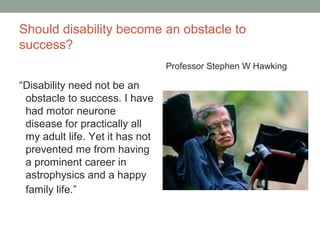
Should disability become an obstacle to
success?
“Disability need not be an
obstacle to success. I have
had motor neurone
disease for practically all
my adult life. Yet it has not
prevented me from having
a prominent career in
astrophysics and a happy
family life.”
Professor Stephen W Hawking
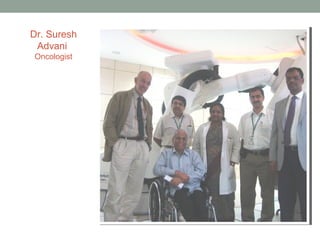
Dr. Suresh
Advani
Oncologist
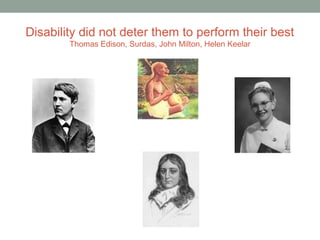
Disability did not deter them to perform their best
Thomas Edison, Surdas, John Milton, Helen Keelar
• More than 1 billion people are disabled in
the world in one form or the other- WHO
• India has around 12 million disabled
people
 Visual
 Speech
 Hearing
 Movement
 Mental & Age based
UN definition of Disability
“Persons with disabilities include those
who have long term physical, mental, intellectual or
sensory impairments which in interaction with various
barriers may hinder their full and effective participation in
society on an equal basis with others.”
Disability and Indian Constitution
The
Constitution of India
resolves to secure to all its citizens
justice; liberty; equality; and fraternity.
Citizens with Disability are an essential part of human
diversity.
Article 15 of the Constitution ensures the Right of Social
Equality and Equal Access to Public Areas
Accessibility for all is recognised as a basic
necessity and there are attempts all over
the world to ensure this.
Barrier-free features are now becoming
fundamental to all design concepts.
What is a Barrier-Free Environment?
A barrier-free environment is a space that allows for free
and safe movement, function and access for all, regardless
of age, sex or condition.
OR
Space or a set of services that can be accessed by all,
without obstacles, with dignity and with as much
independence as possible.
Who all face barriers?
Wheelchair users
People with limited walking/ movement abilities
People with visual impairment or low vision
People with hearing impairment
Elderly and infirm persons
Pregnant ladies
Children
People with temporary disabilities
Is it necessary to remove barriers?
• Barriers make an environment unsafe and cause a high
level of difficulty to the user.
• Barriers cause spaces to be out of reach, denying people
the opportunity of participation in various spheres of life.
• This ranges from education, economic, social, cultural
and many other activities.
• This loss of opportunity is not only a loss for the person
concerned but also society’s loss which misses out on
their contribution.
• A barrier causes exclusion
Access is a basic right
• A barrier-free environment is a basic right of all. It is not a
matter of choice or option or be an aspect of sympathy.
• Not allowing a person equal opportunities and
participation is an infringement on his/ her rights as a
citizen of this country.
• Barrier-free design, therefore, is a professional obligation
as well as a societal commitment of design professionals.
Architect’s Viewpoint: Balkrisna Doshi
“A universal design, not remaining synonymous only with
the provision of ramps, involves many more aspects
to consider. This neither implies an additional demand nor
involves an extra cost, if integrated right from the
conception of the design”
Architect’s Viewpoint: Hasmukh C. Patel
“We, as committed and concerned professionals, should
take up this responsibility of addressing these issues and
demonstrate through our work the benefits of a barrier-free
environment.
Access to public areas is not only a matter of dignity but
also the fundamental right of every person in our country”
Indian Standards, Manuals & Codes
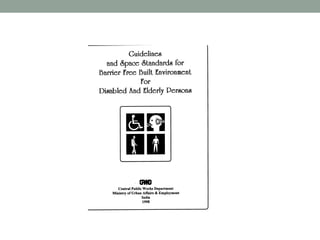
• CPWD Guidelines & Space Standards for Barrier Free Environment
for Disabled &Elderly pesons-1998
• Manual - Planning a Barrier Free Environment by Chief
Commissioner for persons with disability- 2002
• TCPO Model Building Bye laws- 2004
• Design Manual For a Barrier - Free Built Environment by UNNATI –
Organisation for Development Education, Handicap International, Ahmedabad, 2004
• Bureau of Indian Standards: NBC 2005
• Uttar Pradesh Model Building Bye- Laws 2008: Chapter- 11
National Building Code of India:2005
Clause 12.21 of Part -3
‘Special Requirements for Planning of Public
Buildings meant for use of Physically Challenged’
Sub Clauses
General
Site Development
Buildings
Design for Children
Requirements apply to all public buildings and
facilities which are to be made accessible to, and
functional for the physically challenged.
LET OUR ESTEEMED
EXPERTS
GUIDE US HENCEFORTH
Site Development: Walks
• Public Walks be at least 1200mm wide
• Gradient not greater than 1 in 20.
• Non-slip surface and have level surfaces at regular
intervals
• Be of a continuing common surface not interrupted by
steps or abrupt changes in level.
• Wherever walks cross other walks, driveways or parking
lots they should blend to a common level.
Passages
• The minimum clear passage width for a single
wheelchair is 900 mm continuously.
• An accessible route should be 1200 mm wide to allow
both a wheelchair and a walking person
• The minimum passage width for two wheelchairs to pass
side by side is 1500 mm.Preferable width is 1800 mm.
Site Development: Parking
• Parking lots to be closest to the areas accessible to the
handicapped
• Design the spaces so that wheelchairs and individuals
using braces and crutches are not compelled to wheel or
walk behind parked cars.
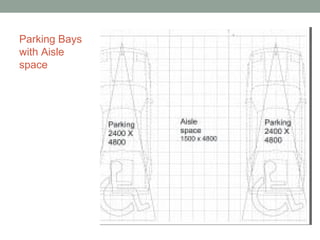
• Parking bays should be 2.7 to 3.0m wide
Parking Bays
with Aisle
space
Ramps
For shorter distances Minimum Width 900mm
Gradient greater than 1 in 20 or maximum of 1 in 12 for short distance up to 900mm.
900mm.
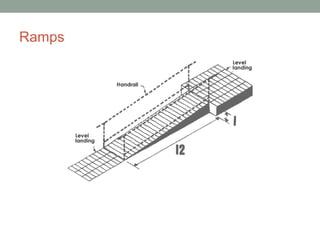
High Handrails preferably on two sides, extend 300mm beyond the top and bottom of the ramp.
Where major traffic is predominantly children, the height of handrails should be restricted to 760mm.
Level platforms at 10 m to 12m intervals. At turnings min. width- 1.5
Minimum width - 1500mm, If length exceeds 3.5m.
The Ramp shall have a level platform at the top which is at least 1800mm long, if a door swings out
onto the platform or toward the ramp. This platform shall extend at least 300mm beyond each side of
the doorway
Each ramp shall have at least 1800mm of straight clearance at the bottom.
For visually impaired people, ramps may be colour contrasted with landing.
Ramps
Buildings: Entrances
At least one primary entrance to each building to be
wheelchairs usable and to be indicated by a sign and shall
be
on a level that would make the elevators accessible.
Buildings: Doors
• Minimum clear width - 900mm. Single leaf non self closing
• Not to open –out into circulation spaces
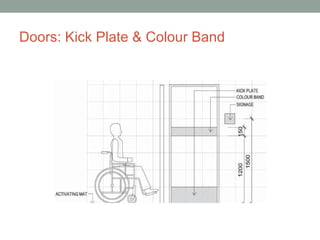
• 400mm high kick plates be provided.
• Public buildings - Sliding automatic doors.
• Colour contrast with the adjoining wall..
• Glazed doors to be marked with a coloured band or
frame.
• Height of door handles and locks - 800mm from the floor.
Doors: Kick Plate & Colour Band
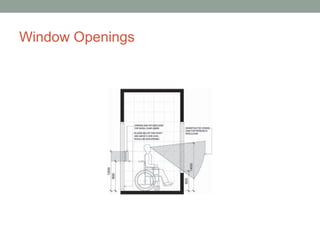
Buildings: Windows
• To be designed to avoid the glare
• Large glass areas close to circulation spaces be marked
with a coloured band or frame.
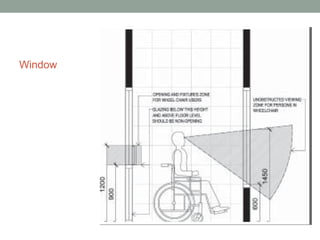
• Sill not to be higher than 800mm
• Be easy to open and close.
• Controls be placed in the zone 900 to 1200mm from the
floor.
Window
Window Openings
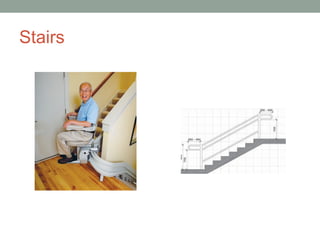
Buildings: Stairs
• Stairs be supplemented by lifts or ramps.
• Straight flights preferred.
• Treads - 300mm and risers not higher than 150mm.
• Steps to be of a consistent height and depth throughout.
• Projecting Nosing to be avoided
• Handrails on both sides of any stairway. And be
continuous and extend not less than 300mm beyond the
top and bottom step
• Colour contrast
Stairs
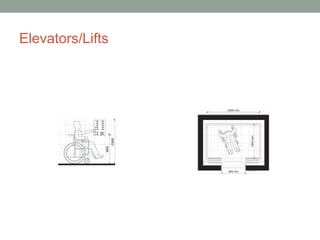
Elevators/Lifts
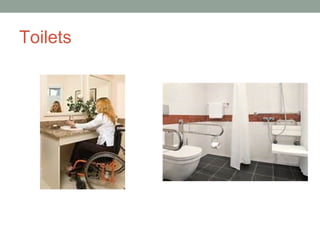
Buildings: Toilets
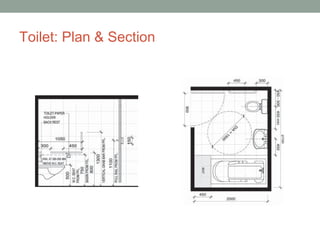
• WC be at-least 900mm wide and 1500mmdeep.
• Seat Height- 500mm from floor
• Door width: Min. 800mm, swings out
• Handrails on each side, 780mm high and parallel to the
floor, 40mm clearance between rail and wall, and
fastened securely at ends and centre
• Wall-mounted water-closet with a narrow under-structure
that recedes sharply is most desirable.
Toilet: Plan & Section
Toilets
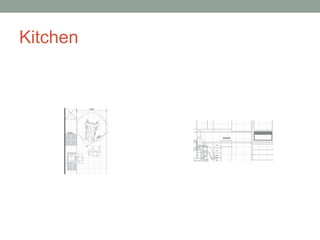
Kitchens
Kitchen
Wheelchair Passage Width
• The minimum clear passage width for a single
wheelchair is 900 mm continuously.
• An accessible route should be 1200 mm wide to allow
both a wheelchair and a walking person
• The minimum passage width for two wheelchairs to pass
side by side is 1500 mm.
• Preferable width is 1800 mm.

Barrier free environment

  • 1.
    BARRIER FREE ARCHITECTURE Prof. SubodhShankar Integral University, Lucknow
  • 2.
    Should disability becomean obstacle to success? “Disability need not be an obstacle to success. I have had motor neurone disease for practically all my adult life. Yet it has not prevented me from having a prominent career in astrophysics and a happy family life.” Professor Stephen W Hawking
  • 3.
  • 4.
    Disability did notdeter them to perform their best Thomas Edison, Surdas, John Milton, Helen Keelar
  • 5.
    • More than1 billion people are disabled in the world in one form or the other- WHO • India has around 12 million disabled people  Visual  Speech  Hearing  Movement  Mental & Age based
  • 6.
    UN definition ofDisability “Persons with disabilities include those who have long term physical, mental, intellectual or sensory impairments which in interaction with various barriers may hinder their full and effective participation in society on an equal basis with others.”
  • 7.
    Disability and IndianConstitution The Constitution of India resolves to secure to all its citizens justice; liberty; equality; and fraternity. Citizens with Disability are an essential part of human diversity. Article 15 of the Constitution ensures the Right of Social Equality and Equal Access to Public Areas
  • 8.
    Accessibility for allis recognised as a basic necessity and there are attempts all over the world to ensure this. Barrier-free features are now becoming fundamental to all design concepts.
  • 9.
    What is aBarrier-Free Environment? A barrier-free environment is a space that allows for free and safe movement, function and access for all, regardless of age, sex or condition. OR Space or a set of services that can be accessed by all, without obstacles, with dignity and with as much independence as possible.
  • 10.
    Who all facebarriers? Wheelchair users People with limited walking/ movement abilities People with visual impairment or low vision People with hearing impairment Elderly and infirm persons Pregnant ladies Children People with temporary disabilities
  • 11.
    Is it necessaryto remove barriers? • Barriers make an environment unsafe and cause a high level of difficulty to the user. • Barriers cause spaces to be out of reach, denying people the opportunity of participation in various spheres of life. • This ranges from education, economic, social, cultural and many other activities. • This loss of opportunity is not only a loss for the person concerned but also society’s loss which misses out on their contribution. • A barrier causes exclusion
  • 12.
    Access is abasic right • A barrier-free environment is a basic right of all. It is not a matter of choice or option or be an aspect of sympathy. • Not allowing a person equal opportunities and participation is an infringement on his/ her rights as a citizen of this country. • Barrier-free design, therefore, is a professional obligation as well as a societal commitment of design professionals.
  • 13.
    Architect’s Viewpoint: BalkrisnaDoshi “A universal design, not remaining synonymous only with the provision of ramps, involves many more aspects to consider. This neither implies an additional demand nor involves an extra cost, if integrated right from the conception of the design”
  • 14.
    Architect’s Viewpoint: HasmukhC. Patel “We, as committed and concerned professionals, should take up this responsibility of addressing these issues and demonstrate through our work the benefits of a barrier-free environment. Access to public areas is not only a matter of dignity but also the fundamental right of every person in our country”
  • 15.
    Indian Standards, Manuals& Codes • CPWD Guidelines & Space Standards for Barrier Free Environment for Disabled &Elderly pesons-1998 • Manual - Planning a Barrier Free Environment by Chief Commissioner for persons with disability- 2002 • TCPO Model Building Bye laws- 2004 • Design Manual For a Barrier - Free Built Environment by UNNATI – Organisation for Development Education, Handicap International, Ahmedabad, 2004 • Bureau of Indian Standards: NBC 2005 • Uttar Pradesh Model Building Bye- Laws 2008: Chapter- 11
  • 16.
    National Building Codeof India:2005 Clause 12.21 of Part -3 ‘Special Requirements for Planning of Public Buildings meant for use of Physically Challenged’ Sub Clauses General Site Development Buildings Design for Children Requirements apply to all public buildings and facilities which are to be made accessible to, and functional for the physically challenged.
  • 17.
  • 20.
    Site Development: Walks •Public Walks be at least 1200mm wide • Gradient not greater than 1 in 20. • Non-slip surface and have level surfaces at regular intervals • Be of a continuing common surface not interrupted by steps or abrupt changes in level. • Wherever walks cross other walks, driveways or parking lots they should blend to a common level.
  • 21.
    Passages • The minimumclear passage width for a single wheelchair is 900 mm continuously. • An accessible route should be 1200 mm wide to allow both a wheelchair and a walking person • The minimum passage width for two wheelchairs to pass side by side is 1500 mm.Preferable width is 1800 mm.
  • 22.
    Site Development: Parking •Parking lots to be closest to the areas accessible to the handicapped • Design the spaces so that wheelchairs and individuals using braces and crutches are not compelled to wheel or walk behind parked cars. • Parking bays should be 2.7 to 3.0m wide
  • 23.
  • 24.
    Ramps For shorter distancesMinimum Width 900mm Gradient greater than 1 in 20 or maximum of 1 in 12 for short distance up to 900mm. 900mm. High Handrails preferably on two sides, extend 300mm beyond the top and bottom of the ramp. Where major traffic is predominantly children, the height of handrails should be restricted to 760mm. Level platforms at 10 m to 12m intervals. At turnings min. width- 1.5 Minimum width - 1500mm, If length exceeds 3.5m. The Ramp shall have a level platform at the top which is at least 1800mm long, if a door swings out onto the platform or toward the ramp. This platform shall extend at least 300mm beyond each side of the doorway Each ramp shall have at least 1800mm of straight clearance at the bottom. For visually impaired people, ramps may be colour contrasted with landing.
  • 26.
  • 27.
    Buildings: Entrances At leastone primary entrance to each building to be wheelchairs usable and to be indicated by a sign and shall be on a level that would make the elevators accessible.
  • 28.
    Buildings: Doors • Minimumclear width - 900mm. Single leaf non self closing • Not to open –out into circulation spaces • 400mm high kick plates be provided. • Public buildings - Sliding automatic doors. • Colour contrast with the adjoining wall.. • Glazed doors to be marked with a coloured band or frame. • Height of door handles and locks - 800mm from the floor.
  • 29.
    Doors: Kick Plate& Colour Band
  • 30.
    Buildings: Windows • Tobe designed to avoid the glare • Large glass areas close to circulation spaces be marked with a coloured band or frame. • Sill not to be higher than 800mm • Be easy to open and close. • Controls be placed in the zone 900 to 1200mm from the floor.
  • 31.
  • 32.
  • 33.
    Buildings: Stairs • Stairsbe supplemented by lifts or ramps. • Straight flights preferred. • Treads - 300mm and risers not higher than 150mm. • Steps to be of a consistent height and depth throughout. • Projecting Nosing to be avoided • Handrails on both sides of any stairway. And be continuous and extend not less than 300mm beyond the top and bottom step • Colour contrast
  • 34.
  • 35.
  • 36.
    Buildings: Toilets • WCbe at-least 900mm wide and 1500mmdeep. • Seat Height- 500mm from floor • Door width: Min. 800mm, swings out • Handrails on each side, 780mm high and parallel to the floor, 40mm clearance between rail and wall, and fastened securely at ends and centre • Wall-mounted water-closet with a narrow under-structure that recedes sharply is most desirable.
  • 37.
  • 38.
  • 39.
  • 40.
  • 41.
    Wheelchair Passage Width •The minimum clear passage width for a single wheelchair is 900 mm continuously. • An accessible route should be 1200 mm wide to allow both a wheelchair and a walking person • The minimum passage width for two wheelchairs to pass side by side is 1500 mm. • Preferable width is 1800 mm.