Principles of Nerve
Repair
Alphonsus Chong
Consultant Hand Surgeon,
Department of Hand and Reconstructive Microsurgery, NUH
Objectives for lecture
• Outline the indications for surgery after a nerve injury
• Understand the rationale for timing for surgery
• Prepare the patient and the nerve bed for surgery
• List the apparatus and instruments required in the surgery
Objectives for surgery on a nerve
• Establish a diagnosis
• Repair a severed or ruptured nerve
• Relief of compression or distortion
Reasons for operating on a nerve
after injury (Rolf Birch in
Green’s)
• High likelihood of nerve transection:
• Complete paralysis after a wound over the course of a major nerve
• Complete paralysis affecting a nerve after surgery or an injection near that
nerve
• Complete paralysis after a closed injury, especially high-energy injuries with
severe damage to soft tissues and the skeleton
• Complete paralysis after closed traction injury of the brachial plexus
• A nerve lesion associated with an arterial injury
• Need to be do surgery in the area:
• A nerve lesion associated with fracture or dislocation requiring urgent open
reduction and internal fixation
• Poor progression
• Worsening of nerve injury while under observation
• Failure to progress toward recovery in the expected time after a closed injury
• Failure to recover from conduction block within 6 weeks of injury
• Persistent pain
• Treatment of a painful neuroma
Timing of repair
• If clear that nerve is transected, the earlier the repair/grafting,
the better the result
• Delay:
• Patient unfit
• Diagnosis unclear
• Other reasons
Considerations and preparation
before surgery
• Life and limb salvage first
• Late – clear infections and heal wounds
• Prepare bed – flaps may be needed
• Overcome joint stiffness – splinting or surgical means
• Consider other measures
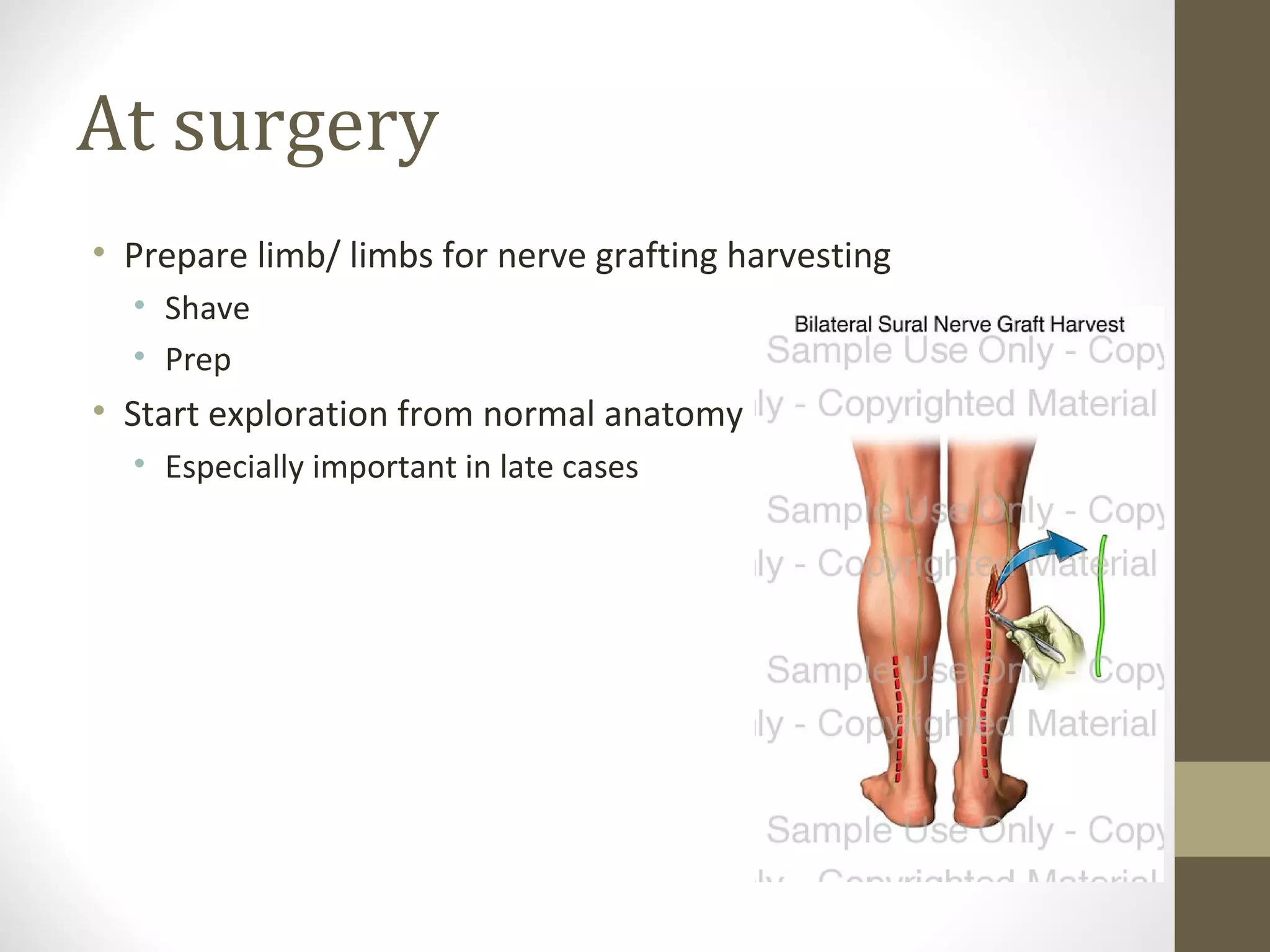
At surgery
• Prepare limb/ limbs for nerve grafting harvesting
• Shave
• Prep
• Start exploration from normal anatomy
• Especially important in late cases
Magnification
• Loupes
• 2.5x to 4.5x
• Field of view
• Depth of field
• Operating Microscope
• Variable zoom
• XY control
• Foot or hand controlled
Operating Microscope
Instruments
• Bipolar cautery
• Microsurgical instruments
• Jewellers forceps
• Straight and curved micro-scissors
• Approximating clamps
• Specific nerve instruments
• Nerve clamps (S&T Viktor Meyer)
• With special nerve sectioning blade
• Background
• Green glove
• Microsutures
• Fibrin glue
• Training
Video of Digital Nerve
Coaptation

Principles of nerve repair

  • 1.
    Principles of Nerve Repair AlphonsusChong Consultant Hand Surgeon, Department of Hand and Reconstructive Microsurgery, NUH
  • 2.
    Objectives for lecture •Outline the indications for surgery after a nerve injury • Understand the rationale for timing for surgery • Prepare the patient and the nerve bed for surgery • List the apparatus and instruments required in the surgery
  • 3.
    Objectives for surgeryon a nerve • Establish a diagnosis • Repair a severed or ruptured nerve • Relief of compression or distortion
  • 4.
    Reasons for operatingon a nerve after injury (Rolf Birch in Green’s) • High likelihood of nerve transection: • Complete paralysis after a wound over the course of a major nerve • Complete paralysis affecting a nerve after surgery or an injection near that nerve • Complete paralysis after a closed injury, especially high-energy injuries with severe damage to soft tissues and the skeleton • Complete paralysis after closed traction injury of the brachial plexus • A nerve lesion associated with an arterial injury • Need to be do surgery in the area: • A nerve lesion associated with fracture or dislocation requiring urgent open reduction and internal fixation • Poor progression • Worsening of nerve injury while under observation • Failure to progress toward recovery in the expected time after a closed injury • Failure to recover from conduction block within 6 weeks of injury • Persistent pain • Treatment of a painful neuroma
  • 5.
    Timing of repair •If clear that nerve is transected, the earlier the repair/grafting, the better the result • Delay: • Patient unfit • Diagnosis unclear • Other reasons
  • 6.
    Considerations and preparation beforesurgery • Life and limb salvage first • Late – clear infections and heal wounds • Prepare bed – flaps may be needed • Overcome joint stiffness – splinting or surgical means • Consider other measures
  • 7.
    At surgery • Preparelimb/ limbs for nerve grafting harvesting • Shave • Prep • Start exploration from normal anatomy • Especially important in late cases
  • 8.
    Magnification • Loupes • 2.5xto 4.5x • Field of view • Depth of field • Operating Microscope • Variable zoom • XY control • Foot or hand controlled Operating Microscope
  • 9.
    Instruments • Bipolar cautery •Microsurgical instruments • Jewellers forceps • Straight and curved micro-scissors • Approximating clamps • Specific nerve instruments • Nerve clamps (S&T Viktor Meyer) • With special nerve sectioning blade • Background • Green glove • Microsutures • Fibrin glue • Training
  • 13.
    Video of DigitalNerve Coaptation

Editor's Notes

  • #4 Although the decision to operate on a nerve is usually straightforward, as in the case of an open wound or when the nerve injury is associated with unstable orthopaedic trauma or vascular or tendon injury, it is not always as easy. The primary reasons to operate include (1) to confirm or establish a diagnosis, (2) to restore continuity to a severed or ruptured nerve, and (3) to relieve a nerve of an agent that is compressing, distorting, or occupying it
  • #6 The sooner the distal segment is reconnected to the proximal segment and thus to the cell body, the better the result. In the extreme case of replantation after traumatic amputation, O’Brien showed that primary suture of nerves gave the only hope of recovery.[106] The prognosis for recovery is governed by two factors that outweigh all others. First is the violence of the injury, and second is the interval between injury and repair. George Bonney introduced a policy of urgent repair of both nerves and arteries at St. Mary's Hospital, London, in the early 1960s. Improved results after urgent repair have been reported for the median and ulnar nerves,[13,81,95] the radial nerve,[119] and the musculocutaneous nerve.[109] Kato and colleagues showed that recovery of function and relief of pain were decisively better with urgent repair of a closed traction lesion of the brachial plexus.[69] The spinal accessory nerve seems to be an exception to the rule that immediate repair improves outcomes. Impressive recovery of function along with relief of pain has been seen in cases in which repair of that nerve was delayed for many months. Urgent repair of nerves damaged by penetrating missile wounds is recommended by Oullette.[110] This policy is followed by our military colleagues working in the Selly Oak Hospital, Birmingham, United Kingdom. Decisive evidence for early repair is provided by Glasby and co-workers, who demonstrated that regeneration was impaired by delay and that regeneration was further impaired by associated long-bone fracture, arterial injury, hematoma, or fibrosis.[44,46,47]ry and repair.
  • #7 Considerations Before Surgical Intervention 1 Lifesaving or limb-saving measures come first. The surgeon has a duty to assess a patient's ability to undergo a prolonged intervention.2 In late cases, indolent wounds and infections must be cleared. The texture of the skin may require massage and oiling. Nonunion of a long bone can be dealt with at the same time as the nerve repair. A torn rotator cuff is repaired either at the same time as the circumflex nerve or after nerve repair.3 Deep scars from penetrating missile injury or from burns offer a most hostile bed to nerve grafts. These areas will need replacement with healthy full-thickness skin flaps, pedicled or free, before nerve repair.4 The timing for treatment of a severe fixed deformity from uncorrected paralysis or ischemic fibrosis is adapted to the individual patient's needs. Serial plaster of Paris splinting is particularly useful in overcoming fixed flexion deformity of the wrist, the proximal interphalangeal (PIP) joints, and the elbow.[62] Immobilization of the part is necessary after elongation of tendons or after muscle slide or capsulotomy, and in such cases I prefer to repair the nerve at the same time.5 Is it worthwhile? Are other, simpler measures available? “By the time the changes of degeneration are present the patient is a better candidate for the examination halls than for restorative treatment. The object of the clinician must be to make the diagnosis before the signs of peripheral degeneration have appeared: that is, before the best time for intervention has passed.”[8] Paralysis caused by neglected high radial, high ulnar, or common peroneal nerve lesions may better be treated by the appropriate musculotendinous transfer.6 Static or dynamic splinting is helpful to patients by diminishing their disability, by giving an indication of what is hoped to be achieved, and of course, by ensuring that these modalities are ready for the course of postoperative treatment.7 Patients appreciate a clear statement of what has happened, what can be done, and when it can be done. It is helpful for them to know for how long they must plan to be away from work and curtail daily activities and driving. A fourth of all of my patients have suffered iatrogenic nerve injuries. I think that the clinician responsible for treating an iatrogenic situation should take charge, give clear advice, set out a clear plan of action, and avoid a partisan approach. I advise patients that appropriate records of operative findings will be promptly released to their legal advisors but that I will not, myself, prepare a medicolegal report.
  • #9 For initial dissection – loups Then microscope for repair
  • #10 Reasons to not proceed with repair of a transected nerve include the following: ▪ The general condition of the patient. After having saved a life or limb by means of successful arterial repair, the patient, the anesthetist, and the surgeon may well have had enough.▪ The attributes and skills of the operating team and the availability of specialized equipment.▪ Uncertainty about the viability or state of the nerve trunks. This is particularly valid when the nerve has been torn by a saw or by a bullet.▪ The risk for local or systemic sepsis. If the local soft tissue damage and contamination from an open fracture or high-velocity gunshot wound are severe, it is better to wait until the soft tissue bed is stabilized before proceeding with nerve repair.▪ When the condition of the nerve is such that function will more surely and more rapidly be restored by musculotendinous transfer.