Topics
• spatial encoding - part 2
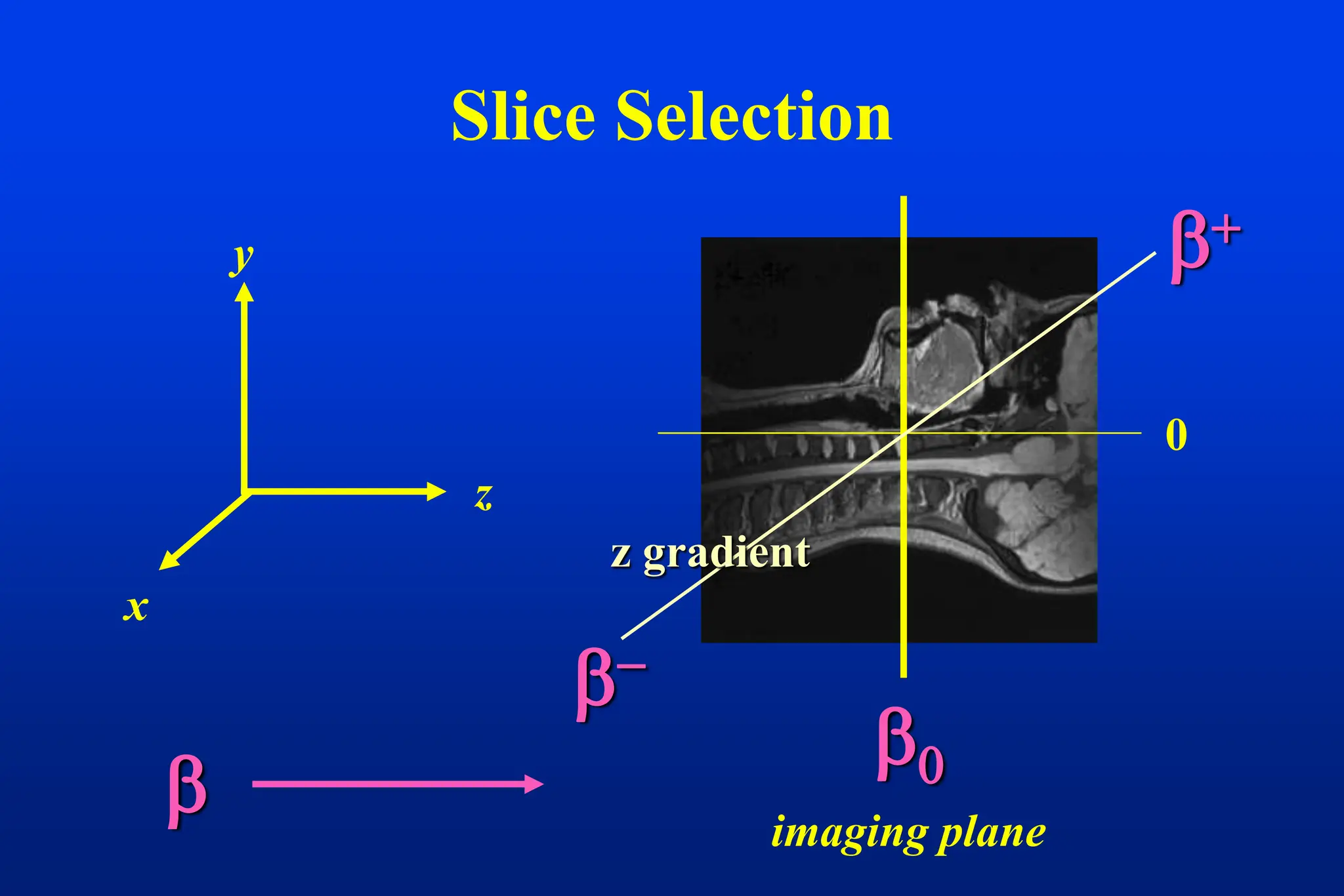
Slice Selection

z
y
x
0
imaging plane



z gradient
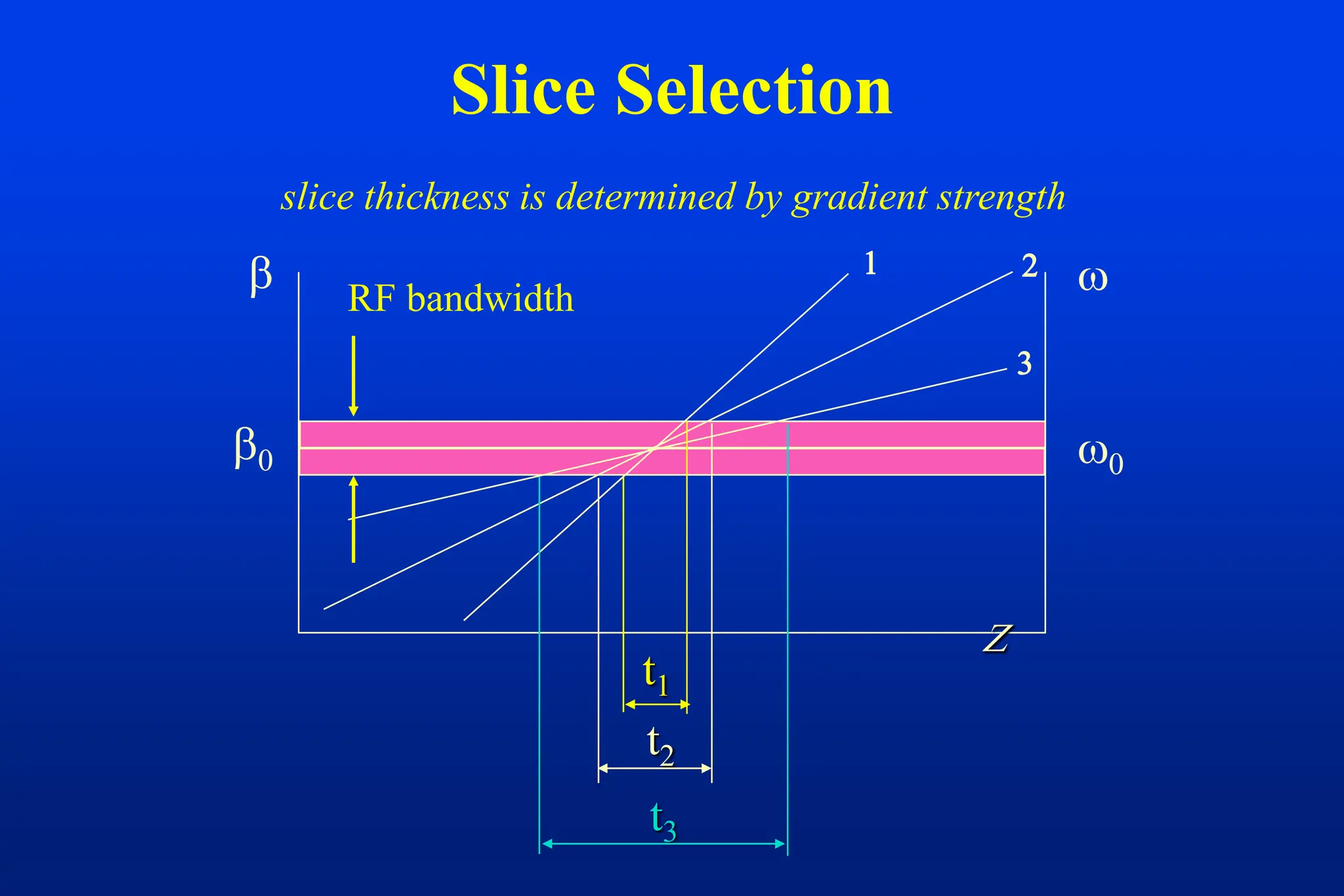
Slice Selection
slice thickness is determined by gradient strength




RF bandwidth




t1
t2
t3
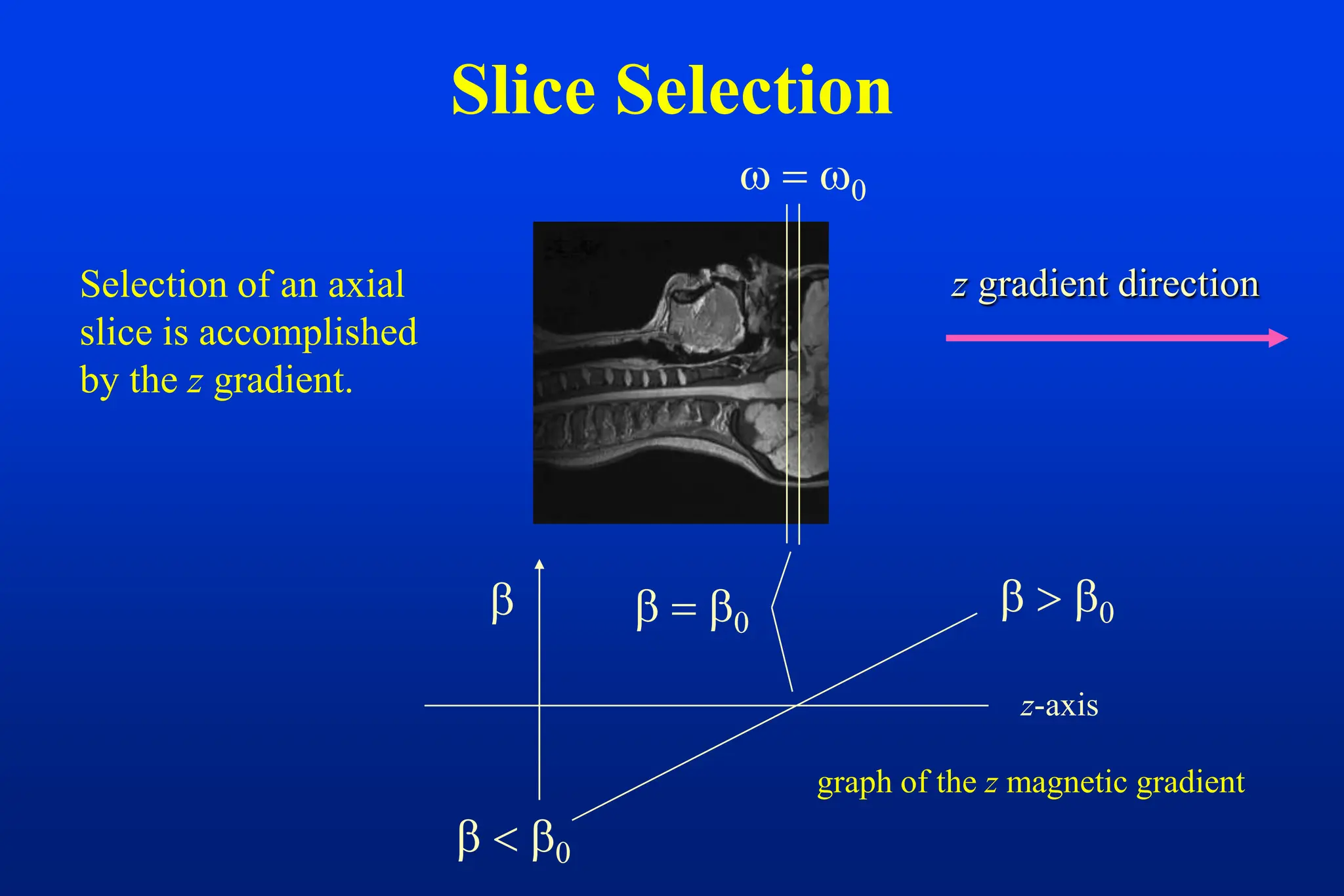
Slice Selection
Selection of an axial
slice is accomplished
by the z gradient.
z gradient direction

graph of the z magnetic gradient
z-axis
 


Slice Selection
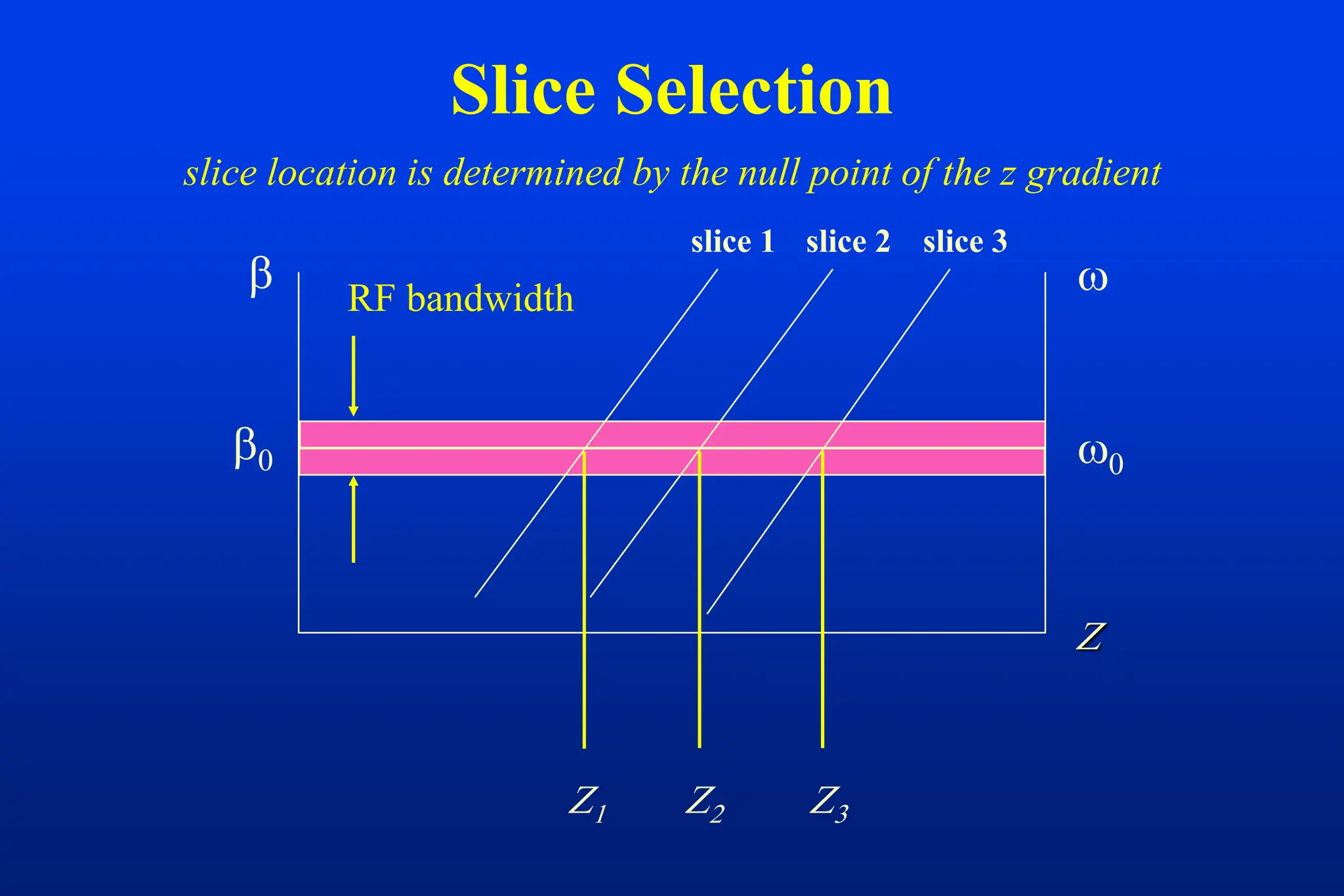
slice location is determined by the null point of the z gradient




RF bandwidth
slice 1

slice 2 slice 3
  
Frequency Encoding
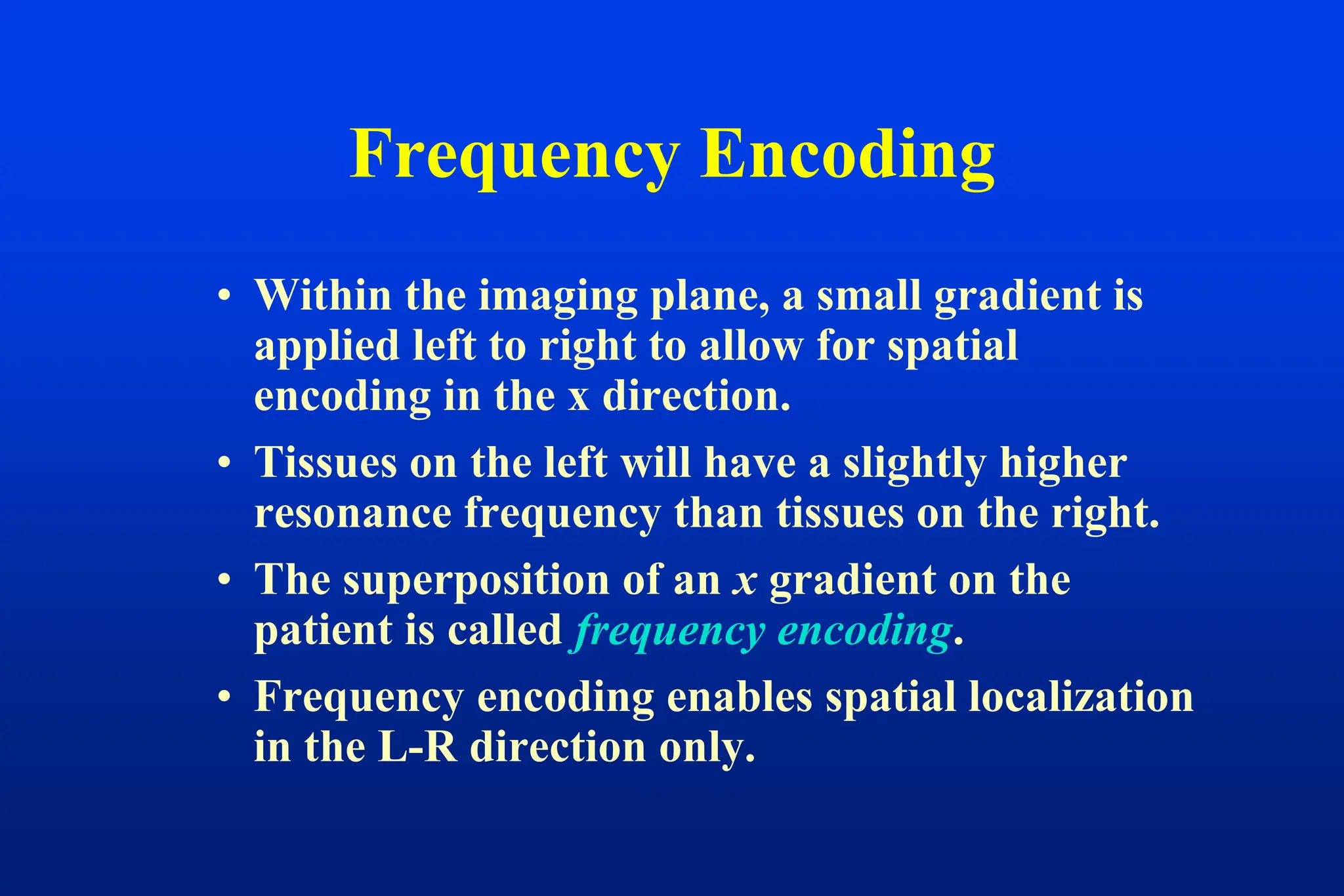
• Within the imaging plane, a small gradient is
applied left to right to allow for spatial
encoding in the x direction.
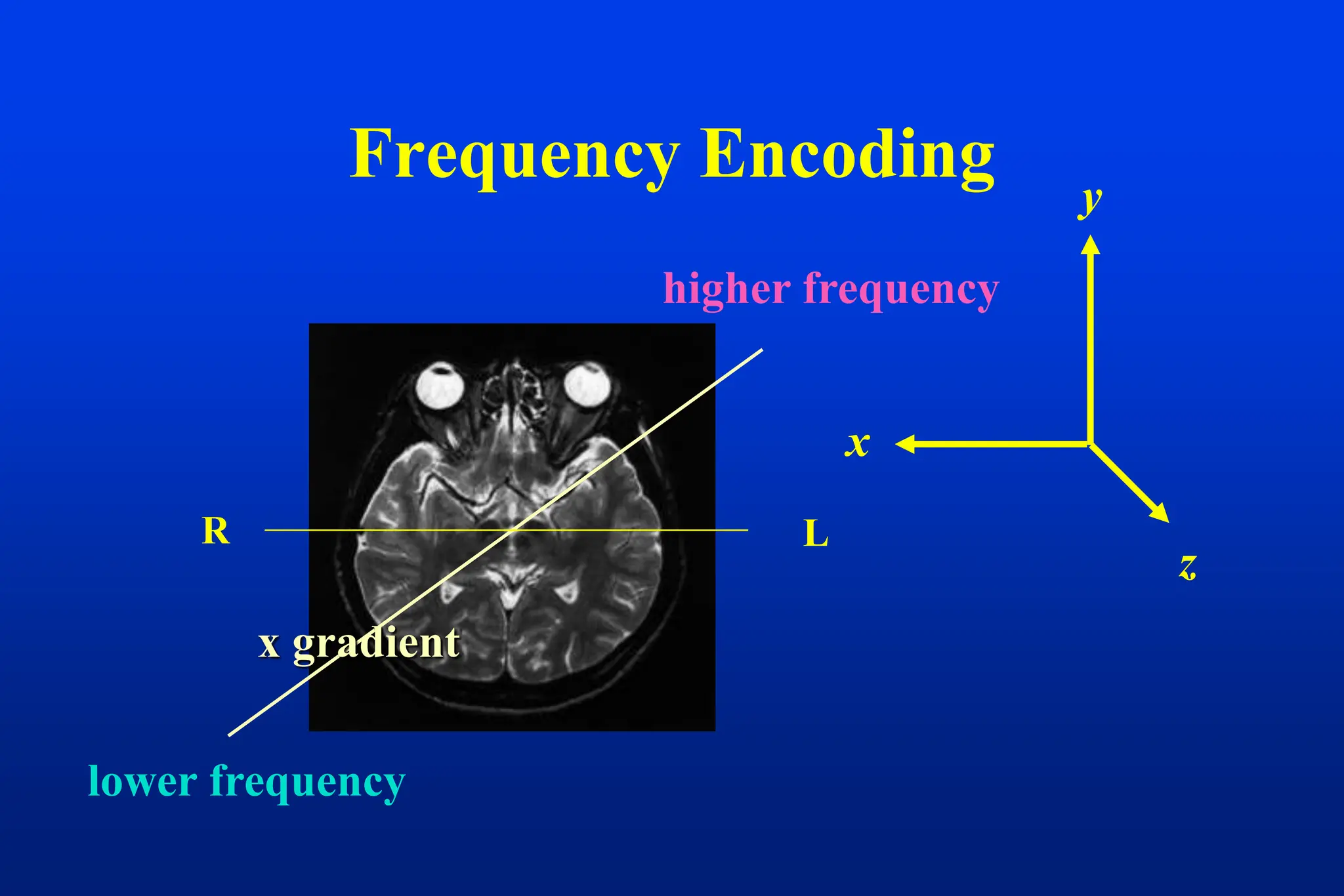
• Tissues on the left will have a slightly higher
resonance frequency than tissues on the right.
• The superposition of an x gradient on the
patient is called frequency encoding.
• Frequency encoding enables spatial localization
in the L-R direction only.
Frequency Encoding
z
y
x
x gradient
higher frequency
lower frequency
L
R
Frequency Encoding
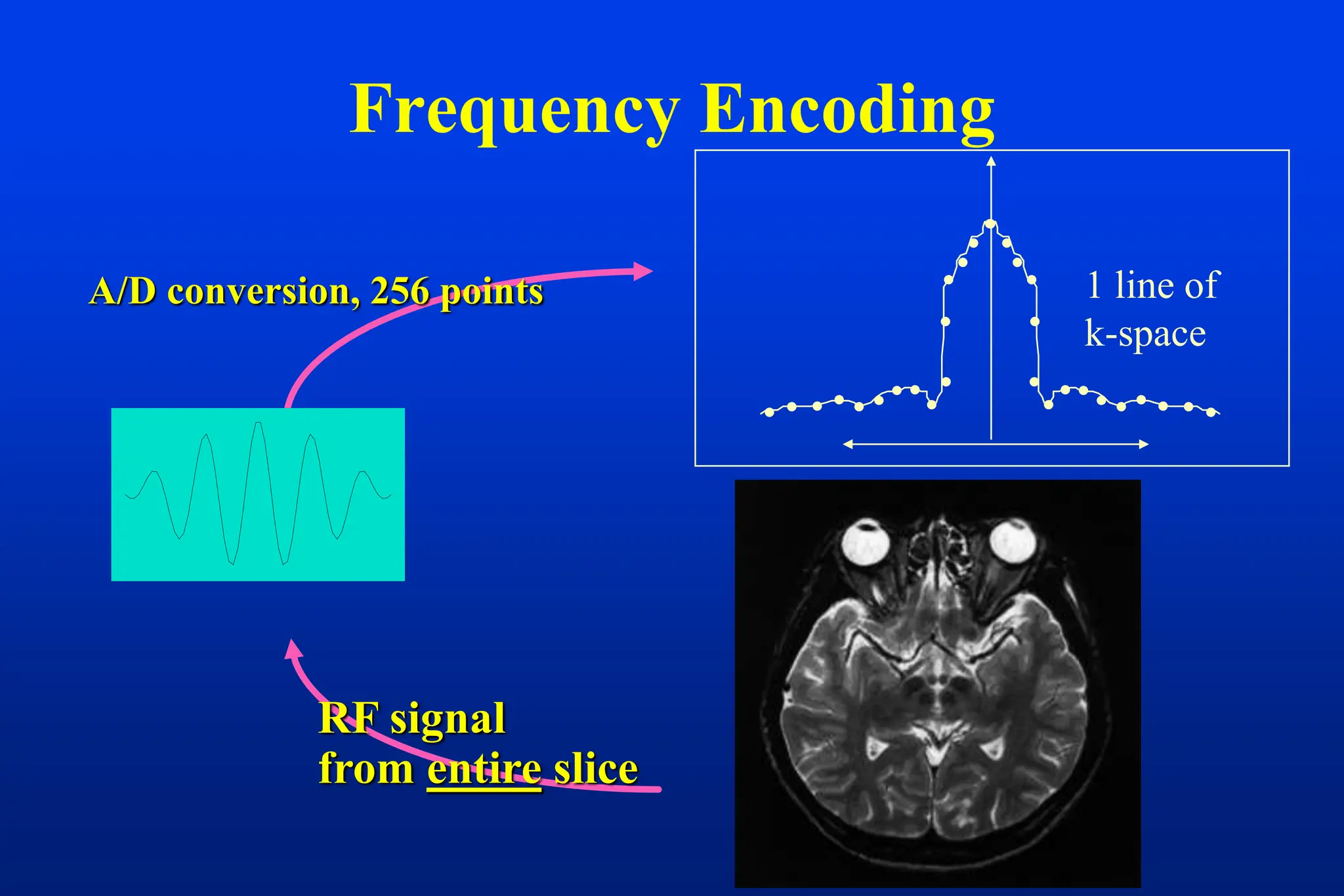
RF signal
from entire slice
A/D conversion, 256 points 1 line of
k-space
Phase Encoding
• An additional gradient is applied in the
y direction to encode the image in the
remaining direction.
• Because the x gradient alters the
frequencies in the received signal according
to spatial location, the y gradient must alter
the phase of the signal.
• Thus, the points of k-space are revealed by
recording the digitized RF signal after a
phase encoding gradient application.
Phase Encoding
• The technique of phase encoding the second
dimension in the imaging plane is
sometimes referred to as spin warping.
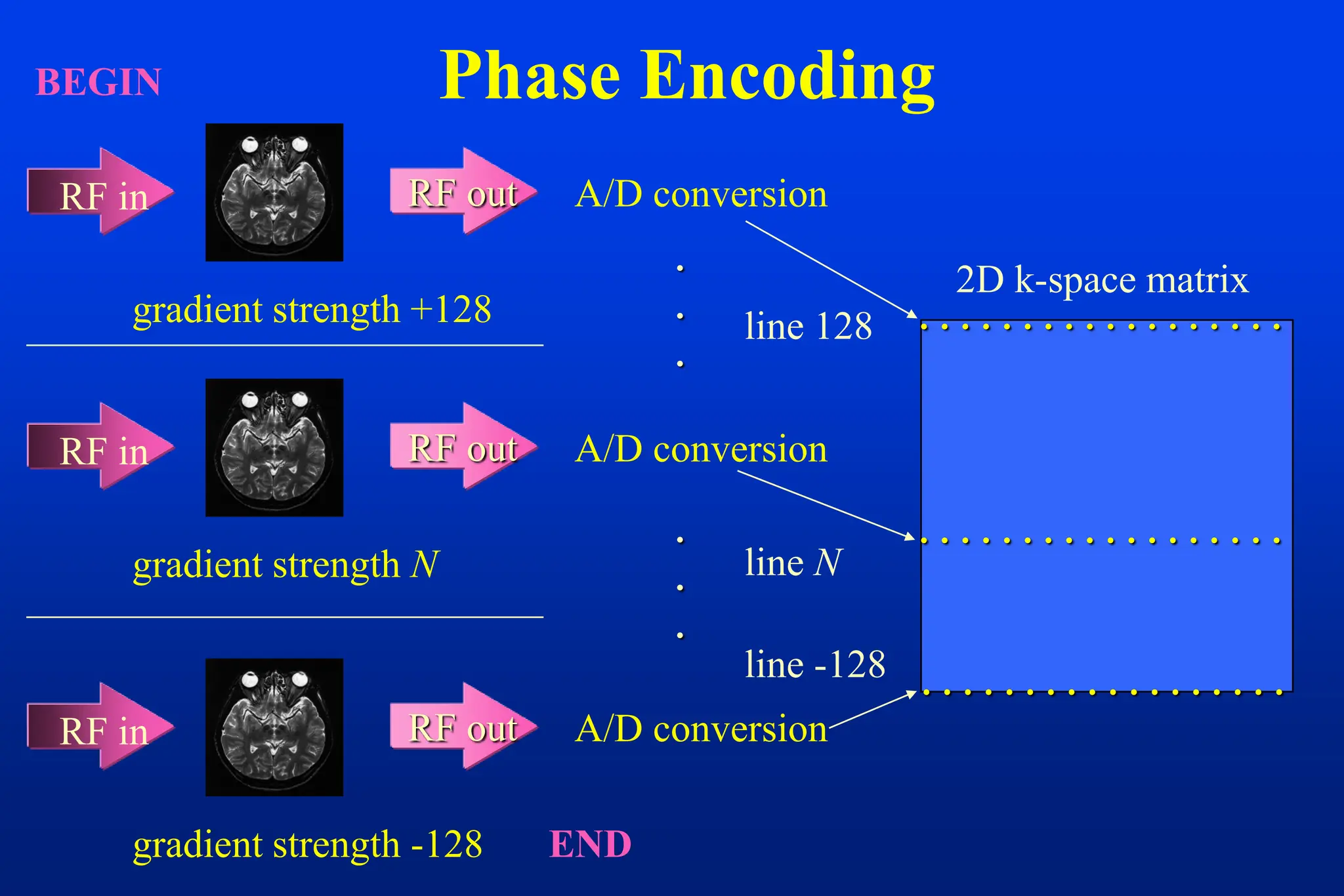
• The phase encoding gradient is “stepped”
during the acquisition of image data for a
single slice. Each step provides a unique
phase encoding.
• For a 256 x 256 square image matrix, 256
unique phase encodings must be performed
for each image slice. The second 256 points
in the x direction are obtained by A to D
conversion of the received signal.
Phase Encoding
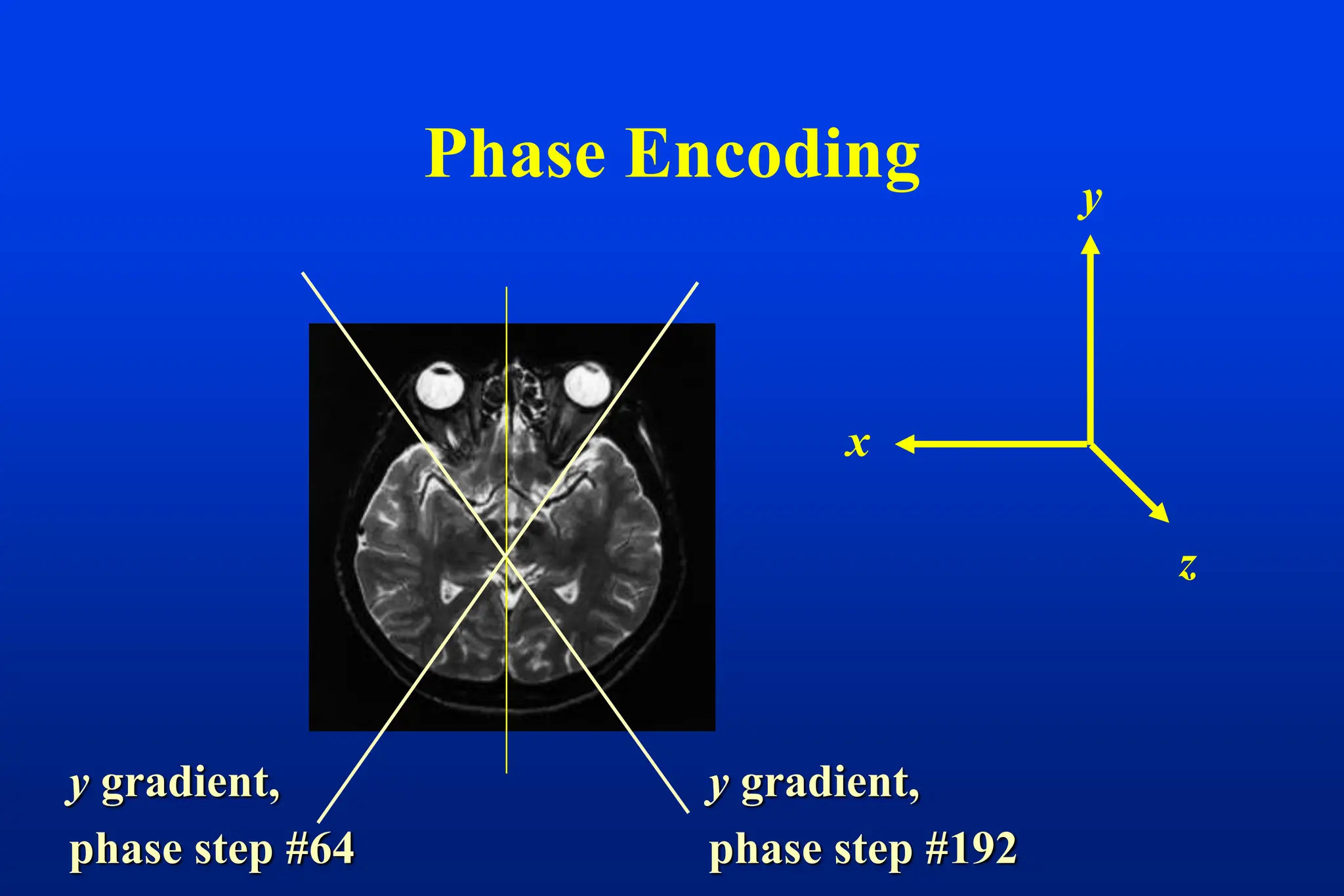
z
y
x
y gradient,
phase step #192
y gradient,
phase step #64
Phase Encoding
2D k-space matrix
gradient strength +128
RF in RF out A/D conversion
gradient strength N
RF in RF out A/D conversion
gradient strength -128
RF in RF out A/D conversion
                 






END
BEGIN
line 128
line N
line -128
                 
                 
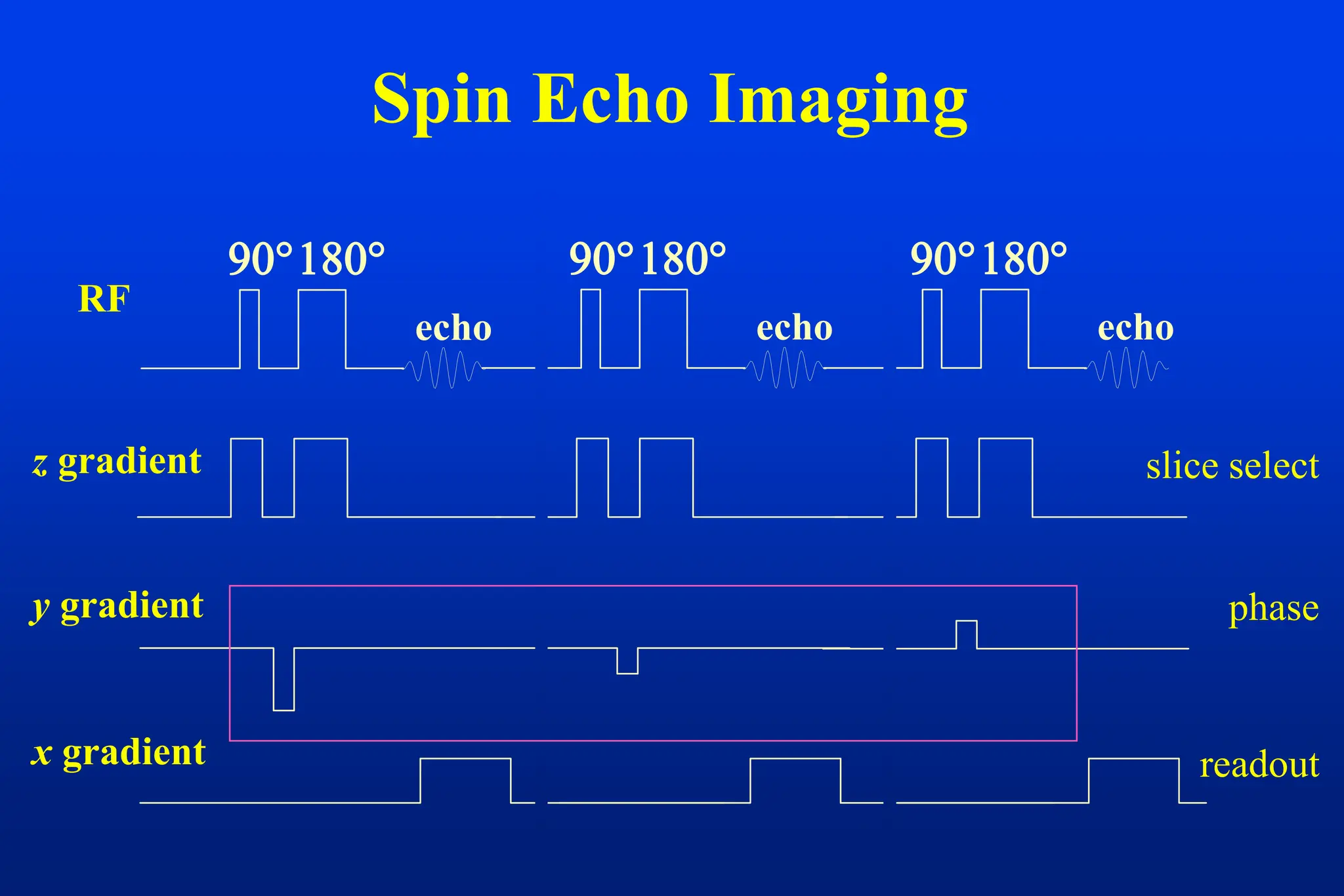
Spin Echo Imaging
RF
z gradient
echo

echo

echo

y gradient
x gradient
slice select
phase
readout
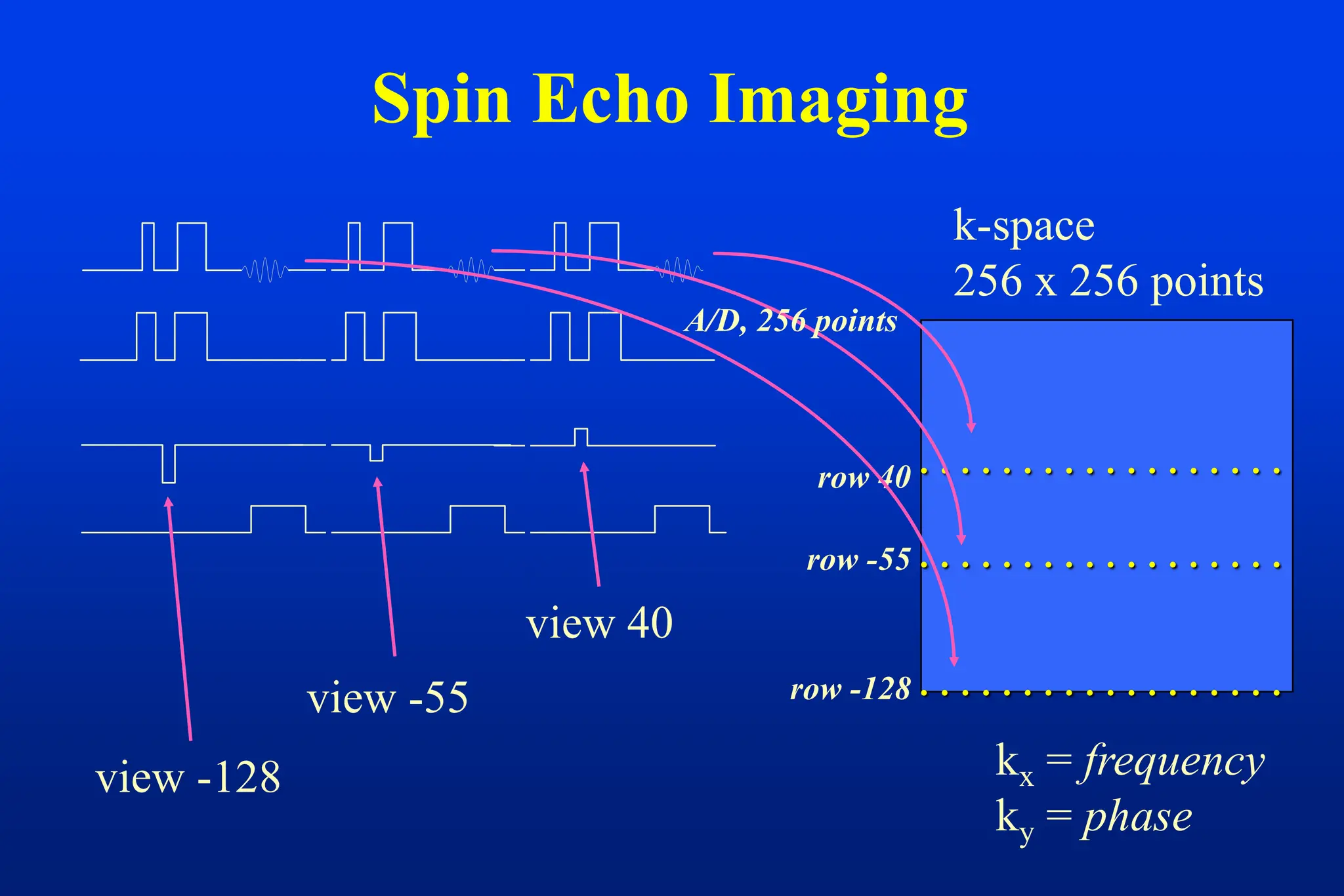
Spin Echo Imaging
view -128
view -55
view 40
                 
                 
                 
k-space
256 x 256 points
row 40
row -55
row -128
A/D, 256 points
kx = frequency
ky = phase
• Acquisition of spatially encoded data as
described allows for reconstruction of the
MR image.
• The frequency and phase data are acquired
and form points in a 2D array .
• Reconstruction of the image is provided by
2D inverse Fourier transform of the
2D array.
• This method of spatially encoding the MR
image is called 2D FT imaging.
MR Image Reconstruction
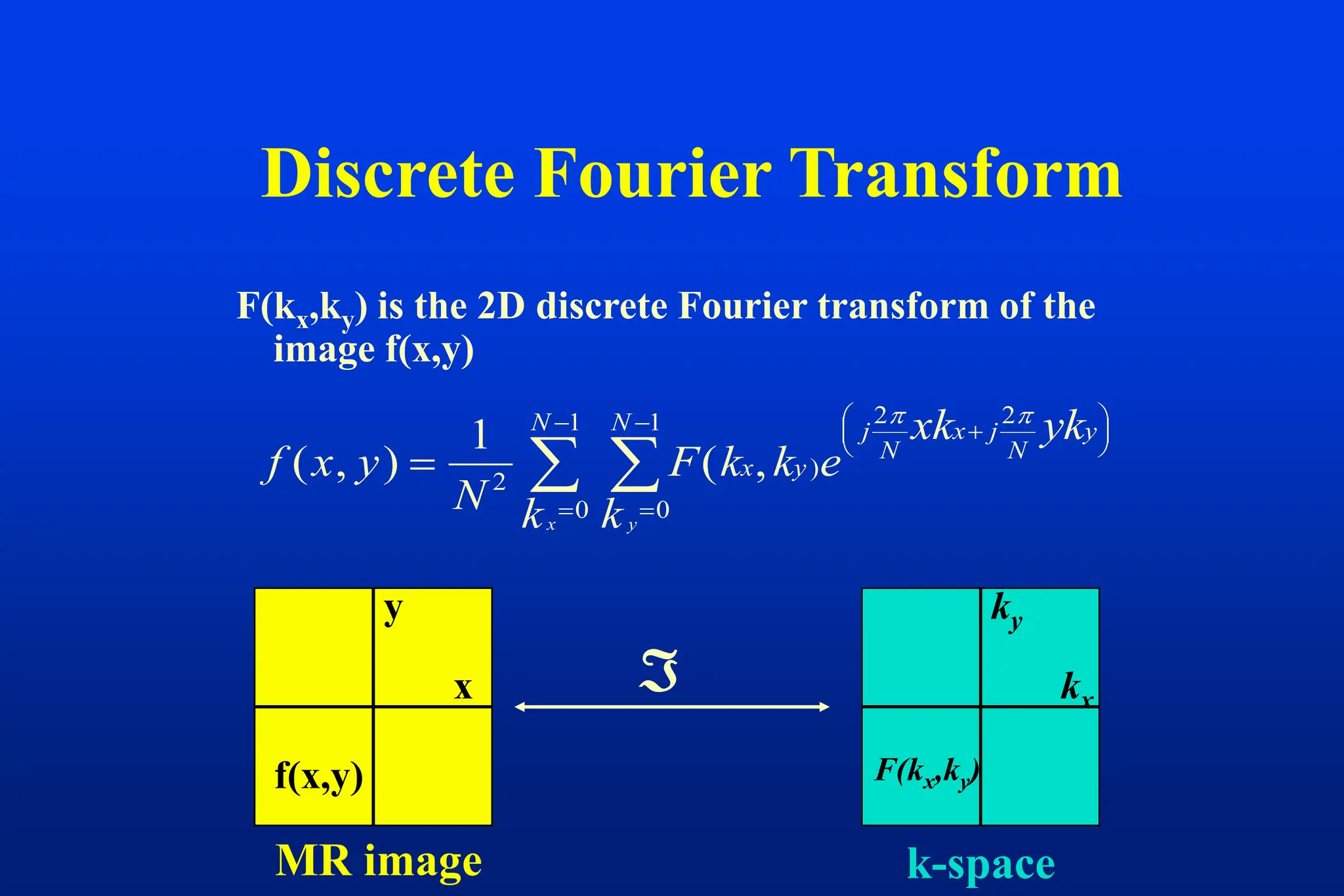
Discrete Fourier Transform
F(kx,ky) is the 2D discrete Fourier transform of the
image f(x,y)
f x y
N
F k k e
xk yk
k
k
x y
j
N
x j
N
y
N
N
y
x
( , ) ( , )














1
2
2 2
0
1
0
1  
x
y
f(x,y)
kx
ky

k-space
F(kx,ky)
MR image
Image Resolution and Phase Encoding
• Resolution is always maximum in the
frequency encoding direction because the MR
signal is always digitized into 256 points.
• Resolution can vary in the phase encoding
direction depending on the number of phase
steps used to acquire the image.
• Because each phase encoding requires a
separate 90 and 180 degree pulse, image
acquisition time is proportional to the number
of phase encode steps.
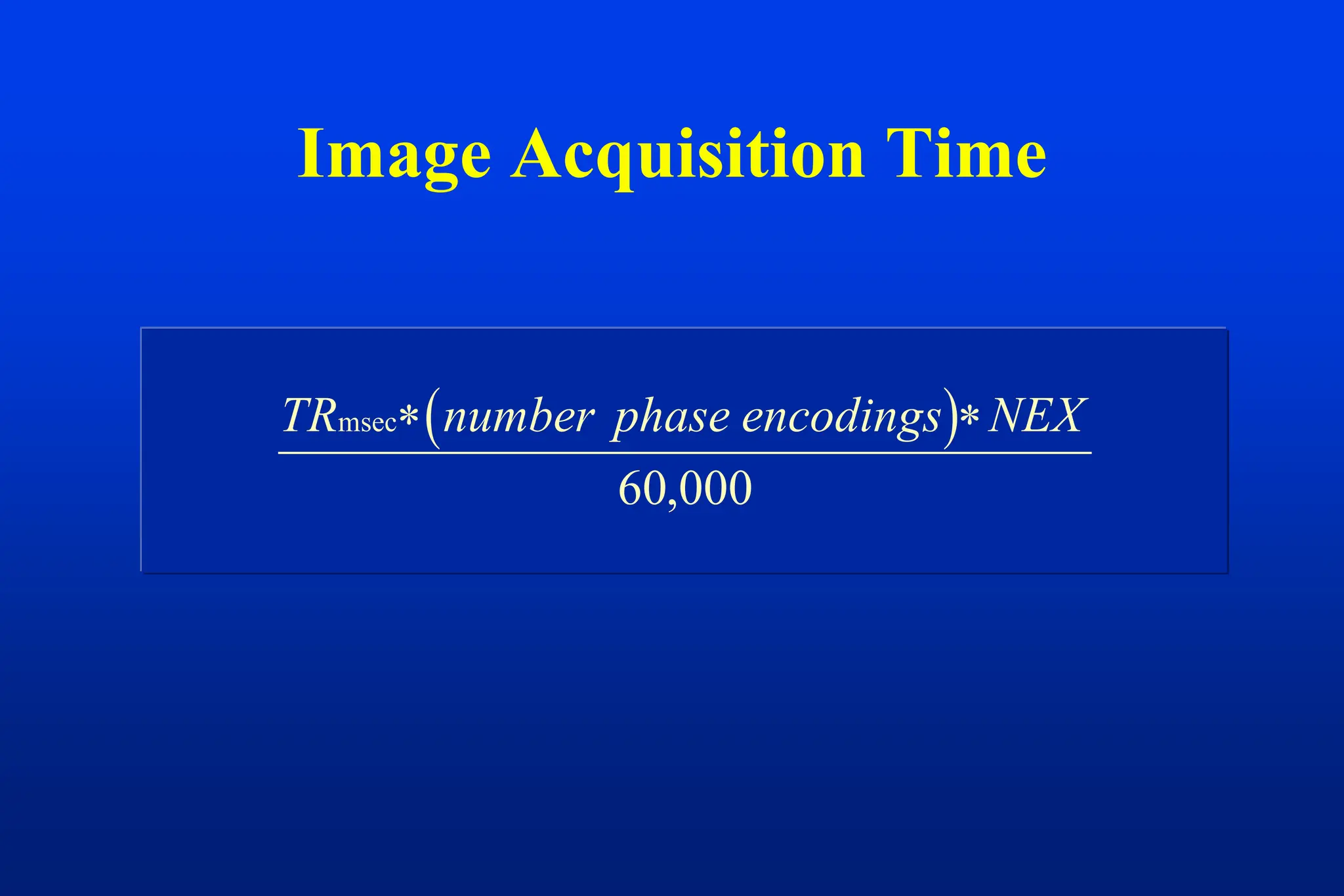
Image Acquisition Time
 
TR number phase encodings NEX
msec 
60,000
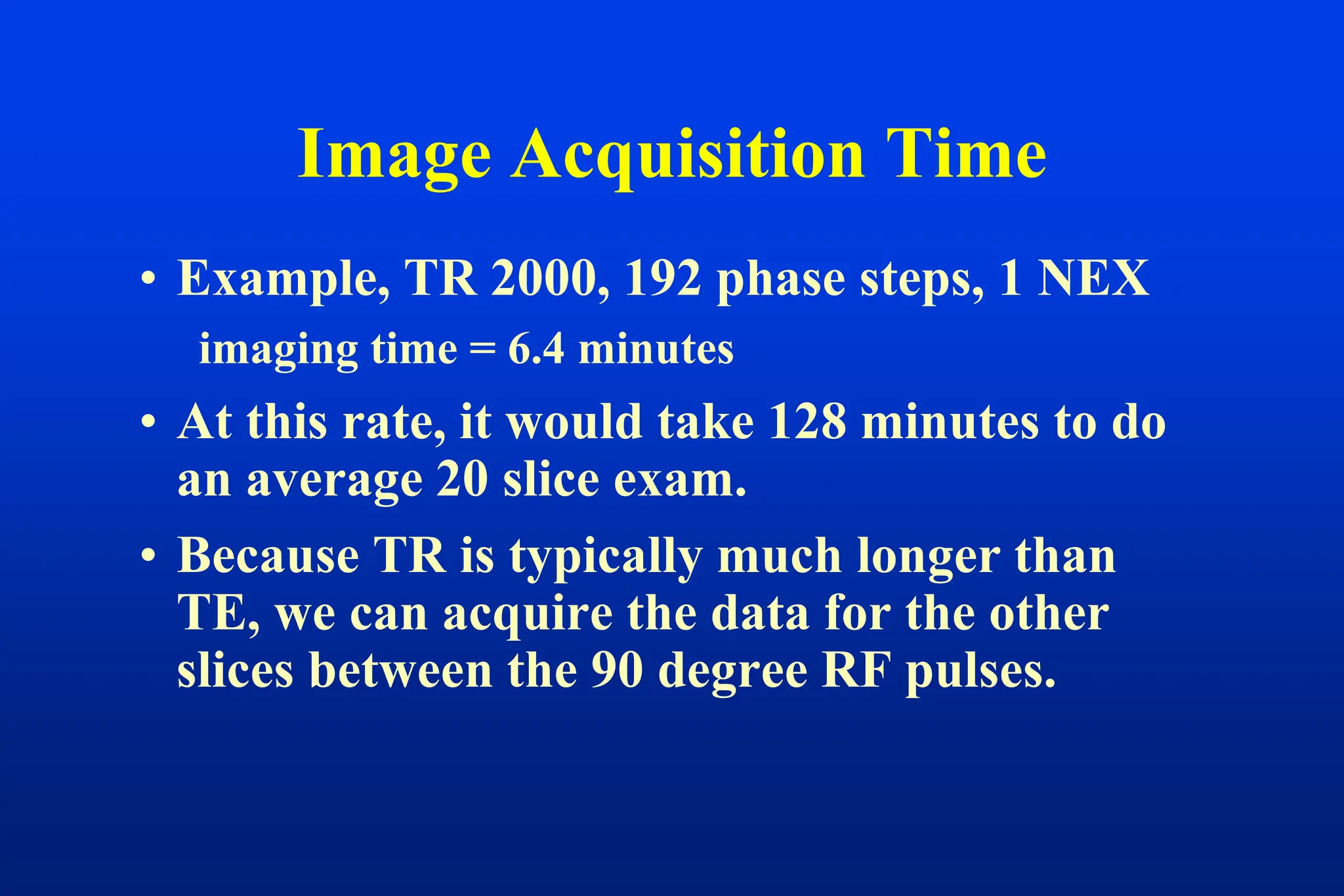
• Example, TR 2000, 192 phase steps, 1 NEX
imaging time = 6.4 minutes
• At this rate, it would take 128 minutes to do
an average 20 slice exam.
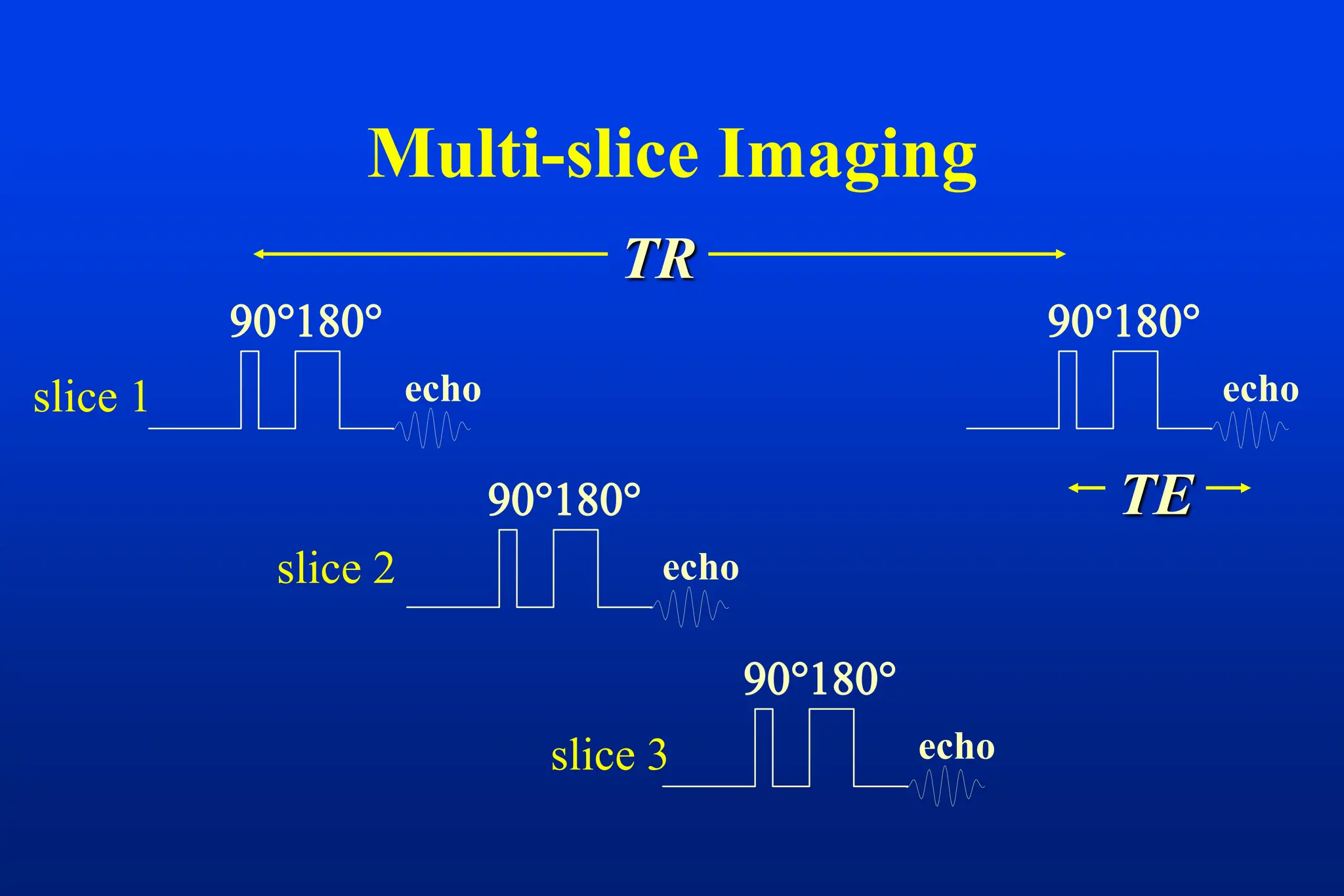
• Because TR is typically much longer than
TE, we can acquire the data for the other
slices between the 90 degree RF pulses.
Image Acquisition Time
Multi-slice Imaging
echo

echo

echo

echo

slice 1
slice 2
slice 3
TR
TE
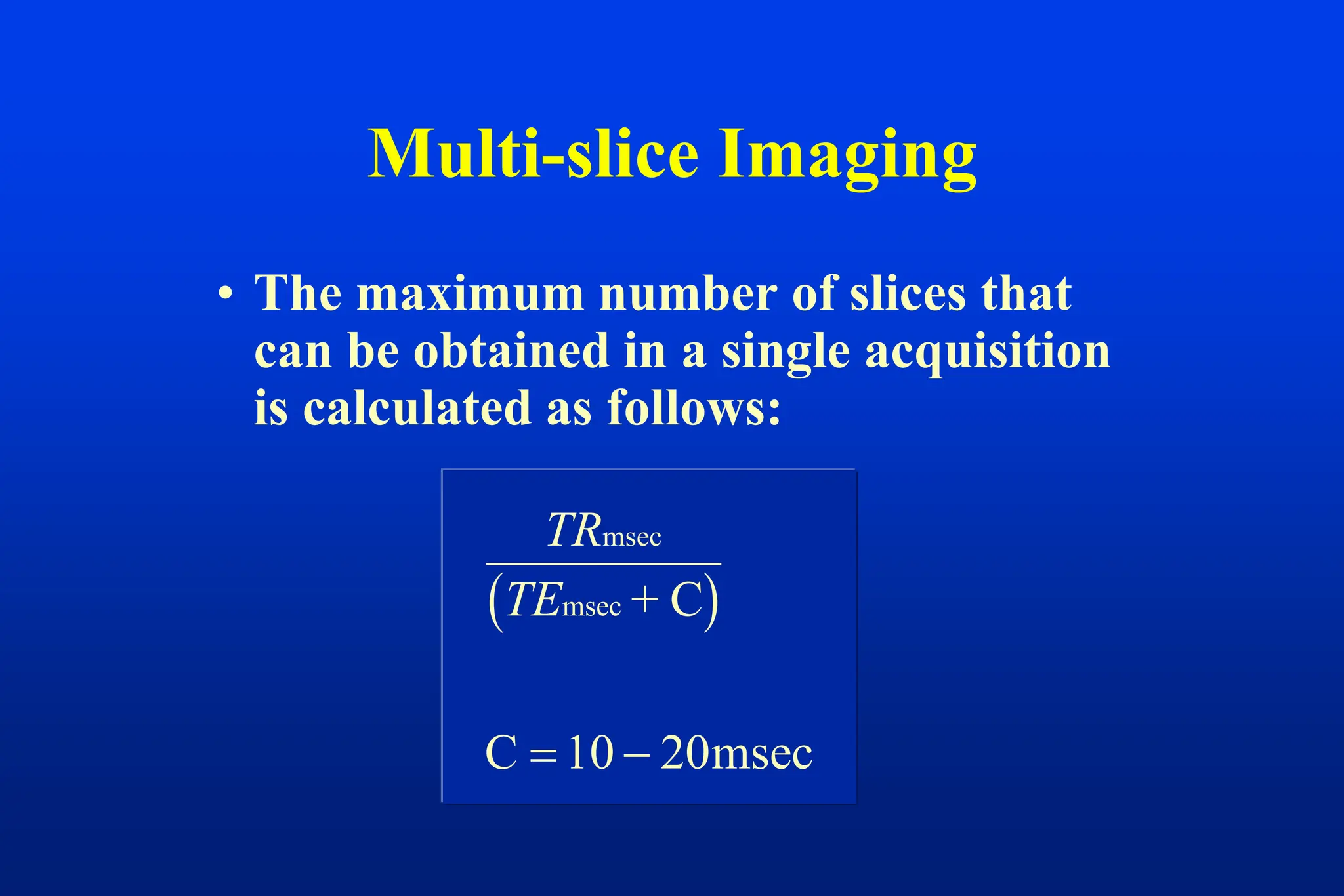
• The maximum number of slices that
can be obtained in a single acquisition
is calculated as follows:
Multi-slice Imaging
 
TR
TE
msec
msec + C
C msec
 
10 20
k-space Traversal
• The most important phase encoding
information is centered around the
middle of k-space.
• Typically, k-space is filled in an orderly
manner, beginning with the returned
echos obtained at the maximum negative
y gradient strength and continuing to the
maximum positive value.
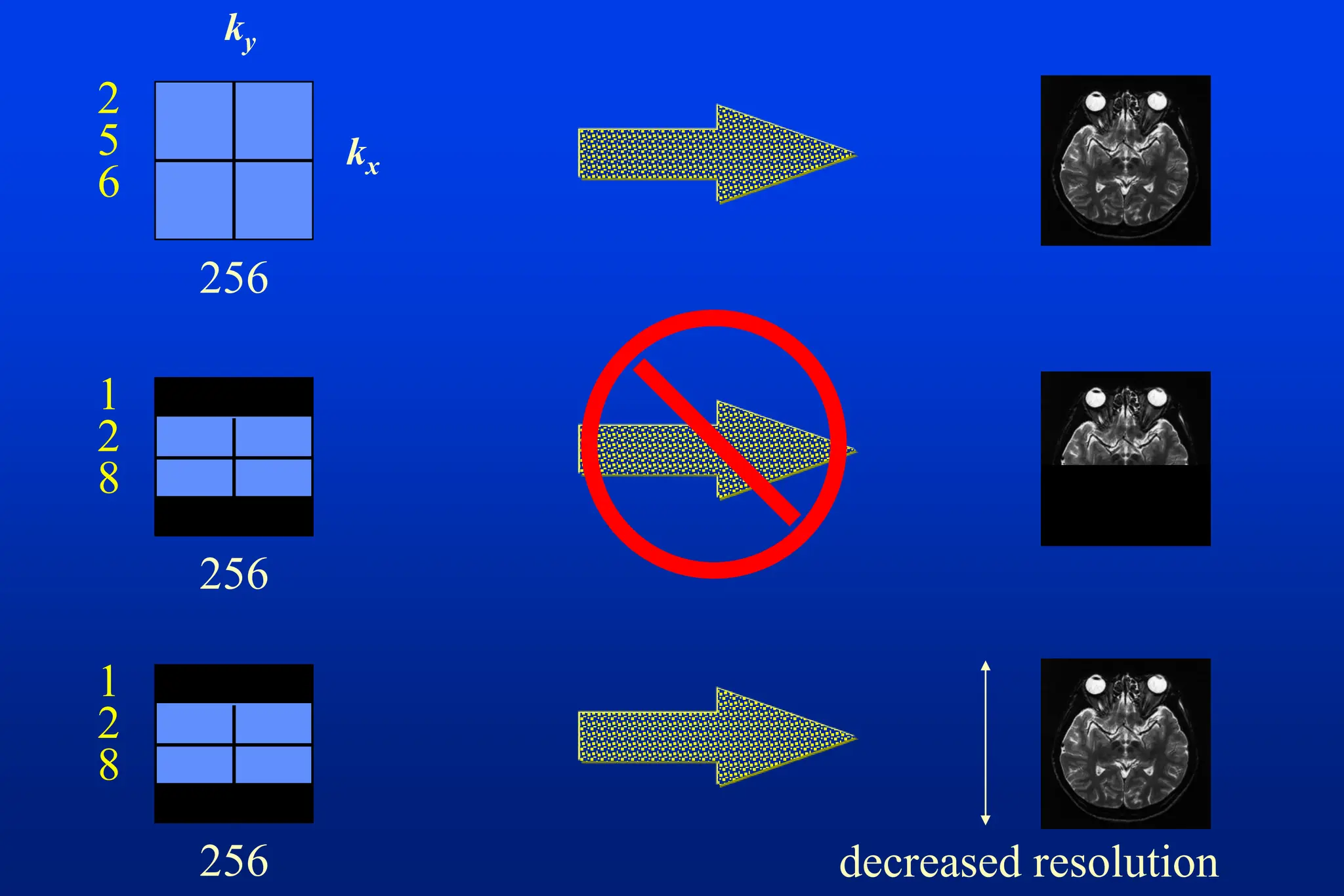
• For images obtained with less than
256 views, the number of phase
encodings is evenly divided between
positive and negative values centered
around zero.
• Images reconstructed with less than
256 phase encodings have less detail in
the phase encoding direction.
k-space Traversal
kx
ky
256
2
5
6
256
1
2
8
256
1
2
8
decreased resolution
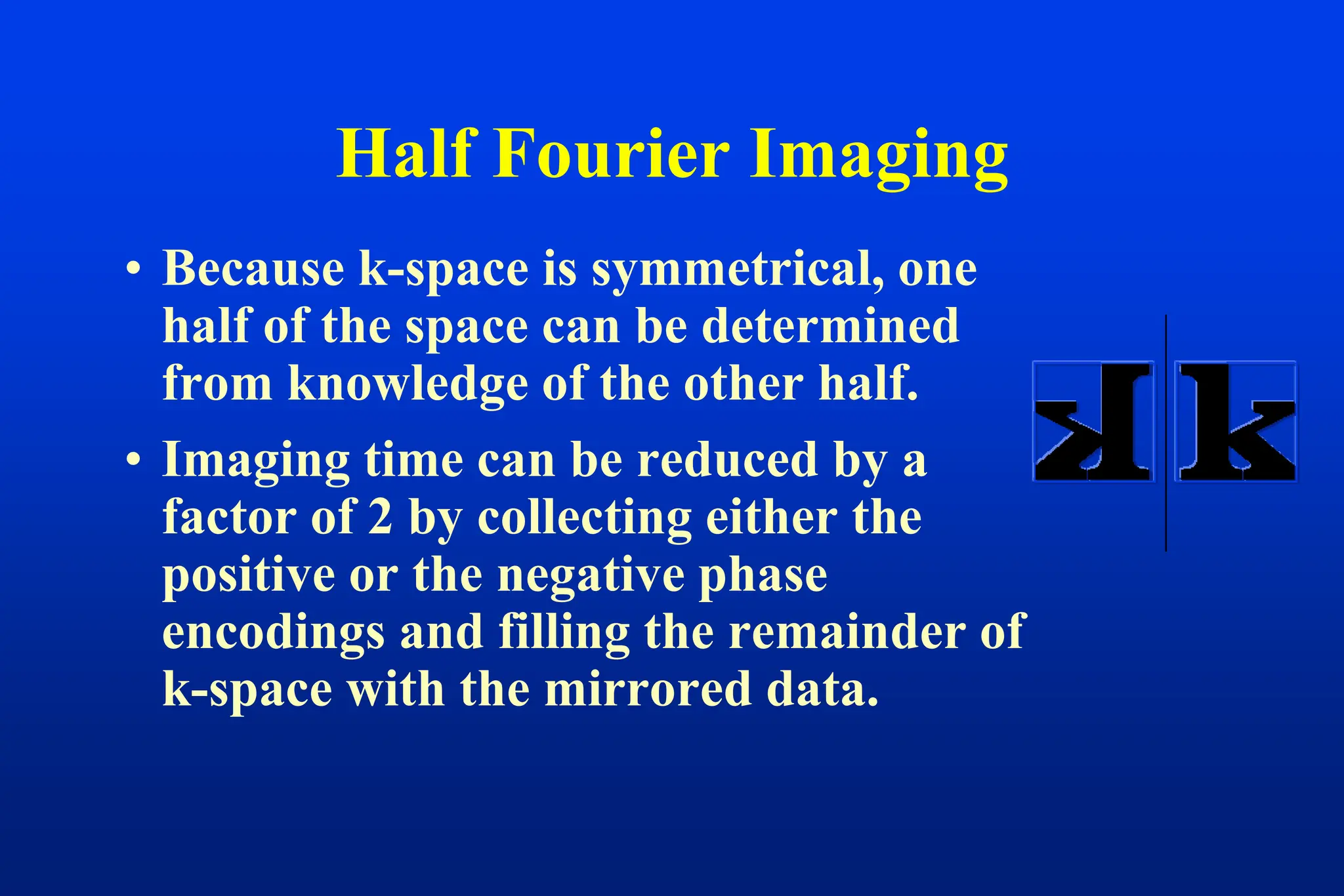
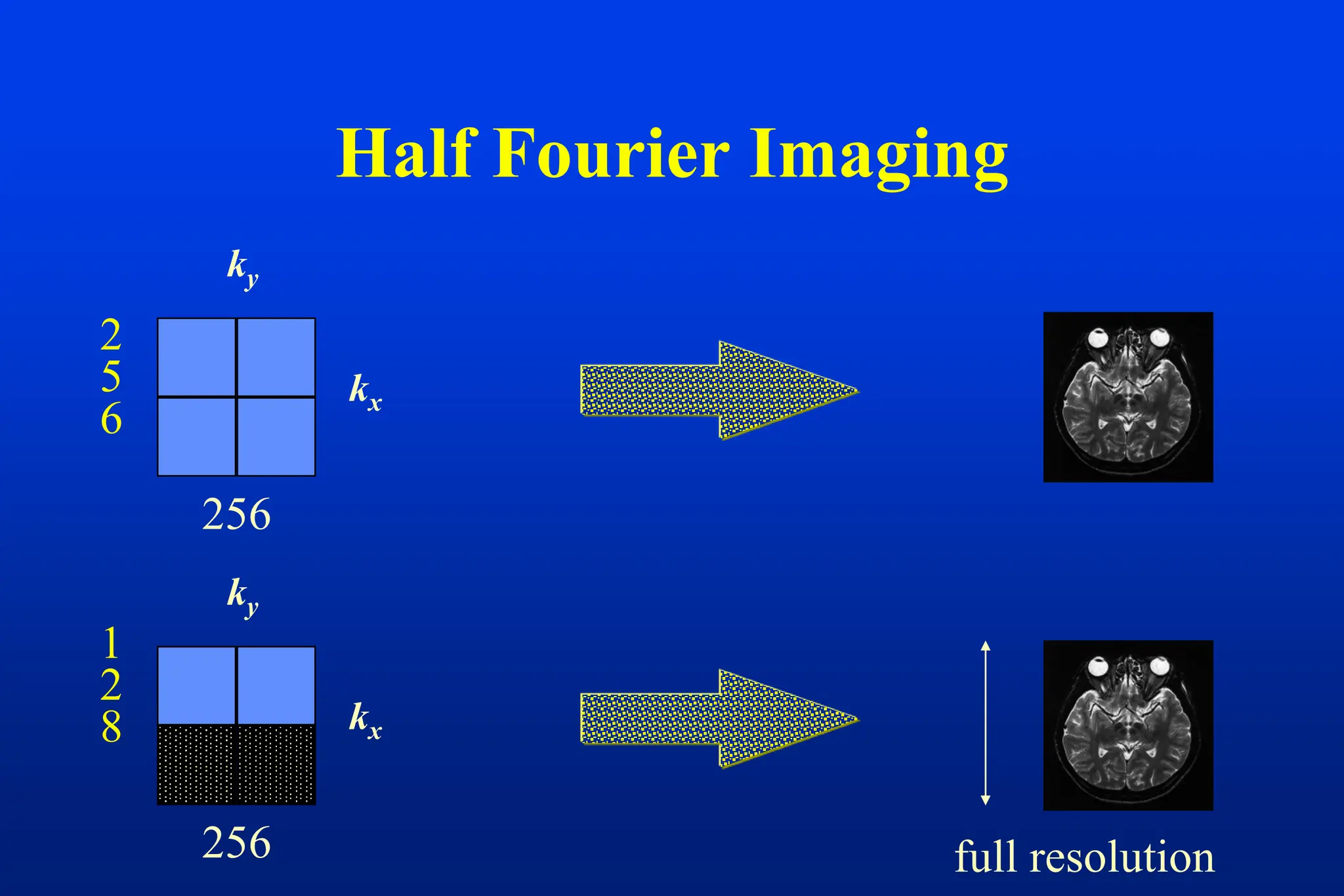
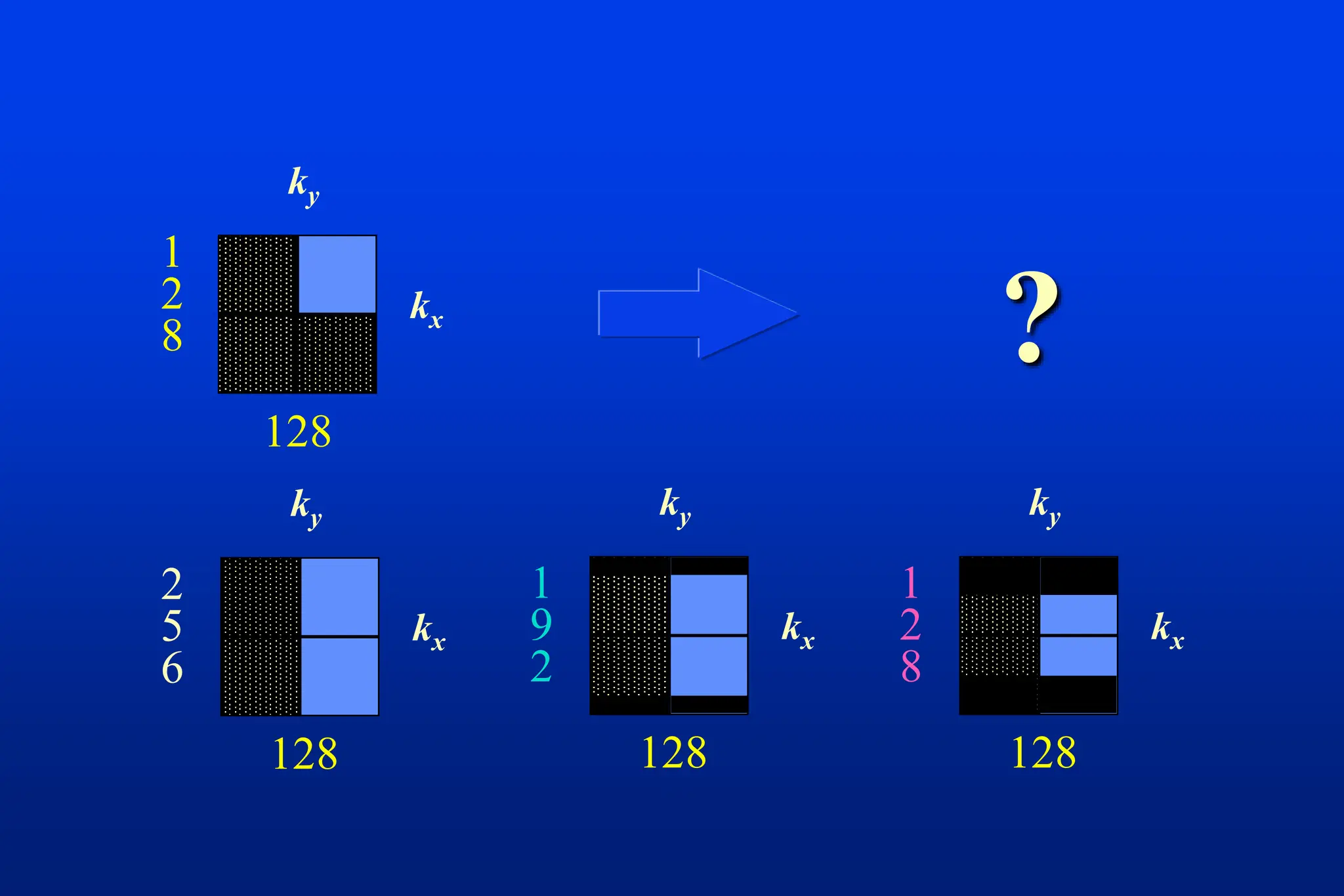
• Because k-space is symmetrical, one
half of the space can be determined
from knowledge of the other half.
• Imaging time can be reduced by a
factor of 2 by collecting either the
positive or the negative phase
encodings and filling the remainder of
k-space with the mirrored data.
Half Fourier Imaging
kx
ky
256
2
5
6
kx
ky
256
1
2
8
full resolution
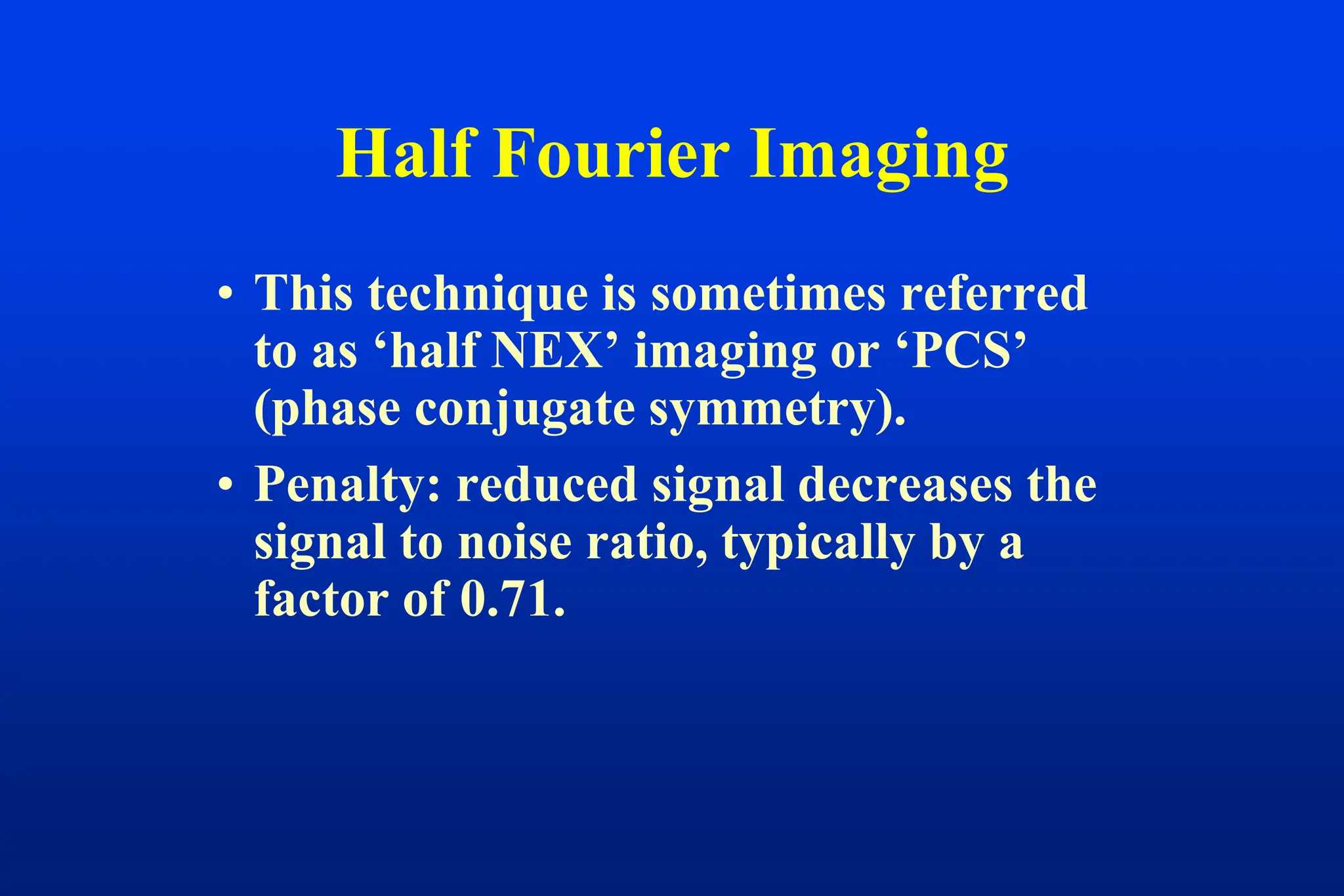
• This technique is sometimes referred
to as ‘half NEX’ imaging or ‘PCS’
(phase conjugate symmetry).
• Penalty: reduced signal decreases the
signal to noise ratio, typically by a
factor of 0.71.
Half Fourier Imaging
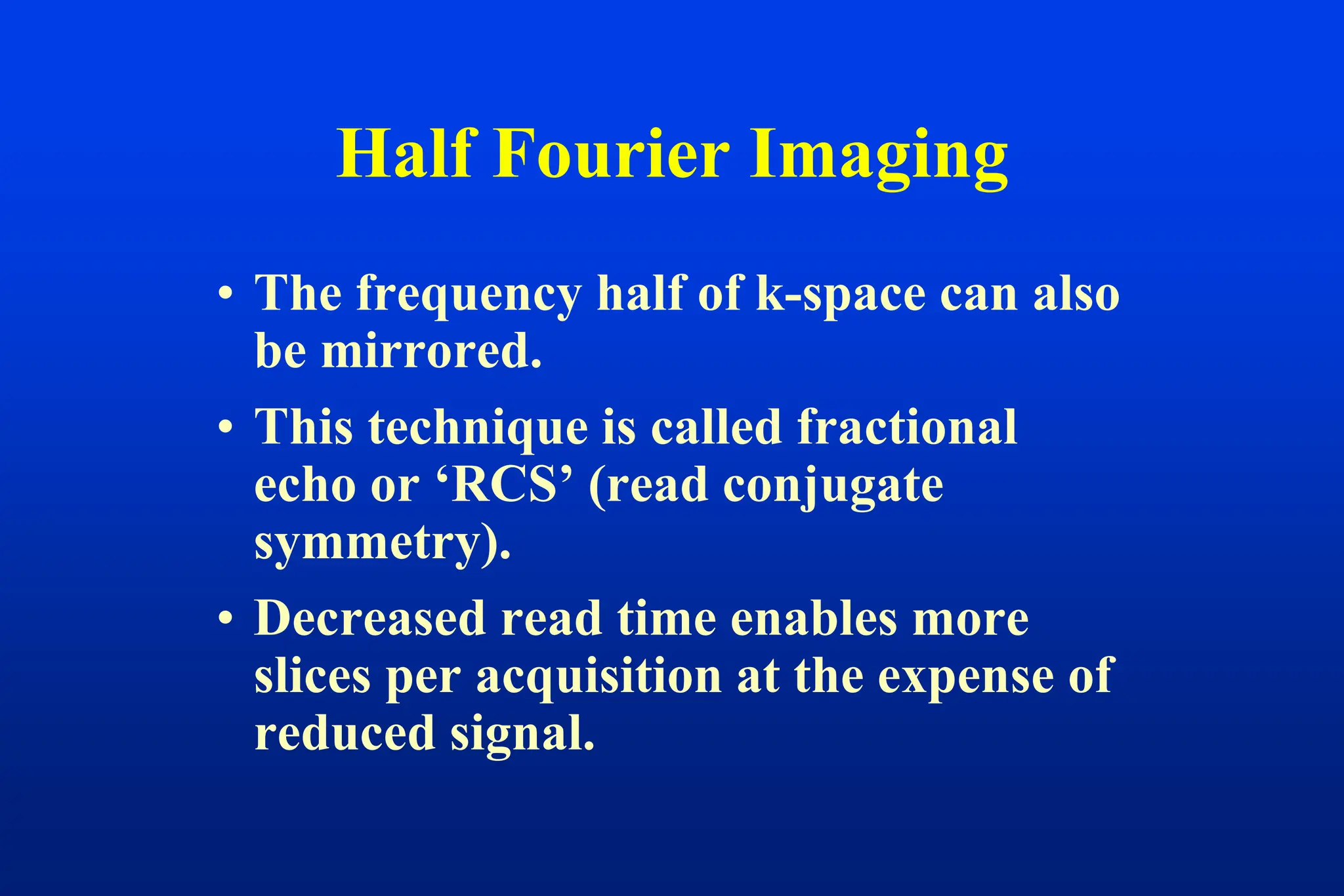
• The frequency half of k-space can also
be mirrored.
• This technique is called fractional
echo or ‘RCS’ (read conjugate
symmetry).
• Decreased read time enables more
slices per acquisition at the expense of
reduced signal.
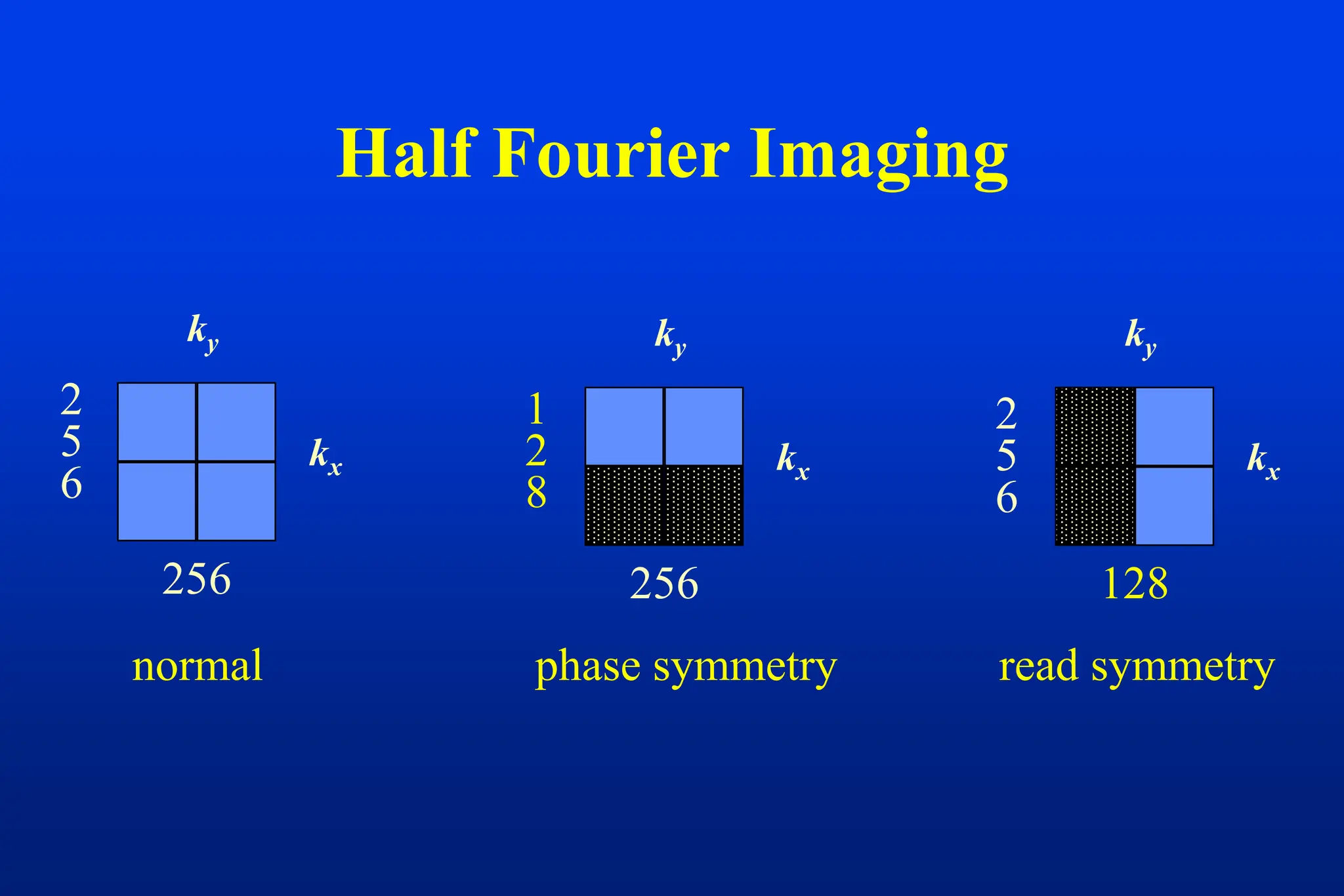
Half Fourier Imaging
kx
ky
256
2
5
6
256
kx
ky
1
2
8
normal phase symmetry
kx
ky
128
2
5
6
read symmetry
kx
ky
128
1
2
8 ?
128
kx
ky
2
5
6
128
kx
ky
1
9
2
128
kx
ky
1
2
8
3D Acquisition
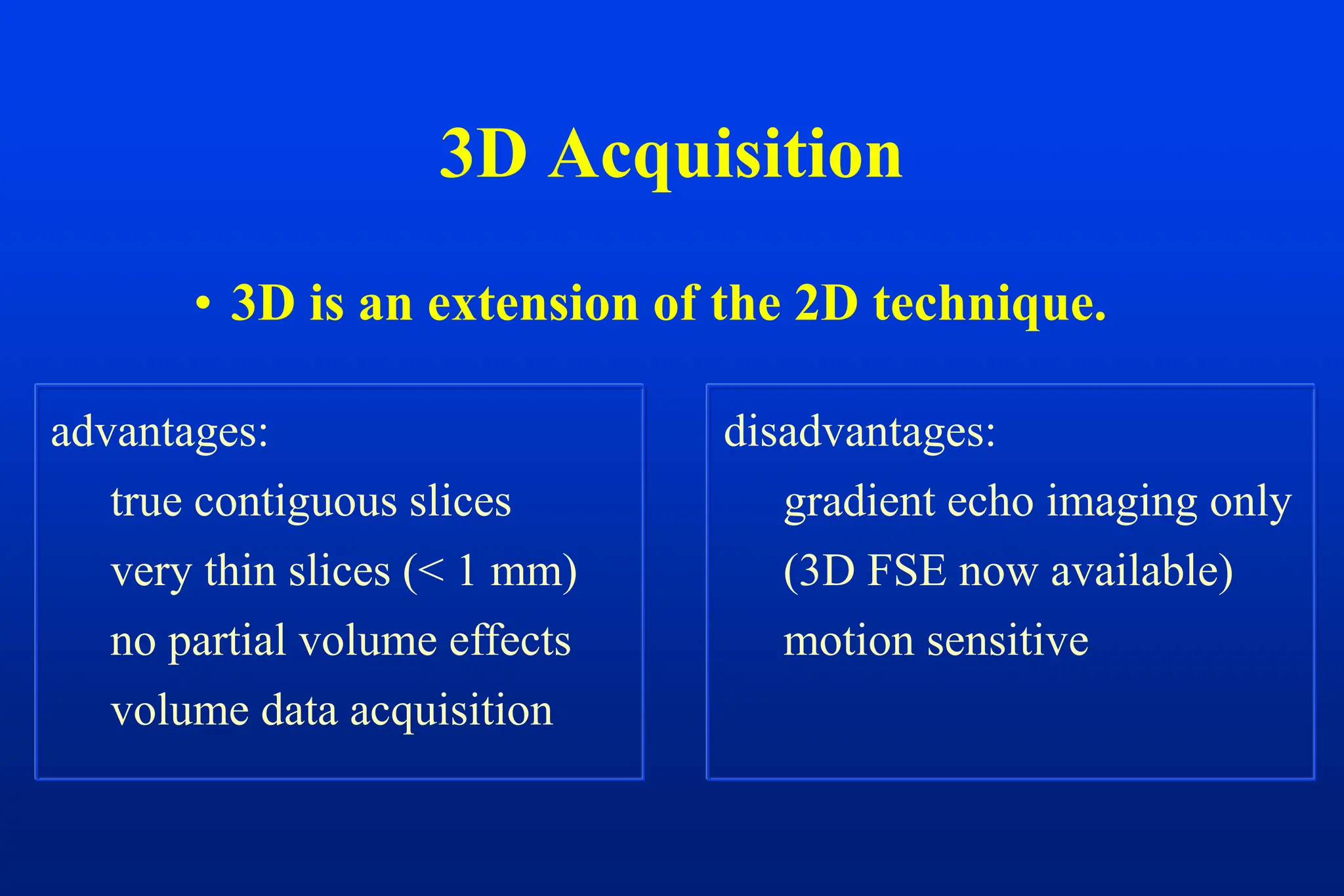
• 3D is an extension of the 2D technique.
advantages:
true contiguous slices
very thin slices (< 1 mm)
no partial volume effects
volume data acquisition
disadvantages:
gradient echo imaging only
(3D FSE now available)
motion sensitive
3D Acquisition
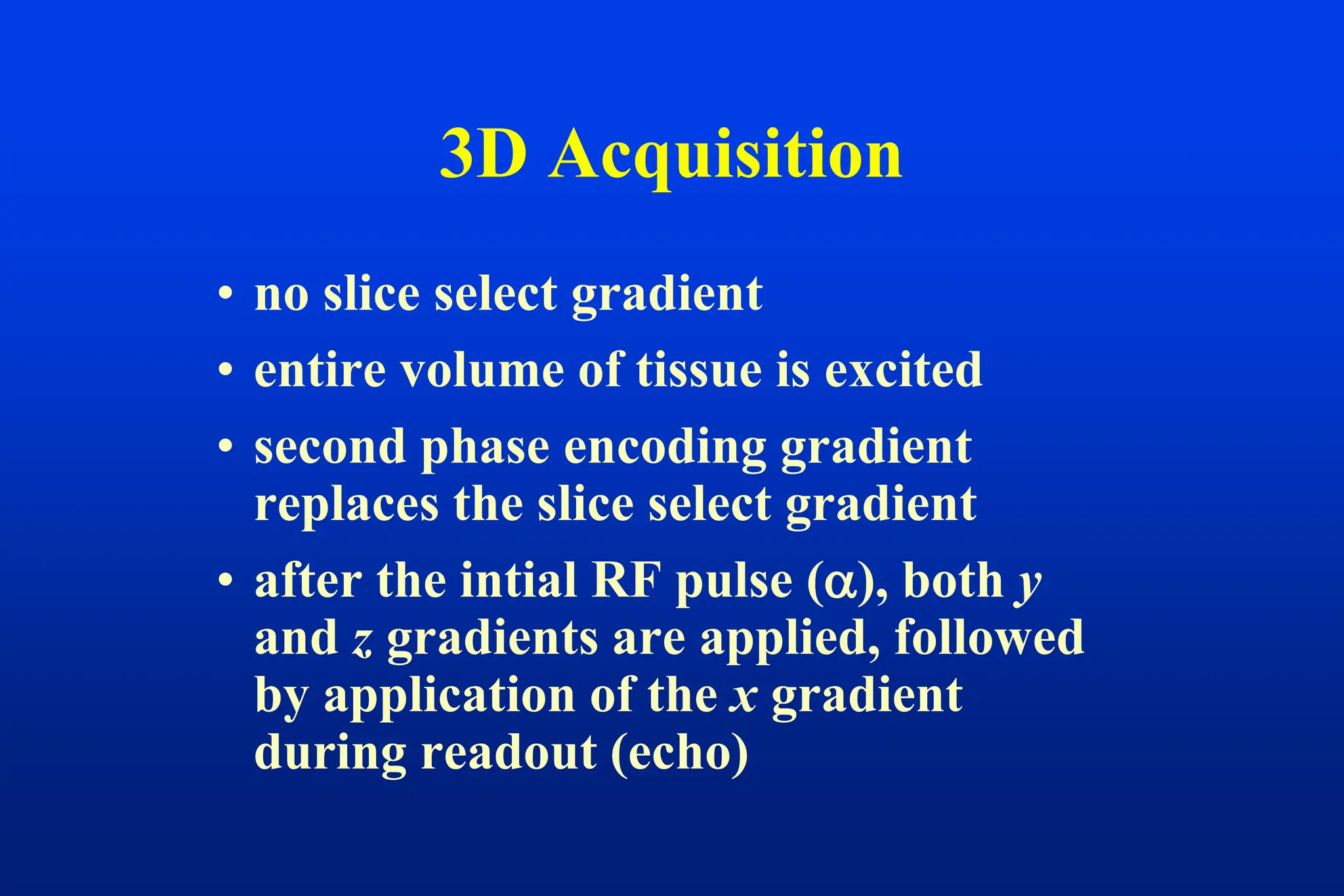
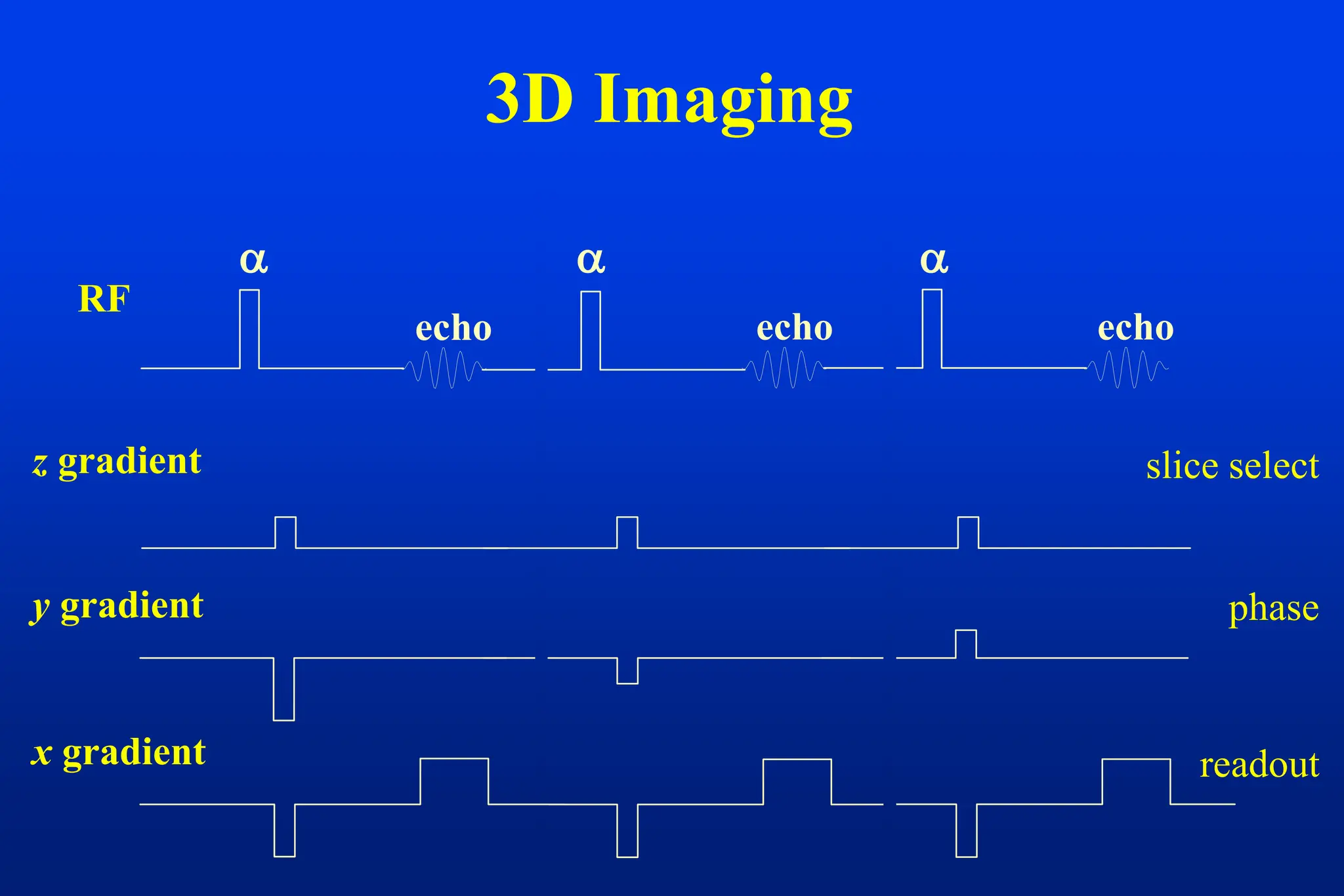
• no slice select gradient
• entire volume of tissue is excited
• second phase encoding gradient
replaces the slice select gradient
• after the intial RF pulse (), both y
and z gradients are applied, followed
by application of the x gradient
during readout (echo)
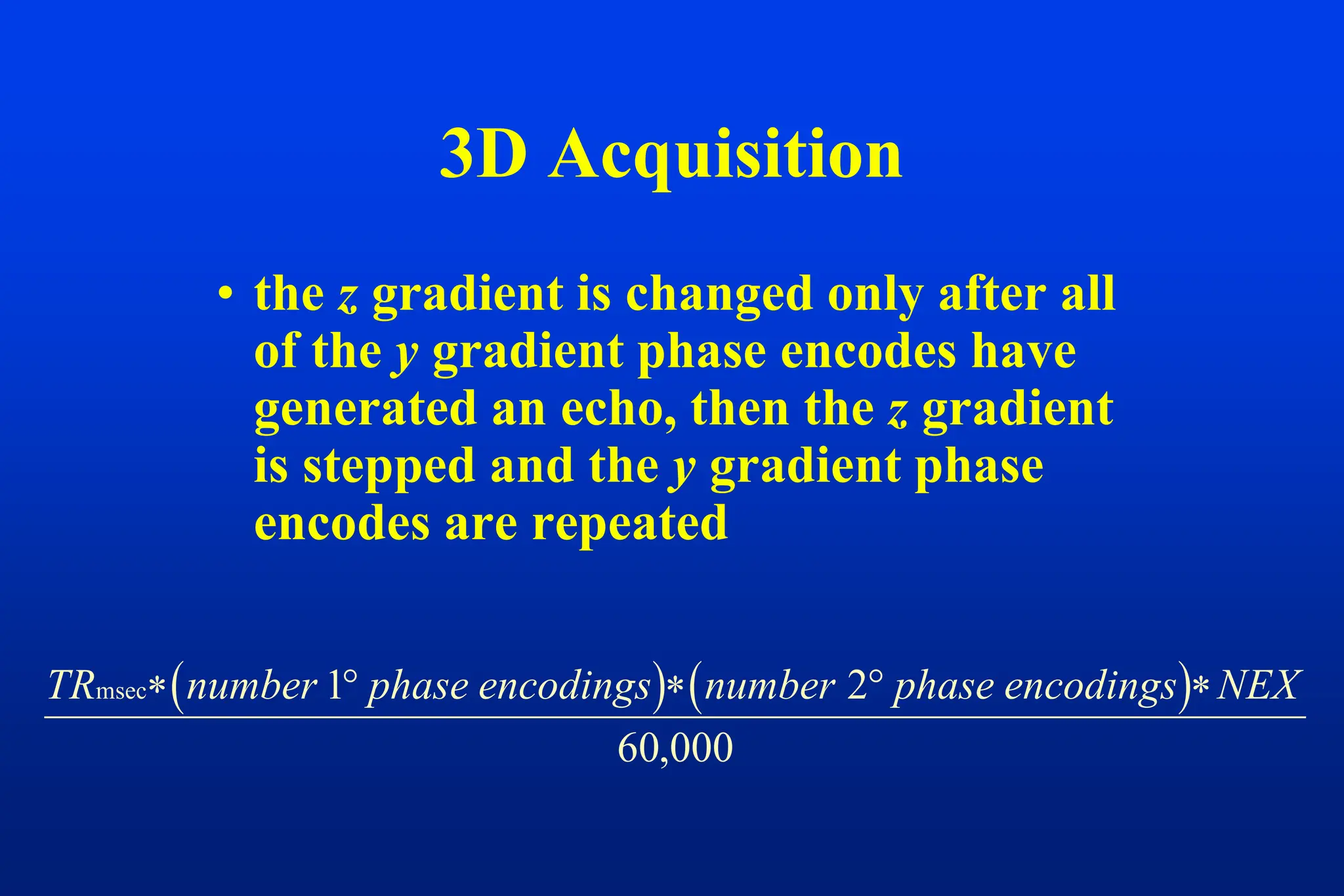
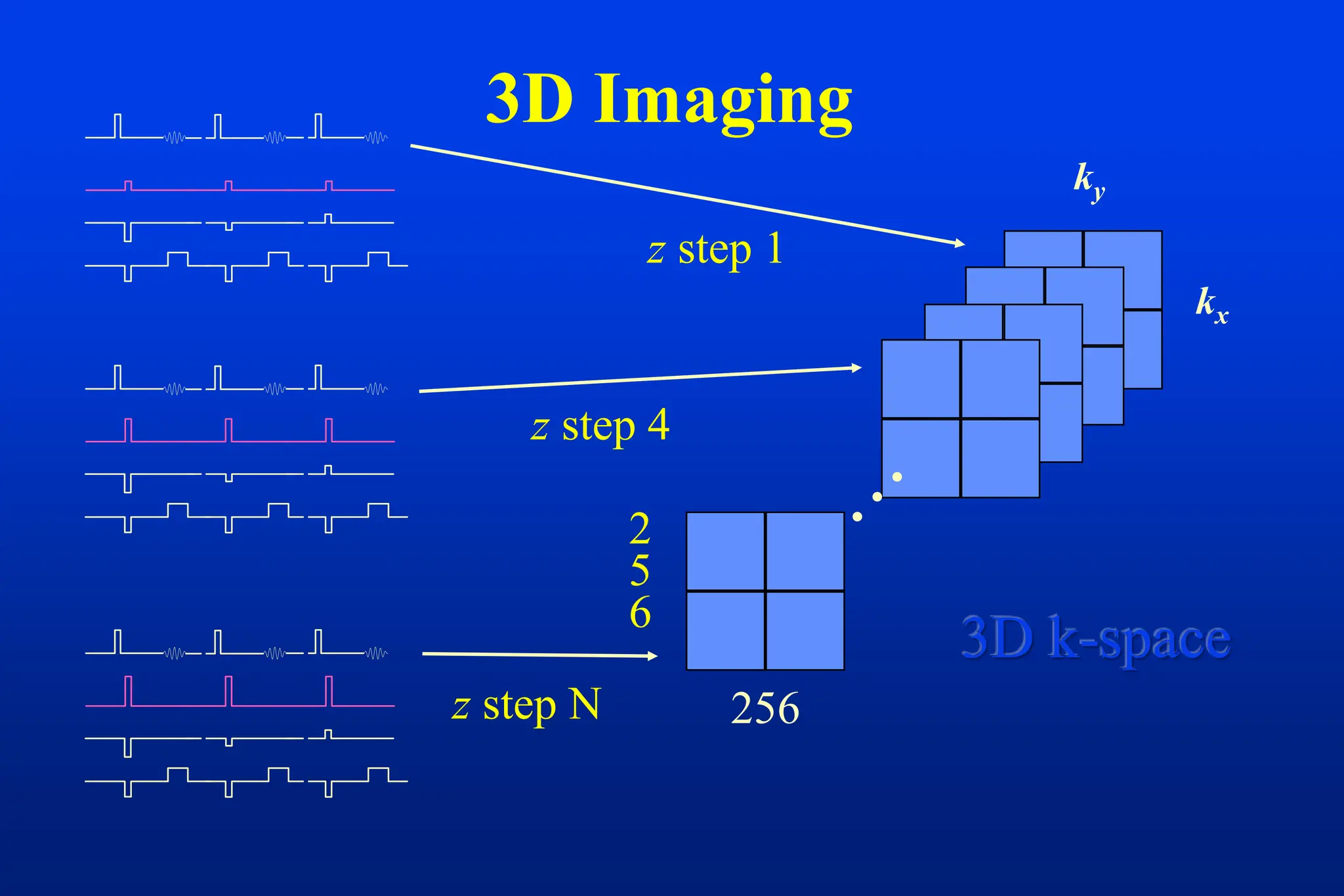
• the z gradient is changed only after all
of the y gradient phase encodes have
generated an echo, then the z gradient
is stepped and the y gradient phase
encodes are repeated
3D Acquisition
   
TR number phase encodings number phase encodings NEX
msec    
1 2
60,000
3D Imaging
RF
z gradient
echo

echo

echo

y gradient
x gradient
slice select
phase
readout
3D Imaging
kx
ky
256
2
5
6



z step 1
z step 4
z step N
3D k-space

Principles of MRI Physics and Engineering.ppt

  • 1.
  • 2.
  • 3.
    Slice Selection slice thicknessis determined by gradient strength     RF bandwidth     t1 t2 t3
  • 4.
    Slice Selection Selection ofan axial slice is accomplished by the z gradient. z gradient direction  graph of the z magnetic gradient z-axis    
  • 5.
    Slice Selection slice locationis determined by the null point of the z gradient     RF bandwidth slice 1  slice 2 slice 3   
  • 6.
    Frequency Encoding • Withinthe imaging plane, a small gradient is applied left to right to allow for spatial encoding in the x direction. • Tissues on the left will have a slightly higher resonance frequency than tissues on the right. • The superposition of an x gradient on the patient is called frequency encoding. • Frequency encoding enables spatial localization in the L-R direction only.
  • 7.
    Frequency Encoding z y x x gradient higherfrequency lower frequency L R
  • 8.
    Frequency Encoding RF signal fromentire slice A/D conversion, 256 points 1 line of k-space
  • 9.
    Phase Encoding • Anadditional gradient is applied in the y direction to encode the image in the remaining direction. • Because the x gradient alters the frequencies in the received signal according to spatial location, the y gradient must alter the phase of the signal. • Thus, the points of k-space are revealed by recording the digitized RF signal after a phase encoding gradient application.
  • 10.
    Phase Encoding • Thetechnique of phase encoding the second dimension in the imaging plane is sometimes referred to as spin warping. • The phase encoding gradient is “stepped” during the acquisition of image data for a single slice. Each step provides a unique phase encoding. • For a 256 x 256 square image matrix, 256 unique phase encodings must be performed for each image slice. The second 256 points in the x direction are obtained by A to D conversion of the received signal.
  • 11.
    Phase Encoding z y x y gradient, phasestep #192 y gradient, phase step #64
  • 12.
    Phase Encoding 2D k-spacematrix gradient strength +128 RF in RF out A/D conversion gradient strength N RF in RF out A/D conversion gradient strength -128 RF in RF out A/D conversion                         END BEGIN line 128 line N line -128                                    
  • 13.
    Spin Echo Imaging RF zgradient echo  echo  echo  y gradient x gradient slice select phase readout
  • 14.
    Spin Echo Imaging view-128 view -55 view 40                                                       k-space 256 x 256 points row 40 row -55 row -128 A/D, 256 points kx = frequency ky = phase
  • 15.
    • Acquisition ofspatially encoded data as described allows for reconstruction of the MR image. • The frequency and phase data are acquired and form points in a 2D array . • Reconstruction of the image is provided by 2D inverse Fourier transform of the 2D array. • This method of spatially encoding the MR image is called 2D FT imaging. MR Image Reconstruction
  • 16.
    Discrete Fourier Transform F(kx,ky)is the 2D discrete Fourier transform of the image f(x,y) f x y N F k k e xk yk k k x y j N x j N y N N y x ( , ) ( , )               1 2 2 2 0 1 0 1   x y f(x,y) kx ky  k-space F(kx,ky) MR image
  • 17.
    Image Resolution andPhase Encoding • Resolution is always maximum in the frequency encoding direction because the MR signal is always digitized into 256 points. • Resolution can vary in the phase encoding direction depending on the number of phase steps used to acquire the image. • Because each phase encoding requires a separate 90 and 180 degree pulse, image acquisition time is proportional to the number of phase encode steps.
  • 18.
    Image Acquisition Time  TR number phase encodings NEX msec  60,000
  • 19.
    • Example, TR2000, 192 phase steps, 1 NEX imaging time = 6.4 minutes • At this rate, it would take 128 minutes to do an average 20 slice exam. • Because TR is typically much longer than TE, we can acquire the data for the other slices between the 90 degree RF pulses. Image Acquisition Time
  • 20.
  • 21.
    • The maximumnumber of slices that can be obtained in a single acquisition is calculated as follows: Multi-slice Imaging   TR TE msec msec + C C msec   10 20
  • 22.
    k-space Traversal • Themost important phase encoding information is centered around the middle of k-space. • Typically, k-space is filled in an orderly manner, beginning with the returned echos obtained at the maximum negative y gradient strength and continuing to the maximum positive value.
  • 23.
    • For imagesobtained with less than 256 views, the number of phase encodings is evenly divided between positive and negative values centered around zero. • Images reconstructed with less than 256 phase encodings have less detail in the phase encoding direction. k-space Traversal
  • 24.
  • 25.
    • Because k-spaceis symmetrical, one half of the space can be determined from knowledge of the other half. • Imaging time can be reduced by a factor of 2 by collecting either the positive or the negative phase encodings and filling the remainder of k-space with the mirrored data. Half Fourier Imaging
  • 26.
  • 27.
    • This techniqueis sometimes referred to as ‘half NEX’ imaging or ‘PCS’ (phase conjugate symmetry). • Penalty: reduced signal decreases the signal to noise ratio, typically by a factor of 0.71. Half Fourier Imaging
  • 28.
    • The frequencyhalf of k-space can also be mirrored. • This technique is called fractional echo or ‘RCS’ (read conjugate symmetry). • Decreased read time enables more slices per acquisition at the expense of reduced signal. Half Fourier Imaging
  • 29.
    Half Fourier Imaging kx ky 256 2 5 6 256 kx ky 1 2 8 normalphase symmetry kx ky 128 2 5 6 read symmetry
  • 30.
  • 31.
    3D Acquisition • 3Dis an extension of the 2D technique. advantages: true contiguous slices very thin slices (< 1 mm) no partial volume effects volume data acquisition disadvantages: gradient echo imaging only (3D FSE now available) motion sensitive
  • 32.
    3D Acquisition • noslice select gradient • entire volume of tissue is excited • second phase encoding gradient replaces the slice select gradient • after the intial RF pulse (), both y and z gradients are applied, followed by application of the x gradient during readout (echo)
  • 33.
    • the zgradient is changed only after all of the y gradient phase encodes have generated an echo, then the z gradient is stepped and the y gradient phase encodes are repeated 3D Acquisition     TR number phase encodings number phase encodings NEX msec     1 2 60,000
  • 34.
    3D Imaging RF z gradient echo  echo  echo  ygradient x gradient slice select phase readout
  • 35.
    3D Imaging kx ky 256 2 5 6    z step1 z step 4 z step N 3D k-space