Primer on Commonly Occurring MRI Artifacts
and How to Overcome Them
Chikara Noda, PhD1
Bharath Ambale Venkatesh, PhD2
Jennifer D. Wagner, BS, RT3
Yoko Kato, MD, PhD1
Jason M. Ortman, RT1
João A.C. Lima, MD, MBA1
Author Affiliations:
1
Division of Cardiology, Johns Hopkins University School of Medicine, Baltimore, MD, USA
2
Division of Radiology, Johns Hopkins University School of Medicine, Baltimore, MD, USA
3
Canon Medical Research USA, Cleveland, OH, USA
Corresponding author:
J.A.C.L. (email: jlima@jhmi.edu)
Presented as an education exhibit at RSNA 2020 (HP137-ED-X). Supported by a National Institutes of
Health grant (133032) to Johns Hopkins University
Disclosures of conflicts of interest.—J.D.W. Employed by Canon Medical Research, USA. Part of
ongoing educational collaborations with Canon Medical Systems Corporation.
Introduction
Various artifacts can occur when acquiring MR images.
o MRI technologists need to know the causes of artifacts and how to avoid them in order to optimize
clinical examinations.
o Radiologists need to be aware of these artifacts in order to perform accurate readings.
This presentation describes:
o How artifacts relate to system conditions, patient physiology, or tissue characteristics
o How to identify artifacts and distinguish similar artifacts from each other
o How to mitigate artifacts in clinical practice
An abbreviations table and artifact map have also been included to make the relationships among
artifacts and the use of various terminology as clear as possible.
Learning Objectives
• Learn how to identify the artifacts presented here by taking note of
the specific details associated with each example.
• Understand the most common causes of each artifact and how to
mitigate its impact on image quality.
• Understand the pitfalls and trade-offs of each artifact reduction
strategy.
Primer Abbreviation Generic Term Vendor Nomenclature Primer Abbreviation Generic Term Vendor Nomenclature
B0 Main magnetic field PDW Proton-density–weighted
B1 Radiofrequency field PI Parallel imaging ASSET, SENSE, SPEEDER
BH Breath hold r R-factor or acceleration factor
bSSFP Balanced steady-state free
precession
True SSFP, FIESTA,
True FISP, balanced FFE
RF Radiofrequency
BW Bandwidth SAR Specific absorption rate
CS Compressed sensing Compressed SENSE,
Compressed SPEEDER
SE Spin echo SE
DSV Diameter spherical volume SNR Signal-to-noise ratio
ESP Echo spacing ETS, ESP SS-FSE Single-shot FSE FASE, SS-FSE, HASTE
ETL Echo train length ETL, TF T1-FFE RF-spoiled GRE FFE, FLASH, SPGR
f0 Center frequency T1W T1-weighted (dark fluid)
FS Fat saturation CHESS, Chem Sat, FS T2W T2-weighted (bright fluid)
FSE Fast-spin echo FSE, TSE TOF Time of flight MRA2D/3D, TOF
GRE Gradient-recalled echo FE, GRE UTE Ultrashort echo time mUTE, UTE
NSA Number of signal averages NAQ, NEX, NSA VENC Velocity encoding
Abbreviations
Abbreviations used throughout this primer, their definition, and their correlation with common vendor-
specific terms are shown here.
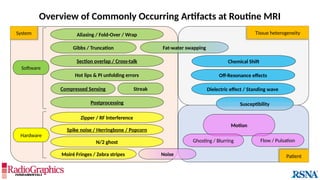
Motion
Chemical Shift
Dielectric effect / Standing wave
Susceptibility
Fat-water swapping
Overview of Commonly Occurring Artifacts at Routine MRI
Off-Resonance effects
Patient
Tissue heterogeneity
System
Flow / Pulsation
Ghosting / Blurring
Gibbs / Truncation
Aliasing / Fold-Over / Wrap
Section overlap / Cross-talk
Hot lips & PI unfolding errors
Streak
Software
Postprocessing
Compressed Sensing
Spike noise / Herringbone / Popcorn
Zipper / RF Interference
Moiré Fringes / Zebra stripes
Hardware
N/2 ghost
Noise
Causes
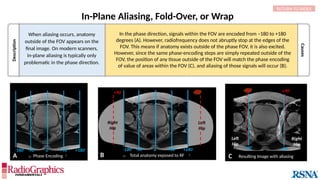
In-Plane Aliasing, Fold-Over, or Wrap
RETURN TO INDEX
Description
 Phase Encoding 
0◦
+90◦
-90◦
+180◦
-180◦
 Total anatomy exposed to RF 
Left
Hip
-90◦
+90◦
Left
Hip
-90◦
-90◦
+90◦
-90◦
Resulting Image with aliasing
Right
Hip
A B C
When aliasing occurs, anatomy
outside of the FOV appears on the
final image. On modern scanners,
in-plane aliasing is typically only
problematic in the phase direction.
In the phase direction, signals within the FOV are encoded from –180 to +180
degrees (A). However, radiofrequency does not abruptly stop at the edges of the
FOV. This means if anatomy exists outside of the phase FOV, it is also excited.
However, since the same phase-encoding steps are simply repeated outside of the
FOV, the position of any tissue outside of the FOV will match the phase encoding
of value of areas within the FOV (C), and aliasing of those signals will occur (B).
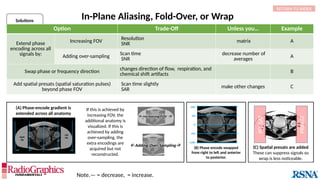
Solutions
If this is achieved by
increasing FOV, the
additional anatomy is
visualized. If this is
achieved by adding
over-sampling, the
extra encodings are
acquired but not
reconstructed.
(B) Phase encode swapped
from right to left and anterior
to posterior.
PRESAT
PRESAT
In-Plane Aliasing, Fold-Over, or Wrap
RETURN TO INDEX
(A) Phase-encode gradient is
extended across all anatomy
Option Trade-Off Unless you… Example
Extend phase
encoding across all
signals by:
Increasing FOV Resolution
SNR matrix A
Adding over-sampling
Scan time
SNR
decrease number of
averages A
Swap phase or frequency direction changes direction of flow, respiration, and
chemical shift artifacts
B
Add spatial presats (spatial saturation pulses)
beyond phase FOV
Scan time slightly
SAR
make other changes C
(C) Spatial presats are added
These can suppress signals so
wrap is less noticeable.
Note.— = decrease, = increase.
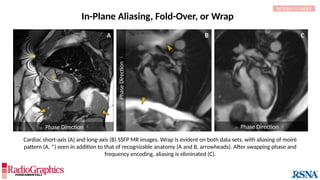
Cardiac short-axis (A) and long-axis (B) SSFP MR images. Wrap is evident on both data sets, with aliasing of moiré
pattern (A, *) seen in addition to that of recognizable anatomy (A and B, arrowheads). After swapping phase and
frequency encoding, aliasing is eliminated (C).
In-Plane Aliasing, Fold-Over, or Wrap
RETURN TO INDEX
A B C
*
*
 Phase Direction 

Phase
Direction

 Phase Direction 
IMAGING SLAB
Section Level
Section-encoding Aliasing
RETURN TO INDEX
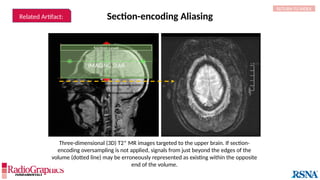
Three-dimensional (3D) T2* MR images targeted to the upper brain. If section-
encoding oversampling is not applied, signals from just beyond the edges of the
volume (dotted line) may be erroneously represented as existing within the opposite
end of the volume.
Related Artifact:
Flow Encode Aliasing
RETURN TO INDEX
Related Artifact:
A B
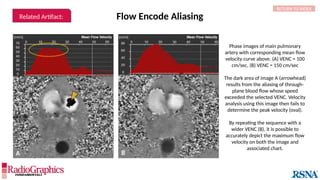
Phase images of main pulmonary
artery with corresponding mean flow
velocity curve above. (A) VENC = 100
cm/sec, (B) VENC = 150 cm/sec
The dark area of image A (arrowhead)
results from the aliasing of through-
plane blood flow whose speed
exceeded the selected VENC. Velocity
analysis using this image then fails to
determine the peak velocity (oval).
By repeating the sequence with a
wider VENC (B), it is possible to
accurately depict the maximum flow
velocity on both the image and
associated chart.
Description
Causes
Gibbs or Truncation
A
 Phase Direction 
RETURN TO INDEX
(A) Sagittal T2W cervical MR image with FOV = 240 mm, matrix (frequency-encoding direction [f] ×
phase-encoding direction [p]) = 272 × 256. Gibbs (arrowheads) is common in the spine and may
interfere with the depiction of spinal cord contusions or mimic a syrinx. Out-of-phase (B) and in-phase
(C) axial T1W abdominal GRE MR images with truncation artifacts (arrowheads) along the margins of
organs. Small lesions along the lateral liver and spleen can be overlooked because of this artifact.
• Gibbs results from the Fourier transform process used to
reconstruct the MR signal into images.
• When strong signals change suddenly in a stepwise manner,
they can be truncated by the Fourier process and thus
inaccurately approximated in the final image.
Alternating stripes at high-contrast boundaries. Gibbs
can occur in any direction, but it is most common
along the phase-encoding direction since this
direction typically employs a lower matrix in the
interest of time savings.
B

Phase
Direction

C
A B C
Gibbs or Truncation
Option Trade-Off Example
Decrease pixel size by:
Decreasing field of view SNR Not shown
Increasing matrix Scan time (phase-encoding [PE] matrix); SNR A
Apply raw data filter Image blur B
Decrease echo train length Scan time C
Decrease bandwidth Chemical shift; Sensitivity to motion Not shown
Solutions
RETURN TO INDEX
Baseline
Axial fluid-attenuated inversion-recovery (FLAIR) MR images of the brain. FOV = 220 mm and matrix (f × p) = 256 × 128 in
baseline. In this situation, Gibbs (arrowheads) may complicate the assessment of subtle cortical abnormalities, such as
focal cortical hypoplasia.
Description
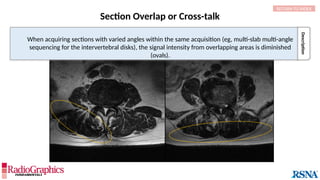
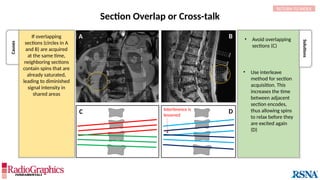
When acquiring sections with varied angles within the same acquisition (eg, multi-slab multi-angle
sequencing for the intervertebral disks), the signal intensity from overlapping areas is diminished
(ovals).
Section Overlap or Cross-talk
RETURN TO INDEX
Section Overlap or Cross-talk
Causes
Solutions
• Avoid overlapping
sections (C)
A B
C D
Interference is
lessened
• Use interleave
method for section
acquisition. This
increases the time
between adjacent
section encodes,
thus allowing spins
to relax before they
are excited again
(D)
RETURN TO INDEX
If overlapping
sections (circles in A
and B) are acquired
at the same time,
neighboring sections
contain spins that are
already saturated,
leading to diminished
signal intensity in
shared areas
Causes
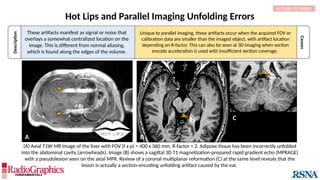
Unique to parallel imaging, these artifacts occur when the acquired FOV or
calibration data are smaller than the imaged object, with artifact location
depending on R-factor. This can also be seen at 3D imaging when section
encode acceleration is used with insufficient section coverage.
Hot Lips and Parallel Imaging Unfolding Errors
(A) Axial T1W MR image of the liver with FOV (f x p) = 400 x 360 mm, R-factor = 2. Adipose tissue has been incorrectly unfolded
into the abdominal cavity (arrowheads). Image (B) shows a sagittal 3D T1 magnetization-prepared rapid gradient echo (MPRAGE)
with a pseudolesion seen on the axial MPR. Review of a coronal multiplanar reformation (C) at the same level reveals that the
lesion is actually a section-encoding unfolding artifact caused by the ear.
C
RETURN TO INDEX
HOT LIPS
A
Description
These artifacts manifest as signal or noise that
overlays a somewhat centralized location on the
image. This is different from normal aliasing,
which is found along the edges of the volume.
B
A B C D
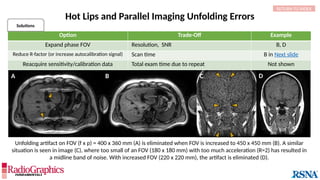
Unfolding artifact on FOV (f x p) = 400 x 360 mm (A) is eliminated when FOV is increased to 450 x 450 mm (B). A similar
situation is seen in image (C), where too small of an FOV (180 x 180 mm) with too much acceleration (R=2) has resulted in
a midline band of noise. With increased FOV (220 x 220 mm), the artifact is eliminated (D).
Hot Lips and Parallel Imaging Unfolding Errors
Option Trade-Off Example
Expand phase FOV Resolution, SNR B, D
Reduce R-factor (or increase autocalibration signal) Scan time B in Next slide
Reacquire sensitivity/calibration data Total exam time due to repeat Not shown
Solutions
RETURN TO INDEX
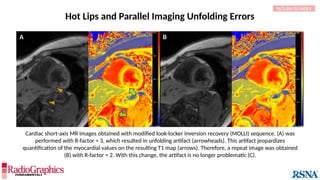
Cardiac short-axis MR images obtained with modified look-locker inversion recovery (MOLLI) sequence. (A) was
performed with R-factor = 3, which resulted in unfolding artifact (arrowheads). This artifact jeopardizes
quantification of the myocardial values on the resulting T1 map (arrows). Therefore, a repeat image was obtained
(B) with R-factor = 2. With this change, the artifact is no longer problematic (C).
A B
Hot Lips and Parallel Imaging Unfolding Errors
RETURN TO INDEX
A B C
*
*
Causes
Description
Effects of regularization in sparse sampling are shown on FS PDW coronal MR images of the knee. With over-regularization, fine
detail is lost (A, *), and under-regularization, aliasing, and noise are evident (C, arrowheads). Thus, a balance of regularization
must be found (B).
Compressed Sensing Artifacts
If parameters are not properly optimized,
blurring of fine structures or textured noise
may be observed on protocols that use
sparse sampling as a method of acceleration.
RETURN TO INDEX
When compressed sensing is applied, if k-space has insufficient phase
encodes to support a given acceleration factor, blur results. Additionally,
regularization, which is used to threshold out noise and aliases, will also
blur the image if set too high. If set too low, excessive noise may be seen.
Solutions
Compressed Sensing (Optimizing Encodings or Acceleration)
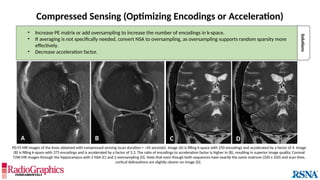
• Increase PE matrix or add oversampling to increase the number of encodings in k-space.
• If averaging is not specifically needed, convert NSA to oversampling, as oversampling supports random sparsity more
effectively.
• Decrease acceleration factor.
PD FS MR images of the knee obtained with compressed sensing (scan duration = ~45 seconds). Image (A) is filling k-space with 250 encodings and accelerated by a factor of 4. Image
(B) is filling k-space with 375 encodings and is accelerated by a factor of 3.3. The ratio of encodings to acceleration factor is higher in (B), resulting in superior image quality. Coronal
T2W MR images through the hippocampus with 2 NSA (C) and 2 oversampling (D). Note that even though both sequences have exactly the same matrices (320 x 320) and scan time,
cortical delineations are slightly clearer on image (D).
A B
C
D
C
Solutions
Compressed Sensing (Optimizing Regularization)
C
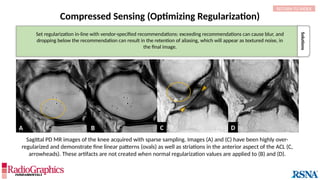
Set regularization in-line with vendor-specified recommendations: exceeding recommendations can cause blur, and
dropping below the recommendation can result in the retention of aliasing, which will appear as textured noise, in
the final image.
Sagittal PD MR images of the knee acquired with sparse sampling. Images (A) and (C) have been highly over-
regularized and demonstrate fine linear patterns (ovals) as well as striations in the anterior aspect of the ACL (C,
arrowheads). These artifacts are not created when normal regularization values are applied to (B) and (D).
A C
B D
RETURN TO INDEX
Streak
RETURN TO INDEX
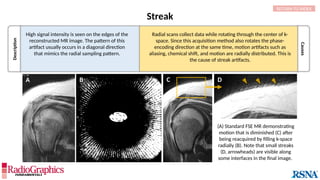
(A) Standard FSE MR demonstrating
motion that is diminished (C) after
being reacquired by filling k-space
radially (B). Note that small streaks
(D, arrowheads) are visible along
some interfaces in the final image.
A B C D
Description
High signal intensity is seen on the edges of the
reconstructed MR image. The pattern of this
artifact usually occurs in a diagonal direction
that mimics the radial sampling pattern.
Causes
Radial scans collect data while rotating through the center of k-
space. Since this acquisition method also rotates the phase-
encoding direction at the same time, motion artifacts such as
aliasing, chemical shift, and motion are radially distributed. This is
the cause of streak artifacts.
Solutions
Streak
A B
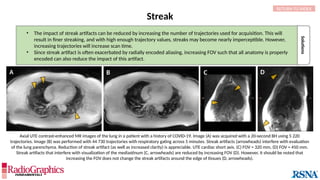
Axial UTE contrast-enhanced MR images of the lung in a patient with a history of COVID-19. Image (A) was acquired with a 20-second BH using 5 220
trajectories. Image (B) was performed with 44 730 trajectories with respiratory gating across 5 minutes. Streak artifacts (arrowheads) interfere with evaluation
of the lung parenchyma. Reduction of streak artifact (as well as increased clarity) is appreciable. UTE cardiac short axis. (C) FOV = 320 mm, (D) FOV = 450 mm.
Streak artifacts that interfere with visualization of the mediastinum (C, arrowheads) are reduced by increasing FOV (D). However, it should be noted that
increasing the FOV does not change the streak artifacts around the edge of tissues (D, arrowheads).
• The impact of streak artifacts can be reduced by increasing the number of trajectories used for acquisition. This will
result in finer streaking, and with high enough trajectory values, streaks may become nearly imperceptible. However,
increasing trajectories will increase scan time.
• Since streak artifact is often exacerbated by radially encoded aliasing, increasing FOV such that all anatomy is properly
encoded can also reduce the impact of this artifact.
RETURN TO INDEX
C D
C D
A B
Filtering or Reconstruction
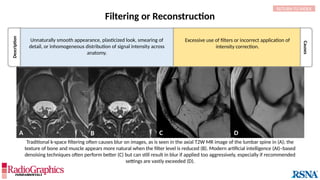
Traditional k-space filtering often causes blur on images, as is seen in the axial T2W MR image of the lumbar spine in (A); the
texture of bone and muscle appears more natural when the filter level is reduced (B). Modern artificial intelligence (AI)–based
denoising techniques often perform better (C) but can still result in blur if applied too aggressively, especially if recommended
settings are vastly exceeded (D).
Description
Unnaturally smooth appearance, plasticized look, smearing of
detail, or inhomogeneous distribution of signal intensity across
anatomy.
Causes
Excessive use of filters or incorrect application of
intensity correction.
RETURN TO INDEX
Solutions
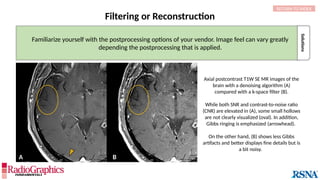
Axial postcontrast T1W SE MR images of the
brain with a denoising algorithm (A)
compared with a k-space filter (B).
While both SNR and contrast-to-noise ratio
(CNR) are elevated in (A), some small hollows
are not clearly visualized (oval). In addition,
Gibbs ringing is emphasized (arrowhead).
On the other hand, (B) shows less Gibbs
artifacts and better displays fine details but is
a bit noisy.
Filtering or Reconstruction
RETURN TO INDEX
A B
Familiarize yourself with the postprocessing options of your vendor. Image feel can vary greatly
depending the postprocessing that is applied.
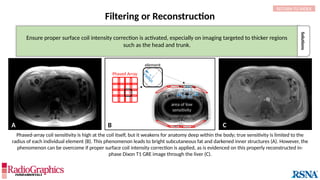
Phased-array coil sensitivity is high at the coil itself, but it weakens for anatomy deep within the body; true sensitivity is limited to the
radius of each individual element (B). This phenomenon leads to bright subcutaneous fat and darkened inner structures (A). However, the
phenomenon can be overcome if proper surface coil intensity correction is applied, as is evidenced on this properly reconstructed in-
phase Dixon T1 GRE image through the liver (C).
A C
Filtering or Reconstruction
Phased Array
element
r
a
d
i
u
s
area of low
sensitivity
RETURN TO INDEX
B
Solutions
Ensure proper surface coil intensity correction is activated, especially on imaging targeted to thicker regions
such as the head and trunk.
A C
B
Description
Causes
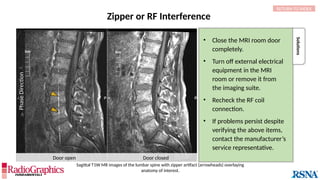
Zipper or RF Interference
RETURN TO INDEX
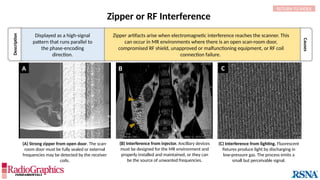
Displayed as a high-signal
pattern that runs parallel to
the phase-encoding
direction.
Zipper artifacts arise when electromagnetic interference reaches the scanner. This
can occur in MR environments where there is an open scan-room door,
compromised RF shield, unapproved or malfunctioning equipment, or RF coil
connection failure.
(B) Interference from injector. Ancillary devices
must be designed for the MR environment and
properly installed and maintained, or they can
be the source of unwanted frequencies.
(A) Strong zipper from open door. The scan-
room door must be fully sealed or external
frequencies may be detected by the receiver
coils.
(C) Interference from lighting. Fluorescent
fixtures produce light by discharging in
low-pressure gas. The process emits a
small but perceivable signal.
• Close the MRI room door
completely.
• Turn off external electrical
equipment in the MRI
room or remove it from
the imaging suite.
• Recheck the RF coil
connection.
• If problems persist despite
verifying the above items,
contact the manufacturer’s
service representative.
Solutions
Door open Door closed
Zipper or RF Interference
RETURN TO INDEX
Sagittal T1W MR images of the lumbar spine with zipper artifact (arrowheads) overlaying
anatomy of interest.

Phase
Direction

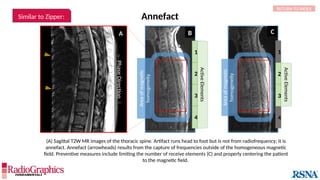
Annefact
(A) Sagittal T2W MR images of the thoracic spine. Artifact runs head to foot but is not from radiofrequency; it is
annefact. Annefact (arrowheads) results from the capture of frequencies outside of the homogeneous magnetic
field. Preventive measures include limiting the number of receive elements (C) and properly centering the patient
to the magnetic field.
Area
of
magnetic
homogeneity
1
4
3
2
Active
Elements
4
3
2
1
Active
Elements
Area
of
magnetic
homogeneity

Phase
Direction

RETURN TO INDEX
A C
B
Similar to Zipper:
Description
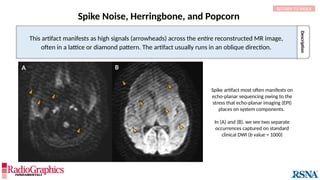
Spike Noise, Herringbone, and Popcorn
This artifact manifests as high signals (arrowheads) across the entire reconstructed MR image,
often in a lattice or diamond pattern. The artifact usually runs in an oblique direction.
B
Spike artifact most often manifests on
echo-planar sequencing owing to the
stress that echo-planar imaging (EPI)
places on system components.
In (A) and (B), we see two separate
occurrences captured on standard
clinical DWI (b value = 1000)
A
RETURN TO INDEX
Causes
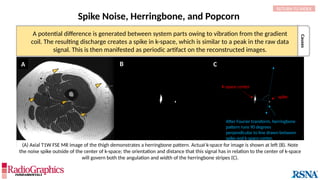
Spike Noise, Herringbone, and Popcorn
A C
spike
K-space center
After Fourier transform, herringbone
pattern runs 90 degrees
perpendicular to line drawn between
spike and k-space center.
B
(A) Axial T1W FSE MR image of the thigh demonstrates a herringbone pattern. Actual k-space for image is shown at left (B). Note
the noise spike outside of the center of k-space; the orientation and distance that this signal has in relation to the center of k-space
will govern both the angulation and width of the herringbone stripes (C).
A potential difference is generated between system parts owing to vibration from the gradient
coil. The resulting discharge creates a spike in k-space, which is similar to a peak in the raw data
signal. This is then manifested as periodic artifact on the reconstructed images.
RETURN TO INDEX
Solutions
Spike Noise, Herringbone, and Popcorn
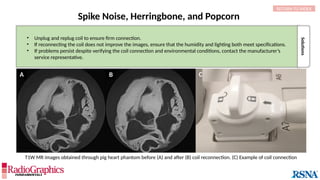
• Unplug and replug coil to ensure firm connection.
• If reconnecting the coil does not improve the images, ensure that the humidity and lighting both meet specifications.
• If problems persist despite verifying the coil connection and environmental conditions, contact the manufacturer’s
service representative.
A B C
T1W MR images obtained through pig heart phantom before (A) and after (B) coil reconnection. (C) Example of coil connection
RETURN TO INDEX
Free-Induction Decay
*
RETURN TO INDEX
Similar to herringbone:
(A) Coronal short inversion-time
inversion-recovery (STIR) MRI of
the pelvis, (B) sagittal T2 FS MRI
of the brain utilizing 3D FSE with
VFA. Although similar to
herringbone, FID artifacts can be
differentiated because the lines
are often wavy (arrows),
whereas herringbone is straight.
Also, FID artifacts stop abruptly
in some places (*), whereas
herringbone will carry across the
entire image.
Causes
Solutions
A B
FID can sometimes be resolved by applying
full 90° or 180° RF pulses and increasing
echo time (TE) or echo spacing.
Additionally, use of ≥2 averages will almost
always eliminate the artifact.
In theory, spin-echoes utilize a 90° or 180° pulse to excite and refocus
spins. In practice, however, if some spins are not fully exposed to both
pulses, errant signal results and manifests as a free-induction decay
(FID) artifact. This is most common when modified refocusing pulse
schemes (eg, variable flip angle [VFA]) are used and in areas where
there is localized tissue inhomogeneity.
N/2 Ghost
A B
Description
RETURN TO INDEX
Causes
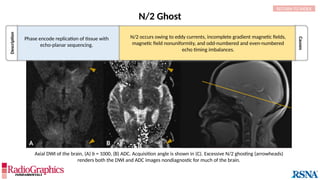
N/2 occurs owing to eddy currents, incomplete gradient magnetic fields,
magnetic field nonuniformity, and odd-numbered and even-numbered
echo timing imbalances.
Phase encode replication of tissue with
echo-planar sequencing.
Axial DWI of the brain, (A) b = 1000, (B) ADC. Acquisition angle is shown in (C). Excessive N/2 ghosting (arrowheads)
renders both the DWI and ADC images nondiagnostic for much of the brain.
A B
r = 2.0 r = 3.0 r = 3.0
C
Solutions
N/2 Ghost
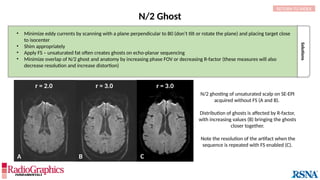
• Minimize eddy currents by scanning with a plane perpendicular to B0 (don’t tilt or rotate the plane) and placing target close
to isocenter
• Shim appropriately
• Apply FS – unsaturated fat often creates ghosts on echo-planar sequencing
• Minimize overlap of N/2 ghost and anatomy by increasing phase FOV or decreasing R-factor (these measures will also
decrease resolution and increase distortion)
RETURN TO INDEX
N/2 ghosting of unsaturated scalp on SE-EPI
acquired without FS (A and B).
Distribution of ghosts is affected by R-factor,
with increasing values (B) bringing the ghosts
closer together.
Note the resolution of the artifact when the
sequence is repeated with FS enabled (C).
Description
Moiré Fringes or Zebra Stripes
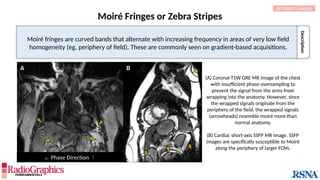
Moiré fringes are curved bands that alternate with increasing frequency in areas of very low field
homogeneity (eg, periphery of field). These are commonly seen on gradient-based acquisitions.
A B
(A) Coronal T1W GRE MR image of the chest
with insufficient phase oversampling to
prevent the signal from the arms from
wrapping into the anatomy. However, since
the wrapped signals originate from the
periphery of the field, the wrapped signals
(arrowheads) resemble moiré more than
normal anatomy.
(B) Cardiac short-axis SSFP MR image. SSFP
images are specifically susceptible to Moiré
along the periphery of larger FOVs.
RETURN TO INDEX
 Phase Direction 
Solutions
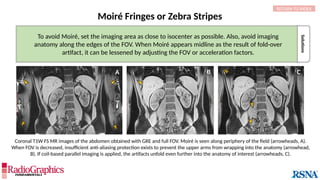
Coronal T1W FS MR images of the abdomen obtained with GRE and full FOV. Moiré is seen along periphery of the field (arrowheads, A).
When FOV is decreased, insufficient anti-aliasing protection exists to prevent the upper arms from wrapping into the anatomy (arrowhead,
B). If coil-based parallel imaging is applied, the artifacts unfold even further into the anatomy of interest (arrowheads, C).
Moiré Fringes or Zebra Stripes
To avoid Moiré, set the imaging area as close to isocenter as possible. Also, avoid imaging
anatomy along the edges of the FOV. When Moiré appears midline as the result of fold-over
artifact, it can be lessened by adjusting the FOV or acceleration factors.
A A B C
RETURN TO INDEX
Description
Causes
Noise
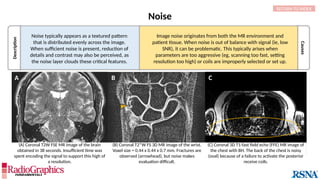
Noise typically appears as a textured pattern
that is distributed evenly across the image.
When sufficient noise is present, reduction of
details and contrast may also be perceived, as
the noise layer clouds these critical features.
RETURN TO INDEX
Image noise originates from both the MR environment and
patient tissue. When noise is out of balance with signal (ie, low
SNR), it can be problematic. This typically arises when
parameters are too aggressive (eg, scanning too fast, setting
resolution too high) or coils are improperly selected or set up.
A B C
A B C
(B) Coronal T2*W FS 3D MR image of the wrist.
Voxel size = 0.44 x 0.44 x 0.7 mm. Fractures are
observed (arrowhead), but noise makes
evaluation difficult.
(C) Coronal 3D T1-fast field echo (FFE) MR image of
the chest with BH. The back of the chest is noisy
(oval) because of a failure to activate the posterior
receive coils.
(A) Coronal T2W FSE MR image of the brain
obtained in 38 seconds. Insufficient time was
spent encoding the signal to support this high of
a resolution.
A B C
Baseline
How to Increase SNR
C D
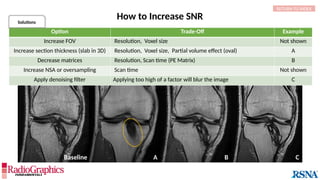
Option Trade-Off Example
Increase FOV Resolution, Voxel size Not shown
Increase section thickness (slab in 3D) Resolution, Voxel size, Partial volume effect (oval) A
Decrease matrices Resolution, Scan time (PE Matrix) B
Increase NSA or oversampling Scan time Not shown
Apply denoising filter Applying too high of a factor will blur the image C
Solutions
RETURN TO INDEX
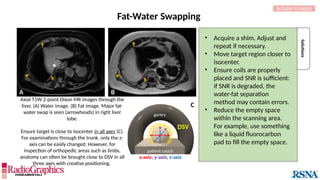
Description
Causes
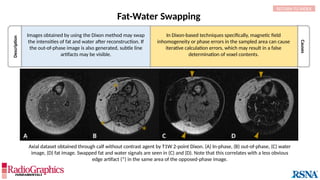
Axial dataset obtained through calf without contrast agent by T1W 2-point Dixon. (A) In-phase, (B) out-of-phase, (C) water
image, (D) fat image. Swapped fat and water signals are seen in (C) and (D). Note that this correlates with a less obvious
edge artifact (*) in the same area of the opposed-phase image.
Fat-Water Swapping
A D
C
B
* *
*
RETURN TO INDEX
Images obtained by using the Dixon method may swap
the intensities of fat and water after reconstruction. If
the out-of-phase image is also generated, subtle line
artifacts may be visible.
In Dixon-based techniques specifically, magnetic field
inhomogeneity or phase errors in the sampled area can cause
iterative calculation errors, which may result in a false
determination of voxel contents.
Fat-Water Swapping
A B
Solutions
x-axis; y-axis; z-axis
DSV
gantry
C
patient couch
RETURN TO INDEX
• Acquire a shim. Adjust and
repeat if necessary.
• Move target region closer to
isocenter.
• Ensure coils are properly
placed and SNR is sufficient:
if SNR is degraded, the
water-fat separation
method may contain errors.
• Reduce the empty space
within the scanning area.
For example, use something
like a liquid fluorocarbon
pad to fill the empty space.
Axial T1W 2-point Dixon MR images through the
liver. (A) Water image. (B) Fat image. Major fat-
water swap is seen (arrowheads) in right liver
lobe.
Ensure target is close to isocenter in all axes (C).
For examinations through the trunk, only the z-
axis can be easily changed. However, for
inspection of orthopedic areas such as limbs,
anatomy can often be brought close to DSV in all
three axes with creative positioning.
 Frequency Direction 
B C
A
 Frequency Direction 
Description
Causes
Chemical Shift
In areas where tissue containing fat borders a source
of water signal (eg, aqueous humor, cerebrospinal
fluid [CSF], etc.), an image shift occurs along the
frequency-encoding direction, and white or black
borders are observed at the tissue interfaces.
(A) Axial T2W MRI of the kidney with chemical shift artifact seen on either side of renal cortex. Sagittal T2W cervical in-phase (B) and water (C)
MR images from the Dixon dataset. Note that chemical shift (arrowheads) is completely removed when signals from fat are suppressed on (C).
RETURN TO INDEX
Protons of different molecules precess at different
frequencies; water protons rotate slightly faster (3.5 ppm)
than fat protons. Therefore, the fat and water components of
a voxel are encoded at different locations along the frequency
direction.
Chemical Shift
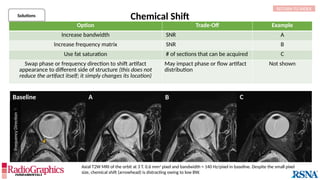
Option Trade-Off Example
Increase bandwidth SNR A
Increase frequency matrix SNR B
Use fat saturation # of sections that can be acquired C
Swap phase or frequency direction to shift artifact
appearance to different side of structure (this does not
reduce the artifact itself; it simply changes its location)
May impact phase or flow artifact
distribution
Not shown
Solutions
RETURN TO INDEX
Axial T2W MRI of the orbit at 3 T. 0.6 mm2
pixel and bandwidth = 140 Hz/pixel in baseline. Despite the small pixel
size, chemical shift (arrowhead) is distracting owing to low BW.
A B
Baseline

Frequency
Direction

C
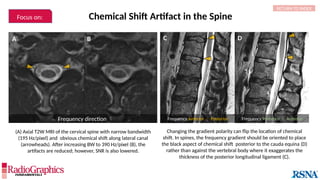
(A) Axial T2W MRI of the cervical spine with narrow bandwidth
(195 Hz/pixel) and obvious chemical shift along lateral canal
(arrowheads). After increasing BW to 390 Hz/pixel (B), the
artifacts are reduced; however, SNR is also lowered.
Chemical Shift Artifact in the Spine
Changing the gradient polarity can flip the location of chemical
shift. In spines, the frequency gradient should be oriented to place
the black aspect of chemical shift posterior to the cauda equina (D)
rather than against the vertebral body where it exaggerates the
thickness of the posterior longitudinal ligament (C).
B
A
 Frequency direction  Frequency Anterior  Posterior Frequency Posterior  Anterior
C D
RETURN TO INDEX
Focus on:
Description
Causes
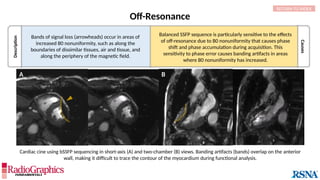
Off-Resonance
Bands of signal loss (arrowheads) occur in areas of
increased B0 nonuniformity, such as along the
boundaries of dissimilar tissues, air and tissue, and
along the periphery of the magnetic field.
RETURN TO INDEX
Cardiac cine using bSSFP sequencing in short-axis (A) and two-chamber (B) views. Banding artifacts (bands) overlap on the anterior
wall, making it difficult to trace the contour of the myocardium during functional analysis.
A B
Balanced SSFP sequence is particularly sensitive to the effects
of off-resonance due to B0 nonuniformity that causes phase
shift and phase accumulation during acquisition. This
sensitivity to phase error causes banding artifacts in areas
where B0 nonuniformity has increased.
Off-Resonance
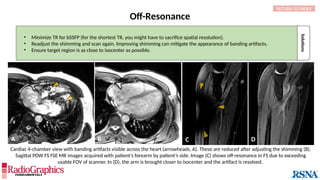
Cardiac 4-chamber view with banding artifacts visible across the heart (arrowheads, A). These are reduced after adjusting the shimming (B).
Sagittal PDW FS FSE MR images acquired with patient’s forearm by patient’s side. Image (C) shows off-resonance in FS due to exceeding
usable FOV of scanner. In (D), the arm is brought closer to isocenter and the artifact is resolved.
A B
Solutions
• Minimize TR for bSSFP (for the shortest TR, you might have to sacrifice spatial resolution).
• Readjust the shimming and scan again. Improving shimming can mitigate the appearance of banding artifacts.
• Ensure target region is as close to isocenter as possible.
RETURN TO INDEX
C D
Mitigating Off-Resonance Artifact at bSSFP Imaging
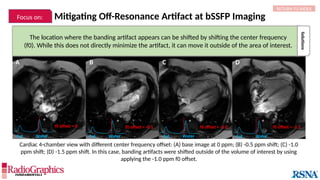
Cardiac 4-chamber view with different center frequency offset: (A) base image at 0 ppm; (B) -0.5 ppm shift; (C) -1.0
ppm shift; (D) -1.5 ppm shift. In this case, banding artifacts were shifted outside of the volume of interest by using
applying the -1.0 ppm f0 offset.
A B C D
Solutions
The location where the banding artifact appears can be shifted by shifting the center frequency
(f0). While this does not directly minimize the artifact, it can move it outside of the area of interest.
f0 offset = 0 f0 offset = -1.0 f0 offset = -1.5
- + - +
f0 offset = -0.5
- + - +
RETURN TO INDEX
Focus on:
Water
Fat Water
Fat Water
Fat Water
Fat
Description
Causes
A B
Dielectric Effect, Standing Wave, and B1
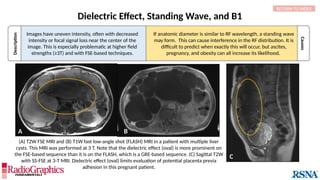
(A) T2W FSE MRI and (B) T1W fast low-angle shot (FLASH) MRI in a patient with multiple liver
cysts. This MRI was performed at 3 T. Note that the dielectric effect (oval) is more prominent on
the FSE-based sequence than it is on the FLASH, which is a GRE-based sequence. (C) Sagittal T2W
with SS-FSE at 3-T MRI. Dielectric effect (oval) limits evaluation of potential placenta previa
adhesion in this pregnant patient.
RETURN TO INDEX
Images have uneven intensity, often with decreased
intensity or focal signal loss near the center of the
image. This is especially problematic at higher field
strengths (≥3T) and with FSE-based techniques.
If anatomic diameter is similar to RF wavelength, a standing wave
may form. This can cause interference in the RF distribution. It is
difficult to predict when exactly this will occur, but ascites,
pregnancy, and obesity can all increase its likelihood.
C
A B C
Solutions
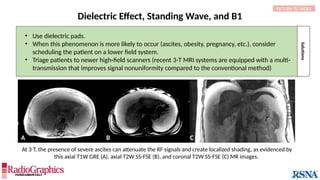
• Use dielectric pads.
• When this phenomenon is more likely to occur (ascites, obesity, pregnancy, etc.), consider
scheduling the patient on a lower field system.
• Triage patients to newer high-field scanners (recent 3-T MRI systems are equipped with a multi-
transmission that improves signal nonuniformity compared to the conventional method)
Dielectric Effect, Standing Wave, and B1
RETURN TO INDEX
At 3 T, the presence of severe ascites can attenuate the RF signals and create localized shading, as evidenced by
this axial T1W GRE (A), axial T2W SS-FSE (B), and coronal T2W SS-FSE (C) MR images.
Description
Causes
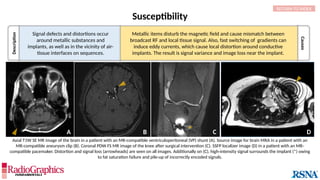
Susceptibility
A B C
* D
Signal defects and distortions occur
around metallic substances and
implants, as well as in the vicinity of air-
tissue interfaces on sequences.
RETURN TO INDEX
Metallic items disturb the magnetic field and cause mismatch between
broadcast RF and local tissue signal. Also, fast switching of gradients can
induce eddy currents, which cause local distortion around conductive
implants. The result is signal variance and image loss near the implant.
Axial T1W SE MR image of the brain in a patient with an MR-compatible ventriculoperitoneal (VP) shunt (A). Source image for brain MRA in a patient with an
MR-compatible aneurysm clip (B). Coronal PDW FS MR image of the knee after surgical intervention (C). SSFP localizer image (D) in a patient with an MR-
compatible pacemaker. Distortion and signal loss (arrowheads) are seen on all images. Additionally on (C), high-intensity signal surrounds the implant (*) owing
to fat saturation failure and pile-up of incorrectly encoded signals.
A B
Susceptibility
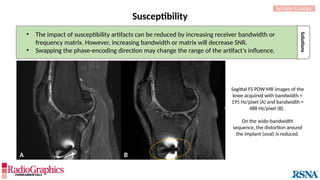
Sagittal FS PDW MR images of the
knee acquired with bandwidth =
195 Hz/pixel (A) and bandwidth =
488 Hz/pixel (B).
On the wide-bandwidth
sequence, the distortion around
the implant (oval) is reduced.
Solutions
• The impact of susceptibility artifacts can be reduced by increasing receiver bandwidth or
frequency matrix. However, increasing bandwidth or matrix will decrease SNR.
• Swapping the phase-encoding direction may change the range of the artifact’s influence.
RETURN TO INDEX
Susceptibility
Solutions
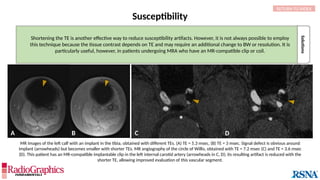
Shortening the TE is another effective way to reduce susceptibility artifacts. However, it is not always possible to employ
this technique because the tissue contrast depends on TE and may require an additional change to BW or resolution. It is
particularly useful, however, in patients undergoing MRA who have an MR-compatible clip or coil.
RETURN TO INDEX
C D
B
A
MR images of the left calf with an implant in the tibia, obtained with different TEs. (A) TE = 5.3 msec, (B) TE = 3 msec. Signal defect is obvious around
implant (arrowheads) but becomes smaller with shorter TEs. MR angiography of the circle of Willis, obtained with TE = 7.2 msec (C) and TE = 3.6 msec
(D). This patient has an MR-compatible implantable clip in the left internal carotid artery (arrowheads in C, D); its resulting artifact is reduced with the
shorter TE, allowing improved evaluation of this vascular segment.
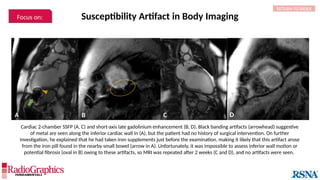
Susceptibility Artifact in Body Imaging
A D
C
B
RETURN TO INDEX
Focus on:
Cardiac 2-chamber SSFP (A, C) and short-axis late gadolinium enhancement (B, D). Black banding artifacts (arrowhead) suggestive
of metal are seen along the inferior cardiac wall in (A), but the patient had no history of surgical intervention. On further
investigation, he explained that he had taken iron supplements just before the examination, making it likely that this artifact arose
from the iron pill found in the nearby small bowel (arrow in A). Unfortunately, it was impossible to assess inferior wall motion or
potential fibrosis (oval in B) owing to these artifacts, so MRI was repeated after 2 weeks (C and D), and no artifacts were seen.
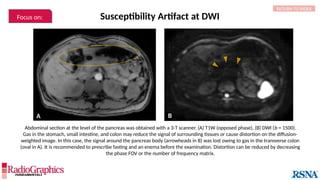
Susceptibility Artifact at DWI
Abdominal section at the level of the pancreas was obtained with a 3-T scanner. (A) T1W (opposed phase), (B) DWI (b = 1500).
Gas in the stomach, small intestine, and colon may reduce the signal of surrounding tissues or cause distortion on the diffusion-
weighted image. In this case, the signal around the pancreas body (arrowheads in B) was lost owing to gas in the transverse colon
(oval in A). It is recommended to prescribe fasting and an enema before the examination. Distortion can be reduced by decreasing
the phase FOV or the number of frequency matrix.
A B
RETURN TO INDEX
Focus on:
Description
Causes
Motion
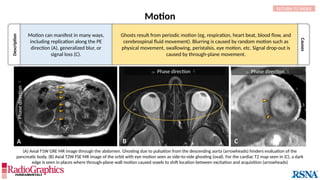
Motion can manifest in many ways,
including replication along the PE
direction (A), generalized blur, or
signal loss (C).
(A) Axial T1W GRE MR image through the abdomen. Ghosting due to pulsation from the descending aorta (arrowheads) hinders evaluation of the
pancreatic body. (B) Axial T2W FSE MR image of the orbit with eye motion seen as side-to-side ghosting (oval). For the cardiac T2 map seen in (C), a dark
edge is seen in places where through-plane wall motion caused voxels to shift location between excitation and acquisition (arrowheads)
RETURN TO INDEX
Ghosts result from periodic motion (eg, respiration, heart beat, blood flow, and
cerebrospinal fluid movement). Blurring is caused by random motion such as
physical movement, swallowing, peristalsis, eye motion, etc. Signal drop-out is
caused by through-plane movement.
C
A B

Phase
direction

 Phase direction   Phase direction 
Baseline C D
A B
Motion
Solutions
RETURN TO INDEX

Phase
direction

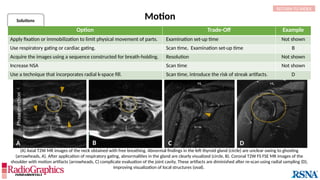
(A) Axial T2W MR images of the neck obtained with free breathing. Abnormal findings in the left thyroid gland (circle) are unclear owing to ghosting
(arrowheads, A). After application of respiratory gating, abnormalities in the gland are clearly visualized (circle, B). Coronal T2W FS FSE MR images of the
shoulder with motion artifacts (arrowheads, C) complicate evaluation of the joint cavity. These artifacts are diminished after re-scan using radial sampling (D),
improving visualization of local structures (oval).
Option Trade-Off Example
Apply fixation or immobilization to limit physical movement of parts. Examination set-up time Not shown
Use respiratory gating or cardiac gating. Scan time, Examination set-up time B
Acquire the images using a sequence constructed for breath-holding. Resolution Not shown
Increase NSA Scan time Not shown
Use a technique that incorporates radial k-space fill. Scan time, introduce the risk of streak artifacts. D
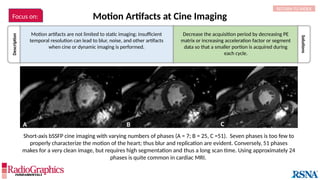
Short-axis bSSFP cine imaging with varying numbers of phases (A = 7; B = 25, C =51). Seven phases is too few to
properly characterize the motion of the heart; thus blur and replication are evident. Conversely, 51 phases
makes for a very clean image, but requires high segmentation and thus a long scan time. Using approximately 24
phases is quite common in cardiac MRI.
Motion Artifacts at Cine Imaging
A B C
Description
Motion artifacts are not limited to static imaging; insufficient
temporal resolution can lead to blur, noise, and other artifacts
when cine or dynamic imaging is performed.
Solutions
Decrease the acquisition period by decreasing PE
matrix or increasing acceleration factor or segment
data so that a smaller portion is acquired during
each cycle.
RETURN TO INDEX
Focus on:
Description
Causes
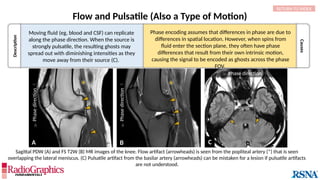
Flow and Pulsatile (Also a Type of Motion)
Moving fluid (eg, blood and CSF) can replicate
along the phase direction. When the source is
strongly pulsatile, the resulting ghosts may
spread out with diminishing intensities as they
move away from their source (C).
Sagittal PDW (A) and FS T2W (B) MR images of the knee. Flow artifact (arrowheads) is seen from the popliteal artery (*) that is seen
overlapping the lateral meniscus. (C) Pulsatile artifact from the basilar artery (arrowheads) can be mistaken for a lesion if pulsatile artifacts
are not understood.
RETURN TO INDEX
Phase encoding assumes that differences in phase are due to
differences in spatial location. However, when spins from
fluid enter the section plane, they often have phase
differences that result from their own intrinsic motion,
causing the signal to be encoded as ghosts across the phase
FOV.
A

Phase
direction

* *

Phase
direction

 Phase direction 
B C
A B D
C
Solutions
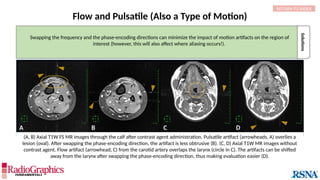
Swapping the frequency and the phase-encoding directions can minimize the impact of motion artifacts on the region of
interest (however, this will also affect where aliasing occurs!).
Flow and Pulsatile (Also a Type of Motion)
(A, B) Axial T1W FS MR images through the calf after contrast agent administration. Pulsatile artifact (arrowheads, A) overlies a
lesion (oval). After swapping the phase-encoding direction, the artifact is less obtrusive (B). (C, D) Axial T1W MR images without
contrast agent. Flow artifact (arrowhead, C) from the carotid artery overlaps the larynx (circle in C). The artifacts can be shifted
away from the larynx after swapping the phase-encoding direction, thus making evaluation easier (D).
RETURN TO INDEX
Effects of Presaturation Bands in Reducing Flow Artifact
A

Phase
direction

B
P
R
E
S
A
T
U
R
A
T
I
O
N
B
A
N
D
Focus on:
Solutions
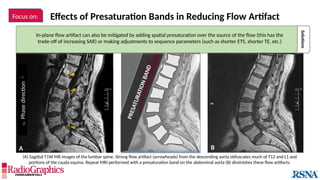
In-plane flow artifact can also be mitigated by adding spatial presaturation over the source of the flow (this has the
trade-off of increasing SAR) or making adjustments to sequence parameters (such as shorter ETS, shorter TE, etc.)
(A) Sagittal T1W MR images of the lumbar spine. Strong flow artifact (arrowheads) from the descending aorta obfuscates much of T12 and L1 and
portions of the cauda equina. Repeat MRI performed with a presaturation band on the abdominal aorta (B) diminishes these flow artifacts.
Conclusion
There are numerous artifacts that can arise at MRI. Take careful note of
the details inherent in each artifact’s style of manifestation; this will aid
in identification and allow proper countermeasures to be applied. We
hope that this material will not only help learners to better their
knowledge on the topic, but also improve the quality of the clinical
images and dictations that they provide.
Eilenberg SS, Tartar VM, Mattrey RF. Reducing Magnetic Susceptibility Differences Using Liquid Fluorocarbon Pads (Sat Pad™):
Results with Spectral Presaturation of Fat. Artificial Cells, Blood Substitutes, and Biotechnology 1994;22(4):1477-1483.
Hirokawa Y, Isoda H, Maetani YS, Arizono S, Shimada K, Togashi K. MRI artifact reduction and quality improvement in the upper
abdomen with PROPELLER and prospective acquisition correction (PACE) technique. AJR Am J Roentgenol 2008;191(4):1154-1158.
Huang SY, Seethamraju RT, Patel P, Hahn PF, Kirsch JE, Guimaraes AR. Body MR Imaging: Artifacts, k-Space, and Solutions.
Radiographics 2015;35(5):1439-1460.
Maehara M, Ikeda K, Kurokawa H, Omura N, Ikeda S, Hirokawa Y, Maehara S, Utsunomiya K, Tanigawa N, Sawada S. Diffusion-
weighted echo-planar imaging of the head and neck using 3-T MRI: Investigation into the usefulness of liquid perfluorocarbon pads
and choice of optimal fat suppression method. Magnetic Resonance Imaging 2014;32.
Runge M, Ibrahim E-SH, Bogun F, Attili A, Mahani MG, Pang Y, Horwood L, Chenevert TL, Stojanovska J. Metal Artifact Reduction in
Cardiovascular MRI for Accurate Myocardial Scar Assessment in Patients With Cardiac Implantable Electronic Devices. American
Journal of Roentgenology 2019;213(3):555-561.
Stadler A, Schima W, Ba-Ssalamah A, Kettenbach J, Eisenhuber E. Artifacts in body MR imaging: their appearance and how to
eliminate them. European Radiology 2007;17(5):1242-1255.
Triche BL, Nelson JT, McGill NS, Porter KK, Sanyal R, Tessler FN, McConathy JE, Gauntt DM, Yester MV, Singh SP. Recognizing and
Minimizing Artifacts at CT, MRI, US, and Molecular Imaging. RadioGraphics 2019;39(4):1017-1018.
Tsuchihashi T. Artifact of MRI(MR Series). Japanese Journal of Radiological Technology. 2003;59(11):1370-1377.
Yu H, Reeder SB, Shimakawa A, McKenzie CA, Brittain JH. Robust multipoint water-fat separation using fat likelihood analysis. Magn
Reson Med 2012;67(4):1065-1076.
Suggested Readings

A primer on magnetic resonance imaging artifacts

  • 1.
    Primer on CommonlyOccurring MRI Artifacts and How to Overcome Them Chikara Noda, PhD1 Bharath Ambale Venkatesh, PhD2 Jennifer D. Wagner, BS, RT3 Yoko Kato, MD, PhD1 Jason M. Ortman, RT1 João A.C. Lima, MD, MBA1
  • 2.
    Author Affiliations: 1 Division ofCardiology, Johns Hopkins University School of Medicine, Baltimore, MD, USA 2 Division of Radiology, Johns Hopkins University School of Medicine, Baltimore, MD, USA 3 Canon Medical Research USA, Cleveland, OH, USA Corresponding author: J.A.C.L. (email: jlima@jhmi.edu) Presented as an education exhibit at RSNA 2020 (HP137-ED-X). Supported by a National Institutes of Health grant (133032) to Johns Hopkins University Disclosures of conflicts of interest.—J.D.W. Employed by Canon Medical Research, USA. Part of ongoing educational collaborations with Canon Medical Systems Corporation.
  • 3.
    Introduction Various artifacts canoccur when acquiring MR images. o MRI technologists need to know the causes of artifacts and how to avoid them in order to optimize clinical examinations. o Radiologists need to be aware of these artifacts in order to perform accurate readings. This presentation describes: o How artifacts relate to system conditions, patient physiology, or tissue characteristics o How to identify artifacts and distinguish similar artifacts from each other o How to mitigate artifacts in clinical practice An abbreviations table and artifact map have also been included to make the relationships among artifacts and the use of various terminology as clear as possible.
  • 4.
    Learning Objectives • Learnhow to identify the artifacts presented here by taking note of the specific details associated with each example. • Understand the most common causes of each artifact and how to mitigate its impact on image quality. • Understand the pitfalls and trade-offs of each artifact reduction strategy.
  • 5.
    Primer Abbreviation GenericTerm Vendor Nomenclature Primer Abbreviation Generic Term Vendor Nomenclature B0 Main magnetic field PDW Proton-density–weighted B1 Radiofrequency field PI Parallel imaging ASSET, SENSE, SPEEDER BH Breath hold r R-factor or acceleration factor bSSFP Balanced steady-state free precession True SSFP, FIESTA, True FISP, balanced FFE RF Radiofrequency BW Bandwidth SAR Specific absorption rate CS Compressed sensing Compressed SENSE, Compressed SPEEDER SE Spin echo SE DSV Diameter spherical volume SNR Signal-to-noise ratio ESP Echo spacing ETS, ESP SS-FSE Single-shot FSE FASE, SS-FSE, HASTE ETL Echo train length ETL, TF T1-FFE RF-spoiled GRE FFE, FLASH, SPGR f0 Center frequency T1W T1-weighted (dark fluid) FS Fat saturation CHESS, Chem Sat, FS T2W T2-weighted (bright fluid) FSE Fast-spin echo FSE, TSE TOF Time of flight MRA2D/3D, TOF GRE Gradient-recalled echo FE, GRE UTE Ultrashort echo time mUTE, UTE NSA Number of signal averages NAQ, NEX, NSA VENC Velocity encoding Abbreviations Abbreviations used throughout this primer, their definition, and their correlation with common vendor- specific terms are shown here.
  • 6.
    Motion Chemical Shift Dielectric effect/ Standing wave Susceptibility Fat-water swapping Overview of Commonly Occurring Artifacts at Routine MRI Off-Resonance effects Patient Tissue heterogeneity System Flow / Pulsation Ghosting / Blurring Gibbs / Truncation Aliasing / Fold-Over / Wrap Section overlap / Cross-talk Hot lips & PI unfolding errors Streak Software Postprocessing Compressed Sensing Spike noise / Herringbone / Popcorn Zipper / RF Interference Moiré Fringes / Zebra stripes Hardware N/2 ghost Noise
  • 7.
    Causes In-Plane Aliasing, Fold-Over,or Wrap RETURN TO INDEX Description  Phase Encoding  0◦ +90◦ -90◦ +180◦ -180◦  Total anatomy exposed to RF  Left Hip -90◦ +90◦ Left Hip -90◦ -90◦ +90◦ -90◦ Resulting Image with aliasing Right Hip A B C When aliasing occurs, anatomy outside of the FOV appears on the final image. On modern scanners, in-plane aliasing is typically only problematic in the phase direction. In the phase direction, signals within the FOV are encoded from –180 to +180 degrees (A). However, radiofrequency does not abruptly stop at the edges of the FOV. This means if anatomy exists outside of the phase FOV, it is also excited. However, since the same phase-encoding steps are simply repeated outside of the FOV, the position of any tissue outside of the FOV will match the phase encoding of value of areas within the FOV (C), and aliasing of those signals will occur (B).
  • 8.
    Solutions If this isachieved by increasing FOV, the additional anatomy is visualized. If this is achieved by adding over-sampling, the extra encodings are acquired but not reconstructed. (B) Phase encode swapped from right to left and anterior to posterior. PRESAT PRESAT In-Plane Aliasing, Fold-Over, or Wrap RETURN TO INDEX (A) Phase-encode gradient is extended across all anatomy Option Trade-Off Unless you… Example Extend phase encoding across all signals by: Increasing FOV Resolution SNR matrix A Adding over-sampling Scan time SNR decrease number of averages A Swap phase or frequency direction changes direction of flow, respiration, and chemical shift artifacts B Add spatial presats (spatial saturation pulses) beyond phase FOV Scan time slightly SAR make other changes C (C) Spatial presats are added These can suppress signals so wrap is less noticeable. Note.— = decrease, = increase.
  • 9.
    Cardiac short-axis (A)and long-axis (B) SSFP MR images. Wrap is evident on both data sets, with aliasing of moiré pattern (A, *) seen in addition to that of recognizable anatomy (A and B, arrowheads). After swapping phase and frequency encoding, aliasing is eliminated (C). In-Plane Aliasing, Fold-Over, or Wrap RETURN TO INDEX A B C * *  Phase Direction   Phase Direction   Phase Direction 
  • 10.
    IMAGING SLAB Section Level Section-encodingAliasing RETURN TO INDEX Three-dimensional (3D) T2* MR images targeted to the upper brain. If section- encoding oversampling is not applied, signals from just beyond the edges of the volume (dotted line) may be erroneously represented as existing within the opposite end of the volume. Related Artifact:
  • 11.
    Flow Encode Aliasing RETURNTO INDEX Related Artifact: A B Phase images of main pulmonary artery with corresponding mean flow velocity curve above. (A) VENC = 100 cm/sec, (B) VENC = 150 cm/sec The dark area of image A (arrowhead) results from the aliasing of through- plane blood flow whose speed exceeded the selected VENC. Velocity analysis using this image then fails to determine the peak velocity (oval). By repeating the sequence with a wider VENC (B), it is possible to accurately depict the maximum flow velocity on both the image and associated chart.
  • 12.
    Description Causes Gibbs or Truncation A Phase Direction  RETURN TO INDEX (A) Sagittal T2W cervical MR image with FOV = 240 mm, matrix (frequency-encoding direction [f] × phase-encoding direction [p]) = 272 × 256. Gibbs (arrowheads) is common in the spine and may interfere with the depiction of spinal cord contusions or mimic a syrinx. Out-of-phase (B) and in-phase (C) axial T1W abdominal GRE MR images with truncation artifacts (arrowheads) along the margins of organs. Small lesions along the lateral liver and spleen can be overlooked because of this artifact. • Gibbs results from the Fourier transform process used to reconstruct the MR signal into images. • When strong signals change suddenly in a stepwise manner, they can be truncated by the Fourier process and thus inaccurately approximated in the final image. Alternating stripes at high-contrast boundaries. Gibbs can occur in any direction, but it is most common along the phase-encoding direction since this direction typically employs a lower matrix in the interest of time savings. B  Phase Direction  C
  • 13.
    A B C Gibbsor Truncation Option Trade-Off Example Decrease pixel size by: Decreasing field of view SNR Not shown Increasing matrix Scan time (phase-encoding [PE] matrix); SNR A Apply raw data filter Image blur B Decrease echo train length Scan time C Decrease bandwidth Chemical shift; Sensitivity to motion Not shown Solutions RETURN TO INDEX Baseline Axial fluid-attenuated inversion-recovery (FLAIR) MR images of the brain. FOV = 220 mm and matrix (f × p) = 256 × 128 in baseline. In this situation, Gibbs (arrowheads) may complicate the assessment of subtle cortical abnormalities, such as focal cortical hypoplasia.
  • 14.
    Description When acquiring sectionswith varied angles within the same acquisition (eg, multi-slab multi-angle sequencing for the intervertebral disks), the signal intensity from overlapping areas is diminished (ovals). Section Overlap or Cross-talk RETURN TO INDEX
  • 15.
    Section Overlap orCross-talk Causes Solutions • Avoid overlapping sections (C) A B C D Interference is lessened • Use interleave method for section acquisition. This increases the time between adjacent section encodes, thus allowing spins to relax before they are excited again (D) RETURN TO INDEX If overlapping sections (circles in A and B) are acquired at the same time, neighboring sections contain spins that are already saturated, leading to diminished signal intensity in shared areas
  • 16.
    Causes Unique to parallelimaging, these artifacts occur when the acquired FOV or calibration data are smaller than the imaged object, with artifact location depending on R-factor. This can also be seen at 3D imaging when section encode acceleration is used with insufficient section coverage. Hot Lips and Parallel Imaging Unfolding Errors (A) Axial T1W MR image of the liver with FOV (f x p) = 400 x 360 mm, R-factor = 2. Adipose tissue has been incorrectly unfolded into the abdominal cavity (arrowheads). Image (B) shows a sagittal 3D T1 magnetization-prepared rapid gradient echo (MPRAGE) with a pseudolesion seen on the axial MPR. Review of a coronal multiplanar reformation (C) at the same level reveals that the lesion is actually a section-encoding unfolding artifact caused by the ear. C RETURN TO INDEX HOT LIPS A Description These artifacts manifest as signal or noise that overlays a somewhat centralized location on the image. This is different from normal aliasing, which is found along the edges of the volume. B
  • 17.
    A B CD Unfolding artifact on FOV (f x p) = 400 x 360 mm (A) is eliminated when FOV is increased to 450 x 450 mm (B). A similar situation is seen in image (C), where too small of an FOV (180 x 180 mm) with too much acceleration (R=2) has resulted in a midline band of noise. With increased FOV (220 x 220 mm), the artifact is eliminated (D). Hot Lips and Parallel Imaging Unfolding Errors Option Trade-Off Example Expand phase FOV Resolution, SNR B, D Reduce R-factor (or increase autocalibration signal) Scan time B in Next slide Reacquire sensitivity/calibration data Total exam time due to repeat Not shown Solutions RETURN TO INDEX
  • 18.
    Cardiac short-axis MRimages obtained with modified look-locker inversion recovery (MOLLI) sequence. (A) was performed with R-factor = 3, which resulted in unfolding artifact (arrowheads). This artifact jeopardizes quantification of the myocardial values on the resulting T1 map (arrows). Therefore, a repeat image was obtained (B) with R-factor = 2. With this change, the artifact is no longer problematic (C). A B Hot Lips and Parallel Imaging Unfolding Errors RETURN TO INDEX
  • 19.
    A B C * * Causes Description Effectsof regularization in sparse sampling are shown on FS PDW coronal MR images of the knee. With over-regularization, fine detail is lost (A, *), and under-regularization, aliasing, and noise are evident (C, arrowheads). Thus, a balance of regularization must be found (B). Compressed Sensing Artifacts If parameters are not properly optimized, blurring of fine structures or textured noise may be observed on protocols that use sparse sampling as a method of acceleration. RETURN TO INDEX When compressed sensing is applied, if k-space has insufficient phase encodes to support a given acceleration factor, blur results. Additionally, regularization, which is used to threshold out noise and aliases, will also blur the image if set too high. If set too low, excessive noise may be seen.
  • 20.
    Solutions Compressed Sensing (OptimizingEncodings or Acceleration) • Increase PE matrix or add oversampling to increase the number of encodings in k-space. • If averaging is not specifically needed, convert NSA to oversampling, as oversampling supports random sparsity more effectively. • Decrease acceleration factor. PD FS MR images of the knee obtained with compressed sensing (scan duration = ~45 seconds). Image (A) is filling k-space with 250 encodings and accelerated by a factor of 4. Image (B) is filling k-space with 375 encodings and is accelerated by a factor of 3.3. The ratio of encodings to acceleration factor is higher in (B), resulting in superior image quality. Coronal T2W MR images through the hippocampus with 2 NSA (C) and 2 oversampling (D). Note that even though both sequences have exactly the same matrices (320 x 320) and scan time, cortical delineations are slightly clearer on image (D). A B C D C
  • 21.
    Solutions Compressed Sensing (OptimizingRegularization) C Set regularization in-line with vendor-specified recommendations: exceeding recommendations can cause blur, and dropping below the recommendation can result in the retention of aliasing, which will appear as textured noise, in the final image. Sagittal PD MR images of the knee acquired with sparse sampling. Images (A) and (C) have been highly over- regularized and demonstrate fine linear patterns (ovals) as well as striations in the anterior aspect of the ACL (C, arrowheads). These artifacts are not created when normal regularization values are applied to (B) and (D). A C B D RETURN TO INDEX
  • 22.
    Streak RETURN TO INDEX (A)Standard FSE MR demonstrating motion that is diminished (C) after being reacquired by filling k-space radially (B). Note that small streaks (D, arrowheads) are visible along some interfaces in the final image. A B C D Description High signal intensity is seen on the edges of the reconstructed MR image. The pattern of this artifact usually occurs in a diagonal direction that mimics the radial sampling pattern. Causes Radial scans collect data while rotating through the center of k- space. Since this acquisition method also rotates the phase- encoding direction at the same time, motion artifacts such as aliasing, chemical shift, and motion are radially distributed. This is the cause of streak artifacts.
  • 23.
    Solutions Streak A B Axial UTEcontrast-enhanced MR images of the lung in a patient with a history of COVID-19. Image (A) was acquired with a 20-second BH using 5 220 trajectories. Image (B) was performed with 44 730 trajectories with respiratory gating across 5 minutes. Streak artifacts (arrowheads) interfere with evaluation of the lung parenchyma. Reduction of streak artifact (as well as increased clarity) is appreciable. UTE cardiac short axis. (C) FOV = 320 mm, (D) FOV = 450 mm. Streak artifacts that interfere with visualization of the mediastinum (C, arrowheads) are reduced by increasing FOV (D). However, it should be noted that increasing the FOV does not change the streak artifacts around the edge of tissues (D, arrowheads). • The impact of streak artifacts can be reduced by increasing the number of trajectories used for acquisition. This will result in finer streaking, and with high enough trajectory values, streaks may become nearly imperceptible. However, increasing trajectories will increase scan time. • Since streak artifact is often exacerbated by radially encoded aliasing, increasing FOV such that all anatomy is properly encoded can also reduce the impact of this artifact. RETURN TO INDEX C D
  • 24.
    C D A B Filteringor Reconstruction Traditional k-space filtering often causes blur on images, as is seen in the axial T2W MR image of the lumbar spine in (A); the texture of bone and muscle appears more natural when the filter level is reduced (B). Modern artificial intelligence (AI)–based denoising techniques often perform better (C) but can still result in blur if applied too aggressively, especially if recommended settings are vastly exceeded (D). Description Unnaturally smooth appearance, plasticized look, smearing of detail, or inhomogeneous distribution of signal intensity across anatomy. Causes Excessive use of filters or incorrect application of intensity correction. RETURN TO INDEX
  • 25.
    Solutions Axial postcontrast T1WSE MR images of the brain with a denoising algorithm (A) compared with a k-space filter (B). While both SNR and contrast-to-noise ratio (CNR) are elevated in (A), some small hollows are not clearly visualized (oval). In addition, Gibbs ringing is emphasized (arrowhead). On the other hand, (B) shows less Gibbs artifacts and better displays fine details but is a bit noisy. Filtering or Reconstruction RETURN TO INDEX A B Familiarize yourself with the postprocessing options of your vendor. Image feel can vary greatly depending the postprocessing that is applied.
  • 26.
    Phased-array coil sensitivityis high at the coil itself, but it weakens for anatomy deep within the body; true sensitivity is limited to the radius of each individual element (B). This phenomenon leads to bright subcutaneous fat and darkened inner structures (A). However, the phenomenon can be overcome if proper surface coil intensity correction is applied, as is evidenced on this properly reconstructed in- phase Dixon T1 GRE image through the liver (C). A C Filtering or Reconstruction Phased Array element r a d i u s area of low sensitivity RETURN TO INDEX B Solutions Ensure proper surface coil intensity correction is activated, especially on imaging targeted to thicker regions such as the head and trunk.
  • 27.
    A C B Description Causes Zipper orRF Interference RETURN TO INDEX Displayed as a high-signal pattern that runs parallel to the phase-encoding direction. Zipper artifacts arise when electromagnetic interference reaches the scanner. This can occur in MR environments where there is an open scan-room door, compromised RF shield, unapproved or malfunctioning equipment, or RF coil connection failure. (B) Interference from injector. Ancillary devices must be designed for the MR environment and properly installed and maintained, or they can be the source of unwanted frequencies. (A) Strong zipper from open door. The scan- room door must be fully sealed or external frequencies may be detected by the receiver coils. (C) Interference from lighting. Fluorescent fixtures produce light by discharging in low-pressure gas. The process emits a small but perceivable signal.
  • 28.
    • Close theMRI room door completely. • Turn off external electrical equipment in the MRI room or remove it from the imaging suite. • Recheck the RF coil connection. • If problems persist despite verifying the above items, contact the manufacturer’s service representative. Solutions Door open Door closed Zipper or RF Interference RETURN TO INDEX Sagittal T1W MR images of the lumbar spine with zipper artifact (arrowheads) overlaying anatomy of interest.  Phase Direction 
  • 29.
    Annefact (A) Sagittal T2WMR images of the thoracic spine. Artifact runs head to foot but is not from radiofrequency; it is annefact. Annefact (arrowheads) results from the capture of frequencies outside of the homogeneous magnetic field. Preventive measures include limiting the number of receive elements (C) and properly centering the patient to the magnetic field. Area of magnetic homogeneity 1 4 3 2 Active Elements 4 3 2 1 Active Elements Area of magnetic homogeneity  Phase Direction  RETURN TO INDEX A C B Similar to Zipper:
  • 30.
    Description Spike Noise, Herringbone,and Popcorn This artifact manifests as high signals (arrowheads) across the entire reconstructed MR image, often in a lattice or diamond pattern. The artifact usually runs in an oblique direction. B Spike artifact most often manifests on echo-planar sequencing owing to the stress that echo-planar imaging (EPI) places on system components. In (A) and (B), we see two separate occurrences captured on standard clinical DWI (b value = 1000) A RETURN TO INDEX
  • 31.
    Causes Spike Noise, Herringbone,and Popcorn A C spike K-space center After Fourier transform, herringbone pattern runs 90 degrees perpendicular to line drawn between spike and k-space center. B (A) Axial T1W FSE MR image of the thigh demonstrates a herringbone pattern. Actual k-space for image is shown at left (B). Note the noise spike outside of the center of k-space; the orientation and distance that this signal has in relation to the center of k-space will govern both the angulation and width of the herringbone stripes (C). A potential difference is generated between system parts owing to vibration from the gradient coil. The resulting discharge creates a spike in k-space, which is similar to a peak in the raw data signal. This is then manifested as periodic artifact on the reconstructed images. RETURN TO INDEX
  • 32.
    Solutions Spike Noise, Herringbone,and Popcorn • Unplug and replug coil to ensure firm connection. • If reconnecting the coil does not improve the images, ensure that the humidity and lighting both meet specifications. • If problems persist despite verifying the coil connection and environmental conditions, contact the manufacturer’s service representative. A B C T1W MR images obtained through pig heart phantom before (A) and after (B) coil reconnection. (C) Example of coil connection RETURN TO INDEX
  • 33.
    Free-Induction Decay * RETURN TOINDEX Similar to herringbone: (A) Coronal short inversion-time inversion-recovery (STIR) MRI of the pelvis, (B) sagittal T2 FS MRI of the brain utilizing 3D FSE with VFA. Although similar to herringbone, FID artifacts can be differentiated because the lines are often wavy (arrows), whereas herringbone is straight. Also, FID artifacts stop abruptly in some places (*), whereas herringbone will carry across the entire image. Causes Solutions A B FID can sometimes be resolved by applying full 90° or 180° RF pulses and increasing echo time (TE) or echo spacing. Additionally, use of ≥2 averages will almost always eliminate the artifact. In theory, spin-echoes utilize a 90° or 180° pulse to excite and refocus spins. In practice, however, if some spins are not fully exposed to both pulses, errant signal results and manifests as a free-induction decay (FID) artifact. This is most common when modified refocusing pulse schemes (eg, variable flip angle [VFA]) are used and in areas where there is localized tissue inhomogeneity.
  • 34.
    N/2 Ghost A B Description RETURNTO INDEX Causes N/2 occurs owing to eddy currents, incomplete gradient magnetic fields, magnetic field nonuniformity, and odd-numbered and even-numbered echo timing imbalances. Phase encode replication of tissue with echo-planar sequencing. Axial DWI of the brain, (A) b = 1000, (B) ADC. Acquisition angle is shown in (C). Excessive N/2 ghosting (arrowheads) renders both the DWI and ADC images nondiagnostic for much of the brain.
  • 35.
    A B r =2.0 r = 3.0 r = 3.0 C Solutions N/2 Ghost • Minimize eddy currents by scanning with a plane perpendicular to B0 (don’t tilt or rotate the plane) and placing target close to isocenter • Shim appropriately • Apply FS – unsaturated fat often creates ghosts on echo-planar sequencing • Minimize overlap of N/2 ghost and anatomy by increasing phase FOV or decreasing R-factor (these measures will also decrease resolution and increase distortion) RETURN TO INDEX N/2 ghosting of unsaturated scalp on SE-EPI acquired without FS (A and B). Distribution of ghosts is affected by R-factor, with increasing values (B) bringing the ghosts closer together. Note the resolution of the artifact when the sequence is repeated with FS enabled (C).
  • 36.
    Description Moiré Fringes orZebra Stripes Moiré fringes are curved bands that alternate with increasing frequency in areas of very low field homogeneity (eg, periphery of field). These are commonly seen on gradient-based acquisitions. A B (A) Coronal T1W GRE MR image of the chest with insufficient phase oversampling to prevent the signal from the arms from wrapping into the anatomy. However, since the wrapped signals originate from the periphery of the field, the wrapped signals (arrowheads) resemble moiré more than normal anatomy. (B) Cardiac short-axis SSFP MR image. SSFP images are specifically susceptible to Moiré along the periphery of larger FOVs. RETURN TO INDEX  Phase Direction 
  • 37.
    Solutions Coronal T1W FSMR images of the abdomen obtained with GRE and full FOV. Moiré is seen along periphery of the field (arrowheads, A). When FOV is decreased, insufficient anti-aliasing protection exists to prevent the upper arms from wrapping into the anatomy (arrowhead, B). If coil-based parallel imaging is applied, the artifacts unfold even further into the anatomy of interest (arrowheads, C). Moiré Fringes or Zebra Stripes To avoid Moiré, set the imaging area as close to isocenter as possible. Also, avoid imaging anatomy along the edges of the FOV. When Moiré appears midline as the result of fold-over artifact, it can be lessened by adjusting the FOV or acceleration factors. A A B C RETURN TO INDEX
  • 38.
    Description Causes Noise Noise typically appearsas a textured pattern that is distributed evenly across the image. When sufficient noise is present, reduction of details and contrast may also be perceived, as the noise layer clouds these critical features. RETURN TO INDEX Image noise originates from both the MR environment and patient tissue. When noise is out of balance with signal (ie, low SNR), it can be problematic. This typically arises when parameters are too aggressive (eg, scanning too fast, setting resolution too high) or coils are improperly selected or set up. A B C A B C (B) Coronal T2*W FS 3D MR image of the wrist. Voxel size = 0.44 x 0.44 x 0.7 mm. Fractures are observed (arrowhead), but noise makes evaluation difficult. (C) Coronal 3D T1-fast field echo (FFE) MR image of the chest with BH. The back of the chest is noisy (oval) because of a failure to activate the posterior receive coils. (A) Coronal T2W FSE MR image of the brain obtained in 38 seconds. Insufficient time was spent encoding the signal to support this high of a resolution.
  • 39.
    A B C Baseline Howto Increase SNR C D Option Trade-Off Example Increase FOV Resolution, Voxel size Not shown Increase section thickness (slab in 3D) Resolution, Voxel size, Partial volume effect (oval) A Decrease matrices Resolution, Scan time (PE Matrix) B Increase NSA or oversampling Scan time Not shown Apply denoising filter Applying too high of a factor will blur the image C Solutions RETURN TO INDEX
  • 40.
    Description Causes Axial dataset obtainedthrough calf without contrast agent by T1W 2-point Dixon. (A) In-phase, (B) out-of-phase, (C) water image, (D) fat image. Swapped fat and water signals are seen in (C) and (D). Note that this correlates with a less obvious edge artifact (*) in the same area of the opposed-phase image. Fat-Water Swapping A D C B * * * RETURN TO INDEX Images obtained by using the Dixon method may swap the intensities of fat and water after reconstruction. If the out-of-phase image is also generated, subtle line artifacts may be visible. In Dixon-based techniques specifically, magnetic field inhomogeneity or phase errors in the sampled area can cause iterative calculation errors, which may result in a false determination of voxel contents.
  • 41.
    Fat-Water Swapping A B Solutions x-axis;y-axis; z-axis DSV gantry C patient couch RETURN TO INDEX • Acquire a shim. Adjust and repeat if necessary. • Move target region closer to isocenter. • Ensure coils are properly placed and SNR is sufficient: if SNR is degraded, the water-fat separation method may contain errors. • Reduce the empty space within the scanning area. For example, use something like a liquid fluorocarbon pad to fill the empty space. Axial T1W 2-point Dixon MR images through the liver. (A) Water image. (B) Fat image. Major fat- water swap is seen (arrowheads) in right liver lobe. Ensure target is close to isocenter in all axes (C). For examinations through the trunk, only the z- axis can be easily changed. However, for inspection of orthopedic areas such as limbs, anatomy can often be brought close to DSV in all three axes with creative positioning.
  • 42.
     Frequency Direction B C A  Frequency Direction  Description Causes Chemical Shift In areas where tissue containing fat borders a source of water signal (eg, aqueous humor, cerebrospinal fluid [CSF], etc.), an image shift occurs along the frequency-encoding direction, and white or black borders are observed at the tissue interfaces. (A) Axial T2W MRI of the kidney with chemical shift artifact seen on either side of renal cortex. Sagittal T2W cervical in-phase (B) and water (C) MR images from the Dixon dataset. Note that chemical shift (arrowheads) is completely removed when signals from fat are suppressed on (C). RETURN TO INDEX Protons of different molecules precess at different frequencies; water protons rotate slightly faster (3.5 ppm) than fat protons. Therefore, the fat and water components of a voxel are encoded at different locations along the frequency direction.
  • 43.
    Chemical Shift Option Trade-OffExample Increase bandwidth SNR A Increase frequency matrix SNR B Use fat saturation # of sections that can be acquired C Swap phase or frequency direction to shift artifact appearance to different side of structure (this does not reduce the artifact itself; it simply changes its location) May impact phase or flow artifact distribution Not shown Solutions RETURN TO INDEX Axial T2W MRI of the orbit at 3 T. 0.6 mm2 pixel and bandwidth = 140 Hz/pixel in baseline. Despite the small pixel size, chemical shift (arrowhead) is distracting owing to low BW. A B Baseline  Frequency Direction  C
  • 44.
    (A) Axial T2WMRI of the cervical spine with narrow bandwidth (195 Hz/pixel) and obvious chemical shift along lateral canal (arrowheads). After increasing BW to 390 Hz/pixel (B), the artifacts are reduced; however, SNR is also lowered. Chemical Shift Artifact in the Spine Changing the gradient polarity can flip the location of chemical shift. In spines, the frequency gradient should be oriented to place the black aspect of chemical shift posterior to the cauda equina (D) rather than against the vertebral body where it exaggerates the thickness of the posterior longitudinal ligament (C). B A  Frequency direction  Frequency Anterior  Posterior Frequency Posterior  Anterior C D RETURN TO INDEX Focus on:
  • 45.
    Description Causes Off-Resonance Bands of signalloss (arrowheads) occur in areas of increased B0 nonuniformity, such as along the boundaries of dissimilar tissues, air and tissue, and along the periphery of the magnetic field. RETURN TO INDEX Cardiac cine using bSSFP sequencing in short-axis (A) and two-chamber (B) views. Banding artifacts (bands) overlap on the anterior wall, making it difficult to trace the contour of the myocardium during functional analysis. A B Balanced SSFP sequence is particularly sensitive to the effects of off-resonance due to B0 nonuniformity that causes phase shift and phase accumulation during acquisition. This sensitivity to phase error causes banding artifacts in areas where B0 nonuniformity has increased.
  • 46.
    Off-Resonance Cardiac 4-chamber viewwith banding artifacts visible across the heart (arrowheads, A). These are reduced after adjusting the shimming (B). Sagittal PDW FS FSE MR images acquired with patient’s forearm by patient’s side. Image (C) shows off-resonance in FS due to exceeding usable FOV of scanner. In (D), the arm is brought closer to isocenter and the artifact is resolved. A B Solutions • Minimize TR for bSSFP (for the shortest TR, you might have to sacrifice spatial resolution). • Readjust the shimming and scan again. Improving shimming can mitigate the appearance of banding artifacts. • Ensure target region is as close to isocenter as possible. RETURN TO INDEX C D
  • 47.
    Mitigating Off-Resonance Artifactat bSSFP Imaging Cardiac 4-chamber view with different center frequency offset: (A) base image at 0 ppm; (B) -0.5 ppm shift; (C) -1.0 ppm shift; (D) -1.5 ppm shift. In this case, banding artifacts were shifted outside of the volume of interest by using applying the -1.0 ppm f0 offset. A B C D Solutions The location where the banding artifact appears can be shifted by shifting the center frequency (f0). While this does not directly minimize the artifact, it can move it outside of the area of interest. f0 offset = 0 f0 offset = -1.0 f0 offset = -1.5 - + - + f0 offset = -0.5 - + - + RETURN TO INDEX Focus on: Water Fat Water Fat Water Fat Water Fat
  • 48.
    Description Causes A B Dielectric Effect,Standing Wave, and B1 (A) T2W FSE MRI and (B) T1W fast low-angle shot (FLASH) MRI in a patient with multiple liver cysts. This MRI was performed at 3 T. Note that the dielectric effect (oval) is more prominent on the FSE-based sequence than it is on the FLASH, which is a GRE-based sequence. (C) Sagittal T2W with SS-FSE at 3-T MRI. Dielectric effect (oval) limits evaluation of potential placenta previa adhesion in this pregnant patient. RETURN TO INDEX Images have uneven intensity, often with decreased intensity or focal signal loss near the center of the image. This is especially problematic at higher field strengths (≥3T) and with FSE-based techniques. If anatomic diameter is similar to RF wavelength, a standing wave may form. This can cause interference in the RF distribution. It is difficult to predict when exactly this will occur, but ascites, pregnancy, and obesity can all increase its likelihood. C
  • 49.
    A B C Solutions •Use dielectric pads. • When this phenomenon is more likely to occur (ascites, obesity, pregnancy, etc.), consider scheduling the patient on a lower field system. • Triage patients to newer high-field scanners (recent 3-T MRI systems are equipped with a multi- transmission that improves signal nonuniformity compared to the conventional method) Dielectric Effect, Standing Wave, and B1 RETURN TO INDEX At 3 T, the presence of severe ascites can attenuate the RF signals and create localized shading, as evidenced by this axial T1W GRE (A), axial T2W SS-FSE (B), and coronal T2W SS-FSE (C) MR images.
  • 50.
    Description Causes Susceptibility A B C *D Signal defects and distortions occur around metallic substances and implants, as well as in the vicinity of air- tissue interfaces on sequences. RETURN TO INDEX Metallic items disturb the magnetic field and cause mismatch between broadcast RF and local tissue signal. Also, fast switching of gradients can induce eddy currents, which cause local distortion around conductive implants. The result is signal variance and image loss near the implant. Axial T1W SE MR image of the brain in a patient with an MR-compatible ventriculoperitoneal (VP) shunt (A). Source image for brain MRA in a patient with an MR-compatible aneurysm clip (B). Coronal PDW FS MR image of the knee after surgical intervention (C). SSFP localizer image (D) in a patient with an MR- compatible pacemaker. Distortion and signal loss (arrowheads) are seen on all images. Additionally on (C), high-intensity signal surrounds the implant (*) owing to fat saturation failure and pile-up of incorrectly encoded signals.
  • 51.
    A B Susceptibility Sagittal FSPDW MR images of the knee acquired with bandwidth = 195 Hz/pixel (A) and bandwidth = 488 Hz/pixel (B). On the wide-bandwidth sequence, the distortion around the implant (oval) is reduced. Solutions • The impact of susceptibility artifacts can be reduced by increasing receiver bandwidth or frequency matrix. However, increasing bandwidth or matrix will decrease SNR. • Swapping the phase-encoding direction may change the range of the artifact’s influence. RETURN TO INDEX
  • 52.
    Susceptibility Solutions Shortening the TEis another effective way to reduce susceptibility artifacts. However, it is not always possible to employ this technique because the tissue contrast depends on TE and may require an additional change to BW or resolution. It is particularly useful, however, in patients undergoing MRA who have an MR-compatible clip or coil. RETURN TO INDEX C D B A MR images of the left calf with an implant in the tibia, obtained with different TEs. (A) TE = 5.3 msec, (B) TE = 3 msec. Signal defect is obvious around implant (arrowheads) but becomes smaller with shorter TEs. MR angiography of the circle of Willis, obtained with TE = 7.2 msec (C) and TE = 3.6 msec (D). This patient has an MR-compatible implantable clip in the left internal carotid artery (arrowheads in C, D); its resulting artifact is reduced with the shorter TE, allowing improved evaluation of this vascular segment.
  • 53.
    Susceptibility Artifact inBody Imaging A D C B RETURN TO INDEX Focus on: Cardiac 2-chamber SSFP (A, C) and short-axis late gadolinium enhancement (B, D). Black banding artifacts (arrowhead) suggestive of metal are seen along the inferior cardiac wall in (A), but the patient had no history of surgical intervention. On further investigation, he explained that he had taken iron supplements just before the examination, making it likely that this artifact arose from the iron pill found in the nearby small bowel (arrow in A). Unfortunately, it was impossible to assess inferior wall motion or potential fibrosis (oval in B) owing to these artifacts, so MRI was repeated after 2 weeks (C and D), and no artifacts were seen.
  • 54.
    Susceptibility Artifact atDWI Abdominal section at the level of the pancreas was obtained with a 3-T scanner. (A) T1W (opposed phase), (B) DWI (b = 1500). Gas in the stomach, small intestine, and colon may reduce the signal of surrounding tissues or cause distortion on the diffusion- weighted image. In this case, the signal around the pancreas body (arrowheads in B) was lost owing to gas in the transverse colon (oval in A). It is recommended to prescribe fasting and an enema before the examination. Distortion can be reduced by decreasing the phase FOV or the number of frequency matrix. A B RETURN TO INDEX Focus on:
  • 55.
    Description Causes Motion Motion can manifestin many ways, including replication along the PE direction (A), generalized blur, or signal loss (C). (A) Axial T1W GRE MR image through the abdomen. Ghosting due to pulsation from the descending aorta (arrowheads) hinders evaluation of the pancreatic body. (B) Axial T2W FSE MR image of the orbit with eye motion seen as side-to-side ghosting (oval). For the cardiac T2 map seen in (C), a dark edge is seen in places where through-plane wall motion caused voxels to shift location between excitation and acquisition (arrowheads) RETURN TO INDEX Ghosts result from periodic motion (eg, respiration, heart beat, blood flow, and cerebrospinal fluid movement). Blurring is caused by random motion such as physical movement, swallowing, peristalsis, eye motion, etc. Signal drop-out is caused by through-plane movement. C A B  Phase direction   Phase direction   Phase direction 
  • 56.
    Baseline C D AB Motion Solutions RETURN TO INDEX  Phase direction  (A) Axial T2W MR images of the neck obtained with free breathing. Abnormal findings in the left thyroid gland (circle) are unclear owing to ghosting (arrowheads, A). After application of respiratory gating, abnormalities in the gland are clearly visualized (circle, B). Coronal T2W FS FSE MR images of the shoulder with motion artifacts (arrowheads, C) complicate evaluation of the joint cavity. These artifacts are diminished after re-scan using radial sampling (D), improving visualization of local structures (oval). Option Trade-Off Example Apply fixation or immobilization to limit physical movement of parts. Examination set-up time Not shown Use respiratory gating or cardiac gating. Scan time, Examination set-up time B Acquire the images using a sequence constructed for breath-holding. Resolution Not shown Increase NSA Scan time Not shown Use a technique that incorporates radial k-space fill. Scan time, introduce the risk of streak artifacts. D
  • 57.
    Short-axis bSSFP cineimaging with varying numbers of phases (A = 7; B = 25, C =51). Seven phases is too few to properly characterize the motion of the heart; thus blur and replication are evident. Conversely, 51 phases makes for a very clean image, but requires high segmentation and thus a long scan time. Using approximately 24 phases is quite common in cardiac MRI. Motion Artifacts at Cine Imaging A B C Description Motion artifacts are not limited to static imaging; insufficient temporal resolution can lead to blur, noise, and other artifacts when cine or dynamic imaging is performed. Solutions Decrease the acquisition period by decreasing PE matrix or increasing acceleration factor or segment data so that a smaller portion is acquired during each cycle. RETURN TO INDEX Focus on:
  • 58.
    Description Causes Flow and Pulsatile(Also a Type of Motion) Moving fluid (eg, blood and CSF) can replicate along the phase direction. When the source is strongly pulsatile, the resulting ghosts may spread out with diminishing intensities as they move away from their source (C). Sagittal PDW (A) and FS T2W (B) MR images of the knee. Flow artifact (arrowheads) is seen from the popliteal artery (*) that is seen overlapping the lateral meniscus. (C) Pulsatile artifact from the basilar artery (arrowheads) can be mistaken for a lesion if pulsatile artifacts are not understood. RETURN TO INDEX Phase encoding assumes that differences in phase are due to differences in spatial location. However, when spins from fluid enter the section plane, they often have phase differences that result from their own intrinsic motion, causing the signal to be encoded as ghosts across the phase FOV. A  Phase direction  * *  Phase direction   Phase direction  B C
  • 59.
    A B D C Solutions Swappingthe frequency and the phase-encoding directions can minimize the impact of motion artifacts on the region of interest (however, this will also affect where aliasing occurs!). Flow and Pulsatile (Also a Type of Motion) (A, B) Axial T1W FS MR images through the calf after contrast agent administration. Pulsatile artifact (arrowheads, A) overlies a lesion (oval). After swapping the phase-encoding direction, the artifact is less obtrusive (B). (C, D) Axial T1W MR images without contrast agent. Flow artifact (arrowhead, C) from the carotid artery overlaps the larynx (circle in C). The artifacts can be shifted away from the larynx after swapping the phase-encoding direction, thus making evaluation easier (D). RETURN TO INDEX
  • 60.
    Effects of PresaturationBands in Reducing Flow Artifact A  Phase direction  B P R E S A T U R A T I O N B A N D Focus on: Solutions In-plane flow artifact can also be mitigated by adding spatial presaturation over the source of the flow (this has the trade-off of increasing SAR) or making adjustments to sequence parameters (such as shorter ETS, shorter TE, etc.) (A) Sagittal T1W MR images of the lumbar spine. Strong flow artifact (arrowheads) from the descending aorta obfuscates much of T12 and L1 and portions of the cauda equina. Repeat MRI performed with a presaturation band on the abdominal aorta (B) diminishes these flow artifacts.
  • 61.
    Conclusion There are numerousartifacts that can arise at MRI. Take careful note of the details inherent in each artifact’s style of manifestation; this will aid in identification and allow proper countermeasures to be applied. We hope that this material will not only help learners to better their knowledge on the topic, but also improve the quality of the clinical images and dictations that they provide.
  • 62.
    Eilenberg SS, TartarVM, Mattrey RF. Reducing Magnetic Susceptibility Differences Using Liquid Fluorocarbon Pads (Sat Pad™): Results with Spectral Presaturation of Fat. Artificial Cells, Blood Substitutes, and Biotechnology 1994;22(4):1477-1483. Hirokawa Y, Isoda H, Maetani YS, Arizono S, Shimada K, Togashi K. MRI artifact reduction and quality improvement in the upper abdomen with PROPELLER and prospective acquisition correction (PACE) technique. AJR Am J Roentgenol 2008;191(4):1154-1158. Huang SY, Seethamraju RT, Patel P, Hahn PF, Kirsch JE, Guimaraes AR. Body MR Imaging: Artifacts, k-Space, and Solutions. Radiographics 2015;35(5):1439-1460. Maehara M, Ikeda K, Kurokawa H, Omura N, Ikeda S, Hirokawa Y, Maehara S, Utsunomiya K, Tanigawa N, Sawada S. Diffusion- weighted echo-planar imaging of the head and neck using 3-T MRI: Investigation into the usefulness of liquid perfluorocarbon pads and choice of optimal fat suppression method. Magnetic Resonance Imaging 2014;32. Runge M, Ibrahim E-SH, Bogun F, Attili A, Mahani MG, Pang Y, Horwood L, Chenevert TL, Stojanovska J. Metal Artifact Reduction in Cardiovascular MRI for Accurate Myocardial Scar Assessment in Patients With Cardiac Implantable Electronic Devices. American Journal of Roentgenology 2019;213(3):555-561. Stadler A, Schima W, Ba-Ssalamah A, Kettenbach J, Eisenhuber E. Artifacts in body MR imaging: their appearance and how to eliminate them. European Radiology 2007;17(5):1242-1255. Triche BL, Nelson JT, McGill NS, Porter KK, Sanyal R, Tessler FN, McConathy JE, Gauntt DM, Yester MV, Singh SP. Recognizing and Minimizing Artifacts at CT, MRI, US, and Molecular Imaging. RadioGraphics 2019;39(4):1017-1018. Tsuchihashi T. Artifact of MRI(MR Series). Japanese Journal of Radiological Technology. 2003;59(11):1370-1377. Yu H, Reeder SB, Shimakawa A, McKenzie CA, Brittain JH. Robust multipoint water-fat separation using fat likelihood analysis. Magn Reson Med 2012;67(4):1065-1076. Suggested Readings