LEGAL DRAFTING
BY- BHAVNA NIRBAN
WHAT IS LEGAL DRAFTING?
“Legal drafting” means the preparation of any
written legal documents like letters, briefs, memos,
agreements, deeds, contracts, etc.
PURPOSE OF LEGAL WRITING OR DRAFTING.
 For specific objectives eg. Legal opinion is intended for your
clients.
 Whomsoever, writing or drafting must know who is the audience.
One must have the knowledge of the background of audience.
(Audience can be your clients, judges or the readers for your
article).
 The writer must keep in mind the interests and needs of its
readers.
 The draftsmen or the writer must know the need of drafting or
writing. (Eg. For draftsmen the need would be drafts for Judges).
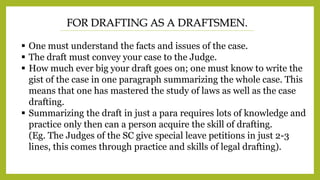
FOR DRAFTING AS A DRAFTSMEN.
 One must understand the facts and issues of the case.
 The draft must convey your case to the Judge.
 How much ever big your draft goes on; one must know to write the
gist of the case in one paragraph summarizing the whole case. This
means that one has mastered the study of laws as well as the case
drafting.
 Summarizing the draft in just a para requires lots of knowledge and
practice only then can a person acquire the skill of drafting.
(Eg. The Judges of the SC give special leave petitions in just 2-3
lines, this comes through practice and skills of legal drafting).
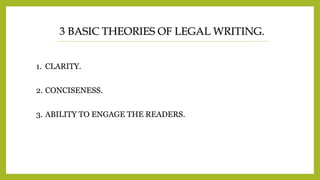
3 BASIC THEORIES OF LEGAL WRITING.
1. CLARITY.
2. CONCISENESS.
3. ABILITY TO ENGAGE THE READERS.
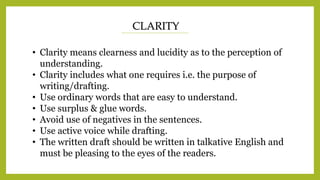
CLARITY
• Clarity means clearness and lucidity as to the perception of
understanding.
• Clarity includes what one requires i.e. the purpose of
writing/drafting.
• Use ordinary words that are easy to understand.
• Use surplus & glue words.
• Avoid use of negatives in the sentences.
• Use active voice while drafting.
• The written draft should be written in talkative English and
must be pleasing to the eyes of the readers.
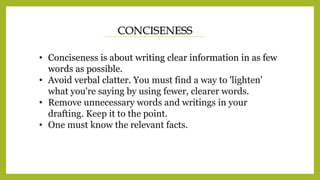
CONCISENESS
• Conciseness is about writing clear information in as few
words as possible.
• Avoid verbal clatter. You must find a way to 'lighten'
what you're saying by using fewer, clearer words.
• Remove unnecessary words and writings in your
drafting. Keep it to the point.
• One must know the relevant facts.
ABILITY TO ENGAGE THE READERS
In order to keep your audience or readers engaged
one must question oneself as to –
What are the real issues involved in the case ?
What is the position of your client in the case ?
How are you right in the position on the case ?
DO’S DON’TS
• Remember your audience.
• Use surplus and glue words.
• Be precise.
• Draft in chronological order of
events.
• Write in short sentences &
paragraphs.
• Use active voice.
• Don’t assume the reader knows the
laws.
• Avoid using negatives.
• Don’t state your personal opinion
without backing it up with the
authoritative law.
• Don’t use contractions.
• Don’t forget to self- edit after you
are done with drafting.
THANK YOU
FORWATCHING !!!
LIKE SHARE SUBSCRIBE

Legal drafting.

  • 1.
  • 2.
    WHAT IS LEGALDRAFTING? “Legal drafting” means the preparation of any written legal documents like letters, briefs, memos, agreements, deeds, contracts, etc.
  • 3.
    PURPOSE OF LEGALWRITING OR DRAFTING.  For specific objectives eg. Legal opinion is intended for your clients.  Whomsoever, writing or drafting must know who is the audience. One must have the knowledge of the background of audience. (Audience can be your clients, judges or the readers for your article).  The writer must keep in mind the interests and needs of its readers.  The draftsmen or the writer must know the need of drafting or writing. (Eg. For draftsmen the need would be drafts for Judges).
  • 4.
    FOR DRAFTING ASA DRAFTSMEN.  One must understand the facts and issues of the case.  The draft must convey your case to the Judge.  How much ever big your draft goes on; one must know to write the gist of the case in one paragraph summarizing the whole case. This means that one has mastered the study of laws as well as the case drafting.  Summarizing the draft in just a para requires lots of knowledge and practice only then can a person acquire the skill of drafting. (Eg. The Judges of the SC give special leave petitions in just 2-3 lines, this comes through practice and skills of legal drafting).
  • 5.
    3 BASIC THEORIESOF LEGAL WRITING. 1. CLARITY. 2. CONCISENESS. 3. ABILITY TO ENGAGE THE READERS.
  • 6.
    CLARITY • Clarity meansclearness and lucidity as to the perception of understanding. • Clarity includes what one requires i.e. the purpose of writing/drafting. • Use ordinary words that are easy to understand. • Use surplus & glue words. • Avoid use of negatives in the sentences. • Use active voice while drafting. • The written draft should be written in talkative English and must be pleasing to the eyes of the readers.
  • 7.
    CONCISENESS • Conciseness isabout writing clear information in as few words as possible. • Avoid verbal clatter. You must find a way to 'lighten' what you're saying by using fewer, clearer words. • Remove unnecessary words and writings in your drafting. Keep it to the point. • One must know the relevant facts.
  • 8.
    ABILITY TO ENGAGETHE READERS In order to keep your audience or readers engaged one must question oneself as to – What are the real issues involved in the case ? What is the position of your client in the case ? How are you right in the position on the case ?
  • 9.
    DO’S DON’TS • Rememberyour audience. • Use surplus and glue words. • Be precise. • Draft in chronological order of events. • Write in short sentences & paragraphs. • Use active voice. • Don’t assume the reader knows the laws. • Avoid using negatives. • Don’t state your personal opinion without backing it up with the authoritative law. • Don’t use contractions. • Don’t forget to self- edit after you are done with drafting.
  • 10.