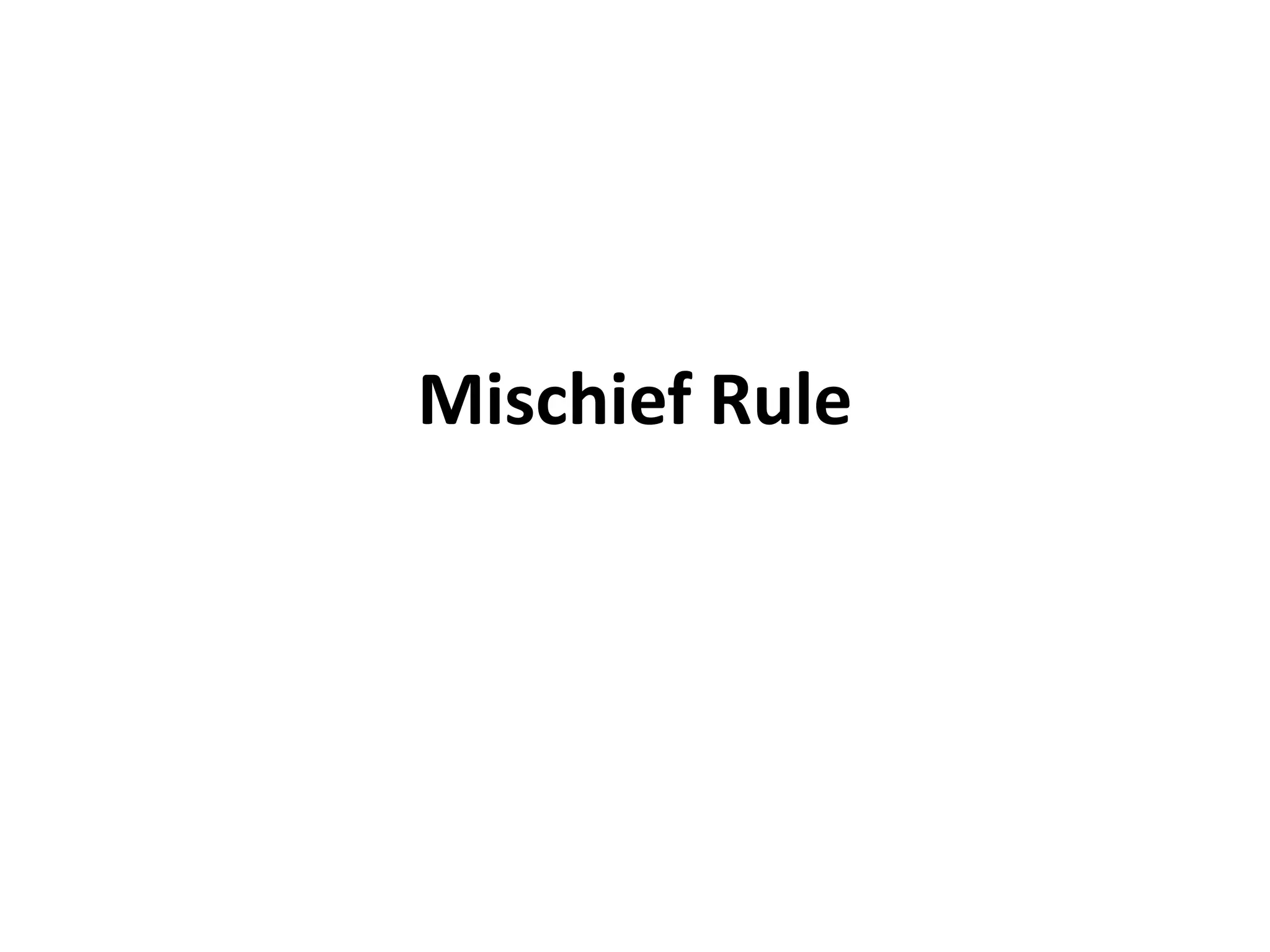
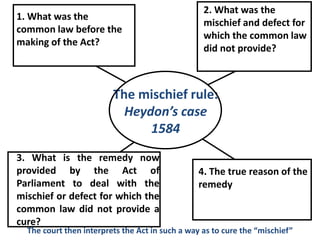
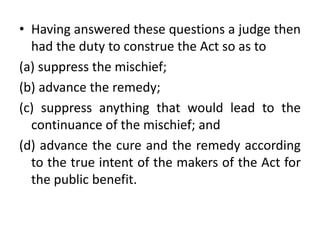
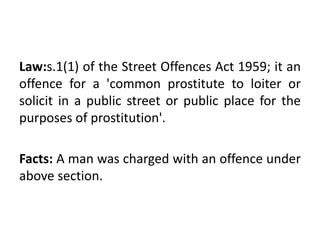
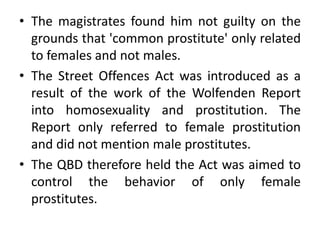
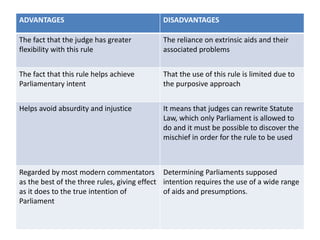
The mischief rule is used to determine the intention of Parliament when enacting legislation. It looks at the problem or defect that the law was meant to address, known as the "mischief." Heydon's Case established four questions to determine the mischief: 1) what was the common law prior to the Act, 2) what issue was the common law not addressing, 3) how does the Act aim to remedy this, and 4) what was the purpose of the remedy. Later cases like Smith v Hughes and Elliott v Grey applied the mischief rule broadly to find defendants guilty in order to suppress the mischief, even when a literal reading may have found otherwise. The mischief rule aims to achieve Parliament's intent but
![Mischief Rule
• The literal and golden rules are concerned
with finding out what Parliament SAID. The
mischief rule is applied to find out what
Parliament MEANT.
• It looks for the wrong: the ‘mischief’ which
the statute is trying to correct. The statute is
then interpreted in light of this.
• The rule is based on the Heydon’s Case [1584]
– VERY OLD!…in which certain steps were
identified as a way of interpretation.](https://image.slidesharecdn.com/mischiefrule-180908083153/85/Mischief-rule-2-320.jpg)
![Heydon’s Case [1584]
• In this case it was stated that judges should
(a) What was the common law before the
enactment of the Act?
(b)What was the mischief and defect for which
the common law did not Provide a remedy or
redress?
(c) What is the remedy now provided by the Act
of Parliament to deal with the mischief or
defect for which the common law did not
provide a cure?
(d) What is the rationale for the remedy?](https://image.slidesharecdn.com/mischiefrule-180908083153/85/Mischief-rule-4-320.jpg)

![DPP v Bull [1995] QB 88](https://image.slidesharecdn.com/mischiefrule-180908083153/85/Mischief-rule-19-320.jpg)




![Strict interpretation [penal]](https://cdn.slidesharecdn.com/ss_thumbnails/strictinterpretationpenal-180908083208-thumbnail.jpg?width=640&height=640&fit=bounds)


