


Adv. Jharna Jagtiani
Arbitrator, Mediator & Commercial Negotiator
Co Founder, Prerna Foundation
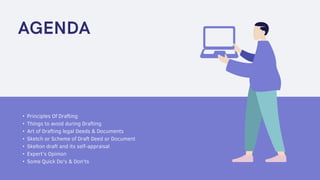
• Principles Of Drafting
• Things to avoid during Drafting
• Art of Drafting legal Deeds & Documents
• Sketch or Scheme of Draft Deed or Document
• Skelton draft and its self-appraisal
• Expert’s Opinion
• Some Quick Do's & Don'ts
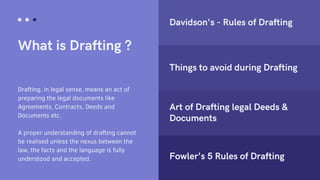
Drafting, in legal sense, means an act of
preparing the legal documents like
Agreements, Contracts, Deeds and
Documents etc.
A proper understanding of drafting cannot
be realised unless the nexus between the
law, the facts and the language is fully
understood and accepted.
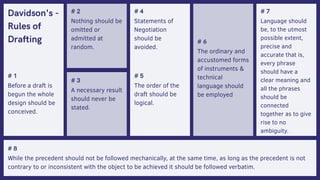
Before a draft is
begun the whole
design should be
conceived.
Nothing should be
omitted or
admitted at
random.
A necessary result
should never be
stated.
Statements of
Negotiation
should be
avoided.
The order of the
draft should be
logical.
Language should
be, to the utmost
possible extent,
precise and
accurate that is,
every phrase
should have a
clear meaning and
all the phrases
should be
connected
together as to give
rise to no
ambiguity.
The ordinary and
accustomed forms
of instruments &
technical
language should
be employed
While the precedent should not be followed mechanically, at the same time, as long as the precedent is not
contrary to or inconsistent with the object to be achieved it should be followed verbatim.
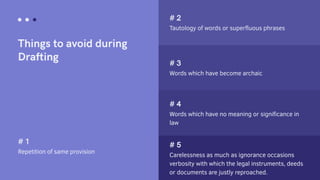
Tautology of words or superfluous phrases
Words which have become archaic
Words which have no meaning or significance in
law
Carelessness as much as ignorance occasions
verbosity with which the legal instruments, deeds
or documents are justly reproached.
Repetition of same provision
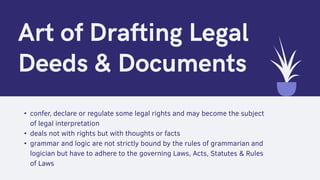
• confer, declare or regulate some legal rights and may become the subject
of legal interpretation
• deals not with rights but with thoughts or facts
• grammar and logic are not strictly bound by the rules of grammarian and
logician but have to adhere to the governing Laws, Acts, Statutes & Rules
of Laws
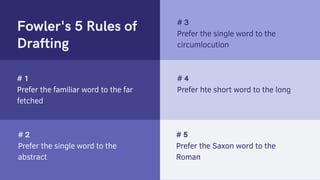
Prefer the familiar word to the far
fetched
Prefer the single word to the
abstract
Prefer the single word to the
circumlocution
Prefer hte short word to the long
Prefer the Saxon word to the
Roman
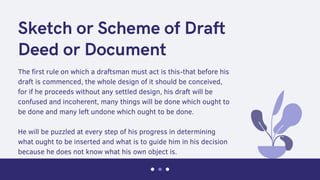
The first rule on which a draftsman must act is this-that before his
draft is commenced, the whole design of it should be conceived,
for if he proceeds without any settled design, his draft will be
confused and incoherent, many things will be done which ought to
be done and many left undone which ought to be done.
He will be puzzled at every step of his progress in determining
what ought to be inserted and what is to guide him in his decision
because he does not know what his own object is.
Draftsman should frame what is called a “skeleton draft”
which should be filled in or elaborated as he proceeds with
his work.
Once the draft of the document is ready, the draftsman
should appraise it.
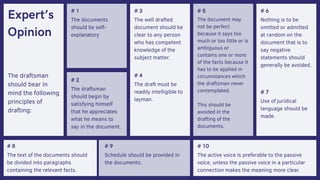
The draftsman
should bear in
mind the following
principles of
drafting:
The documents
should be self-
explanatory
The draftsman
should begin by
satisfying himself
that he appreciates
what he means to
say in the document.
The well drafted
document should be
clear to any person
who has competent
knowledge of the
subject matter.
The draft must be
readily intelligible to
layman.
Nothing is to be
omitted or admitted
at random on the
document that is to
say negative
statements should
generally be avoided.
Use of juridical
language should be
made.
The document may
not be perfect
because it says too
much or too little or is
ambiguous or
contains one or more
of the facts because it
has to be applied in
circumstances which
the draftsman never
contemplated.
This should be
avoided in the
drafting of the
documents.
The text of the documents should
be divided into paragraphs
containing the relevant facts.
Schedule should be provided in
the documents.
The active voice is preferable to the passive
voice, unless the passive voice in a particular
connection makes the meaning more clear.
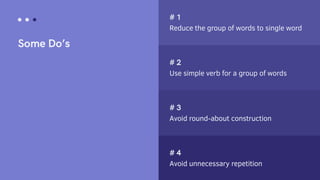
Reduce the group of words to single word
Use simple verb for a group of words
Avoid round-about construction
Avoid unnecessary repetition
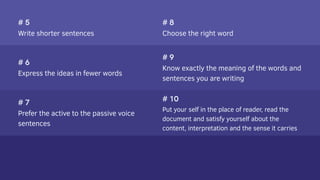
Choose the right word
Know exactly the meaning of the words and
sentences you are writing
Put your self in the place of reader, read the
document and satisfy yourself about the
content, interpretation and the sense it carries
Write shorter sentences
Express the ideas in fewer words
Prefer the active to the passive voice
sentences
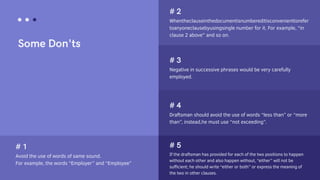
Whentheclauseinthedocumentisnumbereditisconvenienttorefer
toanyoneclausebyusingsingle number for it. For example, “in
clause 2 above” and so on.
Negative in successive phrases would be very carefully
employed.
Draftsman should avoid the use of words “less than” or “more
than”, instead,he must use “not exceeding”.
If the draftsman has provided for each of the two positions to happen
without each other and also happen without, “either” will not be
sufficient; he should write “either or both” or express the meaning of
the two in other clauses.
Avoid the use of words of same sound.
For example, the words “Employer” and “Employee”
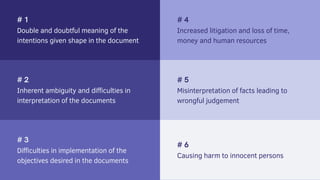
The legal implications of drafting, therefore, may be
observed as under:
Double and doubtful meaning of the
intentions given shape in the document
Inherent ambiguity and difficulties in
interpretation of the documents
Difficulties in implementation of the
objectives desired in the documents
Increased litigation and loss of time,
money and human resources
Misinterpretation of facts leading to
wrongful judgement
Causing harm to innocent persons
The above implications could be
avoided if drafting principles are fully
adhered to by the draftsman as
mentioned.
Principles of Drafting

Principles of Drafting

  • 1.
    Adv. Jharna Jagtiani Arbitrator,Mediator & Commercial Negotiator Co Founder, Prerna Foundation
  • 2.
    • Principles OfDrafting • Things to avoid during Drafting • Art of Drafting legal Deeds & Documents • Sketch or Scheme of Draft Deed or Document • Skelton draft and its self-appraisal • Expert’s Opinion • Some Quick Do's & Don'ts
  • 3.
    Drafting, in legalsense, means an act of preparing the legal documents like Agreements, Contracts, Deeds and Documents etc. A proper understanding of drafting cannot be realised unless the nexus between the law, the facts and the language is fully understood and accepted.
  • 4.
    Before a draftis begun the whole design should be conceived. Nothing should be omitted or admitted at random. A necessary result should never be stated. Statements of Negotiation should be avoided. The order of the draft should be logical. Language should be, to the utmost possible extent, precise and accurate that is, every phrase should have a clear meaning and all the phrases should be connected together as to give rise to no ambiguity. The ordinary and accustomed forms of instruments & technical language should be employed While the precedent should not be followed mechanically, at the same time, as long as the precedent is not contrary to or inconsistent with the object to be achieved it should be followed verbatim.
  • 5.
    Tautology of wordsor superfluous phrases Words which have become archaic Words which have no meaning or significance in law Carelessness as much as ignorance occasions verbosity with which the legal instruments, deeds or documents are justly reproached. Repetition of same provision
  • 6.
    • confer, declareor regulate some legal rights and may become the subject of legal interpretation • deals not with rights but with thoughts or facts • grammar and logic are not strictly bound by the rules of grammarian and logician but have to adhere to the governing Laws, Acts, Statutes & Rules of Laws
  • 7.
    Prefer the familiarword to the far fetched Prefer the single word to the abstract Prefer the single word to the circumlocution Prefer hte short word to the long Prefer the Saxon word to the Roman
  • 8.
    The first ruleon which a draftsman must act is this-that before his draft is commenced, the whole design of it should be conceived, for if he proceeds without any settled design, his draft will be confused and incoherent, many things will be done which ought to be done and many left undone which ought to be done. He will be puzzled at every step of his progress in determining what ought to be inserted and what is to guide him in his decision because he does not know what his own object is.
  • 9.
    Draftsman should framewhat is called a “skeleton draft” which should be filled in or elaborated as he proceeds with his work. Once the draft of the document is ready, the draftsman should appraise it.
  • 10.
    The draftsman should bearin mind the following principles of drafting: The documents should be self- explanatory The draftsman should begin by satisfying himself that he appreciates what he means to say in the document. The well drafted document should be clear to any person who has competent knowledge of the subject matter. The draft must be readily intelligible to layman. Nothing is to be omitted or admitted at random on the document that is to say negative statements should generally be avoided. Use of juridical language should be made. The document may not be perfect because it says too much or too little or is ambiguous or contains one or more of the facts because it has to be applied in circumstances which the draftsman never contemplated. This should be avoided in the drafting of the documents. The text of the documents should be divided into paragraphs containing the relevant facts. Schedule should be provided in the documents. The active voice is preferable to the passive voice, unless the passive voice in a particular connection makes the meaning more clear.
  • 12.
    Reduce the groupof words to single word Use simple verb for a group of words Avoid round-about construction Avoid unnecessary repetition
  • 13.
    Choose the rightword Know exactly the meaning of the words and sentences you are writing Put your self in the place of reader, read the document and satisfy yourself about the content, interpretation and the sense it carries Write shorter sentences Express the ideas in fewer words Prefer the active to the passive voice sentences
  • 14.
    Whentheclauseinthedocumentisnumbereditisconvenienttorefer toanyoneclausebyusingsingle number forit. For example, “in clause 2 above” and so on. Negative in successive phrases would be very carefully employed. Draftsman should avoid the use of words “less than” or “more than”, instead,he must use “not exceeding”. If the draftsman has provided for each of the two positions to happen without each other and also happen without, “either” will not be sufficient; he should write “either or both” or express the meaning of the two in other clauses. Avoid the use of words of same sound. For example, the words “Employer” and “Employee”
  • 15.
    The legal implicationsof drafting, therefore, may be observed as under:
  • 16.
    Double and doubtfulmeaning of the intentions given shape in the document Inherent ambiguity and difficulties in interpretation of the documents Difficulties in implementation of the objectives desired in the documents Increased litigation and loss of time, money and human resources Misinterpretation of facts leading to wrongful judgement Causing harm to innocent persons
  • 17.
    The above implicationscould be avoided if drafting principles are fully adhered to by the draftsman as mentioned.