PRIVATE INTERNATIONAL LAW
SUBMITTED BY:-
KANCHAN
LL.B (Hons.)
 Marriage is the very foundation of the civil society, and no part of the laws and institutions of a
country can be of more vital importance to its subject than those which regulate the manner
and condition of forming, and if necessary of dissolving, the marriage contract.”
 In English law, a marriage though a contract, is a contract sui generis i.e unique contract. Each
legal system determines the attributes of a marriage; at Common Law in England, it is in
essence a consensual (involve consent) union of a man and a woman.
 A marriage was a voluntary union for life of one man with one woman to the exclusion of
others. This decision was the foundation of the rule that polygamous marriages were not
recognized in England but the situation has been changed and such marriages are now
recognized in England.
 The institution of marriage gives rise to obligations, conjugal relations and certain rights
between the spouses and this is the reason why law seeks the discharge of those marital
obligations.
Definition
Marriage means the union of a man and a woman to the exclusion of all others, voluntarily entered
into for life: Marriage Amendment Act 2004 (Cth) – ss 5 (1) Marriage Act 1961.
Ingredients:-
 A Man and A Woman
 Voluntary Union
 Indefinite duration
 Monogamous
In India, conjugal right is believed to be inherent in the very institution of marriage and not a mere
creation of statute.
Primary issues:-
 Declaration of validity
 Annulment
An incidental question when:-
 Dissolution
 Revocation of will by marriage
 Inheritance of spouse or child
 Legitimacy of child
 Taxation relief of spouse
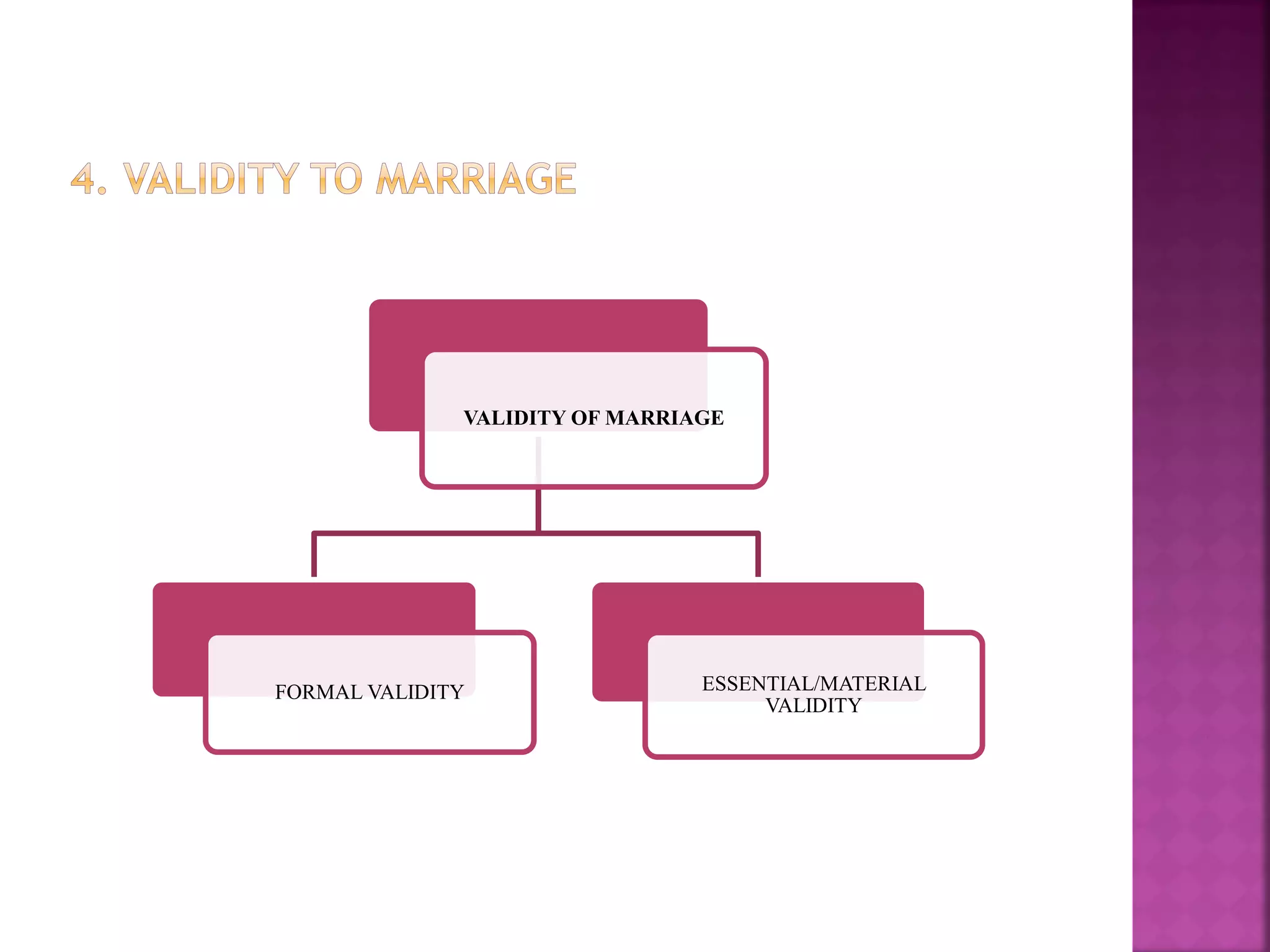
VALIDITY OF MARRIAGE
FORMAL VALIDITY ESSENTIAL/MATERIAL
VALIDITY
 Parties must have capacity_ Essential validity
 Parties must have performed necessary ceremonies and rites of marriage_ Formal Validity
If any of the above two, not fulfilled marriage is not valid.
Formal Validity:-
 Whether religious or civil ceremony
 Qualifications of celebrant
 Need for witnesses in numbers
 Requirements of notice/publication and registration
 Need for parental consent – questionable
Essential / Material Validity:-
 Age qualification
 Relationship by common descent or affinity qualification
 Pre-existing marital status
 LEX LOCI CELEBRATIONIS:-
The law of the place where a contract of marriage is performed.
 LEX DOMICILI:-
The law in force in country or place where a person is domiciled.
 Formal Validity –
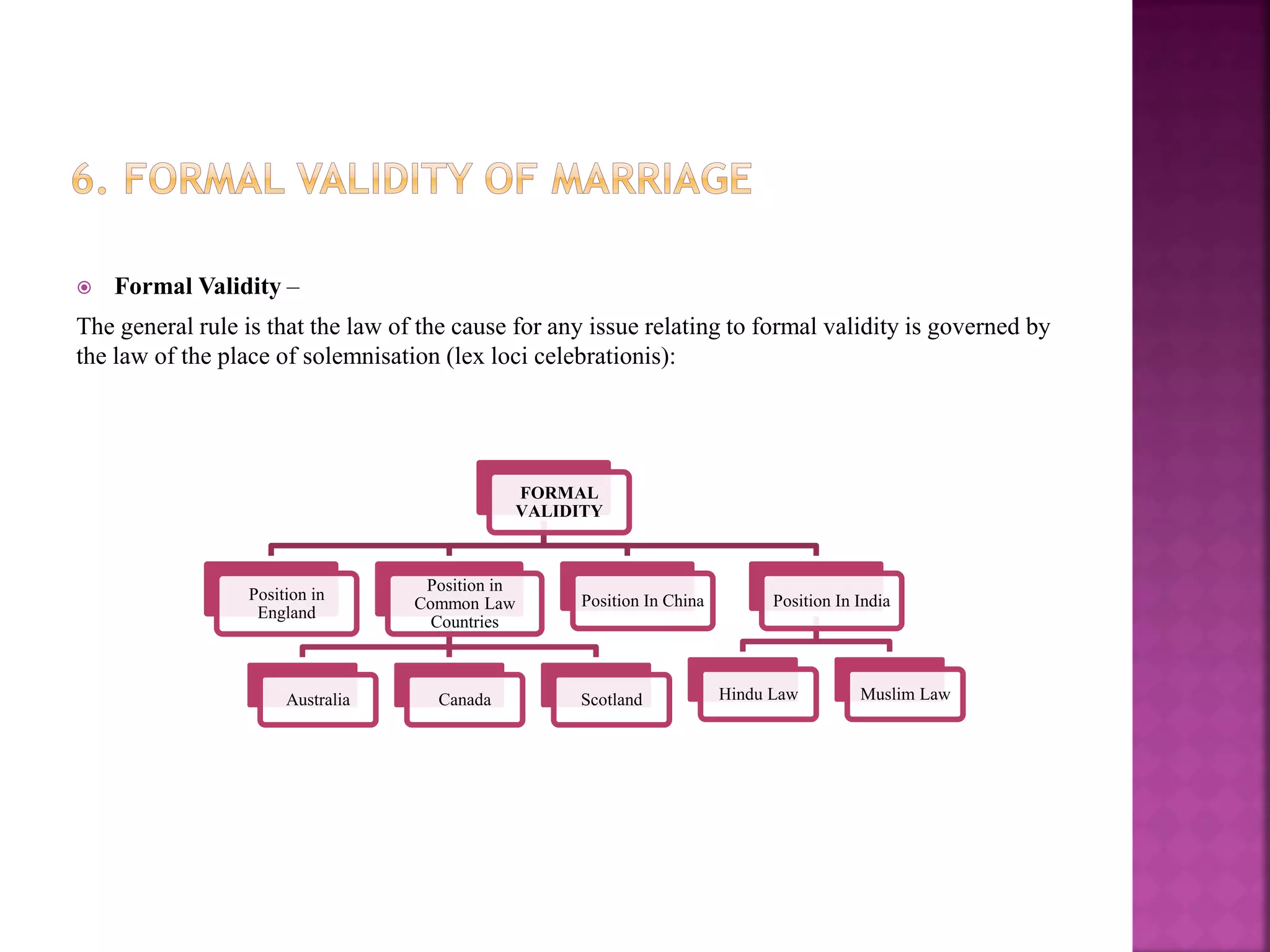
The general rule is that the law of the cause for any issue relating to formal validity is governed by
the law of the place of solemnisation (lex loci celebrationis):
FORMAL
VALIDITY
Position in
England
Position in
Common Law
Countries
Australia Canada Scotland
Position In China Position In India
Hindu Law Muslim Law
A. Position in England
o Lex Loci Celebrationis: De Barrov v. De Barros
o Locus Regit Actum:
o Retrospective Legislation:
B. Position in Common Law Countries
o Australia
o Canada
o Scotland
C. Position in China
D. Position in India
MARRIAGES IN
INDIA
Hindu law Muslim law
 Hindu Law: Marriage as Sacrament
Section 7 of The Hindu Marriage Act:- Hindu Marriage must be solemnized in accordance with
customary rites and ceremonies of either party.
Essential rites which may, is the requirement common in all ceremonial marriage are:
 Invocation before the sacred fire
 Kanyadan – not essential
 Saptapadi – is the essential ceremony
 Muslim Law:- Marriage as Civil Contract
It is a simple ceremony, at which the bride does not have to be present so long as she sends two
witnesses to the drawn-up agreement. Normally, the ceremony consists of reading from the Qur'an,
and the exchange of vows in front of witnesses for both partners.
 The Hague Conference on Private International Law has drafted the Hague Convention on the
Celebration and Recognition of the Validity of Marriages 1978.
 Few Common Law States have adopted it, Australia being the only exception, having amended
the (Australian) Marriage Act 1961, in 1985 to give statutory force of convention relating to
the recognition of marriage. The Law commission in the United Kingdom recommended
against its adoption.
 Article 2 - recognises the principle of lex loci celebrationis, which will determine the formal
validity of marriages in Private International Law.
 Article 5 and 14 – lays down that a state, party to this convention may refuse to enforce
and recognize a marriage if it is opposed to public policy of that state.
 Indian has not adopted it. The convention thus has little direct usefulness, some of its
provisions are being briefly indicated, however to show what can be called the international
consensus of opinion on the subject.
 A contract to marry fundamentally from a commercial contract, since creates a status that
affects both the parties themselves and the society to which they belong. It is fulfilled on the
solemnization of the marriage ceremony, and therefore there is a change in the law that
governed the relationship between the parties.
 Thus the institution of matrimonial causes, such as a petitioner for divorce and judicial
separation, implies that the parties are related to each other as husband and wife. Each legal
system must determine the attributes of the consensual union between man and woman, the
common factor, in eyes of the English law, of every marriage, which are necessary to create
the relationship of husband and wife.
 As far as jurisdiction of English Court is concerned, to entertain proceedings for nullity, if
either party was habitual resident for one year or domiciled in England, or if either of the
parties died before that date and either was at domiciled in England or had been habitually
resident for one year ending with the date of the death. A nullity decree may declare a marriage
either void or voidable.
Validity of marriage  formal validity

Validity of marriage formal validity

  • 1.
    PRIVATE INTERNATIONAL LAW SUBMITTEDBY:- KANCHAN LL.B (Hons.)
  • 2.
     Marriage isthe very foundation of the civil society, and no part of the laws and institutions of a country can be of more vital importance to its subject than those which regulate the manner and condition of forming, and if necessary of dissolving, the marriage contract.”  In English law, a marriage though a contract, is a contract sui generis i.e unique contract. Each legal system determines the attributes of a marriage; at Common Law in England, it is in essence a consensual (involve consent) union of a man and a woman.
  • 3.
     A marriagewas a voluntary union for life of one man with one woman to the exclusion of others. This decision was the foundation of the rule that polygamous marriages were not recognized in England but the situation has been changed and such marriages are now recognized in England.  The institution of marriage gives rise to obligations, conjugal relations and certain rights between the spouses and this is the reason why law seeks the discharge of those marital obligations. Definition Marriage means the union of a man and a woman to the exclusion of all others, voluntarily entered into for life: Marriage Amendment Act 2004 (Cth) – ss 5 (1) Marriage Act 1961. Ingredients:-  A Man and A Woman  Voluntary Union  Indefinite duration  Monogamous In India, conjugal right is believed to be inherent in the very institution of marriage and not a mere creation of statute.
  • 4.
    Primary issues:-  Declarationof validity  Annulment An incidental question when:-  Dissolution  Revocation of will by marriage  Inheritance of spouse or child  Legitimacy of child  Taxation relief of spouse
  • 5.
    VALIDITY OF MARRIAGE FORMALVALIDITY ESSENTIAL/MATERIAL VALIDITY
  • 6.
     Parties musthave capacity_ Essential validity  Parties must have performed necessary ceremonies and rites of marriage_ Formal Validity If any of the above two, not fulfilled marriage is not valid. Formal Validity:-  Whether religious or civil ceremony  Qualifications of celebrant  Need for witnesses in numbers  Requirements of notice/publication and registration  Need for parental consent – questionable Essential / Material Validity:-  Age qualification  Relationship by common descent or affinity qualification  Pre-existing marital status
  • 7.
     LEX LOCICELEBRATIONIS:- The law of the place where a contract of marriage is performed.  LEX DOMICILI:- The law in force in country or place where a person is domiciled.
  • 8.
     Formal Validity– The general rule is that the law of the cause for any issue relating to formal validity is governed by the law of the place of solemnisation (lex loci celebrationis): FORMAL VALIDITY Position in England Position in Common Law Countries Australia Canada Scotland Position In China Position In India Hindu Law Muslim Law
  • 9.
    A. Position inEngland o Lex Loci Celebrationis: De Barrov v. De Barros o Locus Regit Actum: o Retrospective Legislation: B. Position in Common Law Countries o Australia o Canada o Scotland C. Position in China D. Position in India MARRIAGES IN INDIA Hindu law Muslim law
  • 10.
     Hindu Law:Marriage as Sacrament Section 7 of The Hindu Marriage Act:- Hindu Marriage must be solemnized in accordance with customary rites and ceremonies of either party. Essential rites which may, is the requirement common in all ceremonial marriage are:  Invocation before the sacred fire  Kanyadan – not essential  Saptapadi – is the essential ceremony  Muslim Law:- Marriage as Civil Contract It is a simple ceremony, at which the bride does not have to be present so long as she sends two witnesses to the drawn-up agreement. Normally, the ceremony consists of reading from the Qur'an, and the exchange of vows in front of witnesses for both partners.
  • 11.
     The HagueConference on Private International Law has drafted the Hague Convention on the Celebration and Recognition of the Validity of Marriages 1978.  Few Common Law States have adopted it, Australia being the only exception, having amended the (Australian) Marriage Act 1961, in 1985 to give statutory force of convention relating to the recognition of marriage. The Law commission in the United Kingdom recommended against its adoption.  Article 2 - recognises the principle of lex loci celebrationis, which will determine the formal validity of marriages in Private International Law.  Article 5 and 14 – lays down that a state, party to this convention may refuse to enforce and recognize a marriage if it is opposed to public policy of that state.  Indian has not adopted it. The convention thus has little direct usefulness, some of its provisions are being briefly indicated, however to show what can be called the international consensus of opinion on the subject.
  • 12.
     A contractto marry fundamentally from a commercial contract, since creates a status that affects both the parties themselves and the society to which they belong. It is fulfilled on the solemnization of the marriage ceremony, and therefore there is a change in the law that governed the relationship between the parties.  Thus the institution of matrimonial causes, such as a petitioner for divorce and judicial separation, implies that the parties are related to each other as husband and wife. Each legal system must determine the attributes of the consensual union between man and woman, the common factor, in eyes of the English law, of every marriage, which are necessary to create the relationship of husband and wife.  As far as jurisdiction of English Court is concerned, to entertain proceedings for nullity, if either party was habitual resident for one year or domiciled in England, or if either of the parties died before that date and either was at domiciled in England or had been habitually resident for one year ending with the date of the death. A nullity decree may declare a marriage either void or voidable.