BY
RAJASHREE J JAWALE
ASSISTANT PROFESSOR
ISMAILSAHEB MULLA LAW COLLEGE SATARA
 Statutory interpretation is the process of interpreting and
applying legislation to decide cases.
 Interpretation is necessary when case involves suble or
ambiguous aspects of a statute.
 Generally, the words of a statute have a plain and
straightforward meaning. But in some cases, there may be
ambiguity or vagueness in the words of the statute that must
be resolved by the judge. The reason for ambiguity or
vagueness of a legislation is the fundamental nature of
language. It is not always possible to precisely transform
the intention of the legislature into written words.
 To find the meanings of statutes, judges use various
tools and methods of statutory interpretation, including
traditional canons of statutory interpretation, legislative
history, and purpose. In common law jurisdictions, the
judiciary may apply rules of statutory interpretation to
legislation enacted by the legislature or to delegated
legislation such as administrative agency regulations.
 Literal Rule (aka PlainMeaning Rule) - It means that
statutes are to be interpreted using the ordinary
meaning of the language of the statute unless a statute
explicitly defines some of its terms otherwise. In other
words, the law must be read, word for word, and it
should not divert from its true meaning.
According to this rule, when a word does not contain any
definition in a statute, it must be given its plain, ordinary,
and literal meaning. If the word is clear, it must be
applied, even though the intention of the legislature may
have been different or the result is harsh or undesirable.
The literal rule is what the law says instead of what the
law means.
 In J.P. Bansal v. State of Rajasthan 2003, SC
observed that the intention of the legislature is
primarily to be gathered from the language used, which
means that attention should be paid to what has been
said as also to what has not been said. As a
consequence, a construction which requires for its
support, addition, substitution, or removal of words or
which results in rejection of words as meaningless has
to be avoided. This is accordance with the case of
 Crawford vs Spooner, 1846, where privy council
noted that the courts cannot aid the legislature's
defective phrasing of an Act, they cannot add or mend,
and by construction.
 In M V Joshi vsM V Shimpi, AIR 1961, relating to
Food and Adulteration Act, it was
 contented that the act does not apply to butter made
from curd. However, SC held that the word butter in
the said act is plain and clear and there is no need to
interpret it differently. Butter is butter whether made
from milk or curd.
A statues often contains a "definitions" section, which
explicitly defines the most important terms used in that
statute. However, some statutes omit a definitions section
entirely, or fail to define a particular term. The literal rule,
which is also known as the plain meaning rule, attempts to
guide courts faced with litigation that turns on the
meaning of a term not defined by the statute, or on that of
a word found within a definition itself.
 Mischief rule - This rule attempts to determine the
legislator's intention.
 Originating from a 16th century case in the United
Kingdom, its main aim is to determine the "mischief
and defect" that the statute in question has set out to
remedy, and what ruling would effectively implement
this remedy. Smith vs. Hughes [1960] 2 All E.R. 859
 The rule was further illustrated in the case of Smith v
Hughes, 1960,
 where under the Street Offences Act 1959, it was a
crime for prostitutes to "loiter or solicit in the street for
the purposes of prostitution". The defendants were
calling to men in the street from balconies and tapping
on windows. They claimed they were not guilty as they
were not in the "street." The judge applied the mischief
rule to come to the conclusion that they were guilty as
 the intention of the Act was to cover the mischief of
harassment from prostitutes.
 This rule is of narrower application than the golden rule
or the plain meaning rule, in that it can only be used to
interpret a statute and only when the statute was passed
to remedy a defect in the common law. This rule has
often been used to resolve ambiguities in cases in
which the literal rule cannot be applied.
 The Mischief Rule is used by judges in statutory
interpretation in order to discover legislature's
intention. It essentially asks the question: By creating
an Act of Parliament what was the "mischief" that the
previous or existing law did not cover and this act
covers.
 The application of this rule gives the judge more
discretion than the literal and the golden rule as it
allows him to effectively decide on Parliament's intent.
Legislative intent is determined by examining
secondary sources, such as committee reports, treatises,
law review articles and corresponding statutes
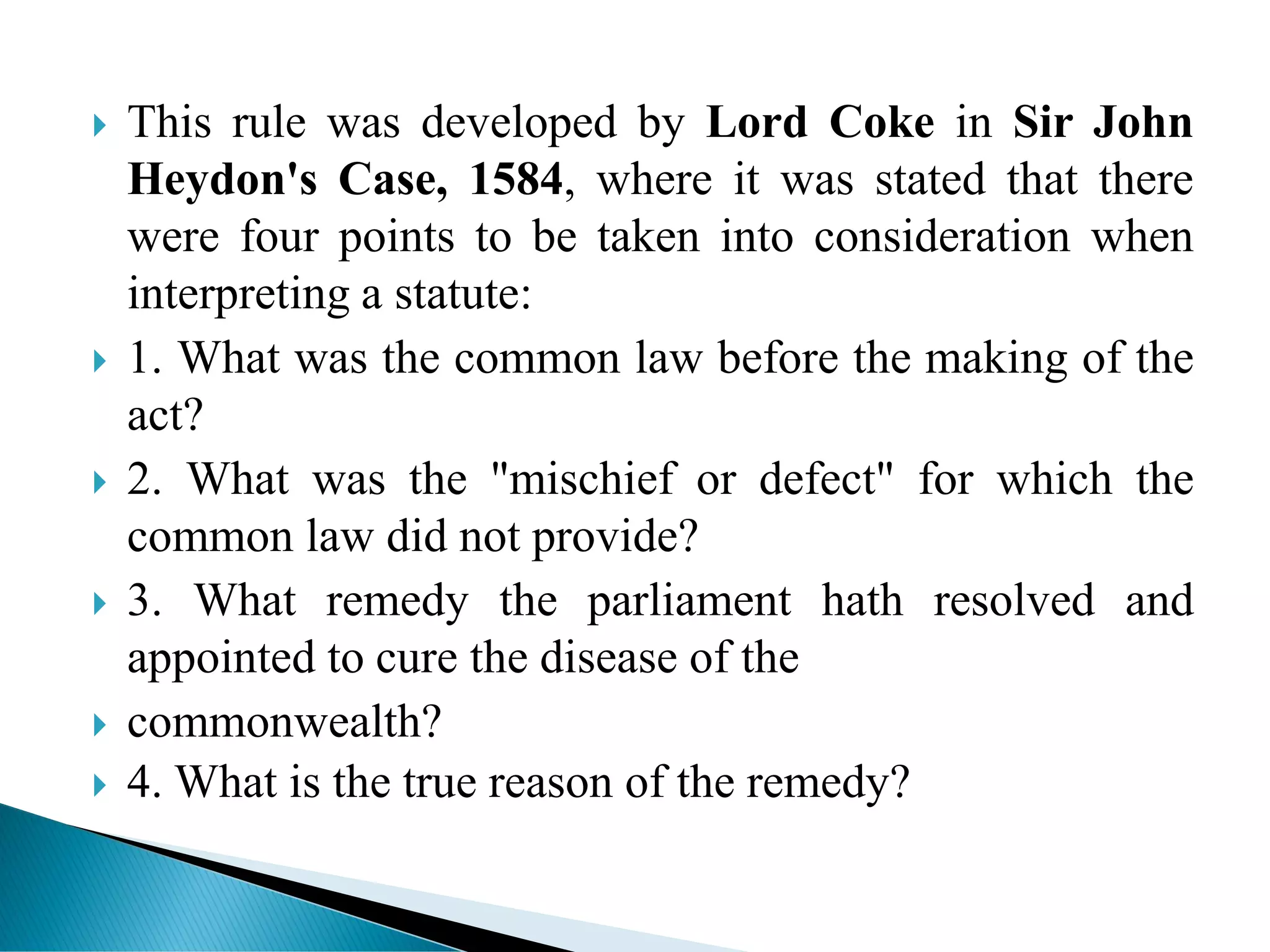
 This rule was developed by Lord Coke in Sir John
Heydon's Case, 1584, where it was stated that there
were four points to be taken into consideration when
interpreting a statute:
 1. What was the common law before the making of the
act?
 2. What was the "mischief or defect" for which the
common law did not provide?
 3. What remedy the parliament hath resolved and
appointed to cure the disease of the
 commonwealth?
 4. What is the true reason of the remedy?
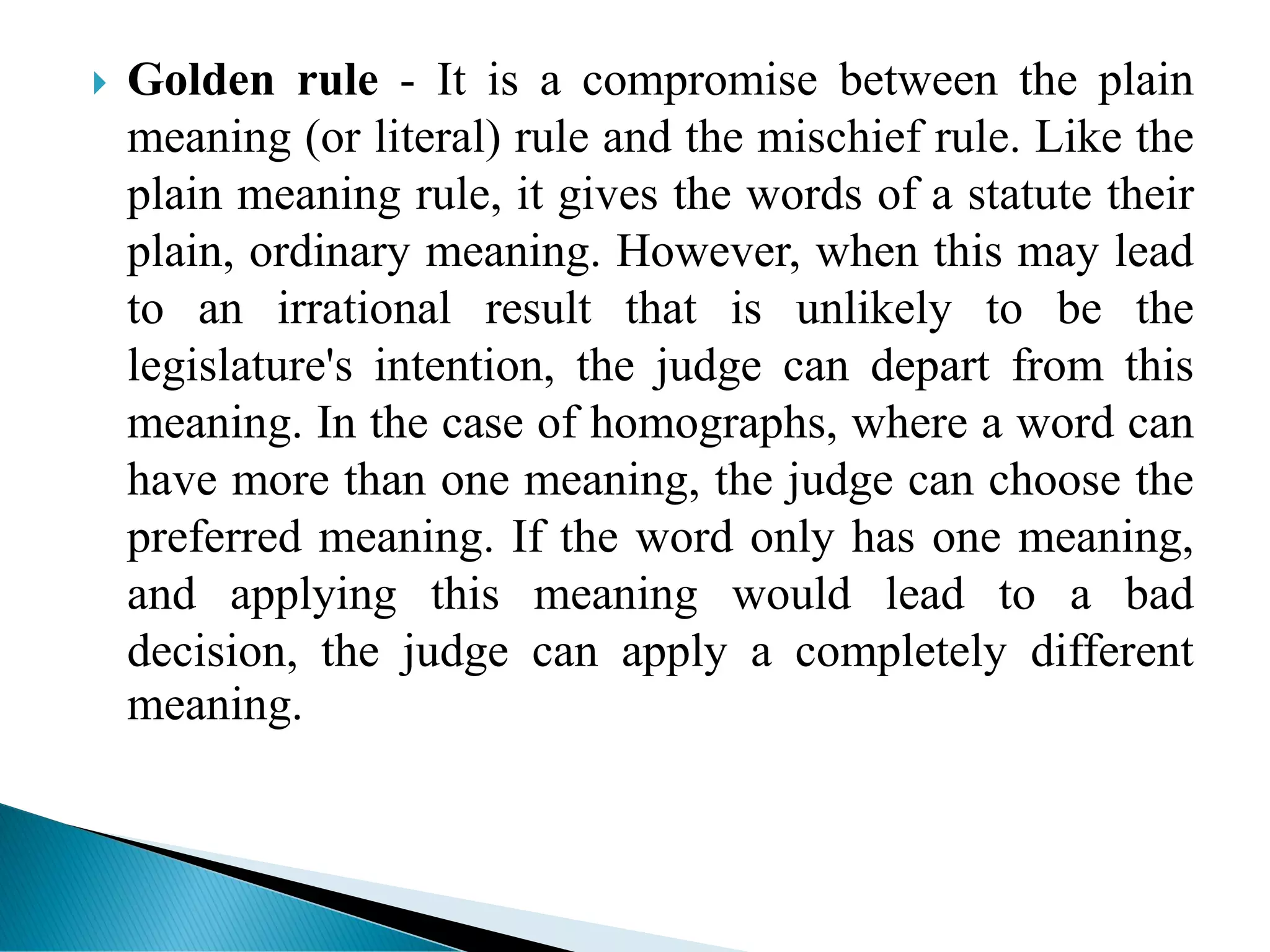
 Golden rule - It is a compromise between the plain
meaning (or literal) rule and the mischief rule. Like the
plain meaning rule, it gives the words of a statute their
plain, ordinary meaning. However, when this may lead
to an irrational result that is unlikely to be the
legislature's intention, the judge can depart from this
meaning. In the case of homographs, where a word can
have more than one meaning, the judge can choose the
preferred meaning. If the word only has one meaning,
and applying this meaning would lead to a bad
decision, the judge can apply a completely different
meaning.
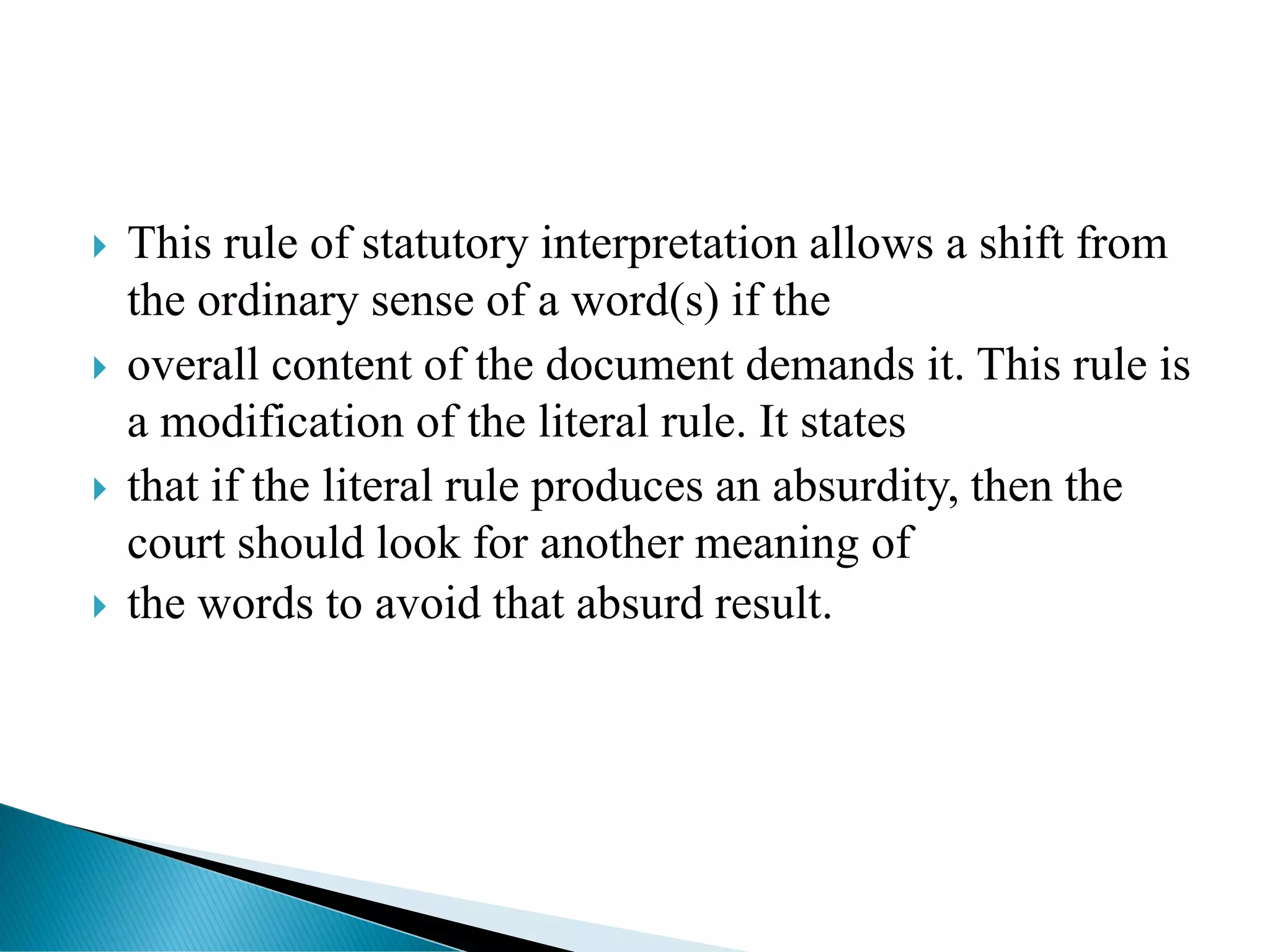
 This rule of statutory interpretation allows a shift from
the ordinary sense of a word(s) if the
 overall content of the document demands it. This rule is
a modification of the literal rule. It states
 that if the literal rule produces an absurdity, then the
court should look for another meaning of
 the words to avoid that absurd result.
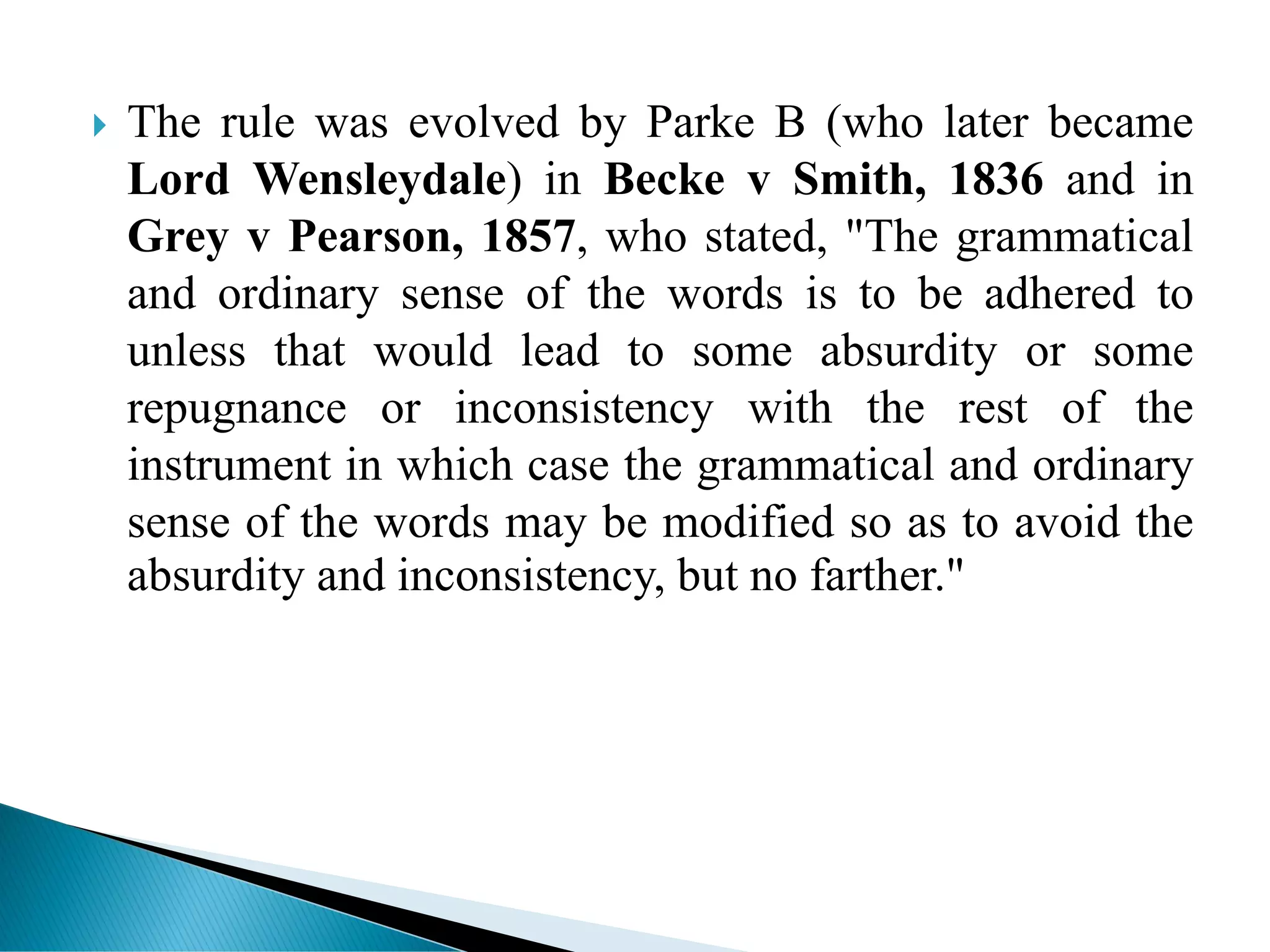
 The rule was evolved by Parke B (who later became
Lord Wensleydale) in Becke v Smith, 1836 and in
Grey v Pearson, 1857, who stated, "The grammatical
and ordinary sense of the words is to be adhered to
unless that would lead to some absurdity or some
repugnance or inconsistency with the rest of the
instrument in which case the grammatical and ordinary
sense of the words may be modified so as to avoid the
absurdity and inconsistency, but no farther."
 It is a very useful rule in the construction of a statute as
it allows to adhere to the ordinary meaning of the
words used, and to the grammatical construction,
unless that is at variance with the intention of the
legislature to be collected from the statute itself, or
leads to any manifest absurdity or repugnance, in which
case it allows the language to be varied or modified so
as to avoid such inconvenience.
 The second use of the golden rule is in a wider sense, to
avoid a result that is obnoxious to
 principles of public policy, even where words have
only one meaning. Bedford vs Bedford,
 1935, is another interesting case that highlighted the
use of this rule.
 It concerned a case where a son murdered his mother
and committed suicide. The courts were required to
rule on who then inherited the estate, the mother's
family, or the son's descendants. The mother had not
made a will and under the Administration of Justice Act
1925 her estate would be inherited by her next of kin,
i.e. her son. There was no ambiguity in the words of the
Act, but the court was not prepared to let the son who
had murdered his mother benefit from his crime. It was
held that the literal rule should not apply and that the
golden rule should be used to prevent the repugnant
situation of the son inheriting. The court held that if the
son inherits the estate that would amount to profiting
from a crime and that would be repugnant to the act.
 Interpreting a statute to determine whether it
applies to a given set of facts often boils
down to analyzing whether a single word or
short phrase covers some element of the
factual situation before the judge.
Thus, the Golden rule implies that if a strict interpretation
of a statute would lead to an absurd
result then the meaning of the words should be so
construed so as to lead to the avoidance of such absurdity.
A further corollary to this rule is that in case there are
multiple constructions to effect the Golden rule the one
which favors the assessee should always be taken. This
rule is also known as the Rule of Reasonable
Construction.
 Rule of Harmonious Construction - when there are
two provisions in a statute, which are in conflict with
each other, they should be interpreted such that effect
can be given to both and the construction which renders
either of them inoperative and useless should not be
adopted except in the last resort. Bengal immunity Co.
vs. State of Bihar (1955) 6 STC 446 (SC).
 Noscitur a sociis -When a word is ambiguous, its
meaning may be determined by reference to the rest of
the statute.
 Reddendo Singula Singulis -When a list of words has
a modifying phrase at the end, the phrase refers only to
the last word, e.g., firemen, policemen, and doctors in a
hospital. Here,"in a hospital" only applies to doctors
and not to firemen or policemen.
 Ejusdem Generis -When a list of two or more specific
descriptors are followed by more general descriptors,
the otherwise wide meaning of the general descriptors
must be restricted to the same class, if any, of the
specific words that precede them e.g. vehicles in
"cars,motor bikes,motor powered vehicles" would be
interpreted in a limited sense and therefore cannot be
interpreted as including air planes.
THANKS

Rules of statutary interpretation PPT By Rajashree J Jawale

  • 1.
    BY RAJASHREE J JAWALE ASSISTANTPROFESSOR ISMAILSAHEB MULLA LAW COLLEGE SATARA
  • 2.
     Statutory interpretationis the process of interpreting and applying legislation to decide cases.  Interpretation is necessary when case involves suble or ambiguous aspects of a statute.  Generally, the words of a statute have a plain and straightforward meaning. But in some cases, there may be ambiguity or vagueness in the words of the statute that must be resolved by the judge. The reason for ambiguity or vagueness of a legislation is the fundamental nature of language. It is not always possible to precisely transform the intention of the legislature into written words.
  • 3.
     To findthe meanings of statutes, judges use various tools and methods of statutory interpretation, including traditional canons of statutory interpretation, legislative history, and purpose. In common law jurisdictions, the judiciary may apply rules of statutory interpretation to legislation enacted by the legislature or to delegated legislation such as administrative agency regulations.
  • 4.
     Literal Rule(aka PlainMeaning Rule) - It means that statutes are to be interpreted using the ordinary meaning of the language of the statute unless a statute explicitly defines some of its terms otherwise. In other words, the law must be read, word for word, and it should not divert from its true meaning.
  • 5.
    According to thisrule, when a word does not contain any definition in a statute, it must be given its plain, ordinary, and literal meaning. If the word is clear, it must be applied, even though the intention of the legislature may have been different or the result is harsh or undesirable. The literal rule is what the law says instead of what the law means.
  • 6.
     In J.P.Bansal v. State of Rajasthan 2003, SC observed that the intention of the legislature is primarily to be gathered from the language used, which means that attention should be paid to what has been said as also to what has not been said. As a consequence, a construction which requires for its support, addition, substitution, or removal of words or which results in rejection of words as meaningless has to be avoided. This is accordance with the case of  Crawford vs Spooner, 1846, where privy council noted that the courts cannot aid the legislature's defective phrasing of an Act, they cannot add or mend, and by construction.
  • 7.
     In MV Joshi vsM V Shimpi, AIR 1961, relating to Food and Adulteration Act, it was  contented that the act does not apply to butter made from curd. However, SC held that the word butter in the said act is plain and clear and there is no need to interpret it differently. Butter is butter whether made from milk or curd.
  • 8.
    A statues oftencontains a "definitions" section, which explicitly defines the most important terms used in that statute. However, some statutes omit a definitions section entirely, or fail to define a particular term. The literal rule, which is also known as the plain meaning rule, attempts to guide courts faced with litigation that turns on the meaning of a term not defined by the statute, or on that of a word found within a definition itself.
  • 9.
     Mischief rule- This rule attempts to determine the legislator's intention.  Originating from a 16th century case in the United Kingdom, its main aim is to determine the "mischief and defect" that the statute in question has set out to remedy, and what ruling would effectively implement this remedy. Smith vs. Hughes [1960] 2 All E.R. 859
  • 10.
     The rulewas further illustrated in the case of Smith v Hughes, 1960,  where under the Street Offences Act 1959, it was a crime for prostitutes to "loiter or solicit in the street for the purposes of prostitution". The defendants were calling to men in the street from balconies and tapping on windows. They claimed they were not guilty as they were not in the "street." The judge applied the mischief rule to come to the conclusion that they were guilty as  the intention of the Act was to cover the mischief of harassment from prostitutes.
  • 11.
     This ruleis of narrower application than the golden rule or the plain meaning rule, in that it can only be used to interpret a statute and only when the statute was passed to remedy a defect in the common law. This rule has often been used to resolve ambiguities in cases in which the literal rule cannot be applied.
  • 12.
     The MischiefRule is used by judges in statutory interpretation in order to discover legislature's intention. It essentially asks the question: By creating an Act of Parliament what was the "mischief" that the previous or existing law did not cover and this act covers.
  • 13.
     The applicationof this rule gives the judge more discretion than the literal and the golden rule as it allows him to effectively decide on Parliament's intent. Legislative intent is determined by examining secondary sources, such as committee reports, treatises, law review articles and corresponding statutes
  • 14.
     This rulewas developed by Lord Coke in Sir John Heydon's Case, 1584, where it was stated that there were four points to be taken into consideration when interpreting a statute:  1. What was the common law before the making of the act?  2. What was the "mischief or defect" for which the common law did not provide?  3. What remedy the parliament hath resolved and appointed to cure the disease of the  commonwealth?  4. What is the true reason of the remedy?
  • 15.
     Golden rule- It is a compromise between the plain meaning (or literal) rule and the mischief rule. Like the plain meaning rule, it gives the words of a statute their plain, ordinary meaning. However, when this may lead to an irrational result that is unlikely to be the legislature's intention, the judge can depart from this meaning. In the case of homographs, where a word can have more than one meaning, the judge can choose the preferred meaning. If the word only has one meaning, and applying this meaning would lead to a bad decision, the judge can apply a completely different meaning.
  • 16.
     This ruleof statutory interpretation allows a shift from the ordinary sense of a word(s) if the  overall content of the document demands it. This rule is a modification of the literal rule. It states  that if the literal rule produces an absurdity, then the court should look for another meaning of  the words to avoid that absurd result.
  • 17.
     The rulewas evolved by Parke B (who later became Lord Wensleydale) in Becke v Smith, 1836 and in Grey v Pearson, 1857, who stated, "The grammatical and ordinary sense of the words is to be adhered to unless that would lead to some absurdity or some repugnance or inconsistency with the rest of the instrument in which case the grammatical and ordinary sense of the words may be modified so as to avoid the absurdity and inconsistency, but no farther."
  • 18.
     It isa very useful rule in the construction of a statute as it allows to adhere to the ordinary meaning of the words used, and to the grammatical construction, unless that is at variance with the intention of the legislature to be collected from the statute itself, or leads to any manifest absurdity or repugnance, in which case it allows the language to be varied or modified so as to avoid such inconvenience.
  • 19.
     The seconduse of the golden rule is in a wider sense, to avoid a result that is obnoxious to  principles of public policy, even where words have only one meaning. Bedford vs Bedford,  1935, is another interesting case that highlighted the use of this rule.
  • 20.
     It concerneda case where a son murdered his mother and committed suicide. The courts were required to rule on who then inherited the estate, the mother's family, or the son's descendants. The mother had not made a will and under the Administration of Justice Act 1925 her estate would be inherited by her next of kin, i.e. her son. There was no ambiguity in the words of the Act, but the court was not prepared to let the son who had murdered his mother benefit from his crime. It was held that the literal rule should not apply and that the golden rule should be used to prevent the repugnant situation of the son inheriting. The court held that if the son inherits the estate that would amount to profiting from a crime and that would be repugnant to the act.
  • 21.
     Interpreting astatute to determine whether it applies to a given set of facts often boils down to analyzing whether a single word or short phrase covers some element of the factual situation before the judge.
  • 22.
    Thus, the Goldenrule implies that if a strict interpretation of a statute would lead to an absurd result then the meaning of the words should be so construed so as to lead to the avoidance of such absurdity. A further corollary to this rule is that in case there are multiple constructions to effect the Golden rule the one which favors the assessee should always be taken. This rule is also known as the Rule of Reasonable Construction.
  • 23.
     Rule ofHarmonious Construction - when there are two provisions in a statute, which are in conflict with each other, they should be interpreted such that effect can be given to both and the construction which renders either of them inoperative and useless should not be adopted except in the last resort. Bengal immunity Co. vs. State of Bihar (1955) 6 STC 446 (SC).
  • 24.
     Noscitur asociis -When a word is ambiguous, its meaning may be determined by reference to the rest of the statute.
  • 25.
     Reddendo SingulaSingulis -When a list of words has a modifying phrase at the end, the phrase refers only to the last word, e.g., firemen, policemen, and doctors in a hospital. Here,"in a hospital" only applies to doctors and not to firemen or policemen.
  • 27.
     Ejusdem Generis-When a list of two or more specific descriptors are followed by more general descriptors, the otherwise wide meaning of the general descriptors must be restricted to the same class, if any, of the specific words that precede them e.g. vehicles in "cars,motor bikes,motor powered vehicles" would be interpreted in a limited sense and therefore cannot be interpreted as including air planes.
  • 28.