



A presentation by
Maj Gen Nilendra Kumar
Director
Amity Law School, Noida
At
Technical session of the NIRC of ICSI
Presentation at Management Skill
Orientation Programme
6th March 2014
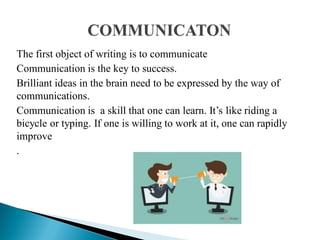
The first object of writing is to communicate
Communication is the key to success.
Brilliant ideas in the brain need to be expressed by the way of
communications.
Communication is a skill that one can learn. It‟s like riding a
bicycle or typing. If one is willing to work at it, one can rapidly
improve
.
It is the type of technical writing
Used by lawyers, judges, legislators and others connected
with law.
Creates binding legal text
To advocate for, or to express the resolution of a client‟s
legal matter.
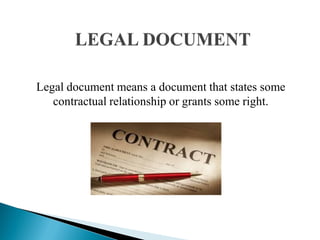
Legal document means a document that states some
contractual relationship or grants some right.
 Affidavits
 Agreement
 Arbitration
 Bonds
 Compromise and family
settlement
 Foreign collaboration
 Gift
 Hire purchase
 Indemnity
 Lease & License
 Mortgage & Pledge
 Notice
 Opinion
 Partition
 Partnership
 Power of Attorney
 Sale
 Will
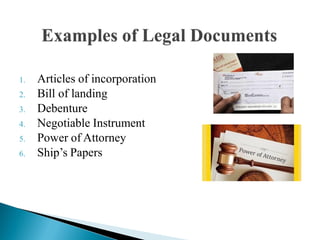
1. Articles of incorporation
2. Bill of landing
3. Debenture
4. Negotiable Instrument
5. Power of Attorney
6. Ship‟s Papers
“You can change your world by changing your words.
Remember, death and life are in power of tongue.”
-Joel Osteen
1. Authority (statutes or citation)
2. Precedent
3. Vocabulary
4. Formality
Formal writing is the opposite of the style adopted on
mobile phone text messages or on social media
Legal force behind the assertion
1. Remember your audience
2. Organize your writing
3. Write short sentences and use simple English
4. Avoid the legalese
5. Use action words
6. Avoid passive voice
7. Avoid adjectives
8. Edit ruthlessly
To know your audience implies for whom the document is
being prepared. It could be trial court, appellate court,
client, customer or government office etc.
Educate the reader what is coming.
Strive to explain in a logical and sequential manner.
Need to know concept as against adopting a post office
approach.
1. Collect all relevant matter
2. Arrange in proper sequence
3. Check if any essential matter is left out
4. Cross check if the document is complete
Adhere to the form where it is so required.
To illustrate how the documents are to be prepared for a High
Court
Proceedings how written-
1. Shall be in English
2. Fairly and legibly written, typed or printed in double spacing on one side
of standard petition paper with an inner margin of about 4 centimeters
width on top and on the left side.
3. Paragraphs shall be divided into paragraphs. And numbered consequently
as nearly as may be an separate allegation.
Ref Chapter III
1. Long sentences
2. Complex construction
3. Archaic and hyper formal vocabulary
4. Focus on the content to the exclusion of reader‟s need
Avoid use of formal text
Divide your text into a number of paragraphs. Introduce
each paragraph with a topic sentence. Use heading and
sub-headings to deal with a specific aspect.
 Dispatch
 Supply
 Cancel
 Appoint
 Purchase
 Appeal
 Negotiate
 Regret
 Confirm
 Shift
 Meet
 Reduce
It is the transfer of the legal title of property from one
person to another or the granting of an encumbrance such
as mortgage or lien.
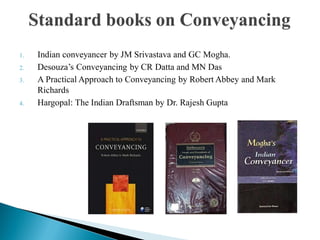
1. Indian conveyancer by JM Srivastava and GC Mogha.
2. Desouza‟s Conveyancing by CR Datta and MN Das
3. A Practical Approach to Conveyancing by Robert Abbey and Mark
Richards
4. Hargopal: The Indian Draftsman by Dr. Rajesh Gupta
Example-
1. We were affected by the news “we were devastated by the
news” instead of “we were relieved by the news”
2. Governmental income support to poor residents, in place of
„welfare‟
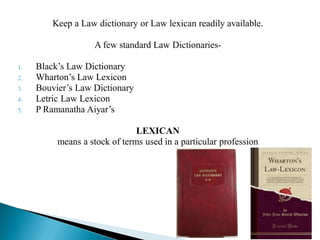
Keep a Law dictionary or Law lexican readily available.
A few standard Law Dictionaries-
1. Black‟s Law Dictionary
2. Wharton‟s Law Lexicon
3. Bouvier‟s Law Dictionary
4. Letric Law Lexicon
5. P Ramanatha Aiyar‟s
LEXICAN
means a stock of terms used in a particular profession
Make liberal use of search engines to cross check
references authorities and citations.
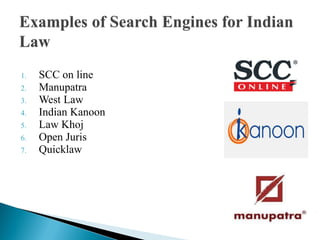
1. SCC on line
2. Manupatra
3. West Law
4. Indian Kanoon
5. Law Khoj
6. Open Juris
7. Quicklaw
Learn correct use of foot notes and end notes etc.
It means in the same source (use to save space in textual
reference to a quoted work which has been mentioned in a
previous reference) ibid is abbreviated as id.
It is an academic and legal citation signal used when a writer
desires to refer a reader to an earlier cited authority.
Supra is used as an internal cross reference to guide the reader
between parts of a document.
Example:
See supra note 3
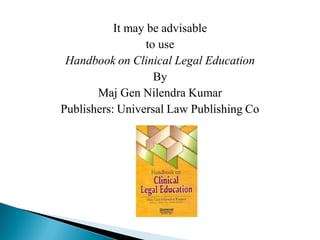
It may be advisable
to use
Handbook on Clinical Legal Education
By
Maj Gen Nilendra Kumar
Publishers: Universal Law Publishing Co
1. Statutory- Constitution, Act, Rules, Regulations, By
laws, Circular etc.
2. Judicial- Citation
3. Academic/ Professional
It means legal writing that is very difficult for laymen to
read and understand.
A citation is a reference to a published or unpublished
source.
Text Citation
An abbreviated alphanumeric expression embedded in the
body of an intellectual work that denotes an entry in the
bibliographic reference section of the work for the purpose of
acknowledging the relevance of the work of others to the topic
od discussion at the spot where the citation appears.
1. H M Seervai, Constitutional Law of India, 2nd edn,
Vol I Tripathi, 1976
2. N A Palkhivala (1984); We, the People of India- The
Largest Democracy, Bombay Strand Book Stall
3. Wade & Forsyth, Administrative Law (2009) 771
1. Presidency Small Causes Courts Act, 1882, Sec 18
2. Order 39, Rule 1 and 2
3. CPC (Amendment) Act, 2002 (22 of 2002), Sec 12(a)
An earlier event or action that is regarded as an example
or guide to be considered.
It means the way things have been done before.
These are re-usable documents templates
Legal drafting requires an eye for detail and constant
practice. Law students are advised to make sincere efforts
to learn it during their programme of studies.
THANK YOU

Legal Drafting

  • 2.
    A presentation by MajGen Nilendra Kumar Director Amity Law School, Noida At Technical session of the NIRC of ICSI
  • 3.
    Presentation at ManagementSkill Orientation Programme 6th March 2014
  • 4.
    The first objectof writing is to communicate Communication is the key to success. Brilliant ideas in the brain need to be expressed by the way of communications. Communication is a skill that one can learn. It‟s like riding a bicycle or typing. If one is willing to work at it, one can rapidly improve .
  • 5.
    It is thetype of technical writing Used by lawyers, judges, legislators and others connected with law.
  • 6.
  • 7.
    To advocate for,or to express the resolution of a client‟s legal matter.
  • 8.
    Legal document meansa document that states some contractual relationship or grants some right.
  • 9.
     Affidavits  Agreement Arbitration  Bonds  Compromise and family settlement  Foreign collaboration  Gift  Hire purchase  Indemnity  Lease & License  Mortgage & Pledge  Notice  Opinion  Partition  Partnership  Power of Attorney  Sale  Will
  • 10.
    1. Articles ofincorporation 2. Bill of landing 3. Debenture 4. Negotiable Instrument 5. Power of Attorney 6. Ship‟s Papers
  • 11.
    “You can changeyour world by changing your words. Remember, death and life are in power of tongue.” -Joel Osteen
  • 12.
    1. Authority (statutesor citation) 2. Precedent 3. Vocabulary 4. Formality
  • 13.
    Formal writing isthe opposite of the style adopted on mobile phone text messages or on social media
  • 14.
    Legal force behindthe assertion
  • 15.
    1. Remember youraudience 2. Organize your writing 3. Write short sentences and use simple English 4. Avoid the legalese 5. Use action words 6. Avoid passive voice 7. Avoid adjectives 8. Edit ruthlessly
  • 16.
    To know youraudience implies for whom the document is being prepared. It could be trial court, appellate court, client, customer or government office etc.
  • 17.
    Educate the readerwhat is coming. Strive to explain in a logical and sequential manner.
  • 18.
    Need to knowconcept as against adopting a post office approach.
  • 19.
    1. Collect allrelevant matter 2. Arrange in proper sequence 3. Check if any essential matter is left out 4. Cross check if the document is complete
  • 20.
    Adhere to theform where it is so required. To illustrate how the documents are to be prepared for a High Court
  • 21.
    Proceedings how written- 1.Shall be in English 2. Fairly and legibly written, typed or printed in double spacing on one side of standard petition paper with an inner margin of about 4 centimeters width on top and on the left side. 3. Paragraphs shall be divided into paragraphs. And numbered consequently as nearly as may be an separate allegation. Ref Chapter III
  • 22.
    1. Long sentences 2.Complex construction 3. Archaic and hyper formal vocabulary 4. Focus on the content to the exclusion of reader‟s need
  • 23.
    Avoid use offormal text
  • 24.
    Divide your textinto a number of paragraphs. Introduce each paragraph with a topic sentence. Use heading and sub-headings to deal with a specific aspect.
  • 25.
     Dispatch  Supply Cancel  Appoint  Purchase  Appeal  Negotiate  Regret  Confirm  Shift  Meet  Reduce
  • 26.
    It is thetransfer of the legal title of property from one person to another or the granting of an encumbrance such as mortgage or lien.
  • 27.
    1. Indian conveyancerby JM Srivastava and GC Mogha. 2. Desouza‟s Conveyancing by CR Datta and MN Das 3. A Practical Approach to Conveyancing by Robert Abbey and Mark Richards 4. Hargopal: The Indian Draftsman by Dr. Rajesh Gupta
  • 28.
    Example- 1. We wereaffected by the news “we were devastated by the news” instead of “we were relieved by the news” 2. Governmental income support to poor residents, in place of „welfare‟
  • 29.
    Keep a Lawdictionary or Law lexican readily available. A few standard Law Dictionaries- 1. Black‟s Law Dictionary 2. Wharton‟s Law Lexicon 3. Bouvier‟s Law Dictionary 4. Letric Law Lexicon 5. P Ramanatha Aiyar‟s LEXICAN means a stock of terms used in a particular profession
  • 30.
    Make liberal useof search engines to cross check references authorities and citations.
  • 31.
    1. SCC online 2. Manupatra 3. West Law 4. Indian Kanoon 5. Law Khoj 6. Open Juris 7. Quicklaw
  • 32.
    Learn correct useof foot notes and end notes etc.
  • 33.
    It means inthe same source (use to save space in textual reference to a quoted work which has been mentioned in a previous reference) ibid is abbreviated as id.
  • 34.
    It is anacademic and legal citation signal used when a writer desires to refer a reader to an earlier cited authority. Supra is used as an internal cross reference to guide the reader between parts of a document. Example: See supra note 3
  • 35.
    It may beadvisable to use Handbook on Clinical Legal Education By Maj Gen Nilendra Kumar Publishers: Universal Law Publishing Co
  • 36.
    1. Statutory- Constitution,Act, Rules, Regulations, By laws, Circular etc. 2. Judicial- Citation 3. Academic/ Professional
  • 37.
    It means legalwriting that is very difficult for laymen to read and understand.
  • 38.
    A citation isa reference to a published or unpublished source.
  • 39.
    Text Citation An abbreviatedalphanumeric expression embedded in the body of an intellectual work that denotes an entry in the bibliographic reference section of the work for the purpose of acknowledging the relevance of the work of others to the topic od discussion at the spot where the citation appears.
  • 40.
    1. H MSeervai, Constitutional Law of India, 2nd edn, Vol I Tripathi, 1976 2. N A Palkhivala (1984); We, the People of India- The Largest Democracy, Bombay Strand Book Stall 3. Wade & Forsyth, Administrative Law (2009) 771
  • 41.
    1. Presidency SmallCauses Courts Act, 1882, Sec 18 2. Order 39, Rule 1 and 2 3. CPC (Amendment) Act, 2002 (22 of 2002), Sec 12(a)
  • 42.
    An earlier eventor action that is regarded as an example or guide to be considered. It means the way things have been done before.
  • 43.
    These are re-usabledocuments templates
  • 44.
    Legal drafting requiresan eye for detail and constant practice. Law students are advised to make sincere efforts to learn it during their programme of studies.
  • 45.