Principles of Geotechnical
Engineering
Eighth Edition, SI
BRAJA M. DAS, Dean Emeritus
California State University, Sacramento
KHALED SOBHAN
Florida Atlantic University
Australia • Brazil • Japan • Korea • Mexico • Singapore • Spain • United Kingdom • United States
Copyright 2012 Cengage Learning. All Rights Reserved. May not be copied, scanned, or duplicated, in whole or in part.
Principles of Geotechnical Engineering,
Eighth Edition, SI
Braja M. Das and Khaled Sobhan
Publisher, Global Engineering:
Christopher M. Shortt
Senior Developmental Editor: Hilda
Gowans
Editorial Assistant: Tanya Altieri
Team Assistant: Carly Rizzo
Marketing Manager: Lauren Betsos
Media Editor: Chris Valentine
Content Project Manager:
D. Jean Buttrom
Production Service: RPK Editorial
Services, Inc.
Copyeditor: Shelly Gerger-Knechtl
Proofreader: Harlan James
Indexer: Braja M. Das
Compositor: Integra
Senior Art Director: Michelle Kunkler
Internal Designer: Carmela Pereira
Cover Designer: Tin Box Studio
Cover Image: Courtesy of ZETAŞ
Zemin Teknolojisi A.Ş., © Hüseyin
Tuncer/iStockphoto LP
Rights Acquisition Director:
Audrey Pettengill
Rights Acquisition Specialist:
Text and Image: Amber Hosea
Text and Image Permissions Researcher:
Kristiina Paul
Senior Manufacturing Planner: Doug
Wilke
Printed in the United States of America
1 2 3 4 5 6 7 15 14 13 12
© 2014, 2010 Cengage Learning
ALL RIGHTS RESERVED. No part of this work covered by the copyright
herein may be reproduced, transmitted, stored, or used in any form or
by any means graphic, electronic, or mechanical, including but not
limited to photocopying, recording, scanning, digitizing, taping, web
distribution, information networks, or information storage and
retrieval systems, except as permitted under Section 107 or 108 of
the 1976 United States Copyright Act, without the prior written
permission of the publisher.
For product information and technology assistance, contact us at
Cengage Learning Customer & Sales Support, 1-800-354-9706.
For permission to use material from this text or product,
submit all requests online at www.cengage.com/permissions.
Further permissions questions can be emailed to
permissionrequest@cengage.com.
Library of Congress Control Number: 2012952059
ISBN-13: 978-1-133-10867-2
ISBN-10: 1-133-10867-9
Cengage Learning
200 First Stamford Place, Suite 400
Stamford, CT 06902
USA
Cengage Learning is a leading provider of customized learning
solutions with office locations around the globe, including
Singapore, the United Kingdom, Australia, Mexico, Brazil, and Japan.
Locate your local office at: international.cengage.com/region.
Cengage Learning products are represented in Canada by
Nelson Education Ltd.
For your course and learning solutions, please visit
login.cengage.com and log in to access instructor-specific resources.
Purchase any of our products at your local college store or at our
preferred online store www.cengagebrain.com.
Copyright 2012 Cengage Learning. All Rights Reserved. May not be copied, scanned, or duplicated, in whole or in part.
To Elizabeth Madison, Armaan, and Shaiza
Copyright 2012 Cengage Learning. All Rights Reserved. May not be copied, scanned, or duplicated, in whole or in part.
Principles of Geotechnical Engineering was originally published with a 1985 copyright
and was intended for use as a text for the introductory course in geotechnical engineering
taken by practically all civil engineering students, as well as for use as a reference book
for practicing engineers. The book was revised in 1990, 1994, 1998, 2002, 2006, and 2010.
This eighth edition has a coauthor, Khaled Sobhan, of Florida Atlantic University. As in
the previous editions of the book, this new edition offers an overview of soil properties and
mechanics, together with coverage of field practices and basic engineering procedures,
without changing the basic philosophy of the original text. It is not the intent of this book
to conform to any design codes.
Unlike the seventh edition, which had 18 chapters, this edition has 17 chapters. The
chapter on Landfill Liners and Geosynthetics has been deleted from this edition since the
subject has grown and matured over the years and is offered as a separate course in many
civil engineering programs.
Most of the example problems and homework problems have been changed and/or
modified. One or two critical thinking problems have been added to the homework prob-
lems in most chapters to challenge and enhance the thought process and understanding of
students on the subject(s) covered in a given chapter.
Since geotechnical engineering is a practical and application-oriented subject, a few
actual case histories have also been included. These case histories are presented in Chapters 11,
15, and 16 with the primary intention being to familiarize students with the unpredictable
variability of soil in the field compared to the idealized situation in classroom teaching and
learning. New photographs have also been added throughout.
Other noteworthy changes in the eighth edition include the following:
• An expanded section of the introduction at the beginning and a summary section at
the end of each chapter have been provided.
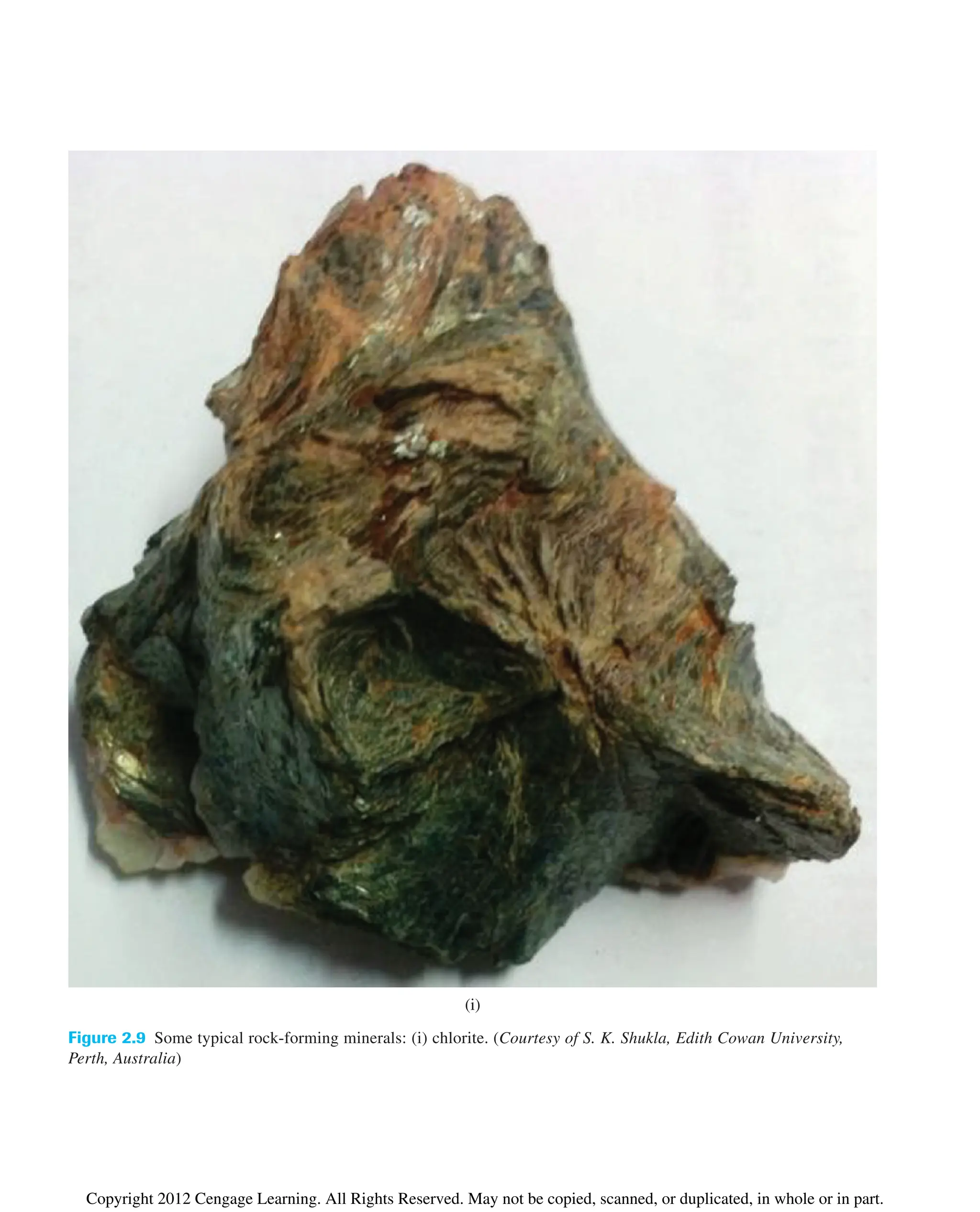
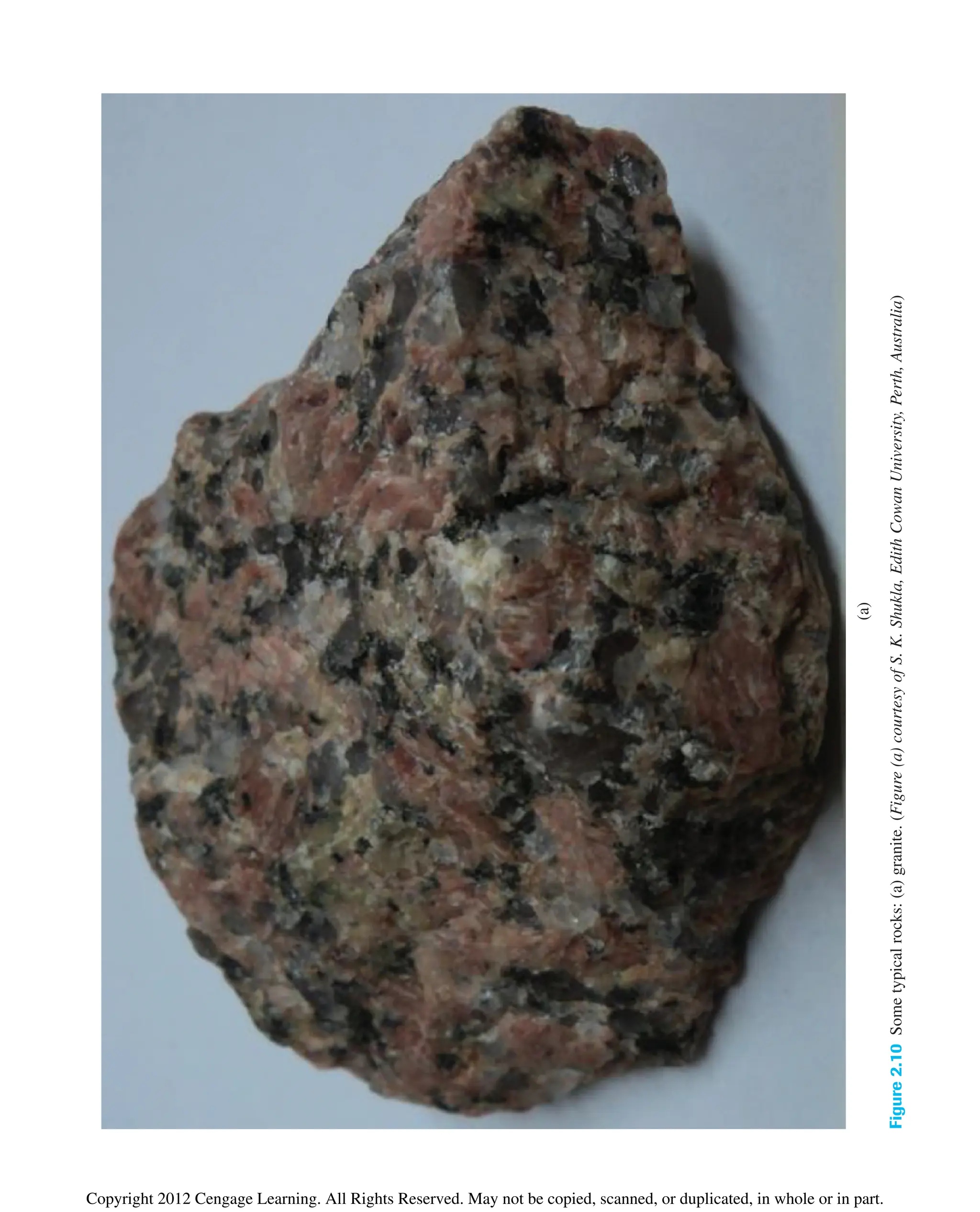
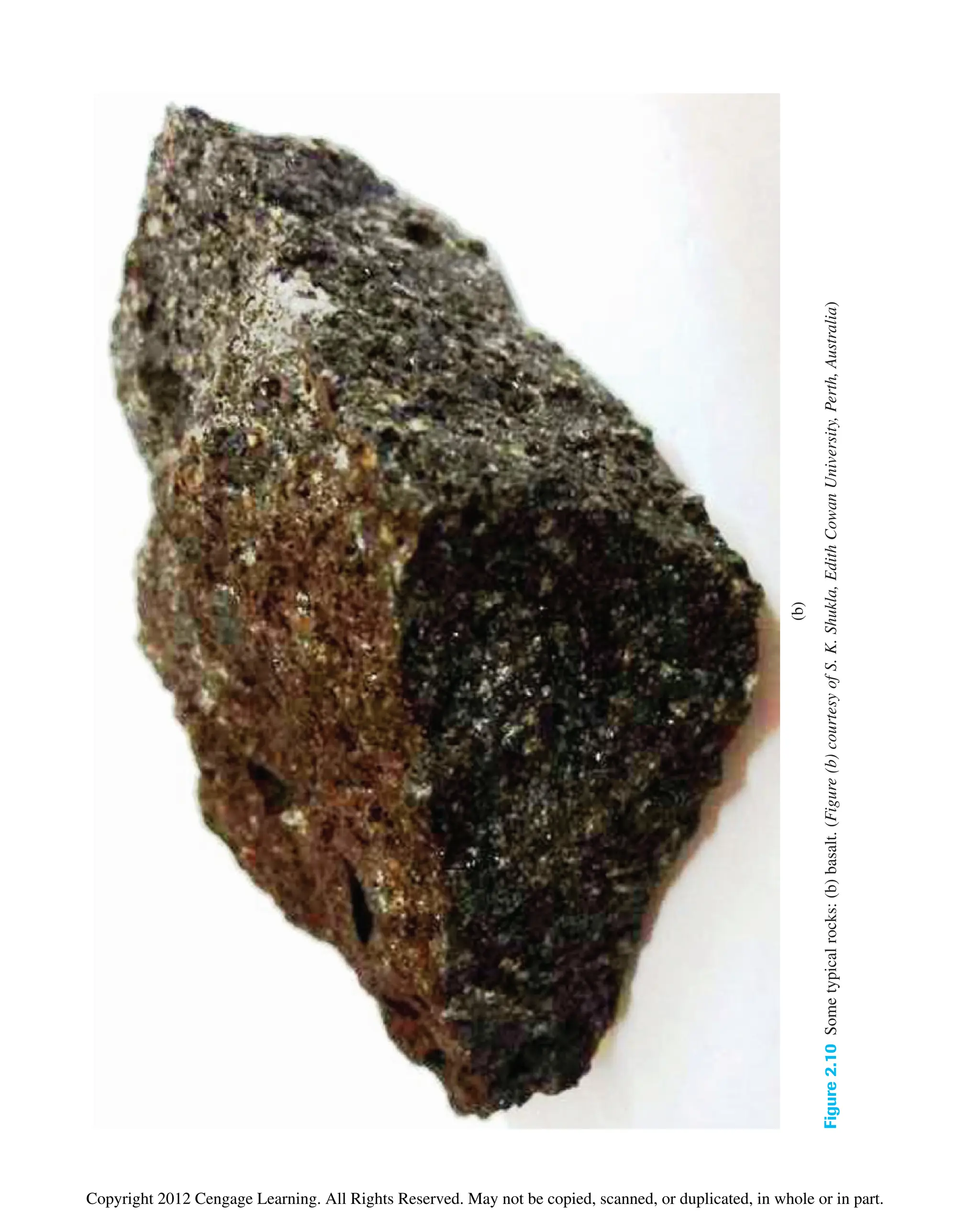
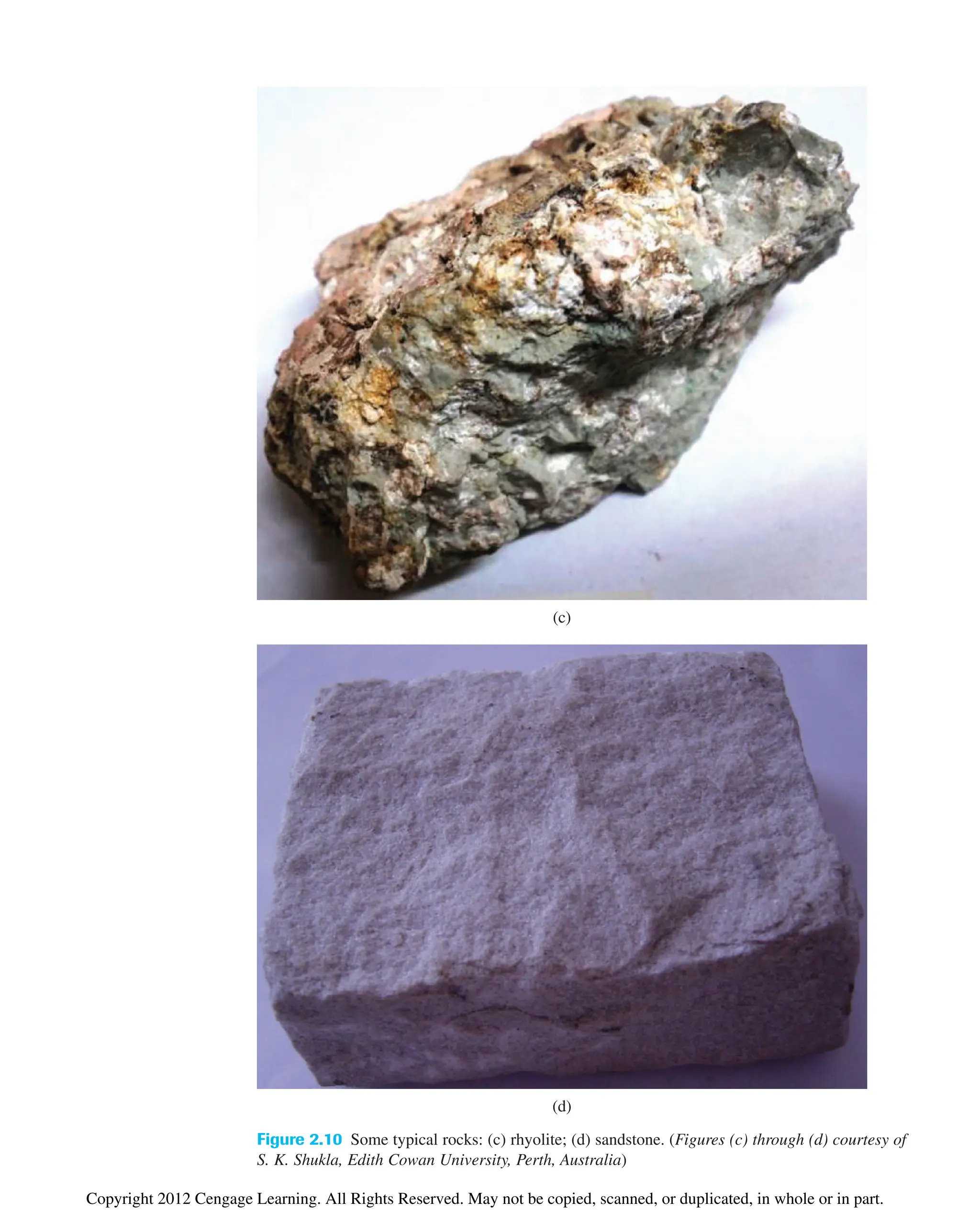
• In Chapter 2, on Origin of Soil and Grain Size, several photographs of common
rock-forming minerals, rocks, and structures built with or in rock have been added
(Section 2.3). To help students in future field identification of rocks and rock-
forming minerals, they are presented in color as well as in black and white.
vii
Preface
Copyright 2012 Cengage Learning. All Rights Reserved. May not be copied, scanned, or duplicated, in whole or in part.
• In Chapter 3, on Weight–Volume Relationships, the section on maximum and minimum
void ratio of granular soil has been expanded.
• The procedure for determination of shrinkage limit of cohesive soils using the wax
method (ASTM Test Designation 4943) has been described in detail in Chapter 4
(Plasticity and Structure of Soil).
• In Chapter 5, on Classification of Soil, line diagrams have been added in example
problems to determine the group names of soils from group symbols (Unified Soil
Classification System). These line diagrams will help the readers follow a step-by-
step procedure in arriving at the proper group name of soil during soil classification.
• The chapter on Soil Compaction (Chapter 6) now includes several recent empirical
correlations to estimate maximum dry unit weight and optimum moisture content
based on the energy of compaction. A section on evaluation of soils as compaction
material has been added.
• In Chapter 9, on In Situ Stresses, a mathematical derivation for a general case
to obtain the seepage force per unit volume of soil is added. Also in this chapter,
Harza’s chart to obtain the exit gradient of flow under a hydraulic structure is
provided. This chart is helpful in estimating the factor of safety against heaving.
An example to show the use of a filter on the downstream side of a hydraulic
structure to increase the factor of safety against heaving is given.
• A section on the vertical stress increase at a certain point and depth below the
ground surface due to a linearly increasing vertical loading on a infinite strip has
been added in Chapter 10, on Stresses in a Soil Mass.
• An improved explanation of the fundamentals of consolidation is given in Chapter 11,
on Compressibility of Soil. This chapter also provides a general discussion on the
effect of load duration on the e – log s⬘ plot.
• Chapter 12, on Shear Strength of Soils, updates the calculation procedure of
undrained cohesion for tests conducted with a tapered vane based on ASTM (2010).
• The procedure for estimation of active earth pressure in a c⬘ ⫺f⬘ soil under
earthquake conditions has been updated in Chapter 13 (Lateral Earth Pressure:
At-Rest, Rankine, and Coulomb).
• The Caquot and Kerisel theory for estimation of passive earth pressure with granular
backfill (inclined back face of wall and horizontal backfill, and vertical back face of
wall and inclined backfill) has now been included in Chapter 14, on Lateral Earth
Pressure: Curved Failure Surface.
• In Chapter 15, on Slope Stability, a detailed derivation on the factor of safety of infinite
slopes with seepage is now included. Results of some recent studies on the critical circles
of failure for slopes in clay (f ⫽ 0 condition) and c⬘ ⫺ f⬘ soil is added in this chapter.
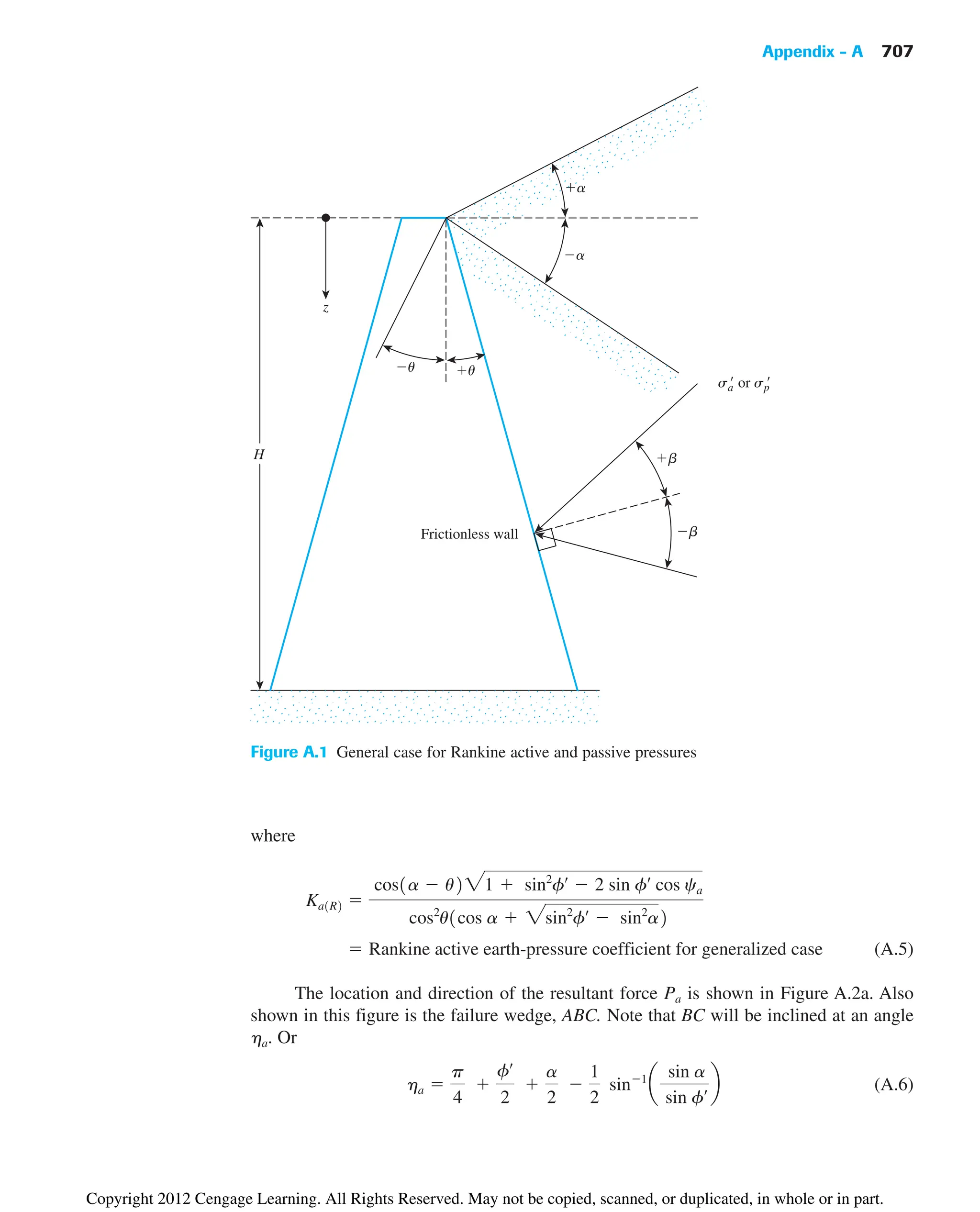
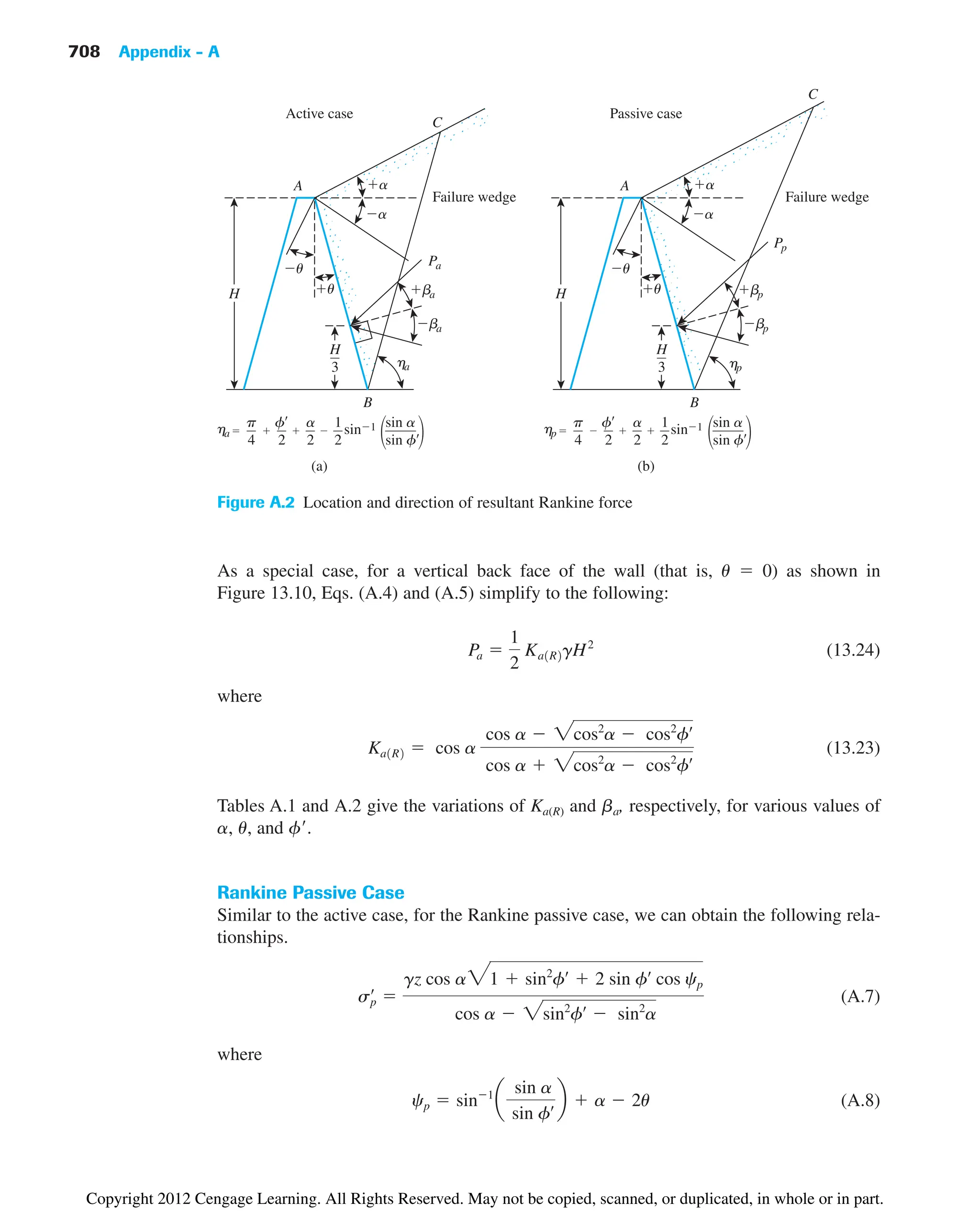
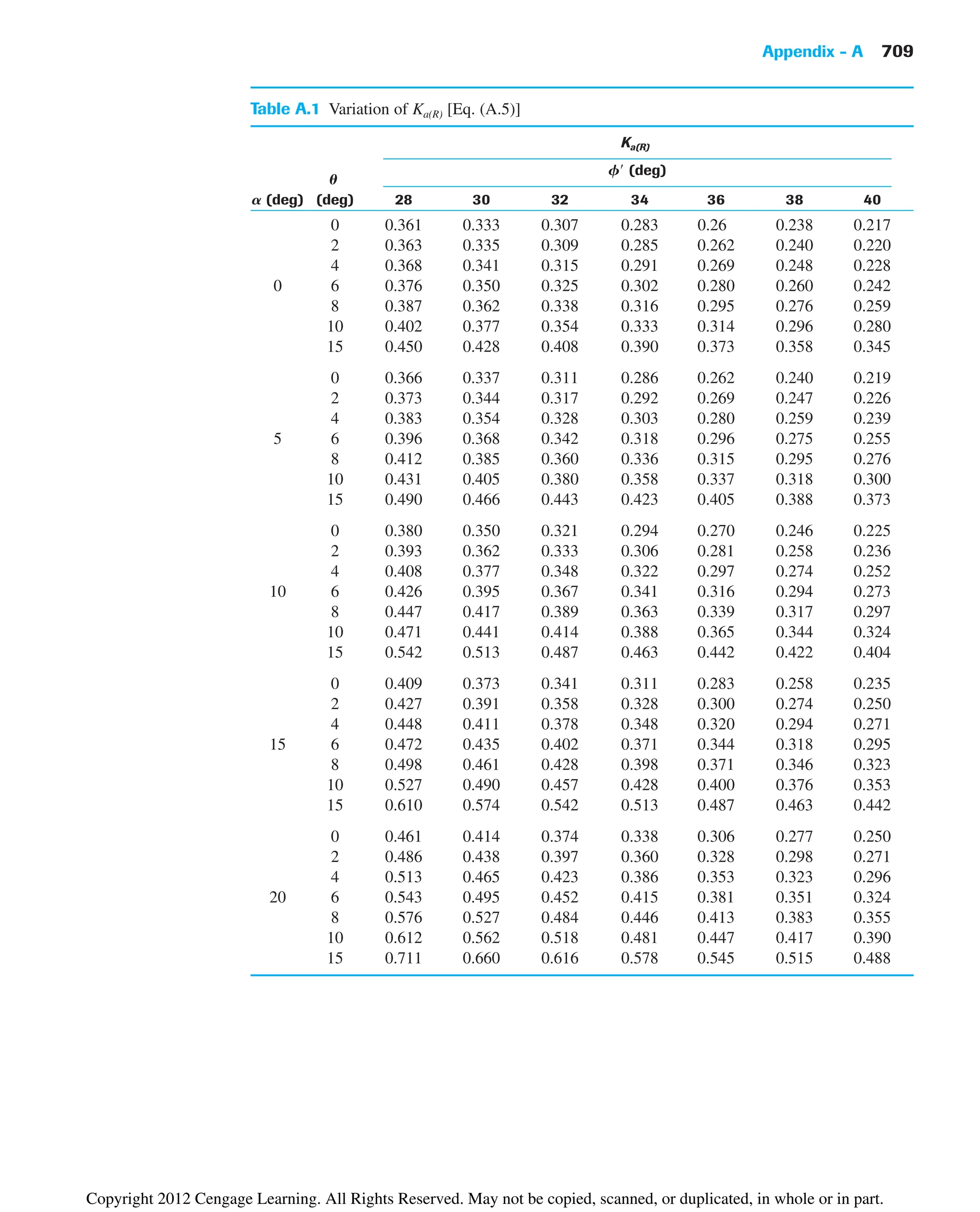
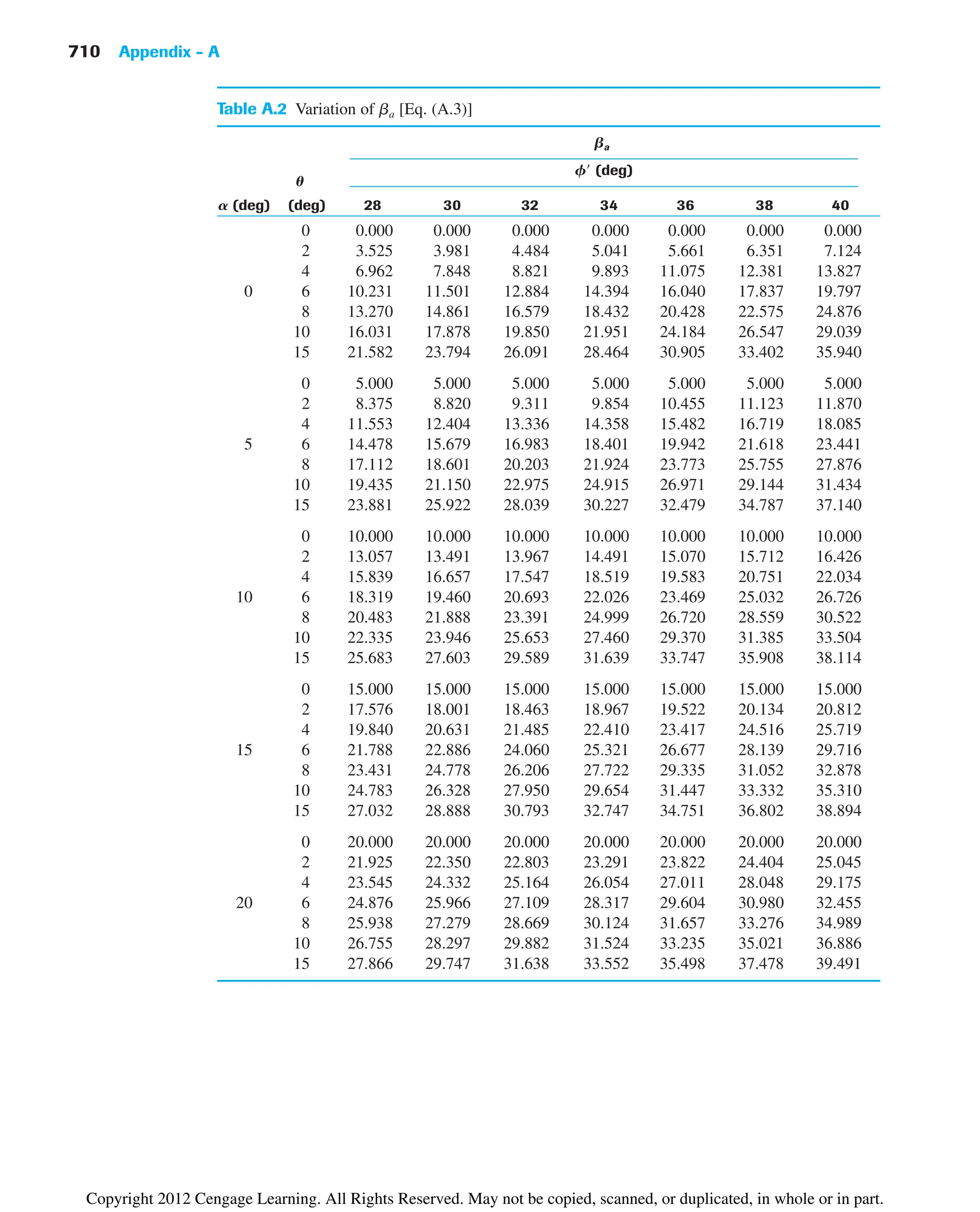
• A generalized case for Rankine active and passive pressure with granular backfill is
provided in Appendix A.
In the preparation of an engineering text of this type, it is tempting to include many
recent developments relating to the behavior of natural soil deposits found in various
parts of the world that are available in journals and conference proceedings with the
hope that they will prove to be useful to the students in their future practice. However,
based on many years of teaching, the authors feel that clarity in explaining the funda-
mentals of soil mechanics is more important in a first course in this area without
cluttering the book with too many details and alternatives. Many of the intricate details
can be left to an advanced course in the area of geotechnical engineering. This approach
viii Preface
Copyright 2012 Cengage Learning. All Rights Reserved. May not be copied, scanned, or duplicated, in whole or in part.
Preface ix
will most likely help in developing students’ interest and appreciation in the geotechni-
cal engineering profession at large.
Instructor Resource Materials
A detailed Instructor’s Solutions Manual and PowerPoint slides of both figures and tables
and equations and examples from the book are available for instructors through a password-
protected Web site at www.cengagebrain.com.
Student Resource Materials
Self-Evaluation Multiple Choice Questions with Answers for each chapter are available for
students on the book Web site. The students may also benefit from these questions as a
practice tool in preparation for examinations.
To access additional course materials, please visit www.cengagebrain.com. At the
cengagebrain.com home page, search for the ISBN of your title (from the back cover of your
book) using the search box at the top of the page. This will take you to the product page
where these resources can be found. If you require a password, follow directions for
Instructor Resources.
The authors would not have been able to complete this revised manuscript without the
support and encouragement of their wives, Janice and Samira, and their families. Janice Das
was most helpful in getting the manuscript ready for publication. Professor Sanjay K.
Shukla of Edith Cowan University, Australia, provided many valuable suggestions during
the revision process. Finally, many thanks are due to Christopher Shortt, Publisher; Hilda
Gowans, Senior Development Editor; and Lauren Betsos, Marketing Manager of Cengage
Learning (Engineering) for their assistance and advice in the final development of the book.
It is fitting also to thank Rose P. Kernan of RPK Editorial Services. She has been instru-
mental in shaping the style and overseeing the production of this edition of Principles of
Geotechnical Engineering as well as several previous editions.
Thanks are due to the following reviewers for their comments and constructive
suggestions:
Dragos Andrei, California State Polytechnic University, Pomona, California
Tuncer Edil, University of Wisconsin, Madison, Wisconsin
Ton Qiu, The Pennsylvania State University, University Park, Pennsylvania
Kamal Tawfiq, Florida State University, Tallahassee, Florida
Binod Tiwari, California State University, Fullerton, California
Jay Wang, Louisiana Tech University, Ruston, Louisiana
Mohammad M. Yamin, Bradley University, Peoria, Illinois
BRAJA DAS AND KHALED SOBHAN
Copyright 2012 Cengage Learning. All Rights Reserved. May not be copied, scanned, or duplicated, in whole or in part.
xi
About the Authors
Professor Braja Das is Dean Emeritus of the College of Engineering and Computer Science
at California State University, Sacramento. He received his M.S. in Civil Engineering from the
University of lowa and his Ph.D. in the area of Geotechnical Engineering from the University
of Wisconsin. He is the author of several geotechnical engineering texts and reference books
and has authored more than 250 technical papers in the area of geotechnical engineering. His
primary areas of research include shallow foundations, earth anchors, and geosynthetics. He
is a Fellow and Life Member of the American Society of Civil Engineers, Life Member of the
American Society for Engineering Education, and an Emeritus Member of the Chemical and
Mechanical Stabilization Committee of the Transportation Research Board of the National
Research Council (Washington, D.C.). He has previously served as a member of the editorial
board of the Journal of Geotechnical Engineering of ASCE, a member of the Lowland
Technology International journal (Japan), associate editor of the International Journal of
Offshore and Polar Engineering (ISOPE), and co-editor of the Journal of Geotechnical and
Geological Engineering (Springer, The Netherlands). Presently he is the editor-in-chief of the
International Journal of Geotechnical Engineering (J. Ross, Ft. Lauderdale, FL). Dr. Das has
received numerous awards for teaching excellence, including theAMOCO FoundationAward,
AT&TAward for Teaching Excellence from theAmerican Society for Engineering Education,
the Ralph Teetor Award from the Society of Automotive Engineers, and the Distinguished
Achievement Award for Teaching Excellence from the University of Texas at El Paso.
Professor Khaled Sobhan is an Associate Professor of Civil Engineering at Florida
Atlantic University. He received his M.S. degree from The Johns Hopkins University and
his Ph.D. degree from Northwestern University, both in the area of Geotechnical
Engineering. His primary research areas include ground improvement, geotechnology of
soft soils, experimental soil mechanics, and geotechnical aspects of pavement engineering.
He served as the Chair of the Chemical and Mechanical Stabilization Committee (AFS90)
of the Transportation Research Board (2005–2011) and coauthored the TRB Circular
titled Evaluation of Chemical Stabilizers: State-of-the-Practice Report (E-C086). He is
currently serving as an Associate Editor of ASCE Journal of Materials in Civil
Copyright 2012 Cengage Learning. All Rights Reserved. May not be copied, scanned, or duplicated, in whole or in part.
xii About the Authors
Engineering, and on the editorial board of the ASTM Geotechnical Testing Journal,
Geotechnical and Geological Engineering (Springer, The Netherlands) and International
Journal of Geotechnical Engineering (J. Ross, Ft. Lauderdale, FL). He is a recipient of the
distinguished Award for Excellence and Innovation in Undergraduate Teaching (2006) and
the Excellence in Graduate Mentoring Award (2009) from Florida Atlantic University. He
has published more than 75 technical articles and reports in the area of Geotechnical
Engineering.
Copyright 2012 Cengage Learning. All Rights Reserved. May not be copied, scanned, or duplicated, in whole or in part.
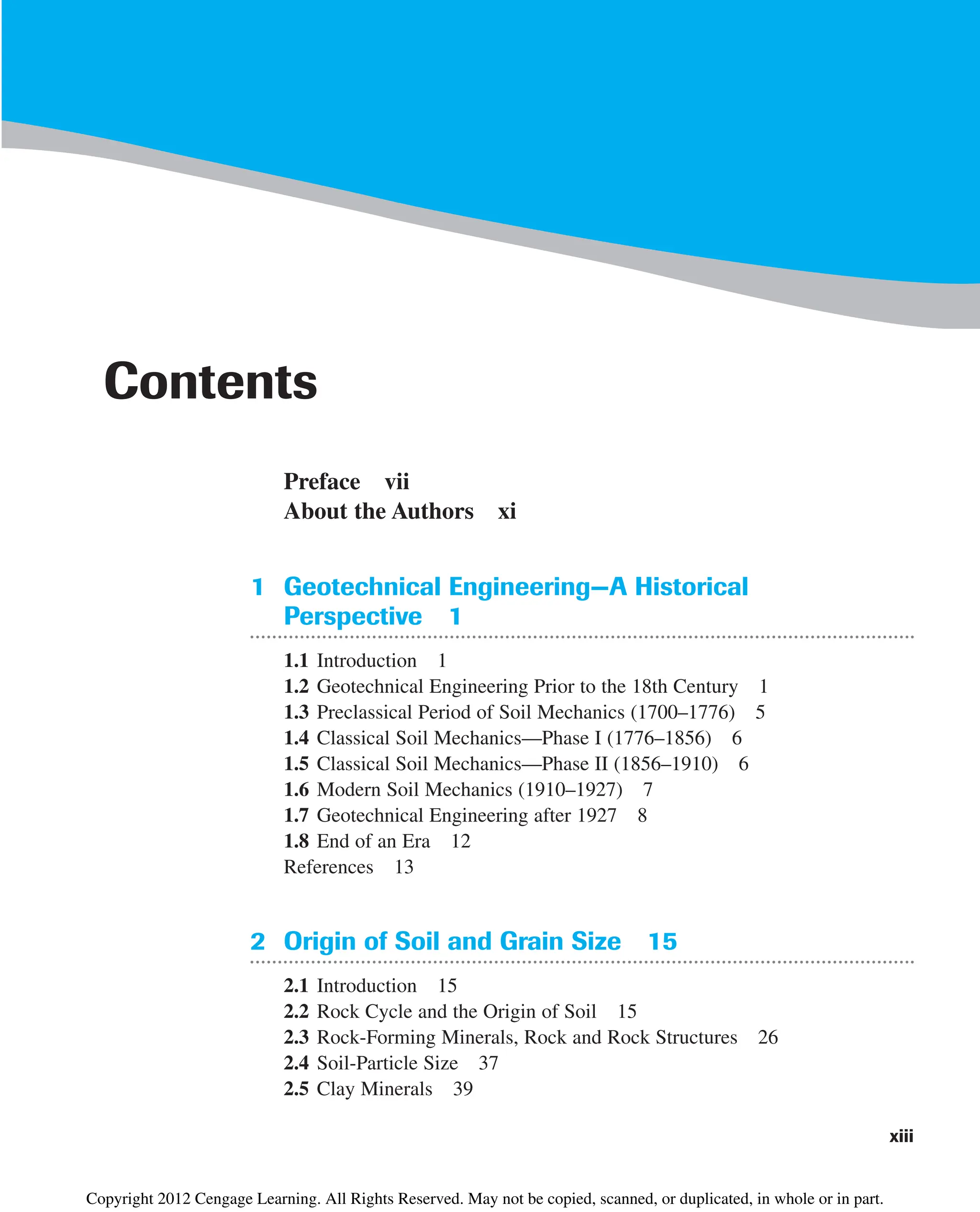
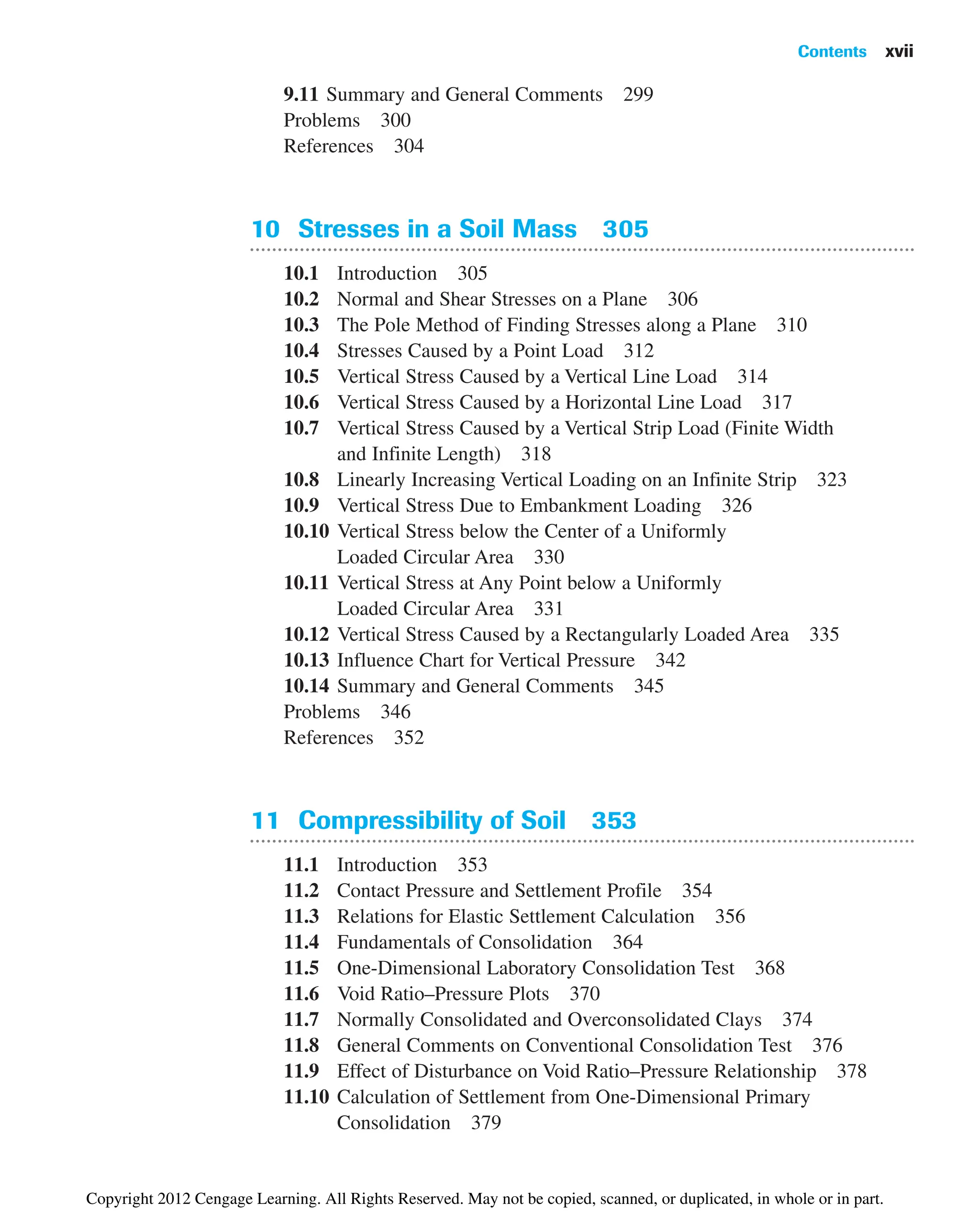
Preface vii
About the Authors xi
1 Geotechnical Engineering—A Historical
Perspective 1
1.1 Introduction 1
1.2 Geotechnical Engineering Prior to the 18th Century 1
1.3 Preclassical Period of Soil Mechanics (1700–1776) 5
1.4 Classical Soil Mechanics—Phase I (1776–1856) 6
1.5 Classical Soil Mechanics—Phase II (1856–1910) 6
1.6 Modern Soil Mechanics (1910–1927) 7
1.7 Geotechnical Engineering after 1927 8
1.8 End of an Era 12
References 13
2 Origin of Soil and Grain Size 15
2.1 Introduction 15
2.2 Rock Cycle and the Origin of Soil 15
2.3 Rock-Forming Minerals, Rock and Rock Structures 26
2.4 Soil-Particle Size 37
2.5 Clay Minerals 39
xiii
Contents
Copyright 2012 Cengage Learning. All Rights Reserved. May not be copied, scanned, or duplicated, in whole or in part.
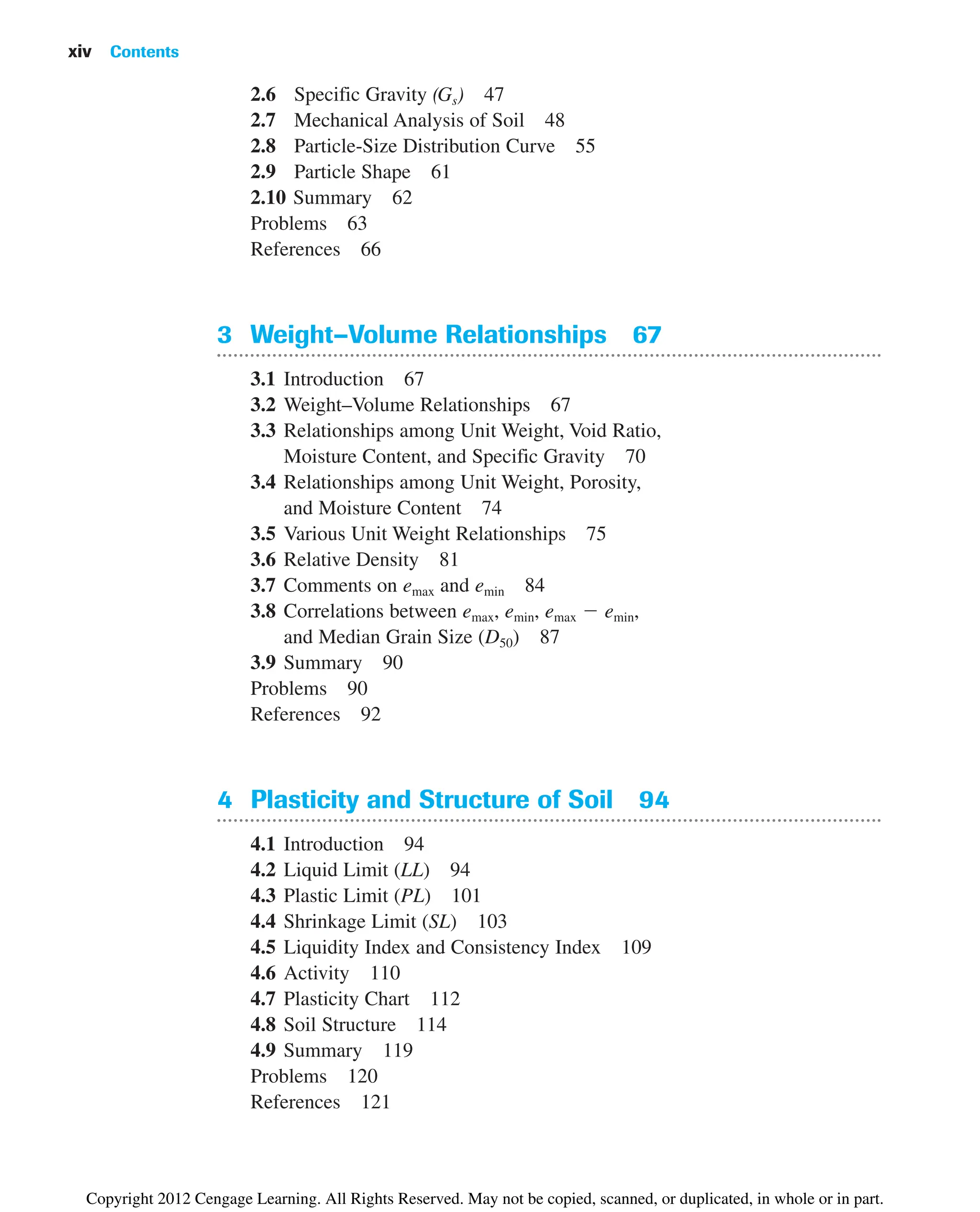
2.6 Specific Gravity (Gs) 47
2.7 Mechanical Analysis of Soil 48
2.8 Particle-Size Distribution Curve 55
2.9 Particle Shape 61
2.10 Summary 62
Problems 63
References 66
3 Weight–Volume Relationships 67
3.1 Introduction 67
3.2 Weight–Volume Relationships 67
3.3 Relationships among Unit Weight, Void Ratio,
Moisture Content, and Specific Gravity 70
3.4 Relationships among Unit Weight, Porosity,
and Moisture Content 74
3.5 Various Unit Weight Relationships 75
3.6 Relative Density 81
3.7 Comments on emax and emin 84
3.8 Correlations between emax, emin, emax ⫺ emin,
and Median Grain Size (D50) 87
3.9 Summary 90
Problems 90
References 92
4 Plasticity and Structure of Soil 94
4.1 Introduction 94
4.2 Liquid Limit (LL) 94
4.3 Plastic Limit (PL) 101
4.4 Shrinkage Limit (SL) 103
4.5 Liquidity Index and Consistency Index 109
4.6 Activity 110
4.7 Plasticity Chart 112
4.8 Soil Structure 114
4.9 Summary 119
Problems 120
References 121
xiv Contents
Copyright 2012 Cengage Learning. All Rights Reserved. May not be copied, scanned, or duplicated, in whole or in part.
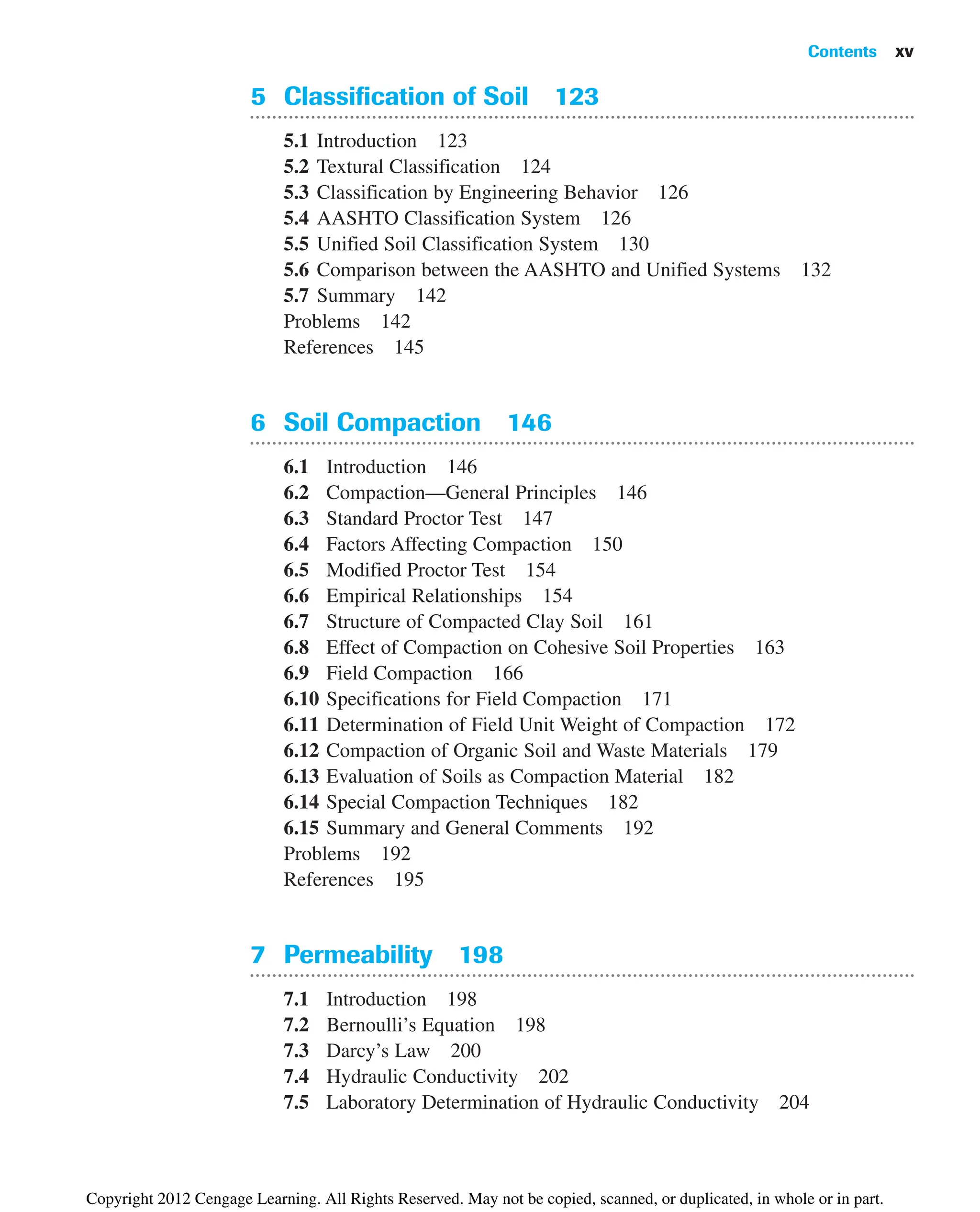
5 Classification of Soil 123
5.1 Introduction 123
5.2 Textural Classification 124
5.3 Classification by Engineering Behavior 126
5.4 AASHTO Classification System 126
5.5 Unified Soil Classification System 130
5.6 Comparison between the AASHTO and Unified Systems 132
5.7 Summary 142
Problems 142
References 145
6 Soil Compaction 146
6.1 Introduction 146
6.2 Compaction—General Principles 146
6.3 Standard Proctor Test 147
6.4 Factors Affecting Compaction 150
6.5 Modified Proctor Test 154
6.6 Empirical Relationships 154
6.7 Structure of Compacted Clay Soil 161
6.8 Effect of Compaction on Cohesive Soil Properties 163
6.9 Field Compaction 166
6.10 Specifications for Field Compaction 171
6.11 Determination of Field Unit Weight of Compaction 172
6.12 Compaction of Organic Soil and Waste Materials 179
6.13 Evaluation of Soils as Compaction Material 182
6.14 Special Compaction Techniques 182
6.15 Summary and General Comments 192
Problems 192
References 195
7 Permeability 198
7.1 Introduction 198
7.2 Bernoulli’s Equation 198
7.3 Darcy’s Law 200
7.4 Hydraulic Conductivity 202
7.5 Laboratory Determination of Hydraulic Conductivity 204
Contents xv
Copyright 2012 Cengage Learning. All Rights Reserved. May not be copied, scanned, or duplicated, in whole or in part.
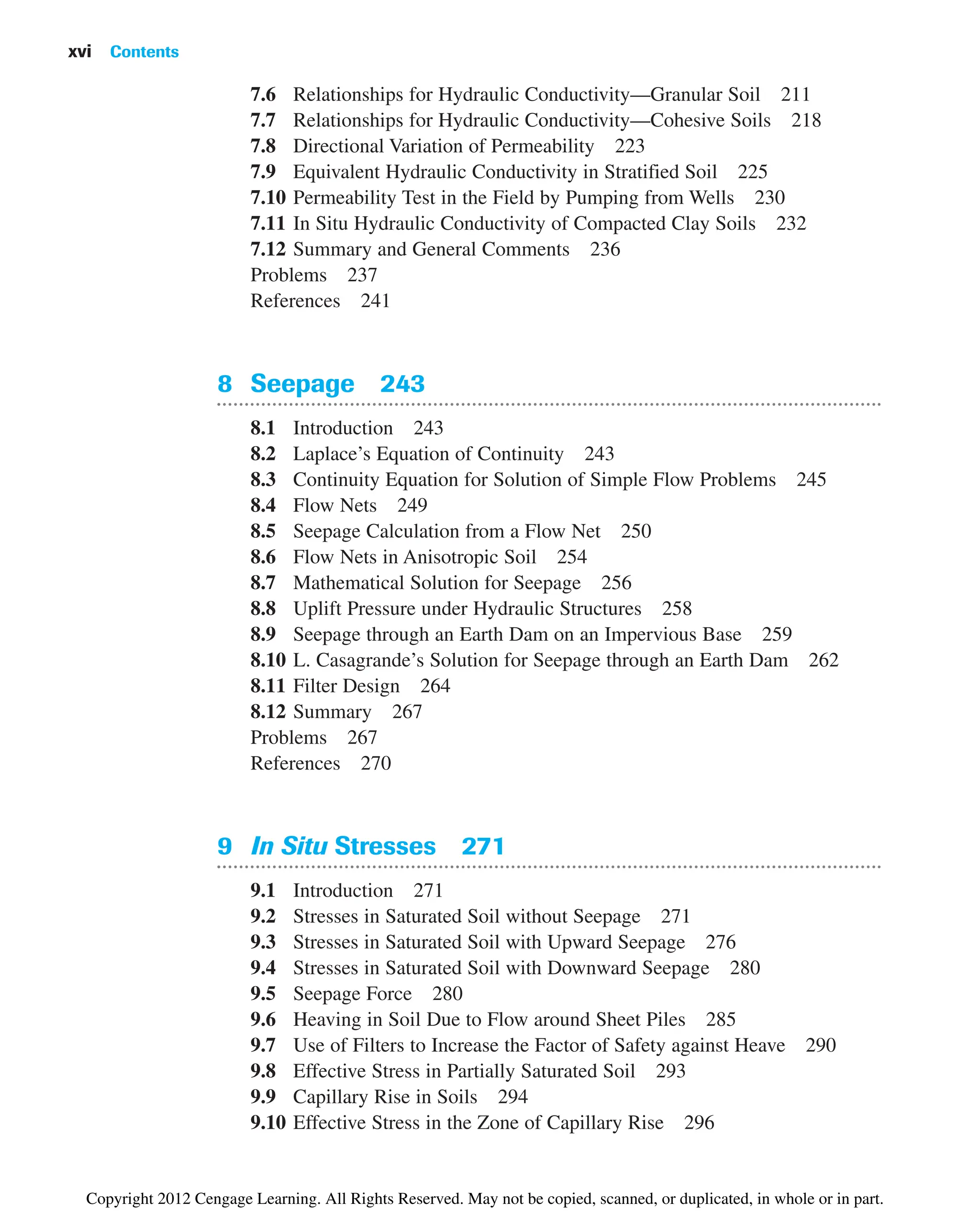
7.6 Relationships for Hydraulic Conductivity—Granular Soil 211
7.7 Relationships for Hydraulic Conductivity—Cohesive Soils 218
7.8 Directional Variation of Permeability 223
7.9 Equivalent Hydraulic Conductivity in Stratified Soil 225
7.10 Permeability Test in the Field by Pumping from Wells 230
7.11 In Situ Hydraulic Conductivity of Compacted Clay Soils 232
7.12 Summary and General Comments 236
Problems 237
References 241
8 Seepage 243
8.1 Introduction 243
8.2 Laplace’s Equation of Continuity 243
8.3 Continuity Equation for Solution of Simple Flow Problems 245
8.4 Flow Nets 249
8.5 Seepage Calculation from a Flow Net 250
8.6 Flow Nets in Anisotropic Soil 254
8.7 Mathematical Solution for Seepage 256
8.8 Uplift Pressure under Hydraulic Structures 258
8.9 Seepage through an Earth Dam on an Impervious Base 259
8.10 L. Casagrande’s Solution for Seepage through an Earth Dam 262
8.11 Filter Design 264
8.12 Summary 267
Problems 267
References 270
9 In Situ Stresses 271
9.1 Introduction 271
9.2 Stresses in Saturated Soil without Seepage 271
9.3 Stresses in Saturated Soil with Upward Seepage 276
9.4 Stresses in Saturated Soil with Downward Seepage 280
9.5 Seepage Force 280
9.6 Heaving in Soil Due to Flow around Sheet Piles 285
9.7 Use of Filters to Increase the Factor of Safety against Heave 290
9.8 Effective Stress in Partially Saturated Soil 293
9.9 Capillary Rise in Soils 294
9.10 Effective Stress in the Zone of Capillary Rise 296
xvi Contents
Copyright 2012 Cengage Learning. All Rights Reserved. May not be copied, scanned, or duplicated, in whole or in part.
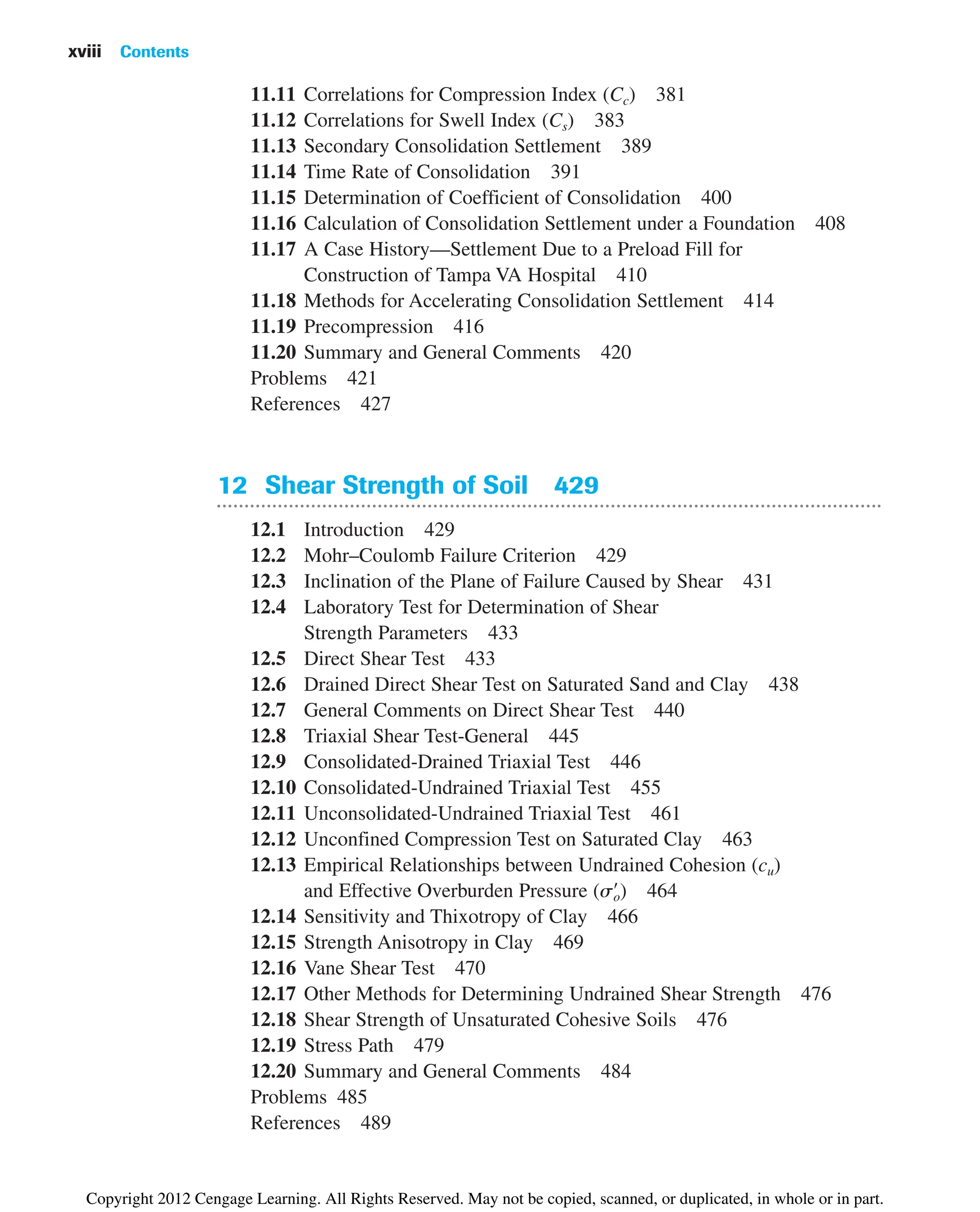
9.11 Summary and General Comments 299
Problems 300
References 304
10 Stresses in a Soil Mass 305
10.1 Introduction 305
10.2 Normal and Shear Stresses on a Plane 306
10.3 The Pole Method of Finding Stresses along a Plane 310
10.4 Stresses Caused by a Point Load 312
10.5 Vertical Stress Caused by a Vertical Line Load 314
10.6 Vertical Stress Caused by a Horizontal Line Load 317
10.7 Vertical Stress Caused by a Vertical Strip Load (Finite Width
and Infinite Length) 318
10.8 Linearly Increasing Vertical Loading on an Infinite Strip 323
10.9 Vertical Stress Due to Embankment Loading 326
10.10 Vertical Stress below the Center of a Uniformly
Loaded Circular Area 330
10.11 Vertical Stress at Any Point below a Uniformly
Loaded Circular Area 331
10.12 Vertical Stress Caused by a Rectangularly Loaded Area 335
10.13 Influence Chart for Vertical Pressure 342
10.14 Summary and General Comments 345
Problems 346
References 352
11 Compressibility of Soil 353
11.1 Introduction 353
11.2 Contact Pressure and Settlement Profile 354
11.3 Relations for Elastic Settlement Calculation 356
11.4 Fundamentals of Consolidation 364
11.5 One-Dimensional Laboratory Consolidation Test 368
11.6 Void Ratio–Pressure Plots 370
11.7 Normally Consolidated and Overconsolidated Clays 374
11.8 General Comments on Conventional Consolidation Test 376
11.9 Effect of Disturbance on Void Ratio–Pressure Relationship 378
11.10 Calculation of Settlement from One-Dimensional Primary
Consolidation 379
Contents xvii
Copyright 2012 Cengage Learning. All Rights Reserved. May not be copied, scanned, or duplicated, in whole or in part.
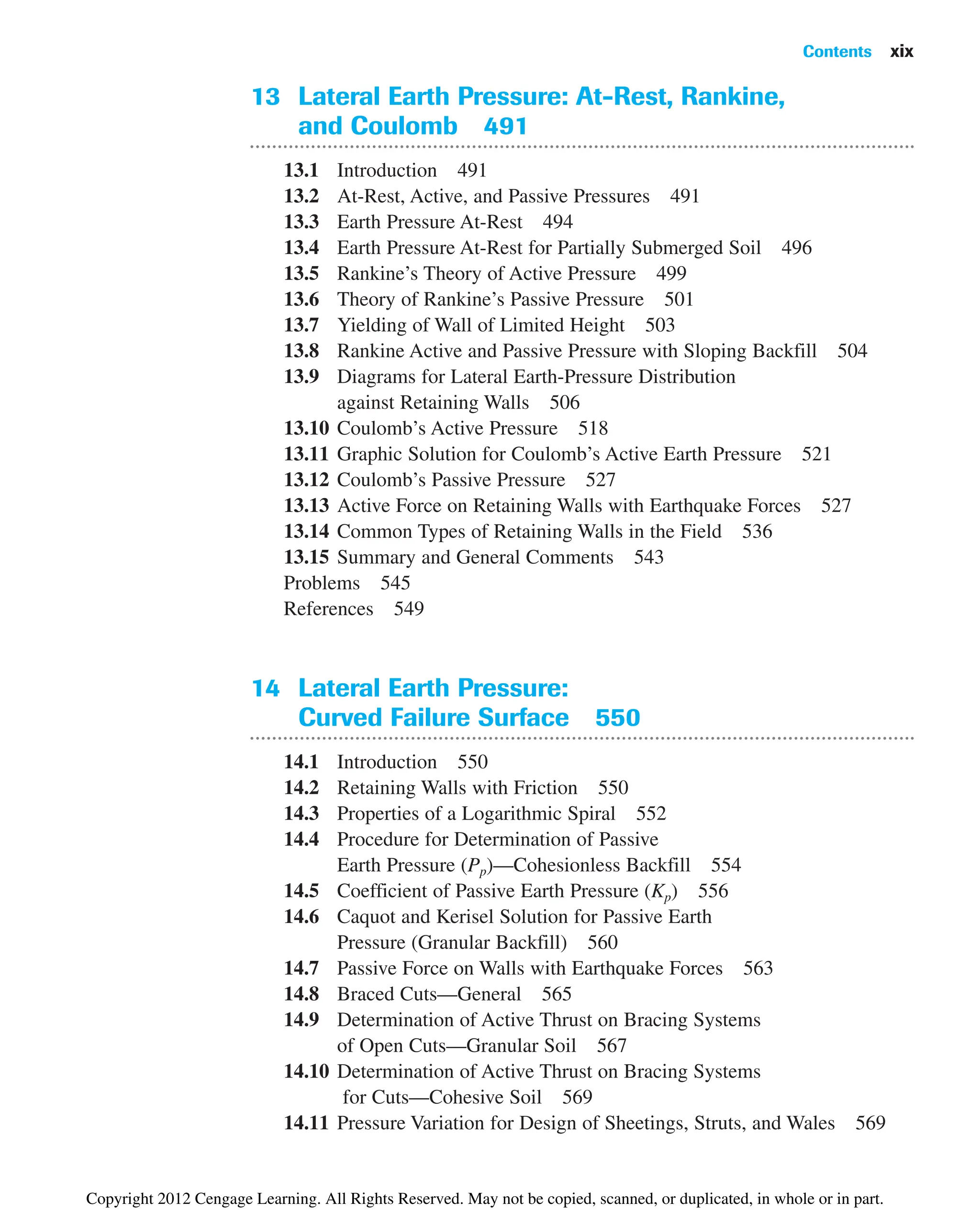
11.11 Correlations for Compression Index (Cc) 381
11.12 Correlations for Swell Index (Cs) 383
11.13 Secondary Consolidation Settlement 389
11.14 Time Rate of Consolidation 391
11.15 Determination of Coefficient of Consolidation 400
11.16 Calculation of Consolidation Settlement under a Foundation 408
11.17 A Case History—Settlement Due to a Preload Fill for
Construction of Tampa VA Hospital 410
11.18 Methods for Accelerating Consolidation Settlement 414
11.19 Precompression 416
11.20 Summary and General Comments 420
Problems 421
References 427
12 Shear Strength of Soil 429
12.1 Introduction 429
12.2 Mohr–Coulomb Failure Criterion 429
12.3 Inclination of the Plane of Failure Caused by Shear 431
12.4 Laboratory Test for Determination of Shear
Strength Parameters 433
12.5 Direct Shear Test 433
12.6 Drained Direct Shear Test on Saturated Sand and Clay 438
12.7 General Comments on Direct Shear Test 440
12.8 Triaxial Shear Test-General 445
12.9 Consolidated-Drained Triaxial Test 446
12.10 Consolidated-Undrained Triaxial Test 455
12.11 Unconsolidated-Undrained Triaxial Test 461
12.12 Unconfined Compression Test on Saturated Clay 463
12.13 Empirical Relationships between Undrained Cohesion (cu)
and Effective Overburden Pressure ( ) 464
12.14 Sensitivity and Thixotropy of Clay 466
12.15 Strength Anisotropy in Clay 469
12.16 Vane Shear Test 470
12.17 Other Methods for Determining Undrained Shear Strength 476
12.18 Shear Strength of Unsaturated Cohesive Soils 476
12.19 Stress Path 479
12.20 Summary and General Comments 484
Problems 485
References 489
so
œ
xviii Contents
Copyright 2012 Cengage Learning. All Rights Reserved. May not be copied, scanned, or duplicated, in whole or in part.
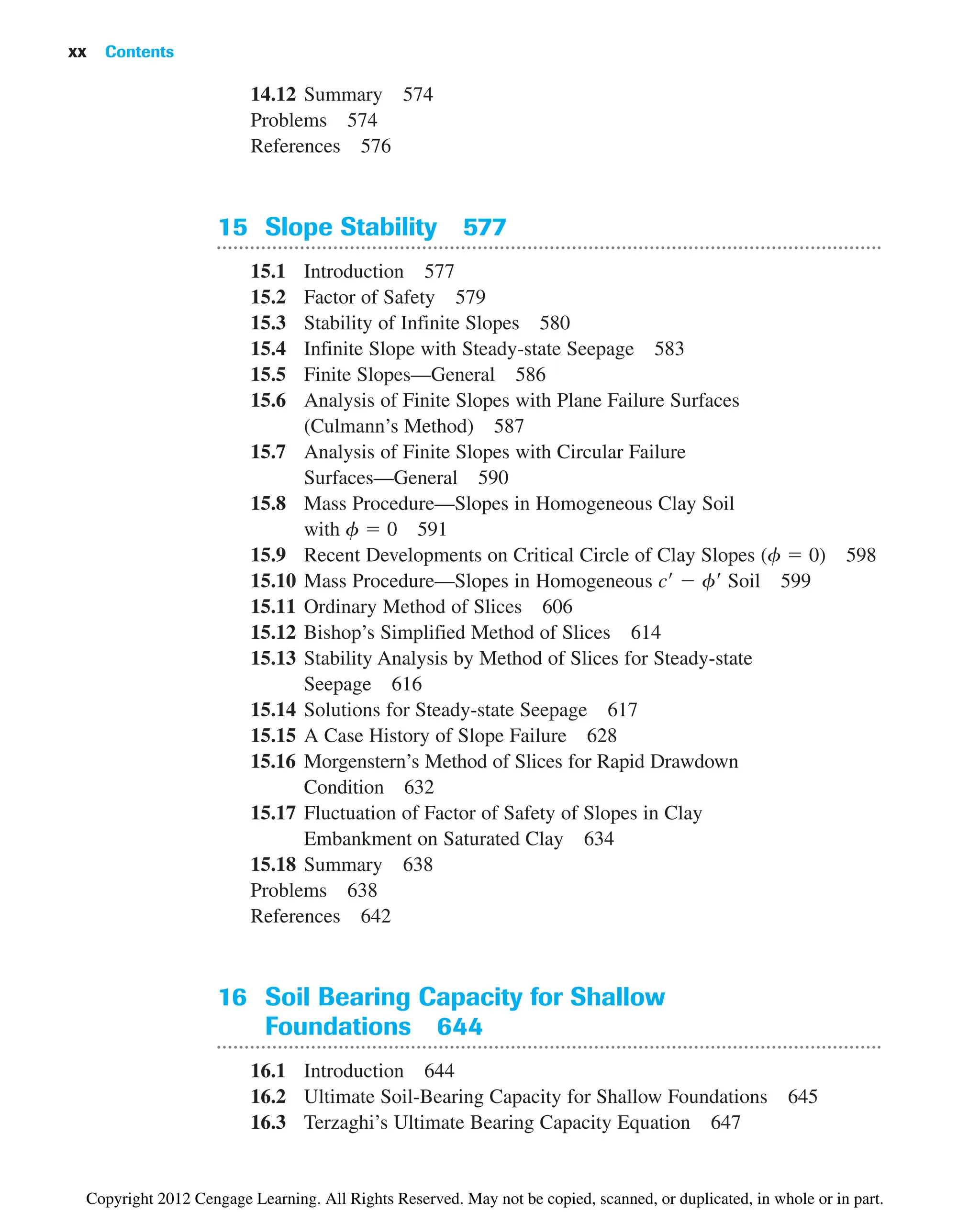
13 Lateral Earth Pressure: At-Rest, Rankine,
and Coulomb 491
13.1 Introduction 491
13.2 At-Rest, Active, and Passive Pressures 491
13.3 Earth Pressure At-Rest 494
13.4 Earth Pressure At-Rest for Partially Submerged Soil 496
13.5 Rankine’s Theory of Active Pressure 499
13.6 Theory of Rankine’s Passive Pressure 501
13.7 Yielding of Wall of Limited Height 503
13.8 Rankine Active and Passive Pressure with Sloping Backfill 504
13.9 Diagrams for Lateral Earth-Pressure Distribution
against Retaining Walls 506
13.10 Coulomb’s Active Pressure 518
13.11 Graphic Solution for Coulomb’s Active Earth Pressure 521
13.12 Coulomb’s Passive Pressure 527
13.13 Active Force on Retaining Walls with Earthquake Forces 527
13.14 Common Types of Retaining Walls in the Field 536
13.15 Summary and General Comments 543
Problems 545
References 549
14 Lateral Earth Pressure:
Curved Failure Surface 550
14.1 Introduction 550
14.2 Retaining Walls with Friction 550
14.3 Properties of a Logarithmic Spiral 552
14.4 Procedure for Determination of Passive
Earth Pressure (Pp)—Cohesionless Backfill 554
14.5 Coefficient of Passive Earth Pressure (Kp) 556
14.6 Caquot and Kerisel Solution for Passive Earth
Pressure (Granular Backfill) 560
14.7 Passive Force on Walls with Earthquake Forces 563
14.8 Braced Cuts—General 565
14.9 Determination of Active Thrust on Bracing Systems
of Open Cuts—Granular Soil 567
14.10 Determination of Active Thrust on Bracing Systems
for Cuts—Cohesive Soil 569
14.11 Pressure Variation for Design of Sheetings, Struts, and Wales 569
Contents xix
Copyright 2012 Cengage Learning. All Rights Reserved. May not be copied, scanned, or duplicated, in whole or in part.
14.12 Summary 574
Problems 574
References 576
15 Slope Stability 577
15.1 Introduction 577
15.2 Factor of Safety 579
15.3 Stability of Infinite Slopes 580
15.4 Infinite Slope with Steady-state Seepage 583
15.5 Finite Slopes—General 586
15.6 Analysis of Finite Slopes with Plane Failure Surfaces
(Culmann’s Method) 587
15.7 Analysis of Finite Slopes with Circular Failure
Surfaces—General 590
15.8 Mass Procedure—Slopes in Homogeneous Clay Soil
with f ⫽ 0 591
15.9 Recent Developments on Critical Circle of Clay Slopes (f ⫽ 0) 598
15.10 Mass Procedure—Slopes in Homogeneous c⬘ ⫺ f⬘ Soil 599
15.11 Ordinary Method of Slices 606
15.12 Bishop’s Simplified Method of Slices 614
15.13 Stability Analysis by Method of Slices for Steady-state
Seepage 616
15.14 Solutions for Steady-state Seepage 617
15.15 A Case History of Slope Failure 628
15.16 Morgenstern’s Method of Slices for Rapid Drawdown
Condition 632
15.17 Fluctuation of Factor of Safety of Slopes in Clay
Embankment on Saturated Clay 634
15.18 Summary 638
Problems 638
References 642
16 Soil Bearing Capacity for Shallow
Foundations 644
16.1 Introduction 644
16.2 Ultimate Soil-Bearing Capacity for Shallow Foundations 645
16.3 Terzaghi’s Ultimate Bearing Capacity Equation 647
xx Contents
Copyright 2012 Cengage Learning. All Rights Reserved. May not be copied, scanned, or duplicated, in whole or in part.
16.4 Effect of Groundwater Table 651
16.5 Factor of Safety 652
16.6 General Bearing Capacity Equation 655
16.7 A Case History for Evaluation of the Ultimate
Bearing Capacity 659
16.8 Ultimate Load for Shallow Foundations Under
Eccentric Load 663
16.9 Bearing Capacity of Sand Based on Settlement 668
16.10 Plate-Load Test 670
16.11 Summary and General Comments 673
Problems 673
References 676
17 Subsoil Exploration 678
17.1 Introduction 678
17.2 Planning for Soil Exploration 679
17.3 Boring Methods 680
17.4 Common Sampling Methods 684
17.5 Sample Disturbance 689
17.6 Correlations for Standard Penetration Test 689
17.7 Other In Situ Tests 694
17.8 Rock Coring 699
17.9 Soil Exploration Report 701
17.10 Summary 701
Problems 703
References 704
Appendix A
A Generalized Case for Rankine Active and Passive
Pressure–Granular Backfill 706
Answers to Selected Problems 714
Index 722
Contents xxi
Copyright 2012 Cengage Learning. All Rights Reserved. May not be copied, scanned, or duplicated, in whole or in part.
1.1 Introduction
For engineering purposes, soil is defined as the uncemented aggregate of mineral grains and
decayed organic matter (solid particles) with liquid and gas in the empty spaces between the
solid particles. Soil is used as a construction material in various civil engineering projects,
and it supports structural foundations. Thus, civil engineers must study the properties of
soil, such as its origin, grain-size distribution, ability to drain water, compressibility, shear
strength, and load-bearing capacity. Soil mechanics is the branch of science that deals with
the study of the physical properties of soil and the behavior of soil masses subjected to var-
ious types of forces. Soils engineering is the application of the principles of soil mechanics
to practical problems. Geotechnical engineering is the subdiscipline of civil engineering
that involves natural materials found close to the surface of the earth. It includes the appli-
cation of the principles of soil mechanics and rock mechanics to the design of foundations,
retaining structures, and earth structures.
1.2 Geotechnical Engineering Prior to the 18th Century
The record of a person’s first use of soil as a construction material is lost in antiquity. In true
engineering terms, the understanding of geotechnical engineering as it is known today began
early in the 18th century (Skempton, 1985). For years, the art of geotechnical engineering
was based on only past experiences through a succession of experimentation without any real
scientific character. Based on those experimentations, many structures were built—some of
which have crumbled, while others are still standing.
Recorded history tells us that ancient civilizations flourished along the banks of
rivers, such as the Nile (Egypt), the Tigris and Euphrates (Mesopotamia), the Huang Ho
(Yellow River, China), and the Indus (India). Dykes dating back to about 2000 B.C. were
built in the basin of the Indus to protect the town of Mohenjo Dara (in what became
1
Geotechnical Engineering—
A Historical Perspective
1
C H A P T E R
Copyright 2012 Cengage Learning. All Rights Reserved. May not be copied, scanned, or duplicated, in whole or in part.
Pakistan after 1947). During the Chan dynasty in China (1120 B.C. to 249 B.C.) many
dykes were built for irrigation purposes. There is no evidence that measures were taken
to stabilize the foundations or check erosion caused by floods (Kerisel, 1985). Ancient
Greek civilization used isolated pad footings and strip-and-raft foundations for building
structures. Beginning around 2700 B.C., several pyramids were built in Egypt, most of
which were built as tombs for the country’s Pharaohs and their consorts during the Old
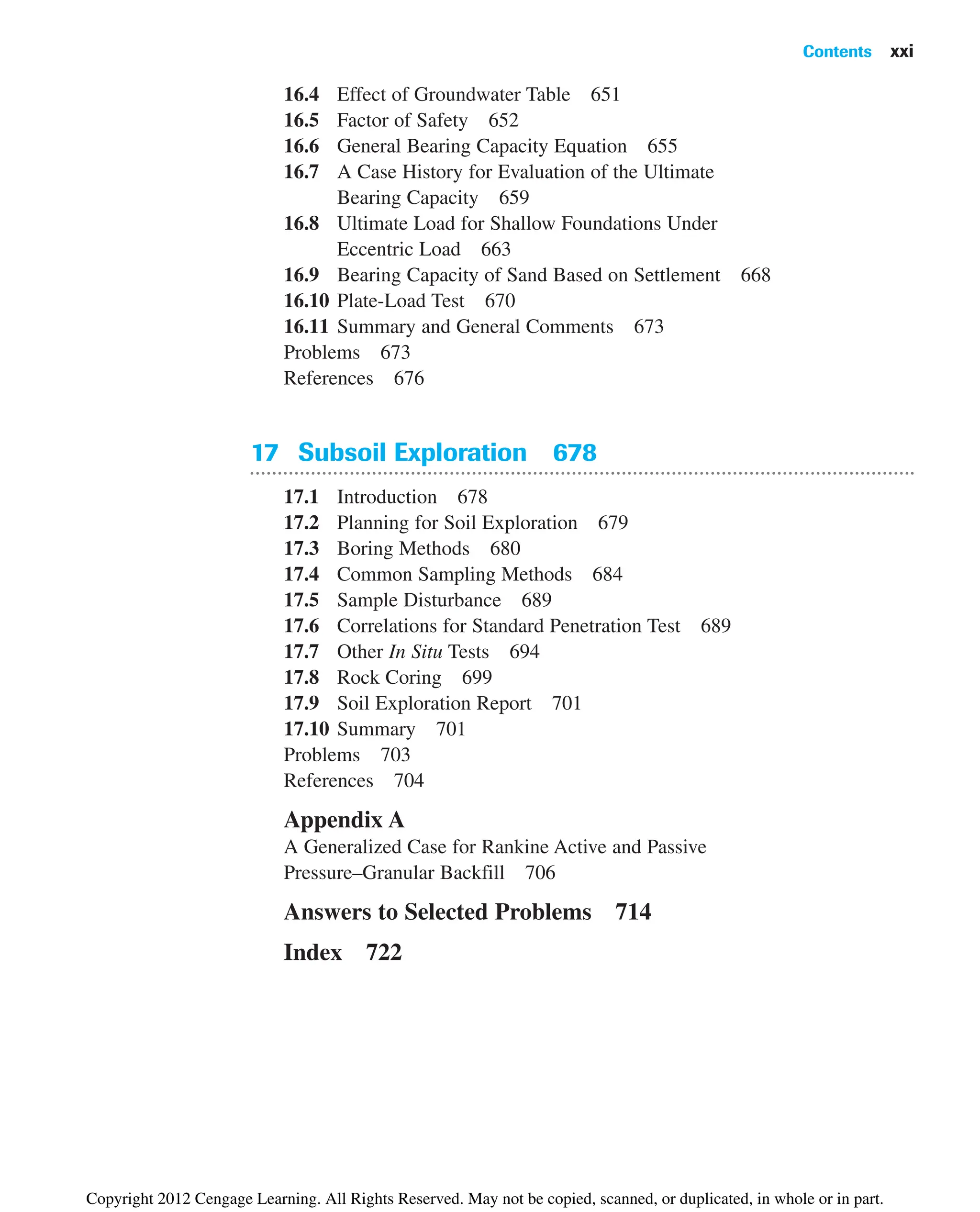
and Middle Kingdom periods. Table 1.1 lists some of the major pyramids identified
through the Pharaoh who ordered it built. As of 2008, a total of 138 pyramids have been
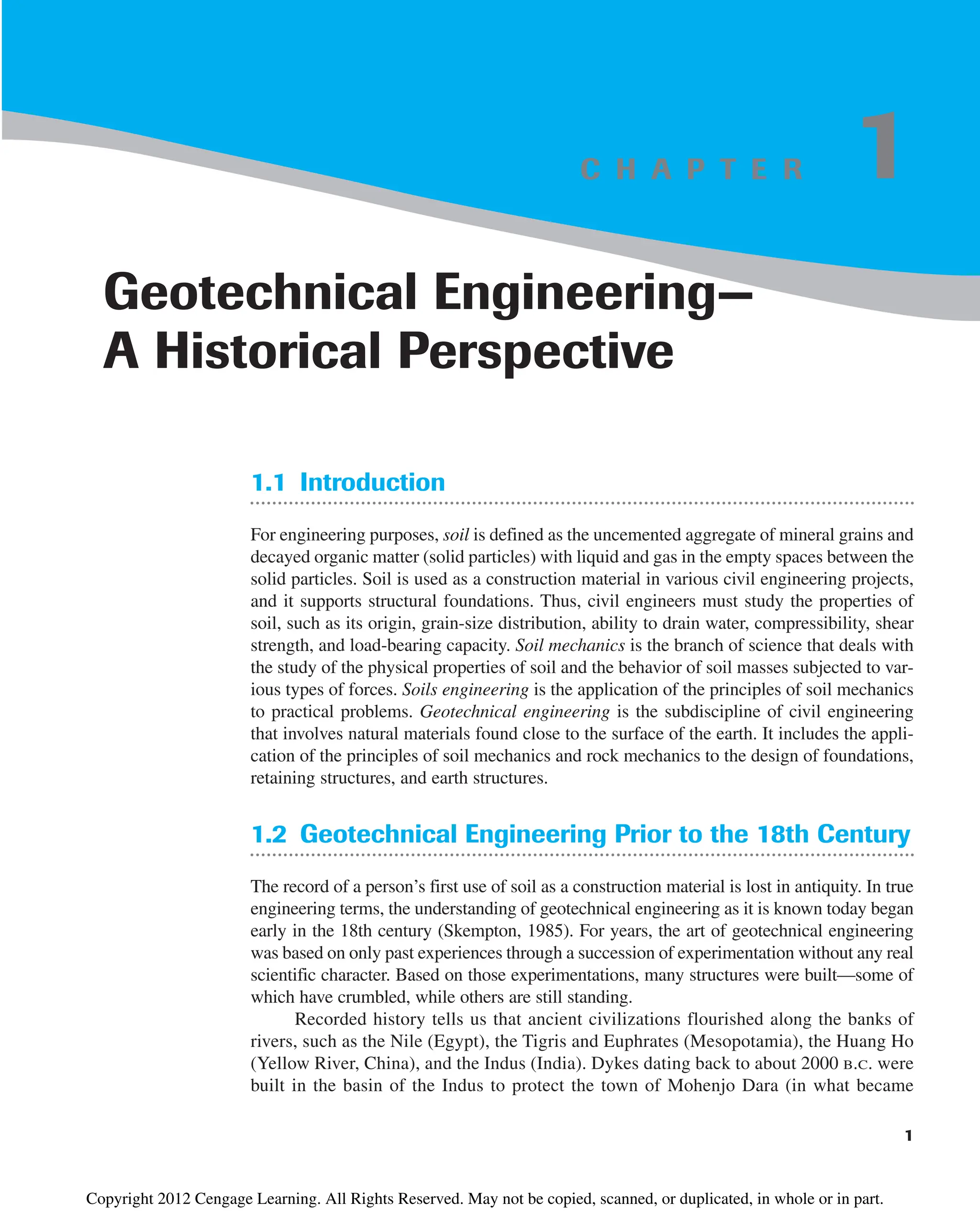
discovered in Egypt. Figure 1.1 shows a view of the pyramids at Giza. The construction
of the pyramids posed formidable challenges regarding foundations, stability of slopes,
2 Chapter 1: Geotechnical Engineering—A Historical Perspective
Table 1.1 Major Pyramids in Egypt
Pyramid/Pharaoh Location Reign of Pharaoh
Djoser Saqqara 2630–2612 B.C.
Sneferu Dashur (North) 2612–2589 B.C.
Sneferu Dashur (South) 2612–2589 B.C.
Sneferu Meidum 2612–2589 B.C.
Khufu Giza 2589–2566 B.C.
Djedefre Abu Rawash 2566–2558 B.C.
Khafre Giza 2558–2532 B.C.
Menkaure Giza 2532–2504 B.C.
Figure 1.1 A view of the pyramids at Giza. (Courtesy of Janice Das, Henderson, Nevada)
©
Cengage
Learning
2014
Copyright 2012 Cengage Learning. All Rights Reserved. May not be copied, scanned, or duplicated, in whole or in part.
and construction of underground chambers. With the arrival of Buddhism in China
during the Eastern Han dynasty in 68 A.D., thousands of pagodas were built. Many of
these structures were constructed on silt and soft clay layers. In some cases the founda-
tion pressure exceeded the load-bearing capacity of the soil and thereby caused exten-
sive structural damage.
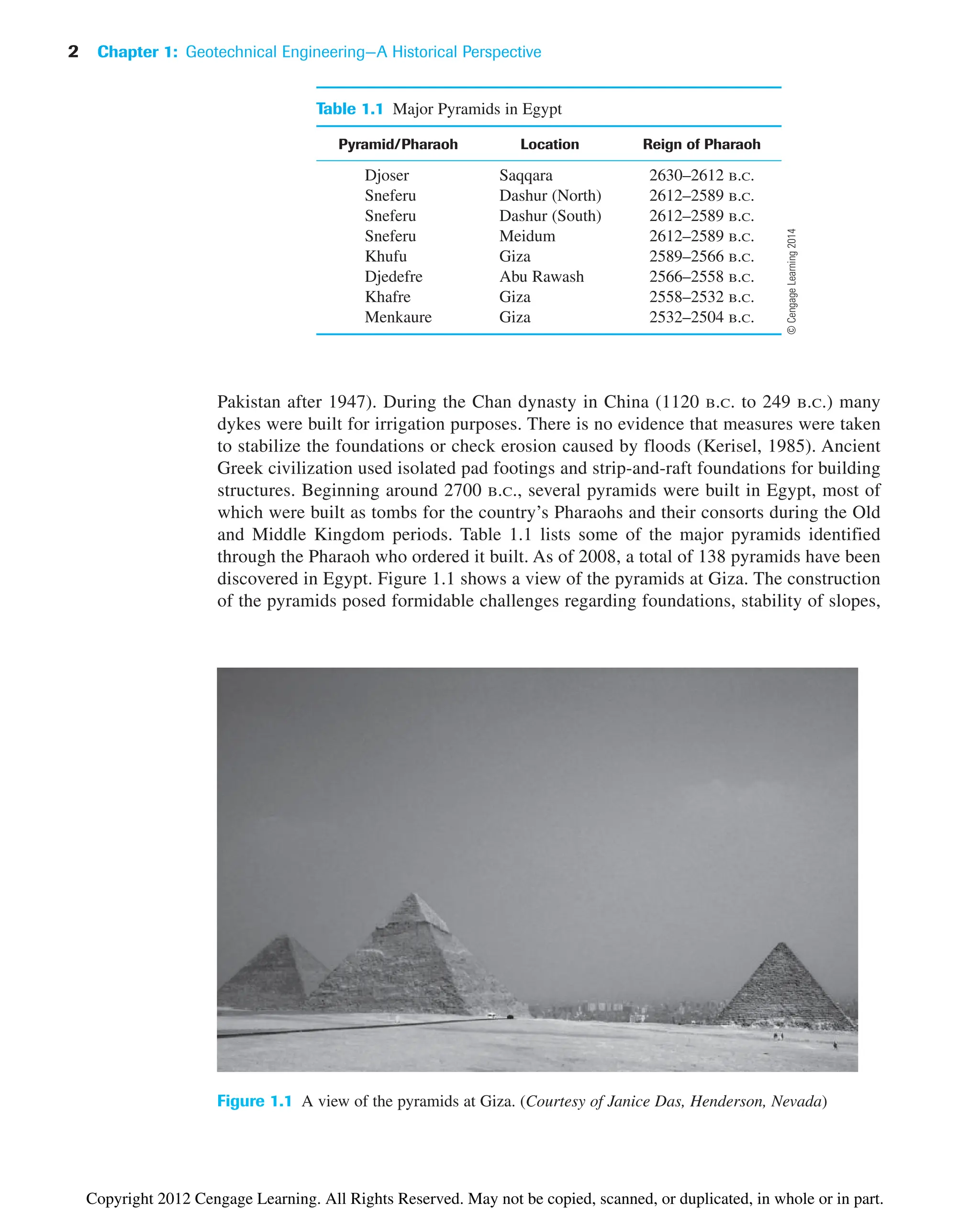
One of the most famous examples of problems related to soil-bearing capacity in
the construction of structures prior to the 18th century is the Leaning Tower of Pisa in
Italy (See Figure 1.2). Construction of the tower began in 1173 A.D. when the Republic
of Pisa was flourishing and continued in various stages for over 200 years. The structure
weighs about 15,700 metric tons and is supported by a circular base having a diameter of
20 m. The tower has tilted in the past to the east, north, west, and, finally, to the south.
Recent investigations showed that a weak clay layer existed at a depth of about 11 m
below the ground surface compression of which caused the tower to tilt. It became more
than 5 m out of plumb with the 54 m height. The tower was closed in 1990 because it was
1.2 Geotechnical Engineering Prior to the 18th Century 3
Figure 1.2 Leaning Tower of Pisa, Italy (Courtesy of Braja M. Das, Henderson, Nevada)
Copyright 2012 Cengage Learning. All Rights Reserved. May not be copied, scanned, or duplicated, in whole or in part.
feared that it would either fall over or collapse. It recently has been stabilized by exca-
vating soil from under the north side of the tower. About 70 metric tons of earth were
removed in 41 separate extractions that spanned the width of the tower. As the ground
gradually settled to fill the resulting space, the tilt of the tower eased. The tower now
leans 5 degrees. The half-degree change is not noticeable, but it makes the structure con-
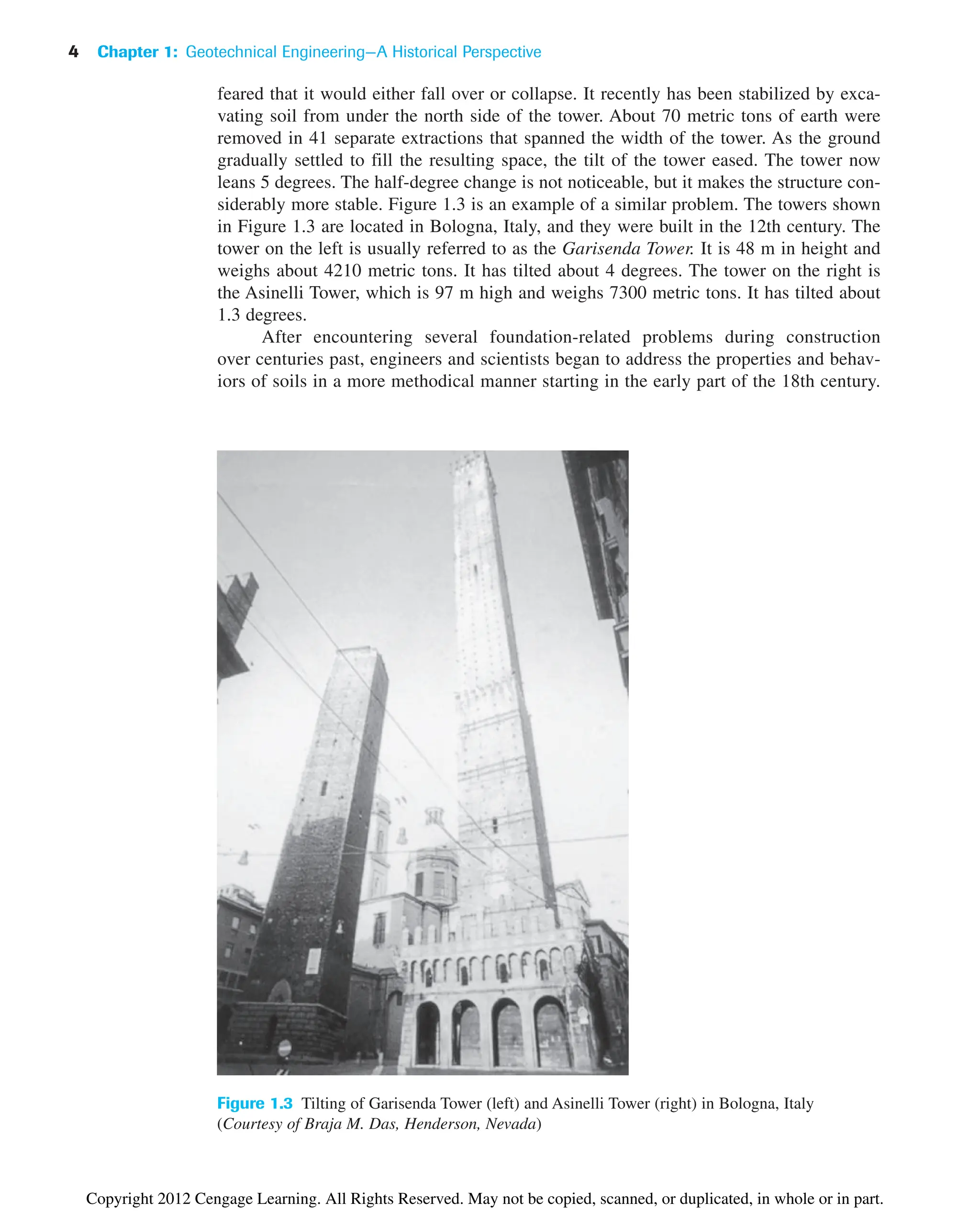
siderably more stable. Figure 1.3 is an example of a similar problem. The towers shown
in Figure 1.3 are located in Bologna, Italy, and they were built in the 12th century. The
tower on the left is usually referred to as the Garisenda Tower. It is 48 m in height and
weighs about 4210 metric tons. It has tilted about 4 degrees. The tower on the right is
the Asinelli Tower, which is 97 m high and weighs 7300 metric tons. It has tilted about
1.3 degrees.
After encountering several foundation-related problems during construction
over centuries past, engineers and scientists began to address the properties and behav-
iors of soils in a more methodical manner starting in the early part of the 18th century.
4 Chapter 1: Geotechnical Engineering—A Historical Perspective
Figure 1.3 Tilting of Garisenda Tower (left) and Asinelli Tower (right) in Bologna, Italy
(Courtesy of Braja M. Das, Henderson, Nevada)
Copyright 2012 Cengage Learning. All Rights Reserved. May not be copied, scanned, or duplicated, in whole or in part.
Based on the emphasis and the nature of study in the area of geotechnical engineering,
the time span extending from 1700 to 1927 can be divided into four major periods
(Skempton, 1985):
1. Preclassical (1700 to 1776 A.D.)
2. Classical soil mechanics—Phase I (1776 to 1856 A.D.)
3. Classical soil mechanics—Phase II (1856 to 1910 A.D.)
4. Modern soil mechanics (1910 to 1927 A.D.)
Brief descriptions of some significant developments during each of these four periods are
presented below.
1.3 Preclassical Period of Soil Mechanics (1700–1776)
This period concentrated on studies relating to natural slope and unit weights of various
types of soils, as well as the semiempirical earth pressure theories. In 1717, a French royal
engineer, Henri Gautier (1660–1737), studied the natural slopes of soils when tipped in a
heap for formulating the design procedures of retaining walls. The natural slope is what
we now refer to as the angle of repose. According to this study, the natural slope of clean
dry sand and ordinary earth were 31° and 45°, respectively. Also, the unit weight of clean
dry sand and ordinary earth were recommended to be 18.1 kN/m3
and 13.4 kN/m3
(85 lb/ft3
), respectively. No test results on clay were reported. In 1729, Bernard Forest de
Belidor (1671–1761) published a textbook for military and civil engineers in France. In the
book, he proposed a theory for lateral earth pressure on retaining walls that was a follow-
up to Gautier’s (1717) original study. He also specified a soil classification system in the
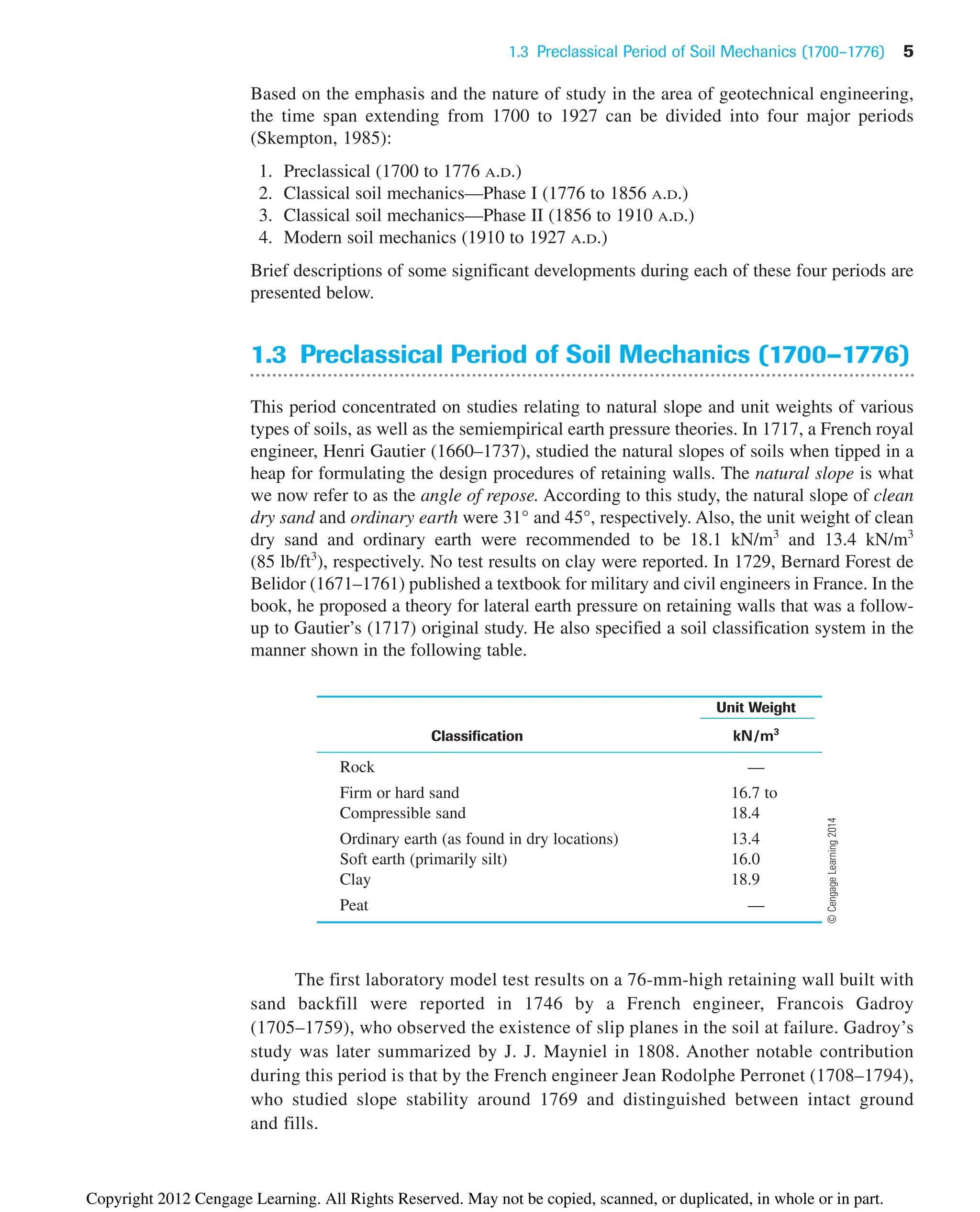
manner shown in the following table.
1.3 Preclassical Period of Soil Mechanics (1700–1776) 5
Unit Weight
Classification kN/m3
Rock —
Firm or hard sand 16.7 to
Compressible sand 18.4
Ordinary earth (as found in dry locations) 13.4
Soft earth (primarily silt) 16.0
Clay 18.9
Peat —
The first laboratory model test results on a 76-mm-high retaining wall built with
sand backfill were reported in 1746 by a French engineer, Francois Gadroy
(1705–1759), who observed the existence of slip planes in the soil at failure. Gadroy’s
study was later summarized by J. J. Mayniel in 1808. Another notable contribution
during this period is that by the French engineer Jean Rodolphe Perronet (1708–1794),
who studied slope stability around 1769 and distinguished between intact ground
and fills.
©
Cengage
Learning
2014
Copyright 2012 Cengage Learning. All Rights Reserved. May not be copied, scanned, or duplicated, in whole or in part.
1.4 Classical Soil Mechanics—Phase I (1776–1856)
During this period, most of the developments in the area of geotechnical engineering
came from engineers and scientists in France. In the preclassical period, practically all
theoretical considerations used in calculating lateral earth pressure on retaining walls
were based on an arbitrarily based failure surface in soil. In his famous paper presented
in 1776, French scientist Charles Augustin Coulomb (1736–1806) used the principles of
calculus for maxima and minima to determine the true position of the sliding surface in
soil behind a retaining wall. In this analysis, Coulomb used the laws of friction and cohe-
sion for solid bodies. In 1790, the distinguished French civil engineer, Gaspard Clair
Marie Riche de Prony (1755–1839) included Coulomb’s theory in his leading textbook,
Nouvelle Architecture Hydraulique (Vol. 1). In 1820, special cases of Coulomb’s work
were studied by French engineer Jacques Frederic Francais (1775–1833) and by French
applied mechanics professor Claude Louis Marie Henri Navier (1785–1836). These
special cases related to inclined backfills and backfills supporting surcharge. In 1840,
Jean Victor Poncelet (1788–1867), an army engineer and professor of mechanics,
extended Coulomb’s theory by providing a graphical method for determining the mag-
nitude of lateral earth pressure on vertical and inclined retaining walls with arbitrarily
broken polygonal ground surfaces. Poncelet was also the first to use the symbol f for
soil friction angle. He also provided the first ultimate bearing-capacity theory for
shallow foundations. In 1846 Alexandre Collin (1808–1890), an engineer, provided the
details for deep slips in clay slopes, cutting, and embankments. Collin theorized that in
all cases the failure takes place when the mobilized cohesion exceeds the existing cohe-
sion of the soil. He also observed that the actual failure surfaces could be approximated
as arcs of cycloids.
The end of Phase I of the classical soil mechanics period is generally marked by
the year (1857) of the first publication by William John Macquorn Rankine (1820–1872),
a professor of civil engineering at the University of Glasgow. This study provided a notable
theory on earth pressure and equilibrium of earth masses. Rankine’s theory is a simplifi-
cation of Coulomb’s theory.
1.5 Classical Soil Mechanics—Phase II (1856–1910)
Several experimental results from laboratory tests on sand appeared in the literature in
this phase. One of the earliest and most important publications is one by French engi-
neer Henri Philibert Gaspard Darcy (1803–1858). In 1856, he published a study on the
permeability of sand filters. Based on those tests, Darcy defined the term coefficient of
permeability (or hydraulic conductivity) of soil, a very useful parameter in geotechnical
engineering to this day.
Sir George Howard Darwin (1845–1912), a professor of astronomy, conducted
laboratory tests to determine the overturning moment on a hinged wall retaining
sand in loose and dense states of compaction. Another noteworthy contribution, which
was published in 1885 by Joseph Valentin Boussinesq (1842–1929), was the develop-
ment of the theory of stress distribution under loaded bearing areas in a homogeneous,
6 Chapter 1: Geotechnical Engineering—A Historical Perspective
Copyright 2012 Cengage Learning. All Rights Reserved. May not be copied, scanned, or duplicated, in whole or in part.
semiinfinite, elastic, and isotropic medium. In 1887, Osborne Reynolds (1842–1912)
demonstrated the phenomenon of dilatancy in sand. Other notable studies during
this period are those by John Clibborn (1847–1938) and John Stuart Beresford
(1845–1925) relating to the flow of water through sand bed and uplift pressure.
Clibborn’s study was published in the Treatise on Civil Engineering, Vol. 2: Irrigation
Work in India, Roorkee, 1901 and also in Technical Paper No. 97, Government of
India, 1902. Beresford’s 1898 study on uplift pressure on the Narora Weir on the
Ganges River has been documented in Technical Paper No. 97, Government of
India, 1902.
1.6 Modern Soil Mechanics (1910–1927)
In this period, results of research conducted on clays were published in which the funda-
mental properties and parameters of clay were established. The most notable publications
are described next.
Around 1908, Albert Mauritz Atterberg (1846–1916), a Swedish chemist and soil
scientist, defined clay-size fractions as the percentage by weight of particles smaller than
2 microns in size. He realized the important role of clay particles in a soil and the plasticity
thereof. In 1911, he explained the consistency of cohesive soils by defining liquid, plastic,
and shrinkage limits. He also defined the plasticity index as the difference between liquid
limit and plastic limit (see Atterberg, 1911).
In October 1909, the 17-m-high earth dam at Charmes, France, failed. It was built
between 1902 and 1906. A French engineer, Jean Fontard (1884–1962), carried out investiga-
tions to determine the cause of failure. In that context, he conducted undrained double-shear
tests on clay specimens (0.77 m2
in area and 200 mm thick) under constant vertical stress to
determine their shear strength parameters (see Frontard, 1914). The times for failure of these
specimens were between 10 to 20 minutes.
Arthur Langley Bell (1874–1956), a civil engineer from England, worked on the
design and construction of the outer seawall at Rosyth Dockyard. Based on his work, he
developed relationships for lateral pressure and resistance in clay as well as bearing capac-
ity of shallow foundations in clay (see Bell, 1915). He also used shear-box tests to measure
the undrained shear strength of undisturbed clay specimens.
Wolmar Fellenius (1876–1957), an engineer from Sweden, developed the stability
analysis of saturated clay slopes (that is, f ⫽ 0 condition) with the assumption that
the critical surface of sliding is the arc of a circle. These were elaborated upon in his
papers published in 1918 and 1926. The paper published in 1926 gave correct numeri-
cal solutions for the stability numbers of circular slip surfaces passing through the toe of
the slope.
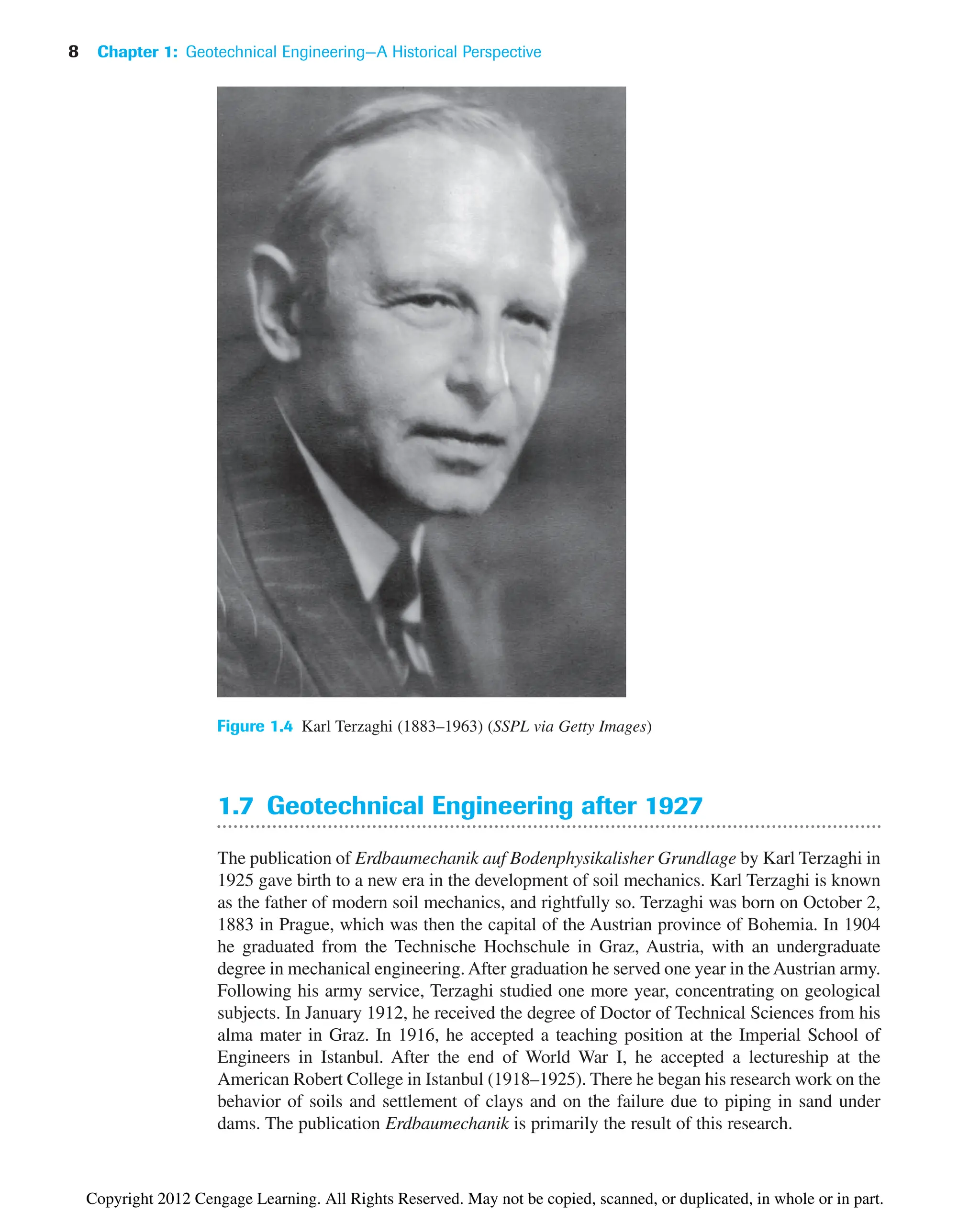
Karl Terzaghi (1883–1963) of Austria (Figure 1.4) developed the theory of consol-
idation for clays as we know today. The theory was developed when Terzaghi was teach-
ing at the American Robert College in Istanbul, Turkey. His study spanned a five-year
period from 1919 to 1924. Five different clay soils were used. The liquid limit of those
soils ranged between 36 and 67, and the plasticity index was in the range of 18 to 38.
The consolidation theory was published in Terzaghi’s celebrated book Erdbaumechanik
in 1925.
1.6 Modern Soil Mechanics (1910–1927) 7
Copyright 2012 Cengage Learning. All Rights Reserved. May not be copied, scanned, or duplicated, in whole or in part.
1.7 Geotechnical Engineering after 1927
The publication of Erdbaumechanik auf Bodenphysikalisher Grundlage by Karl Terzaghi in
1925 gave birth to a new era in the development of soil mechanics. Karl Terzaghi is known
as the father of modern soil mechanics, and rightfully so. Terzaghi was born on October 2,
1883 in Prague, which was then the capital of the Austrian province of Bohemia. In 1904
he graduated from the Technische Hochschule in Graz, Austria, with an undergraduate
degree in mechanical engineering. After graduation he served one year in the Austrian army.
Following his army service, Terzaghi studied one more year, concentrating on geological
subjects. In January 1912, he received the degree of Doctor of Technical Sciences from his
alma mater in Graz. In 1916, he accepted a teaching position at the Imperial School of
Engineers in Istanbul. After the end of World War I, he accepted a lectureship at the
American Robert College in Istanbul (1918–1925). There he began his research work on the
behavior of soils and settlement of clays and on the failure due to piping in sand under
dams. The publication Erdbaumechanik is primarily the result of this research.
8 Chapter 1: Geotechnical Engineering—A Historical Perspective
Figure 1.4 Karl Terzaghi (1883–1963) (SSPL via Getty Images)
Copyright 2012 Cengage Learning. All Rights Reserved. May not be copied, scanned, or duplicated, in whole or in part.
In 1925, Terzaghi accepted a visiting lectureship at Massachusetts Institute of
Technology, where he worked until 1929. During that time, he became recognized as the
leader of the new branch of civil engineering called soil mechanics. In October 1929, he
returned to Europe to accept a professorship at the Technical University of Vienna, which
soon became the nucleus for civil engineers interested in soil mechanics. In 1939, he
returned to the United States to become a professor at Harvard University.
The first conference of the International Society of Soil Mechanics and Foundation
Engineering (ISSMFE) was held at Harvard University in 1936 with Karl Terzaghi
presiding. The conference was possible due to the conviction and efforts of Professor
Arthur Casagrande of Harvard University. About 200 individuals representing 21 countries
attended this conference. It was through the inspiration and guidance of Terzaghi over the
preceding quarter-century that papers were brought to that conference covering a wide
range of topics, such as
• Effective stress
• Shear strength
• Testing with Dutch cone penetrometer
• Consolidation
• Centrifuge testing
• Elastic theory and stress distribution
• Preloading for settlement control
• Swelling clays
• Frost action
• Earthquake and soil liquefaction
• Machine vibration
• Arching theory of earth pressure
For the next quarter-century, Terzaghi was the guiding spirit in the development of soil
mechanics and geotechnical engineering throughout the world. To that effect, in 1985, Ralph
Peck wrote that “few people during Terzaghi’s lifetime would have disagreed that he was not
only the guiding spirit in soil mechanics, but that he was the clearing house for research and
application throughout the world. Within the next few years he would be engaged on proj-
ects on every continent save Australia and Antarctica.” Peck continued with, “Hence, even
today, one can hardly improve on his contemporary assessments of the state of soil mechan-
ics as expressed in his summary papers and presidential addresses.” In 1939, Terzaghi deliv-
ered the 45th James Forrest Lecture at the Institution of Civil Engineers, London. His lecture
was entitled “Soil Mechanics—A New Chapter in Engineering Science.” In it, he proclaimed
that most of the foundation failures that occurred were no longer “acts of God.”
Following are some highlights in the development of soil mechanics and geotechni-
cal engineering that evolved after the first conference of the ISSMFE in 1936:
• Publication of the book Theoretical Soil Mechanics by Karl Terzaghi in 1943 (Wiley,
New York)
• Publication of the book Soil Mechanics in Engineering Practice by Karl Terzaghi
and Ralph Peck in 1948 (Wiley, New York)
• Publication of the book Fundamentals of Soil Mechanics by Donald W. Taylor in
1948 (Wiley, New York)
• Start of the publication of Geotechnique, the international journal of soil mechanics
in 1948 in England
1.7 Geotechnical Engineering after 1927 9
Copyright 2012 Cengage Learning. All Rights Reserved. May not be copied, scanned, or duplicated, in whole or in part.
After a brief interruption for World War II, the second conference of ISSMFE was held
in Rotterdam, The Netherlands, in 1948. There were about 600 participants, and seven volumes
of proceedings were published. In this conference, A. W. Skempton presented the landmark
paper on f ⫽ 0 concept for clays. Following Rotterdam, ISSMFE conferences have been
organized about every four years in different parts of the world. The aftermath of the Rotterdam
conference saw the growth of regional conferences on geotechnical engineering, such as
• European Regional Conference on Stability of Earth Slopes, Stockholm (1954)
• First Australia–New Zealand Conference on Shear Characteristics of Soils (1952)
• First Pan American Conference, Mexico City (1960)
• Research conference on Shear Strength of Cohesive Soils, Boulder, Colorado, (1960)
Two other important milestones between 1948 and 1960 are (1) the publication of
A. W. Skempton’s paper on A and B pore pressure parameters, which made effective stress
calculations more practical for various engineering works, and (2) publication of the
book entitled The Measurement of Soil Properties in the Triaxial Text by A. W. Bishop and
B. J. Henkel (Arnold, London) in 1957.
By the early 1950s, computer-aided finite difference and finite element solutions
were applied to various types of geotechnical engineering problems. They still remain an
important and useful computation tool in our profession. Since the early days, the profes-
sion of geotechnical engineering has come a long way and has matured. It is now an estab-
lished branch of civil engineering, and thousands of civil engineers declare geotechnical
engineering to be their preferred area of speciality.
In 1997, the ISSMFE was changed to ISSMGE (International Society of Soil
Mechanics and Geotechnical Engineering) to reflect its true scope. These international
conferences have been instrumental for exchange of information regarding new develop-
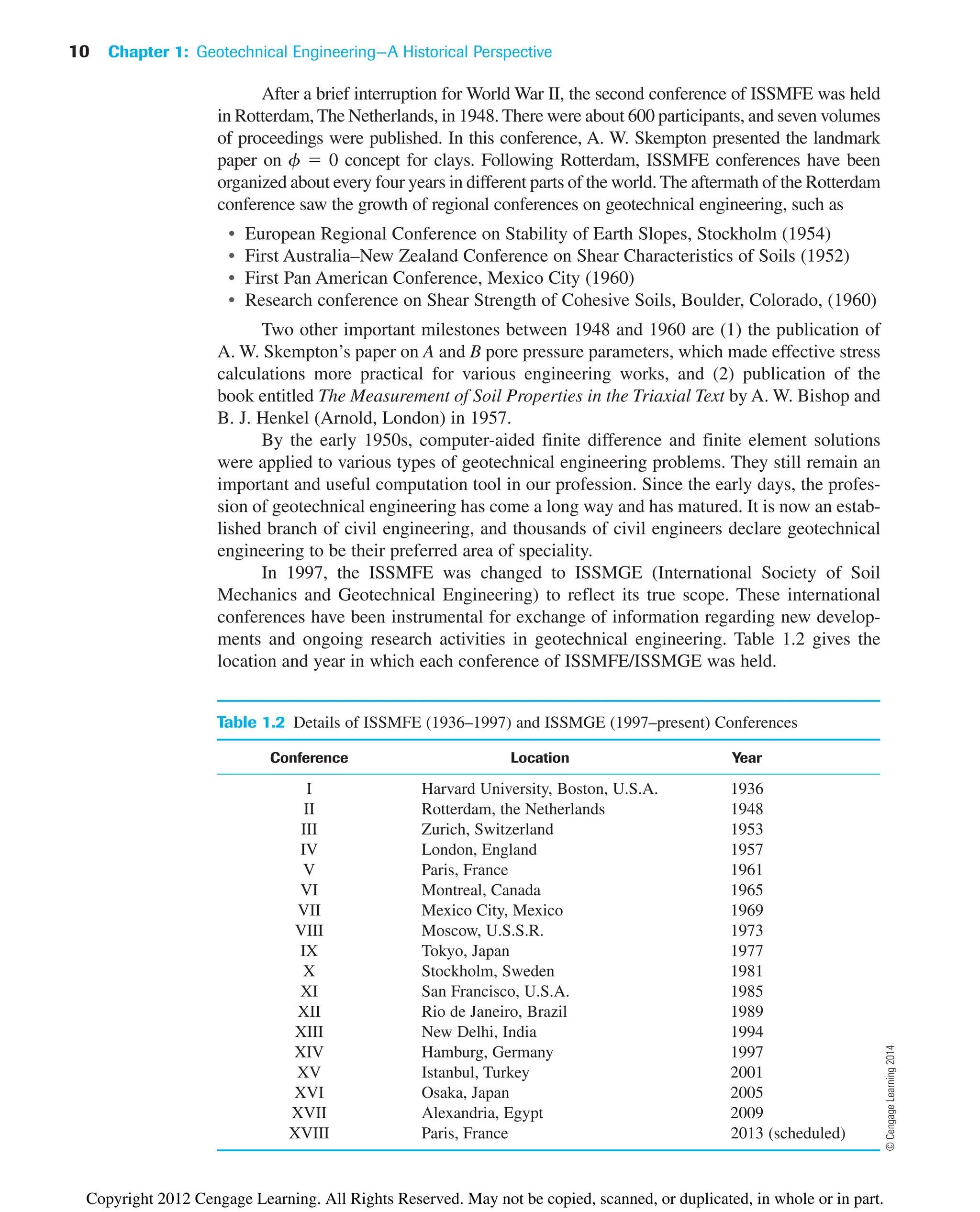
ments and ongoing research activities in geotechnical engineering. Table 1.2 gives the
location and year in which each conference of ISSMFE/ISSMGE was held.
10 Chapter 1: Geotechnical Engineering—A Historical Perspective
Table 1.2 Details of ISSMFE (1936–1997) and ISSMGE (1997–present) Conferences
Conference Location Year
I Harvard University, Boston, U.S.A. 1936
II Rotterdam, the Netherlands 1948
III Zurich, Switzerland 1953
IV London, England 1957
V Paris, France 1961
VI Montreal, Canada 1965
VII Mexico City, Mexico 1969
VIII Moscow, U.S.S.R. 1973
IX Tokyo, Japan 1977
X Stockholm, Sweden 1981
XI San Francisco, U.S.A. 1985
XII Rio de Janeiro, Brazil 1989
XIII New Delhi, India 1994
XIV Hamburg, Germany 1997
XV Istanbul, Turkey 2001
XVI Osaka, Japan 2005
XVII Alexandria, Egypt 2009
XVIII Paris, France 2013 (scheduled)
©
Cengage
Learning
2014
Copyright 2012 Cengage Learning. All Rights Reserved. May not be copied, scanned, or duplicated, in whole or in part.
1.7 Geotechnical Engineering after 1927 11
In 1960, Bishop, Alpan, Blight, and Donald provided early guidelines and experi-
mental results for the factors controlling the strength of partially saturated cohesive soils.
Since that time advances have been made in the study of the behavior of unsaturated soils
as related to strength and compressibility and other factors affecting construction of earth-
supported and earth-retaining structures.
ISSMGE has several technical committees, and these committees organize or
co-sponsor several conferences around the world. A list of these technical committees
(2010–2013) is given in Table 1.3. ISSMGE also conducts International Seminars (for-
merly known as Touring Lectures), and they have proved to be an important activity;
these seminars bring together practitioners, contractors, and academics, both on stage
Table 1.3 List of ISSMGE Technical Committees (2010–2013)
Technical
Committee
Category Number Technical Committee Name
Fundamentals TC101 Laboratory Stress Strength Testing of Geomaterials
TC102 Ground Property Characterization from In-Situ Tests
TC103 Numerical Methods in Geomechanics
TC104 Physical Modelling in Geotechnics
TC105 Geo-Mechanics from Micro to Macro
TC106 Unsaturated Soils
Applications TC201 Geotechnical Aspects of Dykes and Levees,
Shore Protection and Land Reclamation
TC202 Transportation Geotechnics
TC203 Earthquake Geotechnical Engineering and
Associated Problems
TC204 Underground Construction in Soft Ground
TC205 Limit State Design in Geotechnical Engineering
TC206 Interactive Geotechnical Design
TC207 Soil-Structure Interaction and Retaining Walls
TC208 Stability of Natural Slopes
TC209 Offshore Geotechnics
TC210 Dams and Embankments
TC211 Ground Improvement
TC212 Deep Foundations
TC213 Geotechnics of Soil Erosion
TC214 Foundation Engineering for Difficult Soft Soil
Conditions
TC215 Environmental Geotechnics
TC216 Frost Geotechnics
Impact TC301 Preservation of Historic Sites
on Society TC302 Forensic Geotechnical Engineering
TC303 Coastal and River Disaster Mitigation and
Rehabilitation
TC304 Engineering Practice of Risk Assessment and
Management
TC305 Geotechnical Infrastructure for Megacities
and New Capitals
©
Cengage
Learning
2014
Copyright 2012 Cengage Learning. All Rights Reserved. May not be copied, scanned, or duplicated, in whole or in part.
and in the audience, to their own benefit irrespective of the region, size, or wealth of the
Member Society, thus fostering a sense of belonging to the International Society for Soil
Mechanics and Geotechnical Engineering.
1.8 End of an Era
In Section 1.7, a brief outline of the contributions made to modern soil mechanics by
pioneers such as Karl Terzaghi, Arthur Casagrande, Donald W. Taylor, Laurits Bjerrum,
and Ralph B. Peck was presented. The last of the early giants of the profession, Ralph B.
Peck, passed away on February 18, 2008, at the age of 95.
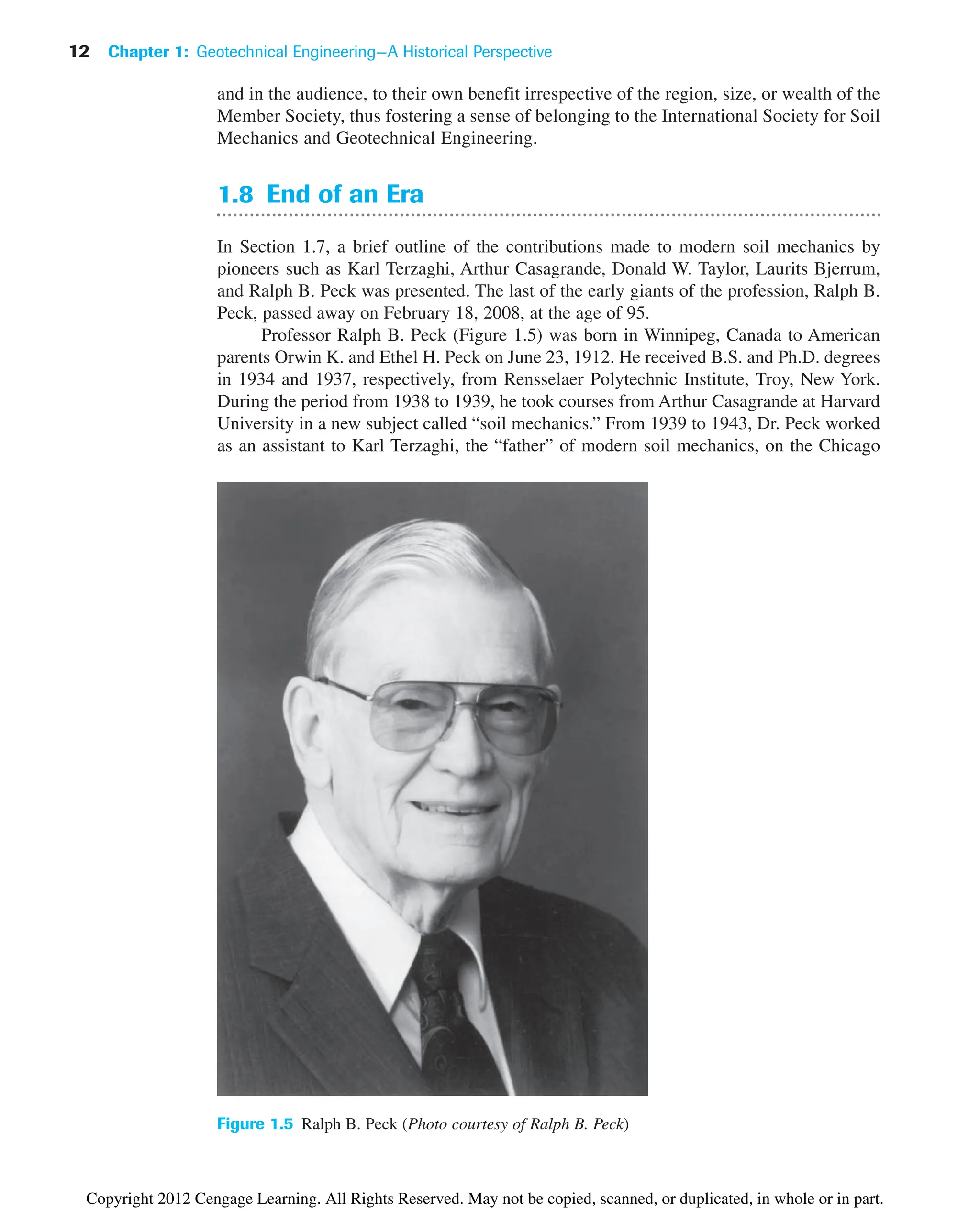
Professor Ralph B. Peck (Figure 1.5) was born in Winnipeg, Canada to American
parents Orwin K. and Ethel H. Peck on June 23, 1912. He received B.S. and Ph.D. degrees
in 1934 and 1937, respectively, from Rensselaer Polytechnic Institute, Troy, New York.
During the period from 1938 to 1939, he took courses from Arthur Casagrande at Harvard
University in a new subject called “soil mechanics.” From 1939 to 1943, Dr. Peck worked
as an assistant to Karl Terzaghi, the “father” of modern soil mechanics, on the Chicago
Figure 1.5 Ralph B. Peck (Photo courtesy of Ralph B. Peck)
12 Chapter 1: Geotechnical Engineering—A Historical Perspective
Copyright 2012 Cengage Learning. All Rights Reserved. May not be copied, scanned, or duplicated, in whole or in part.
Subway Project. In 1943, he joined the University of Illinois at Champaign–Urban and was
a professor of foundation engineering from 1948 until he retired in 1974. After retirement,
he was active in consulting, which included major geotechnical projects in 44 states in the
United States and 28 other countries on five continents. Some examples of his major
consulting projects include
• Rapid transit systems in Chicago, San Francisco, and Washington, D.C.
• Alaskan pipeline system
• James Bay Project in Quebec, Canada
• Heathrow Express Rail Project (U.K.)
• Dead Sea dikes
His last project was the Rion-Antirion Bridge in Greece. On March 13, 2008, The Times of
the United Kingdom wrote, “Ralph B. Peck was an American civil engineer who invented
a controversial construction technique that would be used on some of the modern engi-
neering wonders of the world, including the Channel Tunnel. Known as ‘the godfather of
soil mechanics,’ he was directly responsible for a succession of celebrated tunneling and
earth dam projects that pushed the boundaries of what was believed to be possible.”
Dr. Peck authored more than 250 highly distinguished technical publications. He
was the president of the ISSMGE from 1969 to 1973. In 1974, he received the National
Medal of Science from President Gerald R. Ford. Professor Peck was a teacher, mentor,
friend, and counselor to generations of geotechnical engineers in every country in the
world. The 16th ISSMGE Conference in Osaka, Japan (2005) would be the last major con-
ference of its type that he would attend.
This is truly the end of an era.
References 13
References
ATTERBERG, A. M. (1911). “Über die physikalische Bodenuntersuchung, und über die Plasti-zität de
Tone,” International Mitteilungen für Bodenkunde, Verlag für Fachliteratur. G.m.b.H. Berlin,
Vol. 1, 10–43.
BELIDOR, B. F. (1729). La Science des Ingenieurs dans la Conduite des Travaux de Fortification et
D’Architecture Civil, Jombert, Paris.
BELL, A. L. (1915). “The Lateral Pressure and Resistance of Clay, and Supporting Power of Clay
Foundations,” Min. Proceeding of Institute of Civil Engineers, Vol. 199, 233–272.
BISHOP, A. W., ALPAN, I., BLIGHT, G. E., and DONALD, I. B. (1960). “Factors Controlling the
Strength of Partially Saturated Cohesive Soils.” Proceedings. Research Conference on Shear
Strength of Cohesive Soils, ASCE, 502–532.
BISHOP, A. W. and HENKEL, B. J. (1957). The Measurement of Soil Properties in the Triaxial Test,
Arnold, London.
BOUSSINESQ, J. V. (1885). Application des Potentiels â L’Etude de L’Équilibre et du Mouvement des
Solides Élastiques, Gauthier-Villars, Paris.
COLLIN, A. (1846). Recherches Expérimentales sur les Glissements Spontanés des Terrains Argileux
Accompagnées de Considérations sur Quelques Principes de la Mécanique Terrestre,
Carilian-Goeury, Paris.
COULOMB, C. A. (1776). “Essai sur une Application des Règles de Maximis et Minimis à Quelques
Problèmes de Statique Relatifs à L’Architecture,” Mèmoires de la Mathèmatique et de
Phisique, présentés à l’Académie Royale des Sciences, par divers savans, et lûs dans sés
Assemblées, De L’Imprimerie Royale, Paris, Vol. 7, Annee 1793, 343–382.
Copyright 2012 Cengage Learning. All Rights Reserved. May not be copied, scanned, or duplicated, in whole or in part.
DARCY, H. P. G. (1856). Les Fontaines Publiques de la Ville de Dijon, Dalmont, Paris.
DARWIN, G. H. (1883). “On the Horizontal Thrust of a Mass of Sand,” Proceedings, Institute of Civil
Engineers, London, Vol. 71, 350–378.
FELLENIUS, W. (1918). “Kaj-och Jordrasen I Göteborg,” Teknisk Tidskrift. Vol. 48, 17–19.
FRANCAIS, J. F. (1820). “Recherches sur la Poussée de Terres sur la Forme et Dimensions des
Revêtments et sur la Talus D’Excavation,” Mémorial de L’Officier du Génie, Paris, Vol. IV,
157–206.
FRONTARD, J. (1914). “Notice sur L’Accident de la Digue de Charmes,” Anns. Ponts et Chaussées
9th Ser., Vol. 23, 173–292.
GADROY, F. (1746). Mémoire sur la Poussée des Terres, summarized by Mayniel, 1808.
GAUTIER, H. (1717). Dissertation sur L’Epaisseur des Culées des Ponts . . . sur L’Effort et al
Pesanteur des Arches . . . et sur les Profiles de Maconnerie qui Doivent Supporter des
Chaussées, des Terrasses, et des Remparts. Cailleau, Paris.
KERISEL, J. (1985). “The History of Geotechnical Engineering up until 1700,” Proceedings, XI
International Conference on Soil Mechanics and Foundation Engineering, San Francisco,
Golden Jubilee Volume, A. A. Balkema, 3–93.
MAYNIEL, J. J. (1808). Traité Experimentale, Analytique et Pratique de la Poussé des Terres.
Colas, Paris.
NAVIER, C. L. M. (1839). Leçons sur L’Application de la Mécanique à L’Establissement des
Constructions et des Machines, 2nd ed., Paris.
PECK, R. B. (1985). “The Last Sixty Years,” Proceedings, XI International Conference on Soil
Mechanics and Foundation Engineering, San Francisco, Golden Jubilee Volume,A.A. Balkema,
123–133.
PONCELET, J. V. (1840). Mémoire sur la Stabilité des Revêtments et de seurs Fondations, Bachelier,
Paris.
PRONY, G. C. M. L. R. (1790), Nouvelle Architecture Hydraulique, contenant l’art d’élever l’eau au
moyen de différentes machines, de construire dans ce fluide, de le diriger, et généralement de
l’appliquer, de diverses manières, aux besoins de la sociétè, FirminDidot, Paris.
RANKINE, W. J. M. (1857). “On the Stability of Loose Earth,” Philosophical Transactions, Royal
Society, Vol. 147, London.
REYNOLDS, O. (1887). “Experiments Showing Dilatency, a Property of Granular Material Possibly
Connected to Gravitation,” Proceedings, Royal Society, London, Vol. 11, 354–363.
SKEMPTON, A. W. (1948). “The f ⫽ 0 Analysis of Stability and Its Theoretical Basis,” Proceedings,
II International Conference on Soil Mechanics and Foundation Engineering, Rotterdam,
Vol. 1, 72–78.
SKEMPTON, A. W. (1954). “The Pore Pressure Coefficients A and B,” Geotechnique, Vol. 4, 143–147.
SKEMPTON, A. W. (1985). “A History of Soil Properties, 1717–1927,” Proceedings, XI International
Conference on Soil Mechanics and Foundation Engineering, San Francisco, Golden Jubilee
Volume, A. A. Balkema, 95–121.
TAYLOR, D. W. (1948). Fundamentals of Soil Mechanics, John Wiley, New York.
TERZAGHI, K. (1925). Erdbaumechanik auf Bodenphysikalisher Grundlage, Deuticke, Vienna.
TERZAGHI, K. (1939). “Soil Mechanics—A New Chapter in Engineering Science,” Institute of Civil
Engineers Journal, London, Vol. 12, No. 7, 106–142.
TERZAGHI, K. (1943). Theoretical Soil Mechanics, John Wiley, New York.
TERZAGHI, K., and PECK, R. B. (1948). Soil Mechanics in Engineering Practice, John Wiley,
New York.
14 Chapter 1: Geotechnical Engineering—A Historical Perspective
Copyright 2012 Cengage Learning. All Rights Reserved. May not be copied, scanned, or duplicated, in whole or in part.
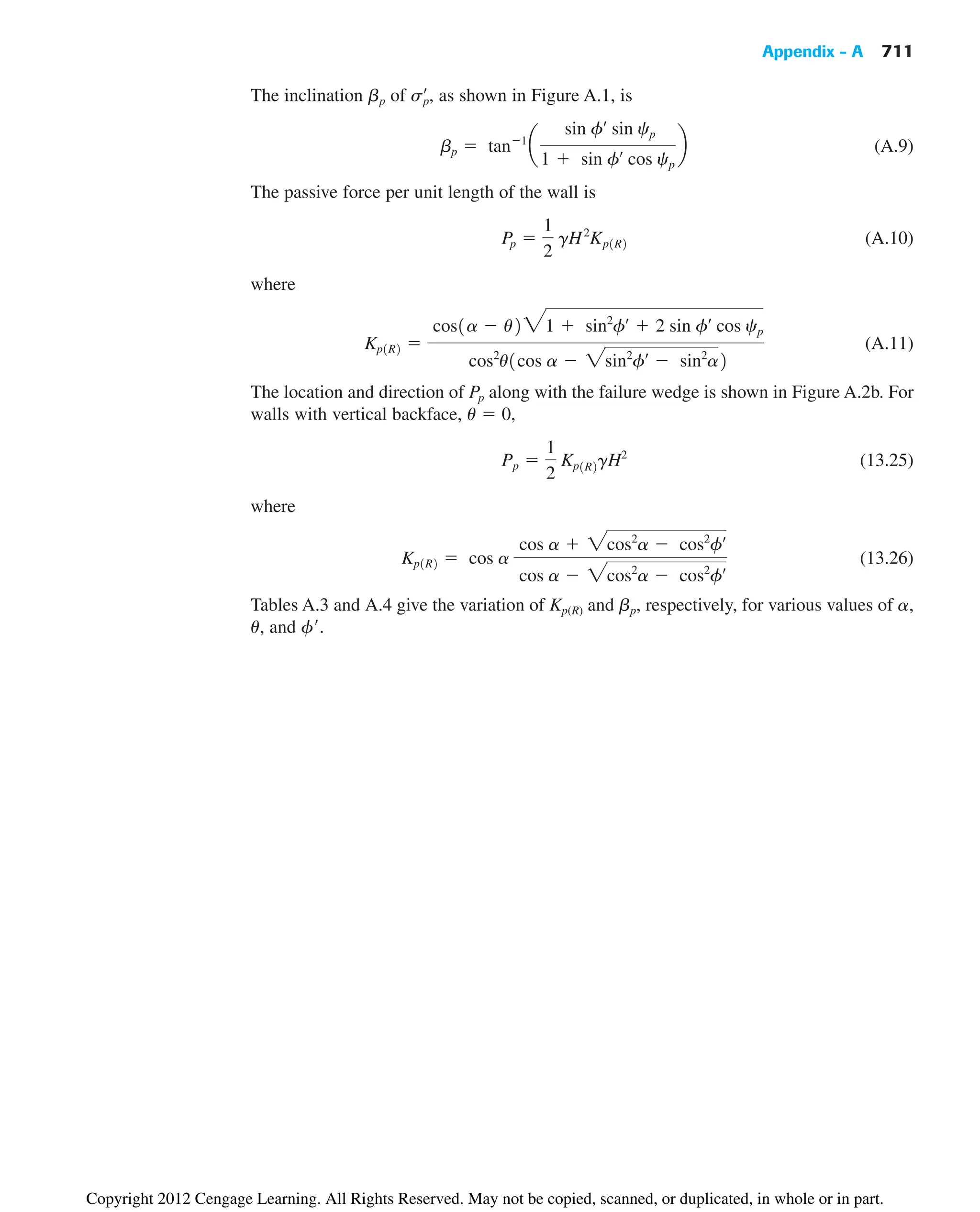
C H A P T E R
2.1 Introduction
In general, soils are formed by weathering of rocks. The physical properties of soil are dic-
tated primarily by the minerals that constitute the soil particles and, hence, the rock from
which it is derived. In this chapter we will discuss the following:
• The formation of various types of rocks, the origins of which are the solidification of
molten magma the mantle of the earth
• Formation of soil by mechanical and chemical weathering of rock
• Determination of the distribution of particle sizes in a given soil mass
• Composition of the clay minerals, which provides the plastic properties of a soil mass
• The shape of various particles in a soil mass
2.2 Rock Cycle and the Origin of Soil
The mineral grains that form the solid phase of a soil aggregate are the product of rock
weathering. The size of the individual grains varies over a wide range. Many of the physical
properties of soil are dictated by the size, shape, and chemical composition of the grains. To
better understand these factors, one must be familiar with the basic types of rock that form
the earth’s crust, the rock-forming minerals, and the weathering process.
On the basis of their mode of origin, rocks can be divided into three basic types:
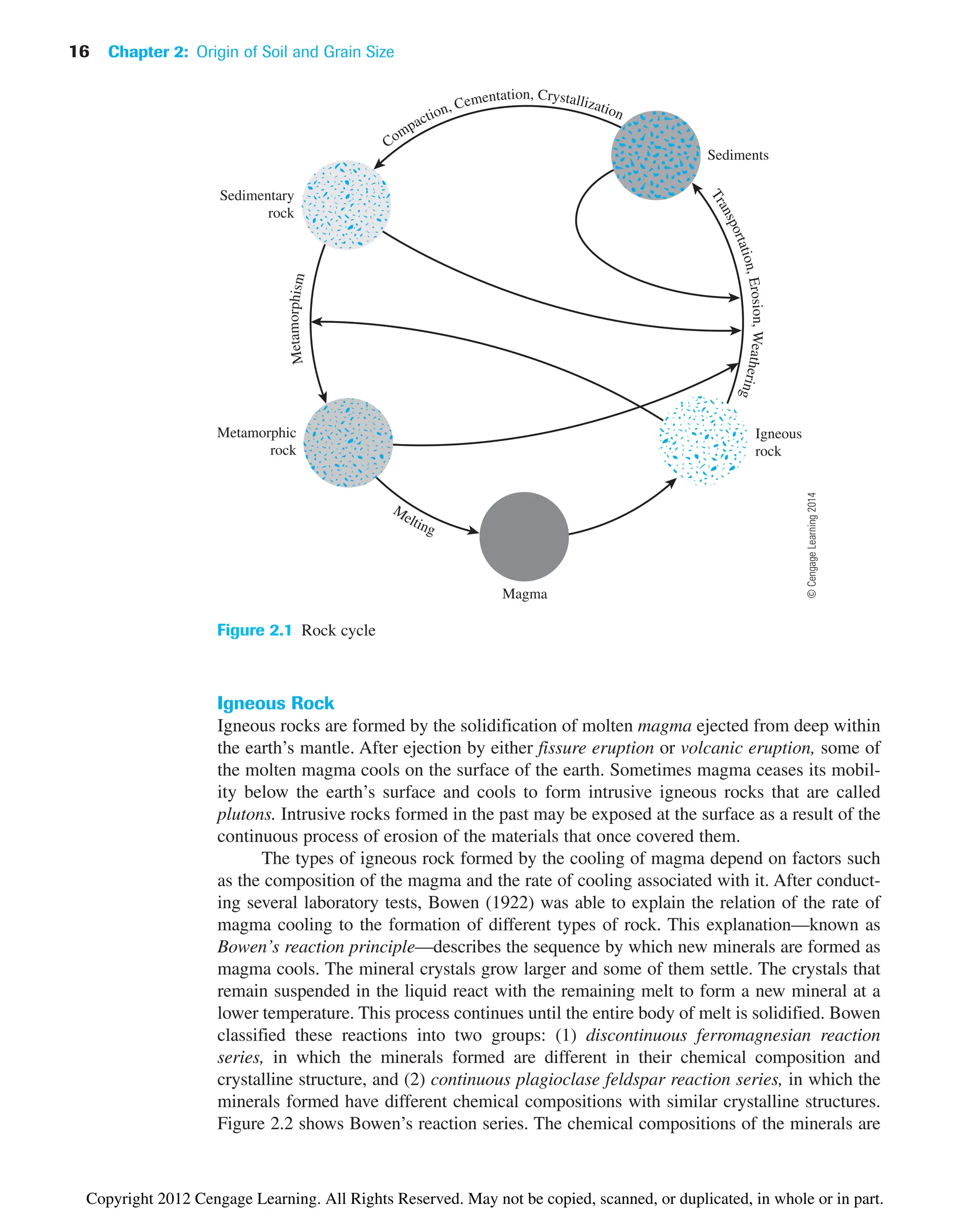
igneous, sedimentary, and metamorphic. Figure 2.1 shows a diagram of the formation
cycle of different types of rock and the processes associated with them. This is called the
rock cycle. Brief discussions of each element of the rock cycle follow.
15
Origin of Soil and Grain Size
2
Copyright 2012 Cengage Learning. All Rights Reserved. May not be copied, scanned, or duplicated, in whole or in part.
16 Chapter 2: Origin of Soil and Grain Size
Igneous Rock
Igneous rocks are formed by the solidification of molten magma ejected from deep within
the earth’s mantle. After ejection by either fissure eruption or volcanic eruption, some of
the molten magma cools on the surface of the earth. Sometimes magma ceases its mobil-
ity below the earth’s surface and cools to form intrusive igneous rocks that are called
plutons. Intrusive rocks formed in the past may be exposed at the surface as a result of the
continuous process of erosion of the materials that once covered them.
The types of igneous rock formed by the cooling of magma depend on factors such
as the composition of the magma and the rate of cooling associated with it. After conduct-
ing several laboratory tests, Bowen (1922) was able to explain the relation of the rate of
magma cooling to the formation of different types of rock. This explanation—known as
Bowen’s reaction principle—describes the sequence by which new minerals are formed as
magma cools. The mineral crystals grow larger and some of them settle. The crystals that
remain suspended in the liquid react with the remaining melt to form a new mineral at a
lower temperature. This process continues until the entire body of melt is solidified. Bowen
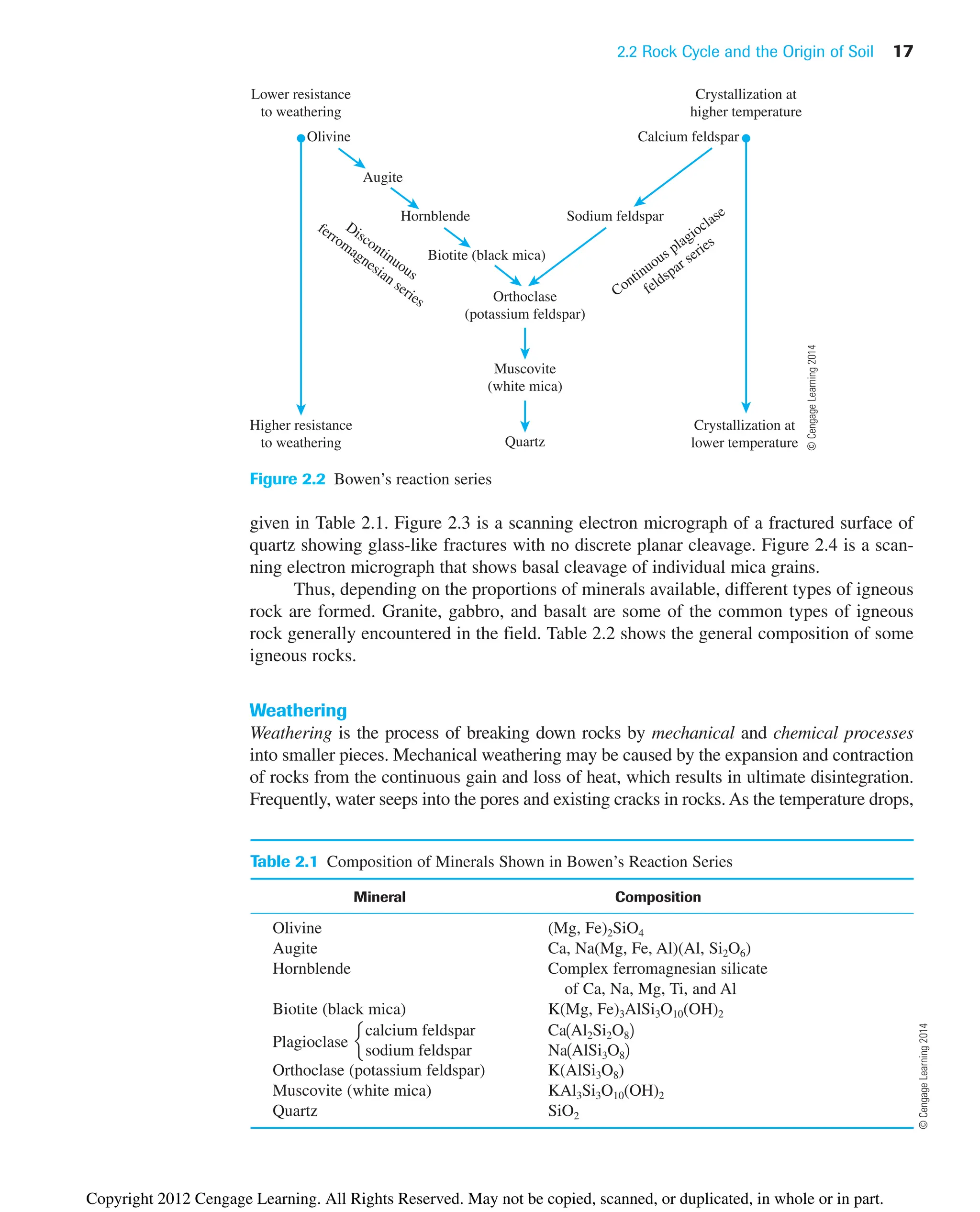
classified these reactions into two groups: (1) discontinuous ferromagnesian reaction
series, in which the minerals formed are different in their chemical composition and
crystalline structure, and (2) continuous plagioclase feldspar reaction series, in which the
minerals formed have different chemical compositions with similar crystalline structures.
Figure 2.2 shows Bowen’s reaction series. The chemical compositions of the minerals are
T
r
a
n
s
p
o
r
t
a
t
i
o
n
,
E
r
o
s
i
o
n
,
W
e
a
t
h
e
r
i
n
g
Compaction, Cementation, Crystallization
Metamorphic
rock
Igneous
rock
Sedimentary
rock
Sediments
Magma
M
e
t
a
m
o
r
p
h
i
s
m
M
elting
Figure 2.1 Rock cycle
©
Cengage
Learning
2014
Copyright 2012 Cengage Learning. All Rights Reserved. May not be copied, scanned, or duplicated, in whole or in part.
2.2 Rock Cycle and the Origin of Soil 17
Figure 2.2 Bowen’s reaction series
Table 2.1 Composition of Minerals Shown in Bowen’s Reaction Series
Mineral Composition
Olivine (Mg, Fe)2SiO4
Augite Ca, Na(Mg, Fe, Al)(Al, Si2O6)
Hornblende Complex ferromagnesian silicate
of Ca, Na, Mg, Ti, and Al
Biotite (black mica) K(Mg, Fe)3AlSi3O10(OH)2
Orthoclase (potassium feldspar) K(AlSi3O8)
Muscovite (white mica) KAl3Si3O10(OH)2
Quartz SiO2
Ca1Al2Si2O82
Na1AlSi3O82
Plagioclase e
calcium feldspar
sodium feldspar
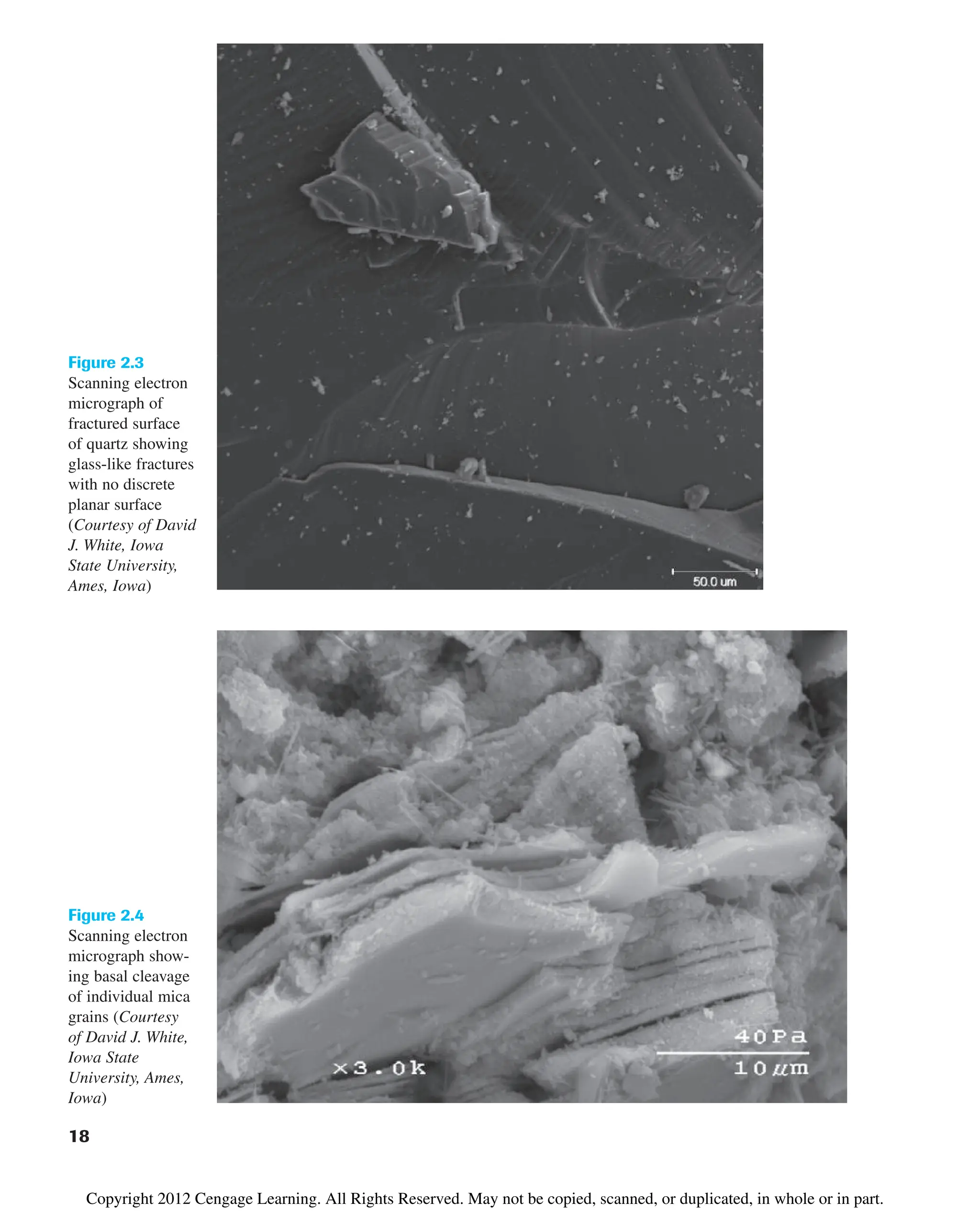
given in Table 2.1. Figure 2.3 is a scanning electron micrograph of a fractured surface of
quartz showing glass-like fractures with no discrete planar cleavage. Figure 2.4 is a scan-
ning electron micrograph that shows basal cleavage of individual mica grains.
Thus, depending on the proportions of minerals available, different types of igneous
rock are formed. Granite, gabbro, and basalt are some of the common types of igneous
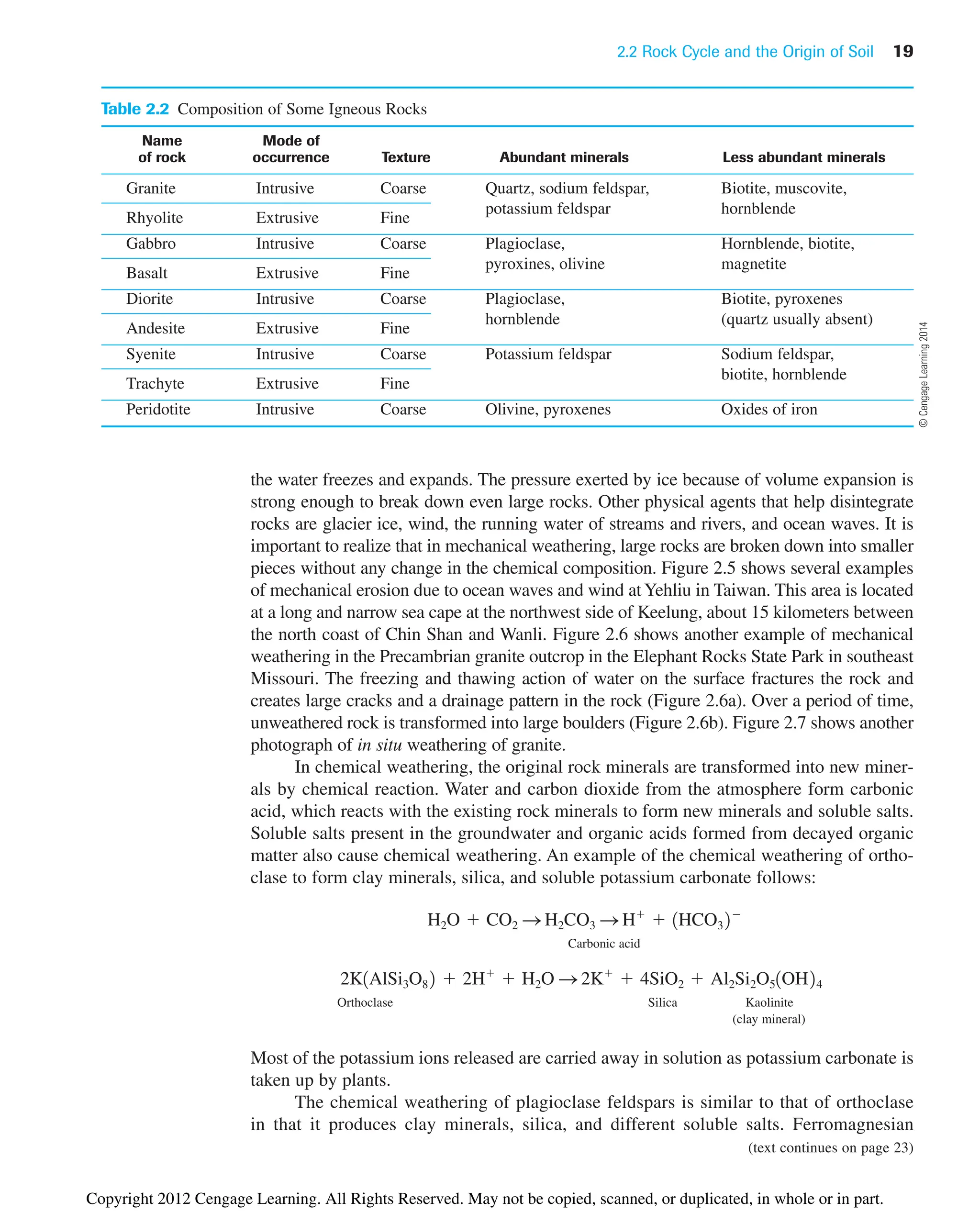
rock generally encountered in the field. Table 2.2 shows the general composition of some
igneous rocks.
Weathering
Weathering is the process of breaking down rocks by mechanical and chemical processes
into smaller pieces. Mechanical weathering may be caused by the expansion and contraction
of rocks from the continuous gain and loss of heat, which results in ultimate disintegration.
Frequently, water seeps into the pores and existing cracks in rocks. As the temperature drops,
©
Cengage
Learning
2014
©
Cengage
Learning
2014
Lower resistance
to weathering
Olivine
Augite
Hornblende
Biotite (black mica)
Orthoclase
(potassium feldspar)
Muscovite
(white mica)
Quartz
Sodium feldspar
Higher resistance
to weathering
Continuous plagioclase
feldspar series
Calcium feldspar
Crystallization at
higher temperature
Crystallization at
lower temperature
Discontinuous
ferromagnesian series
Copyright 2012 Cengage Learning. All Rights Reserved. May not be copied, scanned, or duplicated, in whole or in part.
Figure 2.4
Scanning electron
micrograph show-
ing basal cleavage
of individual mica
grains (Courtesy
of David J. White,
Iowa State
University, Ames,
Iowa)
Figure 2.3
Scanning electron
micrograph of
fractured surface
of quartz showing
glass-like fractures
with no discrete
planar surface
(Courtesy of David
J. White, Iowa
State University,
Ames, Iowa)
18
Copyright 2012 Cengage Learning. All Rights Reserved. May not be copied, scanned, or duplicated, in whole or in part.
Table 2.2 Composition of Some Igneous Rocks
Name Mode of
of rock occurrence Texture Abundant minerals Less abundant minerals
Granite Intrusive Coarse Quartz, sodium feldspar, Biotite, muscovite,
potassium feldspar hornblende
Rhyolite Extrusive Fine
Gabbro Intrusive Coarse Plagioclase, Hornblende, biotite,
pyroxines, olivine magnetite
Basalt Extrusive Fine
Diorite Intrusive Coarse Plagioclase, Biotite, pyroxenes
hornblende (quartz usually absent)
Andesite Extrusive Fine
Syenite Intrusive Coarse Potassium feldspar Sodium feldspar,
biotite, hornblende
Trachyte Extrusive Fine
Peridotite Intrusive Coarse Olivine, pyroxenes Oxides of iron
the water freezes and expands. The pressure exerted by ice because of volume expansion is
strong enough to break down even large rocks. Other physical agents that help disintegrate
rocks are glacier ice, wind, the running water of streams and rivers, and ocean waves. It is
important to realize that in mechanical weathering, large rocks are broken down into smaller
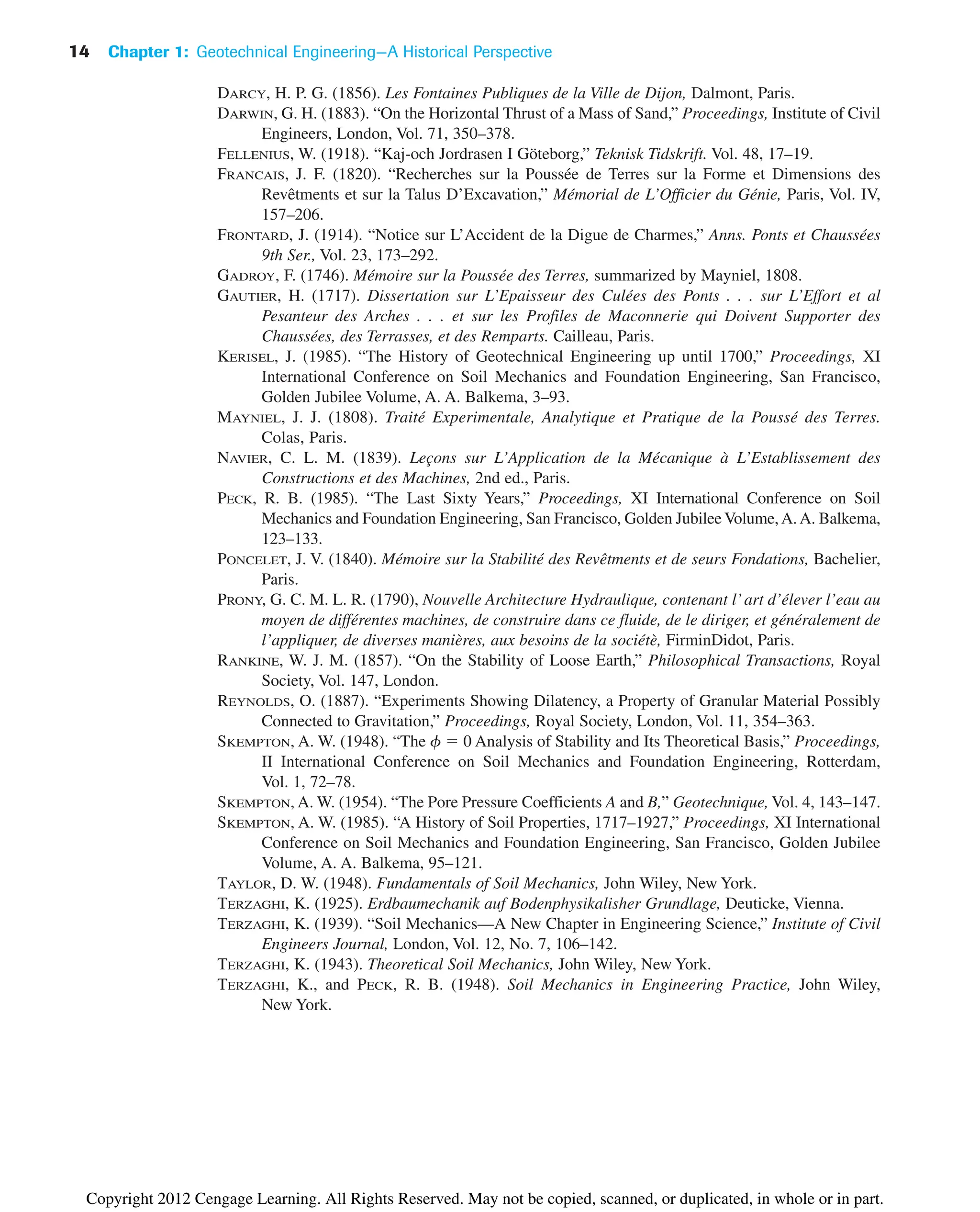
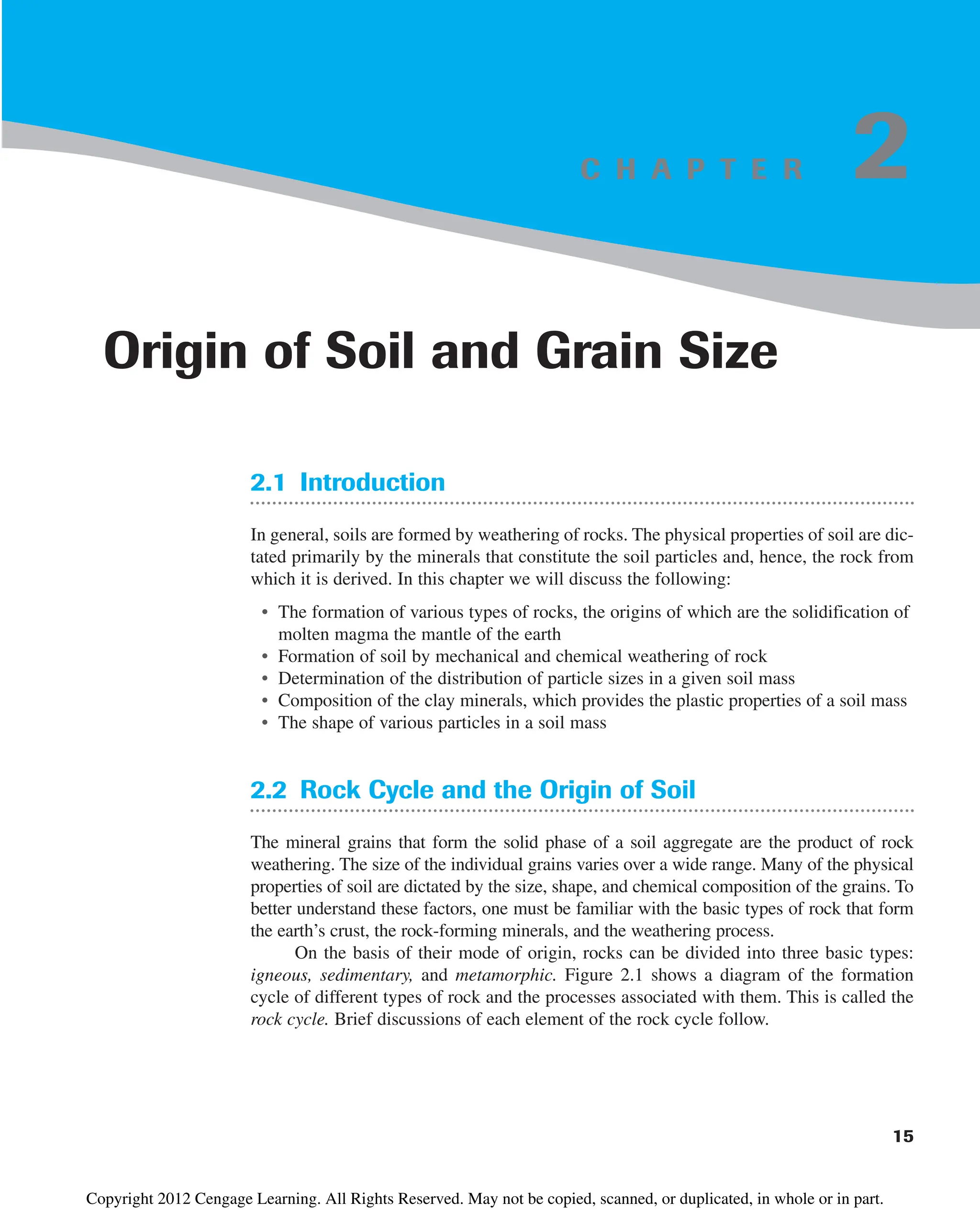
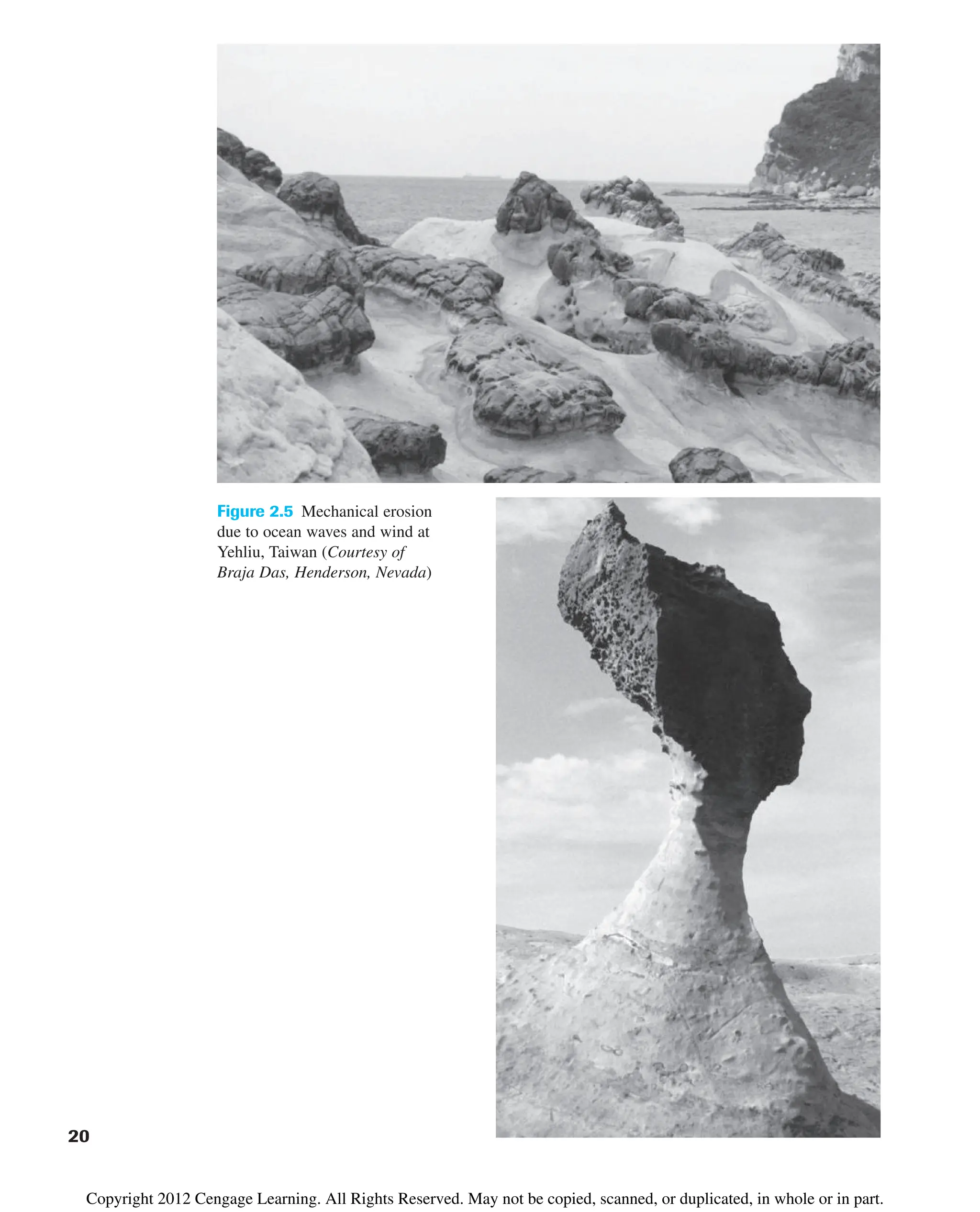
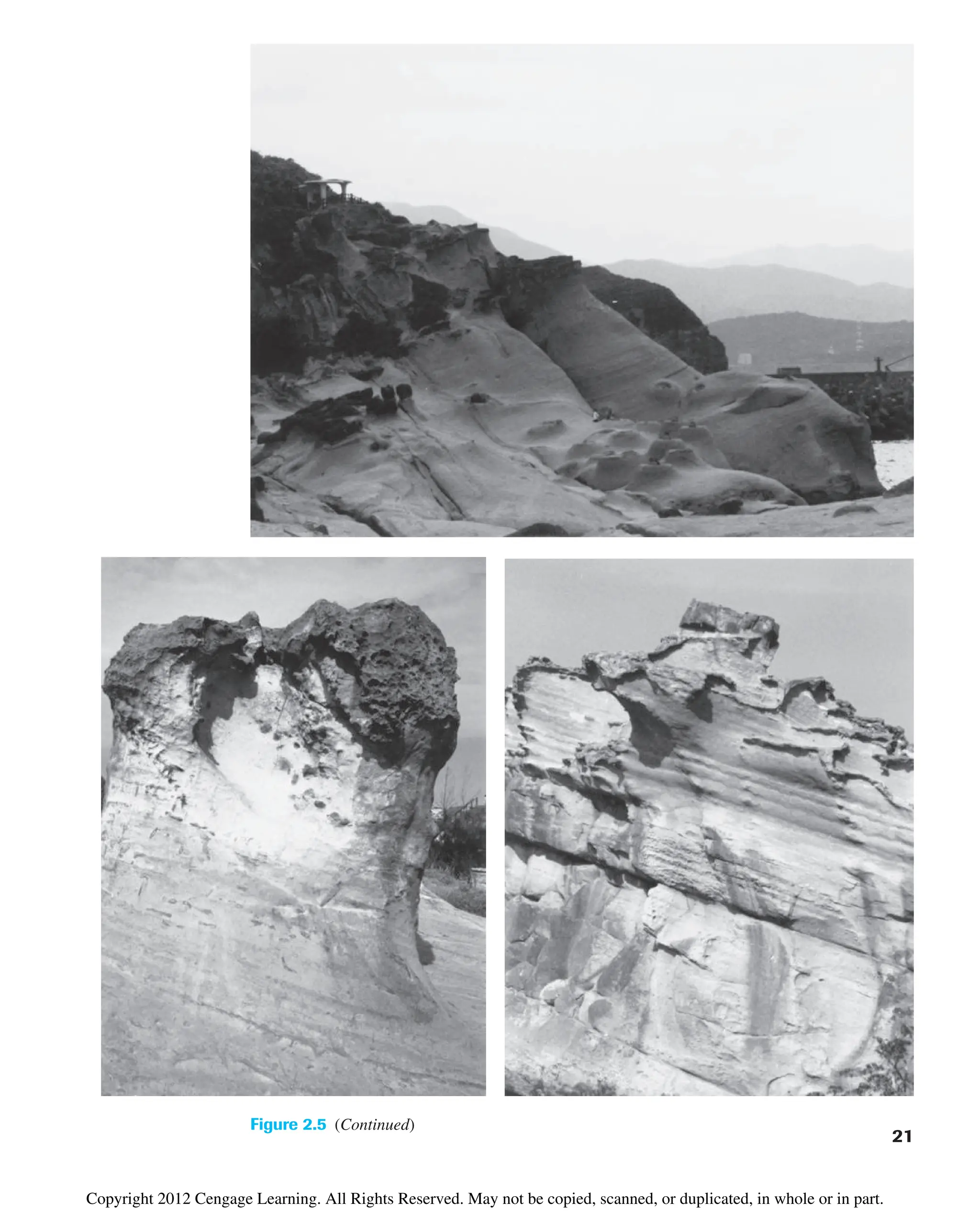
pieces without any change in the chemical composition. Figure 2.5 shows several examples
of mechanical erosion due to ocean waves and wind atYehliu in Taiwan. This area is located
at a long and narrow sea cape at the northwest side of Keelung, about 15 kilometers between
the north coast of Chin Shan and Wanli. Figure 2.6 shows another example of mechanical
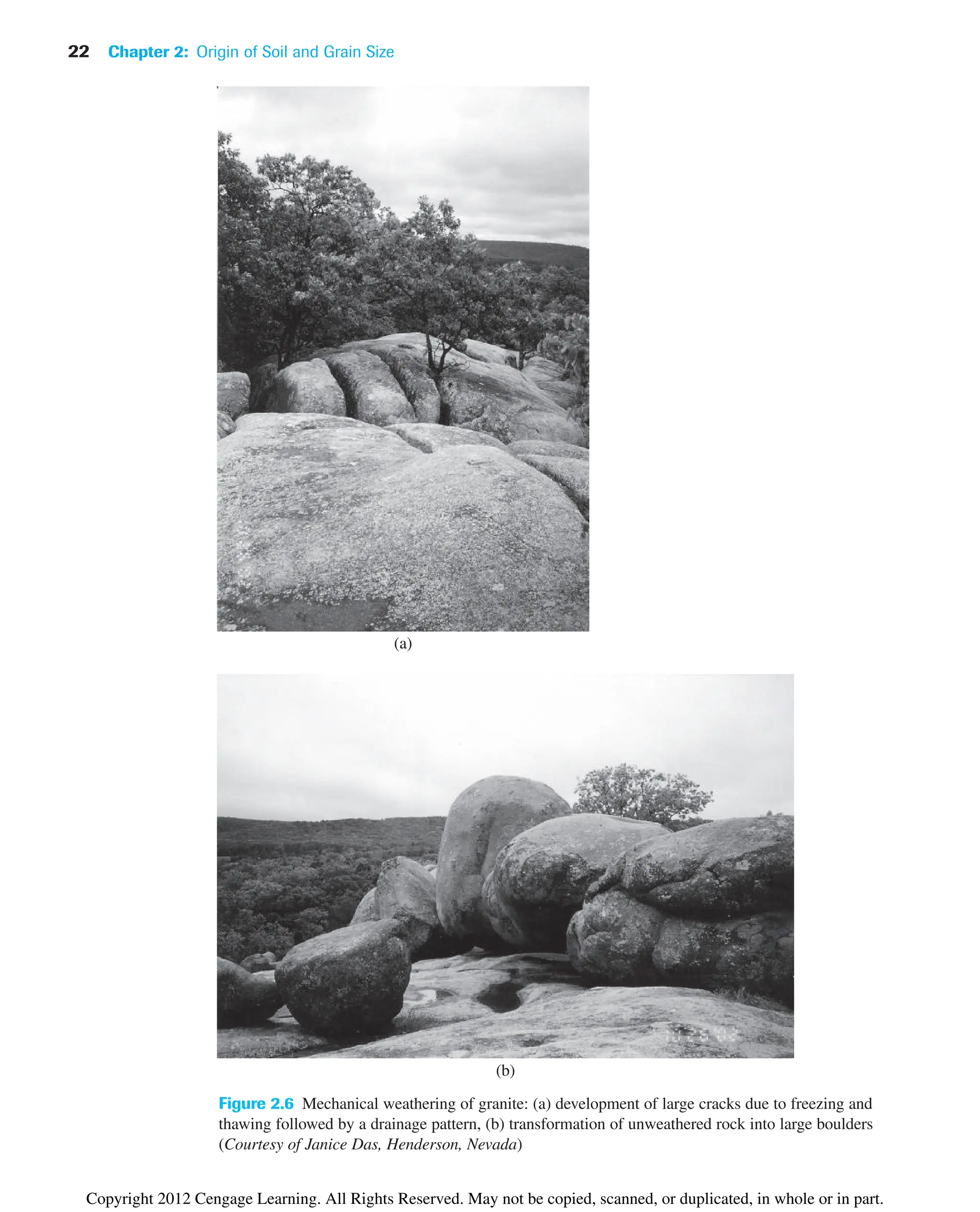
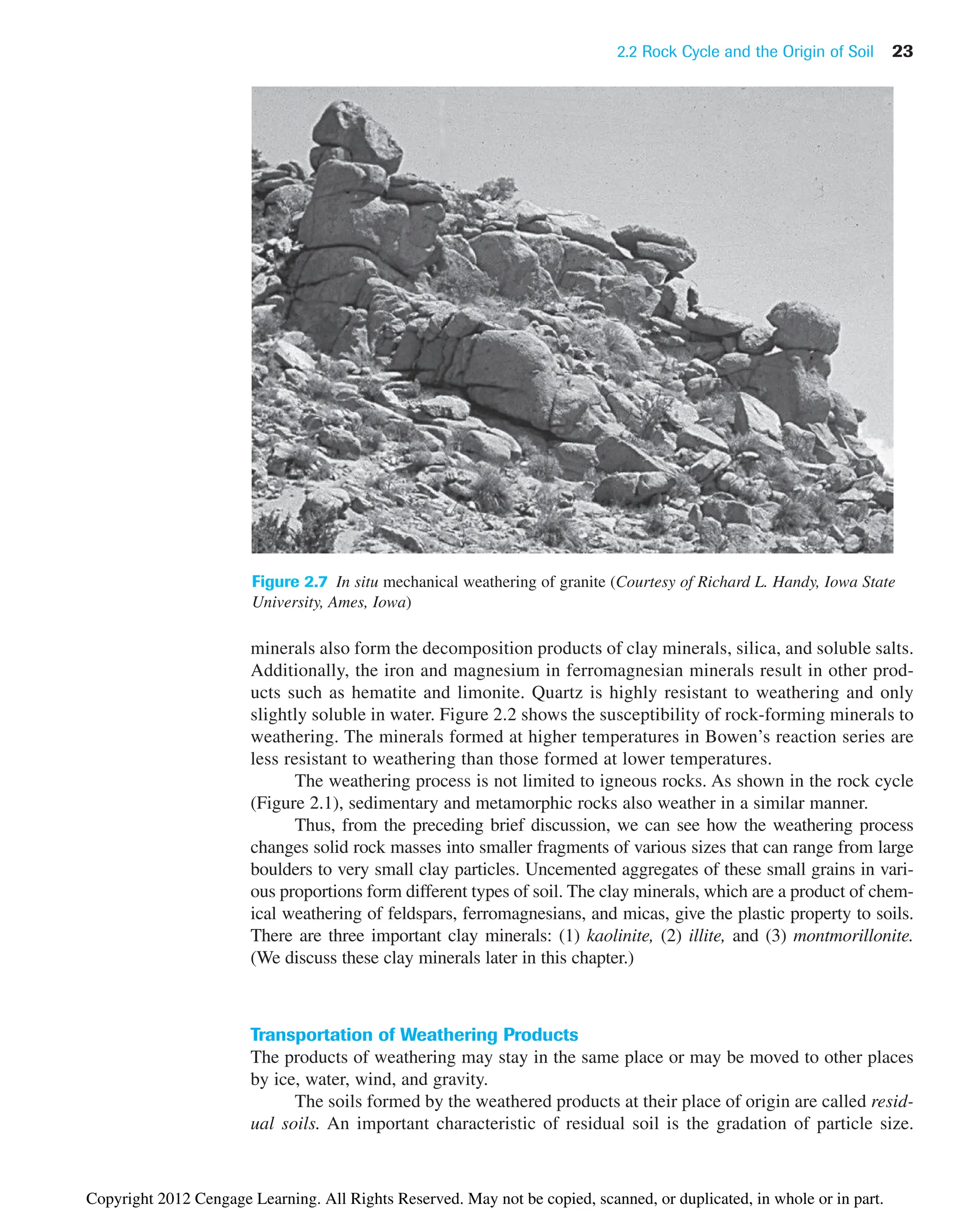
weathering in the Precambrian granite outcrop in the Elephant Rocks State Park in southeast
Missouri. The freezing and thawing action of water on the surface fractures the rock and
creates large cracks and a drainage pattern in the rock (Figure 2.6a). Over a period of time,
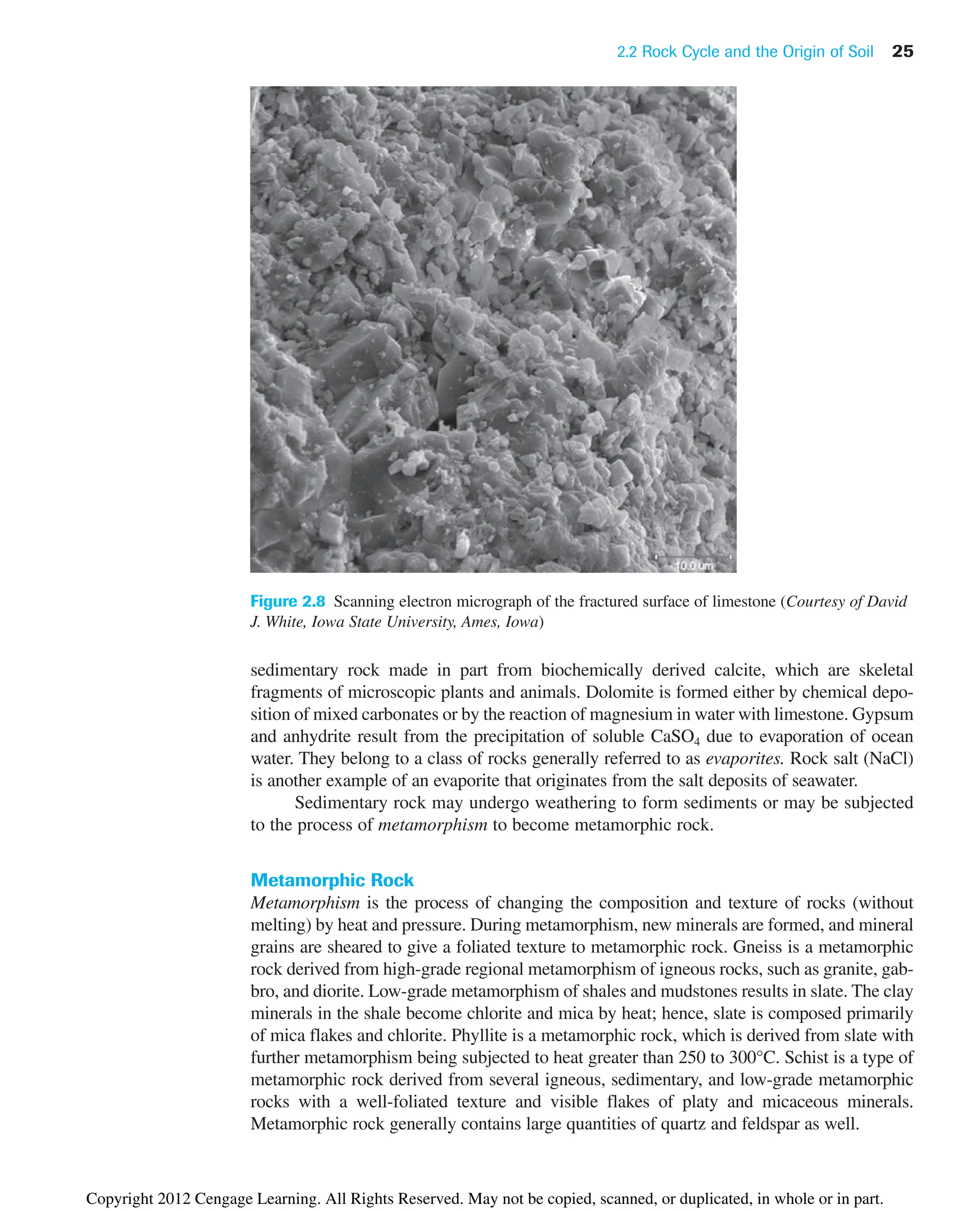
unweathered rock is transformed into large boulders (Figure 2.6b). Figure 2.7 shows another
photograph of in situ weathering of granite.
In chemical weathering, the original rock minerals are transformed into new miner-
als by chemical reaction. Water and carbon dioxide from the atmosphere form carbonic
acid, which reacts with the existing rock minerals to form new minerals and soluble salts.
Soluble salts present in the groundwater and organic acids formed from decayed organic
matter also cause chemical weathering. An example of the chemical weathering of ortho-
clase to form clay minerals, silica, and soluble potassium carbonate follows:
Carbonic acid
Orthoclase Silica Kaolinite
(clay mineral)
Most of the potassium ions released are carried away in solution as potassium carbonate is
taken up by plants.
The chemical weathering of plagioclase feldspars is similar to that of orthoclase
in that it produces clay minerals, silica, and different soluble salts. Ferromagnesian
2K1AlSi3O8 2  2H
 H2O S 2K
 4SiO2  Al2Si2O51OH24
H2O  CO2 S H2CO3 S H
 1HCO3 2
2.2 Rock Cycle and the Origin of Soil 19
(text continues on page 23)
©
Cengage
Learning
2014
Copyright 2012 Cengage Learning. All Rights Reserved. May not be copied, scanned, or duplicated, in whole or in part.
Figure 2.5 Mechanical erosion
due to ocean waves and wind at
Yehliu, Taiwan (Courtesy of
Braja Das, Henderson, Nevada)
20
Copyright 2012 Cengage Learning. All Rights Reserved. May not be copied, scanned, or duplicated, in whole or in part.
Figure 2.5 (Continued)
21
Copyright 2012 Cengage Learning. All Rights Reserved. May not be copied, scanned, or duplicated, in whole or in part.
22 Chapter 2: Origin of Soil and Grain Size
Figure 2.6 Mechanical weathering of granite: (a) development of large cracks due to freezing and
thawing followed by a drainage pattern, (b) transformation of unweathered rock into large boulders
(Courtesy of Janice Das, Henderson, Nevada)
(a)
(b)
Copyright 2012 Cengage Learning. All Rights Reserved. May not be copied, scanned, or duplicated, in whole or in part.
2.2 Rock Cycle and the Origin of Soil 23
minerals also form the decomposition products of clay minerals, silica, and soluble salts.
Additionally, the iron and magnesium in ferromagnesian minerals result in other prod-
ucts such as hematite and limonite. Quartz is highly resistant to weathering and only
slightly soluble in water. Figure 2.2 shows the susceptibility of rock-forming minerals to
weathering. The minerals formed at higher temperatures in Bowen’s reaction series are
less resistant to weathering than those formed at lower temperatures.
The weathering process is not limited to igneous rocks. As shown in the rock cycle
(Figure 2.1), sedimentary and metamorphic rocks also weather in a similar manner.
Thus, from the preceding brief discussion, we can see how the weathering process
changes solid rock masses into smaller fragments of various sizes that can range from large
boulders to very small clay particles. Uncemented aggregates of these small grains in vari-
ous proportions form different types of soil. The clay minerals, which are a product of chem-
ical weathering of feldspars, ferromagnesians, and micas, give the plastic property to soils.
There are three important clay minerals: (1) kaolinite, (2) illite, and (3) montmorillonite.
(We discuss these clay minerals later in this chapter.)
Transportation of Weathering Products
The products of weathering may stay in the same place or may be moved to other places
by ice, water, wind, and gravity.
The soils formed by the weathered products at their place of origin are called resid-
ual soils. An important characteristic of residual soil is the gradation of particle size.
Figure 2.7 In situ mechanical weathering of granite (Courtesy of Richard L. Handy, Iowa State
University, Ames, Iowa)
Copyright 2012 Cengage Learning. All Rights Reserved. May not be copied, scanned, or duplicated, in whole or in part.
24 Chapter 2: Origin of Soil and Grain Size
Fine-grained soil is found at the surface, and the grain size increases with depth. At
greater depths, angular rock fragments may also be found.
The transported soils may be classified into several groups, depending on their mode
of transportation and deposition:
1. Glacial soils—formed by transportation and deposition of glaciers
2. Alluvial soils—transported by running water and deposited along streams
3. Lacustrine soils—formed by deposition in quiet lakes
4. Marine soils—formed by deposition in the seas
5. Aeolian soils—transported and deposited by wind
6. Colluvial soils—formed by movement of soil from its original place by gravity, such
as during landslides
Sedimentary Rock
The deposits of gravel, sand, silt, and clay formed by weathering may become compacted
by overburden pressure and cemented by agents like iron oxide, calcite, dolomite, and
quartz. Cementing agents are generally carried in solution by groundwater. They fill the
spaces between particles and form sedimentary rock. Rocks formed in this way are called
detrital sedimentary rocks.
All detrital rocks have a clastic texture. The following are some examples of detrital
rocks with clastic texture.
Particle size Sedimentary rock
Granular or larger (grain size 2 mm–4 mm or larger) Conglomerate
Sand Sandstone
Silt and clay Mudstone and shale
In the case of conglomerates, if the particles are more angular, the rock is called breccia.
In sandstone, the particle sizes may vary between mm and 2 mm. When the grains in
sandstone are practically all quartz, the rock is referred to as orthoquartzite. In mudstone
and shale, the size of the particles are generally less than mm. Mudstone has a blocky
aspect; whereas, in the case of shale, the rock is split into platy slabs.
Sedimentary rock also can be formed by chemical processes. Rocks of this type are
classified as chemical sedimentary rock. These rocks can have clastic or nonclastic texture.
The following are some examples of chemical sedimentary rock.
Composition Rock
Calcite (CaCO3) Limestone
Halite (NaCl) Rock salt
Dolomite [CaMg(CO3)] Dolomite
Gypsum (CaSO4  2H2O) Gypsum
Limestone is formed mostly of calcium carbonate deposited either by organisms or by
an inorganic process. Most limestones have a clastic texture; however, nonclastic textures
also are found commonly. Figure 2.8 shows the scanning electron micrograph of a fractured
surface of limestone. Individual grains of calcite show rhombohedral cleavage. Chalk is a
1
16
1
16
©
Cengage
Learning
2014
©
Cengage
Learning
2014
Copyright 2012 Cengage Learning. All Rights Reserved. May not be copied, scanned, or duplicated, in whole or in part.
2.2 Rock Cycle and the Origin of Soil 25
sedimentary rock made in part from biochemically derived calcite, which are skeletal
fragments of microscopic plants and animals. Dolomite is formed either by chemical depo-
sition of mixed carbonates or by the reaction of magnesium in water with limestone. Gypsum
and anhydrite result from the precipitation of soluble CaSO4 due to evaporation of ocean
water. They belong to a class of rocks generally referred to as evaporites. Rock salt (NaCl)
is another example of an evaporite that originates from the salt deposits of seawater.
Sedimentary rock may undergo weathering to form sediments or may be subjected
to the process of metamorphism to become metamorphic rock.
Metamorphic Rock
Metamorphism is the process of changing the composition and texture of rocks (without
melting) by heat and pressure. During metamorphism, new minerals are formed, and mineral
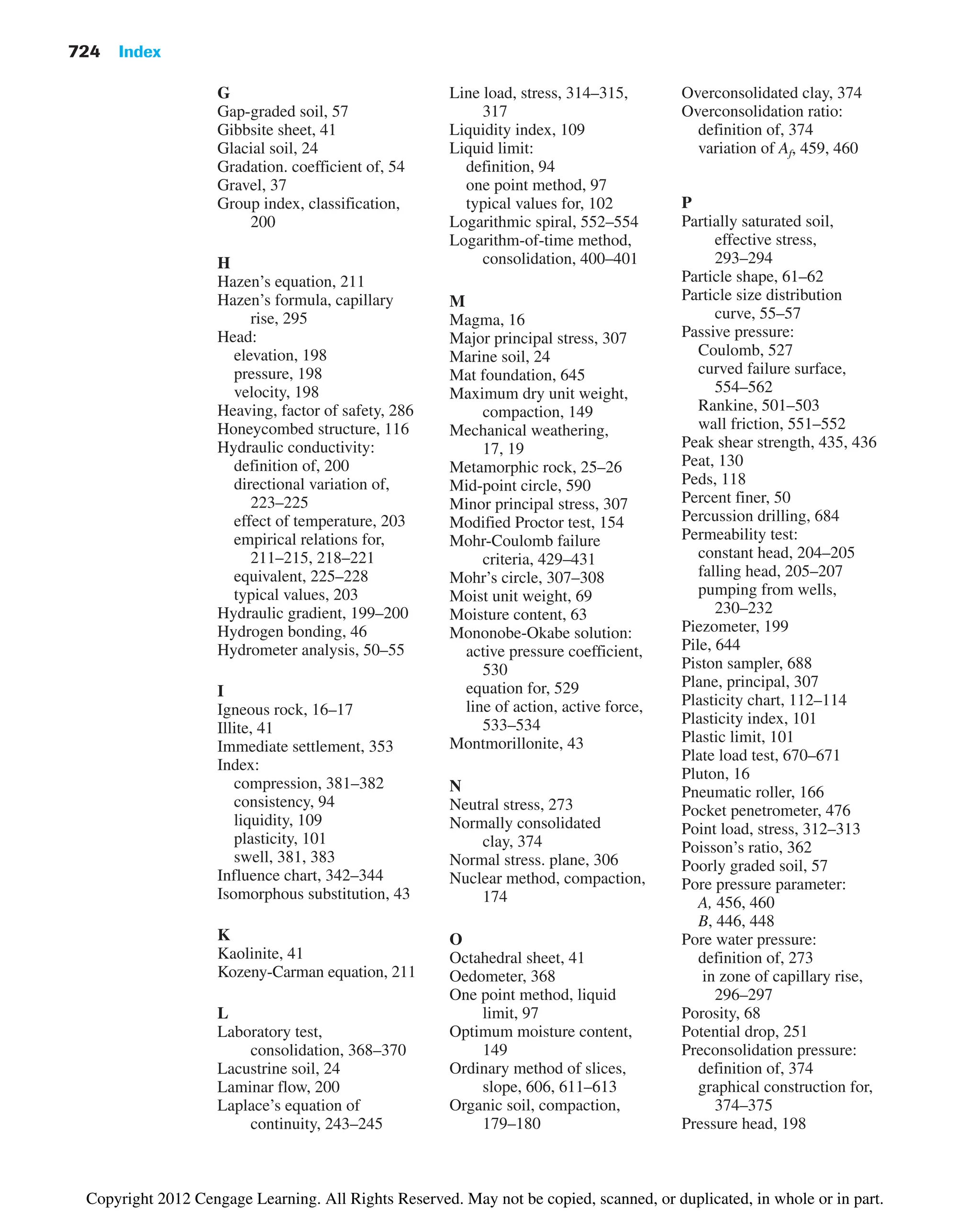
grains are sheared to give a foliated texture to metamorphic rock. Gneiss is a metamorphic
rock derived from high-grade regional metamorphism of igneous rocks, such as granite, gab-
bro, and diorite. Low-grade metamorphism of shales and mudstones results in slate. The clay
minerals in the shale become chlorite and mica by heat; hence, slate is composed primarily
of mica flakes and chlorite. Phyllite is a metamorphic rock, which is derived from slate with
further metamorphism being subjected to heat greater than 250 to 300°C. Schist is a type of
metamorphic rock derived from several igneous, sedimentary, and low-grade metamorphic
rocks with a well-foliated texture and visible flakes of platy and micaceous minerals.
Metamorphic rock generally contains large quantities of quartz and feldspar as well.
Figure 2.8 Scanning electron micrograph of the fractured surface of limestone (Courtesy of David
J. White, Iowa State University, Ames, Iowa)
Copyright 2012 Cengage Learning. All Rights Reserved. May not be copied, scanned, or duplicated, in whole or in part.
26 Chapter 2: Origin of Soil and Grain Size
Marble is formed from calcite and dolomite by recrystallization. The mineral grains
in marble are larger than those present in the original rock. Green marbles are colored by
hornblends, serpentine, or talc. Black marbles contain bituminous material, and brown
marbles contain iron oxide and limonite. Quartzite is a metamorphic rock formed from
quartz-rich sandstones. Silica enters into the void spaces between the quartz and sand
grains and acts as a cementing agent. Quartzite is one of the hardest rocks. Under extreme
heat and pressure, metamorphic rocks may melt to form magma, and the cycle is repeated.
2.3 Rock-Forming Minerals, Rock and Rock Structures
In the preceding section we were introduced to the process of the formation of igneous rocks
from rock-forming minerals, weathering and formation of sedimentary rocks, and metamor-
phism and formation of metamorphic rocks. Figure 2.9 shows some common rock-forming
minerals, such as quartz, orthoclase, plagioclase, muscovite, biotite, andradite, garnet, cal-
cite, dolomite, and chlorite. Some common types of rocks that geotechnical engineers may
encounter in the field, such as granite, basalt, rhyolite, sandstone, limestone, conglomerate,
marble, slate, and schist, are shown in Figure 2.10. Figure 2.10(j) shows an example of folded
schist from the James Cook University Rock Garden on its campus in Townsville, Australia.
Shear stresses and metamorphism involving high temperature and pressure caused the layers
to buckle and fold. Figures 2.9 through 2.11 are reproduced in full color in the color insert.
Figure 2.9 Some typical rock-forming minerals: (a) quartz; (b) orthoclase; (c) plagioclase;
(d) muscovite; (e) biotite; (f) andradite garnet; (g) calcite; (h) dolomite; (i) chlorite. (Courtesy of
Dr. Sanjay K. Shukla, Edith Cowan University, Perth, Australia)
(a)
Copyright 2012 Cengage Learning. All Rights Reserved. May not be copied, scanned, or duplicated, in whole or in part.
2.3 Rock-Forming Minerals, Rock and Rock Structures 27
Figure 2.9 (Continued)
(b)
(c)
Copyright 2012 Cengage Learning. All Rights Reserved. May not be copied, scanned, or duplicated, in whole or in part.
28 Chapter 2: Origin of Soil and Grain Size
Figure 2.9 (Continued)
(d)
(e)
Copyright 2012 Cengage Learning. All Rights Reserved. May not be copied, scanned, or duplicated, in whole or in part.
2.3 Rock-Forming Minerals, Rock and Rock Structures 29
Figure 2.9 (Continued)
(f)
(g)
Copyright 2012 Cengage Learning. All Rights Reserved. May not be copied, scanned, or duplicated, in whole or in part.
30 Chapter 2: Origin of Soil and Grain Size
Figure 2.9 (Continued)
(h)
(i)
Copyright 2012 Cengage Learning. All Rights Reserved. May not be copied, scanned, or duplicated, in whole or in part.
2.3 Rock-Forming Minerals, Rock and Rock Structures 31
Figure 2.10 Some typical rocks: (a) granite; (b) basalt; (c) rhyolite; (d) sandstone; (e) limestone;
(f) conglomerate; (g) marble; (h) slate; (i) mica schist; (j) folded schist. (Figures (a) through
(i) Courtesy of Dr. Sanjay K. Shukla, Edith Cowan University, Perth, Australia; (j) Courtesy of
Dr. Nagaratnam Sivakugan, James Cook University, Townsville, Australia)
(a)
(b)
Copyright 2012 Cengage Learning. All Rights Reserved. May not be copied, scanned, or duplicated, in whole or in part.
32 Chapter 2: Origin of Soil and Grain Size
Figure 2.10 (Continued)
(c)
(d)
Copyright 2012 Cengage Learning. All Rights Reserved. May not be copied, scanned, or duplicated, in whole or in part.
2.3 Rock-Forming Minerals, Rock and Rock Structures 33
Figure 2.10 (Continued)
(e)
(f)
Copyright 2012 Cengage Learning. All Rights Reserved. May not be copied, scanned, or duplicated, in whole or in part.
34 Chapter 2: Origin of Soil and Grain Size
Figure 2.10 (Continued)
(g)
(h)
Copyright 2012 Cengage Learning. All Rights Reserved. May not be copied, scanned, or duplicated, in whole or in part.
2.3 Rock-Forming Minerals, Rock and Rock Structures 35
Figure 2.10 (Continued)
(i)
(j)
Copyright 2012 Cengage Learning. All Rights Reserved. May not be copied, scanned, or duplicated, in whole or in part.
36 Chapter 2: Origin of Soil and Grain Size
There are large structures built several centuries ago around the world with, or in/on
rock, that are still intact and undergoing partial weathering. The Parthenon (Figure 2.11a),
built on the Acropolis in Athens, Greece, in the second half of the 5th century B.C., is made
of marble and built on a limestone hill underlain by phyllite, a fine-grained metamorphic
rock containing large quantities of mica and resembling slate or schist.
Figure 2.11b shows the Corinth Canal in Greece. The Corinth Canal crosses the
Isthmus of Corinth, a narrow strip of land that connects Peloponnesus to the mainland of
Figure 2.11 (a) The Parthenon on the Acropolis in Athens, Greece; (b) Corinth Canal in Greece
(Courtesy of Dr. Nagaratnam Sivakugan, James Cook University, Townsville, Australia)
(a)
(b)
Copyright 2012 Cengage Learning. All Rights Reserved. May not be copied, scanned, or duplicated, in whole or in part.
2.4 Soil-Particle Size 37
Greece, thus linking the Saronic Gulf in the Aegean Sea (eastern part of Greece) with the
Gulf of Corinth (a deep inlet of the Ionian Sea in western Greece). The canal was com-
pleted in 1893. The canal consists of a single channel 8 m deep excavated at sea level (thus
requiring no locks) measuring 6346 m long and is 24.6 m wide at the top and 21.3 m wide
at the bottom. The canal slopes have an inclination of 3V:1H to 5V:1H. The central part of
the canal, where the excavated slopes are highest, consists of Plio-Pleistocene marls with
thin interlayers of marly sands and marly limestone. The marls in the upper part of the
slopes are whitish yellow to light brown, while those in the middle and lower parts are
yellow gray to bluish gray.
2.4 Soil-Particle Size
As discussed in the preceding section, the sizes of particles that make up soil vary over a
wide range. Soils generally are called gravel, sand, silt, or clay, depending on the pre-
dominant size of particles within the soil. To describe soils by their particle size, several
organizations have developed particle-size classifications. Table 2.3 shows the particle-
size classifications developed by the Massachusetts Institute of Technology, the U.S.
Department of Agriculture, the American Association of State Highway and
Transportation Officials, and the U.S. Army Corps of Engineers and U.S. Bureau of
Reclamation. In this table, the MIT system is presented for illustration purposes only. This
system is important in the history of the development of the size limits of particles present
in soils; however, the Unified Soil Classification System is now almost universally
accepted and has been adopted by the American Society for Testing and Materials
(ASTM). Figure 2.12 shows the size limits in a graphic form.
Gravels are pieces of rocks with occasional particles of quartz, feldspar, and other
minerals. Sand particles are made of mostly quartz and feldspar. Other mineral grains also
Table 2.3 Particle-Size Classifications
Grain size (mm)
Name of organization Gravel Sand Silt Clay
Massachusetts Institute of Technology 2 2 to 0.06 0.06 to 0.002 0.002
(MIT)
U.S. Department of Agriculture 2 2 to 0.05 0.05 to 0.002 0.002
(USDA)
American Association of State 76.2 to 2 2 to 0.075 0.075 to 0.002 0.002
Highway and Transportation
Officials (AASHTO)
Unified Soil Classification System 76.2 to 4.75 4.75 to 0.075 Fines
(U.S. Army Corps of Engineers, U.S. (i.e., silts and clays)
Bureau of Reclamation, and American 0.075
Society for Testing and Materials)
Note: Sieve openings of 4.75 mm are found on a U.S. No. 4 sieve; 2-mm openings on a U.S. No. 10 sieve;
0.075-mm openings on a U.S. No. 200 sieve. See Table 2.5.
©
Cengage
Learning
2014
Copyright 2012 Cengage Learning. All Rights Reserved. May not be copied, scanned, or duplicated, in whole or in part.
38 Chapter 2: Origin of Soil and Grain Size
may be present at times. Figure 2.13 shows the scanning electron micrograph of some sand
grains. Note that the larger grains show rounding that can occur as a result of wear during
intermittent transportation by wind and/or water. Figure 2.14 is a higher magnification of
the grains highlighted in Figure 2.13, and it reveals a few small clay particles adhering to
larger sand grains. Silts are the microscopic soil fractions that consist of very fine quartz
grains and some flake-shaped particles that are fragments of micaceous minerals. Clays are
Massachusetts Institute of Technology
U.S. Department of Agriculture
American Association of State
Highway and Transportation Officials
Unified Soil Classification System
100 10 1.0 0.1 0.01 0.001
Grain size (mm)
Gravel Sand Silt Silt and clay Clay
Figure 2.12 Soil-separate-size limits by various systems
Figure 2.13 Scanning electron micrograph of some sand grains (Courtesy of David J. White,
Iowa State University, Ames, Iowa)
©
Cengage
Learning
2014
Copyright 2012 Cengage Learning. All Rights Reserved. May not be copied, scanned, or duplicated, in whole or in part.
2.5 Clay Minerals 39
Figure 2.14 Higher magnification of the sand grains highlighted in Figure 2.13 (Courtesy of
David J. White, Iowa State University, Ames, Iowa)
mostly flake-shaped microscopic and submicroscopic particles of mica, clay minerals, and
other minerals.
As shown in Table 2.3 and Figure 2.12, clays generally are defined as particles smaller
than 0.002 mm. However, in some cases, particles between 0.002 and 0.005 mm in size also
are referred to as clay. Particles classified as clay on the basis of their size may not neces-
sarily contain clay minerals. Clays have been defined as those particles “which develop plas-
ticity when mixed with a limited amount of water” (Grim, 1953). (Plasticity is the putty-like
property of clays that contain a certain amount of water.) Nonclay soils can contain particles
of quartz, feldspar, or mica that are small enough to be within the clay classification. Hence,
it is appropriate for soil particles smaller than 2 microns (2 mm), or 5 microns (5 mm) as
defined under different systems, to be called clay-sized particles rather than clay. Clay parti-
cles are mostly in the colloidal size range (1 mm), and 2 mm appears to be the upper limit.
2.5 Clay Minerals
Clay minerals are complex aluminum silicates composed of two basic units: (1) silica tetra-
hedron and (2) alumina octahedron. Each tetrahedron unit consists of four oxygen atoms
surrounding a silicon atom (Figure 2.15a). The combination of tetrahedral silica units gives
a silica sheet (Figure 2.15b). Three oxygen atoms at the base of each tetrahedron are shared
by neighboring tetrahedra. The octahedral units consist of six hydroxyls surrounding an
aluminum atom (Figure 2.15c), and the combination of the octahedral aluminum hydroxyl
units gives an octahedral sheet. (This also is called a gibbsite sheet—Figure 2.15d.)
Copyright 2012 Cengage Learning. All Rights Reserved. May not be copied, scanned, or duplicated, in whole or in part.
40 Chapter 2: Origin of Soil and Grain Size
and
Oxygen Hydroxyl Aluminum Silicon
and Oxygen
(a)
Silicon
(b)
and Hydroxyl
(c) (d)
Aluminum
(e)
Figure 2.15 (a) Silica tetrahedron; (b) silica sheet; (c) alumina octahedron; (d) octahedral
(gibbsite) sheet; (e) elemental silica-gibbsite sheet (After Grim, 1959. With permission from ASCE.)
Copyright 2012 Cengage Learning. All Rights Reserved. May not be copied, scanned, or duplicated, in whole or in part.
2.5 Clay Minerals 41
Sometimes magnesium replaces the aluminum atoms in the octahedral units; in this case,
the octahedral sheet is called a brucite sheet.
In a silica sheet, each silicon atom with a positive charge of four is linked to four
oxygen atoms with a total negative charge of eight. But each oxygen atom at the base of
the tetrahedron is linked to two silicon atoms. This means that the top oxygen atom of each
tetrahedral unit has a negative charge of one to be counterbalanced. When the silica sheet
is stacked over the octahedral sheet, as shown in Figure 2.15e, these oxygen atoms replace
the hydroxyls to balance their charges.
Of the three important clay minerals, kaolinite consists of repeating layers of elemental
silica-gibbsite sheets in a 1:1 lattice, as shown in Figures 2.16 and 2.17a. Each layer is about
7.2 Å thick. The layers are held together by hydrogen bonding. Kaolinite occurs as platelets,
each with a lateral dimension of 1000 to 20,000 Å and a thickness of 100 to 1000 Å. The sur-
face area of the kaolinite particles per unit mass is about 15 m2
/g. The surface area per unit
mass is defined as specific surface. Figure 2.18 shows a scanning electron micrograph of a
kaolinite specimen.
Illite consists of a gibbsite sheet bonded to two silica sheets—one at the top and
another at the bottom (Figures 2.19 and 2.17b). It is sometimes called clay mica. The illite
layers are bonded by potassium ions. The negative charge to balance the potassium ions
comes from the substitution of aluminum for some silicon in the tetrahedral sheets.
Oxygen Hydroxyl Aluminum Silicon
Figure 2.16 Atomic structure of kaolinite (After Grim, 1959. With permission from ASCE.)
Copyright 2012 Cengage Learning. All Rights Reserved. May not be copied, scanned, or duplicated, in whole or in part.
42 Chapter 2: Origin of Soil and Grain Size
nH2O and exchangeable cations
(c)
(b)
(a)
Basal
spacing
variable—from
9.6 Å to complete
separation
7.2 Å
10 Å
Gibbsite sheet Silica sheet Potassium
Gibbsite sheet
Gibbsite sheet
Silica sheet
Silica sheet Potassium
Gibbsite sheet
Silica sheet
Silica sheet
Gibbsite sheet
Silica sheet
Silica sheet
Gibbsite sheet
Silica sheet
Silica sheet
Gibbsite sheet
Silica sheet
Silica sheet
Figure 2.17 Diagram of the structures of (a) kaolinite; (b) illite; (c) montmorillonite
Figure 2.18 Scanning electron micrograph of a kaolinite specimen (Courtesy of David J. White,
Iowa State University, Ames, Iowa)
©
Cengage
Learning
2014
Copyright 2012 Cengage Learning. All Rights Reserved. May not be copied, scanned, or duplicated, in whole or in part.
2.5 Clay Minerals 43
Substitution of one element for another with no change in the crystalline form is known as
isomorphous substitution. Illite particles generally have lateral dimensions ranging from
1000 to 5000 Å and thicknesses from 50 to 500 Å. The specific surface of the particles is
about 80 m2
/g.
Montmorillonite has a structure similar to that of illite—that is, one gibbsite sheet
sandwiched between two silica sheets. (See Figures 2.20 and 2.17c.) In montmorillonite
there is isomorphous substitution of magnesium and iron for aluminum in the octahedral
sheets. Potassium ions are not present as in illite, and a large amount of water is attracted
into the space between the layers. Particles of montmorillonite have lateral dimensions of
1000 to 5000 Å and thicknesses of 10 to 50 Å. The specific surface is about 800 m2
/g.
Figure 2.21 is a scanning electron micrograph showing the fabric of montmorillonite.
Besides kaolinite, illite, and montmorillonite, other common clay minerals generally
found are chlorite, halloysite, vermiculite, and attapulgite.
The clay particles carry a net negative charge on their surfaces. This is the result both
of isomorphous substitution and of a break in continuity of the structure at its edges.
Larger negative charges are derived from larger specific surfaces. Some positively charged
sites also occur at the edges of the particles. A list of the reciprocal of the average surface
Potassium
Oxygen Hydroxyl Aluminum Silicon
Figure 2.19 Atomic structure of illite (After Grim, 1959. With permission from ASCE.)
Copyright 2012 Cengage Learning. All Rights Reserved. May not be copied, scanned, or duplicated, in whole or in part.
44 Chapter 2: Origin of Soil and Grain Size
Exchangeable cations
nH2O
Oxygen Hydroxyl Aluminum, iron, magnesium Silicon, occasionally aluminum
Figure 2.20 Atomic structure of montmorillonite (After Grim, 1959. With permission from ASCE.)
densities of the negative charges on the surfaces of some clay minerals follows (Yong and
Warkentin, 1966):
Reciprocal of average
surface density of charge
Clay mineral (Å2
/electronic charge)
Kaolinite 25
Clay mica and chlorite 50
Montmorillonite 100
Vermiculite 75
In dry clay, the negative charge is balanced by exchangeable cations like Ca2
,
Mg2
, Na
, and K
surrounding the particles being held by electrostatic attraction. When
water is added to clay, these cations and a few anions float around the clay particles. This
configuration is referred to as a diffuse double layer (Figure 2.22a). The cation concentra-
tion decreases with the distance from the surface of the particle (Figure 2.22b).
Copyright 2012 Cengage Learning. All Rights Reserved. May not be copied, scanned, or duplicated, in whole or in part.
2.5 Clay Minerals 45
Water molecules are polar. Hydrogen atoms are not axisymmetric around an oxygen
atom; instead, they occur at a bonded angle of 105° (Figure 2.23).As a result, a water molecule
has a positive charge at one side and a negative charge at the other side. It is known as a dipole.
Dipolar water is attracted both by the negatively charged surface of the clay particles
and by the cations in the double layer. The cations, in turn, are attracted to the soil particles.
Figure 2.21 Scanning electron micrograph showing the fabric of montmorillonite
(Courtesy of David J. White, Iowa State University, Ames, Iowa)
Surface of clay particle
(b)
Cations
Anions
Distance from the clay particle
Concentration
of
ions
(a)


Figure 2.22 Diffuse double layer
©
Cengage
Learning
2014
Copyright 2012 Cengage Learning. All Rights Reserved. May not be copied, scanned, or duplicated, in whole or in part.
46 Chapter 2: Origin of Soil and Grain Size
105°
Hydrogen Hydrogen
Oxygen
Figure 2.23 Dipolar character of water
A third mechanism by which water is attracted to clay particles is hydrogen bonding, where
hydrogen atoms in the water molecules are shared with oxygen atoms on the surface of the
clay. Some partially hydrated cations in the pore water are also attracted to the surface of
clay particles. These cations attract dipolar water molecules. All these possible mechanics
of attraction of water to clay are shown in Figure 2.24. The force of attraction between water
and clay decreases with distance from the surface of the particles. All the water held to clay
particles by force of attraction is known as double-layer water. The innermost layer of
double-layer water, which is held very strongly by clay, is known as adsorbed water. This
water is more viscous than free water is.
Figure 2.25 shows the absorbed and double-layer water for typical montmorillonite
and kaolinite particles. This orientation of water around the clay particles gives clay soils
their plastic properties.
It needs to be well recognized that the presence of clay minerals in a soil aggregate
has a great influence on the engineering properties of the soil as a whole. When moisture is
present, the engineering behavior of a soil will change greatly as the percentage of clay min-
eral content increases. For all practical purposes, when the clay content is about 50% or
Dipolar water molecule
Cation
Clay particle


Figure 2.24 Attraction of dipolar molecules in diffuse double layer
©
Cengage
Learning
2014
©
Cengage
Learning
2014
Copyright 2012 Cengage Learning. All Rights Reserved. May not be copied, scanned, or duplicated, in whole or in part.
2.6 Specific Gravity (Gs ) 47
more, the sand and silt particles float in a clay matrix, and the clay minerals primarily dic-
tate the engineering properties of the soil.
2.6 Specific Gravity (Gs )
Specific gravity is defined as the ratio of the unit weight of a given material to the unit weight
of water. The specific gravity of soil solids is often needed for various calculations in soil
mechanics. It can be determined accurately in the laboratory. Table 2.4 shows the specific
gravity of some common minerals found in soils. Most of the values fall within a range of 2.6
200 Å
200 Å
10 Å
Typical montmorillonite particle, 1000 Å by 10 Å
(a)
Typical kaolinite particle, 10,000 Å by 1000 Å
(b)
1000 Å
400 Å
400 Å
10 Å
10 Å
Montmorillonite crystal Adsorbed water
Double-layer water
Kaolinite crystal
Figure 2.25 Clay water (Redrawn after Lambe, 1958. With permission from ASCE.)
Copyright 2012 Cengage Learning. All Rights Reserved. May not be copied, scanned, or duplicated, in whole or in part.
48 Chapter 2: Origin of Soil and Grain Size
to 2.9. The specific gravity of solids of light-colored sand, which is mostly made of quartz,
may be estimated to be about 2.65; for clayey and silty soils, it may vary from 2.6 to 2.9.
2.7 Mechanical Analysis of Soil
Mechanical analysis is the determination of the size range of particles present in a soil,
expressed as a percentage of the total dry weight. Two methods generally are used to find the
particle-size distribution of soil: (1) sieve analysis—for particle sizes larger than 0.075 mm
in diameter, and (2) hydrometer analysis—for particle sizes smaller than 0.075 mm in
diameter. The basic principles of sieve analysis and hydrometer analysis are described briefly
in the following two sections.
Sieve Analysis
Sieve analysis consists of shaking the soil sample through a set of sieves that have pro-
gressively smaller openings. U.S. standard sieve numbers and the sizes of openings are
given in Table 2.5.
The sieves used for soil analysis are generally 203 mm in diameter. To conduct a
sieve analysis, one must first oven-dry the soil and then break all lumps into small parti-
cles. The soil then is shaken through a stack of sieves with openings of decreasing size
from top to bottom (a pan is placed below the stack). Figure 2.26 shows a set of sieves in
a shaker used for conducting the test in the laboratory. The smallest-sized sieve that should
be used for this type of test is the U.S. No. 200 sieve. After the soil is shaken, the mass of
soil retained on each sieve is determined. When cohesive soils are analyzed, breaking the
lumps into individual particles may be difficult. In this case, the soil may be mixed with
water to make a slurry and then washed through the sieves. Portions retained on each sieve
are collected separately and oven-dried before the mass retained on each sieve is measured.
1. Determine the mass of soil retained on each sieve (i.e., M1, M2,    Mn) and in the
pan (i.e., Mp).
2. Determine the total mass of the soil: M1  M2      Mi      Mn  Mp   M.
Table 2.4 Specific Gravity of Common Minerals
Mineral Specific gravity, Gs
Quartz 2.65
Kaolinite 2.6
Illite 2.8
Montmorillonite 2.65–2.80
Halloysite 2.0–2.55
Potassium feldspar 2.57
Sodium and calcium feldspar 2.62–2.76
Chlorite 2.6–2.9
Biotite 2.8–3.2
Muscovite 2.76–3.1
Hornblende 3.0–3.47
Limonite 3.6–4.0
Olivine 3.27–3.7
©
Cengage
Learning
2014
Copyright 2012 Cengage Learning. All Rights Reserved. May not be copied, scanned, or duplicated, in whole or in part.
2.7 Mechanical Analysis of Soil 49
Table 2.5 U.S. Standard Sieve Sizes
Sieve no. Opening (mm) Sieve no. Opening (mm)
4 4.75 35 0.500
5 4.00 40 0.425
6 3.35 50 0.355
7 2.80 60 0.250
8 2.36 70 0.212
10 2.00 80 0.180
12 1.70 100 0.150
14 1.40 120 0.125
16 1.18 140 0.106
18 1.00 170 0.090
20 0.850 200 0.075
25 0.710 270 0.053
30 0.600
Figure 2.26 A set of sieves for a test in the laboratory
(Courtesy of Braja M. Das, Henderson, Nevada)
©
Cengage
Learning
2014
Copyright 2012 Cengage Learning. All Rights Reserved. May not be copied, scanned, or duplicated, in whole or in part.
50 Chapter 2: Origin of Soil and Grain Size
3. Determine the cumulative mass of soil retained above each sieve. For the ith sieve, it
is M1  M2      Mi.
4. The mass of soil passing the ith sieve is  M  (M1  M2      Mi).
5. The percent of soil passing the ith sieve (or percent finer) is
Once the percent finer for each sieve is calculated (step 5), the calculations are
plotted on semilogarithmic graph paper (Figure 2.27) with percent finer as the ordinate
(arithmetic scale) and sieve opening size as the abscissa (logarithmic scale). This plot is
referred to as the particle-size distribution curve.
Hydrometer Analysis
Hydrometer analysis is based on the principle of sedimentation of soil grains in water.
When a soil specimen is dispersed in water, the particles settle at different velocities,
depending on their shape, size, weight, and the viscosity of the water. For simplicity, it is
assumed that all the soil particles are spheres and that the velocity of soil particles can be
expressed by Stokes’ law, according to which
(2.1)
D  diameter of soil particles
h  viscosity of water
rw  density of water
rs  density of soil particles
where v  velocity
v 
rs  rw
18h
D2
F 
兺 M  1M1  M2  p  Mi 2
兺 M
100
Particle size (mm)—log scale
Percent
passing
100
80
60
40
20
0
0.5
1.0
10.0 5.0 0.05
0.1
Figure 2.27 Particle-size distribution curve
©
Cengage
Learning
2014
Copyright 2012 Cengage Learning. All Rights Reserved. May not be copied, scanned, or duplicated, in whole or in part.
2.7 Mechanical Analysis of Soil 51
Thus, from Eq. (2.1),
(2.2)
where
Note that
(2.3)
Thus, combining Eqs. (2.2) and (2.3) gives
(2.4)
If the units of h are (g  sec)/cm2
, is in g/cm3
, L is in cm, t is in min, and D is in mm,
then
or
Assume to be approximately equal to 1 g/cm3
, so that
(2.5)
where
(2.6)
Note that the value of K is a function of Gs and h, which are dependent on the temperature
of the test. Table 2.6 gives the variation of K with the test temperature and the specific
gravity of soil solids.
In the laboratory, the hydrometer test is conducted in a sedimentation cylinder
usually with 50 g of oven-dried sample. Sometimes 100-g samples also can be used. The
sedimentation cylinder is 457 mm high and 63.5 mm in diameter. It is marked for a volume
of 1000 ml. Sodium hexametaphosphate generally is used as the dispersing agent. The
volume of the dispersed soil suspension is increased to 1000 ml by adding distilled water.
An ASTM 152H type hydrometer (Figure 2.28) is then placed in the sedimentation
cylinder (Figure 2.29).
K 
B
30h
1Gs  12
D 1mm2  K
B
L 1cm2
t 1min2
rw
D 
B
30h
1Gs  12rw B
L
t
D1mm2
10

C
18h 31g # sec2/cm2
4
1Gs  12rw1g/cm3
2 C
L 1cm2
t 1min2 60
rw
D 
B
18h
1Gs  12rw B
L
t
rs  Gsrw
v 
Distance
Time

L
t
.
D 
B
18hv
rs  rw

B
18h
rs  rwB
L
t
Copyright 2012 Cengage Learning. All Rights Reserved. May not be copied, scanned, or duplicated, in whole or in part.
52 Chapter 2: Origin of Soil and Grain Size
Table 2.6 Values of K from Eq. (2.6)a
Temperature
Gs
(°C) 2.45 2.50 2.55 2.60 2.65 2.70 2.75 2.80
16 0.01510 0.01505 0.01481 0.01457 0.01435 0.01414 0.01394 0.01374
17 0.01511 0.01486 0.01462 0.01439 0.01417 0.01396 0.01376 0.01356
18 0.01492 0.01467 0.01443 0.01421 0.01399 0.01378 0.01359 0.01339
19 0.01474 0.01449 0.01425 0.01403 0.01382 0.01361 0.01342 0.01323
20 0.01456 0.01431 0.01408 0.01386 0.01365 0.01344 0.01325 0.01307
21 0.01438 0.01414 0.01391 0.01369 0.01348 0.01328 0.01309 0.01291
22 0.01421 0.01397 0.01374 0.01353 0.01332 0.01312 0.01294 0.01276
23 0.01404 0.01381 0.01358 0.01337 0.01317 0.01297 0.01279 0.01261
24 0.01388 0.01365 0.01342 0.01321 0.01301 0.01282 0.01264 0.01246
25 0.01372 0.01349 0.01327 0.01306 0.01286 0.01267 0.01249 0.01232
26 0.01357 0.01334 0.01312 0.01291 0.01272 0.01253 0.01235 0.01218
27 0.01342 0.01319 0.01297 0.01277 0.01258 0.01239 0.01221 0.01204
28 0.01327 0.01304 0.01283 0.01264 0.01244 0.01225 0.01208 0.01191
29 0.01312 0.01290 0.01269 0.01249 0.01230 0.01212 0.01195 0.01178
30 0.01298 0.01276 0.01256 0.01236 0.01217 0.01199 0.01182 0.01169
a
After ASTM (2004). Copyright ASTM INTERNATIONAL. Reprinted with permission.
0
60
Figure 2.28 ASTM
152H hydrometer
(Courtesy of ELE
International)
Figure 2.29 ASTM 152H type of hydrometer placed inside the
sedimentation cylinder (Courtesy of Khaled Sobhan, Florida Atlantic
University, Boca Raton, Florida)
Copyright 2012 Cengage Learning. All Rights Reserved. May not be copied, scanned, or duplicated, in whole or in part.
2.7 Mechanical Analysis of Soil 53
When a hydrometer is placed in the soil suspension at a time t, measured from the
start of sedimentation it measures the specific gravity in the vicinity of its bulb at a depth L
(Figure 2.30). The specific gravity is a function of the amount of soil particles present per
unit volume of suspension at that depth. Also, at a time t, the soil particles in suspension at
a depth L will have a diameter smaller than D as calculated in Eq. (2.5). The larger particles
would have settled beyond the zone of measurement. Hydrometers are designed to give the
amount of soil, in grams, that is still in suspension. They are calibrated for soils that have a
specific gravity, Gs, of 2.65; for soils of other specific gravity, a correction must be made.
By knowing the amount of soil in suspension, L, and t, we can calculate the per-
centage of soil by weight finer than a given diameter. Note that L is the depth measured
from the surface of the water to the center of gravity of the hydrometer bulb at which the
density of the suspension is measured. The value of L will change with time t. Hydrometer
analysis is effective for separating soil fractions down to a size of about 0.5 mm. The value
of L (cm) for the ASTM 152H hydrometer can be given by the expression (see Figure 2.30)
(2.7)
L  L1 
1
2
aL2 
V
B
A
b
L
L1
L2
Figure 2.30 Definition of L in hydrometer test
©
Cengage
Learning
2014
Copyright 2012 Cengage Learning. All Rights Reserved. May not be copied, scanned, or duplicated, in whole or in part.
54 Chapter 2: Origin of Soil and Grain Size
top of the bulb to the mark for a hydrometer reading (cm)
The value of L1 is 10.5 cm for a reading of R  0 and 2.3 cm for a reading of R  50.
Hence, for any reading R,
Thus, from Eq. (2.7),
(2.8)
where R  hydrometer reading corrected for the meniscus.
On the basis of Eq. (2.8), the variations of L with the hydrometer readings R are
given in Table 2.7.
In many instances, the results of sieve analysis and hydrometer analysis for finer frac-
tions for a given soil are combined on one graph, such as the one shown in Figure 2.31.
L  10.5  0.164R 
1
2
a14 
67
27.8
b  16.29  0.164R
L1  10.5 
110.5  2.32
50
R  10.5  0.164R 1cm2
A  cross-sectional area of the sedimentation cylinder  27.8 cm2
V
B  volume of the hydrometer bulb  67 cm3
L2  length of the hydrometer bulb  14 cm
where L1  distance along the stem of the hydrometer from the
Table 2.7 Variation of L with Hydrometer Reading—ASTM 152H Hydrometer
Hydrometer Hydrometer
reading, R L (cm) reading, R L (cm)
0 16.3 31 11.2
1 16.1 32 11.1
2 16.0 33 10.9
3 15.8 34 10.7
4 15.6 35 10.6
5 15.5 36 10.4
6 15.3 37 10.2
7 15.2 38 10.1
8 15.0 39 9.9
9 14.8 40 9.7
10 14.7 41 9.6
11 14.5 42 9.4
12 14.3 43 9.2
13 14.2 44 9.1
14 14.0 45 8.9
15 13.8 46 8.8
16 13.7 47 8.6
17 13.5 48 8.4
18 13.3 49 8.3
19 13.2 50 8.1
20 13.0 51 7.9
21 12.9 52 7.8
22 12.7 53 7.6
©
Cengage
Learning
2014
Copyright 2012 Cengage Learning. All Rights Reserved. May not be copied, scanned, or duplicated, in whole or in part.
2.8 Particle-Size Distribution Curve 55
When these results are combined, a discontinuity generally occurs in the range where they
overlap. This discontinuity occurs because soil particles are generally irregular in shape.
Sieve analysis gives the intermediate dimensions of a particle; hydrometer analysis gives
the diameter of an equivalent sphere that would settle at the same rate as the soil particle.
2.8 Particle-Size Distribution Curve
A particle-size distribution curve can be used to determine the following four parameters
for a given soil (Figure 2.32):
1. Effective size (D10): This parameter is the diameter in the particle-size distribution
curve corresponding to 10% finer. The effective size of a granular soil is a good
measure to estimate the hydraulic conductivity and drainage through soil.
Particle diameter (mm)—log scale
Unified classification
Sand
Sieve analysis
10 16 30 40 60 100 200
Hydrometer analysis
Sieve no.
Silt and clay
Percent
finer
100
80
60
40
20
0
0.5 0.2 0.1 0.05
1
5 2 0.005 0.002 0.001
0.01
0.02
Sieve analysis Hydrometer analysis
Figure 2.31 Particle-size distribution curve—sieve analysis and hydrometer analysis
Table 2.7 (continued)
Hydrometer Hydrometer
reading, R L (cm) reading, R L (cm)
23 12.5 54 7.4
24 12.4 55 7.3
25 12.2 56 7.1
26 12.0 57 7.0
27 11.9 58 6.8
28 11.7 59 6.6
29 11.5 60 6.5
30 11.4
©
Cengage
Learning
2014
Copyright 2012 Cengage Learning. All Rights Reserved. May not be copied, scanned, or duplicated, in whole or in part.
56 Chapter 2: Origin of Soil and Grain Size
2. Uniformity coefficient (Cu): This parameter is defined as
(2.9)
where D60  diameter corresponding to 60% finer.
3. Coefficient of gradation (Cc): This parameter is defined as
(2.10)
4. Sorting coefficient (S0): This parameter is another measure of uniformity and is
generally encountered in geologic works and expressed as
(2.11)
The sorting coefficient is not frequently used as a parameter by geotechnical
engineers.
The percentages of gravel, sand, silt, and clay-size particles present in a soil can
be obtained from the particle-size distribution curve. As an example, we will use the
particle-size distribution curve shown in Figure 2.31 to determine the gravel, sand, silt,
and clay size particles as follows (according to the Unified Soil Classification
System—see Table 2.3):
S0 
B
D75
D25
Cc 
D30
2
D60 D10
Cu 
D60
D10
Particle size (mm)—log scale
Percent
finer
100
80
60
40
30
25
75
20
10
0
0.5 0.1 0.05
1.0
10.0 5.0
D75 D30 D25 D10
D60
Figure 2.32 Definition of D75, D60, D30, D25, and D10
©
Cengage
Learning
2014
Copyright 2012 Cengage Learning. All Rights Reserved. May not be copied, scanned, or duplicated, in whole or in part.
2.8 Particle-Size Distribution Curve 57
Size (mm) Percent finer
76.2 100
100  100  0% gravel
4.75 100
100  62  38% sand
0.075 62
62  0  62% silt and clay
— 0
100
80
60
40
20
0
Percent
finer
I II III
2.0 1.0 0.5 0.2 0.1 0.05 0.02 0.01 0.005
Particle diameter (mm)—log scale
Well graded
Poorly graded
Gap graded
Figure 2.33 Different types of particle-size distribution curves
Example 2.1
The following are the results of a sieve analysis:
U.S. sieve no. Mass of soil retained on each sieve (g)
4 0
10 21.6
20 49.5
40 102.6
60 89.1
100 95.6
200 60.4
Pan 31.2
The particle-size distribution curve shows not only the range of particle sizes present in a
soil, but also the type of distribution of various-size particles. Such types of distributions are
demonstrated in Figure 2.33. Curve I represents a type of soil in which most of the soil grains
are the same size. This is called poorly graded soil. Curve II represents a soil in which the par-
ticle sizes are distributed over a wide range, termed well graded. A well-graded soil has a uni-
formity coefficient greater than about 4 for gravels and 6 for sands, and a coefficient of gradation
between 1 and 3 (for gravels and sands). A soil might have a combination of two or more uni-
formly graded fractions. Curve III represents such a soil. This type of soil is termed gap graded.
©
Cengage
Learning
2014
©
Cengage
Learning
2014
Copyright 2012 Cengage Learning. All Rights Reserved. May not be copied, scanned, or duplicated, in whole or in part.
58 Chapter 2: Origin of Soil and Grain Size
a. Perform the necessary calculations and plot a grain-size distribution curve.
b. Determine D10, D30, and D60 from the grain-size distribution curve.
c. Calculate the uniformity coefficient, Cu.
d. Calculate the coefficient of gradation, Cc.
Solution
Part a
The following table can now be prepared for obtaining the percent finer.
Cumulative mass Percent
U.S. Opening Mass retained retained above finera
sieve (mm) on each sieve (g) each sieve (g)
(1) (2) (3) (4) (5)
4 4.75 0 0 100
10 2.00 21.6 21.6 95.2
20 0.850 49.5 71.1 84.2
40 0.425 102.6 173.7 61.4
60 0.250 89.1 262.8 41.6
100 0.150 95.6 358.4 20.4
200 0.075 60.4 418.8 6.9
Pan — 31.2 450   M
a
The particle-size distribution curve is shown in Figure 2.34.
©M  col.4
©M
100 
450  col.4
450
100
Part b
From Figure 2.34,
D10  0.09 mm
D30  0.185 mm
D60  0.41 mm
Percent
finer
100
80
60
40
20
0
10.0 3.0 1.0 0.3 0.1 0.06
Particle diameter (mm)—log scale
D60 D30 D10
Figure 2.34
©
Cengage
Learning
2014
©
Cengage
Learning
2014
Copyright 2012 Cengage Learning. All Rights Reserved. May not be copied, scanned, or duplicated, in whole or in part.
2.8 Particle-Size Distribution Curve 59
Part c
Uniformity coefficient,
Part d
Coefficient of gradation,
Cc 
D30
2
D60 D10

10.18522
10.41210.092
 0.93
Cu 
D60
D10

0.41
0.09
 4.56
Example 2.2
The grain-size characteristics of a soil are given here:
Size (mm) Percent finer
0.425 100
0.033 90
0.018 80
0.01 70
0.0062 60
0.0035 50
0.0018 40
0.001 35
a. Draw the particle-size distribution curve.
b. Determine the percentages of gravel, sand, silt, and clay according to the MIT
system.
c. Repeat Part b using the USDA system.
d. Repeat Part b using the AASHTO system.
Solution
Part a
The grain-size distribution curve is shown in Figure 2.35.
Part b
From the plot shown in Figure 2.35,
Passing 0.002 mm  42%
Passing 0.06 mm  95%
Passing 2 mm  100%
©
Cengage
Learning
2014
Copyright 2012 Cengage Learning. All Rights Reserved. May not be copied, scanned, or duplicated, in whole or in part.
60 Chapter 2: Origin of Soil and Grain Size
Therefore,
Gravel: 0%
Part c
Therefore,
Gravel: 0%
Part d
Therefore,
Gravel: 0%
Clay: 42%  0%  42%
Silt: 96%  42%  54%
Sand: 100%  96%  4%
Passing 0.002 mm  42%
Passing 0.075 mm  96%
Passing 2 mm  100%
Clay: 42%  0%  42%
Silt: 94%  42%  52%
Sand: 100%  94%  6%
Passing 0.002 mm  42%
Passing 0.05 mm  94%
Passing 2 mm  100%
Clay: 42%  0%  42%
Silt: 95%  42%  53%
Sand: 100%  95%  5%
100
80
60
40
20
0
Percent
passing
(%)
1.0 0.3 0.1 0.03 0.003
0.01 0.001
Grain size (mm)—log scale
0.075 mm
0.06 mm
0.05 mm
0.002 mm
42%
96%
94%
95%
Figure 2.35
©
Cengage
Learning
2014
Copyright 2012 Cengage Learning. All Rights Reserved. May not be copied, scanned, or duplicated, in whole or in part.
2.9 Particle Shape 61
2.9 Particle Shape
The shape of particles present in a soil mass is equally as important as the particle-size dis-
tribution because it has significant influence on the physical properties of a given soil.
However, not much attention is paid to particle shape because it is more difficult to meas-
ure. The particle shape generally can be divided into three major categories:
1. Bulky
2. Flaky
3. Needle shaped
Bulky particles are formed mostly by mechanical weathering of rock and minerals.
Geologists use such terms as angular, subangular, subrounded, and rounded to describe the
shapes of bulky particles. These shapes are shown qualitatively in Figure 2.36. Small sand
particles located close to their origin are generally very angular. Sand particles carried by
wind and water for a long distance can be subangular to rounded in shape. The shape of
granular particles in a soil mass has a great influence on the physical properties of the soil,
such as maximum and minimum void ratios, shear strength parameters, compressibility, etc.
The angularity, A, is defined as
(2.12)
The sphericity of bulky particles is defined as
(2.13)
S 
De
Lp
A 
Average radius of corners and edges
Radius of the maximum inscribed sphere
Figure 2.36 Shape of bulky particles (Courtesy of Janice Das, Henderson, Nevada)
Copyright 2012 Cengage Learning. All Rights Reserved. May not be copied, scanned, or duplicated, in whole or in part.
where
V  volume of particle
Lp  length of particle
Flaky particles have very low sphericity—usually 0.01 or less. These particles are
predominantly clay minerals.
Needle-shaped particles are much less common than the other two particle types.
Examples of soils containing needle-shaped particles are some coral deposits and atta-
pulgite clays.
2.10 Summary
In this chapter, we discussed the rock cycle, the origin of soil by weathering, the particle-
size distribution in a soil mass, the shape of particles, and clay minerals. Some important
points include the following:
1. Rocks can be classified into three basic categories: (a) igneous, (b) sedimentary, and
(c) metamorphic.
2. Soils are formed by chemical and mechanical weathering of rocks.
3. Based on the size of the particles, soil can be classified as gravel, sand, silt, and
clay. According to the Unified Soil Classification System, which is now universally
accepted, the grain-size limits of gravel, sand, and fines (silt and clay) are as
follows:
Gravel 76.2 mm–4.75 mm
Sand 4.75 mm–0.075 mm
Fines (silt and clay) 0.075 mm
4. Clays are flake-shaped microscopic and submicroscopic particles of mica, clay min-
erals, and other minerals.
5. Clay minerals are complex aluminum silicates.
6. Clay particles carry a net negative charge on their surfaces. When water is added, a
diffuse double layer of water is developed around the clay particles that is responsi-
ble for providing plasticity to clay soils.
7. Mechanical analysis is a process of determining the size range of particles present in
a soil mass. It consists of two parts—sieve analysis (for particles 0.075 m) and
hydrometer analysis (for particles 0.075 mm)
8. In a sieve analysis
9. In hydrometer analysis, the percent finer than a given particle size (D) can be deter-
mined using the hydrometer reading (L) and Eq. (2.5) at a given time.
Percent finer than
a given sieve size
 100  a
Mass of soil passing a given sieve
Total mass of soil
b11002
De  equivalent diameter of the partilce 
B
3 6V
p
62 Chapter 2: Origin of Soil and Grain Size
Copyright 2012 Cengage Learning. All Rights Reserved. May not be copied, scanned, or duplicated, in whole or in part.
Problems 63
Problems
2.1 For a soil with D60  0.42 mm, D30  0.21 mm, and D10  0.16 mm, calculate the
uniformity coefficient and the coefficient of gradation.
2.2 Repeat Problem 2.1 with the following values: D10  0.27 mm, D30  0.41 mm,
and D60  0.81 mm.
2.3 The following are the results of a sieve analysis:
U.S. sieve no. Mass of soil retained (g)
4 28
10 42
20 48
40 128
60 221
100 86
200 40
Pan 24
a. Determine the percent finer than each sieve and plot a grain-size distribution curve.
b. Determine D10, D30, and D60 from the grain-size distribution curve.
c. Calculate the uniformity coefficient, Cu.
d. Calculate the coefficient of gradation, Cc.
2.4 Repeat Problem 2.3 with the following data:
Mass of soil retained
U.S. sieve no. on each sieve (g)
4 0
6 30.0
10 48.7
20 127.3
40 96.8
60 76.6
100 55.2
200 43.4
Pan 22.0
2.5 Repeat Problem 2.3 with the following data:
U.S. sieve no. Mass of soil retained (g)
4 0
10 40
20 60
40 89
60 140
80 122
100 210
200 56
Pan 12
©
Cengage
Learning
2014
©
Cengage
Learning
2014
©
Cengage
Learning
2014
Copyright 2012 Cengage Learning. All Rights Reserved. May not be copied, scanned, or duplicated, in whole or in part.
64 Chapter 2: Origin of Soil and Grain Size
2.6 Repeat Problem 2.3 with the following data:
Mass of soil retained
U.S. sieve no. on each sieve (g)
4 0
6 0
10 0
20 9.1
40 249.4
60 179.8
100 22.7
200 15.5
Pan 23.5
2.7 The following are the results of a sieve and hydrometer analysis.
Sieve number/ Percent
Analysis grain size finer than
Sieve 40 100
80 96
170 85
200 80
Hydrometer 0.04 mm 59
0.02 mm 39
0.01 mm 26
0.005 mm 15
0.0015 mm 8
a. Draw the grain-size distribution curve.
b. Determine the percentages of gravel, sand, silt, and clay according to the MIT
system.
c. Repeat Part b according to the USDA system.
d. Repeat Part b according to the AASHTO system.
2.8 Repeat Problem 2.7 with the following data:
Sieve number/ Percent
Analysis grain size finer than
Sieve 20 100
30 96
40 90
60 76
80 65
200 34
Hydrometer 0.05 mm 27
0.03 mm 19
0.015 mm 11
0.006 mm 7
0.004 mm 6
0.0015 mm 5
©
Cengage
Learning
2014
©
Cengage
Learning
2014
©
Cengage
Learning
2014
Copyright 2012 Cengage Learning. All Rights Reserved. May not be copied, scanned, or duplicated, in whole or in part.
Critical Thinking Problem 65
2.9 The grain-size characteristics of a soil are given in the following table.
Size (mm) Percent finer
0.425 100
0.1 92
0.052 84
0.02 62
0.01 46
0.004 32
0.001 22
a. Draw the grain-size distribution curve.
b. Determine the percentages of gravel, sand, silt, and clay according to the MIT
system.
c. Repeat Part b using the USDA system.
d. Repeat Part b using the AASHTO system.
2.10 Repeat Problem 2.9 with the following data:
Size (mm) Percent finer
0.425 100
0.1 79
0.04 57
0.02 48
0.01 40
0.002 35
0.001 33
2.11 A hydrometer test has the following result: Gs  2.7, temperature of water  24°C,
and L  9.2 cm at 60 minutes after the start of sedimentation (see Figure 2.30).
What is the diameter D of the smallest-size particles that have settled beyond the
zone of measurement at that time (that is, t  60 min)?
2.12 Repeat Problem 2.11 with the following values: Gs  2.75, temperature of
water  23°C, t  100 min, and L  12.8 cm.
Critical Thinking Problem
2.C.1 Three groups of students from the Geotechnical Engineering class collected
soil-aggregate samples for laboratory testing from a recycled aggregate
processing plant in Palm Beach County, Florida. Three samples, denoted
by Soil A, Soil B, and Soil C, were collected from three locations of the
aggregate stockpile, and sieve analyses were conducted (see Figure 2.37 on the
next page).
a. Determine the coefficient of uniformity and the coefficient of gradation for
Soils A, B, and C.
b. Which one is coarser: Soil A or Soil C? Justify your answer.
©
Cengage
Learning
2014
©
Cengage
Learning
2014
Copyright 2012 Cengage Learning. All Rights Reserved. May not be copied, scanned, or duplicated, in whole or in part.
66 Chapter 2: Origin of Soil and Grain Size
References
AMERICAN SOCIETY FOR TESTING AND MATERIALS (2010). ASTM Book of Standards, Sec. 4,
Vol. 04.08, West Conshohocken, Pa.
BOWEN, N. L. (1922). “The Reaction Principles in Petrogenesis,” Journal of Geology, Vol. 30,
177–198.
GRIM, R. E. (1953). Clay Mineralogy, McGraw-Hill, New York.
GRIM, R. E. (1959). “Physico-Chemical Properties of Soils: Clay Minerals,” Journal of the Soil
Mechanics and Foundations Division, ASCE, Vol. 85, No. SM2, 1–17.
LAMBE, T. W. (1958). “The Structure of Compacted Clay,” Journal of the Soil Mechanics and
Foundations Division, ASCE, Vol. 84, No. SM2, 1655–1 to 1655–35.
YONG, R. N., and WARKENTIN, B. P. (1966). Introduction of Soil Behavior, Macmillan, New York.
Figure 2.37 (a) Soil-aggregate stockpile (b) Sieve analysis (Courtesy of Khaled Sobhan, Florida
Atlantic University, Boca Raton, Florida)
Soil A
10
100
0
20
40
60
80
100
Particle size (mm)
Percent
finer
1 0.1 0.01
Soil B
Soil C
(b)
(a)
c. Although the soils are obtained from the same stockpile, why are the curves so
different? (Hint: Comment on particle segregation and the importance of rep-
resentative field sampling.)
d. Determine the percentages of gravel, sand, and fines according to Unified Soil
Classification System.
©
Cengage
Learning
2014
Copyright 2012 Cengage Learning. All Rights Reserved. May not be copied, scanned, or duplicated, in whole or in part.
C H A P T E R
3.1 Introduction
Chapter 2 presented the geologic processes by which soil is formed, the description of the
limits on the sizes of soil particles, and the mechanical analysis of soils. A given volume
of soil in natural occurrence consists of solid particles and the void spaces between the
particles. The void space may be filled with air and/or water; hence, soil is a three-phase
system. If there is no water in the void space, it is a dry soil. If the entire void space is filled
with water, it is referred to as a saturated soil. However, if the void is partially filled with
water, it is a moist soil. Hence it is important in all geotechnical engineering works to
establish relationships between weight and volume in a given soil mass. In this chapter we
will discuss the following:
• Define and develop nondimensional volume relationships such as void ratio, porosity,
and degree of saturation.
• Define and develop weight relationships such as moisture content and unit weight
(dry, saturated, and moist) in combination with the volume relationships.
3.2 Weight–Volume Relationships
Figure 3.1a shows an element of soil of volume V and weight W as it would exist in a nat-
ural state. To develop the weight–volume relationships, we must separate the three phases
(that is, solid, water, and air) as shown in Figure 3.1b. Thus, the total volume of a given
soil sample can be expressed as
(3.1)
where Vs  volume of soil solids
Vv  volume of voids
Vw  volume of water in the voids
Va  volume of air in the voids
V  Vs  Vv  Vs  Vw  Va
67
Weight–Volume Relationships
3
Copyright 2012 Cengage Learning. All Rights Reserved. May not be copied, scanned, or duplicated, in whole or in part.
68 Chapter 3: Weight–Volume Relationships
Assuming that the weight of the air is negligible, we can express the total weight of the
sample as
(3.2)
where Ws  weight of soil solids
Ww  weight of water
The volume relationships commonly used for the three phases in a soil element are
void ratio, porosity, and degree of saturation. Void ratio (e) is defined as the ratio of the
volume of voids to the volume of solids. Thus,
(3.3)
Porosity (n) is defined as the ratio of the volume of voids to the total volume, or
(3.4)
The degree of saturation (S) is defined as the ratio of the volume of water to the volume
of voids, or
(3.5)
S 
Vw
Vv
n 
Vv
V
e 
Vv
Vs
W  Ws  Ww
Ws
Total
weight
 W
Total
volume
 V
W
Vs
Va
V
(a) (b)
Air Water Solid
W
V
V
Figure 3.1 (a) Soil element in natural state; (b) three phases of the soil element
©
Cengage
Learning
2014
Copyright 2012 Cengage Learning. All Rights Reserved. May not be copied, scanned, or duplicated, in whole or in part.
3.2 Weight–Volume Relationships 69
It is commonly expressed as a percentage.
The relationship between void ratio and porosity can be derived from Eqs. (3.1),
(3.3), and (3.4) as follows:
(3.6)
Also, from Eq. (3.6),
(3.7)
The common terms used for weight relationships are moisture content and unit
weight. Moisture content (w) is also referred to as water content and is defined as the ratio
of the weight of water to the weight of solids in a given volume of soil:
(3.8)
Unit weight (g) is the weight of soil per unit volume. Thus,
(3.9)
The unit weight can also be expressed in terms of the weight of soil solids, the moisture
content, and the total volume. From Eqs. (3.2), (3.8), and (3.9),
(3.10)
Soils engineers sometimes refer to the unit weight defined by Eq. (3.9) as the moist unit weight.
Often, to solve earthwork problems, one must know the weight per unit volume of
soil, excluding water. This weight is referred to as the dry unit weight, gd. Thus,
(3.11)
From Eqs. (3.10) and (3.11), the relationship of unit weight, dry unit weight, and moisture
content can be given as
(3.12)
In SI (Système International), the unit used is kilo Newtons per cubic meter
(kN/m3
). Because the Newton is a derived unit, working with mass densities (r) of soil
gd 
g
1  w
gd 
Ws
V
g 
W
V

Ws  Ww
V

Ws c1  a
Ww
Ws
b d
V

Ws11  w2
V
g 
W
V
w 
Ww
Ws
n 
e
1  e
e 
Vv
Vs

Vv
V  Vv

a
Vv
V
b
1  a
Vv
V
b

n
1  n
Copyright 2012 Cengage Learning. All Rights Reserved. May not be copied, scanned, or duplicated, in whole or in part.
70 Chapter 3: Weight–Volume Relationships
may sometimes be convenient. The SI unit of mass density is kilograms per cubic meter
(kg/m3
). We can write the density equations [similar to Eqs. (3.9) and (3.11)] as
(3.13)
and
(3.14)
where r  density of soil (kg/m3
)
rd  dry density of soil (kg/m3
)
M  total mass of the soil sample (kg)
Ms  mass of soil solids in the sample (kg)
The unit of total volume, V, is m3
.
The unit weight in kN/m3
can be obtained from densities in kg/m3
as
and
where g  acceleration due to gravity  9.81 m/sec2
.
Note that unit weight of water (gw) is equal to 9.81 kN/m3
or 1000 kgf/m3
.
3.3 Relationships among Unit Weight,
Void Ratio, Moisture Content,
and Specific Gravity
To obtain a relationship among unit weight (or density), void ratio, and moisture content,
let us consider a volume of soil in which the volume of the soil solids is one, as shown in
Figure 3.2. If the volume of the soil solids is 1, then the volume of voids is numerically
equal to the void ratio, e [from Eq. (3.3)]. The weights of soil solids and water can be
given as
where Gs  specific gravity of soil solids
w  moisture content
gw  unit weight of water
Ww  wWs  wGsgw
Ws  Gsgw
gd 1kN/m3
2 
grd1kg/m3
2
1000
g 1kN/m3
2 
gr1kg/m3
2
1000
rd 
Ms
V
r 
M
V
Copyright 2012 Cengage Learning. All Rights Reserved. May not be copied, scanned, or duplicated, in whole or in part.
3.3 Relationships among Unit Weight, Void Ratio, Moisture Content, and Specific Gravity 71
W
Vs  1
V 1 e
Weight Volume
W  Gsg
Ws  Gsg
V  Gs
V  e
Air Water Solid
Figure 3.2 Three separate phases of a soil element with volume of soil solids equal to 1
Specific gravity of soil solids (Gs) was defined in Section 2.5 of Chapter 2. It can be
expressed as
(3.15)
Now, using the definitions of unit weight and dry unit weight [Eqs. (3.9) and (3.11)],
we can write
(3.16)
and
(3.17)
or
(3.18)
e 
Gsgw
gd
 1
gd 
Ws
V

Gsgw
1  e
g 
W
V

Ws  Ww
V

Gsgw  wGsgw
1  e

11  w2 Gsgw
1  e
Gs 
Ws
Vsgw
©
Cengage
Learning
2014
Copyright 2012 Cengage Learning. All Rights Reserved. May not be copied, scanned, or duplicated, in whole or in part.
72 Chapter 3: Weight–Volume Relationships
Because the weight of water for the soil element under consideration is wGsgw, the
volume occupied by water is
Hence, from the definition of degree of saturation [Eq. (3.5)],
or
(3.19)
This equation is useful for solving problems involving three-phase relationships.
If the soil sample is saturated—that is, the void spaces are completely filled with
water (Figure 3.3)—the relationship for saturated unit weight (gsat) can be derived in a sim-
ilar manner:
(3.20)
Also, from Eq. (3.18) with S  1,
(3.21)
e  wGs
gsat 
W
V

Ws  Ww
V

Gsgw  egw
1  e

1Gs  e2gw
1  e
Se  wGs
S 
Vw
Vv

wGs
e
Vw 
Ww
gw

wGsgw
gw
 wGs
V  V  e
Ws  Gsg
W
Vs  1
V  1  e
Weight Volume
W  eg
Water Solid
Figure 3.3 Saturated soil element with volume of soil solids equal to one
©
Cengage
Learning
2014
Copyright 2012 Cengage Learning. All Rights Reserved. May not be copied, scanned, or duplicated, in whole or in part.
3.3 Relationships among Unit Weight, Void Ratio, Moisture Content, and Specific Gravity 73
Figure 3.4 Three separate phases of a soil element showing mass–volume relationship
As mentioned before, due to the convenience of working with densities in the SI sys-
tem, the following equations, similar to unit–weight relationships given in Eqs. (3.16),
(3.17), and (3.20), will be useful:
(3.22)
(3.23)
(3.24)
where rw  density of water  1000 kg/m3
.
Equation (3.22) may be derived by referring to the soil element shown in Figure 3.4,
in which the volume of soil solids is equal to 1 and the volume of voids is equal to e.
Hence, the mass of soil solids, Ms, is equal to Gsrw. The moisture content has been defined
in Eq. (3.8) as
where Mw  mass of water.
Since the mass of soil in the element is equal to Gsrw, the mass of water
Mw  wMs  wGsrw

Mw
Ms
w 
Ww
Ws

1mass of water2 # g
1mass of solid2 # g
Saturated density  rsat 
1Gs  e2 rw
1  e
Dry density  rd 
Gsrw
1  e
Density  r 
11  w2Gsrw
1  e
Vs  1
V  e
Ms  Gsr
M  Gsr
Air Water Solid
©
Cengage
Learning
2014
Copyright 2012 Cengage Learning. All Rights Reserved. May not be copied, scanned, or duplicated, in whole or in part.
74 Chapter 3: Weight–Volume Relationships
From Eq. (3.13), density
Equations (3.23) and (3.24) can be derived similarly.
3.4 Relationships among Unit Weight,
Porosity, and Moisture Content
The relationship among unit weight, porosity, and moisture content can be developed in a
manner similar to that presented in the preceding section. Consider a soil that has a total
volume equal to one, as shown in Figure 3.5. From Eq. (3.4),
If V is equal to 1, then Vv is equal to n, so Vs  1  n. The weight of soil solids (Ws) and
the weight of water (Ww) can then be expressed as follows:
(3.25)
(3.26)
Ww  wWs  wGsgw11  n2
Ws  Gsgw11  n2
n 
Vv
V

11  w2Gsrw
1  e
r 
M
V

Ms  Mw
Vs  Vv

Gsrw  wGsrw
1  e
W  Gsg (1  n)
Ws  Gsg (1  n) Vs  1  n
V  1
V  n
Weight Volume
Air Water Solid
Figure 3.5 Soil element with total volume equal to one
©
Cengage
Learning
2014
Copyright 2012 Cengage Learning. All Rights Reserved. May not be copied, scanned, or duplicated, in whole or in part.
3.5 Various Unit Weight Relationships 75
Figure 3.6 Saturated soil element with total volume equal to 1
So, the dry unit weight equals
(3.27)
The moist unit weight equals
(3.28)
Figure 3.6 shows a soil sample that is saturated and has V  1. According to this figure,
(3.29)
The moisture content of a saturated soil sample can be expressed as
(3.30)
3.5 Various Unit Weight Relationships
In Sections 3.2 and 3.3, we derived the fundamental relationships for the moist unit weight,
dry unit weight, and saturated unit weight of soil. Several other forms of relationships that
can be obtained for g, gd, and gsat are given in Table 3.1. Some typical values of void ratio,
moisture content in a saturated condition, and dry unit weight for soils in a natural state
are given in Table 3.2.
wsat 
Ww
Ws

ngw
11  n2gwGs

n
11  n2Gs
gsat 
Ws  Ww
V

11  n2Gsgw  ngw
1
 311  n2Gs  n4gw
g 
Ws  Ww
V
 Gsgw11  n211  w2
gd 
Ws
V

Gsgw11  n2
1
 Gsgw11  n2
V  V  n
Vs  1  n
V  1
Weight Volume
W  ng
Ws  Gsg (1  n)
Water Solid
©
Cengage
Learning
2014
Copyright 2012 Cengage Learning. All Rights Reserved. May not be copied, scanned, or duplicated, in whole or in part.
76 Chapter 3: Weight–Volume Relationships
Table 3.2 Void Ratio, Moisture Content, and Dry Unit Weight for Some Typical Soils in a
Natural State
Natural moisture
content in a Dry unit weight, gd
Void saturated
Type of soil ratio, e state (%) kN/m3
Loose uniform sand 0.8 30 14.5
Dense uniform sand 0.45 16 18
Loose angular-grained silty sand 0.65 25 16
Dense angular-grained silty sand 0.4 15 19
Stiff clay 0.6 21 17
Soft clay 0.9–1.4 30–50 11.5–14.5
Loess 0.9 25 13.5
Soft organic clay 2.5–3.2 90–120 6–8
Glacial till 0.3 10 21
Table 3.1 Various Forms of Relationships for g, gd, and gsat
Moist unit weight (g) Dry unit weight (gd) Saturated unit weight (gsat)
Given Relationship Given Relationship Given Relationship
w, Gs, e
S, Gs, e
w, Gs, S
w, Gs, n
S, Gs, n Gsgw11  n2  nSgw
Gsgw11  n211  w2
11  w2Gsgw
1 
wGs
S
1Gs  Se2gw
1  e
11  w2Gsgw
1  e
g, w
Gs, e
Gs, n
Gs, w, S
e, w, S
gsat, e
gsat, n
gsat, Gs
1gsat  gw2Gs
1Gs  12
gsat  ngw
gsat 
egw
1  e
eSgw
11  e2w
Gsgw
1  a
wGs
S
b
Gsgw11  n2
Gsgw
1  e
g
1  w
Gs, e
Gs, n
Gs, wsat
e, wsat
n, wsat
gd, e
gd, n
gd, Gs
gd, wsat gd11  wsat2
a1 
1
Gs
bgd  gw
gd  ngw
gd  a
e
1  e
bgw
na
1  wsat
wsat
bgw
a
e
wsat
b a
1  wsat
1  e
bgw
a
1  wsat
1  wsatGs
bGsgw
311  n2Gs  n4gw
1Gs  e2gw
1  e
©
Cengage
Learning
2014
©
Cengage
Learning
2014
Copyright 2012 Cengage Learning. All Rights Reserved. May not be copied, scanned, or duplicated, in whole or in part.
3.5 Various Unit Weight Relationships 77
Example 3.1
For a saturated soil, show that
Solution
(a)
From Eq. (3.15),
(b)
Also, from Eq. (3.3),
(c)
Substituting Eqs. (b) and (c) into Eq. (a),
(d)
From Eq. (3.21),
(e)
Substituting (e) into (d) gives
Gsat ⴝ a
1 ⴙ wsat
1 ⴙ wsatGs
bGsGw
e  wsatGs
gsat  11  wsat2
Gsgw
1  e
e  1 
Vv  Vs
Vs

V
Vs
Ws  GsVsgw
gsat 
W
V

Ww  Ws
V

wsatWs  Ws
V
 11  wsat2
Ws
V
gsat  a
1  wsat
1  wsatGs
bGsgw
Example 3.2
The saturated unit weight and the water content in the field are found to be 18.55 kN/m3
and
33%, respectively. Determine the specific gravity of the soil solids and the field void ratio.
Solution
Since saturated unit weight and water contents are both ratios, it is convenient to
assume a unit total volume or
Given: and
From Eq. (3.9),
g 
W
V
wsat  33%
gsat  18.55 kN/m3
V  1 m3
.
Copyright 2012 Cengage Learning. All Rights Reserved. May not be copied, scanned, or duplicated, in whole or in part.
78 Chapter 3: Weight–Volume Relationships
or
Also,
Therefore,
and
Since
Since the soil is fully saturated,
Therefore,
From Eq. (3.3),
From Eq. (3.15),
Gs 
Ws
Vsgw

13.95
10.531219.812
 2.67
e 
Vv
Vs

0.469
0.531
 0.883
Vs  V  Vv  1  0.469  0.531 m3
Vv  Vw  0.469 m3
Vw 
Ww
gw

4.6
9.81
 0.469 m3
gw  9.81 kN/m3
,
Ww  W  Ws  18.55  13.95  4.6 kN
Ws 
W
1  wsat

18.55
1  0.33
 13.95 kN
W  Ws  Ww  Ws  wsatWs  Ws11  wsat2
W  gsat  18.55 kN
Example 3.3
A cylindrical soil sample prepared for laboratory testing has a diameter of 71 mm, a
height of 142 mm, and weighs 10.675  103
kN. If the degree of saturation is 93%
and the specific gravity of soil solids is 2.71, determine:
a. void ratio
b. water content
c. water content under fully saturated condition
Solution
Part a
Given: W  10.675  103
kN; S  93%; Gs  2.71
Copyright 2012 Cengage Learning. All Rights Reserved. May not be copied, scanned, or duplicated, in whole or in part.
3.5 Various Unit Weight Relationships 79
Specimen volume,
(a)
We know
Therefore, Eq. (a) becomes
or
(b)
Since,
(c)
Substituting Vs in Eq. (b), we get
(d)
Substituting the known values in Eq. (d),
Therefore,
Part b
Using Eq. (c),
Therefore,
and
Water content is given by
w 
Ww
Ws

2.221  103
8.454  103
 0.263 or 26.3%
Ww  W  Ws  10.675  103
 8.454  103
 2.221  103
kN
Ws  GsVsgw  12.71210.318  103
219.812  8.454  103
kN
Vs  0.318  103
m3
0.769  1 
0.562  103
Vs
e  0.769
10.675  103

19.81210.572  103
2
1  e
10.93e  2.712
W 
gwV
1  e
1Se  Gs2
e  1 
Vv  Vs
Vs

V
Vs
W  1Se  Gs2gwVs
W  gwVw  GsVsgw  gw SVv  GsVsgw  gw SeVs  GsVsgw
gw 
Ww
Vw
; Gs 
Ws
Vsgw
; S 
Vw
Vv
; and e 
Vv
Vs
W  Ww  Ws
V 
p
4
a
71
1000
b
2
a
142
1000
b  0.562  103
m3
Copyright 2012 Cengage Learning. All Rights Reserved. May not be copied, scanned, or duplicated, in whole or in part.
80 Chapter 3: Weight–Volume Relationships
Example 3.4
In its natural state, a moist soil has a volume of and weighs 177.6 
103
kN. The oven-dried weight of the soil is . If , calculate
a. Moisture content (%)
b. Moist unit weight (kN/m3
)
c. Dry unit weight (kN/m3
)
d. Void ratio
e. Porosity
f. Degree of saturation (%)
Solution
Part a
From Eq. (3.8),
Part b
From Eq. (3.9),
Part c
From Eq. (3.11),
Part d
The volume of solids is [Eq. (3.15)]
Thus,
Vv  V  Vs  9.34  103
 5.86  103
 3.48  103
m3
Vs 
Ws
Gsgw

153.6  103
12.67219.812
 5.86  103
m3
gd 
Ws
V

153.6  103
9.34  103
 16.45 kN/m3
g 
W
V

177.6  103
9.34  103
 19.01 kN/m3
w 
Ww
Ws

177.6  103
 153.6  103
153.6  103
11002  15.6%
Gs  2.67
153.6  103
kN
9.34  103
m3
Part c
For saturated conditions,
Therefore,
wsat 
Ww
Ws

2.39  103
8.454  103
 0.283 or 28.3%
Ww1saturated2  gwVw  19.81210.244  103
2  2.39  103
kN
Vw  Vv  0.244  103
m3
.
Vv  V  Vs  0.562  103
 0.318  103
 0.244  103
m3
Copyright 2012 Cengage Learning. All Rights Reserved. May not be copied, scanned, or duplicated, in whole or in part.
3.6 Relative Density 81
The volume of water is
Now, refer to Figure 3.7. From Eq. (3.3),
e 
Vv
Vs

3.48  103
5.86  103
 0.59
Vw 
Ww
gw

177.6  103
 153.6  103
9.81
 2.45  103
m3
V 2.45×10⁻³
V 3.48×10⁻³
Vs 5.86×10⁻³
V9.34×10−3
Weight (kN) Volume (m3
)
W 24.6×10⁻³
Air Water
Water
Solid
W177.6×10−3
Ws 153.6×10⁻³
Figure 3.7 Diagram for Example 3.4
Part e
From Eq. (3.4),
Part f
From Eq. (3.5),
S 
Vw
Vv

2.45  103
3.48  103
 0.699  70.4%
n 
Vv
V

3.48  103
9.34  103
 0.37
3.6 Relative Density
The term relative density is commonly used to indicate the in situ denseness or looseness
of granular soil. It is defined as
(3.31)
Dr 
emax  e
emax  emin
©
Cengage
Learning
2014
Copyright 2012 Cengage Learning. All Rights Reserved. May not be copied, scanned, or duplicated, in whole or in part.
82 Chapter 3: Weight–Volume Relationships
Table 3.3 Qualitative Description of Granular Soil Deposits
Relative density (%) Description of soil deposit
0–15 Very loose
15–50 Loose
50–70 Medium
70–85 Dense
85–100 Very dense
where Dr  relative density, usually given as a percentage
e  in situ void ratio of the soil
emax  void ratio of the soil in the loosest state
emin  void ratio of the soil in the densest state
The values of Dr may vary from a minimum of 0% for very loose soil to a maximum
of 100% for very dense soils. Soils engineers qualitatively describe the granular soil
deposits according to their relative densities, as shown in Table 3.3. In-place soils seldom
have relative densities less than 20 to 30%. Compacting a granular soil to a relative density
greater than about 85% is difficult.
The relationships for relative density can also be defined in terms of porosity, or
(3.32)
(3.33)
(3.34)
where nmax and nmin  porosity of the soil in the loosest and densest conditions, respec-
tively. Substituting Eqs. (3.32), (3.33), and (3.34) into Eq. (3.31), we obtain
(3.35)
By using the definition of dry unit weight given in Eq. (3.17), we can express rela-
tive density in terms of maximum and minimum possible dry unit weights. Thus,
(3.36)
where gd(min)  dry unit weight in the loosest condition (at a void ratio of emax)
gd  in situ dry unit weight (at a void ratio of e)
gd(max)  dry unit weight in the densest condition (at a void ratio of emin)
Dr 
c
1
gd1min2
d  c
1
gd
d
c
1
gd1min2
d  c
1
gd1max2
d
 c
gd  gd1min2
gd1max2  gd1min2
d c
gd1max2
gd
d
Dr 
11  nmin21nmax  n2
1nmax  nmin211  n2
e 
n
1  n
emin 
nmin
1  nmin
emax 
nmax
1  nmax
©
Cengage
Learning
2014
Copyright 2012 Cengage Learning. All Rights Reserved. May not be copied, scanned, or duplicated, in whole or in part.
3.6 Relative Density 83
In terms of density, Eq. (3.36) can be expressed as
(3.37)
ASTM Test Designations D-4253 and D-4254 (2010) provide a procedure for
determining the maximum and minimum dry unit weights of granular soils so that they
can be used in Eq. (3.36) to measure the relative density of compaction in the field. For
sands, this procedure involves using a mold with a volume of 2830 cm3
. For a determi-
nation of the minimum dry unit weight, sand is poured loosely into the mold from a fun-
nel with a 12.7 mm diameter spout. The average height of the fall of sand into the mold
is maintained at about 25.4 mm. The value of gd(min) then can be calculated by using the
following equation:
(3.38)
where Ws  weight of sand required to fill the mold
Vm  volume of the mold
The maximum dry unit weight is determined by vibrating sand in the mold for
8 min. A surcharge of 14 kN/m2
is added to the top of the sand in the mold. The mold
is placed on a table that vibrates at a frequency of 3600 cycles/min and that has an
amplitude of vibration of 0.635 mm. The value of gd(max) can be determined at the end
of the vibrating period with knowledge of the weight and volume of the sand. Several
factors control the magnitude of gd(max): the magnitude of acceleration, the surcharge
load, and the geometry of acceleration. Hence, one can obtain a larger-value gd(max) than
that obtained by using the ASTM standard method described earlier.
gd1min2 
Ws
Vm
Dr  c
rd  rd1min2
rd1max2  rd1min2
d
rd1max2
rd
Example 3.5
The mass of a moist soil sample collected from the field is 465 grams, and its oven-
dry mass is 405.76 grams. The specific gravity of the soil solids was determined in
the laboratory to be 2.68. If the void ratio of the soil in the natural state is 0.83, find
the following:
a. The moist density of the soil in the field (kg/m3
)
b. The dry density of the soil in the field (kg/m3
)
c. The mass of water, in kilograms, to be added per cubic meter of soil in the field
for saturation
Solution
Part a
w 
Mw
Ms

465  405.76
405.76

59.24
405.76
 14.6%
Copyright 2012 Cengage Learning. All Rights Reserved. May not be copied, scanned, or duplicated, in whole or in part.
84 Chapter 3: Weight–Volume Relationships
3.7 Comments on emax and emin
The maximum and minimum void ratios for granular soils described in Section 3.6 depend
on several factors, such as
• Grain size
• Grain shape
• Nature of the grain-size distribution curve
• Fine contents, Fc (that is, fraction smaller than 0.075 mm)
The amount of nonplastic fines present in a given granular soil has a great influ-
ence on emax and emin. In order to visualize this, let us consider the study of McGeary
(1961) related to the determination of the minimum void ratio (emin) for idealized
spheres (also see Lade et al., 1998). McGeary (1961) conducted tests with mixtures of
two different sizes of steel spheres. The larger spheres had a diameter of 3.15 mm (D).
The diameter of the small spheres (d) varied from 0.91 mm to 0.16 mm. This provided
a range of D/d ratio from 3.46 to 19.69. Figure 3.8 shows the variation of emin with the
percent of small spheres in the mixture by volume for D/d  3.46 and 4.77. For a
given D/d value, the magnitude of emin decreases with the increase in the volume of
small spheres to an absolute minimum value, emin(min). This occurs when the volume
of small spheres in the mix is VF. Beyond this point the magnitude of emin increases
From Eq. (3.22),
Part b
From Eq. (3.23),
Part c
Mass of water to be added  rsat  r
From Eq. (3.24),
So the mass of water to be added  1918  1678.3  239.7 kg/m3
.
rsat 
rw1Gs  e2
1  e

11000212.68  0.832
1.83
 1918 kg/m3
rd 
Gs rw
1  e

12.682110002
1.83
 1464.48 kg/m3
 1678.3 kg/m3
r 
Gsrw11  w2
1  e

12.68211000211.1462
1.83
Copyright 2012 Cengage Learning. All Rights Reserved. May not be copied, scanned, or duplicated, in whole or in part.
3.7 Comments on emax and emin 85
0 20
0.3
0.4
0.5
0.6
0.7
40 60 80 100
Small spheres in the mixture by volume (%)
emin
D/d  3.46
4.77
Figure 3.8 Test results of McGeary (1961)—Variation of minimum void ratio with percent of
smaller steel spheres by volume
Table 3.4 Interpolated values of emin(min) from binary packing based on the
tests of McGeary (1961)
Approximate volume of small spheres
D/d emin(min) at which emin(min) occurs, VF (%)
3.46 0.426 41.3
4.77 0.344 26.2
6.56 0.256 25.0
11.25 0.216 27.5
16.58 0.213 26.3
19.69 0.192 27.5
with the increase in the volume of smaller spheres. Table 3.4 provides a summary
of all of the test results of McGeary (1961). This is also shown in Figure 3.9, from
which it can be concluded that (a) for D/d  7, the magnitude of emin(min) remains
approximately constant (⬇0.2) and, (b) at emin(min), the approximate magnitude of
VF ⬇ 27%.
In order to compare the preceding experimental results with idealized spheres
with the actual soil, we consider the study of Lade et al. (1998), which was con-
ducted with two types: Nevada sand (retained on No. 200 U.S. sieve) and Nevada
nonplastic fines (passing No. 200 U.S. sieve). Table 3.5 shows the D50 (size
through which 50% soil will pass) for the two sands and the nonplastic fines.
Figure 3.10 shows the variation of emax and emin with percent of fine by volume for
Copyright 2012 Cengage Learning. All Rights Reserved. May not be copied, scanned, or duplicated, in whole or in part.
86 Chapter 3: Weight–Volume Relationships
0
0
0.2
0.4
0.6
0.8
1.0
0
10
20
30
40
50
4 8 12 16 20
VF
V
F
(%)
e
min
(min)
emin (min)
D/d
Figure 3.9 Test results of McGeary (1961)—Variation of emin(min) and VF with D/d
Table 3.5 D50-sand and D50-fine of the soils used by Lade et al. (1998)
Sand description D50-sand (mm) D50-fine (mm)
Nevada 50/80 0.211 0.050 4.22
Nevada 80/200 0.120 0.050 2.4
D50-sand
D50-fine
(a) Nevada 50/80 sand and fines and (b) Nevada 80/200 sand and fines. From this figure
it can be seen that:
• For a given sand and fine mixture, the emax and emin decrease with the increase
in the volume of fines from zero to about 30%. This is approximately similar
to the behavior of ideal spheres shown in Figures 3.8 and 3.9. This is the filling-
of-the-void phase, where fines tend to fill the void spaces between the larger
sand particles.
• There is a transition zone, where the percentage of fines is between 30%
to 40%.
• For percentage of fines greater than about 40%, the magnitudes of emax and emin start
increasing. This is the replacement-of-solids phase, where larger-sized solid particles
are pushed out and gradually replaced by fines.
Copyright 2012 Cengage Learning. All Rights Reserved. May not be copied, scanned, or duplicated, in whole or in part.
3.8 Correlations between emax, emin, emax  emin, and Median Grain Size (D50) 87
0
0
0.4
0.8
1.2
20
Nevada 50/80 sand and fines
Nevada 80/200 sand and fines
40 60 80 100
e
max
,
e
min
Percent fines (by volume)
emin
emin
emax
emax
Figure 3.10 Variation of emax and emin with percent of nonplastic fines (Based on the test results
of Lade et al., 1998). Note: For 50/80 sand and fines, D50-sand /D50-fine  4.22 and for 80/200 sand
and fines, D50-sand/D50-fine  2.4
3.8 Correlations between emax, emin, emax  emin,
and Median Grain Size (D50)
Miura et al. (1997) determined the maximum and minimum void ratios of a larger number
of clean sand samples. Based on the data, they suggest that (Figure 3.11).
(3.39)
Figure 3.12 shows a plot of emax vs. emin for clean sand (Fc  fine fraction for which
grain size is smaller than 0.075 mm  0 to 5%) compiled from the studies of Cubrinovski
and Ishihara (2002) and Patra et al. (2010). It appears that Eq. (3.39) provides a reasonable
approximation for the points plotted.
Cubrinovski and Ishihara (2002) studied the variation of emax and emin for a much
large number of soils. Based on the best-fit linear-regression lines, they provided the fol-
lowing relationships.
• Clean sand (Fc  0 to 5%)
(3.40)
emax  0.072  1.53 emin
emax ⬇ 1.62emin
Copyright 2012 Cengage Learning. All Rights Reserved. May not be copied, scanned, or duplicated, in whole or in part.
88 Chapter 3: Weight–Volume Relationships
0.2 0.5 1.0 1.5
Natural sample
Uniform sample
Graded sample
2.0
0.2
0.5
1.0
1.5
2.0
e
max
emin
emax  1.62  emin
emax  emin
Figure 3.11 Test results of Miura et al. (1997)—plot of emax vs. emin for clean sand
0.2
0.4
0.5
1.0
1.5
2.0
0.3
Cubrinovski and Ishihara (2002)
Patra et al. (2010)
Eq. (3.39)
0.4 0.5 0.6 0.7 0.8 0.9 1.0
emin
e
max
Figure 3.12 Plot of emax vs. emin for clean sand [Compiled from Cubrinovski and Ishihara (2002);
and Patra, Sivakugan, and Das (2010)]
Copyright 2012 Cengage Learning. All Rights Reserved. May not be copied, scanned, or duplicated, in whole or in part.
3.8 Correlations between emax, emin, emax  emin, and Median Grain Size (D50) 89
Figure 3.13 Plot of emax  emin versus the mean grain size (Cubrinovski and Ishihara, 2002)
0.6
0.8
0.2
0.4
1.0
0.0
Void
ratio
range,
e
max

e
min
0.1 1.0 10
Mean grain size, D50 (mm)
emax  emin  0.23 
0.06
D50
Clean sands (FC  0 – 5%)
Sands with fines (5  FC ⱕ 15%)
Sands with clay (15  FC ⱕ 30%, PC  5 – 20%)
Silty soils (30  FC ⱕ 70%, PC  5 – 20%)
Gravelly sands (FC  6%, PC  17 – 36%)
Gravels
• Sand with fines (5  Fc  15%)
(3.41)
• Sand with fines and clay (15  Fc  30%; Pc  5 to 20%)
(3.42)
• Silty soils (30  Fc  70%; Pc  5 to 20%)
(3.43)
where Fc  fine fraction for which grain size is smaller than 0.075 mm
Pc  clay-size fraction ( 0.005 mm)
Figure 3.13 shows a plot of emax  emin versus the mean grain size (D50) for a num-
ber of soils (Cubrinovski and Ishihara, 1999 and 2002). From this figure, the average plot
for sandy and gravelly soils can be given by the relationship
(3.44)
emax  emin  0.23 
0.06
D50 1mm2
emax  0.44  1.32 emin
emax  0.44  1.21 emin
emax  0.25  1.37 emin
Copyright 2012 Cengage Learning. All Rights Reserved. May not be copied, scanned, or duplicated, in whole or in part.
90 Chapter 3: Weight–Volume Relationships
Problems
3.1 For a given soil, show that
3.2 For a given soil, show that
3.3 For a given soil, show that
3.4 The moist weight of 2.83  103
m3
of soil is 55.5  103
kN/m3
. If the moisture
content is 14% and the specific gravity of soil solids is 2.71, determine the following:
a. Moist unit weight
b. Dry unit weight
c. Void ratio
wsat 
ngw
gsat  ngw
e 
gsat  gd
gd  gsat  gw
gsat  n a
1  wsat
wsat
b gw
3.9 Summary
In this chapter, we discussed weight–volume relationships of soils. Following is a sum-
mary of the subjects covered:
• Volume relationships consist of void ratio (e), porosity (n), and degree of saturation (S),
or
• Weight relationships consist of moisture content (w) and unit weight (gd, g, gsat), or
The relationships of dry, moist, and saturated unit weights are given, respectively,
by Eqs. (3.17), (3.16), and (3.20).
• Relative density (Dr) is a measure of denseness of granular soil in the field and is
defined by Eqs. (3.31) and (3.36).
• Approximate empirical relationships between maximum void ratio (emax) and
minimum void ratio (emin) for granular soils with varying fine contents and clay-size
fraction are given in Eqs. (3.39)–(3.43).
• The magnitude of emax  emin for sandy and gravelly soils can be correlated to the
median grain size (D50) via Eq. (3.44).
Moisture content, w 
Weight of water in void
Weight of solid
Degree of saturation, S 
Volume of water in void
Total volume of void
Porosity, n 
Volume of void
Total volume
Void ratio, e 
Volume of void
Volume of solid
Copyright 2012 Cengage Learning. All Rights Reserved. May not be copied, scanned, or duplicated, in whole or in part.
Problems 91
d. Porosity
e. Degree of saturation
f. Volume occupied by water
3.5 The moist unit weight of a soil is 19.2 kN/m3
. Given that Gs  2.69 and  9.8%,
determine:
a. Void ratio
b. Dry unit weight
c. Degree of saturation
3.6 Refer to Problem 3.5. Determine the weight of water, in kN, to be added per cubic
meter (m3
) of soil for
a. 90% degree of saturation
b. 100% degree of saturation
3.7 Undisturbed soil sample was collected from the field in steel Shelby tubes for
laboratory evaluation. The tube sample has a diameter of 71 mm, length of
558 mm, and a moist weight of 42.5  103
kN. If the oven-dried weight was
37.85  103
kN, and Gs  2.69, calculate the following:
a. Moist unit weight
b. Field moisture content
c. Dry unit weight
d. Void ratio
e. Degree of saturation
3.8 When the moisture content of a soil is 26%, the degree of saturation is 72%, and
the moist unit weight is 16.98 kN/m3
. Determine:
a. Specific gravity of soil solids
b. Void ratio
c. Saturated unit weight
3.9 For a given soil, the following are known: Gs  2.74, moist unit weight,
 20.6 kN/m3
, and moisture content,  16.6%. Determine:
a. Dry unit weight
b. Void ratio
c. Porosity
d. Degree of saturation
3.10 Refer to Problem 3.9. Determine the weight of water, in kN, to be added per cubic
meter (m3
) of soil for
a. 90% degree of saturation
b. 100% degree of saturation
3.11 The moist density of a soil is 1750 kg/m3
. Given  23% and Gs  2.73,
determine:
a. Dry density
b. Porosity
c. Degree of saturation
d. Mass of water, in kg/m3
, to be added to reach full saturation.
3.12 For a moist soil, given the following: V  7.08  103
m3
; W  136.8  103
kN;
 9.8%; Gs  2.66. Determine:
a. Dry unit weight
b. Void ratio
c. Volume occupied by water
w
w
w
w
Copyright 2012 Cengage Learning. All Rights Reserved. May not be copied, scanned, or duplicated, in whole or in part.
3.13 For a given soil, rd  2180 kg/m3
and n  0.3. Determine:
a. Void ratio
b. Specific gravity of soil solids
3.14 The moisture content of a soil sample is 17% and the dry unit weight is 16.51 kN/m3
.
If Gs  2.69, what is the degree of saturation?
3.15 For a given soil,  18.2%, Gs  2.67, and S  80%. Determine:
a. Moist unit weight in kN/m3
b. Volume occupied by water
3.16 The degree of saturation of a soil is 55% and the moist unit weight is 16.66 kN/m3
.
When the moist unit weight increased to 17.92 kN/m3
, the degree of saturation
increased to 82.2%. Determine:
a. Gs
b. Void ratio
3.17 For a given sandy soil, emax  0.75 and emin  0.52. If Gs  2.67 and Dr  65%,
determine:
a. Void ratio
b. Dry unit weight
3.18 For a given sandy soil the maximum and minimum void ratios are 0.72 and 0.46,
respectively. If Gs  2.68 and  11%, what is the moist unit weight of
compaction (kN/m3
) in the field if Dr  82%?
3.19 In a construction project, the field moist unit weight was 18.08 kN/m3
at a moisture
content of 8%. If maximum and minimum dry unit weight determined in the
laboratory were 16.93 kN/m3
and 14.46 kN/m3
, respectively, what was the field rel-
ative density?
w
w
92 Chapter 3: Weight–Volume Relationships
Critical Thinking Problems
3.C.1 It is known that the natural soil at a construction site has a void ratio of 0.92.
At the end of compaction, the in-place void ratio was found to be 0.65. If the
moisture content remains unchanged, then determine:
a. Percent decrease in the total volume of the soil due to compaction
b. Percent increase in the field unit weight
c. Percent change in the degree of saturation
3.C.2 A 2-m-high sandy fill material was placed loosely at a relative density of 47%.
Laboratory studies indicated that the maximum and minimum void ratios of the
fill material are 0.92 and 0.53, respectively. Construction specifications required
that the fill be compacted to a relative density of 80%. If Gs  2.65, determine:
a. Dry unit weight of the fill before and after compaction
b. Final height of the fill after compaction
References
AMERICAN SOCIETY FOR TESTING AND MATERIALS (2010). Annual Book of ASTM Standards, Sec. 4,
Vol. 04.08. West Conshohocken, Pa.
CUBRINOVSKI, M., and ISHIHARA, K. (1999). “Empirical Correlation Between SPT N-Value and
Relative Density for Sandy Soils,” Soils and Foundations. Vol. 39, No. 5, 61–71.
Copyright 2012 Cengage Learning. All Rights Reserved. May not be copied, scanned, or duplicated, in whole or in part.
CUBRINOVSKI, M., and ISHIHARA, K. (2002). “Maximum and Minimum Void Ratio Characteristics
of Sands,” Soils and Foundations. Vol. 42, No. 6, 65–78.
LADE, P. V., LIGGIO, C. D., andYAMAMURO, J. A. (1998). “Effects of Non-Plastic Fines on Minimum
and Maximum Void Ratios of Sand,” Geotechnical Testing Journal, ASTM. Vol. 21, No. 4,
336–347.
MCGEARY, R. K. (1961). “Mechanical Packing of Spherical Particles,” Journal of the American
Ceramic Society, Vol. 44, No. 11, 513–522.
MIURA, K., MAEDA, K., FURUKAWA, M., AND TOKI, S. (1997). “Physical Characteristics of Sands
with Different Primary Properties,” Soils and Foundations, Vol. 37, No. 3, 53–64.
PATRA, C. R., SIVAKUGAN, N., DAS, B. M., AND ROUT, S. K. (2010). “Correlations for Relative
Density of Clean Sand with Median Grain Size and Compaction Energy,” International
Journal of Geotechnical Engineering, Vol. 4, No. 2, 195–203.
References 93
Copyright 2012 Cengage Learning. All Rights Reserved. May not be copied, scanned, or duplicated, in whole or in part.
C H A P T E R
4.1 Introduction
When clay minerals are present in fine-grained soil, the soil can be remolded in the
presence of some moisture without crumbling. This cohesive nature is caused by the
adsorbed water surrounding the clay particles. In the early 1900s, a Swedish scientist
named Atterberg developed a method to describe the consistency of fine-grained soils
with varying moisture contents. At a very low moisture content, soil behaves more like
a solid. When the moisture content is very high, the soil and water may flow like a
liquid. Hence, on an arbitrary basis, depending on the moisture content, the behavior of
soil can be divided into four basic states—solid, semisolid, plastic, and liquid—as
shown in Figure 4.1.
The moisture content, in percent, at which the transition from solid to semisolid state
takes place is defined as the shrinkage limit. The moisture content at the point of transition
from semisolid to plastic state is the plastic limit, and from plastic to liquid state is the
liquid limit. These parameters are also known as Atterberg limits. This chapter describes
the procedures to determine the Atterberg limits. Also discussed in this chapter are soil
structure and geotechnical parameters, such as activity and liquidity index, which are
related to Atterberg limits.
4.2 Liquid Limit (LL)
A schematic diagram (side view) of a liquid limit device is shown in Figure 4.2a. This
device consists of a brass cup and a hard rubber base. The brass cup can be dropped onto
the base by a cam operated by a crank. To perform the liquid limit test, one must place a
soil paste in the cup. A groove is then cut at the center of the soil pat with the standard
grooving tool (Figures 4.2b and 4.2c). Note that there are two types of grooving tools in
use. They are flat grooving tools (Figure 4.2b) and wedge grooving tools (Figure 4.2c).
94
Plasticity and Structure
of Soil
4
Copyright 2012 Cengage Learning. All Rights Reserved. May not be copied, scanned, or duplicated, in whole or in part.
4.2 Liquid Limit (LL) 95
By the use of the crank-operated cam, the cup is lifted and dropped from a height of 10 mm
(0.394 in.). The moisture content, in percent, required to close a distance of 12.5 mm
(0.5 in.) along the bottom of the groove (see Figures 4.2d and 4.2e) after 25 blows is
defined as the liquid limit.
It is difficult to adjust the moisture content in the soil to meet the required
12.5 mm (0.5 in.) closure of the groove in the soil pat at 25 blows. Hence, at least three
tests for the same soil are conducted at varying moisture contents, with the number of
blows, N, required to achieve closure varying between 15 and 35. Figure 4.3 shows a
photograph of a liquid limit test device and grooving tools. Figure 4.4 shows photo-
graphs of the soil pat in the liquid limit device before and after the test. The moisture
content of the soil, in percent, and the corresponding number of blows are plotted on
semilogarithmic graph paper (Figure 4.5). The relationship between moisture content
and log N is approximated as a straight line. This line is referred to as the flow curve.
The moisture content corresponding to N  25, determined from the flow curve, gives
the liquid limit of the soil. The slope of the flow line is defined as the flow index and
may be written as
(4.1)
where IF  flow index
w1  moisture content of soil, in percent, corresponding to N1 blows
w2  moisture content corresponding to N2 blows
Note that w2 and w1 are exchanged to yield a positive value even though the slope of
the flow line is negative. Thus, the equation of the flow line can be written in a general
form as
(4.2)
where C  a constant.
w  IF log N  C
IF 
w1  w2
loga
N2
N1
b
Stress
Strain
Stress
Strain
Stress
Strain
Solid Semisolid Plastic Liquid
Shrinkage limit, SL
Stress–strain diagrams at various states
Plastic limit, PL Liquid limit, LL
Moisture
content
increasing
Figure 4.1 Atterberg limits
©
Cengage
Learning
2014
Copyright 2012 Cengage Learning. All Rights Reserved. May not be copied, scanned, or duplicated, in whole or in part.
96 Chapter 4: Plasticity and Structure of Soil
(a)
27 mm
54 mm
Soil pat
46.8 mm
27° 11 mm 2 mm
8
mm
(b)
50 mm
(c)
10 mm
73 mm
22.2 mm
radius
10 mm
2 mm 13.43 mm
8 mm
11
mm
2 mm
12.5 mm
(d) (e)
Section
Plan
Figure 4.2 Liquid limit test: (a) liquid limit device; (b) flat grooving tool; (c) wedge grooving
tool; (d) soil pat before test; (e) soil pat after test
©
Cengage
Learning
2014
Copyright 2012 Cengage Learning. All Rights Reserved. May not be copied, scanned, or duplicated, in whole or in part.
4.2 Liquid Limit (LL) 97
From the analysis of hundreds of liquid limit tests, the U.S. Army Corps of
Engineers (1949) at the Waterways Experiment Station in Vicksburg, Mississippi, pro-
posed an empirical equation of the form
(4.3)
where N  number of blows in the liquid limit device for a 12.5 mm groove closure
wN  corresponding moisture content
tan b  0.121 (but note that tan b is not equal to 0.121 for all soils)
Equation (4.3) generally yields good results for the number of blows between 20 and 30.
For routine laboratory tests, it may be used to determine the liquid limit when only one
test is run for a soil. This procedure is generally referred to as the one-point method and
was also adopted by ASTM under designation D-4318. The reason that the one-point
method yields fairly good results is that a small range of moisture content is involved when
N  20 to N  30. Table 4.1 shows the values of the term given in Eq. (4.3) for
N  20 to N  30.
1 N
2520.121
LL  wN a
N
25
b
tan b
Figure 4.3 Liquid limit test device and grooving tools (Courtesy of N. Sivakugan, James Cook
University, Australia)
Copyright 2012 Cengage Learning. All Rights Reserved. May not be copied, scanned, or duplicated, in whole or in part.
98 Chapter 4: Plasticity and Structure of Soil
Figure 4.4 Photographs showing the soil pat in the liquid limit device: (a) before test; (b) after
test [Note: The 12.5 mm groove closure in (b) is marked for clarification] (Courtesy of Khaled
Sobhan, Florida Atlantic University, Boca Raton, Florida)
(a)
(b)
Copyright 2012 Cengage Learning. All Rights Reserved. May not be copied, scanned, or duplicated, in whole or in part.
4.2 Liquid Limit (LL) 99
Another method of determining liquid limit that is popular in Europe and Asia is the
fall cone method (British Standard—BS1377). In this test the liquid limit is defined as the
moisture content at which a standard cone of apex angle 30° and weight of 0.78 N (80 gf)
will penetrate a distance d  20 mm in 5 seconds when allowed to drop from a position
of point contact with the soil surface (Figure 4.6a). Figure 4.7 shows the photograph of a
fall cone apparatus. Due to the difficulty in achieving the liquid limit from a single test,
four or more tests can be conducted at various moisture contents to determine the fall cone
penetration, d. A semilogarithmic graph can then be plotted with moisture content (w)
versus cone penetration d. The plot results in a straight line. The moisture content corre-
sponding to d  20 mm is the liquid limit (Figure 4.6b). From Figure 4.6b, the flow index
can be defined as
(4.4)
where w1, w2  moisture contents at cone penetrations of d1 and d2, respectively.
IFC 
w2 1%2  w1 1%2
log d2  log d1
50
40
45
35
30
Moisture
content
(%)
10 20 30
25 40 50
Number of blows, N (log scale)
Liquid limit  42
Flow curve
Figure 4.5 Flow curve for liquid limit determination of a clayey silt
Table 4.1 Values of
N N
20 0.973 26 1.005
21 0.979 27 1.009
22 0.985 28 1.014
23 0.990 29 1.018
24 0.995 30 1.022
25 1.000
a
N
25
b
0.121
a
N
25
b
0.121
a
N
25
b
0.121
©
Cengage
Learning
2014
©
Cengage
Learning
2014
Copyright 2012 Cengage Learning. All Rights Reserved. May not be copied, scanned, or duplicated, in whole or in part.
100 Chapter 4: Plasticity and Structure of Soil
(a)
Weight, W  0.78 N
d
40 mm
30°
55 mm
Soil
50
40
30
Moisture
content,
(%)
10 20 40 60 80 100
Penetration, d (mm)
Liquid limit
(b)
Figure 4.6 (a) Fall cone test (b) plot of moisture content vs. cone penetration for determination of
liquid limit
Figure 4.7 Fall cone apparatus (Courtesy of N. Sivakugan, James Cook University, Australia)
©
Cengage
Learning
2014
Copyright 2012 Cengage Learning. All Rights Reserved. May not be copied, scanned, or duplicated, in whole or in part.
4.3 Plastic Limit (PL) 101
4.3 Plastic Limit (PL)
The plastic limit is defined as the moisture content in percent, at which the soil crum-
bles, when rolled into threads of 3.2 mm in diameter. The plastic limit is the lower
limit of the plastic stage of soil. The plastic limit test is simple and is performed by
repeated rollings of an ellipsoidal-sized soil mass by hand on a ground glass plate
(Figure 4.8). The procedure for the plastic limit test is given by ASTM in Test
Designation D-4318.
As in the case of liquid limit determination, the fall cone method can be used to
obtain the plastic limit. This can be achieved by using a cone of similar geometry but with
a mass of 2.35 N (240 gf). Three to four tests at varying moisture contents of soil are con-
ducted, and the corresponding cone penetrations (d) are determined. The moisture content
corresponding to a cone penetration of d  20 mm is the plastic limit. Figure 4.9 shows
the liquid and plastic limit determination of Cambridge Gault clay reported by Wroth and
Wood (1978).
The plasticity index (PI) is the difference between the liquid limit and the plastic
limit of a soil, or
(4.5)
Table 4.2 gives the ranges of liquid limit, plastic limit, and activity (Section 4.6) of
some clay minerals (Mitchell, 1976; Skempton, 1953).
PI  LL  PL
Figure 4.8 Rolling of soil mass on ground glass plate to determine plastic limit (Courtesy of
Braja M. Das, Henderson, Nevada)
Copyright 2012 Cengage Learning. All Rights Reserved. May not be copied, scanned, or duplicated, in whole or in part.
102 Chapter 4: Plasticity and Structure of Soil
60
70
50
40
Moisture
content,
(%)
1 2 5 10 50
20
Cone penetration, d (mm)
Liquid limit
Plastic limit
Cone weight,
W  2.35 N
W  0.78 N
Figure 4.9 Liquid and plastic limits for Cambridge Gault clay determined by fall cone test
Table 4.2 Typical Values of Liquid Limit, Plastic Limit, and Activity of Some Clay Minerals
Mineral Liquid limit, LL Plastic limit, PL Activity, A
Kaolinite 35–100 20–40 0.3–0.5
Illite 60–120 35–60 0.5–1.2
Montmorillonite 100–900 50–100 1.5–7.0
Halloysite (hydrated) 50–70 40–60 0.1–0.2
Halloysite (dehydrated) 40–55 30–45 0.4–0.6
Attapulgite 150–250 100–125 0.4–1.3
Allophane 200–250 120–150 0.4–1.3
Burmister (1949) classified the plasticity index in a qualitative manner as follows:
PI Description
0 Nonplastic
1–5 Slightly plastic
5–10 Low plasticity
10–20 Medium plasticity
20–40 High plasticity
40 Very high plasticity
The plasticity index is important in classifying fine-grained soils. It is fundamental
to the Casagrande plasticity chart (presented in Section 4.7), which is currently the basis
for the Unified Soil Classification System. (See Chapter 5.)
Sridharan et al. (1999) showed that the plasticity index can be correlated to the flow index
as obtained from the liquid limit tests (Section 4.2). According to their study (Figure 4.10a),
(4.6)
PI 1%2  4.12IF 1%2
©
Cengage
Learning
2014
©
Cengage
Learning
2014
Copyright 2012 Cengage Learning. All Rights Reserved. May not be copied, scanned, or duplicated, in whole or in part.
4.4 Shrinkage Limit (SL) 103
and (Figure 4.10 b)
(4.7)
In a recent study by Polidori (2007) that involved six inorganic soils and their respec-
tive mixtures with fine silica sand, it was shown that
(4.8)
and
(4.9)
where CF  clay fraction (2 mm) in %. The experimental results of Polidori (2007)
show that the preceding relationships hold good for CF approximately equal to or greater
than 30%.
4.4 Shrinkage Limit (SL)
Soil shrinks as moisture is gradually lost from it. With continuing loss of moisture, a stage
of equilibrium is reached at which more loss of moisture will result in no further volume
change (Figure 4.11). The moisture content, in percent, at which the volume of the soil
mass ceases to change is defined as the shrinkage limit.
Shrinkage limit tests [ASTM (2007)—Test Designation D-427] are performed in
the laboratory with a porcelain dish about 44 mm (1.75 in.) in diameter and about 12.7 mm
( in.) high. The inside of the dish is coated with petroleum jelly and is then filled com-
pletely with wet soil. Excess soil standing above the edge of the dish is struck off with a
straightedge. The mass of the wet soil inside the dish is recorded. The soil pat in the dish
is then oven-dried. The volume of the oven-dried soil pat is determined by the displace-
ment of mercury.
1
2
PI  0.961LL2  0.261CF2  10
PL  0.041LL2  0.261CF2  10
PI 1%2  0.74IFC 1%2
10 20 30
(a)
Eq. (4.6)
PI
(%)
40 50 60
0
50
100
150
200
250
0
IF (%)
50 100 150
(b)
Eq. (4.7)
PI
(%)
200 250 300
0
50
100
150
200
0
IFC (%)
Figure 4.10 Variation of PI with (a) IF; and (b) IFC (Adapted after Sridharan et al. (1999). With
permission from ASTM.)
Copyright 2012 Cengage Learning. All Rights Reserved. May not be copied, scanned, or duplicated, in whole or in part.
104 Chapter 4: Plasticity and Structure of Soil
By reference to Figure 4.11, the shrinkage limit can be determined as
(4.10)
where wi  initial moisture content when the soil is placed in the shrinkage limit dish
w  change in moisture content (that is, between the initial moisture content
and the moisture content at the shrinkage limit)
However,
(4.11)
where M1  mass of the wet soil pat in the dish at the beginning of the test (g)
M2  mass of the dry soil pat (g) (see Figure 4.12)
Figure 4.13 shows photographs of the soil pat in the shrinkage limit dish before and
after drying.
Also,
(4.12)
where Vi  initial volume of the wet soil pat (that is, inside volume of the dish, cm3
)
Vf  volume of the oven-dried soil pat (cm3
)
rw  density of water (g/cm3
)
¢w 1%2 
1V1  Vf2rw
M2
 100
wi 1%2 
M1  M2
M2
 100
SL  wi 1%2  ¢w 1%2
Δ
Volume
of
soil
Shrinkage limit i
Vf
Moisture content (%)
Plastic limit Liquid limit
Vi
Figure 4.11 Definition of shrinkage limit
(a) (b)
Soil volume  Vi
Soil mass  M1
Porcelain
dish
Soil volume  Vf
Soil mass  M2
Figure 4.12 Shrinkage limit test: (a) soil pat before drying; (b) soil pat after drying
©
Cengage
Learning
2014
©
Cengage
Learning
2014
Copyright 2012 Cengage Learning. All Rights Reserved. May not be copied, scanned, or duplicated, in whole or in part.
4.4 Shrinkage Limit (SL) 105
Figure 4.13 Photograph of soil pat in the shrinkage limit dish: (a) before drying; (b) after drying
(Courtesy of Braja Das, Henderson, Nevada)
(a)
(b)
Copyright 2012 Cengage Learning. All Rights Reserved. May not be copied, scanned, or duplicated, in whole or in part.
106 Chapter 4: Plasticity and Structure of Soil
Finally, combining Eqs. (4.10), (4.11), and (4.12) gives
(4.13)
According to ASTM (2010), ASTM Test Designation D-427 has been withdrawn.
ASTM (2010) Test Designation D-4943 describes a method where volume Vi is deter-
mined by filling the shrinkage limit dish with water, or
(4.14)
In order to determine Vf, the dry soil pat is dipped in a molten pot of wax and cooled. The
mass of the dry soil and wax is determined in air and in submerged water. Thus
(4.15)
where M3  mass of dry soil pat and wax in air (g)
M4  mass of dry soil pat and wax in water (g)
M5  mass of water displaced by dry soil pat and wax (g)
The volume of the dry soil pat and wax can be calculated as
(4.16)
The mass of wax (M6) coating the dry soil pat is then obtained as
(4.17)
Thus the volume of wax coating (Vwx) is
(4.18)
where Gwx  specific gravity of wax.
Finally, the volume of the dry soil pat (Vf) can be obtained as
(4.19)
Equations (4.14) and (4.19) can be substituted into Eq. (4.13) to obtain the shrinkage
limit.
Another parameter that can be determined from a shrinkage limit test is the shrinkage
ratio, which is the ratio of the volume change of soil as a percentage of the dry volume to
the corresponding change in moisture content, or
Vf 1cm3
2  Vfwx  Vwx
Vwx 1cm3
2 
M6 1g2
Gwx rw 1g/cm3
2
M6 1g2  M3 1g2  M2 1g2
Vfwx 1cm3
2 
M5 1g2
rw 1g/cm3
2
M5  M3  M4
Vi 
Mass of water to fill the dish 1g2
rw 1g/cm3
2
SL  a
M1  M2
M2
b11002  a
Vi  Vf
M2
b1rw211002
Copyright 2012 Cengage Learning. All Rights Reserved. May not be copied, scanned, or duplicated, in whole or in part.
4.4 Shrinkage Limit (SL) 107
(4.20)
where V  change in volume
M  corresponding change in the mass of moisture
It can also be shown that
(4.21)
where Gs  specific gravity of soil solids.
If desired, the maximum expected volumetric shrinkage and linear shrinkage at
given moisture contents (w) can be calculated as
(4.22)
where VS  volumetric shrinkage, and
(4.23)
where LS  linear shrinkage.
Typical values of shrinkage limit for some clay minerals are as follows (Mitchell,
1976).
Mineral Shrinkage limit
Montmorillonite 8.5–15
Illite 15–17
Kaolinite 25–29
LS 1%2  100c1  a
100
VS1%2  100
b
1
3
d
VS 1%2  SR3w1%2  SL4
Gs 
1
1
SR
 a
SL
100
b
SR 
a
¢V
Vf
b
a
¢M
M2
b

a
¢V
Vf
b
a
¢Vrw
M2
b

M2
Vf rw
Example 4.1
Following are the results of a shrinkage limit test:
• Initial volume of soil in a saturated state  24.6 cm3
• Final volume of soil in a dry state  15.9 cm3
• Initial mass in a saturated state  44.0 g
• Final mass in a dry state  30.1 g
Determine the shrinkage limit of the soil.
Copyright 2012 Cengage Learning. All Rights Reserved. May not be copied, scanned, or duplicated, in whole or in part.
108 Chapter 4: Plasticity and Structure of Soil
Solution
From Eq. (4.13),
 46.18  28.9  17.28%
SL  a
44.0  30.1
30.1
b11002  a
24.6  15.9
30.1
b11211002
M2  30.1g Vf  15.9 cm3
M1  44.0g Vi  24.6 cm3
rw  1 g/cm3
SL  a
M1  M2
M2
b11002  a
Vi  Vf
M2
b1rw211002
Example 4.2
Refer to Example 4.1. Determine the shrinkage ratio of the soil. Also estimate the
specific gravity of the soil solids.
Solution
From Eq. (4.20),
Also, from Eq. (4.21),
Gs 
1
1
SR
 a
SL
100
b

1
a
1
1.89
b  a
17.28
100
b
⬇ 2.81
SR 
M2
Vf rw

30.1 g
115.9 cm3
211 g/cm3
2
 1.89
Example 4.3
Refer to Example 4.1. If the soil is at a moisture content of 28%, estimate the maxi-
mum volumetric shrinkage (VS) and the linear shrinkage (LS).
Solution
From Eq. (4.22),
VS 1%2  SR3w1%2  SL4
Copyright 2012 Cengage Learning. All Rights Reserved. May not be copied, scanned, or duplicated, in whole or in part.
4.5 Liquidity Index and Consistency Index 109
4.5 Liquidity Index and Consistency Index
The relative consistency of a cohesive soil in the natural state can be defined by a ratio
called the liquidity index, which is given by
(4.24)
where w  in situ moisture content of soil.
The in situ moisture content for a sensitive clay may be greater than the liquid limit.
In this case (Figure 4.14),
These soils, when remolded, can be transformed into a viscous form to flow like a liquid.
Soil deposits that are heavily overconsolidated may have a natural moisture content
less than the plastic limit. In this case (Figure 4.14),
Another index that is commonly used for engineering purposes is the consistency
index (CI), which may be defined as
(4.25)
where w  in situ moisture content. If w is equal to the liquid limit, the consistency index
is zero. Again, if w  PI, then CI  1.
CI 
LL  w
LL  PI
LI  0
LI  1
LI 
w  PL
LL  PL
Moisture content,
LI  0 LI  1
PL LL
PI
LI  1
Figure 4.14 Liquidity index
From Example 4.2, SR  1.89. So
Again, from Eq. (4.23),
LS 1%2  100c1  a
100
VS1%2  100
b
1
3
d  100c1  a
100
20.26  100
b
1
3
d ⬇ 5.96%
VS  11.892128  17.282  20.26%
Copyright 2012 Cengage Learning. All Rights Reserved. May not be copied, scanned, or duplicated, in whole or in part.
110 Chapter 4: Plasticity and Structure of Soil
4.6 Activity
Because the plasticity of soil is caused by the adsorbed water that surrounds the
clay particles, we can expect that the type of clay minerals and their proportional
amounts in a soil will affect the liquid and plastic limits. Skempton (1953) observed
that the plasticity index of a soil increases linearly with the percentage of clay-size
fraction (% finer than 2 mm by weight) present (Figure 4.15). The correlations of
PI with the clay-size fractions for different clays plot separate lines. This difference
is due to the diverse plasticity characteristics of the various types of clay minerals.
On the basis of these results, Skempton defined a quantity called activity, which is
the slope of the line correlating PI and % finer than 2 mm. This activity may be
expressed as
(4.26)
where A  activity. Activity is used as an index for identifying the swelling potential of
clay soils. Typical values of activities for various clay minerals are given in Table 4.2.
Seed, Woodward, and Lundgren (1964a) studied the plastic property of several arti-
ficially prepared mixtures of sand and clay. They concluded that, although the relationship
of the plasticity index to the percentage of clay-size fraction is linear (as observed
A 
PI
1%of clay-size fraction, by weight2
Percentage of clay-size fraction (2 mm)
0 20 40 60 80 100
Plasticity
index
100
80
60
40
20
0
+
+
+
+
+
+
Shellhaven clay A  1.33
London clay A  0.95
Weald clay A  0.63
Horten clay A  0.42
+
Figure 4.15 Activity (Based on Skempton, 1953)
Copyright 2012 Cengage Learning. All Rights Reserved. May not be copied, scanned, or duplicated, in whole or in part.
4.6 Activity 111
by Skempton), it may not always pass through the origin. This is shown in Figures 4.16
and 4.17. Thus, the activity can be redefined as
(4.27)
where C is a constant for a given soil.
For the experimental results shown in Figures 4.16 and 4.17, C  9.
Further works of Seed, Woodward, and Lundgren (1964b) have shown that the rela-
tionship of the plasticity index to the percentage of clay-size fractions present in a soil can be
represented by two straight lines. This is shown qualitatively in Figure 4.18. For clay-size frac-
tions greater than 40%, the straight line passes through the origin when it is projected back.
Based on Eqs. (4.8) and (4.9), Polidori (2007) provided an empirical relationship for
activity as (for CF equal to or greater than 30%)
(4.28)
where CF is the clay fraction (2 mm)
A 
0.961LL2  0.261CF2  10
CF
A 
PI
%of clay-size fraction  Cœ
300
400
100
200
500
0
Plasticity
index
0 20 40 60 100
80
0.36
0.96
Percentage of clay-size fraction (2m)
Commercial bentonite
Bentonite/kaolinite — 4 :1
Bentonite/kaolinite—1.5 :1
Kaolinite/bentonite—1.5 :1
Kaolinite/bentonite— 4 :1
Kaolinite/bentonite— 9 :1
Kaolinite/bentonite—19 :1
Commercial kaolinite
1.52
1.95
3.25
4.43
4.85
A  5.4
Figure 4.16 Relationship between plasticity index and clay-size fraction by weight for
kaolinite/bentonite clay mixtures (After Seed, Woodward, and Lundgren, 1964a. With permission
from ASCE.)
Copyright 2012 Cengage Learning. All Rights Reserved. May not be copied, scanned, or duplicated, in whole or in part.
112 Chapter 4: Plasticity and Structure of Soil
4.7 Plasticity Chart
Liquid and plastic limits are determined by relatively simple laboratory tests that provide
information about the nature of cohesive soils. Engineers have used the tests extensively
for the correlation of several physical soil parameters as well as for soil identification.
300
400
100
200
500
0
Plasticity
index
0 20 40 60 100
80
Percentage of clay-size fraction (2m)
Commercial bentonite
Bentonite/illite—4 :1
Bentonite/illite—1.5 :1
Illite/bentonite—1.5 :1
Commercial illite
0.93
1.28
1.78
3.33
A  5.4
Figure 4.17 Relationship between plasticity index and clay-size fraction by weight for illite/bentonite
clay mixtures (After Seed, Woodward, and Lundgren, 1964a. With permission from ASCE.)
40
10
0
Percentage of clay-size fraction (2 mm)
Plasticity
index
Figure 4.18 Simplified relationship between plasticity index and percentage of clay-size fraction
by weight (After Seed, Woodward, and Lundgren, 1964b. With permission from ASCE.)
Copyright 2012 Cengage Learning. All Rights Reserved. May not be copied, scanned, or duplicated, in whole or in part.
4.7 Plasticity Chart 113
Casagrande (1932) studied the relationship of the plasticity index to the liquid limit of a
wide variety of natural soils. On the basis of the test results, he proposed a plasticity chart
as shown in Figure 4.19. The important feature of this chart is the empirical A-line that is
given by the equation PI  0.73(LL  20). An A-line separates the inorganic clays from
the inorganic silts. Inorganic clay values lie above the A-line, and values for inorganic silts
lie below the A-line. Organic silts plot in the same region (below the A-line and with LL
ranging from 30 to 50) as the inorganic silts of medium compressibility. Organic clays plot
in the same region as inorganic silts of high compressibility (below the A-line and LL
greater than 50). The information provided in the plasticity chart is of great value and is
the basis for the classification of fine-grained soils in the Unified Soil Classification
System. (See Chapter 5.)
Note that a line called the U-line lies above the A-line. The U-line is approximately
the upper limit of the relationship of the plasticity index to the liquid limit for any currently
known soil. The equation for the U-line can be given as
(4.29)
There is another use for the A-line and the U-line. Casagrande has suggested that the
shrinkage limit of a soil can be approximately determined if its plasticity index and liquid
limit are known (see Holtz and Kovacs, 1981). This can be done in the following manner
with reference to Figure 4.20.
PI  0.91LL  82
Plasticity
index
100
10
Liquid limit
70
20
0 40 60 80
20
30
40
50
60
0
Cohesionless soil
Inorganic clays of low plasticity
Inorganic silts of low compressibility
Inorganic clays of medium plasticity
Inorganic silts of medium compressibility and organic silts
Inorganic clays of high plasticity
Inorganic silts of high compressibility and organic clays
U-Line PI  0.9(LL  8)
A-Line PI 0.73(LL 20)
Figure 4.19 Plasticity chart
©
Cengage
Learning
2014
Copyright 2012 Cengage Learning. All Rights Reserved. May not be copied, scanned, or duplicated, in whole or in part.
114 Chapter 4: Plasticity and Structure of Soil
0
Plasticity
index
0
20
40
60
8 20 40 60
Liquid limit
B LL   43.5
PI   46.5
U-line
A-line
A
C
80 100 120
Figure 4.20 Estimation of shrinkage from plasticity chart (Adapted from Holtz and Kovacs, 1981)
a. Plot the plasticity index against the liquid limit of a given soil such as point A in
Figure 4.20.
b. Project the A-line and the U-line downward to meet at point B. Point B will have the
coordinates of LL  43.5 and PI  46.4.
c. Join points B and A with a straight line. This will intersect the liquid limit axis at
point C. The abscissa of point C is the estimated shrinkage limit.
4.8 Soil Structure
Soil structure is defined as the geometric arrangement of soil particles with respect to one
another. Among the many factors that affect the structure are the shape, size, and miner-
alogical composition of soil particles, and the nature and composition of soil water. In gen-
eral, soils can be placed into two groups: cohesionless and cohesive. The structures found
in soils in each group are described next.
Structures in Cohesionless Soil
The structures generally encountered in cohesionless soils can be divided into two
major categories: single grained and honeycombed. In single-grained structures, soil
particles are in stable positions, with each particle in contact with the surrounding ones.
The shape and size distribution of the soil particles and their relative positions influ-
ence the denseness of packing (Figure 4.21); thus, a wide range of void ratios is possi-
ble. To get an idea of the variation of void ratios caused by the relative positions of the
particles, let us consider the mode of packing of equal spheres shown in Figures 4.22
and 4.23.
Copyright 2012 Cengage Learning. All Rights Reserved. May not be copied, scanned, or duplicated, in whole or in part.
4.8 Soil Structure 115
Figure 4.22a shows the case of a very loose state of packing. If we isolate a cube
with each side measuring d, which is equal to the diameter of each sphere as shown in the
figure, the void ratio can be calculated as
where V  volume of the cube  d3
Vs  volume of sphere (i.e., solid) inside the cube
Noting that V  d3
and Vs  pd3
/6 yields
The type of packing shown in Figure 4.22a is called cubical or simple cubical packing.
e 
d3
 a
pd3
6
b
a
pd3
6
b
 0.91
e 
Vv
Vs

V  Vs
Vs
Void
(a) (b)
Soil solid
Void
Soil solid
Figure 4.21 Single-grained structure: (a) loose; (b) dense
Figure 4.22 Mode of packing of equal spheres (plan views): (a) very loose packing (e  0.91);
(b) very dense packing (e  0.35)
d d 2
(b)
(a)
2
d
©
Cengage
Learning
2014
©
Cengage
Learning
2014
Copyright 2012 Cengage Learning. All Rights Reserved. May not be copied, scanned, or duplicated, in whole or in part.
116 Chapter 4: Plasticity and Structure of Soil
(b)
(a)
Figure 4.23 Packing of equal spheres: (a) simple stagger; (b) double stagger
Similarly, Figure 4.22b shows the case of a very dense state of packing. Figure 4.22b
also shows an isolated cube, for which each side measures It can be shown that, for this
case, e  0.35. This is referred to as pyramidal packing.
There can be other types of packing of equal spheres between the loosest and densest
states, and these are shown in Figure 4.23. Figure 4.23a shows a simple stagger packing.
In this pattern, each sphere touches six neighboring spheres in its own layer, and the
spheres in different layers are stacked directly on top of each other. The void ratio for the
single stagger pattern is 0.65. Figure 4.23b shows a double stagger packing. This is simi-
lar to the single stagger pattern, except that each sphere in one layer has slid over and down
to contact two spheres in the second layer. The void ratio for the double stagger arrange-
ment is 0.43.
McGeary (1961) conducted some tests (also see Lade et al., 1998) by depositing
equal-sized steel spheres into a container to determine the average minimum void ratio,
which was 0.6. In those tests about 20% of the spheres were in double stagger arrangement
(e  0.43) and about 80% of the spheres were in single stagger arrangement (e  0.65).
Real soil differs from the equal-spheres model in that soil particles are neither equal
in size nor spherical. The smaller-size particles may occupy the void spaces between the
larger particles, thus the void ratio of soils is decreased compared with that for equal
spheres. However, the irregularity in the particle shapes generally yields an increase in the
void ratio of soils. As a result of these two factors, the void ratios encountered in real soils
have approximately the same range as those obtained in equal spheres.
In the honeycombed structure (Figure 4.24), relatively fine sand and silt form small
arches with chains of particles. Soils that exhibit a honeycombed structure have large void
d12.
Void
Soil solid
Figure 4.24 Honeycombed structure
©
Cengage
Learning
2014
©
Cengage
Learning
2014
Copyright 2012 Cengage Learning. All Rights Reserved. May not be copied, scanned, or duplicated, in whole or in part.
4.8 Soil Structure 117
ratios, and they can carry an ordinary static load. However, under a heavy load or when
subjected to shock loading, the structure breaks down, which results in a large amount of
settlement.
Structures in Cohesive Soils
To understand the basic structures in cohesive soils, we need to know the types of
forces that act between clay particles suspended in water. In Chapter 2, we discussed
the negative charge on the surface of the clay particles and the diffuse double layer
surrounding each particle. When two clay particles in suspension come close to each
other, the tendency for interpenetration of the diffuse double layers results in repulsion
between the particles. At the same time, an attractive force exists between the clay par-
ticles that is caused by van der Waals forces and is independent of the characteristics of
water. Both repulsive and attractive forces increase with decreasing distance between
the particles, but at different rates. When the spacing between the particles is very
small, the force of attraction is greater than the force of repulsion. These are the forces
treated by colloidal theories.
The fact that local concentrations of positive charges occur at the edges of clay
particles was discussed in Chapter 2. If the clay particles are very close to each other,
the positively charged edges can be attracted to the negatively charged faces of the
particles.
Let us consider the behavior of clay in the form of a dilute suspension. When the
clay is initially dispersed in water, the particles repel one another. This repulsion occurs
because with larger interparticle spacing, the forces of repulsion between the particles
are greater than the forces of attraction (van der Waals forces). The force of gravity on
each particle is negligible. Thus, the individual particles may settle very slowly or
remain in suspension, undergoing Brownian motion (a random zigzag motion of col-
loidal particles in suspension). The sediment formed by the settling of the individual
particles has a dispersed structure, and all particles are oriented more or less parallel to
one another (Figure 4.25a).
If the clay particles initially dispersed in water come close to one another during
random motion in suspension, they might aggregate into visible flocs with edge-to-face
contact. In this instance, the particles are held together by electrostatic attraction of
positively charged edges to negatively charged faces. This aggregation is known as
flocculation. When the flocs become large, they settle under the force of gravity. The
sediment formed in this manner has a flocculent structure (Figure 4.25b).
When salt is added to a clay–water suspension that has been initially dispersed, the
ions tend to depress the double layer around the particles. This depression reduces the
interparticle repulsion. The clay particles are attracted to one another to form flocs and
settle. The flocculent structure of the sediments formed is shown in Figure 4.25c. In floc-
culent sediment structures of the salt type, the particle orientation approaches a large
degree of parallelism, which is due to van der Waals forces.
Clays that have flocculent structures are lightweight and possess high void ratios.
Clay deposits formed in the sea are highly flocculent. Most of the sediment deposits
formed from freshwater possess an intermediate structure between dispersed and
flocculent.
A deposit of pure clay minerals is rare in nature. When a soil has 50% or more
particles with sizes of 0.002 mm or less, it is generally termed clay. Studies with scanning
Copyright 2012 Cengage Learning. All Rights Reserved. May not be copied, scanned, or duplicated, in whole or in part.
118 Chapter 4: Plasticity and Structure of Soil
(b)
(c)
(a)
Figure 4.25 Sediment structures: (a) dispersion; (b) nonsalt flocculation; (c) salt flocculation
(Adapted from Lambe, 1958)
electron microscopes (Collins and McGown, 1974; Pusch, 1978; Yong and Sheeran, 1973)
have shown that individual clay particles tend to be aggregated or flocculated in submi-
croscopic units. These units are referred to as domains. The domains then group together,
and these groups are called clusters. Clusters can be seen under a light microscope. This
grouping to form clusters is caused primarily by interparticle forces. The clusters, in turn,
group to form peds. Peds can be seen without a microscope. Groups of peds are
macrostructural features along with joints and fissures. Figure 4.26a shows the arrange-
ment of the peds and macropore spaces. The arrangement of domains and clusters with
silt-size particles is shown in Figure 4.26b.
Macropore
Ped
(a) (b)
Silt Domain
Micropore
Silt
Cluster
Figure 4.26 Soil structure: (a) arrangement of peds and macropore spaces; (b) arrangement of
domains and clusters with silt-sized particles
©
Cengage
Learning
2014
Copyright 2012 Cengage Learning. All Rights Reserved. May not be copied, scanned, or duplicated, in whole or in part.
4.9 Summary 119
Table 4.3 Structure of Clay Soils
Item Remarks
Dispersed structures Formed by settlement of individual clay particles; more or less
parallel orientation (see Figure 4.25a)
Flocculent structures Formed by settlement of flocs of clay particles
(see Figures 4.25b and 4.25c)
Domains Aggregated or flocculated submicroscopic units of clay
particles
Clusters Domains group to form clusters; can be seen under light
microscope
Peds Clusters group to form peds; can be seen without microscope
From the preceding discussion, we can see that the structure of cohesive soils is
highly complex. Macrostructures have an important influence on the behavior of soils from
an engineering viewpoint. The microstructure is more important from a fundamental
viewpoint. Table 4.3 summarizes the macrostructures of clay soils.
4.9 Summary
Following is a summary of the materials presented in this chapter.
• The consistency of fine-grained soils can be described by three parameters: the
liquid limit, plastic limit, and shrinkage limit. These are referred to as Atterberg
limits.
• The liquid (LL), plastic (PL), and shrinkage (SL) limits are, respectively, the moisture
contents (%) at which the consistency of soil changes from liquid to plastic stage,
plastic to semisolid stage, and semisolid to solid stage.
• Plasticity index (PI) is the difference between the liquid limit (LL) and the plastic
limit (PL) [Eq. (4.5)].
• Liquidity index of soil (LI) is the ratio of the difference between the in situ moisture
content (%) and the plastic limit to the plasticity index [Eq. (4.24)], or
• Activity, A, is defined as the ratio of plasticity index to the percent of clay-size
fraction by weight in a soil [Eq. (4.26)].
• The structure of cohesionless soils can be single grained or honeycombed. Soils with
honeycombed structure have large void ratios that may break down under heavy load
and dynamic loading.
• Dispersion, nonsalt flocculation, and salt flocculation of clay soils were discussed in
Section 4.8. Also discussed in this section is the structure of fine-grained soil as it
relates to the arrangement of peds and micropore spaces and the arrangement of
domains and clusters with silt-size particles.
LI 
w  PL
LL  PL
©
Cengage
Learning
2014
Copyright 2012 Cengage Learning. All Rights Reserved. May not be copied, scanned, or duplicated, in whole or in part.
120 Chapter 4: Plasticity and Structure of Soil
Problems
4.1 Results from liquid and plastic limit tests conducted on a soil are given below.
Liquid limit tests:
Number of blows, N Moisture content (%)
14 38.4
16 36.5
20 33.1
28 27.0
Plastic limit tests: PL  13.4%
a. Draw the flow curve and obtain the liquid limit.
b. What is the plasticity index of the soil?
4.2 Determine the liquidity index of the soil in Problem 4.1 if win situ  32%
4.3 Results from liquid and plastic limit tests conducted on a soil are given below.
Liquid limit tests:
Number of blows, N Moisture content (%)
13 33
18 27
29 22
Plastic limit tests: PL  19.1%
a. Draw the flow curve and obtain the liquid limit.
b. What is the plasticity index of the soil?
4.4 Determine the liquidity index of the soil in Problem 4.3 if win situ  21%
4.5 A saturated soil used to determine the shrinkage limit has initial volume
Vi  20.2 cm3
, final volume Vf  14.3 cm3
, mass of wet soil M1  34 g, and mass
of dry soil M2  24 g. Determine the shrinkage limit and the shrinkage ratio.
4.6 Repeat Problem 4.5 with the following data: Vi  16.2; Vf  10.8 cm3
; M1  44.6 g,
and mass of dry soil, M2  32.8 g.
Critical Thinking Problems
4.C.1 The properties of seven different clayey soils are shown below (Skempton and
Northey, 1952). Investigate the relationship between the strength and plasticity
characteristics by performing the following tasks:
a. Estimate the plasticity index for each soil using Skempton’s definition of
activity [Eq. (4.26)].
b. Estimate the probable mineral composition of the clay soils based on PI and A
(use Table 4.2).
c. Sensitivity (St) refers to the loss of strength when the soil is remolded or
disturbed. It is defined as the ratio of the undisturbed strength (tf -undisturbed) to
the remolded strength (tf -remolded) at the same moisture content [Eq. (12.38)].
From the given data, estimate tf -remolded for the clay soils.
©
Cengage
Learning
2014
©
Cengage
Learning
2014
Copyright 2012 Cengage Learning. All Rights Reserved. May not be copied, scanned, or duplicated, in whole or in part.
References 121
d. Plot the variations of undisturbed and remolded shear strengths with the
activity, A, and explain the observed behavior.
% Clay Undisturbed shear
Soil fraction ( 2 mm) Activity, A strength (kN/m2
) Sensitivity, St
Beauharnois 79 0.52 18 14
Detroit I 36 0.36 17 2.5
Horten 40 0.42 41 17
Gosport 55 0.89 29 2.2
Mexico City 90 4.5 46 5.3
Shellhaven 41 1.33 36 7.6
St. Thuribe 36 0.33 38 150
4.C.2 The liquidity index, LI, defined by Eq. (4.24), can indicate probable engineering
behavior depending on the natural or current state of water content. For example,
the material behavior can vary from a brittle soild (LI  1) to viscous fluid
(LI  1), with an intermediate plastic state (0  LI  1). From the plasticity
characteristics and ranges of moisture contents listed in the following table,
a. Determine the range of liquidity index for each soil over the range of water
content.
b. Comment on the probable engineering behavior of each soil as the water
content changes (refer to Figure 4.1).
% Clay Natural water Liquid limit, Plastic limit,
Soil fraction (
 2 mm) content, wn (%) LL (%) PL (%)
1 34 59–67 49 26
2 44 29–36 37 21
3 54 51–56 61 26
4 81 61–70 58 24
5 28 441–600 511 192
6 67 98–111 132 49
7 72 51–65 89 31
References
AMERICAN SOCIETY FOR TESTING AND MATERIALS (2010). Annual Book of ASTM Standards, Sec. 4,
Vol. 04.08, West Conshohocken, Pa.
BS:1377 (1990). British Standard Methods of Tests for Soil for Engineering Purposes, Part 2, BSI,
London.
BURMISTER, D. M. (1949). “Principles and Techniques of Soil Identification,” Proceedings, Annual
Highway Research Board Meeting, National Research Council, Washington, D.C., Vol. 29,
402–434.
CASAGRANDE, A. (1932). “Research of Atterberg Limits of Soils,” Public Roads, Vol. 13, No. 8,
121–136.
COLLINS, K., and McGOWN, A. (1974). “The Form and Function of Microfabric Features in a Variety
of Natural Soils,” Geotechnique, Vol. 24, No. 2, 223–254.
HOLTZ, R. D., and KOVACS, W. D. (1981). An Introduction to Geotechnical Engineering, Prentice-
Hall, Englewood Cliffs, NJ.
©
Cengage
Learning
2014
Copyright 2012 Cengage Learning. All Rights Reserved. May not be copied, scanned, or duplicated, in whole or in part.
122 Chapter 4: Plasticity and Structure of Soil
LADE, P. V., LIGGIO, C. D., andYAMAMURO, J. A. (1998). “Effects of Non-Plastic Fines on Minimum
and Maximum Void Ratios of Sand,” Geotechnical Testing Journal, ASTM. Vol. 21, No. 4,
336–347.
LAMBE, T. W. (1958). “The Structure of Compacted Clay,” Journal of the Soil Mechanics and
Foundations Division, ASCE, Vol. 85, No. SM2, 1654-1 to 1654-35.
MITCHELL, J. K. (1976). Fundamentals of Soil Behavior, Wiley, New York.
McGEARY, R. K. (1961). “Mechanical Packing of Spherical Particles,” Journal of the American
Ceramic Society, Vol. 44, No. 11, 513–522.
POLIDORI, E. (2007). “Relationship between Atterberg Limits and Clay Contents,” Soils and
Foundations, Vol. 47, No. 5, 887–896.
PUSCH, R. (1978). “General Report on Physico-Chemical Processes Which Affect Soil Structure and
Vice Versa,” Proceedings, International Symposium on Soil Structure, Gothenburg, Sweden,
Appendix, 33.
SEED, H. B., WOODWARD, R. J., and LUNDGREN, R. (1964a). “Clay Mineralogical Aspects of
Atterberg Limits,” Journal of the Soil Mechanics and Foundations Division, ASCE, Vol. 90,
No. SM4, 107–131.
SEED, H. B., WOODWARD, R. J., and LUNDGREN, R. (1964b). “Fundamental Aspects of the Atterberg
Limits,” Journal of the Soil Mechanics and Foundations Division, ASCE, Vol. 90, No. SM6,
75–105.
SKEMPTON, A. W. (1953). “The Colloidal Activity of Clays,” Proceedings, 3rd International
Conference on Soil Mechanics and Foundation Engineering, London, Vol. 1, 57–61.
Skempton, A. W., and Northey, R. D. (1952). “The Sensitivity of Clays,” Geotechnique, Vol. 3, No. 1,
30–53.
SRIDHARAN, A., NAGARAJ, H. B., and PRAKASH, K. (1999). “Determination of the Plasticity Index
from Flow Index,” Geotechnical Testing Journal, ASTM, Vol. 22, No. 2, 175–181.
U.S. ARMY CORPS OF ENGINEERS (1949). Technical Memo 3-286, U.S. Waterways Experiment
Station, Vicksburg, Miss.
WROTH, C. P., and WOOD, D. M. (1978). “The Correlation of Index Properties with Some Basic
Engineering Properties of Soils,” Canadian Geotechnical Journal, Vol. 15, No. 2, 137–145.
YONG, R. N., and SHEERAN, D. E. (1973). “Fabric Unit Interaction and Soil Behavior,” Proceedings,
International Symposium on Soil Structure, Gothenburg, Sweden, 176–184.
Copyright 2012 Cengage Learning. All Rights Reserved. May not be copied, scanned, or duplicated, in whole or in part.
C H A P T E R
5.1 Introduction
Different soils with similar properties may be classified into groups and subgroups accord-
ing to their engineering behavior. Classification systems provide a common language to
concisely express the general characteristics of soils, which are infinitely varied, without
detailed descriptions. Most of the soil classification systems that have been developed for
engineering purposes are based on simple index properties such as particle-size distribu-
tion and plasticity. Although several classification systems are now in use, none is totally
definitive of any soil for all possible applications because of the wide diversity of soil
properties.
In general, there are two major categories into which the classification systems
developed in the past can be grouped.
1. The textural classification is based on the particle-size distribution of the percent
of sand, silt, and clay-size fractions present in a given soil. In this chapter, we will
discuss the textural classification system developed by the U.S. Department of
Agriculture.
2. The other major category is based on the engineering behavior of soil and takes into
consideration the particle-size distribution and the plasticity (i.e., liquid limit and
plasticity index). Under this category, there are two major classification systems in
extensive use now:
a. The AASHTO classification system, and
b. The Unified classification system.
The guidelines for classifying soil according to both of the above-mentioned systems
will be discussed in detail in the chapter.
123
Classification of Soil
5
Copyright 2012 Cengage Learning. All Rights Reserved. May not be copied, scanned, or duplicated, in whole or in part.
124 Chapter 5: Classification of Soil
0
10
20
30
40
50
60
70
80
90
100
0
10
20
30
30 20 10 0
40
40
50
50
60
60
70
70
80
80
90
90
100
100
Percentage of sand
P
e
r
c
e
n
t
a
g
e
o
f
c
l
a
y
P
e
r
c
e
n
t
a
g
e
o
f
s
i
l
t
Clay
Clay
Silty
Silty
clay
clay
Sandy
Sandy
clay
clay
Sandy clay
Sandy clay
loam
loam
Loam
Loam Silty loam
Silty loam
Silt
Silt
Sandy loam
Sandy loam
Sand
Sand
Loamy
Loamy
sand
sand
Silty clay
Silty clay
loam
loam
Clay loam
Clay loam
Soil
Soil
A
Clay
Silty
clay
Sandy
clay
Sandy clay
loam
Loam Silty loam
Silt
Sandy loam
Sand
Loamy
sand
Silty clay
loam
Clay loam
Soil
A
Figure 5.1 U.S. Department of Agriculture textural classification (USDA)
5.2 Textural Classification
In a general sense, texture of soil refers to its surface appearance. Soil texture is influ-
enced by the size of the individual particles present in it. Table 2.3 divided soils into
gravel, sand, silt, and clay categories on the basis of particle size. In most cases, natural
soils are mixtures of particles from several size groups. In the textural classification sys-
tem, the soils are named after their principal components, such as sandy clay, silty clay,
and so forth.
A number of textural classification systems were developed in the past by different
organizations to serve their needs, and several of those are in use today. Figure 5.1 shows
the textural classification systems developed by the U.S. Department of Agriculture
(USDA). This classification method is based on the particle-size limits as described under
the USDA system in Table 2.3; that is
• Sand size: 2.0 to 0.05 mm in diameter
• Silt size: 0.05 to 0.002 mm in diameter
• Clay size: smaller than 0.002 mm in diameter
The use of this chart can best be demonstrated by an example. If the particle-size
distribution of soil A shows 30% sand, 40% silt, and 30% clay-size particles, its textural
classification can be determined by proceeding in the manner indicated by the arrows in
Figure 5.1. This soil falls into the zone of clay loam. Note that this chart is based on only
Copyright 2012 Cengage Learning. All Rights Reserved. May not be copied, scanned, or duplicated, in whole or in part.
the fraction of soil that passes through the No. 10 sieve. Hence, if the particle-size
distribution of a soil is such that a certain percentage of the soil particles is larger than
2 mm in diameter, a correction will be necessary. For example, if soil B has a particle-size
distribution of 20% gravel, 10% sand, 30% silt, and 40% clay, the modified textural com-
positions are
On the basis of the preceding modified percentages, the USDA textural classification is
clay. However, because of the large percentage of gravel, it may be called gravelly clay.
Several other textural classification systems are also used, but they are no longer use-
ful for civil engineering purposes.
Claysize:
40  100
100  20
 50.0%
Siltsize:
30  100
100  20
 37.5%
Sandsize:
10  100
100  20
 12.5%
5.2 Textural Classification 125
Example 5.1
Classify the following soils according to the USDA textural classification system.
Particle-size Soil
distribution
(%) A B C D
Gravel 12 18 0 12
Sand 25 31 15 22
Silt 32 30 30 26
Clay 31 21 55 40
Solution
Step 1. Calculate the modified percentages of sand, gravel, and silt as follows:
Modified % clay 
%clay
100  %gravel
 100
Modified % silt 
%silt
100  %gravel
 100
Modified % sand 
%sand
100  %gravel
 100
©
Cengage
Learning
2014
Copyright 2012 Cengage Learning. All Rights Reserved. May not be copied, scanned, or duplicated, in whole or in part.
5.3 Classification by Engineering Behavior
Although the textural classification of soil is relatively simple, it is based entirely on the
particle-size distribution. The amount and type of clay minerals present in fine-grained
soils dictate to a great extent their physical properties. Hence, the soils engineer must
consider plasticity, which results from the presence of clay minerals, to interpret soil
characteristics properly. Because textural classification systems do not take plasticity
into account and are not totally indicative of many important soil properties, they are
inadequate for most engineering purposes. Currently, two more elaborate classification
systems are commonly used by soils engineers. Both systems take into consideration the
particle-size distribution and Atterberg limits. They are the American Association of
State Highway and Transportation Officials (AASHTO) classification system and the
Unified Soil Classification System. The AASHTO classification system is used mostly
by state and county highway departments. Geotechnical engineers generally prefer the
Unified system.
5.4 AASHTO Classification System
The AASHTO system of soil classification was developed in 1929 as the Public Road
Administration classification system. It has undergone several revisions, with the present
version proposed by the Committee on Classification of Materials for Subgrades
and Granular Type Roads of the Highway Research Board in 1945 (ASTM designation
D-3282; AASHTO method M145).
126 Chapter 5: Classification of Soil
Thus, the following table results:
Particle-size Soil
distribution
(%) A B C D
Sand 28.4 37.8 15 25
Silt 36.4 36.6 30 29.5
Clay 35.2 25.6 55 45.5
Step 2. With the modified composition calculated, refer to Figure 5.1 to determine the
zone into which each soil falls. The results are as follows:
Classification of soil
A B C D
Gravelly clay loam Gravelly loam Clay Gravelly clay
Note: The word gravelly was added to the classification of soils A, B, and D because of
the large percentage of gravel present in each.
©
Cengage
Learning
2014
©
Cengage
Learning
2014
Copyright 2012 Cengage Learning. All Rights Reserved. May not be copied, scanned, or duplicated, in whole or in part.
5.4 AASHTO Classification System 127
The AASHTO classification in present use is given in Table 5.1. According to this
system, soil is classified into seven major groups: A-1 through A-7. Soils classified under
groups A-1, A-2, and A-3 are granular materials of which 35% or less of the particles pass
through the No. 200 sieve. Soils of which more than 35% pass through the No. 200 sieve are
classified under groups A-4, A-5, A-6, and A-7. These soils are mostly silt and clay-type
materials. This classification system is based on the following criteria:
1. Grain size
a. Gravel: fraction passing the 75-mm sieve and retained on the No. 10 (2-mm)
U.S. sieve
Table 5.1 Classification of Highway Subgrade Materials
General Granular materials
classification (35% or less of total sample passing No. 200)
A-1 A-2
Group classification A-1-a A-1-b A-3 A-2-4 A-2-5 A-2-6 A-2-7
Sieve analysis
(percentage passing)
No. 10 50 max.
No. 40 30 max. 50 max. 51 min.
No. 200 15 max. 25 max. 10 max. 35 max. 35 max. 35 max. 35 max.
Characteristics of fraction
passing No. 40
Liquid limit 40 max. 41 min. 40 max. 41 min.
Plasticity index 6 max. NP 10 max. 10 max. 11 min. 11 min.
Usual types of significant Stone fragments, Fine Silty or clayey gravel and sand
constituent materials gravel, and sand sand
General subgrade rating Excellent to good
Silt-clay materials
General classification (more than 35% of total sample passing No. 200)
A-7
A-7-5a
Group classification A-4 A-5 A-6 A-7-6b
Sieve analysis (percentage passing)
No. 10
No. 40
No. 200 36 min. 36 min. 36 min. 36 min.
Characteristics of fraction passing No. 40
Liquid limit 40 max. 41 min. 40 max. 41 min.
Plasticity index 10 max. 10 max. 11 min. 11 min.
Usual types of significant constituent materials Silty soils Clayey soils
General subgrade rating Fair to poor
a
For A-7-5, PI  LL  30
b
For A-7-6, PI  LL  30
©
Cengage
Learning
2014
Copyright 2012 Cengage Learning. All Rights Reserved. May not be copied, scanned, or duplicated, in whole or in part.
b. Sand: fraction passing the No. 10 (2-mm) U.S. sieve and retained on the No. 200
(0.075-mm) U.S. sieve
c. Silt and clay: fraction passing the No. 200 U.S. sieve
2. Plasticity: The term silty is applied when the fine fractions of the soil have a plastic-
ity index of 10 or less. The term clayey is applied when the fine fractions have a
plasticity index of 11 or more.
3. If cobbles and boulders (size larger than 75 mm) are encountered, they are excluded
from the portion of the soil sample from which classification is made. However, the
percentage of such material is recorded.
To classify a soil according to Table 5.1, one must apply the test data from left to
right. By process of elimination, the first group from the left into which the test data fit is
the correct classification. Figure 5.2 shows a plot of the range of the liquid limit and the
plasticity index for soils that fall into groups A-2, A-4, A-5, A-6, and A-7.
To evaluate the quality of a soil as a highway subgrade material, one must also incor-
porate a number called the group index (GI) with the groups and subgroups of the soil. This
index is written in parentheses after the group or subgroup designation. The group index
is given by the equation
(5.1)
where F200  percentage passing through the No. 200 sieve
LL  liquid limit
PI  plasticity index
GI  1F200  352 30.2  0.0051LL  402 4  0.011F200  1521PI  102
128 Chapter 5: Classification of Soil
70
60
50
40
30
20
10
0
Plasticity
index
30
Liquid limit
100
20
10
0 90
40 80
50 70
60
A-2-6
A-6
A-2-4
A-4
A-2-7
A-7-5
A-7-6
A-2-5
A-5
Figure 5.2 Range of liquid limit and plasticity index for soils in groups A-2, A-4, A-5,
A-6, and A-7
©
Cengage
Learning
2014
Copyright 2012 Cengage Learning. All Rights Reserved. May not be copied, scanned, or duplicated, in whole or in part.
5.4 AASHTO Classification System 129
The first term of Eq. (5.1)—that is, (F200  35)[0.2  0.005(LL  40)]—is the par-
tial group index determined from the liquid limit. The second term—that is,
0.01(F200  15)(PI  10)—is the partial group index determined from the plasticity
index. Following are some rules for determining the group index:
1. If Eq. (5.1) yields a negative value for GI, it is taken as 0.
2. The group index calculated from Eq. (5.1) is rounded off to the nearest whole num-
ber (for example, GI  3.4 is rounded off to 3; GI  3.5 is rounded off to 4).
3. There is no upper limit for the group index.
4. The group index of soils belonging to groups A-1-a, A-1-b, A-2-4, A-2-5, and A-3 is
always 0.
5. When calculating the group index for soils that belong to groups A-2-6 and A-2-7,
use the partial group index for PI, or
(5.2)
In general, the quality of performance of a soil as a subgrade material is inversely propor-
tional to the group index.
GI  0.011F200  1521PI  102
Example 5.2
The results of the particle-size analysis of a soil are as follows:
• Percent passing the No. 10 sieve  42
• Percent passing the No. 40 sieve  35
• Percent passing the No. 200 sieve  20
The liquid limit and plasticity index of the minus No. 40 fraction of the soil are 25
and 20, respectively. Classify the soil by the AASHTO system.
Solution
Since 20% (i.e., less than 35%) of soil is passing No. 200 sieve, it is a granular soil.
Hence it can be A-1, A-2, or A-3. Refer to Table 5.1. Starting from the left of the
table, the soil falls under A-1-b (see the table below).
Parameter Specifications in Table 5.1 Parameters of the given soil
Percent passing sieve
No. 10 —
No. 40 50 max 35
No. 200 25 max 20
Plasticity index (PI) 6 max PI  LL  PL  25  20  5
The group index of the soil is 0. So, the soil is A-1-b(0).
©
Cengage
Learning
2014
Copyright 2012 Cengage Learning. All Rights Reserved. May not be copied, scanned, or duplicated, in whole or in part.
130 Chapter 5: Classification of Soil
Example 5.3
Ninety-five percent of a soil passes through the No. 200 sieve and has a liquid limit
of 60 and plasticity index of 40. Classify the soil by the AASHTO system.
Solution
Ninety-five percent of the soil (which is  36%) is passing through No. 200 sieve.
So it is a silty-clay material. Now refer to Table 5.1. Starting from the left of the
table, it falls under A-7-6 (see the table below).
Specifications
Parameter in Table 5.1 Parameters of the given soil
Percent passing No. 200 sieve 36 min. 95
Liquid limit (LL) 41 min. 60
Plasticity index (PI) 11 min. 40
PI  LL  30 PI  40  LL  30  60  30  30
So, the classification is A-7-6(42).
 42
 195  352 30.2  0.005160  402 4  10.012195  152140  102
GI  1F200  352 30.2  0.0051LL  402 4  0.011F200  1521PI  102
5.5 Unified Soil Classification System
The original form of this system was proposed by Casagrande in 1942 for use in the air-
field construction works undertaken by the Army Corps of Engineers during World War
II. In cooperation with the U.S. Bureau of Reclamation, this system was revised in 1952.
At present, it is used widely by engineers (ASTM Test Designation D-2487). The Unified
classification system is presented in Table 5.2.
This system classifies soils into two broad categories:
1. Coarse-grained soils that are gravelly and sandy in nature with less than 50% pass-
ing through the No. 200 sieve. The group symbols start with a prefix of G or S. G
stands for gravel or gravelly soil, and S for sand or sandy soil.
2. Fine-grained soils are with 50% or more passing through the No. 200 sieve. The
group symbols start with prefixes of M, which stands for inorganic silt, C for inor-
ganic clay, or O for organic silts and clays. The symbol Pt is used for peat, muck,
and other highly organic soils.
Other symbols used for the classification are:
• W—well graded
• P—poorly graded
• L—low plasticity (liquid limit less than 50)
• H—high plasticity (liquid limit more than 50)
©
Cengage
Learning
2014
Copyright 2012 Cengage Learning. All Rights Reserved. May not be copied, scanned, or duplicated, in whole or in part.
131
Table
5.2
Unified
Soil
Classification
System
(Based
on
Material
Passing
76.2-mm
Sieve)
Group
Criteria
for
assigning
group
symbols
symbol
Highly
organic
soils
Primarily
organic
matter,
dark
in
color,
and
organic
odor
a
Gravels
with
5
to
12%
fine
require
dual
symbols:
GW-GM,
GW-GC,
GP-GM,
GP-GC.
b
Sands
with
5
to
12%
fines
require
dual
symbols:
SW-SM,
SW-SC,
SP-SM,
SP-SC.
c
d
If
4

PI

7
and
plots
in
the
hatched
area
in
Figure
5.3,
use
dual
symbol
GC-GM
or
SC-SM.
e
If
4

PI

7
and
plots
in
the
hatched
area
in
Figure
5.3,
use
dual
symbol
CL-ML.
C
u

D
60
D
10
;
C
c

1D
30
2
2
D
60

D
10
Coarse-grained
soils
More
than
50%
of
retained
on
No.
200
sieve
Fine-grained
soils
50%
or
more
passes
No.
200
sieve
Gravels
More
than
50%
of
coarse
fraction
retained
on
No.
4
sieve
Sands
50%
or
more
of
coarse
fraction
passes
No.
4
sieve
Silts
and
clays
Liquid
limit
less
than
50
Silts
and
clays
Liquid
limit
50
or
more
Clean
Gravels
Less
than
5%
fines
a
Gravels
with
Fines
More
than
12%
fines
a,d
Clean
Sands
Less
than
5%
fines
b
Sands
with
Fines
More
than
12%
fines
b,d
Inorganic
Organic
Inorganic
Organic
C
u

4
and
1

C
c

3
c
C
u
4
and/or
C
c
1
or
C
c

3
c
PI
4
or
plots
below
“A”
line
(Figure
5.3)
PI

7
and
plots
on
or
above
“A”
line
(Figure
5.3)
C
u

6
and
1

C
c

3
c
C
u
6
and/or
C
c
1
or
C
c

3
c
PI
4
or
plots
below
“A”
line
(Figure
5.3)
PI

7
and
plots
on
or
above
“A”
line
(Figure
5.3)
PI

7
and
plots
on
or
above
“A”
line
(Figure
5.3)
e
PI
4
or
plots
below
“A”
line
(Figure
5.3)
e
PI
plots
on
or
above
“A”
line
(Figure
5.3)
PI
plots
below
“A”
line
(Figure
5.3)
Liquid
limit—
oven
dried
Liquid
limit—
not
dried
0.75;
see
Figure
5.3;
OH
zone
Liquid
limit—
oven
dried
Liquid
limit—
not
dried
0.75;
see
Figure
5.3;
OL
zone
GW
GP
GM
GC
SW
SP
SM
SC
CL
ML
OL
CH
MH
OH
Pt
©
Cengage
Learning
2014
Copyright 2012 Cengage Learning. All Rights Reserved. May not be copied, scanned, or duplicated, in whole or in part.
For proper classification according to this system, some or all of the following infor-
mation must be known:
1. Percent of gravel—that is, the fraction passing the 76.2-mm sieve and retained on
the No. 4 sieve (4.75-mm opening)
2. Percent of sand—that is, the fraction passing the No. 4 sieve (4.75-mm opening) and
retained on the No. 200 sieve (0.075-mm opening)
3. Percent of silt and clay—that is, the fraction finer than the No. 200 sieve (0.075-mm
opening)
4. Uniformity coefficient (Cu) and the coefficient of gradation (Cc)
5. Liquid limit and plasticity index of the portion of soil passing the No. 40 sieve
The group symbols for coarse-grained gravelly soils are GW, GP, GM, GC, GC-GM,
GW-GM, GW-GC, GP-GM, and GP-GC. Similarly, the group symbols for fine-grained
soils are CL, ML, OL, CH, MH, OH, CL-ML, and Pt.
More recently, ASTM designation D-2487 created an elaborate system to assign
group names to soils. These names are summarized in Figures 5.4, 5.5, and 5.6. In using
these figures, one needs to remember that, in a given soil,
• Fine fraction  percent passing No. 200 sieve
• Coarse fraction  percent retained on No. 200 sieve
• Gravel fraction  percent retained on No. 4 sieve
• Sand fraction  (percent retained on No. 200 sieve)  (percent retained on No. 4 sieve)
5.6 Comparison between the AASHTO
and Unified Systems
Both soil classification systems, AASHTO and Unified, are based on the texture and
plasticity of soil. Also, both systems divide the soils into two major categories, coarse
grained and fine grained, as separated by the No. 200 sieve. According to the AASHTO
132 Chapter 5: Classification of Soil
70
20
Plasticity
index
60
50
40
30
10
0
ML
or
OL
CL-ML
CL
or
OL MH
or
OH
CH
or
OH
U-line PI 
0.9(LL

8)
A-line PI 
0.73(LL 
20)
10
0
Liquid limit
20 30 40 50 60 70 80 90 100
16
Figure 5.3 Plasticity chart
©
Cengage
Learning
2014
Copyright 2012 Cengage Learning. All Rights Reserved. May not be copied, scanned, or duplicated, in whole or in part.
system, a soil is considered fine grained when more than 35% passes through the No.
200 sieve. According to the Unified system, a soil is considered fine grained when more
than 50% passes through the No. 200 sieve. A coarse-grained soil that has about 35%
fine grains will behave like a fine-grained material. This is because enough fine grains
exist to fill the voids between the coarse grains and hold them apart. In this respect,
the AASHTO system appears to be more appropriate. In the AASHTO system, the
No. 10 sieve is used to separate gravel from sand; in the Unified system, the No. 4 of
5.6 Comparison between the AASHTO and Unified Systems 133
Group symbol Group name
GW 15% sand Well-graded gravel
ⱖ15% sand Well-graded gravel with sand
GP 15% sand Poorly graded gravel
ⱖ15% sand Poorly graded gravel with sand
GW-GM 15% sand Well-graded gravel with silt
ⱖ15% sand Well-graded gravel with silt and sand
GW-GC 15% sand Well-graded gravel with clay (or silty clay)
ⱖ15% sand Well-graded gravel with clay and sand (or silty clay and sand)
GP-GM 15% sand Poorly graded gravel with silt
ⱖ15% sand Poorly graded gravel with silt and sand
GP-GC 15% sand Poorly graded gravel with clay (or silty clay)
ⱖ15% sand Poorly graded gravel with clay and sand (or silty clay and sand)
GM 15% sand Silty gravel
ⱖ15% sand Silty gravel with sand
GC 15% sand Clayey gravel
ⱖ15% sand Clayey gravel with sand
GC-GM 15% sand Silty clayey gravel
ⱖ15% sand Silty clayey gravel with sand
SW 15% gravel Well-graded sand
ⱖ15% gravel Well-graded sand with gravel
SP 15% gravel Poorly graded sand
ⱖ15% gravel Poorly graded sand with gravel
SW-SM 15% gravel Well-graded sand with silt
ⱖ15% gravel Well-graded sand with silt and gravel
SW-SC 15% gravel Well-graded sand with clay (or silty clay)
ⱖ15% gravel Well-graded sand with clay and gravel (or silty clay and gravel)
SP-SM 15% gravel Poorly graded sand with silt
ⱖ15% gravel Poorly graded sand with silt and gravel
SP-SC 15% gravel Poorly graded sand with clay (or silty clay)
ⱖ15% gravel Poorly graded sand with clay and gravel (or silty clay and gravel)
SM 15% gravel Silty sand
ⱖ15% gravel Silty sand with gravel
SC 15% gravel Clayey sand
ⱖ15% gravel Clayey sand with gravel
SC-SM 15% gravel Silty clayey sand
ⱖ15% gravel Silty clayey sand with gravel
Figure 5.4 Flowchart group names for gravelly and sandy soil (Source: From “Annual Book of
ASTM Standards, 04.08.” Copyright ASTM INTERNATIONAL. Reprinted with permission.)
(text continues on page 139)
Copyright 2012 Cengage Learning. All Rights Reserved. May not be copied, scanned, or duplicated, in whole or in part.
134
Group
symbol
Group
name
30%
plus
15%
plus
No.
200
Lean
clay
No.
200
15–29%
plus
No.
200
%
sand
ⱖ
%
gravel
Lean
clay
with
sand
PI

7
and
CL
%
sand
%
gravel
Lean
clay
with
gravel
plots
on
or
%
sand
ⱖ
%
gravel
15%
gravel
Sandy
lean
clay
above
ⱖ30%
plus
ⱖ15%
gravel
Sandy
lean
clay
with
gravel
A-line
No.
200
%
sand
%
gravel
15%
sand
Gravelly
lean
clay
ⱖ15%
sand
Gravelly
lean
clay
with
sand
30%
plus
15%
plus
No.
200
Silty
clay
No.
200
15–29%
plus
No.
200
%
sand
ⱖ
%
gravel
Silty
clay
with
sand
Inorganic
4
ⱕ
PI
ⱕ
7
CL-ML
%
sand
%
gravel
Silty
clay
with
gravel
and
plots
on
%
sand
ⱖ
%
gravel
15%
gravel
Sandy
silty
clay
or
above
ⱖ30%
plus
ⱖ15%
gravel
Sandy
silty
clay
with
gravel
A-line
No.
200
%
sand
%
gravel
15%
sand
Gravelly
silty
clay
ⱖ15%
sand
Gravelly
silty
clay
with
sand
30%
plus
15%
plus
No.
200
Silt
LL
50
No.
200
15–29%
plus
No.
200
%
sand
ⱖ
%
gravel
Silt
with
sand
PI
4
or
ML
%
sand
%
gravel
Silt
with
gravel
plots
below
%
sand
ⱖ
%
gravel
15%
gravel
Sandy
silt
A-line
ⱖ30%
plus
ⱖ15%
gravel
Sandy
silt
with
gravel
No.
200
%
sand
%
gravel
15%
sand
Gravelly
silt
ⱖ15%
sand
Gravelly
silt
with
sand
LL
—
oven
dried
Organic

—
—–
—
—
—
—
—
—
—
–
0.75

OL
See
Figure
5.6
LL
—
not
dried
30%
plus
15%
plus
No.
200
Fat
clay
No.
200
15–29%
plus
No.
200
%
sand
ⱖ
%
gravel
Fat
clay
with
sand
PI
plots
on
CH
%
sand
%
gravel
Fat
clay
with
gravel
or
above
%
sand
ⱖ
%
gravel
15%
gravel
Sandy
fat
clay
A-line
ⱖ30%
plus
ⱖ15%
gravel
Sandy
fat
clay
with
gravel
No.
200
%
sand
%
gravel
15%
sand
Gravelly
fat
clay
Inorganic
ⱖ15%
sand
Gravelly
fat
clay
with
sand
30%
plus
15%
plus
No.
200
Elastic
silt
No.
200
15–29%
plus
No.
200
%
sand
ⱖ
%
gravel
Elastic
silt
with
sand
PI
plots
MH
%
sand
%
gravel
Elastic
silt
with
gravel
LL
ⱖ
50
below
%
sand
ⱖ
%
gravel
15%
gravel
Sandy
elastic
silt
A-line
ⱖ30%
plus
ⱖ15%
gravel
Sandy
elastic
silt
with
gravel
No.
200
%
sand
%
gravel
15%
sand
Gravelly
elastic
silt
ⱖ15%
sand
Gravelly
elastic
silt
with
sand
LL—oven
dried
Organic

——
—
—
—
—
—
—
–
0.75

OH
See
Figure
5.6
LL
—not
dried
Figure
5.5
Flowchart
group
names
for
inorganic
silty
and
clayey
soils
(Source:
From
“Annual
Book
of
ASTM
Standards,
04.08.”
Copyright
ASTM
INTERNATIONAL.
Reprinted
with
permission.)
Copyright 2012 Cengage Learning. All Rights Reserved. May not be copied, scanned, or duplicated, in whole or in part.
135
Figure
5.6
Flowchart
group
names
for
organic
silty
and
clayey
soils
(Source:
From
“Annual
Book
of
ASTM
Standards,
04.08.”
Copyright
ASTM
INTERNATIONAL.
Reprinted
with
permission.)
Group
symbol
Group
name
30%
plus
No.
200
15%
plus
No.
200
Organic
clay
15–29%
plus
No.
200
%
sand
ⱖ
%
gravel
Organic
clay
with
sand
%
sand
%
gravel
Organic
clay
with
gravel
%
sand
ⱖ
%
gravel
15%
gravel
Sandy
organic
clay
PI
ⱖ
4
and
plots
ⱖ30%
plus
No.
200
ⱖ15%
gravel
Sandy
organic
clay
with
gravel
on
or
above
%
sand
%
gravel
15%
sand
Gravelly
organic
clay
A-line
ⱖ15%
sand
Gravelly
organic
clay
with
sand
OL
30%
plus
No.
200
15%
plus
No.
200
Organic
silt
15–29%
plus
No.
200
%
sand
ⱖ
%
gravel
Organic
silt
with
sand
%
sand
%
gravel
Organic
silt
with
gravel
%
sand
ⱖ
%
gravel
15%
gravel
Sandy
organic
silt
PI
4
or
plots
ⱖ30%
plus
No.
200
ⱖ15%
gravel
Sandy
organic
silt
with
gravel
below
A-line
%
sand
%
gravel
15%
sand
Gravelly
organic
silt
ⱖ15%
sand
Gravelly
organic
silt
with
sand
30%
plus
No.
200
15%
plus
No.
200
Organic
clay
15–29%
plus
No.
200
%
sand
ⱖ
%
gravel
Organic
clay
with
sand
%
sand
%
gravel
Organic
clay
with
gravel
%
sand
ⱖ
%
gravel
15%
gravel
Sandy
organic
clay
Plots
on
or
ⱖ30%
plus
No.
200
ⱖ15%
gravel
Sandy
organic
clay
with
gravel
above
A-line
%
sand
%
gravel
15%
sand
Gravelly
organic
clay
ⱖ15%
sand
Gravelly
organic
clay
with
sand
OH
30%
plus
No.
200
15%
plus
No.
200
Organic
silt
15–29%
plus
No.
200
%
sand
ⱖ
%
gravel
Organic
silt
with
sand
%
sand
%
gravel
Organic
silt
with
gravel
%
sand
ⱖ
%
gravel
15%
gravel
Sandy
organic
silt
Plots
below
ⱖ30%
plus
No.
200
ⱖ15%
gravel
Sandy
organic
silt
with
gravel
A-line
%
sand
%
gravel
15%
sand
Gravelly
organic
silt
ⱖ15%
sand
Gravelly
organic
silt
with
sand
Copyright 2012 Cengage Learning. All Rights Reserved. May not be copied, scanned, or duplicated, in whole or in part.
136 Chapter 5: Classification of Soil
Example 5.4
The results of the particle-size analysis of a soil are as follows:
Percent passing through the No. 10 sieve  100
Percent passing through the No. 40 sieve  80
Percent passing through the No. 200 sieve  58
The liquid limit and plasticity index of the minus No. 40 fraction of the soil are 30
and 10, respectively. Classify the soil by the Unified classification system.
Solution
Refer to Table 5.2. Since 58% of the soil passes through the No. 200 sieve, it is a
fine-grained soil. Referring to the plasticity chart in Figure 5.3, for LL  30 and
PI  10, it can be classified (group symbol) as CL.
In order to determine the group name, we refer to Figure 5.5 and Figure 5.7,
which is taken from Figure 5.5. The percent passing No. 200 sieve is more than
30%. Percent of gravel  0; percent of sand  (100  58)  (0)  42. Hence,
percent sand  percent gravel. Also, percent gravel is less than 15%. Hence the group
name is sandy lean clay.
30% plus
No. 200
CL
15% plus No. 200
ⱖ30% plus
No. 200
% sand ⱖ % gravel
Lean clay
Lean clay with sand
Lean clay with gravel
Sandy lean clay with gravel
Sandy lean clay
Gravelly lean clay
Gravelly lean clay with sand
15–29% plus No. 200 % sand ⱖ % gravel
% sand % gravel
% sand % gravel
15% sand
15% gravel
ⱖ15% sand
ⱖ15% gravel
Figure 5.7 Determination of group name for the soil in Example 5.4
Example 5.5
For a given soil, the following are known:
• Percentage passing through No. 4 sieve  70
• Percentage passing through No. 200 sieve  30
• Liquid limit  33
• Plastic limit  12
©
Cengage
Learning
2014
Copyright 2012 Cengage Learning. All Rights Reserved. May not be copied, scanned, or duplicated, in whole or in part.
5.6 Comparison between the AASHTO and Unified Systems 137
Classify the soil using the Unified Soil Classification System. Give the group symbol
and the group name.
Solution
Refer to Table 5.2. The percentage passing No. 200 sieve is 30%, which is less than
50%. So it is a coarse-grained soil. Thus
Hence, more than 50% of the coarse fraction is passing No. 4 sieve. Thus, it is a
sandy soil. Since more than 12% is passing No. 200 sieve, it is SM or SC. For this
soil, PI  33  12  21 (which is greater than 7). With LL  33 and PI  21, it
plots above the A-line in Figure 5.3. Thus the group symbol is SC.
For the group name, refer to Figure 5.4 and Figure 5.8 (which is taken from
Figure 5.4). Since the percentage of gravel is more than 15%, it is clayey sand with
gravel.
Gravel fraction  percent retained on No. 4 sieve  100  70  30%
Coarse fraction  100  30  70%
SC
Clayey sand
Clayey sand with gravel
ⱖ15% gravel
15% gravel
Figure 5.8 Determination of group name for the soil in Example 5.5
Example 5.6
Figure 5.9 gives the grain-size distribution of two soils. The liquid and plastic limits
of minus No. 40 sieve fraction of the soil are as follows:
Soil A Soil B
Liquid limit 30 26
Plastic limit 22 20
Determine the group symbols and group names according to the Unified Soil
Classification System.
©
Cengage
Learning
2014
©
Cengage
Learning
2014
Copyright 2012 Cengage Learning. All Rights Reserved. May not be copied, scanned, or duplicated, in whole or in part.
138 Chapter 5: Classification of Soil
Figure 5.10 Determination of group name for soil A in Example 5.6
100
80
60
40
20
0
1.0 0.1 0.01 0.001
Particle diameter (mm) — log scale
Percent
finer
No. 200 sieve
Soil B
Soil A
D60
D30
D10
Figure 5.9 Particle-size distribution of two soils
Solution
Soil A
The grain-size distribution curve (Figure 5.9) indicates that percent passing No. 200
sieve is 8. According to Table 5.2, it is a coarse-grained soil. Also, from Figure 5.9,
the percent retained on No. 4 sieve is zero. Hence, it is a sandy soil.
From Figure 5.9, D10  0.085 mm, D30  0.12 m, and D60  0.135 mm. Thus,
With LL  30 and PI  30  22  8 (which is greater than 7), it plots above the
A-line in Figure 5.3. Hence, the group symbol is SP-SC.
In order to determine the group name, we refer to Figure 5.4 and Figure 5.10.
Percentage of gravel  0 1which is 15%2
Cc 
D2
30
D60  D10

10.1222
10.135210.0852
 1.25  1
Cu 
D60
D10

0.135
0.085
 1.59 6
15% gravel Poorly graded sand with clay
ⱖ15% gravel
SP-SC
Poorly graded sand with clay and gravel
©
Cengage
Learning
2014
©
Cengage
Learning
2014
Copyright 2012 Cengage Learning. All Rights Reserved. May not be copied, scanned, or duplicated, in whole or in part.
5.6 Comparison between the AASHTO and Unified Systems 139
So, the group name is poorly graded sand with clay.
Soil B
The grain-size distribution curve in Figure 5.9 shows that percent passing No. 200
sieve is 61 (50%); hence, it is a fine-grained soil. Given: LL  26 and PI 
26  20  6. In Figure 5.3, the PI plots in the hatched area. So, from Table 5.2, the
group symbol is CL-ML.
For group name (assuming that the soil is inorganic), we go to Figure 5.5 and
obtain Plus No. 200 sieve  100  61  39 (which is greater than 30).
Thus, because the percentage of sand is greater than the percentage of gravel, the soil
is sandy silty clay as shown in Figure 5.11.
Percentage of gravel  0; percentage of sand  100  61  39
30% plus
No. 200
CL-ML
15% plus No. 200
ⱖ30% plus
No. 200
% sand ⱖ % gravel
Silty clay
Silty clay with sand
Silty clay with gravel
Sandy silty clay with gravel
Sandy silty clay
Gravelly silty clay
Gravelly silty clay
with sand
15–29% plus No. 200 % sand ⱖ % gravel
% sand ⱖ % gravel
% sand % gravel
15% sand
15% gravel
ⱖ15% sand
ⱖ15% gravel
Figure 5.11 Determination of group name for soil B in Example 5.6
soil-separated size limits, the No. 10 sieve is the more accepted upper limit for sand.
This limit is used in concrete and highway base-course technology.
In the Unified system, the gravelly and sandy soils clearly are separated; in the
AASHTO system, they are not. The A-2 group, in particular, contains a large variety
of soils. Symbols like GW, SM, CH, and others that are used in the Unified system are
more descriptive of the soil properties than the A symbols used in the AASHTO
system.
The classification of organic soils, such as OL, OH, and Pt, is provided in the Unified
system. Under the AASHTO system, there is no place for organic soils. Peats usually have
a high moisture content, low specific gravity of soil solids, and low unit weight.
Figure 5.12 shows the scanning electron micrographs of four peat samples collected in
Wisconsin. Some of the properties of the peats are given in Table 5.3.
Liu (1967) compared the AASHTO and Unified systems. The results of his study are
presented in Tables 5.4 and 5.5.
©
Cengage
Learning
2014
Copyright 2012 Cengage Learning. All Rights Reserved. May not be copied, scanned, or duplicated, in whole or in part.
140 Chapter 5: Classification of Soil
Figure 5.12 Scanning electron micrographs for four peat samples (After Dhowian and Edil,
1980. Copyright ASTM INTERNATIONAL. Reprinted with permission.)
Table 5.3 Properties of the Peats Shown in Figure 5.12
Moisture
Unit weight
Specific Ash
content gravity, content
Source of peat (%) kN/m3
Gs (%)
Middleton 510 9.1 1.41 12.0
Waupaca County 460 9.6 1.68 15.0
Portage 600 9.6 1.72 19.5
Fond du Lac County 240 10.2 1.94 39.8
©
Cengage
Learning
2014
Copyright 2012 Cengage Learning. All Rights Reserved. May not be copied, scanned, or duplicated, in whole or in part.
5.6 Comparison between the AASHTO and Unified Systems 141
Table 5.4 Comparison of the AASHTO System with the Unified System*
Soil group Comparable soil groups in Unified system
in AASHTO
system Most probable Possible Possible but improbable
A-1-a GW, GP SW, SP GM, SM
A-1-b SW, SP, GM, SM GP —
A-3 SP — SW, GP
A-2-4 GM, SM GC, SC GW, GP, SW, SP
A-2-5 GM, SM — GW, GP, SW, SP
A-2-6 GC, SC GM, SM GW, GP, SW, SP
A-2-7 GM, GC, SM, SC — GW, GP, SW, SP
A-4 ML, OL CL, SM, SC GM, GC
A-5 OH, MH, ML, OL — SM, GM
A-6 CL ML, OL, SC GC, GM, SM
A-7-5 OH, MH ML, OL, CH GM, SM, GC, SC
A-7-6 CH, CL ML, OL, SC OH, MH, GC, GM, SM
*After Liu (1967)
Source: From A Review of Engineering Soil Classification Systems. In Highway Research Record
156, Highway Research Board, National Research Council, Washington, D.C., 1967, Table 5,
p. 16. Reproduced with permission of the Transportation Research Board.
Table 5.5 Comparison of the Unified System with the AASHTO System*
Soil group Comparable soil groups in AASHTO system
in Unified
system Most probable Possible Possible but improbable
GW A-1-a — A-2-4, A-2-5, A-2-6, A-2-7
GP A-1-a A-1-b A-3, A-2-4, A-2-5, A-2-6, A-2-7
GM A-1-b, A-2-4, A-2-5, A-2-7 A-2-6 A-4, A-5, A-6, A-7-5, A-7-6, A-1-a
GC A-2-6, A-2-7 A-2-4 A-4, A-6, A-7-6, A-7-5
SW A-1-b A-1-a A-3, A-2-4, A-2-5, A-2-6, A-2-7
SP A-3, A-1-b A-1-a A-2-4, A-2-5, A-2-6, A-2-7
SM A-1-b, A-2-4, A-2-5, A-2-7 A-2-6, A-4 A-5, A-6, A-7-5, A-7-6, A-1-a
SC A-2-6, A-2-7 A-2-4, A-6, A-4, A-7-6 A-7-5
ML A-4, A-5 A-6, A-7-5, A-7-6 —
CL A-6, A-7-6 A-4 —
OL A-4, A-5 A-6, A-7-5, A-7-6 —
MH A-7-5, A-5 — A-7-6
CH A-7-6 A-7-5 —
OH A-7-5, A-5 — A-7-6
Pt — — —
*After Liu (1967)
Source: From A Review of Engineering Soil Classification Systems. In Highway Research Record 156, Highway
Research Board, National Research Council, Washington, D.C., 1967, Table 6, p. 17. Reproduced with permission of the
Transportation Research Board.
Copyright 2012 Cengage Learning. All Rights Reserved. May not be copied, scanned, or duplicated, in whole or in part.
142 Chapter 5: Classification of Soil
5.7 Summary
In this chapter we have discussed the following:
1. Textural classification is based on naming soils based on their principal compo-
nents such as sand, silt, and clay-size fractions determined from particle-size
distribution. The USDA textural classification system is described in detail in
Section 5.2.
2. The AASHTO soil classification system is based on sieve analysis (i.e., percent finer
than No. 10, 40, and 200 sieves), liquid limit, and plasticity index (Table 5.1). Soils
can be classified under categories
• A-1, A-2, and A-3 (granular soils)
• A-4, A-5, A-6, and A-7 (silty and clayey soils)
Group index [Eqs. (5.1) and (5.2)] is added to the soil classification which evaluates
the quality of soil as a subgrade material.
3. Unified soil classification is based on sieve analysis (i.e., percent finer than No. 4
and No. 200 sieves), liquid limit, and plasticity index (Table 5.2 and Figure 5.3). It
uses classification symbols such as
• GW, GP, GM, GC, GW-GM, GW-GC, GP-GM, GP-GC, GC-GM, SW,
SP, SM, SC, SW-SM, SW-SC, SP-SM, SP-SC, and SC-SM (for coarse-grained
soils)
• CL, ML, CL-ML, OL, CH, MH, and OH (for fine-grained soils)
4. In addition to group symbols, the group names under the Unified classification sys-
tem can be determined using Figures 5.4, 5.5, and 5.6. The group name is primarily
based on percent retained on No. 200 sieve, percent of gravel (i.e., percent retained
on No. 4 sieve), and percent of sand (i.e., percent passing No. 4 sieve but retained
on No. 200 sieve).
5.1 Classify the following soil using the U.S. Department of Agriculture textural classi-
fication chart.
Particle-size
distribution (%)
Soil Sand Silt Clay
A 20 20 60
B 55 5 40
C 45 35 20
D 50 15 35
E 70 15 15
Problems
©
Cengage
Learning
2014
Copyright 2012 Cengage Learning. All Rights Reserved. May not be copied, scanned, or duplicated, in whole or in part.
Problems 143
5.2 Classify the following soils by the AASHTO classification system. Give the group
index for each soil.
Sieve analysis—
Percent finer
Liquid Plasticity
Soil No. 10 No. 40 No. 200 limit index
A 90 74 32 28 9
B 86 56 8 NP
C 42 28 12 18 13
D 92 68 30 42 18
E 90 48 22 31 5
5.3 Classify the following soils by the AASHTO classification system. Give the group
index for each soil.
Sieve analysis—
Percent finer
Liquid Plasticity
Soil No. 10 No. 40 No. 200 limit index
A 98 80 72 52 21
B 90 74 58 38 12
C 84 71 64 41 14
D 100 78 82 32 12
E 80 68 48 30 11
5.4 Classify the following soils by using the Unified soil classification system. Give
the group symbols and the group names.
Sieve analysis—
Percent finer
Liquid Plasticity
Soil No. 4 No. 200 limit index Cu Cc
1 70 30 33 21
2 48 20 41 22
3 95 70 52 28
4 100 82 30 19
5 100 74 35 21
6 87 26 38 18
7 88 78 69 38
8 99 57 54 26
©
Cengage
Learning
2014
©
Cengage
Learning
2014
©
Cengage
Learning
2014
(table continues on next page)
Copyright 2012 Cengage Learning. All Rights Reserved. May not be copied, scanned, or duplicated, in whole or in part.
144 Chapter 5: Classification of Soil
5.C.1 The subsurface characteristics for a highway pavement rehabilitation project in
the southeastern United States are shown in a “boring log” in Figure 5.13. The
highway structure consists of the asphalt pavement underlain by four different
soil strata up to a depth of 6 m, after which the boring was terminated. Some data
on the grain size and plasticity characteristics are also provided for each stratum.
Perform the following tasks:
1. Determine the AASHTO soil classification and the group index (GI) for
each layer.
2. Determine the “most probable” group symbols and group names for the var-
ious layers according to the Unified soil classification system. Use Table 5.4
and the soil characteristics given in the boring log.
Critical Thinking Problem
Sieve analysis—
Percent finer
Liquid Plasticity
Soil No. 4 No. 200 limit index Cu Cc
9 71 11 32 16 4.8 2.9
10 100 2 NP 7.2 2.2
11 89 65 44 21
12 90 8 39 31 3.9 2.1
5.5 For an inorganic soil, the following grain-size analysis is given.
U.S. Percent
Sieve No. passing
4 100
10 90
20 64
40 38
80 18
200 13
For this soil, LL  23 and PL  19. Classify the soil by using
a. AASHTO soil classification system
b. Unified Soil Classification System
Give group names and group symbols.
©
Cengage
Learning
2014
Copyright 2012 Cengage Learning. All Rights Reserved. May not be copied, scanned, or duplicated, in whole or in part.
References 145
Figure 5.13 Soil boring log for a highway rehabilitation project
DEPTH.
m
SAMPLE
No.
STRATUM
No.
BLOWS/0.15
m
N
Value
(blows/0.3
m)
SYMBOL
MATERIAL DESCRIPTION
0.3 1
2
3
4
5
S-1
78
-
-
38
40
31
28
20
19
15
10
9
15
2
1
1
1
5
7
19
16
1
2
1
1
2
1
1
1
2
1
1
2
10
19
17
11
3
3
2
2
0 to 0.3 m Asphalt Pavement
0.3 m to 0.6 m Fine Sand with Limerock Fragments
1.8 m to 4.95 m: Dark Brown Organic Sandy Silt
4.95 m to 6 m: Sandy Silt
0.6 m to 1.8 m Brown Fine Sand
18% minus No. 200
Cu = 8; Cc = 0.9; PI = 5
67% minus No. 200;
LL = 52; PI = 10
52% minus No. 200;
LL = 36; PI = 9
BORING TERMINATED AT DEPTH
OF 6 m
BOREHOLE GROUTED
8% minus No. 200; NP
48
19
5
2
3
2
2
26
36
S-2
S-3
S-4
S-5
S-6
S-7
S-8
S-9
S-10
0.6
0.9
1.2
1.5
1.8
2.1
2.7
2.4
3.0
3.3
3.6
3.9
4.2
4.5
4.8
5.1
5.4
5.7
6.0
BLOWS/0.3 m
Very Loose
Loose
Medium Dense
Dense
Very Dense
Very Soft - H - Hand sand - FILL
- SAND
- ORGANIC SOILS/MUCK
- SILT
- CLAY
- LIMESTONE
- SANDTONE
- S - Split Spoon
- T - Thin Wall Tube
- U - Undistrubted Piston
- C - Diamond Core
- W - Wash Sample
Soft
Still
Medium still
Very Still
Hard
0−4
5−10
11−30
31−50
50
0−2
3−4
5−8
8−15
16−30
50
DENSITY BLOWS/0.3 m CONSISTENCY SAMPLE IDENTIFICATION SYMBOL
REMARKS
AMERICAN ASSOCIATION OF STATE HIGHWAY AND TRANSPORTATION OFFICIALS (1982). AASHTO
Materials, Part I, Specifications, Washington, D.C.
AMERICAN SOCIETY FOR TESTING AND MATERIALS (2010). Annual Book of ASTM Standards, Sec.
4, Vol. 04.08, West Conshohoken, Pa.
CASAGRANDE, A. (1948). “Classification and Identification of Soils,” Transactions, ASCE, Vol. 113,
901–930.
DHOWIAN, A. W., and EDIL, T. B. (1980). “Consolidation Behavior of Peats,” Geotechnical Testing
Journal, ASTM, Vol. 3, No. 3, 105–114.
LIU, T. K. (1967). “A Review of Engineering Soil Classification Systems,” Highway Research
Record No. 156, National Academy of Sciences, Washington, D.C., 1–22.
References
©
Cengage
Learning
2014
Copyright 2012 Cengage Learning. All Rights Reserved. May not be copied, scanned, or duplicated, in whole or in part.
C H A P T E R
6.1 Introduction
In the construction of highway embankments, earth dams, and many other engineering struc-
tures, loose soils must be compacted to increase their unit weights. Compaction increases the
strength characteristics of soils, which increase the bearing capacity of foundations con-
structed over them. Compaction also decreases the amount of undesirable settlement of
structures and increases the stability of slopes of embankments. Smooth-wheel rollers,
sheepsfoot rollers, rubber-tired rollers, and vibratory rollers are generally used in the field for
soil compaction. Vibratory rollers are used mostly for the densification of granular soils.
Vibroflot devices are also used for compacting granular soil deposits to a considerable depth.
Compaction of soil in this manner is known as vibroflotation. This chapter discusses in some
detail the principles of soil compaction in the laboratory and in the field.
This chapter includes elaboration of the following:
• Laboratory compaction test methods
• Factors affecting compaction in general
• Empirical relationships related to compaction
• Structure and properties of compacted cohesive soils
• Field compaction
• Tests for quality control of field compaction
• Special compaction techniques in the field
6.2 Compaction—General Principles
Compaction, in general, is the densification of soil by removal of air, which requires
mechanical energy. The degree of compaction of a soil is measured in terms of its dry unit
weight. When water is added to the soil during compaction, it acts as a softening agent on
the soil particles. The soil particles slip over each other and move into a densely packed
position. The dry unit weight after compaction first increases as the moisture content
146
Soil Compaction
6
Copyright 2012 Cengage Learning. All Rights Reserved. May not be copied, scanned, or duplicated, in whole or in part.
6.3 Standard Proctor Test 147
g
g
1

g
d
(

0)
g2
0 1 2
Moisture content,
Moist
unit
weight,
g
Δgd
Soil solid Water
Figure 6.1 Principles of compaction
increases. (See Figure 6.1.) Note that at a moisture content w ⫽ 0, the moist unit weight
(g) is equal to the dry unit weight (gd), or
When the moisture content is gradually increased and the same compactive effort is used
for compaction, the weight of the soil solids in a unit volume gradually increases. For
example, at w ⫽ w1,
However, the dry unit weight at this moisture content is given by
Beyond a certain moisture content w ⫽ w2 (Figure 6.1), any increase in the moisture content
tends to reduce the dry unit weight. This phenomenon occurs because the water takes up the
spaces that would have been occupied by the solid particles. The moisture content at which the
maximum dry unit weight is attained is generally referred to as the optimum moisture content.
The laboratory test generally used to obtain the maximum dry unit weight of com-
paction and the optimum moisture content is called the Proctor compaction test (Proctor,
1933). The procedure for conducting this type of test is described in the following section.
6.3 Standard Proctor Test
In the Proctor test, the soil is compacted in a mold that has a volume of 944 cm3
. The
diameter of the mold is 101.6 mm. During the laboratory test, the mold is attached to a
baseplate at the bottom and to an extension at the top (Figure 6.2a). The soil is mixed
with varying amounts of water and then compacted in three equal layers by a hammer
(Figure 6.2b) that delivers 25 blows to each layer. The hammer has a mass of 2.5 kg and
gd1w⫽w12 ⫽ gd1w⫽02 ⫹ ¢gd
g ⫽ g2
g ⫽ gd1w⫽02 ⫽ g1
©
Cengage
Learning
2014
Copyright 2012 Cengage Learning. All Rights Reserved. May not be copied, scanned, or duplicated, in whole or in part.
148 Chapter 6: Soil Compaction
(c)
Figure 6.2 Standard Proctor test equipment: (a) mold; (b) hammer; (c) photograph of laboratory
equipment used for test (Courtesy of Braja M. Das, Henderson, Nevada)
114.3 mm
diameter
(4.5 in.)
101.6 mm
diameter
(4 in.)
116.43 mm
(4.584 in.)
Extension
Drop 
304.8 mm
(12 in.)
50.8 mm
(2 in.)
Weight of hammer  2.5 kg
(mass  5.5 lb)
(a) (b)
©
Cengage
Learning
2014
Copyright 2012 Cengage Learning. All Rights Reserved. May not be copied, scanned, or duplicated, in whole or in part.
6.3 Standard Proctor Test 149
has a drop of 30.5 mm. Figure 6.2c is a photograph of the laboratory equipment required
for conducting a standard Proctor test.
For each test, the moist unit weight of compaction, g, can be calculated as
(6.1)
where W ⫽ weight of the compacted soil in the mold
Vm ⫽ volume of the mold
For each test, the moisture content of the compacted soil is determined in the laboratory.
With the known moisture content, the dry unit weight can be calculated as
(6.2)
where w (%) ⫽ percentage of moisture content.
The values of gd determined from Eq. (6.2) can be plotted against the corresponding
moisture contents to obtain the maximum dry unit weight and the optimum moisture con-
tent for the soil. Figure 6.3 shows such a plot for a silty-clay soil.
The procedure for the standard Proctor test is elaborated in ASTM Test Designation
D-698 (ASTM, 2010) and AASHTO Test Designation T-99 (AASHTO, 1982).
gd ⫽
g
1 ⫹
w 1%2
100
1944 cm3
2
g ⫽
W
Vm
Figure 6.3 Standard Proctor compaction test
results for a silty clay
©
Cengage
Learning
2014
Optimum moisture content
Moisture content, (%)
18
5 15
10
16.5
19.5
17.0
17.5
18.0
18.5
19.0
Dry
unit
weight,
g
d
(kN/m
3
)
Maximum gd
Zero-air-void curve (Gs  2.69)
Copyright 2012 Cengage Learning. All Rights Reserved. May not be copied, scanned, or duplicated, in whole or in part.
150 Chapter 6: Soil Compaction
For a given moisture content w and degree of saturation S, the dry unit weight of
compaction can be calculated as follows. From Chapter 3 [Eq. (3.17)], for any soil,
where Gs ⫽ specific gravity of soil solids
gw ⫽ unit weight of water
e ⫽ void ratio
and, from Eq. (3.19),
or
Thus,
(6.3)
For a given moisture content, the theoretical maximum dry unit weight is obtained
when no air is in the void spaces—that is, when the degree of saturation equals 100%.
Hence, the maximum dry unit weight at a given moisture content with zero air voids can
be obtained by substituting S ⫽ 1 into Eq. (6.3), or
(6.4)
where gzav ⫽ zero-air-void unit weight.
To obtain the variation of gzav with moisture content, use the following procedure:
1. Determine the specific gravity of soil solids.
2. Know the unit weight of water (gw).
3. Assume several values of w, such as 5%, 10%, 15%, and so on.
4. Use Eq. (6.4) to calculate gzav for various values of w.
Figure 6.3 also shows the variation of gzav with moisture content and its relative loca-
tion with respect to the compaction curve. Under no circumstances should any part of the
compaction curve lie to the right of the zero-air-void curve.
6.4 Factors Affecting Compaction
The preceding section showed that moisture content has a strong influence on the degree
of compaction achieved by a given soil. Besides moisture content, other important fac-
tors that affect compaction are soil type and compaction effort (energy per unit volume).
gzav ⫽
Gsgw
1 ⫹ wGs
⫽
gw
w ⫹
1
Gs
gd ⫽
Gsgw
1 ⫹
Gsw
S
e ⫽
Gsw
S
Se ⫽ Gsw
gd ⫽
GSgw
1 ⫹ e
Copyright 2012 Cengage Learning. All Rights Reserved. May not be copied, scanned, or duplicated, in whole or in part.
6.4 Factors Affecting Compaction 151
Sandy silt
Moisture content, (%)
20
5 15
10
Dry
unit
weight,
g
d
(kN/m
3
)
15.5
18.5
16.0
16.5
17.0
17.5
18.0
19.0
Silty clay
Highly plastic clay
Poorly graded sand
Figure 6.4 Typical compaction curves for four soils (ASTM D-698)
The importance of each of these two factors is described in more detail in the following
two sections.
Effect of Soil Type
The soil type—that is, grain-size distribution, shape of the soil grains, specific gravity of
soil solids, and amount and type of clay minerals present—has a great influence on the
maximum dry unit weight and optimum moisture content. Figure 6.4 shows typical com-
paction curves obtained from four soils. The laboratory tests were conducted in accordance
with ASTM Test Designation D-698.
Note also that the bell-shaped compaction curve shown in Figure 6.3 is typical of
most clayey soils. Figure 6.4 shows that for sands, the dry unit weight has a general ten-
dency first to decrease as moisture content increases and then to increase to a maximum
value with further increase of moisture. The initial decrease of dry unit weight with
increase of moisture content can be attributed to the capillary tension effect. At lower
moisture contents, the capillary tension in the pore water inhibits the tendency of the soil
particles to move around and be compacted densely.
Lee and Suedkamp (1972) studied compaction curves for 35 soil samples. They
observed that four types of compaction curves can be found. These curves are shown in
Figure 6.5. The following table is a summary of the type of compaction curves encoun-
tered in various soils with reference to Figure 6.5.
Copyright 2012 Cengage Learning. All Rights Reserved. May not be copied, scanned, or duplicated, in whole or in part.
152 Chapter 6: Soil Compaction
Type A
Bell shaped
Dry
unit
weight
Moisture content
(a)
Type B
One and one-half peaks
Dry
unit
weight
Moisture content
(b)
Type C
Double peak
Type D
Odd shaped
Dry
unit
weight
Moisture content
(c)
Dry
unit
weight
Moisture content
(d)
Figure 6.5 Various types of compaction curves encountered in soils
Type of
compaction curve Description
(Figure 6.5) of curve Liquid limit
A Bell shaped Between 30 to 70
B 1-1/2 peak Less than 30
C Double peak Less than 30 and those
greater than 70
D Odd shaped Greater than 70
©
Cengage
Learning
2014
Copyright 2012 Cengage Learning. All Rights Reserved. May not be copied, scanned, or duplicated, in whole or in part.
6.4 Factors Affecting Compaction 153
Effect of Compaction Effort
The compaction energy per unit volume used for the standard Proctor test described in
Section 6.3 can be given as
(6.5)
or, in SI units,
If the compaction effort per unit volume of soil is changed, the moisture–unit weight
curve also changes. This fact can be demonstrated with the aid of Figure 6.6, which shows
E ⫽
1252132a
2.5 ⫻ 9.81
1000
kNb10.305 m2
944 ⫻ 10⫺6
m3
⫽ 594 kN-m/m3
⬇ 600 kN-m/m3
E ⫽
£
Number
of blows
per layer
≥ ⫻ £
Number
of
layers
≥ ⫻ £
Weight
of
hammer
≥ ⫻ £
Height of
drop of
hammer
≥
Volume of mold
Figure 6.6 Effect of compaction energy on the compaction of a sandy clay
Moisture content, (%)
24
10 12 14 16 18 20 22
Sandy clay: Liquid limit  31 Plastic limit  26
Zero-air-void curve (Gs  2.7)
1
20 blows/
layer
2
25 blows/
layer
4
50 blows/
layer
Line of optimum
15.20
Dry
unit
weight,
g
d
(kN/m
3
)
19.85
16.00
17.00
18.00
19.00
3
30 blows/
layer
©
Cengage
Learning
2014
Copyright 2012 Cengage Learning. All Rights Reserved. May not be copied, scanned, or duplicated, in whole or in part.
154 Chapter 6: Soil Compaction
four compaction curves for a sandy clay. The standard Proctor mold and hammer were
used to obtain these compaction curves. The number of layers of soil used for compaction
was three for all cases. However, the number of hammer blows per each layer varied from
20 to 50, which varied the energy per unit volume.
From the preceding observation and Figure 6.6, we can see that
1. As the compaction effort is increased, the maximum dry unit weight of compaction
is also increased.
2. As the compaction effort is increased, the optimum moisture content is decreased to
some extent.
The preceding statements are true for all soils. Note, however, that the degree of com-
paction is not directly proportional to the compaction effort.
6.5 Modified Proctor Test
With the development of heavy rollers and their use in field compaction, the standard
Proctor test was modified to better represent field conditions. This revised version
sometimes is referred to as the modified Proctor test (ASTM Test Designation D-1557
and AASHTO Test Designation T-180). For conducting the modified Proctor test,
the same mold is used with a volume of 944 cm3
, as in the case of the standard Proctor
test. However, the soil is compacted in five layers by a hammer that has a mass of
4.54 kg. The drop of the hammer is 457 mm. The number of hammer blows for each
layer is kept at 25 as in the case of the standard Proctor test. Figure 6.7 shows a com-
parison between the hammers used in standard and modified Proctor tests.
The compaction energy for this type of compaction test can be calculated as
2700 kN-m/m3
.
Because it increases the compactive effort, the modified Proctor test results in an
increase in the maximum dry unit weight of the soil. The increase in the maximum dry unit
weight is accompanied by a decrease in the optimum moisture content.
In the preceding discussions, the specifications given for Proctor tests adopted
by ASTM and AASHTO regarding the volume of the mold and the number of blows
are generally those adopted for fine-grained soils that pass through the U.S. No. 4
sieve. However, under each test designation, there are three suggested methods
that reflect the mold size, the number of blows per layer, and the maximum particle
size in a soil aggregate used for testing. A summary of the test methods is given in
Table 6.1.
6.6 Empirical Relationships
Omar et al. (2003) presented the results of modified Proctor compaction tests on 311 soil
samples. Of these samples, 45 were gravelly soil (GP, GP-GM, GW, GW-GM, and GM),
264 were sandy soil (SP, SP-SM, SW-SM, SW, SC-SM, SC, and SM), and two were
clay with low plasticity (CL). All compaction tests were conducted using ASTM 1557
Copyright 2012 Cengage Learning. All Rights Reserved. May not be copied, scanned, or duplicated, in whole or in part.
6.6 Empirical Relationships 155
Figure 6.7 Comparison between standard Proctor hammer (left) and modified Proctor
hammer (right) (Courtesy of Braja M. Das, Henderson, Nevada)
method C to avoid over-size correction. Based on the tests, the following correlations
were developed.
(6.6)
(6.7)
where rd(max) ⫽ maximum dry density (kg/m3
)
wopt ⫽ optimum moisture content(%)
Gs ⫽ specific gravity of soil solids
LL ⫽ liquid limit, in percent
R#4 ⫽ percent retained on No. 4 sieve
⫹ 7.651
ln1wopt2 ⫽ 1.195 ⫻ 10⫺4
1LL22
⫺ 1.964Gs ⫺ 6.617 ⫻ 10⫺5
1R#42
⫺ 9,527,83040.5
rd1max2 1kg/m3
2 ⫽ 34,804,574Gs ⫺ 195.551LL22
⫹ 156,971 1R#420.5
Copyright 2012 Cengage Learning. All Rights Reserved. May not be copied, scanned, or duplicated, in whole or in part.
156 Chapter 6: Soil Compaction
Table 6.1 Summary of Standard and Modified Proctor Compaction Test Specifications (ASTM D-698 and D-1557)
Description Method A Method B Method C
Physical data Material Passing No. 4 sieve Passing 9.5 mm Passing 19 mm
for the tests sieve sieve
Use Used if 20% or less Used if more than Used if more than
by weight of material 20% by weight of 20% by weight of
is retained on No. 4 material is retained material is retained
sieve on No. 4 (4.75 mm) on 9.5 mm sieve and
sieve and 20% or less than 30% by
less by weight of weight of material is
material is retained retained on 19 mm
on 9.5 mm sieve sieve
Mold volume 2124 cm3
Mold diameter 101.6 mm 101.6 mm 152.4 mm
Mold height 116.4 mm 116.4 mm 116.4 mm
Standard Weight of 24.4 N 24.4 N 24.4 N
Proctor test hammer
Height of drop 305 mm 305 mm 305 mm
Number of 3 3 3
soil layers
Number of 25 25 56
blows/layer
Modified Weight of 44.5 N 44.5 N 44.5 N
Proctor test hammer
Height of drop 457 mm 457 mm 457 mm
Number of 5 5 5
soil layers
Number of 25 25 56
blows/layer
944 cm3
944 cm3
For granular soils with less than 12% fines (i.e., finer than No. 200 sieve), relative
density may be a better indicator for end product compaction specification in the field.
Based on laboratory compaction tests on 55 clean sands (less than 5% finer than
No. 200 sieve), Patra et al. (2010) provided the following relationships
(6.8)
(6.9)
(6.10)
where Dr ⫽ maximum relative density of compaction achieved with compaction energy E
(kN-m/m3
)
D50 ⫽ median grain size (mm)
B ⫽ ⫺0.03 ln E ⫹ 0.306
A ⫽ 0.216 ln E ⫺ 0.850
Dr ⫽ AD50
⫺B
Copyright 2012 Cengage Learning. All Rights Reserved. May not be copied, scanned, or duplicated, in whole or in part.
6.6 Empirical Relationships 157
Gurtug and Sridharan (2004) proposed correlations for optimum moisture content
and maximum dry unit weight with the plastic limit (PL) of cohesive soils. These correla-
tions can be expressed as:
(6.11)
(6.12)
where PL ⫽ plastic limit (%)
E ⫽ compaction energy (kN-m/m3
)
For modified Proctor test, E 2700 kN/m3
. Hence,
and
Osman et al. (2008) analyzed a number of laboratory compaction test results on fine-
grained (cohesive) soil, including those provided by Gurtug and Sridharan (2004). Based
on this study, the following correlations were developed:
(6.13)
and
(6.14)
where
(6.15)
(6.16)
wopt ⫽ optimum water content (%)
PI ⫽ plasticity index (%)
gd(max) ⫽ maximum dry unit weight (kN/m3
)
E ⫽ compaction energy (kN-m/m3
)
Matteo et al. (2009) analyzed the results of 71 fine-grained soils and provided the
following correlations for optimum water content (wopt) and maximum dry unit weight
[gd(max)] for modified Proctor tests (E ⫽ 2700 kN-m/m3
):
(6.17)
and
(6.18)
where LL ⫽ liquid limit (%)
PI ⫽ plasticity index (%)
Gs ⫽ specific gravity of soil solids
gd1max21kN/m3
2 ⫽ 40.3161wopt
⫺0.295
21PI0.032
2 ⫺ 2.4
wopt1%2 ⫽ ⫺0.861LL2 ⫹ 3.04a
LL
Gs
b ⫹ 2.2
M ⫽ ⫺0.19 ⫹ 0.073 ln E
L ⫽ 14.34 ⫹ 1.195 ln E
gd1max2 1kN/m3
2 ⫽ L ⫺ Mwopt
wopt1%2 ⫽ 11.99 ⫺ 0.165 ln E21PI2
gd1max2 1kN/m3
2 ⫽ 22.68e⫺0.0121PL2
wopt1%2 ⬇ 0.65 1PL2
⫽
gd1max2 1kN/m3
2 ⫽ 22.68e⫺0.0183wopt1%2
wopt1%2 ⫽ 31.95 ⫺ 0.381log E241PL2
Copyright 2012 Cengage Learning. All Rights Reserved. May not be copied, scanned, or duplicated, in whole or in part.
158 Chapter 6: Soil Compaction
Example 6.1
The laboratory test results of a standard Proctor test are given in the following table.
Volume of Weight of moist soil Moisture content,
mold (cm3
) in mold (N) w (%)
16.81 10
17.84 12
18.41 14
18.33 16
17.84 18
17.35 20
a. Determine the maximum dry unit weight of compaction and the optimum
moisture content.
b. Calculate and plot gd versus the moisture content for degree of saturation,
S ⫽ 80, 90, and 100% (i.e., gzav). Given: Gs ⫽ 2.7.
Solution
Part a
The following table can be prepared.
Volume of Weight of Moist unit Moisture Dry unit
mold soil, weight, content, weight,
Vm (cm3
) W (N) g (kN/m3
)a
w (%) gd (kN/m3
)b
16.81 17.81 10 16.19
17.84 18.90 12 16.87
18.41 19.50 14 17.11
18.33 19.42 16 16.74
17.84 18.90 18 16.02
17.35 18.38 20 15.32
a
b
The plot of gd versus w is shown at the bottom of Figure 6.8. From the plot, we see that
the maximum dry unit weight gd(max) ⫽ 17.15 kN/m3
and the optimum moisture con-
tent is 14.4%.
gd ⫽
g
1 ⫹
w%
100
g ⫽
W
Vm
944
944
944
944
944
944
944
944
944
944
944
944
©
Cengage
Learning
2014
©
Cengage
Learning
2014
Copyright 2012 Cengage Learning. All Rights Reserved. May not be copied, scanned, or duplicated, in whole or in part.
6.6 Empirical Relationships 159
Part b
From Eq. (6.3),
The following table can be prepared.
gd (kN/m3
)
Gs w (%) S ⴝ 80% S ⴝ 90% S ⴝ 100%
2.7 8 20.84 21.37 21.79
2.7 10 19.81 20.37 20.86
2.7 12 18.85 19.48 20.01
2.7 14 17.99 18.65 19.23
2.7 16 17.20 17.89 18.50
2.7 18 16.48 17.20 17.83
2.7 20 15.82 16.55 17.20
The plot of gd versus w for the various degrees of saturation is also shown in Figure 6.8.
gd ⫽
Gsgw
1 ⫹
Gsw
S
0
14
16
18
20
22
8 10 12 14 16 18 20
Moisture content, (%)
Dry
unit
weight,
g
d
(kN/m
3
) gd (max) S100%
S90%
S80%
gzav
opt
Figure 6.8 Moisture content–unit weight curves
©
Cengage
Learning
2014
Copyright 2012 Cengage Learning. All Rights Reserved. May not be copied, scanned, or duplicated, in whole or in part.
160 Chapter 6: Soil Compaction
Example 6.2
For a granular soil, the following are given:
• Gs ⫽ 2.6
• Liquid limit on the fraction passing No. 40 sieve ⫽ 20
• Percent retained on No. 4 sieve ⫽ 20
Using Eqs. (6.6) and (6.7), estimate the maximum dry density of compaction and the
optimum moisture content based on the modified Proctor test.
Solution
From Eq. (6.6),
From Eq. (6.7),
wopt ⫽ 13.35%
⫽ 2.591
⫽ 1.195 ⫻ 10⫺4
12022
⫺ 1.96412.62 ⫺ 6.617 ⫻ 10⫺5
1202 ⫹ 7,651
ln1wopt2 ⫽ 1.195 ⫻ 10⫺4
1LL22
⫺ 1.964Gs ⫺ 6.617 ⫻ 10⫺5
1R#42 ⫹ 7,651
⫽ 1894 kg/m3
⫽ 34,804,57412.62 ⫺ 195.5512022
⫹ 156,97112020.5
⫺ 9,527,83040.5
rd1max2 1kg/m3
2 ⫽ 34,804,574Gs ⫺ 195.551LL22
⫹ 156,9711R#420.5
⫺ 9,527,83040.5
Example 6.3
For a sand with 4% finer than No. 200 sieve, estimate the maximum relative density of
compaction that may be obtained from a modified Proctor test. Given D50 ⫽ 1.4 mm.
Solution
For modified Proctor test, E ⫽ 2696 kN-m/m3
.
From Eq. (6.9),
From Eq. (6.10),
From Eq. (6.8),
Dr ⫽ AD50
⫺B
⫽ 10.856211.42⫺0.069
⫽ 0.836 ⫽ 83.6%
B ⫽ ⫺0.03 ln E ⫹ 0.306 ⫽ ⫺10.0321ln 26962 ⫹ 0.306 ⫽ 0.069
A ⫽ 0.216 ln E ⫺ 0.850 ⫽ 10.21621ln 26962 ⫺ 0.850 ⫽ 0.856
Copyright 2012 Cengage Learning. All Rights Reserved. May not be copied, scanned, or duplicated, in whole or in part.
6.7 Structure of Compacted Clay Soil 161
Example 6.4
For a silty clay soil given LL ⫽ 43 and PL ⫽ 18. Estimate the maximum dry unit
weight of compaction that can be achieved by conducting a modified Proctor test.
Use Eq. (6.14).
Solution
For modified Proctor test, E ⫽ 2696 kN-m/m3
.
From Eqs. (6.15) and (6.16),
From Eq. (6.13),
From Eq. (6.14),
gd1max2 ⫽ L ⫺ Mwopt ⫽ 23.78 ⫺ 10.3872117.162 ⫽ 17.14 kN/m3
⫽ 17.16%
⫽ 31.99 ⫺ 0.165 ln 1269624143 ⫺ 182
wopt1%2 ⫽ 11.99 ⫺ 0.165 ln E21PI2
M ⫽ ⫺0.19 ⫹ 0.073 ln E ⫽ ⫺0.19 ⫹ 0.073 ln 126962 ⫽ 0.387
L ⫽ 14.34 ⫹ 1.195 ln E ⫽ 14.34 ⫹ 1.195 ln 126962 ⫽ 23.78
6.7 Structure of Compacted Clay Soil
Lambe (1958a) studied the effect of compaction on the structure of clay soils, and the results
of his study are illustrated in Figure 6.9. If clay is compacted with a moisture content on the
dry side of the optimum, as represented by point A, it will possess a flocculent structure. This
type of structure results because, at low moisture content, the diffuse double layers of ions sur-
rounding the clay particles cannot be fully developed; hence, the interparticle repulsion is
reduced. This reduced repulsion results in a more random particle orientation and a lower dry
unit weight. When the moisture content of compaction is increased, as shown by point B, the
diffuse double layers around the particles expand, which increases the repulsion between the
clay particles and gives a lower degree of flocculation and a higher dry unit weight. A contin-
ued increase in moisture content from B to C expands the double layers more. This expansion
results in a continued increase of repulsion between the particles and thus a still greater degree
of particle orientation and a more or less dispersed structure. However, the dry unit weight
decreases because the added water dilutes the concentration of soil solids per unit volume.
At a given moisture content, higher compactive effort yields a more parallel orientation
to the clay particles, which gives a more dispersed structure. The particles are closer and the
soil has a higher unit weight of compaction. This phenomenon can be seen by comparing point
A with point E in Figure 6.9.
Figure 6.10 shows the variation in the degree of particle orientation with molding
water content for compacted Boston blue clay. Works of Seed and Chan (1959) have
shown similar results for compacted kaolin clay.
Copyright 2012 Cengage Learning. All Rights Reserved. May not be copied, scanned, or duplicated, in whole or in part.
Figure 6.10 Orientation
against moisture content for
Boston blue clay (After
Lambe, 1958a. With
permission from ASCE.)
Molding water content
Compacted
density
A
B
C
D
E
Low compactive effort
High compactive effort
Figure 6.9 Effect of compaction on
structure of clay soils (Redrawn
after Lambe, 1958a. With permission
from ASCE.)
162
Molding moisture content (%)
10 24
12 14 16 18 20 22
0
25
50
75
100
Particle
orientation
(%)
Random
Parallel
a
b
a
b
17
18
16
15
14
Dry
unit
weight,
g
d
(kN/m
3
)
10 24
12 14 16 18 20 22
Higher compaction energy Lower compaction energy
Copyright 2012 Cengage Learning. All Rights Reserved. May not be copied, scanned, or duplicated, in whole or in part.
Moisture content (%)
105
104
106
107
108
Hydraulic
conductivity,
k
(cm
/sec)
20.00
20.44
19.00
18.00
17.29
Dry
unit
weight,
g
d
(kN/m
3
)
12 19
13 14 15 16 17 18
12 19
13 14 15 16 17 18
Shows change in moisture and unit weight from permeation
Figure 6.11 Effect of compaction on hydraulic conductivity of clayey soil (Redrawn after Lambe,
1958b. With permission from ASCE.)
6.8 Effect of Compaction on Cohesive
Soil Properties
Compaction induces variations in the structure of cohesive soils. Results of these struc-
tural variations include changes in hydraulic conductivity, compressibility, and
strength. Figure 6.11 shows the results of permeability tests (Chapter 7) on Jamaica
sandy clay. The samples used for the tests were compacted at various moisture contents
6.8 Effect of Compaction on Cohesive Soil Properties 163
Copyright 2012 Cengage Learning. All Rights Reserved. May not be copied, scanned, or duplicated, in whole or in part.
164 Chapter 6: Soil Compaction
by the same compactive effort. The hydraulic conductivity, which is a measure of
how easily water flows through soil, decreases with the increase of moisture content.
It reaches a minimum value at approximately the optimum moisture content. Beyond
the optimum moisture content, the hydraulic conductivity increases slightly. The
high value of the hydraulic conductivity on the dry side of the optimum moisture
content is due to the random orientation of clay particles that results in larger pore
spaces.
One-dimensional compressibility characteristics (Chapter 11) of clay soils com-
pacted on the dry side of the optimum and compacted on the wet side of the optimum
are shown in Figure 6.12. Under lower pressure, a soil that is compacted on the wet
side of the optimum is more compressible than a soil that is compacted on the dry
side of the optimum. This is shown in Figure 6.12a. Under high pressure, the trend is
exactly the opposite, and this is shown in Figure 6.12b. For samples compacted on
Pressure (log scale)
(b) High-pressure consolidation
Void
ratio,
e
Dry compacted or undisturbed sample
Wet compacted or remolded sample
Pressure (natural scale)
(a) Low-pressure consolidation
Void
ratio,
e
Dry compacted or undisturbed sample
Wet compacted or remolded sample
Figure 6.12 Effect of compaction on one-dimensional compressibility of clayey soil (Redrawn
after Lambe, 1958b. With permission from ASCE.)
Copyright 2012 Cengage Learning. All Rights Reserved. May not be copied, scanned, or duplicated, in whole or in part.
6.8 Effect of Compaction on Cohesive Soil Properties 165
the dry side of the optimum, the pressure tends to orient the particles normal to its
direction of application. The space between the clay particles is also reduced at the
same time. However, for samples compacted on the wet side of the optimum, pressure
merely reduces the space between the clay particles. At very high pressure, it is possi-
ble to have identical structures for samples compacted on the dry and wet sides of
optimum.
The strength of compacted clayey soils (Chapter 12) generally decreases with
the molding moisture content. This is shown in Figure 6.13, which is the result of
several unconfined compression-strength tests on compacted specimens of a silty
clay soil. The test specimens were prepared by kneading compaction. The insert in
Figure 6.13 shows the relationship between dry unit weight and moisture content for
the soil. Note that specimens A, B, and C have been compacted, respectively, on the
dry side of the optimum moisture content, near optimum moisture content, and on the
wet side of the optimum moisture content. The unconfined compression strength, qu, is
greatly reduced for the specimen compacted on the wet side of the optimum moisture
content.
Some expansive clays in the field do not stay compacted, but expand upon entry of
water and shrink with loss of moisture. This shrinkage and swelling of soil can cause seri-
ous distress to the foundations of structures. The nature of variation of expansion and
shrinkage of expansive clay is shown in Figure 6.14. Laboratory observations such as this
will help soils engineers to adopt a moisture content for compaction to minimize swelling
and shrinkage.
qu
qu
0 5 10 15 20
10 14 18 22 26
0
10
12
14
16
100
200
300
Axial strain (%)
Moisture content (%)
Axial
stress
(kN/m
2
)
Dry
unit
weight
(kN/m
3
)
qu
C
C
B
B
A
A
Figure 6.13 Unconfined compression test on compacted specimens of a silty clay
©
Cengage
Learning
2014
Copyright 2012 Cengage Learning. All Rights Reserved. May not be copied, scanned, or duplicated, in whole or in part.
166 Chapter 6: Soil Compaction
Moisture content (%)
Dry
unit
weight
Molding moisture content (%)
Volume
change
(%)
Swelling due to
wetting
Shrinkage
due to drying
Figure 6.14 Nature of variation of swelling and shrinkage of expansive clay
6.9 Field Compaction
Compaction Equipment
Most of the compaction in the field is done with rollers. The four most common types of
rollers are
1. Smooth-wheel rollers (or smooth-drum rollers)
2. Pneumatic rubber-tired rollers
3. Sheepsfoot rollers
4. Vibratory rollers
Smooth-wheel rollers (Figure 6.15) are suitable for proof rolling subgrades and for
finishing operation of fills with sandy and clayey soils. These rollers provide 100%
coverage under the wheels, with ground contact pressures as high as 310 to 380 kN/m2
.
They are not suitable for producing high unit weights of compaction when used on
thicker layers.
Pneumatic rubber-tired rollers (Figure 6.16) are better in many respects than the
smooth-wheel rollers. The former are heavily loaded with several rows of tires. These tires
are closely spaced—four to six in a row. The contact pressure under the tires can range
from 600 to 700 kN/m2
, and they produce about 70 to 80% coverage. Pneumatic rollers
can be used for sandy and clayey soil compaction. Compaction is achieved by a combina-
tion of pressure and kneading action.
©
Cengage
Learning
2014
Copyright 2012 Cengage Learning. All Rights Reserved. May not be copied, scanned, or duplicated, in whole or in part.
6.9 Field Compaction 167
Figure 6.15 Smooth-wheel roller (Ingram Compaction LLC)
Figure 6.16 Pneumatic rubber-tired roller (Ingram Compaction LLC)
Copyright 2012 Cengage Learning. All Rights Reserved. May not be copied, scanned, or duplicated, in whole or in part.
168 Chapter 6: Soil Compaction
Figure 6.17 Sheepsfoot roller (SuperStock/Alamy)
Vibrator
Vibrator
Off-center rotating weight
Figure 6.18 Principles of vibratory rollers
Sheepsfoot rollers (Figure 6.17) are drums with a large number of projections. The
area of each projection may range from 25 to 85 cm2
. These rollers are most effective in
compacting clayey soils. The contact pressure under the projections can range from 1400
to 7000 kN/m2
. During compaction in the field, the initial passes compact the lower por-
tion of a lift. Compaction at the top and middle of a lift is done at a later stage.
Vibratory rollers are extremely efficient in compacting granular soils. Vibrators can
be attached to smooth-wheel, pneumatic rubber-tired, or sheepsfoot rollers to provide
vibratory effects to the soil. Figure 6.18 demonstrates the principles of vibratory rollers.
The vibration is produced by rotating off-center weights.
Handheld vibrating plates can be used for effective compaction of granular soils over
a limited area. Vibrating plates are also gang-mounted on machines. These plates can be
used in less restricted areas.
©
Cengage
Learning
2014
Copyright 2012 Cengage Learning. All Rights Reserved. May not be copied, scanned, or duplicated, in whole or in part.
6.9 Field Compaction 169
Figure 6.19 Spraying of water on each lift of soil before compaction in the field (Courtesy of
N. Sivakugan, James Cook University, Australia)
Field Compaction and Factors Affecting Field Compaction
For field compaction, soil is spread in layers and a predetermined amount of water is
sprayed (Figure 6.19) on each layer (lift) of soil, after which compaction is initiated by a
desired roller.
In addition to soil type and moisture content, other factors must be considered to
achieve the desired unit weight of compaction in the field. These factors include the
thickness of lift, the intensity of pressure applied by the compacting equipment, and the
area over which the pressure is applied. These factors are important because the pressure
applied at the surface decreases with depth, which results in a decrease in the degree of
soil compaction. During compaction, the dry unit weight of soil also is affected by the
number of roller passes. Figure 6.20 shows the growth curves for a silty clay soil. The
dry unit weight of a soil at a given moisture content increases to a certain point with the
number of roller passes. Beyond this point, it remains approximately constant. In most
cases, about 10 to 15 roller passes yield the maximum dry unit weight economically
attainable.
Figure 6.21a shows the variation in the unit weight of compaction with depth for a
poorly graded dune sand for which compaction was achieved by a vibratory drum roller.
Vibration was produced by mounting an eccentric weight on a single rotating shaft within
the drum cylinder. The weight of the roller used for this compaction was 55.6 kN, and the
drum diameter was 1.19 m. The lifts were kept at 2.44 m. Note that, at any given depth,
the dry unit weight of compaction increases with the number of roller passes. However,
the rate of increase in unit weight gradually decreases after about 15 passes. Another
fact to note from Figure 6.21a is the variation of dry unit weight with depth for any
given number of roller passes. The dry unit weight and hence the relative density, Dr,
Copyright 2012 Cengage Learning. All Rights Reserved. May not be copied, scanned, or duplicated, in whole or in part.
170 Chapter 6: Soil Compaction
0 8 16 24 32
11
12
13
14
15
16
17
18
Dry
unit
weight,
g
d
(kN/m
3
)
Silty clay: Liquid limit  43 Plasticity index 19
Moisture content  17.8%
Moisture content  11.6%
Number of roller passes
Figure 6.20 Growth curves for a silty clay—relationship between dry unit weight and number of
passes of 84.5 kN three-wheel roller when the soil is compacted in 229 mm loose layers at different
moisture contents (From Full-Scale Field Tests on 3-Wheel Power Rollers. In Highway Research
Bulletin 272, Highway Research Board, National Research Council, Washington, D.C., 1960,
Figure 15, p. 23. Reproduced with permission of the Transportation Research Board.)
(a)
15.72
Dry unit weight, gd (kN/m3)
0.00
0.50
1.00
1.50
1.83
Depth
(m)
16.00 16.50 17.00
Number of
roller passes
5
15
45
(b)
Relative density, Dr (%)
70
50 60 80 90
1.83
1.50
1.00
0.50
0.00
Depth
(m)
Relative density, Dr (%)
70
50 60 80 90
1.83
1.50
1.00
0.50
0.00
Depth
(m)
Compaction after
5 roller passes
0.46 m
(18 in.)
2
Figure 6.21 (a) Vibratory compaction of a sand—variation of dry unit weight with number of
roller passes; thickness of lift ⫽ 2.44 m; (b) estimation of compaction lift thickness for minimum
required relative density of 75% with five roller passes (After D’Appolonia, Whitman, and
D’Appolonia, 1969. With permission from ASCE.)
Copyright 2012 Cengage Learning. All Rights Reserved. May not be copied, scanned, or duplicated, in whole or in part.
6.10 Specifications for Field Compaction 171
reach maximum values at a depth of about 0.5 m and gradually decrease at lesser depths.
This decrease occurs because of the lack of confining pressure toward the surface. Once
the relationship between depth and relative density (or dry unit weight) for a given soil
with a given number of roller passes is determined, estimating the approximate thickness
of each lift is easy. This procedure is shown in Figure 6.21b (D’Appolonia et al., 1969).
6.10 Specifications for Field Compaction
In most specifications for earthwork, the contractor is instructed to achieve a compacted
field dry unit weight of 90 to 95% of the maximum dry unit weight determined in the lab-
oratory by either the standard or modified Proctor test. This is a specification for relative
compaction, which can be expressed as
(6.19)
where R ⫽ relative compaction
For the compaction of granular soils, specifications sometimes are written in terms
of the required relative density Dr or the required relative compaction. Relative density
should not be confused with relative compaction. From Chapter 3, we can write
(6.20)
Comparing Eqs. (6.19) and (6.20), we see that
(6.21)
where
(6.22)
On the basis of observation of 47 soil samples, Lee and Singh (1971) devised a cor-
relation between R and Dr for granular soils:
(6.23)
The specification for field compaction based on relative compaction or on relative
density is an end product specification. The contractor is expected to achieve a minimum
dry unit weight regardless of the field procedure adopted. The most economical com-
paction condition can be explained with the aid of Figure 6.22. The compaction curves A,
B, and C are for the same soil with varying compactive effort. Let curve A represent the
conditions of maximum compactive effort that can be obtained from the existing equip-
ment. Let the contractor be required to achieve a minimum dry unit weight of gd(field) ⫽
Rgd(max). To achieve this, the contractor must ensure that the moisture content w falls
R ⫽ 80 ⫹ 0.2Dr
R0 ⫽
gd1min2
gd1max2
R ⫽
R0
1 ⫺ Dr11 ⫺ R02
Dr ⫽ c
gd1field2 ⫺ gd1min2
gd1max2 ⫺ gd1min2
d c
gd1max2
gd1field2
d
R1%2 ⫽
gd1field2
gd1max—lab2
⫻ 100
Copyright 2012 Cengage Learning. All Rights Reserved. May not be copied, scanned, or duplicated, in whole or in part.
172 Chapter 6: Soil Compaction
between w1 and w2. As can be seen from compaction curve C, the required gd(field) can be
achieved with a lower compactive effort at a moisture content w ⫽ w3. However, for most
practical conditions, a compacted field unit weight of gd(field) ⫽ Rgd(max) cannot be achieved
by the minimum compactive effort. Hence, equipment with slightly more than the mini-
mum compactive effort should be used. The compaction curve B represents this condition.
Now we can see from Figure 6.22 that the most economical moisture content is between
w3 and w4. Note that w ⫽ w4 is the optimum moisture content for curve A, which is for
the maximum compactive effort.
The concept described in the preceding paragraph, along with Figure 6.22, is attributed
historically to Seed (1964) and is elaborated on in more detail in Holtz and Kovacs (1981).
6.11 Determination of Field Unit Weight
of Compaction
When the compaction work is progressing in the field, knowing whether the specified unit
weight has been achieved is useful. The standard procedures for determining the field unit
weight of compaction include
1. Sand cone method
2. Rubber balloon method
3. Nuclear method
Following is a brief description of each of these methods.
Sand Cone Method (ASTM Designation D-1556)
The sand cone device consists of a glass or plastic jar with a metal cone attached at its top
(Figure 6.23). The jar is filled with uniform dry Ottawa sand. The combined weight of the
jar, the cone, and the sand filling the jar is determined (W1). In the field, a small hole is
gd(max)
Rgd(max)
Dry
unit
weight,
g
d
1
Moisture content,
4 3 2
Line of optimum
A B
C
Figure 6.22 Most economical
compaction condition
©
Cengage
Learning
2014
Copyright 2012 Cengage Learning. All Rights Reserved. May not be copied, scanned, or duplicated, in whole or in part.
6.11 Determination of Field Unit Weight of Compaction 173
Figure 6.23 Glass jar filled with Ottawa sand
with sand cone attached (Courtesy of Braja M.
Das, Henderson, Nevada)
excavated in the area where the soil has been compacted. If the weight of the moist soil
excavated from the hole (W2) is determined and the moisture content of the excavated soil
is known, the dry weight of the soil can be obtained as
(6.24)
where w ⫽ moisture content.
After excavation of the hole, the cone with the sand-filled jar attached to it is inverted
and placed over the hole (Figure 6.24). Sand is allowed to flow out of the jar to fill the hole
and the cone. After that, the combined weight of the jar, the cone, and the remaining sand
in the jar is determined (W4), so
(6.25)
where W5 ⫽ weight of sand to fill the hole and cone
The volume of the excavated hole can then be determined as
(6.26)
where Wc ⫽ weight of sand to fill the cone only
gd(sand) ⫽ dry unit weight of Ottawa sand used
V ⫽
W5 ⫺ Wc
gd1sand2
W5 ⫽ W1 ⫺ W4
W3 ⫽
W2
1 ⫹
w 1%2
100
Jar
Valve
Cone
Metal plate
Hole filled with Ottawa sand
Ottawa sand
Figure 6.24 Field unit weight determined
by sand cone method (Most economical
compaction condition)
Copyright 2012 Cengage Learning. All Rights Reserved. May not be copied, scanned, or duplicated, in whole or in part.
174 Chapter 6: Soil Compaction
The values of Wc and gd(sand) are determined from the calibration done in the laboratory.
The dry unit weight of compaction made in the field then can be determined as follows:
(6.27)
Rubber Balloon Method (ASTM Designation D-2167)
The procedure for the rubber balloon method is similar to that for the sand cone method; a
test hole is made and the moist weight of soil removed from the hole and its moisture con-
tent are determined. However, the volume of the hole is determined by introducing into it a
rubber balloon filled with water from a calibrated vessel, from which the volume can be read
directly. The dry unit weight of the compacted soil can be determined by using Eq. (6.27).
Figure 6.25 shows a calibrated vessel that would be used with a rubber balloon.
Nuclear Method
Nuclear density meters are often used for determining the compacted dry unit weight of
soil. The density meters operate either in drilled holes or from the ground surface. It uses
a radioactive isotope source. The isotope gives off Gamma rays that radiate back to the
meter’s detector. Dense soil absorbs more radiation than loose soil. The instrument
measures the weight of wet soil per unit volume and the weight of water present in a unit
gd ⫽
Dry weight of the soil excavated from the hole
Volume of the hole
⫽
W3
V
Figure 6.25 Calibrated vessel used with
rubber balloon (not shown) (Courtesy of
John Hester, Carterville, Illinois)
Copyright 2012 Cengage Learning. All Rights Reserved. May not be copied, scanned, or duplicated, in whole or in part.
6.11 Determination of Field Unit Weight of Compaction 175
Figure 6.26 Nuclear density meter
(Courtesy of Braja M. Das, Henderson,
Nevada)
volume of soil. The dry unit weight of compacted soil can be determined by subtracting
the weight of water from the moist unit weight of soil. Figure 6.26 shows a photograph of
a nuclear density meter.
Example 6.5
Laboratory compaction test results for a clayey silt are given in the following table.
Moisture content (%) Dry unit weight (kN/m3
)
6 14.80
8 17.45
9 18.52
11 18.9
12 18.5
14 16.9
Following are the results of a field unit-weight determination test performed on the
same soil by means of the sand cone method:
• Calibrated dry density of Ottawa sand ⫽ 1570 kg/m3
• Calibrated mass of Ottawa sand to fill the cone ⫽ 0.545 kg
• Mass of jar ⫹ cone ⫹ sand (before use) ⫽ 7.59 kg
• Mass of jar ⫹ cone ⫹ sand (after use) ⫽ 4.78 kg
• Mass of moist soil from hole ⫽ 3.007 kg
• Moisture content of moist soil ⫽ 10.2%
©
Cengage
Learning
2014
Copyright 2012 Cengage Learning. All Rights Reserved. May not be copied, scanned, or duplicated, in whole or in part.
176 Chapter 6: Soil Compaction
Determine:
a. Dry unit weight of compaction in the field
b. Relative compaction in the field
Solution
Part a
In the field,
Hence,
Part b
The results of the laboratory compaction test are plotted in Figure 6.27. From the plot,
we see that gd(max) ⫽ 19 kN/m3
. Thus, from Eq. (6.19),
R ⫽
gd1field2
gd1max2
⫽
18.56
19.0
⫽ 97.7%
gd ⫽
g
1 ⫹
w1%2
100
⫽
20.45
1 ⫹
10.2
100
⫽ 18.56 kN/m3
Moist unit weight of compacted soil ⫽
12084.4219.812
1000
⫽ 20.45 kN/m3
⫽
3.007
0.0014426
⫽ 2.084.4 kg/m3
Moist density of compacted soil ⫽
Mass of moist soil
Volume of hole
⫽
2.265 kg
1570 kg/m3
⫽ 0.0014426 m3
Volume of the hole 1V2 ⫽
2.265 kg
Dry density of Ottawa sand
Mass of sand used to fill the hole ⫽ 2.81 kg ⫺ 0.545 kg ⫽ 2.265 kg
Mass of sand used to fill the hole and cone ⫽ 7.59 kg ⫺ 4.78 kg ⫽ 2.81 kg
0 4 8 12 16 20
14
16
18
20
19 kN/m3
(%)
g
d
(kN/m
3
)
Figure 6.27 Plot of laboratory-
compaction test results
©
Cengage
Learning
2014
Copyright 2012 Cengage Learning. All Rights Reserved. May not be copied, scanned, or duplicated, in whole or in part.
6.11 Determination of Field Unit Weight of Compaction 177
Example 6.6
For a given soil, following are the results of compaction tests conducted in the laboratory.
Moisture content (%) Dry unit weight gd (kN/m3
)
12 16.34
14 16.93
16 17.24
18 17.20
20 16.75
22 16.23
After compaction of the soil in the field, sand cone tests (control tests) were conducted
at five separate locations. Following are the results:
Location Moisture content (%) Moist density, r (kg/m3
)
1 15.2 2055
2 16.4 2060
3 17.2 1971
4 18.8 1980
5 21.1 2104
The specifications require that:
a. gd must be at least 0.95 gd(max).
b. Moisture content w should be within ⫾2% of wopt.
Make necessary calculations to see if the control tests meet the specifications.
Solution
From Eq. (6.4),
Given: Gs ⫽ 2.72. Now the following table can be prepared.
w (%) gzav (kN/m3
)
12 20.12
14 19.33
16 18.59
18 17.91
20 17.28
22 16.70
Figure 6.28 shows the plot of gd and gzav. From the plot, it can be seen that:
wopt ⫽ 16.8%
gd1max2 ⫽ 17.4 kN/m3
gzav ⫽
gw
w ⫹
1
Gs
©
Cengage
Learning
2014
©
Cengage
Learning
2014
©
Cengage
Learning
2014
Copyright 2012 Cengage Learning. All Rights Reserved. May not be copied, scanned, or duplicated, in whole or in part.
178 Chapter 6: Soil Compaction
Based on the specifications, gd must be at least 0.95gd(max) ⫽ (0.95)(17.4) ⫽
16.54 kN/m3
with a moisture content of 16.8% ⫾ 2% ⫽ 14.8% to 18.8%. This zone
is shown in Figure 6.28.
For the control tests, the following table can be prepared.
Location w (%) r (kg/m3
) gd* (kN/m3
)
1 15.2 2055 17.5
2 16.4 2060 17.36
3 17.1 1971 16.51
4 18.8 1980 16.35
5 21.1 2104 18.41
*
The results of the control tests are also plotted in Figure 6.28. From the plot, it appears
that the tests at locations 1 and 2 meet the specifications. The test at location 3 is a
borderline case. Also note that there is some error for the test in location 5, since it falls
above the zero-air-void line.
gd1kN/m3
2 ⫽
£
r1kg/m3
2
1 ⫹
w 1%2
100
§
a
9.81
1000
b
= 18.8%
= 14.8%
Moisture content (%)
Dry
unit
weight,
g
d
(kN/m
3
)
Location
5
4
3
2
1
opt = 16.8%
0.95 gd (max) = 16.54 kN/m3
gd (max) = 17.4 kN/m3
18 24
22
20
10
15
16
17
18
19
20
21
16
14
12
Figure 6.28
©
Cengage
Learning
2014
©
Cengage
Learning
2014
Copyright 2012 Cengage Learning. All Rights Reserved. May not be copied, scanned, or duplicated, in whole or in part.
6.12 Compaction of Organic Soil and Waste Materials 179
Organic content (%)
0 30
5 10 15 20 25
Maximum
dry
unit
weight
(kN/m
3
)
16.00
15.00
14.00
13.00
12.00
11.00
10.22
Oven-dried
Air-dried
Mixture—air-dried
Mixture—oven-dried
Natural sample—oven-dried
Figure 6.29 Variation of maximum dry unit weight with organic content (After Franklin, Orozco,
and Semrau, 1973. With permission from ASCE.)
6.12 Compaction of Organic Soil and Waste Materials
The presence of organic materials in a soil reduces its strength. In many cases, soils with a
high organic content are generally discarded as fill material; however, in certain economic cir-
cumstances, slightly organic soils are used for compaction. In fact, organic soils are desirable
in many circumstances (e.g., for agriculture, decertification, mitigation, and urban planning).
The high costs of waste disposal have sparked an interest in the possible use of waste materi-
als (e.g., bottom ash obtained from coal burning, copper slag, paper mill sludge, shredded
waste tires mixed with inorganic soil, and so forth) in various landfill operations. Such use of
waste materials is one of the major thrusts of present-day environmental geotechnology.
Following is a discussion of the compaction characteristics of some of these materials.
Organic Soil
Franklin et al. (1973) conducted several laboratory tests to observe the effect of organic
content on the compaction characteristics of soil. In the test program, various natural soils
and soil mixtures were tested. Figure 6.29 shows the effect of organic content on the
Copyright 2012 Cengage Learning. All Rights Reserved. May not be copied, scanned, or duplicated, in whole or in part.
180 Chapter 6: Soil Compaction
maximum dry unit weight. When the organic content exceeds 8 to 10%, the maximum dry
unit weight of compaction decreases rapidly. Conversely, the optimum moisture content
for a given compactive effort increases with an increase in organic content. This trend is
shown in Figure 6.30. Likewise, the maximum unconfined compression strength (see
Chapter 12) obtained from a compacted soil (with a given compactive effort) decreases
with increasing organic content of a soil. From these facts, we can see that soils with
organic contents higher than about 10% are undesirable for compaction work.
Soil and Organic Material Mixtures
Lancaster et al. (1996) conducted several modified Proctor tests to determine the effect of
organic content on the maximum dry unit weight and optimum moisture content of soil and
organic material mixtures. The soils tested consisted of a poorly graded sandy soil (SP-
SM) mixed with either shredded redwood bark, shredded rice hulls, or municipal sewage
sludge. Figures 6.31 and 6.32 show the variations of maximum dry unit weight of
compaction and optimum moisture content, respectively, with organic content. As in
Figure 6.29, the maximum dry unit weight decreased with organic content in all cases (see
Figure 6.31). Conversely, the optimum moisture content increased with organic content for
soil mixed with shredded red-wood or rice hulls (see Figure 6.32), similar to the pattern
shown in Figure 6.30. However, for soil and municipal sewage sludge mixtures, the opti-
mum moisture content remained practically constant (see Figure 6.32).
Bottom Ash from Coal Burning and Copper Slag
Laboratory standard Proctor test results for bottom ash from coal-burning power plants
and for copper slag are also available in the literature. These waste products have been
Organic content (%)
0 5 10 15 20 25
Optimum
moisture
content
(%)
10
15
20
25
30
35
Oven-dried Air-dried
Figure 6.30 Variation of optimum moisture content with organic content (After Franklin, Orozco,
and Semrau, 1973. With permission from ASCE.)
Copyright 2012 Cengage Learning. All Rights Reserved. May not be copied, scanned, or duplicated, in whole or in part.
6.12 Compaction of Organic Soil and Waste Materials 181
Organic content (%)
Maximum
dry
unit
weight
(kN/m
3
)
18
16
14
10
8
4
2
12
6
0
0 20 40 60 80 100
Sludge
Redwood bark Rice hulls
Figure 6.31 Variation of maximum dry unit weight of compaction with organic content—soil and
organic material mixture (Source: After “The Effect of Organic Content on Soil Compaction,” by
J. Lancaster, R. Waco, J. Towle, and R. Chaney, 1996. In Proceedings, Third International
Symposium on Environmental Geotechnology, p. 159. Used with permission of the author.)
Organic content (%)
Optimum
moisture
content
(%)
26
24
22
20
18
16
14
12
5 10 15 20 25 30 35
Sludge
Redwood bark Rice hulls
Figure 6.32 Variation of optimum moisture content with organic content—soil and organic mate-
rial mixtures (Source: After “The Effect of Organic Content on Soil Compaction,” by J. Lancaster,
R. Waco, J. Towle, and R. Chaney, 1996. In Proceedings, Third International Symposium on
Environmental Geotechnology, p. 159. Used with permission of the author.)
Copyright 2012 Cengage Learning. All Rights Reserved. May not be copied, scanned, or duplicated, in whole or in part.
182 Chapter 6: Soil Compaction
Table 6.2 Standard Proctor Test Results of Bottom Ash and Copper Slag
Maximum dry
Optimum
unit weight
moisture
Type Location kN/m3
content (%) Source
Bottom ash— Fort Martin 13.4 24.8 Seals, Moulton, and Ruth
bituminous coal Kammer 16.0 13.8 (1972)
(West Virginia) Kanawha River 11.4 26.2
Mitchell 18.3 14.6
Muskingham 14.3 22.0
Willow Island 14.5 21.2
Bottom ash— Big Stone Power 16.4 20.5 Das, Selim, and Pfeifle
lignite coal Plant, South Dakota (1978)
Copper slag American Smelter and 19.8 18.8 Das, Tarquin, and Jones
Refinery Company, (1983)
El Paso, Texas
shown to be environmentally safe for use as landfill. A summary of some of these test
results is given in Table 6.2.
6.13 Evaluation of Soils as Compaction Material
Table 6.3 provides a general summary of the evaluation of various types of soils as fill
material as they relate to roller type, maximum dry unit weight of compaction based on
standard Proctor tests, and compaction characteristics. The compressibility and expansion
characteristics on compacted soils are as follow (Sowers, 1979):
GW, GP, SW, SP Practically none
GM, GC, SM, SC Slight
ML Slight to medium
MH High
CL Medium
CH Very high
6.14 Special Compaction Techniques
Several special types of compaction techniques have been developed for deep compaction
of in-place soils, and these techniques are used in the field for large-scale compaction
works. Among these, the popular methods are vibroflotation, dynamic compaction, and
blasting. Details of these methods are provided in the following sections.
Vibroflotation
Vibroflotation is a technique for in situ densification of thick layers of loose granular soil
deposits. It was developed in Germany in the 1930s. The first vibroflotation device was
used in the United States about 10 years later. The process involves the use of a Vibroflot
Copyright 2012 Cengage Learning. All Rights Reserved. May not be copied, scanned, or duplicated, in whole or in part.
6.14 Special Compaction Techniques 183
Table 6.3 Summary of Evaluation of Fill Materials for Compaction Based on Sowers (1979)
and Highway Research Board (1962)
Maximum dry unit weight—
Unified Compaction
Soil type classification Roller(s) for best results kN/m3
characteristics
Gravelly GW Rubber-tired, steel wheel, vibratory 18.9–20.4 Good
GP Rubber-tired, steel wheel, vibratory 18.1–18.9 Good
GM Rubber-tired, sheepsfoot 18.9–20.4 Good to fair
GC Rubber-tired, sheepsfoot 18.1–19.7 Good to fair
Sandy SW Rubber-tired, vibratory 18.1–19.7 Good
SP Rubber-tired, vibratory 16.5–18.1 Good
SM Rubber-tired, sheepsfoot 17.3–18.9 Good to fair
SC Rubber-tired, sheepsfoot 16.5–18.9 Good to fair
Silty ML Rubber-tired, sheepsfoot 15.7–17.3 Good to poor
MH Rubber-tired, sheepsfoot 13.4–15.7 Fair to poor
Clayey CL Rubber-tired, sheepsfoot 14.1–18.1 Fair to poor
CH Sheepsfoot 13.4–16.5 Fair to poor
unit (also called the vibrating unit), which is about 2.1 m long. (As shown in Figure 6.33.)
This vibrating unit has an eccentric weight inside it and can develop a centrifugal force,
which enables the vibrating unit to vibrate horizontally. There are openings at the bottom
and top of the vibrating unit for water jets. The vibrating unit is attached to a follow-up
pipe. Figure 6.33 shows the entire assembly of equipment necessary for conducting the
field compaction.
The entire vibroflotation compaction process in the field can be divided into four
stages (Figure 6.34):
Stage 1: The jet at the bottom of the Vibroflot is turned on and lowered into the
ground.
Stage 2: The water jet creates a quick condition in the soil and it allows the vibrat-
ing unit to sink into the ground.
Stage 3: Granular material is poured from the top of the hole. The water from the
lower jet is transferred to the jet at the top of the vibrating unit. This water
carries the granular material down the hole.
Stage 4: The vibrating unit is gradually raised in about 0.3 m lifts and held vibrat-
ing for about 30 seconds at each lift. This process compacts the soil to the
desired unit weight.
The details of various types of Vibroflot units used in the United States are given in
Table 6.4. Note that 23 kW electric units have been used since the latter part of the
1940s. The 75 kW units were introduced in the early 1970s.
The zone of compaction around a single probe varies with the type of Vibroflot used.
The cylindrical zone of compaction has a radius of about 2 m for a 23 kW unit. This radius
can extend to about 3 m for a 75 kW unit.
standard Proctor compaction
Copyright 2012 Cengage Learning. All Rights Reserved. May not be copied, scanned, or duplicated, in whole or in part.
184 Chapter 6: Soil Compaction
A
B
Follow-up
pipe
Vibrating
unit
Cylinder of compacted material, added
from the surface to compensate for the
loss of volume caused by the increase
of density of the compacted soil
Cylinder of compacted material, produced
by a single vibroflot compaction
Water pump
Power supply
Figure 6.33 Vibroflotation unit (After Brown, 1977. With permission from ASCE)
Typical patterns of Vibroflot probe spacings are shown in Figure 6.35. Square and
rectangular patterns generally are used to compact soil for isolated, shallow founda-
tions. Equilateral triangular patterns generally are used to compact large areas. The
capacity for successful densification of in situ soil depends on several factors, the most
important of which is the grain-size distribution of the soil and the type of backfill used
to fill the holes during the withdrawal period of the Vibroflot. The range of the grain-
size distribution of in situ soil marked Zone 1 in Figure 6.36 is most suitable for com-
paction by vibroflotation. Soils that contain excessive amounts of fine sand and silt-size
Copyright 2012 Cengage Learning. All Rights Reserved. May not be copied, scanned, or duplicated, in whole or in part.
6.14 Special Compaction Techniques 185
Stage 1 Stage 2 Stage 3 Stage 4
Figure 6.34 Compaction by vibroflotation process (After Brown, 1977. With permission from ASCE)
Table 6.4 Types of Vibroflot Units*
Motor type 75 kW electric and hydraulic 23 kW electric
a. Vibrating tip
Length 2.1 m 1.86 m
Diameter 406 mm 381 mm
Weight 17.8 kN 17.8 kN
Maximum movement when full 12.5 mm 7.6 mm
Centrifugal force 160 kN 89 kN
b. Eccentric
Weight 1.2 kN 0.76 kN
Offset 38 mm 32 mm
Length 610 mm 390 mm
Speed 1800 rpm 1800 rpm
c. Pump
Operating flow rate 0–1.6 m3
/min 0–0.6 m3
/min
Pressure 700–1050 kN/m2
700–1050 kN/m2
d. Lower follow-up pipe and extensions
Diameter 305 mm 305 mm
Weight 3.65 kN/m 3.65 kN/m
*
After Brown 1977. With permission from ASCE.
particles are difficult to compact, and considerable effort is needed to reach the proper
relative density of compaction. Zone 2 in Figure 6.36 is the approximate lower limit of
grain-size distribution for which compaction by vibroflotation is effective. Soil
deposits whose grain-size distributions fall in Zone 3 contain appreciable amounts of
gravel. For these soils, the rate of probe penetration may be slow and may prove uneco-
nomical in the long run.
Copyright 2012 Cengage Learning. All Rights Reserved. May not be copied, scanned, or duplicated, in whole or in part.
186 Chapter 6: Soil Compaction
(a) (b)
(e)


(c) (d)


Figure 6.35 Typical patterns of Vibroflot probe spacings for a column foundation (a, b, c, and d)
and for compaction over a large area (e)
Unified soil classification system
Grain size (mm)
100.0 10.0 1.0 0.1 0.01 0.001
Percent
finer
0
100
20
40
60
80
Zone 1
Gravel Coarse sand Fine sand Silts and clays
Zone 2
Zone 3
Figure 6.36 Effective range of grain-size distribution of soil for vibroflotation
The grain-size distribution of the backfill material is an important factor that controls
the rate of densification. Brown (1977) has defined a quantity called the suitability number
for rating backfill as
(6.28)
SN ⫽ 1.7
B
3
1D5022
⫹
1
1D2022
⫹
1
1D1022
©
Cengage
Learning
2014
©
Cengage
Learning
2014
Copyright 2012 Cengage Learning. All Rights Reserved. May not be copied, scanned, or duplicated, in whole or in part.
6.14 Special Compaction Techniques 187
where D50, D20, and D10 are the diameters (in mm) through which, respectively, 50, 20, and
10% of the material passes.
The smaller the value of SN, the more desirable the backfill material. Following is a
backfill rating system proposed by Brown:
Range of SN Rating as backfill
0–10 Excellent
10–20 Good
20–30 Fair
30–50 Poor
⬎50 Unsuitable
Dynamic Compaction
Dynamic compaction is a technique that has gained popularity in the United States for
the densification of granular soil deposits. This process consists primarily of dropping a
heavy weight repeatedly on the ground at regular intervals. The weight of the hammer
used varies over a range of 80 to 360 kN, and the height of the hammer drop varies
between 7.5 and 30.5 m. The stress waves generated by the hammer drops aid in the den-
sification. The degree of compaction achieved at a given site depends on the following
three factors:
1. Weight of hammer
2. Height of hammer drop
3. Spacing of locations at which the hammer is dropped
Figure 6.37a shows a dynamic compaction in progress. A site immediately after the
completion is shown in Figure 6.37b. Leonards, Cutter, and Holtz (1980) suggested that the
significant depth of influence for compaction can be approximated by using the equation
(6.29)
where D ⫽ significant depth of densification (m)
WH ⫽ dropping weight (metric ton)
h ⫽ height of drop (m)
In English units, the preceding equation takes the form
(6.30)
where the units of D and h are ft, and the unit of WH is kip.
In 1992, Poran and Rodriguez suggested a rational method for conducting dynamic
compaction for granular soils in the field. According to their method, for a hammer of
width D having a weight WH and a drop h, the approximate shape of the densified area will
be of the type shown in Figure 6.38 (i.e., a semiprolate spheroid). Note that in this figure
b ⫽ DI (where DI is the significant depth of densification). Figure 6.39 gives the design
chart for a/D and b/D versus NWHh/Ab (D ⫽ width of the hammer if not circular in cross
section; A ⫽ area of cross section of the hammer; and N ⫽ number of required hammer
drops). This method uses the following steps.
Step 1: Determine the required significant depth of densification, DI (⫽ b).
Step 2: Determine the hammer weight (WH), height of drop (h), dimensions of the
cross section, and thus, the area A and the width D.
D ⫽ 0.612WHh
D ⯝ 11
222WHh
Copyright 2012 Cengage Learning. All Rights Reserved. May not be copied, scanned, or duplicated, in whole or in part.
188 Chapter 6: Soil Compaction
(a)
(b)
Figure 6.37 (a) Dynamic compaction in progress; (b) a site after completion of dynamic
compaction (Courtesy of Khaled Sobhan, Florida Atlantic University, Boca Raton, Florida.)
Copyright 2012 Cengage Learning. All Rights Reserved. May not be copied, scanned, or duplicated, in whole or in part.
6.14 Special Compaction Techniques 189
Approximate shape
Top view
a
Side view
2a
b
Figure 6.38 Approximate shape of the densified area due to dynamic compaction
10
8
6
4
2
0
3.5
3.0
2.5
2.0
1.5
1.0
0.5
0.0
100 1000 10,000
b
D
a
D
a
D
Average
b
D
Average
NWH h
Ab
(kN/m2)
Figure 6.39 Poran and Rodriguez chart for a/D, b/D versus NWHh/Ab
Step 3: Determine DI/D ⫽ b/D.
Step 4: Use Figure 6.39 and determine the magnitude of NWHh/Ab for the value of
b/D obtained in step 3.
Step 5: Since the magnitudes of WH, h, A, and b are known (or assumed) from step 2,
the number of hammer drops can be estimated from the value of NWHh/Ab
obtained from step 4.
Step 6: With known values of NWHh/Ab, determine a/D and thus a from Figure 6.39.
Step 7: The grid spacing, Sg, for dynamic compaction may now be assumed to be
equal to or somewhat less than a. (See Figure 6.40.)
©
Cengage
Learning
2014
©
Cengage
Learning
2014
Copyright 2012 Cengage Learning. All Rights Reserved. May not be copied, scanned, or duplicated, in whole or in part.
190 Chapter 6: Soil Compaction
Blasting
Blasting is a technique that has been used successfully in many projects (Mitchell,
1970) for the densification of granular soils. The general soil grain sizes suitable
for compaction by blasting are the same as those for compaction by vibroflotation.
The process involves the detonation of explosive charges, such as 60% dynamite at a
certain depth below the ground surface in saturated soil. The lateral spacing of the
charges varies from about 3 to 9 m. Three to five successful detonations are usually
necessary to achieve the desired compaction. Compaction (up to a relative density of
about 80%) up to a depth of about 18 m over a large area can easily be achieved by
using this process. Usually, the explosive charges are placed at a depth of about
two-thirds of the thickness of the soil layer desired to be compacted. The sphere
of influence of compaction by a 60% dynamite charge can be given as follows
(Mitchell, 1970):
(6.31)
where r ⫽ sphere of influence
WEX ⫽ weight of explosive—60% dynamite
C ⫽ 0.0122 when WEX is in kg and r is in m
Figure 6.41 shows the test results of soil densification by blasting in an area meas-
uring 15 m by 9 m (Mitchell, 1970). For these tests, twenty 2.09 kg charges of Gelamite
No. 1 (Hercules Powder Company, Wilmington, Delaware) were used.
r ⫽
B
WEX
C
a Sg
b
Figure 6.40 Approximate grid spacing for dynamic compaction
©
Cengage
Learning
2014
Copyright 2012 Cengage Learning. All Rights Reserved. May not be copied, scanned, or duplicated, in whole or in part.
6.14 Special Compaction Techniques 191
0 5 10 15 20 25
0.8
1.0
0.6
0.4
0.2
0.0
Settlement
(m)
Number of charges
Marker No.
M2
M2
M2
M1
M1
M1
Test No.
4
4
3
3
15 m (50 ft)
9 m
(30 ft)
Figure 6.41 Ground settlement as a function of number of explosive charges
Example 6.7
Following are the details for the backfill material used in a vibroflotation project:
• D10 ⫽ 0.36 mm
• D20 ⫽ 0.52 mm
• D50 ⫽ 1.42 mm
Determine the suitability number SN. What would be its rating as a backfill material?
Solution
From Eq. (6.28),
Rating: Excellent
⫽ 6.1
⫽ 1.7
D
3
11.4222
⫹
1
10.5222
⫹
1
10.3622
SN ⫽ 1.7
B
3
1D5022
⫹
1
1D2022
⫹
1
1D1022
©
Cengage
Learning
2014
Copyright 2012 Cengage Learning. All Rights Reserved. May not be copied, scanned, or duplicated, in whole or in part.
6.15 Summary and General Comments
In this chapter, we have discussed the following:
• Standard and modified Proctor compaction tests are conducted in the laboratory to
determine the maximum dry unit weight of compaction [gd(max)] and optimum mois-
ture content (wopt) (Sections 6.3 and 6.5).
• gd(max) and wopt are functions of the energy of compaction E.
• Several empirical relations have been presented to estimate gd(max) and wopt for
cohesionless and cohesive soils (Section 6.6). Also included in this section is an
empirical relationship to estimate the relative density of compaction (Dr) with known
median grain size (D50) and energy of compaction (E).
• For a given energy of compaction (E) in a cohesive soil, the hydraulic conductivity
and unconfined compression strength, swelling, and shrinkage characteristics are
functions of molding moisture content.
• Field compaction is generally carried out by rollers such as smooth-wheel, rubber-
tired, sheepsfoot, and vibratory (Section 6.9).
• Control tests to determine the quality of field compaction can be done by using the
sand cone method, rubber balloon method, and nuclear method.
• Vibroflotation, dynamic compaction, and blasting are special techniques used for
large-scale compaction in the field (Section 6.14).
Laboratory standard and modified Proctor compaction tests described in this chapter are
essentially for impact or dynamic compaction of soil; however, in the laboratory, static
compaction and kneading compaction also can be used. It is important to realize that the
compaction of clayey soils achieved by rollers in the field is essentially the kneading
type. The relationships of dry unit weight (gd) and moisture content (w) obtained by
dynamic and kneading compaction are not the same. Proctor compaction test results
obtained in the laboratory are used primarily to determine whether the roller compaction
in the field is sufficient. The structures of compacted cohesive soil at a similar dry unit
weight obtained by dynamic and kneading compaction may be different. This difference,
in turn, affects physical properties, such as hydraulic conductivity, compressibility, and
strength.
For most fill operations, the final selection of the borrow site depends on such factors
as the soil type and the cost of excavation and hauling.
192 Chapter 6: Soil Compaction
Problems
6.1 Calculate and plot the variation of dry density of a soil in kg/m3
(Gs ⫽ 2.65)
at w ⫽ 5, 10, 15, and 20% for degree of saturation, S ⫽ 70, 80, 90, and 100%.
6.2 Calculate the zero-air-void unit weights (kN/m3
) for a soil with Gs ⫽ 2.68 at
moisture contents of 5, 10, 15, 20, and 25%.
6.3 The results of a standard Proctor test are given in the following table.
a. Determine the maximum dry unit weight of compaction and the optimum
moisture content. Given: mold volume⫽943.3 cm3
.
b. Determine the void ratio and the degree of saturation at the optimum moisture
content. Given: Gs ⫽ 2.68.
Copyright 2012 Cengage Learning. All Rights Reserved. May not be copied, scanned, or duplicated, in whole or in part.
Trial no. Weight of moist soil in the mold (kg) Moisture content (%)
1 1.78 5.0
2 1.87 7.5
3 1.95 10.0
4 1.98 12.5
5 2.02 15
6 1.97 17.5
7 1.90 20.0
6.4 Repeat Problem 6.3 with the following data (use Gs ⫽ 2.7):
Trial no. Weight of moist soil in the mold (kg) Moisture content (%)
1 1.68 9.9
2 1.71 10.6
3 1.77 12.1
4 1.83 13.8
5 1.86 15.1
6 1.88 17.4
7 1.87 19.4
8 1.85 21.2
6.5 The results of a standard Proctor test are given in the following table.
a. Determine the maximum dry density (kg/m3
) of compaction and the optimum
moisture content. Given mold volume ⫽ 943.3 cm3
.
b. If specification calls for 97% relative compaction in the field, what would be
the field dry density and the range of acceptable moisture content?
Trial no. Mass of moist soil in the mold (kg) Moisture content (%)
1 1.47 10.0
2 1.83 12.5
3 2.02 15.0
4 1.95 17.5
5 1.73 20.0
6 1.69 22.5
6.6 The in situ moist unit weight of a soil is 17.3 kN/m3
and the moisture content is
16%. The specific gravity of soil solids is 2.72. This soil is to be excavated and
transported to a construction site for use in a compacted fill. If the specification
calls for the soil to be compacted to a minimum dry unit weight of 18.1 kN/m3
at
the same moisture content of 16%, how many cubic meters of soil from the exca-
vation site are needed to produce 2000 m3
of compacted fill? How many 20 ton
truckloads are needed to transport the excavated soil?
6.7 A proposed embankment fill requires 5000 m3
of compacted soil. The void ratio of
the compacted fill is specified as 0.75. Soil can be transported from one of the four
borrow pits as described in the following table. The void ratio, specific gravity of
soil solids, and the cost per cubic meter for moving the soil to the proposed con-
struction site are provided in the table.
Problems 193
©
Cengage
Learning
2014
©
Cengage
Learning
2014
©
Cengage
Learning
2014
Copyright 2012 Cengage Learning. All Rights Reserved. May not be copied, scanned, or duplicated, in whole or in part.
194 Chapter 6: Soil Compaction
a. Determine the volume of each borrow pit soil required to meet the specification
of the embankment site
b. Make necessary calculations to select the borrow pit which would be most cost
effective.
Borrow pit Void ratio Gs Cost ($/m3
)
I 0.8 2.65 9
II 0.9 2.68 6
III 1.1 2.71 7
IV 0.85 2.74 10
6.8 The maximum and minimum dry unit weights of a sand were determined in the
laboratory to be 18.9 and 15.5 kN/m3
, respectively. What is the relative compaction
in the field if the relative density is 75%?
6.9 The relative compaction of a sand in the field is 93.5%. Given that gd(max) ⫽
16.98 kN/m3
and gd(min) ⫽ 14.46 kN/m3
, determine the dry unit weight in the field
and the relative density of compaction.
6.10 The relative compaction of a sand in the field is 88%. The maximum and
minimum dry unit weights of the sand are 18.55 kN/m3
and 15.41 kN/m3
,
respectively. Determine:
a. Dry unit weight in the field
b. Relative density of compaction
c. Moist unit weight at a moisture content of 13%
6.11 Following are the results of a field unit weight determination test performed by
means of the sand cone method:
• Calibrated dry density of Ottawa sand ⫽ 1731 kg/m3
• Mass of Ottawa sand to fill the cone ⫽ 0.118 kg
• Mass of jar ⫹ cone ⫹ sand (before use) ⫽ 6.08 kg
• Mass of jar ⫹ cone ⫹ sand (after use) ⫽ 2.86 kg
• Mass of moist soil from hole ⫽ 3.34 kg
• Moisture content of moist soil ⫽ 12.1%
Determine:
a. Dry density of compaction in the field.
b. Relative compaction in the field assuming that the test data in Problem 6.5
represent the same soil as in the field
6.12 The backfill material for a vibroflotation project has the following grain sizes:
• D10 ⫽ 0.18 mm
• D20 ⫽ 0.31 mm
• D50 ⫽ 1.98 mm
Determine the suitability number, SN, and rate it as a backfill material.
Critical Thinking Problem
6.C.1 Since laboratory or field experiments are generally expensive and time consum-
ing, geotechnical engineers often have to rely on empirical relationships to
predict design parameters. Section 6.6 presents such relationships for predicting
©
Cengage
Learning
2014
Copyright 2012 Cengage Learning. All Rights Reserved. May not be copied, scanned, or duplicated, in whole or in part.
References 195
optimum moisture content and maximum dry unit weight. Let us use some of
these equations and compare our results with known experimental data.
The following table presents the results from laboratory compaction tests con-
ducted on a wide range of fine-grained soils using various compactive efforts (E).
Based on the soil data given in the table, determine the optimum moisture content and
maximum dry unit weight using the empirical relationships presented in Section 6.6.
a. Use the Osman et al. (2008) method [Eqs. (6.13) through (6.16)].
b. Use the Gurtug and Sridharan (2004) method [Eqs. (6.11) and (6.12)].
c. Use the Matteo et al. (2009) method [Eqs. (6.17) and (6.18)].
d. Plot the calculated wopt against the experimental wopt, and the calculated gd(max)
with the experimental gd(max). Draw a 45° line of equality on each plot.
e. Comment on the predictive capabilities of various methods. What can you say
about the inherent nature of empirical models?
Soil Gs LL (%) PL (%) E (kN-m/m3
) wopt (%) gd(max) (kN/m3
)
1a
2.67 17 16 2700b
8 20.72
600c
10 19.62
354d
10 19.29
2a
2.73 68 21 2700 20 16.00
600 28 13.80
354 31 13.02
3 2.68 56 14 2700 15 18.25
1300e
16 17.5
600 17 16.5
275f
19 15.75
4 2.68 66 27 600 21 15.89
5 2.67 25 21 600 18 16.18
6 2.71 35 22 600 17 16.87
7 2.69 23 18 600 12 18.63
8 2.72 29 19 600 15 17.65
Note:
a
Tschebotarioff (1951)
b
Modified Proctor test
c
Standard Proctor test
d
Standard Proctor mold and hammer; drop: 305 mm; layers: 3; blows/layer: 15
e
Modified Proctor mold and hammer; drop: 457 mm; layers: 5; blows/layer: 26
f
Modified Proctor mold; standard Proctor hammer; drop: 305 mm; layers: 3; blows/layer: 25
References
AMERICAN ASSOCIATION OF STATE HIGHWAY AND TRANSPORTATION OFFICIALS (1982). AASHTO
Materials, Part II, Washington, D.C.
AMERICAN SOCIETY FOR TESTING AND MATERIALS (2010). Annual Book of ASTM Standards,
Vol 04.08, West Conshohocken, Pa.
BROWN, E. (1977). “Vibroflotation Compaction of Cohesionless Soils,” Journal of the Geo technical
Engineering Division, ASCE, Vol. 103, No. GT12, 1437–1451.
D’APPOLONIA, D. J., WHITMAN, R. V., and D’APPOLONIA, E. D. (1969). “Sand Compaction with
Vibratory Rollers,” Journal of the Soil Mechanics and Foundations Division, ASCE, Vol. 95,
No. SM1, 263–284.
©
Cengage
Learning
2014
Copyright 2012 Cengage Learning. All Rights Reserved. May not be copied, scanned, or duplicated, in whole or in part.
196 Chapter 6: Soil Compaction
DAS, B. M., SELIM, A. A., and PFEIFLE, T. W. (1978). “Effective Use of Bottom Ash as a
Geotechnical Material,” Proceedings, 5th Annual UMR-DNR Conference and Exposition on
Energy, University of Missouri, Rolla, 342–348.
DAS, B. M., TARQUIN, A. J., and JONES, A. D. (1983). “Geotechnical Properties of a Copper Slag,”
Transportation Research Record No. 941, National Research Council, Washington, D.C., 1–4.
FRANKLIN, A. F., OROZCO, L. F., and SEMRAU, R. (1973). “Compaction of Slightly Organic Soils,”
Journal of the Soil Mechanics and Foundations Division, ASCE, Vol. 99, No. SM7, 541–557.
GURTUG, Y., and SRIDHARAN, A. (2004). “Compaction Behaviour and Prediction of Its
Characteristics of Fine Grained Soils with Particular Reference to Compaction Energy,” Soils
and Foundations, Vol. 44, No. 5, 27–36.
HIGHWAY RESEARCH BOARD (1962). Factors influencing Compaction Test Results, Bulletin 319,
Washington, D.C.
HOLTZ, R. D., and KOVACS, W. D. (1981). An Introduction to Geotechnical Engineering, Prentice-
Hall, Englewood Cliffs, N.J.
JOHNSON, A. W., and SALLBERG, J. R. (1960). “Factors That Influence Field Compaction of Soil,”
Highway Research Board, Bulletin No. 272.
LAMBE, T. W. (1958a). “The Structure of Compacted Clay,” Journal of the Soil Mechanics and
Foundations Division, ASCE, Vol. 84, No. SM2, 1654–1 to 1654–35.
LAMBE, T. W. (1958b). “The Engineering Behavior of Compacted Clay,” Journal of the Soil
Mechanics and Foundations Division, ASCE, Vol. 84, No. SM2, 1655–1 to 1655–35.
LANCASTER, J., WACO, R., TOWLE, J., and CHANEY, R. (1996). “The Effect of Organic Content on
Soil Compaction,” Proceedings, 3rd International Symposium on Environmental
Geotechnology, San Diego, 152–161.
LEE, K. W., and SINGH, A. (1971). “Relative Density and Relative Compaction,” Journal of the Soil
Mechanics and Foundations Division, ASCE, Vol. 97, No. SM7, 1049–1052.
LEE, P. Y., and SUEDKAMP, R. J. (1972). “Characteristics of Irregularly Shaped Compaction Curves
of Soils,” Highway Research Record No. 381, National Academy of Sciences, Washington,
D.C., 1–9.
LEONARDS, G. A., CUTTER, W. A., and HOLTZ, R. D. (1980). “Dynamic Compaction of Granular
Soils,” Journal of the Geotechnical Engineering Division, ASCE, Vol. 106, No. GT1, 35–44.
MATTEO, L. D., BIGOTTI, F., and RICCO, R. (2009). “Best-Fit Model to Estimate Proctor Properties
of Compacted Soil,” Journal of Geotechnical and Geoenvironmental Engineering, ASCE,
Vol. 135, No. 7, 992–996.
MITCHELL, J. K. (1970). “In-Place Treatment of Foundation Soils,” Journal of the Soil Mechanics
and Foundations Division, ASCE, Vol. 96, No. SM1, 73–110.
OMAR, M., ABDALLAH, S., BASMA, A., and BARAKAT, S. (2003). “Compaction Characteristics of
Granular Soils in United Arab Emirates,” Geotechnical and Geological Engineering, Vol. 21,
No. 3, 283–295.
OSMAN, S., TOGROL, E., and KAYADELEN, C. (2008). “Estimating Compaction Behavior of Fine-Grained
Soils Based on Compaction Energy,” Canadian Geotechnical Journal, Vol. 45, No. 6, 877–887.
PATRA, C. R., SIVAKUGAN, N., DAS, B. M., and ROUT, S. K. (2010). “Correlation of Relative Density
of Clean Sand with Median Grain Size and Compaction Energy,” International Journal of
Geotechnical Engineering, Vol. 4, No. 2, 196–203.
PORAN, C. J., and RODRIGUEZ, J. A. (1992). “Design of Dynamic Compaction,” Canadian
Geotechnical Journal, Vol. 2, No. 5, 796–802.
PROCTOR, R. R. (1933). “Design and Construction of Rolled Earth Dams,” Engineering News
Record, Vol. 3, 245–248, 286–289, 348–351, 372–376.
SEALS, R. K. MOULTON, L. K., and RUTH, E. (1972). “Bottom Ash: An Engineering Material,”
Journal of the Soil Mechanics and Foundations Division, ASCE, Vol. 98, No. SM4, 311–325.
SEED, H. B. (1964). Lecture Notes, CE 271, Seepage and Earth Dam Design, University of
California, Berkeley.
Copyright 2012 Cengage Learning. All Rights Reserved. May not be copied, scanned, or duplicated, in whole or in part.
References 197
SEED, H. B., and CHAN, C. K. (1959). “Structure and Strength Characteristics of Compacted Clays,”
Journal of the Soil Mechanics and Foundations Division, ASCE, Vol. 85, No. SM5, 87–128.
SOWERS, G. F. (1979). Introductory Soil Mechanics and Foundations: Geotechnical Engineering,
Macmillan, New York.
TSCHEBOTARIOFF, G. P. (1951). Soil Mechanics, Foundations, and Earth Structures, McGraw-Hill,
New York.
Copyright 2012 Cengage Learning. All Rights Reserved. May not be copied, scanned, or duplicated, in whole or in part.
C H A P T E R
7.1 Introduction
Soils are permeable due to the existence of interconnected voids through which water can
flow from points of high energy to points of low energy. The study of the flow of water
through permeable soil media is important in soil mechanics. It is necessary for estimating
the quantity of underground seepage under various hydraulic conditions, for investigating
problems involving the pumping of water for underground construction, and for making sta-
bility analyses of earth dams and earth-retaining structures that are subject to seepage forces.
One of the major physical parameters of a soil that controls the rate of seepage
through it is hydraulic conductivity, otherwise known as the coefficient of permeability. In
this chapter, we will study the following:
• Definition of hydraulic conductivity and its magnitude in various soils
• Laboratory determination of hydraulic conductivity
• Empirical relationship to estimate hydraulic conductivity
• Equivalent hydraulic conductivity in stratified soil based on the direction of the
flow of water
• Hydraulic conductivity determination from field tests
7.2 Bernoulli’s Equation
From fluid mechanics, we know that, according to Bernoulli’s equation, the total head at
a point in water under motion can be given by the sum of the pressure, velocity, and
elevation heads, or
(7.1)
Pressure Velocity Elevation
head head head
c
c
c
h 
u
gw

v2
2g
 Z
198
Permeability
7
Copyright 2012 Cengage Learning. All Rights Reserved. May not be copied, scanned, or duplicated, in whole or in part.
7.2 Bernoulli’s Equation 199
where h  total head
u  pressure
 velocity
g  acceleration due to gravity
gw  unit weight of water
Note that the elevation head, Z, is the vertical distance of a given point above or below a
datum plane. The pressure head is the water pressure, u, at that point divided by the unit
weight of water, gw.
If Bernoulli’s equation is applied to the flow of water through a porous soil medium,
the term containing the velocity head can be neglected because the seepage velocity is
small, and the total head at any point can be adequately represented by
(7.2)
Figure 7.1 shows the relationship among pressure, elevation, and total heads for the
flow of water through soil. Open standpipes called piezometers are installed at points A
and B. The levels to which water rises in the piezometer tubes situated at points A and B
are known as the piezometric levels of points A and B, respectively. The pressure head at
a point is the height of the vertical column of water in the piezometer installed at that point.
The loss of head between two points, A and B, can be given by
(7.3)
The head loss, h, can be expressed in a nondimensional form as
(7.4)
i 
¢h
L
¢h  hA  hB  a
uA
gw
 ZA b  a
uB
gw
 ZB b
h 
u
gw
 Z
v
ZB
uA
g
ZA
Flow
hA
hB
Datum
h
A
B
L
uB
g
Figure 7.1 Pressure, elevation, and total heads for flow of water through soil
©
Cengage
Learning
2014
Copyright 2012 Cengage Learning. All Rights Reserved. May not be copied, scanned, or duplicated, in whole or in part.
200 Chapter 7: Permeability
Velocity,
Hydraulic gradient, i
Zone III
Turbulent flow zone
Zone II
Transition zone
Zone I
Laminar flow
zone
Figure 7.2 Nature of variation of v with hydraulic gradient, i
where i  hydraulic gradient
L  distance between points A and B—that is, the length of flow over which the
loss of head occurred
In general, the variation of the velocity v with the hydraulic gradient i is as shown
in Figure 7.2. This figure is divided into three zones:
1. Laminar flow zone (Zone I)
2. Transition zone (Zone II)
3. Turbulent flow zone (Zone III)
When the hydraulic gradient is increased gradually, the flow remains laminar in Zones I
and II, and the velocity, v, bears a linear relationship to the hydraulic gradient. At a higher
hydraulic gradient, the flow becomes turbulent (Zone III). When the hydraulic gradient is
decreased, laminar flow conditions exist only in Zone I.
In most soils, the flow of water through the void spaces can be considered laminar; thus,
(7.5)
In fractured rock, stones, gravels, and very coarse sands, turbulent flow conditions may
exist, and Eq. (7.5) may not be valid.
7.3 Darcy’s Law
In 1856, Darcy published a simple equation for the discharge velocity of water through
saturated soils, which may be expressed as
(7.6)
where  discharge velocity, which is the quanity of water flowing in unit time through
a unit gross cross-sectional area of soil at right angles to the direction of flow
k  hydraulic conductivity (otherwise known as the coefficient of permeability)
v
v  ki
v r i
©
Cengage
Learning
2014
Copyright 2012 Cengage Learning. All Rights Reserved. May not be copied, scanned, or duplicated, in whole or in part.
7.3 Darcy’s Law 201
Flow rate, q
L
Area of soil
specimen  A
Area of void in the
cross section  A
Area of soil solids in
the cross section  As
Figure 7.3 Derivation of Eq. (7.10)
This equation was based primarily on Darcy’s observations about the flow of water
through clean sands. Note that Eq. (7.6) is similar to Eq. (7.5); both are valid for laminar
flow conditions and applicable for a wide range of soils.
In Eq. (7.6), v is the discharge velocity of water based on the gross cross-sectional area
of the soil. However, the actual velocity of water (that is, the seepage velocity) through the
void spaces is greater than v. A relationship between the discharge velocity and the seepage
velocity can be derived by referring to Figure 7.3, which shows a soil of length L with a gross
cross-sectional area A. If the quantity of water flowing through the soil in unit time is q, then
(7.7)
where vs  seepage velocity
Av  area of void in the cross section of the specimen
However,
(7.8)
where As  area of soil solids in the cross section of the specimen.
Combining Eqs. (7.7) and (7.8) gives
or
(7.9)
where Vv  volume of voids in the specimen
Vs  volume of soil solids in the specimen
Equation (7.9) can be rewritten as
(7.10)
where e  void ratio
n  porosity
vs  v ≥
1  a
Vv
Vs
b
Vv
Vs
¥  v a
1  e
e
b 
v
n
vs 
v1Av  As2
Av

v1Av  As2 L
AvL

v1Vv  Vs2
Vv
q  v1Av  As2  Avvs
A  Av  As
q  vA  Avvs
©
Cengage
Learning
2014
Copyright 2012 Cengage Learning. All Rights Reserved. May not be copied, scanned, or duplicated, in whole or in part.
202 Chapter 7: Permeability
Discharge
velocity,
Hydraulic gradient, i
io i
Clay soil
 ki
Figure 7.4 Variation of discharge velocity with hydraulic gradient in clay
Darcy’s law as defined by Eq. (7.6) implies that the discharge velocity v bears a linear
relationship to the hydraulic gradient i and passes through the origin as shown in Figure 7.4.
Hansbo (1960), however, reported the test results for four undisturbed natural clays. On the
basis of his results, a hydraulic gradient (see Figure 7.4) appears to exist, at which
(7.11)
and
(7.12)
The preceding equation implies that for very low hydraulic gradients, the relationship between
v and i is nonlinear. The value of m in Eq. (7.12) for four Swedish clays was about 1.5.
However, several other studies refute the preceding findings. Mitchell (1976) discussed these
studies in detail. Taking all points into consideration, he concluded that Darcy’s law is valid.
7.4 Hydraulic Conductivity
Hydraulic conductivity is generally expressed in cm/sec or m/sec in SI units.
The hydraulic conductivity of soils depends on several factors: fluid viscosity, pore-
size distribution, grain-size distribution, void ratio, roughness of mineral particles, and
degree of soil saturation. In clayey soils, structure plays an important role in hydraulic con-
ductivity. Other major factors that affect the permeability of clays are the ionic concentra-
tion and the thickness of layers of water held to the clay particles.
The value of hydraulic conductivity (k) varies widely for different soils. Some typical
values for saturated soils are given in Table 7.1. The hydraulic conductivity of unsaturated
soils is lower and increases rapidly with the degree of saturation.
The hydraulic conductivity of a soil is also related to the properties of the fluid flow-
ing through it by the equation
(7.13)
k 
gw
h
K
v  kim
1for i  i¿2
v  k1i  i02 1for i  i¿2
i¿
©
Cengage
Learning
2014
Copyright 2012 Cengage Learning. All Rights Reserved. May not be copied, scanned, or duplicated, in whole or in part.
7.4 Hydraulic Conductivity 203
Table 7.2 Variation of hT°C/h20°C
Temperature, T (°C) hT °C/h20°C Temperature, T (°C) hT °C/h20°C
15 1.135 23 0.931
16 1.106 24 0.910
17 1.077 25 0.889
18 1.051 26 0.869
19 1.025 27 0.850
20 1.000 28 0.832
21 0.976 29 0.814
22 0.953 30 0.797
©
Cengage
Learning
2014
©
Cengage
Learning
2014
Table 7.1 Typical Values of Hydraulic Conductivity of Saturated Soils
k
Soil type cm/sec
Clean gravel 100–1.0
Coarse sand 1.0–0.01
Fine sand 0.01–0.001
Silty clay 0.001–0.00001
Clay 0.000001
where gw  unit weight of water
h  viscosity of water
 absolute permeability
The absolute permeability is expressed in units of L2
(that is, cm2
, ft2
, and so forth).
Equation (7.13) showed that hydraulic conductivity is a function of the unit weight
and the viscosity of water, which is in turn a function of the temperature at which the test
is conducted. So, from Eq. (7.13),
(7.14)
where  hydraulic conductivity at temperatures T1 and T2, respectively
viscosity of water at temperatures T1 and T2, respectively
unit weight of water at temperatures T1 and T2, respectively
It is conventional to express the value of k at a temperature of 20°C. Within the range of
test temperatures, we can assume that So, from Eq. (7.14),
(7.15)
The variation of hT°C/h20°C with the test temperature T varying from 15 to 30°C is given in
Table 7.2.
k20°C  a
hT°C
h20°C
b kT°C
gw1T12 ⯝ gw1T22.
gw1T12, gw1T22 
hT1
, hT2

kT1
, kT2
kT1
kT2
 a
hT2
hT1
b c
gw1T12
gw1T22
d
K
K
Copyright 2012 Cengage Learning. All Rights Reserved. May not be copied, scanned, or duplicated, in whole or in part.
204 Chapter 7: Permeability
Figure 7.5 Constant-head permeability test
7.5 Laboratory Determination of Hydraulic Conductivity
Two standard laboratory tests are used to determine the hydraulic conductivity of soil—
the constant-head test and the falling-head test. A brief description of each follows.
Constant-Head Test
A typical arrangement of the constant-head permeability test is shown in Figure 7.5. In this
type of laboratory setup, the water supply at the inlet is adjusted in such a way that the
difference of head between the inlet and the outlet remains constant during the test period.
After a constant flow rate is established, water is collected in a graduated flask for a known
duration.
The total volume of water collected may be expressed as
(7.16)
where Q  volume of water collected
A  area of cross section of the soil specimen
t  duration of water collection
And because
(7.17)
where L  length of the specimen, Eq. (7.17) can be substituted into Eq. (7.16) to yield
i 
h
L
Q  Avt  A1ki2t
Graduated flask
L
h
Porous stone Soil specimen
©
Cengage
Learning
2014
Copyright 2012 Cengage Learning. All Rights Reserved. May not be copied, scanned, or duplicated, in whole or in part.
7.5 Laboratory Determination of Hydraulic Conductivity 205
(7.18)
or
(7.19)
Figure 7.6 shows a photograph of a constant-head test arrangement in the laboratory
for a test on a granular soil.
Falling-Head Test
A typical arrangement of the falling-head permeability test is shown in Figure 7.7. Water
from a standpipe flows through the soil. The initial head difference h1 at time t  0 is
k 
QL
Aht
Q  Aak
h
L
b t
Figure 7.6 Constant-head hydraulic
conductivity test arrangement for a granular
soil in the laboratory (Courtesy of Khaled
Sobhan, Florida Atlantic University,
Boca Raton, Florida)
Copyright 2012 Cengage Learning. All Rights Reserved. May not be copied, scanned, or duplicated, in whole or in part.
206 Chapter 7: Permeability
recorded, and water is allowed to flow through the soil specimen such that the final head
difference at time t  t2 is h2.
The rate of flow of the water through the specimen at any time t can be given by
(7.20)
where q  flow rate
a  cross-sectional area of the standpipe
A  cross-sectional area of the soil specimen
Rearrangement of Eq. (7.20) gives
(7.21)
Integration of the left side of Eq. (7.21) with limits of time from 0 to t and the right side
with limits of head difference from h1 to h2 gives
or
(7.22)
Figure 7.8 shows a falling-head laboratory test arrangement for test on a granular soil.
k  2.303
aL
At
log10
h1
h2
t 
aL
Ak
loge
h1
h2
dt 
aL
Ak
a
dh
h
b
q  k
h
L
A  a
dh
dt
Figure 7.7 Falling-head permeability test
h
h2
h1
dh
Stand pipe
Porous stone Soil specimen ©
Cengage
Learning
2014
Copyright 2012 Cengage Learning. All Rights Reserved. May not be copied, scanned, or duplicated, in whole or in part.
7.5 Laboratory Determination of Hydraulic Conductivity 207
Figure 7.8 Falling-head hydraulic
conductivity test arrangement for a granular
soil in the laboratory (Courtesy of Khaled
Sobhan, Florida Atlantic University, Boca
Raton, Florida)
Example 7.1
Refer to the constant-head permeability test arrangement shown in Figure 7.5. A test
gives these values:
• L  30 cm
• A  area of the specimen  177 cm2
• Constant-head difference, h  50 cm
• Water collected in a period of 5 min  350 cm3
Calculate the hydraulic conductivity in cm/sec.
Copyright 2012 Cengage Learning. All Rights Reserved. May not be copied, scanned, or duplicated, in whole or in part.
208 Chapter 7: Permeability
Example 7.2
For a falling-head permeability test, the following values are given:
• Length of specimen  200 mm.
• Area of soil specimen  1000 mm2
.
• Area of standpipe  40 mm2
.
• Head difference at time t  0  500 mm.
• Head difference at time t  180 sec  300 mm.
Determine the hydraulic conductivity of the soil in cm/sec.
Solution
From Eq. (7.22),
We are given a  40 mm2
, L  200 mm, A  1000 mm2
, t  180 sec, h1  500 mm,
and h2  300 mm,
 2.27 : 102
cm/sec
k  2.303
140212002
11000211802
log10 a
500
300
b
k  2.303
aL
At
log10 a
h1
h2
b
Solution
From Eq. (7.19),
Given Q  350 cm3
, L  30 cm, A  177 cm2
, h  50 cm, and t  5 min, we have
k 
135021302
1177215021521602
 3.95 : 103
cm/sec
k 
QL
Aht
Example 7.3
The hydraulic conductivity of a clayey soil is 4 107
cm/sec. The viscosity of water
at 25°C is 0.0911 104
g sec/cm2
. Calculate the absolute permeability of the soil.
Solution
From Eq. (7.13),
k 
gw
h
K  4 107
cm/sec
K
Copyright 2012 Cengage Learning. All Rights Reserved. May not be copied, scanned, or duplicated, in whole or in part.
7.5 Laboratory Determination of Hydraulic Conductivity 209
so
K  0.3644 : 1011
cm2
4 107
 a
1 g/cm3
0.0911 104
bK
Example 7.4
A permeable soil layer is underlain by an impervious layer, as shown in Figure 7.9a.
With k  5.3 105
m/sec for the permeable layer, calculate the rate of seepage
through it in m3
/hr/m width if H  3 m and a  8°.
Impervious layer Permeable layer
(a)
(b)
Groundwater table (free surface)
H
a
h  S tan a
8  a
S
cos a
Ground surface
S
Direction
of seepage
3 cos a (m)
a
Figure 7.9
©
Cengage
Learning
2014
Copyright 2012 Cengage Learning. All Rights Reserved. May not be copied, scanned, or duplicated, in whole or in part.
210 Chapter 7: Permeability
Example 7.5
Find the flow rate in m3
/sec/m length (at right angles to the cross section shown)
through the permeable soil layer shown in Figure 7.10 given H  8 m, H1  3 m,
h  4 m, S  50 m, a  8°, and k  0.08 cm/sec.
Solution
From Figure 7.9b,
To change to
m/hr
c
q  15.3 105
21sin 8°213 cos 8°2136002  0.0789 m3
/hr/m
k  5.3 105
m/sec
q  kiA  1k21sin a213 cos a2 112
i 
head loss
length

S tan a
a
S
cos a
b
 sin a
Direction
of flow
h
S
H
H1
Impervious layer Permeable layer
a
Figure 7.10 Flow through permeable layer
Solution
Hydraulic gradient 1i2 
h
S
cos a
©
Cengage
Learning
2014
Copyright 2012 Cengage Learning. All Rights Reserved. May not be copied, scanned, or duplicated, in whole or in part.
7.6 Relationships for Hydraulic Conductivity—Granular Soil 211
7.6 Relationships for Hydraulic
Conductivity—Granular Soil
For fairly uniform sand (that is, sand with a small uniformity coefficient), Hazen (1930)
proposed an empirical relationship for hydraulic conductivity in the form
(7.23)
where c  a constant that varies from 1.0 to 1.5
D10  the effective size, in mm
Equation (7.23) is based primarily on Hazen’s (1930) observations of loose, clean, filter
sands. A small quantity of silts and clays, when present in a sandy soil, may change the
hydraulic conductivity substantially.
Over the last several years, experimental observations have shown that the magni-
tude of c for various types of granular soils may vary by three orders of magnitude (Carrier,
2003) and, hence, is not very reliable.
Another form of equation that gives fairly good results in estimating the hydraulic
conductivity of sandy soils is based on the Kozeny-Carman equation (Carman, 1938, 1956;
Kozeny, 1927). The derivation of this equation is not presented here. Interested readers are
referred to any advanced soil mechanics book. According to the Kozeny–Carman equation,
(7.24)
where Cs  shape factor, which is a function of the shape of flow channels
Ss  specific surface area per unit volume of particles
T  tortuosity of flow channels
gw  unit weight of water
h  viscosity of permeant
e  void ratio
k 
1
Cs Ss
2
T 2
gw
h
e3
1  e
k 1cm/sec2  cD10
2
From Eqs. (7.6) and (7.7),
 0.19 : 103
m3
/sec/m
 10.08 102
m/sec2 a
4 cos 8°
50
b13 cos 8° 12
q  kiA  k a
h cos a
S
b1H1 cos a 12
Copyright 2012 Cengage Learning. All Rights Reserved. May not be copied, scanned, or duplicated, in whole or in part.
212 Chapter 7: Permeability
For practical use, Carrier (2003) has modified Eq. (7.24) in the following manner. At 20°C,
gw/h for water is about . Also, (CsT2
) is approximately equal to 5.
Substituting these values in Eq. (7.24), we obtain
(7.25)
Again,
(7.26)
with
(7.27)
where fi  fraction of particles between two sieve sizes, in percent
(Note: larger sieve, l; smaller sieve, s)
(7.28)
SF shape factor
Combining Eqs. (7.25), (7.26), (7.27), and (7.28),
(7.29)
The magnitude of SF may vary between 6 to 8, depending on the angularity of the soil
particles.
Carrier (2003) further suggested a slight modification to Eq. (7.29), which can be
written as
(7.30)
Equation (7.30) suggests that
(7.31)
The author recommends the use of Eqs. (7.30) and (7.31). It is important to note that
Eqs. (7.23) and (7.31) assume that laminar flow condition does exist.
k r
e3
1  e
k  1.99 104
£
100%
g
fi
Dli
0.404
Dsi
0.595
§
2
a
1
SF
b
2
a
e3
1  e
b
k  1.99 104
£
100%
g
fi
Dli
0.5
Dsi
0.5
§
2
a
1
SF
b
2
a
e3
1  e
b

D1av2i1cm2  3Dli1cm240.5
3Dsi 1cm240.5
Deff 
100%
g a
fi
D1av2i
b
Ss 
SF
Deff
a
1
cm
b
k  1.99 104
a
1
Ss
b
2
e3
1  e
9.93 104
1 1
cm # s2
Copyright 2012 Cengage Learning. All Rights Reserved. May not be copied, scanned, or duplicated, in whole or in part.
7.6 Relationships for Hydraulic Conductivity—Granular Soil 213
More recently, Chapuis (2004) proposed an empirical relationship for k in conjunc-
tion with Eq. (7.31) as
(7.32)
where D10  effective size (mm).
The preceding equation is valid for natural, uniform sand and gravel to predict k that
is in the range of 101
to 103
cm/s. This can be extended to natural, silty sands without
plasticity. It is not valid for crushed materials or silty soils with some plasticity.
Based on laboratory experimental results, Amer and Awad (1974) proposed the
following relationship for k in granular soil:
(7.33)
where k is in cm/sec
Cu  uniformity coefficient
D10  effective size (mm)
rw  density of water (g/cm3
)
h  viscosity (g s/cm2
)
At 20 °C, rw  1 g/cm3
and h ⬇ 0.1 104
g s/cm2
. So
or
(7.34)
Mention was made at the end of Section 7.2 that turbulent flow conditions may exist
in very coarse sands and gravels and that Darcy’s law may not be valid for these materials.
However, under a low hydraulic gradient, laminar flow conditions usually exist. Kenney,
Lau, and Ofoegbu (1984) conducted laboratory tests on granular soils in which the particle
sizes in various specimens ranged from 0.074 to 25.4 mm. The uniformity coefficients, Cu,
of these specimens ranged from 1.04 to 12. All permeability tests were conducted at a
relative density of 80% or more. These tests showed that for laminar flow conditions,
(7.35)
where D5  diameter (mm) through which 5% of soil passes. Figure 7.11 shows the results
on which Eq. (7.35) is based.
On the basis of laboratory experiments, the U.S. Department of Navy (1986)
provided an empirical correlation between k and D10 (mm) for granular soils with the uni-
formity coefficient varying between 2 and 12 and D10 /D5  1.4. This correlation is shown
in Figure 7.12.
K1mm2
2  10.05 to 12 D5
2
k1cm/sec2  35 a
e3
1  e
bCu
0.6
1D1022.32
k  3.5 104
a
e3
1  e
bCu
0.6
D10
2.32
a
1
0.1 104
b
k  3.5 104
a
e3
1  e
bCu
0.6
D10
2.32
a
rw
h
b
k1cm/s2  2.4622cD10
2 e3
11  e2
d
0.7825
Copyright 2012 Cengage Learning. All Rights Reserved. May not be copied, scanned, or duplicated, in whole or in part.
214 Chapter 7: Permeability
(a)
Hydraulic
conductivity,
k
(cm/sec)
1
10
10–1
10–2
10–3
0.01 0.1 1.0 10.0 100.0
Fine
Sand
Coarse
Medium
Gravel
Fine
1 – 3
1 – 3
6 8
12
6
+ Noted in U.S. Corps of Engineers, 1953
Krumbein  Monk, 1943
Legend for Cu
D5 (mm)
1
10
10–1
10–2
10–3
Cu = 3.7
1 – 3
1 – 3
6 8
12
6
0.001 0.01
Fine
+ Noted in U.S. Corps of Engineers, 1953
Krumbein  Monk, 1943
Legend for Cu
Sand
Coarse
Medium
Gravel
Fine
0.1
(b)
1.0 10.0
Hydraulic
conductivity,
k
(cm/sec)
D5 (mm)
Cu = 9.5
Cu = 12
Cu = 6
Cu = 1 − 3
Figure 7.11 Results of
permeability tests on
which Eq. (7.35) is
based: (a) results for
Cu  1 – 3; (b) results
for Cu 3(After Kenney,
Lau, and Ofoegbu, 1984)
Copyright 2012 Cengage Learning. All Rights Reserved. May not be copied, scanned, or duplicated, in whole or in part.
7.6 Relationships for Hydraulic Conductivity—Granular Soil 215
0.1
1.0
0.3
10
Cu = 2 to 12
 1.4
D10
D10 (mm)
D5
0.3
100
300
1.0 3.0
Hydraulic
conductivity,
k
(cm/min)
0.6
Void ratio
e = 0.7
0.5
0.4
Figure 7.12 Hydraulic conductivity
of granular soils (Redrawn from U.S.
Department of Navy, 1986)
Example 7.6
The hydraulic conductivity of a sand at a void ratio of 0.48 is 0.02 cm/sec. Estimate
its hydraulic conductivity at a void ratio of 0.6.
Solution
From Eq. (7.31),
k1
k2

e1
3
1  e1
e2
3
1  e2
Copyright 2012 Cengage Learning. All Rights Reserved. May not be copied, scanned, or duplicated, in whole or in part.
216 Chapter 7: Permeability
k2  0.036 cm/sec
0.02
k2

10.4823
1  0.48
10.623
1  0.6
Example 7.7
The grain-size distribution curve for a sand is shown in Figure 7.13. Estimate the
hydraulic conductivity using Eq. (7.30). Given: The void ratio of the sand is 0.6.
Use SF  7.
Solution
From Figure 7.13, the following table can be prepared.
Sieve Sieve Percent Fraction of particles between
no. opening (cm) passing two consecutive sieves (%)
30 0.06 100 4
40 0.0425 96 12
60 0.02 84 34
100 0.015 50 50
200 0.0075 0
For fraction between Nos. 30 and 40 sieves;
For fraction between Nos. 40 and 60 sieves;
Similarly, for fraction between Nos. 60 and 100 sieves;
And, for between Nos. 100 and 200 sieves;
100%
g
fi
Dli
0.404
Dsi
0.595

100
81.62  440.76  2009.5  5013.8
⬇ 0.0133
fi
Dli
0.404
Dsi
0.595

50
10.01520.404
10.007520.595
 5013.8
fi
Dli
0.404
Dsi
0.595

34
10.0220.404
10.01520.595
 2009.5
fi
Dli
0.404
Dsi
0.595

12
10.042520.404
10.0220.595
 440.76
fi
Dli
0.404
Dsi
0.595

4
10.0620.404
10.042520.595
 81.62
©
Cengage
Learning
2014
Copyright 2012 Cengage Learning. All Rights Reserved. May not be copied, scanned, or duplicated, in whole or in part.
7.6 Relationships for Hydraulic Conductivity—Granular Soil 217
From Eq. (7.30),
k  11.99 104
210.013322
a
1
7
b
2
a
0.63
1  0.6
b  0.0097 cm/s
Percent
passing
0
20
40
60
80
100
Grain size (mm)
1.0 0.4 0.2 0.1 0.04 0.02 0.01
Figure 7.13
Example 7.8
Solve Example 7.7 using Eq. (7.32).
Solution
From Figure 7.13, D10  0.09 mm. From Eq. (7.32),
k  2.4622cD10
2 e3
1  e
d
0.7825
 2.4622c10.0922 0.63
1  0.6
d
0.7825
 0.0119 cm/sec
©
Cengage
Learning
2014
Copyright 2012 Cengage Learning. All Rights Reserved. May not be copied, scanned, or duplicated, in whole or in part.
218 Chapter 7: Permeability
7.7 Relationships for Hydraulic
Conductivity—Cohesive Soils
The Kozeny–Carman equation [Eq. (7.24)] has been used in the past to see if it will hold
good for cohesive soil. Olsen (1961) conducted hydraulic conductivity tests on sodium
illite and compared the results with Eq. (7.24). This comparison is shown in Figure 7.14.
The marked degrees of variation between the theoretical and experimental values arise
from several factors, including deviations from Darcy’s law, high viscosity of the pore
water, and unequal pore sizes.
Taylor (1948) proposed a linear relationship between the logarithm of k and the void
ratio as
(7.36)
where ko  in situ hydraulic conductivity at a void ratio eo
k  hydraulic conductivity at a void ratio e
Ck  hydraulic conductivity change index
The preceding equation is a good correlation for eo less than about 2.5. In this equation,
the value of Ck may be taken to be about 0.5eo (see Figure 7.15).
For a wide range of void ratio, Mesri and Olson (1971) suggested the use of a linear
relationship between log k and log e in the form
(7.37)
log k  A¿ log e  B¿
log k  log ko 
eo  e
Ck
Example 7.9
Solve Example 7.7 using Eq. (7.34).
Solution
From Figure 7.13, D60  0.16 mm and D10  0.09 mm. Thus,
From Eq. (7.34),
k  35a
e3
1  e
bCu
0.6
1D1022.32
 35a
0.63
1  0.6
b11.7820.6
10.0922.32
 0.025 cm/sec
Cu 
D60
D10

0.16
0.09
 1.78
Copyright 2012 Cengage Learning. All Rights Reserved. May not be copied, scanned, or duplicated, in whole or in part.
7.7 Relationships for Hydraulic Conductivity—Cohesive Soils 219
k
(mm
/sec)
105
106
107
108
109
Porosity, n
0.2 0.4 0.6 0.8
Eq. (7.24)
Sodium illite
101 N–NaCl
Sodium illite
104 N–NaCl
Figure 7.14 Coefficient of permeability
for sodium illite (Based on Olsen, 1961)
Figure 7.15 Basis of the
relationship as given in
Eq. (7.36) (Tavenas, F.,
Jean, P., Leblond, P., and
Leroueil, S. (1983). “The
Permeabilty of Natural Soft
Clays. Part II: Permeability
Characteristics,” Canadian
Geotechnical Journal,
Vol. 20, No. 4, pp. 645–660.
Figure 17, p. 658. © 2008
Canadian Science
Publishing or its licensors.
Reproduced with
permission.)
0.0
0.00
0.25
0.50
0.75
1.00
C
k
Ck = 0.5eo
1.25
1.50
1.75
0.5 1.0 1.5 2.0 2.5
Other clays
Other Canadian clays
Champlain clays
3.5
3.0
eo
Copyright 2012 Cengage Learning. All Rights Reserved. May not be copied, scanned, or duplicated, in whole or in part.
220 Chapter 7: Permeability
Figure 7.16 shows the plot of log k versus log e obtained in the laboratory based on which
Eq. (7.37) was proposed.
Samarasinghe et al. (1982) conducted laboratory tests on New Liskeard clay and
proposed that, for normally consolidated clays,
(7.38)
where C and n are constants to be determined experimentally (see Figure 7.17).
Tavenas et al. (1983) also gave a correlation between the void ratio and the
hydraulic conductivity of clayey soil. This correlation is shown in Figure 7.18.
An important point to note, however, is that in Figure 7.18, PI, the plasticity index,
and CF, the clay-size fraction in the soil, are in fraction (decimal) form. One should
keep in mind, however, that any empirical relationship of this type is for estimation
only, because the magnitude of k is a highly variable parameter and depends on several
factors.
k  C a
en
1  e
b
0.3
1011
1010
109
108
107
106
Kaolinite
Illite
Montmorillonite
105
104
1.0 3.0 10 30
Void ratio, e
Hydraulic
conductivity
k
(mm/sec)
Figure 7.16 Variation of hydraulic conductivity of sodium clay minerals (Based on Mesri
and Olson, 1971)
Copyright 2012 Cengage Learning. All Rights Reserved. May not be copied, scanned, or duplicated, in whole or in part.
7.7 Relationships for Hydraulic Conductivity—Cohesive Soils 221
0.0 0.4 0.8 1.2 1.6 2.0
0.0
6
12
18
24
30
36
42
Hydraulic
conductivity,
k
(10
−7
cm/min)
1+e
en
Figure 7.17 Variation of k with
en
/(1  e) for normally consolidated
New Liskeard clay (After
Samarasinghe, Huang, and
Drnevich, 1982. With permission
from ASCE)
k (m/sec)
Void
ratio,
e
1011 1010 109 5 109
0.4
0.8
1.2
1.6
2.0
2.4
2.8 PI  CF  1.25
0.5
1.0
0.75
Figure 7.18 Variation of void ratio with hydraulic conductivity of clayey soils (Based on
Tavenas et al, 1983)
Copyright 2012 Cengage Learning. All Rights Reserved. May not be copied, scanned, or duplicated, in whole or in part.
222 Chapter 7: Permeability
Example 7.10
For a normally consolidated clay soil, the following values are given:
Void ratio k (cm/sec)
1.1 0.302 107
0.9 0.12 107
Estimate the hydraulic conductivity of the clay at a void ratio of 0.75. Use Eq. (7.38).
Solution
From Eq. (7.38),
so
To find C,
C 
10.302 107
212.12
1.626
 0.39 107
0.302 107
 Cc
11.125.1
1  1.1
d  a
1.626
2.1
bC
k  Ca
e5.1
1  e
b
n 
log 12.7822
log 11.2222

0.444
0.087
 5.1
2.782  11.2222n
2.517  a
1.9
2.1
b a
1.1
0.9
b
n
0.302 107
0.12 107

11.12n
1  1.1
10.92n
1  0.9
k1
k2

a
e1
n
1  e1
b
a
e2
n
1  e2
b
k  Ca
en
1  e
b
©
Cengage
Learning
2014
Copyright 2012 Cengage Learning. All Rights Reserved. May not be copied, scanned, or duplicated, in whole or in part.
7.8 Directional Variation of Permeability 223
Hence,
At a void ratio of 0.75,
k  10.39 107
2 a
0.755.1
1  0.75
b  0.514 : 108
cm/sec
k  10.39 107
cm/sec2a
en
1  e
b
Example 7.11
A soft saturated clay has the following:
Estimate the hydraulic conductivity of the clay. Use Figure 7.18.
Solution
Given: PI (in fraction)  0.21
Now, from Figure 7.18, for e  0.8 and CF  PI  0.53, the value of
k ⬇ 3.59 1010
m/sec  3.59 : 10ⴚ8
cm/sec
gsat 
1Gs  e2gw
1  e

12.76  e219.812
1  e
; e  0.8
CF  PI  0.32  0.21  0.53
Clay-size fraction, CF  0.32
Specific gravity of soil solids  2.76
Saturated unit weight, gsat  19.4 kN/m3
Plasticity index  21
Percent less than 0.002 mm  32%
7.8 Directional Variation of Permeability
Most soils are not isotropic with respect to permeability. In a given soil deposit, the mag-
nitude of k changes with respect to the direction of flow. Figure 7.19 shows a soil layer
through which water flows in a direction inclined at an angle a with the vertical. Let the
hydraulic conductivity in the vertical (a  0) and horizontal (a  90°) directions be kV
and kH, respectively. The magnitudes of kV and kH in a given soil depend on several factors,
including the method of deposition in the field.
Copyright 2012 Cengage Learning. All Rights Reserved. May not be copied, scanned, or duplicated, in whole or in part.
224 Chapter 7: Permeability
12 16 20 24
107
106
105
104
200
200
Confining
pressure (kN/m2
)
kV
20
20
103
102
Molding moisture content (%)
k
(cm/s)
16.2
16.7
17.2
Dry
unit
weight
(kN/m
3
)
Compaction
curve
kH
Figure 7.20 Variation of kV and kH
for Masa-do soil compacted in the
laboratory (Based on the results of
Fukushima and Ishii, 1986)
Figure 7.20 shows the laboratory test results obtained by Fukushima and Ishii (1986)
related to kV and kH for compacted Masa-do soil (weathered granite). The soil specimens
were initially compacted at a certain moisture content, and the hydraulic conductivity was
determined at 100% saturation. Note that, for any given molding moisture content and
confining pressure, kH is larger than kV.
a
Soil layer
F
l
o
w
d
i
r
e
c
t
i
o
n
Figure 7.19 Directional variation of permeability
©
Cengage
Learning
2014
Copyright 2012 Cengage Learning. All Rights Reserved. May not be copied, scanned, or duplicated, in whole or in part.
7.9 Equivalent Hydraulic Conductivity in Stratified Soil 225
There are several published results for fine-grained soils that show that the
ratio of kH/kV varies over a wide range. Table 7.3 provides a summary of some of those
studies.
7.9 Equivalent Hydraulic Conductivity in Stratified Soil
In a stratified soil deposit where the hydraulic conductivity for flow in a given direction
changes from layer to layer, an equivalent hydraulic conductivity can be computed to sim-
plify calculations. The following derivations relate to the equivalent hydraulic conductivi-
ties for flow in vertical and horizontal directions through multilayered soils with horizontal
stratification.
Figure 7.21 shows n layers of soil with flow in the horizontal direction. Let us
consider a cross section of unit length passing through the n layer and perpendicular
Table 7.3 kH/kV for Fine-Grained Soils—Summary of Several Studies
Soil type kH /kV Reference
Organic silt with peat 1.2 to 1.7 Tsien (1955)
Plastic marine clay 1.2 Lumb and Holt (1968)
Soft clay 1.5 Basett and Brodie (1961)
Varved clay 1.5 to 1.7 Chan and Kenney (1973)
Varved clay 1.5 Kenney and Chan (1973)
Varved clay 3 to 15 Wu et al. (1978)
Varved clay 4 to 40 Casagrande and Poulos (1969)
H
Direction
of flow
Hn
H1
H2
H3
kV1
kH1
kV2
kH2
kV3
kH3
kVn
kHn
Figure 7.21 Equivalent hydraulic conductivity determination—horizontal flow in stratified soil
©
Cengage
Learning
2014
©
Cengage
Learning
2014
Copyright 2012 Cengage Learning. All Rights Reserved. May not be copied, scanned, or duplicated, in whole or in part.
226 Chapter 7: Permeability
to the direction of flow. The total flow through the cross section in unit time can be
written as
(7.39)
where v  average discharge velocity
v1, v2, v3, . . ., vn  discharge velocities of flow in layers denoted by the subscripts
If are the hydraulic conductivities of the individual layers in the
horizontal direction and kH(eq) is the equivalent hydraulic conductivity in the horizontal
direction, then, from Darcy’s law,
Substituting the preceding relations for velocities into Eq. (7.39) and noting that ieq  i1 
i2  i3  . . .  in results in
(7.40)
Figure 7.22 shows n layers of soil with flow in the vertical direction. In this case, the
velocity of flow through all the layers is the same. However, the total head loss, h, is equal
to the sum of the head losses in all layers. Thus,
(7.41)
v  v1  v2  v3  p  vn
kH1eq2 
1
H
1kH1
H1  kH2
H2  kH3
H3  p  kHn
Hn2
v  kH1eq2ieq; v1  kH1
i1; v2  kH2
i2; v3  kH3
i3; p vn  kHn
in;
kH1
, kH2
, kH3
, p ,kHn
 v1
# 1 # H1  v2
# 1 # H2  v3
# 1 # H3  p  vn
# 1 # Hn
q  v # 1 # H
Direction
of
flow
kVn
kHn
Hn
H3
H2
H1
kV3
kH3
kV2
kH2
kV1
kH1
h
h1
h2
h3
H
Figure 7.22 Equivalent hydraulic conductivity determination—vertical flow in stratified soil
©
Cengage
Learning
2014
Copyright 2012 Cengage Learning. All Rights Reserved. May not be copied, scanned, or duplicated, in whole or in part.
7.9 Equivalent Hydraulic Conductivity in Stratified Soil 227
and
(7.42)
Using Darcy’s law, we can rewrite Eq. (7.41) as
(7.43)
where are the hydraulic conductivities of the individual layers in the
vertical direction and kV(eq) is the equivalent hydraulic conductivity.
Again, from Eq. (7.42),
(7.44)
Solving Eqs. (7.43) and (7.44) gives
(7.45)
An excellent example of naturally deposited layered soil is varved soil, which is a
rhythmically layered sediment of coarse and fine minerals. Varved soils result from
annual seasonal fluctuation of sediment conditions in glacial lakes. Figure 7.23 shows
kv1eq2 
H
a
H1
kV1
b  a
H2
kV2
b  a
H3
kV3
b  p  a
Hn
kVn
b
h  H1i1  H2i2  H3i3  p  Hnin
kV1
, kV2
, kV3
, p ,kVn
kV1eq2 a
h
H
b  kV1
i1  kV2
i2  kV3
i3  p  kVn
in
h  h1  h2  h3  p  hn
Moisture content
20 30 40 50 60 70 80 0 50 100
4
3
2
1
0
Moisture content (%) Percent less than
Grain size
Distance
along
sample
(in.)
Boring no. 1
Sample no. 14
Depth, 53.0 ft
Elevation, 570.5 ft
0
.
0
0
6
m
m
0.002 m
m
Coarse
Coarse
Coarse
Fine
Fine
Transition
Trans.
0.001 m
m
Figure 7.23 Variation of moisture content and grain-size distribution in New Liskeard varved soil.
(Source: After “Laboratory Investigation of Permeability Ratio of New Liskeard Varved Clay,” by
H. T. Chan and T. C. Kenney, 1973, Canadian Geotechnical Journal, 10(3), p. 453–472. © 2008
NRC Canada or its licensors. Reproduced with permission.)
Copyright 2012 Cengage Learning. All Rights Reserved. May not be copied, scanned, or duplicated, in whole or in part.
228 Chapter 7: Permeability
the variation of moisture content and grain-size distribution in New Liskeard, Canada,
varved soil. Each varve is about 41 to 51 mm (1.6 to 2.0 in.) thick and consists of
two homogeneous layers of soil—one coarse and one fine—with a transition layer
between.
Example 7.12
A layered soil is shown in Figure 7.24. Given:
• H1  1.5 m k1  104
cm/sec
• H2  3 m k2  3.2 102
cm/sec
• H3  2 m k3  4.1 105
cm/sec
Estimate the ratio of equivalent hydraulic conductivity,
Solution
From Eq. (7.40),
 148.05 104
cm/sec

1
11.5  3  22
31104
2 11.52  13.2 102
2 132  14.1 105
2 1224
kH1eq2 
1
H
1kH1
H1  kH2
H2  kH3
H32
kH1eq2
kV1eq2
H1 k1
k2
k3
H2
H3
Figure 7.24 A layered soil profile
©
Cengage
Learning
2014
Copyright 2012 Cengage Learning. All Rights Reserved. May not be copied, scanned, or duplicated, in whole or in part.
7.9 Equivalent Hydraulic Conductivity in Stratified Soil 229
Again, from Eq. (7.45),
Hence,
kH1eq2
kV1eq2

148.05 104
1.018 104
 145.4
 1.018 104
cm/sec

1.5  3  2
a
1.5
104
b  a
3
3.2 102
b  a
2
4.1 105
b
kv1eq2 
H
a
H1
kV1
b  a
H2
kV2
b  a
H3
kV3
b
Example 7.13
Figure 7.25 shows three layers of soil in a tube that is 100 mm 100 mm in cross
section. Water is supplied to maintain a constant-head difference of 300 mm across
the sample. The hydraulic conductivities of the soils in the direction of flow through
them are as follows:
Soil k (cm/sec)
A 102
B 3 103
C 4.9 104
Find the rate of water supply in cm3
/hr.
Solution
From Eq. (7.45),
 0.0809 cm3
/sec  291.24 cm3
/hr
q  kV1eq2i A  10.0012132a
300
450
b a
100
10
100
10
b
 0.001213 cm/sec
kV1eq2 
H
a
H1
k1
b  a
H2
k2
b  a
H3
k3
b

450
a
150
102
b  a
150
3 103
b  a
150
4.9 104
b
Copyright 2012 Cengage Learning. All Rights Reserved. May not be copied, scanned, or duplicated, in whole or in part.
230 Chapter 7: Permeability
Figure 7.25 Three layers of soil in a tube 100 mm 100 mm in cross section
7.10 Permeability Test in the Field
by Pumping from Wells
In the field, the average hydraulic conductivity of a soil deposit in the direction of flow
can be determined by performing pumping tests from wells. Figure 7.26 shows a case
where the top permeable layer, whose hydraulic conductivity has to be determined, is
unconfined and underlain by an impermeable layer. During the test, water is pumped out
at a constant rate from a test well that has a perforated casing. Several observation wells
at various radial distances are made around the test well. Continuous observations of the
water level in the test well and in the observation wells are made after the start of pump-
ing, until a steady state is reached. The steady state is established when the water level
in the test and observation wells becomes constant. The expression for the rate of flow
of groundwater into the well, which is equal to the rate of discharge from pumping, can
be written as
(7.46)
or
冮
r1
r2
dr
r
 a
2pk
q
b 冮
h1
h2
h dh
q  ka
dh
dr
b2prh
Water supply
Constant-head
difference  300 mm
hA hB
A B C
150 mm 150 mm 150 mm
©
Cengage
Learning
2014
Copyright 2012 Cengage Learning. All Rights Reserved. May not be copied, scanned, or duplicated, in whole or in part.
7.10 Permeability Test in the Field by Pumping from Wells 231
h2
r2
Water table
before pumping
r1
h1
h
dr
dh
r
Draw-down curve
during pumping
Impermeable layer Test well Observation wells
Figure 7.26 Pumping test from a well in an unconfined permeable layer underlain by an
impermeable stratum.
Thus,
(7.47)
From field measurements, if q, r1, r2, h1, and h2 are known, the hydraulic conductivity can
be calculated from the simple relationship presented in Eq. (7.47). This equation also can
be written as
(7.48)
where q is in gpm and h1 and h2 are in ft.
The average hydraulic conductivity for a confined aquifer can also be determined by
conducting a pumping test from a well with a perforated casing that penetrates the full
depth of the aquifer and by observing the piezometric level in a number of observation
wells at various radial distances (Figure 7.27). Pumping is continued at a uniform rate q
until a steady state is reached.
Because water can enter the test well only from the aquifer of thickness H, the steady
state of discharge is
(7.49)
q  k a
dh
dr
b 2prH
k 1cm/sec2 
2.303q log10 a
r1
r2
b
14.7p1h1
2
 h2
2
2
k 
2.303q log 10 a
r1
r2
b
p1h1
2
 h2
2
2
©
Cengage
Learning
2014
Copyright 2012 Cengage Learning. All Rights Reserved. May not be copied, scanned, or duplicated, in whole or in part.
232 Chapter 7: Permeability
h2
r2
Piezometric level
before pumping
Piezometric level
during pumping
r1
h1
h
dr
dh
r
H
Impermeable layer
Confined aquifer
Test well
Observation wells
Figure 7.27 Pumping test from a well penetrating the full depth in a confined aquifer
or
This gives the hydraulic conductivity in the direction of flow as
(7.50)
7.11 In Situ Hydraulic Conductivity
of Compacted Clay Soils
Daniel (1989) provided an excellent review of nine methods to estimate the in situ hydraulic
conductivity of compacted clay layers. Three of these methods are described.
Boutwell Permeameter
A schematic diagram of the Boutwell permeameter is shown in Figure 7.28. A hole is first
drilled and a casing is placed in it (Figure 7.28a). The casing is filled with water and a
k 
q log 10 a
r1
r2
b
2.727H1h1  h22
冮
r1
r2
dr
r
 冮
h1
h2
2pkH
q
dh
©
Cengage
Learning
2014
Copyright 2012 Cengage Learning. All Rights Reserved. May not be copied, scanned, or duplicated, in whole or in part.
7.11 In Situ Hydraulic Conductivity of Compacted Clay Soils 233
d
D
d
(a)
h
(b)
h
L
Compacted clay Grout Casing
D
Figure 7.28 Permeability test with Boutwell permeameter
falling-head permeability test is conducted. Based on the test results, the hydraulic con-
ductivity k1 is calculated as
(7.51)
where d  diameter of the standpipe
D  diameter of the casing
h1  head at time t1
h2  head at time t2
After the hydraulic conductivity is determined, the hole is deepened by augering,
and the permeameter is reassembled as shown in Figure 7.28b. A falling-head hydraulic
conductivity test is conducted again. The hydraulic conductivity is calculated as
(7.52)
where
(7.53)
(7.54)
B¿  8D
L¿
D
1t2  t12e 1  0.562 exp c1.57 a
L¿
D
b d f
A¿  d2
eln £
L¿
D

D
1  a
L¿
D
b
2
§ f
k2 
A¿
B¿
ln a
h1
h2
b
k1 
pd2
pD1t2  t12
ln a
h1
h2
b
©
Cengage
Learning
2014
Copyright 2012 Cengage Learning. All Rights Reserved. May not be copied, scanned, or duplicated, in whole or in part.
234 Chapter 7: Permeability
The anisotropy with respect to hydraulic conductivity is determined by referring to
Figure 7.29, which is a plot of k2/k1 versus for various values of L/D.
Figure 7.29 can be used to determine m using the experimental values of k2/k1 and L9/D.
The plots in this figure are determined from
(7.55)
Once m is determined, we can calculate
(7.56)
and
(7.57)
Constant-Head Borehole Permeameter
Figure 7.30 shows a constant-head borehole permeameter. In this arrangement a constant
head h is maintained by supplying water, and the rate of flow q is measured. The hydraulic
conductivity can be calculated as
(7.58)
where
(7.59)
(7.60)
F1 
4.11711  R2
2
ln1R  2R2
 12  31  11/R2
240.5
R 
h
r
k 
q
r2
2R2
 13F1  1F2/Aœœ
24
kV 
k1
m
kH  mk1
k2
k1

ln31L¿/D2  31  1L¿/D22
4
ln31mL¿/D2  31  1mL¿/D22
4
m
m 1m  3kH/kV2
1
0
4
8
12
2
1.5
L D  1.0
2.0
3 4
k2/k1
m
Figure 7.29
Variation of k2/k1 with m [Eq. (7.55)]
©
Cengage
Learning
2014
Copyright 2012 Cengage Learning. All Rights Reserved. May not be copied, scanned, or duplicated, in whole or in part.
7.11 In Situ Hydraulic Conductivity of Compacted Clay Soils 235
Stand pipe
h
2r
Granular backfill Compacted clay
Perforated casing Seal
Figure 7.30 Borehole test with
constant water level
(7.61)
(7.62)
Typical values of a range from 0.002 to 0.01 cm1
for fine-grained soil.
Porous Probes
Porous probes (Figure 7.31) are pushed or driven into the soil. Constant- or falling-head
permeability tests are performed. The hydraulic conductivity is calculated as follows:
The constant head is given by
(7.63)
The falling head is given by
(7.64)
For probes with permeable bases (Figure 7.31a),
(7.65)
For probes with impermeable bases (Figure 7.31b),
(7.66)
F 
2pL1
ln31L1/D2  31  1L1/D22
4
 2.8D
F 
2pL1
ln31L1/D2  31  1L1/D22
4
k 
pd2
/4
F1t2  t12
In a
h1
h2
b
k 
q
Fh
Aœœ

1
2
ar
F2 
4.280
ln1R  2R2
 12
©
Cengage
Learning
2014
Copyright 2012 Cengage Learning. All Rights Reserved. May not be copied, scanned, or duplicated, in whole or in part.
236 Chapter 7: Permeability
7.12 Summary and General Comments
Following is a summary of the important subjects covered in this chapter.
• Darcy’s law can be expressed as
discharge hydraulic hydraulic
velocity conductivity gradient
• Seepage velocity (vs) of water through the void spaces can be given as
• Hydraulic conductivity is a function of viscosity (and hence temperature) of water.
• Constant-head and falling-head types of tests are conducted to determine the
hydraulic conductivity of soils in the laboratory (Section 7.5).
• There are several empirical correlations for hydraulic conductivity in granular and
cohesive soil. Some of those are given in Sections 7.6 and 7.7. It is important, how-
ever, to realize that these are only approximations, since hydraulic conductivity is a
highly variable quantity.
• For layered soil, depending on the direction of flow, an equivalent hydraulic con-
ductivity relation can be developed to estimate the quantity of flow [Eqs. (7.40)
and (7.45)].
• Hydraulic conductivity in the field can be determined by pumping from wells
(Section 7.10).
vs 
discharge velocity
porosity of soil
c
c
c
i
k

v
d
(a) (b)
h
L1 L1
Seal
D D
Seal
d
h
Figure 7.31 Porous
probe: (a) test with
permeable base; (b) test
with impermeable base
©
Cengage
Learning
2014
Copyright 2012 Cengage Learning. All Rights Reserved. May not be copied, scanned, or duplicated, in whole or in part.
Impervious layer Ground surface
Groundwater table (free surface)
Direction
of seepage
H
a
a
Figure 7.32
h
H
Impervious layer
Direction
of flow
S
HI
Impervious layer
α
Figure 7.33
Problems 237
The hydraulic conductivity of saturated cohesive soils also can be determined by
laboratory consolidation tests. The actual value of the hydraulic conductivity in the field
also may be somewhat different than that obtained in the laboratory because of the non-
homogeneity of the soil. Hence, proper care should be taken in assessing the order of the
magnitude of k for all design considerations.
Problems
7.1 A permeable soil layer is underlain by an impervious layer as shown in Figure 7.32.
Knowing that k  4.8 103
cm/sec for the permeable layer, calculate the rate of
seepage through this layer in m3
/hr/m width. Given: H  4.2 m and a  6°.
7.2 Find the rate of flow in m3
/sec/m (at right angles to the cross section shown in
Figure 7.33) through the permeable soil layer. Given: H  4 m, H1  2 m,
h  2.75 m, S  30 m, a  14°, and k  0.075 cm/sec.
©
Cengage
Learning
2014
©
Cengage
Learning
2014
Copyright 2012 Cengage Learning. All Rights Reserved. May not be copied, scanned, or duplicated, in whole or in part.
7.3 The results of a constant-head permeability test for a fine sand sample having a
diameter of 150 mm and a length of 300 mm are as follows (refer to Figure 7.5):
• Constant-head difference  500 mm
• Water collected in 5 min  350 cm3
• Void ratio of sand  0.61
Determine:
a. Hydraulic conductivity, k (cm/sec)
b. Seepage velocity
7.4 In a constant-head permeability test, the length of the specimen is 150 mm and
the cross-sectional area is 3167 mm2
. If k  0.062 cm/sec and a rate of flow of
160 cm3
/min has to be maintained during the test, what should be the head differ-
ence across the specimen? Also, determine the discharge velocity under the test
conditions.
7.5 The following data are for a falling-head permeability test:
• Length of the soil sample  150 mm
• Area of the soil sample  1964 mm2
• Area of the standpipe  25 mm2
• At time t  0, head difference  400 mm
• At time t  8 min, head difference  200 mm
a. Determine the hydraulic conductivity of the soil (cm/sec).
b. What was the head difference at t  6 min?
7.6 The following data are for a falling-head permeability test:
• Length of the soil sample  500 mm
• Area of the soil sample  1600 mm2
• Area of the standpipe  97 mm2
• At time t  0, head difference  410 mm
• At time t  10 min, head difference  185 mm
If the test was conducted at 20°C at which gw  9.789 kN/m3
and
h  1.005 103
N s/m2
,
a. Determine the absolute permeability of the soil (cm/sec).
b. What was the head difference at t  7 min?
7.7 The hydraulic conductivity of a sandy soil is 0.009 cm/sec at a room
temperature of 28°C. What would be the coefficient of permeability at 20°C?
Use Eq. (7.15).
7.8 The hydraulic conductivity of a sand at a void ratio of 0.62 is 0.03 cm/sec.
Estimate its hydraulic conductivity at a void ratio of 0.48. Use Eq. (7.31).
7.9 For a sandy soil, the following are given:
• Maximum void ratio  0.68
• Minimum void ratio  0.42
• Effective size, D10  0.4 mm
Determine the hydraulic conductivity of the sand at a relative density of 52%.
Use Eq. (7.32).
7.10 For a sandy soil, the following are given:
• Maximum void ratio  0.72
• Minimum void ratio  0.46
• Hydraulic conductivity at a relative density of 80%  0.006 cm/sec.
Determine the hydraulic conductivity of the sand at a relative density of 67%.
238 Chapter 7: Permeability
Copyright 2012 Cengage Learning. All Rights Reserved. May not be copied, scanned, or duplicated, in whole or in part.
7.11 For a sand, the following are given: porosity (n)  0.36 and k  0.072 cm/sec.
Determine k when n  0.48. Use Eq. (7.31).
7.12 The maximum dry unit weight of a quartz sand determined in the laboratory is
16 kN/m3
. If the relative compaction in the field is 90%, determine the hydraulic
conductivity of the sand in the field compaction condition. Given: Gs  2.7;
D10  0.23 mm; Cu  3.1. Use Eq. (7.34).
7.13 The grain-size analysis data for a sand is given in the following table. Estimate the
hydraulic conductivity of the sand at a void ratio of 0.68. Use Eq. (7.30) and
SF  7.5.
U.S. sieve no. Percent passing
30 100
40 73
60 59
100 23
200 0
7.14 For a normally consolidated clay, the following values are given:
Void ratio, e k (cm/sec)
0.95 0.2 106
1.6 0.91 106
Estimate k at a void ratio of 1.1. Use Eq. (7.38).
7.15 Redo Problem 7.14 using the Mesri and Olson (1971) procedure given by Eq. (7.37).
7.16 A layered soil is shown in Figure 7.34. Given that
• H1  1 m k1  104
cm/sec
• H2  1 m k2  2.8 102
cm/sec
• H3  2 m k3  3.5 105
cm/sec
Estimate the ratio of equivalent permeability, kH(eq)/kV(eq).
Problems 239
H1
k1
H2 k2
H3
k3
Figure 7.34
©
Cengage
Learning
2014
©
Cengage
Learning
2014
©
Cengage
Learning
2014
Copyright 2012 Cengage Learning. All Rights Reserved. May not be copied, scanned, or duplicated, in whole or in part.
7.17 Figure 7.35 shows the cross section of a levee that is 500 m long and is underlain
by a 2-m-thick permeable sand layer. It was observed that the quantity of water
flowing through the sand layer into the collection ditch is 250 m3
/day. What is the
hydraulic conductivity of the sand layer?
240 Chapter 7: Permeability
Ditch
Levee
Elv. 160 m
Elv. 150 m
125 m
2 m
Impervious Sand
Figure 7.35
Critical Thinking Problem
7.C.1 Section 7.2 described the importance of total head and hydraulic gradient on
the seepage of water through permeable soil media. In this problem we will
study the variations of head along the axis of a soil specimen through which
seepage is occurring. Consider the setup shown in Figure 7.36 (similar to
Example 7.13) in which three different soil layers, each 200 mm in length, are
located inside a cylindrical tube of diameter 150 mm. A constant-head differ-
ence of 470 mm is maintained across the soil sample. The porosities and
hydraulic conductivities of the three soils in the direction of the flow are as
given in the following table:
Soil n k (cm/sec)
I 0.5 5 103
II 0.6 4.2 102
III 0.33 3.9 104
Perform the following tasks:
a. Determine the quantity of water flowing through the sample per hour.
b. Denoting the downstream water level (Y-Y) to be the datum, determine the
elevation head (Z), pressure head (u/gw), and the total head (h) at the entrance
and exit of each soil layer.
c. Plot the variation of the elevation head, pressure head and the total head with
the horizontal distance along the sample axis (X-X).
d. Plot the variations of discharge velocity and the seepage velocity along the
sample axis.
©
Cengage
Learning
2014
©
Cengage
Learning
2014
Copyright 2012 Cengage Learning. All Rights Reserved. May not be copied, scanned, or duplicated, in whole or in part.
References 241
Water supply
Constant-head
difference  470 mm
Soil I Soil II Soil III
A B
Y
X X
Y
200 mm 200 mm 200 mm
220 mm
Figure 7.36
References
AMER, A. M., and AWAD, A. A. (1974). “Permeability of Cohesionless Soils,” Journal of the
Geotechnical Engineering Division, ASCE, Vol. 100, No. GT12, 1309–1316.
BASETT, D. J., and BRODIE, A. F. (1961). “A Study of Matabitchuan Varved Clay,” Ontario
Hydroelectric Research News, Vol. 13, No. 4, 1–6.
CARMAN, P. C. (1938). “The Determination of the Specific Surface of Powders.” J. Soc. Chem. Ind.
Trans., Vol. 57, 225.
CARMAN, P. C. (1956). Flow of Gases through Porous Media, Butterworths Scientific Publications,
London.
CARRIER III, W. D. (2003). “Goodbye, Hazen; Hello, Kozeny-Carman,” Journal of Geotechnical and
Geoenvironmental Engineering, ASCE, Vol. 129, No. 11, 1054–1056.
CASAGRANDE, L., and POULOS, S. J. (1969). “On the Effectiveness of Sand Drains,” Canadian
Geotechnical Journal, Vol. 6, No. 3, 287–326.
CHAN, H. T., and KENNEY, T. C. (1973). “Laboratory Investigation of Permeability Ratio of New
Liskeard Varved Soil,” Canadian Geotechnical Journal, Vol. 10, No. 3, 453–472.
CHAPUIS, R. P. (2004). “Predicting the Saturated Hydraulic Conductivity of Sand and Gravel Using
Effective Diameter and Void Ratio,” Canadian Geotechnical Journal, Vol. 41, No. 5, 787–795.
DANIEL, D. E. (1989). “In Situ Hydraulic Conductivity Tests for Compacted Clay,” Journal of
Geotechnical Engineering, ASCE, Vol. 115, No. 9, 1205–1226.
DARCY, H. (1856). Les Fontaines Publiques de la Ville de Dijon, Dalmont, Paris.
FUKUSHIMA, S., and ISHII, T. (1986). “An Experimental Study of the Influence of Confining Pressure
on Permeability Coefficients of Filldam Core Materials,” Soils and Foundations, Vol. 26,
No. 4, 32–46
e. What will be the height of the vertical columns of water inside piezometers
A and B installed on the sample axis?
©
Cengage
Learning
2014
Copyright 2012 Cengage Learning. All Rights Reserved. May not be copied, scanned, or duplicated, in whole or in part.
HANSBO, S. (1960). “Consolidation of Clay with Special Reference to Influence of Vertical Sand
Drains,” Swedish Geotechnical Institute, Proc. No. 18, 41–61.
HAZEN, A. (1930). “Water Supply,” in American Civil Engineers Handbook, Wiley, New York.
KENNEY, T. C., and CHAN, H. T. (1973). “Field Investigation of Permeability Ratio of New Liskeard
Varved Soil,” Canadian Geotechnical Journal, Vol. 10, No. 3, 473–488.
KENNEY, T. C., LAU, D., and OFOEGBU, G. I. (1984). “Permeability of Compacted Granular
Materials,” Canadian Geotechnical Journal, Vol. 21, No. 4, 726–729.
KOZENY, J. (1927). “Ueber kapillare Leitung des Wassers im Boden.” Wien, Akad. Wiss., Vol. 136,
No. 2a, 271.
KRUMBEIN, W. C., and MONK, G. D. (1943). “Permeability as a Function of the Size Parameters of
Unconsolidated Sand,” Transactions, AIMME (Petroleum Division), Vol. 151, 153–163.
LUMB, P., and HOLT, J. K. (1968). “The Undrained Shear Strength of a Soft Marine Clay from Hong
Kong,” Geotechnique, Vol. 18, 25–36.
MESRI, G., and OLSON, R. E. (1971). “Mechanism Controlling the Permeability of Clays,” Clay and
Clay Minerals, Vol. 19, 151–158.
MITCHELL, J. K. (1976). Fundamentals of Soil Behavior, Wiley, New York.
OLSEN, H. W. (1961). “Hydraulic Flow Through Saturated Clay,” Sc.D. Thesis, Massachusetts
Institute of Technology.
SAMARASINGHE, A. M., HUANG,Y. H., and DRNEVICH, V. P. (1982). “Permeability and Consolidation
of Normally Consolidated Soils,” Journal of the Geotechnical Engineering Division, ASCE,
Vol. 108, No. GT6, 835–850.
TAVENAS, F., JEAN, P., LEBLOND, F. T. P., and LEROUEIL, S. (1983). “The Permeability of Natural
Soft Clays. Part II: Permeability Characteristics,” Canadian Geotechnical Journal, Vol. 20,
No. 4, 645–660.
TAYLOR, D. W. (1948). Fundamentals of Soil Mechanics, Wiley, New York.
TSIEN, S. I. (1955). “Stabilization of Marsh Deposit,” Highway Research Record, Bulletin 115,
15–43.
U.S. ARMY CORPS OF ENGINEERS (1953). “Filter Experiments and Design Criteria,” Technical
Memorandum No. 3–360, U.S. Army Waterways Experiment Station, Vicksburg, Ms.
U.S. DEPARTMENT OF NAVY (1986). “Soil Mechanics Design Manual 7.01,” U.S. Government
Printing Office, Washington, D.C.
WU, T. H., CHANG, N. Y., AND Ali, E. M. (1978). “Consolidation and Strength Properties of a Clay,”
Journal of the Geotechnical Engineering Division, ASCE, Vol. 104, No. GT7, 899–905.
242 Chapter 7: Permeability
Copyright 2012 Cengage Learning. All Rights Reserved. May not be copied, scanned, or duplicated, in whole or in part.
8.1 Introduction
In the preceding chapter, we considered some simple cases for which direct application of
Darcy’s law was required to calculate the flow of water through soil. In many instances,
the flow of water through soil is not in one direction only, nor is it uniform over the entire
area perpendicular to the flow. In such cases, the groundwater flow is generally calculated
by the use of graphs referred to as flow nets. The concept of the flow net is based on
Laplace’s equation of continuity, which governs the steady flow condition for a given point
in the soil mass.
In this chapter, we will discuss the following:
• Derivation of Laplace’s equation of continuity and some simple applications of the
equation
• Procedure to construct flow nets and calculation of seepage in isotropic and
anisotropic soils
• Seepage through earth dams
8.2 Laplace’s Equation of Continuity
To derive the Laplace differential equation of continuity, let us consider a single row of
sheet piles that have been driven into a permeable soil layer, as shown in Figure 8.1a. The
row of sheet piles is assumed to be impervious. The steady-state flow of water from the
upstream to the downstream side through the permeable layer is a two-dimensional flow.
For flow at a point A, we consider an elemental soil block. The block has dimensions dx,
dy, and dz (length dy is perpendicular to the plane of the paper); it is shown in an enlarged
scale in Figure 8.1b. Let vx and vz be the components of the discharge velocity in the hor-
izontal and vertical directions, respectively. The rate of flow of water into the elemental
243
Seepage
8
C H A P T E R
Copyright 2012 Cengage Learning. All Rights Reserved. May not be copied, scanned, or duplicated, in whole or in part.
244 Chapter 8: Seepage
Figure 8.1 (a) Single-row sheet piles driven into permeable layer; (b) flow at A
block in the horizontal direction is equal to vx dz dy, and in the vertical direction it is vz
dx dy. The rates of outflow from the block in the horizontal and vertical directions are,
respectively,
and
Assuming that water is incompressible and that no volume change in the soil mass occurs,
we know that the total rate of inflow should equal the total rate of outflow. Thus,
avz 
0vz
0z
dzb dx dy
avx 
0vx
0x
dxb dz dy
( )
Impermeable layer
(a)
H1
H2
dz
h
Sheet pile
dx
dy
x dz dy
z dx dy
z  dz dx dy
z
z
( )
x  dx dz dy
x
x
(b)
A
dz
dx
©
Cengage
Learning
2014
Copyright 2012 Cengage Learning. All Rights Reserved. May not be copied, scanned, or duplicated, in whole or in part.
8.3 Continuity Equation for Solution of Simple Flow Problems 245
or
(8.1)
With Darcy’s law, the discharge velocities can be expressed as
(8.2)
and
(8.3)
where kx and kz are the hydraulic conductivities in the horizontal and vertical directions,
respectively.
From Eqs. (8.1), (8.2), and (8.3), we can write
(8.4)
If the soil is isotropic with respect to the hydraulic conductivity—that is, kx  kz—the
preceding continuity equation for two-dimensional flow simplifies to
(8.5)
8.3 Continuity Equation for Solution
of Simple Flow Problems
The continuity equation given in Eq. (8.5) can be used in solving some simple flow problems.
To illustrate this, let us consider a one-dimensional flow problem, as shown in Figure 8.2, in
which a constant head is maintained across a two-layered soil for the flow of water. The head
difference between the top of soil layer no. 1 and the bottom of soil layer no. 2 is h1. Because
the flow is in only the z direction, the continuity equation [Eq. (8.5)] is simplified to the form
(8.6)
or
(8.7)
where A1 and A2 are constants.
h  A1z  A2
02
h
0z2
 0
02
h
0x2

02
h
0z2
 0
kx
02
h
0x2
 kz
02
h
0z2
 0
vz  kziz  kz
0h
0z
vx  kxix  kx
0h
0x
0vx
0x

0vz
0z
 0
c avx 
0vx
0x
dxb dz dy  avz 
0vz
0z
dzb dx dyd  3vx dz dy  vz dx dy4  0
Copyright 2012 Cengage Learning. All Rights Reserved. May not be copied, scanned, or duplicated, in whole or in part.
246 Chapter 8: Seepage
Figure 8.2 Flow through a two-layered soil
To obtain A1 and A2 for flow through soil layer no. 1, we must know the boundary
conditions, which are as follows:
Condition 1: At z  0, h  h1.
Condition 2: At z  H1, h  h2.
Combining Eq. (8.7) and Condition 1 gives
(8.8)
Similarly, combining Eq. (8.7) and Condition 2 with Eq. (8.8) gives
or
(8.9)
Combining Eqs. (8.7), (8.8), and (8.9), we obtain
(8.10)
h  a
h1  h2
H1
bz  h1 1for 0  z  H12
A1  a
h1  h2
H1
b
h2  A1H1  h1
A2  h1
Water supply
h1
h2
h z H1
H2
Soil 1 (k1) Soil 2 (k2)
©
Cengage
Learning
2014
Copyright 2012 Cengage Learning. All Rights Reserved. May not be copied, scanned, or duplicated, in whole or in part.
8.3 Continuity Equation for Solution of Simple Flow Problems 247
For flow through soil layer no. 2, the boundary conditions are
Condition 1: At z  H1, h  h2.
Condition 2: At z  H1  H2, h  0.
From Condition 1 and Eq. (8.7),
(8.11)
Also, from Condition 2 and Eqs. (8.7) and (8.11),
or
(8.12)
So, from Eqs. (8.7), (8.11), and (8.12),
(8.13)
At any given time, flow through soil layer no. 1 equals flow through soil layer no. 2, so
where A  area of cross section of the soil
k1  hydraulic conductivity of soil layer no. 1
k2  hydraulic conductivity of soil layer no. 2
or
(8.14)
Substituting Eq. (8.14) into Eq. (8.10), we obtain
(8.15)
Similarly, combining Eqs. (8.13) and (8.14) gives
(8.16)
h  h1 c a
k1
k1H2  k2H1
b1H1  H2  z2d 1for H1  z  H1  H22
h  h1 a1 
k2z
k1H2  k2H1
b 1for 0  z  H12
h2 
h1k1
H1 a
k1
H1

k2
H2
b
q  k1 a
h1  h2
H1
bA  k2 a
h2  0
H2
bA
h  a
h2
H2
bz  h2 a1 
H1
H2
b 1for H1  z  H1  H22
A1  
h2
H2
A1H1  A1H2  h2  A1H1  0
0  A11H1  H22  1h2  A1H12
A2  h2  A1H1
Copyright 2012 Cengage Learning. All Rights Reserved. May not be copied, scanned, or duplicated, in whole or in part.
248 Chapter 8: Seepage
Example 8.1
Refer to Figure 8.2. Given: H1  305 mm., H2  508 mm., h1  610 mm., h  508 mm.,
z  203 mm., k1  0.066 cm/sec, and diameter of the soil specimen is D  76 mm.
Determine the rate of flow of water through the two-layered soil (cm3
/hr).
Solution
Since z  203 mm. is located in soil layer 1, Eq. (8.15) is valid. Thus,
Given k1  0.066 cm/sec. So
The rate of flow is
Thus,
q  keq iA  1159.48210.752145.062⬇ 5426 cm3
/hr
keq 
H1  H2
H1
k1

H2
k2

30.5 cm  50.8 cm
30.5
0.066

50.8
0.037
 0.0443 cm/sec  159.48 cm/hr
A 
p
4
D2

p
4
17.622
 45.36 cm2
i 
h1
H1  H2

610
305  508
 0.75
q  keq iA
k2 
k1
1.8

0.066
1.8
 0.037 cm/sec
k1
k2
 1.795 ⬇ 1.8
508  610 D1 
203
a
k1
k2
b508  305
T
h  h1 a1 
k2z
k1H2  k2H1
b  h1D1 
z
a
k1
k2
bH2  H1
T
Copyright 2012 Cengage Learning. All Rights Reserved. May not be copied, scanned, or duplicated, in whole or in part.
8.4 Flow Nets 249
Impervious layer
Impervious layer
(a)
H1
H2
Equipotential line
Flow line
kx  kz  k
(b)
kx  kz  k
Nf  4
Nd  6
Water level
b a d e
Water level
c
f g
H1
H2
Sheet pile
Sheet pile
Figure 8.3 (a) Definition of flow lines and equipotential lines; (b) completed flow net
8.4 Flow Nets
The continuity equation [Eq. (8.5)] in an isotropic medium represents two orthogonal
families of curves—that is, the flow lines and the equipotential lines. A flow line is a line
along which a water particle will travel from upstream to the downstream side in the
permeable soil medium. An equipotential line is a line along which the potential head at all
points is equal. Thus, if piezometers are placed at different points along an equipotential
line, the water level will rise to the same elevation in all of them. Figure 8.3a demonstrates
©
Cengage
Learning
2014
Copyright 2012 Cengage Learning. All Rights Reserved. May not be copied, scanned, or duplicated, in whole or in part.
250 Chapter 8: Seepage
the definition of flow and equipotential lines for flow in the permeable soil layer around the
row of sheet piles shown in Figure 8.1 (for kx  kz  k).
A combination of a number of flow lines and equipotential lines is called a flow net.
As mentioned in the introduction, flow nets are constructed for the calculation of ground-
water flow and the evaluation of heads in the media. To complete the graphic construction
of a flow net, one must draw the flow and equipotential lines in such a way that
1. The equipotential lines intersect the flow lines at right angles.
2. The flow elements formed are approximate squares.
Figure 8.3b shows an example of a completed flow net. One more example of flow
net in isotropic permeable layer is given in Figure 8.4. In these figures, Nf is the number
of flow channels in the flow net, and Nd is the number of potential drops (defined later in
this chapter).
Drawing a flow net takes several trials. While constructing the flow net, keep the
boundary conditions in mind. For the flow net shown in Figure 8.3b, the following four
boundary conditions apply:
Condition 1: The upstream and downstream surfaces of the permeable layer (lines
ab and de) are equipotential lines.
Condition 2: Because ab and de are equipotential lines, all the flow lines intersect
them at right angles.
Condition 3: The boundary of the impervious layer—that is, line fg—is a flow line,
and so is the surface of the impervious sheet pile, line acd.
Condition 4: The equipotential lines intersect acd and fg at right angles.
8.5 Seepage Calculation from a Flow Net
In any flow net, the strip between any two adjacent flow lines is called a flow channel.
Figure 8.5 shows a flow channel with the equipotential lines forming square elements.
Let h1, h2, h3, h4, . . ., hn be the piezometric levels corresponding to the equipotential lines.
The rate of seepage through the flow channel per unit length (perpendicular to the vertical
Toe filter
kx  kz  k
Nf  5
Nd  9
H1
H2
H
Figure 8.4 Flow net under a dam with toe filter
©
Cengage
Learning
2014
Copyright 2012 Cengage Learning. All Rights Reserved. May not be copied, scanned, or duplicated, in whole or in part.
8.5 Seepage Calculation from a Flow Net 251
h1
h2
h3 h4
q
l3
l2
l1
q
q2
q3
q1
l3
l2
l1
Figure 8.5 Seepage through a flow
channel with square elements
section through the permeable layer) can be calculated as follows. Because there is no flow
across the flow lines,
(8.17)
From Darcy’s law, the flow rate is equal to kiA. Thus, Eq. (8.17) can be written as
(8.18)
Equation (8.18) shows that if the flow elements are drawn as approximate squares, the
drop in the piezometric level between any two adjacent equipotential lines is the same.
This is called the potential drop. Thus,
(8.19)
and
(8.20)
where H  head difference between the upstream and downstream sides
Nd  number of potential drops
In Figure 8.3b, for any flow channel, H  H1  H2 and Nd  6.
If the number of flow channels in a flow net is equal to Nf, the total rate of flow
through all the channels per unit length can be given by
(8.21)
Although drawing square elements for a flow net is convenient, it is not always neces-
sary.Alternatively, one can draw a rectangular mesh for a flow channel, as shown in Figure 8.6,
provided that the width-to-length ratios for all the rectangular elements in the flow net are the
same. In this case, Eq. (8.18) for rate of flow through the channel can be modified to
(8.22)
¢q  ka
h1  h2
l1
bb1  ka
h2  h3
l2
bb2  ka
h3  h4
l3
bb3  p
q  k
HNf
Nd
¢q  k
H
Nd
h1  h2  h2  h3  h3  h4  p 
H
Nd
¢q  ka
h1  h2
l1
bl1  ka
h2  h3
l2
bl2  ka
h3  h4
l3
bl3  p
¢q1  ¢q2  ¢q3  p  ¢q
©
Cengage
Learning
2014
Copyright 2012 Cengage Learning. All Rights Reserved. May not be copied, scanned, or duplicated, in whole or in part.
252 Chapter 8: Seepage
h1
h2
h3 h4
q
l3
l2
l1
q
q2
q3
q1
b3
b2
b1
Figure 8.6 Seepage through a
flow channel with rectangular
elements
Impervious layer
Water level
Water table
5 m
Flow channel 1  1
l
b
Flow channel 2  1
l
b
Ground surface
Scale
Flow channel 3
l
b
1
0.38
⬇
5.6 m
2.2 m
a 4.1 m
d c
H
e
b
Figure 8.7 Flow net for seepage around a single row of sheet piles
If b1/l1  b2/l2  b3/l3  . . .  n (i.e., the elements are not square), Eqs. (8.20) and
(8.21) can be modified to
(8.23)
and
(8.24)
Figure 8.7 shows a flow net for seepage around a single row of sheet piles. Note that
flow channels 1 and 2 have square elements. Hence, the rate of flow through these two
channels can be obtained from Eq. (8.20):
¢q1  ¢q2 
k
Nd
H 
k
Nd
H 
2kH
Nd
q  kHa
Nf
Nd
bn
¢q  kHa
n
Nd
b
©
Cengage
Learning
2014
©
Cengage
Learning
2014
Copyright 2012 Cengage Learning. All Rights Reserved. May not be copied, scanned, or duplicated, in whole or in part.
8.5 Seepage Calculation from a Flow Net 253
Example 8.2
A flow net for flow around a single row of sheet piles in a permeable soil layer is
shown in Figure 8.7. Given that kx  kz  k  5  103
cm/sec, determine
a. How high (above the ground surface) the water will rise if piezometers are placed
at points a and b
b. The total rate of seepage through the permeable layer per unit length
c. The approximate average hydraulic gradient at c
Solution
Part a
From Figure 8.7, we have Nd  6, H1  5.6 m, and H2  2.2 m. So the head loss of
each potential drop is
At point a, we have gone through one potential drop. So the water in the
piezometer will rise to an elevation of
At point b, we have five potential drops. So the water in the piezometer will rise
to an elevation of
Part b
From Eq. (8.25),
Part c
The average hydraulic gradient at c can be given as
(Note: The average length of flow has been scaled.)
i 
head loss
average length of flow between d and e

¢H
¢L

0.567 m
4.1 m
 0.138
 6.74  105
m3
/sec/m
q  2.38
k1H1  H22
Nd

12.38215  105
m/sec215.6  2.22
6
35.6  15210.56724  2.765 m above the ground surface
15.6  0.5672  5.033 m above the ground surface
¢H 
H1  H2
Nd

5.6  2.2
6
 0.567 m
However, flow channel 3 has rectangular elements. These elements have a width-to-length
ratio of about 0.38; hence, from Eq. (8.23),
So, the total rate of seepage can be given as
(8.25)
q  ¢q1  ¢q2  ¢q3  2.38
kH
Nd
¢q3 
k
Nd
H10.382
Copyright 2012 Cengage Learning. All Rights Reserved. May not be copied, scanned, or duplicated, in whole or in part.
254 Chapter 8: Seepage
8.6 Flow Nets in Anisotropic Soil
The flow-net construction described thus far and the derived Eqs. (8.21) and (8.24) for
seepage calculation have been based on the assumption that the soil is isotropic. However,
in nature, most soils exhibit some degree of anisotropy. To account for soil anisotropy with
respect to hydraulic conductivity, we must modify the flow net construction.
The differential equation of continuity for a two-dimensional flow [Eq. (8.4)] is
For anisotropic soils, kx ⬆ kz. In this case, the equation represents two families of
curves that do not meet at 90°. However, we can rewrite the preceding equation as
(8.26)
Substituting we can express Eq. (8.26) as
(8.27)
Now Eq. (8.27) is in a form similar to that of Eq. (8.5), with x replaced by x, which is the
new transformed coordinate. To construct the flow net, use the following procedure:
Step 1: Adopt a vertical scale (that is, z axis) for drawing the cross section.
Step 2: Adopt a horizontal scale (that is, x axis) such that horizontal scale
vertical scale.
Step 3: With scales adopted as in steps 1 and 2, plot the vertical section through the
permeable layer parallel to the direction of flow.
Step 4: Draw the flow net for the permeable layer on the section obtained from
step 3, with flow lines intersecting equipotential lines at right angles and the
elements as approximate squares.
The rate of seepage per unit length can be calculated by modifying Eq. (8.21) to
(8.28)
where H  total head loss
Nf and Nd  number of flow channels and potential drops, respectively (from
flow net drawn in step 4)
Note that when flow nets are drawn in transformed sections (in anisotropic soils),
the flow lines and the equipotential lines are orthogonal. However, when they are
redrawn in a true section, these lines are not at right angles to each other. This fact is
shown in Figure 8.8. In this figure, it is assumed that kx  6kz. Figure 8.8a shows a flow
element in a transformed section. The flow element has been redrawn in a true section
in Figure 8.8b.
q  2kx kz
HNf
Nd
 3kz /kx 
02
h
0x¿2

02
h
0z2
 0
x¿  1kz /kx x,
02
h
1kz /kx2 0x2

02
h
0z2
 0
kx
02
h
0x2
 kz
02
h
0z2
 0
Copyright 2012 Cengage Learning. All Rights Reserved. May not be copied, scanned, or duplicated, in whole or in part.
Figure 8.8 A flow element in anisotropic soil: (a) in transformed section; (b) in true section
8.6 Flow Nets in Anisotropic Soil 255
Example 8.3
A dam section is shown in Figure 8.9a. The hydraulic conductivity of the permeable
layer in the vertical and horizontal directions are 2  102
mm/s and 4  102
mm/s,
respectively. Draw a flow net and calculate the seepage loss of the dam in m3
/day/m.
Solution
From the given data,
and H  6.1 m. For drawing the flow net,
kx  4  102
mm/s  3.456 m/day
kz  2  102
mm/s  1.728 m/day
kz
kx
1
6
(a)

Vertical scale  6 m
Horizontal scale  6(√6)  14.7 m
(b)
Scale 6 m
©
Cengage
Learning
2014
Copyright 2012 Cengage Learning. All Rights Reserved. May not be copied, scanned, or duplicated, in whole or in part.
256 Chapter 8: Seepage
8.7 Mathematical Solution for Seepage
The seepage under several simple hydraulic structures can be solved mathematically. Harr
(1962) has analyzed many such conditions. Figure 8.10 shows a nondimensional plot for the
rate of seepage around a single row of sheet piles. In a similar manner, Figure 8.11 is a
nondimensional plot for the rate of seepage under a dam. In Figures 8.10 and 8.11, the depth
of penetration of the sheet pile is S, and the thickness of the permeable soil layer is T.
On the basis of this, the dam section is replotted, and the flow net drawn as in Figure 8.9b.
The rate of seepage is given by From Figure 8.9b, Nd  8 and
Nf  2.5 (the lowermost flow channel has a width-to-length ratio of 0.5). So,
q  311.728213.456216.1212.5/82  4.66 m3
/day/m
q  1kxkz H1Nf /Nd2.

1
12
1vertical scale2
Horizontal scale 
B
2  102
4  102
1vertical scale2
6.1 m
6.1 m
(a)
(b)
7.6 m
Vertical scale  7.6 m
Horizontal scale  7.6  √2  10.75 m
1.0
0.5
1.0
Permeable layer Impermeable layer
Figure 8.9
©
Cengage
Learning
2014
Copyright 2012 Cengage Learning. All Rights Reserved. May not be copied, scanned, or duplicated, in whole or in part.
8.7 Mathematical Solution for Seepage 257
Figure 8.10 Plot of q/kH against
S/T for flow around a single
row of sheet piles (After Harr,
1962. By permission of Dover
Publications, Inc.)
S/T
0.0
q
1.4
kH
1.2
1.0
0.8
0.6
0.4
0.2
0.0
0.2 0.4 0.6 0.8 1.0
H
Impermeable layer
Water table
Water table
kx  kz  k
T
S
Example 8.4
Refer to Figure 8.11. Given; the width of the dam, B  6 m; length of the dam,
L  120 m; S  3 m; T  6 m; x  2.4 m; and H1  H2  5 m. If the hydraulic
conductivity of the permeable layer is 0.008 cm/sec, estimate the seepage under
the dam (Q) in m3
/day/m.
Solution
Given that B  6 m, T  6 m, and S  3 m, so b  B/2  3 m.
From Figure 8.11, for b/T  0.5, S/T  0.5, and x/b  0.8, the value of .
Thus,
 1567.64 m3
/day
Q  q L  0.378 kHL  0.37810.008  102
 60  60  24 m/day215211202
q/kH ⬇ 0.378
x
b

2.4
3
 0.8
S
T¿

3
6
 0.5
b
T¿

3
6
 0.5
Copyright 2012 Cengage Learning. All Rights Reserved. May not be copied, scanned, or duplicated, in whole or in part.
258 Chapter 8: Seepage
Figure 8.11 Seepage under a dam (After Harr, 1962. By permission of Dover Publications, Inc.)
8.8 Uplift Pressure under Hydraulic Structures
Flow nets can be used to determine the uplift pressure at the base of a hydraulic structure.
This general concept can be demonstrated by a simple example. Figure 8.12a shows a weir,
the base of which is 2 m below the ground surface. The necessary flow net also has been
drawn (assuming that kx  kz  k). The pressure distribution diagram at the base of the
weir can be obtained from the equipotential lines as follows.
There are seven equipotential drops (Nd) in the flow net, and the difference in the
water levels between the upstream and downstream sides is H  7 m. The head loss for
each potential drop is H/7  7/7  1 m. The uplift pressure at
 317  22  14gw  8gw
a 1left corner of the base2  1Pressure head at a2  1gw2
B
2
0.25
q
kH
0.6
0.5
0.4
0.3
1.00 0.75 0.50 0.00
S
T
 1
3
; b
T
 1
4
S
T
 1
4
; b
T
 1
2
S
T
 1
2
b
T
 1
4
S
T
x
b
 1
2
b
T
 1
2
kx  kz  k
H1
H2
H  H1  H2
Impervious layer
B
b 
x
T
S
;
;
Sheet pile
Copyright 2012 Cengage Learning. All Rights Reserved. May not be copied, scanned, or duplicated, in whole or in part.
8.9 Seepage through an Earth Dam on an Impervious Base 259
Similarly, the uplift pressure at
and at
The uplift pressures have been plotted in Figure 8.12b. The uplift force per unit length
measured along the axis of the weir can be calculated by finding the area of the pressure
diagram.
8.9 Seepage through an Earth Dam
on an Impervious Base
Figure 8.13 shows a homogeneous earth dam resting on an impervious base. Let the
hydraulic conductivity of the compacted material of which the earth dam is made be equal
to k. The free surface of the water passing through the dam is given by abcd. It is assumed
that abc is parabolic. The slope of the free surface can be assumed to be equal to the
f  39  1621124gw  3gw
b  39  1221124gw  7gw
kx  kz  k
Impermeable layer
(a)
8 m
14 m
a b c d e
a b c d e f
8g kN/m2
7g kN/m2
6g kN/m2
5g kN/m2
4g kN/m2
3g kN/m2
(b)
2 m
f
14 m
7 m
10 m
Figure 8.12 (a) A weir; (b) uplift force under a hydraulic structure
©
Cengage
Learning
2014
Copyright 2012 Cengage Learning. All Rights Reserved. May not be copied, scanned, or duplicated, in whole or in part.
260 Chapter 8: Seepage
Impervious layer
x
z
H
Water level
B
d
0.3
a
a
L
d
c
b
f
b
a
dz
dx
e
z

k
Figure 8.13 Flow through an earth dam constructed over an impervious base
hydraulic gradient. It is also is assumed that, because this hydraulic gradient is constant
with depth (Dupuit, 1863),
(8.29)
Considering the triangle cde, we can give the rate of seepage per unit length of the dam (at
right angles to the cross section shown in Figure 8.13) as
So
(8.30)
Again, the rate of seepage (per unit length of the dam) through the section bf is
(8.31)
For continuous flow,
or
kz
dz
dx
 kL tan a sin a
qEq. 18.302  qEq. 18.312
q  kiA  ka
dz
dx
b1z  12  kz
dz
dx
q  k1tan a21L sin a2  kL tan a sin a
A  1ce2112  L sin a
i 
dz
dx
 tan a
q  kiA
i ⯝
dz
dx
©
Cengage
Learning
2014
Copyright 2012 Cengage Learning. All Rights Reserved. May not be copied, scanned, or duplicated, in whole or in part.
8.9 Seepage through an Earth Dam on an Impervious Base 261
Example 8.5
Refer to the earth dam shown in Figure 8.13. Given that b  45°, a  30°, B  3 m,
H  6 m, height of dam  7.6 m, and k  61  106
, calculate the seepage rate, q, in
m3
/day/m length.
Solution
We know that b  45° and a  30°. Thus,
¢ 
H
tan b

6
tan 45°
 6 m 0.3¢  10.32162  1.8 m
or
or
So,
(8.32)
Following is a step-by-step procedure to obtain the seepage rate q (per unit length of
the dam):
Step 1: Obtain a.
Step 2: Calculate  (see Figure 8.13) and then 0.3.
Step 3: Calculate d.
Step 4: With known values of a and d, calculate L from Eq. (8.32).
Step 5: With known value of L, calculate q from Eq. (8.30).
The preceding solution generally is referred to as Schaffernak’s solution (1917) with
Casagrande’s (1937) correction, since Casagrande experimentally showed that the parabolic
free surface starts from a, not a (Figure 8.13).
L 
d
cos a

B
d2
cos2
a

H2
sin2
a
L2
cos a  2Ld 
H2
cos a
sin2
a
 0
H2
cos a
2 sin2
a

L2
cos a
2
 Ld  L2
cos a
H2
2

L2
sin2
a
2
 Lda
sin2
a
cos a
b  L2
sin2
a
1
2 1H2
 L2
sin2
a2  L tan a sin a1d  L cos a2
冮
zH
zL sin a
kz dz  冮
xd
xL cos a
1kL tan a sin a2 dx
Copyright 2012 Cengage Learning. All Rights Reserved. May not be copied, scanned, or duplicated, in whole or in part.
262 Chapter 8: Seepage
8.10 L. Casagrande’s Solution for Seepage
through an Earth Dam
Equation (8.32) is derived on the basis of Dupuit’s assumption (i.e., i ⬇ dz/dx). It was
shown by Casagrande (1932) that, when the downstream slope angle a in Figure 8.13
becomes greater than 30 , deviations from Dupuit’s assumption become more noticeable.
Thus (see Figure 8.13), L. Casagrande (1932) suggested that
(8.33)
where .
So Eq. (8.30) can now be modified as
(8.34)
Again,
(8.35)
Combining Eqs. (8.34) and (8.35) yields
(8.36)
冮
H
L sin a
z dz  冮
s
L
L sin2
a ds
q  kiA  ka
dz
ds
b11  z2
q  kiA  k sin a1L sin a2  kL sin2
a
ds  2dx2
 dz2
i 
dz
ds
 sin a
From Eq. (8.32),
From Eq. (8.30)
 49.48  106
m3
/min/m  7.13  102
m3
/day/m
q  kL tan a sin a  161  106
21tan 3021sin 302

23.36
cos 30

B
a
23.36
cos 30
b
2
 a
6
sin 30
b
2
 2.81 m
L 
d
cos a

B
d2
cos 2
a

H2
sin 2
a
 1.8 
17.6  62
tan 45°
 3 
7.6
tan 30
 23.36 m
d  0.3¢ 
17.6  62
tan b
 B 
7.6
tan a
Copyright 2012 Cengage Learning. All Rights Reserved. May not be copied, scanned, or duplicated, in whole or in part.
8.10 L. Casagrande’s Solution for Seepage through an Earth Dam 263
100
80
60
40
20
0
0 1 2 3 4 5 6 7 8 9
a (deg)
d/H
m  0.1
0.15
0.2
0.3
0.4
0.5
0.6
0.7
0.8
Figure 8.14 Chart for solution by L. Casagrande’s method based on Gilboy’s solution
where s  length of curve abc
or
(8.37)
With about 4 to 5% error, we can write
(8.38)
Combining Eqs. (8.37) and (8.38) yields
(8.39)
Once the magnitude of L is known, the rate of seepage can be calculated from Eq. (8.34) as
In order to avoid the approximation introduced in Eqs. (8.38) and (8.39), a solution was pro-
vided by Gilboy (1934). This is shown in a graphical form in Figure 8.14. Note, in this graph,
(8.40)
m 
L sin a
H
q  kL sin2
a
L  2d2
 H2
 2d2
 H2
cot2
a
s  2d2
 H2
L  s 
B
s2

H2
sin2
a
1
2
1H2
 L2
sin2
a2  L sin2
a1s  L2
Copyright 2012 Cengage Learning. All Rights Reserved. May not be copied, scanned, or duplicated, in whole or in part.
264 Chapter 8: Seepage
Seepage
Toe filter
Impermeable
layer
Figure 8.15 Steady-state seepage in an earth dam with a toe filter
In order to use the graph,
Step 1: Determine d/H.
Step 2: For a given d/H and a, determine m.
Step 3: Calculate
Step 4: Calculate kL sin2
a.
8.11 Filter Design
When seepage water flows from a soil with relatively fine grains into a coarser material,
there is danger that the fine soil particles may wash away into the coarse material. Over a
period of time, this process may clog the void spaces in the coarser material. Hence, the
grain-size distribution of the coarse material should be properly manipulated to avoid this
situation. A properly designed coarser material is called a filter. Figure 8.15 shows the
steady-state seepage condition in an earth dam which has a toe filter. For proper selection
of the filter material, two conditions should be kept in mind:
Condition 1: The size of the voids in the filter material should be small enough to
hold the larger particles of the protected material in place.
Condition 2: The filter material should have a high hydraulic conductivity to pre-
vent buildup of large seepage forces and hydrostatic pressures in the
filters.
It can be shows that, if three perfect spheres have diameters greater than 6.5 times the
diameter of a smaller sphere, the small sphere can move through the void spaces of the
larger ones (Figure 8.16a). Generally speaking, in a given soil, the sizes of the grains vary
over a wide range. If the pore spaces in a filter are small enough to hold D85 of the soil to
be protected, then the finer soil particles also will be protected (Figure 8.16b). This means
that the effective diameter of the pore spaces in the filter should be less than D85 of the soil
to be protected. The effective pore diameter is about of the filter. With this in mind
and based on the experimental investigation of filters, Terzaghi and Peck (1948) provided
the following criteria to satisfy Condition 1:
(8.41)
D151F2
D851S2
 4 to 5 1to satisfy Condition 12
1
5 D15
L 
mH
sin a
.
©
Cengage
Learning
2014
Copyright 2012 Cengage Learning. All Rights Reserved. May not be copied, scanned, or duplicated, in whole or in part.
8.11 Filter Design 265
D85(S)
Filter
Soil to be
protected
D15(F)
Seepage of
water
Large sphere
Small sphere
(a)
(b)
Figure 8.16 (a) Large spheres with diameters of 6.5 times the diameter of the small sphere; (b)
boundary between a filter and the soil to be protected
In order to satisfy Condition 2, they suggested that
(8.42)
where D15(F)  diameter through which 15% of filter material will pass
D15(S)  diameter through which 15% of soil to be protected will pass
D85(S)  diameter through which 85% of soil to be protected will pass
The proper use of Eqs. (8.41) and (8.42) to determine the grain-size distribution of soils
used as filters is shown in Figure 8.17. Consider the soil used for the construction of the earth
dam shown in Figure 8.15. Let the grain-size distribution of this soil be given by curve a in
Figure 8.17. We can now determine 5D85(S) and 5D15(S) and plot them as shown in Figure 8.17.
The acceptable grain-size distribution of the filter material will have to lie in the shaded zone.
(Note: The shape of curves b and c are approximately the same as curve a.)
The U.S. Navy (1971) requires the following conditions for the design of filters.
Condition 1: For avoiding the movement of the particles of the protected soil:
D151F2
D851S2
5
D151F2
D151S2
4 to 5 1to satisfy Condition 22
©
Cengage
Learning
2014
Copyright 2012 Cengage Learning. All Rights Reserved. May not be copied, scanned, or duplicated, in whole or in part.
266 Chapter 8: Seepage
If the uniformity coefficient Cu of the protected soil is less than 1.5,
D15(F)/D85(S) may be increased to 6. Also, if Cu of the protected soil is
greater than 4, D15(F)/D15(S) may be increased to 40.
Condition 2: For avoiding buildup of large seepage force in the filter:
Condition 3: The filter material should not have grain sizes greater than 76.2 mm
(3 in.). (This is to avoid segregation of particles in the filter.)
Condition 4: To avoid internal movement of fines in the filter, it should have no
more than 5% passing a No. 200 sieve.
Condition 5: When perforated pipes are used for collecting seepage water, filters
also are used around the pipes to protect the fine-grained soil from
being washed into the pipes. To avoid the movement of the filter
material into the drain-pipe perforations, the following additional
conditions should be met:
D851F2
hole diameter
1.0 to 1.2
D851F2
slot width
1.2 to 1.4
D151F2
D151S2
4
D151F2
D151S2
20
D50 1F2
D50 1S2
25
100
80
60
40
20
0
Percent
finer
10.0 5.0 1.0 0.5 0.1 0.05 0.01 0.005 0.002
Range of
good filter
Grain-size distribution (mm)
Curve c Curve b
Curve a
(soil to be protected)
5D85(S)  0.55 mm
5D15(S)  0.045 mm
D85(S)  0.11 mm
D 15(S)  0.009 mm
Figure 8.17 Determination of grain-size distribution of filter using Eqs. (8.41) and (8.42)
©
Cengage
Learning
2014
Copyright 2012 Cengage Learning. All Rights Reserved. May not be copied, scanned, or duplicated, in whole or in part.
Problems 267
8.12 Summary
Following is a summary of the subjects covered in this chapter.
• In an isotropic soil, Laplace’s equation of continuity for two-dimensional flow is
given as [Eq. (8.5)]:
• A flow net is a combination of flow lines and equipotential lines that are two orthogonal
families of lines (Section 8.4).
• In an isotropic soil, seepage (q) for unit length of the structure in unit time can be
expressed as [Eq. (8.24)]
• The construction of flow nets in anisotropic soil was outlined in Section 8.6. For this
case, the seepage for unit length of the structure in unit time is [Eq. (8.28)]
• Seepage through an earth dam on an impervious base was discussed in Section 8.9
(Schaffernak’s solution with Casagrande’s correction) and Section 8.10 (L.
Casagrande solution).
• The criteria for filter design are given in Section 8.11 [Eqs. (8.41) and (8.42)],
according to which
and
D151F2
D151S2
4 to 5
D151F2
D851S2
 4 to 5
q  1kxkz
HNf
Nd
q  kHa
Nf
Nd
bn
02
h
0x2

02
h
0z2
 0
Problems
8.1 Refer to the constant-head permeability test arrangement in a two-layered soil as
shown in Figure 8.2. During the test, it was seen that when a constant head of
h1  200 mm was maintained, the magnitude of h2 was 80 mm. If k1 is 0.004 cm/sec,
determine the value of k2 given H1  100 mm and H2  150 mm.
8.2 Refer to Figure 8.18. Given:
• H1  6 m • D  3 m
• H2  1.5 m • D1  6 m
draw a flow net. Calculate the seepage loss per meter length of the sheet pile (at a
right angle to the cross section shown).
8.3 Draw a flow net for the single row of sheet piles driven into a permeable layer as
shown in Figure 8.18. Given:
• H1  3 m • D  1.5 m
• H2  0.5 m • D1  3.75 m
Copyright 2012 Cengage Learning. All Rights Reserved. May not be copied, scanned, or duplicated, in whole or in part.
Figure 8.18
Figure 8.19
268 Chapter 8: Seepage
calculate the seepage loss per meter length of the sheet pile (at right angles to the
cross section shown).
8.4 Refer to Figure 8.18. Given:
• H1  4 m • D1  6 m
• H2  1.5 m • D  3.6 m
calculate the seepage loss in m3
/day per meter length of the sheet pile (at right
angles to the cross section shown). Use Figure 8.10.
8.5 For the hydraulic structure shown in Figure 8.19, draw a flow net for flow through
the permeable layer and calculate the seepage loss in m3
/day/m.
8.6 Refer to Problem 8.5. Using the flow net drawn, calculate the hydraulic uplift force
at the base of the hydraulic structure per meter length (measured along the axis of
the structure).
Impermeable layer
H2
D
k  4  104 cm/sec
H1
D1
Sheet pile
10 m
20 m
25 m
1.67 m
1.67 m
1.67 m
k  0.002 cm/sec
Permeable layer Impermeable layer
3.34 m
©
Cengage
Learning
2014
©
Cengage
Learning
2014
Copyright 2012 Cengage Learning. All Rights Reserved. May not be copied, scanned, or duplicated, in whole or in part.
Figure 8.21
Figure 8.20
Problems 269
8.7 Draw a flow net for the weir shown in Figure 8.20. Calculate the rate of seepage
under the weir.
8.8 For the weir shown in Figure 8.21, calculate the seepage in the permeable layer in
m3
/day/m for (a) x  1 m and (b) x  2 m. Use Figure 8.11.
8.9 An earth dam is shown in Figure 8.22. Determine the seepage rate, q, in m3
/day/m
length. Given: a1  35°, a2  40°, L1  5 m, H  7 m, H1  10 m, and k  3104
cm/sec. Use Schaffernak’s solution.
8.10 Repeat Problem 8.9 using L. Casagrande’s method.
Impermeable layer
9 m
k  103 cm/sec
10 m
24 m
3 m
37 m
1.5 m
Sheet pile
4 m
k  103 cm/sec
6 m
8 m
8 m
x
Sheet pile
Permeable layer Impermeable layer
©
Cengage
Learning
2014
©
Cengage
Learning
2014
Copyright 2012 Cengage Learning. All Rights Reserved. May not be copied, scanned, or duplicated, in whole or in part.
270 Chapter 8: Seepage
L1
Water level
Impervious base
H
k
H1
a1 a2
Figure 8.22
References
CASAGRANDE, A. (1937). “Seepage Through Dams,” in Contribution to Soil Mechanics 1925–1940,
Boston Society of Civil Engineers, Boston.
CASAGRANDE, L. (1932). “Naeherungsmethoden zur Bestimmurg von Art und Menge der Sickerung
durch geschuettete Daemme,” Thesis, Technische Hochschule, Vienna.
DUPUIT, J. (1863). Etudes Theoriques et Practiques sur le Mouvement des Eaux dans les Canaux
Decouverts et a Travers les Terrains Permeables, Dunod, Paris.
GILBOY, G. (1934). “Mechanics of Hydraulic Fill Dams,” in Contributions to Soil Mechanics
1925–1940, Boston Society of Civil Engineers, Boston.
HARR, M. E. (1962). Ground Water and Seepage, McGraw-Hill, New York.
SCHAFFERNAK, F. (1917). “Über die Standicherheit durchlaessiger geschuetteter Dämme,” Allgem.
Bauzeitung.
TERZAGHI, K., and PECK, R. B. (1948). Soil Mechanics in Engineering Practice, Wiley, New York.
U.S. DEPARTMENT OF THE NAVY, Naval Facilities Engineering Command (1971). “Design Manual—
Soil Mechanics, Foundations, and Earth Structures,” NAVFAC DM-7, Washington, D.C.
©
Cengage
Learning
2014
Copyright 2012 Cengage Learning. All Rights Reserved. May not be copied, scanned, or duplicated, in whole or in part.
9.1 Introduction
As described in Chapter 3, soils are multiphase systems. In a given volume of soil, the solid par-
ticles are distributed randomly with void spaces between. The void spaces are continuous and
are occupied by water and/or air. To analyze problems (such as compressibility of soils, bear-
ing capacity of foundations, stability of embankments, and lateral pressure on earth-retaining
structures), we need to know the nature of the distribution of stress along a given cross section
of the soil profile. We can begin the analysis by considering a saturated soil with no seepage.
In this chapter, we will discuss the following:
• Concept of effective stress
• Stresses in saturated soil without seepage, upward seepage, and downward seepage
• Seepage force per unit volume of soil
• Conditions for heaving or boiling for seepage under a hydraulic structure
• Use of filter to increase the stability against heaving or boiling
• Effective stress in partially saturated soil
9.2 Stresses in Saturated Soil without Seepage
Figure 9.1a shows a column of saturated soil mass with no seepage of water in any direc-
tion. The total stress at the elevation of point A can be obtained from the saturated unit
weight of the soil and the unit weight of water above it. Thus,
(9.1)
where s  total stress at the elevation of point A
gw  unit weight of water
gsat  saturated unit weight of the soil
H  height of water table from the top of the soil column
HA  distance between point A and the water table
s  Hgw  1HA  H2gsat
271
In Situ Stresses
9
C H A P T E R
Copyright 2012 Cengage Learning. All Rights Reserved. May not be copied, scanned, or duplicated, in whole or in part.
272 Chapter 9: In Situ Stresses
Figure 9.1 (a) Effective stress consideration for a saturated soil column without seepage;
(b) forces acting at the points of contact of soil particles at the level of point A
The total stress, s, given by Eq. (9.1) can be divided into two parts:
1. A portion is carried by water in the continuous void spaces. This portion acts with
equal intensity in all directions.
2. The rest of the total stress is carried by the soil solids at their points of contact.
The sum of the vertical components of the forces developed at the points of contact
of the solid particles per unit cross-sectional area of the soil mass is called the
effective stress.
This can be seen by drawing a wavy line, a–a, through point A that passes only through
the points of contact of the solid particles. Let P1, P2, P3, . . ., Pn be the forces that act at the
points of contact of the soil particles (Figure 9.1b). The sum of the vertical components of
all such forces over the unit cross-sectional area is equal to the effective stress s, or
(9.2)
s¿ 
P11v2  P21v2  P31v2  p  Pn1v2
A
Pore water
Solid particle
a
A
a
HA
H
Cross-sectional area  A
(a)
(b)
P1
P3
a1 a2 a3 a4
Cross-sectional area  A
P2
P4
©
Cengage
Learning
2014
Copyright 2012 Cengage Learning. All Rights Reserved. May not be copied, scanned, or duplicated, in whole or in part.
9.2 Stresses in Saturated Soil without Seepage 273
where P1(v), P2(v), P3(v), . . ., Pn(v) are the vertical components of P1, P2, P3, . . ., Pn, respec-
tively, and is the cross-sectional area of the soil mass under consideration.
Again, if as is the cross-sectional area occupied by solid-to-solid contacts (that is,
as  a1  a2  a3  . . .  an), then the space occupied by water equals (  as). So we
can write
(9.3)
where u  HA gw  pore water pressure (that is, the hydrostatic pressure at A)
fraction of unit cross-sectional area of the soil mass occupied by
solid-to-solid contacts
The value of is extremely small and can be neglected for pressure ranges gener-
ally encountered in practical problems. Thus, Eq. (9.3) can be approximated by
(9.4)
where u is also referred to as neutral stress. Substitution of Eq. (9.1) for s in Eq. (9.4) gives
(9.5)
where g  gsat  gw equals the submerged unit weight of soil. Thus, we can see that the effec-
tive stress at any point A is independent of the depth of water, H, above the submerged soil.
Figure 9.2a shows a layer of submerged soil in a tank where there is no seepage.
Figures 9.2b through 9.2d show plots of the variations of the total stress, pore water pres-
sure, and effective stress, respectively, with depth for a submerged layer of soil placed in
a tank with no seepage.
The principle of effective stress [Eq. (9.4)] was first developed by Terzaghi (1925,
1936). Skempton (1960) extended the work of Terzaghi and proposed the relationship
between total and effective stress in the form of Eq. (9.3).
In summary, effective stress is approximately the force per unit area carried by the
soil skeleton. The effective stress in a soil mass controls its volume change and strength.
Increasing the effective stress induces soil to move into a denser state of packing.
The effective stress principle is probably the most important concept in geotechnical
engineering. The compressibility and shearing resistance of a soil depend to a great extent on
the effective stress. Thus, the concept of effective stress is significant in solving geotechni-
cal engineering problems, such as the lateral earth pressure on retaining structures, the load-
bearing capacity and settlement of foundations, and the stability of earth slopes.
In Eq. (9.2), the effective stress, s, is defined as the sum of the vertical components
of all intergranular contact forces over a unit gross cross-sectional area. This definition is
mostly true for granular soils; however, for fine-grained soils, intergranular contact may
not physically be there, because the clay particles are surrounded by tightly held water
film. In a more general sense, Eq. (9.3) can be rewritten as
(9.6)
s  sig  u11  as
¿ 2  A¿  R¿
 1Height of the soil column2  g¿
 1HA  H21gsat  gw2
s¿  3Hgw  1HA  H2gsat4  HAgw
s  s¿  u
as
¿
as
¿  as/A 
s  s¿ 
u1A  as2
A
 s¿  u11  aœ
s2
A
A
Copyright 2012 Cengage Learning. All Rights Reserved. May not be copied, scanned, or duplicated, in whole or in part.
274 Chapter 9: In Situ Stresses
Figure 9.2 (a) Layer of soil in a tank where there is no seepage; variation of (b) total stress, (c) pore
water pressure, and (d) effective stress with depth for a submerged soil layer without seepage
where sig  intergranular stress
A  electrical attractive force per unit cross-sectional area of soil
R  electrical repulsive force per unit cross-sectional area of soil
For granular soils, silts, and clays of low plasticity, the magnitudes of A and R are small.
Hence, for all practical purposes,
However, if A  R is large, then sig ⬆ s. Such situations can be encountered in highly
plastic, dispersed clay. Many interpretations have been made in the past to distinguish
between the intergranular stress and effective stress. In any case, the effective stress princi-
ple is an excellent approximation used in solving engineering problems.
sig  s¿ ⬇ s  u
(a)
Valve (closed)
0 0
H1g  H2gsat (H1  H2)g H2g
Depth Depth Depth
(b) (c) (d)
H1g H1g 0
H1g  zgsat (H1  z)g zg
Total stress, s Pore water pressure, u Effective stress, s
H1  H2
H1
H1  z
0
z
H2
H1 A
C
B
©
Cengage
Learning
2014
Copyright 2012 Cengage Learning. All Rights Reserved. May not be copied, scanned, or duplicated, in whole or in part.
9.2 Stresses in Saturated Soil without Seepage 275
Example 9.1
A soil profile is shown in Figure 9.3. Calculate the total stress, pore water pressure,
and effective stress at points A, B, and C.
6m
Groundwater table
A
B
13m gsat  19.25 kN/m3
gdry  16.5 kN/m3
z
Dry sand Saturated sand Clay
C
Dry sand
Saturated sand
Figure 9.3 Soil profile
Solution
At Point A,
At Point B,
At Point C,
sC
¿  349.25  127.53  221.72 kN/m2
uC  13gw  13  9.81  127.53 kN/m2
 99  250.25  349.25 kN/m2
 6  16.5  13  19.25
sC  6gdry1sand2  13gsat1clay2
sB
¿  99  0  99 kN/m2
uB  0 kN/m2
sB  6gdry1sand2  6  16.5  99 kN/m2
Effective stress: sA
¿  0
Pore water pressure: uA  0
Total stress: sA  0
©
Cengage
Learning
2014
Copyright 2012 Cengage Learning. All Rights Reserved. May not be copied, scanned, or duplicated, in whole or in part.
276 Chapter 9: In Situ Stresses
Example 9.2
Refer to Example 9.1. How high should the water table rise so that the effective stress
at C is 190 kN/m2
? Assume gsat to be the same for both layers (i.e., 19.25 kN/m2
).
Solution
Let the groundwater table rise be h above the present groundwater table shown in
Figure 9.3 with
So
or
h  4.49 m
190  16  h216.5  h119.25  9.812  13119.25  9.812
 16  h2gdry  h1gsat  gw
2  131gsat  gw2
s¿
C  sc  u  16  h2gdry  hgsat  13gsat  hgw  13gw
u  1h  132gw
sC  16  h2gdry  hgsat  13gsat
9.3 Stresses in Saturated Soil with Upward Seepage
If water is seeping, the effective stress at any point in a soil mass will differ from that in
the static case. It will increase or decrease, depending on the direction of seepage.
Figure 9.4a shows a layer of granular soil in a tank where upward seepage is caused
by adding water through the valve at the bottom of the tank. The rate of water supply is
kept constant. The loss of head caused by upward seepage between the levels of A and B
is h. Keeping in mind that the total stress at any point in the soil mass is due solely to the
weight of soil and water above it, we find that the effective stress calculations at points A
and B are as follows:
At A,
• Total stress: sA  H1gw
• Pore water pressure: uA  H1gw
• Effective stress:
At B,
• Total stress: sB  H1gw  H2gsat
• Pore water pressure: uB  (H1  H2  h) gw
• Effective stress:
 H2g¿  hgw
 H21gsat  gw
2  hgw
sB
¿  sB  uB
sA
¿  sA  uA  0
Copyright 2012 Cengage Learning. All Rights Reserved. May not be copied, scanned, or duplicated, in whole or in part.
9.3 Stresses in Saturated Soil with Upward Seepage 277
Figure 9.4 (a) Layer of soil in a tank with upward seepage. Variation of (b) total stress; (c) pore
water pressure; and (d) effective stress with depth for a soil layer with upward seepage
Similarly, the effective stress at a point C located at a depth z below the top of the
soil surface can be calculated as follows:
At C,
• Total stress: sC  H1gw  zgsat
• Pore water pressure:
• Effective stress:
 zg¿ 
h
H2
zgw
 z1gsat  gw
2 
h
H2
zgw
s¿
C  sC  uC
uC  aH1  z 
h
H2
zbgw
(a)
(H1  H2  h)g H2g hg
(H1  z  iz)g zg izg
h
z
H1
Inflow
h
H2
冢 冣
0 0
H1g  H2gsat
Depth Depth Depth
(b) (c) (d)
H1g H1g 0
H1g  zgsat
Total stress, s Pore water pressure, u Effective stress, s
H1  H2
H1
H1  z
0
A
Valve (open)
z
H2
C
B
©
Cengage
Learning
2014
Copyright 2012 Cengage Learning. All Rights Reserved. May not be copied, scanned, or duplicated, in whole or in part.
278 Chapter 9: In Situ Stresses
Note that h/H2 is the hydraulic gradient i caused by the flow, and therefore,
(9.7)
The variations of total stress, pore water pressure, and effective stress with depth are
plotted in Figures 9.4b through 9.4d, respectively. A comparison of Figures 9.2d and 9.4d
shows that the effective stress at a point located at a depth z measured from the surface of
a soil layer is reduced by an amount izgw because of upward seepage of water. If the rate
of seepage and thereby the hydraulic gradient gradually are increased, a limiting condition
will be reached, at which point
(9.8)
where icr  critical hydraulic gradient (for zero effective stress).
Under such a situation, soil stability is lost. This situation generally is referred to as
boiling, or a quick condition.
From Eq. (9.8),
(9.9)
For most soils, the value of icr varies from 0.9 to 1.1, with an average of 1.
icr 
g¿
gw
s¿
C  zg¿  icrzgw  0
s¿
C  zg¿  izgw
Example 9.3
A 9-m-thick layer of stiff saturated clay is underlain by a layer of sand (Figure 9.5).
The sand is under artesian pressure. Calculate the maximum depth of cut H that can
be made in the clay.
3 m gsat  16.5 kN/m3
gsat  18 kN/m3
9 m
H
3.6 m
Saturated clay Sand
A
Figure 9.5
©
Cengage
Learning
2014
Copyright 2012 Cengage Learning. All Rights Reserved. May not be copied, scanned, or duplicated, in whole or in part.
9.3 Stresses in Saturated Soil with Upward Seepage 279
Example 9.4
A cut is made in a stiff, saturated clay that is underlain by a layer of sand (Figure 9.6).
What should be the height of the water, h, in the cut so that the stability of the saturated
clay is not lost?
Solution
Due to excavation, there will be unloading of the overburden pressure. Let the depth of
the cut be H, at which point the bottom will heave. Let us consider the stability of point
A at that time:
For heave to occur, should be 0. So
or
H 
19218  13.629.81
18
 7.04 m
19  H218  13.629.81  0
sA  uA  19  H2gsat1clay2  3.6gw
sA
¿
uA  3.6gw
sA  19  H2gsat1clay2
= 18 kN/m3
= 19 kN/m3
4.5 m
7 m
2 m
H = 5 m
A
h
gsat
gsat
Saturated clay Sand
Figure 9.6
Solution
At point A,
uA  4.5gw  14.5219.812  44.15 kN/m2
sa  17  52gsat1clay2  hgw  1221192  1h219.812  38  9.81h 1kN/m2
2
©
Cengage
Learning
2014
Copyright 2012 Cengage Learning. All Rights Reserved. May not be copied, scanned, or duplicated, in whole or in part.
280 Chapter 9: In Situ Stresses
9.4 Stresses in Saturated Soil with Downward Seepage
The condition of downward seepage is shown in Figure 9.7a on the next page. The water
level in the soil tank is held constant by adjusting the supply from the top and the outflow
at the bottom.
The hydraulic gradient caused by the downward seepage equals i  h/H2. The total
stress, pore water pressure, and effective stress at any point C are, respectively,
The variations of total stress, pore water pressure, and effective stress with depth also
are shown graphically in Figures 9.7b through 9.7d.
9.5 Seepage Force
The preceding sections showed that the effect of seepage is to increase or decrease the
effective stress at a point in a layer of soil. Often, expressing the seepage force per unit vol-
ume of soil is convenient.
In Figure 9.2, it was shown that, with no seepage, the effective stress at a depth z
measured from the surface of the soil layer in the tank is equal to zg. Thus, the effective
force on an area A is
(9.10)
(The direction of the force is shown in Figure 9.8a.)
Again, if there is an upward seepage of water in the vertical direction through
the same soil layer (Figure 9.4), the effective force on an area A at a depth z can be
given by
(9.11)
Hence, the decrease in the total force because of seepage is
(9.12)
P1
¿  P2
¿  izgw A
Pœ
2  1zg¿  izgw2A
P1¿
P1¿  zg¿ A
 zg¿  izgw
sœ
C  1H1gw  zgsat2  1H1  z  iz2gw
uC  1H1  z  iz2gw
sC  H1gw  zgsat
For loss of stability, s  0. So,
h  0.63 m
38  9.81h  44.15  0
sA  uA  0
Copyright 2012 Cengage Learning. All Rights Reserved. May not be copied, scanned, or duplicated, in whole or in part.
Figure 9.7 (a) Layer of soil in a tank with downward seepage; variation of (b) total stress;
(c) pore water pressure; (d) effective stress with depth for a soil layer with downward seepage
9.5 Seepage Force 281
The volume of the soil contributing to the effective force equals zA, so the seepage
force per unit volume of soil is
(9.13)
The force per unit volume, igw, for this case acts in the upward direction—that is, in
the direction of flow. This upward force is demonstrated in Figure 9.8b. Similarly, for
downward seepage, it can be shown that the seepage force in the downward direction per
unit volume of soil is igw (Figure 9.8c).
P1¿  P2¿
1Volume of soil2

izgw A
zA
 igw
h
H2
冢 冣z
h
H1
Outflow
A
Valve (open)
z
H2
(a)
Inflow
C
B
(H1  H2  h)gw H2g hgw
(H1  z  iz)gw zg izgw
0 0
H1gw  H2gsat
Depth Depth Depth
(b) (c) (d)
H1gw H1gw 0
H1gw  zgsat
Total stress, s Pore water pressure, u Effective stress, s
H1  H2
H1
H1  z
0
©
Cengage
Learning
2014
Copyright 2012 Cengage Learning. All Rights Reserved. May not be copied, scanned, or duplicated, in whole or in part.
282 Chapter 9: In Situ Stresses
From the preceding discussions, we can conclude that the seepage force per unit
volume of soil is equal to igw, and in isotropic soils the force acts in the same direction as
the direction of flow. This statement is true for flow in any direction. Flow nets can be used
to find the hydraulic gradient at any point and, thus, the seepage force per unit volume of
soil. The mathematical derivation for a general case is given below.
Figure 9.9 shows a soil mass bounded by two flow lines ab and cd and two equipo-
tential lines ef and gh. This is taken from a flow net. The soil mass has a unit thickness at
right angles to the section shown. Let h1 and h2 be the average piezometric elevations,
respectively, along the faces ac and bd of the flow element. Also let F and F  F be
the forces acting, respectively, on the faces ac and bd. The saturated self-weight of the
soil mass acdb (of unit thickness) can then be given as
(9.14)
The hydrostatic force on the face ac is h1gwl; and, similarly, the hydrostatic force on the
face bd is h2gwl. Hence
(9.15)
However,
(9.16)
Combining Eqs. (9.15) and (9.16),
¢F  h1 gwl  l2
gsat sin a  1h1  l sin a  ¢h2gwl
h2  h1  l sin a  ¢h
¢F  h1 gwl  l2
gsat sin a  h2 gwl
W  1l21l2112gsat
Volume of soil  zA
izg A  seepage force
Volume of soil  zA
(c)
(b)
(a)
 

(zg  izg )A
izg A  seepage force
z

zgA
zgA
(zg  izg )A zgA
z
z
Figure 9.8 Force due to (a) no seepage; (b) upward seepage; (c) downward seepage on a
volume of soil
©
Cengage
Learning
2014
Copyright 2012 Cengage Learning. All Rights Reserved. May not be copied, scanned, or duplicated, in whole or in part.
Figure 9.9 Seepage force per unit
volume—determination from flow net
9.5 Seepage Force 283
or
(9.17)
component of seepage
the effective force
weight of soil
in direction of
flow
where effective unit weight of soil. Hence
(9.18)
where i  hydraulic gradient along the direction of flow. Note that Eqs. (9.13) and (9.18)
are identical.
Seepage force/unit volume 
¢hgw l
l2
 gw i
g¿  gsat  gw 
 l2
g¿ sina  ¢hgwl
¢F  l2
1gsat  gw2 sin a  ¢hgwl
Example 9.5
Consider the upward flow of water through a layer of sand in a tank as shown in
Figure 9.10. For the sand, the following are given: void ratio (e)  0.52 and specific
gravity of solids  2.67.
a. Calculate the total stress, pore water pressure, and effective stress at points
A and B.
b. What is the upward seepage force per unit volume of soil?
t
h1
h2
l sin a
W
Dh
F + DF
a
F
a
a′
b′
c′
d′
c
d
e
g
b
h
f
l
l
¶
©
Cengage
Learning
2014
Copyright 2012 Cengage Learning. All Rights Reserved. May not be copied, scanned, or duplicated, in whole or in part.
284 Chapter 9: In Situ Stresses
Figure 9.10 Upward flow of water through a layer of sand in a tank
Solution
Part a
The saturated unit weight of sand is calculated as follows:
Now, the following table can be prepared:
Effective
stress,
Pore water pressure, u Sⴕ ⴝ S ⴚ u
Point Total stress, S (kN/m2
) (kN/m2
) (kN/m2
)
A 3.43
B 6.85
Part b
Hydraulic gradient (i)  1.5/2  0.75. Thus, the seepage force per unit volume can be
calculated as
igw  10.75219.812  7.36 kN/m3
 14.2219.812  41.2
 122120.592  48.05
12  0.7  1.52gw
0.7gw  2gsat  10.7219.812
 12.45219.812  24.03
 112120.592  27.46
c 11  0.72  a
1.5
2
b 112 dgw
0.7gw  1gsat  10.7219.812
gsat 
1Gs  e2gw
1  e

12.67  0.5229.81
1  0.52
 20.59 kN/m3
0.7 m
Inflow
Valve (open)
1 m
2 m
1.5 m
Sand
A
B
©
Cengage
Learning
2014
©
Cengage
Learning
2014
Copyright 2012 Cengage Learning. All Rights Reserved. May not be copied, scanned, or duplicated, in whole or in part.
9.6 Heaving in Soil Due to Flow around Sheet Piles 285
Figure 9.11
(a) Check for heaving on
the downstream side for a
row of sheet piles driven
into a permeable layer;
(b) enlargement of
heave zone
9.6 Heaving in Soil Due to Flow around Sheet Piles
Seepage force per unit volume of soil can be used for checking possible failure of sheet-pile
structures where underground seepage may cause heaving of soil on the downstream side
(Figure 9.11a). After conducting several model tests, Terzaghi (1922) concluded that heav-
ing generally occurs within a distance of D/2 from the sheet piles (when D equals depth of
embedment of sheet piles into the permeable layer). Therefore, we need to investigate the
stability of soil in a zone measuring D by D/2 in cross-section as shown in Figure 9.11b.
The factor of safety against heaving can be given by
(9.19)
where FS  factor of safety
W  submerged weight of soil in the heave zone per unit length
of sheet pile 
U  uplifting force caused by seepage on the same volume of soil
From Eq. (9.13),
where iav  average hydraulic gradient at the bottom of the block of soil (see Example 9.6).
Substituting the values of W and U in Eq. (9.19), we can write
(9.20)
FS 
g¿
iavgw
U  1Soil volume2  1iavgw2  1
2 D2
iavgw
D1D/221gsat  gw2  1 1
2 2D2
g¿
FS 
W¿
U
H1
(b)
U
(a)
2
D
H2
2
D
W
D
T
D
Sheet pile
Heave zone Impermeable layer
©
Cengage
Learning
2014
Copyright 2012 Cengage Learning. All Rights Reserved. May not be copied, scanned, or duplicated, in whole or in part.
286 Chapter 9: In Situ Stresses
For the case of flow around a sheet pile in a homogeneous soil, as shown in Figure 9.11,
it can be demonstrated that
(9.21)
where Co is a function of D/T (see Table 9.1). Hence, from Eq. (9.19),
(9.22)
Harza (1935) investigated the safety of hydraulic structures against heaving. According to
his work, the factor of safety (FS) against heaving (or piping) can be expressed as
(9.23)
where icr  critical hydraulic gradient
iexit  maximum exit gradient
From Eq. (9.9),
(9.24)
The maximum exit gradient also can be determined from a flow net. Referring to Figure 9.12,
the maximum exit gradient is
(9.24a)
A factor of safety of 3 also is considered adequate for the safe performance of the struc-
ture. Harza also presented a chart for iexit for dams constructed over deep homogeneous
deposits (Figure 9.13). Using the notations shown in Figure 9.13,
(9.25)
iexit  C
H
B
iexit 
¢h
l

H
Ndl
icr 
g¿
gw

c
1Gs  12gw
1  e
d
gw

Gs  1
1  e
FS 
icr
iexit
FS 
W¿
U

0.5D2
g¿
0.5Cogw D1H1  H22

Dg¿
Cogw1H1  H22
U
0.5gw D1H1  H22
 Co
Table 9.1 Variation of Co with D/T
D/T Co
0.1 0.385
0.2 0.365
0.3 0.359
0.4 0.353
0.5 0.347
0.6 0.339
0.7 0.327
0.8 0.309
0.9 0.274
©
Cengage
Learning
2014
Copyright 2012 Cengage Learning. All Rights Reserved. May not be copied, scanned, or duplicated, in whole or in part.
9.6 Heaving in Soil Due to Flow around Sheet Piles 287
H
D
B
Deep homogeneous soil
Figure 9.13 Hazra chart for iexit [see Eq. (9.25)] for dams constructed over deep homogeneous
deposits
H
iexit = —
Ndl
H Nd
= 8
l
Figure 9.12 Definition of iexit [Eq. (9.24a)]
C
B/D
Toe sheeting only
Heel and toe sheeting
1.5
1.0
0.5
0.0
iexit = C —
H
B
0 5 10 15
©
Cengage
Learning
2014
©
Cengage
Learning
2014
Copyright 2012 Cengage Learning. All Rights Reserved. May not be copied, scanned, or duplicated, in whole or in part.
288 Chapter 9: In Situ Stresses
Example 9.6
Figure 9.14 shows the flow net for seepage of water around a single row of sheet piles
driven into a permeable layer. Calculate the factor of safety against downstream heave,
given that gsat for the permeable layer  17.7 kN/m3
. (Note: Thickness of permeable
layer T  18 m)
Figure 9.14 Flow net for seepage of water around sheet piles driven into permeable layer
Solution
From the dimensions given in Figure 9.14, the soil prism to be considered is 6 m  3 m
in cross section.
The soil prism is drawn to an enlarged scale in Figure 9.15. By use of the flow net,
we can calculate the head loss through the prism as follows:
• At b, the driving head .
• At c, the driving head .
Similarly, for other intermediate points along bc, the approximate driving heads have
been calculated and are shown in Figure 9.15.
The average value of the head loss in the prism is 0.36(H1  H2), and the average
hydraulic gradient is
iav 
0.361H1  H22
D
⬇
1.6
6
1H1  H22

3
6
1H1  H22
6 m
gsat  17.7 kN/m3
Heave zone Impermeable layer
H1  10 m
H2  1.5 m
Sheet pile
©
Cengage
Learning
2014
Copyright 2012 Cengage Learning. All Rights Reserved. May not be copied, scanned, or duplicated, in whole or in part.
9.6 Heaving in Soil Due to Flow around Sheet Piles 289
Example 9.7
Refer to Figure 9.16. For the flow under the weir, estimate the factor of safety against
piping.
Solution
We can scale the following:
l  1.65 m
H  4.2 m
Thus, the factor of safety [Eq. (9.20)] is
Alternate Solution
For this case, D/T  1/3. From Table 9.1, for D/T  1/3, the value of Co  0.357. Thus,
from Eq. (9.22),
FS 
Dg¿
Cogw1H1  H22

162117.7  9.812
10.357219.812110  1.52
 1.59
FS 
g¿
iavgw

g¿D
0.361H1  H22gw

117.7  9.8126
0.36110  1.52  9.81
 1.58
6 m
Driving
head
(H
1

H
2
)
Average  0.36
3 m
a d
b c
0
0.5
Soil prism
Figure 9.15 Soil prism—enlarged scale
©
Cengage
Learning
2014
Copyright 2012 Cengage Learning. All Rights Reserved. May not be copied, scanned, or duplicated, in whole or in part.
290 Chapter 9: In Situ Stresses
9.7 Use of Filters to Increase the Factor of Safety
against Heave
The factor of safety against heave as calculated in Example 9.6 is low. In practice, a min-
imum factor of safety of about 4 to 5 is required for the safety of the structure. Such a high
factor of safety is recommended primarily because of the inaccuracies inherent in the
analysis. One way to increase the factor of safety against heave is to use a filter in the
downstream side of the sheet-pile structure (Figure 9.17a). A filter is a granular material
with openings small enough to prevent the movement of the soil particles upon which it is
placed and, at the same time, is pervious enough to offer little resistance to seepage
through it (see Section 8.11). In Figure 9.17a, the thickness of the filter material is D1. In
this case, the factor of safety against heave can be calculated as follows (Figure 9.17b).
From the flow net, note that Nd  8. So
From Eq. (9.24),
From Eq. (9.23),
FS 
icr
iexit

1.08
0.318
 3.14
icr 
Gs  1
1  e

2.68  1
1  0.55
 1.08
iexit 
¢h
l

0.525
1.65
 0.318
¢h 
H
Nd

4.2
8
 0.525 m
H
l
Granular
soil
e = 0.55
Gs = 2.68
Impervious
layer
5 m
Figure 9.16
©
Cengage
Learning
2014
Copyright 2012 Cengage Learning. All Rights Reserved. May not be copied, scanned, or duplicated, in whole or in part.
9.7 Use of Filters to Increase the Factor of Safety against Heave 291
D1
D1
Filter
WF
U
(a) (b)
W
D/2
D
D
Figure 9.17 Factor of safety against heave, with a filter
The effective weight of the soil and the filter in the heave zone per unit length of
sheet where
in which gF  effective unit weight of the filter.
The uplifting force caused by seepage on the same volume of soil is given by
The preceding relationship was derived in Section 9.6.
The factor of safety against heave is thus
(9.26)
The principles for selection of filter materials were given in Section 8.11.
If Eq. (9.21) is used,
(9.27)
The value of Co is given in Table 9.1.
FS 
1
2
D2
g¿ 
1
2
D1Dg¿
F
0.5Cogw D1H1  H22

Dg¿  D1g¿
F
Cogw1H1  H22
FS 
W¿  W¿F
U

1
2
D2
g¿ 
1
2
D1Dg¿
F
1
2
D2
iavgw

g¿  a
D1
D
bg¿
F
iavgw
U 
1
2
D2
iavgw
Wœ
F  1D12a
D
2
b1gœ
F2 
1
2
D1Dgœ
F
W¿  1D2a
D
2
b1gsat  gw2 
1
2
D2
g¿
pile  W¿  WF
¿,
©
Cengage
Learning
2014
Copyright 2012 Cengage Learning. All Rights Reserved. May not be copied, scanned, or duplicated, in whole or in part.
292 Chapter 9: In Situ Stresses
Example 9.8
Refer to Example 9.6. If the factor of safety against heaving needs to be increased to
2.5 by laying a filter layer on the downstream side, what should be the thickness of
the layer? Given: dry and saturated unit weights of the filter material are 16 kN/m3
and 20 kN/m3
, respectively.
Solution
Refer to Figure 9.18. The filter material has a thickness of D1. The top (D1  1.5 m) of
the filter is dry, and the bottom 1.5 m of the filter is submerged. Now, from Eq. (9.27),
or
D1 ⬇ 2.47 m
2.5 
162117.7  9.812  1D1  1.521162  11.52120  9.812
10.375219.812110  1.52
FS 
Dg¿  1D1  1.52gd1F2  1.5g¿
F
Cogw1H1  H22
6 m
Filter
3 m
1.5 m
D1
Figure 9.18
©
Cengage
Learning
2014
Copyright 2012 Cengage Learning. All Rights Reserved. May not be copied, scanned, or duplicated, in whole or in part.
9.8 Effective Stress in Partially Saturated Soil 293
9.8 Effective Stress in Partially Saturated Soil
In partially saturated soil, water in the void spaces is not continuous, and it is a three-phase
system—that is, solid, pore water, and pore air (Figure 9.19). Hence, the total stress at any
point in a soil profile consists of intergranular, pore air, and pore water pressures. From
laboratory test results, Bishop et al. (1960) gave the following equation for effective stress
in partially saturated soils:
(9.28)
where s  effective stress
s  total stress
ua  pore air pressure
uw  pore water pressure
In Eq. (9.28), x represents the fraction of a unit cross-sectional area of the soil occu-
pied by water. For dry soil x  0, and for saturated soil x  1.
s¿  s  ua  x1ua  uw2
Solid particle
Pore water
Pore air
Figure 9.19 Partially saturated soil
Bishop et al. (1960) have pointed out that the intermediate values of x will depend
primarily on the degree of saturation S. However, these values also will be influenced by
factors such as soil structure. The nature of variation of x with the degree of saturation for
a silt is shown in Figure 9.20.
©
Cengage
Learning
2014
Copyright 2012 Cengage Learning. All Rights Reserved. May not be copied, scanned, or duplicated, in whole or in part.
294 Chapter 9: In Situ Stresses
9.9 Capillary Rise in Soils
The continuous void spaces in soil can behave as bundles of capillary tubes of variable
cross section. Because of surface tension force, water may rise above the phreatic surface.
Figure 9.21 shows the fundamental concept of the height of rise in a capillary tube.
The height of rise of water in the capillary tube can be given by summing the forces in the
vertical direction, or
(9.29)
where T  surface tension (force/length)
a  angle of contact
d  diameter of capillary tube
gw  unit weight of water
For pure water and clean glass, a  0. Thus, Eq. (9.29) becomes
(9.30)
hc 
4T
dgw
hc 
4T cos a
dgw
a
p
4
d2
bhcgw  pdT cos a
60
40
20
1.0
0.8
0.6
0.4
0.2
0.0
0 80 100
x
Degree of saturation, S (%)
Drained test
Theory
Figure 9.20 Relationship between the parameter x and the degree of saturation for Bearhead silt
(After Bishop et al., 1960. With permission from ASCE.)
Copyright 2012 Cengage Learning. All Rights Reserved. May not be copied, scanned, or duplicated, in whole or in part.
9.9 Capillary Rise in Soils 295
For water, T  72 mN/m. From Eq. (9.30), we see that the height of capillary rise
(9.31)
Thus, the smaller the capillary tube diameter, the larger the capillary rise.
Although the concept of capillary rise as demonstrated for an ideal capillary tube can
be applied to soils, one must realize that the capillary tubes formed in soils because of the
continuity of voids have variable cross sections. The results of the nonuniformity on cap-
illary rise can be seen when a dry column of sandy soil is placed in contact with water
(Figure 9.22). After the lapse of a given amount of time, the variation of the degree of sat-
uration with the height of the soil column caused by capillary rise is approximately as
shown in Figure 9.22b. The degree of saturation is about 100% up to a height of h2, and
this corresponds to the largest voids. Beyond the height h2, water can occupy only the
smaller voids; hence, the degree of saturation is less than 100%. The maximum height of
capillary rise corresponds to the smallest voids. Hazen (1930) gave a formula for the
approximation of the height of capillary rise in the form,
(9.32)
where D10  effective size (mm)
e  void ratio
C  a constant that varies from 10 to 50 mm2
Equation (9.32) has an approach similar to that of Eq. (9.31). With the decrease of
D10, the pore size in soil decreases, which causes higher capillary rise. Table 9.2 shows the
approximate range of capillary rise that is encountered in various types of soils.
h1 1mm2 
C
eD10
hc r
1
d
a a
 
Pressure
Atmospheric pressure
(b)
Capillary tube
T T
d
hcg
hc
Free water surface
(a)
hg
h
Figure 9.21 (a) Rise of water in the capillary tube; (b) pressure within the height of rise in the
capillary tube (atmospheric pressure taken as datum)
©
Cengage
Learning
2014
Copyright 2012 Cengage Learning. All Rights Reserved. May not be copied, scanned, or duplicated, in whole or in part.
296 Chapter 9: In Situ Stresses
Degree of saturation (%)
(b)
(a)
0 100
h1
h2
h
Screen
Sandy soil Water
Figure 9.22 Capillary effect in sandy soil: (a) a soil column in contact with water; (b) variation
of degree of saturation in the soil column
Table 9.2 Approximate Range of Capillary Rise in Soils
Range of capillary rise
Soil type m
Coarse sand 0.1–0.2
Fine sand 0.3–1.2
Silt 0.75–7.5
Clay 7.5–23
Capillary rise is important in the formation of some types of soils such as caliche,
which can be found in the desert Southwest of the United States. Caliche is a mixture of
sand, silt, and gravel bonded by calcareous deposits. These deposits are brought to the sur-
face by a net upward migration of water by capillary action. The water evaporates in the
high local temperature. Because of sparse rainfall, the carbonates are not washed out of the
top soil layer.
9.10 Effective Stress in the Zone of Capillary Rise
The general relationship among total stress, effective stress, and pore water pressure was
given in Eq. (9.4) as
The pore water pressure u at a point in a layer of soil fully saturated by capillary
rise is equal to gwh (h  height of the point under consideration measured from the
s  s¿  u
©
Cengage
Learning
2014
©
Cengage
Learning
2014
Copyright 2012 Cengage Learning. All Rights Reserved. May not be copied, scanned, or duplicated, in whole or in part.
groundwater table) with the atmospheric pressure taken as datum. If partial saturation is
caused by capillary action, it can be approximated as
(9.33)
where S  degree of saturation, in percent.
u   a
S
100
bgwh
9.10 Effective Stress in the Zone of Capillary Rise 297
Example 9.9
A soil profile is shown in Figure 9.23. Given: H1  1.83 m, H2  0.91 m, H3  1.83 m.
Plot the variation of s, u, and s with depth.
Solution
Determination of Unit Weight
Dry sand:
gd1sand2 
Gsgw
1  e

12.65219.812
1  0.5
 17.33 kN/m3
H2
H1
H3
A
C
Gs  2.65
e  0.5
Groundwater table
Zone of capillary rise
Gs  2.65; e  0.5
Degree of saturation  S  50%
 42% (moisture content)
Gs  2.71
Sand Saturated clay Rock
B
D
Figure 9.23
©
Cengage
Learning
2014
Copyright 2012 Cengage Learning. All Rights Reserved. May not be copied, scanned, or duplicated, in whole or in part.
298 Chapter 9: In Situ Stresses
Moist sand:
Saturated clay:
Calculation of Stress
At the ground surface (i.e., point A):
At depth H1 (i.e., point B):
At depth H1  H2 (i.e., at point C):
At depth H1  H2  H3 (i.e., at point D):
The plot of the stress variation is shown in Figure 9.24.
s¿  81.29  17.95  63.34 kN/m2
u  1.83gw  11.83219.812  17.95 kN/m2
s  48.97  117.66211.832  81.29 kN/m2
s¿  48.97  0  48.97 kN/m2
u  0
s  117.33211.832  118.97210.912  48.97 kN/m2
s¿  37.71 193.62  36.17 kN/m2
1immediately below2
s¿  31.71  0  31.71 kN/m2
1immediately above2
u  1Sgw H22 10.5219.81210.912  4.46 kN/m2
1immediately below2
u  0 1immediately above2
s  gd1sand211.832  117.33211.832  31.71 kN/m2
s¿  s  u  0
u  0
s  0
gsat1clay2 
1Gs  e2gw
1  e

12.71  1.138229.81
1  1.1382
 17.66 kN/m3
e 
Gsw
S

12.71210.422
1.0
 1.1382
gsand 
1Gs  Se2gw
1  e

32.65  10.5210.5249.81
1  0.5
 18.97 kN/m3
Copyright 2012 Cengage Learning. All Rights Reserved. May not be copied, scanned, or duplicated, in whole or in part.
9.11 Summary and General Comments 299
Figure 9.24
9.11 Summary and General Comments
The effective stress principle is probably the most important concept in geotechni-
cal engineering. The compressibility and shearing resistance of a soil depend to a
great extent on the effective stress. Thus, the concept of effective stress is signifi-
cant in solving geotechnical engineering problems, such as the lateral earth pressure
on retaining structures, the load-bearing capacity and settlement of foundations, and
the stability of earth slopes. Following is a summary of the topics discussed in this
chapter:
• The total stress (s) at a point in the soil mass is the sum of effective stress (s) and
pore water pressure (u), or [Eq. (9.4)]
• The critical hydraulic gradient (icr) for boiling or quick condition is given as
• Seepage force per unit volume in the direction of flow is equal to igw (i  hydraulic
gradient in the direction of flow).
• The relationships to check for heaving for flow under a hydraulic structure are dis-
cussed in Section 9.6. Also, the possibility of using filters to increase the factor of
safety against heaving is discussed in Section 9.7.
icr 
g¿
gw

effective unit weight of soil
unit weight of water
s  s¿  u
©
Cengage
Learning
2014
0.0 0.0 0.0
0.0
1.83 36.17
48.97
63.34
31.71
1.83
2.74 2.74
4.57 4.57
17.95
−4.46
1.83
2.74
4.57
Depth (m) Depth (m) Depth (m)
81.29
48.97
31.71
σ (kN/m2) σ(kN/m2)
u (kN/m2)
Copyright 2012 Cengage Learning. All Rights Reserved. May not be copied, scanned, or duplicated, in whole or in part.
• Effective stress at a point in a partially saturated soil can be expressed as [Eq. (9.28)]
where s  total stress
ua, uw  pore air and pore water pressure, respectively
x  a factor which is zero for dry soil and 1 for saturated soil
• Capillary rise in soil has been discussed in Section 9.9. Capillary rise can range from
0.1 m to 0.2 m in coarse sand to 7.5 m to 23 m in clay.
s¿  s  ua  x1ua  uw2
300 Chapter 9: In Situ Stresses
Problems
9.1 Through 9.3 A soil profile consisting of three layers is shown in Figure 9.25.
Calculate the values of s, u, and s at points A, B, C, and D for the following cases.
In each case, plot the variations of s, u, and s with depth. Characteristics
of layers 1, 2, and 3 for each case are given below:
B
H1
A
Groundwater table
Layer 1
Layer 2
Layer 3
H2
H3
Dry sand Clay Rock
Sand
C
D
Figure 9.25
Layer no. Thickness Soil parameters
9.1 1 H1  2.1 m gd  17.23 kN/m3
2 H2  3.66 m gsat  18.96 kN/m3
3 H3  1.83 m gsat  18.5 kN/m3
9.2 1 H1  5 m e  0.7; Gs  2.69
2 H2  8 m e  0.55; Gs  2.7
3 H3  3 m w  38%; e  1.2
9.3 1 H1  3 m gd  16 kN/m3
2 H2  6 m gsat  18 kN/m3
3 H3  2.5 m gsat  17 kN/m3
©
Cengage
Learning
2014
©
Cengage
Learning
2014
Copyright 2012 Cengage Learning. All Rights Reserved. May not be copied, scanned, or duplicated, in whole or in part.
Problems 301
9.4 Consider the soil profile in Problem 9.2. What is the change in effective stress at
point C if:
a. the water table drops by 2 m?
b. the water table rises to the surface up to point A?
c. water level rises 3 m above point A due to flooding?
9.5 Consider the soil profile shown in Figure 9.26:
a. Calculate the variations of s, u, and s at points A, B, and C.
b. How high should the groundwater table rise so that the effective stress at C is
111 kN/m2
?
4 m
5 m
B
Dry sand
e = 0.61
Gs = 2.66
C
A
Saturated sand
e = 0.48
Gs = 2.67
Clay
z
Figure 9.26
9.6 For a sandy soil with Gs  2.68, calculate the critical hydraulic gradient that will
cause boiling or quick condition for e  0.38, 0.48, 0.6, 0.7, and 0.8. Plot the
variation of icr with the void ratio.
9.7 An exploratory drill hole was made in a stiff saturated clay having a moisture
content of 29% and Gs  2.68 (Figure 9.27). The sand layer underlying the clay
4.5 m
10 m
6 m
Exploratory drill hole
Saturated clay Sand
Figure 9.27
©
Cengage
Learning
2014
©
Cengage
Learning
2014
Copyright 2012 Cengage Learning. All Rights Reserved. May not be copied, scanned, or duplicated, in whole or in part.
was observed to be under artesian pressure. Water in the drill hole rose to a height
of 6 m above the top of sand layer. If an open excavation is to be made in the clay,
determine the safe depth of excavation before the bottom heaves.
9.8 A 10-m-thick layer of stiff saturated clay is underlain by a layer of sand (Figure 9.28).
The sand is under artesian pressure. A 5.75-m-deep cut is made in the clay. Determine
the factor of safety against heaving at point A.
302 Chapter 9: In Situ Stresses
2.5 m ρsat  1840 kg/m3
ρsat  1925 kg/m3
10 m
5.75 m
6 m
Saturated clay Sand
A
Figure 9.28
9.9 Refer to Figure 9.28. What would be the maximum permissible depth of cut before
heaving would occur?
9.10 Refer to Problem 9.9. Water may be introduced into the cut to improve the stability
against heaving. Assuming that a cut is made up to the maximum permissible depth
calculated in Problem 9.9, what would be the required height of water inside the
cut in order to ensure a factor of safety of 1.5?
9.11 Refer to Figure 9.4a in which upward seepage is taking place through a granular
soil contained in a tank. Given: H1  1.5 m; H2  2.5 m; h  1.5 m; area of the
tank  0.62 m2
; void ratio of the soil, e  0.49; Gs  2.66; and hydraulic
conductivity of the sand (k)  0.21 cm/sec.
a. What is the rate of upward seepage?
b. Will boiling occur when h  1.5 m? Explain.
c. What would be the critical value of h to cause boiling?
9.12 Refer to Figure 9.4a. If H1  0.91 m, H2  1.37 m, h  0.46 m, gsat  18.67 kN/m3
,
area of the tank  0.58 m2
, and hydraulic conductivity of the sand (k)  0.16 cm/sec,
a. What is the rate of upward seepage of water (m3
/min)?
b. If the point C is located at the middle of the soil layer, then what is the effective
stress at C?
9.13 through 9.14 Figure 9.29 shows the zone of capillary rise within a clay layer
above the groundwater table. For the following variables, calculate and plot s, u,
and s with depth.
Degree of saturation in
Problem H1 H2 H3 capillary rise zone, S (%)
9.13 3.05 m 2.43 m 4.88 m 40
9.14 4 m 2.5 m 4.5 m 60
©
Cengage
Learning
2014
©
Cengage
Learning
2014
Copyright 2012 Cengage Learning. All Rights Reserved. May not be copied, scanned, or duplicated, in whole or in part.
Problems 303
Gs  2.69; e  0.47
H1
Gs  2.73; e  0.68
Gs  2.7; e  0.89
H2
H3
Dry sand
Clay; zone of capillary rise
Clay
Rock
Figure 9.29
9.15 Determine the factor of safety against heave on the downstream side of the
single-row sheet pile structure shown in Figure 9.30. Use the following soil
and design parameters: H1  7 m; H2  3 m; thickness of permeable layer
(T)  12 m; design depth of penetration of sheet pile (D)  4.5 m; and
gsat  17 kN/m3
.
Impervious layer
H1
H2
Sheet pile
Water level
Water level
Figure 9.30
©
Cengage
Learning
2014
©
Cengage
Learning
2014
Copyright 2012 Cengage Learning. All Rights Reserved. May not be copied, scanned, or duplicated, in whole or in part.
304 Chapter 9: In Situ Stresses
Rock
k
e  0.55
Gs  2.66
3.5 m
4.75 m
2.49 m
3.5 m
A
2.26 m
9 m
Sheet pile
3 m
0.45 m 1 m
Figure 9.31
Critical Thinking Problem
9.C.1 Figure 9.31 shows a concrete dam. Consider Case 1 without the sheet pile, and
Case 2 with the sheet pile along the upstream side.
a. Draw flow nets for both cases.
b. Determine the value of for both cases. (Note: q  m3
/s/m; k  m/s.)
c. Determine the factor of safety (FS) against heaving using Eqs. (9.23), (9.24), and
(9.24a), for Cases 1 and 2. Comment on any differences in the magnitude of FS.
d. Estimate the seepage force (kN/m3
) at point A in the direction of seepage for
Cases 1 and 2. Comment on any difference in the magnitude of the seepage
force.
q
k
References
BISHOP, A. W., ALPAN, I., BLIGHT, G. E., and DONALD, I. B. (1960). “Factors Controlling the
Strength of Partially Saturated Cohesive Soils,” Proceedings, Research Conference on Shear
Strength of Cohesive Soils, ASCE, 502–532.
HARZA, L. F. (1935). “Uplift and Seepage Under Dams in Sand.” Transactions, ASCE, Vol. 100.
HAZEN, A. (1930). “Water Supply,” in American Civil Engineering Handbook, Wiley, New York.
SKEMPTON, A. W. (1960). “Correspondence,” Geotechnique, Vol. 10, No. 4, 186.
TERZAGHI, K. (1922). “Der Grundbruch an Stauwerken und seine Verhütung,” Die Wasserkraft,
Vol. 17, 445–449.
TERZAGHI, K. (1925). Erdbaumechanik auf Bodenphysikalischer Grundlage, Dueticke, Vienna.
TERZAGHI, K. (1936). “Relation Between Soil Mechanics and Foundation Engineering: Presidential
Address,” Proceedings, First International Conference on Soil Mechanics and Foundation
Engineering, Boston, Vol. 3, 13–18.
©
Cengage
Learning
2014
Copyright 2012 Cengage Learning. All Rights Reserved. May not be copied, scanned, or duplicated, in whole or in part.
C H A P T E R
10.1 Introduction
Construction of a foundation causes changes in the stress, usually a net increase. The net
stress increase in the soil depends on the load per unit area to which the foundation is
subjected, the depth below the foundation at which the stress estimation is desired, and
other factors. It is necessary to estimate the net increase of vertical stress in soil that
occurs as a result of the construction of a foundation so that settlement can be calculated.
The settlement calculation procedure is discussed in more detail in Chapter 11. This
chapter discusses the principles of estimation of vertical stress increase in soil caused
by various types of loading, based on the theory of elasticity. It includes
• Determination of normal and shear stresses on an inclined plane with known stresses
on a two-dimensional stress element
• Determination of vertical stress increase at a certain depth due to the application of
load on the surface. The loading type includes:
• Point load
• Line load
• Uniformly distributed vertical strip load
• Linearly increasing vertical loading on a strip
• Embankment type of loading
• Uniformly loaded circular area
• Uniformly loaded rectangular area
Although natural soil deposits, in most cases, are not fully elastic, isotropic, or
homogeneous materials, calculations for estimating increases in vertical stress yield fairly
good results for practical work.
305
Stresses in a Soil Mass
10
Copyright 2012 Cengage Learning. All Rights Reserved. May not be copied, scanned, or duplicated, in whole or in part.
306 Chapter 10: Stresses in a Soil Mass
sx
txy
B
E
F
tn
sn
T
N
(a) (b)
u
txy
sy
s
y
txy
A B
C
D
E
F
sx
txy
u
Figure 10.1 (a) A soil element with normal and shear stresses acting on it; (b) free body diagram
of EFB as shown in (a)
10.2 Normal and Shear Stresses on a Plane
Students in a soil mechanics course are familiar with the fundamental principles of the
mechanics of deformable solids. This section is a brief review of the basic concepts of normal
and shear stresses on a plane that can be found in any course on the mechanics of materials.
Figure 10.1a shows a two-dimensional soil element that is being subjected to normal
and shear stresses (sy  sx). To determine the normal stress and the shear stress on a plane
EF that makes an angle u with the plane AB, we need to consider the free body diagram of
EFB shown in Figure 10.1b. Let sn and tn be the normal stress and the shear stress, respec-
tively, on the plane EF. From geometry, we know that
(10.1)
and
(10.2)
Summing the components of forces that act on the element in the direction of N and T, we have
or
or
(10.3)
Again,
or
tn  sy sin u cos u  sx sin u cos u  txy1 cos2
u  sin2
u2
txy1EF2 cos2
u  txy1EF2 sin2
u
tn1EF2  sx1EF2 sin u cos u  sy1EF2 sin u cos u
sn 
sy  sx
2

sy  sx
2
cos 2u  txy sin 2u
sn  sx sin2
u  sy cos2
u  2txy sin u cos u
sn1EF2  sx1EF2 sin2
u  sy1EF2 cos2
u  2txy1EF2 sin u cos u
FB  EF sin u
EB  EF cos u
©
Cengage
Learning
2014
Copyright 2012 Cengage Learning. All Rights Reserved. May not be copied, scanned, or duplicated, in whole or in part.
10.2 Normal and Shear Stresses on a Plane 307
or
(10.4)
From Eq. (10.4), we can see that we can choose the value of u in such a way that tn
will be equal to zero. Substituting tn  0, we get
(10.5)
For given values of txy, sx, and sy, Eq. (10.5) will give two values of u that are 90° apart.
This means that there are two planes that are at right angles to each other on which the
shear stress is zero. Such planes are called principal planes. The normal stresses that act
on the principal planes are referred to as principal stresses. The values of principal stresses
can be found by substituting Eq. (10.5) into Eq. (10.3), which yields
Major principal stress:
(10.6)
Minor principal stress:
(10.7)
The normal stress and shear stress that act on any plane can also be determined by
plotting a Mohr’s circle, as shown in Figure 10.2. The following sign conventions are used
in Mohr’s circles: Compressive normal stresses are taken as positive, and shear stresses are
considered positive if they act on opposite faces of the element in such a way that they tend
to produce a counterclockwise rotation.
For plane AD of the soil element shown in Figure 10.1a, normal stress equals sx and
shear stress equals txy. For plane AB, normal stress equals sy and shear stress equals txy.
The points R and M in Figure 10.2 represent the stress conditions on planes AD and
AB, respectively. O is the point of intersection of the normal stress axis with the line RM.
The circle MNQRS drawn with O as the center and OR as the radius is the Mohr’s circle
for the stress conditions considered. The radius of the Mohr’s circle is equal to
The stress on plane EF can be determined by moving an angle 2u (which is twice the angle
that the plane EF makes in a counterclockwise direction with plane AB in Figure 10.1a) in
a counterclockwise direction from point M along the circumference of the Mohr’s circle to
reach point Q. The abscissa and ordinate of point Q, respectively, give the normal stress sn
and the shear stress tn on plane EF.
D
c
1sy  sx2
2
d
2
 txy
2
sn  s3 
sy  sx
2

B
c
1sy  sx2
2
d
2
 txy
2
sn  s1 
sy  sx
2

B
c
1sy  sx2
2
d
2
 txy
2
tan 2u 
2txy
sy  sx
tn 
sy  sx
2
sin 2u  txy cos 2u
Copyright 2012 Cengage Learning. All Rights Reserved. May not be copied, scanned, or duplicated, in whole or in part.
308 Chapter 10: Stresses in a Soil Mass
Because the ordinates (that is, the shear stresses) of points N and S are zero, they rep-
resent the stresses on the principal planes. The abscissa of point N is equal to s1 [Eq.
(10.6)], and the abscissa for point S is s3 [Eq. (10.7)].
As a special case, if the planes AB and AD were major and minor principal planes,
the normal stress and the shear stress on plane EF could be found by substituting txy  0.
Equations (10.3) and (10.4) show that sy  s1 and sx  s3 (Figure 10.3a). Thus,
(10.8)
(10.9)
The Mohr’s circle for such stress conditions is shown in Figure 10.3b. The abscissa
and the ordinate of point Q give the normal stress and the shear stress, respectively, on the
plane EF.
tn 
s1  s3
2
sin 2u
sn 
s1  s3
2

s1  s3
2
cos 2u
Shear
stress,
t
Normal stress, s
S N
O
M
R (sx, txy)
s3
(sy,txy)
s1
Q
(sn, tn )
2u
√
s
x  sy
2
2
 txy
2
s
x  sy
2 冢 冣
Figure 10.2
Principles of the Mohr’s circle
u
A B
C
D
E
F
(a)
s3
s3
s1
s1
(b)
Shear
stress
Normal stress
S N
s3
O
Q(sn, tn )
2u
s1
Figure 10.3 (a) Soil element with AB and AD as major and minor principal planes; (b) Mohr’s
circle for soil element shown in (a)
©
Cengage
Learning
2014
©
Cengage
Learning
2014
Copyright 2012 Cengage Learning. All Rights Reserved. May not be copied, scanned, or duplicated, in whole or in part.
10.2 Normal and Shear Stresses on a Plane 309
Example 10.1
A soil element is shown in Figure 10.4. The magnitudes of stresses are
sx  120 kN/m2
, t  40 kN/m2
, sy  300 kN/m2
, and u  20°. Determine
a. Magnitudes of the principal stresses.
b. Normal and shear stresses on plane AB. Use Eqs. (10.3), (10.4), (10.6),
and (10.7).
A
B
sy
sx
t
t
t
sx
t
sy
u
Figure 10.4 Soil element with stresses acting on it
Solution
Part a
From Eqs. (10.6) and (10.7),
Part b
From Eq. (10.3),
 253.23 kN/m2

300  120
2

300  120
2
cos 12  202  1402 sin 12  202
sn 
sy  sx
2

sy  sx
2
cos 2u  t sin 2u
s3  111.5 kN/m2
s1  308.5 kN/m2

300  120
2

D
c
300  120
2
d
2
 14022
s3
s1
f 
sy  sx
2

D
c
sy  sx
2
d
2
 txy
2
©
Cengage
Learning
2014
Copyright 2012 Cengage Learning. All Rights Reserved. May not be copied, scanned, or duplicated, in whole or in part.
310 Chapter 10: Stresses in a Soil Mass
10.3 The Pole Method of Finding Stresses
along a Plane
Another important technique of finding stresses along a plane from a Mohr’s circle is
the pole method, or the method of origin of planes. This is demonstrated in Figure 10.5.
Figure 10.5a is the same stress element that is shown in Figure 10.1a; Figure 10.5b is
the Mohr’s circle for the stress conditions indicated. According to the pole method, we
draw a line from a known point on the Mohr’s circle parallel to the plane on which the
state of stress acts. The point of intersection of this line with the Mohr’s circle is called
the pole. This is a unique point for the state of stress under consideration. For example,
the point M on the Mohr’s circle in Figure 10.5b represents the stresses on the plane AB.
The line MP is drawn parallel to AB. So point P is the pole (origin of planes) in this
case. If we need to find the stresses on a plane EF, we draw a line from the pole paral-
lel to EF. The point of intersection of this line with the Mohr’s circle is Q. The coordi-
nates of Q give the stresses on the plane EF. (Note: From geometry, angle QOM is twice
the angle QPM.)
(a)
sx
sy
txy
txy
(b)
Shear
stress
Normal stress
S N
s3
O
Q(sn, tn)
2u s1
R
P M(sy,tx y)
(s
x,tx y)
u
A B
C
D
E
F
u
Figure 10.5 (a) Soil element with normal and shear stresses acting on it; (b) use of pole method
to find the stresses along a plane
From Eq. (10.4),
 88.40 kN/m2

300  120
2
sin 12  202  1402 cos 12  202
tn 
sy  sx
2
sin 2u  t cos 2u
©
Cengage
Learning
2014
Copyright 2012 Cengage Learning. All Rights Reserved. May not be copied, scanned, or duplicated, in whole or in part.
10.3 The Pole Method of Finding Stresses along a Plane 311
Example 10.2
For the stressed soil element shown in Figure 10.6a, determine
a. Major principal stress
b. Minor principal stress
c. Normal and shear stresses on the plane DE
Use the pole method.
Figure 10.6 (a) Stressed soil element; (b) Mohr’s circle for the soil element
Solution
On plane AD:
On plane AB:
The Mohr’s circle is plotted in Figure 10.6b. From the plot,
a. Major principal stress  170.7 kN/m2
b. Minor principal stress  29.3 kN/m2
c. NP is the line drawn parallel to the plane CB.
P is the pole. PQ is drawn parallel to DE (Figure 10.6a). The coordinates of point Q
give the stress on the plane DE. Thus,
Shear stress 29.9 kN/m2
Normal stress  164 kN/m2
Shear stress   50 kN/m2
Normal stress   50 kN/m2
Shear stress   50 kN/m2
Normal stress   150 kN/m2
(b)
Shear stress
(kN/m2)
M
O
P
( +50, +50)
29.3
Q (+164, − 29.9)
N (+150, − 50)
170.7
10˚
Normal stress
(kN/m2 )
(a)
A B
C
D
τxy = 50 kN/m2
τxy = 50 kN/m2
σx = 150 kN/m2
σy = 50 kN/m2
E
©
Cengage
Learning
2014
Copyright 2012 Cengage Learning. All Rights Reserved. May not be copied, scanned, or duplicated, in whole or in part.
312 Chapter 10: Stresses in a Soil Mass
10.4 Stresses Caused by a Point Load
Boussinesq (1883) solved the problem of stresses produced at any point in a homogeneous,
elastic, and isotropic medium as the result of a point load applied on the surface of an infi-
nitely large half-space. According to Figure 10.7, Boussinesq’s solution for normal
stresses at a point caused by the point load P is
(10.10)
(10.11)
and
(10.12)
where
m  Poisson’s ratio
Note that Eqs. (10.10) and (10.11), which are the expressions for horizontal normal
stresses, depend on the Poisson’s ratio of the medium. However, the relationship for the
vertical normal stress, sz, as given by Eq. (10.12), is independent of Poisson’s ratio. The
relationship for sz can be rewritten as
(10.13)
¢sz 
P
z2
e
3
2p
1
31r/z22
 145/2
f 
P
z2
I1
L  2x2
 y2
 z2
 2r2
 z2
r  2x2
 y2
¢sz 
3P
2p
z3
L5

3P
2p
z3
1r2
 z2
25/2
¢sy 
P
2p
e
2y2
z
L5
 11  2m2c
y2
 x2
Lr2
1L  z2

x2
z
L3
r2
d f
¢sx 
P
2p
e
3x2
z
L5
 11  2m2c
x2
 y2
Lr2
1L  z2

y2
z
L3
r2
d f
x
z
y
P
x
y
r
z
sz
s
x
sy
L
Figure 10.7
Stresses in an elastic
medium caused by a
point load
©
Cengage
Learning
2014
Copyright 2012 Cengage Learning. All Rights Reserved. May not be copied, scanned, or duplicated, in whole or in part.
10.4 Stresses Caused by a Point Load 313
where
(10.14)
The variation of I1 for various values of r/z is given in Table 10.1. Figure 10.8 shows a plot
of I1 vs. r/z varying from zero to 1.5.
I1 
3
2p
1
31r/z22
 145/2
Table 10.1 Variation of I1 for Various Values of r/z [Eq. (10.14)]
r/z I1 r/z I1 r/z I1
0 0.4775 0.36 0.3521 1.80 0.0129
0.02 0.4770 0.38 0.3408 2.00 0.0085
0.04 0.4765 0.40 0.3294 2.20 0.0058
0.06 0.4723 0.45 0.3011 2.40 0.0040
0.08 0.4699 0.50 0.2733 2.60 0.0029
0.10 0.4657 0.55 0.2466 2.80 0.0021
0.12 0.4607 0.60 0.2214 3.00 0.0015
0.14 0.4548 0.65 0.1978 3.20 0.0011
0.16 0.4482 0.70 0.1762 3.40 0.00085
0.18 0.4409 0.75 0.1565 3.60 0.00066
0.20 0.4329 0.80 0.1386 3.80 0.00051
0.22 0.4242 0.85 0.1226 4.00 0.00040
0.24 0.4151 0.90 0.1083 4.20 0.00032
0.26 0.4050 0.95 0.0956 4.40 0.00026
0.28 0.3954 1.00 0.0844 4.60 0.00021
0.30 0.3849 1.20 0.0513 4.80 0.00017
0.32 0.3742 1.40 0.0317 5.00 0.00014
0.34 0.3632 1.60 0.0200
I1
r/z
0.2 0.4 0.6 0.8 1.0 1.2 1.4 1.5
0
0
0.1
0.2
0.3
0.4
0.5
Figure 10.8 Variation of I1 with r/z
©
Cengage
Learning
2014
©
Cengage
Learning
2014
Copyright 2012 Cengage Learning. All Rights Reserved. May not be copied, scanned, or duplicated, in whole or in part.
314 Chapter 10: Stresses in a Soil Mass
Example 10.3
Consider a point load P  5 kN (Figure 10.7). Calculate the vertical stress increase
(sz) at z  0, 2 m, 4 m, 6 m, 10 m, and 20 m. Given x  3 m and y  4 m.
Solution
The following table can now be prepared.
r z r
(m) (m) z I1 (kN/m2
)
5 0 q 0 0
2 2.5 0.0034 0.0043
4 1.25 0.0424 0.0133
6 0.83 0.1295 0.0180
10 0.5 0.2733 0.0137
20 0.25 0.4103 0.0051
⌬Sz  a
P
z 2 b l1
r  2x2
 y2
 232
 42
 5 m
q/unit length
x
z
x
z
sz
A
Figure 10.9 Line load over the
surface of a semi-infinite soil mass
10.5 Vertical Stress Caused by a Vertical Line Load
Figure 10.9 shows a vertical flexible line load of infinite length that has an intensity q/unit
length on the surface of a semi-infinite soil mass. The vertical stress increase, sz, inside
the soil mass can be determined by using the principles of the theory of elasticity, or
(10.15)
This equation can be rewritten as
¢sz 
2q
pz31x/z22
 142
¢sz 
2qz3
p1x2
 z2
22
©
Cengage
Learning
2014
©
Cengage
Learning
2014
Copyright 2012 Cengage Learning. All Rights Reserved. May not be copied, scanned, or duplicated, in whole or in part.
10.5 Vertical Stress Caused by a Vertical Line Load 315
Table 10.2 Variation of sz/(q/z) with x/z [Eq. (10.16)]
x/z ⌬Sz /(q/z) x/z ⌬Sz /(q/z)
0 0.637
0.1 0.624
0.2 0.589
0.3 0.536
0.4 0.473
0.5 0.407
0.6 0.344
0.7 0.287
0.8 0.237
0.9 0.194
1.0 0.159
1.1 0.130
1.2 0.107
1.3 0.088
1.4 0.073
1.5 0.060
1.6 0.050
1.7 0.042
1.8 0.035
1.9 0.030
2.0 0.025
2.2 0.019
2.4 0.014
2.6 0.011
2.8 0.008
3.0 0.006
or
(10.16)
Note that Eq. (10.16) is in a nondimensional form. Using this equation, we can calculate
the variation of sz /(q/z) with x/z. This is given in Table 10.2. The value of sz calculated
by using Eq. (10.16) is the additional stress on soil caused by the line load. The value of
sz does not include the overburden pressure of the soil above point A. Figure 10.10 shows
a plot of sz/(q/z) vs.  x/z.
¢sz
1q/z2

2
p31x/z22
 142
Figure 10.10
Plot of this variation of
sz /(q/z) with  (x/z)
≤ (x/z)
0.4 0.8 1.2 1.6 2.0 2.4 2.8 3.0
0
0
0.1
0.2
0.3
0.4
0.7
0.5
0.6
␴
z
/(q/z)
©
Cengage
Learning
2014
©
Cengage
Learning
2014
Copyright 2012 Cengage Learning. All Rights Reserved. May not be copied, scanned, or duplicated, in whole or in part.
316 Chapter 10: Stresses in a Soil Mass
Example 10.4
Figure 10.11a shows two line loads on the ground surface. Determine the increase of
stress at point A.
Solution
Refer to Figure 10.11b. The total stress at A is
¢sz  0.182  0.045  0.227 kN/m2
¢sz122 
2q2z3
p1x2
2
 z2
22

12211521423
p1102
 42
22
 0.045 kN/m2
¢sz112 
2q1z3
p1x1
2
 z2
22

12217.521423
p152
 42
22
 0.182 kN/m2
¢sz  ¢sz112  ¢sz122
7.5 kN/m
q2  15 kN/m q1  7.5 kN/m
4 m
5 m 10 m
x1
z
σz(1)


4 m
5 m 5 m
15 kN/m
4 m
x2
z
σz(2)
A
A
A
(a)
(b)
Figure 10.11 (a) Two line loads on the ground surface; (b) use of superposition principle to
obtain stress at point A
©
Cengage
Learning
2014
Copyright 2012 Cengage Learning. All Rights Reserved. May not be copied, scanned, or duplicated, in whole or in part.
10.6 Vertical Stress Caused by a Horizontal Line Load 317
q/unit length
x
z
x
z
sz
A
Figure 10.12 Horizontal line load over the surface of a
semi-infinite soil mass
10.6 Vertical Stress Caused by a Horizontal Line Load
Figure 10.12 shows a horizontal flexible line load on the surface of a semi-infinite soil
mass. The vertical stress increase at point A in the soil mass can be given as
(10.17)
Table 10.3 gives the variation of sz/(q/z) with x/z.
¢sz 
2q
p
xz2
1x2
 z2
22
Table 10.3 Variation of sz/(q/z) with x/z
x/z sz /(q/z) x/z sz /(q/z)
0 0 0.7 0.201
0.1 0.062 0.8 0.189
0.2 0.118 0.9 0.175
0.3 0.161 1.0 0.159
0.4 0.189 1.5 0.090
0.5 0.204 2.0 0.051
0.6 0.207 3.0 0.019
Example 10.5
An inclined line load with a magnitude of 10 kN/m is shown in Figure 10.13.
Determine the increase of vertical stress sz at point A due to the line load.
Solution
The vertical component of the inclined load qV  10 cos 20  9.4 kN/m, and the
horizontal component qH  10 sin 20  3.42 kN/m. For point A, x/z  5/4  1.25.
Using Table 10.2, the vertical stress increase at point A due to qV is
¢sz1V2  10.0982a
qV
z b  10.0982a
9.4
4
b  0.23 kN/m2
¢sz1V2
a
qV
z b
 0.098
©
Cengage
Learning
2014
©
Cengage
Learning
2014
Copyright 2012 Cengage Learning. All Rights Reserved. May not be copied, scanned, or duplicated, in whole or in part.
318 Chapter 10: Stresses in a Soil Mass
10.7 Vertical Stress Caused by a Vertical Strip Load
(Finite Width and Infinite Length)
The fundamental equation for the vertical stress increase at a point in a soil mass as the
result of a line load (Section 10.5) can be used to determine the vertical stress at a point
caused by a flexible strip load of width B. (See Figure 10.14.) Let the load per unit area of
the strip shown in Figure 10.14 be equal to q. If we consider an elemental strip of width
dr, the load per unit length of this strip is equal to q dr. This elemental strip can be treated
as a line load. Equation (10.15) gives the vertical stress increase dsz at point A inside the
soil mass caused by this elemental strip load. To calculate the vertical stress increase, we
need to substitute q dr for q and (x  r) for x. So,
(10.18)
The total increase in the vertical stress (sz) at point A caused by the entire strip load of width
B can be determined by integration of Eq. (10.18) with limits of r from B/2 to B/2, or
dsz 
21q dr2z3
p31x  r22
 z2
42
Similarly, using Table 10.3, the vertical stress increase at point A due to qH is
Thus, the total is
¢sz  ¢sz1V2  ¢sz1H2  0.23  0.107  0.337 kN/m2
¢sz1V2  10.1252a
3.42
4
b  0.107 kN/m2
¢sz1H2
a
qH
z
b
 0.125
5 m
z
x
10 kN/m
20
A
4 m
Figure 10.13
©
Cengage
Learning
2014
Copyright 2012 Cengage Learning. All Rights Reserved. May not be copied, scanned, or duplicated, in whole or in part.
10.7 Vertical Stress Caused by a Vertical Strip Load 319
x
x  r
r dr
z
z
q  Load per unit area
B
x
sz
A
Figure 10.14 Vertical stress
caused by a flexible strip load
(10.19)
With respect to Eq. (10.19), the following should be kept in mind:
1.
2. The magnitude of sz is the same value of x/z (  ).
3. Equation (10.19) is valid as shown in Figure 10.14; that is, for point A, x B/2.
However, for x  0 to x B/2, the magnitude of becomes
negative. For this case, that should be replaced by .
Table 10.4 shows the variation of sz /q with 2z/B and 2x/B. This table can be used
conveniently for the calculation of vertical stress at a point caused by a flexible strip load.
Figure 10.15 shows the variation of sz /q with  x/B and z/B. Contours of sz /q varying
from 0.05 to 0.9 are shown in Figure 10.16.
p  tan1
£
z
x  a
B
2
b
§
tan1
£
z
x  a
B
2
b
§
tan1
£
z
x  a
B
2
b
§
and tan1
£
z
x  a
B
2
b
§
are in radians.

Bz3x2
 z2
 1B2
/424
3x2
 z2
 1B2
/4242
 B2
z2
f

q
p
etan1
c
z
x  1B/22
d  tan1
c
z
x  1B/22
d
¢sz  冮 dsz  冮
B/2
B/2
a
2q
p
b e
z3
31x  r22
 z2
42
f dr
©
Cengage
Learning
2014
Copyright 2012 Cengage Learning. All Rights Reserved. May not be copied, scanned, or duplicated, in whole or in part.
Table 10.4 Variation of sz/q with 2z/B and 2x/B [Eq. (10.19)]
2x/B
2z/B 0.0 0.1 0.2 0.3 0.4 0.5 0.6 0.7 0.8 0.9 1.0
0.00 1.000 1.000 1.000 1.000 1.000 1.000 1.000 1.000 1.000 1.000 0.000
0.10 1.000 1.000 0.999 0.999 0.999 0.998 0.997 0.993 0.980 0.909 0.500
0.20 0.997 0.997 0.996 0.995 0.992 0.988 0.979 0.959 0.909 0.775 0.500
0.30 0.990 0.989 0.987 0.984 0.978 0.967 0.947 0.908 0.833 0.697 0.499
0.40 0.977 0.976 0.973 0.966 0.955 0.937 0.906 0.855 0.773 0.651 0.498
0.50 0.959 0.958 0.953 0.943 0.927 0.902 0.864 0.808 0.727 0.620 0.497
0.60 0.937 0.935 0.928 0.915 0.896 0.866 0.825 0.767 0.691 0.598 0.495
0.70 0.910 0.908 0.899 0.885 0.863 0.831 0.788 0.732 0.662 0.581 0.492
0.80 0.881 0.878 0.869 0.853 0.829 0.797 0.755 0.701 0.638 0.566 0.489
0.90 0.850 0.847 0.837 0.821 0.797 0.765 0.724 0.675 0.617 0.552 0.485
1.00 0.818 0.815 0.805 0.789 0.766 0.735 0.696 0.650 0.598 0.540 0.480
1.10 0.787 0.783 0.774 0.758 0.735 0.706 0.670 0.628 0.580 0.529 0.474
1.20 0.755 0.752 0.743 0.728 0.707 0.679 0.646 0.607 0.564 0.517 0.468
1.30 0.725 0.722 0.714 0.699 0.679 0.654 0.623 0.588 0.548 0.506 0.462
1.40 0.696 0.693 0.685 0.672 0.653 0.630 0.602 0.569 0.534 0.495 0.455
1.50 0.668 0.666 0.658 0.646 0.629 0.607 0.581 0.552 0.519 0.484 0.448
1.60 0.642 0.639 0.633 0.621 0.605 0.586 0.562 0.535 0.506 0.474 0.440
1.70 0.617 0.615 0.608 0.598 0.583 0.565 0.544 0.519 0.492 0.463 0.433
1.80 0.593 0.591 0.585 0.576 0.563 0.546 0.526 0.504 0.479 0.453 0.425
1.90 0.571 0.569 0.564 0.555 0.543 0.528 0.510 0.489 0.467 0.443 0.417
2.00 0.550 0.548 0.543 0.535 0.524 0.510 0.494 0.475 0.455 0.433 0.409
2.10 0.530 0.529 0.524 0.517 0.507 0.494 0.479 0.462 0.443 0.423 0.401
2.20 0.511 0.510 0.506 0.499 0.490 0.479 0.465 0.449 0.432 0.413 0.393
2.30 0.494 0.493 0.489 0.483 0.474 0.464 0.451 0.437 0.421 0.404 0.385
2.40 0.477 0.476 0.473 0.467 0.460 0.450 0.438 0.425 0.410 0.395 0.378
2.50 0.462 0.461 0.458 0.452 0.445 0.436 0.426 0.414 0.400 0.386 0.370
2.60 0.447 0.446 0.443 0.439 0.432 0.424 0.414 0.403 0.390 0.377 0.363
2.70 0.433 0.432 0.430 0.425 0.419 0.412 0.403 0.393 0.381 0.369 0.355
2.80 0.420 0.419 0.417 0.413 0.407 0.400 0.392 0.383 0.372 0.360 0.348
2.90 0.408 0.407 0.405 0.401 0.396 0.389 0.382 0.373 0.363 0.352 0.341
3.00 0.396 0.395 0.393 0.390 0.385 0.379 0.372 0.364 0.355 0.345 0.334
3.10 0.385 0.384 0.382 0.379 0.375 0.369 0.363 0.355 0.347 0.337 0.327
3.20 0.374 0.373 0.372 0.369 0.365 0.360 0.354 0.347 0.339 0.330 0.321
3.30 0.364 0.363 0.362 0.359 0.355 0.351 0.345 0.339 0.331 0.323 0.315
3.40 0.354 0.354 0.352 0.350 0.346 0.342 0.337 0.331 0.324 0.316 0.308
3.50 0.345 0.345 0.343 0.341 0.338 0.334 0.329 0.323 0.317 0.310 0.302
3.60 0.337 0.336 0.335 0.333 0.330 0.326 0.321 0.316 0.310 0.304 0.297
3.70 0.328 0.328 0.327 0.325 0.322 0.318 0.314 0.309 0.304 0.298 0.291
3.80 0.320 0.320 0.319 0.317 0.315 0.311 0.307 0.303 0.297 0.292 0.285
3.90 0.313 0.313 0.312 0.310 0.307 0.304 0.301 0.296 0.291 0.286 0.280
4.00 0.306 0.305 0.304 0.303 0.301 0.298 0.294 0.290 0.285 0.280 0.275
4.10 0.299 0.299 0.298 0.296 0.294 0.291 0.288 0.284 0.280 0.275 0.270
4.20 0.292 0.292 0.291 0.290 0.288 0.285 0.282 0.278 0.274 0.270 0.265
4.30 0.286 0.286 0.285 0.283 0.282 0.279 0.276 0.273 0.269 0.265 0.260
4.40 0.280 0.280 0.279 0.278 0.276 0.274 0.271 0.268 0.264 0.260 0.256
4.50 0.274 0.274 0.273 0.272 0.270 0.268 0.266 0.263 0.259 0.255 0.251
4.60 0.268 0.268 0.268 0.266 0.265 0.263 0.260 0.258 0.254 0.251 0.247
4.70 0.263 0.263 0.262 0.261 0.260 0.258 0.255 0.253 0.250 0.246 0.243
4.80 0.258 0.258 0.257 0.256 0.255 0.253 0.251 0.248 0.245 0.242 0.239
4.90 0.253 0.253 0.252 0.251 0.250 0.248 0.246 0.244 0.241 0.238 0.235
5.00 0.248 0.248 0.247 0.246 0.245 0.244 0.242 0.239 0.237 0.234 0.231
320
©
Cengage
Learning
2014
Copyright 2012 Cengage Learning. All Rights Reserved. May not be copied, scanned, or duplicated, in whole or in part.
Table 10.4 (continued)
2x/B
2z/B 1.1 1.2 1.3 1.4 1.5 1.6 1.7 1.8 1.9 2.0
0.00 0.000 0.000 0.000 0.000 0.000 0.000 0.000 0.000 0.000 0.000
0.10 0.091 0.020 0.007 0.003 0.002 0.001 0.001 0.000 0.000 0.000
0.20 0.225 0.091 0.040 0.020 0.011 0.007 0.004 0.003 0.002 0.002
0.30 0.301 0.165 0.090 0.052 0.031 0.020 0.013 0.009 0.007 0.005
0.40 0.346 0.224 0.141 0.090 0.059 0.040 0.027 0.020 0.014 0.011
0.50 0.373 0.267 0.185 0.128 0.089 0.063 0.046 0.034 0.025 0.019
0.60 0.391 0.298 0.222 0.163 0.120 0.088 0.066 0.050 0.038 0.030
0.70 0.403 0.321 0.250 0.193 0.148 0.113 0.087 0.068 0.053 0.042
0.80 0.411 0.338 0.273 0.218 0.173 0.137 0.108 0.086 0.069 0.056
0.90 0.416 0.351 0.291 0.239 0.195 0.158 0.128 0.104 0.085 0.070
1.00 0.419 0.360 0.305 0.256 0.214 0.177 0.147 0.122 0.101 0.084
1.10 0.420 0.366 0.316 0.271 0.230 0.194 0.164 0.138 0.116 0.098
1.20 0.419 0.371 0.325 0.282 0.243 0.209 0.178 0.152 0.130 0.111
1.30 0.417 0.373 0.331 0.291 0.254 0.221 0.191 0.166 0.143 0.123
1.40 0.414 0.374 0.335 0.298 0.263 0.232 0.203 0.177 0.155 0.135
1.50 0.411 0.374 0.338 0.303 0.271 0.240 0.213 0.188 0.165 0.146
1.60 0.407 0.373 0.339 0.307 0.276 0.248 0.221 0.197 0.175 0.155
1.70 0.402 0.370 0.339 0.309 0.281 0.254 0.228 0.205 0.183 0.164
1.80 0.396 0.368 0.339 0.311 0.284 0.258 0.234 0.212 0.191 0.172
1.90 0.391 0.364 0.338 0.312 0.286 0.262 0.239 0.217 0.197 0.179
2.00 0.385 0.360 0.336 0.311 0.288 0.265 0.243 0.222 0.203 0.185
2.10 0.379 0.356 0.333 0.311 0.288 0.267 0.246 0.226 0.208 0.190
2.20 0.373 0.352 0.330 0.309 0.288 0.268 0.248 0.229 0.212 0.195
2.30 0.366 0.347 0.327 0.307 0.288 0.268 0.250 0.232 0.215 0.199
2.40 0.360 0.342 0.323 0.305 0.287 0.268 0.251 0.234 0.217 0.202
2.50 0.354 0.337 0.320 0.302 0.285 0.268 0.251 0.235 0.220 0.205
2.60 0.347 0.332 0.316 0.299 0.283 0.267 0.251 0.236 0.221 0.207
2.70 0.341 0.327 0.312 0.296 0.281 0.266 0.251 0.236 0.222 0.208
2.80 0.335 0.321 0.307 0.293 0.279 0.265 0.250 0.236 0.223 0.210
2.90 0.329 0.316 0.303 0.290 0.276 0.263 0.249 0.236 0.223 0.211
3.00 0.323 0.311 0.299 0.286 0.274 0.261 0.248 0.236 0.223 0.211
3.10 0.317 0.306 0.294 0.283 0.271 0.259 0.247 0.235 0.223 0.212
3.20 0.311 0.301 0.290 0.279 0.268 0.256 0.245 0.234 0.223 0.212
3.30 0.305 0.296 0.286 0.275 0.265 0.254 0.243 0.232 0.222 0.211
3.40 0.300 0.291 0.281 0.271 0.261 0.251 0.241 0.231 0.221 0.211
3.50 0.294 0.286 0.277 0.268 0.258 0.249 0.239 0.229 0.220 0.210
3.60 0.289 0.281 0.273 0.264 0.255 0.246 0.237 0.228 0.218 0.209
3.70 0.284 0.276 0.268 0.260 0.252 0.243 0.235 0.226 0.217 0.208
3.80 0.279 0.272 0.264 0.256 0.249 0.240 0.232 0.224 0.216 0.207
3.90 0.274 0.267 0.260 0.253 0.245 0.238 0.230 0.222 0.214 0.206
4.00 0.269 0.263 0.256 0.249 0.242 0.235 0.227 0.220 0.212 0.205
4.10 0.264 0.258 0.252 0.246 0.239 0.232 0.225 0.218 0.211 0.203
4.20 0.260 0.254 0.248 0.242 0.236 0.229 0.222 0.216 0.209 0.202
4.30 0.255 0.250 0.244 0.239 0.233 0.226 0.220 0.213 0.207 0.200
4.40 0.251 0.246 0.241 0.235 0.229 0.224 0.217 0.211 0.205 0.199
4.50 0.247 0.242 0.237 0.232 0.226 0.221 0.215 0.209 0.203 0.197
4.60 0.243 0.238 0.234 0.229 0.223 0.218 0.212 0.207 0.201 0.195
4.70 0.239 0.235 0.230 0.225 0.220 0.215 0.210 0.205 0.199 0.194
4.80 0.235 0.231 0.227 0.222 0.217 0.213 0.208 0.202 0.197 0.192
4.90 0.231 0.227 0.223 0.219 0.215 0.210 0.205 0.200 0.195 0.190
5.00 0.227 0.224 0.220 0.216 0.212 0.207 0.203 0.198 0.193 0.188
321
Copyright 2012 Cengage Learning. All Rights Reserved. May not be copied, scanned, or duplicated, in whole or in part.
322 Chapter 10: Stresses in a Soil Mass
≤ x/B
z/B = 0.25
2.0
1.0
0.5
0
0.2
0.4
0.6
1.0
0.8
0.2 0.4 0.6 1.0
0 0.8
␴
z
/q
Figure 10.15 Variation of sz /q with z/B and  x/B
[Eq. (10.19)]
B
2B
B/2
2B
0
B 3B
3B
4B
5B
6B
0.2
0.5
0.3
0.4
0.5
0.6
0.7
0.8
0.9
= 0.1
␴z /q
Figure 10.16 Contours of sz/q below a strip load
Example 10.6
Refer to Figure 10.14. Given: B  4 m and q  100 kN/m2
. For point A, z  1 m and
x  1 m. Determine the vertical stress sz at A. Use Eq. (10.19).
Solution
Since x  1 m B/2  2 m,

Bzcx2
 z2
 a
B2
4
b d
cx2
 z2
 a
B2
4
b d
2
 B2
z2
∂
¢sz 
q
p •
tan1
£
z
x  a
B
2
b
§
 p  tan1
£
z
x  a
B
2
b
§
©
Cengage
Learning
2014
©
Cengage
Learning
2014
Copyright 2012 Cengage Learning. All Rights Reserved. May not be copied, scanned, or duplicated, in whole or in part.
10.8 Linearly Increasing Vertical Loading on an Infinite Strip 323
Hence,
Now, compare with Table 10.4. For this case, and
So,
¢sz  0.902q  10.902211002  90.2 kN/m2
¢sz
q
 0.902 1Check2
122112
4
 0.5.
2z
B

2x
B

122112
4
 0.5
¢sz
q

1
p
30.785  p  0.322  10.824  0.902
Bzcx2
 z2
 a
B2
4
b d
cx2
 z2
 a
B2
4
b d
2
 B2
z2

142112c1122
 1122
 a
16
4
b d
c1122
 1122
 a
16
4
b d
2
 1162112
 0.8
tan1
£
z
x  a
B
2
b
§
 tan1
a
1
1  2
b  18.43°  0.322 rad
tan 1
£
z
x  a
B
2
b
§
 tan1
a
1
1  2
b  45°  0.785 rad
10.8 Linearly Increasing Vertical Loading
on an Infinite Strip
Figure 10.17 shows a vertical loading on an infinity strip of width B. The intensity of load
increases from zero at x  0 to q/unit area at x  B. For the elemental strip of width dr, the load
per unit length can be given as . Approximating this as a line load, we can substitute
for q and ( ) for x in Eq. (10.15) to determine the vertical stress at A (x, z), or
or
(10.20)
¢sz 
q
2p
a
2x
B
a  sin 2db
¢sz  冮 dsz  冮
B
0
2a
q
B
br dr z3
p31x  r22
 z2
42
 a
1
B
b a
2q
p
b 冮
B
0
z3
r dr
31x  r22
 z2
42
x  r
1
q
B2x # dr
1
q
B2x # dr
Copyright 2012 Cengage Learning. All Rights Reserved. May not be copied, scanned, or duplicated, in whole or in part.
324 Chapter 10: Stresses in a Soil Mass
Figure 10.17 Linearly increasing vertical loading on an infinite strip
Table 10.5 Variation of sz/q with 2x/B and 2 z/B [Eq. (10.20)]
2z/B
0 0.5 1.0 1.5 2.0 2.5 3.0 4.0 5.0
3 0 0.0003 0.0018 0.00054 0.0107 0.0170 0.0235 0.0347 0.0422
2 0 0.0008 0.0053 0.0140 0.0249 0.0356 0.0448 0.0567 0.0616
1 0 0.0041 0.0217 0.0447 0.0643 0.0777 0.0854 0.0894 0.0858
0 0 0.0748 0.1273 0.1528 0.1592 0.1553 0.1469 0.1273 0.1098
1 0.5 0.4797 0.4092 0.3341 0.2749 0.2309 0.1979 0.1735 0.1241
2 0.5 0.4220 0.3524 0.2952 0.2500 0.2148 0.1872 0.1476 0.1211
3 0 0.0152 0.0622 0.1010 0.1206 0.1268 0.1258 0.1154 0.1026
4 0 0.0019 0.0119 0.0285 0.0457 0.0596 0.0691 0.0775 0.0776
5 0 0.0005 0.0035 0.0097 0.0182 0.0274 0.0358 0.0482 0.0546
2x
B
In Eq. (10.20), a is in radians. Also. note the sign for the angle d. Table 10.5 shows
the variation of sz with 2x/B and 2z/B.
(x,z)
dr
x
z
q/unit area
r
α
+δ
Δσz
A
B
©
Cengage
Learning
2014
©
Cengage
Learning
2014
Copyright 2012 Cengage Learning. All Rights Reserved. May not be copied, scanned, or duplicated, in whole or in part.
10.8 Linearly Increasing Vertical Loading on an Infinite Strip 325
Example 10.7
Refer to Figure 10.18. For a linearly increasing vertical loading on an infinite
strip, given: B  2 m; q  100 kN/m2
. Determine the vertical stress sz at A
(1 m, 1.5 m).
Solution
Referring to Figure 10.18,
2d  126.86°
d   1a3  a 2   133.7  29.732   63.43°
a3  90  a2  90  56.3  33.7°
a  a2  a1  56.3  26.57  29.73°
a2  tan1
a
1.5
1
b  56.3°
a1  tan1
a
1.5
3
b  26.57°
Figure 10.18
A (x = −1 m, z = 1.5 m)
δ = – 63.43°
z
α2 = 56.3°
α3 = 33.7°
α = 29.73°
123.7°
2 m
α1 = 26.57° x
q = 100 kN/m2
©
Cengage
Learning
2014
Copyright 2012 Cengage Learning. All Rights Reserved. May not be copied, scanned, or duplicated, in whole or in part.
326 Chapter 10: Stresses in a Soil Mass
10.9 Vertical Stress Due to Embankment Loading
Figure 10.19 shows the cross section of an embankment of height H. For this two-
dimensional loading condition the vertical stress increase may be expressed as
(10.21)
where qo  gH
g  unit weight of the embankment soil
H  height of the embankment
(10.22)
(10.23)
For a detailed derivation of the equation, see Das (2008). A simplified form of
Eq. (10.21) is
(10.24)
where I2  a function of B1/z and B2/z.
The variation of I2 with B1/z and B2/z is shown in Figure 10.20 (Osterberg, 1957).
¢sz  qo I2
a2  tan1
a
B1
z
b
a1 1radians2  tan1
a
B1  B2
z
b  tan1
a
B1
z
b
¢sz 
qo
p
c a
B1  B2
B2
b1a1  a22 
B1
B2
1a22d
From Eq. (10.20),
Compare this value of with and
given in Table 10.5. It matches, so
¢sz  10.044721q2  10.0447211002  4.47 kN/m2
2z
B

12211.52
2
 1.5
2x
B

122112
2
 1
¢sz
q

1
2p
30.519  10.824  0.0447
sin 1126.862d
¢sz
q

1
2p
a
2x
B
a  sin 2d b 
1
2p
c
2  112
2
a
p
180
 29.73b
Copyright 2012 Cengage Learning. All Rights Reserved. May not be copied, scanned, or duplicated, in whole or in part.
B2
a1
a2
B1
H
z
qo  gH
Figure 10.19
Embankment
loading
0.1
0.2
0.3
0.4
0.5
0.6
0.7
0.8
0.9
1.0
1.2
1.4
1.6
2.0
3.0
B1/z  0
B2/z
0.01
I
2
0.00
0.05
0.10
0.15
0.20
0.25
0.30
0.35
0.40
0.45
0.50
0.1 1.0 10.0
Figure 10.20
Osterberg’s chart
for determination
of vertical stress
due to embank-
ment loading
327
©
Cengage
Learning
2014
©
Cengage
Learning
2014
Copyright 2012 Cengage Learning. All Rights Reserved. May not be copied, scanned, or duplicated, in whole or in part.
328 Chapter 10: Stresses in a Soil Mass
Example 10.8
An embankment is shown in Figure 10.21a. Determine the stress increase under the
embankment at points A1 and A2.
Solution
Stress Increase at A1
The left side of Figure 10.21b indicates that B1  2.5 m and B2  14 m. So,
According to Figure 10.20, in this case, I2  0.445. Because the two sides in
Figure 10.21b are symmetrical, the value of I2 for the right side will also be 0.445. So,
Stress Increase at A2
Refer to Figure 10.21c. For the left side, B2  5 m and B1  0. So,
According to Figure 10.20, for these values of B2/z and B1/z, I2  0.24. So,
For the middle section,
Thus, I2  0.495. So,
For the right side,
and I2  0.335. So,
Total stress increase at point A2 is
¢sz  ¢sz112  ¢sz122  ¢sz132  10.5  60.64  26.38  44.76 kN/m2
¢sz132  178.75210.3352  26.38 kN/m2
B2
z

9
5
 1.8;
B1
z

0
5
 0
¢sz122  0.4951122.52  60.64 kN/m2
B2
z

14
5
 2.8;
B1
z

14
5
 2.8
¢sz112  43.7510.242  10.5 kN/m2
B2
z

5
5
 1;
B1
z

0
5
 0
 122.530.445  0.4454  109.03 kN/m2
¢sz  ¢sz112  ¢sz122  qo3I21Left2  I21Right24
B1
z

2.5
5
 0.5;
B2
z

14
5
 2.8
gH  117.52172  122.5 kN/m2
Copyright 2012 Cengage Learning. All Rights Reserved. May not be copied, scanned, or duplicated, in whole or in part.
10.9 Vertical Stress Due to Embankment Loading 329
14 m 5 m 14 m
5 m
5 m 5 m
11.5 m 16.5 m
(a)
γ = 17.5 kN/m3
A2 A1
H = 7 m
14 m 14 m
2.5 m 2.5 m
5 m
+
(b)
A1 A1
qo =
122.5
kN/m2
qo =
122.5
kN/m2
σz (2)
σz (1)
Figure 10.21
qo = (2.5 m)
× (17.5
kN/m3
) =
43.75 kN/m2
qo = (7 m)
× (17.5
kN/m3
) =
122.5 kN/m2
qo = (4.5 m)
× (17.5
kN/m3
) =
78.75 kN/m2
5 m
5 m
14 m
(c)
14 m
9 m
A2 A2
A2
σz (1)
σz (2)
σz (3)
−
+
©
Cengage
Learning
2014
Copyright 2012 Cengage Learning. All Rights Reserved. May not be copied, scanned, or duplicated, in whole or in part.
330 Chapter 10: Stresses in a Soil Mass
z
A
sz
Load per unit area  q
r
dr
R
da
Figure 10.22 Vertical stress below the center of a
uniformly loaded flexible circular area
10.10 Vertical Stress below the Center of a Uniformly
Loaded Circular Area
Using Boussinesq’s solution for vertical stress sz caused by a point load [Eq. (10.12)],
one also can develop an expression for the vertical stress below the center of a uniformly
loaded flexible circular area.
From Figure 10.22, let the intensity of pressure on the circular area of radius R be
equal to q. The total load on the elemental area (shaded in the figure) is equal to qr dr da.
The vertical stress, dsz, at point A caused by the load on the elemental area (which may be
assumed to be a concentrated load) can be obtained from Eq. (10.12):
(10.25)
The increase in the stress at point A caused by the entire loaded area can be found
by integrating Eq. (10.25):
So,
(10.26)
¢sz  qe1 
1
31R/z22
 143/2
f
¢sz  冮 dsz  冮
a2p
a0
冮
rR
r0
3q
2p
z3
r
1r2
 z2
25/2
dr da
dsz 
31qr dr da2
2p
z3
1r2
 z2
25/2
©
Cengage
Learning
2014
Copyright 2012 Cengage Learning. All Rights Reserved. May not be copied, scanned, or duplicated, in whole or in part.
10.11 Vertical Stress at Any Point below a Uniformly Loaded Circular Area 331
Table 10.6 Variation of sz/q with z/R [Eq. (10.26)]
z/R sz /q z/R sz /q
0 1 1.0 0.6465
0.02 0.9999 1.5 0.4240
0.05 0.9998 2.0 0.2845
0.10 0.9990 2.5 0.1996
0.2 0.9925 3.0 0.1436
0.4 0.9488 4.0 0.0869
0.5 0.9106 5.0 0.0571
0.8 0.7562
z
z
r
r sz
sz
A
q
R
Figure 10.23 Vertical stress at any point below
a uniformly loaded circular area
The variation of sz/q with z/R as obtained from Eq. (10.26) is given in Table 10.6.
The value of sz decreases rapidly with depth, and at z  5R, it is about 6% of q, which
is the intensity of pressure at the ground surface.
10.11 Vertical Stress at Any Point below a Uniformly
Loaded Circular Area
A detailed tabulation for calculation of vertical stress below a uniformly loaded flexible
circular area was given by Ahlvin and Ulery (1962). Referring to Figure 10.23, we find that
sz at any point A located at a depth z at any distance r from the center of the loaded area
can be given as
(10.27)
where A and B are functions of z/R and r/R. (See Tables 10.7 and 10.8.) Figure 10.24
shows a plot of sz /q with r/R and z/R.
¢sz  q1A¿  B¿2
©
Cengage
Learning
2014
©
Cengage
Learning
2014
Copyright 2012 Cengage Learning. All Rights Reserved. May not be copied, scanned, or duplicated, in whole or in part.
Table 10.7 Variation of A with z/R and r/R*
r/R
z/R 0 0.2 0.4 0.6 0.8 1 1.2 1.5 2
0 1.0 1.0 1.0 1.0 1.0 0.5 0 0 0
0.1 0.90050 0.89748 0.88679 0.86126 0.78797 0.43015 0.09645 0.02787 0.00856
0.2 0.80388 0.79824 0.77884 0.73483 0.63014 0.38269 0.15433 0.05251 0.01680
0.3 0.71265 0.70518 0.68316 0.62690 0.52081 0.34375 0.17964 0.07199 0.02440
0.4 0.62861 0.62015 0.59241 0.53767 0.44329 0.31048 0.18709 0.08593 0.03118
0.5 0.55279 0.54403 0.51622 0.46448 0.38390 0.28156 0.18556 0.09499 0.03701
0.6 0.48550 0.47691 0.45078 0.40427 0.33676 0.25588 0.17952 0.10010
0.7 0.42654 0.41874 0.39491 0.35428 0.29833 0.21727 0.17124 0.10228 0.04558
0.8 0.37531 0.36832 0.34729 0.31243 0.26581 0.21297 0.16206 0.10236
0.9 0.33104 0.32492 0.30669 0.27707 0.23832 0.19488 0.15253 0.10094
1 0.29289 0.28763 0.27005 0.24697 0.21468 0.17868 0.14329 0.09849 0.05185
1.2 0.23178 0.22795 0.21662 0.19890 0.17626 0.15101 0.12570 0.09192 0.05260
1.5 0.16795 0.16552 0.15877 0.14804 0.13436 0.11892 0.10296 0.08048 0.05116
2 0.10557 0.10453 0.10140 0.09647 0.09011 0.08269 0.07471 0.06275 0.04496
2.5 0.07152 0.07098 0.06947 0.06698 0.06373 0.05974 0.05555 0.04880 0.03787
3 0.05132 0.05101 0.05022 0.04886 0.04707 0.04487 0.04241 0.03839 0.03150
4 0.02986 0.02976 0.02907 0.02802 0.02832 0.02749 0.02651 0.02490 0.02193
5 0.01942 0.01938 0.01835 0.01573
6 0.01361 0.01307 0.01168
7 0.01005 0.00976 0.00894
8 0.00772 0.00755 0.00703
9 0.00612 0.00600 0.00566
10 0.00477 0.00465
*
Source: From Ahlvin, R. G., and H. H. Ulery. Tabulated Values for Determining the Complete Pattern of Stresses, Strains, and
Deflections Beneath a Uniform Circular Load on a Homogeneous Half Space. In Highway Research Bulletin 342, Highway
Research Board, National Research Council, Washington, D.C., 1962, Tables 1 and 2, p. 3. Reproduced with permission of the
Transportation Research Board.
Table 10.8 Variation of B with z/R and r/R*
r/R
z/R 0 0.2 0.4 0.6 0.8 1 1.2 1.5 2
0 0 0 0 0 0 0 0 0 0
0.1 0.09852 0.10140 0.11138 0.13424 0.18796 0.05388 0.07899 0.02672 0.00845
0.2 0.18857 0.19306 0.20772 0.23524 0.25983 0.08513 0.07759 0.04448 0.01593
0.3 0.26362 0.26787 0.28018 0.29483 0.27257 0.10757 0.04316 0.04999 0.02166
0.4 0.32016 0.32259 0.32748 0.32273 0.26925 0.12404 0.00766 0.04535 0.02522
0.5 0.35777 0.35752 0.35323 0.33106 0.26236 0.13591 0.02165 0.03455 0.02651
0.6 0.37831 0.37531 0.36308 0.32822 0.25411 0.14440 0.04457 0.02101
0.7 0.38487 0.37962 0.36072 0.31929 0.24638 0.14986 0.06209 0.00702 0.02329
0.8 0.38091 0.37408 0.35133 0.30699 0.23779 0.15292 0.07530 0.00614
0.9 0.36962 0.36275 0.33734 0.29299 0.22891 0.15404 0.08507 0.01795
1 0.35355 0.34553 0.32075 0.27819 0.21978 0.15355 0.09210 0.02814 0.01005
1.2 0.31485 0.30730 0.28481 0.24836 0.20113 0.14915 0.10002 0.04378 0.00023
1.5 0.25602 0.25025 0.23338 0.20694 0.17368 0.13732 0.10193 0.05745 0.01385
2 0.17889 0.18144 0.16644 0.15198 0.13375 0.11331 0.09254 0.06371 0.02836
2.5 0.12807 0.12633 0.12126 0.11327 0.10298 0.09130 0.07869 0.06022 0.03429
3 0.09487 0.09394 0.09099 0.08635 0.08033 0.07325 0.06551 0.05354 0.03511
4 0.05707 0.05666 0.05562 0.05383 0.05145 0.04773 0.04532 0.03995 0.03066
5 0.03772 0.03760 0.03384 0.02474
6 0.02666 0.02468 0.01968
7 0.01980 0.01868 0.01577
8 0.01526 0.01459 0.01279
9 0.01212 0.01170 0.01054
10 0.00924 0.00879
*
Source: From Ahlvin, R. G., and H. H. Ulery. Tabulated Values for Determining the Complete Pattern of Stresses, Strains, and
Deflections Beneath a Uniform Circular Load on a Homogeneous Half Space. In Highway Research Bulletin 342, Highway
Research Board, National Research Council, Washington, D.C., 1962, Tables 1 and 2, p. 3. Reproduced with permission of the
Transportation Research Board.
332
Copyright 2012 Cengage Learning. All Rights Reserved. May not be copied, scanned, or duplicated, in whole or in part.
Table 10.7 (continued)
3 4 5 6 7 8 10 12 14
0 0 0 0 0 0 0 0 0
0.00211 0.00084 0.00042
0.00419 0.00167 0.00083 0.00048 0.00030 0.00020
0.00622 0.00250
0.01013 0.00407 0.00209 0.00118 0.00071 0.00053 0.00025 0.00014 0.00009
0.01742 0.00761 0.00393 0.00226 0.00143 0.00097 0.00050 0.00029 0.00018
0.01935 0.00871 0.00459 0.00269 0.00171 0.00115
0.02142 0.01013 0.00548 0.00325 0.00210 0.00141 0.00073 0.00043 0.00027
0.02221 0.01160 0.00659 0.00399 0.00264 0.00180 0.00094 0.00056 0.00036
0.02143 0.01221 0.00732 0.00463 0.00308 0.00214 0.00115 0.00068 0.00043
0.01980 0.01220 0.00770 0.00505 0.00346 0.00242 0.00132 0.00079 0.00051
0.01592 0.01109 0.00768 0.00536 0.00384 0.00282 0.00160 0.00099 0.00065
0.01249 0.00949 0.00708 0.00527 0.00394 0.00298 0.00179 0.00113 0.00075
0.00983 0.00795 0.00628 0.00492 0.00384 0.00299 0.00188 0.00124 0.00084
0.00784 0.00661 0.00548 0.00445 0.00360 0.00291 0.00193 0.00130 0.00091
0.00635 0.00554 0.00472 0.00398 0.00332 0.00276 0.00189 0.00134 0.00094
0.00520 0.00466 0.00409 0.00353 0.00301 0.00256 0.00184 0.00133 0.00096
0.00438 0.00397 0.00352 0.00326 0.00273 0.00241
Table 10.8 (continued)
3 4 5 6 7 8 10 12 14
0 0 0 0 0 0 0 0 0
0.00210 0.00084 0.00042
0.00412 0.00166 0.00083 0.00024 0.00015 0.00010
0.00599 0.00245
0.00991 0.00388 0.00199 0.00116 0.00073 0.00049 0.00025 0.00014 0.00009
0.01115 0.00608 0.00344 0.00210 0.00135 0.00092 0.00048 0.00028 0.00018
0.00995 0.00632 0.00378 0.00236 0.00156 0.00107
0.00669 0.00600 0.00401 0.00265 0.00181 0.00126 0.00068 0.00040 0.00026
0.00028 0.00410 0.00371 0.00278 0.00202 0.00148 0.00084 0.00050 0.00033
0.00661 0.00130 0.00271 0.00250 0.00201 0.00156 0.00094 0.00059 0.00039
0.01112 0.00157 0.00134 0.00192 0.00179 0.00151 0.00099 0.00065 0.00046
0.01515 0.00595 0.00155 0.00029 0.00094 0.00109 0.00094 0.00068 0.00050
0.01522 0.00810 0.00371 0.00132 0.00013 0.00043 0.00070 0.00061 0.00049
0.01380 0.00867 0.00496 0.00254 0.00110 0.00028 0.00037 0.00047 0.00045
0.01204 0.00842 0.00547 0.00332 0.00185 0.00093 0.00002 0.00029 0.00037
0.01034 0.00779 0.00554 0.00372 0.00236 0.00141 0.00035 0.00008 0.00025
0.00888 0.00705 0.00533 0.00386 0.00265 0.00178 0.00066 0.00012 0.00012
0.00764 0.00631 0.00501 0.00382 0.00281 0.00199
333
Copyright 2012 Cengage Learning. All Rights Reserved. May not be copied, scanned, or duplicated, in whole or in part.
334 Chapter 10: Stresses in a Soil Mass
1.0
0.8
0.6
0.8
0.6
r/R = 0
1.0
1.2
0.5
0.4
0.2
0
0 1 2
2.0
3
z/R
Δσ
z
/q
Figure 10.24
Plot of sz/q with
r/R and z/R
[Eq. (10.27)]
Example 10.9
Consider a uniformly loaded flexible circular area on the ground surface, as shown in
Fig. 10.23. Given: R  3 m and uniform load q  100 kN/m2
.
Calculate the increase in vertical stress at depths of 1.5 m, 3 m, 4.5 m, 6 m, and
12 m below the ground surface for points at (a) r  0 and (b) r  4.5 m.
©
Cengage
Learning
2014
Copyright 2012 Cengage Learning. All Rights Reserved. May not be copied, scanned, or duplicated, in whole or in part.
10.12 Vertical Stress Caused by a Rectangularly Loaded Area 335
Solution
From Eq. (10.27),
Given R  3 m and q  100 kN/m2
.
Part (a)
We can prepare the following table: (Note: r/R  0. A and B values are from Tables
10.7 and 10.8.)
Depth, z (m) z/R A B sz (kN/m2
)
1.5 0.5 0.553 0.358 91.1
3 1.0 0.293 0.354 64.7
4.5 1.5 0.168 0.256 42.4
6 2.0 0.106 0.179 28.5
12 4.0 0.03 0.057 8.7
Part (b)
Depth, z (m) z/R A B sz (kN/m2
)
1.5 0.5 0.095 0.035 6.0
3 1.0 0.098 0.028 12.6
4.5 1.5 0.08 0.057 13.7
6 2.0 0.063 0.064 12.7
12 4.0 0.025 0.04 6.5
r/R  4.5/3  1.5
¢sz  q 1A¿  B¿2
10.12 Vertical Stress Caused by a Rectangularly
Loaded Area
Boussinesq’s solution also can be used to calculate the vertical stress increase below a flex-
ible rectangular loaded area, as shown in Figure 10.25. The loaded area is located at the
ground surface and has length L and width B. The uniformly distributed load per unit area is
equal to q. To determine the increase in the vertical stress (sz) at point A, which is located
at depth z below the corner of the rectangular area, we need to consider a small elemental
area dx dy of the rectangle. (This is shown in Figure 10.25.) The load on this elemental area
can be given by
(10.28)
dq  q dx dy
©
Cengage
Learning
2014
©
Cengage
Learning
2014
Copyright 2012 Cengage Learning. All Rights Reserved. May not be copied, scanned, or duplicated, in whole or in part.
336 Chapter 10: Stresses in a Soil Mass
x
y
z
sz
sz
A
L
q
B
dx
dy
Figure 10.25 Vertical stress below the
corner of a uniformly loaded flexible
rectangular area
The increase in the stress (dsz) at point A caused by the load dq can be determined by using
Eq. (10.12). However, we need to replace P with dq  q dx dy and r2
with x2
 y2
. Thus,
(10.29)
The increase in the stress, at point A caused by the entire loaded area can now be deter-
mined by integrating the preceding equation. We obtain
(10.30)
where
(10.31)
(10.32)
(10.33)
The arctangent term in Eq. (10.31) must be a positive angle in radians. When m2
 n2
 1
m2
n2
, it becomes a negative angle. So a term p should be added to that angle. The varia-
tion of I3 with m and n is shown in Table 10.9 and Figure 10.26.
n 
L
z
m 
B
z
I3 
1
4p
c
2mn2m2
 n2
 1
m2
 n2
 m2
n2
 1
a
m2
 n2
 2
m2
 n2
 1
b  tan1
a
2mn2m2
 n2
 1
m2
 n2
 m2
n2
 1
b d
¢sz  冮 dsz  冮
B
y0
冮
L
x0
3qz3
1dx dy2
2p1x2
 y2
 z2
25/2
 qI3
dsz 
3q dx dy z3
2p1x2
 y2
 z2
25/2
©
Cengage
Learning
2014
Copyright 2012 Cengage Learning. All Rights Reserved. May not be copied, scanned, or duplicated, in whole or in part.
10.12 Vertical Stress Caused by a Rectangularly Loaded Area 337
Table 10.9 Variation of I3 with m and n [Eq. (10.31)]
m
n 0.1 0.2 0.3 0.4 0.5 0.6 0.7 0.8 0.9 1.0
0.1 0.0047 0.0092 0.0132 0.0168 0.0198 0.0222 0.0242 0.0258 0.0270 0.0279
0.2 0.0092 0.0179 0.0259 0.0328 0.0387 0.0435 0.0474 0.0504 0.0528 0.0547
0.3 0.0132 0.0259 0.0374 0.0474 0.0559 0.0629 0.0686 0.0731 0.0766 0.0794
0.4 0.0168 0.0328 0.0474 0.0602 0.0711 0.0801 0.0873 0.0931 0.0977 0.1013
0.5 0.0198 0.0387 0.0559 0.0711 0.0840 0.0947 0.1034 0.1104 0.1158 0.1202
0.6 0.0222 0.0435 0.0629 0.0801 0.0947 0.1069 0.1168 0.1247 0.1311 0.1361
0.7 0.0242 0.0474 0.0686 0.0873 0.1034 0.1169 0.1277 0.1365 0.1436 0.1491
0.8 0.0258 0.0504 0.0731 0.0931 0.1104 0.1247 0.1365 0.1461 0.1537 0.1598
0.9 0.0270 0.0528 0.0766 0.0977 0.1158 0.1311 0.1436 0.1537 0.1619 0.1684
1.0 0.0279 0.0547 0.0794 0.1013 0.1202 0.1361 0.1491 0.1598 0.1684 0.1752
1.2 0.0293 0.0573 0.0832 0.1063 0.1263 0.1431 0.1570 0.1684 0.1777 0.1851
1.4 0.0301 0.0589 0.0856 0.1094 0.1300 0.1475 0.1620 0.1739 0.1836 0.1914
1.6 0.0306 0.0599 0.0871 0.1114 0.1324 0.1503 0.1652 0.1774 0.1874 0.1955
1.8 0.0309 0.0606 0.0880 0.1126 0.1340 0.1521 0.1672 0.1797 0.1899 0.1981
2.0 0.0311 0.0610 0.0887 0.1134 0.1350 0.1533 0.1686 0.1812 0.1915 0.1999
2.5 0.0314 0.0616 0.0895 0.1145 0.1363 0.1548 0.1704 0.1832 0.1938 0.2024
3.0 0.0315 0.0618 0.0898 0.1150 0.1368 0.1555 0.1711 0.1841 0.1947 0.2034
4.0 0.0316 0.0619 0.0901 0.1153 0.1372 0.1560 0.1717 0.1847 0.1954 0.2042
5.0 0.0316 0.0620 0.0901 0.1154 0.1374 0.1561 0.1719 0.1849 0.1956 0.2044
6.0 0.0316 0.0620 0.0902 0.1154 0.1374 0.1562 0.1719 0.1850 0.1957 0.2045
1.2 1.4 1.6 1.8 2.0 2.5 3.0 4.0 5.0 6.0
0.0293 0.0301 0.0306 0.0309 0.0311 0.0314 0.0315 0.0316 0.0316 0.0316
0.0573 0.0589 0.0599 0.0606 0.0610 0.0616 0.0618 0.0619 0.0620 0.0620
0.0832 0.0856 0.0871 0.0880 0.0887 0.0895 0.0898 0.0901 0.0901 0.0902
0.1063 0.1094 0.1114 0.1126 0.1134 0.1145 0.1150 0.1153 0.1154 0.1154
0.1263 0.1300 0.1324 0.1340 0.1350 0.1363 0.1368 0.1372 0.1374 0.1374
0.1431 0.1475 0.1503 0.1521 0.1533 0.1548 0.1555 0.1560 0.1561 0.1562
0.1570 0.1620 0.1652 0.1672 0.1686 0.1704 0.1711 0.1717 0.1719 0.1719
0.1684 0.1739 0.1774 0.1797 0.1812 0.1832 0.1841 0.1847 0.1849 0.1850
0.1777 0.1836 0.1874 0.1899 0.1915 0.1938 0.1947 0.1954 0.1956 0.1957
0.1851 0.1914 0.1955 0.1981 0.1999 0.2024 0.2034 0.2042 0.2044 0.2045
0.1958 0.2028 0.2073 0.2103 0.2124 0.2151 0.2163 0.2172 0.2175 0.2176
0.2028 0.2102 0.2151 0.2184 0.2206 0.2236 0.2250 0.2260 0.2263 0.2264
0.2073 0.2151 0.2203 0.2237 0.2261 0.2294 0.2309 0.2320 0.2323 0.2325
0.2103 0.2183 0.2237 0.2274 0.2299 0.2333 0.2350 0.2362 0.2366 0.2367
0.2124 0.2206 0.2261 0.2299 0.2325 0.2361 0.2378 0.2391 0.2395 0.2397
0.2151 0.2236 0.2294 0.2333 0.2361 0.2401 0.2420 0.2434 0.2439 0.2441
0.2163 0.2250 0.2309 0.2350 0.2378 0.2420 0.2439 0.2455 0.2461 0.2463
0.2172 0.2260 0.2320 0.2362 0.2391 0.2434 0.2455 0.2472 0.2479 0.2481
0.2175 0.2263 0.2324 0.2366 0.2395 0.2439 0.2460 0.2479 0.2486 0.2489
0.2176 0.2264 0.2325 0.2367 0.2397 0.2441 0.2463 0.2482 0.2489 0.2492
©
Cengage
Learning
2014
Copyright 2012 Cengage Learning. All Rights Reserved. May not be copied, scanned, or duplicated, in whole or in part.
338 Chapter 10: Stresses in a Soil Mass
10.0
I
3
0.00
0.02
0.04
0.10
0.08
0.06
0.12
0.14
0.16
0.18
0.20
0.24
0.22
0.26
m
1.0 0.1
2.0
1.8
1.4
1.2
1.0
0.9
0.8
0.7
0.6
0.5
0.4
0.3
0.2
n  0.1
⬁
Figure 10.26 Variation of I3 with m and n
The increase in the stress at any point below a rectangularly loaded area can be found
by using Eq. (10.30). This can be explained by reference to Figure 10.27. Let us determine
the stress at a point below point A at depth z. The loaded area can be divided into four rec-
tangles as shown. The point A is the corner common to all four rectangles. The increase in
the stress at depth z below point A due to each rectangular area can now be calculated by
using Eq. (10.30). The total stress increase caused by the entire loaded area can be given by
(10.34)
where I3(1), I3(2), I3(3), and I3(4)  values of I3 for rectangles 1, 2, 3, and 4, respectively.
¢sz  q3I3112  I3122  I3132  I31424
©
Cengage
Learning
2014
Copyright 2012 Cengage Learning. All Rights Reserved. May not be copied, scanned, or duplicated, in whole or in part.
10.12 Vertical Stress Caused by a Rectangularly Loaded Area 339
L
B
A
1
2
3
4
Figure 10.27 Increase of stress at
any point below a rectangularly
loaded flexible area
q
x
y
z
L ⱖ B
sz
sz
L
B
A
Figure 10.28 Vertical stress below
the center of a uniformly loaded
flexible rectangular area
In most cases the vertical stress increase below the center of a rectangular area
(Figure 10.28) is important. This stress increase can be given by the relationship
(10.35)
where
(10.36)
(10.37)
(10.38)
(10.39)
The variation of I4 with m1 and n1 is given in Table 10.10. Figure 10.29 shows the variation
of I4 with L/B and z/B.
b 
B
2
n1 
z
b
m1 
L
B
I4 
2
p
c
m1n1
21  m1
2
 n1
2
1  m1
2
 2n1
2
11  n1
2
21m1
2
 n1
2
2
 sin1
m1
2m1
2
 n1
2
21  n1
2
d
¢sz  qI4
©
Cengage
Learning
2014
©
Cengage
Learning
2014
Copyright 2012 Cengage Learning. All Rights Reserved. May not be copied, scanned, or duplicated, in whole or in part.
340 Chapter 10: Stresses in a Soil Mass
0 1 2 3 4
2
1
5
0.1
0.2
0.3
0.4
0.5
I4
0.6
0.7
0.8
0.9
1.0
L/B = 5
z/B
Figure 10.29 Variation of I4 with L/B and z/B
©
Cengage
Learning
2014
Copyright 2012 Cengage Learning. All Rights Reserved. May not be copied, scanned, or duplicated, in whole or in part.
10.12 Vertical Stress Caused by a Rectangularly Loaded Area 341
Table 10.10 Variation of I4 with m1 and n1 [Eq. (10.36)]
m1
n1 1 2 3 4 5 6 7 8 9 10
0.20 0.994 0.997 0.997 0.997 0.997 0.997 0.997 0.997 0.997 0.997
0.40 0.960 0.976 0.977 0.977 0.977 0.977 0.977 0.977 0.977 0.977
0.60 0.892 0.932 0.936 0.936 0.937 0.937 0.937 0.937 0.937 0.937
0.80 0.800 0.870 0.878 0.880 0.881 0.881 0.881 0.881 0.881 0.881
1.00 0.701 0.800 0.814 0.817 0.818 0.818 0.818 0.818 0.818 0.818
1.20 0.606 0.727 0.748 0.753 0.754 0.755 0.755 0.755 0.755 0.755
1.40 0.522 0.658 0.685 0.692 0.694 0.695 0.695 0.696 0.696 0.696
1.60 0.449 0.593 0.627 0.636 0.639 0.640 0.641 0.641 0.641 0.642
1.80 0.388 0.534 0.573 0.585 0.590 0.591 0.592 0.592 0.593 0.593
2.00 0.336 0.481 0.525 0.540 0.545 0.547 0.548 0.549 0.549 0.549
3.00 0.179 0.293 0.348 0.373 0.384 0.389 0.392 0.393 0.394 0.395
4.00 0.108 0.190 0.241 0.269 0.285 0.293 0.298 0.301 0.302 0.303
5.00 0.072 0.131 0.174 0.202 0.219 0.229 0.236 0.240 0.242 0.244
6.00 0.051 0.095 0.130 0.155 0.172 0.184 0.192 0.197 0.200 0.202
7.00 0.038 0.072 0.100 0.122 0.139 0.150 0.158 0.164 0.168 0.171
8.00 0.029 0.056 0.079 0.098 0.113 0.125 0.133 0.139 0.144 0.147
9.00 0.023 0.045 0.064 0.081 0.094 0.105 0.113 0.119 0.124 0.128
10.00 0.019 0.037 0.053 0.067 0.079 0.089 0.097 0.103 0.108 0.112
Example 10.10
The plan of a uniformly loaded rectangular area is shown in Figure 10.30a. Determine
the vertical stress increase below point at a depth of z  4 m.
A¿
¢sz
q 150 kN/m2
q 
150
kN/m2
A A
4 m
1 m
1 m
2 m
q 150 kN/m2
A
3 m
2 m
2 m


(a)
(b) (c)
Figure 10.30
©
Cengage
Learning
2014
©
Cengage
Learning
2014
Copyright 2012 Cengage Learning. All Rights Reserved. May not be copied, scanned, or duplicated, in whole or in part.
342 Chapter 10: Stresses in a Soil Mass
Solution
The stress increase can be written as
where
sz(1)  stress increase due to the loaded area shown in Figure 10.30b
sz(2)  stress increase due to the loaded area shown in Figure 10.30c
For the loaded area shown in Figure 10.30b:
From Figure 10.26 for m  0.5 and n  1, the value of I3  0.1225. So
Similarly, for the loaded area shown in Figure 10.30c:
Thus, I3  0.0473. Hence
So
¢sz  ¢sz112  ¢sz122  18.38  7.1  11.28 kN/m2
¢sz122  1150210.04732  7.1 kN/m2
n 
L
z

2
4
 0.5
m 
B
z

1
4
 0.25
¢sz112  qI3  1150210.12022  18.38 kN/m2
n 
L
z

4
4
 1
m 
B
z

2
4
 0.5
¢sz  ¢sz112  ¢sz122
¢sz
10.13 Influence Chart for Vertical Pressure
Equation (10.26) can be rearranged and written in the form
(10.40)
Note that R/z and sz/q in this equation are nondimensional quantities. The values of R/z
that correspond to various pressure ratios are given in Table 10.11.
Using the values of R/z obtained from Eq. (10.40) for various pressure ratios,
Newmark (1942) presented an influence chart that can be used to determine the vertical
pressure at any point below a uniformly loaded flexible area of any shape.
R
z

B
a1 
¢sz
q
b
2/3
 1
Copyright 2012 Cengage Learning. All Rights Reserved. May not be copied, scanned, or duplicated, in whole or in part.
10.13 Influence Chart for Vertical Pressure 343
Table 10.11 Values of R/z for Various Pressure Ratios [Eq. (10.40)]
sz /q R/z sz /q R/z
0 0 0.55 0.8384
0.05 0.1865 0.60 0.9176
0.10 0.2698 0.65 1.0067
0.15 0.3383 0.70 1.1097
0.20 0.4005 0.75 1.2328
0.25 0.4598 0.80 1.3871
0.30 0.5181 0.85 1.5943
0.35 0.5768 0.90 1.9084
0.40 0.6370 0.95 2.5232
0.45 0.6997 1.00 q
0.50 0.7664
Influence
value  0.005
A B
Figure 10.31 Influence chart for vertical
pressure based on Boussinesq’s theory
(Bulletin No. 338. Influence Charts for
Computation of Stresses in Elastic.
Foundations, by Nathan M. Newmark.
University of Illinois, 1942.)
Figure 10.31 shows an influence chart that has been constructed by drawing con-
centric circles. The radii of the circles are equal to the R/z values corresponding to
sz/q  0, 0.1, 0.2, . . . , 1. (Note: For sz/q  0, R/z  0, and for sz/q  1, R/z  `,
so nine circles are shown.) The unit length for plotting the circles is . The circles are
divided by several equally spaced radial lines. The influence value of the chart is given
by 1/N, where N is equal to the number of elements in the chart. In Figure 10.31, there
are 200 elements; hence, the influence value is 0.005.
AB
©
Cengage
Learning
2014
Copyright 2012 Cengage Learning. All Rights Reserved. May not be copied, scanned, or duplicated, in whole or in part.
344 Chapter 10: Stresses in a Soil Mass
Example 10.11
The cross section and plan of a column footing are shown in Figure 10.32a. Find the
increase in vertical stress produced by the column footing at point A.
The procedure for obtaining vertical pressure at any point below a loaded area is as
follows:
1. Determine the depth z below the uniformly loaded area at which the stress increase
is required.
2. Plot the plan of the loaded area with a scale of z equal to the unit length of
the chart ( ).
3. Place the plan (plotted in step 2) on the influence chart in such a way that the point
below which the stress is to be determined is located at the center of the chart.
4. Count the number of elements (M) of the chart enclosed by the plan of the loaded area.
The increase in the pressure at the point under consideration is given by
(10.41)
where IV  influence value
q  pressure on the loaded area
¢sz  1IV2qM
AB
660 kN
1.5 m
Footing size
3 m  3 m
3 m
1.5 m
A
3 m
(a)
3 m
A
Influence value  0.005
(b)
A
A
B
Figure 10.32 (a) Cross section and plan of a column footing; (b) determination of stress at
A by use of Newmark’s influence chart.
©
Cengage
Learning
2014
Copyright 2012 Cengage Learning. All Rights Reserved. May not be copied, scanned, or duplicated, in whole or in part.
10.14 Summary and General Comments 345
Solution
Point A is located at à depth 3 m below the bottom of the footing. The plan of the square
footing has been replotted to a scale of  3 m and placed on the influence chart
(Figure 10.32b) in such a way that point A on the plan falls directly over the center of
the chart. The number of elements inside the outline of the plan is about 48.5. Hence,
¢sz  1IV2qM  0.005a
660
3  3
b48.5  17.78 kN/m2
AB
10.14 Summary and General Comments
In this chapter, we have studied the following:
• Determination of the normal and shear stresses on an inclined plane based on the
stress conditions on a two-dimensional soil element [Eqs. (10.3)
and (10.4)].
• The principles of Mohr’s circle and the pole method to determine the stress along a
plane have been provided in Sections 10.2 and 10.3, respectively.
• The vertical stress (sz) produced at any point in a homogeneous, elastic, and
isotropic medium as a result of various types of load applied on the surface of an
infinitely large half-space has been presented. The following table provides a list of
the type of loading and the corresponding relationships to determine vertical stress.
Type of loading Equation number to estimate ␴z
Point load 10.12
Vertical line load 10.16
Horizontal line load 10.17
Vertical strip load 10.19
Linearly increasing vertical load on a strip 10.20
Embankment loading 10.21
Uniformly loaded circular area 10.26, 10.27
Uniformly loaded rectangular area 10.30, 10.35
• The concept of using an influence chart to determine the vertical pressure at any
point below a loaded area is given in Section 10.13.
The equations and graphs presented in this chapter are based entirely on the prin-
ciples of the theory of elasticity; however, one must realize the limitations of these the-
ories when they are applied to a soil medium. This is because soil deposits, in general,
are not homogeneous, perfectly elastic, and isotropic. Hence, some deviations from the
theoretical stress calculations can be expected in the field. Only a limited number of
field observations are available in the literature for comparision purposes. On the basis
of these results, it appears that one could expect a difference of  25 to 30% between
theoretical estimates and actual field values.
©
Cengage
Learning
2014
Copyright 2012 Cengage Learning. All Rights Reserved. May not be copied, scanned, or duplicated, in whole or in part.
346 Chapter 10: Stresses in a Soil Mass
Problems
10.1 A soil element is shown in Figure 10.33. Determine the following:
a. Maximum and minimum principal stresses
b. Normal and shear stresses on plane AB
Use Eqs. (10.3), (10.4), (10.6), and (10.7).
10.2 Repeat Problem 10.1 for the element shown in Figure 10.34.
10.3 Using the principles of Mohr’s circles for the soil element shown in Figure 10.35,
determine the following:
a. Maximum and minimum principal stresses
b. Normal and shear stresses on plane AB
10.4 Repeat Problem 10.3 for the element shown in Figure 10.36.
10.5 A soil element is shown in Figure 10.37. Using the pole method, determine:
a. Maximum and minimum principal stresses
b. Normal and shear stresses on plane AB
10.6 Repeat Problem 10.5 for the element shown in Figure 10.38.
128 kN/m2
32 kN/m2
32 kN/m2
55°
162 kN/m2
B
A
Figure 10.33
121 kN/m2
39 kN/m2
39 kN/m2
33°
72 kN/m2
B
A
Figure 10.34
Figure 10.35
3 kN/m2
9.6 kN/m2
3 kN/m2
2.4 kN/m2
60°
B
A
Figure 10.36
8 kN/m2
17 kN/m2
8 kN/m2
26 kN/m2
45°
B
A
©
Cengage
Learning
2014
©
Cengage
Learning
2014
©
Cengage
Learning
2014
©
Cengage
Learning
2014
Copyright 2012 Cengage Learning. All Rights Reserved. May not be copied, scanned, or duplicated, in whole or in part.
10.7 Point loads of magnitude 100, 200, and 400 kN act at B, C, and D, respectively
(Figure 10.39). Determine the increase in vertical stress at a depth of 6 m below
the point A. Use Boussinesq’s equation.
Problems 347
85 kN/m2
25 kN/m2
25 kN/m2
40°
45 kN/m2
B
A
Figure 10.37
1.9 kN/m2
3.5 kN/m2
1.9 kN/m2
5.4 kN/m2
50°
B
A
Figure 10.38
A
B 6 m
6 m
3 m D
C
Figure 10.39
Line load  q1 Line load  q2
x1
A
sz
z
x2
Figure 10.40
10.8 Refer to Figure 10.40. Determine the vertical stress increase, sz, at point A with the
following values: q1  90 kN/m; q2  325 kN/m; x1  4 m; x2  2.5 m; z  3 m.
©
Cengage
Learning
2014
©
Cengage
Learning
2014
©
Cengage
Learning
2014
©
Cengage
Learning
2014
Copyright 2012 Cengage Learning. All Rights Reserved. May not be copied, scanned, or duplicated, in whole or in part.
10.9 For the same line loads given in Problem 10.8, determine the vertical stress
increase, sz, at a point located 3 m below the line load, q2.
10.10 Refer to Figure 10.40. Given: q2  13.6 kN/m; x1  4.3 m; x2  1.5 m; z  1.8 m.
If the vertical stress increase at point A due to the loading is 2.3 kN/m2
, determine
the magnitude of q1.
10.11 Refer to Figure 10.41. Due to application of line loads q1 and q2, the vertical
stress increase at point A is 42 kN/m2
. Determine the magnitude of q2.
348 Chapter 10: Stresses in a Soil Mass
q2
q1  292 kN/m
4.5 m
A
3 m
3 m
45
sz
Figure 10.41
σz
A
B
x
x
z
z
q = load per unit area
Figure 10.42
10.12 Refer to Figure 10.42. A strip load of q  43 kN/m2
is applied over a width,
B  11 m. Determine the increase in vertical stress at point A located z  4.6 m
below the surface. Given: x  8.2 m.
10.13 Repeat Problem 10.12 for the following case: q  120 kN/m2
, B  6 m, z  5 m,
and the soil element A is located along the centerline under the strip load.
10.14 An earth embankment is shown in Figure 10.43. Determine the stress increase at
point A due to the embankment load.
©
Cengage
Learning
2014
©
Cengage
Learning
2014
Copyright 2012 Cengage Learning. All Rights Reserved. May not be copied, scanned, or duplicated, in whole or in part.
10.15 For the embankment loading shown in Figure 10.44, determine the vertical stress
increases at points A, B, and C.
Problems 349
9.1 m
6.8 m
1
1.75
1
1.75
10.4 m
A
Unit weight γ  17.6 kN/m3
Figure 10.43
15 m 1
2
1
2
Unit weight γ  19 kN/m3
3.5 m 3.5 m
8 m
B A
C
Figure 10.44
10.16 A flexible circular area on the ground surface is subjected to a uniformly distrib-
uted load, q  105 kN/m2
. If the circular area has a radius, R  3.6 m, determine
the vertical stress increase, sz, at points 0, 1.2, 2.4, 4.8 and 9.6 m below the
ground surface along the centerline of the circular area.
10.17 Figure 10.23 shows a circular area of radius, R  5 m subjected to a uniformly
distributed load, q  380 kN/m2
. Determine the vertical stress increases 3 m
below the loaded area at radial distances, r  0, 1, 3, 5, and 7 m.
10.18 Refer to Figure 10.45. A flexible circular area of radius 6 m is uniformly loaded
by q  450 kN/m2
. Using Newmark’s chart, determine the increase in vertical
stress, sz, at point A.
©
Cengage
Learning
2014
©
Cengage
Learning
2014
Copyright 2012 Cengage Learning. All Rights Reserved. May not be copied, scanned, or duplicated, in whole or in part.
350 Chapter 10: Stresses in a Soil Mass
Critical Thinking Problem
10.C.1 A soil element beneath a pavement experiences principal stress rotations when the
wheel load, W passes over it and moves away, as shown in Figure 10.47. In this
case, the wheel load has passed over points A and B, and is now over point C.
The general state of stress at these points is similar to the one shown by a stress
6 m
Cross section
Plan
6 m
A
sz
q  450 kN/m2
Figure 10.45
10.19 Refer to Figure 10.46. A flexible rectangular area is subjected to a uniformly dis-
tributed load of q  225 kN/m2
. Determine the increase in vertical stress, sz at a
depth of z  3 m under points A, B, and C.
A C
2.4 m
6 m
1.8 m
3 m
1.2 m
B
q  225 kN/m2
Figure 10.46
10.20 Refer to the flexible loaded rectangular area shown in Figure 10.46. Using
Eq, (10.35), determine the vertical stress increase below the center of the loaded
area at depths z  2, 4, 6, 8, and 10 m.
©
Cengage
Learning
2014
©
Cengage
Learning
2014
Copyright 2012 Cengage Learning. All Rights Reserved. May not be copied, scanned, or duplicated, in whole or in part.
Critical Thinking Problem 351
block at point D. The phenomenon of principal stress rotation influences the
permanent deformation behavior of the pavement layers.
Let us now investigate how the magnitude and the orientations of the principal
stresses vary with distance from the point of application of the wheel load.
Consider the case shown in Figure 10.47. A layer of aggregate for an unpaved road
of thickness 610 mm and unit weight of 19.4 kN/m3
is placed over a soil subgrade.
A typical single-axle wheel load, W  40 kN, is applied uniformly over a circular
contact area of radius, R  150 mm (tire pressure of 565 kN/m2
). The horizontal
and shear stresses at each point are calculated from a linear elastic finite element
analysis for a two-layer pavement and are presented in the following table.
Radial Horizontal Shear Vertical
distance, r* stress, sx stress, t stress, sy s1 s3 ai
Element at (m) (kN/m2
) (kN/m2
) (kN/m2
) (kN/m2
) (kN/m2
) (deg)
A 0.457 25 17
B 0.267 32 45
C 0 7 0
* r  distance measured from the center of the circular contact area.
1. Use Eq. (10.27) to calculate the vertical stress increases at soil elements A, B,
and C, located at radial distances 0.457, 0.267, and 0 m, respectively, from the
center of the load. Determine the total vertical stress (sy) due to wheel load
and the overburden pressure at each point and enter these values in the table.
2. Use the pole method to determine the maximum and minimum principal stresses
(s1 and s3) for elements A, B, and C. Also, determine the orientation (ai) of the
principal stress with respect to the vertical. Enter these values in the above table.
3. Plot the variations of s1 and ai with normalized radial distance, r/R, from the
center of loading.
Figure 10.47
305 mm
Direction of travel
Rolling Wheel
Load, W = 40 kN
X
Y
D C
305 mm
σy σ1
α2 α1
σ3
σx
τxy
A
B
Aggregate layer
γ = 19.4 kN/m3
Soil subgrade
γ = 18 kN/m3
©
Cengage
Learning
2014
©
Cengage
Learning
2014
Copyright 2012 Cengage Learning. All Rights Reserved. May not be copied, scanned, or duplicated, in whole or in part.
352 Chapter 10: Stresses in a Soil Mass
References
AHLVIN, R. G., and ULERY, H. H. (1962). “Tabulated Values for Determining the Complete Pattern
of Stresses, Strains, and Deflections Beneath a Uniform Circular Load on a Homogeneous
Half Space,” in Highway Research Bulletin 342, Transportation Research Board, National
Research Council, Washington, D.C., 1–13.
BOUSSINESQ, J. (1883). Application des Potentials à L’Etude de L’Equilibre et du Mouvement des
Solides Elastiques, Gauthier-Villars, Paris.
DAS, B. (2008). Advanced Soil Mechanics, 3rd ed., Taylor and Francis, London.
NEWMARK, N. M. (1942). “Influence Charts for Computation of Stresses in Elastic Soil,” University
of Illinois Engineering Experiment Station, Bulletin No. 338.
OSTERBERG, J. O. (1957). “Influence Values for Vertical Stresses in Semi-Infinite Mass Due to
Embankment Loading,” Proceedings, Fourth International Conference on Soil Mechanics and
Foundation Engineering, London, Vol. 1, 393–396.
Copyright 2012 Cengage Learning. All Rights Reserved. May not be copied, scanned, or duplicated, in whole or in part.
C H A P T E R
11.1 Introduction
A stress increase caused by the construction of foundations or other loads compresses soil
layers. The compression is caused by (a) deformation of soil particles, (b) relocations of
soil particles, and (c) expulsion of water or air from the void spaces. In general, the soil
settlement caused by loads may be divided into three broad categories:
1. Elastic settlement (or immediate settlement), which is caused by the elastic deforma-
tion of dry soil and of moist and saturated soils without any change in the moisture
content. Elastic settlement calculations generally are based on equations derived
from the theory of elasticity.
2. Primary consolidation settlement, which is the result of a volume change in satu-
rated cohesive soils because of expulsion of the water that occupies the void spaces.
3. Secondary consolidation settlement, which is observed in saturated cohesive soils
and organic soil and is the result of the plastic adjustment of soil fabrics. It is an
additional form of compression that occurs at constant effective stress.
This chapter presents the fundamental principles for estimating the elastic and con-
solidation settlements of soil layers under superimposed loadings.
The total settlement of a foundation can then be given as
where ST  total settlement
Sc  primary consolidation settlement
Ss  secondary consolidation settlement
Se  elastic settlement
When foundations are constructed on very compressible clays, the consolidation settle-
ment can be several times greater than the elastic settlement.
ST  Sc  Ss  Se
353
Compressibility of Soil
11
Copyright 2012 Cengage Learning. All Rights Reserved. May not be copied, scanned, or duplicated, in whole or in part.
354 Chapter 11: Compressibility of Soil
This chapter will cover the following:
• Procedure for calculating elastic settlement
• Consolidation test procedure in the laboratory
• Estimation of consolidation settlement (primary and secondary)
• Time rate of primary consolidation settlement
• Methods to accelerate consolidation settlement
• Methods to reduce postconstruction settlement of structures
ELASTIC SETTLEMENT
11.2 Contact Pressure and Settlement Profile
Elastic, or immediate, settlement of foundations (Se) occurs directly after the application
of a load without a change in the moisture content of the soil. The magnitude of the con-
tact settlement will depend on the flexibility of the foundation and the type of material on
which it is resting.
In Chapter 10, the relationships for determining the increase in stress (which causes
elastic settlement) due to the application of line load, strip load, embankment load, circu-
lar load, and rectangular load were based on the following assumptions:
• The load is applied at the ground surface.
• The loaded area is flexible.
• The soil medium is homogeneous, elastic, isotropic, and extends to a great depth.
In general, foundations are not perfectly flexible and are embedded at a certain
depth below the ground surface. It is instructive, however, to evaluate the distribution
of the contact pressure under a foundation along with the settlement profile under
idealized conditions. Figure 11.1a shows a perfectly flexible foundation resting on
an elastic material such as saturated clay. If the foundation is subjected to a uniformly
distributed load, the contact pressure will be uniform and the foundation will experi-
ence a sagging profile. On the other hand, if we consider a perfectly rigid foundation
resting on the ground surface subjected to a uniformly distributed load, the
contact pressure and foundation settlement profile will be as shown in Figure 11.1b.
The foundation will undergo a uniform settlement and the contact pressure will be
redistributed.
The settlement profile and contact pressure distribution described are true for soils
in which the modulus of elasticity is fairly constant with depth. In the case of cohesionless
sand, the modulus of elasticity increases with depth. Additionally, there is a lack of lateral
confinement on the edge of the foundation at the ground surface. The sand at the edge of
a flexible foundation is pushed outward, and the deflection curve of the foundation takes
a concave downward shape. The distributions of contact pressure and the settlement pro-
files of a flexible and a rigid foundation resting on sand and subjected to uniform loading
are shown in Figures 11.2a and 11.2b, respectively.
Copyright 2012 Cengage Learning. All Rights Reserved. May not be copied, scanned, or duplicated, in whole or in part.
11.2 Contact Pressure and Settlement Profile 355
(a)
(b)
Settlement profile
Contact pressure distribution
Settlement profile
Figure 11.1 Elastic settlement profile and contact pressure in clay:
(a) flexible foundation; (b) rigid foundation
(a)
(b)
Settlement profile
Contact pressure distribution
Settlement profile
Figure 11.2 Elastic settlement profile and contact pressure in sand:
(a) flexible foundation; (b) rigid foundation
©
Cengage
Learning
2014
©
Cengage
Learning
2014
Copyright 2012 Cengage Learning. All Rights Reserved. May not be copied, scanned, or duplicated, in whole or in part.
356 Chapter 11: Compressibility of Soil
modulus of elasticity
Soil
Rock
Poisson’s ratio
Rigid
foundation
settlement
Es
ms
Foundation
B  L
s


Flexible
foundation
settlement
Df
Δ
H
Figure 11.3 Elastic settlement of
flexible and rigid foundations
11.3 Relations for Elastic Settlement Calculation
Figure 11.3 shows a shallow foundation subjected to a net force per unit area equal to s. Let
the Poisson’s ratio and the modulus of elasticity of the soil supporting it be ms and Es, respec-
tively. Theoretically, if the foundation is perfectly flexible, the settlement may be expressed as
(11.1)
where s  net applied pressure on the foundation
ms  Poisson’s ratio of soil
Es  average modulus of elasticity of the soil under the foundation measured
from z  0 to about z  5B
B¿  B/2 for center of foundation
 B for corner of foundation
Is  shape factor (Steinbrenner, 1934)
(11.2)
(11.3)
(11.4)
(11.5)
A0  m¿ ln
11  2mœ2
 122mœ2
 nœ2
m¿11  2mœ2
 nœ2
 12
F2 
n¿
2p
tan1
A2
F1 
1
p
1A0  A12
 F1 
1  2ms
1  ms
F2
Se  ¢s1aB¿2
1  m2
s
Es
Is If
©
Cengage
Learning
2014
Copyright 2012 Cengage Learning. All Rights Reserved. May not be copied, scanned, or duplicated, in whole or in part.
11.3 Relations for Elastic Settlement Calculation 357
(11.6)
(11.7)
(11.8)
a  factor that depends on the location on the foundation where settlement is
being calculated
• For calculation of settlement at the center of the foundation:
• For calculation of settlement at a corner of the foundation:
The variations of F1 and F2 [Eqs. (11.3) and (11.4)] with m¿ and n¿ are given in Tables 11.1
and 11.2. Also the variation of If with Df /B and ms is given in Table 11.3. Note that when
Df  0, the value of If  1 in all cases.
The elastic settlement of a rigid foundation can be estimated as
(11.9)
Due to the nonhomogeneous nature of soil deposits, the magnitude of Es may vary
with depth. For that reason, Bowles (1987) recommended using a weighted average value
of Es in Eq. (11.1) or
(11.10)
where Es(i)  soil modulus of elasticity within a depth z
 H or 5B, whichever is smaller
Representative values of the modulus of elasticity and Poisson’s ratio for different
types of soils are given in Tables 11.4 and 11.5, respectively.
z
Es 
gEs1i2¢z
z
Se1rigid2 ⬇ 0.93Se1flexible, center2
n¿ 
H
B
m¿ 
L
B
a  1
n¿ 
H
a
B
2
b
m¿ 
L
B
a  4
If  depth factor 1Fox, 19482  f a
Df
B
, ms, and
L
B
b
A2 
m¿
n¿ 2mœ2
 nœ2
 1
A1  ln
1m¿  2mœ2
 1221  nœ2
m¿  2mœ2
 nœ2
 1
Copyright 2012 Cengage Learning. All Rights Reserved. May not be copied, scanned, or duplicated, in whole or in part.
358 Chapter 11: Compressibility of Soil
Table 11.1 Variation of F1 with m¿ and n¿
m¿
n¿ 1.0 1.2 1.4 1.6 1.8 2.0 2.5 3.0 3.5 4.0
0.25 0.014 0.013 0.012 0.011 0.011 0.011 0.010 0.010 0.010 0.010
0.50 0.049 0.046 0.044 0.042 0.041 0.040 0.038 0.038 0.037 0.037
0.75 0.095 0.090 0.087 0.084 0.082 0.080 0.077 0.076 0.074 0.074
1.00 0.142 0.138 0.134 0.130 0.127 0.125 0.121 0.118 0.116 0.115
1.25 0.186 0.183 0.179 0.176 0.173 0.170 0.165 0.161 0.158 0.157
1.50 0.224 0.224 0.222 0.219 0.216 0.213 0.207 0.203 0.199 0.197
1.75 0.257 0.259 0.259 0.258 0.255 0.253 0.247 0.242 0.238 0.235
2.00 0.285 0.290 0.292 0.292 0.291 0.289 0.284 0.279 0.275 0.271
2.25 0.309 0.317 0.321 0.323 0.323 0.322 0.317 0.313 0.308 0.305
2.50 0.330 0.341 0.347 0.350 0.351 0.351 0.348 0.344 0.340 0.336
2.75 0.348 0.361 0.369 0.374 0.377 0.378 0.377 0.373 0.369 0.365
3.00 0.363 0.379 0.389 0.396 0.400 0.402 0.402 0.400 0.396 0.392
3.25 0.376 0.394 0.406 0.415 0.420 0.423 0.426 0.424 0.421 0.418
3.50 0.388 0.408 0.422 0.431 0.438 0.442 0.447 0.447 0.444 0.441
3.75 0.399 0.420 0.436 0.447 0.454 0.460 0.467 0.458 0.466 0.464
4.00 0.408 0.431 0.448 0.460 0.469 0.476 0.484 0.487 0.486 0.484
4.25 0.417 0.440 0.458 0.472 0.481 0.484 0.495 0.514 0.515 0.515
4.50 0.424 0.450 0.469 0.484 0.495 0.503 0.516 0.521 0.522 0.522
4.75 0.431 0.458 0.478 0.494 0.506 0.515 0.530 0.536 0.539 0.539
5.00 0.437 0.465 0.487 0.503 0.516 0.526 0.543 0.551 0.554 0.554
5.25 0.443 0.472 0.494 0.512 0.526 0.537 0.555 0.564 0.568 0.569
5.50 0.448 0.478 0.501 0.520 0.534 0.546 0.566 0.576 0.581 0.584
5.75 0.453 0.483 0.508 0.527 0.542 0.555 0.576 0.588 0.594 0.597
6.00 0.457 0.489 0.514 0.534 0.550 0.563 0.585 0.598 0.606 0.609
6.25 0.461 0.493 0.519 0.540 0.557 0.570 0.594 0.609 0.617 0.621
6.50 0.465 0.498 0.524 0.546 0.563 0.577 0.603 0.618 0.627 0.632
6.75 0.468 0.502 0.529 0.551 0.569 0.584 0.610 0.627 0.637 0.643
7.00 0.471 0.506 0.533 0.556 0.575 0.590 0.618 0.635 0.646 0.653
7.25 0.474 0.509 0.538 0.561 0.580 0.596 0.625 0.643 0.655 0.662
7.50 0.477 0.513 0.541 0.565 0.585 0.601 0.631 0.650 0.663 0.671
7.75 0.480 0.516 0.545 0.569 0.589 0.606 0.637 0.658 0.671 0.680
8.00 0.482 0.519 0.549 0.573 0.594 0.611 0.643 0.664 0.678 0.688
8.25 0.485 0.522 0.552 0.577 0.598 0.615 0.648 0.670 0.685 0.695
8.50 0.487 0.524 0.555 0.580 0.601 0.619 0.653 0.676 0.692 0.703
8.75 0.489 0.527 0.558 0.583 0.605 0.623 0.658 0.682 0.698 0.710
9.00 0.491 0.529 0.560 0.587 0.609 0.627 0.663 0.687 0.705 0.716
9.25 0.493 0.531 0.563 0.589 0.612 0.631 0.667 0.693 0.710 0.723
9.50 0.495 0.533 0.565 0.592 0.615 0.634 0.671 0.697 0.716 0.719
9.75 0.496 0.536 0.568 0.595 0.618 0.638 0.675 0.702 0.721 0.735
10.00 0.498 0.537 0.570 0.597 0.621 0.641 0.679 0.707 0.726 0.740
20.00 0.529 0.575 0.614 0.647 0.677 0.702 0.756 0.797 0.830 0.858
50.00 0.548 0.598 0.640 0.678 0.711 0.740 0.803 0.853 0.895 0.931
100.00 0.555 0.605 0.649 0.688 0.722 0.753 0.819 0.872 0.918 0.956
©
Cengage
Learning
2014
Copyright 2012 Cengage Learning. All Rights Reserved. May not be copied, scanned, or duplicated, in whole or in part.
11.3 Relations for Elastic Settlement Calculation 359
Table 11.1 (continued)
m¿
n¿ 4.5 5.0 6.0 7.0 8.0 9.0 10.0 25.0 50.0 100.0
0.25 0.010 0.010 0.010 0.010 0.010 0.010 0.010 0.010 0.010 0.010
0.50 0.036 0.036 0.036 0.036 0.036 0.036 0.036 0.036 0.036 0.036
0.75 0.073 0.073 0.072 0.072 0.072 0.072 0.071 0.071 0.071 0.071
1.00 0.114 0.113 0.112 0.112 0.112 0.111 0.111 0.110 0.110 0.110
1.25 0.155 0.154 0.153 0.152 0.152 0.151 0.151 0.150 0.150 0.150
1.50 0.195 0.194 0.192 0.191 0.190 0.190 0.189 0.188 0.188 0.188
1.75 0.233 0.232 0.229 0.228 0.227 0.226 0.225 0.223 0.223 0.223
2.00 0.269 0.267 0.264 0.262 0.261 0.260 0.259 0.257 0.256 0.256
2.25 0.302 0.300 0.296 0.294 0.293 0.291 0.291 0.287 0.287 0.287
2.50 0.333 0.331 0.327 0.324 0.322 0.321 0.320 0.316 0.315 0.315
2.75 0.362 0.359 0.355 0.352 0.350 0.348 0.347 0.343 0.342 0.342
3.00 0.389 0.386 0.382 0.378 0.376 0.374 0.373 0.368 0.367 0.367
3.25 0.415 0.412 0.407 0.403 0.401 0.399 0.397 0.391 0.390 0.390
3.50 0.438 0.435 0.430 0.427 0.424 0.421 0.420 0.413 0.412 0.411
3.75 0.461 0.458 0.453 0.449 0.446 0.443 0.441 0.433 0.432 0.432
4.00 0.482 0.479 0.474 0.470 0.466 0.464 0.462 0.453 0.451 0.451
4.25 0.516 0.496 0.484 0.473 0.471 0.471 0.470 0.468 0.462 0.460
4.50 0.520 0.517 0.513 0.508 0.505 0.502 0.499 0.489 0.487 0.487
4.75 0.537 0.535 0.530 0.526 0.523 0.519 0.517 0.506 0.504 0.503
5.00 0.554 0.552 0.548 0.543 0.540 0.536 0.534 0.522 0.519 0.519
5.25 0.569 0.568 0.564 0.560 0.556 0.553 0.550 0.537 0.534 0.534
5.50 0.584 0.583 0.579 0.575 0.571 0.568 0.585 0.551 0.549 0.548
5.75 0.597 0.597 0.594 0.590 0.586 0.583 0.580 0.565 0.583 0.562
6.00 0.611 0.610 0.608 0.604 0.601 0.598 0.595 0.579 0.576 0.575
6.25 0.623 0.623 0.621 0.618 0.615 0.611 0.608 0.592 0.589 0.588
6.50 0.635 0.635 0.634 0.631 0.628 0.625 0.622 0.605 0.601 0.600
6.75 0.646 0.647 0.646 0.644 0.641 0.637 0.634 0.617 0.613 0.612
7.00 0.656 0.658 0.658 0.656 0.653 0.650 0.647 0.628 0.624 0.623
7.25 0.666 0.669 0.669 0.668 0.665 0.662 0.659 0.640 0.635 0.634
7.50 0.676 0.679 0.680 0.679 0.676 0.673 0.670 0.651 0.646 0.645
7.75 0.685 0.688 0.690 0.689 0.687 0.684 0.681 0.661 0.656 0.655
8.00 0.694 0.697 0.700 0.700 0.698 0.695 0.692 0.672 0.666 0.665
8.25 0.702 0.706 0.710 0.710 0.708 0.705 0.703 0.682 0.676 0.675
8.50 0.710 0.714 0.719 0.719 0.718 0.715 0.713 0.692 0.686 0.684
8.75 0.717 0.722 0.727 0.728 0.727 0.725 0.723 0.701 0.695 0.693
9.00 0.725 0.730 0.736 0.737 0.736 0.735 0.732 0.710 0.704 0.702
9.25 0.731 0.737 0.744 0.746 0.745 0.744 0.742 0.719 0.713 0.711
9.50 0.738 0.744 0.752 0.754 0.754 0.753 0.751 0.728 0.721 0.719
9.75 0.744 0.751 0.759 0.762 0.762 0.761 0.759 0.737 0.729 0.727
10.00 0.750 0.758 0.766 0.770 0.770 0.770 0.768 0.745 0.738 0.735
20.00 0.878 0.896 0.925 0.945 0.959 0.969 0.977 0.982 0.965 0.957
50.00 0.962 0.989 1.034 1.070 1.100 1.125 1.146 1.265 1.279 1.261
100.00 0.990 1.020 1.072 1.114 1.150 1.182 1.209 1.408 1.489 1.499
Copyright 2012 Cengage Learning. All Rights Reserved. May not be copied, scanned, or duplicated, in whole or in part.
360 Chapter 11: Compressibility of Soil
Table 11.2 Variation of F2 with m¿ and n¿
m¿
n¿ 1.0 1.2 1.4 1.6 1.8 2.0 2.5 3.0 3.5 4.0
0.25 0.049 0.050 0.051 0.051 0.051 0.052 0.052 0.052 0.052 0.052
0.50 0.074 0.077 0.080 0.081 0.083 0.084 0.086 0.086 0.0878 0.087
0.75 0.083 0.089 0.093 0.097 0.099 0.101 0.104 0.106 0.107 0.108
1.00 0.083 0.091 0.098 0.102 0.106 0.109 0.114 0.117 0.119 0.120
1.25 0.080 0.089 0.096 0.102 0.107 0.111 0.118 0.122 0.125 0.127
1.50 0.075 0.084 0.093 0.099 0.105 0.110 0.118 0.124 0.128 0.130
1.75 0.069 0.079 0.088 0.095 0.101 0.107 0.117 0.123 0.128 0.131
2.00 0.064 0.074 0.083 0.090 0.097 0.102 0.114 0.121 0.127 0.131
2.25 0.059 0.069 0.077 0.085 0.092 0.098 0.110 0.119 0.125 0.130
2.50 0.055 0.064 0.073 0.080 0.087 0.093 0.106 0.115 0.122 0.127
2.75 0.051 0.060 0.068 0.076 0.082 0.089 0.102 0.111 0.119 0.125
3.00 0.048 0.056 0.064 0.071 0.078 0.084 0.097 0.108 0.116 0.122
3.25 0.045 0.053 0.060 0.067 0.074 0.080 0.093 0.104 0.112 0.119
3.50 0.042 0.050 0.057 0.064 0.070 0.076 0.089 0.100 0.109 0.116
3.75 0.040 0.047 0.054 0.060 0.067 0.073 0.086 0.096 0.105 0.113
4.00 0.037 0.044 0.051 0.057 0.063 0.069 0.082 0.093 0.102 0.110
4.25 0.036 0.042 0.049 0.055 0.061 0.066 0.079 0.090 0.099 0.107
4.50 0.034 0.040 0.046 0.052 0.058 0.063 0.076 0.086 0.096 0.104
4.75 0.032 0.038 0.044 0.050 0.055 0.061 0.073 0.083 0.093 0.101
5.00 0.031 0.036 0.042 0.048 0.053 0.058 0.070 0.080 0.090 0.098
5.25 0.029 0.035 0.040 0.046 0.051 0.056 0.067 0.078 0.087 0.095
5.50 0.028 0.033 0.039 0.044 0.049 0.054 0.065 0.075 0.084 0.092
5.75 0.027 0.032 0.037 0.042 0.047 0.052 0.063 0.073 0.082 0.090
6.00 0.026 0.031 0.036 0.040 0.045 0.050 0.060 0.070 0.079 0.087
6.25 0.025 0.030 0.034 0.039 0.044 0.048 0.058 0.068 0.077 0.085
6.50 0.024 0.029 0.033 0.038 0.042 0.046 0.056 0.066 0.075 0.083
6.75 0.023 0.028 0.032 0.036 0.041 0.045 0.055 0.064 0.073 0.080
7.00 0.022 0.027 0.031 0.035 0.039 0.043 0.053 0.062 0.071 0.078
7.25 0.022 0.026 0.030 0.034 0.038 0.042 0.051 0.060 0.069 0.076
7.50 0.021 0.025 0.029 0.033 0.037 0.041 0.050 0.059 0.067 0.074
7.75 0.020 0.024 0.028 0.032 0.036 0.039 0.048 0.057 0.065 0.072
8.00 0.020 0.023 0.027 0.031 0.035 0.038 0.047 0.055 0.063 0.071
8.25 0.019 0.023 0.026 0.030 0.034 0.037 0.046 0.054 0.062 0.069
8.50 0.018 0.022 0.026 0.029 0.033 0.036 0.045 0.053 0.060 0.067
8.75 0.018 0.021 0.025 0.028 0.032 0.035 0.043 0.051 0.059 0.066
9.00 0.017 0.021 0.024 0.028 0.031 0.034 0.042 0.050 0.057 0.064
9.25 0.017 0.020 0.024 0.027 0.030 0.033 0.041 0.049 0.056 0.063
9.50 0.017 0.020 0.023 0.026 0.029 0.033 0.040 0.048 0.055 0.061
9.75 0.016 0.019 0.023 0.026 0.029 0.032 0.039 0.047 0.054 0.060
10.00 0.016 0.019 0.022 0.025 0.028 0.031 0.038 0.046 0.052 0.059
20.00 0.008 0.010 0.011 0.013 0.014 0.016 0.020 0.024 0.027 0.031
50.00 0.003 0.004 0.004 0.005 0.006 0.006 0.008 0.010 0.011 0.013
100.00 0.002 0.002 0.002 0.003 0.003 0.003 0.004 0.005 0.006 0.006
©
Cengage
Learning
2014
Copyright 2012 Cengage Learning. All Rights Reserved. May not be copied, scanned, or duplicated, in whole or in part.
11.3 Relations for Elastic Settlement Calculation 361
Table 11.2 (continued)
m¿
n¿ 4.5 5.0 6.0 7.0 8.0 9.0 10.0 25.0 50.0 100.0
0.25 0.053 0.053 0.053 0.053 0.053 0.053 0.053 0.053 0.053 0.053
0.50 0.087 0.087 0.088 0.088 0.088 0.088 0.088 0.088 0.088 0.088
0.75 0.109 0.109 0.109 0.110 0.110 0.110 0.110 0.111 0.111 0.111
1.00 0.121 0.122 0.123 0.123 0.124 0.124 0.124 0.125 0.125 0.125
1.25 0.128 0.130 0.131 0.132 0.132 0.133 0.133 0.134 0.134 0.134
1.50 0.132 0.134 0.136 0.137 0.138 0.138 0.139 0.140 0.140 0.140
1.75 0.134 0.136 0.138 0.140 0.141 0.142 0.142 0.144 0.144 0.145
2.00 0.134 0.136 0.139 0.141 0.143 0.144 0.145 0.147 0.147 0.148
2.25 0.133 0.136 0.140 0.142 0.144 0.145 0.146 0.149 0.150 0.150
2.50 0.132 0.135 0.139 0.142 0.144 0.146 0.147 0.151 0.151 0.151
2.75 0.130 0.133 0.138 0.142 0.144 0.146 0.147 0.152 0.152 0.153
3.00 0.127 0.131 0.137 0.141 0.144 0.145 0.147 0.152 0.153 0.154
3.25 0.125 0.129 0.135 0.140 0.143 0.145 0.147 0.153 0.154 0.154
3.50 0.122 0.126 0.133 0.138 0.142 0.144 0.146 0.153 0.155 0.155
3.75 0.119 0.124 0.131 0.137 0.141 0.143 0.145 0.154 0.155 0.155
4.00 0.116 0.121 0.129 0.135 0.139 0.142 0.145 0.154 0.155 0.156
4.25 0.113 0.119 0.127 0.133 0.138 0.141 0.144 0.154 0.156 0.156
4.50 0.110 0.116 0.125 0.131 0.136 0.140 0.143 0.154 0.156 0.156
4.75 0.107 0.113 0.123 0.130 0.135 0.139 0.142 0.154 0.156 0.157
5.00 0.105 0.111 0.120 0.128 0.133 0.137 0.140 0.154 0.156 0.157
5.25 0.102 0.108 0.118 0.126 0.131 0.136 0.139 0.154 0.156 0.157
5.50 0.099 0.106 0.116 0.124 0.130 0.134 0.138 0.154 0.156 0.157
5.75 0.097 0.103 0.113 0.122 0.128 0.133 0.136 0.154 0.157 0.157
6.00 0.094 0.101 0.111 0.120 0.126 0.131 0.135 0.153 0.157 0.157
6.25 0.092 0.098 0.109 0.118 0.124 0.129 0.134 0.153 0.157 0.158
6.50 0.090 0.096 0.107 0.116 0.122 0.128 0.132 0.153 0.157 0.158
6.75 0.087 0.094 0.105 0.114 0.121 0.126 0.131 0.153 0.157 0.158
7.00 0.085 0.092 0.103 0.112 0.119 0.125 0.129 0.152 0.157 0.158
7.25 0.083 0.090 0.101 0.110 0.117 0.123 0.128 0.152 0.157 0.158
7.50 0.081 0.088 0.099 0.108 0.115 0.121 0.126 0.152 0.156 0.158
7.75 0.079 0.086 0.097 0.106 0.114 0.120 0.125 0.151 0.156 0.158
8.00 0.077 0.084 0.095 0.104 0.112 0.118 0.124 0.151 0.156 0.158
8.25 0.076 0.082 0.093 0.102 0.110 0.117 0.122 0.150 0.156 0.158
8.50 0.074 0.080 0.091 0.101 0.108 0.115 0.121 0.150 0.156 0.158
8.75 0.072 0.078 0.089 0.099 0.107 0.114 0.119 0.150 0.156 0.158
9.00 0.071 0.077 0.088 0.097 0.105 0.112 0.118 0.149 0.156 0.158
9.25 0.069 0.075 0.086 0.096 0.104 0.110 0.116 0.149 0.156 0.158
9.50 0.068 0.074 0.085 0.094 0.102 0.109 0.115 0.148 0.156 0.158
9.75 0.066 0.072 0.083 0.092 0.100 0.107 0.113 0.148 0.156 0.158
10.00 0.065 0.071 0.082 0.091 0.099 0.106 0.112 0.147 0.156 0.158
20.00 0.035 0.039 0.046 0.053 0.059 0.065 0.071 0.124 0.148 0.156
50.00 0.014 0.016 0.019 0.022 0.025 0.028 0.031 0.071 0.113 0.142
100.00 0.007 0.008 0.010 0.011 0.013 0.014 0.016 0.039 0.071 0.113
Copyright 2012 Cengage Learning. All Rights Reserved. May not be copied, scanned, or duplicated, in whole or in part.
Table 11.3 Variation of If with L/B and Df /B
If
L/B Df /B ms  0.3 ms  0.4 ms  0.5
1 0.5 0.77 0.82 0.85
0.75 0.69 0.74 0.77
1 0.65 0.69 0.72
2 0.5 0.82 0.86 0.89
0.75 0.75 0.79 0.83
1 0.71 0.75 0.79
5 0.5 0.87 0.91 0.93
0.75 0.81 0.86 0.89
1 0.78 0.82 0.85
Table 11.4 Representative Values of the Modulus of
Elasticity of Soil
Es
Soil type kN/m2
Soft clay 1800–3500
Hard clay 6000–14,000
Loose sand 10,000–28,000
Dense sand 35,000–70,000
Table 11.5 Representative Values of
Poisson’s Ratio
Type of soil Poisson’s ratio, ms
Loose sand 0.2–0.4
Medium sand 0.25–0.4
Dense sand 0.3–0.45
Silty sand 0.2–0.4
Soft clay 0.15–0.25
Medium clay 0.2–0.5
362 Chapter 11: Compressibility of Soil
Example 11.1
A rigid shallow foundation 1 m  1 m in plan is shown in Figure 11.4. Calculate the
elastic settlement at the center of the foundation.
Solution
Given: B  1 m and L  1 m. Note that . From Eq. (11.10),

180002122  160002112  110,0002122
5
 8400 kN/m2
Es 
a Es1i2¢z
z
z  5 m  5B
©
Cengage
Learning
2014
©
Cengage
Learning
2014
©
Cengage
Learning
2014
Copyright 2012 Cengage Learning. All Rights Reserved. May not be copied, scanned, or duplicated, in whole or in part.
11.3 Relations for Elastic Settlement Calculation 363
For the center of the foundation,
From Tables 11.1 and 11.2, F1  0.498 and F2  0.016. From Eq. (11.2),
 0.498 
1  0.6
1  0.3
10.0162  0.507
Is  F1 
1  2ms
1  ms
F2
n¿ 
H
a
B
2
b

5
a
1
2
b
 10
m¿ 
L
B

1
1
 1
a  4
200
8000
6000
10,000
Figure 11.4
©
Cengage
Learning
2014
Copyright 2012 Cengage Learning. All Rights Reserved. May not be copied, scanned, or duplicated, in whole or in part.
364 Chapter 11: Compressibility of Soil
CONSOLIDATION SETTLEMENT
11.4 Fundamentals of Consolidation
When a saturated soil layer is subjected to a stress increase, the pore water pressure is
increased suddenly. In sandy soils that are highly permeable, the drainage caused by the
increase in the pore water pressure is completed immediately. Pore water drainage is
accompanied by a reduction in the volume of the soil mass, which results in settlement.
Because of rapid drainage of the pore water in sandy soils, elastic settlement and consoli-
dation occur simultaneously.
When a saturated compressible clay layer is subjected to a stress increase, elastic
settlement occurs immediately. Because the hydraulic conductivity of clay is significantly
smaller than that of sand, the excess pore water pressure generated by loading gradu-
ally dissipates over a long period. Thus, the associated volume change (that is, the con-
solidation) in the clay may continue long after the elastic settlement. The settlement
caused by consolidation in clay may be several times greater than the elastic settlement.
The time-dependent deformation of saturated clayey soil best can be understood by
considering a simple model that consists of a cylinder with a spring at its center. Let the
inside area of the cross section of the cylinder be equal to A. The cylinder is filled with
water and has a frictionless watertight piston and valve as shown in Figure 11.5a. At this
time, if we place a load P on the piston (Figure 11.5b) and keep the valve closed, the entire
load will be taken by the water in the cylinder because water is incompressible. The spring
will not go through any deformation. The excess hydrostatic pressure at this time can be
given as
(11.11)
This value can be observed in the pressure gauge attached to the cylinder.
In general, we can write
(11.12)
P  Ps  Pw
¢u 
P
A
Again, . From Table 11.3, If  0.65. Hence,
Since the foundation is rigid, from Eq. (11.9),
Se1rigid2  10.932114.32  13.3 mm
 12002a4 
1
2
b a
1  0.32
8400
b10.507210.652  0.0143 m  14.3 mm
Se1flexible2  ¢s1aB¿2
1  ms
2
Es
Is If
Df
B

1
1
 1,
L
B
 1, ms  0.3
Copyright 2012 Cengage Learning. All Rights Reserved. May not be copied, scanned, or duplicated, in whole or in part.
11.4 Fundamentals of Consolidation 365
where Ps  load carried by the spring and Pw  load carried by the water.
From the preceding discussion, we can see that when the valve is closed after the
placement of the load P,
Now, if the valve is opened, the water will flow outward (Figure 11.5c). This flow will be
accompanied by a reduction of the excess hydrostatic pressure and an increase in the com-
pression of the spring. So, at this time, Eq. (11.12) will hold. However,
After some time, the excess hydrostatic pressure will become zero and the system will
reach a state of equilibrium, as shown in Figure 11.5d. Now we can write
and
P  Ps  Pw
Ps  P and Pw  0
Ps  0 and Pw  P 1that is, ¢u  P/A2
Ps  0 and Pw  P
u  0
(a)
Valve closed
u 
P
(b)
Valve closed
P
(c)
Valve open
u  0
P
(d)
Valve open
P
A
u 
u
P
A
Figure 11.5 Spring-cylinder model for consolidation in saturated clay
©
Cengage
Learning
2014
Copyright 2012 Cengage Learning. All Rights Reserved. May not be copied, scanned, or duplicated, in whole or in part.
With this in mind, we can analyze the strain of a saturated clay layer subjected to a
stress increase (Figure 11.6a). Consider the case where a layer of saturated clay of thick-
ness H that is confined between two layers of sand is being subjected to an instantaneous
increase of total stress of s.
As soon as s is applied on the ground surface, the level of water in the standpipes
will rise. The curve that represents the locus of the water level in the standpipes at any
given time represents an isocrone.
• At time t  0 (Isocrone I1)
At this time, the increase in pore water pressure from z  0 to z  H is (due to low
hydraulic conductivity of clay)
where gw  unit weight of water.
From the principle of effective stress,
(11.13)
where s¿  increase in effective stress.
Hence, at t  0 (z  0 to z  H)
u  s (i.e., the entire incremental stress is carried by water)
and
This is similar to what is shown in Figure 11.5b. The variation of s, u, and s¿ for
z  0 to z  H is shown in Figure 11.6b.
• At time t  0 (Isocrone I2)
The water in the void spaces will start to be squeezed out and will drain in both directions
into the sand layer. By this process, the excess pore water pressure at any depth z will grad-
ually decrease. Isocrone I2 shows the variation of h in standpipes,
or
Hence, the pore water pressure increase
and
¢s¿  ¢s  ¢u
¢u  1¢h221gw2  ¢s
¢h  ¢h2  f1z2
¢s¿  0
¢s  ¢s¿  ¢u
¢u  1¢h121gw2  ¢s
¢h  ¢h11for z  0 to z  H2
366 Chapter 11: Compressibility of Soil
Copyright 2012 Cengage Learning. All Rights Reserved. May not be copied, scanned, or duplicated, in whole or in part.
11.4 Fundamentals of Consolidation 367
This is similar to the situation shown in Figure 11.5c. The variation of s, u, and s¿
at time t  0 is shown in Figure 11.6c.
• At time t  (Isocrone I3)
Theoretically, at time t  the entire pore water pressure would be dissipated by drainage
from all points of the clay layer. This is shown by Isocrone I3, or
Thus
and
The total stress increase s is now carried by the soil structure. The variation
of s, u, and s¿ is shown in Figure 11.6d. This is similar to the case shown in
Figure 11.5d.
This gradual process of drainage under an additional load application and the asso-
ciated transfer of excess pore water pressure to effective stress cause the time-dependent
settlement in the clay soil layer. This is called consolidation.
¢s¿  ¢s
¢u  0
¢h  ¢h3  0 1for z  0 to z  H2
H Clay
Sand
Sand
Drainage
Drainage
(a)
Groundwater
table
Depth, z
s
h1 = h
h2 = h = f(z)
t  0
h3 = h = 0
t = ⬁
I1
I2
I3
t = 0
Figure 11.6 Variation of total stress, pore water pressure, and effective stress in a clay layer
drained at top and bottom as the result of an added stress, s (continued)
©
Cengage
Learning
2014
Copyright 2012 Cengage Learning. All Rights Reserved. May not be copied, scanned, or duplicated, in whole or in part.
11.5 One-Dimensional Laboratory Consolidation Test
The one-dimensional consolidation testing procedure was first suggested by Terzaghi. This
test is performed in a consolidometer (sometimes referred to as an oedometer). The
schematic diagram of a consolidometer is shown in Figure 11.7a. Figure 11.7b shows a pho-
tograph of a consolidometer. The soil specimen is placed inside a metal ring with two porous
stones, one at the top of the specimen and another at the bottom. The specimens are usually
64 mm in diameter and 25 mm thick. The load on the specimen is applied through a lever
arm, and compression is measured by a micrometer dial gauge. The specimen is kept under
water during the test. Each load usually is kept for 24 hours. After that, the load usually is
doubled, which doubles the pressure on the specimen, and the compression measurement is
s  0
(c) At time 0  t  ⬁
(d) At time t  ⬁
u  0
H
Total stress increase
s
s
s
Depth, z
Depth, z
s
Depth, z
s
Depth, z
Depth, z Depth, z Depth, z
Depth, z Depth, z
Pore water
pressure increase
Effective
stress increase
Total stress increase
Pore water
pressure increase
Effective
stress increase
Total stress increase
Pore water
pressure increase
Effective
stress increase
(b) At time t  0
u  s
s  0
u  s
H
H
s  s
Figure 11.6 (continued)
368 Chapter 11: Compressibility of Soil
Copyright 2012 Cengage Learning. All Rights Reserved. May not be copied, scanned, or duplicated, in whole or in part.
11.5 One-Dimensional Laboratory Consolidation Test 369
Dial gauge Load
(a)
Porous stone Soil specimen Specimen ring
(b) (c)
Figure 11.7 (a) Schematic diagram of a
consolidometer; (b) photograph of a consolidometer;
(c) a consolidation test in progress (right-hand side)
(Courtesy of Braja M. Das, Henderson, Nevada)
©
Cengage
Learning
2014
Copyright 2012 Cengage Learning. All Rights Reserved. May not be copied, scanned, or duplicated, in whole or in part.
370 Chapter 11: Compressibility of Soil
continued. At the end of the test, the dry weight of the test specimen is determined.
Figure 11.7c shows a consolidation test in progress (right-hand side).
The general shape of the plot of deformation of the specimen against time for a given
load increment is shown in Figure 11.8. From the plot, we can observe three distinct
stages, which may be described as follows:
Stage I: Initial compression, which is caused mostly by preloading
Stage II: Primary consolidation, during which excess pore water pressure gradu-
ally is transferred into effective stress because of the expulsion of pore
water
Stage III: Secondary consolidation, which occurs after complete dissipation of the
excess pore water pressure, when some deformation of the specimen
takes place because of the plastic readjustment of soil fabric
11.6 Void Ratio–Pressure Plots
After the time–deformation plots for various loadings are obtained in the laboratory, it is
necessary to study the change in the void ratio of the specimen with pressure. Following
is a step-by-step procedure for doing so:
Deformation
Time (log scale)
Stage I: Initial compression
Stage II: Primary consolidation
Stage III: Secondary consolidation
Stage I
Stage II
Stage III
Figure 11.8 Time–deformation plot during consolidation for a given load increment
©
Cengage
Learning
2014
Copyright 2012 Cengage Learning. All Rights Reserved. May not be copied, scanned, or duplicated, in whole or in part.
11.6 Void Ratio–Pressure Plots 371
Step 1: Calculate the height of solids, Hs, in the soil specimen (Figure 11.9) using
the equation
(11.14)
where Ws  dry weight of the specimen
Ms  dry mass of the specimen
A  area of the specimen
Gs  specific gravity of soil solids
gw  unit weight of water
rw  density of water
Step 2: Calculate the initial height of voids as
(11.15)
where H  initial height of the specimen.
Step 3: Calculate the initial void ratio, , of the specimen, using the equation
(11.16)
Step 4: For the first incremental loading, s1 (total load/unit area of specimen),
which causes a deformation H1, calculate the change in the void
ratio as
(11.17)
(H1 is obtained from the initial and the final dial readings for the loading).
It is important to note that, at the end of consolidation, total stress s1
is equal to effective stress
Step 5: Calculate the new void ratio after consolidation caused by the pressure
increment as
(11.18)
For the next loading, s2 (note: s2 equals the cumulative load per unit
area of specimen), which causes additional deformation H2, the void ratio
at the end of consolidation can be calculated as
(11.19)
At this time, s2  effective stress, Proceeding in a similar manner,
one can obtain the void ratios at the end of the consolidation for all load
increments.
The effective stress s¿ and the corresponding void ratios (e) at the end
of consolidation are plotted on semilogarithmic graph paper. The typical
shape of such a plot is shown in Figure 11.10.
s¿2.
e2  e1 
¢H2
Hs
e1  eo  ¢e1
s¿1.
¢e1 
¢H1
Hs
eo 
Vv
Vs

Hv
Hs
A
A

Hv
Hs
eo
Hv  H  Hs
Hs 
Ws
AGsgw

Ms
AGsrw
Copyright 2012 Cengage Learning. All Rights Reserved. May not be copied, scanned, or duplicated, in whole or in part.
372 Chapter 11: Compressibility of Soil
Void
ratio,
e
e0
e1
e2
s1 s2
Effective pressure, s (log scale)
Figure 11.10 Typical plot of e against log s¿
Example 11.2
Following are the results of a laboratory consolidation test on a soil specimen
obtained from the field: Dry mass of specimen  128 g, height of specimen at
the beginning of the test  2.54 cm, Gs  2.75, and area of the specimen 
30.68 cm2
.
H2
H  H  Hs
Ws
AGsg
Hs 
H1

Specimen area  A Void Solid
Initial
height of
specimen
 H
Figure 11.9 Change of height of specimen in one-dimensional consolidation test
©
Cengage
Learning
2014
©
Cengage
Learning
2014
Copyright 2012 Cengage Learning. All Rights Reserved. May not be copied, scanned, or duplicated, in whole or in part.
11.6 Void Ratio–Pressure Plots 373
Effective pressure, Final height of specimen at
S¿ (kN/m2
) the end of consolidation (cm)
0 2.540
50 2.488
100 2.465
200 2.431
400 2.389
800 2.324
1600 2.225
3200 2.115
Make necessary calculations and draw an e versus log s¿ curve.
Solution
From Eq. (11.14),
Now the following table can be prepared.
Effective pressure, Height at the end of
S¿ (ton/ft2
) consolidation, H (cm) Hv ⴝ H ⴚ Hs (cm) e ⴝ Hv /Hs
0 2.540 1.02 0.671
0.5 2.488 0.968 0.637
1 2.465 0.945 0.622
2 2.431 0.911 0.599
4 2.389 0.869 0.572
8 2.324 0.804 0.529
16 2.225 0.705 0.464
32 2.115 0.595 0.390
The e versus log s¿ plot is shown in Figure 11.11.
Hs 
Ws
AGsgw

Ms
AGsrw

128 g
130.68 cm2
212.75211g/cm3
2
 1.52 cm
©
Cengage
Learning
2014
©
Cengage
Learning
2014
©
Cengage
Learning
2014
Void
ratio,
e
Effective pressure, ␴ (kN/m2
)-log scale
10
0.2
0.3
0.4
0.5
0.6
0.7
0.8
30 100 300 1000 3000 10,000
Figure 11.11 Variation of
void ratio with effective
pressure
Copyright 2012 Cengage Learning. All Rights Reserved. May not be copied, scanned, or duplicated, in whole or in part.
374 Chapter 11: Compressibility of Soil
11.7 Normally Consolidated and
Overconsolidated Clays
Figure 11.10 shows that the upper part of the e-log s¿ plot is somewhat curved with a flat
slope, followed by a linear relationship for the void ratio with log s¿ having a steeper
slope. This phenomenon can be explained in the following manner:
A soil in the field at some depth has been subjected to a certain maximum effective
past pressure in its geologic history. This maximum effective past pressure may be equal
to or less than the existing effective overburden pressure at the time of sampling. The
reduction of effective pressure in the field may be caused by natural geologic processes or
human processes. During the soil sampling, the existing effective overburden pressure is
also released, which results in some expansion. When this specimen is subjected to a con-
solidation test, a small amount of compression (that is, a small change in void ratio) will
occur when the effective pressure applied is less than the maximum effective overburden
pressure in the field to which the soil has been subjected in the past. When the effective
pressure on the specimen becomes greater than the maximum effective past pressure, the
change in the void ratio is much larger, and the e-log s¿ relationship is practically linear
with a steeper slope.
This relationship can be verified in the laboratory by loading the specimen to exceed
the maximum effective overburden pressure, and then unloading and reloading again. The
e-log s¿ plot for such cases is shown in Figure 11.12, in which cd represents unloading and
dfg represents the reloading process.
This leads us to the two basic definitions of clay based on stress history:
1. Normally consolidated, whose present effective overburden pressure is the maxi-
mum pressure that the soil was subjected to in the past.
2. Overconsolidated, whose present effective overburden pressure is less than that
which the soil experienced in the past. The maximum effective past pressure is
called the preconsolidation pressure.
Casagrande (1936) suggested a simple graphic construction to determine the
preconsolidation pressure from the laboratory e-log s¿ plot. The procedure is as follows
(see Figure 11.13):
1. By visual observation, establish point a, at which the e-log s¿ plot has a minimum
radius of curvature.
2. Draw a horizontal line ab.
3. Draw the line ac tangent at a.
4. Draw the line ad, which is the bisector of the angle bac.
5. Project the straight-line portion gh of the e-log s¿ plot back to intersect line ad at f.
The abscissa of point f is the preconsolidation pressure,
The overconsolidation ratio (OCR) for a soil can now be defined as
(11.20)
OCR 
s¿c
s¿
s¿c.
s¿c
Copyright 2012 Cengage Learning. All Rights Reserved. May not be copied, scanned, or duplicated, in whole or in part.
11.7 Normally Consolidated and Overconsolidated Clays 375
Void
ratio,
e
Pressure, s (log scale)
f
a
g
h
d
c
b
a
a
sc
Figure 11.13 Graphic procedure for
determining preconsolidation pressure
where preconsolidation pressure of a specimen
present effective vertical pressure
In the literature, some empirical relationships are available to predict the preconsolidation
pressure. Some examples are given next.
• Stas and Kulhawy (1984):
(11.21)
where pa  atmospheric pressure (⬇100 kN/m2
)
LI  liquidity index
• Hansbo (1957)
(11.22)
where a(VST)  an empirical coefficient
cu(VST)  undrained shear strength obtained from vane shear test (Chapter 12)
In any case, these above relationships may change from soil to soil. They may be
taken as an initial approximation.

222
LL1%2
s¿c  a1VST2 cu1VST2
s¿c
pa
 1031.111.621LI24
s¿ 
s¿c 
Figure 11.12 Plot of e against log s¿ showing
loading, unloading, and reloading branches
Void
ratio,
e
Effective pressure, s (log scale)
f
g
c
d
a
b
©
Cengage
Learning
2014
©
Cengage
Learning
2014
Copyright 2012 Cengage Learning. All Rights Reserved. May not be copied, scanned, or duplicated, in whole or in part.
376 Chapter 11: Compressibility of Soil
11.8 General Comments on Conventional
Consolidation Test
In Section 11.5, it was noted that in the conventional laboratory consolidation test a
given load on a specimen usually is kept constant for 24 hours. After that, the load on
the specimen is doubled. Questions may arise as to what will happen to the e versus log
s¿ curve if (a) a given load on a specimen is kept for a time t ⬆ 24 hours, and (b) other
factors remaining the same, the load increment ratio s/s¿ (s  load increment per
unit area of specimen and s¿  initial load per unit area of specimen) on the specimen
is kept at values other than one.
Crawford (1964) has conducted several laboratory tests on Leda clay in which the
load on the specimen was doubled each time (that is s/s¿  1). However, the duration
of each load maintained on the specimen was varied. The e versus log s¿ curves obtained
from such tests are shown in Figure 11.14. From this plot, it may be seen that when the
duration of load maintained on a specimen is increased, the e versus log s¿ curve gradu-
ally moves to the left. This means that, for a given load per unit area on the specimen (s¿),
the void ratio at the end of consolidation will decrease as time t is increased. For
example in Figure 11.14 at s¿  s¿
1 , e  e2 for t  24 hours, and e  e3 for t  7 days.
However, e3  e2.
The reason for such variation in the e versus log s¿ curve is that as time t is increased
the amount of secondary consolidation of the specimen is also increased. This will tend to
Void
ratio,
e
Pressure, σ (log scale)
t = 7 days
t = 24 hours
t = tp (i.e., time required for
end of primary consolidation)
e1
e2
e3
σ c σ c σ c
σ 1
Figure 11.14 Effect of load duration on e versus log s¿ curve
©
Cengage
Learning
2014
Copyright 2012 Cengage Learning. All Rights Reserved. May not be copied, scanned, or duplicated, in whole or in part.
11.8 General Comments on Conventional Consolidation Test 377
0
10
30
20
40
50
0 1.0 10 100 1000 10,000
Dial
reading
(mm
×
10
2
)
σ
Δσ
= 1
I
σ
Δσ
= 0.25
II
σ
Δσ
= 0.22
III
Time (min)
Measured pore pressure ≈ 0
Figure 11.15 Consolidation test on undisturbed Mexico City clay (Based on Leonards and
Altschaeffl. 1964)
reduce the void ratio e. Note also that the e versus log s¿ curves shown in Figure 11.14 will
give slightly different values for the preconsolidation pressure The value of will
increase with the decrease of t.
The load increment ratio (s/s¿) also has an influence on the e versus log s¿ curves.
This has been discussed in detail by Leonards and Altschaeffl (1964).
Figure 11.15 shows the plots of dial reading versus time curves for undisturbed
Mexico City clay as observed by Leonards and Altschaeffl (1964). In this figure, for
In Curves II and III , the position of the end of primary consolidation
(that is zero excess pore water pressure) is somewhat difficult to resolve. Figure 11.16
shows the nature of variation of e versus log s¿ for various values of s/s¿. When s/s¿
is increased, the e  log s¿ curve gradually moves down.
athat is,
¢s
s¿
0.25b
Curve III: s¿  716.13 kN/m2
; ¢s  156.96 kN/m2
;
¢s
s¿
 0.22
Curve II: s¿  39.24 kN/m2
; ¢s  9.81 kN/m2
;
¢s
s¿
 0.25
Curve I: s¿  19.62 kN/m2
; ¢s  19.62 kN/m2
;
¢s
s¿
 1
s¿c
1s¿c2.
Copyright 2012 Cengage Learning. All Rights Reserved. May not be copied, scanned, or duplicated, in whole or in part.
378 Chapter 11: Compressibility of Soil
σ
Δσ
 1
σ
Δσ
σ
Δσ
= 1
 1
Pressure, σ (log scale)
Void
ratio,
e
Figure 11.16 Effect of load increment ratio on e versus log s¿ curve
11.9 Effect of Disturbance on Void Ratio–Pressure
Relationship
A soil specimen will be remolded when it is subjected to some degree of disturbance. This
remolding will result in some deviation of the e-log s¿ plot as observed in the laboratory
from the actual behavior in the field. The field e-log s¿ plot can be reconstructed from the
laboratory test results in the manner described in this section (Terzaghi and Peck, 1967).
Normally Consolidated Clay of Low to Medium Plasticity (Figure 11.17)
1. In Figure 11.17, curve 2 is the laboratory e-log s¿ plot. From this plot, determine the
preconsolidation pressure (that is, the present effective overburden pres-
sure). Knowing where , draw vertical line ab.
2. Calculate the void ratio in the field, [Section 11.6, Eq. (11.16)]. Draw horizontal
line cd.
3. Calculate 0.4 and draw line ef. (Note: f is the point of intersection of the line with
curve 2.)
4. Join points f and g. Note that g is the point of intersection of lines ab and cd. This is
the virgin compression curve.
It is important to point out that if a soil is remolded completely, the general position
of the e-log s¿ plot will be as represented by curve 3.
eo
eo
s¿c  s¿o
1s¿c2  s¿o
©
Cengage
Learning
2014
Copyright 2012 Cengage Learning. All Rights Reserved. May not be copied, scanned, or duplicated, in whole or in part.
11.10 Calculation of Settlement from One-Dimensional Primary Consolidation 379
Overconsolidated Clay of Low to Medium Plasticity (Figure 11.18)
1. In Figure 11.18, curve 2 is the laboratory e-log s¿ plot (loading), and curve 3 is the
laboratory unloading, or rebound, curve. From curve 2, determine the preconsolida-
tion pressure Draw the vertical line ab.
2. Determine the field effective overburden pressure Draw vertical line cd.
3. Determine the void ratio in the field, . Draw the horizontal line fg. The point of
intersection of lines fg and cd is h.
4. Draw a line hi, which is parallel to curve 3 (which is practically a straight line). The
point of intersection of lines hi and ab is j.
5. Join points j and k. Point k is on curve 2, and its ordinate is 0.4 .
The field consolidation plot will take a path hjk. The recompression path in the field
is hj and is parallel to the laboratory rebound curve (Schmertmann, 1953).
11.10 Calculation of Settlement from One-Dimensional
Primary Consolidation
With the knowledge gained from the analysis of consolidation test results, we can now pro-
ceed to calculate the probable settlement caused by primary consolidation in the field,
assuming one-dimensional consolidation.
eo
eo
s¿o.
s¿
c.
0.4eo
Virgin consolidation
curve; slope  Cc 
compression index
Laboratory
consolidation curve
Laboratory
rebound curve;
slope  Cs 
swell index
c a
h i
j
g
f
d
e
b
k
2
1
3
Pressure, s (log scale)
eo
Void
ratio,
e
sc
so
Figure 11.18 Consolidation characteristics of overconsol-
idated clay of low to medium sensitivity
Void
ratio,
e
eo
s  sc
o
Pressure, s (log scale)
2
3 1
Consolidation curve
for remolded specimen
Virgin consolidation
curve; slope = Cc
Laboratory
consolidation curve
0.4eo
a
d
g
b
e
c
f
Figure 11.17 Consolidation characteristics of normally
consolidated clay of low to medium sensitivity
©
Cengage
Learning
2014
©
Cengage
Learning
2014
Copyright 2012 Cengage Learning. All Rights Reserved. May not be copied, scanned, or duplicated, in whole or in part.
380 Chapter 11: Compressibility of Soil
Sc
Height
Cross-sectional area  A
Volume

H
V0 V1
V
Soil Void Solid
Sc
Height
Cross-sectional area  A
Volume
H
V 1
Vs
V
V
0
Figure 11.19 Settlement caused by one-dimensional consolidation
Let us consider a saturated clay layer of thickness H and cross-sectional area A under
an existing average effective overburden pressure, Because of an increase of effective
pressure, s¿, let the primary settlement be Sc. Thus, the change in volume (Figure 11.19)
can be given by
(11.23)
where V0 and V1 are the initial and final volumes, respectively. However, the change in the
total volume is equal to the change in the volume of voids, Vv. Hence,
(11.24)
where and are the initial and final void volumes, respectively. From the definition
of void ratio, it follows that
(11.25)
where e  change of void ratio. But
(11.26)
where eo  initial void ratio at volume V0. Thus, from Eqs. (11.23) through (11.26),
or
(11.27)
Sc  H
¢e
1  eo
¢V  Sc A  ¢eVs 
AH
1  eo
¢e
Vs 
V0
1  eo

AH
1  eo
¢Vv  ¢eVs
Vv1
Vv0
¢V  Sc A  Vv0
 Vv1
 ¢Vv
¢V  V0  V1  HA  1H  Sc2A  Sc A
s¿
o.
©
Cengage
Learning
2014
Copyright 2012 Cengage Learning. All Rights Reserved. May not be copied, scanned, or duplicated, in whole or in part.
11.11 Correlations for Compression Index (Cc ) 381
For normally consolidated clays that exhibit a linear e-log s¿ relationship (see
Figure 11.17),
(11.28)
where Cc  slope of the e-log s¿ plot and is defined as the compression index. Substitution
of Eq. (11.28) into Eq. (11.27) gives
(11.29)
In overconsolidated clays (see Figure 11.18), for field e-log s¿ varia-
tion will be along the line hj, the slope of which will be approximately equal to that for the lab-
oratory rebound curve. The slope of the rebound curve Cs is referred to as the swell index; so
(11.30)
From Eqs. (11.27) and (11.30), we obtain
(11.31)
If then
(11.32)
However, if the e-log s¿ curve is given, one can simply pick e off the plot for the appro-
priate range of pressures. This number may be substituted into Eq. (11.27) for the calcu-
lation of settlement, Sc.
11.11 Correlations for Compression Index (Cc )
The compression index for the calculation of field settlement caused by consolidation can
be determined by graphic construction (as shown in Figure 11.17) after one obtains the
laboratory test results for void ratio and pressure.
Skempton (1944) suggested the following empirical expression for the compression
index for undisturbed clays:
(11.33)
where LL  liquid limit.
Cc  0.0091LL  102
Sc 
Cs H
1  eo
log
s¿c
s¿o

Cc H
1  eo
log a
s¿o  ¢s¿
s¿c
b
s¿o  ¢s¿  s¿c,
Sc 
Cs H
1  eo
log a
s¿o  ¢s¿
s¿o
b
¢e  Cs 3log1s¿o  ¢s¿2  log s¿o4
s¿o  ¢s¿ s¿c,
Sc 
Cc H
1  eo
log a
s¿o  ¢s¿
s¿o
b
¢e  Cc3 log 1s¿o  ¢s¿2  log s¿o4
Copyright 2012 Cengage Learning. All Rights Reserved. May not be copied, scanned, or duplicated, in whole or in part.
382 Chapter 11: Compressibility of Soil
Table 11.6 Correlations for Compression Index,
Equation Reference Region of applicability
Cc  0.007(LL  7) Skempton (1944) Remolded clays
Cc  0.01wN Chicago clays
Cc  1.15(eo  0.27) Nishida (1956) All clays
Cc  0.30(eo  0.27) Hough (1957) Inorganic cohesive soil: silt, silty clay, clay
Cc  0.0115wN Organic soils, peats, organic silt, and clay
Cc  0.0046(LL  9) Brazilian clays
Cc  0.75(eo  0.5) Soils with low plasticity
Cc  0.208eo  0.0083 Chicago clays
Cc  0.156eo  0.0107 All clays
*
After Rendon-Herrero, 1980. With permission from ASCE.
Note: eo  in situ void ratio; wN  in situ water content.
Cc
*
Several other correlations for the compression index are also available. They have
been developed by tests on various clays. Some of these correlations are given in
Table 11.6.
On the basis of observations on several natural clays, Rendon-Herrero (1983) gave
the relationship for the compression index in the form
(11.34)
Nagaraj and Murty (1985) expressed the compression index as
(11.35)
Based on the modified Cam clay model, Wroth and Wood (1978) have shown that
(11.36)
where PI  plasticity index.
If an average value of Gs is taken to be about 2.7 (Kulhawy and Mayne, 1990)
(11.37)
Cc ⬇
PI
74
Cc ⬇ 0.5Gs
3PI1%24
100
Cc  0.2343c
LL1%2
100
dGs
Cc  0.141G1.2
s a
1  eo
Gs
b
2.38
Copyright 2012 Cengage Learning. All Rights Reserved. May not be copied, scanned, or duplicated, in whole or in part.
11.12 Correlations for Swell Index (Cs ) 383
Example 11.3
The following are the results of a laboratory consolidation test:
Pressure, S¿ Void Pressure, S¿ Void
(kN/m2
) ratio, e Remarks (kN/m2
) ratio, e Remarks
25 0.93 Loading 800 0.61 Loading
50 0.92 1600 0.52
100 0.88 800 0.535 Unloading
200 0.81 400 0.555
400 0.69 200 0.57
a. Draw an e-log graph and determine the preconsolidation pressure, .
b. Calculate the compression index and the ratio of Cs /Cc.
c. On the basis of the average e-log s¿ plot, calculate the void ratio at
.
s¿
o  1000 kN/m2
s¿
c
s¿
o
More recently, Park and Koumoto (2004) expressed the compression index by the follow-
ing relationship:
(11.38)
where no  in situ porosity of the soil.
11.12 Correlations for Swell Index (Cs)
The swell index is appreciably smaller in magnitude than the compression index and
generally can be determined from laboratory tests. In most cases,
The swell index was expressed by Nagaraj and Murty (1985) as
(11.39)
Based on the modified Cam clay model, Kulhawy and Mayne (1990) have
shown that
(11.40)
Cs ⬇
PI
370
Cs  0.0463c
LL1%2
100
dGs
Cs ⯝ 1
5 to 1
10 Cc
Cc 
no
371.747  4.275no
©
Cengage
Learning
2014
Copyright 2012 Cengage Learning. All Rights Reserved. May not be copied, scanned, or duplicated, in whole or in part.
384 Chapter 11: Compressibility of Soil
Solution
Part a
The e versus log s¿ plot is shown in Figure 11.20. Casagrande’s graphic procedure is
used to determine the preconsolidation pressure:
Part b
From the average e-log s¿ plot, for the loading and unloading branches, the following
values can be determined:
Branch e (kN/m2
)
Loading 0.8 200
0.7 400
Unloading 0.544 200
0.532 400
S¿
o
o
s¿
o  120 kN/m2
b
a
sc  120 kN/m2
d
c
1.0
0.9
0.8
0.7
0.6
0.5
0.4
Void
ratio,
e
10 20 50 100
Pressure s (kN/m2)
200 500
400 1000 2000
Figure 11.20 Plot of e versus log s¿
©
Cengage
Learning
2014
©
Cengage
Learning
2014
Copyright 2012 Cengage Learning. All Rights Reserved. May not be copied, scanned, or duplicated, in whole or in part.
11.12 Correlations for Swell Index (Cs ) 385
Example 11.4
A soil profile is shown in Figure 11.21. If a uniformly distributed load, s, is applied
at the ground surface, what is the settlement of the clay layer caused by primary con-
solidation if
a. The clay is normally consolidated
b. The preconsolidation pressure
c.
Use Cs ⬇
1
5
Cc.
s¿
c  150 kN/m2
1s¿
c2  200 kN/m2
From the loading branch,
From the unloading branch,
Part c
We know that e1  0.8 at and that Cc  0.33 [part (b)]. Let
. So,
e3  0.8  0.33 log a
1000
200
b ⬇ 0.57
0.33 
0.8  e3
log a
1000
200
b
s¿3  1000 kN/m2
s¿1  200 kN/m2
Cc 
e1  e3
log
s¿3
s¿1
Cs
Cc

0.04
0.33
 0.12
Cs 
e1  e2
log
s¿2
s¿1

0.544  0.532
log a
400
200
b
 0.0399 ⬇ 0.04
Cc 
e1  e2
log
s¿2
s¿1

0.8  0.7
log a
400
200
b
 0.33
Copyright 2012 Cengage Learning. All Rights Reserved. May not be copied, scanned, or duplicated, in whole or in part.
Solution
Part a
The average effective stress at the middle of the clay layer is
From Eq. (11.29),
From Eq. (11.33),
So,
Part b
Because use Eq. (11.31):
Sc 
Cs H
1  eo
log a
s¿
o  ¢s¿
s¿
o
b
s¿
o  ¢s¿  s¿
c,
s¿
c  200 kN/m2
s¿
o  ¢s¿  76.08  100  176.08 kN/m2
Sc 
10.27213.52
1  0.8
log a
76.08  100
76.08
b  0.191 m  191 mm
Cc  0.0091LL  102  0.009140  102  0.27
Sc 
Cc H
1  eo
log a
s¿o  ¢s¿
s¿o
b
s¿
o  1221142  4118  9.812  1.75119  9.812  76.08 kN/m2
s¿
o  2gdry  43gsat1sand2  gw4 
3.5
2
3gsat1clay2  gw4
s  100 kN/m2
Groundwater table
gdry  14 kN/m3
gsat  18 kN/m3
gsat  19 kN/m3
Void ratio, e  0.8
LL  40
Sand
2 m
4 m
3.5 m
Clay
Figure 11.21
386 Chapter 11: Compressibility of Soil
©
Cengage
Learning
2014
Copyright 2012 Cengage Learning. All Rights Reserved. May not be copied, scanned, or duplicated, in whole or in part.
11.12 Correlations for Swell Index (Cs ) 387
Example 11.5
A soil profile is shown in Figure 11.22a. Laboratory consolidation tests were con-
ducted on a specimen collected from the middle of the clay layer. The field consolida-
tion curve interpolated from the laboratory test results is shown in Figure 11.22b.
Calculate the settlement in the field caused by primary consolidation for a surcharge
of 60 kN/m2
applied at the ground surface.
Solution
The void ratio corresponding to 92.76 kN/m2
(see Figure 11.22b) is 1.045. Hence,
e  1.1  1.045  0.055. We have
[Eq. (11.27)]
So,
Sc  8
10.0552
1  1.1
 0.21 m  210 mm
Settlement 1Sc2  H
¢e
1  eo
sO¿  ¢s¿  32.76  60  92.76 kN/m2
¢s¿  60 kN/m2
eo  1.1
 32.76 kN/m2
s¿o  1421gsat  gw2  4118.0  9.812
Part c
Because use Eq. (11.32):
⬇ 0.0675 m  67.5 mm

10.054213.52
1.8
log a
150
76.08
b 
10.27213.52
1.8
log a
176.08
150
b
Sc 
CsH
1  eo
log
s¿c
s¿o

Cc H
1  eo
log a
s¿o  ¢s¿
s¿c
b
s¿o  s¿c  s¿o  ¢s¿,
s¿c  150 kN/m2
s¿o  ¢s¿  176.08 kN/m2
s¿o  76.08 kN/m2
Sc 
10.054213.52
1  0.8
log a
76.08  100
76.08
b  0.038 m  38 mm
Cs 
Cc
5

0.27
5
 0.054
Copyright 2012 Cengage Learning. All Rights Reserved. May not be copied, scanned, or duplicated, in whole or in part.
388 Chapter 11: Compressibility of Soil
Groundwater table
Clay
60 kN/m2
Rock
eo  1.1
gsat  18 kN/m3
8 m
(a)
Void
ratio,
e
Pressure s o (log scale) (kN/m2)
(b)
e
1.12
1.10
1.08
1.06
1.04
1.02
1.00
32.76 70 100
92.76
1.076
1.045
Figure 11.22 (a) Soil profile (b) field consolidation curve
©
Cengage
Learning
2014
Copyright 2012 Cengage Learning. All Rights Reserved. May not be copied, scanned, or duplicated, in whole or in part.
11.13 Secondary Consolidation Settlement 389
Void
ratio,
e
Time, t (log scale)
t1
e
e
log
t2
t1
Ca 
ep
t2
Figure 11.23 Variation of
e with log t under a given load
increment and definition of
secondary consolidation index
11.13 Secondary Consolidation Settlement
Section 11.5 showed that at the end of primary consolidation (that is, after complete dissi-
pation of excess pore water pressure) some settlement is observed because of the plastic
adjustment of soil fabrics. This stage of consolidation is called secondary consolidation.
During secondary consolidation the plot of deformation against the log of time is practi-
cally linear (see Figure 11.8). The variation of the void ratio, e, with time t for a given load
increment will be similar to that shown in Figure 11.8. This variation is shown in
Figure 11.23. From Figure 11.23, the secondary compression index can be defined as
(11.41)
where Ca  secondary compression index
e  change of void ratio
t1, t2  time
The magnitude of the secondary consolidation can be calculated as
(11.42)
and
(11.43)
where ep  void ratio at the end of primary consolidation (see Figure 11.23)
H  thickness of clay layer
C¿a 
Ca
1  ep
Ss  C¿a H log a
t2
t1
b
Ca 
¢e
log t2  log t1

¢e
log 1t2/t12
©
Cengage
Learning
2014
Copyright 2012 Cengage Learning. All Rights Reserved. May not be copied, scanned, or duplicated, in whole or in part.
390 Chapter 11: Compressibility of Soil
Example 11.6
For a normally consolidated clay layer in the field, the following values are given:
• Thickness of clay layer  2.6 m
• Void ratio (eo)  0.8
• Compression index (Cc)  0.28
• Average effective pressure on the clay layer (s¿o)  127 kN/m2
• s¿  46.5 kN/m2
• Secondary compression index (Ca)  0.02
What is the total consolidation settlement of the clay layer five years after the com-
pletion of primary consolidation settlement? (Note: Time for completion of primary
settlement  1.5 years.)
Solution
From Eq. (11.43),
The value of ep can be calculated as
Combining Eqs. (11.27) and (11.28), we find that
 0.038
¢e  Cc log a
s¿o  ¢s¿
s¿o
b  0.28 log a
127  46.5
127
b
ep  eo  ¢eprimary
C¿a 
Ca
1  ep
The general magnitudes of as observed in various natural deposits are as follows:
• Overconsolidated clays  0.001 or less
• Normally consolidated clays  0.005 to 0.03
• Organic soil  0.04 or more
Mersri and Godlewski (1977) compiled the ratio of C¿a /Cc for a number of natural
clays. From this study, it appears that C¿a /Cc for
• Inorganic clays and silts
• Organic clays and silts
• Peats
Secondary consolidation settlement is more important than primary consolidation in
organic and highly compressible inorganic soils. In overconsolidated inorganic clays, the
secondary compression index is very small and of less practical significance.
⬇ 0.075 0.01
⬇ 0.05 0.01
⬇ 0.04 0.01
C¿a
Copyright 2012 Cengage Learning. All Rights Reserved. May not be copied, scanned, or duplicated, in whole or in part.
11.14 Time Rate of Consolidation 391
11.14 Time Rate of Consolidation
The total settlement caused by primary consolidation resulting from an increase in the
stress on a soil layer can be calculated by the use of one of the three equations—(11.29),
(11.31), or (11.32)—given in Section 11.10. However, they do not provide any informa-
tion regarding the rate of primary consolidation. Terzaghi (1925) proposed the first theory
to consider the rate of one-dimensional consolidation for saturated clay soils. The mathe-
matical derivations are based on the following six assumptions (also see Taylor, 1948):
1. The clay–water system is homogeneous.
2. Saturation is complete.
3. Compressibility of water is negligible.
4. Compressibility of soil grains is negligible (but soil grains rearrange).
5. The flow of water is in one direction only (that is, in the direction of compression).
6. Darcy’s law is valid.
Figure 11.24a shows a layer of clay of thickness 2Hdr (Note: Hdr  length of maxi-
mum drainage path) that is located between two highly permeable sand layers. If the clay
layer is subjected to an increased pressure of s, the pore water pressure at any point A in
the clay layer will increase. For one-dimensional consolidation, water will be squeezed out
in the vertical direction toward the sand layer.
Figure 11.24b shows the flow of water through a prismatic element at A. For the soil
element shown,
Rate of outflow of water  Rate of inflow of water  Rate of volume change
Primary consolidation,
It is given that eo  0.8, and thus,
Hence,
From Eq. (11.42),
Total consolidation settlement  primary consolidation (Sc)  secondary settlement
(Ss). So
Total consolidation settlement  54.9  14.95  69.85 mm
Ss  C¿
a H loga
t2
t1
b  10.011212.6  10002 log a
5
1.5
b ⬇ 14.95 mm
C¿a 
0.02
1  0.762
 0.011
ep  0.8  0.038  0.762
Sc 
¢eH
1  eo

10.038212.6  10002
1  0.8
 54.9 mm
Copyright 2012 Cengage Learning. All Rights Reserved. May not be copied, scanned, or duplicated, in whole or in part.
392 Chapter 11: Compressibility of Soil
Thus,
where V  volume of the soil element
vz  velocity of flow in z direction
avz 
0vz
0z
dzb dx dy  vz dx dy 
0V
0t
s
z
(a)
( z  dz) dx dy
z
z
dy
(b)
Groundwater table
Sand
A
u
g
h 
2Hdr
z
Clay
dz
dx
zdx dy Figure 11.24 (a) Clay layer undergoing
consolidation; (b) flow of water at A
during consolidation
©
Cengage
Learning
2014
Copyright 2012 Cengage Learning. All Rights Reserved. May not be copied, scanned, or duplicated, in whole or in part.
11.14 Time Rate of Consolidation 393
or
(11.44)
Using Darcy’s law, we have
(11.45)
where u  excess pore water pressure caused by the increase of stress.
From Eqs. (11.44) and (11.45),
(11.46)
During consolidation, the rate of change in the volume of the soil element is equal to the
rate of change in the volume of voids. Thus,
(11.47)
where Vs  volume of soil solids
Vv  volume of voids
But (assuming that soil solids are incompressible)
and
Substitution for and Vs in Eq. (11.47) yields
(11.48)
where eo  initial void ratio.
Combining Eqs. (11.46) and (11.48) gives
(11.49)
The change in the void ratio is caused by the increase of effective stress (i.e., a
decrease of excess pore water pressure). Assuming that they are related linearly, we have
(11.50)
where change in effective pressure
av  coefficient of compressibility (av can be considered constant for a
narrow range of pressure increase)
01¢s¿2 
0e  av01¢s¿2  av0u

k
gw
02
u
0z2

1
1  eo
0e
0t
0V
0t

dx dy dz
1  eo
0e
0t
0Vs /0t
Vs 
V
1  eo

dx dy dz
1  eo
0Vs
0t
 0
0V
0t

0Vv
0t

01Vs  eVs2
0t

0Vs
0t
 Vs
0e
0t
 e
0Vs
0t

k
gw
02
u
0z2

1
dx dy dz
0V
0t
vz  ki  k
0h
0z
 
k
gw
0u
0z
0vz
0z
dx dy dz 
0V
0t
Copyright 2012 Cengage Learning. All Rights Reserved. May not be copied, scanned, or duplicated, in whole or in part.
394 Chapter 11: Compressibility of Soil
Combining Eqs. (11.49) and (11.50) gives
where
(11.51)
or,
(11.52)
where
(11.53)
Thus,
(11.54)
Equation (11.52) is the basic differential equation of Terzaghi’s consolidation theory
and can be solved with the following boundary conditions:
The solution yields
(11.55)
where m  an integer
M  (p /2)(2m  1)
uo  initial excess pore water pressure
(11.56)
The time factor is a nondimensional number.
Because consolidation progresses by the dissipation of excess pore water pressure,
the degree of consolidation at a distance z at any time t is
(11.57)
where uz  excess pore water pressure at time t.
Equations (11.55) and (11.57) can be combined to obtain the degree of consolida-
tion at any depth z. This is shown in Figure 11.25.
Uz 
uo  uz
uo
 1 
uz
uo
Tv 
cvt
H2
dr
 time factor
u  a
mq
m0
c
2uo
M
sin a
Mz
Hdr
b deM 2
Tv
t  0, u  uo
z  2Hdr, u  0
z  0, u  0
cv 
k
gw mv

k
gw a
av
1  eo
b
cv  cofficient of consolidation  k/1gw mv2
0u
0t
 cv
02
u
0z2
mv  coefficient of volume compressibility  av/11  eo2

k
gw
02
u
0z2
 
av
1  eo
0u
0t
 mv
0u
0t
Copyright 2012 Cengage Learning. All Rights Reserved. May not be copied, scanned, or duplicated, in whole or in part.
11.14 Time Rate of Consolidation 395
The average degree of consolidation for the entire depth of the clay layer at any time
t can be written from Eq. (11.57) as
(11.58)
where U  average degree of consolidation
Sc(t)  settlement of the layer at time t
Sc  ultimate settlement of the layer from primary consolidation
Substitution of the expression for excess pore water pressure uz given in Eq. (11.55)
into Eq. (11.58) gives
(11.59)
The variation in the average degree of consolidation with the nondimensional time factor,
Tv , is given in Figure 11.26, which represents the case where uo is the same for the entire
depth of the consolidating layer.
U  1  a
mq
m0
2
M2
eM 2
Tv
U 
Sc1t2
Sc
 1 
a
1
2Hdr
b 冮
2Hdr
0
uz dz
uo
Figure 11.25 Variation of Uz with Tv and z/Hdr
Degree of consolidation, Uz
0.0
2.0
z
Hdr
1.5
1.0
0.5
0.0
0.1
0.2
0.3
0.4
0.5
0.6
0.7
0.8
0.9
0.1 0.2 0.3 0.4 0.5 0.6 0.7 0.8 0.9 1.0
T  0
©
Cengage
Learning
2014
Copyright 2012 Cengage Learning. All Rights Reserved. May not be copied, scanned, or duplicated, in whole or in part.
396 Chapter 11: Compressibility of Soil
The values of the time factor and their corresponding average degrees of consolidation
for the case presented in Figure 11.26 may also be approximated by the following simple
relationship:
(11.60)
(11.61)
Table 11.7 gives the variation of Tv with U on the basis of Eqs. (11.60) and (11.61).
Sivaram and Swamee (1977) gave the following equation for U varying from 0 to
100%:
(11.62)
or
(11.63)
Equations (11.62) and (11.63) give an error in Tv of less than 1% for 0%  U  90%
and less than 3% for 90%  U  100%.
Tv 
1p/421U%/10022
31  1U%/10025.6
40.357
U%
100

14Tv /p20.5
31  14Tv /p22.8
40.179
For U  60%, Tv  1.781  0.933 log 1100  U%2
For U  0 to 60% , Tv 
p
4
a
U%
100
b
2
Figure 11.26 Variation of average degree of consolidation with time factor, Tv (uo constant
with depth)
Two-way
drainage
2Hdr
uo
One-way
drainage
Hdr
uo
One-way
drainage
Hdr
uo
Different types of drainage
with uo constant
Average
degree
of
consolidation,
U(%)
100
0.0
Time factor, T
0.2 0.4 0.6 0.8 0.9
80
60
40
20
0
©
Cengage
Learning
2014
Copyright 2012 Cengage Learning. All Rights Reserved. May not be copied, scanned, or duplicated, in whole or in part.
11.14 Time Rate of Consolidation 397
Table 11.7 Variation of Tv with U
U (%) Tv U (%) Tv U (%) Tv U (%) Tv
0 0 26 0.0531 52 0.212 78 0.529
1 0.00008 27 0.0572 53 0.221 79 0.547
2 0.0003 28 0.0615 54 0.230 80 0.567
3 0.00071 29 0.0660 55 0.239 81 0.588
4 0.00126 30 0.0707 56 0.248 82 0.610
5 0.00196 31 0.0754 57 0.257 83 0.633
6 0.00283 32 0.0803 58 0.267 84 0.658
7 0.00385 33 0.0855 59 0.276 85 0.684
8 0.00502 34 0.0907 60 0.286 86 0.712
9 0.00636 35 0.0962 61 0.297 87 0.742
10 0.00785 36 0.102 62 0.307 88 0.774
11 0.0095 37 0.107 63 0.318 89 0.809
12 0.0113 38 0.113 64 0.329 90 0.848
13 0.0133 39 0.119 65 0.340 91 0.891
14 0.0154 40 0.126 66 0.352 92 0.938
15 0.0177 41 0.132 67 0.364 93 0.993
16 0.0201 42 0.138 68 0.377 94 1.055
17 0.0227 43 0.145 69 0.390 95 1.129
18 0.0254 44 0.152 70 0.403 96 1.219
19 0.0283 45 0.159 71 0.417 97 1.336
20 0.0314 46 0.166 72 0.431 98 1.500
21 0.0346 47 0.173 73 0.446 99 1.781
22 0.0380 48 0.181 74 0.461 100
23 0.0415 49 0.188 75 0.477
24 0.0452 50 0.197 76 0.493
25 0.0491 51 0.204 77 0.511
Example 11.7
The time required for 50% consolidation of a 25-mm-thick clay layer (drained at both
top and bottom) in the laboratory is 3 min 15 sec. How long (in days) will it take for
a 2-m-thick clay layer of the same clay in the field under the same pressure increment
to reach 50% consolidation? In the field, sand layers are present at the top and bottom
of the clay layer.
Solution
or
tlab
Hdr1lab2
2

tfield
Hdr1field2
2
T50 
cv tlab
H2
dr1lab2

cv tfield
H2
dr1field2
©
Cengage
Learning
2014
Copyright 2012 Cengage Learning. All Rights Reserved. May not be copied, scanned, or duplicated, in whole or in part.
398 Chapter 11: Compressibility of Soil
Example 11.8
Refer to Example 11.7. How long (in days) will it take in the field for 30% primary
consolidation to occur? Use Eq. (11.60).
Solution
From Eq. (11.60),
So
or
t2  5.2 days
14.44 days
t2

502
302
t1
t2

U2
1
U2
2
t q U2
cv tfield
H2
dr1field2
 Tv U2
tfield  1,248,000 sec  14.44 days
195sec
a
0.025 m
2
b
2

tfield
a
2
2
mb
2
Example 11.9
A 3-m-thick layer (double drainage) of saturated clay under a surcharge loading
underwent 90% primary consolidation in 75 days. Find the coefficient of consolida-
tion of clay for the pressure range.
Solution
Because the clay layer has two-way drainage, Hdr  3 m/2  1.5 m. Also, T90  0.848
(see Table 11.7). So,
T90 
cvt90
H2
dr
Copyright 2012 Cengage Learning. All Rights Reserved. May not be copied, scanned, or duplicated, in whole or in part.
11.14 Time Rate of Consolidation 399
cv 
0.848  2.25  104
75  24  60  60
 0.00294 cm2
/sec
0.848 
cv175  24  60  602
11.5  10022
Example 11.10
For a normally consolidated laboratory clay specimen drained on both sides, the fol-
lowing are given:
• s¿o  150 kN/m2
, e  eo  1.1
• s¿o  s¿  300 kN/m2
, e  0.9
• Thickness of clay specimen  25 mm
• Time for 50% consolidation  2 min
a. Determine the hydraulic conductivity (min) of the clay for the loading range.
b. How long (in days) will it take for a 1.8 m clay layer in the field (drained on one
side) to reach 60% consolidation?
Solution
Part a
The coefficient of compressibility is
So
From Table 11.7, for U  50%, Tv  0.197
cv 
10.1972a
25
2  1000
b
2
2
 1.53  104
m2
/min
mv 
0.2
150
1  1.0
 6.35  104
m2
/kN
eav 
1.1  0.9
2
 1.0
¢s¿  300  150  150 kN/m2
¢e  1.1  0.9  0.2
my 
ay
1  eav

a
¢e
¢s¿
b
1  eav
Copyright 2012 Cengage Learning. All Rights Reserved. May not be copied, scanned, or duplicated, in whole or in part.
400 Chapter 11: Compressibility of Soil
11.15 Determination of Coefficient of Consolidation
The coefficient of consolidation cv generally decreases as the liquid limit of soil increases.
The range of variation of cv for a given liquid limit of soil is wide.
For a given load increment on a specimen, two graphical methods commonly are
used for determining cv from laboratory one-dimensional consolidation tests. The first is
the logarithm-of-time method proposed by Casagrande and Fadum (1940), and the other is
the square-root-of-time method given by Taylor (1942). More recently, at least two other
methods were proposed. They are the hyperbola method (Sridharan and Prakash, 1985)
and the early stage log-t method (Robinson and Allam, 1996). The general procedures for
obtaining cv by these methods are described in this section.
Logarithm-of-Time Method
For a given incremental loading of the laboratory test, the specimen deformation against
log-of-time plot is shown in Figure 11.27. The following constructions are needed to deter-
mine cv.
Step 1: Extend the straight-line portions of primary and secondary consolidations
to intersect at A. The ordinate of A is represented by d100—that is, the defor-
mation at the end of 100% primary consolidation.
Step 2: The initial curved portion of the plot of deformation versus log t is approx-
imated to be a parabola on the natural scale. Select times t1 and t2 on the
curved portion such that t2  4t1. Let the difference of specimen deforma-
tion during time (t2  t1) be equal to x.
Step 3: Draw a horizontal line DE such that the vertical distance BD is equal to x.
The deformation corresponding to the line DE is d0 (that is, deformation at
0% consolidation).
Part b
From Table 11.7, for U  60%, Tv  0.286,
t60 
10.286211.822
1.53  105
 60,565 min  42.06 days
t60 
T60H2
dr
cv
T60 
cv t60
H2
dr
 95.3  107
cm/min
k  cv mvgw  11.53  105
216.35  104
219.812  95.3  109
m/min
Copyright 2012 Cengage Learning. All Rights Reserved. May not be copied, scanned, or duplicated, in whole or in part.
11.15 Determination of Coefficient of Consolidation 401
Step 4: The ordinate of point F on the consolidation curve represents the deforma-
tion at 50% primary consolidation, and its abscissa represents the corre-
sponding time (t50).
Step 5: For 50% average degree of consolidation, Tv  0.197 (see Table 11.7), so,
or
(11.64)
where Hdr  average longest drainage path during consolidation.
For specimens drained at both top and bottom, Hdr equals one-half the average height
of the specimen during consolidation. For specimens drained on only one side, Hdr equals
the average height of the specimen during consolidation.
Square-Root-of-Time Method
In the square-root-of-time method, a plot of deformation against the square root of time is
made for the incremental loading (Figure 11.28). Other graphic constructions required are
as follows:
Step 1: Draw a line AB through the early portion of the curve.
Step 2: Draw a line AC such that . The abscissa of point D, which is
the intersection of AC and the consolidation curve, gives the square root of
time for 90% consolidation .
11t902
OC  1.15OB
cv 
0.197Hdr
2
t50
T50 
cv t50
H2
dr
Deformation
(increasing)
d100
t1
Time (log scale)
d0  d100
2
x
B
D E
x
d50
d0
F
A
t2 t50
C
Figure 11.27 Logarithm-of-time method
for determining coefficient of consolidation
©
Cengage
Learning
2014
Copyright 2012 Cengage Learning. All Rights Reserved. May not be copied, scanned, or duplicated, in whole or in part.
402 Chapter 11: Compressibility of Soil
B
A
D
C
O
√t90
√Time, t
Deformation
(increasing)
Figure 11.28 Square-root-of-time fitting
method
Step 3: For 90% consolidation, T90  0.848 (see Table 11.7), so
or
(11.65)
Hdr in Eq. (11.65) is determined in a manner similar to that in the
logarithm-of-time method.
Hyperbola Method
In the hyperbola method, the following procedure is recommended for the determination
of cv.
Step 1: Obtain the time t and the specimen deformation (H) from the laboratory
consolidation test.
Step 2: Plot the graph of t/H against t as shown in Figure 11.29.
Step 3: Identify the straight-line portion bc and project it back to point d.
Determine the intercept D.
Step 4: Determine the slope m of the line bc.
Step 5: Calculate cv as
(11.66)
Note that because the unit of D is time/length and the unit of m is (time/length)/
time  1/length, the unit of cv is
cv  0.3a
mH2
dr
D
b
cv 
0.848H2
dr
t90
T90  0.848 
cv t90
H2
dr
©
Cengage
Learning
2014
Copyright 2012 Cengage Learning. All Rights Reserved. May not be copied, scanned, or duplicated, in whole or in part.
11.15 Determination of Coefficient of Consolidation 403
The hyperbola method is fairly simple to use, and it gives good results for U  60
to 90%.
Early Stage log-t Method
The early stage log-t method, an extension of the logarithm-of-time method, is based on
specimen deformation against log-of-time plot as shown in Figure 11.30. According to this
method, follow steps 2 and 3 described for the logarithm-of-time method to determine d0.
Draw a horizontal line DE through d0. Then draw a tangent through the point of inflec-
tion, F. The tangent intersects line DE at point G. Determine the time t corresponding to
G, which is the time at U  22.14%. So
(11.67)
In most cases, for a given soil and pressure range, the magnitude of cv determined by
using the logarithm-of-time method provides lowest value. The highest value is
obtained from the early stage log-t method. The primary reason is because the early
stage log-t method uses the earlier part of the consolidation curve, whereas the
logarithm-of-time method uses the lower portion of the consolidation curve. When the
lower portion of the consolidation curve is taken into account, the effect of secondary
consolidation plays a role in the magnitude of cv. This fact is demonstrated for several
soils in Table 11.8.
Several investigators also have reported that the cv value obtained from the field is
substantially higher than that obtained from laboratory tests conducted by using conven-
tional testing methods (that is, logarithm-of-time and square-root-of-time methods). These
have been summarized in a paper by Leroueil (1988).
cv 
0.0385H2
dr
t22.14
a
1
length
b1length22
a
time
length
b

1length22
time
Time, t
c
b
d
D
1
a
m
t
H
Figure 11.29 Hyperbola method for
determination of cv
©
Cengage
Learning
2014
Copyright 2012 Cengage Learning. All Rights Reserved. May not be copied, scanned, or duplicated, in whole or in part.
404 Chapter 11: Compressibility of Soil
Table 11.8 Comparison of cv Obtained from Various Methods*
cv ⴛ 104
cm2
/sec
Range of Logarithm- Square-root-
pressure S¿ of-time of-time Early stage
Soil (kN/m2
) method method log-t method
Red earth 25–50 4.63 5.45 6.12
50–100 6.43 7.98 9.00
100–200 7.32 9.99 11.43
200–400 8.14 10.90 12.56
400–800 8.10 11.99 12.80
Brown soil 25–50 3.81 4.45 5.42
50–100 3.02 3.77 3.80
100–200 2.86 3.40 3.52
200–400 2.09 2.21 2.74
400–800 1.30 1.45 1.36
Black cotton soil 25–50 5.07 6.55 9.73
50–100 3.06 3.69 4.78
100–200 2.00 2.50 3.45
200–400 1.15 1.57 2.03
400–800 0.56 0.64 0.79
Illite 25–50 1.66 2.25 2.50
50–100 1.34 3.13 3.32
100–200 2.20 3.18 3.65
200–400 3.15 4.59 5.14
400–800 4.15 5.82 6.45
Bentonite 25–50 0.063 0.130 0.162
50–100 0.046 0.100 0.130
Time, t (log scale)
d0
t22.14
F
G
D
E
Deformation
(increasing)
Figure 11.30 Early stage log-t method
©
Cengage
Learning
2014
Copyright 2012 Cengage Learning. All Rights Reserved. May not be copied, scanned, or duplicated, in whole or in part.
11.15 Determination of Coefficient of Consolidation 405
Table 11.8 (continued)
cv ⴛ 104
cm2
/sec
Range of Logarithm- Square-root-
pressure S¿ of-time of-time Early stage
Soil (kN/m2
) method method log-t method
100–200 0.044 0.052 0.081
200–400 0.021 0.022 0.040
400–800 0.015 0.017 0.022
Chicago clay 12.5–25 25.10 45.50 46.00
(Taylor, 1948) 25–50 20.10 23.90 31.50
50–100 13.70 17.40 20.20
100–200 3.18 4.71 4.97
200–400 4.56 4.40 4.91
400–800 6.05 6.44 7.41
800–1600 7.09 8.62 9.09
*
After a table from “Determination of Coefficient of Consolidation from Early Stage of Log t
Plot,” by R.G. Robinson and M.M Allam, 1996, Geotechnical Testing Journal, 19(3) pp. 316–320.
Copyright ASTM INTERNATIONAL. Reprinted with permission.
Example 11.11
During a laboratory consolidation test, the time and dial gauge readings obtained
from an increase of pressure on the specimen from 50 kN/m2
to 100 kN/m2
are
given here.
Dial gauge Dial gauge
reading reading
Time (min) (cm ⴛ 104
) Time (min) (cm ⴛ 104
)
0 3975 16.0 4572
0.1 4082 30.0 4737
0.25 4102 60.0 4923
0.5 4128 120.0 5080
1.0 4166 240.0 5207
2.0 4224 480.0 5283
4.0 4298 960.0 5334
8.0 4420 1440.0 5364
Using the logarithm-of-time method, determine cv. The average height of the speci-
men during consolidation was 2.24 cm, and it was drained at the top and bottom.
Solution
The semilogarithmic plot of dial reading versus time is shown in Figure 11.31. For this,
t1  0.1 min, t2  0.4 min to determine d0. Following the procedure outlined in
Figure 11.27, t50 ⬇ 19 min. From Eq. (11.64),
©
Cengage
Learning
2014
Copyright 2012 Cengage Learning. All Rights Reserved. May not be copied, scanned, or duplicated, in whole or in part.
406 Chapter 11: Compressibility of Soil
0.3
0.1
0.54
0.52
0.50
0.48
0.46
0.44
0.42
0.40
0.4 1.0
t22.14
t50 = 19 min
G
d0
3 10 30 100 300 1000
Time (min)—log scale
Dial
reading
(cm)
d50
d100
Figure 11.31
cv 
0.197H2
dr
t50

0.197a
2.24
2
b
2
19
 0.013 cm2
/min  2.17  104
cm2
/sec
Example 11.12
Refer to the laboratory test results of a consolidation test given in Example 11.11.
Using the hyperbola method, determine cv.
Solution
The following table can now be prepared.
Time, t (min) Dial reading (cm) ⌬H (cm)
0 0.3975 0 0
0.10 0.4082 0.0107 9.346
0.25 0.4102 0.0127 19.89
0.50 0.4128 0.0153 32.68
1.00 0.4166 0.0191 52.36
2.00 0.4224 0.0249 80.32
4.00 0.4298 0.0323 123.84
t
⌬H
©
Cengage
Learning
2014
©
Cengage
Learning
2014
Copyright 2012 Cengage Learning. All Rights Reserved. May not be copied, scanned, or duplicated, in whole or in part.
11.15 Determination of Coefficient of Consolidation 407
Time, t (min) Dial reading (cm) ⌬H (cm)
8.00 0.4420 0.0445 179.78
16.00 0.4572 0.0597 268.00
30.00 0.4737 0.0762 393.70
60.00 0.4923 0.0948 623.91
120.00 0.5080 0.1105 1085.97
The plot of t/H vs. time (t) is shown in Figure 11.32. From this plot,
So, from Eq. (11.66),
cv 
0.3mHdr
2
D

10.3217.72a
2.24
2
b
2
180
 0.0161 cm2
/min  2.68  104
cm2
/sec
m 
1085.97  623.91
60
⬇ 7.7
D ⬇ 180
t
⌬H
(continued)
20
0
D = 180
0
400
200
t/ΔH
(min/cm)
800
600
1000
1200
40
40 60 80 100
m = 7.7
Time, t (min)
120
Figure 11.32
©
Cengage
Learning
2014
©
Cengage
Learning
2014
Copyright 2012 Cengage Learning. All Rights Reserved. May not be copied, scanned, or duplicated, in whole or in part.
408 Chapter 11: Compressibility of Soil
Example 11.13
Refer to the laboratory test results of a consolidation test given in Example 11.11.
Using the earth stage log-t method, determine cv.
Solution
Refer to Figure 11.31. A tangent is drawn through the point of inflection. It intersects
the do line at G. The time corresponding to point G is 2.57 min. From Eq. (11.67),
 0.01879 cm/min  3.13 : 104
cm2
/sec
cv 
0.03851Hdr22
t22.14

10.03852a
2.24
2
b
2
2.57
Example 11.14
Calculate the settlement of the 3-m-thick clay layer (Figure 11.33) that will result
from the load carried by a 1.5-m-square footing. The clay is normally consolidated.
Use the weighted average method [Eq. (11.68)] to calculate the average increase of
effective pressure in the clay layer.
11.16 Calculation of Consolidation Settlement
under a Foundation
Chapter 10 showed that the increase in the vertical stress in soil caused by a load applied
over a limited area decreases with depth z measured from the ground surface downward.
Hence to estimate the one-dimensional settlement of a foundation, we can use Eq. (11.29),
(11.31), or (11.32). However, the increase of effective stress, s¿, in these equations should
be the average increase in the pressure below the center of the foundation. The values can
be determined by using the procedure described in Chapter 10.
Assuming that the pressure increase varies parabolically, using Simpson’s rule, we
can estimate the value of as
(11.68)
where , , and represent the increase in the effective pressure at the top,
middle, and bottom of the layer, respectively.
¢s¿
b
¢s¿
m
¢s¿
t
¢s¿
av 
¢s¿
t  4¢s¿
m  ¢s¿
b
6
¢s¿
av
Copyright 2012 Cengage Learning. All Rights Reserved. May not be copied, scanned, or duplicated, in whole or in part.
11.16 Calculation of Consolidation Settlement under a Foundation 409
Solution
For normally consolidated clay, from Eq. (11.29),
where
 85.58 kN/m2
 3  15.72  3118.87  9.812  1.5117.3  9.812
s¿
o  3 m  gdry1sand2  3 m3gsat1sand2  9.814 
3
2
3gsat1clay2  9.814
eo  1.0
H  3  1000  3000 mm
Cc  0.0091LL  102  0.009140  102  0.27
Se 
Cc H
1  eo
log
s¿
o  ¢s¿
av
s¿
o
gdry  15.72 kN/m2
890 kN
3 m
3 m gsat  18.87 kN/m3
Groundwater table
Sand Clay
Footing size
1.5 m  1.5 m
1.5 m
3 m
gsat  17.3 kN/m3
eo  1.0
LL  40
Dry sand
Figure 11.33
©
Cengage
Learning
2014
Copyright 2012 Cengage Learning. All Rights Reserved. May not be copied, scanned, or duplicated, in whole or in part.
410 Chapter 11: Compressibility of Soil
From Eq. (11.68),
and below the center of the footing can be obtained from Eq. (10.35).
Now we can prepare the following table (Note: L/B  1.5/1.5  1):
m1 z (m) bB/2 (m) n1  z/b q (kN/m2
) I4 ⌬s¿ = qI4 (kN/m2
)
1 4.5 0.75 6 0.051
1 6.0 0.75 8 395.6 0.029
1 7.5 0.75 10 395.6 0.019
So,
Hence,
Sc 
10.272130002
1  1
log
85.58  12.26
85.58
⬇ 23.6 mm
¢s¿
av 
20.18  142111.472  7.52
6
 12.26 kN/m2
7.52  ¢sb
¿
11.47  ¢sm
¿
20.18  ¢st¿
890
1.5  1.5
 395.6
¢s¿
b
¢s¿
m
¢s¿
t
¢s¿
av 
¢s¿
t  4¢s¿
m  ¢s¿
b
6
11.17 A Case History—Settlement Due to a Preload Fill
for Construction of Tampa VA Hospital
Wheelen and Sowers (1972) have presented the field measurements of settlement due to
a preload fill used for the construction of Tampa Veterans Administration Hospital.
Figure 11.34 shows the simplified general subsoil conditions at the building site. In general,
the subsoil consisted of 4.6 to 6 m of subangular quartz sand at the top followed by clayey
soil of varying thicknesses. The void ratio of the clayey soil varied from 0.7 to 1.4. The silt
and clay content of the clayey soil varied from 5 to 75%. The Tampa limestone underlying
the clay layer is a complex assortment of chalky, poorly consolidated calcareous deposits.
The groundwater table was located at a depth of about 4.57 m below the ground surface
(elevation 7.6 m). Figure 11.35 shows the consolidation curves obtained in the laboratory
for clayey sand and sandy clay samples collected from various depths at the site.
The plan of the hospital building is shown in Figure 11.36 (broken lines).
Figure 11.34 also shows the cross section of the building. For a number of reasons, it was
decided that the hospital should be built with a mat foundation. As can be seen from
Figure 11.34, some soil had to be excavated to build the mat. As reported by Wheelen
and Sowers, preliminary calculations indicated that the average building load in the eight-
story area would be equal to the weight of the soil to be excavated for the construction of
the mat. In that case, the consolidation settlement of the clay layer under the building would
Copyright 2012 Cengage Learning. All Rights Reserved. May not be copied, scanned, or duplicated, in whole or in part.
11.17 A Case History—Settlement Due to a Preload Fill for Construction of Tampa VA Hospital 411
Mat
Fill
East
West
8-story hospital
30 m
Ground surface
0
7.6 m
7.6 m
15.2 m
22.8 m
0
Firm fine sand
Fine sandy clay—clayey fine sand
Peat, organic silt
Soft porous limestone—Tampa formation
Surcharge fill
Figure 11.34 Simplified general subsoil conditions at the site of Tampa VA Hospital (After Wheelen and Sowers, 1972.
With permission from ASCE.)
be rather small. However, the grading plan required a permanent fill of 4.88 m over the
original ground surface to provide access to the main floor on the east side. This is also
shown in Figure 11.34. Preliminary calculations indicated that the weight of this fill could
be expected to produce a soil settlement of about 101.6 mm near the east side of the build-
ing. This settlement would produce undue bending and overstressing of the mat foundation.
For that reason, it was decided to build a temporary fill that was 7.93 m high and limited to
the front area of the proposed building. The fill area is shown in Figures 11.34 and 11.36.
This temporary fill was built because the vertical stress that it induced in the clay layer
would be greater than the stress induced by the permanent fill of 4.88 m as required by the
grading plan. This would produce faster consolidation settlement. In a period of about four
months, the settlement would be approximately 101.6 mm, which is the magnitude of max-
imum settlement expected from the required permanent fill of 4.88 m. At that time, if the
excess fill material is removed and the building constructed, the settlement of the mat on the
east side will be negligible. This technique of achieving the probable settlement of soil
before construction is referred to as preloading.
Figure 11.36 shows the locations of eight settlement plates placed on the original
ground surface before the construction of the temporary fill. Figure 11.37 shows the
time–settlement records beneath the surcharge fill area as observed from the settlement
plates. Following is a comparison of total estimated and observed consolidation settlement
due to preloading.
Copyright 2012 Cengage Learning. All Rights Reserved. May not be copied, scanned, or duplicated, in whole or in part.
412 Chapter 11: Compressibility of Soil
1.3
0.7
5 10 50 100 500 1000 2500
0.8
0.9
1.0
1.1
1.2
Void
ratio,
e
Pressure, s (log scale) (kN/m2
)
B29—16.5 m
7B4—8.5 m
2B2—7.3 m
2B14—7.3 m
B26—17.4 m
B16—7.9 m
B—25—7.9 m
7B3—11.6 m
Figure 11.35 Consolidation curves of clayey sands and sandy clays (After Wheelen and
Sowers, 1972. With permission from ASCE.)
Settlement Observed Estimated consolidation
plate location settlement (mm) settlement (mm)
3 66.0 73.7
4 63.5 73.7
6 73.7 76.2
7 86.4 96.5
©
Cengage
Learning
2014
Copyright 2012 Cengage Learning. All Rights Reserved. May not be copied, scanned, or duplicated, in whole or in part.
11.17 A Case History—Settlement Due to a Preload Fill for Construction of Tampa VA Hospital 413
Location of settlement plates
Surcharge fill area
3-story
3-story
Plan
N
8-story
30 m
0
Figure 11.36 Plan of the Tampa VA Hospital (After Wheelen and Sowers, 1972.
With permission from ASCE.)
0
100
75
50
Settlement
(mm)
25
0
20 40 60
Time in days from beginning surcharge
80 100 120 140
0
100%
Surcharge period
7.93 m sand fill
Fill Remove Permanent
Load
Settlement
plate no.
1
2
8
5
4
3
6
7
Figure 11.37 Settlement-time curves beneath the surcharge fill area for the construction of Tampa VA Hospital
(After Wheelen and Sowers, 1972. With permission from ASCE.)
Copyright 2012 Cengage Learning. All Rights Reserved. May not be copied, scanned, or duplicated, in whole or in part.
414 Chapter 11: Compressibility of Soil
11.18 Methods for Accelerating Consolidation
Settlement
In many instances, sand drains and prefabricated vertical drains are used in the field to
accelerate consolidation settlement in soft, normally consolidated clay layers and to
achieve precompression before the construction of a desired foundation. Sand drains are
constructed by drilling holes through the clay layer(s) in the field at regular intervals. The
holes then are backfilled with sand. This can be achieved by several means, such as
(a) rotary drilling and then backfilling with sand; (b) drilling by continuous flight auger
with a hollow stem and backfilling with sand (through the hollow stem); and (c) driving
hollow steel piles. The soil inside the pile is then jetted out, and the hole is backfilled with
sand. Figure 11.38 shows a schematic diagram of sand drains. After backfilling the drill
holes with sand, a surcharge is applied at the ground surface. This surcharge will increase
the pore water pressure in the clay. The excess pore water pressure in the clay will be dis-
sipated by drainage—both vertically and radially to the sand drains—which accelerates
settlement of the clay layer. In Figure 11.38a, note that the radius of the sand drains is rw.
Figure 11.38b shows the plan of the layout of the sand drains. The effective zone from
which the radial drainage will be directed toward a given sand drain is approximately
cylindrical, with a diameter of de. The surcharge that needs to be applied at the ground
surface and the length of time it has to be maintained to achieve the desired degree of
consolidation will be a function of rw, de, and other soil parameters. Figure 11.39 shows a
sand drain installation in progress.
From the preceding comparisons of observed and estimated settlements given by
Wheelen and Sowers and Figure 11.37, the following conclusions can be drawn:
1. In all cases, the estimated settlement slightly exceeded the observed settlement.
2. Most of the settlement was complete in a period of about 90 days.
3. The difference between the estimated and observed settlement varied from 3 to 16%,
with an average of 13%.
4. Two-thirds to four-fifths of the total observed settlement was completed during the
period of fill construction. The rate of consolidation was much faster than antici-
pated.
Wheelen and Sowers have suggested that the accelerated rate of consolidation may be due
primarily to irregular sandy seams within the clay stratum. In Section 11.14, it was shown
that the average degree of consolidation is related to the time factor, Tv. Also,
For similar values of Tv (or average degree of consolidation) and cv, the time t will be less
if the maximum length of the drainage path (Hdr) is less. The presence of irregular sandy
seams in the clay layer tends to reduce the magnitude of Hdr. This is the reason why a faster
rate of consolidation was attained in this area.
The structural load of the VA hospital was completed in the early part of 1970. No
noticeable foundation movement has occurred.
t 
Tv H2
dr
cv
Copyright 2012 Cengage Learning. All Rights Reserved. May not be copied, scanned, or duplicated, in whole or in part.
11.18 Methods for Accelerating Consolidation Settlement 415
Figure 11.39 Sand drain installation in progress (Courtesy of E.C. Shin, University of Inchon,
South Korea)
Groundwater table
Surcharge
(a) Section
de
He
Sand drain; radius  r
(b) Plan
Sand Clay layer
Sand drain
Sand drain;
radius  r
Radial
drainage
Radial
drainage
Vertical drainage
Vertical drainage
Figure 11.38 Sand drains
©
Cengage
Learning
2014
Copyright 2012 Cengage Learning. All Rights Reserved. May not be copied, scanned, or duplicated, in whole or in part.
416 Chapter 11: Compressibility of Soil
Figure 11.41 Installation of PVDs in progress
(Courtesy of E.C. Shin, University of Inchon, South
Korea)
Prefabricated vertical drains (PVDs), which also are referred to as wick or strip
drains, originally were developed as a substitute for the commonly used sand drain. With
the advent of materials science, these drains are manufactured from synthetic polymers
such as polypropylene and high-density polyethylene. PVDs normally are manufactured
with a corrugated or channeled synthetic core enclosed by a geotextile filter, as shown
schematically in Figure 11.40. Installation rates reported in the literature are on the order
of 0.1 to 0.3 m/sec, excluding equipment mobilization and setup time. PVDs have been
used extensively in the past for expedient consolidation of low permeability soils under
surface surcharge. The main advantage of PVDs over sand drains is that they do not require
drilling and, thus, installation is much faster. Figure 11.41 shows the installation of PVDs
in the field.
Polypropylene core
Geotextile fabric
Figure 11.40 Prefabricated vertical drain
(PVD)
11.19 Precompression
When highly compressible, normally consolidated clayey soil layers lie at a limited depth
and large consolidation settlements are expected as a result of the construction of large
buildings, highway embankments, or earth dams, precompression of soil may be used to
minimize postconstruction settlement. The principles of precompression are best explained
by referring to Figure 11.42. Here, the proposed structural load per unit area is s(p) and
©
Cengage
Learning
2014
Copyright 2012 Cengage Learning. All Rights Reserved. May not be copied, scanned, or duplicated, in whole or in part.
11.19 Precompression 417
Surcharge
Settlement
Surcharge per unit area
Time
Time
Sand
S(p)
H
Clay
(a) (b)
Groundwater table
s(p)  s(f)
s(p)
S(pf)
t2 t1
Figure 11.42 Principles of precompression
the thickness of the clay layer undergoing consolidation is H. The maximum primary con-
solidation settlement caused by the structural load, Sc  S(p), then is
(11.69)
Note that at the end of consolidation, s¿  s(p).
The settlement–time relationship under the structural load will be like that shown in
Figure 11.42b. However, if a surcharge of s(p)  s(f) is placed on the ground, then the
primary consolidation settlement will be
(11.70)
Note that at the end of consolidation,
The settlement–time relationship under a surcharge of s(p)  s(f ) is also shown in
Figure 11.42b. Note that a total settlement of S( p) would occur at a time t2, which is much
shorter than t1. So, if a temporary total surcharge of s( f )  s( p) is applied on the ground
surface for time t2, the settlement will equal S( p). At that time, if the surcharge is removed
and a structure with a permanent load per unit area of s( p) is built, no appreciable settle-
ment will occur. The procedure just described is precompression. The total surcharge,
s( p)  s( f ), can be applied by using temporary fills.
Derivation of Equations to Obtain s(t) and t2
Figure 11.42b shows that, under a surcharge of s( p)  s( f ), the degree of consolidation
at time t2 after load application is
(11.71)
U 
S1p2
S1pf2
¢s¿  ¢s1p2  ¢s1f2
Sc  S1pf2 
Cc H
1  eo
log
s¿
o  3¢s1p2  ¢s1f24
s¿
o
Sc  S1p2 
Cc H
1  eo
log
s¿
o  ¢s1p2
s¿
o
©
Cengage
Learning
2014
Copyright 2012 Cengage Learning. All Rights Reserved. May not be copied, scanned, or duplicated, in whole or in part.
418 Chapter 11: Compressibility of Soil
Example 11.15
Refer to Figure 11.42. During the construction of a highway bridge, the average
permanent load on the clay layer is expected to increase by about 115 kN/m2
. The
average effective overburden pressure at the middle of the clay layer is 210 kN/m2
.
Here, H  6 m, Cc  0.28, eo  0.9, and cv  0.36 m2
/mo. The clay is normally
consolidated.
Substitution of Eqs. (11.69) and (11.70) into Eq. (11.71) yields
(11.72)
From Eq. (11.59), we know that
(11.73)
where
cv  coefficient of consolidation
t2  time
Hdr  maximum drainage path (H/2 for two-way drainage and H for one-way
drainage)
The variation of U with Tv is shown in Table 11.7.
Procedure for Obtaining Precompression Parameters
Engineers may encounter two problems during precompression work in the field:
1. The value of s(f) is known, but t2 must be obtained. In such case, obtain
and s(p) and solve for U using Eq. (11.72). For this value of U, obtain
Tv from Table 11.7. Then,
(11.74)
2. For a specified value of t2, s( f ) must be obtained. In such case, calculate Tv. Then
refer to Table 11.7 to obtain the degree of consolidation, U. With the estimated value
of U, go to Eq. (11.72) to find the required s( f )/s(p) and then calculate s( f ).
The case history given in Section 11.17 is an example of precompression.
t2 
Tv H2
dr
cv
so
¿
Tv  time factor  cv t2/Hdr
2
U  f1Tv2
U 
log c
so
¿  ¢s1p2
so
¿
d
log c
so
¿  ¢s1p2  ¢s1f2
so
¿
d

log c1 
¢s1p2
so
¿
d
log e1 
¢s1p2
so
¿
c1 
¢s1f2
¢s1p2
d f
Copyright 2012 Cengage Learning. All Rights Reserved. May not be copied, scanned, or duplicated, in whole or in part.
11.19 Precompression 419
a. Determine the total primary consolidation settlement of the bridge without
precompression.
b. What is the surcharge, s( f), needed to eliminate by precompression the entire
primary consolidation settlement in nine months?
Solution
Part a
The total primary consolidation settlement may be calculated from Eq. (11.69):
Part b
Hence,
According to Table 11.7, for Tv  0.36, the value of U is 67%. Now
So,
Thus, from Eq. (11.72),
So,
¢s1f2  10.677211152  78 kN/m2
¢s1f2
¢s1p2
 0.677
U  0.67 
log 11  0.5482
log e1  0.548c1 
¢s1f2
¢s1p2
d f
¢s1p2
so
¿

115
210
 0.548
so
¿  210 kN/m2
¢s1p2  115 kN/m2
Tv 
10.362192
32
 0.36
t2  9 mo.
Hdr  3 m 1two-way drainage2
cv  0.36 m2
/mo.
Tv 
cv t2
H2
dr
 0.1677 m  167.7 mm
Sc  S1p2 
Cc H
1  eo
log c
so
¿  ¢s1p2
so
¿
d 
10.282162
1  0.9
log c
210  115
210
d
Copyright 2012 Cengage Learning. All Rights Reserved. May not be copied, scanned, or duplicated, in whole or in part.
420 Chapter 11: Compressibility of Soil
11.20 Summary and General Comments
This chapter discussed theories relating to the settlement of foundations. Following is a
summary of the topics covered.
• Total settlement of a foundation is the sum of elastic settlement and consolidation
settlement. Consolidation settlement has two components—primary and secondary.
• Elastic settlement (Section 11.3) is primarily a function of the size (length and width)
and rigidity of the foundation, the modulus of elasticity and Poisson’s ratio of the
soil supporting the foundation, and the intensity of the load applied.
• Consolidation is a time-dependent process of settlement of the saturated clay layer(s)
located below the groundwater table.
• Primary consolidation settlement can be calculated using Eqs. (11.29), (11.31),
and (11.32).
• Empirical relationships for compression index and swell index needed to estimate
primary consolidation settlement are given in Sections 11.11 and 11.12.
• Secondary consolidation settlement can be estimated using Eq. (11.42).
• The degree of consolidation at any time after load application is a function of the
nondimensional time factor Tv [see Table 11.7 and Eqs. (11.60)–(11.63)].
• The coefficient of consolidation for a given loading range can be obtained by using
logarithm-of-time, square-root-of-time, hyperbola, and early stage log-t methods
(Section 11.15).
• Sand drains and prefabricated vertical drains may be used to accelerate the consoli-
dation process in the field (Section 11.18).
• Precompression is a technique to reduce postconstruction settlement by application
of a temporary surcharge on the ground surface for a limited period of time. The
surcharge is removed when construction begins.
There are several case histories in the literature for which the fundamental principles
of soil compressibility have been used to predict and compare the actual total settlement
and the time rate of settlement of soil profiles under superimposed loading. In some cases,
the actual and predicted maximum settlements agree remarkably; in many others, the
predicted settlements deviate to a large extent from the actual settlements observed. The
disagreement in the latter cases may have several causes:
1. Improper evaluation of soil properties
2. Nonhomogeneity and irregularity of soil profiles
3. Error in the evaluation of the net stress increase with depth, which induces
settlement
The variation between the predicted and observed time rate of settlement may also
be due to
• Improper evaluation of cv (see Section 11.15)
• Presence of irregular sandy seams within the clay layer, which reduces the length of
the maximum drainage path, Hdr
Copyright 2012 Cengage Learning. All Rights Reserved. May not be copied, scanned, or duplicated, in whole or in part.
Problems 421
Problems
11.1 A rigid foundation is subjected to a vertical column load, P  355 kN, as shown
in Figure 11.43. Estimate the elastic settlement due to the net applied pressure,
s, on the foundation. Given: B  2 m; L  3 m; Df  1.5 m; H  4 m; Es 
13,500 kN/m2
; and ms  0.4.
11.2 Refer to Figure 11.43. A square rigid foundation measuring 1.8 m  1.8 m in
plan is supported by 8 m (H) of layered soil with the following characteristics:
Layer type Thickness (m) Es (kN/m2
) gd (KN/m3
)
Loose sand 0 – 2 20,680 17.6
Medium clay 2 – 4.5 7580 18.3
Dense sand 4.5 – 8 58,600 19.1
Given that P  450 kN; Df  1 m; and ms  0.3 for all layers, estimate the elastic
settlement of the foundation.
modulus of elasticity
Soil
Rock
Poisson’s ratio
Es
μs
Foundation
B  L
P
σ


Df
Δ
H
Figure 11.43
©
Cengage
Learning
2014
©
Cengage
Learning
2014
Copyright 2012 Cengage Learning. All Rights Reserved. May not be copied, scanned, or duplicated, in whole or in part.
11.3 The following are the results of a consolidation test on a sample of a clayey soil.
e Pressure, S¿ (kN/m2
)
1.116 25
1.108 50
1.055 100
0.962 200
0.845 400
0.755 800
0.65 1600
0.658 800
0.675 400
0.685 200
a. Plot the e-log s¿ curve
b. Using Casagrande’s method, determine the preconsolidation pressure.
c. Calculate the compression index, Cc, and the ratio of Cs/Cc.
11.4 Organic soils are typically characterized by high void ratio, low specific gravity,
and high compressibility. Following are the results of a consolidation test on a
sample of organic soil obtained from southwest Florida.
Pressure, S¿ (kN/m2
) Change in dial reading, ⌬H (mm)
6 0.284
12 0.150
24 0.315
48 0.564
100 0.823
200 2.25
400 5.34
Given that the initial height of the specimen  20.6 mm, mass of dry specimen 
12 g, area of specimen  31.67 cm2
, and Gs  2.49,
a. Plot the e-log s¿ curve.
b. Determine the preconsolidation pressure.
c. Calculate the compression index, Cc.
11.5 Following are the results of a laboratory consolidation test on a sample of undis-
turbed clay obtained from the field.
Pressure, S¿ (kg/cm2
) Final height of specimen (cm)
0 2.540
0.5 2.519
1.0 2.5
2.0 2.428
4.0 2.322
8.0 2.206
16.0 2.09
422 Chapter 11: Compressibility of Soil
©
Cengage
Learning
2014
©
Cengage
Learning
2014
©
Cengage
Learning
2014
Copyright 2012 Cengage Learning. All Rights Reserved. May not be copied, scanned, or duplicated, in whole or in part.
The height of the specimen at the beginning of the test was 25.4 mm, and the diame-
ter was 63.5 mm. The moist specimen weighed 140 g and the water content was
determined to be 19%. Estimate the compression index and the preconsolidation
pressure from the e-log s¿ curve. Given: Gs  2.7.
11.6 Refer to Figure 11.43. Considering the soil to be a uniform clay layer, estimate
the primary consolidation settlement due to the foundation load. Given:
P  150 kN; B  3 m; L  3 m; Df  1.5 m; H  8 m; e  0.7; Gs  2.72; and
LL  42. Assume that the clay is normally consolidated, and the groundwater
table is at the foundation level. Use
11.7 Redo Problem 11.6 using the weighted average method [Eq. (11.68)] to calculate
the stress increase in the clay layer.
11.8 Consider the soil profile shown in Figure 11.44 subjected to the uniformly
distributed load, s, on the ground surface. Given: s  26 kN/m2
; H1  1.83 m;
H2  3.66 m; and H3  5.5 m. Soil characteristics are as follows:
• Sand: gd  17.9 kN/m3
; gsat  18.5 kN/m3
• Clay: gsat  18.3 kN/m3
; LL  38; e  0.73;
Estimate the primary consolidation settlement in the clay if
a. The clay is normally consolidated
b. The preconsolidation pressure
11.9 Refer to Figure 11.44. Estimate the primary consolidation settlement in the clay
layer. Given: s  85 kN/m2
; H1  2 m; H2  4 m; and H3  6 m. Soil charac-
teristics are as follows:
• Sand: e  0.65; Gs  2.66
• Clay: LL  54; e  0.98; Gs  2.74; ; Cs 
1
6
Cc
sc
¿  150 kN/m2
sc
¿  105 kN/m2
Cs 
1
5
Cc
¢s 
P
BL
Problems 423
Sand
s
H1
H2
H3
Clay
Figure 11.44
©
Cengage
Learning
2014
Copyright 2012 Cengage Learning. All Rights Reserved. May not be copied, scanned, or duplicated, in whole or in part.
11.10 The coordinates of two points on the virgin compression curve are as follows:
e S¿ (kN/m2
)
1.22 108
0.97 225
Determine the void ratio that corresponds to a pressure of 300 kN/m2
.
11.11 An undisturbed clay has a preconsolidation pressure of 100 kN/m2
. A laboratory
consolidation tests yield the following data:
e S¿ (kN/m2
)
0.92 150
0.77 300
Determine the void ratio that corresponds to a pressure of 450 kN/m2
.
11.12 A 2-m clay layer in the field has a current effective stress, s¿
0 70 kN/m2
. There
is a net stress increase, s  180 kN/m2
, due to a foundation load. Calculate the
expected primary consolidation settlement. The results of a consolidation test on
the clay are given below.
e S¿ (kN/m2
)
0.98 12
0.94 50
0.82 200
0.73 400
11.13 Refer to Problem 11.9. How long will it take for 75% consolidation to be over in
the field? Given: cv  0.24 cm2
/min.
11.14 For the consolidation test data given in Problem 11.11,
a. Determine the coefficient of volume compressibility for the pressure range
stated.
b. If cv  7  103
cm2
/sec, determine k in cm/sec corresponding to the average
void ratio within the pressure range.
11.15 The time for 65% consolidation of a 19-mm clay specimen (drained at top and
bottom) in the laboratory is 10 minutes. How long will it take for a 4-m-thick clay
layer in the field to undergo 40% consolidation under the same pressure
increment? In the field, there is a rock layer at the bottom of the clay.
11.16 A 3.75 m clay layer in the field (drained on one side) is normally consolidated.
When the pressure is increased from 50 kN/m2
to 150 kN/m2
, the void ratio
decreases from 0.9 to 0.75. The hydraulic conductivity, k, of the clay for the
above loading range was found to be 6  107
cm/sec.
a. How long (in days) will it take for the clay layer to reach 50% consolidation?
b. What is the settlement at that time (that is, at 50% consolidation)?
424 Chapter 11: Compressibility of Soil
©
Cengage
Learning
2014
©
Cengage
Learning
2014
©
Cengage
Learning
2014
Copyright 2012 Cengage Learning. All Rights Reserved. May not be copied, scanned, or duplicated, in whole or in part.
Problems 425
11.17 For a laboratory consolidation test on a 25-mm-thick clay specimen (drained on
both ends), the following data were obtained:
e S¿ (kN/m2
)
0.85 125
0.71 250
If the time for 70% consolidation is 4.8 min, determine the hydraulic conductivity
of the clay for the loading range.
11.18 A 4.5 m saturated clay layer (two-way drainage) subjected to surcharge loading
underwent 90% primary consolidation in 180 days.
a. Find the coefficient of consolidation of the clay for the pressure range.
b. How long will it take for a 19-mm-thick clay specimen to undergo 65% con-
solidation in a laboratory test?
11.19 Refer to Figure 11.45. A square footing, 2  2 m in size, supports a column load
of 300 kN. The soil characteristics are given in the figure. Field monitoring indi-
cated that the foundation settlement was 19 mm during the first 12 months.
a. Estimate the average stress increase in the clay layer due to the applied load.
b. Estimate the primary consolidation settlement.
c. What is the degree of consolidation after 12 months?
d. Estimate the coefficient of consolidation for the pressure range.
e. Estimate the settlement in 24 months.
gd  14 kN/m3
300 kN
gsat  17 kN/m3
1 m
1 m
2 m
2 m  2 m
Sand Clay
 24%
Gs  2.74
LL  46
s c  40 kN/m2
Cs  1/5Cc
Figure 11.45
©
Cengage
Learning
2014
©
Cengage
Learning
2014
Copyright 2012 Cengage Learning. All Rights Reserved. May not be copied, scanned, or duplicated, in whole or in part.
426 Chapter 11: Compressibility of Soil
Critical Thinking Problem
11.C.1 Foundation engineers are often challenged by the existence of soft compressible
soils at the construction site. Figure 11.46 shows a soil profile with a silty sand
(g  15 kN/m3
; gsat  17 kN/m3
) underlain by high-plasticity clay (gsat 
17 kN/m3
) and a peat layer (gsat  16 kN/m3
), followed by dense sand. To expe-
dite consolidation and minimize future settlement, an additional 2-m-thick fill
material, compacted to a unit weight of 19 kN/m3
, will be placed on top of the
silty sand layer. The plan area of the fill is 10 m  10 m. The fill load will be
left in place for 2 years, after which construction will begin with the fill becom-
ing part of the permanent foundation. Undisturbed samples collected from the
clay and organic layers had the following properties:
Layer Cc Ca cv (cm2
/sec) e0
Clay 0.36 0.03 0.003 1.1
Peat 6.6 0.263 0.025 5.9
a. Estimate the total consolidation settlement under the action of the fill load.
Consider both the clay and peat layers to be normally consolidated.
b. Estimate the time for 99% primary consolidation in each layer. Are the layers
singly or doubly drained? Explain.
c. Estimate the secondary compression in each layer.
d. What will be the total settlement after 2 years?
e. Determine the effective stress at point A three months after the application of
the fill load.
2 m
Fill load (kN/m2
)
2 m
2 m
4 m
3 m
A
Dense sand
Peat
Clay
Silty sand
Figure 11.46
©
Cengage
Learning
2014
©
Cengage
Learning
2014
Copyright 2012 Cengage Learning. All Rights Reserved. May not be copied, scanned, or duplicated, in whole or in part.
References 427
References
BOWLES, J. E. (1987). “Elastic Foundation Settlement on Sand Deposits,” Journal of Geotechnical
Engineering, ASCE, Vol. 113, No. 8, 846–860.
CASAGRANDE, A. (1936). “Determination of the Preconsolidation Load and Its Practical
Significance,” Proceedings, 1st International Conference on Soil Mechanics and Foundation
Engineering, Cambridge, Mass., Vol. 3, 60–64.
CASAGRANDE, A., and FADUM, R. E. (1940). “Notes on Soil Testing for Engineering Purposes,”
Harvard University Graduate School of Engineering Publication No. 8.
CRAWFORD, C. B. (1964). “Interpretation of the Consolidation Tests,” Journal of the Soil Mechanics
and Foundations Division, ASCE, Vol. 90, No. SM5, 93–108.
FOX, E. N. (1948). “The Mean Elastic Settlement of a Uniformly Loaded Area at a Depth Below the
Ground Surface,” Proceedings, 2nd
International Conference on Soil Mechanics and
Foundation Engineering, Rotterdam, Vol. 1, pp. 129–132.
HANSBO, S. (1957). “A New Approach to the Determination of Shear Strength of Clay by the Fall
Cone Test,” Report 14, Swedish Geotechnical Institute, Stockholm.
HOUGH, B. K. (1957). Basic Soils Engineering, Ronald Press, New York.
KULHAWY, F. H., AND MAYNE, P. W. (1990). Manual of Estimating Soil Properties for Foundation
Design, Final Report (EL-6800), Electric Power Research Institute (EPRI), Palo Alto, CA.
LEONARDS, G. A., and ALTSCHAEFFL, A. G. (1964). “Compressibility of Clay,” Journal of the Soil
Mechanics and Foundations Division, ASCE, Vol. 90, No. SM5, 133–156.
LEROUEIL, S. (1988). “Tenth Canadian Geotechnical Colloquium: Recent Developments in
Consolidation of Natural Clays,” Canadian Geotechnical Journal, Vol. 25, No. 1, 85–107.
MESRI, G., AND GODLEWSKI, P. M. (1977). “Time and Stress—Compressiblity Interrelationship,”
Journal of the Geotechnical Engineering Division, ASCE, Vol. 103, No. GT5, 417–430.
NAGARAJ, T., and MURTY, B. R. S. (1985). “Prediction of the Preconsolidation Pressure and
Recompression Index of Soils,” Geotechnical Testing Journal, Vol. 8, No. 4, 199–202.
NISHIDA, Y. (1956). “A Brief Note on Compression Index of Soils,” Journal of the Soil Mechanics
and Foundations Division, ASCE, Vol. 82, No. SM3, 1027-1–1027-14.
PARK, J. H., and KOUMOTO, T. (2004). “New Compression Index Equation,” Journal of Geotechnical
and Geoenvironmental Engineering, ASCE, Vol. 130, No. 2, 223–226.
RENDON-HERRERO, O. (1983). “Universal Compression Index Equation,” Discussion, Journal of
Geotechnical Engineering, ASCE, Vol. 109, No. 10, 1349.
RENDON-HERRERO, O. (1980). “Universal Compression Index Equation,” Journal of the
Geotechnical Engineering Division, ASCE, Vol. 106, No. GT11, 1179–1200.
ROBINSON, R. G., and ALLAM, M. M. (1996). “Determination of Coefficient of Consolidation from
Early Stage of log t Plot,” Geotechnical Testing Journal, ASTM, Vol. 19, No. 3, 316–320.
SCHMERTMANN, J. H. (1953). “Undisturbed Consolidation Behavior of Clay,” Transactions, ASCE,
Vol. 120, 1201.
SIVARAM, B., and SWAMEE, A. (1977). “A Computational Method for Consolidation Coefficient,”
Soils and Foundations, Vol. 17, No. 2, 48–52.
SKEMPTON, A. W. (1944). “Notes on the Compressibility of Clays,” Quarterly Journal of the
Geological Society of London, Vol. 100, 119–135.
SRIDHARAN, A., and PRAKASH, K. (1985). “Improved Rectangular Hyperbola Method for the
Determination of Coefficient of Consolidation,” Geotechnical Testing Journal, ASTM, Vol. 8,
No. 1, 37–40.
STAS, C.V., AND KULHAWY, F. H. (1984). “Critical Evaluation of Design Methods for Foundations
under Axial Uplift and Compression Loading,” Report EL-3771, Electric Power Research
Institute (EPRI), Palo Alto, CA.
Copyright 2012 Cengage Learning. All Rights Reserved. May not be copied, scanned, or duplicated, in whole or in part.
STEINBRENNER, W. (1934). “Tafeln zur Setzungsberechnung,” Die Strasse, Vol. 1, 121–124.
TAYLOR, D. W. (1942). “Research on Consolidation of Clays,” Serial No. 82, Department of Civil
and Sanitary Engineering, Massachusetts Institute of Technology, Cambridge, Mass.
TAYLOR, D. W. (1948). Fundamentals of Soil Mechanics, Wiley, New York.
TERZAGHI, K. (1925). Erdbaumechanik auf Bodenphysikalischer Grundlager, Deuticke, Vienna.
TERZAGHI, K., and PECK, R. B. (1967). Soil Mechanics in Engineering Practice, 2nd ed., Wiley,
New York.
WHEELEN, L. D., AND SOWERS, G. F. (1972). “Mat Foundation and Preload Fill, VA Hospital,
Tampa,” Proceedings, Specialty Conference on Performance of Earth and Earth-Supported
Structures, ASCE, Vol. 1, Part 2, 939–951.
WROTH, C. P., AND WOOD, D. M. (1978). “The Correlation of Index Properties with Some Basic
Engineering Properties of Soils,” Canadian Geotechnical Journal, Vol. 15, No. 2, 137–145.
428 Chapter 11: Compressibility of Soil
Copyright 2012 Cengage Learning. All Rights Reserved. May not be copied, scanned, or duplicated, in whole or in part.
C H A P T E R
12.1 Introduction
The shear strength of a soil mass is the internal resistance per unit area that the soil mass
can offer to resist failure and sliding along any plane inside it. One must understand the
nature of shearing resistance in order to analyze soil stability problems, such as bearing
capacity, slope stability, and lateral pressure on earth-retaining structures. The following
will be introduced in this chapter:
• Shear strength parameters of soil
• Laboratory testing of soil under various drainage conditions to estimate the shear
strength parameters
• Effect of remolding on shear strength of cohesive soils
• Effect of variation of shear strength depending on the direction of load application
• Use of vane shear to obtain shear strength of saturated cohesive soils
12.2 Mohr–Coulomb Failure Criterion
Mohr (1900) presented a theory for rupture in materials that contended that a material fails
because of a critical combination of normal stress and shearing stress and not from either
maximum normal or shear stress alone. Thus, the functional relationship between normal
stress and shear stress on a failure plane can be expressed in the following form:
(12.1)
The failure envelope defined by Eq. (12.1) is a curved line. For most soil mechanics
problems, it is sufficient to approximate the shear stress on the failure plane as a linear
function of the normal stress (Coulomb, 1776). This linear function can be written as
(12.2)
tf  c  s tan f
tf  f1s2
429
Shear Strength of Soil
12
Copyright 2012 Cengage Learning. All Rights Reserved. May not be copied, scanned, or duplicated, in whole or in part.
where c  cohesion
f  angle of internal friction
s  normal stress on the failure plane
tf  shear strength
The preceding equation is called the Mohr–Coulomb failure criterion.
In saturated soil, the total normal stress at a point is the sum of the effective stress
(s) and pore water pressure (u), or
The effective stress s is carried by the soil solids. The Mohr–Coulomb failure criterion,
expressed in terms of effective stress, will be of the form
(12.3)
where c  cohesion and f  friction angle, based on effective stress.
Thus, Eqs. (12.2) and (12.3) are expressions of shear strength based on total
stress and effective stress respectively. The value of c for sand and inorganic silt is 0.
For normally consolidated clays, c can be approximated at 0. Overconsolidated clays
have values of c that are greater than 0. The angle of friction, f, is sometimes
referred to as the drained angle of friction. Typical values of f for some granular
soils are given in Table 12.1.
The significance of Eq. (12.3) can be explained by referring to Figure 12.1, which
shows an elemental soil mass. Let the effective normal stress and the shear stress on the
plane ab be s and t, respectively. Figure 12.1b shows the plot of the failure envelope
defined by Eq. (12.3). If the magnitudes of s and t on plane ab are such that they plot as
point A in Figure 12.1b, shear failure will not occur along the plane. If the effective normal
stress and the shear stress on plane ab plot as point B (which falls on the failure envelope),
shear failure will occur along that plane. A state of stress on a plane represented by point C
cannot exist, because it plots above the failure envelope, and shear failure in a soil would
have occurred already.
tf  cœ
 sœ
tan fœ
s  sœ
 u
430 Chapter 12: Shear Strength of Soil
Table 12.1 Typical Values of Drained Angle of
Friction for Sands and Silts
Soil type Fⴕ (deg)
Sand: Rounded grains
Loose 27–30
Medium 30–35
Dense 35–38
Sand: Angular grains
Loose 30–35
Medium 35–40
Dense 40–45
Gravel with some sand 34–48
Silts 26–35
©
Cengage
Learning
2014
Copyright 2012 Cengage Learning. All Rights Reserved. May not be copied, scanned, or duplicated, in whole or in part.
12.3 Inclination of the Plane of Failure Caused by Shear 431
12.3 Inclination of the Plane of Failure Caused
by Shear
As stated by the Mohr–Coulomb failure criterion, failure from shear will occur when the
shear stress on a plane reaches a value given by Eq. (12.3). To determine the inclination
of the failure plane with the major principal plane, refer to Figure 12.2, where and
are, respectively, the major and minor effective principal stresses. The failure plane EF
makes an angle u with the major principal plane. To determine the angle u and the rela-
tionship between and , refer to Figure 12.3, which is a plot of the Mohr’s circle for
the state of stress shown in Figure 12.2 (see Chapter 10). In Figure 12.3, fgh is the failure
envelope defined by the relationship tf  c  s tan f. The radial line ab defines the
s3
œ
s1
œ
s3
œ
s1
œ
(a)
sy

t
sx

t
(b)
Effective normal stress, s
C
A
B
Mohr–Coulomb failure criteria
c
Shear
stress,
t
a
b
s
t
f
Figure 12.1 Mohr–Coulomb failure criterion
s1

s3

s1
  s3

A B
F
C
D
E
u
Figure 12.2 Inclination of failure plane
in soil with major principal plane
Effective normal stress
f
s3

O
Shear
stress
s1

a
b
e
h
g
d
f
2u
tf  c s tan f
c
Figure 12.3 Mohr’s circle and failure envelope
©
Cengage
Learning
2014
©
Cengage
Learning
2014
©
Cengage
Learning
2014
Copyright 2012 Cengage Learning. All Rights Reserved. May not be copied, scanned, or duplicated, in whole or in part.
432 Chapter 12: Shear Strength of Soil
major principal plane (CD in Figure 12.2), and the radial line ad defines the failure plane
(EF in Figure 12.2). It can be shown that ⬔bad  2u  90  f, or
(12.4)
Again, from Figure 12.3,
(12.5)
(12.6a)
Also,
(12.6b)
Substituting Eqs. (12.6a) and (12.6b) into Eq. (12.5), we obtain
or
(12.7)
However,
and
Thus,
(12.8)
An expression similar to Eq. (12.8) could also be derived using Eq. (12.2) (that is,
total stress parameters c and f), or
(12.9)
s1  s3 tan2
a45 
f
2
b  2c tana45 
f
2
b
s1
œ
 s3
œ
tan2
a45 
fœ
2
b  2cœ
tan a45 
fœ
2
b
cos fœ
1  sin fœ  tan a45 
fœ
2
b
1  sin fœ
1  sin fœ  tan2
a45 
fœ
2
b
s1
œ
 s3
œ
a
1  sin fœ
1  sin fœ b  2cœ
a
cos fœ
1  sin fœ b
sin fœ

s1
œ
 s3
œ
2
cœ
cot fœ

s1
œ
 s3
œ
2
ad 
s1
œ
 s3
œ
2
fa  fO  Oa  cœ
cot fœ

s1
œ
 s3
œ
2
ad
fa
 sin fœ
u  45 
fœ
2
Copyright 2012 Cengage Learning. All Rights Reserved. May not be copied, scanned, or duplicated, in whole or in part.
12.5 Direct Shear Test 433
12.4 Laboratory Test for Determination of Shear
Strength Parameters
There are several laboratory methods available to determine the shear strength parameters
(i.e., c, f, c
, f) of various soil specimens in the laboratory. They are as follows:
• Direct shear test
• Triaxial test
• Direct simple shear test
• Plane strain triaxial test
• Torsional ring shear test
The direct shear test and the triaxial test are the two commonly used techniques for deter-
mining the shear strength parameters. These two tests will be described in detail in the sec-
tions that follow.
12.5 Direct Shear Test
The direct shear test is the oldest and simplest form of shear test arrangement. A diagram
of the direct shear test apparatus is shown in Figure 12.4. The test equipment consists of a
metal shear box in which the soil specimen is placed. The soil specimens may be square
or circular in plan. The size of the specimens generally used is about 51 mm  51 mm or
102 mm  102 mm across and about 25 mm high. The box is split horizontally into halves.
Normal force on the specimen is applied from the top of the shear box. The normal stress
on the specimens can be as great as 1050 kN/m2
. Shear force is applied by moving one-
half of the box relative to the other to cause failure in the soil specimen.
Depending on the equipment, the shear test can be either stress controlled or strain
controlled. In stress-controlled tests, the shear force is applied in equal increments until the
Shear force
Normal force
Shear box
Porous stone
Loading plate
Shear force
t
t
Figure 12.4 Diagram of direct shear test arrangement
©
Cengage
Learning
2014
Copyright 2012 Cengage Learning. All Rights Reserved. May not be copied, scanned, or duplicated, in whole or in part.
434 Chapter 12: Shear Strength of Soil
specimen fails. The failure occurs along the plane of split of the shear box. After the
application of each incremental load, the shear displacement of the top half of the box is
measured by a horizontal dial gauge. The change in the height of the specimen (and thus
the volume change of the specimen) during the test can be obtained from the readings of
a dial gauge that measures the vertical movement of the upper loading plate.
In strain-controlled tests, a constant rate of shear displacement is applied to one-half
of the box by a motor that acts through gears. The constant rate of shear displacement is
measured by a horizontal dial gauge. The resisting shear force of the soil corresponding
to any shear displacement can be measured by a horizontal proving ring or load cell. The
volume change of the specimen during the test is obtained in a manner similar to that in the
stress-controlled tests. Figure 12.5 shows a photograph of strain-controlled direct shear test
equipment. Figure 12.6 shows a photograph taken from the top of the direct shear test
equipment with the dial gages and proving ring in place.
The advantage of the strain-controlled tests is that in the case of dense sand, peak shear
resistance (that is, at failure) as well as lesser shear resistance (that is, at a point after failure
called ultimate strength) can be observed and plotted. In stress-controlled tests, only the peak
shear resistance can be observed and plotted. Note that the peak shear resistance in stress-
controlled tests can be only approximated because failure occurs at a stress level somewhere
between the prefailure load increment and the failure load increment. Nevertheless, compared
with strain-controlled tests, stress-controlled tests probably model real field situations better.
Figure 12.5 Strain-controlled
direct shear equipment
(Courtesy of Braja M. Das,
Henderson, Nevada)
Copyright 2012 Cengage Learning. All Rights Reserved. May not be copied, scanned, or duplicated, in whole or in part.
12.5 Direct Shear Test 435
For a given test, the normal stress can be calculated as
(12.10)
The resisting shear stress for any shear displacement can be calculated as
(12.11)
Figure 12.7 shows a typical plot of shear stress and change in the height of the speci-
men against shear displacement for dry loose and dense sands. These observations were
obtained from a strain-controlled test. The following generalizations can be developed from
Figure 12.7 regarding the variation of resisting shear stress with shear displacement:
1. In loose sand, the resisting shear stress increases with shear displacement until a
failure shear stress of tf is reached. After that, the shear resistance remains approxi-
mately constant for any further increase in the shear displacement.
2. In dense sand, the resisting shear stress increases with shear displacement until it
reaches a failure stress of tf. This tf is called the peak shear strength. After failure
stress is attained, the resisting shear stress gradually decreases as shear displacement
increases until it finally reaches a constant value called the ultimate shear strength.
t  Shear stress 
Resisting shear force
Cross-sectional area of the specimen
s  Normal stress 
Normal force
Cross-sectional area of the specimen
Figure 12.6 A photograph showing the dial gauges and proving ring in place (Courtesy of Braja
M. Das, Henderson, Nevada)
Copyright 2012 Cengage Learning. All Rights Reserved. May not be copied, scanned, or duplicated, in whole or in part.
436 Chapter 12: Shear Strength of Soil
Since the height of the specimen changes during the application of the shear force (as
shown in Figure 12.7), it is obvious that the void ratio of the sand changes (at least in the vicin-
ity of the split of the shear box). Figure 12.8 shows the nature of variation of the void ratio for
loose and dense sands with shear displacement. At large shear displacement, the void ratios of
loose and dense sands become practically the same, and this is termed the critical void ratio.
It is important to note that, in dry sand,
s  sœ
Shear displacement
Shear displacement
Change
in
height
of
specimen
Compression
Expansion
Shear
stress
Dense sand
Loose sand
s  constant
Dense sand
Loose sand
Peak shear strength
Ultimate shear strength
tf
tult
tf
Figure 12.7 Plot of shear stress
and change in height of specimen
against shear displacement for
loose and dense dry sand (direct
shear test)
Ultimate
strength
Loose sand
Peak
strength
Dense sand
Shearing displacement
Void
ratio
Figure 12.8 Nature of variation of void ratio
with shearing displacement
©
Cengage
Learning
2014
©
Cengage
Learning
2014
Copyright 2012 Cengage Learning. All Rights Reserved. May not be copied, scanned, or duplicated, in whole or in part.
12.5 Direct Shear Test 437
and
Direct shear tests are repeated on similar specimens at various normal stresses. The
normal stresses and the corresponding values of tf obtained from a number of tests are
plotted on a graph from which the shear strength parameters are determined. Figure 12.9
shows such a plot for tests on a dry sand. The equation for the average line obtained from
experimental results is
(12.12)
So, the friction angle can be determined as follows:
(12.13)
It is important to note that in situ cemented sands may show a c intercept.
If the variation of the ultimate shear strength (tult) with normal stress is known, it can
be plotted as shown in Figure 12.9. The average plot can be expressed as
(12.14)
or
(12.15)
fult
œ
 tan1
a
tult
sœ b
tult  sœ
tan fult
œ
fœ
 tan1
a
tf
sœ b
tf  sœ
tan fœ
cœ
 0
50
10 20 30 40
0
50
0
100
150
200
0 100 150 200 250 300
0
10
20
30
Shear
stress,
t
(kN/m
2
)
Effective normal stress, s (kN/m2)
s (lb/in.2)
t
(lb/in.
2
)
f  42
f
ult  29
Figure 12.9 Determination of shear strength parameters for a dry sand using the results
of direct shear tests
©
Cengage
Learning
2014
Copyright 2012 Cengage Learning. All Rights Reserved. May not be copied, scanned, or duplicated, in whole or in part.
438 Chapter 12: Shear Strength of Soil
12.6 Drained Direct Shear Test on Saturated
Sand and Clay
In the direct shear test arrangement, the shear box that contains the soil specimen is generally
kept inside a container that can be filled with water to saturate the specimen. A drained test
is made on a saturated soil specimen by keeping the rate of loading slow enough so that the
excess pore water pressure generated in the soil is dissipated completely by drainage. Pore
water from the specimen is drained through two porous stones. (See Figure 12.4.)
Because the hydraulic conductivity of sand is high, the excess pore water pressure
generated due to loading (normal and shear) is dissipated quickly. Hence, for an ordinary
loading rate, essentially full drainage conditions exist. The friction angle, f, obtained
from a drained direct shear test of saturated sand will be the same as that for a similar spec-
imen of dry sand.
The hydraulic conductivity of clay is very small compared with that of sand. When
a normal load is applied to a clay soil specimen, a sufficient length of time must elapse for
full consolidation—that is, for dissipation of excess pore water pressure. For this reason,
the shearing load must be applied very slowly. The test may last from two to five days.
Figure 12.10 shows the results of a drained direct shear test on an overconsolidated clay.
Figure 12.11 shows the plot of tf against s obtained from a number of drained direct shear
tests on a normally consolidated clay and an overconsolidated clay. Note that the value of
for a normally consolidated clay.
Similar to the ultimate shear strength in the case of sand (Figure 12.8), at large shear-
ing displacements, we can obtain the residual shear strength of clay (tr) in a drained test.
c¿ ⯝ 0
0
200
400
600
0 1 2 3 4
Horizontal deformation
Dimension of specimen in the direction of shear force
(%)
Residual shear strength
Shear
stress
(kN/m
2
)
Peak shear strength
Figure 12.10 Results of a drained direct shear test on an overconsolidated clay [Note: Residual
shear strength in clay is similar to ultimate shear strength in sand (see Figure 12.7)]
©
Cengage
Learning
2014
Copyright 2012 Cengage Learning. All Rights Reserved. May not be copied, scanned, or duplicated, in whole or in part.
12.6 Drained Direct Shear Test on Saturated Sand and Clay 439
This is shown in Figure 12.10. Figure 12.11 shows the plot of tr versus s
. The average
plot will pass through the origin and can be expressed as
or
(12.16)
The drained angle of friction, f
, of normally consolidated clays generally decreases
with the plasticity index of soil. This fact is illustrated in Figure 12.12 for a number of
clays from data reported by Kenney (1959). Although the data are scattered considerably,
the general pattern seems to hold.
Skempton (1964) provided the results of the variation of the residual angle of friction,
of a number of clayey soils with the clay-size fraction ( 2 mm) present. The following
table shows a summary of these results.
Clay-size Residual
fraction friction angle,
Soil (%) (deg)
Selset 17.7 29.8
Wiener Tegel 22.8 25.1
Jackfield 35.4 19.1
Oxford clay 41.9 16.3
Jari 46.5 18.6
London clay 54.9 16.3
Walton’s Wood 67 13.2
Weser-Elbe 63.2 9.3
Little Belt 77.2 11.2
Biotite 100 7.5
Frⴕ
fr
œ
,
fr
œ
 tan1
a
tr
sœ b
tr  s tan fr
œ
Effective normal stress, s
c
Shear
stress
at
failure
Overconsolidated clay tf  c  s tan f (c  0)
f
f
Normally consolidated clay tf  s tan f (c ⯝ 0)
Residual strength plot tr  s tan fr
fr

Figure 12.11
Failure envelope for clay
obtained from drained
direct shear tests
©
Cengage
Learning
2014
Copyright 2012 Cengage Learning. All Rights Reserved. May not be copied, scanned, or duplicated, in whole or in part.
440 Chapter 12: Shear Strength of Soil
12.7 General Comments on Direct Shear Test
The direct shear test is simple to perform, but it has some inherent shortcomings. The relia-
bility of the results may be questioned because the soil is not allowed to fail along the weak-
est plane but is forced to fail along the plane of split of the shear box. Also, the shear stress
distribution over the shear surface of the specimen is not uniform. Despite these shortcomings,
the direct shear test is the simplest and most economical for a dry or saturated sandy soil.
In many foundation design problems, one must determine the angle of friction
between the soil and the material in which the foundation is constructed (Figure 12.13).
The foundation material may be concrete, steel, or wood. The shear strength along the
surface of contact of the soil and the foundation can be given as
(12.17)
tf  ca
œ
 sœ
tan dœ
Plasticity index, PI (%)
sin
f
150
1.0
100
60 80
40
30
20
15
10
5
0.8
0.6
0.4
0.2
0.0
Undisturbed soil Remolded soil
Figure 12.12 Variation of sin f with plasticity index for a number of soils (After Kenney, 1959.
With permission from ASCE.)
Interface
Soil
Foundation material
t
t
Figure 12.13
Interface of a foundation material
and soil
©
Cengage
Learning
2014
Copyright 2012 Cengage Learning. All Rights Reserved. May not be copied, scanned, or duplicated, in whole or in part.
12.7 General Comments on Direct Shear Test 441
where adhesion
d  effective angle of friction between the soil and the foundation meterial
Note that the preceding equation is similar in form to Eq. (12.3). The shear strength
parameters between a soil and a foundation material can be conveniently determined by a
direct shear test. This is a great advantage of the direct shear test. The foundation material
can be placed in the bottom part of the direct shear test box and then the soil can be placed
above it (that is, in the top part of the box), as shown in Figure 12.14, and the test can be
conducted in the usual manner.
Figure 12.15 shows the results of direct shear tests conducted in this manner
with a quartz sand and concrete, wood, and steel as foundation materials, with
s  100 kN/m2
.
It was mentioned briefly in Section 12.1 [related to Eq. (12.1)] that Mohr’s failure
envelope is curvilinear in nature, and Eq. (12.2) is only an approximation. This fact should
be kept in mind when considering problems at higher confining pressures. Figure 12.16
shows the decrease of f and d with the increase of normal stress (s) for the same mate-
rials discussed in Figure 12.15. This can be explained by referring to Figure 12.17, which
shows a curved Mohr’s failure envelope. If a direct shear test is conducted with
the shear strength will be tf (1). So,
This is shown in Figure 12.17. In a similar manner, if the test is conducted with
, then
As can be seen from Figure 12.17, . Keeping this in mind, it must
be realized that the values of f given in Table 12.1 are only the average values.
d2
œ
d1
œ
since s2
œ
 s112
œ
dœ
 d2
œ
 tan1
c
tf122
s122
œ d
sœ
 s122
œ
d1
œ
 tan1
c
tf112
s112
œ d
sœ
 s112
œ
,
ca
œ

Shear
force
Normal force
Soil Foundation material
Figure 12.14 Direct shear test to determine interface friction angle
©
Cengage
Learning
2014
Copyright 2012 Cengage Learning. All Rights Reserved. May not be copied, scanned, or duplicated, in whole or in part.
442 Chapter 12: Shear Strength of Soil
1/e
2.0
tan
(f
or
d)
1.2
Relative density, Dr (%)
0
25
50
75
100
1.9 1.8 1.7 1.6 1.5 1.4 1.3
1.0
0.8
0.6
0.4
0.2
0.0
Sand Wood Steel
Normal stress s  100 kN/m2
emin  0.51 emax  0.716
Concrete
Figure 12.15 Variation of tan f and tan d with 1/e
[Note: e  void ratio, s  100 kN/m2
, quartz sand]
(After Acar, Durgunoglu, and Tumay, 1982. With
permission from ASCE.)
0.5 1.0 2.0 4.0 6.0 8.0 10
50
40
30
20
10
0
Friction
angle,
d
or
f
()
Sand Wood Steel
Concrete
Normal stress, s ( 102 kN/m2)
Figure 12.16 Variation of f and d with s
(Note: Relative density  45%; quartz sand) (After Acar,
Durgunoglu, and Tumay, 1982. With permission
from ASCE.)
d1
d2
[tf(1), s(1)]
[tf(2), s(2)]
Mohr’s failure envelope in sand
Shear
stress,
t
Normal stress, s


 Figure 12.17
Curvilinear nature of Mohr’s
failure envelope in sand
©
Cengage
Learning
2014
Copyright 2012 Cengage Learning. All Rights Reserved. May not be copied, scanned, or duplicated, in whole or in part.
12.7 General Comments on Direct Shear Test 443
Example 12.1
Direct shear tests were performed on a dry, sandy soil. The size of the specimen was
50 mm.  50 mm.  19 mm. Test results are as follows:
Normala
Shear force Shear stressb
Normal stress s  s at failure at failure tf
Test no. force (N) (kN/m2
) (N) (kN/m2
)
1 89 35.6 53.4 21.4
2 133 53.2 81.4 32.6
3 311 124.4 187.3 74.9
4 445 178.0 267.3 106.9
a
b
Find the shear stress parameters.
Solution
The shear stresses, tf, obtained from the tests are plotted against the normal stresses in
Figure 12.18, from which c  0, f  32°.
tf 1kN/m2
2 
shear force
area of specimen

1shear force2
11000210.05 m210.05 m2
sœ
1kN/m2
2 
normal force
area of specimen

1normal force2
11000210.05 m210.05m2
0.0
0.0 48
32˚
96 144 192
24
Shear
stress
(kN/m
2
)
48
72
96
120
Normal stress. σ (kN/m2
)
Figure 12.18
©
Cengage
Learning
2014
©
Cengage
Learning
2014
Copyright 2012 Cengage Learning. All Rights Reserved. May not be copied, scanned, or duplicated, in whole or in part.
444 Chapter 12: Shear Strength of Soil
Example 12.2
Following are the results of four drained direct shear tests on an overconsolidated clay:
• Diameter of specimen  50 mm
• Height of specimen  25 mm
Normal Shear force at Residual shear
Test force, N failure, Speak force, Sresidual
no. (N) (N) (N)
1 150 157.5 44.2
2 250 199.9 56.6
3 350 257.6 102.9
4 550 363.4 144.5
Determine the relationships for peak shear strength (tf) and residual shear strength (tr).
Solution
Area of the specimen . Now the following
table can be prepared.
Residual
shear
Normal Normal Peak shear force,
Test force, N stress, Sⴕ force, Speak Sresidual
no. (N) (kN/m2
) (N) (kN/m2
) (N) (kN/m2
)
1 150 76.4 157.5 80.2 44.2 22.5
2 250 127.3 199.9 101.8 56.6 28.8
3 350 178.3 257.6 131.2 102.9 52.4
4 550 280.1 363.4 185.1 144.5 73.6
The variations of tf and tr with s are plotted in Figure 12.19. From the plots,
we find that
Peak strength: tf (kN/m2
)  40 ⴙ Sⴕ tan 27
Residual strength: tr(kN/m2
)  Sⴕ tan 14.6
(Note: For all overconsolidated clays, the residual shear strength can be expressed as
where  effective residual friction angle.)
fr
œ
tr  sœ
tan fr
œ
Tr 
Sresidual
A
Tf ⴝ
Speak
A
1A2  1p/42 a
50
1000
b
2
 0.0019634 m2
©
Cengage
Learning
2014
©
Cengage
Learning
2014
Copyright 2012 Cengage Learning. All Rights Reserved. May not be copied, scanned, or duplicated, in whole or in part.
12.8 Triaxial Shear Test-General 445
Effective normal stress, s (kN/m2)
Shear
stress,
t
(kN/m
2
)
350
0
27  f
c  40 kN/m2
50 100 150 200 250 300
0
50
100
150
200
250
300
fr
  14.6
tr versus s
tf versus s
Figure 12.19 Variations of tf and tr with s
12.8 Triaxial Shear Test-General
The triaxial shear test is one of the most reliable methods available for determining shear
strength parameters. It is used widely for research and conventional testing. A diagram of
the triaxial test layout is shown in Figure 12.20. Figure 12.21 on page 447 shows a triaxial
test in progress in the laboratory.
In this test, a soil specimen about 36 mm in diameter and 76 mm (3 in.) long gener-
ally is used. The specimen is encased by a thin rubber membrane and placed inside a plas-
tic cylindrical chamber that usually is filled with water or glycerine. The specimen is
subjected to a confining pressure by compression of the fluid in the chamber. (Note: Air is
sometimes used as a compression medium.) To cause shear failure in the specimen, one
must apply axial stress (sometimes called deviator stress) through a vertical loading ram.
This stress can be applied in one of two ways:
1. Application of dead weights or hydraulic pressure in equal increments until the
specimen fails. (Axial deformation of the specimen resulting from the load applied
through the ram is measured by a dial gauge.)
2. Application of axial deformation at a constant rate by means of a geared or
hydraulic loading press. This is a strain-controlled test.
The axial load applied by the loading ram corresponding to a given axial deformation is
measured by a proving ring or load cell attached to the ram.
©
Cengage
Learning
2014
Copyright 2012 Cengage Learning. All Rights Reserved. May not be copied, scanned, or duplicated, in whole or in part.
446 Chapter 12: Shear Strength of Soil
Rubber ring
Air release valve
Axial load
Loading ram
Top cap
Flexible tube
Water Porous disc Specimen enclosed in a rubber membrane
Air
Air
Sealing ring
Connections for drainage or pore pressure measurement
To cell pressure control
Pressure gauge
Figure 12.20 Diagram of triaxial test equipment (After Bishop and Bjerrum, 1960. With
permission from ASCE.)
Connections to measure drainage into or out of the specimen, or to measure pressure
in the pore water (as per the test conditions), also are provided. The following three stan-
dard types of triaxial tests generally are conducted:
1. Consolidated-drained test or drained test (CD test)
2. Consolidated-undrained test (CU test)
3. Unconsolidated-undrained test or undrained test (UU test)
The general procedures and implications for each of the tests in saturated soils are
described in the following sections.
12.9 Consolidated-Drained Triaxial Test
In the CD test, the saturated specimen first is subjected to an all around confining pressure,
s3, by compression of the chamber fluid (Figure 12.22a).As confining pressure is applied, the
pore water pressure of the specimen increases by uc (if drainage is prevented). This increase
in the pore water pressure can be expressed as a nondimensional parameter in the form
(12.18)
where Skempton’s pore pressure parameter (Skempton, 1954).
B 
B 
uc
s3
Copyright 2012 Cengage Learning. All Rights Reserved. May not be copied, scanned, or duplicated, in whole or in part.
12.9 Consolidated-Drained Triaxial Test 447
Figure 12.21 A triaxial test in progress in
the laboratory (Courtesy of S. Vanapalli,
University of Ottawa, Canada)
s3 s3
s3
s3
s3 s3
s3
s3
sd
sd
(b)
(a)
uc  0 ud  0
Figure 12.22 Consolidated-drained
triaxial test: (a) specimen under
chamber-confining pressure; (b) deviator
stress application
©
Cengage
Learning
2014
Copyright 2012 Cengage Learning. All Rights Reserved. May not be copied, scanned, or duplicated, in whole or in part.
448 Chapter 12: Shear Strength of Soil
Table 12.2 Theoretical Values of B at Complete Saturation
Theoretical
Type of soil value
Normally consolidated soft clay 0.9998
Lightly overconsolidated soft clays and silts 0.9988
Overconsolidated stiff clays and sands 0.9877
Very dense sands and very stiff clays at high
confining pressures 0.9130
For saturated soft soils, B is approximately equal to 1; however, for saturated stiff
soils, the magnitude of B can be less than 1. Black and Lee (1973) gave the theoreti-
cal values of B for various soils at complete saturation. These values are listed in
Table 12.2.
Now, if the connection to drainage is opened, dissipation of the excess pore water
pressure, and thus consolidation, will occur. With time, uc will become equal to 0. In
saturated soil, the change in the volume of the specimen ( Vc) that takes place during
consolidation can be obtained from the volume of pore water drained (Figure 12.23a).
Next, the deviator stress, sd, on the specimen is increased very slowly (Figure 12.22b).
The drainage connection is kept open, and the slow rate of deviator stress
application allows complete dissipation of any pore water pressure that developed as a
result ( ud  0).
A typical plot of the variation of deviator stress against strain in loose sand and nor-
mally consolidated clay is shown in Figure 12.23b. Figure 12.23c shows a similar plot for
dense sand and overconsolidated clay. The volume change, Vd, of specimens that occurs
because of the application of deviator stress in various soils is also shown in Figures 12.23d
and 12.23e.
Because the pore water pressure developed during the test is completely dissipated,
we have
and
In a triaxial test, is the major principal effective stress at failure and is the minor prin-
cipal effective stress at failure.
Several tests on similar specimens can be conducted by varying the confining
pressure. With the major and minor principal stresses at failure for each test the Mohr’s
circles can be drawn and the failure envelopes can be obtained. Figure 12.24 shows the
type of effective stress failure envelope obtained for tests on sand and normally con-
solidated clay. The coordinates of the point of tangency of the failure envelope with a
Mohr’s circle (that is, point A) give the stresses (normal and shear) on the failure plane
of that test specimen.
For normally consolidated clay, referring to Figure 12.24
sin fœ

AOœ
OOœ
s3
œ
s1
œ
Total and effective axial stress at failure  s3  1¢sd2f  s1  s1
œ
Total and effective confining stress  s3  s3
œ
©
Cengage
Learning
2014
Copyright 2012 Cengage Learning. All Rights Reserved. May not be copied, scanned, or duplicated, in whole or in part.
12.9 Consolidated-Drained Triaxial Test 449
V
c
Compression
Expansion
s
d
(a)
Axial strain
( sd)f
s
d
(b)
Axial strain
( sd)f
V
d
(d)
V
d
(e)
(c)
Compression
Expansion
Compression
Expansion
Time
Axial strain
Axial strain
Figure 12.23 Consolidated-drained triaxial test: (a) volume change of specimen caused by
chamber-confining pressure; (b) plot of deviator stress against strain in the vertical direction for
loose sand and normally consolidated clay; (c) plot of deviator stress against strain in the vertical
direction for dense sand and overconsolidated clay; (d) volume change in loose sand and nor-
mally consolidated clay during deviator stress application; (e) volume change in dense sand and
overconsolidated clay during deviator stress application
or
(12.19)
Also, the failure plane will be inclined at an angle of u  45  f/2 to the major principal
plane, as shown in Figure 12.24.
fœ
 sin1
a
s1
œ
 s3
œ
s1
œ
 s3
œ b
sin fœ

a
s1
œ
 s3
œ
2
b
a
s1
œ
 s3
œ
2
b
©
Cengage
Learning
2014
Copyright 2012 Cengage Learning. All Rights Reserved. May not be copied, scanned, or duplicated, in whole or in part.
450 Chapter 12: Shear Strength of Soil
Overconsolidation results when a clay initially is consolidated under an all-around
chamber pressure of and is allowed to swell by reducing the chamber pressure
to . The failure envelope obtained from drained triaxial tests of such overcon-
solidated clay specimens shows two distinct branches (ab and bc in Figure 12.25). The
portion ab has a flatter slope with a cohesion intercept, and the shear strength equation for
this branch can be written as
(12.20)
tf  cœ
 sœ
tan f1
œ
s3 1 s3
œ
2
sc 1 sc
œ
2
Figure 12.24 Effective stress failure envelope from drained tests on sand and normally
consolidated clay
Normal stress
s3  s3

c
Shear
stress
s1  s1
 sc

a
b
c
f
f1

Overconsolidated Normally consolidated
Figure 12.25 Effective stress failure envelope for overconsolidated clay
( sd)f
O O
( sd)f
Normal stress
s3  s3
 s1  s1

Shear
stress
2u 2u
f
A
B
Effective stress failure envelope tf  s tan f
s3
s3
s1
s1
u
u  45 
2
f
©
Cengage
Learning
2014
©
Cengage
Learning
2014
Copyright 2012 Cengage Learning. All Rights Reserved. May not be copied, scanned, or duplicated, in whole or in part.
12.9 Consolidated-Drained Triaxial Test 451
The portion bc of the failure envelope represents a normally consolidated stage of soil and
follows the equation tf  s tan f.
If the triaxial test results of two overconsolidated soil specimens are known, the
magnitudes of and c can be determined as follows. From Eq. (12.8), for Specimen 1:
(12.21)
And, for Specimen 2:
(12.22)
or
Hence,
(12.23)
Once the value of is known, we can obtain c as
(12.24)
A consolidated-drained triaxial test on a clayey soil may take several days to com-
plete. This amount of time is required because deviator stress must be applied very slowly
to ensure full drainage from the soil specimen. For this reason, the CD type of triaxial test
is uncommon.
cœ

s1112
œ
 s3112
œ
tan2
a45 
f1
œ
2
b
2 tana45 
f1
œ
2
b
f1
œ
f1
œ
 2e tan1
c
s1112
œ
 s1122
œ
s3112
œ
 s3122
œ d
0.5
 45°f
s1112
œ
 s1122
œ
 3s3112
œ
 s3122
œ
4 tan2
145  f1
œ
/22
s1122
œ
 s3122
œ
tan2
145  f1
œ
/22  2cœ
tan145  f1
œ
/22
s1112
œ
 s3112
œ
tan2
145  f1
œ
/22  2cœ
tan145  f1
œ
/22
f1
œ
Example 12.3
A consolidated-drained triaxial test was conducted on a normally consolidated clay.
The results are as follows:
• s3  276 kN/m2
• ( sd)f  276 kN/m2
Determine
a. Angle of friction, f
b. Angle u that the failure plane makes with the major principal plane
Solution
For normally consolidated soil, the failure envelope equation is
tf  sœ
tan fœ
1because cœ
 02
Copyright 2012 Cengage Learning. All Rights Reserved. May not be copied, scanned, or duplicated, in whole or in part.
452 Chapter 12: Shear Strength of Soil
For the triaxial test, the effective major and minor principal stresses at failure are as
follows:
and
Part a
The Mohr’s circle and the failure envelope are shown in Figure 12.26. From Eq. (12.19),
or
Part b
From Eq. (12.4),
u  45 
fœ
2
 45° 
19.45°
2
 54.73°
fœ
 19.45ⴗ
sin fœ

s1
œ
 s3
œ
s1
œ
 s3
œ 
552  276
552  276
 0.333
s3
œ
 s3  276 kN/m2
s1
œ
 s1  s3  1¢sd2f  276  276  552 kN/m2
Normal stress
s3
  276 kN/m2 s1
  552 kN/m2
Shear
stress
O
B
2u
f
Effective stress failure envelope
A
s3

s3

s1

s1

u
Figure 12.26 Mohr’s circle and failure envelope for a normally consolidated clay
©
Cengage
Learning
2014
Copyright 2012 Cengage Learning. All Rights Reserved. May not be copied, scanned, or duplicated, in whole or in part.
12.9 Consolidated-Drained Triaxial Test 453
Example 12.4
Refer to Example 12.3.
a. Find the normal stress s and the shear stress tf on the failure plane.
b. Determine the effective normal stress on the plane of maximum shear stress.
Solution
Part a
From Eqs. (10.8) and (10.9),
and
Substituting the values of , , and u  54.73° into the
preceding equations, we get
and
Part b
From Eq. (10.9), it can be seen that the maximum shear stress will occur on the plane
with u  45°. From Eq. (10.8),
Substituting u  45° into the preceding equation gives
sœ

552  276
2

552  276
2
cos 90  414 kN/m2
sœ

s1
œ
 s3
œ
2

s1
œ
 s3
œ
2
cos 2u
tf 
552  276
2
sin 12  54.732  130.12 kN/m2
sœ

552  276
2

552  276
2
cos 12  54.732  368.03 kN/m2
s3
œ
 276 kN/m2
s1
œ
 552 kN/m2
tf 
s1
œ
 s3
œ
2
sin 2u
sœ
1on the failure plane2 
s1
œ
 s3
œ
2

s1
œ
 s3
œ
2
cos 2u
Copyright 2012 Cengage Learning. All Rights Reserved. May not be copied, scanned, or duplicated, in whole or in part.
454 Chapter 12: Shear Strength of Soil
Example 12.5
The equation of the effective stress failure envelope for normally consolidated clayey
soil is tf  s tan 30°. A drained triaxial test was conducted with the same soil at a
chamber-confining pressure of 69 kN/m2
. Calculate the deviator stress at failure.
Solution
For normally consolidated clay, c  0. Thus, from Eq. (12.8),
So,
1¢sd2f  s1
œ
 s3
œ
 207  69  138 kN/m2
s1
œ
 69 tan2
a45 
30
2
b  207 kN/m2
fœ
 30°
s1
œ
 s3
œ
tan2
a45 
fœ
2
b
Example 12.6
The results of two drained triaxial tests on a saturated clay follow:
Specimen I:
Specimen II:
Determine the shear strength parameters.
Solution
Refer to Figure 12.27. For Specimen I, the principal stresses at failure are
and
Similarly, the principal stresses at failure for Specimen II are
s3
œ
 s3  160 kN/m2
s1
œ
 s1  s3  1¢sd2f  70  130  200 kN/m2
s3
œ
 s3  70 kN/m2
1¢sd2f  223.5 kN/m2
s3  160 kN/m2
1¢sd2f  130 kN/m2
s3  70 kN/m2
Copyright 2012 Cengage Learning. All Rights Reserved. May not be copied, scanned, or duplicated, in whole or in part.
12.10 Consolidated-Undrained Triaxial Test 455
and
Now, from Eq. (12.23),
Again, from Eq. (12.24),
cœ

s11I2
œ
 s31I2
œ
tan2
a45 
f1
œ
2
b
2 tan a45 
f1
œ
2
b

200  70 tan2
a45 
20
2
b
2 tan a45 
20
2
b
 20 kN/m2
 2etan1
c
200  383.5
70  160
d
0.5
 45°f  20ⴗ
f1
œ
 2etan1
c
s11I2
œ
 s11II2
œ
s31I2
œ
 s31II2
œ d
0.5
 45°f
s1
œ
 s1  s3  1¢sd2f  160  223.5  383.5 kN/m2
Normal stress, s (kN/m2)
Shear
stress
(kN/m
2
)
c
383.5
200
160
70
f
Figure 12.27 Effective stress failure envelope and Mohr’s circles for Specimens I and II
12.10 Consolidated-Undrained Triaxial Test
The consolidated-undrained test is the most common type of triaxial test. In this test, the
saturated soil specimen is first consolidated by an all-around chamber fluid pressure, s3,
that results in drainage (Figures 12.28a and 12.28b). After the pore water pressure gener-
ated by the application of confining pressure is dissipated, the deviator stress, sd, on the
specimen is increased to cause shear failure (Figure 12.28c). During this phase of the test,
the drainage line from the specimen is kept closed. Because drainage is not permitted, the
©
Cengage
Learning
2014
Copyright 2012 Cengage Learning. All Rights Reserved. May not be copied, scanned, or duplicated, in whole or in part.
456 Chapter 12: Shear Strength of Soil
s3 s3
s3
s3
sd
sd
(c)
s3 s3
s3
s3
(a)
V
c
(b)
Time
Compression
Expansion
(d)
s
d
Axial strain
( sd)f
(f)
(e)
(g)
u
d
Axial strain


s
d
Axial strain
( sd)f
u
d
Axial strain
uc  0


Figure 12.28 Consolidated-undrained test: (a) specimen under chamber-confining pressure;
(b) volume change in specimen caused by confining pressure; (c) deviator stress application;
(d) deviator stress against axial strain for loose sand and normally consolidated clay; (e) deviator
stress against axial strain for dense sand and overconsolidated clay; (f) variation of pore water
pressure with axial strain for loose sand and normally consolidated clay; (g) variation of pore
water pressure with axial strain for dense sand and overconsolidated clay
pore water pressure, ud, will increase. During the test, simultaneous measurements of
sd and ud are made. The increase in the pore water pressure, ud, can be expressed in
a nondimensional form as
(12.25)
where Skempton’s pore pressure parameter (Skempton, 1954).
A 
A 
¢ud
¢sd
©
Cengage
Learning
2014
Copyright 2012 Cengage Learning. All Rights Reserved. May not be copied, scanned, or duplicated, in whole or in part.
12.10 Consolidated-Undrained Triaxial Test 457
The general patterns of variation of sd and ud with axial strain for sand and clay
soils are shown in Figures 12.28d through 12.28g. In loose sand and normally consolidated
clay, the pore water pressure increases with strain. In dense sand and overconsolidated
clay, the pore water pressure increases with strain to a certain limit, beyond which it
decreases and becomes negative (with respect to the atmospheric pressure). This decrease
is because of a tendency of the soil to dilate. Figure 12.29 shows a triaxial soil specimen
at failure during a consolidated-undrained test.
Unlike the consolidated-drained test, the total and effective principal stresses are not
the same in the consolidated-undrained test. Because the pore water pressure at failure is
measured in this test, the principal stresses may be analyzed as follows:
• Major principal stress at failure (total):
• Major principal stress at failure (effective):
• Minor principal stress at failure (total): s3
• Minor principal stress at failure (effective):
In these equations, pressure at failure. The preceding derivations
show that
Tests on several similar specimens with varying confining pressures may be conducted
to determine the shear strength parameters. Figure 12.30 shows the total and effective stress
s1  s3  s1
œ
 s3
œ
1¢ud2f  pore water
s3  1¢ud2f  s3
œ
s1  1¢ud2f  s1
œ
s3  1¢sd2f  s1
Figure 12.29 Triaxial soil specimen at failure during a
consolidated-undrained test (Courtesy of S. Varapalli,
University of Ottawa, Canada)
Copyright 2012 Cengage Learning. All Rights Reserved. May not be copied, scanned, or duplicated, in whole or in part.
458 Chapter 12: Shear Strength of Soil
Mohr’s circles at failure obtained from consolidated-undrained triaxial tests in sand and
normally consolidated clay. Note that A and B are two total stress Mohr’s circles obtained
from two tests. C and D are the effective stress Mohr’s circles corresponding to total stress
circles A and B, respectively. The diameters of circles A and C are the same; similarly, the
diameters of circles B and D are the same.
In Figure 12.30, the total stress failure envelope can be obtained by drawing a line
that touches all the total stress Mohr’s circles. For sand and normally consolidated clays,
this will be approximately a straight line passing through the origin and may be expressed
by the equation
(12.26)
where s  total stress
f  the angle that the total stress failure envelope makes with the normal stress
axis, also known as the consolidated-undrained angle of shearing resistance
Equation (12.26) is seldom used for practical considerations. Similar to Eq. (12.19), for
sand and normally consolidated clay, we can write
(12.27)
and
(12.28)
 sin1
c
s1  s3
s1  s3  21¢ud2f
d
 sin1
e
3s1  1¢ud2f4  3s3  1¢ud2f4
f
fœ
 sin1
a
s1
œ
 s3
œ
s1
œ
 s3
œ b
f  sin1
a
s1  s3
s1  s3
b
tf  s tan f
Normal stress
( ud)f
s3
s3

Shear
stress
s1
s1

( ud)f
A D B
C
f
f
Total stress failure envelope tf  s tan f
Effective stress failure envelope tf  s tan f
Figure 12.30 Total and effective stress failure envelopes for consolidated undrained triaxial tests.
©
Cengage
Learning
2014
Copyright 2012 Cengage Learning. All Rights Reserved. May not be copied, scanned, or duplicated, in whole or in part.
12.10 Consolidated-Undrained Triaxial Test 459
Again referring to Figure 12.30, we see that the failure envelope that is tangent to all
the effective stress Mohr’s circles can be represented by the equation tf  s tan f, which
is the same as that obtained from consolidated-drained tests (see Figure 12.24).
In overconsolidated clays, the total stress failure envelope obtained from consolidated-
undrained tests will take the shape shown in Figure 12.31. The straight line is repre-
sented by the equation
(12.29)
and the straight line follows the relationship given by Eq. (12.26). The effective stress
failure envelope drawn from the effective stress Mohr’s circles will be similar to that
shown in Figure 12.25.
Consolidated-drained tests on clay soils take considerable time. For this reason,
consolidated-undrained tests can be conducted on such soils with pore pressure measure-
ments to obtain the drained shear strength parameters. Because drainage is not allowed in
these tests during the application of deviator stress, they can be performed quickly.
Skempton’s pore water pressure parameter was defined in Eq. (12.25). At failure,
the parameter can be written as
(12.30)
The general range of values in most clay soils is as follows:
• Normally consolidated clays: 0.5 to 1
• Overconsolidated clays: 0.5 to 0
Table 12.3 gives the values of for some normally consolidated clays as obtained by the
Norwegian Geotechnical Institute.
Laboratory triaxial tests of Simons (1960) on Oslo clay, Weald clay, and London clay
showed that becomes approximately zero at an overconsolidation value of about 3 or 4.
Af
Af
Af
A  Af 
1¢ud2f
1¢sd2f
A
A
bœ
cœ
tf  c  s tan f1
aœ
bœ
Normal stress
s3 s1
c
Shear
stress
f1
a
b
f
c
tf  c  s tan f1
tf  s tan f
Figure 12.31 Total stress failure envelope obtained from consolidated-undrained tests in
overconsolidated clay
©
Cengage
Learning
2014
Copyright 2012 Cengage Learning. All Rights Reserved. May not be copied, scanned, or duplicated, in whole or in part.
460 Chapter 12: Shear Strength of Soil
Table 12.3 Triaxial Test Results for Some Normally Consolidated Clays Obtained by the
Norwegian Geotechnical Institute*
Drained
Liquid Plastic Liquidity friction angle,
Location limit limit index Sensitivitya
F (deg)
Seven Sisters, Canada 127 35 0.28 19 0.72
Sarpborg 69 28 0.68 5 25.5 1.03
Lilla Edet, Sweden 68 30 1.32 50 26 1.10
Fredrikstad 59 22 0.58 5 28.5 0.87
Fredrikstad 57 22 0.63 6 27 1.00
Lilla Edet, Sweden 63 30 1.58 50 23 1.02
Göta River, Sweden 60 27 1.30 12 28.5 1.05
Göta River, Sweden 60 30 1.50 40 24 1.05
Oslo 48 25 0.87 4 31.5 1.00
Trondheim 36 20 0.50 2 34 0.75
Drammen 33 18 1.08 8 28 1.18
*
After Bjerrum and Simons, 1960. With permission from ASCE.
a
See Section 12.14 for the definition of sensitivity.
Af
Example 12.7
A specimen of saturated sand was consolidated under an all-around pressure of
105 kN/m2
. The axial stress was then increased and drainage was prevented. The
specimen failed when the axial deviator stress reached 70 kN/m2
. The pore water
pressure at failure was 50 kN/m2
. Determine
a. Consolidated-undrained angle of shearing resistance, f
b. Drained friction angle, f
Solution
Part a
For this case, s3  105 kN/m2
, s1  105  70  175 kN/m2
, and ( ud)f  50 kN/m2
.
The total and effective stress failure envelopes are shown in Figure 12.32. From
Eq. (12.27),
Part b
From Eq. (12.28),
fœ
 sin1
c
s1  s3
s1  s3  21¢ud2f
d  sin1
c
175  105
175  105  1221502
d  22.9ⴗ
f  sin1
a
s1  s3
s1  s3
b  sin1
a
175  105
175  105
b ⬇ 14.5°
Copyright 2012 Cengage Learning. All Rights Reserved. May not be copied, scanned, or duplicated, in whole or in part.
12.11 Unconsolidated-Undrained Triaxial Test 461
12.11 Unconsolidated-Undrained Triaxial Test
In unconsolidated-undrained tests, drainage from the soil specimen is not permitted dur-
ing the application of chamber pressure s3. The test specimen is sheared to failure by the
application of deviator stress, sd, and drainage is prevented. Because drainage is not
allowed at any stage, the test can be performed quickly. Because of the application of
chamber confining pressure s3, the pore water pressure in the soil specimen will increase
by uc. A further increase in the pore water pressure ( ud) will occur because of the devia-
tor stress application. Hence, the total pore water pressure u in the specimen at any stage
of deviator stress application can be given as
(12.31)
From Eqs. (12.18) and (12.25), uc  Bs3 and , so
(12.32)
This test usually is conducted on clay specimens and depends on a very important
strength concept for cohesive soils if the soil is fully saturated. The added axial stress at
failure ( sd)f is practically the same regardless of the chamber confining pressure. This
property is shown in Figure 12.33. The failure envelope for the total stress Mohr’s circles
u  Bs3  A¢sd  Bs3  A1s1  s32
¢ud  A¢sd
u  uc  ¢ud
f
f
B
B
A
55
Shear
stress
(kN/m
2
)
Normal stress (kN/m2)
105 125 175
A
Effective stress failure envelope
Total stress failure envelope
Figure 12.32 Failure envelopes and Mohr’s circles for a saturated sand
©
Cengage
Learning
2014
Copyright 2012 Cengage Learning. All Rights Reserved. May not be copied, scanned, or duplicated, in whole or in part.
462 Chapter 12: Shear Strength of Soil
Normal stress
s3
cu
s3 s3
s1 s1 s1
Shear
stress
Total stress Mohr’s circles at failure
Failure envelope f  0
Figure 12.33 Total stress Mohr’s circles and failure envelope (f  0) obtained from
unconsolidated-undrained triaxial tests on fully saturated cohesive soil
becomes a horizontal line and hence is called a f  0 condition. From Eq. (12.9) with
f  0, we get
(12.33)
where cu is the undrained shear strength and is equal to the radius of the Mohr’s circles.
Note that the f  0 concept is applicable to only saturated clays and silts.
The reason for obtaining the same added axial stress ( sd)f regardless of the con-
fining pressure can be explained as follows. If a clay specimen (No. I) is consolidated at
a chamber pressure s3 and then sheared to failure without drainage, the total stress con-
ditions at failure can be represented by the Mohr’s circle P in Figure 12.34. The pore
tf  c  cu
( ud)f
( sd)f
( sd)f
Shear
stress
s3
 s1
 s3 s1
( sd)f
Normal stress
s3  uc
f
f
Total stress Mohr’s circle at failure
Q P R
Figure 12.34 The f  0 concept
©
Cengage
Learning
2014
©
Cengage
Learning
2014
Copyright 2012 Cengage Learning. All Rights Reserved. May not be copied, scanned, or duplicated, in whole or in part.
12.12 Unconfined Compression Test on Saturated Clay 463
pressure developed in the specimen at failure is equal to ( ud)f. Thus, the major and
minor principal effective stresses at failure are, respectively,
and
Q is the effective stress Mohr’s circle drawn with the preceding principal stresses. Note
that the diameters of circles P and Q are the same.
Now let us consider another similar clay specimen (No. II) that has been consolidated
under a chamber pressure s3 with initial pore pressure equal to zero. If the chamber pressure is
increased by s3 without drainage, the pore water pressure will increase by an amount uc.
For saturated soils under isotropic stresses, the pore water pressure increase is equal to the total
stress increase, so uc  s3 (B  1). At this time, the effective confining pressure is equal to
s3  s3  uc  s3  s3  s3  s3. This is the same as the effective confining pres-
sure of Specimen I before the application of deviator stress. Hence, if Specimen II is sheared
to failure by increasing the axial stress, it should fail at the same deviator stress ( sd)f that was
obtained for Specimen I. The total stress Mohr’s circle at failure will be R (see Figure 12.34).
The added pore pressure increase caused by the application of ( sd)f will be ( ud)f.
At failure, the minor principal effective stress is
and the major principal effective stress is
Thus, the effective stress Mohr’s circle will still be Q because strength is a function of
effective stress. Note that the diameters of circles P, Q, and R are all the same.
Any value of s3 could have been chosen for testing Specimen II. In any case, the
deviator stress ( sd)f to cause failure would have been the same as long as the soil was
fully saturated and fully undrained during both stages of the test.
12.12 Unconfined Compression Test on Saturated Clay
The unconfined compression test is a special type of unconsolidated-undrained test that is
commonly used for clay specimens. In this test, the confining pressure s3 is 0. An axial
load is rapidly applied to the specimen to cause failure. At failure, the total minor princi-
pal stress is zero and the total major principal stress is s1 (Figure 12.35). Because the
undrained shear strength is independent of the confining pressure as long as the soil is fully
saturated and fully undrained, we have
(12.34)
where qu is the unconfined compression strength. Table 12.4 gives the approximate con-
sistencies of clays on the basis of their unconfined compression strength. A photograph of
tf 
s1
2

qu
2
 cu
 s1  1¢ud2f  s1
œ
3s3  ¢s3  1¢sd2f4  3¢uc  1¢ud2f4  3s3  1¢sd2f4  1¢ud2f
31s3  ¢s324  3¢uc  1¢ud2f4  s3  1¢ud2f  s3
œ
s3
œ
 s3  1¢ud2f
s1
œ
 3s3  1¢sd2f4  1¢ud2f  s1  1¢ud2f
Copyright 2012 Cengage Learning. All Rights Reserved. May not be copied, scanned, or duplicated, in whole or in part.
464 Chapter 12: Shear Strength of Soil
Normal stress
cu
s1  qu
s3  0
Total stress Mohr’s
circle at failure
Shear
stress
f  0
s1
s1
Figure 12.35
Unconfined compression test
Table 12.4 General Relationship of Consistency and
Unconfined Compression Strength of Clays
qu
Consistency kN/m2
Very soft 0–25
Soft 25–50
Medium 50–100
Stiff 100–200
Very stiff 200–400
Hard 400
unconfined compression test equipment is shown in Figure 12.36. Figures 12.37 and 12.38
show the failure in two specimens—one by shear and one by bulging—at the end of
unconfined compression tests.
Theoretically, for similar saturated clay specimens, the unconfined compression tests
and the unconsolidated-undrained triaxial tests should yield the same values of cu. In prac-
tice, however, unconfined compression tests on saturated clays yield slightly lower values
of cu than those obtained from unconsolidated-undrained tests.
12.13 Empirical Relationships between Undrained
Cohesion (cu ) and Effective Overburden
Pressure ( )
Several empirical relationships have been proposed between cu and the effective overbur-
den pressure s
o. The most commonly cited relationship is that given by Skempton (1957),
which can be expressed as
(12.35)
where cu(VST)  undrained shear strength from vane shear test (see Section 12.15)
PI  plasticity index (%)
cu1VST2
so
œ  0.11  0.00371PI2 1for normally consolidated clay2
So
œ
©
Cengage
Learning
2014
©
Cengage
Learning
2014
Copyright 2012 Cengage Learning. All Rights Reserved. May not be copied, scanned, or duplicated, in whole or in part.
12.13 Undrained Cohesion (cu) and Effective Overburden Pressure (s
o) 465
Figure 12.36 Unconfined compression test
equipment (Courtesy of ELE International)
Figure 12.37 Failure by shear of an unconfined
compression test specimen (Courtesy of Braja M. Das,
Henderson, Nevada)
Figure 12.38 Failure by bulging of an unconfined
compression test specimen (Courtesy of Braja M. Das,
Henderson, Nevada)
Copyright 2012 Cengage Learning. All Rights Reserved. May not be copied, scanned, or duplicated, in whole or in part.
466 Chapter 12: Shear Strength of Soil
Chandler (1988) suggested that the preceding relationship will hold good for over-
consolidated soil with an accuracy of 25%. This does not include sensitive and fissured
clays. Ladd et al. (1977) proposed that
(12.36)
where OCR  overconsolidation ratio. Jamiolkoswski et al. (1985) suggested that
(12.37)
cu
so
œ  10.23 0.0421OCR20.8
a
cu
so
œ b
overconsolidated
a
cu
so
œ b
normally consolidated
 1OCR20.8
Example 12.8
An overconsolidated clay deposit located below the groundwater table has the
following:
• Average present effective overburden pressure  160 kN/m2
• Overconsolidation ratio  3.2
• Plasticity index  28
Estimate the average undrained shear strength of the clay (that is, cu).
Use Eq. (12.37).
Solution
From Eq. (12.37),
cu  77.28 kN/m2
to 54.38 kN/m2
cu
160
 10.23 0.04213.220.5
cu
so
œ  10.23 0.0421OCR20.5
12.14 Sensitivity and Thixotropy of Clay
For many naturally deposited clay soils, the unconfined compression strength is reduced
greatly when the soils are tested after remolding without any change in the moisture con-
tent, as shown in Figure 12.39. This property of clay soils is called sensitivity. The degree
Copyright 2012 Cengage Learning. All Rights Reserved. May not be copied, scanned, or duplicated, in whole or in part.
12.14 Sensitivity and Thixotropy of Clay 467
of sensitivity may be defined as the ratio of the unconfined compression strength in an
undisturbed state to that in a remolded state, or
(12.38)
The sensitivity ratio of most clays ranges from about 1 to 8; however, highly
flocculent marine clay deposits may have sensitivity ratios ranging from about 10 to 80.
Some clays turn to viscous fluids upon remolding. These clays are found mostly in the pre-
viously glaciated areas of North America and Scandinavia. Such clays are referred to as
quick clays. Rosenqvist (1953) classified clays on the basis of their sensitivity as follows:
Sensitivity Classification
1 Insensitive
1–2 Slightly sensitive
2–4 Medium sensitive
4–8 Very sensitive
8–16 Slightly quick
16–32 Medium quick
32–64 Very quick
64 Extra quick
The loss of strength of clay soils from remolding is caused primarily by the destruction
of the clay particle structure that was developed during the original process of sedimentation.
If, however, after remolding, a soil specimen is kept in an undisturbed state (that is,
without any change in the moisture content), it will continue to gain strength with time.
This phenomenon is referred to as thixotropy. Thixotropy is a time-dependent, reversible
process in which materials under constant composition and volume soften when remolded.
St 
cu 1undisturbed2
cu 1remolded2

tf 1undisturbed2
tf 1remolded2
Axial strain
s
1
qu
qu
Undisturbed
Remolded
Figure 12.39 Unconfined compression strength for undisturbed and remolded clay
©
Cengage
Learning
2014
©
Cengage
Learning
2014
Copyright 2012 Cengage Learning. All Rights Reserved. May not be copied, scanned, or duplicated, in whole or in part.
468 Chapter 12: Shear Strength of Soil
This loss of strength is gradually regained with time when the materials are allowed to rest.
This phenomenon is illustrated in Figure 12.40a.
Most soils, however, are partially thixotropic—that is, part of the strength loss
caused by remolding is never regained with time. The nature of the strength-time variation
for partially thixotropic materials is shown in Figure 12.40b. For soils, the difference
between the undisturbed strength and the strength after thixotropic hardening can be attrib-
uted to the destruction of the clay-particle structure that was developed during the original
process of sedimentation.
Seed and Chan (1959) conducted several tests on three compacted clays with a
water content near or below the plastic limit to study the thixotropic strength regain
characteristics of the clays. The results of these tests are shown in Figure 12.41. Note
that in Figure 12.41,
(12.39)
Thixotropic strength ratio 
cu1at time t after compaction2
cu1at time t0 after compaction2
(b)
Time
Strength
Strength after thixotropic hardening
Remolded strength
Remolding
Remolding
Remolding
Initial undisturbed strength
(a)
Time
Strength
Remolded strength
H
a
r
d
e
n
i
n
g
H
a
r
d
e
n
i
n
g
H
a
r
d
e
n
i
n
g
H
a
r
d
e
n
i
n
g
H
a
r
d
e
n
i
n
g
H
a
r
d
e
n
i
n
g
Remolding
Remolding
Remolding
Initial undisturbed strength
qu(undisturbed)
qu(remolded)
qu(remolded)
qu(undisturbed)
St 
Figure 12.40 Behavior of (a) thixotropic material; (b) partially thixotropic material
©
Cengage
Learning
2014
Copyright 2012 Cengage Learning. All Rights Reserved. May not be copied, scanned, or duplicated, in whole or in part.
12.15 Strength Anisotropy in Clay 469
12.15 Strength Anisotropy in Clay
The unconsolidated-undrained shear strength of some saturated clays can vary, depending
on the direction of load application; this variation is referred to as anisotropy with respect
to strength. Anisotropy is caused primarily by the nature of the deposition of the cohesive
soils, and subsequent consolidation makes the clay particles orient perpendicular to the
direction of the major principal stress. Parallel orientation of the clay particles can cause
the strength of clay to vary with direction. Figure 12.42 shows an element of saturated clay
in a deposit with the major principal stress making an angle a with respect to the horizon-
tal. For anisotropic clays, the magnitude of cu is a function of a.
Based on several laboratory test results, Casagrande and Carrillo (1944) proposed
the following relationship for the directional variation of undrained shear strength:
(12.40)
For normally consolidated clays, cu(a  90°)  cu(a  0°); for overconsolidated clays,
cu(a  90°) cu(a  0°). Figure 12.43 shows the directional variation for cu(a) based on
Eq. (12.40). The anisotropy with respect to strength for clays can have an important effect
on various stability calculations.
cu1a2  cu1a0°2  3cu1a90°2  cu1a0°24 sin2
a
Vicksburg silty clay PL  23;  19.5%
Pittsburgh sandy clay PL  20;  17.4%
Friant-Kern clay PL  35;  22%
100 1000
Time (min)
Thixotropic
strength
ratio
10,000 100,000
10
1.6
1.5
1.4
1.3
1.2
1.1
1.0
Figure 12.41 Thixotropic strength increase with time for three clays (Based on Seed
and Chan, 1959)
Copyright 2012 Cengage Learning. All Rights Reserved. May not be copied, scanned, or duplicated, in whole or in part.
470 Chapter 12: Shear Strength of Soil
12.16 Vane Shear Test
Fairly reliable results for the undrained shear strength, cu (f  0 concept), of very soft to
medium cohesive soils may be obtained directly from vane shear tests. The shear vane usually
consists of four thin, equal-sized steel plates welded to a steel torque rod (Figure 12.44). First,
the vane is pushed into the soil. Then torque is applied at the top of the torque rod to rotate the
vane at a uniform speed. A cylinder of soil of height h and diameter d will resist the torque
until the soil fails. The undrained shear strength of the soil can be calculated as follows.
If T is the maximum torque applied at the head of the torque rod to cause failure, it
should be equal to the sum of the resisting moment of the shear force along the side sur-
face of the soil cylinder (Ms) and the resisting moment of the shear force at each end (Me)
(Figure 12.45):
(12.41)
Two ends
T  Ms  Me  Me
a
s1
s3
Saturated clay
Figure 12.42 Strength anisotropy in clay
Normally consolidated anisotropic clay
Overconsolidated anisotropic clay
Isotropic clay
cu(a  0)
c
u(a

90)
cu(a)
Figure 12.43 Graphical representation of Eq. (12.40)
s
©
Cengage
Learning
2014
©
Cengage
Learning
2014
Copyright 2012 Cengage Learning. All Rights Reserved. May not be copied, scanned, or duplicated, in whole or in part.
12.16 Vane Shear Test 471
h
d
T
Figure 12.44 Diagram of vane shear test equipment
d
(a)
h
Me
Me
(b)
cu
Parabolic form of mobilization of shear strength
d
2
d
2
cu
d
2
d
2
cu
d
2
d
2
Triangular mobilization of shear strength
Ms
Uniform mobilization of shear strength
Figure 12.45 Derivation of Eq. (12.44): (a) resisting moment of shear force; (b) variations in
shear strength-mobilization
©
Cengage
Learning
2014
©
Cengage
Learning
2014
Copyright 2012 Cengage Learning. All Rights Reserved. May not be copied, scanned, or duplicated, in whole or in part.
472 Chapter 12: Shear Strength of Soil
The resisting moment can be given as
(12.42)
Surface moment
area arm
where d  diameter of the shear vane
h  height of the shear vane
For the calculation of Me, investigators have assumed several types of distribution of
shear strength mobilization at the ends of the soil cylinder:
1. Triangular. Shear strength mobilization is cu at the periphery of the soil cylinder and
decreases linearly to zero at the center.
2. Uniform. Shear strength mobilization is constant (that is, cu) from the periphery to
the center of the soil cylinder.
3. Parabolic. Shear strength mobilization is cu at the periphery of the soil cylinder and
decreases parabolically to zero at the center.
These variations in shear strength mobilization are shown in Figure 12.45b. In gen-
eral, the torque, T, at failure can be expressed as
(12.43)
or
(12.44)
where for triangular mobilization of undrained shear strength
for uniform mobilization of undrained shear strength
for parabolic mobilization of undrained shear strength
Note that Eq. (12.44) usually is referred to as Calding’s equation.
Vane shear tests can be conducted in the laboratory and in the field during soil explo-
ration. The laboratory shear vane has dimensions of about 13 mm in diameter and
25 mm (1 in.) in height. Figure 12.46 shows a photograph of laboratory vane shear test
equipment. Figure 12.47 shows the field vanes recommended by ASTM (2004). Table 12.5
gives the ASTM recommended dimensions of field vanes. The standard rate of torque
application is 0.1°/sec. The maximum torque, T, applied to cause failure can be given as
(12.45)
or
(12.46)
cu 
T
K
T  f1cu, h, d2
11
2 in.2
b  3
5
b  2
3
b  1
2
cu 
T
pc
d2
h
2
 b
d3
4
d
T  pcu c
d2
h
2
 b
d3
4
d
Ms  1pdh2cu 1d/22
f
f
Copyright 2012 Cengage Learning. All Rights Reserved. May not be copied, scanned, or duplicated, in whole or in part.
12.16 Vane Shear Test 473
Figure 12.46 Laboratory vane shear test device (Courtesy of ELE International)
d
d
iT
iB
h
L

10d
Rectangular vane Tapered vane
Figure 12.47 Geometry of field vanes
(From Annual Book of ASTM Standard
(2004), 04.08, p. 346. Copyright ASTM
INTERNATIONAL. Reprinted with
permission.)
(Note: iT and iB are usually 45°.)
Copyright 2012 Cengage Learning. All Rights Reserved. May not be copied, scanned, or duplicated, in whole or in part.
474 Chapter 12: Shear Strength of Soil
According to ASTM (2010), for rectangular vanes.
(12.47)
If h/d  2,
(12.48)
Thus
(12.49)
For tapered vanes,
(12.50)
The angles iT and iB are defined in Figure 12.47.
In the field, where considerable variation in the undrained shear strength can be found
with depth, vane shear tests are extremely useful. In a short period, one can establish a rea-
sonable pattern of the change of cu with depth. However, if the clay deposit at a given site is
more or less uniform, a few unconsolidated-undrained triaxial tests on undisturbed specimens
will allow a reasonable estimation of soil parameters for design work.Vane shear tests also are
limited by the strength of soils in which they can be used. The undrained shear strength
obtained from a vane shear test also depends on the rate of application of torque T.
Bjerrum (1974) also showed that, as the plasticity of soils increases, cu obtained
from vane shear tests may give results that are unsafe for foundation design. For this rea-
son, he suggested the correction
(12.51)
where
(12.52)
PI  plasticity index
l  correction factor  1.7  0.54 log 1PI2
cu1design2  lcu1vane shear2
K 
pd2
12
a
d
cos iT

d
cos iB
 6hb
cu 
6T
7pd3
K 
7pd3
6
K 
pd2
2
ah 
d
3
b
Table 12.5 Recommended Dimensions of Field Vanes*a
Thickness Diameter
Diameter, Height, of blade, of rod,
Casing size (mm) (mm) (mm) (mm)
AX 38.1 76.2 1.6 12.7
BX 50.8 101.6 1.6 12.7
NX 63.5 127.0 3.2 12.7
101.6 mm 92.1 184.1 3.2 12.7
*
After ASTM, 2004. Copyright ASTM INTERNATIONAL. Reprinted with permission.
a
Selection of vane size is directly related to the consistency of the soil being tested; that is, the
softer the soil, the larger the vane diameter should be
b
Inside diameter
Copyright 2012 Cengage Learning. All Rights Reserved. May not be copied, scanned, or duplicated, in whole or in part.
12.16 Vane Shear Test 475
Example 12.9
A soil profile is shown in Figure 12.48. The clay is normally consolidated. Its liquid
limit is 60 and its plastic limit is 25. Estimate the unconfined compression strength of
the clay at a depth of 10 m measured from the ground surface. Use Skempton’s
relationship from Eq. (12.35) and Eqs. (12.51) and (12.52).
Solution
For the saturated clay layer, the void ratio is
The effective unit weight is
The effective stress at a depth of 10 m from the ground surface is
From Eq. (12.35),
cu1VST2
110.62
 0.11  0.0037160  252
cu1VST2
so
œ  0.11  0.00371PI2
 110.62 kN/m2
so
œ
 3gsand  7gclay
œ
 132115.52  17219.162
gclay
œ
 a
Gs  1
1  e
b gw 
12.68  1219.812
1  0.8
 9.16 kN/m3
e  wGs  12.68210.32  0.8
g  15.5 kN/m3
Rock
Groundwater table
10 m
3 m
Dry sand Clay
24 m
 30%
Gs  2.68
Figure 12.48
©
Cengage
Learning
2014
Copyright 2012 Cengage Learning. All Rights Reserved. May not be copied, scanned, or duplicated, in whole or in part.
476 Chapter 12: Shear Strength of Soil
12.17 Other Methods for Determining Undrained
Shear Strength
A modified form of the vane shear test apparatus is the Torvane (Figure 12.49), which is a
handheld device with a calibrated spring. This instrument can be used for determining cu
for tube specimens collected from the field during soil exploration, and it can be used in
the field. The Torvane is pushed into the soil and then rotated until the soil fails. The
undrained shear strength can be read at the top of the calibrated dial.
Figure 12.50 shows a pocket penetrometer, which is pushed directly into the soil. The
unconfined compression strength (qu) is measured by a calibrated spring. This device can
be used both in the laboratory and in the field.
12.18 Shear Strength of Unsaturated Cohesive Soils
The equation relating total stress, effective stress, and pore water pressure for unsaturated
soils can be expressed as
(12.53)
where s  effective stress
s  total stress
ua  pore air pressure
uw  pore water pressure
When the expression for s is substituted into the shear strength equation
[Eq. (12.3)], which is based on effective stress parameters, we get
(12.54)
The values of depend primarily on the degree of saturation. With ordinary triaxial
equipment used for laboratory testing, it is not possible to determine accurately the effec-
tive stresses in unsaturated soil specimens, so the common practice is to conduct undrained
tf  cœ
 3s  ua  x1ua  uw24 tan fœ
sœ
 s  ua  x1ua  uw2
and
From Eqs. (12.51) and (12.52), we get
So the unconfined compression strength is
qu  2cu  122122.952  45.9 kN/m2
 31.7  0.54 log 160  252426.49  22.95 kN/m2
 31.7  0.54 log 1PI24cu1VST2
cu  lcu1VST2
cu1VST2  26.49 kN/m2
Copyright 2012 Cengage Learning. All Rights Reserved. May not be copied, scanned, or duplicated, in whole or in part.
12.18 Shear Strength of Unsaturated Cohesive Soils 477
Figure 12.49
Torvane (Courtesy of ELE
International)
Figure 12.50
Pocket penetrometer
(Courtesy of ELE
International)
Copyright 2012 Cengage Learning. All Rights Reserved. May not be copied, scanned, or duplicated, in whole or in part.
478 Chapter 12: Shear Strength of Soil
triaxial tests on unsaturated specimens and measure only the total stress. Figure 12.51
shows a total stress failure envelope obtained from a number of undrained triaxial tests
conducted with a given initial degree of saturation. The failure envelope is generally
curved. Higher confining pressure causes higher compression of the air in void spaces;
thus, the solubility of void air in void water is increased. For design purposes, the curved
envelope is sometimes approximated as a straight line, as shown in Figure 12.51, with an
equation as follows:
(12.55)
(Note: c and f in the preceding equation are empirical constants.)
Figure 12.52 shows the variation of the total stress envelopes with change of the ini-
tial degree of saturation obtained from undrained tests on an inorganic clay. Note that for
these tests the specimens were prepared with approximately the same initial dry unit
tf  c  s tan f
Normal stress (total)
Shear
stress
c
tf  c  s tan f
f
Figure 12.51 Total stress failure envelope for unsaturated cohesive soils
Total normal stress, s (kN/m2)
Shear
stress,
t
(kN/m
2
)
2000 2200
1000
1500
1000
500
0
800
600
400
200
0
Degree of saturation 
61%
74.8%
86.8%
88.8%
Inorganic clay (CL)
Figure 12.52 Variation of the total stress failure envelope with change of initial degree of
saturation obtained from undrained tests of an inorganic clay (After Casagrande and Hirschfeld,
1960. With permission from ASCE.)
©
Cengage
Learning
2014
Copyright 2012 Cengage Learning. All Rights Reserved. May not be copied, scanned, or duplicated, in whole or in part.
12.19 Stress Path 479
weight of about 16.7 kN/m3
. For a given total normal stress, the shear stress needed to
cause failure decreases as the degree of saturation increases. When the degree of saturation
reaches 100%, the total stress failure envelope becomes a horizontal line that is the same
as with the f  0 concept.
In practical cases where a cohesive soil deposit may become saturated because of
rainfall or a rise in the groundwater table, the strength of partially saturated clay should not
be used for design considerations. Instead, the unsaturated soil specimens collected from
the field must be saturated in the laboratory and the undrained strength determined.
12.19 Stress Path
Results of triaxial tests can be represented by diagrams called stress paths. A stress path is
a line that connects a series of points, each of which represents a successive stress state
experienced by a soil specimen during the progress of a test. There are several ways in
which a stress path can be drawn. This section covers one of them.
Lambe (1964) suggested a type of stress path representation that plots q against p
(where p and q are the coordinates of the top of the Mohr’s circle). Thus, relationships
for p and q are as follows:
(12.56)
(12.57)
This type of stress path plot can be explained with the aid of Figure 12.53. Let us consider
a normally consolidated clay specimen subjected to an isotropically consolidated-drained
triaxial test. At the beginning of the application of deviator stress, , so
(12.58)
pœ

s3
œ
 s3
œ
2
 s3
œ
 s3
s1
œ
 s3
œ
 s3
qœ

s1
œ
 s3
œ
2
pœ

s1
œ
 s3
œ
2
( sd)f
sd
Shear
stress,
or
q
45
D
D
D
A
I
B
O s, s, or p
s1  s1
'
s3  s3

f
a
F'
F
Figure 12.53 Stress path—plot of q against p for a consolidated-drained triaxial test on a nor-
mally consolidated clay
©
Cengage
Learning
2014
Copyright 2012 Cengage Learning. All Rights Reserved. May not be copied, scanned, or duplicated, in whole or in part.
480 Chapter 12: Shear Strength of Soil
and
(12.59)
For this condition, p and q will plot as a point (that is, I in Figure 12.53). At some other
time during deviator stress application, The
Mohr’s circle marked A in Figure 12.53 corresponds to this state of stress on the soil spec-
imen. The values of p and q for this stress condition are
(12.60)
and
(12.61)
If these values of p and q were plotted in Figure 12.53, they would be represented by
point D at the top of the Mohr’s circle. So, if the values of p and q at various stages of
the deviator stress application are plotted and these points are joined, a straight line like ID
will result. The straight line ID is referred to as the stress path in a q-p plot for a
consolidated-drained triaxial test. Note that the line ID makes an angle of 45° with the
horizontal. Point D represents the failure condition of the soil specimen in the test. Also,
we can see that Mohr’s circle B represents the failure stress condition.
For normally consolidated clays, the failure envelope can be given by tf  s tan f.
This is the line OF in Figure 12.53. (See also Figure 12.24.) A modified failure envelope
now can be defined by line OF. This modified line commonly is called the Kf line. The
equation of the Kf line can be expressed as
(12.62)
where a  the angle that the modified failure envelope makes with the horizontal.
The relationship between the angles f and a can be determined by referring to
Figure 12.54, in which, for clarity, the Mohr’s circle at failure (that is, circle B) and lines
OF and OF, as shown in Figure 12.53, have been redrawn. Note that O is the center of
the Mohr’s circle at failure. Now,
and thus we obtain
(12.63)
tan a 
s1
œ
 s3
œ
2
s1
œ
 s3
œ
2

s1
œ
 s3
œ
s1
œ
 s3
œ
DOœ
OOœ  tan a
qœ
 pœ
tan a
qœ

1s3
œ
 ¢sd2  s3
œ
2

¢sd
2
pœ

s1
œ
 s3
œ
2

1s3
œ
 ¢sd2  s3
œ
2
 s3
œ

¢sd
2
 s3 
¢sd
2
s1
œ
 s3
œ
 ¢sd  s3  ¢sd; s3
œ
 s3.
qœ

s3
œ
 s3
œ
2
 0
Copyright 2012 Cengage Learning. All Rights Reserved. May not be copied, scanned, or duplicated, in whole or in part.
12.19 Stress Path 481
Again,
or
(12.64)
Comparing Eqs. (12.63) and (12.64), we see that
(12.65)
or
(12.66)
Figure 12.55 shows a q–pplot for a normally consolidated clay specimen subjected
to an isotropically consolidated-undrained triaxial test. At the beginning of the application
of deviator stress, Hence, p  and q  0. This relationship is repre-
sented by point I. At some other stage of the deviator stress application,
and
So,
(12.67)
pœ

s1
œ
 s3
œ
2
 s3 
¢sd
2
 ¢ud
s3
œ
 s3  ¢ud
s1
œ
 s3  ¢sd  ¢ud
s3
œ
s1
œ
 s3
œ
 s3.
fœ
 sin1
1tan a2
sin fœ
 tan a
sin fœ

s1
œ
 s3
œ
2
s1
œ
 s3
œ
2

s1
œ
 s3
œ
s1
œ
 s3
œ
COœ
OOœ  sin fœ
Shear
stress,
or
q
( sd)f
s3  3
 s, s
, or p
a
f F
F
s1  s1

O'
O
D
C
Figure 12.54 Relationship between f and a
©
Cengage
Learning
2014
Copyright 2012 Cengage Learning. All Rights Reserved. May not be copied, scanned, or duplicated, in whole or in part.
482 Chapter 12: Shear Strength of Soil
and
(12.68)
The preceding values of p and q will plot as point U in Figure 12.55. Points such as U
represent values of p and q as the test progresses. At failure of the soil specimen,
(12.69)
and
(12.70)
The values of p and q given by Eqs. (12.69) and (12.70) will plot as point U. Hence,
the effective stress path for a consolidated-undrained test can be given by the curve IUU.
Note that point U will fall on the modified failure envelope, OF (see Figure 12.54), which
is inclined at an angle a to the horizontal. Lambe (1964) proposed a technique to evaluate
the elastic and consolidation settlements of foundations on clay soils by using the stress
paths determined in this manner.
qœ

1¢sd2f
2
pœ
 s3 
1¢sd2f
2
 1¢ud2f
qœ

s1
œ
 s3
œ
2

¢sd
2
Figure 12.55 Stress path—plot of q against p for a consolidated-undrained triaxial test on a
normally consolidated clay
O s, s, or p
Shear
stress,
or
q
U
U
U
ud
F
a
Effective stress Mohr’s circle
Total stress Mohr’s circle
s1

s3

1
s3
I
Example 12.10
For a normally consolidated clay, the failure envelope is given by the equation tf 
s tan f. The corresponding modified failure envelope (q-p plot) is given by Eq.
(12.62) as q  p tan a. In a similar manner, if the failure envelope is tf  c  s
tan f, the corresponding modified failure envelope is a q-p plot that can be
expressed as q  m  p tan a. Express a as a function of f, and give m as a
function of c and f.
©
Cengage
Learning
2014
Copyright 2012 Cengage Learning. All Rights Reserved. May not be copied, scanned, or duplicated, in whole or in part.
12.19 Stress Path 483
Solution
From Figure 12.56,
So,
(a)
or
(b)
Comparing Eqs. (a) and (b), we find that
and
or
a  tan1
1sin Fœ
2
tan a  sin fœ
m  cœ
cos fœ
qœ
 m  pœ
tan a
a
s1
œ
 s3
œ
2
b  cœ
cos fœ
 a
s1
œ
 s3
œ
2
b sin fœ
sin fœ

AB
AC

AB
CO  OA

a
s1
œ
 s3
œ
2
b
cœ
cot fœ
 a
s1
œ
 s3
œ
2
b
Normal stress
C
O
Shear
stress
A
B
f
tf  c  s' tan f
c
s1
  s3

2
s1
'  s3
'
2
c cot f
s1

s3

Figure 12.56 Derivation of a as a function of f and m as a function of c and f
©
Cengage
Learning
2014
Copyright 2012 Cengage Learning. All Rights Reserved. May not be copied, scanned, or duplicated, in whole or in part.
484 Chapter 12: Shear Strength of Soil
12.20 Summary and General Comments
In this chapter, the shear strengths of granular and cohesive soils were examined.
Laboratory procedures for determining the shear strength parameters were described.
A summary of subjects covered in this chapter is as follows:
• According to the Mohr–Coulomb failure criteria, the shear strength of soil can be
expressed as
• Direct shear and triaxial are two commonly used laboratory test methods to
determine the shear strength parameters of soil.
• Shear strength of soil is dependent on the drainage conditions. Triaxial tests can be
conducted under three different drainage conditions:
• Consolidated-drained (Section 12.9)
• Consolidated-undrained (Section 12.10)
• Unconsolidated-undrained (Section 12.11)
• The unconfined compression test is a special type of unconsolidated-undrained test
(Section 12.12).
• Thixotropy is a loss of strength of cohesive soils due to remolding
(Section 12.14).
• Due to the nature of disposition of clay soils, the shear strength may vary depending
on the direction of load application (Section 12.15). This is referred to as strength
anisotropy of clay.
• The vane shear test is another method to determine the undrained shear strength of
clay soils in the laboratory and field (Section 12.16).
In textbooks, determination of the shear strength parameters of cohesive soils
appears to be fairly simple. However, in practice, the proper choice of these parameters
for design and stability checks of various earth, earth-retaining, and earth-supported
structures is very difficult and requires experience and an appropriate theoretical back-
ground in geotechnical engineering. In this chapter, three types of strength parameters
(consolidated-drained, consolidated-undrained, and unconsolidated-undrained) were
introduced. Their use depends on drainage conditions.
Consolidated-drained strength parameters can be used to determine the long-
term stability of structures such as earth embankments and cut slopes. Consolidated-
undrained shear strength parameters can be used to study stability problems relating
to cases where the soil initially is fully consolidated and then there is rapid loading.
An excellent example of this is the stability of slopes of earth dams after rapid draw-
down. The unconsolidated-undrained shear strength of clays can be used to evaluate
the end-of-construction stability of saturated cohesive soils with the assumption that
the load caused by construction has been applied rapidly and there has been little
time for drainage to take place. The bearing capacity of foundations on soft saturated
clays and the stability of the base of embankments on soft clays are examples of this
condition.
tf  cœ
 sœ
tan fœ
Copyright 2012 Cengage Learning. All Rights Reserved. May not be copied, scanned, or duplicated, in whole or in part.
Problems 485
Problems
12.1 Following data are given for a direct shear test conducted on dry sand:
• Specimen dimensions: 63 mm  63 mm  25 mm (height)
• Normal stress: 105 kN/m2
• Shear force at failure: 300 N
a. Determine the angle of friction, f
b. For a normal stress of 180 kN/m2
, what shear force is required to cause failure?
12.2 Consider the specimen in Problem 12.1b.
a. What are the principal stresses at failure?
b. What is the inclination of the major principal plane with the horizontal?
12.3 For a dry sand specimen in a direct shear test box, the following are given:
• Size of specimen: 63.5 mm  63.5 mm  31.75 mm (height)
• Angle of friction: 33°
• Normal stress: 193 kN/m2
Determine the shear force required to cause failure
12.4 The following are the results of four drained direct shear tests on undisturbed nor-
mally consolidated clay samples having a diameter of 50 mm. and height of 25 mm.
Normal Shear force at
Test no. force (N) failure (N)
1 67 23.3
2 133 46.6
3 213 44.6
4 369 132.3
Draw a graph for shear stress at failure against the normal stress and determine
the drained angle of friction from the graph.
12.5 Repeat Problem 12.4 with the following data. Given: Specimen diameter 
50 mm; specimen height  25 mm.
Normal Shear force at
Test no. force (N) failure (N)
1 250 139
2 375 209
3 450 250
4 540 300
12.6 Consider the clay soil in Problem 12.5. If a drained triaxial test is conducted on
the same soil with a chamber confining pressure of 208 kN/m2
, what would be the
deviator stress at failure?
12.7 For the triaxial test on the clay specimen in Problem 12.6,
a. What is the inclination of the failure plane with the major principal plane?
b. Determine the normal and shear stress on a plane inclined at 30° with the
major principal plane at failure. Also explain why the specimen did not fail
along this plane.
©
Cengage
Learning
2014
©
Cengage
Learning
2014
Copyright 2012 Cengage Learning. All Rights Reserved. May not be copied, scanned, or duplicated, in whole or in part.
486 Chapter 12: Shear Strength of Soil
12.8 The relationship between the relative density, Dr, and the angle of friction, f, of
a sand can be given as f  28  0.18Dr (Dr in %). A drained triaxial test was
conducted on the same sand with a chamber-confining pressure of 150 kN/m2
.
The sand sample was prepared at a relative density of 68%. Calculate the major
principal stress at failire.
12.9 For a normally consolidated clay specimen, the results of a drained triaxial test
are as follows:
• Chamber-confining pressure  125 kN/m2
• Deviator stress at failure  175 kN/m2
Determine the soil friction angle, f.
12.10 In a consolidated-drained triaxial test on a clay, the specimen failed at a deviator
stress of 124 kN/m2
. If the effective stress friction angle is known to be 31°, what
was the effective confining pressure at failure?
12.11 Consider the clay sample in Problem 12.10. A consolidated-undrained triaxial test
was conducted on the same clay with a chamber pressure of 103 kN/m2
. The pore
pressure at failure ( ud)f  33 kN/m2
. What would be the major principal stress,
, at failure?
12.12 Following are the results of consolidated-undrained triaxial tests on undisturbed
soils retrieved from a 4-m-thick saturated clay layer in the field (sat  19 kN/m3
).
a. Estimate graphically the Mohr–Coulomb shear strength parameters c and f.
b. Estimate the shear strength in the middle of the clay layer.
Chamber Deviator stress, Pore pressure at
pressure, s3 ( sd)f failure, ( ud)f
Test no. (kN/m2
) (kN/m2
) (kN/m2
)
1 100 170 15
2 200 260 40
3 300 360 80
12.13 A consolidated-drained triaxial test was conducted on a normally consolidated
clay with a chamber pressure, s3  172 kN/m2
. The deviator stress at failure,
( sd)f  227 kN/m2
. Determine:
a. The angle of friction, f
b. The angle u that the failure plane makes with the major principal plane
c. The normal stress, , and the shear stress, tf, on the failure plane
12.14 The results of two consolidated-drained triaxial tests on a clay are given below:
Chamber Deviator stress,
pressure, s3 (s1  s3)f
Specimen (kN/m2
) (kN/m2
)
I 105 220
II 210 400
Calculate the shear strength parameters of the soil.
sf
œ
s1
œ
©
Cengage
Learning
2014
©
Cengage
Learning
2014
Copyright 2012 Cengage Learning. All Rights Reserved. May not be copied, scanned, or duplicated, in whole or in part.
Problems 487
12.15 Consider the triaxial tests in Problem 12.14.
a. What are the normal and shear stresses on a plane inclined at 40° to the major
principal plane for Specimen I?
b. What are the normal and shear stresses on the failure plane at failure for
Specimen II?
12.16 A clay sample was consolidated in a triaxial test chamber under an all-around
confining pressure of 152 kN/m2
. The sample was then loaded to failure in
undrained condition by applying an additional axial stress of 193 kN/m2
. A pore
water pressure sensor recorded an excess pore pressure, ( ud)f  27.6 kN/m2
at failure. Determine the undrained and drained friction angles for the soil.
12.17 The shear strength of a normally consolidated clay can be given by the equation
tf  s tan 27°. Following are the results of a consolidated-undrained test on
the clay.
• Chamber-confining pressure  150 kN/m2
• Deviator stress at failure  120 kN/m2
a. Determine the consolidated-undrained friction angle
b. Pore water pressure developed in the specimen at failure
12.18 If a consolidated-drained test is conducted on the clay specimen of Problem 12.17
with the same chamber-confining pressure of 150 kN/m2
, what would be the
deviator stress at failure?
12.19 A consolidated-undrained triaxial test was conducted on a dense sand with
a chamber-confining pressure of 138 kN/m2
. Results showed that f  24°
and f  31°. Determine the deviator stress and the pore water pressure at
failure. If the sand were loose, what would have been the expected behavior?
Explain.
12.20 Undisturbed samples from a normally consolidated clay layer were collected
during a field exploration program. Drained triaxial tests showed that the effective
friction angle f  28°. The unconfined compressive strength, qu, of a similar
specimen was found to be 148 kN/m2
. Determine the pore pressure at failure for
the unconfined compression test.
12.21 Results of two consolidated-drained triaxial tests on a clayey soil are as follows:
Test no. (kN/m2
) (kN/m2
)
1 104 320
2 207 517
Using the failure envelope equation given in Example 12.10 (q  m  ptana),
determine the following (do not plot a graph):
a. m and a
b. c and f
12.22 A 10-m-thick normally consolidated clay layer is shown in Figure 12.57. The
plasticity index of the clay is 23. Using Skempton’s equation (12.35), estimate the
S11failure2
œ
S3
œ
©
Cengage
Learning
2014
Copyright 2012 Cengage Learning. All Rights Reserved. May not be copied, scanned, or duplicated, in whole or in part.
488 Chapter 12: Shear Strength of Soil
Critical Thinking Problem
12.C.1 A soil element in the field may go through various complicated stress
paths during the lifetime of a geotechnical structure. It is sometimes possible
to simulate these field conditions by advanced triaxial stress path testing,
in which the axial and confining pressures are independently controlled and
varied to achieve a desired stress path in the pq space. This way, soil
behavior can be predicted under more realistic field conditions. In this
problem, we will investigate the influence of stress paths in producing the
most damaging strains in a granular material undergoing consolidated
drained triaxial testing. The following definitions of p (mean normal
effective stress) and q (deviatoric stress) are used in this study (Schofield
and Wroth, 1968):
Task 1: Establishing the failure line in the p  q space
The following table shows the results of a series of consolidated-drained triaxial
tests on a medium dense granular soil. Draw the stress paths for each test in the
pq space. Also, establish the failure line going through the origin and con-
necting the failure points 1pf
œ
, qf2.
q  s1  s3
pœ

1
3
1s1
œ
 s2
œ
 s3
œ
2 
1
3
1s1
œ
 2s3
œ
2, 1note: s2
œ
 s3
œ
for triaxial tests2
undrained cohesion at a depth of 9 m below the ground surface as would be
obtained by conducting a vane shear test.
g  18 kN/m3
gsat  19.5 kN/m3
Rock
Groundwater table
10 m
2 m
Dry sand Clay
Figure 12.57
©
Cengage
Learning
2014
Copyright 2012 Cengage Learning. All Rights Reserved. May not be copied, scanned, or duplicated, in whole or in part.
References 489
F
a
i
l
u
r
e
l
i
n
e
S
t
r
e
s
s
p
a
t
h
O
-
P
-
A
p
p
O
q
A
Figure 12.58
Task 2: Loading the specimen through a specified stress path
A soil specimen is loaded along the stress path O (0, 0), P (250, 0), and A (675,
1000) under drained conditions to reach point A close to the failure line estab-
lished in Task 1 (Figure 12.58). Determine the combinations of confining pres-
sure and deviator stresses applied to the triaxial specimen at O, P, and A in order
to follow the stress path O-P-A.
Consolidated-drained triaxial tests
S3 (kN/m2
) ( Sd)f (kN/m2
)
150 527
275 965
350 1225
450 1580
510 1800
References
ACAR,Y. B., DURGUNOGLU, H. T., and TUMAY, M. T. (1982). “Interface Properties of Sand,” Journal
of the Geotechnical Engineering Division, ASCE, Vol. 108, No. GT4, 648–654.
AMERICAN SOCIETY FOR TESTING AND MATERIALS (2010). Annual Book of ASTM Standards, Vol.
04.08, West Conshohocken, Pa.
BISHOP, A. W., and BJERRUM, L. (1960). “The Relevance of the Triaxial Test to the Solution of
Stability Problems,” Proceedings, Research Conference on Shear Strength of Cohesive Soils,
ASCE, 437–501.
BJERRUM, L. (1974). “Problems of Soil Mechanics and Construction on Soft Clays,” Norwegian
Geotechnical Institute, Publication No. 110, Oslo.
BJERRUM, L., and SIMONS, N. E. (1960). “Compression of Shear Strength Characteristics of
Normally Consolidated Claly,” Proceedings, Research Conference on Shear Strength of
Cohesive Soils, ASCE. 711–726.
BLACK, D. K., and LEE, K. L. (1973). “Saturating Laboratory Samples by Back Pressure,” Journal
of the Soil Mechanics and Foundations Division, ASCE, Vol. 99, No. SM1, 75–93.
CASAGRANDE, A., and CARRILLO, N. (1944). “Shear Failure of Anisotropic Materials,” in
Contribution to Soil Mechanics 1941–1953, Boston Society of Civil Engineers, Boston.
CASAGRANDE, A., and HIRSCHFELD, R. C. (1960). “Stress Deformation and Strength Characteristics
of a Clay Compacted to a Constant Dry Unit Weight,” Proceedings, Research Conference on
Shear Strength of Cohesive Soils, ASCE, 359–417.
CHANDLER, R. J. (1988). “The in situ Measurement of the Undrained Shear Strength of Clays Using
the Field Vane,” STP 1014, Vane Shear Strength Testing in Soils: Field and Laboratory Studies,
ASTM, 13–44.
©
Cengage
Learning
2014
©
Cengage
Learning
2014
Copyright 2012 Cengage Learning. All Rights Reserved. May not be copied, scanned, or duplicated, in whole or in part.
490 Chapter 12: Shear Strength of Soil
COULOMB, C. A. (1776). “Essai sur une application des regles de Maximums et Minimis á quelques
Problèmes de Statique, relatifs á l’Architecture,” Memoires de Mathematique et de Physique,
Présentés, á l’Academie Royale des Sciences, Paris, Vol. 3, 38.
JAMIOLKOSWSKI, M., LADD, C. C., GERMAINE, J. T., and LANCELLOTTA, R. (1985). “New Developments
in Field and Laboratory Testing of Soils,” Proceedings, XIth International Conference on Soil
Mechanics and Foundation Engineering, San Francisco, Vol. 1, 57–153.
KENNEY, T. C. (1959). “Discussion,” Proceedings, ASCE, Vol. 85, No. SM3, 67–79.
LADD, C. C., FOOTE, R., ISHIHARA, K., SCHLOSSER, F., and POULOS, H. G. (1977). “Stress Deformation
and Strength Characteristics,” Proceedings, 9th International Conference on Soil Mechanics and
Foundation Engineering, Tokyo, Vol. 2, 421–494.
LAMBE, T. W. (1964). “Methods of Estimating Settlement,” Journal of the Soil Mechanics and
Foundations Division, ASCE, Vol. 90, No. SM5, 47–74.
MOHR, O. (1900). “Welche Umstände Bedingen die Elastizitätsgrenze und den Bruch eines Materiales?”
Zeitschrift des Vereines Deutscher Ingenieure, Vol. 44, 1524–1530, 1572–1577.
ROSENQVIST, I. TH. (1953). “Considerations on the Sensitivity of Norwegian Quick Clays,”
Geotechnique, Vol. 3, No. 5, 195–200.
SCHOFIELD, A., and WROTH, P. (1968). The Critical State Soil Mechanics, McGraw Hill, Inc.,
New York.
SEED, H. B., and CHAN, C. K. (1959). “Thixotropic Characteristics of Compacted Clays,” Transactions,
ASCE, Vol. 124, 894–916.
SIMONS, N. E. (1960). “The Effect of Overconsolidation on the Shear Strength Characteristics of an
Undisturbed Oslo Clay,” Proceedings, Research Conference on Shear Strength of Cohesive
Soils, ASCE, 747–763.
SKEMPTON, A. W. (1954). “The Pore Water Coefficients A and B,” Geotechnique, Vol. 4, 143–147.
SKEMPTON, A. W. (1957). “Discussion: The Planning and Design of New Hong Kong Airport,”
Proceedings, Institute of Civil Engineers, London, Vol. 7, 305–307.
SKEMPTON, A. W. (1964). “Long-Term Stability of Clay Slopes,” Geotechnique, Vol. 14, 77.
Copyright 2012 Cengage Learning. All Rights Reserved. May not be copied, scanned, or duplicated, in whole or in part.
491
C H A P T E R
13.1 Introduction
Retaining structures such as retaining walls, basement walls, and bulkheads commonly
are encountered in foundation engineering as they support slopes of earth masses.
Proper design and construction of these structures require a thorough knowledge of the
lateral forces that act between the retaining structures and the soil masses being
retained. These lateral forces are caused by lateral earth pressure. The magnitude and
distribution of lateral earth pressure depends on many factors, such as the shear
strength parameters of the soil being retained, the inclination of the surface of the back-
fill, the height and inclination of the retaining wall at the wall–backfill interface, the
nature of wall movement under lateral pressure, and the adhesion and friction angle at
the wall–backfill interface. This chapter is devoted to the study of the various earth
pressure theories and the influence of the above parameters on the magnitude of lateral
earth pressure.
13.2 At-Rest, Active, and Passive Pressures
Consider a mass of soil shown in Figure 13.1a. The mass is bounded by a frictionless wall
of height AB. A soil element located at a depth z is subjected to a vertical effective pressure,
and a horizontal effective pressure, . There are no shear stresses on the vertical and
horizontal planes of the soil element. Let us define the ratio of to as a nondimensional
quantity K, or
(13.1)
K 
sh
œ
so
œ
so
œ
sh
œ
sh
œ
so
œ
,
Lateral Earth Pressure:
At-Rest, Rankine, and Coulomb
13
Copyright 2012 Cengage Learning. All Rights Reserved. May not be copied, scanned, or duplicated, in whole or in part.
492 Chapter 13: Lateral Earth Pressure: At-Rest, Rankine, and Coulomb
Now, three possible cases may arise concerning the retaining wall; they are
described as follows:
Case 1 If the wall AB is static—that is, if it does not move either to the right or to the left
of its initial position—the soil mass will be in a state of static equilibrium. In that case,
is referred to as the at-rest earth pressure, or
(13.2)
where Ko  at-rest earth pressure coefficient.
Case 2 If the frictionless wall rotates sufficiently about its bottom to a position of AB
(Figure 13.1b), then a triangular soil mass ABC adjacent to the wall will reach a state of
K  Ko 
sh
œ
so
œ
sh
œ
H
(a)
A
B
so
 so

At-rest pressure
tf  c  s tan f
Koso
  sh

z
(b)
A
C
B
z
Active pressure
tf  c  s tan f
Kaso
  sh

A
La
(c)
A
C
B
z
Passive pressure
tf  c  s tan f
Kpso
  sh

A
Lp
so

Figure 13.1 Definition of at-rest, active, and passive pressures (Note: Wall AB is frictionless)
©
Cengage
Learning
2014
Copyright 2012 Cengage Learning. All Rights Reserved. May not be copied, scanned, or duplicated, in whole or in part.
13.2 At-Rest, Active, and Passive Pressures 493
plastic equilibrium and will fail sliding down the plane BC. At this time, the horizontal
effective stress, will be referred to as active pressure. Now,
(13.3)
where Ka  active earth pressure coefficient.
Case 3 If the frictionless wall rotates sufficiently about its bottom to a position AB
(Figure 13.1c), then a triangular soil mass ABC will reach a state of plastic equilibrium
and will fail sliding upward along the plane BC. The horizontal effective stress at this time
will be the so-called passive pressure. In this case,
(13.4)
where Kp  passive earth pressure coefficient
Figure 13.2 shows the nature of variation of lateral earth pressure with the wall
tilt. Typical values of DLa/H (DLa  AA in Figure 13.1b) and DLp/H (DLp  AA in
Figure 13.1c) for attaining the active and passive states in various soils are given in
Table 13.1.
K  Kp 
sh
œ
so
œ 
sp
œ
so
œ
sh
œ
 sp
œ
,
K  Ka 
sh
œ
so
œ 
sa
œ
so
œ
sh
œ
 sa
œ
,
La
H
Lp
H
Wall tilt Wall tilt
Earth pressure, sh

Active pressure, sa

Passive pressure, sp

At-rest pressure, sh

Figure 13.2 Variation of the magnitude of lateral earth pressure with wall tilt
Table 13.1 Typical Values of DLa/H and DLp/H
Soil type DLa/H DLp/H
Loose sand 0.001–0.002 0.01
Dense sand 0.0005–0.001 0.005
Soft clay 0.02 0.04
Stiff clay 0.01 0.02
©
Cengage
Learning
2014
©
Cengage
Learning
2014
Copyright 2012 Cengage Learning. All Rights Reserved. May not be copied, scanned, or duplicated, in whole or in part.
494 Chapter 13: Lateral Earth Pressure: At-Rest, Rankine, and Coulomb
A
B
so
  gz
sh
  Kogz
H
z
tf  c  s tan f
Figure 13.3
Earth pressure at rest
AT-REST LATERAL EARTH PRESSURE
13.3 Earth Pressure At-Rest
The fundamental concept of earth pressure at rest was discussed in the preceding section. In
order to define the earth pressure coefficient Ko at rest, we refer to Figure 13.3, which shows
a wall AB retaining a dry soil with a unit weight of g. The wall is static. At a depth z,
So,
For coarse-grained soils, the coefficient of earth pressure at rest can be estimated by
using the empirical relationship (Jaky, 1944)
(13.5)
where f  drained friction angle.
While designing a wall that may be subjected to lateral earth pressure at rest, one
must take care in evaluating the value of Ko. Sherif, Fang, and Sherif (1984), on the basis
of their laboratory tests, showed that Jaky’s equation for Ko [Eq. (13.5)] gives good results
when the backfill is loose sand. However, for a dense, compacted sand backfill, Eq. (13.5)
may grossly underestimate the lateral earth pressure at rest. This underestimation results
because of the process of compaction of backfill. For this reason, they recommended the
design relationship
(13.6)
where gd  actual compacted dry unit weight of the sand behind the wall
gd(min)  dry unit weight of the sand in the loosest state (Chapter 3)
Ko  11  sin f2  c
gd
gd1min2
 1d5.5
Ko  1  sin fœ
Ko 
sh
œ
so
œ  at-rest earth pressure coefficient
Horizontal effective stress  sh
œ
 Ko gz
Vertical effective stress  so
œ
 gz
©
Cengage
Learning
2014
Copyright 2012 Cengage Learning. All Rights Reserved. May not be copied, scanned, or duplicated, in whole or in part.
Figure 13.4 Distribution of lateral earth pressure
at-rest on a wall
13.3 Earth Pressure At-Rest 495
The increase of Ko observed from Eq. (13.6) compared to Eq. (13.5) is due to over
consolidation. For that reason, Mayne and Kulhawy (1982), after evaluating 171 soils,
recommended a modification to Eq. (13.5). Or
(13.7)
where
Equation (13.7) is valid for soils ranging from clay to gravel.
For fine-grained, normally consolidated soils, Massarsch (1979) suggested the fol-
lowing equation for Ko:
(13.8)
For overconsolidated clays, the coefficient of earth pressure at rest can be approxi-
mated as
(13.9)
Figure 13.4 shows the distribution of lateral earth pressure at rest on a wall of height
H retaining a dry soil having a unit weight of g. The total force per unit length of the wall,
Po, is equal to the area of the pressure diagram, so
(13.10)
Po 
1
2
KogH2
Ko1overconsolidated2  Ko1normally consolidated2 1OCR
Ko  0.44  0.42c
PI 1%2
100
d

preconsolidation pressure, sc
œ
present effective overburden pressure, so
œ
OCR  overconsolidation ratio
Ko  11  sin fœ
21OCR2 sin fœ
KogH
H
3
tf  c  s tan f
Unit weight  g
H
©
Cengage
Learning
2014
Copyright 2012 Cengage Learning. All Rights Reserved. May not be copied, scanned, or duplicated, in whole or in part.
496 Chapter 13: Lateral Earth Pressure: At-Rest, Rankine, and Coulomb
I
J K
g H2
Saturated unit weight of soil  gsat
(b)

H1
H2
Unit weight of soil  g
z
Groundwater table
B G
(a)
Ko(gH1  gH2)
F
E
KogH1
C
(c)
Ko(gH1  gH2)  g H2
KogH1

A
sh
 u
sh
H
H1
H2
Figure 13.5
Distribution of earth
pressure at-rest for partially
submerged soil
13.4 Earth Pressure At-Rest for Partially
Submerged Soil
Figure 13.5a shows a wall of height H. The groundwater table is located at a depth H1
below the ground surface, and there is no compensating water on the other side of the wall.
For z  H1, the lateral earth pressure at rest can be given as The variation of
sh
œ
 Ko gz.
with depth is shown by triangle ACE in Figure 13.5a. However, for z H1 (i.e., below
the groundwater table), the pressure on the wall is found from the effective stress and pore
water pressure components via the equation
(13.11)
where g  gsat  gw  the effective unit weight of soil. So, the effective lateral pressure
at rest is
(13.12)
The variation of with depth is shown by CEGB in Figure 13.5a. Again, the lateral
pressure from pore water is
(13.13)
The variation of u with depth is shown in Figure 13.5b.
u  gw1z  H12
sh
œ
sh
œ
 Koso
œ
 Ko3gH1  gœ
1z  H124
Effective vertical pressure  so
œ
 gH1  gœ
1z  H12
sh
œ
©
Cengage
Learning
2014
Copyright 2012 Cengage Learning. All Rights Reserved. May not be copied, scanned, or duplicated, in whole or in part.
13.4 Earth Pressure At-Rest for Partially Submerged Soil 497
Example 13.1
Figure 13.6a shows a 4.5-m-high retaining wall. The wall is restrained from yielding.
Calculate the lateral force Po per unit length of the wall. Also, determine the location
of the resultant force. Assume that for sand OCR  1.5.
Solution
The variations of and u with depth are shown in Figures 13.6b and 13.6c.
or
 38.01  38.01  10.94  11.04  98 kN/m
Po  a
1
2
b132125.342  11.52125.342  a
1
2
b11.52114.582  a
1
2
b11.52114.722
Lateral force Po  Area 1  Area 2  Area 3  Area 4
sh
œ
u  11.521gw2  11.5219.812  14.72 kN/m2
sh
œ
 Koso
œ
 10.5382161.192  39.92 kN/m2
At z  4.5: so
œ
 132115.72  11.52119.2  9.812  61.19 kN/m2
u  0
sh
œ
 Koso
œ
 10.5382147.12  25.34 kN/m2
At z  3 m: so
œ
 132115.72  47.1 kN/m2
At z  0: so
œ
 0; sh
œ
 0; u  0
 11  sin 35211.52 sin 35
 0.538
Ko  11  sin fœ
21OCR2 sin fœ
Hence, the total lateral pressure from earth and water at any depth z H1 is equal to
(13.14)
The force per unit length of the wall can be found from the sum of the areas of the
pressure diagrams in Figures 13.5a and 13.5b and is equal to (Figure 13.5c)
(13.15)
Area Area Areas
ACE CEFB EFG and IJK
Po  1
2KogH1
2
 KogH1H2  1
2 1Kogœ
 gw2H2
2
 Ko3gH1  gœ
1z  H124  gw1z  H12
sh  sh
œ
 u
e
μ
•
Copyright 2012 Cengage Learning. All Rights Reserved. May not be copied, scanned, or duplicated, in whole or in part.
498 Chapter 13: Lateral Earth Pressure: At-Rest, Rankine, and Coulomb
z
z (m)
c  0
f  35
g  15.7 kN/m3
3 m
3 25.34
4.5 39.92 14.72
1.5 m
c  0
f  35
gsat  19.2 kN/m3
A
B
C
3
1
2
sh
 (kN/m2)
z (m)
3
15
4
u (kN/m2)
Groundwater table
Sand
(a)
(b) (c)
Figure 13.6
The location of the resultant, measured from the bottom of the wall, is
or
z
៮ 
138.012a1.5 
3
3
b  138.012a
1.5
2
b  110.942a
1.5
3
b  111.042a
1.5
3
b
98
 1.76 m
z
៮ 
© moment of pressure diagram about C
Po
©
Cengage
Learning
2014
Copyright 2012 Cengage Learning. All Rights Reserved. May not be copied, scanned, or duplicated, in whole or in part.
13.5 Rankine’s Theory of Active Pressure 499
RANKINE’S LATERAL EARTH PRESSURE
13.5 Rankine’s Theory of Active Pressure
The phrase plastic equilibrium in soil refers to the condition where every point in a soil
mass is on the verge of failure. Rankine (1857) investigated the stress conditions in soil at
a state of plastic equilibrium. In this section and in Section 13.5, we deal with Rankine’s
theory of earth pressure.
Figure 13.7a shows a soil mass that is bounded by a frictionless wall, AB, that
extends to an infinite depth. The vertical and horizontal effective principal stresses on a
soil element at a depth z are and respectively. As we saw in Section 13.2, if the wall
AB is not allowed to move, then The stress condition in the soil element can be
sh
œ
 Koso
œ
sh
œ
,
so
œ
A
B
so

sh

z
Unit weight of soil  g
tf  c  s tan f
A
B
L
(a)
(b)
Normal stress
Shear
stress
A
f
f
c
O
sa

D
D
Koso

C
so

b
a
tf  c + s tan f
(d)
f
2
45 
(c)
z
gzKa  2c√Ka
f
2
45 
2c√Ka
2c
g
tan 45  f
2
冣
冢
Figure 13.7 Rankine’s active earth pressure
©
Cengage
Learning
2014
Copyright 2012 Cengage Learning. All Rights Reserved. May not be copied, scanned, or duplicated, in whole or in part.
500 Chapter 13: Lateral Earth Pressure: At-Rest, Rankine, and Coulomb
represented by the Mohr’s circle a in Figure 13.7b. However, if the wall AB is allowed to
move away from the soil mass gradually, the horizontal principal stress will decrease.
Ultimately a state will be reached when the stress condition in the soil element can be rep-
resented by the Mohr’s circle b, the state of plastic equilibrium and failure of the soil will
occur. This situation represents Rankine’s active state, and the effective pressure on the
vertical plane (which is a principal plane) is Rankine’s active earth pressure. We next
derive in terms of g, z, c, and f from Figure 13.7b:
But
and
So,
or
or
(13.16)
But
and
cos fœ
1  sin fœ  tan a45 
fœ
2
b
1  sin fœ
1  sin fœ  tan 2
a45 
fœ
2
b
so
œ
 vertical effective overburden pressure  gz
sa
œ
 so
œ
1  sin fœ
1  sin fœ  2cœ
cos fœ
1  sin fœ
cœ
cos fœ

so
œ
 sa
œ
2
sin fœ

so
œ
 sa
œ
2
sin fœ

so
œ
 sa
œ
2
cœ
cot fœ

so
œ
 sa
œ
2
OC 
so
œ
 sa
œ
2
AO  cœ
cot fœ
CD  radius of the failure circle 
so
œ
 sa
œ
2
sin fœ

CD
AC

CD
AO  OC
sa
œ
sa
œ
Copyright 2012 Cengage Learning. All Rights Reserved. May not be copied, scanned, or duplicated, in whole or in part.
13.6 Theory of Rankine’s Passive Pressure 501
Substituting the preceding values into Eq. (13.16), we get
(13.17)
The variation of with depth is shown in Figure 13.7c. For cohesionless soils,
and
(13.18)
The ratio of to is called the coefficient of Rankine’s active earth pressure and
is given by
(13.19)
Again, from Figure 13.7b we can see that the failure planes in the soil make (45 
f/2)-degree angles with the direction of the major principal plane—that is, the horizontal.
These are called potential slip planes and are shown in Figure 13.7d.
It is important to realize that a similar equation for sa could be derived based on the
total stress shear strength parameters—that is, . For this case,
(13.20)
13.6 Theory of Rankine’s Passive Pressure
Rankine’s passive state can be explained with the aid of Figure 13.8. AB is a frictionless
wall that extends to an infinite depth (Figure 13.8a). The initial stress condition on a soil
element is represented by the Mohr’s circle a in Figure 13.8b. If the wall gradually is
pushed into the soil mass, the effective principal stress will increase. Ultimately, the
wall will reach a situation where the stress condition for the soil element can be expressed
by the Mohr’s circle b. At this time, failure of the soil will occur. This situation is referred
to as Rankine’s passive state. The lateral earth pressure , which is the major principal
stress, is called Rankine’s passive earth pressure. From Figure 13.8b, it can be shown that
(13.21)
The derivation is similar to that for Rankine’s active state.
 gz tan 2
a45 
fœ
2
b  2cœ
tan a45 
fœ
2
b
sp
œ
 so
œ
tan 2
a45 
fœ
2
b  2cœ
tan a45 
fœ
2
b
sp
œ
sh
œ
sa  gz tan 2
a45 
f
2
b  2c tan a45 
f
2
b
tf  c  s tan f
Ka 
sa
œ
so
œ  tan 2
a45 
fœ
2
b
so
œ
sa
œ
sa
œ
 so
œ
tan 2
a45 
fœ
2
b
c¿  0
sa
œ
sa
œ
 gz tan 2
a45 
fœ
2
b  2cœ
tan a45 
fœ
2
b
Copyright 2012 Cengage Learning. All Rights Reserved. May not be copied, scanned, or duplicated, in whole or in part.
(b)
Normal stress
Shear
stress
A
O
sp

D
D
C
a
b
A
B
Unit weight of soil  g
tf  c  s tan f
A
B
L
(a)
f
f Koso
 so

tf  c + s tan f
so

sh

z
Figure 13.8 Rankine’s passive earth pressure
(c)
2c√Kp
gzKp
z
(d)
f
2
45 
f
2
45 
502 Chapter 13: Lateral Earth Pressure: At-Rest, Rankine, and Coulomb
©
Cengage
Learning
2014
Copyright 2012 Cengage Learning. All Rights Reserved. May not be copied, scanned, or duplicated, in whole or in part.
Figure 13.8c shows the variation of passive pressure with depth. For cohesionless
soils (c  0),
or
(13.22)
Kp (the ratio of effective stresses) in the preceding equation is referred to as the coefficient
of Rankine’s passive earth pressure.
The points D and D on the failure circle (see Figure 13.8b) correspond to the slip
planes in the soil. For Rankine’s passive state, the slip planes make (45  f/2)-degree
angles with the direction of the minor principal plane—that is, in the horizontal direction.
Figure 13.8d shows the distribution of slip planes in the soil mass.
13.7 Yielding of Wall of Limited Height
We learned in the preceding discussion that sufficient movement of a frictionless wall
extending to an infinite depth is necessary to achieve a state of plastic equilibrium.
However, the distribution of lateral pressure against a wall of limited height is influenced
very much by the manner in which the wall actually yields. In most retaining walls of lim-
ited height, movement may occur by simple translation or, more frequently, by rotation
about the bottom.
For preliminary theoretical analysis, let us consider a frictionless retaining wall
represented by a plane AB as shown in Figure 13.9a. If the wall AB rotates sufficiently
about its bottom to a position AB, then a triangular soil mass ABC adjacent to the wall
will reach Rankine’s active state. Because the slip planes in Rankine’s active state make
angles of (45  f/2) degrees with the major principal plane, the soil mass in the
state of plastic equilibrium is bounded by the plane BC, which makes an angle of
(45  f/2) degrees with the horizontal. The soil inside the zone ABC undergoes the
same unit deformation in the horizontal direction everywhere, which is equal to DLa/La.
The lateral earth pressure on the wall at any depth z from the ground surface can be
calculated by using Eq. (13.17).
In a similar manner, if the frictionless wall AB (Figure 13.9b) rotates sufficiently into
the soil mass to a position AB, then the triangular mass of soil ABC will reach Rankine’s
passive state. The slip plane BC bounding the soil wedge that is at a state of plastic equi-
librium will make an angle of (45  f/2) degrees with the horizontal. Every point of the
soil in the triangular zone ABC will undergo the same unit deformation in the horizontal
direction, which is equal to DLp/Lp. The passive pressure on the wall at any depth z can be
evaluated by using Eq. (13.21).
sp
œ
so
œ  Kp  tan 2
a45 
fœ
2
b
sp
œ
 so
œ
tan 2
a45 
fœ
2
b
13.7 Yielding of Wall of Limited Height 503
Copyright 2012 Cengage Learning. All Rights Reserved. May not be copied, scanned, or duplicated, in whole or in part.
504 Chapter 13: Lateral Earth Pressure: At-Rest, Rankine, and Coulomb
(a)
B
A
H
A
z
La
La
(b)
B
A A
Lp
C
Lp
z
C
f
2
45 
f
2
45 
H
f
2
45 
f
2
45 
f
2
45 
Figure 13.9 Rotation of frictionless wall about the bottom
13.8 Rankine Active and Passive Pressure
with Sloping Backfill
In Sections 13.5 through 13.7, we considered retaining walls with vertical backs and hor-
izontal backfills. In some cases, however, the backfill may be continuously sloping at an
angle a with the horizontal, as shown in Figure 13.10 for active pressure case. In such
cases, the direction of Rankine’s active or passive pressures are no longer horizontal.
Rather, they are inclined at an angle a with the horizontal. If the backfill is a granular soil
with a drained friction angle f, and c  0, then
sa
œ
 gzKa
©
Cengage
Learning
2014
Copyright 2012 Cengage Learning. All Rights Reserved. May not be copied, scanned, or duplicated, in whole or in part.
13.8 Rankine Active and Passive Pressure with Sloping Backfill 505
γ
φ
z
α
α
a
Frictionless
wall
H σ′
c
Figure 13.10
Frictionless vertical retaining wall with
sloping backfill
Table 13.2 Values of Ka [Eq. (13.23)]
F (deg) B
T A (deg) 28 30 32 34 36 38 40
0 0.361 0.333 0.307 0.283 0.260 0.238 0.217
5 0.366 0.337 0.311 0.286 0.262 0.240 0.219
10 0.380 0.350 0.321 0.294 0.270 0.246 0.225
15 0.409 0.373 0.341 0.311 0.283 0.258 0.235
20 0.461 0.414 0.374 0.338 0.306 0.277 0.250
25 0.573 0.494 0.434 0.385 0.343 0.307 0.275
where
(13.23)
The active force per unit length of the wall can be given as
(13.24)
The line of action of the resultant acts at a distance of H/3 measured from the bottom of
the wall. Table 13.2 gives the values of Ka for various combinations of a and f.
In a similar manner, the Rankine passive earth pressure for a wall of height H with
a granular sloping backfill can be represented by the equation
(13.25)
Pp 
1
2
gH2
Kp
Pa 
1
2
KagH2
 cos a
cos a  2 cos 2
a  cos 2
fœ
cos a  2 cos 2
a  cos 2
fœ
Ka  Rankine’s active pressure coefficient
©
Cengage
Learning
2014
©
Cengage
Learning
2014
Copyright 2012 Cengage Learning. All Rights Reserved. May not be copied, scanned, or duplicated, in whole or in part.
506 Chapter 13: Lateral Earth Pressure: At-Rest, Rankine, and Coulomb
Table 13.3 Passive Earth Pressure Coefficient, Kp [Eq. (13.26)]
F (deg) B
T A (deg) 28 30 32 34 36 38 40
0 2.770 3.000 3.255 3.537 3.852 4.204 4.599
5 2.715 2.943 3.196 3.476 3.788 4.136 4.527
10 2.551 2.775 3.022 3.295 3.598 3.937 4.316
15 2.284 2.502 2.740 3.003 3.293 3.615 3.977
20 1.918 2.132 2.362 2.612 2.886 3.189 3.526
25 1.434 1.664 1.894 2.135 2.394 2.676 2.987
where
(13.26)
is the passive earth pressure coefficient.
As in the case of the active force, the resultant force Pp is inclined at an angle a with
the horizontal and intersects the wall at a distance of H/3 measured from the bottom of the
wall. The values of Kp (passive earth pressure coefficient) for various values of a and f
are given in Table 13.3.
A generalized case for Rankine active and passive pressure with granular backfill is
given in Appendix A.
13.9 Diagrams for Lateral Earth-Pressure
Distribution against Retaining Walls
Backfill—Cohesionless Soil with Horizontal Ground Surface
Active Case Figure 13.11a shows a retaining wall with cohensionless soil backfill that
has a horizontal ground surface. The unit weight and the angle of friction of the soil are g
and f, respectively.
For Rankine’s active state, the earth pressure at any depth against the retaining wall
can be given by Eq. (13.17):
Note that increases linearly with depth, and at the bottom of the wall, it is
(13.27)
The total force per unit length of the wall is equal to the area of the pressure diagram, so
(13.28)
Pa 
1
2
KagH2
sa
œ
 KagH
sa
œ
sa
œ
 Kagz 1Note: cœ
 02
Kp  cos a
cos a  2 cos 2
a  cos 2
fœ
cos a  2 cos 2
a  cos 2
fœ
©
Cengage
Learning
2014
Copyright 2012 Cengage Learning. All Rights Reserved. May not be copied, scanned, or duplicated, in whole or in part.
13.9 Diagrams for Lateral Earth-Pressure Distribution against Retaining Walls 507
H
Failure
wedge
g
f
c  0
(a)
sa

Pa
H
3
(b)
KpgH
sp

Pp
H
3
Failure wedge
H
H
H
KagH
f
2
45 
f
2
45 
g
f
c  0
Figure 13.11
Pressure distribu-
tion against a
retaining wall for
cohensionless soil
backfill with
horizontal ground
surface:
(a) Rankine’s
active state;
(b) Rankine’s
passive state
Passive Case The lateral pressure distribution against a retaining wall of height H for
Rankine’s passive state is shown in Figure 13.11b. The lateral earth pressure at any depth z
[Eq. (13.22), c  0] is
(13.29)
The total force per unit length of the wall is
(13.30)
Backfill—Partially Submerged Cohensionless
Soil Supporting a Surcharge
Active Case Figure 13.12a shows a frictionless retaining wall of height H and a backfill
of cohensionless soil. The groundwater table is located at a depth of H1 below the ground
surface, and the backfill is supporting a surcharge pressure of q per unit area. From
Eq. (13.19), the effective active earth pressure at any depth can be given by
(13.31)
sa
œ
 Kaso
œ
Pp 
1
2
KpgH2
sp
œ
 KpgH
©
Cengage
Learning
2014
Copyright 2012 Cengage Learning. All Rights Reserved. May not be copied, scanned, or duplicated, in whole or in part.
508 Chapter 13: Lateral Earth Pressure: At-Rest, Rankine, and Coulomb
g H2
(b)
H
H1
H2
z
Groundwater table
Ka(q  gH1  gH2)
Surcharge  q
Failure
wedge
g
f
gsat
f
(a)
H1
H2
qKa
qKa
KagH1  qKa
(c)
 
Ka(q  gH1)
(d)
KagH2  g H2
sa
 
u sa
f
2
45 
Figure 13.12
Rankine’s active
earth-pressure
distribution against
a retaining wall with
partially submerged
cohesionless soil
backfill supporting
a surcharge
where and  the effective vertical pressure and lateral pressure, respectively. At z  0,
(13.32)
and
(13.33)
At depth z  H1,
(13.34)
and
(13.35)
sa
œ
 Ka1q  gH12
so
œ
 1q  gH12
sa
œ
 Kaq
so  so
œ
 q
sa
œ
so
œ
©
Cengage
Learning
2014
Copyright 2012 Cengage Learning. All Rights Reserved. May not be copied, scanned, or duplicated, in whole or in part.
13.9 Diagrams for Lateral Earth-Pressure Distribution against Retaining Walls 509
At depth z  H,
(13.36)
and
(13.37)
where g  gsat  gw. The variation of with depth is shown in Figure 13.12b.
The lateral pressure on the wall from the pore water between and H1 is 0, and
for z H1, it increases linearly with depth (Figure 13.12c). At ,
The total lateral-pressure diagram (Figure 13.12d) is the sum of the pressure dia-
grams shown in Figures 13.12b and 13.12c. The total active force per unit length of the
wall is the area of the total pressure diagram. Thus,
(13.38)
Passive Case Figure 13.13a shows the same retaining wall as was shown in Figure 13.12a.
Rankine’s passive pressure at any depth against the wall can be given by Eq. (13.22):
Using the preceding equation, we can determine the variation of with depth, as
shown in Figure 13.13b. The variation of the pressure on the wall from water with depth
is shown in Figure 13.13c. Figure 13.13d shows the distribution of the total pressure p
with depth. The total lateral passive force per unit length of the wall is the area of the dia-
gram given in Figure 13.13d, or
(13.39)
Backfill—Cohesive Soil with Horizontal Backfill
Active Case Figure 13.14a shows a frictionless retaining wall with a cohesive soil back-
fill. The active pressure against the wall at any depth below the ground surface can be
expressed as [Eq. (13.17)]
The variation of Kagz with depth is shown in Figure 13.14b, and the variation of
with depth is shown in Figure 13.14c. Note that is not a function of z;
hence, Figure 13.14c is a rectangle. The variation of the net value of with depth is plot-
ted in Figure 13.14d. Also note that, because of the effect of cohesion, is negative in the
upper part of the retaining wall. The depth zo at which the active pressure becomes equal
to 0 can be found from Eq. (13.17) as
Kagzo  21Kacœ
 0
sa
œ
sa
œ
21Kacœ
21Kacœ
sa
œ
 Kagz  21Kacœ
Pp  KpqH 
1
2
KpgH1
2
 KpgH1H2 
1
2
1Kpgœ
 gw2H2
2
sp
œ
sp
œ
 Kpso
œ
Pa  KaqH 
1
2
KagH1
2
 KagH1H2 
1
2
1Kagœ
 gw2H2
2
u  gwH2
z  H
z  0
sa
œ
sa
œ
 Ka1q  gH1  gœ
H22
so
œ
 1q  gH1  gœ
H22
Copyright 2012 Cengage Learning. All Rights Reserved. May not be copied, scanned, or duplicated, in whole or in part.
510 Chapter 13: Lateral Earth Pressure: At-Rest, Rankine, and Coulomb
or
(13.40)
For the undrained condition—that is, f  0, Ka  tan2
45  1, and c  cu
(undrained cohesion)—from Eq. (13.20),
(13.41)
So, with time, tensile cracks at the soil–wall interface will develop up to a depth zo.
The total active force per unit length of the wall can be found from the area of the
total pressure diagram (Figure 13.14d), or
(13.42)
Pa 
1
2
KagH2
 21Kacœ
H
zo 
2cu
g
zo 
2cœ
g1Ka
g H2
(b)
z
Groundwater table
Kp(gH1  gH2)
Surcharge  q
g
f
gsat
f
(a)
qKp
(c)
 
Kp(q  gH1)
(d)
KpgH2  g H2
Failure wedge
Kp(gH1  q)
sp
 sp
u
H
H1
H2
f
2
45 
H1
H2
Figure 13.13 Rankine’s
passive earth-pressure
distribution against a
retaining wall with partially
submerged cohesionless
soil backfill supporting a
surcharge
©
Cengage
Learning
2014
Copyright 2012 Cengage Learning. All Rights Reserved. May not be copied, scanned, or duplicated, in whole or in part.
13.9 Diagrams for Lateral Earth-Pressure Distribution against Retaining Walls 511
(b)
z
Failure wedge
(a)
(c)

(d)
KagH
2c√Ka
zo
H  zo
− 2c√Ka
KagH

2c√Ka
H
f
2
45 
H
Figure 13.14 Rankine’s active earth-pressure distribution against a retaining wall with cohesive
soil backfill
For the f  0 condition,
(13.43)
For calculation of the total active force, common practice is to take the tensile cracks
into account. Because no contact exists between the soil and the wall up to a depth of zo
after the development of tensile cracks, only the active pressure distribution against the
wall between and H (Figure 13.14d) is considered. In this case,
Pa 
1
2
1KagH  21Kacœ
2aH 
2cœ
g1Ka
b
z  2cœ
/1g1Ka2
Pa 
1
2
gH2
 2cuH
©
Cengage
Learning
2014
Copyright 2012 Cengage Learning. All Rights Reserved. May not be copied, scanned, or duplicated, in whole or in part.
512 Chapter 13: Lateral Earth Pressure: At-Rest, Rankine, and Coulomb
(a) (b)
2c√Kp KpgH
Failure wedge
sp

H
z
f
2
45 
Figure 13.15
Rankine’s passive
earth-pressure
distribution against
a retaining wall
with cohesive soil
backfill
(13.44)
For the f  0 condition,
(13.45)
Passive Case Figure 13.15a shows the same retaining wall with backfill similar to that
considered in Figure 13.14a. Rankine’s passive pressure against the wall at depth z can be
given by [Eq. (13.21)]
At z  0,
(13.46)
and at z  H,
(13.47)
The variation of with depth is shown in Figure 13.15b. The passive force per unit
length of the wall can be found from the area of the pressure diagrams as
(13.48a)
For the f  0 condition, Kp  1 and
(13.48b)
Pp 
1
2
gH2
 2cuH
Pp 
1
2
KpgH2
 23Kpcœ
H
sp
œ
sp
œ
 KpgH  23Kpcœ
sp
œ
 23Kpcœ
sp
œ
 Kpgz  23Kp cœ
Pa 
1
2
gH2
 2cuH  2
cu
2
g

1
2
KagH2
 21Kacœ
H  2
cœ2
g
©
Cengage
Learning
2014
Copyright 2012 Cengage Learning. All Rights Reserved. May not be copied, scanned, or duplicated, in whole or in part.
13.9 Diagrams for Lateral Earth-Pressure Distribution against Retaining Walls 513
Example 13.2
An 5-m-high retaining wall is shown in Figure 13.16a. Determine
a. Rankine active force per unit length of the wall and the location of the resultant
b. Rankine passive force per unit length of the wall and the location of the resultant
Solution
Part a
Because c  0, to determine the active force we can use from Eq. (13.19).
At z  0, at z  5 m,
The pressure-distribution diagram is shown in Figure 13.16b. The active force per unit
length of the wall is as follows:
Also,
Part b
To determine the passive force, we are given that c  0. So, from Eq. (13.22),
At z  0, ; at z  5 m,
The pressure-distribution diagram is shown in Figure 13.16c. The passive force per unit
length of the wall is as follows.
Also,
z 
5
3
 1.67 m
Pp 
1
2
15212102  525 kN/m
sp
œ
 13.021142152  210 kN/m2
sp
œ
 0
Kp 
1  sin fœ
1  sin fœ 
1  sin 30
1  sin 30
 3.0
sp
œ
 Kpso
œ
 Kpgz
z
៮  1.67 m
Pa 
1
2
152123.12  57.75 kN/m
sa
œ
 10.3321142152  23.1kN/m2
sa
œ
 0;
Ka 
1  sin fœ
1  sin fœ 
1  sin 30
1  sin 30
 0.33
sa
œ
 Kaso
œ
 Kagz
Copyright 2012 Cengage Learning. All Rights Reserved. May not be copied, scanned, or duplicated, in whole or in part.
514 Chapter 13: Lateral Earth Pressure: At-Rest, Rankine, and Coulomb
Example 13.3
For the retaining wall shown in Figure 13.17a, determine the force per unit length of
the wall for Rankine’s active state. Also find the location of the resultant.
Solution
Given that c  0, we know that . For the upper layer of the soil, Rankine’s
active earth-pressure coefficient is
For the lower layer,
Ka  Ka122 
1  sin 35°
1  sin 35°
 0.271
Ka  Ka112 
1  sin 30°
1  sin 30°

1
3
sa
œ
 Kaso
œ
(b)
5 m
23.1 kN/m2
z̄  1.67 m
57.75 kN/m
Figure 13.16 Diagrams for determining
active and passive forces
(a)
Normally consolidated sand (OCR  1)
5 m g  14 kN/m3
f  30
c  0
5 m
(c)
210 kN/m2
z̄  1.67 m
525 kN/m
©
Cengage
Learning
2014
Copyright 2012 Cengage Learning. All Rights Reserved. May not be copied, scanned, or duplicated, in whole or in part.
13.9 Diagrams for Lateral Earth-Pressure Distribution against Retaining Walls 515
At z  0, . At z  3 m (just inside the bottom of the upper layer),
So
Again, at z  3 m (in the lower layer), and
At z  6 m,
and
The variation of with depth is shown in Figure 13.17b.
The lateral pressures due to the pore water are as follows.
At z  6 m: u  3  gw  3  9.81  29.43 kN/m2
At z  3 m: u  0
At z  0: u  0
sa
œ
sa
œ
 Ka122so
œ
 10.2712  172.572  19.67 kN/m2
c
gw
so
œ
 3  16  3118  9.812  72.57 kN/m2
sa
œ
 Ka122so
œ
 10.2712  1482  13.0 kN/m2
so
œ
 3  16  48 kN/m2
,
sa
œ
 Ka112so
œ

1
3
 48  16 kN/m2
so
œ
 3  16  48 kN/m2
.
so
œ
 0
16
 
13.0
19.67
(b)
16
Pa  117.15 kN/m
29.43
3 m
3 m
(c)
(a)
(d)
36.1
13.0
1.78 m
Groundwater table
g  16 kN/m3
f  30
c  0
gsat  18 kN/m3
f  35
c  0
z
3 m
3 m
Figure 13.17 Retaining wall and pressure diagrams for determining Rankine’s active
earth pressure. (Note: The units of pressure in (b), (c), and (d) are kN/m2
)
©
Cengage
Learning
2014
Copyright 2012 Cengage Learning. All Rights Reserved. May not be copied, scanned, or duplicated, in whole or in part.
516 Chapter 13: Lateral Earth Pressure: At-Rest, Rankine, and Coulomb
Example 13.4
A frictionless retaining wall is shown in Figure 13.18a. Determine:
a. The active force Pa after the tensile crack occurs
b. The passive force Pp
Solution
Part a
Given f  26°, we have
Ka 
1  sin fœ
1  sin fœ 
1  sin 26°
1  sin 26°
 0.39
The variation of u with depth is shown in Figure 13.17c, and that for a (total active
pressure) is shown in Figure 13.17d. Thus,
The location of the resultant can be found by taking the moment about the bot-
tom of the wall:
 1.78 m
z
៮ 
24a3 
3
3
b  39.0a
3
2
b  54.15a
3
3
b
117.15
Pa  11
221321162  3113.02  11
22132136.12  24  39.0  54.15  117.15 kN/m
Figure 13.18
51.2 kN/m2
153.6 kN/m2
(c)
(b)
17.31 kN/m2
–6.09 kN/m2
4
–
z
=
2.96
m
z = 1.04 m
(a)
4 m
q = 10 kN/m2
©
Cengage
Learning
2014
Copyright 2012 Cengage Learning. All Rights Reserved. May not be copied, scanned, or duplicated, in whole or in part.
13.9 Diagrams for Lateral Earth-Pressure Distribution against Retaining Walls 517
From Eq. (13.17),
At z  0,
At z  4 m,
The pressure distribution is shown in Figure 13.18b. From this diagram,
or
After the tensile crack occurs,
Part b
Given f  26°, we have
From Eq. (13.21),
At z  0, and
Again, at z  4 m, and
The pressure distribution is shown in Figure 13.18c. The passive resistance per unit
length of the wall is
 204.8  307.2  512 kN/m
Pp  151.22142 
1
2
1421153.62
 204.8 kN/m2
sp
œ
 12.5621702  212.56182
sO
œ
 110  4  152  70 kN/m2
 25.6  25.6  51.2 kN/m2
sp  12.5621102  212.56182
sO
œ
 10 kN/m2
sp
œ
 Kpso
œ
 23Kp cœ
Kp 
1  sin fœ
1  sin fœ 
1  sin 26°
1  sin 26°

1.4384
0.5616
 2.56
Pa 
1
2
14  z2117.312  a
1
2
b12.962117.312  25.62 kN/m
z  1.04 m
6.09
z

17.31
4  z
 17.31 kN/m2
sa
œ
 10.392310  14211524  12218210.39  27.3  9.99
sa
œ
 10.3921102  12218210.39  3.9  9.99   6.09 kN/m2
sa
œ
 Kaso
œ
 2cœ
1Ka
Copyright 2012 Cengage Learning. All Rights Reserved. May not be copied, scanned, or duplicated, in whole or in part.
518 Chapter 13: Lateral Earth Pressure: At-Rest, Rankine, and Coulomb
(a) (b)
B
b
90  u  b
Pa
d′
D
W
F
f
u
90  u  a
A
C a
Pa
F
b  a
90  u  d
90  u  d  b  f
b  f
W
H
Figure 13.19 Coulomb’s active pressure: (a) trial failure wedge; (b) force polygon
COULOMB’S EARTH PRESSURE THEORY
More than 200 years ago, Coulomb (1776) presented a theory for active and passive earth
pressures against retaining walls. In this theory, Coulomb assumed that the failure surface
is a plane. The wall friction was taken into consideration. The following sections discuss
the general principles of the derivation of Coulomb’s earth-pressure theory for a cohe-
sionless backfill (shear strength defined by the equation tf  s tan f).
13.10 Coulomb’s Active Pressure
Let AB (Figure 13.19a) be the back face of a retaining wall supporting a granular soil, the
surface of which is constantly sloping at an angle a with the horizontal. BC is a trial fail-
ure surface. In the stability consideration of the probable failure wedge ABC, the follow-
ing forces are involved (per unit length of the wall):
1. W—the weight of the soil wedge.
2. F—the resultant of the shear and normal forces on the surface of failure, BC. This is
inclined at an angle of f to the normal drawn to the plane BC.
3. Pa—the active force per unit length of the wall. The direction of Pa is inclined at an
angle d to the normal drawn to the face of the wall that supports the soil. d is the
angle of friction between the soil and the wall.
The force triangle for the wedge is shown in Figure 13.19b. From the law of sines,
we have
(13.49)
W
sin 190  u  dœ
 b  fœ
2

Pa
sin 1b  fœ
2
©
Cengage
Learning
2014
Copyright 2012 Cengage Learning. All Rights Reserved. May not be copied, scanned, or duplicated, in whole or in part.
13.10 Coulomb’s Active Pressure 519
or
(13.50)
The preceding equation can be written in the form
(13.51)
where g  unit weight of the backfill. The values of g, H, u, a, f, and d are constants,
and b is the only variable. To determine the critical value of b for maximum Pa, we have
(13.52)
After solving Eq. (13.52), when the relationship of b is substituted into Eq. (13.51),
we obtain Coulomb’s active earth pressure as
(13.53)
where Ka is Coulomb’s active earth-pressure coefficient and is given by
(13.54)
Note that when a  0°, u  0°, and d  0°, Coulomb’s active earth-pressure coef-
ficient becomes equal to (1  sin f)/(1  sin f), which is the same as Rankine’s earth-
pressure coefficient given earlier in this chapter.
The variation of the values of Ka for retaining walls with a vertical back (u  0°) and
horizontal backfill (a  0°) is given in Table 13.4. From this table, note that for a given value
of f, the effect of wall friction is to reduce somewhat the active earth-pressure coefficient.
Tables 13.5 and 13.6 also give the variation of Ka [Eq. (13.54)] for various values of
a, f, u, and d ( Table 13.5 and Table 13.6).
dœ
 1
2fœ
in
dœ
 2
3fœ
in
Ka 
cos 2
1fœ
 u2
cos 2
u cos 1dœ
 u2c1 
D
sin 1dœ
 fœ
2 sin 1fœ
 a2
cos 1dœ
 u2 cos 1u  a2
d
2
Pa 
1
2
KagH2
dPa
db
 0
Pa 
1
2
gH2
c
cos 1u  b2 cos 1u  a2 sin 1b  fœ
2
cos 2
u sin 1b  a2 sin 190  u  dœ
 b  fœ
2
d
Pa 
sin 1b  fœ
2
sin 190  u  dœ
 b  fœ
2
W
Table 13.4 Values of Ka [Eq. (13.54)] for u  0°, a  0°
D (deg) B
T F (deg) 0 5 10 15 20 25
28 0.3610 0.3448 0.3330 0.3251 0.3203 0.3186
30 0.3333 0.3189 0.3085 0.3014 0.2973 0.2956
32 0.3073 0.2945 0.2853 0.2791 0.2755 0.2745
34 0.2827 0.2714 0.2633 0.2579 0.2549 0.2542
36 0.2596 0.2497 0.2426 0.2379 0.2354 0.2350
38 0.2379 0.2292 0.2230 0.2190 0.2169 0.2167
40 0.2174 0.2089 0.2045 0.2011 0.1994 0.1995
42 0.1982 0.1916 0.1870 0.1841 0.1828 0.1831
©
Cengage
Learning
2014
Copyright 2012 Cengage Learning. All Rights Reserved. May not be copied, scanned, or duplicated, in whole or in part.
520 Chapter 13: Lateral Earth Pressure: At-Rest, Rankine, and Coulomb
Table 13.5 Values of Ka [Eq. (13.54)] (Note: )
U (deg)
A F
(deg) (deg) 0 5 10 15 20 25
0 28 0.3213 0.3588 0.4007 0.4481 0.5026 0.5662
29 0.3091 0.3467 0.3886 0.4362 0.4908 0.5547
30 0.2973 0.3349 0.3769 0.4245 0.4794 0.5435
31 0.2860 0.3235 0.3655 0.4133 0.4682 0.5326
32 0.2750 0.3125 0.3545 0.4023 0.4574 0.5220
33 0.2645 0.3019 0.3439 0.3917 0.4469 0.5117
34 0.2543 0.2916 0.3335 0.3813 0.4367 0.5017
35 0.2444 0.2816 0.3235 0.3713 0.4267 0.4919
36 0.2349 0.2719 0.3137 0.3615 0.4170 0.4824
37 0.2257 0.2626 0.3042 0.3520 0.4075 0.4732
38 0.2168 0.2535 0.2950 0.3427 0.3983 0.4641
39 0.2082 0.2447 0.2861 0.3337 0.3894 0.4553
40 0.1998 0.2361 0.2774 0.3249 0.3806 0.4468
41 0.1918 0.2278 0.2689 0.3164 0.3721 0.4384
42 0.1840 0.2197 0.2606 0.3080 0.3637 0.4302
5 28 0.3431 0.3845 0.4311 0.4843 0.5461 0.6190
29 0.3295 0.3709 0.4175 0.4707 0.5325 0.6056
30 0.3165 0.3578 0.4043 0.4575 0.5194 0.5926
31 0.3039 0.3451 0.3916 0.4447 0.5067 0.5800
32 0.2919 0.3329 0.3792 0.4324 0.4943 0.5677
33 0.2803 0.3211 0.3673 0.4204 0.4823 0.5558
34 0.2691 0.3097 0.3558 0.4088 0.4707 0.5443
35 0.2583 0.2987 0.3446 0.3975 0.4594 0.5330
36 0.2479 0.2881 0.3338 0.3866 0.4484 0.5221
37 0.2379 0.2778 0.3233 0.3759 0.4377 0.5115
38 0.2282 0.2679 0.3131 0.3656 0.4273 0.5012
39 0.2188 0.2582 0.3033 0.3556 0.4172 0.4911
40 0.2098 0.2489 0.2937 0.3458 0.4074 0.4813
41 0.2011 0.2398 0.2844 0.3363 0.3978 0.4718
42 0.1927 0.2311 0.2753 0.3271 0.3884 0.4625
10 28 0.3702 0.4164 0.4686 0.5287 0.5992 0.6834
29 0.3548 0.4007 0.4528 0.5128 0.5831 0.6672
30 0.3400 0.3857 0.4376 0.4974 0.5676 0.6516
31 0.3259 0.3713 0.4230 0.4826 0.5526 0.6365
32 0.3123 0.3575 0.4089 0.4683 0.5382 0.6219
33 0.2993 0.3442 0.3953 0.4545 0.5242 0.6078
34 0.2868 0.3314 0.3822 0.4412 0.5107 0.5942
35 0.2748 0.3190 0.3696 0.4283 0.4976 0.5810
36 0.2633 0.3072 0.3574 0.4158 0.4849 0.5682
37 0.2522 0.2957 0.3456 0.4037 0.4726 0.5558
38 0.2415 0.2846 0.3342 0.3920 0.4607 0.5437
39 0.2313 0.2740 0.3231 0.3807 0.4491 0.5321
40 0.2214 0.2636 0.3125 0.3697 0.4379 0.5207
41 0.2119 0.2537 0.3021 0.3590 0.4270 0.5097
42 0.2027 0.2441 0.2921 0.3487 0.4164 0.4990
dœ
 2
3 fœ
©
Cengage
Learning
2014
Copyright 2012 Cengage Learning. All Rights Reserved. May not be copied, scanned, or duplicated, in whole or in part.
13.11 Graphic Solution for Coulomb’s Active Earth Pressure 521
15 28 0.4065 0.4585 0.5179 0.5868 0.6685 0.7670
29 0.3881 0.4397 0.4987 0.5672 0.6483 0.7463
30 0.3707 0.4219 0.4804 0.5484 0.6291 0.7265
31 0.3541 0.4049 0.4629 0.5305 0.6106 0.7076
32 0.3384 0.3887 0.4462 0.5133 0.5930 0.6895
33 0.3234 0.3732 0.4303 0.4969 0.5761 0.6721
34 0.3091 0.3583 0.4150 0.4811 0.5598 0.6554
35 0.2954 0.3442 0.4003 0.4659 0.5442 0.6393
36 0.2823 0.3306 0.3862 0.4513 0.5291 0.6238
37 0.2698 0.3175 0.3726 0.4373 0.5146 0.6089
38 0.2578 0.3050 0.3595 0.4237 0.5006 0.5945
39 0.2463 0.2929 0.3470 0.4106 0.4871 0.5805
40 0.2353 0.2813 0.3348 0.3980 0.4740 0.5671
41 0.2247 0.2702 0.3231 0.3858 0.4613 0.5541
42 0.2146 0.2594 0.3118 0.3740 0.4491 0.5415
20 28 0.4602 0.5205 0.5900 0.6714 0.7689 0.8880
29 0.4364 0.4958 0.5642 0.6445 0.7406 0.8581
30 0.4142 0.4728 0.5403 0.6195 0.7144 0.8303
31 0.3935 0.4513 0.5179 0.5961 0.6898 0.8043
32 0.3742 0.4311 0.4968 0.5741 0.6666 0.7799
33 0.3559 0.4121 0.4769 0.5532 0.6448 0.7569
34 0.3388 0.3941 0.4581 0.5335 0.6241 0.7351
35 0.3225 0.3771 0.4402 0.5148 0.6044 0.7144
36 0.3071 0.3609 0.4233 0.4969 0.5856 0.6947
37 0.2925 0.3455 0.4071 0.4799 0.5677 0.6759
38 0.2787 0.3308 0.3916 0.4636 0.5506 0.6579
39 0.2654 0.3168 0.3768 0.4480 0.5342 0.6407
40 0.2529 0.3034 0.3626 0.4331 0.5185 0.6242
41 0.2408 0.2906 0.3490 0.4187 0.5033 0.6083
42 0.2294 0.2784 0.3360 0.4049 0.4888 0.5930
Table 13.5 (continued)
U (deg)
A F
(deg) (deg) 0 5 10 15 20 25
13.11 Graphic Solution for Coulomb’s Active
Earth Pressure
An expedient method for creating a graphic solution of Coulomb’s earth-pressure theory
was given by Culmann (1875). Culmann’s solution can be used for any wall friction,
regardless of irregularity of backfill and surcharges. Hence, it provides a powerful tech-
nique for estimating lateral earth pressure. The steps in Culmann’s solution of active pres-
sure with granular backfill (c  0) are described next, with reference to Figure 13.20a:
Step 1: Draw the features of the retaining wall and the backfill to a convenient scale.
Step 2: Determine the value of c (degrees)  90  u  d, where u  the inclina-
tion of the back face of the retaining wall with the vertical, and d  angle
of wall friction.
Step 3: Draw a line BD that makes an angle f with the horizontal.
Copyright 2012 Cengage Learning. All Rights Reserved. May not be copied, scanned, or duplicated, in whole or in part.
522 Chapter 13: Lateral Earth Pressure: At-Rest, Rankine, and Coulomb
Table 13.6 Values of Ka [Eq. (13.54)] (Note: d  f/2)
U (deg)
A F
(deg) (deg) 0 5 10 15 20 25
0 28 0.3264 0.3629 0.4034 0.4490 0.5011 0.5616
29 0.3137 0.3502 0.3907 0.4363 0.4886 0.5492
30 0.3014 0.3379 0.3784 0.4241 0.4764 0.5371
31 0.2896 0.3260 0.3665 0.4121 0.4645 0.5253
32 0.2782 0.3145 0.3549 0.4005 0.4529 0.5137
33 0.2671 0.3033 0.3436 0.3892 0.4415 0.5025
34 0.2564 0.2925 0.3327 0.3782 0.4305 0.4915
35 0.2461 0.2820 0.3221 0.3675 0.4197 0.4807
36 0.2362 0.2718 0.3118 0.3571 0.4092 0.4702
37 0.2265 0.2620 0.3017 0.3469 0.3990 0.4599
38 0.2172 0.2524 0.2920 0.3370 0.3890 0.4498
39 0.2081 0.2431 0.2825 0.3273 0.3792 0.4400
40 0.1994 0.2341 0.2732 0.3179 0.3696 0.4304
41 0.1909 0.2253 0.2642 0.3087 0.3602 0.4209
42 0.1828 0.2168 0.2554 0.2997 0.3511 0.4117
5 28 0.3477 0.3879 0.4327 0.4837 0.5425 0.6115
29 0.3337 0.3737 0.4185 0.4694 0.5282 0.5972
30 0.3202 0.3601 0.4048 0.4556 0.5144 0.5833
31 0.3072 0.3470 0.3915 0.4422 0.5009 0.5698
32 0.2946 0.3342 0.3787 0.4292 0.4878 0.5566
33 0.2825 0.3219 0.3662 0.4166 0.4750 0.5437
34 0.2709 0.3101 0.3541 0.4043 0.4626 0.5312
35 0.2596 0.2986 0.3424 0.3924 0.4505 0.5190
36 0.2488 0.2874 0.3310 0.3808 0.4387 0.5070
37 0.2383 0.2767 0.3199 0.3695 0.4272 0.4954
38 0.2282 0.2662 0.3092 0.3585 0.4160 0.4840
39 0.2185 0.2561 0.2988 0.3478 0.4050 0.4729
40 0.2090 0.2463 0.2887 0.3374 0.3944 0.4620
41 0.1999 0.2368 0.2788 0.3273 0.3840 0.4514
42 0.1911 0.2276 0.2693 0.3174 0.3738 0.4410
10 28 0.3743 0.4187 0.4688 0.5261 0.5928 0.6719
29 0.3584 0.4026 0.4525 0.5096 0.5761 0.6549
30 0.3432 0.3872 0.4368 0.4936 0.5599 0.6385
31 0.3286 0.3723 0.4217 0.4782 0.5442 0.6225
32 0.3145 0.3580 0.4071 0.4633 0.5290 0.6071
33 0.3011 0.3442 0.3930 0.4489 0.5143 0.5920
34 0.2881 0.3309 0.3793 0.4350 0.5000 0.5775
35 0.2757 0.3181 0.3662 0.4215 0.4862 0.5633
36 0.2637 0.3058 0.3534 0.4084 0.4727 0.5495
37 0.2522 0.2938 0.3411 0.3957 0.4597 0.5361
38 0.2412 0.2823 0.3292 0.3833 0.4470 0.5230
39 0.2305 0.2712 0.3176 0.3714 0.4346 0.5103
40 0.2202 0.2604 0.3064 0.3597 0.4226 0.4979
41 0.2103 0.2500 0.2956 0.3484 0.4109 0.4858
42 0.2007 0.2400 0.2850 0.3375 0.3995 0.4740
©
Cengage
Learning
2014
Copyright 2012 Cengage Learning. All Rights Reserved. May not be copied, scanned, or duplicated, in whole or in part.
15 28 0.4095 0.4594 0.5159 0.5812 0.6579 0.7498
29 0.3908 0.4402 0.4964 0.5611 0.6373 0.7284
30 0.3730 0.4220 0.4777 0.5419 0.6175 0.7080
31 0.3560 0.4046 0.4598 0.5235 0.5985 0.6884
32 0.3398 0.3880 0.4427 0.5059 0.5803 0.6695
33 0.3244 0.3721 0.4262 0.4889 0.5627 0.6513
34 0.3097 0.3568 0.4105 0.4726 0.5458 0.6338
35 0.2956 0.3422 0.3953 0.4569 0.5295 0.6168
36 0.2821 0.3282 0.3807 0.4417 0.5138 0.6004
37 0.2692 0.3147 0.3667 0.4271 0.4985 0.5846
38 0.2569 0.3017 0.3531 0.4130 0.4838 0.5692
39 0.2450 0.2893 0.3401 0.3993 0.4695 0.5543
40 0.2336 0.2773 0.3275 0.3861 0.4557 0.5399
41 0.2227 0.2657 0.3153 0.3733 0.4423 0.5258
42 0.2122 0.2546 0.3035 0.3609 0.4293 0.5122
20 28 0.4614 0.5188 0.5844 0.6608 0.7514 0.8613
29 0.4374 0.4940 0.5586 0.6339 0.7232 0.8313
30 0.4150 0.4708 0.5345 0.6087 0.6968 0.8034
31 0.3941 0.4491 0.5119 0.5851 0.6720 0.7772
32 0.3744 0.4286 0.4906 0.5628 0.6486 0.7524
33 0.3559 0.4093 0.4704 0.5417 0.6264 0.7289
34 0.3384 0.3910 0.4513 0.5216 0.6052 0.7066
35 0.3218 0.3736 0.4331 0.5025 0.5851 0.6853
36 0.3061 0.3571 0.4157 0.4842 0.5658 0.6649
37 0.2911 0.3413 0.3991 0.4668 0.5474 0.6453
38 0.2769 0.3263 0.3833 0.4500 0.5297 0.6266
39 0.2633 0.3120 0.3681 0.4340 0.5127 0.6085
40 0.2504 0.2982 0.3535 0.4185 0.4963 0.5912
41 0.2381 0.2851 0.3395 0.4037 0.4805 0.5744
42 0.2263 0.2725 0.3261 0.3894 0.4653 0.5582
13.11 Graphic Solution for Coulomb’s Active Earth Pressure 523
Table 13.6 (continued)
U (deg)
A F
(deg) (deg) 0 5 10 15 20 25
Step 4: Draw a line BE that makes an angle c with line BD.
Step 5: To consider some trial failure wedges, draw lines BC1, BC2, BC3, . . . , BCn.
Step 6: Find the areas of ABC1, ABC2, ABC3, . . . , ABCn.
Step 7: Determine the weight of soil, W, per unit length of the retaining wall in each
of the trial failure wedges as follows:
Step 8: Adopt a convenient load scale and plot the weights W1, W2, W3, . . . , Wn
determined from step 7 on line BD. (Note: Bc1  W1, Bc2  W2, Bc3 
W3, . . . , Bcn  Wn.)
Wn  1Area of ABCn2  1g2  112
o
W3  1Area of ABC32  1g2  112
W2  1Area of ABC22  1g2  112
W1  1Area of ABC12  1g2  112
Copyright 2012 Cengage Learning. All Rights Reserved. May not be copied, scanned, or duplicated, in whole or in part.
524 Chapter 13: Lateral Earth Pressure: At-Rest, Rankine, and Coulomb
B
f'

P
a
d′
D
W
u
A
b  f
c
F
E
(a)
c
C1
C2
C3
C4
Ca
c1
c1

c2
c2

c3
c3

c4

c4
ca
ca

B
D
c
P
a
F
(b)
Figure 13.20 Culmann’s solution for active earth pressure
Example 13.5
Refer to Figure 13.19. Given: a  10°; u  5°; H  4 m; unit weight of soil, g 
15 kN/m3
; soil friction angle, f  30°; and d  15°. Estimate the active force, Pa, per
unit length of the wall. Also, state the direction and location of the resultant force, Pa.
Solution
From Eq. (13.53),
For f  30°; d  15°—that is, a  10°; and u  5°, the magnitude
of Ka is 0.3872 (Table 13.6). So,
The resultant will act at a vertical distance equal to H/3  4/3  1.33 m above the bot-
tom of the wall and will be inclined at an angle of 15° ( d) to the back face of the
wall.
Pa 
1
2
11521422
10.38722  46.46 kN/m
dœ
fœ 
15
30

1
2
;
Pa 
1
2
gH2
Ka
©
Cengage
Learning
2014
Copyright 2012 Cengage Learning. All Rights Reserved. May not be copied, scanned, or duplicated, in whole or in part.
13.11 Graphic Solution for Coulomb’s Active Earth Pressure 525
Step 9: Draw parallel to the line BE. (Note:
are located on lines BC1, BC2, BC3, . . ., BCn, respectively.)
Step 10: Draw a smooth curve through This curve is called the
Culmann line.
Step 11: Draw a tangent BD to the smooth curve drawn in step 10. BD is paral-
lel to line BD. Let be the point of tangency.
Step 12: Draw a line parallel to the line BE.
Step 13: Determine the active force per unit length of wall as
Step 14: Draw a line . ABCa is the desired failure wedge.
Note that the construction procedure entails, in essence, drawing a number of force
polygons for a number of trial wedges and finding the maximum value of the active force
that the wall can be subjected to. For example, Figure 13.20b shows the force polygon for
the failure wedge ABCa (similar to that in Figure 13.19b), in which
W  weight of the failure wedge of soil ABCa
Pa  active force on the wall
F  the resultant of the shear and normal forces acting along BCa
b  ⬔Ca BF (the angle that the failure wedge makes with the horizontal)
The force triangle (Figure 13.20b) is simply rotated in Figure 13.20a and is repre-
sented by the triangle Similarly, the force triangles
correspond to the trial wedges ABC1, ABC2, ABC3, . . . , ABCn.
The preceding graphic procedure is given in a step-by-step manner only to facilitate
basic understanding. These problems can be easily and effectively solved by the use of
computer programs.
The Culmann solution provides us with only the magnitude of the active force per
unit length of the retaining wall—not with the point of application of the resultant. The ana-
lytic procedure used to find the point of application of the resultant can be tedious. For this
reason, an approximate method, which does not sacrifice much accuracy, can be used. This
method is demonstrated in Figure 13.21, in which ABC is the failure wedge determined by
Culmann’s method. O is the center of gravity of the wedge ABC. If a line OO is drawn par-
allel to the surface of sliding, BC, the point of intersection of this line with the back face of
the wall will give the point of application of Pa. Thus, Pa acts at O inclined at angle d with
the normal drawn to the back face of the wall.
Bc1c1
œ
, Bc2c2
œ
, Bc3c3
œ
, p , Bcncn
œ
Bcaca
œ
Bca
œ
Ca
Pa  1Length of caca
œ
2  1Load scale2
caca
œ
ca
œ
c1
œ
, c2
œ
, c3
œ
, p ,cn
œ
c1
œ
, c2
œ
, c3
œ
, p , cn
œ
c1c1
œ
, c2c2
œ
, c3c3
œ
, p , cncn
œ
Pa
d
A
B
C
O
O
Figure 13.21 Approximate
method for finding the point
of application of the resultant
active force
©
Cengage
Learning
2014
Copyright 2012 Cengage Learning. All Rights Reserved. May not be copied, scanned, or duplicated, in whole or in part.
526 Chapter 13: Lateral Earth Pressure: At-Rest, Rankine, and Coulomb
Example 13.6
A 4.57-m-high retaining wall with a granular soil backfill is shown in Figure 13.22.
Given that g  15.72 kN/m3
, f  35°, u  5°, and d  10°, determine the active
thrust per foot length of the wall.
Solution
For this problem, c  90  u  d  90°  5°  10°  75°. The graphic construc-
tion is shown in Figure 13.22. The weights of the wedges considered are as follows.
Wedge Weight (kN/m)
ABC1
ABC2
ABC3
ABC4
ABC5
In Figure 13.22,
152.70  31
210.6216.7724115.722  184.63 kN/m
120.86  31
2 10.64216.3324115.722  152.70 kN/m
89.10  31
2 10.68215.9624115.722  120.86 kN/m
56.97  31
2 10.72215.6624115.722  89.10 kN/m
1
2 11.33215.452115.722  56.97 kN/m
4.57 m
0.76 m
5.33 m
A
B
0.76 m 0.76 m 0.76 m
1.52 m
5
.
4
5
m
5
.
6
6
m
5
.
9
6
m
6
.
3
3
m
6
.
7
7
m
C1
c1
c2
c3
c4
c5
C2 C3 C4 C5
c  90  u  d  75
f  35
u  5
d  10
185.33 kN
57.14 kN
89.10 kN
152.87 kN
1.33 m
0.72 m
0.68 m
0.64 m
0.6 m
P
a ⬇
59.7 kN/m
Weight (× 4.448 kN)
1
0 2 3 4 5
121.03 kN
Figure 13.22 Culmann’s solution for determining active thrust per unit length of wall
©
Cengage
Learning
2014
©
Cengage
Learning
2014
Copyright 2012 Cengage Learning. All Rights Reserved. May not be copied, scanned, or duplicated, in whole or in part.
13.13 Active Force on Retaining Walls with Earthquake Forces 527
13.12 Coulomb’s Passive Pressure
Figure 13.23a shows a retaining wall with a sloping cohensionless backfill similar to that
considered in Figure 13.19a. The force polygon for equilibrium of the wedge ABC for the
passive state is shown in Figure 13.23b. Pp is the notation for the passive force. Other nota-
tions used are the same as those for the active case (Section 13.10). In a procedure similar
to the one that we followed in the active case [Eq. (13.53)], we get
(13.55)
where Kp  Coulomb’s passive earth-pressure coefficient, or
(13.56)
For a frictionless wall with the vertical back face supporting granular soil backfill
with a horizontal surface (that is, u  0°, a  0°, and d  0°), Eq. (13.56) yields
This relationship is the same as that obtained for the passive earth-pressure coefficient in
Rankine’s case, given by Eq. (13.22).
The variation of Kp with f and d (for u  0° and a  0°) is given in Table 13.7. We can
see from this table that for given value of f, the value of Kp increases with the wall friction.
13.13 Active Force on Retaining Walls
with Earthquake Forces
Active Case (Granular Backfill)
Coulomb’s analysis for active force on retaining walls discussed in Section 13.10 can be
conveniently extended to include earthquake forces. To do so, let us consider a retaining
wall of height H with a sloping granular backfill, as shown in Figure 13.24a. Let the unit
Kp 
1  sin fœ
1  sin fœ  tan 2
a45 
fœ
2
b
Kp 
cos 2
1fœ
 u2
cos 2
u cos 1dœ
 u2c1 
D
sin 1fœ
 dœ
2 sin 1fœ
 a2
cos 1dœ
 u2 cos 1a  u2
d
2
Pp  1
2KpgH2
The active thrust per unit length of the wall is 59.7 kN.
Bc5  184.63 kN
Bc4  152.70 kN
Bc3  120.86 kN
Bc2  89.10 kN
Bc1  56.97 kN
Copyright 2012 Cengage Learning. All Rights Reserved. May not be copied, scanned, or duplicated, in whole or in part.
528 Chapter 13: Lateral Earth Pressure: At-Rest, Rankine, and Coulomb
H
(a)
B
b
90  u  b
P
p
d
W
F
f
u
90  u  a
A
C a
[180  (90  u  d)  (b  f)]
(b)
F
W
Pp
90  u  d
b  f
Figure 13.23 Coulomb’s passive pressure: (a) trial failure wedge; (b) force polygon
Table 13.7 Values of Kp [Eq. 13.56] for u  0°, a  0°
D (deg) B
T F (deg) 0 5 10 15 20
15 1.698 1.900 2.130 2.405 2.735
20 2.040 2.313 2.636 3.030 3.525
25 2.464 2.830 3.286 3.855 4.597
30 3.000 3.506 4.143 4.977 6.105
35 3.690 4.390 5.310 6.854 8.324
40 4.600 5.590 6.946 8.870 11.772
©
Cengage
Learning
2014
©
Cengage
Learning
2014
Copyright 2012 Cengage Learning. All Rights Reserved. May not be copied, scanned, or duplicated, in whole or in part.
13.13 Active Force on Retaining Walls with Earthquake Forces 529
A
B
a
(a)
P
ae
d
h
F
f
g
f
d
C
W
k W
khW
(b)
Pae
k W
khW
F
W
H
u
Figure 13.24 Active force on a retaining wall with earthquake forces
weight and the friction angle of the granular soil retained by the wall be equal to g and f,
respectively. Also, let d be the angle of friction between the soil and the wall. ABC is a
trial failure wedge. The forces acting on the wedge are as follows:
1. Weight of the soil in the wedge, W
2. Resultant of the shear and normal forces on the failure surface BC, F
3. Active force per unit length of the wall, Pae
4. Horizontal inertial force, khW
5. Vertical inertial force, kvW
Note that
(13.57)
(13.58)
where g  acceleration due to gravity.
The force polygon demonstrating these forces is shown in Figure 13.24b. The
dynamic active force on the wall is the maximum value of Pae exerted by any wedge. This
value can be expressed as
(13.59)
Pae 
1
2
gH2
11  ky2Ka
œœ
kv 
Vertical component of earthquake acceleration
g
kh 
Horizontal component of earthquake acceleration
g
©
Cengage
Learning
2014
Copyright 2012 Cengage Learning. All Rights Reserved. May not be copied, scanned, or duplicated, in whole or in part.
530 Chapter 13: Lateral Earth Pressure: At-Rest, Rankine, and Coulomb
where
(13.60)
and
(13.61)
Note that with no inertia forces from earthquakes, is equal to 0. Hence, as
given in Eq. (13.54). Equations (13.59) and (13.60) generally are referred to as the
Mononobe–Okabe equations (Mononobe, 1929; Okabe, 1926). The variation of with
Ka
œœ
Ka
œœ
 Ka
b
b  tan1
a
kh
1  kv
b
Ka
œœ

cos 2
1fœ
 u  b2
cos2
ucosb cos1dœ
u b2e1 c
sin1dœ
fœ
2sin1fœ
a b2
cos1dœ
ub2cos1ua2
d
1/2
f
2
(for u  0, a  0,  0, f  30°) for which the maximum value of Pae is obtained.
Seed and Whitman (1970) provided a simple procedure to obtain the value of
from the standard charts of [see Eq. (13.54)]. This procedure is explained next.
Referring to Eqs. (13.53) and (13.54), we can write
(13.62)
where
(13.63)
Now, referring to Eqs. (13.59) and (13.60), we can write
(13.64)
where
(13.65)
Now, let us define
(13.66)
and
(13.67)
a*  a  b
៮
u*  u  b
៮

cos 2
1fœ
 u  b2
cos1dœ
 u  b
៮ 2c1 
B
sin 1d¿  f¿2 sin 1f¿  a  b2
cos 1d¿  u  b2 cos 1u  a2
d
2
Am  Ka
œœ
cos 2
u cos b
៮
Pae 
1
2
gH 2
11  kv2Ka
œœ
 a
1
2
gH 2
b11  kv2a
1
cos 2
u cos b
b1Am2
Ac  Ka cos 2
u 
cos 2
1fœ
 u2
cos 2
1dœ
 u2c1 
D
sin 1dœ
 fœ
2 sin 1fœ
 a2
cos 1dœ
 u2 cos 1u  a2
d
2
Pa 
1
2
gH2
Ka  a
1
2
gH2
b a
1
cos 2
u
b1Ac2
Ka
Ka
œœ
kv
u  0° and  0 is given in Table 13.8. Figure 13.25 shows the critical values of h  hc
kv
Copyright 2012 Cengage Learning. All Rights Reserved. May not be copied, scanned, or duplicated, in whole or in part.
Table 13.8 Values of [Eq. (13.60)] with u  0° and  0
F (deg)
kh D (deg) A (deg) 28 30 35 40 45
0.1 0 0 0.427 0.397 0.328 0.268 0.217
0.2 0.508 0.473 0.396 0.382 0.270
0.3 0.611 0.569 0.478 0.400 0.334
0.4 0.753 0.697 0.581 0.488 0.409
0.5 1.005 0.890 0.716 0.596 0.500
0.1 0 5 0.457 0.423 0.347 0.282 0.227
0.2 0.554 0.514 0.424 0.349 0.285
0.3 0.690 0.635 0.522 0.431 0.356
0.4 0.942 0.825 0.653 0.535 0.442
0.5 — — 0.855 0.673 0.551
0.1 0 10 0.497 0.457 0.371 0.299 0.238
0.2 0.623 0.570 0.461 0.375 0.303
0.3 0.856 0.748 0.585 0.472 0.383
0.4 — — 0.780 0.604 0.486
0.5 — — — 0.809 0.624
0.1 f/2 0 0.396 0.368 0.306 0.253 0.207
0.2 0.485 0.452 0.380 0.319 0.267
0.3 0.604 0.563 0.474 0.402 0.340
0.4 0.778 0.718 0.599 0.508 0.433
0.5 1.115 0.972 0.774 0.648 0.552
0.1 f/2 5 0.428 0.396 0.326 0.268 0.218
0.2 0.537 0.497 0.412 0.342 0.283
0.3 0.699 0.640 0.526 0.438 0.367
0.4 1.025 0.881 0.690 0.568 0.475
0.5 — — 0.962 0.752 0.620
0.1 f/2 10 0.472 0.433 0.352 0.285 0.230
0.2 0.616 0.562 0.454 0.371 0.303
0.3 0.908 0.780 0.602 0.487 0.400
0.4 — — 0.857 0.656 0.531
0.5 — — — 0.944 0.722
0.1 0 0.393 0.366 0.306 0.256 0.212
0.2 0.486 0.454 0.384 0.326 0.276
0.3 0.612 0.572 0.486 0.416 0.357
0.4 0.801 0.740 0.622 0.533 0.462
0.5 1.177 1.023 0.819 0.693 0.600
0.1 5 0.427 0.395 0.327 0.271 0.224
0.2 0.541 0.501 0.418 0.350 0.294
0.3 0.714 0.655 0.541 0.455 0.386
0.4 1.073 0.921 0.722 0.600 0.509
0.5 — — 1.034 0.812 0.679
0.1 10 0.472 0.434 0.354 0.290 0.237
0.2 0.625 0.570 0.463 0.381 0.317
0.3 0.942 0.807 0.624 0.509 0.423
0.4 — — 0.909 0.699 0.573
0.5 — — — 1.037 0.800
2
3
fœ
2
3
fœ
2
3
fœ
kv
Ka
œœ
531
©
Cengage
Learning
2014
Copyright 2012 Cengage Learning. All Rights Reserved. May not be copied, scanned, or duplicated, in whole or in part.
532 Chapter 13: Lateral Earth Pressure: At-Rest, Rankine, and Coulomb
0.1
20
30
40 δ′ = 20°
δ′ = 0°
50
η
c
(deg)
60
0.2 0.3 0.4 0.5
kh
kυ = 0
θ = 0
α = 0
φ′ = 30°
0
Figure 13.25 Plot of for  0, u  0, a  0, and f  30°
kv
h  hc
Substituting Eqs. (13.66) and (13.67) into the relationship for Am [that is, Eq. (13.65)],
we obtain
(13.68)
Comparing Eqs. (13.63) and (13.68), we have
(13.69)
Hence,
or
(13.70)
The term Pa(u*
, a*
) in Eq. (13.70) is the active earth pressure on an imaginary retain-
ing wall with a wall inclination of u*
and backfill slope inclination of a*
. The value of Ka
can be obtained from standard charts or tables, such as Tables 13.5 and 13.6.
Considering the active force relation given by Eqs. (13.59) through (13.61), we find
that the term sin in Eq. (13.60) has two important implications. First, if
(i.e., negative), no real solution of is possible. Physically, this implies
Ka
œœ
fœ
 a  b  0
1fœ
 a  b2
 3Pa1u*, a*2411  kv2c
cos 2
1u  b2
cos 2
u cos b
d
Pae  3Pa1u*, a*2411  kv2a
cos 2
u*
cos 2
u cos b
b
Pae 
1
2
gH2
11  kv2
1
cos 2
u cos b
Ka1u*, a*2 cos 2
u*
Am  Ac1u*, a*2  Ka1u*, a*2 cos 2
u*
Am 
cos2
1f
œ
 u*
2
cos1d
œ
 u*
2c1 
B
sin1d
œ
 f¿
2 sin1f¿
 a*
2
cos1d
œ
 u*
2 cos1u*
 a*
2
d
2
©
Cengage
Learning
2014
Copyright 2012 Cengage Learning. All Rights Reserved. May not be copied, scanned, or duplicated, in whole or in part.
13.13 Active Force on Retaining Walls with Earthquake Forces 533
that an equilibrium condition will not exist. Hence, for stability, the limiting slope of the
backfill may be given as
(13.71)
For no earthquake condition, for stability, Eq. (13.71) gives the familiar relation
(13.72)
Second, for horizontal backfill, a  0°; for stability,
(13.73)
Because for stability, combining Eqs. (13.61) and (13.73)
results in
(13.74)
Hence, the critical value of the horizontal acceleration can be defined as
(13.75)
where kh(cr)  critical value of horizontal acceleration (Figure 13.26).
Location of Line of Action of Resultant Force, Pae
Seed and Whitman (1970) proposed a simple procedure to determine the location of the
line of action of the resultant, Pae. Their method is as follows:
1. Let
(13.76)
where Pa  Coulomb’s active force as determined from Eq. (13.53)
DPae  additional active force caused by the earthquake effect
Pae  Pa  ¢Pae
kh1cr2  11  ky2 tan fœ
kh  11  ky2 tan fœ
b  tan 1
3kh/11  ky24,
b  fœ
a  fœ
b  0°;
a  fœ
 b
Soil friction angle, f (deg)
k
h(cr)
k  0
40
30
20
10
0
0.0
0.1
0.2
0.3
0.4
0.5
0.4
0.2
Figure 13.26 Critical values of horizontal acceleration [Eq. (13.75)]
©
Cengage
Learning
2014
Copyright 2012 Cengage Learning. All Rights Reserved. May not be copied, scanned, or duplicated, in whole or in part.
534 Chapter 13: Lateral Earth Pressure: At-Rest, Rankine, and Coulomb
2. Calculate Pa [Eq. (13.53)].
3. Calculate Pae [Eq. (13.59)].
4. Calculate DPae  Pae  Pa.
5. According to Figure 13.27, Pa will act at a distance of H/3 from the base of the wall.
Also, DPae will act at a distance of 0.6H from the base of the wall.
6. Calculate the location of Pae as
(13.77)
where of the line of action of Pae from the base of the wall.
Note that the line of action of Pae will be inclined at an angle of d to the normal
drawn to the back face of the retaining wall. It is very important to realize that this method
of determining Pae is approximate and does not actually model the soil dynamics.
Active Case (cⴕ  Fⴕ Backfill)
Shukla et al. (2009) developed a procedure for estimation of Pae for a retaining wall
with a vertical back face and horizontal backfill with a c  f soil (Figure 13.28a).
In Figure 13.28a, ABC is the trail failure wedge. The following assumptions have been
made in the analysis:
1. The effect of tensile crack is not taken into account.
2. The friction and adhesion between the back face of the wall and the backfill are
neglected.
Figure 13.28b shows the polygon for all the forces acting on the wedge ABC. The nota-
tions are similar to those shown in Figure 13.24. According to this analysis, the critical
wedge angle for maximum value of Pae can be given as
h  hc
z
៮  distance
z
៮ 
Pa a
H
3
b  ¢Pae10.6H2
Pae
H
H
3
0.6H
P
a
Pae
d
d
d
Pae
Figure 13.27 Location of the line of action of Pae
©
Cengage
Learning
2014
Copyright 2012 Cengage Learning. All Rights Reserved. May not be copied, scanned, or duplicated, in whole or in part.
13.13 Active Force on Retaining Walls with Earthquake Forces 535
(13.78)
where
(13.79)
For definition of , see Eq. (13.61).
Thus, the magnitude of Pae can be expressed as
(13.80)
Pae
gH2
 Pae
* 
1
2
11  kv2Kaeg  c*Kaec
b
m 
cœ
cos b
gH11  kv2
tan hc 
sin f¿sin1f¿  b2  m sin 2f¿  £
sin f' sin1f'  b2cos b
 4m2
cos2
f'  2m cos f'
5sin f' cos b  sin1f'  b26
§
0.5
sin f' cos1f'  b2  2mcos2
f'
Pae
Pae
kvW
kvW
khW
C
F
W
(b)
(a)
B
A C
F
W
C =
c′H
sin η
H
khW
(η – φ′)
η
φ′
γ
φ′
c′
Figure 13.28 Estimation of Pae with c  f backfill: (a) trial failure wedge, (b) force polygon
©
Cengage
Learning
2014
Copyright 2012 Cengage Learning. All Rights Reserved. May not be copied, scanned, or duplicated, in whole or in part.
536 Chapter 13: Lateral Earth Pressure: At-Rest, Rankine, and Coulomb
where
(13.81)
(13.82)
(13.83)
Figure 13.29 gives plots of against f for various values of c*
and kh (kv  0).
13.14 Common Types of Retaining
Walls in the Field
The preceding sections present the theoretical concepts for estimating the lateral earth
pressure for retaining walls. In practice, the common types of retaining walls constructed
can be divided into two major categories: rigid retaining walls and mechanically stabilized
earth (MSE) walls. The following is a brief overview of the various types of retaining walls
constructed in the field.
Rigid Retaining Walls
Under this category, the wall may be subdivided to four categories. They are:
1. Gravity retaining walls
2. Semigravity retaining walls
3. Cantilever retaining walls
4. Counterfort retaining walls
Gravity retaining walls (Figure 13.30a) are constructed with plain concrete or stone
masonry. They depend on their own weight and any soil resting on the masonry for stabil-
ity. This type of construction is not economical for high walls.
In many cases, a small amount of steel may be used for the construction of gravity
walls, thereby minimizing the size of wall sections. Such walls generally are referred to as
semigravity walls (Figure 13.30b).
Cantilever retaining walls (Figure 13.30c) are made of reinforced concrete that con-
sists of a thin stem and a base slab. This type of wall is economical to a height of about
8 m. Figure 13.31 shows a cantilever retaining wall under construction.
Counterfort retaining walls (Figure 13.30d) are similar to cantilever walls. At regu-
lar intervals, however, they have thin, vertical concrete slabs known as counterforts that tie
the wall and the base slab together. The purpose of the counterforts is to reduce the shear
and the bending moments.
Pae
*
Kaec 
cos fœ
11  tan2
hc2
tan hc1 cos fœ
 tan hc sin fœ
2
Kaeg 
cos 1fœ
 b2 
sin 1fœ
 b2
tan hc
cos b1 cos fœ
 tan hc sin fœ
2
c* 
cœ
gH
Copyright 2012 Cengage Learning. All Rights Reserved. May not be copied, scanned, or duplicated, in whole or in part.
0.6
0.5
0.4
0.3
0.2
0.1
0
0
(a)
5 10 15 20 25 30 35 40
0.2
0.1
0.05
0.025
kυ = 0
kh = 0.1
c*
= 0
45
–0.1
φ′ (deg)
0.2
0.1
0.05
0.025
kυ = 0
kh = 0.2
c*= 0
0.6
0.5
0.4
0.3
0.2
0.1
0
(b)
–0.1
0 5 10 15 20 25 30 35 40 45
φ′ (deg)
p
ae
*
p
ae
*
Figure 13.29 Plot of vs. f for various values of c*
: (a) kh  0.1, (b) kh  0.2, (c) kh  0.3,
(d) kh  0.4 (Note:  0)
kv
Pae
*
537
©
Cengage
Learning
2014
Copyright 2012 Cengage Learning. All Rights Reserved. May not be copied, scanned, or duplicated, in whole or in part.
538 Chapter 13: Lateral Earth Pressure: At-Rest, Rankine, and Coulomb
0.6
0.5
0.4
0.3
0.2
0.1
0
0
(c)
5 10 15 20 25 30 35 40
0.2
0.1
0.05
0.025
kυ =0
kh =0.3
c*
= 0
45
–0.1
φ′ (deg)
p
ae
*
0.2
0.1
0.05
0.025
kυ = 0
kh = 0.4
c*
= 0
0.6
0.5
0.4
0.3
0.2
0.1
0
(d)
0 5 10 15 20 25 30 35 40 45
φ′ (deg)
p
ae
*
Figure 13.29 (Continued)
Copyright 2012 Cengage Learning. All Rights Reserved. May not be copied, scanned, or duplicated, in whole or in part.
13.14 Common Types of Retaining Walls in the Field 539
(a) Gravity wall (b) Semigravity wall (c) Cantilever wall
Reinforcement Reinforcement
(d) Counterfort wall
Counterfort
Plain concrete or stone masonry
Figure 13.30 Types of retaining walls ©
Cengage
Learning
2014
Copyright 2012 Cengage Learning. All Rights Reserved. May not be copied, scanned, or duplicated, in whole or in part.
540 Chapter 13: Lateral Earth Pressure: At-Rest, Rankine, and Coulomb
Figure 13.31 A cantilever retaining wall under construction (Courtesy of Dharma Shakya,
Geotechnical Solutions, Inc., Irvine, California)
Example 13.7
For a retaining wall with a cohesionless soil backfill, g  15.5 kN/m3
, f  30°,
d  15°, u  0°, a  0°, H  4 m, k  0, and kh  0.2. Determine Pae. Also
determine the location of the resultant line of action of Pae—that is, .
Solution
From Eqs. (13.66) and (13.67),
So,
a*  0  11.3°  11.3°
u*  0  11.3°  11.3°
b  tan 1
a
kh
1  kv
b  tan 1
a
0.2
1  0
b  11.3°
a*  a  b
u*  u  b
z
Copyright 2012 Cengage Learning. All Rights Reserved. May not be copied, scanned, or duplicated, in whole or in part.
13.14 Common Types of Retaining Walls in the Field 541
Example 13.8
For a retaining wall with a vertical backfill, the following are given.
• H  8.54 m • g  18.55 kN/m3
• f  20° • kh  0.1
• c  7.9 kN/m2
Determine the magnitude of the active force, Pae.
Solution
From Eq. (13.81),
f œ
 20°
c* 
cœ
gH

7.9
118.55218.542
 0.0499 ⬇ 0.05
From Eq. (13.70),
where Ka is a function of u*
and a*
.
Since d/f  15/30  0.5, we will use Table 13.6. For u*
 a*
 11.3°, the value
of . Thus,
[Note: We can also get the same values of Pae using Eq. (13.60) and from Table 13.8.]
We now locate the resultant line of action. From Eq. (13.53),
For f  30° and d  15°, Ka  0.3014 (Table 13.6), so
Hence, DPae  56.05  37.37  18.68 kN/m. From Eq. (13.77)
z 
Pa a
H
3
b  ¢Pae10.6H2
Pae

137.372a
4
3
b  118.68212.42
56.05
 1.69 m
Pa  1
210.30142115.521422
 37.37 KN/m
Pa  1
2KagH2
Kae
œ
Pae  1
2115.521422
10.452211  02c
cos 2
10  11.32
1 cos 021 cos 2
11.32
d  56.05 kN/m
Ka ⬇ 0.452
Pa1u*, a*2  1
2gH2
Ka
 3Pa1u*, a*2411  kv2c
cos 2
1u  b2
cos u cos 2
b
d
Pae  3Pa1u*, a*2411  kv2a
cos 2
u*
cos 2
u cos 2
b
b
Copyright 2012 Cengage Learning. All Rights Reserved. May not be copied, scanned, or duplicated, in whole or in part.
542 Chapter 13: Lateral Earth Pressure: At-Rest, Rankine, and Coulomb
Skin
S
SH
Tie
Soil
Figure 13.32 MSE wall with metallic strip reinforcement and metallic skin
From Figure 13.29a, for f  20° and c*
 0.05, the value of Hence
Pae  Pae
*g H2
 10.2072118.55218.5422
 280 kN/m
Pae
* ⬇ 0.207.
Mechanically Stabilized Earth (MSE) Walls
Mechanically stabilized earth walls are flexible walls, and they are becoming more com-
mon nowadays. The main components of these types of walls are
• Backfill—which is granular soil
• Reinforcement in the backfill
• A cover (or skin) on the front face
The reinforcement can be thin galvanized steel strips, geogrid, or geotextile. In most cases,
precast concrete slabs are used as skin. The slabs are grooved to fit into each other so that
soil cannot flow between the joints. Thin galvanized steel also can be used as skin when
the reinforcements are metallic strips. When metal skins are used, they are bolted together,
and reinforcing strips are placed between the skins.
Figure 13.32 shows an MSE wall with metallic strips as reinforcement along with a
metal skin. Figure 13.33 shows some typical MSE walls with geogrid reinforcement in the
backfill. Figures 13.34 and 13.35 show MSE wall construction with geotextile and geogrid
reinforcement, respectively.
The retaining walls are designed using various earth-pressure theories described in
this chapter. For actual wall design, refer to any foundation engineering book.
©
Cengage
Learning
2014
Copyright 2012 Cengage Learning. All Rights Reserved. May not be copied, scanned, or duplicated, in whole or in part.
13.15 Summary and General Comments 543
Geogrids—biaxial
Geogrids—uniaxial
Geogrids
Gabion facing
Leveling pad
Precast concrete panel
(a)
(b)
(c)
Pinned connection
Geogrids
Figure 13.33 Typical schematic diagrams of retaining walls with geogrid reinforcement:
(a) geogrid wraparound wall; (b) wall with gabion facing; (c) concrete-panel-faced wall
13.15 Summary and General Comments
This chapter covers the general concepts of lateral earth pressure. Following is a summary
of the topics discussed:
• When the wall does not yield toward the backfill or away from the backfill, the lat-
eral earth pressure is referred to as at-rest earth pressure. The at-rest earth pressure
coefficients are given in Eqs. (13.5), (13.7), (13.8), and (13.9).
• The Rankine active earth pressure (frictionless wall—Section 13.5) can be given
by Eq. (13.20). The Rankine active earth-pressure coefficient is given by
Eq. (13.19), or
Ka  tan 2
a45 
f œ
2
b
©
Cengage
Learning
2014
Copyright 2012 Cengage Learning. All Rights Reserved. May not be copied, scanned, or duplicated, in whole or in part.
544 Chapter 13: Lateral Earth Pressure: At-Rest, Rankine, and Coulomb
Figure 13.35 HDPE geogrid-reinforced wall with precast concrete panel facing under construction
(Courtesy of Tensar International Corporation, Atlanta, Georgia)
Figure 13.34 Construction of a retaining wall with geotextile reinforcement (Courtesy of
Jonathan T. H. Wu, University of Colorado at Denver, Denver, Colorado)
Copyright 2012 Cengage Learning. All Rights Reserved. May not be copied, scanned, or duplicated, in whole or in part.
Problems 545
Problems
13.1 through 13.4 Figure 13.36 shows a retaining wall that is restrained from yielding.
For each problem, determine the magnitude of the lateral earth force per unit
length of the wall. Also, find the location of the resultant, measured from the
bottom of the wall.
z
៮,
Overconsolidation
Problem H F (deg) G ratio, OCR
13.1 5 m 35 18.1 kN/m3
2
13.2 5.2 m 33 14.9 kN/m3
1.8
13.3 6 m 29 19 kN/m3
1
13.4 5.5 m 40 18 kN/m3
1.5
Sand
Unit weight  g (or density  r)
f
c  0
d (angle of wall friction)  0
H
Figure 13.36
• The Rankine passive earth-pressure (frictionless wall—Section 13.6) can be given by
Eq. (13.21). The Rankine passive earth-pressure coefficient [Eq. (13.22)] is
• The lateral earth pressure with wall friction and granular backfill can be obtained
from Coulomb’s analysis. Coulomb’s active and passive earth pressure coefficients
are given in Eqs. (13.54) and (13.56), respectively.
• The analysis of active earth pressure with granular and c–f soil backfill
subjected to earthquake forces was discussed in Section 13.13. The active earth
pressure coefficient with granular backfill is given in Eq. (13.60). Similarly,
for a c–f soil backfill, the lateral earth pressure coefficients can be given by
Eqs. (13.82) and (13.83).
Kp  tan 2
a45 
f œ
2
b
©
Cengage
Learning
2014
©
Cengage
Learning
2014
Copyright 2012 Cengage Learning. All Rights Reserved. May not be copied, scanned, or duplicated, in whole or in part.
546 Chapter 13: Lateral Earth Pressure: At-Rest, Rankine, and Coulomb
Problem H F (deg) G
13.9 3.35 m 32 18.4 kN/m3
13.10 4.87 m 38 15.8 kN/m3
13.11 7 m 30 16.6 kN/m3
13.12 12 m 27 20.5 kN/m3
13.13 through 13.15 A retaining wall is shown in Figure 13.37. For each problem,
determine the Rankine active force, Pa, per unit length of the wall and the location
of the resultant.
Problem H H1 G1 G2 F (deg) F (deg) q
13.13 4.3 m 2.1 m 16.2 kN/m3
19.9 kN/m3
28 28 0
13.14 7.3 m 3 m 18 kN/m3
19.1 kN/m3
32 32 12 kN/m2
13.15 9 m 4 m 16.5 kN/m3
20.2 kN/m3
30 34 21 kN/m2
Frictionless wall
Sand
g1
f1

c1
  0
Sand
g2 (saturated unit weight)
f2

c2
  0
H1
Surcharge  q
Groundwater table
H
Figure 13.37
13.5 through 13.8 Assume that the retaining wall shown in Figure 13.36 is frictionless.
For each problem, determine the Rankine active force per unit length of the wall,
the variation of active earth pressure with depth, and the location of the resultant.
Problem H F (deg) G
13.5 4.3 m 32 17.3 kN/m3
13.6 6.7 m 28 15.5 kN/m3
13.7 5 m 37 17.6 kN/m3
13.8 9 m 41 19.5 kN/m3
13.9 through 13.12 Assume that the retaining wall shown in Figure 13.36 is frictionless.
For each problem, determine the Rankine passive force per unit length of the wall,
the variation of active earth pressure with depth, and the location of the resultant.
©
Cengage
Learning
2014
©
Cengage
Learning
2014
©
Cengage
Learning
2014
©
Cengage
Learning
2014
Copyright 2012 Cengage Learning. All Rights Reserved. May not be copied, scanned, or duplicated, in whole or in part.
Problems 547
13.16 For the partially submerged backfill in Problem 13.13 (Figure 13.37), determine the
Rankine’s passive force per unit length of the wall and the location of the resultant.
13.17 Figure 13.10 shows a frictionless wall with a sloping granular backfill. Given: H 
4 m, a  10°, f  33°, and g  19 kN/m3
.
a. Determine the magnitude of active pressure, , at the bottom of the wall.
Also, state the direction of application of
b. Determine the Rankine active force, Pa, per unit length of the wall and its
location and direction.
13.18 For the data given in Problem 13.17, determine the Rankine passive force, Pp, per
unit length of the wall, and its location and direction.
13.19 A 5-m-high retaining wall with a vertical back face retains a homogeneous satu-
rated soft clay. The saturated unit weight of the clay is 21 kN/m3
. Laboratory tests
showed that the undrained shear strength, cu, of the clay is 17 kN/m2
.
a. Make the necessary calculation and draw the variation of Rankine’s active
pressure on the wall with depth.
b. Find the depth up to which tensile crack can occur.
c. Determine the total active force per unit length of the wall before the tensile
crack occurs.
d. Determine the total active force per unit length of the wall after the tensile
crack occurs. Also, find the location of the resultant.
13.20 Redo Problem 13.19, assuming that a surcharge pressure of 11 kN/m2
is applied
on top of the backfill.
13.21 A 10-m-high retaining wall with a vertical back face has a c  f soil for
backfill material. Properties of the backfill material are as follows: g  19.1 kN/m3
,
c  35.9 kN/m2
, and f  28°. Considering the existence of the tensile crack,
determine the Rankine active force, Pa, per unit length of the wall.
13.22 Consider the retaining wall shown in Figure 13.38. The height of the wall is 9.75 m,
and the unit weight of the sand backfill is 18.7 kN/m3
. Using Coulomb’s equation,
calculate the active force, Pa, on the wall for the following values of the angle of
wall friction. Also, comment on the direction and location of the resultant.
a. d  14°
b. d  21°
13.23 Referring to Figure 13.39, determine Coulomb’s active force, Pa, per unit length of
the wall for the following cases. Use Culmann’s graphic construction procedure.
a. H  4.57 m, b  85°, n  1, H1  6.1 m, g  20.12 kN/m3
, f  38°, d  20°
b. H  5.5 m, b  80°, n  1, H1  6.5 m, r  1680 kg/m3
, f  30°, d  30°
sa
œ
.
sa
œ
Sand
u
g  18.7 kN/m3
c  0
f  34
u  12
d (wall friction)
u  10
H 9.75 m
Figure 13.38
©
Cengage
Learning
2014
Copyright 2012 Cengage Learning. All Rights Reserved. May not be copied, scanned, or duplicated, in whole or in part.
548 Chapter 13: Lateral Earth Pressure: At-Rest, Rankine, and Coulomb
Critical Thinking Problem
13.C.1 Figure A.2 in Appendix A provides a generalized case for Rankine active pres-
sure on a frictionless retaining wall with inclined back and a sloping granular
backfill. You are required to develop some compaction guidelines for the backfill
soil when u  10°, and a  0°, 10°, and 20°. Laboratory direct shear tests on
the granular soil revealed that the effective friction angle varies with the dry unit
weight as follows:
Dry unit weight, G Friction angle, f
(kN/m3
) (deg)
16.5 28
18.7 32
19.5 36
The data show that the soil friction angle increases as the compacted unit weight
increases. You already know from Chapter 12 that higher friction angle means
better shear strength and stability. However, according to Eq. (13.24), higher
unit weight also means higher active force, Pa, on the wall, which is not desir-
able. To further investigate if higher friction angle indeed has a beneficial effect,
Cohesionless soil
Unit weight  g (or density  r)
c  0
f
d (angle of wall friction)
n
1
H1
b
H
Figure 13.39
13.24 Refer to Figure 13.24. Given: H  6 m, u  12°, a  14°, g  19 kN/m3
, f  30°,
, kh  0.2, kv  0. Determine the active force, Pae, per unit length of the
retaining wall.
dœ

2
3
fœ
prepare a design chart by plotting the variations of (which is equal to
Ka(R)g) for various values of the backfill slope, a, and the friction angle, f.
Explain how this chart may aid a geotechnical engineer in developing guidelines
for backfill construction for a given height (H) of the retaining wall.
Pa
0.5H2
©
Cengage
Learning
2014
©
Cengage
Learning
2014
Copyright 2012 Cengage Learning. All Rights Reserved. May not be copied, scanned, or duplicated, in whole or in part.
References 549
References
COULOMB, C. A. (1776). “Essai sur une Application des Règles de Maximis et Minimis a quelques
Problèmes de Statique, relatifs a l’Architecture,” Mem. Roy. des Sciences, Paris, Vol. 3, 38.
CULMANN, C. (1875). Die graphische Statik, Meyer and Zeller, Zurich.
JAKY, J. (1944). “The Coefficient of Earth Pressure at Rest,” Journal of the Society of Hungarian
Architects and Engineers, Vol. 7, 355–358.
MASSARSCH, K. R. (1979). “Lateral Earth Pressure in Normally Consolidated Clay,” Proceedings of
the Seventh European Conference on Soil Mechanics and Foundation Engineering, Brighton,
England, Vol. 2, 245–250.
MAYNE, P. W., and KULHAWY, F. H. (1982). “Ko–OCR Relationships in Soil,” Journal of the
Geotechnical Division, ASCE, Vol. 108, No. 6, 851–872.
MONONOBE, N. (1929). “Earthquake-Proof Construction of Masonry Dams,” Proceeding World
Engineering Conference, Vol. 9, pp. 274–280.
OKABE, S. (1926). “General Theory of Earth Pressure,” Journal of the Japanese Society of Civil
Engineers, Tokyo, Vol. 12, No. 1.
RANKINE, W. M. J. (1857). “On Stability on Loose Earth,” Philosophic Transactions of Royal
Society, London, Part I, 9–27.
SEED, H. B., and WHITMAN, R. V. (1970). “Design of Earth Retaining Structures for Dynamic
Loads,” Proceedings, Specialty Conference on Lateral Stresses in the Ground and Design of
Earth Retaining Structures, ASCE, 103–147.
SHERIF, M. A., FANG,Y. S., and SHERIF, R. I. (1984). “KA and KO Behind Rotating and Non-Yielding
Walls,” Journal of Geotechnical Engineering, ASCE, Vol. 110, No. GT1, 41–56.
SHUKLA, S. K., GUPTA, S. K., and SIVAKUGAN, N. (2009). “Active Earth Pressure on Retaining Wall
for c–f Soil Backfill Under Seismic Loading Condition,” Journal of Geotechnical and
Geoenvironmental Engineering, ASCE, Vol. 135, No. 5, 690–696.
Copyright 2012 Cengage Learning. All Rights Reserved. May not be copied, scanned, or duplicated, in whole or in part.
C H A P T E R
14.1 Introduction
In Chapter 13, we considered Coulomb’s earth pressure theory, in which the retaining wall
was considered to be rough. The potential failure surfaces in the backfill were considered
to be planes. In reality, most failure surfaces in soil are curved. There are several instances
where the assumption of plane failure surfaces in soil may provide unsafe results.
Examples of these cases are the estimation of passive pressure and braced cuts. This chap-
ter describes procedures by which passive earth pressure and lateral earth pressure on
braced cuts can be estimated using curved failure surfaces in the soil.
14.2 Retaining Walls with Friction
In reality, retaining walls are rough, and shear forces develop between the face of the wall
and the backfill. To understand the effect of wall friction on the failure surface, let us con-
sider a rough retaining wall AB with a horizontal granular backfill as shown in Figure 14.1.
In the active case (Figure 14.1a), when the wall AB moves to a position AB, the soil
mass in the active zone will be stretched outward. This will cause a downward motion of the
soil relative to the wall. This motion causes a downward shear on the wall (Figure 14.1b),
and it is called a positive wall friction in the active case. If d is the angle of friction between
the wall and the backfill, then the resultant active force Pa will be inclined at an angle d to
the normal drawn to the back face of the retaining wall. Advanced studies show that the
failure surface in the backfill can be represented by BCD, as shown in Figure 14.1a. The
portion BC is curved, and the portion CD of the failure surface is a straight line. Rankine’s
active state exists in the zone ACD.
Under certain conditions, if the wall shown in Figure 14.1a is forced downward
with reference to the backfill, the direction of the active force, Pa, will change as shown
in Figure 14.1c. This is a situation of negative wall friction (d) in the active case.
Figure 14.1c also shows the nature of the failure surface in the backfill.
550
Lateral Earth Pressure:
Curved Failure Surface
14
Copyright 2012 Cengage Learning. All Rights Reserved. May not be copied, scanned, or duplicated, in whole or in part.
H
A
A
D
C
Pa
d
(a) Active case (d)
(c) Active case (d)
(b)
H
A
A
d
B
45 
f
2
45 
f
2
45 
f
2
H
3
45 
f
2
Soil friction angle  f
H
3
B
Pa
H
A A D
C
Pp
d
(d) Passive case (d)
(f) Passive case (d)
(e)
H
A A'
B
d
B
45 
f
2
45 
f
2
45 
f
2
H
3
45 
f
2
Soil friction angle  f
H
3 Pp
Figure 14.1 Effect
of wall friction on
failure surface
©
Cengage
Learning
2014
551
Copyright 2012 Cengage Learning. All Rights Reserved. May not be copied, scanned, or duplicated, in whole or in part.
552 Chapter 14: Lateral Earth Pressure: Curved Failure Surface
The effect of wall friction for the passive state is shown in Figures 14.1d and e. When
the wall AB is pushed to a position AB (Figure 14.1d), the soil in the passive zone will be
compressed. The result is an upward motion relative to the wall. The upward motion of the
soil will cause an upward shear on the retaining wall (Figure 14.1e). This is referred to as
positive wall friction in the passive case. The resultant passive force, Pp, will be inclined at
an angle d to the normal drawn to the back face of the wall. The failure surface in the soil
has a curved lower portion BC and a straight upper portion CD. Rankine’s passive state
exists in the zone ACD.
If the wall shown in Figure 14.1d is forced upward relative to the backfill by a force,
then the direction of the passive force Pp will change as shown in Figure 14.1f. This is
negative wall friction in the passive case (d). Figure 14.1f also shows the nature of the
failure surface in the backfill under such a condition.
For practical considerations, in the case of loose granular backfill, the angle of wall
friction d is taken to be equal to the angle of friction of soil, f. For dense granular back-
fills, d is smaller than f and is in the range of f/2  d  (2/3) f.
The assumption of plane failure surface gives reasonably good results while calculating
active earth pressure. However, the assumption that the failure surface is a plane in Coulomb’s
theory grossly overestimates the passive resistance of walls, particularly for d  f/2.
14.3 Properties of a Logarithmic Spiral
The case of passive pressure shown in Figure 14.1d (case of d) is the most common one
encountered in design and construction. Also, the curved failure surface represented by BC
in Figure 14.1d is assumed most commonly to be the arc of a logarithmic spiral. In a sim-
ilar manner, the failure surface in soil in the case of braced cuts (Sections 14.9 to 14.10)
also is assumed to be the arc of a logarithmic spiral. Hence, some useful ideas concerning
the properties of a logarithmic spiral are described in this section.
The equation of the logarithmic spiral generally used in solving problems in soil
mechanics is of the form
(14.1)
where r  radius of the spiral
ro  starting radius at u  0
f  angle of friction of soil
u  angle between r and ro
The basic parameters of a logarithmic spiral are shown in Figure 14.2, in which O is the
center of the spiral. The area of the sector OAB is given by
(14.2)
A  冮
u
0
1
2
r1r du2
r  roeu tan fœ
Copyright 2012 Cengage Learning. All Rights Reserved. May not be copied, scanned, or duplicated, in whole or in part.
14.3 Properties of a Logarithmic Spiral 553
O
A
r0
B
r1
r
u
90 90
m n
f
Figure 14.2 General parameters of a
logarithmic spiral
Substituting the values of r from Eq. (14.1) into Eq. (14.2), we get
(14.3)
The location of the centroid can be defined by the distances and (Figure 14.2),
measured from OA and OB, respectively, and can be given by the following equations
(Hijab, 1956):
(14.4)
(14.5)
Another important property of the logarithmic spiral defined by Eq. (14.1) is that any
radial line makes an angle f with the normal to the curve drawn at the point where the

n 
4
3
ro
tan fœ
19 tan2
fœ
 12
≥
a
r1
ro
b
3
 3 tan fœ
sin u  cos u
a
r1
ro
b
2
 1
¥

m 
4
3
ro
tan fœ
19 tan2
fœ
 12
≥
a
r1
ro
b
3
13 tan fœ
sin u  cos u2  1
a
r1
ro
b
2
 1
¥
n
m

r1
2
 ro
2
4 tan fœ
A  冮
u1
0
1
2
ro
2
e2u tan f¿
du
©
Cengage
Learning
2014
Copyright 2012 Cengage Learning. All Rights Reserved. May not be copied, scanned, or duplicated, in whole or in part.
554 Chapter 14: Lateral Earth Pressure: Curved Failure Surface
radial line and the spiral intersect. This basic property is useful particularly in solving
problems related to lateral earth pressure.
PASSIVE EARTH PRESSURE
14.4 Procedure for Determination of Passive Earth
Pressure (Pp)—Cohesionless Backfill
Figure 14.1d shows the curved failure surface in the granular backfill of a retaining wall
of height H. The shear strength of the granular backfill is expressed as
(14.6)
The curved lower portion BC of the failure wedge is an arc of a logarithmic spiral
defined by Eq. (14.1). The center of the log spiral lies on the line CA (not necessarily
within the limits of points C and A). The upper portion CD is a straight line that makes
an angle of (45  f/2) degrees with the horizontal. The soil in the zone ACD is in
Rankine’s passive state.
Figure 14.3 shows the procedure for evaluating the passive resistance by trial
wedges (Terzaghi and Peck, 1967). The retaining wall is first drawn to scale as shown in
Figure 14.3a. The line C1A is drawn in such a way that it makes an angle of (45  f/2)
degrees with the surface of the backfill. BC1D1 is a trial wedge in which BC1 is the arc of
a logarithmic spiral. According to the equation , O1 is the center of the spiral.
(Note: and and ; refer to Figure 14.2.)
Now let us consider the stability of the soil mass (Figure 14.3b). For equi-
librium, the following forces per unit length of the wall are to be considered:
1. Weight of the soil in zone
2. The vertical face, is in the zone of Rankine’s passive state; hence, the force
acting on this face is
(14.7)
where . Pd(1) acts horizontally at a distance of d1/3 measured vertically
upward from C1.
3. F1 is the resultant of the shear and normal forces that act along the surface of
sliding, BC1. At any point on the curve, according to the property of the
logarithmic spiral, a radial line makes an angle f with the normal. Because the
resultant, F1, makes an angle f with the normal to the spiral at its point of
application, its line of application will coincide with a radial line and will pass
through the point O1.
4. P1 is the passive force per unit length of the wall. It acts at a distance of H/3 meas-
ured vertically from the bottom of the wall. The direction of the force P1 is inclined
at an angle d with the normal drawn to the back face of the wall.
d1  C1C1
œ
Pd112 
1
2
g1d122
tan2
a45 
fœ
2
b
C1C1
œ
ABC1C1
œ
 W1  1g21Area of ABC1C¿
12112
ABC1C1
œ
⬔BO1C1  u
O1C1  r1
O1B  ro
r1  roeu tan fœ
tf  sœ
tan fœ
Copyright 2012 Cengage Learning. All Rights Reserved. May not be copied, scanned, or duplicated, in whole or in part.
14.4 Procedure for Determination of Passive Earth Pressure (Pp)—Cohesionless Backfill 555
A
H u
B
f
2
45 
f
2
45 
O1
D1
d
H
3
C1
C1

g
f
c  0
(a)
A
B
O1
d
C1
C1

(b)
P1
lP(1)
lW(1)
W1
d1
d1
3
Pd(1)
l1
F1
f
A
H
B
O1
d
C1
C1

(c)
Pp
P
p P
1
P3
P2
3 1
2
Trial 3
Trial 1
Trial 2
Granular soil
Figure 14.3 Passive earth pressure against retaining wall with curved failure surface
©
Cengage
Learning
2014
Copyright 2012 Cengage Learning. All Rights Reserved. May not be copied, scanned, or duplicated, in whole or in part.
Now, taking the moments of W1, Pd(1), F1, and P1 about the point O1, for equilibrium,
we have
(14.8)
or
(14.9)
where lw(1), l1, and lP(1) are moment arms for the forces W1, Pd (1), and P1, respectively.
The preceding procedure for finding the trial passive force per unit length of the wall
is repeated for several trial wedges such as those shown in Figure 14.3c. Let P1, P2,
P3, . . ., Pn be the forces that correspond to trial wedges 1, 2, 3, . . ., n, respectively. The
forces are plotted to some scale as shown in the upper part of the figure. A smooth curve
is plotted through the points 1, 2, 3, . . ., n. The lowest point of the smooth curve defines
the actual passive force, Pp, per unit length of the wall.
14.5 Coefficient of Passive Earth Pressure (Kp)
Referring to the retaining wall with a granular backfill (c  0) shown in Figure 14.3, the
passive earth pressure Kp can be expressed as
(14.10)
or
(14.11)
Following is a summary of results obtained by several investigators.
Procedure of Terzaghi and Peck
Using the procedure of Terzaghi and Peck (1967) described in Section 14.4, the passive
earth-pressure coefficient can be evaluated for various combinations of u, d, and f.
Figure 14.4 shows the variation of Kp for f  30° and 40° (for u  0) with d.
Solution by the Method of Slices
Shields and Tolunay (1973) improved the trail wedge solutions described in Section 14.4
using the method of slices to consider the stability of the trial soil wedge such as ABC1
C1 in Figure 14.3a. The details of the analysis are beyond the scope of this text. However,
the values of Kp (passive earth-pressure coefficient) obtained by this method are given in
Table 14.1 and Figure 14.5. Note that the values of Kp shown in Figure 14.5 are for retain-
ing walls with a vertical back (that is, u  0 in Figure 14.3) supporting a granular back-
fill with a horizontal ground surface.
Kp 
Pp
0.5gH2
Pp 
1
2
KpgH2
P1 
1
lp112
3W1lw112  Pd112l14
W13lw1124  Pd1123l14  F1304  P13lp1124
556 Chapter 14: Lateral Earth Pressure: Curved Failure Surface
Copyright 2012 Cengage Learning. All Rights Reserved. May not be copied, scanned, or duplicated, in whole or in part.
14.5 Coefficient of Passive Earth Pressure (Kp) 557
16
14
12
10
8
6
4
2
0
0
10
20
30
40
K
p
d
(deg)
f

40
f

30
Figure
14.4
Variation
of
K
p
with
f
and
d
based
on
the
procedure
of
Terzaghi
and
Peck
(1967)
(Note:
u

0)
(Based
on
Terzaghi
and
Peck,
1967)
18
16
14
12
10
8
6
4
2
0
20
30
25
35
40
45
K
p
Soil
friction
angle,
f
(deg)
d
f

1
0.8
0.6
0.4
0.2
0
Figure
14.5
K
p
based
on
Shields
and
Tolunay’s
analysis
(Note:
u

0)
(Based
on
Shields
and
Tolunay’s
analysis)
Copyright 2012 Cengage Learning. All Rights Reserved. May not be copied, scanned, or duplicated, in whole or in part.
Table 14.1 Shields and Tolunay’s Values of Kp Based on the Method of Slices
d9 (deg)
f9 (deg) 0 5 10 15 20 25 30 35 40 45
20 2.04 2.26 2.43 2.55 2.70
25 2.46 2.77 3.03 3.23 3.39 3.63
30 3.00 3.43 3.80 4.13 4.40 4.64 5.03
35 3.69 4.29 4.84 5.34 5.80 6.21 6.59 7.25
40 4.69 5.44 6.26 7.05 7.80 8.51 9.18 9.83 11.03
45 5.83 7.06 8.30 9.55 10.80 12.04 13.26 14.46 15.60 18.01
Solution by the Method of Triangular Slices
Zhu and Qian (2000) used the method of triangular slices (such as in the zone of ABC1 in
Figure 14.3a) to obtain the variation of Kp. According to this analysis,
(14.12)
where Kp  passive earth pressure coefficient for a given value of u, d, and f
for a given value of u, f, with d  0
R  modification factor which is a function of f, u, d/f
The variations of are given in Table 14.2. The interpolated values of R are given
in Table 14.3.
Kp1dœ
02
Kp1dœ
02  Kp
Kp  Kp1dœ
02R
558 Chapter 14: Lateral Earth Pressure: Curved Failure Surface
Table 14.2 Variation of [see Eq. (14.12) and Figure 14.3a]*
u (deg)
f9 (deg) 30 25 20 15 10 5 0
20 1.70 1.69 1.72 1.77 1.83 1.92 2.04
21 1.74 1.73 1.76 1.81 1.89 1.99 2.12
22 1.77 1.77 1.80 1.87 1.95 2.06 2.20
23 1.81 1.81 1.85 1.92 2.01 2.13 2.28
24 1.84 1.85 1.90 1.97 2.07 2.21 2.37
25 1.88 1.89 1.95 2.03 2.14 2.28 2.46
26 1.91 1.93 1.99 2.09 2.21 2.36 2.56
27 1.95 1.98 2.05 2.15 2.28 2.45 2.66
28 1.99 2.02 2.10 2.21 2.35 2.54 2.77
29 2.03 2.07 2.15 2.27 2.43 2.63 2.88
30 2.07 2.11 2.21 2.34 2.51 2.73 3.00
31 2.11 2.16 2.27 2.41 2.60 2.83 3.12
32 2.15 2.21 2.33 2.48 2.68 2.93 3.25
33 2.20 2.26 2.39 2.56 2.77 3.04 3.39
34 2.24 2.32 2.45 2.64 2.87 3.16 3.53
35 2.29 2.37 2.52 2.72 2.97 3.28 3.68
Kp1dœ
02
Copyright 2012 Cengage Learning. All Rights Reserved. May not be copied, scanned, or duplicated, in whole or in part.
14.5 Coefficient of Passive Earth Pressure (Kp) 559
Table 14.3 Variation of R [Eq. (14.12)]
R for f9 (deg)
u (deg) dⴕ/fⴕ 30 35 40 45
0 0.2 1.2 1.28 1.35 1.45
0.4 1.4 1.6 1.8 2.2
0.6 1.65 1.95 2.4 3.2
0.8 1.95 2.4 3.15 4.45
1.0 2.2 2.85 3.95 6.1
5 0.2 1.2 1.25 1.32 1.4
0.4 1.4 1.6 1.8 2.1
0.6 1.6 1.9 2.35 3.0
0.8 1.9 2.35 3.05 4.3
1.0 2.15 2.8 3.8 5.7
10 0.2 1.15 1.2 1.3 1.4
0.4 1.35 1.5 1.7 2.0
0.6 1.6 1.85 2.25 2.9
0.8 1.8 2.25 2.9 4.0
1.0 2.05 2.65 3.6 5.3
15 0.2 1.15 1.2 1.3 1.35
0.4 1.35 1.5 1.65 1.95
0.6 1.55 1.8 2.2 2.7
0.8 1.8 2.2 2.8 3.8
1.0 2.0 2.6 3.4 4.95
20 0.2 1.15 1.2 1.3 1.35
0.4 1.35 1.45 1.65 1.9
0.6 1.5 1.8 2.1 2.6
0.8 1.8 2.1 2.6 3.55
1.0 1.9 2.4 3.2 4.8
Table 14.2 (continued)
u (deg)
f (deg) 30 25 20 15 10 5 0
36 2.33 2.43 2.59 2.80 3.07 3.41 3.84
37 2.38 2.49 2.66 2.89 3.18 3.55 4.01
38 2.43 2.55 2.73 2.98 3.29 3.69 4.19
39 2.48 2.61 2.81 3.07 3.41 3.84 4.38
40 2.53 2.67 2.89 3.17 3.53 4.00 4.59
41 2.59 2.74 2.97 3.27 3.66 4.16 4.80
42 2.64 2.80 3.05 3.38 3.80 4.34 5.03
43 2.70 2.88 3.14 3.49 3.94 4.52 5.27
44 2.76 2.94 3.23 3.61 4.09 4.72 5.53
45 2.82 3.02 3.32 3.73 4.25 4.92 5.80
*
Based on Zhu and Qian, 2000
©
Cengage
Learning
2014
Copyright 2012 Cengage Learning. All Rights Reserved. May not be copied, scanned, or duplicated, in whole or in part.
560 Chapter 14: Lateral Earth Pressure: Curved Failure Surface
14.6 Caquot and Kerisel Solution for Passive Earth
Pressure (Granular Backfill)
Figure 14.6 shows a retaining wall with an inclined back and a horizontal backfill. For this
case, the passive pressure per unit length of the wall can be calculated as
(14.13)
where Kp  the passive pressure coefficient
For definition of H1, refer to Figure 14.6. The variation of Kp determined by
Caquot and Kerisel (1948) also is shown in Figure 14.6. It is important to note that the
Kp values shown are for d/f  1. If d/f ⬆ 1, the following procedure must be used
to determine Kp.
1. Assume d and f.
2. Calculate d/f.
3. Using the ratio of d/f (step 2), determine the reduction factor, R, from Table 14.4.
4. Determine Kp from Figure 14.6 for d/f  1
5. Calculate Kp for the required d/f as
(14.14)
Kp  1Rœ
23Kp1dœ
/fœ
124
Pp 
1
2
gH1
2
Kp
0 10 20 30 40 45
2
1
3
4
5
6
7
8
9
10
11
12
13
14
15
− 30º
+ 20°
+ 30°
+ 40°
Pp
H1 + u
Coefficient
of
passive
pressures,
K
p
+ 10°
− 20º
−10º
u = 0º
d'
H1
3
Failure surface
Logarithmic spiral
Soil friction angle, f′ (deg)
45 −
2
45 −
2
s′p = kpgΗ1
f′
d
f′
Figure 14.6 Caquot and Kerisel’s solution for Kp [Eq. (14.13)]
©
Cengage
Learning
2014
Copyright 2012 Cengage Learning. All Rights Reserved. May not be copied, scanned, or duplicated, in whole or in part.
14.6 Caquot and Kerisel Solution for Passive Earth Pressure (Granular Backfill) 561
0
1.0
2.0
3.0
4.0
5.0
10.0
K
p
20.0
30.0
40.0
50.0
100.0
10
H
+α
σp = Kpγz
H
3
Log spiral
Pp
20 30
φ′ (deg)
40
−0.9
−0.8
−0.6
−0.4
−0.2
0.0
0.2
0.4
45
0.6
0.8
+1
α/φ′=
δ′
Figure 14.7 Caquot and Kerisel’s solution for Kp [Eq. (14.15)]
©
Cengage
Learning
2014
Copyright 2012 Cengage Learning. All Rights Reserved. May not be copied, scanned, or duplicated, in whole or in part.
562 Chapter 14: Lateral Earth Pressure: Curved Failure Surface
Example 14.1
Consider a 3-m-high (H) retaining wall with a vertical back (u  0°) and a horizontal
granular backfill. Given: g  15.7 kN/m3
, d  15°, and f  30°. Estimate the passive
force, Pp, by using
a. Coulomb’s theory
b. Terzaghi and Peck’s wedge theory
c. Shields and Tolunay’s solution (method of slices)
d. Zhu and Qian’s solution (method of triangular slices)
e. Caquot and Kerisel’s theory
Solution
Part a
From Eq. (13.55),
Pp 
1
2
KpgH2
Figure 14.7 shows a vertical retaining wall with an inclined granular backfill.
For this case,
(14.15)
Caquot and Kerisel’s solution (1948) for Kp to use in Eq. (14.15) is given in Figure 14.7
for d/f  1. In order to determine Kp via Figure 14.7, the following steps are necessary:
Step 1: Determine a/f (note the sign of a).
Step 2: Knowing f and a/f, use Figure 14.7 to determine Kp for d/f  1.
Step 3: Calculate d/f.
Step 4: Go to Table 14.4 to determine the reduction factor, R.
Step 5: (14.16)
Kp  1Rœ
23Kp1dœ
/fœ
124.
Pp 
1
2
gH2
Kp
Table 14.4 Caquot and Kerisel’s Reduction Factor, R, for Passive Pressure Calculation
dⴕ/fⴕ
fⴕ 0.7 0.6 0.5 0.4 0.3 0.2 0.1 0.0
10 0.978 0.962 0.946 0.929 0.912 0.898 0.881 0.864
15 0.961 0.934 0.907 0.881 0.854 0.830 0.803 0.775
20 0.939 0.901 0.862 0.824 0.787 0.752 0.716 0.678
25 0.912 0.860 0.808 0.759 0.711 0.666 0.620 0.574
30 0.878 0.811 0.746 0.686 0.627 0.574 0.520 0.467
35 0.836 0.752 0.674 0.603 0.536 0.475 0.417 0.362
40 0.783 0.682 0.592 0.512 0.439 0.375 0.316 0.262
45 0.718 0.600 0.500 0.414 0.339 0.276 0.221 0.174
©
Cengage
Learning
2014
Copyright 2012 Cengage Learning. All Rights Reserved. May not be copied, scanned, or duplicated, in whole or in part.
14.7 Passive Force on Walls with Earthquake Forces 563
From Table 13.7, for f  30° and d  15°, the value of Kp is 4.977. Thus,
Part b
From Figure 14.4, for f  30° and d  15°, the value of Kp is about 4.53. Thus,
Part c
From Figure 14.5, for f  30° and d  15° (i.e, ) the value of Kp is 4.13. Hence,
Part d
From Eq. (14.12),
For f  30° and u  0, Kp(d  0) is equal to 3.0 (Table 14.2). Again, for u  0 and
d/f  0.5, the value of R is about 1.52 (Table 14.3). Thus, Kp  (3)(1.52)  4.56.
Part e
From Eq. (14.13), with u  0, H1  H,
From Figure 14.6, for f  30° and d/f  1, the value of Kp(d/f  1) is about 5.9. Also,
from Table 14.4, with f  30° and d/f  0.5, the value of R is 0.746.
Hence,
Pp 
1
2
gH2
Kp 
1
2
115.721322
10.746 5.92 ⬇ 311 kN/m
Pp 
1
2
gH2
Kp
Pp  a
1
2
b14.562115.721322
 322 kN/m
Kp  Kp1dœ
02R
Pp  a
1
2
b14.132115.721322
⬇ 292 kN/m
dœ
fœ  0.5
Pp 
1
2
KpgH2
Pp  a
1
2
b14.532115.721322
 320 kN/m
Pp  a
1
2
b14.9772115.721322
 351.6 kN/m
14.7 Passive Force on Walls with Earthquake Forces
The relationship for passive earth pressure on a retaining wall with a granular hori-
zontal backfill and vertical back face under earthquake conditions was evaluated by
Subba Rao and Choudhury (2005) using the pseudo-static approach to the method of
Copyright 2012 Cengage Learning. All Rights Reserved. May not be copied, scanned, or duplicated, in whole or in part.
564 Chapter 14: Lateral Earth Pressure: Curved Failure Surface
0
0
3
6
9
12
15
0.1 0.2 0.3 0.4 0.5
f  40
d
f
40
30
30
20
20
10
10
k  0
k  kh
K
pg(e)
 1
kh
(a)
0
0
2
4
6
8
10
0.1 0.2 0.3 0.4 0.5
f  40
d
f
40
30
30
20
20
10
10
k  0
k  kh
K
pg(e)
 0.5
kh
(b)
Figure 14.8 Variation of Kpg(e): (a) d/f  1; (b)
dœ
fœ  0.5
limited equilibrium. The failure surface in soil assumed in the analysis was similar to
that shown in Figure 14.3 (with u  0; that is, vertical back face). The notations used
in the analysis were
Based on this analysis, the passive force Ppe can be expressed as
(14.17)
where Kpg(e)  passive earth-pressure coefficient in the normal direction to the wall.
Kpg(e) is a function of kh and kv. The variations of Kpg(e) for d/f  0.5 and 1 are
shown in Figure 14.8. The passive pressure Ppe will be inclined at an angle d to the back
face of the wall and will act at a distance of H/3 above the bottom of the wall.
Ppe  c
1
2
gH2
Kpg1e2 d
1
cos dœ
kv 
vertical component of earthquake acceleration
acceleration due to gravity, g
kh 
horizontal component of earthquake acceleration
acceleration due to gravity, g
dœ
 angle of wall friction
fœ
 soil friction angle
Ppe  passive force per unit length of the wall
H  height of retaining wall
©
Cengage
Learning
2014
Copyright 2012 Cengage Learning. All Rights Reserved. May not be copied, scanned, or duplicated, in whole or in part.
14.8 Braced Cuts—General 565
A
B
C
X
(a)
Strut
X
(b)
Sheet pile Wale
Strut
Sheet pile
Wale
Figure 14.9 Braced cut: (a) cross section; (b) plan (section at X–X)
BRACED CUTS
14.8 Braced Cuts—General
Frequently during the construction of foundations or utilities (such as sewers), open
trenches with vertical soil slopes are excavated. Although most of these trenches are tem-
porary, the sides of the cuts must be supported by proper bracing systems. Figure 14.9
shows one of several bracing systems commonly adopted in construction practice. The
bracing consists of sheet piles, wales, and struts.
Proper design of these elements requires a knowledge of the lateral earth pressure
exerted on the braced walls. The magnitude of the lateral earth pressure at various depths of
the cut is very much influenced by the deformation condition of the sheeting. To understand
the nature of the deformation of the braced walls, one needs to follow the sequence of con-
struction. Construction of the unit begins with driving the sheetings. The top row of the
wales and struts (marked A in Figure 14.9a) is emplaced immediately after a small cut is
made. This emplacement must be done immediately so that the soil mass outside the cut has
no time to deform and cause the sheetings to yield. As the sequence of driving the sheet-
ings, excavating the soil, and placing rows of wales and struts (see B and C in Figure 14.9)
continues, the sheetings move inward at greater depths. This action is caused by greater
earth pressure exerted by the soil outside the cut. The deformation of the braced walls is
shown by the broken lines in Figure 14.9a. Essentially, the problem models a condition
where the walls are rotating about the level of the top row of struts. A photograph of braced
cuts made for subway construction in Chicago is shown in Figure 14.10.
The deformation of a braced wall differs from the deformation condition of a retain-
ing wall in that, in a braced wall, the rotation is about the top. For this reason, neither
Coulomb’s nor Rankine’s theory will give the actual earth-pressure distribution. This fact is
illustrated in Figure 14.11, in which AB is a frictionless wall with a granular soil backfill.
When the wall deforms to position AB, failure surface BC develops. Because the upper
portion of the soil mass in the zone ABC does not undergo sufficient deformation, it does
not pass into Rankine’s active state. The sliding surface BC intersects the ground surface
©
Cengage
Learning
2014
Copyright 2012 Cengage Learning. All Rights Reserved. May not be copied, scanned, or duplicated, in whole or in part.
566 Chapter 14: Lateral Earth Pressure: Curved Failure Surface
Figure 14.10 Braced cut for Chicago subway construction (Courtesy of Ralph B. Peck)
H
A C
(a)
Sand
Logarithmic spiral
90
a
b c
P
KagH
KogH
(b)
naH
B
B
Figure 14.11 Earth pressure distribution against a wall with rotation about the top
©
Cengage
Learning
2014
Copyright 2012 Cengage Learning. All Rights Reserved. May not be copied, scanned, or duplicated, in whole or in part.
14.9 Determination of Active Thrust on Bracing Systems of Open Cuts—Granular Soil 567
0
1.0
0.8
0.6
0.4
0.2
0
1 2
Rotation about
top
z/H
Rotation about
bottom
f′ = 34°
d′
3 4 5
f′
g = 15.4 kN/m3
= 2/3
Horizontal earth pressure, sa cos d′ (kN/m2
)
′
Figure 14.12 Horizontal earth pressure distribution behind a model retaining wall
(Note: active earth pressure) (Based on Matsuzawa and Hazarika, 1996)
sa
œ

almost at 90°. The corresponding earth pressure will be somewhat parabolic, like acb shown
in Figure 14.11b. With this type of pressure distribution, the point of application of the result-
ant active thrust, Pa, will be at a height of naH measured from the bottom of the wall, with
(for triangular pressure distribution . Theoretical evaluation and field
measurements have shown that na could be as high as 0.55. Figure 14.12 shows the experi-
mental results of a laboratory test program in which the horizontal components of the active
earth pressure ( cos d) were measured for wall rotations about the top and bottom. This
essentially gives similar trends shown in Figure 11.11b.
14.9 Determination of Active Thrust on Bracing
Systems of Open Cuts—Granular Soil
The active thrust on the bracing system of open cuts can be estimated theoretically by
using trial wedges and Terzaghi’s general wedge theory (1941). The basic procedure for
determination of the active thrust are described in this section.
Figure 14.13a shows a braced wall AB of height H that deforms by rotating about its
top. The wall is assumed to be rough, with the angle of wall friction equal to d. The point
of application of the active thrust (that is, naH) is assumed to be known. The curve of slid-
ing is assumed to be an arc of a logarithmic spiral. As we discussed in the preceding sec-
tion, the curve of sliding intersects the horizontal ground surface at 90°. To proceed with the
trial wedge solution, let us select a point b1. From b1, a line b1 b
1 that makes an angle f
with the ground surface is drawn. (Note that f  effective angle of friction of the soil.).
The arc of the logarithmic spiral, b1B, which defines the curve of sliding for this trial, can
now be drawn, with the center of the spiral (point O1) located on the line Note that the
b1b1
œ
.
sa
œ
na  1
3 2
na  1
3
Copyright 2012 Cengage Learning. All Rights Reserved. May not be copied, scanned, or duplicated, in whole or in part.
568 Chapter 14: Lateral Earth Pressure: Curved Failure Surface
H
B
B
A
(a)
90
naH
d
P1
b1
g
f
c  0
W1
lW(1)
b1

O1
f
lP(1)
f
F1
H
B
B
A
(b)
naH
d
P
a
b1
b1

O1
b3
b3

b2
b2

Trial 3
Trial 1
Trial 2
P2
P1 P3
Pa
Figure 14.13 Determination of active force on bracing system of open cut in cohesionless soil
equation for the logarithmic spiral is given by r1  and, in this case, and
. Also, it is interesting to see that the horizontal line that represents the ground
surface is the normal to the curve of sliding at the point b1, and that O1b1 is a radial line.
The angle between them is equal to f, which agrees with the property of the spiral.
To look at the equilibrium of the failure wedge, let us consider the following forces
per unit length of the braced wall:
• W1  the weight of the wedge ABb1  (Area of ABb1) (g) (1).
• P1  the active thrust acting at a point naH measured vertically upward from the
bottom of the cut and inclined at an angle d with the horizontal.
O1B  r1
O1b1  ro
roeu1 tan f¿
©
Cengage
Learning
2014
Copyright 2012 Cengage Learning. All Rights Reserved. May not be copied, scanned, or duplicated, in whole or in part.
14.11 Pressure Variation for Design of Sheetings, Struts, and Wales 569
• F1  the resultant of the shear and normal forces that act along the trial failure
surface. The line of action of the force F1 will pass through the point O1.
Now, taking the moments of these forces about O1, we have
or
(14.18)
where lw(1) and lP(1) are the moment arms for the forces W1 and P1, respectively.
This procedure of finding the active thrust can now be repeated for several wedges
such as ABb2, ABb3, . . ., ABbn (Figure 14.13b). Note that the centers of the logarithmic-
spiral arcs will lie on lines . . ., respectively. The active thrusts P1, P2,
P3, . . ., Pn derived from the trial wedges are plotted to some scale in the upper portion of
Figure 14.13b. The maximum point of the smooth curve drawn through these points will
yield the desired maximum active thrust, Pa, on the braced wall.
Kim and Preber (1969) determined the values of Pa/0.5gH2
for braced excavations
for various values of f, d, and na. These values are given in Table 14.5. In general, the
average magnitude of Pa is about 10% greater when the wall rotation is about the top as
compared with the value obtained by Coulomb’s active earth-pressure theory.
14.10 Determination of Active Thrust on Bracing
Systems for Cuts—Cohesive Soil
Using the principles of the general wedge theory, we also can determine the active thrust
on bracing systems for cuts made in cf soil. Table 14.6 gives the variation of Pa in a
nondimensional form for various values of f, d, na, and c/gH.
14.11 Pressure Variation for Design of Sheetings,
Struts, and Wales
The active thrust against sheeting in a braced cut, calculated by using the general wedge
theory, does not explain the variation of the earth pressure with depth that is necessary for
design work. An important difference between bracings in open cuts and retaining walls is
that retaining walls fail as single units, whereas bracings in an open cut undergo progres-
sive failure where one or more struts fail at one time.
Empirical lateral pressure diagrams against sheetings for the design of bracing systems
have been given by Peck (1969). These pressure diagrams for cuts in sand, soft to medium
clay, and stiff clay are given in Figure 14.14. Strut loads may be determined by assuming that
the vertical members are hinged at each strut level except the topmost and bottommost ones
(Figure 14.15). Example 14.2 illustrates the procedure for the calculation of strut loads.
bnbn
œ
b2b2
œ
, b3b3
œ
,
P1 
W1lw112
lP112
W13lw1124  F1102  P13lP1124  0
Copyright 2012 Cengage Learning. All Rights Reserved. May not be copied, scanned, or duplicated, in whole or in part.
570 Chapter 14: Lateral Earth Pressure: Curved Failure Surface
Table 14.5 Pa /0.5gH2
Against f, d, and na (c  0) for Braced Cuts*
Pa /0.5GH2
Pa /0.5GH2
fⴕ dⴕ fⴕ dⴕ
(deg) (deg) na ⴝ 0.3 na ⴝ 0.4 na ⴝ 0.5 na ⴝ 0.6 (deg) (deg) na ⴝ 0.3 na ⴝ 0.4 na  0.5 na  0.6
10 0 0.653 0.734 0.840 0.983
5 0.623 0.700 0.799 0.933
10 0.610 0.685 0.783 0.916
15 0 0.542 0.602 0.679 0.778
5 0.518 0.575 0.646 0.739
10 0.505 0.559 0.629 0.719
15 0.499 0.554 0.623 0.714
20 0 0.499 0.495 0.551 0.622
5 0.430 0.473 0.526 0.593
10 0.419 0.460 0.511 0.575
15 0.413 0.454 0.504 0.568
20 0.413 0.454 0.504 0.569
25 0 0.371 0.405 0.447 0.499
5 0.356 0.389 0.428 0.477
10 0.347 0.378 0.416 0.464
15 0.342 0.373 0.410 0.457
20 0.341 0.372 0.409 0.456
25 0.344 0.375 0.413 0.461
30 0 0.304 0.330 0.361 0.400
5 0.293 0.318 0.347 0.384
10 0.286 0.310 0.339 0.374
15 0.282 0.306 0.334 0.368
20 0.281 0.305 0.332 0.367
25 0.284 0.307 0.335 0.370
30 0.289 0.313 0.341 0.377
*
After Kim and Preber, 1969. With permission from ASCE.
35 0 0.247 0.267 0.290 0.318
5 0.239 0.258 0.280 0.318
10 0.234 0.252 0.273 0.300
15 0.231 0.249 0.270 0.296
20 0.231 0.248 0.269 0.295
25 0.232 0.250 0.271 0.297
30 0.236 0.254 0.276 0.302
35 0.243 0.262 0.284 0.312
40 0 0.198 0.213 0.230 0.252
5 0.192 0.206 0.223 0.244
10 0.189 0.202 0.219 0.238
15 0.187 0.200 0.216 0.236
20 0.187 0.200 0.216 0.235
25 0.188 0.202 0.218 0.237
30 0.192 0.205 0.222 0.241
35 0.197 0.211 0.228 0.248
40 0.205 0.220 0.237 0.259
45 0 0.156 0.167 0.180 0.196
5 0.152 0.163 0.175 0.190
10 0.150 0.160 0.172 0.187
15 0.148 0.159 0.171 0.185
20 0.149 0.159 0.171 0.185
25 0.150 0.160 0.173 0.187
30 0.153 0.164 0.176 0.190
35 0.158 0.168 0.181 0.196
40 0.164 0.175 0.188 0.204
45 0.173 0.184 0.198 0.213
Table 14.6 Values of Pa /0.5gH2
for Cuts in a c-f Soil
with the Assumption *
na  0.3 na  0.4 na  0.5
dⴕ and and and
(deg) cⴕ/gH  0.1 cⴕ/gH  0.1 cⴕ/gH  0.1
f  15
0 0.254 0.285 0.322
5 0.214 0.240 0.270
10 0.187 0.210 0.238
15 0.169 0.191 0.218
f  20
0 0.191 0.210 0.236
ca
œ
 cœ
1 tan dœ
/ tan fœ
2
Copyright 2012 Cengage Learning. All Rights Reserved. May not be copied, scanned, or duplicated, in whole or in part.
14.11 Pressure Variation for Design of Sheetings, Struts, and Wales 571
Table 14.6 (continued)
na  0.3 na  0.4 na  0.5
dⴕ and and and
(deg) cⴕ/gH  0.1 cⴕ/gH  0.1 cⴕ/gH  0.1
5 0.160 0.179 0.200
10 0.140 0.156 0.173
15 0.122 0.127 0.154
20 0.113 0.124 0.140
f  25
0 0.138 0.150 0.167
5 0.116 0.128 0.141
10 0.099 0.110 0.122
15 0.085 0.095 0.106
20 0.074 0.083 0.093
25 0.065 0.074 0.083
f  30
0 0.093 0.103 0.113
5 0.078 0.086 0.094
10 0.066 0.073 0.080
15 0.056 0.060 0.067
20 0.047 0.051 0.056
25 0.036 0.042 0.047
30 0.029 0.033 0.038
*After Kim and Preber, 1969. With permission from ASCE.
H
f
2
s
a  0.65gH tan2冠45  冡
(a)
0.75H
(b)
0.25H
sa  gH 冠1  冡
4cu
gH
for  4
gH
cu
for ⱕ 4
gH
cu
0.5H
(c)
0.25H
s
a  0.2gH to 0.4gH
0.25H
s
a s
a
s
a
Sand Soft to medium clay Stiff clay
Figure 14.14 Peck’s pressure diagrams for design of bracing systems
©
Cengage
Learning
2014
Copyright 2012 Cengage Learning. All Rights Reserved. May not be copied, scanned, or duplicated, in whole or in part.
572 Chapter 14: Lateral Earth Pressure: Curved Failure Surface
A
B  C
D  E
F

C
D
B
A
F
E
sa
Figure 14.15 Determination of strut loads
from empirical lateral pressure diagrams
Example 14.2
A 7-m-deep braced cut in sand is shown in Figure 14.16. In the plan, the struts are
placed at s  2 m center to center. Using Peck’s empirical pressure diagram, calculate
the design strut loads.
A
B
C
2.5 m
5 m
1 m
2.5 m
1.5 m
Bottom of cut
Sand
f  30
g  16 kN/m3
Figure 14.16 Braced cut in sand
Solution
Refer to Figure 14.14a. For the lateral earth pressure diagram,
sa  0.65gH tan2
a45 
fœ
2
b  10.652116217.52 tan2
a45 
30
2
b  26 kN/m2
©
Cengage
Learning
2014
©
Cengage
Learning
2014
Copyright 2012 Cengage Learning. All Rights Reserved. May not be copied, scanned, or duplicated, in whole or in part.
14.11 Pressure Variation for Design of Sheetings, Struts, and Wales 573
Assume that the sheeting is hinged at strut level B. Now refer to the diagram in
Figure 14.17 We need to find reactions at A, B1, B2, and C. Taking the moment about
B1, we have
Hence,
Again, taking the moment about B2, we have
So
The strut loads are as follows:
At level C: 1C21s2  183.22122  166.4 kN
At level B: 1B1  B221s2  127.3  20.82122  96.2 kN
At level A: 1A21s2  163.72122  127.4 kN
B2  1262142  83.2  20.8 kN/m
C  83.2 kN/m
2.5C  1262142a
4
2
b
B1  126213.52  63.7  27.3 kN/m
2.5A  126213.52 a
3.5
2
b; A  63.7 kN/m
1 m
2.5 m
B1
A
26 kN/m2
26 kN/m2
2.5 m
1.5 m
C
B2
Figure 14.17 Calculation of strut loads from pressure envelope
©
Cengage
Learning
2014
Copyright 2012 Cengage Learning. All Rights Reserved. May not be copied, scanned, or duplicated, in whole or in part.
574 Chapter 14: Lateral Earth Pressure: Curved Failure Surface
Problems
14.1 Refer to the retaining wall shown in Figure 14.18. Given: u  15°, a  0,
g  17.8 kN/m3
, f  30°, d  18°, and H  5 m. Estimate the passive force,
Pp, per unit length of the wall using Zhu and Qian’s method of triangular slices
(Tables 14.2 and 14.3).
14.2 Refer to Figure 14.18. Given: H  4.26 m, u  0, a  0, g  17.56 kN/m3
,
f  35°, and . Estimate the passive force, Pp, per unit length of the wall
using the Kp values given by Shields and Tolunay’s method of slices (Figure 14.5).
14.3 A retaining wall has a vertical backface with a horizontal granular backfill.
Given: H  4 m, g  19 kN/m3
, f  30°, and . Estimate the passive
force, Pp, per unit length of the wall using the Terzaghi and Peck’s wedge theory
(Figure 14.4).
14.4 Solve Problem 14.3 using Zhu and Qian’s method (Tables 14.2 and 14.3).
14.5 Refer to Figure 14.18. Given: u  0, a  10°, H  4.75 m, g  16.8 kN/m3
,
f  30°, and d  18°. Estimate the passive force, Pp, per unit length of the wall
using Caquot and Kerisel’s solution (Figure 14.6 and Table 14.4).
14.6 Refer to Figure 14.3a. Given: g  18.5 kN/m3
, f  30°, d  15°, and H  4.57 m,
kv  0, and kh  0.25. Calculate Ppe for the retaining wall (Section 14.7).
14.7 A braced wall is shown in Figure 14.19. Given: H  5.5 m, na H  2.75 m,
f  40°, d  15°, g  15.8 kN/m3
, and c  0. Determine the active thrust, Pa,
on the wall using the general wedge theory.
14.8 Repeat Problem 14.7 with the following data: H  6.4 m, naH  1.98 m, f  25°,
d  15°, g  18.97 kN/m3
, and c  12.18 kN/m2
. Assume: .
ca
œ
cœ 
tan dœ
tan fœ
dœ
 2
3 fœ
dœ
 2
3 fœ
14.12 Summary
This chapter covers two major topics:
• Estimation of passive pressure using curved failure surface in soil
• Lateral earth pressure on braced cuts using the general wedge theory and pressure
envelopes for design of struts, wales, and sheet piles.
Passive pressure calculations using curved failure surface are essential for the
case in which d  f/2, since plane-failure surface assumption provides results on the
unsafe side for design. The passive pressure coefficient as obtained using the analyses
of Terzaghi and Peck (1967), Shields and Tolunay (1973), Zhu and Qian (2000), and
Caquot and Kerisel are given in Sections 14.5 and 14.6.
In the case of braced cuts, although the general wedge theory provides the force
per unit length of the cut, it does not provide the nature of distribution of earth pres-
sure with depth. For that reason, pressure envelopes are necessary for practical design.
Section 14.11 presents the earth pressure envelopes recommended by Peck (1969) for
cuts in sand, soft to medium clay, and stiff clay. It also provides the procedure for
calculation of the strut loads in braced cuts.
Copyright 2012 Cengage Learning. All Rights Reserved. May not be copied, scanned, or duplicated, in whole or in part.
Problems 575
H
naH
g
c
f
d
d
Pa
Figure 14.19
H g
f
c  0
d
Granular backfill
u
a
Figure 14.18
14.9 The elevation and plan of a bracing system for an open cut in sand are shown in
Figure 14.20. Using Peck’s empirical pressure diagrams, determine the design strut
loads. Given: gsand  18 kN/m3
, f  32°, x  1.83 m, z  0.91 m, and s  3.05 m.
14.10 The cross section of a braced cut supporting a sheet pile installation in a clay soil is
shown in Figure 14.21. Given: H  8 m, gclay  19 kN/m3
, f  0, c  42 kN/m2
,
and the center-to-center spacing of struts in plan view, s  3.5 m.
a. Using Peck’s empirical pressure diagrams, draw the earth pressure envelope.
b. Determine the strut loads at levels A, B, and C.
Sand
g
f
H
Section
A
x
B
C
D
z
x
x
x
Plan
s
s
Struts—center-to-center spacing = s
Figure 14.20
©
Cengage
Learning
2014
©
Cengage
Learning
2014
©
Cengage
Learning
2014
Copyright 2012 Cengage Learning. All Rights Reserved. May not be copied, scanned, or duplicated, in whole or in part.
Figure 14.21
576 Chapter 14: Lateral Earth Pressure: Curved Failure Surface
References
CAQUOT, A., and KERISEL, J. (1948). Tables for the Calculation of Passive Pressure, Active Pressure,
and Bearing Capacity of Foundations, Gauthier-Villars, Paris.
HIJAB, W. (1956). “A Note on the Centroid of a Logarithmic Spiral Sector,” Geotechnique, Vol. 4,
No. 2, 96–99.
KIM, J. S., and PREBER, T. (1969). “Earth Pressure Against Braced Excavations,” Journal of the Soil
Mechanics and Foundations Division, ASCE, Vol. 95, No. SM6, 1581–1584.
MATSUZAWA, H., AND HAZARIKA, H. (1996). “Analysis of Active Earth Pressure against Retaining
Wall Subjected to Different Modes of Movement,” Soils and Foundations, Tokyo, Japan,
Vol. 36, No. 3, 51–66.
PECK, R. B. (1969). “Deep Excavation and Tunneling in Soft Ground,” Proceedings, 7th
International Conference on Soil Mechanics and Foundation Engineering, Mexico City, State-
of-the-Art Vol., 225–290.
SHIELDS, D. H., and TOLUNAY, A. Z. (1973). “Passive Pressure Coefficients by Method of Slices,”
Journal of the Soil Mechanics and Foundations Division, ASCE, Vol. 99, No. SM12,
1043–1053.
SUBBA RAO, K.S., AND CHOUDHURY, D. (2005). “Seismic Passive Earth Pressures in Soil,” Journal
of Geotechnical and Geoenvironmental Engineering, American Society of Civil Engineers,
Vol. 131, No. 1, 131–135.
TERZAGHI, K. (1941). “General Wedge Theory of Earth Pressure,” Transactions, ASCE, Vol. 106,
68–97.
TERZAGHI, K., and PECK, R. B. (1967). Soil Mechanics in Engineering Practice, 2nd ed., Wiley,
New York.
ZHU, D. Y., AND QIAN, Q. (2000). “Determination of Passive Earth Pressure Coefficient by the
Method of Triangular Slices,” Canadian Geotechnical Journal, Vol. 37, No. 2, 485–491.
7 m
1 m
3 m
3 m
1 m
C
B
A
©
Cengage
Learning
2014
Copyright 2012 Cengage Learning. All Rights Reserved. May not be copied, scanned, or duplicated, in whole or in part.
C H A P T E R
15.1 Introduction
An exposed ground surface that stands at an angle with the horizontal is called an unrestrained
slope. The slope can be natural or man-made. It can fail in various modes. Cruden and Varnes
(1996) classified the slope failures into the following five major categories. They are
1. Fall. This is the detachment of soil and/or rock fragments that fall down a slope
(Figure 15.1). Figure 15.2 shows a fall in which a large amount of soil mass has slid
down a slope.
2. Topple. This is a forward rotation of soil and/or rock mass about an axis below the
center of gravity of mass being displaced (Figure 15.3).
3. Slide. This is the downward movement of a soil mass occurring on a surface of rup-
ture (Figure 15.4).
4. Spread. This is a form of slide (Figure 15.5) by translation. It occurs by “sudden
movement of water-bearing seams of sands or silts overlain by clays or loaded by
fills”.
5. Flow. This is a downward movement of soil mass similar to a viscous fluid
(Figure 15.6).
577
Slope Stability
15
Figure 15.1 “Fall” type of
landslide
©
Cengage
Learning
2014
Copyright 2012 Cengage Learning. All Rights Reserved. May not be copied, scanned, or duplicated, in whole or in part.
578 Chapter 15: Slope Stability
Figure 15.2 Soil and rock “fall” in a slope (Courtesy of E.C. Shin, University of Inchon,
South Korea)
Figure 15.3 Slope failure by
“toppling”
Figure 15.4 Slope failure by “sliding”
©
Cengage
Learning
2014
©
Cengage
Learning
2014
Copyright 2012 Cengage Learning. All Rights Reserved. May not be copied, scanned, or duplicated, in whole or in part.
15.2 Factor of Safety 579
This chapter primarily relates to the quantitative analysis that fall under the category
of slide. We will discuss in detail the following:
• Definition of factor of safety
• Stability of infinite slopes
• Stability of finite slopes with plane and circular failure surfaces
• Analysis of the stability of finite slopes with steady-state seepage and in rapid draw-
down conditions
15.2 Factor of Safety
The task of the engineer charged with analyzing slope stability is to determine the factor
of safety. Generally, the factor of safety is defined as
(15.1)
where Fs  factor of safety with respect to strength
tf  average shear strength of the soil
td  average shear stress developed along the potential failure surface
Fs 
tf
td
Figure 15.5 Slope failure by lateral “spreading”
Figure 15.6 Slope failure by “flowing”
©
Cengage
Learning
2014
©
Cengage
Learning
2014
Copyright 2012 Cengage Learning. All Rights Reserved. May not be copied, scanned, or duplicated, in whole or in part.
580 Chapter 15: Slope Stability
The shear strength of a soil consists of two components, cohesion and friction, and
may be written as
(15.2)
where c  cohesion
f  angle of friction
s  normal stress on the potential failure surface
In a similar manner, we can write
(15.3)
where and are, respectively, the cohesion and the angle of friction that develop along
the potential failure surface. Substituting Eqs. (15.2) and (15.3) into Eq. (15.1), we get
(15.4)
Now we can introduce some other aspects of the factor of safety—that is, the factor
of safety with respect to cohesion, , and the factor of safety with respect to friction, .
They are defined as
(15.5)
and
(15.6)
When we compare Eqs. (15.4) through (15.6), we can see that when becomes
equal to , it gives the factor of safety with respect to strength. Or, if
then we can write
(15.7)
When Fs is equal to 1, the slope is in a state of impending failure. Generally, a value of
1.5 for the factor of safety with respect to strength is acceptable for the design of a stable slope.
15.3 Stability of Infinite Slopes
In considering the problem of slope stability, let us start with the case of an infinite slope
as shown in Figure 15.7. The shear strength of the soil may be given by Eq. (15.2):
tf  cœ
 sœ
tan fœ
Fs  Fcœ  Ffœ
cœ
cd
œ 
tan fœ
tan fd
œ
Ffœ
Fcœ
Ffœ 
tan fœ
tan fd
œ
Fcœ 
cœ
cd
œ
Ffœ
Fcœ
Fs 
cœ
 sœ
tan fœ
cd
œ
 sœ
tan fd
œ
fd
œ
cd
œ
td  cd
œ
 sœ
tan fd
œ
tf  cœ
 sœ
tan fœ
Copyright 2012 Cengage Learning. All Rights Reserved. May not be copied, scanned, or duplicated, in whole or in part.
15.3 Stability of Infinite Slopes 581
d
a
b
c
F
F Ta
Tr
W
R
Na
b
b
Nr
b
L
A
B
H
b
Figure 15.7 Analysis of infinite slope (without seepage)
Assuming that the pore water pressure is zero, we will evaluate the factor of safety against
a possible slope failure along a plane AB located at a depth H below the ground surface.
The slope failure can occur by the movement of soil above the plane AB from right to left.
Let us consider a slope element abcd that has a unit length perpendicular to the plane
of the section shown. The forces, F, that act on the faces ab and cd are equal and opposite
and may be ignored. The weight of the soil element is
(15.8)
The weight W can be resolved into two components:
1. Force perpendicular to the plane AB  Na  W cos b  gLH cos b.
2. Force parallel to the plane AB  Ta  W sin b  gLH sin b. Note that this is the
force that tends to cause the slip along the plane.
Thus, the effective normal stress and the shear stress at the base of the slope element
can be given, respectively, as
(15.9)
and
(15.10)
The reaction to the weight W is an equal and opposite force R. The normal and tan-
gential components of R with respect to the plane AB are
(15.11)
Nr  R cos b  W cos b
t 
Ta
Area of base

gLH sin b
a
L
cos b
b
 gH cos b sin b
sœ

Na
Area of base

gLH cos b
a
L
cos b
b
 gH cos2
b
W  1Volume of soil element2  1Unit weight of soil2  gLH
©
Cengage
Learning
2014
Copyright 2012 Cengage Learning. All Rights Reserved. May not be copied, scanned, or duplicated, in whole or in part.
582 Chapter 15: Slope Stability
and
(15.12)
For equilibrium, the resistive shear stress that develops at the base of the element is equal
to (Tr)/(Area of base)  gH sin b cos b. The resistive shear stress also may be written in
the same form as Eq. (15.3):
The value of the normal stress is given by Eq. (15.9). Substitution of Eq. (15.9) into
Eq. (15.3) yields
(15.13)
Thus,
or
(15.14)
The factor of safety with respect to strength has been defined in Eq. (15.7), from
which we get
Substituting the preceding relationships into Eq. (15.14), we obtain
(15.15)
For granular soils, c  0, and the factor of safety, Fs, becomes equal to (tan f)/(tan b).
This indicates that in an infinite slope in sand, the value of Fs is independent of the height H
and the slope is stable as long as b  f.
If a soil possesses cohesion and friction, the depth of the plane along which
critical equilibrium occurs may be determined by substituting Fs  1 and H  Hcr into
Eq. (15.15). Thus,
(15.16)
Hcr 
c¿
g
1
cos2
b1tan b  tan f¿2
Fs 
cœ
gH cos2
b tan b

tan fœ
tan b
tan fd
œ

tan fœ
Fs
and cd
œ

cœ
Fs
 cos2
b1tan b  tan fd
œ
2
cd
œ
gH
 sin b cos b  cos2
b tan fd
œ
gH sin b cos b  cd
œ
 gH cos2
b tan fd
œ
td  cd
œ
 gH cos2
b tan fd
œ
td  cd
œ
 sœ
tan fd
œ
Tr  R sin b  W sin b
Copyright 2012 Cengage Learning. All Rights Reserved. May not be copied, scanned, or duplicated, in whole or in part.
15.4 Infinite Slope with Steady-state Seepage 583
15.4 Infinite Slope with Steady-state Seepage
Figure 15.8a shows an infinite slope. We will assume that there is seepage through the soil
and that the groundwater level coincides with the ground surface. The shear strength of the
soil is given by
(15.17)
To determine the factor of safety against failure along the plane AB, consider the
slope element abcd. The forces that act on the vertical faces ab and cd are equal and oppo-
site. The total weight of the slope element of unit length is
(15.18)
where gsat  saturated unit weight of soil.
The components of W in the directions normal and parallel to plane AB are
(15.19)
and
(15.20)
The reaction to the weight W is equal to R. Thus,
(15.21)
and
(15.22)
The total normal stress and the shear stress at the base of the element are,
respectively,
(15.23)
and
(15.24)
The resistive shear stress developed at the base of the element also can be given by
(15.25)
where u  pore water pressure. Referring to Figure 15.8b, we see that
u  (Height of water in piezometer placed at f )(gw)  hgw
and
h  ef cos b  1H cos b21cos b2  H cos2
b
td  cd
œ
 sœ
tan fd  cd
œ
 1s  u2 tan fd
œ
t 
Tr
a
L
cos b
b
 gsat H cos b sin b
s 
Nr
a
L
cos b
b
 gsat H cos2
b
Tr  R sin b  W sin b  gsat LH sin b
Nr  R cos b  W cos b  gsat LH cos b
Ta  W sin b  gsat LH sin b
Na  W cos b  gsat LH cos b
W  gsat LH
tf  cœ
 sœ
tan fœ
Copyright 2012 Cengage Learning. All Rights Reserved. May not be copied, scanned, or duplicated, in whole or in part.
584 Chapter 15: Slope Stability
Direction of seepage
(a)
(b)
Flow line
Equipotential line
Seepage
H cos β
H
A
H
β
β
β
h = H cos2 β
c
b
R
W
Tr
Ta
Nr
Na
a
d
c
f
b
a e
d
B
L
β
Figure 15.8 Analysis of
infinite slope (with seepage)
so
Substituting the values of s [Eq. (15.23)] and u into Eq. (15.25), we get
(15.26)
 cd
œ
 gœ
H cos2
b tan fd
œ
td  cd
œ
 1gsat H cos2
b  gw H cos2
b2 tan fd
œ
u  gw H cos2
b
©
Cengage
Learning
2014
Copyright 2012 Cengage Learning. All Rights Reserved. May not be copied, scanned, or duplicated, in whole or in part.
15.4 Infinite Slope with Steady-state Seepage 585
Example 15.1
For the infinite slope shown in Figure 15.9 (consider that there is no seepage through
the soil), determine:
a. The factor of safety against sliding along the soil–rock interface
b. The height, H, that will give a factor of safety (Fs) of 2 against sliding along the
soil–rock interface
Solution
Part a
From Eq. (15.15),
Given: c  9.58 kN/m2
, g  15.72 kN/m2
, f  15°, b  25°, and H  2.44 m, we have
Part b
From Eq. (15.15),
H  1.12 m
2 
9.58
115.7221H21cos2
2521tan 252

tan 15
tan 25
Fs 
cœ
gH cos2
b tan b

tan fœ
tan b
Fs 
9.58
115.72212.4421cos2
2521tan 252

tan 15
tan 25
 1.23
Fs 
cœ
gH cos2
b tan b

tan fœ
tan b
Now, setting the right-hand sides of Eqs. (15.24) and (15.26) equal to each other
gives
or
(15.27)
where g  gsat  gw  effective unit weight of soil.
The factor of safety with respect to strength can be found by substituting
tan and into Eq. (15.27), or
(15.28)
Fs 
cœ
gsatH cos2
b tan b

gœ
gsat
tan fœ
tan b
cd
œ
 cœ
/Fs
fd
œ
 1tan fœ
2/Fs
cd
œ
gsatH
 cos2
batan b 
gœ
gsat
tan fd
œ
b
gsatH cos b sin b  cd
œ
 gœ
H cos2
b tan fd
œ
Copyright 2012 Cengage Learning. All Rights Reserved. May not be copied, scanned, or duplicated, in whole or in part.
586 Chapter 15: Slope Stability
Example 15.2
Refer to Figure 15.9. If there is seepage through the soil as shown and the groundwater
table coincides with the ground surface, what is the factor of safety, Fs, given H  1.16 m
and gsat  18.55 kN/m3
?
Solution
From Eq. (15.28),
or
Fs 
9.58
118.55211.1621cos2
2521tan 252

118.55  9.812
18.55
a
tan 15
tan 25
b  1.43
Fs 
cœ
gsatH cos2
b tan b

gœ
gsat
tan fœ
tan b
15.5 Finite Slopes—General
When the value of Hcr approaches the height of the slope, the slope generally may be
considered finite. For simplicity, when analyzing the stability of a finite slope in a
homogeneous soil, we need to make an assumption about the general shape of the sur-
face of potential failure. Although considerable evidence suggests that slope failures
Rock
β
H  2.44 m
β  25
Seepage
Figure 15.9
©
Cengage
Learning
2014
Copyright 2012 Cengage Learning. All Rights Reserved. May not be copied, scanned, or duplicated, in whole or in part.
15.6 Analysis of Finite Slopes with Plane Failure Surfaces (Culmann’s Method) 587
H
u
b
A
R
Nr
tf  c  s tan f
Unit weight of soil  g
Ta
Tr
C
W
B
Na
Figure 15.10 Finite slope analysis—Culmann’s method
usually occur on curved failure surfaces, Culmann (1875) approximated the surface of
potential failure as a plane. The factor of safety, Fs, calculated by using Culmann’s
approximation, gives fairly good results for near-vertical slopes only. After extensive
investigation of slope failures in the 1920s, a Swedish geotechnical commission rec-
ommended that the actual surface of sliding may be approximated to be circularly
cylindrical.
Since that time, most conventional stability analyses of slopes have been made
by assuming that the curve of potential sliding is an arc of a circle. However, in many
circumstances (for example, zoned dams and foundations on weak strata), stability analy-
sis using plane failure of sliding is more appropriate and yields excellent results.
15.6 Analysis of Finite Slopes with Plane Failure
Surfaces (Culmann’s Method)
Culmann’s analysis is based on the assumption that the failure of a slope occurs
along a plane when the average shearing stress tending to cause the slip is more than
the shear strength of the soil. Also, the most critical plane is the one that has a mini-
mum ratio of the average shearing stress that tends to cause failure to the shear
strength of soil.
Figure 15.10 shows a slope of height H. The slope rises at an angle b with the
horizontal. AC is a trial failure plane. If we consider a unit length perpendicular to the
section of the slope, we find that the weight of the wedge ABC is equal to
(15.29)

1
2
gH2
c
sin1b  u2
sin b sin u
d
W 
1
2
1H21BC21121g2 
1
2
H1H cot u  H cot b2g
©
Cengage
Learning
2014
Copyright 2012 Cengage Learning. All Rights Reserved. May not be copied, scanned, or duplicated, in whole or in part.
588 Chapter 15: Slope Stability
The normal and tangential components of W with respect to the plane AC are as
follows.
(15.30)
(15.31)
The average effective normal stress and the average shear stress on the plane AC are,
respectively,
(15.32)
and
(15.33)
The average resistive shearing stress developed along the plane AC also may be
expressed as
(15.34)
Now, from Eqs. (15.33) and (15.34),
(15.35)
or
(15.36)
The expression in Eq. (15.36) is derived for the trial failure plane AC. In an effort to
determine the critical failure plane, we must use the principle of maxima and minima (for
a given value of ) to find the angle u where the developed cohesion would be maximum.
Thus, the first derivative of with respect to u is set equal to zero, or
(15.37)
0cd
œ
0u
 0
cd
œ
fd
œ
cd
œ

1
2
gHc
sin1b  u21sin u  cos u tan fd
œ
2
sin b
d
1
2
gHc
sin1b  u2
sin b sin u
d sin2
u  cd
œ

1
2
gHc
sin1b  u2
sin b sin u
d cos u sin u tan fd
œ
 cd
œ

1
2
gHc
sin1b  u2
sin b sin u
d cos u sin u tan fd
œ
td  cd
œ
 sœ
tan fd
œ

1
2
gHc
sin1b  u2
sin b sin u
d sin2
u
t 
Ta
1AC2112

Ta
a
H
sin u
b

1
2
gHc
sin1b  u2
sin b sin u
d cos u sin u
sœ

Na
1AC2112

Na
a
H
sin u
b
Ta  tangential component  W sin u 
1
2
gH2
c
sin1b  u2
sin b sin u
d sin u
Na  normal component  W cos u 
1
2
gH2
c
sin1b  u2
sin b sin u
d cos u
Copyright 2012 Cengage Learning. All Rights Reserved. May not be copied, scanned, or duplicated, in whole or in part.
15.6 Analysis of Finite Slopes with Plane Failure Surfaces (Culmann’s Method) 589
Example 15.3
A cut is to be made in a soil having g  16.5 kN/m3
, c  28.75 kN/m2
, and f  15°.
The side of the cut slope will make an angle of 45° with the horizontal. What should be
the depth of the cut slope that will have a factor of safety (Fs) of 3?
Solution
Given: f  15°; c  28.75 kN/m2
. If Fs  3, then and should both be equal to 3.
or
Similarly,
tan fd
œ

tan fœ
Ffœ

tan fœ
Fs

tan 15
3
Ffœ 
tan fœ
tan fd
œ
cd
œ

cœ
Fcœ

cœ
Fs

28.75
3
 9.58 kN/m2
Fcœ 
cœ
cd
œ
Ffœ
Fcœ
Because g, H, and b are constants in Eq. (15.36), we have
(15.38)
Solving Eq. (15.38) gives the critical value of u, or
(15.39)
Substitution of the value of u  ucr into Eq. (15.36) yields
(15.40)
The preceding equation also can be written as
(15.41)
where m  stability number.
The maximum height of the slope for which critical equilibrium occurs can be
obtained by substituting and into Eq. (15.40). Thus,
(15.42)
Hcr 
4cœ
g
c
sin b cos fœ
1  cos1b  fœ
2
d
fd
œ
 fœ
cd
œ
 cœ
cd
œ
gH
 m 
1  cos1b  fd
œ
2
4 sin b cos fd
œ
cd
œ

gH
4
c
1  cos1b  fd
œ
2
sin b cos fd
œ d
ucr 
b  fd
œ
2
0
0u
3sin1b  u21sin u  cos u tan fd
œ
24  0
Copyright 2012 Cengage Learning. All Rights Reserved. May not be copied, scanned, or duplicated, in whole or in part.
590 Chapter 15: Slope Stability
15.7 Analysis of Finite Slopes with Circular Failure
Surfaces—General
Modes of Failure
In general, finite slope failure occurs in one of the following modes (Figure 15.11):
1. When the failure occurs in such a way that the surface of sliding intersects the slope
at or above its toe, it is called a slope failure (Figure 15.11a). The failure circle is
referred to as a toe circle if it passes through the toe of the slope and as a slope circle
if it passes above the toe of the slope. Under certain circumstances, a shallow slope
failure can occur, as shown in Figure 15.11b.
2. When the failure occurs in such a way that the surface of sliding passes at some
distance below the toe of the slope, it is called a base failure (Figure 15.11c).
The failure circle in the case of base failure is called a midpoint circle.
Types of Stability Analysis Procedures
Various procedures of stability analysis may, in general, be divided into two major classes:
1. Mass procedure: In this case, the mass of the soil above the surface of sliding
is taken as a unit. This procedure is useful when the soil that forms the slope
is assumed to be homogeneous, although this is not the case in most natural
slopes.
2. Method of slices: In this procedure, the soil above the surface of sliding is divided
into a number of vertical parallel slices. The stability of each slice is calculated
separately. This is a versatile technique in which the nonhomogeneity of the soils
and pore water pressure can be taken into consideration. It also accounts for the
variation of the normal stress along the potential failure surface.
The fundamentals of the analysis of slope stability by mass procedure and method of slices
are given in the following sections.
or
Substituting the preceding values of and in Eq. (15.40),
 7.03 m

4  9.58
16.5
c
sin 45 # cos 5.1
1  cos145  5.12
d
H 
4cd
œ
g
c
sin b # cos fd
œ
1  cos 1b  fd
œ
2
d
fd
œ
cd
œ
fd
œ
 tan1
c
tan 15
3
d  5.1°
Copyright 2012 Cengage Learning. All Rights Reserved. May not be copied, scanned, or duplicated, in whole or in part.
15.8 Mass Procedure—Slopes in Homogeneous Clay Soil with 591
f  0
(a)
O
O
Slope circle
Toe circle
(b)
O
L
L
(c)
Midpoint circle
Figure 15.11 Modes of failure of finite slope: (a) slope failure; (b) shallow slope failure; (c) base failure
15.8 Mass Procedure—Slopes in Homogeneous Clay
Soil with f ⴝ 0
Figure 15.12 shows a slope in a homogeneous soil. The undrained shear strength of the soil
is assumed to be constant with depth and may be given by tf  cu. To perform the stability
analysis, we choose a trial potential curve of sliding, AED, which is an arc of a circle that
has a radius r. The center of the circle is located at O. Considering a unit length perpendi-
cular to the section of the slope, we can give the weight of the soil above the curve AED as
W  W1  W2, where
and
Failure of the slope may occur by sliding of the soil mass. The moment of the driving
force about O to cause slope instability is
(15.43)
where l1 and l2 are the moment arms.
The resistance to sliding is derived from the cohesion that acts along the potential
surface of sliding. If cd is the cohesion that needs to be developed, the moment of the resist-
ing forces about O is
(15.44)
MR  cd1AED21121r2  cdr2
u
Md  W1l1  W2l2
W2  1Area of ABFEA21g2
W1  1Area of FCDEF21g2
©
Cengage
Learning
2014
Copyright 2012 Cengage Learning. All Rights Reserved. May not be copied, scanned, or duplicated, in whole or in part.
592 Chapter 15: Slope Stability
For equilibrium, MR  Md; thus,
or
(15.45)
The factor of safety against sliding may now be found.
(15.46)
Note that the potential curve of sliding, AED, was chosen arbitrarily. The critical sur-
face is that for which the ratio of cu to cd is a minimum. In other words, cd is maximum.
To find the critical surface for sliding, one must make a number of trials for different trial
circles. The minimum value of the factor of safety thus obtained is the factor of safety
against sliding for the slope, and the corresponding circle is the critical circle.
Stability problems of this type have been solved analytically by Fellenius (1927) and
Taylor (1937). For the case of critical circles, the developed cohesion can be expressed by
the relationship
or
(15.47)
Note that the term m on the right-hand side of the preceding equation is nondimensional
and is referred to as the stability number. The critical height (i.e., Fs  1) of the slope can be
evaluated by substituting H  Hcr and cd  cu (full mobilization of the undrained shear
strength) into the preceding equation. Thus,
(15.48)
Hcr 
cu
gm
cd
gH
 m
cd  gHm
Fs 
tf
cd

cu
cd
cd 
W1l1  W2l2
r2
u
cdr2
u  W1l1  W2l2
O
Nr (normal reaction)
C
D
B
A
E
H
l2
Unit weight of soil  g
tf  cu
u
Radius  r
cd
cd
F
W2
cd
W1
l1
Figure 15.12 Stability analysis of slope in homogeneous saturated clay soil (f0)
©
Cengage
Learning
2014
Copyright 2012 Cengage Learning. All Rights Reserved. May not be copied, scanned, or duplicated, in whole or in part.
15.8 Mass Procedure—Slopes in Homogeneous Clay Soil with 593
f  0
Figure 15.13 (a) Definition of parameters for midpoint circle type of failure; (b) plot of stability
number against slope angle (Adapted from Terzaghi and Peck, 1967. With permission of John Wiley
 Sons, Inc.)
Values of the stability number, m, for various slope angles, b, are given in Figure 15.13.
Terzaghi used the term gH/cd, the reciprocal of m and called it the stability factor. Readers
should be careful in using Figure 15.13 and note that it is valid for slopes of saturated clay and
is applicable to only undrained conditions (f  0).
In reference to Figure 15.13, the following must be pointed out:
1. For a slope angle b greater than 53°, the critical circle is always a toe circle.
The location of the center of the critical toe circle may be found with the aid of
Figure 15.14.
2. For b  53°, the critical circle may be a toe, slope, or midpoint circle, depending on
the location of the firm base under the slope. This is called the depth function, which
is defined as
(15.49)
D 
Vertical distance from top of slope to firm base
Height of slope
nH
H
DH
(a)
(b)
Slope angle, b (deg)
Stability
number,
m
90 80 70 60 50 40 30 20 10 0
0.0
0.1
0.2
0.3
D  
4.0
1.2
1.0
For b  53:
All circles are toe circles.
Toe circle
Midpoint circle
Slope circle
For b  53:
b  53
1.5 2.0
Copyright 2012 Cengage Learning. All Rights Reserved. May not be copied, scanned, or duplicated, in whole or in part.
594 Chapter 15: Slope Stability
O
u
b
a
50 60 70 80 90
80
70
60
50
40
30
a
and
u
(deg)
b (deg)
u
a
Figure 15.14 Location of the center of critical circles for b  53°
3. When the critical circle is a midpoint circle (i.e., the failure surface is tangent to the
firm base), its position can be determined with the aid of Figure 15.15.
4. The maximum possible value of the stability number for failure as a midpoint circle
is 0.181.
Fellenius (1927) also investigated the case of critical toe circles for slopes with
b  53°. The location of these can be determined with the use of Figure 15.16 and
Table 15.1. Note that these critical toe circles are not necessarily the most critical
circles that exist.
©
Cengage
Learning
2014
Copyright 2012 Cengage Learning. All Rights Reserved. May not be copied, scanned, or duplicated, in whole or in part.
15.8 Mass Procedure—Slopes in Homogeneous Clay Soil with 595
f  0
Figure 15.15 Location of midpoint circle (Based on Fellenius, 1927; and Terzaghi and Peck, 1967)
1
n
O
a2
a1
b
Figure 15.16 Location of the center of critical toe circles for b  53°
Table 15.1 Location of the Center of Critical Toe Circles (b  53°)
n b (deg) a1 (deg) a2 (deg)
1.0 45 28 37
1.5 33.68 26 35
2.0 26.57 25 35
3.0 18.43 25 35
5.0 11.32 25 37
Note: For notations of n
, b, a1, and a2, see Figure 15.16.
©
Cengage
Learning
2014
©
Cengage
Learning
2014
Copyright 2012 Cengage Learning. All Rights Reserved. May not be copied, scanned, or duplicated, in whole or in part.
596 Chapter 15: Slope Stability
Example 15.4
A cut slope is to be made in a soft saturated clay with its sides rising at an angle of
60° to the horizontal (Figure 15.17).
Given: cu  40 kN/m2
and g  17.5 kN/m3
.
a. Determine the maximum depth up to which the excavation can be carried out.
b. Find the radius, r, of the critical circle when the factor of safety is equal to 1 (Part a).
c. Find the distance .
BC
Hcr
C
r
F
A
O
B
D
E
Radius  r
60
u
a
Figure 15.17
Solution
Part a
Since the slope angle b  60°  53°, the critical circle is a toe circle. From Figure 15.13,
for b  60°, the stability number  0.195.
Part b
From Figure 15.17,
But
DC 
AC
2

a
Hcr
sin a
b
2
r 
DC
sin
u
2
Hcr 
cu
gm

40
17.5  0.195
 11.72 m
©
Cengage
Learning
2014
Copyright 2012 Cengage Learning. All Rights Reserved. May not be copied, scanned, or duplicated, in whole or in part.
15.8 Mass Procedure—Slopes in Homogeneous Clay Soil with 597
f  0
so,
From Figure 15.14, for b  60°
, a  35° and u  72.5°. Substituting these values into
the equation for r, we get
Part c
 11.721cot 35  cot 602  9.97 m
 Hcr1cot a  cot 75°2
BC  EF  AF  AE

11.72
21sin 3521sin 36.252
 17.28 m
r 
Hcr
2 sin a sin
u
2
r 
Hcr
2 sin a sin
u
2
Example 15.5
A cut slope was excavated in a saturated clay. The slope made an angle of 40° with the
horizontal. Slope failure occurred when the cut reached a depth of 7 m. Previous soil
explorations showed that a rock layer was located at a depth of 10.5 m below the ground
surface. Assuming an undrained condition and gsat  18 kN/m3
, find the following.
a. Determine the undrained cohesion of the clay (use Figure 15.13).
b. What was the nature of the critical circle?
c. With reference to the toe of the slope, at what distance did the surface of sliding
intersect the bottom of the excavation?
Solution
Part a
Referring to Figure 15.13,
Hcr 
cu
gm
gsat  18 kN/m3
D 
10.5
7
 1.5
Copyright 2012 Cengage Learning. All Rights Reserved. May not be copied, scanned, or duplicated, in whole or in part.
598 Chapter 15: Slope Stability
15.9 Recent Developments on Critical Circle of Clay
Slopes (f ⴝ 0)
More recently, Steward, Sivakugan, Shukla and Das (2011) made hundreds of runs using
SLOPE/W to locate the critical circles of several slopes with different geometry and soil prop-
erties. According to this study, there appears to be five types of critical circles. (They are
Figure 15.18):
• Compound slope circle
• Compound toe circle
Figure 15.18 Nature of critical circles observed by Steward, Sivakugan, Shukla, and Das (2011)
From Figure 15.13, for b  40° and D  1.5, m  0.175. So,
Part b
Midpoint circle.
Part c
Again, from Figure 15.15, for D  1.5, b  40°; n  0.9. So,
Distance  1n21Hcr2  10.92172  6.3 m
cu  1Hcr21g21m2  172118210.1752  22.05 kN/m2
a. Compound slope circle
b. Compound toe circle e. Shallow toe circle
c. Compound midpoint circle
d. Touch midpoint circle
Copyright 2012 Cengage Learning. All Rights Reserved. May not be copied, scanned, or duplicated, in whole or in part.
15.10 Mass Procedure—Slopes in Homogeneous Soil 599
c¿f¿
• Compound midpoint circle
• Touch midpoint circle
• Shallow toe circle
Also, when b  58° the failure circle is a shallow toe circle. This is slightly different to
the angle 53° shown in Figure 15.13. Based on this analysis, Figure 15.19 shows the plot
of stability number (m) against b along with zones in which the above-stated five types of
critical circles are encountered.
15.10 Mass Procedure—Slopes in Homogeneous
Soil
A slope in a homogeneous soil is shown in Figure 15.20a. The shear strength of the soil is
given by
The pore water pressure is assumed to be zero. AC
 is a trial circular arc that passes through
the toe of the slope, and O is the center of the circle. Considering a unit length perpendi-
cular to the section of the slope, we find
Weight of soil wedge ABC  W  1Area of ABC21g2
tf  cœ
 sœ
tan fœ
cœ
 Fœ
90 80
0
0.1
0.2
0.3
70 60 50 40
Slope angle, b (deg.)
Stability
number,
m
30 20
D
5
1
1
2
3
4
Compound slope circle
2 Compound toe circle
3 Compound midpoint circle
4 Touch midpoint circle
5 Shallow toe circle
4
2
1.5
1.2
1.0
10 0
Figure 15.19 Analysis of Steward et al. (2011)—plot of m vs. b with zones of critical circles
shown in Figure 15.18
Copyright 2012 Cengage Learning. All Rights Reserved. May not be copied, scanned, or duplicated, in whole or in part.
600 Chapter 15: Slope Stability
For equilibrium, the following other forces are acting on the wedge:
• Cd—resultant of the cohesive force that is equal to the cohesion per unit area devel-
oped times the length of the cord . The magnitude of Cd is given by the following
(Figure 15.20b).
(15.50)
Cd acts in a direction parallel to the cord (see Figure 15.20 b) and at a distance a
from the center of the circle O such that

Cd1a2  cœ
d1AC2r
AC
Cd  cd
œ
1AC2
AC
O
a
b
A
W
F
C
B
H
r sin f
r
r
a
tf  c  s tan f
Cd
u
f
(a)
Cd
d Cd
(b)
Cd
W
F
(c)
Figure 15.20 Stability analysis of slope in homogeneous soil
cœ
fœ
©
Cengage
Learning
2014
Copyright 2012 Cengage Learning. All Rights Reserved. May not be copied, scanned, or duplicated, in whole or in part.
15.10 Mass Procedure—Slopes in Homogeneous Soil 601
c¿f¿
or
 
(15.51)
• F—the resultant of the normal and frictional forces along the surface of sliding. For
equilibrium, the line of action of F will pass through the point of intersection of the
line of action of W and Cd.
Now, if we assume that full friction is mobilized (f
d  f or Ff1), the line of
action of F will make an angle of f with a normal to the arc and thus will be a tangent
to a circle with its center at O and having a radius of r sin f
. This circle is called the
friction circle. Actually, the radius of the friction circle is a little larger than r sin f.
Because the directions of W, Cd, and F are known and the magnitude of W is
known, a force polygon, as shown in Figure 15.20c, can be plotted. The magnitude of
Cd can be determined from the force polygon. So the cohesion per unit area developed
can be found.
Determination of the magnitude of described previously is based on a trial surface
of sliding. Several trials must be made to obtain the most critical sliding surface, along
which the developed cohesion is a maximum. Thus, we can express the maximum cohe-
sion developed along the critical surface as
(15.52)
For critical equilibrium—that is, Fc  Ff  Fs  1—we can substitute H  Hcr and
into Eq. (15.52) and write
or
(15.53)
where m  stability number. The values of m for various values of f and b are given in
Figure 15.21, which is based on Taylor (1937). This can be used to determine the factor of
safety, Fs, of the homogeneous slope. The procedure to do the analysis is given as
Step 1: Determine c
, f
, g, b and H.
Step 2: Assume several values of f
d (Note: such as . . . .
(Column 1 of Table 15.2).
fd112,
œ
fd122
œ
fd
œ
fœ
,
cœ
gHcr
 f1a, b, u, fœ
2  m
cœ
 gHcr3f1a, b, u, fœ
24
cd
œ
 cœ
cd
œ
 gH3f1a, b, u, fœ
24
cd
œ
cd
œ

Cd
AC
a 
cœ
d1AC2r
Cd

AC
AC
r
Copyright 2012 Cengage Learning. All Rights Reserved. May not be copied, scanned, or duplicated, in whole or in part.
602 Chapter 15: Slope Stability
Figure 15.21 Taylor’s stability number
Table 15.2 Determination of Fs by Friction Circle Method
fⴕ
d m c
d Fc'
(1) (2) (3) (4) (5)
f
d(1) m1 m1gH  c
d(1)
f
d(2) m2 m2gH  c
d(2)
cœ
cœ
d122
 Fc¿122
tan f¿
tan f¿d122
cœ
cœ
d112
 Fc¿112
tan fœ
tan fœ
d112
F␾¿ 
tan ␾œ
tan ␾œ
d
©
Cengage
Learning
2014
Copyright 2012 Cengage Learning. All Rights Reserved. May not be copied, scanned, or duplicated, in whole or in part.
15.10 Mass Procedure—Slopes in Homogeneous Soil 603
c¿f¿
Ff
Fc
Fs
Fs
45
Figure 15.22 Plot of versus to
determine Fs
Fcœ
F
fœ
Step 3: Determine , for each assumed value of as (Column 2, Table 15.2)
Step 4: For each assumed value of and b, determine m (that is, m1, m2, m3, . . .)
from Figure 15.21 (Column 3, Table 15.2).
Step 5: Determine the developed cohesion for each value of m as (Column 4,
Table 15.2)
Step 6: Calculate for each value of (Column 5, Table 15.2), or
Step 7: Plot a graph of versus the corresponding (Figure 15.22) and determine
An example of determining Fs using the procedure just described is given in
Example 15.6.
Using Taylor’s friction circle method of slope stability (as shown in Example 15.6)
Singh (1970) provided graphs of equal factors of safety, Fs, for various slopes. This is shown
in Figure 15.23.
Calculations have shown that for f  3°, the critical circles are all toe circles.
Fs  Ffœ  Fcœ.
Fcœ
Ffœ
Fcœ
122 
cœ
cd122
œ
Fcœ
112 
cœ
cd112
œ
cd
œ
Fcœ
cd122
œ
 m2gH
cd112
œ
 m1gH
fd
œ
Ffœ
122 
tan fœ
tan fd122
œ
Ffœ
112 
tan fœ
tan fd112
œ
fd
œ
Ffœ
©
Cengage
Learning
2014
Copyright 2012 Cengage Learning. All Rights Reserved. May not be copied, scanned, or duplicated, in whole or in part.
0.6
0.5
0.4
0.3
0.2
0.1
0 10 20 30
′ (deg)
(a)
40
Fs  2.5
50
2.0
1.6
1.2
1.1
1.0
0.8
c′
gH
c′
gH
c′
gH
c′
gH
c′
gH
c′
gH
c′
gH
1.4
0.6
0.5
0.4
0.3
0.2
0.1
0 10 20 30
′ (deg)
(c)
40
Fs  3.0
50
2.5
2.5
2.0
1.8
1.8
1.6
1.6
0.8
0.8
0.6
0.6 0.6
0.6
1.2 1.2
1.0
1.0
1.4
1.4
0.6
0.5
0.4
0.3
0.2
0.1
0 10 20 30
′ (deg)
(b)
40 50
0.6 0.6 0.6
1.2 1.2
1.2
1.4
1.4 1.4
1.8 1.8
1.8
2.0 2.0
2.0
2.5 2.5 2.5
1.6
1.6 1.6
1.0
1.0
1.0
0.8
0.8
0.8
0.6
0.5
0.4
0.3
0.2
0.1
0 10 20 30
′ (deg)
(d)
40 50
0.6
0.5
0.4
0.3
0.2
0.1
0 10 20 30
′ (deg)
(g)
40 50
0.6
0.5
0.4
0.3
0.2
0.1
0 10 20 30
′ (deg)
(f)
40 50
0.6
0.5
0.4
0.3
0.2
0.1
0 10 20 30
′ (deg)
(e)
40 50
Fs  3
Fs  3
Fs  3
Fs  3
2.0
0.8
1.2
2.5
1.8
1.6
1.4
1.0
2.0
Fs  3
Figure 15.23 Contours of equal factors of safety: (a) slope  1 vertical to 0.5 horizontal; (b) slope  1 vertical to
0.75 horizontal; (c) slope  1 vertical to 1 horizontal; (d) slope  1 vertical to 1.5 horizontal; (e) slope  1 vertical
to 2 horizontal; (f) slope  1 vertical to 2.5 horizontal; (g) slope  1 vertical to 3 horizontal (After Singh, 1970. With
permission from ASCE.)
604
Copyright 2012 Cengage Learning. All Rights Reserved. May not be copied, scanned, or duplicated, in whole or in part.
15.10 Mass Procedure—Slopes in Homogeneous Soil 605
c¿f¿
H
b
v
f
D
B
Log-spiral
C
V
V
E
O
A
V
rO
Figure 15.24 Stability analysis using rotational collapse mechanism
5
4
3
2
1
0
0.0 0.1 0.2 0.3 0.4 0.5
c
gH tan f
14
12
10
8
6
4
2
0
0.0 0.5 1.0 1.5 2.0 3.0
2.5
F
s
tan
f
c
gH tan f
b  15 30
45
60
75
90
b  15 30 45 60 75
90
F
s
tan
f
Figure 15.25 Michalowski’s analysis for stability of simple slopes
Analysis of Michalowski (2002)
Michalowski (2002) made a stability analysis of simple slopes using the kinematic
approach of limit analysis applied to a rigid rotational collapse mechanism. The failure
surface in soil assumed in this study is an arc of a logarithmic spiral (Figure 15.24). The
results of this study are summarized in Figure 15.25, from which Fs can be obtained
directly (See Example 15.7).
©
Cengage
Learning
2014
©
Cengage
Learning
2014
Copyright 2012 Cengage Learning. All Rights Reserved. May not be copied, scanned, or duplicated, in whole or in part.
606 Chapter 15: Slope Stability
b. Deep toe circle
c. Midpoint circle
a. Shallow toe circle
Figure 15.26 Failure circles observed by Steward et al. (2011) for slopes in cf soil
Analysis of Steward, Sivakuga, Shukla, and Das (2011)
Steward et al. (2011) made hundreds of runs using SLOPE/W to locate the critical circles
of slopes with cf soil. According to this study, the failure circles are mostly toe circles.
However, in a few cases, as shown in Figure 15.26, they can be midpoint circles. Based on
their study, a design chart has been developed and is shown in Figure 15.27.
15.11 Ordinary Method of Slices
Stability analysis by using the method of slices can be explained with the use of Figure 15.29a
on page 611, in which AC is an arc of a circle representing the trial failure surface. The soil
above the trial failure surface is divided into several vertical slices. The width of each slice
need not be the same. Considering a unit length perpendicular to the cross section shown, the
forces that act on a typical slice (nth slice) are shown in Figure 15.29b. Wn is the weight of the
slice. The forces Nr and Tr, respectively, are the normal and tangential components of the reac-
tion R. Pn and Pn1 are the normal forces that act on the sides of the slice. Similarly, the shear-
ing forces that act on the sides of the slice are Tn and Tn1. For simplicity, the pore water
pressure is assumed to be zero. The forces Pn, Pn1, Tn, and Tn1 are difficult to determine.
However, we can make an approximate assumption that the resultants of Pn and Tn are equal
in magnitude to the resultants of Pn1 and Tn1 and that their lines of action coincide.
Copyright 2012 Cengage Learning. All Rights Reserved. May not be copied, scanned, or duplicated, in whole or in part.
15.11 Ordinary Method of Slices 607
β = 90°
0.02
0.0
0
0.5
1.0
1.5
2.0
0.04 0.06 0.08 0.10 0.12 0.14 0.16 0.18 0.20 0.22 0.24 0.26
4.0
2.0
1.0
0.50
0.20
0.15
0.10
0.05
0.01
8
5
º
80º
75º
70º
65º
60º
50º
tan φ′
Fs
γΗ tan φ′
c′
γΗ Fs
c′
10º
20º
30º
40º
Figure 15.27 Analysis of Steward et al. (2011)—Design chart to estimate Fs
Example 15.6
A slope with b  45° is to be constructed with a soil that has f  20° and
c  24 kN/m2
. The unit weight of the compacted soil will be 18.9 kN/m3
.
a. Find the critical height of the slope.
b. If the height of the slope is 10 m, determine the factor of safety with respect to
strength.
Copyright 2012 Cengage Learning. All Rights Reserved. May not be copied, scanned, or duplicated, in whole or in part.
608 Chapter 15: Slope Stability
Solution
Part a
We have
From Figure 15.21, for b  45° and f  20°, m  0.06. So
Part b
If we assume that full friction is mobilized, then, referring to Figure 15.21 (for b  45°
and fd  f  20°), we have
or
Thus,
and
Since , this is not the factor of safety with respect to strength.
Now we can make another trial. Let the developed angle of friction, fd,
be equal to 15°. For b  45° and the friction angle equal to 15°, we find from
Figure 15.21.
or
For this trial,
and
Fcœ 
cœ
cd
œ 
24
15.69
 1.53
Ffœ 
tan fœ
tan fd
œ 
tan 20
tan 15
 1.36
cd
œ
 10.0832118.921102  15.69 kN/m2
m  0.083 
cd
œ
gH
Fcœ Ffœ
Fcœ 
cœ
cd
œ 
24
11.34
 2.12
Ffœ 
tan fœ
tan fd
œ 
tan 20
tan 20
 1
cd
œ
 10.062118.921102  11.34 kN/m2
m  0.06 
cd
œ
gH
Hcr 
cœ
gm

24
118.9210.062
 21.1 m
m 
cœ
gHcr
Copyright 2012 Cengage Learning. All Rights Reserved. May not be copied, scanned, or duplicated, in whole or in part.
15.11 Ordinary Method of Slices 609
Similar calculations of and for various assumed values of fd are given in
the following table.
f
d tan f
d Ff m c
d (kN/m2
) Fc
20 0.364 1.0 0.06 11.34 2.12
15 0.268 1.36 0.083 15.69 1.53
10 0.176 2.07 0.105 19.85 1.21
5 0.0875 4.16 0.136 25.70 0.93
The values of are plotted against their corresponding values of in Figure 15.28,
from which we find
Note: We could have found the value of Fs from Figure 15.23c. Since b  45°, it is a
slope of 1V:1H. For this slope
From Figure 15.23c, for’ c/gH  0.127, the value of Fs  1.4.
cœ
gH

24
118.921102
 0.127
Fcœ  Ffœ  Fs  1.42
Fcœ
Ffœ
Fcœ
Ffœ
F
f
Fc
Fs
Fs
45
0
0
1
2
3
4
5
1 2 3 4 5
Figure 15.28
©
Cengage
Learning
2014
©
Cengage
Learning
2014
Copyright 2012 Cengage Learning. All Rights Reserved. May not be copied, scanned, or duplicated, in whole or in part.
610 Chapter 15: Slope Stability
Example 15.8
Solve Example 15.6 using the design chart given in Figure 15.27.
Solution
Part a
For critical height Hcr, Fs  1.
For b  45°, , the value of (Figure 15.27).
Hence
Hcr 
cœ
0.145g tan fœ 
24
10.1452118.921tan 202
 24.06 m
cœ
gHcr tan fœ  0.145
tan fœ
Fs

tan 20
1
 0.364
Example 15.7
Solve Example 15.6 using Michalowski’s solution.
Solution
Part a
For critical height (Hcr), Fs  1. Thus,
From Figure 15.25, for b  45° and Fs /tan f  2.747, the value of
c/gH . So
Part b
From Figure 15.25, Fs /tan f  4.
Fs  4 tan fœ
 1421tan 202  1.46
b  45°
cœ
gH tan fœ 
24
118.9211021 tan 202
 0.349
3.49
Hcr
 0.17; Hcr  20.5 m
tan fœ
 0.17
b  45°
Fs
tan fœ 
1
tan 20
 2.747
cœ
gH tan fœ 
24
118.921Hcr21tan 202

3.49
Hcr
Copyright 2012 Cengage Learning. All Rights Reserved. May not be copied, scanned, or duplicated, in whole or in part.
15.11 Ordinary Method of Slices 611
Wn
B
C
A
H
bn
O
tf  c  s tan f
r sin an
n
p
1
2
r
r
an
r
(a)
R  Wn
Ln
Tr
an
an
Pn1
Tn
Tn1
(b)
Pn
Wn
Nr
Figure 15.29
Stability analysis by ordinary
method of slices: (a) trial
failure surface; (b) forces
acting on nth slice
Part b
For b  45° and , the value of is
about 0.25. Hence
Fs 
tan 20
0.25
 1.46
tan fœ
Fs
cœ
gH tan fœ 
24
118.9211021 tan 202
 0.349
©
Cengage
Learning
2014
Copyright 2012 Cengage Learning. All Rights Reserved. May not be copied, scanned, or duplicated, in whole or in part.
612 Chapter 15: Slope Stability
For equilibrium consideration,
The resisting shear force can be expressed as
(15.54)
The normal stress, s, in Eq. (15.54) is equal to
For equilibrium of the trial wedge ABC, the moment of the driving force about O
equals the moment of the resisting force about O, or
or
(15.55)
[Note: Ln in Eq. (15.55) is approximately equal to (bn)/(cos an), where bn  the width of
the nth slice.]
Note that the value of an may be either positive or negative. The value of an is positive
when the slope of the arc is in the same quadrant as the ground slope. To find the minimum
factor of safety—that is, the factor of safety for the critical circle—one must make several
trials by changing the center of the trial circle. This method generally is referred to as the
ordinary method of slices.
For convenience, a slope in a homogeneous soil is shown in Figure 15.29. However,
the method of slices can be extended to slopes with layered soil, as shown in Figure 15.30.
The general procedure of stability analysis is the same. However, some minor points
should be kept in mind. When Eq. (15.55) is used for the factor of safety calculation, the
values of f and c will not be the same for all slices. For example, for slice No. 3 (see
Figure 15.30), we have to use a friction angle of and cohesion ; similarly,
for slice No. 2, f  f
2 and c  c
2.
It is of interest to note that if total shear strength parameters (that is, tf  c  tan f)
were used, Eq. (15.55) would take the form
(15.56)
Fs 
a
np
n1
1c¢Ln  Wn cos an tan f2
a
np
n1
Wn sin an
cœ
 c3
œ
fœ
 f3
œ
Fs 
a
np
n1
1cœ
¢Ln  Wn cos an tan fœ
2
a
np
n1
Wn sin an
a
np
n1
Wnr sin an  a
np
n1
1
Fs
acœ

Wn cos an
¢Ln
tan fœ
b1¢Ln21r2
Nr
¢Ln

Wn cos an
¢Ln
Tr  td1¢Ln2 
tf 1¢Ln2
Fs

1
Fs
3cœ
 sœ
tan fœ
4¢Ln
Nr  Wn cos an
Copyright 2012 Cengage Learning. All Rights Reserved. May not be copied, scanned, or duplicated, in whole or in part.
15.11 Ordinary Method of Slices 613
6
5
3
2
1
4
g1, f1
, c1

g2, f2
, c2

g3, f3
, c3

A
B C
Figure 15.30 Stability analysis, by ordinary method of slices, for slope in layered soils
Example 15.9
For the slope shown in Figure 15.31, find the factor of safety against sliding for the
trial slip surface AC. Use the ordinary method of slices.
Solution
The sliding wedge is divided into seven slices. Now the following table can be
prepared:
18 m
5 m
14 m
7
6
5
4
3
2
1
W7
W6
W5 W4
W3
W2
W1
8 12
30
24
38
54
70
A
B C
g  16 kN/m3
c  20 kN/m2
f  20
O
0
Figure 15.31 Stability analysis of a slope by ordinary method of slices
©
Cengage
Learning
2014
©
Cengage
Learning
2014
Copyright 2012 Cengage Learning. All Rights Reserved. May not be copied, scanned, or duplicated, in whole or in part.
614 Chapter 15: Slope Stability
15.12 Bishop’s Simplified Method of Slices
In 1955, Bishop proposed a more refined solution to the ordinary method of slices. In this
method, the effect of forces on the sides of each slice are accounted for to some degree.
We can study this method by referring to the slope analysis presented in Figure 15.29. The
forces that act on the nth slice shown in Figure 15.29b have been redrawn in Figure 15.32a.
Now, let Pn  Pn1  P and Tn  Tn1  T. Also, we can write
(15.57)
Figure 15.32b shows the force polygon for equilibrium of the nth slice. Summing the
forces in the vertical direction gives
or
(15.58)
Nr 
Wn  ¢T 
cœ
¢Ln
Fs
sin an
cos an 
tan fœ
sin an
Fs
Wn  ¢T  Nr cos an  c
Nr tan fœ
Fs

cœ
¢Ln
Fs
d sin an
Tr  Nr1tan fd
œ
2  cd
œ
¢Ln  Nr a
tan fœ
Fs
b 
cœ
¢Ln
Fs
Slice W an Wn sin an Wn cos an
no. (kN/m) (deg) sin an cos an Ln (m) (kN/m) (kN/m)
(1) (2) (3) (4) (5) (6) (7) (8)
1 22.4 70 0.94 0.342 2.924 21.1 7.66
2 294.4 54 0.81 0.588 6.803 238.5 173.1
3 435.2 38 0.616 0.788 5.076 268.1 342.94
4 435.2 24 0.407 0.914 4.376 177.1 397.8
5 390.4 12 0.208 0.978 4.09 81.2 381.8
6 268.8 0 0 1 4 0 268.8
7 66.58 8 0.139 0.990 3.232 9.25 65.9
 Col. 6   Col. 7   Col. 8 
30.501 m 776.75 kN/m 1638 kN/m

130.50121202  1163821tan 202
776.75
 1.55
Fs 
1© Col. 621cœ
2  1© Col. 82 tan fœ
© Col. 7
©
Cengage
Learning
2014
Copyright 2012 Cengage Learning. All Rights Reserved. May not be copied, scanned, or duplicated, in whole or in part.
15.12 Bishop’s Simplified Method of Slices 615
Ln
Tr
an
an
(a) (b)
P
Wn
T
Nr
Nr tan f
Fs
c Ln
Fs
fd

an
R  Wn
Nr
Tn1
Tn
Pn1
Pn
Wn
Figure 15.32
Bishop’s simplified method
of slices: (a) forces acting
on the nth slice; (b) force
polygon for equilibrium
For equilibrium of the wedge ABC (Figure 15.29a), taking the moment about O gives
(15.59)
where
(15.60)
Substitution of Eqs. (15.58) and (15.60) into Eq. (15.59) gives
(15.61)
where
(15.62)
ma1n2  cos an 
tan fœ
sin an
Fs
Fs 
a
np
n1
1cœ
bn  Wn tan fœ
 ¢T tan fœ
2
1
ma1n2
a
np
n1
Wn sin an

1
Fs
1cœ
¢Ln  Nr tan fœ
2
Tr 
1
Fs
1cœ
 sœ
tan fœ
2¢Ln
a
np
n1
Wnr sin an  a
np
n1
Trr
©
Cengage
Learning
2014
Copyright 2012 Cengage Learning. All Rights Reserved. May not be copied, scanned, or duplicated, in whole or in part.
616 Chapter 15: Slope Stability
Figure 15.33 shows the variation of ma(n) with an and tan f/Fs.
For simplicity, if we let T  0, Eq. (15.61) becomes
(15.63)
Note that the term Fs is present on both sides of Eq. (15.63). Hence, we must adopt
a trial-and-error procedure to find the value of Fs. As in the method of ordinary slices, a
number of failure surfaces must be investigated so that we can find the critical surface that
provides the minimum factor of safety.
Bishop’s simplified method is probably the most widely used. When incorporated
into computer programs, it yields satisfactory results in most cases. The ordinary method
of slices is presented in this chapter as a learning tool only. It is used rarely now because
it is too conservative.
15.13 Stability Analysis by Method of Slices for
Steady-state Seepage
The fundamentals of the ordinary method of slices and Bishop’s simplified method of slices
were presented in Sections 15.11 and 15.12, respectively, and we assumed the pore water
pressure to be zero. However, for steady-state seepage through slopes, as is the situation in
many practical cases, the pore water pressure must be considered when effective shear
strength parameters are used. So we need to modify Eqs. (15.55) and (15.63) slightly.
Figure 15.34 shows a slope through which there is steady-state seepage. For the nth
slice, the average pore water pressure at the bottom of the slice is equal to un  hngw. The
total force caused by the pore water pressure at the bottom of the nth slice is equal to un Ln.
Fs 
a
np
n1
1cœ
bn  Wn tan fœ
2
1
ma1n2
a
np
n1
Wn sin an
Figure 15.33 Variation of ma(n)
with an and tan f/Fs [Eq. (15.62)]
©
Cengage
Learning
2014
Copyright 2012 Cengage Learning. All Rights Reserved. May not be copied, scanned, or duplicated, in whole or in part.
15.14 Solutions for Steady-state Seepage 617
Phreatic surface
Seepage
H
z
h
b
Figure 15.34
Stability analysis of slope
with steady-state seepage
Thus, Eq. (15.55) for the ordinary method of slices will be modified to read as follows.
(15.64)
Similarly, Eq. (15.63) for Bishop’s simplified method of slices will be modified to the form
(15.65)
Note that Wn in Eqs. (15.64) and (15.65) is the total weight of the slice.
15.14 Solutions for Steady-state Seepage
Bishop and Morgenstern Solution
Using Eq. (15.65), Bishop and Morgenstern (1960) developed tables for the calculation of Fs
for simple slopes. The principles of these developments can be explained as follows.
In Eq. (15.65),
(15.66)
where zn  average height of the nth slice. Also in Eq. (15.65),
un  hngw
Wn  total weight of the nth slice  gbnzn
Fs 
a
np
n1
3cœ
bn  1Wn  unbn2 tan fœ
4
1
m1a2n
a
np
n1
Wn sin an
Fs 
a
np
n1
3cœ
¢Ln  1Wn cos an  un¢Ln24 tan fœ
a
np
n1
Wn sin an
©
Cengage
Learning
2014
Copyright 2012 Cengage Learning. All Rights Reserved. May not be copied, scanned, or duplicated, in whole or in part.
618 Chapter 15: Slope Stability
So, we can let
(15.67)
Note that ru(n) is a nondimensional quantity. Substituting Eqs. (15.66) and (15.67) into
Eq. (15.65) and simplifying, we obtain
(15.68)
For a steady-state seepage condition, a weighted average value of ru(n) can be taken, which
is a constant. Let the weighted averaged value of ru(n) be ru. For most practical cases, the
value of ru may range up to 0.5. Thus,
(15.69)
The factor of safety based on the preceding equation can be solved and expressed in
the form
(15.70)
where m and n  stability coefficients. Table 15.3 gives the values of m and n for var-
ious combinations of c/gH, D, f, and b.
To determine Fs from Table 15.3, we must use the following step-by-step procedure:
Step 1: Obtain f, b, and c/gH.
Step 2: Obtain ru (weighted average value).
Step 3: From Table 15.3, obtain the values of m and n for D  1, 1.25, and 1.5
(for the required parameters f, b, ru, and c/gH).
Step 4: Determine Fs, using the values of m and n for each value of D.
Step 5: The required value of Fs is the smallest one obtained in Step 4.
Spencer’s Solution
Bishop’s simplified method of slices described in Sections 15.12, 15.13 and 15.14 satisfies
the equations of equilibrium with respect to the moment but not with respect to the forces.
Spencer (1967) has provided a method to determine the factor of safety (Fs) by taking into
account the interslice forces (Pn, Tn, Pn1, Tn1, as shown in Figure 15.32), which does sat-
isfy the equations of equilibrium with respect to moment and forces. The details of this
method of analysis are beyond the scope of this text; however, the final results of Spencer’s
work are summarized in this section in Figure 15.35. Note that ru, as shown in Figure 15.35,
is the same as that given in by Eq. (15.69).
Fs  mœ
 nœ
ru
Fs  £
1
a
np
n1
bn
H
zn
H
sin an
§  a
np
n1
•
c
cœ
gH
bn
H

bn
H
zn
H
11  ru2 tan fœ
d
ma1n2
¶
Fs  £
1
a
np
n1
bn
H
zn
H
sin an
§  a
np
n1
•
cœ
gH
bn
H

bn
H
zn
H
31  ru1n24 tan fœ
ma1n2
¶
ru1n2 
un
gzn

hngw
gzn
Copyright 2012 Cengage Learning. All Rights Reserved. May not be copied, scanned, or duplicated, in whole or in part.
15.14 Solutions for Steady-state Seepage 619
Table 15.3 Values of m and n [Eq. (15.70)]
a. Stability coefficients m and n for c/g H ⴝ 0
Stability coefficients for earth slopes
Slope 2:1 Slope 3:1 Slope 4:1 Slope 5:1
f m n m n m n m n
10.0 0.353 0.441 0.529 0.588 0.705 0.749 0.882 0.917
12.5 0.443 0.554 0.665 0.739 0.887 0.943 1.109 1.153
15.0 0.536 0.670 0.804 0.893 1.072 1.139 1.340 1.393
17.5 0.631 0.789 0.946 1.051 1.261 1.340 1.577 1.639
20.0 0.728 0.910 1.092 1.213 1.456 1.547 1.820 1.892
22.5 0.828 1.035 1.243 1.381 1.657 1.761 2.071 2.153
25.0 0.933 1.166 1.399 1.554 1.865 1.982 2.332 2.424
27.5 1.041 1.301 1.562 1.736 2.082 2.213 2.603 2.706
30.0 1.155 1.444 1.732 1.924 2.309 2.454 2.887 3.001
32.5 1.274 1.593 1.911 2.123 2.548 2.708 3.185 3.311
35.0 1.400 1.750 2.101 2.334 2.801 2.977 3.501 3.639
37.5 1.535 1.919 2.302 2.558 3.069 3.261 3.837 3.989
40.0 1.678 2.098 2.517 2.797 3.356 3.566 4.196 4.362
b. Stability coefficients m and n for c/g H ⴝ 0.025 and D ⴝ 1.00
Stability coefficients for earth slopes
Slope 2:1 Slope 3:1 Slope 4:1 Slope 5:1
f m n m n m n m n
10.0 0.678 0.534 0.906 0.683 1.130 0.846 1.367 1.031
12.5 0.790 0.655 1.066 0.849 1.337 1.061 1.620 1.282
15.0 0.901 0.776 1.224 1.014 1.544 1.273 1.868 1.534
17.5 1.012 0.898 1.380 1.179 1.751 1.485 2.121 1.789
20.0 1.124 1.022 1.542 1.347 1.962 1.698 2.380 2.050
22.5 1.239 1.150 1.705 1.518 2.177 1.916 2.646 2.317
25.0 1.356 1.282 1.875 1.696 2.400 2.141 2.921 2.596
27.5 1.478 1.421 2.050 1.882 2.631 2.375 3.207 2.886
30.0 1.606 1.567 2.235 2.078 2.873 2.622 3.508 3.191
32.5 1.739 1.721 2.431 2.285 3.127 2.883 3.823 3.511
35.0 1.880 1.885 2.635 2.505 3.396 3.160 4.156 3.849
37.5 2.030 2.060 2.855 2.741 3.681 3.458 4.510 4.209
40.0 2.190 2.247 3.090 2.993 3.984 3.778 4.885 4.592
(continued)
©
Cengage
Learning
2014
Copyright 2012 Cengage Learning. All Rights Reserved. May not be copied, scanned, or duplicated, in whole or in part.
620 Chapter 15: Slope Stability
Table 15.3 (continued)
c. Stability coefficients m and n for c/g H ⴝ 0.025 and D ⴝ 1.25
Stability coefficients for earth slopes
Slope 2:1 Slope 3:1 Slope 4:1 Slope 5:1
f m n m n m n m n
10.0 0.737 0.614 0.901 0.726 1.085 0.867 1.285 1.014
12.5 0.878 0.759 1.076 0.908 1.299 1.098 1.543 1.278
15.0 1.019 0.907 1.253 1.093 1.515 1.311 1.803 1.545
17.5 1.162 1.059 1.433 1.282 1.736 1.541 2.065 1.814
20.0 1.309 1.216 1.618 1.478 1.961 1.775 2.334 2.090
22.5 1.461 1.379 1.808 1.680 2.194 2.017 2.610 2.373
25.0 1.619 1.547 2.007 1.891 2.437 2.269 2.879 2.669
27.5 1.783 1.728 2.213 2.111 2.689 2.531 3.196 2.976
30.0 1.956 1.915 2.431 2.342 2.953 2.806 3.511 3.299
32.5 2.139 2.112 2.659 2.686 3.231 3.095 3.841 3.638
35.0 2.331 2.321 2.901 2.841 3.524 3.400 4.191 3.998
37.5 2.536 2.541 3.158 3.112 3.835 3.723 4.563 4.379
40.0 2.753 2.775 3.431 3.399 4.164 4.064 4.958 4.784
d. Stability coefficients m and n for c/gH ⴝ 0.05 and D ⴝ 1.00
Stability coefficients for earth slopes
Slope 2:1 Slope 3:1 Slope 4:1 Slope 5:1
f m n m n m n m n
10.0 0.913 0.563 1.181 0.717 1.469 0.910 1.733 1.069
12.5 1.030 0.690 1.343 0.878 1.688 1.136 1.995 1.316
15.0 1.145 0.816 1.506 1.043 1.904 1.353 2.256 1.567
17.5 1.262 0.942 1.671 1.212 2.117 1.565 2.517 1.825
20.0 1.380 1.071 1.840 1.387 2.333 1.776 2.783 2.091
22.5 1.500 1.202 2.014 1.568 2.551 1.989 3.055 2.365
25.0 1.624 1.338 2.193 1.757 2.778 2.211 3.336 2.651
27.5 1.753 1.480 1.380 1.952 3.013 2.444 3.628 2.948
30.0 1.888 1.630 2.574 2.157 3.261 2.693 3.934 3.259
32.5 2.029 1.789 2.777 2.370 3.523 2.961 4.256 3.585
35.0 2.178 1.958 2.990 2.592 3.803 3.253 4.597 3.927
37.5 2.336 2.138 3.215 2.826 4.103 3.574 4.959 4.288
40.0 2.505 2.332 3.451 3.071 4.425 3.926 5.344 4.668
Copyright 2012 Cengage Learning. All Rights Reserved. May not be copied, scanned, or duplicated, in whole or in part.
15.14 Solutions for Steady-state Seepage 621
Table 15.3 (continued)
e. Stability coefficients m and n for c/g H ⴝ 0.05 and D ⴝ 1.25
Stability coefficients for earth slopes
Slope 2:1 Slope 3:1 Slope 4:1 Slope 5:1
f m n m n m n m n
10.0 0.919 0.633 1.119 0.766 1.344 0.886 1.594 1.042
12.5 1.065 0.792 1.294 0.941 1.563 1.112 1.850 1.300
15.0 1.211 0.950 1.471 1.119 1.782 1.338 2.109 1.562
17.5 1.359 1.108 1.650 1.303 2.004 1.567 2.373 1.831
20.0 1.509 1.266 1.834 1.493 2.230 1.799 2.643 2.107
22.5 1.663 1.428 2.024 1.690 2.463 2.038 2.921 2.392
25.0 1.822 1.595 2.222 1.897 2.705 2.287 3.211 2.690
27.5 1.988 1.769 2.428 2.113 2.957 2.546 3.513 2.999
30.0 2.161 1.950 2.645 2.342 3.221 2.819 3.829 3.324
32.5 2.343 2.141 2.873 2.583 3.500 3.107 4.161 3.665
35.0 2.535 2.344 3.114 2.839 3.795 3.413 4.511 4.025
37.5 2.738 2.560 3.370 3.111 4.109 3.740 4.881 4.405
40.0 2.953 2.791 3.642 3.400 4.442 4.090 5.273 4.806
f. Stability coefficients m and n for c/g H ⴝ 0.05 and D ⴝ 1.50
Stability coefficients for earth slopes
Slope 2:1 Slope 3:1 Slope 4:1 Slope 5:1
fⴕ m n m n m n m n
10.0 1.022 0.751 1.170 0.828 1.343 0.974 1.547 1.108
12.5 1.202 0.936 1.376 1.043 1.589 1.227 1.829 1.399
15.0 1.383 1.122 1.583 1.260 1.835 1.480 2.112 1.690
17.5 1.565 1.309 1.795 1.480 2.084 1.734 2.398 1.983
20.0 1.752 1.501 2.011 1.705 2.337 1.993 2.690 2.280
22.5 1.943 1.698 2.234 1.937 2.597 2.258 2.990 2.585
25.0 2.143 1.903 2.467 2.179 2.867 2.534 3.302 2.902
27.5 2.350 2.117 2.709 2.431 3.148 2.820 3.626 3.231
30.0 2.568 2.342 2.964 2.696 3.443 3.120 3.967 3.577
32.5 2.798 2.580 3.232 2.975 3.753 3.436 4.326 3.940
35.0 3.041 2.832 3.515 3.269 4.082 3.771 4.707 4.325
37.5 3.299 3.102 3.817 3.583 4.431 4.128 5.112 4.735
40.0 3.574 3.389 4.136 3.915 4.803 4.507 5.543 5.171
(continued)
Copyright 2012 Cengage Learning. All Rights Reserved. May not be copied, scanned, or duplicated, in whole or in part.
622 Chapter 15: Slope Stability
Table 15.3 (continued)
g. Stability coefficients m and n for c/gH ⴝ 0.075 and toe circles
Stability coefficients for earth slopes
Slope 2:1 Slope 3:1 Slope 4:1 Slope 5:1
fⴕ m n m n m n m n
20 1.593 1.158 2.055 1.516 2.498 1.903 2.934 2.301
25 1.853 1.430 2.426 1.888 2.980 2.361 3.520 2.861
30 2.133 1.730 2.826 2.288 3.496 2.888 4.150 3.461
35 2.433 2.058 3.253 2.730 4.055 3.445 4.846 4.159
40 2.773 2.430 3.737 3.231 4.680 4.061 5.609 4.918
h. Stability coefficients m and n for c/gH ⴝ 0.075 and D ⴝ 1.00
Stability coefficients for earth slopes
Slope 2:1 Slope 3:1 Slope 4:1 Slope 5:1
fⴕ m n m n m n m n
20 1.610 1.100 2.141 1.443 2.664 1.801 3.173 2.130
25 1.872 1.386 2.502 1.815 3.126 2.259 3.742 2.715
30 2.142 1.686 2.884 2.201 3.623 2.758 4.357 3.331
35 2.443 2.030 3.306 2.659 4.177 3.331 5.024 4.001
40 2.772 2.386 3.775 3.145 4.785 3.945 5.776 4.759
i. Stability coefficients m and n for c/g H ⴝ 0.075 and D ⴝ 1.25
Stability coefficients for earth slopes
Slope 2:1 Slope 3:1 Slope 4:1 Slope 5:1
fⴕ m n m n m n m n
20 1.688 1.285 2.071 1.543 2.492 1.815 2.954 2.173
25 2.004 1.641 2.469 1.957 2.972 2.315 3.523 2.730
30 2.352 2.015 2.888 2.385 3.499 2.857 4.149 3.357
35 2.728 2.385 3.357 2.870 4.079 3.457 4.831 4.043
40 3.154 2.841 3.889 3.428 4.729 4.128 5.603 4.830
j. Stability coefficients m and n for c/g H ⴝ 0.075 and D ⴝ 1.50
Stability coefficients for earth slopes
Slope 2:1 Slope 3:1 Slope 4:1 Slope 5:1
fⴕ m n m n m n m n
20 1.918 1.514 2.199 1.728 2.548 1.985 2.931 2.272
25 2.308 1.914 2.660 2.200 3.083 2.530 3.552 2.915
30 2.735 2.355 3.158 2.714 3.659 3.128 4.128 3.585
35 3.211 2.854 3.708 3.285 4.302 3.786 4.961 4.343
40 3.742 3.397 4.332 3.926 5.026 4.527 5.788 5.185
Copyright 2012 Cengage Learning. All Rights Reserved. May not be copied, scanned, or duplicated, in whole or in part.
15.14 Solutions for Steady-state Seepage 623
Table 15.3 (continued)
k. Stability coefficients m and n for c/g H ⴝ 0.100 and toe circles
Stability coefficients for earth slopes
Slope 2:1 Slope 3:1 Slope 4:1 Slope 5:1
fⴕ m n m n m n m n
20 1.804 2.101 2.286 1.588 2.748 1.974 3.190 2.361
25 2.076 1.488 2.665 1.945 3.246 2.459 3.796 2.959
30 2.362 1.786 3.076 2.359 3.770 2.961 4.442 3.576
35 2.673 2.130 3.518 2.803 4.339 3.518 5.146 4.249
40 3.012 2.486 4.008 3.303 4.984 4.173 5.923 5.019
l. Stability coefficients m and n for c/g H ⴝ 0.100 and D ⴝ 1.00
Stability coefficients for earth slopes
Slope 2:1 Slope 3:1 Slope 4:1 Slope 5:1
fⴕ m n m n m n m n
20 1.841 1.143 2.421 1.472 2.982 1.815 3.549 2.157
25 2.102 1.430 2.785 1.845 3.458 2.303 4.131 2.743
30 2.378 1.714 3.183 2.258 3.973 2.830 4.751 3.372
35 2.692 2.086 3.612 2.715 4.516 3.359 5.426 4.059
40 3.025 2.445 4.103 3.230 5.144 4.001 6.187 4.831
m. Stability coefficients m and n for c/g H ⴝ 0.100 and D ⴝ 1.25
Stability coefficients for earth slopes
Slope 2:1 Slope 3:1 Slope 4:1 Slope 5:1
fⴕ m n m n m n m n
20 1.874 1.301 2.283 1.558 2.751 1.843 3.253 2.158
25 2.197 1.642 2.681 1.972 3.233 2.330 3.833 2.758
30 2.540 2.000 3.112 2.415 3.753 2.858 4.451 3.372
35 2.922 2.415 3.588 2.914 4.333 3.458 5.141 4.072
40 3.345 2.855 4.119 3.457 4.987 4.142 5.921 4.872
n. Stability coefficients m and n for c/g H ⴝ 0.100 and D ⴝ 1.50
Stability coefficients for earth slopes
Slope 2:1 Slope 3:1 Slope 4:1 Slope 5:1
fⴕ m n m n m n m n
20 2.079 1.528 2.387 1.742 2.768 2.014 3.158 2.285
25 2.477 1.942 2.852 2.215 3.297 2.542 3.796 2.927
30 2.908 2.385 3.349 2.728 3.881 3.143 4.468 3.614
35 3.385 2.884 3.900 3.300 4.520 3.800 5.211 4.372
40 3.924 3.441 4.524 3.941 5.247 4.542 6.040 5.200
Copyright 2012 Cengage Learning. All Rights Reserved. May not be copied, scanned, or duplicated, in whole or in part.
4 6 10 14 18
Slope angle b (deg)
(a)
22 26 30 34
0.12
0.10
0.08
0.06
0.04
0.02
0.00
4 6 10 14 18 22 26 30 34
0.12
0.10
0.08
0.06
0.04
0.02
0.00
4 6 10 14 18 22 26 30 34
Slope angle b (deg)
(b)
c/F
s
gH
0.12
0.10
0.08
0.06
0.04
0.02
0.00
c/F
s
gH
Slope angle b (deg)
(c)
c/F
s
gH
ru  0
ru  0.25
ru  0.5
fd
  10
12
14
16
18
22
24
26
28
20
30
fd
  10
fd
  10
12
14
14
16
18
18
22
22
12
16
20
24
26
26
28
20
30
30
32
34
34
24
28
32
38
36
38
36
40
40
Figure 15.35 Spencer’s solution—plot of c/FsgH versus b
624
©
Cengage
Learning
2014
Copyright 2012 Cengage Learning. All Rights Reserved. May not be copied, scanned, or duplicated, in whole or in part.
15.14 Solutions for Steady-state Seepage 625
In order to use the charts given in Figure 15.35 and to determine the required value
of Fs, the following step-by-step procedure needs to be used.
Step 1: Determine c
, g, H, b, f, and ru for the given slope.
Step 2: Assume a value of Fs.
Step 3:
Step 4: With the value of c/FsgH calculated in step 3 and the slope angle b, enter
the proper chart in Figure 15.35 to obtain . Note that Figures 15.35 a, b,
and c, are, respectively, for ru of 0, 0.25, and 0.5, respectively.
Step 5:
Step 6: If the values of Fs as assumed in step 2 are not the same as those calculated
in step 5, repeat steps 2, 3, 4, and 5 until they are the same.
Michalowski’s Solution
Michalowski (2002) used the kinematic approach of limit analysis similar to that shown in
Figures 15.24 and 15.25 to analyze slopes with steady-state seepage. The results of this
analysis are summarized in Figure 15.36 for ru  0.25 and ru  0.5. Note that Figure 15.25
is applicable for the ru  0 condition.
Step 4
c
Calculate Fs  tan fœ
/ tan fd
œ
.
fd
œ
Step 2
c
Calculate cœ
/3Fs1assumed2 gH4.
0.0 0.5 1.0 1.5 2.0 2.5 3.0
14
12
10
8
6
4
2
0
F
s
tan
f
0.0 0.5 1.0 1.5 2.0 2.5 3.0
14
12
10
8
6
4
2
0
ru  0.25 ru  0.50
b  15 30 45 60
90
75 b  15 30 45 60 75
90
Figure 15.36 Michalowski’s solution for steady-state seepage condition (continued)
©
Cengage
Learning
2014
Copyright 2012 Cengage Learning. All Rights Reserved. May not be copied, scanned, or duplicated, in whole or in part.
626 Chapter 15: Slope Stability
0.0 0.1 0.2 0.3 0.4 0.5
5
4
3
2
1
0
F
s
tan
f
ru  0.50
ru  0.25
b  15 30
45
60
75
90
0.0 0.1 0.2 0.3 0.4 0.5
5
4
3
2
1
0
b  15
30
45
60
75
90
c
gH tan f
c
gH tan f
Figure 15.36 (continued)
Example 15.10
A given slope under steady-state seepage has the following: H  21.62 m, f  25°,
slope: 2H:1V, c  20 kN/m2
, g  18.5 kN/m3
, ru  0.25. Determine the factor of
safety, Fs. Use Table 15.3.
Solution
Now the following table can be prepared.
Fs 
b (deg) f (deg) c/gH D ma
nb
m  nru
c
26.57 25 0.05 1.00 1.624d
1.338d
1.29
26.57 25 0.05 1.25 1.822e
1.595e
1.423
26.57 25 0.05 1.5 2.143f
1.903f
1.667
a
From Table 15.3
b
From Table 15.3
cœ
gH

20
118.52121.622
 0.05
b  tan1
a
1
2
b  26.57°
©
Cengage
Learning
2014
Copyright 2012 Cengage Learning. All Rights Reserved. May not be copied, scanned, or duplicated, in whole or in part.
15.14 Solutions for Steady-state Seepage 627
c
Eq. (15.70); ru  0.25
d
Table 15.3d
e
Table 15.3e
f
Table 15.3f
So,
Fs  1.29
Example 15.11
Solve Example 15.10 using Spencer’s solution (Figure 15.35).
Solution
Given: H  21.62 m, b  26.57°, c  20 kN/m2
, g  18.5 kN/m3
, f  25°, and
ru  0.25. Now the following table can be prepared.
Fs (calculated) 
b (deg) Fs(assumed)
26.57 1.1 0.0455 18 1.435
26.57 1.2 0.0417 19 1.354
26.57 1.3 0.0385 20 1.281
26.57 1.4 0.0357 21 1.215
a
From Figure 15.35b
Figure 15.37 shows a plot of Fs(assumed) against Fs(calculated), from which Fs  1.3.
tan Fœ
tan Fd
œ
Fd
œa
1deg2
c œ
Fs1assumed2GH
1.3
1.0 1.2 1.4 1.6
1.6
1.4
1.2
1.0
45
F
s(calculated)
Fs(assumed) Figure 15.37
©
Cengage
Learning
2014
©
Cengage
Learning
2014
Copyright 2012 Cengage Learning. All Rights Reserved. May not be copied, scanned, or duplicated, in whole or in part.
628 Chapter 15: Slope Stability
15.15 A Case History of Slope Failure
Ladd (1972) reported the results of a study of the failure of a slope that had been con-
structed over a sensitive clay. The study was conducted in relation to a major improve-
ment program of Interstate Route 95 in Portsmouth, New Hampshire, which is located
80 kilometer north of Boston on the coast. To study the stability of the slope, a test
embankment was built to failure during the spring of 1968. The test embankment was
heavily instrumented. The general subsoil condition at the test site, the section of the test
embankment, and the instruments placed to monitor the performance of the test section
are shown in Figure 15.38.
The ground water level at the test section was at an elevation of 60 m (mean sea
level). The general physical properties of the soft to very soft gray silty clay layer as shown
in Figure 15.38 are as follows:
Natural moisture content  50 5%
Undrained shear strength as obtained from field vane shear tests  12 2.4 kN/m2
Remolded shear strength  1.2 0.24 kN/m3
Liquid limit  35 5
Plastic limit  20 2
During construction of the test embankment, fill was placed at a fairly uniform rate
within a period of about one month. Failure of the slope (1 vertical: 4 horizontal) occurred
on June 6, 1968, at night. The height of the embankment at failure was 6.55 m. Figure 15.39
shows the actual failure surface of the slope. The rotated section shown in Figure 15.39 is
the “before failure” section rotated through an angle of 13 degrees about a point W 13.12,
El. 15.55 m.
Ladd (1972) reported the total stress (f  0 concept) stability analysis of the slope
that failed by using Bishop’s simplified method (Section 15.12). The variation of the
undrained shear strengths (cu) used for the stability analysis is given below. Note that these
values have not been corrected via Eq. (12.51).
Example 15.12
Solve Example 15.10 using Michalowski’s solution (Figure 15.36).
Solution
For ru  0.25, from Figure 15.36, So,
Fs  13.121 tan 252  1.45
Fs
tan fœ  3.1
cœ
gH tan fœ 
20
118.52121.6221 tan 252
 0.107
Copyright 2012 Cengage Learning. All Rights Reserved. May not be copied, scanned, or duplicated, in whole or in part.
W30
12
9
6
3
0
3
6
9
12
15
18
21
24
18
12
6
0
6
12
18
24
30
36
42
48E
Distance
(m)
Elevation
(m—mean
sea
level)
Alignment
stake
Settlement
platform
El.
12.65
m
Settlement
platform
with
Borros
point
Casagrande
piezometer
Soft
to
very
soft
gray
silty
clay
Soft
clay
Vibrating
wire
Piezometer
Slope
indicator
1
1
4
8
Sand
fill
Loose
fine
sand–silt
Sandy
till
Medium–stiff
clay
Rock
Figure
15.38
Cross
section
through
the
centerline
of
the
experimental
test
section
looking
north
(After
Ladd,
1972.
With
permission
from
ASCE.)
629
Copyright 2012 Cengage Learning. All Rights Reserved. May not be copied, scanned, or duplicated, in whole or in part.
630 Chapter 15: Slope Stability
cu as obtained from
Elevation vane shear strength tests
(m—mean sea level) (kN/m2
)
6.0 to 4.6 47.9
4.6 to 3.0 19.2
3.0 to 1.5 11.5
1.5 to 0 12.0
0 to 0.75 14.4
0.75 to 1.5 11.3
1.5 to 3.0 12.7
3.0 to 4.0 14.4
The factor of safety (Fs) as obtained from the stability analysis for the critical circle
of sliding was 0.88. The critical circle of sliding is shown in Figure 15.40. The factor of
safety for actual surface of sliding as obtained by using Bishop’s simplified method was
0.92. For comparison purposes, the actual surface of sliding is also shown in Figure 15.40.
Note that the bottom of the actual failure surface is about 0.91 m above the theoretically
determined critical failure surface.
Ladd (1972) also reported the stability analysis of the slope based on the average
undrained shear strength variation of the clay layer as determined by using the Stress
History And Normalized Soil Engineering Properties (SHANSEP). The details of obtain-
ing cu by this procedure are beyond the scope of this text. However, the final results are
given in the following table.
33
36 21
24
27
30 0
6
9 6
3
3 9
12
15
18
Distance (m)
6
3
0
3
6
9
12
15
18
Elevation
(m—mean
sea
level)
Medium
clay
Sand–Silt
Soft
clay
Rotated
Rotated
Before
Before failure
Slope indicator,
before
Centerline
LEGEND
Rotated
After
Original ground surface
After
Fill
After failure
Rotated section
Figure 15.39 Cross section of the experimental test section before and after failure (After Ladd,
1972. With permission from ASCE.)
©
Cengage
Learning
2014
Copyright 2012 Cengage Learning. All Rights Reserved. May not be copied, scanned, or duplicated, in whole or in part.
15.15 A Case History of Slope Failure 631
Average cu as
Elevation obtained from SHANSEP
(m—mean sea level) (kN/m2
)
4.0 to 4.6 47.9
4.6 to 3.0 16.1
3.0 to 1.5 11.0
1.5 to 0 12.5
0 to 0.75 14.4
0.75 to 1.5 15.3
1.5 to 3.0 17.0
3.0 to 4.0 19.2
Using the preceding average value of cu, Bishop’s simplified method of stability analysis
yields the following results:
Failure surface Factor of safety, Fs
actual failure surface 1.02
critical failure surface 1.01
Figure 15.40 also shows the critical failure surface as determined by using the values of cu
obtained from SHANSEP.
36 24
30 0
6
12
18
Distance (m)
6
0
6
12
24
18
Elevation
(m—mean
sea
level)
Critical failure surface (from vane shear test)
Actual failure surface
Critical failure surface from SHANSEP
Ground water
table
El. 12.65 m
Soft clay
Sand-silt; g  20.44 kN/m3
; f  30
g  17.29 kN/m3
f  30
Sand fill
Medium clay
g  18.08 kN/m3
f  40
Figure 15.40 Results of total stress stability analysis (After Ladd, 1972. With permission from
ASCE.) (Note: SHANSEP  Stress History And Normalized Soil Engineering Properties)
©
Cengage
Learning
2014
©
Cengage
Learning
2014
Copyright 2012 Cengage Learning. All Rights Reserved. May not be copied, scanned, or duplicated, in whole or in part.
632 Chapter 15: Slope Stability
Based on the preceding results, we can draw the following conclusions:
a. The actual failure surface of a slope with limited height is an arc of a circle.
b. The disagreement between the predicted critical failure surface and the actual failure
surface is primarily due to the shear strength assumptions. The cu values obtained
from SHANSEP give an and the critical failure surface is practically the same
as the actual failure surface.
This case study is another example that demonstrates the importance of proper
evaluation of soil parameters for prediction of the stability of various structures.
15.16 Morgenstern’s Method of Slices for Rapid
Drawdown Condition
Morgenstern (1963) used Bishop’s method of slices (Section 15.12) to determine the fac-
tor of safety, Fs, during rapid draw-down. In preparing the solution, Morgenstern used the
following notation (Figure 15.41):
• L  height of drawdown
• H  height of embankment
• b  angle that the slope makes with the horizontal
Morgenstern also assumed that
1. The embankment is made of homogeneous material and rests on an impervious base.
2. Initially, the water level coincides with the top of the embankment.
3. During draw-down, pore water pressure does not dissipate.
4. The unit weight of saturated soil (gsat)  2gw (gw  unit weight of water).
Figures 15.42 through 15.44 provide the draw-down stability charts developed by
Morgenstern.
Fs  1,
Water table before draw-down
Water table after draw-down
L
H
b
Impervious base
Figure 15.41 Stability
analysis for rapid draw-
down condition
©
Cengage
Learning
2014
Copyright 2012 Cengage Learning. All Rights Reserved. May not be copied, scanned, or duplicated, in whole or in part.
0.0
0.2
0.4
0.6
0.8
1.0
0
4
3
2
1
0
3
2
1
F
s
F
s
L/
H
tan
b

1
2
tan
b

1
3
tan
b

1
5
f

20
f

30
f

40
tan
b

1
4
f

20
f

30
f

40
0.0
0.2
0.4
0.6
0.8
1.0
0
4
3
2
1
0
3
2
1
F
s
F
s
L
/
H
f

20
f

30
f

40
f

20
f

30
f

40
Figure
15.42
Morgenstern’s
draw-down
stability
chart
for
c/gH

0.0125
0
0.2
0.4
0.6
0.8
1.0
0
3
4
2
1
F
s
L/
H
tan
b

1
2
f

20
f

30
f

40
0
3
4
2
1
F
s
tan
b

1
4
f

20
f

30
f

40
0
0.2
0.4
0.6
0.8
1.0
0
3
4
2
1
F
s
L
/
H
tan
b

1
3
f

20
f

30
f

40
0
3
4
2
1
F
s
tan
b

1
5
f

20
f

30
f

40
Figure
15.43
Morgenstern’s
draw-down
stability
chart
for
c/gH

0.025
633
©
Cengage
Learning
2014
©
Cengage
Learning
2014
Copyright 2012 Cengage Learning. All Rights Reserved. May not be copied, scanned, or duplicated, in whole or in part.
634 Chapter 15: Slope Stability
0
0.2
0.4
0.6
0.8
1.0
0 3 4
2
1
Fs
L
/
H
tan b 
1
2
f  20
f  30
f  40
0 3 4
2
1
Fs
tan b 
1
4
f  20
f  30
f  40
0
0.2
0.4
0.6
0.8
1.0
0 3 4
2
1
Fs
L
/
H
tan b 
1
3
f  20
f  30
f  40
0 3 4
2
1
Fs
tan b 
1
5
f  20
f  30
f  40
Figure 15.44 Morgenstern’s draw-down stability chart for c/gH  0.05
15.17 Fluctuation of Factor of Safety of Slopes in Clay
Embankment on Saturated Clay
Figure 15.45a shows a clay embankment constructed on a saturated soft clay. Let P be a
point on a potential failure surface APB that is an arc of a circle. Before construction of the
embankment, the pore water pressure at P can be expressed as
(15.71)
Under ideal conditions, let us assume that the height of the fill needed for the construction
of the embankment is placed uniformly, as shown in Figure 15.45b. At time t  t1, the
embankment height is equal to H, and it remains constant thereafter (that is, t  t1). The
average shear stress increase, t, on the potential failure surface caused by the construction
of the embankment also is shown in Figure 15.45b. The value of t will increase linearly
with time up to time t  t1 and remain constant thereafter.
u  hgw
©
Cengage
Learning
2014
Copyright 2012 Cengage Learning. All Rights Reserved. May not be copied, scanned, or duplicated, in whole or in part.
(a)
(b)
(c)
Groundwater table
A
B
P
h
Embankment
t1
Time
Time
t2
t1
Pore
water
pressure,
u
t2
Average shear stress, t, on
a given surface through P
Height of fill
u  excess pore water pressure due to the stress imposed
hg
u1
(d)
t1
Time
Time
Shear
strength
of
soil,
t
f
t2
(e)
t1
Factor
of
safety,
F
s
t2
Figure 15.45 Factor of safety variation with time for embankment on soft clay (Redrawn after
Bishop and Bjerrum, 1960. With permission from ASCE.)
635
Copyright 2012 Cengage Learning. All Rights Reserved. May not be copied, scanned, or duplicated, in whole or in part.
The pore water pressure at point P (Figure 15.45a) will continue to increase as
construction of the embankment progresses, as shown in Figure 15.45c. At time t  t1,
u  u1  hgw. This is because of the slow rate of drainage from the clay layer. However,
after construction of the embankment is completed (that is, t  t1), the pore water pressure
gradually will decrease with time as the drainage (thus consolidation) progresses. At
time ,
For simplicity, if we assume that the embankment construction is rapid and that
practically no drainage occurs during the construction period, the average shear strength of
the clay will remain constant from t  0 to t  t1, or tf  cu (undrained shear strength). This
is shown in Figure 15.45d. For time t  t1, as consolidation progresses, the magnitude of
the shear strength, tf, will gradually increase. At time t t2—that is, after consolidation is
completed—the average shear strength of the clay will be equal to tf  c  s tan f
(drained shear strength) (Figure 15.45d). The factor of safety of the embankment along the
potential surface of sliding can be given as
(15.72)
The general nature of the variation of the factor of safety, Fs, with time is shown in
Figure 15.45e. As we can see from this figure, the magnitude of Fs initially decreases
with time. At the end of construction (time t  t1), the value of the factor of safety is a
minimum. Beyond this point, the value of Fs continues to increase with drainage up to
time t  t2.
Cuts in Saturated Clay
Figure 15.46a shows a cut slope in a saturated soft clay in which APB is a circular poten-
tial failure surface. During advancement of the cut, the average shear stress, t, on the
potential failure surface passing through P will increase. The maximum value of the aver-
age shear stress, t, will be attained at the end of construction—that is, at time t  t1. This
property is shown in Figure 15.46b.
Because of excavation of the soil, the effective overburden pressure at point P will
decrease, which will induce a reduction in the pore water pressure. The variation of the net
change of pore water pressure, u, is shown in Figure 15.46c. After excavation is complete
(time t  t1), the net negative excess pore water pressure will gradually dissipate. At time
t t2, the magnitude of u will be equal to 0.
The variation of the average shear strength, tf, of the clay with time is shown in
Figure 15.46d. Note that the shear strength of the soil after excavation gradually
decreases. This decrease occurs because of dissipation of the negative excess pore
water pressure.
If the factor of safety of the cut slope, Fs, along the potential failure surface
is defined by Eq. (15.72), its variation will be as shown in Figure 15.46e. Note that the
magnitude of Fs decreases with time, and its minimum value is obtained at time t t2.
Fs 
Average shear strength of clay, tf, along sliding surface 1Figure 14.45d2
Average shear stress, t, along sliding surface 1Figure 14.45b2
u  hgw
t  t2
636 Chapter 15: Slope Stability
Copyright 2012 Cengage Learning. All Rights Reserved. May not be copied, scanned, or duplicated, in whole or in part.
t1
Time
Time
Shear
stress,
t
t2
Average shear stress, t,
on a surface through P
Groundwater table
P
A
B
Excess
pore
water
pressure,
u
t1 t2
(positive)
(negative)
t1
Factor
of
safety,
F
s
t2
(b)
(a)
(c)
(e)
(d)
t1
Time
Time
Shear
strength
of
soil,
t
f
t2
Figure 15.46 Variation of
factor of safety for cut
slope in soft clay (Redrawn
after Bishop and Bjerrum,
1960. With permission from
ASCE.)
637
Copyright 2012 Cengage Learning. All Rights Reserved. May not be copied, scanned, or duplicated, in whole or in part.
15.18 Summary
Following is a summary of the topics covered in this chapter:
• The factor of safety with respect to strength (Fs) occurs when [Eq. (15.7)]
• The factors of safety against sliding for infinite slopes for cases with and without
seepage are given by Eqs. (15.15) and (15.28), respectively.
• The critical height of a finite slope with plane failure surface assumption can be
given by Eq. (15.42).
• The modes of failure of finite slopes with circular failure surfaces can be categorized
under (Section 15.7)
• Slope failure
• Base failure
• Stability analysis charts for clay slopes (f  0 condition) are provided in Figures 15.13
and 15.19.
• Stability analysis charts for slopes with cf soil (pore water pressure equal to
zero) are given in Figures 15.21, 15.23, 15.25, and 15.27.
• Determination of factor of safety with respect to strength using the method of slices
with and without seepage is described in Sections 15.11 and 15.12.
• Stability analysis of slopes with circular failure surface under steady-state seepage is
presented in Sections 15.13 and 15.14.
Fs  Fcœ  Ffœ
638 Chapter 15: Slope Stability
Problems
15.1 Refer to the infinite slope shown in Figure 15.47. Given: b  25°, g 
17.8 kN/m3
, f  28°, and c  31 kN/m2
. Find the height, H, such that a factor
of safety, Fs, of 2.75 is maintained against sliding along the soil–rock interface.
H
b
g
f
c
b
Rock
Figure 15.47
©
Cengage
Learning
2014
Copyright 2012 Cengage Learning. All Rights Reserved. May not be copied, scanned, or duplicated, in whole or in part.
15.2 For the slope shown in Figure 15.47, determine the height, H, for critical
equilibrium. Given: b  30°, g  18.05 kN/m3
, f  21°, and c  14.3 kN/m3
.
15.3 Determine the factor of safety, Fs, for the infinite slope shown in Figure 15.48,
where seepage is occurring through the soil and the groundwater table coincides
with the ground surface. Given: H  11 m, b  18°, gsat  19.2 kN/m3
,
f  22°, and c  46 kN/m2
.
15.4 Figure 15.48 shows an infinite slope with H  8.22 m, and the groundwater table
coinciding with the ground surface. If there is seepage through the soil, determine
the factor of safety against sliding along the plane AB. The soil properties are as
follows: Gs  2.73, e  0.69, b  28°, f  18°, and c  47.8 kN/m2
.
Problems 639
Gs
e
f
c
Groundwater table
Direction of seepage
B
A
20
20
H
Figure 15.48
15.5 An infinite slope is shown in Figure 15.49. The shear strength parameters at the
interface of soil and rock are f  26°, and c  21 kN/m2
. Given: r  1950 kg/m3
.
a. If H  5 m and b  18°, find the factor of safety against sliding on the rock
surface.
b. If b  27°, find the height, H, for which Fs  1.75.
H
ρ
β
c′
φ′
Figure 15.49
©
Cengage
Learning
2014
©
Cengage
Learning
2014
Copyright 2012 Cengage Learning. All Rights Reserved. May not be copied, scanned, or duplicated, in whole or in part.
15.6 A slope is shown in Figure 15.50. If AC represents a trial failure plane, determine
the factor of safety against sliding for the wedge ABC. Given: g  18 kN/m3
,
f  25°, and c  19.1 kN/m3
.
640 Chapter 15: Slope Stability
B
A 50°
25°
7.62 m
C
Figure 15.50
H
γ
β
φ′
c′
Figure 15.51
15.8 Refer to Figure 15.51. Using the soil parameters given in Problem 15.7, find the
height of the slope, H, that will have a factor of safety of 2.5 against sliding.
Assume that the critical sliding surface is a plane.
15.9 Refer to Figure 15.51. Given that b  45°, g  18.5 kN/m3
, f  22°, c 
34 kN/m2
, and H  9.4 m, determine the factor of safety with respect to sliding.
Assume that the critical sliding surface is a plane.
15.10 The inclination of a finite slope is 1 vertical to 2 horizontal. Determine the
slope height, H, that will have a factor of safety of 2.3 against sliding.
Given: r  1800 kg/m3
, f  17°, and c  20 kN/m2
. Assume that the
critical sliding surface is a plane.
15.11 A cut slope is to be made in a saturated clay. Given: The undrained shear strength,
cu  26 kN/m2
(f  0 condition), and g  18.5 kN/m3
. The slope makes an
angle, b  55° with the horizontal. Assuming that the critical sliding surface is
circular, determine the maximum depth up to which the cut could be made. What
is the nature of the critical circle (toe, slope, or midpoint)?
15.7 For the finite slope shown in Figure 15.51, assume that the slope failure would occur
along a plane (Culmann’s assumption). Find the height of the slope for critical
equilibrium. Given: b  58°, g  16.5 kN/m3
, f  14°, and c  28 kN/m2
.
©
Cengage
Learning
2014
©
Cengage
Learning
2014
Copyright 2012 Cengage Learning. All Rights Reserved. May not be copied, scanned, or duplicated, in whole or in part.
15.12 For the cut slope described in Problem 15.11, how deep should the cut be made to
ensure a factor of safety of 2.5 against sliding?
15.13 Using the graph shown in Figure 15.13, determine the height of a slope (1 vertical
to 2 horizontal) in saturated clay with an undrained shear strength of 38 kN/m2
and a unit weight of 18.7 kN/m3
. The desired factor of safety against sliding is
2.5. Given: D  1.50.
15.14 Refer to Problem 15.13. What is the critical height of the slope? What is the
nature of the critical circle?
15.15 A cut slope was excavated in a saturated clay with a slope angle, b  48°
, with the
horizontal. Slope failure occurred when the cut reached a depth of 10 m. Previous
soil explorations showed that a rock layer was located at a depth of 14 m below the
ground surface. Assuming an undrained condition and g  17 kN/m3
:
a. Determine the undrained cohesion of the clay (Figure 15.13).
b. What was the nature of the critical circle?
c. With reference to the top of the slope, at what distance did the surface of the
sliding intersect the bottom of the excavation?
15.16 Refer to Figure 15.52. Using Michalowski’s solution given in Figure 15.25 (f  0),
determine the critical height of the slope for the following conditions.
a.
b. n¿  1, f¿  18°, c¿  30 kN/m2
, and g  17 kN/m3
n¿  2, f¿  12°, c¿  36 kN/m2
, and g  18.5 kN/m3
Problems 641
g
f
c
1
n
H
Figure 15.52
15.17 Refer to Figure 15.52. Using Taylor’s stability chart (Figure 15.21), determine the
factor of safety, Fs, against sliding for the slopes with the following characteristics:
Slope: 2.5H:1V, g  18.8 kN/m3
, f  14°, H  18.3 m, and c  24 kN/m2
.
15.18 Repeat Problem 15.17 with the following data: Slope: 1H:1V, g  18 kN/m3
,
f  20°, H  10 m, and c  32 kN/m2
.
15.19 Repeat Problem 15.17 using the design chart given in Figure 15.27 (Steward,
Sivakugan, Shukla, and Das, 2011).
15.20 Refer to Figure 15.53. Using the ordinary method of slices, find the factor of
safety with respect to sliding for the following trial cases:
a.
b.
fœ
 20°, and c¿
 27 kN/m2
H  8 m, b  45°, a  30°, u  80°, g  17 kN/m3
,
f¿
 18°, and c¿  31 kN/m2
H  15.2 m, b  45°, a  30°, u  70°, g  18.9 kN/m3
,
©
Cengage
Learning
2014
Copyright 2012 Cengage Learning. All Rights Reserved. May not be copied, scanned, or duplicated, in whole or in part.
15.21 Determine the minimum factor of safety of a slope with the following parameters:
H  14 m, b  26.56°, g  19 kN/m3
, f  25°, c  20 kN/m2
, and ru  0.5.
Use Bishop and Morgenstern’s method.
15.22 Determine the minimum factor of safety of a slope with the following parameters:
H  12.2 m, b  18.43°, g  18.4 kN/m3
, f  20°, c  23 kN/m2
, and ru 
0.5. Use Bishop and Morgenstern’s method.
15.23 Use Spencer’s chart to determine the value of Fs for a slope with the following
characteristics: H  17 m, b  26°, g  19 kN/m3
, f  21°, c  21 kN/m2
,
and ru  0.5.
15.24 The following parameters are given for a slope with steady-state seepage: Slope
angle: 3H:1V, f  24°, c  27 kN/m2
, g  17.5 kN/m3
, H  18 m, and
ru  0.25. Determine the factor of safety, Fs, using
a. Spencer’s solution (Figure 15.35)
b. Michalowski’s solution (Figure 15.36)
642 Chapter 15: Slope Stability
H
b
u
B C
A
a
1
n
g
c
f
Figure 15.53
References
BISHOP, A. W. (1955). “The Use of Slip Circle in the Stability Analysis of Earth Slopes,”
Geotechnique, Vol. 5, No. 1, 7–17.
BISHOP, A. W., and BJERRUM, L. (1960). “The Relevance of the Triaxial Test to the Solution of
Stability Problems,” Proceedings, Research Conference on Shear Strength of Cohesive Soils,
ASCE, 437–501.
BISHOP, A. W., and MORGENSTERN, N. R. (1960). “Stability Coefficients for Earth Slopes,”
Geotechnique, Vol. 10, No. 4, 129–147.
CRUDEN, D. M., and VARNES, D. J. (1996). “Landslide Types and Processes,” Special Report 247,
Transportation Research Board, 36–75.
CULMANN, C. (1875). Die Graphische Statik, Meyer and Zeller, Zurich.
FELLENIUS, W. (1927). Erdstatische Berechnungen, rev. ed., W. Ernst u. Sons, Berlin.
LADD, C. C. (1972). “Test Embankment on Sensitive Clay,” Proceedings, Conference on
Performance of Earth and Earth-Supported Structures, ASCE, Vol. 1, Part 1, 101–128.
©
Cengage
Learning
2014
Copyright 2012 Cengage Learning. All Rights Reserved. May not be copied, scanned, or duplicated, in whole or in part.
References 643
MICHALOWSKI, R. L. (2002). “Stability Charts for Uniform Slopes,” Journal of Geotechnical and
Geoenvironmental Engineering, ASCE, Vol. 128, No. 4, 351–355.
MORGENSTERN, N. R. (1963). “Stability Charts for Earth Slopes During Rapid Drawdown,”
Geotechnique, Vol. 13, No. 2, 121–133.
SINGH, A. (1970). “Shear Strength and Stability of Man-Made Slopes,” Journal of the Soil
Mechanics and Foundations Division, ASCE, Vol. 96, No. SM6, 1879–1892.
SPENCER, E. (1967). “A Method of Analysis of the Stability of Embankments Assuming Parallel
Inter-Slice Forces,” Geotechnique, Vol. 17, No. 1, 11–26.
STEWARD, T., SIVAKUGAN, N., SHUKLA, S. K., and DAS, B. M. (2011). “Taylor’s Slope Stability
Charts Revisited,” International Journal of Geomechanics, ASCE, Vol. 11, No. 4, 348–352.
TAYLOR, D. W. (1937). “Stability of Earth Slopes,” Journal of the Boston Society of Civil Engineers,
Vol. 24, 197–246.
TERZAGHI, K., and PECK, R. B. (1967). Soil Mechanics in Engineering Practice, 2nd ed., Wiley,
New York.
Copyright 2012 Cengage Learning. All Rights Reserved. May not be copied, scanned, or duplicated, in whole or in part.
C H A P T E R
16.1 Introduction
The lowest part of a structure generally is referred to as the foundation. Its function is to
transfer the load of the structure to the soil on which it is resting. A properly designed
foundation transfers the load throughout the soil without overstressing the soil.
Overstressing the soil can result in either excessive settlement or shear failure of the soil,
both of which cause damage to the structure. Thus, geotechnical and structural engineers
who design foundations must evaluate the bearing capacity of soils.
Depending on the structure and soil encountered, various types of foundations are
used. Figure 16.1 shows the most common types of foundations. A spread footing is sim-
ply an enlargement of a load-bearing wall or column that makes it possible to spread the
load of the structure over a larger area of the soil. In soil with low load-bearing capac-
ity, the size of the spread footings required is impracticably large. In that case, it is more
economical to construct the entire structure over a concrete pad. This is called a mat
foundation.
Pile and drilled shaft foundations are used for heavier structures when great depth is
required for supporting the load. Piles are structural members made of timber, concrete, or
steel that transmit the load of the superstructure to the lower layers of the soil. According
to how they transmit their load into the subsoil, piles can be divided into two categories:
friction piles and end-bearing piles. In the case of friction piles, the superstructure load is
resisted by the shear stresses generated along the surface of the pile. In the end-bearing
pile, the load carried by the pile is transmitted at its tip to a firm stratum.
In the case of drilled shafts, a shaft is drilled into the subsoil and then is filled with
concrete. A metal casing may be used while the shaft is being drilled. The casing may be
left in place or may be withdrawn during the placing of concrete. Generally, the diameter
of a drilled shaft is much larger than that of a pile. The distinction between piles and drilled
shafts becomes hazy at an approximate diameter of 1 m, and the definitions and nomen-
clature are inaccurate.
644
Soil Bearing Capacity
for Shallow Foundations
16
Copyright 2012 Cengage Learning. All Rights Reserved. May not be copied, scanned, or duplicated, in whole or in part.
16.2 Ultimate Soil-Bearing Capacity for Shallow Foundations 645
Spread footings and mat foundations generally are referred to as shallow foundations,
whereas pile and drilled-shaft foundations are classified as deep foundations. In a more gen-
eral sense, shallow foundations are foundations that have a depth-of-embedment-to-width
ratio of approximately less than four. When the depth-of-embedment-to-width ratio of a
foundation is greater than four, it may be classified as a deep foundation.
In this chapter, we discuss the soil-bearing capacity for shallow foundations. As
mentioned before, for a foundation to function properly, (1) the settlement of soil caused
by the load must be within the tolerable limit, and (2) shear failure of the soil supporting
the foundation must not occur. Compressibility of soil—consolidation and elasticity
theory—was introduced in Chapter 10. This chapter introduces the load-carrying capacity
of shallow foundations based on the criteria of shear failure in soil.
16.2 Ultimate Soil-Bearing Capacity
for Shallow Foundations
To understand the concept of the ultimate soil-bearing capacity and the mode of shear
failure in soil, let us consider the case of a long rectangular footing of width B located at
the surface of a dense sand layer (or stiff soil) shown in Figure 16.2a. When a uniformly
(c) (d)
(a) (b)
Pile
Figure 16.1 Common types of foundations: (a) spread footing; (b) mat foundation; (c) pile foun-
dation; (d) drilled shaft foundation
©
Cengage
Learning
2014
Copyright 2012 Cengage Learning. All Rights Reserved. May not be copied, scanned, or duplicated, in whole or in part.
646 Chapter 16: Soil Bearing Capacity for Shallow Foundations
q
B
(a) (b)
Load per unit area
Settlement
qu
 qu
General shear failure
Local shear failure
I
II
Figure 16.2 Ultimate soil-bearing capacity for shallow foundation: (a) model footing; (b) load-
settlement relationship
distributed load of q per unit area is applied to the footing, it settles. If the uniformly dis-
tributed load (q) is increased, the settlement of the footing gradually increases. When the
value of q  qu is reached (Figure 16.2b), bearing-capacity failure occurs; the footing
undergoes a very large settlement without any further increase of q. The soil on one or
both sides of the foundation bulges, and the slip surface extends to the ground surface.
The load-settlement relationship is like Curve I shown in Figure 16.2b. In this case, qu is
defined as the ultimate bearing capacity of soil.
The bearing-capacity failure just described is called a general shear failure and can be
explained with reference to Figure 16.3a. When the foundation settles under the application
(b)
(a)
qu
B
qu

B
Original surface of soil
III
II
I
III
II
I
II II
Figure 16.3
Modes of
bearing-capacity
failure in soil:
(a) general shear
failure of soil;
(b) local shear
failure of soil
©
Cengage
Learning
2014
©
Cengage
Learning
2014
Copyright 2012 Cengage Learning. All Rights Reserved. May not be copied, scanned, or duplicated, in whole or in part.
16.3 Terzaghi’s Ultimate Bearing Capacity Equation 647
Df
B
Unit weight
of soil  g
q  gDf
Df  B
Figure 16.4 Shallow strip footing
of a load, a triangular wedge-shaped zone of soil (marked I) is pushed down, and, in turn,
it presses the zones marked II and III sideways and then upward. At the ultimate pressure, qu,
the soil passes into a state of plastic equilibrium and failure occurs by sliding.
If the footing test is conducted instead in a loose-to-medium dense sand, the load-
settlement relationship is like Curve II in Figure 16.2b. Beyond a certain value of
the load-settlement relationship becomes a steep, inclined straight line. In this
case, is defined as the ultimate bearing capacity of soil. This type of soil failure is
referred to as local shear failure and is shown in Figure 16.3b. The triangular wedge-
shaped zone (marked I) below the footing moves downward, but unlike general shear
failure, the slip surfaces end somewhere inside the soil. Some signs of soil bulging are
seen, however.
16.3 Terzaghi’s Ultimate Bearing Capacity Equation
In 1921, Prandtl published the results of his study on the penetration of hard bodies (such
as metal punches) into a softer material. Terzaghi (1943) extended the plastic failure theory
of Prandtl to evaluate the bearing capacity of soils for shallow strip footings. For practical
considerations, a long wall footing (length-to-width ratio more than about five) may be
called a strip footing. According to Terzaghi, a foundation may be defined as a shallow
foundation if the depth Df is less than or equal to its width B (Figure 16.4). He also
assumed that, for ultimate soil-bearing capacity calculations, the weight of soil above the
base of the footing may be replaced by a uniform surcharge, q  ␥Df.
The failure mechanism assumed by Terzaghi for determining the ultimate soil-
bearing capacity (general shear failure) for a rough strip footing located at a depth Df meas-
ured from the ground surface is shown in Figure 16.5a. The soil wedge ABJ (Zone I) is an
elastic zone. Both AJ and BJ make an angle f¿ with the horizontal. Zones marked II (AJE
and BJD) are the radial shear zones, and zones marked III are the Rankine passive zones.
The rupture lines JD and JE are arcs of a logarithmic spiral, and DF and EG are straight
lines. AE, BD, EG, and DF make angles of 45f¿/2 degrees with the horizontal. The
equation of the arcs of the logarithmic spirals JD and JE may be given as
r  roeu tan f¿
qœ
u
q  qœ
u,
©
Cengage
Learning
2014
Copyright 2012 Cengage Learning. All Rights Reserved. May not be copied, scanned, or duplicated, in whole or in part.
648 Chapter 16: Soil Bearing Capacity for Shallow Foundations
(b)
B  2b
qu
B
A
J
W
f f
f
f
PP PP
C  c(BJ)  cb
cos f
C  c(AJ)  cb
cos f
(a)
B
G
E II II
III III
D
F
Soil
g
c
f
C
B
A
C
f f
Df
PP
PP
q  gDf
45 
f
2
45 
f
2
45 
f
2
45 f
2
qu
J
I
Figure 16.5 Terzaghi’s bearing-capacity analysis
If the load per unit area, qu, is applied to the footing and general shear failure occurs,
the passive force Pp is acting on each of the faces of the soil wedge ABJ. This concept is
easy to conceive of if we imagine that AJ and BJ are two walls that are pushing the soil
wedges AJEG and BJDF, respectively, to cause passive failure. Pp should be inclined at an
angle ␦¿ (which is the angle of wall friction) to the perpendicular drawn to the wedge faces
(that is, AJ and BJ). In this case, ␦¿ should be equal to the angle of friction of soil, f¿.
Because AJ and BJ are inclined at an angle f¿ to the horizontal, the direction of Pp should
be vertical.
Now let us consider the free-body diagram of the wedge ABJ as shown in
Figure 16.5b. Considering the unit length of the footing, we have, for equilibrium,
(16.1)
where b  B/2
W  weight of soil wedge ABJ  ␥b2
tan f¿
C  cohesive force acting along each face, AJ and BJ, that is equal to the unit
cohesion times the length of each face  c¿b/(cos f¿)
Thus,
(16.2)
or
(16.3)
qu 
Pp
b
 c¿ tan f¿ 
gb
2
tan f¿
2bqu  2Pp  2bc¿ tan f¿  gb2
tan f¿
1qu212b2112  W  2C sin f¿  2Pp
©
Cengage
Learning
2014
Copyright 2012 Cengage Learning. All Rights Reserved. May not be copied, scanned, or duplicated, in whole or in part.
16.3 Terzaghi’s Ultimate Bearing Capacity Equation 649
The passive pressure in Eq. (16.2) is the sum of the contribution of the weight of soil
␥, cohesion c¿, and surcharge q and can be expressed as
(16.4)
where K␥, Kc, and Kq are earth-pressure coefficients that are functions of the soil friction
angle, f¿.
Combining Eqs. (16.3) and (16.4), we obtain
where
(16.5)
(16.6)
(16.7)
The terms Nc, Nq, and N␥ are, respectively, the contributions of cohesion, surcharge,
and unit weight of soil to the ultimate load-bearing capacity. It is extremely tedious to eval-
uate Kc, Kq, and K␥. For this reason, Terzaghi used an approximate method to determine
the ultimate bearing capacity, qu. The principles of this approximation are the following.
1. If c¿  0 and surcharge (q)  0 (that is, Df  0), then
(16.8)
2. If ␥  0 (that is, weightless soil) and q  0, then
(16.9)
3. If ␥  0 (weightless soil) and c¿  0, then
(16.10)
By the method of superimposition, when the effects of the unit weight of soil, cohe-
sion, and surcharge are considered, we have
(16.11)
Equation (16.11) is referred to as Terzaghi’s bearing-capacity equation. The terms
Nc, Nq, and N␥ are called the bearing-capacity factors. The values of these factors are given
in Table 16.1.
For square and circular footings, Terzaghi suggested the following equations for
ultimate soil-bearing capacity:
Square footing:
(16.12)
qu  1.3c¿Nc  qNq  0.4gBNg
qu  qc  qq  qg  c¿Nc  qNq 
1
2
gBNg
qu  qq  qNq
qu  qc  c¿Nc
qu  qg 
1
2
gBNg
Ng 
1
2
tan f¿1Kg tan f¿  12
Nq  Kq tan f¿
Nc  tan f¿1Kc  12
qu  c¿Nc  qNq 
1
2
gBNg
Pp 
1
2
g1b tan f¿22
Kg  c¿1b tan f¿2Kc  q1b tan f¿2Kq
Copyright 2012 Cengage Learning. All Rights Reserved. May not be copied, scanned, or duplicated, in whole or in part.
650 Chapter 16: Soil Bearing Capacity for Shallow Foundations
Table 16.1 Terzaghi’s Bearing-Capacity Factors—Nc, Nq and N␥—Eqs. (16.11), (16.12), and
(16.13), respectively
␾ⴕ (deg) Nc Nq N␥
a
␾ⴕ (deg) Nc Nq N␥
a
0 5.70 1.00 0.00 26 27.09 14.21 9.84
1 6.00 1.10 0.01 27 29.24 16.90 11.60
2 6.30 1.22 0.04 28 31.61 17.81 13.70
3 6.62 1.35 0.06 29 34.24 19.98 16.18
4 6.97 1.49 0.10 30 37.16 22.46 19.13
5 7.34 1.64 0.14 31 40.41 25.28 22.65
6 7.73 1.81 0.20 32 44.04 28.52 26.87
7 8.15 2.00 0.27 33 48.09 32.23 31.94
8 8.60 2.21 0.35 34 52.64 36.50 38.04
9 9.09 2.44 0.44 35 57.75 41.44 45.41
10 9.61 2.69 0.56 36 63.53 47.16 54.36
11 10.16 2.98 0.69 37 70.01 53.80 65.27
12 10.76 3.29 0.85 38 77.50 61.55 78.61
13 11.41 3.63 1.04 39 85.97 70.61 95.03
14 12.11 4.02 1.26 40 95.66 81.27 116.31
16 12.86 4.45 1.52 41 106.81 93.85 140.51
16 13.68 4.92 1.82 42 119.67 108.75 171.99
17 14.60 5.45 2.18 43 134.58 126.50 211.56
18 15.12 6.04 2.59 44 161.95 147.74 261.60
19 16.56 6.70 3.07 45 172.28 173.28 325.34
20 17.69 7.44 3.64 46 196.22 204.19 407.11
21 18.92 8.26 4.31 47 224.55 241.80 512.84
22 20.27 9.19 5.09 48 258.28 287.85 650.67
23 21.75 10.23 6.00 49 298.71 344.63 831.99
24 23.36 11.40 7.08 50 347.50 416.14 1072.80
25 25.13 12.72 8.34
a
N␥ values from Kumbhojkar (1993)
Circular footing:
(16.13)
where B  diameter of the footing.
For an undrained condition with f  0 and ␶f  cu, the bearing-capacity factors are
N␥  0 and Nq  1. Also, Nc  5.7. In that case, Eqs. (16.11), (16.12), and (16.13) take
the forms
(16.14)
and
(16.15)
qu  (1.32(5.72cu  q  7.41cu  q (square and circular footing2
qu  5.7cu  q (strip footing2
qu  1.3c¿Nc  qNq  0.3gBNg
Copyright 2012 Cengage Learning. All Rights Reserved. May not be copied, scanned, or duplicated, in whole or in part.
16.4 Effect of Groundwater Table 651
(a)
Groundwater table
B
(b)
B
g
gsat Groundwater table
g
gsat
Groundwater table
g
gsat
Df
D
Df
Df
D
(c)
B
Figure 16.6 Effect of the location of groundwater table on the bearing capacity of shallow
foundations: (a) Case I; (b) Case II; (c) Case III
16.4 Effect of Groundwater Table
In developing the bearing-capacity equations given in the preceding section, we assumed
that the groundwater table is located at a depth much greater than the width, B, of the foot-
ing. However, if the groundwater table is close to the footing, some changes are required in
the second and third terms of Eqs. (16.11) to (16.13). Three different conditions can arise
regarding the location of the groundwater table with respect to the bottom of the founda-
tion. They are shown in Figure 16.6. Each of these conditions is briefly described next.
Case I (Figure 16.6a) If the groundwater table is located at a distance D above the
bottom of the foundation, the magnitude of q in the second term of the bearing-capacity
equation should be calculated as
(16.16)
where ␥¿  ␥sat  ␥w  effective unit weight of soil. Also, the unit weight of soil, ␥, that
appears in the third term of the bearing-capacity equations should be replaced by ␥¿.
Case II (Figure 16.6b) If the groundwater table coincides with the bottom of the foun-
dation, the magnitude of q is equal to ␥Df. However, the unit weight, ␥, in the third term
of the bearing-capacity equations should be replaced by ␥¿.
q  g(Df  D2  g¿D
©
Cengage
Learning
2014
Copyright 2012 Cengage Learning. All Rights Reserved. May not be copied, scanned, or duplicated, in whole or in part.
652 Chapter 16: Soil Bearing Capacity for Shallow Foundations
Case III (Figure 16.6c) When the groundwater table is at a depth D below the bottom
of the foundation, q  ␥Df. The magnitude of ␥ in the third term of the bearing-capacity
equations should be replaced by ␥av.
(16.17a)
(16.17b)
16.5 Factor of Safety
Generally, a factor of safety, Fs, of about 3 or more is applied to the ultimate soil-bearing
capacity to arrive at the value of the allowable bearing capacity. An Fs of 3 or more is not
considered too conservative. In nature, soils are neither homogeneous nor isotropic. Much
uncertainty is involved in evaluating the basic shear strength parameters of soil.
There are two basic definitions of the allowable bearing capacity of shallow founda-
tions. They are gross allowable bearing capacity, and net allowable bearing capacity.
The gross allowable bearing capacity can be calculated as
(16.18)
As defined by Eq. (16.18) qall is the allowable load per unit area to which the soil
under the foundation should be subjected to avoid any chance of bearing capacity failure.
It includes the contribution (Figure 16.7) of (a) the dead and live loads above the ground
surface, W(DL); (b) the self-weight of the foundation, WF; and (c) the weight of the soil
located immediately above foundation, WS. Thus,
(16.19)
where A  area of the foundation.
The net allowable bearing capacity is the allowable load per unit area of the founda-
tion in excess of the existing vertical effective stress at the level of the foundation. The ver-
tical effective stress at the foundation level is equal to q  ␥Df. So, the net ultimate load is
qall 
qu
Fs
 c
W(DL2  WF  WS
A
d
qall 
qu
Fs
gav  g 1for D  B2
gav 
1
B
3gD  g¿1B  D24 1for D ⱕ B2
W(D  L)
WS
2
WS
2
WF
Figure 16.7 Contributions to qall
©
Cengage
Learning
2014
Copyright 2012 Cengage Learning. All Rights Reserved. May not be copied, scanned, or duplicated, in whole or in part.
16.5 Factor of Safety 653
Example 16.1
A square foundation is 1.5 m  1.5 m in plan. The soil supporting the foundation has a
friction angle f¿  20°, and c¿  15.2 kN/m2
. The unit weight of soil, ␥, is 17.8 kN/m3
.
Determine the allowable gross load on the foundation with a factor of safety (Fs) of 4.
Assume that the depth of the foundation (Df) is 1 meter and that general shear failure
occurs in soil.
Solution
From Eq. (16.12),
From Table 16.1, for f¿  20°,
Thus,
So the allowable load per unit area of the foundation is
Thus, the total allowable gross load
Q  11302B2
 1130211.5  1.52  292.5 kN
qall 
qu
Fs

521
4
 130.25 kN/m2
⬇ 130 kN/m2
 349.55  132.43  38.87  520.85 ⬇ 521 kN/m2
qu  11.32115.22117.692  11  17.8217.442  10.42117.8211.5213.642
Ng  3.64
Nq  7.44
Nc  17.69
qu  1.3cœ
Nc  qNq  0.4gBNg
(16.20)
Hence,
(16.21)
If we assume that the weight of the soil and the weight of the concrete from which the
foundation is made are approximately the same, then
Hence,
(16.22)
qall(net2 
W(DL2
A

qu  q
Fs
q  gDf ⯝
WS  WF
A
qall(net2 
qu(net2
Fs

qu  q
Fs
qu(net2  qu  q
Copyright 2012 Cengage Learning. All Rights Reserved. May not be copied, scanned, or duplicated, in whole or in part.
654 Chapter 16: Soil Bearing Capacity for Shallow Foundations
Example 16.2
A square foundation is shown in Figure 16.8. The footing will carry a gross mass of
30,000 kg. Using a factor of safety of 3, determine the size of the footing—that is, the
size of B. Use Eq. (16.12).
Solution
It is given that soil density  1850 kg/m3
. So
Total gross load to be supported by the footing is
From Eq. (16.12),
With a factor of safety of 3,
(a)
Also,
(b)
From Eqs. (a) and (b),
(c)
294.3
B2

1
3
(1.3c¿Nc  qNq  0.4gBNg2
qall 
Qall
B2

294.3
B2
qall 
qu
3

1
3
(1.3c¿Nc  qNq  0.4gBNg2
qu  1.3cœ
Nc  qNq  0.4gBNg
(30,00029.81
1000
 294.3 kN  Qall
g 
1850  9.81
1000
 18.15 kN/m3
B
30,000 kg
1 m r  1850 kg/m3
f  35
c  0
Figure 16.8
©
Cengage
Learning
2014
Copyright 2012 Cengage Learning. All Rights Reserved. May not be copied, scanned, or duplicated, in whole or in part.
16.6 General Bearing Capacity Equation 655
From Table 16.1, for f¿  35°, Nc  57.75, Nq  41.44, and N␥  45.41. Substituting
these values into Eq. (c) yields
or
The preceding equation may now be solved by trial and error, and from that we get
B ⯝ 0.95 m
294.3
B2
 250.7  109.9B
294.3
B2

1
3
3(1.32(02(57.752  (18.15  12(41.442  0.4(18.152(B2(45.4124
16.6 General Bearing Capacity Equation
After the development of Terzaghi’s bearing-capacity equation, several investigators
worked in this area and refined the solution (that is, Meyerhof, 1951 and 1963; Lundgren
and Mortensen, 1953; Balla, 1962; Vesic, 1973; and Hansen, 1970). Different solutions
show that the bearing-capacity factors Nc and Nq do not change much. However, for a
given value of f¿, the values of N␥ obtained by different investigators vary widely. This
difference is because of the variation of the assumption of the wedge shape of soil located
directly below the footing, as explained in the following paragraph.
While deriving the bearing-capacity equation for a strip footing, Terzaghi used the
case of a rough footing and assumed that the sides AJ and BJ of the soil wedge ABJ (see
Figure 16.5a) make an angle f¿ with the horizontal. Later model tests (for example, DeBeer
and Vesic, 1958) showed that Terzaghi’s assumption of the general nature of the rupture sur-
face in soil for bearing-capacity failure is correct. However, tests have shown that the sides
AJ and BJ of the soil wedge ABJ make angles of about 45  f¿/2 degrees (instead of f¿)
with the horizontal. This type of failure mechanism is shown in Figure 16.9. It consists of
B
Df
E
G A B
J D
F
Zone I Zone II Zone III
45  f/2
q  gDf
qu
45  f/2
45  f/2
45  f/2 45  f/2
45  f/2
Figure 16.9 Soil-bearing capacity calculation—general shear failure
©
Cengage
Learning
2014
Copyright 2012 Cengage Learning. All Rights Reserved. May not be copied, scanned, or duplicated, in whole or in part.
a Rankine active zone ABJ (Zone I), two radial shear zones (Zones II), and two Rankine
passive zones (Zones III). The curves JD and JE are arcs of a logarithmic spiral.
On the basis of this type of failure mechanism, the ultimate bearing capacity of a
strip footing may be evaluated by the approximate method of superimposition described in
Section 16.3 as
(16.23)
where qc, qq, and q␥ are the contributions of cohesion, surcharge, and unit weight of soil,
respectively.
Reissner (1924) expressed qq as
(16.24)
where
(16.25)
Prandtl (1921) showed that
(16.26)
where
(16.27)
Vesic (1973) expressed q␥ as
(16.28)
where
(16.29)
Combining Eqs. (16.23), (16.24), (16.26), and (16.28), we obtain
(16.30)
This equation is in the same general form as that given by Terzaghi [Eq. (16.11)]; however,
the values of the bearing capacity factors are not the same. The values of Nq, Nc, and N␥,
defined by Eqs. (16.25), (16.27), and (16.29), are given in Table 16.2. But for all practical
purposes, Terzaghi’s bearing-capacity factors will yield good results. Differences in
bearing-capacity factors are usually minor compared with the unknown soil parameters.
qu  c¿Nc  qNq 
1
2
gBNg
Eq. 116.252
c
Ng  21Nq  12 tan fœ
qg 
1
2
BgNg
Eq. 116.252
c
Nc  (Nq  12cot f¿
qc  c¿Nc
Nq  ep tan f¿
tan2
a45 
f¿
2
b
qq  qNq
qu  qc  qq  qg
656 Chapter 16: Soil Bearing Capacity for Shallow Foundations
Copyright 2012 Cengage Learning. All Rights Reserved. May not be copied, scanned, or duplicated, in whole or in part.
16.6 General Bearing Capacity Equation 657
Table 16.2 Bearing-Capacity Factors Nc, Nq, and N␥ [Eqs. (16.25), (16.27) and (16.29)]
␾ⴕ (deg) Nc Nq N␥ ␾ⴕ (deg) Nc Nq N␥
0 5.14 1.00 0.00 26 22.25 11.85 12.54
1 5.38 1.09 0.07 27 23.94 13.20 14.47
2 5.63 1.20 0.15 28 25.80 14.72 16.72
3 5.90 1.31 0.24 29 27.86 16.44 19.34
4 6.19 1.43 0.34 30 30.14 18.40 22.40
5 6.49 1.57 0.45 31 32.67 20.63 25.99
6 6.81 1.72 0.57 32 35.49 23.18 30.22
7 7.16 1.88 0.71 33 38.64 26.09 35.19
8 7.53 2.06 0.86 34 42.16 29.44 41.06
9 7.92 2.25 1.03 35 46.12 33.30 48.03
10 8.35 2.47 1.22 36 50.59 37.75 56.31
11 8.80 2.71 1.44 37 55.63 42.92 66.19
12 9.28 2.97 1.69 38 61.35 48.93 78.03
13 9.81 3.26 1.97 39 67.87 55.96 92.25
14 10.37 3.59 2.29 40 75.31 64.20 109.41
15 10.98 3.94 2.65 41 83.86 73.90 130.22
16 11.63 4.34 3.06 42 93.71 85.38 155.55
17 12.34 4.77 3.53 43 105.11 99.02 186.54
18 13.10 5.26 4.07 44 118.37 115.31 224.64
19 13.93 5.80 4.68 45 133.88 134.88 271.76
20 14.83 6.40 5.39 46 152.10 158.51 330.35
21 15.82 7.07 6.20 47 173.64 187.21 403.67
22 16.88 7.82 7.13 48 199.26 222.31 496.01
23 18.05 8.66 8.20 49 229.93 265.51 613.16
24 19.32 9.60 9.44 50 266.89 319.07 762.89
25 20.72 10.66 10.88
The soil-bearing capacity equation for a strip footing given by Eq. (16.30) can be
modified for general use by incorporating the following factors:
Depth factor: To account for the shearing resistance developed along the
failure surface in soil above the base of the footing
Shape factor: To determine the bearing capacity of rectangular and circular
footings
Inclination factor: To determine the bearing capacity of a footing on which the
direction of load application is inclined at a certain angle to the
vertical
Thus, the modified general ultimate bearing capacity equation can be written as
(16.31)
lci, lqi, and lgi  inclination factors
lcd, lqd, and lgd  depth factors
where lcs, lqs, and lgs  shape factors
qu  c¿lcslcdlciNc  qlqslqdlqiNq 
1
2
lgslgdlgigBNg
©
Cengage
Learning
2014
Copyright 2012 Cengage Learning. All Rights Reserved. May not be copied, scanned, or duplicated, in whole or in part.
658 Chapter 16: Soil Bearing Capacity for Shallow Foundations
The approximate relationships for the shape, depth, and inclination factors are described
below.
Shape Factors The equations for the shape factors ␭cs, ␭qs, and ␭␥s were recommended
by De Beer (1970) and are
(16.32)
(16.33)
and
(16.34)
where L  length of the foundation (L  B).
The shape factors are empirical relations based on extensive laboratory tests.
Depth Factors Hansen (1970) proposed the following equations for the depth factors:
(16.35)
(16.36)
(16.37)
Equations (16.35) and (16.36) are valid for Df /B ⱕ 1. For a depth-of-embedment-to-
foundation-width ratio greater than unity (Df /B  1), the equations have to be modified to
(16.38)
(16.39)
and
(16.40)
respectively. The factor tan1
(Df /B) is in radians in Eqs. (16.38) and (16.39).
Inclination Factors Meyerhof (1963) suggested the following inclination factors for use
in Eq. (16.31):
(16.41)
(16.42)
Here, ␣  inclination of the load on the foundation with respect to the vertical.
lgi  a1 
a
fœ b
2
lci  lqi  a1 
a°
90°
b
2
lgd  1
lqd  1  2 tan fœ
11  sin fœ
22
tan1
a
Df
B
b
lcd  1  10.42 tan1
a
Df
B
b
lgd  1
lqd  1  2 tan fœ
11  sin fœ
22
Df
B
lcd  1  0.4a
Df
B
b
lgs  1  0.4a
B
L
b
lqs  1  a
B
L
b tan fœ
lcs  1  a
B
L
b a
Nq
Nc
b
Copyright 2012 Cengage Learning. All Rights Reserved. May not be copied, scanned, or duplicated, in whole or in part.
16.7 A Case History for Evaluation of the Ultimate Bearing Capacity 659
For undrained condition, if the footing is subjected to vertical loading (that is,
), then
So Eq. (16.31) transforms to
(16.43)
16.7 A Case History for Evaluation of the Ultimate
Bearing Capacity
Several documented cases of large-scale field-load tests used to determine the ultimate
bearing capacity of shallow foundations are presently available. One of these field-load
tests is discussed in this section. The results of this test are compared with the theories
presented in this chapter.
Skempton (1942) reported a field-load test in clay for a large foundation with B 
2.44 m and L  2.74 m. This test also was reported by Bishop and Bjerrum (1960). Figure
16.10 shows a diagram of the foundation and the soil profile. The variation of the undrained
cohesion (cu) of the soil profile also is shown in Figure 16.10. The average moisture content,
liquid limit, and plastic limit of the clay underlying the foundation were 50, 70, and 28%,
respectively. The foundation was loaded to failure immediately after contruction. The net ulti-
mate bearing capacity was determined to be 119.79 kN/m2
.
The net ultimate bearing capacity was defined in Eq. (16.20) as
From Eq. (16.31), for the vertical loading condition and f  0° (note: Nq  1, N␥  0,
␭qs  1, and ␭qd  1),
So,
For the case under consideration, (see Figure 16.10) and Nc  5.14
(see Table 16.2). From Eqs. (16.32) and (16.35),
lcd  1  0.4a
Df
B
b  1  0.4a
1.68
2.44
b  1.275
lcs  1  0.2a
B
L
b  1  0.2a
2.44
2.74
b  1.2
cu ⯝ 16.8 kN/m2
qu1net2  1culcslcd Nc  q2  q  culcslcd Nc
qu  culcslcd Nc  q
qu(net2  qu  q
qu  5.14cu c1  0.2a
B
L
b d c1  0.4a
Df
B
b d  q
lci  lqi  lgi  1
Nc  5.14
Nq  1
Ng  0
c  cu
f  0
a  0°
Copyright 2012 Cengage Learning. All Rights Reserved. May not be copied, scanned, or duplicated, in whole or in part.
660 Chapter 16: Soil Bearing Capacity for Shallow Foundations
Load
Stanchion
2
0
4
6
8
10
(ft)
0 19 38 57
0 400 800 1200
3.05
2.44
1.83
1.22
0.61
0.00
3.66
(m)
(kN/m2)
1.68
m
(5
ft
6
in.)
Undrained shear strength
(lb/ft2)
Mottled clay
Peaty clay Firm sandy clay
Top soil Firm brown clay
Hard core Soft blue clay
Net foundation pressure at failure  119.79 kN/m2 (2500 lb/ft2)
Figure 16.10 Skempton’s field-load test on a foundation supported by a saturated clay
(After Bishop and Bjerrum, 1960. With permission from ASCE.)
Hence,
So, for this field-load test,
Thus, the agreement between the theoretical estimate and the field-load test result is fairly
good. The slight variation between them may be because of the estimation of the average
value of cu.
Bishop and Bjerrum (1960) cited several end-of-construction failures of footings on
saturated clay. The data for these failures are given in Table 16.3. We can see from this
table that in all cases qu(net-theory)/qu(net-actual) is approximately 1. This finding confirms that
the design of shallow foundations based on the net ultimate bearing capacity is a reliable
technique.
qu1net-theory2
qu1net-actual2

132.1
119.79
 1.1 ⬇ 1
qu(net2  (16.82(1.22(1.2752(5.142  132.1 kN/m2
Copyright 2012 Cengage Learning. All Rights Reserved. May not be copied, scanned, or duplicated, in whole or in part.
16.7 A Case History for Evaluation of the Ultimate Bearing Capacity 661
Table 16.3 End-of-Construction Failures of Footings—Saturated Clay Foundation: f  0
Condition*
Data of clay
Locality w(%) LL PL PI
Loading test, Marmorerá 10 35 25 20 0.25 0.92
Kensal Green — — — — — 1.02
Silo, Transcona 50 110 30 80 0.25 1.09
Kippen 50 70 28 42 0.52 0.95
Screw pile, Lock Ryan — — — — — 1.05
Screw pile, Newport — — — — — 1.07
Oil tank, Fredrikstad 45 55 25 30 0.67 1.08
Oil tank A, Shellhaven 70 87 25 62 0.73 1.03
Oil tank B, Shellhaven — — — — — 1.05
Silo, U.S.A. 40 — — — — 0.98
Loading test, Moss 9 — — — — 1.10
Loading test, Hagalund 68 55 20 35 1.37 0.93
Loading test, Torp 27 24 16 8 1.39 0.96
Loading test, Rygge 45 37 19 18 1.44 0.95
*
After Bishop and Bjerrum (1960). With permission from ASCE.
Note: w  moisture content, LL  liquid limit; PL  plastic limit; PI  plasticity index
qu (net-theory)
qu (net-actual)
w ⴚ PL
PI
Example 16.3
A square footing is shown in Figure 16.11. Determine the safe gross load (factor of
safety of 3) that the footing can carry. Use Eq. (16.31).
1.2 m
0.5 m
0.5 m
gsat  19.5 kN/m3
Groundwater table
g  16 kN/m3
c  0
f  32
Figure 16.11
©
Cengage
Learning
2014
Copyright 2012 Cengage Learning. All Rights Reserved. May not be copied, scanned, or duplicated, in whole or in part.
662 Chapter 16: Soil Bearing Capacity for Shallow Foundations
Solution
From Eq. (16.31),
(Note: ␭ci, ␭qi, and ␭gi are all equal to 1 because the load is vertical.)
Because c¿  0,
From Table 16.2 for f¿  32°, Nq  23.18 and N␥  30.22.
The groundwater table is located above the bottom of the foundation, so, from
Eq. (16.16),
Thus,
Hence, the gross load is as follows:
Q  qall1B2
2  233.5111.222
 336.25 kN
qall 
qu
3

700.54
3
 233.51 kN/m2
 700.54 kN/m2
qu  112.845211.625211.232123.182  a
1
2
b119.5  9.81210.6211211.22130.222
q  10.521162  10.52119.5  9.812  12.845 kN/m2
lgs  1
 1.23
 1  2 tan 3211  sin 3222
a
1
1.2
b
lqd  1  2 tan fœ
11  sin fœ
22
a
Df
B
b
lgs  1  0.4
B
L
 1  0.4a
1.2
1.2
b  0.6
lqs  1 
B
L
tan fœ
 1 
1.2
1.2
tan 32  1.625
qu  qlqslqd Nq 
1
2
g¿lgslgd BNg
qu  c¿lcslcd Nc  qlqslqd Nq 
1
2
g¿lgslgd BNg
Copyright 2012 Cengage Learning. All Rights Reserved. May not be copied, scanned, or duplicated, in whole or in part.
16.8 Ultimate Load for Shallow Foundations Under Eccentric Load 663
16.8 Ultimate Load for Shallow Foundations
Under Eccentric Load
One-Way Eccentricity
To calculate the bearing capacity of shallow foundations with eccentric loading, Meyerhof
(1953) introduced the concept of effective area. This concept can be explained with refer-
ence to Figure 16.12, in which a footing of length L and width B is subjected to an eccen-
tric load, Qu. If Qu is the ultimate load on the footing, it may be approximated as follows:
1. Referring to Figures 16.12b and 16.12c, calculate the effective dimensions of the
foundation. If the eccentricity (e) is in the x direction (Figure 16.12b), the effective
dimensions are
and
However, if the eccentricity is in the y direction (Figure 16.12c), the effective
dimensions are
and
X  B
Y  L  2e
Y  L
X  B  2e
e
e
e
A A
L

Y

L
y y
x x
X  B  2e  B
(b) Plan
X  B  B
B
(c) Plan
(a) Section
L
Qu
Y

L

L

2e
B  L
Df
Figure 16.12
Ultimate load for
shallow foundation
under eccentric load
©
Cengage
Learning
2014
Copyright 2012 Cengage Learning. All Rights Reserved. May not be copied, scanned, or duplicated, in whole or in part.
664 Chapter 16: Soil Bearing Capacity for Shallow Foundations
2. The lower of the two effective dimensions calculated in step 1 is the effective width
(B¿) and the other is the effective length (L¿). Thus,
3. So the effective area is equal to B¿ times L¿. Now, using the effective width, we can
rewrite Eq. (16.31) as
(16.44)
Note that the preceding equation is obtained by substituting B¿ for B in Eq. (16.31).
While computing the shape and depth factors, one should use B¿ for B and L¿ for L.
4. Once the value of qu is calculated from Eq. (16.44), we can obtain the total gross
ultimate load as follows:
(16.45)
where A¿  effective area.
Purkayastha and Char (1977) carried out stability analysis of eccentrically loaded
continuous foundations on granular soil (i.e., c¿  0) using the method of slices. Based on
that analysis, they proposed that
(16.46)
where Rk  reduction factor
The magnitude of Rk can be expressed as
(16.47)
where a and k are functions of the embedment ratio Df /B (Table 16.4).
Hence, combining Eqs. (16.46) and (16.47) gives
(16.48)
Qu1eccentric2  Qu1centric2 c1  aa
e
B
b
k
d
Rk  aa
e
B
b
k

Qu1centric2
B
qu1centric2  ultimate bearing capacity of centrally loaded continuous foundations

Qu1eccentric2
B
qu1eccentric2  ultimate bearing capacity of eccentrically loaded continuous foundations
Rk  1 
qu1eccentric2
qu1centric2
Qu  qu1B¿L¿2  qu A¿
qu  c¿lcslcd Nc  qlqslqd Nq 
1
2
lgslgdgB¿Ng
Lœ
 X or Y, whichever is larger
Bœ
 X or Y, whichever is smaller
Copyright 2012 Cengage Learning. All Rights Reserved. May not be copied, scanned, or duplicated, in whole or in part.
16.8 Ultimate Load for Shallow Foundations Under Eccentric Load 665
ex
y
(c)
(a)
x
B
B
B
L
ey
y
x
A
B
L  L
ex
(b)
y
x
B
L
L
ey
A
ex
A
Figure 16.13
Foundation subjected to
two-way eccentricity
where Qu(eccentric) and Qu(centric)  ultimate load per unit length, respectively, for eccentri-
cally and centrically loaded foundations.
Table 16.4 Variations of a and k [Eq. (16.47)]
Df /B a k
0 1.862 0.73
0.25 1.811 0.785
0.5 1.754 0.80
1.0 1.820 0.888
Two-Way Eccentricity
When foundations are subjected to loads with two-way eccentricity, as shown in
Figure 16.13, the effective area is determined such that its centroid coincides with the load.
The procedure for finding the effective dimensions, B¿ and L¿, are beyond the scope of this
text and readers may refer to Das (2011). Once B¿ and L¿ are determined, Eqs. (16.44) and
(16.45) may be used to determine the ultimate load.
©
Cengage
Learning
2014
©
Cengage
Learning
2014
Copyright 2012 Cengage Learning. All Rights Reserved. May not be copied, scanned, or duplicated, in whole or in part.
666 Chapter 16: Soil Bearing Capacity for Shallow Foundations
Example 16.4
A rectangular footing 1.5 m  1 m is shown in Figure 16.14. Determine the magni-
tude of the gross ultimate load applied eccentrically for bearing-capacity failure
in soil.
Solution
From Figures 16.12b and 16.14,
So, effective width (B¿)  0.8 m and effective length (L¿)  1.5 m. From Eq. (16.44),
qu  qlqslqd Nq 
1
2
lgslgdgB¿Ng
Y  L  1.5 m
X  B  2e  1  2e  1  12210.12  0.8 m
Qu
1.5 m
e  0.1 m
0.1 m
1 m
1 m
1 m
g  18 kN/m3
c  0
f  30
y
x
Figure 16.14
©
Cengage
Learning
2014
Copyright 2012 Cengage Learning. All Rights Reserved. May not be copied, scanned, or duplicated, in whole or in part.
16.8 Ultimate Load for Shallow Foundations Under Eccentric Load 667
From Table 16.2 for f¿  30°, Nq  18.4 and N␥  22.4. Also,
So
Hence, from Eq. (16.45),
Qu  qu1Bœ
Lœ
2  1716.53210.8211.52  859.8 kN
 a
1
2
b10.787211.02118210.82122.42  716.53 kN/m2
qu  11  18211.308211.3612118.42
lgd  1
 1.361
 1  2 tan 30 11  sin 3022
a
1
0.8
b
lqd  1  2 tan fœ
 11  sin fœ
22
a
Df
B
b
lgs  1  0.4a
0.8
1.5
b  0.787
lqs  1 
Bœ
Lœ tan fœ
 1  a
0.8
1.5
b tan 30  1.308
Example 16.5
Consider an eccentrically loaded continuous foundation supported by a granular soil.
Given: B  1.5 m, Df  0.75 m, load eccentricity e/B  0.1, ␥  17.5 kN/m3
, f¿  30°,
and c¿  0. Use the reduction factor method [Eq. (16.48)] and determine the gross
ultimate load per unit length that the foundation can carry.
Solution
From Eq. (16.48),
Also, Df /B  0.75/1.5  0.5. From Table 16.4, a  1.754 and k  0.8. Thus,
(Note: The shape factors are all equal to one, since it is a continuous foundation.)
q  gDf  117.5210.752  13.125 kN/m2
Qu1centric2  aqN
qlqd 
1
2
lgd BNg bB
Qu1eccentric2  Qu1centric2 c1  aa
e
B
b
k
d
Copyright 2012 Cengage Learning. All Rights Reserved. May not be copied, scanned, or duplicated, in whole or in part.
From Table 16.2 for f¿  30°, Nq  18.4 and N␥  22.4. Therefore,
Hence,
Qu1eccentric2  1439.65231  11.754210.120.8
4  317.4 kN ⬇ 317 kN/m
 439.65 kN/m
Qu1centric2  3113.1252118.4211.1442  10.5211.0211.52122.42411.52
lgd  1
 1.144
 1  2 tan 30 11  sin 3022
a
0.75
1.5
b
lqd  1  2 tan fœ
 11  sin fœ
22
a
Df
B
b
668 Chapter 16: Soil Bearing Capacity for Shallow Foundations
16.9 Bearing Capacity of Sand Based on Settlement
Obtaining undisturbed specimens of cohesionless sand during a soil exploration program
is usually difficult. For this reason, the results of standard penetration tests (SPTs)
performed during subsurface exploration are commonly used to predict the allowable soil-
bearing capacity of foundations on sand. (The procedure for conducting SPTs is discussed
in detail in Chapter 17.)
Meyerhof (1956) proposed correlations for the net allowable bearing capacity
(qnet) based on settlement (elastic). It was further revised by Meyerhof (1965) based on the
field performance of foundations. The correlations can be expressed as follows.
SI Units
(16.49)
(16.50)
where B  foundation width (m)
Se  settlement
In Eqs. (16.49) through (16.50),
N60  field standard penetration number based on 60% average energy ratio
Se allowable settlement (elastic)
qnet1kN/m2
2 
N60
0.08
a
B  0.3
B
b
2
Fd c
Se1mm2
25
d 1for B  1.22 m2
qnet1kN/m2
2 
N60
0.05
Fd c
Se1mm2
25
d 1for B ⱕ 1.22 m2
Copyright 2012 Cengage Learning. All Rights Reserved. May not be copied, scanned, or duplicated, in whole or in part.
16.9 Bearing Capacity of Sand Based on Settlement 669
Table 16.5 Observed and Calculated Maximum Settlement of Mat Foundations on Sand and Gravel
qnet Se
a
(observed) Se
b
(predicted)
Structure B (m) N60 (kN/m2
) (mm) (mm)
(1) (2) (3) (4) (5) (6) (7)
T. Edison 18.3 15 229.8 15.2 30.6 2.0
Sao Paulo, Brazil
Banco de Brasil 22.9 18 239.4 27.9 26.6 0.95
Sao Paulo, Brazil
Iparanga 9.1 9 306.4 35.6 68.1 1.91
Sao Paulo, Brazil
C.B.I., Esplanada 14.6 22 383.0 27.9 34.8 1.25
Sao Paulo, Brazil
Riscala 4.0 20 229.8 12.7 23 1.81
Sao Paulo, Brazil
Thyssen 22.6 25 239.4 24.1 19.2 0.8
Dusseldorf, Germany
Ministry 15.9 20 220.2 21.6 22.0 1.02
Dusseldorf, Germany
Chimney 20.4 10 172.4 10.2 34.5 3.38
Cologne, Germany
a
Columns 2, 3, 4, 5—Compiled from Meyerhof (1965)
b
Column 6—from Eq. (16.53)
Se (predicted)
Se(observed)
(16.51)
The N60 values referred to in Eqs. (16.49) through (16.50) are the average values
between the bottom of the foundation and 2B below the bottom.
Comparison with Field Settlement Observation
Meyerhof (1965) compiled the observed maximum settlement (Se) for several mat foun-
dations constructed on sand and gravel. These are shown in Table 16.5 (Column 5) along
with the values of B, qnet, and N60.
From Eq. (16.50), we can write
(16.52)
As can be seen from Table 16.5, the widths B for the mats are large. Hence
a
B  0.3
B
b
2
⬇ 1
Se1mm2 
25 qnet
a
N60
0.08
b a
B  0.3
B
b
2
Fd
Fd  depth factor  1  0.33a
Df
B
b ⱕ 1.33
Copyright 2012 Cengage Learning. All Rights Reserved. May not be copied, scanned, or duplicated, in whole or in part.
670 Chapter 16: Soil Bearing Capacity for Shallow Foundations
So
(16.53)
Using the actual values of qnet and N60 given in Table 16.5, the magnitudes of Se have
been calculated via Eq. (16.53). These are shown in Column 6 of Table 16.5 as Se(predicted).
The ratio of Se(predicted)/Se(observed) is shown in Column 7. This ratio varies from 0.84 to 3.6.
Hence, it can be concluded that the allowable net bearing capacity for a given allowable
settlement calculated using the empirical relation is safe and conservative.
16.10 Plate-Load Test
In some cases, conducting field-load tests to determine the soil-bearing capacity of founda-
tions is desirable. The standard method for a field-load test is given by the American Society
for Testing and Materials (ASTM) under Designation D-1194 (ASTM, 1997). Circular steel
bearing plates 162 to 760 mm in diameter and 305 mm  305 mm square plates are used for
this type of test.
A diagram of the load test is shown in Figure 16.15. To conduct the test, one must
have a pit of depth Df excavated. The width of the test pit should be at least four times the
width of the bearing plate to be used for the test. The bearing plate is placed on the soil at
the bottom of the pit, and an incremental load on the bearing plate is applied. After the
application of an incremental load, enough time is allowed for settlement to occur. When
the settlement of the bearing plate becomes negligible, another incremental load is applied.
In this manner, a load-settlement plot can be obtained, as shown in Figure 16.16.
Se1mm2 ⬇
2 qnet1kN/m22
N60
Fd  1  0.33
Df
B
⬇ 1
Reaction beam Test plate Anchor pile
Df
Jack
B
W
W 4B
Figure 16.15 Diagram of plate-load test
©
Cengage
Learning
2014
Copyright 2012 Cengage Learning. All Rights Reserved. May not be copied, scanned, or duplicated, in whole or in part.
16.10 Plate-Load Test 671
Load per unit area, q
Settlement,
S
e
Figure 16.16 Typical load-settlement curve obtained from plate-load test
Example 16.6
The ultimate bearing capacity of a 700-mm-diameter plate as determined from field-
load tests is 280 kN/m2
. Estimate the ultimate bearing capacity of a circular footing
with a diameter of 1.5 m. The soil is sandy.
From the results of field load tests, the ultimate soil-bearing capacity of actual foot-
ings can be approximated as follows:
For clays,
(16.54)
For sandy soils,
(16.55)
For a given intensity of load q, the settlement of the actual footing also can be
approximated from the following equations:
In clay,
(16.56)
In sandy soil,
(16.57)
Se 1footing2  Se 1plate2 c
2B1footing2
B1footing2  B1plate2
d
2
Se 1footing2  Se 1plate2
B1footing2
B1plate2
qu 1footing2  qu 1plate2
B1footing2
B1plate2
qu 1footing2  qu 1plate2
©
Cengage
Learning
2014
Copyright 2012 Cengage Learning. All Rights Reserved. May not be copied, scanned, or duplicated, in whole or in part.
672 Chapter 16: Soil Bearing Capacity for Shallow Foundations
Example 16.7
The results of a plate-load test in a sandy soil are shown in Figure 16.17. The size of
the plate is 0.305 m  0.305 m. Determine the size of a square column foundation
that should carry a load of 2500 kN with a maximum settlement of 25 mm.
Solution
From Eq. (16.57),
 680 kN/m2
qu 1footing2  qu 1plate2
B1footing2
B1plate2
 280a
1.5
0.7
b
Load/unit area (kN/m2
)
200
0
10
20
30
40
Settlement
(mm)
50
60
70
400 600 800
Figure 16.17
Solution
The problem has to be solved by trial and error using the following table and Eq. (16.59).
Assumed Se (plate) corresponding Se (footing)
width, (kN/m2
) to q in Column 3 from using
Q (kN) BF (m) Fig. 16.17 (mm) Eq. (16.57) (mm)
(1) (2) (3) (4) (5)
2500 4.0 156.25 4.0 13.81
2500 3.0 277.80 8.0 26.37
2500 3.2 244.10 6.8 22.67
So a column footing with dimensions of 3.2 m ⴛ 3.2 m will be appropriate.
q ⴝ
Q
B2
F
©
Cengage
Learning
2014
©
Cengage
Learning
2014
Copyright 2012 Cengage Learning. All Rights Reserved. May not be copied, scanned, or duplicated, in whole or in part.
Problems 673
16.11 Summary and General Comments
In this chapter, theories for estimating the ultimate and allowable bearing capacities of
shallow foundations were presented. Procedures for field-load tests and estimation of the
allowable bearing capacity of granular soil based on limited settlement criteria were dis-
cussed briefly.
Following is an itemized list of the important materials covered in this chapter.
• Terzaghi’s ultimate bearing-capacity equations [Eqs. (16.11), (16.12), and (16.13)]
• General ultimate bearing-capacity equation [Eq. (16.31)]
• Ultimate bearing capacity of foundations subjected to vertical eccentric load
[Eq. (16.44)]
• Bearing capacity of shallow foundations based on settlement (Section 16.9)
Several building codes now used in the United States and elsewhere provide pre-
sumptive bearing capacities for various types of soil. It is extremely important to realize
that they are approximate values only. The bearing capacity of foundations depends on
several factors:
1. Subsoil stratification
2. Shear strength parameters of the subsoil
3. Location of the groundwater table
4. Environmental factors
5. Building size and weight
6. Depth of excavation
7. Type of structure
Hence, it is important that the allowable bearing capacity at a given site be determined based
on the findings of soil exploration at that site, past experience of foundation construction,
and fundamentals of the geotechnical engineering theories for bearing capacity.
The allowable bearing-capacity relationships based on settlement considerations such
as those given in Section 16.10 do not take into account the settlement caused by consoli-
dation of the clay layers. Excessive settlement usually causes the building to crack, which
ultimately may lead to structural failure. Uniform settlement of a structure does not produce
cracking; on the other hand, differential settlement may produce cracks and damage to a
building.
Problems
16.1 A continuous footing is shown in Figure 16.18. Using Terzaghi’s bearing-capacity
factors, determine the gross allowable load per unit area (qall) that the footing can
carry. Assume general shear failure. Given: ␥  17.5 kN/m3
, c  21 kN/m2
,
f  32°, Df  1 m, B  1.5 m, and factor of safety  3.
16.2 Repeat Problem 16.1 with the following: ␥  18.5 kN/m3
, c  71.8 kN/m2
,
f  24°, Df  1.21 m, B  1.83 m, and factor of safety  4.
16.3 Repeat Problem 16.1 with the following: ␥  19.5 kN/m3
, cu  37 kN/m2
,
f  0, Df  0.75 m, B  2.5 m, and factor of safety  6.
16.4 Repeat Problem 16.1 using the modified general ultimate bearing capacity,
Eq. (16.31).
Copyright 2012 Cengage Learning. All Rights Reserved. May not be copied, scanned, or duplicated, in whole or in part.
674 Chapter 16: Soil Bearing Capacity for Shallow Foundations
16.5 Repeat Problem 16.2 using the modified general ultimate bearing capacity,
Eq. (16.31).
16.6 Repeat Problem 16.3 using the modified general ultimate bearing capacity,
Eq. (16.31).
16.7 A square footing is shown in Figure 16.19. Determine the gross allowable load,
Qall, that the footing can carry. Use Terzaghi’s equation for general shear failure
(Fs  3.5). Given: ␥  16 kN/m3
, ␥sat  18.9 kN/m3
, c  17 kN/m3
, ␾  32°,
Df  1.2 m, h  0.9 m, and B  1.75 m.
16.8 If the water table in Problem 16.7 drops down to 0.5 m below the foundation
level, what would be the change in the factor of safety for the same gross allow-
able load?
16.9 Repeat Problem 16.7 with the following: density of soil above the groundwater
table, ␳  1750 kg/m3
; saturated soil density below the groundwater table, ␳sat 
1950 kg/m3
; c  28 kN/m3
, ␾  22°, Df  1.5 m, h  2.5 m, and B  2 m.
Df
Unit weight
of soil  g
c
f
B
qall
Figure 16.18
gsat
Groundwater table
h
Unit weight of soil  g
c
f
B
Df
Qall
Figure 16.19
©
Cengage
Learning
2014
©
Cengage
Learning
2014
Copyright 2012 Cengage Learning. All Rights Reserved. May not be copied, scanned, or duplicated, in whole or in part.
Problems 675
16.10 A square footing (B  B) must carry a gross allowable load of 1111 kN. The
base of the footing is to be located at a depth of 1.37 m below the ground surface.
If the required factor of safety is 4, determine the size of the footing. Use
Terzaghi’s bearing-capacity factors and assume general shear failure of soil.
Given: ␥  18.2 kN/m3
, c  43 kN/m2
, ␾  29°.
16.11 Repeat Problem 16.10 with the following: gross allowable load  550 kN,
␥  19 kN/m3
, c  0, ␾  25°, Df  2.1 m, and required factor of safety  2.5.
16.12 Repeat Problem 16.7 using the modified general ultimate bearing capacity,
Eq. (16.31)
16.13 A square footing is shown in Figure 16.20. The footing is subjected to an eccen-
tric load. For the following cases, determine the gross allowable load that the
footing could carry with Fs  5. Use shape factors by De Beer (1970), depth fac-
tors by Hansen (1970), and inclination factors by Meyerhof (1963).
a. ␥  19 kN/m3
, c  0, ␾  31°, Df  1 m, B  2.5 m, x  0.2 m, y  0
b. ␥  18 kN/m3
, c  43.1 kN/m3
, ␾  26°, Df  1.22 m, B  1.83 m,
x  0.27 m, y  0
c. ␳  1800 kg/m3
, c  0, ␾  38°, Df  1.5 m, B  1.5 m, x  0,
y  0.1 m
16.14 A plate-load test was conducted on a sandy soil in which the size of the bearing
plate was 610 mm  610 mm. The ultimate load per unit area (qu) for the test was
found to be 325.5 kN/m2
. Estimate the maximum allowable load for a footing of
size 1524 mm 1524 mm. Use a factor of safety of 5.
16.15 A plate-load test was conducted on a clay using a circular plate having a diameter
of 762 mm. The ultimate load per unit area (qu) for the test was found to be
320 kN/m2
. What should be the maximum allowable load of a column footing
having a diameter of 2.5 m? Use a factor of safety of 4.
x
Unit weight of
soil  g
(or density  r)
c
f
Qall
B
Df
B
B
x
y
Figure 16.20
©
Cengage
Learning
2014
Copyright 2012 Cengage Learning. All Rights Reserved. May not be copied, scanned, or duplicated, in whole or in part.
676 Chapter 16: Soil Bearing Capacity for Shallow Foundations
Critical Thinking Problem
C.16.1 The following table shows the boring log at a site where a multistory shopping
center would be constructed. Soil classification and the standard penetration
number, N60, are provided in the boring log. All columns of the building are sup-
ported by square footings that must be placed at a depth of 1.5 m. Additionally,
the settlement (elastic) of each footing must be restricted to 20 mm. Since the
column loads at different location can vary, a design chart is helpful for quick
estimation of footing size required to support a given load.
a. Prepare a chart by plotting the variation of maximum allowable column loads
with footing sizes, B  1 m, 1.5 m, 2 m, and 3 m. Use a factor of safety of 3.
b. If the gross column load from the structure is 250 kN, how would you use
this chart to select a footing size?
c. For the footing size determined in Part (b), what would be the net allowable
column load if you use Terzaghi’s bearing-capacity equation? For the
well-graded sand, assume that f  33° and y  17 kN/m3
. Use Fs  3.
d. Compare and discuss the differences in footing sizes obtained in parts (b)
and (c).
Soil type (m) Depth (m) N60
Well-graded sand (SW) 1
2 12
3
Sandy silts (ML) 4 7
5
6 8
7
Gravelly sands (SP) 8 19
9
10
References
AMERICAN SOCIETY FOR TESTING AND MATERIALS. (1997). Annual Book of Standards, ASTM,
Vol. 04.08, West Conshohocken, Pa.
BALLA, A. (1962). “Bearing Capacity of Foundations,” Journal of the Soil Mechanics and
Foundations Division, ASCE, Vol. 89, No. SM5, 12–34.
BISHOP, A. W., and BJERRUM, L. (1960). “The Relevance of the Triaxial Test to the Solution of
Stability Problems,” Proceedings, Research Conference on Shear Strength of Cohesive Soils,
ASCE, 437–501.
DAS, B. M. (2011), Principles of Foundation Engineering, 7th ed., Cengage, Stamford, CT.
DE BEER, E. E. (1970). “Experimental Determination of the Shape Factors and Bearing Capacity
Factors of Sand,” Geotechnique, Vol. 20, No. 4, 387–411.
DE BEER, E. E., and VESIĆ, A., (1958). “Etude expérimentale de la capacité portante du sable sous
des fondations directes établies en surface,” Annales des Travaux Publics de Belqique, Vol. 59,
No. 3,. 5–58.
HANSEN, J. B. (1970). “A Revised and Extended Formula for Bearing Capacity,” Danish
Geotechnical Institute, Bulletin No. 28, Copenhagen.
©
Cengage
Learning
2014
Copyright 2012 Cengage Learning. All Rights Reserved. May not be copied, scanned, or duplicated, in whole or in part.
References 677
KUMBHOJKAR, A. S. (1993). “Numerical Evaluation of Terzaghi’s N␥,” Journal of Geotechnical
Engineering, ASCE, Vol. 119, No. GT3, 598–607.
LUNDGREN, H., and MORTENSEN, K. (1953). “Determination by the Theory of Elasticity of the
Bearing Capacity of Continuous Footing on Sand,” Proceedings, 3rd
International Conference
on Soil Mechanics and Foundation Engineering, Vol. I, 409–412.
MEYERHOF, G. G. (1951). “The Ultimate Bearing Capacity of Foundations,” Geotechnique, Vol. 2,
No. 4, 301–331.
MEYERHOF, G. G. (1953). “The Bearing Capacity of Foundations Under Eccentric and Inclined
Loads,” Proceedings, 3rd International Conference on Soil Mechanics and Foundation
Engineering, Vol. 1, 440–445.
MEYERHOF, G. G. (1956). “Penetration Tests and Bearing Capacity of Cohesionless Soils,” Journal
of the Soil Mechanics and Foundations Division, American Society of Civil Engineers,
Vol. 82, No. SM1, pp. 1–19.
MEYERHOF, G. G. (1963). “Some Recent Research on the Bearing Capacity of Foundations,”
Canadian Geotechnical Journal, Vol. 1, 16–26.
MEYERHOF, G. G. (1965). “Shallow Foundations,” Journal of the Soil Mechanics and Foundations
Division, ASCE, Vol. 91, No. SM2, pp. 21–31.
PRANDTL, L. (1921). “Über die Eindringungsfestigkeit (Harte) plasticher Baustoffe und die
Festigkeit von Schneiden,” Zeitschrift für Angewandte Mathematik und Mechanik, Basel,
Switzerland, Vol. 1, No. 1, 15–20.
PURKAYASTHA, R. D., and CHAR, R. A. N. (1977). “Stability Analysis for Eccentrically Loaded
Footings,” Journal of the Geotechnical Engineering Division, ASCE, Vol. 103, No. 6,
647–651.
REISSNER, H. (1924). “Zum Erddruckproblem,” Proceedings, 1st International Congress of Applied
Mechanics, 295–311.
SKEMPTON, A. W. (1942). “An Investigation of the Bearing Capacity of a Soft Clay Soil,” Journal of
the Institute of Civil Engineers, London, Vol. 18, 307–321.
TERZAGHI, K. (1943). Theoretical Soil Mechanics, Wiley, New York.
VESIĆ, A. S. (1973). “Analysis of Ultimate Loads of Shallow Foundations,” Journal of the Soil
Mechanics and Foundations Division, ASCE, Vol. 99, No. SM1, 45–73.
Copyright 2012 Cengage Learning. All Rights Reserved. May not be copied, scanned, or duplicated, in whole or in part.
C H A P T E R
17.1 Introduction
The preceding chapters reviewed the fundamental properties of soils and their behav-
ior under stress and strain in idealized conditions. In practice, natural soil deposits are
not homogeneous, elastic, or isotropic. In some places, the stratification of soil
deposits even may change greatly within a horizontal distance of 15 to 30 m. For foun-
dation design and construction work, one must know the actual soil stratification at a
given site, the laboratory test results of the soil samples obtained from various depths,
and the observations made during the construction of other structures built under sim-
ilar conditions. For most major structures, adequate subsoil exploration at the con-
struction site must be conducted. The purposes of subsoil exploration include the
following:
1. Determining the nature of soil at the site and its stratification
2. Obtaining disturbed and undisturbed soil samples for visual identification and
appropriate laboratory tests
3. Determining the depth and nature of bedrock, if and when encountered
4. Performing some in situ field tests, such as permeability tests (Chapter 7), vane
shear tests (Chapter 12), and standard penetration tests
5. Observing drainage conditions from and into the site
6. Assessing any special construction problems with respect to the existing structure(s)
nearby
7. Determining the position of the water table
This chapter briefly summarizes subsoil exploration techniques. For additional
information, refer to the Manual of Foundation Investigations of the American Association
of State Highway and Transportation Officials (1967).
678
Subsoil Exploration
17
Copyright 2012 Cengage Learning. All Rights Reserved. May not be copied, scanned, or duplicated, in whole or in part.
17.2 Planning for Soil Exploration 679
17.2 Planning for Soil Exploration
A soil exploration program for a given structure can be divided broadly into four phases:
1. Compilation of the existing information regarding the structure: This phase includes
gathering information such as the type of structure to be constructed and its future
use, the requirements of local building codes, and the column and load-bearing wall
loads. If the exploration is for the construction of a bridge foundation, one must
have an idea of the length of the span and the anticipated loads to which the piers
and abutments will be subjected.
2. Collection of existing information for the subsoil condition: Considerable savings
in the exploration program sometimes can be realized if the geotechnical engineer
in charge of the project thoroughly reviews the existing information regarding the
subsoil conditions at the site under consideration. Useful information can be
obtained from the following sources:
a. Geologic survey maps
b. County soil survey maps prepared by the U.S. Department of Agriculture and
the Soil Conservation Service
c. Soil manuals published by the state highway departments
d. Existing soil exploration reports prepared for the construction of nearby
structures
Information gathered from the preceding sources provides insight into the type of
soil and problems that might be encountered during actual drilling operations.
3. Reconnaissance of the proposed construction site: The engineer visually should
inspect the site and the surrounding area. In many cases, the information gathered
from such a trip is invaluable for future planning. The type of vegetation at a site,
in some instances, may indicate the type of subsoil that will be encountered.
The accessibility of a site and the nature of drainage into and from it also can
be determined. Open cuts near the site provide an indication about the subsoil
stratification. Cracks in the walls of nearby structure(s) may indicate settlement
from the possible existence of soft clay layers or the presence of expansive
clay soils.
4. Detailed site investigation: This phase consists of making several test borings at
the site and collecting disturbed and undisturbed soil samples from various depths
for visual observation and for laboratory tests. No hard-and-fast rule exists for
determining the number of borings or the depth to which the test borings are to
be advanced. For most buildings, at least one boring at each corner and one at the
center should provide a start. Depending on the uniformity of the subsoil, additional
test borings may be made. Table 17.1 gives guidelines for initial planning of
borehole spacing.
The test borings should extend through unsuitable foundation materials to firm soil
layers. Sowers and Sowers (1970) provided a rough estimate of the minimum depth of
borings (unless bedrock is encountered) for multistory buildings. They can be given by the
following equations, applicable to light steel or narrow concrete buildings:
(17.1)
zb 1m2 ⫽ 3S0.7
Copyright 2012 Cengage Learning. All Rights Reserved. May not be copied, scanned, or duplicated, in whole or in part.
680 Chapter 17: Subsoil Exploration
Table 17.1 Spacing of Borings
Boring spacings
Project m
One-story buildings 25–30
Multistory buildings 15–25
Highways 250–300
Earth dams 25–50
Residential subdivision planning 60–100
or to heavy steel or wide concrete buildings:
(17.2)
In Eqs. (17.1) and (17.2), zb is the approximate depth of boring and S is the number of stories.
The American Society of Civil Engineers (1972) recommended the following rules
of thumb for estimating the boring depths for buildings.
1. Estimate the variation of the net effective stress increase, ⌬s⬘, that will result from
the construction of the proposed structure with depth. This variation can be esti-
mated by using the principles outlined in Chapter 10. Determine the depth D1 at
which the value of ⌬s⬘ is equal to 10% of the average load per unit area of the
structure.
2. Plot the variation of the effective vertical stress, , in the soil layer with depth.
Compare this with the net stress increase variation, , with depth as determined
in step 1. Determine the depth D2 at which .
3. The smaller of the two depths, D1 and D2, is the approximate minimum depth of
the boring.
When the soil exploration is for the construction of dams and embankments, the
depth of boring may range from one-half to two times the embankment height.
The general techniques used for advancing test borings in the field and the procedure
for the collection of soil samples are described in the following sections.
17.3 Boring Methods
The test boring can be advanced in the field by several methods. The simplest is the use of
augers. Figure 17.1 shows two types of hand augers that can be used for making boreholes
up to a depth of about 3 to 5 m. They can be used for soil exploration work for highways
and small structures. Information regarding the types of soil present at various depths is
obtained by noting the soil that holds to the auger. The soil samples collected in this man-
ner are disturbed, but they can be used to conduct laboratory tests such as grain-size deter-
mination and Atterberg limits.
When the boreholes are to be advanced to greater depths, the most common method
is to use continuous-flight augers, which are power operated. The power for drilling is
¢sœ
⫽ 0.05so
œ
¢s¿
so
œ
zb 1m2 ⫽ 6S0.7
©
Cengage
Learning
2014
Copyright 2012 Cengage Learning. All Rights Reserved. May not be copied, scanned, or duplicated, in whole or in part.
17.3 Boring Methods 681
Figure 17.1 Hand augers: (a) Iwan auger; (b) slip auger (Courtesy of Braja M. Das,
Henderson, Nevada)
delivered by truck- or tractor-mounted drilling rigs. Continuous-flight augers are available
commercially in 1 to 1.5 m sections. During the drilling operation, section after section of
auger can be added and the hole extended downward. Continuous-flight augers can be
solid stem or hollow stem. Some of the commonly used solid-stem augers have outside
diameters of 67 mm, 83 mm, 102 mm, and 114 mm. The inside and outside diameters of
some hollow-stem augers are given in Table 17.2.
Flight augers bring the loose soil from the bottom of the hole to the surface. The
driller can detect the change in soil type encountered by the change of speed and the
sound of drilling. Figure 17.2 shows a drilling operation with flight augers. When solid-
stem augers are used, the auger must be withdrawn at regular intervals to obtain soil
Table 17.2 Dimensions of Commonly Used Hollow-Stem Augers
Inside diameter Outside diameter
mm mm
63.5 158.75
69.85 187.8
76.2 203.2
88.9 228.6
101.6 254.0
©
Cengage
Learning
2014
Copyright 2012 Cengage Learning. All Rights Reserved. May not be copied, scanned, or duplicated, in whole or in part.
682 Chapter 17: Subsoil Exploration
Figure 17.2 Drilling with flight augers (Courtesy of Danny R. Anderson,
PE, of Professional Service Industries, Inc., El Paso, Texas)
samples and to conduct other operations such as standard penetration tests. Hollow-stem
augers have a distinct advantage in this respect—they do not have to be removed at fre-
quent intervals for sampling or other tests. As shown in Figure 17.3, the outside of the
auger acts like a casing. A removable plug is attached to the bottom of the auger by
means of a center rod.
Center rod
Hollow-stem auger
Removable plug
Figure 17.3 Schematic diagram of hollow-stem auger with removable plug
©
Cengage
Learning
2014
Copyright 2012 Cengage Learning. All Rights Reserved. May not be copied, scanned, or duplicated, in whole or in part.
17.3 Boring Methods 683
During the drilling, the plug can be pulled out with the auger in place, and soil sampling
and standard penetration tests can be performed. When hollow-stem augers are used in
sandy soils below the groundwater table, the sand might be pushed several feet into the
stem of the auger by excess hydrostatic pressure immediately after the removal of the plug.
In such conditions, the plug should not be used. Instead, water inside the hollow stem
should be maintained at a higher level than the groundwater table.
Rotary drilling is a procedure by which rapidly rotating drilling bits attached to the
bottom of drilling rods cut and grind the soil and advance the borehole down. Several types
of drilling bits are available for such work. Rotary drilling can be used in sand, clay, and
rock (unless badly fissured). Water or drilling mud is forced down the drilling rods to the
bits, and the return flow forces the cuttings to the surface. Drilling mud is a slurry prepared
by mixing bentonite and water (bentonite is a montmorillonite clay formed by the weath-
ering of volcanic ash). Boreholes with diameters ranging from 50 to 200 mm can be made
easily by using this technique.
Wash boring is another method of advancing boreholes. In this method, a casing
about 2 to 3 m long is driven into the ground. The soil inside the casing then is removed by
means of a chopping bit that is attached to a drilling rod. Water is forced through the drilling
rod, and it goes out at a very high velocity through the holes at the bottom of the chopping
bit (Figure 17.4). The water and the chopped soil particles rise upward in the drill hole and
Water jet at high velocity
Driving shoe
Chopping bit
Casing
Drill rod
Pressure hose
Suction hose
Wash-water tub
Engine
Rope
Derrick
Figure 17.4 Wash boring
©
Cengage
Learning
2014
Copyright 2012 Cengage Learning. All Rights Reserved. May not be copied, scanned, or duplicated, in whole or in part.
684 Chapter 17: Subsoil Exploration
overflow at the top of the casing through a T-connection. The wash water then is collected in
a container. The casing can be extended with additional pieces as the borehole progresses;
however, such extension is not necessary if the borehole will stay open without caving in.
Percussion drilling is an alternative method of advancing a borehole, particularly
through hard soil and rock. In this technique, a heavy drilling bit is raised and lowered to
chop the hard soil. Casing for this type of drilling may be required. The chopped soil par-
ticles are brought up by the circulation of water.
17.4 Common Sampling Methods
During the advancement of the boreholes, soil samples are collected at various depths for
further analysis. This section briefly discusses some of the methods of sample collection.
Sampling by Standard Split Spoon
Figure 17.5 shows a diagram of a split-spoon sampler. It consists of a tool-steel driving
shoe at the bottom, a steel tube (that is split longitudinally into halves) in the middle, and
a coupling at the top. The steel tube in the middle has inside and outside diameters of
34.9 mm and 50.8 mm, respectively. Figure 17.6 shows a photograph of an unassembled
split-spoon sampler.
50.8 mm
1.59 mm
76.2 mm
Driving shoe
Split barrel
457.2 mm
Pin
Water port
Head
Drill rod
34.9 mm
Ball valve
Figure 17.5 Diagram of standard split-spoon sampler
Figure 17.6 Split-spoon sampler, unassembled
(Courtesy of ELE International)
©
Cengage
Learning
2014
Copyright 2012 Cengage Learning. All Rights Reserved. May not be copied, scanned, or duplicated, in whole or in part.
17.4 Common Sampling Methods 685
Figure 17.7 Drilling rod with split-spoon sampler lowered to the bottom of the borehole
(Courtesy of Braja M. Das, Henderson, Nevada)
When the borehole is advanced to a desired depth, the drilling tools are removed.
The split-spoon sampler is attached to the drilling rod and then lowered to the bottom
of the borehole (Figure 17.7). The sampler is driven into the soil at the bottom of the
borehole by means of hammer blows. The hammer blows occur at the top of the drilling
rod. The hammer weighs 623 N. For each blow, the hammer drops a distance of
0.762 m. The number of blows required for driving the sampler through three 152.4 mm
intervals is recorded. The sum of the number of blows required for driving the last two
152.4 mm intervals is referred to as the standard penetration number, N. It also com-
monly is called the blow count. The interpretation of the standard penetration number
is given in Section 17.6. After driving is completed, the sampler is withdrawn and the
shoe and coupling are removed. The soil sample collected inside the split tube then is
removed and transported to the laboratory in small glass jars. Determination of the
standard penetration number and collection of split-spoon samples usually are done at
1.5 m intervals.
At this point, it is important to point out that there are several factors that will
contribute to the variation of the standard penetration number, N, at a given depth
for similar soil profiles. These factors include SPT hammer efficiency, borehole
diameter, sampling method, and rod length factor (Seed et al., 1985; Skempton, 1986).
The two most common types of SPT hammers used in the field are the safety hammer
and donut hammer. They commonly are dropped by a rope with two wraps around a
pulley.
The SPT hammer energy efficiency can be expressed as
(17.3)
Er1%2 ⫽
actual hammer energy to the sampler
input energy
⫻ 100
Copyright 2012 Cengage Learning. All Rights Reserved. May not be copied, scanned, or duplicated, in whole or in part.
686 Chapter 17: Subsoil Exploration
(17.4)
where W ⫽ weight of the hammer ⬇ 0.623 kN
h ⫽ height of drop ⬇ 0.76 mm
So,
In the field, the magnitude of Er can vary from 30 to 90%. The standard practice now in
the U.S. is to express the N-value to an average energy ratio of 60% (⬇ N60). Thus, cor-
recting for field procedures and on the basis of field observations, it appears reasonable to
standardize the field penetration number as a function of the input driving energy and its
dissipation around the sampler into the surrounding soil, or
(17.5)
where N60 ⫽ standard penetration number corrected for field conditions
N ⫽ measured penetration number
hH ⫽ hammer efficiency (%)
hB ⫽ correction for borehole diameter
hS ⫽ sampler correction
hR ⫽ correction for rod length
Based on the recommendations of Seed et al. (1985) and Skempton (1986), the vari-
ations of hH, hB, hS, and hR are summarized in Table 17.3.
N60 ⫽
NhHhBhShR
60
Wh ⫽ 10.623210.762 ⫽ 0.474 kN-m
Theoretical input energy ⫽ Wh
Table 17.3 Variations of hH, hB, hS, and hR [Eq. (17.5)]
1. Variation of HH
Country Hammer type Hammer release HH (%)
Japan Donut Free fall 78
Donut Rope and pulley 67
United States Safety Rope and pulley 60
Donut Rope and pulley 45
Argentina Donut Rope and pulley 45
China Donut Free fall 60
Donut Rope and pulley 50
2. Variation of HB
Diameter
mm HB
60–120 1
150 1.05
200 1.15
(continued)
©
Cengage
Learning
2014
Copyright 2012 Cengage Learning. All Rights Reserved. May not be copied, scanned, or duplicated, in whole or in part.
17.4 Common Sampling Methods 687
Drill rod
Do
Di
Thin wall tube
Figure 17.8 Thin-wall tube sampler
Sampling by Thin-Wall Tube
Sampling by thin-wall tube is used for obtaining fairly undisturbed soil samples. The thin-
wall tubes are made of seamless, thin tubes and commonly are referred to as Shelby tubes
(Figure 17.8). To collect samples at a given depth in a borehole, one first must remove the
Table 17.3 (continued)
3. Variation of HS
Variable HS
Standard sampler 1.0
With liner for dense sand and clay 0.8
With liner for loose sand 0.9
4. Variation of HR
Rod length (m) HR
⬎10 1.0
6–10 0.95
4–6 0.85
0–4 0.75
©
Cengage
Learning
2014
Copyright 2012 Cengage Learning. All Rights Reserved. May not be copied, scanned, or duplicated, in whole or in part.
688 Chapter 17: Subsoil Exploration
(a) (b)
Piston
Vent
Sample
Water (in) Water (out)
Drill rod
Figure 17.9 Piston sampler: (a) sampler lowered to bottom of borehole; (b) pressure released
through hole in piston rod
drilling tools. The sampler is attached to a drilling rod and lowered to the bottom of the
borehole. After this, it is pushed hydraulically into the soil. It then is spun to shear off the
base and is pulled out. The sampler with the soil inside is sealed and taken to the labora-
tory for testing. Most commonly used thin-wall tube samplers have outside diameters
of 76.2 mm.
Sampling by Piston Sampler
Piston samplers are particularly useful when highly undisturbed samples are required.
The cost of recovering such samples is, of course, higher. Several types of piston sam-
plers can be used; however, the sampler proposed by Osterberg (1952) is the most advan-
tageous (Figure 17.9). It consists of a thin-wall tube with a piston. Initially, the piston
closes the end of the thin-wall tube. The sampler first is lowered to the bottom of the
borehole (Figure 17.9a), then the thin-wall tube is pushed into the soil hydraulically—
past the piston. After this, the pressure is released through a hole in the piston rod
(Figure 17.9b). The presence of the piston prevents distortion in the sample by neither
letting the soil squeeze into the sampling tube very fast nor admitting excess soil.
Samples obtained in this manner consequently are disturbed less than those obtained by
Shelby tubes.
©
Cengage
Learning
2014
Copyright 2012 Cengage Learning. All Rights Reserved. May not be copied, scanned, or duplicated, in whole or in part.
17.6 Correlations for Standard Penetration Test 689
17.5 Sample Disturbance
The degree of disturbance of the sample collected by various methods can be expressed by
a term called the area ratio, which is given by
(17.6)
where Do ⫽ outside diameter of the sampler
Di ⫽ inside diameter of the sampler
A soil sample generally can be considered undisturbed if the area ratio is less than
or equal to 10%. The following is a calculation of Ar for a standard split-spoon sampler
and a 50.8 mm (2 in.) Shelby tube:
For the standard spit-spoon sampler, Di ⫽ 35.05 mm and Do ⫽ 50.8 mm. Hence,
For the Shelby-tube sampler (2-in. diameter), Di ⫽ 47.63 mm and Do ⫽ 50.8 mm.
Hence,
The preceding calculation indicates that the sample collected by split spoons is
highly disturbed. The area ratio (Ar) of the 50.8 mm diameter Shelby tube samples is
slightly higher than the 10% limit stated previously. For practical purposes, however, it can
be treated as an undisturbed sample.
The disturbed but representative soil samples recovered by split-spoon samplers can
be used for laboratory tests, such as grain-size distribution, liquid limit, plastic limit, and
shrinkage limit. However, undisturbed soil samples are necessary for performing tests such
as consolidation, triaxial compression, and unconfined compression.
17.6 Correlations for Standard Penetration Test
The procedure for conducting standard penetration tests was outlined in Section 17.4. The
standard penetration number, N60, is commonly used to correlate several useful physical
parameters of soil. Some of these are briefly described next.
Cohesive Soil
The consistency of clay soils can be estimated from the standard penetration number N60.
In order to achieve that, Szechy and Vargi (1978) calculated the consistency index (CI) as
(17.7)
where w ⫽ natural moisture content
LL ⫽ liquid limit
PL ⫽ plastic limit
CI ⫽
LL ⫺ w
LL ⫺ PL
Ar 1%2 ⫽
150.822
⫺ 147.6322
147.6322
⫻ 100 ⫽ 13.8%
Ar 1%2 ⫽
150.822
⫺ 135.0522
135.0522
⫻ 100 ⫽ 110%
Ar 1%2 ⫽
Do
2
⫺ Di
2
Di
2
⫻ 100
Copyright 2012 Cengage Learning. All Rights Reserved. May not be copied, scanned, or duplicated, in whole or in part.
690 Chapter 17: Subsoil Exploration
The approximate correlation among CI, N60, and the unconfined compression strength (qu)
is given in Table 17.4.
It is important to point out that the correlation between N60 and qu given in Table 17.4
is approximate. The sensitivity, St, of clay soil also plays an important role in the actual N60
value obtained in the field. Based on several field test results, Kulhawy and Mayne (1990)
have suggested the following correlation:
(17.8)
where pa ⫽ atmospheric pressure.
Granular Soil
In granular soils, the standard penetration number is highly dependent on the effective
overburden pressure, .
A number of empirical relationships have been proposed to convert the field-standard
penetration number N60 to a standard effective overburden pressure, , of approximately
100 kN/m2
. The general form is
Principles of Geotechnical Engineering -8th Edition.pdf

Principles of Geotechnical Engineering -8th Edition.pdf

  • 1.
    Principles of Geotechnical Engineering EighthEdition, SI BRAJA M. DAS, Dean Emeritus California State University, Sacramento KHALED SOBHAN Florida Atlantic University Australia • Brazil • Japan • Korea • Mexico • Singapore • Spain • United Kingdom • United States Copyright 2012 Cengage Learning. All Rights Reserved. May not be copied, scanned, or duplicated, in whole or in part.
  • 2.
    Principles of GeotechnicalEngineering, Eighth Edition, SI Braja M. Das and Khaled Sobhan Publisher, Global Engineering: Christopher M. Shortt Senior Developmental Editor: Hilda Gowans Editorial Assistant: Tanya Altieri Team Assistant: Carly Rizzo Marketing Manager: Lauren Betsos Media Editor: Chris Valentine Content Project Manager: D. Jean Buttrom Production Service: RPK Editorial Services, Inc. Copyeditor: Shelly Gerger-Knechtl Proofreader: Harlan James Indexer: Braja M. Das Compositor: Integra Senior Art Director: Michelle Kunkler Internal Designer: Carmela Pereira Cover Designer: Tin Box Studio Cover Image: Courtesy of ZETAŞ Zemin Teknolojisi A.Ş., © Hüseyin Tuncer/iStockphoto LP Rights Acquisition Director: Audrey Pettengill Rights Acquisition Specialist: Text and Image: Amber Hosea Text and Image Permissions Researcher: Kristiina Paul Senior Manufacturing Planner: Doug Wilke Printed in the United States of America 1 2 3 4 5 6 7 15 14 13 12 © 2014, 2010 Cengage Learning ALL RIGHTS RESERVED. No part of this work covered by the copyright herein may be reproduced, transmitted, stored, or used in any form or by any means graphic, electronic, or mechanical, including but not limited to photocopying, recording, scanning, digitizing, taping, web distribution, information networks, or information storage and retrieval systems, except as permitted under Section 107 or 108 of the 1976 United States Copyright Act, without the prior written permission of the publisher. For product information and technology assistance, contact us at Cengage Learning Customer & Sales Support, 1-800-354-9706. For permission to use material from this text or product, submit all requests online at www.cengage.com/permissions. Further permissions questions can be emailed to permissionrequest@cengage.com. Library of Congress Control Number: 2012952059 ISBN-13: 978-1-133-10867-2 ISBN-10: 1-133-10867-9 Cengage Learning 200 First Stamford Place, Suite 400 Stamford, CT 06902 USA Cengage Learning is a leading provider of customized learning solutions with office locations around the globe, including Singapore, the United Kingdom, Australia, Mexico, Brazil, and Japan. Locate your local office at: international.cengage.com/region. Cengage Learning products are represented in Canada by Nelson Education Ltd. For your course and learning solutions, please visit login.cengage.com and log in to access instructor-specific resources. Purchase any of our products at your local college store or at our preferred online store www.cengagebrain.com. Copyright 2012 Cengage Learning. All Rights Reserved. May not be copied, scanned, or duplicated, in whole or in part.
  • 3.
    To Elizabeth Madison,Armaan, and Shaiza Copyright 2012 Cengage Learning. All Rights Reserved. May not be copied, scanned, or duplicated, in whole or in part.
  • 4.
    Copyright 2012 CengageLearning. All Rights Reserved. May not be copied, scanned, or duplicated, in whole or in part.
  • 5.
    Principles of GeotechnicalEngineering was originally published with a 1985 copyright and was intended for use as a text for the introductory course in geotechnical engineering taken by practically all civil engineering students, as well as for use as a reference book for practicing engineers. The book was revised in 1990, 1994, 1998, 2002, 2006, and 2010. This eighth edition has a coauthor, Khaled Sobhan, of Florida Atlantic University. As in the previous editions of the book, this new edition offers an overview of soil properties and mechanics, together with coverage of field practices and basic engineering procedures, without changing the basic philosophy of the original text. It is not the intent of this book to conform to any design codes. Unlike the seventh edition, which had 18 chapters, this edition has 17 chapters. The chapter on Landfill Liners and Geosynthetics has been deleted from this edition since the subject has grown and matured over the years and is offered as a separate course in many civil engineering programs. Most of the example problems and homework problems have been changed and/or modified. One or two critical thinking problems have been added to the homework prob- lems in most chapters to challenge and enhance the thought process and understanding of students on the subject(s) covered in a given chapter. Since geotechnical engineering is a practical and application-oriented subject, a few actual case histories have also been included. These case histories are presented in Chapters 11, 15, and 16 with the primary intention being to familiarize students with the unpredictable variability of soil in the field compared to the idealized situation in classroom teaching and learning. New photographs have also been added throughout. Other noteworthy changes in the eighth edition include the following: • An expanded section of the introduction at the beginning and a summary section at the end of each chapter have been provided. • In Chapter 2, on Origin of Soil and Grain Size, several photographs of common rock-forming minerals, rocks, and structures built with or in rock have been added (Section 2.3). To help students in future field identification of rocks and rock- forming minerals, they are presented in color as well as in black and white. vii Preface Copyright 2012 Cengage Learning. All Rights Reserved. May not be copied, scanned, or duplicated, in whole or in part.
  • 6.
    • In Chapter3, on Weight–Volume Relationships, the section on maximum and minimum void ratio of granular soil has been expanded. • The procedure for determination of shrinkage limit of cohesive soils using the wax method (ASTM Test Designation 4943) has been described in detail in Chapter 4 (Plasticity and Structure of Soil). • In Chapter 5, on Classification of Soil, line diagrams have been added in example problems to determine the group names of soils from group symbols (Unified Soil Classification System). These line diagrams will help the readers follow a step-by- step procedure in arriving at the proper group name of soil during soil classification. • The chapter on Soil Compaction (Chapter 6) now includes several recent empirical correlations to estimate maximum dry unit weight and optimum moisture content based on the energy of compaction. A section on evaluation of soils as compaction material has been added. • In Chapter 9, on In Situ Stresses, a mathematical derivation for a general case to obtain the seepage force per unit volume of soil is added. Also in this chapter, Harza’s chart to obtain the exit gradient of flow under a hydraulic structure is provided. This chart is helpful in estimating the factor of safety against heaving. An example to show the use of a filter on the downstream side of a hydraulic structure to increase the factor of safety against heaving is given. • A section on the vertical stress increase at a certain point and depth below the ground surface due to a linearly increasing vertical loading on a infinite strip has been added in Chapter 10, on Stresses in a Soil Mass. • An improved explanation of the fundamentals of consolidation is given in Chapter 11, on Compressibility of Soil. This chapter also provides a general discussion on the effect of load duration on the e – log s⬘ plot. • Chapter 12, on Shear Strength of Soils, updates the calculation procedure of undrained cohesion for tests conducted with a tapered vane based on ASTM (2010). • The procedure for estimation of active earth pressure in a c⬘ ⫺f⬘ soil under earthquake conditions has been updated in Chapter 13 (Lateral Earth Pressure: At-Rest, Rankine, and Coulomb). • The Caquot and Kerisel theory for estimation of passive earth pressure with granular backfill (inclined back face of wall and horizontal backfill, and vertical back face of wall and inclined backfill) has now been included in Chapter 14, on Lateral Earth Pressure: Curved Failure Surface. • In Chapter 15, on Slope Stability, a detailed derivation on the factor of safety of infinite slopes with seepage is now included. Results of some recent studies on the critical circles of failure for slopes in clay (f ⫽ 0 condition) and c⬘ ⫺ f⬘ soil is added in this chapter. • A generalized case for Rankine active and passive pressure with granular backfill is provided in Appendix A. In the preparation of an engineering text of this type, it is tempting to include many recent developments relating to the behavior of natural soil deposits found in various parts of the world that are available in journals and conference proceedings with the hope that they will prove to be useful to the students in their future practice. However, based on many years of teaching, the authors feel that clarity in explaining the funda- mentals of soil mechanics is more important in a first course in this area without cluttering the book with too many details and alternatives. Many of the intricate details can be left to an advanced course in the area of geotechnical engineering. This approach viii Preface Copyright 2012 Cengage Learning. All Rights Reserved. May not be copied, scanned, or duplicated, in whole or in part.
  • 7.
    Preface ix will mostlikely help in developing students’ interest and appreciation in the geotechni- cal engineering profession at large. Instructor Resource Materials A detailed Instructor’s Solutions Manual and PowerPoint slides of both figures and tables and equations and examples from the book are available for instructors through a password- protected Web site at www.cengagebrain.com. Student Resource Materials Self-Evaluation Multiple Choice Questions with Answers for each chapter are available for students on the book Web site. The students may also benefit from these questions as a practice tool in preparation for examinations. To access additional course materials, please visit www.cengagebrain.com. At the cengagebrain.com home page, search for the ISBN of your title (from the back cover of your book) using the search box at the top of the page. This will take you to the product page where these resources can be found. If you require a password, follow directions for Instructor Resources. The authors would not have been able to complete this revised manuscript without the support and encouragement of their wives, Janice and Samira, and their families. Janice Das was most helpful in getting the manuscript ready for publication. Professor Sanjay K. Shukla of Edith Cowan University, Australia, provided many valuable suggestions during the revision process. Finally, many thanks are due to Christopher Shortt, Publisher; Hilda Gowans, Senior Development Editor; and Lauren Betsos, Marketing Manager of Cengage Learning (Engineering) for their assistance and advice in the final development of the book. It is fitting also to thank Rose P. Kernan of RPK Editorial Services. She has been instru- mental in shaping the style and overseeing the production of this edition of Principles of Geotechnical Engineering as well as several previous editions. Thanks are due to the following reviewers for their comments and constructive suggestions: Dragos Andrei, California State Polytechnic University, Pomona, California Tuncer Edil, University of Wisconsin, Madison, Wisconsin Ton Qiu, The Pennsylvania State University, University Park, Pennsylvania Kamal Tawfiq, Florida State University, Tallahassee, Florida Binod Tiwari, California State University, Fullerton, California Jay Wang, Louisiana Tech University, Ruston, Louisiana Mohammad M. Yamin, Bradley University, Peoria, Illinois BRAJA DAS AND KHALED SOBHAN Copyright 2012 Cengage Learning. All Rights Reserved. May not be copied, scanned, or duplicated, in whole or in part.
  • 8.
    Copyright 2012 CengageLearning. All Rights Reserved. May not be copied, scanned, or duplicated, in whole or in part.
  • 9.
    xi About the Authors ProfessorBraja Das is Dean Emeritus of the College of Engineering and Computer Science at California State University, Sacramento. He received his M.S. in Civil Engineering from the University of lowa and his Ph.D. in the area of Geotechnical Engineering from the University of Wisconsin. He is the author of several geotechnical engineering texts and reference books and has authored more than 250 technical papers in the area of geotechnical engineering. His primary areas of research include shallow foundations, earth anchors, and geosynthetics. He is a Fellow and Life Member of the American Society of Civil Engineers, Life Member of the American Society for Engineering Education, and an Emeritus Member of the Chemical and Mechanical Stabilization Committee of the Transportation Research Board of the National Research Council (Washington, D.C.). He has previously served as a member of the editorial board of the Journal of Geotechnical Engineering of ASCE, a member of the Lowland Technology International journal (Japan), associate editor of the International Journal of Offshore and Polar Engineering (ISOPE), and co-editor of the Journal of Geotechnical and Geological Engineering (Springer, The Netherlands). Presently he is the editor-in-chief of the International Journal of Geotechnical Engineering (J. Ross, Ft. Lauderdale, FL). Dr. Das has received numerous awards for teaching excellence, including theAMOCO FoundationAward, AT&TAward for Teaching Excellence from theAmerican Society for Engineering Education, the Ralph Teetor Award from the Society of Automotive Engineers, and the Distinguished Achievement Award for Teaching Excellence from the University of Texas at El Paso. Professor Khaled Sobhan is an Associate Professor of Civil Engineering at Florida Atlantic University. He received his M.S. degree from The Johns Hopkins University and his Ph.D. degree from Northwestern University, both in the area of Geotechnical Engineering. His primary research areas include ground improvement, geotechnology of soft soils, experimental soil mechanics, and geotechnical aspects of pavement engineering. He served as the Chair of the Chemical and Mechanical Stabilization Committee (AFS90) of the Transportation Research Board (2005–2011) and coauthored the TRB Circular titled Evaluation of Chemical Stabilizers: State-of-the-Practice Report (E-C086). He is currently serving as an Associate Editor of ASCE Journal of Materials in Civil Copyright 2012 Cengage Learning. All Rights Reserved. May not be copied, scanned, or duplicated, in whole or in part.
  • 10.
    xii About theAuthors Engineering, and on the editorial board of the ASTM Geotechnical Testing Journal, Geotechnical and Geological Engineering (Springer, The Netherlands) and International Journal of Geotechnical Engineering (J. Ross, Ft. Lauderdale, FL). He is a recipient of the distinguished Award for Excellence and Innovation in Undergraduate Teaching (2006) and the Excellence in Graduate Mentoring Award (2009) from Florida Atlantic University. He has published more than 75 technical articles and reports in the area of Geotechnical Engineering. Copyright 2012 Cengage Learning. All Rights Reserved. May not be copied, scanned, or duplicated, in whole or in part.
  • 11.
    Preface vii About theAuthors xi 1 Geotechnical Engineering—A Historical Perspective 1 1.1 Introduction 1 1.2 Geotechnical Engineering Prior to the 18th Century 1 1.3 Preclassical Period of Soil Mechanics (1700–1776) 5 1.4 Classical Soil Mechanics—Phase I (1776–1856) 6 1.5 Classical Soil Mechanics—Phase II (1856–1910) 6 1.6 Modern Soil Mechanics (1910–1927) 7 1.7 Geotechnical Engineering after 1927 8 1.8 End of an Era 12 References 13 2 Origin of Soil and Grain Size 15 2.1 Introduction 15 2.2 Rock Cycle and the Origin of Soil 15 2.3 Rock-Forming Minerals, Rock and Rock Structures 26 2.4 Soil-Particle Size 37 2.5 Clay Minerals 39 xiii Contents Copyright 2012 Cengage Learning. All Rights Reserved. May not be copied, scanned, or duplicated, in whole or in part.
  • 12.
    2.6 Specific Gravity(Gs) 47 2.7 Mechanical Analysis of Soil 48 2.8 Particle-Size Distribution Curve 55 2.9 Particle Shape 61 2.10 Summary 62 Problems 63 References 66 3 Weight–Volume Relationships 67 3.1 Introduction 67 3.2 Weight–Volume Relationships 67 3.3 Relationships among Unit Weight, Void Ratio, Moisture Content, and Specific Gravity 70 3.4 Relationships among Unit Weight, Porosity, and Moisture Content 74 3.5 Various Unit Weight Relationships 75 3.6 Relative Density 81 3.7 Comments on emax and emin 84 3.8 Correlations between emax, emin, emax ⫺ emin, and Median Grain Size (D50) 87 3.9 Summary 90 Problems 90 References 92 4 Plasticity and Structure of Soil 94 4.1 Introduction 94 4.2 Liquid Limit (LL) 94 4.3 Plastic Limit (PL) 101 4.4 Shrinkage Limit (SL) 103 4.5 Liquidity Index and Consistency Index 109 4.6 Activity 110 4.7 Plasticity Chart 112 4.8 Soil Structure 114 4.9 Summary 119 Problems 120 References 121 xiv Contents Copyright 2012 Cengage Learning. All Rights Reserved. May not be copied, scanned, or duplicated, in whole or in part.
  • 13.
    5 Classification ofSoil 123 5.1 Introduction 123 5.2 Textural Classification 124 5.3 Classification by Engineering Behavior 126 5.4 AASHTO Classification System 126 5.5 Unified Soil Classification System 130 5.6 Comparison between the AASHTO and Unified Systems 132 5.7 Summary 142 Problems 142 References 145 6 Soil Compaction 146 6.1 Introduction 146 6.2 Compaction—General Principles 146 6.3 Standard Proctor Test 147 6.4 Factors Affecting Compaction 150 6.5 Modified Proctor Test 154 6.6 Empirical Relationships 154 6.7 Structure of Compacted Clay Soil 161 6.8 Effect of Compaction on Cohesive Soil Properties 163 6.9 Field Compaction 166 6.10 Specifications for Field Compaction 171 6.11 Determination of Field Unit Weight of Compaction 172 6.12 Compaction of Organic Soil and Waste Materials 179 6.13 Evaluation of Soils as Compaction Material 182 6.14 Special Compaction Techniques 182 6.15 Summary and General Comments 192 Problems 192 References 195 7 Permeability 198 7.1 Introduction 198 7.2 Bernoulli’s Equation 198 7.3 Darcy’s Law 200 7.4 Hydraulic Conductivity 202 7.5 Laboratory Determination of Hydraulic Conductivity 204 Contents xv Copyright 2012 Cengage Learning. All Rights Reserved. May not be copied, scanned, or duplicated, in whole or in part.
  • 14.
    7.6 Relationships forHydraulic Conductivity—Granular Soil 211 7.7 Relationships for Hydraulic Conductivity—Cohesive Soils 218 7.8 Directional Variation of Permeability 223 7.9 Equivalent Hydraulic Conductivity in Stratified Soil 225 7.10 Permeability Test in the Field by Pumping from Wells 230 7.11 In Situ Hydraulic Conductivity of Compacted Clay Soils 232 7.12 Summary and General Comments 236 Problems 237 References 241 8 Seepage 243 8.1 Introduction 243 8.2 Laplace’s Equation of Continuity 243 8.3 Continuity Equation for Solution of Simple Flow Problems 245 8.4 Flow Nets 249 8.5 Seepage Calculation from a Flow Net 250 8.6 Flow Nets in Anisotropic Soil 254 8.7 Mathematical Solution for Seepage 256 8.8 Uplift Pressure under Hydraulic Structures 258 8.9 Seepage through an Earth Dam on an Impervious Base 259 8.10 L. Casagrande’s Solution for Seepage through an Earth Dam 262 8.11 Filter Design 264 8.12 Summary 267 Problems 267 References 270 9 In Situ Stresses 271 9.1 Introduction 271 9.2 Stresses in Saturated Soil without Seepage 271 9.3 Stresses in Saturated Soil with Upward Seepage 276 9.4 Stresses in Saturated Soil with Downward Seepage 280 9.5 Seepage Force 280 9.6 Heaving in Soil Due to Flow around Sheet Piles 285 9.7 Use of Filters to Increase the Factor of Safety against Heave 290 9.8 Effective Stress in Partially Saturated Soil 293 9.9 Capillary Rise in Soils 294 9.10 Effective Stress in the Zone of Capillary Rise 296 xvi Contents Copyright 2012 Cengage Learning. All Rights Reserved. May not be copied, scanned, or duplicated, in whole or in part.
  • 15.
    9.11 Summary andGeneral Comments 299 Problems 300 References 304 10 Stresses in a Soil Mass 305 10.1 Introduction 305 10.2 Normal and Shear Stresses on a Plane 306 10.3 The Pole Method of Finding Stresses along a Plane 310 10.4 Stresses Caused by a Point Load 312 10.5 Vertical Stress Caused by a Vertical Line Load 314 10.6 Vertical Stress Caused by a Horizontal Line Load 317 10.7 Vertical Stress Caused by a Vertical Strip Load (Finite Width and Infinite Length) 318 10.8 Linearly Increasing Vertical Loading on an Infinite Strip 323 10.9 Vertical Stress Due to Embankment Loading 326 10.10 Vertical Stress below the Center of a Uniformly Loaded Circular Area 330 10.11 Vertical Stress at Any Point below a Uniformly Loaded Circular Area 331 10.12 Vertical Stress Caused by a Rectangularly Loaded Area 335 10.13 Influence Chart for Vertical Pressure 342 10.14 Summary and General Comments 345 Problems 346 References 352 11 Compressibility of Soil 353 11.1 Introduction 353 11.2 Contact Pressure and Settlement Profile 354 11.3 Relations for Elastic Settlement Calculation 356 11.4 Fundamentals of Consolidation 364 11.5 One-Dimensional Laboratory Consolidation Test 368 11.6 Void Ratio–Pressure Plots 370 11.7 Normally Consolidated and Overconsolidated Clays 374 11.8 General Comments on Conventional Consolidation Test 376 11.9 Effect of Disturbance on Void Ratio–Pressure Relationship 378 11.10 Calculation of Settlement from One-Dimensional Primary Consolidation 379 Contents xvii Copyright 2012 Cengage Learning. All Rights Reserved. May not be copied, scanned, or duplicated, in whole or in part.
  • 16.
    11.11 Correlations forCompression Index (Cc) 381 11.12 Correlations for Swell Index (Cs) 383 11.13 Secondary Consolidation Settlement 389 11.14 Time Rate of Consolidation 391 11.15 Determination of Coefficient of Consolidation 400 11.16 Calculation of Consolidation Settlement under a Foundation 408 11.17 A Case History—Settlement Due to a Preload Fill for Construction of Tampa VA Hospital 410 11.18 Methods for Accelerating Consolidation Settlement 414 11.19 Precompression 416 11.20 Summary and General Comments 420 Problems 421 References 427 12 Shear Strength of Soil 429 12.1 Introduction 429 12.2 Mohr–Coulomb Failure Criterion 429 12.3 Inclination of the Plane of Failure Caused by Shear 431 12.4 Laboratory Test for Determination of Shear Strength Parameters 433 12.5 Direct Shear Test 433 12.6 Drained Direct Shear Test on Saturated Sand and Clay 438 12.7 General Comments on Direct Shear Test 440 12.8 Triaxial Shear Test-General 445 12.9 Consolidated-Drained Triaxial Test 446 12.10 Consolidated-Undrained Triaxial Test 455 12.11 Unconsolidated-Undrained Triaxial Test 461 12.12 Unconfined Compression Test on Saturated Clay 463 12.13 Empirical Relationships between Undrained Cohesion (cu) and Effective Overburden Pressure ( ) 464 12.14 Sensitivity and Thixotropy of Clay 466 12.15 Strength Anisotropy in Clay 469 12.16 Vane Shear Test 470 12.17 Other Methods for Determining Undrained Shear Strength 476 12.18 Shear Strength of Unsaturated Cohesive Soils 476 12.19 Stress Path 479 12.20 Summary and General Comments 484 Problems 485 References 489 so œ xviii Contents Copyright 2012 Cengage Learning. All Rights Reserved. May not be copied, scanned, or duplicated, in whole or in part.
  • 17.
    13 Lateral EarthPressure: At-Rest, Rankine, and Coulomb 491 13.1 Introduction 491 13.2 At-Rest, Active, and Passive Pressures 491 13.3 Earth Pressure At-Rest 494 13.4 Earth Pressure At-Rest for Partially Submerged Soil 496 13.5 Rankine’s Theory of Active Pressure 499 13.6 Theory of Rankine’s Passive Pressure 501 13.7 Yielding of Wall of Limited Height 503 13.8 Rankine Active and Passive Pressure with Sloping Backfill 504 13.9 Diagrams for Lateral Earth-Pressure Distribution against Retaining Walls 506 13.10 Coulomb’s Active Pressure 518 13.11 Graphic Solution for Coulomb’s Active Earth Pressure 521 13.12 Coulomb’s Passive Pressure 527 13.13 Active Force on Retaining Walls with Earthquake Forces 527 13.14 Common Types of Retaining Walls in the Field 536 13.15 Summary and General Comments 543 Problems 545 References 549 14 Lateral Earth Pressure: Curved Failure Surface 550 14.1 Introduction 550 14.2 Retaining Walls with Friction 550 14.3 Properties of a Logarithmic Spiral 552 14.4 Procedure for Determination of Passive Earth Pressure (Pp)—Cohesionless Backfill 554 14.5 Coefficient of Passive Earth Pressure (Kp) 556 14.6 Caquot and Kerisel Solution for Passive Earth Pressure (Granular Backfill) 560 14.7 Passive Force on Walls with Earthquake Forces 563 14.8 Braced Cuts—General 565 14.9 Determination of Active Thrust on Bracing Systems of Open Cuts—Granular Soil 567 14.10 Determination of Active Thrust on Bracing Systems for Cuts—Cohesive Soil 569 14.11 Pressure Variation for Design of Sheetings, Struts, and Wales 569 Contents xix Copyright 2012 Cengage Learning. All Rights Reserved. May not be copied, scanned, or duplicated, in whole or in part.
  • 18.
    14.12 Summary 574 Problems574 References 576 15 Slope Stability 577 15.1 Introduction 577 15.2 Factor of Safety 579 15.3 Stability of Infinite Slopes 580 15.4 Infinite Slope with Steady-state Seepage 583 15.5 Finite Slopes—General 586 15.6 Analysis of Finite Slopes with Plane Failure Surfaces (Culmann’s Method) 587 15.7 Analysis of Finite Slopes with Circular Failure Surfaces—General 590 15.8 Mass Procedure—Slopes in Homogeneous Clay Soil with f ⫽ 0 591 15.9 Recent Developments on Critical Circle of Clay Slopes (f ⫽ 0) 598 15.10 Mass Procedure—Slopes in Homogeneous c⬘ ⫺ f⬘ Soil 599 15.11 Ordinary Method of Slices 606 15.12 Bishop’s Simplified Method of Slices 614 15.13 Stability Analysis by Method of Slices for Steady-state Seepage 616 15.14 Solutions for Steady-state Seepage 617 15.15 A Case History of Slope Failure 628 15.16 Morgenstern’s Method of Slices for Rapid Drawdown Condition 632 15.17 Fluctuation of Factor of Safety of Slopes in Clay Embankment on Saturated Clay 634 15.18 Summary 638 Problems 638 References 642 16 Soil Bearing Capacity for Shallow Foundations 644 16.1 Introduction 644 16.2 Ultimate Soil-Bearing Capacity for Shallow Foundations 645 16.3 Terzaghi’s Ultimate Bearing Capacity Equation 647 xx Contents Copyright 2012 Cengage Learning. All Rights Reserved. May not be copied, scanned, or duplicated, in whole or in part.
  • 19.
    16.4 Effect ofGroundwater Table 651 16.5 Factor of Safety 652 16.6 General Bearing Capacity Equation 655 16.7 A Case History for Evaluation of the Ultimate Bearing Capacity 659 16.8 Ultimate Load for Shallow Foundations Under Eccentric Load 663 16.9 Bearing Capacity of Sand Based on Settlement 668 16.10 Plate-Load Test 670 16.11 Summary and General Comments 673 Problems 673 References 676 17 Subsoil Exploration 678 17.1 Introduction 678 17.2 Planning for Soil Exploration 679 17.3 Boring Methods 680 17.4 Common Sampling Methods 684 17.5 Sample Disturbance 689 17.6 Correlations for Standard Penetration Test 689 17.7 Other In Situ Tests 694 17.8 Rock Coring 699 17.9 Soil Exploration Report 701 17.10 Summary 701 Problems 703 References 704 Appendix A A Generalized Case for Rankine Active and Passive Pressure–Granular Backfill 706 Answers to Selected Problems 714 Index 722 Contents xxi Copyright 2012 Cengage Learning. All Rights Reserved. May not be copied, scanned, or duplicated, in whole or in part.
  • 20.
    Copyright 2012 CengageLearning. All Rights Reserved. May not be copied, scanned, or duplicated, in whole or in part.
  • 21.
    1.1 Introduction For engineeringpurposes, soil is defined as the uncemented aggregate of mineral grains and decayed organic matter (solid particles) with liquid and gas in the empty spaces between the solid particles. Soil is used as a construction material in various civil engineering projects, and it supports structural foundations. Thus, civil engineers must study the properties of soil, such as its origin, grain-size distribution, ability to drain water, compressibility, shear strength, and load-bearing capacity. Soil mechanics is the branch of science that deals with the study of the physical properties of soil and the behavior of soil masses subjected to var- ious types of forces. Soils engineering is the application of the principles of soil mechanics to practical problems. Geotechnical engineering is the subdiscipline of civil engineering that involves natural materials found close to the surface of the earth. It includes the appli- cation of the principles of soil mechanics and rock mechanics to the design of foundations, retaining structures, and earth structures. 1.2 Geotechnical Engineering Prior to the 18th Century The record of a person’s first use of soil as a construction material is lost in antiquity. In true engineering terms, the understanding of geotechnical engineering as it is known today began early in the 18th century (Skempton, 1985). For years, the art of geotechnical engineering was based on only past experiences through a succession of experimentation without any real scientific character. Based on those experimentations, many structures were built—some of which have crumbled, while others are still standing. Recorded history tells us that ancient civilizations flourished along the banks of rivers, such as the Nile (Egypt), the Tigris and Euphrates (Mesopotamia), the Huang Ho (Yellow River, China), and the Indus (India). Dykes dating back to about 2000 B.C. were built in the basin of the Indus to protect the town of Mohenjo Dara (in what became 1 Geotechnical Engineering— A Historical Perspective 1 C H A P T E R Copyright 2012 Cengage Learning. All Rights Reserved. May not be copied, scanned, or duplicated, in whole or in part.
  • 22.
    Pakistan after 1947).During the Chan dynasty in China (1120 B.C. to 249 B.C.) many dykes were built for irrigation purposes. There is no evidence that measures were taken to stabilize the foundations or check erosion caused by floods (Kerisel, 1985). Ancient Greek civilization used isolated pad footings and strip-and-raft foundations for building structures. Beginning around 2700 B.C., several pyramids were built in Egypt, most of which were built as tombs for the country’s Pharaohs and their consorts during the Old and Middle Kingdom periods. Table 1.1 lists some of the major pyramids identified through the Pharaoh who ordered it built. As of 2008, a total of 138 pyramids have been discovered in Egypt. Figure 1.1 shows a view of the pyramids at Giza. The construction of the pyramids posed formidable challenges regarding foundations, stability of slopes, 2 Chapter 1: Geotechnical Engineering—A Historical Perspective Table 1.1 Major Pyramids in Egypt Pyramid/Pharaoh Location Reign of Pharaoh Djoser Saqqara 2630–2612 B.C. Sneferu Dashur (North) 2612–2589 B.C. Sneferu Dashur (South) 2612–2589 B.C. Sneferu Meidum 2612–2589 B.C. Khufu Giza 2589–2566 B.C. Djedefre Abu Rawash 2566–2558 B.C. Khafre Giza 2558–2532 B.C. Menkaure Giza 2532–2504 B.C. Figure 1.1 A view of the pyramids at Giza. (Courtesy of Janice Das, Henderson, Nevada) © Cengage Learning 2014 Copyright 2012 Cengage Learning. All Rights Reserved. May not be copied, scanned, or duplicated, in whole or in part.
  • 23.
    and construction ofunderground chambers. With the arrival of Buddhism in China during the Eastern Han dynasty in 68 A.D., thousands of pagodas were built. Many of these structures were constructed on silt and soft clay layers. In some cases the founda- tion pressure exceeded the load-bearing capacity of the soil and thereby caused exten- sive structural damage. One of the most famous examples of problems related to soil-bearing capacity in the construction of structures prior to the 18th century is the Leaning Tower of Pisa in Italy (See Figure 1.2). Construction of the tower began in 1173 A.D. when the Republic of Pisa was flourishing and continued in various stages for over 200 years. The structure weighs about 15,700 metric tons and is supported by a circular base having a diameter of 20 m. The tower has tilted in the past to the east, north, west, and, finally, to the south. Recent investigations showed that a weak clay layer existed at a depth of about 11 m below the ground surface compression of which caused the tower to tilt. It became more than 5 m out of plumb with the 54 m height. The tower was closed in 1990 because it was 1.2 Geotechnical Engineering Prior to the 18th Century 3 Figure 1.2 Leaning Tower of Pisa, Italy (Courtesy of Braja M. Das, Henderson, Nevada) Copyright 2012 Cengage Learning. All Rights Reserved. May not be copied, scanned, or duplicated, in whole or in part.
  • 24.
    feared that itwould either fall over or collapse. It recently has been stabilized by exca- vating soil from under the north side of the tower. About 70 metric tons of earth were removed in 41 separate extractions that spanned the width of the tower. As the ground gradually settled to fill the resulting space, the tilt of the tower eased. The tower now leans 5 degrees. The half-degree change is not noticeable, but it makes the structure con- siderably more stable. Figure 1.3 is an example of a similar problem. The towers shown in Figure 1.3 are located in Bologna, Italy, and they were built in the 12th century. The tower on the left is usually referred to as the Garisenda Tower. It is 48 m in height and weighs about 4210 metric tons. It has tilted about 4 degrees. The tower on the right is the Asinelli Tower, which is 97 m high and weighs 7300 metric tons. It has tilted about 1.3 degrees. After encountering several foundation-related problems during construction over centuries past, engineers and scientists began to address the properties and behav- iors of soils in a more methodical manner starting in the early part of the 18th century. 4 Chapter 1: Geotechnical Engineering—A Historical Perspective Figure 1.3 Tilting of Garisenda Tower (left) and Asinelli Tower (right) in Bologna, Italy (Courtesy of Braja M. Das, Henderson, Nevada) Copyright 2012 Cengage Learning. All Rights Reserved. May not be copied, scanned, or duplicated, in whole or in part.
  • 25.
    Based on theemphasis and the nature of study in the area of geotechnical engineering, the time span extending from 1700 to 1927 can be divided into four major periods (Skempton, 1985): 1. Preclassical (1700 to 1776 A.D.) 2. Classical soil mechanics—Phase I (1776 to 1856 A.D.) 3. Classical soil mechanics—Phase II (1856 to 1910 A.D.) 4. Modern soil mechanics (1910 to 1927 A.D.) Brief descriptions of some significant developments during each of these four periods are presented below. 1.3 Preclassical Period of Soil Mechanics (1700–1776) This period concentrated on studies relating to natural slope and unit weights of various types of soils, as well as the semiempirical earth pressure theories. In 1717, a French royal engineer, Henri Gautier (1660–1737), studied the natural slopes of soils when tipped in a heap for formulating the design procedures of retaining walls. The natural slope is what we now refer to as the angle of repose. According to this study, the natural slope of clean dry sand and ordinary earth were 31° and 45°, respectively. Also, the unit weight of clean dry sand and ordinary earth were recommended to be 18.1 kN/m3 and 13.4 kN/m3 (85 lb/ft3 ), respectively. No test results on clay were reported. In 1729, Bernard Forest de Belidor (1671–1761) published a textbook for military and civil engineers in France. In the book, he proposed a theory for lateral earth pressure on retaining walls that was a follow- up to Gautier’s (1717) original study. He also specified a soil classification system in the manner shown in the following table. 1.3 Preclassical Period of Soil Mechanics (1700–1776) 5 Unit Weight Classification kN/m3 Rock — Firm or hard sand 16.7 to Compressible sand 18.4 Ordinary earth (as found in dry locations) 13.4 Soft earth (primarily silt) 16.0 Clay 18.9 Peat — The first laboratory model test results on a 76-mm-high retaining wall built with sand backfill were reported in 1746 by a French engineer, Francois Gadroy (1705–1759), who observed the existence of slip planes in the soil at failure. Gadroy’s study was later summarized by J. J. Mayniel in 1808. Another notable contribution during this period is that by the French engineer Jean Rodolphe Perronet (1708–1794), who studied slope stability around 1769 and distinguished between intact ground and fills. © Cengage Learning 2014 Copyright 2012 Cengage Learning. All Rights Reserved. May not be copied, scanned, or duplicated, in whole or in part.
  • 26.
    1.4 Classical SoilMechanics—Phase I (1776–1856) During this period, most of the developments in the area of geotechnical engineering came from engineers and scientists in France. In the preclassical period, practically all theoretical considerations used in calculating lateral earth pressure on retaining walls were based on an arbitrarily based failure surface in soil. In his famous paper presented in 1776, French scientist Charles Augustin Coulomb (1736–1806) used the principles of calculus for maxima and minima to determine the true position of the sliding surface in soil behind a retaining wall. In this analysis, Coulomb used the laws of friction and cohe- sion for solid bodies. In 1790, the distinguished French civil engineer, Gaspard Clair Marie Riche de Prony (1755–1839) included Coulomb’s theory in his leading textbook, Nouvelle Architecture Hydraulique (Vol. 1). In 1820, special cases of Coulomb’s work were studied by French engineer Jacques Frederic Francais (1775–1833) and by French applied mechanics professor Claude Louis Marie Henri Navier (1785–1836). These special cases related to inclined backfills and backfills supporting surcharge. In 1840, Jean Victor Poncelet (1788–1867), an army engineer and professor of mechanics, extended Coulomb’s theory by providing a graphical method for determining the mag- nitude of lateral earth pressure on vertical and inclined retaining walls with arbitrarily broken polygonal ground surfaces. Poncelet was also the first to use the symbol f for soil friction angle. He also provided the first ultimate bearing-capacity theory for shallow foundations. In 1846 Alexandre Collin (1808–1890), an engineer, provided the details for deep slips in clay slopes, cutting, and embankments. Collin theorized that in all cases the failure takes place when the mobilized cohesion exceeds the existing cohe- sion of the soil. He also observed that the actual failure surfaces could be approximated as arcs of cycloids. The end of Phase I of the classical soil mechanics period is generally marked by the year (1857) of the first publication by William John Macquorn Rankine (1820–1872), a professor of civil engineering at the University of Glasgow. This study provided a notable theory on earth pressure and equilibrium of earth masses. Rankine’s theory is a simplifi- cation of Coulomb’s theory. 1.5 Classical Soil Mechanics—Phase II (1856–1910) Several experimental results from laboratory tests on sand appeared in the literature in this phase. One of the earliest and most important publications is one by French engi- neer Henri Philibert Gaspard Darcy (1803–1858). In 1856, he published a study on the permeability of sand filters. Based on those tests, Darcy defined the term coefficient of permeability (or hydraulic conductivity) of soil, a very useful parameter in geotechnical engineering to this day. Sir George Howard Darwin (1845–1912), a professor of astronomy, conducted laboratory tests to determine the overturning moment on a hinged wall retaining sand in loose and dense states of compaction. Another noteworthy contribution, which was published in 1885 by Joseph Valentin Boussinesq (1842–1929), was the develop- ment of the theory of stress distribution under loaded bearing areas in a homogeneous, 6 Chapter 1: Geotechnical Engineering—A Historical Perspective Copyright 2012 Cengage Learning. All Rights Reserved. May not be copied, scanned, or duplicated, in whole or in part.
  • 27.
    semiinfinite, elastic, andisotropic medium. In 1887, Osborne Reynolds (1842–1912) demonstrated the phenomenon of dilatancy in sand. Other notable studies during this period are those by John Clibborn (1847–1938) and John Stuart Beresford (1845–1925) relating to the flow of water through sand bed and uplift pressure. Clibborn’s study was published in the Treatise on Civil Engineering, Vol. 2: Irrigation Work in India, Roorkee, 1901 and also in Technical Paper No. 97, Government of India, 1902. Beresford’s 1898 study on uplift pressure on the Narora Weir on the Ganges River has been documented in Technical Paper No. 97, Government of India, 1902. 1.6 Modern Soil Mechanics (1910–1927) In this period, results of research conducted on clays were published in which the funda- mental properties and parameters of clay were established. The most notable publications are described next. Around 1908, Albert Mauritz Atterberg (1846–1916), a Swedish chemist and soil scientist, defined clay-size fractions as the percentage by weight of particles smaller than 2 microns in size. He realized the important role of clay particles in a soil and the plasticity thereof. In 1911, he explained the consistency of cohesive soils by defining liquid, plastic, and shrinkage limits. He also defined the plasticity index as the difference between liquid limit and plastic limit (see Atterberg, 1911). In October 1909, the 17-m-high earth dam at Charmes, France, failed. It was built between 1902 and 1906. A French engineer, Jean Fontard (1884–1962), carried out investiga- tions to determine the cause of failure. In that context, he conducted undrained double-shear tests on clay specimens (0.77 m2 in area and 200 mm thick) under constant vertical stress to determine their shear strength parameters (see Frontard, 1914). The times for failure of these specimens were between 10 to 20 minutes. Arthur Langley Bell (1874–1956), a civil engineer from England, worked on the design and construction of the outer seawall at Rosyth Dockyard. Based on his work, he developed relationships for lateral pressure and resistance in clay as well as bearing capac- ity of shallow foundations in clay (see Bell, 1915). He also used shear-box tests to measure the undrained shear strength of undisturbed clay specimens. Wolmar Fellenius (1876–1957), an engineer from Sweden, developed the stability analysis of saturated clay slopes (that is, f ⫽ 0 condition) with the assumption that the critical surface of sliding is the arc of a circle. These were elaborated upon in his papers published in 1918 and 1926. The paper published in 1926 gave correct numeri- cal solutions for the stability numbers of circular slip surfaces passing through the toe of the slope. Karl Terzaghi (1883–1963) of Austria (Figure 1.4) developed the theory of consol- idation for clays as we know today. The theory was developed when Terzaghi was teach- ing at the American Robert College in Istanbul, Turkey. His study spanned a five-year period from 1919 to 1924. Five different clay soils were used. The liquid limit of those soils ranged between 36 and 67, and the plasticity index was in the range of 18 to 38. The consolidation theory was published in Terzaghi’s celebrated book Erdbaumechanik in 1925. 1.6 Modern Soil Mechanics (1910–1927) 7 Copyright 2012 Cengage Learning. All Rights Reserved. May not be copied, scanned, or duplicated, in whole or in part.
  • 28.
    1.7 Geotechnical Engineeringafter 1927 The publication of Erdbaumechanik auf Bodenphysikalisher Grundlage by Karl Terzaghi in 1925 gave birth to a new era in the development of soil mechanics. Karl Terzaghi is known as the father of modern soil mechanics, and rightfully so. Terzaghi was born on October 2, 1883 in Prague, which was then the capital of the Austrian province of Bohemia. In 1904 he graduated from the Technische Hochschule in Graz, Austria, with an undergraduate degree in mechanical engineering. After graduation he served one year in the Austrian army. Following his army service, Terzaghi studied one more year, concentrating on geological subjects. In January 1912, he received the degree of Doctor of Technical Sciences from his alma mater in Graz. In 1916, he accepted a teaching position at the Imperial School of Engineers in Istanbul. After the end of World War I, he accepted a lectureship at the American Robert College in Istanbul (1918–1925). There he began his research work on the behavior of soils and settlement of clays and on the failure due to piping in sand under dams. The publication Erdbaumechanik is primarily the result of this research. 8 Chapter 1: Geotechnical Engineering—A Historical Perspective Figure 1.4 Karl Terzaghi (1883–1963) (SSPL via Getty Images) Copyright 2012 Cengage Learning. All Rights Reserved. May not be copied, scanned, or duplicated, in whole or in part.
  • 29.
    In 1925, Terzaghiaccepted a visiting lectureship at Massachusetts Institute of Technology, where he worked until 1929. During that time, he became recognized as the leader of the new branch of civil engineering called soil mechanics. In October 1929, he returned to Europe to accept a professorship at the Technical University of Vienna, which soon became the nucleus for civil engineers interested in soil mechanics. In 1939, he returned to the United States to become a professor at Harvard University. The first conference of the International Society of Soil Mechanics and Foundation Engineering (ISSMFE) was held at Harvard University in 1936 with Karl Terzaghi presiding. The conference was possible due to the conviction and efforts of Professor Arthur Casagrande of Harvard University. About 200 individuals representing 21 countries attended this conference. It was through the inspiration and guidance of Terzaghi over the preceding quarter-century that papers were brought to that conference covering a wide range of topics, such as • Effective stress • Shear strength • Testing with Dutch cone penetrometer • Consolidation • Centrifuge testing • Elastic theory and stress distribution • Preloading for settlement control • Swelling clays • Frost action • Earthquake and soil liquefaction • Machine vibration • Arching theory of earth pressure For the next quarter-century, Terzaghi was the guiding spirit in the development of soil mechanics and geotechnical engineering throughout the world. To that effect, in 1985, Ralph Peck wrote that “few people during Terzaghi’s lifetime would have disagreed that he was not only the guiding spirit in soil mechanics, but that he was the clearing house for research and application throughout the world. Within the next few years he would be engaged on proj- ects on every continent save Australia and Antarctica.” Peck continued with, “Hence, even today, one can hardly improve on his contemporary assessments of the state of soil mechan- ics as expressed in his summary papers and presidential addresses.” In 1939, Terzaghi deliv- ered the 45th James Forrest Lecture at the Institution of Civil Engineers, London. His lecture was entitled “Soil Mechanics—A New Chapter in Engineering Science.” In it, he proclaimed that most of the foundation failures that occurred were no longer “acts of God.” Following are some highlights in the development of soil mechanics and geotechni- cal engineering that evolved after the first conference of the ISSMFE in 1936: • Publication of the book Theoretical Soil Mechanics by Karl Terzaghi in 1943 (Wiley, New York) • Publication of the book Soil Mechanics in Engineering Practice by Karl Terzaghi and Ralph Peck in 1948 (Wiley, New York) • Publication of the book Fundamentals of Soil Mechanics by Donald W. Taylor in 1948 (Wiley, New York) • Start of the publication of Geotechnique, the international journal of soil mechanics in 1948 in England 1.7 Geotechnical Engineering after 1927 9 Copyright 2012 Cengage Learning. All Rights Reserved. May not be copied, scanned, or duplicated, in whole or in part.
  • 30.
    After a briefinterruption for World War II, the second conference of ISSMFE was held in Rotterdam, The Netherlands, in 1948. There were about 600 participants, and seven volumes of proceedings were published. In this conference, A. W. Skempton presented the landmark paper on f ⫽ 0 concept for clays. Following Rotterdam, ISSMFE conferences have been organized about every four years in different parts of the world. The aftermath of the Rotterdam conference saw the growth of regional conferences on geotechnical engineering, such as • European Regional Conference on Stability of Earth Slopes, Stockholm (1954) • First Australia–New Zealand Conference on Shear Characteristics of Soils (1952) • First Pan American Conference, Mexico City (1960) • Research conference on Shear Strength of Cohesive Soils, Boulder, Colorado, (1960) Two other important milestones between 1948 and 1960 are (1) the publication of A. W. Skempton’s paper on A and B pore pressure parameters, which made effective stress calculations more practical for various engineering works, and (2) publication of the book entitled The Measurement of Soil Properties in the Triaxial Text by A. W. Bishop and B. J. Henkel (Arnold, London) in 1957. By the early 1950s, computer-aided finite difference and finite element solutions were applied to various types of geotechnical engineering problems. They still remain an important and useful computation tool in our profession. Since the early days, the profes- sion of geotechnical engineering has come a long way and has matured. It is now an estab- lished branch of civil engineering, and thousands of civil engineers declare geotechnical engineering to be their preferred area of speciality. In 1997, the ISSMFE was changed to ISSMGE (International Society of Soil Mechanics and Geotechnical Engineering) to reflect its true scope. These international conferences have been instrumental for exchange of information regarding new develop- ments and ongoing research activities in geotechnical engineering. Table 1.2 gives the location and year in which each conference of ISSMFE/ISSMGE was held. 10 Chapter 1: Geotechnical Engineering—A Historical Perspective Table 1.2 Details of ISSMFE (1936–1997) and ISSMGE (1997–present) Conferences Conference Location Year I Harvard University, Boston, U.S.A. 1936 II Rotterdam, the Netherlands 1948 III Zurich, Switzerland 1953 IV London, England 1957 V Paris, France 1961 VI Montreal, Canada 1965 VII Mexico City, Mexico 1969 VIII Moscow, U.S.S.R. 1973 IX Tokyo, Japan 1977 X Stockholm, Sweden 1981 XI San Francisco, U.S.A. 1985 XII Rio de Janeiro, Brazil 1989 XIII New Delhi, India 1994 XIV Hamburg, Germany 1997 XV Istanbul, Turkey 2001 XVI Osaka, Japan 2005 XVII Alexandria, Egypt 2009 XVIII Paris, France 2013 (scheduled) © Cengage Learning 2014 Copyright 2012 Cengage Learning. All Rights Reserved. May not be copied, scanned, or duplicated, in whole or in part.
  • 31.
    1.7 Geotechnical Engineeringafter 1927 11 In 1960, Bishop, Alpan, Blight, and Donald provided early guidelines and experi- mental results for the factors controlling the strength of partially saturated cohesive soils. Since that time advances have been made in the study of the behavior of unsaturated soils as related to strength and compressibility and other factors affecting construction of earth- supported and earth-retaining structures. ISSMGE has several technical committees, and these committees organize or co-sponsor several conferences around the world. A list of these technical committees (2010–2013) is given in Table 1.3. ISSMGE also conducts International Seminars (for- merly known as Touring Lectures), and they have proved to be an important activity; these seminars bring together practitioners, contractors, and academics, both on stage Table 1.3 List of ISSMGE Technical Committees (2010–2013) Technical Committee Category Number Technical Committee Name Fundamentals TC101 Laboratory Stress Strength Testing of Geomaterials TC102 Ground Property Characterization from In-Situ Tests TC103 Numerical Methods in Geomechanics TC104 Physical Modelling in Geotechnics TC105 Geo-Mechanics from Micro to Macro TC106 Unsaturated Soils Applications TC201 Geotechnical Aspects of Dykes and Levees, Shore Protection and Land Reclamation TC202 Transportation Geotechnics TC203 Earthquake Geotechnical Engineering and Associated Problems TC204 Underground Construction in Soft Ground TC205 Limit State Design in Geotechnical Engineering TC206 Interactive Geotechnical Design TC207 Soil-Structure Interaction and Retaining Walls TC208 Stability of Natural Slopes TC209 Offshore Geotechnics TC210 Dams and Embankments TC211 Ground Improvement TC212 Deep Foundations TC213 Geotechnics of Soil Erosion TC214 Foundation Engineering for Difficult Soft Soil Conditions TC215 Environmental Geotechnics TC216 Frost Geotechnics Impact TC301 Preservation of Historic Sites on Society TC302 Forensic Geotechnical Engineering TC303 Coastal and River Disaster Mitigation and Rehabilitation TC304 Engineering Practice of Risk Assessment and Management TC305 Geotechnical Infrastructure for Megacities and New Capitals © Cengage Learning 2014 Copyright 2012 Cengage Learning. All Rights Reserved. May not be copied, scanned, or duplicated, in whole or in part.
  • 32.
    and in theaudience, to their own benefit irrespective of the region, size, or wealth of the Member Society, thus fostering a sense of belonging to the International Society for Soil Mechanics and Geotechnical Engineering. 1.8 End of an Era In Section 1.7, a brief outline of the contributions made to modern soil mechanics by pioneers such as Karl Terzaghi, Arthur Casagrande, Donald W. Taylor, Laurits Bjerrum, and Ralph B. Peck was presented. The last of the early giants of the profession, Ralph B. Peck, passed away on February 18, 2008, at the age of 95. Professor Ralph B. Peck (Figure 1.5) was born in Winnipeg, Canada to American parents Orwin K. and Ethel H. Peck on June 23, 1912. He received B.S. and Ph.D. degrees in 1934 and 1937, respectively, from Rensselaer Polytechnic Institute, Troy, New York. During the period from 1938 to 1939, he took courses from Arthur Casagrande at Harvard University in a new subject called “soil mechanics.” From 1939 to 1943, Dr. Peck worked as an assistant to Karl Terzaghi, the “father” of modern soil mechanics, on the Chicago Figure 1.5 Ralph B. Peck (Photo courtesy of Ralph B. Peck) 12 Chapter 1: Geotechnical Engineering—A Historical Perspective Copyright 2012 Cengage Learning. All Rights Reserved. May not be copied, scanned, or duplicated, in whole or in part.
  • 33.
    Subway Project. In1943, he joined the University of Illinois at Champaign–Urban and was a professor of foundation engineering from 1948 until he retired in 1974. After retirement, he was active in consulting, which included major geotechnical projects in 44 states in the United States and 28 other countries on five continents. Some examples of his major consulting projects include • Rapid transit systems in Chicago, San Francisco, and Washington, D.C. • Alaskan pipeline system • James Bay Project in Quebec, Canada • Heathrow Express Rail Project (U.K.) • Dead Sea dikes His last project was the Rion-Antirion Bridge in Greece. On March 13, 2008, The Times of the United Kingdom wrote, “Ralph B. Peck was an American civil engineer who invented a controversial construction technique that would be used on some of the modern engi- neering wonders of the world, including the Channel Tunnel. Known as ‘the godfather of soil mechanics,’ he was directly responsible for a succession of celebrated tunneling and earth dam projects that pushed the boundaries of what was believed to be possible.” Dr. Peck authored more than 250 highly distinguished technical publications. He was the president of the ISSMGE from 1969 to 1973. In 1974, he received the National Medal of Science from President Gerald R. Ford. Professor Peck was a teacher, mentor, friend, and counselor to generations of geotechnical engineers in every country in the world. The 16th ISSMGE Conference in Osaka, Japan (2005) would be the last major con- ference of its type that he would attend. This is truly the end of an era. References 13 References ATTERBERG, A. M. (1911). “Über die physikalische Bodenuntersuchung, und über die Plasti-zität de Tone,” International Mitteilungen für Bodenkunde, Verlag für Fachliteratur. G.m.b.H. Berlin, Vol. 1, 10–43. BELIDOR, B. F. (1729). La Science des Ingenieurs dans la Conduite des Travaux de Fortification et D’Architecture Civil, Jombert, Paris. BELL, A. L. (1915). “The Lateral Pressure and Resistance of Clay, and Supporting Power of Clay Foundations,” Min. Proceeding of Institute of Civil Engineers, Vol. 199, 233–272. BISHOP, A. W., ALPAN, I., BLIGHT, G. E., and DONALD, I. B. (1960). “Factors Controlling the Strength of Partially Saturated Cohesive Soils.” Proceedings. Research Conference on Shear Strength of Cohesive Soils, ASCE, 502–532. BISHOP, A. W. and HENKEL, B. J. (1957). The Measurement of Soil Properties in the Triaxial Test, Arnold, London. BOUSSINESQ, J. V. (1885). Application des Potentiels â L’Etude de L’Équilibre et du Mouvement des Solides Élastiques, Gauthier-Villars, Paris. COLLIN, A. (1846). Recherches Expérimentales sur les Glissements Spontanés des Terrains Argileux Accompagnées de Considérations sur Quelques Principes de la Mécanique Terrestre, Carilian-Goeury, Paris. COULOMB, C. A. (1776). “Essai sur une Application des Règles de Maximis et Minimis à Quelques Problèmes de Statique Relatifs à L’Architecture,” Mèmoires de la Mathèmatique et de Phisique, présentés à l’Académie Royale des Sciences, par divers savans, et lûs dans sés Assemblées, De L’Imprimerie Royale, Paris, Vol. 7, Annee 1793, 343–382. Copyright 2012 Cengage Learning. All Rights Reserved. May not be copied, scanned, or duplicated, in whole or in part.
  • 34.
    DARCY, H. P.G. (1856). Les Fontaines Publiques de la Ville de Dijon, Dalmont, Paris. DARWIN, G. H. (1883). “On the Horizontal Thrust of a Mass of Sand,” Proceedings, Institute of Civil Engineers, London, Vol. 71, 350–378. FELLENIUS, W. (1918). “Kaj-och Jordrasen I Göteborg,” Teknisk Tidskrift. Vol. 48, 17–19. FRANCAIS, J. F. (1820). “Recherches sur la Poussée de Terres sur la Forme et Dimensions des Revêtments et sur la Talus D’Excavation,” Mémorial de L’Officier du Génie, Paris, Vol. IV, 157–206. FRONTARD, J. (1914). “Notice sur L’Accident de la Digue de Charmes,” Anns. Ponts et Chaussées 9th Ser., Vol. 23, 173–292. GADROY, F. (1746). Mémoire sur la Poussée des Terres, summarized by Mayniel, 1808. GAUTIER, H. (1717). Dissertation sur L’Epaisseur des Culées des Ponts . . . sur L’Effort et al Pesanteur des Arches . . . et sur les Profiles de Maconnerie qui Doivent Supporter des Chaussées, des Terrasses, et des Remparts. Cailleau, Paris. KERISEL, J. (1985). “The History of Geotechnical Engineering up until 1700,” Proceedings, XI International Conference on Soil Mechanics and Foundation Engineering, San Francisco, Golden Jubilee Volume, A. A. Balkema, 3–93. MAYNIEL, J. J. (1808). Traité Experimentale, Analytique et Pratique de la Poussé des Terres. Colas, Paris. NAVIER, C. L. M. (1839). Leçons sur L’Application de la Mécanique à L’Establissement des Constructions et des Machines, 2nd ed., Paris. PECK, R. B. (1985). “The Last Sixty Years,” Proceedings, XI International Conference on Soil Mechanics and Foundation Engineering, San Francisco, Golden Jubilee Volume,A.A. Balkema, 123–133. PONCELET, J. V. (1840). Mémoire sur la Stabilité des Revêtments et de seurs Fondations, Bachelier, Paris. PRONY, G. C. M. L. R. (1790), Nouvelle Architecture Hydraulique, contenant l’art d’élever l’eau au moyen de différentes machines, de construire dans ce fluide, de le diriger, et généralement de l’appliquer, de diverses manières, aux besoins de la sociétè, FirminDidot, Paris. RANKINE, W. J. M. (1857). “On the Stability of Loose Earth,” Philosophical Transactions, Royal Society, Vol. 147, London. REYNOLDS, O. (1887). “Experiments Showing Dilatency, a Property of Granular Material Possibly Connected to Gravitation,” Proceedings, Royal Society, London, Vol. 11, 354–363. SKEMPTON, A. W. (1948). “The f ⫽ 0 Analysis of Stability and Its Theoretical Basis,” Proceedings, II International Conference on Soil Mechanics and Foundation Engineering, Rotterdam, Vol. 1, 72–78. SKEMPTON, A. W. (1954). “The Pore Pressure Coefficients A and B,” Geotechnique, Vol. 4, 143–147. SKEMPTON, A. W. (1985). “A History of Soil Properties, 1717–1927,” Proceedings, XI International Conference on Soil Mechanics and Foundation Engineering, San Francisco, Golden Jubilee Volume, A. A. Balkema, 95–121. TAYLOR, D. W. (1948). Fundamentals of Soil Mechanics, John Wiley, New York. TERZAGHI, K. (1925). Erdbaumechanik auf Bodenphysikalisher Grundlage, Deuticke, Vienna. TERZAGHI, K. (1939). “Soil Mechanics—A New Chapter in Engineering Science,” Institute of Civil Engineers Journal, London, Vol. 12, No. 7, 106–142. TERZAGHI, K. (1943). Theoretical Soil Mechanics, John Wiley, New York. TERZAGHI, K., and PECK, R. B. (1948). Soil Mechanics in Engineering Practice, John Wiley, New York. 14 Chapter 1: Geotechnical Engineering—A Historical Perspective Copyright 2012 Cengage Learning. All Rights Reserved. May not be copied, scanned, or duplicated, in whole or in part.
  • 35.
    C H AP T E R 2.1 Introduction In general, soils are formed by weathering of rocks. The physical properties of soil are dic- tated primarily by the minerals that constitute the soil particles and, hence, the rock from which it is derived. In this chapter we will discuss the following: • The formation of various types of rocks, the origins of which are the solidification of molten magma the mantle of the earth • Formation of soil by mechanical and chemical weathering of rock • Determination of the distribution of particle sizes in a given soil mass • Composition of the clay minerals, which provides the plastic properties of a soil mass • The shape of various particles in a soil mass 2.2 Rock Cycle and the Origin of Soil The mineral grains that form the solid phase of a soil aggregate are the product of rock weathering. The size of the individual grains varies over a wide range. Many of the physical properties of soil are dictated by the size, shape, and chemical composition of the grains. To better understand these factors, one must be familiar with the basic types of rock that form the earth’s crust, the rock-forming minerals, and the weathering process. On the basis of their mode of origin, rocks can be divided into three basic types: igneous, sedimentary, and metamorphic. Figure 2.1 shows a diagram of the formation cycle of different types of rock and the processes associated with them. This is called the rock cycle. Brief discussions of each element of the rock cycle follow. 15 Origin of Soil and Grain Size 2 Copyright 2012 Cengage Learning. All Rights Reserved. May not be copied, scanned, or duplicated, in whole or in part.
  • 36.
    16 Chapter 2:Origin of Soil and Grain Size Igneous Rock Igneous rocks are formed by the solidification of molten magma ejected from deep within the earth’s mantle. After ejection by either fissure eruption or volcanic eruption, some of the molten magma cools on the surface of the earth. Sometimes magma ceases its mobil- ity below the earth’s surface and cools to form intrusive igneous rocks that are called plutons. Intrusive rocks formed in the past may be exposed at the surface as a result of the continuous process of erosion of the materials that once covered them. The types of igneous rock formed by the cooling of magma depend on factors such as the composition of the magma and the rate of cooling associated with it. After conduct- ing several laboratory tests, Bowen (1922) was able to explain the relation of the rate of magma cooling to the formation of different types of rock. This explanation—known as Bowen’s reaction principle—describes the sequence by which new minerals are formed as magma cools. The mineral crystals grow larger and some of them settle. The crystals that remain suspended in the liquid react with the remaining melt to form a new mineral at a lower temperature. This process continues until the entire body of melt is solidified. Bowen classified these reactions into two groups: (1) discontinuous ferromagnesian reaction series, in which the minerals formed are different in their chemical composition and crystalline structure, and (2) continuous plagioclase feldspar reaction series, in which the minerals formed have different chemical compositions with similar crystalline structures. Figure 2.2 shows Bowen’s reaction series. The chemical compositions of the minerals are T r a n s p o r t a t i o n , E r o s i o n , W e a t h e r i n g Compaction, Cementation, Crystallization Metamorphic rock Igneous rock Sedimentary rock Sediments Magma M e t a m o r p h i s m M elting Figure 2.1 Rock cycle © Cengage Learning 2014 Copyright 2012 Cengage Learning. All Rights Reserved. May not be copied, scanned, or duplicated, in whole or in part.
  • 37.
    2.2 Rock Cycleand the Origin of Soil 17 Figure 2.2 Bowen’s reaction series Table 2.1 Composition of Minerals Shown in Bowen’s Reaction Series Mineral Composition Olivine (Mg, Fe)2SiO4 Augite Ca, Na(Mg, Fe, Al)(Al, Si2O6) Hornblende Complex ferromagnesian silicate of Ca, Na, Mg, Ti, and Al Biotite (black mica) K(Mg, Fe)3AlSi3O10(OH)2 Orthoclase (potassium feldspar) K(AlSi3O8) Muscovite (white mica) KAl3Si3O10(OH)2 Quartz SiO2 Ca1Al2Si2O82 Na1AlSi3O82 Plagioclase e calcium feldspar sodium feldspar given in Table 2.1. Figure 2.3 is a scanning electron micrograph of a fractured surface of quartz showing glass-like fractures with no discrete planar cleavage. Figure 2.4 is a scan- ning electron micrograph that shows basal cleavage of individual mica grains. Thus, depending on the proportions of minerals available, different types of igneous rock are formed. Granite, gabbro, and basalt are some of the common types of igneous rock generally encountered in the field. Table 2.2 shows the general composition of some igneous rocks. Weathering Weathering is the process of breaking down rocks by mechanical and chemical processes into smaller pieces. Mechanical weathering may be caused by the expansion and contraction of rocks from the continuous gain and loss of heat, which results in ultimate disintegration. Frequently, water seeps into the pores and existing cracks in rocks. As the temperature drops, © Cengage Learning 2014 © Cengage Learning 2014 Lower resistance to weathering Olivine Augite Hornblende Biotite (black mica) Orthoclase (potassium feldspar) Muscovite (white mica) Quartz Sodium feldspar Higher resistance to weathering Continuous plagioclase feldspar series Calcium feldspar Crystallization at higher temperature Crystallization at lower temperature Discontinuous ferromagnesian series Copyright 2012 Cengage Learning. All Rights Reserved. May not be copied, scanned, or duplicated, in whole or in part.
  • 38.
    Figure 2.4 Scanning electron micrographshow- ing basal cleavage of individual mica grains (Courtesy of David J. White, Iowa State University, Ames, Iowa) Figure 2.3 Scanning electron micrograph of fractured surface of quartz showing glass-like fractures with no discrete planar surface (Courtesy of David J. White, Iowa State University, Ames, Iowa) 18 Copyright 2012 Cengage Learning. All Rights Reserved. May not be copied, scanned, or duplicated, in whole or in part.
  • 39.
    Table 2.2 Compositionof Some Igneous Rocks Name Mode of of rock occurrence Texture Abundant minerals Less abundant minerals Granite Intrusive Coarse Quartz, sodium feldspar, Biotite, muscovite, potassium feldspar hornblende Rhyolite Extrusive Fine Gabbro Intrusive Coarse Plagioclase, Hornblende, biotite, pyroxines, olivine magnetite Basalt Extrusive Fine Diorite Intrusive Coarse Plagioclase, Biotite, pyroxenes hornblende (quartz usually absent) Andesite Extrusive Fine Syenite Intrusive Coarse Potassium feldspar Sodium feldspar, biotite, hornblende Trachyte Extrusive Fine Peridotite Intrusive Coarse Olivine, pyroxenes Oxides of iron the water freezes and expands. The pressure exerted by ice because of volume expansion is strong enough to break down even large rocks. Other physical agents that help disintegrate rocks are glacier ice, wind, the running water of streams and rivers, and ocean waves. It is important to realize that in mechanical weathering, large rocks are broken down into smaller pieces without any change in the chemical composition. Figure 2.5 shows several examples of mechanical erosion due to ocean waves and wind atYehliu in Taiwan. This area is located at a long and narrow sea cape at the northwest side of Keelung, about 15 kilometers between the north coast of Chin Shan and Wanli. Figure 2.6 shows another example of mechanical weathering in the Precambrian granite outcrop in the Elephant Rocks State Park in southeast Missouri. The freezing and thawing action of water on the surface fractures the rock and creates large cracks and a drainage pattern in the rock (Figure 2.6a). Over a period of time, unweathered rock is transformed into large boulders (Figure 2.6b). Figure 2.7 shows another photograph of in situ weathering of granite. In chemical weathering, the original rock minerals are transformed into new miner- als by chemical reaction. Water and carbon dioxide from the atmosphere form carbonic acid, which reacts with the existing rock minerals to form new minerals and soluble salts. Soluble salts present in the groundwater and organic acids formed from decayed organic matter also cause chemical weathering. An example of the chemical weathering of ortho- clase to form clay minerals, silica, and soluble potassium carbonate follows: Carbonic acid Orthoclase Silica Kaolinite (clay mineral) Most of the potassium ions released are carried away in solution as potassium carbonate is taken up by plants. The chemical weathering of plagioclase feldspars is similar to that of orthoclase in that it produces clay minerals, silica, and different soluble salts. Ferromagnesian 2K1AlSi3O8 2 2H H2O S 2K 4SiO2 Al2Si2O51OH24 H2O CO2 S H2CO3 S H 1HCO3 2 2.2 Rock Cycle and the Origin of Soil 19 (text continues on page 23) © Cengage Learning 2014 Copyright 2012 Cengage Learning. All Rights Reserved. May not be copied, scanned, or duplicated, in whole or in part.
  • 40.
    Figure 2.5 Mechanicalerosion due to ocean waves and wind at Yehliu, Taiwan (Courtesy of Braja Das, Henderson, Nevada) 20 Copyright 2012 Cengage Learning. All Rights Reserved. May not be copied, scanned, or duplicated, in whole or in part.
  • 41.
    Figure 2.5 (Continued) 21 Copyright2012 Cengage Learning. All Rights Reserved. May not be copied, scanned, or duplicated, in whole or in part.
  • 42.
    22 Chapter 2:Origin of Soil and Grain Size Figure 2.6 Mechanical weathering of granite: (a) development of large cracks due to freezing and thawing followed by a drainage pattern, (b) transformation of unweathered rock into large boulders (Courtesy of Janice Das, Henderson, Nevada) (a) (b) Copyright 2012 Cengage Learning. All Rights Reserved. May not be copied, scanned, or duplicated, in whole or in part.
  • 43.
    2.2 Rock Cycleand the Origin of Soil 23 minerals also form the decomposition products of clay minerals, silica, and soluble salts. Additionally, the iron and magnesium in ferromagnesian minerals result in other prod- ucts such as hematite and limonite. Quartz is highly resistant to weathering and only slightly soluble in water. Figure 2.2 shows the susceptibility of rock-forming minerals to weathering. The minerals formed at higher temperatures in Bowen’s reaction series are less resistant to weathering than those formed at lower temperatures. The weathering process is not limited to igneous rocks. As shown in the rock cycle (Figure 2.1), sedimentary and metamorphic rocks also weather in a similar manner. Thus, from the preceding brief discussion, we can see how the weathering process changes solid rock masses into smaller fragments of various sizes that can range from large boulders to very small clay particles. Uncemented aggregates of these small grains in vari- ous proportions form different types of soil. The clay minerals, which are a product of chem- ical weathering of feldspars, ferromagnesians, and micas, give the plastic property to soils. There are three important clay minerals: (1) kaolinite, (2) illite, and (3) montmorillonite. (We discuss these clay minerals later in this chapter.) Transportation of Weathering Products The products of weathering may stay in the same place or may be moved to other places by ice, water, wind, and gravity. The soils formed by the weathered products at their place of origin are called resid- ual soils. An important characteristic of residual soil is the gradation of particle size. Figure 2.7 In situ mechanical weathering of granite (Courtesy of Richard L. Handy, Iowa State University, Ames, Iowa) Copyright 2012 Cengage Learning. All Rights Reserved. May not be copied, scanned, or duplicated, in whole or in part.
  • 44.
    24 Chapter 2:Origin of Soil and Grain Size Fine-grained soil is found at the surface, and the grain size increases with depth. At greater depths, angular rock fragments may also be found. The transported soils may be classified into several groups, depending on their mode of transportation and deposition: 1. Glacial soils—formed by transportation and deposition of glaciers 2. Alluvial soils—transported by running water and deposited along streams 3. Lacustrine soils—formed by deposition in quiet lakes 4. Marine soils—formed by deposition in the seas 5. Aeolian soils—transported and deposited by wind 6. Colluvial soils—formed by movement of soil from its original place by gravity, such as during landslides Sedimentary Rock The deposits of gravel, sand, silt, and clay formed by weathering may become compacted by overburden pressure and cemented by agents like iron oxide, calcite, dolomite, and quartz. Cementing agents are generally carried in solution by groundwater. They fill the spaces between particles and form sedimentary rock. Rocks formed in this way are called detrital sedimentary rocks. All detrital rocks have a clastic texture. The following are some examples of detrital rocks with clastic texture. Particle size Sedimentary rock Granular or larger (grain size 2 mm–4 mm or larger) Conglomerate Sand Sandstone Silt and clay Mudstone and shale In the case of conglomerates, if the particles are more angular, the rock is called breccia. In sandstone, the particle sizes may vary between mm and 2 mm. When the grains in sandstone are practically all quartz, the rock is referred to as orthoquartzite. In mudstone and shale, the size of the particles are generally less than mm. Mudstone has a blocky aspect; whereas, in the case of shale, the rock is split into platy slabs. Sedimentary rock also can be formed by chemical processes. Rocks of this type are classified as chemical sedimentary rock. These rocks can have clastic or nonclastic texture. The following are some examples of chemical sedimentary rock. Composition Rock Calcite (CaCO3) Limestone Halite (NaCl) Rock salt Dolomite [CaMg(CO3)] Dolomite Gypsum (CaSO4 2H2O) Gypsum Limestone is formed mostly of calcium carbonate deposited either by organisms or by an inorganic process. Most limestones have a clastic texture; however, nonclastic textures also are found commonly. Figure 2.8 shows the scanning electron micrograph of a fractured surface of limestone. Individual grains of calcite show rhombohedral cleavage. Chalk is a 1 16 1 16 © Cengage Learning 2014 © Cengage Learning 2014 Copyright 2012 Cengage Learning. All Rights Reserved. May not be copied, scanned, or duplicated, in whole or in part.
  • 45.
    2.2 Rock Cycleand the Origin of Soil 25 sedimentary rock made in part from biochemically derived calcite, which are skeletal fragments of microscopic plants and animals. Dolomite is formed either by chemical depo- sition of mixed carbonates or by the reaction of magnesium in water with limestone. Gypsum and anhydrite result from the precipitation of soluble CaSO4 due to evaporation of ocean water. They belong to a class of rocks generally referred to as evaporites. Rock salt (NaCl) is another example of an evaporite that originates from the salt deposits of seawater. Sedimentary rock may undergo weathering to form sediments or may be subjected to the process of metamorphism to become metamorphic rock. Metamorphic Rock Metamorphism is the process of changing the composition and texture of rocks (without melting) by heat and pressure. During metamorphism, new minerals are formed, and mineral grains are sheared to give a foliated texture to metamorphic rock. Gneiss is a metamorphic rock derived from high-grade regional metamorphism of igneous rocks, such as granite, gab- bro, and diorite. Low-grade metamorphism of shales and mudstones results in slate. The clay minerals in the shale become chlorite and mica by heat; hence, slate is composed primarily of mica flakes and chlorite. Phyllite is a metamorphic rock, which is derived from slate with further metamorphism being subjected to heat greater than 250 to 300°C. Schist is a type of metamorphic rock derived from several igneous, sedimentary, and low-grade metamorphic rocks with a well-foliated texture and visible flakes of platy and micaceous minerals. Metamorphic rock generally contains large quantities of quartz and feldspar as well. Figure 2.8 Scanning electron micrograph of the fractured surface of limestone (Courtesy of David J. White, Iowa State University, Ames, Iowa) Copyright 2012 Cengage Learning. All Rights Reserved. May not be copied, scanned, or duplicated, in whole or in part.
  • 46.
    26 Chapter 2:Origin of Soil and Grain Size Marble is formed from calcite and dolomite by recrystallization. The mineral grains in marble are larger than those present in the original rock. Green marbles are colored by hornblends, serpentine, or talc. Black marbles contain bituminous material, and brown marbles contain iron oxide and limonite. Quartzite is a metamorphic rock formed from quartz-rich sandstones. Silica enters into the void spaces between the quartz and sand grains and acts as a cementing agent. Quartzite is one of the hardest rocks. Under extreme heat and pressure, metamorphic rocks may melt to form magma, and the cycle is repeated. 2.3 Rock-Forming Minerals, Rock and Rock Structures In the preceding section we were introduced to the process of the formation of igneous rocks from rock-forming minerals, weathering and formation of sedimentary rocks, and metamor- phism and formation of metamorphic rocks. Figure 2.9 shows some common rock-forming minerals, such as quartz, orthoclase, plagioclase, muscovite, biotite, andradite, garnet, cal- cite, dolomite, and chlorite. Some common types of rocks that geotechnical engineers may encounter in the field, such as granite, basalt, rhyolite, sandstone, limestone, conglomerate, marble, slate, and schist, are shown in Figure 2.10. Figure 2.10(j) shows an example of folded schist from the James Cook University Rock Garden on its campus in Townsville, Australia. Shear stresses and metamorphism involving high temperature and pressure caused the layers to buckle and fold. Figures 2.9 through 2.11 are reproduced in full color in the color insert. Figure 2.9 Some typical rock-forming minerals: (a) quartz; (b) orthoclase; (c) plagioclase; (d) muscovite; (e) biotite; (f) andradite garnet; (g) calcite; (h) dolomite; (i) chlorite. (Courtesy of Dr. Sanjay K. Shukla, Edith Cowan University, Perth, Australia) (a) Copyright 2012 Cengage Learning. All Rights Reserved. May not be copied, scanned, or duplicated, in whole or in part.
  • 47.
    2.3 Rock-Forming Minerals,Rock and Rock Structures 27 Figure 2.9 (Continued) (b) (c) Copyright 2012 Cengage Learning. All Rights Reserved. May not be copied, scanned, or duplicated, in whole or in part.
  • 48.
    28 Chapter 2:Origin of Soil and Grain Size Figure 2.9 (Continued) (d) (e) Copyright 2012 Cengage Learning. All Rights Reserved. May not be copied, scanned, or duplicated, in whole or in part.
  • 49.
    2.3 Rock-Forming Minerals,Rock and Rock Structures 29 Figure 2.9 (Continued) (f) (g) Copyright 2012 Cengage Learning. All Rights Reserved. May not be copied, scanned, or duplicated, in whole or in part.
  • 50.
    30 Chapter 2:Origin of Soil and Grain Size Figure 2.9 (Continued) (h) (i) Copyright 2012 Cengage Learning. All Rights Reserved. May not be copied, scanned, or duplicated, in whole or in part.
  • 51.
    2.3 Rock-Forming Minerals,Rock and Rock Structures 31 Figure 2.10 Some typical rocks: (a) granite; (b) basalt; (c) rhyolite; (d) sandstone; (e) limestone; (f) conglomerate; (g) marble; (h) slate; (i) mica schist; (j) folded schist. (Figures (a) through (i) Courtesy of Dr. Sanjay K. Shukla, Edith Cowan University, Perth, Australia; (j) Courtesy of Dr. Nagaratnam Sivakugan, James Cook University, Townsville, Australia) (a) (b) Copyright 2012 Cengage Learning. All Rights Reserved. May not be copied, scanned, or duplicated, in whole or in part.
  • 52.
    32 Chapter 2:Origin of Soil and Grain Size Figure 2.10 (Continued) (c) (d) Copyright 2012 Cengage Learning. All Rights Reserved. May not be copied, scanned, or duplicated, in whole or in part.
  • 53.
    2.3 Rock-Forming Minerals,Rock and Rock Structures 33 Figure 2.10 (Continued) (e) (f) Copyright 2012 Cengage Learning. All Rights Reserved. May not be copied, scanned, or duplicated, in whole or in part.
  • 54.
    34 Chapter 2:Origin of Soil and Grain Size Figure 2.10 (Continued) (g) (h) Copyright 2012 Cengage Learning. All Rights Reserved. May not be copied, scanned, or duplicated, in whole or in part.
  • 55.
    2.3 Rock-Forming Minerals,Rock and Rock Structures 35 Figure 2.10 (Continued) (i) (j) Copyright 2012 Cengage Learning. All Rights Reserved. May not be copied, scanned, or duplicated, in whole or in part.
  • 56.
    36 Chapter 2:Origin of Soil and Grain Size There are large structures built several centuries ago around the world with, or in/on rock, that are still intact and undergoing partial weathering. The Parthenon (Figure 2.11a), built on the Acropolis in Athens, Greece, in the second half of the 5th century B.C., is made of marble and built on a limestone hill underlain by phyllite, a fine-grained metamorphic rock containing large quantities of mica and resembling slate or schist. Figure 2.11b shows the Corinth Canal in Greece. The Corinth Canal crosses the Isthmus of Corinth, a narrow strip of land that connects Peloponnesus to the mainland of Figure 2.11 (a) The Parthenon on the Acropolis in Athens, Greece; (b) Corinth Canal in Greece (Courtesy of Dr. Nagaratnam Sivakugan, James Cook University, Townsville, Australia) (a) (b) Copyright 2012 Cengage Learning. All Rights Reserved. May not be copied, scanned, or duplicated, in whole or in part.
  • 57.
    2.4 Soil-Particle Size37 Greece, thus linking the Saronic Gulf in the Aegean Sea (eastern part of Greece) with the Gulf of Corinth (a deep inlet of the Ionian Sea in western Greece). The canal was com- pleted in 1893. The canal consists of a single channel 8 m deep excavated at sea level (thus requiring no locks) measuring 6346 m long and is 24.6 m wide at the top and 21.3 m wide at the bottom. The canal slopes have an inclination of 3V:1H to 5V:1H. The central part of the canal, where the excavated slopes are highest, consists of Plio-Pleistocene marls with thin interlayers of marly sands and marly limestone. The marls in the upper part of the slopes are whitish yellow to light brown, while those in the middle and lower parts are yellow gray to bluish gray. 2.4 Soil-Particle Size As discussed in the preceding section, the sizes of particles that make up soil vary over a wide range. Soils generally are called gravel, sand, silt, or clay, depending on the pre- dominant size of particles within the soil. To describe soils by their particle size, several organizations have developed particle-size classifications. Table 2.3 shows the particle- size classifications developed by the Massachusetts Institute of Technology, the U.S. Department of Agriculture, the American Association of State Highway and Transportation Officials, and the U.S. Army Corps of Engineers and U.S. Bureau of Reclamation. In this table, the MIT system is presented for illustration purposes only. This system is important in the history of the development of the size limits of particles present in soils; however, the Unified Soil Classification System is now almost universally accepted and has been adopted by the American Society for Testing and Materials (ASTM). Figure 2.12 shows the size limits in a graphic form. Gravels are pieces of rocks with occasional particles of quartz, feldspar, and other minerals. Sand particles are made of mostly quartz and feldspar. Other mineral grains also Table 2.3 Particle-Size Classifications Grain size (mm) Name of organization Gravel Sand Silt Clay Massachusetts Institute of Technology 2 2 to 0.06 0.06 to 0.002 0.002 (MIT) U.S. Department of Agriculture 2 2 to 0.05 0.05 to 0.002 0.002 (USDA) American Association of State 76.2 to 2 2 to 0.075 0.075 to 0.002 0.002 Highway and Transportation Officials (AASHTO) Unified Soil Classification System 76.2 to 4.75 4.75 to 0.075 Fines (U.S. Army Corps of Engineers, U.S. (i.e., silts and clays) Bureau of Reclamation, and American 0.075 Society for Testing and Materials) Note: Sieve openings of 4.75 mm are found on a U.S. No. 4 sieve; 2-mm openings on a U.S. No. 10 sieve; 0.075-mm openings on a U.S. No. 200 sieve. See Table 2.5. © Cengage Learning 2014 Copyright 2012 Cengage Learning. All Rights Reserved. May not be copied, scanned, or duplicated, in whole or in part.
  • 58.
    38 Chapter 2:Origin of Soil and Grain Size may be present at times. Figure 2.13 shows the scanning electron micrograph of some sand grains. Note that the larger grains show rounding that can occur as a result of wear during intermittent transportation by wind and/or water. Figure 2.14 is a higher magnification of the grains highlighted in Figure 2.13, and it reveals a few small clay particles adhering to larger sand grains. Silts are the microscopic soil fractions that consist of very fine quartz grains and some flake-shaped particles that are fragments of micaceous minerals. Clays are Massachusetts Institute of Technology U.S. Department of Agriculture American Association of State Highway and Transportation Officials Unified Soil Classification System 100 10 1.0 0.1 0.01 0.001 Grain size (mm) Gravel Sand Silt Silt and clay Clay Figure 2.12 Soil-separate-size limits by various systems Figure 2.13 Scanning electron micrograph of some sand grains (Courtesy of David J. White, Iowa State University, Ames, Iowa) © Cengage Learning 2014 Copyright 2012 Cengage Learning. All Rights Reserved. May not be copied, scanned, or duplicated, in whole or in part.
  • 59.
    2.5 Clay Minerals39 Figure 2.14 Higher magnification of the sand grains highlighted in Figure 2.13 (Courtesy of David J. White, Iowa State University, Ames, Iowa) mostly flake-shaped microscopic and submicroscopic particles of mica, clay minerals, and other minerals. As shown in Table 2.3 and Figure 2.12, clays generally are defined as particles smaller than 0.002 mm. However, in some cases, particles between 0.002 and 0.005 mm in size also are referred to as clay. Particles classified as clay on the basis of their size may not neces- sarily contain clay minerals. Clays have been defined as those particles “which develop plas- ticity when mixed with a limited amount of water” (Grim, 1953). (Plasticity is the putty-like property of clays that contain a certain amount of water.) Nonclay soils can contain particles of quartz, feldspar, or mica that are small enough to be within the clay classification. Hence, it is appropriate for soil particles smaller than 2 microns (2 mm), or 5 microns (5 mm) as defined under different systems, to be called clay-sized particles rather than clay. Clay parti- cles are mostly in the colloidal size range (1 mm), and 2 mm appears to be the upper limit. 2.5 Clay Minerals Clay minerals are complex aluminum silicates composed of two basic units: (1) silica tetra- hedron and (2) alumina octahedron. Each tetrahedron unit consists of four oxygen atoms surrounding a silicon atom (Figure 2.15a). The combination of tetrahedral silica units gives a silica sheet (Figure 2.15b). Three oxygen atoms at the base of each tetrahedron are shared by neighboring tetrahedra. The octahedral units consist of six hydroxyls surrounding an aluminum atom (Figure 2.15c), and the combination of the octahedral aluminum hydroxyl units gives an octahedral sheet. (This also is called a gibbsite sheet—Figure 2.15d.) Copyright 2012 Cengage Learning. All Rights Reserved. May not be copied, scanned, or duplicated, in whole or in part.
  • 60.
    40 Chapter 2:Origin of Soil and Grain Size and Oxygen Hydroxyl Aluminum Silicon and Oxygen (a) Silicon (b) and Hydroxyl (c) (d) Aluminum (e) Figure 2.15 (a) Silica tetrahedron; (b) silica sheet; (c) alumina octahedron; (d) octahedral (gibbsite) sheet; (e) elemental silica-gibbsite sheet (After Grim, 1959. With permission from ASCE.) Copyright 2012 Cengage Learning. All Rights Reserved. May not be copied, scanned, or duplicated, in whole or in part.
  • 61.
    2.5 Clay Minerals41 Sometimes magnesium replaces the aluminum atoms in the octahedral units; in this case, the octahedral sheet is called a brucite sheet. In a silica sheet, each silicon atom with a positive charge of four is linked to four oxygen atoms with a total negative charge of eight. But each oxygen atom at the base of the tetrahedron is linked to two silicon atoms. This means that the top oxygen atom of each tetrahedral unit has a negative charge of one to be counterbalanced. When the silica sheet is stacked over the octahedral sheet, as shown in Figure 2.15e, these oxygen atoms replace the hydroxyls to balance their charges. Of the three important clay minerals, kaolinite consists of repeating layers of elemental silica-gibbsite sheets in a 1:1 lattice, as shown in Figures 2.16 and 2.17a. Each layer is about 7.2 Å thick. The layers are held together by hydrogen bonding. Kaolinite occurs as platelets, each with a lateral dimension of 1000 to 20,000 Å and a thickness of 100 to 1000 Å. The sur- face area of the kaolinite particles per unit mass is about 15 m2 /g. The surface area per unit mass is defined as specific surface. Figure 2.18 shows a scanning electron micrograph of a kaolinite specimen. Illite consists of a gibbsite sheet bonded to two silica sheets—one at the top and another at the bottom (Figures 2.19 and 2.17b). It is sometimes called clay mica. The illite layers are bonded by potassium ions. The negative charge to balance the potassium ions comes from the substitution of aluminum for some silicon in the tetrahedral sheets. Oxygen Hydroxyl Aluminum Silicon Figure 2.16 Atomic structure of kaolinite (After Grim, 1959. With permission from ASCE.) Copyright 2012 Cengage Learning. All Rights Reserved. May not be copied, scanned, or duplicated, in whole or in part.
  • 62.
    42 Chapter 2:Origin of Soil and Grain Size nH2O and exchangeable cations (c) (b) (a) Basal spacing variable—from 9.6 Å to complete separation 7.2 Å 10 Å Gibbsite sheet Silica sheet Potassium Gibbsite sheet Gibbsite sheet Silica sheet Silica sheet Potassium Gibbsite sheet Silica sheet Silica sheet Gibbsite sheet Silica sheet Silica sheet Gibbsite sheet Silica sheet Silica sheet Gibbsite sheet Silica sheet Silica sheet Figure 2.17 Diagram of the structures of (a) kaolinite; (b) illite; (c) montmorillonite Figure 2.18 Scanning electron micrograph of a kaolinite specimen (Courtesy of David J. White, Iowa State University, Ames, Iowa) © Cengage Learning 2014 Copyright 2012 Cengage Learning. All Rights Reserved. May not be copied, scanned, or duplicated, in whole or in part.
  • 63.
    2.5 Clay Minerals43 Substitution of one element for another with no change in the crystalline form is known as isomorphous substitution. Illite particles generally have lateral dimensions ranging from 1000 to 5000 Å and thicknesses from 50 to 500 Å. The specific surface of the particles is about 80 m2 /g. Montmorillonite has a structure similar to that of illite—that is, one gibbsite sheet sandwiched between two silica sheets. (See Figures 2.20 and 2.17c.) In montmorillonite there is isomorphous substitution of magnesium and iron for aluminum in the octahedral sheets. Potassium ions are not present as in illite, and a large amount of water is attracted into the space between the layers. Particles of montmorillonite have lateral dimensions of 1000 to 5000 Å and thicknesses of 10 to 50 Å. The specific surface is about 800 m2 /g. Figure 2.21 is a scanning electron micrograph showing the fabric of montmorillonite. Besides kaolinite, illite, and montmorillonite, other common clay minerals generally found are chlorite, halloysite, vermiculite, and attapulgite. The clay particles carry a net negative charge on their surfaces. This is the result both of isomorphous substitution and of a break in continuity of the structure at its edges. Larger negative charges are derived from larger specific surfaces. Some positively charged sites also occur at the edges of the particles. A list of the reciprocal of the average surface Potassium Oxygen Hydroxyl Aluminum Silicon Figure 2.19 Atomic structure of illite (After Grim, 1959. With permission from ASCE.) Copyright 2012 Cengage Learning. All Rights Reserved. May not be copied, scanned, or duplicated, in whole or in part.
  • 64.
    44 Chapter 2:Origin of Soil and Grain Size Exchangeable cations nH2O Oxygen Hydroxyl Aluminum, iron, magnesium Silicon, occasionally aluminum Figure 2.20 Atomic structure of montmorillonite (After Grim, 1959. With permission from ASCE.) densities of the negative charges on the surfaces of some clay minerals follows (Yong and Warkentin, 1966): Reciprocal of average surface density of charge Clay mineral (Å2 /electronic charge) Kaolinite 25 Clay mica and chlorite 50 Montmorillonite 100 Vermiculite 75 In dry clay, the negative charge is balanced by exchangeable cations like Ca2 , Mg2 , Na , and K surrounding the particles being held by electrostatic attraction. When water is added to clay, these cations and a few anions float around the clay particles. This configuration is referred to as a diffuse double layer (Figure 2.22a). The cation concentra- tion decreases with the distance from the surface of the particle (Figure 2.22b). Copyright 2012 Cengage Learning. All Rights Reserved. May not be copied, scanned, or duplicated, in whole or in part.
  • 65.
    2.5 Clay Minerals45 Water molecules are polar. Hydrogen atoms are not axisymmetric around an oxygen atom; instead, they occur at a bonded angle of 105° (Figure 2.23).As a result, a water molecule has a positive charge at one side and a negative charge at the other side. It is known as a dipole. Dipolar water is attracted both by the negatively charged surface of the clay particles and by the cations in the double layer. The cations, in turn, are attracted to the soil particles. Figure 2.21 Scanning electron micrograph showing the fabric of montmorillonite (Courtesy of David J. White, Iowa State University, Ames, Iowa) Surface of clay particle (b) Cations Anions Distance from the clay particle Concentration of ions (a) Figure 2.22 Diffuse double layer © Cengage Learning 2014 Copyright 2012 Cengage Learning. All Rights Reserved. May not be copied, scanned, or duplicated, in whole or in part.
  • 66.
    46 Chapter 2:Origin of Soil and Grain Size 105° Hydrogen Hydrogen Oxygen Figure 2.23 Dipolar character of water A third mechanism by which water is attracted to clay particles is hydrogen bonding, where hydrogen atoms in the water molecules are shared with oxygen atoms on the surface of the clay. Some partially hydrated cations in the pore water are also attracted to the surface of clay particles. These cations attract dipolar water molecules. All these possible mechanics of attraction of water to clay are shown in Figure 2.24. The force of attraction between water and clay decreases with distance from the surface of the particles. All the water held to clay particles by force of attraction is known as double-layer water. The innermost layer of double-layer water, which is held very strongly by clay, is known as adsorbed water. This water is more viscous than free water is. Figure 2.25 shows the absorbed and double-layer water for typical montmorillonite and kaolinite particles. This orientation of water around the clay particles gives clay soils their plastic properties. It needs to be well recognized that the presence of clay minerals in a soil aggregate has a great influence on the engineering properties of the soil as a whole. When moisture is present, the engineering behavior of a soil will change greatly as the percentage of clay min- eral content increases. For all practical purposes, when the clay content is about 50% or Dipolar water molecule Dipolar water molecule Cation Clay particle Figure 2.24 Attraction of dipolar molecules in diffuse double layer © Cengage Learning 2014 © Cengage Learning 2014 Copyright 2012 Cengage Learning. All Rights Reserved. May not be copied, scanned, or duplicated, in whole or in part.
  • 67.
    2.6 Specific Gravity(Gs ) 47 more, the sand and silt particles float in a clay matrix, and the clay minerals primarily dic- tate the engineering properties of the soil. 2.6 Specific Gravity (Gs ) Specific gravity is defined as the ratio of the unit weight of a given material to the unit weight of water. The specific gravity of soil solids is often needed for various calculations in soil mechanics. It can be determined accurately in the laboratory. Table 2.4 shows the specific gravity of some common minerals found in soils. Most of the values fall within a range of 2.6 200 Å 200 Å 10 Å Typical montmorillonite particle, 1000 Å by 10 Å (a) Typical kaolinite particle, 10,000 Å by 1000 Å (b) 1000 Å 400 Å 400 Å 10 Å 10 Å Montmorillonite crystal Adsorbed water Double-layer water Kaolinite crystal Figure 2.25 Clay water (Redrawn after Lambe, 1958. With permission from ASCE.) Copyright 2012 Cengage Learning. All Rights Reserved. May not be copied, scanned, or duplicated, in whole or in part.
  • 68.
    48 Chapter 2:Origin of Soil and Grain Size to 2.9. The specific gravity of solids of light-colored sand, which is mostly made of quartz, may be estimated to be about 2.65; for clayey and silty soils, it may vary from 2.6 to 2.9. 2.7 Mechanical Analysis of Soil Mechanical analysis is the determination of the size range of particles present in a soil, expressed as a percentage of the total dry weight. Two methods generally are used to find the particle-size distribution of soil: (1) sieve analysis—for particle sizes larger than 0.075 mm in diameter, and (2) hydrometer analysis—for particle sizes smaller than 0.075 mm in diameter. The basic principles of sieve analysis and hydrometer analysis are described briefly in the following two sections. Sieve Analysis Sieve analysis consists of shaking the soil sample through a set of sieves that have pro- gressively smaller openings. U.S. standard sieve numbers and the sizes of openings are given in Table 2.5. The sieves used for soil analysis are generally 203 mm in diameter. To conduct a sieve analysis, one must first oven-dry the soil and then break all lumps into small parti- cles. The soil then is shaken through a stack of sieves with openings of decreasing size from top to bottom (a pan is placed below the stack). Figure 2.26 shows a set of sieves in a shaker used for conducting the test in the laboratory. The smallest-sized sieve that should be used for this type of test is the U.S. No. 200 sieve. After the soil is shaken, the mass of soil retained on each sieve is determined. When cohesive soils are analyzed, breaking the lumps into individual particles may be difficult. In this case, the soil may be mixed with water to make a slurry and then washed through the sieves. Portions retained on each sieve are collected separately and oven-dried before the mass retained on each sieve is measured. 1. Determine the mass of soil retained on each sieve (i.e., M1, M2, Mn) and in the pan (i.e., Mp). 2. Determine the total mass of the soil: M1 M2 Mi Mn Mp M. Table 2.4 Specific Gravity of Common Minerals Mineral Specific gravity, Gs Quartz 2.65 Kaolinite 2.6 Illite 2.8 Montmorillonite 2.65–2.80 Halloysite 2.0–2.55 Potassium feldspar 2.57 Sodium and calcium feldspar 2.62–2.76 Chlorite 2.6–2.9 Biotite 2.8–3.2 Muscovite 2.76–3.1 Hornblende 3.0–3.47 Limonite 3.6–4.0 Olivine 3.27–3.7 © Cengage Learning 2014 Copyright 2012 Cengage Learning. All Rights Reserved. May not be copied, scanned, or duplicated, in whole or in part.
  • 69.
    2.7 Mechanical Analysisof Soil 49 Table 2.5 U.S. Standard Sieve Sizes Sieve no. Opening (mm) Sieve no. Opening (mm) 4 4.75 35 0.500 5 4.00 40 0.425 6 3.35 50 0.355 7 2.80 60 0.250 8 2.36 70 0.212 10 2.00 80 0.180 12 1.70 100 0.150 14 1.40 120 0.125 16 1.18 140 0.106 18 1.00 170 0.090 20 0.850 200 0.075 25 0.710 270 0.053 30 0.600 Figure 2.26 A set of sieves for a test in the laboratory (Courtesy of Braja M. Das, Henderson, Nevada) © Cengage Learning 2014 Copyright 2012 Cengage Learning. All Rights Reserved. May not be copied, scanned, or duplicated, in whole or in part.
  • 70.
    50 Chapter 2:Origin of Soil and Grain Size 3. Determine the cumulative mass of soil retained above each sieve. For the ith sieve, it is M1 M2 Mi. 4. The mass of soil passing the ith sieve is M (M1 M2 Mi). 5. The percent of soil passing the ith sieve (or percent finer) is Once the percent finer for each sieve is calculated (step 5), the calculations are plotted on semilogarithmic graph paper (Figure 2.27) with percent finer as the ordinate (arithmetic scale) and sieve opening size as the abscissa (logarithmic scale). This plot is referred to as the particle-size distribution curve. Hydrometer Analysis Hydrometer analysis is based on the principle of sedimentation of soil grains in water. When a soil specimen is dispersed in water, the particles settle at different velocities, depending on their shape, size, weight, and the viscosity of the water. For simplicity, it is assumed that all the soil particles are spheres and that the velocity of soil particles can be expressed by Stokes’ law, according to which (2.1) D diameter of soil particles h viscosity of water rw density of water rs density of soil particles where v velocity v rs rw 18h D2 F 兺 M 1M1 M2 p Mi 2 兺 M 100 Particle size (mm)—log scale Percent passing 100 80 60 40 20 0 0.5 1.0 10.0 5.0 0.05 0.1 Figure 2.27 Particle-size distribution curve © Cengage Learning 2014 Copyright 2012 Cengage Learning. All Rights Reserved. May not be copied, scanned, or duplicated, in whole or in part.
  • 71.
    2.7 Mechanical Analysisof Soil 51 Thus, from Eq. (2.1), (2.2) where Note that (2.3) Thus, combining Eqs. (2.2) and (2.3) gives (2.4) If the units of h are (g sec)/cm2 , is in g/cm3 , L is in cm, t is in min, and D is in mm, then or Assume to be approximately equal to 1 g/cm3 , so that (2.5) where (2.6) Note that the value of K is a function of Gs and h, which are dependent on the temperature of the test. Table 2.6 gives the variation of K with the test temperature and the specific gravity of soil solids. In the laboratory, the hydrometer test is conducted in a sedimentation cylinder usually with 50 g of oven-dried sample. Sometimes 100-g samples also can be used. The sedimentation cylinder is 457 mm high and 63.5 mm in diameter. It is marked for a volume of 1000 ml. Sodium hexametaphosphate generally is used as the dispersing agent. The volume of the dispersed soil suspension is increased to 1000 ml by adding distilled water. An ASTM 152H type hydrometer (Figure 2.28) is then placed in the sedimentation cylinder (Figure 2.29). K B 30h 1Gs 12 D 1mm2 K B L 1cm2 t 1min2 rw D B 30h 1Gs 12rw B L t D1mm2 10 C 18h 31g # sec2/cm2 4 1Gs 12rw1g/cm3 2 C L 1cm2 t 1min2 60 rw D B 18h 1Gs 12rw B L t rs Gsrw v Distance Time L t . D B 18hv rs rw B 18h rs rwB L t Copyright 2012 Cengage Learning. All Rights Reserved. May not be copied, scanned, or duplicated, in whole or in part.
  • 72.
    52 Chapter 2:Origin of Soil and Grain Size Table 2.6 Values of K from Eq. (2.6)a Temperature Gs (°C) 2.45 2.50 2.55 2.60 2.65 2.70 2.75 2.80 16 0.01510 0.01505 0.01481 0.01457 0.01435 0.01414 0.01394 0.01374 17 0.01511 0.01486 0.01462 0.01439 0.01417 0.01396 0.01376 0.01356 18 0.01492 0.01467 0.01443 0.01421 0.01399 0.01378 0.01359 0.01339 19 0.01474 0.01449 0.01425 0.01403 0.01382 0.01361 0.01342 0.01323 20 0.01456 0.01431 0.01408 0.01386 0.01365 0.01344 0.01325 0.01307 21 0.01438 0.01414 0.01391 0.01369 0.01348 0.01328 0.01309 0.01291 22 0.01421 0.01397 0.01374 0.01353 0.01332 0.01312 0.01294 0.01276 23 0.01404 0.01381 0.01358 0.01337 0.01317 0.01297 0.01279 0.01261 24 0.01388 0.01365 0.01342 0.01321 0.01301 0.01282 0.01264 0.01246 25 0.01372 0.01349 0.01327 0.01306 0.01286 0.01267 0.01249 0.01232 26 0.01357 0.01334 0.01312 0.01291 0.01272 0.01253 0.01235 0.01218 27 0.01342 0.01319 0.01297 0.01277 0.01258 0.01239 0.01221 0.01204 28 0.01327 0.01304 0.01283 0.01264 0.01244 0.01225 0.01208 0.01191 29 0.01312 0.01290 0.01269 0.01249 0.01230 0.01212 0.01195 0.01178 30 0.01298 0.01276 0.01256 0.01236 0.01217 0.01199 0.01182 0.01169 a After ASTM (2004). Copyright ASTM INTERNATIONAL. Reprinted with permission. 0 60 Figure 2.28 ASTM 152H hydrometer (Courtesy of ELE International) Figure 2.29 ASTM 152H type of hydrometer placed inside the sedimentation cylinder (Courtesy of Khaled Sobhan, Florida Atlantic University, Boca Raton, Florida) Copyright 2012 Cengage Learning. All Rights Reserved. May not be copied, scanned, or duplicated, in whole or in part.
  • 73.
    2.7 Mechanical Analysisof Soil 53 When a hydrometer is placed in the soil suspension at a time t, measured from the start of sedimentation it measures the specific gravity in the vicinity of its bulb at a depth L (Figure 2.30). The specific gravity is a function of the amount of soil particles present per unit volume of suspension at that depth. Also, at a time t, the soil particles in suspension at a depth L will have a diameter smaller than D as calculated in Eq. (2.5). The larger particles would have settled beyond the zone of measurement. Hydrometers are designed to give the amount of soil, in grams, that is still in suspension. They are calibrated for soils that have a specific gravity, Gs, of 2.65; for soils of other specific gravity, a correction must be made. By knowing the amount of soil in suspension, L, and t, we can calculate the per- centage of soil by weight finer than a given diameter. Note that L is the depth measured from the surface of the water to the center of gravity of the hydrometer bulb at which the density of the suspension is measured. The value of L will change with time t. Hydrometer analysis is effective for separating soil fractions down to a size of about 0.5 mm. The value of L (cm) for the ASTM 152H hydrometer can be given by the expression (see Figure 2.30) (2.7) L L1 1 2 aL2 V B A b L L1 L2 Figure 2.30 Definition of L in hydrometer test © Cengage Learning 2014 Copyright 2012 Cengage Learning. All Rights Reserved. May not be copied, scanned, or duplicated, in whole or in part.
  • 74.
    54 Chapter 2:Origin of Soil and Grain Size top of the bulb to the mark for a hydrometer reading (cm) The value of L1 is 10.5 cm for a reading of R 0 and 2.3 cm for a reading of R 50. Hence, for any reading R, Thus, from Eq. (2.7), (2.8) where R hydrometer reading corrected for the meniscus. On the basis of Eq. (2.8), the variations of L with the hydrometer readings R are given in Table 2.7. In many instances, the results of sieve analysis and hydrometer analysis for finer frac- tions for a given soil are combined on one graph, such as the one shown in Figure 2.31. L 10.5 0.164R 1 2 a14 67 27.8 b 16.29 0.164R L1 10.5 110.5 2.32 50 R 10.5 0.164R 1cm2 A cross-sectional area of the sedimentation cylinder 27.8 cm2 V B volume of the hydrometer bulb 67 cm3 L2 length of the hydrometer bulb 14 cm where L1 distance along the stem of the hydrometer from the Table 2.7 Variation of L with Hydrometer Reading—ASTM 152H Hydrometer Hydrometer Hydrometer reading, R L (cm) reading, R L (cm) 0 16.3 31 11.2 1 16.1 32 11.1 2 16.0 33 10.9 3 15.8 34 10.7 4 15.6 35 10.6 5 15.5 36 10.4 6 15.3 37 10.2 7 15.2 38 10.1 8 15.0 39 9.9 9 14.8 40 9.7 10 14.7 41 9.6 11 14.5 42 9.4 12 14.3 43 9.2 13 14.2 44 9.1 14 14.0 45 8.9 15 13.8 46 8.8 16 13.7 47 8.6 17 13.5 48 8.4 18 13.3 49 8.3 19 13.2 50 8.1 20 13.0 51 7.9 21 12.9 52 7.8 22 12.7 53 7.6 © Cengage Learning 2014 Copyright 2012 Cengage Learning. All Rights Reserved. May not be copied, scanned, or duplicated, in whole or in part.
  • 75.
    2.8 Particle-Size DistributionCurve 55 When these results are combined, a discontinuity generally occurs in the range where they overlap. This discontinuity occurs because soil particles are generally irregular in shape. Sieve analysis gives the intermediate dimensions of a particle; hydrometer analysis gives the diameter of an equivalent sphere that would settle at the same rate as the soil particle. 2.8 Particle-Size Distribution Curve A particle-size distribution curve can be used to determine the following four parameters for a given soil (Figure 2.32): 1. Effective size (D10): This parameter is the diameter in the particle-size distribution curve corresponding to 10% finer. The effective size of a granular soil is a good measure to estimate the hydraulic conductivity and drainage through soil. Particle diameter (mm)—log scale Unified classification Sand Sieve analysis 10 16 30 40 60 100 200 Hydrometer analysis Sieve no. Silt and clay Percent finer 100 80 60 40 20 0 0.5 0.2 0.1 0.05 1 5 2 0.005 0.002 0.001 0.01 0.02 Sieve analysis Hydrometer analysis Figure 2.31 Particle-size distribution curve—sieve analysis and hydrometer analysis Table 2.7 (continued) Hydrometer Hydrometer reading, R L (cm) reading, R L (cm) 23 12.5 54 7.4 24 12.4 55 7.3 25 12.2 56 7.1 26 12.0 57 7.0 27 11.9 58 6.8 28 11.7 59 6.6 29 11.5 60 6.5 30 11.4 © Cengage Learning 2014 Copyright 2012 Cengage Learning. All Rights Reserved. May not be copied, scanned, or duplicated, in whole or in part.
  • 76.
    56 Chapter 2:Origin of Soil and Grain Size 2. Uniformity coefficient (Cu): This parameter is defined as (2.9) where D60 diameter corresponding to 60% finer. 3. Coefficient of gradation (Cc): This parameter is defined as (2.10) 4. Sorting coefficient (S0): This parameter is another measure of uniformity and is generally encountered in geologic works and expressed as (2.11) The sorting coefficient is not frequently used as a parameter by geotechnical engineers. The percentages of gravel, sand, silt, and clay-size particles present in a soil can be obtained from the particle-size distribution curve. As an example, we will use the particle-size distribution curve shown in Figure 2.31 to determine the gravel, sand, silt, and clay size particles as follows (according to the Unified Soil Classification System—see Table 2.3): S0 B D75 D25 Cc D30 2 D60 D10 Cu D60 D10 Particle size (mm)—log scale Percent finer 100 80 60 40 30 25 75 20 10 0 0.5 0.1 0.05 1.0 10.0 5.0 D75 D30 D25 D10 D60 Figure 2.32 Definition of D75, D60, D30, D25, and D10 © Cengage Learning 2014 Copyright 2012 Cengage Learning. All Rights Reserved. May not be copied, scanned, or duplicated, in whole or in part.
  • 77.
    2.8 Particle-Size DistributionCurve 57 Size (mm) Percent finer 76.2 100 100 100 0% gravel 4.75 100 100 62 38% sand 0.075 62 62 0 62% silt and clay — 0 100 80 60 40 20 0 Percent finer I II III 2.0 1.0 0.5 0.2 0.1 0.05 0.02 0.01 0.005 Particle diameter (mm)—log scale Well graded Poorly graded Gap graded Figure 2.33 Different types of particle-size distribution curves Example 2.1 The following are the results of a sieve analysis: U.S. sieve no. Mass of soil retained on each sieve (g) 4 0 10 21.6 20 49.5 40 102.6 60 89.1 100 95.6 200 60.4 Pan 31.2 The particle-size distribution curve shows not only the range of particle sizes present in a soil, but also the type of distribution of various-size particles. Such types of distributions are demonstrated in Figure 2.33. Curve I represents a type of soil in which most of the soil grains are the same size. This is called poorly graded soil. Curve II represents a soil in which the par- ticle sizes are distributed over a wide range, termed well graded. A well-graded soil has a uni- formity coefficient greater than about 4 for gravels and 6 for sands, and a coefficient of gradation between 1 and 3 (for gravels and sands). A soil might have a combination of two or more uni- formly graded fractions. Curve III represents such a soil. This type of soil is termed gap graded. © Cengage Learning 2014 © Cengage Learning 2014 Copyright 2012 Cengage Learning. All Rights Reserved. May not be copied, scanned, or duplicated, in whole or in part.
  • 78.
    58 Chapter 2:Origin of Soil and Grain Size a. Perform the necessary calculations and plot a grain-size distribution curve. b. Determine D10, D30, and D60 from the grain-size distribution curve. c. Calculate the uniformity coefficient, Cu. d. Calculate the coefficient of gradation, Cc. Solution Part a The following table can now be prepared for obtaining the percent finer. Cumulative mass Percent U.S. Opening Mass retained retained above finera sieve (mm) on each sieve (g) each sieve (g) (1) (2) (3) (4) (5) 4 4.75 0 0 100 10 2.00 21.6 21.6 95.2 20 0.850 49.5 71.1 84.2 40 0.425 102.6 173.7 61.4 60 0.250 89.1 262.8 41.6 100 0.150 95.6 358.4 20.4 200 0.075 60.4 418.8 6.9 Pan — 31.2 450 M a The particle-size distribution curve is shown in Figure 2.34. ©M col.4 ©M 100 450 col.4 450 100 Part b From Figure 2.34, D10 0.09 mm D30 0.185 mm D60 0.41 mm Percent finer 100 80 60 40 20 0 10.0 3.0 1.0 0.3 0.1 0.06 Particle diameter (mm)—log scale D60 D30 D10 Figure 2.34 © Cengage Learning 2014 © Cengage Learning 2014 Copyright 2012 Cengage Learning. All Rights Reserved. May not be copied, scanned, or duplicated, in whole or in part.
  • 79.
    2.8 Particle-Size DistributionCurve 59 Part c Uniformity coefficient, Part d Coefficient of gradation, Cc D30 2 D60 D10 10.18522 10.41210.092 0.93 Cu D60 D10 0.41 0.09 4.56 Example 2.2 The grain-size characteristics of a soil are given here: Size (mm) Percent finer 0.425 100 0.033 90 0.018 80 0.01 70 0.0062 60 0.0035 50 0.0018 40 0.001 35 a. Draw the particle-size distribution curve. b. Determine the percentages of gravel, sand, silt, and clay according to the MIT system. c. Repeat Part b using the USDA system. d. Repeat Part b using the AASHTO system. Solution Part a The grain-size distribution curve is shown in Figure 2.35. Part b From the plot shown in Figure 2.35, Passing 0.002 mm 42% Passing 0.06 mm 95% Passing 2 mm 100% © Cengage Learning 2014 Copyright 2012 Cengage Learning. All Rights Reserved. May not be copied, scanned, or duplicated, in whole or in part.
  • 80.
    60 Chapter 2:Origin of Soil and Grain Size Therefore, Gravel: 0% Part c Therefore, Gravel: 0% Part d Therefore, Gravel: 0% Clay: 42% 0% 42% Silt: 96% 42% 54% Sand: 100% 96% 4% Passing 0.002 mm 42% Passing 0.075 mm 96% Passing 2 mm 100% Clay: 42% 0% 42% Silt: 94% 42% 52% Sand: 100% 94% 6% Passing 0.002 mm 42% Passing 0.05 mm 94% Passing 2 mm 100% Clay: 42% 0% 42% Silt: 95% 42% 53% Sand: 100% 95% 5% 100 80 60 40 20 0 Percent passing (%) 1.0 0.3 0.1 0.03 0.003 0.01 0.001 Grain size (mm)—log scale 0.075 mm 0.06 mm 0.05 mm 0.002 mm 42% 96% 94% 95% Figure 2.35 © Cengage Learning 2014 Copyright 2012 Cengage Learning. All Rights Reserved. May not be copied, scanned, or duplicated, in whole or in part.
  • 81.
    2.9 Particle Shape61 2.9 Particle Shape The shape of particles present in a soil mass is equally as important as the particle-size dis- tribution because it has significant influence on the physical properties of a given soil. However, not much attention is paid to particle shape because it is more difficult to meas- ure. The particle shape generally can be divided into three major categories: 1. Bulky 2. Flaky 3. Needle shaped Bulky particles are formed mostly by mechanical weathering of rock and minerals. Geologists use such terms as angular, subangular, subrounded, and rounded to describe the shapes of bulky particles. These shapes are shown qualitatively in Figure 2.36. Small sand particles located close to their origin are generally very angular. Sand particles carried by wind and water for a long distance can be subangular to rounded in shape. The shape of granular particles in a soil mass has a great influence on the physical properties of the soil, such as maximum and minimum void ratios, shear strength parameters, compressibility, etc. The angularity, A, is defined as (2.12) The sphericity of bulky particles is defined as (2.13) S De Lp A Average radius of corners and edges Radius of the maximum inscribed sphere Figure 2.36 Shape of bulky particles (Courtesy of Janice Das, Henderson, Nevada) Copyright 2012 Cengage Learning. All Rights Reserved. May not be copied, scanned, or duplicated, in whole or in part.
  • 82.
    where V volumeof particle Lp length of particle Flaky particles have very low sphericity—usually 0.01 or less. These particles are predominantly clay minerals. Needle-shaped particles are much less common than the other two particle types. Examples of soils containing needle-shaped particles are some coral deposits and atta- pulgite clays. 2.10 Summary In this chapter, we discussed the rock cycle, the origin of soil by weathering, the particle- size distribution in a soil mass, the shape of particles, and clay minerals. Some important points include the following: 1. Rocks can be classified into three basic categories: (a) igneous, (b) sedimentary, and (c) metamorphic. 2. Soils are formed by chemical and mechanical weathering of rocks. 3. Based on the size of the particles, soil can be classified as gravel, sand, silt, and clay. According to the Unified Soil Classification System, which is now universally accepted, the grain-size limits of gravel, sand, and fines (silt and clay) are as follows: Gravel 76.2 mm–4.75 mm Sand 4.75 mm–0.075 mm Fines (silt and clay) 0.075 mm 4. Clays are flake-shaped microscopic and submicroscopic particles of mica, clay min- erals, and other minerals. 5. Clay minerals are complex aluminum silicates. 6. Clay particles carry a net negative charge on their surfaces. When water is added, a diffuse double layer of water is developed around the clay particles that is responsi- ble for providing plasticity to clay soils. 7. Mechanical analysis is a process of determining the size range of particles present in a soil mass. It consists of two parts—sieve analysis (for particles 0.075 m) and hydrometer analysis (for particles 0.075 mm) 8. In a sieve analysis 9. In hydrometer analysis, the percent finer than a given particle size (D) can be deter- mined using the hydrometer reading (L) and Eq. (2.5) at a given time. Percent finer than a given sieve size 100 a Mass of soil passing a given sieve Total mass of soil b11002 De equivalent diameter of the partilce B 3 6V p 62 Chapter 2: Origin of Soil and Grain Size Copyright 2012 Cengage Learning. All Rights Reserved. May not be copied, scanned, or duplicated, in whole or in part.
  • 83.
    Problems 63 Problems 2.1 Fora soil with D60 0.42 mm, D30 0.21 mm, and D10 0.16 mm, calculate the uniformity coefficient and the coefficient of gradation. 2.2 Repeat Problem 2.1 with the following values: D10 0.27 mm, D30 0.41 mm, and D60 0.81 mm. 2.3 The following are the results of a sieve analysis: U.S. sieve no. Mass of soil retained (g) 4 28 10 42 20 48 40 128 60 221 100 86 200 40 Pan 24 a. Determine the percent finer than each sieve and plot a grain-size distribution curve. b. Determine D10, D30, and D60 from the grain-size distribution curve. c. Calculate the uniformity coefficient, Cu. d. Calculate the coefficient of gradation, Cc. 2.4 Repeat Problem 2.3 with the following data: Mass of soil retained U.S. sieve no. on each sieve (g) 4 0 6 30.0 10 48.7 20 127.3 40 96.8 60 76.6 100 55.2 200 43.4 Pan 22.0 2.5 Repeat Problem 2.3 with the following data: U.S. sieve no. Mass of soil retained (g) 4 0 10 40 20 60 40 89 60 140 80 122 100 210 200 56 Pan 12 © Cengage Learning 2014 © Cengage Learning 2014 © Cengage Learning 2014 Copyright 2012 Cengage Learning. All Rights Reserved. May not be copied, scanned, or duplicated, in whole or in part.
  • 84.
    64 Chapter 2:Origin of Soil and Grain Size 2.6 Repeat Problem 2.3 with the following data: Mass of soil retained U.S. sieve no. on each sieve (g) 4 0 6 0 10 0 20 9.1 40 249.4 60 179.8 100 22.7 200 15.5 Pan 23.5 2.7 The following are the results of a sieve and hydrometer analysis. Sieve number/ Percent Analysis grain size finer than Sieve 40 100 80 96 170 85 200 80 Hydrometer 0.04 mm 59 0.02 mm 39 0.01 mm 26 0.005 mm 15 0.0015 mm 8 a. Draw the grain-size distribution curve. b. Determine the percentages of gravel, sand, silt, and clay according to the MIT system. c. Repeat Part b according to the USDA system. d. Repeat Part b according to the AASHTO system. 2.8 Repeat Problem 2.7 with the following data: Sieve number/ Percent Analysis grain size finer than Sieve 20 100 30 96 40 90 60 76 80 65 200 34 Hydrometer 0.05 mm 27 0.03 mm 19 0.015 mm 11 0.006 mm 7 0.004 mm 6 0.0015 mm 5 © Cengage Learning 2014 © Cengage Learning 2014 © Cengage Learning 2014 Copyright 2012 Cengage Learning. All Rights Reserved. May not be copied, scanned, or duplicated, in whole or in part.
  • 85.
    Critical Thinking Problem65 2.9 The grain-size characteristics of a soil are given in the following table. Size (mm) Percent finer 0.425 100 0.1 92 0.052 84 0.02 62 0.01 46 0.004 32 0.001 22 a. Draw the grain-size distribution curve. b. Determine the percentages of gravel, sand, silt, and clay according to the MIT system. c. Repeat Part b using the USDA system. d. Repeat Part b using the AASHTO system. 2.10 Repeat Problem 2.9 with the following data: Size (mm) Percent finer 0.425 100 0.1 79 0.04 57 0.02 48 0.01 40 0.002 35 0.001 33 2.11 A hydrometer test has the following result: Gs 2.7, temperature of water 24°C, and L 9.2 cm at 60 minutes after the start of sedimentation (see Figure 2.30). What is the diameter D of the smallest-size particles that have settled beyond the zone of measurement at that time (that is, t 60 min)? 2.12 Repeat Problem 2.11 with the following values: Gs 2.75, temperature of water 23°C, t 100 min, and L 12.8 cm. Critical Thinking Problem 2.C.1 Three groups of students from the Geotechnical Engineering class collected soil-aggregate samples for laboratory testing from a recycled aggregate processing plant in Palm Beach County, Florida. Three samples, denoted by Soil A, Soil B, and Soil C, were collected from three locations of the aggregate stockpile, and sieve analyses were conducted (see Figure 2.37 on the next page). a. Determine the coefficient of uniformity and the coefficient of gradation for Soils A, B, and C. b. Which one is coarser: Soil A or Soil C? Justify your answer. © Cengage Learning 2014 © Cengage Learning 2014 Copyright 2012 Cengage Learning. All Rights Reserved. May not be copied, scanned, or duplicated, in whole or in part.
  • 86.
    66 Chapter 2:Origin of Soil and Grain Size References AMERICAN SOCIETY FOR TESTING AND MATERIALS (2010). ASTM Book of Standards, Sec. 4, Vol. 04.08, West Conshohocken, Pa. BOWEN, N. L. (1922). “The Reaction Principles in Petrogenesis,” Journal of Geology, Vol. 30, 177–198. GRIM, R. E. (1953). Clay Mineralogy, McGraw-Hill, New York. GRIM, R. E. (1959). “Physico-Chemical Properties of Soils: Clay Minerals,” Journal of the Soil Mechanics and Foundations Division, ASCE, Vol. 85, No. SM2, 1–17. LAMBE, T. W. (1958). “The Structure of Compacted Clay,” Journal of the Soil Mechanics and Foundations Division, ASCE, Vol. 84, No. SM2, 1655–1 to 1655–35. YONG, R. N., and WARKENTIN, B. P. (1966). Introduction of Soil Behavior, Macmillan, New York. Figure 2.37 (a) Soil-aggregate stockpile (b) Sieve analysis (Courtesy of Khaled Sobhan, Florida Atlantic University, Boca Raton, Florida) Soil A 10 100 0 20 40 60 80 100 Particle size (mm) Percent finer 1 0.1 0.01 Soil B Soil C (b) (a) c. Although the soils are obtained from the same stockpile, why are the curves so different? (Hint: Comment on particle segregation and the importance of rep- resentative field sampling.) d. Determine the percentages of gravel, sand, and fines according to Unified Soil Classification System. © Cengage Learning 2014 Copyright 2012 Cengage Learning. All Rights Reserved. May not be copied, scanned, or duplicated, in whole or in part.
  • 87.
    C H AP T E R 3.1 Introduction Chapter 2 presented the geologic processes by which soil is formed, the description of the limits on the sizes of soil particles, and the mechanical analysis of soils. A given volume of soil in natural occurrence consists of solid particles and the void spaces between the particles. The void space may be filled with air and/or water; hence, soil is a three-phase system. If there is no water in the void space, it is a dry soil. If the entire void space is filled with water, it is referred to as a saturated soil. However, if the void is partially filled with water, it is a moist soil. Hence it is important in all geotechnical engineering works to establish relationships between weight and volume in a given soil mass. In this chapter we will discuss the following: • Define and develop nondimensional volume relationships such as void ratio, porosity, and degree of saturation. • Define and develop weight relationships such as moisture content and unit weight (dry, saturated, and moist) in combination with the volume relationships. 3.2 Weight–Volume Relationships Figure 3.1a shows an element of soil of volume V and weight W as it would exist in a nat- ural state. To develop the weight–volume relationships, we must separate the three phases (that is, solid, water, and air) as shown in Figure 3.1b. Thus, the total volume of a given soil sample can be expressed as (3.1) where Vs volume of soil solids Vv volume of voids Vw volume of water in the voids Va volume of air in the voids V Vs Vv Vs Vw Va 67 Weight–Volume Relationships 3 Copyright 2012 Cengage Learning. All Rights Reserved. May not be copied, scanned, or duplicated, in whole or in part.
  • 88.
    68 Chapter 3:Weight–Volume Relationships Assuming that the weight of the air is negligible, we can express the total weight of the sample as (3.2) where Ws weight of soil solids Ww weight of water The volume relationships commonly used for the three phases in a soil element are void ratio, porosity, and degree of saturation. Void ratio (e) is defined as the ratio of the volume of voids to the volume of solids. Thus, (3.3) Porosity (n) is defined as the ratio of the volume of voids to the total volume, or (3.4) The degree of saturation (S) is defined as the ratio of the volume of water to the volume of voids, or (3.5) S Vw Vv n Vv V e Vv Vs W Ws Ww Ws Total weight W Total volume V W Vs Va V (a) (b) Air Water Solid W V V Figure 3.1 (a) Soil element in natural state; (b) three phases of the soil element © Cengage Learning 2014 Copyright 2012 Cengage Learning. All Rights Reserved. May not be copied, scanned, or duplicated, in whole or in part.
  • 89.
    3.2 Weight–Volume Relationships69 It is commonly expressed as a percentage. The relationship between void ratio and porosity can be derived from Eqs. (3.1), (3.3), and (3.4) as follows: (3.6) Also, from Eq. (3.6), (3.7) The common terms used for weight relationships are moisture content and unit weight. Moisture content (w) is also referred to as water content and is defined as the ratio of the weight of water to the weight of solids in a given volume of soil: (3.8) Unit weight (g) is the weight of soil per unit volume. Thus, (3.9) The unit weight can also be expressed in terms of the weight of soil solids, the moisture content, and the total volume. From Eqs. (3.2), (3.8), and (3.9), (3.10) Soils engineers sometimes refer to the unit weight defined by Eq. (3.9) as the moist unit weight. Often, to solve earthwork problems, one must know the weight per unit volume of soil, excluding water. This weight is referred to as the dry unit weight, gd. Thus, (3.11) From Eqs. (3.10) and (3.11), the relationship of unit weight, dry unit weight, and moisture content can be given as (3.12) In SI (Système International), the unit used is kilo Newtons per cubic meter (kN/m3 ). Because the Newton is a derived unit, working with mass densities (r) of soil gd g 1 w gd Ws V g W V Ws Ww V Ws c1 a Ww Ws b d V Ws11 w2 V g W V w Ww Ws n e 1 e e Vv Vs Vv V Vv a Vv V b 1 a Vv V b n 1 n Copyright 2012 Cengage Learning. All Rights Reserved. May not be copied, scanned, or duplicated, in whole or in part.
  • 90.
    70 Chapter 3:Weight–Volume Relationships may sometimes be convenient. The SI unit of mass density is kilograms per cubic meter (kg/m3 ). We can write the density equations [similar to Eqs. (3.9) and (3.11)] as (3.13) and (3.14) where r density of soil (kg/m3 ) rd dry density of soil (kg/m3 ) M total mass of the soil sample (kg) Ms mass of soil solids in the sample (kg) The unit of total volume, V, is m3 . The unit weight in kN/m3 can be obtained from densities in kg/m3 as and where g acceleration due to gravity 9.81 m/sec2 . Note that unit weight of water (gw) is equal to 9.81 kN/m3 or 1000 kgf/m3 . 3.3 Relationships among Unit Weight, Void Ratio, Moisture Content, and Specific Gravity To obtain a relationship among unit weight (or density), void ratio, and moisture content, let us consider a volume of soil in which the volume of the soil solids is one, as shown in Figure 3.2. If the volume of the soil solids is 1, then the volume of voids is numerically equal to the void ratio, e [from Eq. (3.3)]. The weights of soil solids and water can be given as where Gs specific gravity of soil solids w moisture content gw unit weight of water Ww wWs wGsgw Ws Gsgw gd 1kN/m3 2 grd1kg/m3 2 1000 g 1kN/m3 2 gr1kg/m3 2 1000 rd Ms V r M V Copyright 2012 Cengage Learning. All Rights Reserved. May not be copied, scanned, or duplicated, in whole or in part.
  • 91.
    3.3 Relationships amongUnit Weight, Void Ratio, Moisture Content, and Specific Gravity 71 W Vs 1 V 1 e Weight Volume W Gsg Ws Gsg V Gs V e Air Water Solid Figure 3.2 Three separate phases of a soil element with volume of soil solids equal to 1 Specific gravity of soil solids (Gs) was defined in Section 2.5 of Chapter 2. It can be expressed as (3.15) Now, using the definitions of unit weight and dry unit weight [Eqs. (3.9) and (3.11)], we can write (3.16) and (3.17) or (3.18) e Gsgw gd 1 gd Ws V Gsgw 1 e g W V Ws Ww V Gsgw wGsgw 1 e 11 w2 Gsgw 1 e Gs Ws Vsgw © Cengage Learning 2014 Copyright 2012 Cengage Learning. All Rights Reserved. May not be copied, scanned, or duplicated, in whole or in part.
  • 92.
    72 Chapter 3:Weight–Volume Relationships Because the weight of water for the soil element under consideration is wGsgw, the volume occupied by water is Hence, from the definition of degree of saturation [Eq. (3.5)], or (3.19) This equation is useful for solving problems involving three-phase relationships. If the soil sample is saturated—that is, the void spaces are completely filled with water (Figure 3.3)—the relationship for saturated unit weight (gsat) can be derived in a sim- ilar manner: (3.20) Also, from Eq. (3.18) with S 1, (3.21) e wGs gsat W V Ws Ww V Gsgw egw 1 e 1Gs e2gw 1 e Se wGs S Vw Vv wGs e Vw Ww gw wGsgw gw wGs V V e Ws Gsg W Vs 1 V 1 e Weight Volume W eg Water Solid Figure 3.3 Saturated soil element with volume of soil solids equal to one © Cengage Learning 2014 Copyright 2012 Cengage Learning. All Rights Reserved. May not be copied, scanned, or duplicated, in whole or in part.
  • 93.
    3.3 Relationships amongUnit Weight, Void Ratio, Moisture Content, and Specific Gravity 73 Figure 3.4 Three separate phases of a soil element showing mass–volume relationship As mentioned before, due to the convenience of working with densities in the SI sys- tem, the following equations, similar to unit–weight relationships given in Eqs. (3.16), (3.17), and (3.20), will be useful: (3.22) (3.23) (3.24) where rw density of water 1000 kg/m3 . Equation (3.22) may be derived by referring to the soil element shown in Figure 3.4, in which the volume of soil solids is equal to 1 and the volume of voids is equal to e. Hence, the mass of soil solids, Ms, is equal to Gsrw. The moisture content has been defined in Eq. (3.8) as where Mw mass of water. Since the mass of soil in the element is equal to Gsrw, the mass of water Mw wMs wGsrw Mw Ms w Ww Ws 1mass of water2 # g 1mass of solid2 # g Saturated density rsat 1Gs e2 rw 1 e Dry density rd Gsrw 1 e Density r 11 w2Gsrw 1 e Vs 1 V e Ms Gsr M Gsr Air Water Solid © Cengage Learning 2014 Copyright 2012 Cengage Learning. All Rights Reserved. May not be copied, scanned, or duplicated, in whole or in part.
  • 94.
    74 Chapter 3:Weight–Volume Relationships From Eq. (3.13), density Equations (3.23) and (3.24) can be derived similarly. 3.4 Relationships among Unit Weight, Porosity, and Moisture Content The relationship among unit weight, porosity, and moisture content can be developed in a manner similar to that presented in the preceding section. Consider a soil that has a total volume equal to one, as shown in Figure 3.5. From Eq. (3.4), If V is equal to 1, then Vv is equal to n, so Vs 1 n. The weight of soil solids (Ws) and the weight of water (Ww) can then be expressed as follows: (3.25) (3.26) Ww wWs wGsgw11 n2 Ws Gsgw11 n2 n Vv V 11 w2Gsrw 1 e r M V Ms Mw Vs Vv Gsrw wGsrw 1 e W Gsg (1 n) Ws Gsg (1 n) Vs 1 n V 1 V n Weight Volume Air Water Solid Figure 3.5 Soil element with total volume equal to one © Cengage Learning 2014 Copyright 2012 Cengage Learning. All Rights Reserved. May not be copied, scanned, or duplicated, in whole or in part.
  • 95.
    3.5 Various UnitWeight Relationships 75 Figure 3.6 Saturated soil element with total volume equal to 1 So, the dry unit weight equals (3.27) The moist unit weight equals (3.28) Figure 3.6 shows a soil sample that is saturated and has V 1. According to this figure, (3.29) The moisture content of a saturated soil sample can be expressed as (3.30) 3.5 Various Unit Weight Relationships In Sections 3.2 and 3.3, we derived the fundamental relationships for the moist unit weight, dry unit weight, and saturated unit weight of soil. Several other forms of relationships that can be obtained for g, gd, and gsat are given in Table 3.1. Some typical values of void ratio, moisture content in a saturated condition, and dry unit weight for soils in a natural state are given in Table 3.2. wsat Ww Ws ngw 11 n2gwGs n 11 n2Gs gsat Ws Ww V 11 n2Gsgw ngw 1 311 n2Gs n4gw g Ws Ww V Gsgw11 n211 w2 gd Ws V Gsgw11 n2 1 Gsgw11 n2 V V n Vs 1 n V 1 Weight Volume W ng Ws Gsg (1 n) Water Solid © Cengage Learning 2014 Copyright 2012 Cengage Learning. All Rights Reserved. May not be copied, scanned, or duplicated, in whole or in part.
  • 96.
    76 Chapter 3:Weight–Volume Relationships Table 3.2 Void Ratio, Moisture Content, and Dry Unit Weight for Some Typical Soils in a Natural State Natural moisture content in a Dry unit weight, gd Void saturated Type of soil ratio, e state (%) kN/m3 Loose uniform sand 0.8 30 14.5 Dense uniform sand 0.45 16 18 Loose angular-grained silty sand 0.65 25 16 Dense angular-grained silty sand 0.4 15 19 Stiff clay 0.6 21 17 Soft clay 0.9–1.4 30–50 11.5–14.5 Loess 0.9 25 13.5 Soft organic clay 2.5–3.2 90–120 6–8 Glacial till 0.3 10 21 Table 3.1 Various Forms of Relationships for g, gd, and gsat Moist unit weight (g) Dry unit weight (gd) Saturated unit weight (gsat) Given Relationship Given Relationship Given Relationship w, Gs, e S, Gs, e w, Gs, S w, Gs, n S, Gs, n Gsgw11 n2 nSgw Gsgw11 n211 w2 11 w2Gsgw 1 wGs S 1Gs Se2gw 1 e 11 w2Gsgw 1 e g, w Gs, e Gs, n Gs, w, S e, w, S gsat, e gsat, n gsat, Gs 1gsat gw2Gs 1Gs 12 gsat ngw gsat egw 1 e eSgw 11 e2w Gsgw 1 a wGs S b Gsgw11 n2 Gsgw 1 e g 1 w Gs, e Gs, n Gs, wsat e, wsat n, wsat gd, e gd, n gd, Gs gd, wsat gd11 wsat2 a1 1 Gs bgd gw gd ngw gd a e 1 e bgw na 1 wsat wsat bgw a e wsat b a 1 wsat 1 e bgw a 1 wsat 1 wsatGs bGsgw 311 n2Gs n4gw 1Gs e2gw 1 e © Cengage Learning 2014 © Cengage Learning 2014 Copyright 2012 Cengage Learning. All Rights Reserved. May not be copied, scanned, or duplicated, in whole or in part.
  • 97.
    3.5 Various UnitWeight Relationships 77 Example 3.1 For a saturated soil, show that Solution (a) From Eq. (3.15), (b) Also, from Eq. (3.3), (c) Substituting Eqs. (b) and (c) into Eq. (a), (d) From Eq. (3.21), (e) Substituting (e) into (d) gives Gsat ⴝ a 1 ⴙ wsat 1 ⴙ wsatGs bGsGw e wsatGs gsat 11 wsat2 Gsgw 1 e e 1 Vv Vs Vs V Vs Ws GsVsgw gsat W V Ww Ws V wsatWs Ws V 11 wsat2 Ws V gsat a 1 wsat 1 wsatGs bGsgw Example 3.2 The saturated unit weight and the water content in the field are found to be 18.55 kN/m3 and 33%, respectively. Determine the specific gravity of the soil solids and the field void ratio. Solution Since saturated unit weight and water contents are both ratios, it is convenient to assume a unit total volume or Given: and From Eq. (3.9), g W V wsat 33% gsat 18.55 kN/m3 V 1 m3 . Copyright 2012 Cengage Learning. All Rights Reserved. May not be copied, scanned, or duplicated, in whole or in part.
  • 98.
    78 Chapter 3:Weight–Volume Relationships or Also, Therefore, and Since Since the soil is fully saturated, Therefore, From Eq. (3.3), From Eq. (3.15), Gs Ws Vsgw 13.95 10.531219.812 2.67 e Vv Vs 0.469 0.531 0.883 Vs V Vv 1 0.469 0.531 m3 Vv Vw 0.469 m3 Vw Ww gw 4.6 9.81 0.469 m3 gw 9.81 kN/m3 , Ww W Ws 18.55 13.95 4.6 kN Ws W 1 wsat 18.55 1 0.33 13.95 kN W Ws Ww Ws wsatWs Ws11 wsat2 W gsat 18.55 kN Example 3.3 A cylindrical soil sample prepared for laboratory testing has a diameter of 71 mm, a height of 142 mm, and weighs 10.675 103 kN. If the degree of saturation is 93% and the specific gravity of soil solids is 2.71, determine: a. void ratio b. water content c. water content under fully saturated condition Solution Part a Given: W 10.675 103 kN; S 93%; Gs 2.71 Copyright 2012 Cengage Learning. All Rights Reserved. May not be copied, scanned, or duplicated, in whole or in part.
  • 99.
    3.5 Various UnitWeight Relationships 79 Specimen volume, (a) We know Therefore, Eq. (a) becomes or (b) Since, (c) Substituting Vs in Eq. (b), we get (d) Substituting the known values in Eq. (d), Therefore, Part b Using Eq. (c), Therefore, and Water content is given by w Ww Ws 2.221 103 8.454 103 0.263 or 26.3% Ww W Ws 10.675 103 8.454 103 2.221 103 kN Ws GsVsgw 12.71210.318 103 219.812 8.454 103 kN Vs 0.318 103 m3 0.769 1 0.562 103 Vs e 0.769 10.675 103 19.81210.572 103 2 1 e 10.93e 2.712 W gwV 1 e 1Se Gs2 e 1 Vv Vs Vs V Vs W 1Se Gs2gwVs W gwVw GsVsgw gw SVv GsVsgw gw SeVs GsVsgw gw Ww Vw ; Gs Ws Vsgw ; S Vw Vv ; and e Vv Vs W Ww Ws V p 4 a 71 1000 b 2 a 142 1000 b 0.562 103 m3 Copyright 2012 Cengage Learning. All Rights Reserved. May not be copied, scanned, or duplicated, in whole or in part.
  • 100.
    80 Chapter 3:Weight–Volume Relationships Example 3.4 In its natural state, a moist soil has a volume of and weighs 177.6 103 kN. The oven-dried weight of the soil is . If , calculate a. Moisture content (%) b. Moist unit weight (kN/m3 ) c. Dry unit weight (kN/m3 ) d. Void ratio e. Porosity f. Degree of saturation (%) Solution Part a From Eq. (3.8), Part b From Eq. (3.9), Part c From Eq. (3.11), Part d The volume of solids is [Eq. (3.15)] Thus, Vv V Vs 9.34 103 5.86 103 3.48 103 m3 Vs Ws Gsgw 153.6 103 12.67219.812 5.86 103 m3 gd Ws V 153.6 103 9.34 103 16.45 kN/m3 g W V 177.6 103 9.34 103 19.01 kN/m3 w Ww Ws 177.6 103 153.6 103 153.6 103 11002 15.6% Gs 2.67 153.6 103 kN 9.34 103 m3 Part c For saturated conditions, Therefore, wsat Ww Ws 2.39 103 8.454 103 0.283 or 28.3% Ww1saturated2 gwVw 19.81210.244 103 2 2.39 103 kN Vw Vv 0.244 103 m3 . Vv V Vs 0.562 103 0.318 103 0.244 103 m3 Copyright 2012 Cengage Learning. All Rights Reserved. May not be copied, scanned, or duplicated, in whole or in part.
  • 101.
    3.6 Relative Density81 The volume of water is Now, refer to Figure 3.7. From Eq. (3.3), e Vv Vs 3.48 103 5.86 103 0.59 Vw Ww gw 177.6 103 153.6 103 9.81 2.45 103 m3 V 2.45×10⁻³ V 3.48×10⁻³ Vs 5.86×10⁻³ V9.34×10−3 Weight (kN) Volume (m3 ) W 24.6×10⁻³ Air Water Water Solid W177.6×10−3 Ws 153.6×10⁻³ Figure 3.7 Diagram for Example 3.4 Part e From Eq. (3.4), Part f From Eq. (3.5), S Vw Vv 2.45 103 3.48 103 0.699 70.4% n Vv V 3.48 103 9.34 103 0.37 3.6 Relative Density The term relative density is commonly used to indicate the in situ denseness or looseness of granular soil. It is defined as (3.31) Dr emax e emax emin © Cengage Learning 2014 Copyright 2012 Cengage Learning. All Rights Reserved. May not be copied, scanned, or duplicated, in whole or in part.
  • 102.
    82 Chapter 3:Weight–Volume Relationships Table 3.3 Qualitative Description of Granular Soil Deposits Relative density (%) Description of soil deposit 0–15 Very loose 15–50 Loose 50–70 Medium 70–85 Dense 85–100 Very dense where Dr relative density, usually given as a percentage e in situ void ratio of the soil emax void ratio of the soil in the loosest state emin void ratio of the soil in the densest state The values of Dr may vary from a minimum of 0% for very loose soil to a maximum of 100% for very dense soils. Soils engineers qualitatively describe the granular soil deposits according to their relative densities, as shown in Table 3.3. In-place soils seldom have relative densities less than 20 to 30%. Compacting a granular soil to a relative density greater than about 85% is difficult. The relationships for relative density can also be defined in terms of porosity, or (3.32) (3.33) (3.34) where nmax and nmin porosity of the soil in the loosest and densest conditions, respec- tively. Substituting Eqs. (3.32), (3.33), and (3.34) into Eq. (3.31), we obtain (3.35) By using the definition of dry unit weight given in Eq. (3.17), we can express rela- tive density in terms of maximum and minimum possible dry unit weights. Thus, (3.36) where gd(min) dry unit weight in the loosest condition (at a void ratio of emax) gd in situ dry unit weight (at a void ratio of e) gd(max) dry unit weight in the densest condition (at a void ratio of emin) Dr c 1 gd1min2 d c 1 gd d c 1 gd1min2 d c 1 gd1max2 d c gd gd1min2 gd1max2 gd1min2 d c gd1max2 gd d Dr 11 nmin21nmax n2 1nmax nmin211 n2 e n 1 n emin nmin 1 nmin emax nmax 1 nmax © Cengage Learning 2014 Copyright 2012 Cengage Learning. All Rights Reserved. May not be copied, scanned, or duplicated, in whole or in part.
  • 103.
    3.6 Relative Density83 In terms of density, Eq. (3.36) can be expressed as (3.37) ASTM Test Designations D-4253 and D-4254 (2010) provide a procedure for determining the maximum and minimum dry unit weights of granular soils so that they can be used in Eq. (3.36) to measure the relative density of compaction in the field. For sands, this procedure involves using a mold with a volume of 2830 cm3 . For a determi- nation of the minimum dry unit weight, sand is poured loosely into the mold from a fun- nel with a 12.7 mm diameter spout. The average height of the fall of sand into the mold is maintained at about 25.4 mm. The value of gd(min) then can be calculated by using the following equation: (3.38) where Ws weight of sand required to fill the mold Vm volume of the mold The maximum dry unit weight is determined by vibrating sand in the mold for 8 min. A surcharge of 14 kN/m2 is added to the top of the sand in the mold. The mold is placed on a table that vibrates at a frequency of 3600 cycles/min and that has an amplitude of vibration of 0.635 mm. The value of gd(max) can be determined at the end of the vibrating period with knowledge of the weight and volume of the sand. Several factors control the magnitude of gd(max): the magnitude of acceleration, the surcharge load, and the geometry of acceleration. Hence, one can obtain a larger-value gd(max) than that obtained by using the ASTM standard method described earlier. gd1min2 Ws Vm Dr c rd rd1min2 rd1max2 rd1min2 d rd1max2 rd Example 3.5 The mass of a moist soil sample collected from the field is 465 grams, and its oven- dry mass is 405.76 grams. The specific gravity of the soil solids was determined in the laboratory to be 2.68. If the void ratio of the soil in the natural state is 0.83, find the following: a. The moist density of the soil in the field (kg/m3 ) b. The dry density of the soil in the field (kg/m3 ) c. The mass of water, in kilograms, to be added per cubic meter of soil in the field for saturation Solution Part a w Mw Ms 465 405.76 405.76 59.24 405.76 14.6% Copyright 2012 Cengage Learning. All Rights Reserved. May not be copied, scanned, or duplicated, in whole or in part.
  • 104.
    84 Chapter 3:Weight–Volume Relationships 3.7 Comments on emax and emin The maximum and minimum void ratios for granular soils described in Section 3.6 depend on several factors, such as • Grain size • Grain shape • Nature of the grain-size distribution curve • Fine contents, Fc (that is, fraction smaller than 0.075 mm) The amount of nonplastic fines present in a given granular soil has a great influ- ence on emax and emin. In order to visualize this, let us consider the study of McGeary (1961) related to the determination of the minimum void ratio (emin) for idealized spheres (also see Lade et al., 1998). McGeary (1961) conducted tests with mixtures of two different sizes of steel spheres. The larger spheres had a diameter of 3.15 mm (D). The diameter of the small spheres (d) varied from 0.91 mm to 0.16 mm. This provided a range of D/d ratio from 3.46 to 19.69. Figure 3.8 shows the variation of emin with the percent of small spheres in the mixture by volume for D/d 3.46 and 4.77. For a given D/d value, the magnitude of emin decreases with the increase in the volume of small spheres to an absolute minimum value, emin(min). This occurs when the volume of small spheres in the mix is VF. Beyond this point the magnitude of emin increases From Eq. (3.22), Part b From Eq. (3.23), Part c Mass of water to be added rsat r From Eq. (3.24), So the mass of water to be added 1918 1678.3 239.7 kg/m3 . rsat rw1Gs e2 1 e 11000212.68 0.832 1.83 1918 kg/m3 rd Gs rw 1 e 12.682110002 1.83 1464.48 kg/m3 1678.3 kg/m3 r Gsrw11 w2 1 e 12.68211000211.1462 1.83 Copyright 2012 Cengage Learning. All Rights Reserved. May not be copied, scanned, or duplicated, in whole or in part.
  • 105.
    3.7 Comments onemax and emin 85 0 20 0.3 0.4 0.5 0.6 0.7 40 60 80 100 Small spheres in the mixture by volume (%) emin D/d 3.46 4.77 Figure 3.8 Test results of McGeary (1961)—Variation of minimum void ratio with percent of smaller steel spheres by volume Table 3.4 Interpolated values of emin(min) from binary packing based on the tests of McGeary (1961) Approximate volume of small spheres D/d emin(min) at which emin(min) occurs, VF (%) 3.46 0.426 41.3 4.77 0.344 26.2 6.56 0.256 25.0 11.25 0.216 27.5 16.58 0.213 26.3 19.69 0.192 27.5 with the increase in the volume of smaller spheres. Table 3.4 provides a summary of all of the test results of McGeary (1961). This is also shown in Figure 3.9, from which it can be concluded that (a) for D/d 7, the magnitude of emin(min) remains approximately constant (⬇0.2) and, (b) at emin(min), the approximate magnitude of VF ⬇ 27%. In order to compare the preceding experimental results with idealized spheres with the actual soil, we consider the study of Lade et al. (1998), which was con- ducted with two types: Nevada sand (retained on No. 200 U.S. sieve) and Nevada nonplastic fines (passing No. 200 U.S. sieve). Table 3.5 shows the D50 (size through which 50% soil will pass) for the two sands and the nonplastic fines. Figure 3.10 shows the variation of emax and emin with percent of fine by volume for Copyright 2012 Cengage Learning. All Rights Reserved. May not be copied, scanned, or duplicated, in whole or in part.
  • 106.
    86 Chapter 3:Weight–Volume Relationships 0 0 0.2 0.4 0.6 0.8 1.0 0 10 20 30 40 50 4 8 12 16 20 VF V F (%) e min (min) emin (min) D/d Figure 3.9 Test results of McGeary (1961)—Variation of emin(min) and VF with D/d Table 3.5 D50-sand and D50-fine of the soils used by Lade et al. (1998) Sand description D50-sand (mm) D50-fine (mm) Nevada 50/80 0.211 0.050 4.22 Nevada 80/200 0.120 0.050 2.4 D50-sand D50-fine (a) Nevada 50/80 sand and fines and (b) Nevada 80/200 sand and fines. From this figure it can be seen that: • For a given sand and fine mixture, the emax and emin decrease with the increase in the volume of fines from zero to about 30%. This is approximately similar to the behavior of ideal spheres shown in Figures 3.8 and 3.9. This is the filling- of-the-void phase, where fines tend to fill the void spaces between the larger sand particles. • There is a transition zone, where the percentage of fines is between 30% to 40%. • For percentage of fines greater than about 40%, the magnitudes of emax and emin start increasing. This is the replacement-of-solids phase, where larger-sized solid particles are pushed out and gradually replaced by fines. Copyright 2012 Cengage Learning. All Rights Reserved. May not be copied, scanned, or duplicated, in whole or in part.
  • 107.
    3.8 Correlations betweenemax, emin, emax emin, and Median Grain Size (D50) 87 0 0 0.4 0.8 1.2 20 Nevada 50/80 sand and fines Nevada 80/200 sand and fines 40 60 80 100 e max , e min Percent fines (by volume) emin emin emax emax Figure 3.10 Variation of emax and emin with percent of nonplastic fines (Based on the test results of Lade et al., 1998). Note: For 50/80 sand and fines, D50-sand /D50-fine 4.22 and for 80/200 sand and fines, D50-sand/D50-fine 2.4 3.8 Correlations between emax, emin, emax emin, and Median Grain Size (D50) Miura et al. (1997) determined the maximum and minimum void ratios of a larger number of clean sand samples. Based on the data, they suggest that (Figure 3.11). (3.39) Figure 3.12 shows a plot of emax vs. emin for clean sand (Fc fine fraction for which grain size is smaller than 0.075 mm 0 to 5%) compiled from the studies of Cubrinovski and Ishihara (2002) and Patra et al. (2010). It appears that Eq. (3.39) provides a reasonable approximation for the points plotted. Cubrinovski and Ishihara (2002) studied the variation of emax and emin for a much large number of soils. Based on the best-fit linear-regression lines, they provided the fol- lowing relationships. • Clean sand (Fc 0 to 5%) (3.40) emax 0.072 1.53 emin emax ⬇ 1.62emin Copyright 2012 Cengage Learning. All Rights Reserved. May not be copied, scanned, or duplicated, in whole or in part.
  • 108.
    88 Chapter 3:Weight–Volume Relationships 0.2 0.5 1.0 1.5 Natural sample Uniform sample Graded sample 2.0 0.2 0.5 1.0 1.5 2.0 e max emin emax 1.62 emin emax emin Figure 3.11 Test results of Miura et al. (1997)—plot of emax vs. emin for clean sand 0.2 0.4 0.5 1.0 1.5 2.0 0.3 Cubrinovski and Ishihara (2002) Patra et al. (2010) Eq. (3.39) 0.4 0.5 0.6 0.7 0.8 0.9 1.0 emin e max Figure 3.12 Plot of emax vs. emin for clean sand [Compiled from Cubrinovski and Ishihara (2002); and Patra, Sivakugan, and Das (2010)] Copyright 2012 Cengage Learning. All Rights Reserved. May not be copied, scanned, or duplicated, in whole or in part.
  • 109.
    3.8 Correlations betweenemax, emin, emax emin, and Median Grain Size (D50) 89 Figure 3.13 Plot of emax emin versus the mean grain size (Cubrinovski and Ishihara, 2002) 0.6 0.8 0.2 0.4 1.0 0.0 Void ratio range, e max e min 0.1 1.0 10 Mean grain size, D50 (mm) emax emin 0.23 0.06 D50 Clean sands (FC 0 – 5%) Sands with fines (5 FC ⱕ 15%) Sands with clay (15 FC ⱕ 30%, PC 5 – 20%) Silty soils (30 FC ⱕ 70%, PC 5 – 20%) Gravelly sands (FC 6%, PC 17 – 36%) Gravels • Sand with fines (5 Fc 15%) (3.41) • Sand with fines and clay (15 Fc 30%; Pc 5 to 20%) (3.42) • Silty soils (30 Fc 70%; Pc 5 to 20%) (3.43) where Fc fine fraction for which grain size is smaller than 0.075 mm Pc clay-size fraction ( 0.005 mm) Figure 3.13 shows a plot of emax emin versus the mean grain size (D50) for a num- ber of soils (Cubrinovski and Ishihara, 1999 and 2002). From this figure, the average plot for sandy and gravelly soils can be given by the relationship (3.44) emax emin 0.23 0.06 D50 1mm2 emax 0.44 1.32 emin emax 0.44 1.21 emin emax 0.25 1.37 emin Copyright 2012 Cengage Learning. All Rights Reserved. May not be copied, scanned, or duplicated, in whole or in part.
  • 110.
    90 Chapter 3:Weight–Volume Relationships Problems 3.1 For a given soil, show that 3.2 For a given soil, show that 3.3 For a given soil, show that 3.4 The moist weight of 2.83 103 m3 of soil is 55.5 103 kN/m3 . If the moisture content is 14% and the specific gravity of soil solids is 2.71, determine the following: a. Moist unit weight b. Dry unit weight c. Void ratio wsat ngw gsat ngw e gsat gd gd gsat gw gsat n a 1 wsat wsat b gw 3.9 Summary In this chapter, we discussed weight–volume relationships of soils. Following is a sum- mary of the subjects covered: • Volume relationships consist of void ratio (e), porosity (n), and degree of saturation (S), or • Weight relationships consist of moisture content (w) and unit weight (gd, g, gsat), or The relationships of dry, moist, and saturated unit weights are given, respectively, by Eqs. (3.17), (3.16), and (3.20). • Relative density (Dr) is a measure of denseness of granular soil in the field and is defined by Eqs. (3.31) and (3.36). • Approximate empirical relationships between maximum void ratio (emax) and minimum void ratio (emin) for granular soils with varying fine contents and clay-size fraction are given in Eqs. (3.39)–(3.43). • The magnitude of emax emin for sandy and gravelly soils can be correlated to the median grain size (D50) via Eq. (3.44). Moisture content, w Weight of water in void Weight of solid Degree of saturation, S Volume of water in void Total volume of void Porosity, n Volume of void Total volume Void ratio, e Volume of void Volume of solid Copyright 2012 Cengage Learning. All Rights Reserved. May not be copied, scanned, or duplicated, in whole or in part.
  • 111.
    Problems 91 d. Porosity e.Degree of saturation f. Volume occupied by water 3.5 The moist unit weight of a soil is 19.2 kN/m3 . Given that Gs 2.69 and 9.8%, determine: a. Void ratio b. Dry unit weight c. Degree of saturation 3.6 Refer to Problem 3.5. Determine the weight of water, in kN, to be added per cubic meter (m3 ) of soil for a. 90% degree of saturation b. 100% degree of saturation 3.7 Undisturbed soil sample was collected from the field in steel Shelby tubes for laboratory evaluation. The tube sample has a diameter of 71 mm, length of 558 mm, and a moist weight of 42.5 103 kN. If the oven-dried weight was 37.85 103 kN, and Gs 2.69, calculate the following: a. Moist unit weight b. Field moisture content c. Dry unit weight d. Void ratio e. Degree of saturation 3.8 When the moisture content of a soil is 26%, the degree of saturation is 72%, and the moist unit weight is 16.98 kN/m3 . Determine: a. Specific gravity of soil solids b. Void ratio c. Saturated unit weight 3.9 For a given soil, the following are known: Gs 2.74, moist unit weight, 20.6 kN/m3 , and moisture content, 16.6%. Determine: a. Dry unit weight b. Void ratio c. Porosity d. Degree of saturation 3.10 Refer to Problem 3.9. Determine the weight of water, in kN, to be added per cubic meter (m3 ) of soil for a. 90% degree of saturation b. 100% degree of saturation 3.11 The moist density of a soil is 1750 kg/m3 . Given 23% and Gs 2.73, determine: a. Dry density b. Porosity c. Degree of saturation d. Mass of water, in kg/m3 , to be added to reach full saturation. 3.12 For a moist soil, given the following: V 7.08 103 m3 ; W 136.8 103 kN; 9.8%; Gs 2.66. Determine: a. Dry unit weight b. Void ratio c. Volume occupied by water w w w w Copyright 2012 Cengage Learning. All Rights Reserved. May not be copied, scanned, or duplicated, in whole or in part.
  • 112.
    3.13 For agiven soil, rd 2180 kg/m3 and n 0.3. Determine: a. Void ratio b. Specific gravity of soil solids 3.14 The moisture content of a soil sample is 17% and the dry unit weight is 16.51 kN/m3 . If Gs 2.69, what is the degree of saturation? 3.15 For a given soil, 18.2%, Gs 2.67, and S 80%. Determine: a. Moist unit weight in kN/m3 b. Volume occupied by water 3.16 The degree of saturation of a soil is 55% and the moist unit weight is 16.66 kN/m3 . When the moist unit weight increased to 17.92 kN/m3 , the degree of saturation increased to 82.2%. Determine: a. Gs b. Void ratio 3.17 For a given sandy soil, emax 0.75 and emin 0.52. If Gs 2.67 and Dr 65%, determine: a. Void ratio b. Dry unit weight 3.18 For a given sandy soil the maximum and minimum void ratios are 0.72 and 0.46, respectively. If Gs 2.68 and 11%, what is the moist unit weight of compaction (kN/m3 ) in the field if Dr 82%? 3.19 In a construction project, the field moist unit weight was 18.08 kN/m3 at a moisture content of 8%. If maximum and minimum dry unit weight determined in the laboratory were 16.93 kN/m3 and 14.46 kN/m3 , respectively, what was the field rel- ative density? w w 92 Chapter 3: Weight–Volume Relationships Critical Thinking Problems 3.C.1 It is known that the natural soil at a construction site has a void ratio of 0.92. At the end of compaction, the in-place void ratio was found to be 0.65. If the moisture content remains unchanged, then determine: a. Percent decrease in the total volume of the soil due to compaction b. Percent increase in the field unit weight c. Percent change in the degree of saturation 3.C.2 A 2-m-high sandy fill material was placed loosely at a relative density of 47%. Laboratory studies indicated that the maximum and minimum void ratios of the fill material are 0.92 and 0.53, respectively. Construction specifications required that the fill be compacted to a relative density of 80%. If Gs 2.65, determine: a. Dry unit weight of the fill before and after compaction b. Final height of the fill after compaction References AMERICAN SOCIETY FOR TESTING AND MATERIALS (2010). Annual Book of ASTM Standards, Sec. 4, Vol. 04.08. West Conshohocken, Pa. CUBRINOVSKI, M., and ISHIHARA, K. (1999). “Empirical Correlation Between SPT N-Value and Relative Density for Sandy Soils,” Soils and Foundations. Vol. 39, No. 5, 61–71. Copyright 2012 Cengage Learning. All Rights Reserved. May not be copied, scanned, or duplicated, in whole or in part.
  • 113.
    CUBRINOVSKI, M., andISHIHARA, K. (2002). “Maximum and Minimum Void Ratio Characteristics of Sands,” Soils and Foundations. Vol. 42, No. 6, 65–78. LADE, P. V., LIGGIO, C. D., andYAMAMURO, J. A. (1998). “Effects of Non-Plastic Fines on Minimum and Maximum Void Ratios of Sand,” Geotechnical Testing Journal, ASTM. Vol. 21, No. 4, 336–347. MCGEARY, R. K. (1961). “Mechanical Packing of Spherical Particles,” Journal of the American Ceramic Society, Vol. 44, No. 11, 513–522. MIURA, K., MAEDA, K., FURUKAWA, M., AND TOKI, S. (1997). “Physical Characteristics of Sands with Different Primary Properties,” Soils and Foundations, Vol. 37, No. 3, 53–64. PATRA, C. R., SIVAKUGAN, N., DAS, B. M., AND ROUT, S. K. (2010). “Correlations for Relative Density of Clean Sand with Median Grain Size and Compaction Energy,” International Journal of Geotechnical Engineering, Vol. 4, No. 2, 195–203. References 93 Copyright 2012 Cengage Learning. All Rights Reserved. May not be copied, scanned, or duplicated, in whole or in part.
  • 114.
    C H AP T E R 4.1 Introduction When clay minerals are present in fine-grained soil, the soil can be remolded in the presence of some moisture without crumbling. This cohesive nature is caused by the adsorbed water surrounding the clay particles. In the early 1900s, a Swedish scientist named Atterberg developed a method to describe the consistency of fine-grained soils with varying moisture contents. At a very low moisture content, soil behaves more like a solid. When the moisture content is very high, the soil and water may flow like a liquid. Hence, on an arbitrary basis, depending on the moisture content, the behavior of soil can be divided into four basic states—solid, semisolid, plastic, and liquid—as shown in Figure 4.1. The moisture content, in percent, at which the transition from solid to semisolid state takes place is defined as the shrinkage limit. The moisture content at the point of transition from semisolid to plastic state is the plastic limit, and from plastic to liquid state is the liquid limit. These parameters are also known as Atterberg limits. This chapter describes the procedures to determine the Atterberg limits. Also discussed in this chapter are soil structure and geotechnical parameters, such as activity and liquidity index, which are related to Atterberg limits. 4.2 Liquid Limit (LL) A schematic diagram (side view) of a liquid limit device is shown in Figure 4.2a. This device consists of a brass cup and a hard rubber base. The brass cup can be dropped onto the base by a cam operated by a crank. To perform the liquid limit test, one must place a soil paste in the cup. A groove is then cut at the center of the soil pat with the standard grooving tool (Figures 4.2b and 4.2c). Note that there are two types of grooving tools in use. They are flat grooving tools (Figure 4.2b) and wedge grooving tools (Figure 4.2c). 94 Plasticity and Structure of Soil 4 Copyright 2012 Cengage Learning. All Rights Reserved. May not be copied, scanned, or duplicated, in whole or in part.
  • 115.
    4.2 Liquid Limit(LL) 95 By the use of the crank-operated cam, the cup is lifted and dropped from a height of 10 mm (0.394 in.). The moisture content, in percent, required to close a distance of 12.5 mm (0.5 in.) along the bottom of the groove (see Figures 4.2d and 4.2e) after 25 blows is defined as the liquid limit. It is difficult to adjust the moisture content in the soil to meet the required 12.5 mm (0.5 in.) closure of the groove in the soil pat at 25 blows. Hence, at least three tests for the same soil are conducted at varying moisture contents, with the number of blows, N, required to achieve closure varying between 15 and 35. Figure 4.3 shows a photograph of a liquid limit test device and grooving tools. Figure 4.4 shows photo- graphs of the soil pat in the liquid limit device before and after the test. The moisture content of the soil, in percent, and the corresponding number of blows are plotted on semilogarithmic graph paper (Figure 4.5). The relationship between moisture content and log N is approximated as a straight line. This line is referred to as the flow curve. The moisture content corresponding to N 25, determined from the flow curve, gives the liquid limit of the soil. The slope of the flow line is defined as the flow index and may be written as (4.1) where IF flow index w1 moisture content of soil, in percent, corresponding to N1 blows w2 moisture content corresponding to N2 blows Note that w2 and w1 are exchanged to yield a positive value even though the slope of the flow line is negative. Thus, the equation of the flow line can be written in a general form as (4.2) where C a constant. w IF log N C IF w1 w2 loga N2 N1 b Stress Strain Stress Strain Stress Strain Solid Semisolid Plastic Liquid Shrinkage limit, SL Stress–strain diagrams at various states Plastic limit, PL Liquid limit, LL Moisture content increasing Figure 4.1 Atterberg limits © Cengage Learning 2014 Copyright 2012 Cengage Learning. All Rights Reserved. May not be copied, scanned, or duplicated, in whole or in part.
  • 116.
    96 Chapter 4:Plasticity and Structure of Soil (a) 27 mm 54 mm Soil pat 46.8 mm 27° 11 mm 2 mm 8 mm (b) 50 mm (c) 10 mm 73 mm 22.2 mm radius 10 mm 2 mm 13.43 mm 8 mm 11 mm 2 mm 12.5 mm (d) (e) Section Plan Figure 4.2 Liquid limit test: (a) liquid limit device; (b) flat grooving tool; (c) wedge grooving tool; (d) soil pat before test; (e) soil pat after test © Cengage Learning 2014 Copyright 2012 Cengage Learning. All Rights Reserved. May not be copied, scanned, or duplicated, in whole or in part.
  • 117.
    4.2 Liquid Limit(LL) 97 From the analysis of hundreds of liquid limit tests, the U.S. Army Corps of Engineers (1949) at the Waterways Experiment Station in Vicksburg, Mississippi, pro- posed an empirical equation of the form (4.3) where N number of blows in the liquid limit device for a 12.5 mm groove closure wN corresponding moisture content tan b 0.121 (but note that tan b is not equal to 0.121 for all soils) Equation (4.3) generally yields good results for the number of blows between 20 and 30. For routine laboratory tests, it may be used to determine the liquid limit when only one test is run for a soil. This procedure is generally referred to as the one-point method and was also adopted by ASTM under designation D-4318. The reason that the one-point method yields fairly good results is that a small range of moisture content is involved when N 20 to N 30. Table 4.1 shows the values of the term given in Eq. (4.3) for N 20 to N 30. 1 N 2520.121 LL wN a N 25 b tan b Figure 4.3 Liquid limit test device and grooving tools (Courtesy of N. Sivakugan, James Cook University, Australia) Copyright 2012 Cengage Learning. All Rights Reserved. May not be copied, scanned, or duplicated, in whole or in part.
  • 118.
    98 Chapter 4:Plasticity and Structure of Soil Figure 4.4 Photographs showing the soil pat in the liquid limit device: (a) before test; (b) after test [Note: The 12.5 mm groove closure in (b) is marked for clarification] (Courtesy of Khaled Sobhan, Florida Atlantic University, Boca Raton, Florida) (a) (b) Copyright 2012 Cengage Learning. All Rights Reserved. May not be copied, scanned, or duplicated, in whole or in part.
  • 119.
    4.2 Liquid Limit(LL) 99 Another method of determining liquid limit that is popular in Europe and Asia is the fall cone method (British Standard—BS1377). In this test the liquid limit is defined as the moisture content at which a standard cone of apex angle 30° and weight of 0.78 N (80 gf) will penetrate a distance d 20 mm in 5 seconds when allowed to drop from a position of point contact with the soil surface (Figure 4.6a). Figure 4.7 shows the photograph of a fall cone apparatus. Due to the difficulty in achieving the liquid limit from a single test, four or more tests can be conducted at various moisture contents to determine the fall cone penetration, d. A semilogarithmic graph can then be plotted with moisture content (w) versus cone penetration d. The plot results in a straight line. The moisture content corre- sponding to d 20 mm is the liquid limit (Figure 4.6b). From Figure 4.6b, the flow index can be defined as (4.4) where w1, w2 moisture contents at cone penetrations of d1 and d2, respectively. IFC w2 1%2 w1 1%2 log d2 log d1 50 40 45 35 30 Moisture content (%) 10 20 30 25 40 50 Number of blows, N (log scale) Liquid limit 42 Flow curve Figure 4.5 Flow curve for liquid limit determination of a clayey silt Table 4.1 Values of N N 20 0.973 26 1.005 21 0.979 27 1.009 22 0.985 28 1.014 23 0.990 29 1.018 24 0.995 30 1.022 25 1.000 a N 25 b 0.121 a N 25 b 0.121 a N 25 b 0.121 © Cengage Learning 2014 © Cengage Learning 2014 Copyright 2012 Cengage Learning. All Rights Reserved. May not be copied, scanned, or duplicated, in whole or in part.
  • 120.
    100 Chapter 4:Plasticity and Structure of Soil (a) Weight, W 0.78 N d 40 mm 30° 55 mm Soil 50 40 30 Moisture content, (%) 10 20 40 60 80 100 Penetration, d (mm) Liquid limit (b) Figure 4.6 (a) Fall cone test (b) plot of moisture content vs. cone penetration for determination of liquid limit Figure 4.7 Fall cone apparatus (Courtesy of N. Sivakugan, James Cook University, Australia) © Cengage Learning 2014 Copyright 2012 Cengage Learning. All Rights Reserved. May not be copied, scanned, or duplicated, in whole or in part.
  • 121.
    4.3 Plastic Limit(PL) 101 4.3 Plastic Limit (PL) The plastic limit is defined as the moisture content in percent, at which the soil crum- bles, when rolled into threads of 3.2 mm in diameter. The plastic limit is the lower limit of the plastic stage of soil. The plastic limit test is simple and is performed by repeated rollings of an ellipsoidal-sized soil mass by hand on a ground glass plate (Figure 4.8). The procedure for the plastic limit test is given by ASTM in Test Designation D-4318. As in the case of liquid limit determination, the fall cone method can be used to obtain the plastic limit. This can be achieved by using a cone of similar geometry but with a mass of 2.35 N (240 gf). Three to four tests at varying moisture contents of soil are con- ducted, and the corresponding cone penetrations (d) are determined. The moisture content corresponding to a cone penetration of d 20 mm is the plastic limit. Figure 4.9 shows the liquid and plastic limit determination of Cambridge Gault clay reported by Wroth and Wood (1978). The plasticity index (PI) is the difference between the liquid limit and the plastic limit of a soil, or (4.5) Table 4.2 gives the ranges of liquid limit, plastic limit, and activity (Section 4.6) of some clay minerals (Mitchell, 1976; Skempton, 1953). PI LL PL Figure 4.8 Rolling of soil mass on ground glass plate to determine plastic limit (Courtesy of Braja M. Das, Henderson, Nevada) Copyright 2012 Cengage Learning. All Rights Reserved. May not be copied, scanned, or duplicated, in whole or in part.
  • 122.
    102 Chapter 4:Plasticity and Structure of Soil 60 70 50 40 Moisture content, (%) 1 2 5 10 50 20 Cone penetration, d (mm) Liquid limit Plastic limit Cone weight, W 2.35 N W 0.78 N Figure 4.9 Liquid and plastic limits for Cambridge Gault clay determined by fall cone test Table 4.2 Typical Values of Liquid Limit, Plastic Limit, and Activity of Some Clay Minerals Mineral Liquid limit, LL Plastic limit, PL Activity, A Kaolinite 35–100 20–40 0.3–0.5 Illite 60–120 35–60 0.5–1.2 Montmorillonite 100–900 50–100 1.5–7.0 Halloysite (hydrated) 50–70 40–60 0.1–0.2 Halloysite (dehydrated) 40–55 30–45 0.4–0.6 Attapulgite 150–250 100–125 0.4–1.3 Allophane 200–250 120–150 0.4–1.3 Burmister (1949) classified the plasticity index in a qualitative manner as follows: PI Description 0 Nonplastic 1–5 Slightly plastic 5–10 Low plasticity 10–20 Medium plasticity 20–40 High plasticity 40 Very high plasticity The plasticity index is important in classifying fine-grained soils. It is fundamental to the Casagrande plasticity chart (presented in Section 4.7), which is currently the basis for the Unified Soil Classification System. (See Chapter 5.) Sridharan et al. (1999) showed that the plasticity index can be correlated to the flow index as obtained from the liquid limit tests (Section 4.2). According to their study (Figure 4.10a), (4.6) PI 1%2 4.12IF 1%2 © Cengage Learning 2014 © Cengage Learning 2014 Copyright 2012 Cengage Learning. All Rights Reserved. May not be copied, scanned, or duplicated, in whole or in part.
  • 123.
    4.4 Shrinkage Limit(SL) 103 and (Figure 4.10 b) (4.7) In a recent study by Polidori (2007) that involved six inorganic soils and their respec- tive mixtures with fine silica sand, it was shown that (4.8) and (4.9) where CF clay fraction (2 mm) in %. The experimental results of Polidori (2007) show that the preceding relationships hold good for CF approximately equal to or greater than 30%. 4.4 Shrinkage Limit (SL) Soil shrinks as moisture is gradually lost from it. With continuing loss of moisture, a stage of equilibrium is reached at which more loss of moisture will result in no further volume change (Figure 4.11). The moisture content, in percent, at which the volume of the soil mass ceases to change is defined as the shrinkage limit. Shrinkage limit tests [ASTM (2007)—Test Designation D-427] are performed in the laboratory with a porcelain dish about 44 mm (1.75 in.) in diameter and about 12.7 mm ( in.) high. The inside of the dish is coated with petroleum jelly and is then filled com- pletely with wet soil. Excess soil standing above the edge of the dish is struck off with a straightedge. The mass of the wet soil inside the dish is recorded. The soil pat in the dish is then oven-dried. The volume of the oven-dried soil pat is determined by the displace- ment of mercury. 1 2 PI 0.961LL2 0.261CF2 10 PL 0.041LL2 0.261CF2 10 PI 1%2 0.74IFC 1%2 10 20 30 (a) Eq. (4.6) PI (%) 40 50 60 0 50 100 150 200 250 0 IF (%) 50 100 150 (b) Eq. (4.7) PI (%) 200 250 300 0 50 100 150 200 0 IFC (%) Figure 4.10 Variation of PI with (a) IF; and (b) IFC (Adapted after Sridharan et al. (1999). With permission from ASTM.) Copyright 2012 Cengage Learning. All Rights Reserved. May not be copied, scanned, or duplicated, in whole or in part.
  • 124.
    104 Chapter 4:Plasticity and Structure of Soil By reference to Figure 4.11, the shrinkage limit can be determined as (4.10) where wi initial moisture content when the soil is placed in the shrinkage limit dish w change in moisture content (that is, between the initial moisture content and the moisture content at the shrinkage limit) However, (4.11) where M1 mass of the wet soil pat in the dish at the beginning of the test (g) M2 mass of the dry soil pat (g) (see Figure 4.12) Figure 4.13 shows photographs of the soil pat in the shrinkage limit dish before and after drying. Also, (4.12) where Vi initial volume of the wet soil pat (that is, inside volume of the dish, cm3 ) Vf volume of the oven-dried soil pat (cm3 ) rw density of water (g/cm3 ) ¢w 1%2 1V1 Vf2rw M2 100 wi 1%2 M1 M2 M2 100 SL wi 1%2 ¢w 1%2 Δ Volume of soil Shrinkage limit i Vf Moisture content (%) Plastic limit Liquid limit Vi Figure 4.11 Definition of shrinkage limit (a) (b) Soil volume Vi Soil mass M1 Porcelain dish Soil volume Vf Soil mass M2 Figure 4.12 Shrinkage limit test: (a) soil pat before drying; (b) soil pat after drying © Cengage Learning 2014 © Cengage Learning 2014 Copyright 2012 Cengage Learning. All Rights Reserved. May not be copied, scanned, or duplicated, in whole or in part.
  • 125.
    4.4 Shrinkage Limit(SL) 105 Figure 4.13 Photograph of soil pat in the shrinkage limit dish: (a) before drying; (b) after drying (Courtesy of Braja Das, Henderson, Nevada) (a) (b) Copyright 2012 Cengage Learning. All Rights Reserved. May not be copied, scanned, or duplicated, in whole or in part.
  • 126.
    106 Chapter 4:Plasticity and Structure of Soil Finally, combining Eqs. (4.10), (4.11), and (4.12) gives (4.13) According to ASTM (2010), ASTM Test Designation D-427 has been withdrawn. ASTM (2010) Test Designation D-4943 describes a method where volume Vi is deter- mined by filling the shrinkage limit dish with water, or (4.14) In order to determine Vf, the dry soil pat is dipped in a molten pot of wax and cooled. The mass of the dry soil and wax is determined in air and in submerged water. Thus (4.15) where M3 mass of dry soil pat and wax in air (g) M4 mass of dry soil pat and wax in water (g) M5 mass of water displaced by dry soil pat and wax (g) The volume of the dry soil pat and wax can be calculated as (4.16) The mass of wax (M6) coating the dry soil pat is then obtained as (4.17) Thus the volume of wax coating (Vwx) is (4.18) where Gwx specific gravity of wax. Finally, the volume of the dry soil pat (Vf) can be obtained as (4.19) Equations (4.14) and (4.19) can be substituted into Eq. (4.13) to obtain the shrinkage limit. Another parameter that can be determined from a shrinkage limit test is the shrinkage ratio, which is the ratio of the volume change of soil as a percentage of the dry volume to the corresponding change in moisture content, or Vf 1cm3 2 Vfwx Vwx Vwx 1cm3 2 M6 1g2 Gwx rw 1g/cm3 2 M6 1g2 M3 1g2 M2 1g2 Vfwx 1cm3 2 M5 1g2 rw 1g/cm3 2 M5 M3 M4 Vi Mass of water to fill the dish 1g2 rw 1g/cm3 2 SL a M1 M2 M2 b11002 a Vi Vf M2 b1rw211002 Copyright 2012 Cengage Learning. All Rights Reserved. May not be copied, scanned, or duplicated, in whole or in part.
  • 127.
    4.4 Shrinkage Limit(SL) 107 (4.20) where V change in volume M corresponding change in the mass of moisture It can also be shown that (4.21) where Gs specific gravity of soil solids. If desired, the maximum expected volumetric shrinkage and linear shrinkage at given moisture contents (w) can be calculated as (4.22) where VS volumetric shrinkage, and (4.23) where LS linear shrinkage. Typical values of shrinkage limit for some clay minerals are as follows (Mitchell, 1976). Mineral Shrinkage limit Montmorillonite 8.5–15 Illite 15–17 Kaolinite 25–29 LS 1%2 100c1 a 100 VS1%2 100 b 1 3 d VS 1%2 SR3w1%2 SL4 Gs 1 1 SR a SL 100 b SR a ¢V Vf b a ¢M M2 b a ¢V Vf b a ¢Vrw M2 b M2 Vf rw Example 4.1 Following are the results of a shrinkage limit test: • Initial volume of soil in a saturated state 24.6 cm3 • Final volume of soil in a dry state 15.9 cm3 • Initial mass in a saturated state 44.0 g • Final mass in a dry state 30.1 g Determine the shrinkage limit of the soil. Copyright 2012 Cengage Learning. All Rights Reserved. May not be copied, scanned, or duplicated, in whole or in part.
  • 128.
    108 Chapter 4:Plasticity and Structure of Soil Solution From Eq. (4.13), 46.18 28.9 17.28% SL a 44.0 30.1 30.1 b11002 a 24.6 15.9 30.1 b11211002 M2 30.1g Vf 15.9 cm3 M1 44.0g Vi 24.6 cm3 rw 1 g/cm3 SL a M1 M2 M2 b11002 a Vi Vf M2 b1rw211002 Example 4.2 Refer to Example 4.1. Determine the shrinkage ratio of the soil. Also estimate the specific gravity of the soil solids. Solution From Eq. (4.20), Also, from Eq. (4.21), Gs 1 1 SR a SL 100 b 1 a 1 1.89 b a 17.28 100 b ⬇ 2.81 SR M2 Vf rw 30.1 g 115.9 cm3 211 g/cm3 2 1.89 Example 4.3 Refer to Example 4.1. If the soil is at a moisture content of 28%, estimate the maxi- mum volumetric shrinkage (VS) and the linear shrinkage (LS). Solution From Eq. (4.22), VS 1%2 SR3w1%2 SL4 Copyright 2012 Cengage Learning. All Rights Reserved. May not be copied, scanned, or duplicated, in whole or in part.
  • 129.
    4.5 Liquidity Indexand Consistency Index 109 4.5 Liquidity Index and Consistency Index The relative consistency of a cohesive soil in the natural state can be defined by a ratio called the liquidity index, which is given by (4.24) where w in situ moisture content of soil. The in situ moisture content for a sensitive clay may be greater than the liquid limit. In this case (Figure 4.14), These soils, when remolded, can be transformed into a viscous form to flow like a liquid. Soil deposits that are heavily overconsolidated may have a natural moisture content less than the plastic limit. In this case (Figure 4.14), Another index that is commonly used for engineering purposes is the consistency index (CI), which may be defined as (4.25) where w in situ moisture content. If w is equal to the liquid limit, the consistency index is zero. Again, if w PI, then CI 1. CI LL w LL PI LI 0 LI 1 LI w PL LL PL Moisture content, LI 0 LI 1 PL LL PI LI 1 Figure 4.14 Liquidity index From Example 4.2, SR 1.89. So Again, from Eq. (4.23), LS 1%2 100c1 a 100 VS1%2 100 b 1 3 d 100c1 a 100 20.26 100 b 1 3 d ⬇ 5.96% VS 11.892128 17.282 20.26% Copyright 2012 Cengage Learning. All Rights Reserved. May not be copied, scanned, or duplicated, in whole or in part.
  • 130.
    110 Chapter 4:Plasticity and Structure of Soil 4.6 Activity Because the plasticity of soil is caused by the adsorbed water that surrounds the clay particles, we can expect that the type of clay minerals and their proportional amounts in a soil will affect the liquid and plastic limits. Skempton (1953) observed that the plasticity index of a soil increases linearly with the percentage of clay-size fraction (% finer than 2 mm by weight) present (Figure 4.15). The correlations of PI with the clay-size fractions for different clays plot separate lines. This difference is due to the diverse plasticity characteristics of the various types of clay minerals. On the basis of these results, Skempton defined a quantity called activity, which is the slope of the line correlating PI and % finer than 2 mm. This activity may be expressed as (4.26) where A activity. Activity is used as an index for identifying the swelling potential of clay soils. Typical values of activities for various clay minerals are given in Table 4.2. Seed, Woodward, and Lundgren (1964a) studied the plastic property of several arti- ficially prepared mixtures of sand and clay. They concluded that, although the relationship of the plasticity index to the percentage of clay-size fraction is linear (as observed A PI 1%of clay-size fraction, by weight2 Percentage of clay-size fraction (2 mm) 0 20 40 60 80 100 Plasticity index 100 80 60 40 20 0 + + + + + + Shellhaven clay A 1.33 London clay A 0.95 Weald clay A 0.63 Horten clay A 0.42 + Figure 4.15 Activity (Based on Skempton, 1953) Copyright 2012 Cengage Learning. All Rights Reserved. May not be copied, scanned, or duplicated, in whole or in part.
  • 131.
    4.6 Activity 111 bySkempton), it may not always pass through the origin. This is shown in Figures 4.16 and 4.17. Thus, the activity can be redefined as (4.27) where C is a constant for a given soil. For the experimental results shown in Figures 4.16 and 4.17, C 9. Further works of Seed, Woodward, and Lundgren (1964b) have shown that the rela- tionship of the plasticity index to the percentage of clay-size fractions present in a soil can be represented by two straight lines. This is shown qualitatively in Figure 4.18. For clay-size frac- tions greater than 40%, the straight line passes through the origin when it is projected back. Based on Eqs. (4.8) and (4.9), Polidori (2007) provided an empirical relationship for activity as (for CF equal to or greater than 30%) (4.28) where CF is the clay fraction (2 mm) A 0.961LL2 0.261CF2 10 CF A PI %of clay-size fraction Cœ 300 400 100 200 500 0 Plasticity index 0 20 40 60 100 80 0.36 0.96 Percentage of clay-size fraction (2m) Commercial bentonite Bentonite/kaolinite — 4 :1 Bentonite/kaolinite—1.5 :1 Kaolinite/bentonite—1.5 :1 Kaolinite/bentonite— 4 :1 Kaolinite/bentonite— 9 :1 Kaolinite/bentonite—19 :1 Commercial kaolinite 1.52 1.95 3.25 4.43 4.85 A 5.4 Figure 4.16 Relationship between plasticity index and clay-size fraction by weight for kaolinite/bentonite clay mixtures (After Seed, Woodward, and Lundgren, 1964a. With permission from ASCE.) Copyright 2012 Cengage Learning. All Rights Reserved. May not be copied, scanned, or duplicated, in whole or in part.
  • 132.
    112 Chapter 4:Plasticity and Structure of Soil 4.7 Plasticity Chart Liquid and plastic limits are determined by relatively simple laboratory tests that provide information about the nature of cohesive soils. Engineers have used the tests extensively for the correlation of several physical soil parameters as well as for soil identification. 300 400 100 200 500 0 Plasticity index 0 20 40 60 100 80 Percentage of clay-size fraction (2m) Commercial bentonite Bentonite/illite—4 :1 Bentonite/illite—1.5 :1 Illite/bentonite—1.5 :1 Commercial illite 0.93 1.28 1.78 3.33 A 5.4 Figure 4.17 Relationship between plasticity index and clay-size fraction by weight for illite/bentonite clay mixtures (After Seed, Woodward, and Lundgren, 1964a. With permission from ASCE.) 40 10 0 Percentage of clay-size fraction (2 mm) Plasticity index Figure 4.18 Simplified relationship between plasticity index and percentage of clay-size fraction by weight (After Seed, Woodward, and Lundgren, 1964b. With permission from ASCE.) Copyright 2012 Cengage Learning. All Rights Reserved. May not be copied, scanned, or duplicated, in whole or in part.
  • 133.
    4.7 Plasticity Chart113 Casagrande (1932) studied the relationship of the plasticity index to the liquid limit of a wide variety of natural soils. On the basis of the test results, he proposed a plasticity chart as shown in Figure 4.19. The important feature of this chart is the empirical A-line that is given by the equation PI 0.73(LL 20). An A-line separates the inorganic clays from the inorganic silts. Inorganic clay values lie above the A-line, and values for inorganic silts lie below the A-line. Organic silts plot in the same region (below the A-line and with LL ranging from 30 to 50) as the inorganic silts of medium compressibility. Organic clays plot in the same region as inorganic silts of high compressibility (below the A-line and LL greater than 50). The information provided in the plasticity chart is of great value and is the basis for the classification of fine-grained soils in the Unified Soil Classification System. (See Chapter 5.) Note that a line called the U-line lies above the A-line. The U-line is approximately the upper limit of the relationship of the plasticity index to the liquid limit for any currently known soil. The equation for the U-line can be given as (4.29) There is another use for the A-line and the U-line. Casagrande has suggested that the shrinkage limit of a soil can be approximately determined if its plasticity index and liquid limit are known (see Holtz and Kovacs, 1981). This can be done in the following manner with reference to Figure 4.20. PI 0.91LL 82 Plasticity index 100 10 Liquid limit 70 20 0 40 60 80 20 30 40 50 60 0 Cohesionless soil Inorganic clays of low plasticity Inorganic silts of low compressibility Inorganic clays of medium plasticity Inorganic silts of medium compressibility and organic silts Inorganic clays of high plasticity Inorganic silts of high compressibility and organic clays U-Line PI 0.9(LL 8) A-Line PI 0.73(LL 20) Figure 4.19 Plasticity chart © Cengage Learning 2014 Copyright 2012 Cengage Learning. All Rights Reserved. May not be copied, scanned, or duplicated, in whole or in part.
  • 134.
    114 Chapter 4:Plasticity and Structure of Soil 0 Plasticity index 0 20 40 60 8 20 40 60 Liquid limit B LL 43.5 PI 46.5 U-line A-line A C 80 100 120 Figure 4.20 Estimation of shrinkage from plasticity chart (Adapted from Holtz and Kovacs, 1981) a. Plot the plasticity index against the liquid limit of a given soil such as point A in Figure 4.20. b. Project the A-line and the U-line downward to meet at point B. Point B will have the coordinates of LL 43.5 and PI 46.4. c. Join points B and A with a straight line. This will intersect the liquid limit axis at point C. The abscissa of point C is the estimated shrinkage limit. 4.8 Soil Structure Soil structure is defined as the geometric arrangement of soil particles with respect to one another. Among the many factors that affect the structure are the shape, size, and miner- alogical composition of soil particles, and the nature and composition of soil water. In gen- eral, soils can be placed into two groups: cohesionless and cohesive. The structures found in soils in each group are described next. Structures in Cohesionless Soil The structures generally encountered in cohesionless soils can be divided into two major categories: single grained and honeycombed. In single-grained structures, soil particles are in stable positions, with each particle in contact with the surrounding ones. The shape and size distribution of the soil particles and their relative positions influ- ence the denseness of packing (Figure 4.21); thus, a wide range of void ratios is possi- ble. To get an idea of the variation of void ratios caused by the relative positions of the particles, let us consider the mode of packing of equal spheres shown in Figures 4.22 and 4.23. Copyright 2012 Cengage Learning. All Rights Reserved. May not be copied, scanned, or duplicated, in whole or in part.
  • 135.
    4.8 Soil Structure115 Figure 4.22a shows the case of a very loose state of packing. If we isolate a cube with each side measuring d, which is equal to the diameter of each sphere as shown in the figure, the void ratio can be calculated as where V volume of the cube d3 Vs volume of sphere (i.e., solid) inside the cube Noting that V d3 and Vs pd3 /6 yields The type of packing shown in Figure 4.22a is called cubical or simple cubical packing. e d3 a pd3 6 b a pd3 6 b 0.91 e Vv Vs V Vs Vs Void (a) (b) Soil solid Void Soil solid Figure 4.21 Single-grained structure: (a) loose; (b) dense Figure 4.22 Mode of packing of equal spheres (plan views): (a) very loose packing (e 0.91); (b) very dense packing (e 0.35) d d 2 (b) (a) 2 d © Cengage Learning 2014 © Cengage Learning 2014 Copyright 2012 Cengage Learning. All Rights Reserved. May not be copied, scanned, or duplicated, in whole or in part.
  • 136.
    116 Chapter 4:Plasticity and Structure of Soil (b) (a) Figure 4.23 Packing of equal spheres: (a) simple stagger; (b) double stagger Similarly, Figure 4.22b shows the case of a very dense state of packing. Figure 4.22b also shows an isolated cube, for which each side measures It can be shown that, for this case, e 0.35. This is referred to as pyramidal packing. There can be other types of packing of equal spheres between the loosest and densest states, and these are shown in Figure 4.23. Figure 4.23a shows a simple stagger packing. In this pattern, each sphere touches six neighboring spheres in its own layer, and the spheres in different layers are stacked directly on top of each other. The void ratio for the single stagger pattern is 0.65. Figure 4.23b shows a double stagger packing. This is simi- lar to the single stagger pattern, except that each sphere in one layer has slid over and down to contact two spheres in the second layer. The void ratio for the double stagger arrange- ment is 0.43. McGeary (1961) conducted some tests (also see Lade et al., 1998) by depositing equal-sized steel spheres into a container to determine the average minimum void ratio, which was 0.6. In those tests about 20% of the spheres were in double stagger arrangement (e 0.43) and about 80% of the spheres were in single stagger arrangement (e 0.65). Real soil differs from the equal-spheres model in that soil particles are neither equal in size nor spherical. The smaller-size particles may occupy the void spaces between the larger particles, thus the void ratio of soils is decreased compared with that for equal spheres. However, the irregularity in the particle shapes generally yields an increase in the void ratio of soils. As a result of these two factors, the void ratios encountered in real soils have approximately the same range as those obtained in equal spheres. In the honeycombed structure (Figure 4.24), relatively fine sand and silt form small arches with chains of particles. Soils that exhibit a honeycombed structure have large void d12. Void Soil solid Figure 4.24 Honeycombed structure © Cengage Learning 2014 © Cengage Learning 2014 Copyright 2012 Cengage Learning. All Rights Reserved. May not be copied, scanned, or duplicated, in whole or in part.
  • 137.
    4.8 Soil Structure117 ratios, and they can carry an ordinary static load. However, under a heavy load or when subjected to shock loading, the structure breaks down, which results in a large amount of settlement. Structures in Cohesive Soils To understand the basic structures in cohesive soils, we need to know the types of forces that act between clay particles suspended in water. In Chapter 2, we discussed the negative charge on the surface of the clay particles and the diffuse double layer surrounding each particle. When two clay particles in suspension come close to each other, the tendency for interpenetration of the diffuse double layers results in repulsion between the particles. At the same time, an attractive force exists between the clay par- ticles that is caused by van der Waals forces and is independent of the characteristics of water. Both repulsive and attractive forces increase with decreasing distance between the particles, but at different rates. When the spacing between the particles is very small, the force of attraction is greater than the force of repulsion. These are the forces treated by colloidal theories. The fact that local concentrations of positive charges occur at the edges of clay particles was discussed in Chapter 2. If the clay particles are very close to each other, the positively charged edges can be attracted to the negatively charged faces of the particles. Let us consider the behavior of clay in the form of a dilute suspension. When the clay is initially dispersed in water, the particles repel one another. This repulsion occurs because with larger interparticle spacing, the forces of repulsion between the particles are greater than the forces of attraction (van der Waals forces). The force of gravity on each particle is negligible. Thus, the individual particles may settle very slowly or remain in suspension, undergoing Brownian motion (a random zigzag motion of col- loidal particles in suspension). The sediment formed by the settling of the individual particles has a dispersed structure, and all particles are oriented more or less parallel to one another (Figure 4.25a). If the clay particles initially dispersed in water come close to one another during random motion in suspension, they might aggregate into visible flocs with edge-to-face contact. In this instance, the particles are held together by electrostatic attraction of positively charged edges to negatively charged faces. This aggregation is known as flocculation. When the flocs become large, they settle under the force of gravity. The sediment formed in this manner has a flocculent structure (Figure 4.25b). When salt is added to a clay–water suspension that has been initially dispersed, the ions tend to depress the double layer around the particles. This depression reduces the interparticle repulsion. The clay particles are attracted to one another to form flocs and settle. The flocculent structure of the sediments formed is shown in Figure 4.25c. In floc- culent sediment structures of the salt type, the particle orientation approaches a large degree of parallelism, which is due to van der Waals forces. Clays that have flocculent structures are lightweight and possess high void ratios. Clay deposits formed in the sea are highly flocculent. Most of the sediment deposits formed from freshwater possess an intermediate structure between dispersed and flocculent. A deposit of pure clay minerals is rare in nature. When a soil has 50% or more particles with sizes of 0.002 mm or less, it is generally termed clay. Studies with scanning Copyright 2012 Cengage Learning. All Rights Reserved. May not be copied, scanned, or duplicated, in whole or in part.
  • 138.
    118 Chapter 4:Plasticity and Structure of Soil (b) (c) (a) Figure 4.25 Sediment structures: (a) dispersion; (b) nonsalt flocculation; (c) salt flocculation (Adapted from Lambe, 1958) electron microscopes (Collins and McGown, 1974; Pusch, 1978; Yong and Sheeran, 1973) have shown that individual clay particles tend to be aggregated or flocculated in submi- croscopic units. These units are referred to as domains. The domains then group together, and these groups are called clusters. Clusters can be seen under a light microscope. This grouping to form clusters is caused primarily by interparticle forces. The clusters, in turn, group to form peds. Peds can be seen without a microscope. Groups of peds are macrostructural features along with joints and fissures. Figure 4.26a shows the arrange- ment of the peds and macropore spaces. The arrangement of domains and clusters with silt-size particles is shown in Figure 4.26b. Macropore Ped (a) (b) Silt Domain Micropore Silt Cluster Figure 4.26 Soil structure: (a) arrangement of peds and macropore spaces; (b) arrangement of domains and clusters with silt-sized particles © Cengage Learning 2014 Copyright 2012 Cengage Learning. All Rights Reserved. May not be copied, scanned, or duplicated, in whole or in part.
  • 139.
    4.9 Summary 119 Table4.3 Structure of Clay Soils Item Remarks Dispersed structures Formed by settlement of individual clay particles; more or less parallel orientation (see Figure 4.25a) Flocculent structures Formed by settlement of flocs of clay particles (see Figures 4.25b and 4.25c) Domains Aggregated or flocculated submicroscopic units of clay particles Clusters Domains group to form clusters; can be seen under light microscope Peds Clusters group to form peds; can be seen without microscope From the preceding discussion, we can see that the structure of cohesive soils is highly complex. Macrostructures have an important influence on the behavior of soils from an engineering viewpoint. The microstructure is more important from a fundamental viewpoint. Table 4.3 summarizes the macrostructures of clay soils. 4.9 Summary Following is a summary of the materials presented in this chapter. • The consistency of fine-grained soils can be described by three parameters: the liquid limit, plastic limit, and shrinkage limit. These are referred to as Atterberg limits. • The liquid (LL), plastic (PL), and shrinkage (SL) limits are, respectively, the moisture contents (%) at which the consistency of soil changes from liquid to plastic stage, plastic to semisolid stage, and semisolid to solid stage. • Plasticity index (PI) is the difference between the liquid limit (LL) and the plastic limit (PL) [Eq. (4.5)]. • Liquidity index of soil (LI) is the ratio of the difference between the in situ moisture content (%) and the plastic limit to the plasticity index [Eq. (4.24)], or • Activity, A, is defined as the ratio of plasticity index to the percent of clay-size fraction by weight in a soil [Eq. (4.26)]. • The structure of cohesionless soils can be single grained or honeycombed. Soils with honeycombed structure have large void ratios that may break down under heavy load and dynamic loading. • Dispersion, nonsalt flocculation, and salt flocculation of clay soils were discussed in Section 4.8. Also discussed in this section is the structure of fine-grained soil as it relates to the arrangement of peds and micropore spaces and the arrangement of domains and clusters with silt-size particles. LI w PL LL PL © Cengage Learning 2014 Copyright 2012 Cengage Learning. All Rights Reserved. May not be copied, scanned, or duplicated, in whole or in part.
  • 140.
    120 Chapter 4:Plasticity and Structure of Soil Problems 4.1 Results from liquid and plastic limit tests conducted on a soil are given below. Liquid limit tests: Number of blows, N Moisture content (%) 14 38.4 16 36.5 20 33.1 28 27.0 Plastic limit tests: PL 13.4% a. Draw the flow curve and obtain the liquid limit. b. What is the plasticity index of the soil? 4.2 Determine the liquidity index of the soil in Problem 4.1 if win situ 32% 4.3 Results from liquid and plastic limit tests conducted on a soil are given below. Liquid limit tests: Number of blows, N Moisture content (%) 13 33 18 27 29 22 Plastic limit tests: PL 19.1% a. Draw the flow curve and obtain the liquid limit. b. What is the plasticity index of the soil? 4.4 Determine the liquidity index of the soil in Problem 4.3 if win situ 21% 4.5 A saturated soil used to determine the shrinkage limit has initial volume Vi 20.2 cm3 , final volume Vf 14.3 cm3 , mass of wet soil M1 34 g, and mass of dry soil M2 24 g. Determine the shrinkage limit and the shrinkage ratio. 4.6 Repeat Problem 4.5 with the following data: Vi 16.2; Vf 10.8 cm3 ; M1 44.6 g, and mass of dry soil, M2 32.8 g. Critical Thinking Problems 4.C.1 The properties of seven different clayey soils are shown below (Skempton and Northey, 1952). Investigate the relationship between the strength and plasticity characteristics by performing the following tasks: a. Estimate the plasticity index for each soil using Skempton’s definition of activity [Eq. (4.26)]. b. Estimate the probable mineral composition of the clay soils based on PI and A (use Table 4.2). c. Sensitivity (St) refers to the loss of strength when the soil is remolded or disturbed. It is defined as the ratio of the undisturbed strength (tf -undisturbed) to the remolded strength (tf -remolded) at the same moisture content [Eq. (12.38)]. From the given data, estimate tf -remolded for the clay soils. © Cengage Learning 2014 © Cengage Learning 2014 Copyright 2012 Cengage Learning. All Rights Reserved. May not be copied, scanned, or duplicated, in whole or in part.
  • 141.
    References 121 d. Plotthe variations of undisturbed and remolded shear strengths with the activity, A, and explain the observed behavior. % Clay Undisturbed shear Soil fraction ( 2 mm) Activity, A strength (kN/m2 ) Sensitivity, St Beauharnois 79 0.52 18 14 Detroit I 36 0.36 17 2.5 Horten 40 0.42 41 17 Gosport 55 0.89 29 2.2 Mexico City 90 4.5 46 5.3 Shellhaven 41 1.33 36 7.6 St. Thuribe 36 0.33 38 150 4.C.2 The liquidity index, LI, defined by Eq. (4.24), can indicate probable engineering behavior depending on the natural or current state of water content. For example, the material behavior can vary from a brittle soild (LI 1) to viscous fluid (LI 1), with an intermediate plastic state (0 LI 1). From the plasticity characteristics and ranges of moisture contents listed in the following table, a. Determine the range of liquidity index for each soil over the range of water content. b. Comment on the probable engineering behavior of each soil as the water content changes (refer to Figure 4.1). % Clay Natural water Liquid limit, Plastic limit, Soil fraction ( 2 mm) content, wn (%) LL (%) PL (%) 1 34 59–67 49 26 2 44 29–36 37 21 3 54 51–56 61 26 4 81 61–70 58 24 5 28 441–600 511 192 6 67 98–111 132 49 7 72 51–65 89 31 References AMERICAN SOCIETY FOR TESTING AND MATERIALS (2010). Annual Book of ASTM Standards, Sec. 4, Vol. 04.08, West Conshohocken, Pa. BS:1377 (1990). British Standard Methods of Tests for Soil for Engineering Purposes, Part 2, BSI, London. BURMISTER, D. M. (1949). “Principles and Techniques of Soil Identification,” Proceedings, Annual Highway Research Board Meeting, National Research Council, Washington, D.C., Vol. 29, 402–434. CASAGRANDE, A. (1932). “Research of Atterberg Limits of Soils,” Public Roads, Vol. 13, No. 8, 121–136. COLLINS, K., and McGOWN, A. (1974). “The Form and Function of Microfabric Features in a Variety of Natural Soils,” Geotechnique, Vol. 24, No. 2, 223–254. HOLTZ, R. D., and KOVACS, W. D. (1981). An Introduction to Geotechnical Engineering, Prentice- Hall, Englewood Cliffs, NJ. © Cengage Learning 2014 Copyright 2012 Cengage Learning. All Rights Reserved. May not be copied, scanned, or duplicated, in whole or in part.
  • 142.
    122 Chapter 4:Plasticity and Structure of Soil LADE, P. V., LIGGIO, C. D., andYAMAMURO, J. A. (1998). “Effects of Non-Plastic Fines on Minimum and Maximum Void Ratios of Sand,” Geotechnical Testing Journal, ASTM. Vol. 21, No. 4, 336–347. LAMBE, T. W. (1958). “The Structure of Compacted Clay,” Journal of the Soil Mechanics and Foundations Division, ASCE, Vol. 85, No. SM2, 1654-1 to 1654-35. MITCHELL, J. K. (1976). Fundamentals of Soil Behavior, Wiley, New York. McGEARY, R. K. (1961). “Mechanical Packing of Spherical Particles,” Journal of the American Ceramic Society, Vol. 44, No. 11, 513–522. POLIDORI, E. (2007). “Relationship between Atterberg Limits and Clay Contents,” Soils and Foundations, Vol. 47, No. 5, 887–896. PUSCH, R. (1978). “General Report on Physico-Chemical Processes Which Affect Soil Structure and Vice Versa,” Proceedings, International Symposium on Soil Structure, Gothenburg, Sweden, Appendix, 33. SEED, H. B., WOODWARD, R. J., and LUNDGREN, R. (1964a). “Clay Mineralogical Aspects of Atterberg Limits,” Journal of the Soil Mechanics and Foundations Division, ASCE, Vol. 90, No. SM4, 107–131. SEED, H. B., WOODWARD, R. J., and LUNDGREN, R. (1964b). “Fundamental Aspects of the Atterberg Limits,” Journal of the Soil Mechanics and Foundations Division, ASCE, Vol. 90, No. SM6, 75–105. SKEMPTON, A. W. (1953). “The Colloidal Activity of Clays,” Proceedings, 3rd International Conference on Soil Mechanics and Foundation Engineering, London, Vol. 1, 57–61. Skempton, A. W., and Northey, R. D. (1952). “The Sensitivity of Clays,” Geotechnique, Vol. 3, No. 1, 30–53. SRIDHARAN, A., NAGARAJ, H. B., and PRAKASH, K. (1999). “Determination of the Plasticity Index from Flow Index,” Geotechnical Testing Journal, ASTM, Vol. 22, No. 2, 175–181. U.S. ARMY CORPS OF ENGINEERS (1949). Technical Memo 3-286, U.S. Waterways Experiment Station, Vicksburg, Miss. WROTH, C. P., and WOOD, D. M. (1978). “The Correlation of Index Properties with Some Basic Engineering Properties of Soils,” Canadian Geotechnical Journal, Vol. 15, No. 2, 137–145. YONG, R. N., and SHEERAN, D. E. (1973). “Fabric Unit Interaction and Soil Behavior,” Proceedings, International Symposium on Soil Structure, Gothenburg, Sweden, 176–184. Copyright 2012 Cengage Learning. All Rights Reserved. May not be copied, scanned, or duplicated, in whole or in part.
  • 143.
    C H AP T E R 5.1 Introduction Different soils with similar properties may be classified into groups and subgroups accord- ing to their engineering behavior. Classification systems provide a common language to concisely express the general characteristics of soils, which are infinitely varied, without detailed descriptions. Most of the soil classification systems that have been developed for engineering purposes are based on simple index properties such as particle-size distribu- tion and plasticity. Although several classification systems are now in use, none is totally definitive of any soil for all possible applications because of the wide diversity of soil properties. In general, there are two major categories into which the classification systems developed in the past can be grouped. 1. The textural classification is based on the particle-size distribution of the percent of sand, silt, and clay-size fractions present in a given soil. In this chapter, we will discuss the textural classification system developed by the U.S. Department of Agriculture. 2. The other major category is based on the engineering behavior of soil and takes into consideration the particle-size distribution and the plasticity (i.e., liquid limit and plasticity index). Under this category, there are two major classification systems in extensive use now: a. The AASHTO classification system, and b. The Unified classification system. The guidelines for classifying soil according to both of the above-mentioned systems will be discussed in detail in the chapter. 123 Classification of Soil 5 Copyright 2012 Cengage Learning. All Rights Reserved. May not be copied, scanned, or duplicated, in whole or in part.
  • 144.
    124 Chapter 5:Classification of Soil 0 10 20 30 40 50 60 70 80 90 100 0 10 20 30 30 20 10 0 40 40 50 50 60 60 70 70 80 80 90 90 100 100 Percentage of sand P e r c e n t a g e o f c l a y P e r c e n t a g e o f s i l t Clay Clay Silty Silty clay clay Sandy Sandy clay clay Sandy clay Sandy clay loam loam Loam Loam Silty loam Silty loam Silt Silt Sandy loam Sandy loam Sand Sand Loamy Loamy sand sand Silty clay Silty clay loam loam Clay loam Clay loam Soil Soil A Clay Silty clay Sandy clay Sandy clay loam Loam Silty loam Silt Sandy loam Sand Loamy sand Silty clay loam Clay loam Soil A Figure 5.1 U.S. Department of Agriculture textural classification (USDA) 5.2 Textural Classification In a general sense, texture of soil refers to its surface appearance. Soil texture is influ- enced by the size of the individual particles present in it. Table 2.3 divided soils into gravel, sand, silt, and clay categories on the basis of particle size. In most cases, natural soils are mixtures of particles from several size groups. In the textural classification sys- tem, the soils are named after their principal components, such as sandy clay, silty clay, and so forth. A number of textural classification systems were developed in the past by different organizations to serve their needs, and several of those are in use today. Figure 5.1 shows the textural classification systems developed by the U.S. Department of Agriculture (USDA). This classification method is based on the particle-size limits as described under the USDA system in Table 2.3; that is • Sand size: 2.0 to 0.05 mm in diameter • Silt size: 0.05 to 0.002 mm in diameter • Clay size: smaller than 0.002 mm in diameter The use of this chart can best be demonstrated by an example. If the particle-size distribution of soil A shows 30% sand, 40% silt, and 30% clay-size particles, its textural classification can be determined by proceeding in the manner indicated by the arrows in Figure 5.1. This soil falls into the zone of clay loam. Note that this chart is based on only Copyright 2012 Cengage Learning. All Rights Reserved. May not be copied, scanned, or duplicated, in whole or in part.
  • 145.
    the fraction ofsoil that passes through the No. 10 sieve. Hence, if the particle-size distribution of a soil is such that a certain percentage of the soil particles is larger than 2 mm in diameter, a correction will be necessary. For example, if soil B has a particle-size distribution of 20% gravel, 10% sand, 30% silt, and 40% clay, the modified textural com- positions are On the basis of the preceding modified percentages, the USDA textural classification is clay. However, because of the large percentage of gravel, it may be called gravelly clay. Several other textural classification systems are also used, but they are no longer use- ful for civil engineering purposes. Claysize: 40 100 100 20 50.0% Siltsize: 30 100 100 20 37.5% Sandsize: 10 100 100 20 12.5% 5.2 Textural Classification 125 Example 5.1 Classify the following soils according to the USDA textural classification system. Particle-size Soil distribution (%) A B C D Gravel 12 18 0 12 Sand 25 31 15 22 Silt 32 30 30 26 Clay 31 21 55 40 Solution Step 1. Calculate the modified percentages of sand, gravel, and silt as follows: Modified % clay %clay 100 %gravel 100 Modified % silt %silt 100 %gravel 100 Modified % sand %sand 100 %gravel 100 © Cengage Learning 2014 Copyright 2012 Cengage Learning. All Rights Reserved. May not be copied, scanned, or duplicated, in whole or in part.
  • 146.
    5.3 Classification byEngineering Behavior Although the textural classification of soil is relatively simple, it is based entirely on the particle-size distribution. The amount and type of clay minerals present in fine-grained soils dictate to a great extent their physical properties. Hence, the soils engineer must consider plasticity, which results from the presence of clay minerals, to interpret soil characteristics properly. Because textural classification systems do not take plasticity into account and are not totally indicative of many important soil properties, they are inadequate for most engineering purposes. Currently, two more elaborate classification systems are commonly used by soils engineers. Both systems take into consideration the particle-size distribution and Atterberg limits. They are the American Association of State Highway and Transportation Officials (AASHTO) classification system and the Unified Soil Classification System. The AASHTO classification system is used mostly by state and county highway departments. Geotechnical engineers generally prefer the Unified system. 5.4 AASHTO Classification System The AASHTO system of soil classification was developed in 1929 as the Public Road Administration classification system. It has undergone several revisions, with the present version proposed by the Committee on Classification of Materials for Subgrades and Granular Type Roads of the Highway Research Board in 1945 (ASTM designation D-3282; AASHTO method M145). 126 Chapter 5: Classification of Soil Thus, the following table results: Particle-size Soil distribution (%) A B C D Sand 28.4 37.8 15 25 Silt 36.4 36.6 30 29.5 Clay 35.2 25.6 55 45.5 Step 2. With the modified composition calculated, refer to Figure 5.1 to determine the zone into which each soil falls. The results are as follows: Classification of soil A B C D Gravelly clay loam Gravelly loam Clay Gravelly clay Note: The word gravelly was added to the classification of soils A, B, and D because of the large percentage of gravel present in each. © Cengage Learning 2014 © Cengage Learning 2014 Copyright 2012 Cengage Learning. All Rights Reserved. May not be copied, scanned, or duplicated, in whole or in part.
  • 147.
    5.4 AASHTO ClassificationSystem 127 The AASHTO classification in present use is given in Table 5.1. According to this system, soil is classified into seven major groups: A-1 through A-7. Soils classified under groups A-1, A-2, and A-3 are granular materials of which 35% or less of the particles pass through the No. 200 sieve. Soils of which more than 35% pass through the No. 200 sieve are classified under groups A-4, A-5, A-6, and A-7. These soils are mostly silt and clay-type materials. This classification system is based on the following criteria: 1. Grain size a. Gravel: fraction passing the 75-mm sieve and retained on the No. 10 (2-mm) U.S. sieve Table 5.1 Classification of Highway Subgrade Materials General Granular materials classification (35% or less of total sample passing No. 200) A-1 A-2 Group classification A-1-a A-1-b A-3 A-2-4 A-2-5 A-2-6 A-2-7 Sieve analysis (percentage passing) No. 10 50 max. No. 40 30 max. 50 max. 51 min. No. 200 15 max. 25 max. 10 max. 35 max. 35 max. 35 max. 35 max. Characteristics of fraction passing No. 40 Liquid limit 40 max. 41 min. 40 max. 41 min. Plasticity index 6 max. NP 10 max. 10 max. 11 min. 11 min. Usual types of significant Stone fragments, Fine Silty or clayey gravel and sand constituent materials gravel, and sand sand General subgrade rating Excellent to good Silt-clay materials General classification (more than 35% of total sample passing No. 200) A-7 A-7-5a Group classification A-4 A-5 A-6 A-7-6b Sieve analysis (percentage passing) No. 10 No. 40 No. 200 36 min. 36 min. 36 min. 36 min. Characteristics of fraction passing No. 40 Liquid limit 40 max. 41 min. 40 max. 41 min. Plasticity index 10 max. 10 max. 11 min. 11 min. Usual types of significant constituent materials Silty soils Clayey soils General subgrade rating Fair to poor a For A-7-5, PI LL 30 b For A-7-6, PI LL 30 © Cengage Learning 2014 Copyright 2012 Cengage Learning. All Rights Reserved. May not be copied, scanned, or duplicated, in whole or in part.
  • 148.
    b. Sand: fractionpassing the No. 10 (2-mm) U.S. sieve and retained on the No. 200 (0.075-mm) U.S. sieve c. Silt and clay: fraction passing the No. 200 U.S. sieve 2. Plasticity: The term silty is applied when the fine fractions of the soil have a plastic- ity index of 10 or less. The term clayey is applied when the fine fractions have a plasticity index of 11 or more. 3. If cobbles and boulders (size larger than 75 mm) are encountered, they are excluded from the portion of the soil sample from which classification is made. However, the percentage of such material is recorded. To classify a soil according to Table 5.1, one must apply the test data from left to right. By process of elimination, the first group from the left into which the test data fit is the correct classification. Figure 5.2 shows a plot of the range of the liquid limit and the plasticity index for soils that fall into groups A-2, A-4, A-5, A-6, and A-7. To evaluate the quality of a soil as a highway subgrade material, one must also incor- porate a number called the group index (GI) with the groups and subgroups of the soil. This index is written in parentheses after the group or subgroup designation. The group index is given by the equation (5.1) where F200 percentage passing through the No. 200 sieve LL liquid limit PI plasticity index GI 1F200 352 30.2 0.0051LL 402 4 0.011F200 1521PI 102 128 Chapter 5: Classification of Soil 70 60 50 40 30 20 10 0 Plasticity index 30 Liquid limit 100 20 10 0 90 40 80 50 70 60 A-2-6 A-6 A-2-4 A-4 A-2-7 A-7-5 A-7-6 A-2-5 A-5 Figure 5.2 Range of liquid limit and plasticity index for soils in groups A-2, A-4, A-5, A-6, and A-7 © Cengage Learning 2014 Copyright 2012 Cengage Learning. All Rights Reserved. May not be copied, scanned, or duplicated, in whole or in part.
  • 149.
    5.4 AASHTO ClassificationSystem 129 The first term of Eq. (5.1)—that is, (F200 35)[0.2 0.005(LL 40)]—is the par- tial group index determined from the liquid limit. The second term—that is, 0.01(F200 15)(PI 10)—is the partial group index determined from the plasticity index. Following are some rules for determining the group index: 1. If Eq. (5.1) yields a negative value for GI, it is taken as 0. 2. The group index calculated from Eq. (5.1) is rounded off to the nearest whole num- ber (for example, GI 3.4 is rounded off to 3; GI 3.5 is rounded off to 4). 3. There is no upper limit for the group index. 4. The group index of soils belonging to groups A-1-a, A-1-b, A-2-4, A-2-5, and A-3 is always 0. 5. When calculating the group index for soils that belong to groups A-2-6 and A-2-7, use the partial group index for PI, or (5.2) In general, the quality of performance of a soil as a subgrade material is inversely propor- tional to the group index. GI 0.011F200 1521PI 102 Example 5.2 The results of the particle-size analysis of a soil are as follows: • Percent passing the No. 10 sieve 42 • Percent passing the No. 40 sieve 35 • Percent passing the No. 200 sieve 20 The liquid limit and plasticity index of the minus No. 40 fraction of the soil are 25 and 20, respectively. Classify the soil by the AASHTO system. Solution Since 20% (i.e., less than 35%) of soil is passing No. 200 sieve, it is a granular soil. Hence it can be A-1, A-2, or A-3. Refer to Table 5.1. Starting from the left of the table, the soil falls under A-1-b (see the table below). Parameter Specifications in Table 5.1 Parameters of the given soil Percent passing sieve No. 10 — No. 40 50 max 35 No. 200 25 max 20 Plasticity index (PI) 6 max PI LL PL 25 20 5 The group index of the soil is 0. So, the soil is A-1-b(0). © Cengage Learning 2014 Copyright 2012 Cengage Learning. All Rights Reserved. May not be copied, scanned, or duplicated, in whole or in part.
  • 150.
    130 Chapter 5:Classification of Soil Example 5.3 Ninety-five percent of a soil passes through the No. 200 sieve and has a liquid limit of 60 and plasticity index of 40. Classify the soil by the AASHTO system. Solution Ninety-five percent of the soil (which is 36%) is passing through No. 200 sieve. So it is a silty-clay material. Now refer to Table 5.1. Starting from the left of the table, it falls under A-7-6 (see the table below). Specifications Parameter in Table 5.1 Parameters of the given soil Percent passing No. 200 sieve 36 min. 95 Liquid limit (LL) 41 min. 60 Plasticity index (PI) 11 min. 40 PI LL 30 PI 40 LL 30 60 30 30 So, the classification is A-7-6(42). 42 195 352 30.2 0.005160 402 4 10.012195 152140 102 GI 1F200 352 30.2 0.0051LL 402 4 0.011F200 1521PI 102 5.5 Unified Soil Classification System The original form of this system was proposed by Casagrande in 1942 for use in the air- field construction works undertaken by the Army Corps of Engineers during World War II. In cooperation with the U.S. Bureau of Reclamation, this system was revised in 1952. At present, it is used widely by engineers (ASTM Test Designation D-2487). The Unified classification system is presented in Table 5.2. This system classifies soils into two broad categories: 1. Coarse-grained soils that are gravelly and sandy in nature with less than 50% pass- ing through the No. 200 sieve. The group symbols start with a prefix of G or S. G stands for gravel or gravelly soil, and S for sand or sandy soil. 2. Fine-grained soils are with 50% or more passing through the No. 200 sieve. The group symbols start with prefixes of M, which stands for inorganic silt, C for inor- ganic clay, or O for organic silts and clays. The symbol Pt is used for peat, muck, and other highly organic soils. Other symbols used for the classification are: • W—well graded • P—poorly graded • L—low plasticity (liquid limit less than 50) • H—high plasticity (liquid limit more than 50) © Cengage Learning 2014 Copyright 2012 Cengage Learning. All Rights Reserved. May not be copied, scanned, or duplicated, in whole or in part.
  • 151.
    131 Table 5.2 Unified Soil Classification System (Based on Material Passing 76.2-mm Sieve) Group Criteria for assigning group symbols symbol Highly organic soils Primarily organic matter, dark in color, and organic odor a Gravels with 5 to 12% fine require dual symbols: GW-GM, GW-GC, GP-GM, GP-GC. b Sands with 5 to 12% fines require dual symbols: SW-SM, SW-SC, SP-SM, SP-SC. c d If 4 PI 7 and plots in the hatched area in Figure 5.3, use dual symbol GC-GM or SC-SM. e If 4 PI 7 and plots in the hatched area in Figure 5.3, use dual symbol CL-ML. C u D 60 D 10 ; C c 1D 30 2 2 D 60 D 10 Coarse-grained soils More than 50% of retained on No. 200 sieve Fine-grained soils 50% or more passes No. 200 sieve Gravels More than 50% of coarse fraction retained on No. 4 sieve Sands 50% or more of coarse fraction passes No. 4 sieve Silts and clays Liquid limit less than 50 Silts and clays Liquid limit 50 or more Clean Gravels Less than 5% fines a Gravels with Fines More than 12% fines a,d Clean Sands Less than 5% fines b Sands with Fines More than 12% fines b,d Inorganic Organic Inorganic Organic C u 4 and 1 C c 3 c C u 4 and/or C c 1 or C c 3 c PI 4 or plots below “A” line (Figure 5.3) PI 7 and plots on or above “A” line (Figure 5.3) C u 6 and 1 C c 3 c C u 6 and/or C c 1 or C c 3 c PI 4 or plots below “A” line (Figure 5.3) PI 7 and plots on or above “A” line (Figure 5.3) PI 7 and plots on or above “A” line (Figure 5.3) e PI 4 or plots below “A” line (Figure 5.3) e PI plots on or above “A” line (Figure 5.3) PI plots below “A” line (Figure 5.3) Liquid limit— oven dried Liquid limit— not dried 0.75; see Figure 5.3; OH zone Liquid limit— oven dried Liquid limit— not dried 0.75; see Figure 5.3; OL zone GW GP GM GC SW SP SM SC CL ML OL CH MH OH Pt © Cengage Learning 2014 Copyright 2012 CengageLearning. All Rights Reserved. May not be copied, scanned, or duplicated, in whole or in part.
  • 152.
    For proper classificationaccording to this system, some or all of the following infor- mation must be known: 1. Percent of gravel—that is, the fraction passing the 76.2-mm sieve and retained on the No. 4 sieve (4.75-mm opening) 2. Percent of sand—that is, the fraction passing the No. 4 sieve (4.75-mm opening) and retained on the No. 200 sieve (0.075-mm opening) 3. Percent of silt and clay—that is, the fraction finer than the No. 200 sieve (0.075-mm opening) 4. Uniformity coefficient (Cu) and the coefficient of gradation (Cc) 5. Liquid limit and plasticity index of the portion of soil passing the No. 40 sieve The group symbols for coarse-grained gravelly soils are GW, GP, GM, GC, GC-GM, GW-GM, GW-GC, GP-GM, and GP-GC. Similarly, the group symbols for fine-grained soils are CL, ML, OL, CH, MH, OH, CL-ML, and Pt. More recently, ASTM designation D-2487 created an elaborate system to assign group names to soils. These names are summarized in Figures 5.4, 5.5, and 5.6. In using these figures, one needs to remember that, in a given soil, • Fine fraction percent passing No. 200 sieve • Coarse fraction percent retained on No. 200 sieve • Gravel fraction percent retained on No. 4 sieve • Sand fraction (percent retained on No. 200 sieve) (percent retained on No. 4 sieve) 5.6 Comparison between the AASHTO and Unified Systems Both soil classification systems, AASHTO and Unified, are based on the texture and plasticity of soil. Also, both systems divide the soils into two major categories, coarse grained and fine grained, as separated by the No. 200 sieve. According to the AASHTO 132 Chapter 5: Classification of Soil 70 20 Plasticity index 60 50 40 30 10 0 ML or OL CL-ML CL or OL MH or OH CH or OH U-line PI 0.9(LL 8) A-line PI 0.73(LL 20) 10 0 Liquid limit 20 30 40 50 60 70 80 90 100 16 Figure 5.3 Plasticity chart © Cengage Learning 2014 Copyright 2012 Cengage Learning. All Rights Reserved. May not be copied, scanned, or duplicated, in whole or in part.
  • 153.
    system, a soilis considered fine grained when more than 35% passes through the No. 200 sieve. According to the Unified system, a soil is considered fine grained when more than 50% passes through the No. 200 sieve. A coarse-grained soil that has about 35% fine grains will behave like a fine-grained material. This is because enough fine grains exist to fill the voids between the coarse grains and hold them apart. In this respect, the AASHTO system appears to be more appropriate. In the AASHTO system, the No. 10 sieve is used to separate gravel from sand; in the Unified system, the No. 4 of 5.6 Comparison between the AASHTO and Unified Systems 133 Group symbol Group name GW 15% sand Well-graded gravel ⱖ15% sand Well-graded gravel with sand GP 15% sand Poorly graded gravel ⱖ15% sand Poorly graded gravel with sand GW-GM 15% sand Well-graded gravel with silt ⱖ15% sand Well-graded gravel with silt and sand GW-GC 15% sand Well-graded gravel with clay (or silty clay) ⱖ15% sand Well-graded gravel with clay and sand (or silty clay and sand) GP-GM 15% sand Poorly graded gravel with silt ⱖ15% sand Poorly graded gravel with silt and sand GP-GC 15% sand Poorly graded gravel with clay (or silty clay) ⱖ15% sand Poorly graded gravel with clay and sand (or silty clay and sand) GM 15% sand Silty gravel ⱖ15% sand Silty gravel with sand GC 15% sand Clayey gravel ⱖ15% sand Clayey gravel with sand GC-GM 15% sand Silty clayey gravel ⱖ15% sand Silty clayey gravel with sand SW 15% gravel Well-graded sand ⱖ15% gravel Well-graded sand with gravel SP 15% gravel Poorly graded sand ⱖ15% gravel Poorly graded sand with gravel SW-SM 15% gravel Well-graded sand with silt ⱖ15% gravel Well-graded sand with silt and gravel SW-SC 15% gravel Well-graded sand with clay (or silty clay) ⱖ15% gravel Well-graded sand with clay and gravel (or silty clay and gravel) SP-SM 15% gravel Poorly graded sand with silt ⱖ15% gravel Poorly graded sand with silt and gravel SP-SC 15% gravel Poorly graded sand with clay (or silty clay) ⱖ15% gravel Poorly graded sand with clay and gravel (or silty clay and gravel) SM 15% gravel Silty sand ⱖ15% gravel Silty sand with gravel SC 15% gravel Clayey sand ⱖ15% gravel Clayey sand with gravel SC-SM 15% gravel Silty clayey sand ⱖ15% gravel Silty clayey sand with gravel Figure 5.4 Flowchart group names for gravelly and sandy soil (Source: From “Annual Book of ASTM Standards, 04.08.” Copyright ASTM INTERNATIONAL. Reprinted with permission.) (text continues on page 139) Copyright 2012 Cengage Learning. All Rights Reserved. May not be copied, scanned, or duplicated, in whole or in part.
  • 154.
    134 Group symbol Group name 30% plus 15% plus No. 200 Lean clay No. 200 15–29% plus No. 200 % sand ⱖ % gravel Lean clay with sand PI 7 and CL % sand % gravel Lean clay with gravel plots on or % sand ⱖ % gravel 15% gravel Sandy lean clay above ⱖ30% plus ⱖ15% gravel Sandy lean clay with gravel A-line No. 200 % sand % gravel 15% sand Gravelly lean clay ⱖ15% sand Gravelly lean clay with sand 30% plus 15% plus No. 200 Silty clay No. 200 15–29% plus No. 200 % sand ⱖ % gravel Silty clay with sand Inorganic 4 ⱕ PI ⱕ 7 CL-ML % sand % gravel Silty clay with gravel and plots on % sand ⱖ % gravel 15% gravel Sandy silty clay or above ⱖ30% plus ⱖ15% gravel Sandy silty clay with gravel A-line No. 200 % sand % gravel 15% sand Gravelly silty clay ⱖ15% sand Gravelly silty clay with sand 30% plus 15% plus No. 200 Silt LL 50 No. 200 15–29% plus No. 200 % sand ⱖ % gravel Silt with sand PI 4 or ML % sand % gravel Silt with gravel plots below % sand ⱖ % gravel 15% gravel Sandy silt A-line ⱖ30% plus ⱖ15% gravel Sandy silt with gravel No. 200 % sand % gravel 15% sand Gravelly silt ⱖ15% sand Gravelly silt with sand LL — oven dried Organic — —– — — — — — — — – 0.75 OL See Figure 5.6 LL — not dried 30% plus 15% plus No. 200 Fat clay No. 200 15–29% plus No. 200 % sand ⱖ % gravel Fat clay with sand PI plots on CH % sand % gravel Fat clay with gravel or above % sand ⱖ % gravel 15% gravel Sandy fat clay A-line ⱖ30% plus ⱖ15% gravel Sandy fat clay with gravel No. 200 % sand % gravel 15% sand Gravelly fat clay Inorganic ⱖ15% sand Gravelly fat clay with sand 30% plus 15% plus No. 200 Elastic silt No. 200 15–29% plus No. 200 % sand ⱖ % gravel Elastic silt with sand PI plots MH % sand % gravel Elastic silt with gravel LL ⱖ 50 below % sand ⱖ % gravel 15% gravel Sandy elastic silt A-line ⱖ30% plus ⱖ15% gravel Sandy elastic silt with gravel No. 200 % sand % gravel 15% sand Gravelly elastic silt ⱖ15% sand Gravelly elastic silt with sand LL—oven dried Organic —— — — — — — — – 0.75 OH See Figure 5.6 LL —not dried Figure 5.5 Flowchart group names for inorganic silty and clayey soils (Source: From “Annual Book of ASTM Standards, 04.08.” Copyright ASTM INTERNATIONAL. Reprinted with permission.) Copyright 2012 CengageLearning. All Rights Reserved. May not be copied, scanned, or duplicated, in whole or in part.
  • 155.
    135 Figure 5.6 Flowchart group names for organic silty and clayey soils (Source: From “Annual Book of ASTM Standards, 04.08.” Copyright ASTM INTERNATIONAL. Reprinted with permission.) Group symbol Group name 30% plus No. 200 15% plus No. 200 Organic clay 15–29% plus No. 200 % sand ⱖ % gravel Organic clay with sand % sand % gravel Organic clay with gravel % sand ⱖ % gravel 15% gravel Sandy organic clay PI ⱖ 4 and plots ⱖ30% plus No. 200 ⱖ15% gravel Sandy organic clay with gravel on or above % sand % gravel 15% sand Gravelly organic clay A-line ⱖ15% sand Gravelly organic clay with sand OL 30% plus No. 200 15% plus No. 200 Organic silt 15–29% plus No. 200 % sand ⱖ % gravel Organic silt with sand % sand % gravel Organic silt with gravel % sand ⱖ % gravel 15% gravel Sandy organic silt PI 4 or plots ⱖ30% plus No. 200 ⱖ15% gravel Sandy organic silt with gravel below A-line % sand % gravel 15% sand Gravelly organic silt ⱖ15% sand Gravelly organic silt with sand 30% plus No. 200 15% plus No. 200 Organic clay 15–29% plus No. 200 % sand ⱖ % gravel Organic clay with sand % sand % gravel Organic clay with gravel % sand ⱖ % gravel 15% gravel Sandy organic clay Plots on or ⱖ30% plus No. 200 ⱖ15% gravel Sandy organic clay with gravel above A-line % sand % gravel 15% sand Gravelly organic clay ⱖ15% sand Gravelly organic clay with sand OH 30% plus No. 200 15% plus No. 200 Organic silt 15–29% plus No. 200 % sand ⱖ % gravel Organic silt with sand % sand % gravel Organic silt with gravel % sand ⱖ % gravel 15% gravel Sandy organic silt Plots below ⱖ30% plus No. 200 ⱖ15% gravel Sandy organic silt with gravel A-line % sand % gravel 15% sand Gravelly organic silt ⱖ15% sand Gravelly organic silt with sand Copyright 2012 CengageLearning. All Rights Reserved. May not be copied, scanned, or duplicated, in whole or in part.
  • 156.
    136 Chapter 5:Classification of Soil Example 5.4 The results of the particle-size analysis of a soil are as follows: Percent passing through the No. 10 sieve 100 Percent passing through the No. 40 sieve 80 Percent passing through the No. 200 sieve 58 The liquid limit and plasticity index of the minus No. 40 fraction of the soil are 30 and 10, respectively. Classify the soil by the Unified classification system. Solution Refer to Table 5.2. Since 58% of the soil passes through the No. 200 sieve, it is a fine-grained soil. Referring to the plasticity chart in Figure 5.3, for LL 30 and PI 10, it can be classified (group symbol) as CL. In order to determine the group name, we refer to Figure 5.5 and Figure 5.7, which is taken from Figure 5.5. The percent passing No. 200 sieve is more than 30%. Percent of gravel 0; percent of sand (100 58) (0) 42. Hence, percent sand percent gravel. Also, percent gravel is less than 15%. Hence the group name is sandy lean clay. 30% plus No. 200 CL 15% plus No. 200 ⱖ30% plus No. 200 % sand ⱖ % gravel Lean clay Lean clay with sand Lean clay with gravel Sandy lean clay with gravel Sandy lean clay Gravelly lean clay Gravelly lean clay with sand 15–29% plus No. 200 % sand ⱖ % gravel % sand % gravel % sand % gravel 15% sand 15% gravel ⱖ15% sand ⱖ15% gravel Figure 5.7 Determination of group name for the soil in Example 5.4 Example 5.5 For a given soil, the following are known: • Percentage passing through No. 4 sieve 70 • Percentage passing through No. 200 sieve 30 • Liquid limit 33 • Plastic limit 12 © Cengage Learning 2014 Copyright 2012 Cengage Learning. All Rights Reserved. May not be copied, scanned, or duplicated, in whole or in part.
  • 157.
    5.6 Comparison betweenthe AASHTO and Unified Systems 137 Classify the soil using the Unified Soil Classification System. Give the group symbol and the group name. Solution Refer to Table 5.2. The percentage passing No. 200 sieve is 30%, which is less than 50%. So it is a coarse-grained soil. Thus Hence, more than 50% of the coarse fraction is passing No. 4 sieve. Thus, it is a sandy soil. Since more than 12% is passing No. 200 sieve, it is SM or SC. For this soil, PI 33 12 21 (which is greater than 7). With LL 33 and PI 21, it plots above the A-line in Figure 5.3. Thus the group symbol is SC. For the group name, refer to Figure 5.4 and Figure 5.8 (which is taken from Figure 5.4). Since the percentage of gravel is more than 15%, it is clayey sand with gravel. Gravel fraction percent retained on No. 4 sieve 100 70 30% Coarse fraction 100 30 70% SC Clayey sand Clayey sand with gravel ⱖ15% gravel 15% gravel Figure 5.8 Determination of group name for the soil in Example 5.5 Example 5.6 Figure 5.9 gives the grain-size distribution of two soils. The liquid and plastic limits of minus No. 40 sieve fraction of the soil are as follows: Soil A Soil B Liquid limit 30 26 Plastic limit 22 20 Determine the group symbols and group names according to the Unified Soil Classification System. © Cengage Learning 2014 © Cengage Learning 2014 Copyright 2012 Cengage Learning. All Rights Reserved. May not be copied, scanned, or duplicated, in whole or in part.
  • 158.
    138 Chapter 5:Classification of Soil Figure 5.10 Determination of group name for soil A in Example 5.6 100 80 60 40 20 0 1.0 0.1 0.01 0.001 Particle diameter (mm) — log scale Percent finer No. 200 sieve Soil B Soil A D60 D30 D10 Figure 5.9 Particle-size distribution of two soils Solution Soil A The grain-size distribution curve (Figure 5.9) indicates that percent passing No. 200 sieve is 8. According to Table 5.2, it is a coarse-grained soil. Also, from Figure 5.9, the percent retained on No. 4 sieve is zero. Hence, it is a sandy soil. From Figure 5.9, D10 0.085 mm, D30 0.12 m, and D60 0.135 mm. Thus, With LL 30 and PI 30 22 8 (which is greater than 7), it plots above the A-line in Figure 5.3. Hence, the group symbol is SP-SC. In order to determine the group name, we refer to Figure 5.4 and Figure 5.10. Percentage of gravel 0 1which is 15%2 Cc D2 30 D60 D10 10.1222 10.135210.0852 1.25 1 Cu D60 D10 0.135 0.085 1.59 6 15% gravel Poorly graded sand with clay ⱖ15% gravel SP-SC Poorly graded sand with clay and gravel © Cengage Learning 2014 © Cengage Learning 2014 Copyright 2012 Cengage Learning. All Rights Reserved. May not be copied, scanned, or duplicated, in whole or in part.
  • 159.
    5.6 Comparison betweenthe AASHTO and Unified Systems 139 So, the group name is poorly graded sand with clay. Soil B The grain-size distribution curve in Figure 5.9 shows that percent passing No. 200 sieve is 61 (50%); hence, it is a fine-grained soil. Given: LL 26 and PI 26 20 6. In Figure 5.3, the PI plots in the hatched area. So, from Table 5.2, the group symbol is CL-ML. For group name (assuming that the soil is inorganic), we go to Figure 5.5 and obtain Plus No. 200 sieve 100 61 39 (which is greater than 30). Thus, because the percentage of sand is greater than the percentage of gravel, the soil is sandy silty clay as shown in Figure 5.11. Percentage of gravel 0; percentage of sand 100 61 39 30% plus No. 200 CL-ML 15% plus No. 200 ⱖ30% plus No. 200 % sand ⱖ % gravel Silty clay Silty clay with sand Silty clay with gravel Sandy silty clay with gravel Sandy silty clay Gravelly silty clay Gravelly silty clay with sand 15–29% plus No. 200 % sand ⱖ % gravel % sand ⱖ % gravel % sand % gravel 15% sand 15% gravel ⱖ15% sand ⱖ15% gravel Figure 5.11 Determination of group name for soil B in Example 5.6 soil-separated size limits, the No. 10 sieve is the more accepted upper limit for sand. This limit is used in concrete and highway base-course technology. In the Unified system, the gravelly and sandy soils clearly are separated; in the AASHTO system, they are not. The A-2 group, in particular, contains a large variety of soils. Symbols like GW, SM, CH, and others that are used in the Unified system are more descriptive of the soil properties than the A symbols used in the AASHTO system. The classification of organic soils, such as OL, OH, and Pt, is provided in the Unified system. Under the AASHTO system, there is no place for organic soils. Peats usually have a high moisture content, low specific gravity of soil solids, and low unit weight. Figure 5.12 shows the scanning electron micrographs of four peat samples collected in Wisconsin. Some of the properties of the peats are given in Table 5.3. Liu (1967) compared the AASHTO and Unified systems. The results of his study are presented in Tables 5.4 and 5.5. © Cengage Learning 2014 Copyright 2012 Cengage Learning. All Rights Reserved. May not be copied, scanned, or duplicated, in whole or in part.
  • 160.
    140 Chapter 5:Classification of Soil Figure 5.12 Scanning electron micrographs for four peat samples (After Dhowian and Edil, 1980. Copyright ASTM INTERNATIONAL. Reprinted with permission.) Table 5.3 Properties of the Peats Shown in Figure 5.12 Moisture Unit weight Specific Ash content gravity, content Source of peat (%) kN/m3 Gs (%) Middleton 510 9.1 1.41 12.0 Waupaca County 460 9.6 1.68 15.0 Portage 600 9.6 1.72 19.5 Fond du Lac County 240 10.2 1.94 39.8 © Cengage Learning 2014 Copyright 2012 Cengage Learning. All Rights Reserved. May not be copied, scanned, or duplicated, in whole or in part.
  • 161.
    5.6 Comparison betweenthe AASHTO and Unified Systems 141 Table 5.4 Comparison of the AASHTO System with the Unified System* Soil group Comparable soil groups in Unified system in AASHTO system Most probable Possible Possible but improbable A-1-a GW, GP SW, SP GM, SM A-1-b SW, SP, GM, SM GP — A-3 SP — SW, GP A-2-4 GM, SM GC, SC GW, GP, SW, SP A-2-5 GM, SM — GW, GP, SW, SP A-2-6 GC, SC GM, SM GW, GP, SW, SP A-2-7 GM, GC, SM, SC — GW, GP, SW, SP A-4 ML, OL CL, SM, SC GM, GC A-5 OH, MH, ML, OL — SM, GM A-6 CL ML, OL, SC GC, GM, SM A-7-5 OH, MH ML, OL, CH GM, SM, GC, SC A-7-6 CH, CL ML, OL, SC OH, MH, GC, GM, SM *After Liu (1967) Source: From A Review of Engineering Soil Classification Systems. In Highway Research Record 156, Highway Research Board, National Research Council, Washington, D.C., 1967, Table 5, p. 16. Reproduced with permission of the Transportation Research Board. Table 5.5 Comparison of the Unified System with the AASHTO System* Soil group Comparable soil groups in AASHTO system in Unified system Most probable Possible Possible but improbable GW A-1-a — A-2-4, A-2-5, A-2-6, A-2-7 GP A-1-a A-1-b A-3, A-2-4, A-2-5, A-2-6, A-2-7 GM A-1-b, A-2-4, A-2-5, A-2-7 A-2-6 A-4, A-5, A-6, A-7-5, A-7-6, A-1-a GC A-2-6, A-2-7 A-2-4 A-4, A-6, A-7-6, A-7-5 SW A-1-b A-1-a A-3, A-2-4, A-2-5, A-2-6, A-2-7 SP A-3, A-1-b A-1-a A-2-4, A-2-5, A-2-6, A-2-7 SM A-1-b, A-2-4, A-2-5, A-2-7 A-2-6, A-4 A-5, A-6, A-7-5, A-7-6, A-1-a SC A-2-6, A-2-7 A-2-4, A-6, A-4, A-7-6 A-7-5 ML A-4, A-5 A-6, A-7-5, A-7-6 — CL A-6, A-7-6 A-4 — OL A-4, A-5 A-6, A-7-5, A-7-6 — MH A-7-5, A-5 — A-7-6 CH A-7-6 A-7-5 — OH A-7-5, A-5 — A-7-6 Pt — — — *After Liu (1967) Source: From A Review of Engineering Soil Classification Systems. In Highway Research Record 156, Highway Research Board, National Research Council, Washington, D.C., 1967, Table 6, p. 17. Reproduced with permission of the Transportation Research Board. Copyright 2012 Cengage Learning. All Rights Reserved. May not be copied, scanned, or duplicated, in whole or in part.
  • 162.
    142 Chapter 5:Classification of Soil 5.7 Summary In this chapter we have discussed the following: 1. Textural classification is based on naming soils based on their principal compo- nents such as sand, silt, and clay-size fractions determined from particle-size distribution. The USDA textural classification system is described in detail in Section 5.2. 2. The AASHTO soil classification system is based on sieve analysis (i.e., percent finer than No. 10, 40, and 200 sieves), liquid limit, and plasticity index (Table 5.1). Soils can be classified under categories • A-1, A-2, and A-3 (granular soils) • A-4, A-5, A-6, and A-7 (silty and clayey soils) Group index [Eqs. (5.1) and (5.2)] is added to the soil classification which evaluates the quality of soil as a subgrade material. 3. Unified soil classification is based on sieve analysis (i.e., percent finer than No. 4 and No. 200 sieves), liquid limit, and plasticity index (Table 5.2 and Figure 5.3). It uses classification symbols such as • GW, GP, GM, GC, GW-GM, GW-GC, GP-GM, GP-GC, GC-GM, SW, SP, SM, SC, SW-SM, SW-SC, SP-SM, SP-SC, and SC-SM (for coarse-grained soils) • CL, ML, CL-ML, OL, CH, MH, and OH (for fine-grained soils) 4. In addition to group symbols, the group names under the Unified classification sys- tem can be determined using Figures 5.4, 5.5, and 5.6. The group name is primarily based on percent retained on No. 200 sieve, percent of gravel (i.e., percent retained on No. 4 sieve), and percent of sand (i.e., percent passing No. 4 sieve but retained on No. 200 sieve). 5.1 Classify the following soil using the U.S. Department of Agriculture textural classi- fication chart. Particle-size distribution (%) Soil Sand Silt Clay A 20 20 60 B 55 5 40 C 45 35 20 D 50 15 35 E 70 15 15 Problems © Cengage Learning 2014 Copyright 2012 Cengage Learning. All Rights Reserved. May not be copied, scanned, or duplicated, in whole or in part.
  • 163.
    Problems 143 5.2 Classifythe following soils by the AASHTO classification system. Give the group index for each soil. Sieve analysis— Percent finer Liquid Plasticity Soil No. 10 No. 40 No. 200 limit index A 90 74 32 28 9 B 86 56 8 NP C 42 28 12 18 13 D 92 68 30 42 18 E 90 48 22 31 5 5.3 Classify the following soils by the AASHTO classification system. Give the group index for each soil. Sieve analysis— Percent finer Liquid Plasticity Soil No. 10 No. 40 No. 200 limit index A 98 80 72 52 21 B 90 74 58 38 12 C 84 71 64 41 14 D 100 78 82 32 12 E 80 68 48 30 11 5.4 Classify the following soils by using the Unified soil classification system. Give the group symbols and the group names. Sieve analysis— Percent finer Liquid Plasticity Soil No. 4 No. 200 limit index Cu Cc 1 70 30 33 21 2 48 20 41 22 3 95 70 52 28 4 100 82 30 19 5 100 74 35 21 6 87 26 38 18 7 88 78 69 38 8 99 57 54 26 © Cengage Learning 2014 © Cengage Learning 2014 © Cengage Learning 2014 (table continues on next page) Copyright 2012 Cengage Learning. All Rights Reserved. May not be copied, scanned, or duplicated, in whole or in part.
  • 164.
    144 Chapter 5:Classification of Soil 5.C.1 The subsurface characteristics for a highway pavement rehabilitation project in the southeastern United States are shown in a “boring log” in Figure 5.13. The highway structure consists of the asphalt pavement underlain by four different soil strata up to a depth of 6 m, after which the boring was terminated. Some data on the grain size and plasticity characteristics are also provided for each stratum. Perform the following tasks: 1. Determine the AASHTO soil classification and the group index (GI) for each layer. 2. Determine the “most probable” group symbols and group names for the var- ious layers according to the Unified soil classification system. Use Table 5.4 and the soil characteristics given in the boring log. Critical Thinking Problem Sieve analysis— Percent finer Liquid Plasticity Soil No. 4 No. 200 limit index Cu Cc 9 71 11 32 16 4.8 2.9 10 100 2 NP 7.2 2.2 11 89 65 44 21 12 90 8 39 31 3.9 2.1 5.5 For an inorganic soil, the following grain-size analysis is given. U.S. Percent Sieve No. passing 4 100 10 90 20 64 40 38 80 18 200 13 For this soil, LL 23 and PL 19. Classify the soil by using a. AASHTO soil classification system b. Unified Soil Classification System Give group names and group symbols. © Cengage Learning 2014 Copyright 2012 Cengage Learning. All Rights Reserved. May not be copied, scanned, or duplicated, in whole or in part.
  • 165.
    References 145 Figure 5.13Soil boring log for a highway rehabilitation project DEPTH. m SAMPLE No. STRATUM No. BLOWS/0.15 m N Value (blows/0.3 m) SYMBOL MATERIAL DESCRIPTION 0.3 1 2 3 4 5 S-1 78 - - 38 40 31 28 20 19 15 10 9 15 2 1 1 1 5 7 19 16 1 2 1 1 2 1 1 1 2 1 1 2 10 19 17 11 3 3 2 2 0 to 0.3 m Asphalt Pavement 0.3 m to 0.6 m Fine Sand with Limerock Fragments 1.8 m to 4.95 m: Dark Brown Organic Sandy Silt 4.95 m to 6 m: Sandy Silt 0.6 m to 1.8 m Brown Fine Sand 18% minus No. 200 Cu = 8; Cc = 0.9; PI = 5 67% minus No. 200; LL = 52; PI = 10 52% minus No. 200; LL = 36; PI = 9 BORING TERMINATED AT DEPTH OF 6 m BOREHOLE GROUTED 8% minus No. 200; NP 48 19 5 2 3 2 2 26 36 S-2 S-3 S-4 S-5 S-6 S-7 S-8 S-9 S-10 0.6 0.9 1.2 1.5 1.8 2.1 2.7 2.4 3.0 3.3 3.6 3.9 4.2 4.5 4.8 5.1 5.4 5.7 6.0 BLOWS/0.3 m Very Loose Loose Medium Dense Dense Very Dense Very Soft - H - Hand sand - FILL - SAND - ORGANIC SOILS/MUCK - SILT - CLAY - LIMESTONE - SANDTONE - S - Split Spoon - T - Thin Wall Tube - U - Undistrubted Piston - C - Diamond Core - W - Wash Sample Soft Still Medium still Very Still Hard 0−4 5−10 11−30 31−50 50 0−2 3−4 5−8 8−15 16−30 50 DENSITY BLOWS/0.3 m CONSISTENCY SAMPLE IDENTIFICATION SYMBOL REMARKS AMERICAN ASSOCIATION OF STATE HIGHWAY AND TRANSPORTATION OFFICIALS (1982). AASHTO Materials, Part I, Specifications, Washington, D.C. AMERICAN SOCIETY FOR TESTING AND MATERIALS (2010). Annual Book of ASTM Standards, Sec. 4, Vol. 04.08, West Conshohoken, Pa. CASAGRANDE, A. (1948). “Classification and Identification of Soils,” Transactions, ASCE, Vol. 113, 901–930. DHOWIAN, A. W., and EDIL, T. B. (1980). “Consolidation Behavior of Peats,” Geotechnical Testing Journal, ASTM, Vol. 3, No. 3, 105–114. LIU, T. K. (1967). “A Review of Engineering Soil Classification Systems,” Highway Research Record No. 156, National Academy of Sciences, Washington, D.C., 1–22. References © Cengage Learning 2014 Copyright 2012 Cengage Learning. All Rights Reserved. May not be copied, scanned, or duplicated, in whole or in part.
  • 166.
    C H AP T E R 6.1 Introduction In the construction of highway embankments, earth dams, and many other engineering struc- tures, loose soils must be compacted to increase their unit weights. Compaction increases the strength characteristics of soils, which increase the bearing capacity of foundations con- structed over them. Compaction also decreases the amount of undesirable settlement of structures and increases the stability of slopes of embankments. Smooth-wheel rollers, sheepsfoot rollers, rubber-tired rollers, and vibratory rollers are generally used in the field for soil compaction. Vibratory rollers are used mostly for the densification of granular soils. Vibroflot devices are also used for compacting granular soil deposits to a considerable depth. Compaction of soil in this manner is known as vibroflotation. This chapter discusses in some detail the principles of soil compaction in the laboratory and in the field. This chapter includes elaboration of the following: • Laboratory compaction test methods • Factors affecting compaction in general • Empirical relationships related to compaction • Structure and properties of compacted cohesive soils • Field compaction • Tests for quality control of field compaction • Special compaction techniques in the field 6.2 Compaction—General Principles Compaction, in general, is the densification of soil by removal of air, which requires mechanical energy. The degree of compaction of a soil is measured in terms of its dry unit weight. When water is added to the soil during compaction, it acts as a softening agent on the soil particles. The soil particles slip over each other and move into a densely packed position. The dry unit weight after compaction first increases as the moisture content 146 Soil Compaction 6 Copyright 2012 Cengage Learning. All Rights Reserved. May not be copied, scanned, or duplicated, in whole or in part.
  • 167.
    6.3 Standard ProctorTest 147 g g 1 g d ( 0) g2 0 1 2 Moisture content, Moist unit weight, g Δgd Soil solid Water Figure 6.1 Principles of compaction increases. (See Figure 6.1.) Note that at a moisture content w ⫽ 0, the moist unit weight (g) is equal to the dry unit weight (gd), or When the moisture content is gradually increased and the same compactive effort is used for compaction, the weight of the soil solids in a unit volume gradually increases. For example, at w ⫽ w1, However, the dry unit weight at this moisture content is given by Beyond a certain moisture content w ⫽ w2 (Figure 6.1), any increase in the moisture content tends to reduce the dry unit weight. This phenomenon occurs because the water takes up the spaces that would have been occupied by the solid particles. The moisture content at which the maximum dry unit weight is attained is generally referred to as the optimum moisture content. The laboratory test generally used to obtain the maximum dry unit weight of com- paction and the optimum moisture content is called the Proctor compaction test (Proctor, 1933). The procedure for conducting this type of test is described in the following section. 6.3 Standard Proctor Test In the Proctor test, the soil is compacted in a mold that has a volume of 944 cm3 . The diameter of the mold is 101.6 mm. During the laboratory test, the mold is attached to a baseplate at the bottom and to an extension at the top (Figure 6.2a). The soil is mixed with varying amounts of water and then compacted in three equal layers by a hammer (Figure 6.2b) that delivers 25 blows to each layer. The hammer has a mass of 2.5 kg and gd1w⫽w12 ⫽ gd1w⫽02 ⫹ ¢gd g ⫽ g2 g ⫽ gd1w⫽02 ⫽ g1 © Cengage Learning 2014 Copyright 2012 Cengage Learning. All Rights Reserved. May not be copied, scanned, or duplicated, in whole or in part.
  • 168.
    148 Chapter 6:Soil Compaction (c) Figure 6.2 Standard Proctor test equipment: (a) mold; (b) hammer; (c) photograph of laboratory equipment used for test (Courtesy of Braja M. Das, Henderson, Nevada) 114.3 mm diameter (4.5 in.) 101.6 mm diameter (4 in.) 116.43 mm (4.584 in.) Extension Drop 304.8 mm (12 in.) 50.8 mm (2 in.) Weight of hammer 2.5 kg (mass 5.5 lb) (a) (b) © Cengage Learning 2014 Copyright 2012 Cengage Learning. All Rights Reserved. May not be copied, scanned, or duplicated, in whole or in part.
  • 169.
    6.3 Standard ProctorTest 149 has a drop of 30.5 mm. Figure 6.2c is a photograph of the laboratory equipment required for conducting a standard Proctor test. For each test, the moist unit weight of compaction, g, can be calculated as (6.1) where W ⫽ weight of the compacted soil in the mold Vm ⫽ volume of the mold For each test, the moisture content of the compacted soil is determined in the laboratory. With the known moisture content, the dry unit weight can be calculated as (6.2) where w (%) ⫽ percentage of moisture content. The values of gd determined from Eq. (6.2) can be plotted against the corresponding moisture contents to obtain the maximum dry unit weight and the optimum moisture con- tent for the soil. Figure 6.3 shows such a plot for a silty-clay soil. The procedure for the standard Proctor test is elaborated in ASTM Test Designation D-698 (ASTM, 2010) and AASHTO Test Designation T-99 (AASHTO, 1982). gd ⫽ g 1 ⫹ w 1%2 100 1944 cm3 2 g ⫽ W Vm Figure 6.3 Standard Proctor compaction test results for a silty clay © Cengage Learning 2014 Optimum moisture content Moisture content, (%) 18 5 15 10 16.5 19.5 17.0 17.5 18.0 18.5 19.0 Dry unit weight, g d (kN/m 3 ) Maximum gd Zero-air-void curve (Gs 2.69) Copyright 2012 Cengage Learning. All Rights Reserved. May not be copied, scanned, or duplicated, in whole or in part.
  • 170.
    150 Chapter 6:Soil Compaction For a given moisture content w and degree of saturation S, the dry unit weight of compaction can be calculated as follows. From Chapter 3 [Eq. (3.17)], for any soil, where Gs ⫽ specific gravity of soil solids gw ⫽ unit weight of water e ⫽ void ratio and, from Eq. (3.19), or Thus, (6.3) For a given moisture content, the theoretical maximum dry unit weight is obtained when no air is in the void spaces—that is, when the degree of saturation equals 100%. Hence, the maximum dry unit weight at a given moisture content with zero air voids can be obtained by substituting S ⫽ 1 into Eq. (6.3), or (6.4) where gzav ⫽ zero-air-void unit weight. To obtain the variation of gzav with moisture content, use the following procedure: 1. Determine the specific gravity of soil solids. 2. Know the unit weight of water (gw). 3. Assume several values of w, such as 5%, 10%, 15%, and so on. 4. Use Eq. (6.4) to calculate gzav for various values of w. Figure 6.3 also shows the variation of gzav with moisture content and its relative loca- tion with respect to the compaction curve. Under no circumstances should any part of the compaction curve lie to the right of the zero-air-void curve. 6.4 Factors Affecting Compaction The preceding section showed that moisture content has a strong influence on the degree of compaction achieved by a given soil. Besides moisture content, other important fac- tors that affect compaction are soil type and compaction effort (energy per unit volume). gzav ⫽ Gsgw 1 ⫹ wGs ⫽ gw w ⫹ 1 Gs gd ⫽ Gsgw 1 ⫹ Gsw S e ⫽ Gsw S Se ⫽ Gsw gd ⫽ GSgw 1 ⫹ e Copyright 2012 Cengage Learning. All Rights Reserved. May not be copied, scanned, or duplicated, in whole or in part.
  • 171.
    6.4 Factors AffectingCompaction 151 Sandy silt Moisture content, (%) 20 5 15 10 Dry unit weight, g d (kN/m 3 ) 15.5 18.5 16.0 16.5 17.0 17.5 18.0 19.0 Silty clay Highly plastic clay Poorly graded sand Figure 6.4 Typical compaction curves for four soils (ASTM D-698) The importance of each of these two factors is described in more detail in the following two sections. Effect of Soil Type The soil type—that is, grain-size distribution, shape of the soil grains, specific gravity of soil solids, and amount and type of clay minerals present—has a great influence on the maximum dry unit weight and optimum moisture content. Figure 6.4 shows typical com- paction curves obtained from four soils. The laboratory tests were conducted in accordance with ASTM Test Designation D-698. Note also that the bell-shaped compaction curve shown in Figure 6.3 is typical of most clayey soils. Figure 6.4 shows that for sands, the dry unit weight has a general ten- dency first to decrease as moisture content increases and then to increase to a maximum value with further increase of moisture. The initial decrease of dry unit weight with increase of moisture content can be attributed to the capillary tension effect. At lower moisture contents, the capillary tension in the pore water inhibits the tendency of the soil particles to move around and be compacted densely. Lee and Suedkamp (1972) studied compaction curves for 35 soil samples. They observed that four types of compaction curves can be found. These curves are shown in Figure 6.5. The following table is a summary of the type of compaction curves encoun- tered in various soils with reference to Figure 6.5. Copyright 2012 Cengage Learning. All Rights Reserved. May not be copied, scanned, or duplicated, in whole or in part.
  • 172.
    152 Chapter 6:Soil Compaction Type A Bell shaped Dry unit weight Moisture content (a) Type B One and one-half peaks Dry unit weight Moisture content (b) Type C Double peak Type D Odd shaped Dry unit weight Moisture content (c) Dry unit weight Moisture content (d) Figure 6.5 Various types of compaction curves encountered in soils Type of compaction curve Description (Figure 6.5) of curve Liquid limit A Bell shaped Between 30 to 70 B 1-1/2 peak Less than 30 C Double peak Less than 30 and those greater than 70 D Odd shaped Greater than 70 © Cengage Learning 2014 Copyright 2012 Cengage Learning. All Rights Reserved. May not be copied, scanned, or duplicated, in whole or in part.
  • 173.
    6.4 Factors AffectingCompaction 153 Effect of Compaction Effort The compaction energy per unit volume used for the standard Proctor test described in Section 6.3 can be given as (6.5) or, in SI units, If the compaction effort per unit volume of soil is changed, the moisture–unit weight curve also changes. This fact can be demonstrated with the aid of Figure 6.6, which shows E ⫽ 1252132a 2.5 ⫻ 9.81 1000 kNb10.305 m2 944 ⫻ 10⫺6 m3 ⫽ 594 kN-m/m3 ⬇ 600 kN-m/m3 E ⫽ £ Number of blows per layer ≥ ⫻ £ Number of layers ≥ ⫻ £ Weight of hammer ≥ ⫻ £ Height of drop of hammer ≥ Volume of mold Figure 6.6 Effect of compaction energy on the compaction of a sandy clay Moisture content, (%) 24 10 12 14 16 18 20 22 Sandy clay: Liquid limit 31 Plastic limit 26 Zero-air-void curve (Gs 2.7) 1 20 blows/ layer 2 25 blows/ layer 4 50 blows/ layer Line of optimum 15.20 Dry unit weight, g d (kN/m 3 ) 19.85 16.00 17.00 18.00 19.00 3 30 blows/ layer © Cengage Learning 2014 Copyright 2012 Cengage Learning. All Rights Reserved. May not be copied, scanned, or duplicated, in whole or in part.
  • 174.
    154 Chapter 6:Soil Compaction four compaction curves for a sandy clay. The standard Proctor mold and hammer were used to obtain these compaction curves. The number of layers of soil used for compaction was three for all cases. However, the number of hammer blows per each layer varied from 20 to 50, which varied the energy per unit volume. From the preceding observation and Figure 6.6, we can see that 1. As the compaction effort is increased, the maximum dry unit weight of compaction is also increased. 2. As the compaction effort is increased, the optimum moisture content is decreased to some extent. The preceding statements are true for all soils. Note, however, that the degree of com- paction is not directly proportional to the compaction effort. 6.5 Modified Proctor Test With the development of heavy rollers and their use in field compaction, the standard Proctor test was modified to better represent field conditions. This revised version sometimes is referred to as the modified Proctor test (ASTM Test Designation D-1557 and AASHTO Test Designation T-180). For conducting the modified Proctor test, the same mold is used with a volume of 944 cm3 , as in the case of the standard Proctor test. However, the soil is compacted in five layers by a hammer that has a mass of 4.54 kg. The drop of the hammer is 457 mm. The number of hammer blows for each layer is kept at 25 as in the case of the standard Proctor test. Figure 6.7 shows a com- parison between the hammers used in standard and modified Proctor tests. The compaction energy for this type of compaction test can be calculated as 2700 kN-m/m3 . Because it increases the compactive effort, the modified Proctor test results in an increase in the maximum dry unit weight of the soil. The increase in the maximum dry unit weight is accompanied by a decrease in the optimum moisture content. In the preceding discussions, the specifications given for Proctor tests adopted by ASTM and AASHTO regarding the volume of the mold and the number of blows are generally those adopted for fine-grained soils that pass through the U.S. No. 4 sieve. However, under each test designation, there are three suggested methods that reflect the mold size, the number of blows per layer, and the maximum particle size in a soil aggregate used for testing. A summary of the test methods is given in Table 6.1. 6.6 Empirical Relationships Omar et al. (2003) presented the results of modified Proctor compaction tests on 311 soil samples. Of these samples, 45 were gravelly soil (GP, GP-GM, GW, GW-GM, and GM), 264 were sandy soil (SP, SP-SM, SW-SM, SW, SC-SM, SC, and SM), and two were clay with low plasticity (CL). All compaction tests were conducted using ASTM 1557 Copyright 2012 Cengage Learning. All Rights Reserved. May not be copied, scanned, or duplicated, in whole or in part.
  • 175.
    6.6 Empirical Relationships155 Figure 6.7 Comparison between standard Proctor hammer (left) and modified Proctor hammer (right) (Courtesy of Braja M. Das, Henderson, Nevada) method C to avoid over-size correction. Based on the tests, the following correlations were developed. (6.6) (6.7) where rd(max) ⫽ maximum dry density (kg/m3 ) wopt ⫽ optimum moisture content(%) Gs ⫽ specific gravity of soil solids LL ⫽ liquid limit, in percent R#4 ⫽ percent retained on No. 4 sieve ⫹ 7.651 ln1wopt2 ⫽ 1.195 ⫻ 10⫺4 1LL22 ⫺ 1.964Gs ⫺ 6.617 ⫻ 10⫺5 1R#42 ⫺ 9,527,83040.5 rd1max2 1kg/m3 2 ⫽ 34,804,574Gs ⫺ 195.551LL22 ⫹ 156,971 1R#420.5 Copyright 2012 Cengage Learning. All Rights Reserved. May not be copied, scanned, or duplicated, in whole or in part.
  • 176.
    156 Chapter 6:Soil Compaction Table 6.1 Summary of Standard and Modified Proctor Compaction Test Specifications (ASTM D-698 and D-1557) Description Method A Method B Method C Physical data Material Passing No. 4 sieve Passing 9.5 mm Passing 19 mm for the tests sieve sieve Use Used if 20% or less Used if more than Used if more than by weight of material 20% by weight of 20% by weight of is retained on No. 4 material is retained material is retained sieve on No. 4 (4.75 mm) on 9.5 mm sieve and sieve and 20% or less than 30% by less by weight of weight of material is material is retained retained on 19 mm on 9.5 mm sieve sieve Mold volume 2124 cm3 Mold diameter 101.6 mm 101.6 mm 152.4 mm Mold height 116.4 mm 116.4 mm 116.4 mm Standard Weight of 24.4 N 24.4 N 24.4 N Proctor test hammer Height of drop 305 mm 305 mm 305 mm Number of 3 3 3 soil layers Number of 25 25 56 blows/layer Modified Weight of 44.5 N 44.5 N 44.5 N Proctor test hammer Height of drop 457 mm 457 mm 457 mm Number of 5 5 5 soil layers Number of 25 25 56 blows/layer 944 cm3 944 cm3 For granular soils with less than 12% fines (i.e., finer than No. 200 sieve), relative density may be a better indicator for end product compaction specification in the field. Based on laboratory compaction tests on 55 clean sands (less than 5% finer than No. 200 sieve), Patra et al. (2010) provided the following relationships (6.8) (6.9) (6.10) where Dr ⫽ maximum relative density of compaction achieved with compaction energy E (kN-m/m3 ) D50 ⫽ median grain size (mm) B ⫽ ⫺0.03 ln E ⫹ 0.306 A ⫽ 0.216 ln E ⫺ 0.850 Dr ⫽ AD50 ⫺B Copyright 2012 Cengage Learning. All Rights Reserved. May not be copied, scanned, or duplicated, in whole or in part.
  • 177.
    6.6 Empirical Relationships157 Gurtug and Sridharan (2004) proposed correlations for optimum moisture content and maximum dry unit weight with the plastic limit (PL) of cohesive soils. These correla- tions can be expressed as: (6.11) (6.12) where PL ⫽ plastic limit (%) E ⫽ compaction energy (kN-m/m3 ) For modified Proctor test, E 2700 kN/m3 . Hence, and Osman et al. (2008) analyzed a number of laboratory compaction test results on fine- grained (cohesive) soil, including those provided by Gurtug and Sridharan (2004). Based on this study, the following correlations were developed: (6.13) and (6.14) where (6.15) (6.16) wopt ⫽ optimum water content (%) PI ⫽ plasticity index (%) gd(max) ⫽ maximum dry unit weight (kN/m3 ) E ⫽ compaction energy (kN-m/m3 ) Matteo et al. (2009) analyzed the results of 71 fine-grained soils and provided the following correlations for optimum water content (wopt) and maximum dry unit weight [gd(max)] for modified Proctor tests (E ⫽ 2700 kN-m/m3 ): (6.17) and (6.18) where LL ⫽ liquid limit (%) PI ⫽ plasticity index (%) Gs ⫽ specific gravity of soil solids gd1max21kN/m3 2 ⫽ 40.3161wopt ⫺0.295 21PI0.032 2 ⫺ 2.4 wopt1%2 ⫽ ⫺0.861LL2 ⫹ 3.04a LL Gs b ⫹ 2.2 M ⫽ ⫺0.19 ⫹ 0.073 ln E L ⫽ 14.34 ⫹ 1.195 ln E gd1max2 1kN/m3 2 ⫽ L ⫺ Mwopt wopt1%2 ⫽ 11.99 ⫺ 0.165 ln E21PI2 gd1max2 1kN/m3 2 ⫽ 22.68e⫺0.0121PL2 wopt1%2 ⬇ 0.65 1PL2 ⫽ gd1max2 1kN/m3 2 ⫽ 22.68e⫺0.0183wopt1%2 wopt1%2 ⫽ 31.95 ⫺ 0.381log E241PL2 Copyright 2012 Cengage Learning. All Rights Reserved. May not be copied, scanned, or duplicated, in whole or in part.
  • 178.
    158 Chapter 6:Soil Compaction Example 6.1 The laboratory test results of a standard Proctor test are given in the following table. Volume of Weight of moist soil Moisture content, mold (cm3 ) in mold (N) w (%) 16.81 10 17.84 12 18.41 14 18.33 16 17.84 18 17.35 20 a. Determine the maximum dry unit weight of compaction and the optimum moisture content. b. Calculate and plot gd versus the moisture content for degree of saturation, S ⫽ 80, 90, and 100% (i.e., gzav). Given: Gs ⫽ 2.7. Solution Part a The following table can be prepared. Volume of Weight of Moist unit Moisture Dry unit mold soil, weight, content, weight, Vm (cm3 ) W (N) g (kN/m3 )a w (%) gd (kN/m3 )b 16.81 17.81 10 16.19 17.84 18.90 12 16.87 18.41 19.50 14 17.11 18.33 19.42 16 16.74 17.84 18.90 18 16.02 17.35 18.38 20 15.32 a b The plot of gd versus w is shown at the bottom of Figure 6.8. From the plot, we see that the maximum dry unit weight gd(max) ⫽ 17.15 kN/m3 and the optimum moisture con- tent is 14.4%. gd ⫽ g 1 ⫹ w% 100 g ⫽ W Vm 944 944 944 944 944 944 944 944 944 944 944 944 © Cengage Learning 2014 © Cengage Learning 2014 Copyright 2012 Cengage Learning. All Rights Reserved. May not be copied, scanned, or duplicated, in whole or in part.
  • 179.
    6.6 Empirical Relationships159 Part b From Eq. (6.3), The following table can be prepared. gd (kN/m3 ) Gs w (%) S ⴝ 80% S ⴝ 90% S ⴝ 100% 2.7 8 20.84 21.37 21.79 2.7 10 19.81 20.37 20.86 2.7 12 18.85 19.48 20.01 2.7 14 17.99 18.65 19.23 2.7 16 17.20 17.89 18.50 2.7 18 16.48 17.20 17.83 2.7 20 15.82 16.55 17.20 The plot of gd versus w for the various degrees of saturation is also shown in Figure 6.8. gd ⫽ Gsgw 1 ⫹ Gsw S 0 14 16 18 20 22 8 10 12 14 16 18 20 Moisture content, (%) Dry unit weight, g d (kN/m 3 ) gd (max) S100% S90% S80% gzav opt Figure 6.8 Moisture content–unit weight curves © Cengage Learning 2014 Copyright 2012 Cengage Learning. All Rights Reserved. May not be copied, scanned, or duplicated, in whole or in part.
  • 180.
    160 Chapter 6:Soil Compaction Example 6.2 For a granular soil, the following are given: • Gs ⫽ 2.6 • Liquid limit on the fraction passing No. 40 sieve ⫽ 20 • Percent retained on No. 4 sieve ⫽ 20 Using Eqs. (6.6) and (6.7), estimate the maximum dry density of compaction and the optimum moisture content based on the modified Proctor test. Solution From Eq. (6.6), From Eq. (6.7), wopt ⫽ 13.35% ⫽ 2.591 ⫽ 1.195 ⫻ 10⫺4 12022 ⫺ 1.96412.62 ⫺ 6.617 ⫻ 10⫺5 1202 ⫹ 7,651 ln1wopt2 ⫽ 1.195 ⫻ 10⫺4 1LL22 ⫺ 1.964Gs ⫺ 6.617 ⫻ 10⫺5 1R#42 ⫹ 7,651 ⫽ 1894 kg/m3 ⫽ 34,804,57412.62 ⫺ 195.5512022 ⫹ 156,97112020.5 ⫺ 9,527,83040.5 rd1max2 1kg/m3 2 ⫽ 34,804,574Gs ⫺ 195.551LL22 ⫹ 156,9711R#420.5 ⫺ 9,527,83040.5 Example 6.3 For a sand with 4% finer than No. 200 sieve, estimate the maximum relative density of compaction that may be obtained from a modified Proctor test. Given D50 ⫽ 1.4 mm. Solution For modified Proctor test, E ⫽ 2696 kN-m/m3 . From Eq. (6.9), From Eq. (6.10), From Eq. (6.8), Dr ⫽ AD50 ⫺B ⫽ 10.856211.42⫺0.069 ⫽ 0.836 ⫽ 83.6% B ⫽ ⫺0.03 ln E ⫹ 0.306 ⫽ ⫺10.0321ln 26962 ⫹ 0.306 ⫽ 0.069 A ⫽ 0.216 ln E ⫺ 0.850 ⫽ 10.21621ln 26962 ⫺ 0.850 ⫽ 0.856 Copyright 2012 Cengage Learning. All Rights Reserved. May not be copied, scanned, or duplicated, in whole or in part.
  • 181.
    6.7 Structure ofCompacted Clay Soil 161 Example 6.4 For a silty clay soil given LL ⫽ 43 and PL ⫽ 18. Estimate the maximum dry unit weight of compaction that can be achieved by conducting a modified Proctor test. Use Eq. (6.14). Solution For modified Proctor test, E ⫽ 2696 kN-m/m3 . From Eqs. (6.15) and (6.16), From Eq. (6.13), From Eq. (6.14), gd1max2 ⫽ L ⫺ Mwopt ⫽ 23.78 ⫺ 10.3872117.162 ⫽ 17.14 kN/m3 ⫽ 17.16% ⫽ 31.99 ⫺ 0.165 ln 1269624143 ⫺ 182 wopt1%2 ⫽ 11.99 ⫺ 0.165 ln E21PI2 M ⫽ ⫺0.19 ⫹ 0.073 ln E ⫽ ⫺0.19 ⫹ 0.073 ln 126962 ⫽ 0.387 L ⫽ 14.34 ⫹ 1.195 ln E ⫽ 14.34 ⫹ 1.195 ln 126962 ⫽ 23.78 6.7 Structure of Compacted Clay Soil Lambe (1958a) studied the effect of compaction on the structure of clay soils, and the results of his study are illustrated in Figure 6.9. If clay is compacted with a moisture content on the dry side of the optimum, as represented by point A, it will possess a flocculent structure. This type of structure results because, at low moisture content, the diffuse double layers of ions sur- rounding the clay particles cannot be fully developed; hence, the interparticle repulsion is reduced. This reduced repulsion results in a more random particle orientation and a lower dry unit weight. When the moisture content of compaction is increased, as shown by point B, the diffuse double layers around the particles expand, which increases the repulsion between the clay particles and gives a lower degree of flocculation and a higher dry unit weight. A contin- ued increase in moisture content from B to C expands the double layers more. This expansion results in a continued increase of repulsion between the particles and thus a still greater degree of particle orientation and a more or less dispersed structure. However, the dry unit weight decreases because the added water dilutes the concentration of soil solids per unit volume. At a given moisture content, higher compactive effort yields a more parallel orientation to the clay particles, which gives a more dispersed structure. The particles are closer and the soil has a higher unit weight of compaction. This phenomenon can be seen by comparing point A with point E in Figure 6.9. Figure 6.10 shows the variation in the degree of particle orientation with molding water content for compacted Boston blue clay. Works of Seed and Chan (1959) have shown similar results for compacted kaolin clay. Copyright 2012 Cengage Learning. All Rights Reserved. May not be copied, scanned, or duplicated, in whole or in part.
  • 182.
    Figure 6.10 Orientation againstmoisture content for Boston blue clay (After Lambe, 1958a. With permission from ASCE.) Molding water content Compacted density A B C D E Low compactive effort High compactive effort Figure 6.9 Effect of compaction on structure of clay soils (Redrawn after Lambe, 1958a. With permission from ASCE.) 162 Molding moisture content (%) 10 24 12 14 16 18 20 22 0 25 50 75 100 Particle orientation (%) Random Parallel a b a b 17 18 16 15 14 Dry unit weight, g d (kN/m 3 ) 10 24 12 14 16 18 20 22 Higher compaction energy Lower compaction energy Copyright 2012 Cengage Learning. All Rights Reserved. May not be copied, scanned, or duplicated, in whole or in part.
  • 183.
    Moisture content (%) 105 104 106 107 108 Hydraulic conductivity, k (cm /sec) 20.00 20.44 19.00 18.00 17.29 Dry unit weight, g d (kN/m 3 ) 1219 13 14 15 16 17 18 12 19 13 14 15 16 17 18 Shows change in moisture and unit weight from permeation Figure 6.11 Effect of compaction on hydraulic conductivity of clayey soil (Redrawn after Lambe, 1958b. With permission from ASCE.) 6.8 Effect of Compaction on Cohesive Soil Properties Compaction induces variations in the structure of cohesive soils. Results of these struc- tural variations include changes in hydraulic conductivity, compressibility, and strength. Figure 6.11 shows the results of permeability tests (Chapter 7) on Jamaica sandy clay. The samples used for the tests were compacted at various moisture contents 6.8 Effect of Compaction on Cohesive Soil Properties 163 Copyright 2012 Cengage Learning. All Rights Reserved. May not be copied, scanned, or duplicated, in whole or in part.
  • 184.
    164 Chapter 6:Soil Compaction by the same compactive effort. The hydraulic conductivity, which is a measure of how easily water flows through soil, decreases with the increase of moisture content. It reaches a minimum value at approximately the optimum moisture content. Beyond the optimum moisture content, the hydraulic conductivity increases slightly. The high value of the hydraulic conductivity on the dry side of the optimum moisture content is due to the random orientation of clay particles that results in larger pore spaces. One-dimensional compressibility characteristics (Chapter 11) of clay soils com- pacted on the dry side of the optimum and compacted on the wet side of the optimum are shown in Figure 6.12. Under lower pressure, a soil that is compacted on the wet side of the optimum is more compressible than a soil that is compacted on the dry side of the optimum. This is shown in Figure 6.12a. Under high pressure, the trend is exactly the opposite, and this is shown in Figure 6.12b. For samples compacted on Pressure (log scale) (b) High-pressure consolidation Void ratio, e Dry compacted or undisturbed sample Wet compacted or remolded sample Pressure (natural scale) (a) Low-pressure consolidation Void ratio, e Dry compacted or undisturbed sample Wet compacted or remolded sample Figure 6.12 Effect of compaction on one-dimensional compressibility of clayey soil (Redrawn after Lambe, 1958b. With permission from ASCE.) Copyright 2012 Cengage Learning. All Rights Reserved. May not be copied, scanned, or duplicated, in whole or in part.
  • 185.
    6.8 Effect ofCompaction on Cohesive Soil Properties 165 the dry side of the optimum, the pressure tends to orient the particles normal to its direction of application. The space between the clay particles is also reduced at the same time. However, for samples compacted on the wet side of the optimum, pressure merely reduces the space between the clay particles. At very high pressure, it is possi- ble to have identical structures for samples compacted on the dry and wet sides of optimum. The strength of compacted clayey soils (Chapter 12) generally decreases with the molding moisture content. This is shown in Figure 6.13, which is the result of several unconfined compression-strength tests on compacted specimens of a silty clay soil. The test specimens were prepared by kneading compaction. The insert in Figure 6.13 shows the relationship between dry unit weight and moisture content for the soil. Note that specimens A, B, and C have been compacted, respectively, on the dry side of the optimum moisture content, near optimum moisture content, and on the wet side of the optimum moisture content. The unconfined compression strength, qu, is greatly reduced for the specimen compacted on the wet side of the optimum moisture content. Some expansive clays in the field do not stay compacted, but expand upon entry of water and shrink with loss of moisture. This shrinkage and swelling of soil can cause seri- ous distress to the foundations of structures. The nature of variation of expansion and shrinkage of expansive clay is shown in Figure 6.14. Laboratory observations such as this will help soils engineers to adopt a moisture content for compaction to minimize swelling and shrinkage. qu qu 0 5 10 15 20 10 14 18 22 26 0 10 12 14 16 100 200 300 Axial strain (%) Moisture content (%) Axial stress (kN/m 2 ) Dry unit weight (kN/m 3 ) qu C C B B A A Figure 6.13 Unconfined compression test on compacted specimens of a silty clay © Cengage Learning 2014 Copyright 2012 Cengage Learning. All Rights Reserved. May not be copied, scanned, or duplicated, in whole or in part.
  • 186.
    166 Chapter 6:Soil Compaction Moisture content (%) Dry unit weight Molding moisture content (%) Volume change (%) Swelling due to wetting Shrinkage due to drying Figure 6.14 Nature of variation of swelling and shrinkage of expansive clay 6.9 Field Compaction Compaction Equipment Most of the compaction in the field is done with rollers. The four most common types of rollers are 1. Smooth-wheel rollers (or smooth-drum rollers) 2. Pneumatic rubber-tired rollers 3. Sheepsfoot rollers 4. Vibratory rollers Smooth-wheel rollers (Figure 6.15) are suitable for proof rolling subgrades and for finishing operation of fills with sandy and clayey soils. These rollers provide 100% coverage under the wheels, with ground contact pressures as high as 310 to 380 kN/m2 . They are not suitable for producing high unit weights of compaction when used on thicker layers. Pneumatic rubber-tired rollers (Figure 6.16) are better in many respects than the smooth-wheel rollers. The former are heavily loaded with several rows of tires. These tires are closely spaced—four to six in a row. The contact pressure under the tires can range from 600 to 700 kN/m2 , and they produce about 70 to 80% coverage. Pneumatic rollers can be used for sandy and clayey soil compaction. Compaction is achieved by a combina- tion of pressure and kneading action. © Cengage Learning 2014 Copyright 2012 Cengage Learning. All Rights Reserved. May not be copied, scanned, or duplicated, in whole or in part.
  • 187.
    6.9 Field Compaction167 Figure 6.15 Smooth-wheel roller (Ingram Compaction LLC) Figure 6.16 Pneumatic rubber-tired roller (Ingram Compaction LLC) Copyright 2012 Cengage Learning. All Rights Reserved. May not be copied, scanned, or duplicated, in whole or in part.
  • 188.
    168 Chapter 6:Soil Compaction Figure 6.17 Sheepsfoot roller (SuperStock/Alamy) Vibrator Vibrator Off-center rotating weight Off-center rotating weight Figure 6.18 Principles of vibratory rollers Sheepsfoot rollers (Figure 6.17) are drums with a large number of projections. The area of each projection may range from 25 to 85 cm2 . These rollers are most effective in compacting clayey soils. The contact pressure under the projections can range from 1400 to 7000 kN/m2 . During compaction in the field, the initial passes compact the lower por- tion of a lift. Compaction at the top and middle of a lift is done at a later stage. Vibratory rollers are extremely efficient in compacting granular soils. Vibrators can be attached to smooth-wheel, pneumatic rubber-tired, or sheepsfoot rollers to provide vibratory effects to the soil. Figure 6.18 demonstrates the principles of vibratory rollers. The vibration is produced by rotating off-center weights. Handheld vibrating plates can be used for effective compaction of granular soils over a limited area. Vibrating plates are also gang-mounted on machines. These plates can be used in less restricted areas. © Cengage Learning 2014 Copyright 2012 Cengage Learning. All Rights Reserved. May not be copied, scanned, or duplicated, in whole or in part.
  • 189.
    6.9 Field Compaction169 Figure 6.19 Spraying of water on each lift of soil before compaction in the field (Courtesy of N. Sivakugan, James Cook University, Australia) Field Compaction and Factors Affecting Field Compaction For field compaction, soil is spread in layers and a predetermined amount of water is sprayed (Figure 6.19) on each layer (lift) of soil, after which compaction is initiated by a desired roller. In addition to soil type and moisture content, other factors must be considered to achieve the desired unit weight of compaction in the field. These factors include the thickness of lift, the intensity of pressure applied by the compacting equipment, and the area over which the pressure is applied. These factors are important because the pressure applied at the surface decreases with depth, which results in a decrease in the degree of soil compaction. During compaction, the dry unit weight of soil also is affected by the number of roller passes. Figure 6.20 shows the growth curves for a silty clay soil. The dry unit weight of a soil at a given moisture content increases to a certain point with the number of roller passes. Beyond this point, it remains approximately constant. In most cases, about 10 to 15 roller passes yield the maximum dry unit weight economically attainable. Figure 6.21a shows the variation in the unit weight of compaction with depth for a poorly graded dune sand for which compaction was achieved by a vibratory drum roller. Vibration was produced by mounting an eccentric weight on a single rotating shaft within the drum cylinder. The weight of the roller used for this compaction was 55.6 kN, and the drum diameter was 1.19 m. The lifts were kept at 2.44 m. Note that, at any given depth, the dry unit weight of compaction increases with the number of roller passes. However, the rate of increase in unit weight gradually decreases after about 15 passes. Another fact to note from Figure 6.21a is the variation of dry unit weight with depth for any given number of roller passes. The dry unit weight and hence the relative density, Dr, Copyright 2012 Cengage Learning. All Rights Reserved. May not be copied, scanned, or duplicated, in whole or in part.
  • 190.
    170 Chapter 6:Soil Compaction 0 8 16 24 32 11 12 13 14 15 16 17 18 Dry unit weight, g d (kN/m 3 ) Silty clay: Liquid limit 43 Plasticity index 19 Moisture content 17.8% Moisture content 11.6% Number of roller passes Figure 6.20 Growth curves for a silty clay—relationship between dry unit weight and number of passes of 84.5 kN three-wheel roller when the soil is compacted in 229 mm loose layers at different moisture contents (From Full-Scale Field Tests on 3-Wheel Power Rollers. In Highway Research Bulletin 272, Highway Research Board, National Research Council, Washington, D.C., 1960, Figure 15, p. 23. Reproduced with permission of the Transportation Research Board.) (a) 15.72 Dry unit weight, gd (kN/m3) 0.00 0.50 1.00 1.50 1.83 Depth (m) 16.00 16.50 17.00 Number of roller passes 5 15 45 (b) Relative density, Dr (%) 70 50 60 80 90 1.83 1.50 1.00 0.50 0.00 Depth (m) Relative density, Dr (%) 70 50 60 80 90 1.83 1.50 1.00 0.50 0.00 Depth (m) Compaction after 5 roller passes 0.46 m (18 in.) 2 Figure 6.21 (a) Vibratory compaction of a sand—variation of dry unit weight with number of roller passes; thickness of lift ⫽ 2.44 m; (b) estimation of compaction lift thickness for minimum required relative density of 75% with five roller passes (After D’Appolonia, Whitman, and D’Appolonia, 1969. With permission from ASCE.) Copyright 2012 Cengage Learning. All Rights Reserved. May not be copied, scanned, or duplicated, in whole or in part.
  • 191.
    6.10 Specifications forField Compaction 171 reach maximum values at a depth of about 0.5 m and gradually decrease at lesser depths. This decrease occurs because of the lack of confining pressure toward the surface. Once the relationship between depth and relative density (or dry unit weight) for a given soil with a given number of roller passes is determined, estimating the approximate thickness of each lift is easy. This procedure is shown in Figure 6.21b (D’Appolonia et al., 1969). 6.10 Specifications for Field Compaction In most specifications for earthwork, the contractor is instructed to achieve a compacted field dry unit weight of 90 to 95% of the maximum dry unit weight determined in the lab- oratory by either the standard or modified Proctor test. This is a specification for relative compaction, which can be expressed as (6.19) where R ⫽ relative compaction For the compaction of granular soils, specifications sometimes are written in terms of the required relative density Dr or the required relative compaction. Relative density should not be confused with relative compaction. From Chapter 3, we can write (6.20) Comparing Eqs. (6.19) and (6.20), we see that (6.21) where (6.22) On the basis of observation of 47 soil samples, Lee and Singh (1971) devised a cor- relation between R and Dr for granular soils: (6.23) The specification for field compaction based on relative compaction or on relative density is an end product specification. The contractor is expected to achieve a minimum dry unit weight regardless of the field procedure adopted. The most economical com- paction condition can be explained with the aid of Figure 6.22. The compaction curves A, B, and C are for the same soil with varying compactive effort. Let curve A represent the conditions of maximum compactive effort that can be obtained from the existing equip- ment. Let the contractor be required to achieve a minimum dry unit weight of gd(field) ⫽ Rgd(max). To achieve this, the contractor must ensure that the moisture content w falls R ⫽ 80 ⫹ 0.2Dr R0 ⫽ gd1min2 gd1max2 R ⫽ R0 1 ⫺ Dr11 ⫺ R02 Dr ⫽ c gd1field2 ⫺ gd1min2 gd1max2 ⫺ gd1min2 d c gd1max2 gd1field2 d R1%2 ⫽ gd1field2 gd1max—lab2 ⫻ 100 Copyright 2012 Cengage Learning. All Rights Reserved. May not be copied, scanned, or duplicated, in whole or in part.
  • 192.
    172 Chapter 6:Soil Compaction between w1 and w2. As can be seen from compaction curve C, the required gd(field) can be achieved with a lower compactive effort at a moisture content w ⫽ w3. However, for most practical conditions, a compacted field unit weight of gd(field) ⫽ Rgd(max) cannot be achieved by the minimum compactive effort. Hence, equipment with slightly more than the mini- mum compactive effort should be used. The compaction curve B represents this condition. Now we can see from Figure 6.22 that the most economical moisture content is between w3 and w4. Note that w ⫽ w4 is the optimum moisture content for curve A, which is for the maximum compactive effort. The concept described in the preceding paragraph, along with Figure 6.22, is attributed historically to Seed (1964) and is elaborated on in more detail in Holtz and Kovacs (1981). 6.11 Determination of Field Unit Weight of Compaction When the compaction work is progressing in the field, knowing whether the specified unit weight has been achieved is useful. The standard procedures for determining the field unit weight of compaction include 1. Sand cone method 2. Rubber balloon method 3. Nuclear method Following is a brief description of each of these methods. Sand Cone Method (ASTM Designation D-1556) The sand cone device consists of a glass or plastic jar with a metal cone attached at its top (Figure 6.23). The jar is filled with uniform dry Ottawa sand. The combined weight of the jar, the cone, and the sand filling the jar is determined (W1). In the field, a small hole is gd(max) Rgd(max) Dry unit weight, g d 1 Moisture content, 4 3 2 Line of optimum A B C Figure 6.22 Most economical compaction condition © Cengage Learning 2014 Copyright 2012 Cengage Learning. All Rights Reserved. May not be copied, scanned, or duplicated, in whole or in part.
  • 193.
    6.11 Determination ofField Unit Weight of Compaction 173 Figure 6.23 Glass jar filled with Ottawa sand with sand cone attached (Courtesy of Braja M. Das, Henderson, Nevada) excavated in the area where the soil has been compacted. If the weight of the moist soil excavated from the hole (W2) is determined and the moisture content of the excavated soil is known, the dry weight of the soil can be obtained as (6.24) where w ⫽ moisture content. After excavation of the hole, the cone with the sand-filled jar attached to it is inverted and placed over the hole (Figure 6.24). Sand is allowed to flow out of the jar to fill the hole and the cone. After that, the combined weight of the jar, the cone, and the remaining sand in the jar is determined (W4), so (6.25) where W5 ⫽ weight of sand to fill the hole and cone The volume of the excavated hole can then be determined as (6.26) where Wc ⫽ weight of sand to fill the cone only gd(sand) ⫽ dry unit weight of Ottawa sand used V ⫽ W5 ⫺ Wc gd1sand2 W5 ⫽ W1 ⫺ W4 W3 ⫽ W2 1 ⫹ w 1%2 100 Jar Valve Cone Metal plate Hole filled with Ottawa sand Ottawa sand Figure 6.24 Field unit weight determined by sand cone method (Most economical compaction condition) Copyright 2012 Cengage Learning. All Rights Reserved. May not be copied, scanned, or duplicated, in whole or in part.
  • 194.
    174 Chapter 6:Soil Compaction The values of Wc and gd(sand) are determined from the calibration done in the laboratory. The dry unit weight of compaction made in the field then can be determined as follows: (6.27) Rubber Balloon Method (ASTM Designation D-2167) The procedure for the rubber balloon method is similar to that for the sand cone method; a test hole is made and the moist weight of soil removed from the hole and its moisture con- tent are determined. However, the volume of the hole is determined by introducing into it a rubber balloon filled with water from a calibrated vessel, from which the volume can be read directly. The dry unit weight of the compacted soil can be determined by using Eq. (6.27). Figure 6.25 shows a calibrated vessel that would be used with a rubber balloon. Nuclear Method Nuclear density meters are often used for determining the compacted dry unit weight of soil. The density meters operate either in drilled holes or from the ground surface. It uses a radioactive isotope source. The isotope gives off Gamma rays that radiate back to the meter’s detector. Dense soil absorbs more radiation than loose soil. The instrument measures the weight of wet soil per unit volume and the weight of water present in a unit gd ⫽ Dry weight of the soil excavated from the hole Volume of the hole ⫽ W3 V Figure 6.25 Calibrated vessel used with rubber balloon (not shown) (Courtesy of John Hester, Carterville, Illinois) Copyright 2012 Cengage Learning. All Rights Reserved. May not be copied, scanned, or duplicated, in whole or in part.
  • 195.
    6.11 Determination ofField Unit Weight of Compaction 175 Figure 6.26 Nuclear density meter (Courtesy of Braja M. Das, Henderson, Nevada) volume of soil. The dry unit weight of compacted soil can be determined by subtracting the weight of water from the moist unit weight of soil. Figure 6.26 shows a photograph of a nuclear density meter. Example 6.5 Laboratory compaction test results for a clayey silt are given in the following table. Moisture content (%) Dry unit weight (kN/m3 ) 6 14.80 8 17.45 9 18.52 11 18.9 12 18.5 14 16.9 Following are the results of a field unit-weight determination test performed on the same soil by means of the sand cone method: • Calibrated dry density of Ottawa sand ⫽ 1570 kg/m3 • Calibrated mass of Ottawa sand to fill the cone ⫽ 0.545 kg • Mass of jar ⫹ cone ⫹ sand (before use) ⫽ 7.59 kg • Mass of jar ⫹ cone ⫹ sand (after use) ⫽ 4.78 kg • Mass of moist soil from hole ⫽ 3.007 kg • Moisture content of moist soil ⫽ 10.2% © Cengage Learning 2014 Copyright 2012 Cengage Learning. All Rights Reserved. May not be copied, scanned, or duplicated, in whole or in part.
  • 196.
    176 Chapter 6:Soil Compaction Determine: a. Dry unit weight of compaction in the field b. Relative compaction in the field Solution Part a In the field, Hence, Part b The results of the laboratory compaction test are plotted in Figure 6.27. From the plot, we see that gd(max) ⫽ 19 kN/m3 . Thus, from Eq. (6.19), R ⫽ gd1field2 gd1max2 ⫽ 18.56 19.0 ⫽ 97.7% gd ⫽ g 1 ⫹ w1%2 100 ⫽ 20.45 1 ⫹ 10.2 100 ⫽ 18.56 kN/m3 Moist unit weight of compacted soil ⫽ 12084.4219.812 1000 ⫽ 20.45 kN/m3 ⫽ 3.007 0.0014426 ⫽ 2.084.4 kg/m3 Moist density of compacted soil ⫽ Mass of moist soil Volume of hole ⫽ 2.265 kg 1570 kg/m3 ⫽ 0.0014426 m3 Volume of the hole 1V2 ⫽ 2.265 kg Dry density of Ottawa sand Mass of sand used to fill the hole ⫽ 2.81 kg ⫺ 0.545 kg ⫽ 2.265 kg Mass of sand used to fill the hole and cone ⫽ 7.59 kg ⫺ 4.78 kg ⫽ 2.81 kg 0 4 8 12 16 20 14 16 18 20 19 kN/m3 (%) g d (kN/m 3 ) Figure 6.27 Plot of laboratory- compaction test results © Cengage Learning 2014 Copyright 2012 Cengage Learning. All Rights Reserved. May not be copied, scanned, or duplicated, in whole or in part.
  • 197.
    6.11 Determination ofField Unit Weight of Compaction 177 Example 6.6 For a given soil, following are the results of compaction tests conducted in the laboratory. Moisture content (%) Dry unit weight gd (kN/m3 ) 12 16.34 14 16.93 16 17.24 18 17.20 20 16.75 22 16.23 After compaction of the soil in the field, sand cone tests (control tests) were conducted at five separate locations. Following are the results: Location Moisture content (%) Moist density, r (kg/m3 ) 1 15.2 2055 2 16.4 2060 3 17.2 1971 4 18.8 1980 5 21.1 2104 The specifications require that: a. gd must be at least 0.95 gd(max). b. Moisture content w should be within ⫾2% of wopt. Make necessary calculations to see if the control tests meet the specifications. Solution From Eq. (6.4), Given: Gs ⫽ 2.72. Now the following table can be prepared. w (%) gzav (kN/m3 ) 12 20.12 14 19.33 16 18.59 18 17.91 20 17.28 22 16.70 Figure 6.28 shows the plot of gd and gzav. From the plot, it can be seen that: wopt ⫽ 16.8% gd1max2 ⫽ 17.4 kN/m3 gzav ⫽ gw w ⫹ 1 Gs © Cengage Learning 2014 © Cengage Learning 2014 © Cengage Learning 2014 Copyright 2012 Cengage Learning. All Rights Reserved. May not be copied, scanned, or duplicated, in whole or in part.
  • 198.
    178 Chapter 6:Soil Compaction Based on the specifications, gd must be at least 0.95gd(max) ⫽ (0.95)(17.4) ⫽ 16.54 kN/m3 with a moisture content of 16.8% ⫾ 2% ⫽ 14.8% to 18.8%. This zone is shown in Figure 6.28. For the control tests, the following table can be prepared. Location w (%) r (kg/m3 ) gd* (kN/m3 ) 1 15.2 2055 17.5 2 16.4 2060 17.36 3 17.1 1971 16.51 4 18.8 1980 16.35 5 21.1 2104 18.41 * The results of the control tests are also plotted in Figure 6.28. From the plot, it appears that the tests at locations 1 and 2 meet the specifications. The test at location 3 is a borderline case. Also note that there is some error for the test in location 5, since it falls above the zero-air-void line. gd1kN/m3 2 ⫽ £ r1kg/m3 2 1 ⫹ w 1%2 100 § a 9.81 1000 b = 18.8% = 14.8% Moisture content (%) Dry unit weight, g d (kN/m 3 ) Location 5 4 3 2 1 opt = 16.8% 0.95 gd (max) = 16.54 kN/m3 gd (max) = 17.4 kN/m3 18 24 22 20 10 15 16 17 18 19 20 21 16 14 12 Figure 6.28 © Cengage Learning 2014 © Cengage Learning 2014 Copyright 2012 Cengage Learning. All Rights Reserved. May not be copied, scanned, or duplicated, in whole or in part.
  • 199.
    6.12 Compaction ofOrganic Soil and Waste Materials 179 Organic content (%) 0 30 5 10 15 20 25 Maximum dry unit weight (kN/m 3 ) 16.00 15.00 14.00 13.00 12.00 11.00 10.22 Oven-dried Air-dried Mixture—air-dried Mixture—oven-dried Natural sample—oven-dried Figure 6.29 Variation of maximum dry unit weight with organic content (After Franklin, Orozco, and Semrau, 1973. With permission from ASCE.) 6.12 Compaction of Organic Soil and Waste Materials The presence of organic materials in a soil reduces its strength. In many cases, soils with a high organic content are generally discarded as fill material; however, in certain economic cir- cumstances, slightly organic soils are used for compaction. In fact, organic soils are desirable in many circumstances (e.g., for agriculture, decertification, mitigation, and urban planning). The high costs of waste disposal have sparked an interest in the possible use of waste materi- als (e.g., bottom ash obtained from coal burning, copper slag, paper mill sludge, shredded waste tires mixed with inorganic soil, and so forth) in various landfill operations. Such use of waste materials is one of the major thrusts of present-day environmental geotechnology. Following is a discussion of the compaction characteristics of some of these materials. Organic Soil Franklin et al. (1973) conducted several laboratory tests to observe the effect of organic content on the compaction characteristics of soil. In the test program, various natural soils and soil mixtures were tested. Figure 6.29 shows the effect of organic content on the Copyright 2012 Cengage Learning. All Rights Reserved. May not be copied, scanned, or duplicated, in whole or in part.
  • 200.
    180 Chapter 6:Soil Compaction maximum dry unit weight. When the organic content exceeds 8 to 10%, the maximum dry unit weight of compaction decreases rapidly. Conversely, the optimum moisture content for a given compactive effort increases with an increase in organic content. This trend is shown in Figure 6.30. Likewise, the maximum unconfined compression strength (see Chapter 12) obtained from a compacted soil (with a given compactive effort) decreases with increasing organic content of a soil. From these facts, we can see that soils with organic contents higher than about 10% are undesirable for compaction work. Soil and Organic Material Mixtures Lancaster et al. (1996) conducted several modified Proctor tests to determine the effect of organic content on the maximum dry unit weight and optimum moisture content of soil and organic material mixtures. The soils tested consisted of a poorly graded sandy soil (SP- SM) mixed with either shredded redwood bark, shredded rice hulls, or municipal sewage sludge. Figures 6.31 and 6.32 show the variations of maximum dry unit weight of compaction and optimum moisture content, respectively, with organic content. As in Figure 6.29, the maximum dry unit weight decreased with organic content in all cases (see Figure 6.31). Conversely, the optimum moisture content increased with organic content for soil mixed with shredded red-wood or rice hulls (see Figure 6.32), similar to the pattern shown in Figure 6.30. However, for soil and municipal sewage sludge mixtures, the opti- mum moisture content remained practically constant (see Figure 6.32). Bottom Ash from Coal Burning and Copper Slag Laboratory standard Proctor test results for bottom ash from coal-burning power plants and for copper slag are also available in the literature. These waste products have been Organic content (%) 0 5 10 15 20 25 Optimum moisture content (%) 10 15 20 25 30 35 Oven-dried Air-dried Figure 6.30 Variation of optimum moisture content with organic content (After Franklin, Orozco, and Semrau, 1973. With permission from ASCE.) Copyright 2012 Cengage Learning. All Rights Reserved. May not be copied, scanned, or duplicated, in whole or in part.
  • 201.
    6.12 Compaction ofOrganic Soil and Waste Materials 181 Organic content (%) Maximum dry unit weight (kN/m 3 ) 18 16 14 10 8 4 2 12 6 0 0 20 40 60 80 100 Sludge Redwood bark Rice hulls Figure 6.31 Variation of maximum dry unit weight of compaction with organic content—soil and organic material mixture (Source: After “The Effect of Organic Content on Soil Compaction,” by J. Lancaster, R. Waco, J. Towle, and R. Chaney, 1996. In Proceedings, Third International Symposium on Environmental Geotechnology, p. 159. Used with permission of the author.) Organic content (%) Optimum moisture content (%) 26 24 22 20 18 16 14 12 5 10 15 20 25 30 35 Sludge Redwood bark Rice hulls Figure 6.32 Variation of optimum moisture content with organic content—soil and organic mate- rial mixtures (Source: After “The Effect of Organic Content on Soil Compaction,” by J. Lancaster, R. Waco, J. Towle, and R. Chaney, 1996. In Proceedings, Third International Symposium on Environmental Geotechnology, p. 159. Used with permission of the author.) Copyright 2012 Cengage Learning. All Rights Reserved. May not be copied, scanned, or duplicated, in whole or in part.
  • 202.
    182 Chapter 6:Soil Compaction Table 6.2 Standard Proctor Test Results of Bottom Ash and Copper Slag Maximum dry Optimum unit weight moisture Type Location kN/m3 content (%) Source Bottom ash— Fort Martin 13.4 24.8 Seals, Moulton, and Ruth bituminous coal Kammer 16.0 13.8 (1972) (West Virginia) Kanawha River 11.4 26.2 Mitchell 18.3 14.6 Muskingham 14.3 22.0 Willow Island 14.5 21.2 Bottom ash— Big Stone Power 16.4 20.5 Das, Selim, and Pfeifle lignite coal Plant, South Dakota (1978) Copper slag American Smelter and 19.8 18.8 Das, Tarquin, and Jones Refinery Company, (1983) El Paso, Texas shown to be environmentally safe for use as landfill. A summary of some of these test results is given in Table 6.2. 6.13 Evaluation of Soils as Compaction Material Table 6.3 provides a general summary of the evaluation of various types of soils as fill material as they relate to roller type, maximum dry unit weight of compaction based on standard Proctor tests, and compaction characteristics. The compressibility and expansion characteristics on compacted soils are as follow (Sowers, 1979): GW, GP, SW, SP Practically none GM, GC, SM, SC Slight ML Slight to medium MH High CL Medium CH Very high 6.14 Special Compaction Techniques Several special types of compaction techniques have been developed for deep compaction of in-place soils, and these techniques are used in the field for large-scale compaction works. Among these, the popular methods are vibroflotation, dynamic compaction, and blasting. Details of these methods are provided in the following sections. Vibroflotation Vibroflotation is a technique for in situ densification of thick layers of loose granular soil deposits. It was developed in Germany in the 1930s. The first vibroflotation device was used in the United States about 10 years later. The process involves the use of a Vibroflot Copyright 2012 Cengage Learning. All Rights Reserved. May not be copied, scanned, or duplicated, in whole or in part.
  • 203.
    6.14 Special CompactionTechniques 183 Table 6.3 Summary of Evaluation of Fill Materials for Compaction Based on Sowers (1979) and Highway Research Board (1962) Maximum dry unit weight— Unified Compaction Soil type classification Roller(s) for best results kN/m3 characteristics Gravelly GW Rubber-tired, steel wheel, vibratory 18.9–20.4 Good GP Rubber-tired, steel wheel, vibratory 18.1–18.9 Good GM Rubber-tired, sheepsfoot 18.9–20.4 Good to fair GC Rubber-tired, sheepsfoot 18.1–19.7 Good to fair Sandy SW Rubber-tired, vibratory 18.1–19.7 Good SP Rubber-tired, vibratory 16.5–18.1 Good SM Rubber-tired, sheepsfoot 17.3–18.9 Good to fair SC Rubber-tired, sheepsfoot 16.5–18.9 Good to fair Silty ML Rubber-tired, sheepsfoot 15.7–17.3 Good to poor MH Rubber-tired, sheepsfoot 13.4–15.7 Fair to poor Clayey CL Rubber-tired, sheepsfoot 14.1–18.1 Fair to poor CH Sheepsfoot 13.4–16.5 Fair to poor unit (also called the vibrating unit), which is about 2.1 m long. (As shown in Figure 6.33.) This vibrating unit has an eccentric weight inside it and can develop a centrifugal force, which enables the vibrating unit to vibrate horizontally. There are openings at the bottom and top of the vibrating unit for water jets. The vibrating unit is attached to a follow-up pipe. Figure 6.33 shows the entire assembly of equipment necessary for conducting the field compaction. The entire vibroflotation compaction process in the field can be divided into four stages (Figure 6.34): Stage 1: The jet at the bottom of the Vibroflot is turned on and lowered into the ground. Stage 2: The water jet creates a quick condition in the soil and it allows the vibrat- ing unit to sink into the ground. Stage 3: Granular material is poured from the top of the hole. The water from the lower jet is transferred to the jet at the top of the vibrating unit. This water carries the granular material down the hole. Stage 4: The vibrating unit is gradually raised in about 0.3 m lifts and held vibrat- ing for about 30 seconds at each lift. This process compacts the soil to the desired unit weight. The details of various types of Vibroflot units used in the United States are given in Table 6.4. Note that 23 kW electric units have been used since the latter part of the 1940s. The 75 kW units were introduced in the early 1970s. The zone of compaction around a single probe varies with the type of Vibroflot used. The cylindrical zone of compaction has a radius of about 2 m for a 23 kW unit. This radius can extend to about 3 m for a 75 kW unit. standard Proctor compaction Copyright 2012 Cengage Learning. All Rights Reserved. May not be copied, scanned, or duplicated, in whole or in part.
  • 204.
    184 Chapter 6:Soil Compaction A B Follow-up pipe Vibrating unit Cylinder of compacted material, added from the surface to compensate for the loss of volume caused by the increase of density of the compacted soil Cylinder of compacted material, produced by a single vibroflot compaction Water pump Power supply Figure 6.33 Vibroflotation unit (After Brown, 1977. With permission from ASCE) Typical patterns of Vibroflot probe spacings are shown in Figure 6.35. Square and rectangular patterns generally are used to compact soil for isolated, shallow founda- tions. Equilateral triangular patterns generally are used to compact large areas. The capacity for successful densification of in situ soil depends on several factors, the most important of which is the grain-size distribution of the soil and the type of backfill used to fill the holes during the withdrawal period of the Vibroflot. The range of the grain- size distribution of in situ soil marked Zone 1 in Figure 6.36 is most suitable for com- paction by vibroflotation. Soils that contain excessive amounts of fine sand and silt-size Copyright 2012 Cengage Learning. All Rights Reserved. May not be copied, scanned, or duplicated, in whole or in part.
  • 205.
    6.14 Special CompactionTechniques 185 Stage 1 Stage 2 Stage 3 Stage 4 Figure 6.34 Compaction by vibroflotation process (After Brown, 1977. With permission from ASCE) Table 6.4 Types of Vibroflot Units* Motor type 75 kW electric and hydraulic 23 kW electric a. Vibrating tip Length 2.1 m 1.86 m Diameter 406 mm 381 mm Weight 17.8 kN 17.8 kN Maximum movement when full 12.5 mm 7.6 mm Centrifugal force 160 kN 89 kN b. Eccentric Weight 1.2 kN 0.76 kN Offset 38 mm 32 mm Length 610 mm 390 mm Speed 1800 rpm 1800 rpm c. Pump Operating flow rate 0–1.6 m3 /min 0–0.6 m3 /min Pressure 700–1050 kN/m2 700–1050 kN/m2 d. Lower follow-up pipe and extensions Diameter 305 mm 305 mm Weight 3.65 kN/m 3.65 kN/m * After Brown 1977. With permission from ASCE. particles are difficult to compact, and considerable effort is needed to reach the proper relative density of compaction. Zone 2 in Figure 6.36 is the approximate lower limit of grain-size distribution for which compaction by vibroflotation is effective. Soil deposits whose grain-size distributions fall in Zone 3 contain appreciable amounts of gravel. For these soils, the rate of probe penetration may be slow and may prove uneco- nomical in the long run. Copyright 2012 Cengage Learning. All Rights Reserved. May not be copied, scanned, or duplicated, in whole or in part.
  • 206.
    186 Chapter 6:Soil Compaction (a) (b) (e) (c) (d) Figure 6.35 Typical patterns of Vibroflot probe spacings for a column foundation (a, b, c, and d) and for compaction over a large area (e) Unified soil classification system Grain size (mm) 100.0 10.0 1.0 0.1 0.01 0.001 Percent finer 0 100 20 40 60 80 Zone 1 Gravel Coarse sand Fine sand Silts and clays Zone 2 Zone 3 Figure 6.36 Effective range of grain-size distribution of soil for vibroflotation The grain-size distribution of the backfill material is an important factor that controls the rate of densification. Brown (1977) has defined a quantity called the suitability number for rating backfill as (6.28) SN ⫽ 1.7 B 3 1D5022 ⫹ 1 1D2022 ⫹ 1 1D1022 © Cengage Learning 2014 © Cengage Learning 2014 Copyright 2012 Cengage Learning. All Rights Reserved. May not be copied, scanned, or duplicated, in whole or in part.
  • 207.
    6.14 Special CompactionTechniques 187 where D50, D20, and D10 are the diameters (in mm) through which, respectively, 50, 20, and 10% of the material passes. The smaller the value of SN, the more desirable the backfill material. Following is a backfill rating system proposed by Brown: Range of SN Rating as backfill 0–10 Excellent 10–20 Good 20–30 Fair 30–50 Poor ⬎50 Unsuitable Dynamic Compaction Dynamic compaction is a technique that has gained popularity in the United States for the densification of granular soil deposits. This process consists primarily of dropping a heavy weight repeatedly on the ground at regular intervals. The weight of the hammer used varies over a range of 80 to 360 kN, and the height of the hammer drop varies between 7.5 and 30.5 m. The stress waves generated by the hammer drops aid in the den- sification. The degree of compaction achieved at a given site depends on the following three factors: 1. Weight of hammer 2. Height of hammer drop 3. Spacing of locations at which the hammer is dropped Figure 6.37a shows a dynamic compaction in progress. A site immediately after the completion is shown in Figure 6.37b. Leonards, Cutter, and Holtz (1980) suggested that the significant depth of influence for compaction can be approximated by using the equation (6.29) where D ⫽ significant depth of densification (m) WH ⫽ dropping weight (metric ton) h ⫽ height of drop (m) In English units, the preceding equation takes the form (6.30) where the units of D and h are ft, and the unit of WH is kip. In 1992, Poran and Rodriguez suggested a rational method for conducting dynamic compaction for granular soils in the field. According to their method, for a hammer of width D having a weight WH and a drop h, the approximate shape of the densified area will be of the type shown in Figure 6.38 (i.e., a semiprolate spheroid). Note that in this figure b ⫽ DI (where DI is the significant depth of densification). Figure 6.39 gives the design chart for a/D and b/D versus NWHh/Ab (D ⫽ width of the hammer if not circular in cross section; A ⫽ area of cross section of the hammer; and N ⫽ number of required hammer drops). This method uses the following steps. Step 1: Determine the required significant depth of densification, DI (⫽ b). Step 2: Determine the hammer weight (WH), height of drop (h), dimensions of the cross section, and thus, the area A and the width D. D ⫽ 0.612WHh D ⯝ 11 222WHh Copyright 2012 Cengage Learning. All Rights Reserved. May not be copied, scanned, or duplicated, in whole or in part.
  • 208.
    188 Chapter 6:Soil Compaction (a) (b) Figure 6.37 (a) Dynamic compaction in progress; (b) a site after completion of dynamic compaction (Courtesy of Khaled Sobhan, Florida Atlantic University, Boca Raton, Florida.) Copyright 2012 Cengage Learning. All Rights Reserved. May not be copied, scanned, or duplicated, in whole or in part.
  • 209.
    6.14 Special CompactionTechniques 189 Approximate shape Top view a Side view 2a b Figure 6.38 Approximate shape of the densified area due to dynamic compaction 10 8 6 4 2 0 3.5 3.0 2.5 2.0 1.5 1.0 0.5 0.0 100 1000 10,000 b D a D a D Average b D Average NWH h Ab (kN/m2) Figure 6.39 Poran and Rodriguez chart for a/D, b/D versus NWHh/Ab Step 3: Determine DI/D ⫽ b/D. Step 4: Use Figure 6.39 and determine the magnitude of NWHh/Ab for the value of b/D obtained in step 3. Step 5: Since the magnitudes of WH, h, A, and b are known (or assumed) from step 2, the number of hammer drops can be estimated from the value of NWHh/Ab obtained from step 4. Step 6: With known values of NWHh/Ab, determine a/D and thus a from Figure 6.39. Step 7: The grid spacing, Sg, for dynamic compaction may now be assumed to be equal to or somewhat less than a. (See Figure 6.40.) © Cengage Learning 2014 © Cengage Learning 2014 Copyright 2012 Cengage Learning. All Rights Reserved. May not be copied, scanned, or duplicated, in whole or in part.
  • 210.
    190 Chapter 6:Soil Compaction Blasting Blasting is a technique that has been used successfully in many projects (Mitchell, 1970) for the densification of granular soils. The general soil grain sizes suitable for compaction by blasting are the same as those for compaction by vibroflotation. The process involves the detonation of explosive charges, such as 60% dynamite at a certain depth below the ground surface in saturated soil. The lateral spacing of the charges varies from about 3 to 9 m. Three to five successful detonations are usually necessary to achieve the desired compaction. Compaction (up to a relative density of about 80%) up to a depth of about 18 m over a large area can easily be achieved by using this process. Usually, the explosive charges are placed at a depth of about two-thirds of the thickness of the soil layer desired to be compacted. The sphere of influence of compaction by a 60% dynamite charge can be given as follows (Mitchell, 1970): (6.31) where r ⫽ sphere of influence WEX ⫽ weight of explosive—60% dynamite C ⫽ 0.0122 when WEX is in kg and r is in m Figure 6.41 shows the test results of soil densification by blasting in an area meas- uring 15 m by 9 m (Mitchell, 1970). For these tests, twenty 2.09 kg charges of Gelamite No. 1 (Hercules Powder Company, Wilmington, Delaware) were used. r ⫽ B WEX C a Sg b Figure 6.40 Approximate grid spacing for dynamic compaction © Cengage Learning 2014 Copyright 2012 Cengage Learning. All Rights Reserved. May not be copied, scanned, or duplicated, in whole or in part.
  • 211.
    6.14 Special CompactionTechniques 191 0 5 10 15 20 25 0.8 1.0 0.6 0.4 0.2 0.0 Settlement (m) Number of charges Marker No. M2 M2 M2 M1 M1 M1 Test No. 4 4 3 3 15 m (50 ft) 9 m (30 ft) Figure 6.41 Ground settlement as a function of number of explosive charges Example 6.7 Following are the details for the backfill material used in a vibroflotation project: • D10 ⫽ 0.36 mm • D20 ⫽ 0.52 mm • D50 ⫽ 1.42 mm Determine the suitability number SN. What would be its rating as a backfill material? Solution From Eq. (6.28), Rating: Excellent ⫽ 6.1 ⫽ 1.7 D 3 11.4222 ⫹ 1 10.5222 ⫹ 1 10.3622 SN ⫽ 1.7 B 3 1D5022 ⫹ 1 1D2022 ⫹ 1 1D1022 © Cengage Learning 2014 Copyright 2012 Cengage Learning. All Rights Reserved. May not be copied, scanned, or duplicated, in whole or in part.
  • 212.
    6.15 Summary andGeneral Comments In this chapter, we have discussed the following: • Standard and modified Proctor compaction tests are conducted in the laboratory to determine the maximum dry unit weight of compaction [gd(max)] and optimum mois- ture content (wopt) (Sections 6.3 and 6.5). • gd(max) and wopt are functions of the energy of compaction E. • Several empirical relations have been presented to estimate gd(max) and wopt for cohesionless and cohesive soils (Section 6.6). Also included in this section is an empirical relationship to estimate the relative density of compaction (Dr) with known median grain size (D50) and energy of compaction (E). • For a given energy of compaction (E) in a cohesive soil, the hydraulic conductivity and unconfined compression strength, swelling, and shrinkage characteristics are functions of molding moisture content. • Field compaction is generally carried out by rollers such as smooth-wheel, rubber- tired, sheepsfoot, and vibratory (Section 6.9). • Control tests to determine the quality of field compaction can be done by using the sand cone method, rubber balloon method, and nuclear method. • Vibroflotation, dynamic compaction, and blasting are special techniques used for large-scale compaction in the field (Section 6.14). Laboratory standard and modified Proctor compaction tests described in this chapter are essentially for impact or dynamic compaction of soil; however, in the laboratory, static compaction and kneading compaction also can be used. It is important to realize that the compaction of clayey soils achieved by rollers in the field is essentially the kneading type. The relationships of dry unit weight (gd) and moisture content (w) obtained by dynamic and kneading compaction are not the same. Proctor compaction test results obtained in the laboratory are used primarily to determine whether the roller compaction in the field is sufficient. The structures of compacted cohesive soil at a similar dry unit weight obtained by dynamic and kneading compaction may be different. This difference, in turn, affects physical properties, such as hydraulic conductivity, compressibility, and strength. For most fill operations, the final selection of the borrow site depends on such factors as the soil type and the cost of excavation and hauling. 192 Chapter 6: Soil Compaction Problems 6.1 Calculate and plot the variation of dry density of a soil in kg/m3 (Gs ⫽ 2.65) at w ⫽ 5, 10, 15, and 20% for degree of saturation, S ⫽ 70, 80, 90, and 100%. 6.2 Calculate the zero-air-void unit weights (kN/m3 ) for a soil with Gs ⫽ 2.68 at moisture contents of 5, 10, 15, 20, and 25%. 6.3 The results of a standard Proctor test are given in the following table. a. Determine the maximum dry unit weight of compaction and the optimum moisture content. Given: mold volume⫽943.3 cm3 . b. Determine the void ratio and the degree of saturation at the optimum moisture content. Given: Gs ⫽ 2.68. Copyright 2012 Cengage Learning. All Rights Reserved. May not be copied, scanned, or duplicated, in whole or in part.
  • 213.
    Trial no. Weightof moist soil in the mold (kg) Moisture content (%) 1 1.78 5.0 2 1.87 7.5 3 1.95 10.0 4 1.98 12.5 5 2.02 15 6 1.97 17.5 7 1.90 20.0 6.4 Repeat Problem 6.3 with the following data (use Gs ⫽ 2.7): Trial no. Weight of moist soil in the mold (kg) Moisture content (%) 1 1.68 9.9 2 1.71 10.6 3 1.77 12.1 4 1.83 13.8 5 1.86 15.1 6 1.88 17.4 7 1.87 19.4 8 1.85 21.2 6.5 The results of a standard Proctor test are given in the following table. a. Determine the maximum dry density (kg/m3 ) of compaction and the optimum moisture content. Given mold volume ⫽ 943.3 cm3 . b. If specification calls for 97% relative compaction in the field, what would be the field dry density and the range of acceptable moisture content? Trial no. Mass of moist soil in the mold (kg) Moisture content (%) 1 1.47 10.0 2 1.83 12.5 3 2.02 15.0 4 1.95 17.5 5 1.73 20.0 6 1.69 22.5 6.6 The in situ moist unit weight of a soil is 17.3 kN/m3 and the moisture content is 16%. The specific gravity of soil solids is 2.72. This soil is to be excavated and transported to a construction site for use in a compacted fill. If the specification calls for the soil to be compacted to a minimum dry unit weight of 18.1 kN/m3 at the same moisture content of 16%, how many cubic meters of soil from the exca- vation site are needed to produce 2000 m3 of compacted fill? How many 20 ton truckloads are needed to transport the excavated soil? 6.7 A proposed embankment fill requires 5000 m3 of compacted soil. The void ratio of the compacted fill is specified as 0.75. Soil can be transported from one of the four borrow pits as described in the following table. The void ratio, specific gravity of soil solids, and the cost per cubic meter for moving the soil to the proposed con- struction site are provided in the table. Problems 193 © Cengage Learning 2014 © Cengage Learning 2014 © Cengage Learning 2014 Copyright 2012 Cengage Learning. All Rights Reserved. May not be copied, scanned, or duplicated, in whole or in part.
  • 214.
    194 Chapter 6:Soil Compaction a. Determine the volume of each borrow pit soil required to meet the specification of the embankment site b. Make necessary calculations to select the borrow pit which would be most cost effective. Borrow pit Void ratio Gs Cost ($/m3 ) I 0.8 2.65 9 II 0.9 2.68 6 III 1.1 2.71 7 IV 0.85 2.74 10 6.8 The maximum and minimum dry unit weights of a sand were determined in the laboratory to be 18.9 and 15.5 kN/m3 , respectively. What is the relative compaction in the field if the relative density is 75%? 6.9 The relative compaction of a sand in the field is 93.5%. Given that gd(max) ⫽ 16.98 kN/m3 and gd(min) ⫽ 14.46 kN/m3 , determine the dry unit weight in the field and the relative density of compaction. 6.10 The relative compaction of a sand in the field is 88%. The maximum and minimum dry unit weights of the sand are 18.55 kN/m3 and 15.41 kN/m3 , respectively. Determine: a. Dry unit weight in the field b. Relative density of compaction c. Moist unit weight at a moisture content of 13% 6.11 Following are the results of a field unit weight determination test performed by means of the sand cone method: • Calibrated dry density of Ottawa sand ⫽ 1731 kg/m3 • Mass of Ottawa sand to fill the cone ⫽ 0.118 kg • Mass of jar ⫹ cone ⫹ sand (before use) ⫽ 6.08 kg • Mass of jar ⫹ cone ⫹ sand (after use) ⫽ 2.86 kg • Mass of moist soil from hole ⫽ 3.34 kg • Moisture content of moist soil ⫽ 12.1% Determine: a. Dry density of compaction in the field. b. Relative compaction in the field assuming that the test data in Problem 6.5 represent the same soil as in the field 6.12 The backfill material for a vibroflotation project has the following grain sizes: • D10 ⫽ 0.18 mm • D20 ⫽ 0.31 mm • D50 ⫽ 1.98 mm Determine the suitability number, SN, and rate it as a backfill material. Critical Thinking Problem 6.C.1 Since laboratory or field experiments are generally expensive and time consum- ing, geotechnical engineers often have to rely on empirical relationships to predict design parameters. Section 6.6 presents such relationships for predicting © Cengage Learning 2014 Copyright 2012 Cengage Learning. All Rights Reserved. May not be copied, scanned, or duplicated, in whole or in part.
  • 215.
    References 195 optimum moisturecontent and maximum dry unit weight. Let us use some of these equations and compare our results with known experimental data. The following table presents the results from laboratory compaction tests con- ducted on a wide range of fine-grained soils using various compactive efforts (E). Based on the soil data given in the table, determine the optimum moisture content and maximum dry unit weight using the empirical relationships presented in Section 6.6. a. Use the Osman et al. (2008) method [Eqs. (6.13) through (6.16)]. b. Use the Gurtug and Sridharan (2004) method [Eqs. (6.11) and (6.12)]. c. Use the Matteo et al. (2009) method [Eqs. (6.17) and (6.18)]. d. Plot the calculated wopt against the experimental wopt, and the calculated gd(max) with the experimental gd(max). Draw a 45° line of equality on each plot. e. Comment on the predictive capabilities of various methods. What can you say about the inherent nature of empirical models? Soil Gs LL (%) PL (%) E (kN-m/m3 ) wopt (%) gd(max) (kN/m3 ) 1a 2.67 17 16 2700b 8 20.72 600c 10 19.62 354d 10 19.29 2a 2.73 68 21 2700 20 16.00 600 28 13.80 354 31 13.02 3 2.68 56 14 2700 15 18.25 1300e 16 17.5 600 17 16.5 275f 19 15.75 4 2.68 66 27 600 21 15.89 5 2.67 25 21 600 18 16.18 6 2.71 35 22 600 17 16.87 7 2.69 23 18 600 12 18.63 8 2.72 29 19 600 15 17.65 Note: a Tschebotarioff (1951) b Modified Proctor test c Standard Proctor test d Standard Proctor mold and hammer; drop: 305 mm; layers: 3; blows/layer: 15 e Modified Proctor mold and hammer; drop: 457 mm; layers: 5; blows/layer: 26 f Modified Proctor mold; standard Proctor hammer; drop: 305 mm; layers: 3; blows/layer: 25 References AMERICAN ASSOCIATION OF STATE HIGHWAY AND TRANSPORTATION OFFICIALS (1982). AASHTO Materials, Part II, Washington, D.C. AMERICAN SOCIETY FOR TESTING AND MATERIALS (2010). Annual Book of ASTM Standards, Vol 04.08, West Conshohocken, Pa. BROWN, E. (1977). “Vibroflotation Compaction of Cohesionless Soils,” Journal of the Geo technical Engineering Division, ASCE, Vol. 103, No. GT12, 1437–1451. D’APPOLONIA, D. J., WHITMAN, R. V., and D’APPOLONIA, E. D. (1969). “Sand Compaction with Vibratory Rollers,” Journal of the Soil Mechanics and Foundations Division, ASCE, Vol. 95, No. SM1, 263–284. © Cengage Learning 2014 Copyright 2012 Cengage Learning. All Rights Reserved. May not be copied, scanned, or duplicated, in whole or in part.
  • 216.
    196 Chapter 6:Soil Compaction DAS, B. M., SELIM, A. A., and PFEIFLE, T. W. (1978). “Effective Use of Bottom Ash as a Geotechnical Material,” Proceedings, 5th Annual UMR-DNR Conference and Exposition on Energy, University of Missouri, Rolla, 342–348. DAS, B. M., TARQUIN, A. J., and JONES, A. D. (1983). “Geotechnical Properties of a Copper Slag,” Transportation Research Record No. 941, National Research Council, Washington, D.C., 1–4. FRANKLIN, A. F., OROZCO, L. F., and SEMRAU, R. (1973). “Compaction of Slightly Organic Soils,” Journal of the Soil Mechanics and Foundations Division, ASCE, Vol. 99, No. SM7, 541–557. GURTUG, Y., and SRIDHARAN, A. (2004). “Compaction Behaviour and Prediction of Its Characteristics of Fine Grained Soils with Particular Reference to Compaction Energy,” Soils and Foundations, Vol. 44, No. 5, 27–36. HIGHWAY RESEARCH BOARD (1962). Factors influencing Compaction Test Results, Bulletin 319, Washington, D.C. HOLTZ, R. D., and KOVACS, W. D. (1981). An Introduction to Geotechnical Engineering, Prentice- Hall, Englewood Cliffs, N.J. JOHNSON, A. W., and SALLBERG, J. R. (1960). “Factors That Influence Field Compaction of Soil,” Highway Research Board, Bulletin No. 272. LAMBE, T. W. (1958a). “The Structure of Compacted Clay,” Journal of the Soil Mechanics and Foundations Division, ASCE, Vol. 84, No. SM2, 1654–1 to 1654–35. LAMBE, T. W. (1958b). “The Engineering Behavior of Compacted Clay,” Journal of the Soil Mechanics and Foundations Division, ASCE, Vol. 84, No. SM2, 1655–1 to 1655–35. LANCASTER, J., WACO, R., TOWLE, J., and CHANEY, R. (1996). “The Effect of Organic Content on Soil Compaction,” Proceedings, 3rd International Symposium on Environmental Geotechnology, San Diego, 152–161. LEE, K. W., and SINGH, A. (1971). “Relative Density and Relative Compaction,” Journal of the Soil Mechanics and Foundations Division, ASCE, Vol. 97, No. SM7, 1049–1052. LEE, P. Y., and SUEDKAMP, R. J. (1972). “Characteristics of Irregularly Shaped Compaction Curves of Soils,” Highway Research Record No. 381, National Academy of Sciences, Washington, D.C., 1–9. LEONARDS, G. A., CUTTER, W. A., and HOLTZ, R. D. (1980). “Dynamic Compaction of Granular Soils,” Journal of the Geotechnical Engineering Division, ASCE, Vol. 106, No. GT1, 35–44. MATTEO, L. D., BIGOTTI, F., and RICCO, R. (2009). “Best-Fit Model to Estimate Proctor Properties of Compacted Soil,” Journal of Geotechnical and Geoenvironmental Engineering, ASCE, Vol. 135, No. 7, 992–996. MITCHELL, J. K. (1970). “In-Place Treatment of Foundation Soils,” Journal of the Soil Mechanics and Foundations Division, ASCE, Vol. 96, No. SM1, 73–110. OMAR, M., ABDALLAH, S., BASMA, A., and BARAKAT, S. (2003). “Compaction Characteristics of Granular Soils in United Arab Emirates,” Geotechnical and Geological Engineering, Vol. 21, No. 3, 283–295. OSMAN, S., TOGROL, E., and KAYADELEN, C. (2008). “Estimating Compaction Behavior of Fine-Grained Soils Based on Compaction Energy,” Canadian Geotechnical Journal, Vol. 45, No. 6, 877–887. PATRA, C. R., SIVAKUGAN, N., DAS, B. M., and ROUT, S. K. (2010). “Correlation of Relative Density of Clean Sand with Median Grain Size and Compaction Energy,” International Journal of Geotechnical Engineering, Vol. 4, No. 2, 196–203. PORAN, C. J., and RODRIGUEZ, J. A. (1992). “Design of Dynamic Compaction,” Canadian Geotechnical Journal, Vol. 2, No. 5, 796–802. PROCTOR, R. R. (1933). “Design and Construction of Rolled Earth Dams,” Engineering News Record, Vol. 3, 245–248, 286–289, 348–351, 372–376. SEALS, R. K. MOULTON, L. K., and RUTH, E. (1972). “Bottom Ash: An Engineering Material,” Journal of the Soil Mechanics and Foundations Division, ASCE, Vol. 98, No. SM4, 311–325. SEED, H. B. (1964). Lecture Notes, CE 271, Seepage and Earth Dam Design, University of California, Berkeley. Copyright 2012 Cengage Learning. All Rights Reserved. May not be copied, scanned, or duplicated, in whole or in part.
  • 217.
    References 197 SEED, H.B., and CHAN, C. K. (1959). “Structure and Strength Characteristics of Compacted Clays,” Journal of the Soil Mechanics and Foundations Division, ASCE, Vol. 85, No. SM5, 87–128. SOWERS, G. F. (1979). Introductory Soil Mechanics and Foundations: Geotechnical Engineering, Macmillan, New York. TSCHEBOTARIOFF, G. P. (1951). Soil Mechanics, Foundations, and Earth Structures, McGraw-Hill, New York. Copyright 2012 Cengage Learning. All Rights Reserved. May not be copied, scanned, or duplicated, in whole or in part.
  • 218.
    C H AP T E R 7.1 Introduction Soils are permeable due to the existence of interconnected voids through which water can flow from points of high energy to points of low energy. The study of the flow of water through permeable soil media is important in soil mechanics. It is necessary for estimating the quantity of underground seepage under various hydraulic conditions, for investigating problems involving the pumping of water for underground construction, and for making sta- bility analyses of earth dams and earth-retaining structures that are subject to seepage forces. One of the major physical parameters of a soil that controls the rate of seepage through it is hydraulic conductivity, otherwise known as the coefficient of permeability. In this chapter, we will study the following: • Definition of hydraulic conductivity and its magnitude in various soils • Laboratory determination of hydraulic conductivity • Empirical relationship to estimate hydraulic conductivity • Equivalent hydraulic conductivity in stratified soil based on the direction of the flow of water • Hydraulic conductivity determination from field tests 7.2 Bernoulli’s Equation From fluid mechanics, we know that, according to Bernoulli’s equation, the total head at a point in water under motion can be given by the sum of the pressure, velocity, and elevation heads, or (7.1) Pressure Velocity Elevation head head head c c c h u gw v2 2g Z 198 Permeability 7 Copyright 2012 Cengage Learning. All Rights Reserved. May not be copied, scanned, or duplicated, in whole or in part.
  • 219.
    7.2 Bernoulli’s Equation199 where h total head u pressure velocity g acceleration due to gravity gw unit weight of water Note that the elevation head, Z, is the vertical distance of a given point above or below a datum plane. The pressure head is the water pressure, u, at that point divided by the unit weight of water, gw. If Bernoulli’s equation is applied to the flow of water through a porous soil medium, the term containing the velocity head can be neglected because the seepage velocity is small, and the total head at any point can be adequately represented by (7.2) Figure 7.1 shows the relationship among pressure, elevation, and total heads for the flow of water through soil. Open standpipes called piezometers are installed at points A and B. The levels to which water rises in the piezometer tubes situated at points A and B are known as the piezometric levels of points A and B, respectively. The pressure head at a point is the height of the vertical column of water in the piezometer installed at that point. The loss of head between two points, A and B, can be given by (7.3) The head loss, h, can be expressed in a nondimensional form as (7.4) i ¢h L ¢h hA hB a uA gw ZA b a uB gw ZB b h u gw Z v ZB uA g ZA Flow hA hB Datum h A B L uB g Figure 7.1 Pressure, elevation, and total heads for flow of water through soil © Cengage Learning 2014 Copyright 2012 Cengage Learning. All Rights Reserved. May not be copied, scanned, or duplicated, in whole or in part.
  • 220.
    200 Chapter 7:Permeability Velocity, Hydraulic gradient, i Zone III Turbulent flow zone Zone II Transition zone Zone I Laminar flow zone Figure 7.2 Nature of variation of v with hydraulic gradient, i where i hydraulic gradient L distance between points A and B—that is, the length of flow over which the loss of head occurred In general, the variation of the velocity v with the hydraulic gradient i is as shown in Figure 7.2. This figure is divided into three zones: 1. Laminar flow zone (Zone I) 2. Transition zone (Zone II) 3. Turbulent flow zone (Zone III) When the hydraulic gradient is increased gradually, the flow remains laminar in Zones I and II, and the velocity, v, bears a linear relationship to the hydraulic gradient. At a higher hydraulic gradient, the flow becomes turbulent (Zone III). When the hydraulic gradient is decreased, laminar flow conditions exist only in Zone I. In most soils, the flow of water through the void spaces can be considered laminar; thus, (7.5) In fractured rock, stones, gravels, and very coarse sands, turbulent flow conditions may exist, and Eq. (7.5) may not be valid. 7.3 Darcy’s Law In 1856, Darcy published a simple equation for the discharge velocity of water through saturated soils, which may be expressed as (7.6) where discharge velocity, which is the quanity of water flowing in unit time through a unit gross cross-sectional area of soil at right angles to the direction of flow k hydraulic conductivity (otherwise known as the coefficient of permeability) v v ki v r i © Cengage Learning 2014 Copyright 2012 Cengage Learning. All Rights Reserved. May not be copied, scanned, or duplicated, in whole or in part.
  • 221.
    7.3 Darcy’s Law201 Flow rate, q L Area of soil specimen A Area of void in the cross section A Area of soil solids in the cross section As Figure 7.3 Derivation of Eq. (7.10) This equation was based primarily on Darcy’s observations about the flow of water through clean sands. Note that Eq. (7.6) is similar to Eq. (7.5); both are valid for laminar flow conditions and applicable for a wide range of soils. In Eq. (7.6), v is the discharge velocity of water based on the gross cross-sectional area of the soil. However, the actual velocity of water (that is, the seepage velocity) through the void spaces is greater than v. A relationship between the discharge velocity and the seepage velocity can be derived by referring to Figure 7.3, which shows a soil of length L with a gross cross-sectional area A. If the quantity of water flowing through the soil in unit time is q, then (7.7) where vs seepage velocity Av area of void in the cross section of the specimen However, (7.8) where As area of soil solids in the cross section of the specimen. Combining Eqs. (7.7) and (7.8) gives or (7.9) where Vv volume of voids in the specimen Vs volume of soil solids in the specimen Equation (7.9) can be rewritten as (7.10) where e void ratio n porosity vs v ≥ 1 a Vv Vs b Vv Vs ¥ v a 1 e e b v n vs v1Av As2 Av v1Av As2 L AvL v1Vv Vs2 Vv q v1Av As2 Avvs A Av As q vA Avvs © Cengage Learning 2014 Copyright 2012 Cengage Learning. All Rights Reserved. May not be copied, scanned, or duplicated, in whole or in part.
  • 222.
    202 Chapter 7:Permeability Discharge velocity, Hydraulic gradient, i io i Clay soil ki Figure 7.4 Variation of discharge velocity with hydraulic gradient in clay Darcy’s law as defined by Eq. (7.6) implies that the discharge velocity v bears a linear relationship to the hydraulic gradient i and passes through the origin as shown in Figure 7.4. Hansbo (1960), however, reported the test results for four undisturbed natural clays. On the basis of his results, a hydraulic gradient (see Figure 7.4) appears to exist, at which (7.11) and (7.12) The preceding equation implies that for very low hydraulic gradients, the relationship between v and i is nonlinear. The value of m in Eq. (7.12) for four Swedish clays was about 1.5. However, several other studies refute the preceding findings. Mitchell (1976) discussed these studies in detail. Taking all points into consideration, he concluded that Darcy’s law is valid. 7.4 Hydraulic Conductivity Hydraulic conductivity is generally expressed in cm/sec or m/sec in SI units. The hydraulic conductivity of soils depends on several factors: fluid viscosity, pore- size distribution, grain-size distribution, void ratio, roughness of mineral particles, and degree of soil saturation. In clayey soils, structure plays an important role in hydraulic con- ductivity. Other major factors that affect the permeability of clays are the ionic concentra- tion and the thickness of layers of water held to the clay particles. The value of hydraulic conductivity (k) varies widely for different soils. Some typical values for saturated soils are given in Table 7.1. The hydraulic conductivity of unsaturated soils is lower and increases rapidly with the degree of saturation. The hydraulic conductivity of a soil is also related to the properties of the fluid flow- ing through it by the equation (7.13) k gw h K v kim 1for i i¿2 v k1i i02 1for i i¿2 i¿ © Cengage Learning 2014 Copyright 2012 Cengage Learning. All Rights Reserved. May not be copied, scanned, or duplicated, in whole or in part.
  • 223.
    7.4 Hydraulic Conductivity203 Table 7.2 Variation of hT°C/h20°C Temperature, T (°C) hT °C/h20°C Temperature, T (°C) hT °C/h20°C 15 1.135 23 0.931 16 1.106 24 0.910 17 1.077 25 0.889 18 1.051 26 0.869 19 1.025 27 0.850 20 1.000 28 0.832 21 0.976 29 0.814 22 0.953 30 0.797 © Cengage Learning 2014 © Cengage Learning 2014 Table 7.1 Typical Values of Hydraulic Conductivity of Saturated Soils k Soil type cm/sec Clean gravel 100–1.0 Coarse sand 1.0–0.01 Fine sand 0.01–0.001 Silty clay 0.001–0.00001 Clay 0.000001 where gw unit weight of water h viscosity of water absolute permeability The absolute permeability is expressed in units of L2 (that is, cm2 , ft2 , and so forth). Equation (7.13) showed that hydraulic conductivity is a function of the unit weight and the viscosity of water, which is in turn a function of the temperature at which the test is conducted. So, from Eq. (7.13), (7.14) where hydraulic conductivity at temperatures T1 and T2, respectively viscosity of water at temperatures T1 and T2, respectively unit weight of water at temperatures T1 and T2, respectively It is conventional to express the value of k at a temperature of 20°C. Within the range of test temperatures, we can assume that So, from Eq. (7.14), (7.15) The variation of hT°C/h20°C with the test temperature T varying from 15 to 30°C is given in Table 7.2. k20°C a hT°C h20°C b kT°C gw1T12 ⯝ gw1T22. gw1T12, gw1T22 hT1 , hT2 kT1 , kT2 kT1 kT2 a hT2 hT1 b c gw1T12 gw1T22 d K K Copyright 2012 Cengage Learning. All Rights Reserved. May not be copied, scanned, or duplicated, in whole or in part.
  • 224.
    204 Chapter 7:Permeability Figure 7.5 Constant-head permeability test 7.5 Laboratory Determination of Hydraulic Conductivity Two standard laboratory tests are used to determine the hydraulic conductivity of soil— the constant-head test and the falling-head test. A brief description of each follows. Constant-Head Test A typical arrangement of the constant-head permeability test is shown in Figure 7.5. In this type of laboratory setup, the water supply at the inlet is adjusted in such a way that the difference of head between the inlet and the outlet remains constant during the test period. After a constant flow rate is established, water is collected in a graduated flask for a known duration. The total volume of water collected may be expressed as (7.16) where Q volume of water collected A area of cross section of the soil specimen t duration of water collection And because (7.17) where L length of the specimen, Eq. (7.17) can be substituted into Eq. (7.16) to yield i h L Q Avt A1ki2t Graduated flask L h Porous stone Soil specimen © Cengage Learning 2014 Copyright 2012 Cengage Learning. All Rights Reserved. May not be copied, scanned, or duplicated, in whole or in part.
  • 225.
    7.5 Laboratory Determinationof Hydraulic Conductivity 205 (7.18) or (7.19) Figure 7.6 shows a photograph of a constant-head test arrangement in the laboratory for a test on a granular soil. Falling-Head Test A typical arrangement of the falling-head permeability test is shown in Figure 7.7. Water from a standpipe flows through the soil. The initial head difference h1 at time t 0 is k QL Aht Q Aak h L b t Figure 7.6 Constant-head hydraulic conductivity test arrangement for a granular soil in the laboratory (Courtesy of Khaled Sobhan, Florida Atlantic University, Boca Raton, Florida) Copyright 2012 Cengage Learning. All Rights Reserved. May not be copied, scanned, or duplicated, in whole or in part.
  • 226.
    206 Chapter 7:Permeability recorded, and water is allowed to flow through the soil specimen such that the final head difference at time t t2 is h2. The rate of flow of the water through the specimen at any time t can be given by (7.20) where q flow rate a cross-sectional area of the standpipe A cross-sectional area of the soil specimen Rearrangement of Eq. (7.20) gives (7.21) Integration of the left side of Eq. (7.21) with limits of time from 0 to t and the right side with limits of head difference from h1 to h2 gives or (7.22) Figure 7.8 shows a falling-head laboratory test arrangement for test on a granular soil. k 2.303 aL At log10 h1 h2 t aL Ak loge h1 h2 dt aL Ak a dh h b q k h L A a dh dt Figure 7.7 Falling-head permeability test h h2 h1 dh Stand pipe Porous stone Soil specimen © Cengage Learning 2014 Copyright 2012 Cengage Learning. All Rights Reserved. May not be copied, scanned, or duplicated, in whole or in part.
  • 227.
    7.5 Laboratory Determinationof Hydraulic Conductivity 207 Figure 7.8 Falling-head hydraulic conductivity test arrangement for a granular soil in the laboratory (Courtesy of Khaled Sobhan, Florida Atlantic University, Boca Raton, Florida) Example 7.1 Refer to the constant-head permeability test arrangement shown in Figure 7.5. A test gives these values: • L 30 cm • A area of the specimen 177 cm2 • Constant-head difference, h 50 cm • Water collected in a period of 5 min 350 cm3 Calculate the hydraulic conductivity in cm/sec. Copyright 2012 Cengage Learning. All Rights Reserved. May not be copied, scanned, or duplicated, in whole or in part.
  • 228.
    208 Chapter 7:Permeability Example 7.2 For a falling-head permeability test, the following values are given: • Length of specimen 200 mm. • Area of soil specimen 1000 mm2 . • Area of standpipe 40 mm2 . • Head difference at time t 0 500 mm. • Head difference at time t 180 sec 300 mm. Determine the hydraulic conductivity of the soil in cm/sec. Solution From Eq. (7.22), We are given a 40 mm2 , L 200 mm, A 1000 mm2 , t 180 sec, h1 500 mm, and h2 300 mm, 2.27 : 102 cm/sec k 2.303 140212002 11000211802 log10 a 500 300 b k 2.303 aL At log10 a h1 h2 b Solution From Eq. (7.19), Given Q 350 cm3 , L 30 cm, A 177 cm2 , h 50 cm, and t 5 min, we have k 135021302 1177215021521602 3.95 : 103 cm/sec k QL Aht Example 7.3 The hydraulic conductivity of a clayey soil is 4 107 cm/sec. The viscosity of water at 25°C is 0.0911 104 g sec/cm2 . Calculate the absolute permeability of the soil. Solution From Eq. (7.13), k gw h K 4 107 cm/sec K Copyright 2012 Cengage Learning. All Rights Reserved. May not be copied, scanned, or duplicated, in whole or in part.
  • 229.
    7.5 Laboratory Determinationof Hydraulic Conductivity 209 so K 0.3644 : 1011 cm2 4 107 a 1 g/cm3 0.0911 104 bK Example 7.4 A permeable soil layer is underlain by an impervious layer, as shown in Figure 7.9a. With k 5.3 105 m/sec for the permeable layer, calculate the rate of seepage through it in m3 /hr/m width if H 3 m and a 8°. Impervious layer Permeable layer (a) (b) Groundwater table (free surface) H a h S tan a 8 a S cos a Ground surface S Direction of seepage 3 cos a (m) a Figure 7.9 © Cengage Learning 2014 Copyright 2012 Cengage Learning. All Rights Reserved. May not be copied, scanned, or duplicated, in whole or in part.
  • 230.
    210 Chapter 7:Permeability Example 7.5 Find the flow rate in m3 /sec/m length (at right angles to the cross section shown) through the permeable soil layer shown in Figure 7.10 given H 8 m, H1 3 m, h 4 m, S 50 m, a 8°, and k 0.08 cm/sec. Solution From Figure 7.9b, To change to m/hr c q 15.3 105 21sin 8°213 cos 8°2136002 0.0789 m3 /hr/m k 5.3 105 m/sec q kiA 1k21sin a213 cos a2 112 i head loss length S tan a a S cos a b sin a Direction of flow h S H H1 Impervious layer Permeable layer a Figure 7.10 Flow through permeable layer Solution Hydraulic gradient 1i2 h S cos a © Cengage Learning 2014 Copyright 2012 Cengage Learning. All Rights Reserved. May not be copied, scanned, or duplicated, in whole or in part.
  • 231.
    7.6 Relationships forHydraulic Conductivity—Granular Soil 211 7.6 Relationships for Hydraulic Conductivity—Granular Soil For fairly uniform sand (that is, sand with a small uniformity coefficient), Hazen (1930) proposed an empirical relationship for hydraulic conductivity in the form (7.23) where c a constant that varies from 1.0 to 1.5 D10 the effective size, in mm Equation (7.23) is based primarily on Hazen’s (1930) observations of loose, clean, filter sands. A small quantity of silts and clays, when present in a sandy soil, may change the hydraulic conductivity substantially. Over the last several years, experimental observations have shown that the magni- tude of c for various types of granular soils may vary by three orders of magnitude (Carrier, 2003) and, hence, is not very reliable. Another form of equation that gives fairly good results in estimating the hydraulic conductivity of sandy soils is based on the Kozeny-Carman equation (Carman, 1938, 1956; Kozeny, 1927). The derivation of this equation is not presented here. Interested readers are referred to any advanced soil mechanics book. According to the Kozeny–Carman equation, (7.24) where Cs shape factor, which is a function of the shape of flow channels Ss specific surface area per unit volume of particles T tortuosity of flow channels gw unit weight of water h viscosity of permeant e void ratio k 1 Cs Ss 2 T 2 gw h e3 1 e k 1cm/sec2 cD10 2 From Eqs. (7.6) and (7.7), 0.19 : 103 m3 /sec/m 10.08 102 m/sec2 a 4 cos 8° 50 b13 cos 8° 12 q kiA k a h cos a S b1H1 cos a 12 Copyright 2012 Cengage Learning. All Rights Reserved. May not be copied, scanned, or duplicated, in whole or in part.
  • 232.
    212 Chapter 7:Permeability For practical use, Carrier (2003) has modified Eq. (7.24) in the following manner. At 20°C, gw/h for water is about . Also, (CsT2 ) is approximately equal to 5. Substituting these values in Eq. (7.24), we obtain (7.25) Again, (7.26) with (7.27) where fi fraction of particles between two sieve sizes, in percent (Note: larger sieve, l; smaller sieve, s) (7.28) SF shape factor Combining Eqs. (7.25), (7.26), (7.27), and (7.28), (7.29) The magnitude of SF may vary between 6 to 8, depending on the angularity of the soil particles. Carrier (2003) further suggested a slight modification to Eq. (7.29), which can be written as (7.30) Equation (7.30) suggests that (7.31) The author recommends the use of Eqs. (7.30) and (7.31). It is important to note that Eqs. (7.23) and (7.31) assume that laminar flow condition does exist. k r e3 1 e k 1.99 104 £ 100% g fi Dli 0.404 Dsi 0.595 § 2 a 1 SF b 2 a e3 1 e b k 1.99 104 £ 100% g fi Dli 0.5 Dsi 0.5 § 2 a 1 SF b 2 a e3 1 e b D1av2i1cm2 3Dli1cm240.5 3Dsi 1cm240.5 Deff 100% g a fi D1av2i b Ss SF Deff a 1 cm b k 1.99 104 a 1 Ss b 2 e3 1 e 9.93 104 1 1 cm # s2 Copyright 2012 Cengage Learning. All Rights Reserved. May not be copied, scanned, or duplicated, in whole or in part.
  • 233.
    7.6 Relationships forHydraulic Conductivity—Granular Soil 213 More recently, Chapuis (2004) proposed an empirical relationship for k in conjunc- tion with Eq. (7.31) as (7.32) where D10 effective size (mm). The preceding equation is valid for natural, uniform sand and gravel to predict k that is in the range of 101 to 103 cm/s. This can be extended to natural, silty sands without plasticity. It is not valid for crushed materials or silty soils with some plasticity. Based on laboratory experimental results, Amer and Awad (1974) proposed the following relationship for k in granular soil: (7.33) where k is in cm/sec Cu uniformity coefficient D10 effective size (mm) rw density of water (g/cm3 ) h viscosity (g s/cm2 ) At 20 °C, rw 1 g/cm3 and h ⬇ 0.1 104 g s/cm2 . So or (7.34) Mention was made at the end of Section 7.2 that turbulent flow conditions may exist in very coarse sands and gravels and that Darcy’s law may not be valid for these materials. However, under a low hydraulic gradient, laminar flow conditions usually exist. Kenney, Lau, and Ofoegbu (1984) conducted laboratory tests on granular soils in which the particle sizes in various specimens ranged from 0.074 to 25.4 mm. The uniformity coefficients, Cu, of these specimens ranged from 1.04 to 12. All permeability tests were conducted at a relative density of 80% or more. These tests showed that for laminar flow conditions, (7.35) where D5 diameter (mm) through which 5% of soil passes. Figure 7.11 shows the results on which Eq. (7.35) is based. On the basis of laboratory experiments, the U.S. Department of Navy (1986) provided an empirical correlation between k and D10 (mm) for granular soils with the uni- formity coefficient varying between 2 and 12 and D10 /D5 1.4. This correlation is shown in Figure 7.12. K1mm2 2 10.05 to 12 D5 2 k1cm/sec2 35 a e3 1 e bCu 0.6 1D1022.32 k 3.5 104 a e3 1 e bCu 0.6 D10 2.32 a 1 0.1 104 b k 3.5 104 a e3 1 e bCu 0.6 D10 2.32 a rw h b k1cm/s2 2.4622cD10 2 e3 11 e2 d 0.7825 Copyright 2012 Cengage Learning. All Rights Reserved. May not be copied, scanned, or duplicated, in whole or in part.
  • 234.
    214 Chapter 7:Permeability (a) Hydraulic conductivity, k (cm/sec) 1 10 10–1 10–2 10–3 0.01 0.1 1.0 10.0 100.0 Fine Sand Coarse Medium Gravel Fine 1 – 3 1 – 3 6 8 12 6 + Noted in U.S. Corps of Engineers, 1953 Krumbein Monk, 1943 Legend for Cu D5 (mm) 1 10 10–1 10–2 10–3 Cu = 3.7 1 – 3 1 – 3 6 8 12 6 0.001 0.01 Fine + Noted in U.S. Corps of Engineers, 1953 Krumbein Monk, 1943 Legend for Cu Sand Coarse Medium Gravel Fine 0.1 (b) 1.0 10.0 Hydraulic conductivity, k (cm/sec) D5 (mm) Cu = 9.5 Cu = 12 Cu = 6 Cu = 1 − 3 Figure 7.11 Results of permeability tests on which Eq. (7.35) is based: (a) results for Cu 1 – 3; (b) results for Cu 3(After Kenney, Lau, and Ofoegbu, 1984) Copyright 2012 Cengage Learning. All Rights Reserved. May not be copied, scanned, or duplicated, in whole or in part.
  • 235.
    7.6 Relationships forHydraulic Conductivity—Granular Soil 215 0.1 1.0 0.3 10 Cu = 2 to 12 1.4 D10 D10 (mm) D5 0.3 100 300 1.0 3.0 Hydraulic conductivity, k (cm/min) 0.6 Void ratio e = 0.7 0.5 0.4 Figure 7.12 Hydraulic conductivity of granular soils (Redrawn from U.S. Department of Navy, 1986) Example 7.6 The hydraulic conductivity of a sand at a void ratio of 0.48 is 0.02 cm/sec. Estimate its hydraulic conductivity at a void ratio of 0.6. Solution From Eq. (7.31), k1 k2 e1 3 1 e1 e2 3 1 e2 Copyright 2012 Cengage Learning. All Rights Reserved. May not be copied, scanned, or duplicated, in whole or in part.
  • 236.
    216 Chapter 7:Permeability k2 0.036 cm/sec 0.02 k2 10.4823 1 0.48 10.623 1 0.6 Example 7.7 The grain-size distribution curve for a sand is shown in Figure 7.13. Estimate the hydraulic conductivity using Eq. (7.30). Given: The void ratio of the sand is 0.6. Use SF 7. Solution From Figure 7.13, the following table can be prepared. Sieve Sieve Percent Fraction of particles between no. opening (cm) passing two consecutive sieves (%) 30 0.06 100 4 40 0.0425 96 12 60 0.02 84 34 100 0.015 50 50 200 0.0075 0 For fraction between Nos. 30 and 40 sieves; For fraction between Nos. 40 and 60 sieves; Similarly, for fraction between Nos. 60 and 100 sieves; And, for between Nos. 100 and 200 sieves; 100% g fi Dli 0.404 Dsi 0.595 100 81.62 440.76 2009.5 5013.8 ⬇ 0.0133 fi Dli 0.404 Dsi 0.595 50 10.01520.404 10.007520.595 5013.8 fi Dli 0.404 Dsi 0.595 34 10.0220.404 10.01520.595 2009.5 fi Dli 0.404 Dsi 0.595 12 10.042520.404 10.0220.595 440.76 fi Dli 0.404 Dsi 0.595 4 10.0620.404 10.042520.595 81.62 © Cengage Learning 2014 Copyright 2012 Cengage Learning. All Rights Reserved. May not be copied, scanned, or duplicated, in whole or in part.
  • 237.
    7.6 Relationships forHydraulic Conductivity—Granular Soil 217 From Eq. (7.30), k 11.99 104 210.013322 a 1 7 b 2 a 0.63 1 0.6 b 0.0097 cm/s Percent passing 0 20 40 60 80 100 Grain size (mm) 1.0 0.4 0.2 0.1 0.04 0.02 0.01 Figure 7.13 Example 7.8 Solve Example 7.7 using Eq. (7.32). Solution From Figure 7.13, D10 0.09 mm. From Eq. (7.32), k 2.4622cD10 2 e3 1 e d 0.7825 2.4622c10.0922 0.63 1 0.6 d 0.7825 0.0119 cm/sec © Cengage Learning 2014 Copyright 2012 Cengage Learning. All Rights Reserved. May not be copied, scanned, or duplicated, in whole or in part.
  • 238.
    218 Chapter 7:Permeability 7.7 Relationships for Hydraulic Conductivity—Cohesive Soils The Kozeny–Carman equation [Eq. (7.24)] has been used in the past to see if it will hold good for cohesive soil. Olsen (1961) conducted hydraulic conductivity tests on sodium illite and compared the results with Eq. (7.24). This comparison is shown in Figure 7.14. The marked degrees of variation between the theoretical and experimental values arise from several factors, including deviations from Darcy’s law, high viscosity of the pore water, and unequal pore sizes. Taylor (1948) proposed a linear relationship between the logarithm of k and the void ratio as (7.36) where ko in situ hydraulic conductivity at a void ratio eo k hydraulic conductivity at a void ratio e Ck hydraulic conductivity change index The preceding equation is a good correlation for eo less than about 2.5. In this equation, the value of Ck may be taken to be about 0.5eo (see Figure 7.15). For a wide range of void ratio, Mesri and Olson (1971) suggested the use of a linear relationship between log k and log e in the form (7.37) log k A¿ log e B¿ log k log ko eo e Ck Example 7.9 Solve Example 7.7 using Eq. (7.34). Solution From Figure 7.13, D60 0.16 mm and D10 0.09 mm. Thus, From Eq. (7.34), k 35a e3 1 e bCu 0.6 1D1022.32 35a 0.63 1 0.6 b11.7820.6 10.0922.32 0.025 cm/sec Cu D60 D10 0.16 0.09 1.78 Copyright 2012 Cengage Learning. All Rights Reserved. May not be copied, scanned, or duplicated, in whole or in part.
  • 239.
    7.7 Relationships forHydraulic Conductivity—Cohesive Soils 219 k (mm /sec) 105 106 107 108 109 Porosity, n 0.2 0.4 0.6 0.8 Eq. (7.24) Sodium illite 101 N–NaCl Sodium illite 104 N–NaCl Figure 7.14 Coefficient of permeability for sodium illite (Based on Olsen, 1961) Figure 7.15 Basis of the relationship as given in Eq. (7.36) (Tavenas, F., Jean, P., Leblond, P., and Leroueil, S. (1983). “The Permeabilty of Natural Soft Clays. Part II: Permeability Characteristics,” Canadian Geotechnical Journal, Vol. 20, No. 4, pp. 645–660. Figure 17, p. 658. © 2008 Canadian Science Publishing or its licensors. Reproduced with permission.) 0.0 0.00 0.25 0.50 0.75 1.00 C k Ck = 0.5eo 1.25 1.50 1.75 0.5 1.0 1.5 2.0 2.5 Other clays Other Canadian clays Champlain clays 3.5 3.0 eo Copyright 2012 Cengage Learning. All Rights Reserved. May not be copied, scanned, or duplicated, in whole or in part.
  • 240.
    220 Chapter 7:Permeability Figure 7.16 shows the plot of log k versus log e obtained in the laboratory based on which Eq. (7.37) was proposed. Samarasinghe et al. (1982) conducted laboratory tests on New Liskeard clay and proposed that, for normally consolidated clays, (7.38) where C and n are constants to be determined experimentally (see Figure 7.17). Tavenas et al. (1983) also gave a correlation between the void ratio and the hydraulic conductivity of clayey soil. This correlation is shown in Figure 7.18. An important point to note, however, is that in Figure 7.18, PI, the plasticity index, and CF, the clay-size fraction in the soil, are in fraction (decimal) form. One should keep in mind, however, that any empirical relationship of this type is for estimation only, because the magnitude of k is a highly variable parameter and depends on several factors. k C a en 1 e b 0.3 1011 1010 109 108 107 106 Kaolinite Illite Montmorillonite 105 104 1.0 3.0 10 30 Void ratio, e Hydraulic conductivity k (mm/sec) Figure 7.16 Variation of hydraulic conductivity of sodium clay minerals (Based on Mesri and Olson, 1971) Copyright 2012 Cengage Learning. All Rights Reserved. May not be copied, scanned, or duplicated, in whole or in part.
  • 241.
    7.7 Relationships forHydraulic Conductivity—Cohesive Soils 221 0.0 0.4 0.8 1.2 1.6 2.0 0.0 6 12 18 24 30 36 42 Hydraulic conductivity, k (10 −7 cm/min) 1+e en Figure 7.17 Variation of k with en /(1 e) for normally consolidated New Liskeard clay (After Samarasinghe, Huang, and Drnevich, 1982. With permission from ASCE) k (m/sec) Void ratio, e 1011 1010 109 5 109 0.4 0.8 1.2 1.6 2.0 2.4 2.8 PI CF 1.25 0.5 1.0 0.75 Figure 7.18 Variation of void ratio with hydraulic conductivity of clayey soils (Based on Tavenas et al, 1983) Copyright 2012 Cengage Learning. All Rights Reserved. May not be copied, scanned, or duplicated, in whole or in part.
  • 242.
    222 Chapter 7:Permeability Example 7.10 For a normally consolidated clay soil, the following values are given: Void ratio k (cm/sec) 1.1 0.302 107 0.9 0.12 107 Estimate the hydraulic conductivity of the clay at a void ratio of 0.75. Use Eq. (7.38). Solution From Eq. (7.38), so To find C, C 10.302 107 212.12 1.626 0.39 107 0.302 107 Cc 11.125.1 1 1.1 d a 1.626 2.1 bC k Ca e5.1 1 e b n log 12.7822 log 11.2222 0.444 0.087 5.1 2.782 11.2222n 2.517 a 1.9 2.1 b a 1.1 0.9 b n 0.302 107 0.12 107 11.12n 1 1.1 10.92n 1 0.9 k1 k2 a e1 n 1 e1 b a e2 n 1 e2 b k Ca en 1 e b © Cengage Learning 2014 Copyright 2012 Cengage Learning. All Rights Reserved. May not be copied, scanned, or duplicated, in whole or in part.
  • 243.
    7.8 Directional Variationof Permeability 223 Hence, At a void ratio of 0.75, k 10.39 107 2 a 0.755.1 1 0.75 b 0.514 : 108 cm/sec k 10.39 107 cm/sec2a en 1 e b Example 7.11 A soft saturated clay has the following: Estimate the hydraulic conductivity of the clay. Use Figure 7.18. Solution Given: PI (in fraction) 0.21 Now, from Figure 7.18, for e 0.8 and CF PI 0.53, the value of k ⬇ 3.59 1010 m/sec 3.59 : 10ⴚ8 cm/sec gsat 1Gs e2gw 1 e 12.76 e219.812 1 e ; e 0.8 CF PI 0.32 0.21 0.53 Clay-size fraction, CF 0.32 Specific gravity of soil solids 2.76 Saturated unit weight, gsat 19.4 kN/m3 Plasticity index 21 Percent less than 0.002 mm 32% 7.8 Directional Variation of Permeability Most soils are not isotropic with respect to permeability. In a given soil deposit, the mag- nitude of k changes with respect to the direction of flow. Figure 7.19 shows a soil layer through which water flows in a direction inclined at an angle a with the vertical. Let the hydraulic conductivity in the vertical (a 0) and horizontal (a 90°) directions be kV and kH, respectively. The magnitudes of kV and kH in a given soil depend on several factors, including the method of deposition in the field. Copyright 2012 Cengage Learning. All Rights Reserved. May not be copied, scanned, or duplicated, in whole or in part.
  • 244.
    224 Chapter 7:Permeability 12 16 20 24 107 106 105 104 200 200 Confining pressure (kN/m2 ) kV 20 20 103 102 Molding moisture content (%) k (cm/s) 16.2 16.7 17.2 Dry unit weight (kN/m 3 ) Compaction curve kH Figure 7.20 Variation of kV and kH for Masa-do soil compacted in the laboratory (Based on the results of Fukushima and Ishii, 1986) Figure 7.20 shows the laboratory test results obtained by Fukushima and Ishii (1986) related to kV and kH for compacted Masa-do soil (weathered granite). The soil specimens were initially compacted at a certain moisture content, and the hydraulic conductivity was determined at 100% saturation. Note that, for any given molding moisture content and confining pressure, kH is larger than kV. a Soil layer F l o w d i r e c t i o n Figure 7.19 Directional variation of permeability © Cengage Learning 2014 Copyright 2012 Cengage Learning. All Rights Reserved. May not be copied, scanned, or duplicated, in whole or in part.
  • 245.
    7.9 Equivalent HydraulicConductivity in Stratified Soil 225 There are several published results for fine-grained soils that show that the ratio of kH/kV varies over a wide range. Table 7.3 provides a summary of some of those studies. 7.9 Equivalent Hydraulic Conductivity in Stratified Soil In a stratified soil deposit where the hydraulic conductivity for flow in a given direction changes from layer to layer, an equivalent hydraulic conductivity can be computed to sim- plify calculations. The following derivations relate to the equivalent hydraulic conductivi- ties for flow in vertical and horizontal directions through multilayered soils with horizontal stratification. Figure 7.21 shows n layers of soil with flow in the horizontal direction. Let us consider a cross section of unit length passing through the n layer and perpendicular Table 7.3 kH/kV for Fine-Grained Soils—Summary of Several Studies Soil type kH /kV Reference Organic silt with peat 1.2 to 1.7 Tsien (1955) Plastic marine clay 1.2 Lumb and Holt (1968) Soft clay 1.5 Basett and Brodie (1961) Varved clay 1.5 to 1.7 Chan and Kenney (1973) Varved clay 1.5 Kenney and Chan (1973) Varved clay 3 to 15 Wu et al. (1978) Varved clay 4 to 40 Casagrande and Poulos (1969) H Direction of flow Hn H1 H2 H3 kV1 kH1 kV2 kH2 kV3 kH3 kVn kHn Figure 7.21 Equivalent hydraulic conductivity determination—horizontal flow in stratified soil © Cengage Learning 2014 © Cengage Learning 2014 Copyright 2012 Cengage Learning. All Rights Reserved. May not be copied, scanned, or duplicated, in whole or in part.
  • 246.
    226 Chapter 7:Permeability to the direction of flow. The total flow through the cross section in unit time can be written as (7.39) where v average discharge velocity v1, v2, v3, . . ., vn discharge velocities of flow in layers denoted by the subscripts If are the hydraulic conductivities of the individual layers in the horizontal direction and kH(eq) is the equivalent hydraulic conductivity in the horizontal direction, then, from Darcy’s law, Substituting the preceding relations for velocities into Eq. (7.39) and noting that ieq i1 i2 i3 . . . in results in (7.40) Figure 7.22 shows n layers of soil with flow in the vertical direction. In this case, the velocity of flow through all the layers is the same. However, the total head loss, h, is equal to the sum of the head losses in all layers. Thus, (7.41) v v1 v2 v3 p vn kH1eq2 1 H 1kH1 H1 kH2 H2 kH3 H3 p kHn Hn2 v kH1eq2ieq; v1 kH1 i1; v2 kH2 i2; v3 kH3 i3; p vn kHn in; kH1 , kH2 , kH3 , p ,kHn v1 # 1 # H1 v2 # 1 # H2 v3 # 1 # H3 p vn # 1 # Hn q v # 1 # H Direction of flow kVn kHn Hn H3 H2 H1 kV3 kH3 kV2 kH2 kV1 kH1 h h1 h2 h3 H Figure 7.22 Equivalent hydraulic conductivity determination—vertical flow in stratified soil © Cengage Learning 2014 Copyright 2012 Cengage Learning. All Rights Reserved. May not be copied, scanned, or duplicated, in whole or in part.
  • 247.
    7.9 Equivalent HydraulicConductivity in Stratified Soil 227 and (7.42) Using Darcy’s law, we can rewrite Eq. (7.41) as (7.43) where are the hydraulic conductivities of the individual layers in the vertical direction and kV(eq) is the equivalent hydraulic conductivity. Again, from Eq. (7.42), (7.44) Solving Eqs. (7.43) and (7.44) gives (7.45) An excellent example of naturally deposited layered soil is varved soil, which is a rhythmically layered sediment of coarse and fine minerals. Varved soils result from annual seasonal fluctuation of sediment conditions in glacial lakes. Figure 7.23 shows kv1eq2 H a H1 kV1 b a H2 kV2 b a H3 kV3 b p a Hn kVn b h H1i1 H2i2 H3i3 p Hnin kV1 , kV2 , kV3 , p ,kVn kV1eq2 a h H b kV1 i1 kV2 i2 kV3 i3 p kVn in h h1 h2 h3 p hn Moisture content 20 30 40 50 60 70 80 0 50 100 4 3 2 1 0 Moisture content (%) Percent less than Grain size Distance along sample (in.) Boring no. 1 Sample no. 14 Depth, 53.0 ft Elevation, 570.5 ft 0 . 0 0 6 m m 0.002 m m Coarse Coarse Coarse Fine Fine Transition Trans. 0.001 m m Figure 7.23 Variation of moisture content and grain-size distribution in New Liskeard varved soil. (Source: After “Laboratory Investigation of Permeability Ratio of New Liskeard Varved Clay,” by H. T. Chan and T. C. Kenney, 1973, Canadian Geotechnical Journal, 10(3), p. 453–472. © 2008 NRC Canada or its licensors. Reproduced with permission.) Copyright 2012 Cengage Learning. All Rights Reserved. May not be copied, scanned, or duplicated, in whole or in part.
  • 248.
    228 Chapter 7:Permeability the variation of moisture content and grain-size distribution in New Liskeard, Canada, varved soil. Each varve is about 41 to 51 mm (1.6 to 2.0 in.) thick and consists of two homogeneous layers of soil—one coarse and one fine—with a transition layer between. Example 7.12 A layered soil is shown in Figure 7.24. Given: • H1 1.5 m k1 104 cm/sec • H2 3 m k2 3.2 102 cm/sec • H3 2 m k3 4.1 105 cm/sec Estimate the ratio of equivalent hydraulic conductivity, Solution From Eq. (7.40), 148.05 104 cm/sec 1 11.5 3 22 31104 2 11.52 13.2 102 2 132 14.1 105 2 1224 kH1eq2 1 H 1kH1 H1 kH2 H2 kH3 H32 kH1eq2 kV1eq2 H1 k1 k2 k3 H2 H3 Figure 7.24 A layered soil profile © Cengage Learning 2014 Copyright 2012 Cengage Learning. All Rights Reserved. May not be copied, scanned, or duplicated, in whole or in part.
  • 249.
    7.9 Equivalent HydraulicConductivity in Stratified Soil 229 Again, from Eq. (7.45), Hence, kH1eq2 kV1eq2 148.05 104 1.018 104 145.4 1.018 104 cm/sec 1.5 3 2 a 1.5 104 b a 3 3.2 102 b a 2 4.1 105 b kv1eq2 H a H1 kV1 b a H2 kV2 b a H3 kV3 b Example 7.13 Figure 7.25 shows three layers of soil in a tube that is 100 mm 100 mm in cross section. Water is supplied to maintain a constant-head difference of 300 mm across the sample. The hydraulic conductivities of the soils in the direction of flow through them are as follows: Soil k (cm/sec) A 102 B 3 103 C 4.9 104 Find the rate of water supply in cm3 /hr. Solution From Eq. (7.45), 0.0809 cm3 /sec 291.24 cm3 /hr q kV1eq2i A 10.0012132a 300 450 b a 100 10 100 10 b 0.001213 cm/sec kV1eq2 H a H1 k1 b a H2 k2 b a H3 k3 b 450 a 150 102 b a 150 3 103 b a 150 4.9 104 b Copyright 2012 Cengage Learning. All Rights Reserved. May not be copied, scanned, or duplicated, in whole or in part.
  • 250.
    230 Chapter 7:Permeability Figure 7.25 Three layers of soil in a tube 100 mm 100 mm in cross section 7.10 Permeability Test in the Field by Pumping from Wells In the field, the average hydraulic conductivity of a soil deposit in the direction of flow can be determined by performing pumping tests from wells. Figure 7.26 shows a case where the top permeable layer, whose hydraulic conductivity has to be determined, is unconfined and underlain by an impermeable layer. During the test, water is pumped out at a constant rate from a test well that has a perforated casing. Several observation wells at various radial distances are made around the test well. Continuous observations of the water level in the test well and in the observation wells are made after the start of pump- ing, until a steady state is reached. The steady state is established when the water level in the test and observation wells becomes constant. The expression for the rate of flow of groundwater into the well, which is equal to the rate of discharge from pumping, can be written as (7.46) or 冮 r1 r2 dr r a 2pk q b 冮 h1 h2 h dh q ka dh dr b2prh Water supply Constant-head difference 300 mm hA hB A B C 150 mm 150 mm 150 mm © Cengage Learning 2014 Copyright 2012 Cengage Learning. All Rights Reserved. May not be copied, scanned, or duplicated, in whole or in part.
  • 251.
    7.10 Permeability Testin the Field by Pumping from Wells 231 h2 r2 Water table before pumping r1 h1 h dr dh r Draw-down curve during pumping Impermeable layer Test well Observation wells Figure 7.26 Pumping test from a well in an unconfined permeable layer underlain by an impermeable stratum. Thus, (7.47) From field measurements, if q, r1, r2, h1, and h2 are known, the hydraulic conductivity can be calculated from the simple relationship presented in Eq. (7.47). This equation also can be written as (7.48) where q is in gpm and h1 and h2 are in ft. The average hydraulic conductivity for a confined aquifer can also be determined by conducting a pumping test from a well with a perforated casing that penetrates the full depth of the aquifer and by observing the piezometric level in a number of observation wells at various radial distances (Figure 7.27). Pumping is continued at a uniform rate q until a steady state is reached. Because water can enter the test well only from the aquifer of thickness H, the steady state of discharge is (7.49) q k a dh dr b 2prH k 1cm/sec2 2.303q log10 a r1 r2 b 14.7p1h1 2 h2 2 2 k 2.303q log 10 a r1 r2 b p1h1 2 h2 2 2 © Cengage Learning 2014 Copyright 2012 Cengage Learning. All Rights Reserved. May not be copied, scanned, or duplicated, in whole or in part.
  • 252.
    232 Chapter 7:Permeability h2 r2 Piezometric level before pumping Piezometric level during pumping r1 h1 h dr dh r H Impermeable layer Confined aquifer Test well Observation wells Figure 7.27 Pumping test from a well penetrating the full depth in a confined aquifer or This gives the hydraulic conductivity in the direction of flow as (7.50) 7.11 In Situ Hydraulic Conductivity of Compacted Clay Soils Daniel (1989) provided an excellent review of nine methods to estimate the in situ hydraulic conductivity of compacted clay layers. Three of these methods are described. Boutwell Permeameter A schematic diagram of the Boutwell permeameter is shown in Figure 7.28. A hole is first drilled and a casing is placed in it (Figure 7.28a). The casing is filled with water and a k q log 10 a r1 r2 b 2.727H1h1 h22 冮 r1 r2 dr r 冮 h1 h2 2pkH q dh © Cengage Learning 2014 Copyright 2012 Cengage Learning. All Rights Reserved. May not be copied, scanned, or duplicated, in whole or in part.
  • 253.
    7.11 In SituHydraulic Conductivity of Compacted Clay Soils 233 d D d (a) h (b) h L Compacted clay Grout Casing D Figure 7.28 Permeability test with Boutwell permeameter falling-head permeability test is conducted. Based on the test results, the hydraulic con- ductivity k1 is calculated as (7.51) where d diameter of the standpipe D diameter of the casing h1 head at time t1 h2 head at time t2 After the hydraulic conductivity is determined, the hole is deepened by augering, and the permeameter is reassembled as shown in Figure 7.28b. A falling-head hydraulic conductivity test is conducted again. The hydraulic conductivity is calculated as (7.52) where (7.53) (7.54) B¿ 8D L¿ D 1t2 t12e 1 0.562 exp c1.57 a L¿ D b d f A¿ d2 eln £ L¿ D D 1 a L¿ D b 2 § f k2 A¿ B¿ ln a h1 h2 b k1 pd2 pD1t2 t12 ln a h1 h2 b © Cengage Learning 2014 Copyright 2012 Cengage Learning. All Rights Reserved. May not be copied, scanned, or duplicated, in whole or in part.
  • 254.
    234 Chapter 7:Permeability The anisotropy with respect to hydraulic conductivity is determined by referring to Figure 7.29, which is a plot of k2/k1 versus for various values of L/D. Figure 7.29 can be used to determine m using the experimental values of k2/k1 and L9/D. The plots in this figure are determined from (7.55) Once m is determined, we can calculate (7.56) and (7.57) Constant-Head Borehole Permeameter Figure 7.30 shows a constant-head borehole permeameter. In this arrangement a constant head h is maintained by supplying water, and the rate of flow q is measured. The hydraulic conductivity can be calculated as (7.58) where (7.59) (7.60) F1 4.11711 R2 2 ln1R 2R2 12 31 11/R2 240.5 R h r k q r2 2R2 13F1 1F2/Aœœ 24 kV k1 m kH mk1 k2 k1 ln31L¿/D2 31 1L¿/D22 4 ln31mL¿/D2 31 1mL¿/D22 4 m m 1m 3kH/kV2 1 0 4 8 12 2 1.5 L D 1.0 2.0 3 4 k2/k1 m Figure 7.29 Variation of k2/k1 with m [Eq. (7.55)] © Cengage Learning 2014 Copyright 2012 Cengage Learning. All Rights Reserved. May not be copied, scanned, or duplicated, in whole or in part.
  • 255.
    7.11 In SituHydraulic Conductivity of Compacted Clay Soils 235 Stand pipe h 2r Granular backfill Compacted clay Perforated casing Seal Figure 7.30 Borehole test with constant water level (7.61) (7.62) Typical values of a range from 0.002 to 0.01 cm1 for fine-grained soil. Porous Probes Porous probes (Figure 7.31) are pushed or driven into the soil. Constant- or falling-head permeability tests are performed. The hydraulic conductivity is calculated as follows: The constant head is given by (7.63) The falling head is given by (7.64) For probes with permeable bases (Figure 7.31a), (7.65) For probes with impermeable bases (Figure 7.31b), (7.66) F 2pL1 ln31L1/D2 31 1L1/D22 4 2.8D F 2pL1 ln31L1/D2 31 1L1/D22 4 k pd2 /4 F1t2 t12 In a h1 h2 b k q Fh Aœœ 1 2 ar F2 4.280 ln1R 2R2 12 © Cengage Learning 2014 Copyright 2012 Cengage Learning. All Rights Reserved. May not be copied, scanned, or duplicated, in whole or in part.
  • 256.
    236 Chapter 7:Permeability 7.12 Summary and General Comments Following is a summary of the important subjects covered in this chapter. • Darcy’s law can be expressed as discharge hydraulic hydraulic velocity conductivity gradient • Seepage velocity (vs) of water through the void spaces can be given as • Hydraulic conductivity is a function of viscosity (and hence temperature) of water. • Constant-head and falling-head types of tests are conducted to determine the hydraulic conductivity of soils in the laboratory (Section 7.5). • There are several empirical correlations for hydraulic conductivity in granular and cohesive soil. Some of those are given in Sections 7.6 and 7.7. It is important, how- ever, to realize that these are only approximations, since hydraulic conductivity is a highly variable quantity. • For layered soil, depending on the direction of flow, an equivalent hydraulic con- ductivity relation can be developed to estimate the quantity of flow [Eqs. (7.40) and (7.45)]. • Hydraulic conductivity in the field can be determined by pumping from wells (Section 7.10). vs discharge velocity porosity of soil c c c i k v d (a) (b) h L1 L1 Seal D D Seal d h Figure 7.31 Porous probe: (a) test with permeable base; (b) test with impermeable base © Cengage Learning 2014 Copyright 2012 Cengage Learning. All Rights Reserved. May not be copied, scanned, or duplicated, in whole or in part.
  • 257.
    Impervious layer Groundsurface Groundwater table (free surface) Direction of seepage H a a Figure 7.32 h H Impervious layer Direction of flow S HI Impervious layer α Figure 7.33 Problems 237 The hydraulic conductivity of saturated cohesive soils also can be determined by laboratory consolidation tests. The actual value of the hydraulic conductivity in the field also may be somewhat different than that obtained in the laboratory because of the non- homogeneity of the soil. Hence, proper care should be taken in assessing the order of the magnitude of k for all design considerations. Problems 7.1 A permeable soil layer is underlain by an impervious layer as shown in Figure 7.32. Knowing that k 4.8 103 cm/sec for the permeable layer, calculate the rate of seepage through this layer in m3 /hr/m width. Given: H 4.2 m and a 6°. 7.2 Find the rate of flow in m3 /sec/m (at right angles to the cross section shown in Figure 7.33) through the permeable soil layer. Given: H 4 m, H1 2 m, h 2.75 m, S 30 m, a 14°, and k 0.075 cm/sec. © Cengage Learning 2014 © Cengage Learning 2014 Copyright 2012 Cengage Learning. All Rights Reserved. May not be copied, scanned, or duplicated, in whole or in part.
  • 258.
    7.3 The resultsof a constant-head permeability test for a fine sand sample having a diameter of 150 mm and a length of 300 mm are as follows (refer to Figure 7.5): • Constant-head difference 500 mm • Water collected in 5 min 350 cm3 • Void ratio of sand 0.61 Determine: a. Hydraulic conductivity, k (cm/sec) b. Seepage velocity 7.4 In a constant-head permeability test, the length of the specimen is 150 mm and the cross-sectional area is 3167 mm2 . If k 0.062 cm/sec and a rate of flow of 160 cm3 /min has to be maintained during the test, what should be the head differ- ence across the specimen? Also, determine the discharge velocity under the test conditions. 7.5 The following data are for a falling-head permeability test: • Length of the soil sample 150 mm • Area of the soil sample 1964 mm2 • Area of the standpipe 25 mm2 • At time t 0, head difference 400 mm • At time t 8 min, head difference 200 mm a. Determine the hydraulic conductivity of the soil (cm/sec). b. What was the head difference at t 6 min? 7.6 The following data are for a falling-head permeability test: • Length of the soil sample 500 mm • Area of the soil sample 1600 mm2 • Area of the standpipe 97 mm2 • At time t 0, head difference 410 mm • At time t 10 min, head difference 185 mm If the test was conducted at 20°C at which gw 9.789 kN/m3 and h 1.005 103 N s/m2 , a. Determine the absolute permeability of the soil (cm/sec). b. What was the head difference at t 7 min? 7.7 The hydraulic conductivity of a sandy soil is 0.009 cm/sec at a room temperature of 28°C. What would be the coefficient of permeability at 20°C? Use Eq. (7.15). 7.8 The hydraulic conductivity of a sand at a void ratio of 0.62 is 0.03 cm/sec. Estimate its hydraulic conductivity at a void ratio of 0.48. Use Eq. (7.31). 7.9 For a sandy soil, the following are given: • Maximum void ratio 0.68 • Minimum void ratio 0.42 • Effective size, D10 0.4 mm Determine the hydraulic conductivity of the sand at a relative density of 52%. Use Eq. (7.32). 7.10 For a sandy soil, the following are given: • Maximum void ratio 0.72 • Minimum void ratio 0.46 • Hydraulic conductivity at a relative density of 80% 0.006 cm/sec. Determine the hydraulic conductivity of the sand at a relative density of 67%. 238 Chapter 7: Permeability Copyright 2012 Cengage Learning. All Rights Reserved. May not be copied, scanned, or duplicated, in whole or in part.
  • 259.
    7.11 For asand, the following are given: porosity (n) 0.36 and k 0.072 cm/sec. Determine k when n 0.48. Use Eq. (7.31). 7.12 The maximum dry unit weight of a quartz sand determined in the laboratory is 16 kN/m3 . If the relative compaction in the field is 90%, determine the hydraulic conductivity of the sand in the field compaction condition. Given: Gs 2.7; D10 0.23 mm; Cu 3.1. Use Eq. (7.34). 7.13 The grain-size analysis data for a sand is given in the following table. Estimate the hydraulic conductivity of the sand at a void ratio of 0.68. Use Eq. (7.30) and SF 7.5. U.S. sieve no. Percent passing 30 100 40 73 60 59 100 23 200 0 7.14 For a normally consolidated clay, the following values are given: Void ratio, e k (cm/sec) 0.95 0.2 106 1.6 0.91 106 Estimate k at a void ratio of 1.1. Use Eq. (7.38). 7.15 Redo Problem 7.14 using the Mesri and Olson (1971) procedure given by Eq. (7.37). 7.16 A layered soil is shown in Figure 7.34. Given that • H1 1 m k1 104 cm/sec • H2 1 m k2 2.8 102 cm/sec • H3 2 m k3 3.5 105 cm/sec Estimate the ratio of equivalent permeability, kH(eq)/kV(eq). Problems 239 H1 k1 H2 k2 H3 k3 Figure 7.34 © Cengage Learning 2014 © Cengage Learning 2014 © Cengage Learning 2014 Copyright 2012 Cengage Learning. All Rights Reserved. May not be copied, scanned, or duplicated, in whole or in part.
  • 260.
    7.17 Figure 7.35shows the cross section of a levee that is 500 m long and is underlain by a 2-m-thick permeable sand layer. It was observed that the quantity of water flowing through the sand layer into the collection ditch is 250 m3 /day. What is the hydraulic conductivity of the sand layer? 240 Chapter 7: Permeability Ditch Levee Elv. 160 m Elv. 150 m 125 m 2 m Impervious Sand Figure 7.35 Critical Thinking Problem 7.C.1 Section 7.2 described the importance of total head and hydraulic gradient on the seepage of water through permeable soil media. In this problem we will study the variations of head along the axis of a soil specimen through which seepage is occurring. Consider the setup shown in Figure 7.36 (similar to Example 7.13) in which three different soil layers, each 200 mm in length, are located inside a cylindrical tube of diameter 150 mm. A constant-head differ- ence of 470 mm is maintained across the soil sample. The porosities and hydraulic conductivities of the three soils in the direction of the flow are as given in the following table: Soil n k (cm/sec) I 0.5 5 103 II 0.6 4.2 102 III 0.33 3.9 104 Perform the following tasks: a. Determine the quantity of water flowing through the sample per hour. b. Denoting the downstream water level (Y-Y) to be the datum, determine the elevation head (Z), pressure head (u/gw), and the total head (h) at the entrance and exit of each soil layer. c. Plot the variation of the elevation head, pressure head and the total head with the horizontal distance along the sample axis (X-X). d. Plot the variations of discharge velocity and the seepage velocity along the sample axis. © Cengage Learning 2014 © Cengage Learning 2014 Copyright 2012 Cengage Learning. All Rights Reserved. May not be copied, scanned, or duplicated, in whole or in part.
  • 261.
    References 241 Water supply Constant-head difference 470 mm Soil I Soil II Soil III A B Y X X Y 200 mm 200 mm 200 mm 220 mm Figure 7.36 References AMER, A. M., and AWAD, A. A. (1974). “Permeability of Cohesionless Soils,” Journal of the Geotechnical Engineering Division, ASCE, Vol. 100, No. GT12, 1309–1316. BASETT, D. J., and BRODIE, A. F. (1961). “A Study of Matabitchuan Varved Clay,” Ontario Hydroelectric Research News, Vol. 13, No. 4, 1–6. CARMAN, P. C. (1938). “The Determination of the Specific Surface of Powders.” J. Soc. Chem. Ind. Trans., Vol. 57, 225. CARMAN, P. C. (1956). Flow of Gases through Porous Media, Butterworths Scientific Publications, London. CARRIER III, W. D. (2003). “Goodbye, Hazen; Hello, Kozeny-Carman,” Journal of Geotechnical and Geoenvironmental Engineering, ASCE, Vol. 129, No. 11, 1054–1056. CASAGRANDE, L., and POULOS, S. J. (1969). “On the Effectiveness of Sand Drains,” Canadian Geotechnical Journal, Vol. 6, No. 3, 287–326. CHAN, H. T., and KENNEY, T. C. (1973). “Laboratory Investigation of Permeability Ratio of New Liskeard Varved Soil,” Canadian Geotechnical Journal, Vol. 10, No. 3, 453–472. CHAPUIS, R. P. (2004). “Predicting the Saturated Hydraulic Conductivity of Sand and Gravel Using Effective Diameter and Void Ratio,” Canadian Geotechnical Journal, Vol. 41, No. 5, 787–795. DANIEL, D. E. (1989). “In Situ Hydraulic Conductivity Tests for Compacted Clay,” Journal of Geotechnical Engineering, ASCE, Vol. 115, No. 9, 1205–1226. DARCY, H. (1856). Les Fontaines Publiques de la Ville de Dijon, Dalmont, Paris. FUKUSHIMA, S., and ISHII, T. (1986). “An Experimental Study of the Influence of Confining Pressure on Permeability Coefficients of Filldam Core Materials,” Soils and Foundations, Vol. 26, No. 4, 32–46 e. What will be the height of the vertical columns of water inside piezometers A and B installed on the sample axis? © Cengage Learning 2014 Copyright 2012 Cengage Learning. All Rights Reserved. May not be copied, scanned, or duplicated, in whole or in part.
  • 262.
    HANSBO, S. (1960).“Consolidation of Clay with Special Reference to Influence of Vertical Sand Drains,” Swedish Geotechnical Institute, Proc. No. 18, 41–61. HAZEN, A. (1930). “Water Supply,” in American Civil Engineers Handbook, Wiley, New York. KENNEY, T. C., and CHAN, H. T. (1973). “Field Investigation of Permeability Ratio of New Liskeard Varved Soil,” Canadian Geotechnical Journal, Vol. 10, No. 3, 473–488. KENNEY, T. C., LAU, D., and OFOEGBU, G. I. (1984). “Permeability of Compacted Granular Materials,” Canadian Geotechnical Journal, Vol. 21, No. 4, 726–729. KOZENY, J. (1927). “Ueber kapillare Leitung des Wassers im Boden.” Wien, Akad. Wiss., Vol. 136, No. 2a, 271. KRUMBEIN, W. C., and MONK, G. D. (1943). “Permeability as a Function of the Size Parameters of Unconsolidated Sand,” Transactions, AIMME (Petroleum Division), Vol. 151, 153–163. LUMB, P., and HOLT, J. K. (1968). “The Undrained Shear Strength of a Soft Marine Clay from Hong Kong,” Geotechnique, Vol. 18, 25–36. MESRI, G., and OLSON, R. E. (1971). “Mechanism Controlling the Permeability of Clays,” Clay and Clay Minerals, Vol. 19, 151–158. MITCHELL, J. K. (1976). Fundamentals of Soil Behavior, Wiley, New York. OLSEN, H. W. (1961). “Hydraulic Flow Through Saturated Clay,” Sc.D. Thesis, Massachusetts Institute of Technology. SAMARASINGHE, A. M., HUANG,Y. H., and DRNEVICH, V. P. (1982). “Permeability and Consolidation of Normally Consolidated Soils,” Journal of the Geotechnical Engineering Division, ASCE, Vol. 108, No. GT6, 835–850. TAVENAS, F., JEAN, P., LEBLOND, F. T. P., and LEROUEIL, S. (1983). “The Permeability of Natural Soft Clays. Part II: Permeability Characteristics,” Canadian Geotechnical Journal, Vol. 20, No. 4, 645–660. TAYLOR, D. W. (1948). Fundamentals of Soil Mechanics, Wiley, New York. TSIEN, S. I. (1955). “Stabilization of Marsh Deposit,” Highway Research Record, Bulletin 115, 15–43. U.S. ARMY CORPS OF ENGINEERS (1953). “Filter Experiments and Design Criteria,” Technical Memorandum No. 3–360, U.S. Army Waterways Experiment Station, Vicksburg, Ms. U.S. DEPARTMENT OF NAVY (1986). “Soil Mechanics Design Manual 7.01,” U.S. Government Printing Office, Washington, D.C. WU, T. H., CHANG, N. Y., AND Ali, E. M. (1978). “Consolidation and Strength Properties of a Clay,” Journal of the Geotechnical Engineering Division, ASCE, Vol. 104, No. GT7, 899–905. 242 Chapter 7: Permeability Copyright 2012 Cengage Learning. All Rights Reserved. May not be copied, scanned, or duplicated, in whole or in part.
  • 263.
    8.1 Introduction In thepreceding chapter, we considered some simple cases for which direct application of Darcy’s law was required to calculate the flow of water through soil. In many instances, the flow of water through soil is not in one direction only, nor is it uniform over the entire area perpendicular to the flow. In such cases, the groundwater flow is generally calculated by the use of graphs referred to as flow nets. The concept of the flow net is based on Laplace’s equation of continuity, which governs the steady flow condition for a given point in the soil mass. In this chapter, we will discuss the following: • Derivation of Laplace’s equation of continuity and some simple applications of the equation • Procedure to construct flow nets and calculation of seepage in isotropic and anisotropic soils • Seepage through earth dams 8.2 Laplace’s Equation of Continuity To derive the Laplace differential equation of continuity, let us consider a single row of sheet piles that have been driven into a permeable soil layer, as shown in Figure 8.1a. The row of sheet piles is assumed to be impervious. The steady-state flow of water from the upstream to the downstream side through the permeable layer is a two-dimensional flow. For flow at a point A, we consider an elemental soil block. The block has dimensions dx, dy, and dz (length dy is perpendicular to the plane of the paper); it is shown in an enlarged scale in Figure 8.1b. Let vx and vz be the components of the discharge velocity in the hor- izontal and vertical directions, respectively. The rate of flow of water into the elemental 243 Seepage 8 C H A P T E R Copyright 2012 Cengage Learning. All Rights Reserved. May not be copied, scanned, or duplicated, in whole or in part.
  • 264.
    244 Chapter 8:Seepage Figure 8.1 (a) Single-row sheet piles driven into permeable layer; (b) flow at A block in the horizontal direction is equal to vx dz dy, and in the vertical direction it is vz dx dy. The rates of outflow from the block in the horizontal and vertical directions are, respectively, and Assuming that water is incompressible and that no volume change in the soil mass occurs, we know that the total rate of inflow should equal the total rate of outflow. Thus, avz 0vz 0z dzb dx dy avx 0vx 0x dxb dz dy ( ) Impermeable layer (a) H1 H2 dz h Sheet pile dx dy x dz dy z dx dy z dz dx dy z z ( ) x dx dz dy x x (b) A dz dx © Cengage Learning 2014 Copyright 2012 Cengage Learning. All Rights Reserved. May not be copied, scanned, or duplicated, in whole or in part.
  • 265.
    8.3 Continuity Equationfor Solution of Simple Flow Problems 245 or (8.1) With Darcy’s law, the discharge velocities can be expressed as (8.2) and (8.3) where kx and kz are the hydraulic conductivities in the horizontal and vertical directions, respectively. From Eqs. (8.1), (8.2), and (8.3), we can write (8.4) If the soil is isotropic with respect to the hydraulic conductivity—that is, kx kz—the preceding continuity equation for two-dimensional flow simplifies to (8.5) 8.3 Continuity Equation for Solution of Simple Flow Problems The continuity equation given in Eq. (8.5) can be used in solving some simple flow problems. To illustrate this, let us consider a one-dimensional flow problem, as shown in Figure 8.2, in which a constant head is maintained across a two-layered soil for the flow of water. The head difference between the top of soil layer no. 1 and the bottom of soil layer no. 2 is h1. Because the flow is in only the z direction, the continuity equation [Eq. (8.5)] is simplified to the form (8.6) or (8.7) where A1 and A2 are constants. h A1z A2 02 h 0z2 0 02 h 0x2 02 h 0z2 0 kx 02 h 0x2 kz 02 h 0z2 0 vz kziz kz 0h 0z vx kxix kx 0h 0x 0vx 0x 0vz 0z 0 c avx 0vx 0x dxb dz dy avz 0vz 0z dzb dx dyd 3vx dz dy vz dx dy4 0 Copyright 2012 Cengage Learning. All Rights Reserved. May not be copied, scanned, or duplicated, in whole or in part.
  • 266.
    246 Chapter 8:Seepage Figure 8.2 Flow through a two-layered soil To obtain A1 and A2 for flow through soil layer no. 1, we must know the boundary conditions, which are as follows: Condition 1: At z 0, h h1. Condition 2: At z H1, h h2. Combining Eq. (8.7) and Condition 1 gives (8.8) Similarly, combining Eq. (8.7) and Condition 2 with Eq. (8.8) gives or (8.9) Combining Eqs. (8.7), (8.8), and (8.9), we obtain (8.10) h a h1 h2 H1 bz h1 1for 0 z H12 A1 a h1 h2 H1 b h2 A1H1 h1 A2 h1 Water supply h1 h2 h z H1 H2 Soil 1 (k1) Soil 2 (k2) © Cengage Learning 2014 Copyright 2012 Cengage Learning. All Rights Reserved. May not be copied, scanned, or duplicated, in whole or in part.
  • 267.
    8.3 Continuity Equationfor Solution of Simple Flow Problems 247 For flow through soil layer no. 2, the boundary conditions are Condition 1: At z H1, h h2. Condition 2: At z H1 H2, h 0. From Condition 1 and Eq. (8.7), (8.11) Also, from Condition 2 and Eqs. (8.7) and (8.11), or (8.12) So, from Eqs. (8.7), (8.11), and (8.12), (8.13) At any given time, flow through soil layer no. 1 equals flow through soil layer no. 2, so where A area of cross section of the soil k1 hydraulic conductivity of soil layer no. 1 k2 hydraulic conductivity of soil layer no. 2 or (8.14) Substituting Eq. (8.14) into Eq. (8.10), we obtain (8.15) Similarly, combining Eqs. (8.13) and (8.14) gives (8.16) h h1 c a k1 k1H2 k2H1 b1H1 H2 z2d 1for H1 z H1 H22 h h1 a1 k2z k1H2 k2H1 b 1for 0 z H12 h2 h1k1 H1 a k1 H1 k2 H2 b q k1 a h1 h2 H1 bA k2 a h2 0 H2 bA h a h2 H2 bz h2 a1 H1 H2 b 1for H1 z H1 H22 A1 h2 H2 A1H1 A1H2 h2 A1H1 0 0 A11H1 H22 1h2 A1H12 A2 h2 A1H1 Copyright 2012 Cengage Learning. All Rights Reserved. May not be copied, scanned, or duplicated, in whole or in part.
  • 268.
    248 Chapter 8:Seepage Example 8.1 Refer to Figure 8.2. Given: H1 305 mm., H2 508 mm., h1 610 mm., h 508 mm., z 203 mm., k1 0.066 cm/sec, and diameter of the soil specimen is D 76 mm. Determine the rate of flow of water through the two-layered soil (cm3 /hr). Solution Since z 203 mm. is located in soil layer 1, Eq. (8.15) is valid. Thus, Given k1 0.066 cm/sec. So The rate of flow is Thus, q keq iA 1159.48210.752145.062⬇ 5426 cm3 /hr keq H1 H2 H1 k1 H2 k2 30.5 cm 50.8 cm 30.5 0.066 50.8 0.037 0.0443 cm/sec 159.48 cm/hr A p 4 D2 p 4 17.622 45.36 cm2 i h1 H1 H2 610 305 508 0.75 q keq iA k2 k1 1.8 0.066 1.8 0.037 cm/sec k1 k2 1.795 ⬇ 1.8 508 610 D1 203 a k1 k2 b508 305 T h h1 a1 k2z k1H2 k2H1 b h1D1 z a k1 k2 bH2 H1 T Copyright 2012 Cengage Learning. All Rights Reserved. May not be copied, scanned, or duplicated, in whole or in part.
  • 269.
    8.4 Flow Nets249 Impervious layer Impervious layer (a) H1 H2 Equipotential line Flow line kx kz k (b) kx kz k Nf 4 Nd 6 Water level b a d e Water level c f g H1 H2 Sheet pile Sheet pile Figure 8.3 (a) Definition of flow lines and equipotential lines; (b) completed flow net 8.4 Flow Nets The continuity equation [Eq. (8.5)] in an isotropic medium represents two orthogonal families of curves—that is, the flow lines and the equipotential lines. A flow line is a line along which a water particle will travel from upstream to the downstream side in the permeable soil medium. An equipotential line is a line along which the potential head at all points is equal. Thus, if piezometers are placed at different points along an equipotential line, the water level will rise to the same elevation in all of them. Figure 8.3a demonstrates © Cengage Learning 2014 Copyright 2012 Cengage Learning. All Rights Reserved. May not be copied, scanned, or duplicated, in whole or in part.
  • 270.
    250 Chapter 8:Seepage the definition of flow and equipotential lines for flow in the permeable soil layer around the row of sheet piles shown in Figure 8.1 (for kx kz k). A combination of a number of flow lines and equipotential lines is called a flow net. As mentioned in the introduction, flow nets are constructed for the calculation of ground- water flow and the evaluation of heads in the media. To complete the graphic construction of a flow net, one must draw the flow and equipotential lines in such a way that 1. The equipotential lines intersect the flow lines at right angles. 2. The flow elements formed are approximate squares. Figure 8.3b shows an example of a completed flow net. One more example of flow net in isotropic permeable layer is given in Figure 8.4. In these figures, Nf is the number of flow channels in the flow net, and Nd is the number of potential drops (defined later in this chapter). Drawing a flow net takes several trials. While constructing the flow net, keep the boundary conditions in mind. For the flow net shown in Figure 8.3b, the following four boundary conditions apply: Condition 1: The upstream and downstream surfaces of the permeable layer (lines ab and de) are equipotential lines. Condition 2: Because ab and de are equipotential lines, all the flow lines intersect them at right angles. Condition 3: The boundary of the impervious layer—that is, line fg—is a flow line, and so is the surface of the impervious sheet pile, line acd. Condition 4: The equipotential lines intersect acd and fg at right angles. 8.5 Seepage Calculation from a Flow Net In any flow net, the strip between any two adjacent flow lines is called a flow channel. Figure 8.5 shows a flow channel with the equipotential lines forming square elements. Let h1, h2, h3, h4, . . ., hn be the piezometric levels corresponding to the equipotential lines. The rate of seepage through the flow channel per unit length (perpendicular to the vertical Toe filter kx kz k Nf 5 Nd 9 H1 H2 H Figure 8.4 Flow net under a dam with toe filter © Cengage Learning 2014 Copyright 2012 Cengage Learning. All Rights Reserved. May not be copied, scanned, or duplicated, in whole or in part.
  • 271.
    8.5 Seepage Calculationfrom a Flow Net 251 h1 h2 h3 h4 q l3 l2 l1 q q2 q3 q1 l3 l2 l1 Figure 8.5 Seepage through a flow channel with square elements section through the permeable layer) can be calculated as follows. Because there is no flow across the flow lines, (8.17) From Darcy’s law, the flow rate is equal to kiA. Thus, Eq. (8.17) can be written as (8.18) Equation (8.18) shows that if the flow elements are drawn as approximate squares, the drop in the piezometric level between any two adjacent equipotential lines is the same. This is called the potential drop. Thus, (8.19) and (8.20) where H head difference between the upstream and downstream sides Nd number of potential drops In Figure 8.3b, for any flow channel, H H1 H2 and Nd 6. If the number of flow channels in a flow net is equal to Nf, the total rate of flow through all the channels per unit length can be given by (8.21) Although drawing square elements for a flow net is convenient, it is not always neces- sary.Alternatively, one can draw a rectangular mesh for a flow channel, as shown in Figure 8.6, provided that the width-to-length ratios for all the rectangular elements in the flow net are the same. In this case, Eq. (8.18) for rate of flow through the channel can be modified to (8.22) ¢q ka h1 h2 l1 bb1 ka h2 h3 l2 bb2 ka h3 h4 l3 bb3 p q k HNf Nd ¢q k H Nd h1 h2 h2 h3 h3 h4 p H Nd ¢q ka h1 h2 l1 bl1 ka h2 h3 l2 bl2 ka h3 h4 l3 bl3 p ¢q1 ¢q2 ¢q3 p ¢q © Cengage Learning 2014 Copyright 2012 Cengage Learning. All Rights Reserved. May not be copied, scanned, or duplicated, in whole or in part.
  • 272.
    252 Chapter 8:Seepage h1 h2 h3 h4 q l3 l2 l1 q q2 q3 q1 b3 b2 b1 Figure 8.6 Seepage through a flow channel with rectangular elements Impervious layer Water level Water table 5 m Flow channel 1 1 l b Flow channel 2 1 l b Ground surface Scale Flow channel 3 l b 1 0.38 ⬇ 5.6 m 2.2 m a 4.1 m d c H e b Figure 8.7 Flow net for seepage around a single row of sheet piles If b1/l1 b2/l2 b3/l3 . . . n (i.e., the elements are not square), Eqs. (8.20) and (8.21) can be modified to (8.23) and (8.24) Figure 8.7 shows a flow net for seepage around a single row of sheet piles. Note that flow channels 1 and 2 have square elements. Hence, the rate of flow through these two channels can be obtained from Eq. (8.20): ¢q1 ¢q2 k Nd H k Nd H 2kH Nd q kHa Nf Nd bn ¢q kHa n Nd b © Cengage Learning 2014 © Cengage Learning 2014 Copyright 2012 Cengage Learning. All Rights Reserved. May not be copied, scanned, or duplicated, in whole or in part.
  • 273.
    8.5 Seepage Calculationfrom a Flow Net 253 Example 8.2 A flow net for flow around a single row of sheet piles in a permeable soil layer is shown in Figure 8.7. Given that kx kz k 5 103 cm/sec, determine a. How high (above the ground surface) the water will rise if piezometers are placed at points a and b b. The total rate of seepage through the permeable layer per unit length c. The approximate average hydraulic gradient at c Solution Part a From Figure 8.7, we have Nd 6, H1 5.6 m, and H2 2.2 m. So the head loss of each potential drop is At point a, we have gone through one potential drop. So the water in the piezometer will rise to an elevation of At point b, we have five potential drops. So the water in the piezometer will rise to an elevation of Part b From Eq. (8.25), Part c The average hydraulic gradient at c can be given as (Note: The average length of flow has been scaled.) i head loss average length of flow between d and e ¢H ¢L 0.567 m 4.1 m 0.138 6.74 105 m3 /sec/m q 2.38 k1H1 H22 Nd 12.38215 105 m/sec215.6 2.22 6 35.6 15210.56724 2.765 m above the ground surface 15.6 0.5672 5.033 m above the ground surface ¢H H1 H2 Nd 5.6 2.2 6 0.567 m However, flow channel 3 has rectangular elements. These elements have a width-to-length ratio of about 0.38; hence, from Eq. (8.23), So, the total rate of seepage can be given as (8.25) q ¢q1 ¢q2 ¢q3 2.38 kH Nd ¢q3 k Nd H10.382 Copyright 2012 Cengage Learning. All Rights Reserved. May not be copied, scanned, or duplicated, in whole or in part.
  • 274.
    254 Chapter 8:Seepage 8.6 Flow Nets in Anisotropic Soil The flow-net construction described thus far and the derived Eqs. (8.21) and (8.24) for seepage calculation have been based on the assumption that the soil is isotropic. However, in nature, most soils exhibit some degree of anisotropy. To account for soil anisotropy with respect to hydraulic conductivity, we must modify the flow net construction. The differential equation of continuity for a two-dimensional flow [Eq. (8.4)] is For anisotropic soils, kx ⬆ kz. In this case, the equation represents two families of curves that do not meet at 90°. However, we can rewrite the preceding equation as (8.26) Substituting we can express Eq. (8.26) as (8.27) Now Eq. (8.27) is in a form similar to that of Eq. (8.5), with x replaced by x, which is the new transformed coordinate. To construct the flow net, use the following procedure: Step 1: Adopt a vertical scale (that is, z axis) for drawing the cross section. Step 2: Adopt a horizontal scale (that is, x axis) such that horizontal scale vertical scale. Step 3: With scales adopted as in steps 1 and 2, plot the vertical section through the permeable layer parallel to the direction of flow. Step 4: Draw the flow net for the permeable layer on the section obtained from step 3, with flow lines intersecting equipotential lines at right angles and the elements as approximate squares. The rate of seepage per unit length can be calculated by modifying Eq. (8.21) to (8.28) where H total head loss Nf and Nd number of flow channels and potential drops, respectively (from flow net drawn in step 4) Note that when flow nets are drawn in transformed sections (in anisotropic soils), the flow lines and the equipotential lines are orthogonal. However, when they are redrawn in a true section, these lines are not at right angles to each other. This fact is shown in Figure 8.8. In this figure, it is assumed that kx 6kz. Figure 8.8a shows a flow element in a transformed section. The flow element has been redrawn in a true section in Figure 8.8b. q 2kx kz HNf Nd 3kz /kx 02 h 0x¿2 02 h 0z2 0 x¿ 1kz /kx x, 02 h 1kz /kx2 0x2 02 h 0z2 0 kx 02 h 0x2 kz 02 h 0z2 0 Copyright 2012 Cengage Learning. All Rights Reserved. May not be copied, scanned, or duplicated, in whole or in part.
  • 275.
    Figure 8.8 Aflow element in anisotropic soil: (a) in transformed section; (b) in true section 8.6 Flow Nets in Anisotropic Soil 255 Example 8.3 A dam section is shown in Figure 8.9a. The hydraulic conductivity of the permeable layer in the vertical and horizontal directions are 2 102 mm/s and 4 102 mm/s, respectively. Draw a flow net and calculate the seepage loss of the dam in m3 /day/m. Solution From the given data, and H 6.1 m. For drawing the flow net, kx 4 102 mm/s 3.456 m/day kz 2 102 mm/s 1.728 m/day kz kx 1 6 (a) Vertical scale 6 m Horizontal scale 6(√6) 14.7 m (b) Scale 6 m © Cengage Learning 2014 Copyright 2012 Cengage Learning. All Rights Reserved. May not be copied, scanned, or duplicated, in whole or in part.
  • 276.
    256 Chapter 8:Seepage 8.7 Mathematical Solution for Seepage The seepage under several simple hydraulic structures can be solved mathematically. Harr (1962) has analyzed many such conditions. Figure 8.10 shows a nondimensional plot for the rate of seepage around a single row of sheet piles. In a similar manner, Figure 8.11 is a nondimensional plot for the rate of seepage under a dam. In Figures 8.10 and 8.11, the depth of penetration of the sheet pile is S, and the thickness of the permeable soil layer is T. On the basis of this, the dam section is replotted, and the flow net drawn as in Figure 8.9b. The rate of seepage is given by From Figure 8.9b, Nd 8 and Nf 2.5 (the lowermost flow channel has a width-to-length ratio of 0.5). So, q 311.728213.456216.1212.5/82 4.66 m3 /day/m q 1kxkz H1Nf /Nd2. 1 12 1vertical scale2 Horizontal scale B 2 102 4 102 1vertical scale2 6.1 m 6.1 m (a) (b) 7.6 m Vertical scale 7.6 m Horizontal scale 7.6 √2 10.75 m 1.0 0.5 1.0 Permeable layer Impermeable layer Figure 8.9 © Cengage Learning 2014 Copyright 2012 Cengage Learning. All Rights Reserved. May not be copied, scanned, or duplicated, in whole or in part.
  • 277.
    8.7 Mathematical Solutionfor Seepage 257 Figure 8.10 Plot of q/kH against S/T for flow around a single row of sheet piles (After Harr, 1962. By permission of Dover Publications, Inc.) S/T 0.0 q 1.4 kH 1.2 1.0 0.8 0.6 0.4 0.2 0.0 0.2 0.4 0.6 0.8 1.0 H Impermeable layer Water table Water table kx kz k T S Example 8.4 Refer to Figure 8.11. Given; the width of the dam, B 6 m; length of the dam, L 120 m; S 3 m; T 6 m; x 2.4 m; and H1 H2 5 m. If the hydraulic conductivity of the permeable layer is 0.008 cm/sec, estimate the seepage under the dam (Q) in m3 /day/m. Solution Given that B 6 m, T 6 m, and S 3 m, so b B/2 3 m. From Figure 8.11, for b/T 0.5, S/T 0.5, and x/b 0.8, the value of . Thus, 1567.64 m3 /day Q q L 0.378 kHL 0.37810.008 102 60 60 24 m/day215211202 q/kH ⬇ 0.378 x b 2.4 3 0.8 S T¿ 3 6 0.5 b T¿ 3 6 0.5 Copyright 2012 Cengage Learning. All Rights Reserved. May not be copied, scanned, or duplicated, in whole or in part.
  • 278.
    258 Chapter 8:Seepage Figure 8.11 Seepage under a dam (After Harr, 1962. By permission of Dover Publications, Inc.) 8.8 Uplift Pressure under Hydraulic Structures Flow nets can be used to determine the uplift pressure at the base of a hydraulic structure. This general concept can be demonstrated by a simple example. Figure 8.12a shows a weir, the base of which is 2 m below the ground surface. The necessary flow net also has been drawn (assuming that kx kz k). The pressure distribution diagram at the base of the weir can be obtained from the equipotential lines as follows. There are seven equipotential drops (Nd) in the flow net, and the difference in the water levels between the upstream and downstream sides is H 7 m. The head loss for each potential drop is H/7 7/7 1 m. The uplift pressure at 317 22 14gw 8gw a 1left corner of the base2 1Pressure head at a2 1gw2 B 2 0.25 q kH 0.6 0.5 0.4 0.3 1.00 0.75 0.50 0.00 S T 1 3 ; b T 1 4 S T 1 4 ; b T 1 2 S T 1 2 b T 1 4 S T x b 1 2 b T 1 2 kx kz k H1 H2 H H1 H2 Impervious layer B b x T S ; ; Sheet pile Copyright 2012 Cengage Learning. All Rights Reserved. May not be copied, scanned, or duplicated, in whole or in part.
  • 279.
    8.9 Seepage throughan Earth Dam on an Impervious Base 259 Similarly, the uplift pressure at and at The uplift pressures have been plotted in Figure 8.12b. The uplift force per unit length measured along the axis of the weir can be calculated by finding the area of the pressure diagram. 8.9 Seepage through an Earth Dam on an Impervious Base Figure 8.13 shows a homogeneous earth dam resting on an impervious base. Let the hydraulic conductivity of the compacted material of which the earth dam is made be equal to k. The free surface of the water passing through the dam is given by abcd. It is assumed that abc is parabolic. The slope of the free surface can be assumed to be equal to the f 39 1621124gw 3gw b 39 1221124gw 7gw kx kz k Impermeable layer (a) 8 m 14 m a b c d e a b c d e f 8g kN/m2 7g kN/m2 6g kN/m2 5g kN/m2 4g kN/m2 3g kN/m2 (b) 2 m f 14 m 7 m 10 m Figure 8.12 (a) A weir; (b) uplift force under a hydraulic structure © Cengage Learning 2014 Copyright 2012 Cengage Learning. All Rights Reserved. May not be copied, scanned, or duplicated, in whole or in part.
  • 280.
    260 Chapter 8:Seepage Impervious layer x z H Water level B d 0.3 a a L d c b f b a dz dx e z k Figure 8.13 Flow through an earth dam constructed over an impervious base hydraulic gradient. It is also is assumed that, because this hydraulic gradient is constant with depth (Dupuit, 1863), (8.29) Considering the triangle cde, we can give the rate of seepage per unit length of the dam (at right angles to the cross section shown in Figure 8.13) as So (8.30) Again, the rate of seepage (per unit length of the dam) through the section bf is (8.31) For continuous flow, or kz dz dx kL tan a sin a qEq. 18.302 qEq. 18.312 q kiA ka dz dx b1z 12 kz dz dx q k1tan a21L sin a2 kL tan a sin a A 1ce2112 L sin a i dz dx tan a q kiA i ⯝ dz dx © Cengage Learning 2014 Copyright 2012 Cengage Learning. All Rights Reserved. May not be copied, scanned, or duplicated, in whole or in part.
  • 281.
    8.9 Seepage throughan Earth Dam on an Impervious Base 261 Example 8.5 Refer to the earth dam shown in Figure 8.13. Given that b 45°, a 30°, B 3 m, H 6 m, height of dam 7.6 m, and k 61 106 , calculate the seepage rate, q, in m3 /day/m length. Solution We know that b 45° and a 30°. Thus, ¢ H tan b 6 tan 45° 6 m 0.3¢ 10.32162 1.8 m or or So, (8.32) Following is a step-by-step procedure to obtain the seepage rate q (per unit length of the dam): Step 1: Obtain a. Step 2: Calculate (see Figure 8.13) and then 0.3. Step 3: Calculate d. Step 4: With known values of a and d, calculate L from Eq. (8.32). Step 5: With known value of L, calculate q from Eq. (8.30). The preceding solution generally is referred to as Schaffernak’s solution (1917) with Casagrande’s (1937) correction, since Casagrande experimentally showed that the parabolic free surface starts from a, not a (Figure 8.13). L d cos a B d2 cos2 a H2 sin2 a L2 cos a 2Ld H2 cos a sin2 a 0 H2 cos a 2 sin2 a L2 cos a 2 Ld L2 cos a H2 2 L2 sin2 a 2 Lda sin2 a cos a b L2 sin2 a 1 2 1H2 L2 sin2 a2 L tan a sin a1d L cos a2 冮 zH zL sin a kz dz 冮 xd xL cos a 1kL tan a sin a2 dx Copyright 2012 Cengage Learning. All Rights Reserved. May not be copied, scanned, or duplicated, in whole or in part.
  • 282.
    262 Chapter 8:Seepage 8.10 L. Casagrande’s Solution for Seepage through an Earth Dam Equation (8.32) is derived on the basis of Dupuit’s assumption (i.e., i ⬇ dz/dx). It was shown by Casagrande (1932) that, when the downstream slope angle a in Figure 8.13 becomes greater than 30 , deviations from Dupuit’s assumption become more noticeable. Thus (see Figure 8.13), L. Casagrande (1932) suggested that (8.33) where . So Eq. (8.30) can now be modified as (8.34) Again, (8.35) Combining Eqs. (8.34) and (8.35) yields (8.36) 冮 H L sin a z dz 冮 s L L sin2 a ds q kiA ka dz ds b11 z2 q kiA k sin a1L sin a2 kL sin2 a ds 2dx2 dz2 i dz ds sin a From Eq. (8.32), From Eq. (8.30) 49.48 106 m3 /min/m 7.13 102 m3 /day/m q kL tan a sin a 161 106 21tan 3021sin 302 23.36 cos 30 B a 23.36 cos 30 b 2 a 6 sin 30 b 2 2.81 m L d cos a B d2 cos 2 a H2 sin 2 a 1.8 17.6 62 tan 45° 3 7.6 tan 30 23.36 m d 0.3¢ 17.6 62 tan b B 7.6 tan a Copyright 2012 Cengage Learning. All Rights Reserved. May not be copied, scanned, or duplicated, in whole or in part.
  • 283.
    8.10 L. Casagrande’sSolution for Seepage through an Earth Dam 263 100 80 60 40 20 0 0 1 2 3 4 5 6 7 8 9 a (deg) d/H m 0.1 0.15 0.2 0.3 0.4 0.5 0.6 0.7 0.8 Figure 8.14 Chart for solution by L. Casagrande’s method based on Gilboy’s solution where s length of curve abc or (8.37) With about 4 to 5% error, we can write (8.38) Combining Eqs. (8.37) and (8.38) yields (8.39) Once the magnitude of L is known, the rate of seepage can be calculated from Eq. (8.34) as In order to avoid the approximation introduced in Eqs. (8.38) and (8.39), a solution was pro- vided by Gilboy (1934). This is shown in a graphical form in Figure 8.14. Note, in this graph, (8.40) m L sin a H q kL sin2 a L 2d2 H2 2d2 H2 cot2 a s 2d2 H2 L s B s2 H2 sin2 a 1 2 1H2 L2 sin2 a2 L sin2 a1s L2 Copyright 2012 Cengage Learning. All Rights Reserved. May not be copied, scanned, or duplicated, in whole or in part.
  • 284.
    264 Chapter 8:Seepage Seepage Toe filter Impermeable layer Figure 8.15 Steady-state seepage in an earth dam with a toe filter In order to use the graph, Step 1: Determine d/H. Step 2: For a given d/H and a, determine m. Step 3: Calculate Step 4: Calculate kL sin2 a. 8.11 Filter Design When seepage water flows from a soil with relatively fine grains into a coarser material, there is danger that the fine soil particles may wash away into the coarse material. Over a period of time, this process may clog the void spaces in the coarser material. Hence, the grain-size distribution of the coarse material should be properly manipulated to avoid this situation. A properly designed coarser material is called a filter. Figure 8.15 shows the steady-state seepage condition in an earth dam which has a toe filter. For proper selection of the filter material, two conditions should be kept in mind: Condition 1: The size of the voids in the filter material should be small enough to hold the larger particles of the protected material in place. Condition 2: The filter material should have a high hydraulic conductivity to pre- vent buildup of large seepage forces and hydrostatic pressures in the filters. It can be shows that, if three perfect spheres have diameters greater than 6.5 times the diameter of a smaller sphere, the small sphere can move through the void spaces of the larger ones (Figure 8.16a). Generally speaking, in a given soil, the sizes of the grains vary over a wide range. If the pore spaces in a filter are small enough to hold D85 of the soil to be protected, then the finer soil particles also will be protected (Figure 8.16b). This means that the effective diameter of the pore spaces in the filter should be less than D85 of the soil to be protected. The effective pore diameter is about of the filter. With this in mind and based on the experimental investigation of filters, Terzaghi and Peck (1948) provided the following criteria to satisfy Condition 1: (8.41) D151F2 D851S2 4 to 5 1to satisfy Condition 12 1 5 D15 L mH sin a . © Cengage Learning 2014 Copyright 2012 Cengage Learning. All Rights Reserved. May not be copied, scanned, or duplicated, in whole or in part.
  • 285.
    8.11 Filter Design265 D85(S) Filter Soil to be protected D15(F) Seepage of water Large sphere Small sphere (a) (b) Figure 8.16 (a) Large spheres with diameters of 6.5 times the diameter of the small sphere; (b) boundary between a filter and the soil to be protected In order to satisfy Condition 2, they suggested that (8.42) where D15(F) diameter through which 15% of filter material will pass D15(S) diameter through which 15% of soil to be protected will pass D85(S) diameter through which 85% of soil to be protected will pass The proper use of Eqs. (8.41) and (8.42) to determine the grain-size distribution of soils used as filters is shown in Figure 8.17. Consider the soil used for the construction of the earth dam shown in Figure 8.15. Let the grain-size distribution of this soil be given by curve a in Figure 8.17. We can now determine 5D85(S) and 5D15(S) and plot them as shown in Figure 8.17. The acceptable grain-size distribution of the filter material will have to lie in the shaded zone. (Note: The shape of curves b and c are approximately the same as curve a.) The U.S. Navy (1971) requires the following conditions for the design of filters. Condition 1: For avoiding the movement of the particles of the protected soil: D151F2 D851S2 5 D151F2 D151S2 4 to 5 1to satisfy Condition 22 © Cengage Learning 2014 Copyright 2012 Cengage Learning. All Rights Reserved. May not be copied, scanned, or duplicated, in whole or in part.
  • 286.
    266 Chapter 8:Seepage If the uniformity coefficient Cu of the protected soil is less than 1.5, D15(F)/D85(S) may be increased to 6. Also, if Cu of the protected soil is greater than 4, D15(F)/D15(S) may be increased to 40. Condition 2: For avoiding buildup of large seepage force in the filter: Condition 3: The filter material should not have grain sizes greater than 76.2 mm (3 in.). (This is to avoid segregation of particles in the filter.) Condition 4: To avoid internal movement of fines in the filter, it should have no more than 5% passing a No. 200 sieve. Condition 5: When perforated pipes are used for collecting seepage water, filters also are used around the pipes to protect the fine-grained soil from being washed into the pipes. To avoid the movement of the filter material into the drain-pipe perforations, the following additional conditions should be met: D851F2 hole diameter 1.0 to 1.2 D851F2 slot width 1.2 to 1.4 D151F2 D151S2 4 D151F2 D151S2 20 D50 1F2 D50 1S2 25 100 80 60 40 20 0 Percent finer 10.0 5.0 1.0 0.5 0.1 0.05 0.01 0.005 0.002 Range of good filter Grain-size distribution (mm) Curve c Curve b Curve a (soil to be protected) 5D85(S) 0.55 mm 5D15(S) 0.045 mm D85(S) 0.11 mm D 15(S) 0.009 mm Figure 8.17 Determination of grain-size distribution of filter using Eqs. (8.41) and (8.42) © Cengage Learning 2014 Copyright 2012 Cengage Learning. All Rights Reserved. May not be copied, scanned, or duplicated, in whole or in part.
  • 287.
    Problems 267 8.12 Summary Followingis a summary of the subjects covered in this chapter. • In an isotropic soil, Laplace’s equation of continuity for two-dimensional flow is given as [Eq. (8.5)]: • A flow net is a combination of flow lines and equipotential lines that are two orthogonal families of lines (Section 8.4). • In an isotropic soil, seepage (q) for unit length of the structure in unit time can be expressed as [Eq. (8.24)] • The construction of flow nets in anisotropic soil was outlined in Section 8.6. For this case, the seepage for unit length of the structure in unit time is [Eq. (8.28)] • Seepage through an earth dam on an impervious base was discussed in Section 8.9 (Schaffernak’s solution with Casagrande’s correction) and Section 8.10 (L. Casagrande solution). • The criteria for filter design are given in Section 8.11 [Eqs. (8.41) and (8.42)], according to which and D151F2 D151S2 4 to 5 D151F2 D851S2 4 to 5 q 1kxkz HNf Nd q kHa Nf Nd bn 02 h 0x2 02 h 0z2 0 Problems 8.1 Refer to the constant-head permeability test arrangement in a two-layered soil as shown in Figure 8.2. During the test, it was seen that when a constant head of h1 200 mm was maintained, the magnitude of h2 was 80 mm. If k1 is 0.004 cm/sec, determine the value of k2 given H1 100 mm and H2 150 mm. 8.2 Refer to Figure 8.18. Given: • H1 6 m • D 3 m • H2 1.5 m • D1 6 m draw a flow net. Calculate the seepage loss per meter length of the sheet pile (at a right angle to the cross section shown). 8.3 Draw a flow net for the single row of sheet piles driven into a permeable layer as shown in Figure 8.18. Given: • H1 3 m • D 1.5 m • H2 0.5 m • D1 3.75 m Copyright 2012 Cengage Learning. All Rights Reserved. May not be copied, scanned, or duplicated, in whole or in part.
  • 288.
    Figure 8.18 Figure 8.19 268Chapter 8: Seepage calculate the seepage loss per meter length of the sheet pile (at right angles to the cross section shown). 8.4 Refer to Figure 8.18. Given: • H1 4 m • D1 6 m • H2 1.5 m • D 3.6 m calculate the seepage loss in m3 /day per meter length of the sheet pile (at right angles to the cross section shown). Use Figure 8.10. 8.5 For the hydraulic structure shown in Figure 8.19, draw a flow net for flow through the permeable layer and calculate the seepage loss in m3 /day/m. 8.6 Refer to Problem 8.5. Using the flow net drawn, calculate the hydraulic uplift force at the base of the hydraulic structure per meter length (measured along the axis of the structure). Impermeable layer H2 D k 4 104 cm/sec H1 D1 Sheet pile 10 m 20 m 25 m 1.67 m 1.67 m 1.67 m k 0.002 cm/sec Permeable layer Impermeable layer 3.34 m © Cengage Learning 2014 © Cengage Learning 2014 Copyright 2012 Cengage Learning. All Rights Reserved. May not be copied, scanned, or duplicated, in whole or in part.
  • 289.
    Figure 8.21 Figure 8.20 Problems269 8.7 Draw a flow net for the weir shown in Figure 8.20. Calculate the rate of seepage under the weir. 8.8 For the weir shown in Figure 8.21, calculate the seepage in the permeable layer in m3 /day/m for (a) x 1 m and (b) x 2 m. Use Figure 8.11. 8.9 An earth dam is shown in Figure 8.22. Determine the seepage rate, q, in m3 /day/m length. Given: a1 35°, a2 40°, L1 5 m, H 7 m, H1 10 m, and k 3104 cm/sec. Use Schaffernak’s solution. 8.10 Repeat Problem 8.9 using L. Casagrande’s method. Impermeable layer 9 m k 103 cm/sec 10 m 24 m 3 m 37 m 1.5 m Sheet pile 4 m k 103 cm/sec 6 m 8 m 8 m x Sheet pile Permeable layer Impermeable layer © Cengage Learning 2014 © Cengage Learning 2014 Copyright 2012 Cengage Learning. All Rights Reserved. May not be copied, scanned, or duplicated, in whole or in part.
  • 290.
    270 Chapter 8:Seepage L1 Water level Impervious base H k H1 a1 a2 Figure 8.22 References CASAGRANDE, A. (1937). “Seepage Through Dams,” in Contribution to Soil Mechanics 1925–1940, Boston Society of Civil Engineers, Boston. CASAGRANDE, L. (1932). “Naeherungsmethoden zur Bestimmurg von Art und Menge der Sickerung durch geschuettete Daemme,” Thesis, Technische Hochschule, Vienna. DUPUIT, J. (1863). Etudes Theoriques et Practiques sur le Mouvement des Eaux dans les Canaux Decouverts et a Travers les Terrains Permeables, Dunod, Paris. GILBOY, G. (1934). “Mechanics of Hydraulic Fill Dams,” in Contributions to Soil Mechanics 1925–1940, Boston Society of Civil Engineers, Boston. HARR, M. E. (1962). Ground Water and Seepage, McGraw-Hill, New York. SCHAFFERNAK, F. (1917). “Über die Standicherheit durchlaessiger geschuetteter Dämme,” Allgem. Bauzeitung. TERZAGHI, K., and PECK, R. B. (1948). Soil Mechanics in Engineering Practice, Wiley, New York. U.S. DEPARTMENT OF THE NAVY, Naval Facilities Engineering Command (1971). “Design Manual— Soil Mechanics, Foundations, and Earth Structures,” NAVFAC DM-7, Washington, D.C. © Cengage Learning 2014 Copyright 2012 Cengage Learning. All Rights Reserved. May not be copied, scanned, or duplicated, in whole or in part.
  • 291.
    9.1 Introduction As describedin Chapter 3, soils are multiphase systems. In a given volume of soil, the solid par- ticles are distributed randomly with void spaces between. The void spaces are continuous and are occupied by water and/or air. To analyze problems (such as compressibility of soils, bear- ing capacity of foundations, stability of embankments, and lateral pressure on earth-retaining structures), we need to know the nature of the distribution of stress along a given cross section of the soil profile. We can begin the analysis by considering a saturated soil with no seepage. In this chapter, we will discuss the following: • Concept of effective stress • Stresses in saturated soil without seepage, upward seepage, and downward seepage • Seepage force per unit volume of soil • Conditions for heaving or boiling for seepage under a hydraulic structure • Use of filter to increase the stability against heaving or boiling • Effective stress in partially saturated soil 9.2 Stresses in Saturated Soil without Seepage Figure 9.1a shows a column of saturated soil mass with no seepage of water in any direc- tion. The total stress at the elevation of point A can be obtained from the saturated unit weight of the soil and the unit weight of water above it. Thus, (9.1) where s total stress at the elevation of point A gw unit weight of water gsat saturated unit weight of the soil H height of water table from the top of the soil column HA distance between point A and the water table s Hgw 1HA H2gsat 271 In Situ Stresses 9 C H A P T E R Copyright 2012 Cengage Learning. All Rights Reserved. May not be copied, scanned, or duplicated, in whole or in part.
  • 292.
    272 Chapter 9:In Situ Stresses Figure 9.1 (a) Effective stress consideration for a saturated soil column without seepage; (b) forces acting at the points of contact of soil particles at the level of point A The total stress, s, given by Eq. (9.1) can be divided into two parts: 1. A portion is carried by water in the continuous void spaces. This portion acts with equal intensity in all directions. 2. The rest of the total stress is carried by the soil solids at their points of contact. The sum of the vertical components of the forces developed at the points of contact of the solid particles per unit cross-sectional area of the soil mass is called the effective stress. This can be seen by drawing a wavy line, a–a, through point A that passes only through the points of contact of the solid particles. Let P1, P2, P3, . . ., Pn be the forces that act at the points of contact of the soil particles (Figure 9.1b). The sum of the vertical components of all such forces over the unit cross-sectional area is equal to the effective stress s, or (9.2) s¿ P11v2 P21v2 P31v2 p Pn1v2 A Pore water Solid particle a A a HA H Cross-sectional area A (a) (b) P1 P3 a1 a2 a3 a4 Cross-sectional area A P2 P4 © Cengage Learning 2014 Copyright 2012 Cengage Learning. All Rights Reserved. May not be copied, scanned, or duplicated, in whole or in part.
  • 293.
    9.2 Stresses inSaturated Soil without Seepage 273 where P1(v), P2(v), P3(v), . . ., Pn(v) are the vertical components of P1, P2, P3, . . ., Pn, respec- tively, and is the cross-sectional area of the soil mass under consideration. Again, if as is the cross-sectional area occupied by solid-to-solid contacts (that is, as a1 a2 a3 . . . an), then the space occupied by water equals ( as). So we can write (9.3) where u HA gw pore water pressure (that is, the hydrostatic pressure at A) fraction of unit cross-sectional area of the soil mass occupied by solid-to-solid contacts The value of is extremely small and can be neglected for pressure ranges gener- ally encountered in practical problems. Thus, Eq. (9.3) can be approximated by (9.4) where u is also referred to as neutral stress. Substitution of Eq. (9.1) for s in Eq. (9.4) gives (9.5) where g gsat gw equals the submerged unit weight of soil. Thus, we can see that the effec- tive stress at any point A is independent of the depth of water, H, above the submerged soil. Figure 9.2a shows a layer of submerged soil in a tank where there is no seepage. Figures 9.2b through 9.2d show plots of the variations of the total stress, pore water pres- sure, and effective stress, respectively, with depth for a submerged layer of soil placed in a tank with no seepage. The principle of effective stress [Eq. (9.4)] was first developed by Terzaghi (1925, 1936). Skempton (1960) extended the work of Terzaghi and proposed the relationship between total and effective stress in the form of Eq. (9.3). In summary, effective stress is approximately the force per unit area carried by the soil skeleton. The effective stress in a soil mass controls its volume change and strength. Increasing the effective stress induces soil to move into a denser state of packing. The effective stress principle is probably the most important concept in geotechnical engineering. The compressibility and shearing resistance of a soil depend to a great extent on the effective stress. Thus, the concept of effective stress is significant in solving geotechni- cal engineering problems, such as the lateral earth pressure on retaining structures, the load- bearing capacity and settlement of foundations, and the stability of earth slopes. In Eq. (9.2), the effective stress, s, is defined as the sum of the vertical components of all intergranular contact forces over a unit gross cross-sectional area. This definition is mostly true for granular soils; however, for fine-grained soils, intergranular contact may not physically be there, because the clay particles are surrounded by tightly held water film. In a more general sense, Eq. (9.3) can be rewritten as (9.6) s sig u11 as ¿ 2 A¿ R¿ 1Height of the soil column2 g¿ 1HA H21gsat gw2 s¿ 3Hgw 1HA H2gsat4 HAgw s s¿ u as ¿ as ¿ as/A s s¿ u1A as2 A s¿ u11 aœ s2 A A Copyright 2012 Cengage Learning. All Rights Reserved. May not be copied, scanned, or duplicated, in whole or in part.
  • 294.
    274 Chapter 9:In Situ Stresses Figure 9.2 (a) Layer of soil in a tank where there is no seepage; variation of (b) total stress, (c) pore water pressure, and (d) effective stress with depth for a submerged soil layer without seepage where sig intergranular stress A electrical attractive force per unit cross-sectional area of soil R electrical repulsive force per unit cross-sectional area of soil For granular soils, silts, and clays of low plasticity, the magnitudes of A and R are small. Hence, for all practical purposes, However, if A R is large, then sig ⬆ s. Such situations can be encountered in highly plastic, dispersed clay. Many interpretations have been made in the past to distinguish between the intergranular stress and effective stress. In any case, the effective stress princi- ple is an excellent approximation used in solving engineering problems. sig s¿ ⬇ s u (a) Valve (closed) 0 0 H1g H2gsat (H1 H2)g H2g Depth Depth Depth (b) (c) (d) H1g H1g 0 H1g zgsat (H1 z)g zg Total stress, s Pore water pressure, u Effective stress, s H1 H2 H1 H1 z 0 z H2 H1 A C B © Cengage Learning 2014 Copyright 2012 Cengage Learning. All Rights Reserved. May not be copied, scanned, or duplicated, in whole or in part.
  • 295.
    9.2 Stresses inSaturated Soil without Seepage 275 Example 9.1 A soil profile is shown in Figure 9.3. Calculate the total stress, pore water pressure, and effective stress at points A, B, and C. 6m Groundwater table A B 13m gsat 19.25 kN/m3 gdry 16.5 kN/m3 z Dry sand Saturated sand Clay C Dry sand Saturated sand Figure 9.3 Soil profile Solution At Point A, At Point B, At Point C, sC ¿ 349.25 127.53 221.72 kN/m2 uC 13gw 13 9.81 127.53 kN/m2 99 250.25 349.25 kN/m2 6 16.5 13 19.25 sC 6gdry1sand2 13gsat1clay2 sB ¿ 99 0 99 kN/m2 uB 0 kN/m2 sB 6gdry1sand2 6 16.5 99 kN/m2 Effective stress: sA ¿ 0 Pore water pressure: uA 0 Total stress: sA 0 © Cengage Learning 2014 Copyright 2012 Cengage Learning. All Rights Reserved. May not be copied, scanned, or duplicated, in whole or in part.
  • 296.
    276 Chapter 9:In Situ Stresses Example 9.2 Refer to Example 9.1. How high should the water table rise so that the effective stress at C is 190 kN/m2 ? Assume gsat to be the same for both layers (i.e., 19.25 kN/m2 ). Solution Let the groundwater table rise be h above the present groundwater table shown in Figure 9.3 with So or h 4.49 m 190 16 h216.5 h119.25 9.812 13119.25 9.812 16 h2gdry h1gsat gw 2 131gsat gw2 s¿ C sc u 16 h2gdry hgsat 13gsat hgw 13gw u 1h 132gw sC 16 h2gdry hgsat 13gsat 9.3 Stresses in Saturated Soil with Upward Seepage If water is seeping, the effective stress at any point in a soil mass will differ from that in the static case. It will increase or decrease, depending on the direction of seepage. Figure 9.4a shows a layer of granular soil in a tank where upward seepage is caused by adding water through the valve at the bottom of the tank. The rate of water supply is kept constant. The loss of head caused by upward seepage between the levels of A and B is h. Keeping in mind that the total stress at any point in the soil mass is due solely to the weight of soil and water above it, we find that the effective stress calculations at points A and B are as follows: At A, • Total stress: sA H1gw • Pore water pressure: uA H1gw • Effective stress: At B, • Total stress: sB H1gw H2gsat • Pore water pressure: uB (H1 H2 h) gw • Effective stress: H2g¿ hgw H21gsat gw 2 hgw sB ¿ sB uB sA ¿ sA uA 0 Copyright 2012 Cengage Learning. All Rights Reserved. May not be copied, scanned, or duplicated, in whole or in part.
  • 297.
    9.3 Stresses inSaturated Soil with Upward Seepage 277 Figure 9.4 (a) Layer of soil in a tank with upward seepage. Variation of (b) total stress; (c) pore water pressure; and (d) effective stress with depth for a soil layer with upward seepage Similarly, the effective stress at a point C located at a depth z below the top of the soil surface can be calculated as follows: At C, • Total stress: sC H1gw zgsat • Pore water pressure: • Effective stress: zg¿ h H2 zgw z1gsat gw 2 h H2 zgw s¿ C sC uC uC aH1 z h H2 zbgw (a) (H1 H2 h)g H2g hg (H1 z iz)g zg izg h z H1 Inflow h H2 冢 冣 0 0 H1g H2gsat Depth Depth Depth (b) (c) (d) H1g H1g 0 H1g zgsat Total stress, s Pore water pressure, u Effective stress, s H1 H2 H1 H1 z 0 A Valve (open) z H2 C B © Cengage Learning 2014 Copyright 2012 Cengage Learning. All Rights Reserved. May not be copied, scanned, or duplicated, in whole or in part.
  • 298.
    278 Chapter 9:In Situ Stresses Note that h/H2 is the hydraulic gradient i caused by the flow, and therefore, (9.7) The variations of total stress, pore water pressure, and effective stress with depth are plotted in Figures 9.4b through 9.4d, respectively. A comparison of Figures 9.2d and 9.4d shows that the effective stress at a point located at a depth z measured from the surface of a soil layer is reduced by an amount izgw because of upward seepage of water. If the rate of seepage and thereby the hydraulic gradient gradually are increased, a limiting condition will be reached, at which point (9.8) where icr critical hydraulic gradient (for zero effective stress). Under such a situation, soil stability is lost. This situation generally is referred to as boiling, or a quick condition. From Eq. (9.8), (9.9) For most soils, the value of icr varies from 0.9 to 1.1, with an average of 1. icr g¿ gw s¿ C zg¿ icrzgw 0 s¿ C zg¿ izgw Example 9.3 A 9-m-thick layer of stiff saturated clay is underlain by a layer of sand (Figure 9.5). The sand is under artesian pressure. Calculate the maximum depth of cut H that can be made in the clay. 3 m gsat 16.5 kN/m3 gsat 18 kN/m3 9 m H 3.6 m Saturated clay Sand A Figure 9.5 © Cengage Learning 2014 Copyright 2012 Cengage Learning. All Rights Reserved. May not be copied, scanned, or duplicated, in whole or in part.
  • 299.
    9.3 Stresses inSaturated Soil with Upward Seepage 279 Example 9.4 A cut is made in a stiff, saturated clay that is underlain by a layer of sand (Figure 9.6). What should be the height of the water, h, in the cut so that the stability of the saturated clay is not lost? Solution Due to excavation, there will be unloading of the overburden pressure. Let the depth of the cut be H, at which point the bottom will heave. Let us consider the stability of point A at that time: For heave to occur, should be 0. So or H 19218 13.629.81 18 7.04 m 19 H218 13.629.81 0 sA uA 19 H2gsat1clay2 3.6gw sA ¿ uA 3.6gw sA 19 H2gsat1clay2 = 18 kN/m3 = 19 kN/m3 4.5 m 7 m 2 m H = 5 m A h gsat gsat Saturated clay Sand Figure 9.6 Solution At point A, uA 4.5gw 14.5219.812 44.15 kN/m2 sa 17 52gsat1clay2 hgw 1221192 1h219.812 38 9.81h 1kN/m2 2 © Cengage Learning 2014 Copyright 2012 Cengage Learning. All Rights Reserved. May not be copied, scanned, or duplicated, in whole or in part.
  • 300.
    280 Chapter 9:In Situ Stresses 9.4 Stresses in Saturated Soil with Downward Seepage The condition of downward seepage is shown in Figure 9.7a on the next page. The water level in the soil tank is held constant by adjusting the supply from the top and the outflow at the bottom. The hydraulic gradient caused by the downward seepage equals i h/H2. The total stress, pore water pressure, and effective stress at any point C are, respectively, The variations of total stress, pore water pressure, and effective stress with depth also are shown graphically in Figures 9.7b through 9.7d. 9.5 Seepage Force The preceding sections showed that the effect of seepage is to increase or decrease the effective stress at a point in a layer of soil. Often, expressing the seepage force per unit vol- ume of soil is convenient. In Figure 9.2, it was shown that, with no seepage, the effective stress at a depth z measured from the surface of the soil layer in the tank is equal to zg. Thus, the effective force on an area A is (9.10) (The direction of the force is shown in Figure 9.8a.) Again, if there is an upward seepage of water in the vertical direction through the same soil layer (Figure 9.4), the effective force on an area A at a depth z can be given by (9.11) Hence, the decrease in the total force because of seepage is (9.12) P1 ¿ P2 ¿ izgw A Pœ 2 1zg¿ izgw2A P1¿ P1¿ zg¿ A zg¿ izgw sœ C 1H1gw zgsat2 1H1 z iz2gw uC 1H1 z iz2gw sC H1gw zgsat For loss of stability, s 0. So, h 0.63 m 38 9.81h 44.15 0 sA uA 0 Copyright 2012 Cengage Learning. All Rights Reserved. May not be copied, scanned, or duplicated, in whole or in part.
  • 301.
    Figure 9.7 (a)Layer of soil in a tank with downward seepage; variation of (b) total stress; (c) pore water pressure; (d) effective stress with depth for a soil layer with downward seepage 9.5 Seepage Force 281 The volume of the soil contributing to the effective force equals zA, so the seepage force per unit volume of soil is (9.13) The force per unit volume, igw, for this case acts in the upward direction—that is, in the direction of flow. This upward force is demonstrated in Figure 9.8b. Similarly, for downward seepage, it can be shown that the seepage force in the downward direction per unit volume of soil is igw (Figure 9.8c). P1¿ P2¿ 1Volume of soil2 izgw A zA igw h H2 冢 冣z h H1 Outflow A Valve (open) z H2 (a) Inflow C B (H1 H2 h)gw H2g hgw (H1 z iz)gw zg izgw 0 0 H1gw H2gsat Depth Depth Depth (b) (c) (d) H1gw H1gw 0 H1gw zgsat Total stress, s Pore water pressure, u Effective stress, s H1 H2 H1 H1 z 0 © Cengage Learning 2014 Copyright 2012 Cengage Learning. All Rights Reserved. May not be copied, scanned, or duplicated, in whole or in part.
  • 302.
    282 Chapter 9:In Situ Stresses From the preceding discussions, we can conclude that the seepage force per unit volume of soil is equal to igw, and in isotropic soils the force acts in the same direction as the direction of flow. This statement is true for flow in any direction. Flow nets can be used to find the hydraulic gradient at any point and, thus, the seepage force per unit volume of soil. The mathematical derivation for a general case is given below. Figure 9.9 shows a soil mass bounded by two flow lines ab and cd and two equipo- tential lines ef and gh. This is taken from a flow net. The soil mass has a unit thickness at right angles to the section shown. Let h1 and h2 be the average piezometric elevations, respectively, along the faces ac and bd of the flow element. Also let F and F F be the forces acting, respectively, on the faces ac and bd. The saturated self-weight of the soil mass acdb (of unit thickness) can then be given as (9.14) The hydrostatic force on the face ac is h1gwl; and, similarly, the hydrostatic force on the face bd is h2gwl. Hence (9.15) However, (9.16) Combining Eqs. (9.15) and (9.16), ¢F h1 gwl l2 gsat sin a 1h1 l sin a ¢h2gwl h2 h1 l sin a ¢h ¢F h1 gwl l2 gsat sin a h2 gwl W 1l21l2112gsat Volume of soil zA izg A seepage force Volume of soil zA (c) (b) (a) (zg izg )A izg A seepage force z zgA zgA (zg izg )A zgA z z Figure 9.8 Force due to (a) no seepage; (b) upward seepage; (c) downward seepage on a volume of soil © Cengage Learning 2014 Copyright 2012 Cengage Learning. All Rights Reserved. May not be copied, scanned, or duplicated, in whole or in part.
  • 303.
    Figure 9.9 Seepageforce per unit volume—determination from flow net 9.5 Seepage Force 283 or (9.17) component of seepage the effective force weight of soil in direction of flow where effective unit weight of soil. Hence (9.18) where i hydraulic gradient along the direction of flow. Note that Eqs. (9.13) and (9.18) are identical. Seepage force/unit volume ¢hgw l l2 gw i g¿ gsat gw l2 g¿ sina ¢hgwl ¢F l2 1gsat gw2 sin a ¢hgwl Example 9.5 Consider the upward flow of water through a layer of sand in a tank as shown in Figure 9.10. For the sand, the following are given: void ratio (e) 0.52 and specific gravity of solids 2.67. a. Calculate the total stress, pore water pressure, and effective stress at points A and B. b. What is the upward seepage force per unit volume of soil? t h1 h2 l sin a W Dh F + DF a F a a′ b′ c′ d′ c d e g b h f l l ¶ © Cengage Learning 2014 Copyright 2012 Cengage Learning. All Rights Reserved. May not be copied, scanned, or duplicated, in whole or in part.
  • 304.
    284 Chapter 9:In Situ Stresses Figure 9.10 Upward flow of water through a layer of sand in a tank Solution Part a The saturated unit weight of sand is calculated as follows: Now, the following table can be prepared: Effective stress, Pore water pressure, u Sⴕ ⴝ S ⴚ u Point Total stress, S (kN/m2 ) (kN/m2 ) (kN/m2 ) A 3.43 B 6.85 Part b Hydraulic gradient (i) 1.5/2 0.75. Thus, the seepage force per unit volume can be calculated as igw 10.75219.812 7.36 kN/m3 14.2219.812 41.2 122120.592 48.05 12 0.7 1.52gw 0.7gw 2gsat 10.7219.812 12.45219.812 24.03 112120.592 27.46 c 11 0.72 a 1.5 2 b 112 dgw 0.7gw 1gsat 10.7219.812 gsat 1Gs e2gw 1 e 12.67 0.5229.81 1 0.52 20.59 kN/m3 0.7 m Inflow Valve (open) 1 m 2 m 1.5 m Sand A B © Cengage Learning 2014 © Cengage Learning 2014 Copyright 2012 Cengage Learning. All Rights Reserved. May not be copied, scanned, or duplicated, in whole or in part.
  • 305.
    9.6 Heaving inSoil Due to Flow around Sheet Piles 285 Figure 9.11 (a) Check for heaving on the downstream side for a row of sheet piles driven into a permeable layer; (b) enlargement of heave zone 9.6 Heaving in Soil Due to Flow around Sheet Piles Seepage force per unit volume of soil can be used for checking possible failure of sheet-pile structures where underground seepage may cause heaving of soil on the downstream side (Figure 9.11a). After conducting several model tests, Terzaghi (1922) concluded that heav- ing generally occurs within a distance of D/2 from the sheet piles (when D equals depth of embedment of sheet piles into the permeable layer). Therefore, we need to investigate the stability of soil in a zone measuring D by D/2 in cross-section as shown in Figure 9.11b. The factor of safety against heaving can be given by (9.19) where FS factor of safety W submerged weight of soil in the heave zone per unit length of sheet pile U uplifting force caused by seepage on the same volume of soil From Eq. (9.13), where iav average hydraulic gradient at the bottom of the block of soil (see Example 9.6). Substituting the values of W and U in Eq. (9.19), we can write (9.20) FS g¿ iavgw U 1Soil volume2 1iavgw2 1 2 D2 iavgw D1D/221gsat gw2 1 1 2 2D2 g¿ FS W¿ U H1 (b) U (a) 2 D H2 2 D W D T D Sheet pile Heave zone Impermeable layer © Cengage Learning 2014 Copyright 2012 Cengage Learning. All Rights Reserved. May not be copied, scanned, or duplicated, in whole or in part.
  • 306.
    286 Chapter 9:In Situ Stresses For the case of flow around a sheet pile in a homogeneous soil, as shown in Figure 9.11, it can be demonstrated that (9.21) where Co is a function of D/T (see Table 9.1). Hence, from Eq. (9.19), (9.22) Harza (1935) investigated the safety of hydraulic structures against heaving. According to his work, the factor of safety (FS) against heaving (or piping) can be expressed as (9.23) where icr critical hydraulic gradient iexit maximum exit gradient From Eq. (9.9), (9.24) The maximum exit gradient also can be determined from a flow net. Referring to Figure 9.12, the maximum exit gradient is (9.24a) A factor of safety of 3 also is considered adequate for the safe performance of the struc- ture. Harza also presented a chart for iexit for dams constructed over deep homogeneous deposits (Figure 9.13). Using the notations shown in Figure 9.13, (9.25) iexit C H B iexit ¢h l H Ndl icr g¿ gw c 1Gs 12gw 1 e d gw Gs 1 1 e FS icr iexit FS W¿ U 0.5D2 g¿ 0.5Cogw D1H1 H22 Dg¿ Cogw1H1 H22 U 0.5gw D1H1 H22 Co Table 9.1 Variation of Co with D/T D/T Co 0.1 0.385 0.2 0.365 0.3 0.359 0.4 0.353 0.5 0.347 0.6 0.339 0.7 0.327 0.8 0.309 0.9 0.274 © Cengage Learning 2014 Copyright 2012 Cengage Learning. All Rights Reserved. May not be copied, scanned, or duplicated, in whole or in part.
  • 307.
    9.6 Heaving inSoil Due to Flow around Sheet Piles 287 H D B Deep homogeneous soil Figure 9.13 Hazra chart for iexit [see Eq. (9.25)] for dams constructed over deep homogeneous deposits H iexit = — Ndl H Nd = 8 l Figure 9.12 Definition of iexit [Eq. (9.24a)] C B/D Toe sheeting only Heel and toe sheeting 1.5 1.0 0.5 0.0 iexit = C — H B 0 5 10 15 © Cengage Learning 2014 © Cengage Learning 2014 Copyright 2012 Cengage Learning. All Rights Reserved. May not be copied, scanned, or duplicated, in whole or in part.
  • 308.
    288 Chapter 9:In Situ Stresses Example 9.6 Figure 9.14 shows the flow net for seepage of water around a single row of sheet piles driven into a permeable layer. Calculate the factor of safety against downstream heave, given that gsat for the permeable layer 17.7 kN/m3 . (Note: Thickness of permeable layer T 18 m) Figure 9.14 Flow net for seepage of water around sheet piles driven into permeable layer Solution From the dimensions given in Figure 9.14, the soil prism to be considered is 6 m 3 m in cross section. The soil prism is drawn to an enlarged scale in Figure 9.15. By use of the flow net, we can calculate the head loss through the prism as follows: • At b, the driving head . • At c, the driving head . Similarly, for other intermediate points along bc, the approximate driving heads have been calculated and are shown in Figure 9.15. The average value of the head loss in the prism is 0.36(H1 H2), and the average hydraulic gradient is iav 0.361H1 H22 D ⬇ 1.6 6 1H1 H22 3 6 1H1 H22 6 m gsat 17.7 kN/m3 Heave zone Impermeable layer H1 10 m H2 1.5 m Sheet pile © Cengage Learning 2014 Copyright 2012 Cengage Learning. All Rights Reserved. May not be copied, scanned, or duplicated, in whole or in part.
  • 309.
    9.6 Heaving inSoil Due to Flow around Sheet Piles 289 Example 9.7 Refer to Figure 9.16. For the flow under the weir, estimate the factor of safety against piping. Solution We can scale the following: l 1.65 m H 4.2 m Thus, the factor of safety [Eq. (9.20)] is Alternate Solution For this case, D/T 1/3. From Table 9.1, for D/T 1/3, the value of Co 0.357. Thus, from Eq. (9.22), FS Dg¿ Cogw1H1 H22 162117.7 9.812 10.357219.812110 1.52 1.59 FS g¿ iavgw g¿D 0.361H1 H22gw 117.7 9.8126 0.36110 1.52 9.81 1.58 6 m Driving head (H 1 H 2 ) Average 0.36 3 m a d b c 0 0.5 Soil prism Figure 9.15 Soil prism—enlarged scale © Cengage Learning 2014 Copyright 2012 Cengage Learning. All Rights Reserved. May not be copied, scanned, or duplicated, in whole or in part.
  • 310.
    290 Chapter 9:In Situ Stresses 9.7 Use of Filters to Increase the Factor of Safety against Heave The factor of safety against heave as calculated in Example 9.6 is low. In practice, a min- imum factor of safety of about 4 to 5 is required for the safety of the structure. Such a high factor of safety is recommended primarily because of the inaccuracies inherent in the analysis. One way to increase the factor of safety against heave is to use a filter in the downstream side of the sheet-pile structure (Figure 9.17a). A filter is a granular material with openings small enough to prevent the movement of the soil particles upon which it is placed and, at the same time, is pervious enough to offer little resistance to seepage through it (see Section 8.11). In Figure 9.17a, the thickness of the filter material is D1. In this case, the factor of safety against heave can be calculated as follows (Figure 9.17b). From the flow net, note that Nd 8. So From Eq. (9.24), From Eq. (9.23), FS icr iexit 1.08 0.318 3.14 icr Gs 1 1 e 2.68 1 1 0.55 1.08 iexit ¢h l 0.525 1.65 0.318 ¢h H Nd 4.2 8 0.525 m H l Granular soil e = 0.55 Gs = 2.68 Impervious layer 5 m Figure 9.16 © Cengage Learning 2014 Copyright 2012 Cengage Learning. All Rights Reserved. May not be copied, scanned, or duplicated, in whole or in part.
  • 311.
    9.7 Use ofFilters to Increase the Factor of Safety against Heave 291 D1 D1 Filter WF U (a) (b) W D/2 D D Figure 9.17 Factor of safety against heave, with a filter The effective weight of the soil and the filter in the heave zone per unit length of sheet where in which gF effective unit weight of the filter. The uplifting force caused by seepage on the same volume of soil is given by The preceding relationship was derived in Section 9.6. The factor of safety against heave is thus (9.26) The principles for selection of filter materials were given in Section 8.11. If Eq. (9.21) is used, (9.27) The value of Co is given in Table 9.1. FS 1 2 D2 g¿ 1 2 D1Dg¿ F 0.5Cogw D1H1 H22 Dg¿ D1g¿ F Cogw1H1 H22 FS W¿ W¿F U 1 2 D2 g¿ 1 2 D1Dg¿ F 1 2 D2 iavgw g¿ a D1 D bg¿ F iavgw U 1 2 D2 iavgw Wœ F 1D12a D 2 b1gœ F2 1 2 D1Dgœ F W¿ 1D2a D 2 b1gsat gw2 1 2 D2 g¿ pile W¿ WF ¿, © Cengage Learning 2014 Copyright 2012 Cengage Learning. All Rights Reserved. May not be copied, scanned, or duplicated, in whole or in part.
  • 312.
    292 Chapter 9:In Situ Stresses Example 9.8 Refer to Example 9.6. If the factor of safety against heaving needs to be increased to 2.5 by laying a filter layer on the downstream side, what should be the thickness of the layer? Given: dry and saturated unit weights of the filter material are 16 kN/m3 and 20 kN/m3 , respectively. Solution Refer to Figure 9.18. The filter material has a thickness of D1. The top (D1 1.5 m) of the filter is dry, and the bottom 1.5 m of the filter is submerged. Now, from Eq. (9.27), or D1 ⬇ 2.47 m 2.5 162117.7 9.812 1D1 1.521162 11.52120 9.812 10.375219.812110 1.52 FS Dg¿ 1D1 1.52gd1F2 1.5g¿ F Cogw1H1 H22 6 m Filter 3 m 1.5 m D1 Figure 9.18 © Cengage Learning 2014 Copyright 2012 Cengage Learning. All Rights Reserved. May not be copied, scanned, or duplicated, in whole or in part.
  • 313.
    9.8 Effective Stressin Partially Saturated Soil 293 9.8 Effective Stress in Partially Saturated Soil In partially saturated soil, water in the void spaces is not continuous, and it is a three-phase system—that is, solid, pore water, and pore air (Figure 9.19). Hence, the total stress at any point in a soil profile consists of intergranular, pore air, and pore water pressures. From laboratory test results, Bishop et al. (1960) gave the following equation for effective stress in partially saturated soils: (9.28) where s effective stress s total stress ua pore air pressure uw pore water pressure In Eq. (9.28), x represents the fraction of a unit cross-sectional area of the soil occu- pied by water. For dry soil x 0, and for saturated soil x 1. s¿ s ua x1ua uw2 Solid particle Pore water Pore air Figure 9.19 Partially saturated soil Bishop et al. (1960) have pointed out that the intermediate values of x will depend primarily on the degree of saturation S. However, these values also will be influenced by factors such as soil structure. The nature of variation of x with the degree of saturation for a silt is shown in Figure 9.20. © Cengage Learning 2014 Copyright 2012 Cengage Learning. All Rights Reserved. May not be copied, scanned, or duplicated, in whole or in part.
  • 314.
    294 Chapter 9:In Situ Stresses 9.9 Capillary Rise in Soils The continuous void spaces in soil can behave as bundles of capillary tubes of variable cross section. Because of surface tension force, water may rise above the phreatic surface. Figure 9.21 shows the fundamental concept of the height of rise in a capillary tube. The height of rise of water in the capillary tube can be given by summing the forces in the vertical direction, or (9.29) where T surface tension (force/length) a angle of contact d diameter of capillary tube gw unit weight of water For pure water and clean glass, a 0. Thus, Eq. (9.29) becomes (9.30) hc 4T dgw hc 4T cos a dgw a p 4 d2 bhcgw pdT cos a 60 40 20 1.0 0.8 0.6 0.4 0.2 0.0 0 80 100 x Degree of saturation, S (%) Drained test Theory Figure 9.20 Relationship between the parameter x and the degree of saturation for Bearhead silt (After Bishop et al., 1960. With permission from ASCE.) Copyright 2012 Cengage Learning. All Rights Reserved. May not be copied, scanned, or duplicated, in whole or in part.
  • 315.
    9.9 Capillary Risein Soils 295 For water, T 72 mN/m. From Eq. (9.30), we see that the height of capillary rise (9.31) Thus, the smaller the capillary tube diameter, the larger the capillary rise. Although the concept of capillary rise as demonstrated for an ideal capillary tube can be applied to soils, one must realize that the capillary tubes formed in soils because of the continuity of voids have variable cross sections. The results of the nonuniformity on cap- illary rise can be seen when a dry column of sandy soil is placed in contact with water (Figure 9.22). After the lapse of a given amount of time, the variation of the degree of sat- uration with the height of the soil column caused by capillary rise is approximately as shown in Figure 9.22b. The degree of saturation is about 100% up to a height of h2, and this corresponds to the largest voids. Beyond the height h2, water can occupy only the smaller voids; hence, the degree of saturation is less than 100%. The maximum height of capillary rise corresponds to the smallest voids. Hazen (1930) gave a formula for the approximation of the height of capillary rise in the form, (9.32) where D10 effective size (mm) e void ratio C a constant that varies from 10 to 50 mm2 Equation (9.32) has an approach similar to that of Eq. (9.31). With the decrease of D10, the pore size in soil decreases, which causes higher capillary rise. Table 9.2 shows the approximate range of capillary rise that is encountered in various types of soils. h1 1mm2 C eD10 hc r 1 d a a Pressure Atmospheric pressure (b) Capillary tube T T d hcg hc Free water surface (a) hg h Figure 9.21 (a) Rise of water in the capillary tube; (b) pressure within the height of rise in the capillary tube (atmospheric pressure taken as datum) © Cengage Learning 2014 Copyright 2012 Cengage Learning. All Rights Reserved. May not be copied, scanned, or duplicated, in whole or in part.
  • 316.
    296 Chapter 9:In Situ Stresses Degree of saturation (%) (b) (a) 0 100 h1 h2 h Screen Sandy soil Water Figure 9.22 Capillary effect in sandy soil: (a) a soil column in contact with water; (b) variation of degree of saturation in the soil column Table 9.2 Approximate Range of Capillary Rise in Soils Range of capillary rise Soil type m Coarse sand 0.1–0.2 Fine sand 0.3–1.2 Silt 0.75–7.5 Clay 7.5–23 Capillary rise is important in the formation of some types of soils such as caliche, which can be found in the desert Southwest of the United States. Caliche is a mixture of sand, silt, and gravel bonded by calcareous deposits. These deposits are brought to the sur- face by a net upward migration of water by capillary action. The water evaporates in the high local temperature. Because of sparse rainfall, the carbonates are not washed out of the top soil layer. 9.10 Effective Stress in the Zone of Capillary Rise The general relationship among total stress, effective stress, and pore water pressure was given in Eq. (9.4) as The pore water pressure u at a point in a layer of soil fully saturated by capillary rise is equal to gwh (h height of the point under consideration measured from the s s¿ u © Cengage Learning 2014 © Cengage Learning 2014 Copyright 2012 Cengage Learning. All Rights Reserved. May not be copied, scanned, or duplicated, in whole or in part.
  • 317.
    groundwater table) withthe atmospheric pressure taken as datum. If partial saturation is caused by capillary action, it can be approximated as (9.33) where S degree of saturation, in percent. u a S 100 bgwh 9.10 Effective Stress in the Zone of Capillary Rise 297 Example 9.9 A soil profile is shown in Figure 9.23. Given: H1 1.83 m, H2 0.91 m, H3 1.83 m. Plot the variation of s, u, and s with depth. Solution Determination of Unit Weight Dry sand: gd1sand2 Gsgw 1 e 12.65219.812 1 0.5 17.33 kN/m3 H2 H1 H3 A C Gs 2.65 e 0.5 Groundwater table Zone of capillary rise Gs 2.65; e 0.5 Degree of saturation S 50% 42% (moisture content) Gs 2.71 Sand Saturated clay Rock B D Figure 9.23 © Cengage Learning 2014 Copyright 2012 Cengage Learning. All Rights Reserved. May not be copied, scanned, or duplicated, in whole or in part.
  • 318.
    298 Chapter 9:In Situ Stresses Moist sand: Saturated clay: Calculation of Stress At the ground surface (i.e., point A): At depth H1 (i.e., point B): At depth H1 H2 (i.e., at point C): At depth H1 H2 H3 (i.e., at point D): The plot of the stress variation is shown in Figure 9.24. s¿ 81.29 17.95 63.34 kN/m2 u 1.83gw 11.83219.812 17.95 kN/m2 s 48.97 117.66211.832 81.29 kN/m2 s¿ 48.97 0 48.97 kN/m2 u 0 s 117.33211.832 118.97210.912 48.97 kN/m2 s¿ 37.71 193.62 36.17 kN/m2 1immediately below2 s¿ 31.71 0 31.71 kN/m2 1immediately above2 u 1Sgw H22 10.5219.81210.912 4.46 kN/m2 1immediately below2 u 0 1immediately above2 s gd1sand211.832 117.33211.832 31.71 kN/m2 s¿ s u 0 u 0 s 0 gsat1clay2 1Gs e2gw 1 e 12.71 1.138229.81 1 1.1382 17.66 kN/m3 e Gsw S 12.71210.422 1.0 1.1382 gsand 1Gs Se2gw 1 e 32.65 10.5210.5249.81 1 0.5 18.97 kN/m3 Copyright 2012 Cengage Learning. All Rights Reserved. May not be copied, scanned, or duplicated, in whole or in part.
  • 319.
    9.11 Summary andGeneral Comments 299 Figure 9.24 9.11 Summary and General Comments The effective stress principle is probably the most important concept in geotechni- cal engineering. The compressibility and shearing resistance of a soil depend to a great extent on the effective stress. Thus, the concept of effective stress is signifi- cant in solving geotechnical engineering problems, such as the lateral earth pressure on retaining structures, the load-bearing capacity and settlement of foundations, and the stability of earth slopes. Following is a summary of the topics discussed in this chapter: • The total stress (s) at a point in the soil mass is the sum of effective stress (s) and pore water pressure (u), or [Eq. (9.4)] • The critical hydraulic gradient (icr) for boiling or quick condition is given as • Seepage force per unit volume in the direction of flow is equal to igw (i hydraulic gradient in the direction of flow). • The relationships to check for heaving for flow under a hydraulic structure are dis- cussed in Section 9.6. Also, the possibility of using filters to increase the factor of safety against heaving is discussed in Section 9.7. icr g¿ gw effective unit weight of soil unit weight of water s s¿ u © Cengage Learning 2014 0.0 0.0 0.0 0.0 1.83 36.17 48.97 63.34 31.71 1.83 2.74 2.74 4.57 4.57 17.95 −4.46 1.83 2.74 4.57 Depth (m) Depth (m) Depth (m) 81.29 48.97 31.71 σ (kN/m2) σ(kN/m2) u (kN/m2) Copyright 2012 Cengage Learning. All Rights Reserved. May not be copied, scanned, or duplicated, in whole or in part.
  • 320.
    • Effective stressat a point in a partially saturated soil can be expressed as [Eq. (9.28)] where s total stress ua, uw pore air and pore water pressure, respectively x a factor which is zero for dry soil and 1 for saturated soil • Capillary rise in soil has been discussed in Section 9.9. Capillary rise can range from 0.1 m to 0.2 m in coarse sand to 7.5 m to 23 m in clay. s¿ s ua x1ua uw2 300 Chapter 9: In Situ Stresses Problems 9.1 Through 9.3 A soil profile consisting of three layers is shown in Figure 9.25. Calculate the values of s, u, and s at points A, B, C, and D for the following cases. In each case, plot the variations of s, u, and s with depth. Characteristics of layers 1, 2, and 3 for each case are given below: B H1 A Groundwater table Layer 1 Layer 2 Layer 3 H2 H3 Dry sand Clay Rock Sand C D Figure 9.25 Layer no. Thickness Soil parameters 9.1 1 H1 2.1 m gd 17.23 kN/m3 2 H2 3.66 m gsat 18.96 kN/m3 3 H3 1.83 m gsat 18.5 kN/m3 9.2 1 H1 5 m e 0.7; Gs 2.69 2 H2 8 m e 0.55; Gs 2.7 3 H3 3 m w 38%; e 1.2 9.3 1 H1 3 m gd 16 kN/m3 2 H2 6 m gsat 18 kN/m3 3 H3 2.5 m gsat 17 kN/m3 © Cengage Learning 2014 © Cengage Learning 2014 Copyright 2012 Cengage Learning. All Rights Reserved. May not be copied, scanned, or duplicated, in whole or in part.
  • 321.
    Problems 301 9.4 Considerthe soil profile in Problem 9.2. What is the change in effective stress at point C if: a. the water table drops by 2 m? b. the water table rises to the surface up to point A? c. water level rises 3 m above point A due to flooding? 9.5 Consider the soil profile shown in Figure 9.26: a. Calculate the variations of s, u, and s at points A, B, and C. b. How high should the groundwater table rise so that the effective stress at C is 111 kN/m2 ? 4 m 5 m B Dry sand e = 0.61 Gs = 2.66 C A Saturated sand e = 0.48 Gs = 2.67 Clay z Figure 9.26 9.6 For a sandy soil with Gs 2.68, calculate the critical hydraulic gradient that will cause boiling or quick condition for e 0.38, 0.48, 0.6, 0.7, and 0.8. Plot the variation of icr with the void ratio. 9.7 An exploratory drill hole was made in a stiff saturated clay having a moisture content of 29% and Gs 2.68 (Figure 9.27). The sand layer underlying the clay 4.5 m 10 m 6 m Exploratory drill hole Saturated clay Sand Figure 9.27 © Cengage Learning 2014 © Cengage Learning 2014 Copyright 2012 Cengage Learning. All Rights Reserved. May not be copied, scanned, or duplicated, in whole or in part.
  • 322.
    was observed tobe under artesian pressure. Water in the drill hole rose to a height of 6 m above the top of sand layer. If an open excavation is to be made in the clay, determine the safe depth of excavation before the bottom heaves. 9.8 A 10-m-thick layer of stiff saturated clay is underlain by a layer of sand (Figure 9.28). The sand is under artesian pressure. A 5.75-m-deep cut is made in the clay. Determine the factor of safety against heaving at point A. 302 Chapter 9: In Situ Stresses 2.5 m ρsat 1840 kg/m3 ρsat 1925 kg/m3 10 m 5.75 m 6 m Saturated clay Sand A Figure 9.28 9.9 Refer to Figure 9.28. What would be the maximum permissible depth of cut before heaving would occur? 9.10 Refer to Problem 9.9. Water may be introduced into the cut to improve the stability against heaving. Assuming that a cut is made up to the maximum permissible depth calculated in Problem 9.9, what would be the required height of water inside the cut in order to ensure a factor of safety of 1.5? 9.11 Refer to Figure 9.4a in which upward seepage is taking place through a granular soil contained in a tank. Given: H1 1.5 m; H2 2.5 m; h 1.5 m; area of the tank 0.62 m2 ; void ratio of the soil, e 0.49; Gs 2.66; and hydraulic conductivity of the sand (k) 0.21 cm/sec. a. What is the rate of upward seepage? b. Will boiling occur when h 1.5 m? Explain. c. What would be the critical value of h to cause boiling? 9.12 Refer to Figure 9.4a. If H1 0.91 m, H2 1.37 m, h 0.46 m, gsat 18.67 kN/m3 , area of the tank 0.58 m2 , and hydraulic conductivity of the sand (k) 0.16 cm/sec, a. What is the rate of upward seepage of water (m3 /min)? b. If the point C is located at the middle of the soil layer, then what is the effective stress at C? 9.13 through 9.14 Figure 9.29 shows the zone of capillary rise within a clay layer above the groundwater table. For the following variables, calculate and plot s, u, and s with depth. Degree of saturation in Problem H1 H2 H3 capillary rise zone, S (%) 9.13 3.05 m 2.43 m 4.88 m 40 9.14 4 m 2.5 m 4.5 m 60 © Cengage Learning 2014 © Cengage Learning 2014 Copyright 2012 Cengage Learning. All Rights Reserved. May not be copied, scanned, or duplicated, in whole or in part.
  • 323.
    Problems 303 Gs 2.69; e 0.47 H1 Gs 2.73; e 0.68 Gs 2.7; e 0.89 H2 H3 Dry sand Clay; zone of capillary rise Clay Rock Figure 9.29 9.15 Determine the factor of safety against heave on the downstream side of the single-row sheet pile structure shown in Figure 9.30. Use the following soil and design parameters: H1 7 m; H2 3 m; thickness of permeable layer (T) 12 m; design depth of penetration of sheet pile (D) 4.5 m; and gsat 17 kN/m3 . Impervious layer H1 H2 Sheet pile Water level Water level Figure 9.30 © Cengage Learning 2014 © Cengage Learning 2014 Copyright 2012 Cengage Learning. All Rights Reserved. May not be copied, scanned, or duplicated, in whole or in part.
  • 324.
    304 Chapter 9:In Situ Stresses Rock k e 0.55 Gs 2.66 3.5 m 4.75 m 2.49 m 3.5 m A 2.26 m 9 m Sheet pile 3 m 0.45 m 1 m Figure 9.31 Critical Thinking Problem 9.C.1 Figure 9.31 shows a concrete dam. Consider Case 1 without the sheet pile, and Case 2 with the sheet pile along the upstream side. a. Draw flow nets for both cases. b. Determine the value of for both cases. (Note: q m3 /s/m; k m/s.) c. Determine the factor of safety (FS) against heaving using Eqs. (9.23), (9.24), and (9.24a), for Cases 1 and 2. Comment on any differences in the magnitude of FS. d. Estimate the seepage force (kN/m3 ) at point A in the direction of seepage for Cases 1 and 2. Comment on any difference in the magnitude of the seepage force. q k References BISHOP, A. W., ALPAN, I., BLIGHT, G. E., and DONALD, I. B. (1960). “Factors Controlling the Strength of Partially Saturated Cohesive Soils,” Proceedings, Research Conference on Shear Strength of Cohesive Soils, ASCE, 502–532. HARZA, L. F. (1935). “Uplift and Seepage Under Dams in Sand.” Transactions, ASCE, Vol. 100. HAZEN, A. (1930). “Water Supply,” in American Civil Engineering Handbook, Wiley, New York. SKEMPTON, A. W. (1960). “Correspondence,” Geotechnique, Vol. 10, No. 4, 186. TERZAGHI, K. (1922). “Der Grundbruch an Stauwerken und seine Verhütung,” Die Wasserkraft, Vol. 17, 445–449. TERZAGHI, K. (1925). Erdbaumechanik auf Bodenphysikalischer Grundlage, Dueticke, Vienna. TERZAGHI, K. (1936). “Relation Between Soil Mechanics and Foundation Engineering: Presidential Address,” Proceedings, First International Conference on Soil Mechanics and Foundation Engineering, Boston, Vol. 3, 13–18. © Cengage Learning 2014 Copyright 2012 Cengage Learning. All Rights Reserved. May not be copied, scanned, or duplicated, in whole or in part.
  • 325.
    C H AP T E R 10.1 Introduction Construction of a foundation causes changes in the stress, usually a net increase. The net stress increase in the soil depends on the load per unit area to which the foundation is subjected, the depth below the foundation at which the stress estimation is desired, and other factors. It is necessary to estimate the net increase of vertical stress in soil that occurs as a result of the construction of a foundation so that settlement can be calculated. The settlement calculation procedure is discussed in more detail in Chapter 11. This chapter discusses the principles of estimation of vertical stress increase in soil caused by various types of loading, based on the theory of elasticity. It includes • Determination of normal and shear stresses on an inclined plane with known stresses on a two-dimensional stress element • Determination of vertical stress increase at a certain depth due to the application of load on the surface. The loading type includes: • Point load • Line load • Uniformly distributed vertical strip load • Linearly increasing vertical loading on a strip • Embankment type of loading • Uniformly loaded circular area • Uniformly loaded rectangular area Although natural soil deposits, in most cases, are not fully elastic, isotropic, or homogeneous materials, calculations for estimating increases in vertical stress yield fairly good results for practical work. 305 Stresses in a Soil Mass 10 Copyright 2012 Cengage Learning. All Rights Reserved. May not be copied, scanned, or duplicated, in whole or in part.
  • 326.
    306 Chapter 10:Stresses in a Soil Mass sx txy B E F tn sn T N (a) (b) u txy sy s y txy A B C D E F sx txy u Figure 10.1 (a) A soil element with normal and shear stresses acting on it; (b) free body diagram of EFB as shown in (a) 10.2 Normal and Shear Stresses on a Plane Students in a soil mechanics course are familiar with the fundamental principles of the mechanics of deformable solids. This section is a brief review of the basic concepts of normal and shear stresses on a plane that can be found in any course on the mechanics of materials. Figure 10.1a shows a two-dimensional soil element that is being subjected to normal and shear stresses (sy sx). To determine the normal stress and the shear stress on a plane EF that makes an angle u with the plane AB, we need to consider the free body diagram of EFB shown in Figure 10.1b. Let sn and tn be the normal stress and the shear stress, respec- tively, on the plane EF. From geometry, we know that (10.1) and (10.2) Summing the components of forces that act on the element in the direction of N and T, we have or or (10.3) Again, or tn sy sin u cos u sx sin u cos u txy1 cos2 u sin2 u2 txy1EF2 cos2 u txy1EF2 sin2 u tn1EF2 sx1EF2 sin u cos u sy1EF2 sin u cos u sn sy sx 2 sy sx 2 cos 2u txy sin 2u sn sx sin2 u sy cos2 u 2txy sin u cos u sn1EF2 sx1EF2 sin2 u sy1EF2 cos2 u 2txy1EF2 sin u cos u FB EF sin u EB EF cos u © Cengage Learning 2014 Copyright 2012 Cengage Learning. All Rights Reserved. May not be copied, scanned, or duplicated, in whole or in part.
  • 327.
    10.2 Normal andShear Stresses on a Plane 307 or (10.4) From Eq. (10.4), we can see that we can choose the value of u in such a way that tn will be equal to zero. Substituting tn 0, we get (10.5) For given values of txy, sx, and sy, Eq. (10.5) will give two values of u that are 90° apart. This means that there are two planes that are at right angles to each other on which the shear stress is zero. Such planes are called principal planes. The normal stresses that act on the principal planes are referred to as principal stresses. The values of principal stresses can be found by substituting Eq. (10.5) into Eq. (10.3), which yields Major principal stress: (10.6) Minor principal stress: (10.7) The normal stress and shear stress that act on any plane can also be determined by plotting a Mohr’s circle, as shown in Figure 10.2. The following sign conventions are used in Mohr’s circles: Compressive normal stresses are taken as positive, and shear stresses are considered positive if they act on opposite faces of the element in such a way that they tend to produce a counterclockwise rotation. For plane AD of the soil element shown in Figure 10.1a, normal stress equals sx and shear stress equals txy. For plane AB, normal stress equals sy and shear stress equals txy. The points R and M in Figure 10.2 represent the stress conditions on planes AD and AB, respectively. O is the point of intersection of the normal stress axis with the line RM. The circle MNQRS drawn with O as the center and OR as the radius is the Mohr’s circle for the stress conditions considered. The radius of the Mohr’s circle is equal to The stress on plane EF can be determined by moving an angle 2u (which is twice the angle that the plane EF makes in a counterclockwise direction with plane AB in Figure 10.1a) in a counterclockwise direction from point M along the circumference of the Mohr’s circle to reach point Q. The abscissa and ordinate of point Q, respectively, give the normal stress sn and the shear stress tn on plane EF. D c 1sy sx2 2 d 2 txy 2 sn s3 sy sx 2 B c 1sy sx2 2 d 2 txy 2 sn s1 sy sx 2 B c 1sy sx2 2 d 2 txy 2 tan 2u 2txy sy sx tn sy sx 2 sin 2u txy cos 2u Copyright 2012 Cengage Learning. All Rights Reserved. May not be copied, scanned, or duplicated, in whole or in part.
  • 328.
    308 Chapter 10:Stresses in a Soil Mass Because the ordinates (that is, the shear stresses) of points N and S are zero, they rep- resent the stresses on the principal planes. The abscissa of point N is equal to s1 [Eq. (10.6)], and the abscissa for point S is s3 [Eq. (10.7)]. As a special case, if the planes AB and AD were major and minor principal planes, the normal stress and the shear stress on plane EF could be found by substituting txy 0. Equations (10.3) and (10.4) show that sy s1 and sx s3 (Figure 10.3a). Thus, (10.8) (10.9) The Mohr’s circle for such stress conditions is shown in Figure 10.3b. The abscissa and the ordinate of point Q give the normal stress and the shear stress, respectively, on the plane EF. tn s1 s3 2 sin 2u sn s1 s3 2 s1 s3 2 cos 2u Shear stress, t Normal stress, s S N O M R (sx, txy) s3 (sy,txy) s1 Q (sn, tn ) 2u √ s x sy 2 2 txy 2 s x sy 2 冢 冣 Figure 10.2 Principles of the Mohr’s circle u A B C D E F (a) s3 s3 s1 s1 (b) Shear stress Normal stress S N s3 O Q(sn, tn ) 2u s1 Figure 10.3 (a) Soil element with AB and AD as major and minor principal planes; (b) Mohr’s circle for soil element shown in (a) © Cengage Learning 2014 © Cengage Learning 2014 Copyright 2012 Cengage Learning. All Rights Reserved. May not be copied, scanned, or duplicated, in whole or in part.
  • 329.
    10.2 Normal andShear Stresses on a Plane 309 Example 10.1 A soil element is shown in Figure 10.4. The magnitudes of stresses are sx 120 kN/m2 , t 40 kN/m2 , sy 300 kN/m2 , and u 20°. Determine a. Magnitudes of the principal stresses. b. Normal and shear stresses on plane AB. Use Eqs. (10.3), (10.4), (10.6), and (10.7). A B sy sx t t t sx t sy u Figure 10.4 Soil element with stresses acting on it Solution Part a From Eqs. (10.6) and (10.7), Part b From Eq. (10.3), 253.23 kN/m2 300 120 2 300 120 2 cos 12 202 1402 sin 12 202 sn sy sx 2 sy sx 2 cos 2u t sin 2u s3 111.5 kN/m2 s1 308.5 kN/m2 300 120 2 D c 300 120 2 d 2 14022 s3 s1 f sy sx 2 D c sy sx 2 d 2 txy 2 © Cengage Learning 2014 Copyright 2012 Cengage Learning. All Rights Reserved. May not be copied, scanned, or duplicated, in whole or in part.
  • 330.
    310 Chapter 10:Stresses in a Soil Mass 10.3 The Pole Method of Finding Stresses along a Plane Another important technique of finding stresses along a plane from a Mohr’s circle is the pole method, or the method of origin of planes. This is demonstrated in Figure 10.5. Figure 10.5a is the same stress element that is shown in Figure 10.1a; Figure 10.5b is the Mohr’s circle for the stress conditions indicated. According to the pole method, we draw a line from a known point on the Mohr’s circle parallel to the plane on which the state of stress acts. The point of intersection of this line with the Mohr’s circle is called the pole. This is a unique point for the state of stress under consideration. For example, the point M on the Mohr’s circle in Figure 10.5b represents the stresses on the plane AB. The line MP is drawn parallel to AB. So point P is the pole (origin of planes) in this case. If we need to find the stresses on a plane EF, we draw a line from the pole paral- lel to EF. The point of intersection of this line with the Mohr’s circle is Q. The coordi- nates of Q give the stresses on the plane EF. (Note: From geometry, angle QOM is twice the angle QPM.) (a) sx sy txy txy (b) Shear stress Normal stress S N s3 O Q(sn, tn) 2u s1 R P M(sy,tx y) (s x,tx y) u A B C D E F u Figure 10.5 (a) Soil element with normal and shear stresses acting on it; (b) use of pole method to find the stresses along a plane From Eq. (10.4), 88.40 kN/m2 300 120 2 sin 12 202 1402 cos 12 202 tn sy sx 2 sin 2u t cos 2u © Cengage Learning 2014 Copyright 2012 Cengage Learning. All Rights Reserved. May not be copied, scanned, or duplicated, in whole or in part.
  • 331.
    10.3 The PoleMethod of Finding Stresses along a Plane 311 Example 10.2 For the stressed soil element shown in Figure 10.6a, determine a. Major principal stress b. Minor principal stress c. Normal and shear stresses on the plane DE Use the pole method. Figure 10.6 (a) Stressed soil element; (b) Mohr’s circle for the soil element Solution On plane AD: On plane AB: The Mohr’s circle is plotted in Figure 10.6b. From the plot, a. Major principal stress 170.7 kN/m2 b. Minor principal stress 29.3 kN/m2 c. NP is the line drawn parallel to the plane CB. P is the pole. PQ is drawn parallel to DE (Figure 10.6a). The coordinates of point Q give the stress on the plane DE. Thus, Shear stress 29.9 kN/m2 Normal stress 164 kN/m2 Shear stress 50 kN/m2 Normal stress 50 kN/m2 Shear stress 50 kN/m2 Normal stress 150 kN/m2 (b) Shear stress (kN/m2) M O P ( +50, +50) 29.3 Q (+164, − 29.9) N (+150, − 50) 170.7 10˚ Normal stress (kN/m2 ) (a) A B C D τxy = 50 kN/m2 τxy = 50 kN/m2 σx = 150 kN/m2 σy = 50 kN/m2 E © Cengage Learning 2014 Copyright 2012 Cengage Learning. All Rights Reserved. May not be copied, scanned, or duplicated, in whole or in part.
  • 332.
    312 Chapter 10:Stresses in a Soil Mass 10.4 Stresses Caused by a Point Load Boussinesq (1883) solved the problem of stresses produced at any point in a homogeneous, elastic, and isotropic medium as the result of a point load applied on the surface of an infi- nitely large half-space. According to Figure 10.7, Boussinesq’s solution for normal stresses at a point caused by the point load P is (10.10) (10.11) and (10.12) where m Poisson’s ratio Note that Eqs. (10.10) and (10.11), which are the expressions for horizontal normal stresses, depend on the Poisson’s ratio of the medium. However, the relationship for the vertical normal stress, sz, as given by Eq. (10.12), is independent of Poisson’s ratio. The relationship for sz can be rewritten as (10.13) ¢sz P z2 e 3 2p 1 31r/z22 145/2 f P z2 I1 L 2x2 y2 z2 2r2 z2 r 2x2 y2 ¢sz 3P 2p z3 L5 3P 2p z3 1r2 z2 25/2 ¢sy P 2p e 2y2 z L5 11 2m2c y2 x2 Lr2 1L z2 x2 z L3 r2 d f ¢sx P 2p e 3x2 z L5 11 2m2c x2 y2 Lr2 1L z2 y2 z L3 r2 d f x z y P x y r z sz s x sy L Figure 10.7 Stresses in an elastic medium caused by a point load © Cengage Learning 2014 Copyright 2012 Cengage Learning. All Rights Reserved. May not be copied, scanned, or duplicated, in whole or in part.
  • 333.
    10.4 Stresses Causedby a Point Load 313 where (10.14) The variation of I1 for various values of r/z is given in Table 10.1. Figure 10.8 shows a plot of I1 vs. r/z varying from zero to 1.5. I1 3 2p 1 31r/z22 145/2 Table 10.1 Variation of I1 for Various Values of r/z [Eq. (10.14)] r/z I1 r/z I1 r/z I1 0 0.4775 0.36 0.3521 1.80 0.0129 0.02 0.4770 0.38 0.3408 2.00 0.0085 0.04 0.4765 0.40 0.3294 2.20 0.0058 0.06 0.4723 0.45 0.3011 2.40 0.0040 0.08 0.4699 0.50 0.2733 2.60 0.0029 0.10 0.4657 0.55 0.2466 2.80 0.0021 0.12 0.4607 0.60 0.2214 3.00 0.0015 0.14 0.4548 0.65 0.1978 3.20 0.0011 0.16 0.4482 0.70 0.1762 3.40 0.00085 0.18 0.4409 0.75 0.1565 3.60 0.00066 0.20 0.4329 0.80 0.1386 3.80 0.00051 0.22 0.4242 0.85 0.1226 4.00 0.00040 0.24 0.4151 0.90 0.1083 4.20 0.00032 0.26 0.4050 0.95 0.0956 4.40 0.00026 0.28 0.3954 1.00 0.0844 4.60 0.00021 0.30 0.3849 1.20 0.0513 4.80 0.00017 0.32 0.3742 1.40 0.0317 5.00 0.00014 0.34 0.3632 1.60 0.0200 I1 r/z 0.2 0.4 0.6 0.8 1.0 1.2 1.4 1.5 0 0 0.1 0.2 0.3 0.4 0.5 Figure 10.8 Variation of I1 with r/z © Cengage Learning 2014 © Cengage Learning 2014 Copyright 2012 Cengage Learning. All Rights Reserved. May not be copied, scanned, or duplicated, in whole or in part.
  • 334.
    314 Chapter 10:Stresses in a Soil Mass Example 10.3 Consider a point load P 5 kN (Figure 10.7). Calculate the vertical stress increase (sz) at z 0, 2 m, 4 m, 6 m, 10 m, and 20 m. Given x 3 m and y 4 m. Solution The following table can now be prepared. r z r (m) (m) z I1 (kN/m2 ) 5 0 q 0 0 2 2.5 0.0034 0.0043 4 1.25 0.0424 0.0133 6 0.83 0.1295 0.0180 10 0.5 0.2733 0.0137 20 0.25 0.4103 0.0051 ⌬Sz a P z 2 b l1 r 2x2 y2 232 42 5 m q/unit length x z x z sz A Figure 10.9 Line load over the surface of a semi-infinite soil mass 10.5 Vertical Stress Caused by a Vertical Line Load Figure 10.9 shows a vertical flexible line load of infinite length that has an intensity q/unit length on the surface of a semi-infinite soil mass. The vertical stress increase, sz, inside the soil mass can be determined by using the principles of the theory of elasticity, or (10.15) This equation can be rewritten as ¢sz 2q pz31x/z22 142 ¢sz 2qz3 p1x2 z2 22 © Cengage Learning 2014 © Cengage Learning 2014 Copyright 2012 Cengage Learning. All Rights Reserved. May not be copied, scanned, or duplicated, in whole or in part.
  • 335.
    10.5 Vertical StressCaused by a Vertical Line Load 315 Table 10.2 Variation of sz/(q/z) with x/z [Eq. (10.16)] x/z ⌬Sz /(q/z) x/z ⌬Sz /(q/z) 0 0.637 0.1 0.624 0.2 0.589 0.3 0.536 0.4 0.473 0.5 0.407 0.6 0.344 0.7 0.287 0.8 0.237 0.9 0.194 1.0 0.159 1.1 0.130 1.2 0.107 1.3 0.088 1.4 0.073 1.5 0.060 1.6 0.050 1.7 0.042 1.8 0.035 1.9 0.030 2.0 0.025 2.2 0.019 2.4 0.014 2.6 0.011 2.8 0.008 3.0 0.006 or (10.16) Note that Eq. (10.16) is in a nondimensional form. Using this equation, we can calculate the variation of sz /(q/z) with x/z. This is given in Table 10.2. The value of sz calculated by using Eq. (10.16) is the additional stress on soil caused by the line load. The value of sz does not include the overburden pressure of the soil above point A. Figure 10.10 shows a plot of sz/(q/z) vs. x/z. ¢sz 1q/z2 2 p31x/z22 142 Figure 10.10 Plot of this variation of sz /(q/z) with (x/z) ≤ (x/z) 0.4 0.8 1.2 1.6 2.0 2.4 2.8 3.0 0 0 0.1 0.2 0.3 0.4 0.7 0.5 0.6 ␴ z /(q/z) © Cengage Learning 2014 © Cengage Learning 2014 Copyright 2012 Cengage Learning. All Rights Reserved. May not be copied, scanned, or duplicated, in whole or in part.
  • 336.
    316 Chapter 10:Stresses in a Soil Mass Example 10.4 Figure 10.11a shows two line loads on the ground surface. Determine the increase of stress at point A. Solution Refer to Figure 10.11b. The total stress at A is ¢sz 0.182 0.045 0.227 kN/m2 ¢sz122 2q2z3 p1x2 2 z2 22 12211521423 p1102 42 22 0.045 kN/m2 ¢sz112 2q1z3 p1x1 2 z2 22 12217.521423 p152 42 22 0.182 kN/m2 ¢sz ¢sz112 ¢sz122 7.5 kN/m q2 15 kN/m q1 7.5 kN/m 4 m 5 m 10 m x1 z σz(1) 4 m 5 m 5 m 15 kN/m 4 m x2 z σz(2) A A A (a) (b) Figure 10.11 (a) Two line loads on the ground surface; (b) use of superposition principle to obtain stress at point A © Cengage Learning 2014 Copyright 2012 Cengage Learning. All Rights Reserved. May not be copied, scanned, or duplicated, in whole or in part.
  • 337.
    10.6 Vertical StressCaused by a Horizontal Line Load 317 q/unit length x z x z sz A Figure 10.12 Horizontal line load over the surface of a semi-infinite soil mass 10.6 Vertical Stress Caused by a Horizontal Line Load Figure 10.12 shows a horizontal flexible line load on the surface of a semi-infinite soil mass. The vertical stress increase at point A in the soil mass can be given as (10.17) Table 10.3 gives the variation of sz/(q/z) with x/z. ¢sz 2q p xz2 1x2 z2 22 Table 10.3 Variation of sz/(q/z) with x/z x/z sz /(q/z) x/z sz /(q/z) 0 0 0.7 0.201 0.1 0.062 0.8 0.189 0.2 0.118 0.9 0.175 0.3 0.161 1.0 0.159 0.4 0.189 1.5 0.090 0.5 0.204 2.0 0.051 0.6 0.207 3.0 0.019 Example 10.5 An inclined line load with a magnitude of 10 kN/m is shown in Figure 10.13. Determine the increase of vertical stress sz at point A due to the line load. Solution The vertical component of the inclined load qV 10 cos 20 9.4 kN/m, and the horizontal component qH 10 sin 20 3.42 kN/m. For point A, x/z 5/4 1.25. Using Table 10.2, the vertical stress increase at point A due to qV is ¢sz1V2 10.0982a qV z b 10.0982a 9.4 4 b 0.23 kN/m2 ¢sz1V2 a qV z b 0.098 © Cengage Learning 2014 © Cengage Learning 2014 Copyright 2012 Cengage Learning. All Rights Reserved. May not be copied, scanned, or duplicated, in whole or in part.
  • 338.
    318 Chapter 10:Stresses in a Soil Mass 10.7 Vertical Stress Caused by a Vertical Strip Load (Finite Width and Infinite Length) The fundamental equation for the vertical stress increase at a point in a soil mass as the result of a line load (Section 10.5) can be used to determine the vertical stress at a point caused by a flexible strip load of width B. (See Figure 10.14.) Let the load per unit area of the strip shown in Figure 10.14 be equal to q. If we consider an elemental strip of width dr, the load per unit length of this strip is equal to q dr. This elemental strip can be treated as a line load. Equation (10.15) gives the vertical stress increase dsz at point A inside the soil mass caused by this elemental strip load. To calculate the vertical stress increase, we need to substitute q dr for q and (x r) for x. So, (10.18) The total increase in the vertical stress (sz) at point A caused by the entire strip load of width B can be determined by integration of Eq. (10.18) with limits of r from B/2 to B/2, or dsz 21q dr2z3 p31x r22 z2 42 Similarly, using Table 10.3, the vertical stress increase at point A due to qH is Thus, the total is ¢sz ¢sz1V2 ¢sz1H2 0.23 0.107 0.337 kN/m2 ¢sz1V2 10.1252a 3.42 4 b 0.107 kN/m2 ¢sz1H2 a qH z b 0.125 5 m z x 10 kN/m 20 A 4 m Figure 10.13 © Cengage Learning 2014 Copyright 2012 Cengage Learning. All Rights Reserved. May not be copied, scanned, or duplicated, in whole or in part.
  • 339.
    10.7 Vertical StressCaused by a Vertical Strip Load 319 x x r r dr z z q Load per unit area B x sz A Figure 10.14 Vertical stress caused by a flexible strip load (10.19) With respect to Eq. (10.19), the following should be kept in mind: 1. 2. The magnitude of sz is the same value of x/z ( ). 3. Equation (10.19) is valid as shown in Figure 10.14; that is, for point A, x B/2. However, for x 0 to x B/2, the magnitude of becomes negative. For this case, that should be replaced by . Table 10.4 shows the variation of sz /q with 2z/B and 2x/B. This table can be used conveniently for the calculation of vertical stress at a point caused by a flexible strip load. Figure 10.15 shows the variation of sz /q with x/B and z/B. Contours of sz /q varying from 0.05 to 0.9 are shown in Figure 10.16. p tan1 £ z x a B 2 b § tan1 £ z x a B 2 b § tan1 £ z x a B 2 b § and tan1 £ z x a B 2 b § are in radians. Bz3x2 z2 1B2 /424 3x2 z2 1B2 /4242 B2 z2 f q p etan1 c z x 1B/22 d tan1 c z x 1B/22 d ¢sz 冮 dsz 冮 B/2 B/2 a 2q p b e z3 31x r22 z2 42 f dr © Cengage Learning 2014 Copyright 2012 Cengage Learning. All Rights Reserved. May not be copied, scanned, or duplicated, in whole or in part.
  • 340.
    Table 10.4 Variationof sz/q with 2z/B and 2x/B [Eq. (10.19)] 2x/B 2z/B 0.0 0.1 0.2 0.3 0.4 0.5 0.6 0.7 0.8 0.9 1.0 0.00 1.000 1.000 1.000 1.000 1.000 1.000 1.000 1.000 1.000 1.000 0.000 0.10 1.000 1.000 0.999 0.999 0.999 0.998 0.997 0.993 0.980 0.909 0.500 0.20 0.997 0.997 0.996 0.995 0.992 0.988 0.979 0.959 0.909 0.775 0.500 0.30 0.990 0.989 0.987 0.984 0.978 0.967 0.947 0.908 0.833 0.697 0.499 0.40 0.977 0.976 0.973 0.966 0.955 0.937 0.906 0.855 0.773 0.651 0.498 0.50 0.959 0.958 0.953 0.943 0.927 0.902 0.864 0.808 0.727 0.620 0.497 0.60 0.937 0.935 0.928 0.915 0.896 0.866 0.825 0.767 0.691 0.598 0.495 0.70 0.910 0.908 0.899 0.885 0.863 0.831 0.788 0.732 0.662 0.581 0.492 0.80 0.881 0.878 0.869 0.853 0.829 0.797 0.755 0.701 0.638 0.566 0.489 0.90 0.850 0.847 0.837 0.821 0.797 0.765 0.724 0.675 0.617 0.552 0.485 1.00 0.818 0.815 0.805 0.789 0.766 0.735 0.696 0.650 0.598 0.540 0.480 1.10 0.787 0.783 0.774 0.758 0.735 0.706 0.670 0.628 0.580 0.529 0.474 1.20 0.755 0.752 0.743 0.728 0.707 0.679 0.646 0.607 0.564 0.517 0.468 1.30 0.725 0.722 0.714 0.699 0.679 0.654 0.623 0.588 0.548 0.506 0.462 1.40 0.696 0.693 0.685 0.672 0.653 0.630 0.602 0.569 0.534 0.495 0.455 1.50 0.668 0.666 0.658 0.646 0.629 0.607 0.581 0.552 0.519 0.484 0.448 1.60 0.642 0.639 0.633 0.621 0.605 0.586 0.562 0.535 0.506 0.474 0.440 1.70 0.617 0.615 0.608 0.598 0.583 0.565 0.544 0.519 0.492 0.463 0.433 1.80 0.593 0.591 0.585 0.576 0.563 0.546 0.526 0.504 0.479 0.453 0.425 1.90 0.571 0.569 0.564 0.555 0.543 0.528 0.510 0.489 0.467 0.443 0.417 2.00 0.550 0.548 0.543 0.535 0.524 0.510 0.494 0.475 0.455 0.433 0.409 2.10 0.530 0.529 0.524 0.517 0.507 0.494 0.479 0.462 0.443 0.423 0.401 2.20 0.511 0.510 0.506 0.499 0.490 0.479 0.465 0.449 0.432 0.413 0.393 2.30 0.494 0.493 0.489 0.483 0.474 0.464 0.451 0.437 0.421 0.404 0.385 2.40 0.477 0.476 0.473 0.467 0.460 0.450 0.438 0.425 0.410 0.395 0.378 2.50 0.462 0.461 0.458 0.452 0.445 0.436 0.426 0.414 0.400 0.386 0.370 2.60 0.447 0.446 0.443 0.439 0.432 0.424 0.414 0.403 0.390 0.377 0.363 2.70 0.433 0.432 0.430 0.425 0.419 0.412 0.403 0.393 0.381 0.369 0.355 2.80 0.420 0.419 0.417 0.413 0.407 0.400 0.392 0.383 0.372 0.360 0.348 2.90 0.408 0.407 0.405 0.401 0.396 0.389 0.382 0.373 0.363 0.352 0.341 3.00 0.396 0.395 0.393 0.390 0.385 0.379 0.372 0.364 0.355 0.345 0.334 3.10 0.385 0.384 0.382 0.379 0.375 0.369 0.363 0.355 0.347 0.337 0.327 3.20 0.374 0.373 0.372 0.369 0.365 0.360 0.354 0.347 0.339 0.330 0.321 3.30 0.364 0.363 0.362 0.359 0.355 0.351 0.345 0.339 0.331 0.323 0.315 3.40 0.354 0.354 0.352 0.350 0.346 0.342 0.337 0.331 0.324 0.316 0.308 3.50 0.345 0.345 0.343 0.341 0.338 0.334 0.329 0.323 0.317 0.310 0.302 3.60 0.337 0.336 0.335 0.333 0.330 0.326 0.321 0.316 0.310 0.304 0.297 3.70 0.328 0.328 0.327 0.325 0.322 0.318 0.314 0.309 0.304 0.298 0.291 3.80 0.320 0.320 0.319 0.317 0.315 0.311 0.307 0.303 0.297 0.292 0.285 3.90 0.313 0.313 0.312 0.310 0.307 0.304 0.301 0.296 0.291 0.286 0.280 4.00 0.306 0.305 0.304 0.303 0.301 0.298 0.294 0.290 0.285 0.280 0.275 4.10 0.299 0.299 0.298 0.296 0.294 0.291 0.288 0.284 0.280 0.275 0.270 4.20 0.292 0.292 0.291 0.290 0.288 0.285 0.282 0.278 0.274 0.270 0.265 4.30 0.286 0.286 0.285 0.283 0.282 0.279 0.276 0.273 0.269 0.265 0.260 4.40 0.280 0.280 0.279 0.278 0.276 0.274 0.271 0.268 0.264 0.260 0.256 4.50 0.274 0.274 0.273 0.272 0.270 0.268 0.266 0.263 0.259 0.255 0.251 4.60 0.268 0.268 0.268 0.266 0.265 0.263 0.260 0.258 0.254 0.251 0.247 4.70 0.263 0.263 0.262 0.261 0.260 0.258 0.255 0.253 0.250 0.246 0.243 4.80 0.258 0.258 0.257 0.256 0.255 0.253 0.251 0.248 0.245 0.242 0.239 4.90 0.253 0.253 0.252 0.251 0.250 0.248 0.246 0.244 0.241 0.238 0.235 5.00 0.248 0.248 0.247 0.246 0.245 0.244 0.242 0.239 0.237 0.234 0.231 320 © Cengage Learning 2014 Copyright 2012 Cengage Learning. All Rights Reserved. May not be copied, scanned, or duplicated, in whole or in part.
  • 341.
    Table 10.4 (continued) 2x/B 2z/B1.1 1.2 1.3 1.4 1.5 1.6 1.7 1.8 1.9 2.0 0.00 0.000 0.000 0.000 0.000 0.000 0.000 0.000 0.000 0.000 0.000 0.10 0.091 0.020 0.007 0.003 0.002 0.001 0.001 0.000 0.000 0.000 0.20 0.225 0.091 0.040 0.020 0.011 0.007 0.004 0.003 0.002 0.002 0.30 0.301 0.165 0.090 0.052 0.031 0.020 0.013 0.009 0.007 0.005 0.40 0.346 0.224 0.141 0.090 0.059 0.040 0.027 0.020 0.014 0.011 0.50 0.373 0.267 0.185 0.128 0.089 0.063 0.046 0.034 0.025 0.019 0.60 0.391 0.298 0.222 0.163 0.120 0.088 0.066 0.050 0.038 0.030 0.70 0.403 0.321 0.250 0.193 0.148 0.113 0.087 0.068 0.053 0.042 0.80 0.411 0.338 0.273 0.218 0.173 0.137 0.108 0.086 0.069 0.056 0.90 0.416 0.351 0.291 0.239 0.195 0.158 0.128 0.104 0.085 0.070 1.00 0.419 0.360 0.305 0.256 0.214 0.177 0.147 0.122 0.101 0.084 1.10 0.420 0.366 0.316 0.271 0.230 0.194 0.164 0.138 0.116 0.098 1.20 0.419 0.371 0.325 0.282 0.243 0.209 0.178 0.152 0.130 0.111 1.30 0.417 0.373 0.331 0.291 0.254 0.221 0.191 0.166 0.143 0.123 1.40 0.414 0.374 0.335 0.298 0.263 0.232 0.203 0.177 0.155 0.135 1.50 0.411 0.374 0.338 0.303 0.271 0.240 0.213 0.188 0.165 0.146 1.60 0.407 0.373 0.339 0.307 0.276 0.248 0.221 0.197 0.175 0.155 1.70 0.402 0.370 0.339 0.309 0.281 0.254 0.228 0.205 0.183 0.164 1.80 0.396 0.368 0.339 0.311 0.284 0.258 0.234 0.212 0.191 0.172 1.90 0.391 0.364 0.338 0.312 0.286 0.262 0.239 0.217 0.197 0.179 2.00 0.385 0.360 0.336 0.311 0.288 0.265 0.243 0.222 0.203 0.185 2.10 0.379 0.356 0.333 0.311 0.288 0.267 0.246 0.226 0.208 0.190 2.20 0.373 0.352 0.330 0.309 0.288 0.268 0.248 0.229 0.212 0.195 2.30 0.366 0.347 0.327 0.307 0.288 0.268 0.250 0.232 0.215 0.199 2.40 0.360 0.342 0.323 0.305 0.287 0.268 0.251 0.234 0.217 0.202 2.50 0.354 0.337 0.320 0.302 0.285 0.268 0.251 0.235 0.220 0.205 2.60 0.347 0.332 0.316 0.299 0.283 0.267 0.251 0.236 0.221 0.207 2.70 0.341 0.327 0.312 0.296 0.281 0.266 0.251 0.236 0.222 0.208 2.80 0.335 0.321 0.307 0.293 0.279 0.265 0.250 0.236 0.223 0.210 2.90 0.329 0.316 0.303 0.290 0.276 0.263 0.249 0.236 0.223 0.211 3.00 0.323 0.311 0.299 0.286 0.274 0.261 0.248 0.236 0.223 0.211 3.10 0.317 0.306 0.294 0.283 0.271 0.259 0.247 0.235 0.223 0.212 3.20 0.311 0.301 0.290 0.279 0.268 0.256 0.245 0.234 0.223 0.212 3.30 0.305 0.296 0.286 0.275 0.265 0.254 0.243 0.232 0.222 0.211 3.40 0.300 0.291 0.281 0.271 0.261 0.251 0.241 0.231 0.221 0.211 3.50 0.294 0.286 0.277 0.268 0.258 0.249 0.239 0.229 0.220 0.210 3.60 0.289 0.281 0.273 0.264 0.255 0.246 0.237 0.228 0.218 0.209 3.70 0.284 0.276 0.268 0.260 0.252 0.243 0.235 0.226 0.217 0.208 3.80 0.279 0.272 0.264 0.256 0.249 0.240 0.232 0.224 0.216 0.207 3.90 0.274 0.267 0.260 0.253 0.245 0.238 0.230 0.222 0.214 0.206 4.00 0.269 0.263 0.256 0.249 0.242 0.235 0.227 0.220 0.212 0.205 4.10 0.264 0.258 0.252 0.246 0.239 0.232 0.225 0.218 0.211 0.203 4.20 0.260 0.254 0.248 0.242 0.236 0.229 0.222 0.216 0.209 0.202 4.30 0.255 0.250 0.244 0.239 0.233 0.226 0.220 0.213 0.207 0.200 4.40 0.251 0.246 0.241 0.235 0.229 0.224 0.217 0.211 0.205 0.199 4.50 0.247 0.242 0.237 0.232 0.226 0.221 0.215 0.209 0.203 0.197 4.60 0.243 0.238 0.234 0.229 0.223 0.218 0.212 0.207 0.201 0.195 4.70 0.239 0.235 0.230 0.225 0.220 0.215 0.210 0.205 0.199 0.194 4.80 0.235 0.231 0.227 0.222 0.217 0.213 0.208 0.202 0.197 0.192 4.90 0.231 0.227 0.223 0.219 0.215 0.210 0.205 0.200 0.195 0.190 5.00 0.227 0.224 0.220 0.216 0.212 0.207 0.203 0.198 0.193 0.188 321 Copyright 2012 Cengage Learning. All Rights Reserved. May not be copied, scanned, or duplicated, in whole or in part.
  • 342.
    322 Chapter 10:Stresses in a Soil Mass ≤ x/B z/B = 0.25 2.0 1.0 0.5 0 0.2 0.4 0.6 1.0 0.8 0.2 0.4 0.6 1.0 0 0.8 ␴ z /q Figure 10.15 Variation of sz /q with z/B and x/B [Eq. (10.19)] B 2B B/2 2B 0 B 3B 3B 4B 5B 6B 0.2 0.5 0.3 0.4 0.5 0.6 0.7 0.8 0.9 = 0.1 ␴z /q Figure 10.16 Contours of sz/q below a strip load Example 10.6 Refer to Figure 10.14. Given: B 4 m and q 100 kN/m2 . For point A, z 1 m and x 1 m. Determine the vertical stress sz at A. Use Eq. (10.19). Solution Since x 1 m B/2 2 m, Bzcx2 z2 a B2 4 b d cx2 z2 a B2 4 b d 2 B2 z2 ∂ ¢sz q p • tan1 £ z x a B 2 b § p tan1 £ z x a B 2 b § © Cengage Learning 2014 © Cengage Learning 2014 Copyright 2012 Cengage Learning. All Rights Reserved. May not be copied, scanned, or duplicated, in whole or in part.
  • 343.
    10.8 Linearly IncreasingVertical Loading on an Infinite Strip 323 Hence, Now, compare with Table 10.4. For this case, and So, ¢sz 0.902q 10.902211002 90.2 kN/m2 ¢sz q 0.902 1Check2 122112 4 0.5. 2z B 2x B 122112 4 0.5 ¢sz q 1 p 30.785 p 0.322 10.824 0.902 Bzcx2 z2 a B2 4 b d cx2 z2 a B2 4 b d 2 B2 z2 142112c1122 1122 a 16 4 b d c1122 1122 a 16 4 b d 2 1162112 0.8 tan1 £ z x a B 2 b § tan1 a 1 1 2 b 18.43° 0.322 rad tan 1 £ z x a B 2 b § tan1 a 1 1 2 b 45° 0.785 rad 10.8 Linearly Increasing Vertical Loading on an Infinite Strip Figure 10.17 shows a vertical loading on an infinity strip of width B. The intensity of load increases from zero at x 0 to q/unit area at x B. For the elemental strip of width dr, the load per unit length can be given as . Approximating this as a line load, we can substitute for q and ( ) for x in Eq. (10.15) to determine the vertical stress at A (x, z), or or (10.20) ¢sz q 2p a 2x B a sin 2db ¢sz 冮 dsz 冮 B 0 2a q B br dr z3 p31x r22 z2 42 a 1 B b a 2q p b 冮 B 0 z3 r dr 31x r22 z2 42 x r 1 q B2x # dr 1 q B2x # dr Copyright 2012 Cengage Learning. All Rights Reserved. May not be copied, scanned, or duplicated, in whole or in part.
  • 344.
    324 Chapter 10:Stresses in a Soil Mass Figure 10.17 Linearly increasing vertical loading on an infinite strip Table 10.5 Variation of sz/q with 2x/B and 2 z/B [Eq. (10.20)] 2z/B 0 0.5 1.0 1.5 2.0 2.5 3.0 4.0 5.0 3 0 0.0003 0.0018 0.00054 0.0107 0.0170 0.0235 0.0347 0.0422 2 0 0.0008 0.0053 0.0140 0.0249 0.0356 0.0448 0.0567 0.0616 1 0 0.0041 0.0217 0.0447 0.0643 0.0777 0.0854 0.0894 0.0858 0 0 0.0748 0.1273 0.1528 0.1592 0.1553 0.1469 0.1273 0.1098 1 0.5 0.4797 0.4092 0.3341 0.2749 0.2309 0.1979 0.1735 0.1241 2 0.5 0.4220 0.3524 0.2952 0.2500 0.2148 0.1872 0.1476 0.1211 3 0 0.0152 0.0622 0.1010 0.1206 0.1268 0.1258 0.1154 0.1026 4 0 0.0019 0.0119 0.0285 0.0457 0.0596 0.0691 0.0775 0.0776 5 0 0.0005 0.0035 0.0097 0.0182 0.0274 0.0358 0.0482 0.0546 2x B In Eq. (10.20), a is in radians. Also. note the sign for the angle d. Table 10.5 shows the variation of sz with 2x/B and 2z/B. (x,z) dr x z q/unit area r α +δ Δσz A B © Cengage Learning 2014 © Cengage Learning 2014 Copyright 2012 Cengage Learning. All Rights Reserved. May not be copied, scanned, or duplicated, in whole or in part.
  • 345.
    10.8 Linearly IncreasingVertical Loading on an Infinite Strip 325 Example 10.7 Refer to Figure 10.18. For a linearly increasing vertical loading on an infinite strip, given: B 2 m; q 100 kN/m2 . Determine the vertical stress sz at A (1 m, 1.5 m). Solution Referring to Figure 10.18, 2d 126.86° d 1a3 a 2 133.7 29.732 63.43° a3 90 a2 90 56.3 33.7° a a2 a1 56.3 26.57 29.73° a2 tan1 a 1.5 1 b 56.3° a1 tan1 a 1.5 3 b 26.57° Figure 10.18 A (x = −1 m, z = 1.5 m) δ = – 63.43° z α2 = 56.3° α3 = 33.7° α = 29.73° 123.7° 2 m α1 = 26.57° x q = 100 kN/m2 © Cengage Learning 2014 Copyright 2012 Cengage Learning. All Rights Reserved. May not be copied, scanned, or duplicated, in whole or in part.
  • 346.
    326 Chapter 10:Stresses in a Soil Mass 10.9 Vertical Stress Due to Embankment Loading Figure 10.19 shows the cross section of an embankment of height H. For this two- dimensional loading condition the vertical stress increase may be expressed as (10.21) where qo gH g unit weight of the embankment soil H height of the embankment (10.22) (10.23) For a detailed derivation of the equation, see Das (2008). A simplified form of Eq. (10.21) is (10.24) where I2 a function of B1/z and B2/z. The variation of I2 with B1/z and B2/z is shown in Figure 10.20 (Osterberg, 1957). ¢sz qo I2 a2 tan1 a B1 z b a1 1radians2 tan1 a B1 B2 z b tan1 a B1 z b ¢sz qo p c a B1 B2 B2 b1a1 a22 B1 B2 1a22d From Eq. (10.20), Compare this value of with and given in Table 10.5. It matches, so ¢sz 10.044721q2 10.0447211002 4.47 kN/m2 2z B 12211.52 2 1.5 2x B 122112 2 1 ¢sz q 1 2p 30.519 10.824 0.0447 sin 1126.862d ¢sz q 1 2p a 2x B a sin 2d b 1 2p c 2 112 2 a p 180 29.73b Copyright 2012 Cengage Learning. All Rights Reserved. May not be copied, scanned, or duplicated, in whole or in part.
  • 347.
    B2 a1 a2 B1 H z qo gH Figure10.19 Embankment loading 0.1 0.2 0.3 0.4 0.5 0.6 0.7 0.8 0.9 1.0 1.2 1.4 1.6 2.0 3.0 B1/z 0 B2/z 0.01 I 2 0.00 0.05 0.10 0.15 0.20 0.25 0.30 0.35 0.40 0.45 0.50 0.1 1.0 10.0 Figure 10.20 Osterberg’s chart for determination of vertical stress due to embank- ment loading 327 © Cengage Learning 2014 © Cengage Learning 2014 Copyright 2012 Cengage Learning. All Rights Reserved. May not be copied, scanned, or duplicated, in whole or in part.
  • 348.
    328 Chapter 10:Stresses in a Soil Mass Example 10.8 An embankment is shown in Figure 10.21a. Determine the stress increase under the embankment at points A1 and A2. Solution Stress Increase at A1 The left side of Figure 10.21b indicates that B1 2.5 m and B2 14 m. So, According to Figure 10.20, in this case, I2 0.445. Because the two sides in Figure 10.21b are symmetrical, the value of I2 for the right side will also be 0.445. So, Stress Increase at A2 Refer to Figure 10.21c. For the left side, B2 5 m and B1 0. So, According to Figure 10.20, for these values of B2/z and B1/z, I2 0.24. So, For the middle section, Thus, I2 0.495. So, For the right side, and I2 0.335. So, Total stress increase at point A2 is ¢sz ¢sz112 ¢sz122 ¢sz132 10.5 60.64 26.38 44.76 kN/m2 ¢sz132 178.75210.3352 26.38 kN/m2 B2 z 9 5 1.8; B1 z 0 5 0 ¢sz122 0.4951122.52 60.64 kN/m2 B2 z 14 5 2.8; B1 z 14 5 2.8 ¢sz112 43.7510.242 10.5 kN/m2 B2 z 5 5 1; B1 z 0 5 0 122.530.445 0.4454 109.03 kN/m2 ¢sz ¢sz112 ¢sz122 qo3I21Left2 I21Right24 B1 z 2.5 5 0.5; B2 z 14 5 2.8 gH 117.52172 122.5 kN/m2 Copyright 2012 Cengage Learning. All Rights Reserved. May not be copied, scanned, or duplicated, in whole or in part.
  • 349.
    10.9 Vertical StressDue to Embankment Loading 329 14 m 5 m 14 m 5 m 5 m 5 m 11.5 m 16.5 m (a) γ = 17.5 kN/m3 A2 A1 H = 7 m 14 m 14 m 2.5 m 2.5 m 5 m + (b) A1 A1 qo = 122.5 kN/m2 qo = 122.5 kN/m2 σz (2) σz (1) Figure 10.21 qo = (2.5 m) × (17.5 kN/m3 ) = 43.75 kN/m2 qo = (7 m) × (17.5 kN/m3 ) = 122.5 kN/m2 qo = (4.5 m) × (17.5 kN/m3 ) = 78.75 kN/m2 5 m 5 m 14 m (c) 14 m 9 m A2 A2 A2 σz (1) σz (2) σz (3) − + © Cengage Learning 2014 Copyright 2012 Cengage Learning. All Rights Reserved. May not be copied, scanned, or duplicated, in whole or in part.
  • 350.
    330 Chapter 10:Stresses in a Soil Mass z A sz Load per unit area q r dr R da Figure 10.22 Vertical stress below the center of a uniformly loaded flexible circular area 10.10 Vertical Stress below the Center of a Uniformly Loaded Circular Area Using Boussinesq’s solution for vertical stress sz caused by a point load [Eq. (10.12)], one also can develop an expression for the vertical stress below the center of a uniformly loaded flexible circular area. From Figure 10.22, let the intensity of pressure on the circular area of radius R be equal to q. The total load on the elemental area (shaded in the figure) is equal to qr dr da. The vertical stress, dsz, at point A caused by the load on the elemental area (which may be assumed to be a concentrated load) can be obtained from Eq. (10.12): (10.25) The increase in the stress at point A caused by the entire loaded area can be found by integrating Eq. (10.25): So, (10.26) ¢sz qe1 1 31R/z22 143/2 f ¢sz 冮 dsz 冮 a2p a0 冮 rR r0 3q 2p z3 r 1r2 z2 25/2 dr da dsz 31qr dr da2 2p z3 1r2 z2 25/2 © Cengage Learning 2014 Copyright 2012 Cengage Learning. All Rights Reserved. May not be copied, scanned, or duplicated, in whole or in part.
  • 351.
    10.11 Vertical Stressat Any Point below a Uniformly Loaded Circular Area 331 Table 10.6 Variation of sz/q with z/R [Eq. (10.26)] z/R sz /q z/R sz /q 0 1 1.0 0.6465 0.02 0.9999 1.5 0.4240 0.05 0.9998 2.0 0.2845 0.10 0.9990 2.5 0.1996 0.2 0.9925 3.0 0.1436 0.4 0.9488 4.0 0.0869 0.5 0.9106 5.0 0.0571 0.8 0.7562 z z r r sz sz A q R Figure 10.23 Vertical stress at any point below a uniformly loaded circular area The variation of sz/q with z/R as obtained from Eq. (10.26) is given in Table 10.6. The value of sz decreases rapidly with depth, and at z 5R, it is about 6% of q, which is the intensity of pressure at the ground surface. 10.11 Vertical Stress at Any Point below a Uniformly Loaded Circular Area A detailed tabulation for calculation of vertical stress below a uniformly loaded flexible circular area was given by Ahlvin and Ulery (1962). Referring to Figure 10.23, we find that sz at any point A located at a depth z at any distance r from the center of the loaded area can be given as (10.27) where A and B are functions of z/R and r/R. (See Tables 10.7 and 10.8.) Figure 10.24 shows a plot of sz /q with r/R and z/R. ¢sz q1A¿ B¿2 © Cengage Learning 2014 © Cengage Learning 2014 Copyright 2012 Cengage Learning. All Rights Reserved. May not be copied, scanned, or duplicated, in whole or in part.
  • 352.
    Table 10.7 Variationof A with z/R and r/R* r/R z/R 0 0.2 0.4 0.6 0.8 1 1.2 1.5 2 0 1.0 1.0 1.0 1.0 1.0 0.5 0 0 0 0.1 0.90050 0.89748 0.88679 0.86126 0.78797 0.43015 0.09645 0.02787 0.00856 0.2 0.80388 0.79824 0.77884 0.73483 0.63014 0.38269 0.15433 0.05251 0.01680 0.3 0.71265 0.70518 0.68316 0.62690 0.52081 0.34375 0.17964 0.07199 0.02440 0.4 0.62861 0.62015 0.59241 0.53767 0.44329 0.31048 0.18709 0.08593 0.03118 0.5 0.55279 0.54403 0.51622 0.46448 0.38390 0.28156 0.18556 0.09499 0.03701 0.6 0.48550 0.47691 0.45078 0.40427 0.33676 0.25588 0.17952 0.10010 0.7 0.42654 0.41874 0.39491 0.35428 0.29833 0.21727 0.17124 0.10228 0.04558 0.8 0.37531 0.36832 0.34729 0.31243 0.26581 0.21297 0.16206 0.10236 0.9 0.33104 0.32492 0.30669 0.27707 0.23832 0.19488 0.15253 0.10094 1 0.29289 0.28763 0.27005 0.24697 0.21468 0.17868 0.14329 0.09849 0.05185 1.2 0.23178 0.22795 0.21662 0.19890 0.17626 0.15101 0.12570 0.09192 0.05260 1.5 0.16795 0.16552 0.15877 0.14804 0.13436 0.11892 0.10296 0.08048 0.05116 2 0.10557 0.10453 0.10140 0.09647 0.09011 0.08269 0.07471 0.06275 0.04496 2.5 0.07152 0.07098 0.06947 0.06698 0.06373 0.05974 0.05555 0.04880 0.03787 3 0.05132 0.05101 0.05022 0.04886 0.04707 0.04487 0.04241 0.03839 0.03150 4 0.02986 0.02976 0.02907 0.02802 0.02832 0.02749 0.02651 0.02490 0.02193 5 0.01942 0.01938 0.01835 0.01573 6 0.01361 0.01307 0.01168 7 0.01005 0.00976 0.00894 8 0.00772 0.00755 0.00703 9 0.00612 0.00600 0.00566 10 0.00477 0.00465 * Source: From Ahlvin, R. G., and H. H. Ulery. Tabulated Values for Determining the Complete Pattern of Stresses, Strains, and Deflections Beneath a Uniform Circular Load on a Homogeneous Half Space. In Highway Research Bulletin 342, Highway Research Board, National Research Council, Washington, D.C., 1962, Tables 1 and 2, p. 3. Reproduced with permission of the Transportation Research Board. Table 10.8 Variation of B with z/R and r/R* r/R z/R 0 0.2 0.4 0.6 0.8 1 1.2 1.5 2 0 0 0 0 0 0 0 0 0 0 0.1 0.09852 0.10140 0.11138 0.13424 0.18796 0.05388 0.07899 0.02672 0.00845 0.2 0.18857 0.19306 0.20772 0.23524 0.25983 0.08513 0.07759 0.04448 0.01593 0.3 0.26362 0.26787 0.28018 0.29483 0.27257 0.10757 0.04316 0.04999 0.02166 0.4 0.32016 0.32259 0.32748 0.32273 0.26925 0.12404 0.00766 0.04535 0.02522 0.5 0.35777 0.35752 0.35323 0.33106 0.26236 0.13591 0.02165 0.03455 0.02651 0.6 0.37831 0.37531 0.36308 0.32822 0.25411 0.14440 0.04457 0.02101 0.7 0.38487 0.37962 0.36072 0.31929 0.24638 0.14986 0.06209 0.00702 0.02329 0.8 0.38091 0.37408 0.35133 0.30699 0.23779 0.15292 0.07530 0.00614 0.9 0.36962 0.36275 0.33734 0.29299 0.22891 0.15404 0.08507 0.01795 1 0.35355 0.34553 0.32075 0.27819 0.21978 0.15355 0.09210 0.02814 0.01005 1.2 0.31485 0.30730 0.28481 0.24836 0.20113 0.14915 0.10002 0.04378 0.00023 1.5 0.25602 0.25025 0.23338 0.20694 0.17368 0.13732 0.10193 0.05745 0.01385 2 0.17889 0.18144 0.16644 0.15198 0.13375 0.11331 0.09254 0.06371 0.02836 2.5 0.12807 0.12633 0.12126 0.11327 0.10298 0.09130 0.07869 0.06022 0.03429 3 0.09487 0.09394 0.09099 0.08635 0.08033 0.07325 0.06551 0.05354 0.03511 4 0.05707 0.05666 0.05562 0.05383 0.05145 0.04773 0.04532 0.03995 0.03066 5 0.03772 0.03760 0.03384 0.02474 6 0.02666 0.02468 0.01968 7 0.01980 0.01868 0.01577 8 0.01526 0.01459 0.01279 9 0.01212 0.01170 0.01054 10 0.00924 0.00879 * Source: From Ahlvin, R. G., and H. H. Ulery. Tabulated Values for Determining the Complete Pattern of Stresses, Strains, and Deflections Beneath a Uniform Circular Load on a Homogeneous Half Space. In Highway Research Bulletin 342, Highway Research Board, National Research Council, Washington, D.C., 1962, Tables 1 and 2, p. 3. Reproduced with permission of the Transportation Research Board. 332 Copyright 2012 Cengage Learning. All Rights Reserved. May not be copied, scanned, or duplicated, in whole or in part.
  • 353.
    Table 10.7 (continued) 34 5 6 7 8 10 12 14 0 0 0 0 0 0 0 0 0 0.00211 0.00084 0.00042 0.00419 0.00167 0.00083 0.00048 0.00030 0.00020 0.00622 0.00250 0.01013 0.00407 0.00209 0.00118 0.00071 0.00053 0.00025 0.00014 0.00009 0.01742 0.00761 0.00393 0.00226 0.00143 0.00097 0.00050 0.00029 0.00018 0.01935 0.00871 0.00459 0.00269 0.00171 0.00115 0.02142 0.01013 0.00548 0.00325 0.00210 0.00141 0.00073 0.00043 0.00027 0.02221 0.01160 0.00659 0.00399 0.00264 0.00180 0.00094 0.00056 0.00036 0.02143 0.01221 0.00732 0.00463 0.00308 0.00214 0.00115 0.00068 0.00043 0.01980 0.01220 0.00770 0.00505 0.00346 0.00242 0.00132 0.00079 0.00051 0.01592 0.01109 0.00768 0.00536 0.00384 0.00282 0.00160 0.00099 0.00065 0.01249 0.00949 0.00708 0.00527 0.00394 0.00298 0.00179 0.00113 0.00075 0.00983 0.00795 0.00628 0.00492 0.00384 0.00299 0.00188 0.00124 0.00084 0.00784 0.00661 0.00548 0.00445 0.00360 0.00291 0.00193 0.00130 0.00091 0.00635 0.00554 0.00472 0.00398 0.00332 0.00276 0.00189 0.00134 0.00094 0.00520 0.00466 0.00409 0.00353 0.00301 0.00256 0.00184 0.00133 0.00096 0.00438 0.00397 0.00352 0.00326 0.00273 0.00241 Table 10.8 (continued) 3 4 5 6 7 8 10 12 14 0 0 0 0 0 0 0 0 0 0.00210 0.00084 0.00042 0.00412 0.00166 0.00083 0.00024 0.00015 0.00010 0.00599 0.00245 0.00991 0.00388 0.00199 0.00116 0.00073 0.00049 0.00025 0.00014 0.00009 0.01115 0.00608 0.00344 0.00210 0.00135 0.00092 0.00048 0.00028 0.00018 0.00995 0.00632 0.00378 0.00236 0.00156 0.00107 0.00669 0.00600 0.00401 0.00265 0.00181 0.00126 0.00068 0.00040 0.00026 0.00028 0.00410 0.00371 0.00278 0.00202 0.00148 0.00084 0.00050 0.00033 0.00661 0.00130 0.00271 0.00250 0.00201 0.00156 0.00094 0.00059 0.00039 0.01112 0.00157 0.00134 0.00192 0.00179 0.00151 0.00099 0.00065 0.00046 0.01515 0.00595 0.00155 0.00029 0.00094 0.00109 0.00094 0.00068 0.00050 0.01522 0.00810 0.00371 0.00132 0.00013 0.00043 0.00070 0.00061 0.00049 0.01380 0.00867 0.00496 0.00254 0.00110 0.00028 0.00037 0.00047 0.00045 0.01204 0.00842 0.00547 0.00332 0.00185 0.00093 0.00002 0.00029 0.00037 0.01034 0.00779 0.00554 0.00372 0.00236 0.00141 0.00035 0.00008 0.00025 0.00888 0.00705 0.00533 0.00386 0.00265 0.00178 0.00066 0.00012 0.00012 0.00764 0.00631 0.00501 0.00382 0.00281 0.00199 333 Copyright 2012 Cengage Learning. All Rights Reserved. May not be copied, scanned, or duplicated, in whole or in part.
  • 354.
    334 Chapter 10:Stresses in a Soil Mass 1.0 0.8 0.6 0.8 0.6 r/R = 0 1.0 1.2 0.5 0.4 0.2 0 0 1 2 2.0 3 z/R Δσ z /q Figure 10.24 Plot of sz/q with r/R and z/R [Eq. (10.27)] Example 10.9 Consider a uniformly loaded flexible circular area on the ground surface, as shown in Fig. 10.23. Given: R 3 m and uniform load q 100 kN/m2 . Calculate the increase in vertical stress at depths of 1.5 m, 3 m, 4.5 m, 6 m, and 12 m below the ground surface for points at (a) r 0 and (b) r 4.5 m. © Cengage Learning 2014 Copyright 2012 Cengage Learning. All Rights Reserved. May not be copied, scanned, or duplicated, in whole or in part.
  • 355.
    10.12 Vertical StressCaused by a Rectangularly Loaded Area 335 Solution From Eq. (10.27), Given R 3 m and q 100 kN/m2 . Part (a) We can prepare the following table: (Note: r/R 0. A and B values are from Tables 10.7 and 10.8.) Depth, z (m) z/R A B sz (kN/m2 ) 1.5 0.5 0.553 0.358 91.1 3 1.0 0.293 0.354 64.7 4.5 1.5 0.168 0.256 42.4 6 2.0 0.106 0.179 28.5 12 4.0 0.03 0.057 8.7 Part (b) Depth, z (m) z/R A B sz (kN/m2 ) 1.5 0.5 0.095 0.035 6.0 3 1.0 0.098 0.028 12.6 4.5 1.5 0.08 0.057 13.7 6 2.0 0.063 0.064 12.7 12 4.0 0.025 0.04 6.5 r/R 4.5/3 1.5 ¢sz q 1A¿ B¿2 10.12 Vertical Stress Caused by a Rectangularly Loaded Area Boussinesq’s solution also can be used to calculate the vertical stress increase below a flex- ible rectangular loaded area, as shown in Figure 10.25. The loaded area is located at the ground surface and has length L and width B. The uniformly distributed load per unit area is equal to q. To determine the increase in the vertical stress (sz) at point A, which is located at depth z below the corner of the rectangular area, we need to consider a small elemental area dx dy of the rectangle. (This is shown in Figure 10.25.) The load on this elemental area can be given by (10.28) dq q dx dy © Cengage Learning 2014 © Cengage Learning 2014 Copyright 2012 Cengage Learning. All Rights Reserved. May not be copied, scanned, or duplicated, in whole or in part.
  • 356.
    336 Chapter 10:Stresses in a Soil Mass x y z sz sz A L q B dx dy Figure 10.25 Vertical stress below the corner of a uniformly loaded flexible rectangular area The increase in the stress (dsz) at point A caused by the load dq can be determined by using Eq. (10.12). However, we need to replace P with dq q dx dy and r2 with x2 y2 . Thus, (10.29) The increase in the stress, at point A caused by the entire loaded area can now be deter- mined by integrating the preceding equation. We obtain (10.30) where (10.31) (10.32) (10.33) The arctangent term in Eq. (10.31) must be a positive angle in radians. When m2 n2 1 m2 n2 , it becomes a negative angle. So a term p should be added to that angle. The varia- tion of I3 with m and n is shown in Table 10.9 and Figure 10.26. n L z m B z I3 1 4p c 2mn2m2 n2 1 m2 n2 m2 n2 1 a m2 n2 2 m2 n2 1 b tan1 a 2mn2m2 n2 1 m2 n2 m2 n2 1 b d ¢sz 冮 dsz 冮 B y0 冮 L x0 3qz3 1dx dy2 2p1x2 y2 z2 25/2 qI3 dsz 3q dx dy z3 2p1x2 y2 z2 25/2 © Cengage Learning 2014 Copyright 2012 Cengage Learning. All Rights Reserved. May not be copied, scanned, or duplicated, in whole or in part.
  • 357.
    10.12 Vertical StressCaused by a Rectangularly Loaded Area 337 Table 10.9 Variation of I3 with m and n [Eq. (10.31)] m n 0.1 0.2 0.3 0.4 0.5 0.6 0.7 0.8 0.9 1.0 0.1 0.0047 0.0092 0.0132 0.0168 0.0198 0.0222 0.0242 0.0258 0.0270 0.0279 0.2 0.0092 0.0179 0.0259 0.0328 0.0387 0.0435 0.0474 0.0504 0.0528 0.0547 0.3 0.0132 0.0259 0.0374 0.0474 0.0559 0.0629 0.0686 0.0731 0.0766 0.0794 0.4 0.0168 0.0328 0.0474 0.0602 0.0711 0.0801 0.0873 0.0931 0.0977 0.1013 0.5 0.0198 0.0387 0.0559 0.0711 0.0840 0.0947 0.1034 0.1104 0.1158 0.1202 0.6 0.0222 0.0435 0.0629 0.0801 0.0947 0.1069 0.1168 0.1247 0.1311 0.1361 0.7 0.0242 0.0474 0.0686 0.0873 0.1034 0.1169 0.1277 0.1365 0.1436 0.1491 0.8 0.0258 0.0504 0.0731 0.0931 0.1104 0.1247 0.1365 0.1461 0.1537 0.1598 0.9 0.0270 0.0528 0.0766 0.0977 0.1158 0.1311 0.1436 0.1537 0.1619 0.1684 1.0 0.0279 0.0547 0.0794 0.1013 0.1202 0.1361 0.1491 0.1598 0.1684 0.1752 1.2 0.0293 0.0573 0.0832 0.1063 0.1263 0.1431 0.1570 0.1684 0.1777 0.1851 1.4 0.0301 0.0589 0.0856 0.1094 0.1300 0.1475 0.1620 0.1739 0.1836 0.1914 1.6 0.0306 0.0599 0.0871 0.1114 0.1324 0.1503 0.1652 0.1774 0.1874 0.1955 1.8 0.0309 0.0606 0.0880 0.1126 0.1340 0.1521 0.1672 0.1797 0.1899 0.1981 2.0 0.0311 0.0610 0.0887 0.1134 0.1350 0.1533 0.1686 0.1812 0.1915 0.1999 2.5 0.0314 0.0616 0.0895 0.1145 0.1363 0.1548 0.1704 0.1832 0.1938 0.2024 3.0 0.0315 0.0618 0.0898 0.1150 0.1368 0.1555 0.1711 0.1841 0.1947 0.2034 4.0 0.0316 0.0619 0.0901 0.1153 0.1372 0.1560 0.1717 0.1847 0.1954 0.2042 5.0 0.0316 0.0620 0.0901 0.1154 0.1374 0.1561 0.1719 0.1849 0.1956 0.2044 6.0 0.0316 0.0620 0.0902 0.1154 0.1374 0.1562 0.1719 0.1850 0.1957 0.2045 1.2 1.4 1.6 1.8 2.0 2.5 3.0 4.0 5.0 6.0 0.0293 0.0301 0.0306 0.0309 0.0311 0.0314 0.0315 0.0316 0.0316 0.0316 0.0573 0.0589 0.0599 0.0606 0.0610 0.0616 0.0618 0.0619 0.0620 0.0620 0.0832 0.0856 0.0871 0.0880 0.0887 0.0895 0.0898 0.0901 0.0901 0.0902 0.1063 0.1094 0.1114 0.1126 0.1134 0.1145 0.1150 0.1153 0.1154 0.1154 0.1263 0.1300 0.1324 0.1340 0.1350 0.1363 0.1368 0.1372 0.1374 0.1374 0.1431 0.1475 0.1503 0.1521 0.1533 0.1548 0.1555 0.1560 0.1561 0.1562 0.1570 0.1620 0.1652 0.1672 0.1686 0.1704 0.1711 0.1717 0.1719 0.1719 0.1684 0.1739 0.1774 0.1797 0.1812 0.1832 0.1841 0.1847 0.1849 0.1850 0.1777 0.1836 0.1874 0.1899 0.1915 0.1938 0.1947 0.1954 0.1956 0.1957 0.1851 0.1914 0.1955 0.1981 0.1999 0.2024 0.2034 0.2042 0.2044 0.2045 0.1958 0.2028 0.2073 0.2103 0.2124 0.2151 0.2163 0.2172 0.2175 0.2176 0.2028 0.2102 0.2151 0.2184 0.2206 0.2236 0.2250 0.2260 0.2263 0.2264 0.2073 0.2151 0.2203 0.2237 0.2261 0.2294 0.2309 0.2320 0.2323 0.2325 0.2103 0.2183 0.2237 0.2274 0.2299 0.2333 0.2350 0.2362 0.2366 0.2367 0.2124 0.2206 0.2261 0.2299 0.2325 0.2361 0.2378 0.2391 0.2395 0.2397 0.2151 0.2236 0.2294 0.2333 0.2361 0.2401 0.2420 0.2434 0.2439 0.2441 0.2163 0.2250 0.2309 0.2350 0.2378 0.2420 0.2439 0.2455 0.2461 0.2463 0.2172 0.2260 0.2320 0.2362 0.2391 0.2434 0.2455 0.2472 0.2479 0.2481 0.2175 0.2263 0.2324 0.2366 0.2395 0.2439 0.2460 0.2479 0.2486 0.2489 0.2176 0.2264 0.2325 0.2367 0.2397 0.2441 0.2463 0.2482 0.2489 0.2492 © Cengage Learning 2014 Copyright 2012 Cengage Learning. All Rights Reserved. May not be copied, scanned, or duplicated, in whole or in part.
  • 358.
    338 Chapter 10:Stresses in a Soil Mass 10.0 I 3 0.00 0.02 0.04 0.10 0.08 0.06 0.12 0.14 0.16 0.18 0.20 0.24 0.22 0.26 m 1.0 0.1 2.0 1.8 1.4 1.2 1.0 0.9 0.8 0.7 0.6 0.5 0.4 0.3 0.2 n 0.1 ⬁ Figure 10.26 Variation of I3 with m and n The increase in the stress at any point below a rectangularly loaded area can be found by using Eq. (10.30). This can be explained by reference to Figure 10.27. Let us determine the stress at a point below point A at depth z. The loaded area can be divided into four rec- tangles as shown. The point A is the corner common to all four rectangles. The increase in the stress at depth z below point A due to each rectangular area can now be calculated by using Eq. (10.30). The total stress increase caused by the entire loaded area can be given by (10.34) where I3(1), I3(2), I3(3), and I3(4) values of I3 for rectangles 1, 2, 3, and 4, respectively. ¢sz q3I3112 I3122 I3132 I31424 © Cengage Learning 2014 Copyright 2012 Cengage Learning. All Rights Reserved. May not be copied, scanned, or duplicated, in whole or in part.
  • 359.
    10.12 Vertical StressCaused by a Rectangularly Loaded Area 339 L B A 1 2 3 4 Figure 10.27 Increase of stress at any point below a rectangularly loaded flexible area q x y z L ⱖ B sz sz L B A Figure 10.28 Vertical stress below the center of a uniformly loaded flexible rectangular area In most cases the vertical stress increase below the center of a rectangular area (Figure 10.28) is important. This stress increase can be given by the relationship (10.35) where (10.36) (10.37) (10.38) (10.39) The variation of I4 with m1 and n1 is given in Table 10.10. Figure 10.29 shows the variation of I4 with L/B and z/B. b B 2 n1 z b m1 L B I4 2 p c m1n1 21 m1 2 n1 2 1 m1 2 2n1 2 11 n1 2 21m1 2 n1 2 2 sin1 m1 2m1 2 n1 2 21 n1 2 d ¢sz qI4 © Cengage Learning 2014 © Cengage Learning 2014 Copyright 2012 Cengage Learning. All Rights Reserved. May not be copied, scanned, or duplicated, in whole or in part.
  • 360.
    340 Chapter 10:Stresses in a Soil Mass 0 1 2 3 4 2 1 5 0.1 0.2 0.3 0.4 0.5 I4 0.6 0.7 0.8 0.9 1.0 L/B = 5 z/B Figure 10.29 Variation of I4 with L/B and z/B © Cengage Learning 2014 Copyright 2012 Cengage Learning. All Rights Reserved. May not be copied, scanned, or duplicated, in whole or in part.
  • 361.
    10.12 Vertical StressCaused by a Rectangularly Loaded Area 341 Table 10.10 Variation of I4 with m1 and n1 [Eq. (10.36)] m1 n1 1 2 3 4 5 6 7 8 9 10 0.20 0.994 0.997 0.997 0.997 0.997 0.997 0.997 0.997 0.997 0.997 0.40 0.960 0.976 0.977 0.977 0.977 0.977 0.977 0.977 0.977 0.977 0.60 0.892 0.932 0.936 0.936 0.937 0.937 0.937 0.937 0.937 0.937 0.80 0.800 0.870 0.878 0.880 0.881 0.881 0.881 0.881 0.881 0.881 1.00 0.701 0.800 0.814 0.817 0.818 0.818 0.818 0.818 0.818 0.818 1.20 0.606 0.727 0.748 0.753 0.754 0.755 0.755 0.755 0.755 0.755 1.40 0.522 0.658 0.685 0.692 0.694 0.695 0.695 0.696 0.696 0.696 1.60 0.449 0.593 0.627 0.636 0.639 0.640 0.641 0.641 0.641 0.642 1.80 0.388 0.534 0.573 0.585 0.590 0.591 0.592 0.592 0.593 0.593 2.00 0.336 0.481 0.525 0.540 0.545 0.547 0.548 0.549 0.549 0.549 3.00 0.179 0.293 0.348 0.373 0.384 0.389 0.392 0.393 0.394 0.395 4.00 0.108 0.190 0.241 0.269 0.285 0.293 0.298 0.301 0.302 0.303 5.00 0.072 0.131 0.174 0.202 0.219 0.229 0.236 0.240 0.242 0.244 6.00 0.051 0.095 0.130 0.155 0.172 0.184 0.192 0.197 0.200 0.202 7.00 0.038 0.072 0.100 0.122 0.139 0.150 0.158 0.164 0.168 0.171 8.00 0.029 0.056 0.079 0.098 0.113 0.125 0.133 0.139 0.144 0.147 9.00 0.023 0.045 0.064 0.081 0.094 0.105 0.113 0.119 0.124 0.128 10.00 0.019 0.037 0.053 0.067 0.079 0.089 0.097 0.103 0.108 0.112 Example 10.10 The plan of a uniformly loaded rectangular area is shown in Figure 10.30a. Determine the vertical stress increase below point at a depth of z 4 m. A¿ ¢sz q 150 kN/m2 q 150 kN/m2 A A 4 m 1 m 1 m 2 m q 150 kN/m2 A 3 m 2 m 2 m (a) (b) (c) Figure 10.30 © Cengage Learning 2014 © Cengage Learning 2014 Copyright 2012 Cengage Learning. All Rights Reserved. May not be copied, scanned, or duplicated, in whole or in part.
  • 362.
    342 Chapter 10:Stresses in a Soil Mass Solution The stress increase can be written as where sz(1) stress increase due to the loaded area shown in Figure 10.30b sz(2) stress increase due to the loaded area shown in Figure 10.30c For the loaded area shown in Figure 10.30b: From Figure 10.26 for m 0.5 and n 1, the value of I3 0.1225. So Similarly, for the loaded area shown in Figure 10.30c: Thus, I3 0.0473. Hence So ¢sz ¢sz112 ¢sz122 18.38 7.1 11.28 kN/m2 ¢sz122 1150210.04732 7.1 kN/m2 n L z 2 4 0.5 m B z 1 4 0.25 ¢sz112 qI3 1150210.12022 18.38 kN/m2 n L z 4 4 1 m B z 2 4 0.5 ¢sz ¢sz112 ¢sz122 ¢sz 10.13 Influence Chart for Vertical Pressure Equation (10.26) can be rearranged and written in the form (10.40) Note that R/z and sz/q in this equation are nondimensional quantities. The values of R/z that correspond to various pressure ratios are given in Table 10.11. Using the values of R/z obtained from Eq. (10.40) for various pressure ratios, Newmark (1942) presented an influence chart that can be used to determine the vertical pressure at any point below a uniformly loaded flexible area of any shape. R z B a1 ¢sz q b 2/3 1 Copyright 2012 Cengage Learning. All Rights Reserved. May not be copied, scanned, or duplicated, in whole or in part.
  • 363.
    10.13 Influence Chartfor Vertical Pressure 343 Table 10.11 Values of R/z for Various Pressure Ratios [Eq. (10.40)] sz /q R/z sz /q R/z 0 0 0.55 0.8384 0.05 0.1865 0.60 0.9176 0.10 0.2698 0.65 1.0067 0.15 0.3383 0.70 1.1097 0.20 0.4005 0.75 1.2328 0.25 0.4598 0.80 1.3871 0.30 0.5181 0.85 1.5943 0.35 0.5768 0.90 1.9084 0.40 0.6370 0.95 2.5232 0.45 0.6997 1.00 q 0.50 0.7664 Influence value 0.005 A B Figure 10.31 Influence chart for vertical pressure based on Boussinesq’s theory (Bulletin No. 338. Influence Charts for Computation of Stresses in Elastic. Foundations, by Nathan M. Newmark. University of Illinois, 1942.) Figure 10.31 shows an influence chart that has been constructed by drawing con- centric circles. The radii of the circles are equal to the R/z values corresponding to sz/q 0, 0.1, 0.2, . . . , 1. (Note: For sz/q 0, R/z 0, and for sz/q 1, R/z `, so nine circles are shown.) The unit length for plotting the circles is . The circles are divided by several equally spaced radial lines. The influence value of the chart is given by 1/N, where N is equal to the number of elements in the chart. In Figure 10.31, there are 200 elements; hence, the influence value is 0.005. AB © Cengage Learning 2014 Copyright 2012 Cengage Learning. All Rights Reserved. May not be copied, scanned, or duplicated, in whole or in part.
  • 364.
    344 Chapter 10:Stresses in a Soil Mass Example 10.11 The cross section and plan of a column footing are shown in Figure 10.32a. Find the increase in vertical stress produced by the column footing at point A. The procedure for obtaining vertical pressure at any point below a loaded area is as follows: 1. Determine the depth z below the uniformly loaded area at which the stress increase is required. 2. Plot the plan of the loaded area with a scale of z equal to the unit length of the chart ( ). 3. Place the plan (plotted in step 2) on the influence chart in such a way that the point below which the stress is to be determined is located at the center of the chart. 4. Count the number of elements (M) of the chart enclosed by the plan of the loaded area. The increase in the pressure at the point under consideration is given by (10.41) where IV influence value q pressure on the loaded area ¢sz 1IV2qM AB 660 kN 1.5 m Footing size 3 m 3 m 3 m 1.5 m A 3 m (a) 3 m A Influence value 0.005 (b) A A B Figure 10.32 (a) Cross section and plan of a column footing; (b) determination of stress at A by use of Newmark’s influence chart. © Cengage Learning 2014 Copyright 2012 Cengage Learning. All Rights Reserved. May not be copied, scanned, or duplicated, in whole or in part.
  • 365.
    10.14 Summary andGeneral Comments 345 Solution Point A is located at à depth 3 m below the bottom of the footing. The plan of the square footing has been replotted to a scale of 3 m and placed on the influence chart (Figure 10.32b) in such a way that point A on the plan falls directly over the center of the chart. The number of elements inside the outline of the plan is about 48.5. Hence, ¢sz 1IV2qM 0.005a 660 3 3 b48.5 17.78 kN/m2 AB 10.14 Summary and General Comments In this chapter, we have studied the following: • Determination of the normal and shear stresses on an inclined plane based on the stress conditions on a two-dimensional soil element [Eqs. (10.3) and (10.4)]. • The principles of Mohr’s circle and the pole method to determine the stress along a plane have been provided in Sections 10.2 and 10.3, respectively. • The vertical stress (sz) produced at any point in a homogeneous, elastic, and isotropic medium as a result of various types of load applied on the surface of an infinitely large half-space has been presented. The following table provides a list of the type of loading and the corresponding relationships to determine vertical stress. Type of loading Equation number to estimate ␴z Point load 10.12 Vertical line load 10.16 Horizontal line load 10.17 Vertical strip load 10.19 Linearly increasing vertical load on a strip 10.20 Embankment loading 10.21 Uniformly loaded circular area 10.26, 10.27 Uniformly loaded rectangular area 10.30, 10.35 • The concept of using an influence chart to determine the vertical pressure at any point below a loaded area is given in Section 10.13. The equations and graphs presented in this chapter are based entirely on the prin- ciples of the theory of elasticity; however, one must realize the limitations of these the- ories when they are applied to a soil medium. This is because soil deposits, in general, are not homogeneous, perfectly elastic, and isotropic. Hence, some deviations from the theoretical stress calculations can be expected in the field. Only a limited number of field observations are available in the literature for comparision purposes. On the basis of these results, it appears that one could expect a difference of 25 to 30% between theoretical estimates and actual field values. © Cengage Learning 2014 Copyright 2012 Cengage Learning. All Rights Reserved. May not be copied, scanned, or duplicated, in whole or in part.
  • 366.
    346 Chapter 10:Stresses in a Soil Mass Problems 10.1 A soil element is shown in Figure 10.33. Determine the following: a. Maximum and minimum principal stresses b. Normal and shear stresses on plane AB Use Eqs. (10.3), (10.4), (10.6), and (10.7). 10.2 Repeat Problem 10.1 for the element shown in Figure 10.34. 10.3 Using the principles of Mohr’s circles for the soil element shown in Figure 10.35, determine the following: a. Maximum and minimum principal stresses b. Normal and shear stresses on plane AB 10.4 Repeat Problem 10.3 for the element shown in Figure 10.36. 10.5 A soil element is shown in Figure 10.37. Using the pole method, determine: a. Maximum and minimum principal stresses b. Normal and shear stresses on plane AB 10.6 Repeat Problem 10.5 for the element shown in Figure 10.38. 128 kN/m2 32 kN/m2 32 kN/m2 55° 162 kN/m2 B A Figure 10.33 121 kN/m2 39 kN/m2 39 kN/m2 33° 72 kN/m2 B A Figure 10.34 Figure 10.35 3 kN/m2 9.6 kN/m2 3 kN/m2 2.4 kN/m2 60° B A Figure 10.36 8 kN/m2 17 kN/m2 8 kN/m2 26 kN/m2 45° B A © Cengage Learning 2014 © Cengage Learning 2014 © Cengage Learning 2014 © Cengage Learning 2014 Copyright 2012 Cengage Learning. All Rights Reserved. May not be copied, scanned, or duplicated, in whole or in part.
  • 367.
    10.7 Point loadsof magnitude 100, 200, and 400 kN act at B, C, and D, respectively (Figure 10.39). Determine the increase in vertical stress at a depth of 6 m below the point A. Use Boussinesq’s equation. Problems 347 85 kN/m2 25 kN/m2 25 kN/m2 40° 45 kN/m2 B A Figure 10.37 1.9 kN/m2 3.5 kN/m2 1.9 kN/m2 5.4 kN/m2 50° B A Figure 10.38 A B 6 m 6 m 3 m D C Figure 10.39 Line load q1 Line load q2 x1 A sz z x2 Figure 10.40 10.8 Refer to Figure 10.40. Determine the vertical stress increase, sz, at point A with the following values: q1 90 kN/m; q2 325 kN/m; x1 4 m; x2 2.5 m; z 3 m. © Cengage Learning 2014 © Cengage Learning 2014 © Cengage Learning 2014 © Cengage Learning 2014 Copyright 2012 Cengage Learning. All Rights Reserved. May not be copied, scanned, or duplicated, in whole or in part.
  • 368.
    10.9 For thesame line loads given in Problem 10.8, determine the vertical stress increase, sz, at a point located 3 m below the line load, q2. 10.10 Refer to Figure 10.40. Given: q2 13.6 kN/m; x1 4.3 m; x2 1.5 m; z 1.8 m. If the vertical stress increase at point A due to the loading is 2.3 kN/m2 , determine the magnitude of q1. 10.11 Refer to Figure 10.41. Due to application of line loads q1 and q2, the vertical stress increase at point A is 42 kN/m2 . Determine the magnitude of q2. 348 Chapter 10: Stresses in a Soil Mass q2 q1 292 kN/m 4.5 m A 3 m 3 m 45 sz Figure 10.41 σz A B x x z z q = load per unit area Figure 10.42 10.12 Refer to Figure 10.42. A strip load of q 43 kN/m2 is applied over a width, B 11 m. Determine the increase in vertical stress at point A located z 4.6 m below the surface. Given: x 8.2 m. 10.13 Repeat Problem 10.12 for the following case: q 120 kN/m2 , B 6 m, z 5 m, and the soil element A is located along the centerline under the strip load. 10.14 An earth embankment is shown in Figure 10.43. Determine the stress increase at point A due to the embankment load. © Cengage Learning 2014 © Cengage Learning 2014 Copyright 2012 Cengage Learning. All Rights Reserved. May not be copied, scanned, or duplicated, in whole or in part.
  • 369.
    10.15 For theembankment loading shown in Figure 10.44, determine the vertical stress increases at points A, B, and C. Problems 349 9.1 m 6.8 m 1 1.75 1 1.75 10.4 m A Unit weight γ 17.6 kN/m3 Figure 10.43 15 m 1 2 1 2 Unit weight γ 19 kN/m3 3.5 m 3.5 m 8 m B A C Figure 10.44 10.16 A flexible circular area on the ground surface is subjected to a uniformly distrib- uted load, q 105 kN/m2 . If the circular area has a radius, R 3.6 m, determine the vertical stress increase, sz, at points 0, 1.2, 2.4, 4.8 and 9.6 m below the ground surface along the centerline of the circular area. 10.17 Figure 10.23 shows a circular area of radius, R 5 m subjected to a uniformly distributed load, q 380 kN/m2 . Determine the vertical stress increases 3 m below the loaded area at radial distances, r 0, 1, 3, 5, and 7 m. 10.18 Refer to Figure 10.45. A flexible circular area of radius 6 m is uniformly loaded by q 450 kN/m2 . Using Newmark’s chart, determine the increase in vertical stress, sz, at point A. © Cengage Learning 2014 © Cengage Learning 2014 Copyright 2012 Cengage Learning. All Rights Reserved. May not be copied, scanned, or duplicated, in whole or in part.
  • 370.
    350 Chapter 10:Stresses in a Soil Mass Critical Thinking Problem 10.C.1 A soil element beneath a pavement experiences principal stress rotations when the wheel load, W passes over it and moves away, as shown in Figure 10.47. In this case, the wheel load has passed over points A and B, and is now over point C. The general state of stress at these points is similar to the one shown by a stress 6 m Cross section Plan 6 m A sz q 450 kN/m2 Figure 10.45 10.19 Refer to Figure 10.46. A flexible rectangular area is subjected to a uniformly dis- tributed load of q 225 kN/m2 . Determine the increase in vertical stress, sz at a depth of z 3 m under points A, B, and C. A C 2.4 m 6 m 1.8 m 3 m 1.2 m B q 225 kN/m2 Figure 10.46 10.20 Refer to the flexible loaded rectangular area shown in Figure 10.46. Using Eq, (10.35), determine the vertical stress increase below the center of the loaded area at depths z 2, 4, 6, 8, and 10 m. © Cengage Learning 2014 © Cengage Learning 2014 Copyright 2012 Cengage Learning. All Rights Reserved. May not be copied, scanned, or duplicated, in whole or in part.
  • 371.
    Critical Thinking Problem351 block at point D. The phenomenon of principal stress rotation influences the permanent deformation behavior of the pavement layers. Let us now investigate how the magnitude and the orientations of the principal stresses vary with distance from the point of application of the wheel load. Consider the case shown in Figure 10.47. A layer of aggregate for an unpaved road of thickness 610 mm and unit weight of 19.4 kN/m3 is placed over a soil subgrade. A typical single-axle wheel load, W 40 kN, is applied uniformly over a circular contact area of radius, R 150 mm (tire pressure of 565 kN/m2 ). The horizontal and shear stresses at each point are calculated from a linear elastic finite element analysis for a two-layer pavement and are presented in the following table. Radial Horizontal Shear Vertical distance, r* stress, sx stress, t stress, sy s1 s3 ai Element at (m) (kN/m2 ) (kN/m2 ) (kN/m2 ) (kN/m2 ) (kN/m2 ) (deg) A 0.457 25 17 B 0.267 32 45 C 0 7 0 * r distance measured from the center of the circular contact area. 1. Use Eq. (10.27) to calculate the vertical stress increases at soil elements A, B, and C, located at radial distances 0.457, 0.267, and 0 m, respectively, from the center of the load. Determine the total vertical stress (sy) due to wheel load and the overburden pressure at each point and enter these values in the table. 2. Use the pole method to determine the maximum and minimum principal stresses (s1 and s3) for elements A, B, and C. Also, determine the orientation (ai) of the principal stress with respect to the vertical. Enter these values in the above table. 3. Plot the variations of s1 and ai with normalized radial distance, r/R, from the center of loading. Figure 10.47 305 mm Direction of travel Rolling Wheel Load, W = 40 kN X Y D C 305 mm σy σ1 α2 α1 σ3 σx τxy A B Aggregate layer γ = 19.4 kN/m3 Soil subgrade γ = 18 kN/m3 © Cengage Learning 2014 © Cengage Learning 2014 Copyright 2012 Cengage Learning. All Rights Reserved. May not be copied, scanned, or duplicated, in whole or in part.
  • 372.
    352 Chapter 10:Stresses in a Soil Mass References AHLVIN, R. G., and ULERY, H. H. (1962). “Tabulated Values for Determining the Complete Pattern of Stresses, Strains, and Deflections Beneath a Uniform Circular Load on a Homogeneous Half Space,” in Highway Research Bulletin 342, Transportation Research Board, National Research Council, Washington, D.C., 1–13. BOUSSINESQ, J. (1883). Application des Potentials à L’Etude de L’Equilibre et du Mouvement des Solides Elastiques, Gauthier-Villars, Paris. DAS, B. (2008). Advanced Soil Mechanics, 3rd ed., Taylor and Francis, London. NEWMARK, N. M. (1942). “Influence Charts for Computation of Stresses in Elastic Soil,” University of Illinois Engineering Experiment Station, Bulletin No. 338. OSTERBERG, J. O. (1957). “Influence Values for Vertical Stresses in Semi-Infinite Mass Due to Embankment Loading,” Proceedings, Fourth International Conference on Soil Mechanics and Foundation Engineering, London, Vol. 1, 393–396. Copyright 2012 Cengage Learning. All Rights Reserved. May not be copied, scanned, or duplicated, in whole or in part.
  • 373.
    C H AP T E R 11.1 Introduction A stress increase caused by the construction of foundations or other loads compresses soil layers. The compression is caused by (a) deformation of soil particles, (b) relocations of soil particles, and (c) expulsion of water or air from the void spaces. In general, the soil settlement caused by loads may be divided into three broad categories: 1. Elastic settlement (or immediate settlement), which is caused by the elastic deforma- tion of dry soil and of moist and saturated soils without any change in the moisture content. Elastic settlement calculations generally are based on equations derived from the theory of elasticity. 2. Primary consolidation settlement, which is the result of a volume change in satu- rated cohesive soils because of expulsion of the water that occupies the void spaces. 3. Secondary consolidation settlement, which is observed in saturated cohesive soils and organic soil and is the result of the plastic adjustment of soil fabrics. It is an additional form of compression that occurs at constant effective stress. This chapter presents the fundamental principles for estimating the elastic and con- solidation settlements of soil layers under superimposed loadings. The total settlement of a foundation can then be given as where ST total settlement Sc primary consolidation settlement Ss secondary consolidation settlement Se elastic settlement When foundations are constructed on very compressible clays, the consolidation settle- ment can be several times greater than the elastic settlement. ST Sc Ss Se 353 Compressibility of Soil 11 Copyright 2012 Cengage Learning. All Rights Reserved. May not be copied, scanned, or duplicated, in whole or in part.
  • 374.
    354 Chapter 11:Compressibility of Soil This chapter will cover the following: • Procedure for calculating elastic settlement • Consolidation test procedure in the laboratory • Estimation of consolidation settlement (primary and secondary) • Time rate of primary consolidation settlement • Methods to accelerate consolidation settlement • Methods to reduce postconstruction settlement of structures ELASTIC SETTLEMENT 11.2 Contact Pressure and Settlement Profile Elastic, or immediate, settlement of foundations (Se) occurs directly after the application of a load without a change in the moisture content of the soil. The magnitude of the con- tact settlement will depend on the flexibility of the foundation and the type of material on which it is resting. In Chapter 10, the relationships for determining the increase in stress (which causes elastic settlement) due to the application of line load, strip load, embankment load, circu- lar load, and rectangular load were based on the following assumptions: • The load is applied at the ground surface. • The loaded area is flexible. • The soil medium is homogeneous, elastic, isotropic, and extends to a great depth. In general, foundations are not perfectly flexible and are embedded at a certain depth below the ground surface. It is instructive, however, to evaluate the distribution of the contact pressure under a foundation along with the settlement profile under idealized conditions. Figure 11.1a shows a perfectly flexible foundation resting on an elastic material such as saturated clay. If the foundation is subjected to a uniformly distributed load, the contact pressure will be uniform and the foundation will experi- ence a sagging profile. On the other hand, if we consider a perfectly rigid foundation resting on the ground surface subjected to a uniformly distributed load, the contact pressure and foundation settlement profile will be as shown in Figure 11.1b. The foundation will undergo a uniform settlement and the contact pressure will be redistributed. The settlement profile and contact pressure distribution described are true for soils in which the modulus of elasticity is fairly constant with depth. In the case of cohesionless sand, the modulus of elasticity increases with depth. Additionally, there is a lack of lateral confinement on the edge of the foundation at the ground surface. The sand at the edge of a flexible foundation is pushed outward, and the deflection curve of the foundation takes a concave downward shape. The distributions of contact pressure and the settlement pro- files of a flexible and a rigid foundation resting on sand and subjected to uniform loading are shown in Figures 11.2a and 11.2b, respectively. Copyright 2012 Cengage Learning. All Rights Reserved. May not be copied, scanned, or duplicated, in whole or in part.
  • 375.
    11.2 Contact Pressureand Settlement Profile 355 (a) (b) Settlement profile Contact pressure distribution Contact pressure distribution Settlement profile Figure 11.1 Elastic settlement profile and contact pressure in clay: (a) flexible foundation; (b) rigid foundation (a) (b) Settlement profile Contact pressure distribution Contact pressure distribution Settlement profile Figure 11.2 Elastic settlement profile and contact pressure in sand: (a) flexible foundation; (b) rigid foundation © Cengage Learning 2014 © Cengage Learning 2014 Copyright 2012 Cengage Learning. All Rights Reserved. May not be copied, scanned, or duplicated, in whole or in part.
  • 376.
    356 Chapter 11:Compressibility of Soil modulus of elasticity Soil Rock Poisson’s ratio Rigid foundation settlement Es ms Foundation B L s Flexible foundation settlement Df Δ H Figure 11.3 Elastic settlement of flexible and rigid foundations 11.3 Relations for Elastic Settlement Calculation Figure 11.3 shows a shallow foundation subjected to a net force per unit area equal to s. Let the Poisson’s ratio and the modulus of elasticity of the soil supporting it be ms and Es, respec- tively. Theoretically, if the foundation is perfectly flexible, the settlement may be expressed as (11.1) where s net applied pressure on the foundation ms Poisson’s ratio of soil Es average modulus of elasticity of the soil under the foundation measured from z 0 to about z 5B B¿ B/2 for center of foundation B for corner of foundation Is shape factor (Steinbrenner, 1934) (11.2) (11.3) (11.4) (11.5) A0 m¿ ln 11 2mœ2 122mœ2 nœ2 m¿11 2mœ2 nœ2 12 F2 n¿ 2p tan1 A2 F1 1 p 1A0 A12 F1 1 2ms 1 ms F2 Se ¢s1aB¿2 1 m2 s Es Is If © Cengage Learning 2014 Copyright 2012 Cengage Learning. All Rights Reserved. May not be copied, scanned, or duplicated, in whole or in part.
  • 377.
    11.3 Relations forElastic Settlement Calculation 357 (11.6) (11.7) (11.8) a factor that depends on the location on the foundation where settlement is being calculated • For calculation of settlement at the center of the foundation: • For calculation of settlement at a corner of the foundation: The variations of F1 and F2 [Eqs. (11.3) and (11.4)] with m¿ and n¿ are given in Tables 11.1 and 11.2. Also the variation of If with Df /B and ms is given in Table 11.3. Note that when Df 0, the value of If 1 in all cases. The elastic settlement of a rigid foundation can be estimated as (11.9) Due to the nonhomogeneous nature of soil deposits, the magnitude of Es may vary with depth. For that reason, Bowles (1987) recommended using a weighted average value of Es in Eq. (11.1) or (11.10) where Es(i) soil modulus of elasticity within a depth z H or 5B, whichever is smaller Representative values of the modulus of elasticity and Poisson’s ratio for different types of soils are given in Tables 11.4 and 11.5, respectively. z Es gEs1i2¢z z Se1rigid2 ⬇ 0.93Se1flexible, center2 n¿ H B m¿ L B a 1 n¿ H a B 2 b m¿ L B a 4 If depth factor 1Fox, 19482 f a Df B , ms, and L B b A2 m¿ n¿ 2mœ2 nœ2 1 A1 ln 1m¿ 2mœ2 1221 nœ2 m¿ 2mœ2 nœ2 1 Copyright 2012 Cengage Learning. All Rights Reserved. May not be copied, scanned, or duplicated, in whole or in part.
  • 378.
    358 Chapter 11:Compressibility of Soil Table 11.1 Variation of F1 with m¿ and n¿ m¿ n¿ 1.0 1.2 1.4 1.6 1.8 2.0 2.5 3.0 3.5 4.0 0.25 0.014 0.013 0.012 0.011 0.011 0.011 0.010 0.010 0.010 0.010 0.50 0.049 0.046 0.044 0.042 0.041 0.040 0.038 0.038 0.037 0.037 0.75 0.095 0.090 0.087 0.084 0.082 0.080 0.077 0.076 0.074 0.074 1.00 0.142 0.138 0.134 0.130 0.127 0.125 0.121 0.118 0.116 0.115 1.25 0.186 0.183 0.179 0.176 0.173 0.170 0.165 0.161 0.158 0.157 1.50 0.224 0.224 0.222 0.219 0.216 0.213 0.207 0.203 0.199 0.197 1.75 0.257 0.259 0.259 0.258 0.255 0.253 0.247 0.242 0.238 0.235 2.00 0.285 0.290 0.292 0.292 0.291 0.289 0.284 0.279 0.275 0.271 2.25 0.309 0.317 0.321 0.323 0.323 0.322 0.317 0.313 0.308 0.305 2.50 0.330 0.341 0.347 0.350 0.351 0.351 0.348 0.344 0.340 0.336 2.75 0.348 0.361 0.369 0.374 0.377 0.378 0.377 0.373 0.369 0.365 3.00 0.363 0.379 0.389 0.396 0.400 0.402 0.402 0.400 0.396 0.392 3.25 0.376 0.394 0.406 0.415 0.420 0.423 0.426 0.424 0.421 0.418 3.50 0.388 0.408 0.422 0.431 0.438 0.442 0.447 0.447 0.444 0.441 3.75 0.399 0.420 0.436 0.447 0.454 0.460 0.467 0.458 0.466 0.464 4.00 0.408 0.431 0.448 0.460 0.469 0.476 0.484 0.487 0.486 0.484 4.25 0.417 0.440 0.458 0.472 0.481 0.484 0.495 0.514 0.515 0.515 4.50 0.424 0.450 0.469 0.484 0.495 0.503 0.516 0.521 0.522 0.522 4.75 0.431 0.458 0.478 0.494 0.506 0.515 0.530 0.536 0.539 0.539 5.00 0.437 0.465 0.487 0.503 0.516 0.526 0.543 0.551 0.554 0.554 5.25 0.443 0.472 0.494 0.512 0.526 0.537 0.555 0.564 0.568 0.569 5.50 0.448 0.478 0.501 0.520 0.534 0.546 0.566 0.576 0.581 0.584 5.75 0.453 0.483 0.508 0.527 0.542 0.555 0.576 0.588 0.594 0.597 6.00 0.457 0.489 0.514 0.534 0.550 0.563 0.585 0.598 0.606 0.609 6.25 0.461 0.493 0.519 0.540 0.557 0.570 0.594 0.609 0.617 0.621 6.50 0.465 0.498 0.524 0.546 0.563 0.577 0.603 0.618 0.627 0.632 6.75 0.468 0.502 0.529 0.551 0.569 0.584 0.610 0.627 0.637 0.643 7.00 0.471 0.506 0.533 0.556 0.575 0.590 0.618 0.635 0.646 0.653 7.25 0.474 0.509 0.538 0.561 0.580 0.596 0.625 0.643 0.655 0.662 7.50 0.477 0.513 0.541 0.565 0.585 0.601 0.631 0.650 0.663 0.671 7.75 0.480 0.516 0.545 0.569 0.589 0.606 0.637 0.658 0.671 0.680 8.00 0.482 0.519 0.549 0.573 0.594 0.611 0.643 0.664 0.678 0.688 8.25 0.485 0.522 0.552 0.577 0.598 0.615 0.648 0.670 0.685 0.695 8.50 0.487 0.524 0.555 0.580 0.601 0.619 0.653 0.676 0.692 0.703 8.75 0.489 0.527 0.558 0.583 0.605 0.623 0.658 0.682 0.698 0.710 9.00 0.491 0.529 0.560 0.587 0.609 0.627 0.663 0.687 0.705 0.716 9.25 0.493 0.531 0.563 0.589 0.612 0.631 0.667 0.693 0.710 0.723 9.50 0.495 0.533 0.565 0.592 0.615 0.634 0.671 0.697 0.716 0.719 9.75 0.496 0.536 0.568 0.595 0.618 0.638 0.675 0.702 0.721 0.735 10.00 0.498 0.537 0.570 0.597 0.621 0.641 0.679 0.707 0.726 0.740 20.00 0.529 0.575 0.614 0.647 0.677 0.702 0.756 0.797 0.830 0.858 50.00 0.548 0.598 0.640 0.678 0.711 0.740 0.803 0.853 0.895 0.931 100.00 0.555 0.605 0.649 0.688 0.722 0.753 0.819 0.872 0.918 0.956 © Cengage Learning 2014 Copyright 2012 Cengage Learning. All Rights Reserved. May not be copied, scanned, or duplicated, in whole or in part.
  • 379.
    11.3 Relations forElastic Settlement Calculation 359 Table 11.1 (continued) m¿ n¿ 4.5 5.0 6.0 7.0 8.0 9.0 10.0 25.0 50.0 100.0 0.25 0.010 0.010 0.010 0.010 0.010 0.010 0.010 0.010 0.010 0.010 0.50 0.036 0.036 0.036 0.036 0.036 0.036 0.036 0.036 0.036 0.036 0.75 0.073 0.073 0.072 0.072 0.072 0.072 0.071 0.071 0.071 0.071 1.00 0.114 0.113 0.112 0.112 0.112 0.111 0.111 0.110 0.110 0.110 1.25 0.155 0.154 0.153 0.152 0.152 0.151 0.151 0.150 0.150 0.150 1.50 0.195 0.194 0.192 0.191 0.190 0.190 0.189 0.188 0.188 0.188 1.75 0.233 0.232 0.229 0.228 0.227 0.226 0.225 0.223 0.223 0.223 2.00 0.269 0.267 0.264 0.262 0.261 0.260 0.259 0.257 0.256 0.256 2.25 0.302 0.300 0.296 0.294 0.293 0.291 0.291 0.287 0.287 0.287 2.50 0.333 0.331 0.327 0.324 0.322 0.321 0.320 0.316 0.315 0.315 2.75 0.362 0.359 0.355 0.352 0.350 0.348 0.347 0.343 0.342 0.342 3.00 0.389 0.386 0.382 0.378 0.376 0.374 0.373 0.368 0.367 0.367 3.25 0.415 0.412 0.407 0.403 0.401 0.399 0.397 0.391 0.390 0.390 3.50 0.438 0.435 0.430 0.427 0.424 0.421 0.420 0.413 0.412 0.411 3.75 0.461 0.458 0.453 0.449 0.446 0.443 0.441 0.433 0.432 0.432 4.00 0.482 0.479 0.474 0.470 0.466 0.464 0.462 0.453 0.451 0.451 4.25 0.516 0.496 0.484 0.473 0.471 0.471 0.470 0.468 0.462 0.460 4.50 0.520 0.517 0.513 0.508 0.505 0.502 0.499 0.489 0.487 0.487 4.75 0.537 0.535 0.530 0.526 0.523 0.519 0.517 0.506 0.504 0.503 5.00 0.554 0.552 0.548 0.543 0.540 0.536 0.534 0.522 0.519 0.519 5.25 0.569 0.568 0.564 0.560 0.556 0.553 0.550 0.537 0.534 0.534 5.50 0.584 0.583 0.579 0.575 0.571 0.568 0.585 0.551 0.549 0.548 5.75 0.597 0.597 0.594 0.590 0.586 0.583 0.580 0.565 0.583 0.562 6.00 0.611 0.610 0.608 0.604 0.601 0.598 0.595 0.579 0.576 0.575 6.25 0.623 0.623 0.621 0.618 0.615 0.611 0.608 0.592 0.589 0.588 6.50 0.635 0.635 0.634 0.631 0.628 0.625 0.622 0.605 0.601 0.600 6.75 0.646 0.647 0.646 0.644 0.641 0.637 0.634 0.617 0.613 0.612 7.00 0.656 0.658 0.658 0.656 0.653 0.650 0.647 0.628 0.624 0.623 7.25 0.666 0.669 0.669 0.668 0.665 0.662 0.659 0.640 0.635 0.634 7.50 0.676 0.679 0.680 0.679 0.676 0.673 0.670 0.651 0.646 0.645 7.75 0.685 0.688 0.690 0.689 0.687 0.684 0.681 0.661 0.656 0.655 8.00 0.694 0.697 0.700 0.700 0.698 0.695 0.692 0.672 0.666 0.665 8.25 0.702 0.706 0.710 0.710 0.708 0.705 0.703 0.682 0.676 0.675 8.50 0.710 0.714 0.719 0.719 0.718 0.715 0.713 0.692 0.686 0.684 8.75 0.717 0.722 0.727 0.728 0.727 0.725 0.723 0.701 0.695 0.693 9.00 0.725 0.730 0.736 0.737 0.736 0.735 0.732 0.710 0.704 0.702 9.25 0.731 0.737 0.744 0.746 0.745 0.744 0.742 0.719 0.713 0.711 9.50 0.738 0.744 0.752 0.754 0.754 0.753 0.751 0.728 0.721 0.719 9.75 0.744 0.751 0.759 0.762 0.762 0.761 0.759 0.737 0.729 0.727 10.00 0.750 0.758 0.766 0.770 0.770 0.770 0.768 0.745 0.738 0.735 20.00 0.878 0.896 0.925 0.945 0.959 0.969 0.977 0.982 0.965 0.957 50.00 0.962 0.989 1.034 1.070 1.100 1.125 1.146 1.265 1.279 1.261 100.00 0.990 1.020 1.072 1.114 1.150 1.182 1.209 1.408 1.489 1.499 Copyright 2012 Cengage Learning. All Rights Reserved. May not be copied, scanned, or duplicated, in whole or in part.
  • 380.
    360 Chapter 11:Compressibility of Soil Table 11.2 Variation of F2 with m¿ and n¿ m¿ n¿ 1.0 1.2 1.4 1.6 1.8 2.0 2.5 3.0 3.5 4.0 0.25 0.049 0.050 0.051 0.051 0.051 0.052 0.052 0.052 0.052 0.052 0.50 0.074 0.077 0.080 0.081 0.083 0.084 0.086 0.086 0.0878 0.087 0.75 0.083 0.089 0.093 0.097 0.099 0.101 0.104 0.106 0.107 0.108 1.00 0.083 0.091 0.098 0.102 0.106 0.109 0.114 0.117 0.119 0.120 1.25 0.080 0.089 0.096 0.102 0.107 0.111 0.118 0.122 0.125 0.127 1.50 0.075 0.084 0.093 0.099 0.105 0.110 0.118 0.124 0.128 0.130 1.75 0.069 0.079 0.088 0.095 0.101 0.107 0.117 0.123 0.128 0.131 2.00 0.064 0.074 0.083 0.090 0.097 0.102 0.114 0.121 0.127 0.131 2.25 0.059 0.069 0.077 0.085 0.092 0.098 0.110 0.119 0.125 0.130 2.50 0.055 0.064 0.073 0.080 0.087 0.093 0.106 0.115 0.122 0.127 2.75 0.051 0.060 0.068 0.076 0.082 0.089 0.102 0.111 0.119 0.125 3.00 0.048 0.056 0.064 0.071 0.078 0.084 0.097 0.108 0.116 0.122 3.25 0.045 0.053 0.060 0.067 0.074 0.080 0.093 0.104 0.112 0.119 3.50 0.042 0.050 0.057 0.064 0.070 0.076 0.089 0.100 0.109 0.116 3.75 0.040 0.047 0.054 0.060 0.067 0.073 0.086 0.096 0.105 0.113 4.00 0.037 0.044 0.051 0.057 0.063 0.069 0.082 0.093 0.102 0.110 4.25 0.036 0.042 0.049 0.055 0.061 0.066 0.079 0.090 0.099 0.107 4.50 0.034 0.040 0.046 0.052 0.058 0.063 0.076 0.086 0.096 0.104 4.75 0.032 0.038 0.044 0.050 0.055 0.061 0.073 0.083 0.093 0.101 5.00 0.031 0.036 0.042 0.048 0.053 0.058 0.070 0.080 0.090 0.098 5.25 0.029 0.035 0.040 0.046 0.051 0.056 0.067 0.078 0.087 0.095 5.50 0.028 0.033 0.039 0.044 0.049 0.054 0.065 0.075 0.084 0.092 5.75 0.027 0.032 0.037 0.042 0.047 0.052 0.063 0.073 0.082 0.090 6.00 0.026 0.031 0.036 0.040 0.045 0.050 0.060 0.070 0.079 0.087 6.25 0.025 0.030 0.034 0.039 0.044 0.048 0.058 0.068 0.077 0.085 6.50 0.024 0.029 0.033 0.038 0.042 0.046 0.056 0.066 0.075 0.083 6.75 0.023 0.028 0.032 0.036 0.041 0.045 0.055 0.064 0.073 0.080 7.00 0.022 0.027 0.031 0.035 0.039 0.043 0.053 0.062 0.071 0.078 7.25 0.022 0.026 0.030 0.034 0.038 0.042 0.051 0.060 0.069 0.076 7.50 0.021 0.025 0.029 0.033 0.037 0.041 0.050 0.059 0.067 0.074 7.75 0.020 0.024 0.028 0.032 0.036 0.039 0.048 0.057 0.065 0.072 8.00 0.020 0.023 0.027 0.031 0.035 0.038 0.047 0.055 0.063 0.071 8.25 0.019 0.023 0.026 0.030 0.034 0.037 0.046 0.054 0.062 0.069 8.50 0.018 0.022 0.026 0.029 0.033 0.036 0.045 0.053 0.060 0.067 8.75 0.018 0.021 0.025 0.028 0.032 0.035 0.043 0.051 0.059 0.066 9.00 0.017 0.021 0.024 0.028 0.031 0.034 0.042 0.050 0.057 0.064 9.25 0.017 0.020 0.024 0.027 0.030 0.033 0.041 0.049 0.056 0.063 9.50 0.017 0.020 0.023 0.026 0.029 0.033 0.040 0.048 0.055 0.061 9.75 0.016 0.019 0.023 0.026 0.029 0.032 0.039 0.047 0.054 0.060 10.00 0.016 0.019 0.022 0.025 0.028 0.031 0.038 0.046 0.052 0.059 20.00 0.008 0.010 0.011 0.013 0.014 0.016 0.020 0.024 0.027 0.031 50.00 0.003 0.004 0.004 0.005 0.006 0.006 0.008 0.010 0.011 0.013 100.00 0.002 0.002 0.002 0.003 0.003 0.003 0.004 0.005 0.006 0.006 © Cengage Learning 2014 Copyright 2012 Cengage Learning. All Rights Reserved. May not be copied, scanned, or duplicated, in whole or in part.
  • 381.
    11.3 Relations forElastic Settlement Calculation 361 Table 11.2 (continued) m¿ n¿ 4.5 5.0 6.0 7.0 8.0 9.0 10.0 25.0 50.0 100.0 0.25 0.053 0.053 0.053 0.053 0.053 0.053 0.053 0.053 0.053 0.053 0.50 0.087 0.087 0.088 0.088 0.088 0.088 0.088 0.088 0.088 0.088 0.75 0.109 0.109 0.109 0.110 0.110 0.110 0.110 0.111 0.111 0.111 1.00 0.121 0.122 0.123 0.123 0.124 0.124 0.124 0.125 0.125 0.125 1.25 0.128 0.130 0.131 0.132 0.132 0.133 0.133 0.134 0.134 0.134 1.50 0.132 0.134 0.136 0.137 0.138 0.138 0.139 0.140 0.140 0.140 1.75 0.134 0.136 0.138 0.140 0.141 0.142 0.142 0.144 0.144 0.145 2.00 0.134 0.136 0.139 0.141 0.143 0.144 0.145 0.147 0.147 0.148 2.25 0.133 0.136 0.140 0.142 0.144 0.145 0.146 0.149 0.150 0.150 2.50 0.132 0.135 0.139 0.142 0.144 0.146 0.147 0.151 0.151 0.151 2.75 0.130 0.133 0.138 0.142 0.144 0.146 0.147 0.152 0.152 0.153 3.00 0.127 0.131 0.137 0.141 0.144 0.145 0.147 0.152 0.153 0.154 3.25 0.125 0.129 0.135 0.140 0.143 0.145 0.147 0.153 0.154 0.154 3.50 0.122 0.126 0.133 0.138 0.142 0.144 0.146 0.153 0.155 0.155 3.75 0.119 0.124 0.131 0.137 0.141 0.143 0.145 0.154 0.155 0.155 4.00 0.116 0.121 0.129 0.135 0.139 0.142 0.145 0.154 0.155 0.156 4.25 0.113 0.119 0.127 0.133 0.138 0.141 0.144 0.154 0.156 0.156 4.50 0.110 0.116 0.125 0.131 0.136 0.140 0.143 0.154 0.156 0.156 4.75 0.107 0.113 0.123 0.130 0.135 0.139 0.142 0.154 0.156 0.157 5.00 0.105 0.111 0.120 0.128 0.133 0.137 0.140 0.154 0.156 0.157 5.25 0.102 0.108 0.118 0.126 0.131 0.136 0.139 0.154 0.156 0.157 5.50 0.099 0.106 0.116 0.124 0.130 0.134 0.138 0.154 0.156 0.157 5.75 0.097 0.103 0.113 0.122 0.128 0.133 0.136 0.154 0.157 0.157 6.00 0.094 0.101 0.111 0.120 0.126 0.131 0.135 0.153 0.157 0.157 6.25 0.092 0.098 0.109 0.118 0.124 0.129 0.134 0.153 0.157 0.158 6.50 0.090 0.096 0.107 0.116 0.122 0.128 0.132 0.153 0.157 0.158 6.75 0.087 0.094 0.105 0.114 0.121 0.126 0.131 0.153 0.157 0.158 7.00 0.085 0.092 0.103 0.112 0.119 0.125 0.129 0.152 0.157 0.158 7.25 0.083 0.090 0.101 0.110 0.117 0.123 0.128 0.152 0.157 0.158 7.50 0.081 0.088 0.099 0.108 0.115 0.121 0.126 0.152 0.156 0.158 7.75 0.079 0.086 0.097 0.106 0.114 0.120 0.125 0.151 0.156 0.158 8.00 0.077 0.084 0.095 0.104 0.112 0.118 0.124 0.151 0.156 0.158 8.25 0.076 0.082 0.093 0.102 0.110 0.117 0.122 0.150 0.156 0.158 8.50 0.074 0.080 0.091 0.101 0.108 0.115 0.121 0.150 0.156 0.158 8.75 0.072 0.078 0.089 0.099 0.107 0.114 0.119 0.150 0.156 0.158 9.00 0.071 0.077 0.088 0.097 0.105 0.112 0.118 0.149 0.156 0.158 9.25 0.069 0.075 0.086 0.096 0.104 0.110 0.116 0.149 0.156 0.158 9.50 0.068 0.074 0.085 0.094 0.102 0.109 0.115 0.148 0.156 0.158 9.75 0.066 0.072 0.083 0.092 0.100 0.107 0.113 0.148 0.156 0.158 10.00 0.065 0.071 0.082 0.091 0.099 0.106 0.112 0.147 0.156 0.158 20.00 0.035 0.039 0.046 0.053 0.059 0.065 0.071 0.124 0.148 0.156 50.00 0.014 0.016 0.019 0.022 0.025 0.028 0.031 0.071 0.113 0.142 100.00 0.007 0.008 0.010 0.011 0.013 0.014 0.016 0.039 0.071 0.113 Copyright 2012 Cengage Learning. All Rights Reserved. May not be copied, scanned, or duplicated, in whole or in part.
  • 382.
    Table 11.3 Variationof If with L/B and Df /B If L/B Df /B ms 0.3 ms 0.4 ms 0.5 1 0.5 0.77 0.82 0.85 0.75 0.69 0.74 0.77 1 0.65 0.69 0.72 2 0.5 0.82 0.86 0.89 0.75 0.75 0.79 0.83 1 0.71 0.75 0.79 5 0.5 0.87 0.91 0.93 0.75 0.81 0.86 0.89 1 0.78 0.82 0.85 Table 11.4 Representative Values of the Modulus of Elasticity of Soil Es Soil type kN/m2 Soft clay 1800–3500 Hard clay 6000–14,000 Loose sand 10,000–28,000 Dense sand 35,000–70,000 Table 11.5 Representative Values of Poisson’s Ratio Type of soil Poisson’s ratio, ms Loose sand 0.2–0.4 Medium sand 0.25–0.4 Dense sand 0.3–0.45 Silty sand 0.2–0.4 Soft clay 0.15–0.25 Medium clay 0.2–0.5 362 Chapter 11: Compressibility of Soil Example 11.1 A rigid shallow foundation 1 m 1 m in plan is shown in Figure 11.4. Calculate the elastic settlement at the center of the foundation. Solution Given: B 1 m and L 1 m. Note that . From Eq. (11.10), 180002122 160002112 110,0002122 5 8400 kN/m2 Es a Es1i2¢z z z 5 m 5B © Cengage Learning 2014 © Cengage Learning 2014 © Cengage Learning 2014 Copyright 2012 Cengage Learning. All Rights Reserved. May not be copied, scanned, or duplicated, in whole or in part.
  • 383.
    11.3 Relations forElastic Settlement Calculation 363 For the center of the foundation, From Tables 11.1 and 11.2, F1 0.498 and F2 0.016. From Eq. (11.2), 0.498 1 0.6 1 0.3 10.0162 0.507 Is F1 1 2ms 1 ms F2 n¿ H a B 2 b 5 a 1 2 b 10 m¿ L B 1 1 1 a 4 200 8000 6000 10,000 Figure 11.4 © Cengage Learning 2014 Copyright 2012 Cengage Learning. All Rights Reserved. May not be copied, scanned, or duplicated, in whole or in part.
  • 384.
    364 Chapter 11:Compressibility of Soil CONSOLIDATION SETTLEMENT 11.4 Fundamentals of Consolidation When a saturated soil layer is subjected to a stress increase, the pore water pressure is increased suddenly. In sandy soils that are highly permeable, the drainage caused by the increase in the pore water pressure is completed immediately. Pore water drainage is accompanied by a reduction in the volume of the soil mass, which results in settlement. Because of rapid drainage of the pore water in sandy soils, elastic settlement and consoli- dation occur simultaneously. When a saturated compressible clay layer is subjected to a stress increase, elastic settlement occurs immediately. Because the hydraulic conductivity of clay is significantly smaller than that of sand, the excess pore water pressure generated by loading gradu- ally dissipates over a long period. Thus, the associated volume change (that is, the con- solidation) in the clay may continue long after the elastic settlement. The settlement caused by consolidation in clay may be several times greater than the elastic settlement. The time-dependent deformation of saturated clayey soil best can be understood by considering a simple model that consists of a cylinder with a spring at its center. Let the inside area of the cross section of the cylinder be equal to A. The cylinder is filled with water and has a frictionless watertight piston and valve as shown in Figure 11.5a. At this time, if we place a load P on the piston (Figure 11.5b) and keep the valve closed, the entire load will be taken by the water in the cylinder because water is incompressible. The spring will not go through any deformation. The excess hydrostatic pressure at this time can be given as (11.11) This value can be observed in the pressure gauge attached to the cylinder. In general, we can write (11.12) P Ps Pw ¢u P A Again, . From Table 11.3, If 0.65. Hence, Since the foundation is rigid, from Eq. (11.9), Se1rigid2 10.932114.32 13.3 mm 12002a4 1 2 b a 1 0.32 8400 b10.507210.652 0.0143 m 14.3 mm Se1flexible2 ¢s1aB¿2 1 ms 2 Es Is If Df B 1 1 1, L B 1, ms 0.3 Copyright 2012 Cengage Learning. All Rights Reserved. May not be copied, scanned, or duplicated, in whole or in part.
  • 385.
    11.4 Fundamentals ofConsolidation 365 where Ps load carried by the spring and Pw load carried by the water. From the preceding discussion, we can see that when the valve is closed after the placement of the load P, Now, if the valve is opened, the water will flow outward (Figure 11.5c). This flow will be accompanied by a reduction of the excess hydrostatic pressure and an increase in the com- pression of the spring. So, at this time, Eq. (11.12) will hold. However, After some time, the excess hydrostatic pressure will become zero and the system will reach a state of equilibrium, as shown in Figure 11.5d. Now we can write and P Ps Pw Ps P and Pw 0 Ps 0 and Pw P 1that is, ¢u P/A2 Ps 0 and Pw P u 0 (a) Valve closed u P (b) Valve closed P (c) Valve open u 0 P (d) Valve open P A u u P A Figure 11.5 Spring-cylinder model for consolidation in saturated clay © Cengage Learning 2014 Copyright 2012 Cengage Learning. All Rights Reserved. May not be copied, scanned, or duplicated, in whole or in part.
  • 386.
    With this inmind, we can analyze the strain of a saturated clay layer subjected to a stress increase (Figure 11.6a). Consider the case where a layer of saturated clay of thick- ness H that is confined between two layers of sand is being subjected to an instantaneous increase of total stress of s. As soon as s is applied on the ground surface, the level of water in the standpipes will rise. The curve that represents the locus of the water level in the standpipes at any given time represents an isocrone. • At time t 0 (Isocrone I1) At this time, the increase in pore water pressure from z 0 to z H is (due to low hydraulic conductivity of clay) where gw unit weight of water. From the principle of effective stress, (11.13) where s¿ increase in effective stress. Hence, at t 0 (z 0 to z H) u s (i.e., the entire incremental stress is carried by water) and This is similar to what is shown in Figure 11.5b. The variation of s, u, and s¿ for z 0 to z H is shown in Figure 11.6b. • At time t 0 (Isocrone I2) The water in the void spaces will start to be squeezed out and will drain in both directions into the sand layer. By this process, the excess pore water pressure at any depth z will grad- ually decrease. Isocrone I2 shows the variation of h in standpipes, or Hence, the pore water pressure increase and ¢s¿ ¢s ¢u ¢u 1¢h221gw2 ¢s ¢h ¢h2 f1z2 ¢s¿ 0 ¢s ¢s¿ ¢u ¢u 1¢h121gw2 ¢s ¢h ¢h11for z 0 to z H2 366 Chapter 11: Compressibility of Soil Copyright 2012 Cengage Learning. All Rights Reserved. May not be copied, scanned, or duplicated, in whole or in part.
  • 387.
    11.4 Fundamentals ofConsolidation 367 This is similar to the situation shown in Figure 11.5c. The variation of s, u, and s¿ at time t 0 is shown in Figure 11.6c. • At time t (Isocrone I3) Theoretically, at time t the entire pore water pressure would be dissipated by drainage from all points of the clay layer. This is shown by Isocrone I3, or Thus and The total stress increase s is now carried by the soil structure. The variation of s, u, and s¿ is shown in Figure 11.6d. This is similar to the case shown in Figure 11.5d. This gradual process of drainage under an additional load application and the asso- ciated transfer of excess pore water pressure to effective stress cause the time-dependent settlement in the clay soil layer. This is called consolidation. ¢s¿ ¢s ¢u 0 ¢h ¢h3 0 1for z 0 to z H2 H Clay Sand Sand Drainage Drainage (a) Groundwater table Depth, z s h1 = h h2 = h = f(z) t 0 h3 = h = 0 t = ⬁ I1 I2 I3 t = 0 Figure 11.6 Variation of total stress, pore water pressure, and effective stress in a clay layer drained at top and bottom as the result of an added stress, s (continued) © Cengage Learning 2014 Copyright 2012 Cengage Learning. All Rights Reserved. May not be copied, scanned, or duplicated, in whole or in part.
  • 388.
    11.5 One-Dimensional LaboratoryConsolidation Test The one-dimensional consolidation testing procedure was first suggested by Terzaghi. This test is performed in a consolidometer (sometimes referred to as an oedometer). The schematic diagram of a consolidometer is shown in Figure 11.7a. Figure 11.7b shows a pho- tograph of a consolidometer. The soil specimen is placed inside a metal ring with two porous stones, one at the top of the specimen and another at the bottom. The specimens are usually 64 mm in diameter and 25 mm thick. The load on the specimen is applied through a lever arm, and compression is measured by a micrometer dial gauge. The specimen is kept under water during the test. Each load usually is kept for 24 hours. After that, the load usually is doubled, which doubles the pressure on the specimen, and the compression measurement is s 0 (c) At time 0 t ⬁ (d) At time t ⬁ u 0 H Total stress increase s s s Depth, z Depth, z s Depth, z s Depth, z Depth, z Depth, z Depth, z Depth, z Depth, z Pore water pressure increase Effective stress increase Total stress increase Pore water pressure increase Effective stress increase Total stress increase Pore water pressure increase Effective stress increase (b) At time t 0 u s s 0 u s H H s s Figure 11.6 (continued) 368 Chapter 11: Compressibility of Soil Copyright 2012 Cengage Learning. All Rights Reserved. May not be copied, scanned, or duplicated, in whole or in part.
  • 389.
    11.5 One-Dimensional LaboratoryConsolidation Test 369 Dial gauge Load (a) Porous stone Soil specimen Specimen ring (b) (c) Figure 11.7 (a) Schematic diagram of a consolidometer; (b) photograph of a consolidometer; (c) a consolidation test in progress (right-hand side) (Courtesy of Braja M. Das, Henderson, Nevada) © Cengage Learning 2014 Copyright 2012 Cengage Learning. All Rights Reserved. May not be copied, scanned, or duplicated, in whole or in part.
  • 390.
    370 Chapter 11:Compressibility of Soil continued. At the end of the test, the dry weight of the test specimen is determined. Figure 11.7c shows a consolidation test in progress (right-hand side). The general shape of the plot of deformation of the specimen against time for a given load increment is shown in Figure 11.8. From the plot, we can observe three distinct stages, which may be described as follows: Stage I: Initial compression, which is caused mostly by preloading Stage II: Primary consolidation, during which excess pore water pressure gradu- ally is transferred into effective stress because of the expulsion of pore water Stage III: Secondary consolidation, which occurs after complete dissipation of the excess pore water pressure, when some deformation of the specimen takes place because of the plastic readjustment of soil fabric 11.6 Void Ratio–Pressure Plots After the time–deformation plots for various loadings are obtained in the laboratory, it is necessary to study the change in the void ratio of the specimen with pressure. Following is a step-by-step procedure for doing so: Deformation Time (log scale) Stage I: Initial compression Stage II: Primary consolidation Stage III: Secondary consolidation Stage I Stage II Stage III Figure 11.8 Time–deformation plot during consolidation for a given load increment © Cengage Learning 2014 Copyright 2012 Cengage Learning. All Rights Reserved. May not be copied, scanned, or duplicated, in whole or in part.
  • 391.
    11.6 Void Ratio–PressurePlots 371 Step 1: Calculate the height of solids, Hs, in the soil specimen (Figure 11.9) using the equation (11.14) where Ws dry weight of the specimen Ms dry mass of the specimen A area of the specimen Gs specific gravity of soil solids gw unit weight of water rw density of water Step 2: Calculate the initial height of voids as (11.15) where H initial height of the specimen. Step 3: Calculate the initial void ratio, , of the specimen, using the equation (11.16) Step 4: For the first incremental loading, s1 (total load/unit area of specimen), which causes a deformation H1, calculate the change in the void ratio as (11.17) (H1 is obtained from the initial and the final dial readings for the loading). It is important to note that, at the end of consolidation, total stress s1 is equal to effective stress Step 5: Calculate the new void ratio after consolidation caused by the pressure increment as (11.18) For the next loading, s2 (note: s2 equals the cumulative load per unit area of specimen), which causes additional deformation H2, the void ratio at the end of consolidation can be calculated as (11.19) At this time, s2 effective stress, Proceeding in a similar manner, one can obtain the void ratios at the end of the consolidation for all load increments. The effective stress s¿ and the corresponding void ratios (e) at the end of consolidation are plotted on semilogarithmic graph paper. The typical shape of such a plot is shown in Figure 11.10. s¿2. e2 e1 ¢H2 Hs e1 eo ¢e1 s¿1. ¢e1 ¢H1 Hs eo Vv Vs Hv Hs A A Hv Hs eo Hv H Hs Hs Ws AGsgw Ms AGsrw Copyright 2012 Cengage Learning. All Rights Reserved. May not be copied, scanned, or duplicated, in whole or in part.
  • 392.
    372 Chapter 11:Compressibility of Soil Void ratio, e e0 e1 e2 s1 s2 Effective pressure, s (log scale) Figure 11.10 Typical plot of e against log s¿ Example 11.2 Following are the results of a laboratory consolidation test on a soil specimen obtained from the field: Dry mass of specimen 128 g, height of specimen at the beginning of the test 2.54 cm, Gs 2.75, and area of the specimen 30.68 cm2 . H2 H H Hs Ws AGsg Hs H1 Specimen area A Void Solid Initial height of specimen H Figure 11.9 Change of height of specimen in one-dimensional consolidation test © Cengage Learning 2014 © Cengage Learning 2014 Copyright 2012 Cengage Learning. All Rights Reserved. May not be copied, scanned, or duplicated, in whole or in part.
  • 393.
    11.6 Void Ratio–PressurePlots 373 Effective pressure, Final height of specimen at S¿ (kN/m2 ) the end of consolidation (cm) 0 2.540 50 2.488 100 2.465 200 2.431 400 2.389 800 2.324 1600 2.225 3200 2.115 Make necessary calculations and draw an e versus log s¿ curve. Solution From Eq. (11.14), Now the following table can be prepared. Effective pressure, Height at the end of S¿ (ton/ft2 ) consolidation, H (cm) Hv ⴝ H ⴚ Hs (cm) e ⴝ Hv /Hs 0 2.540 1.02 0.671 0.5 2.488 0.968 0.637 1 2.465 0.945 0.622 2 2.431 0.911 0.599 4 2.389 0.869 0.572 8 2.324 0.804 0.529 16 2.225 0.705 0.464 32 2.115 0.595 0.390 The e versus log s¿ plot is shown in Figure 11.11. Hs Ws AGsgw Ms AGsrw 128 g 130.68 cm2 212.75211g/cm3 2 1.52 cm © Cengage Learning 2014 © Cengage Learning 2014 © Cengage Learning 2014 Void ratio, e Effective pressure, ␴ (kN/m2 )-log scale 10 0.2 0.3 0.4 0.5 0.6 0.7 0.8 30 100 300 1000 3000 10,000 Figure 11.11 Variation of void ratio with effective pressure Copyright 2012 Cengage Learning. All Rights Reserved. May not be copied, scanned, or duplicated, in whole or in part.
  • 394.
    374 Chapter 11:Compressibility of Soil 11.7 Normally Consolidated and Overconsolidated Clays Figure 11.10 shows that the upper part of the e-log s¿ plot is somewhat curved with a flat slope, followed by a linear relationship for the void ratio with log s¿ having a steeper slope. This phenomenon can be explained in the following manner: A soil in the field at some depth has been subjected to a certain maximum effective past pressure in its geologic history. This maximum effective past pressure may be equal to or less than the existing effective overburden pressure at the time of sampling. The reduction of effective pressure in the field may be caused by natural geologic processes or human processes. During the soil sampling, the existing effective overburden pressure is also released, which results in some expansion. When this specimen is subjected to a con- solidation test, a small amount of compression (that is, a small change in void ratio) will occur when the effective pressure applied is less than the maximum effective overburden pressure in the field to which the soil has been subjected in the past. When the effective pressure on the specimen becomes greater than the maximum effective past pressure, the change in the void ratio is much larger, and the e-log s¿ relationship is practically linear with a steeper slope. This relationship can be verified in the laboratory by loading the specimen to exceed the maximum effective overburden pressure, and then unloading and reloading again. The e-log s¿ plot for such cases is shown in Figure 11.12, in which cd represents unloading and dfg represents the reloading process. This leads us to the two basic definitions of clay based on stress history: 1. Normally consolidated, whose present effective overburden pressure is the maxi- mum pressure that the soil was subjected to in the past. 2. Overconsolidated, whose present effective overburden pressure is less than that which the soil experienced in the past. The maximum effective past pressure is called the preconsolidation pressure. Casagrande (1936) suggested a simple graphic construction to determine the preconsolidation pressure from the laboratory e-log s¿ plot. The procedure is as follows (see Figure 11.13): 1. By visual observation, establish point a, at which the e-log s¿ plot has a minimum radius of curvature. 2. Draw a horizontal line ab. 3. Draw the line ac tangent at a. 4. Draw the line ad, which is the bisector of the angle bac. 5. Project the straight-line portion gh of the e-log s¿ plot back to intersect line ad at f. The abscissa of point f is the preconsolidation pressure, The overconsolidation ratio (OCR) for a soil can now be defined as (11.20) OCR s¿c s¿ s¿c. s¿c Copyright 2012 Cengage Learning. All Rights Reserved. May not be copied, scanned, or duplicated, in whole or in part.
  • 395.
    11.7 Normally Consolidatedand Overconsolidated Clays 375 Void ratio, e Pressure, s (log scale) f a g h d c b a a sc Figure 11.13 Graphic procedure for determining preconsolidation pressure where preconsolidation pressure of a specimen present effective vertical pressure In the literature, some empirical relationships are available to predict the preconsolidation pressure. Some examples are given next. • Stas and Kulhawy (1984): (11.21) where pa atmospheric pressure (⬇100 kN/m2 ) LI liquidity index • Hansbo (1957) (11.22) where a(VST) an empirical coefficient cu(VST) undrained shear strength obtained from vane shear test (Chapter 12) In any case, these above relationships may change from soil to soil. They may be taken as an initial approximation. 222 LL1%2 s¿c a1VST2 cu1VST2 s¿c pa 1031.111.621LI24 s¿ s¿c Figure 11.12 Plot of e against log s¿ showing loading, unloading, and reloading branches Void ratio, e Effective pressure, s (log scale) f g c d a b © Cengage Learning 2014 © Cengage Learning 2014 Copyright 2012 Cengage Learning. All Rights Reserved. May not be copied, scanned, or duplicated, in whole or in part.
  • 396.
    376 Chapter 11:Compressibility of Soil 11.8 General Comments on Conventional Consolidation Test In Section 11.5, it was noted that in the conventional laboratory consolidation test a given load on a specimen usually is kept constant for 24 hours. After that, the load on the specimen is doubled. Questions may arise as to what will happen to the e versus log s¿ curve if (a) a given load on a specimen is kept for a time t ⬆ 24 hours, and (b) other factors remaining the same, the load increment ratio s/s¿ (s load increment per unit area of specimen and s¿ initial load per unit area of specimen) on the specimen is kept at values other than one. Crawford (1964) has conducted several laboratory tests on Leda clay in which the load on the specimen was doubled each time (that is s/s¿ 1). However, the duration of each load maintained on the specimen was varied. The e versus log s¿ curves obtained from such tests are shown in Figure 11.14. From this plot, it may be seen that when the duration of load maintained on a specimen is increased, the e versus log s¿ curve gradu- ally moves to the left. This means that, for a given load per unit area on the specimen (s¿), the void ratio at the end of consolidation will decrease as time t is increased. For example in Figure 11.14 at s¿ s¿ 1 , e e2 for t 24 hours, and e e3 for t 7 days. However, e3 e2. The reason for such variation in the e versus log s¿ curve is that as time t is increased the amount of secondary consolidation of the specimen is also increased. This will tend to Void ratio, e Pressure, σ (log scale) t = 7 days t = 24 hours t = tp (i.e., time required for end of primary consolidation) e1 e2 e3 σ c σ c σ c σ 1 Figure 11.14 Effect of load duration on e versus log s¿ curve © Cengage Learning 2014 Copyright 2012 Cengage Learning. All Rights Reserved. May not be copied, scanned, or duplicated, in whole or in part.
  • 397.
    11.8 General Commentson Conventional Consolidation Test 377 0 10 30 20 40 50 0 1.0 10 100 1000 10,000 Dial reading (mm × 10 2 ) σ Δσ = 1 I σ Δσ = 0.25 II σ Δσ = 0.22 III Time (min) Measured pore pressure ≈ 0 Figure 11.15 Consolidation test on undisturbed Mexico City clay (Based on Leonards and Altschaeffl. 1964) reduce the void ratio e. Note also that the e versus log s¿ curves shown in Figure 11.14 will give slightly different values for the preconsolidation pressure The value of will increase with the decrease of t. The load increment ratio (s/s¿) also has an influence on the e versus log s¿ curves. This has been discussed in detail by Leonards and Altschaeffl (1964). Figure 11.15 shows the plots of dial reading versus time curves for undisturbed Mexico City clay as observed by Leonards and Altschaeffl (1964). In this figure, for In Curves II and III , the position of the end of primary consolidation (that is zero excess pore water pressure) is somewhat difficult to resolve. Figure 11.16 shows the nature of variation of e versus log s¿ for various values of s/s¿. When s/s¿ is increased, the e log s¿ curve gradually moves down. athat is, ¢s s¿ 0.25b Curve III: s¿ 716.13 kN/m2 ; ¢s 156.96 kN/m2 ; ¢s s¿ 0.22 Curve II: s¿ 39.24 kN/m2 ; ¢s 9.81 kN/m2 ; ¢s s¿ 0.25 Curve I: s¿ 19.62 kN/m2 ; ¢s 19.62 kN/m2 ; ¢s s¿ 1 s¿c 1s¿c2. Copyright 2012 Cengage Learning. All Rights Reserved. May not be copied, scanned, or duplicated, in whole or in part.
  • 398.
    378 Chapter 11:Compressibility of Soil σ Δσ 1 σ Δσ σ Δσ = 1 1 Pressure, σ (log scale) Void ratio, e Figure 11.16 Effect of load increment ratio on e versus log s¿ curve 11.9 Effect of Disturbance on Void Ratio–Pressure Relationship A soil specimen will be remolded when it is subjected to some degree of disturbance. This remolding will result in some deviation of the e-log s¿ plot as observed in the laboratory from the actual behavior in the field. The field e-log s¿ plot can be reconstructed from the laboratory test results in the manner described in this section (Terzaghi and Peck, 1967). Normally Consolidated Clay of Low to Medium Plasticity (Figure 11.17) 1. In Figure 11.17, curve 2 is the laboratory e-log s¿ plot. From this plot, determine the preconsolidation pressure (that is, the present effective overburden pres- sure). Knowing where , draw vertical line ab. 2. Calculate the void ratio in the field, [Section 11.6, Eq. (11.16)]. Draw horizontal line cd. 3. Calculate 0.4 and draw line ef. (Note: f is the point of intersection of the line with curve 2.) 4. Join points f and g. Note that g is the point of intersection of lines ab and cd. This is the virgin compression curve. It is important to point out that if a soil is remolded completely, the general position of the e-log s¿ plot will be as represented by curve 3. eo eo s¿c s¿o 1s¿c2 s¿o © Cengage Learning 2014 Copyright 2012 Cengage Learning. All Rights Reserved. May not be copied, scanned, or duplicated, in whole or in part.
  • 399.
    11.10 Calculation ofSettlement from One-Dimensional Primary Consolidation 379 Overconsolidated Clay of Low to Medium Plasticity (Figure 11.18) 1. In Figure 11.18, curve 2 is the laboratory e-log s¿ plot (loading), and curve 3 is the laboratory unloading, or rebound, curve. From curve 2, determine the preconsolida- tion pressure Draw the vertical line ab. 2. Determine the field effective overburden pressure Draw vertical line cd. 3. Determine the void ratio in the field, . Draw the horizontal line fg. The point of intersection of lines fg and cd is h. 4. Draw a line hi, which is parallel to curve 3 (which is practically a straight line). The point of intersection of lines hi and ab is j. 5. Join points j and k. Point k is on curve 2, and its ordinate is 0.4 . The field consolidation plot will take a path hjk. The recompression path in the field is hj and is parallel to the laboratory rebound curve (Schmertmann, 1953). 11.10 Calculation of Settlement from One-Dimensional Primary Consolidation With the knowledge gained from the analysis of consolidation test results, we can now pro- ceed to calculate the probable settlement caused by primary consolidation in the field, assuming one-dimensional consolidation. eo eo s¿o. s¿ c. 0.4eo Virgin consolidation curve; slope Cc compression index Laboratory consolidation curve Laboratory rebound curve; slope Cs swell index c a h i j g f d e b k 2 1 3 Pressure, s (log scale) eo Void ratio, e sc so Figure 11.18 Consolidation characteristics of overconsol- idated clay of low to medium sensitivity Void ratio, e eo s sc o Pressure, s (log scale) 2 3 1 Consolidation curve for remolded specimen Virgin consolidation curve; slope = Cc Laboratory consolidation curve 0.4eo a d g b e c f Figure 11.17 Consolidation characteristics of normally consolidated clay of low to medium sensitivity © Cengage Learning 2014 © Cengage Learning 2014 Copyright 2012 Cengage Learning. All Rights Reserved. May not be copied, scanned, or duplicated, in whole or in part.
  • 400.
    380 Chapter 11:Compressibility of Soil Sc Height Cross-sectional area A Volume H V0 V1 V Soil Void Solid Sc Height Cross-sectional area A Volume H V 1 Vs V V 0 Figure 11.19 Settlement caused by one-dimensional consolidation Let us consider a saturated clay layer of thickness H and cross-sectional area A under an existing average effective overburden pressure, Because of an increase of effective pressure, s¿, let the primary settlement be Sc. Thus, the change in volume (Figure 11.19) can be given by (11.23) where V0 and V1 are the initial and final volumes, respectively. However, the change in the total volume is equal to the change in the volume of voids, Vv. Hence, (11.24) where and are the initial and final void volumes, respectively. From the definition of void ratio, it follows that (11.25) where e change of void ratio. But (11.26) where eo initial void ratio at volume V0. Thus, from Eqs. (11.23) through (11.26), or (11.27) Sc H ¢e 1 eo ¢V Sc A ¢eVs AH 1 eo ¢e Vs V0 1 eo AH 1 eo ¢Vv ¢eVs Vv1 Vv0 ¢V Sc A Vv0 Vv1 ¢Vv ¢V V0 V1 HA 1H Sc2A Sc A s¿ o. © Cengage Learning 2014 Copyright 2012 Cengage Learning. All Rights Reserved. May not be copied, scanned, or duplicated, in whole or in part.
  • 401.
    11.11 Correlations forCompression Index (Cc ) 381 For normally consolidated clays that exhibit a linear e-log s¿ relationship (see Figure 11.17), (11.28) where Cc slope of the e-log s¿ plot and is defined as the compression index. Substitution of Eq. (11.28) into Eq. (11.27) gives (11.29) In overconsolidated clays (see Figure 11.18), for field e-log s¿ varia- tion will be along the line hj, the slope of which will be approximately equal to that for the lab- oratory rebound curve. The slope of the rebound curve Cs is referred to as the swell index; so (11.30) From Eqs. (11.27) and (11.30), we obtain (11.31) If then (11.32) However, if the e-log s¿ curve is given, one can simply pick e off the plot for the appro- priate range of pressures. This number may be substituted into Eq. (11.27) for the calcu- lation of settlement, Sc. 11.11 Correlations for Compression Index (Cc ) The compression index for the calculation of field settlement caused by consolidation can be determined by graphic construction (as shown in Figure 11.17) after one obtains the laboratory test results for void ratio and pressure. Skempton (1944) suggested the following empirical expression for the compression index for undisturbed clays: (11.33) where LL liquid limit. Cc 0.0091LL 102 Sc Cs H 1 eo log s¿c s¿o Cc H 1 eo log a s¿o ¢s¿ s¿c b s¿o ¢s¿ s¿c, Sc Cs H 1 eo log a s¿o ¢s¿ s¿o b ¢e Cs 3log1s¿o ¢s¿2 log s¿o4 s¿o ¢s¿ s¿c, Sc Cc H 1 eo log a s¿o ¢s¿ s¿o b ¢e Cc3 log 1s¿o ¢s¿2 log s¿o4 Copyright 2012 Cengage Learning. All Rights Reserved. May not be copied, scanned, or duplicated, in whole or in part.
  • 402.
    382 Chapter 11:Compressibility of Soil Table 11.6 Correlations for Compression Index, Equation Reference Region of applicability Cc 0.007(LL 7) Skempton (1944) Remolded clays Cc 0.01wN Chicago clays Cc 1.15(eo 0.27) Nishida (1956) All clays Cc 0.30(eo 0.27) Hough (1957) Inorganic cohesive soil: silt, silty clay, clay Cc 0.0115wN Organic soils, peats, organic silt, and clay Cc 0.0046(LL 9) Brazilian clays Cc 0.75(eo 0.5) Soils with low plasticity Cc 0.208eo 0.0083 Chicago clays Cc 0.156eo 0.0107 All clays * After Rendon-Herrero, 1980. With permission from ASCE. Note: eo in situ void ratio; wN in situ water content. Cc * Several other correlations for the compression index are also available. They have been developed by tests on various clays. Some of these correlations are given in Table 11.6. On the basis of observations on several natural clays, Rendon-Herrero (1983) gave the relationship for the compression index in the form (11.34) Nagaraj and Murty (1985) expressed the compression index as (11.35) Based on the modified Cam clay model, Wroth and Wood (1978) have shown that (11.36) where PI plasticity index. If an average value of Gs is taken to be about 2.7 (Kulhawy and Mayne, 1990) (11.37) Cc ⬇ PI 74 Cc ⬇ 0.5Gs 3PI1%24 100 Cc 0.2343c LL1%2 100 dGs Cc 0.141G1.2 s a 1 eo Gs b 2.38 Copyright 2012 Cengage Learning. All Rights Reserved. May not be copied, scanned, or duplicated, in whole or in part.
  • 403.
    11.12 Correlations forSwell Index (Cs ) 383 Example 11.3 The following are the results of a laboratory consolidation test: Pressure, S¿ Void Pressure, S¿ Void (kN/m2 ) ratio, e Remarks (kN/m2 ) ratio, e Remarks 25 0.93 Loading 800 0.61 Loading 50 0.92 1600 0.52 100 0.88 800 0.535 Unloading 200 0.81 400 0.555 400 0.69 200 0.57 a. Draw an e-log graph and determine the preconsolidation pressure, . b. Calculate the compression index and the ratio of Cs /Cc. c. On the basis of the average e-log s¿ plot, calculate the void ratio at . s¿ o 1000 kN/m2 s¿ c s¿ o More recently, Park and Koumoto (2004) expressed the compression index by the follow- ing relationship: (11.38) where no in situ porosity of the soil. 11.12 Correlations for Swell Index (Cs) The swell index is appreciably smaller in magnitude than the compression index and generally can be determined from laboratory tests. In most cases, The swell index was expressed by Nagaraj and Murty (1985) as (11.39) Based on the modified Cam clay model, Kulhawy and Mayne (1990) have shown that (11.40) Cs ⬇ PI 370 Cs 0.0463c LL1%2 100 dGs Cs ⯝ 1 5 to 1 10 Cc Cc no 371.747 4.275no © Cengage Learning 2014 Copyright 2012 Cengage Learning. All Rights Reserved. May not be copied, scanned, or duplicated, in whole or in part.
  • 404.
    384 Chapter 11:Compressibility of Soil Solution Part a The e versus log s¿ plot is shown in Figure 11.20. Casagrande’s graphic procedure is used to determine the preconsolidation pressure: Part b From the average e-log s¿ plot, for the loading and unloading branches, the following values can be determined: Branch e (kN/m2 ) Loading 0.8 200 0.7 400 Unloading 0.544 200 0.532 400 S¿ o o s¿ o 120 kN/m2 b a sc 120 kN/m2 d c 1.0 0.9 0.8 0.7 0.6 0.5 0.4 Void ratio, e 10 20 50 100 Pressure s (kN/m2) 200 500 400 1000 2000 Figure 11.20 Plot of e versus log s¿ © Cengage Learning 2014 © Cengage Learning 2014 Copyright 2012 Cengage Learning. All Rights Reserved. May not be copied, scanned, or duplicated, in whole or in part.
  • 405.
    11.12 Correlations forSwell Index (Cs ) 385 Example 11.4 A soil profile is shown in Figure 11.21. If a uniformly distributed load, s, is applied at the ground surface, what is the settlement of the clay layer caused by primary con- solidation if a. The clay is normally consolidated b. The preconsolidation pressure c. Use Cs ⬇ 1 5 Cc. s¿ c 150 kN/m2 1s¿ c2 200 kN/m2 From the loading branch, From the unloading branch, Part c We know that e1 0.8 at and that Cc 0.33 [part (b)]. Let . So, e3 0.8 0.33 log a 1000 200 b ⬇ 0.57 0.33 0.8 e3 log a 1000 200 b s¿3 1000 kN/m2 s¿1 200 kN/m2 Cc e1 e3 log s¿3 s¿1 Cs Cc 0.04 0.33 0.12 Cs e1 e2 log s¿2 s¿1 0.544 0.532 log a 400 200 b 0.0399 ⬇ 0.04 Cc e1 e2 log s¿2 s¿1 0.8 0.7 log a 400 200 b 0.33 Copyright 2012 Cengage Learning. All Rights Reserved. May not be copied, scanned, or duplicated, in whole or in part.
  • 406.
    Solution Part a The averageeffective stress at the middle of the clay layer is From Eq. (11.29), From Eq. (11.33), So, Part b Because use Eq. (11.31): Sc Cs H 1 eo log a s¿ o ¢s¿ s¿ o b s¿ o ¢s¿ s¿ c, s¿ c 200 kN/m2 s¿ o ¢s¿ 76.08 100 176.08 kN/m2 Sc 10.27213.52 1 0.8 log a 76.08 100 76.08 b 0.191 m 191 mm Cc 0.0091LL 102 0.009140 102 0.27 Sc Cc H 1 eo log a s¿o ¢s¿ s¿o b s¿ o 1221142 4118 9.812 1.75119 9.812 76.08 kN/m2 s¿ o 2gdry 43gsat1sand2 gw4 3.5 2 3gsat1clay2 gw4 s 100 kN/m2 Groundwater table gdry 14 kN/m3 gsat 18 kN/m3 gsat 19 kN/m3 Void ratio, e 0.8 LL 40 Sand 2 m 4 m 3.5 m Clay Figure 11.21 386 Chapter 11: Compressibility of Soil © Cengage Learning 2014 Copyright 2012 Cengage Learning. All Rights Reserved. May not be copied, scanned, or duplicated, in whole or in part.
  • 407.
    11.12 Correlations forSwell Index (Cs ) 387 Example 11.5 A soil profile is shown in Figure 11.22a. Laboratory consolidation tests were con- ducted on a specimen collected from the middle of the clay layer. The field consolida- tion curve interpolated from the laboratory test results is shown in Figure 11.22b. Calculate the settlement in the field caused by primary consolidation for a surcharge of 60 kN/m2 applied at the ground surface. Solution The void ratio corresponding to 92.76 kN/m2 (see Figure 11.22b) is 1.045. Hence, e 1.1 1.045 0.055. We have [Eq. (11.27)] So, Sc 8 10.0552 1 1.1 0.21 m 210 mm Settlement 1Sc2 H ¢e 1 eo sO¿ ¢s¿ 32.76 60 92.76 kN/m2 ¢s¿ 60 kN/m2 eo 1.1 32.76 kN/m2 s¿o 1421gsat gw2 4118.0 9.812 Part c Because use Eq. (11.32): ⬇ 0.0675 m 67.5 mm 10.054213.52 1.8 log a 150 76.08 b 10.27213.52 1.8 log a 176.08 150 b Sc CsH 1 eo log s¿c s¿o Cc H 1 eo log a s¿o ¢s¿ s¿c b s¿o s¿c s¿o ¢s¿, s¿c 150 kN/m2 s¿o ¢s¿ 176.08 kN/m2 s¿o 76.08 kN/m2 Sc 10.054213.52 1 0.8 log a 76.08 100 76.08 b 0.038 m 38 mm Cs Cc 5 0.27 5 0.054 Copyright 2012 Cengage Learning. All Rights Reserved. May not be copied, scanned, or duplicated, in whole or in part.
  • 408.
    388 Chapter 11:Compressibility of Soil Groundwater table Clay 60 kN/m2 Rock eo 1.1 gsat 18 kN/m3 8 m (a) Void ratio, e Pressure s o (log scale) (kN/m2) (b) e 1.12 1.10 1.08 1.06 1.04 1.02 1.00 32.76 70 100 92.76 1.076 1.045 Figure 11.22 (a) Soil profile (b) field consolidation curve © Cengage Learning 2014 Copyright 2012 Cengage Learning. All Rights Reserved. May not be copied, scanned, or duplicated, in whole or in part.
  • 409.
    11.13 Secondary ConsolidationSettlement 389 Void ratio, e Time, t (log scale) t1 e e log t2 t1 Ca ep t2 Figure 11.23 Variation of e with log t under a given load increment and definition of secondary consolidation index 11.13 Secondary Consolidation Settlement Section 11.5 showed that at the end of primary consolidation (that is, after complete dissi- pation of excess pore water pressure) some settlement is observed because of the plastic adjustment of soil fabrics. This stage of consolidation is called secondary consolidation. During secondary consolidation the plot of deformation against the log of time is practi- cally linear (see Figure 11.8). The variation of the void ratio, e, with time t for a given load increment will be similar to that shown in Figure 11.8. This variation is shown in Figure 11.23. From Figure 11.23, the secondary compression index can be defined as (11.41) where Ca secondary compression index e change of void ratio t1, t2 time The magnitude of the secondary consolidation can be calculated as (11.42) and (11.43) where ep void ratio at the end of primary consolidation (see Figure 11.23) H thickness of clay layer C¿a Ca 1 ep Ss C¿a H log a t2 t1 b Ca ¢e log t2 log t1 ¢e log 1t2/t12 © Cengage Learning 2014 Copyright 2012 Cengage Learning. All Rights Reserved. May not be copied, scanned, or duplicated, in whole or in part.
  • 410.
    390 Chapter 11:Compressibility of Soil Example 11.6 For a normally consolidated clay layer in the field, the following values are given: • Thickness of clay layer 2.6 m • Void ratio (eo) 0.8 • Compression index (Cc) 0.28 • Average effective pressure on the clay layer (s¿o) 127 kN/m2 • s¿ 46.5 kN/m2 • Secondary compression index (Ca) 0.02 What is the total consolidation settlement of the clay layer five years after the com- pletion of primary consolidation settlement? (Note: Time for completion of primary settlement 1.5 years.) Solution From Eq. (11.43), The value of ep can be calculated as Combining Eqs. (11.27) and (11.28), we find that 0.038 ¢e Cc log a s¿o ¢s¿ s¿o b 0.28 log a 127 46.5 127 b ep eo ¢eprimary C¿a Ca 1 ep The general magnitudes of as observed in various natural deposits are as follows: • Overconsolidated clays 0.001 or less • Normally consolidated clays 0.005 to 0.03 • Organic soil 0.04 or more Mersri and Godlewski (1977) compiled the ratio of C¿a /Cc for a number of natural clays. From this study, it appears that C¿a /Cc for • Inorganic clays and silts • Organic clays and silts • Peats Secondary consolidation settlement is more important than primary consolidation in organic and highly compressible inorganic soils. In overconsolidated inorganic clays, the secondary compression index is very small and of less practical significance. ⬇ 0.075 0.01 ⬇ 0.05 0.01 ⬇ 0.04 0.01 C¿a Copyright 2012 Cengage Learning. All Rights Reserved. May not be copied, scanned, or duplicated, in whole or in part.
  • 411.
    11.14 Time Rateof Consolidation 391 11.14 Time Rate of Consolidation The total settlement caused by primary consolidation resulting from an increase in the stress on a soil layer can be calculated by the use of one of the three equations—(11.29), (11.31), or (11.32)—given in Section 11.10. However, they do not provide any informa- tion regarding the rate of primary consolidation. Terzaghi (1925) proposed the first theory to consider the rate of one-dimensional consolidation for saturated clay soils. The mathe- matical derivations are based on the following six assumptions (also see Taylor, 1948): 1. The clay–water system is homogeneous. 2. Saturation is complete. 3. Compressibility of water is negligible. 4. Compressibility of soil grains is negligible (but soil grains rearrange). 5. The flow of water is in one direction only (that is, in the direction of compression). 6. Darcy’s law is valid. Figure 11.24a shows a layer of clay of thickness 2Hdr (Note: Hdr length of maxi- mum drainage path) that is located between two highly permeable sand layers. If the clay layer is subjected to an increased pressure of s, the pore water pressure at any point A in the clay layer will increase. For one-dimensional consolidation, water will be squeezed out in the vertical direction toward the sand layer. Figure 11.24b shows the flow of water through a prismatic element at A. For the soil element shown, Rate of outflow of water Rate of inflow of water Rate of volume change Primary consolidation, It is given that eo 0.8, and thus, Hence, From Eq. (11.42), Total consolidation settlement primary consolidation (Sc) secondary settlement (Ss). So Total consolidation settlement 54.9 14.95 69.85 mm Ss C¿ a H loga t2 t1 b 10.011212.6 10002 log a 5 1.5 b ⬇ 14.95 mm C¿a 0.02 1 0.762 0.011 ep 0.8 0.038 0.762 Sc ¢eH 1 eo 10.038212.6 10002 1 0.8 54.9 mm Copyright 2012 Cengage Learning. All Rights Reserved. May not be copied, scanned, or duplicated, in whole or in part.
  • 412.
    392 Chapter 11:Compressibility of Soil Thus, where V volume of the soil element vz velocity of flow in z direction avz 0vz 0z dzb dx dy vz dx dy 0V 0t s z (a) ( z dz) dx dy z z dy (b) Groundwater table Sand A u g h 2Hdr z Clay dz dx zdx dy Figure 11.24 (a) Clay layer undergoing consolidation; (b) flow of water at A during consolidation © Cengage Learning 2014 Copyright 2012 Cengage Learning. All Rights Reserved. May not be copied, scanned, or duplicated, in whole or in part.
  • 413.
    11.14 Time Rateof Consolidation 393 or (11.44) Using Darcy’s law, we have (11.45) where u excess pore water pressure caused by the increase of stress. From Eqs. (11.44) and (11.45), (11.46) During consolidation, the rate of change in the volume of the soil element is equal to the rate of change in the volume of voids. Thus, (11.47) where Vs volume of soil solids Vv volume of voids But (assuming that soil solids are incompressible) and Substitution for and Vs in Eq. (11.47) yields (11.48) where eo initial void ratio. Combining Eqs. (11.46) and (11.48) gives (11.49) The change in the void ratio is caused by the increase of effective stress (i.e., a decrease of excess pore water pressure). Assuming that they are related linearly, we have (11.50) where change in effective pressure av coefficient of compressibility (av can be considered constant for a narrow range of pressure increase) 01¢s¿2 0e av01¢s¿2 av0u k gw 02 u 0z2 1 1 eo 0e 0t 0V 0t dx dy dz 1 eo 0e 0t 0Vs /0t Vs V 1 eo dx dy dz 1 eo 0Vs 0t 0 0V 0t 0Vv 0t 01Vs eVs2 0t 0Vs 0t Vs 0e 0t e 0Vs 0t k gw 02 u 0z2 1 dx dy dz 0V 0t vz ki k 0h 0z k gw 0u 0z 0vz 0z dx dy dz 0V 0t Copyright 2012 Cengage Learning. All Rights Reserved. May not be copied, scanned, or duplicated, in whole or in part.
  • 414.
    394 Chapter 11:Compressibility of Soil Combining Eqs. (11.49) and (11.50) gives where (11.51) or, (11.52) where (11.53) Thus, (11.54) Equation (11.52) is the basic differential equation of Terzaghi’s consolidation theory and can be solved with the following boundary conditions: The solution yields (11.55) where m an integer M (p /2)(2m 1) uo initial excess pore water pressure (11.56) The time factor is a nondimensional number. Because consolidation progresses by the dissipation of excess pore water pressure, the degree of consolidation at a distance z at any time t is (11.57) where uz excess pore water pressure at time t. Equations (11.55) and (11.57) can be combined to obtain the degree of consolida- tion at any depth z. This is shown in Figure 11.25. Uz uo uz uo 1 uz uo Tv cvt H2 dr time factor u a mq m0 c 2uo M sin a Mz Hdr b deM 2 Tv t 0, u uo z 2Hdr, u 0 z 0, u 0 cv k gw mv k gw a av 1 eo b cv cofficient of consolidation k/1gw mv2 0u 0t cv 02 u 0z2 mv coefficient of volume compressibility av/11 eo2 k gw 02 u 0z2 av 1 eo 0u 0t mv 0u 0t Copyright 2012 Cengage Learning. All Rights Reserved. May not be copied, scanned, or duplicated, in whole or in part.
  • 415.
    11.14 Time Rateof Consolidation 395 The average degree of consolidation for the entire depth of the clay layer at any time t can be written from Eq. (11.57) as (11.58) where U average degree of consolidation Sc(t) settlement of the layer at time t Sc ultimate settlement of the layer from primary consolidation Substitution of the expression for excess pore water pressure uz given in Eq. (11.55) into Eq. (11.58) gives (11.59) The variation in the average degree of consolidation with the nondimensional time factor, Tv , is given in Figure 11.26, which represents the case where uo is the same for the entire depth of the consolidating layer. U 1 a mq m0 2 M2 eM 2 Tv U Sc1t2 Sc 1 a 1 2Hdr b 冮 2Hdr 0 uz dz uo Figure 11.25 Variation of Uz with Tv and z/Hdr Degree of consolidation, Uz 0.0 2.0 z Hdr 1.5 1.0 0.5 0.0 0.1 0.2 0.3 0.4 0.5 0.6 0.7 0.8 0.9 0.1 0.2 0.3 0.4 0.5 0.6 0.7 0.8 0.9 1.0 T 0 © Cengage Learning 2014 Copyright 2012 Cengage Learning. All Rights Reserved. May not be copied, scanned, or duplicated, in whole or in part.
  • 416.
    396 Chapter 11:Compressibility of Soil The values of the time factor and their corresponding average degrees of consolidation for the case presented in Figure 11.26 may also be approximated by the following simple relationship: (11.60) (11.61) Table 11.7 gives the variation of Tv with U on the basis of Eqs. (11.60) and (11.61). Sivaram and Swamee (1977) gave the following equation for U varying from 0 to 100%: (11.62) or (11.63) Equations (11.62) and (11.63) give an error in Tv of less than 1% for 0% U 90% and less than 3% for 90% U 100%. Tv 1p/421U%/10022 31 1U%/10025.6 40.357 U% 100 14Tv /p20.5 31 14Tv /p22.8 40.179 For U 60%, Tv 1.781 0.933 log 1100 U%2 For U 0 to 60% , Tv p 4 a U% 100 b 2 Figure 11.26 Variation of average degree of consolidation with time factor, Tv (uo constant with depth) Two-way drainage 2Hdr uo One-way drainage Hdr uo One-way drainage Hdr uo Different types of drainage with uo constant Average degree of consolidation, U(%) 100 0.0 Time factor, T 0.2 0.4 0.6 0.8 0.9 80 60 40 20 0 © Cengage Learning 2014 Copyright 2012 Cengage Learning. All Rights Reserved. May not be copied, scanned, or duplicated, in whole or in part.
  • 417.
    11.14 Time Rateof Consolidation 397 Table 11.7 Variation of Tv with U U (%) Tv U (%) Tv U (%) Tv U (%) Tv 0 0 26 0.0531 52 0.212 78 0.529 1 0.00008 27 0.0572 53 0.221 79 0.547 2 0.0003 28 0.0615 54 0.230 80 0.567 3 0.00071 29 0.0660 55 0.239 81 0.588 4 0.00126 30 0.0707 56 0.248 82 0.610 5 0.00196 31 0.0754 57 0.257 83 0.633 6 0.00283 32 0.0803 58 0.267 84 0.658 7 0.00385 33 0.0855 59 0.276 85 0.684 8 0.00502 34 0.0907 60 0.286 86 0.712 9 0.00636 35 0.0962 61 0.297 87 0.742 10 0.00785 36 0.102 62 0.307 88 0.774 11 0.0095 37 0.107 63 0.318 89 0.809 12 0.0113 38 0.113 64 0.329 90 0.848 13 0.0133 39 0.119 65 0.340 91 0.891 14 0.0154 40 0.126 66 0.352 92 0.938 15 0.0177 41 0.132 67 0.364 93 0.993 16 0.0201 42 0.138 68 0.377 94 1.055 17 0.0227 43 0.145 69 0.390 95 1.129 18 0.0254 44 0.152 70 0.403 96 1.219 19 0.0283 45 0.159 71 0.417 97 1.336 20 0.0314 46 0.166 72 0.431 98 1.500 21 0.0346 47 0.173 73 0.446 99 1.781 22 0.0380 48 0.181 74 0.461 100 23 0.0415 49 0.188 75 0.477 24 0.0452 50 0.197 76 0.493 25 0.0491 51 0.204 77 0.511 Example 11.7 The time required for 50% consolidation of a 25-mm-thick clay layer (drained at both top and bottom) in the laboratory is 3 min 15 sec. How long (in days) will it take for a 2-m-thick clay layer of the same clay in the field under the same pressure increment to reach 50% consolidation? In the field, sand layers are present at the top and bottom of the clay layer. Solution or tlab Hdr1lab2 2 tfield Hdr1field2 2 T50 cv tlab H2 dr1lab2 cv tfield H2 dr1field2 © Cengage Learning 2014 Copyright 2012 Cengage Learning. All Rights Reserved. May not be copied, scanned, or duplicated, in whole or in part.
  • 418.
    398 Chapter 11:Compressibility of Soil Example 11.8 Refer to Example 11.7. How long (in days) will it take in the field for 30% primary consolidation to occur? Use Eq. (11.60). Solution From Eq. (11.60), So or t2 5.2 days 14.44 days t2 502 302 t1 t2 U2 1 U2 2 t q U2 cv tfield H2 dr1field2 Tv U2 tfield 1,248,000 sec 14.44 days 195sec a 0.025 m 2 b 2 tfield a 2 2 mb 2 Example 11.9 A 3-m-thick layer (double drainage) of saturated clay under a surcharge loading underwent 90% primary consolidation in 75 days. Find the coefficient of consolida- tion of clay for the pressure range. Solution Because the clay layer has two-way drainage, Hdr 3 m/2 1.5 m. Also, T90 0.848 (see Table 11.7). So, T90 cvt90 H2 dr Copyright 2012 Cengage Learning. All Rights Reserved. May not be copied, scanned, or duplicated, in whole or in part.
  • 419.
    11.14 Time Rateof Consolidation 399 cv 0.848 2.25 104 75 24 60 60 0.00294 cm2 /sec 0.848 cv175 24 60 602 11.5 10022 Example 11.10 For a normally consolidated laboratory clay specimen drained on both sides, the fol- lowing are given: • s¿o 150 kN/m2 , e eo 1.1 • s¿o s¿ 300 kN/m2 , e 0.9 • Thickness of clay specimen 25 mm • Time for 50% consolidation 2 min a. Determine the hydraulic conductivity (min) of the clay for the loading range. b. How long (in days) will it take for a 1.8 m clay layer in the field (drained on one side) to reach 60% consolidation? Solution Part a The coefficient of compressibility is So From Table 11.7, for U 50%, Tv 0.197 cv 10.1972a 25 2 1000 b 2 2 1.53 104 m2 /min mv 0.2 150 1 1.0 6.35 104 m2 /kN eav 1.1 0.9 2 1.0 ¢s¿ 300 150 150 kN/m2 ¢e 1.1 0.9 0.2 my ay 1 eav a ¢e ¢s¿ b 1 eav Copyright 2012 Cengage Learning. All Rights Reserved. May not be copied, scanned, or duplicated, in whole or in part.
  • 420.
    400 Chapter 11:Compressibility of Soil 11.15 Determination of Coefficient of Consolidation The coefficient of consolidation cv generally decreases as the liquid limit of soil increases. The range of variation of cv for a given liquid limit of soil is wide. For a given load increment on a specimen, two graphical methods commonly are used for determining cv from laboratory one-dimensional consolidation tests. The first is the logarithm-of-time method proposed by Casagrande and Fadum (1940), and the other is the square-root-of-time method given by Taylor (1942). More recently, at least two other methods were proposed. They are the hyperbola method (Sridharan and Prakash, 1985) and the early stage log-t method (Robinson and Allam, 1996). The general procedures for obtaining cv by these methods are described in this section. Logarithm-of-Time Method For a given incremental loading of the laboratory test, the specimen deformation against log-of-time plot is shown in Figure 11.27. The following constructions are needed to deter- mine cv. Step 1: Extend the straight-line portions of primary and secondary consolidations to intersect at A. The ordinate of A is represented by d100—that is, the defor- mation at the end of 100% primary consolidation. Step 2: The initial curved portion of the plot of deformation versus log t is approx- imated to be a parabola on the natural scale. Select times t1 and t2 on the curved portion such that t2 4t1. Let the difference of specimen deforma- tion during time (t2 t1) be equal to x. Step 3: Draw a horizontal line DE such that the vertical distance BD is equal to x. The deformation corresponding to the line DE is d0 (that is, deformation at 0% consolidation). Part b From Table 11.7, for U 60%, Tv 0.286, t60 10.286211.822 1.53 105 60,565 min 42.06 days t60 T60H2 dr cv T60 cv t60 H2 dr 95.3 107 cm/min k cv mvgw 11.53 105 216.35 104 219.812 95.3 109 m/min Copyright 2012 Cengage Learning. All Rights Reserved. May not be copied, scanned, or duplicated, in whole or in part.
  • 421.
    11.15 Determination ofCoefficient of Consolidation 401 Step 4: The ordinate of point F on the consolidation curve represents the deforma- tion at 50% primary consolidation, and its abscissa represents the corre- sponding time (t50). Step 5: For 50% average degree of consolidation, Tv 0.197 (see Table 11.7), so, or (11.64) where Hdr average longest drainage path during consolidation. For specimens drained at both top and bottom, Hdr equals one-half the average height of the specimen during consolidation. For specimens drained on only one side, Hdr equals the average height of the specimen during consolidation. Square-Root-of-Time Method In the square-root-of-time method, a plot of deformation against the square root of time is made for the incremental loading (Figure 11.28). Other graphic constructions required are as follows: Step 1: Draw a line AB through the early portion of the curve. Step 2: Draw a line AC such that . The abscissa of point D, which is the intersection of AC and the consolidation curve, gives the square root of time for 90% consolidation . 11t902 OC 1.15OB cv 0.197Hdr 2 t50 T50 cv t50 H2 dr Deformation (increasing) d100 t1 Time (log scale) d0 d100 2 x B D E x d50 d0 F A t2 t50 C Figure 11.27 Logarithm-of-time method for determining coefficient of consolidation © Cengage Learning 2014 Copyright 2012 Cengage Learning. All Rights Reserved. May not be copied, scanned, or duplicated, in whole or in part.
  • 422.
    402 Chapter 11:Compressibility of Soil B A D C O √t90 √Time, t Deformation (increasing) Figure 11.28 Square-root-of-time fitting method Step 3: For 90% consolidation, T90 0.848 (see Table 11.7), so or (11.65) Hdr in Eq. (11.65) is determined in a manner similar to that in the logarithm-of-time method. Hyperbola Method In the hyperbola method, the following procedure is recommended for the determination of cv. Step 1: Obtain the time t and the specimen deformation (H) from the laboratory consolidation test. Step 2: Plot the graph of t/H against t as shown in Figure 11.29. Step 3: Identify the straight-line portion bc and project it back to point d. Determine the intercept D. Step 4: Determine the slope m of the line bc. Step 5: Calculate cv as (11.66) Note that because the unit of D is time/length and the unit of m is (time/length)/ time 1/length, the unit of cv is cv 0.3a mH2 dr D b cv 0.848H2 dr t90 T90 0.848 cv t90 H2 dr © Cengage Learning 2014 Copyright 2012 Cengage Learning. All Rights Reserved. May not be copied, scanned, or duplicated, in whole or in part.
  • 423.
    11.15 Determination ofCoefficient of Consolidation 403 The hyperbola method is fairly simple to use, and it gives good results for U 60 to 90%. Early Stage log-t Method The early stage log-t method, an extension of the logarithm-of-time method, is based on specimen deformation against log-of-time plot as shown in Figure 11.30. According to this method, follow steps 2 and 3 described for the logarithm-of-time method to determine d0. Draw a horizontal line DE through d0. Then draw a tangent through the point of inflec- tion, F. The tangent intersects line DE at point G. Determine the time t corresponding to G, which is the time at U 22.14%. So (11.67) In most cases, for a given soil and pressure range, the magnitude of cv determined by using the logarithm-of-time method provides lowest value. The highest value is obtained from the early stage log-t method. The primary reason is because the early stage log-t method uses the earlier part of the consolidation curve, whereas the logarithm-of-time method uses the lower portion of the consolidation curve. When the lower portion of the consolidation curve is taken into account, the effect of secondary consolidation plays a role in the magnitude of cv. This fact is demonstrated for several soils in Table 11.8. Several investigators also have reported that the cv value obtained from the field is substantially higher than that obtained from laboratory tests conducted by using conven- tional testing methods (that is, logarithm-of-time and square-root-of-time methods). These have been summarized in a paper by Leroueil (1988). cv 0.0385H2 dr t22.14 a 1 length b1length22 a time length b 1length22 time Time, t c b d D 1 a m t H Figure 11.29 Hyperbola method for determination of cv © Cengage Learning 2014 Copyright 2012 Cengage Learning. All Rights Reserved. May not be copied, scanned, or duplicated, in whole or in part.
  • 424.
    404 Chapter 11:Compressibility of Soil Table 11.8 Comparison of cv Obtained from Various Methods* cv ⴛ 104 cm2 /sec Range of Logarithm- Square-root- pressure S¿ of-time of-time Early stage Soil (kN/m2 ) method method log-t method Red earth 25–50 4.63 5.45 6.12 50–100 6.43 7.98 9.00 100–200 7.32 9.99 11.43 200–400 8.14 10.90 12.56 400–800 8.10 11.99 12.80 Brown soil 25–50 3.81 4.45 5.42 50–100 3.02 3.77 3.80 100–200 2.86 3.40 3.52 200–400 2.09 2.21 2.74 400–800 1.30 1.45 1.36 Black cotton soil 25–50 5.07 6.55 9.73 50–100 3.06 3.69 4.78 100–200 2.00 2.50 3.45 200–400 1.15 1.57 2.03 400–800 0.56 0.64 0.79 Illite 25–50 1.66 2.25 2.50 50–100 1.34 3.13 3.32 100–200 2.20 3.18 3.65 200–400 3.15 4.59 5.14 400–800 4.15 5.82 6.45 Bentonite 25–50 0.063 0.130 0.162 50–100 0.046 0.100 0.130 Time, t (log scale) d0 t22.14 F G D E Deformation (increasing) Figure 11.30 Early stage log-t method © Cengage Learning 2014 Copyright 2012 Cengage Learning. All Rights Reserved. May not be copied, scanned, or duplicated, in whole or in part.
  • 425.
    11.15 Determination ofCoefficient of Consolidation 405 Table 11.8 (continued) cv ⴛ 104 cm2 /sec Range of Logarithm- Square-root- pressure S¿ of-time of-time Early stage Soil (kN/m2 ) method method log-t method 100–200 0.044 0.052 0.081 200–400 0.021 0.022 0.040 400–800 0.015 0.017 0.022 Chicago clay 12.5–25 25.10 45.50 46.00 (Taylor, 1948) 25–50 20.10 23.90 31.50 50–100 13.70 17.40 20.20 100–200 3.18 4.71 4.97 200–400 4.56 4.40 4.91 400–800 6.05 6.44 7.41 800–1600 7.09 8.62 9.09 * After a table from “Determination of Coefficient of Consolidation from Early Stage of Log t Plot,” by R.G. Robinson and M.M Allam, 1996, Geotechnical Testing Journal, 19(3) pp. 316–320. Copyright ASTM INTERNATIONAL. Reprinted with permission. Example 11.11 During a laboratory consolidation test, the time and dial gauge readings obtained from an increase of pressure on the specimen from 50 kN/m2 to 100 kN/m2 are given here. Dial gauge Dial gauge reading reading Time (min) (cm ⴛ 104 ) Time (min) (cm ⴛ 104 ) 0 3975 16.0 4572 0.1 4082 30.0 4737 0.25 4102 60.0 4923 0.5 4128 120.0 5080 1.0 4166 240.0 5207 2.0 4224 480.0 5283 4.0 4298 960.0 5334 8.0 4420 1440.0 5364 Using the logarithm-of-time method, determine cv. The average height of the speci- men during consolidation was 2.24 cm, and it was drained at the top and bottom. Solution The semilogarithmic plot of dial reading versus time is shown in Figure 11.31. For this, t1 0.1 min, t2 0.4 min to determine d0. Following the procedure outlined in Figure 11.27, t50 ⬇ 19 min. From Eq. (11.64), © Cengage Learning 2014 Copyright 2012 Cengage Learning. All Rights Reserved. May not be copied, scanned, or duplicated, in whole or in part.
  • 426.
    406 Chapter 11:Compressibility of Soil 0.3 0.1 0.54 0.52 0.50 0.48 0.46 0.44 0.42 0.40 0.4 1.0 t22.14 t50 = 19 min G d0 3 10 30 100 300 1000 Time (min)—log scale Dial reading (cm) d50 d100 Figure 11.31 cv 0.197H2 dr t50 0.197a 2.24 2 b 2 19 0.013 cm2 /min 2.17 104 cm2 /sec Example 11.12 Refer to the laboratory test results of a consolidation test given in Example 11.11. Using the hyperbola method, determine cv. Solution The following table can now be prepared. Time, t (min) Dial reading (cm) ⌬H (cm) 0 0.3975 0 0 0.10 0.4082 0.0107 9.346 0.25 0.4102 0.0127 19.89 0.50 0.4128 0.0153 32.68 1.00 0.4166 0.0191 52.36 2.00 0.4224 0.0249 80.32 4.00 0.4298 0.0323 123.84 t ⌬H © Cengage Learning 2014 © Cengage Learning 2014 Copyright 2012 Cengage Learning. All Rights Reserved. May not be copied, scanned, or duplicated, in whole or in part.
  • 427.
    11.15 Determination ofCoefficient of Consolidation 407 Time, t (min) Dial reading (cm) ⌬H (cm) 8.00 0.4420 0.0445 179.78 16.00 0.4572 0.0597 268.00 30.00 0.4737 0.0762 393.70 60.00 0.4923 0.0948 623.91 120.00 0.5080 0.1105 1085.97 The plot of t/H vs. time (t) is shown in Figure 11.32. From this plot, So, from Eq. (11.66), cv 0.3mHdr 2 D 10.3217.72a 2.24 2 b 2 180 0.0161 cm2 /min 2.68 104 cm2 /sec m 1085.97 623.91 60 ⬇ 7.7 D ⬇ 180 t ⌬H (continued) 20 0 D = 180 0 400 200 t/ΔH (min/cm) 800 600 1000 1200 40 40 60 80 100 m = 7.7 Time, t (min) 120 Figure 11.32 © Cengage Learning 2014 © Cengage Learning 2014 Copyright 2012 Cengage Learning. All Rights Reserved. May not be copied, scanned, or duplicated, in whole or in part.
  • 428.
    408 Chapter 11:Compressibility of Soil Example 11.13 Refer to the laboratory test results of a consolidation test given in Example 11.11. Using the earth stage log-t method, determine cv. Solution Refer to Figure 11.31. A tangent is drawn through the point of inflection. It intersects the do line at G. The time corresponding to point G is 2.57 min. From Eq. (11.67), 0.01879 cm/min 3.13 : 104 cm2 /sec cv 0.03851Hdr22 t22.14 10.03852a 2.24 2 b 2 2.57 Example 11.14 Calculate the settlement of the 3-m-thick clay layer (Figure 11.33) that will result from the load carried by a 1.5-m-square footing. The clay is normally consolidated. Use the weighted average method [Eq. (11.68)] to calculate the average increase of effective pressure in the clay layer. 11.16 Calculation of Consolidation Settlement under a Foundation Chapter 10 showed that the increase in the vertical stress in soil caused by a load applied over a limited area decreases with depth z measured from the ground surface downward. Hence to estimate the one-dimensional settlement of a foundation, we can use Eq. (11.29), (11.31), or (11.32). However, the increase of effective stress, s¿, in these equations should be the average increase in the pressure below the center of the foundation. The values can be determined by using the procedure described in Chapter 10. Assuming that the pressure increase varies parabolically, using Simpson’s rule, we can estimate the value of as (11.68) where , , and represent the increase in the effective pressure at the top, middle, and bottom of the layer, respectively. ¢s¿ b ¢s¿ m ¢s¿ t ¢s¿ av ¢s¿ t 4¢s¿ m ¢s¿ b 6 ¢s¿ av Copyright 2012 Cengage Learning. All Rights Reserved. May not be copied, scanned, or duplicated, in whole or in part.
  • 429.
    11.16 Calculation ofConsolidation Settlement under a Foundation 409 Solution For normally consolidated clay, from Eq. (11.29), where 85.58 kN/m2 3 15.72 3118.87 9.812 1.5117.3 9.812 s¿ o 3 m gdry1sand2 3 m3gsat1sand2 9.814 3 2 3gsat1clay2 9.814 eo 1.0 H 3 1000 3000 mm Cc 0.0091LL 102 0.009140 102 0.27 Se Cc H 1 eo log s¿ o ¢s¿ av s¿ o gdry 15.72 kN/m2 890 kN 3 m 3 m gsat 18.87 kN/m3 Groundwater table Sand Clay Footing size 1.5 m 1.5 m 1.5 m 3 m gsat 17.3 kN/m3 eo 1.0 LL 40 Dry sand Figure 11.33 © Cengage Learning 2014 Copyright 2012 Cengage Learning. All Rights Reserved. May not be copied, scanned, or duplicated, in whole or in part.
  • 430.
    410 Chapter 11:Compressibility of Soil From Eq. (11.68), and below the center of the footing can be obtained from Eq. (10.35). Now we can prepare the following table (Note: L/B 1.5/1.5 1): m1 z (m) bB/2 (m) n1 z/b q (kN/m2 ) I4 ⌬s¿ = qI4 (kN/m2 ) 1 4.5 0.75 6 0.051 1 6.0 0.75 8 395.6 0.029 1 7.5 0.75 10 395.6 0.019 So, Hence, Sc 10.272130002 1 1 log 85.58 12.26 85.58 ⬇ 23.6 mm ¢s¿ av 20.18 142111.472 7.52 6 12.26 kN/m2 7.52 ¢sb ¿ 11.47 ¢sm ¿ 20.18 ¢st¿ 890 1.5 1.5 395.6 ¢s¿ b ¢s¿ m ¢s¿ t ¢s¿ av ¢s¿ t 4¢s¿ m ¢s¿ b 6 11.17 A Case History—Settlement Due to a Preload Fill for Construction of Tampa VA Hospital Wheelen and Sowers (1972) have presented the field measurements of settlement due to a preload fill used for the construction of Tampa Veterans Administration Hospital. Figure 11.34 shows the simplified general subsoil conditions at the building site. In general, the subsoil consisted of 4.6 to 6 m of subangular quartz sand at the top followed by clayey soil of varying thicknesses. The void ratio of the clayey soil varied from 0.7 to 1.4. The silt and clay content of the clayey soil varied from 5 to 75%. The Tampa limestone underlying the clay layer is a complex assortment of chalky, poorly consolidated calcareous deposits. The groundwater table was located at a depth of about 4.57 m below the ground surface (elevation 7.6 m). Figure 11.35 shows the consolidation curves obtained in the laboratory for clayey sand and sandy clay samples collected from various depths at the site. The plan of the hospital building is shown in Figure 11.36 (broken lines). Figure 11.34 also shows the cross section of the building. For a number of reasons, it was decided that the hospital should be built with a mat foundation. As can be seen from Figure 11.34, some soil had to be excavated to build the mat. As reported by Wheelen and Sowers, preliminary calculations indicated that the average building load in the eight- story area would be equal to the weight of the soil to be excavated for the construction of the mat. In that case, the consolidation settlement of the clay layer under the building would Copyright 2012 Cengage Learning. All Rights Reserved. May not be copied, scanned, or duplicated, in whole or in part.
  • 431.
    11.17 A CaseHistory—Settlement Due to a Preload Fill for Construction of Tampa VA Hospital 411 Mat Fill East West 8-story hospital 30 m Ground surface 0 7.6 m 7.6 m 15.2 m 22.8 m 0 Firm fine sand Fine sandy clay—clayey fine sand Peat, organic silt Soft porous limestone—Tampa formation Surcharge fill Figure 11.34 Simplified general subsoil conditions at the site of Tampa VA Hospital (After Wheelen and Sowers, 1972. With permission from ASCE.) be rather small. However, the grading plan required a permanent fill of 4.88 m over the original ground surface to provide access to the main floor on the east side. This is also shown in Figure 11.34. Preliminary calculations indicated that the weight of this fill could be expected to produce a soil settlement of about 101.6 mm near the east side of the build- ing. This settlement would produce undue bending and overstressing of the mat foundation. For that reason, it was decided to build a temporary fill that was 7.93 m high and limited to the front area of the proposed building. The fill area is shown in Figures 11.34 and 11.36. This temporary fill was built because the vertical stress that it induced in the clay layer would be greater than the stress induced by the permanent fill of 4.88 m as required by the grading plan. This would produce faster consolidation settlement. In a period of about four months, the settlement would be approximately 101.6 mm, which is the magnitude of max- imum settlement expected from the required permanent fill of 4.88 m. At that time, if the excess fill material is removed and the building constructed, the settlement of the mat on the east side will be negligible. This technique of achieving the probable settlement of soil before construction is referred to as preloading. Figure 11.36 shows the locations of eight settlement plates placed on the original ground surface before the construction of the temporary fill. Figure 11.37 shows the time–settlement records beneath the surcharge fill area as observed from the settlement plates. Following is a comparison of total estimated and observed consolidation settlement due to preloading. Copyright 2012 Cengage Learning. All Rights Reserved. May not be copied, scanned, or duplicated, in whole or in part.
  • 432.
    412 Chapter 11:Compressibility of Soil 1.3 0.7 5 10 50 100 500 1000 2500 0.8 0.9 1.0 1.1 1.2 Void ratio, e Pressure, s (log scale) (kN/m2 ) B29—16.5 m 7B4—8.5 m 2B2—7.3 m 2B14—7.3 m B26—17.4 m B16—7.9 m B—25—7.9 m 7B3—11.6 m Figure 11.35 Consolidation curves of clayey sands and sandy clays (After Wheelen and Sowers, 1972. With permission from ASCE.) Settlement Observed Estimated consolidation plate location settlement (mm) settlement (mm) 3 66.0 73.7 4 63.5 73.7 6 73.7 76.2 7 86.4 96.5 © Cengage Learning 2014 Copyright 2012 Cengage Learning. All Rights Reserved. May not be copied, scanned, or duplicated, in whole or in part.
  • 433.
    11.17 A CaseHistory—Settlement Due to a Preload Fill for Construction of Tampa VA Hospital 413 Location of settlement plates Surcharge fill area 3-story 3-story Plan N 8-story 30 m 0 Figure 11.36 Plan of the Tampa VA Hospital (After Wheelen and Sowers, 1972. With permission from ASCE.) 0 100 75 50 Settlement (mm) 25 0 20 40 60 Time in days from beginning surcharge 80 100 120 140 0 100% Surcharge period 7.93 m sand fill Fill Remove Permanent Load Settlement plate no. 1 2 8 5 4 3 6 7 Figure 11.37 Settlement-time curves beneath the surcharge fill area for the construction of Tampa VA Hospital (After Wheelen and Sowers, 1972. With permission from ASCE.) Copyright 2012 Cengage Learning. All Rights Reserved. May not be copied, scanned, or duplicated, in whole or in part.
  • 434.
    414 Chapter 11:Compressibility of Soil 11.18 Methods for Accelerating Consolidation Settlement In many instances, sand drains and prefabricated vertical drains are used in the field to accelerate consolidation settlement in soft, normally consolidated clay layers and to achieve precompression before the construction of a desired foundation. Sand drains are constructed by drilling holes through the clay layer(s) in the field at regular intervals. The holes then are backfilled with sand. This can be achieved by several means, such as (a) rotary drilling and then backfilling with sand; (b) drilling by continuous flight auger with a hollow stem and backfilling with sand (through the hollow stem); and (c) driving hollow steel piles. The soil inside the pile is then jetted out, and the hole is backfilled with sand. Figure 11.38 shows a schematic diagram of sand drains. After backfilling the drill holes with sand, a surcharge is applied at the ground surface. This surcharge will increase the pore water pressure in the clay. The excess pore water pressure in the clay will be dis- sipated by drainage—both vertically and radially to the sand drains—which accelerates settlement of the clay layer. In Figure 11.38a, note that the radius of the sand drains is rw. Figure 11.38b shows the plan of the layout of the sand drains. The effective zone from which the radial drainage will be directed toward a given sand drain is approximately cylindrical, with a diameter of de. The surcharge that needs to be applied at the ground surface and the length of time it has to be maintained to achieve the desired degree of consolidation will be a function of rw, de, and other soil parameters. Figure 11.39 shows a sand drain installation in progress. From the preceding comparisons of observed and estimated settlements given by Wheelen and Sowers and Figure 11.37, the following conclusions can be drawn: 1. In all cases, the estimated settlement slightly exceeded the observed settlement. 2. Most of the settlement was complete in a period of about 90 days. 3. The difference between the estimated and observed settlement varied from 3 to 16%, with an average of 13%. 4. Two-thirds to four-fifths of the total observed settlement was completed during the period of fill construction. The rate of consolidation was much faster than antici- pated. Wheelen and Sowers have suggested that the accelerated rate of consolidation may be due primarily to irregular sandy seams within the clay stratum. In Section 11.14, it was shown that the average degree of consolidation is related to the time factor, Tv. Also, For similar values of Tv (or average degree of consolidation) and cv, the time t will be less if the maximum length of the drainage path (Hdr) is less. The presence of irregular sandy seams in the clay layer tends to reduce the magnitude of Hdr. This is the reason why a faster rate of consolidation was attained in this area. The structural load of the VA hospital was completed in the early part of 1970. No noticeable foundation movement has occurred. t Tv H2 dr cv Copyright 2012 Cengage Learning. All Rights Reserved. May not be copied, scanned, or duplicated, in whole or in part.
  • 435.
    11.18 Methods forAccelerating Consolidation Settlement 415 Figure 11.39 Sand drain installation in progress (Courtesy of E.C. Shin, University of Inchon, South Korea) Groundwater table Surcharge (a) Section de He Sand drain; radius r (b) Plan Sand Clay layer Sand drain Sand drain; radius r Radial drainage Radial drainage Vertical drainage Vertical drainage Figure 11.38 Sand drains © Cengage Learning 2014 Copyright 2012 Cengage Learning. All Rights Reserved. May not be copied, scanned, or duplicated, in whole or in part.
  • 436.
    416 Chapter 11:Compressibility of Soil Figure 11.41 Installation of PVDs in progress (Courtesy of E.C. Shin, University of Inchon, South Korea) Prefabricated vertical drains (PVDs), which also are referred to as wick or strip drains, originally were developed as a substitute for the commonly used sand drain. With the advent of materials science, these drains are manufactured from synthetic polymers such as polypropylene and high-density polyethylene. PVDs normally are manufactured with a corrugated or channeled synthetic core enclosed by a geotextile filter, as shown schematically in Figure 11.40. Installation rates reported in the literature are on the order of 0.1 to 0.3 m/sec, excluding equipment mobilization and setup time. PVDs have been used extensively in the past for expedient consolidation of low permeability soils under surface surcharge. The main advantage of PVDs over sand drains is that they do not require drilling and, thus, installation is much faster. Figure 11.41 shows the installation of PVDs in the field. Polypropylene core Geotextile fabric Figure 11.40 Prefabricated vertical drain (PVD) 11.19 Precompression When highly compressible, normally consolidated clayey soil layers lie at a limited depth and large consolidation settlements are expected as a result of the construction of large buildings, highway embankments, or earth dams, precompression of soil may be used to minimize postconstruction settlement. The principles of precompression are best explained by referring to Figure 11.42. Here, the proposed structural load per unit area is s(p) and © Cengage Learning 2014 Copyright 2012 Cengage Learning. All Rights Reserved. May not be copied, scanned, or duplicated, in whole or in part.
  • 437.
    11.19 Precompression 417 Surcharge Settlement Surchargeper unit area Time Time Sand S(p) H Clay (a) (b) Groundwater table s(p) s(f) s(p) S(pf) t2 t1 Figure 11.42 Principles of precompression the thickness of the clay layer undergoing consolidation is H. The maximum primary con- solidation settlement caused by the structural load, Sc S(p), then is (11.69) Note that at the end of consolidation, s¿ s(p). The settlement–time relationship under the structural load will be like that shown in Figure 11.42b. However, if a surcharge of s(p) s(f) is placed on the ground, then the primary consolidation settlement will be (11.70) Note that at the end of consolidation, The settlement–time relationship under a surcharge of s(p) s(f ) is also shown in Figure 11.42b. Note that a total settlement of S( p) would occur at a time t2, which is much shorter than t1. So, if a temporary total surcharge of s( f ) s( p) is applied on the ground surface for time t2, the settlement will equal S( p). At that time, if the surcharge is removed and a structure with a permanent load per unit area of s( p) is built, no appreciable settle- ment will occur. The procedure just described is precompression. The total surcharge, s( p) s( f ), can be applied by using temporary fills. Derivation of Equations to Obtain s(t) and t2 Figure 11.42b shows that, under a surcharge of s( p) s( f ), the degree of consolidation at time t2 after load application is (11.71) U S1p2 S1pf2 ¢s¿ ¢s1p2 ¢s1f2 Sc S1pf2 Cc H 1 eo log s¿ o 3¢s1p2 ¢s1f24 s¿ o Sc S1p2 Cc H 1 eo log s¿ o ¢s1p2 s¿ o © Cengage Learning 2014 Copyright 2012 Cengage Learning. All Rights Reserved. May not be copied, scanned, or duplicated, in whole or in part.
  • 438.
    418 Chapter 11:Compressibility of Soil Example 11.15 Refer to Figure 11.42. During the construction of a highway bridge, the average permanent load on the clay layer is expected to increase by about 115 kN/m2 . The average effective overburden pressure at the middle of the clay layer is 210 kN/m2 . Here, H 6 m, Cc 0.28, eo 0.9, and cv 0.36 m2 /mo. The clay is normally consolidated. Substitution of Eqs. (11.69) and (11.70) into Eq. (11.71) yields (11.72) From Eq. (11.59), we know that (11.73) where cv coefficient of consolidation t2 time Hdr maximum drainage path (H/2 for two-way drainage and H for one-way drainage) The variation of U with Tv is shown in Table 11.7. Procedure for Obtaining Precompression Parameters Engineers may encounter two problems during precompression work in the field: 1. The value of s(f) is known, but t2 must be obtained. In such case, obtain and s(p) and solve for U using Eq. (11.72). For this value of U, obtain Tv from Table 11.7. Then, (11.74) 2. For a specified value of t2, s( f ) must be obtained. In such case, calculate Tv. Then refer to Table 11.7 to obtain the degree of consolidation, U. With the estimated value of U, go to Eq. (11.72) to find the required s( f )/s(p) and then calculate s( f ). The case history given in Section 11.17 is an example of precompression. t2 Tv H2 dr cv so ¿ Tv time factor cv t2/Hdr 2 U f1Tv2 U log c so ¿ ¢s1p2 so ¿ d log c so ¿ ¢s1p2 ¢s1f2 so ¿ d log c1 ¢s1p2 so ¿ d log e1 ¢s1p2 so ¿ c1 ¢s1f2 ¢s1p2 d f Copyright 2012 Cengage Learning. All Rights Reserved. May not be copied, scanned, or duplicated, in whole or in part.
  • 439.
    11.19 Precompression 419 a.Determine the total primary consolidation settlement of the bridge without precompression. b. What is the surcharge, s( f), needed to eliminate by precompression the entire primary consolidation settlement in nine months? Solution Part a The total primary consolidation settlement may be calculated from Eq. (11.69): Part b Hence, According to Table 11.7, for Tv 0.36, the value of U is 67%. Now So, Thus, from Eq. (11.72), So, ¢s1f2 10.677211152 78 kN/m2 ¢s1f2 ¢s1p2 0.677 U 0.67 log 11 0.5482 log e1 0.548c1 ¢s1f2 ¢s1p2 d f ¢s1p2 so ¿ 115 210 0.548 so ¿ 210 kN/m2 ¢s1p2 115 kN/m2 Tv 10.362192 32 0.36 t2 9 mo. Hdr 3 m 1two-way drainage2 cv 0.36 m2 /mo. Tv cv t2 H2 dr 0.1677 m 167.7 mm Sc S1p2 Cc H 1 eo log c so ¿ ¢s1p2 so ¿ d 10.282162 1 0.9 log c 210 115 210 d Copyright 2012 Cengage Learning. All Rights Reserved. May not be copied, scanned, or duplicated, in whole or in part.
  • 440.
    420 Chapter 11:Compressibility of Soil 11.20 Summary and General Comments This chapter discussed theories relating to the settlement of foundations. Following is a summary of the topics covered. • Total settlement of a foundation is the sum of elastic settlement and consolidation settlement. Consolidation settlement has two components—primary and secondary. • Elastic settlement (Section 11.3) is primarily a function of the size (length and width) and rigidity of the foundation, the modulus of elasticity and Poisson’s ratio of the soil supporting the foundation, and the intensity of the load applied. • Consolidation is a time-dependent process of settlement of the saturated clay layer(s) located below the groundwater table. • Primary consolidation settlement can be calculated using Eqs. (11.29), (11.31), and (11.32). • Empirical relationships for compression index and swell index needed to estimate primary consolidation settlement are given in Sections 11.11 and 11.12. • Secondary consolidation settlement can be estimated using Eq. (11.42). • The degree of consolidation at any time after load application is a function of the nondimensional time factor Tv [see Table 11.7 and Eqs. (11.60)–(11.63)]. • The coefficient of consolidation for a given loading range can be obtained by using logarithm-of-time, square-root-of-time, hyperbola, and early stage log-t methods (Section 11.15). • Sand drains and prefabricated vertical drains may be used to accelerate the consoli- dation process in the field (Section 11.18). • Precompression is a technique to reduce postconstruction settlement by application of a temporary surcharge on the ground surface for a limited period of time. The surcharge is removed when construction begins. There are several case histories in the literature for which the fundamental principles of soil compressibility have been used to predict and compare the actual total settlement and the time rate of settlement of soil profiles under superimposed loading. In some cases, the actual and predicted maximum settlements agree remarkably; in many others, the predicted settlements deviate to a large extent from the actual settlements observed. The disagreement in the latter cases may have several causes: 1. Improper evaluation of soil properties 2. Nonhomogeneity and irregularity of soil profiles 3. Error in the evaluation of the net stress increase with depth, which induces settlement The variation between the predicted and observed time rate of settlement may also be due to • Improper evaluation of cv (see Section 11.15) • Presence of irregular sandy seams within the clay layer, which reduces the length of the maximum drainage path, Hdr Copyright 2012 Cengage Learning. All Rights Reserved. May not be copied, scanned, or duplicated, in whole or in part.
  • 441.
    Problems 421 Problems 11.1 Arigid foundation is subjected to a vertical column load, P 355 kN, as shown in Figure 11.43. Estimate the elastic settlement due to the net applied pressure, s, on the foundation. Given: B 2 m; L 3 m; Df 1.5 m; H 4 m; Es 13,500 kN/m2 ; and ms 0.4. 11.2 Refer to Figure 11.43. A square rigid foundation measuring 1.8 m 1.8 m in plan is supported by 8 m (H) of layered soil with the following characteristics: Layer type Thickness (m) Es (kN/m2 ) gd (KN/m3 ) Loose sand 0 – 2 20,680 17.6 Medium clay 2 – 4.5 7580 18.3 Dense sand 4.5 – 8 58,600 19.1 Given that P 450 kN; Df 1 m; and ms 0.3 for all layers, estimate the elastic settlement of the foundation. modulus of elasticity Soil Rock Poisson’s ratio Es μs Foundation B L P σ Df Δ H Figure 11.43 © Cengage Learning 2014 © Cengage Learning 2014 Copyright 2012 Cengage Learning. All Rights Reserved. May not be copied, scanned, or duplicated, in whole or in part.
  • 442.
    11.3 The followingare the results of a consolidation test on a sample of a clayey soil. e Pressure, S¿ (kN/m2 ) 1.116 25 1.108 50 1.055 100 0.962 200 0.845 400 0.755 800 0.65 1600 0.658 800 0.675 400 0.685 200 a. Plot the e-log s¿ curve b. Using Casagrande’s method, determine the preconsolidation pressure. c. Calculate the compression index, Cc, and the ratio of Cs/Cc. 11.4 Organic soils are typically characterized by high void ratio, low specific gravity, and high compressibility. Following are the results of a consolidation test on a sample of organic soil obtained from southwest Florida. Pressure, S¿ (kN/m2 ) Change in dial reading, ⌬H (mm) 6 0.284 12 0.150 24 0.315 48 0.564 100 0.823 200 2.25 400 5.34 Given that the initial height of the specimen 20.6 mm, mass of dry specimen 12 g, area of specimen 31.67 cm2 , and Gs 2.49, a. Plot the e-log s¿ curve. b. Determine the preconsolidation pressure. c. Calculate the compression index, Cc. 11.5 Following are the results of a laboratory consolidation test on a sample of undis- turbed clay obtained from the field. Pressure, S¿ (kg/cm2 ) Final height of specimen (cm) 0 2.540 0.5 2.519 1.0 2.5 2.0 2.428 4.0 2.322 8.0 2.206 16.0 2.09 422 Chapter 11: Compressibility of Soil © Cengage Learning 2014 © Cengage Learning 2014 © Cengage Learning 2014 Copyright 2012 Cengage Learning. All Rights Reserved. May not be copied, scanned, or duplicated, in whole or in part.
  • 443.
    The height ofthe specimen at the beginning of the test was 25.4 mm, and the diame- ter was 63.5 mm. The moist specimen weighed 140 g and the water content was determined to be 19%. Estimate the compression index and the preconsolidation pressure from the e-log s¿ curve. Given: Gs 2.7. 11.6 Refer to Figure 11.43. Considering the soil to be a uniform clay layer, estimate the primary consolidation settlement due to the foundation load. Given: P 150 kN; B 3 m; L 3 m; Df 1.5 m; H 8 m; e 0.7; Gs 2.72; and LL 42. Assume that the clay is normally consolidated, and the groundwater table is at the foundation level. Use 11.7 Redo Problem 11.6 using the weighted average method [Eq. (11.68)] to calculate the stress increase in the clay layer. 11.8 Consider the soil profile shown in Figure 11.44 subjected to the uniformly distributed load, s, on the ground surface. Given: s 26 kN/m2 ; H1 1.83 m; H2 3.66 m; and H3 5.5 m. Soil characteristics are as follows: • Sand: gd 17.9 kN/m3 ; gsat 18.5 kN/m3 • Clay: gsat 18.3 kN/m3 ; LL 38; e 0.73; Estimate the primary consolidation settlement in the clay if a. The clay is normally consolidated b. The preconsolidation pressure 11.9 Refer to Figure 11.44. Estimate the primary consolidation settlement in the clay layer. Given: s 85 kN/m2 ; H1 2 m; H2 4 m; and H3 6 m. Soil charac- teristics are as follows: • Sand: e 0.65; Gs 2.66 • Clay: LL 54; e 0.98; Gs 2.74; ; Cs 1 6 Cc sc ¿ 150 kN/m2 sc ¿ 105 kN/m2 Cs 1 5 Cc ¢s P BL Problems 423 Sand s H1 H2 H3 Clay Figure 11.44 © Cengage Learning 2014 Copyright 2012 Cengage Learning. All Rights Reserved. May not be copied, scanned, or duplicated, in whole or in part.
  • 444.
    11.10 The coordinatesof two points on the virgin compression curve are as follows: e S¿ (kN/m2 ) 1.22 108 0.97 225 Determine the void ratio that corresponds to a pressure of 300 kN/m2 . 11.11 An undisturbed clay has a preconsolidation pressure of 100 kN/m2 . A laboratory consolidation tests yield the following data: e S¿ (kN/m2 ) 0.92 150 0.77 300 Determine the void ratio that corresponds to a pressure of 450 kN/m2 . 11.12 A 2-m clay layer in the field has a current effective stress, s¿ 0 70 kN/m2 . There is a net stress increase, s 180 kN/m2 , due to a foundation load. Calculate the expected primary consolidation settlement. The results of a consolidation test on the clay are given below. e S¿ (kN/m2 ) 0.98 12 0.94 50 0.82 200 0.73 400 11.13 Refer to Problem 11.9. How long will it take for 75% consolidation to be over in the field? Given: cv 0.24 cm2 /min. 11.14 For the consolidation test data given in Problem 11.11, a. Determine the coefficient of volume compressibility for the pressure range stated. b. If cv 7 103 cm2 /sec, determine k in cm/sec corresponding to the average void ratio within the pressure range. 11.15 The time for 65% consolidation of a 19-mm clay specimen (drained at top and bottom) in the laboratory is 10 minutes. How long will it take for a 4-m-thick clay layer in the field to undergo 40% consolidation under the same pressure increment? In the field, there is a rock layer at the bottom of the clay. 11.16 A 3.75 m clay layer in the field (drained on one side) is normally consolidated. When the pressure is increased from 50 kN/m2 to 150 kN/m2 , the void ratio decreases from 0.9 to 0.75. The hydraulic conductivity, k, of the clay for the above loading range was found to be 6 107 cm/sec. a. How long (in days) will it take for the clay layer to reach 50% consolidation? b. What is the settlement at that time (that is, at 50% consolidation)? 424 Chapter 11: Compressibility of Soil © Cengage Learning 2014 © Cengage Learning 2014 © Cengage Learning 2014 Copyright 2012 Cengage Learning. All Rights Reserved. May not be copied, scanned, or duplicated, in whole or in part.
  • 445.
    Problems 425 11.17 Fora laboratory consolidation test on a 25-mm-thick clay specimen (drained on both ends), the following data were obtained: e S¿ (kN/m2 ) 0.85 125 0.71 250 If the time for 70% consolidation is 4.8 min, determine the hydraulic conductivity of the clay for the loading range. 11.18 A 4.5 m saturated clay layer (two-way drainage) subjected to surcharge loading underwent 90% primary consolidation in 180 days. a. Find the coefficient of consolidation of the clay for the pressure range. b. How long will it take for a 19-mm-thick clay specimen to undergo 65% con- solidation in a laboratory test? 11.19 Refer to Figure 11.45. A square footing, 2 2 m in size, supports a column load of 300 kN. The soil characteristics are given in the figure. Field monitoring indi- cated that the foundation settlement was 19 mm during the first 12 months. a. Estimate the average stress increase in the clay layer due to the applied load. b. Estimate the primary consolidation settlement. c. What is the degree of consolidation after 12 months? d. Estimate the coefficient of consolidation for the pressure range. e. Estimate the settlement in 24 months. gd 14 kN/m3 300 kN gsat 17 kN/m3 1 m 1 m 2 m 2 m 2 m Sand Clay 24% Gs 2.74 LL 46 s c 40 kN/m2 Cs 1/5Cc Figure 11.45 © Cengage Learning 2014 © Cengage Learning 2014 Copyright 2012 Cengage Learning. All Rights Reserved. May not be copied, scanned, or duplicated, in whole or in part.
  • 446.
    426 Chapter 11:Compressibility of Soil Critical Thinking Problem 11.C.1 Foundation engineers are often challenged by the existence of soft compressible soils at the construction site. Figure 11.46 shows a soil profile with a silty sand (g 15 kN/m3 ; gsat 17 kN/m3 ) underlain by high-plasticity clay (gsat 17 kN/m3 ) and a peat layer (gsat 16 kN/m3 ), followed by dense sand. To expe- dite consolidation and minimize future settlement, an additional 2-m-thick fill material, compacted to a unit weight of 19 kN/m3 , will be placed on top of the silty sand layer. The plan area of the fill is 10 m 10 m. The fill load will be left in place for 2 years, after which construction will begin with the fill becom- ing part of the permanent foundation. Undisturbed samples collected from the clay and organic layers had the following properties: Layer Cc Ca cv (cm2 /sec) e0 Clay 0.36 0.03 0.003 1.1 Peat 6.6 0.263 0.025 5.9 a. Estimate the total consolidation settlement under the action of the fill load. Consider both the clay and peat layers to be normally consolidated. b. Estimate the time for 99% primary consolidation in each layer. Are the layers singly or doubly drained? Explain. c. Estimate the secondary compression in each layer. d. What will be the total settlement after 2 years? e. Determine the effective stress at point A three months after the application of the fill load. 2 m Fill load (kN/m2 ) 2 m 2 m 4 m 3 m A Dense sand Peat Clay Silty sand Figure 11.46 © Cengage Learning 2014 © Cengage Learning 2014 Copyright 2012 Cengage Learning. All Rights Reserved. May not be copied, scanned, or duplicated, in whole or in part.
  • 447.
    References 427 References BOWLES, J.E. (1987). “Elastic Foundation Settlement on Sand Deposits,” Journal of Geotechnical Engineering, ASCE, Vol. 113, No. 8, 846–860. CASAGRANDE, A. (1936). “Determination of the Preconsolidation Load and Its Practical Significance,” Proceedings, 1st International Conference on Soil Mechanics and Foundation Engineering, Cambridge, Mass., Vol. 3, 60–64. CASAGRANDE, A., and FADUM, R. E. (1940). “Notes on Soil Testing for Engineering Purposes,” Harvard University Graduate School of Engineering Publication No. 8. CRAWFORD, C. B. (1964). “Interpretation of the Consolidation Tests,” Journal of the Soil Mechanics and Foundations Division, ASCE, Vol. 90, No. SM5, 93–108. FOX, E. N. (1948). “The Mean Elastic Settlement of a Uniformly Loaded Area at a Depth Below the Ground Surface,” Proceedings, 2nd International Conference on Soil Mechanics and Foundation Engineering, Rotterdam, Vol. 1, pp. 129–132. HANSBO, S. (1957). “A New Approach to the Determination of Shear Strength of Clay by the Fall Cone Test,” Report 14, Swedish Geotechnical Institute, Stockholm. HOUGH, B. K. (1957). Basic Soils Engineering, Ronald Press, New York. KULHAWY, F. H., AND MAYNE, P. W. (1990). Manual of Estimating Soil Properties for Foundation Design, Final Report (EL-6800), Electric Power Research Institute (EPRI), Palo Alto, CA. LEONARDS, G. A., and ALTSCHAEFFL, A. G. (1964). “Compressibility of Clay,” Journal of the Soil Mechanics and Foundations Division, ASCE, Vol. 90, No. SM5, 133–156. LEROUEIL, S. (1988). “Tenth Canadian Geotechnical Colloquium: Recent Developments in Consolidation of Natural Clays,” Canadian Geotechnical Journal, Vol. 25, No. 1, 85–107. MESRI, G., AND GODLEWSKI, P. M. (1977). “Time and Stress—Compressiblity Interrelationship,” Journal of the Geotechnical Engineering Division, ASCE, Vol. 103, No. GT5, 417–430. NAGARAJ, T., and MURTY, B. R. S. (1985). “Prediction of the Preconsolidation Pressure and Recompression Index of Soils,” Geotechnical Testing Journal, Vol. 8, No. 4, 199–202. NISHIDA, Y. (1956). “A Brief Note on Compression Index of Soils,” Journal of the Soil Mechanics and Foundations Division, ASCE, Vol. 82, No. SM3, 1027-1–1027-14. PARK, J. H., and KOUMOTO, T. (2004). “New Compression Index Equation,” Journal of Geotechnical and Geoenvironmental Engineering, ASCE, Vol. 130, No. 2, 223–226. RENDON-HERRERO, O. (1983). “Universal Compression Index Equation,” Discussion, Journal of Geotechnical Engineering, ASCE, Vol. 109, No. 10, 1349. RENDON-HERRERO, O. (1980). “Universal Compression Index Equation,” Journal of the Geotechnical Engineering Division, ASCE, Vol. 106, No. GT11, 1179–1200. ROBINSON, R. G., and ALLAM, M. M. (1996). “Determination of Coefficient of Consolidation from Early Stage of log t Plot,” Geotechnical Testing Journal, ASTM, Vol. 19, No. 3, 316–320. SCHMERTMANN, J. H. (1953). “Undisturbed Consolidation Behavior of Clay,” Transactions, ASCE, Vol. 120, 1201. SIVARAM, B., and SWAMEE, A. (1977). “A Computational Method for Consolidation Coefficient,” Soils and Foundations, Vol. 17, No. 2, 48–52. SKEMPTON, A. W. (1944). “Notes on the Compressibility of Clays,” Quarterly Journal of the Geological Society of London, Vol. 100, 119–135. SRIDHARAN, A., and PRAKASH, K. (1985). “Improved Rectangular Hyperbola Method for the Determination of Coefficient of Consolidation,” Geotechnical Testing Journal, ASTM, Vol. 8, No. 1, 37–40. STAS, C.V., AND KULHAWY, F. H. (1984). “Critical Evaluation of Design Methods for Foundations under Axial Uplift and Compression Loading,” Report EL-3771, Electric Power Research Institute (EPRI), Palo Alto, CA. Copyright 2012 Cengage Learning. All Rights Reserved. May not be copied, scanned, or duplicated, in whole or in part.
  • 448.
    STEINBRENNER, W. (1934).“Tafeln zur Setzungsberechnung,” Die Strasse, Vol. 1, 121–124. TAYLOR, D. W. (1942). “Research on Consolidation of Clays,” Serial No. 82, Department of Civil and Sanitary Engineering, Massachusetts Institute of Technology, Cambridge, Mass. TAYLOR, D. W. (1948). Fundamentals of Soil Mechanics, Wiley, New York. TERZAGHI, K. (1925). Erdbaumechanik auf Bodenphysikalischer Grundlager, Deuticke, Vienna. TERZAGHI, K., and PECK, R. B. (1967). Soil Mechanics in Engineering Practice, 2nd ed., Wiley, New York. WHEELEN, L. D., AND SOWERS, G. F. (1972). “Mat Foundation and Preload Fill, VA Hospital, Tampa,” Proceedings, Specialty Conference on Performance of Earth and Earth-Supported Structures, ASCE, Vol. 1, Part 2, 939–951. WROTH, C. P., AND WOOD, D. M. (1978). “The Correlation of Index Properties with Some Basic Engineering Properties of Soils,” Canadian Geotechnical Journal, Vol. 15, No. 2, 137–145. 428 Chapter 11: Compressibility of Soil Copyright 2012 Cengage Learning. All Rights Reserved. May not be copied, scanned, or duplicated, in whole or in part.
  • 449.
    C H AP T E R 12.1 Introduction The shear strength of a soil mass is the internal resistance per unit area that the soil mass can offer to resist failure and sliding along any plane inside it. One must understand the nature of shearing resistance in order to analyze soil stability problems, such as bearing capacity, slope stability, and lateral pressure on earth-retaining structures. The following will be introduced in this chapter: • Shear strength parameters of soil • Laboratory testing of soil under various drainage conditions to estimate the shear strength parameters • Effect of remolding on shear strength of cohesive soils • Effect of variation of shear strength depending on the direction of load application • Use of vane shear to obtain shear strength of saturated cohesive soils 12.2 Mohr–Coulomb Failure Criterion Mohr (1900) presented a theory for rupture in materials that contended that a material fails because of a critical combination of normal stress and shearing stress and not from either maximum normal or shear stress alone. Thus, the functional relationship between normal stress and shear stress on a failure plane can be expressed in the following form: (12.1) The failure envelope defined by Eq. (12.1) is a curved line. For most soil mechanics problems, it is sufficient to approximate the shear stress on the failure plane as a linear function of the normal stress (Coulomb, 1776). This linear function can be written as (12.2) tf c s tan f tf f1s2 429 Shear Strength of Soil 12 Copyright 2012 Cengage Learning. All Rights Reserved. May not be copied, scanned, or duplicated, in whole or in part.
  • 450.
    where c cohesion f angle of internal friction s normal stress on the failure plane tf shear strength The preceding equation is called the Mohr–Coulomb failure criterion. In saturated soil, the total normal stress at a point is the sum of the effective stress (s) and pore water pressure (u), or The effective stress s is carried by the soil solids. The Mohr–Coulomb failure criterion, expressed in terms of effective stress, will be of the form (12.3) where c cohesion and f friction angle, based on effective stress. Thus, Eqs. (12.2) and (12.3) are expressions of shear strength based on total stress and effective stress respectively. The value of c for sand and inorganic silt is 0. For normally consolidated clays, c can be approximated at 0. Overconsolidated clays have values of c that are greater than 0. The angle of friction, f, is sometimes referred to as the drained angle of friction. Typical values of f for some granular soils are given in Table 12.1. The significance of Eq. (12.3) can be explained by referring to Figure 12.1, which shows an elemental soil mass. Let the effective normal stress and the shear stress on the plane ab be s and t, respectively. Figure 12.1b shows the plot of the failure envelope defined by Eq. (12.3). If the magnitudes of s and t on plane ab are such that they plot as point A in Figure 12.1b, shear failure will not occur along the plane. If the effective normal stress and the shear stress on plane ab plot as point B (which falls on the failure envelope), shear failure will occur along that plane. A state of stress on a plane represented by point C cannot exist, because it plots above the failure envelope, and shear failure in a soil would have occurred already. tf cœ sœ tan fœ s sœ u 430 Chapter 12: Shear Strength of Soil Table 12.1 Typical Values of Drained Angle of Friction for Sands and Silts Soil type Fⴕ (deg) Sand: Rounded grains Loose 27–30 Medium 30–35 Dense 35–38 Sand: Angular grains Loose 30–35 Medium 35–40 Dense 40–45 Gravel with some sand 34–48 Silts 26–35 © Cengage Learning 2014 Copyright 2012 Cengage Learning. All Rights Reserved. May not be copied, scanned, or duplicated, in whole or in part.
  • 451.
    12.3 Inclination ofthe Plane of Failure Caused by Shear 431 12.3 Inclination of the Plane of Failure Caused by Shear As stated by the Mohr–Coulomb failure criterion, failure from shear will occur when the shear stress on a plane reaches a value given by Eq. (12.3). To determine the inclination of the failure plane with the major principal plane, refer to Figure 12.2, where and are, respectively, the major and minor effective principal stresses. The failure plane EF makes an angle u with the major principal plane. To determine the angle u and the rela- tionship between and , refer to Figure 12.3, which is a plot of the Mohr’s circle for the state of stress shown in Figure 12.2 (see Chapter 10). In Figure 12.3, fgh is the failure envelope defined by the relationship tf c s tan f. The radial line ab defines the s3 œ s1 œ s3 œ s1 œ (a) sy t sx t (b) Effective normal stress, s C A B Mohr–Coulomb failure criteria c Shear stress, t a b s t f Figure 12.1 Mohr–Coulomb failure criterion s1 s3 s1 s3 A B F C D E u Figure 12.2 Inclination of failure plane in soil with major principal plane Effective normal stress f s3 O Shear stress s1 a b e h g d f 2u tf c s tan f c Figure 12.3 Mohr’s circle and failure envelope © Cengage Learning 2014 © Cengage Learning 2014 © Cengage Learning 2014 Copyright 2012 Cengage Learning. All Rights Reserved. May not be copied, scanned, or duplicated, in whole or in part.
  • 452.
    432 Chapter 12:Shear Strength of Soil major principal plane (CD in Figure 12.2), and the radial line ad defines the failure plane (EF in Figure 12.2). It can be shown that ⬔bad 2u 90 f, or (12.4) Again, from Figure 12.3, (12.5) (12.6a) Also, (12.6b) Substituting Eqs. (12.6a) and (12.6b) into Eq. (12.5), we obtain or (12.7) However, and Thus, (12.8) An expression similar to Eq. (12.8) could also be derived using Eq. (12.2) (that is, total stress parameters c and f), or (12.9) s1 s3 tan2 a45 f 2 b 2c tana45 f 2 b s1 œ s3 œ tan2 a45 fœ 2 b 2cœ tan a45 fœ 2 b cos fœ 1 sin fœ tan a45 fœ 2 b 1 sin fœ 1 sin fœ tan2 a45 fœ 2 b s1 œ s3 œ a 1 sin fœ 1 sin fœ b 2cœ a cos fœ 1 sin fœ b sin fœ s1 œ s3 œ 2 cœ cot fœ s1 œ s3 œ 2 ad s1 œ s3 œ 2 fa fO Oa cœ cot fœ s1 œ s3 œ 2 ad fa sin fœ u 45 fœ 2 Copyright 2012 Cengage Learning. All Rights Reserved. May not be copied, scanned, or duplicated, in whole or in part.
  • 453.
    12.5 Direct ShearTest 433 12.4 Laboratory Test for Determination of Shear Strength Parameters There are several laboratory methods available to determine the shear strength parameters (i.e., c, f, c , f) of various soil specimens in the laboratory. They are as follows: • Direct shear test • Triaxial test • Direct simple shear test • Plane strain triaxial test • Torsional ring shear test The direct shear test and the triaxial test are the two commonly used techniques for deter- mining the shear strength parameters. These two tests will be described in detail in the sec- tions that follow. 12.5 Direct Shear Test The direct shear test is the oldest and simplest form of shear test arrangement. A diagram of the direct shear test apparatus is shown in Figure 12.4. The test equipment consists of a metal shear box in which the soil specimen is placed. The soil specimens may be square or circular in plan. The size of the specimens generally used is about 51 mm 51 mm or 102 mm 102 mm across and about 25 mm high. The box is split horizontally into halves. Normal force on the specimen is applied from the top of the shear box. The normal stress on the specimens can be as great as 1050 kN/m2 . Shear force is applied by moving one- half of the box relative to the other to cause failure in the soil specimen. Depending on the equipment, the shear test can be either stress controlled or strain controlled. In stress-controlled tests, the shear force is applied in equal increments until the Shear force Normal force Shear box Porous stone Loading plate Shear force t t Figure 12.4 Diagram of direct shear test arrangement © Cengage Learning 2014 Copyright 2012 Cengage Learning. All Rights Reserved. May not be copied, scanned, or duplicated, in whole or in part.
  • 454.
    434 Chapter 12:Shear Strength of Soil specimen fails. The failure occurs along the plane of split of the shear box. After the application of each incremental load, the shear displacement of the top half of the box is measured by a horizontal dial gauge. The change in the height of the specimen (and thus the volume change of the specimen) during the test can be obtained from the readings of a dial gauge that measures the vertical movement of the upper loading plate. In strain-controlled tests, a constant rate of shear displacement is applied to one-half of the box by a motor that acts through gears. The constant rate of shear displacement is measured by a horizontal dial gauge. The resisting shear force of the soil corresponding to any shear displacement can be measured by a horizontal proving ring or load cell. The volume change of the specimen during the test is obtained in a manner similar to that in the stress-controlled tests. Figure 12.5 shows a photograph of strain-controlled direct shear test equipment. Figure 12.6 shows a photograph taken from the top of the direct shear test equipment with the dial gages and proving ring in place. The advantage of the strain-controlled tests is that in the case of dense sand, peak shear resistance (that is, at failure) as well as lesser shear resistance (that is, at a point after failure called ultimate strength) can be observed and plotted. In stress-controlled tests, only the peak shear resistance can be observed and plotted. Note that the peak shear resistance in stress- controlled tests can be only approximated because failure occurs at a stress level somewhere between the prefailure load increment and the failure load increment. Nevertheless, compared with strain-controlled tests, stress-controlled tests probably model real field situations better. Figure 12.5 Strain-controlled direct shear equipment (Courtesy of Braja M. Das, Henderson, Nevada) Copyright 2012 Cengage Learning. All Rights Reserved. May not be copied, scanned, or duplicated, in whole or in part.
  • 455.
    12.5 Direct ShearTest 435 For a given test, the normal stress can be calculated as (12.10) The resisting shear stress for any shear displacement can be calculated as (12.11) Figure 12.7 shows a typical plot of shear stress and change in the height of the speci- men against shear displacement for dry loose and dense sands. These observations were obtained from a strain-controlled test. The following generalizations can be developed from Figure 12.7 regarding the variation of resisting shear stress with shear displacement: 1. In loose sand, the resisting shear stress increases with shear displacement until a failure shear stress of tf is reached. After that, the shear resistance remains approxi- mately constant for any further increase in the shear displacement. 2. In dense sand, the resisting shear stress increases with shear displacement until it reaches a failure stress of tf. This tf is called the peak shear strength. After failure stress is attained, the resisting shear stress gradually decreases as shear displacement increases until it finally reaches a constant value called the ultimate shear strength. t Shear stress Resisting shear force Cross-sectional area of the specimen s Normal stress Normal force Cross-sectional area of the specimen Figure 12.6 A photograph showing the dial gauges and proving ring in place (Courtesy of Braja M. Das, Henderson, Nevada) Copyright 2012 Cengage Learning. All Rights Reserved. May not be copied, scanned, or duplicated, in whole or in part.
  • 456.
    436 Chapter 12:Shear Strength of Soil Since the height of the specimen changes during the application of the shear force (as shown in Figure 12.7), it is obvious that the void ratio of the sand changes (at least in the vicin- ity of the split of the shear box). Figure 12.8 shows the nature of variation of the void ratio for loose and dense sands with shear displacement. At large shear displacement, the void ratios of loose and dense sands become practically the same, and this is termed the critical void ratio. It is important to note that, in dry sand, s sœ Shear displacement Shear displacement Change in height of specimen Compression Expansion Shear stress Dense sand Loose sand s constant Dense sand Loose sand Peak shear strength Ultimate shear strength tf tult tf Figure 12.7 Plot of shear stress and change in height of specimen against shear displacement for loose and dense dry sand (direct shear test) Ultimate strength Loose sand Peak strength Dense sand Shearing displacement Void ratio Figure 12.8 Nature of variation of void ratio with shearing displacement © Cengage Learning 2014 © Cengage Learning 2014 Copyright 2012 Cengage Learning. All Rights Reserved. May not be copied, scanned, or duplicated, in whole or in part.
  • 457.
    12.5 Direct ShearTest 437 and Direct shear tests are repeated on similar specimens at various normal stresses. The normal stresses and the corresponding values of tf obtained from a number of tests are plotted on a graph from which the shear strength parameters are determined. Figure 12.9 shows such a plot for tests on a dry sand. The equation for the average line obtained from experimental results is (12.12) So, the friction angle can be determined as follows: (12.13) It is important to note that in situ cemented sands may show a c intercept. If the variation of the ultimate shear strength (tult) with normal stress is known, it can be plotted as shown in Figure 12.9. The average plot can be expressed as (12.14) or (12.15) fult œ tan1 a tult sœ b tult sœ tan fult œ fœ tan1 a tf sœ b tf sœ tan fœ cœ 0 50 10 20 30 40 0 50 0 100 150 200 0 100 150 200 250 300 0 10 20 30 Shear stress, t (kN/m 2 ) Effective normal stress, s (kN/m2) s (lb/in.2) t (lb/in. 2 ) f 42 f ult 29 Figure 12.9 Determination of shear strength parameters for a dry sand using the results of direct shear tests © Cengage Learning 2014 Copyright 2012 Cengage Learning. All Rights Reserved. May not be copied, scanned, or duplicated, in whole or in part.
  • 458.
    438 Chapter 12:Shear Strength of Soil 12.6 Drained Direct Shear Test on Saturated Sand and Clay In the direct shear test arrangement, the shear box that contains the soil specimen is generally kept inside a container that can be filled with water to saturate the specimen. A drained test is made on a saturated soil specimen by keeping the rate of loading slow enough so that the excess pore water pressure generated in the soil is dissipated completely by drainage. Pore water from the specimen is drained through two porous stones. (See Figure 12.4.) Because the hydraulic conductivity of sand is high, the excess pore water pressure generated due to loading (normal and shear) is dissipated quickly. Hence, for an ordinary loading rate, essentially full drainage conditions exist. The friction angle, f, obtained from a drained direct shear test of saturated sand will be the same as that for a similar spec- imen of dry sand. The hydraulic conductivity of clay is very small compared with that of sand. When a normal load is applied to a clay soil specimen, a sufficient length of time must elapse for full consolidation—that is, for dissipation of excess pore water pressure. For this reason, the shearing load must be applied very slowly. The test may last from two to five days. Figure 12.10 shows the results of a drained direct shear test on an overconsolidated clay. Figure 12.11 shows the plot of tf against s obtained from a number of drained direct shear tests on a normally consolidated clay and an overconsolidated clay. Note that the value of for a normally consolidated clay. Similar to the ultimate shear strength in the case of sand (Figure 12.8), at large shear- ing displacements, we can obtain the residual shear strength of clay (tr) in a drained test. c¿ ⯝ 0 0 200 400 600 0 1 2 3 4 Horizontal deformation Dimension of specimen in the direction of shear force (%) Residual shear strength Shear stress (kN/m 2 ) Peak shear strength Figure 12.10 Results of a drained direct shear test on an overconsolidated clay [Note: Residual shear strength in clay is similar to ultimate shear strength in sand (see Figure 12.7)] © Cengage Learning 2014 Copyright 2012 Cengage Learning. All Rights Reserved. May not be copied, scanned, or duplicated, in whole or in part.
  • 459.
    12.6 Drained DirectShear Test on Saturated Sand and Clay 439 This is shown in Figure 12.10. Figure 12.11 shows the plot of tr versus s . The average plot will pass through the origin and can be expressed as or (12.16) The drained angle of friction, f , of normally consolidated clays generally decreases with the plasticity index of soil. This fact is illustrated in Figure 12.12 for a number of clays from data reported by Kenney (1959). Although the data are scattered considerably, the general pattern seems to hold. Skempton (1964) provided the results of the variation of the residual angle of friction, of a number of clayey soils with the clay-size fraction ( 2 mm) present. The following table shows a summary of these results. Clay-size Residual fraction friction angle, Soil (%) (deg) Selset 17.7 29.8 Wiener Tegel 22.8 25.1 Jackfield 35.4 19.1 Oxford clay 41.9 16.3 Jari 46.5 18.6 London clay 54.9 16.3 Walton’s Wood 67 13.2 Weser-Elbe 63.2 9.3 Little Belt 77.2 11.2 Biotite 100 7.5 Frⴕ fr œ , fr œ tan1 a tr sœ b tr s tan fr œ Effective normal stress, s c Shear stress at failure Overconsolidated clay tf c s tan f (c 0) f f Normally consolidated clay tf s tan f (c ⯝ 0) Residual strength plot tr s tan fr fr Figure 12.11 Failure envelope for clay obtained from drained direct shear tests © Cengage Learning 2014 Copyright 2012 Cengage Learning. All Rights Reserved. May not be copied, scanned, or duplicated, in whole or in part.
  • 460.
    440 Chapter 12:Shear Strength of Soil 12.7 General Comments on Direct Shear Test The direct shear test is simple to perform, but it has some inherent shortcomings. The relia- bility of the results may be questioned because the soil is not allowed to fail along the weak- est plane but is forced to fail along the plane of split of the shear box. Also, the shear stress distribution over the shear surface of the specimen is not uniform. Despite these shortcomings, the direct shear test is the simplest and most economical for a dry or saturated sandy soil. In many foundation design problems, one must determine the angle of friction between the soil and the material in which the foundation is constructed (Figure 12.13). The foundation material may be concrete, steel, or wood. The shear strength along the surface of contact of the soil and the foundation can be given as (12.17) tf ca œ sœ tan dœ Plasticity index, PI (%) sin f 150 1.0 100 60 80 40 30 20 15 10 5 0.8 0.6 0.4 0.2 0.0 Undisturbed soil Remolded soil Figure 12.12 Variation of sin f with plasticity index for a number of soils (After Kenney, 1959. With permission from ASCE.) Interface Soil Foundation material t t Figure 12.13 Interface of a foundation material and soil © Cengage Learning 2014 Copyright 2012 Cengage Learning. All Rights Reserved. May not be copied, scanned, or duplicated, in whole or in part.
  • 461.
    12.7 General Commentson Direct Shear Test 441 where adhesion d effective angle of friction between the soil and the foundation meterial Note that the preceding equation is similar in form to Eq. (12.3). The shear strength parameters between a soil and a foundation material can be conveniently determined by a direct shear test. This is a great advantage of the direct shear test. The foundation material can be placed in the bottom part of the direct shear test box and then the soil can be placed above it (that is, in the top part of the box), as shown in Figure 12.14, and the test can be conducted in the usual manner. Figure 12.15 shows the results of direct shear tests conducted in this manner with a quartz sand and concrete, wood, and steel as foundation materials, with s 100 kN/m2 . It was mentioned briefly in Section 12.1 [related to Eq. (12.1)] that Mohr’s failure envelope is curvilinear in nature, and Eq. (12.2) is only an approximation. This fact should be kept in mind when considering problems at higher confining pressures. Figure 12.16 shows the decrease of f and d with the increase of normal stress (s) for the same mate- rials discussed in Figure 12.15. This can be explained by referring to Figure 12.17, which shows a curved Mohr’s failure envelope. If a direct shear test is conducted with the shear strength will be tf (1). So, This is shown in Figure 12.17. In a similar manner, if the test is conducted with , then As can be seen from Figure 12.17, . Keeping this in mind, it must be realized that the values of f given in Table 12.1 are only the average values. d2 œ d1 œ since s2 œ s112 œ dœ d2 œ tan1 c tf122 s122 œ d sœ s122 œ d1 œ tan1 c tf112 s112 œ d sœ s112 œ , ca œ Shear force Normal force Soil Foundation material Figure 12.14 Direct shear test to determine interface friction angle © Cengage Learning 2014 Copyright 2012 Cengage Learning. All Rights Reserved. May not be copied, scanned, or duplicated, in whole or in part.
  • 462.
    442 Chapter 12:Shear Strength of Soil 1/e 2.0 tan (f or d) 1.2 Relative density, Dr (%) 0 25 50 75 100 1.9 1.8 1.7 1.6 1.5 1.4 1.3 1.0 0.8 0.6 0.4 0.2 0.0 Sand Wood Steel Normal stress s 100 kN/m2 emin 0.51 emax 0.716 Concrete Figure 12.15 Variation of tan f and tan d with 1/e [Note: e void ratio, s 100 kN/m2 , quartz sand] (After Acar, Durgunoglu, and Tumay, 1982. With permission from ASCE.) 0.5 1.0 2.0 4.0 6.0 8.0 10 50 40 30 20 10 0 Friction angle, d or f () Sand Wood Steel Concrete Normal stress, s ( 102 kN/m2) Figure 12.16 Variation of f and d with s (Note: Relative density 45%; quartz sand) (After Acar, Durgunoglu, and Tumay, 1982. With permission from ASCE.) d1 d2 [tf(1), s(1)] [tf(2), s(2)] Mohr’s failure envelope in sand Shear stress, t Normal stress, s Figure 12.17 Curvilinear nature of Mohr’s failure envelope in sand © Cengage Learning 2014 Copyright 2012 Cengage Learning. All Rights Reserved. May not be copied, scanned, or duplicated, in whole or in part.
  • 463.
    12.7 General Commentson Direct Shear Test 443 Example 12.1 Direct shear tests were performed on a dry, sandy soil. The size of the specimen was 50 mm. 50 mm. 19 mm. Test results are as follows: Normala Shear force Shear stressb Normal stress s s at failure at failure tf Test no. force (N) (kN/m2 ) (N) (kN/m2 ) 1 89 35.6 53.4 21.4 2 133 53.2 81.4 32.6 3 311 124.4 187.3 74.9 4 445 178.0 267.3 106.9 a b Find the shear stress parameters. Solution The shear stresses, tf, obtained from the tests are plotted against the normal stresses in Figure 12.18, from which c 0, f 32°. tf 1kN/m2 2 shear force area of specimen 1shear force2 11000210.05 m210.05 m2 sœ 1kN/m2 2 normal force area of specimen 1normal force2 11000210.05 m210.05m2 0.0 0.0 48 32˚ 96 144 192 24 Shear stress (kN/m 2 ) 48 72 96 120 Normal stress. σ (kN/m2 ) Figure 12.18 © Cengage Learning 2014 © Cengage Learning 2014 Copyright 2012 Cengage Learning. All Rights Reserved. May not be copied, scanned, or duplicated, in whole or in part.
  • 464.
    444 Chapter 12:Shear Strength of Soil Example 12.2 Following are the results of four drained direct shear tests on an overconsolidated clay: • Diameter of specimen 50 mm • Height of specimen 25 mm Normal Shear force at Residual shear Test force, N failure, Speak force, Sresidual no. (N) (N) (N) 1 150 157.5 44.2 2 250 199.9 56.6 3 350 257.6 102.9 4 550 363.4 144.5 Determine the relationships for peak shear strength (tf) and residual shear strength (tr). Solution Area of the specimen . Now the following table can be prepared. Residual shear Normal Normal Peak shear force, Test force, N stress, Sⴕ force, Speak Sresidual no. (N) (kN/m2 ) (N) (kN/m2 ) (N) (kN/m2 ) 1 150 76.4 157.5 80.2 44.2 22.5 2 250 127.3 199.9 101.8 56.6 28.8 3 350 178.3 257.6 131.2 102.9 52.4 4 550 280.1 363.4 185.1 144.5 73.6 The variations of tf and tr with s are plotted in Figure 12.19. From the plots, we find that Peak strength: tf (kN/m2 ) 40 ⴙ Sⴕ tan 27 Residual strength: tr(kN/m2 ) Sⴕ tan 14.6 (Note: For all overconsolidated clays, the residual shear strength can be expressed as where effective residual friction angle.) fr œ tr sœ tan fr œ Tr Sresidual A Tf ⴝ Speak A 1A2 1p/42 a 50 1000 b 2 0.0019634 m2 © Cengage Learning 2014 © Cengage Learning 2014 Copyright 2012 Cengage Learning. All Rights Reserved. May not be copied, scanned, or duplicated, in whole or in part.
  • 465.
    12.8 Triaxial ShearTest-General 445 Effective normal stress, s (kN/m2) Shear stress, t (kN/m 2 ) 350 0 27 f c 40 kN/m2 50 100 150 200 250 300 0 50 100 150 200 250 300 fr 14.6 tr versus s tf versus s Figure 12.19 Variations of tf and tr with s 12.8 Triaxial Shear Test-General The triaxial shear test is one of the most reliable methods available for determining shear strength parameters. It is used widely for research and conventional testing. A diagram of the triaxial test layout is shown in Figure 12.20. Figure 12.21 on page 447 shows a triaxial test in progress in the laboratory. In this test, a soil specimen about 36 mm in diameter and 76 mm (3 in.) long gener- ally is used. The specimen is encased by a thin rubber membrane and placed inside a plas- tic cylindrical chamber that usually is filled with water or glycerine. The specimen is subjected to a confining pressure by compression of the fluid in the chamber. (Note: Air is sometimes used as a compression medium.) To cause shear failure in the specimen, one must apply axial stress (sometimes called deviator stress) through a vertical loading ram. This stress can be applied in one of two ways: 1. Application of dead weights or hydraulic pressure in equal increments until the specimen fails. (Axial deformation of the specimen resulting from the load applied through the ram is measured by a dial gauge.) 2. Application of axial deformation at a constant rate by means of a geared or hydraulic loading press. This is a strain-controlled test. The axial load applied by the loading ram corresponding to a given axial deformation is measured by a proving ring or load cell attached to the ram. © Cengage Learning 2014 Copyright 2012 Cengage Learning. All Rights Reserved. May not be copied, scanned, or duplicated, in whole or in part.
  • 466.
    446 Chapter 12:Shear Strength of Soil Rubber ring Air release valve Axial load Loading ram Top cap Flexible tube Water Porous disc Specimen enclosed in a rubber membrane Air Air Sealing ring Connections for drainage or pore pressure measurement To cell pressure control Pressure gauge Figure 12.20 Diagram of triaxial test equipment (After Bishop and Bjerrum, 1960. With permission from ASCE.) Connections to measure drainage into or out of the specimen, or to measure pressure in the pore water (as per the test conditions), also are provided. The following three stan- dard types of triaxial tests generally are conducted: 1. Consolidated-drained test or drained test (CD test) 2. Consolidated-undrained test (CU test) 3. Unconsolidated-undrained test or undrained test (UU test) The general procedures and implications for each of the tests in saturated soils are described in the following sections. 12.9 Consolidated-Drained Triaxial Test In the CD test, the saturated specimen first is subjected to an all around confining pressure, s3, by compression of the chamber fluid (Figure 12.22a).As confining pressure is applied, the pore water pressure of the specimen increases by uc (if drainage is prevented). This increase in the pore water pressure can be expressed as a nondimensional parameter in the form (12.18) where Skempton’s pore pressure parameter (Skempton, 1954). B B uc s3 Copyright 2012 Cengage Learning. All Rights Reserved. May not be copied, scanned, or duplicated, in whole or in part.
  • 467.
    12.9 Consolidated-Drained TriaxialTest 447 Figure 12.21 A triaxial test in progress in the laboratory (Courtesy of S. Vanapalli, University of Ottawa, Canada) s3 s3 s3 s3 s3 s3 s3 s3 sd sd (b) (a) uc 0 ud 0 Figure 12.22 Consolidated-drained triaxial test: (a) specimen under chamber-confining pressure; (b) deviator stress application © Cengage Learning 2014 Copyright 2012 Cengage Learning. All Rights Reserved. May not be copied, scanned, or duplicated, in whole or in part.
  • 468.
    448 Chapter 12:Shear Strength of Soil Table 12.2 Theoretical Values of B at Complete Saturation Theoretical Type of soil value Normally consolidated soft clay 0.9998 Lightly overconsolidated soft clays and silts 0.9988 Overconsolidated stiff clays and sands 0.9877 Very dense sands and very stiff clays at high confining pressures 0.9130 For saturated soft soils, B is approximately equal to 1; however, for saturated stiff soils, the magnitude of B can be less than 1. Black and Lee (1973) gave the theoreti- cal values of B for various soils at complete saturation. These values are listed in Table 12.2. Now, if the connection to drainage is opened, dissipation of the excess pore water pressure, and thus consolidation, will occur. With time, uc will become equal to 0. In saturated soil, the change in the volume of the specimen ( Vc) that takes place during consolidation can be obtained from the volume of pore water drained (Figure 12.23a). Next, the deviator stress, sd, on the specimen is increased very slowly (Figure 12.22b). The drainage connection is kept open, and the slow rate of deviator stress application allows complete dissipation of any pore water pressure that developed as a result ( ud 0). A typical plot of the variation of deviator stress against strain in loose sand and nor- mally consolidated clay is shown in Figure 12.23b. Figure 12.23c shows a similar plot for dense sand and overconsolidated clay. The volume change, Vd, of specimens that occurs because of the application of deviator stress in various soils is also shown in Figures 12.23d and 12.23e. Because the pore water pressure developed during the test is completely dissipated, we have and In a triaxial test, is the major principal effective stress at failure and is the minor prin- cipal effective stress at failure. Several tests on similar specimens can be conducted by varying the confining pressure. With the major and minor principal stresses at failure for each test the Mohr’s circles can be drawn and the failure envelopes can be obtained. Figure 12.24 shows the type of effective stress failure envelope obtained for tests on sand and normally con- solidated clay. The coordinates of the point of tangency of the failure envelope with a Mohr’s circle (that is, point A) give the stresses (normal and shear) on the failure plane of that test specimen. For normally consolidated clay, referring to Figure 12.24 sin fœ AOœ OOœ s3 œ s1 œ Total and effective axial stress at failure s3 1¢sd2f s1 s1 œ Total and effective confining stress s3 s3 œ © Cengage Learning 2014 Copyright 2012 Cengage Learning. All Rights Reserved. May not be copied, scanned, or duplicated, in whole or in part.
  • 469.
    12.9 Consolidated-Drained TriaxialTest 449 V c Compression Expansion s d (a) Axial strain ( sd)f s d (b) Axial strain ( sd)f V d (d) V d (e) (c) Compression Expansion Compression Expansion Time Axial strain Axial strain Figure 12.23 Consolidated-drained triaxial test: (a) volume change of specimen caused by chamber-confining pressure; (b) plot of deviator stress against strain in the vertical direction for loose sand and normally consolidated clay; (c) plot of deviator stress against strain in the vertical direction for dense sand and overconsolidated clay; (d) volume change in loose sand and nor- mally consolidated clay during deviator stress application; (e) volume change in dense sand and overconsolidated clay during deviator stress application or (12.19) Also, the failure plane will be inclined at an angle of u 45 f/2 to the major principal plane, as shown in Figure 12.24. fœ sin1 a s1 œ s3 œ s1 œ s3 œ b sin fœ a s1 œ s3 œ 2 b a s1 œ s3 œ 2 b © Cengage Learning 2014 Copyright 2012 Cengage Learning. All Rights Reserved. May not be copied, scanned, or duplicated, in whole or in part.
  • 470.
    450 Chapter 12:Shear Strength of Soil Overconsolidation results when a clay initially is consolidated under an all-around chamber pressure of and is allowed to swell by reducing the chamber pressure to . The failure envelope obtained from drained triaxial tests of such overcon- solidated clay specimens shows two distinct branches (ab and bc in Figure 12.25). The portion ab has a flatter slope with a cohesion intercept, and the shear strength equation for this branch can be written as (12.20) tf cœ sœ tan f1 œ s3 1 s3 œ 2 sc 1 sc œ 2 Figure 12.24 Effective stress failure envelope from drained tests on sand and normally consolidated clay Normal stress s3 s3 c Shear stress s1 s1 sc a b c f f1 Overconsolidated Normally consolidated Figure 12.25 Effective stress failure envelope for overconsolidated clay ( sd)f O O ( sd)f Normal stress s3 s3 s1 s1 Shear stress 2u 2u f A B Effective stress failure envelope tf s tan f s3 s3 s1 s1 u u 45 2 f © Cengage Learning 2014 © Cengage Learning 2014 Copyright 2012 Cengage Learning. All Rights Reserved. May not be copied, scanned, or duplicated, in whole or in part.
  • 471.
    12.9 Consolidated-Drained TriaxialTest 451 The portion bc of the failure envelope represents a normally consolidated stage of soil and follows the equation tf s tan f. If the triaxial test results of two overconsolidated soil specimens are known, the magnitudes of and c can be determined as follows. From Eq. (12.8), for Specimen 1: (12.21) And, for Specimen 2: (12.22) or Hence, (12.23) Once the value of is known, we can obtain c as (12.24) A consolidated-drained triaxial test on a clayey soil may take several days to com- plete. This amount of time is required because deviator stress must be applied very slowly to ensure full drainage from the soil specimen. For this reason, the CD type of triaxial test is uncommon. cœ s1112 œ s3112 œ tan2 a45 f1 œ 2 b 2 tana45 f1 œ 2 b f1 œ f1 œ 2e tan1 c s1112 œ s1122 œ s3112 œ s3122 œ d 0.5 45°f s1112 œ s1122 œ 3s3112 œ s3122 œ 4 tan2 145 f1 œ /22 s1122 œ s3122 œ tan2 145 f1 œ /22 2cœ tan145 f1 œ /22 s1112 œ s3112 œ tan2 145 f1 œ /22 2cœ tan145 f1 œ /22 f1 œ Example 12.3 A consolidated-drained triaxial test was conducted on a normally consolidated clay. The results are as follows: • s3 276 kN/m2 • ( sd)f 276 kN/m2 Determine a. Angle of friction, f b. Angle u that the failure plane makes with the major principal plane Solution For normally consolidated soil, the failure envelope equation is tf sœ tan fœ 1because cœ 02 Copyright 2012 Cengage Learning. All Rights Reserved. May not be copied, scanned, or duplicated, in whole or in part.
  • 472.
    452 Chapter 12:Shear Strength of Soil For the triaxial test, the effective major and minor principal stresses at failure are as follows: and Part a The Mohr’s circle and the failure envelope are shown in Figure 12.26. From Eq. (12.19), or Part b From Eq. (12.4), u 45 fœ 2 45° 19.45° 2 54.73° fœ 19.45ⴗ sin fœ s1 œ s3 œ s1 œ s3 œ 552 276 552 276 0.333 s3 œ s3 276 kN/m2 s1 œ s1 s3 1¢sd2f 276 276 552 kN/m2 Normal stress s3 276 kN/m2 s1 552 kN/m2 Shear stress O B 2u f Effective stress failure envelope A s3 s3 s1 s1 u Figure 12.26 Mohr’s circle and failure envelope for a normally consolidated clay © Cengage Learning 2014 Copyright 2012 Cengage Learning. All Rights Reserved. May not be copied, scanned, or duplicated, in whole or in part.
  • 473.
    12.9 Consolidated-Drained TriaxialTest 453 Example 12.4 Refer to Example 12.3. a. Find the normal stress s and the shear stress tf on the failure plane. b. Determine the effective normal stress on the plane of maximum shear stress. Solution Part a From Eqs. (10.8) and (10.9), and Substituting the values of , , and u 54.73° into the preceding equations, we get and Part b From Eq. (10.9), it can be seen that the maximum shear stress will occur on the plane with u 45°. From Eq. (10.8), Substituting u 45° into the preceding equation gives sœ 552 276 2 552 276 2 cos 90 414 kN/m2 sœ s1 œ s3 œ 2 s1 œ s3 œ 2 cos 2u tf 552 276 2 sin 12 54.732 130.12 kN/m2 sœ 552 276 2 552 276 2 cos 12 54.732 368.03 kN/m2 s3 œ 276 kN/m2 s1 œ 552 kN/m2 tf s1 œ s3 œ 2 sin 2u sœ 1on the failure plane2 s1 œ s3 œ 2 s1 œ s3 œ 2 cos 2u Copyright 2012 Cengage Learning. All Rights Reserved. May not be copied, scanned, or duplicated, in whole or in part.
  • 474.
    454 Chapter 12:Shear Strength of Soil Example 12.5 The equation of the effective stress failure envelope for normally consolidated clayey soil is tf s tan 30°. A drained triaxial test was conducted with the same soil at a chamber-confining pressure of 69 kN/m2 . Calculate the deviator stress at failure. Solution For normally consolidated clay, c 0. Thus, from Eq. (12.8), So, 1¢sd2f s1 œ s3 œ 207 69 138 kN/m2 s1 œ 69 tan2 a45 30 2 b 207 kN/m2 fœ 30° s1 œ s3 œ tan2 a45 fœ 2 b Example 12.6 The results of two drained triaxial tests on a saturated clay follow: Specimen I: Specimen II: Determine the shear strength parameters. Solution Refer to Figure 12.27. For Specimen I, the principal stresses at failure are and Similarly, the principal stresses at failure for Specimen II are s3 œ s3 160 kN/m2 s1 œ s1 s3 1¢sd2f 70 130 200 kN/m2 s3 œ s3 70 kN/m2 1¢sd2f 223.5 kN/m2 s3 160 kN/m2 1¢sd2f 130 kN/m2 s3 70 kN/m2 Copyright 2012 Cengage Learning. All Rights Reserved. May not be copied, scanned, or duplicated, in whole or in part.
  • 475.
    12.10 Consolidated-Undrained TriaxialTest 455 and Now, from Eq. (12.23), Again, from Eq. (12.24), cœ s11I2 œ s31I2 œ tan2 a45 f1 œ 2 b 2 tan a45 f1 œ 2 b 200 70 tan2 a45 20 2 b 2 tan a45 20 2 b 20 kN/m2 2etan1 c 200 383.5 70 160 d 0.5 45°f 20ⴗ f1 œ 2etan1 c s11I2 œ s11II2 œ s31I2 œ s31II2 œ d 0.5 45°f s1 œ s1 s3 1¢sd2f 160 223.5 383.5 kN/m2 Normal stress, s (kN/m2) Shear stress (kN/m 2 ) c 383.5 200 160 70 f Figure 12.27 Effective stress failure envelope and Mohr’s circles for Specimens I and II 12.10 Consolidated-Undrained Triaxial Test The consolidated-undrained test is the most common type of triaxial test. In this test, the saturated soil specimen is first consolidated by an all-around chamber fluid pressure, s3, that results in drainage (Figures 12.28a and 12.28b). After the pore water pressure gener- ated by the application of confining pressure is dissipated, the deviator stress, sd, on the specimen is increased to cause shear failure (Figure 12.28c). During this phase of the test, the drainage line from the specimen is kept closed. Because drainage is not permitted, the © Cengage Learning 2014 Copyright 2012 Cengage Learning. All Rights Reserved. May not be copied, scanned, or duplicated, in whole or in part.
  • 476.
    456 Chapter 12:Shear Strength of Soil s3 s3 s3 s3 sd sd (c) s3 s3 s3 s3 (a) V c (b) Time Compression Expansion (d) s d Axial strain ( sd)f (f) (e) (g) u d Axial strain s d Axial strain ( sd)f u d Axial strain uc 0 Figure 12.28 Consolidated-undrained test: (a) specimen under chamber-confining pressure; (b) volume change in specimen caused by confining pressure; (c) deviator stress application; (d) deviator stress against axial strain for loose sand and normally consolidated clay; (e) deviator stress against axial strain for dense sand and overconsolidated clay; (f) variation of pore water pressure with axial strain for loose sand and normally consolidated clay; (g) variation of pore water pressure with axial strain for dense sand and overconsolidated clay pore water pressure, ud, will increase. During the test, simultaneous measurements of sd and ud are made. The increase in the pore water pressure, ud, can be expressed in a nondimensional form as (12.25) where Skempton’s pore pressure parameter (Skempton, 1954). A A ¢ud ¢sd © Cengage Learning 2014 Copyright 2012 Cengage Learning. All Rights Reserved. May not be copied, scanned, or duplicated, in whole or in part.
  • 477.
    12.10 Consolidated-Undrained TriaxialTest 457 The general patterns of variation of sd and ud with axial strain for sand and clay soils are shown in Figures 12.28d through 12.28g. In loose sand and normally consolidated clay, the pore water pressure increases with strain. In dense sand and overconsolidated clay, the pore water pressure increases with strain to a certain limit, beyond which it decreases and becomes negative (with respect to the atmospheric pressure). This decrease is because of a tendency of the soil to dilate. Figure 12.29 shows a triaxial soil specimen at failure during a consolidated-undrained test. Unlike the consolidated-drained test, the total and effective principal stresses are not the same in the consolidated-undrained test. Because the pore water pressure at failure is measured in this test, the principal stresses may be analyzed as follows: • Major principal stress at failure (total): • Major principal stress at failure (effective): • Minor principal stress at failure (total): s3 • Minor principal stress at failure (effective): In these equations, pressure at failure. The preceding derivations show that Tests on several similar specimens with varying confining pressures may be conducted to determine the shear strength parameters. Figure 12.30 shows the total and effective stress s1 s3 s1 œ s3 œ 1¢ud2f pore water s3 1¢ud2f s3 œ s1 1¢ud2f s1 œ s3 1¢sd2f s1 Figure 12.29 Triaxial soil specimen at failure during a consolidated-undrained test (Courtesy of S. Varapalli, University of Ottawa, Canada) Copyright 2012 Cengage Learning. All Rights Reserved. May not be copied, scanned, or duplicated, in whole or in part.
  • 478.
    458 Chapter 12:Shear Strength of Soil Mohr’s circles at failure obtained from consolidated-undrained triaxial tests in sand and normally consolidated clay. Note that A and B are two total stress Mohr’s circles obtained from two tests. C and D are the effective stress Mohr’s circles corresponding to total stress circles A and B, respectively. The diameters of circles A and C are the same; similarly, the diameters of circles B and D are the same. In Figure 12.30, the total stress failure envelope can be obtained by drawing a line that touches all the total stress Mohr’s circles. For sand and normally consolidated clays, this will be approximately a straight line passing through the origin and may be expressed by the equation (12.26) where s total stress f the angle that the total stress failure envelope makes with the normal stress axis, also known as the consolidated-undrained angle of shearing resistance Equation (12.26) is seldom used for practical considerations. Similar to Eq. (12.19), for sand and normally consolidated clay, we can write (12.27) and (12.28) sin1 c s1 s3 s1 s3 21¢ud2f d sin1 e 3s1 1¢ud2f4 3s3 1¢ud2f4 3s1 1¢ud2f4 3s3 1¢ud2f4 f fœ sin1 a s1 œ s3 œ s1 œ s3 œ b f sin1 a s1 s3 s1 s3 b tf s tan f Normal stress ( ud)f s3 s3 Shear stress s1 s1 ( ud)f A D B C f f Total stress failure envelope tf s tan f Effective stress failure envelope tf s tan f Figure 12.30 Total and effective stress failure envelopes for consolidated undrained triaxial tests. © Cengage Learning 2014 Copyright 2012 Cengage Learning. All Rights Reserved. May not be copied, scanned, or duplicated, in whole or in part.
  • 479.
    12.10 Consolidated-Undrained TriaxialTest 459 Again referring to Figure 12.30, we see that the failure envelope that is tangent to all the effective stress Mohr’s circles can be represented by the equation tf s tan f, which is the same as that obtained from consolidated-drained tests (see Figure 12.24). In overconsolidated clays, the total stress failure envelope obtained from consolidated- undrained tests will take the shape shown in Figure 12.31. The straight line is repre- sented by the equation (12.29) and the straight line follows the relationship given by Eq. (12.26). The effective stress failure envelope drawn from the effective stress Mohr’s circles will be similar to that shown in Figure 12.25. Consolidated-drained tests on clay soils take considerable time. For this reason, consolidated-undrained tests can be conducted on such soils with pore pressure measure- ments to obtain the drained shear strength parameters. Because drainage is not allowed in these tests during the application of deviator stress, they can be performed quickly. Skempton’s pore water pressure parameter was defined in Eq. (12.25). At failure, the parameter can be written as (12.30) The general range of values in most clay soils is as follows: • Normally consolidated clays: 0.5 to 1 • Overconsolidated clays: 0.5 to 0 Table 12.3 gives the values of for some normally consolidated clays as obtained by the Norwegian Geotechnical Institute. Laboratory triaxial tests of Simons (1960) on Oslo clay, Weald clay, and London clay showed that becomes approximately zero at an overconsolidation value of about 3 or 4. Af Af Af A Af 1¢ud2f 1¢sd2f A A bœ cœ tf c s tan f1 aœ bœ Normal stress s3 s1 c Shear stress f1 a b f c tf c s tan f1 tf s tan f Figure 12.31 Total stress failure envelope obtained from consolidated-undrained tests in overconsolidated clay © Cengage Learning 2014 Copyright 2012 Cengage Learning. All Rights Reserved. May not be copied, scanned, or duplicated, in whole or in part.
  • 480.
    460 Chapter 12:Shear Strength of Soil Table 12.3 Triaxial Test Results for Some Normally Consolidated Clays Obtained by the Norwegian Geotechnical Institute* Drained Liquid Plastic Liquidity friction angle, Location limit limit index Sensitivitya F (deg) Seven Sisters, Canada 127 35 0.28 19 0.72 Sarpborg 69 28 0.68 5 25.5 1.03 Lilla Edet, Sweden 68 30 1.32 50 26 1.10 Fredrikstad 59 22 0.58 5 28.5 0.87 Fredrikstad 57 22 0.63 6 27 1.00 Lilla Edet, Sweden 63 30 1.58 50 23 1.02 Göta River, Sweden 60 27 1.30 12 28.5 1.05 Göta River, Sweden 60 30 1.50 40 24 1.05 Oslo 48 25 0.87 4 31.5 1.00 Trondheim 36 20 0.50 2 34 0.75 Drammen 33 18 1.08 8 28 1.18 * After Bjerrum and Simons, 1960. With permission from ASCE. a See Section 12.14 for the definition of sensitivity. Af Example 12.7 A specimen of saturated sand was consolidated under an all-around pressure of 105 kN/m2 . The axial stress was then increased and drainage was prevented. The specimen failed when the axial deviator stress reached 70 kN/m2 . The pore water pressure at failure was 50 kN/m2 . Determine a. Consolidated-undrained angle of shearing resistance, f b. Drained friction angle, f Solution Part a For this case, s3 105 kN/m2 , s1 105 70 175 kN/m2 , and ( ud)f 50 kN/m2 . The total and effective stress failure envelopes are shown in Figure 12.32. From Eq. (12.27), Part b From Eq. (12.28), fœ sin1 c s1 s3 s1 s3 21¢ud2f d sin1 c 175 105 175 105 1221502 d 22.9ⴗ f sin1 a s1 s3 s1 s3 b sin1 a 175 105 175 105 b ⬇ 14.5° Copyright 2012 Cengage Learning. All Rights Reserved. May not be copied, scanned, or duplicated, in whole or in part.
  • 481.
    12.11 Unconsolidated-Undrained TriaxialTest 461 12.11 Unconsolidated-Undrained Triaxial Test In unconsolidated-undrained tests, drainage from the soil specimen is not permitted dur- ing the application of chamber pressure s3. The test specimen is sheared to failure by the application of deviator stress, sd, and drainage is prevented. Because drainage is not allowed at any stage, the test can be performed quickly. Because of the application of chamber confining pressure s3, the pore water pressure in the soil specimen will increase by uc. A further increase in the pore water pressure ( ud) will occur because of the devia- tor stress application. Hence, the total pore water pressure u in the specimen at any stage of deviator stress application can be given as (12.31) From Eqs. (12.18) and (12.25), uc Bs3 and , so (12.32) This test usually is conducted on clay specimens and depends on a very important strength concept for cohesive soils if the soil is fully saturated. The added axial stress at failure ( sd)f is practically the same regardless of the chamber confining pressure. This property is shown in Figure 12.33. The failure envelope for the total stress Mohr’s circles u Bs3 A¢sd Bs3 A1s1 s32 ¢ud A¢sd u uc ¢ud f f B B A 55 Shear stress (kN/m 2 ) Normal stress (kN/m2) 105 125 175 A Effective stress failure envelope Total stress failure envelope Figure 12.32 Failure envelopes and Mohr’s circles for a saturated sand © Cengage Learning 2014 Copyright 2012 Cengage Learning. All Rights Reserved. May not be copied, scanned, or duplicated, in whole or in part.
  • 482.
    462 Chapter 12:Shear Strength of Soil Normal stress s3 cu s3 s3 s1 s1 s1 Shear stress Total stress Mohr’s circles at failure Failure envelope f 0 Figure 12.33 Total stress Mohr’s circles and failure envelope (f 0) obtained from unconsolidated-undrained triaxial tests on fully saturated cohesive soil becomes a horizontal line and hence is called a f 0 condition. From Eq. (12.9) with f 0, we get (12.33) where cu is the undrained shear strength and is equal to the radius of the Mohr’s circles. Note that the f 0 concept is applicable to only saturated clays and silts. The reason for obtaining the same added axial stress ( sd)f regardless of the con- fining pressure can be explained as follows. If a clay specimen (No. I) is consolidated at a chamber pressure s3 and then sheared to failure without drainage, the total stress con- ditions at failure can be represented by the Mohr’s circle P in Figure 12.34. The pore tf c cu ( ud)f ( sd)f ( sd)f Shear stress s3 s1 s3 s1 ( sd)f Normal stress s3 uc f f Total stress Mohr’s circle at failure Q P R Figure 12.34 The f 0 concept © Cengage Learning 2014 © Cengage Learning 2014 Copyright 2012 Cengage Learning. All Rights Reserved. May not be copied, scanned, or duplicated, in whole or in part.
  • 483.
    12.12 Unconfined CompressionTest on Saturated Clay 463 pressure developed in the specimen at failure is equal to ( ud)f. Thus, the major and minor principal effective stresses at failure are, respectively, and Q is the effective stress Mohr’s circle drawn with the preceding principal stresses. Note that the diameters of circles P and Q are the same. Now let us consider another similar clay specimen (No. II) that has been consolidated under a chamber pressure s3 with initial pore pressure equal to zero. If the chamber pressure is increased by s3 without drainage, the pore water pressure will increase by an amount uc. For saturated soils under isotropic stresses, the pore water pressure increase is equal to the total stress increase, so uc s3 (B 1). At this time, the effective confining pressure is equal to s3 s3 uc s3 s3 s3 s3. This is the same as the effective confining pres- sure of Specimen I before the application of deviator stress. Hence, if Specimen II is sheared to failure by increasing the axial stress, it should fail at the same deviator stress ( sd)f that was obtained for Specimen I. The total stress Mohr’s circle at failure will be R (see Figure 12.34). The added pore pressure increase caused by the application of ( sd)f will be ( ud)f. At failure, the minor principal effective stress is and the major principal effective stress is Thus, the effective stress Mohr’s circle will still be Q because strength is a function of effective stress. Note that the diameters of circles P, Q, and R are all the same. Any value of s3 could have been chosen for testing Specimen II. In any case, the deviator stress ( sd)f to cause failure would have been the same as long as the soil was fully saturated and fully undrained during both stages of the test. 12.12 Unconfined Compression Test on Saturated Clay The unconfined compression test is a special type of unconsolidated-undrained test that is commonly used for clay specimens. In this test, the confining pressure s3 is 0. An axial load is rapidly applied to the specimen to cause failure. At failure, the total minor princi- pal stress is zero and the total major principal stress is s1 (Figure 12.35). Because the undrained shear strength is independent of the confining pressure as long as the soil is fully saturated and fully undrained, we have (12.34) where qu is the unconfined compression strength. Table 12.4 gives the approximate con- sistencies of clays on the basis of their unconfined compression strength. A photograph of tf s1 2 qu 2 cu s1 1¢ud2f s1 œ 3s3 ¢s3 1¢sd2f4 3¢uc 1¢ud2f4 3s3 1¢sd2f4 1¢ud2f 31s3 ¢s324 3¢uc 1¢ud2f4 s3 1¢ud2f s3 œ s3 œ s3 1¢ud2f s1 œ 3s3 1¢sd2f4 1¢ud2f s1 1¢ud2f Copyright 2012 Cengage Learning. All Rights Reserved. May not be copied, scanned, or duplicated, in whole or in part.
  • 484.
    464 Chapter 12:Shear Strength of Soil Normal stress cu s1 qu s3 0 Total stress Mohr’s circle at failure Shear stress f 0 s1 s1 Figure 12.35 Unconfined compression test Table 12.4 General Relationship of Consistency and Unconfined Compression Strength of Clays qu Consistency kN/m2 Very soft 0–25 Soft 25–50 Medium 50–100 Stiff 100–200 Very stiff 200–400 Hard 400 unconfined compression test equipment is shown in Figure 12.36. Figures 12.37 and 12.38 show the failure in two specimens—one by shear and one by bulging—at the end of unconfined compression tests. Theoretically, for similar saturated clay specimens, the unconfined compression tests and the unconsolidated-undrained triaxial tests should yield the same values of cu. In prac- tice, however, unconfined compression tests on saturated clays yield slightly lower values of cu than those obtained from unconsolidated-undrained tests. 12.13 Empirical Relationships between Undrained Cohesion (cu ) and Effective Overburden Pressure ( ) Several empirical relationships have been proposed between cu and the effective overbur- den pressure s o. The most commonly cited relationship is that given by Skempton (1957), which can be expressed as (12.35) where cu(VST) undrained shear strength from vane shear test (see Section 12.15) PI plasticity index (%) cu1VST2 so œ 0.11 0.00371PI2 1for normally consolidated clay2 So œ © Cengage Learning 2014 © Cengage Learning 2014 Copyright 2012 Cengage Learning. All Rights Reserved. May not be copied, scanned, or duplicated, in whole or in part.
  • 485.
    12.13 Undrained Cohesion(cu) and Effective Overburden Pressure (s o) 465 Figure 12.36 Unconfined compression test equipment (Courtesy of ELE International) Figure 12.37 Failure by shear of an unconfined compression test specimen (Courtesy of Braja M. Das, Henderson, Nevada) Figure 12.38 Failure by bulging of an unconfined compression test specimen (Courtesy of Braja M. Das, Henderson, Nevada) Copyright 2012 Cengage Learning. All Rights Reserved. May not be copied, scanned, or duplicated, in whole or in part.
  • 486.
    466 Chapter 12:Shear Strength of Soil Chandler (1988) suggested that the preceding relationship will hold good for over- consolidated soil with an accuracy of 25%. This does not include sensitive and fissured clays. Ladd et al. (1977) proposed that (12.36) where OCR overconsolidation ratio. Jamiolkoswski et al. (1985) suggested that (12.37) cu so œ 10.23 0.0421OCR20.8 a cu so œ b overconsolidated a cu so œ b normally consolidated 1OCR20.8 Example 12.8 An overconsolidated clay deposit located below the groundwater table has the following: • Average present effective overburden pressure 160 kN/m2 • Overconsolidation ratio 3.2 • Plasticity index 28 Estimate the average undrained shear strength of the clay (that is, cu). Use Eq. (12.37). Solution From Eq. (12.37), cu 77.28 kN/m2 to 54.38 kN/m2 cu 160 10.23 0.04213.220.5 cu so œ 10.23 0.0421OCR20.5 12.14 Sensitivity and Thixotropy of Clay For many naturally deposited clay soils, the unconfined compression strength is reduced greatly when the soils are tested after remolding without any change in the moisture con- tent, as shown in Figure 12.39. This property of clay soils is called sensitivity. The degree Copyright 2012 Cengage Learning. All Rights Reserved. May not be copied, scanned, or duplicated, in whole or in part.
  • 487.
    12.14 Sensitivity andThixotropy of Clay 467 of sensitivity may be defined as the ratio of the unconfined compression strength in an undisturbed state to that in a remolded state, or (12.38) The sensitivity ratio of most clays ranges from about 1 to 8; however, highly flocculent marine clay deposits may have sensitivity ratios ranging from about 10 to 80. Some clays turn to viscous fluids upon remolding. These clays are found mostly in the pre- viously glaciated areas of North America and Scandinavia. Such clays are referred to as quick clays. Rosenqvist (1953) classified clays on the basis of their sensitivity as follows: Sensitivity Classification 1 Insensitive 1–2 Slightly sensitive 2–4 Medium sensitive 4–8 Very sensitive 8–16 Slightly quick 16–32 Medium quick 32–64 Very quick 64 Extra quick The loss of strength of clay soils from remolding is caused primarily by the destruction of the clay particle structure that was developed during the original process of sedimentation. If, however, after remolding, a soil specimen is kept in an undisturbed state (that is, without any change in the moisture content), it will continue to gain strength with time. This phenomenon is referred to as thixotropy. Thixotropy is a time-dependent, reversible process in which materials under constant composition and volume soften when remolded. St cu 1undisturbed2 cu 1remolded2 tf 1undisturbed2 tf 1remolded2 Axial strain s 1 qu qu Undisturbed Remolded Figure 12.39 Unconfined compression strength for undisturbed and remolded clay © Cengage Learning 2014 © Cengage Learning 2014 Copyright 2012 Cengage Learning. All Rights Reserved. May not be copied, scanned, or duplicated, in whole or in part.
  • 488.
    468 Chapter 12:Shear Strength of Soil This loss of strength is gradually regained with time when the materials are allowed to rest. This phenomenon is illustrated in Figure 12.40a. Most soils, however, are partially thixotropic—that is, part of the strength loss caused by remolding is never regained with time. The nature of the strength-time variation for partially thixotropic materials is shown in Figure 12.40b. For soils, the difference between the undisturbed strength and the strength after thixotropic hardening can be attrib- uted to the destruction of the clay-particle structure that was developed during the original process of sedimentation. Seed and Chan (1959) conducted several tests on three compacted clays with a water content near or below the plastic limit to study the thixotropic strength regain characteristics of the clays. The results of these tests are shown in Figure 12.41. Note that in Figure 12.41, (12.39) Thixotropic strength ratio cu1at time t after compaction2 cu1at time t0 after compaction2 (b) Time Strength Strength after thixotropic hardening Remolded strength Remolding Remolding Remolding Initial undisturbed strength (a) Time Strength Remolded strength H a r d e n i n g H a r d e n i n g H a r d e n i n g H a r d e n i n g H a r d e n i n g H a r d e n i n g Remolding Remolding Remolding Initial undisturbed strength qu(undisturbed) qu(remolded) qu(remolded) qu(undisturbed) St Figure 12.40 Behavior of (a) thixotropic material; (b) partially thixotropic material © Cengage Learning 2014 Copyright 2012 Cengage Learning. All Rights Reserved. May not be copied, scanned, or duplicated, in whole or in part.
  • 489.
    12.15 Strength Anisotropyin Clay 469 12.15 Strength Anisotropy in Clay The unconsolidated-undrained shear strength of some saturated clays can vary, depending on the direction of load application; this variation is referred to as anisotropy with respect to strength. Anisotropy is caused primarily by the nature of the deposition of the cohesive soils, and subsequent consolidation makes the clay particles orient perpendicular to the direction of the major principal stress. Parallel orientation of the clay particles can cause the strength of clay to vary with direction. Figure 12.42 shows an element of saturated clay in a deposit with the major principal stress making an angle a with respect to the horizon- tal. For anisotropic clays, the magnitude of cu is a function of a. Based on several laboratory test results, Casagrande and Carrillo (1944) proposed the following relationship for the directional variation of undrained shear strength: (12.40) For normally consolidated clays, cu(a 90°) cu(a 0°); for overconsolidated clays, cu(a 90°) cu(a 0°). Figure 12.43 shows the directional variation for cu(a) based on Eq. (12.40). The anisotropy with respect to strength for clays can have an important effect on various stability calculations. cu1a2 cu1a0°2 3cu1a90°2 cu1a0°24 sin2 a Vicksburg silty clay PL 23; 19.5% Pittsburgh sandy clay PL 20; 17.4% Friant-Kern clay PL 35; 22% 100 1000 Time (min) Thixotropic strength ratio 10,000 100,000 10 1.6 1.5 1.4 1.3 1.2 1.1 1.0 Figure 12.41 Thixotropic strength increase with time for three clays (Based on Seed and Chan, 1959) Copyright 2012 Cengage Learning. All Rights Reserved. May not be copied, scanned, or duplicated, in whole or in part.
  • 490.
    470 Chapter 12:Shear Strength of Soil 12.16 Vane Shear Test Fairly reliable results for the undrained shear strength, cu (f 0 concept), of very soft to medium cohesive soils may be obtained directly from vane shear tests. The shear vane usually consists of four thin, equal-sized steel plates welded to a steel torque rod (Figure 12.44). First, the vane is pushed into the soil. Then torque is applied at the top of the torque rod to rotate the vane at a uniform speed. A cylinder of soil of height h and diameter d will resist the torque until the soil fails. The undrained shear strength of the soil can be calculated as follows. If T is the maximum torque applied at the head of the torque rod to cause failure, it should be equal to the sum of the resisting moment of the shear force along the side sur- face of the soil cylinder (Ms) and the resisting moment of the shear force at each end (Me) (Figure 12.45): (12.41) Two ends T Ms Me Me a s1 s3 Saturated clay Figure 12.42 Strength anisotropy in clay Normally consolidated anisotropic clay Overconsolidated anisotropic clay Isotropic clay cu(a 0) c u(a 90) cu(a) Figure 12.43 Graphical representation of Eq. (12.40) s © Cengage Learning 2014 © Cengage Learning 2014 Copyright 2012 Cengage Learning. All Rights Reserved. May not be copied, scanned, or duplicated, in whole or in part.
  • 491.
    12.16 Vane ShearTest 471 h d T Figure 12.44 Diagram of vane shear test equipment d (a) h Me Me (b) cu Parabolic form of mobilization of shear strength d 2 d 2 cu d 2 d 2 cu d 2 d 2 Triangular mobilization of shear strength Ms Uniform mobilization of shear strength Figure 12.45 Derivation of Eq. (12.44): (a) resisting moment of shear force; (b) variations in shear strength-mobilization © Cengage Learning 2014 © Cengage Learning 2014 Copyright 2012 Cengage Learning. All Rights Reserved. May not be copied, scanned, or duplicated, in whole or in part.
  • 492.
    472 Chapter 12:Shear Strength of Soil The resisting moment can be given as (12.42) Surface moment area arm where d diameter of the shear vane h height of the shear vane For the calculation of Me, investigators have assumed several types of distribution of shear strength mobilization at the ends of the soil cylinder: 1. Triangular. Shear strength mobilization is cu at the periphery of the soil cylinder and decreases linearly to zero at the center. 2. Uniform. Shear strength mobilization is constant (that is, cu) from the periphery to the center of the soil cylinder. 3. Parabolic. Shear strength mobilization is cu at the periphery of the soil cylinder and decreases parabolically to zero at the center. These variations in shear strength mobilization are shown in Figure 12.45b. In gen- eral, the torque, T, at failure can be expressed as (12.43) or (12.44) where for triangular mobilization of undrained shear strength for uniform mobilization of undrained shear strength for parabolic mobilization of undrained shear strength Note that Eq. (12.44) usually is referred to as Calding’s equation. Vane shear tests can be conducted in the laboratory and in the field during soil explo- ration. The laboratory shear vane has dimensions of about 13 mm in diameter and 25 mm (1 in.) in height. Figure 12.46 shows a photograph of laboratory vane shear test equipment. Figure 12.47 shows the field vanes recommended by ASTM (2004). Table 12.5 gives the ASTM recommended dimensions of field vanes. The standard rate of torque application is 0.1°/sec. The maximum torque, T, applied to cause failure can be given as (12.45) or (12.46) cu T K T f1cu, h, d2 11 2 in.2 b 3 5 b 2 3 b 1 2 cu T pc d2 h 2 b d3 4 d T pcu c d2 h 2 b d3 4 d Ms 1pdh2cu 1d/22 f f Copyright 2012 Cengage Learning. All Rights Reserved. May not be copied, scanned, or duplicated, in whole or in part.
  • 493.
    12.16 Vane ShearTest 473 Figure 12.46 Laboratory vane shear test device (Courtesy of ELE International) d d iT iB h L 10d Rectangular vane Tapered vane Figure 12.47 Geometry of field vanes (From Annual Book of ASTM Standard (2004), 04.08, p. 346. Copyright ASTM INTERNATIONAL. Reprinted with permission.) (Note: iT and iB are usually 45°.) Copyright 2012 Cengage Learning. All Rights Reserved. May not be copied, scanned, or duplicated, in whole or in part.
  • 494.
    474 Chapter 12:Shear Strength of Soil According to ASTM (2010), for rectangular vanes. (12.47) If h/d 2, (12.48) Thus (12.49) For tapered vanes, (12.50) The angles iT and iB are defined in Figure 12.47. In the field, where considerable variation in the undrained shear strength can be found with depth, vane shear tests are extremely useful. In a short period, one can establish a rea- sonable pattern of the change of cu with depth. However, if the clay deposit at a given site is more or less uniform, a few unconsolidated-undrained triaxial tests on undisturbed specimens will allow a reasonable estimation of soil parameters for design work.Vane shear tests also are limited by the strength of soils in which they can be used. The undrained shear strength obtained from a vane shear test also depends on the rate of application of torque T. Bjerrum (1974) also showed that, as the plasticity of soils increases, cu obtained from vane shear tests may give results that are unsafe for foundation design. For this rea- son, he suggested the correction (12.51) where (12.52) PI plasticity index l correction factor 1.7 0.54 log 1PI2 cu1design2 lcu1vane shear2 K pd2 12 a d cos iT d cos iB 6hb cu 6T 7pd3 K 7pd3 6 K pd2 2 ah d 3 b Table 12.5 Recommended Dimensions of Field Vanes*a Thickness Diameter Diameter, Height, of blade, of rod, Casing size (mm) (mm) (mm) (mm) AX 38.1 76.2 1.6 12.7 BX 50.8 101.6 1.6 12.7 NX 63.5 127.0 3.2 12.7 101.6 mm 92.1 184.1 3.2 12.7 * After ASTM, 2004. Copyright ASTM INTERNATIONAL. Reprinted with permission. a Selection of vane size is directly related to the consistency of the soil being tested; that is, the softer the soil, the larger the vane diameter should be b Inside diameter Copyright 2012 Cengage Learning. All Rights Reserved. May not be copied, scanned, or duplicated, in whole or in part.
  • 495.
    12.16 Vane ShearTest 475 Example 12.9 A soil profile is shown in Figure 12.48. The clay is normally consolidated. Its liquid limit is 60 and its plastic limit is 25. Estimate the unconfined compression strength of the clay at a depth of 10 m measured from the ground surface. Use Skempton’s relationship from Eq. (12.35) and Eqs. (12.51) and (12.52). Solution For the saturated clay layer, the void ratio is The effective unit weight is The effective stress at a depth of 10 m from the ground surface is From Eq. (12.35), cu1VST2 110.62 0.11 0.0037160 252 cu1VST2 so œ 0.11 0.00371PI2 110.62 kN/m2 so œ 3gsand 7gclay œ 132115.52 17219.162 gclay œ a Gs 1 1 e b gw 12.68 1219.812 1 0.8 9.16 kN/m3 e wGs 12.68210.32 0.8 g 15.5 kN/m3 Rock Groundwater table 10 m 3 m Dry sand Clay 24 m 30% Gs 2.68 Figure 12.48 © Cengage Learning 2014 Copyright 2012 Cengage Learning. All Rights Reserved. May not be copied, scanned, or duplicated, in whole or in part.
  • 496.
    476 Chapter 12:Shear Strength of Soil 12.17 Other Methods for Determining Undrained Shear Strength A modified form of the vane shear test apparatus is the Torvane (Figure 12.49), which is a handheld device with a calibrated spring. This instrument can be used for determining cu for tube specimens collected from the field during soil exploration, and it can be used in the field. The Torvane is pushed into the soil and then rotated until the soil fails. The undrained shear strength can be read at the top of the calibrated dial. Figure 12.50 shows a pocket penetrometer, which is pushed directly into the soil. The unconfined compression strength (qu) is measured by a calibrated spring. This device can be used both in the laboratory and in the field. 12.18 Shear Strength of Unsaturated Cohesive Soils The equation relating total stress, effective stress, and pore water pressure for unsaturated soils can be expressed as (12.53) where s effective stress s total stress ua pore air pressure uw pore water pressure When the expression for s is substituted into the shear strength equation [Eq. (12.3)], which is based on effective stress parameters, we get (12.54) The values of depend primarily on the degree of saturation. With ordinary triaxial equipment used for laboratory testing, it is not possible to determine accurately the effec- tive stresses in unsaturated soil specimens, so the common practice is to conduct undrained tf cœ 3s ua x1ua uw24 tan fœ sœ s ua x1ua uw2 and From Eqs. (12.51) and (12.52), we get So the unconfined compression strength is qu 2cu 122122.952 45.9 kN/m2 31.7 0.54 log 160 252426.49 22.95 kN/m2 31.7 0.54 log 1PI24cu1VST2 cu lcu1VST2 cu1VST2 26.49 kN/m2 Copyright 2012 Cengage Learning. All Rights Reserved. May not be copied, scanned, or duplicated, in whole or in part.
  • 497.
    12.18 Shear Strengthof Unsaturated Cohesive Soils 477 Figure 12.49 Torvane (Courtesy of ELE International) Figure 12.50 Pocket penetrometer (Courtesy of ELE International) Copyright 2012 Cengage Learning. All Rights Reserved. May not be copied, scanned, or duplicated, in whole or in part.
  • 498.
    478 Chapter 12:Shear Strength of Soil triaxial tests on unsaturated specimens and measure only the total stress. Figure 12.51 shows a total stress failure envelope obtained from a number of undrained triaxial tests conducted with a given initial degree of saturation. The failure envelope is generally curved. Higher confining pressure causes higher compression of the air in void spaces; thus, the solubility of void air in void water is increased. For design purposes, the curved envelope is sometimes approximated as a straight line, as shown in Figure 12.51, with an equation as follows: (12.55) (Note: c and f in the preceding equation are empirical constants.) Figure 12.52 shows the variation of the total stress envelopes with change of the ini- tial degree of saturation obtained from undrained tests on an inorganic clay. Note that for these tests the specimens were prepared with approximately the same initial dry unit tf c s tan f Normal stress (total) Shear stress c tf c s tan f f Figure 12.51 Total stress failure envelope for unsaturated cohesive soils Total normal stress, s (kN/m2) Shear stress, t (kN/m 2 ) 2000 2200 1000 1500 1000 500 0 800 600 400 200 0 Degree of saturation 61% 74.8% 86.8% 88.8% Inorganic clay (CL) Figure 12.52 Variation of the total stress failure envelope with change of initial degree of saturation obtained from undrained tests of an inorganic clay (After Casagrande and Hirschfeld, 1960. With permission from ASCE.) © Cengage Learning 2014 Copyright 2012 Cengage Learning. All Rights Reserved. May not be copied, scanned, or duplicated, in whole or in part.
  • 499.
    12.19 Stress Path479 weight of about 16.7 kN/m3 . For a given total normal stress, the shear stress needed to cause failure decreases as the degree of saturation increases. When the degree of saturation reaches 100%, the total stress failure envelope becomes a horizontal line that is the same as with the f 0 concept. In practical cases where a cohesive soil deposit may become saturated because of rainfall or a rise in the groundwater table, the strength of partially saturated clay should not be used for design considerations. Instead, the unsaturated soil specimens collected from the field must be saturated in the laboratory and the undrained strength determined. 12.19 Stress Path Results of triaxial tests can be represented by diagrams called stress paths. A stress path is a line that connects a series of points, each of which represents a successive stress state experienced by a soil specimen during the progress of a test. There are several ways in which a stress path can be drawn. This section covers one of them. Lambe (1964) suggested a type of stress path representation that plots q against p (where p and q are the coordinates of the top of the Mohr’s circle). Thus, relationships for p and q are as follows: (12.56) (12.57) This type of stress path plot can be explained with the aid of Figure 12.53. Let us consider a normally consolidated clay specimen subjected to an isotropically consolidated-drained triaxial test. At the beginning of the application of deviator stress, , so (12.58) pœ s3 œ s3 œ 2 s3 œ s3 s1 œ s3 œ s3 qœ s1 œ s3 œ 2 pœ s1 œ s3 œ 2 ( sd)f sd Shear stress, or q 45 D D D A I B O s, s, or p s1 s1 ' s3 s3 f a F' F Figure 12.53 Stress path—plot of q against p for a consolidated-drained triaxial test on a nor- mally consolidated clay © Cengage Learning 2014 Copyright 2012 Cengage Learning. All Rights Reserved. May not be copied, scanned, or duplicated, in whole or in part.
  • 500.
    480 Chapter 12:Shear Strength of Soil and (12.59) For this condition, p and q will plot as a point (that is, I in Figure 12.53). At some other time during deviator stress application, The Mohr’s circle marked A in Figure 12.53 corresponds to this state of stress on the soil spec- imen. The values of p and q for this stress condition are (12.60) and (12.61) If these values of p and q were plotted in Figure 12.53, they would be represented by point D at the top of the Mohr’s circle. So, if the values of p and q at various stages of the deviator stress application are plotted and these points are joined, a straight line like ID will result. The straight line ID is referred to as the stress path in a q-p plot for a consolidated-drained triaxial test. Note that the line ID makes an angle of 45° with the horizontal. Point D represents the failure condition of the soil specimen in the test. Also, we can see that Mohr’s circle B represents the failure stress condition. For normally consolidated clays, the failure envelope can be given by tf s tan f. This is the line OF in Figure 12.53. (See also Figure 12.24.) A modified failure envelope now can be defined by line OF. This modified line commonly is called the Kf line. The equation of the Kf line can be expressed as (12.62) where a the angle that the modified failure envelope makes with the horizontal. The relationship between the angles f and a can be determined by referring to Figure 12.54, in which, for clarity, the Mohr’s circle at failure (that is, circle B) and lines OF and OF, as shown in Figure 12.53, have been redrawn. Note that O is the center of the Mohr’s circle at failure. Now, and thus we obtain (12.63) tan a s1 œ s3 œ 2 s1 œ s3 œ 2 s1 œ s3 œ s1 œ s3 œ DOœ OOœ tan a qœ pœ tan a qœ 1s3 œ ¢sd2 s3 œ 2 ¢sd 2 pœ s1 œ s3 œ 2 1s3 œ ¢sd2 s3 œ 2 s3 œ ¢sd 2 s3 ¢sd 2 s1 œ s3 œ ¢sd s3 ¢sd; s3 œ s3. qœ s3 œ s3 œ 2 0 Copyright 2012 Cengage Learning. All Rights Reserved. May not be copied, scanned, or duplicated, in whole or in part.
  • 501.
    12.19 Stress Path481 Again, or (12.64) Comparing Eqs. (12.63) and (12.64), we see that (12.65) or (12.66) Figure 12.55 shows a q–pplot for a normally consolidated clay specimen subjected to an isotropically consolidated-undrained triaxial test. At the beginning of the application of deviator stress, Hence, p and q 0. This relationship is repre- sented by point I. At some other stage of the deviator stress application, and So, (12.67) pœ s1 œ s3 œ 2 s3 ¢sd 2 ¢ud s3 œ s3 ¢ud s1 œ s3 ¢sd ¢ud s3 œ s1 œ s3 œ s3. fœ sin1 1tan a2 sin fœ tan a sin fœ s1 œ s3 œ 2 s1 œ s3 œ 2 s1 œ s3 œ s1 œ s3 œ COœ OOœ sin fœ Shear stress, or q ( sd)f s3 3 s, s , or p a f F F s1 s1 O' O D C Figure 12.54 Relationship between f and a © Cengage Learning 2014 Copyright 2012 Cengage Learning. All Rights Reserved. May not be copied, scanned, or duplicated, in whole or in part.
  • 502.
    482 Chapter 12:Shear Strength of Soil and (12.68) The preceding values of p and q will plot as point U in Figure 12.55. Points such as U represent values of p and q as the test progresses. At failure of the soil specimen, (12.69) and (12.70) The values of p and q given by Eqs. (12.69) and (12.70) will plot as point U. Hence, the effective stress path for a consolidated-undrained test can be given by the curve IUU. Note that point U will fall on the modified failure envelope, OF (see Figure 12.54), which is inclined at an angle a to the horizontal. Lambe (1964) proposed a technique to evaluate the elastic and consolidation settlements of foundations on clay soils by using the stress paths determined in this manner. qœ 1¢sd2f 2 pœ s3 1¢sd2f 2 1¢ud2f qœ s1 œ s3 œ 2 ¢sd 2 Figure 12.55 Stress path—plot of q against p for a consolidated-undrained triaxial test on a normally consolidated clay O s, s, or p Shear stress, or q U U U ud F a Effective stress Mohr’s circle Total stress Mohr’s circle s1 s3 1 s3 I Example 12.10 For a normally consolidated clay, the failure envelope is given by the equation tf s tan f. The corresponding modified failure envelope (q-p plot) is given by Eq. (12.62) as q p tan a. In a similar manner, if the failure envelope is tf c s tan f, the corresponding modified failure envelope is a q-p plot that can be expressed as q m p tan a. Express a as a function of f, and give m as a function of c and f. © Cengage Learning 2014 Copyright 2012 Cengage Learning. All Rights Reserved. May not be copied, scanned, or duplicated, in whole or in part.
  • 503.
    12.19 Stress Path483 Solution From Figure 12.56, So, (a) or (b) Comparing Eqs. (a) and (b), we find that and or a tan1 1sin Fœ 2 tan a sin fœ m cœ cos fœ qœ m pœ tan a a s1 œ s3 œ 2 b cœ cos fœ a s1 œ s3 œ 2 b sin fœ sin fœ AB AC AB CO OA a s1 œ s3 œ 2 b cœ cot fœ a s1 œ s3 œ 2 b Normal stress C O Shear stress A B f tf c s' tan f c s1 s3 2 s1 ' s3 ' 2 c cot f s1 s3 Figure 12.56 Derivation of a as a function of f and m as a function of c and f © Cengage Learning 2014 Copyright 2012 Cengage Learning. All Rights Reserved. May not be copied, scanned, or duplicated, in whole or in part.
  • 504.
    484 Chapter 12:Shear Strength of Soil 12.20 Summary and General Comments In this chapter, the shear strengths of granular and cohesive soils were examined. Laboratory procedures for determining the shear strength parameters were described. A summary of subjects covered in this chapter is as follows: • According to the Mohr–Coulomb failure criteria, the shear strength of soil can be expressed as • Direct shear and triaxial are two commonly used laboratory test methods to determine the shear strength parameters of soil. • Shear strength of soil is dependent on the drainage conditions. Triaxial tests can be conducted under three different drainage conditions: • Consolidated-drained (Section 12.9) • Consolidated-undrained (Section 12.10) • Unconsolidated-undrained (Section 12.11) • The unconfined compression test is a special type of unconsolidated-undrained test (Section 12.12). • Thixotropy is a loss of strength of cohesive soils due to remolding (Section 12.14). • Due to the nature of disposition of clay soils, the shear strength may vary depending on the direction of load application (Section 12.15). This is referred to as strength anisotropy of clay. • The vane shear test is another method to determine the undrained shear strength of clay soils in the laboratory and field (Section 12.16). In textbooks, determination of the shear strength parameters of cohesive soils appears to be fairly simple. However, in practice, the proper choice of these parameters for design and stability checks of various earth, earth-retaining, and earth-supported structures is very difficult and requires experience and an appropriate theoretical back- ground in geotechnical engineering. In this chapter, three types of strength parameters (consolidated-drained, consolidated-undrained, and unconsolidated-undrained) were introduced. Their use depends on drainage conditions. Consolidated-drained strength parameters can be used to determine the long- term stability of structures such as earth embankments and cut slopes. Consolidated- undrained shear strength parameters can be used to study stability problems relating to cases where the soil initially is fully consolidated and then there is rapid loading. An excellent example of this is the stability of slopes of earth dams after rapid draw- down. The unconsolidated-undrained shear strength of clays can be used to evaluate the end-of-construction stability of saturated cohesive soils with the assumption that the load caused by construction has been applied rapidly and there has been little time for drainage to take place. The bearing capacity of foundations on soft saturated clays and the stability of the base of embankments on soft clays are examples of this condition. tf cœ sœ tan fœ Copyright 2012 Cengage Learning. All Rights Reserved. May not be copied, scanned, or duplicated, in whole or in part.
  • 505.
    Problems 485 Problems 12.1 Followingdata are given for a direct shear test conducted on dry sand: • Specimen dimensions: 63 mm 63 mm 25 mm (height) • Normal stress: 105 kN/m2 • Shear force at failure: 300 N a. Determine the angle of friction, f b. For a normal stress of 180 kN/m2 , what shear force is required to cause failure? 12.2 Consider the specimen in Problem 12.1b. a. What are the principal stresses at failure? b. What is the inclination of the major principal plane with the horizontal? 12.3 For a dry sand specimen in a direct shear test box, the following are given: • Size of specimen: 63.5 mm 63.5 mm 31.75 mm (height) • Angle of friction: 33° • Normal stress: 193 kN/m2 Determine the shear force required to cause failure 12.4 The following are the results of four drained direct shear tests on undisturbed nor- mally consolidated clay samples having a diameter of 50 mm. and height of 25 mm. Normal Shear force at Test no. force (N) failure (N) 1 67 23.3 2 133 46.6 3 213 44.6 4 369 132.3 Draw a graph for shear stress at failure against the normal stress and determine the drained angle of friction from the graph. 12.5 Repeat Problem 12.4 with the following data. Given: Specimen diameter 50 mm; specimen height 25 mm. Normal Shear force at Test no. force (N) failure (N) 1 250 139 2 375 209 3 450 250 4 540 300 12.6 Consider the clay soil in Problem 12.5. If a drained triaxial test is conducted on the same soil with a chamber confining pressure of 208 kN/m2 , what would be the deviator stress at failure? 12.7 For the triaxial test on the clay specimen in Problem 12.6, a. What is the inclination of the failure plane with the major principal plane? b. Determine the normal and shear stress on a plane inclined at 30° with the major principal plane at failure. Also explain why the specimen did not fail along this plane. © Cengage Learning 2014 © Cengage Learning 2014 Copyright 2012 Cengage Learning. All Rights Reserved. May not be copied, scanned, or duplicated, in whole or in part.
  • 506.
    486 Chapter 12:Shear Strength of Soil 12.8 The relationship between the relative density, Dr, and the angle of friction, f, of a sand can be given as f 28 0.18Dr (Dr in %). A drained triaxial test was conducted on the same sand with a chamber-confining pressure of 150 kN/m2 . The sand sample was prepared at a relative density of 68%. Calculate the major principal stress at failire. 12.9 For a normally consolidated clay specimen, the results of a drained triaxial test are as follows: • Chamber-confining pressure 125 kN/m2 • Deviator stress at failure 175 kN/m2 Determine the soil friction angle, f. 12.10 In a consolidated-drained triaxial test on a clay, the specimen failed at a deviator stress of 124 kN/m2 . If the effective stress friction angle is known to be 31°, what was the effective confining pressure at failure? 12.11 Consider the clay sample in Problem 12.10. A consolidated-undrained triaxial test was conducted on the same clay with a chamber pressure of 103 kN/m2 . The pore pressure at failure ( ud)f 33 kN/m2 . What would be the major principal stress, , at failure? 12.12 Following are the results of consolidated-undrained triaxial tests on undisturbed soils retrieved from a 4-m-thick saturated clay layer in the field (sat 19 kN/m3 ). a. Estimate graphically the Mohr–Coulomb shear strength parameters c and f. b. Estimate the shear strength in the middle of the clay layer. Chamber Deviator stress, Pore pressure at pressure, s3 ( sd)f failure, ( ud)f Test no. (kN/m2 ) (kN/m2 ) (kN/m2 ) 1 100 170 15 2 200 260 40 3 300 360 80 12.13 A consolidated-drained triaxial test was conducted on a normally consolidated clay with a chamber pressure, s3 172 kN/m2 . The deviator stress at failure, ( sd)f 227 kN/m2 . Determine: a. The angle of friction, f b. The angle u that the failure plane makes with the major principal plane c. The normal stress, , and the shear stress, tf, on the failure plane 12.14 The results of two consolidated-drained triaxial tests on a clay are given below: Chamber Deviator stress, pressure, s3 (s1 s3)f Specimen (kN/m2 ) (kN/m2 ) I 105 220 II 210 400 Calculate the shear strength parameters of the soil. sf œ s1 œ © Cengage Learning 2014 © Cengage Learning 2014 Copyright 2012 Cengage Learning. All Rights Reserved. May not be copied, scanned, or duplicated, in whole or in part.
  • 507.
    Problems 487 12.15 Considerthe triaxial tests in Problem 12.14. a. What are the normal and shear stresses on a plane inclined at 40° to the major principal plane for Specimen I? b. What are the normal and shear stresses on the failure plane at failure for Specimen II? 12.16 A clay sample was consolidated in a triaxial test chamber under an all-around confining pressure of 152 kN/m2 . The sample was then loaded to failure in undrained condition by applying an additional axial stress of 193 kN/m2 . A pore water pressure sensor recorded an excess pore pressure, ( ud)f 27.6 kN/m2 at failure. Determine the undrained and drained friction angles for the soil. 12.17 The shear strength of a normally consolidated clay can be given by the equation tf s tan 27°. Following are the results of a consolidated-undrained test on the clay. • Chamber-confining pressure 150 kN/m2 • Deviator stress at failure 120 kN/m2 a. Determine the consolidated-undrained friction angle b. Pore water pressure developed in the specimen at failure 12.18 If a consolidated-drained test is conducted on the clay specimen of Problem 12.17 with the same chamber-confining pressure of 150 kN/m2 , what would be the deviator stress at failure? 12.19 A consolidated-undrained triaxial test was conducted on a dense sand with a chamber-confining pressure of 138 kN/m2 . Results showed that f 24° and f 31°. Determine the deviator stress and the pore water pressure at failure. If the sand were loose, what would have been the expected behavior? Explain. 12.20 Undisturbed samples from a normally consolidated clay layer were collected during a field exploration program. Drained triaxial tests showed that the effective friction angle f 28°. The unconfined compressive strength, qu, of a similar specimen was found to be 148 kN/m2 . Determine the pore pressure at failure for the unconfined compression test. 12.21 Results of two consolidated-drained triaxial tests on a clayey soil are as follows: Test no. (kN/m2 ) (kN/m2 ) 1 104 320 2 207 517 Using the failure envelope equation given in Example 12.10 (q m ptana), determine the following (do not plot a graph): a. m and a b. c and f 12.22 A 10-m-thick normally consolidated clay layer is shown in Figure 12.57. The plasticity index of the clay is 23. Using Skempton’s equation (12.35), estimate the S11failure2 œ S3 œ © Cengage Learning 2014 Copyright 2012 Cengage Learning. All Rights Reserved. May not be copied, scanned, or duplicated, in whole or in part.
  • 508.
    488 Chapter 12:Shear Strength of Soil Critical Thinking Problem 12.C.1 A soil element in the field may go through various complicated stress paths during the lifetime of a geotechnical structure. It is sometimes possible to simulate these field conditions by advanced triaxial stress path testing, in which the axial and confining pressures are independently controlled and varied to achieve a desired stress path in the pq space. This way, soil behavior can be predicted under more realistic field conditions. In this problem, we will investigate the influence of stress paths in producing the most damaging strains in a granular material undergoing consolidated drained triaxial testing. The following definitions of p (mean normal effective stress) and q (deviatoric stress) are used in this study (Schofield and Wroth, 1968): Task 1: Establishing the failure line in the p q space The following table shows the results of a series of consolidated-drained triaxial tests on a medium dense granular soil. Draw the stress paths for each test in the pq space. Also, establish the failure line going through the origin and con- necting the failure points 1pf œ , qf2. q s1 s3 pœ 1 3 1s1 œ s2 œ s3 œ 2 1 3 1s1 œ 2s3 œ 2, 1note: s2 œ s3 œ for triaxial tests2 undrained cohesion at a depth of 9 m below the ground surface as would be obtained by conducting a vane shear test. g 18 kN/m3 gsat 19.5 kN/m3 Rock Groundwater table 10 m 2 m Dry sand Clay Figure 12.57 © Cengage Learning 2014 Copyright 2012 Cengage Learning. All Rights Reserved. May not be copied, scanned, or duplicated, in whole or in part.
  • 509.
    References 489 F a i l u r e l i n e S t r e s s p a t h O - P - A p p O q A Figure 12.58 Task2: Loading the specimen through a specified stress path A soil specimen is loaded along the stress path O (0, 0), P (250, 0), and A (675, 1000) under drained conditions to reach point A close to the failure line estab- lished in Task 1 (Figure 12.58). Determine the combinations of confining pres- sure and deviator stresses applied to the triaxial specimen at O, P, and A in order to follow the stress path O-P-A. Consolidated-drained triaxial tests S3 (kN/m2 ) ( Sd)f (kN/m2 ) 150 527 275 965 350 1225 450 1580 510 1800 References ACAR,Y. B., DURGUNOGLU, H. T., and TUMAY, M. T. (1982). “Interface Properties of Sand,” Journal of the Geotechnical Engineering Division, ASCE, Vol. 108, No. GT4, 648–654. AMERICAN SOCIETY FOR TESTING AND MATERIALS (2010). Annual Book of ASTM Standards, Vol. 04.08, West Conshohocken, Pa. BISHOP, A. W., and BJERRUM, L. (1960). “The Relevance of the Triaxial Test to the Solution of Stability Problems,” Proceedings, Research Conference on Shear Strength of Cohesive Soils, ASCE, 437–501. BJERRUM, L. (1974). “Problems of Soil Mechanics and Construction on Soft Clays,” Norwegian Geotechnical Institute, Publication No. 110, Oslo. BJERRUM, L., and SIMONS, N. E. (1960). “Compression of Shear Strength Characteristics of Normally Consolidated Claly,” Proceedings, Research Conference on Shear Strength of Cohesive Soils, ASCE. 711–726. BLACK, D. K., and LEE, K. L. (1973). “Saturating Laboratory Samples by Back Pressure,” Journal of the Soil Mechanics and Foundations Division, ASCE, Vol. 99, No. SM1, 75–93. CASAGRANDE, A., and CARRILLO, N. (1944). “Shear Failure of Anisotropic Materials,” in Contribution to Soil Mechanics 1941–1953, Boston Society of Civil Engineers, Boston. CASAGRANDE, A., and HIRSCHFELD, R. C. (1960). “Stress Deformation and Strength Characteristics of a Clay Compacted to a Constant Dry Unit Weight,” Proceedings, Research Conference on Shear Strength of Cohesive Soils, ASCE, 359–417. CHANDLER, R. J. (1988). “The in situ Measurement of the Undrained Shear Strength of Clays Using the Field Vane,” STP 1014, Vane Shear Strength Testing in Soils: Field and Laboratory Studies, ASTM, 13–44. © Cengage Learning 2014 © Cengage Learning 2014 Copyright 2012 Cengage Learning. All Rights Reserved. May not be copied, scanned, or duplicated, in whole or in part.
  • 510.
    490 Chapter 12:Shear Strength of Soil COULOMB, C. A. (1776). “Essai sur une application des regles de Maximums et Minimis á quelques Problèmes de Statique, relatifs á l’Architecture,” Memoires de Mathematique et de Physique, Présentés, á l’Academie Royale des Sciences, Paris, Vol. 3, 38. JAMIOLKOSWSKI, M., LADD, C. C., GERMAINE, J. T., and LANCELLOTTA, R. (1985). “New Developments in Field and Laboratory Testing of Soils,” Proceedings, XIth International Conference on Soil Mechanics and Foundation Engineering, San Francisco, Vol. 1, 57–153. KENNEY, T. C. (1959). “Discussion,” Proceedings, ASCE, Vol. 85, No. SM3, 67–79. LADD, C. C., FOOTE, R., ISHIHARA, K., SCHLOSSER, F., and POULOS, H. G. (1977). “Stress Deformation and Strength Characteristics,” Proceedings, 9th International Conference on Soil Mechanics and Foundation Engineering, Tokyo, Vol. 2, 421–494. LAMBE, T. W. (1964). “Methods of Estimating Settlement,” Journal of the Soil Mechanics and Foundations Division, ASCE, Vol. 90, No. SM5, 47–74. MOHR, O. (1900). “Welche Umstände Bedingen die Elastizitätsgrenze und den Bruch eines Materiales?” Zeitschrift des Vereines Deutscher Ingenieure, Vol. 44, 1524–1530, 1572–1577. ROSENQVIST, I. TH. (1953). “Considerations on the Sensitivity of Norwegian Quick Clays,” Geotechnique, Vol. 3, No. 5, 195–200. SCHOFIELD, A., and WROTH, P. (1968). The Critical State Soil Mechanics, McGraw Hill, Inc., New York. SEED, H. B., and CHAN, C. K. (1959). “Thixotropic Characteristics of Compacted Clays,” Transactions, ASCE, Vol. 124, 894–916. SIMONS, N. E. (1960). “The Effect of Overconsolidation on the Shear Strength Characteristics of an Undisturbed Oslo Clay,” Proceedings, Research Conference on Shear Strength of Cohesive Soils, ASCE, 747–763. SKEMPTON, A. W. (1954). “The Pore Water Coefficients A and B,” Geotechnique, Vol. 4, 143–147. SKEMPTON, A. W. (1957). “Discussion: The Planning and Design of New Hong Kong Airport,” Proceedings, Institute of Civil Engineers, London, Vol. 7, 305–307. SKEMPTON, A. W. (1964). “Long-Term Stability of Clay Slopes,” Geotechnique, Vol. 14, 77. Copyright 2012 Cengage Learning. All Rights Reserved. May not be copied, scanned, or duplicated, in whole or in part.
  • 511.
    491 C H AP T E R 13.1 Introduction Retaining structures such as retaining walls, basement walls, and bulkheads commonly are encountered in foundation engineering as they support slopes of earth masses. Proper design and construction of these structures require a thorough knowledge of the lateral forces that act between the retaining structures and the soil masses being retained. These lateral forces are caused by lateral earth pressure. The magnitude and distribution of lateral earth pressure depends on many factors, such as the shear strength parameters of the soil being retained, the inclination of the surface of the back- fill, the height and inclination of the retaining wall at the wall–backfill interface, the nature of wall movement under lateral pressure, and the adhesion and friction angle at the wall–backfill interface. This chapter is devoted to the study of the various earth pressure theories and the influence of the above parameters on the magnitude of lateral earth pressure. 13.2 At-Rest, Active, and Passive Pressures Consider a mass of soil shown in Figure 13.1a. The mass is bounded by a frictionless wall of height AB. A soil element located at a depth z is subjected to a vertical effective pressure, and a horizontal effective pressure, . There are no shear stresses on the vertical and horizontal planes of the soil element. Let us define the ratio of to as a nondimensional quantity K, or (13.1) K sh œ so œ so œ sh œ sh œ so œ , Lateral Earth Pressure: At-Rest, Rankine, and Coulomb 13 Copyright 2012 Cengage Learning. All Rights Reserved. May not be copied, scanned, or duplicated, in whole or in part.
  • 512.
    492 Chapter 13:Lateral Earth Pressure: At-Rest, Rankine, and Coulomb Now, three possible cases may arise concerning the retaining wall; they are described as follows: Case 1 If the wall AB is static—that is, if it does not move either to the right or to the left of its initial position—the soil mass will be in a state of static equilibrium. In that case, is referred to as the at-rest earth pressure, or (13.2) where Ko at-rest earth pressure coefficient. Case 2 If the frictionless wall rotates sufficiently about its bottom to a position of AB (Figure 13.1b), then a triangular soil mass ABC adjacent to the wall will reach a state of K Ko sh œ so œ sh œ H (a) A B so so At-rest pressure tf c s tan f Koso sh z (b) A C B z Active pressure tf c s tan f Kaso sh A La (c) A C B z Passive pressure tf c s tan f Kpso sh A Lp so Figure 13.1 Definition of at-rest, active, and passive pressures (Note: Wall AB is frictionless) © Cengage Learning 2014 Copyright 2012 Cengage Learning. All Rights Reserved. May not be copied, scanned, or duplicated, in whole or in part.
  • 513.
    13.2 At-Rest, Active,and Passive Pressures 493 plastic equilibrium and will fail sliding down the plane BC. At this time, the horizontal effective stress, will be referred to as active pressure. Now, (13.3) where Ka active earth pressure coefficient. Case 3 If the frictionless wall rotates sufficiently about its bottom to a position AB (Figure 13.1c), then a triangular soil mass ABC will reach a state of plastic equilibrium and will fail sliding upward along the plane BC. The horizontal effective stress at this time will be the so-called passive pressure. In this case, (13.4) where Kp passive earth pressure coefficient Figure 13.2 shows the nature of variation of lateral earth pressure with the wall tilt. Typical values of DLa/H (DLa AA in Figure 13.1b) and DLp/H (DLp AA in Figure 13.1c) for attaining the active and passive states in various soils are given in Table 13.1. K Kp sh œ so œ sp œ so œ sh œ sp œ , K Ka sh œ so œ sa œ so œ sh œ sa œ , La H Lp H Wall tilt Wall tilt Earth pressure, sh Active pressure, sa Passive pressure, sp At-rest pressure, sh Figure 13.2 Variation of the magnitude of lateral earth pressure with wall tilt Table 13.1 Typical Values of DLa/H and DLp/H Soil type DLa/H DLp/H Loose sand 0.001–0.002 0.01 Dense sand 0.0005–0.001 0.005 Soft clay 0.02 0.04 Stiff clay 0.01 0.02 © Cengage Learning 2014 © Cengage Learning 2014 Copyright 2012 Cengage Learning. All Rights Reserved. May not be copied, scanned, or duplicated, in whole or in part.
  • 514.
    494 Chapter 13:Lateral Earth Pressure: At-Rest, Rankine, and Coulomb A B so gz sh Kogz H z tf c s tan f Figure 13.3 Earth pressure at rest AT-REST LATERAL EARTH PRESSURE 13.3 Earth Pressure At-Rest The fundamental concept of earth pressure at rest was discussed in the preceding section. In order to define the earth pressure coefficient Ko at rest, we refer to Figure 13.3, which shows a wall AB retaining a dry soil with a unit weight of g. The wall is static. At a depth z, So, For coarse-grained soils, the coefficient of earth pressure at rest can be estimated by using the empirical relationship (Jaky, 1944) (13.5) where f drained friction angle. While designing a wall that may be subjected to lateral earth pressure at rest, one must take care in evaluating the value of Ko. Sherif, Fang, and Sherif (1984), on the basis of their laboratory tests, showed that Jaky’s equation for Ko [Eq. (13.5)] gives good results when the backfill is loose sand. However, for a dense, compacted sand backfill, Eq. (13.5) may grossly underestimate the lateral earth pressure at rest. This underestimation results because of the process of compaction of backfill. For this reason, they recommended the design relationship (13.6) where gd actual compacted dry unit weight of the sand behind the wall gd(min) dry unit weight of the sand in the loosest state (Chapter 3) Ko 11 sin f2 c gd gd1min2 1d5.5 Ko 1 sin fœ Ko sh œ so œ at-rest earth pressure coefficient Horizontal effective stress sh œ Ko gz Vertical effective stress so œ gz © Cengage Learning 2014 Copyright 2012 Cengage Learning. All Rights Reserved. May not be copied, scanned, or duplicated, in whole or in part.
  • 515.
    Figure 13.4 Distributionof lateral earth pressure at-rest on a wall 13.3 Earth Pressure At-Rest 495 The increase of Ko observed from Eq. (13.6) compared to Eq. (13.5) is due to over consolidation. For that reason, Mayne and Kulhawy (1982), after evaluating 171 soils, recommended a modification to Eq. (13.5). Or (13.7) where Equation (13.7) is valid for soils ranging from clay to gravel. For fine-grained, normally consolidated soils, Massarsch (1979) suggested the fol- lowing equation for Ko: (13.8) For overconsolidated clays, the coefficient of earth pressure at rest can be approxi- mated as (13.9) Figure 13.4 shows the distribution of lateral earth pressure at rest on a wall of height H retaining a dry soil having a unit weight of g. The total force per unit length of the wall, Po, is equal to the area of the pressure diagram, so (13.10) Po 1 2 KogH2 Ko1overconsolidated2 Ko1normally consolidated2 1OCR Ko 0.44 0.42c PI 1%2 100 d preconsolidation pressure, sc œ present effective overburden pressure, so œ OCR overconsolidation ratio Ko 11 sin fœ 21OCR2 sin fœ KogH H 3 tf c s tan f Unit weight g H © Cengage Learning 2014 Copyright 2012 Cengage Learning. All Rights Reserved. May not be copied, scanned, or duplicated, in whole or in part.
  • 516.
    496 Chapter 13:Lateral Earth Pressure: At-Rest, Rankine, and Coulomb I J K g H2 Saturated unit weight of soil gsat (b) H1 H2 Unit weight of soil g z Groundwater table B G (a) Ko(gH1 gH2) F E KogH1 C (c) Ko(gH1 gH2) g H2 KogH1 A sh u sh H H1 H2 Figure 13.5 Distribution of earth pressure at-rest for partially submerged soil 13.4 Earth Pressure At-Rest for Partially Submerged Soil Figure 13.5a shows a wall of height H. The groundwater table is located at a depth H1 below the ground surface, and there is no compensating water on the other side of the wall. For z H1, the lateral earth pressure at rest can be given as The variation of sh œ Ko gz. with depth is shown by triangle ACE in Figure 13.5a. However, for z H1 (i.e., below the groundwater table), the pressure on the wall is found from the effective stress and pore water pressure components via the equation (13.11) where g gsat gw the effective unit weight of soil. So, the effective lateral pressure at rest is (13.12) The variation of with depth is shown by CEGB in Figure 13.5a. Again, the lateral pressure from pore water is (13.13) The variation of u with depth is shown in Figure 13.5b. u gw1z H12 sh œ sh œ Koso œ Ko3gH1 gœ 1z H124 Effective vertical pressure so œ gH1 gœ 1z H12 sh œ © Cengage Learning 2014 Copyright 2012 Cengage Learning. All Rights Reserved. May not be copied, scanned, or duplicated, in whole or in part.
  • 517.
    13.4 Earth PressureAt-Rest for Partially Submerged Soil 497 Example 13.1 Figure 13.6a shows a 4.5-m-high retaining wall. The wall is restrained from yielding. Calculate the lateral force Po per unit length of the wall. Also, determine the location of the resultant force. Assume that for sand OCR 1.5. Solution The variations of and u with depth are shown in Figures 13.6b and 13.6c. or 38.01 38.01 10.94 11.04 98 kN/m Po a 1 2 b132125.342 11.52125.342 a 1 2 b11.52114.582 a 1 2 b11.52114.722 Lateral force Po Area 1 Area 2 Area 3 Area 4 sh œ u 11.521gw2 11.5219.812 14.72 kN/m2 sh œ Koso œ 10.5382161.192 39.92 kN/m2 At z 4.5: so œ 132115.72 11.52119.2 9.812 61.19 kN/m2 u 0 sh œ Koso œ 10.5382147.12 25.34 kN/m2 At z 3 m: so œ 132115.72 47.1 kN/m2 At z 0: so œ 0; sh œ 0; u 0 11 sin 35211.52 sin 35 0.538 Ko 11 sin fœ 21OCR2 sin fœ Hence, the total lateral pressure from earth and water at any depth z H1 is equal to (13.14) The force per unit length of the wall can be found from the sum of the areas of the pressure diagrams in Figures 13.5a and 13.5b and is equal to (Figure 13.5c) (13.15) Area Area Areas ACE CEFB EFG and IJK Po 1 2KogH1 2 KogH1H2 1 2 1Kogœ gw2H2 2 Ko3gH1 gœ 1z H124 gw1z H12 sh sh œ u e μ • Copyright 2012 Cengage Learning. All Rights Reserved. May not be copied, scanned, or duplicated, in whole or in part.
  • 518.
    498 Chapter 13:Lateral Earth Pressure: At-Rest, Rankine, and Coulomb z z (m) c 0 f 35 g 15.7 kN/m3 3 m 3 25.34 4.5 39.92 14.72 1.5 m c 0 f 35 gsat 19.2 kN/m3 A B C 3 1 2 sh (kN/m2) z (m) 3 15 4 u (kN/m2) Groundwater table Sand (a) (b) (c) Figure 13.6 The location of the resultant, measured from the bottom of the wall, is or z ៮ 138.012a1.5 3 3 b 138.012a 1.5 2 b 110.942a 1.5 3 b 111.042a 1.5 3 b 98 1.76 m z ៮ © moment of pressure diagram about C Po © Cengage Learning 2014 Copyright 2012 Cengage Learning. All Rights Reserved. May not be copied, scanned, or duplicated, in whole or in part.
  • 519.
    13.5 Rankine’s Theoryof Active Pressure 499 RANKINE’S LATERAL EARTH PRESSURE 13.5 Rankine’s Theory of Active Pressure The phrase plastic equilibrium in soil refers to the condition where every point in a soil mass is on the verge of failure. Rankine (1857) investigated the stress conditions in soil at a state of plastic equilibrium. In this section and in Section 13.5, we deal with Rankine’s theory of earth pressure. Figure 13.7a shows a soil mass that is bounded by a frictionless wall, AB, that extends to an infinite depth. The vertical and horizontal effective principal stresses on a soil element at a depth z are and respectively. As we saw in Section 13.2, if the wall AB is not allowed to move, then The stress condition in the soil element can be sh œ Koso œ sh œ , so œ A B so sh z Unit weight of soil g tf c s tan f A B L (a) (b) Normal stress Shear stress A f f c O sa D D Koso C so b a tf c + s tan f (d) f 2 45 (c) z gzKa 2c√Ka f 2 45 2c√Ka 2c g tan 45 f 2 冣 冢 Figure 13.7 Rankine’s active earth pressure © Cengage Learning 2014 Copyright 2012 Cengage Learning. All Rights Reserved. May not be copied, scanned, or duplicated, in whole or in part.
  • 520.
    500 Chapter 13:Lateral Earth Pressure: At-Rest, Rankine, and Coulomb represented by the Mohr’s circle a in Figure 13.7b. However, if the wall AB is allowed to move away from the soil mass gradually, the horizontal principal stress will decrease. Ultimately a state will be reached when the stress condition in the soil element can be rep- resented by the Mohr’s circle b, the state of plastic equilibrium and failure of the soil will occur. This situation represents Rankine’s active state, and the effective pressure on the vertical plane (which is a principal plane) is Rankine’s active earth pressure. We next derive in terms of g, z, c, and f from Figure 13.7b: But and So, or or (13.16) But and cos fœ 1 sin fœ tan a45 fœ 2 b 1 sin fœ 1 sin fœ tan 2 a45 fœ 2 b so œ vertical effective overburden pressure gz sa œ so œ 1 sin fœ 1 sin fœ 2cœ cos fœ 1 sin fœ cœ cos fœ so œ sa œ 2 sin fœ so œ sa œ 2 sin fœ so œ sa œ 2 cœ cot fœ so œ sa œ 2 OC so œ sa œ 2 AO cœ cot fœ CD radius of the failure circle so œ sa œ 2 sin fœ CD AC CD AO OC sa œ sa œ Copyright 2012 Cengage Learning. All Rights Reserved. May not be copied, scanned, or duplicated, in whole or in part.
  • 521.
    13.6 Theory ofRankine’s Passive Pressure 501 Substituting the preceding values into Eq. (13.16), we get (13.17) The variation of with depth is shown in Figure 13.7c. For cohesionless soils, and (13.18) The ratio of to is called the coefficient of Rankine’s active earth pressure and is given by (13.19) Again, from Figure 13.7b we can see that the failure planes in the soil make (45 f/2)-degree angles with the direction of the major principal plane—that is, the horizontal. These are called potential slip planes and are shown in Figure 13.7d. It is important to realize that a similar equation for sa could be derived based on the total stress shear strength parameters—that is, . For this case, (13.20) 13.6 Theory of Rankine’s Passive Pressure Rankine’s passive state can be explained with the aid of Figure 13.8. AB is a frictionless wall that extends to an infinite depth (Figure 13.8a). The initial stress condition on a soil element is represented by the Mohr’s circle a in Figure 13.8b. If the wall gradually is pushed into the soil mass, the effective principal stress will increase. Ultimately, the wall will reach a situation where the stress condition for the soil element can be expressed by the Mohr’s circle b. At this time, failure of the soil will occur. This situation is referred to as Rankine’s passive state. The lateral earth pressure , which is the major principal stress, is called Rankine’s passive earth pressure. From Figure 13.8b, it can be shown that (13.21) The derivation is similar to that for Rankine’s active state. gz tan 2 a45 fœ 2 b 2cœ tan a45 fœ 2 b sp œ so œ tan 2 a45 fœ 2 b 2cœ tan a45 fœ 2 b sp œ sh œ sa gz tan 2 a45 f 2 b 2c tan a45 f 2 b tf c s tan f Ka sa œ so œ tan 2 a45 fœ 2 b so œ sa œ sa œ so œ tan 2 a45 fœ 2 b c¿ 0 sa œ sa œ gz tan 2 a45 fœ 2 b 2cœ tan a45 fœ 2 b Copyright 2012 Cengage Learning. All Rights Reserved. May not be copied, scanned, or duplicated, in whole or in part.
  • 522.
    (b) Normal stress Shear stress A O sp D D C a b A B Unit weightof soil g tf c s tan f A B L (a) f f Koso so tf c + s tan f so sh z Figure 13.8 Rankine’s passive earth pressure (c) 2c√Kp gzKp z (d) f 2 45 f 2 45 502 Chapter 13: Lateral Earth Pressure: At-Rest, Rankine, and Coulomb © Cengage Learning 2014 Copyright 2012 Cengage Learning. All Rights Reserved. May not be copied, scanned, or duplicated, in whole or in part.
  • 523.
    Figure 13.8c showsthe variation of passive pressure with depth. For cohesionless soils (c 0), or (13.22) Kp (the ratio of effective stresses) in the preceding equation is referred to as the coefficient of Rankine’s passive earth pressure. The points D and D on the failure circle (see Figure 13.8b) correspond to the slip planes in the soil. For Rankine’s passive state, the slip planes make (45 f/2)-degree angles with the direction of the minor principal plane—that is, in the horizontal direction. Figure 13.8d shows the distribution of slip planes in the soil mass. 13.7 Yielding of Wall of Limited Height We learned in the preceding discussion that sufficient movement of a frictionless wall extending to an infinite depth is necessary to achieve a state of plastic equilibrium. However, the distribution of lateral pressure against a wall of limited height is influenced very much by the manner in which the wall actually yields. In most retaining walls of lim- ited height, movement may occur by simple translation or, more frequently, by rotation about the bottom. For preliminary theoretical analysis, let us consider a frictionless retaining wall represented by a plane AB as shown in Figure 13.9a. If the wall AB rotates sufficiently about its bottom to a position AB, then a triangular soil mass ABC adjacent to the wall will reach Rankine’s active state. Because the slip planes in Rankine’s active state make angles of (45 f/2) degrees with the major principal plane, the soil mass in the state of plastic equilibrium is bounded by the plane BC, which makes an angle of (45 f/2) degrees with the horizontal. The soil inside the zone ABC undergoes the same unit deformation in the horizontal direction everywhere, which is equal to DLa/La. The lateral earth pressure on the wall at any depth z from the ground surface can be calculated by using Eq. (13.17). In a similar manner, if the frictionless wall AB (Figure 13.9b) rotates sufficiently into the soil mass to a position AB, then the triangular mass of soil ABC will reach Rankine’s passive state. The slip plane BC bounding the soil wedge that is at a state of plastic equi- librium will make an angle of (45 f/2) degrees with the horizontal. Every point of the soil in the triangular zone ABC will undergo the same unit deformation in the horizontal direction, which is equal to DLp/Lp. The passive pressure on the wall at any depth z can be evaluated by using Eq. (13.21). sp œ so œ Kp tan 2 a45 fœ 2 b sp œ so œ tan 2 a45 fœ 2 b 13.7 Yielding of Wall of Limited Height 503 Copyright 2012 Cengage Learning. All Rights Reserved. May not be copied, scanned, or duplicated, in whole or in part.
  • 524.
    504 Chapter 13:Lateral Earth Pressure: At-Rest, Rankine, and Coulomb (a) B A H A z La La (b) B A A Lp C Lp z C f 2 45 f 2 45 H f 2 45 f 2 45 f 2 45 Figure 13.9 Rotation of frictionless wall about the bottom 13.8 Rankine Active and Passive Pressure with Sloping Backfill In Sections 13.5 through 13.7, we considered retaining walls with vertical backs and hor- izontal backfills. In some cases, however, the backfill may be continuously sloping at an angle a with the horizontal, as shown in Figure 13.10 for active pressure case. In such cases, the direction of Rankine’s active or passive pressures are no longer horizontal. Rather, they are inclined at an angle a with the horizontal. If the backfill is a granular soil with a drained friction angle f, and c 0, then sa œ gzKa © Cengage Learning 2014 Copyright 2012 Cengage Learning. All Rights Reserved. May not be copied, scanned, or duplicated, in whole or in part.
  • 525.
    13.8 Rankine Activeand Passive Pressure with Sloping Backfill 505 γ φ z α α a Frictionless wall H σ′ c Figure 13.10 Frictionless vertical retaining wall with sloping backfill Table 13.2 Values of Ka [Eq. (13.23)] F (deg) B T A (deg) 28 30 32 34 36 38 40 0 0.361 0.333 0.307 0.283 0.260 0.238 0.217 5 0.366 0.337 0.311 0.286 0.262 0.240 0.219 10 0.380 0.350 0.321 0.294 0.270 0.246 0.225 15 0.409 0.373 0.341 0.311 0.283 0.258 0.235 20 0.461 0.414 0.374 0.338 0.306 0.277 0.250 25 0.573 0.494 0.434 0.385 0.343 0.307 0.275 where (13.23) The active force per unit length of the wall can be given as (13.24) The line of action of the resultant acts at a distance of H/3 measured from the bottom of the wall. Table 13.2 gives the values of Ka for various combinations of a and f. In a similar manner, the Rankine passive earth pressure for a wall of height H with a granular sloping backfill can be represented by the equation (13.25) Pp 1 2 gH2 Kp Pa 1 2 KagH2 cos a cos a 2 cos 2 a cos 2 fœ cos a 2 cos 2 a cos 2 fœ Ka Rankine’s active pressure coefficient © Cengage Learning 2014 © Cengage Learning 2014 Copyright 2012 Cengage Learning. All Rights Reserved. May not be copied, scanned, or duplicated, in whole or in part.
  • 526.
    506 Chapter 13:Lateral Earth Pressure: At-Rest, Rankine, and Coulomb Table 13.3 Passive Earth Pressure Coefficient, Kp [Eq. (13.26)] F (deg) B T A (deg) 28 30 32 34 36 38 40 0 2.770 3.000 3.255 3.537 3.852 4.204 4.599 5 2.715 2.943 3.196 3.476 3.788 4.136 4.527 10 2.551 2.775 3.022 3.295 3.598 3.937 4.316 15 2.284 2.502 2.740 3.003 3.293 3.615 3.977 20 1.918 2.132 2.362 2.612 2.886 3.189 3.526 25 1.434 1.664 1.894 2.135 2.394 2.676 2.987 where (13.26) is the passive earth pressure coefficient. As in the case of the active force, the resultant force Pp is inclined at an angle a with the horizontal and intersects the wall at a distance of H/3 measured from the bottom of the wall. The values of Kp (passive earth pressure coefficient) for various values of a and f are given in Table 13.3. A generalized case for Rankine active and passive pressure with granular backfill is given in Appendix A. 13.9 Diagrams for Lateral Earth-Pressure Distribution against Retaining Walls Backfill—Cohesionless Soil with Horizontal Ground Surface Active Case Figure 13.11a shows a retaining wall with cohensionless soil backfill that has a horizontal ground surface. The unit weight and the angle of friction of the soil are g and f, respectively. For Rankine’s active state, the earth pressure at any depth against the retaining wall can be given by Eq. (13.17): Note that increases linearly with depth, and at the bottom of the wall, it is (13.27) The total force per unit length of the wall is equal to the area of the pressure diagram, so (13.28) Pa 1 2 KagH2 sa œ KagH sa œ sa œ Kagz 1Note: cœ 02 Kp cos a cos a 2 cos 2 a cos 2 fœ cos a 2 cos 2 a cos 2 fœ © Cengage Learning 2014 Copyright 2012 Cengage Learning. All Rights Reserved. May not be copied, scanned, or duplicated, in whole or in part.
  • 527.
    13.9 Diagrams forLateral Earth-Pressure Distribution against Retaining Walls 507 H Failure wedge g f c 0 (a) sa Pa H 3 (b) KpgH sp Pp H 3 Failure wedge H H H KagH f 2 45 f 2 45 g f c 0 Figure 13.11 Pressure distribu- tion against a retaining wall for cohensionless soil backfill with horizontal ground surface: (a) Rankine’s active state; (b) Rankine’s passive state Passive Case The lateral pressure distribution against a retaining wall of height H for Rankine’s passive state is shown in Figure 13.11b. The lateral earth pressure at any depth z [Eq. (13.22), c 0] is (13.29) The total force per unit length of the wall is (13.30) Backfill—Partially Submerged Cohensionless Soil Supporting a Surcharge Active Case Figure 13.12a shows a frictionless retaining wall of height H and a backfill of cohensionless soil. The groundwater table is located at a depth of H1 below the ground surface, and the backfill is supporting a surcharge pressure of q per unit area. From Eq. (13.19), the effective active earth pressure at any depth can be given by (13.31) sa œ Kaso œ Pp 1 2 KpgH2 sp œ KpgH © Cengage Learning 2014 Copyright 2012 Cengage Learning. All Rights Reserved. May not be copied, scanned, or duplicated, in whole or in part.
  • 528.
    508 Chapter 13:Lateral Earth Pressure: At-Rest, Rankine, and Coulomb g H2 (b) H H1 H2 z Groundwater table Ka(q gH1 gH2) Surcharge q Failure wedge g f gsat f (a) H1 H2 qKa qKa KagH1 qKa (c) Ka(q gH1) (d) KagH2 g H2 sa u sa f 2 45 Figure 13.12 Rankine’s active earth-pressure distribution against a retaining wall with partially submerged cohesionless soil backfill supporting a surcharge where and the effective vertical pressure and lateral pressure, respectively. At z 0, (13.32) and (13.33) At depth z H1, (13.34) and (13.35) sa œ Ka1q gH12 so œ 1q gH12 sa œ Kaq so so œ q sa œ so œ © Cengage Learning 2014 Copyright 2012 Cengage Learning. All Rights Reserved. May not be copied, scanned, or duplicated, in whole or in part.
  • 529.
    13.9 Diagrams forLateral Earth-Pressure Distribution against Retaining Walls 509 At depth z H, (13.36) and (13.37) where g gsat gw. The variation of with depth is shown in Figure 13.12b. The lateral pressure on the wall from the pore water between and H1 is 0, and for z H1, it increases linearly with depth (Figure 13.12c). At , The total lateral-pressure diagram (Figure 13.12d) is the sum of the pressure dia- grams shown in Figures 13.12b and 13.12c. The total active force per unit length of the wall is the area of the total pressure diagram. Thus, (13.38) Passive Case Figure 13.13a shows the same retaining wall as was shown in Figure 13.12a. Rankine’s passive pressure at any depth against the wall can be given by Eq. (13.22): Using the preceding equation, we can determine the variation of with depth, as shown in Figure 13.13b. The variation of the pressure on the wall from water with depth is shown in Figure 13.13c. Figure 13.13d shows the distribution of the total pressure p with depth. The total lateral passive force per unit length of the wall is the area of the dia- gram given in Figure 13.13d, or (13.39) Backfill—Cohesive Soil with Horizontal Backfill Active Case Figure 13.14a shows a frictionless retaining wall with a cohesive soil back- fill. The active pressure against the wall at any depth below the ground surface can be expressed as [Eq. (13.17)] The variation of Kagz with depth is shown in Figure 13.14b, and the variation of with depth is shown in Figure 13.14c. Note that is not a function of z; hence, Figure 13.14c is a rectangle. The variation of the net value of with depth is plot- ted in Figure 13.14d. Also note that, because of the effect of cohesion, is negative in the upper part of the retaining wall. The depth zo at which the active pressure becomes equal to 0 can be found from Eq. (13.17) as Kagzo 21Kacœ 0 sa œ sa œ 21Kacœ 21Kacœ sa œ Kagz 21Kacœ Pp KpqH 1 2 KpgH1 2 KpgH1H2 1 2 1Kpgœ gw2H2 2 sp œ sp œ Kpso œ Pa KaqH 1 2 KagH1 2 KagH1H2 1 2 1Kagœ gw2H2 2 u gwH2 z H z 0 sa œ sa œ Ka1q gH1 gœ H22 so œ 1q gH1 gœ H22 Copyright 2012 Cengage Learning. All Rights Reserved. May not be copied, scanned, or duplicated, in whole or in part.
  • 530.
    510 Chapter 13:Lateral Earth Pressure: At-Rest, Rankine, and Coulomb or (13.40) For the undrained condition—that is, f 0, Ka tan2 45 1, and c cu (undrained cohesion)—from Eq. (13.20), (13.41) So, with time, tensile cracks at the soil–wall interface will develop up to a depth zo. The total active force per unit length of the wall can be found from the area of the total pressure diagram (Figure 13.14d), or (13.42) Pa 1 2 KagH2 21Kacœ H zo 2cu g zo 2cœ g1Ka g H2 (b) z Groundwater table Kp(gH1 gH2) Surcharge q g f gsat f (a) qKp (c) Kp(q gH1) (d) KpgH2 g H2 Failure wedge Kp(gH1 q) sp sp u H H1 H2 f 2 45 H1 H2 Figure 13.13 Rankine’s passive earth-pressure distribution against a retaining wall with partially submerged cohesionless soil backfill supporting a surcharge © Cengage Learning 2014 Copyright 2012 Cengage Learning. All Rights Reserved. May not be copied, scanned, or duplicated, in whole or in part.
  • 531.
    13.9 Diagrams forLateral Earth-Pressure Distribution against Retaining Walls 511 (b) z Failure wedge (a) (c) (d) KagH 2c√Ka zo H zo − 2c√Ka KagH 2c√Ka H f 2 45 H Figure 13.14 Rankine’s active earth-pressure distribution against a retaining wall with cohesive soil backfill For the f 0 condition, (13.43) For calculation of the total active force, common practice is to take the tensile cracks into account. Because no contact exists between the soil and the wall up to a depth of zo after the development of tensile cracks, only the active pressure distribution against the wall between and H (Figure 13.14d) is considered. In this case, Pa 1 2 1KagH 21Kacœ 2aH 2cœ g1Ka b z 2cœ /1g1Ka2 Pa 1 2 gH2 2cuH © Cengage Learning 2014 Copyright 2012 Cengage Learning. All Rights Reserved. May not be copied, scanned, or duplicated, in whole or in part.
  • 532.
    512 Chapter 13:Lateral Earth Pressure: At-Rest, Rankine, and Coulomb (a) (b) 2c√Kp KpgH Failure wedge sp H z f 2 45 Figure 13.15 Rankine’s passive earth-pressure distribution against a retaining wall with cohesive soil backfill (13.44) For the f 0 condition, (13.45) Passive Case Figure 13.15a shows the same retaining wall with backfill similar to that considered in Figure 13.14a. Rankine’s passive pressure against the wall at depth z can be given by [Eq. (13.21)] At z 0, (13.46) and at z H, (13.47) The variation of with depth is shown in Figure 13.15b. The passive force per unit length of the wall can be found from the area of the pressure diagrams as (13.48a) For the f 0 condition, Kp 1 and (13.48b) Pp 1 2 gH2 2cuH Pp 1 2 KpgH2 23Kpcœ H sp œ sp œ KpgH 23Kpcœ sp œ 23Kpcœ sp œ Kpgz 23Kp cœ Pa 1 2 gH2 2cuH 2 cu 2 g 1 2 KagH2 21Kacœ H 2 cœ2 g © Cengage Learning 2014 Copyright 2012 Cengage Learning. All Rights Reserved. May not be copied, scanned, or duplicated, in whole or in part.
  • 533.
    13.9 Diagrams forLateral Earth-Pressure Distribution against Retaining Walls 513 Example 13.2 An 5-m-high retaining wall is shown in Figure 13.16a. Determine a. Rankine active force per unit length of the wall and the location of the resultant b. Rankine passive force per unit length of the wall and the location of the resultant Solution Part a Because c 0, to determine the active force we can use from Eq. (13.19). At z 0, at z 5 m, The pressure-distribution diagram is shown in Figure 13.16b. The active force per unit length of the wall is as follows: Also, Part b To determine the passive force, we are given that c 0. So, from Eq. (13.22), At z 0, ; at z 5 m, The pressure-distribution diagram is shown in Figure 13.16c. The passive force per unit length of the wall is as follows. Also, z 5 3 1.67 m Pp 1 2 15212102 525 kN/m sp œ 13.021142152 210 kN/m2 sp œ 0 Kp 1 sin fœ 1 sin fœ 1 sin 30 1 sin 30 3.0 sp œ Kpso œ Kpgz z ៮ 1.67 m Pa 1 2 152123.12 57.75 kN/m sa œ 10.3321142152 23.1kN/m2 sa œ 0; Ka 1 sin fœ 1 sin fœ 1 sin 30 1 sin 30 0.33 sa œ Kaso œ Kagz Copyright 2012 Cengage Learning. All Rights Reserved. May not be copied, scanned, or duplicated, in whole or in part.
  • 534.
    514 Chapter 13:Lateral Earth Pressure: At-Rest, Rankine, and Coulomb Example 13.3 For the retaining wall shown in Figure 13.17a, determine the force per unit length of the wall for Rankine’s active state. Also find the location of the resultant. Solution Given that c 0, we know that . For the upper layer of the soil, Rankine’s active earth-pressure coefficient is For the lower layer, Ka Ka122 1 sin 35° 1 sin 35° 0.271 Ka Ka112 1 sin 30° 1 sin 30° 1 3 sa œ Kaso œ (b) 5 m 23.1 kN/m2 z̄ 1.67 m 57.75 kN/m Figure 13.16 Diagrams for determining active and passive forces (a) Normally consolidated sand (OCR 1) 5 m g 14 kN/m3 f 30 c 0 5 m (c) 210 kN/m2 z̄ 1.67 m 525 kN/m © Cengage Learning 2014 Copyright 2012 Cengage Learning. All Rights Reserved. May not be copied, scanned, or duplicated, in whole or in part.
  • 535.
    13.9 Diagrams forLateral Earth-Pressure Distribution against Retaining Walls 515 At z 0, . At z 3 m (just inside the bottom of the upper layer), So Again, at z 3 m (in the lower layer), and At z 6 m, and The variation of with depth is shown in Figure 13.17b. The lateral pressures due to the pore water are as follows. At z 6 m: u 3 gw 3 9.81 29.43 kN/m2 At z 3 m: u 0 At z 0: u 0 sa œ sa œ Ka122so œ 10.2712 172.572 19.67 kN/m2 c gw so œ 3 16 3118 9.812 72.57 kN/m2 sa œ Ka122so œ 10.2712 1482 13.0 kN/m2 so œ 3 16 48 kN/m2 , sa œ Ka112so œ 1 3 48 16 kN/m2 so œ 3 16 48 kN/m2 . so œ 0 16 13.0 19.67 (b) 16 Pa 117.15 kN/m 29.43 3 m 3 m (c) (a) (d) 36.1 13.0 1.78 m Groundwater table g 16 kN/m3 f 30 c 0 gsat 18 kN/m3 f 35 c 0 z 3 m 3 m Figure 13.17 Retaining wall and pressure diagrams for determining Rankine’s active earth pressure. (Note: The units of pressure in (b), (c), and (d) are kN/m2 ) © Cengage Learning 2014 Copyright 2012 Cengage Learning. All Rights Reserved. May not be copied, scanned, or duplicated, in whole or in part.
  • 536.
    516 Chapter 13:Lateral Earth Pressure: At-Rest, Rankine, and Coulomb Example 13.4 A frictionless retaining wall is shown in Figure 13.18a. Determine: a. The active force Pa after the tensile crack occurs b. The passive force Pp Solution Part a Given f 26°, we have Ka 1 sin fœ 1 sin fœ 1 sin 26° 1 sin 26° 0.39 The variation of u with depth is shown in Figure 13.17c, and that for a (total active pressure) is shown in Figure 13.17d. Thus, The location of the resultant can be found by taking the moment about the bot- tom of the wall: 1.78 m z ៮ 24a3 3 3 b 39.0a 3 2 b 54.15a 3 3 b 117.15 Pa 11 221321162 3113.02 11 22132136.12 24 39.0 54.15 117.15 kN/m Figure 13.18 51.2 kN/m2 153.6 kN/m2 (c) (b) 17.31 kN/m2 –6.09 kN/m2 4 – z = 2.96 m z = 1.04 m (a) 4 m q = 10 kN/m2 © Cengage Learning 2014 Copyright 2012 Cengage Learning. All Rights Reserved. May not be copied, scanned, or duplicated, in whole or in part.
  • 537.
    13.9 Diagrams forLateral Earth-Pressure Distribution against Retaining Walls 517 From Eq. (13.17), At z 0, At z 4 m, The pressure distribution is shown in Figure 13.18b. From this diagram, or After the tensile crack occurs, Part b Given f 26°, we have From Eq. (13.21), At z 0, and Again, at z 4 m, and The pressure distribution is shown in Figure 13.18c. The passive resistance per unit length of the wall is 204.8 307.2 512 kN/m Pp 151.22142 1 2 1421153.62 204.8 kN/m2 sp œ 12.5621702 212.56182 sO œ 110 4 152 70 kN/m2 25.6 25.6 51.2 kN/m2 sp 12.5621102 212.56182 sO œ 10 kN/m2 sp œ Kpso œ 23Kp cœ Kp 1 sin fœ 1 sin fœ 1 sin 26° 1 sin 26° 1.4384 0.5616 2.56 Pa 1 2 14 z2117.312 a 1 2 b12.962117.312 25.62 kN/m z 1.04 m 6.09 z 17.31 4 z 17.31 kN/m2 sa œ 10.392310 14211524 12218210.39 27.3 9.99 sa œ 10.3921102 12218210.39 3.9 9.99 6.09 kN/m2 sa œ Kaso œ 2cœ 1Ka Copyright 2012 Cengage Learning. All Rights Reserved. May not be copied, scanned, or duplicated, in whole or in part.
  • 538.
    518 Chapter 13:Lateral Earth Pressure: At-Rest, Rankine, and Coulomb (a) (b) B b 90 u b Pa d′ D W F f u 90 u a A C a Pa F b a 90 u d 90 u d b f b f W H Figure 13.19 Coulomb’s active pressure: (a) trial failure wedge; (b) force polygon COULOMB’S EARTH PRESSURE THEORY More than 200 years ago, Coulomb (1776) presented a theory for active and passive earth pressures against retaining walls. In this theory, Coulomb assumed that the failure surface is a plane. The wall friction was taken into consideration. The following sections discuss the general principles of the derivation of Coulomb’s earth-pressure theory for a cohe- sionless backfill (shear strength defined by the equation tf s tan f). 13.10 Coulomb’s Active Pressure Let AB (Figure 13.19a) be the back face of a retaining wall supporting a granular soil, the surface of which is constantly sloping at an angle a with the horizontal. BC is a trial fail- ure surface. In the stability consideration of the probable failure wedge ABC, the follow- ing forces are involved (per unit length of the wall): 1. W—the weight of the soil wedge. 2. F—the resultant of the shear and normal forces on the surface of failure, BC. This is inclined at an angle of f to the normal drawn to the plane BC. 3. Pa—the active force per unit length of the wall. The direction of Pa is inclined at an angle d to the normal drawn to the face of the wall that supports the soil. d is the angle of friction between the soil and the wall. The force triangle for the wedge is shown in Figure 13.19b. From the law of sines, we have (13.49) W sin 190 u dœ b fœ 2 Pa sin 1b fœ 2 © Cengage Learning 2014 Copyright 2012 Cengage Learning. All Rights Reserved. May not be copied, scanned, or duplicated, in whole or in part.
  • 539.
    13.10 Coulomb’s ActivePressure 519 or (13.50) The preceding equation can be written in the form (13.51) where g unit weight of the backfill. The values of g, H, u, a, f, and d are constants, and b is the only variable. To determine the critical value of b for maximum Pa, we have (13.52) After solving Eq. (13.52), when the relationship of b is substituted into Eq. (13.51), we obtain Coulomb’s active earth pressure as (13.53) where Ka is Coulomb’s active earth-pressure coefficient and is given by (13.54) Note that when a 0°, u 0°, and d 0°, Coulomb’s active earth-pressure coef- ficient becomes equal to (1 sin f)/(1 sin f), which is the same as Rankine’s earth- pressure coefficient given earlier in this chapter. The variation of the values of Ka for retaining walls with a vertical back (u 0°) and horizontal backfill (a 0°) is given in Table 13.4. From this table, note that for a given value of f, the effect of wall friction is to reduce somewhat the active earth-pressure coefficient. Tables 13.5 and 13.6 also give the variation of Ka [Eq. (13.54)] for various values of a, f, u, and d ( Table 13.5 and Table 13.6). dœ 1 2fœ in dœ 2 3fœ in Ka cos 2 1fœ u2 cos 2 u cos 1dœ u2c1 D sin 1dœ fœ 2 sin 1fœ a2 cos 1dœ u2 cos 1u a2 d 2 Pa 1 2 KagH2 dPa db 0 Pa 1 2 gH2 c cos 1u b2 cos 1u a2 sin 1b fœ 2 cos 2 u sin 1b a2 sin 190 u dœ b fœ 2 d Pa sin 1b fœ 2 sin 190 u dœ b fœ 2 W Table 13.4 Values of Ka [Eq. (13.54)] for u 0°, a 0° D (deg) B T F (deg) 0 5 10 15 20 25 28 0.3610 0.3448 0.3330 0.3251 0.3203 0.3186 30 0.3333 0.3189 0.3085 0.3014 0.2973 0.2956 32 0.3073 0.2945 0.2853 0.2791 0.2755 0.2745 34 0.2827 0.2714 0.2633 0.2579 0.2549 0.2542 36 0.2596 0.2497 0.2426 0.2379 0.2354 0.2350 38 0.2379 0.2292 0.2230 0.2190 0.2169 0.2167 40 0.2174 0.2089 0.2045 0.2011 0.1994 0.1995 42 0.1982 0.1916 0.1870 0.1841 0.1828 0.1831 © Cengage Learning 2014 Copyright 2012 Cengage Learning. All Rights Reserved. May not be copied, scanned, or duplicated, in whole or in part.
  • 540.
    520 Chapter 13:Lateral Earth Pressure: At-Rest, Rankine, and Coulomb Table 13.5 Values of Ka [Eq. (13.54)] (Note: ) U (deg) A F (deg) (deg) 0 5 10 15 20 25 0 28 0.3213 0.3588 0.4007 0.4481 0.5026 0.5662 29 0.3091 0.3467 0.3886 0.4362 0.4908 0.5547 30 0.2973 0.3349 0.3769 0.4245 0.4794 0.5435 31 0.2860 0.3235 0.3655 0.4133 0.4682 0.5326 32 0.2750 0.3125 0.3545 0.4023 0.4574 0.5220 33 0.2645 0.3019 0.3439 0.3917 0.4469 0.5117 34 0.2543 0.2916 0.3335 0.3813 0.4367 0.5017 35 0.2444 0.2816 0.3235 0.3713 0.4267 0.4919 36 0.2349 0.2719 0.3137 0.3615 0.4170 0.4824 37 0.2257 0.2626 0.3042 0.3520 0.4075 0.4732 38 0.2168 0.2535 0.2950 0.3427 0.3983 0.4641 39 0.2082 0.2447 0.2861 0.3337 0.3894 0.4553 40 0.1998 0.2361 0.2774 0.3249 0.3806 0.4468 41 0.1918 0.2278 0.2689 0.3164 0.3721 0.4384 42 0.1840 0.2197 0.2606 0.3080 0.3637 0.4302 5 28 0.3431 0.3845 0.4311 0.4843 0.5461 0.6190 29 0.3295 0.3709 0.4175 0.4707 0.5325 0.6056 30 0.3165 0.3578 0.4043 0.4575 0.5194 0.5926 31 0.3039 0.3451 0.3916 0.4447 0.5067 0.5800 32 0.2919 0.3329 0.3792 0.4324 0.4943 0.5677 33 0.2803 0.3211 0.3673 0.4204 0.4823 0.5558 34 0.2691 0.3097 0.3558 0.4088 0.4707 0.5443 35 0.2583 0.2987 0.3446 0.3975 0.4594 0.5330 36 0.2479 0.2881 0.3338 0.3866 0.4484 0.5221 37 0.2379 0.2778 0.3233 0.3759 0.4377 0.5115 38 0.2282 0.2679 0.3131 0.3656 0.4273 0.5012 39 0.2188 0.2582 0.3033 0.3556 0.4172 0.4911 40 0.2098 0.2489 0.2937 0.3458 0.4074 0.4813 41 0.2011 0.2398 0.2844 0.3363 0.3978 0.4718 42 0.1927 0.2311 0.2753 0.3271 0.3884 0.4625 10 28 0.3702 0.4164 0.4686 0.5287 0.5992 0.6834 29 0.3548 0.4007 0.4528 0.5128 0.5831 0.6672 30 0.3400 0.3857 0.4376 0.4974 0.5676 0.6516 31 0.3259 0.3713 0.4230 0.4826 0.5526 0.6365 32 0.3123 0.3575 0.4089 0.4683 0.5382 0.6219 33 0.2993 0.3442 0.3953 0.4545 0.5242 0.6078 34 0.2868 0.3314 0.3822 0.4412 0.5107 0.5942 35 0.2748 0.3190 0.3696 0.4283 0.4976 0.5810 36 0.2633 0.3072 0.3574 0.4158 0.4849 0.5682 37 0.2522 0.2957 0.3456 0.4037 0.4726 0.5558 38 0.2415 0.2846 0.3342 0.3920 0.4607 0.5437 39 0.2313 0.2740 0.3231 0.3807 0.4491 0.5321 40 0.2214 0.2636 0.3125 0.3697 0.4379 0.5207 41 0.2119 0.2537 0.3021 0.3590 0.4270 0.5097 42 0.2027 0.2441 0.2921 0.3487 0.4164 0.4990 dœ 2 3 fœ © Cengage Learning 2014 Copyright 2012 Cengage Learning. All Rights Reserved. May not be copied, scanned, or duplicated, in whole or in part.
  • 541.
    13.11 Graphic Solutionfor Coulomb’s Active Earth Pressure 521 15 28 0.4065 0.4585 0.5179 0.5868 0.6685 0.7670 29 0.3881 0.4397 0.4987 0.5672 0.6483 0.7463 30 0.3707 0.4219 0.4804 0.5484 0.6291 0.7265 31 0.3541 0.4049 0.4629 0.5305 0.6106 0.7076 32 0.3384 0.3887 0.4462 0.5133 0.5930 0.6895 33 0.3234 0.3732 0.4303 0.4969 0.5761 0.6721 34 0.3091 0.3583 0.4150 0.4811 0.5598 0.6554 35 0.2954 0.3442 0.4003 0.4659 0.5442 0.6393 36 0.2823 0.3306 0.3862 0.4513 0.5291 0.6238 37 0.2698 0.3175 0.3726 0.4373 0.5146 0.6089 38 0.2578 0.3050 0.3595 0.4237 0.5006 0.5945 39 0.2463 0.2929 0.3470 0.4106 0.4871 0.5805 40 0.2353 0.2813 0.3348 0.3980 0.4740 0.5671 41 0.2247 0.2702 0.3231 0.3858 0.4613 0.5541 42 0.2146 0.2594 0.3118 0.3740 0.4491 0.5415 20 28 0.4602 0.5205 0.5900 0.6714 0.7689 0.8880 29 0.4364 0.4958 0.5642 0.6445 0.7406 0.8581 30 0.4142 0.4728 0.5403 0.6195 0.7144 0.8303 31 0.3935 0.4513 0.5179 0.5961 0.6898 0.8043 32 0.3742 0.4311 0.4968 0.5741 0.6666 0.7799 33 0.3559 0.4121 0.4769 0.5532 0.6448 0.7569 34 0.3388 0.3941 0.4581 0.5335 0.6241 0.7351 35 0.3225 0.3771 0.4402 0.5148 0.6044 0.7144 36 0.3071 0.3609 0.4233 0.4969 0.5856 0.6947 37 0.2925 0.3455 0.4071 0.4799 0.5677 0.6759 38 0.2787 0.3308 0.3916 0.4636 0.5506 0.6579 39 0.2654 0.3168 0.3768 0.4480 0.5342 0.6407 40 0.2529 0.3034 0.3626 0.4331 0.5185 0.6242 41 0.2408 0.2906 0.3490 0.4187 0.5033 0.6083 42 0.2294 0.2784 0.3360 0.4049 0.4888 0.5930 Table 13.5 (continued) U (deg) A F (deg) (deg) 0 5 10 15 20 25 13.11 Graphic Solution for Coulomb’s Active Earth Pressure An expedient method for creating a graphic solution of Coulomb’s earth-pressure theory was given by Culmann (1875). Culmann’s solution can be used for any wall friction, regardless of irregularity of backfill and surcharges. Hence, it provides a powerful tech- nique for estimating lateral earth pressure. The steps in Culmann’s solution of active pres- sure with granular backfill (c 0) are described next, with reference to Figure 13.20a: Step 1: Draw the features of the retaining wall and the backfill to a convenient scale. Step 2: Determine the value of c (degrees) 90 u d, where u the inclina- tion of the back face of the retaining wall with the vertical, and d angle of wall friction. Step 3: Draw a line BD that makes an angle f with the horizontal. Copyright 2012 Cengage Learning. All Rights Reserved. May not be copied, scanned, or duplicated, in whole or in part.
  • 542.
    522 Chapter 13:Lateral Earth Pressure: At-Rest, Rankine, and Coulomb Table 13.6 Values of Ka [Eq. (13.54)] (Note: d f/2) U (deg) A F (deg) (deg) 0 5 10 15 20 25 0 28 0.3264 0.3629 0.4034 0.4490 0.5011 0.5616 29 0.3137 0.3502 0.3907 0.4363 0.4886 0.5492 30 0.3014 0.3379 0.3784 0.4241 0.4764 0.5371 31 0.2896 0.3260 0.3665 0.4121 0.4645 0.5253 32 0.2782 0.3145 0.3549 0.4005 0.4529 0.5137 33 0.2671 0.3033 0.3436 0.3892 0.4415 0.5025 34 0.2564 0.2925 0.3327 0.3782 0.4305 0.4915 35 0.2461 0.2820 0.3221 0.3675 0.4197 0.4807 36 0.2362 0.2718 0.3118 0.3571 0.4092 0.4702 37 0.2265 0.2620 0.3017 0.3469 0.3990 0.4599 38 0.2172 0.2524 0.2920 0.3370 0.3890 0.4498 39 0.2081 0.2431 0.2825 0.3273 0.3792 0.4400 40 0.1994 0.2341 0.2732 0.3179 0.3696 0.4304 41 0.1909 0.2253 0.2642 0.3087 0.3602 0.4209 42 0.1828 0.2168 0.2554 0.2997 0.3511 0.4117 5 28 0.3477 0.3879 0.4327 0.4837 0.5425 0.6115 29 0.3337 0.3737 0.4185 0.4694 0.5282 0.5972 30 0.3202 0.3601 0.4048 0.4556 0.5144 0.5833 31 0.3072 0.3470 0.3915 0.4422 0.5009 0.5698 32 0.2946 0.3342 0.3787 0.4292 0.4878 0.5566 33 0.2825 0.3219 0.3662 0.4166 0.4750 0.5437 34 0.2709 0.3101 0.3541 0.4043 0.4626 0.5312 35 0.2596 0.2986 0.3424 0.3924 0.4505 0.5190 36 0.2488 0.2874 0.3310 0.3808 0.4387 0.5070 37 0.2383 0.2767 0.3199 0.3695 0.4272 0.4954 38 0.2282 0.2662 0.3092 0.3585 0.4160 0.4840 39 0.2185 0.2561 0.2988 0.3478 0.4050 0.4729 40 0.2090 0.2463 0.2887 0.3374 0.3944 0.4620 41 0.1999 0.2368 0.2788 0.3273 0.3840 0.4514 42 0.1911 0.2276 0.2693 0.3174 0.3738 0.4410 10 28 0.3743 0.4187 0.4688 0.5261 0.5928 0.6719 29 0.3584 0.4026 0.4525 0.5096 0.5761 0.6549 30 0.3432 0.3872 0.4368 0.4936 0.5599 0.6385 31 0.3286 0.3723 0.4217 0.4782 0.5442 0.6225 32 0.3145 0.3580 0.4071 0.4633 0.5290 0.6071 33 0.3011 0.3442 0.3930 0.4489 0.5143 0.5920 34 0.2881 0.3309 0.3793 0.4350 0.5000 0.5775 35 0.2757 0.3181 0.3662 0.4215 0.4862 0.5633 36 0.2637 0.3058 0.3534 0.4084 0.4727 0.5495 37 0.2522 0.2938 0.3411 0.3957 0.4597 0.5361 38 0.2412 0.2823 0.3292 0.3833 0.4470 0.5230 39 0.2305 0.2712 0.3176 0.3714 0.4346 0.5103 40 0.2202 0.2604 0.3064 0.3597 0.4226 0.4979 41 0.2103 0.2500 0.2956 0.3484 0.4109 0.4858 42 0.2007 0.2400 0.2850 0.3375 0.3995 0.4740 © Cengage Learning 2014 Copyright 2012 Cengage Learning. All Rights Reserved. May not be copied, scanned, or duplicated, in whole or in part.
  • 543.
    15 28 0.40950.4594 0.5159 0.5812 0.6579 0.7498 29 0.3908 0.4402 0.4964 0.5611 0.6373 0.7284 30 0.3730 0.4220 0.4777 0.5419 0.6175 0.7080 31 0.3560 0.4046 0.4598 0.5235 0.5985 0.6884 32 0.3398 0.3880 0.4427 0.5059 0.5803 0.6695 33 0.3244 0.3721 0.4262 0.4889 0.5627 0.6513 34 0.3097 0.3568 0.4105 0.4726 0.5458 0.6338 35 0.2956 0.3422 0.3953 0.4569 0.5295 0.6168 36 0.2821 0.3282 0.3807 0.4417 0.5138 0.6004 37 0.2692 0.3147 0.3667 0.4271 0.4985 0.5846 38 0.2569 0.3017 0.3531 0.4130 0.4838 0.5692 39 0.2450 0.2893 0.3401 0.3993 0.4695 0.5543 40 0.2336 0.2773 0.3275 0.3861 0.4557 0.5399 41 0.2227 0.2657 0.3153 0.3733 0.4423 0.5258 42 0.2122 0.2546 0.3035 0.3609 0.4293 0.5122 20 28 0.4614 0.5188 0.5844 0.6608 0.7514 0.8613 29 0.4374 0.4940 0.5586 0.6339 0.7232 0.8313 30 0.4150 0.4708 0.5345 0.6087 0.6968 0.8034 31 0.3941 0.4491 0.5119 0.5851 0.6720 0.7772 32 0.3744 0.4286 0.4906 0.5628 0.6486 0.7524 33 0.3559 0.4093 0.4704 0.5417 0.6264 0.7289 34 0.3384 0.3910 0.4513 0.5216 0.6052 0.7066 35 0.3218 0.3736 0.4331 0.5025 0.5851 0.6853 36 0.3061 0.3571 0.4157 0.4842 0.5658 0.6649 37 0.2911 0.3413 0.3991 0.4668 0.5474 0.6453 38 0.2769 0.3263 0.3833 0.4500 0.5297 0.6266 39 0.2633 0.3120 0.3681 0.4340 0.5127 0.6085 40 0.2504 0.2982 0.3535 0.4185 0.4963 0.5912 41 0.2381 0.2851 0.3395 0.4037 0.4805 0.5744 42 0.2263 0.2725 0.3261 0.3894 0.4653 0.5582 13.11 Graphic Solution for Coulomb’s Active Earth Pressure 523 Table 13.6 (continued) U (deg) A F (deg) (deg) 0 5 10 15 20 25 Step 4: Draw a line BE that makes an angle c with line BD. Step 5: To consider some trial failure wedges, draw lines BC1, BC2, BC3, . . . , BCn. Step 6: Find the areas of ABC1, ABC2, ABC3, . . . , ABCn. Step 7: Determine the weight of soil, W, per unit length of the retaining wall in each of the trial failure wedges as follows: Step 8: Adopt a convenient load scale and plot the weights W1, W2, W3, . . . , Wn determined from step 7 on line BD. (Note: Bc1 W1, Bc2 W2, Bc3 W3, . . . , Bcn Wn.) Wn 1Area of ABCn2 1g2 112 o W3 1Area of ABC32 1g2 112 W2 1Area of ABC22 1g2 112 W1 1Area of ABC12 1g2 112 Copyright 2012 Cengage Learning. All Rights Reserved. May not be copied, scanned, or duplicated, in whole or in part.
  • 544.
    524 Chapter 13:Lateral Earth Pressure: At-Rest, Rankine, and Coulomb B f' P a d′ D W u A b f c F E (a) c C1 C2 C3 C4 Ca c1 c1 c2 c2 c3 c3 c4 c4 ca ca B D c P a F (b) Figure 13.20 Culmann’s solution for active earth pressure Example 13.5 Refer to Figure 13.19. Given: a 10°; u 5°; H 4 m; unit weight of soil, g 15 kN/m3 ; soil friction angle, f 30°; and d 15°. Estimate the active force, Pa, per unit length of the wall. Also, state the direction and location of the resultant force, Pa. Solution From Eq. (13.53), For f 30°; d 15°—that is, a 10°; and u 5°, the magnitude of Ka is 0.3872 (Table 13.6). So, The resultant will act at a vertical distance equal to H/3 4/3 1.33 m above the bot- tom of the wall and will be inclined at an angle of 15° ( d) to the back face of the wall. Pa 1 2 11521422 10.38722 46.46 kN/m dœ fœ 15 30 1 2 ; Pa 1 2 gH2 Ka © Cengage Learning 2014 Copyright 2012 Cengage Learning. All Rights Reserved. May not be copied, scanned, or duplicated, in whole or in part.
  • 545.
    13.11 Graphic Solutionfor Coulomb’s Active Earth Pressure 525 Step 9: Draw parallel to the line BE. (Note: are located on lines BC1, BC2, BC3, . . ., BCn, respectively.) Step 10: Draw a smooth curve through This curve is called the Culmann line. Step 11: Draw a tangent BD to the smooth curve drawn in step 10. BD is paral- lel to line BD. Let be the point of tangency. Step 12: Draw a line parallel to the line BE. Step 13: Determine the active force per unit length of wall as Step 14: Draw a line . ABCa is the desired failure wedge. Note that the construction procedure entails, in essence, drawing a number of force polygons for a number of trial wedges and finding the maximum value of the active force that the wall can be subjected to. For example, Figure 13.20b shows the force polygon for the failure wedge ABCa (similar to that in Figure 13.19b), in which W weight of the failure wedge of soil ABCa Pa active force on the wall F the resultant of the shear and normal forces acting along BCa b ⬔Ca BF (the angle that the failure wedge makes with the horizontal) The force triangle (Figure 13.20b) is simply rotated in Figure 13.20a and is repre- sented by the triangle Similarly, the force triangles correspond to the trial wedges ABC1, ABC2, ABC3, . . . , ABCn. The preceding graphic procedure is given in a step-by-step manner only to facilitate basic understanding. These problems can be easily and effectively solved by the use of computer programs. The Culmann solution provides us with only the magnitude of the active force per unit length of the retaining wall—not with the point of application of the resultant. The ana- lytic procedure used to find the point of application of the resultant can be tedious. For this reason, an approximate method, which does not sacrifice much accuracy, can be used. This method is demonstrated in Figure 13.21, in which ABC is the failure wedge determined by Culmann’s method. O is the center of gravity of the wedge ABC. If a line OO is drawn par- allel to the surface of sliding, BC, the point of intersection of this line with the back face of the wall will give the point of application of Pa. Thus, Pa acts at O inclined at angle d with the normal drawn to the back face of the wall. Bc1c1 œ , Bc2c2 œ , Bc3c3 œ , p , Bcncn œ Bcaca œ Bca œ Ca Pa 1Length of caca œ 2 1Load scale2 caca œ ca œ c1 œ , c2 œ , c3 œ , p ,cn œ c1 œ , c2 œ , c3 œ , p , cn œ c1c1 œ , c2c2 œ , c3c3 œ , p , cncn œ Pa d A B C O O Figure 13.21 Approximate method for finding the point of application of the resultant active force © Cengage Learning 2014 Copyright 2012 Cengage Learning. All Rights Reserved. May not be copied, scanned, or duplicated, in whole or in part.
  • 546.
    526 Chapter 13:Lateral Earth Pressure: At-Rest, Rankine, and Coulomb Example 13.6 A 4.57-m-high retaining wall with a granular soil backfill is shown in Figure 13.22. Given that g 15.72 kN/m3 , f 35°, u 5°, and d 10°, determine the active thrust per foot length of the wall. Solution For this problem, c 90 u d 90° 5° 10° 75°. The graphic construc- tion is shown in Figure 13.22. The weights of the wedges considered are as follows. Wedge Weight (kN/m) ABC1 ABC2 ABC3 ABC4 ABC5 In Figure 13.22, 152.70 31 210.6216.7724115.722 184.63 kN/m 120.86 31 2 10.64216.3324115.722 152.70 kN/m 89.10 31 2 10.68215.9624115.722 120.86 kN/m 56.97 31 2 10.72215.6624115.722 89.10 kN/m 1 2 11.33215.452115.722 56.97 kN/m 4.57 m 0.76 m 5.33 m A B 0.76 m 0.76 m 0.76 m 1.52 m 5 . 4 5 m 5 . 6 6 m 5 . 9 6 m 6 . 3 3 m 6 . 7 7 m C1 c1 c2 c3 c4 c5 C2 C3 C4 C5 c 90 u d 75 f 35 u 5 d 10 185.33 kN 57.14 kN 89.10 kN 152.87 kN 1.33 m 0.72 m 0.68 m 0.64 m 0.6 m P a ⬇ 59.7 kN/m Weight (× 4.448 kN) 1 0 2 3 4 5 121.03 kN Figure 13.22 Culmann’s solution for determining active thrust per unit length of wall © Cengage Learning 2014 © Cengage Learning 2014 Copyright 2012 Cengage Learning. All Rights Reserved. May not be copied, scanned, or duplicated, in whole or in part.
  • 547.
    13.13 Active Forceon Retaining Walls with Earthquake Forces 527 13.12 Coulomb’s Passive Pressure Figure 13.23a shows a retaining wall with a sloping cohensionless backfill similar to that considered in Figure 13.19a. The force polygon for equilibrium of the wedge ABC for the passive state is shown in Figure 13.23b. Pp is the notation for the passive force. Other nota- tions used are the same as those for the active case (Section 13.10). In a procedure similar to the one that we followed in the active case [Eq. (13.53)], we get (13.55) where Kp Coulomb’s passive earth-pressure coefficient, or (13.56) For a frictionless wall with the vertical back face supporting granular soil backfill with a horizontal surface (that is, u 0°, a 0°, and d 0°), Eq. (13.56) yields This relationship is the same as that obtained for the passive earth-pressure coefficient in Rankine’s case, given by Eq. (13.22). The variation of Kp with f and d (for u 0° and a 0°) is given in Table 13.7. We can see from this table that for given value of f, the value of Kp increases with the wall friction. 13.13 Active Force on Retaining Walls with Earthquake Forces Active Case (Granular Backfill) Coulomb’s analysis for active force on retaining walls discussed in Section 13.10 can be conveniently extended to include earthquake forces. To do so, let us consider a retaining wall of height H with a sloping granular backfill, as shown in Figure 13.24a. Let the unit Kp 1 sin fœ 1 sin fœ tan 2 a45 fœ 2 b Kp cos 2 1fœ u2 cos 2 u cos 1dœ u2c1 D sin 1fœ dœ 2 sin 1fœ a2 cos 1dœ u2 cos 1a u2 d 2 Pp 1 2KpgH2 The active thrust per unit length of the wall is 59.7 kN. Bc5 184.63 kN Bc4 152.70 kN Bc3 120.86 kN Bc2 89.10 kN Bc1 56.97 kN Copyright 2012 Cengage Learning. All Rights Reserved. May not be copied, scanned, or duplicated, in whole or in part.
  • 548.
    528 Chapter 13:Lateral Earth Pressure: At-Rest, Rankine, and Coulomb H (a) B b 90 u b P p d W F f u 90 u a A C a [180 (90 u d) (b f)] (b) F W Pp 90 u d b f Figure 13.23 Coulomb’s passive pressure: (a) trial failure wedge; (b) force polygon Table 13.7 Values of Kp [Eq. 13.56] for u 0°, a 0° D (deg) B T F (deg) 0 5 10 15 20 15 1.698 1.900 2.130 2.405 2.735 20 2.040 2.313 2.636 3.030 3.525 25 2.464 2.830 3.286 3.855 4.597 30 3.000 3.506 4.143 4.977 6.105 35 3.690 4.390 5.310 6.854 8.324 40 4.600 5.590 6.946 8.870 11.772 © Cengage Learning 2014 © Cengage Learning 2014 Copyright 2012 Cengage Learning. All Rights Reserved. May not be copied, scanned, or duplicated, in whole or in part.
  • 549.
    13.13 Active Forceon Retaining Walls with Earthquake Forces 529 A B a (a) P ae d h F f g f d C W k W khW (b) Pae k W khW F W H u Figure 13.24 Active force on a retaining wall with earthquake forces weight and the friction angle of the granular soil retained by the wall be equal to g and f, respectively. Also, let d be the angle of friction between the soil and the wall. ABC is a trial failure wedge. The forces acting on the wedge are as follows: 1. Weight of the soil in the wedge, W 2. Resultant of the shear and normal forces on the failure surface BC, F 3. Active force per unit length of the wall, Pae 4. Horizontal inertial force, khW 5. Vertical inertial force, kvW Note that (13.57) (13.58) where g acceleration due to gravity. The force polygon demonstrating these forces is shown in Figure 13.24b. The dynamic active force on the wall is the maximum value of Pae exerted by any wedge. This value can be expressed as (13.59) Pae 1 2 gH2 11 ky2Ka œœ kv Vertical component of earthquake acceleration g kh Horizontal component of earthquake acceleration g © Cengage Learning 2014 Copyright 2012 Cengage Learning. All Rights Reserved. May not be copied, scanned, or duplicated, in whole or in part.
  • 550.
    530 Chapter 13:Lateral Earth Pressure: At-Rest, Rankine, and Coulomb where (13.60) and (13.61) Note that with no inertia forces from earthquakes, is equal to 0. Hence, as given in Eq. (13.54). Equations (13.59) and (13.60) generally are referred to as the Mononobe–Okabe equations (Mononobe, 1929; Okabe, 1926). The variation of with Ka œœ Ka œœ Ka b b tan1 a kh 1 kv b Ka œœ cos 2 1fœ u b2 cos2 ucosb cos1dœ u b2e1 c sin1dœ fœ 2sin1fœ a b2 cos1dœ ub2cos1ua2 d 1/2 f 2 (for u 0, a 0, 0, f 30°) for which the maximum value of Pae is obtained. Seed and Whitman (1970) provided a simple procedure to obtain the value of from the standard charts of [see Eq. (13.54)]. This procedure is explained next. Referring to Eqs. (13.53) and (13.54), we can write (13.62) where (13.63) Now, referring to Eqs. (13.59) and (13.60), we can write (13.64) where (13.65) Now, let us define (13.66) and (13.67) a* a b ៮ u* u b ៮ cos 2 1fœ u b2 cos1dœ u b ៮ 2c1 B sin 1d¿ f¿2 sin 1f¿ a b2 cos 1d¿ u b2 cos 1u a2 d 2 Am Ka œœ cos 2 u cos b ៮ Pae 1 2 gH 2 11 kv2Ka œœ a 1 2 gH 2 b11 kv2a 1 cos 2 u cos b b1Am2 Ac Ka cos 2 u cos 2 1fœ u2 cos 2 1dœ u2c1 D sin 1dœ fœ 2 sin 1fœ a2 cos 1dœ u2 cos 1u a2 d 2 Pa 1 2 gH2 Ka a 1 2 gH2 b a 1 cos 2 u b1Ac2 Ka Ka œœ kv u 0° and 0 is given in Table 13.8. Figure 13.25 shows the critical values of h hc kv Copyright 2012 Cengage Learning. All Rights Reserved. May not be copied, scanned, or duplicated, in whole or in part.
  • 551.
    Table 13.8 Valuesof [Eq. (13.60)] with u 0° and 0 F (deg) kh D (deg) A (deg) 28 30 35 40 45 0.1 0 0 0.427 0.397 0.328 0.268 0.217 0.2 0.508 0.473 0.396 0.382 0.270 0.3 0.611 0.569 0.478 0.400 0.334 0.4 0.753 0.697 0.581 0.488 0.409 0.5 1.005 0.890 0.716 0.596 0.500 0.1 0 5 0.457 0.423 0.347 0.282 0.227 0.2 0.554 0.514 0.424 0.349 0.285 0.3 0.690 0.635 0.522 0.431 0.356 0.4 0.942 0.825 0.653 0.535 0.442 0.5 — — 0.855 0.673 0.551 0.1 0 10 0.497 0.457 0.371 0.299 0.238 0.2 0.623 0.570 0.461 0.375 0.303 0.3 0.856 0.748 0.585 0.472 0.383 0.4 — — 0.780 0.604 0.486 0.5 — — — 0.809 0.624 0.1 f/2 0 0.396 0.368 0.306 0.253 0.207 0.2 0.485 0.452 0.380 0.319 0.267 0.3 0.604 0.563 0.474 0.402 0.340 0.4 0.778 0.718 0.599 0.508 0.433 0.5 1.115 0.972 0.774 0.648 0.552 0.1 f/2 5 0.428 0.396 0.326 0.268 0.218 0.2 0.537 0.497 0.412 0.342 0.283 0.3 0.699 0.640 0.526 0.438 0.367 0.4 1.025 0.881 0.690 0.568 0.475 0.5 — — 0.962 0.752 0.620 0.1 f/2 10 0.472 0.433 0.352 0.285 0.230 0.2 0.616 0.562 0.454 0.371 0.303 0.3 0.908 0.780 0.602 0.487 0.400 0.4 — — 0.857 0.656 0.531 0.5 — — — 0.944 0.722 0.1 0 0.393 0.366 0.306 0.256 0.212 0.2 0.486 0.454 0.384 0.326 0.276 0.3 0.612 0.572 0.486 0.416 0.357 0.4 0.801 0.740 0.622 0.533 0.462 0.5 1.177 1.023 0.819 0.693 0.600 0.1 5 0.427 0.395 0.327 0.271 0.224 0.2 0.541 0.501 0.418 0.350 0.294 0.3 0.714 0.655 0.541 0.455 0.386 0.4 1.073 0.921 0.722 0.600 0.509 0.5 — — 1.034 0.812 0.679 0.1 10 0.472 0.434 0.354 0.290 0.237 0.2 0.625 0.570 0.463 0.381 0.317 0.3 0.942 0.807 0.624 0.509 0.423 0.4 — — 0.909 0.699 0.573 0.5 — — — 1.037 0.800 2 3 fœ 2 3 fœ 2 3 fœ kv Ka œœ 531 © Cengage Learning 2014 Copyright 2012 Cengage Learning. All Rights Reserved. May not be copied, scanned, or duplicated, in whole or in part.
  • 552.
    532 Chapter 13:Lateral Earth Pressure: At-Rest, Rankine, and Coulomb 0.1 20 30 40 δ′ = 20° δ′ = 0° 50 η c (deg) 60 0.2 0.3 0.4 0.5 kh kυ = 0 θ = 0 α = 0 φ′ = 30° 0 Figure 13.25 Plot of for 0, u 0, a 0, and f 30° kv h hc Substituting Eqs. (13.66) and (13.67) into the relationship for Am [that is, Eq. (13.65)], we obtain (13.68) Comparing Eqs. (13.63) and (13.68), we have (13.69) Hence, or (13.70) The term Pa(u* , a* ) in Eq. (13.70) is the active earth pressure on an imaginary retain- ing wall with a wall inclination of u* and backfill slope inclination of a* . The value of Ka can be obtained from standard charts or tables, such as Tables 13.5 and 13.6. Considering the active force relation given by Eqs. (13.59) through (13.61), we find that the term sin in Eq. (13.60) has two important implications. First, if (i.e., negative), no real solution of is possible. Physically, this implies Ka œœ fœ a b 0 1fœ a b2 3Pa1u*, a*2411 kv2c cos 2 1u b2 cos 2 u cos b d Pae 3Pa1u*, a*2411 kv2a cos 2 u* cos 2 u cos b b Pae 1 2 gH2 11 kv2 1 cos 2 u cos b Ka1u*, a*2 cos 2 u* Am Ac1u*, a*2 Ka1u*, a*2 cos 2 u* Am cos2 1f œ u* 2 cos1d œ u* 2c1 B sin1d œ f¿ 2 sin1f¿ a* 2 cos1d œ u* 2 cos1u* a* 2 d 2 © Cengage Learning 2014 Copyright 2012 Cengage Learning. All Rights Reserved. May not be copied, scanned, or duplicated, in whole or in part.
  • 553.
    13.13 Active Forceon Retaining Walls with Earthquake Forces 533 that an equilibrium condition will not exist. Hence, for stability, the limiting slope of the backfill may be given as (13.71) For no earthquake condition, for stability, Eq. (13.71) gives the familiar relation (13.72) Second, for horizontal backfill, a 0°; for stability, (13.73) Because for stability, combining Eqs. (13.61) and (13.73) results in (13.74) Hence, the critical value of the horizontal acceleration can be defined as (13.75) where kh(cr) critical value of horizontal acceleration (Figure 13.26). Location of Line of Action of Resultant Force, Pae Seed and Whitman (1970) proposed a simple procedure to determine the location of the line of action of the resultant, Pae. Their method is as follows: 1. Let (13.76) where Pa Coulomb’s active force as determined from Eq. (13.53) DPae additional active force caused by the earthquake effect Pae Pa ¢Pae kh1cr2 11 ky2 tan fœ kh 11 ky2 tan fœ b tan 1 3kh/11 ky24, b fœ a fœ b 0°; a fœ b Soil friction angle, f (deg) k h(cr) k 0 40 30 20 10 0 0.0 0.1 0.2 0.3 0.4 0.5 0.4 0.2 Figure 13.26 Critical values of horizontal acceleration [Eq. (13.75)] © Cengage Learning 2014 Copyright 2012 Cengage Learning. All Rights Reserved. May not be copied, scanned, or duplicated, in whole or in part.
  • 554.
    534 Chapter 13:Lateral Earth Pressure: At-Rest, Rankine, and Coulomb 2. Calculate Pa [Eq. (13.53)]. 3. Calculate Pae [Eq. (13.59)]. 4. Calculate DPae Pae Pa. 5. According to Figure 13.27, Pa will act at a distance of H/3 from the base of the wall. Also, DPae will act at a distance of 0.6H from the base of the wall. 6. Calculate the location of Pae as (13.77) where of the line of action of Pae from the base of the wall. Note that the line of action of Pae will be inclined at an angle of d to the normal drawn to the back face of the retaining wall. It is very important to realize that this method of determining Pae is approximate and does not actually model the soil dynamics. Active Case (cⴕ Fⴕ Backfill) Shukla et al. (2009) developed a procedure for estimation of Pae for a retaining wall with a vertical back face and horizontal backfill with a c f soil (Figure 13.28a). In Figure 13.28a, ABC is the trail failure wedge. The following assumptions have been made in the analysis: 1. The effect of tensile crack is not taken into account. 2. The friction and adhesion between the back face of the wall and the backfill are neglected. Figure 13.28b shows the polygon for all the forces acting on the wedge ABC. The nota- tions are similar to those shown in Figure 13.24. According to this analysis, the critical wedge angle for maximum value of Pae can be given as h hc z ៮ distance z ៮ Pa a H 3 b ¢Pae10.6H2 Pae H H 3 0.6H P a Pae d d d Pae Figure 13.27 Location of the line of action of Pae © Cengage Learning 2014 Copyright 2012 Cengage Learning. All Rights Reserved. May not be copied, scanned, or duplicated, in whole or in part.
  • 555.
    13.13 Active Forceon Retaining Walls with Earthquake Forces 535 (13.78) where (13.79) For definition of , see Eq. (13.61). Thus, the magnitude of Pae can be expressed as (13.80) Pae gH2 Pae * 1 2 11 kv2Kaeg c*Kaec b m cœ cos b gH11 kv2 tan hc sin f¿sin1f¿ b2 m sin 2f¿ £ sin f' sin1f' b2cos b 4m2 cos2 f' 2m cos f' 5sin f' cos b sin1f' b26 § 0.5 sin f' cos1f' b2 2mcos2 f' Pae Pae kvW kvW khW C F W (b) (a) B A C F W C = c′H sin η H khW (η – φ′) η φ′ γ φ′ c′ Figure 13.28 Estimation of Pae with c f backfill: (a) trial failure wedge, (b) force polygon © Cengage Learning 2014 Copyright 2012 Cengage Learning. All Rights Reserved. May not be copied, scanned, or duplicated, in whole or in part.
  • 556.
    536 Chapter 13:Lateral Earth Pressure: At-Rest, Rankine, and Coulomb where (13.81) (13.82) (13.83) Figure 13.29 gives plots of against f for various values of c* and kh (kv 0). 13.14 Common Types of Retaining Walls in the Field The preceding sections present the theoretical concepts for estimating the lateral earth pressure for retaining walls. In practice, the common types of retaining walls constructed can be divided into two major categories: rigid retaining walls and mechanically stabilized earth (MSE) walls. The following is a brief overview of the various types of retaining walls constructed in the field. Rigid Retaining Walls Under this category, the wall may be subdivided to four categories. They are: 1. Gravity retaining walls 2. Semigravity retaining walls 3. Cantilever retaining walls 4. Counterfort retaining walls Gravity retaining walls (Figure 13.30a) are constructed with plain concrete or stone masonry. They depend on their own weight and any soil resting on the masonry for stabil- ity. This type of construction is not economical for high walls. In many cases, a small amount of steel may be used for the construction of gravity walls, thereby minimizing the size of wall sections. Such walls generally are referred to as semigravity walls (Figure 13.30b). Cantilever retaining walls (Figure 13.30c) are made of reinforced concrete that con- sists of a thin stem and a base slab. This type of wall is economical to a height of about 8 m. Figure 13.31 shows a cantilever retaining wall under construction. Counterfort retaining walls (Figure 13.30d) are similar to cantilever walls. At regu- lar intervals, however, they have thin, vertical concrete slabs known as counterforts that tie the wall and the base slab together. The purpose of the counterforts is to reduce the shear and the bending moments. Pae * Kaec cos fœ 11 tan2 hc2 tan hc1 cos fœ tan hc sin fœ 2 Kaeg cos 1fœ b2 sin 1fœ b2 tan hc cos b1 cos fœ tan hc sin fœ 2 c* cœ gH Copyright 2012 Cengage Learning. All Rights Reserved. May not be copied, scanned, or duplicated, in whole or in part.
  • 557.
    0.6 0.5 0.4 0.3 0.2 0.1 0 0 (a) 5 10 1520 25 30 35 40 0.2 0.1 0.05 0.025 kυ = 0 kh = 0.1 c* = 0 45 –0.1 φ′ (deg) 0.2 0.1 0.05 0.025 kυ = 0 kh = 0.2 c*= 0 0.6 0.5 0.4 0.3 0.2 0.1 0 (b) –0.1 0 5 10 15 20 25 30 35 40 45 φ′ (deg) p ae * p ae * Figure 13.29 Plot of vs. f for various values of c* : (a) kh 0.1, (b) kh 0.2, (c) kh 0.3, (d) kh 0.4 (Note: 0) kv Pae * 537 © Cengage Learning 2014 Copyright 2012 Cengage Learning. All Rights Reserved. May not be copied, scanned, or duplicated, in whole or in part.
  • 558.
    538 Chapter 13:Lateral Earth Pressure: At-Rest, Rankine, and Coulomb 0.6 0.5 0.4 0.3 0.2 0.1 0 0 (c) 5 10 15 20 25 30 35 40 0.2 0.1 0.05 0.025 kυ =0 kh =0.3 c* = 0 45 –0.1 φ′ (deg) p ae * 0.2 0.1 0.05 0.025 kυ = 0 kh = 0.4 c* = 0 0.6 0.5 0.4 0.3 0.2 0.1 0 (d) 0 5 10 15 20 25 30 35 40 45 φ′ (deg) p ae * Figure 13.29 (Continued) Copyright 2012 Cengage Learning. All Rights Reserved. May not be copied, scanned, or duplicated, in whole or in part.
  • 559.
    13.14 Common Typesof Retaining Walls in the Field 539 (a) Gravity wall (b) Semigravity wall (c) Cantilever wall Reinforcement Reinforcement (d) Counterfort wall Counterfort Plain concrete or stone masonry Figure 13.30 Types of retaining walls © Cengage Learning 2014 Copyright 2012 Cengage Learning. All Rights Reserved. May not be copied, scanned, or duplicated, in whole or in part.
  • 560.
    540 Chapter 13:Lateral Earth Pressure: At-Rest, Rankine, and Coulomb Figure 13.31 A cantilever retaining wall under construction (Courtesy of Dharma Shakya, Geotechnical Solutions, Inc., Irvine, California) Example 13.7 For a retaining wall with a cohesionless soil backfill, g 15.5 kN/m3 , f 30°, d 15°, u 0°, a 0°, H 4 m, k 0, and kh 0.2. Determine Pae. Also determine the location of the resultant line of action of Pae—that is, . Solution From Eqs. (13.66) and (13.67), So, a* 0 11.3° 11.3° u* 0 11.3° 11.3° b tan 1 a kh 1 kv b tan 1 a 0.2 1 0 b 11.3° a* a b u* u b z Copyright 2012 Cengage Learning. All Rights Reserved. May not be copied, scanned, or duplicated, in whole or in part.
  • 561.
    13.14 Common Typesof Retaining Walls in the Field 541 Example 13.8 For a retaining wall with a vertical backfill, the following are given. • H 8.54 m • g 18.55 kN/m3 • f 20° • kh 0.1 • c 7.9 kN/m2 Determine the magnitude of the active force, Pae. Solution From Eq. (13.81), f œ 20° c* cœ gH 7.9 118.55218.542 0.0499 ⬇ 0.05 From Eq. (13.70), where Ka is a function of u* and a* . Since d/f 15/30 0.5, we will use Table 13.6. For u* a* 11.3°, the value of . Thus, [Note: We can also get the same values of Pae using Eq. (13.60) and from Table 13.8.] We now locate the resultant line of action. From Eq. (13.53), For f 30° and d 15°, Ka 0.3014 (Table 13.6), so Hence, DPae 56.05 37.37 18.68 kN/m. From Eq. (13.77) z Pa a H 3 b ¢Pae10.6H2 Pae 137.372a 4 3 b 118.68212.42 56.05 1.69 m Pa 1 210.30142115.521422 37.37 KN/m Pa 1 2KagH2 Kae œ Pae 1 2115.521422 10.452211 02c cos 2 10 11.32 1 cos 021 cos 2 11.32 d 56.05 kN/m Ka ⬇ 0.452 Pa1u*, a*2 1 2gH2 Ka 3Pa1u*, a*2411 kv2c cos 2 1u b2 cos u cos 2 b d Pae 3Pa1u*, a*2411 kv2a cos 2 u* cos 2 u cos 2 b b Copyright 2012 Cengage Learning. All Rights Reserved. May not be copied, scanned, or duplicated, in whole or in part.
  • 562.
    542 Chapter 13:Lateral Earth Pressure: At-Rest, Rankine, and Coulomb Skin S SH Tie Soil Figure 13.32 MSE wall with metallic strip reinforcement and metallic skin From Figure 13.29a, for f 20° and c* 0.05, the value of Hence Pae Pae *g H2 10.2072118.55218.5422 280 kN/m Pae * ⬇ 0.207. Mechanically Stabilized Earth (MSE) Walls Mechanically stabilized earth walls are flexible walls, and they are becoming more com- mon nowadays. The main components of these types of walls are • Backfill—which is granular soil • Reinforcement in the backfill • A cover (or skin) on the front face The reinforcement can be thin galvanized steel strips, geogrid, or geotextile. In most cases, precast concrete slabs are used as skin. The slabs are grooved to fit into each other so that soil cannot flow between the joints. Thin galvanized steel also can be used as skin when the reinforcements are metallic strips. When metal skins are used, they are bolted together, and reinforcing strips are placed between the skins. Figure 13.32 shows an MSE wall with metallic strips as reinforcement along with a metal skin. Figure 13.33 shows some typical MSE walls with geogrid reinforcement in the backfill. Figures 13.34 and 13.35 show MSE wall construction with geotextile and geogrid reinforcement, respectively. The retaining walls are designed using various earth-pressure theories described in this chapter. For actual wall design, refer to any foundation engineering book. © Cengage Learning 2014 Copyright 2012 Cengage Learning. All Rights Reserved. May not be copied, scanned, or duplicated, in whole or in part.
  • 563.
    13.15 Summary andGeneral Comments 543 Geogrids—biaxial Geogrids—uniaxial Geogrids Gabion facing Leveling pad Precast concrete panel (a) (b) (c) Pinned connection Geogrids Figure 13.33 Typical schematic diagrams of retaining walls with geogrid reinforcement: (a) geogrid wraparound wall; (b) wall with gabion facing; (c) concrete-panel-faced wall 13.15 Summary and General Comments This chapter covers the general concepts of lateral earth pressure. Following is a summary of the topics discussed: • When the wall does not yield toward the backfill or away from the backfill, the lat- eral earth pressure is referred to as at-rest earth pressure. The at-rest earth pressure coefficients are given in Eqs. (13.5), (13.7), (13.8), and (13.9). • The Rankine active earth pressure (frictionless wall—Section 13.5) can be given by Eq. (13.20). The Rankine active earth-pressure coefficient is given by Eq. (13.19), or Ka tan 2 a45 f œ 2 b © Cengage Learning 2014 Copyright 2012 Cengage Learning. All Rights Reserved. May not be copied, scanned, or duplicated, in whole or in part.
  • 564.
    544 Chapter 13:Lateral Earth Pressure: At-Rest, Rankine, and Coulomb Figure 13.35 HDPE geogrid-reinforced wall with precast concrete panel facing under construction (Courtesy of Tensar International Corporation, Atlanta, Georgia) Figure 13.34 Construction of a retaining wall with geotextile reinforcement (Courtesy of Jonathan T. H. Wu, University of Colorado at Denver, Denver, Colorado) Copyright 2012 Cengage Learning. All Rights Reserved. May not be copied, scanned, or duplicated, in whole or in part.
  • 565.
    Problems 545 Problems 13.1 through13.4 Figure 13.36 shows a retaining wall that is restrained from yielding. For each problem, determine the magnitude of the lateral earth force per unit length of the wall. Also, find the location of the resultant, measured from the bottom of the wall. z ៮, Overconsolidation Problem H F (deg) G ratio, OCR 13.1 5 m 35 18.1 kN/m3 2 13.2 5.2 m 33 14.9 kN/m3 1.8 13.3 6 m 29 19 kN/m3 1 13.4 5.5 m 40 18 kN/m3 1.5 Sand Unit weight g (or density r) f c 0 d (angle of wall friction) 0 H Figure 13.36 • The Rankine passive earth-pressure (frictionless wall—Section 13.6) can be given by Eq. (13.21). The Rankine passive earth-pressure coefficient [Eq. (13.22)] is • The lateral earth pressure with wall friction and granular backfill can be obtained from Coulomb’s analysis. Coulomb’s active and passive earth pressure coefficients are given in Eqs. (13.54) and (13.56), respectively. • The analysis of active earth pressure with granular and c–f soil backfill subjected to earthquake forces was discussed in Section 13.13. The active earth pressure coefficient with granular backfill is given in Eq. (13.60). Similarly, for a c–f soil backfill, the lateral earth pressure coefficients can be given by Eqs. (13.82) and (13.83). Kp tan 2 a45 f œ 2 b © Cengage Learning 2014 © Cengage Learning 2014 Copyright 2012 Cengage Learning. All Rights Reserved. May not be copied, scanned, or duplicated, in whole or in part.
  • 566.
    546 Chapter 13:Lateral Earth Pressure: At-Rest, Rankine, and Coulomb Problem H F (deg) G 13.9 3.35 m 32 18.4 kN/m3 13.10 4.87 m 38 15.8 kN/m3 13.11 7 m 30 16.6 kN/m3 13.12 12 m 27 20.5 kN/m3 13.13 through 13.15 A retaining wall is shown in Figure 13.37. For each problem, determine the Rankine active force, Pa, per unit length of the wall and the location of the resultant. Problem H H1 G1 G2 F (deg) F (deg) q 13.13 4.3 m 2.1 m 16.2 kN/m3 19.9 kN/m3 28 28 0 13.14 7.3 m 3 m 18 kN/m3 19.1 kN/m3 32 32 12 kN/m2 13.15 9 m 4 m 16.5 kN/m3 20.2 kN/m3 30 34 21 kN/m2 Frictionless wall Sand g1 f1 c1 0 Sand g2 (saturated unit weight) f2 c2 0 H1 Surcharge q Groundwater table H Figure 13.37 13.5 through 13.8 Assume that the retaining wall shown in Figure 13.36 is frictionless. For each problem, determine the Rankine active force per unit length of the wall, the variation of active earth pressure with depth, and the location of the resultant. Problem H F (deg) G 13.5 4.3 m 32 17.3 kN/m3 13.6 6.7 m 28 15.5 kN/m3 13.7 5 m 37 17.6 kN/m3 13.8 9 m 41 19.5 kN/m3 13.9 through 13.12 Assume that the retaining wall shown in Figure 13.36 is frictionless. For each problem, determine the Rankine passive force per unit length of the wall, the variation of active earth pressure with depth, and the location of the resultant. © Cengage Learning 2014 © Cengage Learning 2014 © Cengage Learning 2014 © Cengage Learning 2014 Copyright 2012 Cengage Learning. All Rights Reserved. May not be copied, scanned, or duplicated, in whole or in part.
  • 567.
    Problems 547 13.16 Forthe partially submerged backfill in Problem 13.13 (Figure 13.37), determine the Rankine’s passive force per unit length of the wall and the location of the resultant. 13.17 Figure 13.10 shows a frictionless wall with a sloping granular backfill. Given: H 4 m, a 10°, f 33°, and g 19 kN/m3 . a. Determine the magnitude of active pressure, , at the bottom of the wall. Also, state the direction of application of b. Determine the Rankine active force, Pa, per unit length of the wall and its location and direction. 13.18 For the data given in Problem 13.17, determine the Rankine passive force, Pp, per unit length of the wall, and its location and direction. 13.19 A 5-m-high retaining wall with a vertical back face retains a homogeneous satu- rated soft clay. The saturated unit weight of the clay is 21 kN/m3 . Laboratory tests showed that the undrained shear strength, cu, of the clay is 17 kN/m2 . a. Make the necessary calculation and draw the variation of Rankine’s active pressure on the wall with depth. b. Find the depth up to which tensile crack can occur. c. Determine the total active force per unit length of the wall before the tensile crack occurs. d. Determine the total active force per unit length of the wall after the tensile crack occurs. Also, find the location of the resultant. 13.20 Redo Problem 13.19, assuming that a surcharge pressure of 11 kN/m2 is applied on top of the backfill. 13.21 A 10-m-high retaining wall with a vertical back face has a c f soil for backfill material. Properties of the backfill material are as follows: g 19.1 kN/m3 , c 35.9 kN/m2 , and f 28°. Considering the existence of the tensile crack, determine the Rankine active force, Pa, per unit length of the wall. 13.22 Consider the retaining wall shown in Figure 13.38. The height of the wall is 9.75 m, and the unit weight of the sand backfill is 18.7 kN/m3 . Using Coulomb’s equation, calculate the active force, Pa, on the wall for the following values of the angle of wall friction. Also, comment on the direction and location of the resultant. a. d 14° b. d 21° 13.23 Referring to Figure 13.39, determine Coulomb’s active force, Pa, per unit length of the wall for the following cases. Use Culmann’s graphic construction procedure. a. H 4.57 m, b 85°, n 1, H1 6.1 m, g 20.12 kN/m3 , f 38°, d 20° b. H 5.5 m, b 80°, n 1, H1 6.5 m, r 1680 kg/m3 , f 30°, d 30° sa œ . sa œ Sand u g 18.7 kN/m3 c 0 f 34 u 12 d (wall friction) u 10 H 9.75 m Figure 13.38 © Cengage Learning 2014 Copyright 2012 Cengage Learning. All Rights Reserved. May not be copied, scanned, or duplicated, in whole or in part.
  • 568.
    548 Chapter 13:Lateral Earth Pressure: At-Rest, Rankine, and Coulomb Critical Thinking Problem 13.C.1 Figure A.2 in Appendix A provides a generalized case for Rankine active pres- sure on a frictionless retaining wall with inclined back and a sloping granular backfill. You are required to develop some compaction guidelines for the backfill soil when u 10°, and a 0°, 10°, and 20°. Laboratory direct shear tests on the granular soil revealed that the effective friction angle varies with the dry unit weight as follows: Dry unit weight, G Friction angle, f (kN/m3 ) (deg) 16.5 28 18.7 32 19.5 36 The data show that the soil friction angle increases as the compacted unit weight increases. You already know from Chapter 12 that higher friction angle means better shear strength and stability. However, according to Eq. (13.24), higher unit weight also means higher active force, Pa, on the wall, which is not desir- able. To further investigate if higher friction angle indeed has a beneficial effect, Cohesionless soil Unit weight g (or density r) c 0 f d (angle of wall friction) n 1 H1 b H Figure 13.39 13.24 Refer to Figure 13.24. Given: H 6 m, u 12°, a 14°, g 19 kN/m3 , f 30°, , kh 0.2, kv 0. Determine the active force, Pae, per unit length of the retaining wall. dœ 2 3 fœ prepare a design chart by plotting the variations of (which is equal to Ka(R)g) for various values of the backfill slope, a, and the friction angle, f. Explain how this chart may aid a geotechnical engineer in developing guidelines for backfill construction for a given height (H) of the retaining wall. Pa 0.5H2 © Cengage Learning 2014 © Cengage Learning 2014 Copyright 2012 Cengage Learning. All Rights Reserved. May not be copied, scanned, or duplicated, in whole or in part.
  • 569.
    References 549 References COULOMB, C.A. (1776). “Essai sur une Application des Règles de Maximis et Minimis a quelques Problèmes de Statique, relatifs a l’Architecture,” Mem. Roy. des Sciences, Paris, Vol. 3, 38. CULMANN, C. (1875). Die graphische Statik, Meyer and Zeller, Zurich. JAKY, J. (1944). “The Coefficient of Earth Pressure at Rest,” Journal of the Society of Hungarian Architects and Engineers, Vol. 7, 355–358. MASSARSCH, K. R. (1979). “Lateral Earth Pressure in Normally Consolidated Clay,” Proceedings of the Seventh European Conference on Soil Mechanics and Foundation Engineering, Brighton, England, Vol. 2, 245–250. MAYNE, P. W., and KULHAWY, F. H. (1982). “Ko–OCR Relationships in Soil,” Journal of the Geotechnical Division, ASCE, Vol. 108, No. 6, 851–872. MONONOBE, N. (1929). “Earthquake-Proof Construction of Masonry Dams,” Proceeding World Engineering Conference, Vol. 9, pp. 274–280. OKABE, S. (1926). “General Theory of Earth Pressure,” Journal of the Japanese Society of Civil Engineers, Tokyo, Vol. 12, No. 1. RANKINE, W. M. J. (1857). “On Stability on Loose Earth,” Philosophic Transactions of Royal Society, London, Part I, 9–27. SEED, H. B., and WHITMAN, R. V. (1970). “Design of Earth Retaining Structures for Dynamic Loads,” Proceedings, Specialty Conference on Lateral Stresses in the Ground and Design of Earth Retaining Structures, ASCE, 103–147. SHERIF, M. A., FANG,Y. S., and SHERIF, R. I. (1984). “KA and KO Behind Rotating and Non-Yielding Walls,” Journal of Geotechnical Engineering, ASCE, Vol. 110, No. GT1, 41–56. SHUKLA, S. K., GUPTA, S. K., and SIVAKUGAN, N. (2009). “Active Earth Pressure on Retaining Wall for c–f Soil Backfill Under Seismic Loading Condition,” Journal of Geotechnical and Geoenvironmental Engineering, ASCE, Vol. 135, No. 5, 690–696. Copyright 2012 Cengage Learning. All Rights Reserved. May not be copied, scanned, or duplicated, in whole or in part.
  • 570.
    C H AP T E R 14.1 Introduction In Chapter 13, we considered Coulomb’s earth pressure theory, in which the retaining wall was considered to be rough. The potential failure surfaces in the backfill were considered to be planes. In reality, most failure surfaces in soil are curved. There are several instances where the assumption of plane failure surfaces in soil may provide unsafe results. Examples of these cases are the estimation of passive pressure and braced cuts. This chap- ter describes procedures by which passive earth pressure and lateral earth pressure on braced cuts can be estimated using curved failure surfaces in the soil. 14.2 Retaining Walls with Friction In reality, retaining walls are rough, and shear forces develop between the face of the wall and the backfill. To understand the effect of wall friction on the failure surface, let us con- sider a rough retaining wall AB with a horizontal granular backfill as shown in Figure 14.1. In the active case (Figure 14.1a), when the wall AB moves to a position AB, the soil mass in the active zone will be stretched outward. This will cause a downward motion of the soil relative to the wall. This motion causes a downward shear on the wall (Figure 14.1b), and it is called a positive wall friction in the active case. If d is the angle of friction between the wall and the backfill, then the resultant active force Pa will be inclined at an angle d to the normal drawn to the back face of the retaining wall. Advanced studies show that the failure surface in the backfill can be represented by BCD, as shown in Figure 14.1a. The portion BC is curved, and the portion CD of the failure surface is a straight line. Rankine’s active state exists in the zone ACD. Under certain conditions, if the wall shown in Figure 14.1a is forced downward with reference to the backfill, the direction of the active force, Pa, will change as shown in Figure 14.1c. This is a situation of negative wall friction (d) in the active case. Figure 14.1c also shows the nature of the failure surface in the backfill. 550 Lateral Earth Pressure: Curved Failure Surface 14 Copyright 2012 Cengage Learning. All Rights Reserved. May not be copied, scanned, or duplicated, in whole or in part.
  • 571.
    H A A D C Pa d (a) Active case(d) (c) Active case (d) (b) H A A d B 45 f 2 45 f 2 45 f 2 H 3 45 f 2 Soil friction angle f Soil friction angle f H 3 B Pa H A A D C Pp d (d) Passive case (d) (f) Passive case (d) (e) H A A' B d B 45 f 2 45 f 2 45 f 2 H 3 45 f 2 Soil friction angle f Soil friction angle f H 3 Pp Figure 14.1 Effect of wall friction on failure surface © Cengage Learning 2014 551 Copyright 2012 Cengage Learning. All Rights Reserved. May not be copied, scanned, or duplicated, in whole or in part.
  • 572.
    552 Chapter 14:Lateral Earth Pressure: Curved Failure Surface The effect of wall friction for the passive state is shown in Figures 14.1d and e. When the wall AB is pushed to a position AB (Figure 14.1d), the soil in the passive zone will be compressed. The result is an upward motion relative to the wall. The upward motion of the soil will cause an upward shear on the retaining wall (Figure 14.1e). This is referred to as positive wall friction in the passive case. The resultant passive force, Pp, will be inclined at an angle d to the normal drawn to the back face of the wall. The failure surface in the soil has a curved lower portion BC and a straight upper portion CD. Rankine’s passive state exists in the zone ACD. If the wall shown in Figure 14.1d is forced upward relative to the backfill by a force, then the direction of the passive force Pp will change as shown in Figure 14.1f. This is negative wall friction in the passive case (d). Figure 14.1f also shows the nature of the failure surface in the backfill under such a condition. For practical considerations, in the case of loose granular backfill, the angle of wall friction d is taken to be equal to the angle of friction of soil, f. For dense granular back- fills, d is smaller than f and is in the range of f/2 d (2/3) f. The assumption of plane failure surface gives reasonably good results while calculating active earth pressure. However, the assumption that the failure surface is a plane in Coulomb’s theory grossly overestimates the passive resistance of walls, particularly for d f/2. 14.3 Properties of a Logarithmic Spiral The case of passive pressure shown in Figure 14.1d (case of d) is the most common one encountered in design and construction. Also, the curved failure surface represented by BC in Figure 14.1d is assumed most commonly to be the arc of a logarithmic spiral. In a sim- ilar manner, the failure surface in soil in the case of braced cuts (Sections 14.9 to 14.10) also is assumed to be the arc of a logarithmic spiral. Hence, some useful ideas concerning the properties of a logarithmic spiral are described in this section. The equation of the logarithmic spiral generally used in solving problems in soil mechanics is of the form (14.1) where r radius of the spiral ro starting radius at u 0 f angle of friction of soil u angle between r and ro The basic parameters of a logarithmic spiral are shown in Figure 14.2, in which O is the center of the spiral. The area of the sector OAB is given by (14.2) A 冮 u 0 1 2 r1r du2 r roeu tan fœ Copyright 2012 Cengage Learning. All Rights Reserved. May not be copied, scanned, or duplicated, in whole or in part.
  • 573.
    14.3 Properties ofa Logarithmic Spiral 553 O A r0 B r1 r u 90 90 m n f Figure 14.2 General parameters of a logarithmic spiral Substituting the values of r from Eq. (14.1) into Eq. (14.2), we get (14.3) The location of the centroid can be defined by the distances and (Figure 14.2), measured from OA and OB, respectively, and can be given by the following equations (Hijab, 1956): (14.4) (14.5) Another important property of the logarithmic spiral defined by Eq. (14.1) is that any radial line makes an angle f with the normal to the curve drawn at the point where the n 4 3 ro tan fœ 19 tan2 fœ 12 ≥ a r1 ro b 3 3 tan fœ sin u cos u a r1 ro b 2 1 ¥ m 4 3 ro tan fœ 19 tan2 fœ 12 ≥ a r1 ro b 3 13 tan fœ sin u cos u2 1 a r1 ro b 2 1 ¥ n m r1 2 ro 2 4 tan fœ A 冮 u1 0 1 2 ro 2 e2u tan f¿ du © Cengage Learning 2014 Copyright 2012 Cengage Learning. All Rights Reserved. May not be copied, scanned, or duplicated, in whole or in part.
  • 574.
    554 Chapter 14:Lateral Earth Pressure: Curved Failure Surface radial line and the spiral intersect. This basic property is useful particularly in solving problems related to lateral earth pressure. PASSIVE EARTH PRESSURE 14.4 Procedure for Determination of Passive Earth Pressure (Pp)—Cohesionless Backfill Figure 14.1d shows the curved failure surface in the granular backfill of a retaining wall of height H. The shear strength of the granular backfill is expressed as (14.6) The curved lower portion BC of the failure wedge is an arc of a logarithmic spiral defined by Eq. (14.1). The center of the log spiral lies on the line CA (not necessarily within the limits of points C and A). The upper portion CD is a straight line that makes an angle of (45 f/2) degrees with the horizontal. The soil in the zone ACD is in Rankine’s passive state. Figure 14.3 shows the procedure for evaluating the passive resistance by trial wedges (Terzaghi and Peck, 1967). The retaining wall is first drawn to scale as shown in Figure 14.3a. The line C1A is drawn in such a way that it makes an angle of (45 f/2) degrees with the surface of the backfill. BC1D1 is a trial wedge in which BC1 is the arc of a logarithmic spiral. According to the equation , O1 is the center of the spiral. (Note: and and ; refer to Figure 14.2.) Now let us consider the stability of the soil mass (Figure 14.3b). For equi- librium, the following forces per unit length of the wall are to be considered: 1. Weight of the soil in zone 2. The vertical face, is in the zone of Rankine’s passive state; hence, the force acting on this face is (14.7) where . Pd(1) acts horizontally at a distance of d1/3 measured vertically upward from C1. 3. F1 is the resultant of the shear and normal forces that act along the surface of sliding, BC1. At any point on the curve, according to the property of the logarithmic spiral, a radial line makes an angle f with the normal. Because the resultant, F1, makes an angle f with the normal to the spiral at its point of application, its line of application will coincide with a radial line and will pass through the point O1. 4. P1 is the passive force per unit length of the wall. It acts at a distance of H/3 meas- ured vertically from the bottom of the wall. The direction of the force P1 is inclined at an angle d with the normal drawn to the back face of the wall. d1 C1C1 œ Pd112 1 2 g1d122 tan2 a45 fœ 2 b C1C1 œ ABC1C1 œ W1 1g21Area of ABC1C¿ 12112 ABC1C1 œ ⬔BO1C1 u O1C1 r1 O1B ro r1 roeu tan fœ tf sœ tan fœ Copyright 2012 Cengage Learning. All Rights Reserved. May not be copied, scanned, or duplicated, in whole or in part.
  • 575.
    14.4 Procedure forDetermination of Passive Earth Pressure (Pp)—Cohesionless Backfill 555 A H u B f 2 45 f 2 45 O1 D1 d H 3 C1 C1 g f c 0 (a) A B O1 d C1 C1 (b) P1 lP(1) lW(1) W1 d1 d1 3 Pd(1) l1 F1 f A H B O1 d C1 C1 (c) Pp P p P 1 P3 P2 3 1 2 Trial 3 Trial 1 Trial 2 Granular soil Figure 14.3 Passive earth pressure against retaining wall with curved failure surface © Cengage Learning 2014 Copyright 2012 Cengage Learning. All Rights Reserved. May not be copied, scanned, or duplicated, in whole or in part.
  • 576.
    Now, taking themoments of W1, Pd(1), F1, and P1 about the point O1, for equilibrium, we have (14.8) or (14.9) where lw(1), l1, and lP(1) are moment arms for the forces W1, Pd (1), and P1, respectively. The preceding procedure for finding the trial passive force per unit length of the wall is repeated for several trial wedges such as those shown in Figure 14.3c. Let P1, P2, P3, . . ., Pn be the forces that correspond to trial wedges 1, 2, 3, . . ., n, respectively. The forces are plotted to some scale as shown in the upper part of the figure. A smooth curve is plotted through the points 1, 2, 3, . . ., n. The lowest point of the smooth curve defines the actual passive force, Pp, per unit length of the wall. 14.5 Coefficient of Passive Earth Pressure (Kp) Referring to the retaining wall with a granular backfill (c 0) shown in Figure 14.3, the passive earth pressure Kp can be expressed as (14.10) or (14.11) Following is a summary of results obtained by several investigators. Procedure of Terzaghi and Peck Using the procedure of Terzaghi and Peck (1967) described in Section 14.4, the passive earth-pressure coefficient can be evaluated for various combinations of u, d, and f. Figure 14.4 shows the variation of Kp for f 30° and 40° (for u 0) with d. Solution by the Method of Slices Shields and Tolunay (1973) improved the trail wedge solutions described in Section 14.4 using the method of slices to consider the stability of the trial soil wedge such as ABC1 C1 in Figure 14.3a. The details of the analysis are beyond the scope of this text. However, the values of Kp (passive earth-pressure coefficient) obtained by this method are given in Table 14.1 and Figure 14.5. Note that the values of Kp shown in Figure 14.5 are for retain- ing walls with a vertical back (that is, u 0 in Figure 14.3) supporting a granular back- fill with a horizontal ground surface. Kp Pp 0.5gH2 Pp 1 2 KpgH2 P1 1 lp112 3W1lw112 Pd112l14 W13lw1124 Pd1123l14 F1304 P13lp1124 556 Chapter 14: Lateral Earth Pressure: Curved Failure Surface Copyright 2012 Cengage Learning. All Rights Reserved. May not be copied, scanned, or duplicated, in whole or in part.
  • 577.
    14.5 Coefficient ofPassive Earth Pressure (Kp) 557 16 14 12 10 8 6 4 2 0 0 10 20 30 40 K p d (deg) f 40 f 30 Figure 14.4 Variation of K p with f and d based on the procedure of Terzaghi and Peck (1967) (Note: u 0) (Based on Terzaghi and Peck, 1967) 18 16 14 12 10 8 6 4 2 0 20 30 25 35 40 45 K p Soil friction angle, f (deg) d f 1 0.8 0.6 0.4 0.2 0 Figure 14.5 K p based on Shields and Tolunay’s analysis (Note: u 0) (Based on Shields and Tolunay’s analysis) Copyright 2012 Cengage Learning. All Rights Reserved. May not be copied, scanned, or duplicated, in whole or in part.
  • 578.
    Table 14.1 Shieldsand Tolunay’s Values of Kp Based on the Method of Slices d9 (deg) f9 (deg) 0 5 10 15 20 25 30 35 40 45 20 2.04 2.26 2.43 2.55 2.70 25 2.46 2.77 3.03 3.23 3.39 3.63 30 3.00 3.43 3.80 4.13 4.40 4.64 5.03 35 3.69 4.29 4.84 5.34 5.80 6.21 6.59 7.25 40 4.69 5.44 6.26 7.05 7.80 8.51 9.18 9.83 11.03 45 5.83 7.06 8.30 9.55 10.80 12.04 13.26 14.46 15.60 18.01 Solution by the Method of Triangular Slices Zhu and Qian (2000) used the method of triangular slices (such as in the zone of ABC1 in Figure 14.3a) to obtain the variation of Kp. According to this analysis, (14.12) where Kp passive earth pressure coefficient for a given value of u, d, and f for a given value of u, f, with d 0 R modification factor which is a function of f, u, d/f The variations of are given in Table 14.2. The interpolated values of R are given in Table 14.3. Kp1dœ 02 Kp1dœ 02 Kp Kp Kp1dœ 02R 558 Chapter 14: Lateral Earth Pressure: Curved Failure Surface Table 14.2 Variation of [see Eq. (14.12) and Figure 14.3a]* u (deg) f9 (deg) 30 25 20 15 10 5 0 20 1.70 1.69 1.72 1.77 1.83 1.92 2.04 21 1.74 1.73 1.76 1.81 1.89 1.99 2.12 22 1.77 1.77 1.80 1.87 1.95 2.06 2.20 23 1.81 1.81 1.85 1.92 2.01 2.13 2.28 24 1.84 1.85 1.90 1.97 2.07 2.21 2.37 25 1.88 1.89 1.95 2.03 2.14 2.28 2.46 26 1.91 1.93 1.99 2.09 2.21 2.36 2.56 27 1.95 1.98 2.05 2.15 2.28 2.45 2.66 28 1.99 2.02 2.10 2.21 2.35 2.54 2.77 29 2.03 2.07 2.15 2.27 2.43 2.63 2.88 30 2.07 2.11 2.21 2.34 2.51 2.73 3.00 31 2.11 2.16 2.27 2.41 2.60 2.83 3.12 32 2.15 2.21 2.33 2.48 2.68 2.93 3.25 33 2.20 2.26 2.39 2.56 2.77 3.04 3.39 34 2.24 2.32 2.45 2.64 2.87 3.16 3.53 35 2.29 2.37 2.52 2.72 2.97 3.28 3.68 Kp1dœ 02 Copyright 2012 Cengage Learning. All Rights Reserved. May not be copied, scanned, or duplicated, in whole or in part.
  • 579.
    14.5 Coefficient ofPassive Earth Pressure (Kp) 559 Table 14.3 Variation of R [Eq. (14.12)] R for f9 (deg) u (deg) dⴕ/fⴕ 30 35 40 45 0 0.2 1.2 1.28 1.35 1.45 0.4 1.4 1.6 1.8 2.2 0.6 1.65 1.95 2.4 3.2 0.8 1.95 2.4 3.15 4.45 1.0 2.2 2.85 3.95 6.1 5 0.2 1.2 1.25 1.32 1.4 0.4 1.4 1.6 1.8 2.1 0.6 1.6 1.9 2.35 3.0 0.8 1.9 2.35 3.05 4.3 1.0 2.15 2.8 3.8 5.7 10 0.2 1.15 1.2 1.3 1.4 0.4 1.35 1.5 1.7 2.0 0.6 1.6 1.85 2.25 2.9 0.8 1.8 2.25 2.9 4.0 1.0 2.05 2.65 3.6 5.3 15 0.2 1.15 1.2 1.3 1.35 0.4 1.35 1.5 1.65 1.95 0.6 1.55 1.8 2.2 2.7 0.8 1.8 2.2 2.8 3.8 1.0 2.0 2.6 3.4 4.95 20 0.2 1.15 1.2 1.3 1.35 0.4 1.35 1.45 1.65 1.9 0.6 1.5 1.8 2.1 2.6 0.8 1.8 2.1 2.6 3.55 1.0 1.9 2.4 3.2 4.8 Table 14.2 (continued) u (deg) f (deg) 30 25 20 15 10 5 0 36 2.33 2.43 2.59 2.80 3.07 3.41 3.84 37 2.38 2.49 2.66 2.89 3.18 3.55 4.01 38 2.43 2.55 2.73 2.98 3.29 3.69 4.19 39 2.48 2.61 2.81 3.07 3.41 3.84 4.38 40 2.53 2.67 2.89 3.17 3.53 4.00 4.59 41 2.59 2.74 2.97 3.27 3.66 4.16 4.80 42 2.64 2.80 3.05 3.38 3.80 4.34 5.03 43 2.70 2.88 3.14 3.49 3.94 4.52 5.27 44 2.76 2.94 3.23 3.61 4.09 4.72 5.53 45 2.82 3.02 3.32 3.73 4.25 4.92 5.80 * Based on Zhu and Qian, 2000 © Cengage Learning 2014 Copyright 2012 Cengage Learning. All Rights Reserved. May not be copied, scanned, or duplicated, in whole or in part.
  • 580.
    560 Chapter 14:Lateral Earth Pressure: Curved Failure Surface 14.6 Caquot and Kerisel Solution for Passive Earth Pressure (Granular Backfill) Figure 14.6 shows a retaining wall with an inclined back and a horizontal backfill. For this case, the passive pressure per unit length of the wall can be calculated as (14.13) where Kp the passive pressure coefficient For definition of H1, refer to Figure 14.6. The variation of Kp determined by Caquot and Kerisel (1948) also is shown in Figure 14.6. It is important to note that the Kp values shown are for d/f 1. If d/f ⬆ 1, the following procedure must be used to determine Kp. 1. Assume d and f. 2. Calculate d/f. 3. Using the ratio of d/f (step 2), determine the reduction factor, R, from Table 14.4. 4. Determine Kp from Figure 14.6 for d/f 1 5. Calculate Kp for the required d/f as (14.14) Kp 1Rœ 23Kp1dœ /fœ 124 Pp 1 2 gH1 2 Kp 0 10 20 30 40 45 2 1 3 4 5 6 7 8 9 10 11 12 13 14 15 − 30º + 20° + 30° + 40° Pp H1 + u Coefficient of passive pressures, K p + 10° − 20º −10º u = 0º d' H1 3 Failure surface Logarithmic spiral Soil friction angle, f′ (deg) 45 − 2 45 − 2 s′p = kpgΗ1 f′ d f′ Figure 14.6 Caquot and Kerisel’s solution for Kp [Eq. (14.13)] © Cengage Learning 2014 Copyright 2012 Cengage Learning. All Rights Reserved. May not be copied, scanned, or duplicated, in whole or in part.
  • 581.
    14.6 Caquot andKerisel Solution for Passive Earth Pressure (Granular Backfill) 561 0 1.0 2.0 3.0 4.0 5.0 10.0 K p 20.0 30.0 40.0 50.0 100.0 10 H +α σp = Kpγz H 3 Log spiral Pp 20 30 φ′ (deg) 40 −0.9 −0.8 −0.6 −0.4 −0.2 0.0 0.2 0.4 45 0.6 0.8 +1 α/φ′= δ′ Figure 14.7 Caquot and Kerisel’s solution for Kp [Eq. (14.15)] © Cengage Learning 2014 Copyright 2012 Cengage Learning. All Rights Reserved. May not be copied, scanned, or duplicated, in whole or in part.
  • 582.
    562 Chapter 14:Lateral Earth Pressure: Curved Failure Surface Example 14.1 Consider a 3-m-high (H) retaining wall with a vertical back (u 0°) and a horizontal granular backfill. Given: g 15.7 kN/m3 , d 15°, and f 30°. Estimate the passive force, Pp, by using a. Coulomb’s theory b. Terzaghi and Peck’s wedge theory c. Shields and Tolunay’s solution (method of slices) d. Zhu and Qian’s solution (method of triangular slices) e. Caquot and Kerisel’s theory Solution Part a From Eq. (13.55), Pp 1 2 KpgH2 Figure 14.7 shows a vertical retaining wall with an inclined granular backfill. For this case, (14.15) Caquot and Kerisel’s solution (1948) for Kp to use in Eq. (14.15) is given in Figure 14.7 for d/f 1. In order to determine Kp via Figure 14.7, the following steps are necessary: Step 1: Determine a/f (note the sign of a). Step 2: Knowing f and a/f, use Figure 14.7 to determine Kp for d/f 1. Step 3: Calculate d/f. Step 4: Go to Table 14.4 to determine the reduction factor, R. Step 5: (14.16) Kp 1Rœ 23Kp1dœ /fœ 124. Pp 1 2 gH2 Kp Table 14.4 Caquot and Kerisel’s Reduction Factor, R, for Passive Pressure Calculation dⴕ/fⴕ fⴕ 0.7 0.6 0.5 0.4 0.3 0.2 0.1 0.0 10 0.978 0.962 0.946 0.929 0.912 0.898 0.881 0.864 15 0.961 0.934 0.907 0.881 0.854 0.830 0.803 0.775 20 0.939 0.901 0.862 0.824 0.787 0.752 0.716 0.678 25 0.912 0.860 0.808 0.759 0.711 0.666 0.620 0.574 30 0.878 0.811 0.746 0.686 0.627 0.574 0.520 0.467 35 0.836 0.752 0.674 0.603 0.536 0.475 0.417 0.362 40 0.783 0.682 0.592 0.512 0.439 0.375 0.316 0.262 45 0.718 0.600 0.500 0.414 0.339 0.276 0.221 0.174 © Cengage Learning 2014 Copyright 2012 Cengage Learning. All Rights Reserved. May not be copied, scanned, or duplicated, in whole or in part.
  • 583.
    14.7 Passive Forceon Walls with Earthquake Forces 563 From Table 13.7, for f 30° and d 15°, the value of Kp is 4.977. Thus, Part b From Figure 14.4, for f 30° and d 15°, the value of Kp is about 4.53. Thus, Part c From Figure 14.5, for f 30° and d 15° (i.e, ) the value of Kp is 4.13. Hence, Part d From Eq. (14.12), For f 30° and u 0, Kp(d 0) is equal to 3.0 (Table 14.2). Again, for u 0 and d/f 0.5, the value of R is about 1.52 (Table 14.3). Thus, Kp (3)(1.52) 4.56. Part e From Eq. (14.13), with u 0, H1 H, From Figure 14.6, for f 30° and d/f 1, the value of Kp(d/f 1) is about 5.9. Also, from Table 14.4, with f 30° and d/f 0.5, the value of R is 0.746. Hence, Pp 1 2 gH2 Kp 1 2 115.721322 10.746 5.92 ⬇ 311 kN/m Pp 1 2 gH2 Kp Pp a 1 2 b14.562115.721322 322 kN/m Kp Kp1dœ 02R Pp a 1 2 b14.132115.721322 ⬇ 292 kN/m dœ fœ 0.5 Pp 1 2 KpgH2 Pp a 1 2 b14.532115.721322 320 kN/m Pp a 1 2 b14.9772115.721322 351.6 kN/m 14.7 Passive Force on Walls with Earthquake Forces The relationship for passive earth pressure on a retaining wall with a granular hori- zontal backfill and vertical back face under earthquake conditions was evaluated by Subba Rao and Choudhury (2005) using the pseudo-static approach to the method of Copyright 2012 Cengage Learning. All Rights Reserved. May not be copied, scanned, or duplicated, in whole or in part.
  • 584.
    564 Chapter 14:Lateral Earth Pressure: Curved Failure Surface 0 0 3 6 9 12 15 0.1 0.2 0.3 0.4 0.5 f 40 d f 40 30 30 20 20 10 10 k 0 k kh K pg(e) 1 kh (a) 0 0 2 4 6 8 10 0.1 0.2 0.3 0.4 0.5 f 40 d f 40 30 30 20 20 10 10 k 0 k kh K pg(e) 0.5 kh (b) Figure 14.8 Variation of Kpg(e): (a) d/f 1; (b) dœ fœ 0.5 limited equilibrium. The failure surface in soil assumed in the analysis was similar to that shown in Figure 14.3 (with u 0; that is, vertical back face). The notations used in the analysis were Based on this analysis, the passive force Ppe can be expressed as (14.17) where Kpg(e) passive earth-pressure coefficient in the normal direction to the wall. Kpg(e) is a function of kh and kv. The variations of Kpg(e) for d/f 0.5 and 1 are shown in Figure 14.8. The passive pressure Ppe will be inclined at an angle d to the back face of the wall and will act at a distance of H/3 above the bottom of the wall. Ppe c 1 2 gH2 Kpg1e2 d 1 cos dœ kv vertical component of earthquake acceleration acceleration due to gravity, g kh horizontal component of earthquake acceleration acceleration due to gravity, g dœ angle of wall friction fœ soil friction angle Ppe passive force per unit length of the wall H height of retaining wall © Cengage Learning 2014 Copyright 2012 Cengage Learning. All Rights Reserved. May not be copied, scanned, or duplicated, in whole or in part.
  • 585.
    14.8 Braced Cuts—General565 A B C X (a) Strut X (b) Sheet pile Wale Strut Sheet pile Wale Figure 14.9 Braced cut: (a) cross section; (b) plan (section at X–X) BRACED CUTS 14.8 Braced Cuts—General Frequently during the construction of foundations or utilities (such as sewers), open trenches with vertical soil slopes are excavated. Although most of these trenches are tem- porary, the sides of the cuts must be supported by proper bracing systems. Figure 14.9 shows one of several bracing systems commonly adopted in construction practice. The bracing consists of sheet piles, wales, and struts. Proper design of these elements requires a knowledge of the lateral earth pressure exerted on the braced walls. The magnitude of the lateral earth pressure at various depths of the cut is very much influenced by the deformation condition of the sheeting. To understand the nature of the deformation of the braced walls, one needs to follow the sequence of con- struction. Construction of the unit begins with driving the sheetings. The top row of the wales and struts (marked A in Figure 14.9a) is emplaced immediately after a small cut is made. This emplacement must be done immediately so that the soil mass outside the cut has no time to deform and cause the sheetings to yield. As the sequence of driving the sheet- ings, excavating the soil, and placing rows of wales and struts (see B and C in Figure 14.9) continues, the sheetings move inward at greater depths. This action is caused by greater earth pressure exerted by the soil outside the cut. The deformation of the braced walls is shown by the broken lines in Figure 14.9a. Essentially, the problem models a condition where the walls are rotating about the level of the top row of struts. A photograph of braced cuts made for subway construction in Chicago is shown in Figure 14.10. The deformation of a braced wall differs from the deformation condition of a retain- ing wall in that, in a braced wall, the rotation is about the top. For this reason, neither Coulomb’s nor Rankine’s theory will give the actual earth-pressure distribution. This fact is illustrated in Figure 14.11, in which AB is a frictionless wall with a granular soil backfill. When the wall deforms to position AB, failure surface BC develops. Because the upper portion of the soil mass in the zone ABC does not undergo sufficient deformation, it does not pass into Rankine’s active state. The sliding surface BC intersects the ground surface © Cengage Learning 2014 Copyright 2012 Cengage Learning. All Rights Reserved. May not be copied, scanned, or duplicated, in whole or in part.
  • 586.
    566 Chapter 14:Lateral Earth Pressure: Curved Failure Surface Figure 14.10 Braced cut for Chicago subway construction (Courtesy of Ralph B. Peck) H A C (a) Sand Logarithmic spiral 90 a b c P KagH KogH (b) naH B B Figure 14.11 Earth pressure distribution against a wall with rotation about the top © Cengage Learning 2014 Copyright 2012 Cengage Learning. All Rights Reserved. May not be copied, scanned, or duplicated, in whole or in part.
  • 587.
    14.9 Determination ofActive Thrust on Bracing Systems of Open Cuts—Granular Soil 567 0 1.0 0.8 0.6 0.4 0.2 0 1 2 Rotation about top z/H Rotation about bottom f′ = 34° d′ 3 4 5 f′ g = 15.4 kN/m3 = 2/3 Horizontal earth pressure, sa cos d′ (kN/m2 ) ′ Figure 14.12 Horizontal earth pressure distribution behind a model retaining wall (Note: active earth pressure) (Based on Matsuzawa and Hazarika, 1996) sa œ almost at 90°. The corresponding earth pressure will be somewhat parabolic, like acb shown in Figure 14.11b. With this type of pressure distribution, the point of application of the result- ant active thrust, Pa, will be at a height of naH measured from the bottom of the wall, with (for triangular pressure distribution . Theoretical evaluation and field measurements have shown that na could be as high as 0.55. Figure 14.12 shows the experi- mental results of a laboratory test program in which the horizontal components of the active earth pressure ( cos d) were measured for wall rotations about the top and bottom. This essentially gives similar trends shown in Figure 11.11b. 14.9 Determination of Active Thrust on Bracing Systems of Open Cuts—Granular Soil The active thrust on the bracing system of open cuts can be estimated theoretically by using trial wedges and Terzaghi’s general wedge theory (1941). The basic procedure for determination of the active thrust are described in this section. Figure 14.13a shows a braced wall AB of height H that deforms by rotating about its top. The wall is assumed to be rough, with the angle of wall friction equal to d. The point of application of the active thrust (that is, naH) is assumed to be known. The curve of slid- ing is assumed to be an arc of a logarithmic spiral. As we discussed in the preceding sec- tion, the curve of sliding intersects the horizontal ground surface at 90°. To proceed with the trial wedge solution, let us select a point b1. From b1, a line b1 b 1 that makes an angle f with the ground surface is drawn. (Note that f effective angle of friction of the soil.). The arc of the logarithmic spiral, b1B, which defines the curve of sliding for this trial, can now be drawn, with the center of the spiral (point O1) located on the line Note that the b1b1 œ . sa œ na 1 3 2 na 1 3 Copyright 2012 Cengage Learning. All Rights Reserved. May not be copied, scanned, or duplicated, in whole or in part.
  • 588.
    568 Chapter 14:Lateral Earth Pressure: Curved Failure Surface H B B A (a) 90 naH d P1 b1 g f c 0 W1 lW(1) b1 O1 f lP(1) f F1 H B B A (b) naH d P a b1 b1 O1 b3 b3 b2 b2 Trial 3 Trial 1 Trial 2 P2 P1 P3 Pa Figure 14.13 Determination of active force on bracing system of open cut in cohesionless soil equation for the logarithmic spiral is given by r1 and, in this case, and . Also, it is interesting to see that the horizontal line that represents the ground surface is the normal to the curve of sliding at the point b1, and that O1b1 is a radial line. The angle between them is equal to f, which agrees with the property of the spiral. To look at the equilibrium of the failure wedge, let us consider the following forces per unit length of the braced wall: • W1 the weight of the wedge ABb1 (Area of ABb1) (g) (1). • P1 the active thrust acting at a point naH measured vertically upward from the bottom of the cut and inclined at an angle d with the horizontal. O1B r1 O1b1 ro roeu1 tan f¿ © Cengage Learning 2014 Copyright 2012 Cengage Learning. All Rights Reserved. May not be copied, scanned, or duplicated, in whole or in part.
  • 589.
    14.11 Pressure Variationfor Design of Sheetings, Struts, and Wales 569 • F1 the resultant of the shear and normal forces that act along the trial failure surface. The line of action of the force F1 will pass through the point O1. Now, taking the moments of these forces about O1, we have or (14.18) where lw(1) and lP(1) are the moment arms for the forces W1 and P1, respectively. This procedure of finding the active thrust can now be repeated for several wedges such as ABb2, ABb3, . . ., ABbn (Figure 14.13b). Note that the centers of the logarithmic- spiral arcs will lie on lines . . ., respectively. The active thrusts P1, P2, P3, . . ., Pn derived from the trial wedges are plotted to some scale in the upper portion of Figure 14.13b. The maximum point of the smooth curve drawn through these points will yield the desired maximum active thrust, Pa, on the braced wall. Kim and Preber (1969) determined the values of Pa/0.5gH2 for braced excavations for various values of f, d, and na. These values are given in Table 14.5. In general, the average magnitude of Pa is about 10% greater when the wall rotation is about the top as compared with the value obtained by Coulomb’s active earth-pressure theory. 14.10 Determination of Active Thrust on Bracing Systems for Cuts—Cohesive Soil Using the principles of the general wedge theory, we also can determine the active thrust on bracing systems for cuts made in cf soil. Table 14.6 gives the variation of Pa in a nondimensional form for various values of f, d, na, and c/gH. 14.11 Pressure Variation for Design of Sheetings, Struts, and Wales The active thrust against sheeting in a braced cut, calculated by using the general wedge theory, does not explain the variation of the earth pressure with depth that is necessary for design work. An important difference between bracings in open cuts and retaining walls is that retaining walls fail as single units, whereas bracings in an open cut undergo progres- sive failure where one or more struts fail at one time. Empirical lateral pressure diagrams against sheetings for the design of bracing systems have been given by Peck (1969). These pressure diagrams for cuts in sand, soft to medium clay, and stiff clay are given in Figure 14.14. Strut loads may be determined by assuming that the vertical members are hinged at each strut level except the topmost and bottommost ones (Figure 14.15). Example 14.2 illustrates the procedure for the calculation of strut loads. bnbn œ b2b2 œ , b3b3 œ , P1 W1lw112 lP112 W13lw1124 F1102 P13lP1124 0 Copyright 2012 Cengage Learning. All Rights Reserved. May not be copied, scanned, or duplicated, in whole or in part.
  • 590.
    570 Chapter 14:Lateral Earth Pressure: Curved Failure Surface Table 14.5 Pa /0.5gH2 Against f, d, and na (c 0) for Braced Cuts* Pa /0.5GH2 Pa /0.5GH2 fⴕ dⴕ fⴕ dⴕ (deg) (deg) na ⴝ 0.3 na ⴝ 0.4 na ⴝ 0.5 na ⴝ 0.6 (deg) (deg) na ⴝ 0.3 na ⴝ 0.4 na 0.5 na 0.6 10 0 0.653 0.734 0.840 0.983 5 0.623 0.700 0.799 0.933 10 0.610 0.685 0.783 0.916 15 0 0.542 0.602 0.679 0.778 5 0.518 0.575 0.646 0.739 10 0.505 0.559 0.629 0.719 15 0.499 0.554 0.623 0.714 20 0 0.499 0.495 0.551 0.622 5 0.430 0.473 0.526 0.593 10 0.419 0.460 0.511 0.575 15 0.413 0.454 0.504 0.568 20 0.413 0.454 0.504 0.569 25 0 0.371 0.405 0.447 0.499 5 0.356 0.389 0.428 0.477 10 0.347 0.378 0.416 0.464 15 0.342 0.373 0.410 0.457 20 0.341 0.372 0.409 0.456 25 0.344 0.375 0.413 0.461 30 0 0.304 0.330 0.361 0.400 5 0.293 0.318 0.347 0.384 10 0.286 0.310 0.339 0.374 15 0.282 0.306 0.334 0.368 20 0.281 0.305 0.332 0.367 25 0.284 0.307 0.335 0.370 30 0.289 0.313 0.341 0.377 * After Kim and Preber, 1969. With permission from ASCE. 35 0 0.247 0.267 0.290 0.318 5 0.239 0.258 0.280 0.318 10 0.234 0.252 0.273 0.300 15 0.231 0.249 0.270 0.296 20 0.231 0.248 0.269 0.295 25 0.232 0.250 0.271 0.297 30 0.236 0.254 0.276 0.302 35 0.243 0.262 0.284 0.312 40 0 0.198 0.213 0.230 0.252 5 0.192 0.206 0.223 0.244 10 0.189 0.202 0.219 0.238 15 0.187 0.200 0.216 0.236 20 0.187 0.200 0.216 0.235 25 0.188 0.202 0.218 0.237 30 0.192 0.205 0.222 0.241 35 0.197 0.211 0.228 0.248 40 0.205 0.220 0.237 0.259 45 0 0.156 0.167 0.180 0.196 5 0.152 0.163 0.175 0.190 10 0.150 0.160 0.172 0.187 15 0.148 0.159 0.171 0.185 20 0.149 0.159 0.171 0.185 25 0.150 0.160 0.173 0.187 30 0.153 0.164 0.176 0.190 35 0.158 0.168 0.181 0.196 40 0.164 0.175 0.188 0.204 45 0.173 0.184 0.198 0.213 Table 14.6 Values of Pa /0.5gH2 for Cuts in a c-f Soil with the Assumption * na 0.3 na 0.4 na 0.5 dⴕ and and and (deg) cⴕ/gH 0.1 cⴕ/gH 0.1 cⴕ/gH 0.1 f 15 0 0.254 0.285 0.322 5 0.214 0.240 0.270 10 0.187 0.210 0.238 15 0.169 0.191 0.218 f 20 0 0.191 0.210 0.236 ca œ cœ 1 tan dœ / tan fœ 2 Copyright 2012 Cengage Learning. All Rights Reserved. May not be copied, scanned, or duplicated, in whole or in part.
  • 591.
    14.11 Pressure Variationfor Design of Sheetings, Struts, and Wales 571 Table 14.6 (continued) na 0.3 na 0.4 na 0.5 dⴕ and and and (deg) cⴕ/gH 0.1 cⴕ/gH 0.1 cⴕ/gH 0.1 5 0.160 0.179 0.200 10 0.140 0.156 0.173 15 0.122 0.127 0.154 20 0.113 0.124 0.140 f 25 0 0.138 0.150 0.167 5 0.116 0.128 0.141 10 0.099 0.110 0.122 15 0.085 0.095 0.106 20 0.074 0.083 0.093 25 0.065 0.074 0.083 f 30 0 0.093 0.103 0.113 5 0.078 0.086 0.094 10 0.066 0.073 0.080 15 0.056 0.060 0.067 20 0.047 0.051 0.056 25 0.036 0.042 0.047 30 0.029 0.033 0.038 *After Kim and Preber, 1969. With permission from ASCE. H f 2 s a 0.65gH tan2冠45 冡 (a) 0.75H (b) 0.25H sa gH 冠1 冡 4cu gH for 4 gH cu for ⱕ 4 gH cu 0.5H (c) 0.25H s a 0.2gH to 0.4gH 0.25H s a s a s a Sand Soft to medium clay Stiff clay Figure 14.14 Peck’s pressure diagrams for design of bracing systems © Cengage Learning 2014 Copyright 2012 Cengage Learning. All Rights Reserved. May not be copied, scanned, or duplicated, in whole or in part.
  • 592.
    572 Chapter 14:Lateral Earth Pressure: Curved Failure Surface A B C D E F C D B A F E sa Figure 14.15 Determination of strut loads from empirical lateral pressure diagrams Example 14.2 A 7-m-deep braced cut in sand is shown in Figure 14.16. In the plan, the struts are placed at s 2 m center to center. Using Peck’s empirical pressure diagram, calculate the design strut loads. A B C 2.5 m 5 m 1 m 2.5 m 1.5 m Bottom of cut Sand f 30 g 16 kN/m3 Figure 14.16 Braced cut in sand Solution Refer to Figure 14.14a. For the lateral earth pressure diagram, sa 0.65gH tan2 a45 fœ 2 b 10.652116217.52 tan2 a45 30 2 b 26 kN/m2 © Cengage Learning 2014 © Cengage Learning 2014 Copyright 2012 Cengage Learning. All Rights Reserved. May not be copied, scanned, or duplicated, in whole or in part.
  • 593.
    14.11 Pressure Variationfor Design of Sheetings, Struts, and Wales 573 Assume that the sheeting is hinged at strut level B. Now refer to the diagram in Figure 14.17 We need to find reactions at A, B1, B2, and C. Taking the moment about B1, we have Hence, Again, taking the moment about B2, we have So The strut loads are as follows: At level C: 1C21s2 183.22122 166.4 kN At level B: 1B1 B221s2 127.3 20.82122 96.2 kN At level A: 1A21s2 163.72122 127.4 kN B2 1262142 83.2 20.8 kN/m C 83.2 kN/m 2.5C 1262142a 4 2 b B1 126213.52 63.7 27.3 kN/m 2.5A 126213.52 a 3.5 2 b; A 63.7 kN/m 1 m 2.5 m B1 A 26 kN/m2 26 kN/m2 2.5 m 1.5 m C B2 Figure 14.17 Calculation of strut loads from pressure envelope © Cengage Learning 2014 Copyright 2012 Cengage Learning. All Rights Reserved. May not be copied, scanned, or duplicated, in whole or in part.
  • 594.
    574 Chapter 14:Lateral Earth Pressure: Curved Failure Surface Problems 14.1 Refer to the retaining wall shown in Figure 14.18. Given: u 15°, a 0, g 17.8 kN/m3 , f 30°, d 18°, and H 5 m. Estimate the passive force, Pp, per unit length of the wall using Zhu and Qian’s method of triangular slices (Tables 14.2 and 14.3). 14.2 Refer to Figure 14.18. Given: H 4.26 m, u 0, a 0, g 17.56 kN/m3 , f 35°, and . Estimate the passive force, Pp, per unit length of the wall using the Kp values given by Shields and Tolunay’s method of slices (Figure 14.5). 14.3 A retaining wall has a vertical backface with a horizontal granular backfill. Given: H 4 m, g 19 kN/m3 , f 30°, and . Estimate the passive force, Pp, per unit length of the wall using the Terzaghi and Peck’s wedge theory (Figure 14.4). 14.4 Solve Problem 14.3 using Zhu and Qian’s method (Tables 14.2 and 14.3). 14.5 Refer to Figure 14.18. Given: u 0, a 10°, H 4.75 m, g 16.8 kN/m3 , f 30°, and d 18°. Estimate the passive force, Pp, per unit length of the wall using Caquot and Kerisel’s solution (Figure 14.6 and Table 14.4). 14.6 Refer to Figure 14.3a. Given: g 18.5 kN/m3 , f 30°, d 15°, and H 4.57 m, kv 0, and kh 0.25. Calculate Ppe for the retaining wall (Section 14.7). 14.7 A braced wall is shown in Figure 14.19. Given: H 5.5 m, na H 2.75 m, f 40°, d 15°, g 15.8 kN/m3 , and c 0. Determine the active thrust, Pa, on the wall using the general wedge theory. 14.8 Repeat Problem 14.7 with the following data: H 6.4 m, naH 1.98 m, f 25°, d 15°, g 18.97 kN/m3 , and c 12.18 kN/m2 . Assume: . ca œ cœ tan dœ tan fœ dœ 2 3 fœ dœ 2 3 fœ 14.12 Summary This chapter covers two major topics: • Estimation of passive pressure using curved failure surface in soil • Lateral earth pressure on braced cuts using the general wedge theory and pressure envelopes for design of struts, wales, and sheet piles. Passive pressure calculations using curved failure surface are essential for the case in which d f/2, since plane-failure surface assumption provides results on the unsafe side for design. The passive pressure coefficient as obtained using the analyses of Terzaghi and Peck (1967), Shields and Tolunay (1973), Zhu and Qian (2000), and Caquot and Kerisel are given in Sections 14.5 and 14.6. In the case of braced cuts, although the general wedge theory provides the force per unit length of the cut, it does not provide the nature of distribution of earth pres- sure with depth. For that reason, pressure envelopes are necessary for practical design. Section 14.11 presents the earth pressure envelopes recommended by Peck (1969) for cuts in sand, soft to medium clay, and stiff clay. It also provides the procedure for calculation of the strut loads in braced cuts. Copyright 2012 Cengage Learning. All Rights Reserved. May not be copied, scanned, or duplicated, in whole or in part.
  • 595.
    Problems 575 H naH g c f d d Pa Figure 14.19 Hg f c 0 d Granular backfill u a Figure 14.18 14.9 The elevation and plan of a bracing system for an open cut in sand are shown in Figure 14.20. Using Peck’s empirical pressure diagrams, determine the design strut loads. Given: gsand 18 kN/m3 , f 32°, x 1.83 m, z 0.91 m, and s 3.05 m. 14.10 The cross section of a braced cut supporting a sheet pile installation in a clay soil is shown in Figure 14.21. Given: H 8 m, gclay 19 kN/m3 , f 0, c 42 kN/m2 , and the center-to-center spacing of struts in plan view, s 3.5 m. a. Using Peck’s empirical pressure diagrams, draw the earth pressure envelope. b. Determine the strut loads at levels A, B, and C. Sand g f H Section A x B C D z x x x Plan s s Struts—center-to-center spacing = s Figure 14.20 © Cengage Learning 2014 © Cengage Learning 2014 © Cengage Learning 2014 Copyright 2012 Cengage Learning. All Rights Reserved. May not be copied, scanned, or duplicated, in whole or in part.
  • 596.
    Figure 14.21 576 Chapter14: Lateral Earth Pressure: Curved Failure Surface References CAQUOT, A., and KERISEL, J. (1948). Tables for the Calculation of Passive Pressure, Active Pressure, and Bearing Capacity of Foundations, Gauthier-Villars, Paris. HIJAB, W. (1956). “A Note on the Centroid of a Logarithmic Spiral Sector,” Geotechnique, Vol. 4, No. 2, 96–99. KIM, J. S., and PREBER, T. (1969). “Earth Pressure Against Braced Excavations,” Journal of the Soil Mechanics and Foundations Division, ASCE, Vol. 95, No. SM6, 1581–1584. MATSUZAWA, H., AND HAZARIKA, H. (1996). “Analysis of Active Earth Pressure against Retaining Wall Subjected to Different Modes of Movement,” Soils and Foundations, Tokyo, Japan, Vol. 36, No. 3, 51–66. PECK, R. B. (1969). “Deep Excavation and Tunneling in Soft Ground,” Proceedings, 7th International Conference on Soil Mechanics and Foundation Engineering, Mexico City, State- of-the-Art Vol., 225–290. SHIELDS, D. H., and TOLUNAY, A. Z. (1973). “Passive Pressure Coefficients by Method of Slices,” Journal of the Soil Mechanics and Foundations Division, ASCE, Vol. 99, No. SM12, 1043–1053. SUBBA RAO, K.S., AND CHOUDHURY, D. (2005). “Seismic Passive Earth Pressures in Soil,” Journal of Geotechnical and Geoenvironmental Engineering, American Society of Civil Engineers, Vol. 131, No. 1, 131–135. TERZAGHI, K. (1941). “General Wedge Theory of Earth Pressure,” Transactions, ASCE, Vol. 106, 68–97. TERZAGHI, K., and PECK, R. B. (1967). Soil Mechanics in Engineering Practice, 2nd ed., Wiley, New York. ZHU, D. Y., AND QIAN, Q. (2000). “Determination of Passive Earth Pressure Coefficient by the Method of Triangular Slices,” Canadian Geotechnical Journal, Vol. 37, No. 2, 485–491. 7 m 1 m 3 m 3 m 1 m C B A © Cengage Learning 2014 Copyright 2012 Cengage Learning. All Rights Reserved. May not be copied, scanned, or duplicated, in whole or in part.
  • 597.
    C H AP T E R 15.1 Introduction An exposed ground surface that stands at an angle with the horizontal is called an unrestrained slope. The slope can be natural or man-made. It can fail in various modes. Cruden and Varnes (1996) classified the slope failures into the following five major categories. They are 1. Fall. This is the detachment of soil and/or rock fragments that fall down a slope (Figure 15.1). Figure 15.2 shows a fall in which a large amount of soil mass has slid down a slope. 2. Topple. This is a forward rotation of soil and/or rock mass about an axis below the center of gravity of mass being displaced (Figure 15.3). 3. Slide. This is the downward movement of a soil mass occurring on a surface of rup- ture (Figure 15.4). 4. Spread. This is a form of slide (Figure 15.5) by translation. It occurs by “sudden movement of water-bearing seams of sands or silts overlain by clays or loaded by fills”. 5. Flow. This is a downward movement of soil mass similar to a viscous fluid (Figure 15.6). 577 Slope Stability 15 Figure 15.1 “Fall” type of landslide © Cengage Learning 2014 Copyright 2012 Cengage Learning. All Rights Reserved. May not be copied, scanned, or duplicated, in whole or in part.
  • 598.
    578 Chapter 15:Slope Stability Figure 15.2 Soil and rock “fall” in a slope (Courtesy of E.C. Shin, University of Inchon, South Korea) Figure 15.3 Slope failure by “toppling” Figure 15.4 Slope failure by “sliding” © Cengage Learning 2014 © Cengage Learning 2014 Copyright 2012 Cengage Learning. All Rights Reserved. May not be copied, scanned, or duplicated, in whole or in part.
  • 599.
    15.2 Factor ofSafety 579 This chapter primarily relates to the quantitative analysis that fall under the category of slide. We will discuss in detail the following: • Definition of factor of safety • Stability of infinite slopes • Stability of finite slopes with plane and circular failure surfaces • Analysis of the stability of finite slopes with steady-state seepage and in rapid draw- down conditions 15.2 Factor of Safety The task of the engineer charged with analyzing slope stability is to determine the factor of safety. Generally, the factor of safety is defined as (15.1) where Fs factor of safety with respect to strength tf average shear strength of the soil td average shear stress developed along the potential failure surface Fs tf td Figure 15.5 Slope failure by lateral “spreading” Figure 15.6 Slope failure by “flowing” © Cengage Learning 2014 © Cengage Learning 2014 Copyright 2012 Cengage Learning. All Rights Reserved. May not be copied, scanned, or duplicated, in whole or in part.
  • 600.
    580 Chapter 15:Slope Stability The shear strength of a soil consists of two components, cohesion and friction, and may be written as (15.2) where c cohesion f angle of friction s normal stress on the potential failure surface In a similar manner, we can write (15.3) where and are, respectively, the cohesion and the angle of friction that develop along the potential failure surface. Substituting Eqs. (15.2) and (15.3) into Eq. (15.1), we get (15.4) Now we can introduce some other aspects of the factor of safety—that is, the factor of safety with respect to cohesion, , and the factor of safety with respect to friction, . They are defined as (15.5) and (15.6) When we compare Eqs. (15.4) through (15.6), we can see that when becomes equal to , it gives the factor of safety with respect to strength. Or, if then we can write (15.7) When Fs is equal to 1, the slope is in a state of impending failure. Generally, a value of 1.5 for the factor of safety with respect to strength is acceptable for the design of a stable slope. 15.3 Stability of Infinite Slopes In considering the problem of slope stability, let us start with the case of an infinite slope as shown in Figure 15.7. The shear strength of the soil may be given by Eq. (15.2): tf cœ sœ tan fœ Fs Fcœ Ffœ cœ cd œ tan fœ tan fd œ Ffœ Fcœ Ffœ tan fœ tan fd œ Fcœ cœ cd œ Ffœ Fcœ Fs cœ sœ tan fœ cd œ sœ tan fd œ fd œ cd œ td cd œ sœ tan fd œ tf cœ sœ tan fœ Copyright 2012 Cengage Learning. All Rights Reserved. May not be copied, scanned, or duplicated, in whole or in part.
  • 601.
    15.3 Stability ofInfinite Slopes 581 d a b c F F Ta Tr W R Na b b Nr b L A B H b Figure 15.7 Analysis of infinite slope (without seepage) Assuming that the pore water pressure is zero, we will evaluate the factor of safety against a possible slope failure along a plane AB located at a depth H below the ground surface. The slope failure can occur by the movement of soil above the plane AB from right to left. Let us consider a slope element abcd that has a unit length perpendicular to the plane of the section shown. The forces, F, that act on the faces ab and cd are equal and opposite and may be ignored. The weight of the soil element is (15.8) The weight W can be resolved into two components: 1. Force perpendicular to the plane AB Na W cos b gLH cos b. 2. Force parallel to the plane AB Ta W sin b gLH sin b. Note that this is the force that tends to cause the slip along the plane. Thus, the effective normal stress and the shear stress at the base of the slope element can be given, respectively, as (15.9) and (15.10) The reaction to the weight W is an equal and opposite force R. The normal and tan- gential components of R with respect to the plane AB are (15.11) Nr R cos b W cos b t Ta Area of base gLH sin b a L cos b b gH cos b sin b sœ Na Area of base gLH cos b a L cos b b gH cos2 b W 1Volume of soil element2 1Unit weight of soil2 gLH © Cengage Learning 2014 Copyright 2012 Cengage Learning. All Rights Reserved. May not be copied, scanned, or duplicated, in whole or in part.
  • 602.
    582 Chapter 15:Slope Stability and (15.12) For equilibrium, the resistive shear stress that develops at the base of the element is equal to (Tr)/(Area of base) gH sin b cos b. The resistive shear stress also may be written in the same form as Eq. (15.3): The value of the normal stress is given by Eq. (15.9). Substitution of Eq. (15.9) into Eq. (15.3) yields (15.13) Thus, or (15.14) The factor of safety with respect to strength has been defined in Eq. (15.7), from which we get Substituting the preceding relationships into Eq. (15.14), we obtain (15.15) For granular soils, c 0, and the factor of safety, Fs, becomes equal to (tan f)/(tan b). This indicates that in an infinite slope in sand, the value of Fs is independent of the height H and the slope is stable as long as b f. If a soil possesses cohesion and friction, the depth of the plane along which critical equilibrium occurs may be determined by substituting Fs 1 and H Hcr into Eq. (15.15). Thus, (15.16) Hcr c¿ g 1 cos2 b1tan b tan f¿2 Fs cœ gH cos2 b tan b tan fœ tan b tan fd œ tan fœ Fs and cd œ cœ Fs cos2 b1tan b tan fd œ 2 cd œ gH sin b cos b cos2 b tan fd œ gH sin b cos b cd œ gH cos2 b tan fd œ td cd œ gH cos2 b tan fd œ td cd œ sœ tan fd œ Tr R sin b W sin b Copyright 2012 Cengage Learning. All Rights Reserved. May not be copied, scanned, or duplicated, in whole or in part.
  • 603.
    15.4 Infinite Slopewith Steady-state Seepage 583 15.4 Infinite Slope with Steady-state Seepage Figure 15.8a shows an infinite slope. We will assume that there is seepage through the soil and that the groundwater level coincides with the ground surface. The shear strength of the soil is given by (15.17) To determine the factor of safety against failure along the plane AB, consider the slope element abcd. The forces that act on the vertical faces ab and cd are equal and oppo- site. The total weight of the slope element of unit length is (15.18) where gsat saturated unit weight of soil. The components of W in the directions normal and parallel to plane AB are (15.19) and (15.20) The reaction to the weight W is equal to R. Thus, (15.21) and (15.22) The total normal stress and the shear stress at the base of the element are, respectively, (15.23) and (15.24) The resistive shear stress developed at the base of the element also can be given by (15.25) where u pore water pressure. Referring to Figure 15.8b, we see that u (Height of water in piezometer placed at f )(gw) hgw and h ef cos b 1H cos b21cos b2 H cos2 b td cd œ sœ tan fd cd œ 1s u2 tan fd œ t Tr a L cos b b gsat H cos b sin b s Nr a L cos b b gsat H cos2 b Tr R sin b W sin b gsat LH sin b Nr R cos b W cos b gsat LH cos b Ta W sin b gsat LH sin b Na W cos b gsat LH cos b W gsat LH tf cœ sœ tan fœ Copyright 2012 Cengage Learning. All Rights Reserved. May not be copied, scanned, or duplicated, in whole or in part.
  • 604.
    584 Chapter 15:Slope Stability Direction of seepage (a) (b) Flow line Equipotential line Seepage H cos β H A H β β β h = H cos2 β c b R W Tr Ta Nr Na a d c f b a e d B L β Figure 15.8 Analysis of infinite slope (with seepage) so Substituting the values of s [Eq. (15.23)] and u into Eq. (15.25), we get (15.26) cd œ gœ H cos2 b tan fd œ td cd œ 1gsat H cos2 b gw H cos2 b2 tan fd œ u gw H cos2 b © Cengage Learning 2014 Copyright 2012 Cengage Learning. All Rights Reserved. May not be copied, scanned, or duplicated, in whole or in part.
  • 605.
    15.4 Infinite Slopewith Steady-state Seepage 585 Example 15.1 For the infinite slope shown in Figure 15.9 (consider that there is no seepage through the soil), determine: a. The factor of safety against sliding along the soil–rock interface b. The height, H, that will give a factor of safety (Fs) of 2 against sliding along the soil–rock interface Solution Part a From Eq. (15.15), Given: c 9.58 kN/m2 , g 15.72 kN/m2 , f 15°, b 25°, and H 2.44 m, we have Part b From Eq. (15.15), H 1.12 m 2 9.58 115.7221H21cos2 2521tan 252 tan 15 tan 25 Fs cœ gH cos2 b tan b tan fœ tan b Fs 9.58 115.72212.4421cos2 2521tan 252 tan 15 tan 25 1.23 Fs cœ gH cos2 b tan b tan fœ tan b Now, setting the right-hand sides of Eqs. (15.24) and (15.26) equal to each other gives or (15.27) where g gsat gw effective unit weight of soil. The factor of safety with respect to strength can be found by substituting tan and into Eq. (15.27), or (15.28) Fs cœ gsatH cos2 b tan b gœ gsat tan fœ tan b cd œ cœ /Fs fd œ 1tan fœ 2/Fs cd œ gsatH cos2 batan b gœ gsat tan fd œ b gsatH cos b sin b cd œ gœ H cos2 b tan fd œ Copyright 2012 Cengage Learning. All Rights Reserved. May not be copied, scanned, or duplicated, in whole or in part.
  • 606.
    586 Chapter 15:Slope Stability Example 15.2 Refer to Figure 15.9. If there is seepage through the soil as shown and the groundwater table coincides with the ground surface, what is the factor of safety, Fs, given H 1.16 m and gsat 18.55 kN/m3 ? Solution From Eq. (15.28), or Fs 9.58 118.55211.1621cos2 2521tan 252 118.55 9.812 18.55 a tan 15 tan 25 b 1.43 Fs cœ gsatH cos2 b tan b gœ gsat tan fœ tan b 15.5 Finite Slopes—General When the value of Hcr approaches the height of the slope, the slope generally may be considered finite. For simplicity, when analyzing the stability of a finite slope in a homogeneous soil, we need to make an assumption about the general shape of the sur- face of potential failure. Although considerable evidence suggests that slope failures Rock β H 2.44 m β 25 Seepage Figure 15.9 © Cengage Learning 2014 Copyright 2012 Cengage Learning. All Rights Reserved. May not be copied, scanned, or duplicated, in whole or in part.
  • 607.
    15.6 Analysis ofFinite Slopes with Plane Failure Surfaces (Culmann’s Method) 587 H u b A R Nr tf c s tan f Unit weight of soil g Ta Tr C W B Na Figure 15.10 Finite slope analysis—Culmann’s method usually occur on curved failure surfaces, Culmann (1875) approximated the surface of potential failure as a plane. The factor of safety, Fs, calculated by using Culmann’s approximation, gives fairly good results for near-vertical slopes only. After extensive investigation of slope failures in the 1920s, a Swedish geotechnical commission rec- ommended that the actual surface of sliding may be approximated to be circularly cylindrical. Since that time, most conventional stability analyses of slopes have been made by assuming that the curve of potential sliding is an arc of a circle. However, in many circumstances (for example, zoned dams and foundations on weak strata), stability analy- sis using plane failure of sliding is more appropriate and yields excellent results. 15.6 Analysis of Finite Slopes with Plane Failure Surfaces (Culmann’s Method) Culmann’s analysis is based on the assumption that the failure of a slope occurs along a plane when the average shearing stress tending to cause the slip is more than the shear strength of the soil. Also, the most critical plane is the one that has a mini- mum ratio of the average shearing stress that tends to cause failure to the shear strength of soil. Figure 15.10 shows a slope of height H. The slope rises at an angle b with the horizontal. AC is a trial failure plane. If we consider a unit length perpendicular to the section of the slope, we find that the weight of the wedge ABC is equal to (15.29) 1 2 gH2 c sin1b u2 sin b sin u d W 1 2 1H21BC21121g2 1 2 H1H cot u H cot b2g © Cengage Learning 2014 Copyright 2012 Cengage Learning. All Rights Reserved. May not be copied, scanned, or duplicated, in whole or in part.
  • 608.
    588 Chapter 15:Slope Stability The normal and tangential components of W with respect to the plane AC are as follows. (15.30) (15.31) The average effective normal stress and the average shear stress on the plane AC are, respectively, (15.32) and (15.33) The average resistive shearing stress developed along the plane AC also may be expressed as (15.34) Now, from Eqs. (15.33) and (15.34), (15.35) or (15.36) The expression in Eq. (15.36) is derived for the trial failure plane AC. In an effort to determine the critical failure plane, we must use the principle of maxima and minima (for a given value of ) to find the angle u where the developed cohesion would be maximum. Thus, the first derivative of with respect to u is set equal to zero, or (15.37) 0cd œ 0u 0 cd œ fd œ cd œ 1 2 gHc sin1b u21sin u cos u tan fd œ 2 sin b d 1 2 gHc sin1b u2 sin b sin u d sin2 u cd œ 1 2 gHc sin1b u2 sin b sin u d cos u sin u tan fd œ cd œ 1 2 gHc sin1b u2 sin b sin u d cos u sin u tan fd œ td cd œ sœ tan fd œ 1 2 gHc sin1b u2 sin b sin u d sin2 u t Ta 1AC2112 Ta a H sin u b 1 2 gHc sin1b u2 sin b sin u d cos u sin u sœ Na 1AC2112 Na a H sin u b Ta tangential component W sin u 1 2 gH2 c sin1b u2 sin b sin u d sin u Na normal component W cos u 1 2 gH2 c sin1b u2 sin b sin u d cos u Copyright 2012 Cengage Learning. All Rights Reserved. May not be copied, scanned, or duplicated, in whole or in part.
  • 609.
    15.6 Analysis ofFinite Slopes with Plane Failure Surfaces (Culmann’s Method) 589 Example 15.3 A cut is to be made in a soil having g 16.5 kN/m3 , c 28.75 kN/m2 , and f 15°. The side of the cut slope will make an angle of 45° with the horizontal. What should be the depth of the cut slope that will have a factor of safety (Fs) of 3? Solution Given: f 15°; c 28.75 kN/m2 . If Fs 3, then and should both be equal to 3. or Similarly, tan fd œ tan fœ Ffœ tan fœ Fs tan 15 3 Ffœ tan fœ tan fd œ cd œ cœ Fcœ cœ Fs 28.75 3 9.58 kN/m2 Fcœ cœ cd œ Ffœ Fcœ Because g, H, and b are constants in Eq. (15.36), we have (15.38) Solving Eq. (15.38) gives the critical value of u, or (15.39) Substitution of the value of u ucr into Eq. (15.36) yields (15.40) The preceding equation also can be written as (15.41) where m stability number. The maximum height of the slope for which critical equilibrium occurs can be obtained by substituting and into Eq. (15.40). Thus, (15.42) Hcr 4cœ g c sin b cos fœ 1 cos1b fœ 2 d fd œ fœ cd œ cœ cd œ gH m 1 cos1b fd œ 2 4 sin b cos fd œ cd œ gH 4 c 1 cos1b fd œ 2 sin b cos fd œ d ucr b fd œ 2 0 0u 3sin1b u21sin u cos u tan fd œ 24 0 Copyright 2012 Cengage Learning. All Rights Reserved. May not be copied, scanned, or duplicated, in whole or in part.
  • 610.
    590 Chapter 15:Slope Stability 15.7 Analysis of Finite Slopes with Circular Failure Surfaces—General Modes of Failure In general, finite slope failure occurs in one of the following modes (Figure 15.11): 1. When the failure occurs in such a way that the surface of sliding intersects the slope at or above its toe, it is called a slope failure (Figure 15.11a). The failure circle is referred to as a toe circle if it passes through the toe of the slope and as a slope circle if it passes above the toe of the slope. Under certain circumstances, a shallow slope failure can occur, as shown in Figure 15.11b. 2. When the failure occurs in such a way that the surface of sliding passes at some distance below the toe of the slope, it is called a base failure (Figure 15.11c). The failure circle in the case of base failure is called a midpoint circle. Types of Stability Analysis Procedures Various procedures of stability analysis may, in general, be divided into two major classes: 1. Mass procedure: In this case, the mass of the soil above the surface of sliding is taken as a unit. This procedure is useful when the soil that forms the slope is assumed to be homogeneous, although this is not the case in most natural slopes. 2. Method of slices: In this procedure, the soil above the surface of sliding is divided into a number of vertical parallel slices. The stability of each slice is calculated separately. This is a versatile technique in which the nonhomogeneity of the soils and pore water pressure can be taken into consideration. It also accounts for the variation of the normal stress along the potential failure surface. The fundamentals of the analysis of slope stability by mass procedure and method of slices are given in the following sections. or Substituting the preceding values of and in Eq. (15.40), 7.03 m 4 9.58 16.5 c sin 45 # cos 5.1 1 cos145 5.12 d H 4cd œ g c sin b # cos fd œ 1 cos 1b fd œ 2 d fd œ cd œ fd œ tan1 c tan 15 3 d 5.1° Copyright 2012 Cengage Learning. All Rights Reserved. May not be copied, scanned, or duplicated, in whole or in part.
  • 611.
    15.8 Mass Procedure—Slopesin Homogeneous Clay Soil with 591 f 0 (a) O O Slope circle Toe circle (b) O L L (c) Midpoint circle Figure 15.11 Modes of failure of finite slope: (a) slope failure; (b) shallow slope failure; (c) base failure 15.8 Mass Procedure—Slopes in Homogeneous Clay Soil with f ⴝ 0 Figure 15.12 shows a slope in a homogeneous soil. The undrained shear strength of the soil is assumed to be constant with depth and may be given by tf cu. To perform the stability analysis, we choose a trial potential curve of sliding, AED, which is an arc of a circle that has a radius r. The center of the circle is located at O. Considering a unit length perpendi- cular to the section of the slope, we can give the weight of the soil above the curve AED as W W1 W2, where and Failure of the slope may occur by sliding of the soil mass. The moment of the driving force about O to cause slope instability is (15.43) where l1 and l2 are the moment arms. The resistance to sliding is derived from the cohesion that acts along the potential surface of sliding. If cd is the cohesion that needs to be developed, the moment of the resist- ing forces about O is (15.44) MR cd1AED21121r2 cdr2 u Md W1l1 W2l2 W2 1Area of ABFEA21g2 W1 1Area of FCDEF21g2 © Cengage Learning 2014 Copyright 2012 Cengage Learning. All Rights Reserved. May not be copied, scanned, or duplicated, in whole or in part.
  • 612.
    592 Chapter 15:Slope Stability For equilibrium, MR Md; thus, or (15.45) The factor of safety against sliding may now be found. (15.46) Note that the potential curve of sliding, AED, was chosen arbitrarily. The critical sur- face is that for which the ratio of cu to cd is a minimum. In other words, cd is maximum. To find the critical surface for sliding, one must make a number of trials for different trial circles. The minimum value of the factor of safety thus obtained is the factor of safety against sliding for the slope, and the corresponding circle is the critical circle. Stability problems of this type have been solved analytically by Fellenius (1927) and Taylor (1937). For the case of critical circles, the developed cohesion can be expressed by the relationship or (15.47) Note that the term m on the right-hand side of the preceding equation is nondimensional and is referred to as the stability number. The critical height (i.e., Fs 1) of the slope can be evaluated by substituting H Hcr and cd cu (full mobilization of the undrained shear strength) into the preceding equation. Thus, (15.48) Hcr cu gm cd gH m cd gHm Fs tf cd cu cd cd W1l1 W2l2 r2 u cdr2 u W1l1 W2l2 O Nr (normal reaction) C D B A E H l2 Unit weight of soil g tf cu u Radius r cd cd F W2 cd W1 l1 Figure 15.12 Stability analysis of slope in homogeneous saturated clay soil (f0) © Cengage Learning 2014 Copyright 2012 Cengage Learning. All Rights Reserved. May not be copied, scanned, or duplicated, in whole or in part.
  • 613.
    15.8 Mass Procedure—Slopesin Homogeneous Clay Soil with 593 f 0 Figure 15.13 (a) Definition of parameters for midpoint circle type of failure; (b) plot of stability number against slope angle (Adapted from Terzaghi and Peck, 1967. With permission of John Wiley Sons, Inc.) Values of the stability number, m, for various slope angles, b, are given in Figure 15.13. Terzaghi used the term gH/cd, the reciprocal of m and called it the stability factor. Readers should be careful in using Figure 15.13 and note that it is valid for slopes of saturated clay and is applicable to only undrained conditions (f 0). In reference to Figure 15.13, the following must be pointed out: 1. For a slope angle b greater than 53°, the critical circle is always a toe circle. The location of the center of the critical toe circle may be found with the aid of Figure 15.14. 2. For b 53°, the critical circle may be a toe, slope, or midpoint circle, depending on the location of the firm base under the slope. This is called the depth function, which is defined as (15.49) D Vertical distance from top of slope to firm base Height of slope nH H DH (a) (b) Slope angle, b (deg) Stability number, m 90 80 70 60 50 40 30 20 10 0 0.0 0.1 0.2 0.3 D 4.0 1.2 1.0 For b 53: All circles are toe circles. Toe circle Midpoint circle Slope circle For b 53: b 53 1.5 2.0 Copyright 2012 Cengage Learning. All Rights Reserved. May not be copied, scanned, or duplicated, in whole or in part.
  • 614.
    594 Chapter 15:Slope Stability O u b a 50 60 70 80 90 80 70 60 50 40 30 a and u (deg) b (deg) u a Figure 15.14 Location of the center of critical circles for b 53° 3. When the critical circle is a midpoint circle (i.e., the failure surface is tangent to the firm base), its position can be determined with the aid of Figure 15.15. 4. The maximum possible value of the stability number for failure as a midpoint circle is 0.181. Fellenius (1927) also investigated the case of critical toe circles for slopes with b 53°. The location of these can be determined with the use of Figure 15.16 and Table 15.1. Note that these critical toe circles are not necessarily the most critical circles that exist. © Cengage Learning 2014 Copyright 2012 Cengage Learning. All Rights Reserved. May not be copied, scanned, or duplicated, in whole or in part.
  • 615.
    15.8 Mass Procedure—Slopesin Homogeneous Clay Soil with 595 f 0 Figure 15.15 Location of midpoint circle (Based on Fellenius, 1927; and Terzaghi and Peck, 1967) 1 n O a2 a1 b Figure 15.16 Location of the center of critical toe circles for b 53° Table 15.1 Location of the Center of Critical Toe Circles (b 53°) n b (deg) a1 (deg) a2 (deg) 1.0 45 28 37 1.5 33.68 26 35 2.0 26.57 25 35 3.0 18.43 25 35 5.0 11.32 25 37 Note: For notations of n , b, a1, and a2, see Figure 15.16. © Cengage Learning 2014 © Cengage Learning 2014 Copyright 2012 Cengage Learning. All Rights Reserved. May not be copied, scanned, or duplicated, in whole or in part.
  • 616.
    596 Chapter 15:Slope Stability Example 15.4 A cut slope is to be made in a soft saturated clay with its sides rising at an angle of 60° to the horizontal (Figure 15.17). Given: cu 40 kN/m2 and g 17.5 kN/m3 . a. Determine the maximum depth up to which the excavation can be carried out. b. Find the radius, r, of the critical circle when the factor of safety is equal to 1 (Part a). c. Find the distance . BC Hcr C r F A O B D E Radius r 60 u a Figure 15.17 Solution Part a Since the slope angle b 60° 53°, the critical circle is a toe circle. From Figure 15.13, for b 60°, the stability number 0.195. Part b From Figure 15.17, But DC AC 2 a Hcr sin a b 2 r DC sin u 2 Hcr cu gm 40 17.5 0.195 11.72 m © Cengage Learning 2014 Copyright 2012 Cengage Learning. All Rights Reserved. May not be copied, scanned, or duplicated, in whole or in part.
  • 617.
    15.8 Mass Procedure—Slopesin Homogeneous Clay Soil with 597 f 0 so, From Figure 15.14, for b 60° , a 35° and u 72.5°. Substituting these values into the equation for r, we get Part c 11.721cot 35 cot 602 9.97 m Hcr1cot a cot 75°2 BC EF AF AE 11.72 21sin 3521sin 36.252 17.28 m r Hcr 2 sin a sin u 2 r Hcr 2 sin a sin u 2 Example 15.5 A cut slope was excavated in a saturated clay. The slope made an angle of 40° with the horizontal. Slope failure occurred when the cut reached a depth of 7 m. Previous soil explorations showed that a rock layer was located at a depth of 10.5 m below the ground surface. Assuming an undrained condition and gsat 18 kN/m3 , find the following. a. Determine the undrained cohesion of the clay (use Figure 15.13). b. What was the nature of the critical circle? c. With reference to the toe of the slope, at what distance did the surface of sliding intersect the bottom of the excavation? Solution Part a Referring to Figure 15.13, Hcr cu gm gsat 18 kN/m3 D 10.5 7 1.5 Copyright 2012 Cengage Learning. All Rights Reserved. May not be copied, scanned, or duplicated, in whole or in part.
  • 618.
    598 Chapter 15:Slope Stability 15.9 Recent Developments on Critical Circle of Clay Slopes (f ⴝ 0) More recently, Steward, Sivakugan, Shukla and Das (2011) made hundreds of runs using SLOPE/W to locate the critical circles of several slopes with different geometry and soil prop- erties. According to this study, there appears to be five types of critical circles. (They are Figure 15.18): • Compound slope circle • Compound toe circle Figure 15.18 Nature of critical circles observed by Steward, Sivakugan, Shukla, and Das (2011) From Figure 15.13, for b 40° and D 1.5, m 0.175. So, Part b Midpoint circle. Part c Again, from Figure 15.15, for D 1.5, b 40°; n 0.9. So, Distance 1n21Hcr2 10.92172 6.3 m cu 1Hcr21g21m2 172118210.1752 22.05 kN/m2 a. Compound slope circle b. Compound toe circle e. Shallow toe circle c. Compound midpoint circle d. Touch midpoint circle Copyright 2012 Cengage Learning. All Rights Reserved. May not be copied, scanned, or duplicated, in whole or in part.
  • 619.
    15.10 Mass Procedure—Slopesin Homogeneous Soil 599 c¿f¿ • Compound midpoint circle • Touch midpoint circle • Shallow toe circle Also, when b 58° the failure circle is a shallow toe circle. This is slightly different to the angle 53° shown in Figure 15.13. Based on this analysis, Figure 15.19 shows the plot of stability number (m) against b along with zones in which the above-stated five types of critical circles are encountered. 15.10 Mass Procedure—Slopes in Homogeneous Soil A slope in a homogeneous soil is shown in Figure 15.20a. The shear strength of the soil is given by The pore water pressure is assumed to be zero. AC is a trial circular arc that passes through the toe of the slope, and O is the center of the circle. Considering a unit length perpendi- cular to the section of the slope, we find Weight of soil wedge ABC W 1Area of ABC21g2 tf cœ sœ tan fœ cœ Fœ 90 80 0 0.1 0.2 0.3 70 60 50 40 Slope angle, b (deg.) Stability number, m 30 20 D 5 1 1 2 3 4 Compound slope circle 2 Compound toe circle 3 Compound midpoint circle 4 Touch midpoint circle 5 Shallow toe circle 4 2 1.5 1.2 1.0 10 0 Figure 15.19 Analysis of Steward et al. (2011)—plot of m vs. b with zones of critical circles shown in Figure 15.18 Copyright 2012 Cengage Learning. All Rights Reserved. May not be copied, scanned, or duplicated, in whole or in part.
  • 620.
    600 Chapter 15:Slope Stability For equilibrium, the following other forces are acting on the wedge: • Cd—resultant of the cohesive force that is equal to the cohesion per unit area devel- oped times the length of the cord . The magnitude of Cd is given by the following (Figure 15.20b). (15.50) Cd acts in a direction parallel to the cord (see Figure 15.20 b) and at a distance a from the center of the circle O such that Cd1a2 cœ d1AC2r AC Cd cd œ 1AC2 AC O a b A W F C B H r sin f r r a tf c s tan f Cd u f (a) Cd d Cd (b) Cd W F (c) Figure 15.20 Stability analysis of slope in homogeneous soil cœ fœ © Cengage Learning 2014 Copyright 2012 Cengage Learning. All Rights Reserved. May not be copied, scanned, or duplicated, in whole or in part.
  • 621.
    15.10 Mass Procedure—Slopesin Homogeneous Soil 601 c¿f¿ or (15.51) • F—the resultant of the normal and frictional forces along the surface of sliding. For equilibrium, the line of action of F will pass through the point of intersection of the line of action of W and Cd. Now, if we assume that full friction is mobilized (f d f or Ff1), the line of action of F will make an angle of f with a normal to the arc and thus will be a tangent to a circle with its center at O and having a radius of r sin f . This circle is called the friction circle. Actually, the radius of the friction circle is a little larger than r sin f. Because the directions of W, Cd, and F are known and the magnitude of W is known, a force polygon, as shown in Figure 15.20c, can be plotted. The magnitude of Cd can be determined from the force polygon. So the cohesion per unit area developed can be found. Determination of the magnitude of described previously is based on a trial surface of sliding. Several trials must be made to obtain the most critical sliding surface, along which the developed cohesion is a maximum. Thus, we can express the maximum cohe- sion developed along the critical surface as (15.52) For critical equilibrium—that is, Fc Ff Fs 1—we can substitute H Hcr and into Eq. (15.52) and write or (15.53) where m stability number. The values of m for various values of f and b are given in Figure 15.21, which is based on Taylor (1937). This can be used to determine the factor of safety, Fs, of the homogeneous slope. The procedure to do the analysis is given as Step 1: Determine c , f , g, b and H. Step 2: Assume several values of f d (Note: such as . . . . (Column 1 of Table 15.2). fd112, œ fd122 œ fd œ fœ , cœ gHcr f1a, b, u, fœ 2 m cœ gHcr3f1a, b, u, fœ 24 cd œ cœ cd œ gH3f1a, b, u, fœ 24 cd œ cd œ Cd AC a cœ d1AC2r Cd AC AC r Copyright 2012 Cengage Learning. All Rights Reserved. May not be copied, scanned, or duplicated, in whole or in part.
  • 622.
    602 Chapter 15:Slope Stability Figure 15.21 Taylor’s stability number Table 15.2 Determination of Fs by Friction Circle Method fⴕ d m c d Fc' (1) (2) (3) (4) (5) f d(1) m1 m1gH c d(1) f d(2) m2 m2gH c d(2) cœ cœ d122 Fc¿122 tan f¿ tan f¿d122 cœ cœ d112 Fc¿112 tan fœ tan fœ d112 F␾¿ tan ␾œ tan ␾œ d © Cengage Learning 2014 Copyright 2012 Cengage Learning. All Rights Reserved. May not be copied, scanned, or duplicated, in whole or in part.
  • 623.
    15.10 Mass Procedure—Slopesin Homogeneous Soil 603 c¿f¿ Ff Fc Fs Fs 45 Figure 15.22 Plot of versus to determine Fs Fcœ F fœ Step 3: Determine , for each assumed value of as (Column 2, Table 15.2) Step 4: For each assumed value of and b, determine m (that is, m1, m2, m3, . . .) from Figure 15.21 (Column 3, Table 15.2). Step 5: Determine the developed cohesion for each value of m as (Column 4, Table 15.2) Step 6: Calculate for each value of (Column 5, Table 15.2), or Step 7: Plot a graph of versus the corresponding (Figure 15.22) and determine An example of determining Fs using the procedure just described is given in Example 15.6. Using Taylor’s friction circle method of slope stability (as shown in Example 15.6) Singh (1970) provided graphs of equal factors of safety, Fs, for various slopes. This is shown in Figure 15.23. Calculations have shown that for f 3°, the critical circles are all toe circles. Fs Ffœ Fcœ. Fcœ Ffœ Fcœ 122 cœ cd122 œ Fcœ 112 cœ cd112 œ cd œ Fcœ cd122 œ m2gH cd112 œ m1gH fd œ Ffœ 122 tan fœ tan fd122 œ Ffœ 112 tan fœ tan fd112 œ fd œ Ffœ © Cengage Learning 2014 Copyright 2012 Cengage Learning. All Rights Reserved. May not be copied, scanned, or duplicated, in whole or in part.
  • 624.
    0.6 0.5 0.4 0.3 0.2 0.1 0 10 2030 ′ (deg) (a) 40 Fs 2.5 50 2.0 1.6 1.2 1.1 1.0 0.8 c′ gH c′ gH c′ gH c′ gH c′ gH c′ gH c′ gH 1.4 0.6 0.5 0.4 0.3 0.2 0.1 0 10 20 30 ′ (deg) (c) 40 Fs 3.0 50 2.5 2.5 2.0 1.8 1.8 1.6 1.6 0.8 0.8 0.6 0.6 0.6 0.6 1.2 1.2 1.0 1.0 1.4 1.4 0.6 0.5 0.4 0.3 0.2 0.1 0 10 20 30 ′ (deg) (b) 40 50 0.6 0.6 0.6 1.2 1.2 1.2 1.4 1.4 1.4 1.8 1.8 1.8 2.0 2.0 2.0 2.5 2.5 2.5 1.6 1.6 1.6 1.0 1.0 1.0 0.8 0.8 0.8 0.6 0.5 0.4 0.3 0.2 0.1 0 10 20 30 ′ (deg) (d) 40 50 0.6 0.5 0.4 0.3 0.2 0.1 0 10 20 30 ′ (deg) (g) 40 50 0.6 0.5 0.4 0.3 0.2 0.1 0 10 20 30 ′ (deg) (f) 40 50 0.6 0.5 0.4 0.3 0.2 0.1 0 10 20 30 ′ (deg) (e) 40 50 Fs 3 Fs 3 Fs 3 Fs 3 2.0 0.8 1.2 2.5 1.8 1.6 1.4 1.0 2.0 Fs 3 Figure 15.23 Contours of equal factors of safety: (a) slope 1 vertical to 0.5 horizontal; (b) slope 1 vertical to 0.75 horizontal; (c) slope 1 vertical to 1 horizontal; (d) slope 1 vertical to 1.5 horizontal; (e) slope 1 vertical to 2 horizontal; (f) slope 1 vertical to 2.5 horizontal; (g) slope 1 vertical to 3 horizontal (After Singh, 1970. With permission from ASCE.) 604 Copyright 2012 Cengage Learning. All Rights Reserved. May not be copied, scanned, or duplicated, in whole or in part.
  • 625.
    15.10 Mass Procedure—Slopesin Homogeneous Soil 605 c¿f¿ H b v f D B Log-spiral C V V E O A V rO Figure 15.24 Stability analysis using rotational collapse mechanism 5 4 3 2 1 0 0.0 0.1 0.2 0.3 0.4 0.5 c gH tan f 14 12 10 8 6 4 2 0 0.0 0.5 1.0 1.5 2.0 3.0 2.5 F s tan f c gH tan f b 15 30 45 60 75 90 b 15 30 45 60 75 90 F s tan f Figure 15.25 Michalowski’s analysis for stability of simple slopes Analysis of Michalowski (2002) Michalowski (2002) made a stability analysis of simple slopes using the kinematic approach of limit analysis applied to a rigid rotational collapse mechanism. The failure surface in soil assumed in this study is an arc of a logarithmic spiral (Figure 15.24). The results of this study are summarized in Figure 15.25, from which Fs can be obtained directly (See Example 15.7). © Cengage Learning 2014 © Cengage Learning 2014 Copyright 2012 Cengage Learning. All Rights Reserved. May not be copied, scanned, or duplicated, in whole or in part.
  • 626.
    606 Chapter 15:Slope Stability b. Deep toe circle c. Midpoint circle a. Shallow toe circle Figure 15.26 Failure circles observed by Steward et al. (2011) for slopes in cf soil Analysis of Steward, Sivakuga, Shukla, and Das (2011) Steward et al. (2011) made hundreds of runs using SLOPE/W to locate the critical circles of slopes with cf soil. According to this study, the failure circles are mostly toe circles. However, in a few cases, as shown in Figure 15.26, they can be midpoint circles. Based on their study, a design chart has been developed and is shown in Figure 15.27. 15.11 Ordinary Method of Slices Stability analysis by using the method of slices can be explained with the use of Figure 15.29a on page 611, in which AC is an arc of a circle representing the trial failure surface. The soil above the trial failure surface is divided into several vertical slices. The width of each slice need not be the same. Considering a unit length perpendicular to the cross section shown, the forces that act on a typical slice (nth slice) are shown in Figure 15.29b. Wn is the weight of the slice. The forces Nr and Tr, respectively, are the normal and tangential components of the reac- tion R. Pn and Pn1 are the normal forces that act on the sides of the slice. Similarly, the shear- ing forces that act on the sides of the slice are Tn and Tn1. For simplicity, the pore water pressure is assumed to be zero. The forces Pn, Pn1, Tn, and Tn1 are difficult to determine. However, we can make an approximate assumption that the resultants of Pn and Tn are equal in magnitude to the resultants of Pn1 and Tn1 and that their lines of action coincide. Copyright 2012 Cengage Learning. All Rights Reserved. May not be copied, scanned, or duplicated, in whole or in part.
  • 627.
    15.11 Ordinary Methodof Slices 607 β = 90° 0.02 0.0 0 0.5 1.0 1.5 2.0 0.04 0.06 0.08 0.10 0.12 0.14 0.16 0.18 0.20 0.22 0.24 0.26 4.0 2.0 1.0 0.50 0.20 0.15 0.10 0.05 0.01 8 5 º 80º 75º 70º 65º 60º 50º tan φ′ Fs γΗ tan φ′ c′ γΗ Fs c′ 10º 20º 30º 40º Figure 15.27 Analysis of Steward et al. (2011)—Design chart to estimate Fs Example 15.6 A slope with b 45° is to be constructed with a soil that has f 20° and c 24 kN/m2 . The unit weight of the compacted soil will be 18.9 kN/m3 . a. Find the critical height of the slope. b. If the height of the slope is 10 m, determine the factor of safety with respect to strength. Copyright 2012 Cengage Learning. All Rights Reserved. May not be copied, scanned, or duplicated, in whole or in part.
  • 628.
    608 Chapter 15:Slope Stability Solution Part a We have From Figure 15.21, for b 45° and f 20°, m 0.06. So Part b If we assume that full friction is mobilized, then, referring to Figure 15.21 (for b 45° and fd f 20°), we have or Thus, and Since , this is not the factor of safety with respect to strength. Now we can make another trial. Let the developed angle of friction, fd, be equal to 15°. For b 45° and the friction angle equal to 15°, we find from Figure 15.21. or For this trial, and Fcœ cœ cd œ 24 15.69 1.53 Ffœ tan fœ tan fd œ tan 20 tan 15 1.36 cd œ 10.0832118.921102 15.69 kN/m2 m 0.083 cd œ gH Fcœ Ffœ Fcœ cœ cd œ 24 11.34 2.12 Ffœ tan fœ tan fd œ tan 20 tan 20 1 cd œ 10.062118.921102 11.34 kN/m2 m 0.06 cd œ gH Hcr cœ gm 24 118.9210.062 21.1 m m cœ gHcr Copyright 2012 Cengage Learning. All Rights Reserved. May not be copied, scanned, or duplicated, in whole or in part.
  • 629.
    15.11 Ordinary Methodof Slices 609 Similar calculations of and for various assumed values of fd are given in the following table. f d tan f d Ff m c d (kN/m2 ) Fc 20 0.364 1.0 0.06 11.34 2.12 15 0.268 1.36 0.083 15.69 1.53 10 0.176 2.07 0.105 19.85 1.21 5 0.0875 4.16 0.136 25.70 0.93 The values of are plotted against their corresponding values of in Figure 15.28, from which we find Note: We could have found the value of Fs from Figure 15.23c. Since b 45°, it is a slope of 1V:1H. For this slope From Figure 15.23c, for’ c/gH 0.127, the value of Fs 1.4. cœ gH 24 118.921102 0.127 Fcœ Ffœ Fs 1.42 Fcœ Ffœ Fcœ Ffœ F f Fc Fs Fs 45 0 0 1 2 3 4 5 1 2 3 4 5 Figure 15.28 © Cengage Learning 2014 © Cengage Learning 2014 Copyright 2012 Cengage Learning. All Rights Reserved. May not be copied, scanned, or duplicated, in whole or in part.
  • 630.
    610 Chapter 15:Slope Stability Example 15.8 Solve Example 15.6 using the design chart given in Figure 15.27. Solution Part a For critical height Hcr, Fs 1. For b 45°, , the value of (Figure 15.27). Hence Hcr cœ 0.145g tan fœ 24 10.1452118.921tan 202 24.06 m cœ gHcr tan fœ 0.145 tan fœ Fs tan 20 1 0.364 Example 15.7 Solve Example 15.6 using Michalowski’s solution. Solution Part a For critical height (Hcr), Fs 1. Thus, From Figure 15.25, for b 45° and Fs /tan f 2.747, the value of c/gH . So Part b From Figure 15.25, Fs /tan f 4. Fs 4 tan fœ 1421tan 202 1.46 b 45° cœ gH tan fœ 24 118.9211021 tan 202 0.349 3.49 Hcr 0.17; Hcr 20.5 m tan fœ 0.17 b 45° Fs tan fœ 1 tan 20 2.747 cœ gH tan fœ 24 118.921Hcr21tan 202 3.49 Hcr Copyright 2012 Cengage Learning. All Rights Reserved. May not be copied, scanned, or duplicated, in whole or in part.
  • 631.
    15.11 Ordinary Methodof Slices 611 Wn B C A H bn O tf c s tan f r sin an n p 1 2 r r an r (a) R Wn Ln Tr an an Pn1 Tn Tn1 (b) Pn Wn Nr Figure 15.29 Stability analysis by ordinary method of slices: (a) trial failure surface; (b) forces acting on nth slice Part b For b 45° and , the value of is about 0.25. Hence Fs tan 20 0.25 1.46 tan fœ Fs cœ gH tan fœ 24 118.9211021 tan 202 0.349 © Cengage Learning 2014 Copyright 2012 Cengage Learning. All Rights Reserved. May not be copied, scanned, or duplicated, in whole or in part.
  • 632.
    612 Chapter 15:Slope Stability For equilibrium consideration, The resisting shear force can be expressed as (15.54) The normal stress, s, in Eq. (15.54) is equal to For equilibrium of the trial wedge ABC, the moment of the driving force about O equals the moment of the resisting force about O, or or (15.55) [Note: Ln in Eq. (15.55) is approximately equal to (bn)/(cos an), where bn the width of the nth slice.] Note that the value of an may be either positive or negative. The value of an is positive when the slope of the arc is in the same quadrant as the ground slope. To find the minimum factor of safety—that is, the factor of safety for the critical circle—one must make several trials by changing the center of the trial circle. This method generally is referred to as the ordinary method of slices. For convenience, a slope in a homogeneous soil is shown in Figure 15.29. However, the method of slices can be extended to slopes with layered soil, as shown in Figure 15.30. The general procedure of stability analysis is the same. However, some minor points should be kept in mind. When Eq. (15.55) is used for the factor of safety calculation, the values of f and c will not be the same for all slices. For example, for slice No. 3 (see Figure 15.30), we have to use a friction angle of and cohesion ; similarly, for slice No. 2, f f 2 and c c 2. It is of interest to note that if total shear strength parameters (that is, tf c tan f) were used, Eq. (15.55) would take the form (15.56) Fs a np n1 1c¢Ln Wn cos an tan f2 a np n1 Wn sin an cœ c3 œ fœ f3 œ Fs a np n1 1cœ ¢Ln Wn cos an tan fœ 2 a np n1 Wn sin an a np n1 Wnr sin an a np n1 1 Fs acœ Wn cos an ¢Ln tan fœ b1¢Ln21r2 Nr ¢Ln Wn cos an ¢Ln Tr td1¢Ln2 tf 1¢Ln2 Fs 1 Fs 3cœ sœ tan fœ 4¢Ln Nr Wn cos an Copyright 2012 Cengage Learning. All Rights Reserved. May not be copied, scanned, or duplicated, in whole or in part.
  • 633.
    15.11 Ordinary Methodof Slices 613 6 5 3 2 1 4 g1, f1 , c1 g2, f2 , c2 g3, f3 , c3 A B C Figure 15.30 Stability analysis, by ordinary method of slices, for slope in layered soils Example 15.9 For the slope shown in Figure 15.31, find the factor of safety against sliding for the trial slip surface AC. Use the ordinary method of slices. Solution The sliding wedge is divided into seven slices. Now the following table can be prepared: 18 m 5 m 14 m 7 6 5 4 3 2 1 W7 W6 W5 W4 W3 W2 W1 8 12 30 24 38 54 70 A B C g 16 kN/m3 c 20 kN/m2 f 20 O 0 Figure 15.31 Stability analysis of a slope by ordinary method of slices © Cengage Learning 2014 © Cengage Learning 2014 Copyright 2012 Cengage Learning. All Rights Reserved. May not be copied, scanned, or duplicated, in whole or in part.
  • 634.
    614 Chapter 15:Slope Stability 15.12 Bishop’s Simplified Method of Slices In 1955, Bishop proposed a more refined solution to the ordinary method of slices. In this method, the effect of forces on the sides of each slice are accounted for to some degree. We can study this method by referring to the slope analysis presented in Figure 15.29. The forces that act on the nth slice shown in Figure 15.29b have been redrawn in Figure 15.32a. Now, let Pn Pn1 P and Tn Tn1 T. Also, we can write (15.57) Figure 15.32b shows the force polygon for equilibrium of the nth slice. Summing the forces in the vertical direction gives or (15.58) Nr Wn ¢T cœ ¢Ln Fs sin an cos an tan fœ sin an Fs Wn ¢T Nr cos an c Nr tan fœ Fs cœ ¢Ln Fs d sin an Tr Nr1tan fd œ 2 cd œ ¢Ln Nr a tan fœ Fs b cœ ¢Ln Fs Slice W an Wn sin an Wn cos an no. (kN/m) (deg) sin an cos an Ln (m) (kN/m) (kN/m) (1) (2) (3) (4) (5) (6) (7) (8) 1 22.4 70 0.94 0.342 2.924 21.1 7.66 2 294.4 54 0.81 0.588 6.803 238.5 173.1 3 435.2 38 0.616 0.788 5.076 268.1 342.94 4 435.2 24 0.407 0.914 4.376 177.1 397.8 5 390.4 12 0.208 0.978 4.09 81.2 381.8 6 268.8 0 0 1 4 0 268.8 7 66.58 8 0.139 0.990 3.232 9.25 65.9 Col. 6 Col. 7 Col. 8 30.501 m 776.75 kN/m 1638 kN/m 130.50121202 1163821tan 202 776.75 1.55 Fs 1© Col. 621cœ 2 1© Col. 82 tan fœ © Col. 7 © Cengage Learning 2014 Copyright 2012 Cengage Learning. All Rights Reserved. May not be copied, scanned, or duplicated, in whole or in part.
  • 635.
    15.12 Bishop’s SimplifiedMethod of Slices 615 Ln Tr an an (a) (b) P Wn T Nr Nr tan f Fs c Ln Fs fd an R Wn Nr Tn1 Tn Pn1 Pn Wn Figure 15.32 Bishop’s simplified method of slices: (a) forces acting on the nth slice; (b) force polygon for equilibrium For equilibrium of the wedge ABC (Figure 15.29a), taking the moment about O gives (15.59) where (15.60) Substitution of Eqs. (15.58) and (15.60) into Eq. (15.59) gives (15.61) where (15.62) ma1n2 cos an tan fœ sin an Fs Fs a np n1 1cœ bn Wn tan fœ ¢T tan fœ 2 1 ma1n2 a np n1 Wn sin an 1 Fs 1cœ ¢Ln Nr tan fœ 2 Tr 1 Fs 1cœ sœ tan fœ 2¢Ln a np n1 Wnr sin an a np n1 Trr © Cengage Learning 2014 Copyright 2012 Cengage Learning. All Rights Reserved. May not be copied, scanned, or duplicated, in whole or in part.
  • 636.
    616 Chapter 15:Slope Stability Figure 15.33 shows the variation of ma(n) with an and tan f/Fs. For simplicity, if we let T 0, Eq. (15.61) becomes (15.63) Note that the term Fs is present on both sides of Eq. (15.63). Hence, we must adopt a trial-and-error procedure to find the value of Fs. As in the method of ordinary slices, a number of failure surfaces must be investigated so that we can find the critical surface that provides the minimum factor of safety. Bishop’s simplified method is probably the most widely used. When incorporated into computer programs, it yields satisfactory results in most cases. The ordinary method of slices is presented in this chapter as a learning tool only. It is used rarely now because it is too conservative. 15.13 Stability Analysis by Method of Slices for Steady-state Seepage The fundamentals of the ordinary method of slices and Bishop’s simplified method of slices were presented in Sections 15.11 and 15.12, respectively, and we assumed the pore water pressure to be zero. However, for steady-state seepage through slopes, as is the situation in many practical cases, the pore water pressure must be considered when effective shear strength parameters are used. So we need to modify Eqs. (15.55) and (15.63) slightly. Figure 15.34 shows a slope through which there is steady-state seepage. For the nth slice, the average pore water pressure at the bottom of the slice is equal to un hngw. The total force caused by the pore water pressure at the bottom of the nth slice is equal to un Ln. Fs a np n1 1cœ bn Wn tan fœ 2 1 ma1n2 a np n1 Wn sin an Figure 15.33 Variation of ma(n) with an and tan f/Fs [Eq. (15.62)] © Cengage Learning 2014 Copyright 2012 Cengage Learning. All Rights Reserved. May not be copied, scanned, or duplicated, in whole or in part.
  • 637.
    15.14 Solutions forSteady-state Seepage 617 Phreatic surface Seepage H z h b Figure 15.34 Stability analysis of slope with steady-state seepage Thus, Eq. (15.55) for the ordinary method of slices will be modified to read as follows. (15.64) Similarly, Eq. (15.63) for Bishop’s simplified method of slices will be modified to the form (15.65) Note that Wn in Eqs. (15.64) and (15.65) is the total weight of the slice. 15.14 Solutions for Steady-state Seepage Bishop and Morgenstern Solution Using Eq. (15.65), Bishop and Morgenstern (1960) developed tables for the calculation of Fs for simple slopes. The principles of these developments can be explained as follows. In Eq. (15.65), (15.66) where zn average height of the nth slice. Also in Eq. (15.65), un hngw Wn total weight of the nth slice gbnzn Fs a np n1 3cœ bn 1Wn unbn2 tan fœ 4 1 m1a2n a np n1 Wn sin an Fs a np n1 3cœ ¢Ln 1Wn cos an un¢Ln24 tan fœ a np n1 Wn sin an © Cengage Learning 2014 Copyright 2012 Cengage Learning. All Rights Reserved. May not be copied, scanned, or duplicated, in whole or in part.
  • 638.
    618 Chapter 15:Slope Stability So, we can let (15.67) Note that ru(n) is a nondimensional quantity. Substituting Eqs. (15.66) and (15.67) into Eq. (15.65) and simplifying, we obtain (15.68) For a steady-state seepage condition, a weighted average value of ru(n) can be taken, which is a constant. Let the weighted averaged value of ru(n) be ru. For most practical cases, the value of ru may range up to 0.5. Thus, (15.69) The factor of safety based on the preceding equation can be solved and expressed in the form (15.70) where m and n stability coefficients. Table 15.3 gives the values of m and n for var- ious combinations of c/gH, D, f, and b. To determine Fs from Table 15.3, we must use the following step-by-step procedure: Step 1: Obtain f, b, and c/gH. Step 2: Obtain ru (weighted average value). Step 3: From Table 15.3, obtain the values of m and n for D 1, 1.25, and 1.5 (for the required parameters f, b, ru, and c/gH). Step 4: Determine Fs, using the values of m and n for each value of D. Step 5: The required value of Fs is the smallest one obtained in Step 4. Spencer’s Solution Bishop’s simplified method of slices described in Sections 15.12, 15.13 and 15.14 satisfies the equations of equilibrium with respect to the moment but not with respect to the forces. Spencer (1967) has provided a method to determine the factor of safety (Fs) by taking into account the interslice forces (Pn, Tn, Pn1, Tn1, as shown in Figure 15.32), which does sat- isfy the equations of equilibrium with respect to moment and forces. The details of this method of analysis are beyond the scope of this text; however, the final results of Spencer’s work are summarized in this section in Figure 15.35. Note that ru, as shown in Figure 15.35, is the same as that given in by Eq. (15.69). Fs mœ nœ ru Fs £ 1 a np n1 bn H zn H sin an § a np n1 • c cœ gH bn H bn H zn H 11 ru2 tan fœ d ma1n2 ¶ Fs £ 1 a np n1 bn H zn H sin an § a np n1 • cœ gH bn H bn H zn H 31 ru1n24 tan fœ ma1n2 ¶ ru1n2 un gzn hngw gzn Copyright 2012 Cengage Learning. All Rights Reserved. May not be copied, scanned, or duplicated, in whole or in part.
  • 639.
    15.14 Solutions forSteady-state Seepage 619 Table 15.3 Values of m and n [Eq. (15.70)] a. Stability coefficients m and n for c/g H ⴝ 0 Stability coefficients for earth slopes Slope 2:1 Slope 3:1 Slope 4:1 Slope 5:1 f m n m n m n m n 10.0 0.353 0.441 0.529 0.588 0.705 0.749 0.882 0.917 12.5 0.443 0.554 0.665 0.739 0.887 0.943 1.109 1.153 15.0 0.536 0.670 0.804 0.893 1.072 1.139 1.340 1.393 17.5 0.631 0.789 0.946 1.051 1.261 1.340 1.577 1.639 20.0 0.728 0.910 1.092 1.213 1.456 1.547 1.820 1.892 22.5 0.828 1.035 1.243 1.381 1.657 1.761 2.071 2.153 25.0 0.933 1.166 1.399 1.554 1.865 1.982 2.332 2.424 27.5 1.041 1.301 1.562 1.736 2.082 2.213 2.603 2.706 30.0 1.155 1.444 1.732 1.924 2.309 2.454 2.887 3.001 32.5 1.274 1.593 1.911 2.123 2.548 2.708 3.185 3.311 35.0 1.400 1.750 2.101 2.334 2.801 2.977 3.501 3.639 37.5 1.535 1.919 2.302 2.558 3.069 3.261 3.837 3.989 40.0 1.678 2.098 2.517 2.797 3.356 3.566 4.196 4.362 b. Stability coefficients m and n for c/g H ⴝ 0.025 and D ⴝ 1.00 Stability coefficients for earth slopes Slope 2:1 Slope 3:1 Slope 4:1 Slope 5:1 f m n m n m n m n 10.0 0.678 0.534 0.906 0.683 1.130 0.846 1.367 1.031 12.5 0.790 0.655 1.066 0.849 1.337 1.061 1.620 1.282 15.0 0.901 0.776 1.224 1.014 1.544 1.273 1.868 1.534 17.5 1.012 0.898 1.380 1.179 1.751 1.485 2.121 1.789 20.0 1.124 1.022 1.542 1.347 1.962 1.698 2.380 2.050 22.5 1.239 1.150 1.705 1.518 2.177 1.916 2.646 2.317 25.0 1.356 1.282 1.875 1.696 2.400 2.141 2.921 2.596 27.5 1.478 1.421 2.050 1.882 2.631 2.375 3.207 2.886 30.0 1.606 1.567 2.235 2.078 2.873 2.622 3.508 3.191 32.5 1.739 1.721 2.431 2.285 3.127 2.883 3.823 3.511 35.0 1.880 1.885 2.635 2.505 3.396 3.160 4.156 3.849 37.5 2.030 2.060 2.855 2.741 3.681 3.458 4.510 4.209 40.0 2.190 2.247 3.090 2.993 3.984 3.778 4.885 4.592 (continued) © Cengage Learning 2014 Copyright 2012 Cengage Learning. All Rights Reserved. May not be copied, scanned, or duplicated, in whole or in part.
  • 640.
    620 Chapter 15:Slope Stability Table 15.3 (continued) c. Stability coefficients m and n for c/g H ⴝ 0.025 and D ⴝ 1.25 Stability coefficients for earth slopes Slope 2:1 Slope 3:1 Slope 4:1 Slope 5:1 f m n m n m n m n 10.0 0.737 0.614 0.901 0.726 1.085 0.867 1.285 1.014 12.5 0.878 0.759 1.076 0.908 1.299 1.098 1.543 1.278 15.0 1.019 0.907 1.253 1.093 1.515 1.311 1.803 1.545 17.5 1.162 1.059 1.433 1.282 1.736 1.541 2.065 1.814 20.0 1.309 1.216 1.618 1.478 1.961 1.775 2.334 2.090 22.5 1.461 1.379 1.808 1.680 2.194 2.017 2.610 2.373 25.0 1.619 1.547 2.007 1.891 2.437 2.269 2.879 2.669 27.5 1.783 1.728 2.213 2.111 2.689 2.531 3.196 2.976 30.0 1.956 1.915 2.431 2.342 2.953 2.806 3.511 3.299 32.5 2.139 2.112 2.659 2.686 3.231 3.095 3.841 3.638 35.0 2.331 2.321 2.901 2.841 3.524 3.400 4.191 3.998 37.5 2.536 2.541 3.158 3.112 3.835 3.723 4.563 4.379 40.0 2.753 2.775 3.431 3.399 4.164 4.064 4.958 4.784 d. Stability coefficients m and n for c/gH ⴝ 0.05 and D ⴝ 1.00 Stability coefficients for earth slopes Slope 2:1 Slope 3:1 Slope 4:1 Slope 5:1 f m n m n m n m n 10.0 0.913 0.563 1.181 0.717 1.469 0.910 1.733 1.069 12.5 1.030 0.690 1.343 0.878 1.688 1.136 1.995 1.316 15.0 1.145 0.816 1.506 1.043 1.904 1.353 2.256 1.567 17.5 1.262 0.942 1.671 1.212 2.117 1.565 2.517 1.825 20.0 1.380 1.071 1.840 1.387 2.333 1.776 2.783 2.091 22.5 1.500 1.202 2.014 1.568 2.551 1.989 3.055 2.365 25.0 1.624 1.338 2.193 1.757 2.778 2.211 3.336 2.651 27.5 1.753 1.480 1.380 1.952 3.013 2.444 3.628 2.948 30.0 1.888 1.630 2.574 2.157 3.261 2.693 3.934 3.259 32.5 2.029 1.789 2.777 2.370 3.523 2.961 4.256 3.585 35.0 2.178 1.958 2.990 2.592 3.803 3.253 4.597 3.927 37.5 2.336 2.138 3.215 2.826 4.103 3.574 4.959 4.288 40.0 2.505 2.332 3.451 3.071 4.425 3.926 5.344 4.668 Copyright 2012 Cengage Learning. All Rights Reserved. May not be copied, scanned, or duplicated, in whole or in part.
  • 641.
    15.14 Solutions forSteady-state Seepage 621 Table 15.3 (continued) e. Stability coefficients m and n for c/g H ⴝ 0.05 and D ⴝ 1.25 Stability coefficients for earth slopes Slope 2:1 Slope 3:1 Slope 4:1 Slope 5:1 f m n m n m n m n 10.0 0.919 0.633 1.119 0.766 1.344 0.886 1.594 1.042 12.5 1.065 0.792 1.294 0.941 1.563 1.112 1.850 1.300 15.0 1.211 0.950 1.471 1.119 1.782 1.338 2.109 1.562 17.5 1.359 1.108 1.650 1.303 2.004 1.567 2.373 1.831 20.0 1.509 1.266 1.834 1.493 2.230 1.799 2.643 2.107 22.5 1.663 1.428 2.024 1.690 2.463 2.038 2.921 2.392 25.0 1.822 1.595 2.222 1.897 2.705 2.287 3.211 2.690 27.5 1.988 1.769 2.428 2.113 2.957 2.546 3.513 2.999 30.0 2.161 1.950 2.645 2.342 3.221 2.819 3.829 3.324 32.5 2.343 2.141 2.873 2.583 3.500 3.107 4.161 3.665 35.0 2.535 2.344 3.114 2.839 3.795 3.413 4.511 4.025 37.5 2.738 2.560 3.370 3.111 4.109 3.740 4.881 4.405 40.0 2.953 2.791 3.642 3.400 4.442 4.090 5.273 4.806 f. Stability coefficients m and n for c/g H ⴝ 0.05 and D ⴝ 1.50 Stability coefficients for earth slopes Slope 2:1 Slope 3:1 Slope 4:1 Slope 5:1 fⴕ m n m n m n m n 10.0 1.022 0.751 1.170 0.828 1.343 0.974 1.547 1.108 12.5 1.202 0.936 1.376 1.043 1.589 1.227 1.829 1.399 15.0 1.383 1.122 1.583 1.260 1.835 1.480 2.112 1.690 17.5 1.565 1.309 1.795 1.480 2.084 1.734 2.398 1.983 20.0 1.752 1.501 2.011 1.705 2.337 1.993 2.690 2.280 22.5 1.943 1.698 2.234 1.937 2.597 2.258 2.990 2.585 25.0 2.143 1.903 2.467 2.179 2.867 2.534 3.302 2.902 27.5 2.350 2.117 2.709 2.431 3.148 2.820 3.626 3.231 30.0 2.568 2.342 2.964 2.696 3.443 3.120 3.967 3.577 32.5 2.798 2.580 3.232 2.975 3.753 3.436 4.326 3.940 35.0 3.041 2.832 3.515 3.269 4.082 3.771 4.707 4.325 37.5 3.299 3.102 3.817 3.583 4.431 4.128 5.112 4.735 40.0 3.574 3.389 4.136 3.915 4.803 4.507 5.543 5.171 (continued) Copyright 2012 Cengage Learning. All Rights Reserved. May not be copied, scanned, or duplicated, in whole or in part.
  • 642.
    622 Chapter 15:Slope Stability Table 15.3 (continued) g. Stability coefficients m and n for c/gH ⴝ 0.075 and toe circles Stability coefficients for earth slopes Slope 2:1 Slope 3:1 Slope 4:1 Slope 5:1 fⴕ m n m n m n m n 20 1.593 1.158 2.055 1.516 2.498 1.903 2.934 2.301 25 1.853 1.430 2.426 1.888 2.980 2.361 3.520 2.861 30 2.133 1.730 2.826 2.288 3.496 2.888 4.150 3.461 35 2.433 2.058 3.253 2.730 4.055 3.445 4.846 4.159 40 2.773 2.430 3.737 3.231 4.680 4.061 5.609 4.918 h. Stability coefficients m and n for c/gH ⴝ 0.075 and D ⴝ 1.00 Stability coefficients for earth slopes Slope 2:1 Slope 3:1 Slope 4:1 Slope 5:1 fⴕ m n m n m n m n 20 1.610 1.100 2.141 1.443 2.664 1.801 3.173 2.130 25 1.872 1.386 2.502 1.815 3.126 2.259 3.742 2.715 30 2.142 1.686 2.884 2.201 3.623 2.758 4.357 3.331 35 2.443 2.030 3.306 2.659 4.177 3.331 5.024 4.001 40 2.772 2.386 3.775 3.145 4.785 3.945 5.776 4.759 i. Stability coefficients m and n for c/g H ⴝ 0.075 and D ⴝ 1.25 Stability coefficients for earth slopes Slope 2:1 Slope 3:1 Slope 4:1 Slope 5:1 fⴕ m n m n m n m n 20 1.688 1.285 2.071 1.543 2.492 1.815 2.954 2.173 25 2.004 1.641 2.469 1.957 2.972 2.315 3.523 2.730 30 2.352 2.015 2.888 2.385 3.499 2.857 4.149 3.357 35 2.728 2.385 3.357 2.870 4.079 3.457 4.831 4.043 40 3.154 2.841 3.889 3.428 4.729 4.128 5.603 4.830 j. Stability coefficients m and n for c/g H ⴝ 0.075 and D ⴝ 1.50 Stability coefficients for earth slopes Slope 2:1 Slope 3:1 Slope 4:1 Slope 5:1 fⴕ m n m n m n m n 20 1.918 1.514 2.199 1.728 2.548 1.985 2.931 2.272 25 2.308 1.914 2.660 2.200 3.083 2.530 3.552 2.915 30 2.735 2.355 3.158 2.714 3.659 3.128 4.128 3.585 35 3.211 2.854 3.708 3.285 4.302 3.786 4.961 4.343 40 3.742 3.397 4.332 3.926 5.026 4.527 5.788 5.185 Copyright 2012 Cengage Learning. All Rights Reserved. May not be copied, scanned, or duplicated, in whole or in part.
  • 643.
    15.14 Solutions forSteady-state Seepage 623 Table 15.3 (continued) k. Stability coefficients m and n for c/g H ⴝ 0.100 and toe circles Stability coefficients for earth slopes Slope 2:1 Slope 3:1 Slope 4:1 Slope 5:1 fⴕ m n m n m n m n 20 1.804 2.101 2.286 1.588 2.748 1.974 3.190 2.361 25 2.076 1.488 2.665 1.945 3.246 2.459 3.796 2.959 30 2.362 1.786 3.076 2.359 3.770 2.961 4.442 3.576 35 2.673 2.130 3.518 2.803 4.339 3.518 5.146 4.249 40 3.012 2.486 4.008 3.303 4.984 4.173 5.923 5.019 l. Stability coefficients m and n for c/g H ⴝ 0.100 and D ⴝ 1.00 Stability coefficients for earth slopes Slope 2:1 Slope 3:1 Slope 4:1 Slope 5:1 fⴕ m n m n m n m n 20 1.841 1.143 2.421 1.472 2.982 1.815 3.549 2.157 25 2.102 1.430 2.785 1.845 3.458 2.303 4.131 2.743 30 2.378 1.714 3.183 2.258 3.973 2.830 4.751 3.372 35 2.692 2.086 3.612 2.715 4.516 3.359 5.426 4.059 40 3.025 2.445 4.103 3.230 5.144 4.001 6.187 4.831 m. Stability coefficients m and n for c/g H ⴝ 0.100 and D ⴝ 1.25 Stability coefficients for earth slopes Slope 2:1 Slope 3:1 Slope 4:1 Slope 5:1 fⴕ m n m n m n m n 20 1.874 1.301 2.283 1.558 2.751 1.843 3.253 2.158 25 2.197 1.642 2.681 1.972 3.233 2.330 3.833 2.758 30 2.540 2.000 3.112 2.415 3.753 2.858 4.451 3.372 35 2.922 2.415 3.588 2.914 4.333 3.458 5.141 4.072 40 3.345 2.855 4.119 3.457 4.987 4.142 5.921 4.872 n. Stability coefficients m and n for c/g H ⴝ 0.100 and D ⴝ 1.50 Stability coefficients for earth slopes Slope 2:1 Slope 3:1 Slope 4:1 Slope 5:1 fⴕ m n m n m n m n 20 2.079 1.528 2.387 1.742 2.768 2.014 3.158 2.285 25 2.477 1.942 2.852 2.215 3.297 2.542 3.796 2.927 30 2.908 2.385 3.349 2.728 3.881 3.143 4.468 3.614 35 3.385 2.884 3.900 3.300 4.520 3.800 5.211 4.372 40 3.924 3.441 4.524 3.941 5.247 4.542 6.040 5.200 Copyright 2012 Cengage Learning. All Rights Reserved. May not be copied, scanned, or duplicated, in whole or in part.
  • 644.
    4 6 1014 18 Slope angle b (deg) (a) 22 26 30 34 0.12 0.10 0.08 0.06 0.04 0.02 0.00 4 6 10 14 18 22 26 30 34 0.12 0.10 0.08 0.06 0.04 0.02 0.00 4 6 10 14 18 22 26 30 34 Slope angle b (deg) (b) c/F s gH 0.12 0.10 0.08 0.06 0.04 0.02 0.00 c/F s gH Slope angle b (deg) (c) c/F s gH ru 0 ru 0.25 ru 0.5 fd 10 12 14 16 18 22 24 26 28 20 30 fd 10 fd 10 12 14 14 16 18 18 22 22 12 16 20 24 26 26 28 20 30 30 32 34 34 24 28 32 38 36 38 36 40 40 Figure 15.35 Spencer’s solution—plot of c/FsgH versus b 624 © Cengage Learning 2014 Copyright 2012 Cengage Learning. All Rights Reserved. May not be copied, scanned, or duplicated, in whole or in part.
  • 645.
    15.14 Solutions forSteady-state Seepage 625 In order to use the charts given in Figure 15.35 and to determine the required value of Fs, the following step-by-step procedure needs to be used. Step 1: Determine c , g, H, b, f, and ru for the given slope. Step 2: Assume a value of Fs. Step 3: Step 4: With the value of c/FsgH calculated in step 3 and the slope angle b, enter the proper chart in Figure 15.35 to obtain . Note that Figures 15.35 a, b, and c, are, respectively, for ru of 0, 0.25, and 0.5, respectively. Step 5: Step 6: If the values of Fs as assumed in step 2 are not the same as those calculated in step 5, repeat steps 2, 3, 4, and 5 until they are the same. Michalowski’s Solution Michalowski (2002) used the kinematic approach of limit analysis similar to that shown in Figures 15.24 and 15.25 to analyze slopes with steady-state seepage. The results of this analysis are summarized in Figure 15.36 for ru 0.25 and ru 0.5. Note that Figure 15.25 is applicable for the ru 0 condition. Step 4 c Calculate Fs tan fœ / tan fd œ . fd œ Step 2 c Calculate cœ /3Fs1assumed2 gH4. 0.0 0.5 1.0 1.5 2.0 2.5 3.0 14 12 10 8 6 4 2 0 F s tan f 0.0 0.5 1.0 1.5 2.0 2.5 3.0 14 12 10 8 6 4 2 0 ru 0.25 ru 0.50 b 15 30 45 60 90 75 b 15 30 45 60 75 90 Figure 15.36 Michalowski’s solution for steady-state seepage condition (continued) © Cengage Learning 2014 Copyright 2012 Cengage Learning. All Rights Reserved. May not be copied, scanned, or duplicated, in whole or in part.
  • 646.
    626 Chapter 15:Slope Stability 0.0 0.1 0.2 0.3 0.4 0.5 5 4 3 2 1 0 F s tan f ru 0.50 ru 0.25 b 15 30 45 60 75 90 0.0 0.1 0.2 0.3 0.4 0.5 5 4 3 2 1 0 b 15 30 45 60 75 90 c gH tan f c gH tan f Figure 15.36 (continued) Example 15.10 A given slope under steady-state seepage has the following: H 21.62 m, f 25°, slope: 2H:1V, c 20 kN/m2 , g 18.5 kN/m3 , ru 0.25. Determine the factor of safety, Fs. Use Table 15.3. Solution Now the following table can be prepared. Fs b (deg) f (deg) c/gH D ma nb m nru c 26.57 25 0.05 1.00 1.624d 1.338d 1.29 26.57 25 0.05 1.25 1.822e 1.595e 1.423 26.57 25 0.05 1.5 2.143f 1.903f 1.667 a From Table 15.3 b From Table 15.3 cœ gH 20 118.52121.622 0.05 b tan1 a 1 2 b 26.57° © Cengage Learning 2014 Copyright 2012 Cengage Learning. All Rights Reserved. May not be copied, scanned, or duplicated, in whole or in part.
  • 647.
    15.14 Solutions forSteady-state Seepage 627 c Eq. (15.70); ru 0.25 d Table 15.3d e Table 15.3e f Table 15.3f So, Fs 1.29 Example 15.11 Solve Example 15.10 using Spencer’s solution (Figure 15.35). Solution Given: H 21.62 m, b 26.57°, c 20 kN/m2 , g 18.5 kN/m3 , f 25°, and ru 0.25. Now the following table can be prepared. Fs (calculated) b (deg) Fs(assumed) 26.57 1.1 0.0455 18 1.435 26.57 1.2 0.0417 19 1.354 26.57 1.3 0.0385 20 1.281 26.57 1.4 0.0357 21 1.215 a From Figure 15.35b Figure 15.37 shows a plot of Fs(assumed) against Fs(calculated), from which Fs 1.3. tan Fœ tan Fd œ Fd œa 1deg2 c œ Fs1assumed2GH 1.3 1.0 1.2 1.4 1.6 1.6 1.4 1.2 1.0 45 F s(calculated) Fs(assumed) Figure 15.37 © Cengage Learning 2014 © Cengage Learning 2014 Copyright 2012 Cengage Learning. All Rights Reserved. May not be copied, scanned, or duplicated, in whole or in part.
  • 648.
    628 Chapter 15:Slope Stability 15.15 A Case History of Slope Failure Ladd (1972) reported the results of a study of the failure of a slope that had been con- structed over a sensitive clay. The study was conducted in relation to a major improve- ment program of Interstate Route 95 in Portsmouth, New Hampshire, which is located 80 kilometer north of Boston on the coast. To study the stability of the slope, a test embankment was built to failure during the spring of 1968. The test embankment was heavily instrumented. The general subsoil condition at the test site, the section of the test embankment, and the instruments placed to monitor the performance of the test section are shown in Figure 15.38. The ground water level at the test section was at an elevation of 60 m (mean sea level). The general physical properties of the soft to very soft gray silty clay layer as shown in Figure 15.38 are as follows: Natural moisture content 50 5% Undrained shear strength as obtained from field vane shear tests 12 2.4 kN/m2 Remolded shear strength 1.2 0.24 kN/m3 Liquid limit 35 5 Plastic limit 20 2 During construction of the test embankment, fill was placed at a fairly uniform rate within a period of about one month. Failure of the slope (1 vertical: 4 horizontal) occurred on June 6, 1968, at night. The height of the embankment at failure was 6.55 m. Figure 15.39 shows the actual failure surface of the slope. The rotated section shown in Figure 15.39 is the “before failure” section rotated through an angle of 13 degrees about a point W 13.12, El. 15.55 m. Ladd (1972) reported the total stress (f 0 concept) stability analysis of the slope that failed by using Bishop’s simplified method (Section 15.12). The variation of the undrained shear strengths (cu) used for the stability analysis is given below. Note that these values have not been corrected via Eq. (12.51). Example 15.12 Solve Example 15.10 using Michalowski’s solution (Figure 15.36). Solution For ru 0.25, from Figure 15.36, So, Fs 13.121 tan 252 1.45 Fs tan fœ 3.1 cœ gH tan fœ 20 118.52121.6221 tan 252 0.107 Copyright 2012 Cengage Learning. All Rights Reserved. May not be copied, scanned, or duplicated, in whole or in part.
  • 649.
  • 650.
    630 Chapter 15:Slope Stability cu as obtained from Elevation vane shear strength tests (m—mean sea level) (kN/m2 ) 6.0 to 4.6 47.9 4.6 to 3.0 19.2 3.0 to 1.5 11.5 1.5 to 0 12.0 0 to 0.75 14.4 0.75 to 1.5 11.3 1.5 to 3.0 12.7 3.0 to 4.0 14.4 The factor of safety (Fs) as obtained from the stability analysis for the critical circle of sliding was 0.88. The critical circle of sliding is shown in Figure 15.40. The factor of safety for actual surface of sliding as obtained by using Bishop’s simplified method was 0.92. For comparison purposes, the actual surface of sliding is also shown in Figure 15.40. Note that the bottom of the actual failure surface is about 0.91 m above the theoretically determined critical failure surface. Ladd (1972) also reported the stability analysis of the slope based on the average undrained shear strength variation of the clay layer as determined by using the Stress History And Normalized Soil Engineering Properties (SHANSEP). The details of obtain- ing cu by this procedure are beyond the scope of this text. However, the final results are given in the following table. 33 36 21 24 27 30 0 6 9 6 3 3 9 12 15 18 Distance (m) 6 3 0 3 6 9 12 15 18 Elevation (m—mean sea level) Medium clay Sand–Silt Soft clay Rotated Rotated Before Before failure Slope indicator, before Centerline LEGEND Rotated After Original ground surface After Fill After failure Rotated section Figure 15.39 Cross section of the experimental test section before and after failure (After Ladd, 1972. With permission from ASCE.) © Cengage Learning 2014 Copyright 2012 Cengage Learning. All Rights Reserved. May not be copied, scanned, or duplicated, in whole or in part.
  • 651.
    15.15 A CaseHistory of Slope Failure 631 Average cu as Elevation obtained from SHANSEP (m—mean sea level) (kN/m2 ) 4.0 to 4.6 47.9 4.6 to 3.0 16.1 3.0 to 1.5 11.0 1.5 to 0 12.5 0 to 0.75 14.4 0.75 to 1.5 15.3 1.5 to 3.0 17.0 3.0 to 4.0 19.2 Using the preceding average value of cu, Bishop’s simplified method of stability analysis yields the following results: Failure surface Factor of safety, Fs actual failure surface 1.02 critical failure surface 1.01 Figure 15.40 also shows the critical failure surface as determined by using the values of cu obtained from SHANSEP. 36 24 30 0 6 12 18 Distance (m) 6 0 6 12 24 18 Elevation (m—mean sea level) Critical failure surface (from vane shear test) Actual failure surface Critical failure surface from SHANSEP Ground water table El. 12.65 m Soft clay Sand-silt; g 20.44 kN/m3 ; f 30 g 17.29 kN/m3 f 30 Sand fill Medium clay g 18.08 kN/m3 f 40 Figure 15.40 Results of total stress stability analysis (After Ladd, 1972. With permission from ASCE.) (Note: SHANSEP Stress History And Normalized Soil Engineering Properties) © Cengage Learning 2014 © Cengage Learning 2014 Copyright 2012 Cengage Learning. All Rights Reserved. May not be copied, scanned, or duplicated, in whole or in part.
  • 652.
    632 Chapter 15:Slope Stability Based on the preceding results, we can draw the following conclusions: a. The actual failure surface of a slope with limited height is an arc of a circle. b. The disagreement between the predicted critical failure surface and the actual failure surface is primarily due to the shear strength assumptions. The cu values obtained from SHANSEP give an and the critical failure surface is practically the same as the actual failure surface. This case study is another example that demonstrates the importance of proper evaluation of soil parameters for prediction of the stability of various structures. 15.16 Morgenstern’s Method of Slices for Rapid Drawdown Condition Morgenstern (1963) used Bishop’s method of slices (Section 15.12) to determine the fac- tor of safety, Fs, during rapid draw-down. In preparing the solution, Morgenstern used the following notation (Figure 15.41): • L height of drawdown • H height of embankment • b angle that the slope makes with the horizontal Morgenstern also assumed that 1. The embankment is made of homogeneous material and rests on an impervious base. 2. Initially, the water level coincides with the top of the embankment. 3. During draw-down, pore water pressure does not dissipate. 4. The unit weight of saturated soil (gsat) 2gw (gw unit weight of water). Figures 15.42 through 15.44 provide the draw-down stability charts developed by Morgenstern. Fs 1, Water table before draw-down Water table after draw-down L H b Impervious base Figure 15.41 Stability analysis for rapid draw- down condition © Cengage Learning 2014 Copyright 2012 Cengage Learning. All Rights Reserved. May not be copied, scanned, or duplicated, in whole or in part.
  • 653.
  • 654.
    634 Chapter 15:Slope Stability 0 0.2 0.4 0.6 0.8 1.0 0 3 4 2 1 Fs L / H tan b 1 2 f 20 f 30 f 40 0 3 4 2 1 Fs tan b 1 4 f 20 f 30 f 40 0 0.2 0.4 0.6 0.8 1.0 0 3 4 2 1 Fs L / H tan b 1 3 f 20 f 30 f 40 0 3 4 2 1 Fs tan b 1 5 f 20 f 30 f 40 Figure 15.44 Morgenstern’s draw-down stability chart for c/gH 0.05 15.17 Fluctuation of Factor of Safety of Slopes in Clay Embankment on Saturated Clay Figure 15.45a shows a clay embankment constructed on a saturated soft clay. Let P be a point on a potential failure surface APB that is an arc of a circle. Before construction of the embankment, the pore water pressure at P can be expressed as (15.71) Under ideal conditions, let us assume that the height of the fill needed for the construction of the embankment is placed uniformly, as shown in Figure 15.45b. At time t t1, the embankment height is equal to H, and it remains constant thereafter (that is, t t1). The average shear stress increase, t, on the potential failure surface caused by the construction of the embankment also is shown in Figure 15.45b. The value of t will increase linearly with time up to time t t1 and remain constant thereafter. u hgw © Cengage Learning 2014 Copyright 2012 Cengage Learning. All Rights Reserved. May not be copied, scanned, or duplicated, in whole or in part.
  • 655.
    (a) (b) (c) Groundwater table A B P h Embankment t1 Time Time t2 t1 Pore water pressure, u t2 Average shearstress, t, on a given surface through P Height of fill u excess pore water pressure due to the stress imposed hg u1 (d) t1 Time Time Shear strength of soil, t f t2 (e) t1 Factor of safety, F s t2 Figure 15.45 Factor of safety variation with time for embankment on soft clay (Redrawn after Bishop and Bjerrum, 1960. With permission from ASCE.) 635 Copyright 2012 Cengage Learning. All Rights Reserved. May not be copied, scanned, or duplicated, in whole or in part.
  • 656.
    The pore waterpressure at point P (Figure 15.45a) will continue to increase as construction of the embankment progresses, as shown in Figure 15.45c. At time t t1, u u1 hgw. This is because of the slow rate of drainage from the clay layer. However, after construction of the embankment is completed (that is, t t1), the pore water pressure gradually will decrease with time as the drainage (thus consolidation) progresses. At time , For simplicity, if we assume that the embankment construction is rapid and that practically no drainage occurs during the construction period, the average shear strength of the clay will remain constant from t 0 to t t1, or tf cu (undrained shear strength). This is shown in Figure 15.45d. For time t t1, as consolidation progresses, the magnitude of the shear strength, tf, will gradually increase. At time t t2—that is, after consolidation is completed—the average shear strength of the clay will be equal to tf c s tan f (drained shear strength) (Figure 15.45d). The factor of safety of the embankment along the potential surface of sliding can be given as (15.72) The general nature of the variation of the factor of safety, Fs, with time is shown in Figure 15.45e. As we can see from this figure, the magnitude of Fs initially decreases with time. At the end of construction (time t t1), the value of the factor of safety is a minimum. Beyond this point, the value of Fs continues to increase with drainage up to time t t2. Cuts in Saturated Clay Figure 15.46a shows a cut slope in a saturated soft clay in which APB is a circular poten- tial failure surface. During advancement of the cut, the average shear stress, t, on the potential failure surface passing through P will increase. The maximum value of the aver- age shear stress, t, will be attained at the end of construction—that is, at time t t1. This property is shown in Figure 15.46b. Because of excavation of the soil, the effective overburden pressure at point P will decrease, which will induce a reduction in the pore water pressure. The variation of the net change of pore water pressure, u, is shown in Figure 15.46c. After excavation is complete (time t t1), the net negative excess pore water pressure will gradually dissipate. At time t t2, the magnitude of u will be equal to 0. The variation of the average shear strength, tf, of the clay with time is shown in Figure 15.46d. Note that the shear strength of the soil after excavation gradually decreases. This decrease occurs because of dissipation of the negative excess pore water pressure. If the factor of safety of the cut slope, Fs, along the potential failure surface is defined by Eq. (15.72), its variation will be as shown in Figure 15.46e. Note that the magnitude of Fs decreases with time, and its minimum value is obtained at time t t2. Fs Average shear strength of clay, tf, along sliding surface 1Figure 14.45d2 Average shear stress, t, along sliding surface 1Figure 14.45b2 u hgw t t2 636 Chapter 15: Slope Stability Copyright 2012 Cengage Learning. All Rights Reserved. May not be copied, scanned, or duplicated, in whole or in part.
  • 657.
    t1 Time Time Shear stress, t t2 Average shear stress,t, on a surface through P Groundwater table P A B Excess pore water pressure, u t1 t2 (positive) (negative) t1 Factor of safety, F s t2 (b) (a) (c) (e) (d) t1 Time Time Shear strength of soil, t f t2 Figure 15.46 Variation of factor of safety for cut slope in soft clay (Redrawn after Bishop and Bjerrum, 1960. With permission from ASCE.) 637 Copyright 2012 Cengage Learning. All Rights Reserved. May not be copied, scanned, or duplicated, in whole or in part.
  • 658.
    15.18 Summary Following isa summary of the topics covered in this chapter: • The factor of safety with respect to strength (Fs) occurs when [Eq. (15.7)] • The factors of safety against sliding for infinite slopes for cases with and without seepage are given by Eqs. (15.15) and (15.28), respectively. • The critical height of a finite slope with plane failure surface assumption can be given by Eq. (15.42). • The modes of failure of finite slopes with circular failure surfaces can be categorized under (Section 15.7) • Slope failure • Base failure • Stability analysis charts for clay slopes (f 0 condition) are provided in Figures 15.13 and 15.19. • Stability analysis charts for slopes with cf soil (pore water pressure equal to zero) are given in Figures 15.21, 15.23, 15.25, and 15.27. • Determination of factor of safety with respect to strength using the method of slices with and without seepage is described in Sections 15.11 and 15.12. • Stability analysis of slopes with circular failure surface under steady-state seepage is presented in Sections 15.13 and 15.14. Fs Fcœ Ffœ 638 Chapter 15: Slope Stability Problems 15.1 Refer to the infinite slope shown in Figure 15.47. Given: b 25°, g 17.8 kN/m3 , f 28°, and c 31 kN/m2 . Find the height, H, such that a factor of safety, Fs, of 2.75 is maintained against sliding along the soil–rock interface. H b g f c b Rock Figure 15.47 © Cengage Learning 2014 Copyright 2012 Cengage Learning. All Rights Reserved. May not be copied, scanned, or duplicated, in whole or in part.
  • 659.
    15.2 For theslope shown in Figure 15.47, determine the height, H, for critical equilibrium. Given: b 30°, g 18.05 kN/m3 , f 21°, and c 14.3 kN/m3 . 15.3 Determine the factor of safety, Fs, for the infinite slope shown in Figure 15.48, where seepage is occurring through the soil and the groundwater table coincides with the ground surface. Given: H 11 m, b 18°, gsat 19.2 kN/m3 , f 22°, and c 46 kN/m2 . 15.4 Figure 15.48 shows an infinite slope with H 8.22 m, and the groundwater table coinciding with the ground surface. If there is seepage through the soil, determine the factor of safety against sliding along the plane AB. The soil properties are as follows: Gs 2.73, e 0.69, b 28°, f 18°, and c 47.8 kN/m2 . Problems 639 Gs e f c Groundwater table Direction of seepage B A 20 20 H Figure 15.48 15.5 An infinite slope is shown in Figure 15.49. The shear strength parameters at the interface of soil and rock are f 26°, and c 21 kN/m2 . Given: r 1950 kg/m3 . a. If H 5 m and b 18°, find the factor of safety against sliding on the rock surface. b. If b 27°, find the height, H, for which Fs 1.75. H ρ β c′ φ′ Figure 15.49 © Cengage Learning 2014 © Cengage Learning 2014 Copyright 2012 Cengage Learning. All Rights Reserved. May not be copied, scanned, or duplicated, in whole or in part.
  • 660.
    15.6 A slopeis shown in Figure 15.50. If AC represents a trial failure plane, determine the factor of safety against sliding for the wedge ABC. Given: g 18 kN/m3 , f 25°, and c 19.1 kN/m3 . 640 Chapter 15: Slope Stability B A 50° 25° 7.62 m C Figure 15.50 H γ β φ′ c′ Figure 15.51 15.8 Refer to Figure 15.51. Using the soil parameters given in Problem 15.7, find the height of the slope, H, that will have a factor of safety of 2.5 against sliding. Assume that the critical sliding surface is a plane. 15.9 Refer to Figure 15.51. Given that b 45°, g 18.5 kN/m3 , f 22°, c 34 kN/m2 , and H 9.4 m, determine the factor of safety with respect to sliding. Assume that the critical sliding surface is a plane. 15.10 The inclination of a finite slope is 1 vertical to 2 horizontal. Determine the slope height, H, that will have a factor of safety of 2.3 against sliding. Given: r 1800 kg/m3 , f 17°, and c 20 kN/m2 . Assume that the critical sliding surface is a plane. 15.11 A cut slope is to be made in a saturated clay. Given: The undrained shear strength, cu 26 kN/m2 (f 0 condition), and g 18.5 kN/m3 . The slope makes an angle, b 55° with the horizontal. Assuming that the critical sliding surface is circular, determine the maximum depth up to which the cut could be made. What is the nature of the critical circle (toe, slope, or midpoint)? 15.7 For the finite slope shown in Figure 15.51, assume that the slope failure would occur along a plane (Culmann’s assumption). Find the height of the slope for critical equilibrium. Given: b 58°, g 16.5 kN/m3 , f 14°, and c 28 kN/m2 . © Cengage Learning 2014 © Cengage Learning 2014 Copyright 2012 Cengage Learning. All Rights Reserved. May not be copied, scanned, or duplicated, in whole or in part.
  • 661.
    15.12 For thecut slope described in Problem 15.11, how deep should the cut be made to ensure a factor of safety of 2.5 against sliding? 15.13 Using the graph shown in Figure 15.13, determine the height of a slope (1 vertical to 2 horizontal) in saturated clay with an undrained shear strength of 38 kN/m2 and a unit weight of 18.7 kN/m3 . The desired factor of safety against sliding is 2.5. Given: D 1.50. 15.14 Refer to Problem 15.13. What is the critical height of the slope? What is the nature of the critical circle? 15.15 A cut slope was excavated in a saturated clay with a slope angle, b 48° , with the horizontal. Slope failure occurred when the cut reached a depth of 10 m. Previous soil explorations showed that a rock layer was located at a depth of 14 m below the ground surface. Assuming an undrained condition and g 17 kN/m3 : a. Determine the undrained cohesion of the clay (Figure 15.13). b. What was the nature of the critical circle? c. With reference to the top of the slope, at what distance did the surface of the sliding intersect the bottom of the excavation? 15.16 Refer to Figure 15.52. Using Michalowski’s solution given in Figure 15.25 (f 0), determine the critical height of the slope for the following conditions. a. b. n¿ 1, f¿ 18°, c¿ 30 kN/m2 , and g 17 kN/m3 n¿ 2, f¿ 12°, c¿ 36 kN/m2 , and g 18.5 kN/m3 Problems 641 g f c 1 n H Figure 15.52 15.17 Refer to Figure 15.52. Using Taylor’s stability chart (Figure 15.21), determine the factor of safety, Fs, against sliding for the slopes with the following characteristics: Slope: 2.5H:1V, g 18.8 kN/m3 , f 14°, H 18.3 m, and c 24 kN/m2 . 15.18 Repeat Problem 15.17 with the following data: Slope: 1H:1V, g 18 kN/m3 , f 20°, H 10 m, and c 32 kN/m2 . 15.19 Repeat Problem 15.17 using the design chart given in Figure 15.27 (Steward, Sivakugan, Shukla, and Das, 2011). 15.20 Refer to Figure 15.53. Using the ordinary method of slices, find the factor of safety with respect to sliding for the following trial cases: a. b. fœ 20°, and c¿ 27 kN/m2 H 8 m, b 45°, a 30°, u 80°, g 17 kN/m3 , f¿ 18°, and c¿ 31 kN/m2 H 15.2 m, b 45°, a 30°, u 70°, g 18.9 kN/m3 , © Cengage Learning 2014 Copyright 2012 Cengage Learning. All Rights Reserved. May not be copied, scanned, or duplicated, in whole or in part.
  • 662.
    15.21 Determine theminimum factor of safety of a slope with the following parameters: H 14 m, b 26.56°, g 19 kN/m3 , f 25°, c 20 kN/m2 , and ru 0.5. Use Bishop and Morgenstern’s method. 15.22 Determine the minimum factor of safety of a slope with the following parameters: H 12.2 m, b 18.43°, g 18.4 kN/m3 , f 20°, c 23 kN/m2 , and ru 0.5. Use Bishop and Morgenstern’s method. 15.23 Use Spencer’s chart to determine the value of Fs for a slope with the following characteristics: H 17 m, b 26°, g 19 kN/m3 , f 21°, c 21 kN/m2 , and ru 0.5. 15.24 The following parameters are given for a slope with steady-state seepage: Slope angle: 3H:1V, f 24°, c 27 kN/m2 , g 17.5 kN/m3 , H 18 m, and ru 0.25. Determine the factor of safety, Fs, using a. Spencer’s solution (Figure 15.35) b. Michalowski’s solution (Figure 15.36) 642 Chapter 15: Slope Stability H b u B C A a 1 n g c f Figure 15.53 References BISHOP, A. W. (1955). “The Use of Slip Circle in the Stability Analysis of Earth Slopes,” Geotechnique, Vol. 5, No. 1, 7–17. BISHOP, A. W., and BJERRUM, L. (1960). “The Relevance of the Triaxial Test to the Solution of Stability Problems,” Proceedings, Research Conference on Shear Strength of Cohesive Soils, ASCE, 437–501. BISHOP, A. W., and MORGENSTERN, N. R. (1960). “Stability Coefficients for Earth Slopes,” Geotechnique, Vol. 10, No. 4, 129–147. CRUDEN, D. M., and VARNES, D. J. (1996). “Landslide Types and Processes,” Special Report 247, Transportation Research Board, 36–75. CULMANN, C. (1875). Die Graphische Statik, Meyer and Zeller, Zurich. FELLENIUS, W. (1927). Erdstatische Berechnungen, rev. ed., W. Ernst u. Sons, Berlin. LADD, C. C. (1972). “Test Embankment on Sensitive Clay,” Proceedings, Conference on Performance of Earth and Earth-Supported Structures, ASCE, Vol. 1, Part 1, 101–128. © Cengage Learning 2014 Copyright 2012 Cengage Learning. All Rights Reserved. May not be copied, scanned, or duplicated, in whole or in part.
  • 663.
    References 643 MICHALOWSKI, R.L. (2002). “Stability Charts for Uniform Slopes,” Journal of Geotechnical and Geoenvironmental Engineering, ASCE, Vol. 128, No. 4, 351–355. MORGENSTERN, N. R. (1963). “Stability Charts for Earth Slopes During Rapid Drawdown,” Geotechnique, Vol. 13, No. 2, 121–133. SINGH, A. (1970). “Shear Strength and Stability of Man-Made Slopes,” Journal of the Soil Mechanics and Foundations Division, ASCE, Vol. 96, No. SM6, 1879–1892. SPENCER, E. (1967). “A Method of Analysis of the Stability of Embankments Assuming Parallel Inter-Slice Forces,” Geotechnique, Vol. 17, No. 1, 11–26. STEWARD, T., SIVAKUGAN, N., SHUKLA, S. K., and DAS, B. M. (2011). “Taylor’s Slope Stability Charts Revisited,” International Journal of Geomechanics, ASCE, Vol. 11, No. 4, 348–352. TAYLOR, D. W. (1937). “Stability of Earth Slopes,” Journal of the Boston Society of Civil Engineers, Vol. 24, 197–246. TERZAGHI, K., and PECK, R. B. (1967). Soil Mechanics in Engineering Practice, 2nd ed., Wiley, New York. Copyright 2012 Cengage Learning. All Rights Reserved. May not be copied, scanned, or duplicated, in whole or in part.
  • 664.
    C H AP T E R 16.1 Introduction The lowest part of a structure generally is referred to as the foundation. Its function is to transfer the load of the structure to the soil on which it is resting. A properly designed foundation transfers the load throughout the soil without overstressing the soil. Overstressing the soil can result in either excessive settlement or shear failure of the soil, both of which cause damage to the structure. Thus, geotechnical and structural engineers who design foundations must evaluate the bearing capacity of soils. Depending on the structure and soil encountered, various types of foundations are used. Figure 16.1 shows the most common types of foundations. A spread footing is sim- ply an enlargement of a load-bearing wall or column that makes it possible to spread the load of the structure over a larger area of the soil. In soil with low load-bearing capac- ity, the size of the spread footings required is impracticably large. In that case, it is more economical to construct the entire structure over a concrete pad. This is called a mat foundation. Pile and drilled shaft foundations are used for heavier structures when great depth is required for supporting the load. Piles are structural members made of timber, concrete, or steel that transmit the load of the superstructure to the lower layers of the soil. According to how they transmit their load into the subsoil, piles can be divided into two categories: friction piles and end-bearing piles. In the case of friction piles, the superstructure load is resisted by the shear stresses generated along the surface of the pile. In the end-bearing pile, the load carried by the pile is transmitted at its tip to a firm stratum. In the case of drilled shafts, a shaft is drilled into the subsoil and then is filled with concrete. A metal casing may be used while the shaft is being drilled. The casing may be left in place or may be withdrawn during the placing of concrete. Generally, the diameter of a drilled shaft is much larger than that of a pile. The distinction between piles and drilled shafts becomes hazy at an approximate diameter of 1 m, and the definitions and nomen- clature are inaccurate. 644 Soil Bearing Capacity for Shallow Foundations 16 Copyright 2012 Cengage Learning. All Rights Reserved. May not be copied, scanned, or duplicated, in whole or in part.
  • 665.
    16.2 Ultimate Soil-BearingCapacity for Shallow Foundations 645 Spread footings and mat foundations generally are referred to as shallow foundations, whereas pile and drilled-shaft foundations are classified as deep foundations. In a more gen- eral sense, shallow foundations are foundations that have a depth-of-embedment-to-width ratio of approximately less than four. When the depth-of-embedment-to-width ratio of a foundation is greater than four, it may be classified as a deep foundation. In this chapter, we discuss the soil-bearing capacity for shallow foundations. As mentioned before, for a foundation to function properly, (1) the settlement of soil caused by the load must be within the tolerable limit, and (2) shear failure of the soil supporting the foundation must not occur. Compressibility of soil—consolidation and elasticity theory—was introduced in Chapter 10. This chapter introduces the load-carrying capacity of shallow foundations based on the criteria of shear failure in soil. 16.2 Ultimate Soil-Bearing Capacity for Shallow Foundations To understand the concept of the ultimate soil-bearing capacity and the mode of shear failure in soil, let us consider the case of a long rectangular footing of width B located at the surface of a dense sand layer (or stiff soil) shown in Figure 16.2a. When a uniformly (c) (d) (a) (b) Pile Figure 16.1 Common types of foundations: (a) spread footing; (b) mat foundation; (c) pile foun- dation; (d) drilled shaft foundation © Cengage Learning 2014 Copyright 2012 Cengage Learning. All Rights Reserved. May not be copied, scanned, or duplicated, in whole or in part.
  • 666.
    646 Chapter 16:Soil Bearing Capacity for Shallow Foundations q B (a) (b) Load per unit area Settlement qu qu General shear failure Local shear failure I II Figure 16.2 Ultimate soil-bearing capacity for shallow foundation: (a) model footing; (b) load- settlement relationship distributed load of q per unit area is applied to the footing, it settles. If the uniformly dis- tributed load (q) is increased, the settlement of the footing gradually increases. When the value of q qu is reached (Figure 16.2b), bearing-capacity failure occurs; the footing undergoes a very large settlement without any further increase of q. The soil on one or both sides of the foundation bulges, and the slip surface extends to the ground surface. The load-settlement relationship is like Curve I shown in Figure 16.2b. In this case, qu is defined as the ultimate bearing capacity of soil. The bearing-capacity failure just described is called a general shear failure and can be explained with reference to Figure 16.3a. When the foundation settles under the application (b) (a) qu B qu B Original surface of soil Original surface of soil III II I III II I II II Figure 16.3 Modes of bearing-capacity failure in soil: (a) general shear failure of soil; (b) local shear failure of soil © Cengage Learning 2014 © Cengage Learning 2014 Copyright 2012 Cengage Learning. All Rights Reserved. May not be copied, scanned, or duplicated, in whole or in part.
  • 667.
    16.3 Terzaghi’s UltimateBearing Capacity Equation 647 Df B Unit weight of soil g q gDf Df B Figure 16.4 Shallow strip footing of a load, a triangular wedge-shaped zone of soil (marked I) is pushed down, and, in turn, it presses the zones marked II and III sideways and then upward. At the ultimate pressure, qu, the soil passes into a state of plastic equilibrium and failure occurs by sliding. If the footing test is conducted instead in a loose-to-medium dense sand, the load- settlement relationship is like Curve II in Figure 16.2b. Beyond a certain value of the load-settlement relationship becomes a steep, inclined straight line. In this case, is defined as the ultimate bearing capacity of soil. This type of soil failure is referred to as local shear failure and is shown in Figure 16.3b. The triangular wedge- shaped zone (marked I) below the footing moves downward, but unlike general shear failure, the slip surfaces end somewhere inside the soil. Some signs of soil bulging are seen, however. 16.3 Terzaghi’s Ultimate Bearing Capacity Equation In 1921, Prandtl published the results of his study on the penetration of hard bodies (such as metal punches) into a softer material. Terzaghi (1943) extended the plastic failure theory of Prandtl to evaluate the bearing capacity of soils for shallow strip footings. For practical considerations, a long wall footing (length-to-width ratio more than about five) may be called a strip footing. According to Terzaghi, a foundation may be defined as a shallow foundation if the depth Df is less than or equal to its width B (Figure 16.4). He also assumed that, for ultimate soil-bearing capacity calculations, the weight of soil above the base of the footing may be replaced by a uniform surcharge, q ␥Df. The failure mechanism assumed by Terzaghi for determining the ultimate soil- bearing capacity (general shear failure) for a rough strip footing located at a depth Df meas- ured from the ground surface is shown in Figure 16.5a. The soil wedge ABJ (Zone I) is an elastic zone. Both AJ and BJ make an angle f¿ with the horizontal. Zones marked II (AJE and BJD) are the radial shear zones, and zones marked III are the Rankine passive zones. The rupture lines JD and JE are arcs of a logarithmic spiral, and DF and EG are straight lines. AE, BD, EG, and DF make angles of 45f¿/2 degrees with the horizontal. The equation of the arcs of the logarithmic spirals JD and JE may be given as r roeu tan f¿ qœ u q qœ u, © Cengage Learning 2014 Copyright 2012 Cengage Learning. All Rights Reserved. May not be copied, scanned, or duplicated, in whole or in part.
  • 668.
    648 Chapter 16:Soil Bearing Capacity for Shallow Foundations (b) B 2b qu B A J W f f f f PP PP C c(BJ) cb cos f C c(AJ) cb cos f (a) B G E II II III III D F Soil g c f C B A C f f Df PP PP q gDf 45 f 2 45 f 2 45 f 2 45 f 2 qu J I Figure 16.5 Terzaghi’s bearing-capacity analysis If the load per unit area, qu, is applied to the footing and general shear failure occurs, the passive force Pp is acting on each of the faces of the soil wedge ABJ. This concept is easy to conceive of if we imagine that AJ and BJ are two walls that are pushing the soil wedges AJEG and BJDF, respectively, to cause passive failure. Pp should be inclined at an angle ␦¿ (which is the angle of wall friction) to the perpendicular drawn to the wedge faces (that is, AJ and BJ). In this case, ␦¿ should be equal to the angle of friction of soil, f¿. Because AJ and BJ are inclined at an angle f¿ to the horizontal, the direction of Pp should be vertical. Now let us consider the free-body diagram of the wedge ABJ as shown in Figure 16.5b. Considering the unit length of the footing, we have, for equilibrium, (16.1) where b B/2 W weight of soil wedge ABJ ␥b2 tan f¿ C cohesive force acting along each face, AJ and BJ, that is equal to the unit cohesion times the length of each face c¿b/(cos f¿) Thus, (16.2) or (16.3) qu Pp b c¿ tan f¿ gb 2 tan f¿ 2bqu 2Pp 2bc¿ tan f¿ gb2 tan f¿ 1qu212b2112 W 2C sin f¿ 2Pp © Cengage Learning 2014 Copyright 2012 Cengage Learning. All Rights Reserved. May not be copied, scanned, or duplicated, in whole or in part.
  • 669.
    16.3 Terzaghi’s UltimateBearing Capacity Equation 649 The passive pressure in Eq. (16.2) is the sum of the contribution of the weight of soil ␥, cohesion c¿, and surcharge q and can be expressed as (16.4) where K␥, Kc, and Kq are earth-pressure coefficients that are functions of the soil friction angle, f¿. Combining Eqs. (16.3) and (16.4), we obtain where (16.5) (16.6) (16.7) The terms Nc, Nq, and N␥ are, respectively, the contributions of cohesion, surcharge, and unit weight of soil to the ultimate load-bearing capacity. It is extremely tedious to eval- uate Kc, Kq, and K␥. For this reason, Terzaghi used an approximate method to determine the ultimate bearing capacity, qu. The principles of this approximation are the following. 1. If c¿ 0 and surcharge (q) 0 (that is, Df 0), then (16.8) 2. If ␥ 0 (that is, weightless soil) and q 0, then (16.9) 3. If ␥ 0 (weightless soil) and c¿ 0, then (16.10) By the method of superimposition, when the effects of the unit weight of soil, cohe- sion, and surcharge are considered, we have (16.11) Equation (16.11) is referred to as Terzaghi’s bearing-capacity equation. The terms Nc, Nq, and N␥ are called the bearing-capacity factors. The values of these factors are given in Table 16.1. For square and circular footings, Terzaghi suggested the following equations for ultimate soil-bearing capacity: Square footing: (16.12) qu 1.3c¿Nc qNq 0.4gBNg qu qc qq qg c¿Nc qNq 1 2 gBNg qu qq qNq qu qc c¿Nc qu qg 1 2 gBNg Ng 1 2 tan f¿1Kg tan f¿ 12 Nq Kq tan f¿ Nc tan f¿1Kc 12 qu c¿Nc qNq 1 2 gBNg Pp 1 2 g1b tan f¿22 Kg c¿1b tan f¿2Kc q1b tan f¿2Kq Copyright 2012 Cengage Learning. All Rights Reserved. May not be copied, scanned, or duplicated, in whole or in part.
  • 670.
    650 Chapter 16:Soil Bearing Capacity for Shallow Foundations Table 16.1 Terzaghi’s Bearing-Capacity Factors—Nc, Nq and N␥—Eqs. (16.11), (16.12), and (16.13), respectively ␾ⴕ (deg) Nc Nq N␥ a ␾ⴕ (deg) Nc Nq N␥ a 0 5.70 1.00 0.00 26 27.09 14.21 9.84 1 6.00 1.10 0.01 27 29.24 16.90 11.60 2 6.30 1.22 0.04 28 31.61 17.81 13.70 3 6.62 1.35 0.06 29 34.24 19.98 16.18 4 6.97 1.49 0.10 30 37.16 22.46 19.13 5 7.34 1.64 0.14 31 40.41 25.28 22.65 6 7.73 1.81 0.20 32 44.04 28.52 26.87 7 8.15 2.00 0.27 33 48.09 32.23 31.94 8 8.60 2.21 0.35 34 52.64 36.50 38.04 9 9.09 2.44 0.44 35 57.75 41.44 45.41 10 9.61 2.69 0.56 36 63.53 47.16 54.36 11 10.16 2.98 0.69 37 70.01 53.80 65.27 12 10.76 3.29 0.85 38 77.50 61.55 78.61 13 11.41 3.63 1.04 39 85.97 70.61 95.03 14 12.11 4.02 1.26 40 95.66 81.27 116.31 16 12.86 4.45 1.52 41 106.81 93.85 140.51 16 13.68 4.92 1.82 42 119.67 108.75 171.99 17 14.60 5.45 2.18 43 134.58 126.50 211.56 18 15.12 6.04 2.59 44 161.95 147.74 261.60 19 16.56 6.70 3.07 45 172.28 173.28 325.34 20 17.69 7.44 3.64 46 196.22 204.19 407.11 21 18.92 8.26 4.31 47 224.55 241.80 512.84 22 20.27 9.19 5.09 48 258.28 287.85 650.67 23 21.75 10.23 6.00 49 298.71 344.63 831.99 24 23.36 11.40 7.08 50 347.50 416.14 1072.80 25 25.13 12.72 8.34 a N␥ values from Kumbhojkar (1993) Circular footing: (16.13) where B diameter of the footing. For an undrained condition with f 0 and ␶f cu, the bearing-capacity factors are N␥ 0 and Nq 1. Also, Nc 5.7. In that case, Eqs. (16.11), (16.12), and (16.13) take the forms (16.14) and (16.15) qu (1.32(5.72cu q 7.41cu q (square and circular footing2 qu 5.7cu q (strip footing2 qu 1.3c¿Nc qNq 0.3gBNg Copyright 2012 Cengage Learning. All Rights Reserved. May not be copied, scanned, or duplicated, in whole or in part.
  • 671.
    16.4 Effect ofGroundwater Table 651 (a) Groundwater table B (b) B g gsat Groundwater table g gsat Groundwater table g gsat Df D Df Df D (c) B Figure 16.6 Effect of the location of groundwater table on the bearing capacity of shallow foundations: (a) Case I; (b) Case II; (c) Case III 16.4 Effect of Groundwater Table In developing the bearing-capacity equations given in the preceding section, we assumed that the groundwater table is located at a depth much greater than the width, B, of the foot- ing. However, if the groundwater table is close to the footing, some changes are required in the second and third terms of Eqs. (16.11) to (16.13). Three different conditions can arise regarding the location of the groundwater table with respect to the bottom of the founda- tion. They are shown in Figure 16.6. Each of these conditions is briefly described next. Case I (Figure 16.6a) If the groundwater table is located at a distance D above the bottom of the foundation, the magnitude of q in the second term of the bearing-capacity equation should be calculated as (16.16) where ␥¿ ␥sat ␥w effective unit weight of soil. Also, the unit weight of soil, ␥, that appears in the third term of the bearing-capacity equations should be replaced by ␥¿. Case II (Figure 16.6b) If the groundwater table coincides with the bottom of the foun- dation, the magnitude of q is equal to ␥Df. However, the unit weight, ␥, in the third term of the bearing-capacity equations should be replaced by ␥¿. q g(Df D2 g¿D © Cengage Learning 2014 Copyright 2012 Cengage Learning. All Rights Reserved. May not be copied, scanned, or duplicated, in whole or in part.
  • 672.
    652 Chapter 16:Soil Bearing Capacity for Shallow Foundations Case III (Figure 16.6c) When the groundwater table is at a depth D below the bottom of the foundation, q ␥Df. The magnitude of ␥ in the third term of the bearing-capacity equations should be replaced by ␥av. (16.17a) (16.17b) 16.5 Factor of Safety Generally, a factor of safety, Fs, of about 3 or more is applied to the ultimate soil-bearing capacity to arrive at the value of the allowable bearing capacity. An Fs of 3 or more is not considered too conservative. In nature, soils are neither homogeneous nor isotropic. Much uncertainty is involved in evaluating the basic shear strength parameters of soil. There are two basic definitions of the allowable bearing capacity of shallow founda- tions. They are gross allowable bearing capacity, and net allowable bearing capacity. The gross allowable bearing capacity can be calculated as (16.18) As defined by Eq. (16.18) qall is the allowable load per unit area to which the soil under the foundation should be subjected to avoid any chance of bearing capacity failure. It includes the contribution (Figure 16.7) of (a) the dead and live loads above the ground surface, W(DL); (b) the self-weight of the foundation, WF; and (c) the weight of the soil located immediately above foundation, WS. Thus, (16.19) where A area of the foundation. The net allowable bearing capacity is the allowable load per unit area of the founda- tion in excess of the existing vertical effective stress at the level of the foundation. The ver- tical effective stress at the foundation level is equal to q ␥Df. So, the net ultimate load is qall qu Fs c W(DL2 WF WS A d qall qu Fs gav g 1for D B2 gav 1 B 3gD g¿1B D24 1for D ⱕ B2 W(D L) WS 2 WS 2 WF Figure 16.7 Contributions to qall © Cengage Learning 2014 Copyright 2012 Cengage Learning. All Rights Reserved. May not be copied, scanned, or duplicated, in whole or in part.
  • 673.
    16.5 Factor ofSafety 653 Example 16.1 A square foundation is 1.5 m 1.5 m in plan. The soil supporting the foundation has a friction angle f¿ 20°, and c¿ 15.2 kN/m2 . The unit weight of soil, ␥, is 17.8 kN/m3 . Determine the allowable gross load on the foundation with a factor of safety (Fs) of 4. Assume that the depth of the foundation (Df) is 1 meter and that general shear failure occurs in soil. Solution From Eq. (16.12), From Table 16.1, for f¿ 20°, Thus, So the allowable load per unit area of the foundation is Thus, the total allowable gross load Q 11302B2 1130211.5 1.52 292.5 kN qall qu Fs 521 4 130.25 kN/m2 ⬇ 130 kN/m2 349.55 132.43 38.87 520.85 ⬇ 521 kN/m2 qu 11.32115.22117.692 11 17.8217.442 10.42117.8211.5213.642 Ng 3.64 Nq 7.44 Nc 17.69 qu 1.3cœ Nc qNq 0.4gBNg (16.20) Hence, (16.21) If we assume that the weight of the soil and the weight of the concrete from which the foundation is made are approximately the same, then Hence, (16.22) qall(net2 W(DL2 A qu q Fs q gDf ⯝ WS WF A qall(net2 qu(net2 Fs qu q Fs qu(net2 qu q Copyright 2012 Cengage Learning. All Rights Reserved. May not be copied, scanned, or duplicated, in whole or in part.
  • 674.
    654 Chapter 16:Soil Bearing Capacity for Shallow Foundations Example 16.2 A square foundation is shown in Figure 16.8. The footing will carry a gross mass of 30,000 kg. Using a factor of safety of 3, determine the size of the footing—that is, the size of B. Use Eq. (16.12). Solution It is given that soil density 1850 kg/m3 . So Total gross load to be supported by the footing is From Eq. (16.12), With a factor of safety of 3, (a) Also, (b) From Eqs. (a) and (b), (c) 294.3 B2 1 3 (1.3c¿Nc qNq 0.4gBNg2 qall Qall B2 294.3 B2 qall qu 3 1 3 (1.3c¿Nc qNq 0.4gBNg2 qu 1.3cœ Nc qNq 0.4gBNg (30,00029.81 1000 294.3 kN Qall g 1850 9.81 1000 18.15 kN/m3 B 30,000 kg 1 m r 1850 kg/m3 f 35 c 0 Figure 16.8 © Cengage Learning 2014 Copyright 2012 Cengage Learning. All Rights Reserved. May not be copied, scanned, or duplicated, in whole or in part.
  • 675.
    16.6 General BearingCapacity Equation 655 From Table 16.1, for f¿ 35°, Nc 57.75, Nq 41.44, and N␥ 45.41. Substituting these values into Eq. (c) yields or The preceding equation may now be solved by trial and error, and from that we get B ⯝ 0.95 m 294.3 B2 250.7 109.9B 294.3 B2 1 3 3(1.32(02(57.752 (18.15 12(41.442 0.4(18.152(B2(45.4124 16.6 General Bearing Capacity Equation After the development of Terzaghi’s bearing-capacity equation, several investigators worked in this area and refined the solution (that is, Meyerhof, 1951 and 1963; Lundgren and Mortensen, 1953; Balla, 1962; Vesic, 1973; and Hansen, 1970). Different solutions show that the bearing-capacity factors Nc and Nq do not change much. However, for a given value of f¿, the values of N␥ obtained by different investigators vary widely. This difference is because of the variation of the assumption of the wedge shape of soil located directly below the footing, as explained in the following paragraph. While deriving the bearing-capacity equation for a strip footing, Terzaghi used the case of a rough footing and assumed that the sides AJ and BJ of the soil wedge ABJ (see Figure 16.5a) make an angle f¿ with the horizontal. Later model tests (for example, DeBeer and Vesic, 1958) showed that Terzaghi’s assumption of the general nature of the rupture sur- face in soil for bearing-capacity failure is correct. However, tests have shown that the sides AJ and BJ of the soil wedge ABJ make angles of about 45 f¿/2 degrees (instead of f¿) with the horizontal. This type of failure mechanism is shown in Figure 16.9. It consists of B Df E G A B J D F Zone I Zone II Zone III 45 f/2 q gDf qu 45 f/2 45 f/2 45 f/2 45 f/2 45 f/2 Figure 16.9 Soil-bearing capacity calculation—general shear failure © Cengage Learning 2014 Copyright 2012 Cengage Learning. All Rights Reserved. May not be copied, scanned, or duplicated, in whole or in part.
  • 676.
    a Rankine activezone ABJ (Zone I), two radial shear zones (Zones II), and two Rankine passive zones (Zones III). The curves JD and JE are arcs of a logarithmic spiral. On the basis of this type of failure mechanism, the ultimate bearing capacity of a strip footing may be evaluated by the approximate method of superimposition described in Section 16.3 as (16.23) where qc, qq, and q␥ are the contributions of cohesion, surcharge, and unit weight of soil, respectively. Reissner (1924) expressed qq as (16.24) where (16.25) Prandtl (1921) showed that (16.26) where (16.27) Vesic (1973) expressed q␥ as (16.28) where (16.29) Combining Eqs. (16.23), (16.24), (16.26), and (16.28), we obtain (16.30) This equation is in the same general form as that given by Terzaghi [Eq. (16.11)]; however, the values of the bearing capacity factors are not the same. The values of Nq, Nc, and N␥, defined by Eqs. (16.25), (16.27), and (16.29), are given in Table 16.2. But for all practical purposes, Terzaghi’s bearing-capacity factors will yield good results. Differences in bearing-capacity factors are usually minor compared with the unknown soil parameters. qu c¿Nc qNq 1 2 gBNg Eq. 116.252 c Ng 21Nq 12 tan fœ qg 1 2 BgNg Eq. 116.252 c Nc (Nq 12cot f¿ qc c¿Nc Nq ep tan f¿ tan2 a45 f¿ 2 b qq qNq qu qc qq qg 656 Chapter 16: Soil Bearing Capacity for Shallow Foundations Copyright 2012 Cengage Learning. All Rights Reserved. May not be copied, scanned, or duplicated, in whole or in part.
  • 677.
    16.6 General BearingCapacity Equation 657 Table 16.2 Bearing-Capacity Factors Nc, Nq, and N␥ [Eqs. (16.25), (16.27) and (16.29)] ␾ⴕ (deg) Nc Nq N␥ ␾ⴕ (deg) Nc Nq N␥ 0 5.14 1.00 0.00 26 22.25 11.85 12.54 1 5.38 1.09 0.07 27 23.94 13.20 14.47 2 5.63 1.20 0.15 28 25.80 14.72 16.72 3 5.90 1.31 0.24 29 27.86 16.44 19.34 4 6.19 1.43 0.34 30 30.14 18.40 22.40 5 6.49 1.57 0.45 31 32.67 20.63 25.99 6 6.81 1.72 0.57 32 35.49 23.18 30.22 7 7.16 1.88 0.71 33 38.64 26.09 35.19 8 7.53 2.06 0.86 34 42.16 29.44 41.06 9 7.92 2.25 1.03 35 46.12 33.30 48.03 10 8.35 2.47 1.22 36 50.59 37.75 56.31 11 8.80 2.71 1.44 37 55.63 42.92 66.19 12 9.28 2.97 1.69 38 61.35 48.93 78.03 13 9.81 3.26 1.97 39 67.87 55.96 92.25 14 10.37 3.59 2.29 40 75.31 64.20 109.41 15 10.98 3.94 2.65 41 83.86 73.90 130.22 16 11.63 4.34 3.06 42 93.71 85.38 155.55 17 12.34 4.77 3.53 43 105.11 99.02 186.54 18 13.10 5.26 4.07 44 118.37 115.31 224.64 19 13.93 5.80 4.68 45 133.88 134.88 271.76 20 14.83 6.40 5.39 46 152.10 158.51 330.35 21 15.82 7.07 6.20 47 173.64 187.21 403.67 22 16.88 7.82 7.13 48 199.26 222.31 496.01 23 18.05 8.66 8.20 49 229.93 265.51 613.16 24 19.32 9.60 9.44 50 266.89 319.07 762.89 25 20.72 10.66 10.88 The soil-bearing capacity equation for a strip footing given by Eq. (16.30) can be modified for general use by incorporating the following factors: Depth factor: To account for the shearing resistance developed along the failure surface in soil above the base of the footing Shape factor: To determine the bearing capacity of rectangular and circular footings Inclination factor: To determine the bearing capacity of a footing on which the direction of load application is inclined at a certain angle to the vertical Thus, the modified general ultimate bearing capacity equation can be written as (16.31) lci, lqi, and lgi inclination factors lcd, lqd, and lgd depth factors where lcs, lqs, and lgs shape factors qu c¿lcslcdlciNc qlqslqdlqiNq 1 2 lgslgdlgigBNg © Cengage Learning 2014 Copyright 2012 Cengage Learning. All Rights Reserved. May not be copied, scanned, or duplicated, in whole or in part.
  • 678.
    658 Chapter 16:Soil Bearing Capacity for Shallow Foundations The approximate relationships for the shape, depth, and inclination factors are described below. Shape Factors The equations for the shape factors ␭cs, ␭qs, and ␭␥s were recommended by De Beer (1970) and are (16.32) (16.33) and (16.34) where L length of the foundation (L B). The shape factors are empirical relations based on extensive laboratory tests. Depth Factors Hansen (1970) proposed the following equations for the depth factors: (16.35) (16.36) (16.37) Equations (16.35) and (16.36) are valid for Df /B ⱕ 1. For a depth-of-embedment-to- foundation-width ratio greater than unity (Df /B 1), the equations have to be modified to (16.38) (16.39) and (16.40) respectively. The factor tan1 (Df /B) is in radians in Eqs. (16.38) and (16.39). Inclination Factors Meyerhof (1963) suggested the following inclination factors for use in Eq. (16.31): (16.41) (16.42) Here, ␣ inclination of the load on the foundation with respect to the vertical. lgi a1 a fœ b 2 lci lqi a1 a° 90° b 2 lgd 1 lqd 1 2 tan fœ 11 sin fœ 22 tan1 a Df B b lcd 1 10.42 tan1 a Df B b lgd 1 lqd 1 2 tan fœ 11 sin fœ 22 Df B lcd 1 0.4a Df B b lgs 1 0.4a B L b lqs 1 a B L b tan fœ lcs 1 a B L b a Nq Nc b Copyright 2012 Cengage Learning. All Rights Reserved. May not be copied, scanned, or duplicated, in whole or in part.
  • 679.
    16.7 A CaseHistory for Evaluation of the Ultimate Bearing Capacity 659 For undrained condition, if the footing is subjected to vertical loading (that is, ), then So Eq. (16.31) transforms to (16.43) 16.7 A Case History for Evaluation of the Ultimate Bearing Capacity Several documented cases of large-scale field-load tests used to determine the ultimate bearing capacity of shallow foundations are presently available. One of these field-load tests is discussed in this section. The results of this test are compared with the theories presented in this chapter. Skempton (1942) reported a field-load test in clay for a large foundation with B 2.44 m and L 2.74 m. This test also was reported by Bishop and Bjerrum (1960). Figure 16.10 shows a diagram of the foundation and the soil profile. The variation of the undrained cohesion (cu) of the soil profile also is shown in Figure 16.10. The average moisture content, liquid limit, and plastic limit of the clay underlying the foundation were 50, 70, and 28%, respectively. The foundation was loaded to failure immediately after contruction. The net ulti- mate bearing capacity was determined to be 119.79 kN/m2 . The net ultimate bearing capacity was defined in Eq. (16.20) as From Eq. (16.31), for the vertical loading condition and f 0° (note: Nq 1, N␥ 0, ␭qs 1, and ␭qd 1), So, For the case under consideration, (see Figure 16.10) and Nc 5.14 (see Table 16.2). From Eqs. (16.32) and (16.35), lcd 1 0.4a Df B b 1 0.4a 1.68 2.44 b 1.275 lcs 1 0.2a B L b 1 0.2a 2.44 2.74 b 1.2 cu ⯝ 16.8 kN/m2 qu1net2 1culcslcd Nc q2 q culcslcd Nc qu culcslcd Nc q qu(net2 qu q qu 5.14cu c1 0.2a B L b d c1 0.4a Df B b d q lci lqi lgi 1 Nc 5.14 Nq 1 Ng 0 c cu f 0 a 0° Copyright 2012 Cengage Learning. All Rights Reserved. May not be copied, scanned, or duplicated, in whole or in part.
  • 680.
    660 Chapter 16:Soil Bearing Capacity for Shallow Foundations Load Stanchion 2 0 4 6 8 10 (ft) 0 19 38 57 0 400 800 1200 3.05 2.44 1.83 1.22 0.61 0.00 3.66 (m) (kN/m2) 1.68 m (5 ft 6 in.) Undrained shear strength (lb/ft2) Mottled clay Peaty clay Firm sandy clay Top soil Firm brown clay Hard core Soft blue clay Net foundation pressure at failure 119.79 kN/m2 (2500 lb/ft2) Figure 16.10 Skempton’s field-load test on a foundation supported by a saturated clay (After Bishop and Bjerrum, 1960. With permission from ASCE.) Hence, So, for this field-load test, Thus, the agreement between the theoretical estimate and the field-load test result is fairly good. The slight variation between them may be because of the estimation of the average value of cu. Bishop and Bjerrum (1960) cited several end-of-construction failures of footings on saturated clay. The data for these failures are given in Table 16.3. We can see from this table that in all cases qu(net-theory)/qu(net-actual) is approximately 1. This finding confirms that the design of shallow foundations based on the net ultimate bearing capacity is a reliable technique. qu1net-theory2 qu1net-actual2 132.1 119.79 1.1 ⬇ 1 qu(net2 (16.82(1.22(1.2752(5.142 132.1 kN/m2 Copyright 2012 Cengage Learning. All Rights Reserved. May not be copied, scanned, or duplicated, in whole or in part.
  • 681.
    16.7 A CaseHistory for Evaluation of the Ultimate Bearing Capacity 661 Table 16.3 End-of-Construction Failures of Footings—Saturated Clay Foundation: f 0 Condition* Data of clay Locality w(%) LL PL PI Loading test, Marmorerá 10 35 25 20 0.25 0.92 Kensal Green — — — — — 1.02 Silo, Transcona 50 110 30 80 0.25 1.09 Kippen 50 70 28 42 0.52 0.95 Screw pile, Lock Ryan — — — — — 1.05 Screw pile, Newport — — — — — 1.07 Oil tank, Fredrikstad 45 55 25 30 0.67 1.08 Oil tank A, Shellhaven 70 87 25 62 0.73 1.03 Oil tank B, Shellhaven — — — — — 1.05 Silo, U.S.A. 40 — — — — 0.98 Loading test, Moss 9 — — — — 1.10 Loading test, Hagalund 68 55 20 35 1.37 0.93 Loading test, Torp 27 24 16 8 1.39 0.96 Loading test, Rygge 45 37 19 18 1.44 0.95 * After Bishop and Bjerrum (1960). With permission from ASCE. Note: w moisture content, LL liquid limit; PL plastic limit; PI plasticity index qu (net-theory) qu (net-actual) w ⴚ PL PI Example 16.3 A square footing is shown in Figure 16.11. Determine the safe gross load (factor of safety of 3) that the footing can carry. Use Eq. (16.31). 1.2 m 0.5 m 0.5 m gsat 19.5 kN/m3 Groundwater table g 16 kN/m3 c 0 f 32 Figure 16.11 © Cengage Learning 2014 Copyright 2012 Cengage Learning. All Rights Reserved. May not be copied, scanned, or duplicated, in whole or in part.
  • 682.
    662 Chapter 16:Soil Bearing Capacity for Shallow Foundations Solution From Eq. (16.31), (Note: ␭ci, ␭qi, and ␭gi are all equal to 1 because the load is vertical.) Because c¿ 0, From Table 16.2 for f¿ 32°, Nq 23.18 and N␥ 30.22. The groundwater table is located above the bottom of the foundation, so, from Eq. (16.16), Thus, Hence, the gross load is as follows: Q qall1B2 2 233.5111.222 336.25 kN qall qu 3 700.54 3 233.51 kN/m2 700.54 kN/m2 qu 112.845211.625211.232123.182 a 1 2 b119.5 9.81210.6211211.22130.222 q 10.521162 10.52119.5 9.812 12.845 kN/m2 lgs 1 1.23 1 2 tan 3211 sin 3222 a 1 1.2 b lqd 1 2 tan fœ 11 sin fœ 22 a Df B b lgs 1 0.4 B L 1 0.4a 1.2 1.2 b 0.6 lqs 1 B L tan fœ 1 1.2 1.2 tan 32 1.625 qu qlqslqd Nq 1 2 g¿lgslgd BNg qu c¿lcslcd Nc qlqslqd Nq 1 2 g¿lgslgd BNg Copyright 2012 Cengage Learning. All Rights Reserved. May not be copied, scanned, or duplicated, in whole or in part.
  • 683.
    16.8 Ultimate Loadfor Shallow Foundations Under Eccentric Load 663 16.8 Ultimate Load for Shallow Foundations Under Eccentric Load One-Way Eccentricity To calculate the bearing capacity of shallow foundations with eccentric loading, Meyerhof (1953) introduced the concept of effective area. This concept can be explained with refer- ence to Figure 16.12, in which a footing of length L and width B is subjected to an eccen- tric load, Qu. If Qu is the ultimate load on the footing, it may be approximated as follows: 1. Referring to Figures 16.12b and 16.12c, calculate the effective dimensions of the foundation. If the eccentricity (e) is in the x direction (Figure 16.12b), the effective dimensions are and However, if the eccentricity is in the y direction (Figure 16.12c), the effective dimensions are and X B Y L 2e Y L X B 2e e e e A A L Y L y y x x X B 2e B (b) Plan X B B B (c) Plan (a) Section L Qu Y L L 2e B L Df Figure 16.12 Ultimate load for shallow foundation under eccentric load © Cengage Learning 2014 Copyright 2012 Cengage Learning. All Rights Reserved. May not be copied, scanned, or duplicated, in whole or in part.
  • 684.
    664 Chapter 16:Soil Bearing Capacity for Shallow Foundations 2. The lower of the two effective dimensions calculated in step 1 is the effective width (B¿) and the other is the effective length (L¿). Thus, 3. So the effective area is equal to B¿ times L¿. Now, using the effective width, we can rewrite Eq. (16.31) as (16.44) Note that the preceding equation is obtained by substituting B¿ for B in Eq. (16.31). While computing the shape and depth factors, one should use B¿ for B and L¿ for L. 4. Once the value of qu is calculated from Eq. (16.44), we can obtain the total gross ultimate load as follows: (16.45) where A¿ effective area. Purkayastha and Char (1977) carried out stability analysis of eccentrically loaded continuous foundations on granular soil (i.e., c¿ 0) using the method of slices. Based on that analysis, they proposed that (16.46) where Rk reduction factor The magnitude of Rk can be expressed as (16.47) where a and k are functions of the embedment ratio Df /B (Table 16.4). Hence, combining Eqs. (16.46) and (16.47) gives (16.48) Qu1eccentric2 Qu1centric2 c1 aa e B b k d Rk aa e B b k Qu1centric2 B qu1centric2 ultimate bearing capacity of centrally loaded continuous foundations Qu1eccentric2 B qu1eccentric2 ultimate bearing capacity of eccentrically loaded continuous foundations Rk 1 qu1eccentric2 qu1centric2 Qu qu1B¿L¿2 qu A¿ qu c¿lcslcd Nc qlqslqd Nq 1 2 lgslgdgB¿Ng Lœ X or Y, whichever is larger Bœ X or Y, whichever is smaller Copyright 2012 Cengage Learning. All Rights Reserved. May not be copied, scanned, or duplicated, in whole or in part.
  • 685.
    16.8 Ultimate Loadfor Shallow Foundations Under Eccentric Load 665 ex y (c) (a) x B B B L ey y x A B L L ex (b) y x B L L ey A ex A Figure 16.13 Foundation subjected to two-way eccentricity where Qu(eccentric) and Qu(centric) ultimate load per unit length, respectively, for eccentri- cally and centrically loaded foundations. Table 16.4 Variations of a and k [Eq. (16.47)] Df /B a k 0 1.862 0.73 0.25 1.811 0.785 0.5 1.754 0.80 1.0 1.820 0.888 Two-Way Eccentricity When foundations are subjected to loads with two-way eccentricity, as shown in Figure 16.13, the effective area is determined such that its centroid coincides with the load. The procedure for finding the effective dimensions, B¿ and L¿, are beyond the scope of this text and readers may refer to Das (2011). Once B¿ and L¿ are determined, Eqs. (16.44) and (16.45) may be used to determine the ultimate load. © Cengage Learning 2014 © Cengage Learning 2014 Copyright 2012 Cengage Learning. All Rights Reserved. May not be copied, scanned, or duplicated, in whole or in part.
  • 686.
    666 Chapter 16:Soil Bearing Capacity for Shallow Foundations Example 16.4 A rectangular footing 1.5 m 1 m is shown in Figure 16.14. Determine the magni- tude of the gross ultimate load applied eccentrically for bearing-capacity failure in soil. Solution From Figures 16.12b and 16.14, So, effective width (B¿) 0.8 m and effective length (L¿) 1.5 m. From Eq. (16.44), qu qlqslqd Nq 1 2 lgslgdgB¿Ng Y L 1.5 m X B 2e 1 2e 1 12210.12 0.8 m Qu 1.5 m e 0.1 m 0.1 m 1 m 1 m 1 m g 18 kN/m3 c 0 f 30 y x Figure 16.14 © Cengage Learning 2014 Copyright 2012 Cengage Learning. All Rights Reserved. May not be copied, scanned, or duplicated, in whole or in part.
  • 687.
    16.8 Ultimate Loadfor Shallow Foundations Under Eccentric Load 667 From Table 16.2 for f¿ 30°, Nq 18.4 and N␥ 22.4. Also, So Hence, from Eq. (16.45), Qu qu1Bœ Lœ 2 1716.53210.8211.52 859.8 kN a 1 2 b10.787211.02118210.82122.42 716.53 kN/m2 qu 11 18211.308211.3612118.42 lgd 1 1.361 1 2 tan 30 11 sin 3022 a 1 0.8 b lqd 1 2 tan fœ 11 sin fœ 22 a Df B b lgs 1 0.4a 0.8 1.5 b 0.787 lqs 1 Bœ Lœ tan fœ 1 a 0.8 1.5 b tan 30 1.308 Example 16.5 Consider an eccentrically loaded continuous foundation supported by a granular soil. Given: B 1.5 m, Df 0.75 m, load eccentricity e/B 0.1, ␥ 17.5 kN/m3 , f¿ 30°, and c¿ 0. Use the reduction factor method [Eq. (16.48)] and determine the gross ultimate load per unit length that the foundation can carry. Solution From Eq. (16.48), Also, Df /B 0.75/1.5 0.5. From Table 16.4, a 1.754 and k 0.8. Thus, (Note: The shape factors are all equal to one, since it is a continuous foundation.) q gDf 117.5210.752 13.125 kN/m2 Qu1centric2 aqN qlqd 1 2 lgd BNg bB Qu1eccentric2 Qu1centric2 c1 aa e B b k d Copyright 2012 Cengage Learning. All Rights Reserved. May not be copied, scanned, or duplicated, in whole or in part.
  • 688.
    From Table 16.2for f¿ 30°, Nq 18.4 and N␥ 22.4. Therefore, Hence, Qu1eccentric2 1439.65231 11.754210.120.8 4 317.4 kN ⬇ 317 kN/m 439.65 kN/m Qu1centric2 3113.1252118.4211.1442 10.5211.0211.52122.42411.52 lgd 1 1.144 1 2 tan 30 11 sin 3022 a 0.75 1.5 b lqd 1 2 tan fœ 11 sin fœ 22 a Df B b 668 Chapter 16: Soil Bearing Capacity for Shallow Foundations 16.9 Bearing Capacity of Sand Based on Settlement Obtaining undisturbed specimens of cohesionless sand during a soil exploration program is usually difficult. For this reason, the results of standard penetration tests (SPTs) performed during subsurface exploration are commonly used to predict the allowable soil- bearing capacity of foundations on sand. (The procedure for conducting SPTs is discussed in detail in Chapter 17.) Meyerhof (1956) proposed correlations for the net allowable bearing capacity (qnet) based on settlement (elastic). It was further revised by Meyerhof (1965) based on the field performance of foundations. The correlations can be expressed as follows. SI Units (16.49) (16.50) where B foundation width (m) Se settlement In Eqs. (16.49) through (16.50), N60 field standard penetration number based on 60% average energy ratio Se allowable settlement (elastic) qnet1kN/m2 2 N60 0.08 a B 0.3 B b 2 Fd c Se1mm2 25 d 1for B 1.22 m2 qnet1kN/m2 2 N60 0.05 Fd c Se1mm2 25 d 1for B ⱕ 1.22 m2 Copyright 2012 Cengage Learning. All Rights Reserved. May not be copied, scanned, or duplicated, in whole or in part.
  • 689.
    16.9 Bearing Capacityof Sand Based on Settlement 669 Table 16.5 Observed and Calculated Maximum Settlement of Mat Foundations on Sand and Gravel qnet Se a (observed) Se b (predicted) Structure B (m) N60 (kN/m2 ) (mm) (mm) (1) (2) (3) (4) (5) (6) (7) T. Edison 18.3 15 229.8 15.2 30.6 2.0 Sao Paulo, Brazil Banco de Brasil 22.9 18 239.4 27.9 26.6 0.95 Sao Paulo, Brazil Iparanga 9.1 9 306.4 35.6 68.1 1.91 Sao Paulo, Brazil C.B.I., Esplanada 14.6 22 383.0 27.9 34.8 1.25 Sao Paulo, Brazil Riscala 4.0 20 229.8 12.7 23 1.81 Sao Paulo, Brazil Thyssen 22.6 25 239.4 24.1 19.2 0.8 Dusseldorf, Germany Ministry 15.9 20 220.2 21.6 22.0 1.02 Dusseldorf, Germany Chimney 20.4 10 172.4 10.2 34.5 3.38 Cologne, Germany a Columns 2, 3, 4, 5—Compiled from Meyerhof (1965) b Column 6—from Eq. (16.53) Se (predicted) Se(observed) (16.51) The N60 values referred to in Eqs. (16.49) through (16.50) are the average values between the bottom of the foundation and 2B below the bottom. Comparison with Field Settlement Observation Meyerhof (1965) compiled the observed maximum settlement (Se) for several mat foun- dations constructed on sand and gravel. These are shown in Table 16.5 (Column 5) along with the values of B, qnet, and N60. From Eq. (16.50), we can write (16.52) As can be seen from Table 16.5, the widths B for the mats are large. Hence a B 0.3 B b 2 ⬇ 1 Se1mm2 25 qnet a N60 0.08 b a B 0.3 B b 2 Fd Fd depth factor 1 0.33a Df B b ⱕ 1.33 Copyright 2012 Cengage Learning. All Rights Reserved. May not be copied, scanned, or duplicated, in whole or in part.
  • 690.
    670 Chapter 16:Soil Bearing Capacity for Shallow Foundations So (16.53) Using the actual values of qnet and N60 given in Table 16.5, the magnitudes of Se have been calculated via Eq. (16.53). These are shown in Column 6 of Table 16.5 as Se(predicted). The ratio of Se(predicted)/Se(observed) is shown in Column 7. This ratio varies from 0.84 to 3.6. Hence, it can be concluded that the allowable net bearing capacity for a given allowable settlement calculated using the empirical relation is safe and conservative. 16.10 Plate-Load Test In some cases, conducting field-load tests to determine the soil-bearing capacity of founda- tions is desirable. The standard method for a field-load test is given by the American Society for Testing and Materials (ASTM) under Designation D-1194 (ASTM, 1997). Circular steel bearing plates 162 to 760 mm in diameter and 305 mm 305 mm square plates are used for this type of test. A diagram of the load test is shown in Figure 16.15. To conduct the test, one must have a pit of depth Df excavated. The width of the test pit should be at least four times the width of the bearing plate to be used for the test. The bearing plate is placed on the soil at the bottom of the pit, and an incremental load on the bearing plate is applied. After the application of an incremental load, enough time is allowed for settlement to occur. When the settlement of the bearing plate becomes negligible, another incremental load is applied. In this manner, a load-settlement plot can be obtained, as shown in Figure 16.16. Se1mm2 ⬇ 2 qnet1kN/m22 N60 Fd 1 0.33 Df B ⬇ 1 Reaction beam Test plate Anchor pile Df Jack B W W 4B Figure 16.15 Diagram of plate-load test © Cengage Learning 2014 Copyright 2012 Cengage Learning. All Rights Reserved. May not be copied, scanned, or duplicated, in whole or in part.
  • 691.
    16.10 Plate-Load Test671 Load per unit area, q Settlement, S e Figure 16.16 Typical load-settlement curve obtained from plate-load test Example 16.6 The ultimate bearing capacity of a 700-mm-diameter plate as determined from field- load tests is 280 kN/m2 . Estimate the ultimate bearing capacity of a circular footing with a diameter of 1.5 m. The soil is sandy. From the results of field load tests, the ultimate soil-bearing capacity of actual foot- ings can be approximated as follows: For clays, (16.54) For sandy soils, (16.55) For a given intensity of load q, the settlement of the actual footing also can be approximated from the following equations: In clay, (16.56) In sandy soil, (16.57) Se 1footing2 Se 1plate2 c 2B1footing2 B1footing2 B1plate2 d 2 Se 1footing2 Se 1plate2 B1footing2 B1plate2 qu 1footing2 qu 1plate2 B1footing2 B1plate2 qu 1footing2 qu 1plate2 © Cengage Learning 2014 Copyright 2012 Cengage Learning. All Rights Reserved. May not be copied, scanned, or duplicated, in whole or in part.
  • 692.
    672 Chapter 16:Soil Bearing Capacity for Shallow Foundations Example 16.7 The results of a plate-load test in a sandy soil are shown in Figure 16.17. The size of the plate is 0.305 m 0.305 m. Determine the size of a square column foundation that should carry a load of 2500 kN with a maximum settlement of 25 mm. Solution From Eq. (16.57), 680 kN/m2 qu 1footing2 qu 1plate2 B1footing2 B1plate2 280a 1.5 0.7 b Load/unit area (kN/m2 ) 200 0 10 20 30 40 Settlement (mm) 50 60 70 400 600 800 Figure 16.17 Solution The problem has to be solved by trial and error using the following table and Eq. (16.59). Assumed Se (plate) corresponding Se (footing) width, (kN/m2 ) to q in Column 3 from using Q (kN) BF (m) Fig. 16.17 (mm) Eq. (16.57) (mm) (1) (2) (3) (4) (5) 2500 4.0 156.25 4.0 13.81 2500 3.0 277.80 8.0 26.37 2500 3.2 244.10 6.8 22.67 So a column footing with dimensions of 3.2 m ⴛ 3.2 m will be appropriate. q ⴝ Q B2 F © Cengage Learning 2014 © Cengage Learning 2014 Copyright 2012 Cengage Learning. All Rights Reserved. May not be copied, scanned, or duplicated, in whole or in part.
  • 693.
    Problems 673 16.11 Summaryand General Comments In this chapter, theories for estimating the ultimate and allowable bearing capacities of shallow foundations were presented. Procedures for field-load tests and estimation of the allowable bearing capacity of granular soil based on limited settlement criteria were dis- cussed briefly. Following is an itemized list of the important materials covered in this chapter. • Terzaghi’s ultimate bearing-capacity equations [Eqs. (16.11), (16.12), and (16.13)] • General ultimate bearing-capacity equation [Eq. (16.31)] • Ultimate bearing capacity of foundations subjected to vertical eccentric load [Eq. (16.44)] • Bearing capacity of shallow foundations based on settlement (Section 16.9) Several building codes now used in the United States and elsewhere provide pre- sumptive bearing capacities for various types of soil. It is extremely important to realize that they are approximate values only. The bearing capacity of foundations depends on several factors: 1. Subsoil stratification 2. Shear strength parameters of the subsoil 3. Location of the groundwater table 4. Environmental factors 5. Building size and weight 6. Depth of excavation 7. Type of structure Hence, it is important that the allowable bearing capacity at a given site be determined based on the findings of soil exploration at that site, past experience of foundation construction, and fundamentals of the geotechnical engineering theories for bearing capacity. The allowable bearing-capacity relationships based on settlement considerations such as those given in Section 16.10 do not take into account the settlement caused by consoli- dation of the clay layers. Excessive settlement usually causes the building to crack, which ultimately may lead to structural failure. Uniform settlement of a structure does not produce cracking; on the other hand, differential settlement may produce cracks and damage to a building. Problems 16.1 A continuous footing is shown in Figure 16.18. Using Terzaghi’s bearing-capacity factors, determine the gross allowable load per unit area (qall) that the footing can carry. Assume general shear failure. Given: ␥ 17.5 kN/m3 , c 21 kN/m2 , f 32°, Df 1 m, B 1.5 m, and factor of safety 3. 16.2 Repeat Problem 16.1 with the following: ␥ 18.5 kN/m3 , c 71.8 kN/m2 , f 24°, Df 1.21 m, B 1.83 m, and factor of safety 4. 16.3 Repeat Problem 16.1 with the following: ␥ 19.5 kN/m3 , cu 37 kN/m2 , f 0, Df 0.75 m, B 2.5 m, and factor of safety 6. 16.4 Repeat Problem 16.1 using the modified general ultimate bearing capacity, Eq. (16.31). Copyright 2012 Cengage Learning. All Rights Reserved. May not be copied, scanned, or duplicated, in whole or in part.
  • 694.
    674 Chapter 16:Soil Bearing Capacity for Shallow Foundations 16.5 Repeat Problem 16.2 using the modified general ultimate bearing capacity, Eq. (16.31). 16.6 Repeat Problem 16.3 using the modified general ultimate bearing capacity, Eq. (16.31). 16.7 A square footing is shown in Figure 16.19. Determine the gross allowable load, Qall, that the footing can carry. Use Terzaghi’s equation for general shear failure (Fs 3.5). Given: ␥ 16 kN/m3 , ␥sat 18.9 kN/m3 , c 17 kN/m3 , ␾ 32°, Df 1.2 m, h 0.9 m, and B 1.75 m. 16.8 If the water table in Problem 16.7 drops down to 0.5 m below the foundation level, what would be the change in the factor of safety for the same gross allow- able load? 16.9 Repeat Problem 16.7 with the following: density of soil above the groundwater table, ␳ 1750 kg/m3 ; saturated soil density below the groundwater table, ␳sat 1950 kg/m3 ; c 28 kN/m3 , ␾ 22°, Df 1.5 m, h 2.5 m, and B 2 m. Df Unit weight of soil g c f B qall Figure 16.18 gsat Groundwater table h Unit weight of soil g c f B Df Qall Figure 16.19 © Cengage Learning 2014 © Cengage Learning 2014 Copyright 2012 Cengage Learning. All Rights Reserved. May not be copied, scanned, or duplicated, in whole or in part.
  • 695.
    Problems 675 16.10 Asquare footing (B B) must carry a gross allowable load of 1111 kN. The base of the footing is to be located at a depth of 1.37 m below the ground surface. If the required factor of safety is 4, determine the size of the footing. Use Terzaghi’s bearing-capacity factors and assume general shear failure of soil. Given: ␥ 18.2 kN/m3 , c 43 kN/m2 , ␾ 29°. 16.11 Repeat Problem 16.10 with the following: gross allowable load 550 kN, ␥ 19 kN/m3 , c 0, ␾ 25°, Df 2.1 m, and required factor of safety 2.5. 16.12 Repeat Problem 16.7 using the modified general ultimate bearing capacity, Eq. (16.31) 16.13 A square footing is shown in Figure 16.20. The footing is subjected to an eccen- tric load. For the following cases, determine the gross allowable load that the footing could carry with Fs 5. Use shape factors by De Beer (1970), depth fac- tors by Hansen (1970), and inclination factors by Meyerhof (1963). a. ␥ 19 kN/m3 , c 0, ␾ 31°, Df 1 m, B 2.5 m, x 0.2 m, y 0 b. ␥ 18 kN/m3 , c 43.1 kN/m3 , ␾ 26°, Df 1.22 m, B 1.83 m, x 0.27 m, y 0 c. ␳ 1800 kg/m3 , c 0, ␾ 38°, Df 1.5 m, B 1.5 m, x 0, y 0.1 m 16.14 A plate-load test was conducted on a sandy soil in which the size of the bearing plate was 610 mm 610 mm. The ultimate load per unit area (qu) for the test was found to be 325.5 kN/m2 . Estimate the maximum allowable load for a footing of size 1524 mm 1524 mm. Use a factor of safety of 5. 16.15 A plate-load test was conducted on a clay using a circular plate having a diameter of 762 mm. The ultimate load per unit area (qu) for the test was found to be 320 kN/m2 . What should be the maximum allowable load of a column footing having a diameter of 2.5 m? Use a factor of safety of 4. x Unit weight of soil g (or density r) c f Qall B Df B B x y Figure 16.20 © Cengage Learning 2014 Copyright 2012 Cengage Learning. All Rights Reserved. May not be copied, scanned, or duplicated, in whole or in part.
  • 696.
    676 Chapter 16:Soil Bearing Capacity for Shallow Foundations Critical Thinking Problem C.16.1 The following table shows the boring log at a site where a multistory shopping center would be constructed. Soil classification and the standard penetration number, N60, are provided in the boring log. All columns of the building are sup- ported by square footings that must be placed at a depth of 1.5 m. Additionally, the settlement (elastic) of each footing must be restricted to 20 mm. Since the column loads at different location can vary, a design chart is helpful for quick estimation of footing size required to support a given load. a. Prepare a chart by plotting the variation of maximum allowable column loads with footing sizes, B 1 m, 1.5 m, 2 m, and 3 m. Use a factor of safety of 3. b. If the gross column load from the structure is 250 kN, how would you use this chart to select a footing size? c. For the footing size determined in Part (b), what would be the net allowable column load if you use Terzaghi’s bearing-capacity equation? For the well-graded sand, assume that f 33° and y 17 kN/m3 . Use Fs 3. d. Compare and discuss the differences in footing sizes obtained in parts (b) and (c). Soil type (m) Depth (m) N60 Well-graded sand (SW) 1 2 12 3 Sandy silts (ML) 4 7 5 6 8 7 Gravelly sands (SP) 8 19 9 10 References AMERICAN SOCIETY FOR TESTING AND MATERIALS. (1997). Annual Book of Standards, ASTM, Vol. 04.08, West Conshohocken, Pa. BALLA, A. (1962). “Bearing Capacity of Foundations,” Journal of the Soil Mechanics and Foundations Division, ASCE, Vol. 89, No. SM5, 12–34. BISHOP, A. W., and BJERRUM, L. (1960). “The Relevance of the Triaxial Test to the Solution of Stability Problems,” Proceedings, Research Conference on Shear Strength of Cohesive Soils, ASCE, 437–501. DAS, B. M. (2011), Principles of Foundation Engineering, 7th ed., Cengage, Stamford, CT. DE BEER, E. E. (1970). “Experimental Determination of the Shape Factors and Bearing Capacity Factors of Sand,” Geotechnique, Vol. 20, No. 4, 387–411. DE BEER, E. E., and VESIĆ, A., (1958). “Etude expérimentale de la capacité portante du sable sous des fondations directes établies en surface,” Annales des Travaux Publics de Belqique, Vol. 59, No. 3,. 5–58. HANSEN, J. B. (1970). “A Revised and Extended Formula for Bearing Capacity,” Danish Geotechnical Institute, Bulletin No. 28, Copenhagen. © Cengage Learning 2014 Copyright 2012 Cengage Learning. All Rights Reserved. May not be copied, scanned, or duplicated, in whole or in part.
  • 697.
    References 677 KUMBHOJKAR, A.S. (1993). “Numerical Evaluation of Terzaghi’s N␥,” Journal of Geotechnical Engineering, ASCE, Vol. 119, No. GT3, 598–607. LUNDGREN, H., and MORTENSEN, K. (1953). “Determination by the Theory of Elasticity of the Bearing Capacity of Continuous Footing on Sand,” Proceedings, 3rd International Conference on Soil Mechanics and Foundation Engineering, Vol. I, 409–412. MEYERHOF, G. G. (1951). “The Ultimate Bearing Capacity of Foundations,” Geotechnique, Vol. 2, No. 4, 301–331. MEYERHOF, G. G. (1953). “The Bearing Capacity of Foundations Under Eccentric and Inclined Loads,” Proceedings, 3rd International Conference on Soil Mechanics and Foundation Engineering, Vol. 1, 440–445. MEYERHOF, G. G. (1956). “Penetration Tests and Bearing Capacity of Cohesionless Soils,” Journal of the Soil Mechanics and Foundations Division, American Society of Civil Engineers, Vol. 82, No. SM1, pp. 1–19. MEYERHOF, G. G. (1963). “Some Recent Research on the Bearing Capacity of Foundations,” Canadian Geotechnical Journal, Vol. 1, 16–26. MEYERHOF, G. G. (1965). “Shallow Foundations,” Journal of the Soil Mechanics and Foundations Division, ASCE, Vol. 91, No. SM2, pp. 21–31. PRANDTL, L. (1921). “Über die Eindringungsfestigkeit (Harte) plasticher Baustoffe und die Festigkeit von Schneiden,” Zeitschrift für Angewandte Mathematik und Mechanik, Basel, Switzerland, Vol. 1, No. 1, 15–20. PURKAYASTHA, R. D., and CHAR, R. A. N. (1977). “Stability Analysis for Eccentrically Loaded Footings,” Journal of the Geotechnical Engineering Division, ASCE, Vol. 103, No. 6, 647–651. REISSNER, H. (1924). “Zum Erddruckproblem,” Proceedings, 1st International Congress of Applied Mechanics, 295–311. SKEMPTON, A. W. (1942). “An Investigation of the Bearing Capacity of a Soft Clay Soil,” Journal of the Institute of Civil Engineers, London, Vol. 18, 307–321. TERZAGHI, K. (1943). Theoretical Soil Mechanics, Wiley, New York. VESIĆ, A. S. (1973). “Analysis of Ultimate Loads of Shallow Foundations,” Journal of the Soil Mechanics and Foundations Division, ASCE, Vol. 99, No. SM1, 45–73. Copyright 2012 Cengage Learning. All Rights Reserved. May not be copied, scanned, or duplicated, in whole or in part.
  • 698.
    C H AP T E R 17.1 Introduction The preceding chapters reviewed the fundamental properties of soils and their behav- ior under stress and strain in idealized conditions. In practice, natural soil deposits are not homogeneous, elastic, or isotropic. In some places, the stratification of soil deposits even may change greatly within a horizontal distance of 15 to 30 m. For foun- dation design and construction work, one must know the actual soil stratification at a given site, the laboratory test results of the soil samples obtained from various depths, and the observations made during the construction of other structures built under sim- ilar conditions. For most major structures, adequate subsoil exploration at the con- struction site must be conducted. The purposes of subsoil exploration include the following: 1. Determining the nature of soil at the site and its stratification 2. Obtaining disturbed and undisturbed soil samples for visual identification and appropriate laboratory tests 3. Determining the depth and nature of bedrock, if and when encountered 4. Performing some in situ field tests, such as permeability tests (Chapter 7), vane shear tests (Chapter 12), and standard penetration tests 5. Observing drainage conditions from and into the site 6. Assessing any special construction problems with respect to the existing structure(s) nearby 7. Determining the position of the water table This chapter briefly summarizes subsoil exploration techniques. For additional information, refer to the Manual of Foundation Investigations of the American Association of State Highway and Transportation Officials (1967). 678 Subsoil Exploration 17 Copyright 2012 Cengage Learning. All Rights Reserved. May not be copied, scanned, or duplicated, in whole or in part.
  • 699.
    17.2 Planning forSoil Exploration 679 17.2 Planning for Soil Exploration A soil exploration program for a given structure can be divided broadly into four phases: 1. Compilation of the existing information regarding the structure: This phase includes gathering information such as the type of structure to be constructed and its future use, the requirements of local building codes, and the column and load-bearing wall loads. If the exploration is for the construction of a bridge foundation, one must have an idea of the length of the span and the anticipated loads to which the piers and abutments will be subjected. 2. Collection of existing information for the subsoil condition: Considerable savings in the exploration program sometimes can be realized if the geotechnical engineer in charge of the project thoroughly reviews the existing information regarding the subsoil conditions at the site under consideration. Useful information can be obtained from the following sources: a. Geologic survey maps b. County soil survey maps prepared by the U.S. Department of Agriculture and the Soil Conservation Service c. Soil manuals published by the state highway departments d. Existing soil exploration reports prepared for the construction of nearby structures Information gathered from the preceding sources provides insight into the type of soil and problems that might be encountered during actual drilling operations. 3. Reconnaissance of the proposed construction site: The engineer visually should inspect the site and the surrounding area. In many cases, the information gathered from such a trip is invaluable for future planning. The type of vegetation at a site, in some instances, may indicate the type of subsoil that will be encountered. The accessibility of a site and the nature of drainage into and from it also can be determined. Open cuts near the site provide an indication about the subsoil stratification. Cracks in the walls of nearby structure(s) may indicate settlement from the possible existence of soft clay layers or the presence of expansive clay soils. 4. Detailed site investigation: This phase consists of making several test borings at the site and collecting disturbed and undisturbed soil samples from various depths for visual observation and for laboratory tests. No hard-and-fast rule exists for determining the number of borings or the depth to which the test borings are to be advanced. For most buildings, at least one boring at each corner and one at the center should provide a start. Depending on the uniformity of the subsoil, additional test borings may be made. Table 17.1 gives guidelines for initial planning of borehole spacing. The test borings should extend through unsuitable foundation materials to firm soil layers. Sowers and Sowers (1970) provided a rough estimate of the minimum depth of borings (unless bedrock is encountered) for multistory buildings. They can be given by the following equations, applicable to light steel or narrow concrete buildings: (17.1) zb 1m2 ⫽ 3S0.7 Copyright 2012 Cengage Learning. All Rights Reserved. May not be copied, scanned, or duplicated, in whole or in part.
  • 700.
    680 Chapter 17:Subsoil Exploration Table 17.1 Spacing of Borings Boring spacings Project m One-story buildings 25–30 Multistory buildings 15–25 Highways 250–300 Earth dams 25–50 Residential subdivision planning 60–100 or to heavy steel or wide concrete buildings: (17.2) In Eqs. (17.1) and (17.2), zb is the approximate depth of boring and S is the number of stories. The American Society of Civil Engineers (1972) recommended the following rules of thumb for estimating the boring depths for buildings. 1. Estimate the variation of the net effective stress increase, ⌬s⬘, that will result from the construction of the proposed structure with depth. This variation can be esti- mated by using the principles outlined in Chapter 10. Determine the depth D1 at which the value of ⌬s⬘ is equal to 10% of the average load per unit area of the structure. 2. Plot the variation of the effective vertical stress, , in the soil layer with depth. Compare this with the net stress increase variation, , with depth as determined in step 1. Determine the depth D2 at which . 3. The smaller of the two depths, D1 and D2, is the approximate minimum depth of the boring. When the soil exploration is for the construction of dams and embankments, the depth of boring may range from one-half to two times the embankment height. The general techniques used for advancing test borings in the field and the procedure for the collection of soil samples are described in the following sections. 17.3 Boring Methods The test boring can be advanced in the field by several methods. The simplest is the use of augers. Figure 17.1 shows two types of hand augers that can be used for making boreholes up to a depth of about 3 to 5 m. They can be used for soil exploration work for highways and small structures. Information regarding the types of soil present at various depths is obtained by noting the soil that holds to the auger. The soil samples collected in this man- ner are disturbed, but they can be used to conduct laboratory tests such as grain-size deter- mination and Atterberg limits. When the boreholes are to be advanced to greater depths, the most common method is to use continuous-flight augers, which are power operated. The power for drilling is ¢sœ ⫽ 0.05so œ ¢s¿ so œ zb 1m2 ⫽ 6S0.7 © Cengage Learning 2014 Copyright 2012 Cengage Learning. All Rights Reserved. May not be copied, scanned, or duplicated, in whole or in part.
  • 701.
    17.3 Boring Methods681 Figure 17.1 Hand augers: (a) Iwan auger; (b) slip auger (Courtesy of Braja M. Das, Henderson, Nevada) delivered by truck- or tractor-mounted drilling rigs. Continuous-flight augers are available commercially in 1 to 1.5 m sections. During the drilling operation, section after section of auger can be added and the hole extended downward. Continuous-flight augers can be solid stem or hollow stem. Some of the commonly used solid-stem augers have outside diameters of 67 mm, 83 mm, 102 mm, and 114 mm. The inside and outside diameters of some hollow-stem augers are given in Table 17.2. Flight augers bring the loose soil from the bottom of the hole to the surface. The driller can detect the change in soil type encountered by the change of speed and the sound of drilling. Figure 17.2 shows a drilling operation with flight augers. When solid- stem augers are used, the auger must be withdrawn at regular intervals to obtain soil Table 17.2 Dimensions of Commonly Used Hollow-Stem Augers Inside diameter Outside diameter mm mm 63.5 158.75 69.85 187.8 76.2 203.2 88.9 228.6 101.6 254.0 © Cengage Learning 2014 Copyright 2012 Cengage Learning. All Rights Reserved. May not be copied, scanned, or duplicated, in whole or in part.
  • 702.
    682 Chapter 17:Subsoil Exploration Figure 17.2 Drilling with flight augers (Courtesy of Danny R. Anderson, PE, of Professional Service Industries, Inc., El Paso, Texas) samples and to conduct other operations such as standard penetration tests. Hollow-stem augers have a distinct advantage in this respect—they do not have to be removed at fre- quent intervals for sampling or other tests. As shown in Figure 17.3, the outside of the auger acts like a casing. A removable plug is attached to the bottom of the auger by means of a center rod. Center rod Hollow-stem auger Removable plug Figure 17.3 Schematic diagram of hollow-stem auger with removable plug © Cengage Learning 2014 Copyright 2012 Cengage Learning. All Rights Reserved. May not be copied, scanned, or duplicated, in whole or in part.
  • 703.
    17.3 Boring Methods683 During the drilling, the plug can be pulled out with the auger in place, and soil sampling and standard penetration tests can be performed. When hollow-stem augers are used in sandy soils below the groundwater table, the sand might be pushed several feet into the stem of the auger by excess hydrostatic pressure immediately after the removal of the plug. In such conditions, the plug should not be used. Instead, water inside the hollow stem should be maintained at a higher level than the groundwater table. Rotary drilling is a procedure by which rapidly rotating drilling bits attached to the bottom of drilling rods cut and grind the soil and advance the borehole down. Several types of drilling bits are available for such work. Rotary drilling can be used in sand, clay, and rock (unless badly fissured). Water or drilling mud is forced down the drilling rods to the bits, and the return flow forces the cuttings to the surface. Drilling mud is a slurry prepared by mixing bentonite and water (bentonite is a montmorillonite clay formed by the weath- ering of volcanic ash). Boreholes with diameters ranging from 50 to 200 mm can be made easily by using this technique. Wash boring is another method of advancing boreholes. In this method, a casing about 2 to 3 m long is driven into the ground. The soil inside the casing then is removed by means of a chopping bit that is attached to a drilling rod. Water is forced through the drilling rod, and it goes out at a very high velocity through the holes at the bottom of the chopping bit (Figure 17.4). The water and the chopped soil particles rise upward in the drill hole and Water jet at high velocity Driving shoe Chopping bit Casing Drill rod Pressure hose Suction hose Wash-water tub Engine Rope Derrick Figure 17.4 Wash boring © Cengage Learning 2014 Copyright 2012 Cengage Learning. All Rights Reserved. May not be copied, scanned, or duplicated, in whole or in part.
  • 704.
    684 Chapter 17:Subsoil Exploration overflow at the top of the casing through a T-connection. The wash water then is collected in a container. The casing can be extended with additional pieces as the borehole progresses; however, such extension is not necessary if the borehole will stay open without caving in. Percussion drilling is an alternative method of advancing a borehole, particularly through hard soil and rock. In this technique, a heavy drilling bit is raised and lowered to chop the hard soil. Casing for this type of drilling may be required. The chopped soil par- ticles are brought up by the circulation of water. 17.4 Common Sampling Methods During the advancement of the boreholes, soil samples are collected at various depths for further analysis. This section briefly discusses some of the methods of sample collection. Sampling by Standard Split Spoon Figure 17.5 shows a diagram of a split-spoon sampler. It consists of a tool-steel driving shoe at the bottom, a steel tube (that is split longitudinally into halves) in the middle, and a coupling at the top. The steel tube in the middle has inside and outside diameters of 34.9 mm and 50.8 mm, respectively. Figure 17.6 shows a photograph of an unassembled split-spoon sampler. 50.8 mm 1.59 mm 76.2 mm Driving shoe Split barrel 457.2 mm Pin Water port Head Drill rod 34.9 mm Ball valve Figure 17.5 Diagram of standard split-spoon sampler Figure 17.6 Split-spoon sampler, unassembled (Courtesy of ELE International) © Cengage Learning 2014 Copyright 2012 Cengage Learning. All Rights Reserved. May not be copied, scanned, or duplicated, in whole or in part.
  • 705.
    17.4 Common SamplingMethods 685 Figure 17.7 Drilling rod with split-spoon sampler lowered to the bottom of the borehole (Courtesy of Braja M. Das, Henderson, Nevada) When the borehole is advanced to a desired depth, the drilling tools are removed. The split-spoon sampler is attached to the drilling rod and then lowered to the bottom of the borehole (Figure 17.7). The sampler is driven into the soil at the bottom of the borehole by means of hammer blows. The hammer blows occur at the top of the drilling rod. The hammer weighs 623 N. For each blow, the hammer drops a distance of 0.762 m. The number of blows required for driving the sampler through three 152.4 mm intervals is recorded. The sum of the number of blows required for driving the last two 152.4 mm intervals is referred to as the standard penetration number, N. It also com- monly is called the blow count. The interpretation of the standard penetration number is given in Section 17.6. After driving is completed, the sampler is withdrawn and the shoe and coupling are removed. The soil sample collected inside the split tube then is removed and transported to the laboratory in small glass jars. Determination of the standard penetration number and collection of split-spoon samples usually are done at 1.5 m intervals. At this point, it is important to point out that there are several factors that will contribute to the variation of the standard penetration number, N, at a given depth for similar soil profiles. These factors include SPT hammer efficiency, borehole diameter, sampling method, and rod length factor (Seed et al., 1985; Skempton, 1986). The two most common types of SPT hammers used in the field are the safety hammer and donut hammer. They commonly are dropped by a rope with two wraps around a pulley. The SPT hammer energy efficiency can be expressed as (17.3) Er1%2 ⫽ actual hammer energy to the sampler input energy ⫻ 100 Copyright 2012 Cengage Learning. All Rights Reserved. May not be copied, scanned, or duplicated, in whole or in part.
  • 706.
    686 Chapter 17:Subsoil Exploration (17.4) where W ⫽ weight of the hammer ⬇ 0.623 kN h ⫽ height of drop ⬇ 0.76 mm So, In the field, the magnitude of Er can vary from 30 to 90%. The standard practice now in the U.S. is to express the N-value to an average energy ratio of 60% (⬇ N60). Thus, cor- recting for field procedures and on the basis of field observations, it appears reasonable to standardize the field penetration number as a function of the input driving energy and its dissipation around the sampler into the surrounding soil, or (17.5) where N60 ⫽ standard penetration number corrected for field conditions N ⫽ measured penetration number hH ⫽ hammer efficiency (%) hB ⫽ correction for borehole diameter hS ⫽ sampler correction hR ⫽ correction for rod length Based on the recommendations of Seed et al. (1985) and Skempton (1986), the vari- ations of hH, hB, hS, and hR are summarized in Table 17.3. N60 ⫽ NhHhBhShR 60 Wh ⫽ 10.623210.762 ⫽ 0.474 kN-m Theoretical input energy ⫽ Wh Table 17.3 Variations of hH, hB, hS, and hR [Eq. (17.5)] 1. Variation of HH Country Hammer type Hammer release HH (%) Japan Donut Free fall 78 Donut Rope and pulley 67 United States Safety Rope and pulley 60 Donut Rope and pulley 45 Argentina Donut Rope and pulley 45 China Donut Free fall 60 Donut Rope and pulley 50 2. Variation of HB Diameter mm HB 60–120 1 150 1.05 200 1.15 (continued) © Cengage Learning 2014 Copyright 2012 Cengage Learning. All Rights Reserved. May not be copied, scanned, or duplicated, in whole or in part.
  • 707.
    17.4 Common SamplingMethods 687 Drill rod Do Di Thin wall tube Figure 17.8 Thin-wall tube sampler Sampling by Thin-Wall Tube Sampling by thin-wall tube is used for obtaining fairly undisturbed soil samples. The thin- wall tubes are made of seamless, thin tubes and commonly are referred to as Shelby tubes (Figure 17.8). To collect samples at a given depth in a borehole, one first must remove the Table 17.3 (continued) 3. Variation of HS Variable HS Standard sampler 1.0 With liner for dense sand and clay 0.8 With liner for loose sand 0.9 4. Variation of HR Rod length (m) HR ⬎10 1.0 6–10 0.95 4–6 0.85 0–4 0.75 © Cengage Learning 2014 Copyright 2012 Cengage Learning. All Rights Reserved. May not be copied, scanned, or duplicated, in whole or in part.
  • 708.
    688 Chapter 17:Subsoil Exploration (a) (b) Piston Vent Sample Water (in) Water (out) Drill rod Figure 17.9 Piston sampler: (a) sampler lowered to bottom of borehole; (b) pressure released through hole in piston rod drilling tools. The sampler is attached to a drilling rod and lowered to the bottom of the borehole. After this, it is pushed hydraulically into the soil. It then is spun to shear off the base and is pulled out. The sampler with the soil inside is sealed and taken to the labora- tory for testing. Most commonly used thin-wall tube samplers have outside diameters of 76.2 mm. Sampling by Piston Sampler Piston samplers are particularly useful when highly undisturbed samples are required. The cost of recovering such samples is, of course, higher. Several types of piston sam- plers can be used; however, the sampler proposed by Osterberg (1952) is the most advan- tageous (Figure 17.9). It consists of a thin-wall tube with a piston. Initially, the piston closes the end of the thin-wall tube. The sampler first is lowered to the bottom of the borehole (Figure 17.9a), then the thin-wall tube is pushed into the soil hydraulically— past the piston. After this, the pressure is released through a hole in the piston rod (Figure 17.9b). The presence of the piston prevents distortion in the sample by neither letting the soil squeeze into the sampling tube very fast nor admitting excess soil. Samples obtained in this manner consequently are disturbed less than those obtained by Shelby tubes. © Cengage Learning 2014 Copyright 2012 Cengage Learning. All Rights Reserved. May not be copied, scanned, or duplicated, in whole or in part.
  • 709.
    17.6 Correlations forStandard Penetration Test 689 17.5 Sample Disturbance The degree of disturbance of the sample collected by various methods can be expressed by a term called the area ratio, which is given by (17.6) where Do ⫽ outside diameter of the sampler Di ⫽ inside diameter of the sampler A soil sample generally can be considered undisturbed if the area ratio is less than or equal to 10%. The following is a calculation of Ar for a standard split-spoon sampler and a 50.8 mm (2 in.) Shelby tube: For the standard spit-spoon sampler, Di ⫽ 35.05 mm and Do ⫽ 50.8 mm. Hence, For the Shelby-tube sampler (2-in. diameter), Di ⫽ 47.63 mm and Do ⫽ 50.8 mm. Hence, The preceding calculation indicates that the sample collected by split spoons is highly disturbed. The area ratio (Ar) of the 50.8 mm diameter Shelby tube samples is slightly higher than the 10% limit stated previously. For practical purposes, however, it can be treated as an undisturbed sample. The disturbed but representative soil samples recovered by split-spoon samplers can be used for laboratory tests, such as grain-size distribution, liquid limit, plastic limit, and shrinkage limit. However, undisturbed soil samples are necessary for performing tests such as consolidation, triaxial compression, and unconfined compression. 17.6 Correlations for Standard Penetration Test The procedure for conducting standard penetration tests was outlined in Section 17.4. The standard penetration number, N60, is commonly used to correlate several useful physical parameters of soil. Some of these are briefly described next. Cohesive Soil The consistency of clay soils can be estimated from the standard penetration number N60. In order to achieve that, Szechy and Vargi (1978) calculated the consistency index (CI) as (17.7) where w ⫽ natural moisture content LL ⫽ liquid limit PL ⫽ plastic limit CI ⫽ LL ⫺ w LL ⫺ PL Ar 1%2 ⫽ 150.822 ⫺ 147.6322 147.6322 ⫻ 100 ⫽ 13.8% Ar 1%2 ⫽ 150.822 ⫺ 135.0522 135.0522 ⫻ 100 ⫽ 110% Ar 1%2 ⫽ Do 2 ⫺ Di 2 Di 2 ⫻ 100 Copyright 2012 Cengage Learning. All Rights Reserved. May not be copied, scanned, or duplicated, in whole or in part.
  • 710.
    690 Chapter 17:Subsoil Exploration The approximate correlation among CI, N60, and the unconfined compression strength (qu) is given in Table 17.4. It is important to point out that the correlation between N60 and qu given in Table 17.4 is approximate. The sensitivity, St, of clay soil also plays an important role in the actual N60 value obtained in the field. Based on several field test results, Kulhawy and Mayne (1990) have suggested the following correlation: (17.8) where pa ⫽ atmospheric pressure. Granular Soil In granular soils, the standard penetration number is highly dependent on the effective overburden pressure, . A number of empirical relationships have been proposed to convert the field-standard penetration number N60 to a standard effective overburden pressure, , of approximately 100 kN/m2 . The general form is