Keeping Time with the
Skies
By:K Sandeep Swamy(M.Sc,B.Ed)
For Online Classes (IITJEE & NEET foundation and academics) contact :9491878325
Subscribe Samyans Eduhub youtube channel
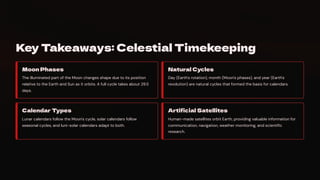
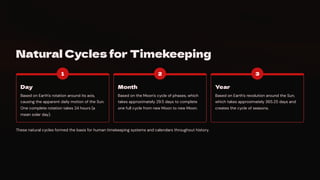
For thousands of years, humans have looked to the skies to track the passage of time. The
rhythmic cycles of the Sun, Moon, and stars have formed the foundation of our calendars
and timekeeping systems, connecting us to the cosmos and helping us organize our lives.Exploring Further:
Questions to Ponder
Moon Observations
Have you ever seen the Moon during
the day? Why is it sometimes visible
when the Sun is up?
If you lived on the Moon instead of
Earth, what would you mean by a day, a
month, or a year?
What would happen if Earth had two
moons instead of one? How would that
change the night sky?
Calendar Investigations
If we didn't have clocks or calendars,
how else could we measure time?
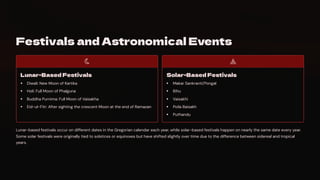
Why do some festivals fall on different
dates each year in the Gregorian
calendar?
How are tides related to the Moon's
position and phases?The Moon's Changing Appearance
Meera was surprised to see the Moon during daytime at the Patang Mahotsav in Ahmedabad. She knew the Moon is spherical and shines by reflecting sunlight, but wondered why its shape changes every night.
This observation led her to question: Why isn't the whole Moon visible every night? What causes the Moon's changing shape?
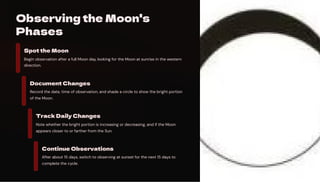
Observing the Moon's Phases
Spot the Moon
Begin observation after a full Moon day, looking for the Moon at sunrise in the western direction.
Document Changes
Record the date, time of observation, and shade a circle to show the bright portion of the Moon.
Track Daily Changes
Note whether the bright portion is increasing or decreasing, and if the Moon appears closer to or farther from the Sun.
Continue Observations
After about 15 days, switch to observing at sunset for the next 15 days to complete the cycle.
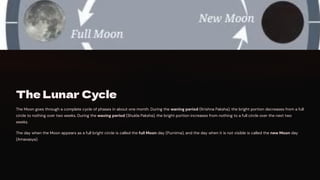
The Lunar Cycle
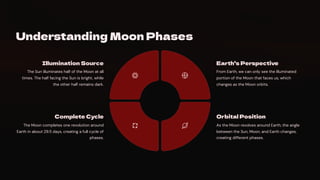
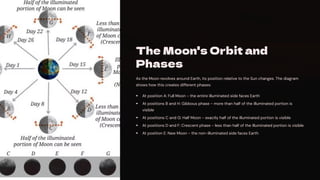
The Moon goes through a complete cycle of phases in about one month. During the waning period (Krishna Paksha), the bright portion decreases from a full circle to nothing over two weeks. During the waxing period (Shukla Paksha), the bright portion increases from nothing to a full circle over the next two weeks.
The day when the Moon appears as a full bright circle is called the full Moon day (Purnima), and the day when it is not visible is called the new Moon day (Amavasya).
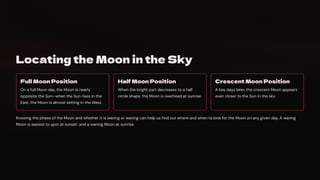
Locating the Moon in the Sky
Full Moon Position
On a full Moon day, the Moon is nearly opposite the Sun—when the Sun rises in the East, the Moon is almost setting in the West.
Half Moon Position
When the bright part decreases to a half circle shape, the Moon is overhead at sunrise.
Crescent Moon Position
A few days later, the crescent Moon appears even closer to the Sun in the sky.
Knowing the phase of the Moon and whether it is waxing or waning can help us find out where and when to look for the Moon on any given day. A waxing Moon is easiest to spot at sunset, and a waning Moon at sunrise.
 Most read
 Most read

 Most read