JOINTS
• A joint is simply known as a connection between bones in the skeletal
system.
• It is a site at which two or more bones meets together.
• They allow different types of movement in the bones.
CLASSIFICATION OF JOINTS
Joints can be classified on the basis of two categories:
• On the basis of structure
• On the basis of Function
On the basis of structure
On the basis of structure joints are classified into three types.
1. Fibrous joints
2. Cartilaginous joints
3. Synovial joints
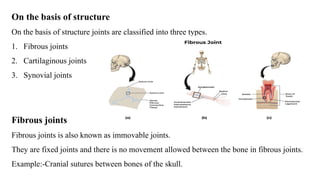
Fibrous joints
Fibrous joints is also known as immovable joints.
They are fixed joints and there is no movement allowed between the bone in fibrous joints.
Example:-Cranial sutures between bones of the skull.
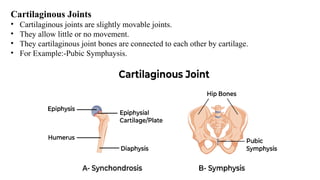
Cartilaginous Joints
• Cartilaginous joints are slightly movable joints.
• They allow little or no movement.
• They cartilaginous joint bones are connected to each other by cartilage.
• For Example:-Pubic Symphaysis.
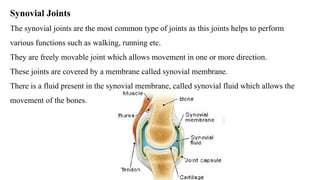
Synovial Joints
The synovial joints are the most common type of joints as this joints helps to perform
various functions such as walking, running etc.
They are freely movable joint which allows movement in one or more direction.
These joints are covered by a membrane called synovial membrane.
There is a fluid present in the synovial membrane, called synovial fluid which allows the
movement of the bones.
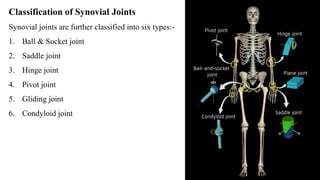
Classification of Synovial Joints
Synovial joints are further classified into six types:-
1. Ball & Socket joint
2. Saddle joint
3. Hinge joint
4. Pivot joint
5. Gliding joint
6. Condyloid joint
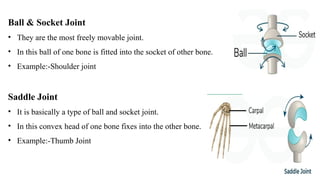
Ball & Socket Joint
• They are the most freely movable joint.
• In this ball of one bone is fitted into the socket of other bone.
• Example:-Shoulder joint
Saddle Joint
• It is basically a type of ball and socket joint.
• In this convex head of one bone fixes into the other bone.
• Example:-Thumb Joint
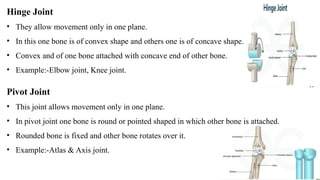
Hinge Joint
• They allow movement only in one plane.
• In this one bone is of convex shape and others one is of concave shape.
• Convex and of one bone attached with concave end of other bone.
• Example:-Elbow joint, Knee joint.
Pivot Joint
• This joint allows movement only in one plane.
• In pivot joint one bone is round or pointed shaped in which other bone is attached.
• Rounded bone is fixed and other bone rotates over it.
• Example:-Atlas & Axis joint.
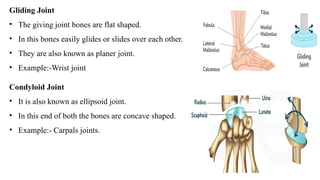
Gliding Joint
• The giving joint bones are flat shaped.
• In this bones easily glides or slides over each other.
• They are also known as planer joint.
• Example:-Wrist joint
Condyloid Joint
• It is also known as ellipsoid joint.
• In this end of both the bones are concave shaped.
• Example:- Carpals joints.
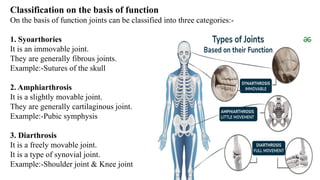
Classification on the basis of function
On the basis of function joints can be classified into three categories:-
1. Syoarthories
It is an immovable joint.
They are generally fibrous joints.
Example:-Sutures of the skull
2. Amphiarthrosis
It is a slightly movable joint.
They are generally cartilaginous joint.
Example:-Pubic symphysis
3. Diarthrosis
It is a freely movable joint.
It is a type of synovial joint.
Example:-Shoulder joint & Knee joint

THANK YOU

Structural and Functional Classification ,types of joints movements and its articulation

  • 1.
  • 2.
    • A jointis simply known as a connection between bones in the skeletal system. • It is a site at which two or more bones meets together. • They allow different types of movement in the bones. CLASSIFICATION OF JOINTS Joints can be classified on the basis of two categories: • On the basis of structure • On the basis of Function
  • 3.
    On the basisof structure On the basis of structure joints are classified into three types. 1. Fibrous joints 2. Cartilaginous joints 3. Synovial joints Fibrous joints Fibrous joints is also known as immovable joints. They are fixed joints and there is no movement allowed between the bone in fibrous joints. Example:-Cranial sutures between bones of the skull.
  • 4.
    Cartilaginous Joints • Cartilaginousjoints are slightly movable joints. • They allow little or no movement. • They cartilaginous joint bones are connected to each other by cartilage. • For Example:-Pubic Symphaysis.
  • 5.
    Synovial Joints The synovialjoints are the most common type of joints as this joints helps to perform various functions such as walking, running etc. They are freely movable joint which allows movement in one or more direction. These joints are covered by a membrane called synovial membrane. There is a fluid present in the synovial membrane, called synovial fluid which allows the movement of the bones.
  • 6.
    Classification of SynovialJoints Synovial joints are further classified into six types:- 1. Ball & Socket joint 2. Saddle joint 3. Hinge joint 4. Pivot joint 5. Gliding joint 6. Condyloid joint
  • 7.
    Ball & SocketJoint • They are the most freely movable joint. • In this ball of one bone is fitted into the socket of other bone. • Example:-Shoulder joint Saddle Joint • It is basically a type of ball and socket joint. • In this convex head of one bone fixes into the other bone. • Example:-Thumb Joint
  • 8.
    Hinge Joint • Theyallow movement only in one plane. • In this one bone is of convex shape and others one is of concave shape. • Convex and of one bone attached with concave end of other bone. • Example:-Elbow joint, Knee joint. Pivot Joint • This joint allows movement only in one plane. • In pivot joint one bone is round or pointed shaped in which other bone is attached. • Rounded bone is fixed and other bone rotates over it. • Example:-Atlas & Axis joint.
  • 9.
    Gliding Joint • Thegiving joint bones are flat shaped. • In this bones easily glides or slides over each other. • They are also known as planer joint. • Example:-Wrist joint Condyloid Joint • It is also known as ellipsoid joint. • In this end of both the bones are concave shaped. • Example:- Carpals joints.
  • 10.
    Classification on thebasis of function On the basis of function joints can be classified into three categories:- 1. Syoarthories It is an immovable joint. They are generally fibrous joints. Example:-Sutures of the skull 2. Amphiarthrosis It is a slightly movable joint. They are generally cartilaginous joint. Example:-Pubic symphysis 3. Diarthrosis It is a freely movable joint. It is a type of synovial joint. Example:-Shoulder joint & Knee joint
  • 11.