PRINCIPLES OF CROPS
EXPERIMENTATION
CODE: APT06210
CREDITS: 12
TUTOR: TRIPHONIA NDENDYA
2022/2023
1.0 INTRODUCTION
An experiment: is defined as the systematic procedures
carried under controlled condition, in order to discover
new idea or test hypothesis.
• OR is an investigation set up to provide answers to
question or questions of interest.
For example: We may wish to conduct experiment to test the
efficiency of using organic manure (goat manure) in groundnut
production or different inorganic fertilizers at different rates or
different spacing.
• Experiment is more likely to involve comparison of
treatments, for example methods, varieties, spacing etc.
Cont..
• However in some cases experiments do not involve
comparison of one treatment with the other treatments, hence
experiment can be absolute or comparative
• If we conduct the experiment to examine the usefulness of the
newly developed fungicide for controlling certain plant disease
without comparing its effect with other fungicides, the
experiment will be an absolute experiment.
• If we conduct the experiment to assess the effectiveness of
one fungicide as compared to the effect of other fungicides on
controlling plant disease, then the experiment is said to be
comparative experiment.
 Experimentation: it involves designing and testing of different
factors of interest using experiments.
• The major concern of experiment:
The primary concern in any experiment is to
accurately estimate or compare effects of
certain factors or treatments on the productive
or physiological performance of plants.
A factor
• is a variable which is believed to affect the
outcome of the experiment. Factors are also
called test materials.
• Factors in agricultural experiments are simply
identifiable as categories of inputs or
management practices.
• Example of factors for crop experiments are
varieties, fertilizers, herbicides etc.
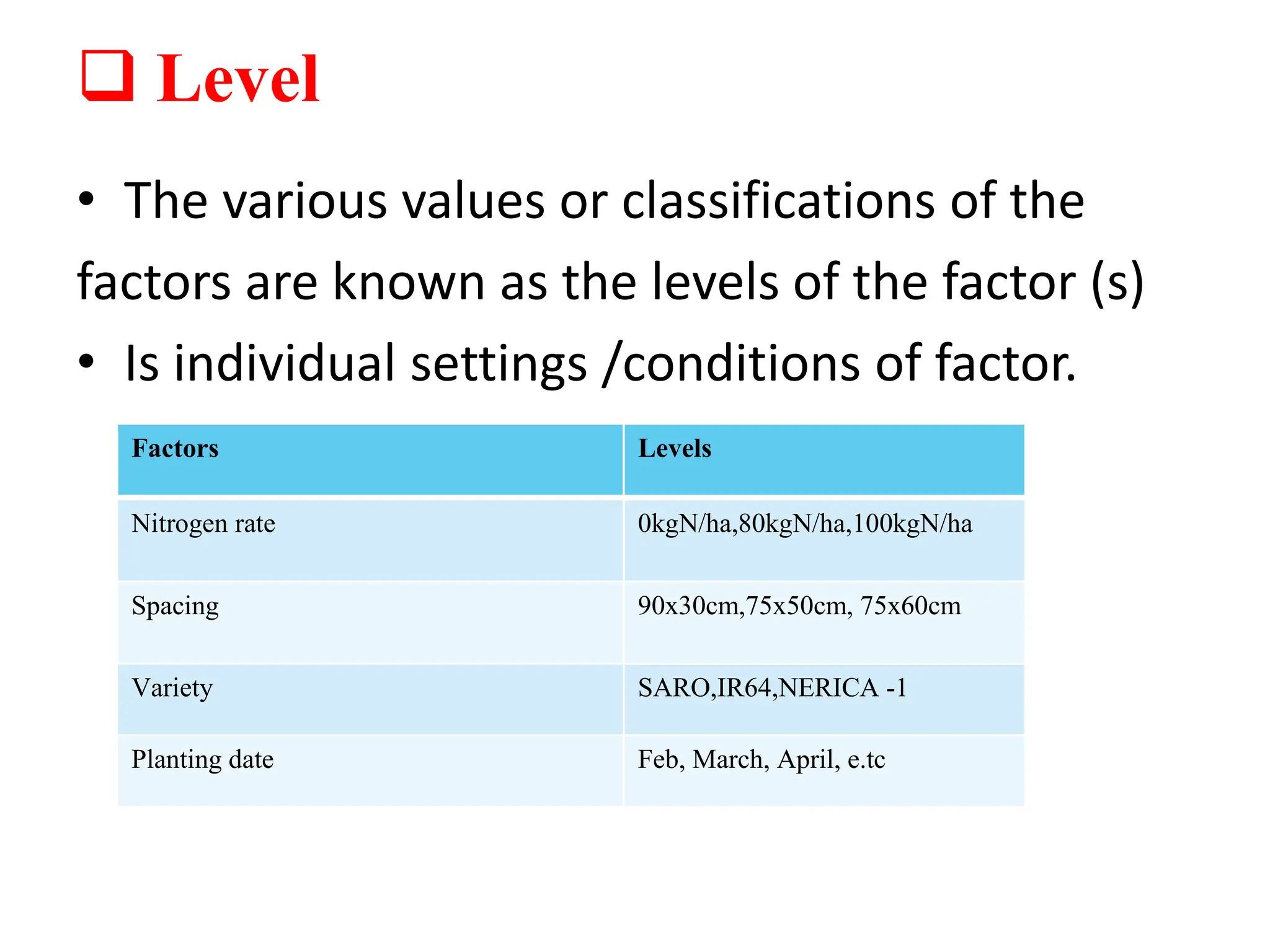
 Level
• The various values or classifications of the
factors are known as the levels of the factor (s)
• Is individual settings /conditions of factor.
Factors Levels
Nitrogen rate 0kgN/ha,80kgN/ha,100kgN/ha
Spacing 90x30cm,75x50cm, 75x60cm
Variety SARO,IR64,NERICA -1
Planting date Feb, March, April, e.tc
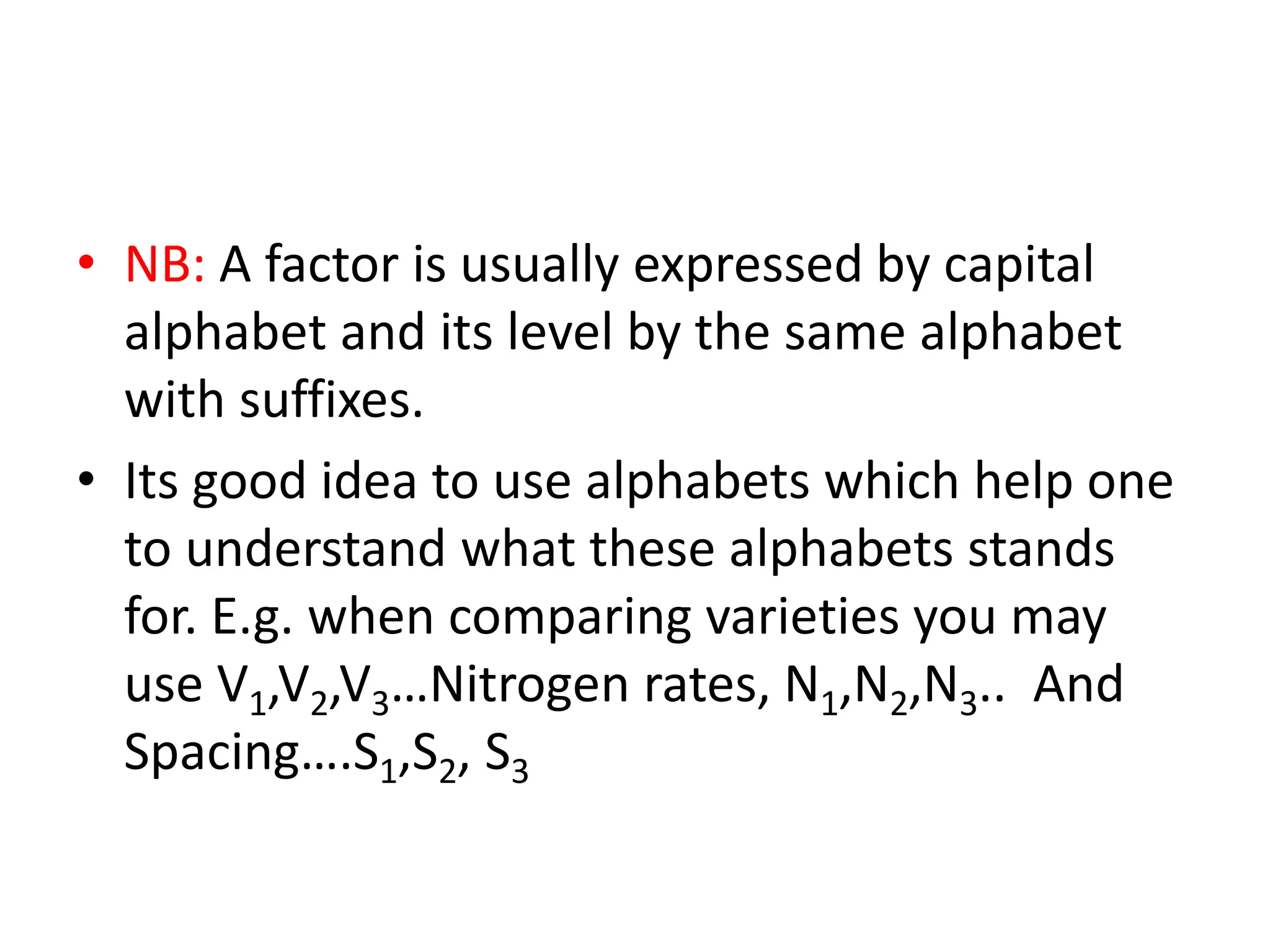
• NB: A factor is usually expressed by capital
alphabet and its level by the same alphabet
with suffixes.
• Its good idea to use alphabets which help one
to understand what these alphabets stands
for. E.g. when comparing varieties you may
use V1,V2,V3…Nitrogen rates, N1,N2,N3.. And
Spacing….S1,S2, S3
 Treatment or Treatment
combination
• is one or more things that are compared or
investigated in an experiment. OR
• It is a dosage/ amount of materials or
procedure which is to be tested in experiment.
• Example: In experiment involved spacing trial
[a factor] and a fertilizer trial[another factor],
now trial treatments can be:-
• Planting at 75x60cm with 60kgs N/ha.
• Planting at 25x10cm with 20 kgs N/ha
• NB: Total number of treatments is the product
of levels in each factor.
• For above example will be:
[2 factors] x[2 level] = 4 treatments
Variable(s)
• is any quantitative or attribute whose values
varies from one unit of investigation to
another.
• A variable is a characteristic that changes from
unit to unit or one individual to another
individual.
• They shows variability Example :plant heights,
weights, pod height, number of flowers, fruit
height, etc.
Experimental unit:
• Is the unit of experimental material to which the
application of the treatment is made and on
which the variable under study is measured. Or
• Are the pre-determined plots or the blocks where
different treatments are applied. Such
experimental units must be selected (defined)
very carefully.
• Examples, a plot in agricultural experiments and
petri dish in laboratory experiments.
• Experimental unit measures the effectiveness of
factor or treatment.
Experimental area:
• Is that area where the experiment is to be
conducted.
• It can divided to form replicates and that
replicates divided to form experimental units.
• It is selected from an experimental site.
 Experimental factors (variables):
• These are factors that are of experimental
interest which tend to vary from one
treatment to another.
Non-experimental factors (variables):
• These are factors that are not of experimental
interest.
• These are factors which remain fixed or
applied uniformly over the trial.
Control:
• It is used to restrain experimental conditions.
• Experimental unit does not receive any
treatment, but the effectiveness of other
treatments should be found through
comparison with that control.
Response (output of experiment):
This is the numerical results observed for a
particular experimental unit. e.g. (grain yield)
one may be interested to know the amount of a
grains in kg produced when different types of
fertilizers are applied to a piece of land.
Population:
• It is the aggregate from which the sample is
chosen for measurement of particular
variable. For example total number of maize
plants in the field of 1 acre.
 Sample:
• It is a part of population used as a substitute
for population, e.g. measuring 10 plants in
each plot of maize experiment.
• The value obtained from 10 plants represents
the rest of plants in a given plot.
Sampling unit:
• Is the unit on which actual measurement is
made, e.g. 10 plants in a 10mx5m maize plot.
It is potential member of the sample.
Data:
• is the set of values assigned to response
variable or set of quantitative values obtained
by measuring or counting.
The purpose of research
• The purpose of research is to discover answers to
questions through the application of scientific
procedures.
• To find out the truth which is hidden and which
has not been discovered yet.
• To test a hypothesis of a causal relationship
between variables (such studies are known as
hypothesis-testing research studies).
• To address different production problems which
face farmers through development of appropriate
technologies. E.g. new crop varieties, new animal
feeds, appropriate animal housing, e.tc.
• To portray accurately the characteristics of a
particular individual, situation or a group
(studies with this object in view are known as
descriptive research );
• To determine the frequency with which
something occurs or with which it is
associated with something else (studies with
this object in view are known as diagnostic
research );
Principles of experimentation
I. There must be clear statement of research
aims, which defines the research question.
II. There must be information sheet for
participants, which sets out clearly what the
research is about, what it will involve ,which
laid down prior to research beginning
III. The methodology is appropriate to the
research question , if is qualitative or
quantitative
iv. The research should be carried out in an
unbiased fashion. researcher should not
influence the results of the research in any
way.
v. From the beginning, the research should have
appropriate and sufficient resources in terms
of people, time, transport, money e.t.c
vi. People conducting the research should be
trained in research and research methods
vii. All research should be ethical and not
harmful in any way to the participants.
2.TYPES OF EXPERIMENT AND SURVEY
• There are three basic types of experiment in
agriculture, which are
i. Exploratory experiment: these types of
experiment seek to better define and
characterize a particular production problem.
Used to find causes to problem and problem
prioritization.
ii. Determinative experiments: test possible
solutions to a production problem that is well
understood.
iii. Verification experiments:
• used to test technology in larger scale and in
wide range of circumstances.
• These kind of experiment are meant to
publicize the positive attributes of treatments
(demonstration plots may be
used).experiment on these category are
usually on-farm
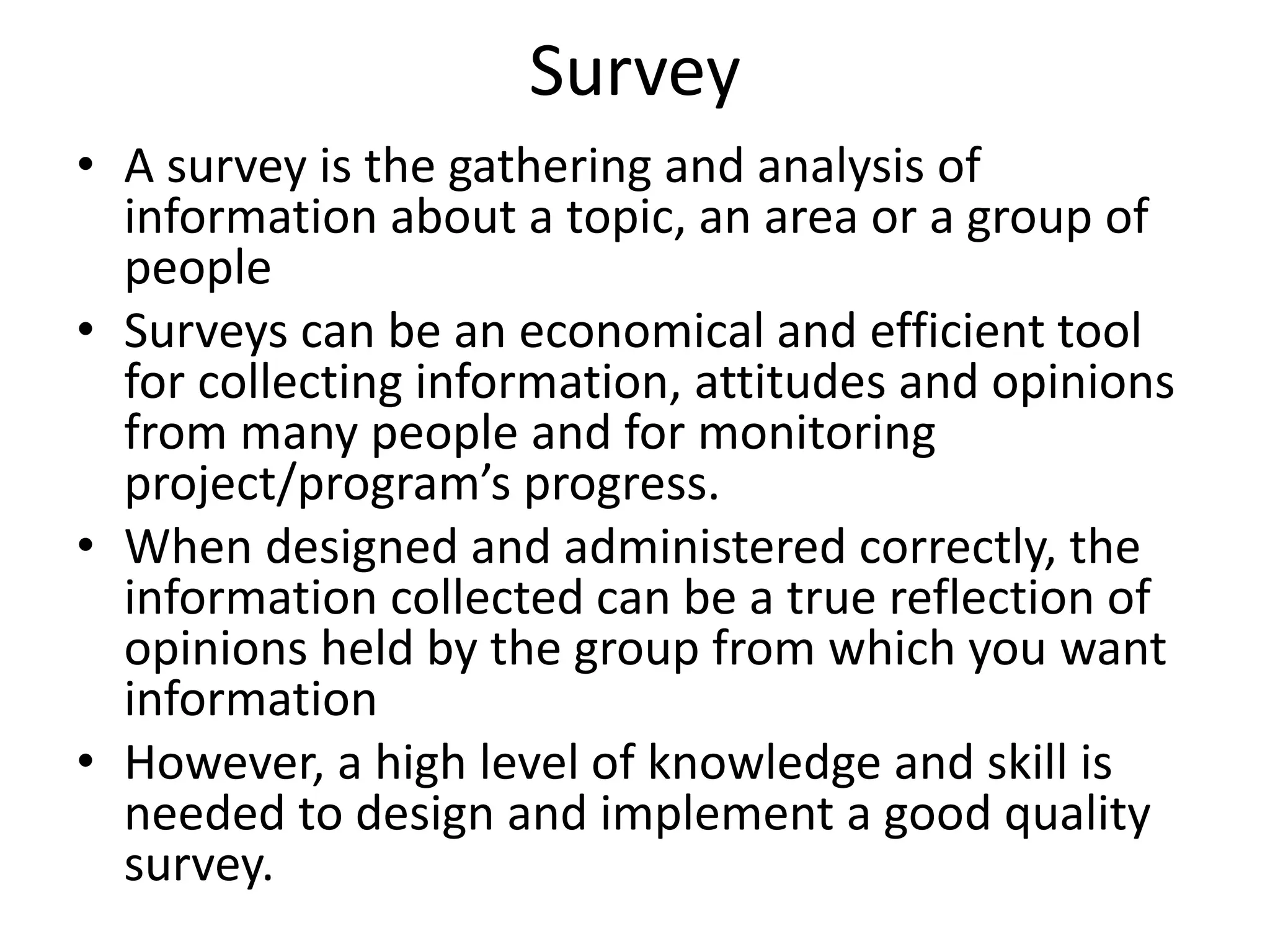
Survey
• A survey is the gathering and analysis of
information about a topic, an area or a group of
people
• Surveys can be an economical and efficient tool
for collecting information, attitudes and opinions
from many people and for monitoring
project/program’s progress.
• When designed and administered correctly, the
information collected can be a true reflection of
opinions held by the group from which you want
information
• However, a high level of knowledge and skill is
needed to design and implement a good quality
survey.
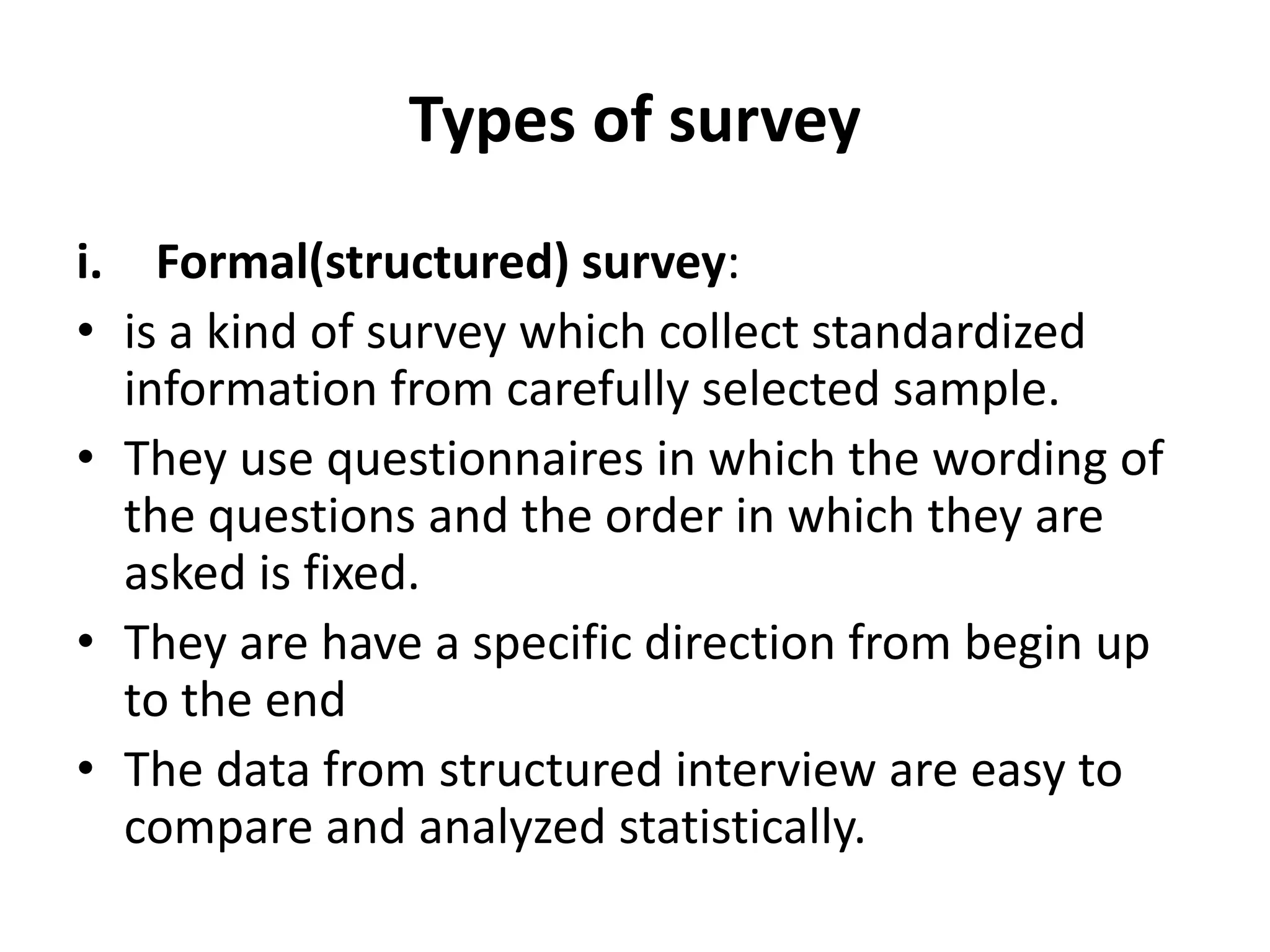
Types of survey
i. Formal(structured) survey:
• is a kind of survey which collect standardized
information from carefully selected sample.
• They use questionnaires in which the wording of
the questions and the order in which they are
asked is fixed.
• They are have a specific direction from begin up
to the end
• The data from structured interview are easy to
compare and analyzed statistically.
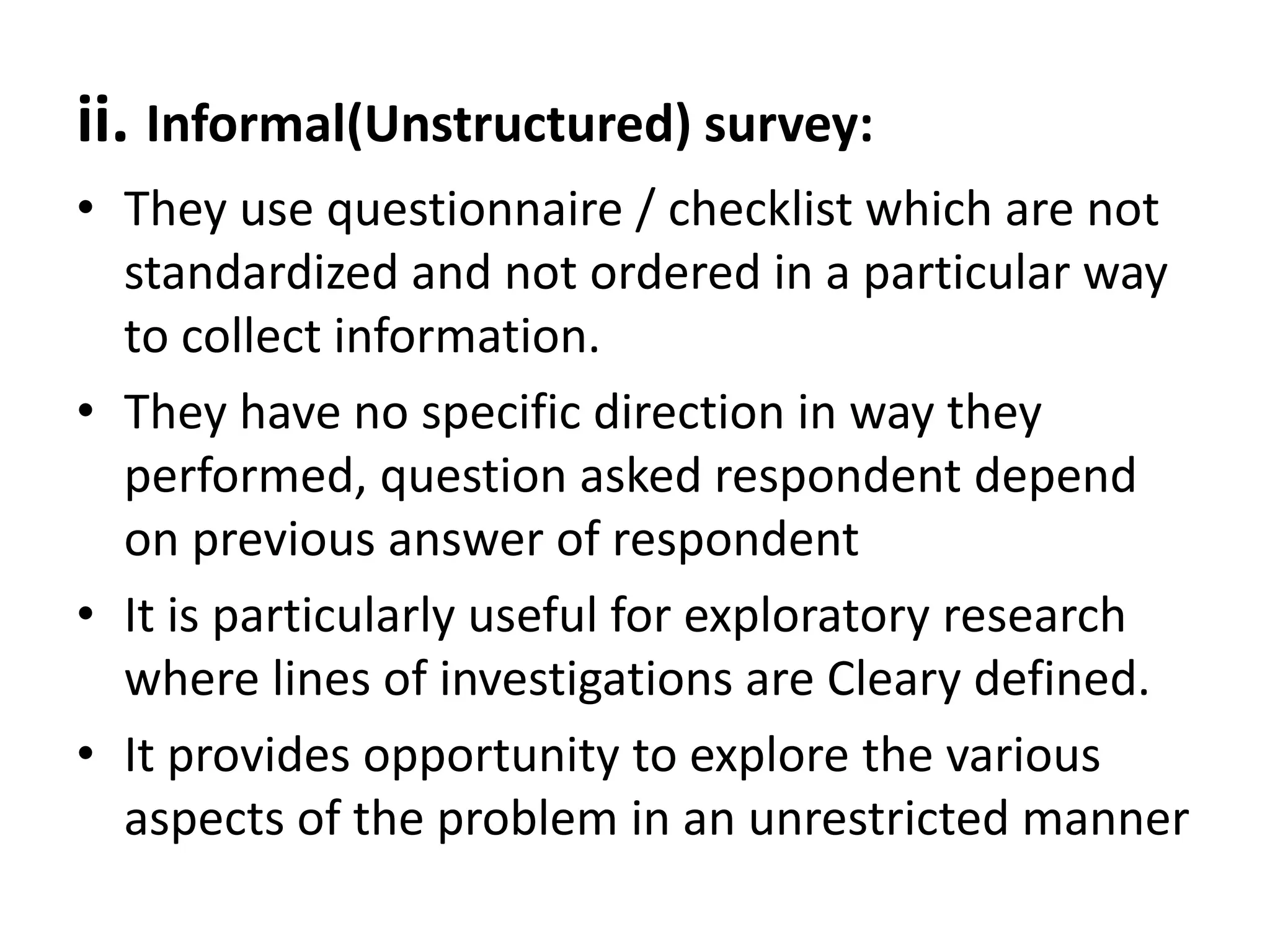
ii. Informal(Unstructured) survey:
• They use questionnaire / checklist which are not
standardized and not ordered in a particular way
to collect information.
• They have no specific direction in way they
performed, question asked respondent depend
on previous answer of respondent
• It is particularly useful for exploratory research
where lines of investigations are Cleary defined.
• It provides opportunity to explore the various
aspects of the problem in an unrestricted manner
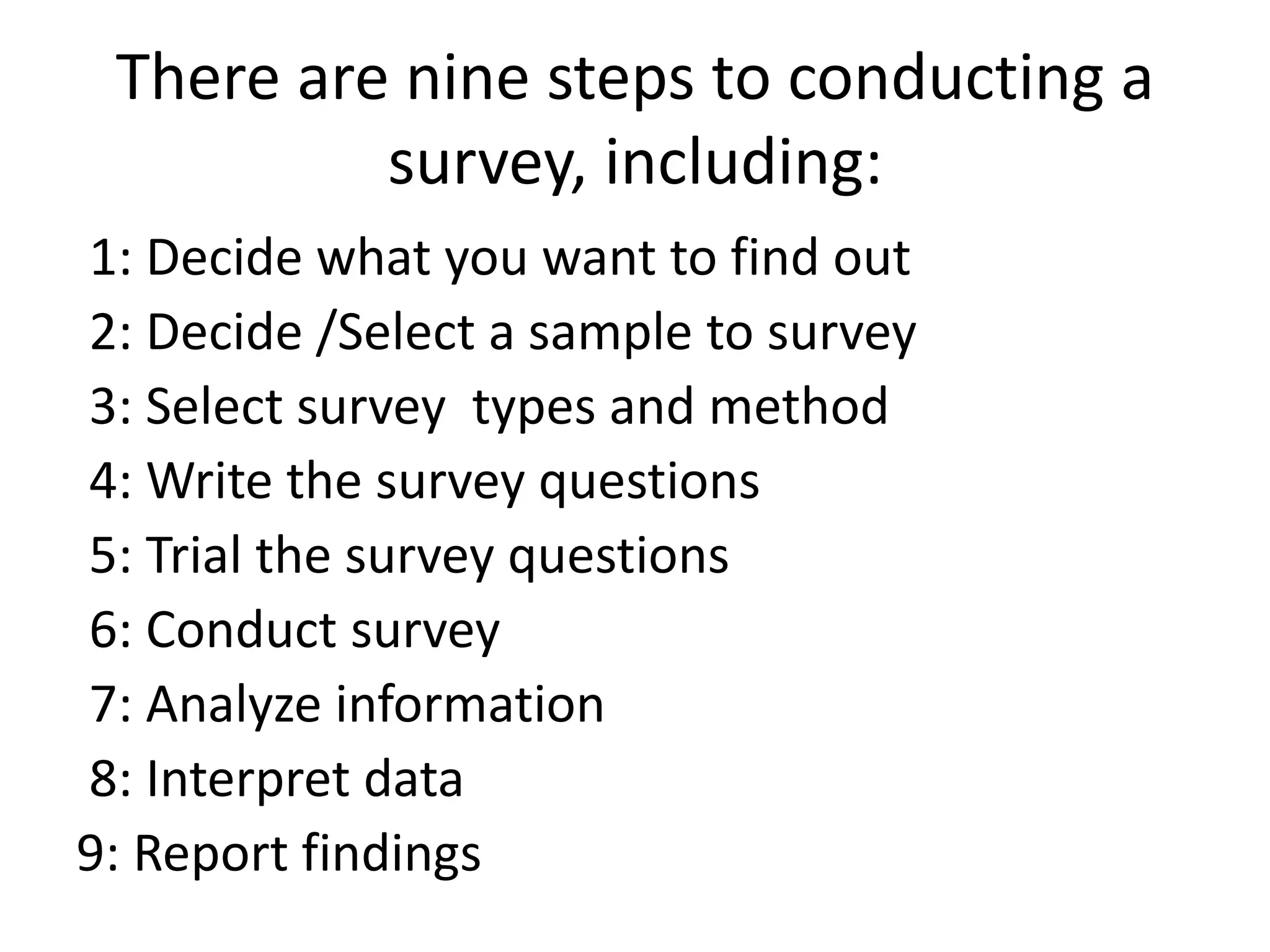
There are nine steps to conducting a
survey, including:
1: Decide what you want to find out
2: Decide /Select a sample to survey
3: Select survey types and method
4: Write the survey questions
5: Trial the survey questions
6: Conduct survey
7: Analyze information
8: Interpret data
9: Report findings
1.Decide what you want to find out
• The first decision to be made is what information
do we need to collect. Means a topic to deal
• What do the survey questions need to determine
2.Decide /Select a sample to survey
• As it is not usually possible to survey the whole
community, you will need to survey a sample that
represents the group.
• The sample needs to be representative of the
people you really want to talk to so that as little
bias as possible occurs.
3.Select the survey type & method
• The survey type determines the way a survey
is to be conducted, what is to collected and
what is to recorded.
• The type of survey used depends on the type
of information you want, how much
information can be analyzed and the time and
resources available.
• A combination of survey types and method
can also be used.
There are three common methods of
surveys:
a. Self-completed questionnaires
• Are most commonly presented as written
questions on paper.
• The questions are completed or ‘filled in’ by the
participant, usually without any assistance from
the people who designed the questionnaire.
c. Face-to-face interviews
• Involve an interviewer asking questions verbally
to an individual ( interviewee) personally.
b. Telephone surveys
• Involve an interviewer asking questions verbally
to a single, anonymous individual over the phone.
4.Write down the survey questions
• Questionnaires should be designed to be
attractive, easily understood, easily answered
and to give you the required information.
• This step looks at:
i. the types of questions to ask
ii. how to design questions
iii. sequencing and presentation of
questionnaires
4.i.The types of questions to ask
• There are two main types of questions:
a. open-ended
b. closed-ended.
a. Open-ended questions
• Are questions that can have unexpected answers
as they allow the answer to be left entirely to the
respondent so they can express their feelings
without restriction.
• They can generate a wide range of replies
• Open-ended questions give ‘qualitative’
information
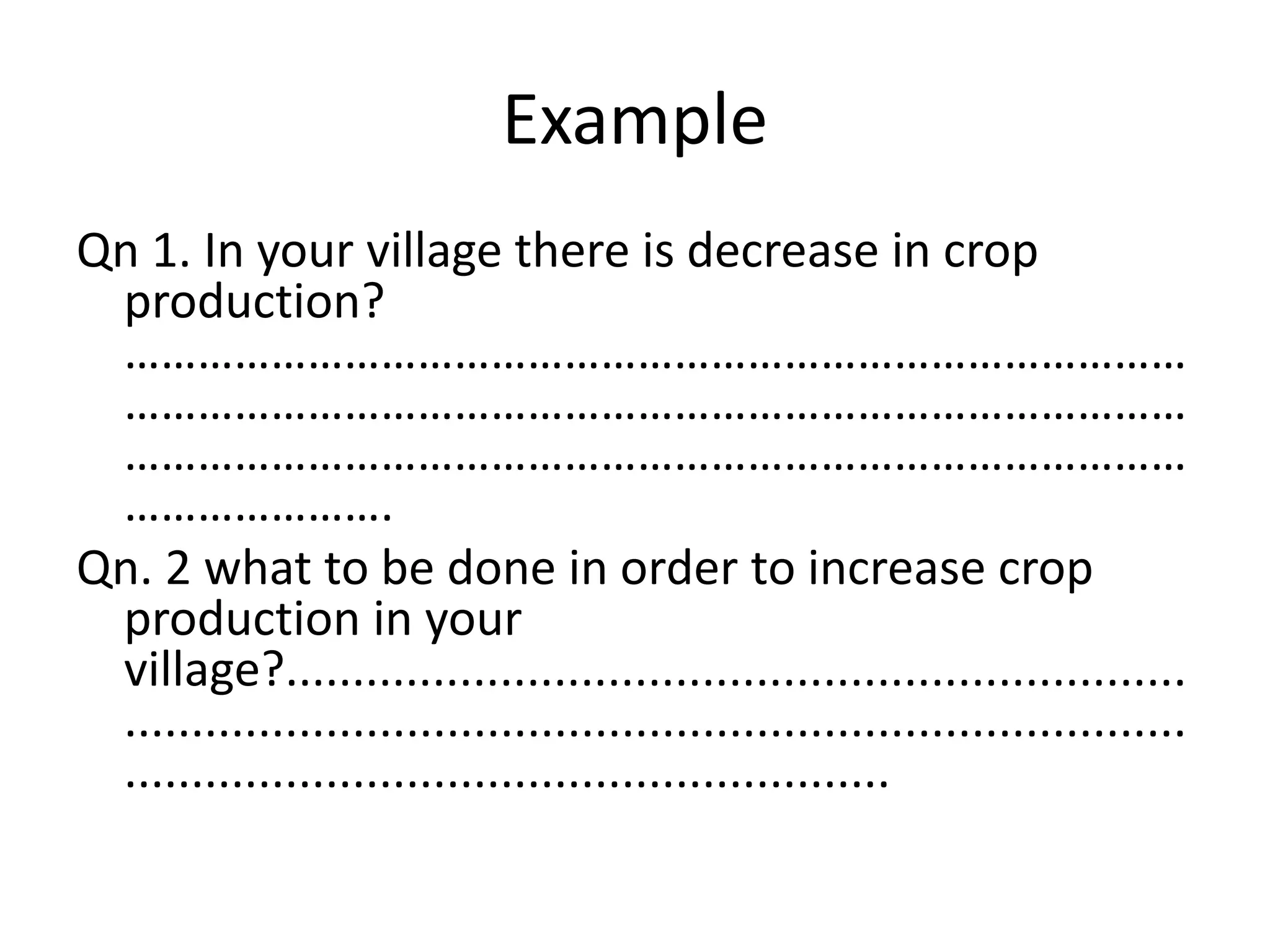
Example
Qn 1. In your village there is decrease in crop
production?
……………………………………………………………………………
……………………………………………………………………………
……………………………………………………………………………
………………….
Qn. 2 what to be done in order to increase crop
production in your
village?...................................................................
...............................................................................
.........................................................
b. Closed-ended.
• Closed-ended questions are questions
followed by a list of answers and a format for
making an answer
• Closed-ended questions provide ‘quantitative’
information that can be counted.
• The information can be discussed in terms of
numbers, frequencies, and percentages.
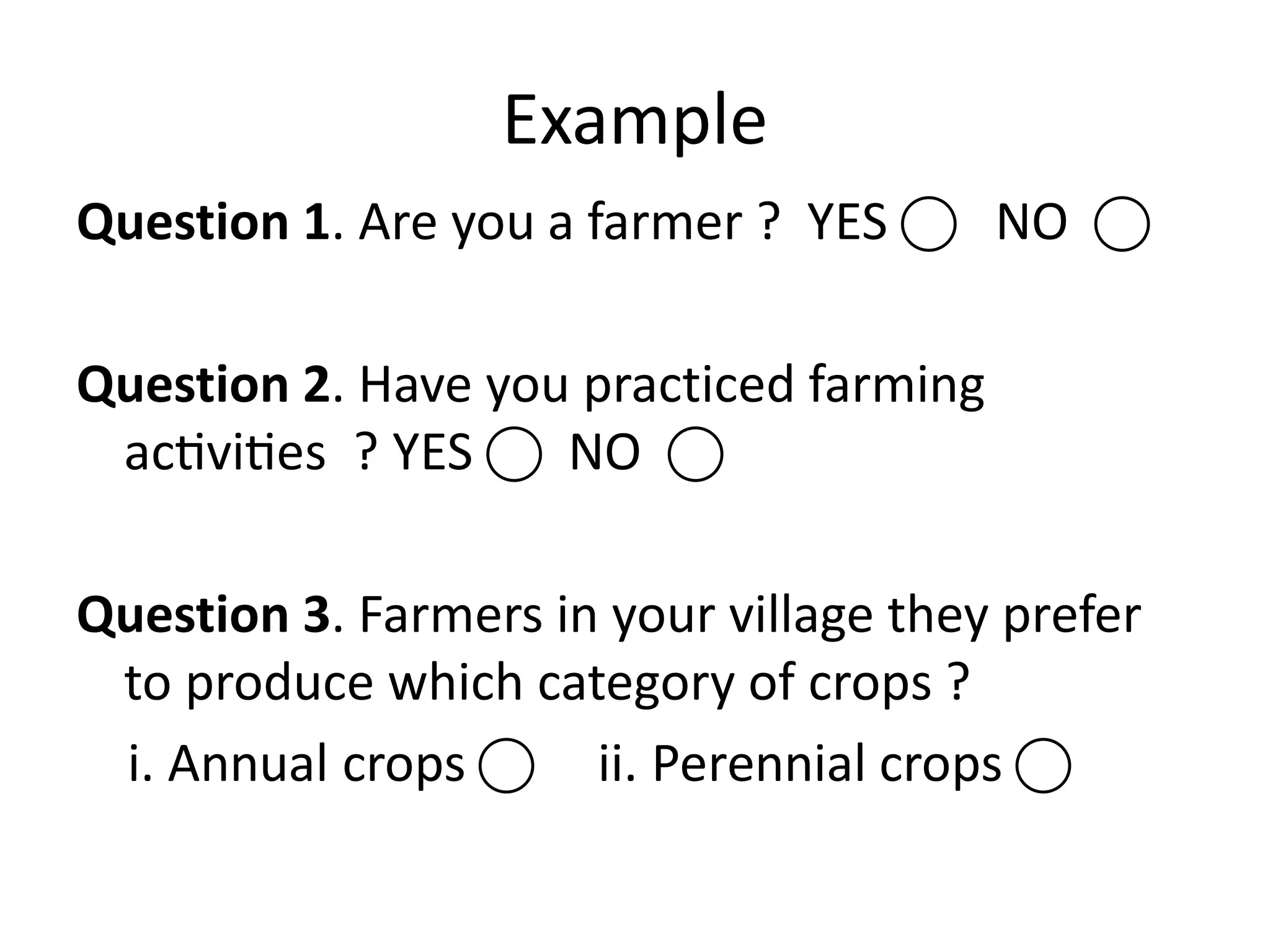
Example
Question 1. Are you a farmer ? YES ⃝ NO ⃝
Question 2. Have you practiced farming
activities ? YES ⃝ NO ⃝
Question 3. Farmers in your village they prefer
to produce which category of crops ?
i. Annual crops ⃝ ii. Perennial crops ⃝
Reading assignment
1. Outline the advantages and disadvantages of
open ended questions
2. Outline the advantages and disadvantages of
close ended questions
5: Trial the questionnaire or interview
questions
• A trial or pilot study refers to testing or having a
practice run of the questionnaire or interview.
• Circulate the questionnaire among colleagues,
friends and a variety of people to get their
opinion
• It is also necessary to choose a small number of
the actual target group
• Incorporate any valid suggestions into the
questionnaire design.
Testing is done to ensure:
• the information you receive is the information
you set out to get
• there are no unexpected weakness or
imperfections
• the information you obtain can be interpreted
6: Conduct the survey
• It is the point when the survey is done
• It may involves Election of a questionnaire
coordinator, Organise questionnaire
distribution, Organise questionnaire returns
and Send reminder notices for self-completed
questionnaires
7.Analyse the data
• An analysis and discussion is necessary to make
sense of the data collected.
• The method of analysis used depends on the type
of data gathered.
8.Interpreting results
• When interpreting what the results of the survey
mean, it is important not to generalise too much.
• It is also important to recognise and acknowledge
any possible bias in the results. Not all people in
the community have been asked (only a
representative sample),
10: Report the findings
• It is important that information gathered is given
back to the community from which the
information was obtained. Or to extension
institute
• The survey results should also be given to and
used by relevant decision-makers.
• In the report, it is important to recognise and
discuss any difficulties or problems that might
affect the interpretation and generalisation of the
findings.
Practical 1
• Conduct a survey and collect data
SAMPLING
• What is sampling……….??????
• There are two ways of choosing a sample:
A. Probability sampling: is the one in which every
member in a population have equal chance to
be selected.
B. Non probability/intention: is the one in which
the sampler or investigator decide in advance
the factor that will determine whether a
particular unit/ member of population should be
included in the sample. Not all member has
equal chance to participate in the sample.
A:Probability sampling techniques
• It includes the following sub techniques
I. Simple random sampling
II. Systematic sampling
III. Cluster sampling
IV. .Stratified sampling
• SIMPLE RANDOMLY SAMPLING
• Is the method of obtaining sample where every individual of a population
is chosen randomly by chance. Every individual has the same probability of
being chosen to be part of a sample.
• SYTEMATIC SAMPLING.
• Researcher divide the entire population into strata or subgroup within a
population. Each sub group is separated from the others on the basis of a
common characteristics such as gender, sex, religion age.
• For example if you are dividing a students population by its course
engineers, linguistics, and education,
• SYSTEMATIC SAMPLING.
• Researcher use this method to choose the samplSe members of a
population at regular intervals it requires selecting a starting point for the
sample and sample size determination that can be repeated at regular
interval eg.
Sample of 500people from population of 5000.
he/she numbers the population from 1-5000
and will choose every 10th individual to be part
of sample.
• Total population/sample size
• =5000/500
=10
• CLUSTER SAMPLING.
• Is the method in which the researcher divides the
population into smaller groups called clusters and
then randomly select some of these cluster as
your sample.
• Uses of probability sampling
• 1. Reduce sample bias.
• 2. Used in diverse population.
• 3. Create an accurate sample.
B:Non probability sampling
• It includes the following sub techniques
I. Accidental sampling:
II. Quota sampling
III. Purposive or judgmental sampling
3.IMPORTANT CONCEPTS AND
DEFINITIONS
i. Experiment:
• Is an investigation set up to provide answers to
a question or questions of interest.
OR
• Is the process of examining the truth of a
statistical hypothesis, relating to some research
problem.
• For example, an experiment conducted to test
the efficiency of a certain newly developed drug
for curing a certain skin condition in animals.
ii. Experimental Design or Designing of an
Experiment:
• A design is a plan/ framework for obtaining
relevant information to answer the research
question of interest.
• In other words, it can be defined as the
complete sequence of steps laid down in
advance to ensure that the maximum
amount of information relevant to the
problem under investigation will be collected.
• Example RCBD, RCD, Split plot
iii. A factor
• is a variable which is believed to affect the
outcome of the experiment. Factors are also
called test materials.
• Factors in agricultural experiments are simply
identifiable as categories of inputs or
management practices.
• Example of factors for crop experiments are
varieties, fertilizer, herbicide and for livestock
can be pastures, vaccines and breed
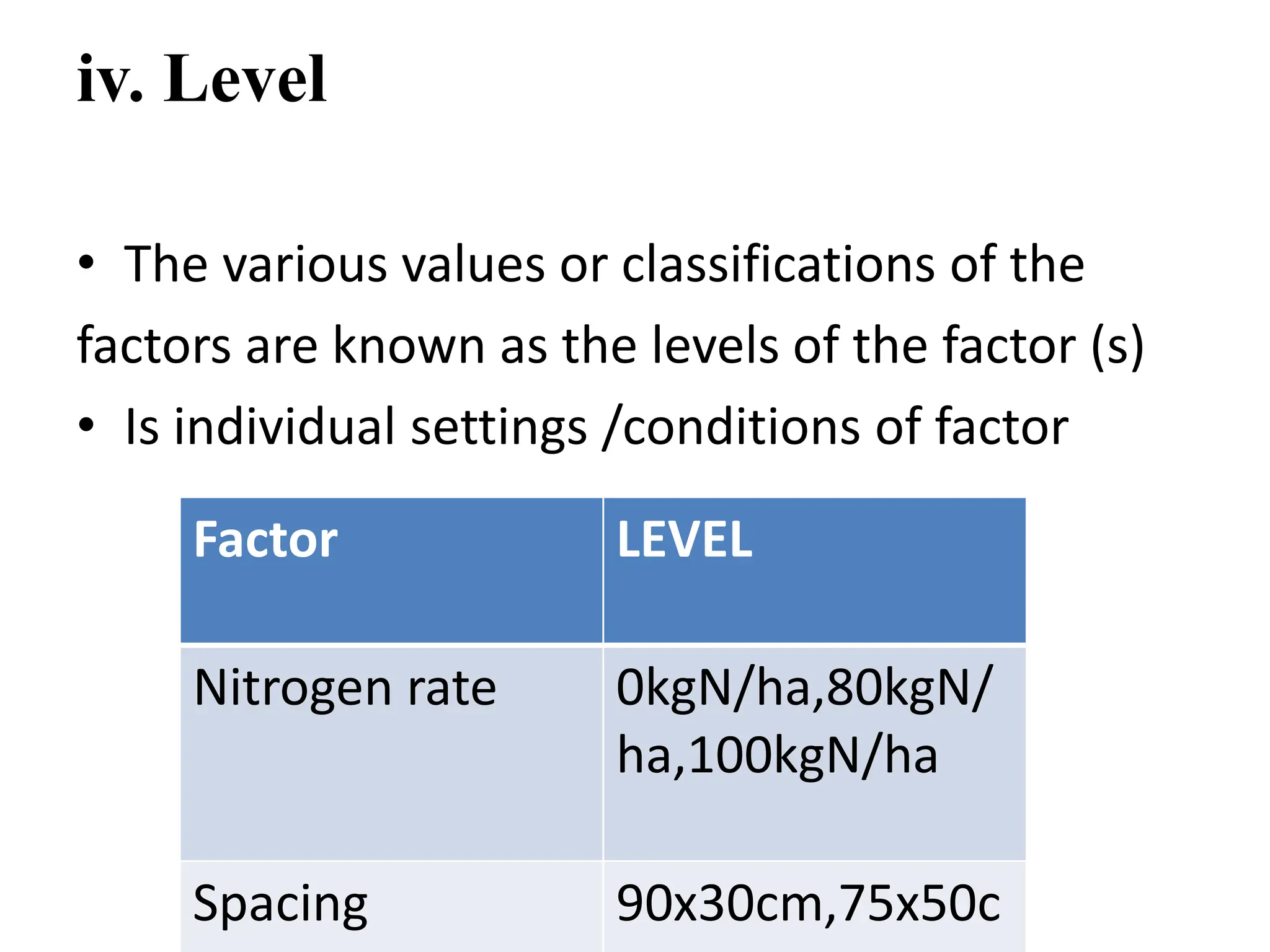
iv. Level
• The various values or classifications of the
factors are known as the levels of the factor (s)
• Is individual settings /conditions of factor
Factor LEVEL
Nitrogen rate 0kgN/ha,80kgN/
ha,100kgN/ha
Spacing 90x30cm,75x50c
• NB: A factor is usually expressed by capital
alphabet and its level by the same alphabet
with suffixes.
• Its good idea to use alphabets which help one
to understand what these alphabets stands
for. E.g. when comparing varieties you may
use V1,V2,V3…Nitrogen rates, N1,N2,N3.. And
Spacing….S1,S2, S3
v. Treatment or Treatment
combination
• is one or more things that are compared or
investigated in an experiment.
• It is a dosage/ amount of materials or
procedure which is to be tested in experiment.
• Example: In experiment involved spacing trial
[a factor] and a fertilizer trial[another factor],
now trial treatments can be:-
• Planting at 75x60cm with 60kgs N/ha.
• Planting at 25x10cm with 20 kgs N/ha
• NB; Total number of treatments is the
products of levels in each factor.
• For above example will be
[2factors] x[2level] =4treatments
vi. Experimental unit:
• Is the unit of experimental material to which the
application of the treatment is made and on
which the variable under study is measured. Or
• Are the pre-determined plots or the blocks where
different treatments are applied. Such
experimental units must be selected (defined)
very carefully.
• Examples, a plot in agricultural experiments and
petri dish in laboratory experiments.
• Experimental unit measures the effectiveness of
factor or treatment.
vii. Experimental area:
• Is that area where experiment is to be done.
• It can divided to form replicates and that
replicates divided to form experimental units
• It is selected from an experimental site
 Experimental factors (variables):
• These are factors that are of experimental
interest which tend to vary from one
treatment to another.
Non-experimental factors (variables):
• These are factors that are not of experimental
interest.
• These are factors which remain fixed or
applied uniformly over the trial.
Control:
• It is used to restrain experimental conditions.
• Experimental unit does not receive any
treatment, but the effectiveness of other
treatments should be found through
comparison with that control.
Response (output of experiment):
This is the numerical results observed for a
particular experimental unit. e.g. (grain yield)
one may be interested to know the amount of a
grains in kg produced when different types of
fertilizers are applied to a piece of land.
Population:
• It is the aggregate from which the sample is
chosen for measurement of particular
variable. For example total number of maize
plants in the field of 1 acre.
 Sample:
• It is a part of population used as a substitute
for population, e.g. measuring 10 plants in
each plot of maize experiment.
• The value obtained from 10 plants represents
the rest of plants in a given plot.
Sampling unit:
• Is the unit on which actual measurement is
made, e.g. 10 plants in a 10mx5m maize plot.
It is potential member of the sample.
Data:
• is the set of values assigned to response
variable or set of quantitative values obtained
by measuring or counting.
xiii) Analyze:
• study or examine in order to learn about
something. Analysis simply means separation
of whole into its parts for study and
interpretation.
xiv) Data analysis:
• involve the application of one or more
statistical techniques to set of data with the
purpose of extracting as much information as
possible from given data
xv. Tabulation
• Is the process of summarizing raw data and
displaying them in compact form for further
analysis
xvi. Experimental Error
• Is a measure (gauge) of the variation among
experimental units receiving same treatments.
• The difference among experimental plots
treated alike is called experimental error.
• That measures mainly inherent/ inborn
variation among them.
• This error is the primary basis for deciding
whether an observed difference is real Or
just due to chance.
• Thus experimental error is a technical term
and does not mean a mistake, but includes
all types of extraneous variation due to;
Sources of experimental errors
(i) Inherent variability in experimental units
(ii) Error associated with the measurements
made (i.e. eye parallax or instrumental
error)
(iii) Lack of representative of the sample to the
population under study
• Experimental error cannot completely be
controlled, but can be reduced.
• Variations among experimental units sometimes
cannot be avoided in practice, some variations
are controllable and some are beyond the control
of the experimenter.
• Other factors such as soil fertility, moisture, and
damage by insects disease and birds also can
affect responses like yields, plant height and pod
weight.
• Because these other factors affect responses, a
satisfactory evaluation of the two treatments
must involvesa procedure that can separate
treatment difference from other sources Of
variation.
• That is, the experimenter must be able to design
an experiment that allows him to decide whether
the difference observed is caused by treatment
difference or by other factors.
Every experiment must be designed to
have a measure of the experimental
error. by
( a ) Replication
• means repetition, another copy, to look (exactly)
alike. It is the number of times a treatment
appears in an experiment
• In the same way that at least two plots of the
same treatment are needed to determine the
difference among plots treated alike,
• Experimental error can be measured only if there
are at least two plots planted to the same variety
(or receiving the sametreatment).
• Thus, to obtain a measure of experimental error,
replication is needed.
• This refers to the number of experimental units
on each treatment
• A treatment is said to be replicated if it is applied
to more than one experimental unit
• In short replication means the number of times a
treatment appears on experimental units
( b ) Randomization
• Randomization is more involved in getting a
measure of experimental error than simply
planting several plots of the same treatment .
• For example, suppose, in comparing two rice
varieties, the plant breeder plants varieties A and
B each in four plots
• Randomization ensure each variety will have an
equal chance of being assigned to any
experimental plot and, consequently, of being
grown in any particular environment existing in
the experimental site.
Control of error
• Because the ability to detect existing
differences among treatments increases as the
size of the experimental error decreases
• Now a good experiment incorporates all
possible means of minimizing the
experimental error.
• Three commonly used techniques for
controlling experimental error in agricultural
research are:-
a. Blocking
b. Proper plot technique
c. Data analysis
a. Blocking
• Dividing the field into several homogenous
parts is known as ‘blocking.
• In By putting experimental units that are as
similar as possible together in same group
(generally referredto as a block)
• and by assigning all treatments into each
block separately and independently, variation
among blocks can be measured and removed
from experimental error.
• In general, blocking is the means at which we
hold an extraneous factor fixed, so that we
can measure its contribution to the total
variability of the treatment by means of a
two-way analysis of variance
b. Proper plot technique
• For almost all types of experiment, it is absolutely
essential all other factors aside from those
considered as treatments be maintained
uniformly for all experimental units.
• For example, in variety trials where the
treatments consist solely of the test varieties,
• it is required that all other factors such as soil
nutrients, solar energy, plant population, pest
incidence, and an almost infinite number of other
environmental factors are maintained uniformly
for all plots in the experiment.
c. Data analysis
• In cases where blocking alone may not be able
to achieve adequate control of experimental
error, proper choice of data analysis can help
greatly
xvii. Research hypothesis:
• When a prediction or a tentative answers to
be tested by scientific methods, it is termed as
research hypothesis.
• The research hypothesis is a predictive
statement that relates an independent
variable to a dependent variable.
• Usually a research hypothesis must contain, at
least one independent and one dependent
variable.
• Predictive statements which are not to be
objectively verified or the relationships that
are assumed but not to be tested, are not
termed research hypotheses
• The hypothesis has to be verified or disproved
through experimentation.
• These hypotheses are usually suggested by
past experiences,observations, and at times
by theoretical considerations
4.STEPS FOR DESIGN ON STATION
EXPERIMENTATION
On station experimentation
• these are experiments conducted by
researcher/experimenter on the station field
• Conducted with high control of condition
while on farm experiment are performed with
less control of conditions
• Usually only researchers are involved while on
farm both researcher and farmers can be
involved
• OSE are really experiment while OFE are not
really experiments are just demonstrations
• During designing OSE the selection of procedures
for research depends to large extent on the
subject in which the research is to be conducted
and the objective of the research.
• The research conducted must be descriptive and
involving a sampling survey or it might involve
controlled experiment e.tc
Important steps to be taken
1. Definition of the problem
2. Review relevant literatures
3. Setting the objectives of the
experiment
4. Specify the population
5. Evaluate the feasibility of testing the
hypothesis.
6. Selection of treatments
7.Design an experiment
8.Conduct experiment
9.Analysis of data
10.Interpretation of results
11.Reporting
1.Definition of the problem
• This involves precise problem identification
and formulation of problem statement.
• It is important to develop enough information
related to a particular problem in order to
define it correctly and also try to develop
appropriate solution through experimentation
if necessary.
• Problem statement is a concise descriptive
and balanced statement which portrays the
issue to be investigated.
2. Review relevant literatures
• It involves to learn what has been done by
other researcher in the field and to become
familiar enough with the field of interest allow
to you to discuss it with others.
• The best ideas often cross disciplines and
species, so a broad approach is important.
• For example, recent research in controlling
odors in swine waste has exciting implications
for fly and nematode control.
3.Setting the objectives of the experiment
• The objective of the experiment state what
will be achieved.
• This may be inform of question to be
answered, hypothesis to be answered, or the
effects to be estimated.
Important points to take in
consideration when setting objectives
• The objective(s) must be clear, concise i.e.
clearly understandable, short, direct to the
point, and easy to understand by stakeholders.
• The objective(s) must be specific, must be
related exactly to the problem/solution to be
developed. If objective are not specific they
become hard to attain.
• Too ambitious objectives must be based on
technical, financial, and time at disposal.
• Avoid too many objectives for one experiment.
With too many objectives, designing, conducting,
data collection and analysis and even coming
with conclusion becomes very complicated.
• When there many objectives list them in order of
importance and work with few first and then the
others later
• In writing the objective look at the problem and
reformulate it as positive statement.
4.Specify the population /study area
• Specify the population on which research is to
be conducted.
• For example, specify whether you are going to
determine the N requirements of common
beans on the KARUCO Station or the N
requirements of common beans throughout
the Region,
• or the P requirements of papaya in sand or
solution culture.
5. Evaluate the feasibility of testing the
hypothesis.
• Researcher should be relatively sure that an
experiment can be set up to adequately test
the hypotheses with the available resources.
• Therefore, a list should be made of the costs,
materials, personnel, equipment, etc.,
• This ensure that adequate resources are
available to carry out the research.
• If not, necessary modifications will have to be
made to design the research to fit the
available resource
6.Selection of treatments
• Is very crucial and can make the difference
between success or failure in achieving the
objectives.
7.Design an experiment
• Refer to specific manner in which the
experiment will be i) set up ii) conducted and
iii) the plans for data collection and analysis
Importance of proper designing of
experiments
i. ) Relevant comparison of the selected
treatments can be achieved
ii.) Experimental units receiving different
treatments do not differ in any systematic way.
Thus reduce experimental error
iii.) The conclusion will have wide range of
validity if experiment will be well designed
( it will sound reasonable)
NB
• The size of experiment must be suitable i.e.
not too small or large experiment. Large
experiments are costly.
• A proper statistical analysis of results should
be possible without artificial assumptions.
8.Conduct/Install experiment
• At this point the experiment is laid out using
relevant experimental design.
• Care should be taken in measuring treatment
materials(fertilizers, herbicides, or other
chemicals, food rations, etc.) and the
application of treatments to the experimental
units.
• The experimental site should be frequently
visited and take note/action on everything.
9.Data collection
• Careful measurements of experimental variables
should be made with the appropriate
instruments.
• It is better to collect too much data than not
enough. Data should also be recorded properly in
a permanent notebook.
• Data are collected and recorded in field
notebook, or forms before input in computer for
analysis or manual analysis of data.
• Always put a duplicate of data collected in case
same forms get destroyed
9.Analysis of data
• Data are analyzed manually or using appropriate
statistical tool or software packages, include
MSTATC, SPSS*,Excel, GenStat*** etc.
10.Interpretation of results
• Interpretation means give meaning of results
in light of experimental conditions.
• Hypothesis tested and in relation to the facts
previously established by other researchers
11.Reporting
• Finally, prepare a complete, correct, and
readable report of the experiment.
• Involves preparation using a given format for
reporting the results and write report of the
results
• This may be a report to the farmers or
researchers or an extension publication.
5.EXPERIMENTAL DESIGNS
• Experimental design refers to the framework or
structure of an experiment .
• There are three basic principles of experimental
designs:
(1) the Principle of Replication;
(2) the Principle of Randomization; and
(3) Principle of Local Control.
Already introduced but let us discuss them again
Three basic principles of experimental
designs:
1.Principle of Replication
• Randomization Is a procedure of assigning
treatment to experimental unit without bias or
subjectivity.
• Process of allocation of different treatments such
that, treatment has an equal chance of being
applied in each plot/unit and each plot has an
equal chance of receiving each treatment.
• All the treatment are allocated in in the
experimental unit at random to avoid any types
of personal bias or due to unforeseen patterns of
variation amongst the units.
Purposes of randomization.
• To ensure that there is association between
treatments and any characteristics of units i.e.
randomization gives each treatment chance of
being to any unit.
• To ensure validity of results because
randomization is guard against environmental
factors that may invalidate the conclusion of
study
• It helps to have an objective comparison
among treatments
2. Principle of replication
• This is the procedure whereby treatment is
applied to more than one experimental unit so
that treatments can be compared using the
natural variability from one unit to another
• In the same way that at least two plots of the
same variety are needed to determine the
differences among plot treated alike.
• Experimental error can be measured if there at
least two plots planted to the same variety (or
receiving the same treatment) thus to obtain the
measure of experimental error replication is
needed.
Factors that determine the number of
replication
• The experimental design to be used: with CRD you can
have more replication than other designs.
• The inherent variability of the experimental material:
the more the variability the more replication or blocks
will be required.
• The degree of precision required: when the degree of
precision for the factors being tested is different split
plot design is best.
• Resources and expertise available: the more the
number of replication, the more the plots and the
more inputs and financial needed.
Importance of replication technique in
experiment
• Replication are necessary for valid estimate or
error from the experiment and hence results
can be interpreted correctly.
• The more the replications the more
information collected.
• Even when some of observation are missing
the analysis can be carried without much
difficult
3. Principle of local control( blocking)
• Dividing the field into several homogenous parts
is known as ‘blocking’.
• In general, blocks are the levels at which we hold
an extraneous factor fixed,
• Example in diet trial pigs of the same age may be
grouped in a litter (a house) to eliminate age
effect. So age is known source of variation among
this experiment units (pig)
• In a fertilizer trial, experimental units can be
grouped (blocking) and placed in area with the
same level of the same fertility.
When and how to use blocking
technique
• When productivity pattern of the experiment
field is known, orient the block so that soil
differences between blocks are maximized
and those wit blocks are minimized.
• Example, for the field with unidirectional
fertility gradient along the length of the field
blocking should be made across or
perpendicular to the gradient.
Important Experimental Designs
• We can classify experimental designs into two
broad categories, these are informal
experimental designs and formal experimental
designs.
• Informal experimental designs are those designs
that normally use a less sophisticated form of
analysis based on differences in magnitudes,
• whereas formal experimental designs offer
relatively more control and use precise statistical
procedures for analysis
Important experiment designs are as
follows:
(a) Informal experimental designs:
(i) Before-and-after without control design.
(ii) After-only with control design.
(iii) Before-and-after with control design.
(b) Formal experimental designs:***
(i) Completely randomized design (C.R. D).
(ii) Randomized complete block design (R.C.B.D ).
(iii) Split plot
(iv) Factorial designs.
( v) Latin square design (L.S. Design).
Completely randomized design
(C.R. D):
• Involves only two principles, which are the
principle of replication and the principle of
randomization of experimental designs.
• It is the simplest possible design and its
procedure of analysis is also easier.
• The essential characteristic of the design is
that treatments are randomly assigned to
experimental units .
• One-way analysis of variance (or one-way
ANOVA) is used to analyze such a design.
• Even unequal replications can also work in this
design.
• It provides maximum number of degrees of
freedom to the error.
• Such a design is generally used when
experimental areas happen to be
homogeneous.
Steps for layout and randomization CRD
1. Determine the total number of experimental
plots (n) as the of treatments (t) and the number
of replications (r); that is, n = (r)(t). For example,
n = (3)(4)=12
2. Assign a plot number to each experimental plot
in any convenient manner; for example,
consecutively from 1 to n. For our example, the
plot number 1,..., 12are assigned to the 12
experimental plots.
3.Assign the treatments to the experimental plots
by any of the randomization schemes: table of
random numbers, scientific calculator**, drawing
cards
Advantages of CRD
• The design is suitable for experiments with
homogeneous experimental units like
laboratory experiment where the environment
effects are easy to control.
• Randomization in CRD is done without any
restrictions i.e. it’s not necessary all
treatments to appear in one replication e.g.
two treatments for example D and D has
appeared in one replication.
• The design is flexible in such that, the number
of treatments and replication is limited by the
number of experimental unit available.
• Effect of loss of information due to missing
data is small relative to losses with other
designs.
Disadvantage of CRD
• The design is seldom used in field experiments
because generally the land is not
homogenous.
Randomized Complete block design
(R.C.B. D)
• Is an improvement over the C.R.D design. In
the R.C.B.D the principle of local control can
be applied along with the other two principles
of experimental designs
• The primary distinguishing features of RCB
design is the presence of blocks of equal size
each contains all treatments.
• Complete set of treatments are randomized
within each block(replication). This aims at
keeping variability within blocks
• The main feature of the R.C.B. design is that
Each treatment appear in every block hence
the name COMPLETE BLOCK
• The R.C.B.Design is analyzed by the two-way
analysis of variance (two-way ANOVA)*
technique.
Layout and randomization
• The randomization process for a RCB design is
applied separately and independently to each
of the blocks. The following steps can be
adopted
1.Divide the experiment area into equal
blocks/replicate where (r) is the number of
replications desired following the blocking
techniques.
2.Subdivide the first block into (t) experimental
plots, where (t) is the number of treatments.
3.Number the plots consecutively from 1… t,
4. Assign treatments at random to the t plots
following any of the randomization schemes
for the CRD
5.Repeat step 2 and step 3 to complete each of
the remaining blocks/replicate.
Advantages of RCBD
• The design is efficient because all principles of
designing are used
• It is very appropriate for field experiment
which lack homogeneity
• There is no chance plots with the same type of
treatments appear in adjacent plots as in CRD.
Disadvantage of RCBD
• If the blocks are not homogenous as expected
we have large experimental error.
• Missing observation must be estimated before
carrying out the analysis of observation from
whole blocks has to be dropped.
Split-plot design
• The split-plot design is specifically suited for a
two-factor experiment that has more treatments
than can be accommodated by a complete block
design.
• In the split-plot design, one of the factors is
assigned to the main plot. The assigned factor is
called the main-plot factor.
• The main plot is divided into subplots to which
the second factor, called the subplot factor, is
assigned.
• Thus, each main plot becomes a block for the
subplot treatments (i.e., the levels of the subplot
factor).
• With a split-plot design, the precision for the
measurement of the effects of the main-plot
factor is sacrificed to improve that of the subplot
factor.
• Measurement of the main effect of the subplot
factor and its interaction with the main-plot
factor is more precise than that obtainable with a
randomized complete block design.
• On the other hand, the measurement of the
effects of the main-plot treatments (i.e., the
levels of the main-plot factor) is less precise than
that obtainable with a randomized complete
block design.
• In a split-plot design, both the procedure for
randomization and that for analysis of variance
are accomplished in two stages-one on the main-
plot level and another on the subplot level
Factorial experiment
• An experiment in which the treatments consist of
all possible combinations of the selected levels in
two or more factors is referred to as a factorial
experiment.
• For example, an experiment involving two factors,
each at two levels, such as two varieties and two
nitrogen rates, is referred to as a 2 X 2 or a 22
factorial experiment.
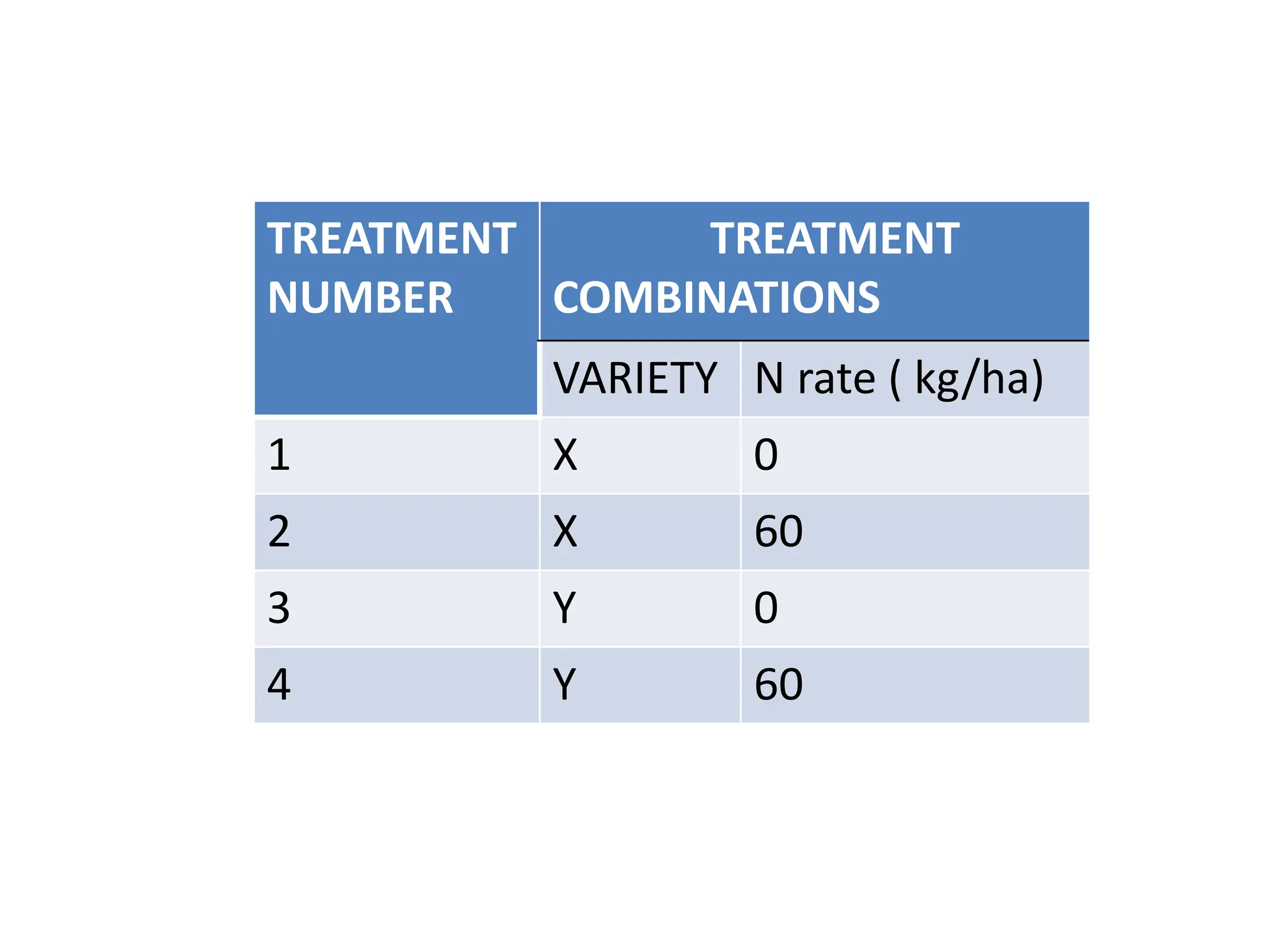
• Its treatments consist of the following four
possible combinations of the two levels in each of
the two factors
TREATMENT
NUMBER
TREATMENT
COMBINATIONS
VARIETY N rate ( kg/ha)
1 X 0
2 X 60
3 Y 0
4 Y 60
• If the 22 factorial experiment is expanded to
include a third factor, say weed control at two
levels, the experiment becomes a 2 x 2 x 2 or a 23
factorial
• The term complete factorial experiment is
sometimes used when the treatments include all
combinations of the selected levels of the
variable factors.
• In contrast, the term incomplete factorial
experiment is used when only a fraction of all the
combinations is tested.
6.ANALYSIS OF VARIENCE FOR CRD
1. Analysis of variance for CRD
• There are two sources of variation among the
n observations obtained from a CRD trial.
• One is the treatment variation, and the other
is experimental error.
• The treatment difference is said to be real if
treatment variation is sufficiently larger than
experimental error
2. Analysis of variance for RCBD
• There are three sources of variation among
the n observations obtained from a RCBD trial.
• Detail on how to do displayed well on the blackboard during class period
Comparing with tabulated F. value
• Obtain tabulated F value from Appendix E.
• Set the f1=treatment d.f ( t-1) and f2= error
d.f ( t(r-1)
• For our example f1 = 4 (read from horizontal
in bale of tabulated F value) and f2= 8 ( read
from vertical).
• Now if your check from table of tabulated F
value we get 3.84 at 5% and 7.01 at 1%
1.If the computed F value is larger than tabular F
value at the 1% the level of significance, the
treatment difference is said to be highly
significant.
• Such a result is generally indicated by placing
two asterisks (**) on the computed F value in
the analysis of variance.
2.If the computed F value is larger than the
tabular F value at the 5% level of significance
but smaller than or equal to the tabular F
value the 1% level of significance, the
treatment difference is said to be significant
• Such a result is indicated by placing one
asterisk (*) on thecomputed F value in the
analysis of variance.
3.If the computed F value is smaller than or
equal to the tabular F value at the 5%level of
significance, the treatment difference is said
to be non significant.
• Such a result is indicated by placing ns on the
computed F value in the analysis of variance.
• When 1% used, means chances are less than 1
in 100 that all the observed differences among
the seven treatment meanscould be due to
chance.
• Also when 5% used means chances are less
than 5 in 100
Coefficient of variation
• The cv indicates the degree of precision with
which the treatments are compared and is a good
index of the reliability of the experiment.
• It expresses the experimental error as percentage
of the mean; thus, the higher the cv value, the
lower is the reliability of the experiment.
• The cv varies greatly with the type of experiment,
the crop grown, and the character measured
comparing treatments differences
• The two most commonly used test procedures
for pair comparisons in agricultural research
are the least significant difference (LSD) test
which is suited for a planned pair comparison,
• And Duncan's multiple range test (DMRT)
which is applicable to an unplanned pair
comparison.
least significant difference (LSD)
• two treatments are declared significantly
different at a prescribed level of significance if
their difference exceeds the computed LSD
value;
• The procedure for applying the LSD test to
compare any two treatments
I. Compute the mean difference between t1 and
t2 treatment as: d= t1-t2
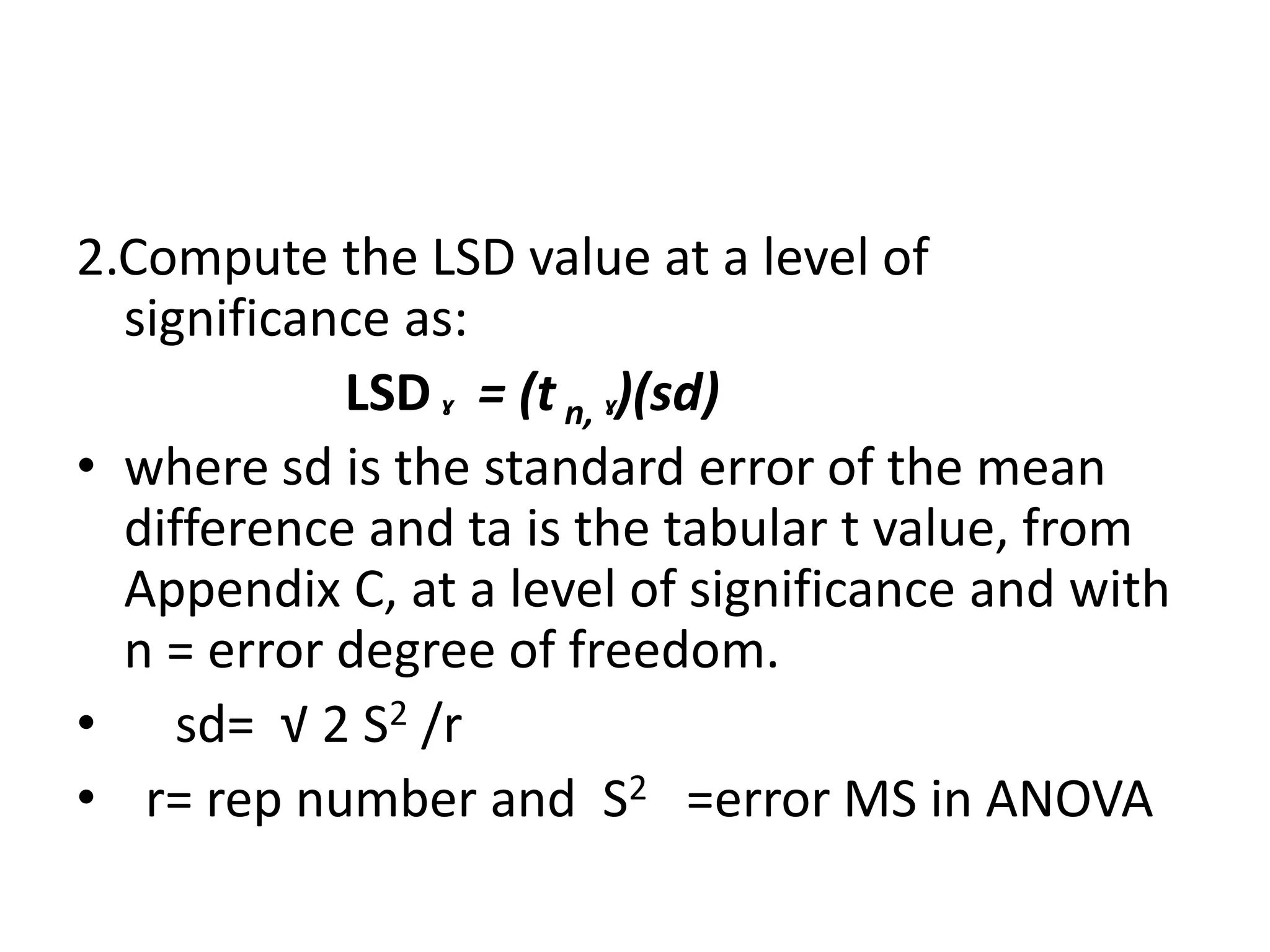
2.Compute the LSD value at a level of
significance as:
LSDˠ = (t n, ˠ)(sd)
• where sd is the standard error of the mean
difference and ta is the tabular t value, from
Appendix C, at a level of significance and with
n = error degree of freedom.
• sd= √ 2 S2 /r
• r= rep number and S2 =error MS in ANOVA
3. Compare means difference obtained in step 1
with the LSD value obtained in step 2.
• if value of means different is greater than LSD
value ,treatment are said to be significant
• Also we can apply the use of level of
significance ( 5% or 1%)
SCIENTIFIC/TECHNICAL REPORT
WRITING
1. Title of the article
2. Authors and their affiliated institutions
3. Abstract
4. Introduction( incorporating literature review)
5. Material and methods( methodology)
6. Results
7. Discussions
8. Conclusions
9. Recommendations
10.References or literature cited
1.Title of the article
-briefly identify the subject and indicates the
purpose of the study
2. Author and their affiliated institutes
- In case of co authorship, names should be written
in proper order. The first name should be
principal/senior author
3. Abstract
-it should have fair amount of details regarding the
nature, objectives, methodology, main results
obtained and major conclusion reached
4. Introduction
-it tell why the study is important and what exactly
the study is about. Introduction ends up with a
statement of study specific hypothesis or
hypothesis.
5.Materials and methods( methodology)
-it explain materials and methods used to control
the experiment with their detailed procedures. It
should be written in paragraph with little
repetition as possible
6. Results
-the section describe the results, it give factual
account of the findings
7.Discusion
-here references to other researchers did similar
work is made.
8.Conclusion
- States major inferences that can be drawn from
the discussion
9. Recommendations
-indicates any further work that needs to be done.
Identifies the alternative you think best solves or
improve the problem
10.References or list of literature cited
-some books , article or other reading materials
consulted during research progress
11. Appendices
-additional information that support but not
essential to explanations
FARMING SYSTEMS APPROACH
Concept
• Farming system is an integrated set of activities
that farmers perform in their farms under their
resources and circumstances to maximize the
productivity and net farm income on a sustainable
basis.
• The farming system takes into account the
components of soil, water, crops, livestock, labour,
capital, energy and other resources, with the farm
family at the centre managing agriculture and
related activities.
• Farming System is defined as a complex inter
related matrix of soil, plants, animals,
implements, power, labour capital and other
inputs controlled in part by farming families
and influenced to varying degrees by political,
economic, institutional and social forces that
operate at many levels.
• The farming system therefore, refers to the
farm as an entity of inter dependent farming
enterprises carried out on the farm”.
Need for Farming System Approach
• cost of farm inputs, fluctuation in the market
price of farm produce, risk in crop harvest due
to climatic vagaries and biotic factors.
• Environmental degradation, depletion in soil
fertility & productivity, unstable income of the
farmer, fragmentation of holdings and
• low standard of living add to the intensity of
the problem.
Why Farming Systems Approach
• To develop farm – house hold systems and
rural communities on a sustainable basis
• To improve efficiency in farm production
• To raise farm and family income
• To increase welfare of farm families and satisfy
basic needs.
Farming Systems approach
• In view of serious limitations on horizontal
expansion of land and agriculture,
• only alternative left is for vertical expansion
through various farm enterprises required less
space and time but giving high productivity
and ensuring periodic income
• This helps small and marginal farmers located
in rain fed areas, dry lands, arid zone, hilly
areas, tribal belts and problem soils.
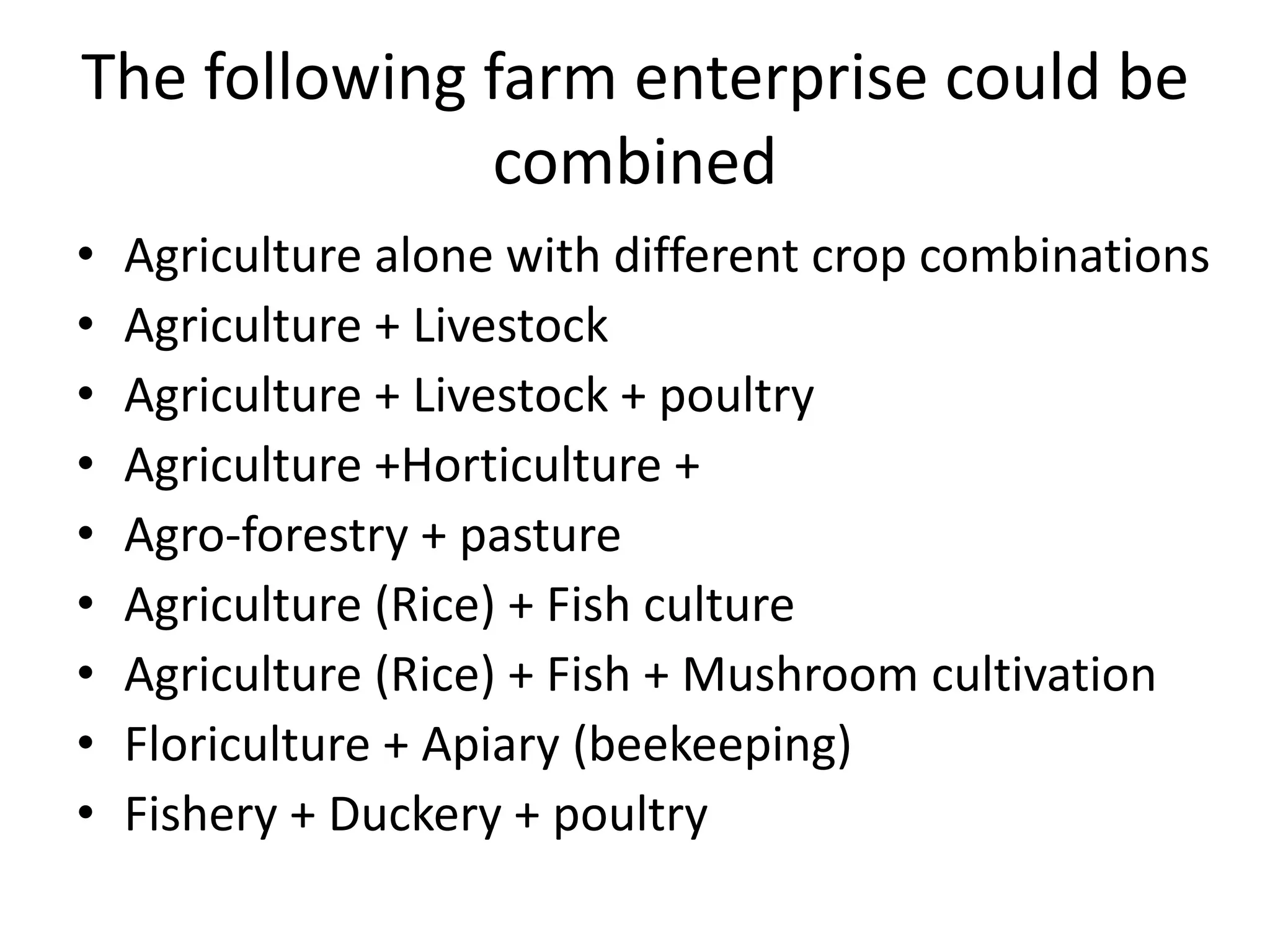
The following farm enterprise could be
combined
• Agriculture alone with different crop combinations
• Agriculture + Livestock
• Agriculture + Livestock + poultry
• Agriculture +Horticulture +
• Agro-forestry + pasture
• Agriculture (Rice) + Fish culture
• Agriculture (Rice) + Fish + Mushroom cultivation
• Floriculture + Apiary (beekeeping)
• Fishery + Duckery + poultry
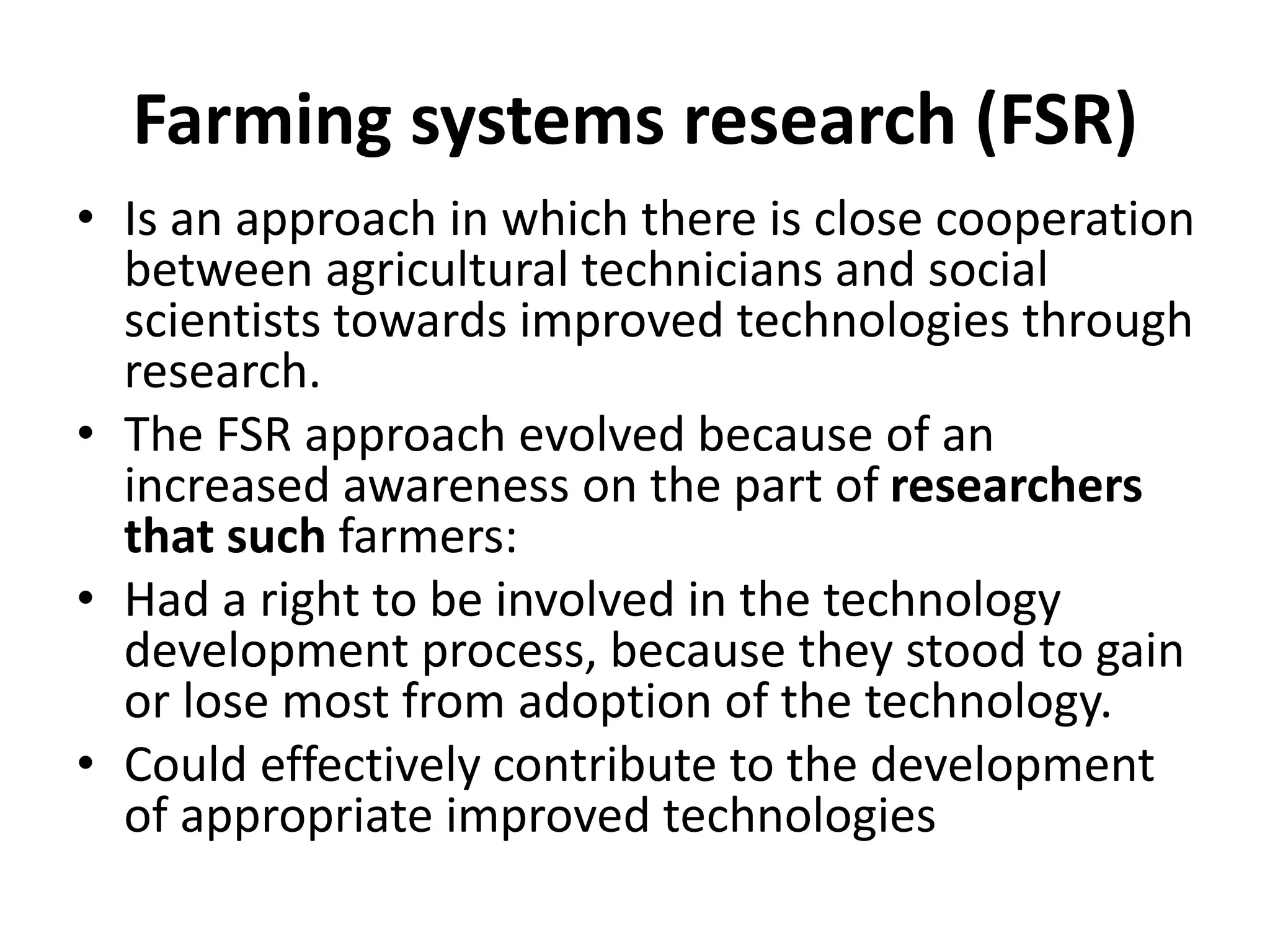
Farming systems research (FSR)
• Is an approach in which there is close cooperation
between agricultural technicians and social
scientists towards improved technologies through
research.
• The FSR approach evolved because of an
increased awareness on the part of researchers
that such farmers:
• Had a right to be involved in the technology
development process, because they stood to gain
or lose most from adoption of the technology.
• Could effectively contribute to the development
of appropriate improved technologies
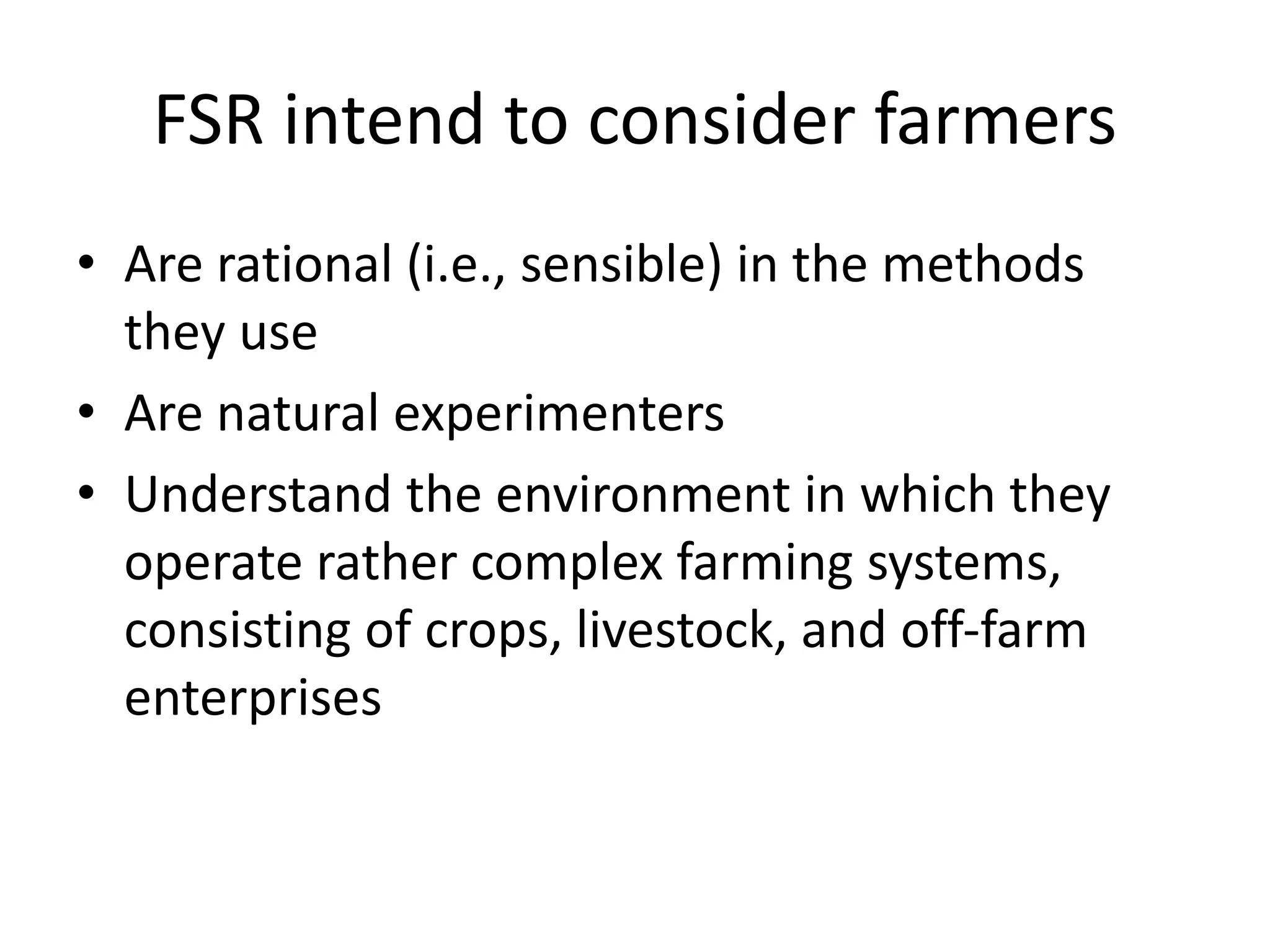
FSR intend to consider farmers
• Are rational (i.e., sensible) in the methods
they use
• Are natural experimenters
• Understand the environment in which they
operate rather complex farming systems,
consisting of crops, livestock, and off-farm
enterprises
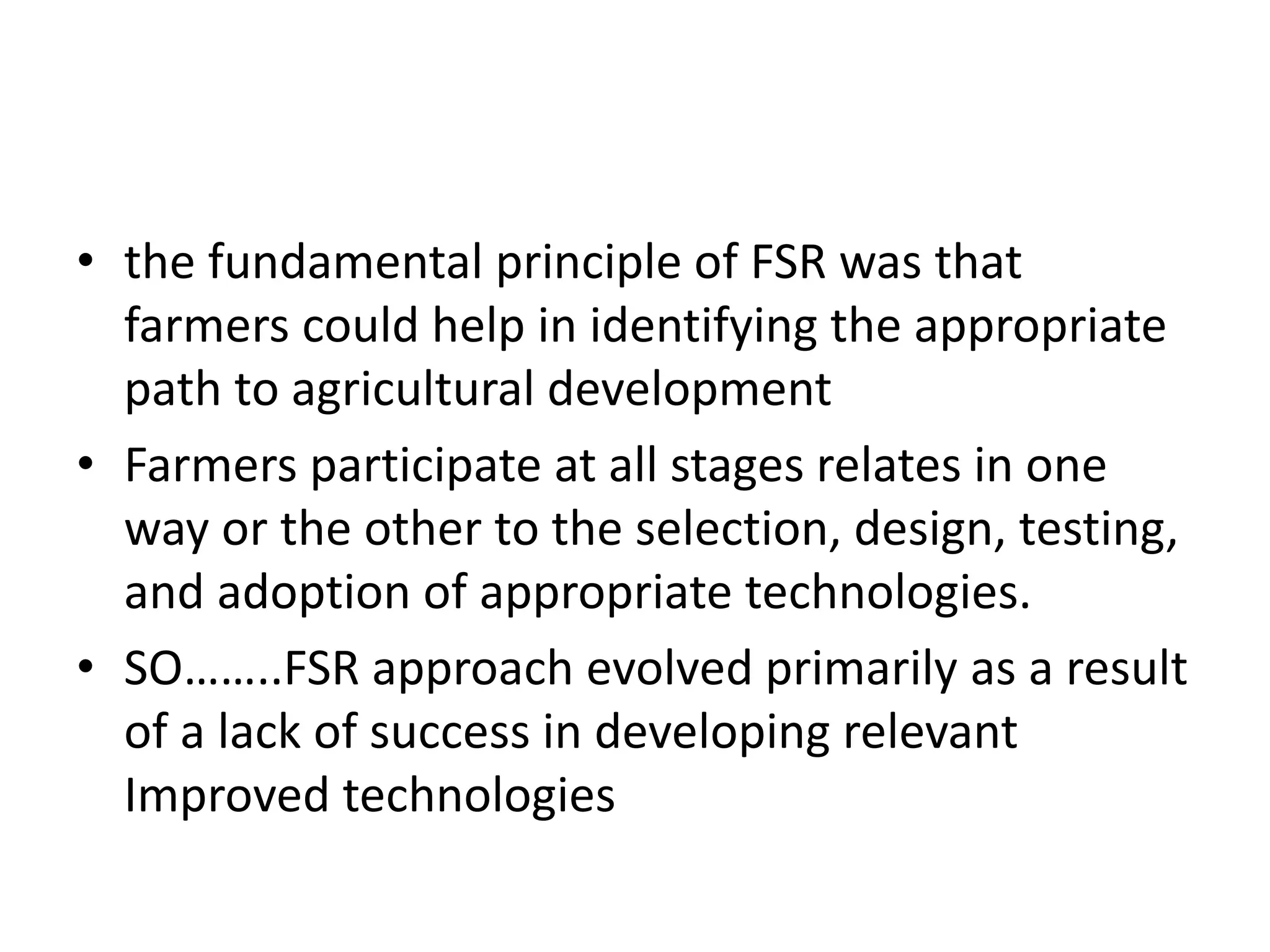
• the fundamental principle of FSR was that
farmers could help in identifying the appropriate
path to agricultural development
• Farmers participate at all stages relates in one
way or the other to the selection, design, testing,
and adoption of appropriate technologies.
• SO……..FSR approach evolved primarily as a result
of a lack of success in developing relevant
Improved technologies
farming systems research (FSR)
methodology
• The farming systems approach to development
(FSD) has two inter-related thrusts.
• One is to develop an understanding of the farm-
household, the environment in which it operates,
and the constraints it faces, together with
identifying and testing potential solutions to
those constraints,
• The second thrust involves the dissemination of
the most promising solutions to other farm
households facing similar problems
list of the steps involved in FSR should
include
• Selection of target areas and sub-areas.
• Selection of research areas.
• Selection of cooperators.
• Description and diagnostic-stage
• Design-stage activities.
• Testing and implementation stage
• Dissemination and impact evaluation stage
i).Selection of target areas and sub-
areas
• Generally, the selection of a target area for a
FSR programme is made by national decision
makers, usually in Ministries of Agriculture or
their equivalent,
• is completed before FSR team members have
been assembled to begin organizing FSR work.
• To meet the needs of the people living there
and/or To take advantage of the agricultural
potential of the area
ii). Selection of research areas.
• After the target area has been chosen, a
research area or areas within the target area
will be identified. This selection is usually
made by members of the FSR team as one of
their first activities in the field,
• factors to consider Representativeness of the
Research Area, Accessibility, Cooperation of
Farmer Contact Agencies and Leader Support
etc
iii). Selection of cooperators
• in identifying individuals to be interviewed or
individual fields for experimental purposes is the
selection of participating farmers.
• This selection is made by FSR team members but
often may be improved by consulting with local
authorities, agents, etc
• Participating farmers need to be selected at the
beginning of every season or at the start of any
new research initiative.
• The cooperating unit may be a dwelling unit, a
farming household, or specific members within a
household
iv) The Descriptive or Diagnostic Stage,
• Actual farming system is examined in the
context of the total environment to
identify constraints farmers face and to
determine the potential flexibility in the
farming system in terms of timing,
unused resources, etc.
• The aim is to identify the constraints limiting
farm productivity and production and hindering
improvement in the welfare of the farm
households themselves.
• An effort also is made to understand the goals
and motivation of farmers that may affect
their efforts to improve the farming system
• Potential solutions to these problems are
identified, and the results of this analysis
formulated as suggestions for further action
then are passed on to the relevant 'actors'.
• These could include researchers, extension
and support service staff, or policy makers.
v) The Design Stage,
• in which a range of strategies/approaches are
identified that are thought to be relevant in
dealing with the constraints determined in the
descriptive or diagnostic stage.
• , the process involves the development of ideas
and little field work.
• visiting scientists and cooperating colleagues
from other agencies often have contributed ideas
to FSR to be better
• Trials and Surveys to quantify farmers' attitudes
or preferences are needed to help in prioritizing
what should be tested
vi) The Testing and Implementation
Stage,
• in which one or more promising strategies/
approaches arising from the design stage, are
examined and evaluated under term
conditions to determine their suitability for
producing desirable and acceptable changes in
the existing farming system.
vii) The Dissemination and Impact
Evaluation Stage,
• in which the strategies that were identified
and screened during the design and testing
stages are extended to farmers.
• In terms of activities at this stage,
impact/adoption studies can be very
important
TESTING HYPOTHESIS
Introduction
• Often in real life we take observations on a
sample with a specific question in mind.
• Hypothesis testing is another way of data
analysis. It begins with some theory, claim,or
assertion about a particular parameter of a
population.
• The theories or claims we have in our mind
are what we call hypothesis
• view to choose between two conflicting
hypotheses about the value of a population
parameter.
• Hypothesis testing helps to decide on the
basis of a sample data, whether a hypothesis
about the population is likely to be true or
false
• Hypothesis simply means a mere assumption
or some supposition to be proved or
disproved OR prediction or a tentative
answers to be tested by scientific methods,
• logical supposition, a reasonable guess which
may give direction to thinking with respect to
the problem and, thus aid in solving it.
• If we are to compare method A with method B
about its superiority and if we proceed on the
assumption that both methods are equally good,
then this assumption is termed as the null
hypothesis.
• As against this, we may think that the method A
is superior or the method B is inferior, we are
then stating what is termed as alternative
hypothesis
• The null hypothesis is generally symbolized as H0
and the alternative hypothesis as Ha.
example
• Researcher can suppose that, the average
waiting time for donkey to give birth is 9
months
HO: µ= 9months
Ha: µ ‡ 9months
or (Ha: µ ˂ 9months or Ha: µ ˃9months)
• A formal procedure for deciding between H0
and Ha is called a hypothesis test or test of
significance.
• Hypothesis can be tested using various test
Statistics. The important test Statistics are: (1) z-
test; (2) t-test; (3) X2-test, and (4) F-test.
• The calculated test statistic value (under a
specified level of significance) is then
compared with the tabulated test statistic in
order to reject or accept the null hypothesis.
Important test Statistics
• X2 -test is based on chi-square distribution and as
a parametric test is used for comparing a sample
variance to a theoretical population variance.
• F-test is based on F-distribution and is used to
compare the variance of the two-independent
samples. It used for analysis of variance
• z-test is based on the normal probability
distribution and is used for judging the
significance of several statistical measures,
particularly the mean.
• t-test is based on t-distribution and is
considered an appropriate test for judging the
significance of a sample mean or for judging
the significance of difference between the
means of two samples in case of small
sample(s) when population variance is not
known (in which case we use variance of the
sample as an estimate of the population
variance).
• Alternative hypothesis is usually the one
which someone wishes to prove and the null
hypothesis is the one which someone wishes
to disprove.
• Thus, a null hypothesis represents the
hypothesis we are trying to reject, and
alternative hypothesis represents all other
possibilities.
1.The level of significance
• This is very important concept in the context of
hypothesis testing.
• It is always some percentage (usually 5% or 1%)
which should be chosen with great care, thought
and reason.
• In other words, the 5 per cent level of significance
means that researcher is willing to take as much as
a 5% risk of rejecting the null hypothesis when it
happens to be true. Like wise to 1%
• Thus the significance level is the maximum
value of the probability of rejecting (Ho) when
it is true and is usually determined in advance
before testing the hypothesis.
2.Decision rule or test of hypothesis:
• Given a hypothesis H0 and an alternative
hypothesis Ha,
• we make a rule which is known as decision
rule according to which we accept H0 (i.e.,
reject Ha) or reject H0 (i.e., accept Ha).
3.Type I and Type II errors:
• In the context of testing of hypotheses, there are
basically two types of errors we can make.
• We may reject H0 when H0 is true and we may
accept H0 when in fact H0 is not true.
• The former is known as Type I error and the
latter as Type II error. In other words,
• Type I error means rejection of hypothesis which
should have been accepted and Type II error
means accepting the hypothesis which should
have been rejected.
• Type I error occurs when the null hypothesis (H0)
is rejected when in fact it is true and should not
be rejected. On the other hand, a
• Type II error occurs when the null hypothesis H0
is not rejected when in fact it is false and should
be rejected.
• Type I error is denoted by a (alpha) known as a
error, also called the level of significance of test;
and Type II error is denoted by b (beta) known as
b error.
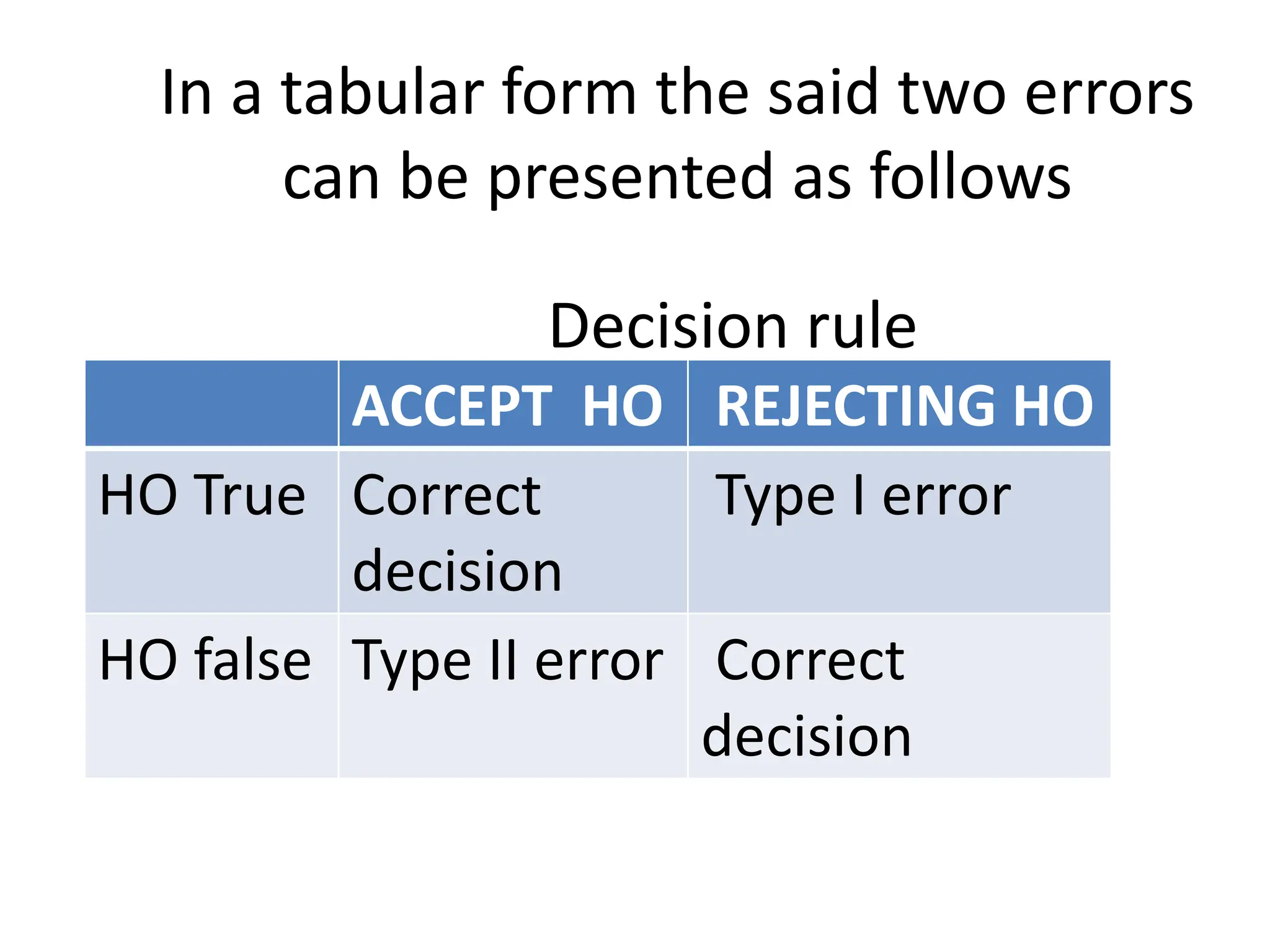
In a tabular form the said two errors
can be presented as follows
ACCEPT HO REJECTING HO
HO True Correct
decision
Type I error
HO false Type II error Correct
decision
Decision rule
• In order to make a choice of whether to reject
or accept the null hypothesis we need based
on sample information, compute the value of
a test statistic, which will tell us what action to
take.
• A test statistic is a function of the sample
information that is used as a basis for deciding
between H0 and H1.
• For example, . Z= x-µ/ σ/ a test statistic.
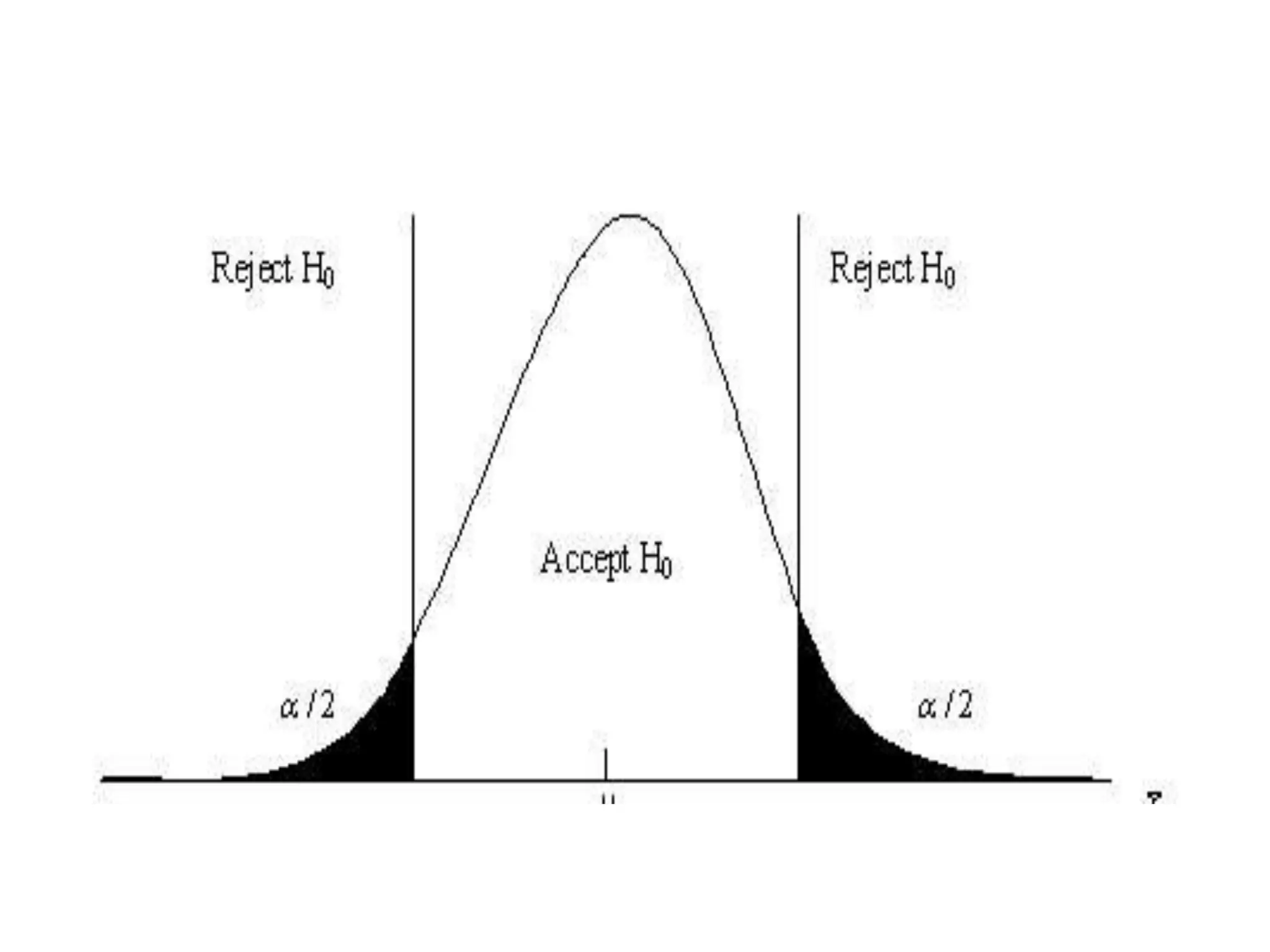
• In testing hypothesis we partition the possible
values of the test statistic into two subsets:
• an acceptance region for H0 and a rejection
region for Ha
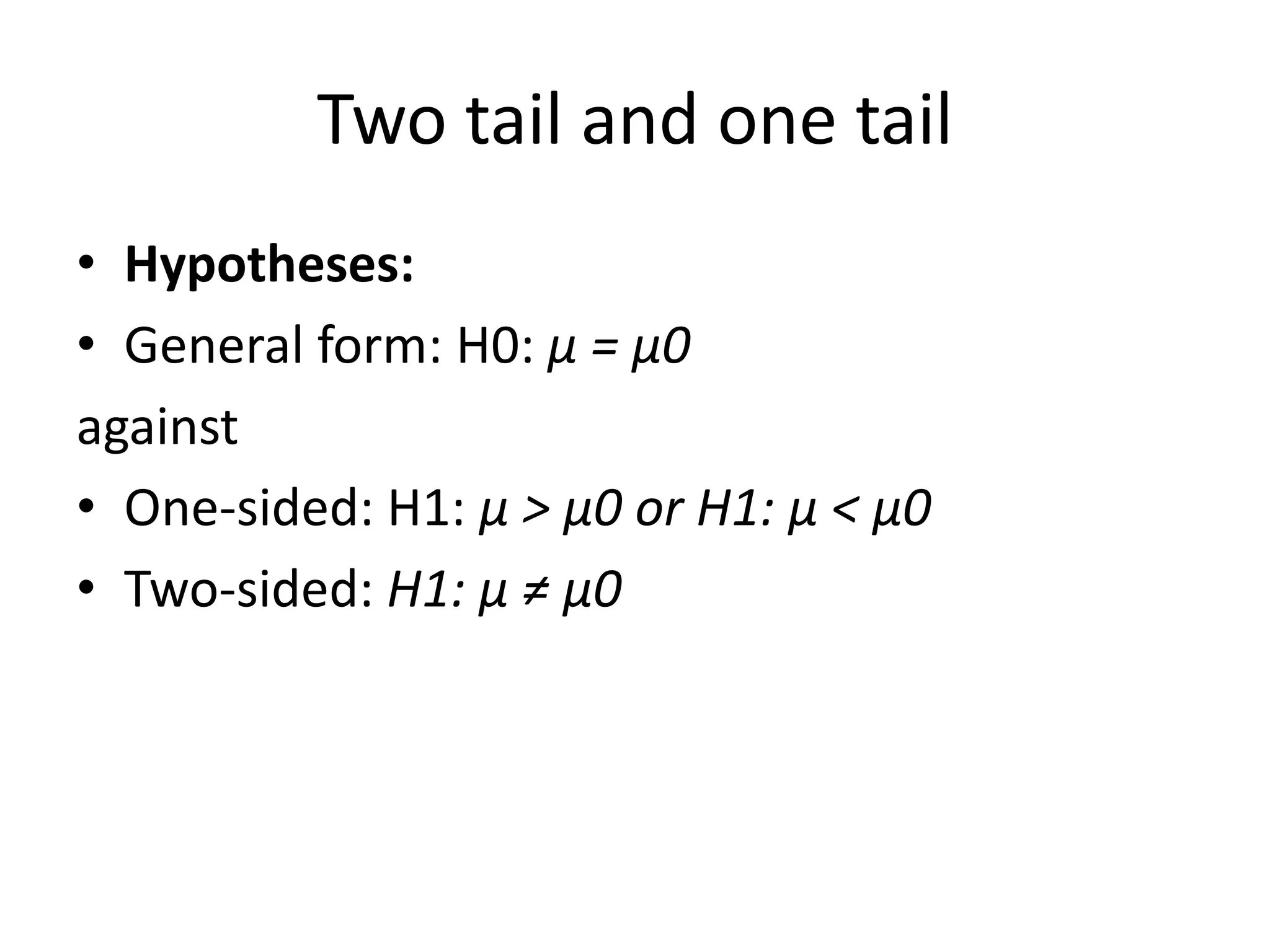
Two tail and one tail
• Hypotheses:
• General form: H0: μ = μ0
against
• One-sided: H1: μ > μ0 or H1: μ < μ0
• Two-sided: H1: μ ≠ μ0
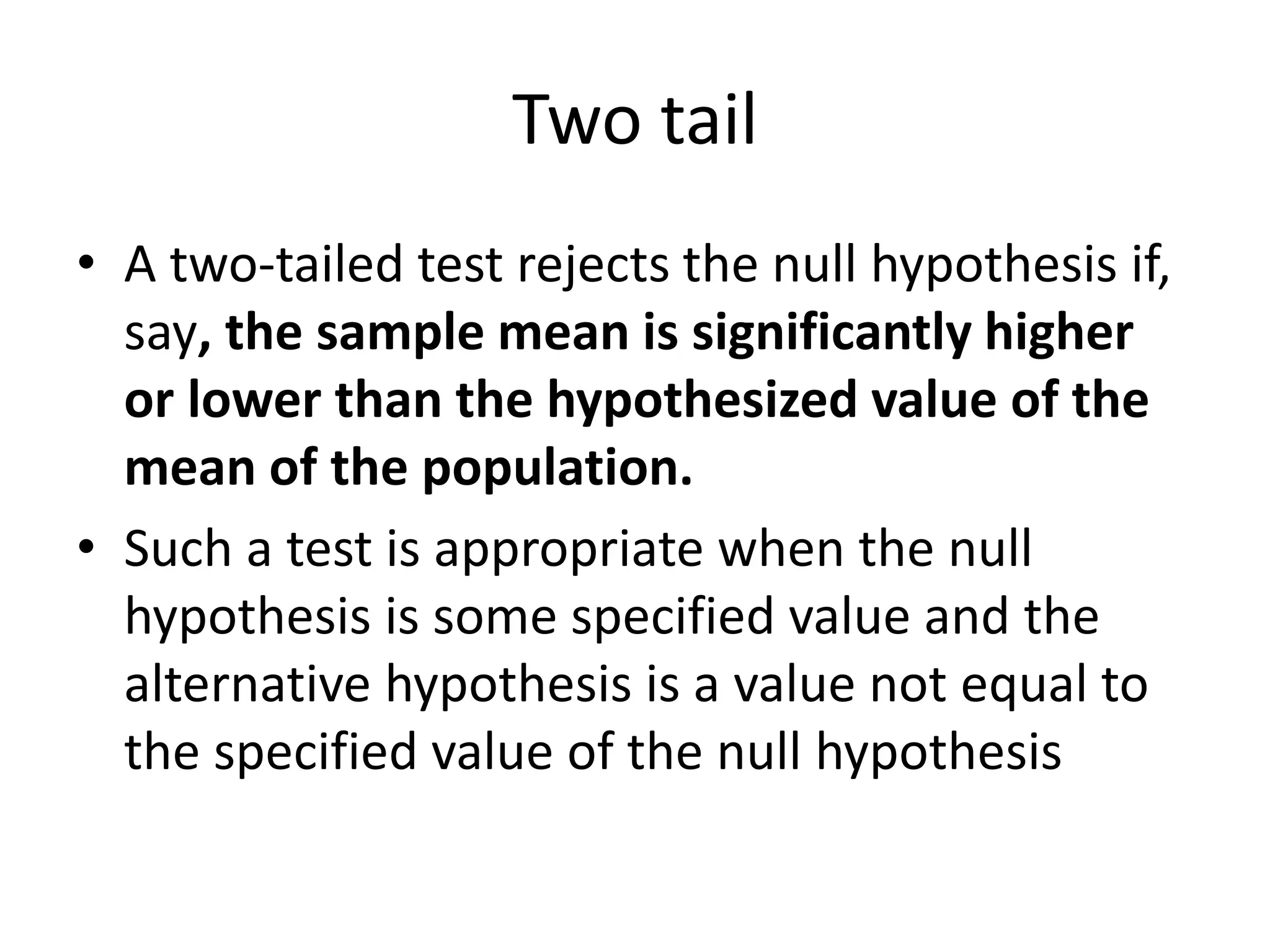
Two tail
• A two-tailed test rejects the null hypothesis if,
say, the sample mean is significantly higher
or lower than the hypothesized value of the
mean of the population.
• Such a test is appropriate when the null
hypothesis is some specified value and the
alternative hypothesis is a value not equal to
the specified value of the null hypothesis
• A two-tailed test, also known as a non
directional hypothesis, is the standard test of
significance to determine if there is a
relationship between variables in either
direction.
• Two-tailed tests do this by dividing the 0.05 in
two and putting half on each side of the bell
curve.
A one-tailed test
• A one-tailed test would be used when we are
to test, say, whether the population mean is
either lower than or higher than some
hypothesized value.
• For instance, if our H0: m = m and Ha H : m <
m 0
• then we are interested in what is known as
left-tailed test (wherein there is one rejection
region only on the left tail)
One-Tailed Test
• Also we can have right sided on tail or left sided
.The level of significant is not divided
• A one-tailed test, also known as a directional
hypothesis, is a test of significance to determine
if there is a relationship between the variables in
one direction.
• A one-tailed test is useful if you have a good
idea, usually based on your knowledge of the
subject, that there is going to be a directional
difference between the variables.
• Often in real life we take observations on a
sample with a specific question in mind.
• Hypothesis testing is another way of data
analysis. It begins with some theory, claim,
• or assertion about a particular parameter of a
population.
PROCEDURE FOR HYPOTHESIS TESTING
(i) Making a formal statement:
• The step consists in making a formal
statement of the null hypothesis (H0) and also
of the alternative hypothesis (Ha).
• This means that hypotheses should be clearly
stated, considering the nature of the research
problem.
(ii) Selecting a significance level:
• The hypotheses are tested on a pre-
determined level of significance and as such
the same should be specified.
• Generally, in practice, either 5% level or 1%
level is adopted for the purpose
The factors that affect the level of
significance are:
(a) the magnitude of the difference between
sample means;
(b) the size of the samples;
(c) the variability of measurements within
samples;
(iii) Deciding the distribution to use:
• After deciding the level of significance, the
next step in hypothesis testing is to determine
the appropriate sampling distribution.
• The choice generally remains between
normal distribution and the t-distribution.
(iv) Selecting a random sample and
computing an appropriate value:
• Another step is to select a random sample(s)
and compute an appropriate value from the
sample data concerning the test statistic
utilizing the relevant distribution.
• In other words, draw a sample to furnish
empirical data.
(v) Calculation of the probability:
• One has then to calculate the probability that
the sample result would diverge as widely as it
has from expectations,
• It involves to know if the null hypothesis were
in fact true.
(vi) Comparing the probability:
• Yet another step consists in comparing the
probability thus calculated with the specified
α value , the significance level.
• If the calculated probability is equal to or
smaller than the α value in case of one-tailed
test (and a α /2 in case of two-tailed test),
then reject the null hypothesis (i.e. accept the
alternative hypothesis
• but if the calculated probability is greater,
then accept the null hypothesis.
• In case we reject H0, when it is true
committing Type I error, but if we accept H0,
when it is false we committing Type II error .
PRINCIPLES OF AGRICULTURAL EXPERIMENTATION1

PRINCIPLES OF AGRICULTURAL EXPERIMENTATION1

  • 1.
    PRINCIPLES OF CROPS EXPERIMENTATION CODE:APT06210 CREDITS: 12 TUTOR: TRIPHONIA NDENDYA 2022/2023
  • 2.
    1.0 INTRODUCTION An experiment:is defined as the systematic procedures carried under controlled condition, in order to discover new idea or test hypothesis. • OR is an investigation set up to provide answers to question or questions of interest. For example: We may wish to conduct experiment to test the efficiency of using organic manure (goat manure) in groundnut production or different inorganic fertilizers at different rates or different spacing. • Experiment is more likely to involve comparison of treatments, for example methods, varieties, spacing etc.
  • 3.
    Cont.. • However insome cases experiments do not involve comparison of one treatment with the other treatments, hence experiment can be absolute or comparative • If we conduct the experiment to examine the usefulness of the newly developed fungicide for controlling certain plant disease without comparing its effect with other fungicides, the experiment will be an absolute experiment. • If we conduct the experiment to assess the effectiveness of one fungicide as compared to the effect of other fungicides on controlling plant disease, then the experiment is said to be comparative experiment.  Experimentation: it involves designing and testing of different factors of interest using experiments.
  • 4.
    • The majorconcern of experiment: The primary concern in any experiment is to accurately estimate or compare effects of certain factors or treatments on the productive or physiological performance of plants.
  • 5.
    A factor • isa variable which is believed to affect the outcome of the experiment. Factors are also called test materials. • Factors in agricultural experiments are simply identifiable as categories of inputs or management practices. • Example of factors for crop experiments are varieties, fertilizers, herbicides etc.
  • 6.
     Level • Thevarious values or classifications of the factors are known as the levels of the factor (s) • Is individual settings /conditions of factor. Factors Levels Nitrogen rate 0kgN/ha,80kgN/ha,100kgN/ha Spacing 90x30cm,75x50cm, 75x60cm Variety SARO,IR64,NERICA -1 Planting date Feb, March, April, e.tc
  • 7.
    • NB: Afactor is usually expressed by capital alphabet and its level by the same alphabet with suffixes. • Its good idea to use alphabets which help one to understand what these alphabets stands for. E.g. when comparing varieties you may use V1,V2,V3…Nitrogen rates, N1,N2,N3.. And Spacing….S1,S2, S3
  • 8.
     Treatment orTreatment combination • is one or more things that are compared or investigated in an experiment. OR • It is a dosage/ amount of materials or procedure which is to be tested in experiment. • Example: In experiment involved spacing trial [a factor] and a fertilizer trial[another factor], now trial treatments can be:- • Planting at 75x60cm with 60kgs N/ha. • Planting at 25x10cm with 20 kgs N/ha
  • 9.
    • NB: Totalnumber of treatments is the product of levels in each factor. • For above example will be: [2 factors] x[2 level] = 4 treatments
  • 10.
    Variable(s) • is anyquantitative or attribute whose values varies from one unit of investigation to another. • A variable is a characteristic that changes from unit to unit or one individual to another individual. • They shows variability Example :plant heights, weights, pod height, number of flowers, fruit height, etc.
  • 11.
    Experimental unit: • Isthe unit of experimental material to which the application of the treatment is made and on which the variable under study is measured. Or • Are the pre-determined plots or the blocks where different treatments are applied. Such experimental units must be selected (defined) very carefully. • Examples, a plot in agricultural experiments and petri dish in laboratory experiments. • Experimental unit measures the effectiveness of factor or treatment.
  • 12.
    Experimental area: • Isthat area where the experiment is to be conducted. • It can divided to form replicates and that replicates divided to form experimental units. • It is selected from an experimental site.
  • 13.
     Experimental factors(variables): • These are factors that are of experimental interest which tend to vary from one treatment to another. Non-experimental factors (variables): • These are factors that are not of experimental interest. • These are factors which remain fixed or applied uniformly over the trial.
  • 14.
    Control: • It isused to restrain experimental conditions. • Experimental unit does not receive any treatment, but the effectiveness of other treatments should be found through comparison with that control. Response (output of experiment): This is the numerical results observed for a particular experimental unit. e.g. (grain yield) one may be interested to know the amount of a grains in kg produced when different types of fertilizers are applied to a piece of land.
  • 15.
    Population: • It isthe aggregate from which the sample is chosen for measurement of particular variable. For example total number of maize plants in the field of 1 acre.  Sample: • It is a part of population used as a substitute for population, e.g. measuring 10 plants in each plot of maize experiment. • The value obtained from 10 plants represents the rest of plants in a given plot.
  • 16.
    Sampling unit: • Isthe unit on which actual measurement is made, e.g. 10 plants in a 10mx5m maize plot. It is potential member of the sample. Data: • is the set of values assigned to response variable or set of quantitative values obtained by measuring or counting.
  • 17.
    The purpose ofresearch • The purpose of research is to discover answers to questions through the application of scientific procedures. • To find out the truth which is hidden and which has not been discovered yet. • To test a hypothesis of a causal relationship between variables (such studies are known as hypothesis-testing research studies). • To address different production problems which face farmers through development of appropriate technologies. E.g. new crop varieties, new animal feeds, appropriate animal housing, e.tc.
  • 18.
    • To portrayaccurately the characteristics of a particular individual, situation or a group (studies with this object in view are known as descriptive research ); • To determine the frequency with which something occurs or with which it is associated with something else (studies with this object in view are known as diagnostic research );
  • 19.
    Principles of experimentation I.There must be clear statement of research aims, which defines the research question. II. There must be information sheet for participants, which sets out clearly what the research is about, what it will involve ,which laid down prior to research beginning III. The methodology is appropriate to the research question , if is qualitative or quantitative
  • 20.
    iv. The researchshould be carried out in an unbiased fashion. researcher should not influence the results of the research in any way. v. From the beginning, the research should have appropriate and sufficient resources in terms of people, time, transport, money e.t.c vi. People conducting the research should be trained in research and research methods vii. All research should be ethical and not harmful in any way to the participants.
  • 21.
    2.TYPES OF EXPERIMENTAND SURVEY • There are three basic types of experiment in agriculture, which are i. Exploratory experiment: these types of experiment seek to better define and characterize a particular production problem. Used to find causes to problem and problem prioritization. ii. Determinative experiments: test possible solutions to a production problem that is well understood.
  • 22.
    iii. Verification experiments: •used to test technology in larger scale and in wide range of circumstances. • These kind of experiment are meant to publicize the positive attributes of treatments (demonstration plots may be used).experiment on these category are usually on-farm
  • 23.
    Survey • A surveyis the gathering and analysis of information about a topic, an area or a group of people • Surveys can be an economical and efficient tool for collecting information, attitudes and opinions from many people and for monitoring project/program’s progress. • When designed and administered correctly, the information collected can be a true reflection of opinions held by the group from which you want information • However, a high level of knowledge and skill is needed to design and implement a good quality survey.
  • 24.
    Types of survey i.Formal(structured) survey: • is a kind of survey which collect standardized information from carefully selected sample. • They use questionnaires in which the wording of the questions and the order in which they are asked is fixed. • They are have a specific direction from begin up to the end • The data from structured interview are easy to compare and analyzed statistically.
  • 25.
    ii. Informal(Unstructured) survey: •They use questionnaire / checklist which are not standardized and not ordered in a particular way to collect information. • They have no specific direction in way they performed, question asked respondent depend on previous answer of respondent • It is particularly useful for exploratory research where lines of investigations are Cleary defined. • It provides opportunity to explore the various aspects of the problem in an unrestricted manner
  • 26.
    There are ninesteps to conducting a survey, including: 1: Decide what you want to find out 2: Decide /Select a sample to survey 3: Select survey types and method 4: Write the survey questions 5: Trial the survey questions 6: Conduct survey 7: Analyze information 8: Interpret data 9: Report findings
  • 27.
    1.Decide what youwant to find out • The first decision to be made is what information do we need to collect. Means a topic to deal • What do the survey questions need to determine 2.Decide /Select a sample to survey • As it is not usually possible to survey the whole community, you will need to survey a sample that represents the group. • The sample needs to be representative of the people you really want to talk to so that as little bias as possible occurs.
  • 28.
    3.Select the surveytype & method • The survey type determines the way a survey is to be conducted, what is to collected and what is to recorded. • The type of survey used depends on the type of information you want, how much information can be analyzed and the time and resources available. • A combination of survey types and method can also be used.
  • 29.
    There are threecommon methods of surveys: a. Self-completed questionnaires • Are most commonly presented as written questions on paper. • The questions are completed or ‘filled in’ by the participant, usually without any assistance from the people who designed the questionnaire. c. Face-to-face interviews • Involve an interviewer asking questions verbally to an individual ( interviewee) personally. b. Telephone surveys • Involve an interviewer asking questions verbally to a single, anonymous individual over the phone.
  • 30.
    4.Write down thesurvey questions • Questionnaires should be designed to be attractive, easily understood, easily answered and to give you the required information. • This step looks at: i. the types of questions to ask ii. how to design questions iii. sequencing and presentation of questionnaires
  • 31.
    4.i.The types ofquestions to ask • There are two main types of questions: a. open-ended b. closed-ended. a. Open-ended questions • Are questions that can have unexpected answers as they allow the answer to be left entirely to the respondent so they can express their feelings without restriction. • They can generate a wide range of replies • Open-ended questions give ‘qualitative’ information
  • 32.
    Example Qn 1. Inyour village there is decrease in crop production? …………………………………………………………………………… …………………………………………………………………………… …………………………………………………………………………… …………………. Qn. 2 what to be done in order to increase crop production in your village?................................................................... ............................................................................... .........................................................
  • 33.
    b. Closed-ended. • Closed-endedquestions are questions followed by a list of answers and a format for making an answer • Closed-ended questions provide ‘quantitative’ information that can be counted. • The information can be discussed in terms of numbers, frequencies, and percentages.
  • 34.
    Example Question 1. Areyou a farmer ? YES ⃝ NO ⃝ Question 2. Have you practiced farming activities ? YES ⃝ NO ⃝ Question 3. Farmers in your village they prefer to produce which category of crops ? i. Annual crops ⃝ ii. Perennial crops ⃝
  • 35.
    Reading assignment 1. Outlinethe advantages and disadvantages of open ended questions 2. Outline the advantages and disadvantages of close ended questions
  • 36.
    5: Trial thequestionnaire or interview questions • A trial or pilot study refers to testing or having a practice run of the questionnaire or interview. • Circulate the questionnaire among colleagues, friends and a variety of people to get their opinion • It is also necessary to choose a small number of the actual target group • Incorporate any valid suggestions into the questionnaire design.
  • 37.
    Testing is doneto ensure: • the information you receive is the information you set out to get • there are no unexpected weakness or imperfections • the information you obtain can be interpreted
  • 38.
    6: Conduct thesurvey • It is the point when the survey is done • It may involves Election of a questionnaire coordinator, Organise questionnaire distribution, Organise questionnaire returns and Send reminder notices for self-completed questionnaires
  • 39.
    7.Analyse the data •An analysis and discussion is necessary to make sense of the data collected. • The method of analysis used depends on the type of data gathered. 8.Interpreting results • When interpreting what the results of the survey mean, it is important not to generalise too much. • It is also important to recognise and acknowledge any possible bias in the results. Not all people in the community have been asked (only a representative sample),
  • 40.
    10: Report thefindings • It is important that information gathered is given back to the community from which the information was obtained. Or to extension institute • The survey results should also be given to and used by relevant decision-makers. • In the report, it is important to recognise and discuss any difficulties or problems that might affect the interpretation and generalisation of the findings.
  • 41.
    Practical 1 • Conducta survey and collect data
  • 42.
    SAMPLING • What issampling……….?????? • There are two ways of choosing a sample: A. Probability sampling: is the one in which every member in a population have equal chance to be selected. B. Non probability/intention: is the one in which the sampler or investigator decide in advance the factor that will determine whether a particular unit/ member of population should be included in the sample. Not all member has equal chance to participate in the sample.
  • 43.
    A:Probability sampling techniques •It includes the following sub techniques I. Simple random sampling II. Systematic sampling III. Cluster sampling IV. .Stratified sampling
  • 44.
    • SIMPLE RANDOMLYSAMPLING • Is the method of obtaining sample where every individual of a population is chosen randomly by chance. Every individual has the same probability of being chosen to be part of a sample. • SYTEMATIC SAMPLING. • Researcher divide the entire population into strata or subgroup within a population. Each sub group is separated from the others on the basis of a common characteristics such as gender, sex, religion age. • For example if you are dividing a students population by its course engineers, linguistics, and education, • SYSTEMATIC SAMPLING. • Researcher use this method to choose the samplSe members of a population at regular intervals it requires selecting a starting point for the sample and sample size determination that can be repeated at regular interval eg.
  • 45.
    Sample of 500peoplefrom population of 5000. he/she numbers the population from 1-5000 and will choose every 10th individual to be part of sample. • Total population/sample size • =5000/500 =10
  • 46.
    • CLUSTER SAMPLING. •Is the method in which the researcher divides the population into smaller groups called clusters and then randomly select some of these cluster as your sample. • Uses of probability sampling • 1. Reduce sample bias. • 2. Used in diverse population. • 3. Create an accurate sample.
  • 47.
    B:Non probability sampling •It includes the following sub techniques I. Accidental sampling: II. Quota sampling III. Purposive or judgmental sampling
  • 48.
    3.IMPORTANT CONCEPTS AND DEFINITIONS i.Experiment: • Is an investigation set up to provide answers to a question or questions of interest. OR • Is the process of examining the truth of a statistical hypothesis, relating to some research problem. • For example, an experiment conducted to test the efficiency of a certain newly developed drug for curing a certain skin condition in animals.
  • 49.
    ii. Experimental Designor Designing of an Experiment: • A design is a plan/ framework for obtaining relevant information to answer the research question of interest. • In other words, it can be defined as the complete sequence of steps laid down in advance to ensure that the maximum amount of information relevant to the problem under investigation will be collected. • Example RCBD, RCD, Split plot
  • 50.
    iii. A factor •is a variable which is believed to affect the outcome of the experiment. Factors are also called test materials. • Factors in agricultural experiments are simply identifiable as categories of inputs or management practices. • Example of factors for crop experiments are varieties, fertilizer, herbicide and for livestock can be pastures, vaccines and breed
  • 51.
    iv. Level • Thevarious values or classifications of the factors are known as the levels of the factor (s) • Is individual settings /conditions of factor Factor LEVEL Nitrogen rate 0kgN/ha,80kgN/ ha,100kgN/ha Spacing 90x30cm,75x50c
  • 52.
    • NB: Afactor is usually expressed by capital alphabet and its level by the same alphabet with suffixes. • Its good idea to use alphabets which help one to understand what these alphabets stands for. E.g. when comparing varieties you may use V1,V2,V3…Nitrogen rates, N1,N2,N3.. And Spacing….S1,S2, S3
  • 53.
    v. Treatment orTreatment combination • is one or more things that are compared or investigated in an experiment. • It is a dosage/ amount of materials or procedure which is to be tested in experiment. • Example: In experiment involved spacing trial [a factor] and a fertilizer trial[another factor], now trial treatments can be:- • Planting at 75x60cm with 60kgs N/ha. • Planting at 25x10cm with 20 kgs N/ha
  • 54.
    • NB; Totalnumber of treatments is the products of levels in each factor. • For above example will be [2factors] x[2level] =4treatments
  • 55.
    vi. Experimental unit: •Is the unit of experimental material to which the application of the treatment is made and on which the variable under study is measured. Or • Are the pre-determined plots or the blocks where different treatments are applied. Such experimental units must be selected (defined) very carefully. • Examples, a plot in agricultural experiments and petri dish in laboratory experiments. • Experimental unit measures the effectiveness of factor or treatment.
  • 56.
    vii. Experimental area: •Is that area where experiment is to be done. • It can divided to form replicates and that replicates divided to form experimental units • It is selected from an experimental site
  • 57.
     Experimental factors(variables): • These are factors that are of experimental interest which tend to vary from one treatment to another. Non-experimental factors (variables): • These are factors that are not of experimental interest. • These are factors which remain fixed or applied uniformly over the trial.
  • 58.
    Control: • It isused to restrain experimental conditions. • Experimental unit does not receive any treatment, but the effectiveness of other treatments should be found through comparison with that control. Response (output of experiment): This is the numerical results observed for a particular experimental unit. e.g. (grain yield) one may be interested to know the amount of a grains in kg produced when different types of fertilizers are applied to a piece of land.
  • 59.
    Population: • It isthe aggregate from which the sample is chosen for measurement of particular variable. For example total number of maize plants in the field of 1 acre.  Sample: • It is a part of population used as a substitute for population, e.g. measuring 10 plants in each plot of maize experiment. • The value obtained from 10 plants represents the rest of plants in a given plot.
  • 60.
    Sampling unit: • Isthe unit on which actual measurement is made, e.g. 10 plants in a 10mx5m maize plot. It is potential member of the sample. Data: • is the set of values assigned to response variable or set of quantitative values obtained by measuring or counting.
  • 61.
    xiii) Analyze: • studyor examine in order to learn about something. Analysis simply means separation of whole into its parts for study and interpretation. xiv) Data analysis: • involve the application of one or more statistical techniques to set of data with the purpose of extracting as much information as possible from given data
  • 62.
    xv. Tabulation • Isthe process of summarizing raw data and displaying them in compact form for further analysis xvi. Experimental Error • Is a measure (gauge) of the variation among experimental units receiving same treatments. • The difference among experimental plots treated alike is called experimental error.
  • 63.
    • That measuresmainly inherent/ inborn variation among them. • This error is the primary basis for deciding whether an observed difference is real Or just due to chance. • Thus experimental error is a technical term and does not mean a mistake, but includes all types of extraneous variation due to;
  • 64.
    Sources of experimentalerrors (i) Inherent variability in experimental units (ii) Error associated with the measurements made (i.e. eye parallax or instrumental error) (iii) Lack of representative of the sample to the population under study
  • 65.
    • Experimental errorcannot completely be controlled, but can be reduced. • Variations among experimental units sometimes cannot be avoided in practice, some variations are controllable and some are beyond the control of the experimenter. • Other factors such as soil fertility, moisture, and damage by insects disease and birds also can affect responses like yields, plant height and pod weight.
  • 66.
    • Because theseother factors affect responses, a satisfactory evaluation of the two treatments must involvesa procedure that can separate treatment difference from other sources Of variation. • That is, the experimenter must be able to design an experiment that allows him to decide whether the difference observed is caused by treatment difference or by other factors.
  • 67.
    Every experiment mustbe designed to have a measure of the experimental error. by ( a ) Replication • means repetition, another copy, to look (exactly) alike. It is the number of times a treatment appears in an experiment • In the same way that at least two plots of the same treatment are needed to determine the difference among plots treated alike, • Experimental error can be measured only if there are at least two plots planted to the same variety (or receiving the sametreatment).
  • 68.
    • Thus, toobtain a measure of experimental error, replication is needed. • This refers to the number of experimental units on each treatment • A treatment is said to be replicated if it is applied to more than one experimental unit • In short replication means the number of times a treatment appears on experimental units
  • 69.
    ( b )Randomization • Randomization is more involved in getting a measure of experimental error than simply planting several plots of the same treatment . • For example, suppose, in comparing two rice varieties, the plant breeder plants varieties A and B each in four plots • Randomization ensure each variety will have an equal chance of being assigned to any experimental plot and, consequently, of being grown in any particular environment existing in the experimental site.
  • 70.
    Control of error •Because the ability to detect existing differences among treatments increases as the size of the experimental error decreases • Now a good experiment incorporates all possible means of minimizing the experimental error. • Three commonly used techniques for controlling experimental error in agricultural research are:-
  • 71.
    a. Blocking b. Properplot technique c. Data analysis
  • 72.
    a. Blocking • Dividingthe field into several homogenous parts is known as ‘blocking. • In By putting experimental units that are as similar as possible together in same group (generally referredto as a block) • and by assigning all treatments into each block separately and independently, variation among blocks can be measured and removed from experimental error.
  • 73.
    • In general,blocking is the means at which we hold an extraneous factor fixed, so that we can measure its contribution to the total variability of the treatment by means of a two-way analysis of variance
  • 74.
    b. Proper plottechnique • For almost all types of experiment, it is absolutely essential all other factors aside from those considered as treatments be maintained uniformly for all experimental units. • For example, in variety trials where the treatments consist solely of the test varieties, • it is required that all other factors such as soil nutrients, solar energy, plant population, pest incidence, and an almost infinite number of other environmental factors are maintained uniformly for all plots in the experiment.
  • 75.
    c. Data analysis •In cases where blocking alone may not be able to achieve adequate control of experimental error, proper choice of data analysis can help greatly
  • 76.
    xvii. Research hypothesis: •When a prediction or a tentative answers to be tested by scientific methods, it is termed as research hypothesis. • The research hypothesis is a predictive statement that relates an independent variable to a dependent variable. • Usually a research hypothesis must contain, at least one independent and one dependent variable.
  • 77.
    • Predictive statementswhich are not to be objectively verified or the relationships that are assumed but not to be tested, are not termed research hypotheses • The hypothesis has to be verified or disproved through experimentation. • These hypotheses are usually suggested by past experiences,observations, and at times by theoretical considerations
  • 78.
    4.STEPS FOR DESIGNON STATION EXPERIMENTATION On station experimentation • these are experiments conducted by researcher/experimenter on the station field • Conducted with high control of condition while on farm experiment are performed with less control of conditions • Usually only researchers are involved while on farm both researcher and farmers can be involved
  • 79.
    • OSE arereally experiment while OFE are not really experiments are just demonstrations • During designing OSE the selection of procedures for research depends to large extent on the subject in which the research is to be conducted and the objective of the research. • The research conducted must be descriptive and involving a sampling survey or it might involve controlled experiment e.tc
  • 80.
    Important steps tobe taken 1. Definition of the problem 2. Review relevant literatures 3. Setting the objectives of the experiment 4. Specify the population 5. Evaluate the feasibility of testing the hypothesis. 6. Selection of treatments
  • 81.
    7.Design an experiment 8.Conductexperiment 9.Analysis of data 10.Interpretation of results 11.Reporting
  • 82.
    1.Definition of theproblem • This involves precise problem identification and formulation of problem statement. • It is important to develop enough information related to a particular problem in order to define it correctly and also try to develop appropriate solution through experimentation if necessary. • Problem statement is a concise descriptive and balanced statement which portrays the issue to be investigated.
  • 83.
    2. Review relevantliteratures • It involves to learn what has been done by other researcher in the field and to become familiar enough with the field of interest allow to you to discuss it with others. • The best ideas often cross disciplines and species, so a broad approach is important. • For example, recent research in controlling odors in swine waste has exciting implications for fly and nematode control.
  • 84.
    3.Setting the objectivesof the experiment • The objective of the experiment state what will be achieved. • This may be inform of question to be answered, hypothesis to be answered, or the effects to be estimated.
  • 85.
    Important points totake in consideration when setting objectives • The objective(s) must be clear, concise i.e. clearly understandable, short, direct to the point, and easy to understand by stakeholders. • The objective(s) must be specific, must be related exactly to the problem/solution to be developed. If objective are not specific they become hard to attain. • Too ambitious objectives must be based on technical, financial, and time at disposal.
  • 86.
    • Avoid toomany objectives for one experiment. With too many objectives, designing, conducting, data collection and analysis and even coming with conclusion becomes very complicated. • When there many objectives list them in order of importance and work with few first and then the others later • In writing the objective look at the problem and reformulate it as positive statement.
  • 87.
    4.Specify the population/study area • Specify the population on which research is to be conducted. • For example, specify whether you are going to determine the N requirements of common beans on the KARUCO Station or the N requirements of common beans throughout the Region, • or the P requirements of papaya in sand or solution culture.
  • 88.
    5. Evaluate thefeasibility of testing the hypothesis. • Researcher should be relatively sure that an experiment can be set up to adequately test the hypotheses with the available resources. • Therefore, a list should be made of the costs, materials, personnel, equipment, etc., • This ensure that adequate resources are available to carry out the research. • If not, necessary modifications will have to be made to design the research to fit the available resource
  • 89.
    6.Selection of treatments •Is very crucial and can make the difference between success or failure in achieving the objectives. 7.Design an experiment • Refer to specific manner in which the experiment will be i) set up ii) conducted and iii) the plans for data collection and analysis
  • 90.
    Importance of properdesigning of experiments i. ) Relevant comparison of the selected treatments can be achieved ii.) Experimental units receiving different treatments do not differ in any systematic way. Thus reduce experimental error iii.) The conclusion will have wide range of validity if experiment will be well designed ( it will sound reasonable)
  • 91.
    NB • The sizeof experiment must be suitable i.e. not too small or large experiment. Large experiments are costly. • A proper statistical analysis of results should be possible without artificial assumptions.
  • 92.
    8.Conduct/Install experiment • Atthis point the experiment is laid out using relevant experimental design. • Care should be taken in measuring treatment materials(fertilizers, herbicides, or other chemicals, food rations, etc.) and the application of treatments to the experimental units. • The experimental site should be frequently visited and take note/action on everything.
  • 93.
    9.Data collection • Carefulmeasurements of experimental variables should be made with the appropriate instruments. • It is better to collect too much data than not enough. Data should also be recorded properly in a permanent notebook. • Data are collected and recorded in field notebook, or forms before input in computer for analysis or manual analysis of data. • Always put a duplicate of data collected in case same forms get destroyed
  • 94.
    9.Analysis of data •Data are analyzed manually or using appropriate statistical tool or software packages, include MSTATC, SPSS*,Excel, GenStat*** etc. 10.Interpretation of results • Interpretation means give meaning of results in light of experimental conditions. • Hypothesis tested and in relation to the facts previously established by other researchers
  • 95.
    11.Reporting • Finally, preparea complete, correct, and readable report of the experiment. • Involves preparation using a given format for reporting the results and write report of the results • This may be a report to the farmers or researchers or an extension publication.
  • 96.
    5.EXPERIMENTAL DESIGNS • Experimentaldesign refers to the framework or structure of an experiment . • There are three basic principles of experimental designs: (1) the Principle of Replication; (2) the Principle of Randomization; and (3) Principle of Local Control. Already introduced but let us discuss them again
  • 97.
    Three basic principlesof experimental designs: 1.Principle of Replication • Randomization Is a procedure of assigning treatment to experimental unit without bias or subjectivity. • Process of allocation of different treatments such that, treatment has an equal chance of being applied in each plot/unit and each plot has an equal chance of receiving each treatment. • All the treatment are allocated in in the experimental unit at random to avoid any types of personal bias or due to unforeseen patterns of variation amongst the units.
  • 98.
    Purposes of randomization. •To ensure that there is association between treatments and any characteristics of units i.e. randomization gives each treatment chance of being to any unit. • To ensure validity of results because randomization is guard against environmental factors that may invalidate the conclusion of study • It helps to have an objective comparison among treatments
  • 99.
    2. Principle ofreplication • This is the procedure whereby treatment is applied to more than one experimental unit so that treatments can be compared using the natural variability from one unit to another • In the same way that at least two plots of the same variety are needed to determine the differences among plot treated alike. • Experimental error can be measured if there at least two plots planted to the same variety (or receiving the same treatment) thus to obtain the measure of experimental error replication is needed.
  • 100.
    Factors that determinethe number of replication • The experimental design to be used: with CRD you can have more replication than other designs. • The inherent variability of the experimental material: the more the variability the more replication or blocks will be required. • The degree of precision required: when the degree of precision for the factors being tested is different split plot design is best. • Resources and expertise available: the more the number of replication, the more the plots and the more inputs and financial needed.
  • 101.
    Importance of replicationtechnique in experiment • Replication are necessary for valid estimate or error from the experiment and hence results can be interpreted correctly. • The more the replications the more information collected. • Even when some of observation are missing the analysis can be carried without much difficult
  • 102.
    3. Principle oflocal control( blocking) • Dividing the field into several homogenous parts is known as ‘blocking’. • In general, blocks are the levels at which we hold an extraneous factor fixed, • Example in diet trial pigs of the same age may be grouped in a litter (a house) to eliminate age effect. So age is known source of variation among this experiment units (pig) • In a fertilizer trial, experimental units can be grouped (blocking) and placed in area with the same level of the same fertility.
  • 103.
    When and howto use blocking technique • When productivity pattern of the experiment field is known, orient the block so that soil differences between blocks are maximized and those wit blocks are minimized. • Example, for the field with unidirectional fertility gradient along the length of the field blocking should be made across or perpendicular to the gradient.
  • 104.
    Important Experimental Designs •We can classify experimental designs into two broad categories, these are informal experimental designs and formal experimental designs. • Informal experimental designs are those designs that normally use a less sophisticated form of analysis based on differences in magnitudes, • whereas formal experimental designs offer relatively more control and use precise statistical procedures for analysis
  • 105.
    Important experiment designsare as follows: (a) Informal experimental designs: (i) Before-and-after without control design. (ii) After-only with control design. (iii) Before-and-after with control design. (b) Formal experimental designs:*** (i) Completely randomized design (C.R. D). (ii) Randomized complete block design (R.C.B.D ). (iii) Split plot (iv) Factorial designs. ( v) Latin square design (L.S. Design).
  • 106.
    Completely randomized design (C.R.D): • Involves only two principles, which are the principle of replication and the principle of randomization of experimental designs. • It is the simplest possible design and its procedure of analysis is also easier. • The essential characteristic of the design is that treatments are randomly assigned to experimental units .
  • 107.
    • One-way analysisof variance (or one-way ANOVA) is used to analyze such a design. • Even unequal replications can also work in this design. • It provides maximum number of degrees of freedom to the error. • Such a design is generally used when experimental areas happen to be homogeneous.
  • 108.
    Steps for layoutand randomization CRD 1. Determine the total number of experimental plots (n) as the of treatments (t) and the number of replications (r); that is, n = (r)(t). For example, n = (3)(4)=12 2. Assign a plot number to each experimental plot in any convenient manner; for example, consecutively from 1 to n. For our example, the plot number 1,..., 12are assigned to the 12 experimental plots. 3.Assign the treatments to the experimental plots by any of the randomization schemes: table of random numbers, scientific calculator**, drawing cards
  • 109.
    Advantages of CRD •The design is suitable for experiments with homogeneous experimental units like laboratory experiment where the environment effects are easy to control. • Randomization in CRD is done without any restrictions i.e. it’s not necessary all treatments to appear in one replication e.g. two treatments for example D and D has appeared in one replication.
  • 110.
    • The designis flexible in such that, the number of treatments and replication is limited by the number of experimental unit available. • Effect of loss of information due to missing data is small relative to losses with other designs.
  • 111.
    Disadvantage of CRD •The design is seldom used in field experiments because generally the land is not homogenous.
  • 112.
    Randomized Complete blockdesign (R.C.B. D) • Is an improvement over the C.R.D design. In the R.C.B.D the principle of local control can be applied along with the other two principles of experimental designs • The primary distinguishing features of RCB design is the presence of blocks of equal size each contains all treatments. • Complete set of treatments are randomized within each block(replication). This aims at keeping variability within blocks
  • 113.
    • The mainfeature of the R.C.B. design is that Each treatment appear in every block hence the name COMPLETE BLOCK • The R.C.B.Design is analyzed by the two-way analysis of variance (two-way ANOVA)* technique.
  • 114.
    Layout and randomization •The randomization process for a RCB design is applied separately and independently to each of the blocks. The following steps can be adopted 1.Divide the experiment area into equal blocks/replicate where (r) is the number of replications desired following the blocking techniques.
  • 115.
    2.Subdivide the firstblock into (t) experimental plots, where (t) is the number of treatments. 3.Number the plots consecutively from 1… t, 4. Assign treatments at random to the t plots following any of the randomization schemes for the CRD 5.Repeat step 2 and step 3 to complete each of the remaining blocks/replicate.
  • 116.
    Advantages of RCBD •The design is efficient because all principles of designing are used • It is very appropriate for field experiment which lack homogeneity • There is no chance plots with the same type of treatments appear in adjacent plots as in CRD.
  • 117.
    Disadvantage of RCBD •If the blocks are not homogenous as expected we have large experimental error. • Missing observation must be estimated before carrying out the analysis of observation from whole blocks has to be dropped.
  • 118.
    Split-plot design • Thesplit-plot design is specifically suited for a two-factor experiment that has more treatments than can be accommodated by a complete block design. • In the split-plot design, one of the factors is assigned to the main plot. The assigned factor is called the main-plot factor. • The main plot is divided into subplots to which the second factor, called the subplot factor, is assigned.
  • 119.
    • Thus, eachmain plot becomes a block for the subplot treatments (i.e., the levels of the subplot factor). • With a split-plot design, the precision for the measurement of the effects of the main-plot factor is sacrificed to improve that of the subplot factor. • Measurement of the main effect of the subplot factor and its interaction with the main-plot factor is more precise than that obtainable with a randomized complete block design.
  • 120.
    • On theother hand, the measurement of the effects of the main-plot treatments (i.e., the levels of the main-plot factor) is less precise than that obtainable with a randomized complete block design. • In a split-plot design, both the procedure for randomization and that for analysis of variance are accomplished in two stages-one on the main- plot level and another on the subplot level
  • 121.
    Factorial experiment • Anexperiment in which the treatments consist of all possible combinations of the selected levels in two or more factors is referred to as a factorial experiment. • For example, an experiment involving two factors, each at two levels, such as two varieties and two nitrogen rates, is referred to as a 2 X 2 or a 22 factorial experiment. • Its treatments consist of the following four possible combinations of the two levels in each of the two factors
  • 122.
  • 123.
    • If the22 factorial experiment is expanded to include a third factor, say weed control at two levels, the experiment becomes a 2 x 2 x 2 or a 23 factorial • The term complete factorial experiment is sometimes used when the treatments include all combinations of the selected levels of the variable factors. • In contrast, the term incomplete factorial experiment is used when only a fraction of all the combinations is tested.
  • 124.
    6.ANALYSIS OF VARIENCEFOR CRD 1. Analysis of variance for CRD • There are two sources of variation among the n observations obtained from a CRD trial. • One is the treatment variation, and the other is experimental error. • The treatment difference is said to be real if treatment variation is sufficiently larger than experimental error
  • 125.
    2. Analysis ofvariance for RCBD • There are three sources of variation among the n observations obtained from a RCBD trial. • Detail on how to do displayed well on the blackboard during class period
  • 126.
    Comparing with tabulatedF. value • Obtain tabulated F value from Appendix E. • Set the f1=treatment d.f ( t-1) and f2= error d.f ( t(r-1) • For our example f1 = 4 (read from horizontal in bale of tabulated F value) and f2= 8 ( read from vertical). • Now if your check from table of tabulated F value we get 3.84 at 5% and 7.01 at 1%
  • 127.
    1.If the computedF value is larger than tabular F value at the 1% the level of significance, the treatment difference is said to be highly significant. • Such a result is generally indicated by placing two asterisks (**) on the computed F value in the analysis of variance. 2.If the computed F value is larger than the tabular F value at the 5% level of significance but smaller than or equal to the tabular F value the 1% level of significance, the treatment difference is said to be significant
  • 128.
    • Such aresult is indicated by placing one asterisk (*) on thecomputed F value in the analysis of variance. 3.If the computed F value is smaller than or equal to the tabular F value at the 5%level of significance, the treatment difference is said to be non significant. • Such a result is indicated by placing ns on the computed F value in the analysis of variance.
  • 129.
    • When 1%used, means chances are less than 1 in 100 that all the observed differences among the seven treatment meanscould be due to chance. • Also when 5% used means chances are less than 5 in 100
  • 130.
    Coefficient of variation •The cv indicates the degree of precision with which the treatments are compared and is a good index of the reliability of the experiment. • It expresses the experimental error as percentage of the mean; thus, the higher the cv value, the lower is the reliability of the experiment. • The cv varies greatly with the type of experiment, the crop grown, and the character measured
  • 131.
    comparing treatments differences •The two most commonly used test procedures for pair comparisons in agricultural research are the least significant difference (LSD) test which is suited for a planned pair comparison, • And Duncan's multiple range test (DMRT) which is applicable to an unplanned pair comparison.
  • 132.
    least significant difference(LSD) • two treatments are declared significantly different at a prescribed level of significance if their difference exceeds the computed LSD value; • The procedure for applying the LSD test to compare any two treatments I. Compute the mean difference between t1 and t2 treatment as: d= t1-t2
  • 133.
    2.Compute the LSDvalue at a level of significance as: LSDˠ = (t n, ˠ)(sd) • where sd is the standard error of the mean difference and ta is the tabular t value, from Appendix C, at a level of significance and with n = error degree of freedom. • sd= √ 2 S2 /r • r= rep number and S2 =error MS in ANOVA
  • 134.
    3. Compare meansdifference obtained in step 1 with the LSD value obtained in step 2. • if value of means different is greater than LSD value ,treatment are said to be significant • Also we can apply the use of level of significance ( 5% or 1%)
  • 135.
    SCIENTIFIC/TECHNICAL REPORT WRITING 1. Titleof the article 2. Authors and their affiliated institutions 3. Abstract 4. Introduction( incorporating literature review) 5. Material and methods( methodology) 6. Results 7. Discussions 8. Conclusions 9. Recommendations 10.References or literature cited
  • 136.
    1.Title of thearticle -briefly identify the subject and indicates the purpose of the study 2. Author and their affiliated institutes - In case of co authorship, names should be written in proper order. The first name should be principal/senior author 3. Abstract -it should have fair amount of details regarding the nature, objectives, methodology, main results obtained and major conclusion reached
  • 137.
    4. Introduction -it tellwhy the study is important and what exactly the study is about. Introduction ends up with a statement of study specific hypothesis or hypothesis. 5.Materials and methods( methodology) -it explain materials and methods used to control the experiment with their detailed procedures. It should be written in paragraph with little repetition as possible
  • 138.
    6. Results -the sectiondescribe the results, it give factual account of the findings 7.Discusion -here references to other researchers did similar work is made. 8.Conclusion - States major inferences that can be drawn from the discussion
  • 139.
    9. Recommendations -indicates anyfurther work that needs to be done. Identifies the alternative you think best solves or improve the problem 10.References or list of literature cited -some books , article or other reading materials consulted during research progress 11. Appendices -additional information that support but not essential to explanations
  • 141.
    FARMING SYSTEMS APPROACH Concept •Farming system is an integrated set of activities that farmers perform in their farms under their resources and circumstances to maximize the productivity and net farm income on a sustainable basis. • The farming system takes into account the components of soil, water, crops, livestock, labour, capital, energy and other resources, with the farm family at the centre managing agriculture and related activities.
  • 142.
    • Farming Systemis defined as a complex inter related matrix of soil, plants, animals, implements, power, labour capital and other inputs controlled in part by farming families and influenced to varying degrees by political, economic, institutional and social forces that operate at many levels. • The farming system therefore, refers to the farm as an entity of inter dependent farming enterprises carried out on the farm”.
  • 143.
    Need for FarmingSystem Approach • cost of farm inputs, fluctuation in the market price of farm produce, risk in crop harvest due to climatic vagaries and biotic factors. • Environmental degradation, depletion in soil fertility & productivity, unstable income of the farmer, fragmentation of holdings and • low standard of living add to the intensity of the problem.
  • 144.
    Why Farming SystemsApproach • To develop farm – house hold systems and rural communities on a sustainable basis • To improve efficiency in farm production • To raise farm and family income • To increase welfare of farm families and satisfy basic needs.
  • 145.
    Farming Systems approach •In view of serious limitations on horizontal expansion of land and agriculture, • only alternative left is for vertical expansion through various farm enterprises required less space and time but giving high productivity and ensuring periodic income • This helps small and marginal farmers located in rain fed areas, dry lands, arid zone, hilly areas, tribal belts and problem soils.
  • 146.
    The following farmenterprise could be combined • Agriculture alone with different crop combinations • Agriculture + Livestock • Agriculture + Livestock + poultry • Agriculture +Horticulture + • Agro-forestry + pasture • Agriculture (Rice) + Fish culture • Agriculture (Rice) + Fish + Mushroom cultivation • Floriculture + Apiary (beekeeping) • Fishery + Duckery + poultry
  • 147.
    Farming systems research(FSR) • Is an approach in which there is close cooperation between agricultural technicians and social scientists towards improved technologies through research. • The FSR approach evolved because of an increased awareness on the part of researchers that such farmers: • Had a right to be involved in the technology development process, because they stood to gain or lose most from adoption of the technology. • Could effectively contribute to the development of appropriate improved technologies
  • 148.
    FSR intend toconsider farmers • Are rational (i.e., sensible) in the methods they use • Are natural experimenters • Understand the environment in which they operate rather complex farming systems, consisting of crops, livestock, and off-farm enterprises
  • 149.
    • the fundamentalprinciple of FSR was that farmers could help in identifying the appropriate path to agricultural development • Farmers participate at all stages relates in one way or the other to the selection, design, testing, and adoption of appropriate technologies. • SO……..FSR approach evolved primarily as a result of a lack of success in developing relevant Improved technologies
  • 150.
    farming systems research(FSR) methodology • The farming systems approach to development (FSD) has two inter-related thrusts. • One is to develop an understanding of the farm- household, the environment in which it operates, and the constraints it faces, together with identifying and testing potential solutions to those constraints, • The second thrust involves the dissemination of the most promising solutions to other farm households facing similar problems
  • 151.
    list of thesteps involved in FSR should include • Selection of target areas and sub-areas. • Selection of research areas. • Selection of cooperators. • Description and diagnostic-stage • Design-stage activities. • Testing and implementation stage • Dissemination and impact evaluation stage
  • 152.
    i).Selection of targetareas and sub- areas • Generally, the selection of a target area for a FSR programme is made by national decision makers, usually in Ministries of Agriculture or their equivalent, • is completed before FSR team members have been assembled to begin organizing FSR work. • To meet the needs of the people living there and/or To take advantage of the agricultural potential of the area
  • 153.
    ii). Selection ofresearch areas. • After the target area has been chosen, a research area or areas within the target area will be identified. This selection is usually made by members of the FSR team as one of their first activities in the field, • factors to consider Representativeness of the Research Area, Accessibility, Cooperation of Farmer Contact Agencies and Leader Support etc
  • 154.
    iii). Selection ofcooperators • in identifying individuals to be interviewed or individual fields for experimental purposes is the selection of participating farmers. • This selection is made by FSR team members but often may be improved by consulting with local authorities, agents, etc • Participating farmers need to be selected at the beginning of every season or at the start of any new research initiative. • The cooperating unit may be a dwelling unit, a farming household, or specific members within a household
  • 155.
    iv) The Descriptiveor Diagnostic Stage, • Actual farming system is examined in the context of the total environment to identify constraints farmers face and to determine the potential flexibility in the farming system in terms of timing, unused resources, etc. • The aim is to identify the constraints limiting farm productivity and production and hindering improvement in the welfare of the farm households themselves.
  • 156.
    • An effortalso is made to understand the goals and motivation of farmers that may affect their efforts to improve the farming system • Potential solutions to these problems are identified, and the results of this analysis formulated as suggestions for further action then are passed on to the relevant 'actors'. • These could include researchers, extension and support service staff, or policy makers.
  • 157.
    v) The DesignStage, • in which a range of strategies/approaches are identified that are thought to be relevant in dealing with the constraints determined in the descriptive or diagnostic stage. • , the process involves the development of ideas and little field work. • visiting scientists and cooperating colleagues from other agencies often have contributed ideas to FSR to be better • Trials and Surveys to quantify farmers' attitudes or preferences are needed to help in prioritizing what should be tested
  • 158.
    vi) The Testingand Implementation Stage, • in which one or more promising strategies/ approaches arising from the design stage, are examined and evaluated under term conditions to determine their suitability for producing desirable and acceptable changes in the existing farming system.
  • 159.
    vii) The Disseminationand Impact Evaluation Stage, • in which the strategies that were identified and screened during the design and testing stages are extended to farmers. • In terms of activities at this stage, impact/adoption studies can be very important
  • 160.
    TESTING HYPOTHESIS Introduction • Oftenin real life we take observations on a sample with a specific question in mind. • Hypothesis testing is another way of data analysis. It begins with some theory, claim,or assertion about a particular parameter of a population. • The theories or claims we have in our mind are what we call hypothesis
  • 161.
    • view tochoose between two conflicting hypotheses about the value of a population parameter. • Hypothesis testing helps to decide on the basis of a sample data, whether a hypothesis about the population is likely to be true or false
  • 162.
    • Hypothesis simplymeans a mere assumption or some supposition to be proved or disproved OR prediction or a tentative answers to be tested by scientific methods, • logical supposition, a reasonable guess which may give direction to thinking with respect to the problem and, thus aid in solving it.
  • 163.
    • If weare to compare method A with method B about its superiority and if we proceed on the assumption that both methods are equally good, then this assumption is termed as the null hypothesis. • As against this, we may think that the method A is superior or the method B is inferior, we are then stating what is termed as alternative hypothesis • The null hypothesis is generally symbolized as H0 and the alternative hypothesis as Ha.
  • 164.
    example • Researcher cansuppose that, the average waiting time for donkey to give birth is 9 months HO: µ= 9months Ha: µ ‡ 9months or (Ha: µ ˂ 9months or Ha: µ ˃9months)
  • 165.
    • A formalprocedure for deciding between H0 and Ha is called a hypothesis test or test of significance. • Hypothesis can be tested using various test Statistics. The important test Statistics are: (1) z- test; (2) t-test; (3) X2-test, and (4) F-test. • The calculated test statistic value (under a specified level of significance) is then compared with the tabulated test statistic in order to reject or accept the null hypothesis.
  • 166.
    Important test Statistics •X2 -test is based on chi-square distribution and as a parametric test is used for comparing a sample variance to a theoretical population variance. • F-test is based on F-distribution and is used to compare the variance of the two-independent samples. It used for analysis of variance • z-test is based on the normal probability distribution and is used for judging the significance of several statistical measures, particularly the mean.
  • 167.
    • t-test isbased on t-distribution and is considered an appropriate test for judging the significance of a sample mean or for judging the significance of difference between the means of two samples in case of small sample(s) when population variance is not known (in which case we use variance of the sample as an estimate of the population variance).
  • 168.
    • Alternative hypothesisis usually the one which someone wishes to prove and the null hypothesis is the one which someone wishes to disprove. • Thus, a null hypothesis represents the hypothesis we are trying to reject, and alternative hypothesis represents all other possibilities.
  • 169.
    1.The level ofsignificance • This is very important concept in the context of hypothesis testing. • It is always some percentage (usually 5% or 1%) which should be chosen with great care, thought and reason. • In other words, the 5 per cent level of significance means that researcher is willing to take as much as a 5% risk of rejecting the null hypothesis when it happens to be true. Like wise to 1%
  • 170.
    • Thus thesignificance level is the maximum value of the probability of rejecting (Ho) when it is true and is usually determined in advance before testing the hypothesis.
  • 171.
    2.Decision rule ortest of hypothesis: • Given a hypothesis H0 and an alternative hypothesis Ha, • we make a rule which is known as decision rule according to which we accept H0 (i.e., reject Ha) or reject H0 (i.e., accept Ha).
  • 172.
    3.Type I andType II errors: • In the context of testing of hypotheses, there are basically two types of errors we can make. • We may reject H0 when H0 is true and we may accept H0 when in fact H0 is not true. • The former is known as Type I error and the latter as Type II error. In other words, • Type I error means rejection of hypothesis which should have been accepted and Type II error means accepting the hypothesis which should have been rejected.
  • 173.
    • Type Ierror occurs when the null hypothesis (H0) is rejected when in fact it is true and should not be rejected. On the other hand, a • Type II error occurs when the null hypothesis H0 is not rejected when in fact it is false and should be rejected. • Type I error is denoted by a (alpha) known as a error, also called the level of significance of test; and Type II error is denoted by b (beta) known as b error.
  • 174.
    In a tabularform the said two errors can be presented as follows ACCEPT HO REJECTING HO HO True Correct decision Type I error HO false Type II error Correct decision Decision rule
  • 175.
    • In orderto make a choice of whether to reject or accept the null hypothesis we need based on sample information, compute the value of a test statistic, which will tell us what action to take. • A test statistic is a function of the sample information that is used as a basis for deciding between H0 and H1. • For example, . Z= x-µ/ σ/ a test statistic.
  • 176.
    • In testinghypothesis we partition the possible values of the test statistic into two subsets: • an acceptance region for H0 and a rejection region for Ha
  • 178.
    Two tail andone tail • Hypotheses: • General form: H0: μ = μ0 against • One-sided: H1: μ > μ0 or H1: μ < μ0 • Two-sided: H1: μ ≠ μ0
  • 179.
    Two tail • Atwo-tailed test rejects the null hypothesis if, say, the sample mean is significantly higher or lower than the hypothesized value of the mean of the population. • Such a test is appropriate when the null hypothesis is some specified value and the alternative hypothesis is a value not equal to the specified value of the null hypothesis
  • 180.
    • A two-tailedtest, also known as a non directional hypothesis, is the standard test of significance to determine if there is a relationship between variables in either direction. • Two-tailed tests do this by dividing the 0.05 in two and putting half on each side of the bell curve.
  • 181.
    A one-tailed test •A one-tailed test would be used when we are to test, say, whether the population mean is either lower than or higher than some hypothesized value. • For instance, if our H0: m = m and Ha H : m < m 0 • then we are interested in what is known as left-tailed test (wherein there is one rejection region only on the left tail)
  • 182.
    One-Tailed Test • Alsowe can have right sided on tail or left sided .The level of significant is not divided • A one-tailed test, also known as a directional hypothesis, is a test of significance to determine if there is a relationship between the variables in one direction. • A one-tailed test is useful if you have a good idea, usually based on your knowledge of the subject, that there is going to be a directional difference between the variables.
  • 183.
    • Often inreal life we take observations on a sample with a specific question in mind. • Hypothesis testing is another way of data analysis. It begins with some theory, claim, • or assertion about a particular parameter of a population.
  • 184.
    PROCEDURE FOR HYPOTHESISTESTING (i) Making a formal statement: • The step consists in making a formal statement of the null hypothesis (H0) and also of the alternative hypothesis (Ha). • This means that hypotheses should be clearly stated, considering the nature of the research problem.
  • 185.
    (ii) Selecting asignificance level: • The hypotheses are tested on a pre- determined level of significance and as such the same should be specified. • Generally, in practice, either 5% level or 1% level is adopted for the purpose
  • 186.
    The factors thataffect the level of significance are: (a) the magnitude of the difference between sample means; (b) the size of the samples; (c) the variability of measurements within samples;
  • 187.
    (iii) Deciding thedistribution to use: • After deciding the level of significance, the next step in hypothesis testing is to determine the appropriate sampling distribution. • The choice generally remains between normal distribution and the t-distribution.
  • 188.
    (iv) Selecting arandom sample and computing an appropriate value: • Another step is to select a random sample(s) and compute an appropriate value from the sample data concerning the test statistic utilizing the relevant distribution. • In other words, draw a sample to furnish empirical data.
  • 189.
    (v) Calculation ofthe probability: • One has then to calculate the probability that the sample result would diverge as widely as it has from expectations, • It involves to know if the null hypothesis were in fact true.
  • 190.
    (vi) Comparing theprobability: • Yet another step consists in comparing the probability thus calculated with the specified α value , the significance level. • If the calculated probability is equal to or smaller than the α value in case of one-tailed test (and a α /2 in case of two-tailed test), then reject the null hypothesis (i.e. accept the alternative hypothesis
  • 191.
    • but ifthe calculated probability is greater, then accept the null hypothesis. • In case we reject H0, when it is true committing Type I error, but if we accept H0, when it is false we committing Type II error .