Course objectives
• Toimpart knowledge on selection and
training animal power
• To pass on understanding in
preparation of draught animals for land
preparation and transportation of farm
goods
Monday, June 9, 2025 2
3.
Course content
• Identificationof different types of draught
animals
• Application of different methods for
training draught animals
• Carry out land preparation for pasture
establishment
• Carry out transportation of farm goods
Monday, June 9, 2025 3
Sub- topic tobe covered
A. Definition of terms related to DAs
B. Importance of DAs
C. Farm operation performed by DAs
D. Common types of DAs
E. Limitations of DAs
F. working schedule of DAs
Monday, June 9, 2025 5
6.
Definition of termsrelated to DAs
Animal power – Is the draught force
from animals which when taped by
humans can be used for productive and
recreational activities.
Draught animal – Is the trained animal
used for pulling or lifting implements
and / or loading
Monday, June 9, 2025 6
7.
.
Oxenization – Isthe wide – scale utilization
of trained and castrated male cattle (oxen)
for all farm activities and transportation.
Or
Is the animal traction which involves the use
of not only oxen but also all other types of
work animals.
Animal traction – Is the use of draught
animals in pulling, pushing or lifting of
loads, implements or machinery.
Monday, June 9, 2025 7
8.
.
• A harness– Is the set of items that
serve to link draught animal and an
implement, so that the energy
generated by the animals can be used
to carry out a particular operation.
• Yoke – Is the bovine harness usually
made up of timber.
Monday, June 9, 2025 8
9.
Sources of FarmPower
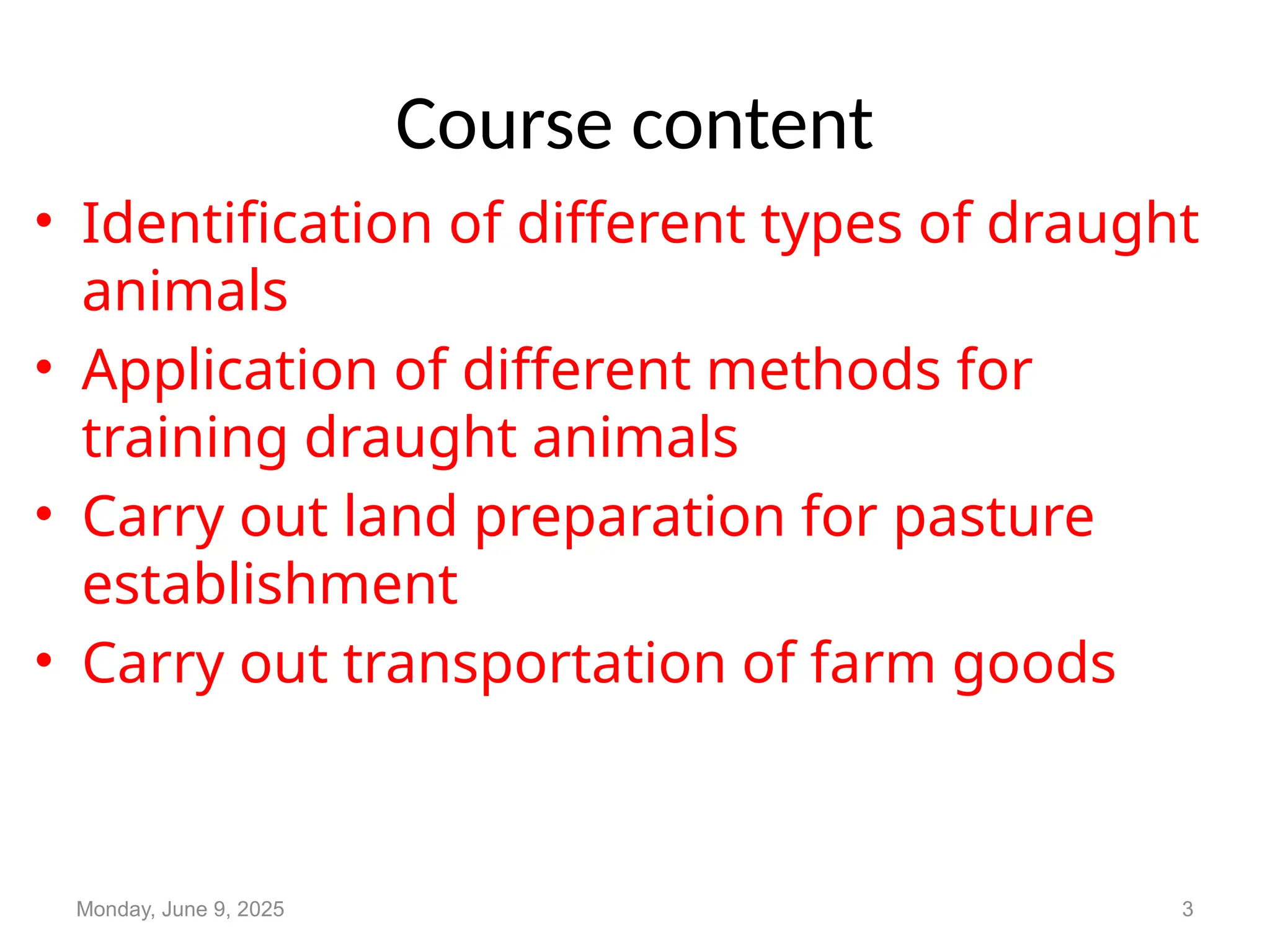
Human Power
Animal Power
Mechanical power
Wind power
Solar Power
Electrical power
Water power
Biogas
Monday, June 9, 2025 9
10.
Importance of DraughtAnimals
• Reduce drudgery of many household
activities & save time for other tasks
• Used where cars cannot pass (lack of roads,
difficult/mountainous terrain)
• Income generation through transport or
hiring-out in farm operations
• Improve crop yields through better timeliness
of operations, greater areas cropped
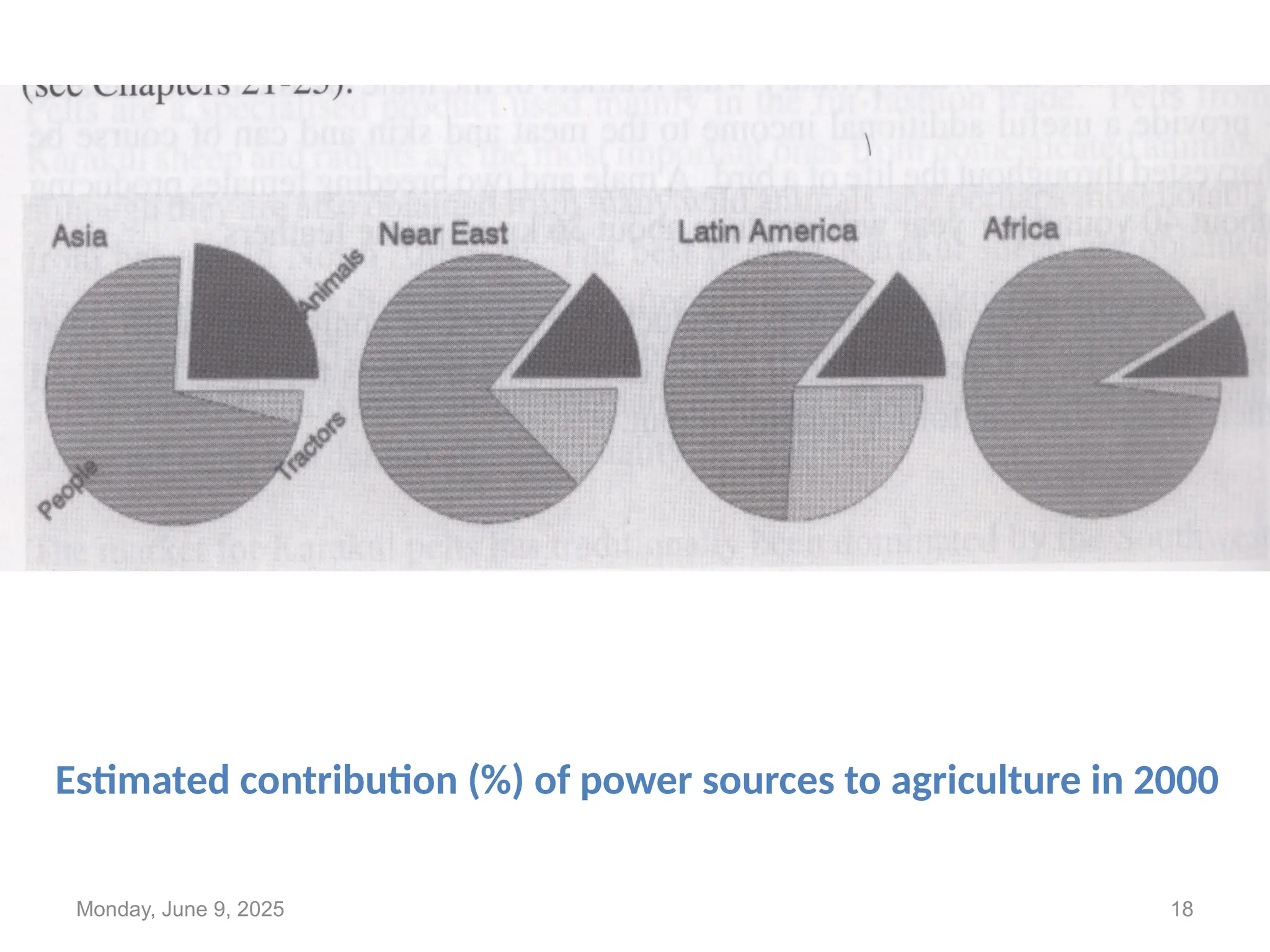
• Provide more than 75% of the draught power
in agriculture.
Monday, June 9, 2025 10
11.
Importance of draughtanimals
• Although DAP saves time for other
activities, new responsibilities & other
labour demanding activities also arise e.g.
animal husbandry activities, maintenance
of implements etc.
• the use of manual labor becomes the most
limiting factor (there is very short interval
of time between plowing & planting in
order to catch the scanty rains).
Monday, June 9, 2025 11
12.
Other importance ofDAPs
DA provide manure e.g FYM/FM
DA provide milk and meat E.g cattle,
buffaloes and camel
Production of biogas. Gaseous mix of
60-70% of methane that can burnt and
30-40%CO2 which is inert.
Accompanied by anaerobic bacterial
Increase social status
Capital accumulation.
Change of detrimental gender barrier
Monday, June 9, 2025 12
13.
Advantages of UsingAnimal Power
• DAP could represent a fairly large
investment for many subsistence/ssf
BUT it is more affordable than tractors
• DAP would be more suitable for the
small, often fragmented farms found
among subsistence/ssf
• Use of DAP enables the farmer to
integrate livestock with crop production
(this permits exploitation of the cattle
kept on settled, subsistence farms
Monday, June 9, 2025 13
14.
Advantages of UsingAnimal Power
• Increased area under cultivation. DA
owners can cultivate 30 – 100% more
land than farmers in the hand- hoe
based system.
• Gender and age implication. DAP in
transportation has the potential to
benefit women more b/se w/men are
responsible for transportation of goods
by head loading.
Monday, June 9, 2025 14
15.
..
• Timeliness ofoperation and risk
reduction.
• DAP is a renewable and sustainable
source of power. Old animals are
replaced with newborn to carry on their
work.
• Affordability . DA are within purchasing
power of one third (1/3) of the National
number of households.
• Easy of operation. The skills used to
handle DA in many cases is relatively
very low.
Monday, June 9, 2025 15
16.
.
• Reduction ofdrudgery. DAP reduces
hardships operation associated with
human labour.
• The salvage value of animals can be
considered as a positive incentive in
using DAP logging
Monday, June 9, 2025 16
17.
Disadvantages
• Animals usedfor work have shorter life span
• They loose energy and weight quicker than
machines
• Huge amount of money is needed to feed and
maintain the animal
• It cannot work at certain times of the day
• Disease may affect the efficiency of the animal
Monday, June 9, 2025 17
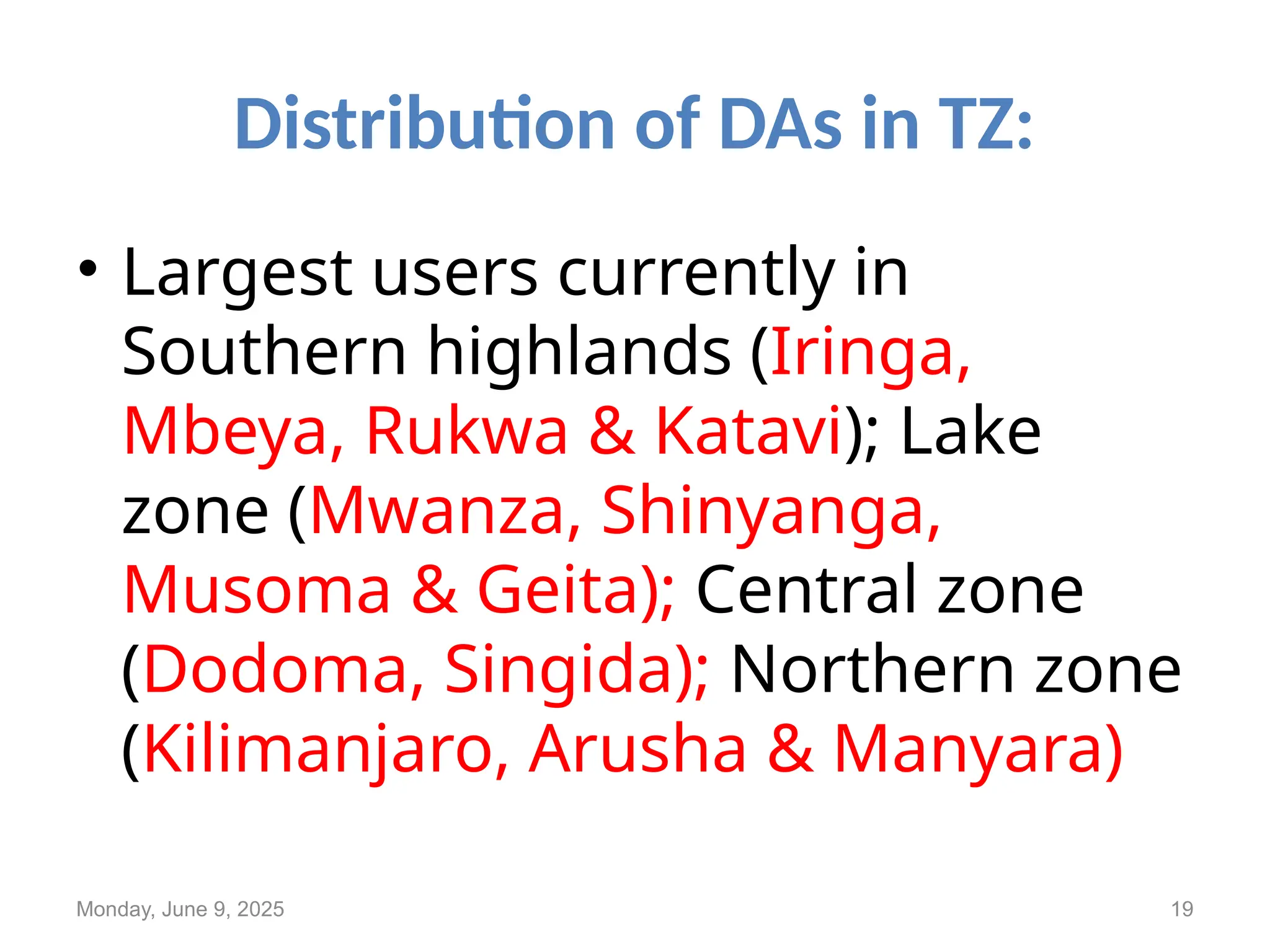
Distribution of DAsin TZ:
• Largest users currently in
Southern highlands (Iringa,
Mbeya, Rukwa & Katavi); Lake
zone (Mwanza, Shinyanga,
Musoma & Geita); Central zone
(Dodoma, Singida); Northern zone
(Kilimanjaro, Arusha & Manyara)
Monday, June 9, 2025 19
20.
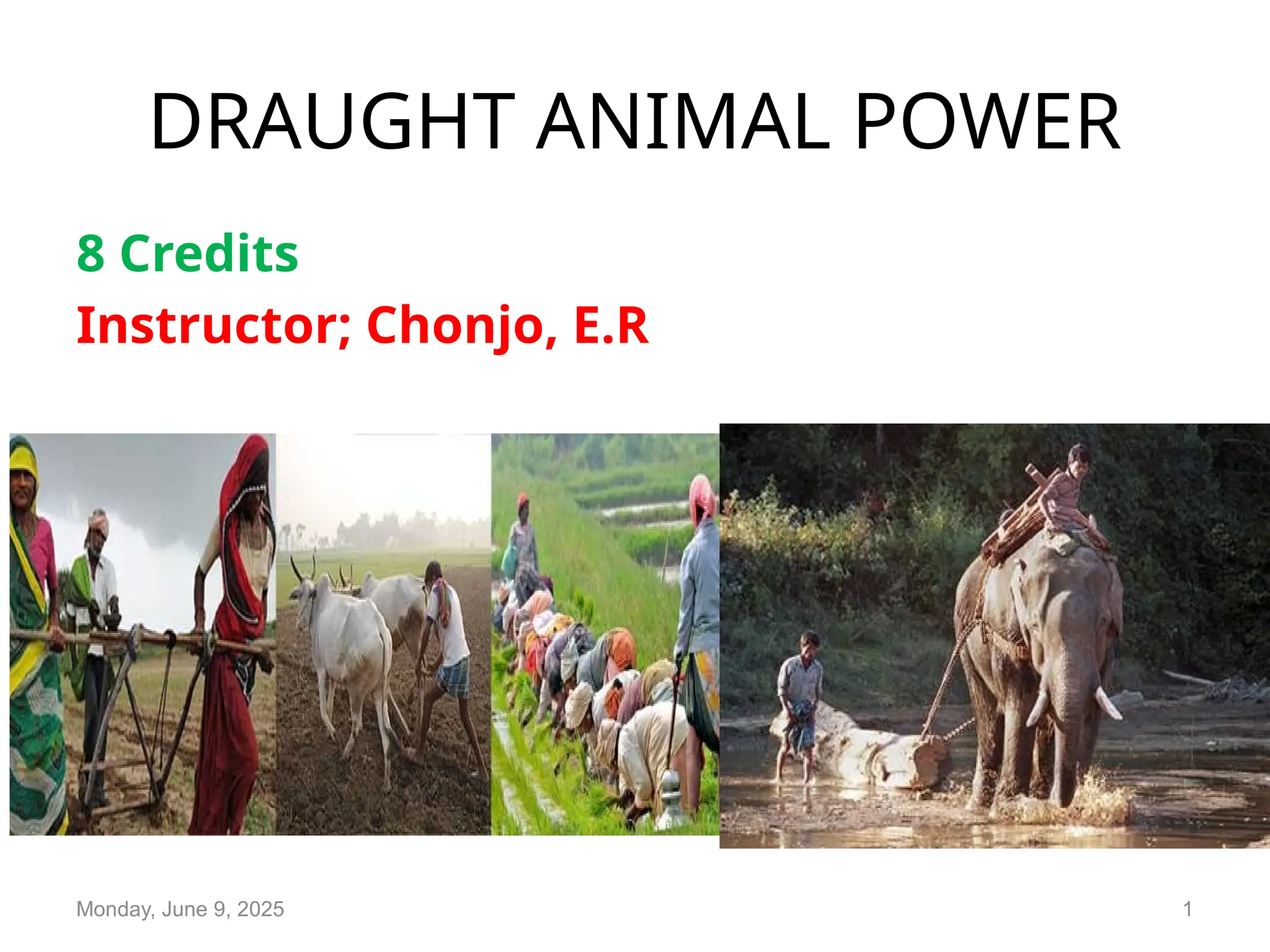
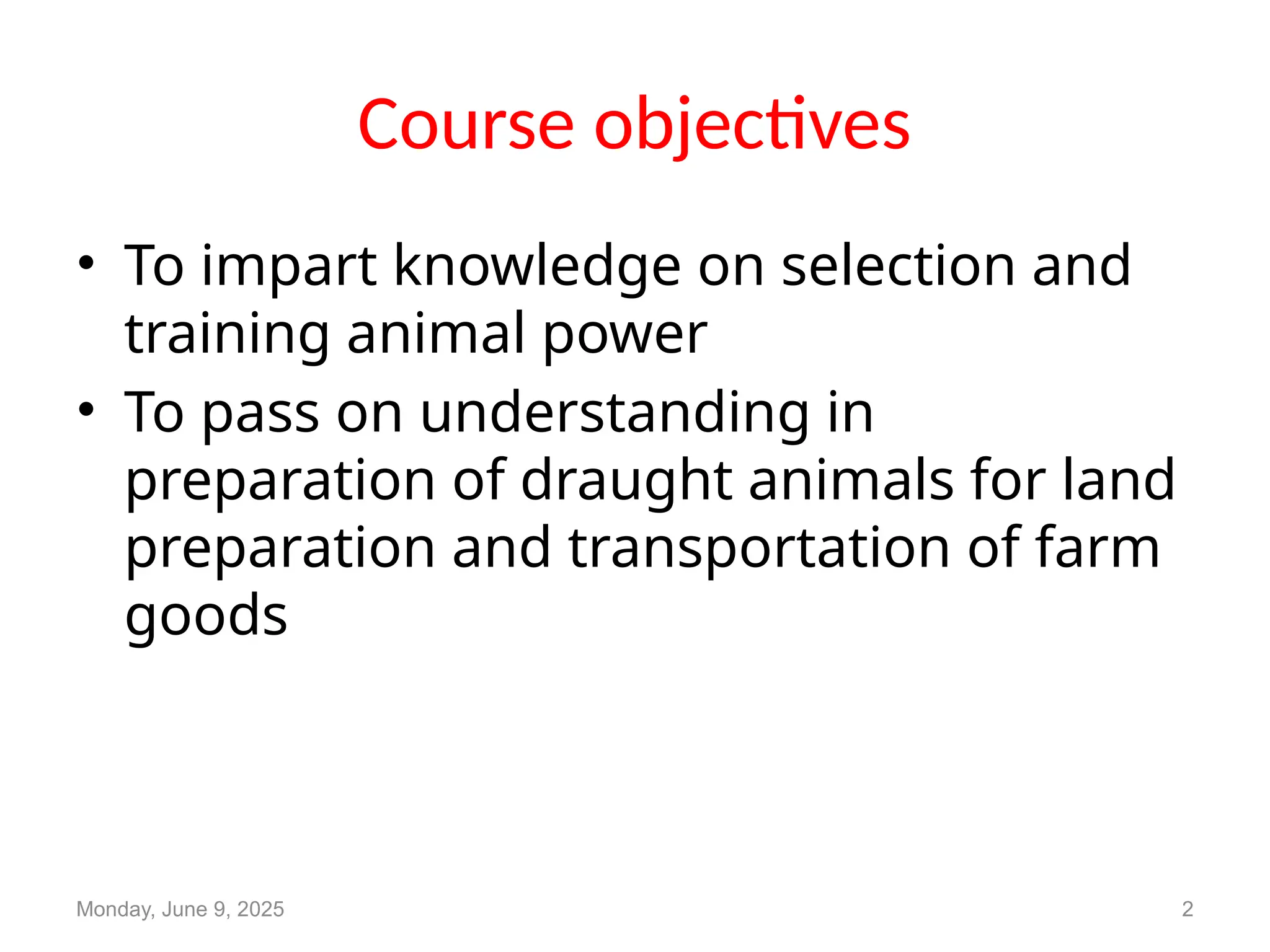
Common types ofdraught animal :
• Cattle (oxen/bullocks, bulls, cows)
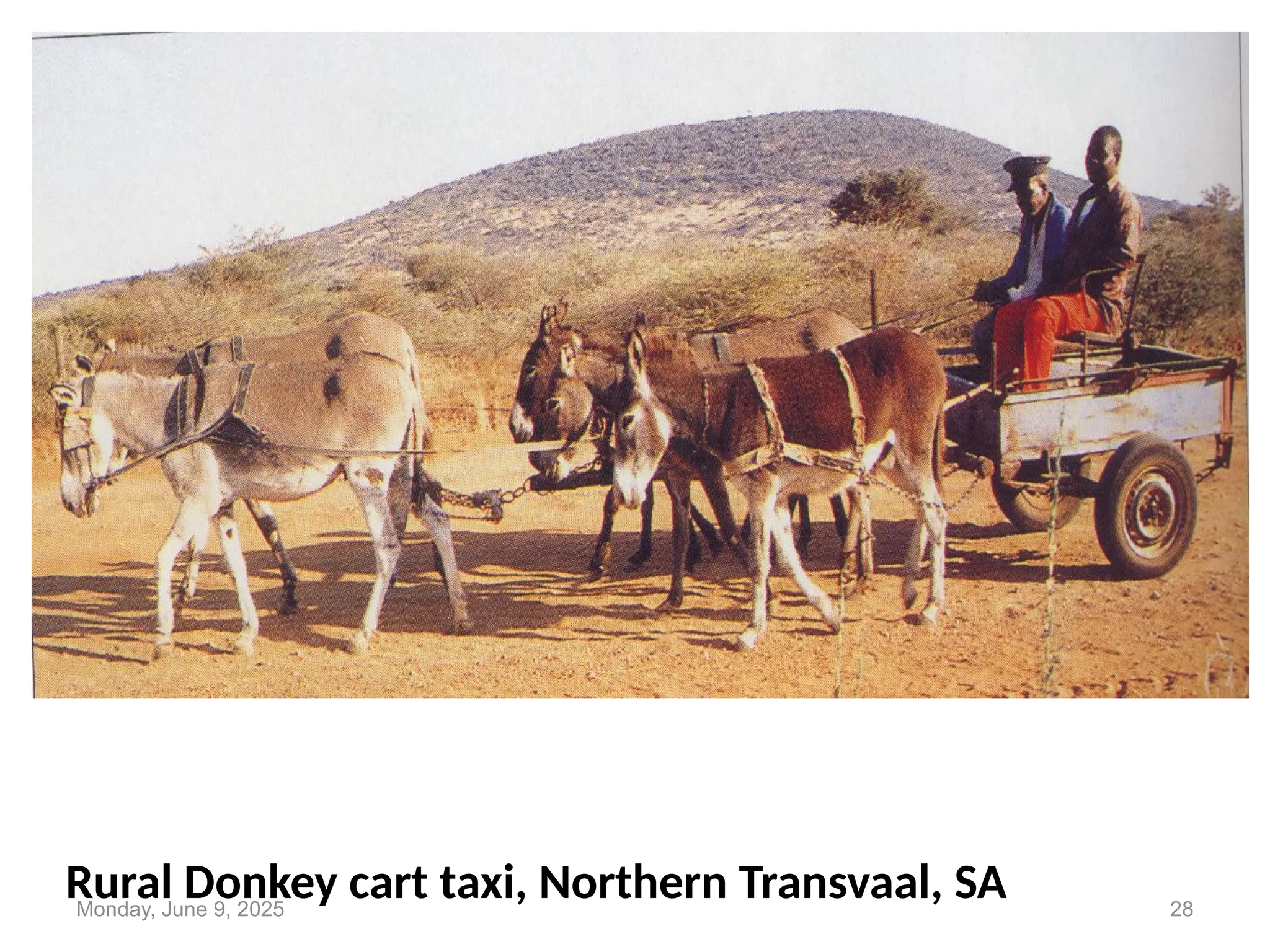
• Equines (Donkeys, Horses & Mules
(cross breed of Male donkey+Female
horse)
• Camels (Transport, Meat and Milk in
arid regions; India, Pakistan)
• Buffaloes (Nyati) (India, Milk and meat)
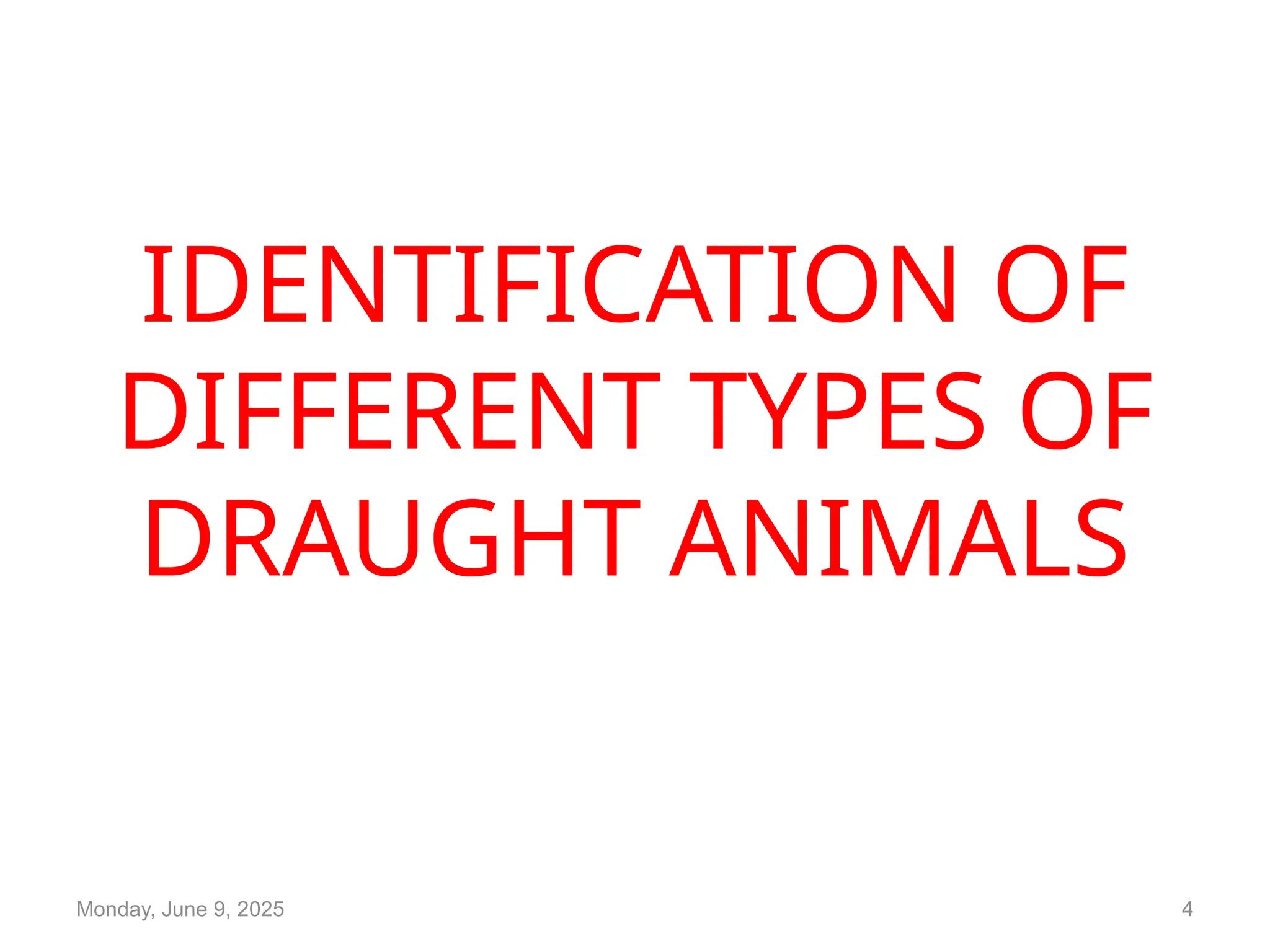
• Elephants (Transport in Thailand)
• Goats (
Monday, June 9, 2025 20
21.
Limitation of DAs
•Low speed and capability to work; DAs
can operate only about as fast as
human walk and they exert a relatively
small amount of power compared to a
tractor. Eg. Cattle work about
5hours/day.
• Lack of assortment(variety) of
implement; some implement e.g
proper weeding implements.
Monday, June 9, 2025 21
22.
.
• Health ofanimal; e.g Tabora, Kigoma,
Rukwa and Kagera region are infested
with tse tse flies that lead to difficult use
of cattle. Prophylactic/preventive
treatment is necessary whether the
animals are working or not.
Monday, June 9, 2025 22
23.
Farm operations performedby DAs
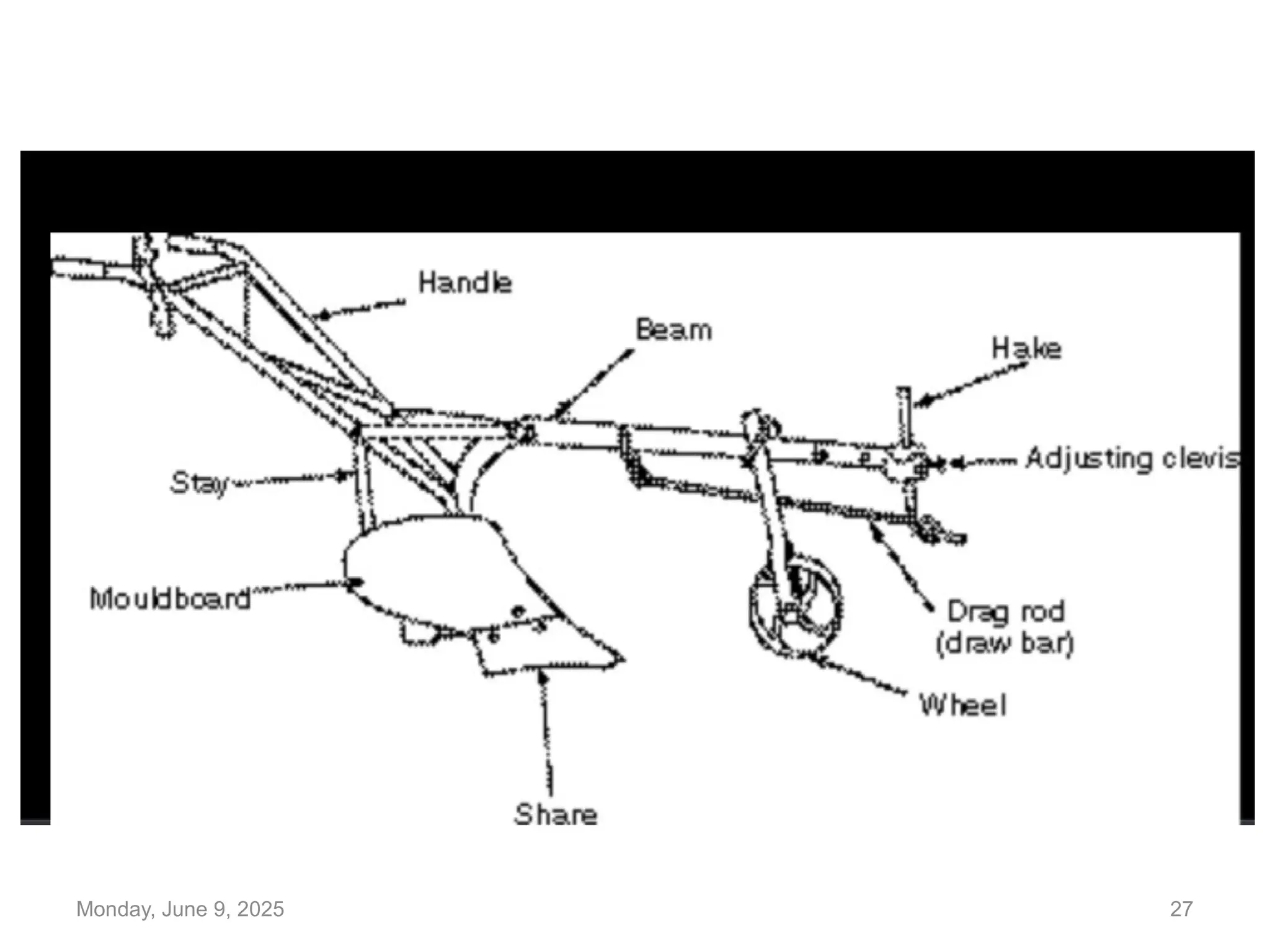
1. Tillage- Is the change of the physical
condition of the soil by mechanically turning
over, loosening or mixing it to optimize
conditions for crop seed germination and
growth. Its divided into two types i.e Primary
and secondary tillage.
• Primary tillage – power intensive operation
which involves working the soil up to the
depth of more than 15cm. Eg ridgers &
rippers
Monday, June 9, 2025 23
24.
.
• Secondary tillage– Is the creation of finer
tilth on few top centimeters (less than
15cm) of cultivated soil. This is very
important where mechanical ox drawn
planter used.eg ridgers, harrows and
cultivators
2. Planting – Is the placement of the seed in
the soil to achieve a required planting
depth and correct spacing between plant
station. Less than 1% of farmer use
DAPP.eg DA furrow opener or row marker
Monday, June 9, 2025 24
25.
.
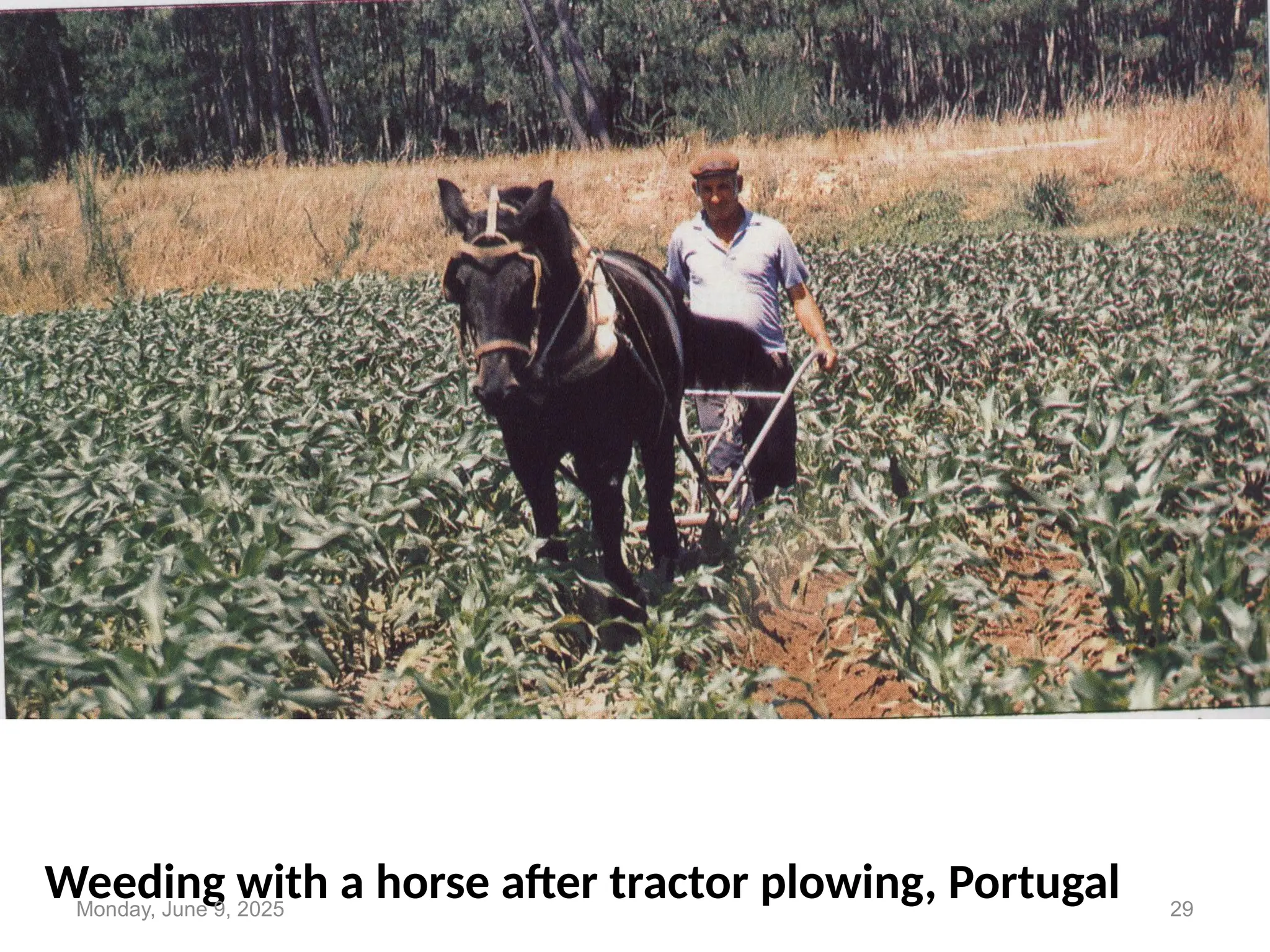
3. Weeding -Is the removal of unwanted
plants by mechanical or chemical means.
Less than 3% of the farmer use DAPW. Eg.
Cultivator and ridgers
4. Crop protection. This is done under zero
tillage by chemicals using DAP sprayers eg
in S.America but not adopted in Tanzania
5. Harvesting – Is the raping and gathering-
in of grain or other product from a planted
crop. Present not practiced in Tanzania
Monday, June 9, 2025 25
26.
Types of workdone with DAP:
• Farm operations (tillage, harrowing,
seeding/planting, weeding, harvesting)
• Transport (carts or packs) – 20% world population
• Water lifting (small irrigated plots)
• Running sugarcane crushers
• Hay/forage cutting & hay raking
• Running grain mills
• Crop threshing by trampling etc.
• Logging operations
Monday, June 9, 2025 26