
 Split-Plot Design.
 Analysis Of Covariance(ANCOVA).
 Response Surface Design.
 Split plot design are needed when the levels of some factors
more difficult to change during the experiment than those of
others .SPD is a mixture of hard to change and easy to
change factors . The hard to change factors are implemented
first , followed by easier to change factors.
Real life application of SPD:
 SPD are commonly seen in agriculture designs and industries
they can also be used across a wide variety of disciplines.
EXAMPLE:
Basically a split plot design consists of two experiments with
different experimental units of different “size”. Experimental
units, whereas other factors can be easily applied to
“smaller” plots of land.
 Advantage:
1. Estimates of subplot treatments and its interaction with
whole plot treatments are obtained in SPD than in RBD.
2.Two or more factors needing relatively large and small units
can be combined in the same experiment of SPD.
 Disadvantage:
1.Main plot treatments are measured with less precision in SPD
than in comparable RBD.
2.Analysis of data is relatively complicated in SPD.
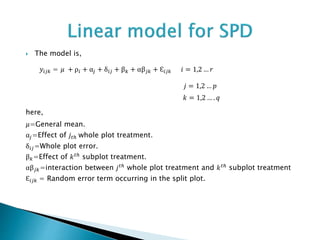
 The model is,
𝑦𝑖𝑗𝑘 = 𝜇 + ρ𝑖 + α𝑗 + δ𝑖𝑗 + β 𝑘 + αβ 𝑗𝑘 + Ԑ𝑖𝑗𝑘 𝑖 = 1,2 … 𝑟
𝑗 = 1,2 … 𝑝
𝑘 = 1,2 … . 𝑞
here,
𝜇=General mean.
α𝑗=Effect of 𝑗𝑡ℎ whole plot treatment.
δ𝑖𝑗=Whole plot error.
β 𝑘=Effect of 𝑘 𝑡ℎ
subplot treatment.
αβ 𝑗𝑘=interaction between 𝑗 𝑡ℎ
whole plot treatment and 𝑘 𝑡ℎ
subplot treatment
Ԑ𝑖𝑗𝑘 = Random error term occurring in the split plot.
 Analysis Of Covariance is the process of analysis of variance
on the observations of response variable y after adjusting for
the effects of uncontrolled concomitant variables.
Example: In animal feeding experiment , the
initial weight of animals under
investigation can be used as covariate.
1.Increased precision and
error control.
2.Estimation of missing
values.
Uses of ANCOVA:
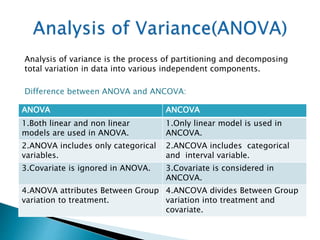
ANOVA ANCOVA
1.Both linear and non linear
models are used in ANOVA.
1.Only linear model is used in
ANCOVA.
2.ANOVA includes only categorical
variables.
2.ANCOVA includes categorical
and interval variable.
3.Covariate is ignored in ANOVA. 3.Covariate is considered in
ANCOVA.
4.ANOVA attributes Between Group
variation to treatment.
4.ANCOVA divides Between Group
variation into treatment and
covariate.
Analysis of variance is the process of partitioning and decomposing
total variation in data into various independent components.
Difference between ANOVA and ANCOVA:
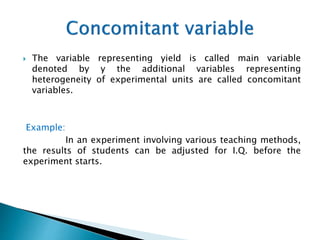
 The variable representing yield is called main variable
denoted by y the additional variables representing
heterogeneity of experimental units are called concomitant
variables.
Example:
In an experiment involving various teaching methods,
the results of students can be adjusted for I.Q. before the
experiment starts.
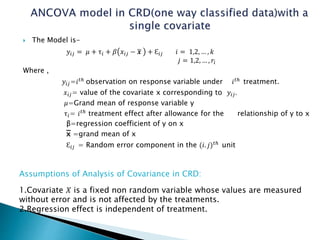
 The Model is-
𝑦𝑖𝑗 = 𝜇 + τ𝑖 + 𝛽 𝑥𝑖𝑗 − 𝒙 + Ԑ𝑖𝑗 𝑖 = 1,2, … , 𝑘
𝑗 = 1,2, … , 𝑟𝑖
Where ,
𝑦𝑖𝑗=𝑖 𝑡ℎ
observation on response variable under 𝑖 𝑡ℎ
treatment.
𝑥𝑖𝑗= value of the covariate x corresponding to 𝑦𝑖𝑗.
𝜇=Grand mean of response variable y
τ𝑖= 𝑖 𝑡ℎ
treatment effect after allowance for the relationship of y to x
β=regression coefficient of y on x
x̅ =grand mean of x
Ԑ𝑖𝑗 = Random error component in the (𝑖. 𝑗) 𝑡ℎ
unit
1.Covariate 𝑋 is a fixed non random variable whose values are measured
without error and is not affected by the treatments.
2.Regression effect is independent of treatment.
Assumptions of Analysis of Covariance in CRD:
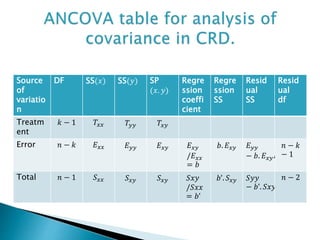
Source
of
variatio
n
DF SS(𝑥) SS(𝑦) SP
(𝑥. 𝑦)
Regre
ssion
coeffi
cient
Regre
ssion
SS
Resid
ual
SS
Resid
ual
df
Treatm
ent
𝑘 − 1 𝑇𝑥𝑥 𝑇𝑦𝑦 𝑇𝑥𝑦
Error 𝑛 − 𝑘 𝐸 𝑥𝑥 𝐸 𝑦𝑦 𝐸 𝑥𝑦 𝐸 𝑥𝑦
/𝐸 𝑥𝑥
= 𝑏
𝑏. 𝐸 𝑥𝑦 𝐸 𝑦𝑦
− 𝑏. 𝐸 𝑥𝑦 𝐸𝑥𝑦
𝑛 − 𝑘
− 1
Total 𝑛 − 1 𝑆 𝑥𝑥 𝑆 𝑥𝑦 𝑆 𝑥𝑦 𝑆𝑥𝑦
/𝑆𝑥𝑥
= 𝑏’
𝑏’. 𝑆 𝑥𝑦 𝑆𝑦𝑦
− 𝑏’. 𝑆𝑥𝑦
𝑛 − 2
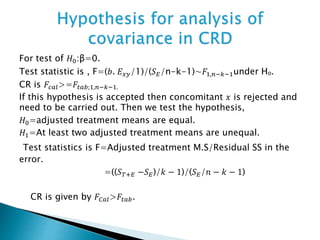
For test of 𝐻0:β=0.
Test statistic is , F=(𝑏. 𝐸 𝑥𝑦/1)/(𝑆 𝐸/n-k-1)∼𝐹1,𝑛−𝑘−1under Hₒ.
CR is 𝐹𝑐𝑎𝑙>=𝐹𝑡𝑎𝑏;1,𝑛−𝑘−1.
If this hypothesis is accepted then concomitant 𝑥 is rejected and
need to be carried out. Then we test the hypothesis,
𝐻0=adjusted treatment means are equal.
𝐻1=At least two adjusted treatment means are unequal.
Test statistics is F=Adjusted treatment M.S/Residual SS in the
error.
=((𝑆 𝑇+𝐸 −𝑆 𝐸)/𝑘 − 1)/(𝑆 𝐸/𝑛 − 𝑘 − 1)
CR is given by 𝐹𝐶𝑎𝑙>𝐹𝑡𝑎𝑏.
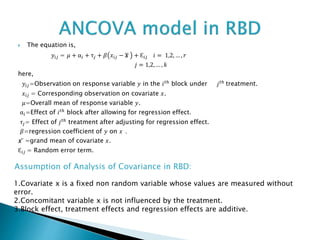
 The equation is,
𝑦𝑖𝑗 = 𝜇 + α𝑖 + τ𝑗 + 𝛽 𝑥𝑖𝑗 − 𝒙 + Ԑ𝑖𝑗 𝑖 = 1,2, … , 𝑟
𝑗 = 1,2, … , 𝑘
here,
𝑦𝑖𝑗=Observation on response variable 𝑦 in the 𝑖 𝑡ℎ
block under 𝑗 𝑡ℎ
treatment.
𝑥𝑖𝑗 = Corresponding observation on covariate 𝑥.
𝜇=Overall mean of response variable 𝑦.
α𝑖=Effect of 𝑖 𝑡ℎ
block after allowing for regression effect.
τ𝑗= Effect of 𝑗 𝑡ℎ
treatment after adjusting for regression effect.
𝛽=regression coefficient of 𝑦 on 𝑥 .
𝒙 ̅ =grand mean of covariate 𝑥.
Ԑ𝑖𝑗 = Random error term.
1.Covariate x is a fixed non random variable whose values are measured without
error.
2.Concomitant variable x is not influenced by the treatment.
3.Block effect, treatment effects and regression effects are additive.
Assumption of Analysis of Covariance in RBD:
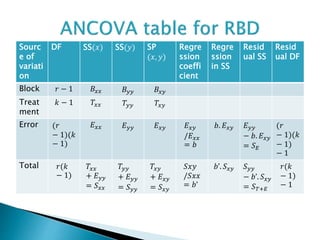
Sourc
e of
variati
on
DF SS(𝑥) SS(𝑦) SP
(𝑥, 𝑦)
Regre
ssion
coeffi
cient
Regre
ssion
in SS
Resid
ual SS
Resid
ual DF
Block 𝑟 − 1 𝐵𝑥𝑥 𝐵𝑦𝑦 𝐵𝑥𝑦
Treat
ment
𝑘 − 1 𝑇𝑥𝑥 𝑇𝑦𝑦 𝑇𝑥𝑦
Error (𝑟
− 1)(𝑘
− 1)
𝐸 𝑥𝑥 𝐸 𝑦𝑦 𝐸 𝑥𝑦 𝐸 𝑥𝑦
/𝐸 𝑥𝑥
= 𝑏
𝑏. 𝐸 𝑥𝑦 𝐸 𝑦𝑦
− 𝑏. 𝐸 𝑥𝑦
= 𝑆 𝐸
(𝑟
− 1)(𝑘
− 1)
− 1
Total 𝑟(𝑘
− 1)
𝑇𝑥𝑥
+ 𝐸 𝑦𝑦
= 𝑆 𝑥𝑥
𝑇𝑦𝑦
+ 𝐸 𝑦𝑦
= 𝑆 𝑦𝑦
𝑇𝑥𝑦
+ 𝐸 𝑥𝑦
= 𝑆 𝑥𝑦
𝑆𝑥𝑦
/𝑆𝑥𝑥
= 𝑏’
𝑏’. 𝑆 𝑥𝑦 𝑆 𝑦𝑦
− 𝑏’. 𝑆 𝑥𝑦
= 𝑆 𝑇+𝐸
𝑟(𝑘
− 1)
− 1
 For test of 𝐻ₒ: 𝛽=0.
Test statistic is , F=[{(𝐸 𝑥𝑦)²/𝐸 𝑥𝑥}/1]/[𝑆 𝐸/{(𝑟 − 1)(𝑘 − 1) − 1}] under 𝐻ₒ.
CR is 𝐹𝑐𝑎𝑙>=𝐹𝑡𝑎𝑏;1, (𝑟 − 1)(𝑘 − 1) − 1.
If this hypothesis is accepted then concomitant 𝑥 is rejected and need
to be carried out . Then we test the hypothesis,
𝐻0=adjusted treatment means are equal.
𝐻1=At least two adjusted treatment means are unequal.
Test statistics is F=Adjusted treatment M.S/residual SS in the error.
=[(𝑆 𝑇+𝐸-𝑆 𝐸)/(𝑘 − 1)]/[𝑆 𝐸/(𝑟 − 1)(𝑘 − 1) − 1]
CR is given by 𝐹𝑐𝑎𝑙>𝐹𝑡𝑎𝑏.
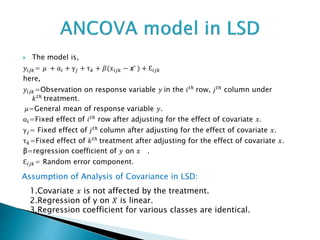
 The model is,
𝑦𝑖𝑗𝑘= 𝜇 + α𝑖 + γ 𝑗 + τ 𝑘 + 𝛽(𝑥𝑖𝑗𝑘 − 𝒙 ̅ ) + Ԑ𝑖𝑗𝑘
here,
𝑦𝑖𝑗𝑘=Observation on response variable 𝑦 in the 𝑖 𝑡ℎ
row, 𝑗 𝑡ℎ
column under
𝑘 𝑡ℎ
treatment.
𝜇=General mean of response variable 𝑦.
α𝑖=Fixed effect of 𝑖 𝑡ℎ
row after adjusting for the effect of covariate 𝑥.
γ 𝑗= Fixed effect of 𝑗 𝑡ℎ
column after adjusting for the effect of covariate 𝑥.
τ 𝑘=Fixed effect of 𝑘 𝑡ℎ
treatment after adjusting for the effect of covariate 𝑥.
β=regression coefficient of 𝑦 on 𝑥 .
Ԑ𝑖𝑗𝑘= Random error component.
1.Covariate 𝑥 is not affected by the treatment.
2.Regression of y on 𝑋 is linear.
3.Regression coefficient for various classes are identical.
Assumption of Analysis of Covariance in LSD:
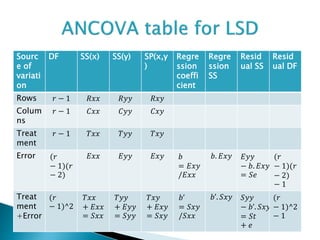
Sourc
e of
variati
on
DF SS(x) SS(y) SP(x,y
)
Regre
ssion
coeffi
cient
Regre
ssion
SS
Resid
ual SS
Resid
ual DF
Rows 𝑟 − 1 𝑅𝑥𝑥 𝑅𝑦𝑦 𝑅𝑥𝑦
Colum
ns
𝑟 − 1 𝐶𝑥𝑥 𝐶𝑦𝑦 𝐶𝑥𝑦
Treat
ment
𝑟 − 1 𝑇𝑥𝑥 𝑇𝑦𝑦 𝑇𝑥𝑦
Error (𝑟
− 1)(𝑟
− 2)
𝐸𝑥𝑥 𝐸𝑦𝑦 𝐸𝑥𝑦 𝑏
= 𝐸𝑥𝑦
/𝐸𝑥𝑥
𝑏. 𝐸𝑥𝑦 𝐸𝑦𝑦
− 𝑏. 𝐸𝑥𝑦
= 𝑆𝑒
(𝑟
− 1)(𝑟
− 2)
− 1
Treat
ment
+Error
(𝑟
− 1)^2
𝑇𝑥𝑥
+ 𝐸𝑥𝑥
= 𝑆𝑥𝑥
𝑇𝑦𝑦
+ 𝐸𝑦𝑦
= 𝑆𝑦𝑦
𝑇𝑥𝑦
+ 𝐸𝑥𝑦
= 𝑆𝑥𝑦
𝑏’
= 𝑆𝑥𝑦
/𝑆𝑥𝑥
𝑏’. 𝑆𝑥𝑦 𝑆𝑦𝑦
− 𝑏’. 𝑆𝑥𝑦
= 𝑆𝑡
+ 𝑒
(𝑟
− 1)^2
− 1
 For test of 𝐻ₒ: 𝛽=0.
Test statistic is,F=[{(𝐸 𝑥𝑥)²/𝐸 𝑥𝑥}/1]/[𝑆 𝐸/{(𝑟 − 1)(𝑟 − 2) − 1}] under 𝐻ₒ.
CR is 𝐹𝑐𝑎𝑙>=𝐹𝑡𝑎𝑏;1, (𝑟 − 1)(𝑟 − 2) − 1.
,.If this hypothesis is accepted then concomitant 𝑥 is rejected and
need to be carried out . Then we test the hypothesis,
𝐻ₒ=adjusted treatment means are equal.
𝐻1=At least two adjusted treatment means are unequal.
Test statistics is F=Adjusted treatment M.S/residual SS in the
error.
=[(𝑆 𝑇+𝐸-𝑆 𝐸)/(𝑟 − 1)]/[𝑆 𝐸/(𝑟 − 1)(𝑟 − 2) − 1]
CR is given by 𝐹𝑐𝑎𝑙>𝐹𝑡𝑎𝑏.
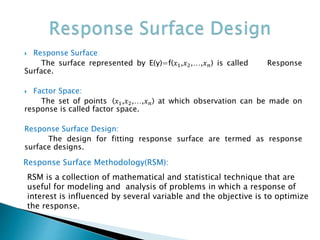
 Response Surface:
The surface represented by E(y)=f(𝑥1,𝑥2,…,𝑥 𝑛) is called Response
Surface.
 Factor Space:
The set of points (𝑥1,𝑥2,…,𝑥 𝑛) at which observation can be made on
response is called factor space.
Response Surface Design:
The design for fitting response surface are termed as response
surface designs.
RSM is a collection of mathematical and statistical technique that are
useful for modeling and analysis of problems in which a response of
interest is influenced by several variable and the objective is to optimize
the response.
Response Surface Methodology(RSM):
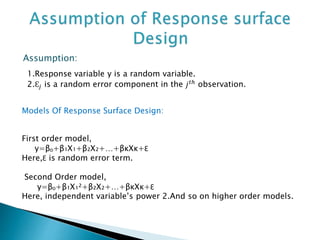
Assumption:
First order model,
y=βₒ+β₁X₁+β₂X₂+…+βκXκ+Ԑ
Here,Ԑ is random error term.
Second Order model,
y=βₒ+β₁X₁²+β₂X₂+…+βκXκ+Ԑ
Here, independent variable’s power 2.And so on higher order models.
Models Of Response Surface Design:
1.Response variable y is a random variable.
2.Ԑ𝑗 is a random error component in the 𝑗 𝑡ℎ
observation.
Thank You

Basic Concepts of Split-Plot Design,Analysis Of Covariance(ANCOVA)& Response Surface Design (Statistics)

  • 2.
     Split-Plot Design. Analysis Of Covariance(ANCOVA).  Response Surface Design.
  • 3.
     Split plotdesign are needed when the levels of some factors more difficult to change during the experiment than those of others .SPD is a mixture of hard to change and easy to change factors . The hard to change factors are implemented first , followed by easier to change factors. Real life application of SPD:  SPD are commonly seen in agriculture designs and industries they can also be used across a wide variety of disciplines. EXAMPLE: Basically a split plot design consists of two experiments with different experimental units of different “size”. Experimental units, whereas other factors can be easily applied to “smaller” plots of land.
  • 4.
     Advantage: 1. Estimatesof subplot treatments and its interaction with whole plot treatments are obtained in SPD than in RBD. 2.Two or more factors needing relatively large and small units can be combined in the same experiment of SPD.  Disadvantage: 1.Main plot treatments are measured with less precision in SPD than in comparable RBD. 2.Analysis of data is relatively complicated in SPD.
  • 5.
     The modelis, 𝑦𝑖𝑗𝑘 = 𝜇 + ρ𝑖 + α𝑗 + δ𝑖𝑗 + β 𝑘 + αβ 𝑗𝑘 + Ԑ𝑖𝑗𝑘 𝑖 = 1,2 … 𝑟 𝑗 = 1,2 … 𝑝 𝑘 = 1,2 … . 𝑞 here, 𝜇=General mean. α𝑗=Effect of 𝑗𝑡ℎ whole plot treatment. δ𝑖𝑗=Whole plot error. β 𝑘=Effect of 𝑘 𝑡ℎ subplot treatment. αβ 𝑗𝑘=interaction between 𝑗 𝑡ℎ whole plot treatment and 𝑘 𝑡ℎ subplot treatment Ԑ𝑖𝑗𝑘 = Random error term occurring in the split plot.
  • 6.
     Analysis OfCovariance is the process of analysis of variance on the observations of response variable y after adjusting for the effects of uncontrolled concomitant variables. Example: In animal feeding experiment , the initial weight of animals under investigation can be used as covariate. 1.Increased precision and error control. 2.Estimation of missing values. Uses of ANCOVA:
  • 7.
    ANOVA ANCOVA 1.Both linearand non linear models are used in ANOVA. 1.Only linear model is used in ANCOVA. 2.ANOVA includes only categorical variables. 2.ANCOVA includes categorical and interval variable. 3.Covariate is ignored in ANOVA. 3.Covariate is considered in ANCOVA. 4.ANOVA attributes Between Group variation to treatment. 4.ANCOVA divides Between Group variation into treatment and covariate. Analysis of variance is the process of partitioning and decomposing total variation in data into various independent components. Difference between ANOVA and ANCOVA:
  • 8.
     The variablerepresenting yield is called main variable denoted by y the additional variables representing heterogeneity of experimental units are called concomitant variables. Example: In an experiment involving various teaching methods, the results of students can be adjusted for I.Q. before the experiment starts.
  • 9.
     The Modelis- 𝑦𝑖𝑗 = 𝜇 + τ𝑖 + 𝛽 𝑥𝑖𝑗 − 𝒙 + Ԑ𝑖𝑗 𝑖 = 1,2, … , 𝑘 𝑗 = 1,2, … , 𝑟𝑖 Where , 𝑦𝑖𝑗=𝑖 𝑡ℎ observation on response variable under 𝑖 𝑡ℎ treatment. 𝑥𝑖𝑗= value of the covariate x corresponding to 𝑦𝑖𝑗. 𝜇=Grand mean of response variable y τ𝑖= 𝑖 𝑡ℎ treatment effect after allowance for the relationship of y to x β=regression coefficient of y on x x̅ =grand mean of x Ԑ𝑖𝑗 = Random error component in the (𝑖. 𝑗) 𝑡ℎ unit 1.Covariate 𝑋 is a fixed non random variable whose values are measured without error and is not affected by the treatments. 2.Regression effect is independent of treatment. Assumptions of Analysis of Covariance in CRD:
  • 10.
    Source of variatio n DF SS(𝑥) SS(𝑦)SP (𝑥. 𝑦) Regre ssion coeffi cient Regre ssion SS Resid ual SS Resid ual df Treatm ent 𝑘 − 1 𝑇𝑥𝑥 𝑇𝑦𝑦 𝑇𝑥𝑦 Error 𝑛 − 𝑘 𝐸 𝑥𝑥 𝐸 𝑦𝑦 𝐸 𝑥𝑦 𝐸 𝑥𝑦 /𝐸 𝑥𝑥 = 𝑏 𝑏. 𝐸 𝑥𝑦 𝐸 𝑦𝑦 − 𝑏. 𝐸 𝑥𝑦 𝐸𝑥𝑦 𝑛 − 𝑘 − 1 Total 𝑛 − 1 𝑆 𝑥𝑥 𝑆 𝑥𝑦 𝑆 𝑥𝑦 𝑆𝑥𝑦 /𝑆𝑥𝑥 = 𝑏’ 𝑏’. 𝑆 𝑥𝑦 𝑆𝑦𝑦 − 𝑏’. 𝑆𝑥𝑦 𝑛 − 2
  • 11.
    For test of𝐻0:β=0. Test statistic is , F=(𝑏. 𝐸 𝑥𝑦/1)/(𝑆 𝐸/n-k-1)∼𝐹1,𝑛−𝑘−1under Hₒ. CR is 𝐹𝑐𝑎𝑙>=𝐹𝑡𝑎𝑏;1,𝑛−𝑘−1. If this hypothesis is accepted then concomitant 𝑥 is rejected and need to be carried out. Then we test the hypothesis, 𝐻0=adjusted treatment means are equal. 𝐻1=At least two adjusted treatment means are unequal. Test statistics is F=Adjusted treatment M.S/Residual SS in the error. =((𝑆 𝑇+𝐸 −𝑆 𝐸)/𝑘 − 1)/(𝑆 𝐸/𝑛 − 𝑘 − 1) CR is given by 𝐹𝐶𝑎𝑙>𝐹𝑡𝑎𝑏.
  • 12.
     The equationis, 𝑦𝑖𝑗 = 𝜇 + α𝑖 + τ𝑗 + 𝛽 𝑥𝑖𝑗 − 𝒙 + Ԑ𝑖𝑗 𝑖 = 1,2, … , 𝑟 𝑗 = 1,2, … , 𝑘 here, 𝑦𝑖𝑗=Observation on response variable 𝑦 in the 𝑖 𝑡ℎ block under 𝑗 𝑡ℎ treatment. 𝑥𝑖𝑗 = Corresponding observation on covariate 𝑥. 𝜇=Overall mean of response variable 𝑦. α𝑖=Effect of 𝑖 𝑡ℎ block after allowing for regression effect. τ𝑗= Effect of 𝑗 𝑡ℎ treatment after adjusting for regression effect. 𝛽=regression coefficient of 𝑦 on 𝑥 . 𝒙 ̅ =grand mean of covariate 𝑥. Ԑ𝑖𝑗 = Random error term. 1.Covariate x is a fixed non random variable whose values are measured without error. 2.Concomitant variable x is not influenced by the treatment. 3.Block effect, treatment effects and regression effects are additive. Assumption of Analysis of Covariance in RBD:
  • 13.
    Sourc e of variati on DF SS(𝑥)SS(𝑦) SP (𝑥, 𝑦) Regre ssion coeffi cient Regre ssion in SS Resid ual SS Resid ual DF Block 𝑟 − 1 𝐵𝑥𝑥 𝐵𝑦𝑦 𝐵𝑥𝑦 Treat ment 𝑘 − 1 𝑇𝑥𝑥 𝑇𝑦𝑦 𝑇𝑥𝑦 Error (𝑟 − 1)(𝑘 − 1) 𝐸 𝑥𝑥 𝐸 𝑦𝑦 𝐸 𝑥𝑦 𝐸 𝑥𝑦 /𝐸 𝑥𝑥 = 𝑏 𝑏. 𝐸 𝑥𝑦 𝐸 𝑦𝑦 − 𝑏. 𝐸 𝑥𝑦 = 𝑆 𝐸 (𝑟 − 1)(𝑘 − 1) − 1 Total 𝑟(𝑘 − 1) 𝑇𝑥𝑥 + 𝐸 𝑦𝑦 = 𝑆 𝑥𝑥 𝑇𝑦𝑦 + 𝐸 𝑦𝑦 = 𝑆 𝑦𝑦 𝑇𝑥𝑦 + 𝐸 𝑥𝑦 = 𝑆 𝑥𝑦 𝑆𝑥𝑦 /𝑆𝑥𝑥 = 𝑏’ 𝑏’. 𝑆 𝑥𝑦 𝑆 𝑦𝑦 − 𝑏’. 𝑆 𝑥𝑦 = 𝑆 𝑇+𝐸 𝑟(𝑘 − 1) − 1
  • 14.
     For testof 𝐻ₒ: 𝛽=0. Test statistic is , F=[{(𝐸 𝑥𝑦)²/𝐸 𝑥𝑥}/1]/[𝑆 𝐸/{(𝑟 − 1)(𝑘 − 1) − 1}] under 𝐻ₒ. CR is 𝐹𝑐𝑎𝑙>=𝐹𝑡𝑎𝑏;1, (𝑟 − 1)(𝑘 − 1) − 1. If this hypothesis is accepted then concomitant 𝑥 is rejected and need to be carried out . Then we test the hypothesis, 𝐻0=adjusted treatment means are equal. 𝐻1=At least two adjusted treatment means are unequal. Test statistics is F=Adjusted treatment M.S/residual SS in the error. =[(𝑆 𝑇+𝐸-𝑆 𝐸)/(𝑘 − 1)]/[𝑆 𝐸/(𝑟 − 1)(𝑘 − 1) − 1] CR is given by 𝐹𝑐𝑎𝑙>𝐹𝑡𝑎𝑏.
  • 15.
     The modelis, 𝑦𝑖𝑗𝑘= 𝜇 + α𝑖 + γ 𝑗 + τ 𝑘 + 𝛽(𝑥𝑖𝑗𝑘 − 𝒙 ̅ ) + Ԑ𝑖𝑗𝑘 here, 𝑦𝑖𝑗𝑘=Observation on response variable 𝑦 in the 𝑖 𝑡ℎ row, 𝑗 𝑡ℎ column under 𝑘 𝑡ℎ treatment. 𝜇=General mean of response variable 𝑦. α𝑖=Fixed effect of 𝑖 𝑡ℎ row after adjusting for the effect of covariate 𝑥. γ 𝑗= Fixed effect of 𝑗 𝑡ℎ column after adjusting for the effect of covariate 𝑥. τ 𝑘=Fixed effect of 𝑘 𝑡ℎ treatment after adjusting for the effect of covariate 𝑥. β=regression coefficient of 𝑦 on 𝑥 . Ԑ𝑖𝑗𝑘= Random error component. 1.Covariate 𝑥 is not affected by the treatment. 2.Regression of y on 𝑋 is linear. 3.Regression coefficient for various classes are identical. Assumption of Analysis of Covariance in LSD:
  • 16.
    Sourc e of variati on DF SS(x)SS(y) SP(x,y ) Regre ssion coeffi cient Regre ssion SS Resid ual SS Resid ual DF Rows 𝑟 − 1 𝑅𝑥𝑥 𝑅𝑦𝑦 𝑅𝑥𝑦 Colum ns 𝑟 − 1 𝐶𝑥𝑥 𝐶𝑦𝑦 𝐶𝑥𝑦 Treat ment 𝑟 − 1 𝑇𝑥𝑥 𝑇𝑦𝑦 𝑇𝑥𝑦 Error (𝑟 − 1)(𝑟 − 2) 𝐸𝑥𝑥 𝐸𝑦𝑦 𝐸𝑥𝑦 𝑏 = 𝐸𝑥𝑦 /𝐸𝑥𝑥 𝑏. 𝐸𝑥𝑦 𝐸𝑦𝑦 − 𝑏. 𝐸𝑥𝑦 = 𝑆𝑒 (𝑟 − 1)(𝑟 − 2) − 1 Treat ment +Error (𝑟 − 1)^2 𝑇𝑥𝑥 + 𝐸𝑥𝑥 = 𝑆𝑥𝑥 𝑇𝑦𝑦 + 𝐸𝑦𝑦 = 𝑆𝑦𝑦 𝑇𝑥𝑦 + 𝐸𝑥𝑦 = 𝑆𝑥𝑦 𝑏’ = 𝑆𝑥𝑦 /𝑆𝑥𝑥 𝑏’. 𝑆𝑥𝑦 𝑆𝑦𝑦 − 𝑏’. 𝑆𝑥𝑦 = 𝑆𝑡 + 𝑒 (𝑟 − 1)^2 − 1
  • 17.
     For testof 𝐻ₒ: 𝛽=0. Test statistic is,F=[{(𝐸 𝑥𝑥)²/𝐸 𝑥𝑥}/1]/[𝑆 𝐸/{(𝑟 − 1)(𝑟 − 2) − 1}] under 𝐻ₒ. CR is 𝐹𝑐𝑎𝑙>=𝐹𝑡𝑎𝑏;1, (𝑟 − 1)(𝑟 − 2) − 1. ,.If this hypothesis is accepted then concomitant 𝑥 is rejected and need to be carried out . Then we test the hypothesis, 𝐻ₒ=adjusted treatment means are equal. 𝐻1=At least two adjusted treatment means are unequal. Test statistics is F=Adjusted treatment M.S/residual SS in the error. =[(𝑆 𝑇+𝐸-𝑆 𝐸)/(𝑟 − 1)]/[𝑆 𝐸/(𝑟 − 1)(𝑟 − 2) − 1] CR is given by 𝐹𝑐𝑎𝑙>𝐹𝑡𝑎𝑏.
  • 18.
     Response Surface: Thesurface represented by E(y)=f(𝑥1,𝑥2,…,𝑥 𝑛) is called Response Surface.  Factor Space: The set of points (𝑥1,𝑥2,…,𝑥 𝑛) at which observation can be made on response is called factor space. Response Surface Design: The design for fitting response surface are termed as response surface designs. RSM is a collection of mathematical and statistical technique that are useful for modeling and analysis of problems in which a response of interest is influenced by several variable and the objective is to optimize the response. Response Surface Methodology(RSM):
  • 19.
    Assumption: First order model, y=βₒ+β₁X₁+β₂X₂+…+βκXκ+Ԑ Here,Ԑis random error term. Second Order model, y=βₒ+β₁X₁²+β₂X₂+…+βκXκ+Ԑ Here, independent variable’s power 2.And so on higher order models. Models Of Response Surface Design: 1.Response variable y is a random variable. 2.Ԑ𝑗 is a random error component in the 𝑗 𝑡ℎ observation.
  • 20.