IDENTIFYING PRIME NUMBERS
AC230 Midterm Presentation
Yang Yang Li
LEARNING OBJECTIVES:
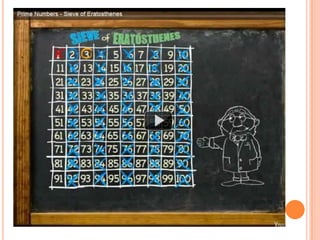
 Let students to watch two videos that is regarding
  to the lesson today in the beginning class.
 Divide students into a small groups, and to working
  on some problems together as a group.
 Come out the answers and share to the
  classmates.
BEGINNING THE CLASS:


 Students should remove their jackets and
  backpacks, then hanging inside the closet.
 Taking out a book, piece paper and pencil to write
  with.
 Then quietly sit down in their seat.
DO NOW:

 Watch two YouTube videos about today’s topic
  ---------prime numbers.
 Take notes down.
GROUPING
 After watch the videos, students will divide into a
  groups, each group should not be more than 6
  members.
 Each one will responsible to participate and working
  together to answer the few questions.
 Each group will be compete to other group.

 The winner group will get free one day no
  homework pass.
QUESTIONS:


 What is prime numbers by the definition?
  Provide some examples.
 How can you identify prime numbers?

 What is composite numbers? Provide some
  examples.
ANSWERS:


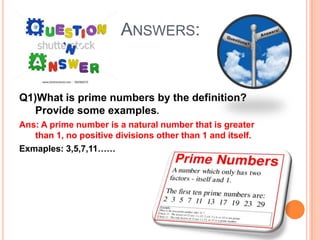
Q1)What is prime numbers by the definition?
  Provide some examples.
Ans: A prime number is a natural number that is greater
   than 1, no positive divisions other than 1 and itself.
Exmaples: 3,5,7,11……
ANSWERS CONTINUE:


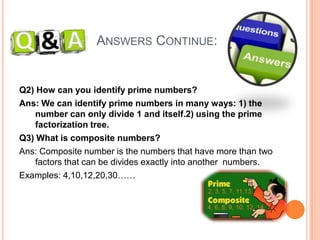
Q2) How can you identify prime numbers?
Ans: We can identify prime numbers in many ways: 1) the
   number can only divide 1 and itself.2) using the prime
   factorization tree.
Q3) What is composite numbers?
Ans: Composite number is the numbers that have more than two
   factors that can be divides exactly into another numbers.
Examples: 4,10,12,20,30……
IN THE END:

Conclusion:
Throughout this lesson, I will let students to know what is
  prime number, composite number, and how to identify the
  prime numbers.
Summarize:
   You may notice the prime numbers is exist as big numbers
  and small numbers. The smallest prime number is two. The
  largest prime number is at infinity. Grouping is the key to help
  determine if a number is prime or not. These groupings are
  also known as factors. Composite numbers is number that
  have more than two factors which can be divides exactly into
  another numbers.

Identifying prime numbers

  • 1.
    IDENTIFYING PRIME NUMBERS AC230Midterm Presentation Yang Yang Li
  • 2.
    LEARNING OBJECTIVES:  Letstudents to watch two videos that is regarding to the lesson today in the beginning class.  Divide students into a small groups, and to working on some problems together as a group.  Come out the answers and share to the classmates.
  • 3.
    BEGINNING THE CLASS: Students should remove their jackets and backpacks, then hanging inside the closet.  Taking out a book, piece paper and pencil to write with.  Then quietly sit down in their seat.
  • 4.
    DO NOW:  Watchtwo YouTube videos about today’s topic ---------prime numbers.  Take notes down.
  • 7.
    GROUPING  After watchthe videos, students will divide into a groups, each group should not be more than 6 members.  Each one will responsible to participate and working together to answer the few questions.  Each group will be compete to other group.  The winner group will get free one day no homework pass.
  • 8.
    QUESTIONS:  What isprime numbers by the definition? Provide some examples.  How can you identify prime numbers?  What is composite numbers? Provide some examples.
  • 9.
    ANSWERS: Q1)What is primenumbers by the definition? Provide some examples. Ans: A prime number is a natural number that is greater than 1, no positive divisions other than 1 and itself. Exmaples: 3,5,7,11……
  • 10.
    ANSWERS CONTINUE: Q2) Howcan you identify prime numbers? Ans: We can identify prime numbers in many ways: 1) the number can only divide 1 and itself.2) using the prime factorization tree. Q3) What is composite numbers? Ans: Composite number is the numbers that have more than two factors that can be divides exactly into another numbers. Examples: 4,10,12,20,30……
  • 11.
    IN THE END: Conclusion: Throughoutthis lesson, I will let students to know what is prime number, composite number, and how to identify the prime numbers. Summarize: You may notice the prime numbers is exist as big numbers and small numbers. The smallest prime number is two. The largest prime number is at infinity. Grouping is the key to help determine if a number is prime or not. These groupings are also known as factors. Composite numbers is number that have more than two factors which can be divides exactly into another numbers.