Primary Health Care
Levels of Care
Primary health care
Secondary health care
Tertiary health care
Levels of Care
Primary health care
 The “first” level of contact between the
individual and the health system.
 Essential health care (PHC) is provided.
 A majority of prevailing health problems can be
managed.
 The closest to the people.
 Provided by the primary health care centers.
Levels of Care
Secondary health care
 More complex problems are dealt with.
 Comprises curative services
 Provided by the district hospitals
 The 1st
referral level
Tertiary health care
 Offers super-specialist care
 Provided by regional/central level institution.
 Provide training programs
• Primary health care (PHC) became a core policy
for the World Health Organization with the Alma-
Ata Declaration in 1978 and the “Health-for-All by
the Year 2000” Program.
•The commitment to global improvements in
health, especially for the most disadvantaged
populations, was renewed in 1998 by the World
Health Assembly. This led to the ‘Health-for-All for
the twenty-first Century’ policy and program, within
which the commitment to PHC development is
restated.
What is Primary Health Care?
PHC is essential health care that is a
 Socially appropriate
 Universally accessible
 Scientifically sound first level care
 Provided by a suitably trained workforce
 Supported by integrated referral systems
 Priority to those most in need
 Maximises community and individual self-reliance
 Involves collaboration with other sectors.
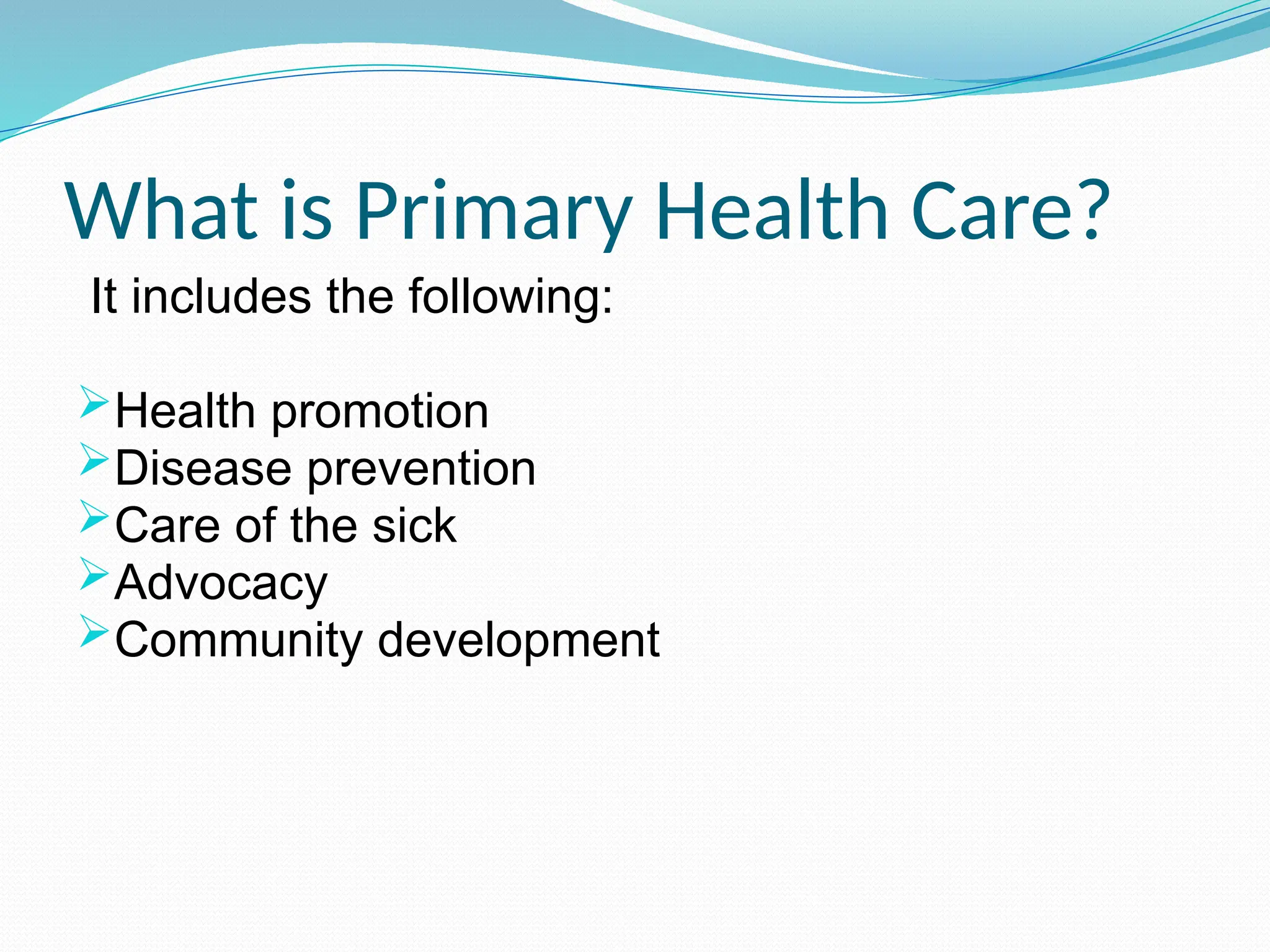
What is Primary Health Care?
It includes the following:
Health promotion
Disease prevention
Care of the sick
Advocacy
Community development
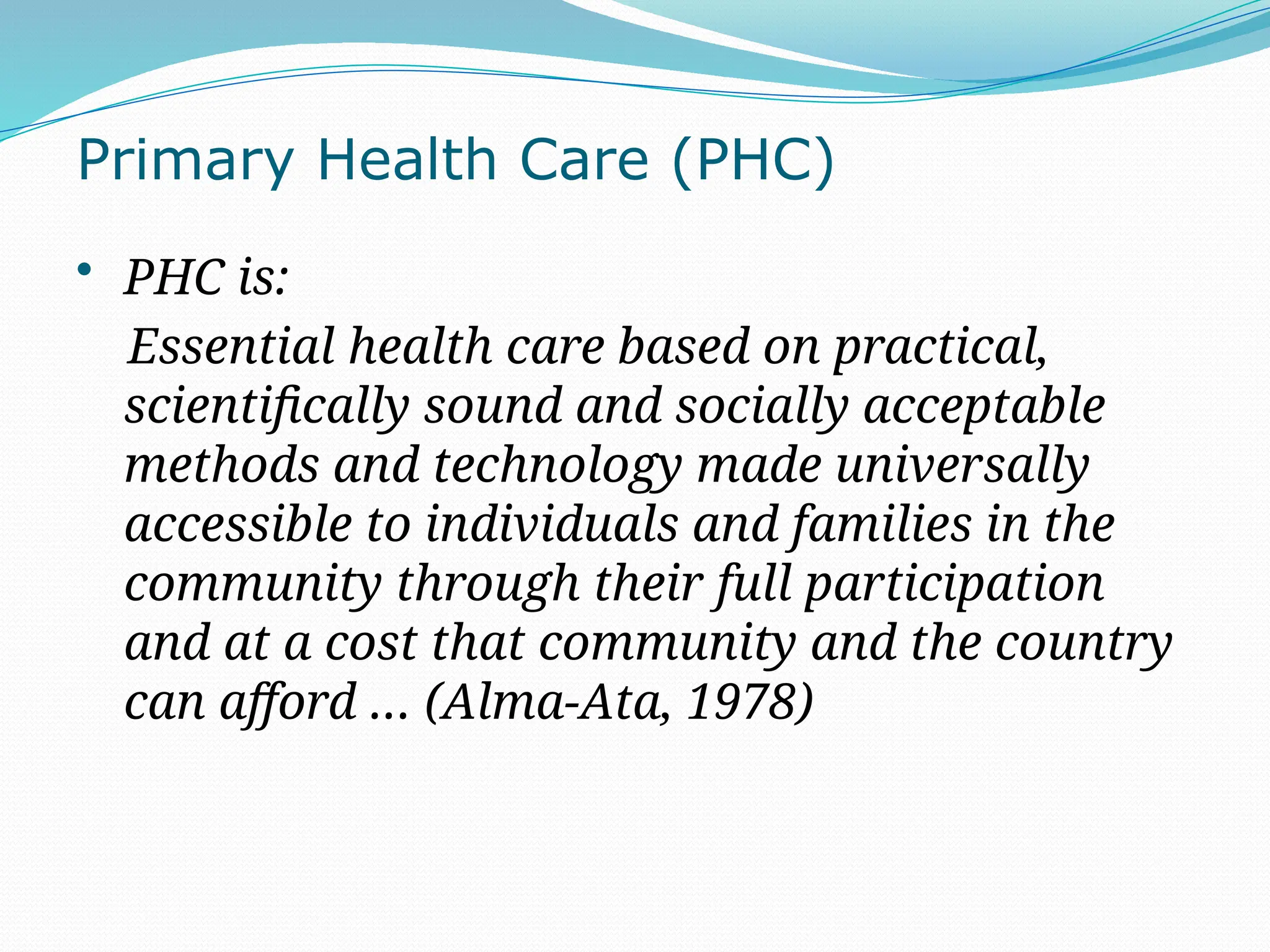
Primary Health Care (PHC)
• PHC is:
Essential health care based on practical,
scientifically sound and socially acceptable
methods and technology made universally
accessible to individuals and families in the
community through their full participation
and at a cost that community and the country
can afford … (Alma-Ata, 1978)
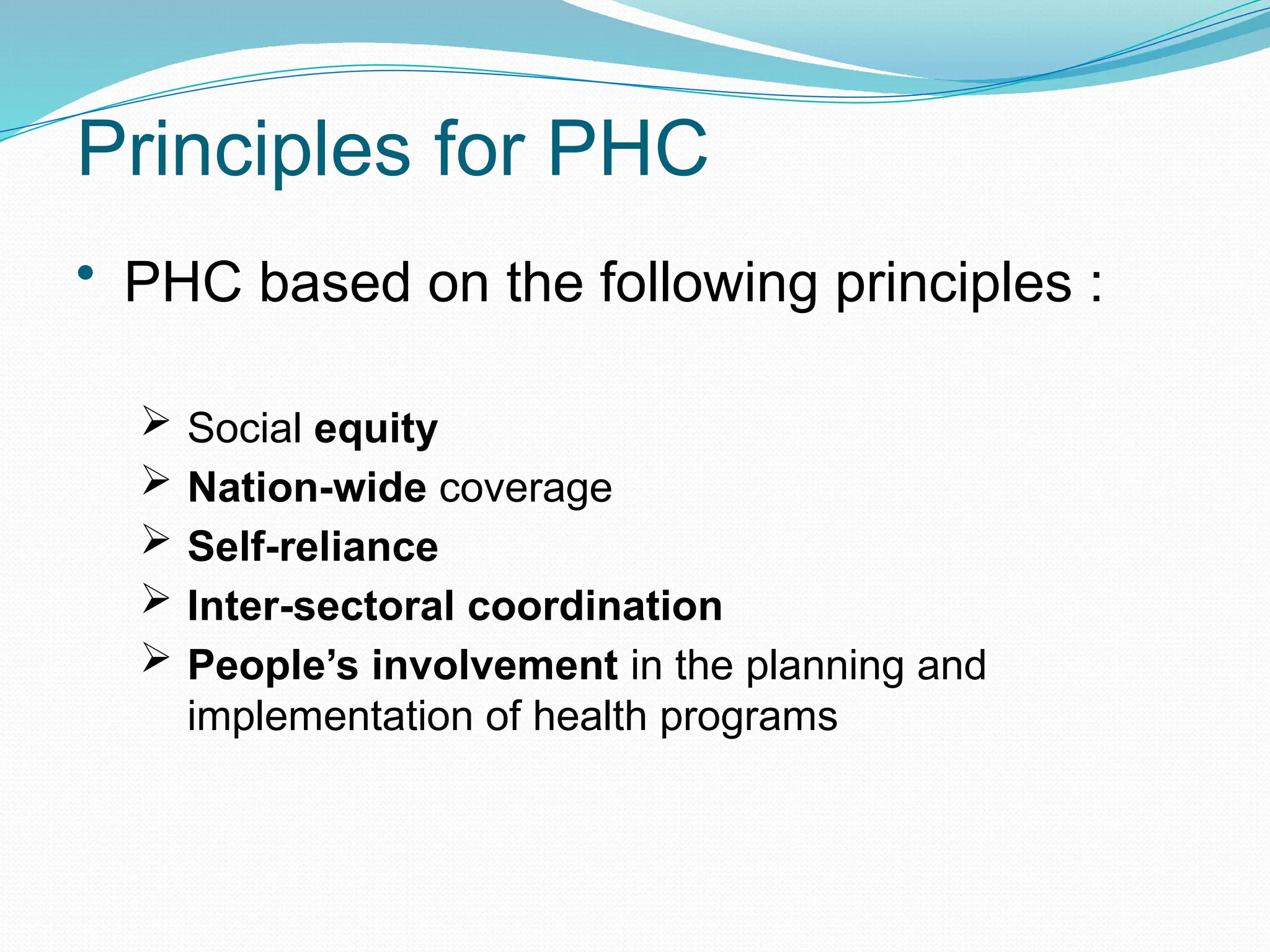
Principles for PHC
• PHC based on the following principles :
 Social equity
 Nation-wide coverage
 Self-reliance
 Inter-sectoral coordination
 People’s involvement in the planning and
implementation of health programs
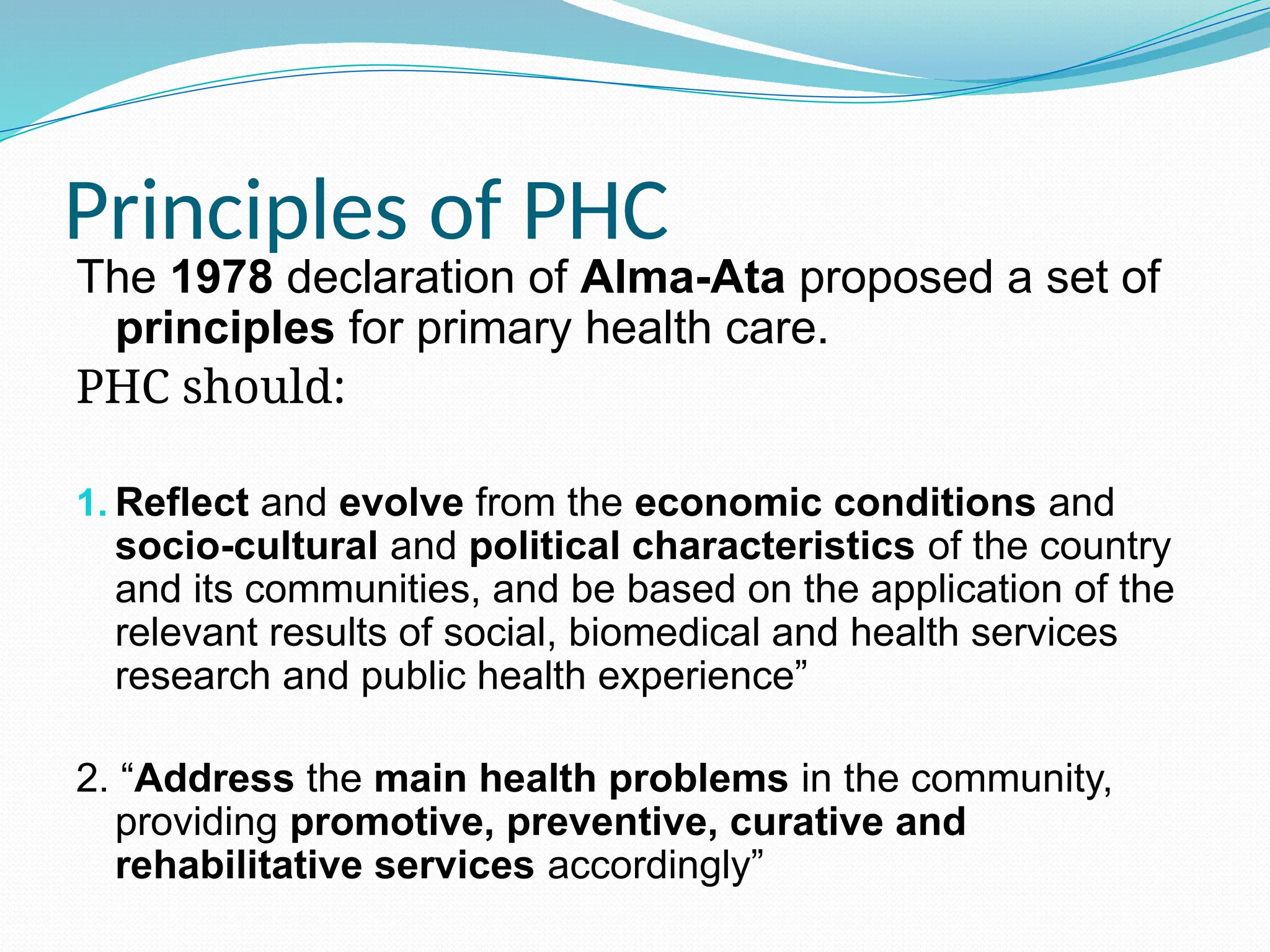
Principles of PHC
The 1978 declaration of Alma-Ata proposed a set of
principles for primary health care.
PHC should:
1. Reflect and evolve from the economic conditions and
socio-cultural and political characteristics of the country
and its communities, and be based on the application of the
relevant results of social, biomedical and health services
research and public health experience”
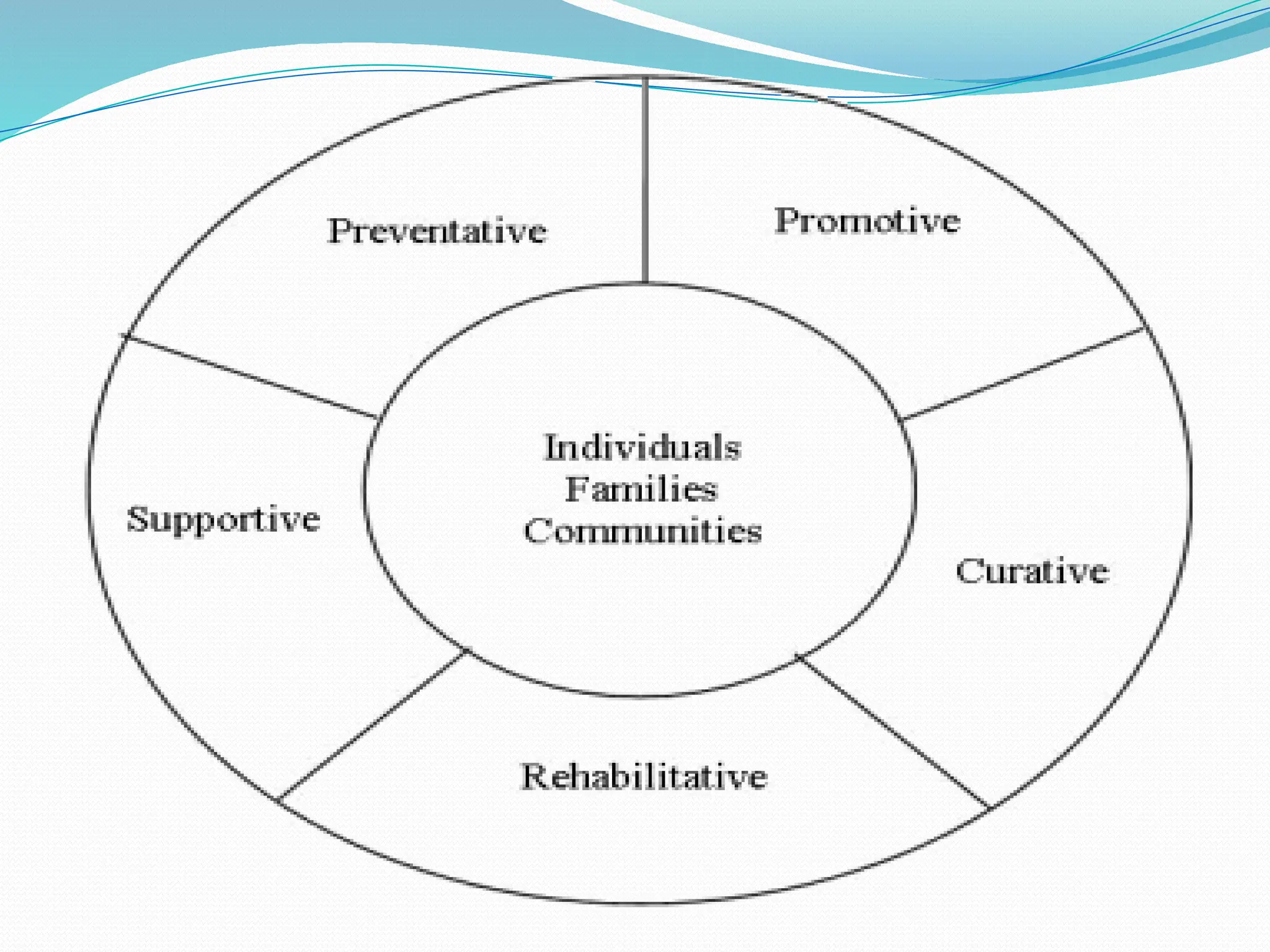
2. “Address the main health problems in the community,
providing promotive, preventive, curative and
rehabilitative services accordingly”
Principles of PHC
3. “Involve, in addition to the health sector, all
related sectors and aspects of national and
community development, in particular agriculture,
animal husbandry, food, industry, education,
housing, public works,
4. “Promote maximum community and individual
self-reliance and participation in the planning,
organization, operation and control of primary
health care, making fullest use of local, national
and other available resources; and to this end
develop through appropriate education the ability
of communities to participate”
5. “Be sustained by integrated, functional and
mutually-supportive referral systems, leading to
the progressive improvement of comprehensive
health care for all, and giving priority to those
most in need”
6. “Rely, at local and referral levels, on health
workers, including physicians, nurses, midwives,
and community workers as applicable, as well as
traditional practitioners as needed, suitably
trained socially and technically to work as a
health team and to respond to the expressed
health needs of the community.”
Principles of Primary Health Care
1. Equitable Distribution
 health services must be shared equally by all people
irrespective of their ability to pay and all must have
access to health services.
 PHC aims to redress the imbalance between urban and
rural population by shifting the center of gravity of the
health care system from cities to rural areas and bring
these services as near peoples homes as possible.
Principles of Primary Health Care
2. Community Participation
 The involvement of individuals, families and
communities in promotion of their own health and
welfare, is an essential ingredient of primary health
care.
 There must be a continuing effort to secure
meaningful involvement of community in the planning,
implementation and maintenance of health services.
Principles of Primary Health Care
3. Intersectoral Co ordination
 The components of PHC cannot be provided by the
health sector alone.
 PHC involves in addition to health sector, all related
sectors and aspects of national and community
development, in particular agriculture, animal
husbandry, food industry, education, housing,
public work, communication and other sectors.
Principles of Primary Health Care
4. Appropriate Technology
 Technology that is scientifically sound ,
adaptable to local needs, and acceptable to
those who apply it and those for whom it is used,
and that can be maintained by the people
themselves in keeping with the principle of self
reliance with the resources the community and
country can afford.
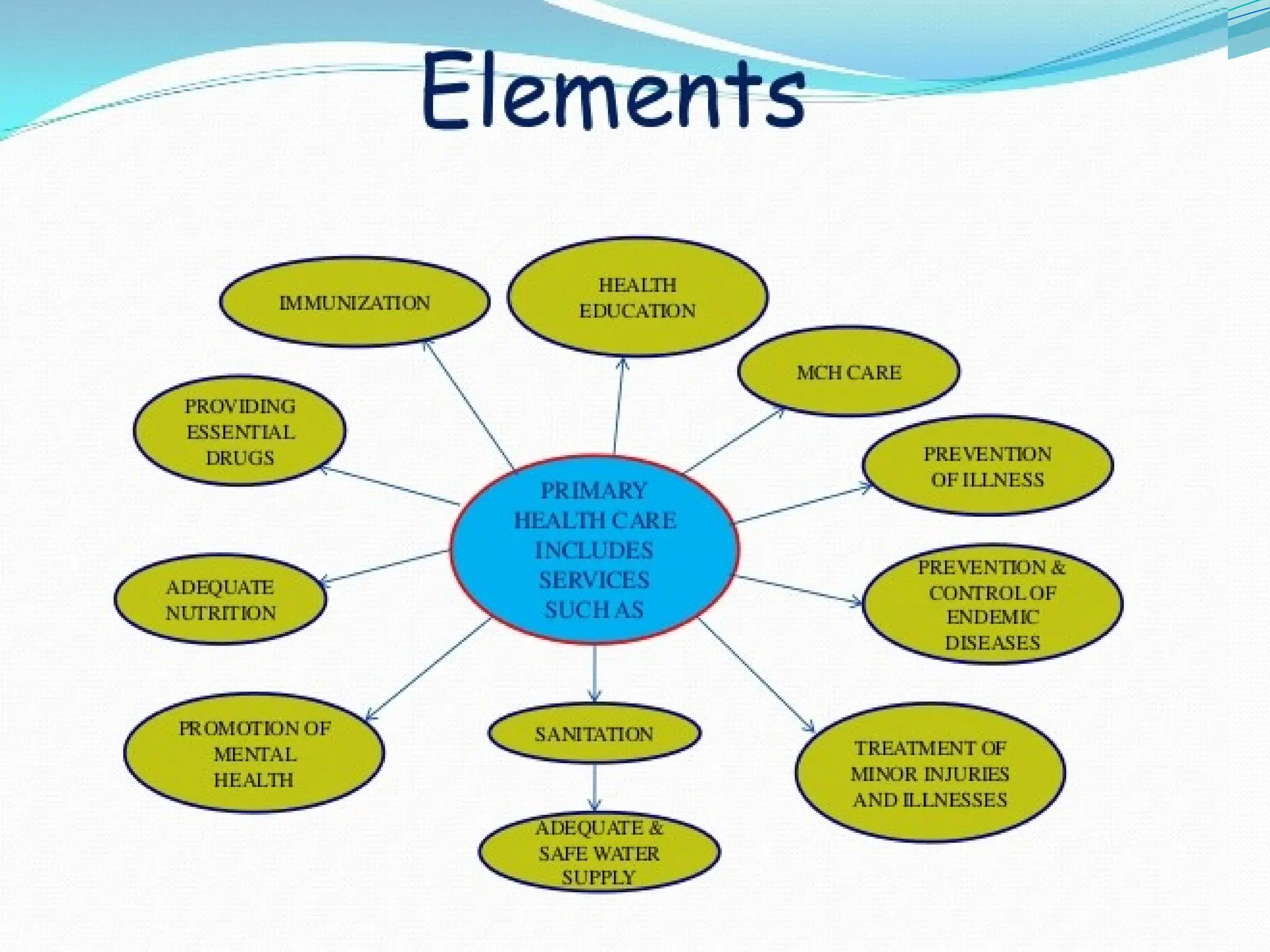
Core Activities for PHC
There is a set of CORE ACTIVITIES, which were
normally defined nationally or locally. According
to the 1978 Declaration of Alma-Ata proposed
that these activities should include:
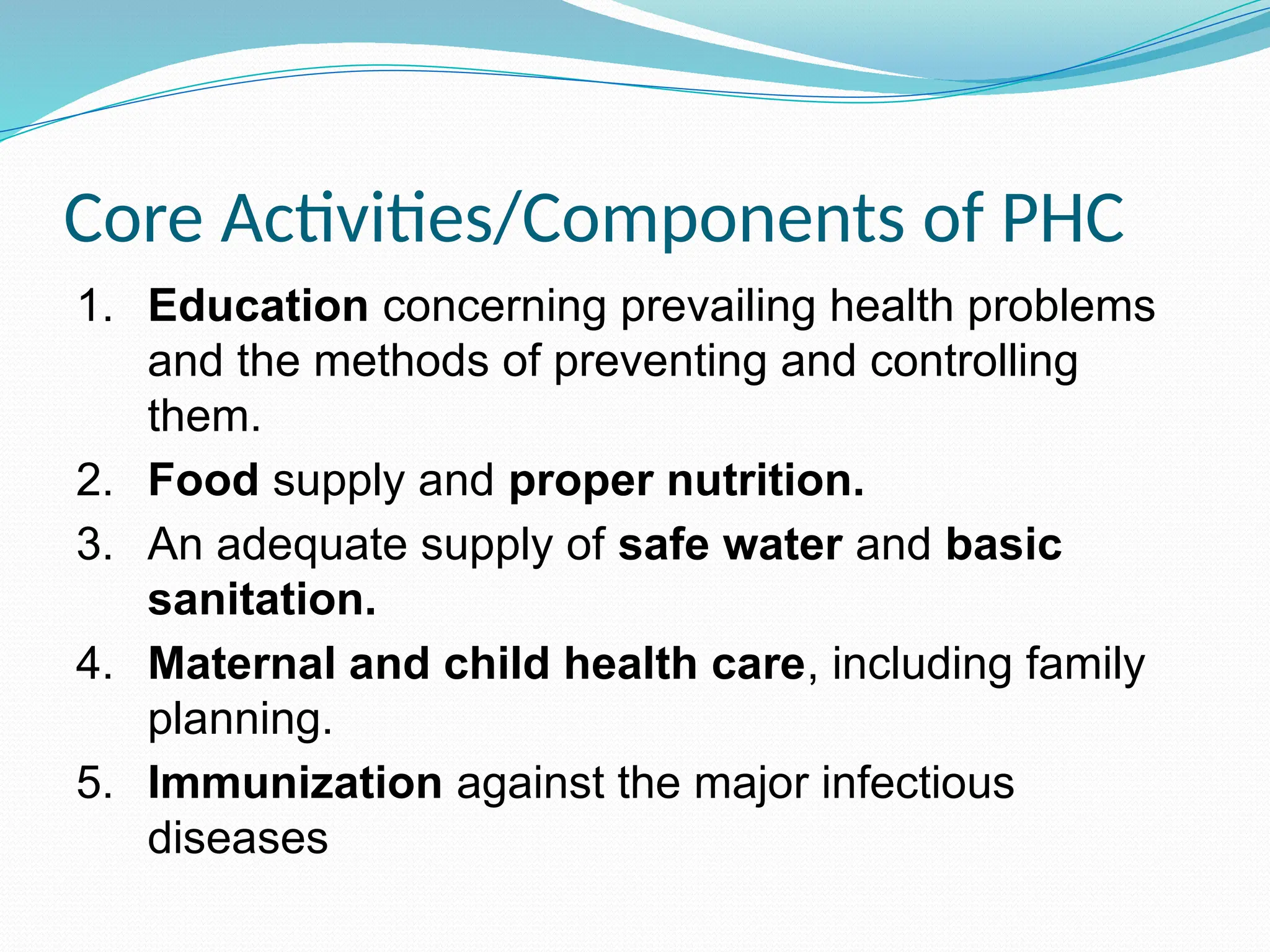
Core Activities/Components of PHC
1. Education concerning prevailing health problems
and the methods of preventing and controlling
them.
2. Food supply and proper nutrition.
3. An adequate supply of safe water and basic
sanitation.
4. Maternal and child health care, including family
planning.
5. Immunization against the major infectious
diseases
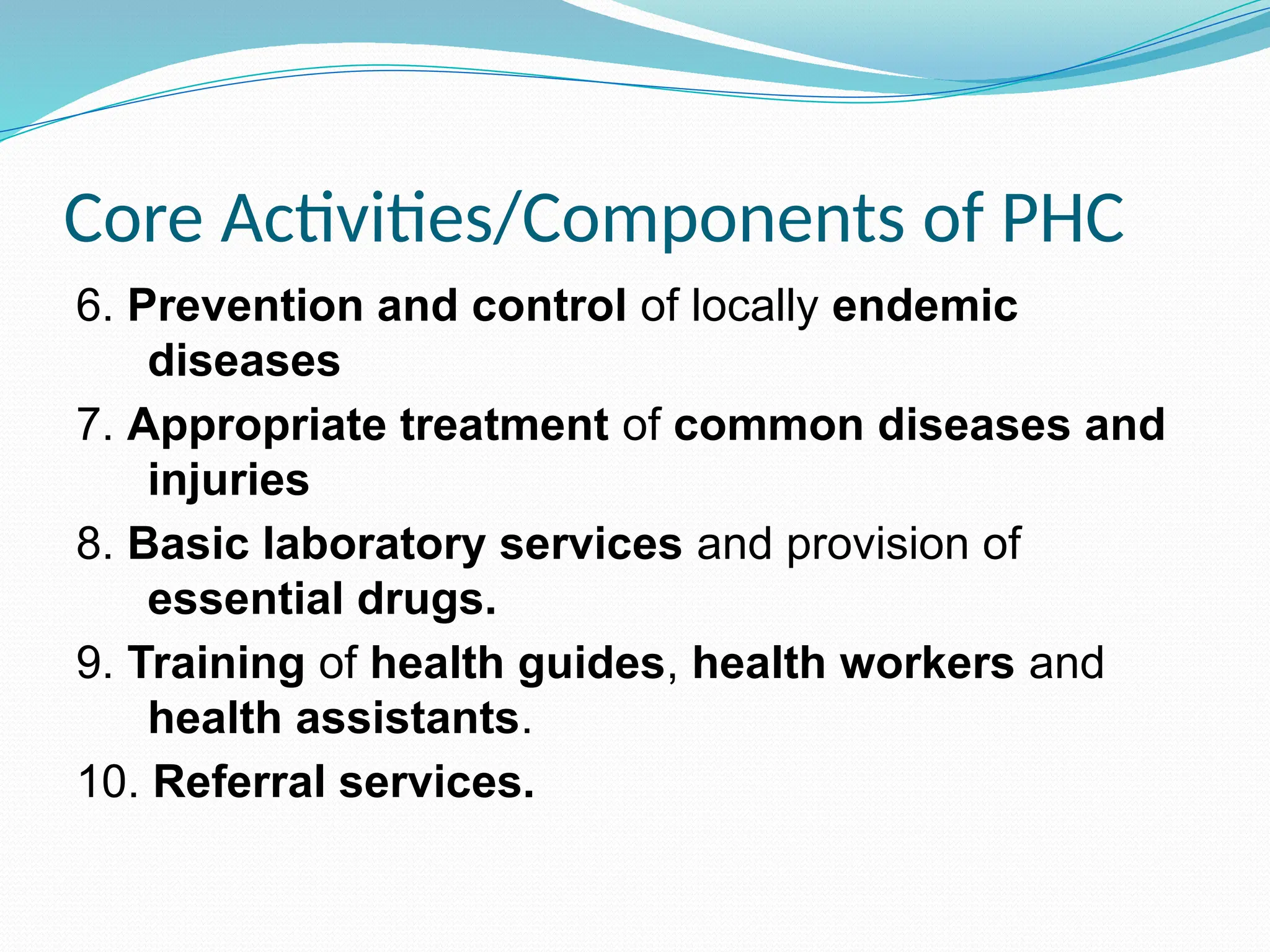
Core Activities/Components of PHC
6. Prevention and control of locally endemic
diseases
7. Appropriate treatment of common diseases and
injuries
8. Basic laboratory services and provision of
essential drugs.
9. Training of health guides, health workers and
health assistants.
10. Referral services.
Core Activities/Components of PHC
11.Mental health
12.Physical handicaps
13.Health and social care of the elderly
The Basic Requirements for Sound PHC (the
8 A’s and the 3 C’s)
 Appropriateness
 Availability
 Adequacy
 Accessibility
 Acceptability
 Affordability
 Assessability
 Accountability
 Completeness
 Comprehensiveness
 Continuity
Appropriateness
 Whether the service is needed at all in relation to
essential human needs, priorities and policies.
 The service has to be properly selected and carried
out by trained personnel in the proper way.
Adequacy
 The service proportionate to requirement.
Sufficient volume of care to meet the need and
demand of a community.
Affordability
 The cost should be within the means and
resources of the individual and the country.
Accessibility
 Reachable, convenient services
 Geographic, economic, cultural accessibility
Acceptability
 Acceptability of care depends on a variety of
factors, including satisfactory communication
between health care providers and the patients,
whether the patients trust this care, and whether
the patients believe in the confidentiality and
privacy of information shared with the providers.
Availability
 Availability of medical care means that care can
be obtained whenever people need it.
Assessability
 Assessbility means that medical care can be
readily evaluated.
Accountability
 Accountability implies the feasibility of regular
review of financial records by certified public
accountants.
Completeness
 Completeness of care requires adequate
attention to all aspects of a medical problem,
including prevention, early detection, diagnosis,
treatment, follow up measures, and
rehabilitation.
Comprehensiveness
 Comprehensiveness of care means that care is
provided for all types of health problems.
Continuity
 Continuity of care requires that the management
of a patient’s care over time be coordinated
among providers.
Key Concepts in PHC Planning
There are three inter linked concepts of PHC, if
each one of these were to operate alone , the
results will be ineffective.
 Equity
 Effectiveness
 Efficiency
Equity
1. Everyone should be entitled for health care
2. Everyone need should be taken into account
This does not imply that everyone should receive
equal care, because every ones need are not
equal, thus the call for care according to need
Effectiveness
 Each PHC program activity such as EPI, ORT
and Growth monitoring should have a favorable
effect that is measurable through indicators.
 Being effective means producing powerful effects
 It refers to doing the right things. It constantly
measures if the actual output meets the desired
output.
Efficiency
 Whenever PHC programs are undertaken, they should
be low cost and consistent with favorable effect.
 Being efficient means producing results with little wasted
effort. It is the ability to carry out actions quickly.
 it is defined as the output to input ratio and focuses on
getting the Maximum output with Minimum resources.
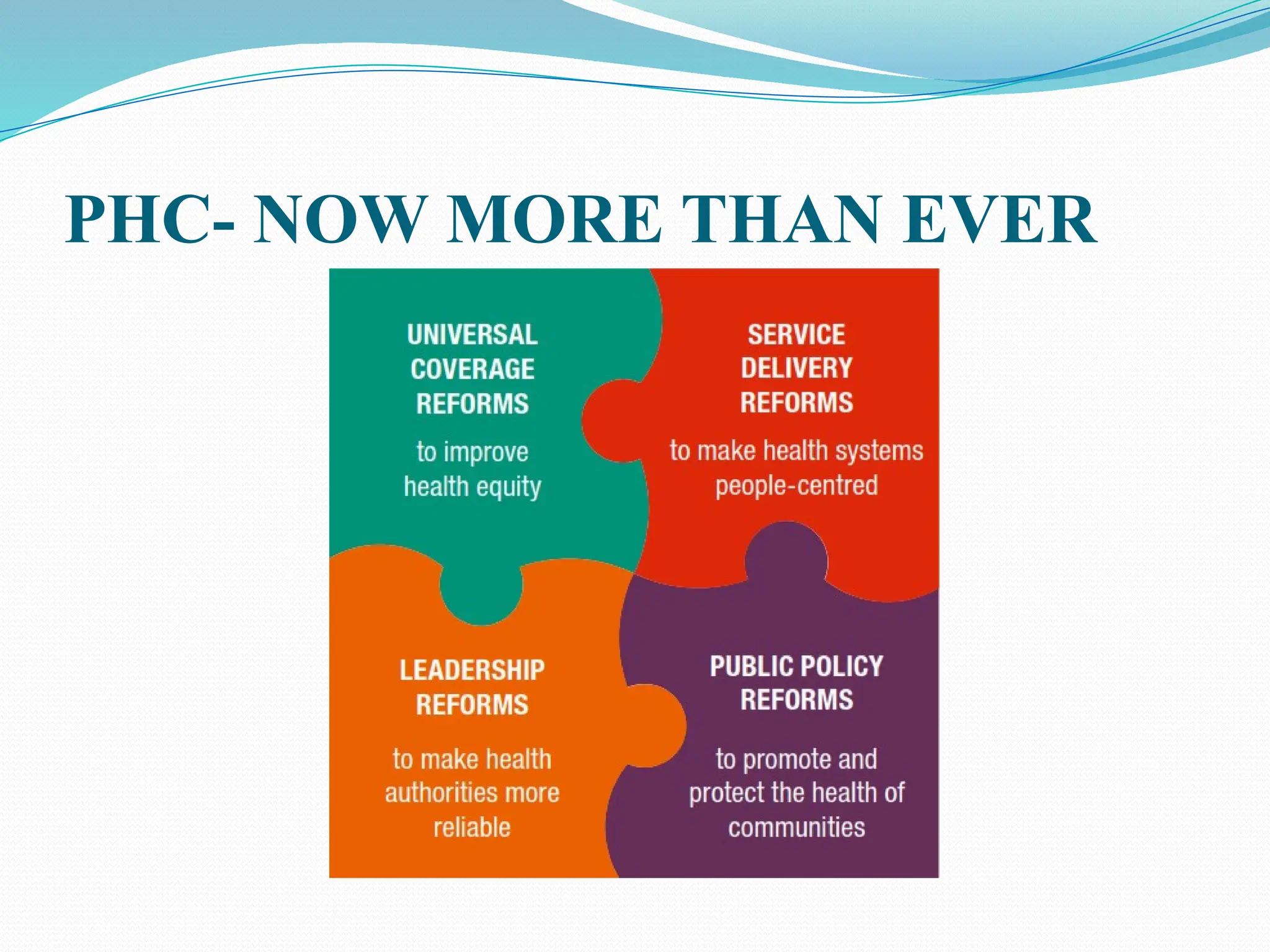
PHC- NOW MORE THAN EVER
To Summarize
Primary care is an approach that:
 Focuses on the person not the disease,
considers all determinants of health.
 Integrates care when there is more than one
problem.
 Addresses most important problems in the
community by providing preventive, curative, and
rehabilitative services.

Referencess
 http://www.euro.who.int/__data/assets/pdf_file/00
09/113877/E93944.pdf
 http://www.who.int/whr/2008/whr08_en.pdf
Many Thanks
for Attention and
Patient Participation
email:mdrjawad@yahoo.com

Introduction to Primary health care, basic knowledge for students in public health

  • 1.
  • 2.
    Levels of Care Primaryhealth care Secondary health care Tertiary health care
  • 3.
    Levels of Care Primaryhealth care  The “first” level of contact between the individual and the health system.  Essential health care (PHC) is provided.  A majority of prevailing health problems can be managed.  The closest to the people.  Provided by the primary health care centers.
  • 4.
    Levels of Care Secondaryhealth care  More complex problems are dealt with.  Comprises curative services  Provided by the district hospitals  The 1st referral level Tertiary health care  Offers super-specialist care  Provided by regional/central level institution.  Provide training programs
  • 5.
    • Primary healthcare (PHC) became a core policy for the World Health Organization with the Alma- Ata Declaration in 1978 and the “Health-for-All by the Year 2000” Program. •The commitment to global improvements in health, especially for the most disadvantaged populations, was renewed in 1998 by the World Health Assembly. This led to the ‘Health-for-All for the twenty-first Century’ policy and program, within which the commitment to PHC development is restated.
  • 6.
    What is PrimaryHealth Care? PHC is essential health care that is a  Socially appropriate  Universally accessible  Scientifically sound first level care  Provided by a suitably trained workforce  Supported by integrated referral systems  Priority to those most in need  Maximises community and individual self-reliance  Involves collaboration with other sectors.
  • 7.
    What is PrimaryHealth Care? It includes the following: Health promotion Disease prevention Care of the sick Advocacy Community development
  • 8.
    Primary Health Care(PHC) • PHC is: Essential health care based on practical, scientifically sound and socially acceptable methods and technology made universally accessible to individuals and families in the community through their full participation and at a cost that community and the country can afford … (Alma-Ata, 1978)
  • 9.
    Principles for PHC •PHC based on the following principles :  Social equity  Nation-wide coverage  Self-reliance  Inter-sectoral coordination  People’s involvement in the planning and implementation of health programs
  • 10.
    Principles of PHC The1978 declaration of Alma-Ata proposed a set of principles for primary health care. PHC should: 1. Reflect and evolve from the economic conditions and socio-cultural and political characteristics of the country and its communities, and be based on the application of the relevant results of social, biomedical and health services research and public health experience” 2. “Address the main health problems in the community, providing promotive, preventive, curative and rehabilitative services accordingly”
  • 11.
    Principles of PHC 3.“Involve, in addition to the health sector, all related sectors and aspects of national and community development, in particular agriculture, animal husbandry, food, industry, education, housing, public works, 4. “Promote maximum community and individual self-reliance and participation in the planning, organization, operation and control of primary health care, making fullest use of local, national and other available resources; and to this end develop through appropriate education the ability of communities to participate”
  • 12.
    5. “Be sustainedby integrated, functional and mutually-supportive referral systems, leading to the progressive improvement of comprehensive health care for all, and giving priority to those most in need” 6. “Rely, at local and referral levels, on health workers, including physicians, nurses, midwives, and community workers as applicable, as well as traditional practitioners as needed, suitably trained socially and technically to work as a health team and to respond to the expressed health needs of the community.”
  • 14.
    Principles of PrimaryHealth Care 1. Equitable Distribution  health services must be shared equally by all people irrespective of their ability to pay and all must have access to health services.  PHC aims to redress the imbalance between urban and rural population by shifting the center of gravity of the health care system from cities to rural areas and bring these services as near peoples homes as possible.
  • 15.
    Principles of PrimaryHealth Care 2. Community Participation  The involvement of individuals, families and communities in promotion of their own health and welfare, is an essential ingredient of primary health care.  There must be a continuing effort to secure meaningful involvement of community in the planning, implementation and maintenance of health services.
  • 16.
    Principles of PrimaryHealth Care 3. Intersectoral Co ordination  The components of PHC cannot be provided by the health sector alone.  PHC involves in addition to health sector, all related sectors and aspects of national and community development, in particular agriculture, animal husbandry, food industry, education, housing, public work, communication and other sectors.
  • 17.
    Principles of PrimaryHealth Care 4. Appropriate Technology  Technology that is scientifically sound , adaptable to local needs, and acceptable to those who apply it and those for whom it is used, and that can be maintained by the people themselves in keeping with the principle of self reliance with the resources the community and country can afford.
  • 19.
    Core Activities forPHC There is a set of CORE ACTIVITIES, which were normally defined nationally or locally. According to the 1978 Declaration of Alma-Ata proposed that these activities should include:
  • 21.
    Core Activities/Components ofPHC 1. Education concerning prevailing health problems and the methods of preventing and controlling them. 2. Food supply and proper nutrition. 3. An adequate supply of safe water and basic sanitation. 4. Maternal and child health care, including family planning. 5. Immunization against the major infectious diseases
  • 22.
    Core Activities/Components ofPHC 6. Prevention and control of locally endemic diseases 7. Appropriate treatment of common diseases and injuries 8. Basic laboratory services and provision of essential drugs. 9. Training of health guides, health workers and health assistants. 10. Referral services.
  • 23.
    Core Activities/Components ofPHC 11.Mental health 12.Physical handicaps 13.Health and social care of the elderly
  • 24.
    The Basic Requirementsfor Sound PHC (the 8 A’s and the 3 C’s)  Appropriateness  Availability  Adequacy  Accessibility  Acceptability  Affordability  Assessability  Accountability  Completeness  Comprehensiveness  Continuity
  • 25.
    Appropriateness  Whether theservice is needed at all in relation to essential human needs, priorities and policies.  The service has to be properly selected and carried out by trained personnel in the proper way.
  • 26.
    Adequacy  The serviceproportionate to requirement. Sufficient volume of care to meet the need and demand of a community.
  • 27.
    Affordability  The costshould be within the means and resources of the individual and the country.
  • 28.
    Accessibility  Reachable, convenientservices  Geographic, economic, cultural accessibility
  • 29.
    Acceptability  Acceptability ofcare depends on a variety of factors, including satisfactory communication between health care providers and the patients, whether the patients trust this care, and whether the patients believe in the confidentiality and privacy of information shared with the providers.
  • 30.
    Availability  Availability ofmedical care means that care can be obtained whenever people need it.
  • 31.
    Assessability  Assessbility meansthat medical care can be readily evaluated.
  • 32.
    Accountability  Accountability impliesthe feasibility of regular review of financial records by certified public accountants.
  • 33.
    Completeness  Completeness ofcare requires adequate attention to all aspects of a medical problem, including prevention, early detection, diagnosis, treatment, follow up measures, and rehabilitation.
  • 34.
    Comprehensiveness  Comprehensiveness ofcare means that care is provided for all types of health problems.
  • 35.
    Continuity  Continuity ofcare requires that the management of a patient’s care over time be coordinated among providers.
  • 36.
    Key Concepts inPHC Planning There are three inter linked concepts of PHC, if each one of these were to operate alone , the results will be ineffective.  Equity  Effectiveness  Efficiency
  • 37.
    Equity 1. Everyone shouldbe entitled for health care 2. Everyone need should be taken into account This does not imply that everyone should receive equal care, because every ones need are not equal, thus the call for care according to need
  • 38.
    Effectiveness  Each PHCprogram activity such as EPI, ORT and Growth monitoring should have a favorable effect that is measurable through indicators.  Being effective means producing powerful effects  It refers to doing the right things. It constantly measures if the actual output meets the desired output.
  • 39.
    Efficiency  Whenever PHCprograms are undertaken, they should be low cost and consistent with favorable effect.  Being efficient means producing results with little wasted effort. It is the ability to carry out actions quickly.  it is defined as the output to input ratio and focuses on getting the Maximum output with Minimum resources.
  • 40.
    PHC- NOW MORETHAN EVER
  • 41.
    To Summarize Primary careis an approach that:  Focuses on the person not the disease, considers all determinants of health.  Integrates care when there is more than one problem.  Addresses most important problems in the community by providing preventive, curative, and rehabilitative services.
  • 42.
  • 43.
    Many Thanks for Attentionand Patient Participation email:mdrjawad@yahoo.com