1….Reflex causes.
A)-Due to sensory stimulation of the structer of the eyeball e.g corneal forieng body ,corneal ulcer,keratitis or exposure to cold wind,dust smoke or irritating gases
B)-exposure to very bright light.
C)-Due to stimulation of the nasal mucus membrane as in nasal cattarh
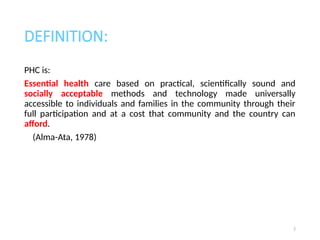
DEFINITION:
PHC is:
Essential healthcare based on practical, scientifically sound and
socially acceptable methods and technology made universally
accessible to individuals and families in the community through their
full participation and at a cost that community and the country can
afford.
(Alma-Ata, 1978)
2
3.
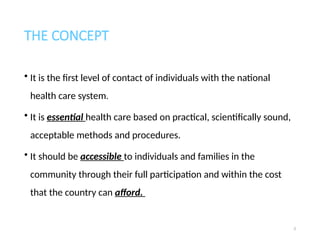
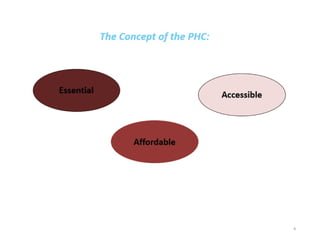
THE CONCEPT
• Itis the first level of contact of individuals with the national
health care system.
• It is essential health care based on practical, scientifically sound,
acceptable methods and procedures.
• It should be accessible to individuals and families in the
community through their full participation and within the cost
that the country can afford.
3
Levels Of Care
Primary health care
Secondary health care
Tertiary health care
5
6.
Primary Health Care
The “first” level of contact between the individual and
the health system.
Essential health care (PHC) is provided.
A majority of prevailing health problems can be
satisfactorily managed.
The closest to the people.
Provided by the primary health centers.
7.
Secondary Health Care
More complex problems are dealt with.
Comprises curative services
Provided by the district hospitals
The 1st referral level
8.
Tertiary Health Care
Offers super-specialist care
Provided by regional/central level institution.
Provide training programs
9.
Primary healthcare (PHC) became a core policy for the
World Health Organization with the Alma-Ata Declaration in
1978 and the ‘Health-for-All by the Year 2000’ Program.
The commitment to global improvements in health,
especially for the most disadvantaged populations, was
renewed in 1998 by the World Health Assembly. This led to
the ‘Health-for-All for the twenty-first Century’ policy and
program, within which the commitment to PHC development
is restated.
10.
What Is PrimaryHealth
Care?
Essential health care
First Level
Socially appropriate
Universally accessible
Scientifically sound
Trained workforce
11.
Maximizes communityand individual self-reliance
Collaboration with other sectors
12.
Primary Health Care
Include:
• Health promotion
• Illness prevention
• Care of the sick
• Advocacy
• Community development
13.
Principles For PHC
PHCbased on the following principles :
• Social equity
• Nation-wide coverage
• Self-reliance
• Inter-sectoral coordination
• People’s involvement in the planning and implementation of
health programs
14.
The 1978 Declarationof Alma-Ata proposed a set of PRINCIPLES for
primary health care. PHC should:
1. “Reflect and evolve from the economic conditions and socio-cultural
and political characteristics of the country and its communities, and be
based on the application of the relevant results of social, biomedical
and health services research and public health experience”
2. “Address the main health problems in the community, providing
promotive, preventive, curative and rehabilitative services accordingly”
15.
3. “Involve, inaddition to the health sector, all related
sectors and aspects of national and community
development, in particular agriculture, animal
husbandry, food, industry, education, housing, public
works,
4. “Promote maximum community and individual self-
reliance and participation in the planning, organization,
operation and control of primary health care, making
fullest use of local, national and other available
resources; and to this end develop through appropriate
education the ability of communities to participate”
16.
5. “Be sustainedby integrated, functional and mutually-supportive
referral systems, leading to the progressive improvement of
comprehensive health care for all, and giving priority to those most in
need”
6. “Rely, at local and referral levels, on health workers, including
physicians, nurses, midwives, auxiliaries and community workers as
applicable, as well as traditional practitioners as needed, suitably
trained socially and technically to work as a health team and to
respond to the expressed health needs of the community.”
17.
Core Activities forPHC
“Often health is considered as absence of certain disease
conditions and not a condition itself, which is not true.”
18.
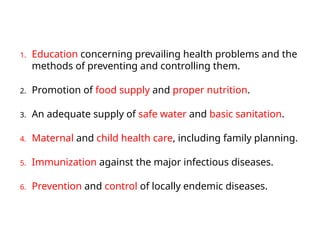
1. Education concerningprevailing health problems and the
methods of preventing and controlling them.
2. Promotion of food supply and proper nutrition.
3. An adequate supply of safe water and basic sanitation.
4. Maternal and child health care, including family planning.
5. Immunization against the major infectious diseases.
6. Prevention and control of locally endemic diseases.
19.
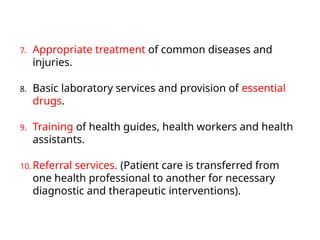
7. Appropriate treatmentof common diseases and
injuries.
8. Basic laboratory services and provision of essential
drugs.
9. Training of health guides, health workers and health
assistants.
10. Referral services. (Patient care is transferred from
one health professional to another for necessary
diagnostic and therapeutic interventions).
20.
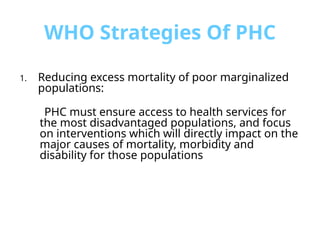
WHO Strategies OfPHC
1. Reducing excess mortality of poor marginalized
populations:
PHC must ensure access to health services for
the most disadvantaged populations, and focus
on interventions which will directly impact on the
major causes of mortality, morbidity and
disability for those populations
21.
2. Reducing theleading risk factors to human health:
PHC, through its preventative and health promotion roles,
must address those known risk factors, which are the major
determinants of health outcomes for local populations.
3. Developing Sustainable Health Systems:
PHC as a component of health systems must develop
in ways, which are financially sustainable, supported
by political leaders, and supported by the populations
served.
22.
4. Developing anenabling policy and institutional
environment:
PHC policy must be integrated with other policy
domains, and play its part in the pursuit of wider
social, economic, environmental and development
policy.
23.
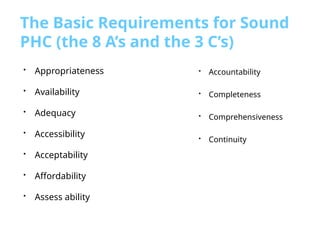
The Basic Requirementsfor Sound
PHC (the 8 A’s and the 3 C’s)
• Accountability
• Completeness
• Comprehensiveness
• Continuity
• Appropriateness
• Availability
• Adequacy
• Accessibility
• Acceptability
• Affordability
• Assess ability
24.
Appropriateness
1. Whether theservice is needed at all in relation to
essential human needs, priorities and policies.
2. The service has to be properly selected and
carried out by trained personnel in the proper
way.
25.
Adequacy
1. The serviceproportionate to requirement.
2. Sufficient volume of care to meet the need and
demand of a community
26.
Affordability
• The costshould be within the means and
resources of the individual and the country.
Acceptability
• Acceptability ofcare depends on a variety of
factors, including satisfactory communication
between health care providers and the patients,
whether the patients trust this care, and whether
the patients believe in the confidentiality and
privacy of information shared with the providers.
Completeness
• Completeness ofcare requires adequate attention
to all aspects of a medical problem, including
prevention, early detection, diagnosis, treatment,
follow up measures, and rehabilitation.
Continuity
• Continuity ofcare requires that the management
of a patient’s care over time be coordinated among
providers.
35.
Summary
Primary care isan approach that:
• Focuses on the person not the disease, considers
all determinants of health
• Integrates care when there is more than one
problem
• Uses resources to narrow differences
36.
Summary
• Forms thebasis for other levels of health systems
• Addresses most important problems in the
community by providing preventive, curative, and
rehabilitative services
• Organizes deployment of resources aiming at
promoting and maintaining health.