Primary Health Care Strategy: Key Directions for the Information Environment Case study report and composite success model
“ Doctors, nurses, community health workers and others in primary health care will work together to reduce health inequalities and to address the causes of poor health status.  Services will be readily available at a cost people can afford. High quality care will ensure coordination over time and across the different providers needed to deal with a wide range of problems.” Annette King, PHCS February 2001 Key Directions - background
“ People will be part of local primary health care services that improve their health, keep them well and are easy to get to and coordinate their ongoing care.  Primary health care services will focus on better health for a population and actively work to reduce health inequalities between different groups.” “ The Strategy in Summary”  PHCS February 2001 Key Directions - background
Describes the information environment needed to achieve the goals of the Primary Health Care Strategy and describes the development path required organised around the needs of people flexible enough to meet local preferences dependable and maintains high-quality standards empowering for all its users What is Key Directions?
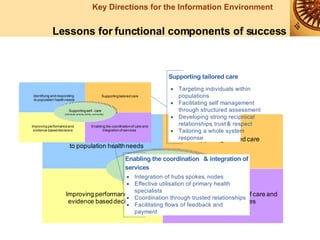
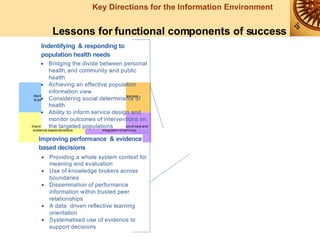
Describes the need for five key capabilities Identifying and responding to population health needs Supporting tailored care Enabling the coordination of care and integration of services Improving performance and evidence-based decisions Supporting self-care What is Key Directions?
Population health capability is the systematic identification and deliberate response to the:  Distribution of health outcomes among populations; and  Patterns of health determinants, over the life course, in relation to health outcomes.  Enables actions to: Identify populations of interest Identify immediate needs and predict future patterns Identify the response Evaluate the response Identifying & responding to population health needs
Tailored care for individuals is the systematic identification of needs and the deliberate and dependable response to an individual in relation to their context.  For example, this can be supporting child health development, a person with a long term condition or in response to an episodic care need. Enables actions to: Engage individuals Identify health needs Intervene effectively with all populations Assess the effectiveness Support self-management   Supporting the tailoring of care for individuals
Coordination of care and integration of services refers to the deliberate organisation of integrated care for people who require dependable care over time. Enables actions to: Develop care pathways  Identify participants in care Streamline the actions along the care pathways Follow progress and respond to actions along care pathway Evaluate effectiveness   Enabling the coordination of care
Performance improvement is a continual process of assessing how well we are performing against benchmarks and evidence, planning how to change our performance, implementing and then reassessing. Enables actions to: Determine what we want to achieve Define how we will know if we have made an improvement Determine what changes will result in an improvement Plan, act and assess Disseminate learning and evidence.   Improving performance & evidence based decisions
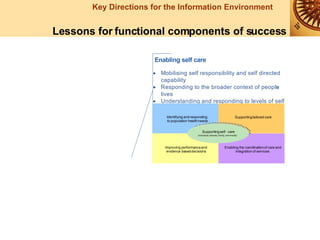
Self-care is about enabling people, working in partnership with their carers and health professionals, to: Make informed choices Adapt new perspectives and skills that can be applied to new problems and goals as they arise Practice new health behaviours, and to  Maintain or regain confidence. The aim is to maintain health, prevent and slow the progression of disease, and to enable people to be active participants in their health care. Self-care, in Key Directions, includes whānau, family, carers and community as agents of change and recognises their roles in influencing not just their own well-being, but also the way in which we think of health and the health system.   Supporting self-care
The Ministry of Health engaged Synergia to undertake case studies of the innovative use of information in primary health care 43 respondents 8 examined in more detail for their ability to: Profile the use of information in primary care to improve clinical practice, organisational performance, and health outcomes Provide examples and key learnings from sector activity in primary care The case studies
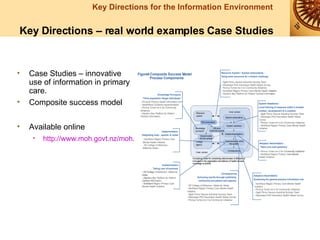
Success, even the seeds of it, can be found in many things - even things that have failed. Composite success is about identifying elements of success and ensuring that they can be woven together and replicated across settings This report identifies the elements of successful functions found across the eight initiatives and proposes that they can be woven together to provide a representation of a ‘composite success model’  Composite success model
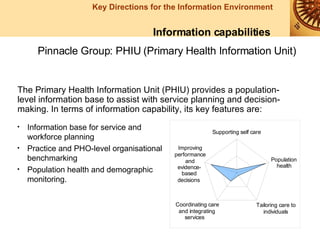
Information capabilities Pinnacle Group: PHIU (Primary Health Information Unit) The Primary Health Information Unit (PHIU) provides a population-level information base to assist with service planning and decision-making. In terms of information capability, its key features are: Information base for service and workforce planning Practice and PHO-level organisational benchmarking Population health and demographic monitoring.
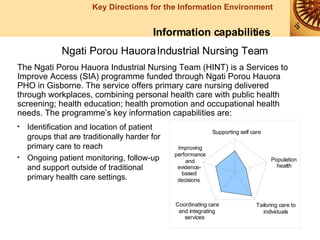
Information capabilities Ngati Porou Hauora Industrial Nursing Team The Ngati Porou Hauora Industrial Nursing Team (HINT) is a Services to Improve Access (SIA) programme funded through Ngati Porou Hauora PHO in Gisborne. The service offers primary care nursing delivered through workplaces, combining personal health care with public health screening; health education; health promotion and occupational health needs. The programme’s key information capabilities are: Identification and location of patient groups that are traditionally harder for primary care to reach Ongoing patient monitoring, follow-up and support outside of traditional primary health care settings.
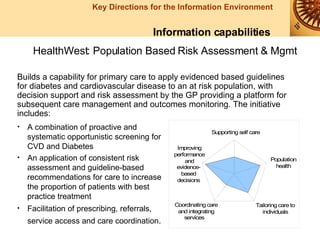
Information capabilities HealthWest: Population Based Risk Assessment & Mgmt A combination of proactive and systematic opportunistic screening for CVD and Diabetes An application of consistent risk assessment and guideline-based recommendations for care to increase the proportion of patients with best practice treatment Facilitation of prescribing, referrals, service access and care coordination .   Builds a capability for primary care to apply evidenced based guidelines for diabetes and cardiovascular disease to an at risk population, with decision support and risk assessment by the GP providing a platform for subsequent care management and outcomes monitoring. The initiative includes:
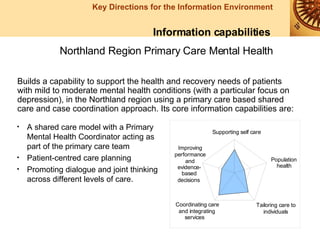
Information capabilities Northland Region Primary Care Mental Health A shared care model with a Primary Mental Health Coordinator acting as part of the primary care team Patient-centred care planning  Promoting dialogue and joint thinking across different levels of care.   Builds a capability to support the health and recovery needs of patients with mild to moderate mental health conditions (with a particular focus on depression), in the Northland region using a primary care based shared care and case coordination approach. Its core information capabilities are:
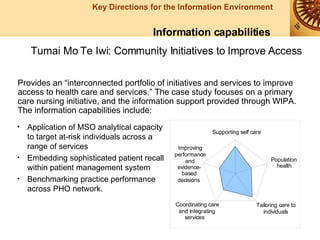
Information capabilities Tumai Mo Te Iwi: Community Initiatives to Improve Access Application of MSO analytical capacity to target at-risk individuals across a range of services Embedding sophisticated patient recall within patient management system Benchmarking practice performance across PHO network.   Provides an “interconnected portfolio of initiatives and services to improve access to health care and services.” The case study focuses on a primary care nursing initiative, and the information support provided through WIPA. The information capabilities include:
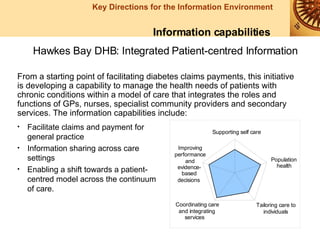
Information capabilities Hawkes Bay DHB: Integrated Patient-centred Information Facilitate claims and payment for general practice Information sharing across care settings Enabling a shift towards a patient-centred model across the continuum of care.   From a starting point of facilitating diabetes claims payments, this initiative is developing a capability to manage the health needs of patients with chronic conditions within a model of care that integrates the roles and functions of GPs, nurses, specialist community providers and secondary services. The information capabilities include:
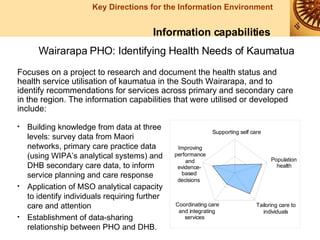
Information capabilities Wairarapa PHO: Identifying Health Needs of Kaumatua Building knowledge from data at three levels: survey data from Maori networks, primary care practice data (using WIPA’s analytical systems) and DHB secondary care data, to inform service planning and care response Application of MSO analytical capacity to identify individuals requiring further care and attention Establishment of data-sharing relationship between PHO and DHB.   Focuses on a project to research and document the health status and health service utilisation of kaumatua in the South Wairarapa, and to identify recommendations for services across primary and secondary care in the region. The information capabilities that were utilised or developed include:
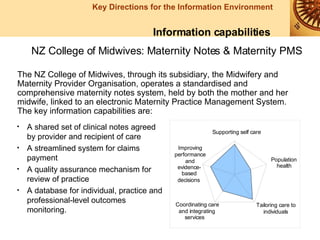
Information capabilities NZ College of Midwives: Maternity Notes & Maternity PMS A shared set of clinical notes agreed by provider and recipient of care A streamlined system for claims payment A quality assurance mechanism for review of practice A database for individual, practice and professional-level outcomes monitoring.   The NZ College of Midwives, through its subsidiary, the Midwifery and Maternity Provider Organisation, operates a standardised and comprehensive maternity notes system, held by both the mother and her midwife, linked to an electronic Maternity Practice Management System. The key information capabilities are:
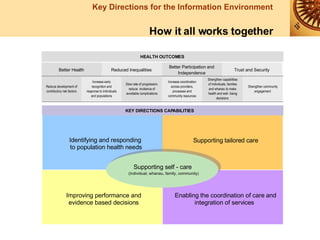
How it all works together Slow rate of progression,  reduce  incidence of  avoidable complications Increase early  recognition and  response to individuals  and populations Reduce development of  contributory risk factors Strengthen community  engagement Strengthen capabilities  of individuals, families  and whanau to make  health and well - being  decisions Increase coordination  across providers,  processes and  community resources HEALTH OUTCOMES Better Health Reduced Inequalities Better Participation and  Independence Trust and Security Identifying and responding  to population health needs Supporting tailored care  Enabling the coordination of care and  integration of services Improving performance and evidence based decisions KEY DIRECTIONS CAPABILITIES Supporting self - care (individual, whanau, family, community)
Lessons for functional components of success
Key Directions – real world examples Case Studies Case Studies – innovative use of information in primary care. Composite success model Available online http://www.moh.govt.nz/moh.nsf/indexmh/phcs-projects-keydirections#casestudies

Primary Health Care Strategy

  • 1.
    Primary Health CareStrategy: Key Directions for the Information Environment Case study report and composite success model
  • 2.
    “ Doctors, nurses,community health workers and others in primary health care will work together to reduce health inequalities and to address the causes of poor health status. Services will be readily available at a cost people can afford. High quality care will ensure coordination over time and across the different providers needed to deal with a wide range of problems.” Annette King, PHCS February 2001 Key Directions - background
  • 3.
    “ People willbe part of local primary health care services that improve their health, keep them well and are easy to get to and coordinate their ongoing care. Primary health care services will focus on better health for a population and actively work to reduce health inequalities between different groups.” “ The Strategy in Summary” PHCS February 2001 Key Directions - background
  • 4.
    Describes the informationenvironment needed to achieve the goals of the Primary Health Care Strategy and describes the development path required organised around the needs of people flexible enough to meet local preferences dependable and maintains high-quality standards empowering for all its users What is Key Directions?
  • 5.
    Describes the needfor five key capabilities Identifying and responding to population health needs Supporting tailored care Enabling the coordination of care and integration of services Improving performance and evidence-based decisions Supporting self-care What is Key Directions?
  • 6.
    Population health capabilityis the systematic identification and deliberate response to the: Distribution of health outcomes among populations; and Patterns of health determinants, over the life course, in relation to health outcomes. Enables actions to: Identify populations of interest Identify immediate needs and predict future patterns Identify the response Evaluate the response Identifying & responding to population health needs
  • 7.
    Tailored care forindividuals is the systematic identification of needs and the deliberate and dependable response to an individual in relation to their context. For example, this can be supporting child health development, a person with a long term condition or in response to an episodic care need. Enables actions to: Engage individuals Identify health needs Intervene effectively with all populations Assess the effectiveness Support self-management Supporting the tailoring of care for individuals
  • 8.
    Coordination of careand integration of services refers to the deliberate organisation of integrated care for people who require dependable care over time. Enables actions to: Develop care pathways Identify participants in care Streamline the actions along the care pathways Follow progress and respond to actions along care pathway Evaluate effectiveness Enabling the coordination of care
  • 9.
    Performance improvement isa continual process of assessing how well we are performing against benchmarks and evidence, planning how to change our performance, implementing and then reassessing. Enables actions to: Determine what we want to achieve Define how we will know if we have made an improvement Determine what changes will result in an improvement Plan, act and assess Disseminate learning and evidence. Improving performance & evidence based decisions
  • 10.
    Self-care is aboutenabling people, working in partnership with their carers and health professionals, to: Make informed choices Adapt new perspectives and skills that can be applied to new problems and goals as they arise Practice new health behaviours, and to Maintain or regain confidence. The aim is to maintain health, prevent and slow the progression of disease, and to enable people to be active participants in their health care. Self-care, in Key Directions, includes whānau, family, carers and community as agents of change and recognises their roles in influencing not just their own well-being, but also the way in which we think of health and the health system. Supporting self-care
  • 11.
    The Ministry ofHealth engaged Synergia to undertake case studies of the innovative use of information in primary health care 43 respondents 8 examined in more detail for their ability to: Profile the use of information in primary care to improve clinical practice, organisational performance, and health outcomes Provide examples and key learnings from sector activity in primary care The case studies
  • 12.
    Success, even theseeds of it, can be found in many things - even things that have failed. Composite success is about identifying elements of success and ensuring that they can be woven together and replicated across settings This report identifies the elements of successful functions found across the eight initiatives and proposes that they can be woven together to provide a representation of a ‘composite success model’ Composite success model
  • 13.
    Information capabilities PinnacleGroup: PHIU (Primary Health Information Unit) The Primary Health Information Unit (PHIU) provides a population-level information base to assist with service planning and decision-making. In terms of information capability, its key features are: Information base for service and workforce planning Practice and PHO-level organisational benchmarking Population health and demographic monitoring.
  • 14.
    Information capabilities NgatiPorou Hauora Industrial Nursing Team The Ngati Porou Hauora Industrial Nursing Team (HINT) is a Services to Improve Access (SIA) programme funded through Ngati Porou Hauora PHO in Gisborne. The service offers primary care nursing delivered through workplaces, combining personal health care with public health screening; health education; health promotion and occupational health needs. The programme’s key information capabilities are: Identification and location of patient groups that are traditionally harder for primary care to reach Ongoing patient monitoring, follow-up and support outside of traditional primary health care settings.
  • 15.
    Information capabilities HealthWest:Population Based Risk Assessment & Mgmt A combination of proactive and systematic opportunistic screening for CVD and Diabetes An application of consistent risk assessment and guideline-based recommendations for care to increase the proportion of patients with best practice treatment Facilitation of prescribing, referrals, service access and care coordination . Builds a capability for primary care to apply evidenced based guidelines for diabetes and cardiovascular disease to an at risk population, with decision support and risk assessment by the GP providing a platform for subsequent care management and outcomes monitoring. The initiative includes:
  • 16.
    Information capabilities NorthlandRegion Primary Care Mental Health A shared care model with a Primary Mental Health Coordinator acting as part of the primary care team Patient-centred care planning Promoting dialogue and joint thinking across different levels of care. Builds a capability to support the health and recovery needs of patients with mild to moderate mental health conditions (with a particular focus on depression), in the Northland region using a primary care based shared care and case coordination approach. Its core information capabilities are:
  • 17.
    Information capabilities TumaiMo Te Iwi: Community Initiatives to Improve Access Application of MSO analytical capacity to target at-risk individuals across a range of services Embedding sophisticated patient recall within patient management system Benchmarking practice performance across PHO network. Provides an “interconnected portfolio of initiatives and services to improve access to health care and services.” The case study focuses on a primary care nursing initiative, and the information support provided through WIPA. The information capabilities include:
  • 18.
    Information capabilities HawkesBay DHB: Integrated Patient-centred Information Facilitate claims and payment for general practice Information sharing across care settings Enabling a shift towards a patient-centred model across the continuum of care. From a starting point of facilitating diabetes claims payments, this initiative is developing a capability to manage the health needs of patients with chronic conditions within a model of care that integrates the roles and functions of GPs, nurses, specialist community providers and secondary services. The information capabilities include:
  • 19.
    Information capabilities WairarapaPHO: Identifying Health Needs of Kaumatua Building knowledge from data at three levels: survey data from Maori networks, primary care practice data (using WIPA’s analytical systems) and DHB secondary care data, to inform service planning and care response Application of MSO analytical capacity to identify individuals requiring further care and attention Establishment of data-sharing relationship between PHO and DHB. Focuses on a project to research and document the health status and health service utilisation of kaumatua in the South Wairarapa, and to identify recommendations for services across primary and secondary care in the region. The information capabilities that were utilised or developed include:
  • 20.
    Information capabilities NZCollege of Midwives: Maternity Notes & Maternity PMS A shared set of clinical notes agreed by provider and recipient of care A streamlined system for claims payment A quality assurance mechanism for review of practice A database for individual, practice and professional-level outcomes monitoring. The NZ College of Midwives, through its subsidiary, the Midwifery and Maternity Provider Organisation, operates a standardised and comprehensive maternity notes system, held by both the mother and her midwife, linked to an electronic Maternity Practice Management System. The key information capabilities are:
  • 21.
    How it allworks together Slow rate of progression, reduce incidence of avoidable complications Increase early recognition and response to individuals and populations Reduce development of contributory risk factors Strengthen community engagement Strengthen capabilities of individuals, families and whanau to make health and well - being decisions Increase coordination across providers, processes and community resources HEALTH OUTCOMES Better Health Reduced Inequalities Better Participation and Independence Trust and Security Identifying and responding to population health needs Supporting tailored care Enabling the coordination of care and integration of services Improving performance and evidence based decisions KEY DIRECTIONS CAPABILITIES Supporting self - care (individual, whanau, family, community)
  • 22.
    Lessons for functionalcomponents of success
  • 23.
    Lessons for functionalcomponents of success
  • 24.
    Lessons for functionalcomponents of success
  • 25.
    Key Directions –real world examples Case Studies Case Studies – innovative use of information in primary care. Composite success model Available online http://www.moh.govt.nz/moh.nsf/indexmh/phcs-projects-keydirections#casestudies