Learning Health Care Systems
                Engines of Success for U.S. Health Reform?


   Grand Rounds I Beth Israel Deaconess Medical Center I January 24, 2013


Eric B. Larson, MD, MPH
Vice President for Research, Group Health
Executive Director, Group Health Research Institute
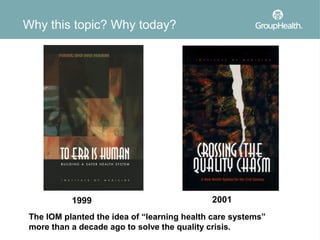
Why this topic? Why today?


           1999                              2001
 The IOM planted the idea of “learning health care systems”
 more than a decade ago to solve the quality crisis.
More than a decade later…

We are still struggling to achieve “the triple aim”:

   • Improving patient experience (quality & satisfaction)

   • Improving the health of populations (better access)

   • Reducing per capita cost
Berwick & Hackbarth on the problem:
Eliminate systemic waste (JAMA 2012)
Total U.S. health care system waste = $11 trillion over nine
years

“The savings potentially achievable from systemic,
comprehensive, and cooperative pursuit of even a fractional
reduction in waste are far higher than from more direct and
blunter cuts in care and coverage.”


                                                               4
A matter of professional ethics

To make a difference, we must address all categories at once:
•   Overtreatment
•   Failures to coordinate care
•   Failures in care delivery
•   Excess administrative costs
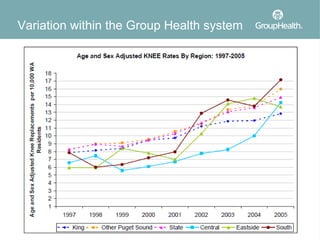
•   Excessive health care prices
•   Fraud and abuse

Addressing waste is a matter of professional ethics.

Waste must be addressed by professionals from within the
   system.
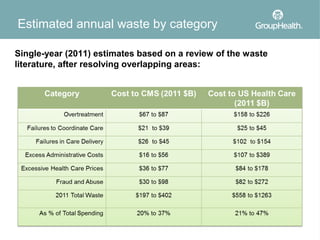
Estimated annual waste by category

Single-year (2011) estimates based on a review of the waste
literature, after resolving overlapping areas:


                                                              6
What can be done?

Today’s system appears wedded to prevailing payment
arrangements.

Powerful forces have a strong stake in preserving the status quo.
(“It works for us.”)

Must we accept poor quality, lack of access, higher costs?

Some doubt the U.S. health care system can change itself:

   • Stanford economist Victor Fuchs in The New York Times:
     The only solution may be change that profoundly “unsettles
     established interests.”

   • He quotes Alexis de Tocqueville:
     In the U.S., “events can move from the impossible to the inevitable
     without ever stopping at the probable.”
Can learning health care systems
be the engines of change?
 Overview of today’s talk:

 •   History and development of a learning health care system (LHCS):
     Group Health Cooperative

 •   Potential opportunities for research in LHCS

 •   What we’ve learned about LHCS: Challenges & rewards

 •   How LHCS can help solve the crises in quality, access, cost
The challenges. The opportunity.

The IOM’s 2008 Roundtable on Evidence-Based Medicine
identified problems with U.S. health care:

• Evidence is often not available for clinical decision making.

• Uptake of new discoveries can be slow and false starts are common.

• Even when evidence is available, it is not applied consistently—meaning
  variation, inefficiencies, and disparities persist.

Opportunity:

• We need a new clinical research paradigm.

• We need “learning health care systems.”
The challenges. The opportunity.

In learning health care systems, traditional principles of research
can be used in more practical ways so that:

• Decisions can be made more quickly.

• Better information is available for clinical decision making, for
  managing health care delivery.
What is a learning health care system?

 The IOM’s vision:

  • Research happens closer to clinical practice than in traditional
    university settings.

  • Scientists, clinicians, and administrators work together.

  • Studies occur in everyday practice settings.

  • Electronic medical records are linked and mined for research.

  • Recognition that clinical and health system data exist for the public
    good.


 Evidence informs practice and practice informs evidence.
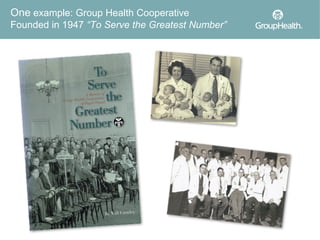
One example: Group Health Cooperative
Founded in 1947 “To Serve the Greatest Number”
Today’s Group Health

A Seattle-based health plan serving 620,000 in Washington, Idaho

Combines health care and coverage

1,200 physicians and 9,500 staff

Nearly 2/3 of members get care at Group Health facilities

Annual revenue: about $3.3 billion

Includes Group Health Research Institute
Today at Group Health Research Institute

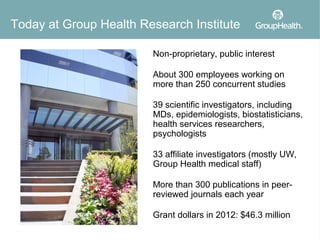
                        Non-proprietary, public interest

                        About 300 employees working on
                        more than 250 concurrent studies

                        39 scientific investigators, including
                        MDs, epidemiologists, biostatisticians,
                        health services researchers,
                        psychologists

                        33 affiliate investigators (mostly UW,
                        Group Health medical staff)

                        More than 300 publications in peer-
                        reviewed journals each year

                        Grant dollars in 2012: $46.3 million
Primary areas of research focus


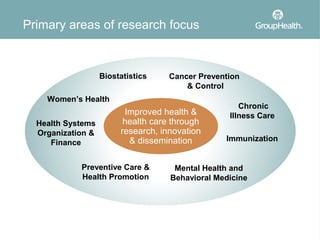
                   Biostatistics    Cancer Prevention
                                        & Control
    Women’s Health
                                                     Chronic
                         Improved health &        Illness Care
  Health Systems         health care through
  Organization &        research, innovation
                          & dissemination        Immunization
     Finance


            Preventive Care &        Mental Health and
            Health Promotion        Behavioral Medicine
Research is in Group Health’s DNA


1947: Group Health’s original mission statement: “Contribute to
medical research”

1950s-60s: University-based researchers mine Group Health data
beginning in 1956 with the Seattle Longitudinal Study on Aging

1970s: Group Health’s own research on its preventive care services
began

1983: Group Health Research Institute (GHRI) founded with
Ed Wagner, MD, MPH, as director
Research is in Group Health’s DNA

1980s:
• NCI funds phone-based tobacco cessation research, leading to changes in
  coverage, successful quit lines nationwide
• Bike helmet studies show link to reduced head injuries, leading to bike
  helmet laws and wide-spread use

1990s:
• Chlamydia screening proven effective against PID; CDC recommends
  Chlamydia screening
• Collaborative care proven effective for depression

Early 2000s:
• Alternative care can help back pain
• Improved diabetes care reduces cost
Highlights of GHRI’s first 25 years
Registries for breast cancer screening and immunization
 • 1987: The nation’s first breast cancer screening registry and reminder
   system
 • 1988: 1 of 5 sites in the CDC’s first Vaccine Safety Datalink

 • JAMA 1995: 32% reduction in late-stage breast cancer and 89% of 2-year-
   olds have complete immunizations
 • Both registries enable ongoing large-scale research that impacts clinical
   recommendations and national standards


The Chronic Care Model
 • Developed at GHRI’s MacColl Center for Health Care Innovation as a way
   to improve diabetes care and outcomes
 • Now used worldwide for diabetes, depression, congestive heart failure,
   asthma, and other chronic conditions
Challenge: Linking research
to practice and vice versa

2002 “Access Initiative”

• Group Health has always been primary-care based; aspired to
  be patient-centered.

• Reputation and past performance in “managed care” and as a
  traditional HMO: Access was a problem.

Access Initiative elements included:

•   Same-day appointments
•   Open access to specialists
•   A new EMR with secure website for members
•   Ambitious productivity standards
•   Reimbursement change
Challenge: Linking research
to practice and vice versa

University of Washington/Group Health study of “Access
Initiative” showed:
    • Increased patient satisfaction
    • Markedly improved access and productivity
    • But no gains in clinical quality, and
    • A dramatic negative impact on primary care provider work life


Next step:
  • Patient-centered medical home pilot
  • Can it improve quality and revitalize primary care?
  • Our design benefitted from “lessons learned” through the
     Access Initiative
Patient-centered medical home to
revitalize primary care

Genesis of medical home concept: Special-needs pediatrics
and internal medicine

Reinvigorated core attributes of primary care

More system support for chronic illness care

Advanced information technologies (EMR, registries,
reminders, patient portals)

Supportive physician payment methods (promotes medical
home goals, not simply volume)
Patient centered medical home to
revitalize primary care


Design principles for Group Health’s pilot:

 •   Panel size reduced from 2,300 to 1,800 patients

 •   Appointment times increased from 20 to 30 minutes
 •   Expanded multi-disciplinary clinical teams

 •   Desktop time for physicians

 •   E-technology and communication (EMR and secure e-mail
     with patients)
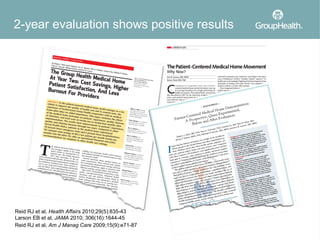
2-year evaluation shows positive results


Reid RJ et al, Health Affairs 2010;29(5):835-43
Larson EB et al, JAMA 2010; 306(16):1644-45
Reid RJ et al, Am J Manag Care 2009;15(9):e71-87
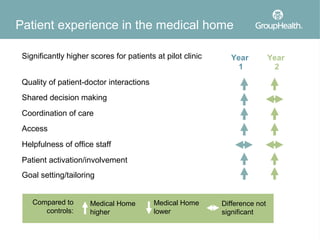
Patient experience in the medical home

 Significantly higher scores for patients at pilot clinic     Year           Year
                                                                1             2
 Quality of patient-doctor interactions
 Shared decision making
 Coordination of care
 Access
 Helpfulness of office staff
 Patient activation/involvement
 Goal setting/tailoring


    Compared to       Medical Home        Medical Home      Difference not
       controls:      higher              lower             significant
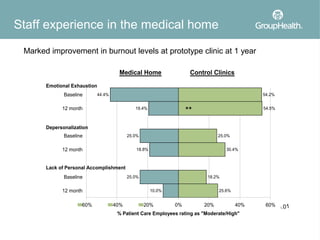
Staff experience in the medical home

 Marked improvement in burnout levels at prototype clinic at 1 year

                                        Medical Home                  Control Clinics
       Emotional Exhaustion
              Baseline        44.4%                                                            54.2%


             12 month                           19.4%
                                                                     **                        54.5%


       Depersonalization
              Baseline                       25.0%                               25.0%


             12 month                           18.8%                               30.4%


       Lack of Personal Accomplishment
              Baseline                       25.0%                          18.2%


             12 month                                   10.0%                    25.6%


                     -60%             -40%           -20%       0%         20%           40%    60%
                                                                                                ** p<0.01
                                        % Patient Care Employees rating as "Moderate/High"
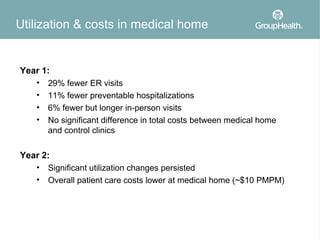
Utilization & costs in medical home


Year 1:
   • 29% fewer ER visits
   • 11% fewer preventable hospitalizations
   • 6% fewer but longer in-person visits
   • No significant difference in total costs between medical home
      and control clinics

Year 2:
   • Significant utilization changes persisted
   • Overall patient care costs lower at medical home (~$10 PMPM)
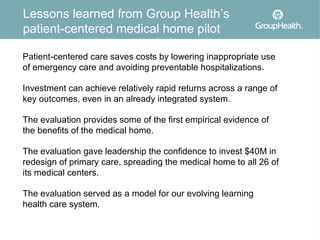
Lessons learned from Group Health’s
patient-centered medical home pilot

Patient-centered care saves costs by lowering inappropriate use
of emergency care and avoiding preventable hospitalizations.

Investment can achieve relatively rapid returns across a range of
key outcomes, even in an already integrated system.

The evaluation provides some of the first empirical evidence of
the benefits of the medical home.

The evaluation gave leadership the confidence to invest $40M in
redesign of primary care, spreading the medical home to all 26 of
its medical centers.

The evaluation served as a model for our evolving learning
health care system.
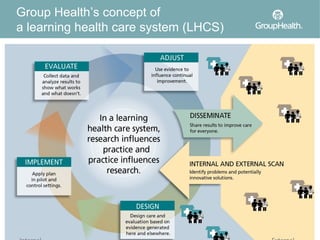
Group Health’s concept of
a learning health care system (LHCS)
Unwarranted variations in surgical care
are pervasive in the U.S.

  The Dartmouth Atlas Project has found widespread geographical
  variation nationwide in the use of elective surgical procedures.

  Patients in Wenatchee, WA are three times more likely to have
  their arthritic knees replaced than are similar patients in Honolulu.

  Men in Bellevue, WA are much less likely than those in Thousand
  Oaks, CA to undergo surgery for benign prostate disease.

  This variation reflects physician training and preference—not what
  patients want or need.
Variation within the Group Health system
More LHCS projects have followed
Example: Shared decision making

2007: Washington State passes nation’s first law endorsing
shared decision making (SDM)

SDM provides shelter from liability

State mandates demonstration projects, leading SDM research at
Group Health.
More LHCS projects have followed
Example: Shared decision making

In 2009, Group Health launched a system-wide shared decision
making initiative

12 video-based decision aids in six specialty services:

  •   Orthopedic: hip and knee osteoarthritis

  •   Cardiac: coronary heart disease

  •   Urology: benign prostatic hyperplasia and prostate cancer

  •   Women’s health: uterine fibroids and abnormal uterine bleeding

  •   Breast cancer programs: early-stage breast cancer, breast
      reconstruction, and ductal carcinoma in situ

  •   Back care programs: low back pain from spinal stenosis and herniated
      disc
SDM is not new to Group Health,
but translating findings is
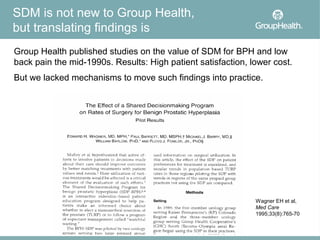
Group Health published studies on the value of SDM for BPH and low
back pain the mid-1990s. Results: High patient satisfaction, lower cost.
But we lacked mechanisms to move such findings into practice.


                                                              Wagner EH et al,
                                                              Med Care
                                                              1995;33(8):765-70
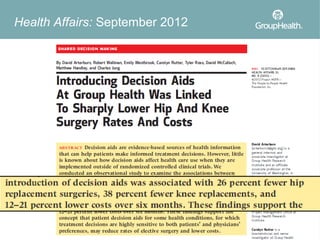
Health Affairs: September 2012
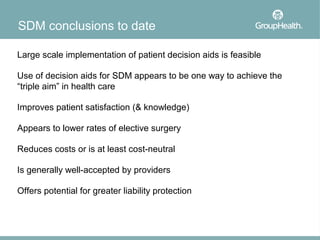
SDM conclusions to date

Large scale implementation of patient decision aids is feasible

Use of decision aids for SDM appears to be one way to achieve the
“triple aim” in health care

Improves patient satisfaction (& knowledge)

Appears to lower rates of elective surgery

Reduces costs or is at least cost-neutral

Is generally well-accepted by providers

Offers potential for greater liability protection
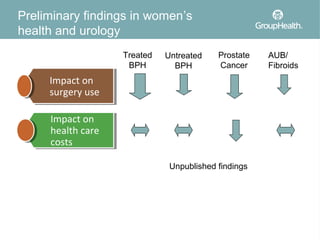
Preliminary findings in women’s
health and urology
                    Treated   Untreated    Prostate   AUB/
                     BPH        BPH        Cancer     Fibroids
     Impact on
      Impact on
     surgery use
      surgery use

     Impact on
      Impact on
     health care
      health care
     costs
      costs

                               Unpublished findings
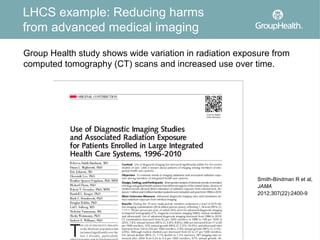
LHCS example: Reducing harms
from advanced medical imaging
Group Health study shows wide variation in radiation exposure from
computed tomography (CT) scans and increased use over time.


                                                          Smith-Bindman R et al,
                                                          JAMA
                                                          2012;307(22):2400-9
LHCS example: Reducing harms
from advanced medical imaging
Estimated that CT-induced cancers could be reduced by 40% if the
highest 25% of radiation doses from pediatric CT could be lowered to
the median dose.
Based on these results, Group Health began developing ways to
lower radiation exposure from medical imaging.
Researchers and the radiology service collaborated to provide CT
technologists with feedback reports, training on CT doses.
The technologists are eager for more education and want to engage
radiologists in discussions about developing dose monitoring
protocols.
Researchers will evaluate whether dose-feedback reports and dose-
reduction education reduce radiation exposure for Group Health
patients.
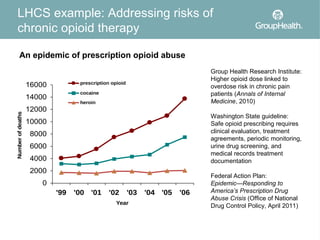
LHCS example: Addressing risks of
  chronic opioid therapy

       An epidemic of prescription opioid abuse
                                                                              Group Health Research Institute:
                                                                              Higher opioid dose linked to
                                  prescription opioid
                   16000                                                      overdose risk in chronic pain
                                  cocaine                                     patients (Annals of Internal
                   14000
                                  heroin                                      Medicine, 2010)
                   12000
Number of deaths


                                                                              Washington State guideline:
                   10000                                                      Safe opioid prescribing requires
                    8000                                                      clinical evaluation, treatment
                                                                              agreements, periodic monitoring,
                    6000                                                      urine drug screening, and
                                                                              medical records treatment
                    4000                                                      documentation
                    2000
                                                                              Federal Action Plan:
                       0                                                      Epidemic—Responding to
                           '99   '00 '01     '02        '03   '04 '05   '06   America’s Prescription Drug
                                                                              Abuse Crisis (Office of National
                                                 Year
                                                                              Drug Control Policy, April 2011)
LHCS example: Addressing risks of
chronic opioid therapy

Group Health launches a comprehensive opioid prescribing
safety initiative in 2010.

• Objectives: standardized practices, clarification of treatment goals and
  expectations, fewer cases of abuse, misuse, and overdose

• Standardized care plans: one responsible prescribing physician, refill
  planning and monitoring, urine drug screening for high-risk patients,
  referral guidelines

• Training: Web-based CME on how to implement the standardized care
  plans, funded by the Group Health Foundation

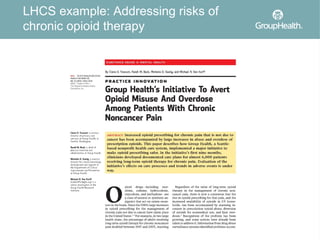
The initiative produced stunning results that outpaced the federal
call to action (April 2011)….
LHCS example: Addressing risks of
chronic opioid therapy
LHCS example: Addressing risks of
chronic opioid therapy
                                                                                          Cumulative

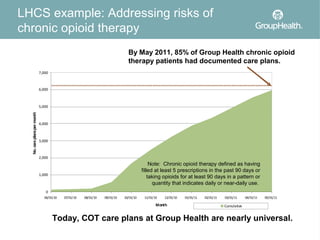
                                                                             By May 2011, 85% of Group Health chronic opioid
                                                                             therapy patients had documented care plans.
                            7,000


                            6,000


                            5,000
  No. care plansper month


                            4,000


                            3,000


                            2,000
                                                                                           Note: Chronic opioid therapy defined as having
                                                                                      filled at least 5 prescriptions in the past 90 days or
                            1,000
                                                                                          taking opioids for at least 90 days in a pattern or
                                                                                            quantity that indicates daily or near-daily use.
                                0
                               06/01/10   07/01/10   08/01/10   09/01/10   10/01/10    11/01/10   12/01/10   01/01/11   02/01/11   03/01/11     04/01/11   05/01/11

                                                                                              Month                                Cumulative


                                    Today, COT care plans at Group Health are nearly universal.
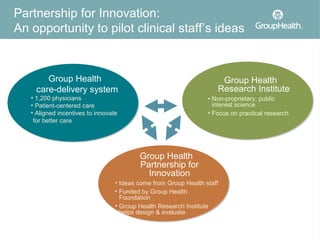
Partnership for Innovation:
An opportunity to pilot clinical staff’s ideas


        Group Health                                                  Group Health
     care-delivery system                                            Research Institute
   • 1,200 physicians                                             • Non-proprietary, public
   • Patient-centered care                                          interest science
   • Aligned incentives to innovate                               • Focus on practical research
    for better care


                                          Group Health
                                          Partnership for
                                            Innovation
                                  • Ideas come from Group Health staff
                                  • Funded by Group Health
                                    Foundation
                                  • Group Health Research Institute
                                    helps design & evaluate
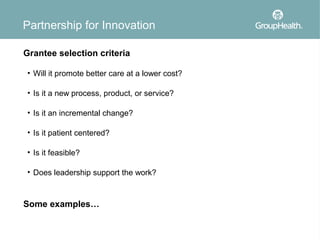
Partnership for Innovation

Grantee selection criteria

• Will it promote better care at a lower cost?

• Is it a new process, product, or service?

• Is it an incremental change?

• Is it patient centered?

• Is it feasible?

• Does leadership support the work?


Some examples…
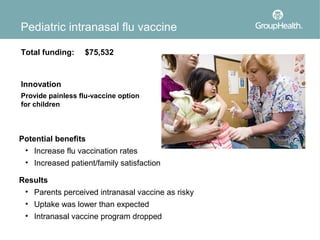
Pediatric intranasal flu vaccine

Total funding:    $75,532


Innovation
Provide painless flu-vaccine option
for children


Potential benefits
 • Increase flu vaccination rates
 • Increased patient/family satisfaction

Results
 • Parents perceived intranasal vaccine as risky
 • Uptake was lower than expected
 • Intranasal vaccine program dropped
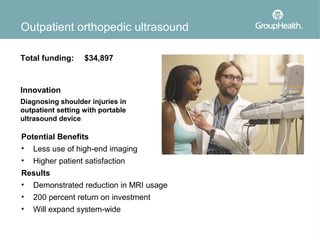
Outpatient orthopedic ultrasound

Total funding:     $34,897


Innovation
Diagnosing shoulder injuries in
outpatient setting with portable
ultrasound device

Potential Benefits
• Less use of high-end imaging
•   Higher patient satisfaction
Results
• Demonstrated reduction in MRI usage
•   200 percent return on investment
•   Will expand system-wide
Learning health care systems can address
the BIG questions for U.S. health care

What’s the best use of limited resources?

What works? What doesn't?

How can we cut out waste, inefficiencies, errors?

How can we leverage the strengths of integrated care systems?

How can we address the problems of an aging population?

How can we address growing burdens of chronic illness?

How can we contain costs so we can afford to care for the
expanded number of people who will soon have coverage?
What we have learned in developing a
LHCS at Group Health

We can learn more quickly, produce more timely results.
Research can align with the care-delivery system’s business goals.
We always strive for projects that are:
  • Generalizable
  • Public-domain
  • Leading to nationally relevant discoveries and solutions
Funding these projects can be challenging, but not impossible.
What does the future hold for LHCS?

New sources of support:


Patient Centered Outcomes Research Institute
 • Founded in 2010 under the Affordable Care Act
 • Nonprofit, nonfederal, independent
 • Patient and stakeholder input influences all phases
 • Patients and stakeholders are reviewers
 • Budget: $3 billion for 2012-2019
What does the future hold for LHCS?

New sources of support:

Health Care Systems Collaboratory
 • Established by NIH Director Francis Collins, MD, PhD, through the
   Common Fund
 • Engaging health systems in large clinical studies
 • Coordinating Center at Duke University funded in 2012
 • $11.3M for first year
 • Includes HMO Research Network (19 integrated health plans)
 • Recently funded seven “pragmatic trials” to develop and spread
   best practices—includes studies of suicide prevention, colorectal
   cancer screening, and care for low back pain
What does the future hold for LHCS?

New opportunities through large, multi-site studies:
Example: The Mini-Sentinel
 • Funded by the FDA
• Active, extensive surveillance system to monitor the safety of
  regulated medical products
• Gathers data from 29 health care organizations nationwide
Conclusion

The potential is rich.

Can Victor Fuchs’ assessment be right? Will change only come
through an unraveling of the current system?

Or can we make our learning health care systems the engines of
success for U.S. health reform?

Let’s take this as a matter of professional ethics, exercising
professional obligations to our patients.

Let’s drive the change, achieving de Tocqueville’s prediction of
inevitable and positive change.
Questions?

Learning Health Care Systems

  • 1.
    Learning Health CareSystems Engines of Success for U.S. Health Reform? Grand Rounds I Beth Israel Deaconess Medical Center I January 24, 2013 Eric B. Larson, MD, MPH Vice President for Research, Group Health Executive Director, Group Health Research Institute
  • 2.
    Why this topic?Why today? 1999 2001 The IOM planted the idea of “learning health care systems” more than a decade ago to solve the quality crisis.
  • 3.
    More than adecade later… We are still struggling to achieve “the triple aim”: • Improving patient experience (quality & satisfaction) • Improving the health of populations (better access) • Reducing per capita cost
  • 4.
    Berwick & Hackbarthon the problem: Eliminate systemic waste (JAMA 2012) Total U.S. health care system waste = $11 trillion over nine years “The savings potentially achievable from systemic, comprehensive, and cooperative pursuit of even a fractional reduction in waste are far higher than from more direct and blunter cuts in care and coverage.” 4
  • 5.
    A matter ofprofessional ethics To make a difference, we must address all categories at once: • Overtreatment • Failures to coordinate care • Failures in care delivery • Excess administrative costs • Excessive health care prices • Fraud and abuse Addressing waste is a matter of professional ethics. Waste must be addressed by professionals from within the system.
  • 6.
    Estimated annual wasteby category Single-year (2011) estimates based on a review of the waste literature, after resolving overlapping areas: 6
  • 7.
    What can bedone? Today’s system appears wedded to prevailing payment arrangements. Powerful forces have a strong stake in preserving the status quo. (“It works for us.”) Must we accept poor quality, lack of access, higher costs? Some doubt the U.S. health care system can change itself: • Stanford economist Victor Fuchs in The New York Times: The only solution may be change that profoundly “unsettles established interests.” • He quotes Alexis de Tocqueville: In the U.S., “events can move from the impossible to the inevitable without ever stopping at the probable.”
  • 8.
    Can learning healthcare systems be the engines of change? Overview of today’s talk: • History and development of a learning health care system (LHCS): Group Health Cooperative • Potential opportunities for research in LHCS • What we’ve learned about LHCS: Challenges & rewards • How LHCS can help solve the crises in quality, access, cost
  • 9.
    The challenges. Theopportunity. The IOM’s 2008 Roundtable on Evidence-Based Medicine identified problems with U.S. health care: • Evidence is often not available for clinical decision making. • Uptake of new discoveries can be slow and false starts are common. • Even when evidence is available, it is not applied consistently—meaning variation, inefficiencies, and disparities persist. Opportunity: • We need a new clinical research paradigm. • We need “learning health care systems.”
  • 10.
    The challenges. Theopportunity. In learning health care systems, traditional principles of research can be used in more practical ways so that: • Decisions can be made more quickly. • Better information is available for clinical decision making, for managing health care delivery.
  • 11.
    What is alearning health care system? The IOM’s vision: • Research happens closer to clinical practice than in traditional university settings. • Scientists, clinicians, and administrators work together. • Studies occur in everyday practice settings. • Electronic medical records are linked and mined for research. • Recognition that clinical and health system data exist for the public good. Evidence informs practice and practice informs evidence.
  • 12.
    One example: GroupHealth Cooperative Founded in 1947 “To Serve the Greatest Number”
  • 13.
    Today’s Group Health ASeattle-based health plan serving 620,000 in Washington, Idaho Combines health care and coverage 1,200 physicians and 9,500 staff Nearly 2/3 of members get care at Group Health facilities Annual revenue: about $3.3 billion Includes Group Health Research Institute
  • 14.
    Today at GroupHealth Research Institute Non-proprietary, public interest About 300 employees working on more than 250 concurrent studies 39 scientific investigators, including MDs, epidemiologists, biostatisticians, health services researchers, psychologists 33 affiliate investigators (mostly UW, Group Health medical staff) More than 300 publications in peer- reviewed journals each year Grant dollars in 2012: $46.3 million
  • 15.
    Primary areas ofresearch focus Biostatistics Cancer Prevention & Control Women’s Health Chronic Improved health & Illness Care Health Systems health care through Organization & research, innovation & dissemination Immunization Finance Preventive Care & Mental Health and Health Promotion Behavioral Medicine
  • 16.
    Research is inGroup Health’s DNA 1947: Group Health’s original mission statement: “Contribute to medical research” 1950s-60s: University-based researchers mine Group Health data beginning in 1956 with the Seattle Longitudinal Study on Aging 1970s: Group Health’s own research on its preventive care services began 1983: Group Health Research Institute (GHRI) founded with Ed Wagner, MD, MPH, as director
  • 17.
    Research is inGroup Health’s DNA 1980s: • NCI funds phone-based tobacco cessation research, leading to changes in coverage, successful quit lines nationwide • Bike helmet studies show link to reduced head injuries, leading to bike helmet laws and wide-spread use 1990s: • Chlamydia screening proven effective against PID; CDC recommends Chlamydia screening • Collaborative care proven effective for depression Early 2000s: • Alternative care can help back pain • Improved diabetes care reduces cost
  • 18.
    Highlights of GHRI’sfirst 25 years Registries for breast cancer screening and immunization • 1987: The nation’s first breast cancer screening registry and reminder system • 1988: 1 of 5 sites in the CDC’s first Vaccine Safety Datalink • JAMA 1995: 32% reduction in late-stage breast cancer and 89% of 2-year- olds have complete immunizations • Both registries enable ongoing large-scale research that impacts clinical recommendations and national standards The Chronic Care Model • Developed at GHRI’s MacColl Center for Health Care Innovation as a way to improve diabetes care and outcomes • Now used worldwide for diabetes, depression, congestive heart failure, asthma, and other chronic conditions
  • 19.
    Challenge: Linking research topractice and vice versa 2002 “Access Initiative” • Group Health has always been primary-care based; aspired to be patient-centered. • Reputation and past performance in “managed care” and as a traditional HMO: Access was a problem. Access Initiative elements included: • Same-day appointments • Open access to specialists • A new EMR with secure website for members • Ambitious productivity standards • Reimbursement change
  • 20.
    Challenge: Linking research topractice and vice versa University of Washington/Group Health study of “Access Initiative” showed: • Increased patient satisfaction • Markedly improved access and productivity • But no gains in clinical quality, and • A dramatic negative impact on primary care provider work life Next step: • Patient-centered medical home pilot • Can it improve quality and revitalize primary care? • Our design benefitted from “lessons learned” through the Access Initiative
  • 21.
    Patient-centered medical hometo revitalize primary care Genesis of medical home concept: Special-needs pediatrics and internal medicine Reinvigorated core attributes of primary care More system support for chronic illness care Advanced information technologies (EMR, registries, reminders, patient portals) Supportive physician payment methods (promotes medical home goals, not simply volume)
  • 22.
    Patient centered medicalhome to revitalize primary care Design principles for Group Health’s pilot: • Panel size reduced from 2,300 to 1,800 patients • Appointment times increased from 20 to 30 minutes • Expanded multi-disciplinary clinical teams • Desktop time for physicians • E-technology and communication (EMR and secure e-mail with patients)
  • 23.
    2-year evaluation showspositive results Reid RJ et al, Health Affairs 2010;29(5):835-43 Larson EB et al, JAMA 2010; 306(16):1644-45 Reid RJ et al, Am J Manag Care 2009;15(9):e71-87
  • 24.
    Patient experience inthe medical home Significantly higher scores for patients at pilot clinic Year Year 1 2 Quality of patient-doctor interactions Shared decision making Coordination of care Access Helpfulness of office staff Patient activation/involvement Goal setting/tailoring Compared to Medical Home Medical Home Difference not controls: higher lower significant
  • 25.
    Staff experience inthe medical home Marked improvement in burnout levels at prototype clinic at 1 year Medical Home Control Clinics Emotional Exhaustion Baseline 44.4% 54.2% 12 month 19.4% ** 54.5% Depersonalization Baseline 25.0% 25.0% 12 month 18.8% 30.4% Lack of Personal Accomplishment Baseline 25.0% 18.2% 12 month 10.0% 25.6% -60% -40% -20% 0% 20% 40% 60% ** p<0.01 % Patient Care Employees rating as "Moderate/High"
  • 26.
    Utilization & costsin medical home Year 1: • 29% fewer ER visits • 11% fewer preventable hospitalizations • 6% fewer but longer in-person visits • No significant difference in total costs between medical home and control clinics Year 2: • Significant utilization changes persisted • Overall patient care costs lower at medical home (~$10 PMPM)
  • 27.
    Lessons learned fromGroup Health’s patient-centered medical home pilot Patient-centered care saves costs by lowering inappropriate use of emergency care and avoiding preventable hospitalizations. Investment can achieve relatively rapid returns across a range of key outcomes, even in an already integrated system. The evaluation provides some of the first empirical evidence of the benefits of the medical home. The evaluation gave leadership the confidence to invest $40M in redesign of primary care, spreading the medical home to all 26 of its medical centers. The evaluation served as a model for our evolving learning health care system.
  • 28.
    Group Health’s conceptof a learning health care system (LHCS)
  • 29.
    Unwarranted variations insurgical care are pervasive in the U.S. The Dartmouth Atlas Project has found widespread geographical variation nationwide in the use of elective surgical procedures. Patients in Wenatchee, WA are three times more likely to have their arthritic knees replaced than are similar patients in Honolulu. Men in Bellevue, WA are much less likely than those in Thousand Oaks, CA to undergo surgery for benign prostate disease. This variation reflects physician training and preference—not what patients want or need.
  • 30.
    Variation within theGroup Health system
  • 31.
    More LHCS projectshave followed Example: Shared decision making 2007: Washington State passes nation’s first law endorsing shared decision making (SDM) SDM provides shelter from liability State mandates demonstration projects, leading SDM research at Group Health.
  • 32.
    More LHCS projectshave followed Example: Shared decision making In 2009, Group Health launched a system-wide shared decision making initiative 12 video-based decision aids in six specialty services: • Orthopedic: hip and knee osteoarthritis • Cardiac: coronary heart disease • Urology: benign prostatic hyperplasia and prostate cancer • Women’s health: uterine fibroids and abnormal uterine bleeding • Breast cancer programs: early-stage breast cancer, breast reconstruction, and ductal carcinoma in situ • Back care programs: low back pain from spinal stenosis and herniated disc
  • 33.
    SDM is notnew to Group Health, but translating findings is Group Health published studies on the value of SDM for BPH and low back pain the mid-1990s. Results: High patient satisfaction, lower cost. But we lacked mechanisms to move such findings into practice. Wagner EH et al, Med Care 1995;33(8):765-70
  • 34.
  • 35.
    SDM conclusions todate Large scale implementation of patient decision aids is feasible Use of decision aids for SDM appears to be one way to achieve the “triple aim” in health care Improves patient satisfaction (& knowledge) Appears to lower rates of elective surgery Reduces costs or is at least cost-neutral Is generally well-accepted by providers Offers potential for greater liability protection
  • 36.
    Preliminary findings inwomen’s health and urology Treated Untreated Prostate AUB/ BPH BPH Cancer Fibroids Impact on Impact on surgery use surgery use Impact on Impact on health care health care costs costs Unpublished findings
  • 37.
    LHCS example: Reducingharms from advanced medical imaging Group Health study shows wide variation in radiation exposure from computed tomography (CT) scans and increased use over time. Smith-Bindman R et al, JAMA 2012;307(22):2400-9
  • 38.
    LHCS example: Reducingharms from advanced medical imaging Estimated that CT-induced cancers could be reduced by 40% if the highest 25% of radiation doses from pediatric CT could be lowered to the median dose. Based on these results, Group Health began developing ways to lower radiation exposure from medical imaging. Researchers and the radiology service collaborated to provide CT technologists with feedback reports, training on CT doses. The technologists are eager for more education and want to engage radiologists in discussions about developing dose monitoring protocols. Researchers will evaluate whether dose-feedback reports and dose- reduction education reduce radiation exposure for Group Health patients.
  • 39.
    LHCS example: Addressingrisks of chronic opioid therapy An epidemic of prescription opioid abuse Group Health Research Institute: Higher opioid dose linked to prescription opioid 16000 overdose risk in chronic pain cocaine patients (Annals of Internal 14000 heroin Medicine, 2010) 12000 Number of deaths Washington State guideline: 10000 Safe opioid prescribing requires 8000 clinical evaluation, treatment agreements, periodic monitoring, 6000 urine drug screening, and medical records treatment 4000 documentation 2000 Federal Action Plan: 0 Epidemic—Responding to '99 '00 '01 '02 '03 '04 '05 '06 America’s Prescription Drug Abuse Crisis (Office of National Year Drug Control Policy, April 2011)
  • 40.
    LHCS example: Addressingrisks of chronic opioid therapy Group Health launches a comprehensive opioid prescribing safety initiative in 2010. • Objectives: standardized practices, clarification of treatment goals and expectations, fewer cases of abuse, misuse, and overdose • Standardized care plans: one responsible prescribing physician, refill planning and monitoring, urine drug screening for high-risk patients, referral guidelines • Training: Web-based CME on how to implement the standardized care plans, funded by the Group Health Foundation The initiative produced stunning results that outpaced the federal call to action (April 2011)….
  • 41.
    LHCS example: Addressingrisks of chronic opioid therapy
  • 42.
    LHCS example: Addressingrisks of chronic opioid therapy Cumulative By May 2011, 85% of Group Health chronic opioid therapy patients had documented care plans. 7,000 6,000 5,000 No. care plansper month 4,000 3,000 2,000 Note: Chronic opioid therapy defined as having filled at least 5 prescriptions in the past 90 days or 1,000 taking opioids for at least 90 days in a pattern or quantity that indicates daily or near-daily use. 0 06/01/10 07/01/10 08/01/10 09/01/10 10/01/10 11/01/10 12/01/10 01/01/11 02/01/11 03/01/11 04/01/11 05/01/11 Month Cumulative Today, COT care plans at Group Health are nearly universal.
  • 43.
    Partnership for Innovation: Anopportunity to pilot clinical staff’s ideas Group Health Group Health care-delivery system Research Institute • 1,200 physicians • Non-proprietary, public • Patient-centered care interest science • Aligned incentives to innovate • Focus on practical research for better care Group Health Partnership for Innovation • Ideas come from Group Health staff • Funded by Group Health Foundation • Group Health Research Institute helps design & evaluate
  • 44.
    Partnership for Innovation Granteeselection criteria • Will it promote better care at a lower cost? • Is it a new process, product, or service? • Is it an incremental change? • Is it patient centered? • Is it feasible? • Does leadership support the work? Some examples…
  • 45.
    Pediatric intranasal fluvaccine Total funding: $75,532 Innovation Provide painless flu-vaccine option for children Potential benefits • Increase flu vaccination rates • Increased patient/family satisfaction Results • Parents perceived intranasal vaccine as risky • Uptake was lower than expected • Intranasal vaccine program dropped
  • 46.
    Outpatient orthopedic ultrasound Totalfunding: $34,897 Innovation Diagnosing shoulder injuries in outpatient setting with portable ultrasound device Potential Benefits • Less use of high-end imaging • Higher patient satisfaction Results • Demonstrated reduction in MRI usage • 200 percent return on investment • Will expand system-wide
  • 47.
    Learning health caresystems can address the BIG questions for U.S. health care What’s the best use of limited resources? What works? What doesn't? How can we cut out waste, inefficiencies, errors? How can we leverage the strengths of integrated care systems? How can we address the problems of an aging population? How can we address growing burdens of chronic illness? How can we contain costs so we can afford to care for the expanded number of people who will soon have coverage?
  • 48.
    What we havelearned in developing a LHCS at Group Health We can learn more quickly, produce more timely results. Research can align with the care-delivery system’s business goals. We always strive for projects that are: • Generalizable • Public-domain • Leading to nationally relevant discoveries and solutions Funding these projects can be challenging, but not impossible.
  • 49.
    What does thefuture hold for LHCS? New sources of support: Patient Centered Outcomes Research Institute • Founded in 2010 under the Affordable Care Act • Nonprofit, nonfederal, independent • Patient and stakeholder input influences all phases • Patients and stakeholders are reviewers • Budget: $3 billion for 2012-2019
  • 50.
    What does thefuture hold for LHCS? New sources of support: Health Care Systems Collaboratory • Established by NIH Director Francis Collins, MD, PhD, through the Common Fund • Engaging health systems in large clinical studies • Coordinating Center at Duke University funded in 2012 • $11.3M for first year • Includes HMO Research Network (19 integrated health plans) • Recently funded seven “pragmatic trials” to develop and spread best practices—includes studies of suicide prevention, colorectal cancer screening, and care for low back pain
  • 51.
    What does thefuture hold for LHCS? New opportunities through large, multi-site studies: Example: The Mini-Sentinel • Funded by the FDA • Active, extensive surveillance system to monitor the safety of regulated medical products • Gathers data from 29 health care organizations nationwide
  • 52.
    Conclusion The potential isrich. Can Victor Fuchs’ assessment be right? Will change only come through an unraveling of the current system? Or can we make our learning health care systems the engines of success for U.S. health reform? Let’s take this as a matter of professional ethics, exercising professional obligations to our patients. Let’s drive the change, achieving de Tocqueville’s prediction of inevitable and positive change.
  • 53.

Editor's Notes

  • #48 09 Vancouver patient-centered Mar 02/06/13 09 Vancouver patient-centered Mar 02/06/13 09 Vancouver patient-centered Mar 02/06/13
  • #53 09 Vancouver patient-centered Mar 02/06/13 09 Vancouver patient-centered Mar 02/06/13 09 Vancouver patient-centered Mar 02/06/13