Empowered Health
Healthcare that works
Healthcare that is safe
Healthcare that leaves no one behind
Gabe Rijpma
Sr Director Health
Microsoft Asia
gabery@Microsoft.com
The Disruption of Care is here
Challenging our own
organisations to be better
Source: PwC Health Research Insights
Care
Within
Walls
Source: RBC Capital Markets
Virtual care
Video consultations,
Secure messaging,
Booking
Between visit
interactions
Remote Monitoring, IoT,
Agents, Analytics,Digital
Life
Digital
Work
Care &
Health
Without
Walls
1900
92
$88B
$58B
($26B)
Current HIT
Market (Platform +
EPIC, Cerner, Allscrips, GE,
Mckesson, Meditech,
Accenture etc)
Consumerization
of HIT Market
Innovation
Opportunity
DISRUPTION IS HERE
Enhancing the
patient & health
professional
experience
Becoming more
predictive
Transforming
into a digital
system
Virtual Healthcare
Precision Medicine
Trusted, certified, and
compliant technologies
Consistent experience
across devices
Mobile
Productivity
Solutions that span home,
hospital, and mobile settings
Innovation that keeps up
with emerging health and
technology trends
Reduced Readmissions
Increased
operational
effectiveness
Enhancing clinical
productivity
Gain actionable
insights to
improve clinical
care
OUR INDUSTRY's FUTUREEMPOWERING
Every person and every organization on the planet to achieve more
Create more
personal computing
Reinvent productivity &
business process
Build the
intelligent cloud
EMPOWERING
HEALTH
of tech budgets
controlled by
departments
other than IT
27%
Healthcare leaders are reimagining their businesses
CEO priorities
engaged
employees
satisfied
patients
Growing
expectation
personal,
individualized
service
Becoming more
responsive
Transforming
to a digital
believe they make
better and faster tech
decisions than IT
79% of C-level executives
Outperforming
enterprises are
54%
more
likely to
Enhancing
the patient
experience
enhancing patient experiencetop priority
3/4decision
makers
digital
savvy
CEO’s business
performance
best
indicator
of
Sense/
respond
engage
model
Episodic
treatment
model
of CxOs now look to partners who will
have an equal hand in creating
business value
60%
CxOs believe
social/digital
interaction is the
new imperative
7 in 10
Responding to
ongoing needs for
efficiency and
improved outcomes
exploiting a
fundamentally different
digital paradigm
dual goals
CIOs
70%
to reduce
IT costs
Would
increase
risk
and accelerate
business agility
of
collaborate
extensively
with their
custom
ers
provider
better
outcomes
Becoming a responsive, patient-obsessed provider
8
Transforming to a
digital business
Tapping into new
opportunities with the
Internet of Things
Inspiring innovation
across the company
Making information
security a top priority
Connecting everything with the cloud
Startingwith
mobileforevery
newinitiative
Building infrastructure
to be flexible
Protecting
theprivacy
ofpatients
Becoming
more responsive
Breaking down the walls
of the traditional
workplace
Making it easy for
clinicians to get the
same view of
information
Encouraging collaboration
across the business
Makingmobile
andsocial
“businessasusual”
Helping clinicians to
do their best work with
connected technologies
Moving faster to take
on new opportunities
Enhancing the
customer experience
Building
teams
around the
patient
Findingnewwaysto
connectwithpatients
online
Putting the patient
first in every decision
Anticipating patient
behavior and needs
Making every patient feel understood
Creating
great patient
experiences
that they will want to share
Understanding
yourclinician’s
needs
Engaging with patients
across the channels they
want to use
Empowering
the front line with direct access to
information and tools
Responding to patients
without delay
Working
smarter
with intelligent
automation
EPG | MICROSOFT CONFIDENTIAL
The Hospital of the Future & the Future of Hospitals
Ubiquitous
Personalized
Connected
Experiences
Re-imagining productivity to empower organizations, professionals and patients to achieve more and to do more
Decision
making &
Insights
enriched by
Data
Natural human-
computing
Interfaces &
Interactions
Research
powered by
Infinite
computing
power
Paper-less
Intelligent
computing
power
Citizen-centric
Trustworthy &
Social connections
Dallas Neurosurgical & Spine
Where traditionally a patient
would need to be physically in
the room to get benefits from
these specialists, now with Lync
Online, we’ve enabled them to
share their knowledge
regionally and even globally.”
Unleashing latent
talents and sparking
innovation
Leading health organisations are transforming to digital
10
Delighting patients
in the Hospital
Chris O’Brien Lifehouse
offers every available
therapy and technology in
a setting that is truly a
healing environment.
Providing
proactive service
Maccabi Healthcare Services
significantly improved the
level
of service because we
respond to them quickly with
accurate and consistent
answers.
Delivering insight
and analytics to
improve care
Capital & Coast District Health
Board In just 12 months,
transformed BI to improve
collaboration and workflow—
and nearly halved BI software
costs.
Transforming the
clinical experience
Seoul National University
Bundang Hospital sought to
implement a hospital information
system that offered a highly
intuitive user experience with
unified communications, that
integrated with existing systems.
Healthcare Innovation at work
INNOVATION
AUGMENTED REALITY
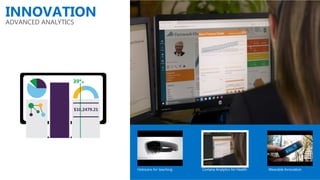
HoloLens for teaching Cortana Analytics for Health Wearable innovation
INNOVATION
HoloLens for teaching Cortana Analytics for Health Wearable Innovation
ADVANCED ANALYTICS
INNOVATION
HoloLens for teaching Cortana Analytics for Health Wearable Innovation
ADVANCED ANALYTICS
INNOVATION
CONSUMER HEALTH
HoloLens for Teaching Cortana Analytics for Health Wearable innovation
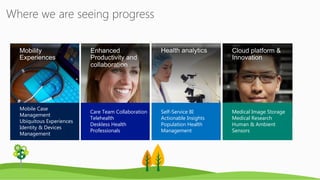
Where we are seeing progress
Mobile Case
Management
Ubiquitous Experiences
Identity & Devices
Management
Care Team Collaboration
Telehealth
Deskless Health
Professionals
Self-Service BI
Actionable Insights
Population Health
Management
Medical Image Storage
Medical Research
Human & Ambient
Sensors
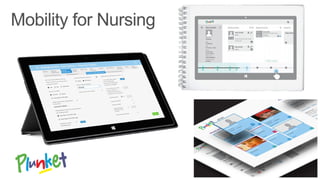
Nursing
Can we answer the challenges?
22% of Health Errors occur during
poor Handovers
60% of Health Errors occur due to
poor Communication
Outstanding tasks
Demographics
Medical history
Assessment
Interventions
Red Flags / Alerts
Plans
Transforming Nurse
Charting
Communication &
Collaboration
Empowered Health
Empowered Health
Empowered Health

Empowered Health

  • 1.
    Empowered Health Healthcare thatworks Healthcare that is safe Healthcare that leaves no one behind Gabe Rijpma Sr Director Health Microsoft Asia gabery@Microsoft.com
  • 3.
    The Disruption ofCare is here Challenging our own organisations to be better
  • 4.
    Source: PwC HealthResearch Insights Care Within Walls Source: RBC Capital Markets Virtual care Video consultations, Secure messaging, Booking Between visit interactions Remote Monitoring, IoT, Agents, Analytics,Digital Life Digital Work Care & Health Without Walls 1900 92 $88B $58B ($26B) Current HIT Market (Platform + EPIC, Cerner, Allscrips, GE, Mckesson, Meditech, Accenture etc) Consumerization of HIT Market Innovation Opportunity DISRUPTION IS HERE
  • 6.
    Enhancing the patient &health professional experience Becoming more predictive Transforming into a digital system Virtual Healthcare Precision Medicine Trusted, certified, and compliant technologies Consistent experience across devices Mobile Productivity Solutions that span home, hospital, and mobile settings Innovation that keeps up with emerging health and technology trends Reduced Readmissions Increased operational effectiveness Enhancing clinical productivity Gain actionable insights to improve clinical care OUR INDUSTRY's FUTUREEMPOWERING Every person and every organization on the planet to achieve more Create more personal computing Reinvent productivity & business process Build the intelligent cloud EMPOWERING HEALTH
  • 7.
    of tech budgets controlledby departments other than IT 27% Healthcare leaders are reimagining their businesses CEO priorities engaged employees satisfied patients Growing expectation personal, individualized service Becoming more responsive Transforming to a digital believe they make better and faster tech decisions than IT 79% of C-level executives Outperforming enterprises are 54% more likely to Enhancing the patient experience enhancing patient experiencetop priority 3/4decision makers digital savvy CEO’s business performance best indicator of Sense/ respond engage model Episodic treatment model of CxOs now look to partners who will have an equal hand in creating business value 60% CxOs believe social/digital interaction is the new imperative 7 in 10 Responding to ongoing needs for efficiency and improved outcomes exploiting a fundamentally different digital paradigm dual goals CIOs 70% to reduce IT costs Would increase risk and accelerate business agility of collaborate extensively with their custom ers provider better outcomes
  • 8.
    Becoming a responsive,patient-obsessed provider 8 Transforming to a digital business Tapping into new opportunities with the Internet of Things Inspiring innovation across the company Making information security a top priority Connecting everything with the cloud Startingwith mobileforevery newinitiative Building infrastructure to be flexible Protecting theprivacy ofpatients Becoming more responsive Breaking down the walls of the traditional workplace Making it easy for clinicians to get the same view of information Encouraging collaboration across the business Makingmobile andsocial “businessasusual” Helping clinicians to do their best work with connected technologies Moving faster to take on new opportunities Enhancing the customer experience Building teams around the patient Findingnewwaysto connectwithpatients online Putting the patient first in every decision Anticipating patient behavior and needs Making every patient feel understood Creating great patient experiences that they will want to share Understanding yourclinician’s needs Engaging with patients across the channels they want to use Empowering the front line with direct access to information and tools Responding to patients without delay Working smarter with intelligent automation
  • 9.
    EPG | MICROSOFTCONFIDENTIAL The Hospital of the Future & the Future of Hospitals Ubiquitous Personalized Connected Experiences Re-imagining productivity to empower organizations, professionals and patients to achieve more and to do more Decision making & Insights enriched by Data Natural human- computing Interfaces & Interactions Research powered by Infinite computing power Paper-less Intelligent computing power Citizen-centric Trustworthy & Social connections
  • 10.
    Dallas Neurosurgical &Spine Where traditionally a patient would need to be physically in the room to get benefits from these specialists, now with Lync Online, we’ve enabled them to share their knowledge regionally and even globally.” Unleashing latent talents and sparking innovation Leading health organisations are transforming to digital 10 Delighting patients in the Hospital Chris O’Brien Lifehouse offers every available therapy and technology in a setting that is truly a healing environment. Providing proactive service Maccabi Healthcare Services significantly improved the level of service because we respond to them quickly with accurate and consistent answers. Delivering insight and analytics to improve care Capital & Coast District Health Board In just 12 months, transformed BI to improve collaboration and workflow— and nearly halved BI software costs. Transforming the clinical experience Seoul National University Bundang Hospital sought to implement a hospital information system that offered a highly intuitive user experience with unified communications, that integrated with existing systems.
  • 12.
  • 13.
    INNOVATION AUGMENTED REALITY HoloLens forteaching Cortana Analytics for Health Wearable innovation
  • 14.
    INNOVATION HoloLens for teachingCortana Analytics for Health Wearable Innovation ADVANCED ANALYTICS
  • 15.
    INNOVATION HoloLens for teachingCortana Analytics for Health Wearable Innovation ADVANCED ANALYTICS
  • 16.
    INNOVATION CONSUMER HEALTH HoloLens forTeaching Cortana Analytics for Health Wearable innovation
  • 17.
    Where we areseeing progress Mobile Case Management Ubiquitous Experiences Identity & Devices Management Care Team Collaboration Telehealth Deskless Health Professionals Self-Service BI Actionable Insights Population Health Management Medical Image Storage Medical Research Human & Ambient Sensors
  • 18.
    Nursing Can we answerthe challenges?
  • 19.
    22% of HealthErrors occur during poor Handovers
  • 20.
    60% of HealthErrors occur due to poor Communication Outstanding tasks Demographics Medical history Assessment Interventions Red Flags / Alerts Plans
  • 21.
  • 22.

Editor's Notes

  • #5 There are two consumer experiences that will fundamentally change the practice of medicine in the near future: Between visit interactions (BVIs) – mediated by partners and delivered via IoT Apps, Advanced Analytics, Agents (like a Cortana coach), and Communications This is the core area where Band/Health will play.  Note that these capabilities reside mostly in AZURE, except for devices, wearables, appcessories, and agents.   This makes C&E and ASG (Cortana) natural partners for us to offer the partner ecosystem the complete platform they need to deliver BVI services to care providers looking to offer cost-effective and engaging population healht and corporate wellness services to employers, patients, and the communiites they serve & Virtual care – mediated by partners via a core platform and mobile consumer and provider endpoints.  This is the area where Skype 4 Business (platofrm and provider endpoint) and Skype (consumer endpoint) play.  Currently we are neither the platform of choice for partners nor do we hold a meaningful share of endpoints—which is why we’re proposing all of the above Just like the CoIT threatened our OS and device primacy in both the enterprise and EDU, the Consumerization of HIT (CoHIT) is moving the center of gravity for health computing from enterprise LOB apps to the individual --sensors, phones, devices, and wearables will monitor, alert, diagnose, and improve our health behaviors and empower and assist consumers in self managing their well being, risks and chronic conditions. MSFT uniquely offers an end to end presence in the health market that spans the entire ecosystem across commercial and public sector health, business and education, the home, consumers, and mobile devices in between.  This is important because: the determinants of health and consumer engagement that impact runaway cost growth are mostly about choices and behaviors that happen where we live, work, play, and learn rather than in the hospital, clinic, or ED the interdisciplinary team communication, collaboration, machine interactions, and ambient intelligence needed to engage and keep consumers engaged in their health, risks, and care span the digital work and lives of consumers across organizational boundaries and are, therefore, beyond the reach of conventional EHR apps this places Microsoft and its partners in a unique position to innovate and collaborate with the industry to design and automate the end to end interventions and between visit interactions that improve the health, outcomes and experience of care for more people, securely, in less time and at a lower cost—i.e., bend the cost curve   There are two consumer experiences that will fundamentally change the practice of medicine in the near future: Between visit interactions (BVIs) – mediated by partners and delivered via IoT Apps, Advanced Analytics, Agents (like a Cortana coach), and Communications This is the core area where Band/Health will play.  Note that these capabilities reside mostly in AZURE, except for devices, wearables, appcessories, and agents.   This makes C&E and ASG (Cortana) natural partners for us to offer the partner ecosystem the complete platform they need to deliver BVI services to care providers looking to offer cost-effective and engaging population healht and corporate wellness services to employers, patients, and the communiites they serve & Virtual care – mediated by partners via a core platform and mobile consumer and provider endpoints.  This is the area where Skype 4 Business (platofrm and provider endpoint) and Skype (consumer endpoint) play.  Currently we are neither the platform of choice for partners nor do we hold a meaningful share of endpoints—which is why we’re proposing all of the above Apple and IBM have made a decisive move to lead the Consumerization of the HIT market with remote patient monitoring, wearables, mobile apps, IoT and cognitive technology (Watson Health) capabilities. RBC Capital Market forecasts as $88B market opportunity above and beyond the current $58B HIT market. Due to compliance barriers and branding fragmentation we are not even in the game and EHR ISVs are looking to Apple and IBM for one stop IoT/RPM/pop health solutions . As a result we are at risk from being locked out of this $88B Consumerization of HIT market, as occurred in edu and CoIT where we waited too long to act. IDC Health Insights: To control spiraling healthcare costs related to managing patients with chronic conditions, 70% of healthcare organizations worldwide will invest in consumer-facing mobile applications, wearables, remote health monitoring, and virtual care by 2018 (Source: IDC Health Insights)
  • #6 There are two consumer experiences that will fundamentally change the practice of medicine in the near future: Between visit interactions (BVIs) – mediated by partners and delivered via IoT Apps, Advanced Analytics, Agents (like a Cortana coach), and Communications This is the core area where Band/Health will play.  Note that these capabilities reside mostly in AZURE, except for devices, wearables, appcessories, and agents.   This makes C&E and ASG (Cortana) natural partners for us to offer the partner ecosystem the complete platform they need to deliver BVI services to care providers looking to offer cost-effective and engaging population healht and corporate wellness services to employers, patients, and the communiites they serve & Virtual care – mediated by partners via a core platform and mobile consumer and provider endpoints.  This is the area where Skype 4 Business (platofrm and provider endpoint) and Skype (consumer endpoint) play.  Currently we are neither the platform of choice for partners nor do we hold a meaningful share of endpoints—which is why we’re proposing all of the above Just like the CoIT threatened our OS and device primacy in both the enterprise and EDU, the Consumerization of HIT (CoHIT) is moving the center of gravity for health computing from enterprise LOB apps to the individual --sensors, phones, devices, and wearables will monitor, alert, diagnose, and improve our health behaviors and empower and assist consumers in self managing their well being, risks and chronic conditions. MSFT uniquely offers an end to end presence in the health market that spans the entire ecosystem across commercial and public sector health, business and education, the home, consumers, and mobile devices in between.  This is important because: the determinants of health and consumer engagement that impact runaway cost growth are mostly about choices and behaviors that happen where we live, work, play, and learn rather than in the hospital, clinic, or ED the interdisciplinary team communication, collaboration, machine interactions, and ambient intelligence needed to engage and keep consumers engaged in their health, risks, and care span the digital work and lives of consumers across organizational boundaries and are, therefore, beyond the reach of conventional EHR apps this places Microsoft and its partners in a unique position to innovate and collaborate with the industry to design and automate the end to end interventions and between visit interactions that improve the health, outcomes and experience of care for more people, securely, in less time and at a lower cost—i.e., bend the cost curve   There are two consumer experiences that will fundamentally change the practice of medicine in the near future: Between visit interactions (BVIs) – mediated by partners and delivered via IoT Apps, Advanced Analytics, Agents (like a Cortana coach), and Communications This is the core area where Band/Health will play.  Note that these capabilities reside mostly in AZURE, except for devices, wearables, appcessories, and agents.   This makes C&E and ASG (Cortana) natural partners for us to offer the partner ecosystem the complete platform they need to deliver BVI services to care providers looking to offer cost-effective and engaging population healht and corporate wellness services to employers, patients, and the communiites they serve & Virtual care – mediated by partners via a core platform and mobile consumer and provider endpoints.  This is the area where Skype 4 Business (platofrm and provider endpoint) and Skype (consumer endpoint) play.  Currently we are neither the platform of choice for partners nor do we hold a meaningful share of endpoints—which is why we’re proposing all of the above Apple and IBM have made a decisive move to lead the Consumerization of the HIT market with remote patient monitoring, wearables, mobile apps, IoT and cognitive technology (Watson Health) capabilities. RBC Capital Market forecasts as $88B market opportunity above and beyond the current $58B HIT market. Due to compliance barriers and branding fragmentation we are not even in the game and EHR ISVs are looking to Apple and IBM for one stop IoT/RPM/pop health solutions . As a result we are at risk from being locked out of this $88B Consumerization of HIT market, as occurred in edu and CoIT where we waited too long to act. IDC Health Insights: To control spiraling healthcare costs related to managing patients with chronic conditions, 70% of healthcare organizations worldwide will invest in consumer-facing mobile applications, wearables, remote health monitoring, and virtual care by 2018 (Source: IDC Health Insights)
  • #7 SLIDE 6 or 7 Full presenter notes are available for this presentation at infopedia/docstore/Pages/KCDoc.aspx?k=KC02-23-64074. For more health reference, Slide 31?: Open Reimagining Healthcare February 2015.pptx Health graphics->Creative assets: http://infopedia/Pages/worldwidehealthmarketing.aspx also the modern health deck under presentations found here: http://infopedia/docstore/Pages/Custom/ModernBiz-PublicSectorContents.aspx
  • #8 Presenter guidance: Use this slide to set the context for a conversation on “reimagining” through the lens of external research and insights. Read up on the FY15 enterprise research at //aka.ms/reimagining. A summary overview deck, plus research summary documents for all-up enterprise (CxO and megatrends), CEO, marketing, finance, HR and sales audiences are available. An alternate, simpler version of this slide is available in the appendix for keynote presentations.   Key points: Enhancing the customer experience was the top theme that emerged in this year’s research of top enterprise priorities across business and IT executive audiences. This is considered a key growth strategy, which is increasingly replacing cost cutting as a strategic focus as economies improve. The prevalent use of connected mobile technology in the world has changed customer expectations dramatically. This in turn is both forcing companies to provide the experiences people expect and is providing the opportunity to compete in new and different ways. Transforming to a digital business is now considered a requirement for virtually every enterprise. Much more than simply digitizing traditional processes, businesses are rethinking products, services and even entire business models in a mobile-first, cloud-first, all-digital world. For example, manufacturers are undergoing a major shift from an asset-centric world where they don’t often know who their customers are to one in which they have direct relationships with customers and are able to differentiate their company by providing rich, value-added services. While the majority of uses of big data today are incremental to current business practices, Gartner has observed that some organizations are engaging in game-changing activities: 42% are developing new products and business models, and 23% are monetizing information directly. (Source: Kart, Lisa, Nick Heudecker, and Frank Buytendijk. Survey analysis: big data adoption in 2013 shows substance behind the hype. Gartner, Inc. September 12, 2013. ) Becoming more responsive is a natural outcome for companies that design customer-first products and processes and effectively transform into a digital business. As the flow of information increases, companies can gain competitive advantages by shifting focus from efficiency to their ability to learn and respond rapidly to new information. Realizing that adaptability and iteration speed are paramount is forcing leaders to fundamentally rethink corporate structures and information systems. Sources for infographic data points: “Engaged employees and satisfied customers dominate thinking of CEOs in 2014.” CEO Challenge 2014. The Conference Board. January 9, 2014. “Outperforming enterprises are 54 percent more likely than underperforming enterprises to collaborate extensively with their Customers” The Customer-activated Enterprise: Insights from the IBM Global C-suite Study. IBM. March 2014. “The top priorities facing specific business functions or departments for 2014 are similar, but include some subtle differences: enhancing the customer experience (75%); deploying new strategies or initiatives (72%); successfully communicating company strategy (71%); growing manager skills (70%).” New Study Uncovers Top Business Challenges and Priorities for Executives in 2014. Root Inc. and Kelton Global. February 6, 2014. “The emergence of social, mobile and digital networks has played a big part in democratizing the relationship between organizations and their customers. It’s also forcing them to rethink how they work. Some 60 percent of CxOs now look to partners who will have an equal hand in creating business value. And almost half are sourcing innovation from the outside.” The Customer-activated Enterprise: Insights from the IBM Global C-suite Study. IBM. March 2014. “As the digital infuses the physical, and vice versa, organizations are transforming the customer experience. Nearly seven in ten CxOs recognize the new imperative — a shift to social and digital interaction. Over half expect to meet an even more difficult demand: understanding and engaging the customer as an individual rather than as a category or market segment” The Customer-activated Enterprise: Insights from the IBM Global C-suite Study. IBM. March 2014. “CIOs also report that a quarter [27%] of 2014 IT spending will happen outside the IT budget.” Taming the digital dragon: the 2014 CIO agenda: insights from the 2014 Gartner CIO agenda report. Gartner, Inc. 2014. “But individual digital leaders are not enough – all business leaders must become digital leaders. The 2014 CIO Survey found that the CEO's digital savvy is one of the best indicators of IT and business performance.” Aron, Dave, and Graham P. Walker. Taming the digital dragon: the 2014 CIO agenda. Gartner, Inc. December 31, 2013. “79 percent of C-level executives believe they make better and faster tech decisions than their IT departments.” Global Survey: What’s creating tension between IT and business leaders? Avanade. April 2014. “70% of CIOs Will Increase Enterprise Exposure to Risk to Dramatically Reduce IT Costs and Accelerate Business Agility Through Increased Cloud Adoption.” Dr. Ron Babin and Fred Magee. Worldwide CIO Agenda 2014 Top 10 Predictions. IDC. December 2013. "2014 will be a year of dual goals: responding to ongoing needs for efficiency and growth, but also shifting to exploit a fundamentally different digital paradigm. Ignoring either of these is not an option.” Gartner Executive Programs survey of more than 2,300 CIOs reveals many are unprepared for digitalization: the third era of enterprise IT. Gartner, Inc. January 14, 2014. Inversion of the Make-Sell to Sense-and-Respond Business Model: “Businesses have discovered that the new customer is mobile and socially connected and has access to a massive amount of information about products and services. As a result, businesses are racing to understand and include customer sentiment and trends on a real-time basis.” Dr. Ron Babin and Fred Magee. Worldwide CIO Agenda 2014 Top 10 Predictions. IDC. December 2013. “Customers expect personal service through tailored experiences and will not hesitate to transact with your competitors if you disappoint.” Behenna, Alastair, Pascal Matzke, Khalid Kark and Andrew Smith. What the European CEO needs from the CIO in 2014: trust in IT delivery is an issue for European business decision-makers. Forrester, Inc. January 17, 2014.   Additional information: FY15 enterprise research: http://infopedia/Pages/EnterpriseResearch.aspx
  • #9 Presenter guidance: Use this slide to pause and initiate a discussion with your customer on how they are reimagining their business. The slide is themed around the three areas of top interest (from the earlier infographic slide) and provides a subtle connection to the megatrends (represented on the Microsoft solutions slide later), which are key enablers of a digital business.   Key points: Technology is essential to becoming a responsive, customer-obsessed enterprise. Microsoft wants to be your trusted partner and work with you to reimagine your business, products and services.
  • #10 Build up slide Start by framing the slide as “we see several regions across Europe and abroad, making plans and investments for the hospital of the future, super-hospitals, hospitals 2.0….” at the same time we all want to think – collectively – what the Future OF Hospitals will look like: How the are integral and connected part of the fabric of the city and or a region How they become a step in a connected care value chain versus the centre of cure as it was in the old paradigm How they become an place of healing and a centre of innovation, learning as well as economic development How hospital extend their cure mission into care, prevent and engage – empowering citizens and patients to take ownership for their own health As we think about the opportunity to re-imagine productivity to enable health orgs and professionals to achieve more (better outcomes); we also think of how technology enables the future of hospitals and the hospitals of the future. As we look across our technology and the solutions of the ecosystem, we identified 6 areas in which technology enables future-proof investments for the Health of the Future: Ubiquitous & personalized experiences Data enriched decision making and insights Natural human computing interfaces Research and innovation powered by computing cloud capabilities Automation supported by a world of sensors and connected devices Trustworthy and social connections There is a rich ecosystem of ISVs and other partners developing in this direction. We are pleased to support and enable them as the platform and productivity company for digital health of the future.
  • #11 Presenter guidance: Use this slide to share examples of how Microsoft customers are reimagining their business. Consider showing one of the videos (linked below and on slide) to allow the customer to tell their own story. If doing a keynote, consider replacing this slide with one or more of the keynote versions available in the appendix. When presenting to an industry customer, replace this slide with one from the appendix that highlights the top stories for each of our nine commercial industries. Add your own local stories as appropriate.   Key points: Nedbank (customer experience): Nedbank saw an opportunity to improve the client experience, while improving banking efficiency and client retention. To do this, they delivered a new video banking channel in less than 90 days that connected clients visiting a branch face-to-face with experts in a call center using the video conference capabilities of Lync. Now customers can get the attention they need from an expert without waiting in a queue. Within weeks, Nedbank saw on average 40 percent of their customers using the new solution. They also saw the likelihood of clients to recommend Nedbank to family and friends increase to 86 percent, a 10 percent improvement. Delta (customer experience): Delta wanted to maintain their first-in-class customer experience by providing more personalized services for their customers. To do this, Delta deployed a Fly Delta app for their customers and Windows Phones for their flight attendants to process in-flight transactions and access customer preferences. With their new devices and services Delta has been able to provide quicker transaction processing times and the personal services customers expect and appreciate on their Delta flight. They also lowered the weight of flight bags with Microsoft Surfaces for each of their pilots, saving 1.2 million gallons of fuel annually. ThyssenKrupp Elevator (digital business): ThyssenKrupp Elevator maintains more than 1.1 million elevators worldwide, including those at some of the world’s most iconic buildings, like New York’s 102-story One World Trade Center. They wanted to go beyond the industry standard of preventative maintenance to offer predictive and even preemptive maintenance, so it could guarantee higher reliability. To do this, ThyssenKrupp created a cloud-based, intelligent line-of-business asset monitoring system connecting the thousands of sensors and systems in its elevators into a single dashboard that provides technicians instant diagnostic capabilities. Instead of just reacting to a failure alarm, technicians can use rich, real-time data visualization to define a needed repair before a breakdown happens. Lotus F1 Team (digital business): Lotus F1 Team wants to win the Formula One World Championship in 2014. In order to do that they need to track the car’s levels in real time in order to make needed adjustments. With the help of Microsoft Dynamics, Microsoft Azure and Office 365, the Lotus F1 team can analyze and share data from over two hundred sensors on the car in order to make decisions faster and enable them to win races. Coles (responsiveness): Coles wanted to enable the spontaneous, free-flow of information among team members. They consolidated their company’s various portals onto a singular, secure and user-friendly portal to help improve internal communication and collaboration amongst their 100,000 employees. With their singular company platform, Coles can now foster collaboration and enable productivity with a familiar interface and access to information wherever they maybe through any web-enabled device.   Additional information: Nedbank: https://www.youtube.com/watch?v=WO24F3AlFxY Delta: https://www.youtube.com/watch?v=-4QE9oMDzsk ThyssenKrupp: http://blogs.microsoft.com/firehose/2014/07/16/the-internet-of-things-gives-the-worlds-cities-a-major-lift/ Lotus F1 Team: https://www.youtube.com/watch?v=rkxJ10PFpHo Coles: http://www.microsoft.com/casestudies/Case_Study_Detail.aspx?CaseStudyID=710000003739 More stories and slides at http://erdesk
  • #18 Slide objective: speak to Microsoft and customers’ priorities. And specific areas / scenarios of focus We all strive to achieve better care and better outcomes for more people. It’s a shared goal, and Microsoft works every day with health organizations, communities, and partners around the world to help realize it. We assist by bringing together people, processes, and information to support better-informed decisions and greater collaboration. Our solutions—some designed specifically for health and others well-known to people everywhere—are intuitive and powerful, delivering excellent value. They work well with customers’ current systems and approaches, and they also provide new capabilities to help people advance research, management, and care. Currently we are focused with our partners on these areas: Mobility in Health Health productivity and collaboration Health analytics Cloud platform in health   In each of these areas we strive to focus on specific high impact scenarios that will make a real difference delivering real benefits to customers and patients alike.
  • #20 Johnson, M. and L.S. Cowin, Nurses discuss bedside handover and using written handover sheets. Journal of Nursing Management, 2013. 21(1): p. 121-129. - See more at: http://www.definingnursing.com/handover/#sthash.u2skxDIG.dpuf http://www.definingnursing.com/handover/ -- It is estimated that approximately 10 to 15% of a nurse’s day is focused on giving verbal reports and one patient’s clinical information is shared between different health care professionals at least ten times per day11. - See more at: http://www.definingnursing.com/handover/#sthash.u2skxDIG.dpuf
  • #21 Johnson, M. and L.S. Cowin, Nurses discuss bedside handover and using written handover sheets. Journal of Nursing Management, 2013. 21(1): p. 121-129. - See more at: http://www.definingnursing.com/handover/#sthash.u2skxDIG.dpuf http://www.definingnursing.com/handover/ -- It is estimated that approximately 10 to 15% of a nurse’s day is focused on giving verbal reports and one patient’s clinical information is shared between different health care professionals at least ten times per day11. - See more at: http://www.definingnursing.com/handover/#sthash.u2skxDIG.dpuf
  • #22 Johnson, M. and L.S. Cowin, Nurses discuss bedside handover and using written handover sheets. Journal of Nursing Management, 2013. 21(1): p. 121-129. - See more at: http://www.definingnursing.com/handover/#sthash.u2skxDIG.dpuf http://www.definingnursing.com/handover/ -- It is estimated that approximately 10 to 15% of a nurse’s day is focused on giving verbal reports and one patient’s clinical information is shared between different health care professionals at least ten times per day11. - See more at: http://www.definingnursing.com/handover/#sthash.u2skxDIG.dpuf