Oligopoly
Cont……
Cont…..
Cont…..
Cont….
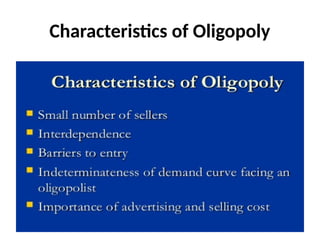
Characteristics of Oligopoly
Cont…………..
Examples of Oligopoly Industries
• The automobile industry, steel industry,
photographic equipment industry, aircraft
manufacturing industry, beer (wholesale)
industry, cereal (breakfast) industry, Infant
formula makers, oil industry (wholesale),
airline industry, beverage (including soft
drinks) industry, Organization of the Petroleum
Exporting Countries (OPEC).
CONT…..
1. Few sellers.
There are just several sellers who control all or
most of the sales in the industry.
2. Barriers to entry.
It is difficult to enter an oligopoly industry and
compete as a small start-up company. Oligopoly
firms are large and benefit from economies of
scale. It takes considerable know-how and
capital to compete in this industry.
CONT………….
3. Interdependence:
• This is because when the number of competitors is
few, if one oligopoly firm changes its price or its
marketing strategy, it will significantly impact the
rival firm(s).
• For instance, if Pepsi lowers its price to 80 cents per
can, Coke will be affected. If Coke does not
respond, it will lose significant market share.
Therefore, Coke will most likely lower its price, too.
Cont…………
5. Existence of Price Rigidity:
• In oligopoly situation, each firm has to stick to its
price.
• If any firm tries to reduce its price, the rival firms will
retaliate by a higher reduction in their prices. This will
lead to a situation of price war which benefits none.
• On the other hand, if any firm increases its price with
a view to increase its profits; the other rival firms will
not follow the same. Hence, no firm would like to
reduce the price or to increase the price. The price
rigidity will take place.
Cont………….
4. Advertising and selling costs:
• A direct effect of interdependence of oligopolists
is that the various firms have to employ various
aggressive and defensive marketing weapons to
gain a greater share in the market or to prevent
a fall in their market share.
• For this various firms have to incur a good deal
of costs on advertising and on other measures
of sales promotion.
Cont………..
6. Indeterminateness of Demand Curve:
7. Profit maximization
8. Imperfect knowledge
9. Price maker
Cont………
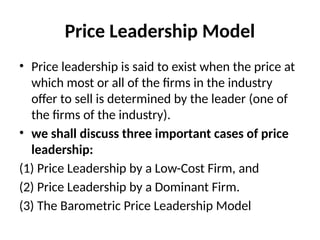
Price Leadership Model
• Price leadership is said to exist when the price at
which most or all of the firms in the industry
offer to sell is determined by the leader (one of
the firms of the industry).
• we shall discuss three important cases of price
leadership:
(1) Price Leadership by a Low-Cost Firm, and
(2) Price Leadership by a Dominant Firm.
(3) The Barometric Price Leadership Model
1. Price Leadership by Low Cost Firm:
In the low-cost price leadership model, an
oligopolistic firm having lower costs than the
other firms sets a lower price which the other
firms have to follow. Thus the low-cost firm
becomes the price leader.
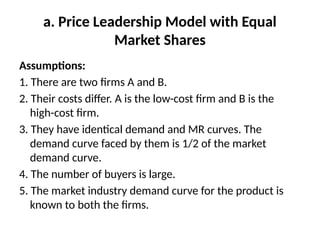
a. Price Leadership Model with Equal
Market Shares
Assumptions:
1. There are two firms A and B.
2. Their costs differ. A is the low-cost firm and B is the
high-cost firm.
3. They have identical demand and MR curves. The
demand curve faced by them is 1/2 of the market
demand curve.
4. The number of buyers is large.
5. The market industry demand curve for the product is
known to both the firms.
Cont…….
b. Price Leadership Model with unequal
Market Shares
Cont…..
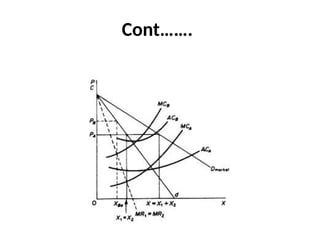
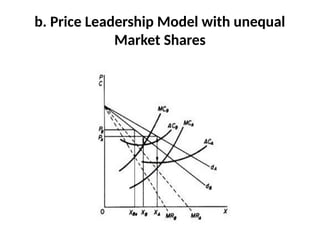
• The firm with the lowest cost will charge a lower price (PA) and
this price will be fol­
lowed by the high-cost firm, although at
this price firm B (the follower) does not maximize its profits.
The follower would obtain a higher profit by producing a
lower output (XBe) and selling it at a higher price (PB). However,
it prefers to follow the leader, sacrificing some of its profits in
order to avoid a price war, which would eliminate it if price fell
sufficiently low as not to cover its LAC. It should be stressed
that for the leader to maximize his profit price must be
retained at the level PA and he should sell XA. This implies that
the follower must supply a quantity (0XB in figure 1 , or OX1 =
OX2 in figure 2 ) sufficient to maintain the price set by the
leader
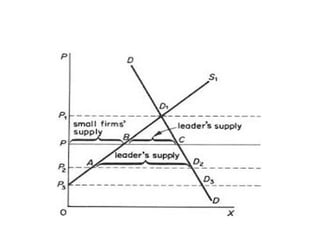
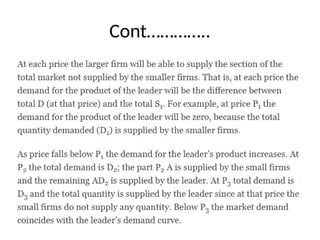
b. Price Leadership by Dominant Firm
• In this model it is assumed that there is a large
dominant firm which has a considerable share of
the total market, and some smaller firms, each
of them having a small market share. The market
demand (DD in figure) is assumed known to the
dominant firm.
• It is also assumed that the dominant leader
knows the MC curves of the smaller firms, which
he can add horizontally and find the total supply
by the small firms at each price.
Cont…………..
Cont………..
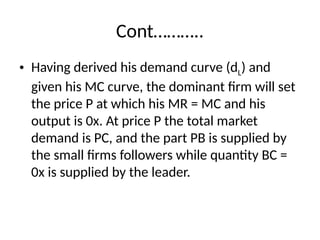
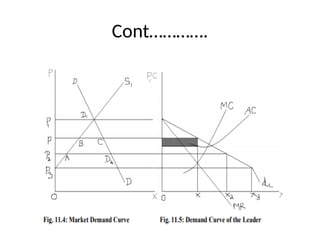
• Having derived his demand curve (dL) and
given his MC curve, the dominant firm will set
the price P at which his MR = MC and his
output is 0x. At price P the total market
demand is PC, and the part PB is supplied by
the small firms followers while quantity BC =
0x is supplied by the leader.
Cont………….
Cont……….
• At price OP, PB gives the small firms supply
and BC the leader’s supply. At price OP3, AD2
gives the leader’s supply.
c. Barometric Price Leadership Model
• In this model it is formally or informally
agreed that all firms will follow (exactly or
approximately) the changes of the price of a
firm which is considered to have a good
knowledge of the prevailing conditions in the
market and can forecast better than the
others the future developments in the market.
• In short, the firm chosen as the leader is
considered as a barometer, reflecting the
changes in economic environment.
Multiple Product Pricing:
• The activity of producing more than one product by
one firm is multiproduct production.
• In multiproduct production cost of production will
be reduced.
• Even a single product of an organization can differ in
styles and sizes.
• For example, an automobile organization
manufactures vehicles in different colors, sizes, and
mileage. The pricing in case of multiple products is
called multiple product pricing.
Cont………..
Cont………..
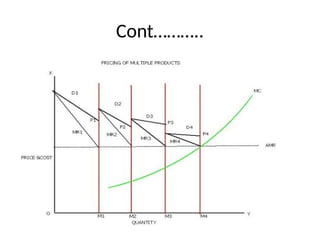
• The four markets have four demand curves D1,D2D3,D4,
and corresponding MR curves, MR1, MR2, MR3 and MR
4.
• MC is the marginal cost, which is common. The
horizontal line AMR is the aggregate marginal revenue
curve
• Each product is charged differently.
• For example in the first market A the firm sells OM
1output. At this point MR1 = MC. The price charged is
P1M1.
• The price charged is M2P2 in the second market and
M3P3 in the third market and so on
CONT…….
The producers in multi product pricing may sell
different types or models of a commodity in
different markets depending on elasticity of
demand and thus make a profit.
Joint Product Pricing
• If two or more than two products are produced
from the same plant, they are called joint
products.
• For example, a farmer produces both meat and
wool jointly from the from his sheep farming.
• Pricing of joint products can be explained under
two different circumstances:
(i). Joint Product with Fixed Proportion.
(Ii). Joint Product with Variable Proportion.
(i) Joint Products with Fixed Proportion:
• In joint product case with fixed proportion of
quantity, there is no possibility of increasing
one at the expense of another.
• Although the two goods are produced
together, their demands are independent.
• For example, meat and wool are produced in
fixed proportions.
Cont………..
Cont……
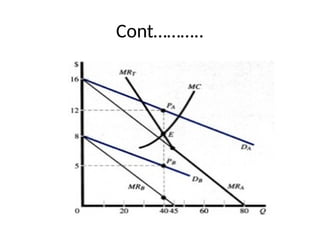
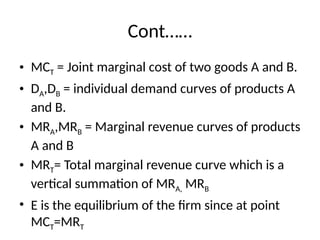
• MCT = Joint marginal cost of two goods A and B.
• DA,DB = individual demand curves of products A
and B.
• MRA,MRB = Marginal revenue curves of products
A and B
• MRT= Total marginal revenue curve which is a
vertical summation of MRA, MRB
• E is the equilibrium of the firm since at point
MCT=MRT
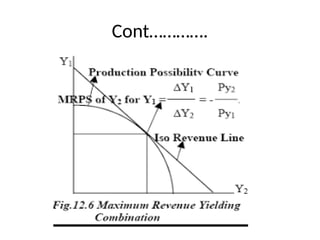
(ii) Joint Products with Variable Proportions:
• In joint product case with variable proportion
of quantity, there is a possibility of increasing
one at the expense of another.
• For example, petroleum products.
• The best combinations are the points of
tangency of ISO-COST curves and ISO-
REVENUE lines for optimum production and
maximization of sales revenues or profits
Cont………….
Cost plus Pricing Method
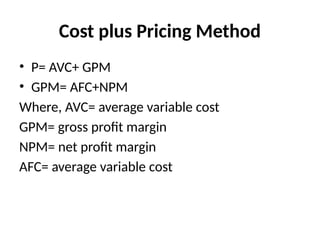
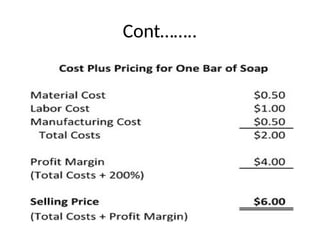
• P= AVC+ GPM
• GPM= AFC+NPM
Where, AVC= average variable cost
GPM= gross profit margin
NPM= net profit margin
AFC= average variable cost
Cont……..
Marginal cost pricing
• Marginal-cost pricing, in economics, the practice
of setting the price of a product to equal the extra
cost of producing an extra unit of output.
• By this policy, a producer charges, for each
product unit sold, only the addition to total cost
resulting from materials and direct labour.
• Businesses often set prices close to marginal cost
during periods of poor sales.
Cont……….
• If, for example, an item has a marginal cost of
$1.00 and a normal selling price is $2.00, the
firm selling the item might wish to lower the
price to $1.10 if demand has waned. The
business would choose this approach because
the incremental profit of 10 cents from the
transaction is better than no sale at all
oligopoly_economics presentationssssssss

oligopoly_economics presentationssssssss

  • 1.
  • 2.
  • 3.
  • 4.
  • 5.
  • 6.
  • 7.
    Cont………….. Examples of OligopolyIndustries • The automobile industry, steel industry, photographic equipment industry, aircraft manufacturing industry, beer (wholesale) industry, cereal (breakfast) industry, Infant formula makers, oil industry (wholesale), airline industry, beverage (including soft drinks) industry, Organization of the Petroleum Exporting Countries (OPEC).
  • 8.
    CONT….. 1. Few sellers. Thereare just several sellers who control all or most of the sales in the industry. 2. Barriers to entry. It is difficult to enter an oligopoly industry and compete as a small start-up company. Oligopoly firms are large and benefit from economies of scale. It takes considerable know-how and capital to compete in this industry.
  • 9.
    CONT…………. 3. Interdependence: • Thisis because when the number of competitors is few, if one oligopoly firm changes its price or its marketing strategy, it will significantly impact the rival firm(s). • For instance, if Pepsi lowers its price to 80 cents per can, Coke will be affected. If Coke does not respond, it will lose significant market share. Therefore, Coke will most likely lower its price, too.
  • 10.
    Cont………… 5. Existence ofPrice Rigidity: • In oligopoly situation, each firm has to stick to its price. • If any firm tries to reduce its price, the rival firms will retaliate by a higher reduction in their prices. This will lead to a situation of price war which benefits none. • On the other hand, if any firm increases its price with a view to increase its profits; the other rival firms will not follow the same. Hence, no firm would like to reduce the price or to increase the price. The price rigidity will take place.
  • 11.
    Cont…………. 4. Advertising andselling costs: • A direct effect of interdependence of oligopolists is that the various firms have to employ various aggressive and defensive marketing weapons to gain a greater share in the market or to prevent a fall in their market share. • For this various firms have to incur a good deal of costs on advertising and on other measures of sales promotion.
  • 12.
    Cont……….. 6. Indeterminateness ofDemand Curve: 7. Profit maximization 8. Imperfect knowledge 9. Price maker
  • 13.
  • 14.
    Price Leadership Model •Price leadership is said to exist when the price at which most or all of the firms in the industry offer to sell is determined by the leader (one of the firms of the industry). • we shall discuss three important cases of price leadership: (1) Price Leadership by a Low-Cost Firm, and (2) Price Leadership by a Dominant Firm. (3) The Barometric Price Leadership Model
  • 15.
    1. Price Leadershipby Low Cost Firm: In the low-cost price leadership model, an oligopolistic firm having lower costs than the other firms sets a lower price which the other firms have to follow. Thus the low-cost firm becomes the price leader.
  • 16.
    a. Price LeadershipModel with Equal Market Shares Assumptions: 1. There are two firms A and B. 2. Their costs differ. A is the low-cost firm and B is the high-cost firm. 3. They have identical demand and MR curves. The demand curve faced by them is 1/2 of the market demand curve. 4. The number of buyers is large. 5. The market industry demand curve for the product is known to both the firms.
  • 17.
  • 18.
    b. Price LeadershipModel with unequal Market Shares
  • 19.
    Cont….. • The firmwith the lowest cost will charge a lower price (PA) and this price will be fol­ lowed by the high-cost firm, although at this price firm B (the follower) does not maximize its profits. The follower would obtain a higher profit by producing a lower output (XBe) and selling it at a higher price (PB). However, it prefers to follow the leader, sacrificing some of its profits in order to avoid a price war, which would eliminate it if price fell sufficiently low as not to cover its LAC. It should be stressed that for the leader to maximize his profit price must be retained at the level PA and he should sell XA. This implies that the follower must supply a quantity (0XB in figure 1 , or OX1 = OX2 in figure 2 ) sufficient to maintain the price set by the leader
  • 20.
    b. Price Leadershipby Dominant Firm • In this model it is assumed that there is a large dominant firm which has a considerable share of the total market, and some smaller firms, each of them having a small market share. The market demand (DD in figure) is assumed known to the dominant firm. • It is also assumed that the dominant leader knows the MC curves of the smaller firms, which he can add horizontally and find the total supply by the small firms at each price.
  • 22.
  • 23.
    Cont……….. • Having derivedhis demand curve (dL) and given his MC curve, the dominant firm will set the price P at which his MR = MC and his output is 0x. At price P the total market demand is PC, and the part PB is supplied by the small firms followers while quantity BC = 0x is supplied by the leader.
  • 24.
  • 25.
    Cont………. • At priceOP, PB gives the small firms supply and BC the leader’s supply. At price OP3, AD2 gives the leader’s supply.
  • 26.
    c. Barometric PriceLeadership Model • In this model it is formally or informally agreed that all firms will follow (exactly or approximately) the changes of the price of a firm which is considered to have a good knowledge of the prevailing conditions in the market and can forecast better than the others the future developments in the market. • In short, the firm chosen as the leader is considered as a barometer, reflecting the changes in economic environment.
  • 27.
    Multiple Product Pricing: •The activity of producing more than one product by one firm is multiproduct production. • In multiproduct production cost of production will be reduced. • Even a single product of an organization can differ in styles and sizes. • For example, an automobile organization manufactures vehicles in different colors, sizes, and mileage. The pricing in case of multiple products is called multiple product pricing.
  • 28.
  • 29.
    Cont……….. • The fourmarkets have four demand curves D1,D2D3,D4, and corresponding MR curves, MR1, MR2, MR3 and MR 4. • MC is the marginal cost, which is common. The horizontal line AMR is the aggregate marginal revenue curve • Each product is charged differently. • For example in the first market A the firm sells OM 1output. At this point MR1 = MC. The price charged is P1M1. • The price charged is M2P2 in the second market and M3P3 in the third market and so on
  • 30.
    CONT……. The producers inmulti product pricing may sell different types or models of a commodity in different markets depending on elasticity of demand and thus make a profit.
  • 31.
    Joint Product Pricing •If two or more than two products are produced from the same plant, they are called joint products. • For example, a farmer produces both meat and wool jointly from the from his sheep farming. • Pricing of joint products can be explained under two different circumstances: (i). Joint Product with Fixed Proportion. (Ii). Joint Product with Variable Proportion.
  • 32.
    (i) Joint Productswith Fixed Proportion: • In joint product case with fixed proportion of quantity, there is no possibility of increasing one at the expense of another. • Although the two goods are produced together, their demands are independent. • For example, meat and wool are produced in fixed proportions.
  • 33.
  • 34.
    Cont…… • MCT =Joint marginal cost of two goods A and B. • DA,DB = individual demand curves of products A and B. • MRA,MRB = Marginal revenue curves of products A and B • MRT= Total marginal revenue curve which is a vertical summation of MRA, MRB • E is the equilibrium of the firm since at point MCT=MRT
  • 35.
    (ii) Joint Productswith Variable Proportions: • In joint product case with variable proportion of quantity, there is a possibility of increasing one at the expense of another. • For example, petroleum products. • The best combinations are the points of tangency of ISO-COST curves and ISO- REVENUE lines for optimum production and maximization of sales revenues or profits
  • 36.
  • 37.
    Cost plus PricingMethod • P= AVC+ GPM • GPM= AFC+NPM Where, AVC= average variable cost GPM= gross profit margin NPM= net profit margin AFC= average variable cost
  • 38.
  • 39.
    Marginal cost pricing •Marginal-cost pricing, in economics, the practice of setting the price of a product to equal the extra cost of producing an extra unit of output. • By this policy, a producer charges, for each product unit sold, only the addition to total cost resulting from materials and direct labour. • Businesses often set prices close to marginal cost during periods of poor sales.
  • 40.
    Cont………. • If, forexample, an item has a marginal cost of $1.00 and a normal selling price is $2.00, the firm selling the item might wish to lower the price to $1.10 if demand has waned. The business would choose this approach because the incremental profit of 10 cents from the transaction is better than no sale at all