Helping the Poverty StrickenElise RhoadsMs. OrenBlock 3
Presentation OverviewPowerpointVideoHunger Banquet Activity
 “Poverty is not natural. It is man made and it can be overcome and eradicated by the actions of human beings.”  										Nelson Mandella
InspirationDiscovered this non-profit organization from a concert I had attended November of junior year
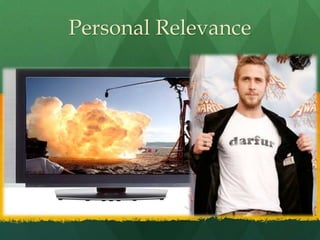
Personal Relevance
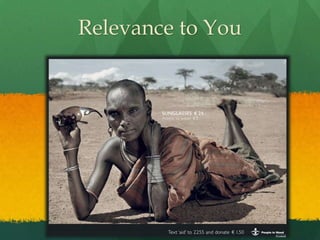
Relevance to You
Importance of Oxfam AmericaOxfam America is an international relief and development organization that creates lasting solutions to poverty, hunger, and injustice. Individuals and local groups in more than 100 countries help Oxfam by: Donating moneyFundraisingVolunteering at a local office Or actually traveling to a specific country to help. Oxfam works to end global poverty by saving lives, strengthening communities, and campaigning for change.
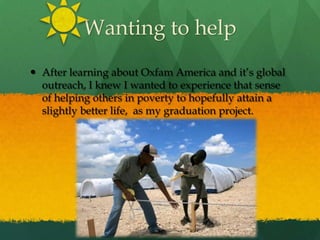
Wanting to helpAfter learning about Oxfam America and it’s global outreach, I knew I wanted to experience that sense of helping others in poverty to hopefully attain a slightly better life,  as my graduation project.
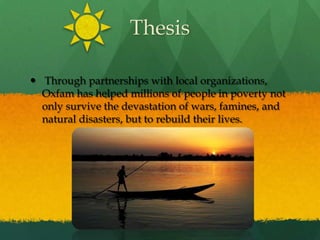
Thesis Through partnerships with local organizations, Oxfam has helped millions of people in poverty not only survive the devastation of wars, famines, and natural disasters, but to rebuild their lives.
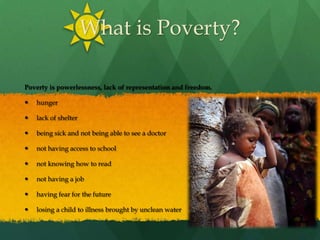
What is Poverty?Poverty is powerlessness, lack of representation and freedom.hunger lack of shelterbeing sick and not being able to see a doctornot having access to schoolnot knowing how to readnot having a jobhaving fear for the futurelosing a child to illness brought by unclean water
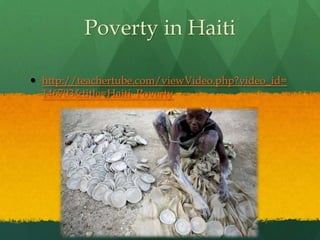
Poverty in Haitihttp://teachertube.com/viewVideo.php?video_id=146703&title=Haiti_Poverty
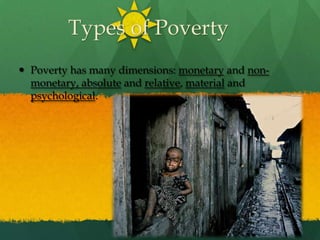
Types of PovertyPoverty has many dimensions: monetary and non-monetary, absolute and relative, material and psychological.
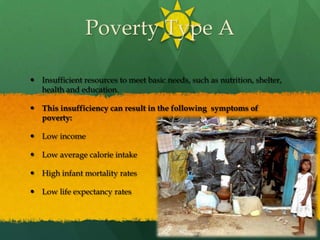
Poverty Type AInsufficient resources to meet basic needs, such as nutrition, shelter, health and education.This insufficiency can result in the following  symptoms of poverty:Low incomeLow average calorie intakeHigh infant mortality ratesLow life expectancy rates
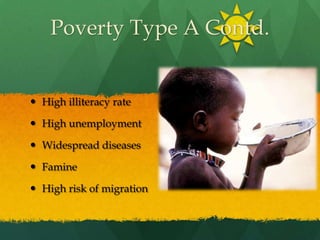
Poverty Type A Contd.High illiteracy rateHigh unemploymentWidespread diseasesFamineHigh risk of migration
Poverty Type BThis inequality of income or consumption can result in the following psychological symptoms of poverty:Feelings of loss of dignityLow self-esteemFeelings of powerlessnessFeelings of lack of participation in culture and politicsFeelings of discrimination and resentment.
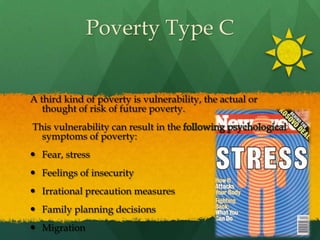
Poverty Type CA third kind of poverty is vulnerability, the actual or thought of risk of future poverty. This vulnerability can result in the following psychological symptoms of poverty:Fear, stressFeelings of insecurityIrrational precaution measuresFamily planning decisionsMigration
Different Causes of PovertyAccidental causes, such as drought, disease, birth defects, handicaps etc.Historical causes, such as colonialismEconomic causes, such as energy prices, food prices, etc.National political causes
Causes Contd.International political causes such as trade policySocial causes such as racism, sexism, discriminationDemographic Causes such as overpopulation or a high percentage of people who too young or too oldGeographic Causes such as access to fertile land, fresh water, minerals, energyEnvironmental causes such as climate change, soil erosion and desertificationPoverty traps
Measures to Help Types of PovertyGross Domestic Product (GDP)Calorie intake levelsLevel of Income Literacy Levels
Successful Development of a Country…An improvement in living standards and access to all basic needsA stable political, social and economic environment, with political, social and economic freedomsThe ability to make free and informed choices that are not forcedBe able to participate in a democratic environment with the ability to have a say in one’s own future
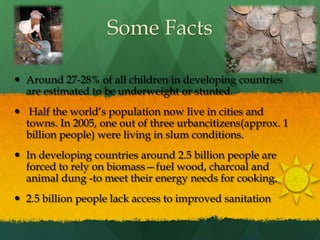
Some FactsAround 27-28% of all children in developing countries are estimated to be underweight or stunted. Half the world’s population now live in cities and towns. In 2005, one out of three urbancitizens(approx. 1 billion people) were living in slum conditions.In developing countries around 2.5 billion people are forced to rely on biomass—fuel wood, charcoal and animal dung -to meet their energy needs for cooking.2.5 billion people lack access to improved sanitation
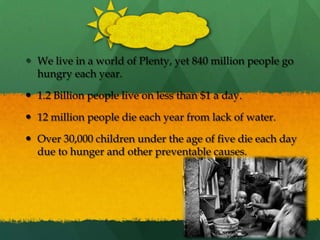
We live in a world of Plenty, yet 840 million people go hungry each year.1.2 Billion people live on less than $1 a day.12 million people die each year from lack of water.Over 30,000 children under the age of five die each day due to hunger and other preventable causes.
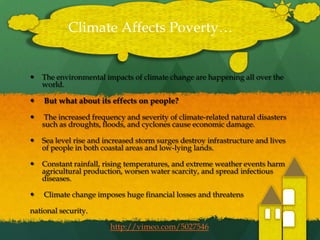
The environmental impacts of climate change are happening all over the world. But what about its effects on people? The increased frequency and severity of climate-related natural disasters such as droughts, floods, and cyclones cause economic damage. Sea level rise and increased storm surges destroy infrastructure and lives of people in both coastal areas and low-lying lands. Constant rainfall, rising temperatures, and extreme weather events harm agricultural production, worsen water scarcity, and spread infectious diseases. Climate change imposes huge financial losses and threatensnational security.Climate Affects Poverty…http://vimeo.com/5027546
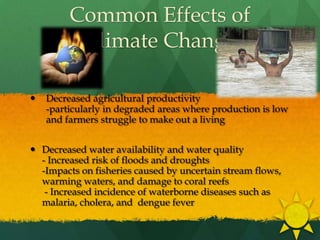
Common Effects of Climate ChangeDecreased agricultural productivity-particularly in degraded areas where production is low and farmers struggle to make out a livingDecreased water availability and water quality - Increased risk of floods and droughts -Impacts on fisheries caused by uncertain stream flows, warming waters, and damage to coral reefs - Increased incidence of waterborne diseases such as malaria, cholera, and  dengue fever
A glimpse of Climate Changehttp://www.vimeo.com/6655465
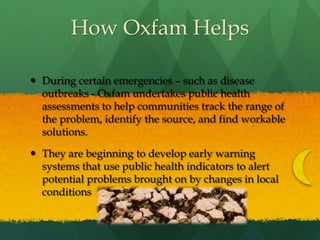
How Oxfam HelpsDuring certain emergencies – such as disease outbreaks - Oxfam undertakes public health assessments to help communities track the range of the problem, identify the source, and find workable solutions.They are beginning to develop early warning systems that use public health indicators to alert potential problems brought on by changes in local conditions
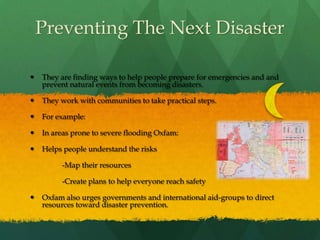
Preventing The Next DisasterThey are finding ways to help people prepare for emergencies and and prevent natural events from becoming disasters.They work with communities to take practical steps.For example:In areas prone to severe flooding Oxfam:Helps people understand the risks		-Map their resources		-Create plans to help everyone reach safetyOxfam also urges governments and international aid-groups to direct resources toward disaster prevention.
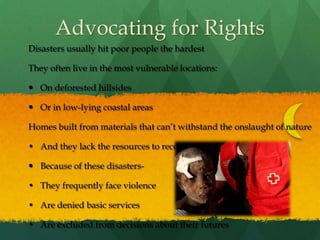
Advocating for RightsDisasters usually hit poor people the hardestThey often live in the most vulnerable locations:On deforested hillsidesOr in low-lying coastal areasHomes built from materials that can’t withstand the onslaught of natureAnd they lack the resources to recoverBecause of these disasters- They frequently face violence
Are denied basic services
Are excluded from decisions about their futures
Oxfam works with the poorest communities to help them claim their rights to safety, services, and a voiceHelp People Earn a LivingGetting back to work after an emergency helps people and communities recover more quickly Some initiatives Oxfam takes are:A variety of programs that offer immediate employmentGrants and loans that help jump-start businessesVocational training fundingSupport some communitieswith distribution of basic farming
Current IssuesClimate ChangeDisasters and conflictsHunger & Food securityOil, gas & miningAid ReformCommunity FinanceAffordable Housing			Workers rights
Water
Trade
US Public Policy
Access to Land
Equality for Women
Agriculture
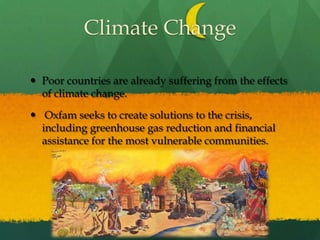
HIV & AIDSClimate ChangePoor countries are already suffering from the effects of climate change. Oxfam seeks to create solutions to the crisis, including greenhouse gas reduction and financial assistance for the most vulnerable communities.
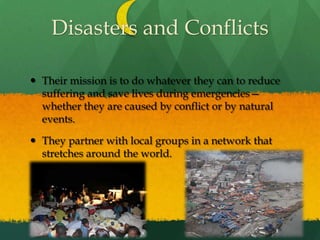
Disasters and ConflictsTheir mission is to do whatever they can to reduce suffering and save lives during emergencies—whether they are caused by conflict or by natural events. They partner with local groups in a network that stretches around the world.
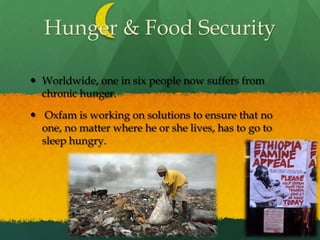
Hunger & Food SecurityWorldwide, one in six people now suffers from chronic hunger. Oxfam is working on solutions to ensure that no one, no matter where he or she lives, has to go to sleep hungry.
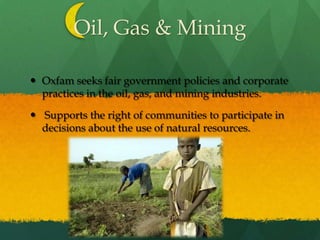
Oil, Gas & MiningOxfam seeks fair government policies and corporate practices in the oil, gas, and mining industries. Supports the right of communities to participate in decisions about the use of natural resources.
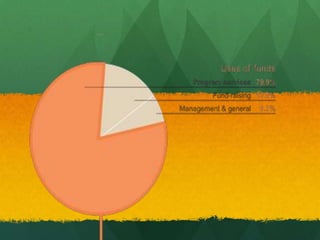
Where does the money go?http://www.vimeo.com/9188972
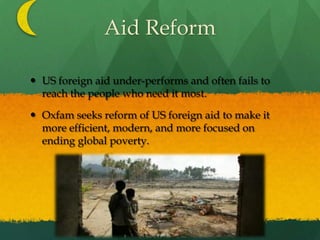
Aid ReformUS foreign aid under-performs and often fails to reach the people who need it most. Oxfam seeks reform of US foreign aid to make it more efficient, modern, and more focused on ending global poverty.
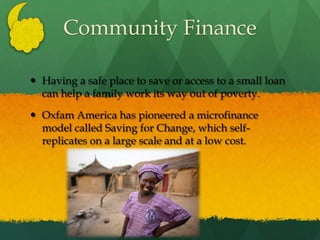
Community FinanceHaving a safe place to save or access to a small loan can help a family work its way out of poverty. Oxfam America has pioneered a microfinance model called Saving for Change, which self-replicates on a large scale and at a low cost.
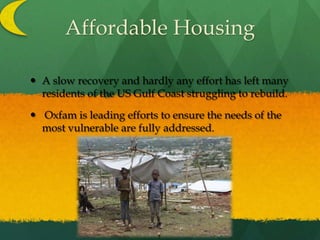
Affordable Housing A slow recovery and hardly any effort has left many residents of the US Gulf Coast struggling to rebuild. Oxfam is leading efforts to ensure the needs of the most vulnerable are fully addressed.
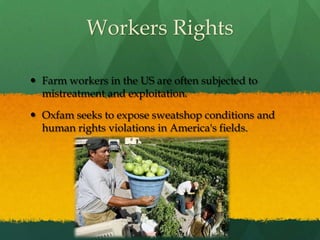
Workers Rights Farm workers in the US are often subjected to mistreatment and exploitation. Oxfam seeks to expose sweatshop conditions and human rights violations in America's fields.
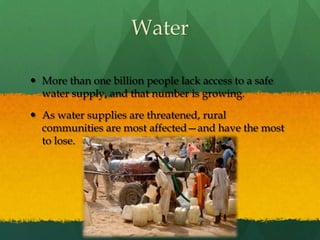
WaterMore than one billion people lack access to a safe water supply, and that number is growing. As water supplies are threatened, rural communities are most affected—and have the most to lose.
Video on Oxfam Helpinghttp://www.vimeo.com/3341320
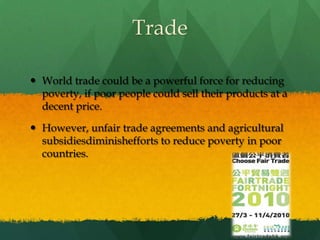
TradeWorld trade could be a powerful force for reducing poverty, if poor people could sell their products at a decent price. However, unfair trade agreements and agricultural subsidiesdiminishefforts to reduce poverty in poor countries.
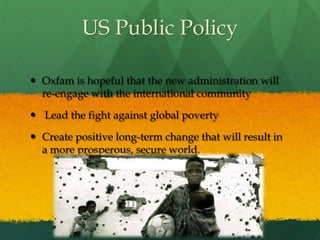
US Public PolicyOxfam is hopeful that the new administration will re-engage with the international community Lead the fight against global povertyCreate positive long-term change that will result in a more prosperous, secure world.
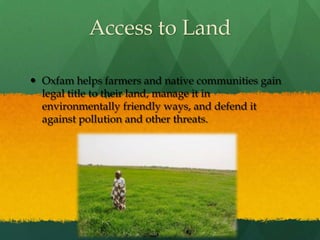
Access to LandOxfam helps farmers and native communities gain legal title to their land, manage it in environmentally friendly ways, and defend it against pollution and other threats.
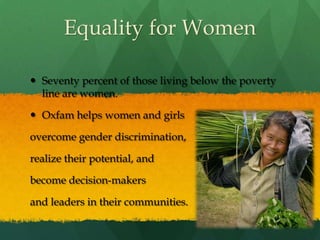
Equality for WomenSeventy percent of those living below the poverty line are women. Oxfam helps women and girlsovercome gender discrimination,realize their potential, andbecome decision-makersand leaders in their communities.
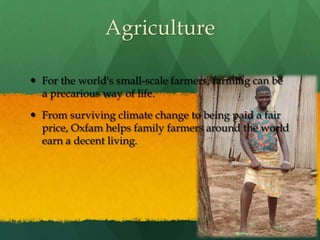
AgricultureFor the world's small-scale farmers, farming can be a precarious way of life. From surviving climate change to being paid a fair price, Oxfam helps family farmers around the world earn a decent living.
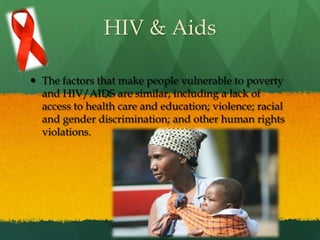
HIV & AidsThe factors that make people vulnerable to poverty and HIV/AIDS are similar, including a lack of access to health care and education; violence; racial and gender discrimination; and other human rights violations.
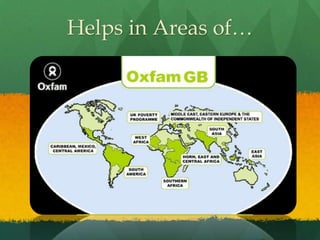
Helps in Areas of…
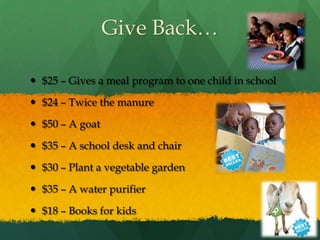
Give Back…$25 – Gives a meal program to one child in school$24 – Twice the manure$50 – A goat$35 – A school desk and chair$30 – Plant a vegetable garden$35 – A water purifier$18 – Books for kids
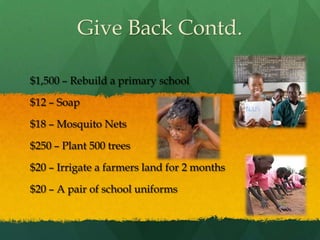
Give Back Contd.$1,500 – Rebuild a primary school$12 – Soap$18 – Mosquito Nets$250 – Plant 500 trees$20 – Irrigate a farmers land for 2 months$20 – A pair of school uniforms
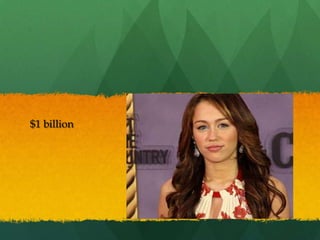
$1 billion
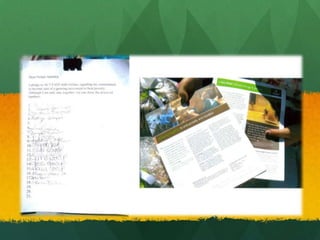
ApplicationMy friend Allyson and I raised over $300 for Oxfam at Upper Darby High School’s flea market in early September of 2009.We spent over 30 hours planning, and setting up  for our grad project.  We made Tye Dye shirts, baked cakes, cookies, brownies, muffinsWe had a box for donationsWe had a package sent from Oxfam with information booklets on the organization,  how you can help, what they work on, and so on.  We  laid the information sheets  out on our table for people to readWe had people sign a signature page to send it to Oxfam to show how many people we had informed of Oxfams’s actions
What you can DoDonateGive Back, InformFundraiseVolunteer or InternWork at Oxfam

Oxfamsgp!new

  • 1.
    Helping the PovertyStrickenElise RhoadsMs. OrenBlock 3
  • 2.
  • 3.
    “Poverty isnot natural. It is man made and it can be overcome and eradicated by the actions of human beings.” Nelson Mandella
  • 4.
    InspirationDiscovered this non-profitorganization from a concert I had attended November of junior year
  • 5.
  • 6.
  • 7.
    Importance of OxfamAmericaOxfam America is an international relief and development organization that creates lasting solutions to poverty, hunger, and injustice. Individuals and local groups in more than 100 countries help Oxfam by: Donating moneyFundraisingVolunteering at a local office Or actually traveling to a specific country to help. Oxfam works to end global poverty by saving lives, strengthening communities, and campaigning for change.
  • 8.
    Wanting to helpAfterlearning about Oxfam America and it’s global outreach, I knew I wanted to experience that sense of helping others in poverty to hopefully attain a slightly better life, as my graduation project.
  • 9.
    Thesis Through partnershipswith local organizations, Oxfam has helped millions of people in poverty not only survive the devastation of wars, famines, and natural disasters, but to rebuild their lives.
  • 11.
    What is Poverty?Povertyis powerlessness, lack of representation and freedom.hunger lack of shelterbeing sick and not being able to see a doctornot having access to schoolnot knowing how to readnot having a jobhaving fear for the futurelosing a child to illness brought by unclean water
  • 12.
  • 13.
    Types of PovertyPovertyhas many dimensions: monetary and non-monetary, absolute and relative, material and psychological.
  • 14.
    Poverty Type AInsufficientresources to meet basic needs, such as nutrition, shelter, health and education.This insufficiency can result in the following symptoms of poverty:Low incomeLow average calorie intakeHigh infant mortality ratesLow life expectancy rates
  • 15.
    Poverty Type AContd.High illiteracy rateHigh unemploymentWidespread diseasesFamineHigh risk of migration
  • 16.
    Poverty Type BThisinequality of income or consumption can result in the following psychological symptoms of poverty:Feelings of loss of dignityLow self-esteemFeelings of powerlessnessFeelings of lack of participation in culture and politicsFeelings of discrimination and resentment.
  • 17.
    Poverty Type CAthird kind of poverty is vulnerability, the actual or thought of risk of future poverty. This vulnerability can result in the following psychological symptoms of poverty:Fear, stressFeelings of insecurityIrrational precaution measuresFamily planning decisionsMigration
  • 18.
    Different Causes ofPovertyAccidental causes, such as drought, disease, birth defects, handicaps etc.Historical causes, such as colonialismEconomic causes, such as energy prices, food prices, etc.National political causes
  • 19.
    Causes Contd.International politicalcauses such as trade policySocial causes such as racism, sexism, discriminationDemographic Causes such as overpopulation or a high percentage of people who too young or too oldGeographic Causes such as access to fertile land, fresh water, minerals, energyEnvironmental causes such as climate change, soil erosion and desertificationPoverty traps
  • 20.
    Measures to HelpTypes of PovertyGross Domestic Product (GDP)Calorie intake levelsLevel of Income Literacy Levels
  • 21.
    Successful Development ofa Country…An improvement in living standards and access to all basic needsA stable political, social and economic environment, with political, social and economic freedomsThe ability to make free and informed choices that are not forcedBe able to participate in a democratic environment with the ability to have a say in one’s own future
  • 22.
    Some FactsAround 27-28%of all children in developing countries are estimated to be underweight or stunted. Half the world’s population now live in cities and towns. In 2005, one out of three urbancitizens(approx. 1 billion people) were living in slum conditions.In developing countries around 2.5 billion people are forced to rely on biomass—fuel wood, charcoal and animal dung -to meet their energy needs for cooking.2.5 billion people lack access to improved sanitation
  • 23.
    We live ina world of Plenty, yet 840 million people go hungry each year.1.2 Billion people live on less than $1 a day.12 million people die each year from lack of water.Over 30,000 children under the age of five die each day due to hunger and other preventable causes.
  • 25.
    The environmental impactsof climate change are happening all over the world. But what about its effects on people? The increased frequency and severity of climate-related natural disasters such as droughts, floods, and cyclones cause economic damage. Sea level rise and increased storm surges destroy infrastructure and lives of people in both coastal areas and low-lying lands. Constant rainfall, rising temperatures, and extreme weather events harm agricultural production, worsen water scarcity, and spread infectious diseases. Climate change imposes huge financial losses and threatensnational security.Climate Affects Poverty…http://vimeo.com/5027546
  • 26.
    Common Effects ofClimate ChangeDecreased agricultural productivity-particularly in degraded areas where production is low and farmers struggle to make out a livingDecreased water availability and water quality - Increased risk of floods and droughts -Impacts on fisheries caused by uncertain stream flows, warming waters, and damage to coral reefs - Increased incidence of waterborne diseases such as malaria, cholera, and dengue fever
  • 27.
    A glimpse ofClimate Changehttp://www.vimeo.com/6655465
  • 29.
    How Oxfam HelpsDuringcertain emergencies – such as disease outbreaks - Oxfam undertakes public health assessments to help communities track the range of the problem, identify the source, and find workable solutions.They are beginning to develop early warning systems that use public health indicators to alert potential problems brought on by changes in local conditions
  • 30.
    Preventing The NextDisasterThey are finding ways to help people prepare for emergencies and and prevent natural events from becoming disasters.They work with communities to take practical steps.For example:In areas prone to severe flooding Oxfam:Helps people understand the risks -Map their resources -Create plans to help everyone reach safetyOxfam also urges governments and international aid-groups to direct resources toward disaster prevention.
  • 31.
    Advocating for RightsDisastersusually hit poor people the hardestThey often live in the most vulnerable locations:On deforested hillsidesOr in low-lying coastal areasHomes built from materials that can’t withstand the onslaught of natureAnd they lack the resources to recoverBecause of these disasters- They frequently face violence
  • 32.
  • 33.
    Are excluded fromdecisions about their futures
  • 34.
    Oxfam works withthe poorest communities to help them claim their rights to safety, services, and a voiceHelp People Earn a LivingGetting back to work after an emergency helps people and communities recover more quickly Some initiatives Oxfam takes are:A variety of programs that offer immediate employmentGrants and loans that help jump-start businessesVocational training fundingSupport some communitieswith distribution of basic farming
  • 35.
    Current IssuesClimate ChangeDisastersand conflictsHunger & Food securityOil, gas & miningAid ReformCommunity FinanceAffordable Housing Workers rights
  • 36.
  • 37.
  • 38.
  • 39.
  • 40.
  • 41.
  • 42.
    HIV & AIDSClimateChangePoor countries are already suffering from the effects of climate change. Oxfam seeks to create solutions to the crisis, including greenhouse gas reduction and financial assistance for the most vulnerable communities.
  • 43.
    Disasters and ConflictsTheirmission is to do whatever they can to reduce suffering and save lives during emergencies—whether they are caused by conflict or by natural events. They partner with local groups in a network that stretches around the world.
  • 44.
    Hunger & FoodSecurityWorldwide, one in six people now suffers from chronic hunger. Oxfam is working on solutions to ensure that no one, no matter where he or she lives, has to go to sleep hungry.
  • 45.
    Oil, Gas &MiningOxfam seeks fair government policies and corporate practices in the oil, gas, and mining industries. Supports the right of communities to participate in decisions about the use of natural resources.
  • 46.
    Where does themoney go?http://www.vimeo.com/9188972
  • 47.
    Aid ReformUS foreignaid under-performs and often fails to reach the people who need it most. Oxfam seeks reform of US foreign aid to make it more efficient, modern, and more focused on ending global poverty.
  • 48.
    Community FinanceHaving asafe place to save or access to a small loan can help a family work its way out of poverty. Oxfam America has pioneered a microfinance model called Saving for Change, which self-replicates on a large scale and at a low cost.
  • 49.
    Affordable Housing Aslow recovery and hardly any effort has left many residents of the US Gulf Coast struggling to rebuild. Oxfam is leading efforts to ensure the needs of the most vulnerable are fully addressed.
  • 50.
    Workers Rights Farmworkers in the US are often subjected to mistreatment and exploitation. Oxfam seeks to expose sweatshop conditions and human rights violations in America's fields.
  • 51.
    WaterMore than onebillion people lack access to a safe water supply, and that number is growing. As water supplies are threatened, rural communities are most affected—and have the most to lose.
  • 52.
    Video on OxfamHelpinghttp://www.vimeo.com/3341320
  • 53.
    TradeWorld trade couldbe a powerful force for reducing poverty, if poor people could sell their products at a decent price. However, unfair trade agreements and agricultural subsidiesdiminishefforts to reduce poverty in poor countries.
  • 54.
    US Public PolicyOxfamis hopeful that the new administration will re-engage with the international community Lead the fight against global povertyCreate positive long-term change that will result in a more prosperous, secure world.
  • 55.
    Access to LandOxfamhelps farmers and native communities gain legal title to their land, manage it in environmentally friendly ways, and defend it against pollution and other threats.
  • 56.
    Equality for WomenSeventypercent of those living below the poverty line are women. Oxfam helps women and girlsovercome gender discrimination,realize their potential, andbecome decision-makersand leaders in their communities.
  • 57.
    AgricultureFor the world'ssmall-scale farmers, farming can be a precarious way of life. From surviving climate change to being paid a fair price, Oxfam helps family farmers around the world earn a decent living.
  • 58.
    HIV & AidsThefactors that make people vulnerable to poverty and HIV/AIDS are similar, including a lack of access to health care and education; violence; racial and gender discrimination; and other human rights violations.
  • 59.
  • 62.
    Give Back…$25 –Gives a meal program to one child in school$24 – Twice the manure$50 – A goat$35 – A school desk and chair$30 – Plant a vegetable garden$35 – A water purifier$18 – Books for kids
  • 63.
    Give Back Contd.$1,500– Rebuild a primary school$12 – Soap$18 – Mosquito Nets$250 – Plant 500 trees$20 – Irrigate a farmers land for 2 months$20 – A pair of school uniforms
  • 64.
  • 65.
    ApplicationMy friend Allysonand I raised over $300 for Oxfam at Upper Darby High School’s flea market in early September of 2009.We spent over 30 hours planning, and setting up for our grad project. We made Tye Dye shirts, baked cakes, cookies, brownies, muffinsWe had a box for donationsWe had a package sent from Oxfam with information booklets on the organization, how you can help, what they work on, and so on. We laid the information sheets out on our table for people to readWe had people sign a signature page to send it to Oxfam to show how many people we had informed of Oxfams’s actions
  • 70.
    What you canDoDonateGive Back, InformFundraiseVolunteer or InternWork at Oxfam

Editor's Notes

  • #4 I chose this quote because it’s saying poverty is not natural. It was created by man and can be taken away by man, but it all depends on our actions to help.
  • #5 This is the organization I raised money for. Oxfam volunteers were handing out cards with Oxfam information on it. Thiscaught my interest, I knew right away I wanted to help in some way.
  • #6 I found out about poverty mostly from commercials or celebrities.
  • #7 You’ve more than likely seen ad’s or commercials on poverty, and you might have had some sort of feelings of wanting to help.
  • #8 This is just a brief overview of Oxfam and what they do.
  • #9 (First)Have you ever noticed how great you feel after doing something good for others?
  • #11 Now I’m going to talk to you about poverty.
  • #12 Emphasize key words!!
  • #13 This is just a brief video showing how people live in Haiti, and how they are living off of “dirt cookies” and selling them to earn a living.
  • #15 These material symptoms result in these types of poverty:Depression increases while income decreases.
  • #16 The widespread diseases are usually curable, or preventable: ones such as Diarrhoea, children typically die from this. Clean water is not available to re-hydrate them.Pneumonia, and Tuberculosis are curable as well. Yet people are still dying from it.
  • #18 Many people fear of waking up each day to no food, water, a disease, and so on. They have feelings of insecurity because no one can protect them.
  • #19 The are different causes to poverty:Colonialism:Colonialism is a practice of domination, which involves the subjugation of one people to another.National Political Causes such as :such as bad governance, corruption, rights violations, war, oppression, lack of investment in economic infrastructure and education, etc.
  • #21 GDP – Also known as the total annual country income per citizenCalorie Intake The body needs around 2000-2500 calories per day in order sustain the human body.In the end, people will have better self esteem about themselves, and feel human again.
  • #22 Successful development can include many things, such as:Basic Needs such as that a person has enough food, water, shelter, clothing, health, education, etc;Freedoms such as equal ownership of land and property;
  • #23 -(approximately 1 billion people) one out of 3 urban dwellersThe two regions that account for the bulk of the deficit are South Asia and sub-Saharan Africa.To meet our energy needs we are using oil (petroleum) gas, wind turbines, nuclear power, renewable energy
  • #24 Thechildren “die quietly in some of the poorest villages on earth, far removed from people in the world. Beingweak in life makes these dying multitudes even more invisible in death.
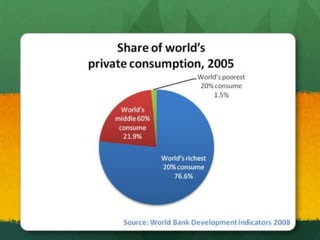
  • #25 The wealthiest 20% of the world accounted for 76.6% of total private consumption. The poorest fifth just 1.5%.
  • #26 This video is describing Geetu’s life and his experiences on the climate changing in his homeland, Bangladesh.Climate change is a reality for fishermen like Geetu. While Bangladesh is a very poor country, these people are the poorest of the poor. Their life is hard, they depend on the water and yet it hurts them.Climate change is destroying lives here. Floods are deeper and longer lasting, rainfall is erratic, and river erosion is increasing. These changes are having a damaging impact on poor farmers and fishermen. When the floods last too long, their crops are destroyed, and they can’t fish.
  • #27 Climate change mostly affects poor rural communities, villages, etc
  • #28 This is a visual and musical take on climate change and how it affects people worldwide. This film was made for OXFAM to help show people that climate change hits the rich and poor in two very different ways.Add (nowim going to talk about oxfam slide) after this
  • #29 Now I’m going to talk about Oxfam.
  • #30 such as drought. With this information, they can take steps to avert the disaster.
  • #32 When a disaster strikes, Oxfam is there to advocate the rights for the poor.This is a description of the conditions these people face in order for Oxfam to take action.
  • #36 What makes a disaster? Is it the event itself -- the earthquake, tsunami, or flood? No. It's the tragic consequences: the immense number of lives lost, the people hurt, and communities destroyed.
  • #39 Do you ever wonder where the money goes as your watching the money go up while pumping gas? You’re not alone, Oxfam says, people on the other end of the pipeline are wondering too. Citizens in other countries who are producing oil for us, are not seeing any benefits for themselves.
  • #42 Many people are living under tents built with sticks and blankets, which are destroyed with typical rainfall.
  • #43 Toiling under dangerous conditions, workers in our nation's meat-processing plants and on our farms are among the lowest paid and most vulnerable laborers in the country. Acompetitive global market is pushing wages lower and eroding worker rights.
  • #44 This is a young boy trying to fill up jugs of water from a hose attached to a metal bin.
  • #45 A well provides water, and song, for cows in Ethiopia's dry season. This video shows how Oxfam America helped one area in Ethiopia optimize their well to make it more efficient. Stop vid at 2:38 point
  • #46 This picture shows you can choose fair trade.
  • #47 This picture is showing children near holes that were shot into a wall with guns. Gun trade in various countries is enormous and very dangerous to the citizens.
  • #48 This is a woman on her piece of land.
  • #49 gender is a risk factor for poverty, women typically are set back from the men, making them less capable of being well off, Creating a life for themselves, getting jobs, owning a house, etc.http://www.genderandhealth.ca/en/modules/poverty/poverty-childhood-experience-03.jsp?r=
  • #55 These donations help people in different countries receive these items.Manure is for farming and keeping the land fertile.
  • #56 Mosquito Nets- to keep bugs and mosquitos away from families. There are many different types of bugs in poverty Ridden counties.
  • #57 Last year, Miley earned a total of around $1 billion dollars from Hannah Montana related Sales which, after calculating the math, could build 549,450 schools, the same amount of bars of soap, school uniforms and mosquito nets. 274,725,000 trees could be planted. You could also Irrigate a famers land for 91, 575 years.
  • #58 At Upper Darby, we were made to have 30 hours of work or more into our graduation projects and we had to start ours in the middle of Junior year, so we had our date set up in early September of our senior year for the flea market to sell our items and raise money.
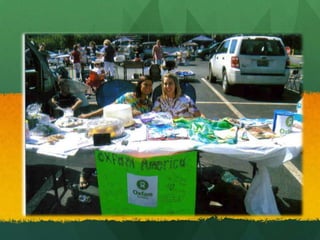
  • #59 My friend Allyson and I sitting at our table at the flea market.
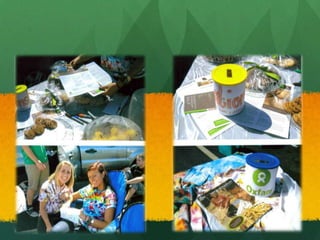
  • #61 This is a picture of our muffins (obviously in the heat) And one of my friends signing the Oxfam signature page.
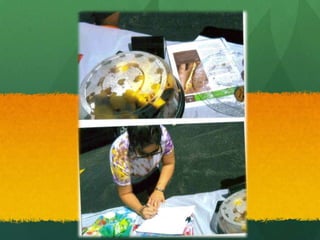
  • #62 This is a picture of the fact booklets and worksheets, and a signature page we got people to sign to inform people on Oxfam’s mission to heal poverty.
  • #65 This is a quote that I felt was very important for my presentation, as it shows how a woman feels and is affected by poverty in her everyday life.cozay.com/documents/poverty2
  • #71 Upper Class Letter A– Grab (Brownie Cupcakes)Middle Class Letter B – Grab (Choc. Pretzels, Sodas, and Graham Crackers)Poverty Letter C – Grab (Matzo’s, Bugs, and Worms)This activity shows the affects on how people live and the luxuries they recieve if they are upper and middle class, which most take for granted.People in poverty don’t receive the good food and are often left hungry and unhappy.