Gender and Disaster Risk ReductionAn OverviewLeisa Perch, Team Leader – Rural and Sustainable DevelopmentIPC-IGJuly 11th, 2011
Outline of Presentation	Gender and DevelopmentGender and Disaster Risk Reduction:Case Study – GrenadaCase Study – St. Lucia Case Study -  St. Kitts and NevisGender Mainstreaming in DRRGender Analysis for Improved Development ResultsGender and Climate Change
TerminologyGender and Development: understanding how socially and culturally defined roles prescribe opportunities and capabilities for women and men and impacts on their capacity for education, employment, for accessing servicesGender Mainstreaming: In July 1997, the United Nations Economic and Social Council (ECOSOC) defined the concept of gender mainstreaming as follows: "Mainstreaming a gender perspective is the process of assessing the implications for women and men of any planned action, including legislation, policies or programmes, in any area and at all levels. It is a strategy for making the concerns and experiences of women as well as of men an integral part of the design, implementation, monitoring and evaluation of policies and programmes in all political, economic and societal spheres, so that women and men benefit equally, and inequality is not perpetuated. The ultimate goal of mainstreaming is to achieve gender equality." Gender Analysis: examines the differences in women's and men's lives, including those which lead to social and economic inequity for women, and applies this understanding to policy development and service delivery is concerned with the underlying causes of these inequities aims to achieve positive change for women (GRDC)
“Gender equality is an issue of developmental effectiveness, not just a matter of political correctness or kindness to women” (WB, 2002:1). Gender and Development
Gender and Development     Everybody has the right to a standard of living adequate for the health and well-being of his/herself and of his/her family, including food, clothing, housing and medical care and necessary social services and the right to security in the event of unemployment, sickness, disability, widowhood, old age or other lack of livelihood in circumstances beyond his/her control.   (United Nations, Declaration of Human Rights Article 25 (1))
Addressing Gender is SMART developmentLeaving 50% of the population out of development weakens the sustainability of growth and developmentTargeting women can be strategic and be a multiplier for development: “impact on household investment in nutrition, health, and education of children than extra income going to fathers” (World Bank 1995:28).When women are empowered, growth and the rate of growth improves (Klasen, 2006)Increased output of goods and services, increased leisure, increased conservation of the environment, increased capacities to enjoy good health, to exercise skills, and toparticipate in decision making (Barriteau, 2005)
Taken from the Report of Third Working Group on Primary Education and General Equality of the Millennium Project, 2005
Gender dimensions of development According to the best available data approximately 30% of those who live on less than a dollar each day are men.Women work two-thirds of the world’s working hours yet receive only 10% of the world’s income.Men own 99% of the world’s property.Women members of parliament globally average only 17% of all seats.92% of all of the world’s cabinet ministers are men.Seventy-five percent of the world’s 876 million illiterate adults are women.Worldwide women received 78% of the wages received by men for the same work, although in some regions, they have a better educational background. In some parts of the world, the wage gap between women and men is close to 40%.Of the 550 million low-paid workers in the world, 40% are men.In a sample of 141 countries over the period 1981–2002, it was found that natural disasters (and their subsequent impact) on average kill more women than men or kill women at an earlier age than men.Sources: Social Watch, 2007 and 2008; Oxfam, 2007; Neumayer and Plümper, 2007; and ILO, 2008.
Gender – More than about women“Development cannot be achieved if half of the world’s population is left out” – Helen ClarkBeyond sex and biology Social and cultural constructsDefinitions of masculine and feminine and how these define power and accessIncludes focus on women’s empowerment (based on clear data on women’s disadvantage)Engagement with men and male leaders on solutionsUnderstanding and working to adjust notions of masculinity which encourage violence and unequal advantage
Gender and Disaster Risk
A conceptual framework for vulnerabilitySource: AshaKambon, 2005
What do We know about Gender and Development in the CaribbeanDifferent impacts for men and women in development – different issues and implications (Trotz, 2003)Increased feminization of poverty – increasing no. of poor female headed households Increasing feminization of HIV-AIDS in the region (see HIV-AIDS presentation)Higher attrition amongst males in secondary schoolChallenges for women go beyond them –by implication impacts on children and their development and role in societySocialization, gender roles and culture have impacts on many things we do and why and how we do themEducational attainment not translating in livelihood, employment and income – twice as many women unemployed than men (STL, 2004)
Framework for the social dimension of vulnerability to a natural disasterSource: AshaKabon, 2005
Case Study – Post-Ivan GrenadaMain impacts – housing, agriculture and tourismAgriculture: women were mainly processers in nutmeg industry; owned little of the industry. Were immediately unemployed – non-mobile skills. Households: Fifty-one (51%) of Grenada’s households are headed by womenwith significant dependents. How to repair houses?Women make up the majority of the workforce in the tourism sector and a significantly large percent of agriculture workers.  Only 30% of Grenada’s hotels are likely to be operational by the end of 2005. Reported sex for food transactions and coercion (UNECLAC/UNIFEM/UNDP, 2005)Construction – huge source of investment BUT……………..
Gender and Land Tenure in GrenadaGender differentiation in land ownership (2005 CWIQ, survey)
Poverty indicators: Post-Ivan
Lessons on Gender and Environment from Disasters (Kambon, 2005)
Case Study – St. Kitts and Nevis (GEC)HDI Rank: 62; GDP per capita over 14K;  Debt to GDP – 187%. GDP declined by -8% in GEC; 2005 the sugar industry was closed affected 15% of labour forceThe lack of insurance, particularly health insurance, potentially exposes the poor and vulnerable in St. Kitts and Nevis: it is estimated that about 70 per cent of the population had no access to health insurance (Felicien, 2009a).the labour force participation rate for women was 71.6 per cent, compared to 87.2 per cent for men (St. Kitts and Nevis CPA, 2008); women’s unemployment exceeds that of men mostly in the higher quintiles (quintiles 3–5) and not in the poorest. Conversely, unemployment seemed to affect young men particularly (St Kitts and Nevis CPA, 2008: 27).Nevis – The Four Seasons closed for one year - 30 per cent drop in income for the Nevis government and 10% of labour force unemployed.(Source: Perch and Roy, 2010)
Kambon, 2005Sectoral distribution of the Impact of natural Disasters  on four selected Caribbean SIDS (Sept 2004)
Why Gender Analysis is Important Gender analysis - the process by which we reveal the social, psychological, ideological and material inequalities and power differentials  existing between women and men that areoutcomes of the social relations of gender at the individual and institutional levels within a society.(EudineBarriteau, 2005)
Understanding Gender in Reality“a basic underlying assumption embedded in the target statement, which is also highlighted in many of the outcome documents of the international conferences held in the 1990s, is that education can be used as the vehicle for women’s economic and political empowerment”, and challenges this assumption by quoting Barbara Bailey’s assertion (2003) that …education has not proven to be the vehicle for Caribbean women’s economic, political or personal empowerment. In spite of their overall higher levels of participation and performance at the secondary and tertiary levels of Caribbean education systems, the majority of the women in the region continue to be positioned in the lowest sectors of the capital market, earn lower wages than men, suffer higher rates of unemployment, experience greater levels of poverty, are under-represented in decision-making positions at the meso and macro levels of social and political institutions and lack real personal autonomy. (p.136)[i][i]Bailey, B. 2003. The Search for Gender Equity and Empowerment of Caribbean Women: The Role of Education. In: Tang-Nain, G. & Bailey, B. (eds.) Gender Equality in the Caribbean: Reality or Illusion. Kingston, Jamaica: Ian Randle Publishers.
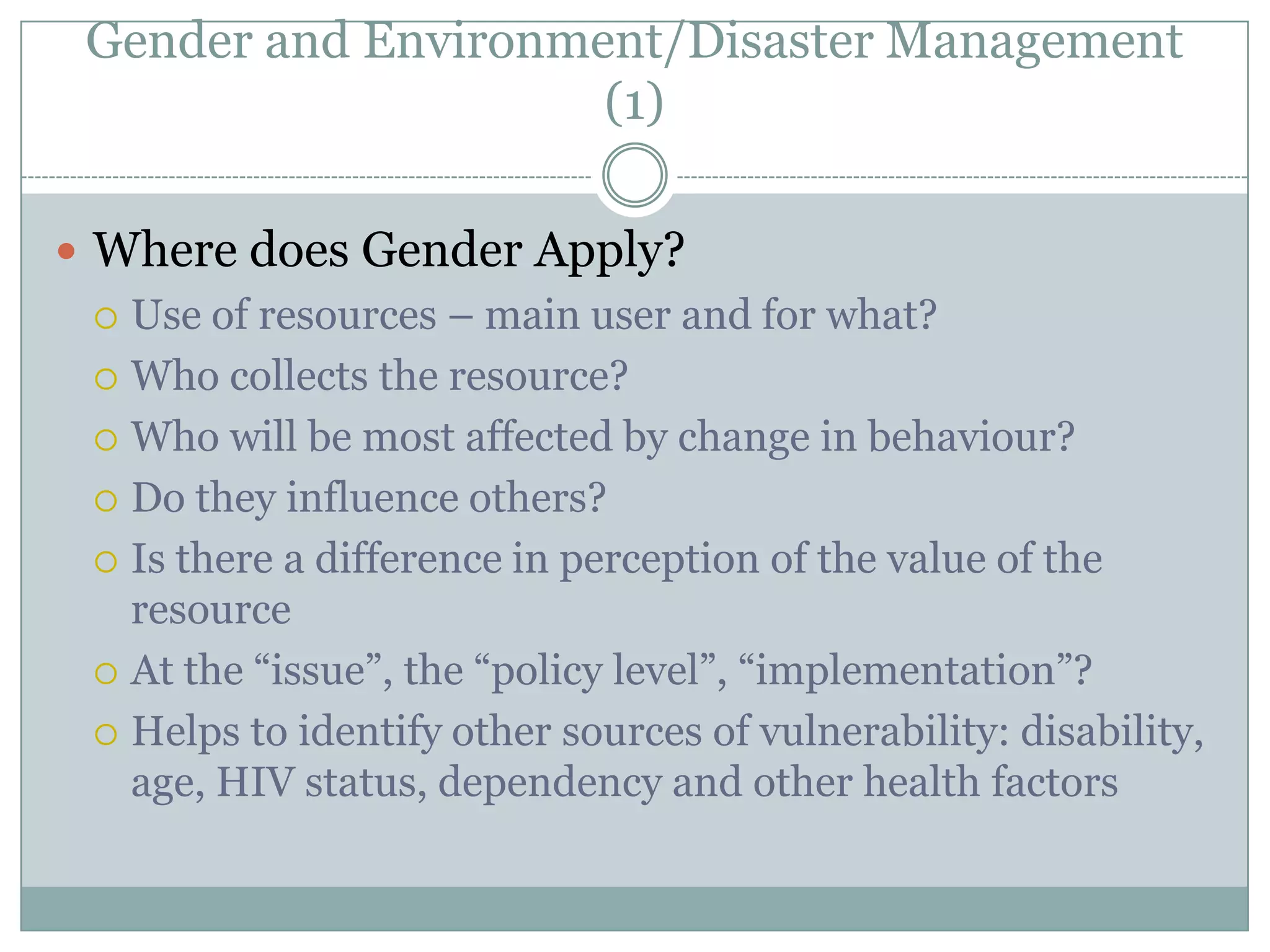
Gender and Environment/Disaster Management (1)Where does Gender Apply?Use of resources – main user and for what?Who collects the resource?Who will be most affected by change in behaviour?Do they influence others?Is there a difference in perception of the value of the resourceAt the “issue”, the “policy level”, “implementation”?Helps to identify other sources of vulnerability: disability, age, HIV status, dependency and other health factors
Gender and Environment/DRRDisaster Management?Where could gender apply?Issues in vulnerability – what are they?Who should be evacuated and when?Shelter Management – any issues?Response – who are those in need? Who were most affected?Management – who could be the drivers of change?Social Risk Analysis: What happens when you don’t take gender relations and gender into consideration – anything, nothing, something big, nothing major or something significant?
Case Study – Saint Lucia (2005)38% of household-heads unemployed; incidence of unemployment is greater amongst female- rather than male-headed households (50% in the former versus 25%+ in the latter)86% of male-headed households reporting the man as the principal income earner versus 68% of women heads in female-head households. 15% of children in women-headed households are the principal contributors to income versus less than 3% in male-headed households. 24.5% of women report household duties as the reason for being ‘economically inactive’, compared to less than 2% of men. This figure rises to almost 60% when considering women in the 30-49 age cohort. (Jackson, 2005 for UNDP Barbados and the OECS)
Benefits – Engendered UNTFHS projectUNIFEM/UN Women and National  Organization of Women on board from the initiationGender mainstreamed from the outsetA specific component on mainstreaming with specific funds allocatedAll implementing partners trained on gender to improve targeting and reporting in projectSpecific gender indicators identified in project documentImproved gender analysis on DRR and Agriculture components where they were weakestGender reflected in additional protocols for DRR in HIV/AIDS and PWDs
Example from UNTFHS projectObjective 5: Gender considerations mainstreamed in disaster risk reduction and livelihoods approaches, and ate responses to ending gender-based violence (GBV) strengthened. (Increased access for women to microfinance by 15% and increased services for Gender-based violence by end of 2007)5.0. 	Mainstream gender in disaster management, livelihoods security and counselling services:5.1. Improved understanding of gender analysis and the instruments for factoring gender issues into disaster management.5.2. Microfinance institutions better equipped to respond to women’s needs to enhance their livelihood.5.3 Enhanced capacity and understanding of police and justice administration personnel to respond to GBV 
Tools	Gender Analysis – UNIFEM, WEDO, UNFPAGender Scorecards – (identifying impacts of projects/interventions before-hand): UNDP and the OECDPoverty and Social Impact Analysis (ex-ante or ex-post of policy)Engendered EIAs (SEA – few good examples exist)Post-Disaster Socio-economic Impact (UNECLAC, OECS)Post Disaster Needs Assessment (UNDP)
– An added dimension to DRR EfFORTS and BUILDING/SUSTAININg SOCIAL RESILIENCeClimate Change
Social Vulnerability: the additionality of climate changeHealthAccess to water (by 2020, between 75 and 250 million of people are projected to be exposed to increased water stress due to climate change – IPCC FAR, 2007)Increased incidence of vector-borne diseases; malaria could emerge in places it has never beenIncome generationFloods or droughts are both bad for small farmers and their investments Access to food and nutritious food ((By 2020, in some countries, yields from rain-fed agriculture could be reduced by up to 50%, IPCC FAR/Heinrich Boll Foundation SAR)Disasters DeathDestruction of property and livelihoodsResettlement Poverty: http://www.youtube.com/watch?v=R1HWoL5Xwdk&feature=related
Implications for ResponseResponding to humanitarian crisesAdaptation – building resilience in communities and identifying options for sectors such as agriculture, water, sanitationMitigation: reducing GHGs from unplanned, crisis and emergency driven responses particularly by the poorhttp://www.youtube.com/watch?v=Rnlpv_G8f94
Gender in Climate ChangeThere are important gender perspectives in all aspects of climate change:60 % of the world's poorest and most vulnerable people are women who are dependent on their natural environment to earn a living and feed their families.Gender inequalities in access to resources, including credit, extension services, information and technology, must be taken into account in developing mitigation activities. Adaptation efforts should systematically and effectively address gender-specific impacts of climate change in the areas of energy, water, food security, agriculture and fisheries, biodiversity and ecosystem services, health, industry, human settlements, disaster management, and conflict and security. Referenced from the Report of the Secretary-General on overview of UN activities in relation to climate change A/62/644.
IMPROVING GENDER OUTCOMESImproving Development Effectiveness
Building Social ResilienceImproves analysis of the social and other impacts of climate change Improved understanding of impacts of repeated events on systems and social resilience (moving past event-related analysis)Can allow tracking of how long recovery takes and understanding resilience and fragilityExpands our understanding of the behaviour change needed to expand renewable energy, reduce dependency on fossil fuelsWill improve adaptation and mitigation – success depends on each of us individuallyCan help make strategic decisions for the investment of scarce resources Likely to improve human impact of climate change policyLikely to result in greater ownership by entire society of policy reform including hard choicesCan reduce/eliminate ‘ additional harm’ of supposed gender-neutral policy
The need to mainstream and not just add…..mainstream gender perspectives into national policies, action plans and other measures on sustainable development and climate change,carrying out systematic gender analysis, collecting and utilizing sex-disaggregated data, establishing gender-sensitive indicators and benchmarks,developing practical tools to support increased attention to gender perspectives,More research on the social dimensions not only of climate change but about climate change responses i.e. human behaviour and social change, and Consultation with and participation of women in climate change initiatives and ensuring a role for women’s groups and networks. Involving the Gender Bureaux and Ministry of Social Development. [Policy Reform]
Examples  of DRR and CC Links in PolicyConstitutional Reform in Bangladesh (http://www.trust.org/alertnet/news/bangladesh-laying-constitutional-groundwork-to-seek-climate-damages/)Government of Maldives – Strategic National Adaptation Plan which links Disaster Risk Reduction and Climate Change Adaptation (SNAP) -www.drrprojects.net/.../drrpp_file.file.bff298f63b65aa07.4d616c64 Government of Tonga: In 2010, Tonga’s Cabinet endorsed a Joint National Action Plan for Climate Change Adaptation and Disaster Risk Reduction (JNAP)
Examples of CC and GenderBangladesh, Sao Tome e Principe and Solomon IslandsBangladesh prioritizes women and the poor in its NAPA (Government of Bangladesh, 2005), and was nominated for “Gender Champion of the Week” at the Copenhagen 2009 climate talks for its strong interventions on gender and providing significant support for women to participate in the climate talks (Somera, 2009). São Tomé e Príncipe’s NAPA offers another example of how it is possible to combine several benefits in one project: constructing two systems of water supply in rural zones combines adaptation to climate change, helps the rural poor, and decreases the burden that women face in water collection (Government of São Tomé e Príncipe, 2007).
Multiplier effect of Crises and Multiple CrisesFuel crisis-Food Crisis – Global Economic crisisHaiti: earthquake (201o) – 200,000+ dead; millions homeless and infrastructure devastated; cholera (early 2011): 5300 dead and thousands hospitalized; tropical storm (June 2011): 20+ dead and thousands affected by landslidesAntigua and Barbuda (Jose and Lenny in 1999) and Jamaica (Wilma, Emily and Dennis in 2005; Ivan and Charley in 2004 and Isidor and Lili in 2002 and Charley and Haiti 2008)
Further ReadingEldis website and BRIDGE (http://www.bridge.ids.ac.uk/go/home&id=58722&type=Document&langid=1) http://www.acdi-cida.gc.ca/acdi-cida/ACDI-CIDA.nsf/En/JUD-31194519-KBDUNDP CRI Reports on Gender and DRR and Gender and CC - http://www.undp.org.cu/crmi/en/doclist.aspWomen’s Leadership in DRR (Oxfam): http://www.undp.org.cu/crmi/docs/oxfam-womenleaderdrr-td-2011-en.pdfhttp://devnet.anu.edu.au/GenderPacific/pdfs/23_gen_mainstream_hunt.pdf  www.undp.org/genderwww.ipc-undp.org/pub/IPCWorkingPaper75.pdf
Thank You!For  further information,Pls contact:Leisa PerchIPC-IGleisa.perch@ipc-undp.org

Gender And Disaster Risk Reduction Ifrc Caribbean

  • 1.
    Gender and DisasterRisk ReductionAn OverviewLeisa Perch, Team Leader – Rural and Sustainable DevelopmentIPC-IGJuly 11th, 2011
  • 2.
    Outline of Presentation Genderand DevelopmentGender and Disaster Risk Reduction:Case Study – GrenadaCase Study – St. Lucia Case Study - St. Kitts and NevisGender Mainstreaming in DRRGender Analysis for Improved Development ResultsGender and Climate Change
  • 3.
    TerminologyGender and Development:understanding how socially and culturally defined roles prescribe opportunities and capabilities for women and men and impacts on their capacity for education, employment, for accessing servicesGender Mainstreaming: In July 1997, the United Nations Economic and Social Council (ECOSOC) defined the concept of gender mainstreaming as follows: "Mainstreaming a gender perspective is the process of assessing the implications for women and men of any planned action, including legislation, policies or programmes, in any area and at all levels. It is a strategy for making the concerns and experiences of women as well as of men an integral part of the design, implementation, monitoring and evaluation of policies and programmes in all political, economic and societal spheres, so that women and men benefit equally, and inequality is not perpetuated. The ultimate goal of mainstreaming is to achieve gender equality." Gender Analysis: examines the differences in women's and men's lives, including those which lead to social and economic inequity for women, and applies this understanding to policy development and service delivery is concerned with the underlying causes of these inequities aims to achieve positive change for women (GRDC)
  • 4.
    “Gender equality isan issue of developmental effectiveness, not just a matter of political correctness or kindness to women” (WB, 2002:1). Gender and Development
  • 5.
    Gender and Development Everybody has the right to a standard of living adequate for the health and well-being of his/herself and of his/her family, including food, clothing, housing and medical care and necessary social services and the right to security in the event of unemployment, sickness, disability, widowhood, old age or other lack of livelihood in circumstances beyond his/her control. (United Nations, Declaration of Human Rights Article 25 (1))
  • 6.
    Addressing Gender isSMART developmentLeaving 50% of the population out of development weakens the sustainability of growth and developmentTargeting women can be strategic and be a multiplier for development: “impact on household investment in nutrition, health, and education of children than extra income going to fathers” (World Bank 1995:28).When women are empowered, growth and the rate of growth improves (Klasen, 2006)Increased output of goods and services, increased leisure, increased conservation of the environment, increased capacities to enjoy good health, to exercise skills, and toparticipate in decision making (Barriteau, 2005)
  • 7.
    Taken from theReport of Third Working Group on Primary Education and General Equality of the Millennium Project, 2005
  • 8.
    Gender dimensions ofdevelopment According to the best available data approximately 30% of those who live on less than a dollar each day are men.Women work two-thirds of the world’s working hours yet receive only 10% of the world’s income.Men own 99% of the world’s property.Women members of parliament globally average only 17% of all seats.92% of all of the world’s cabinet ministers are men.Seventy-five percent of the world’s 876 million illiterate adults are women.Worldwide women received 78% of the wages received by men for the same work, although in some regions, they have a better educational background. In some parts of the world, the wage gap between women and men is close to 40%.Of the 550 million low-paid workers in the world, 40% are men.In a sample of 141 countries over the period 1981–2002, it was found that natural disasters (and their subsequent impact) on average kill more women than men or kill women at an earlier age than men.Sources: Social Watch, 2007 and 2008; Oxfam, 2007; Neumayer and Plümper, 2007; and ILO, 2008.
  • 9.
    Gender – Morethan about women“Development cannot be achieved if half of the world’s population is left out” – Helen ClarkBeyond sex and biology Social and cultural constructsDefinitions of masculine and feminine and how these define power and accessIncludes focus on women’s empowerment (based on clear data on women’s disadvantage)Engagement with men and male leaders on solutionsUnderstanding and working to adjust notions of masculinity which encourage violence and unequal advantage
  • 10.
  • 11.
    A conceptual frameworkfor vulnerabilitySource: AshaKambon, 2005
  • 12.
    What do Weknow about Gender and Development in the CaribbeanDifferent impacts for men and women in development – different issues and implications (Trotz, 2003)Increased feminization of poverty – increasing no. of poor female headed households Increasing feminization of HIV-AIDS in the region (see HIV-AIDS presentation)Higher attrition amongst males in secondary schoolChallenges for women go beyond them –by implication impacts on children and their development and role in societySocialization, gender roles and culture have impacts on many things we do and why and how we do themEducational attainment not translating in livelihood, employment and income – twice as many women unemployed than men (STL, 2004)
  • 13.
    Framework for thesocial dimension of vulnerability to a natural disasterSource: AshaKabon, 2005
  • 14.
    Case Study –Post-Ivan GrenadaMain impacts – housing, agriculture and tourismAgriculture: women were mainly processers in nutmeg industry; owned little of the industry. Were immediately unemployed – non-mobile skills. Households: Fifty-one (51%) of Grenada’s households are headed by womenwith significant dependents. How to repair houses?Women make up the majority of the workforce in the tourism sector and a significantly large percent of agriculture workers. Only 30% of Grenada’s hotels are likely to be operational by the end of 2005. Reported sex for food transactions and coercion (UNECLAC/UNIFEM/UNDP, 2005)Construction – huge source of investment BUT……………..
  • 15.
    Gender and LandTenure in GrenadaGender differentiation in land ownership (2005 CWIQ, survey)
  • 16.
  • 17.
    Lessons on Genderand Environment from Disasters (Kambon, 2005)
  • 18.
    Case Study –St. Kitts and Nevis (GEC)HDI Rank: 62; GDP per capita over 14K; Debt to GDP – 187%. GDP declined by -8% in GEC; 2005 the sugar industry was closed affected 15% of labour forceThe lack of insurance, particularly health insurance, potentially exposes the poor and vulnerable in St. Kitts and Nevis: it is estimated that about 70 per cent of the population had no access to health insurance (Felicien, 2009a).the labour force participation rate for women was 71.6 per cent, compared to 87.2 per cent for men (St. Kitts and Nevis CPA, 2008); women’s unemployment exceeds that of men mostly in the higher quintiles (quintiles 3–5) and not in the poorest. Conversely, unemployment seemed to affect young men particularly (St Kitts and Nevis CPA, 2008: 27).Nevis – The Four Seasons closed for one year - 30 per cent drop in income for the Nevis government and 10% of labour force unemployed.(Source: Perch and Roy, 2010)
  • 19.
    Kambon, 2005Sectoral distributionof the Impact of natural Disasters on four selected Caribbean SIDS (Sept 2004)
  • 20.
    Why Gender Analysisis Important Gender analysis - the process by which we reveal the social, psychological, ideological and material inequalities and power differentials existing between women and men that areoutcomes of the social relations of gender at the individual and institutional levels within a society.(EudineBarriteau, 2005)
  • 21.
    Understanding Gender inReality“a basic underlying assumption embedded in the target statement, which is also highlighted in many of the outcome documents of the international conferences held in the 1990s, is that education can be used as the vehicle for women’s economic and political empowerment”, and challenges this assumption by quoting Barbara Bailey’s assertion (2003) that …education has not proven to be the vehicle for Caribbean women’s economic, political or personal empowerment. In spite of their overall higher levels of participation and performance at the secondary and tertiary levels of Caribbean education systems, the majority of the women in the region continue to be positioned in the lowest sectors of the capital market, earn lower wages than men, suffer higher rates of unemployment, experience greater levels of poverty, are under-represented in decision-making positions at the meso and macro levels of social and political institutions and lack real personal autonomy. (p.136)[i][i]Bailey, B. 2003. The Search for Gender Equity and Empowerment of Caribbean Women: The Role of Education. In: Tang-Nain, G. & Bailey, B. (eds.) Gender Equality in the Caribbean: Reality or Illusion. Kingston, Jamaica: Ian Randle Publishers.
  • 22.
    Gender and Environment/DisasterManagement (1)Where does Gender Apply?Use of resources – main user and for what?Who collects the resource?Who will be most affected by change in behaviour?Do they influence others?Is there a difference in perception of the value of the resourceAt the “issue”, the “policy level”, “implementation”?Helps to identify other sources of vulnerability: disability, age, HIV status, dependency and other health factors
  • 23.
    Gender and Environment/DRRDisasterManagement?Where could gender apply?Issues in vulnerability – what are they?Who should be evacuated and when?Shelter Management – any issues?Response – who are those in need? Who were most affected?Management – who could be the drivers of change?Social Risk Analysis: What happens when you don’t take gender relations and gender into consideration – anything, nothing, something big, nothing major or something significant?
  • 24.
    Case Study –Saint Lucia (2005)38% of household-heads unemployed; incidence of unemployment is greater amongst female- rather than male-headed households (50% in the former versus 25%+ in the latter)86% of male-headed households reporting the man as the principal income earner versus 68% of women heads in female-head households. 15% of children in women-headed households are the principal contributors to income versus less than 3% in male-headed households. 24.5% of women report household duties as the reason for being ‘economically inactive’, compared to less than 2% of men. This figure rises to almost 60% when considering women in the 30-49 age cohort. (Jackson, 2005 for UNDP Barbados and the OECS)
  • 25.
    Benefits – EngenderedUNTFHS projectUNIFEM/UN Women and National Organization of Women on board from the initiationGender mainstreamed from the outsetA specific component on mainstreaming with specific funds allocatedAll implementing partners trained on gender to improve targeting and reporting in projectSpecific gender indicators identified in project documentImproved gender analysis on DRR and Agriculture components where they were weakestGender reflected in additional protocols for DRR in HIV/AIDS and PWDs
  • 26.
    Example from UNTFHSprojectObjective 5: Gender considerations mainstreamed in disaster risk reduction and livelihoods approaches, and ate responses to ending gender-based violence (GBV) strengthened. (Increased access for women to microfinance by 15% and increased services for Gender-based violence by end of 2007)5.0. Mainstream gender in disaster management, livelihoods security and counselling services:5.1. Improved understanding of gender analysis and the instruments for factoring gender issues into disaster management.5.2. Microfinance institutions better equipped to respond to women’s needs to enhance their livelihood.5.3 Enhanced capacity and understanding of police and justice administration personnel to respond to GBV 
  • 27.
    Tools Gender Analysis –UNIFEM, WEDO, UNFPAGender Scorecards – (identifying impacts of projects/interventions before-hand): UNDP and the OECDPoverty and Social Impact Analysis (ex-ante or ex-post of policy)Engendered EIAs (SEA – few good examples exist)Post-Disaster Socio-economic Impact (UNECLAC, OECS)Post Disaster Needs Assessment (UNDP)
  • 28.
    – An addeddimension to DRR EfFORTS and BUILDING/SUSTAININg SOCIAL RESILIENCeClimate Change
  • 29.
    Social Vulnerability: theadditionality of climate changeHealthAccess to water (by 2020, between 75 and 250 million of people are projected to be exposed to increased water stress due to climate change – IPCC FAR, 2007)Increased incidence of vector-borne diseases; malaria could emerge in places it has never beenIncome generationFloods or droughts are both bad for small farmers and their investments Access to food and nutritious food ((By 2020, in some countries, yields from rain-fed agriculture could be reduced by up to 50%, IPCC FAR/Heinrich Boll Foundation SAR)Disasters DeathDestruction of property and livelihoodsResettlement Poverty: http://www.youtube.com/watch?v=R1HWoL5Xwdk&feature=related
  • 30.
    Implications for ResponseRespondingto humanitarian crisesAdaptation – building resilience in communities and identifying options for sectors such as agriculture, water, sanitationMitigation: reducing GHGs from unplanned, crisis and emergency driven responses particularly by the poorhttp://www.youtube.com/watch?v=Rnlpv_G8f94
  • 31.
    Gender in ClimateChangeThere are important gender perspectives in all aspects of climate change:60 % of the world's poorest and most vulnerable people are women who are dependent on their natural environment to earn a living and feed their families.Gender inequalities in access to resources, including credit, extension services, information and technology, must be taken into account in developing mitigation activities. Adaptation efforts should systematically and effectively address gender-specific impacts of climate change in the areas of energy, water, food security, agriculture and fisheries, biodiversity and ecosystem services, health, industry, human settlements, disaster management, and conflict and security. Referenced from the Report of the Secretary-General on overview of UN activities in relation to climate change A/62/644.
  • 32.
    IMPROVING GENDER OUTCOMESImprovingDevelopment Effectiveness
  • 33.
    Building Social ResilienceImprovesanalysis of the social and other impacts of climate change Improved understanding of impacts of repeated events on systems and social resilience (moving past event-related analysis)Can allow tracking of how long recovery takes and understanding resilience and fragilityExpands our understanding of the behaviour change needed to expand renewable energy, reduce dependency on fossil fuelsWill improve adaptation and mitigation – success depends on each of us individuallyCan help make strategic decisions for the investment of scarce resources Likely to improve human impact of climate change policyLikely to result in greater ownership by entire society of policy reform including hard choicesCan reduce/eliminate ‘ additional harm’ of supposed gender-neutral policy
  • 34.
    The need tomainstream and not just add…..mainstream gender perspectives into national policies, action plans and other measures on sustainable development and climate change,carrying out systematic gender analysis, collecting and utilizing sex-disaggregated data, establishing gender-sensitive indicators and benchmarks,developing practical tools to support increased attention to gender perspectives,More research on the social dimensions not only of climate change but about climate change responses i.e. human behaviour and social change, and Consultation with and participation of women in climate change initiatives and ensuring a role for women’s groups and networks. Involving the Gender Bureaux and Ministry of Social Development. [Policy Reform]
  • 35.
    Examples ofDRR and CC Links in PolicyConstitutional Reform in Bangladesh (http://www.trust.org/alertnet/news/bangladesh-laying-constitutional-groundwork-to-seek-climate-damages/)Government of Maldives – Strategic National Adaptation Plan which links Disaster Risk Reduction and Climate Change Adaptation (SNAP) -www.drrprojects.net/.../drrpp_file.file.bff298f63b65aa07.4d616c64 Government of Tonga: In 2010, Tonga’s Cabinet endorsed a Joint National Action Plan for Climate Change Adaptation and Disaster Risk Reduction (JNAP)
  • 36.
    Examples of CCand GenderBangladesh, Sao Tome e Principe and Solomon IslandsBangladesh prioritizes women and the poor in its NAPA (Government of Bangladesh, 2005), and was nominated for “Gender Champion of the Week” at the Copenhagen 2009 climate talks for its strong interventions on gender and providing significant support for women to participate in the climate talks (Somera, 2009). São Tomé e Príncipe’s NAPA offers another example of how it is possible to combine several benefits in one project: constructing two systems of water supply in rural zones combines adaptation to climate change, helps the rural poor, and decreases the burden that women face in water collection (Government of São Tomé e Príncipe, 2007).
  • 37.
    Multiplier effect ofCrises and Multiple CrisesFuel crisis-Food Crisis – Global Economic crisisHaiti: earthquake (201o) – 200,000+ dead; millions homeless and infrastructure devastated; cholera (early 2011): 5300 dead and thousands hospitalized; tropical storm (June 2011): 20+ dead and thousands affected by landslidesAntigua and Barbuda (Jose and Lenny in 1999) and Jamaica (Wilma, Emily and Dennis in 2005; Ivan and Charley in 2004 and Isidor and Lili in 2002 and Charley and Haiti 2008)
  • 38.
    Further ReadingEldis websiteand BRIDGE (http://www.bridge.ids.ac.uk/go/home&id=58722&type=Document&langid=1) http://www.acdi-cida.gc.ca/acdi-cida/ACDI-CIDA.nsf/En/JUD-31194519-KBDUNDP CRI Reports on Gender and DRR and Gender and CC - http://www.undp.org.cu/crmi/en/doclist.aspWomen’s Leadership in DRR (Oxfam): http://www.undp.org.cu/crmi/docs/oxfam-womenleaderdrr-td-2011-en.pdfhttp://devnet.anu.edu.au/GenderPacific/pdfs/23_gen_mainstream_hunt.pdf www.undp.org/genderwww.ipc-undp.org/pub/IPCWorkingPaper75.pdf
  • 39.
    Thank You!For further information,Pls contact:Leisa PerchIPC-IGleisa.perch@ipc-undp.org

Editor's Notes

  • #4 *Can include affirmative action and gender-specific activities/differentiation between practical (food, income and water) and strategic (barriers which prevent their access to these goods and services)