Families in Changing
Educational Environment

 THE CHANGING ROLE OF FAMILIES
 AFFECTED BY HIV/AIDS IN KENYA

        PRESENTATION TO
CONFERENCE ON NON-GOVERNMENTAL
 ORGANIZATIONS IN CONSULTATIVE
  RELATIONSHIP WITH THE UNITED
            NATIONS

      DR. GRACE JEPKEMBOI
FOUNDER: KENYA HERITAGE FOUNDATION
Appreciation

 Hosts: NGO committee on the Family - New York.
 Moderator: Dr. Jerry Aldridge.
 The Permanent Mission of the Republic of Kenya To
  the United Nations, New York: Ms. B. Mwaura
  (Legal Officer) and other Officials.
 KHF Board: Drs. Lynn Kirkland (President);
  MaryAnn Manning and Lois Christensen.
 Friends and invited guests.
Changing Role of Families affected by HIV/AIDS

 Recall the famous idiom that defines Africa:
 “It takes a village to raise a child.”
 The village’s strong foundation is the family.
 Now that HIV/AIDS has ravaged families across all
  communities in Africa, how much truth does this
  adage still have?
 The village is slowly fading away.
 Even with the emerging global village many children
  still grow up not feeling adequately cared for.
Focus of the speech

 This speech will address five areas that relate to the
  HIV/AIDS pandemic in Kenya:
1. The rising number of children affected by HIV/AIDS
2. The impact on family & traditional systems of care.
3. The changing role of the family and family systems.
4. Role of NGOs and FBOs in Protecting and
supporting children affected by HIV/AIDS.
5. A Call to action.
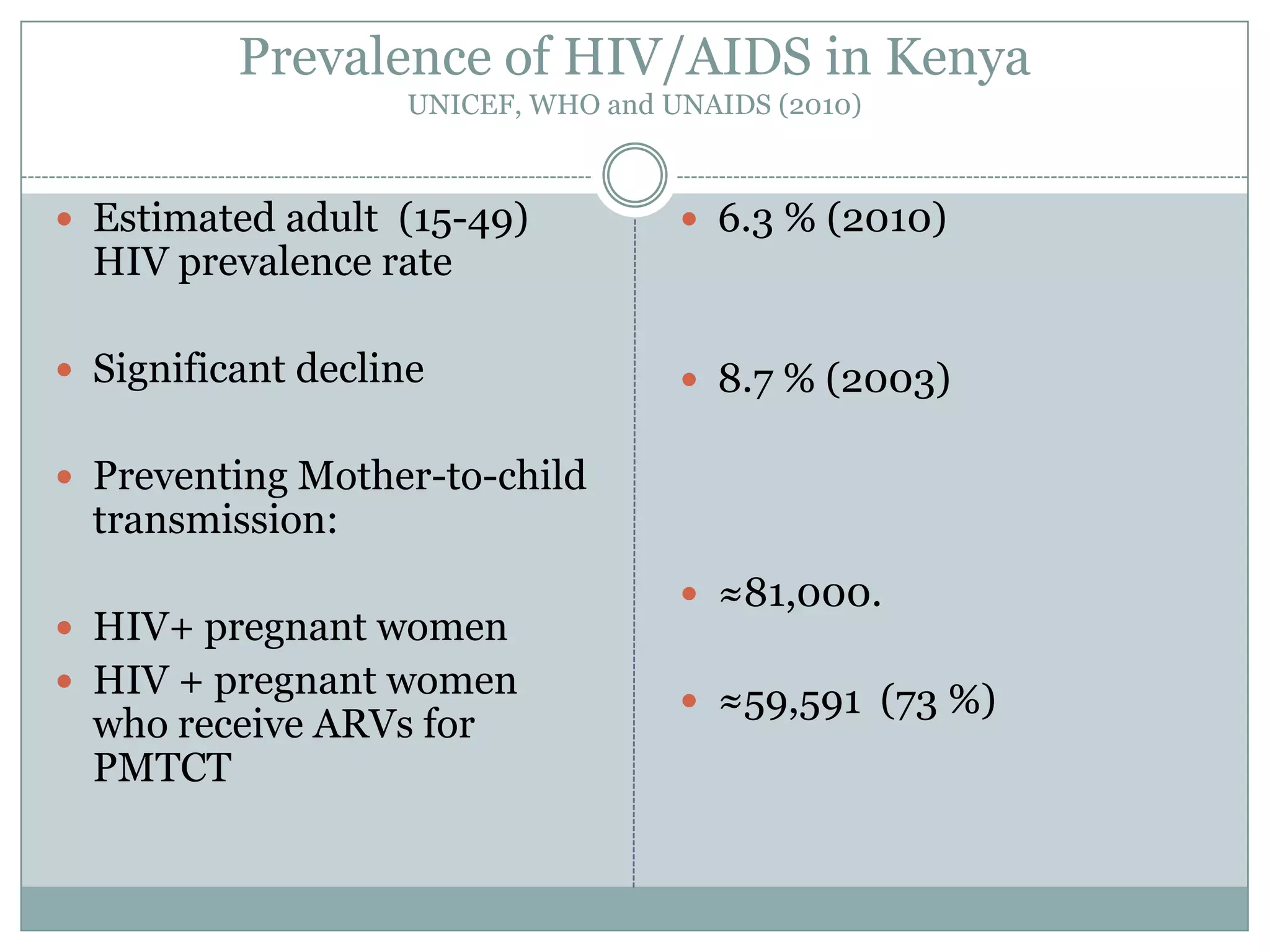
Prevalence of HIV/AIDS in Kenya
                    UNICEF, WHO and UNAIDS (2010)


 Estimated adult (15-49)             6.3 % (2010)
  HIV prevalence rate

 Significant decline                 8.7 % (2003)

 Preventing Mother-to-child
  transmission:
                                      ≈81,000.
 HIV+ pregnant women
 HIV + pregnant women
                                      ≈59,591 (73 %)
  who receive ARVs for
  PMTCT
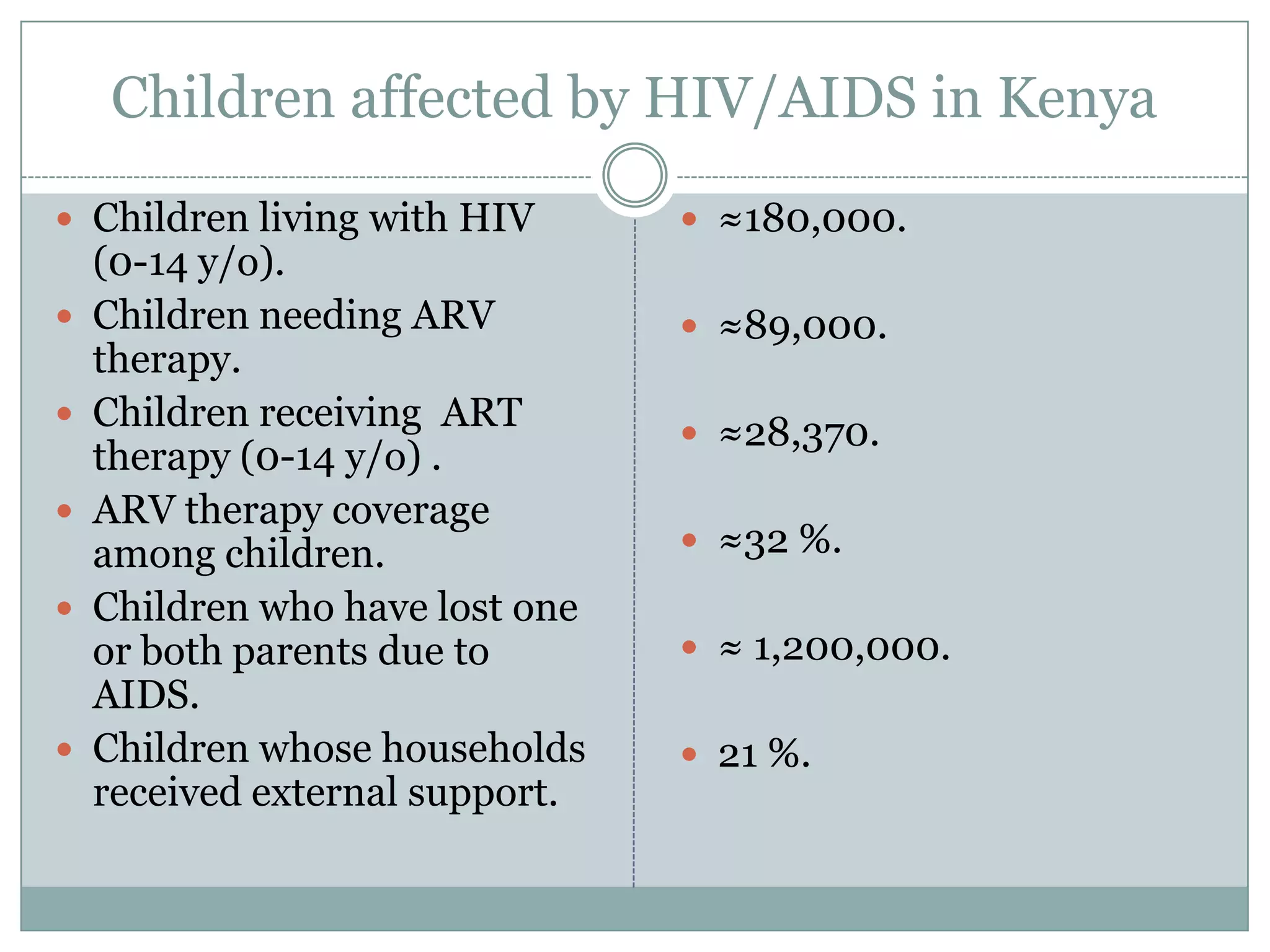
Children affected by HIV/AIDS in Kenya
 Children living with HIV        ≈180,000.
    (0-14 y/o).
   Children needing ARV          ≈89,000.
    therapy.
   Children receiving ART        ≈28,370.
    therapy (0-14 y/o) .
   ARV therapy coverage
    among children.               ≈32 %.
   Children who have lost one
    or both parents due to        ≈ 1,200,000.
    AIDS.
   Children whose households     21 %.
    received external support.
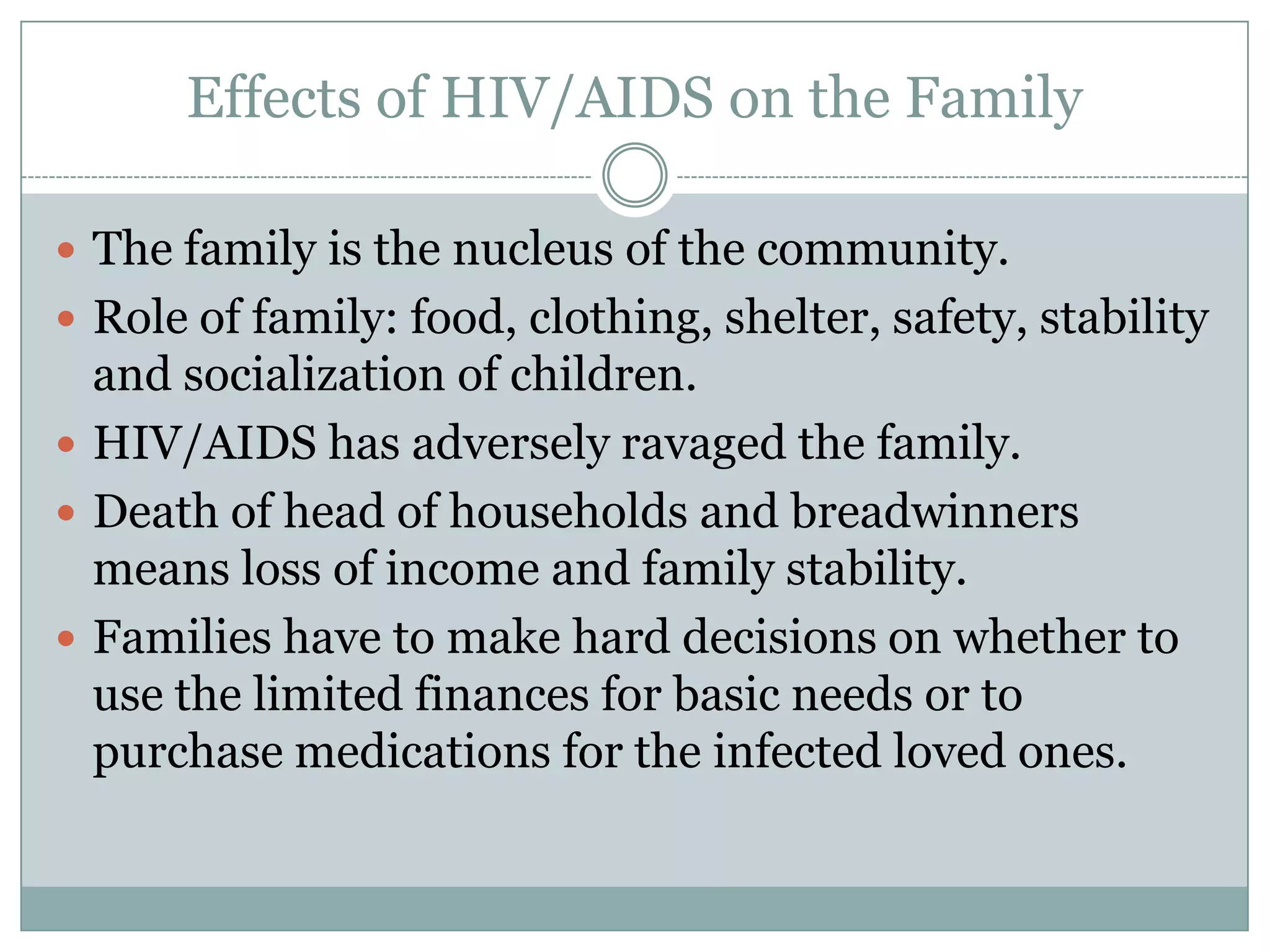
Effects of HIV/AIDS on the Family

 The family is the nucleus of the community.
 Role of family: food, clothing, shelter, safety, stability
  and socialization of children.
 HIV/AIDS has adversely ravaged the family.
 Death of head of households and breadwinners
  means loss of income and family stability.
 Families have to make hard decisions on whether to
  use the limited finances for basic needs or to
  purchase medications for the infected loved ones.
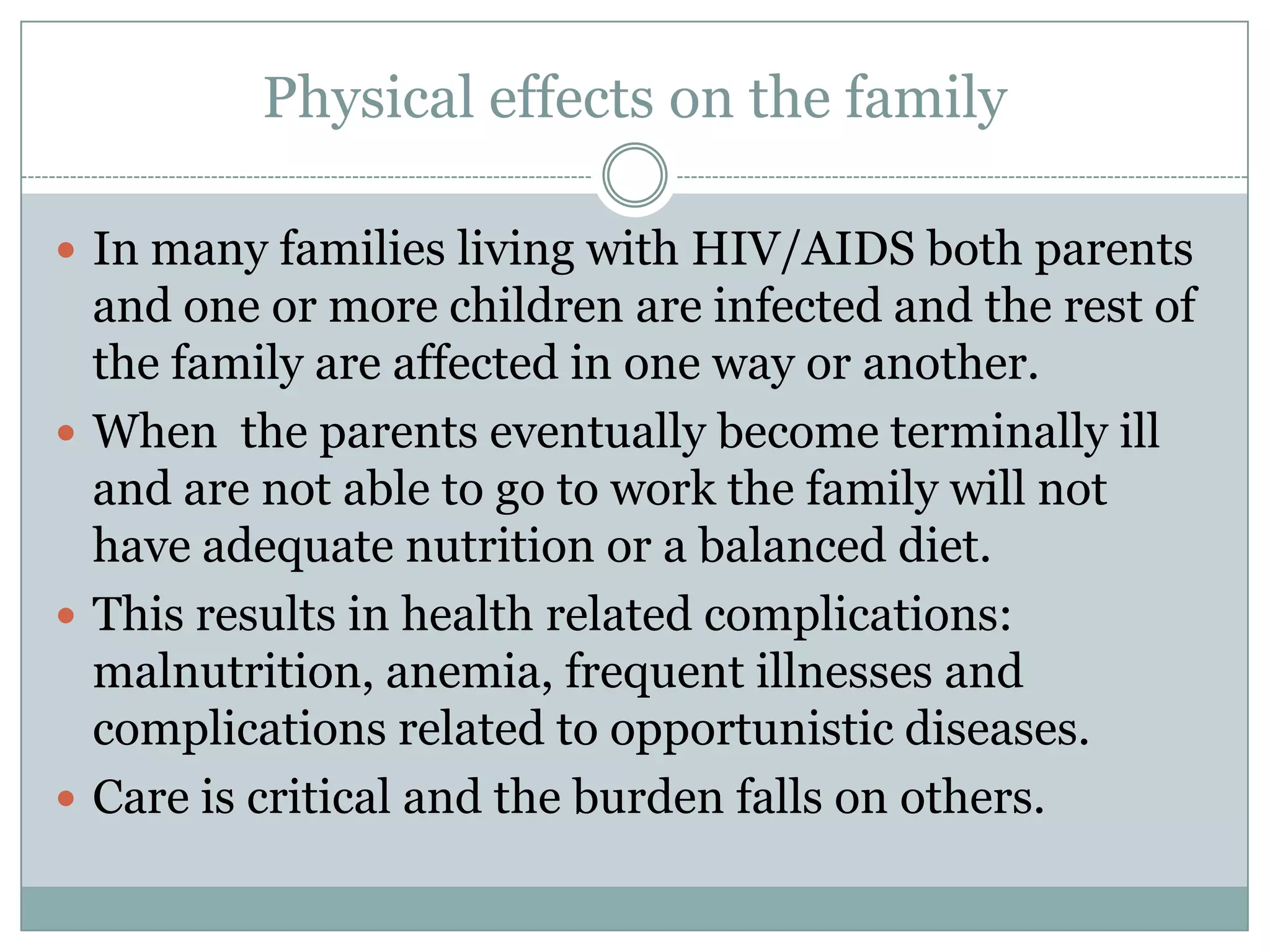
Physical effects on the family

 In many families living with HIV/AIDS both parents
  and one or more children are infected and the rest of
  the family are affected in one way or another.
 When the parents eventually become terminally ill
  and are not able to go to work the family will not
  have adequate nutrition or a balanced diet.
 This results in health related complications:
  malnutrition, anemia, frequent illnesses and
  complications related to opportunistic diseases.
 Care is critical and the burden falls on others.
Impact of family relationships

 Stigma and prejudice: Families often become
  isolated, ridiculed and ostracized.
 Disclosure of HIV status: Many families would rather
  die is silence rather than come and seek for help.
 Marital relationships also suffer: Lack of trust
  between spouses and loss of consortium has resulted
  in a lot of marital discord and breaking up of
  families.
 Shifting of blame, shame, guilt, disappointment and
  bitterness between spouses and members of the
  extended family.
Impact on family stability

 Urban- rural migration: Many families in the urban
  areas (with better opportunities) often relocate to
  rural areas.
 Rural-urban migration: Infected persons move to the
  urban areas to access medical care. Family members
  will bear the extra cost to accommodate.
 Family separation and divorce.
 Children loose already established friendships,
  change schools and some may not have been raised
  in rural areas.
Impact on family finances

 The greatest challenge families face is finances.
 Direct and indirect costs of HIV/AIDS are enormous.
 Breadwinners and head of households may no longer go
    to work. Eventually with both parents terminally ill the
    dwindling family finances suffer.
   Families choose between basic needs and medical costs.
   Cost-sharing for the ARVs: costly for families.
   Extended periods of hospitalization results in large
    medical bills. Funeral expenses are also costly. Not many
    families have adequate insurance to cover.
   Those with insurance eventually loose it because they can
    no longer go to work.
Effects of AIDS on traditional systems of Care

 Situation is of increasing concern: size of the crisis is
    overwhelming traditional systems of caring for children.
   Family social networks are overstressed, overburdened
    and weakened as the number of AIDS orphans increase.
   Extended families, mainly grandparents care for 90 % of
    all orphans.
   Majority of households live in poverty and are
    progressively less able to adequately provide for the
    children in their care.
   Burdens on the families are heavy and persist over a long
    period of time .
Emerging Family Trends

 Grand families: Rising number of children raised by
  grand parent headed households.
 Child headed households: rising number of children
  raising younger siblings. Because the children are
  financially desperate, they are more likely to be
  exploited. They are vulnerable to sexual abuse, drug
  trafficking, violence and child labor. These are
  situations that often increase the chances of HIV
  infection.
Child headed households

 Free Primary Education has increased access to basic
  education.
 But schooling is often interrupted. Some children take
  over responsibilities as care-givers and home-makers
  for their terminally ill parents and siblings.
 When the parents die, the children take over the
  responsibilities of taking care of younger siblings and
  running the household. Many will find work so that they
  can get something to eat and supplement the family
  income. Consequently, they are under-educated,
  overworked and financially insecure.
 Unfortunately, majority of the children who are forced to
  drop out are girls.
Other effects on children

 Psychological: Experience trauma, depression, low
  self-esteem, alienation, disturbed social behavior and
  poor life skills while witnessing the sickness and
  death of a parent.
 Emotional dependency and vulnerability. Seeking to
  be cared for and accepted by others children are
  more likely to seek comfort in risky behaviors which
  pose greater risk of becoming HIV infected
Role of NGOs and FBOs

 Partner with the families to provide:
 Orphanage Care for a few hundreds of the children.
    Provide a new home: food, shelter, clothing, medical
    care, substitute parenting.
   Empower families to have adequate nutrition. Support
    Feeding Programs for vulnerable children.
   Partner with health facilities to provide ARVs and other
    essential medications for PLWHVA. Help families
    subsidize the enormous financial burden.
   HIV/AIDS campaign and prevention education.
   Capacity building and community empowerment.
The Kenya Heritage Foundation
 KHF is a non-profit, 501(c) 3 community based organization with the
    following goals:
   Empower families living in poverty and those affected by HIV/AIDS in
    Kenya to become self sufficient through sustainable economic
    development projects.
   Partner with local hospitals to provide ARVs and essential medicines
    to people living with HIV/AIDS.
   Provide adequate nutrition to children affected by HIV/AIDS.
   Provide access to basic education for children affected by HIV/AIDS.
Our success stories…….

 In 2011: we adopted two families - one with a
  grandmother raising 9 grand children. We
  provided school supplies, uniforms, and financial
  support to the children to remain in school,
  purchased 5 sheep and chickens, and help start a
  vegetable garden.
 In 2012: the community is coming together to help
  the family plough their farm, grow corn, purchase
  a cow and build them a bigger home.
 In 2012: we are targeting 20 families and 200
  children.
Call to Action…..

 HIV does not discriminate, and neither should the
  AIDS response. The disparities in access, coverage
  and outcomes that exists across age, gender,
  geographic areas, wealth and educational spectra
  cannot be accepted as inevitable.
 Ordinary people can do extra ordinary things and
  support families to make the world a better place for
  our children.
 We call on every individual to use their abilities to do
  their very best to help families affected by AIDS.
We can raise the bar even more……

 Provide economic support to poor families,
  vulnerable women, children and adolescents.
  Research has shown that health and wellness
  indicators are increased in financially stable families.
 Increase access for families living on the margins of
  society to health, education, and social welfare.
 For families with expextant and nursing mothers we
  aim beyond the PMTCT to a HIV-free survival of
  children.
 Identify HIV + newborns, infants and young people
  without delay and provide rapid access to ART.
Finally…. We pray for the child

 An adaption Marion W. Edelman’s prayers for the child.
         We pray for the child…..
   Who is growing up in an orphanage far away in Africa and those
    with no one close to care for her.
   Who feels hunger pangs and is not sure of the next meal.
   Who will never go to school because she works hard as a house-
    help, farm boy or sells sweets on the streets to put food on the
    table for her siblings because she lost both parents to AIDS.
   Who will watch her strong parents’ health slowly waste away till
    they die of AIDS.
   Who has not Sunday clothes or Christmas dress and lives in a
    neighborhood, too dangerous to venture out, but has to do so.
 We pray for the children because we are their
  advocates, teachers and hope for tomorrow.
 And beyond prayer we will do our best to turn this
  transformative moment in the AIDS response into a
  catalyst for greater equity and better outcomes- to
  better the benefit of the millions of children, women
  and families who still face, every day, the burden of
  the epidemic.
                           THANK YOU

UN Speech

  • 1.
    Families in Changing EducationalEnvironment THE CHANGING ROLE OF FAMILIES AFFECTED BY HIV/AIDS IN KENYA PRESENTATION TO CONFERENCE ON NON-GOVERNMENTAL ORGANIZATIONS IN CONSULTATIVE RELATIONSHIP WITH THE UNITED NATIONS DR. GRACE JEPKEMBOI FOUNDER: KENYA HERITAGE FOUNDATION
  • 2.
    Appreciation  Hosts: NGOcommittee on the Family - New York.  Moderator: Dr. Jerry Aldridge.  The Permanent Mission of the Republic of Kenya To the United Nations, New York: Ms. B. Mwaura (Legal Officer) and other Officials.  KHF Board: Drs. Lynn Kirkland (President); MaryAnn Manning and Lois Christensen.  Friends and invited guests.
  • 3.
    Changing Role ofFamilies affected by HIV/AIDS  Recall the famous idiom that defines Africa:  “It takes a village to raise a child.”  The village’s strong foundation is the family.  Now that HIV/AIDS has ravaged families across all communities in Africa, how much truth does this adage still have?  The village is slowly fading away.  Even with the emerging global village many children still grow up not feeling adequately cared for.
  • 4.
    Focus of thespeech  This speech will address five areas that relate to the HIV/AIDS pandemic in Kenya: 1. The rising number of children affected by HIV/AIDS 2. The impact on family & traditional systems of care. 3. The changing role of the family and family systems. 4. Role of NGOs and FBOs in Protecting and supporting children affected by HIV/AIDS. 5. A Call to action.
  • 5.
    Prevalence of HIV/AIDSin Kenya UNICEF, WHO and UNAIDS (2010)  Estimated adult (15-49)  6.3 % (2010) HIV prevalence rate  Significant decline  8.7 % (2003)  Preventing Mother-to-child transmission:  ≈81,000.  HIV+ pregnant women  HIV + pregnant women  ≈59,591 (73 %) who receive ARVs for PMTCT
  • 6.
    Children affected byHIV/AIDS in Kenya  Children living with HIV  ≈180,000. (0-14 y/o).  Children needing ARV  ≈89,000. therapy.  Children receiving ART  ≈28,370. therapy (0-14 y/o) .  ARV therapy coverage among children.  ≈32 %.  Children who have lost one or both parents due to  ≈ 1,200,000. AIDS.  Children whose households  21 %. received external support.
  • 7.
    Effects of HIV/AIDSon the Family  The family is the nucleus of the community.  Role of family: food, clothing, shelter, safety, stability and socialization of children.  HIV/AIDS has adversely ravaged the family.  Death of head of households and breadwinners means loss of income and family stability.  Families have to make hard decisions on whether to use the limited finances for basic needs or to purchase medications for the infected loved ones.
  • 8.
    Physical effects onthe family  In many families living with HIV/AIDS both parents and one or more children are infected and the rest of the family are affected in one way or another.  When the parents eventually become terminally ill and are not able to go to work the family will not have adequate nutrition or a balanced diet.  This results in health related complications: malnutrition, anemia, frequent illnesses and complications related to opportunistic diseases.  Care is critical and the burden falls on others.
  • 9.
    Impact of familyrelationships  Stigma and prejudice: Families often become isolated, ridiculed and ostracized.  Disclosure of HIV status: Many families would rather die is silence rather than come and seek for help.  Marital relationships also suffer: Lack of trust between spouses and loss of consortium has resulted in a lot of marital discord and breaking up of families.  Shifting of blame, shame, guilt, disappointment and bitterness between spouses and members of the extended family.
  • 10.
    Impact on familystability  Urban- rural migration: Many families in the urban areas (with better opportunities) often relocate to rural areas.  Rural-urban migration: Infected persons move to the urban areas to access medical care. Family members will bear the extra cost to accommodate.  Family separation and divorce.  Children loose already established friendships, change schools and some may not have been raised in rural areas.
  • 11.
    Impact on familyfinances  The greatest challenge families face is finances.  Direct and indirect costs of HIV/AIDS are enormous.  Breadwinners and head of households may no longer go to work. Eventually with both parents terminally ill the dwindling family finances suffer.  Families choose between basic needs and medical costs.  Cost-sharing for the ARVs: costly for families.  Extended periods of hospitalization results in large medical bills. Funeral expenses are also costly. Not many families have adequate insurance to cover.  Those with insurance eventually loose it because they can no longer go to work.
  • 12.
    Effects of AIDSon traditional systems of Care  Situation is of increasing concern: size of the crisis is overwhelming traditional systems of caring for children.  Family social networks are overstressed, overburdened and weakened as the number of AIDS orphans increase.  Extended families, mainly grandparents care for 90 % of all orphans.  Majority of households live in poverty and are progressively less able to adequately provide for the children in their care.  Burdens on the families are heavy and persist over a long period of time .
  • 13.
    Emerging Family Trends Grand families: Rising number of children raised by grand parent headed households.  Child headed households: rising number of children raising younger siblings. Because the children are financially desperate, they are more likely to be exploited. They are vulnerable to sexual abuse, drug trafficking, violence and child labor. These are situations that often increase the chances of HIV infection.
  • 14.
    Child headed households Free Primary Education has increased access to basic education.  But schooling is often interrupted. Some children take over responsibilities as care-givers and home-makers for their terminally ill parents and siblings.  When the parents die, the children take over the responsibilities of taking care of younger siblings and running the household. Many will find work so that they can get something to eat and supplement the family income. Consequently, they are under-educated, overworked and financially insecure.  Unfortunately, majority of the children who are forced to drop out are girls.
  • 15.
    Other effects onchildren  Psychological: Experience trauma, depression, low self-esteem, alienation, disturbed social behavior and poor life skills while witnessing the sickness and death of a parent.  Emotional dependency and vulnerability. Seeking to be cared for and accepted by others children are more likely to seek comfort in risky behaviors which pose greater risk of becoming HIV infected
  • 16.
    Role of NGOsand FBOs  Partner with the families to provide:  Orphanage Care for a few hundreds of the children. Provide a new home: food, shelter, clothing, medical care, substitute parenting.  Empower families to have adequate nutrition. Support Feeding Programs for vulnerable children.  Partner with health facilities to provide ARVs and other essential medications for PLWHVA. Help families subsidize the enormous financial burden.  HIV/AIDS campaign and prevention education.  Capacity building and community empowerment.
  • 17.
    The Kenya HeritageFoundation  KHF is a non-profit, 501(c) 3 community based organization with the following goals:  Empower families living in poverty and those affected by HIV/AIDS in Kenya to become self sufficient through sustainable economic development projects.  Partner with local hospitals to provide ARVs and essential medicines to people living with HIV/AIDS.  Provide adequate nutrition to children affected by HIV/AIDS.  Provide access to basic education for children affected by HIV/AIDS.
  • 18.
    Our success stories……. In 2011: we adopted two families - one with a grandmother raising 9 grand children. We provided school supplies, uniforms, and financial support to the children to remain in school, purchased 5 sheep and chickens, and help start a vegetable garden.  In 2012: the community is coming together to help the family plough their farm, grow corn, purchase a cow and build them a bigger home.  In 2012: we are targeting 20 families and 200 children.
  • 19.
    Call to Action….. HIV does not discriminate, and neither should the AIDS response. The disparities in access, coverage and outcomes that exists across age, gender, geographic areas, wealth and educational spectra cannot be accepted as inevitable.  Ordinary people can do extra ordinary things and support families to make the world a better place for our children.  We call on every individual to use their abilities to do their very best to help families affected by AIDS.
  • 20.
    We can raisethe bar even more……  Provide economic support to poor families, vulnerable women, children and adolescents. Research has shown that health and wellness indicators are increased in financially stable families.  Increase access for families living on the margins of society to health, education, and social welfare.  For families with expextant and nursing mothers we aim beyond the PMTCT to a HIV-free survival of children.  Identify HIV + newborns, infants and young people without delay and provide rapid access to ART.
  • 21.
    Finally…. We prayfor the child  An adaption Marion W. Edelman’s prayers for the child. We pray for the child…..  Who is growing up in an orphanage far away in Africa and those with no one close to care for her.  Who feels hunger pangs and is not sure of the next meal.  Who will never go to school because she works hard as a house- help, farm boy or sells sweets on the streets to put food on the table for her siblings because she lost both parents to AIDS.  Who will watch her strong parents’ health slowly waste away till they die of AIDS.  Who has not Sunday clothes or Christmas dress and lives in a neighborhood, too dangerous to venture out, but has to do so.
  • 22.
     We prayfor the children because we are their advocates, teachers and hope for tomorrow.  And beyond prayer we will do our best to turn this transformative moment in the AIDS response into a catalyst for greater equity and better outcomes- to better the benefit of the millions of children, women and families who still face, every day, the burden of the epidemic.  THANK YOU