FAMILY HEALTH
OPTIONS KENYA
Your Health, Our Concern
FAMILY HEALTH
OPTIONS KENYA
Your Health, Our Concern
AFRICA REGIONAL OFFICE
Your Health, Our Concern
Gender Transformative Approach
in sexual and reproductive health and rights, and
gender-based violence programmes
Presented by Kevin Karuga
2nd December 2019
KNLS
FAMILY HEALTH
OPTIONS KENYA
Your Health, Our Concern
FAMILY HEALTH
OPTIONS KENYA
Your Health, Our Concern AFRICA REGIONAL OFFICE
Your Health, Our Concern
FAMILY HEALTH
OPTIONS KENYA
Your Health, Our Concern
FAMILY HEALTH
OPTIONS KENYA
Your Health, Our Concern AFRICA REGIONAL OFFICE
Your Health, Our Concern
Gender transformative approaches (GTAs): “actively strive to
examine, question, and change rigid gender norms and imbalances
of power as a means of achieving SRHR objectives, as well as
gender equality objectives at all levels of the socio-ecological
model.
Definition of GTA
FAMILY HEALTH
OPTIONS KENYA
Your Health, Our Concern
FAMILY HEALTH
OPTIONS KENYA
Your Health, Our Concern AFRICA REGIONAL OFFICE
Your Health, Our Concern
Programmes and policies may transform gender relations through:
•Encouraging critical awareness of gender roles and norms
•Questioning the costs of harmful, inequitable gender norms in relation
to SRHR and making explicit the advantages of changing them
•Empowering women/girls and people with diverse gender and/or sexual
identities/orientations
•Engaging boys and men in SRH and gender equality
By applying these four strategies, harmful, inequitable gender norms will
change into positive, equitable and inclusive ones and lead to improved
SRH of men/boys and women/girls, the prevention of gender-based
violence and gender equality.”
Based on Gupta 2000, Rolleri 2014 and USAID/IGWG 2011.
FAMILY HEALTH
OPTIONS KENYA
Your Health, Our Concern
FAMILY HEALTH
OPTIONS KENYA
Your Health, Our Concern AFRICA REGIONAL OFFICE
Your Health, Our Concern
1.The human rights-based approach
2.Power
3.Norms and values
4.Gender and diversity: sexual orientation, gender identity &
expression, and sex characteristics
5.Empowerment of women and girls
6.Engaging men and boys in SRHR programming
GTA – six interrelated components
FAMILY HEALTH
OPTIONS KENYA
Your Health, Our Concern
FAMILY HEALTH
OPTIONS KENYA
Your Health, Our Concern AFRICA REGIONAL OFFICE
Your Health, Our Concern
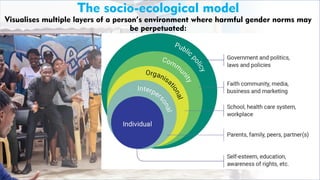
The socio-ecological model
Visualises multiple layers of a person’s environment where harmful gender norms may
be perpetuated:
FAMILY HEALTH
OPTIONS KENYA
Your Health, Our Concern
FAMILY HEALTH
OPTIONS KENYA
Your Health, Our Concern AFRICA REGIONAL OFFICE
Your Health, Our Concern
1. The human rights-based approach
•State = duty bearer
•All people are rights holders = they are entitled to
human rights. They should also respect the human
rights of others
•Accountability hold duty bearers to account, who have
to face up to their commitments
•Accountability requires empowerment
FAMILY HEALTH
OPTIONS KENYA
Your Health, Our Concern
FAMILY HEALTH
OPTIONS KENYA
Your Health, Our Concern AFRICA REGIONAL OFFICE
Your Health, Our Concern
•Obligation to respect: States must refrain from
interfering with or curtailing the enjoyment of human
rights
•Obligation to protect: States must protect individuals
and groups against human rights abuses.
•Obligation to fulfil: States must take positive action to
facilitate the enjoyment of basic human rights
FAMILY HEALTH
OPTIONS KENYA
Your Health, Our Concern
FAMILY HEALTH
OPTIONS KENYA
Your Health, Our Concern AFRICA REGIONAL OFFICE
Your Health, Our Concern
Human rights (civil, political, social, cultural,
economic) are:
•Universal
•Inalienable
•Indivisible
•Interdependent
FAMILY HEALTH
OPTIONS KENYA
Your Health, Our Concern
FAMILY HEALTH
OPTIONS KENYA
Your Health, Our Concern AFRICA REGIONAL OFFICE
Your Health, Our Concern
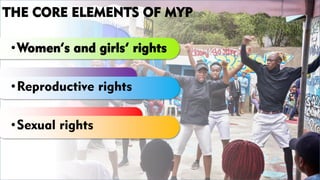
THE CORE ELEMENTS OF MYP
•Women’s and girls’ rights
•Reproductive rights
•Sexual rights
FAMILY HEALTH
OPTIONS KENYA
Your Health, Our Concern
FAMILY HEALTH
OPTIONS KENYA
Your Health, Our Concern AFRICA REGIONAL OFFICE
Your Health, Our Concern
2. Power
Understanding power is
fundamental if you are to
understand how change happens.
FAMILY HEALTH
OPTIONS KENYA
Your Health, Our Concern
FAMILY HEALTH
OPTIONS KENYA
Your Health, Our Concern AFRICA REGIONAL OFFICE
Your Health, Our Concern
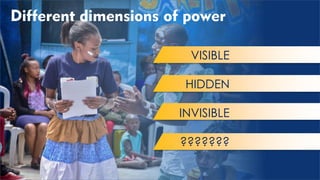
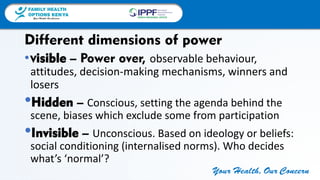
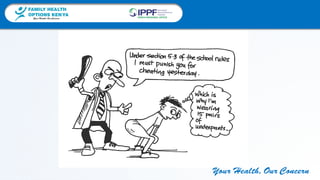
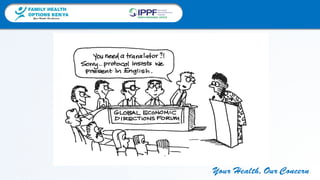
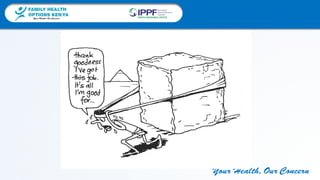
Different dimensions of power
VISIBLE
HIDDEN
INVISIBLE
???????
FAMILY HEALTH
OPTIONS KENYA
Your Health, Our Concern
FAMILY HEALTH
OPTIONS KENYA
Your Health, Our Concern AFRICA REGIONAL OFFICE
Your Health, Our Concern
•Visible – Power over, observable behaviour,
attitudes, decision-making mechanisms, winners and
losers
•Hidden – Conscious, setting the agenda behind the
scene, biases which exclude some from participation
•Invisible – Unconscious. Based on ideology or beliefs:
social conditioning (internalised norms). Who decides
what’s ‘normal’?
Different dimensions of power
FAMILY HEALTH
OPTIONS KENYA
Your Health, Our Concern
FAMILY HEALTH
OPTIONS KENYA
Your Health, Our Concern AFRICA REGIONAL OFFICE
Your Health, Our Concern
FAMILY HEALTH
OPTIONS KENYA
Your Health, Our Concern
FAMILY HEALTH
OPTIONS KENYA
Your Health, Our Concern AFRICA REGIONAL OFFICE
Your Health, Our Concern
FAMILY HEALTH
OPTIONS KENYA
Your Health, Our Concern
FAMILY HEALTH
OPTIONS KENYA
Your Health, Our Concern AFRICA REGIONAL OFFICE
Your Health, Our Concern
FAMILY HEALTH
OPTIONS KENYA
Your Health, Our Concern
FAMILY HEALTH
OPTIONS KENYA
Your Health, Our Concern AFRICA REGIONAL OFFICE
Your Health, Our Concern
Expressions of power
• ‘Power over’ is a way of exercising influence over people, often
negatively associated with force, repression, coercion,
discrimination, abuse and corruption. It perpetuates inequality,
injustice and poverty.
• ‘Power with’ builds collective strength and finds common ground
among different interest groups. It is based on mutual support,
solidarity and collaboration.
• ‘Power to’ implies the capacity to decide and carry out desired
actions.
It opens up the possibility of joint action.
• ‘Power within’ has to do with a person’s sense of self-worth, self-
knowledge, self-confidence and the conviction of what is legitimate.
FAMILY HEALTH
OPTIONS KENYA
Your Health, Our Concern
FAMILY HEALTH
OPTIONS KENYA
Your Health, Our Concern AFRICA REGIONAL OFFICE
Your Health, Our Concern
Norms are: ”Patterns of behaviour that are
widespread, are generally tolerated or
accepted as proper, are reinforced by
responses of others and are quite hard to
resist even if they run against what is felt to
be right”.
Tibandebage et al. 2002
3. Norms and values
FAMILY HEALTH
OPTIONS KENYA
Your Health, Our Concern
FAMILY HEALTH
OPTIONS KENYA
Your Health, Our Concern AFRICA REGIONAL OFFICE
Your Health, Our Concern
Boys …
… have freedom
… have responsibility to lead, provide, protect and take
charge
… should never act like girls
… are naturally attracted to girls
… need to show they are strong and tough (to gain respect)
… need girlfriends for social status
… trick girls for favors
… judge girls on physical appearance
Gender norms
FAMILY HEALTH
OPTIONS KENYA
Your Health, Our Concern
FAMILY HEALTH
OPTIONS KENYA
Your Health, Our Concern AFRICA REGIONAL OFFICE
Your Health, Our Concern
Girls …
• … lack freedom
• … have adult responsibilities … have ambition
• … are weak/afraid/in need of protection
• … should be differential/proper/composed, bodies are their asset
• … are in danger because they are girls
• … are responsible for arousing boys
• … shouldn’t be in romantic relationships/have sex until they are older
Gender norms
FAMILY HEALTH
OPTIONS KENYA
Your Health, Our Concern
FAMILY HEALTH
OPTIONS KENYA
Your Health, Our Concern AFRICA REGIONAL OFFICE
Your Health, Our Concern
• Sex (daily use): activity focused on sexual arousal
• Sex: Biological characteristics that define humans as male,
female: hormonal, genetic/chromosomes, physical
• Gender: social-psychological-cultural representations of
masculinity and femininity. Gender identity, -roles, -stereotypes,
-norms, -attitudes, -expression
• Gender diversity and sexual identity
4. Gender and diversity:
FAMILY HEALTH
OPTIONS KENYA
Your Health, Our Concern
FAMILY HEALTH
OPTIONS KENYA
Your Health, Our Concern AFRICA REGIONAL OFFICE
Your Health, Our Concern
Biological explanations emphasise the differences between
women and men
From modern to postmodern perspectives:
•Gender as individual characteristic: gender identity and
attitudes
•Gender as norm: gender stereotypes, roles, the ‘sexual double
standard’
•Gender as a procces: gender socialisation and ‘do gender’ =
the continuous enactment of gender roles
Evolution of a concept
FAMILY HEALTH
OPTIONS KENYA
Your Health, Our Concern
FAMILY HEALTH
OPTIONS KENYA
Your Health, Our Concern AFRICA REGIONAL OFFICE
Your Health, Our Concern
•CSE programmes that address gender equality are 5 times more likely
to be effective than those that do not. Of the CSE programmes that
address gender, 80% were associated with a significantly lower rate of
STIs or unintended pregnancy (Haberland 2015).
•Targeted, gender-transformative programming on health and violence
leads (amongst others) to:
• 40% less violence against a partner
• Greater contraceptive use: 70% of women in the MenCare
programme vs. 61% in the comparison group, report currently using
modern contraception
• Greater involvement of women in decision-making in the
household: 56% of women in the MenCare programme say that the
man has the final say about the use of weekly/monthly income and
expenses vs. 79% who say so in the comparison group, a difference
of about 30%. (Doyle et.al. 2018:10-12)
Why are we interested in gender?
FAMILY HEALTH
OPTIONS KENYA
Your Health, Our Concern
FAMILY HEALTH
OPTIONS KENYA
Your Health, Our Concern AFRICA REGIONAL OFFICE
Your Health, Our Concern
•Two different things!
•Related, but the relationship is complex and variable
•Sexual expression is a function of biological, psychological, social
and cultural influences
•Inconsistencies between attraction, behaviour and identity
•Among women there is relatively strong diversity, plasticity and
discontinuity
•Gender atypical behaviour is condemned more strongly in boys (and
boys condemn more strongly)
•Increasing diversity in sexual and gender identities
Gender identity and sexual identity
FAMILY HEALTH
OPTIONS KENYA
Your Health, Our Concern
FAMILY HEALTH
OPTIONS KENYA
Your Health, Our Concern AFRICA REGIONAL OFFICE
Your Health, Our Concern
“Empowerment is the expansion of choice
and the strengthening of voice through the
transformation of power relations, so women
and girls have more control over their lives
and futures.”
Eerdewijk et al. 2017:17
5. Empowerment of women and girls
FAMILY HEALTH
OPTIONS KENYA
Your Health, Our Concern
FAMILY HEALTH
OPTIONS KENYA
Your Health, Our Concern AFRICA REGIONAL OFFICE
Your Health, Our Concern
•Choice is ‘the ability of women and girls to make and influence
choices that affect their lives and futures’.
•Choice is empowering if women and girls have freedom to choose
from a range of options, for example regarding contraceptive use or
when and whom to marry. Empowered choice challenges social
inequalities.
•Critical consciousness is women and girls identifying and
questioning how inequalities in power operate in their lives, and
asserting and affirming their sense of self and their entitlements
(‘power-within’).
•For empowerment to happen, choices need to materialise in actions
and outcomes.
Choice and critical consciousness
FAMILY HEALTH
OPTIONS KENYA
Your Health, Our Concern
FAMILY HEALTH
OPTIONS KENYA
Your Health, Our Concern AFRICA REGIONAL OFFICE
Your Health, Our Concern
• The capacity of women and girls to speak up, be heard and share
in discussions and decisions – in public and private domains – that
affect their lives.
• Voice is important to contest existing power relations. It can be
realised through:
• The participation and representation of women and girls in political
and economic decision-making institutions;
• Collective organising in favor of gender equality;
• Strengthened leadership of women and girls (individually and
collectively) to pursue own interests and needs
• Holding institutions accountable
Voice
FAMILY HEALTH
OPTIONS KENYA
Your Health, Our Concern
FAMILY HEALTH
OPTIONS KENYA
Your Health, Our Concern AFRICA REGIONAL OFFICE
Your Health, Our Concern
• Agency relates to choice and voice. It means:
• Women and girls pursuing goals, expressing voice and influencing
and making decisions free from violence and retribution. The
capacity of women and girls to speak up, be heard and share in
discussions and decisions – in public and private domains – that
affect their lives.
• Decision-making is strongly affected by gender and age, in
intersection with other social markers such as socioeconomic
status, sexual orientation, ethnicity, race, or caste.
• Empowered decision-making involves negotiating, influencing and
bargaining
Agency
FAMILY HEALTH
OPTIONS KENYA
Your Health, Our Concern
FAMILY HEALTH
OPTIONS KENYA
Your Health, Our Concern AFRICA REGIONAL OFFICE
Your Health, Our Concern
• Formal leadership: women’s political participation or
representation in leadership and management positions
• Informal leadership: the ability to inspire and guide others in
order to bring about change.
• Leadership can manifest itself individually and collectively:
power over, power within, power to and in case of collective
action also power with.
• Leadership is an expression of choice and voice, requires
empowerment and larger control by women and girls over their
lives.
Leadership
FAMILY HEALTH
OPTIONS KENYA
Your Health, Our Concern
FAMILY HEALTH
OPTIONS KENYA
Your Health, Our Concern AFRICA REGIONAL OFFICE
Your Health, Our Concern
Any crime committed against persons, whether male or female (including gender
and sexual minorities), because of their sex and/or socially constructed gender
roles. It is not always manifested as a form of sexual violence, and may include
non-sexual attacks on women, girls, men and boys because of their gender.
2014 Policy paper form Office of the Prosecutor of International Criminal Court)
The Convention of the Elimination of Violence Against Women (CEDAW), refers
to “all acts of gender‐based violence that result in, or are likely to result in,
physical, sexual, psychological or economic harm or suffering to women,
including threats of such acts, coercion or arbitrary deprivation of liberty,
whether occurring in public or in private life.”
Article 1 DEVAW, Article 3 Istanbul Convention
Definition of gender-based violence
FAMILY HEALTH
OPTIONS KENYA
Your Health, Our Concern
FAMILY HEALTH
OPTIONS KENYA
Your Health, Our Concern AFRICA REGIONAL OFFICE
Your Health, Our Concern
• Boys and men have gendered vulnerabilities (like women).
• Create a safe space for boys and men and listen to their stories.
• Use a group therapeutic approach that critically questions and challenges
harmful concepts of masculinity, using culturally appropriate framing.
• Identify current coping mechanisms, strengthen positive ones, and
reshape negative ones (those reliant on violence, alcohol or isolation).
• Approach men as diverse and complex actors – not only recognising them
as perpetrators, but also as survivors and witnesses of violence, as agents
of change, partners, fathers and clients.
• Acknowledge that man are not born violent, learned violent behaviour
can be unlearned.
6. Engaging boys and men as part of the
solution
FAMILY HEALTH
OPTIONS KENYA
Your Health, Our Concern
FAMILY HEALTH
OPTIONS KENYA
Your Health, Our Concern AFRICA REGIONAL OFFICE
Your Health, Our Concern
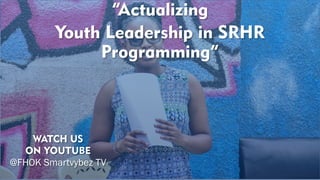
“Actualizing
Youth Leadership in SRHR
Programming”
WATCH US
ON YOUTUBE
@FHOK Smartvybez TV

Gender Transformative Approach FHOK presentation

  • 1.
    FAMILY HEALTH OPTIONS KENYA YourHealth, Our Concern FAMILY HEALTH OPTIONS KENYA Your Health, Our Concern AFRICA REGIONAL OFFICE Your Health, Our Concern Gender Transformative Approach in sexual and reproductive health and rights, and gender-based violence programmes Presented by Kevin Karuga 2nd December 2019 KNLS
  • 2.
    FAMILY HEALTH OPTIONS KENYA YourHealth, Our Concern FAMILY HEALTH OPTIONS KENYA Your Health, Our Concern AFRICA REGIONAL OFFICE Your Health, Our Concern
  • 3.
    FAMILY HEALTH OPTIONS KENYA YourHealth, Our Concern FAMILY HEALTH OPTIONS KENYA Your Health, Our Concern AFRICA REGIONAL OFFICE Your Health, Our Concern Gender transformative approaches (GTAs): “actively strive to examine, question, and change rigid gender norms and imbalances of power as a means of achieving SRHR objectives, as well as gender equality objectives at all levels of the socio-ecological model. Definition of GTA
  • 4.
    FAMILY HEALTH OPTIONS KENYA YourHealth, Our Concern FAMILY HEALTH OPTIONS KENYA Your Health, Our Concern AFRICA REGIONAL OFFICE Your Health, Our Concern Programmes and policies may transform gender relations through: •Encouraging critical awareness of gender roles and norms •Questioning the costs of harmful, inequitable gender norms in relation to SRHR and making explicit the advantages of changing them •Empowering women/girls and people with diverse gender and/or sexual identities/orientations •Engaging boys and men in SRH and gender equality By applying these four strategies, harmful, inequitable gender norms will change into positive, equitable and inclusive ones and lead to improved SRH of men/boys and women/girls, the prevention of gender-based violence and gender equality.” Based on Gupta 2000, Rolleri 2014 and USAID/IGWG 2011.
  • 5.
    FAMILY HEALTH OPTIONS KENYA YourHealth, Our Concern FAMILY HEALTH OPTIONS KENYA Your Health, Our Concern AFRICA REGIONAL OFFICE Your Health, Our Concern 1.The human rights-based approach 2.Power 3.Norms and values 4.Gender and diversity: sexual orientation, gender identity & expression, and sex characteristics 5.Empowerment of women and girls 6.Engaging men and boys in SRHR programming GTA – six interrelated components
  • 6.
    FAMILY HEALTH OPTIONS KENYA YourHealth, Our Concern FAMILY HEALTH OPTIONS KENYA Your Health, Our Concern AFRICA REGIONAL OFFICE Your Health, Our Concern The socio-ecological model Visualises multiple layers of a person’s environment where harmful gender norms may be perpetuated:
  • 7.
    FAMILY HEALTH OPTIONS KENYA YourHealth, Our Concern FAMILY HEALTH OPTIONS KENYA Your Health, Our Concern AFRICA REGIONAL OFFICE Your Health, Our Concern 1. The human rights-based approach •State = duty bearer •All people are rights holders = they are entitled to human rights. They should also respect the human rights of others •Accountability hold duty bearers to account, who have to face up to their commitments •Accountability requires empowerment
  • 8.
    FAMILY HEALTH OPTIONS KENYA YourHealth, Our Concern FAMILY HEALTH OPTIONS KENYA Your Health, Our Concern AFRICA REGIONAL OFFICE Your Health, Our Concern •Obligation to respect: States must refrain from interfering with or curtailing the enjoyment of human rights •Obligation to protect: States must protect individuals and groups against human rights abuses. •Obligation to fulfil: States must take positive action to facilitate the enjoyment of basic human rights
  • 9.
    FAMILY HEALTH OPTIONS KENYA YourHealth, Our Concern FAMILY HEALTH OPTIONS KENYA Your Health, Our Concern AFRICA REGIONAL OFFICE Your Health, Our Concern Human rights (civil, political, social, cultural, economic) are: •Universal •Inalienable •Indivisible •Interdependent
  • 10.
    FAMILY HEALTH OPTIONS KENYA YourHealth, Our Concern FAMILY HEALTH OPTIONS KENYA Your Health, Our Concern AFRICA REGIONAL OFFICE Your Health, Our Concern THE CORE ELEMENTS OF MYP •Women’s and girls’ rights •Reproductive rights •Sexual rights
  • 11.
    FAMILY HEALTH OPTIONS KENYA YourHealth, Our Concern FAMILY HEALTH OPTIONS KENYA Your Health, Our Concern AFRICA REGIONAL OFFICE Your Health, Our Concern 2. Power Understanding power is fundamental if you are to understand how change happens.
  • 12.
    FAMILY HEALTH OPTIONS KENYA YourHealth, Our Concern FAMILY HEALTH OPTIONS KENYA Your Health, Our Concern AFRICA REGIONAL OFFICE Your Health, Our Concern Different dimensions of power VISIBLE HIDDEN INVISIBLE ???????
  • 13.
    FAMILY HEALTH OPTIONS KENYA YourHealth, Our Concern FAMILY HEALTH OPTIONS KENYA Your Health, Our Concern AFRICA REGIONAL OFFICE Your Health, Our Concern •Visible – Power over, observable behaviour, attitudes, decision-making mechanisms, winners and losers •Hidden – Conscious, setting the agenda behind the scene, biases which exclude some from participation •Invisible – Unconscious. Based on ideology or beliefs: social conditioning (internalised norms). Who decides what’s ‘normal’? Different dimensions of power
  • 14.
    FAMILY HEALTH OPTIONS KENYA YourHealth, Our Concern FAMILY HEALTH OPTIONS KENYA Your Health, Our Concern AFRICA REGIONAL OFFICE Your Health, Our Concern
  • 15.
    FAMILY HEALTH OPTIONS KENYA YourHealth, Our Concern FAMILY HEALTH OPTIONS KENYA Your Health, Our Concern AFRICA REGIONAL OFFICE Your Health, Our Concern
  • 16.
    FAMILY HEALTH OPTIONS KENYA YourHealth, Our Concern FAMILY HEALTH OPTIONS KENYA Your Health, Our Concern AFRICA REGIONAL OFFICE Your Health, Our Concern
  • 17.
    FAMILY HEALTH OPTIONS KENYA YourHealth, Our Concern FAMILY HEALTH OPTIONS KENYA Your Health, Our Concern AFRICA REGIONAL OFFICE Your Health, Our Concern Expressions of power • ‘Power over’ is a way of exercising influence over people, often negatively associated with force, repression, coercion, discrimination, abuse and corruption. It perpetuates inequality, injustice and poverty. • ‘Power with’ builds collective strength and finds common ground among different interest groups. It is based on mutual support, solidarity and collaboration. • ‘Power to’ implies the capacity to decide and carry out desired actions. It opens up the possibility of joint action. • ‘Power within’ has to do with a person’s sense of self-worth, self- knowledge, self-confidence and the conviction of what is legitimate.
  • 18.
    FAMILY HEALTH OPTIONS KENYA YourHealth, Our Concern FAMILY HEALTH OPTIONS KENYA Your Health, Our Concern AFRICA REGIONAL OFFICE Your Health, Our Concern Norms are: ”Patterns of behaviour that are widespread, are generally tolerated or accepted as proper, are reinforced by responses of others and are quite hard to resist even if they run against what is felt to be right”. Tibandebage et al. 2002 3. Norms and values
  • 19.
    FAMILY HEALTH OPTIONS KENYA YourHealth, Our Concern FAMILY HEALTH OPTIONS KENYA Your Health, Our Concern AFRICA REGIONAL OFFICE Your Health, Our Concern Boys … … have freedom … have responsibility to lead, provide, protect and take charge … should never act like girls … are naturally attracted to girls … need to show they are strong and tough (to gain respect) … need girlfriends for social status … trick girls for favors … judge girls on physical appearance Gender norms
  • 20.
    FAMILY HEALTH OPTIONS KENYA YourHealth, Our Concern FAMILY HEALTH OPTIONS KENYA Your Health, Our Concern AFRICA REGIONAL OFFICE Your Health, Our Concern Girls … • … lack freedom • … have adult responsibilities … have ambition • … are weak/afraid/in need of protection • … should be differential/proper/composed, bodies are their asset • … are in danger because they are girls • … are responsible for arousing boys • … shouldn’t be in romantic relationships/have sex until they are older Gender norms
  • 21.
    FAMILY HEALTH OPTIONS KENYA YourHealth, Our Concern FAMILY HEALTH OPTIONS KENYA Your Health, Our Concern AFRICA REGIONAL OFFICE Your Health, Our Concern • Sex (daily use): activity focused on sexual arousal • Sex: Biological characteristics that define humans as male, female: hormonal, genetic/chromosomes, physical • Gender: social-psychological-cultural representations of masculinity and femininity. Gender identity, -roles, -stereotypes, -norms, -attitudes, -expression • Gender diversity and sexual identity 4. Gender and diversity:
  • 22.
    FAMILY HEALTH OPTIONS KENYA YourHealth, Our Concern FAMILY HEALTH OPTIONS KENYA Your Health, Our Concern AFRICA REGIONAL OFFICE Your Health, Our Concern Biological explanations emphasise the differences between women and men From modern to postmodern perspectives: •Gender as individual characteristic: gender identity and attitudes •Gender as norm: gender stereotypes, roles, the ‘sexual double standard’ •Gender as a procces: gender socialisation and ‘do gender’ = the continuous enactment of gender roles Evolution of a concept
  • 23.
    FAMILY HEALTH OPTIONS KENYA YourHealth, Our Concern FAMILY HEALTH OPTIONS KENYA Your Health, Our Concern AFRICA REGIONAL OFFICE Your Health, Our Concern •CSE programmes that address gender equality are 5 times more likely to be effective than those that do not. Of the CSE programmes that address gender, 80% were associated with a significantly lower rate of STIs or unintended pregnancy (Haberland 2015). •Targeted, gender-transformative programming on health and violence leads (amongst others) to: • 40% less violence against a partner • Greater contraceptive use: 70% of women in the MenCare programme vs. 61% in the comparison group, report currently using modern contraception • Greater involvement of women in decision-making in the household: 56% of women in the MenCare programme say that the man has the final say about the use of weekly/monthly income and expenses vs. 79% who say so in the comparison group, a difference of about 30%. (Doyle et.al. 2018:10-12) Why are we interested in gender?
  • 24.
    FAMILY HEALTH OPTIONS KENYA YourHealth, Our Concern FAMILY HEALTH OPTIONS KENYA Your Health, Our Concern AFRICA REGIONAL OFFICE Your Health, Our Concern •Two different things! •Related, but the relationship is complex and variable •Sexual expression is a function of biological, psychological, social and cultural influences •Inconsistencies between attraction, behaviour and identity •Among women there is relatively strong diversity, plasticity and discontinuity •Gender atypical behaviour is condemned more strongly in boys (and boys condemn more strongly) •Increasing diversity in sexual and gender identities Gender identity and sexual identity
  • 25.
    FAMILY HEALTH OPTIONS KENYA YourHealth, Our Concern FAMILY HEALTH OPTIONS KENYA Your Health, Our Concern AFRICA REGIONAL OFFICE Your Health, Our Concern “Empowerment is the expansion of choice and the strengthening of voice through the transformation of power relations, so women and girls have more control over their lives and futures.” Eerdewijk et al. 2017:17 5. Empowerment of women and girls
  • 26.
    FAMILY HEALTH OPTIONS KENYA YourHealth, Our Concern FAMILY HEALTH OPTIONS KENYA Your Health, Our Concern AFRICA REGIONAL OFFICE Your Health, Our Concern •Choice is ‘the ability of women and girls to make and influence choices that affect their lives and futures’. •Choice is empowering if women and girls have freedom to choose from a range of options, for example regarding contraceptive use or when and whom to marry. Empowered choice challenges social inequalities. •Critical consciousness is women and girls identifying and questioning how inequalities in power operate in their lives, and asserting and affirming their sense of self and their entitlements (‘power-within’). •For empowerment to happen, choices need to materialise in actions and outcomes. Choice and critical consciousness
  • 27.
    FAMILY HEALTH OPTIONS KENYA YourHealth, Our Concern FAMILY HEALTH OPTIONS KENYA Your Health, Our Concern AFRICA REGIONAL OFFICE Your Health, Our Concern • The capacity of women and girls to speak up, be heard and share in discussions and decisions – in public and private domains – that affect their lives. • Voice is important to contest existing power relations. It can be realised through: • The participation and representation of women and girls in political and economic decision-making institutions; • Collective organising in favor of gender equality; • Strengthened leadership of women and girls (individually and collectively) to pursue own interests and needs • Holding institutions accountable Voice
  • 28.
    FAMILY HEALTH OPTIONS KENYA YourHealth, Our Concern FAMILY HEALTH OPTIONS KENYA Your Health, Our Concern AFRICA REGIONAL OFFICE Your Health, Our Concern • Agency relates to choice and voice. It means: • Women and girls pursuing goals, expressing voice and influencing and making decisions free from violence and retribution. The capacity of women and girls to speak up, be heard and share in discussions and decisions – in public and private domains – that affect their lives. • Decision-making is strongly affected by gender and age, in intersection with other social markers such as socioeconomic status, sexual orientation, ethnicity, race, or caste. • Empowered decision-making involves negotiating, influencing and bargaining Agency
  • 29.
    FAMILY HEALTH OPTIONS KENYA YourHealth, Our Concern FAMILY HEALTH OPTIONS KENYA Your Health, Our Concern AFRICA REGIONAL OFFICE Your Health, Our Concern • Formal leadership: women’s political participation or representation in leadership and management positions • Informal leadership: the ability to inspire and guide others in order to bring about change. • Leadership can manifest itself individually and collectively: power over, power within, power to and in case of collective action also power with. • Leadership is an expression of choice and voice, requires empowerment and larger control by women and girls over their lives. Leadership
  • 30.
    FAMILY HEALTH OPTIONS KENYA YourHealth, Our Concern FAMILY HEALTH OPTIONS KENYA Your Health, Our Concern AFRICA REGIONAL OFFICE Your Health, Our Concern Any crime committed against persons, whether male or female (including gender and sexual minorities), because of their sex and/or socially constructed gender roles. It is not always manifested as a form of sexual violence, and may include non-sexual attacks on women, girls, men and boys because of their gender. 2014 Policy paper form Office of the Prosecutor of International Criminal Court) The Convention of the Elimination of Violence Against Women (CEDAW), refers to “all acts of gender‐based violence that result in, or are likely to result in, physical, sexual, psychological or economic harm or suffering to women, including threats of such acts, coercion or arbitrary deprivation of liberty, whether occurring in public or in private life.” Article 1 DEVAW, Article 3 Istanbul Convention Definition of gender-based violence
  • 31.
    FAMILY HEALTH OPTIONS KENYA YourHealth, Our Concern FAMILY HEALTH OPTIONS KENYA Your Health, Our Concern AFRICA REGIONAL OFFICE Your Health, Our Concern • Boys and men have gendered vulnerabilities (like women). • Create a safe space for boys and men and listen to their stories. • Use a group therapeutic approach that critically questions and challenges harmful concepts of masculinity, using culturally appropriate framing. • Identify current coping mechanisms, strengthen positive ones, and reshape negative ones (those reliant on violence, alcohol or isolation). • Approach men as diverse and complex actors – not only recognising them as perpetrators, but also as survivors and witnesses of violence, as agents of change, partners, fathers and clients. • Acknowledge that man are not born violent, learned violent behaviour can be unlearned. 6. Engaging boys and men as part of the solution
  • 32.
    FAMILY HEALTH OPTIONS KENYA YourHealth, Our Concern FAMILY HEALTH OPTIONS KENYA Your Health, Our Concern AFRICA REGIONAL OFFICE Your Health, Our Concern “Actualizing Youth Leadership in SRHR Programming” WATCH US ON YOUTUBE @FHOK Smartvybez TV