





FLUID MECHANICS
PRESSURE
MEASUREMENT
Dishant Patiwala
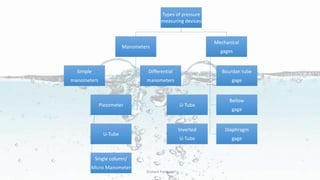
Types of pressure
measuring devices
Manometers
Simple
manometers
Piezometer
U-Tube
Single column/
Micro Manometer
Differential
manometers
U-Tube
Inverted
U-Tube
Mechanical
gages
Bourdan tube
gage
Bellow
gage
Diaphragm
gage
Dishant Patiwala
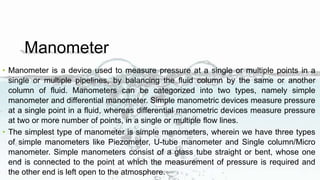
Manometer
• Manometer is a device used to measure pressure at a single or multiple points in a
single or multiple pipelines, by balancing the fluid column by the same or another
column of fluid. Manometers can be categorized into two types, namely simple
manometer and differential manometer. Simple manometric devices measure pressure
at a single point in a fluid, whereas differential manometric devices measure pressure
at two or more number of points, in a single or multiple flow lines.
• The simplest type of manometer is simple manometers, wherein we have three types
of simple manometers like Piezometer, U-tube manometer and Single column/Micro
manometer. Simple manometers consist of a glass tube straight or bent, whose one
end is connected to the point at which the measurement of pressure is required and
the other end is left open to the atmosphere.Dishant Patiwala
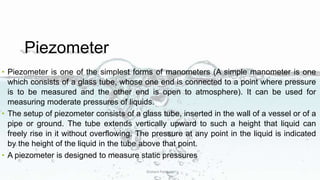
Piezometer
• Piezometer is one of the simplest forms of manometers (A simple manometer is one
which consists of a glass tube, whose one end is connected to a point where pressure
is to be measured and the other end is open to atmosphere). It can be used for
measuring moderate pressures of liquids.
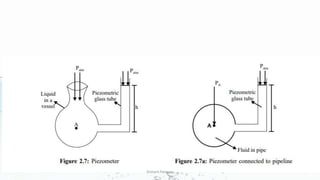
• The setup of piezometer consists of a glass tube, inserted in the wall of a vessel or of a
pipe or ground. The tube extends vertically upward to such a height that liquid can
freely rise in it without overflowing. The pressure at any point in the liquid is indicated
by the height of the liquid in the tube above that point.
• A piezometer is designed to measure static pressures
Dishant Patiwala
Dishant Patiwala
U-tube manometer
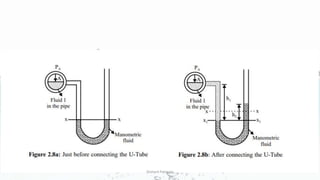
• U-tube manometer is a simple manometric device used to measure pressure at a point
in a fluid, by balancing the fluid column by the same or another column of fluid. It has a
glass tube bent in “U” shape with some amount of same or other type of fluid, called
manometric fluid like mercury, as shown in Figures
Dishant Patiwala
Dishant Patiwala
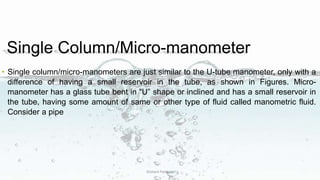
Single Column/Micro-manometer
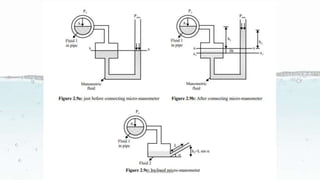
• Single column/micro-manometers are just similar to the U-tube manometer, only with a
difference of having a small reservoir in the tube, as shown in Figures. Micro-
manometer has a glass tube bent in “U” shape or inclined and has a small reservoir in
the tube, having some amount of same or other type of fluid called manometric fluid.
Consider a pipe
Dishant Patiwala
Dishant Patiwala
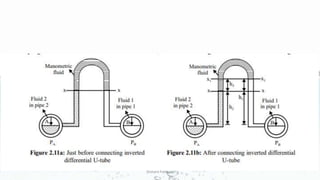
Inverted Differential U-tube Manometer
• Inverted differential U-tube manometer is a device just as same that of U-tube
differential manometer but is inverted in construction. It measures pressure difference
∆P at two different points “A” and “B” in a single pipe or different pipes, carrying two
fluids of same or different kinds, as shown in Figure As small change in
Dishant Patiwala
Dishant Patiwala
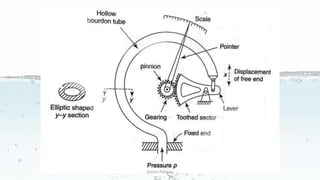
Bourdon tube
• Bourdon tube is the oldest pressure sensing element .It is a length of metal tube of
elliptical cross section and shaped into letter “C”.
• One end is left free and the other end is fixed and is open for the pressure source to be
applied. A tube of elliptical cross section has a smaller volume than a circular one of
the same length and perimeter. When connected to the pressure source it is made to
accommodate more of the fluid. Resultant of all reactions will produce maximum
displacement at the free end. Within close limits, the change in angle subtended at the
centre by a tube is proportional to the change of internal pressure and within the limits
of proportionality of the material; the displacement of the free end is proportional to the
applied pressure.
Dishant Patiwala
Dishant Patiwala
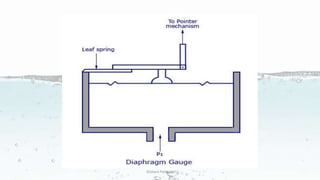
Diaphragm gauge
• This type of gauge employs a metallic disc or diaphragm instead of bent tube.
• This disc or diaphragm is used for actuating the indicating device.
• When pressure is applied on the lower side of the diaphragm it is deflected upward.
• This movement of the diaphragm is transmitted to a rack and pinion.
• The latter is attached to the spindle of needle moving on a graduated dial.
• This dial can again be graduated in a suitable scale.
Dishant Patiwala
Dishant Patiwala
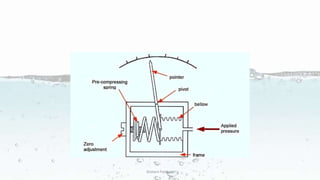
Bellows gauge
• The bellows is a one-piece, collapsible, seamless metallic unit that has deep folds
formed from very thin-walled tubing. The diameter of the bellows ranges from 0.5 to 12
in. and may have as many as 24 folds. System or line pressure is applied to the
internal volume of the bellows. As the inlet pressure to the instrument varies, the
bellows will expand or contract. The moving end of the bellows is connected to a
mechanical linkage assembly. As the bellows and linkage assembly moves, either an
electrical signal is generated or a direct pressure indication is provided. The flexibility
of a metallic bellows is similar in character to that of a helical, coiled compression
spring. Up to the elastic limit of the bellows, the relation between increments of load
and deflection is linear.
Dishant Patiwala
Dishant Patiwala
Dishant Patiwala
Dishant Patiwala

Pressure measurement

  • 1.
  • 2.
    Types of pressure measuringdevices Manometers Simple manometers Piezometer U-Tube Single column/ Micro Manometer Differential manometers U-Tube Inverted U-Tube Mechanical gages Bourdan tube gage Bellow gage Diaphragm gage Dishant Patiwala
  • 3.
    Manometer • Manometer isa device used to measure pressure at a single or multiple points in a single or multiple pipelines, by balancing the fluid column by the same or another column of fluid. Manometers can be categorized into two types, namely simple manometer and differential manometer. Simple manometric devices measure pressure at a single point in a fluid, whereas differential manometric devices measure pressure at two or more number of points, in a single or multiple flow lines. • The simplest type of manometer is simple manometers, wherein we have three types of simple manometers like Piezometer, U-tube manometer and Single column/Micro manometer. Simple manometers consist of a glass tube straight or bent, whose one end is connected to the point at which the measurement of pressure is required and the other end is left open to the atmosphere.Dishant Patiwala
  • 4.
    Piezometer • Piezometer isone of the simplest forms of manometers (A simple manometer is one which consists of a glass tube, whose one end is connected to a point where pressure is to be measured and the other end is open to atmosphere). It can be used for measuring moderate pressures of liquids. • The setup of piezometer consists of a glass tube, inserted in the wall of a vessel or of a pipe or ground. The tube extends vertically upward to such a height that liquid can freely rise in it without overflowing. The pressure at any point in the liquid is indicated by the height of the liquid in the tube above that point. • A piezometer is designed to measure static pressures Dishant Patiwala
  • 5.
  • 6.
    U-tube manometer • U-tubemanometer is a simple manometric device used to measure pressure at a point in a fluid, by balancing the fluid column by the same or another column of fluid. It has a glass tube bent in “U” shape with some amount of same or other type of fluid, called manometric fluid like mercury, as shown in Figures Dishant Patiwala
  • 7.
  • 8.
    Single Column/Micro-manometer • Singlecolumn/micro-manometers are just similar to the U-tube manometer, only with a difference of having a small reservoir in the tube, as shown in Figures. Micro- manometer has a glass tube bent in “U” shape or inclined and has a small reservoir in the tube, having some amount of same or other type of fluid called manometric fluid. Consider a pipe Dishant Patiwala
  • 9.
  • 10.
    Inverted Differential U-tubeManometer • Inverted differential U-tube manometer is a device just as same that of U-tube differential manometer but is inverted in construction. It measures pressure difference ∆P at two different points “A” and “B” in a single pipe or different pipes, carrying two fluids of same or different kinds, as shown in Figure As small change in Dishant Patiwala
  • 11.
  • 12.
    Bourdon tube • Bourdontube is the oldest pressure sensing element .It is a length of metal tube of elliptical cross section and shaped into letter “C”. • One end is left free and the other end is fixed and is open for the pressure source to be applied. A tube of elliptical cross section has a smaller volume than a circular one of the same length and perimeter. When connected to the pressure source it is made to accommodate more of the fluid. Resultant of all reactions will produce maximum displacement at the free end. Within close limits, the change in angle subtended at the centre by a tube is proportional to the change of internal pressure and within the limits of proportionality of the material; the displacement of the free end is proportional to the applied pressure. Dishant Patiwala
  • 13.
  • 14.
    Diaphragm gauge • Thistype of gauge employs a metallic disc or diaphragm instead of bent tube. • This disc or diaphragm is used for actuating the indicating device. • When pressure is applied on the lower side of the diaphragm it is deflected upward. • This movement of the diaphragm is transmitted to a rack and pinion. • The latter is attached to the spindle of needle moving on a graduated dial. • This dial can again be graduated in a suitable scale. Dishant Patiwala
  • 15.
  • 16.
    Bellows gauge • Thebellows is a one-piece, collapsible, seamless metallic unit that has deep folds formed from very thin-walled tubing. The diameter of the bellows ranges from 0.5 to 12 in. and may have as many as 24 folds. System or line pressure is applied to the internal volume of the bellows. As the inlet pressure to the instrument varies, the bellows will expand or contract. The moving end of the bellows is connected to a mechanical linkage assembly. As the bellows and linkage assembly moves, either an electrical signal is generated or a direct pressure indication is provided. The flexibility of a metallic bellows is similar in character to that of a helical, coiled compression spring. Up to the elastic limit of the bellows, the relation between increments of load and deflection is linear. Dishant Patiwala
  • 17.
  • 18.
  • 19.