Chapter-Three
VALVES
By: Semahagn Yematawu (MSc)
2024
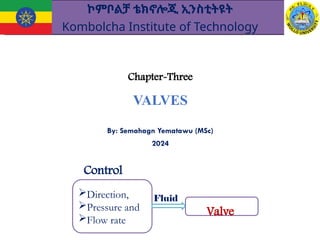
Direction,
Pressure and
Flow rate
ኮምቦልቻ ቴክኖሎጂ ኢንስቲትዩት
Kombolcha Institute of Technology
Valve
Fluid
Control
3.1 Introduction
 Control is the most important consideration in
any system.
 If control system components are not properly
selected, the entire system will not function as
required.
 Valves are used in fluid power system to
control direction, pressure and flow. Also, the
selection of valves involves the type, size,
actuating techniques etc of the system.
3
2
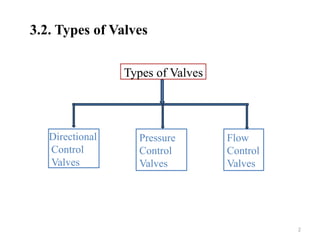
Directional
Control
Valves
Types of Valves
Flow
Control
Valves
Pressure
Control
Valves
3.2. Types of Valves
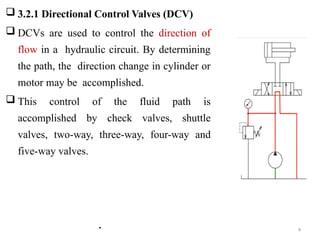
 3.2.1 Directional Control Valves (DCV)
 DCVs are used to control the direction of
flow in a hydraulic circuit. By determining
the path, the direction change in cylinder or
motor may be accomplished.
 This control of the fluid path is
accomplished by check valves, shuttle
valves, two-way, three-way, four-way and
five-way valves.
. 4
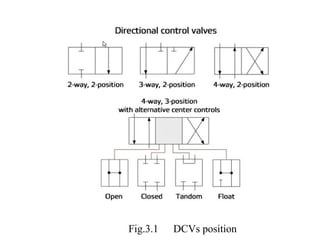
 The number of ports on the DCVs is identified using the term
 Way: flow path through valve or
 Port: a connection to a valve passage.
Types of DCVs
 One-way valve: simple check valve; flow in one direction
only, has two ports. Pilot-operated check valves (may be
direct acting or pilot operated from an adjacent or remote
location).
 Two-way valve: flow in both direction; simple shutoff
valves
 Three-way valve: three flow path
 Four-way valve : four flow path
 Five- way valve : five flow path
Fig.3.1 DCVs position
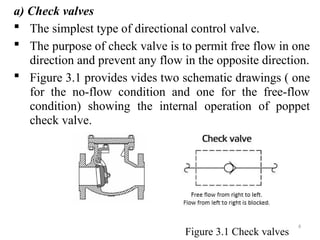
a) Check valves
 The simplest type of directional control valve.
 The purpose of check valve is to permit free flow in one
direction and prevent any flow in the opposite direction.
 Figure 3.1 provides vides two schematic drawings ( one
for the no-flow condition and one for the free-flow
condition) showing the internal operation of poppet
check valve.
6
Figure 3.1 Check valves
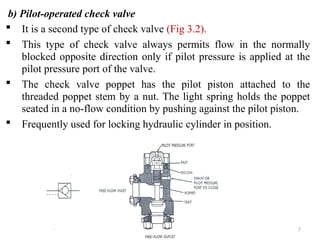
b) Pilot-operated check valve
 It is a second type of check valve (Fig 3.2).
 This type of check valve always permits flow in the normally
blocked opposite direction only if pilot pressure is applied at the
pilot pressure port of the valve.
 The check valve poppet has the pilot piston attached to the
threaded poppet stem by a nut. The light spring holds the poppet
seated in a no-flow condition by pushing against the pilot piston.
 Frequently used for locking hydraulic cylinder in position.
7
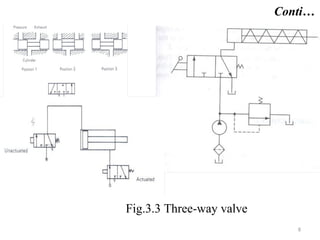
c) Three-way valves
 A directional control valve whose primary function is
alternately to pressurize and exhaust on working port
 Contains three ports, are typically of the spool design
rather than poppet design (Figure 3.3).
 A spool is a circular shaft containing lands (larger
diameter sections) that are machined to slide in a very
close fitting bore of the valve body.
 The grooves between the lands provide the flow paths
between ports. Clearance between land and bore <
0.03mm.
8
8
Fig.3.3 Three-way valve
Conti…
 Used to operate cylinder or motor in one direction.
Single acting cylinders retracted by spring or other
means.
 Can be two position or three position
 Designation by No. of Ports/ No. of Positions ( for
example: a three-way valve that uses two positions of the
spool is called a three-way, two position directional
control valve.
 The spool can be positioned manually, mechanically, by
using pilot pressure or by using electrical solenoid.
9
Conti…
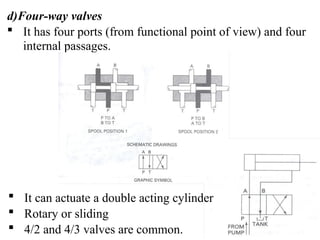
d)Four-way valves
 It has four ports (from functional point of view) and four
internal passages.
10
 It can actuate a double acting cylinder
 Rotary or sliding
 4/2 and 4/3 valves are common.
10
e) Five-way valve
Used usually in pneumatic systems (Fig. 3.5)
Figure 3.5 Five-way valve
f) Shuttle valve
 It is another type of directional control valve Fig 3.6.
 It provides a means for connecting two lines to one
output (it permits a system to operate from either of the
fluid power source).
 One application is for safety in the event that the main
pump can no longer provide a hydraulic power to
operate emergency devices
11
Fig 3.6. shunt valves
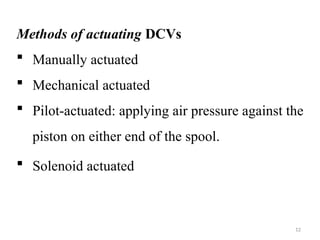
Methods of actuating DCVs
 Manually actuated
 Mechanical actuated
 Pilot-actuated: applying air pressure against the
piston on either end of the spool.
 Solenoid actuated
12
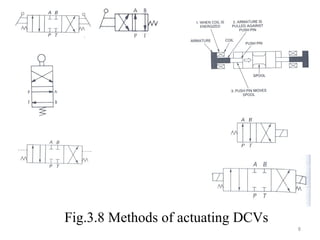
Fig.3.8 Methods of actuating DCVs
8
13
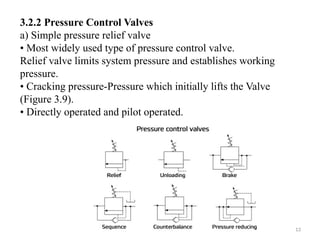
3.2.2 Pressure Control Valves
a) Simple pressure relief valve
• Most widely used type of pressure control valve.
Relief valve limits system pressure and establishes working
pressure.
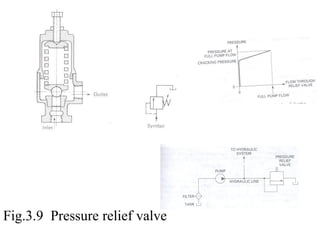
• Cracking pressure-Pressure which initially lifts the Valve
(Figure 3.9).
• Directly operated and pilot operated.
Fig.3.9 Pressure relief valve
PRESSURE RELIEF VALVES
Purposes and Operating Conditions
 Pressure relief valves are designed to protect a
system from being over-pressurized
 Pressure < 10,000 psia
 Temperature < 1,0000F
PRESSURE RELIEF VALVES
Types of Pressure Relief Valves
 Direct-loaded relief valves
 Pilot-operated relief valves
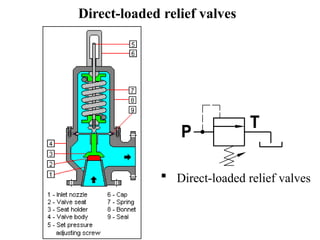
Direct-loaded relief valves
 Direct-loaded relief valves
Pilot-operated relief valves
 Pilot-operated relief valves
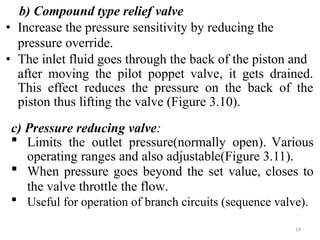
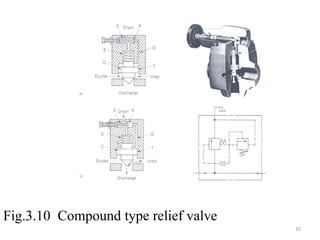
b) Compound type relief valve
• Increase the pressure sensitivity by reducing the
pressure override.
• The inlet fluid goes through the back of the piston and
after moving the pilot poppet valve, it gets drained.
This effect reduces the pressure on the back of the
piston thus lifting the valve (Figure 3.10).
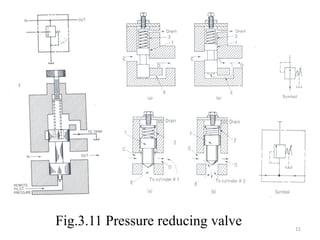
c) Pressure reducing valve:
 Limits the outlet pressure(normally open). Various
operating ranges and also adjustable(Figure 3.11).
 When pressure goes beyond the set value, closes to
the valve throttle the flow.
 Useful for operation of branch circuits (sequence valve).
14
Fig.3.10 Compound type relief valve
10
Fig.3.11 Pressure reducing valve 11
Sequence valves:
 Control the order of operation of two of two parallel
branch circuits.
 Common examples of application include the operation
of two work cylinders in sequence such that the second
one activates after the complete extension of the first
(stalling increases the pressure which raises the valve to
allow flow to the other cylinder).
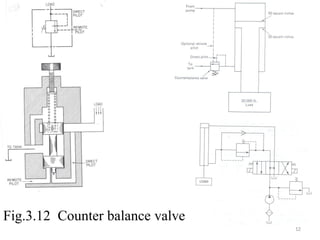
c) Counterbalance valves:
 Used to maintain back pressure to prevent a load
from falling. Common applications include
vertical presses, loaders, lift trucks, etc (Fig 3.12).
 The valve is to open at a pressure above the
pressure required to prevent the vertical cylinder
from descending due to the weight of its load. The
pressure is applied at the blank end.
 If operated directly, pressure on the rod end of the
ram must exceed the pressure setting of the valve.
 Usually, 10% greater than pressure required to
sustain the vertical load.
Fig.3.12 Counter balance valve
12
3.1.3. Flow Control (FCV)
 Primary function: controlling rate of flow, velocity control of
cylinders, speed control of hydraulic motors.
 Accurate speed control of pneumatic cylinders is difficult to
achieve because of compressibility effect
a) Orifice as a Flow Meter (Flow Control Device)
 An orifice ( a disk with a hole through which fluid flows)
installed in a pipe.
 Such a device can be used as a flow meter by measuring a
pressure drop across the orifice. Orifice is used to determine
flow rate by measurement of pressure drop between inlet exit.
 It is also used to control the flow rate.
 The area of the orifice is fixed.
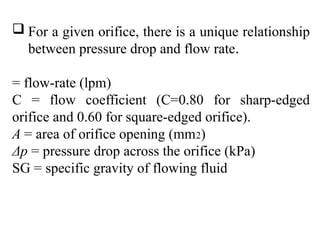
 For a given orifice, there is a unique relationship
between pressure drop and flow rate.
= flow-rate (lpm)
C = flow coefficient (C=0.80 for sharp-edged
orifice and 0.60 for square-edged orifice).
A = area of orifice opening (mm2)
Δp = pressure drop across the orifice (kPa)
SG = specific gravity of flowing fluid
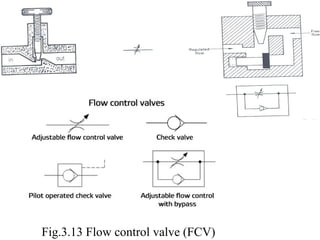
b) Needle Valve
 Are adjustable valves that will allow the change of flow rate
(Fig.3.13).
 Usually, a tapered needle is used to control the flow rate by
adjusting a screw.
 Flow control only in one direction
 By including a check valve, the flow can be restricted in one
direction and can freely flow in the other direction.
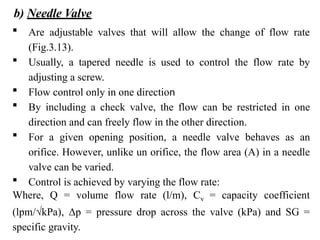
 For a given opening position, a needle valve behaves as an
orifice. However, unlike un orifice, the flow area (A) in a needle
valve can be varied.
 Control is achieved by varying the flow rate:
Where, Q = volume flow rate (l/m), Cv = capacity coefficient
(lpm/√kPa), Δp = pressure drop across the valve (kPa) and SG =
specific gravity.
Fig.3.13 Flow control valve (FCV)
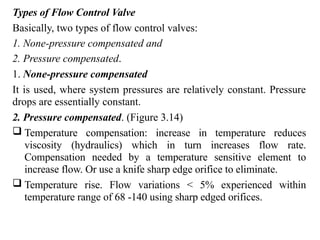
Types of Flow Control Valve
Basically, two types of flow control valves:
1. None-pressure compensated and
2. Pressure compensated.
1. None-pressure compensated
It is used, where system pressures are relatively constant. Pressure
drops are essentially constant.
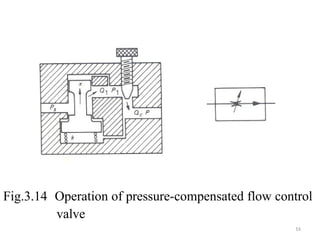
2. Pressure compensated. (Figure 3.14)
 Temperature compensation: increase in temperature reduces
viscosity (hydraulics) which in turn increases flow rate.
Compensation needed by a temperature sensitive element to
increase flow. Or use a knife sharp edge orifice to eliminate.
 Temperature rise. Flow variations < 5% experienced within
temperature range of 68 -140 using sharp edged orifices.
Fig.3.14 Operation of pressure-compensated flow control
valve
14
On-off valves
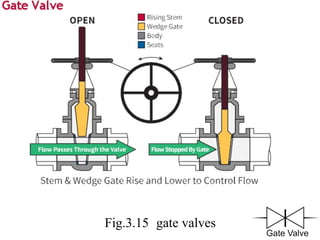
 Control valves and includes gate, globe valves, ball, plug,
butterfly valve
 Stopping the flow
 Providing tight shutoff when being closed
 Providing low pressure drops when being fully opened
 Most of control valves can be used for on-off duty,
especially ball valves
 Gate valves are often used in on-off service
Fig.3.15 gate valves
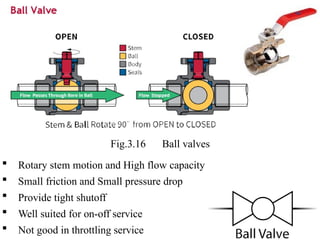
Fig.3.16 Ball valves
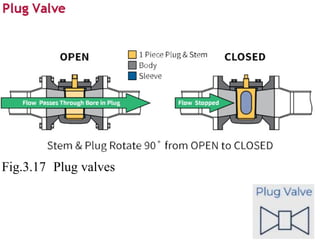
 Rotary stem motion and High flow capacity
 Small friction and Small pressure drop
 Provide tight shutoff
 Well suited for on-off service
 Not good in throttling service
Fig.3.17 Plug valves
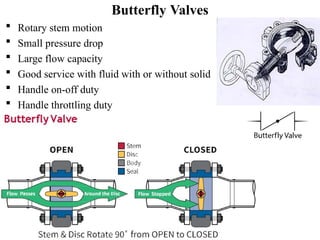
Butterfly Valves
 Rotary stem motion
 Small pressure drop
 Large flow capacity
 Good service with fluid with or without solid
 Handle on-off duty
 Handle throttling duty
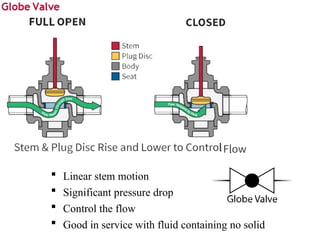
 Linear stem motion
 Significant pressure drop
 Control the flow
 Good in service with fluid containing no solid
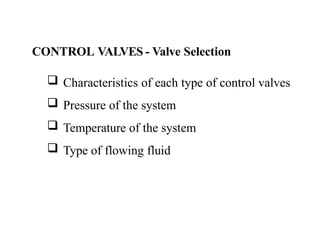
CONTROL VALVES - Valve Selection
 Characteristics of each type of control valves
 Pressure of the system
 Temperature of the system
 Type of flowing fluid

Chapter 3 Valves(Fluid power regulators).pptx

  • 1.
    Chapter-Three VALVES By: Semahagn Yematawu(MSc) 2024 Direction, Pressure and Flow rate ኮምቦልቻ ቴክኖሎጂ ኢንስቲትዩት Kombolcha Institute of Technology Valve Fluid Control
  • 2.
    3.1 Introduction  Controlis the most important consideration in any system.  If control system components are not properly selected, the entire system will not function as required.  Valves are used in fluid power system to control direction, pressure and flow. Also, the selection of valves involves the type, size, actuating techniques etc of the system. 3
  • 3.
  • 4.
     3.2.1 DirectionalControl Valves (DCV)  DCVs are used to control the direction of flow in a hydraulic circuit. By determining the path, the direction change in cylinder or motor may be accomplished.  This control of the fluid path is accomplished by check valves, shuttle valves, two-way, three-way, four-way and five-way valves. . 4
  • 5.
     The numberof ports on the DCVs is identified using the term  Way: flow path through valve or  Port: a connection to a valve passage. Types of DCVs  One-way valve: simple check valve; flow in one direction only, has two ports. Pilot-operated check valves (may be direct acting or pilot operated from an adjacent or remote location).  Two-way valve: flow in both direction; simple shutoff valves  Three-way valve: three flow path  Four-way valve : four flow path  Five- way valve : five flow path
  • 6.
  • 7.
    a) Check valves The simplest type of directional control valve.  The purpose of check valve is to permit free flow in one direction and prevent any flow in the opposite direction.  Figure 3.1 provides vides two schematic drawings ( one for the no-flow condition and one for the free-flow condition) showing the internal operation of poppet check valve. 6 Figure 3.1 Check valves
  • 8.
    b) Pilot-operated checkvalve  It is a second type of check valve (Fig 3.2).  This type of check valve always permits flow in the normally blocked opposite direction only if pilot pressure is applied at the pilot pressure port of the valve.  The check valve poppet has the pilot piston attached to the threaded poppet stem by a nut. The light spring holds the poppet seated in a no-flow condition by pushing against the pilot piston.  Frequently used for locking hydraulic cylinder in position. 7
  • 9.
    c) Three-way valves A directional control valve whose primary function is alternately to pressurize and exhaust on working port  Contains three ports, are typically of the spool design rather than poppet design (Figure 3.3).  A spool is a circular shaft containing lands (larger diameter sections) that are machined to slide in a very close fitting bore of the valve body.  The grooves between the lands provide the flow paths between ports. Clearance between land and bore < 0.03mm. 8
  • 10.
  • 11.
     Used tooperate cylinder or motor in one direction. Single acting cylinders retracted by spring or other means.  Can be two position or three position  Designation by No. of Ports/ No. of Positions ( for example: a three-way valve that uses two positions of the spool is called a three-way, two position directional control valve.  The spool can be positioned manually, mechanically, by using pilot pressure or by using electrical solenoid. 9 Conti…
  • 12.
    d)Four-way valves  Ithas four ports (from functional point of view) and four internal passages. 10  It can actuate a double acting cylinder  Rotary or sliding  4/2 and 4/3 valves are common.
  • 13.
    10 e) Five-way valve Usedusually in pneumatic systems (Fig. 3.5) Figure 3.5 Five-way valve
  • 14.
    f) Shuttle valve It is another type of directional control valve Fig 3.6.  It provides a means for connecting two lines to one output (it permits a system to operate from either of the fluid power source).  One application is for safety in the event that the main pump can no longer provide a hydraulic power to operate emergency devices 11 Fig 3.6. shunt valves
  • 15.
    Methods of actuatingDCVs  Manually actuated  Mechanical actuated  Pilot-actuated: applying air pressure against the piston on either end of the spool.  Solenoid actuated 12
  • 16.
    Fig.3.8 Methods ofactuating DCVs 8
  • 17.
    13 3.2.2 Pressure ControlValves a) Simple pressure relief valve • Most widely used type of pressure control valve. Relief valve limits system pressure and establishes working pressure. • Cracking pressure-Pressure which initially lifts the Valve (Figure 3.9). • Directly operated and pilot operated.
  • 18.
  • 19.
    PRESSURE RELIEF VALVES Purposesand Operating Conditions  Pressure relief valves are designed to protect a system from being over-pressurized  Pressure < 10,000 psia  Temperature < 1,0000F
  • 20.
    PRESSURE RELIEF VALVES Typesof Pressure Relief Valves  Direct-loaded relief valves  Pilot-operated relief valves
  • 21.
    Direct-loaded relief valves Direct-loaded relief valves
  • 22.
    Pilot-operated relief valves Pilot-operated relief valves
  • 23.
    b) Compound typerelief valve • Increase the pressure sensitivity by reducing the pressure override. • The inlet fluid goes through the back of the piston and after moving the pilot poppet valve, it gets drained. This effect reduces the pressure on the back of the piston thus lifting the valve (Figure 3.10). c) Pressure reducing valve:  Limits the outlet pressure(normally open). Various operating ranges and also adjustable(Figure 3.11).  When pressure goes beyond the set value, closes to the valve throttle the flow.  Useful for operation of branch circuits (sequence valve). 14
  • 24.
    Fig.3.10 Compound typerelief valve 10
  • 25.
  • 26.
    Sequence valves:  Controlthe order of operation of two of two parallel branch circuits.  Common examples of application include the operation of two work cylinders in sequence such that the second one activates after the complete extension of the first (stalling increases the pressure which raises the valve to allow flow to the other cylinder).
  • 27.
    c) Counterbalance valves: Used to maintain back pressure to prevent a load from falling. Common applications include vertical presses, loaders, lift trucks, etc (Fig 3.12).  The valve is to open at a pressure above the pressure required to prevent the vertical cylinder from descending due to the weight of its load. The pressure is applied at the blank end.  If operated directly, pressure on the rod end of the ram must exceed the pressure setting of the valve.  Usually, 10% greater than pressure required to sustain the vertical load.
  • 28.
  • 29.
    3.1.3. Flow Control(FCV)  Primary function: controlling rate of flow, velocity control of cylinders, speed control of hydraulic motors.  Accurate speed control of pneumatic cylinders is difficult to achieve because of compressibility effect a) Orifice as a Flow Meter (Flow Control Device)  An orifice ( a disk with a hole through which fluid flows) installed in a pipe.  Such a device can be used as a flow meter by measuring a pressure drop across the orifice. Orifice is used to determine flow rate by measurement of pressure drop between inlet exit.  It is also used to control the flow rate.  The area of the orifice is fixed.
  • 30.
     For agiven orifice, there is a unique relationship between pressure drop and flow rate. = flow-rate (lpm) C = flow coefficient (C=0.80 for sharp-edged orifice and 0.60 for square-edged orifice). A = area of orifice opening (mm2) Δp = pressure drop across the orifice (kPa) SG = specific gravity of flowing fluid
  • 31.
    b) Needle Valve Are adjustable valves that will allow the change of flow rate (Fig.3.13).  Usually, a tapered needle is used to control the flow rate by adjusting a screw.  Flow control only in one direction  By including a check valve, the flow can be restricted in one direction and can freely flow in the other direction.  For a given opening position, a needle valve behaves as an orifice. However, unlike un orifice, the flow area (A) in a needle valve can be varied.  Control is achieved by varying the flow rate: Where, Q = volume flow rate (l/m), Cv = capacity coefficient (lpm/√kPa), Δp = pressure drop across the valve (kPa) and SG = specific gravity.
  • 32.
  • 33.
    Types of FlowControl Valve Basically, two types of flow control valves: 1. None-pressure compensated and 2. Pressure compensated. 1. None-pressure compensated It is used, where system pressures are relatively constant. Pressure drops are essentially constant. 2. Pressure compensated. (Figure 3.14)  Temperature compensation: increase in temperature reduces viscosity (hydraulics) which in turn increases flow rate. Compensation needed by a temperature sensitive element to increase flow. Or use a knife sharp edge orifice to eliminate.  Temperature rise. Flow variations < 5% experienced within temperature range of 68 -140 using sharp edged orifices.
  • 34.
    Fig.3.14 Operation ofpressure-compensated flow control valve 14
  • 35.
    On-off valves  Controlvalves and includes gate, globe valves, ball, plug, butterfly valve  Stopping the flow  Providing tight shutoff when being closed  Providing low pressure drops when being fully opened  Most of control valves can be used for on-off duty, especially ball valves  Gate valves are often used in on-off service
  • 36.
  • 37.
    Fig.3.16 Ball valves Rotary stem motion and High flow capacity  Small friction and Small pressure drop  Provide tight shutoff  Well suited for on-off service  Not good in throttling service
  • 38.
  • 39.
    Butterfly Valves  Rotarystem motion  Small pressure drop  Large flow capacity  Good service with fluid with or without solid  Handle on-off duty  Handle throttling duty
  • 40.
     Linear stemmotion  Significant pressure drop  Control the flow  Good in service with fluid containing no solid
  • 41.
    CONTROL VALVES -Valve Selection  Characteristics of each type of control valves  Pressure of the system  Temperature of the system  Type of flowing fluid