Sarvajanik College of
Engineering andTechnology
Topic :- Preservation of Samples
Subject :- Environmental Engineering (2150603)
Branch :- Civil Engineering (06)
Semester :- 5th
Guided by :- Prof. Mitali Shah
Prof. Chaitali Patel
Submitted By
Name Enrollment No.
Prajapati Jay 160420106053
Rangoonwala Abhay 160420106054
Ravani Harsh 160420106055
Ravani Prit 160420106056
Savaliya Smit 160420106057
Shah Jainam 160420106058
Shah Siddh 160420106059
ANNEXTURE
 Meaning and Need of Preservation
 Preservation containers
 Preservation Methods
Meaning and Need of Preservation
 Preservation is the process to maintain original properties of water samples.
 Sample preservation is the measure or measures taken to prevent reduction or
loss of target analytes.
 Analyte loss can occur between sample collection and laboratory analysis because
of physical, chemical, and biological processes that result in chemical
precipitation, adsorption, oxidation, reduction, ion exchange, degassing, or
degradation.
 Preservation stabilizes analyte concentrations for a limited period of time. Some
samples have a very short holding time.
Preservation Container
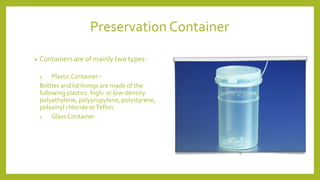
 Containers are of mainly two types:-
1. Plastic Container:-
Bottles and lid linings are made of the
following plastics: high- or low-density
polyethylene, polypropylene, polystyrene,
polyvinyl chloride orTeflon
1. GlassContainer
Preservation Methods
 Preservation methods for chemical parameters (on-site analysis):-
 Preservation methods for microbiological and chemical parameters (laboratory
analysis)
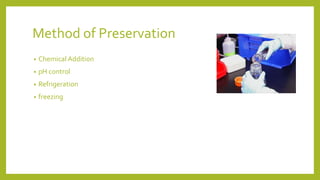
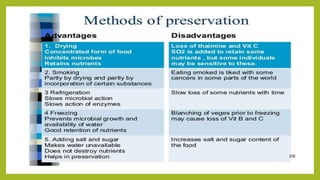
Method of Preservation
• Chemical Addition
• pH control
• Refrigeration
• freezing
ChemicalAddition
• The most convenient preservative is a chemical which can be added to a sample
bottle prior to sampling.
• When the sample is added, ·the preservative disperses immediately, stabilizing
the parameter(s) of concern for long periods of time
• When the preservative added interferes with other parameters being measured,
additional samples for those parameters must be collected.
• For example, concentrated nitric acid added for the preservation of some of the
metals would interfere with BOD, so an additional sample must be collected for
BOD.
Ph Control
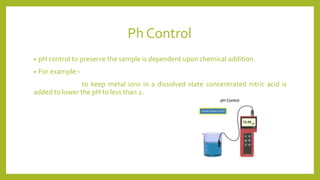
• pH control to preserve the sample is dependent upon chemical addition.
• For example:-
to keep metal ions in a dissolved state concentrated nitric acid is
added to lower the pH to less than 2.
Freezing
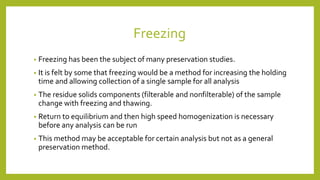
• Freezing has been the subject of many preservation studies.
• It is felt by some that freezing would be a method for increasing the holding
time and allowing collection of a single sample for all analysis
• The residue solids components (filterable and nonfilterable) of the sample
change with freezing and thawing.
• Return to equilibrium and then high speed homogenization is necessary
before any analysis can be run
• This method may be acceptable for certain analysis but not as a general
preservation method.
Refrigeration
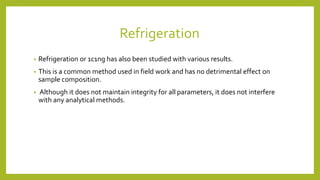
• Refrigeration or 1c1ng has also been studied with various results.
• This is a common method used in field work and has no detrimental effect on
sample composition.
• Although it does not maintain integrity for all parameters, it does not interfere
with any analytical methods.
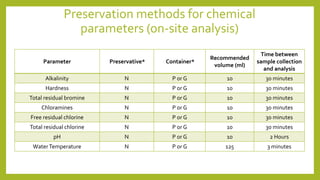
Preservation methods for chemical
parameters (on-site analysis)
Parameter Preservative* Container*
Recommended
volume (ml)
Time between
sample collection
and analysis
Alkalinity N P or G 10 30 minutes
Hardness N P or G 10 30 minutes
Total residual bromine N P or G 10 30 minutes
Chloramines N P or G 10 30 minutes
Free residual chlorine N P or G 10 30 minutes
Total residual chlorine N P or G 10 30 minutes
pH N P or G 10 2 Hours
WaterTemperature N P or G 125 3 minutes
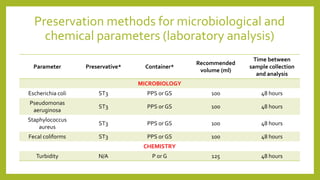
Preservation methods for microbiological and
chemical parameters (laboratory analysis)
Parameter Preservative* Container*
Recommended
volume (ml)
Time between
sample collection
and analysis
MICROBIOLOGY
Escherichia coli ST3 PPS or GS 100 48 hours
Pseudomonas
aeruginosa
ST3 PPS or GS 100 48 hours
Staphylococcus
aureus
ST3 PPS or GS 100 48 hours
Fecal coliforms ST3 PPS or GS 100 48 hours
CHEMISTRY
Turbidity N/A P or G 125 48 hours
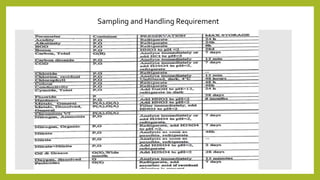
Sampling and Handling Requirement
Preservation of samples

Preservation of samples

  • 1.
    Sarvajanik College of EngineeringandTechnology Topic :- Preservation of Samples Subject :- Environmental Engineering (2150603) Branch :- Civil Engineering (06) Semester :- 5th Guided by :- Prof. Mitali Shah Prof. Chaitali Patel
  • 2.
    Submitted By Name EnrollmentNo. Prajapati Jay 160420106053 Rangoonwala Abhay 160420106054 Ravani Harsh 160420106055 Ravani Prit 160420106056 Savaliya Smit 160420106057 Shah Jainam 160420106058 Shah Siddh 160420106059
  • 3.
    ANNEXTURE  Meaning andNeed of Preservation  Preservation containers  Preservation Methods
  • 4.
    Meaning and Needof Preservation  Preservation is the process to maintain original properties of water samples.  Sample preservation is the measure or measures taken to prevent reduction or loss of target analytes.  Analyte loss can occur between sample collection and laboratory analysis because of physical, chemical, and biological processes that result in chemical precipitation, adsorption, oxidation, reduction, ion exchange, degassing, or degradation.  Preservation stabilizes analyte concentrations for a limited period of time. Some samples have a very short holding time.
  • 5.
    Preservation Container  Containersare of mainly two types:- 1. Plastic Container:- Bottles and lid linings are made of the following plastics: high- or low-density polyethylene, polypropylene, polystyrene, polyvinyl chloride orTeflon 1. GlassContainer
  • 6.
    Preservation Methods  Preservationmethods for chemical parameters (on-site analysis):-  Preservation methods for microbiological and chemical parameters (laboratory analysis)
  • 7.
    Method of Preservation •Chemical Addition • pH control • Refrigeration • freezing
  • 8.
    ChemicalAddition • The mostconvenient preservative is a chemical which can be added to a sample bottle prior to sampling. • When the sample is added, ·the preservative disperses immediately, stabilizing the parameter(s) of concern for long periods of time • When the preservative added interferes with other parameters being measured, additional samples for those parameters must be collected. • For example, concentrated nitric acid added for the preservation of some of the metals would interfere with BOD, so an additional sample must be collected for BOD.
  • 9.
    Ph Control • pHcontrol to preserve the sample is dependent upon chemical addition. • For example:- to keep metal ions in a dissolved state concentrated nitric acid is added to lower the pH to less than 2.
  • 10.
    Freezing • Freezing hasbeen the subject of many preservation studies. • It is felt by some that freezing would be a method for increasing the holding time and allowing collection of a single sample for all analysis • The residue solids components (filterable and nonfilterable) of the sample change with freezing and thawing. • Return to equilibrium and then high speed homogenization is necessary before any analysis can be run • This method may be acceptable for certain analysis but not as a general preservation method.
  • 11.
    Refrigeration • Refrigeration or1c1ng has also been studied with various results. • This is a common method used in field work and has no detrimental effect on sample composition. • Although it does not maintain integrity for all parameters, it does not interfere with any analytical methods.
  • 13.
    Preservation methods forchemical parameters (on-site analysis) Parameter Preservative* Container* Recommended volume (ml) Time between sample collection and analysis Alkalinity N P or G 10 30 minutes Hardness N P or G 10 30 minutes Total residual bromine N P or G 10 30 minutes Chloramines N P or G 10 30 minutes Free residual chlorine N P or G 10 30 minutes Total residual chlorine N P or G 10 30 minutes pH N P or G 10 2 Hours WaterTemperature N P or G 125 3 minutes
  • 14.
    Preservation methods formicrobiological and chemical parameters (laboratory analysis) Parameter Preservative* Container* Recommended volume (ml) Time between sample collection and analysis MICROBIOLOGY Escherichia coli ST3 PPS or GS 100 48 hours Pseudomonas aeruginosa ST3 PPS or GS 100 48 hours Staphylococcus aureus ST3 PPS or GS 100 48 hours Fecal coliforms ST3 PPS or GS 100 48 hours CHEMISTRY Turbidity N/A P or G 125 48 hours
  • 15.