

INDUSTRIAL AND MUNICIPAL
WASTE MANAGEMENT
C.E 8.3.1
Unit II
SAMPLING METHODS
BIOMONITORING & CONTINIOUS MONITORING
ASST. PROF. PRACHI DESSAI, DON BOSCO COLLEGE OF ENGINEERING 1
SAMPLING
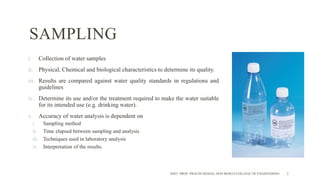
i. Collection of water samples
ii. Physical, Chemical and biological characteristics to determine its quality.
iii. Results are compared against water quality standards in regulations and
guidelines
iv. Determine its use and/or the treatment required to make the water suitable
for its intended use (e.g. drinking water).
v. Accuracy of water analysis is dependent on
i. Sampling method
ii. Time elapsed between sampling and analysis
iii. Techniques used in laboratory analysis
iv. Interpretation of the results.
ASST. PROF. PRACHI DESSAI, DON BOSCO COLLEGE OF ENGINEERING 2
SAMPLING TYPES – GRAB SAMPLING
i. Most common form of sampling
ii. Reliable and easy to do.
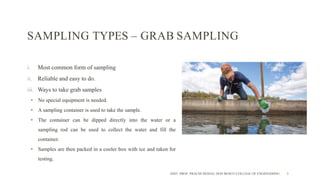
iii. Ways to take grab samples
 No special equipment is needed.
 A sampling container is used to take the sample.
 The container can be dipped directly into the water or a
sampling rod can be used to collect the water and fill the
container.
 Samples are then packed in a cooler box with ice and taken for
testing.
ASST. PROF. PRACHI DESSAI, DON BOSCO COLLEGE OF ENGINEERING 3
SAMPLING TYPES – GRAB SAMPLING
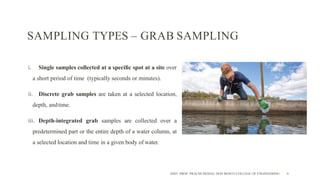
i. Single samples collected at a specific spot at a site over
a short period of time (typically seconds or minutes).
ii. Discrete grab samples are taken at a selected location,
depth, andtime.
iii. Depth-integrated grab samples are collected over a
predetermined part or the entire depth of a water column, at
a selected location and time in a given body of water.
ASST. PROF. PRACHI DESSAI, DON BOSCO COLLEGE OF ENGINEERING 4
SAMPLING TYPES – GRAB SAMPLING
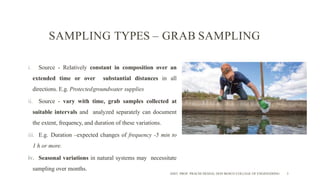
i. Source - Relatively constant in composition over an
extended time or over substantial distances in all
directions. E.g. Protectedgroundwater supplies
ii. Source - vary with time, grab samples collected at
suitable intervals and analyzed separately can document
the extent, frequency, and duration of these variations.
iii. E.g. Duration –expected changes of frequency -5 min to
1 h or more.
iv. Seasonal variations in natural systems may necessitate
sampling over months.
ASST. PROF. PRACHI DESSAI, DON BOSCO COLLEGE OF ENGINEERING 5
SAMPLING METHODS – COMPOSITE
SAMPLES
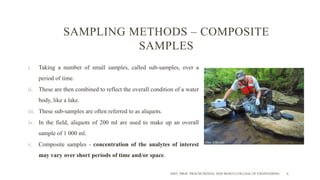
i. Taking a number of small samples, called sub-samples, over a
period of time.
ii. These are then combined to reflect the overall condition of a water
body, like a lake.
iii. These sub-samples are often referred to as aliquots.
iv. In the field, aliquots of 200 ml are used to make up an overall
sample of 1 000 ml.
v. Composite samples - concentration of the analytes of interest
may vary over short periods of time and/or space.
ASST. PROF. PRACHI DESSAI, DON BOSCO COLLEGE OF ENGINEERING 6
SAMPLING METHODS – COMPOSITE
SAMPLES
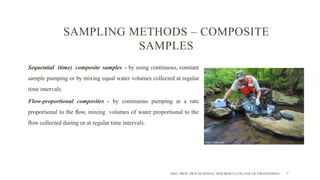
Sequential (time) composite samples - by using continuous, constant
sample pumping or by mixing equal water volumes collected at regular
time intervals.
Flow-proportional composites - by continuous pumping at a rate
proportional to the flow, mixing volumes of water proportional to the
flow collected during or at regular time intervals.
ASST. PROF. PRACHI DESSAI, DON BOSCO COLLEGE OF ENGINEERING 7
SAMPLING METHODS – COMPOSITE
SAMPLES
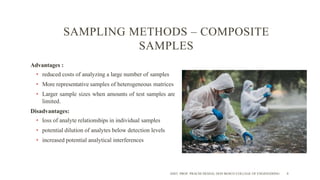
Advantages :
• reduced costs of analyzing a large number of samples
• More representative samples of heterogeneous matrices
• Larger sample sizes when amounts of test samples are
limited.
Disadvantages:
• loss of analyte relationships in individual samples
• potential dilution of analytes below detection levels
• increased potential analytical interferences
ASST. PROF. PRACHI DESSAI, DON BOSCO COLLEGE OF ENGINEERING 8
SAMPLING METHODS
• Manual sampling:
• It requires trained field technicians and is often necessary for regulatory and research
investigations for which critical appraisal of field conditions and complex sample-collection
techniques are essential. Manually collect certain samples, such as waters containing oil and
grease.
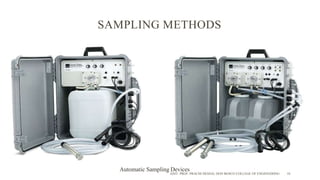
• Automatic sampling:
• Automatic sampler
• Carefully match pump speeds and tubing sizes to the type of sample to be taken.
• Sorbent sampling:
• Use of solid sorbents, particularly membrane- type disks, is becoming more frequent. These
methods offer rapid, inexpensive sampling if the analyses of interest can be adsorbed and
desorbed efficiently and the water matrix is free of particulates that plug the sorbent. Eg. polyester
pads, straw,clay
ASST. PROF. PRACHI DESSAI, DON BOSCO COLLEGE OF ENGINEERING 9
SAMPLING METHODS
ASST. PROF. PRACHI DESSAI, DON BOSCO COLLEGE OF ENGINEERING 10
Automatic Sampling Devices
SAMPLING CONTAINERS
• Free of analytes
• Made of plastic or glass, but one material
may be preferred over the other. E.g. silica,
sodium, and boron may be leached from soft
glass, but not plastic, and trace levels of some
pesticides and metals may sorb onto the walls
of glass containers.
ASST. PROF. PRACHI DESSAI, DON BOSCO COLLEGE OF ENGINEERING 11
SAMPLING CONTAINERS
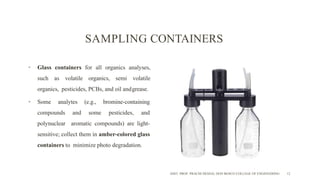
• Glass containers for all organics analyses,
such as volatile organics, semi volatile
organics, pesticides, PCBs, and oil andgrease.
• Some analytes (e.g., bromine-containing
compounds and some pesticides, and
polynuclear aromatic compounds) are light-
sensitive; collect them in amber-colored glass
containers to minimize photo degradation.
ASST. PROF. PRACHI DESSAI, DON BOSCO COLLEGE OF ENGINEERING 12
SAMPLE VOLUMES
Collect a 1-L sample for most physical and chemical analyses.
ASST. PROF. PRACHI DESSAI, DON BOSCO COLLEGE OF ENGINEERING 13
SAMPLING PROCEDURE –FIELD
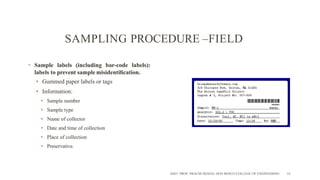
• Sample labels (including bar-code labels):
labels to prevent sample misidentification.
• Gummed paper labels or tags
• Information:
• Sample number
• Sample type
• Name of collector
• Date and time of collection
• Place of collection
• Preservative.
ASST. PROF. PRACHI DESSAI, DON BOSCO COLLEGE OF ENGINEERING 14
SAMPLING PROCEDURE –FIELD
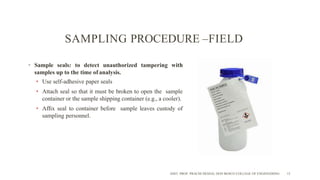
• Sample seals: to detect unauthorized tampering with
samples up to the time of analysis.
• Use self-adhesive paper seals
• Attach seal so that it must be broken to open the sample
container or the sample shipping container (e.g., a cooler).
• Affix seal to container before sample leaves custody of
sampling personnel.
ASST. PROF. PRACHI DESSAI, DON BOSCO COLLEGE OF ENGINEERING 15
SAMPLING PROCEDURE –FIELD
• Field log book: Record all information pertinent to a field surveyor sampling in a bound log
book.
• Purpose of sampling
• Location of sampling point
• Name & Address of field contact
• Procedure of material being sampled and address (if different from location)
• Type of sample
• Date and time
• Description of sampling point and sampling method
• Identification number
• Photographs of the sampling site
• Feld observations and measurements
• Signatures of personnel responsible for observations.
ASST. PROF. PRACHI DESSAI, DON BOSCO COLLEGE OF ENGINEERING 16
SAMPLING PROCEDURE –FIELD
• Chain-of-custody record: Fill out a chain-of-custody record to accompany each sample or group
of samples.
• Sample number
• Signature of collector
• Date & Time
• Sample type
• Sample preservation requirements
• Signatures of persons involved in the chain of possession and inclusive dates and times of
possession
ASST. PROF. PRACHI DESSAI, DON BOSCO COLLEGE OF ENGINEERING 17
SAMPLING PROCEDURE –FIELD
• Sample analysis request sheet: accompanies samples to the laboratory.
• Sample delivery to the laboratory: Deliver sample(s) to laboratory as soon as practicable after
collection, typically within 2 d.
• Receipt and logging of sample:
• In the laboratory, the sample custodian inspects the condition and seal of the sample and reconciles
label information and seal against the chain-of-custody record before the sample is accepted for
analysis. After acceptance, the custodian assigns a laboratory number, logs sample in the
laboratory log book and/or computerized laboratory information management system, and stores it
in a secured storage room or cabinet or refrigerator at the specified temperature until it is assigned
to an analyst.
ASST. PROF. PRACHI DESSAI, DON BOSCO COLLEGE OF ENGINEERING 18
SAMPLING PROCEDURE –FIELD
• Assignment of sample for analysis
• Disposal
• Hold samples for the prescribed amount of time for the project or until the data have been
reviewed and accepted. Document the disposition of samples. Ensure that disposal is in accordance
with local, state, and U.S. EPA approved methods.
ASST. PROF. PRACHI DESSAI, DON BOSCO COLLEGE OF ENGINEERING 19
CONTINUOUS MONITORING
ASST. PROF. PRACHI DESSAI, DON BOSCO COLLEGE OF ENGINEERING 20
i. Most industrial water treatment systems are dynamic.
ii. Industrial water treatment systems may be monitored by manual methods or by continuous systems employing
automatic instrumentation.
iii. MANUAL MONITORING: Manual monitoring typically involves plant operators or technicians conducting
chemical tests and comparing the results to specified chemical control limits. The testing frequency can vary from
once per day to once per hour, depending on the plant resources available.
iv. Manual monitoring is satisfactory for noncritical water systems or systems in which water and plant operating
conditions change slowly.
CONTINUOUS MONITORING
ASST. PROF. PRACHI DESSAI, DON BOSCO COLLEGE OF ENGINEERING 21
CONTINUOUS, ON LINE MONITORING :Because of the dynamic nature of many water treatment systems and the
worldwide need for improved reliability and quality, a higher degree of precision is required in the monitoring and
control of water treatment programs than that obtained through manual monitoring. To achieve the degree of precision
needed, continuous on-line monitoring with automatic instrumentation is required. The parameters monitoredinclude:
 pH (0-14)
 Flow (instant and total)
 Temperature
 Conductivity / Turbidity
 TSS and / or TDS
 Heavy Metals via colorimetric determination including (Fe,Cu, Cd, Cr,Ni, Zn, etc.)
BIO MONITORING
i. Aquatic biomonitoring is the science of studying the
ecological condition of rivers, lakes, streams, and
wetlands by examining the organisms that live there.
Biomonitoring of the impacts of toxicants can be done
on a single species or on community.
ii. The organisms which are used in biomonitoring are
called as bio monitors.
iii. These bio monitors provide the means for regular
surveillance and to quantify the amount of pollutant
present in the environment.
iv. Biomonitoring is based on “when there are changes in
water quality, there are changes in fish behavior”.
ASST. PROF. PRACHI DESSAI, DON BOSCO COLLEGE OF ENGINEERING 22
BIO MONITORING
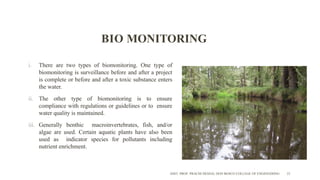
i. There are two types of biomonitoring. One type of
biomonitoring is surveillance before and after a project
is complete or before and after a toxic substance enters
the water.
ii. The other type of biomonitoring is to ensure
compliance with regulations or guidelines or to ensure
water quality is maintained.
iii. Generally benthic macroinvertebrates, fish, and/or
algae are used. Certain aquatic plants have also been
used as indicator species for pollutants including
nutrient enrichment.
ASST. PROF. PRACHI DESSAI, DON BOSCO COLLEGE OF ENGINEERING 23
BIO MONITORING
Advantages of biomonitoring:
i. Acts as a sensitive early warning system which may simulate prophylactic measures to prevent or diminish
disastrous effect of pollution.
i. Indicator organisms provide a direct method of studying the effects of the prevailing pollution in living
organisms and provide a measure of integrated effects of all environmental factors.
ii. It is possible to study the relationship between concentration of pollutants and its effects when both are
measured at same rate.
iii. Possibility of determining species and temporal trends in the occurrence and intensity of effects of several
pollutants on natural environment.
iv. Indicator organisms enable the analysis of polluting compounds by measuring accumulation within indicator
organisms.
v. Biomonitoring do not depend on electricity for their operation also do not need treatment and are early to
indicate the discovering vandalism.
vi. Biomonitoring can be done in remote areas and no expensive technical equipment is involved.
ASST. PROF. PRACHI DESSAI, DON BOSCO COLLEGE OF ENGINEERING 24

04 - Sampling, Continious & Biomonitoring.pptx

  • 1.
    INDUSTRIAL AND MUNICIPAL WASTEMANAGEMENT C.E 8.3.1 Unit II SAMPLING METHODS BIOMONITORING & CONTINIOUS MONITORING ASST. PROF. PRACHI DESSAI, DON BOSCO COLLEGE OF ENGINEERING 1
  • 2.
    SAMPLING i. Collection ofwater samples ii. Physical, Chemical and biological characteristics to determine its quality. iii. Results are compared against water quality standards in regulations and guidelines iv. Determine its use and/or the treatment required to make the water suitable for its intended use (e.g. drinking water). v. Accuracy of water analysis is dependent on i. Sampling method ii. Time elapsed between sampling and analysis iii. Techniques used in laboratory analysis iv. Interpretation of the results. ASST. PROF. PRACHI DESSAI, DON BOSCO COLLEGE OF ENGINEERING 2
  • 3.
    SAMPLING TYPES –GRAB SAMPLING i. Most common form of sampling ii. Reliable and easy to do. iii. Ways to take grab samples  No special equipment is needed.  A sampling container is used to take the sample.  The container can be dipped directly into the water or a sampling rod can be used to collect the water and fill the container.  Samples are then packed in a cooler box with ice and taken for testing. ASST. PROF. PRACHI DESSAI, DON BOSCO COLLEGE OF ENGINEERING 3
  • 4.
    SAMPLING TYPES –GRAB SAMPLING i. Single samples collected at a specific spot at a site over a short period of time (typically seconds or minutes). ii. Discrete grab samples are taken at a selected location, depth, andtime. iii. Depth-integrated grab samples are collected over a predetermined part or the entire depth of a water column, at a selected location and time in a given body of water. ASST. PROF. PRACHI DESSAI, DON BOSCO COLLEGE OF ENGINEERING 4
  • 5.
    SAMPLING TYPES –GRAB SAMPLING i. Source - Relatively constant in composition over an extended time or over substantial distances in all directions. E.g. Protectedgroundwater supplies ii. Source - vary with time, grab samples collected at suitable intervals and analyzed separately can document the extent, frequency, and duration of these variations. iii. E.g. Duration –expected changes of frequency -5 min to 1 h or more. iv. Seasonal variations in natural systems may necessitate sampling over months. ASST. PROF. PRACHI DESSAI, DON BOSCO COLLEGE OF ENGINEERING 5
  • 6.
    SAMPLING METHODS –COMPOSITE SAMPLES i. Taking a number of small samples, called sub-samples, over a period of time. ii. These are then combined to reflect the overall condition of a water body, like a lake. iii. These sub-samples are often referred to as aliquots. iv. In the field, aliquots of 200 ml are used to make up an overall sample of 1 000 ml. v. Composite samples - concentration of the analytes of interest may vary over short periods of time and/or space. ASST. PROF. PRACHI DESSAI, DON BOSCO COLLEGE OF ENGINEERING 6
  • 7.
    SAMPLING METHODS –COMPOSITE SAMPLES Sequential (time) composite samples - by using continuous, constant sample pumping or by mixing equal water volumes collected at regular time intervals. Flow-proportional composites - by continuous pumping at a rate proportional to the flow, mixing volumes of water proportional to the flow collected during or at regular time intervals. ASST. PROF. PRACHI DESSAI, DON BOSCO COLLEGE OF ENGINEERING 7
  • 8.
    SAMPLING METHODS –COMPOSITE SAMPLES Advantages : • reduced costs of analyzing a large number of samples • More representative samples of heterogeneous matrices • Larger sample sizes when amounts of test samples are limited. Disadvantages: • loss of analyte relationships in individual samples • potential dilution of analytes below detection levels • increased potential analytical interferences ASST. PROF. PRACHI DESSAI, DON BOSCO COLLEGE OF ENGINEERING 8
  • 9.
    SAMPLING METHODS • Manualsampling: • It requires trained field technicians and is often necessary for regulatory and research investigations for which critical appraisal of field conditions and complex sample-collection techniques are essential. Manually collect certain samples, such as waters containing oil and grease. • Automatic sampling: • Automatic sampler • Carefully match pump speeds and tubing sizes to the type of sample to be taken. • Sorbent sampling: • Use of solid sorbents, particularly membrane- type disks, is becoming more frequent. These methods offer rapid, inexpensive sampling if the analyses of interest can be adsorbed and desorbed efficiently and the water matrix is free of particulates that plug the sorbent. Eg. polyester pads, straw,clay ASST. PROF. PRACHI DESSAI, DON BOSCO COLLEGE OF ENGINEERING 9
  • 10.
    SAMPLING METHODS ASST. PROF.PRACHI DESSAI, DON BOSCO COLLEGE OF ENGINEERING 10 Automatic Sampling Devices
  • 11.
    SAMPLING CONTAINERS • Freeof analytes • Made of plastic or glass, but one material may be preferred over the other. E.g. silica, sodium, and boron may be leached from soft glass, but not plastic, and trace levels of some pesticides and metals may sorb onto the walls of glass containers. ASST. PROF. PRACHI DESSAI, DON BOSCO COLLEGE OF ENGINEERING 11
  • 12.
    SAMPLING CONTAINERS • Glasscontainers for all organics analyses, such as volatile organics, semi volatile organics, pesticides, PCBs, and oil andgrease. • Some analytes (e.g., bromine-containing compounds and some pesticides, and polynuclear aromatic compounds) are light- sensitive; collect them in amber-colored glass containers to minimize photo degradation. ASST. PROF. PRACHI DESSAI, DON BOSCO COLLEGE OF ENGINEERING 12
  • 13.
    SAMPLE VOLUMES Collect a1-L sample for most physical and chemical analyses. ASST. PROF. PRACHI DESSAI, DON BOSCO COLLEGE OF ENGINEERING 13
  • 14.
    SAMPLING PROCEDURE –FIELD •Sample labels (including bar-code labels): labels to prevent sample misidentification. • Gummed paper labels or tags • Information: • Sample number • Sample type • Name of collector • Date and time of collection • Place of collection • Preservative. ASST. PROF. PRACHI DESSAI, DON BOSCO COLLEGE OF ENGINEERING 14
  • 15.
    SAMPLING PROCEDURE –FIELD •Sample seals: to detect unauthorized tampering with samples up to the time of analysis. • Use self-adhesive paper seals • Attach seal so that it must be broken to open the sample container or the sample shipping container (e.g., a cooler). • Affix seal to container before sample leaves custody of sampling personnel. ASST. PROF. PRACHI DESSAI, DON BOSCO COLLEGE OF ENGINEERING 15
  • 16.
    SAMPLING PROCEDURE –FIELD •Field log book: Record all information pertinent to a field surveyor sampling in a bound log book. • Purpose of sampling • Location of sampling point • Name & Address of field contact • Procedure of material being sampled and address (if different from location) • Type of sample • Date and time • Description of sampling point and sampling method • Identification number • Photographs of the sampling site • Feld observations and measurements • Signatures of personnel responsible for observations. ASST. PROF. PRACHI DESSAI, DON BOSCO COLLEGE OF ENGINEERING 16
  • 17.
    SAMPLING PROCEDURE –FIELD •Chain-of-custody record: Fill out a chain-of-custody record to accompany each sample or group of samples. • Sample number • Signature of collector • Date & Time • Sample type • Sample preservation requirements • Signatures of persons involved in the chain of possession and inclusive dates and times of possession ASST. PROF. PRACHI DESSAI, DON BOSCO COLLEGE OF ENGINEERING 17
  • 18.
    SAMPLING PROCEDURE –FIELD •Sample analysis request sheet: accompanies samples to the laboratory. • Sample delivery to the laboratory: Deliver sample(s) to laboratory as soon as practicable after collection, typically within 2 d. • Receipt and logging of sample: • In the laboratory, the sample custodian inspects the condition and seal of the sample and reconciles label information and seal against the chain-of-custody record before the sample is accepted for analysis. After acceptance, the custodian assigns a laboratory number, logs sample in the laboratory log book and/or computerized laboratory information management system, and stores it in a secured storage room or cabinet or refrigerator at the specified temperature until it is assigned to an analyst. ASST. PROF. PRACHI DESSAI, DON BOSCO COLLEGE OF ENGINEERING 18
  • 19.
    SAMPLING PROCEDURE –FIELD •Assignment of sample for analysis • Disposal • Hold samples for the prescribed amount of time for the project or until the data have been reviewed and accepted. Document the disposition of samples. Ensure that disposal is in accordance with local, state, and U.S. EPA approved methods. ASST. PROF. PRACHI DESSAI, DON BOSCO COLLEGE OF ENGINEERING 19
  • 20.
    CONTINUOUS MONITORING ASST. PROF.PRACHI DESSAI, DON BOSCO COLLEGE OF ENGINEERING 20 i. Most industrial water treatment systems are dynamic. ii. Industrial water treatment systems may be monitored by manual methods or by continuous systems employing automatic instrumentation. iii. MANUAL MONITORING: Manual monitoring typically involves plant operators or technicians conducting chemical tests and comparing the results to specified chemical control limits. The testing frequency can vary from once per day to once per hour, depending on the plant resources available. iv. Manual monitoring is satisfactory for noncritical water systems or systems in which water and plant operating conditions change slowly.
  • 21.
    CONTINUOUS MONITORING ASST. PROF.PRACHI DESSAI, DON BOSCO COLLEGE OF ENGINEERING 21 CONTINUOUS, ON LINE MONITORING :Because of the dynamic nature of many water treatment systems and the worldwide need for improved reliability and quality, a higher degree of precision is required in the monitoring and control of water treatment programs than that obtained through manual monitoring. To achieve the degree of precision needed, continuous on-line monitoring with automatic instrumentation is required. The parameters monitoredinclude:  pH (0-14)  Flow (instant and total)  Temperature  Conductivity / Turbidity  TSS and / or TDS  Heavy Metals via colorimetric determination including (Fe,Cu, Cd, Cr,Ni, Zn, etc.)
  • 22.
    BIO MONITORING i. Aquaticbiomonitoring is the science of studying the ecological condition of rivers, lakes, streams, and wetlands by examining the organisms that live there. Biomonitoring of the impacts of toxicants can be done on a single species or on community. ii. The organisms which are used in biomonitoring are called as bio monitors. iii. These bio monitors provide the means for regular surveillance and to quantify the amount of pollutant present in the environment. iv. Biomonitoring is based on “when there are changes in water quality, there are changes in fish behavior”. ASST. PROF. PRACHI DESSAI, DON BOSCO COLLEGE OF ENGINEERING 22
  • 23.
    BIO MONITORING i. Thereare two types of biomonitoring. One type of biomonitoring is surveillance before and after a project is complete or before and after a toxic substance enters the water. ii. The other type of biomonitoring is to ensure compliance with regulations or guidelines or to ensure water quality is maintained. iii. Generally benthic macroinvertebrates, fish, and/or algae are used. Certain aquatic plants have also been used as indicator species for pollutants including nutrient enrichment. ASST. PROF. PRACHI DESSAI, DON BOSCO COLLEGE OF ENGINEERING 23
  • 24.
    BIO MONITORING Advantages ofbiomonitoring: i. Acts as a sensitive early warning system which may simulate prophylactic measures to prevent or diminish disastrous effect of pollution. i. Indicator organisms provide a direct method of studying the effects of the prevailing pollution in living organisms and provide a measure of integrated effects of all environmental factors. ii. It is possible to study the relationship between concentration of pollutants and its effects when both are measured at same rate. iii. Possibility of determining species and temporal trends in the occurrence and intensity of effects of several pollutants on natural environment. iv. Indicator organisms enable the analysis of polluting compounds by measuring accumulation within indicator organisms. v. Biomonitoring do not depend on electricity for their operation also do not need treatment and are early to indicate the discovering vandalism. vi. Biomonitoring can be done in remote areas and no expensive technical equipment is involved. ASST. PROF. PRACHI DESSAI, DON BOSCO COLLEGE OF ENGINEERING 24