Tutor: Dottoranda:
Prof. Stefano Piotto Piotto Federica Campana
Co-Tutor:
Prof. Pablo V. Escribá
Department of Biology, University of the Balearic Islands
Spain
Università degli Studi di Salerno
Dottorato di Ricerca in Scienza e Tecnologie per l’Industria Chimica, Farmaceutica e Alimentare
XI CICLO
Molecular dynamics investigations of drug-cell
membrane interactions
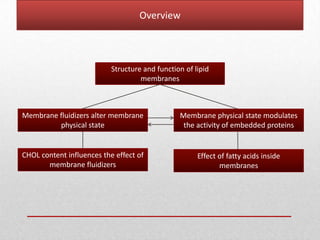
Structure and function of lipid
membranes
Membrane fluidizers alter membrane
physical state
Membrane physical state modulates
the activity of embedded proteins
CHOL content influences the effect of
membrane fluidizers
Effect of fatty acids inside
membranes
Overview
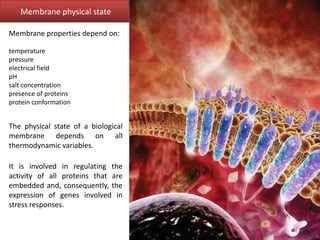
Membrane properties depend on:
temperature
pressure
electrical field
pH
salt concentration
presence of proteins
protein conformation
The physical state of a biological
membrane depends on all
thermodynamic variables.
Membrane physical state
It is involved in regulating the
activity of all proteins that are
embedded and, consequently, the
expression of genes involved in
stress responses.
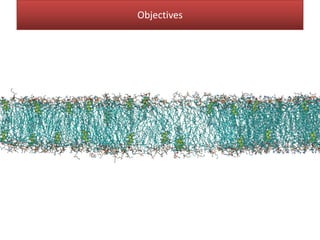
Objectives
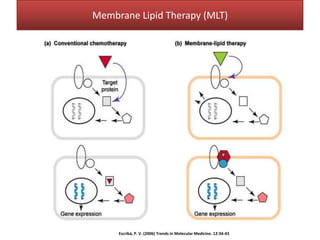
Escribá, P. V. (2006) Trends in Molecular Medicine. 12:34-43
Membrane Lipid Therapy (MLT)
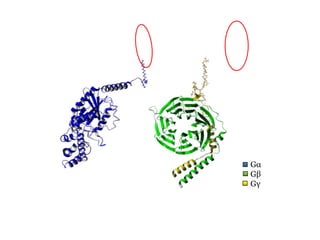
Gα monomer Gβγ dimer
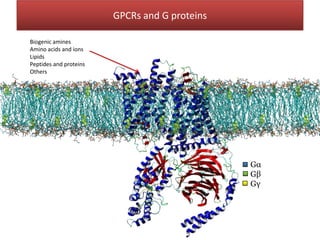
Biogenic amines
Amino acids and ions
Lipids
Peptides and proteins
Others
Gα
Gβ
Gγ
GPCRs and G proteins
Gα
Gβ
Gγ
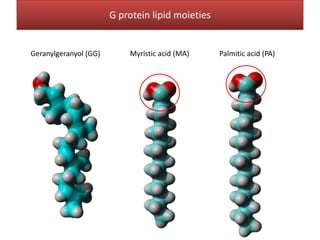
G protein lipid moieties
Geranylgeranyol (GG) Myristic alcohol (MOH) Palmitic alcohol (POH)Myristic acid (MA) Palmitic acid (PA)
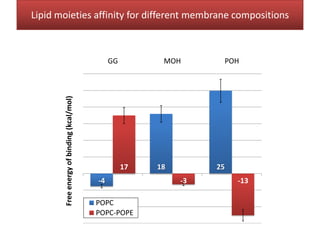
-4
18 2517
-3 -13
GG MOH POH
Freeenergyofbinding(kcal/mol)
POPC
POPC-POPE
Lipid moieties affinity for different membrane compositions
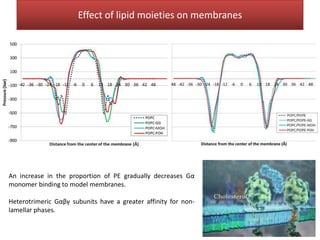
Effect of lipid moieties on membranes
An increase in the proportion of PE gradually decreases Gα
monomer binding to model membranes.
Heterotrimeric Gαβγ subunits have a greater affinity for non-
lamellar phases.
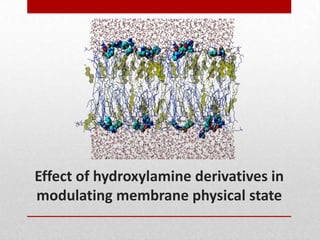
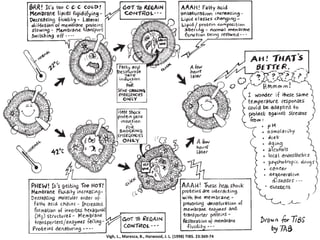
Effect of hydroxylamine derivatives in
modulating membrane physical state
Vigh, L., Maresca, B., Harwood, J. L. (1998) TIBS. 23:369-74
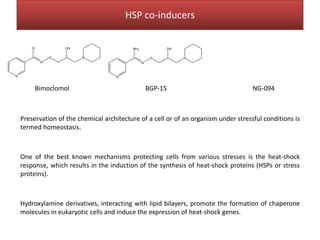
Preservation of the chemical architecture of a cell or of an organism under stressful conditions is
termed homeostasis.
One of the best known mechanisms protecting cells from various stresses is the heat-shock
response, which results in the induction of the synthesis of heat-shock proteins (HSPs or stress
proteins).
Hydroxylamine derivatives, interacting with lipid bilayers, promote the formation of chaperone
molecules in eukaryotic cells and induce the expression of heat-shock genes.
N
N
O N
Cl OH
N
N
O N
NH2 OH
Bimoclomol BGP-15 NG-094
HSP co-inducers
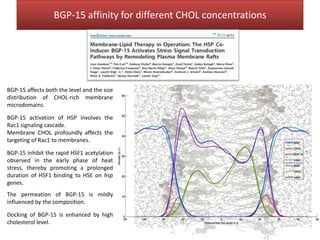
BGP-15 affinity for different CHOL concentrations
The permeation of BGP-15 is mildly
influenced by the composition.
Docking of BGP-15 is enhanced by high
cholesterol level.
BGP-15 affects both the level and the size
distribution of CHOL-rich membrane
microdomains.
BGP-15 activation of HSP involves the
Rac1 signaling cascade.
Membrane CHOL profoundly affects the
targeting of Rac1 to membranes.
BGP-15 inhibit the rapid HSF1 acetylation
observed in the early phase of heat
stress, thereby promoting a prolonged
duration of HSF1 binding to HSE on hsp
genes.
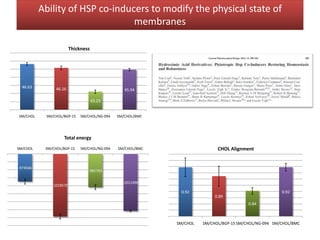
Ability of HSP co-inducers to modify the physical state of
membranes
46.63 46.16
43.23
45.94
SM/CHOL SM/CHOL/BGP-15 SM/CHOL/NG-094 SM/CHOL/BMC
Thickness
-974566
-1018570
-981763
-1011496
SM/CHOL SM/CHOL/BGP-15 SM/CHOL/NG-094 SM/CHOL/BMC
Total energy
0.92
0.89
0.84
0.92
SM/CHOL SM/CHOL/BGP-15 SM/CHOL/NG-094 SM/CHOL/BMC
CHOL Alignment
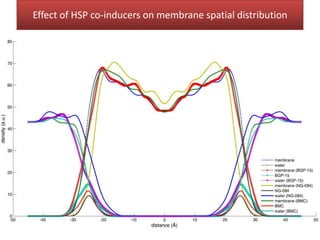
Effect of HSP co-inducers on membrane spatial distribution
CHOL content in lipid rafts influences
the effect of HSP co-inducers
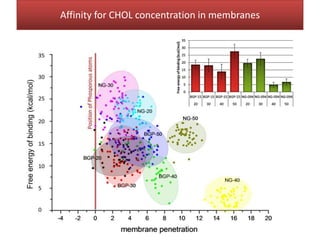
Affinity for CHOL concentration in membranes
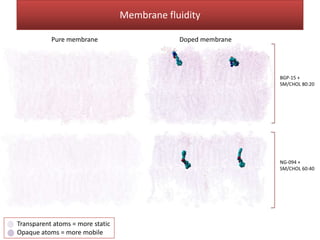
Transparent atoms = more static
Opaque atoms = more mobile
Membrane fluidity
Pure membrane Doped membrane
NG-094 +
SM/CHOL 60:40
BGP-15 +
SM/CHOL 80:20
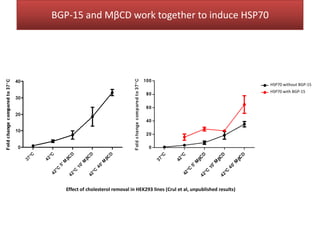
BGP-15 and MβCD work together to induce HSP70
HSP70 without BGP-15
HSP70 with BGP-15
Effect of cholesterol removal in HEK293 lines (Crul et al, unpublished results)
Hydroxy arachidonic acid, a new
potential non steroidal anti-
inflammatory molecule
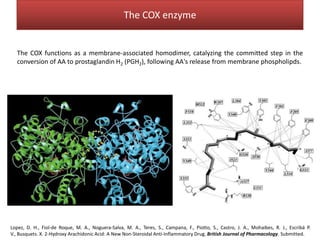
The COX functions as a membrane-associated homodimer, catalyzing the committed step in the
conversion of AA to prostaglandin H2 (PGH2), following AA's release from membrane phospholipds.
The COX enzyme
Lopez, D. H., Fiol-de Roque, M. A., Noguera-Salva, M. A., Teres, S., Campana, F., Piotto, S., Castro, J. A., Mohaibes, R. J., Escribá P.
V., Busquets. X. 2-Hydroxy Arachidonic Acid: A New Non-Steroidal Anti-Inflammatory Drug. British Journal of Pharmacology. Submitted.
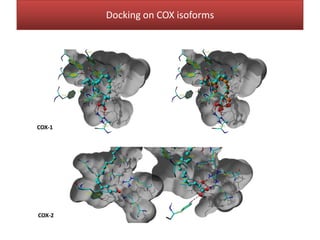
COX-1
COX-2
Docking on COX isoforms
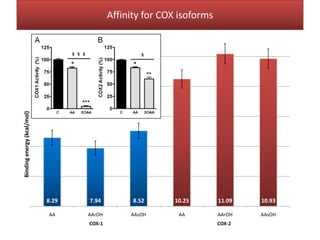
8.29 7.94 8.52 10.25 11.09 10.93
AA AArOH AAsOH AA AArOH AAsOH
Bindingenergy(kcal/mol)
COX-1 COX-2
Affinity for COX isoforms
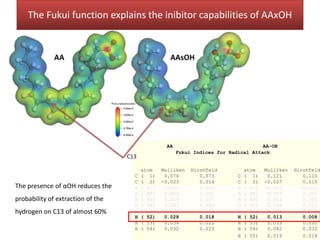
AA AA-OH
Fukui Indices for Radical Attack
atom Mulliken Hirshfeld atom Mulliken Hirshfeld
C ( 1) 0.076 0.073 C ( 1) 0.121 0.110
C ( 2) -0.023 0.014 C ( 2) -0.027 0.015
H ( 47) 0.000 0.000 H ( 47) -0.005 -0.002
H ( 48) 0.002 0.001 H ( 48) 0.007 0.003
H ( 49) 0.014 0.007 H ( 49) 0.011 0.005
O ( 50) 0.087 0.085 O ( 50) 0.108 0.111
O ( 51) 0.027 0.038 O ( 51) 0.056 0.065
H ( 52) 0.028 0.018 H ( 52) 0.013 0.008
H ( 53) 0.034 0.022 H ( 53) 0.033 0.020
H ( 54) 0.032 0.023 H ( 54) 0.042 0.032
H ( 55) 0.019 0.014
The presence of αOH reduces the
probability of extraction of the
hydrogen on C13 of almost 60%
The Fukui function explains the inibitor capabilities of AAxOH
Prof. Stefano Piotto Piotto
Prof.ssa Simona Concilio
Prof. Pio Iannelli
Dott.ssa Lucia Sessa
Lab. 12
Acknowledgement

Federica Campana PhD defense

  • 1.
    Tutor: Dottoranda: Prof. StefanoPiotto Piotto Federica Campana Co-Tutor: Prof. Pablo V. Escribá Department of Biology, University of the Balearic Islands Spain Università degli Studi di Salerno Dottorato di Ricerca in Scienza e Tecnologie per l’Industria Chimica, Farmaceutica e Alimentare XI CICLO Molecular dynamics investigations of drug-cell membrane interactions
  • 2.
    Structure and functionof lipid membranes Membrane fluidizers alter membrane physical state Membrane physical state modulates the activity of embedded proteins CHOL content influences the effect of membrane fluidizers Effect of fatty acids inside membranes Overview
  • 4.
    Membrane properties dependon: temperature pressure electrical field pH salt concentration presence of proteins protein conformation The physical state of a biological membrane depends on all thermodynamic variables. Membrane physical state It is involved in regulating the activity of all proteins that are embedded and, consequently, the expression of genes involved in stress responses.
  • 5.
  • 6.
    Escribá, P. V.(2006) Trends in Molecular Medicine. 12:34-43 Membrane Lipid Therapy (MLT)
  • 7.
    Gα monomer Gβγdimer Biogenic amines Amino acids and ions Lipids Peptides and proteins Others Gα Gβ Gγ GPCRs and G proteins
  • 8.
  • 9.
    G protein lipidmoieties Geranylgeranyol (GG) Myristic alcohol (MOH) Palmitic alcohol (POH)Myristic acid (MA) Palmitic acid (PA)
  • 10.
    -4 18 2517 -3 -13 GGMOH POH Freeenergyofbinding(kcal/mol) POPC POPC-POPE Lipid moieties affinity for different membrane compositions
  • 11.
    Effect of lipidmoieties on membranes An increase in the proportion of PE gradually decreases Gα monomer binding to model membranes. Heterotrimeric Gαβγ subunits have a greater affinity for non- lamellar phases.
  • 12.
    Effect of hydroxylaminederivatives in modulating membrane physical state
  • 13.
    Vigh, L., Maresca,B., Harwood, J. L. (1998) TIBS. 23:369-74
  • 14.
    Preservation of thechemical architecture of a cell or of an organism under stressful conditions is termed homeostasis. One of the best known mechanisms protecting cells from various stresses is the heat-shock response, which results in the induction of the synthesis of heat-shock proteins (HSPs or stress proteins). Hydroxylamine derivatives, interacting with lipid bilayers, promote the formation of chaperone molecules in eukaryotic cells and induce the expression of heat-shock genes. N N O N Cl OH N N O N NH2 OH Bimoclomol BGP-15 NG-094 HSP co-inducers
  • 15.
    BGP-15 affinity fordifferent CHOL concentrations The permeation of BGP-15 is mildly influenced by the composition. Docking of BGP-15 is enhanced by high cholesterol level. BGP-15 affects both the level and the size distribution of CHOL-rich membrane microdomains. BGP-15 activation of HSP involves the Rac1 signaling cascade. Membrane CHOL profoundly affects the targeting of Rac1 to membranes. BGP-15 inhibit the rapid HSF1 acetylation observed in the early phase of heat stress, thereby promoting a prolonged duration of HSF1 binding to HSE on hsp genes.
  • 16.
    Ability of HSPco-inducers to modify the physical state of membranes 46.63 46.16 43.23 45.94 SM/CHOL SM/CHOL/BGP-15 SM/CHOL/NG-094 SM/CHOL/BMC Thickness -974566 -1018570 -981763 -1011496 SM/CHOL SM/CHOL/BGP-15 SM/CHOL/NG-094 SM/CHOL/BMC Total energy 0.92 0.89 0.84 0.92 SM/CHOL SM/CHOL/BGP-15 SM/CHOL/NG-094 SM/CHOL/BMC CHOL Alignment
  • 17.
    Effect of HSPco-inducers on membrane spatial distribution
  • 18.
    CHOL content inlipid rafts influences the effect of HSP co-inducers
  • 19.
    Affinity for CHOLconcentration in membranes
  • 20.
    Transparent atoms =more static Opaque atoms = more mobile Membrane fluidity Pure membrane Doped membrane NG-094 + SM/CHOL 60:40 BGP-15 + SM/CHOL 80:20
  • 21.
    BGP-15 and MβCDwork together to induce HSP70 HSP70 without BGP-15 HSP70 with BGP-15 Effect of cholesterol removal in HEK293 lines (Crul et al, unpublished results)
  • 22.
    Hydroxy arachidonic acid,a new potential non steroidal anti- inflammatory molecule
  • 23.
    The COX functionsas a membrane-associated homodimer, catalyzing the committed step in the conversion of AA to prostaglandin H2 (PGH2), following AA's release from membrane phospholipds. The COX enzyme Lopez, D. H., Fiol-de Roque, M. A., Noguera-Salva, M. A., Teres, S., Campana, F., Piotto, S., Castro, J. A., Mohaibes, R. J., Escribá P. V., Busquets. X. 2-Hydroxy Arachidonic Acid: A New Non-Steroidal Anti-Inflammatory Drug. British Journal of Pharmacology. Submitted.
  • 24.
  • 25.
    8.29 7.94 8.5210.25 11.09 10.93 AA AArOH AAsOH AA AArOH AAsOH Bindingenergy(kcal/mol) COX-1 COX-2 Affinity for COX isoforms
  • 26.
    AA AA-OH Fukui Indicesfor Radical Attack atom Mulliken Hirshfeld atom Mulliken Hirshfeld C ( 1) 0.076 0.073 C ( 1) 0.121 0.110 C ( 2) -0.023 0.014 C ( 2) -0.027 0.015 H ( 47) 0.000 0.000 H ( 47) -0.005 -0.002 H ( 48) 0.002 0.001 H ( 48) 0.007 0.003 H ( 49) 0.014 0.007 H ( 49) 0.011 0.005 O ( 50) 0.087 0.085 O ( 50) 0.108 0.111 O ( 51) 0.027 0.038 O ( 51) 0.056 0.065 H ( 52) 0.028 0.018 H ( 52) 0.013 0.008 H ( 53) 0.034 0.022 H ( 53) 0.033 0.020 H ( 54) 0.032 0.023 H ( 54) 0.042 0.032 H ( 55) 0.019 0.014 The presence of αOH reduces the probability of extraction of the hydrogen on C13 of almost 60% The Fukui function explains the inibitor capabilities of AAxOH
  • 27.
    Prof. Stefano PiottoPiotto Prof.ssa Simona Concilio Prof. Pio Iannelli Dott.ssa Lucia Sessa Lab. 12 Acknowledgement