Synthesis of Novel 3′-C-Methylene Thymidine and 5-Methyluridine/
Cytidine H-Phosphonates and Phosphonamidites for New
Backbone Modification of Oligonucleotides
Haoyun An,*,† Tingmin Wang, Martin A. Maier, Muthiah Manoharan, Bruce S. Ross, and
P. Dan Cook
Isis Pharmaceuticals, Inc., 2292 Faraday Avenue, Carlsbad, California 92008
han@isisph.com
Received December 4, 2000
Novel 5′-O-DMT- and MMT-protected 3′-C-methylene-modified thymidine, 5-methyluridine, and
5-methylcytidine H-phosphonates 1-7 with O-methyl, fluoro, hydrogen, and O-(2-methoxyethyl)
substituents at the 2′-position have been synthesized by a new effective strategy from the
corresponding key intermediates 3′-C-iodomethyl nucleosides and intermediate BTSP, prepared
in situ through the Arbuzov reaction. The modified reaction conditions for the Arbuzov reaction
prevented the loss of DMT- and MMT-protecting groups, and directly provided the desired 5′-O-
DMT- and/or MMT-protected 3′-C-methylene-modified H-phosphonates 1-6 although some of them
were also prepared through the manipulation of protecting groups after the P-C bond formation.
The modified Arbuzov reaction of 3′-C-iodomethyl-5-methylcytidine 53, prepared from its 5-me-
thyluridine derivative 42, with BTSP provided the 5-methylcytidine H-phosphonate 54, which was
further transferred to the corresponding 4-N-(N-methylpyrrolidin-2-ylidene)-protected H-phospho-
nate monomer 7. 5′-O-MMT-protected 3′-C-methylene-modified H-phosphonates 5, 3, and 7 were
converted to the corresponding cyanoethyl H-phosphonates 50, 51, and 56 using DCC as a coupling
reagent. One-pot three-step reactions of 50, 51, and 56 provided the desired 3′-C-methylene-modified
phosphonamidite monomers 8-10. Some of these new 3′-methylene-modified monomers 1-10 have
been successfully utilized for the synthesis of 3′-methylene-modified oligonucleotides, which have
shown superior antisense properties including nuclease resistance and binding affinity to the target
RNA.
Introduction
Extensive investigation1 of antisense oligonucleotides
as therapeutics with antiviral, anticancer, antibacterial,
antiinflammatory, and other indications2
has resulted in
19 clinical candidates, and the first antisense drug,
Vitravene, has been launched on the market.3 Most of
these candidates are phosphorothioate oligonucleotides
in which one of the nonbridging oxygen atoms of the
phosphate ester linkage of natural DNA (see structure
I, Figure 1) is replaced with sulfur. This modification
provides improved nuclease resistance to endonucleases
and exonucleases and retains the ability to activate
RNase H to cleave the target RNA.4,5
However, phospho-
rothioate oligonucleotides have limitations of poor oral
bioavailability and nonspecific binding to proteins. Re-
cently, methylphosphonate,6
phosphoramidate,7
mor-
pholino,8 amide,9 boranophosphate,10 methylene(meth-
ylimino) (MMI),11 5′-methylphosphonate,12 and other13
† Current address: ICN Pharmaceuticals, Inc., 3300 Hyland Avenue,
Costa Mesa, CA 92626
(1) (a) Uhlmann, E.; Peyman, A. Chem. Rev. 1990, 90, 543-584. (b)
Crooke, S. T.; Bennett, C. F. Annu. Rev. Pharmacol. Toxicol. 1996,
36, 107-129. (c) Bennett, C. F. Biochem. Pharmacol. 1998, 55, 9-19.
(d) Gee, J. E.; Robbins, I.; van der Laan, A. C.; van Boom, J. H.;
Colombier, C.; Leng, M.; Paible, A. M.; Nelson, J. S.; Lebleu, B.
Antisense Nucleic Acid Drug Dev. 1998, 8, 103-111. (e) Crooke, S. T.
Biochim. Biophys. Acta 1999, 1489, 31-44.
(2) (a) Holmlund, J. T.; Monia, B. P.; Kwoh, T. J.; Dorr, F. A. Curr.
Opin. Mol. Ther. 1999, 1, 372-385. (b) Dorr, F. A. Antisense Nucleic
Acid Drug Dev. 1999, 9, 391-396. (c) Taylor, J. K.; Dean, N. M. Curr.
Opin. Drug Dev. 1999, 2, 147-151. (d) Marcusson, E. G.; Yacyshyn,
B. R.; Shanahan, W. R. Jr.; Dean, N. M. Mol. Biotechnol. 1999, 12,
1-11. (e) Chopra, I. Exp. Opin. Invest. Drugs 1999, 8, 1203-1208. (f)
Lebedeva, I. V.; Stein, C. A. BioDrugs 2000, 13, 195-216.
(3) (a) Cook, P. D. Handb. Exp. Pharmacol. 1998, 131 (Antisese Res.
Appl.), 51-101. (b) Cook, P. D. Making Drugs Out of Oligonucleotidess
Assessment After Ten years. XIV International Roundatable: Nucleo-
sides, Nucleotides and Their Biological Applications, Sep 10-14, 2000,
San Francisco; No. 34, p 31.
(4) (a) Cook, P. D. Nucleosides Nucleotides 1999, 18, 1141-1161.
(b) Uhlmann, E. Curr. Opin. Drug Discovery Dev. 2000, 3, 203-213. (c)
Freier, S. M.; Altmann, K. H. Nucleic Acids Res. 1997, 25, 4429-4443.
(d) Matteucci, M. Perspect. Drug Discovery Design 1996, 4, 1-16.
(5) (a) Cook, P. D. Annu. Rep. Med. Chem. 1998, 33, 313-325. (b)
Manoharan, M. Biochim. Biophys. Acta 1999, 1489, 117-130.
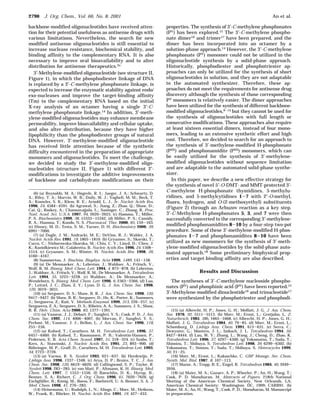
Figure 1. Chemical Structures of Natural DNA (I) and 2′-
Substituted 3′-Methylene-Modified Oligonucleotides (II).
2789J. Org. Chem. 2001, 66, 2789-2801
10.1021/jo001699u CCC: $20.00 © 2001 American Chemical Society
Published on Web 03/16/2001
backbone-modified oligonucleotides have received atten-
tion for their potential usefulness as antisense drugs with
various limitations. Nevertheless, the search for new
modified antisense oligonucleotides is still essential to
increase nuclease resistance, biochemical stability, and
binding affinity to the complementary RNA. It is also
necessary to improve oral bioavailability and to alter
distribution for antisense therapeutics.3a
3′-Methylene-modified oligonucleotide (see structure II,
Figure 1), in which the phosphodiester linkage of DNA
is replaced by a 3′-C-methylene phosphonate linkage, is
expected to increase the enzymatic stability against endo/
exo-nucleases and improve the target-binding affinity
(Tm) to the complementary RNA based on the initial
X-ray analysis of an octamer having a single 3′-C-
methylene phosphonate linkage.14
In addition, 3′-meth-
ylene-modified oligonucleotides may enhance membrane
permeability, improve bioavailability and cellular uptake,
and also alter distribution, because they have higher
lipophilicity than the phosphodiester groups of natural
DNA. However, 3′-methylene-modified oligonucleotide
has received little attention because of the synthetic
difficulty encountered in the preparation of appropriate
monomers and oligonucleotides. To meet the challenge,
we decided to study the 3′-methylene-modified oligo-
nucleotides (structure II, Figure 1) with different 2′-
modifications to investigate the additive improvements
of backbone and carbohydrate modifications on their
properties. The synthesis of 3′-C-methylene phosphonates
(PV
) has been explored.15
The 3′-C-methylene phospho-
nate dimer16 and trimer17 have been prepared, and the
dimer has been incorporated into an octamer by a
solution-phase approach.14
However, the 3′-C-methylene
phosphonate (PV) monomer could not be utilized in the
oligonucleotide synthesis by a solid-phase approach.
Historically, phosphodiester and phosphotriester ap-
proaches can only be utilized for the synthesis of short
oligonucleotides in solution, and they are not adaptable
to the automated synthesizer. Therefore, these ap-
proaches do not meet the requirements for antisense drug
discovery although the synthesis of those corresponding
PV
monomers is relatively easier. The dimer approaches
have been utilized for the synthesis of different backbone-
modified oligonucleotides,9-14 but they cannot be used for
the synthesis of oligonucleotides with full length or
consecutive modifications. These approaches also require
at least sixteen essential dimers, instead of four mono-
mers, leading to an extensive synthetic effort and high
cost. Therefore, we decided to search for an approach to
the synthesis of 3′-methylene-modified H-phosphonate
(PIII) and phosphonamidite (PIII) monomers, which can
be easily utilized for the synthesis of 3′-methylene-
modified oligonucleotides without sequence limitation
and are adaptable to the automated solid-phase synthe-
sizer.
In this paper, we describe a new effective strategy for
the synthesis of novel 5′-O-DMT- and MMT-protected 3′-
C-methylene H-phosphonate thymidines, 5-methylu-
ridines, and 5-methylcytidines 1-7 with 2′-O-methyl,
fluoro, hydrogen, and O-(2-methoxyethyl) substituents
(Figure 2) through an Arbuzov reaction as a key step.
3′-C-Methylene H-phosphonates 5, 3, and 7 were then
successfully converted to the corresponding 3′-methylene-
modified phosphonamidites 8-10 by a four-step two-pot
procedure. Some of these 3′-methylene-modified H-phos-
phonates 1-7 and phosphonamidites 8-10 have been
utilized as new monomers for the synthesis of 3′-meth-
ylene-modified oligonucleotides by the solid-phase auto-
mated approach.18
Some preliminary biophysical prop-
erties and target-binding affinity are also described.
Results and Discussion
The syntheses of 3′-C-methylene nucleoside phospho-
nates (PV) and phosphinic acid (PV) have been reported.15
3′-Methylene-modified dinucleotide16 and trinucleotide17
were synthesized by the phosphotriester and phosphodi-
(6) (a) Reynolds, M. A.; Hogrefe, R. I.; Jaeger, J. A.; Schwartz, D.
A.; Riley, T. A.; Marvin, W. B.; Daily, W. J.; Vaghefi, M. M.; Beck, T.
A.; Knowles, S. K.; Klem, R. E.; Arnold, L. J., Jr. Nucleic Acids Res.
1996, 24, 4584-4591. (b) Agrawal, S.; Jiang, Z.; Zhao, Q.; Shaw, D.;
Cai, Q.; Roskey, A.; Channavajjala, L.; Saxinger, C.; Zhang, R. Proc.
Natl. Acad. Sci. U.S.A. 1997, 94, 2620-2625. (c) Hamma, T.; Miller,
P. S. Biochemistry 1999, 38, 15333-15342. (d) Miller, P. S.; Cassidy,
R. A.; Hamma, T.; Kondo, N. S. Pharmacol. Ther. 2000, 85, 159-163.
(e) Disney, M. D.; Testa, S. M.; Turner, D. H. Biochemistry 2000, 39,
6991-7000.
(7) (a) Dagle, J. M.; Andracki, M. E.; DeVine, R. J.; Walder, J. A.
Nucleic Acids Res. 1991, 19, 1805-1810. (b) Gryaznov, S.; Skorski, T.;
Cucco, C.; Nieborowska-Skorska, M.; Chiu, C. Y.; Lioyd, D.; Chen, J.
K.; Koziolkiewicz M.; Calabretta, B. Nucleic Acids Res. 1996, 24, 1508-
1514. (c) Gryaznov, S. M.; Winter, H. Nucleic Acids Res. 1998, 26,
4160-4167.
(8) Summerton, J. Biochim. Biophys. Acta 1999, 1489, 141-158.
(9) (a) De Mesmaeker, A.; Lebreton, J.; Waldner, A.; Fritsch, V.;
Wolf, R. M. Bioorg. Med. Chem. Lett. 1994, 4, 873-878. (b) Lebreton,
J.; Waldner, A.; Fritsch, V.; Wolf, R. M.; De Mesmaeker, A. Tetrahedron
Lett. 1994, 35, 5225-5228. (c) Waldner, A.; De Mesmaeker, A.;
Wendeborn, S. Bioorg. Med. Chem. Lett. 1996, 6, 2363-2366. (d) Luo,
P.; Leitzel, J. C.; Zhan, Z. Y.; Lynn, D. G. J. Am. Chem. Soc. 1998,
120, 3019-3031.
(10) (a) Sergueev, D. S.; Shaw, B. R. J. Am. Chem. Soc. 1998, 120,
9417-9427. (b) Shaw, B. R.; Sergueev, D.; He, K.; Porter, K.; Summers,
J.; Sergueeva, Z.; Rait, V. Methods Enzymol. 1999, 313, 226-257. (c)
Sergueeva, Z. A.; Sergueev, D. S.; Ribeiro, A. A.; Summers, J. S.; Shaw,
B. R. Helv. Chim. Acta 2000, 83, 1377-1391.
(11) (a) Vasseur, J. J.; Debart, F.; Sanghvi, Y. S.; Cook, P. D. J. Am.
Chem. Soc. 1992, 114, 4006-4007. (b) Morvan, F.; Sanghvi, Y. S.;
Perbost, M.; Vasseur, J. J.; Bellon, L. J. Am. Chem. Soc. 1996, 118,
255-256.
(12) (a) Kofoed, T.; Caruthers, M. H. Tetrahedron Lett. 1996, 37,
6457-6460. (b) Kofoed, T.; Rasmussen, P. B.; Valentin-Hansen, P.;
Pedersen, E. B. Acta Chem. Scand. 1997, 51, 318-324. (c) Szabo, T.;
Kers, A.; Stawinski, J. Nucleic Acids Res. 1995, 23, 893-900. (d)
Bo¨hringer, M. P.; Graff, D.; Caruthers, M. H. Tetrahedron Lett. 1993,
34, 2723-2726.
(13) (a) Varma, R. S. Synlett 1993, 621-637. (b) Herdewijn, P.
Liebigs Ann. 1996, 1337-1348. (c) Arya, D. P.; Bruice, T. C. J. Am.
Chem. Soc. 1998, 120, 6619-6620. (d) Collingwood, S. P.; Taylor, R.
Synlett 1998, 283-285. (e) von Matt, P.; Altmann, K. H. Bioorg. Med.
Chem. Lett. 1997, 7, 1553-1556. (f) Baeschlin, D. K.; Hyrup, B.;
Benner, S. A.; Richert, C. J. Org. Chem. 1996, 61, 7620-7626. (g)
Eschgfa¨ller, B.; Ko¨nig, M.; Boess, F.; Boelsterli, U. A. Benner, S. A. J.
Med. Chem. 1998, 41, 276-283.
(14) Heinemann, U.; Rudolph, L. N.; Alings, C.; Morr, M.; Heikens,
W.; Frank, R.; Blo¨cker, H. Nucleic Acids Res. 1991, 19, 427-433.
(15) (a) Albrecht, H. P.; Jones, G. H.; Moffatt, J. G. J. Am. Chem.
Soc. 1970, 92, 5511-5513. (b) Morr, M.; Ernst, L.; Grotjahn, L. Z.
Naturforsch. 1983, 38b, 1665-1668. (c) Albrecht, H. P.; Jones, G. H.;
Moffatt, J. G. Tetrahedron 1984, 40, 79-85. (d) Morr, M.; Ernst, L.;
Schomburg, D. Liebigs Ann. Chem. 1991, 615-631. (e) Serra, C.;
Dewynter, G.; Montero, J. L.; Imbach, J. L. Tetrahedron 1994, 50,
8427-8444. (f) Lau, W. Y.; Zhang, L.; Wang, J.; Cheng, D.; Zhao, K.
Tetrahedron Lett. 1996, 37, 4297-4300. (g) Yokomatsu, T.; Sada, T.;
Shimizu, T.; Shibuya, S. Tetrahedron Lett. 1998, 39, 6299-6302. (h)
Yokomatsu, T.; Simizu, T.; Sada, T.; Shibuya, S. Heterocycles 1999,
50, 21-25.
(16) Morr, M.; Ernst, L.; Kakoschke, C. GBF Monogr. Ser. Chem.
Synth. Mol. Biol. 1987, 8, 107-113.
(17) Mazur, A.; Tropp, B. E.; Engel, R. Tetrahedron 1984, 40, 3949-
3956.
(18) (a) Maier, M. A.; Guzaev, A. P.; Wheeler, P.; An, H.; Wang, T.;
Cook, P. D. Manoharan, M. Abstracts of Papers. 218th National
Meeting of the American Chemical Society, New Orleands, LA;
American Chemical Society: Washington, DC, 1999; CARB91. (b)
Maier, M. A.; An, H.; Wang, T.; Cook, P. D.; Manoharan, M. Manuscript
in preparation.
2790 J. Org. Chem., Vol. 66, No. 8, 2001 An et al.
ester approaches in solution. One GpG dimer, containing
one 3′-C-methylene-substituted phosphonate linkage, was
incorporated into an octamer by a phosphotriester ap-
proach in solution for conformational studies.14
This
method can only be used for the synthesis of short
oligonucleotides in solution. It is impossible to use this
historic method for the synthesis of long oligonucleotides
by the automated solid-phase approach. Only 3′-C-
methylene H-phosphonate and phosphonamidite mono-
mers (PIII
) can be utilized for the synthesis of the desired
3′-methylene-modified oligonucleotides on solid support,
therefore, adaptable to automation. Collingwood and co-
workers19
outlined the synthesis of 5′-O-DMT-3′-deoxy-
3′-C-methylenethymidine H-phosphonate without detail.
Recently, we have disclosed the synthesis of 5′-O-DMT-
and MMT-protected 3′-C-methylene H-phosphonate thy-
midine/5-methyluridines with different 2′-substituents by
a new efficient strategy.20 The increasing interest in
antisense therapeutics and the great importance for
improving enzymatic stability, binding affinity, and other
properties of antisense drugs prompted us to report the
full details of our discovery on the 3′-methylene backbone
modification.
The 3′-methylene-modified thymidine, 5-methyluri-
dine, and 5-methylcytidine H-phosphonates 1-7 were
synthesized through the Arbuzov reaction as a key step,
and the 3′-methylene-modified phosphonamidites 8-10
were successfully synthesized from their corresponding
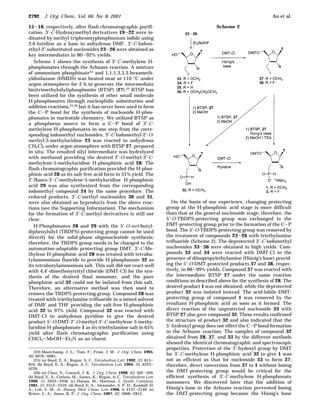
H-phosphonate derivatives (Figure 2). Scheme 1 shows
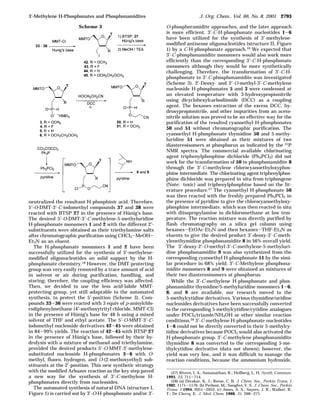
the synthesis of key intermediates 3′-C-iodomethyl nu-
cleoside derivatives 23-26. The 3′-O-(3-tert-butylphe-
noxythiocarbonate) nucleosides 11-14 were prepared by
the reaction of 3′-tert-butylphenyl chlorothionoformate
with the corresponding 5′-protected 2′-substituted nucle-
oside derivatives following the similar procedure for the
preparation of 3′-O-phenoxythiocarbonyl derivatives.21,22
The radical reactions of 11-14 with β-tributylstannyl
styrene23
were initiated by 2,2′-azobisisobutyronitrile
(AIBN) providing the corresponding 3′-C-styrene deriva-
tives 15-18. The oxidation reactions of 15-18 were
catalyzed by osmium tetraoxide in the presence of N-
methylmorpholine N-oxide. Thus resulted diols were
oxidatively cleaved using sodium periodate as an oxidiz-
ing agent in a mixture of dioxane and water. Thus
obtained corresponding 3′-C-aldehyde derivatives were
directly reduced by sodium borohydride without further
purification in order to avoid their decomposition. The
3′-C-hydroxymethyl nucleosides 19-22 were obtained in
36-80% overall yields in three steps from compounds
(19) Collingwood, S. P.; Douglas, M. E.; Natt, F.; Pieles, U. Phos-
phorus Sulfur Silicon 1999, 144-146, 645-648.
(20) An, H.; Wang, T.; Cook, P. D. Tetrahedron Lett. 2000, 41, 7813-
7816.
(21) Sanghvi, Y. S.; Bharadwaj, R.; Debart, F.; De Mesmaeker, A.
Synthesis 1994, 1163-1166.
(22) Dimock, S.; Bhat, B.; Peoc′h, D.; Sanghvi, Y. S.; Swayze, E. E.
Nucleosides Nucleotides 1997, 16, 1629-1632.
(23) (a) Saihi, M. L.; Pereyre, M. Bull. Soc. Chim. Fr. 1977, 1251-
1255. (b) Sanghvi, Y. S.; Ross, B. S.; Bharadwaj, R.; Vasseur, J. J.
Tetrahedron Lett. 1994, 35, 4697-4700.
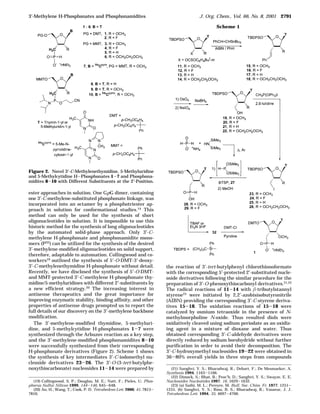
Figure 2. Novel 3′-C-Methylenethymidine, 5-Methyluridine
and 5-Methylcytidine H-Phosphonates 1-7 and Phosphona-
midites 8-10 with Different Substituents at the 2′-Position.
Scheme 1
3′-Methylene H-Phosphonates and Phosphonamidites J. Org. Chem., Vol. 66, No. 8, 2001 2791
15-18, respectively, after flash chromatographic purifi-
cation. 3′-C-Hydroxymethyl derivatives 19-22 were io-
dinated by methyl triphenoxyphosphonium iodide using
2,6-lutidine as a base in anhydrous DMF. 3′-C-Iodom-
ethyl-2′-substituted nucleosides 23-26 were obtained as
key intermediates in 80-92% yields.
Scheme 1 shows the synthesis of 3′-C-methylene H-
phosphonates through the Arbuzov reaction. A mixture
of ammonium phosphinate24 and 1,1,1,3,3,3-hexameth-
yldisilazane (HMDS) was heated neat at 110 °C under
argon atmosphere for 2 h to generate the intermediate
bis(trimethylsilyl)phosphonite (BTSP) (27).25 BTSP has
been utilized for the synthesis of other small molecule
H-phosphonates through nucleophilic substitution and
addition reactions,25,26 but it has never been used to form
the C-P bond for the synthesis of nucleoside H-phos-
phonates in nucleotide chemistry. We utilized BTSP as
a phosphorus source to form a C-P bond of 3′-C-
methylene H-phosphonates in one step from the corre-
sponding iodomethyl nucleosides. 3′-C-Iodomethyl-2′-O-
methyl-5-methyluridine 23 was reacted in anhydrous
CH2Cl2 under argon atmosphere with BTSP 27, prepared
in situ. The resulted silyl intermediate was hydrolyzed
with methanol providing the desired 2′-O-methyl-3′-C-
methylene-5-methyluridine H-phosphinic acid 28. The
flash chromatographic purification provided the H-phos-
phinic acid 28 as its salt-free acid form in 31% yield. The
2′-fluoro-3′-C-methylene-5-methyluridine H-phosphinic
acid 29 was also synthesized from the corresponding
iodomethyl compound 24 by the same procedure. The
reduced products, 3′-C-methyl nucleosides 30 and 31,
were also obtained as byproducts from the above reac-
tions (see the Supporting Information). The mechanism
for the formation of 3′-C-methyl derivatives is still not
clear.
H-Phosphonates 28 and 29 with the 5′-O-tert-butyl-
diphenylsilyl (TBDPS)-protecting group cannot be used
directly for the solid-phase oligonucleotide synthesis;
therefore, the TBDPS group needs to be changed to the
automation-adaptable protecting group DMT. 3′-C-Me-
thylene H-phosphinic acid 28 was treated with tetrabu-
tylammonium fluoride to provide H-phosphonate 32 as
its tetrabutylammonium salt. This salt did not react well
with 4,4′-dimethoxytrityl chloride (DMT-Cl) for the syn-
thesis of the desired final monomer, and the pure
phosphinic acid 32 could not be isolated from this salt.
Therefore, an alternative method was then used to
remove the TBDPS-protecting group. Compound 28 was
treated with triethylamine trifluoride in a mixed solvent
of DMF and THF providing the salt-free H-phosphinic
acid 32 in 97% yield. Compound 32 was reacted with
DMT-Cl in anhydrous pyridine to give the desired
product 5′-O-DMT-2′-O-methyl-3′-C-methylene-5-methy-
luridine H-phosphonate 1 as its triethylamine salt in 65%
yield after flash chromatographic purification using
CHCl3-MeOH-Et3N as an eluent.
On the basis of our experience, changing protecting
group at the H-phosphinic acid stage is more difficult
than that at the general nucleoside stage; therefore, the
5′-O-TBDPS-protecting group was exchanged to the
DMT-protecting group prior to the formation of the C-P
bond. The 5′-O-TBDPS-protecting group was removed by
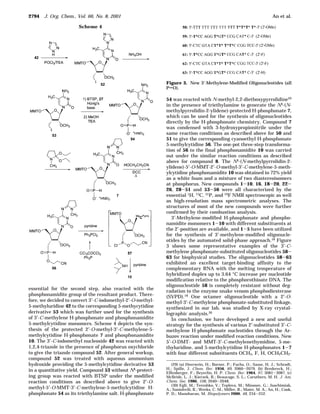
the treatment of compounds 23-26 with triethylamine
trifluoride (Scheme 2). The deprotected 3′-C-iodomethyl
nucleosides 33-36 were obtained in high yields. Com-
pounds 33 and 34 were reacted with DMT-Cl in the
presence of diisopropylethylamine (Hu¨nig’s base) provid-
ing the 5′-O-DMT-protected products 37 and 38, respec-
tively, in 88-99% yields. Compound 37 was reacted with
the intermediate BTSP 27 under the same reaction
conditions as described above for the synthesis of 28. The
desired product 1 was not obtained, while the deprotected
product 32 was isolated instead. The acid-labile DMT-
protecting group of compound 1 was removed by the
resultant H-phosphinic acid as soon as it formed. The
direct reaction of the unprotected nucleoside 33 with
BTSP 27 also gave compound 32. These results confirmed
the structure of product 32 and also indicated that the
5′-hydroxyl group does not effect the C-P bond formation
in the Arbuzov reaction. The samples of compound 32
obtained from 28, 37, and 33 by the different methods
showed the identical chromatographic and spectroscopic
properties. Protection of the 5′-hydoxyl group by DMT
for 3′-C-methylene H-phosphinic acid 32 to give 1 was
not as efficient as that for nucleoside 33 to form 37;
therefore, direct conversion from 37 to 1 without losing
the DMT-protecting group would be critical for the
efficient synthesis of 3′-C-methylene H-phosphonate
monomers. We discovered later that the addition of
Hu¨nig’s base in the Arbuzov reaction prevented losing
the DMT-protecting group because the Hu¨nig’s base
(24) Montchamp, J. L.; Tian, F.; Frost, J. W. J. Org. Chem. 1995,
60, 6076-6081.
(25) (a) Boyd, E. A.; Regan, A. C. Tetrahedron Lett. 1992, 33, 813-
816. (b) Boyd, E. A.; Regan, A. C. Tetrahedron Lett. 1994, 35, 4223-
4226.
(26) (a) Chen, S.; Coward, J. K. J. Org. Chem. 1998, 63, 502-509.
(b) Boyd, E. A.; Corless, M.; James, K.; Regan, A. C. Tetrahedron Lett.
1990, 31, 2933-2936. (c) Hatam, M.; Martens, J. Synth. Commun.
1995, 25, 2553-2559. (d) Boyd, E. A.; Alexander, S. P. H.; Kendall, D.
A.; Loh, V. M., Jr. Bioorg. Med. Chem. Lett. 1996, 6, 2137-2140. (e)
Reiter, L. A.; Jones, B. P. J. Org. Chem. 1997, 62, 2808-2812.
Scheme 2
2792 J. Org. Chem., Vol. 66, No. 8, 2001 An et al.
neutralized the resultant H-phosphinic acid. Therefore,
5′-O-DMT-3′-C-iodomethyl compounds 37 and 38 were
reacted with BTSP 27 in the presence of Hu¨nig’s base.
The desired 5′-O-DMT-3′-C-methylene-5-methyluridine
H-phosphonate monomers 1 and 2 with the different 2′-
substituents were obtained as their triethylamine salts
after chromatographic purification using CHCl3-MeOH-
Et3N as an eluent.
The H-phosphonate monomers 1 and 2 have been
successfully utilized for the synthesis of 3′-methylene-
modified oligonucleotides on solid support by the H-
phosphonate chemistry.18 However, the DMT-protecting
group was very easily removed by a trace amount of acid
in solvent or air during purification, handling, and
storing; therefore, the coupling efficiency was affected.
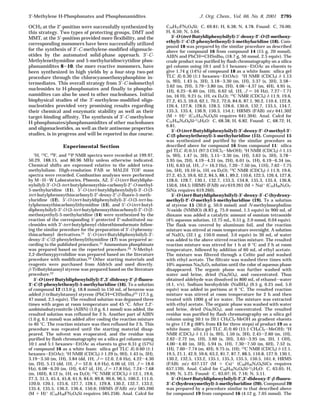
Then, we decided to use the less acid-labile MMT-
protecting group, yet still adaptable to the automated
synthesis, to protect the 5′-position (Scheme 3). Com-
pounds 33-36 were reacted with 3 equiv of p-anisylchlo-
rodiphenylmethane (4′-methoxytrityl chloride, MMT-Cl)
in the presence of Hu¨nig’s base for 48 h using a mixed
solvent of THF and ethyl acetate. The 5′-O-MMT-3′-C-
iodomethyl nucleoside derivatives 42-45 were obtained
in 84-99% yields. The reaction of 42-45 with BTSP 27
in the presence of Hu¨nig’s base, followed by their hy-
drolysis with a mixture of methanol and triethylamine,
provided the desired products 5′-O-MMT-3′-methylene-
substituted nucleoside H-phosphonates 3-6 with O-
methyl, fluoro, hydrogen, and O-(2-methoxyethyl) sub-
stituents at the 2′-position. This new synthetic strategy
with the modified Arbuzov reaction as the key step paved
a new way for the synthesis of 3′-C-methylene H-
phosphonates directly from nucleosides.
The automated synthesis of natural DNA (structure I,
Figure 1) is carried out by 3′-O-H-phosphonate and/or 3′-
O-phosphoramidite approaches, and the later approach
is more efficient. 3′-C-H-phosphonate nucleotides 1-6
have been utilized for the synthesis of 3′-methylene-
modified antisense oligonucleotides (structure II, Figure
1) by a C-H-phosphonate approach.18
We expected that
3′-C-phosphonamidite monomers would also work more
efficiently than the corresponding 3′-C-H-phosphonate
monomers although they would be more synthetically
challenging. Therefore, the transformation of 3′-C-H-
phosphonate to 3′-C-phosphonamidite was investigated
(Scheme 3). 2′-Deoxy- and 2′-O-methyl-3′-C-methylene
nucleoside H-phosphonates 5 and 3 were condensed at
an elevated temperature with 3-hydroxypropionitrile
using dicyclohexylcarbodiimide (DCC) as a coupling
agent. The hexanes extraction of the excess DCC, hy-
droxypropionitrile, and other impurities from an aceto-
nitrile solution was proved to be an effective way for the
purification of the resulted cyanoethyl H-phosphonates
50 and 51 without chromatographic purification. The
cyanoethyl H-phosphonate thymidine 50 and 5-methy-
luridine 51 were obtained as their mixtures of two
diastereoisomers at phosphorus as indicated by the 31P
NMR spectra. The commercial available chlorinating
agent triphenylphosphine dichloride (Ph3PCl2) did not
work for the transformation of 50 to phosphonamidite 8
through the 3′-C-methylene chlorocyanoethyloxyphos-
phine intermediate. The chlorinating agent triphenylphos-
phine dichloride was prepared in situ from triphosgene
(Note: toxic) and triphenylphosphine based on the lit-
erature procedure.27
The cyanoethyl H-phosphonate 50
was then reacted with the freshly prepared Ph3PCl2 in
the presence of pyridine to give the chlorocyanoethyloxy-
phosphine intermediate, which was then reacted in situ
with diisopropylamine in dichloromethane at low tem-
perature. The reaction mixture was directly purified by
flash chromatography on a silica gel column using
hexanes-EtOAc-Et3N and then hexanes-THF-Et3N as
eluents to give the desired product 3′-deoxy-3′-C-meth-
ylenethymidine phosphonamidite 8 in 56% overall yield.
The 3′-deoxy-2′-O-methyl-3′-C-methylene-5-methyluri-
dine phosphonamidite 9 was also synthesized from the
corresponding cyanoethyl H-phosphonate 51 by the simi-
lar procedure in 68% yield. 3′-C-Methylene phosphona-
midite monomers 8 and 9 were obtained as mixtures of
their two diastereoisomers at phosphorus.
While the 3′-C-methylene H-phosphonate and phos-
phonamidite thymidine/5-methyluridine monomers 1-6,
8, and 9 are available, our research moved to the
5-methylcytidine derivatives. Various thymidine/uridine
nucleosides derivatives have been successfully converted
to the corresponding 5-methylcytidine/cytidine analogues
under POCl3/triazole/NH4OH or other similar reaction
conditions.28 3′-C-methylene H-phosphonate nucleotides
1-6 could not be directly converted to their 5-methylcy-
tidine derivatives because POCl3 would also activated the
H-phosphonate group. 3′-C-methylene phosphonamidite
thymidine 8 was converted to the corresponding 5-me-
thylcytidine derivative (data not shown); however, the
yield was very low, and it was difficult to manage the
reaction conditions, because the ammonium hydroxide,
(27) Rivero, I. A.; Somanathan, R.; Hellberg, L. H. Synth. Commun.
1993, 23, 711-714.
(28) (a) Divakar, K. J.; Reese, C. B. J. Chem. Soc., Perkin Trans. 1
1982, 1171-1176. (b) Perbost, M.; Sanghvi, Y. S. J. Chem. Soc., Perkin
Trans. 1 1994, 2051-2052. (c) Jones, A. S.; Sayers, J. R.; Walker, R.
T.; De Clercq, E. J. Med. Chem. 1988, 31, 268-271.
Scheme 3
3′-Methylene H-Phosphonates and Phosphonamidites J. Org. Chem., Vol. 66, No. 8, 2001 2793
essential for the second step, also reacted with the
phosphonamidite group of the resultant product. There-
fore, we decided to convert 3′-C-iodomethyl-2′-O-methyl-
5-methyluridine 42 to the corresponding 5-methycytidine
derivative 53 which was further used for the synthesis
of 3′-C-methylene H-phosphonate and phosphonamidite
5-methylcytidine monomers. Scheme 4 depicts the syn-
thesis of the protected 2′-O-methyl-3′-C-methylene-5-
methylcytidine H-phosphonate 7 and phosphonamidite
10. The 3′-C-iodomethyl nucleoside 42 was reacted with
1,2,4-triazole in the presence of phosphorus oxychloride
to give the triazole compound 52. After general workup,
compound 52 was treated with aqueous ammonium
hydroxide providing the 5-methylcytidine derivative 53
in a quantitative yield. Compound 53 without N4-protect-
ing group was reacted with BTSP under the modified
reaction conditions as described above to give 2′-O-
methyl-5′-O-MMT-3′-C-methylene-5-methylcytidine H-
phosphonate 54 as its triethylamine salt. H-phosphonate
54 was reacted with N-methyl-2,2-diethoxypyrrolidine29
in the presence of triethylamine to generate the N4
-(N-
methylpyrrolidin-2-ylidene)-protected H-phosphonate 7,
which can be used for the synthesis of oligonucleotides
directly by the H-phosphonate chemistry. Compound 7
was condensed with 3-hydroxypropionitrile under the
same reaction conditions as described above for 50 and
51 to give the corresponding cyanoethyl H-phosphonate
5-methylcytidine 56. The one-pot three-step transforma-
tion of 56 to the final phosphonamidite 10 was carried
out under the similar reaction conditions as described
above for compound 8. The N4
-(N-methylpyrrolidin-2-
ylidene)-5′-O-MMT-2′-O-methyl-3′-C-methylene-5-meth-
ylcytidine phosphonamidite 10 was obtained in 72% yield
as a white foam and a mixture of two diastereoisomers
at phosphorus. New compounds 1-10, 16, 18-20, 22-
26, 28-51 and 53-56 were all characterized by the
essential 1
H, 13
C, 31
P, and 19
F NMR spectroscopic as well
as high-resolution mass spectrometric analyses. The
structures of most of the new compounds were further
confirmed by their combustion analysis.
3′-Methylene-modified H-phosphonate and phospho-
namidite monomers 1-10 with different substituents at
the 2′-position are available, and 1-5 have been utilized
for the synthesis of 3′-methylene-modified oligonucle-
otides by the automated solid-phase approach.18 Figure
3 shows some representative examples of the 3′-C-
methylene phosphonate-substituted oligonucleotides 58-
63 for biophysical studies. The oligonucleotides 58-63
exhibited an excellent target-binding affinity to the
complementary RNA with the melting temperature of
hybridized duplex up to 3.64 °C increase per nucleotide
modification relative to the phosphorothioate DNA. The
oligonucleotide 58 is completely resistant without deg-
radation to the enzyme snake venom phosphodiesterase
(SVPD).18 One octamer oligonucleotide with a 2′-O-
methyl-3′-C-methylene phosphonate-substituted linkage,
synthesized in our lab, was studied by X-ray crystal-
lographic analysis.30
In conclusion, we have developed a new and useful
strategy for the synthesis of various 2′-substituted 3′-C-
methylene H-phosphonate nucleotides through the Ar-
buzov reaction under modified reaction conditions. New
5′-O-DMT- and MMT-3′-C-methylenethymidine, 5-me-
thyluridine, and 5-methylcytidine H-phosphonates 1-7
with four different substituents OCH3, F, H, OCH2CH2-
(29) (a) Heerwein, H.; Borner, P.; Fuchs, O.; Sasse, H. J.; Schrodt,
H.; Spille, J. Chem. Ber. 1956, 89, 2060-2079. (b) Bredereck, H.;
Effenberger, F.; Beyerlin, H. P. Chem. Ber. 1964, 97, 3081-3087. (c)
McBride, L. J.; Kierzek, R.; Beaucage, S. L.; Caruthers, M. H. J. Am.
Chem. Soc. 1986, 108, 2040-2048.
(30) Egli, M.; Tereshko, V.; Teplova, M.; Minasov, G.; Joachimiak,
A.; Sanishvili, R.; Weeks, C. M.; Miller, R.; Maier, M. A.; An, H.; Cook,
P. D.; Manoharan, M. Biopolymers 2000, 48, 234-252.
Scheme 4
Figure 3. New 3′-Methylene-Modified Oligonucleotides (all
PdO).
2794 J. Org. Chem., Vol. 66, No. 8, 2001 An et al.
OCH3 at the 2′-position were successfully synthesized by
this strategy. Two types of protecting groups, DMT and
MMT, at the 5′-position provided more flexibility, and the
corresponding monomers have been successfully utilized
for the synthesis of 3′-C-methylene-modified oligonucle-
otides by the automated solid-phase approach. 3′-C-
Methylenethymidine and 5-methyluridine/cytidine phos-
phonamidites 8-10, the more reactive monomers, have
been synthesized in high yields by a four-step two-pot
procedure through the chlorocyanoethoxyphosphine in-
termediates. This overall strategy from 3′-C-iodomethyl
nucleosides to H-phosphonates and finally to phospho-
namidites can also be used to other nucleobases. Initial
biophysical studies of the 3′-methylene-modified oligo-
nucleotides provided very promising results regarding
their chemical and enzymatic stability as well as their
target-binding affinity. The synthesis of 3′-C-methylene
H-phosphonates/phosphonamidites of other nucleobases
and oligonucleotides, as well as their antisense properties
studies, is in progress and will be reported in due course.
Experimental Section
1
H, 13
C, 19
F, and 31
P NMR spectra were recorded at 199.97,
50.29, 188.15, and 80.96 MHz unless otherwise indicated.
Chemical shifts are expressed relative to the added tetra-
methylsilane. High-resolution FAB or MALDI TOF mass
spectra were recorded. Combustion analyses were performed
by M-H-W Laboratories, Phoenix, AZ. 5′-O-(tert-Butyldiphe-
nylsilyl)-3′-O-(3-tert-butylphenoxythio-carbonyl)-2′-O-methyl-
5-methyluridine (11), 5′-O-(tert-butyldiphenylsilyl)-3′-O-(3-
tert-butylphenoxythiocarbonyl)-2′-deoxy-2′-β-fluoro-5-meth-
yluridine (12), 5′-O-(tert-butyldiphenylsilyl)-3′-O-(3-tert-bu-
tylphenoxythiocarbonyl)thymidine (13), and 5′-O-(tert-butyl-
diphenylsilyl)-3′-O-(3-tert-butylphenoxythiocarbonyl)-2′-O-(2-
methoxyethyl)-5-methyluridine (14) were synthesized by the
reaction of the corresponding 5′-protected 2′-substituted nu-
cleosides with 3′-tert-butylphenyl chlorothionoformate follow-
ing the similar procedure for the preparation of 3′-O-phenoxy-
thiocarbonyl derivatives.21
5′-O-(tert-Butyldiphenylsilyl)-3′-
deoxy-3′-C-(2-phenylethenyl)thymidine (17) was prepared ac-
cording to the published procedure.21
Ammonium phosphinate
was prepared based on the reported procedure.24 N-Methyl-
2,2-diethoxypyrrolidine was prepared based on the literature
procedure with modification.29 Other starting materials and
reagents were purchased from Aldrich and used directly.
β-Tributylstannyl styrene was prepared based on the literature
procedure.23
5′-O-(tert-Butyldiphenylsilyl)-2′,3′-dideoxy-2′-β-fluoro-
3′-C-(2-phenylethenyl)-5-methyluridine (16). To a solution
of compound 12 (13.0 g, 18.8 mmol) in 150 mL of benzene was
added β-tributylstannyl styrene (PhCHdCHSnBu3)23
(17.5 g,
47 mmol, 2.5 equiv). The resulted solution was degassed three
times with argon at room temperature and 45 °C. After 2,2′-
azobisisobutyronitrile (AIBN) (1.0 g, 6.1 mmol) was added, the
resulted solution was refluxed for 2 h. Another part of AIBN
(1.0 g, 6.1 mmol) was added after cooling the reaction mixture
to 40 °C. The reaction mixture was then refluxed for 2 h. This
procedure was repeated until the starting material disap-
peared. The solvent was evaporated, and the residue was
purified by flash chromatography on a silica gel column using
10:1 and 5:1 hexanes-EtOAc as eluents to give 6.31 g (57%)
of compound 16 as a white foam: silica gel TLC Rf 0.60 (1:1
hexanes-EtOAc); 1H NMR (CDCl3) δ 1.29 (s, 9H), 1.43 (s, 3H),
3.19-3.50 (m, 1H), 3.84 (dd, 1H, J ) 12.0, 2.6 Hz), 4.22-4.30
(m, 2H), 5.13 (dd, 1H, J ) 52.0, 4.0 Hz), 6.06 (d, 1H, J ) 18.6
Hz), 6.08-6.20 (m, 1H), 6.67 (d, 1H, J ) 17.8 Hz), 7.24-7.68
(m, 16H), 8.12 (s, 1H, ex D2O); 13C NMR (CDCl3) δ 12.1, 19.6,
27.3, 31.3, 45.4, 45.8, 61.9, 84.0, 89.8, 90.6, 96.5, 100.2, 111.0,
120.0, 120.1, 125.6, 127.7, 128.1, 129.8, 130.2, 132.7, 133.2,
135.4, 135.5, 136.2, 136.4, 150.6; HRMS (FAB) m/z 585.260
(M + H)+
(C34H38FN2O4Si requires 585.258). Anal. Calcd for
C34H37FN2O4Si: C, 69.81; H, 6.38; N, 4.78. Found: C, 70.00;
H, 6.50; N, 5.04.
5′-O-(tert-Butyldiphenylsilyl)-3′-deoxy-2′-O-(2-methoxy-
ethyl)-3′-C-(2-phenylethenyl)-5-methyluridine (18). Com-
pound 18 was prepared by the similar procedure as described
above for compound 16 from compound 14 (15 g, 20 mmol),
AIBN and PhCHdCHSnBu3 (18.7 g, 50 mmol, 2.5 equiv). The
crude product was purified by flash chromatography on a silica
gel column using 10:1 and 5:1 hexanes-EtOAc as eluents to
give 1.74 g (14%) of compound 18 as a white foam: silica gel
TLC Rf 0.30 (1:1 hexanes-EtOAc): 1
H NMR (CDCl3) δ 1.13
(s, 9H), 1.43 (s, 3H), 3.18-3.30 (m, 1H), 3.37 (s, 3H), 3.58-
3.62 (m, 2H), 3.79-3.80 (m, 2H), 4.06-4.37 (m, 4H), 4.95 (s,
1H), 6.25-6.40 (m, 1H), 6.62 (d, 1H, J ) 16 Hz), 7.27-7.71
(m, 16 H), 9.21 (s, 1H, ex D2O); 13
C NMR (CDCl3) δ 11.9, 19.6,
27.2, 45.3, 59.0, 62.1, 70.2, 72.0, 84.6, 87.1, 90.2, 110.4, 122.8,
126.4, 127.8, 128.0, 128.3, 128.6, 130.0, 132.7, 133.5, 134.7,
135.3, 135.4, 136.9, 150.3, 154.1; HRMS (FAB) m/z 641.302
(M + H)+ (C37H45N2O6Si requires 641.304). Anal. Calcd for
C37H44N2O6Si‚1/2H2O: C, 68.38; H, 6.82. Found: C, 68.72; H,
6.81.
5′-O-(tert-Butyldiphenylsilyl)-3′-deoxy-2′-O-methyl-3′-
C-(2-phenylethenyl)-5-methyluridine (15). Compound 15
was synthesized and purified by the similar procedure as
described above for compound 16 from compound 11: silica
gel TLC Rf 0.51 (97:3 CHCl3-MeOH); 1H NMR (CDCl3) δ 1.15
(s, 9H), 1.47 (s, 3H), 3.15-3.30 (m, 1H), 3.63 (s, 3H), 3.78-
3.95 (m, 2H), 4.19-4.31 (m, 2H), 6.01 (s, 1H), 6.19-6.34 (m,
1H), 6.63 (d, 1H, J ) 16.2 Hz), 7.20-7.50 (m, 11H), 7.62-7.75
(m, 5H), 10.10 (s, 1H, ex D2O); 13C NMR (CDCl3) δ 11.9, 19.6,
27.2, 45.3, 59.6, 62.2, 84.5, 88.1, 89.2, 110.6, 122.5, 126.4, 127.8,
128.0, 128.7, 130.1, 132.7, 133.3, 134.8, 135.3, 135.4, 136.8,
150.6, 164.5; HRMS (FAB) m/z 619.261 (M + Na)+
(C35H40N2O5-
SiNa requires 619.260).
5′-O-(tert-Butyldiphenylsilyl)-3′-deoxy-3′-C-(hydroxy-
methyl)-2′-O-methyl-5-methyluridine (19). To a solution
of styrene 15 (30.0 g, 50.0 mmol) and N-methylmorpholine
N-oxide (NMMO) (8.83 g, 75.0 mmol, 1.5 equiv) in 900 mL of
dioxane was added a catalytic amount of osmium tetraoxide
(4% aqueous solution, 12.75 mL, 0.51 g, 2.0 mmol, 0.04 equiv).
The flask was covered by aluminum foil, and the reaction
mixture was stirred at room temperature overnight. A solution
of NaIO4 (32.1 g, 150.0 mmol, 3.0 equiv) in 30 mL of water
was added to the above stirred reaction mixture. The resulted
reaction mixture was stirred for 1 h at 0 °C and 2 h at room
temperature, followed by addition of 60 mL of ethyl acetate.
The mixture was filtered through a Celite pad and washed
with ethyl acetate. The filtrate was washed three times with
10% aqueous Na2S2O3 solution until the color of aqueous phase
disappeared. The organic phase was further washed with
water and brine, dried (Na2SO4), and concentrated. Thus
obtained aldehyde was dissolved in 800 mL of ethanol-water
(4:1, v/v). Sodium borohydride (NaBH4) (9.5 g, 0.25 mol, 5.0
equiv) was added in portions at 0 °C. The resulted reaction
mixture was stirred at room temperature for 2 h and then
treated with 1000 g of ice water. The mixture was extracted
with ethyl acetate. The organic phase was washed with water
and brine, dried (Na2SO4), and concentrated. The resulted
residue was purified by flash chromatography on a silica gel
column using 50:1 to 20:1 CH2Cl2-MeOH as gradient eluents
to give 17.8 g (68% from 15 for three steps) of product 19 as a
white foam: silica gel TLC Rf 0.40 (15:1 CH2Cl2-MeOH); 1
H
NMR (CDCl3) δ 1.11 (s, 9H), 1.50 (s, 3H), 2.45-2.60 (m, 1H),
2.62-2.72 (m, 1H), 3.60 (s, 3H), 3.65-3.95 (m, 3H, 1 OH),
4.00-4.40 (m, 3H), 5.94 (s, 1H), 7.30-7.50 (m, 6H), 7.52 (s,
1H), 7.60-7.74 (m, 4H), 9.75 (s, 1H); 13
C NMR (CDCl3) δ 12.1,
19.5, 21.1, 42.9, 59.6, 63.2, 81.7, 87.7, 88.5, 110.8, 127.9, 130.1,
130.2, 132.5, 133.2, 135.1, 135.3, 135.5, 150.5, 161.4; HRMS
(FAB) m/z 657.137 (M + Cs)+
(C28H36N2O6SiCs requires
657.139). Anal. Calcd for C28H36N2O6Si‚1
/2H2O: C, 63.05; H,
6.99; N, 5.25. Found: C, 63.07; H, 7.16; N, 5.11.
5′-O-(tert-Butyldiphenylsilyl)-2′,3′-dideoxy-2′-β-fluoro-
3′-C-(hydroxymethyl)-5-methyluridine (20). Compound 20
was prepared by a procedure similar to that described above
for compound 19 from compound 16 (4.12 g, 7.05 mmol). The
3′-Methylene H-Phosphonates and Phosphonamidites J. Org. Chem., Vol. 66, No. 8, 2001 2795
crude product was purified by flash chromatography on a silica
gel column using 200:1 and 50:1 CH2Cl2-MeOH as eluents to
give 1.77 g (49%) of compound 20 as a white foam: silica gel
TLC Rf 0.25 (20:1 CHCl3-MeOH); 1
H NMR (CDCl3) δ 1.09 (s,
9H), 1.57 (s, 3H), 2.56-2.88 (m, 1H), 2.92 (bs, 1H, ex D2O),
3.62-3.71 (m, 1H), 3.78-3.86 (m, 2H), 4.12-4.18 (m, 2H), 5.32
(dd, 1H, J ) 52.0, 4.5 Hz), 5.97 (d, 1H, J ) 18.0 Hz), 7.36-
7.69 (m, 11H), 9.80 (bs, 1H, ex D2O); 13C NMR (CDCl3) δ 12.2,
19.1, 27.1, 44.2, 44.6, 57.4, 57.6, 63.4, 82.5, 89.6, 90.3, 95.1,
98.7, 110.1, 127.7, 128.0, 130.1, 132.5, 133.0, 135.4, 135.6,
150.4, 164.2; 19
F NMR (CDCl3) δ -63.77 (ddd, J1 ) 55.2 Hz,
J2 ) 35.5 Hz, J3 ) 19.8 Hz); HRMS (FAB) m/z 535.201 (M +
Na)+
(C27H33FN2O5SiNa requires 535.204). Anal. Calcd for
C27H33FN2O5Si: C, 63.24; H, 6.49; N, 5.47. Found: C, 63.40;
H, 6.28; N, 5.37.
5′-O-(tert-Butyldiphenylsilyl)-3′-deoxy-3′-C-(hydroxy-
methyl)thymidine (21).31
Compound 21 was prepared by a
procedure similar to that described above for compound 19
from compound 17 (5.67 g, 10.0 mmol). The product was
purified by flash chromatography on a silica gel column using
40:1 and 20:1 CH2Cl2-MeOH as eluents to give 3.99 g (80%
overall) of compound 21 as a white foam.
5′-O-(tert-Butyldiphenylsilyl)-3′-deoxy-3′-C-(hydroxy-
methyl)-2′-O-(2-methoxyethyl)-5-methyluridine (22). Com-
pound 22 was prepared by the similar procedure as described
above for compound 19 from compound 18 (5.0 g, 7.8 mmol).
The crude product was purified by flash chromatography on a
silica gel column using 2:1, 1:1 and 1:2 hexanes-EtOAc as
eluents to give 1.60 g (36%) of compound 22 as a white foam:
silica gel TLC Rf 0.40 (20:1 CH2Cl2-MeOH); 1
H NMR (CDCl3)
δ 1.09 (s, 9H), 1.50 (s, 3H), 2.25 (bs, 1H, ex D2O), 2.52-2.78
(m, 1H), 3.38 (s, 3H), 3.52-4.25 (m, 10H), 5.86 (s, 1H), 7.38-
7.70 (m, 11H), 9.95 (bs, 1H, ex D2O); 13
C NMR (CDCl3) δ 12.1,
19.5, 27.1, 43.1, 58.2, 58.8, 63.1, 69.5, 71.6, 82.3, 86.1, 89.8,
110.5, 128.0, 130.2, 132.5, 133.2, 135.1, 135.3, 136.5, 150.5,
164.4; HRMS (FAB) m/z 569.268 (M + H)+
(C30H41N2O7Si
requires 569.268). Anal. Calcd for C30H40N2O7Si: C, 63.33; H,
7.09; N, 4.93. Found: C, 63.13; H, 6.88; N, 5.12.
5′-O-(tert-Butyldiphenylsilyl)-3′-deoxy-3′-C-(iodome-
thyl)-2′-O-methyl-5-methyluridine (23). 2,6-Lutidine (10
mL, 9.2 g, 85.8 mmol, 1.94 equiv) and methyl triphenoxyphos-
phonium iodide (24.3 g, 53.7 mmol, 1.2 equiv) were sequen-
tially added to a solution of compound 19 (23.3 g, 44.2 mmol)
in 400 mL of anhydrous DMF under stirring at 0 °C. The
resulted reaction mixture was stirred at 0 °C for 1 h and at
room temperature for 2 h. The reaction mixture was diluted
with 100 mL of ethyl acetate and washed twice with 0.1 N
Na2S2O3 aqueous solution to remove iodine. The organic phase
was further washed with aqueous NaHCO3 solution, water,
and brine. The aqueous phases were back extracted with ethyl
acetate. The combined organic phase was dried (Na2SO4) and
concentrated. The resulted residue was purified by flash
chromatography on a silica gel column using 200:1 to 30:1 CH2-
Cl2-MeOH as gradient eluents to give 22.8 g (81%) of the iodo
product 23 as a white foam: silica gel TLC Rf 0.54 (20:1 CH2-
Cl2-MeOH), Rf 0.63 (1:1 hexanes-EtOAc); 1H NMR (CDCl3)
δ 1.13 (s, 9H), 1.61 (s, 3H), 2.60-2.84 (m, 2H), 3.18 (t, 3H, J
) 9.0 Hz), 3.64 (s, 3H), 3.67-3.80 (m, 1H), 3.84-3.98 (m, 2H),
4.05-4.21 (m, 1H), 5.91 (s, 1H), 7.32-7.49 (m, 6H), 7.54-7.74
(m, 5H), 8.90 (s, 1H); 13C NMR (CDCl3) δ 12.3, 19.4, 27.2, 44.9,
59.0, 62.5, 83.2, 86.8, 88.3, 110.6, 127.7, 128.0, 128.2, 130.2,
130.3, 132.4, 132.9, 134.9, 135.4, 135.6, 150.4, 164.3; HRMS
(FAB) m/z 635.144 (M + H)+
(C28H36IN2O5Si requires 635.143).
Anal. Calcd for C28H35IN2O5Si: C, 53.00; H, 5.55; N, 4.41.
Found: C, 53.20; H, 5.53; N, 4.39.
5′-O-(tert-Butyldiphenylsilyl)-2′,3′-dideoxy-2′-β-fluoro-
3′-C-(iodomethyl)-5-methyluridine (24). Compound 24 was
prepared as described above for compound 23 from compound
20 (1.3 g, 2.54 mmol), methyl triphenoxyphosphonium iodide
(1.70 g, 3.8 mmol, 1.5 equiv) and 2,6-lutidine (0.59 mL, 0.54
g, 5.08 mmol). The product was purified by flash chromatog-
raphy on a silica gel column using 200:1 CH2Cl2-MeOH as an
eluent to give 1.45 g (92%) of compound 24 as a white foam:
silica gel TLC Rf 0.33 (20:1 CH2CH2-MeOH); 1
H NMR (CDCl3)
δ 1.11 (s, 9H), 1.63 (s, 3H), 2.76-3.18 (m, 3H), 3.76 (dd, 1H, J
) 12.0, 2.8 Hz), 3.97 (d, 1H, J ) 8.0 Hz), 4.17 (dd, 1H, J )
12.0, 2.0 Hz), 5.21 (dd, 1H, J ) 52.0, 3.8 Hz), 5.98 (d, 1H, J )
19.4 Hz), 7.39-7.71 (m, 11H), 8.46 (bs, 1H, ex D2O); HRMS
(FAB) m/z 645.103 (M + Na)+ (C27H32FN2O4SiNa requires
645.105). Anal. Calcd for C27H32FN2O4Si: C, 52.07; H, 5.18;
N, 4.50. Found: C, 52.28; H, 5.28; N, 4.28.
5′-O-(tert-Butyldiphenylsilyl)-3′-deoxy-3′-C-(iodometh-
yl)thymidine (25).19 Compound 25 was prepared as described
above for compound 23 from compound 21 (32.0 g, 64.6 mmol),
methyl triphenoxyphosphonium iodide (34.3 g, 75.8 mmol, 1.17
equiv), and 2,6-lutidine (14.3 mL, 13.1 g, 122 mmol, 1.89 equiv)
in 660 mL of DMF. The product was purified by flash
chromatography on a silica gel column using 5:1 to 2:1
hexanes-EtOAc as eluents to give 33.2 g (85%) of compound
25 as a white foam: silica gel TLC Rf 0.54 (1:1 hexanes-
EtOAc); 1H NMR (CDCl3) δ 1.12 (s, 9H), 1.69 (s, 3H), 2.15-
2.40 (m, 2H), 2.60-2.80 (m, 1H), 3.06-3.28 (m, 2H), 3.75-
3.89 (m, 2H), 3.98-4.10 (m, 1H), 6.18 (t, 1H, J ) 5.8 Hz), 7.35-
7.54 (m, 7H), 7.63-7.78 (4H), 9.52 (bs, 1H, ex D2O); 13
C NMR
(CDCl3) δ 6.9, 12.3, 19.4, 27.1, 40.2, 40.7, 63.9, 84.1, 85.2, 111.1,
127.7, 128.0, 130.1, 132.6, 133.0, 135.2, 135.4, 135.6, 150.7,
164.2; HRMS (MALDI) m/z 627.113 (M + Na)+ (C27H33IN2O4-
SiNa requires 627.115).
5′-O-(tert-Butyldiphenylsilyl)-3′-deoxy-3′-C-(iodome-
thyl)-2′-O-(2-methoxyethyl)-5-methyluridine (26). The iodo
compound 26 was synthesized as described above for com-
pound 23 from compound 22 (1.34 g, 2.35 mmol), 2,6-lutidine
(0.547 mL, 503 mg, 4.69 mmol, 2.0 equiv), and methyl
triphenoxyphosphonium iodide (1.28 g, 2.83 mmol, 1.2 equiv)
in 25 mL of DMF. The crude product was purified by flash
chromatography on a silica gel column. Gradient elution with
5:1, 3:1, and then 1:1 hexanes-EtOAc provided 1.24 g (78%)
of the iodo product 26 as a white foam: silica gel TLC Rf 0.39
(1:1 hexanes-EtOAc); 1H NMR (CDCl3) δ 1.13 (s, 9H), 1.62
(s, 3H), 2.64-2.85 (m, 2H), 3.20-3.35 (m, 1H), 3.38 (s, 3H),
3.50-4.25 (m, 8H), 5.91 (s, 1H), 7.32-7.50 (m, 6H), 7.60 (s,
1H), 7.62-7.78 (m, 4H), 10.46 (s, 1H); 13
C NMR (CDCl3) δ 12.4,
19.5, 27.2, 45.0, 58.0, 62.5, 70.3, 71.9, 83.3, 85.6, 88.9, 110.5,
128.1, 128.2, 130.1, 130.3, 132.4, 132.9, 135.0, 135.4, 135.6,
150.7, 164.7; HRMS (FAB) m/z 679.172 (M + H)+
(C30H40IN2O6-
Si requires 679.170).
5′-O-(tert-Butyldiphenylsilyl)-3′-deoxy-3′-C-[(hydroxy-
phosphinyl)methyl]-2′-O-methyl-5-methyluridine (28) and
5′-O-(tert-Butyldiphenylsilyl)-3′-dexoy-3′-C-methyl-2′-O-
methyl-5-methyluridine (30). A mixture of ammonium
phosphinate (0.41 g, 5.0 mmol, 5.0 equiv)24 and 1,1,1,3,3,3-
hexamethyldisilazane (HMDS) (1.07 mL, 0.82 g, 5.05 mmol,
5.05 equiv) was heated neat at 100-110 °C for 2 h under argon
atmosphere with a condenser. The resulted intermediate bis-
(trimethylsilyl)phosphonite (BTSP) (27) was cooled to -5-0
°C. Anhydrous CH2Cl2 (5 mL) was injected, followed by a
solution of iodo-compound 23 (0.64 g, 1.0 mmol) in 8 mL of
CH2Cl2. The resulted reaction mixture was stirred at room
temperature overnight, filtered, and concentrated. The clear
oily residue was dissolved in 5 mL of CH2Cl2 and 5 mL of
MeOH. The solution was stirred at room temperature for 2 h.
After evaporation of the solvent, the residue was dissolved in
ethyl acetate. The solution was washed with water and brine.
The organic phase was dried and concentrated. The residue
was purified by flash chromatography on a silica gel column
using 10:1, 2:1, and then 1:1 EtOAc-MeOH as eluents to
provide 105 mg (31%) of the desired product H-phosphinic acid
28 and 150 mg (59%) of the reduced byproduct 30 as white
foams. H-Phosphinic acid 28 (free acid): silica gel TLC Rf 0.30
(50:10:1 CHCl3-MeOH-Et3N); 1
H NMR (CD3OD) δ 1.10 (s,
9H), 1.33 (s, 3H), 1.30-1.51 (m, 1H), 1.74-1.98 (m, 1H), 2.47-
2.68 (m, 1H), 3.53 (s, 3H), 3.87-4.08 (m, 3H), 4.19 (d, 1H, J )
11.6 Hz), 7.07 (5.82, 8.32; d, 1H, J ) 500 Hz, PH), 5.91 (s,
1H), 7.35-7.50 (m, 6H), 7.59 (s, 1H), 7.65-6.80 (m, 4H); 13
C
NMR (DMSO-d6) δ 11.7, 18.9, 26.8, 36.1, 48.6, 57.3, 63.1, 84.8,
88.3, 108.9, 128.0, 129.9, 132.5, 133.1, 134.9, 135.0, 150.1,
(31) Haly, B.; Bellon, L.; Mohan, V.; Sanghvi, Y. S. Nucleosides
Nucleotides 1996, 15, 1383-1395.
2796 J. Org. Chem., Vol. 66, No. 8, 2001 An et al.
163.7; 31P NMR (CD3OD) δ 27.1; MS (ES) m/z 571 (M - H)-;
HRMS (FAB) m/z 595.200 (M + Na)+ (C28H37N2O7PSiNa
requires 595.200).
5′-O-(tert-Butyldiphenylsilyl)-2′,3′-dideoxy-2′-β-fluoro-
3′-C-[(hydroxyphosphinyl)methyl]-5-methyluridine (29)
and 5′-O-(tert-Butyldiphenylsilyl)-2′,3′-didexoy-2′-β-fluoro-
3′-C-methyl-5-methyluridine (31). Compounds 29 and 31
were prepared by a procedure similar to that described above
for compounds 28 and 30 from HMDS (18.0 g, 50 mmol),
ammonium phosphinate (1.0 g, 12 mmol), and compound 24
(0.75 g, 1.2 mmol). The crude products were purified by flash
chromatography on a silica gel column using 20:1 and 5:1 CH2-
Cl2-MeOH as eluents to give 0.10 g (15%) of compound 29 as
a white powder and 0.30 g (50%) of compound 31 as a white
foam. H-Phosphinic acid 29 (free acid): silica gel TLC Rf 0.30
(50:10:1 CHCl3-MeOH-Et3N); 1
H NMR (CD3OD) δ 1.10 (s,
9H), 1.42 (s, 3H), 1.35-1.91 (m, 2H), 2.56-2.86 (m, 1H), 3.85-
4.31(m, 3H), 5.38 (dd, 1H, J ) 52.0, 4.2 Hz), 7.13 (5.88, 8.39;
d, 1H, J ) 502 Hz, PH), 6.01 (d, 1H, J ) 20.0 Hz), 7.32-7.78
(m, 11H); 31P NMR (CD3OD) δ 25.01; 19F NMR (CD3OD) δ
-62.62 (ddd, J1 ) 54.8 Hz, J2 ) 34.1 Hz, J3 ) 20.1 Hz); HRMS
(FAB) m/z 583.180 (M + Na)+
(C27H34FN2O6PSiNa requires
583.180).
3′-Deoxy-3′-C-[(hydroxyphosphinyl)methyl]-2′-O-meth-
yl-5-methyluridine Tetrabutylammonium Salt (32). To a
solution of 5′-TBDPS-protected H-phosphinic acid 28 (140 mg,
0.20 mmol) in 1 mL of DMF and 8 mL of THF was added
tetrabutylammonium fluoride (1.0 M in THF, 0.31 mL, 0.31
mmol, 1.5 equiv) at 0 °C. The reaction mixture was stirred at
room temperature for 4 h and concentrated. The residue was
purified by flash chromatography on a silica gel column using
20:1, 2:1, and then 1:1 EtOAc-MeOH as eluents to give 108
mg (94%) of the sticky oily product 32 as its tetrabutylammo-
nium salt: silica gel TLC Rf 0.39 (1:1 EtOAc-MeOH); 1H NMR
(CD3OD) δ 1.02 (t, 12H, J ) 7.0 Hz), 1.30-1.55 (m, 8H), 1.57-
1.78 (m, 8H), 1.85 (s, 3H), 1.80-2.00 (m, 1H), 2.34-2.65 (m,
1H), 3.18-3.45 (m, 9H), 3.55 (s, 3H), 3.70-4.06 (m, 4H), 7.06
(5.81, 8.31; d, 1H, J ) 500 Hz, PH), 5.87 (s, 1H), 8.25 (s, 1H);
13
C NMR (CD3OD) δ 12.6, 14.0, 20.7, 24.8, 27.2, 28.9, 36.1,
58.3, 59.5, 60.4, 87.3, 87.7, 88.0, 89.7, 110.2, 138.3, 152.1, 166.7;
31P NMR (CD3OD) δ 26.9; MS (ES) m/z 333 (M - H)-.
3′-Deoxy-3′-C-[(hydroxyphosphinyl)methyl]-2′-O-meth-
ylthymidine (32) (Salt-Free). A mixture of 28 (500 mg, 0.87
mmol) and triethylamine trifluoride (1.15 mL, 1.14 g, 7.07
mmol, 8.1 equiv) in 10 mL of DMF and 15 mL of THF was
stirred at room temperature for 48 h. The solvent was
evaporated, and the residue was purified by flash chromatog-
raphy on a silica gel column using 10:1, 2:1, and then 1:1
EtOAc-MeOH as eluents to give 370 mg (97%) of product 32
as a white foam: silica gel TLC Rf 0.39 (1:1 EtOAc-MeOH);
1H NMR (CD3OD) δ 1.30-1.80 (m, 2H), 1.86 (s, 3H), 2.24-
2.55 (m, 1H), 3.55 (s, 3H), 3.74-4.06 (m, 4H), 7.06 (5.81, 8.31;
d, 1H, J ) 500 Hz, PH), 5.87 (s, 1H), 8.25 (s, 1H); 13
C NMR
(CD3OD) δ 12.6, 27.2, 28.9, 36.1, 58.3, 60.4, 87.3, 87.7, 88.0,
89.8, 110.2, 138.3, 152.1, 166.7; 31
P NMR (CD3OD) δ 27.0; 31
P
NMR (CD3OD + HCl) δ 36.9; MS (ES) m/z 333 (M - H)-
;
HRMS (FAB) m/z 357.083 (M + Na)+ (C12H19N2O7PNa requires
357.082). Anal. Calcd for C12H19N2O7P: C, 43.12; H, 5.72; N,
8.38. Found: C, 43.37; H, 5.87; N, 8.25.
3′-Deoxy-5′-O-(4,4′-dimethoxytrityl)-3′-C-[(hydroxyphos-
phinyl)methyl]-2′-O-methyl-5-methyluridine Triethyl-
amine Salt (1). The unprotected H-phosphinic acid 32 (70 mg,
0.2 mmol) was coevaporated twice with anhydrous pyridine
and then dissolved in 3 mL of pyridine. To this solution was
added DMT-Cl (203 mg, 0.6 mmol, 3.0 equiv) at 0 °C. The
reaction mixture was stirred at room temperature for 24 h and
concentrated. The residue was purified by flash chromatog-
raphy on a silica gel column. Elution with 100:10:1 to 100:
30:1 CHCl3-MeOH-Et3N provided 95 mg (65%) of triethyl-
amine salt product 1 as a white foam: silica gel TLC Rf 0.39
(50:10:1 CHCl3-MeOH-Et3N); 1H NMR (CD3OD) δ 1.20-1.45
(m, 3 + 9H, Et3N), 1.55-1.95 (m, 2H), 2.60-2.85 (m, 1H), 3.16
(q, 6H, J ) 7.2 Hz, Et3N), 3.57 (s, 3H), 3.76 (s, 6H), 3.90-4.15
(m, 3H), 5.81 (s, 1H), 6.86 (d, 4H, J ) 10.0 Hz), 7.07 (5.83,
8.31; d, 1H, J ) 496 Hz, PH), 7.20-7.53 (m, 9H), 7.91 (s, 1H);
13C NMR (CD3OD) δ 9.3, 12.3, 27.3, 29.1, 37.5, 47.7, 55.8, 58.2,
62.5, 86.1, 86.5, 86.7, 87.9, 90.4, 110.6, 114.3, 128.2, 129.0,
129.6, 131.5, 136.7, 136.8, 137.5, 145.9, 151.9, 160.3, 166.2;
31
P NMR (CD3OD) δ 27.2; HRMS (FAB) m/z 659.212 (M + Na)+
(C33H37N2O9PNa requires 659.213).
3′-Deoxy-3′-C-(iodomethyl)-2′-O-methyl-5-methyluri-
dine (33). A solution of 23 (6.35 g, 10.0 mmol) and triethyl-
amine trifluoride (6.52 mL, 6.45 g, 40.0 mmol, 4.0 equiv) in
100 mL of THF was stirred at room temperature for 24 h. The
reaction mixture was diluted with 200 mL of ethyl acetate and
washed with water and brine. The organic phase was dried
(Na2SO4) and concentrated. The residue was purified by flash
chromatography on a silica gel column. Elution with 3:1, 1:1,
and then 1:2 hexanes-EtOAc provided 3.76 g (95%) of product
33 as a white foam: silica gel TLC Rf 0.40 (1:2 hexanes-
EtOAc); 1
H NMR (CDCl3) δ 1.87 (s, 3H), 2.56-2.74 (m, 1H),
3.17-3.30 (m, 2H), 3.61 (s, 3H), 3.70-4.04 (m, 4H), 5.88 (s,
1H), 8.18 (s, 1H); 13C NMR (CDCl3) δ 12.6, 45.1, 59.2, 60.8,
85.2, 88.7, 89.1, 110.6, 138.0, 152.1, 166.6; HRMS (FAB) m/z
397.026 (M + H)+ (C12H18IN2O5 requires 397.026). Anal. Calcd
for C12H17IN2O5: C, 36.37; H, 4.32; N, 7.07. Found: C, 35.97;
H, 4.17; N, 7.01.
2′,3′-Dideoxy-2′-β-fluoro-3′-C-(iodomethyl)-5-methyl-
uridine (34). Compound 34 was prepared by the similar
procedure as described above for compound 33 from compound
24 (0.62 g, 3.25 mmol) and triethylamine trifluoride (2.65 mL,
16.2 mmol, 5 equiv). The product was purified by flash
chromatography on a silica gel column using 20:1 CH2Cl2-
MeOH as an eluent to give 1.15 g (92%) of compound 34 as a
white foam: silica gel TLC Rf 0.25 (20:1 CH2Cl2-MeOH); 1
H
NMR (CDCl3) δ 1.90 (s, 3H), 2.60 (t, 1H, J ) 4.8 Hz, ex D2O),
2.82-3.30 (m, 3H), 3.82-4.16 (m, 3H), 5.26 (dd, 1H, J ) 52.0,
4.4 Hz), 5.88 (d, 1H, J ) 19.6 Hz), 7.59 (s, 1H), 9.08 (bs, 1H,
ex D2O); 19F NMR (CDCl3) δ -63.23 (ddd, J1 ) 55.4 Hz, J2 )
35.2 Hz, J3 ) 20.2 Hz); HRMS (FAB) m/z 385.006 (M + H)+
(C11H15FIN2O4 requires 385.006). Anal. Calcd for C11H14-
FIN2O4: C, 34.37; H, 3.67; N, 7.29. Found: C, 34.31; H, 3.88;
N, 7.03.
3′-Deoxy-3′-C-(iodomethyl)thymidine (35). The unpro-
tected iodo compound 35 was synthesized as described above
for compound 33 from compound 25 (33.3 g, 55.0 mmol) and
triethylamine trifluoride (40.4 mL, 39.95 g, 247 mmol, 4.5
equiv) in 700 mL of THF. Recrystallization of the crude product
from ethyl acetate provided 19.0 g (94%) of the deprotected
iodo product 35 as white needles: mp 164-165 °C; silica gel
TLC Rf 0.20 (1:2 hexanes-EtOAc); 1
H NMR (CD3OD) δ 1.88
(s, 3H), 2.20-2.32 (m, 2H), 2.47-2.68 (m, 1H), 3.23-3.34 (m,
1H), 3.36-3.48 (m, 1H), 3.70-3.97 (m, 3H), 6.09 (t, 1H, J )
5.4 Hz), 7.93 (s, 1H); 1H NMR (DMSO-d6) δ 1.79 (s, 3H), 2.10-
2.25 (m, 2H), 2.43-2.64 (m, 1H), 3.25-3.37 (m, 1H), 3.39-
3.50 (m, 1H), 3.55-3.80 (m, 3H), 6.04 (t, 1H, J ) 5.6 Hz), 7.83
(s, 1H), 11.27 (s, 1H, ex D2O); 13
C NMR (DMSO-d6) δ 9.5, 12.3,
39.5, 60.9, 83.3, 85.1, 108.9, 136.2, 150.4, 163.8; HRMS
(MALDI TOF) m/z 388.997 (M + Na)+
(C11H15IN2O4Na re-
quires 388.997). Anal. Calcd for C11H15IN2O4: C, 36.08; H, 4.12;
N, 7.65. Found: C, 36.27; H, 3.94; N, 7.64.
3′-Deoxy-3′-C-(iodomethyl)-2′-O-(2-methoxyethyl)-5-
methyluridine (36). The unprotected iodo-compound 36 was
synthesized as described above for compound 33 from com-
pound 26 (1.12 g, 1.65 mmol) and triethylamine trifluoride (1.1
mL, 1.08 g, 6.7 mmol, 4.0 equiv) in 20 mL of THF. The crude
product was purified by flash chromatography on a silica gel
column. Gradient elution with 2:1, 1:2, and then 1:3 hexanes-
EtOAc provided 504 mg (69%) of the deprotected iodo-product
36 as a white foam: silica gel TLC Rf 0.27 (1:3 hexanes-
EtOAc); 1
H NMR (CD3OD) δ 1.87 (s, 3H), 2.47-2.75 (m, 1H),
3.18-3.37 (m, 2H), 3.40 (s, 3H), 3.59-3.70 (m, 2H), 3.71-3.90
(m, 2H), 3.92-4.17 (m, 4H), 5.87 (s, 1H), 8.17 (s, 1H); 13
C NMR
(CD3OD) δ 12.5, 45.2, 59.2, 60.9, 71.0, 72.9, 85.4, 87.3, 89.7,
110.5, 138.0, 152.1, 166.6; HRMS (FAB) m/z 441.053 (M + H)+
(C14H22IN2O6 requires 441.052).
3′-Deoxy-5′-O-(4,4′-dimethoxytrityl)-3′-C-(iodomethyl)-
2′-O-methyl-5-methyluridine (37). A mixture of 33 (3.17 g,
8.0 mmol), Hu¨nig’s base (4.2 mL, 3.11 g, 24 mmol, 3.0 equiv),
and DMT-Cl (5.42 g, 16.0 mmol, 2.0 equiv) in 80 mL of ethyl
3′-Methylene H-Phosphonates and Phosphonamidites J. Org. Chem., Vol. 66, No. 8, 2001 2797
acetate was stirred at 0 °C to room temperature for 7 h. The
resulted reaction mixture was diluted with ethyl acetate, and
washed with water and then brine. The organic phase was
dried (Na2SO4) and concentrated. The residue was purified by
flash chromatography on a silica gel column using 3:1 to 1:1
hexanes-EtOAc as gradient eluents to give 5.53 g (99%) of
product 37 as a white foam: silica gel TLC Rf 0.35 (30:1 CH2-
Cl2-MeOH); 1
H NMR (CDCl3) δ 1.44 (s, 3H), 2.70-2.86 (m,
2H), 3.09-3.30 (m, 2H), 3.66 (s, 3H), 3.68-3.71 (m, 1H), 3.80
(s, 6H), 3.91 (d, 1H, J ) 4.4 Hz), 3.99 (d, 1H, J ) 9.8 Hz), 5.91
(s, 1H), 6.86 (d, 4H, J ) 8.0 Hz), 7.20-7.45 (m, 9H), 7.80 (s,
1H), 9.10 (s, 1H); 13
C NMR (CDCl3) δ 12.2, 45.1, 55.3, 59.0,
61.5, 82.5, 86.8, 88.4, 110.6, 113.4, 127.3, 128.2, 130.2, 135.2,
135.3, 144.2, 150.6, 158.8, 164.6; HRMS (FAB) m/z 721.139
(M + Na)+ (C33H35IN2O7Na requires 721.138). Anal. Calcd for
C33H35IN2O7‚H2O: C, 55.31; H, 5.20; N, 3.91. Found: C, 55.44;
H, 5.19; N, 3.87.
2′,3′-Dideoxy-5′-O-(4,4′-dimethoxytrityl)-2′-β-fluoro-3′-
C-(iodomethyl)-5-methyluridine (38). Compound 38 was
prepared by the similar procedure for compound 37 from
compound 34 (1.15 g, 3 mmol), Hu¨nig’s base (1.16 g, 9 mmol,
3 equiv) and DMT-Cl (2.03 g, 6 mmol, 2 equiv). The product
was purified by flash chromatography on a silica gel column
using 10:1, 5:1, and 2:1 hexanes-EtOAc as eluents to give 1.82
g (88%) of compound 38 as a white foam: silica gel TLC Rf
0.40 (1:1 hexanes-EtOAc); 1
H NMR (CDCl3) δ 1.53 (s, 3H),
2.73-2.95 (m, 1H), 2.94-3.18 (m, 2H), 3.26-3.43 (m, 1H),
3.67-3.80 (m, 1H), 3.80 (s, 6H), 3.98-4.13 (m, 1H), 5.26 (dd,
1H, J ) 52.0, 4.4 Hz), 6.01 (d, 1H, J ) 18 Hz), 6.85-7.44 (m,
13H), 7.69 (s, 1H), 9.67 (bs, 1H, ex D2O); 13C NMR (CDCl3) δ
12.2, 45.4, 45.8, 55.3, 61.3, 82.3, 87.0, 88.9, 89.6, 95.6, 99.3,
111.1, 113.4, 127.3, 128.1, 130.1, 135.1, 135.2, 144.1, 150.2,
158.8, 164.2; HRMS (FAB) m/z 687.135 (M + H)+
(C32H33-
FIN2O6 requires 687.136).
3′-Deoxy-3′-C-[(hydroxyphosphinyl)methyl]-2′-O-meth-
yl-5-methyluridine (32) and 3′-Deoxy-3′-C-methyl-2′-O-
methyl-5-methyluridine (39) (from 37). A mixture of
ammonium phosphinate (1.66 g, 20 mmol, 10 equiv) and
HMDS (4.64 mL, 3.55 g, 22.0 mmol, 11.0 equiv) was heated
at 100-110 °C for 2 h under argon atmosphere with a
condenser. The intermediate BTSP 27 was cooled to 0 °C, and
8 mL of anhydrous CH2Cl2 was injected, followed by injecting
a solution of iodo-compound 37 (1.40 g, 2.0 mmol) in 10 mL of
CH2Cl2. The reaction mixture was stirred at room temperature
overnight, concentrated, and dissolved in 20 mL of THF-
MeOH (2:1). The mixture was stirred at room temperature for
1 h, concentrated, and treated with water-ethyl acetate. The
mixture was filtered through a Celite pad and washed with
water and ethyl acetate. The layers were separated, and the
organic phase was washed with water. The combined aqueous
phase was concentrated and purified on a silica gel column
using 100:10:1, 100:20:1, and then 100:30:1 CHCl3-MeOH-
Et3N as eluents. The crude product obtained was further
purified on a reversed-phase column eluting with water to
remove all possible inorganic salts and then with 25:1 and 5:1
water-MeOH. The H-phosphinic acid product 32 was obtained
as a white foam, yield 160 mg (24%): silica gel TLC Rf 0.40-
0.50 (1:1 EtOAc-MeOH), Rf 0.38 (50:10:1 CHCl3-MeOH-
Et3N). Compound 32 obtained by this method from 37 shows
the identical chromatographic and spectroscopic properties as
the same compound 32 obtained from compound 28 (Scheme
1). The organic phase obtained from above reaction mixture
was dried (Na2SO4) and concentrated. The foam residue was
purified by flash chromatography on a silica gel column.
Elution with 2:1 to 1:1 hexanes-EtOAc provided 290 mg (53%)
of the reduced product 39 as white needles.
Compounds 32 and 39 (from 33). Compound 33 (594 mg,
1.5 mmol) was reacted with BTSP 27 similarly as described
above for 32 from 37. Chromatographic purification provided
118 mg (23%) of product 32 as a white foam and 256 mg (63%)
of the reduced byproduct 39 as white needles. Compounds 32
and 39 obtained by this way from 33 show identical chromato-
graphic and spectroscopic properties as the same compounds
32 and 39 obtained from compound 37.
3′-Deoxy-5′-O-(4,4′-dimethoxytrityl)-3′-C-[(hydroxyphos-
phinyl)methyl]-2′-O-methyl-5-methyluridine Triethyl-
amine Salt (1) and 3′-Deoxy-5′-O-(4,4′-dimethoxytrityl)-
3′-C-methyl-2′-O-methyl-5-methyluridine (40) (from 37).
A mixture of ammonium phosphinate (810 mg, 9.7 mmol, 4.0
equiv) and HMDS (2.08 mL, 1.59 g, 9.8 mmol, 4.04 equiv) was
heated at 100-110 °C under argon atmosphere with a con-
denser. The resulted BTSP (27) was cooled to 0 °C and 10 mL
of anhydrous CH2Cl2 was injected, followed by a solution of
compound 37 (1.70 g, 2.43 mmol) and Hu¨nig’s base (860 µL,
638 mg, 4.9 mmol, 2.0 equiv) in 10 mL of CH2Cl2. The resulted
reaction mixture was stirred at room temperature overnight
and then treated with THF-MeOH-Et3N (5:8:1). The reaction
mixture was stirred at room temperature for 2 h, concentrated,
and then treated with mixture of water and ethyl acetate. The
layers were separated and concentrated. The residue obtained
from the aqueous phase was purified by flash chromatography
on a silica gel column using 200:100:1 CHCl3-MeOH-Et3N as
an eluent to give 560 mg (31%) of final product 1 and 48 mg
(6%) of the deprotected product 32 as white foams. Product 1
obtained by this way shows the identical chromatographic and
spectroscopic properties as the same compound obtained from
compound 32. The organic phase of the reaction mixture was
dried (Na2SO4) and concentrated. The residue was purified by
flash chromatography on a silica gel column. Elution with 3:1
to 1:1 hexanes-EtOAc provided 750 mg (54%) of the reduced
product 40 as a white foam.
2′,3′-Dideoxy-5′-O-(4,4′-dimethoxytrityl)-2′-β-fluoro-3′-
C-[(hydroxyphosphinyl)methyl]-5-methyluridine Tri-
ethylamine Salt (2) and 2′,3′-Dideoxy-5′-O-(4,4′-dimethoxy-
trityl)-2′-β-fluoro-3′-C-methyl-5-methyluridine (41) (from
38). Compounds 2 and 43 were prepared by the similar
procedure for compounds 1 and 40 from compound 38 (0.75 g,
1.1 mmol), ammonium phosphinate (0.365 g, 4.4 mmol, 4.0
equiv), and HMDS (0.72 g, 4.46 mmol, 4.05 equiv). The product
was purified by flash chromatography on a silica gel column
using 200:5:1 CH2Cl2-MeOH-Et3N as an eluent to give 175
mg (17%) of compound 2 as a white foam. The reduced
compound was further purified by flash chromatography on a
silica gel column using 3:1 and 2:1 hexanes-EtOAc as eluents
to give 303 mg (49%) of compound 41 as a white foam.
H-Phosphonate 2: silica gel TLC Rf 0.40 (50:10:1 CHCl3-
MeOH-Et3N); 1
H NMR (CDCl3) δ 1.25-1.45 (m, 3 + 9H,
Et3N), 3.02 (q, 6H, J ) 7.4 Hz, Et3N), 3.25 (dd, 1H, J ) 12.0,
4.4 Hz), 3.61-3.66 (m, 1H), 3.76 (s, 6H), 3.02-4.15 (m, 1H),
5.46 (dd, 1H, J ) 62.0, 4.5 Hz), 6.01 (d, 1H, J ) 17.2 Hz), 6.81-
7.43 (m, 14H), 7.25 (6.02, 8.48; d, 1H, J ) 492 Hz, PH), 7.69-
(s, 1H, ex D2O); 13
C NMR (CDCl3) δ 8.6, 12.0, 25.86, 27.5, 36.5,
36.9, 45.6, 55.2, 61.1, 84.1, 84.4, 86.6, 89.1, 89.8, 94.9, 98.6,
110.2, 113.3, 127.0, 128.0, 128.2, 130.1, 134.9, 135.4, 144.2,
150.4, 158.6, 164.3; 31P NMR (CDCl3) δ 21.27; 19F NMR (CDCl3)
δ -61.84 (ddd, J1 ) 55.2 Hz, J2 ) 35.0 Hz, J3 ) 18.7 Hz); MS
(ES) m/z 623.2 (M - H)-
(C32H33FN2O8P requires 623.2).
3′-Deoxy-3′-C-(iodomethyl)-5′-O-(4-methoxytrityl)-2′-O-
methyl-5-methyluridine (42). A mixture of 33 (1.19 g, 3.0
mmol), Hu¨nig’s base (2.1 mL, 1.55 g, 12.0 mmol, 4.0 equiv),
and p-anisylchlorodiphenylmethane (4′-methoxytrityl chloride,
MMT-Cl) (2.78 g, 9.0 mmol, 3.0 equiv) in 40 mL of ethyl acetate
and 10 mL of THF was stirred at room temperature for 48 h.
The reaction mixture was diluted with ethyl acetate and
washed with water, followed by brine. The organic phase was
dried (Na2SO4) and concentrated. The residue was purified by
flash chromatography on a silica gel column. Elution with 3:1
to 1:3 hexanes-EtOAc provided 1.90 g (95%) of the MMT-
protected product 42 as a white foam: silica gel TLC Rf 0.48
(1:1 hexanes-EtOAc); 1
H NMR (CDCl3) δ 1.45 (s, 3H), 2.69-
2.86 (m, 2H), 3.09-3.31 (m, 2H), 3.67 (s, 3H), 3.60-3.70 (m,
1H), 3.80 (s, 3H), 3.90-4.09 (m, 2H), 5.91 (s, 1H), 6.87 (d, 2H,
J ) 8.0 Hz), 7.25-7.50 (m, 12H), 7.78 (s, 1H), 9.40 (s, 1H); 13
C
NMR (CDCl3) δ 12.3, 45.1, 55.3, 59.0, 61.6, 82.4, 86.8, 87.1,
88.4, 110.6, 113.4, 127.4, 127.7, 128.2, 128.4, 130.4, 134.7,
135.3, 143.6, 143.7, 150.6, 158.9, 164.6; HRMS (FAB) m/z
691.128 (M + Na)+
(C32H33IN2O6Na requires 691.128). Anal.
Calcd for C32H33IN2O6: C, 55.98; H, 5.13; N, 4.08. Found: C,
55.79; H, 5.10; N, 4.03.
2798 J. Org. Chem., Vol. 66, No. 8, 2001 An et al.
2′,3′-Dideoxy-2′-β-fluoro-3′-C-(iodomethyl)-5′-O-(4-meth-
oxytrityl)-5-methyluridine (43). Compound 43 was pre-
pared by the similar procedure as described above for com-
pound 42 from compound 34 (2.72 g, 7.08 mmol), MMT-Cl (6.6
g, 21.2 mmol, 3 equiv), and Hu¨nig’s base (3.72 mL, 2.75 g, 21.2
mmol, 3 equiv) in 75 mL of ethyl acetate and 15 mL of THF.
The crude product was purified by flash chromatography on a
silica gel column using CH2Cl2 and 200:1 CH2Cl2-MeOH as
eluents to give 4.08 g (88%) of compound 43 as a pale yellow
foam: silica gel TLC Rf 0.45 (1:1 hexanes-EtOAc); 1
H NMR
(CDCl3) δ 1.53 (s, 3H), 2.78-3.16 (m, 3H), 3.33 (dd, 1H, J )
12.0, 2.8 Hz), 3.69-3.74 (m, 1H), 3.81 (s, 3H), 4.02-4.07 (m,
1H), 5.26 (dd, 1H, J ) 50.0, 3.2 Hz), 6.01 (d, 1H, J ) 18.2 Hz),
6.86-7.45 (m, 14H), 7.67 (s, 1H), 9.52 (bs, 1H, ex D2O); 13
C
NMR (CDCl3) δ 12.2, 45.5, 45.8, 55.3, 61.4, 82.2, 87.2, 88.9,
89.7, 95.6, 99.3, 111.1, 113.4, 127.4, 127.8, 128.2, 128.4, 130.4,
134.6, 135.2, 143.5, 143.7, 150.2, 159.0, 164.1; 19F NMR (CDCl3)
δ -64.51 (ddd, J1 ) 54.1 Hz, J2 ) 33.9 Hz, J3 ) 19.8 Hz).
3′-Deoxy-3′-C-(iodomethyl)-5′-O-(4-methoxytrityl)thy-
midine (44). Compound 44 was prepared as described above
for compound 42 from compound 35 (14.8 g, 40.4 mmol),
Hu¨nig’s base (25.0 mL, 18.55 g, 143 mmol, 3.5 equiv), and
MMT-Cl (37.5 g, 121 mmol, 3.0 equiv) in a mixture of THF
(380 mL) and ethyl acetate (220 mL). The crude product was
purified by flash chromatography on a silica gel column.
Gradient elution with 4:1 to 1:3 hexanes-EtOAc provided
21.76 g (84.3%) of the MMT-protected product 44 as a white
foam: silica gel TLC Rf 0.38 (1:1 hexanes-EtOAc); 1
H NMR
(CDCl3) δ 1.54 (s, 3H), 2.25-2.38 (m, 2H), 2.56-2.74 (m, 1H),
2.99-3.20 (m, 2H), 3.30 (dd, 1H, J ) 10.8, 3.4 Hz), 3.55 (dd,
1H, J ) 10.8, 2.8 Hz), 3.80 (s, 3H), 3.80-3.94 (m, 1H), 6.15 (t,
1H, J ) 5.8 Hz), 6.85 (d, 2H, J ) 10.0 Hz), 7.20-7.54 (m, 12H),
7.60 (s, 1H), 8.59 (s, 1H); 13C NMR (CDCl3) δ 6.4, 12.2, 40.4,
40.6, 55.3, 63.2, 84.4, 87.1, 110.9, 113.4, 127.3, 128.1, 128.4,
130.4, 134.9, 135.4, 143.9, 150.5, 158.9, 164.0; HRMS (MALDI
TOF) m/z 661.117 (M + Na)+
(C31H31IN2O5Na requires 661.117).
Anal. Calcd for C31H31IN2O5: C, 58.31; H, 4.89; N, 4.38.
Found: C, 58.06; H, 4.63; N, 4.22.
3′-Deoxy-3′-C-(iodomethyl)-2′-O-(2-methoxyethyl)-5′-O-
(4-methoxytrityl)-5-methyluridine (45). The 5′-MMT-2′-
methoxyethyoxy compound 45 was prepared as described
above for compound 42 from compound 36 (472 mg, 1.07
mmol), Hu¨nig’s base (0.79 mL, 586 mg, 4.5 mmol, 4.0 equiv),
and MMT-Cl (1.32 g, 4.27 mmol, 4.0 equiv) in a mixture of
THF (6 mL) and ethyl acetate (4 mL). The crude product was
purified by flash chromatography on a silica gel column.
Gradient elution with 3:1, 2:1, 1:1, and then 1:3 hexanes-
EtOAc provided 690 mg (99%) of the MMT-protected product
45 as a white foam: silica gel TLC Rf 0.57 (1:2 hexanes-
EtOAc); 1H NMR (CDCl3) δ 1.46 (s, 3H), 2.70-2.89 (m, 2H),
3.19-3.31 (m, 2H), 3.39 (s, 3H), 3.58-3.70 (m, 3H), 3.80 (s,
3H), 3.80-3.94 (m, 1H), 4.05-4.25 (m, 3H), 5.89 (s, 1H), 6.87
(d, 2H, J ) 8.0 Hz), 7.24-7.48 (m, 12H), 7.78 (s, 1H), 9.69 (s,
1H); 13
C NMR (CDCl3) δ 12.3, 45.3, 55.3, 58.9, 61.6, 70.2, 71.9,
82.6, 85.6, 87.1, 89.1, 110.5, 113.4, 127.4, 128.2, 128.4, 130.5,
134.7, 135.3, 143.6, 143.7, 150.5, 158.9, 164.6; HRMS (FAB)
m/z 735.155 (M + Na)+
(C34H37IN2O7Na requires 735.154).
3′-Deoxy-3′-C-[(hydroxyphosphinyl)methyl]-5′-O-(4-
methoxytrityl)-2′-O-methyl-5-methyluridine Triethyl-
amine Salt (3) and 3′-Deoxy-5′-O-(4-methoxytrityl)-3′-C-
methyl-2′-O-methyl-5-methyluridine (46). A mixture of
ammonium phosphinate (996 mg, 12.0 mmol, 4.0 equiv) and
HMDS (2.56 mL, 1.95 g, 12.1 mmol, 4.05 equiv) was heated
at 100-110 °C for 2 h under argon atmosphere with a
condenser. The intermediate BTSP 27 was cooled to 0 °C, and
10 mL of CH2Cl2 was injected. To this mixture was injected a
solution of 42 (2.0 g, 2.99 mmol) and Hu¨nig’s base (1.0 mL,
742 mg, 5.74 mmol, 1.92 equiv) in 15 mL of CH2Cl2. After the
reaction mixture was stirred at room temperature overnight,
a mixture of THF-MeOH-Et3N (7/12/0.5 mL) was added, and
the stirring was continued for 1 h. The reaction mixture was
filtered through a Celite pad and washed with CH2Cl2. The
solvent was evaporated, and the residue was purified by flash
chromatography similar as described above for compounds 1
and 40 providing 750 mg (35%) of product 3 and 1.02 g (63%)
of the reduced product 46 as white foams. H-Phosphonate 3:
silica gel TLC Rf 0.40 (50:10:1 CHCl3-MeOH-Et3N); 1H NMR
(CDCl3) δ 1.20-1.45 (m, 3 + 9H, Et3N), 1.50-1.85 (m, 2H),
2.45-2.70 (m, 1H), 3.02 (q, 6H, J ) 7.2 Hz, Et3N), 3.10-3.25
(m, 1H), 3.42-3.60 (m, 1H), 3.49 (s, 3H), 3.70 (s, 3H), 3.90-
4.01 (m, 2H), 5.85 (s, 1H), 6.77 (d, 2H, J ) 8.0 Hz), 7.14 (5.90,
8.39; d, 1H, J ) 498 Hz, PH), 7.10-7.50 (m, 12H), 7.58 (s,
1H), 10.58 (bs, 1H); 13C NMR (CDCl3) δ 8.6, 12.0, 18.0, 26.5,
27.2, 36.8, 42.1, 45.6, 53.6, 55.2, 57.7, 61.9, 84.5, 84.9, 85.2,
86.6, 89.2, 109.7, 113.3, 127.1, 128.0, 128.5, 130.4, 135.1, 135.3,
143.9, 150.4, 158.6, 164.4; 31
P NMR (CDCl3) δ 22.2; HRMS
(FAB) m/z 629.202 (M + Na)+
(C32H35N2O8PNa requires
629.202). Anal. Calcd for C32H35N2O8P‚Et3N‚H2O: C, 62.80;
H, 7.16; N, 5.78. Found: C, 62.70; H, 7.38; N, 5.63.
2′,3′-Dideoxy-2′-β-fluoro-3′-C-[(hydroxyphosphinyl)-
methyl]-5′-O-(4-methoxytrityl)-5-methyluridine Trieth-
ylamine Salt (4) and 2′,3′-Dideoxy-2′-β-fluoro-5′-O-(4-
methoxytrityl)-3′-C-methyl-5-methyluridine (47). The H-
phosphonate product 4 and the reduced product 47 were
synthesized by the similar procedure as described above for
compounds 3 and 46 from compound 43 (2.0 g, 3.05 mmol),
ammonium phosphinate (1.01 g, 12.2 mmol, 4 equv), and
HMDS (2.61 mL, 2.0 g, 12.35 mmol, 4.05 equiv), as well as
Hu¨nig’s base. The products were purified by flash chromatog-
raphy as described above for compounds 3 and 46 providing
451 mg (26%) of compound 4 and 690 mg (43%) of compound
47 as white foams. H-Phosphonate 4: silica gel TLC Rf 0.40
(50:10:1 CHCl3-MeOH-Et3N); 1
H NMR (CDCl3) δ 1.25 (t, 9H,
J ) 7.4 Hz, Et3N), 1.25-1.30 (m, 1H), 1.38 (s, 3H), 1.54-1.80
(m, 2H), 2.96 (q, 6H, J ) 7.4 Hz, Et3N), 3.27 (dd, 1H, J ) 12.0,
3.2 Hz), 3.62-3.67 (m, 1H), 3.79 (s, 3H), 4.05-4.12 (m, 1H),
5.45 (dd, 1H, J ) 50.0, 3.6 Hz), 6.02 (d, 1H, J ) 17.2 Hz), 7.24
(5.99, 8.48; d, 1H, J ) 498 Hz, PH), 6.82-7.45 (m, 14H), 7.70
(s, 1H); 31P NMR (CDCl3) δ 21.36; HRMS (FAB) 696.319 (M +
H)+
(C37H48FN2O7P requires 696.321).
3′-Deoxy-3′-C-[(hydroxyphosphinyl)methyl]-5′-O-(4-
methoxytrityl)thymidine Triethylamine Salt (5) and 3′-
Deoxy-5′-O-(4-methoxytrityl)-3′-C-methylthymidine (48).
Compounds 5 and 48 were synthesized as described above for
compounds 3 and 48 from ammonium phosphinate (2.0 g, 24.0
mmol, 3.75 equiv), HMDS (5.1 mL, 3.9 g, 24.1 mmol, 3.76
equiv), compound 44 (4.10, 6.42 mmol), and Hu¨nig’s base (2.1
mL, 1.56 g, 12.0 mmol, 1.87 equiv) in CH2Cl2. The crude
product was purified by flash chromatography on a silica gel
column. Gradient elution with 400:20:1 to 200:60:1 CHCl3-
MeOH-Et3N provided 1.58 (36%) of H-phosphonate product 5
as a white foam. The reduced product was collected and
repurified using 2:1, 1:1, and then 1:2 hexanes-EtOAc as
eluents providing 2.04 (62%) of the product 48 as a white foam.
H-Phosphonate 5: silica gel TLC Rf 0.45 (50:10:1 CHCl3-
MeOH-Et3N); 1
H NMR (CDCl3) δ 1.23 (t, 9H, J ) 7.2 Hz,
Et3N), 1.49 (s, 3H), 1.30-1.70 (m, 2H), 2.10-2.32 (m, 1H),
2.45-2.78 (m, 2H), 2.94 (q, 6H, J ) 7.2 Hz, Et3N), 3.22-3.34
(m, 1H), 3.38-3.51 (m, 1H), 3.65-3.85 (m, 1H), 3.78 (s, 3H),
6.09 (s, 1H), 6.12 (s, 1H), 6.82 (d, 2H, J ) 8.0 Hz), 7.16 (5.94,
8.39; d, 1H, J ) 490 Hz, PH), 7.15-7.50 (m, 12H), 7.57 (s,
1H); 31
P NMR (CDCl3) δ 22.2; ES MS m/z 575 (M - H)-
. Anal.
Calcd for C31H33N2O7P‚Et3N: C, 65.75; H, 7.13; N, 6.20.
Found: C, 65.48; H, 7.17; N, 6.09.
3′-Deoxy-3′-C-[(hydroxyphosphinyl)methyl]-2′-O-(2-
methoxyethyl)-5′-O-(4-methoxytrityl)-5-methyluridine Tri-
ethylamine Salt (6) and 3′-Deoxy-2′-O-(2-methoxyethyl)-
5′-O-(4-methoxytrityl)-3′-C-methyl-5-methyluridine (49).
Compounds 6 and 49 were synthesized as described above for
compounds 3 and 46 from ammonium phosphinate (410 mg,
5.06 mmol, 4.6 equiv), HMDS (1.18 mL, 902 mg, 5.59 mmol,
5.08 equiv), compound 45 (780 mg, 1.1 mmol), and Hu¨nig’s
base (390 µL, 289 mg, 2.23 mmol, 2.0 equiv) in CH2Cl2. The
crude product was purified by flash chromatography on a silica
gel column. Elution with 200:40:1 and then 200:60:1 CHCl3-
MeOH-Et3N provided 214 mg (26%) of H-phosphonate product
6 as a white foam. The reduced product was collected and
repurified using 2:1, 1:1, and then 1:2 hexanes-EtOAc as
eluents providing 380 mg (59%) of product 49 as a white foam.
H-Phosphonate 6: silica gel TLC Rf 0.40 (50:10:1 CHCl3-
3′-Methylene H-Phosphonates and Phosphonamidites J. Org. Chem., Vol. 66, No. 8, 2001 2799
MeOH-Et3N); 1H NMR (CDCl3) δ 1.21 (t, 9H, J ) 7.2 Hz,
Et3N), 1.33 (s, 3H), 1.50-2.00 (m, 2H), 2.45-2.80 (m, 1H), 3.00
(q, 6H, J ) 7.2 Hz, Et3N), 3.11-3.26 (m, 1H), 3.31 (s, 3H),
3.42-3.60 (m, 3H), 3.73 (s, 3H), 3.74-3.83 (m, 1H), 4.00-4.16
(m, 2H), 4.18-4.25 (m, 1H), 5.87 (s, 1H), 6.81 (d, 2H, J ) 10.0
Hz), 7.20 (5.95, 8.45; d, 1H, J ) 500 Hz, PH), 7.10-7.35 (m,
8H), 7.36-7.47 (m, 4H), 7.60 (s, 1H), 11.0 (bs, 1H); 13
C NMR
(CDCl3) δ 8.5, 12.1, 37.0, 45.1, 55.2, 58.8, 62.0, 69.3, 71.8, 84.2,
86.6, 89.7, 109.6, 113.3, 127.0, 127.9, 128.5, 130.4, 135.1, 143.9,
150.6, 158.6, 164.6; 31
P NMR (CDCl3) δ 22.2; HRMS (FAB) m/z
637.231 (M + Na)+
(C34H39N2O9PNa requires 673.229).
3′-Deoxy-3′-C-[[(2-cyanoethoxy)phosphinyl]methyl]-5′-
O-(4-methoxytrityl)thymidine (50). A solution of H-phos-
phonate 5 (1.75 g, 2.58 mmol), dicyclohexycarbodiimide (DCC)
(1.25 g, 6.0 mmol, 2.3 equiv), and 3-hydroxypropionitrile (0.511
mL, 531 mg, 7.48 mmol, 2.9 equiv) in 35 mL of anhydrous THF
was stirred at 65 °C for 24 h. The reaction mixture was filtered,
and the solid was washed with ethyl acetate. The filtrate was
concentrated, and the residue was dissolved in CHCl3. The
solution was washed with water, dried, and concentrated. The
white foam was dissolved in acetonitrile and extracted with
hexanes. Concentration of the acetonitrile phase provided 1.28
g (79%) of a white foam product 50 as a mixture of two
diastereoisomers at phosphorus: silica gel TLC Rf 0.38 (15:1
EtOAc-MeOH); 1H NMR (400 MHz, CDCl3) δ 1.55 (s, 3H),
1.60-1.98 (m, 2H), 2.20-2.30 (m, 1H), 2.48-2.58 (m, 1H),
2.67-2.71 (m, 2H), 2.72-2.87 (m, 1H), 3.28 (dd, 1H, J ) 10.8,
3.2 Hz), 3.54-3.62 (m, 1H), 3.79 (s, 3H), 3.75-3.90 (m, 1H),
4.10-4.20 (m, 2H), 4.21-4.32 (m, 1H), 6.11, 6.13 (2s, 1H), 6.85
(d, 2H, J ) 8.0 Hz), 7.18, 7.20 (6.50, 7.87; 6.52, 7.89; 2d, 1H,
J ) 548 Hz, PH, 2 diastereoisomers), 7.20-7.32 (m, 8H), 7.38-
7.47 (m, 4H), 7.58 (s, 1H), 9.50 (bs, 1H); 31P NMR (CDCl3) δ
38.0, 38.2; HRMS (FAB) m/z 636.245 (M + Li)+ (C34H36N3PO7-
Li requires 636.245). Anal. Calcd for C34H36N3PO7‚3H2O: C,
59.73; H, 6.14; N, 6.14. Found: C, 60.01; H, 6.11; N, 6.17.
3′-Deoxy-3′-C-[[(2-cyanoethoxy)phosphinyl]methyl]-5′-
O-(4-methoxytrityl)-2′-O-methyl-5-methyluridine (51).
Compound 51 was synthesized by the similar procedure as
described above for compound 50 from H-phosphonate 3 (1.58
g, 2.23 mmol), DCC (1.15 g, 5.62 mmol, 2.5 equiv), and
3-hydroxypropionitrile (0.458 mL, 476 mg, 6.69 mmol, 3.0
equiv). 1.40 g (95%) of a white foam product 51 was obtained
as a mixture of two diastereoisomers at phosphorus: silica gel
TLC Rf 0.30 (15:1 EtOAc-MeOH); 1
H NMR (400 MHz, CDCl3)
δ 1.45 (s, 3H), 1.40-1.95 (m, 2H), 2.00-2.18 (m, 1H), 2.62-
2.71 (m, 2H), 2.73-2.88 (m, 1H), 3.16-3.26 (m, 1H), 3.60 (s,
3H), 3.66-3.75 (m, 1H), 3.79 (s, 3H), 3.99-4.30 (m, 3H), 5.91,
5.94 (2s, 1H), 6.85 (d, 2H, J ) 12 Hz), 7.13, 7.22 (6.45, 7.82;
6.52, 7.91; 2d, 1H, J ) 548, 556 Hz, PH, 2 diastereoisomers),
7.20-7.36 (m, 8H), 7.37-7.50 (m, 4H), 7.72, 7.76 (2s, 1H), 9.50
(bs, 1H); 31
P NMR (CDCl3) δ 38.6, 38.9; HRMS (FAB) m/z
682.229 (M + Na)+
(C35H38N3O8PNa requires 682.229). Anal.
Calcd for C35H38N3O8P: C, 63.67; H, 5.80; N, 6.37. Found: C,
63.46; H, 6.03; N, 6.27.
3′-Deoxy-3′-C-[[(2-cyanoethoxy)(diisopropylamino)-
phosphinyl]methyl]-5′-O-(4-methoxytrityl)thymidine (8).
To a solution of triphosgene (0.21 g, 0.707 mmol, 1.08 equiv)
(Note: toxic) in 2 mL of CH2Cl2 at 10 °C under argon
atmosphere was added a solution of triphenylphosphine (0.54
g, 2.05 mmol, 3.1 equiv) in 3 mL of CH2Cl2. The resulted
solution was warmed to room temperature, and pyridine (0.24
mL, 230 mg, 2.96 mmol, 4.5 equiv) was added. A solution of
cyanoethyl H-phosphonate 50 (0.41 g, 0.65 mmol) and pyridine
(0.24 mL) in 5 mL of CH2Cl2 was added at 5 °C. The resulting
reaction mixture was stirred at room temperature for 2-3 h
and re-cooled to -40 °C. A solution of diisopropylamine (0.524
mL, 378 mg, 3.73 mmol, 5.7 equiv) in 0.5 mL of dichlo-
romethane was added dropwise. The reaction mixture was
warmed to room temperature and applied onto a silica gel
column. Gradient elution with 1:1 hexanes-EtOAc (containing
0.5% Et3N) and then 1:1 hexanes-THF (0.5% Et3N) provided
259 mg (56% overall yield) of 3′-C-methylene phosphonamidite
product 8 as a white foam in a mixture of two diastereoisomers
at phosphorus: silica gel TLC Rf 0.50 (1:1 hexanes-EtOAc);
1
H NMR (400 MHz, CDCl3) δ 0.95-1.20 (m, 2H), 1.05 (d, 6H,
J ) 6.8 Hz), 1.18 (d, 6H, J ) 6.8 Hz), 1.55, 1.60 (2s, 3H), 2.05-
2.13 (m, 1H), 2.17-2.27 (m, 1H), 2.37 (t, 2H, J ) 6.0 Hz), 2.58-
2.75 (m, 2H), 3.29-3.35 (m, 1H), 3.41-3.58 (m, 3H), 3.67-
3.75 (m, 2H), 3.79 (s, 3H), 6.08, 6.09 (2s, 1H), 6.85 (d, 2H, J )
6.0 Hz), 7.20-7.40 (m, 8H), 7.42-7.51 (m, 4H), 7.72 (s, 1H),
8.23 (bs, 1H); 31
P NMR (CDCl3) δ 128.0, 128.5; HRMS (FAB)
m/z 713.346 (M + H)+ (C40H50N4O6P requires 713.346). Anal.
Calcd for C40H49N4O6P‚1.5H2O: C, 64.88; H, 7.03; N, 7.57.
Found: C, 64.73; H, 6.84; N, 7.68.
3′-Deoxy-3′-C-[[(2-cyanoethoxy)(diisopropylamino)-
phosphinyl]methyl]-5′-O-(4-methoxytrityl)-2′-O-methyl-
5-methyluridine (9). 3′-C-Methylene phosphonamidite 9 was
synthesized by the similar procedure as described above for
compound 8 from cyanoethyl H-phosphonate 51 (1.40 g, 2.12
mmol), triphosgene (0.662 g, 2.23 mmol, 1.05 equiv), triph-
enylphosphine (1.73 g, 6.59 mmol, 3.1 equiv), and diisopropy-
lamine (1.63 mL, 1.18 g, 11.6 mmol, 5.5 equiv). The crude
product was purified by flash chromatography on a silica gel
column using 1:1 hexanes-EtOAc (0.3% Et3N) and then 1:1
hexanes-THF (0.3% Et3N) as eluents to provide 1.13 g (68%
overall yield) of a white foam product 9 as a mixture of two
diastereoisomers at phosphorus: silica gel TLC Rf 0.37, 0.44
(1:1 hexanes-EtOAc); 1
H NMR (400 MHz, CDCl3) δ 0.99-1.40
(m, 2H), 1.07 (d, 6H, J ) 5.6 Hz), 1.20 (d, 6H, J ) 5.6 Hz),
1.48 (s, 3H), 1.72-1.81 (m, 1H), 2.23-2.35 (m, 2H), 2.50-2.78
(m, 1H), 3.26 (d, 1H, J ) 11.6 Hz), 3.40-3.55 (m, 2H), 3.61 (s,
3H), 3.65-3.78 (m, 2H), 3.79 (s, 3H), 4.00 (d, 1H, J ) 10.4
Hz), 4.08-4.22 (m, 1H), 5.82, 5.88 (2s, 1H), 6.85 (d, 2H, J )
8.0 Hz), 7.18-7.40 (m, 8H), 7.41-7.55 (m, 4H), 7.75, 7.86 (2s,
1H), 8.62 (bs, 1H); 31P NMR (CDCl3) δ 128.9, 130.0; HRMS
(FAB) m/z 743.356 (M + H)+
(C41H52N4O7P requires 743.357).
Anal. Calcd for C41H51N4O7P‚0.5CHCl3: C, 62.05; H, 6.46; N,
6.98. Found: C, 61.87; H, 6.61; N, 6.93.
3′-Deoxy-3′-C-(iodomethyl)-5′-O-(4-methoxytrityl)-2′-O-
methyl-5-methylcytidine (53). Phosphorus oxychloride (2.20
mL, 3.62 g, 23.6 mmol, 2.5 equiv) was added dropwise to a
stirred solution of 1,2,4-triazole (6.35 g, 92.0 mmol, 10.0 equiv)
in 70 mL of anhydrous acetonitrile at -40 °C, and the resulted
reaction mixture was stirred for 20 min. A solution of 3′-C-
iodomethyl-5-methyluridine compound 42 (6.15 g, 9.20 mmol)
in 50 mL of acetonitrile was added slowly to above reaction
mixture. The reaction mixture was stirred for 4 h until starting
material 42 was completely converted to triazole compound
52 (monitored by TLC, silica gel, Rf 0.46, 1:2 hexanes-EtOAc).
The reaction mixture was concentrated, and the residue was
dissolved in ethyl acetate. The resulted solution was washed
with saturated aqueous NaHCO3 solution, water, and brine.
The organic phase was dried (Na2SO4) and concentrated. The
crude product 52 was obtained as a white foam:1
H NMR (400
MHz, CDCl3) δ 1.91 (s, 3H), 2.70-2.80 (m, 2H), 3.17 (t, 1H, J
) 11.6 Hz), 3.29 (dd, 1H, J ) 11.2, 2.4 Hz), 3.73 (d, 1H, J )
11.2 Hz), 3.78 (s, 3H), 3.80 (s, 3H), 4.05 (d, 1H, J ) 4.0 Hz),
4.12 (d, 1H, J ) 10.4 Hz), 6.00 (s, 1H), 6.87 (d, 2H, J ) 8.0
Hz), 7.20-7.38 (m, 8H), 7.39-7.50 (m, 4H), 8.08 (s, 1H), 8.44
(s, 1H), 9.28 (s, 1H). Thus-obtained compound 52 was dissolved
in 100 mL of THF, and 60 mL of aqueous ammonium
hydroxide was added at -30 °C. The sealed reaction mixture
was stirred at room temperature overnight and concentrated.
The residue was dissolved in ethyl acetate, and the solution
was washed with saturated aqueous NaHCO3, water, and
brine. The organic phase was dried (Na2SO4) and concentrated.
The residue was purified by flash chromatography on a silica
gel column using 40:1 and 30:1 CH2Cl2-MeOH as eluents to
give 6.14 g (99.8%) of 5-methylcytidine compound 53 as a white
foam: silica gel TLC Rf 0.40, 0.44 (10:1 CH2Cl2-MeOH); 1
H
NMR (400 MHz, CDCl3) δ 1.40 (s, 3H), 2.67-2.79 (m, 2H), 3.16
(t, 1H, J ) 11.6 Hz), 3.23 (dd, 1H, J ) 11.2, 2.4 Hz), 3.67 (d,
1H, J ) 11.2 Hz), 3.72 (s, 3H), 3.80 (s, 3H), 3.97 (d, 1H, J )
4.0 Hz), 4.00-4.08 (m, 1H), 5.94 (s, 1H), 6.86 (d, 2H, J ) 8.0
Hz), 7.23-7.38 (m, 8H), 7.40-7.49 (m, 4H), 7.87 (s, 1H);13C
NMR (CDCl3) δ 12.9, 45.0, 55.5, 59.1, 61.9, 82.4, 86.7, 87.2,
89.1, 101.6, 113.5, 127.5, 128.3, 128.7, 130.6, 134.9, 138.2,
143.8, 143.9, 156.1, 159.1, 166.4; HRMS (MALDI) m/z 690.144
2800 J. Org. Chem., Vol. 66, No. 8, 2001 An et al.
(M + Na)+ (C32H34IN3O5Na requires 690.144). Anal. Calcd for
C32H34IN3O5‚1/2CHCl3: C, 53.68; H, 4.87. Found: C, 53.74; H,
4.90.
3′-Deoxy-3′-C-[(hydroxyphosphinyl)methyl]-5′-O-(4-
methoxytrityl)-2′-O-methyl-5-methylcytidine Triethyl-
amine Salt (54) and 3′-Deoxy-5′-O-(4-methoxytrityl)-3′-
C-methyl-2′-O-methyl-5-methylcytidine (55). The H-phos-
phonate cytidine 54 and reduced product 55 were prepared
by a procedure similar to that described above for compound
3 and 46 from iodomethyl compound 53 (0.47 g, 0.7 mmol),
ammonium phosphinate (0.23 g, 2.8 mmol, 4.0 equiv), and
HMDS (0.60 mL, 0.46 g, 2.85 mmol, 4.08 equiv). The product
was purified by flash chromatography on a silica gel column
using 150:50:1, 200:100:1 and then 100:100:1 CHCl3-MeOH-
Et3N as eluents to give 143 mg (29%) of a white foam product
54 as its triethylamine salt. The reduced compound was
further purified by flash chromatography on a silica gel column
using 30:1, 20:1, and then 15:1 CH2Cl2-MeOH as eluents to
give 160 mg (42%) of compound 55 as a white foam. H-
Phosphonate 54: silica gel TLC Rf 0.43 (50:10:1 CHCl3-
MeOH-Et3N); 1H NMR (CDCl3) δ 1.23 (t, 9H, J ) 7.2 Hz,
Et3N), 1.36 (s, 3H), 1.65-2.00 (m, 2H), 2.37-2.60 (m, 1H), 2.94
(q, 6H, J ) 7.2 Hz, Et3N), 3.17-3.35 (m, 1H), 3.50-3.62 (m,
1H), 3.63 (s, 3H), 3.77 (s, 3H), 4.05-4.20 (m, 2H), 5.95 (s, 1H),
6.84 (d, 2H, J ) 10.0 Hz), 7.14 (5.92, 8.36; d, 1H, J ) 488 Hz,
PH), 7.17-7.60 (m, 12H), 7.74 (s, 1H); 31
P NMR (CDCl3) δ 20.1;
HRMS (FAB) m/z 606.236 (M + H)+ (C32H37N3O7P requires
606.237).
3′-Deoxy-3′-C-[(hydroxyphosphinyl)methyl]-5′-O-(4-
methoxytrityl)-2′-O-methyl-4-N-(N-methylpyrrolidin-2-
ylidene)-5-methylcytidine (7). N-Methyl-2,2-diethoxypyr-
rolidine28
(1.06 g, 6.1 mmol, 5.0 equiv) was added to a stirred
solution of H-phosphonate 5-methylcytidine 54 (0.86 g, 1.21
mmol) and Et3N (1.0 mL) in 24 mL of anhydrous MeOH at 0
°C under argon atmosphere. The resulted reaction mixture was
stirred at room temperature for 6 h and concentrated. The
crude product was purified by flash chromatography on a silica
gel column using 200:30:1, 200:60:1, and then 200:100:1
CHCl3-MeOH-Et3N as eluents to give 0.877 g (92%) of the
protected H-phosphonate product 7 as a white foam: silica gel
TLC Rf 0.43 (50:10:1 CHCl3-MeOH-Et3N); 1
H NMR (CDCl3)
δ 1.24 (t, 9H, J ) 7.2 Hz, Et3N), 1.53 (s, 3H), 1.70-2.12 (m,
4H), 2.29-2.55 (m, 2H), 2.70-2.80 (m, 1H), 2.97 (q, 6H, J )
7.2 Hz, Et3N), 3.02 (s, 3H), 3.18-3.60 (m, 4H), 3.66 (s, 3H),
3.78 (s, 3H), 4.00-4.18 (m, 2H), 6.03 (s, 1H), 6.83 (d, 2H, J )
8.0 Hz), 7.08 (5.84, 8.31; d, 1H, J ) 494 Hz, PH), 7.15-7.40
(m, 8H), 7.44-7.53 (m, 4H), 7.75 (s, 1H); 31
P NMR (CDCl3) δ
22.6; HRMS (FAB) m/z 687.295 (M + H)+ (C37H44N4O7P
requires 687.294).
3′-Deoxy-3′-C-[[(2-cyanoethoxy)phosphinyl]methyl]-5′-
O-(4-methoxytrityl)-2′-O-methyl-4-N-(N-methylpyrrolidin-
2-ylene)-5-methylcytidine (56). Cyanoethyl H-phosphonate
56 was prepared by the similar procedure as described above
for compound 50 from compound 7 (0.87 g, 1.1 mmol), DCC
(0.681 g, 3.3 mmol, 3.0 equiv), and 3-hydroxypropionitrile (0.30
mL, 313 mg, 4.4 mmol, 4.0 equiv) in 22 mL of anhydrous THF.
0.81 g (99%) of a white foam product 56 was obtained as a
mixture of two diastereoisomers at phosphorus: silica gel TLC
Rf 0.48 (1:1 EtOAc-MeOH); 1
H NMR (400 MHz, CDCl3) δ 1.59,
1.61 (2s, 3H), 1.70-2.40 (m, 5H), 2.58-2.80 (m, 2H), 3.03 (s,
3H), 3.10-3.38 (m, 3H), 3.44 (t, 2H, J ) 7.4 Hz), 3.60-3.75
(m, 1H), 3.68 (s, 3H), 3.79 (s, 3H), 3.94-4.28 (m, 4H), 6.04,
6.08 (2s, 1H), 6.85 (d, 2H, J ) 10.0 Hz), 7.08, 7.16 (5.70, 8.45;
5.78, 8.54; 2d, 1H, J ) 550, 552 Hz, PH, 2 diastereoisomers),
7.18-7.38 (m, 8H), 7.40-7.52 (m, 4H), 7.77, 7.85 (2s, 1H); 31
P
NMR (CDCl3) δ 37.6, 38.1; HRMS (FAB) m/z 740.323 (M +
H)+ (C40H47N5O7P requires 740.321).
3′-Deoxy-3′-C-[[(2-cyanoethoxy)(diisopropylamino)-
phosphinyl]methyl]-5′-O-(4-methoxytrityl)-2′-O-methyl-
4-N-(N-methylpyrrolidin-2-ylene)-5-methylcytidine (10).
3′-C-Methylene phosphonamidite 10 was prepared by a pro-
cedure similar to that described above for compound 8 from
the corresponding cytidine compound 56 (0.504 g, 0.68 mmol),
triphosgene (0.224 g, 0.75 mmol, 1.1 equiv), tryiphenylphos-
phine (0.60 g, 2.28 mmol, 3.3 equiv), and diisopropylamine
(0.526 mL, 379 mg, 3.75 mmol, 5.5 equiv). The crude product
was purified by flash chromatography on a silica gel column
using 1:2 hexanes-EtOAc (0.5% Et3N), 1:2 hexanes-THF
(0.5% Et3N), and then 20:1 EtOAc-MeOH (0.5% Et3N) as
eluents to give 403 mg (72% overall yield) of a white foam
product 10 as a mixture of two diastereoisomers at phospho-
rus: silica gel TLC Rf 0.42 (5:1 EtOAc-MeOH); 1
H NMR
(CDCl3) δ 1.07 (d, 6H, J ) 6.4 Hz), 1.19 (d, 6H, J ) 6.4 Hz),
1.25-1.60 (m, 2H), 1.62 (s, 3H), 1.95-2.32 (m, 4H), 2.40-2.70
(m, 1H), 3.03 (s, 3H), 3.12-3.31 (m, 3H), 3.35-3.58 (m, 4H),
3.60-3.90 (m, 3H), 3.69 (s, 3H), 3.79 (s, 3H), 3.99-4.20 (m,
2H), 5.98, 6.04 (2s, 1H), 6.85 (d, 2H, J ) 8.0 Hz), 7.20-7.58
(m, 12H), 7.96 (s, 1H); 31P NMR (CDCl3) δ 127.5, 129.2; HRMS
(FAB) m/z 823.431 (M + H)+
(C46H60N6O6P requires 823.431).
Acknowledgment. We thank Steve Owens for nu-
clease resistance studies, Elena Lesnik for RNA binding
affinity studies, and Yanzhang Wu, Ramesh Bharadwaj,
Lendell L. Cummins, and Sue Freier for their helpful
discussions.
Supporting Information Available: Spectral data of
compounds 30, 31, 39-41, 46-49, and 55; NMR spectra of
compounds 1, 2, 4, 6, 7, 10, 26, 36, 38, 43, 45, and 56. This
material is available free of charge via the Internet at
http://pubs.acs.org.
JO001699U
3′-Methylene H-Phosphonates and Phosphonamidites J. Org. Chem., Vol. 66, No. 8, 2001 2801

Nucleosides JOC01-2789-Harry

  • 1.
    Synthesis of Novel3′-C-Methylene Thymidine and 5-Methyluridine/ Cytidine H-Phosphonates and Phosphonamidites for New Backbone Modification of Oligonucleotides Haoyun An,*,† Tingmin Wang, Martin A. Maier, Muthiah Manoharan, Bruce S. Ross, and P. Dan Cook Isis Pharmaceuticals, Inc., 2292 Faraday Avenue, Carlsbad, California 92008 han@isisph.com Received December 4, 2000 Novel 5′-O-DMT- and MMT-protected 3′-C-methylene-modified thymidine, 5-methyluridine, and 5-methylcytidine H-phosphonates 1-7 with O-methyl, fluoro, hydrogen, and O-(2-methoxyethyl) substituents at the 2′-position have been synthesized by a new effective strategy from the corresponding key intermediates 3′-C-iodomethyl nucleosides and intermediate BTSP, prepared in situ through the Arbuzov reaction. The modified reaction conditions for the Arbuzov reaction prevented the loss of DMT- and MMT-protecting groups, and directly provided the desired 5′-O- DMT- and/or MMT-protected 3′-C-methylene-modified H-phosphonates 1-6 although some of them were also prepared through the manipulation of protecting groups after the P-C bond formation. The modified Arbuzov reaction of 3′-C-iodomethyl-5-methylcytidine 53, prepared from its 5-me- thyluridine derivative 42, with BTSP provided the 5-methylcytidine H-phosphonate 54, which was further transferred to the corresponding 4-N-(N-methylpyrrolidin-2-ylidene)-protected H-phospho- nate monomer 7. 5′-O-MMT-protected 3′-C-methylene-modified H-phosphonates 5, 3, and 7 were converted to the corresponding cyanoethyl H-phosphonates 50, 51, and 56 using DCC as a coupling reagent. One-pot three-step reactions of 50, 51, and 56 provided the desired 3′-C-methylene-modified phosphonamidite monomers 8-10. Some of these new 3′-methylene-modified monomers 1-10 have been successfully utilized for the synthesis of 3′-methylene-modified oligonucleotides, which have shown superior antisense properties including nuclease resistance and binding affinity to the target RNA. Introduction Extensive investigation1 of antisense oligonucleotides as therapeutics with antiviral, anticancer, antibacterial, antiinflammatory, and other indications2 has resulted in 19 clinical candidates, and the first antisense drug, Vitravene, has been launched on the market.3 Most of these candidates are phosphorothioate oligonucleotides in which one of the nonbridging oxygen atoms of the phosphate ester linkage of natural DNA (see structure I, Figure 1) is replaced with sulfur. This modification provides improved nuclease resistance to endonucleases and exonucleases and retains the ability to activate RNase H to cleave the target RNA.4,5 However, phospho- rothioate oligonucleotides have limitations of poor oral bioavailability and nonspecific binding to proteins. Re- cently, methylphosphonate,6 phosphoramidate,7 mor- pholino,8 amide,9 boranophosphate,10 methylene(meth- ylimino) (MMI),11 5′-methylphosphonate,12 and other13 † Current address: ICN Pharmaceuticals, Inc., 3300 Hyland Avenue, Costa Mesa, CA 92626 (1) (a) Uhlmann, E.; Peyman, A. Chem. Rev. 1990, 90, 543-584. (b) Crooke, S. T.; Bennett, C. F. Annu. Rev. Pharmacol. Toxicol. 1996, 36, 107-129. (c) Bennett, C. F. Biochem. Pharmacol. 1998, 55, 9-19. (d) Gee, J. E.; Robbins, I.; van der Laan, A. C.; van Boom, J. H.; Colombier, C.; Leng, M.; Paible, A. M.; Nelson, J. S.; Lebleu, B. Antisense Nucleic Acid Drug Dev. 1998, 8, 103-111. (e) Crooke, S. T. Biochim. Biophys. Acta 1999, 1489, 31-44. (2) (a) Holmlund, J. T.; Monia, B. P.; Kwoh, T. J.; Dorr, F. A. Curr. Opin. Mol. Ther. 1999, 1, 372-385. (b) Dorr, F. A. Antisense Nucleic Acid Drug Dev. 1999, 9, 391-396. (c) Taylor, J. K.; Dean, N. M. Curr. Opin. Drug Dev. 1999, 2, 147-151. (d) Marcusson, E. G.; Yacyshyn, B. R.; Shanahan, W. R. Jr.; Dean, N. M. Mol. Biotechnol. 1999, 12, 1-11. (e) Chopra, I. Exp. Opin. Invest. Drugs 1999, 8, 1203-1208. (f) Lebedeva, I. V.; Stein, C. A. BioDrugs 2000, 13, 195-216. (3) (a) Cook, P. D. Handb. Exp. Pharmacol. 1998, 131 (Antisese Res. Appl.), 51-101. (b) Cook, P. D. Making Drugs Out of Oligonucleotidess Assessment After Ten years. XIV International Roundatable: Nucleo- sides, Nucleotides and Their Biological Applications, Sep 10-14, 2000, San Francisco; No. 34, p 31. (4) (a) Cook, P. D. Nucleosides Nucleotides 1999, 18, 1141-1161. (b) Uhlmann, E. Curr. Opin. Drug Discovery Dev. 2000, 3, 203-213. (c) Freier, S. M.; Altmann, K. H. Nucleic Acids Res. 1997, 25, 4429-4443. (d) Matteucci, M. Perspect. Drug Discovery Design 1996, 4, 1-16. (5) (a) Cook, P. D. Annu. Rep. Med. Chem. 1998, 33, 313-325. (b) Manoharan, M. Biochim. Biophys. Acta 1999, 1489, 117-130. Figure 1. Chemical Structures of Natural DNA (I) and 2′- Substituted 3′-Methylene-Modified Oligonucleotides (II). 2789J. Org. Chem. 2001, 66, 2789-2801 10.1021/jo001699u CCC: $20.00 © 2001 American Chemical Society Published on Web 03/16/2001
  • 2.
    backbone-modified oligonucleotides havereceived atten- tion for their potential usefulness as antisense drugs with various limitations. Nevertheless, the search for new modified antisense oligonucleotides is still essential to increase nuclease resistance, biochemical stability, and binding affinity to the complementary RNA. It is also necessary to improve oral bioavailability and to alter distribution for antisense therapeutics.3a 3′-Methylene-modified oligonucleotide (see structure II, Figure 1), in which the phosphodiester linkage of DNA is replaced by a 3′-C-methylene phosphonate linkage, is expected to increase the enzymatic stability against endo/ exo-nucleases and improve the target-binding affinity (Tm) to the complementary RNA based on the initial X-ray analysis of an octamer having a single 3′-C- methylene phosphonate linkage.14 In addition, 3′-meth- ylene-modified oligonucleotides may enhance membrane permeability, improve bioavailability and cellular uptake, and also alter distribution, because they have higher lipophilicity than the phosphodiester groups of natural DNA. However, 3′-methylene-modified oligonucleotide has received little attention because of the synthetic difficulty encountered in the preparation of appropriate monomers and oligonucleotides. To meet the challenge, we decided to study the 3′-methylene-modified oligo- nucleotides (structure II, Figure 1) with different 2′- modifications to investigate the additive improvements of backbone and carbohydrate modifications on their properties. The synthesis of 3′-C-methylene phosphonates (PV ) has been explored.15 The 3′-C-methylene phospho- nate dimer16 and trimer17 have been prepared, and the dimer has been incorporated into an octamer by a solution-phase approach.14 However, the 3′-C-methylene phosphonate (PV) monomer could not be utilized in the oligonucleotide synthesis by a solid-phase approach. Historically, phosphodiester and phosphotriester ap- proaches can only be utilized for the synthesis of short oligonucleotides in solution, and they are not adaptable to the automated synthesizer. Therefore, these ap- proaches do not meet the requirements for antisense drug discovery although the synthesis of those corresponding PV monomers is relatively easier. The dimer approaches have been utilized for the synthesis of different backbone- modified oligonucleotides,9-14 but they cannot be used for the synthesis of oligonucleotides with full length or consecutive modifications. These approaches also require at least sixteen essential dimers, instead of four mono- mers, leading to an extensive synthetic effort and high cost. Therefore, we decided to search for an approach to the synthesis of 3′-methylene-modified H-phosphonate (PIII) and phosphonamidite (PIII) monomers, which can be easily utilized for the synthesis of 3′-methylene- modified oligonucleotides without sequence limitation and are adaptable to the automated solid-phase synthe- sizer. In this paper, we describe a new effective strategy for the synthesis of novel 5′-O-DMT- and MMT-protected 3′- C-methylene H-phosphonate thymidines, 5-methylu- ridines, and 5-methylcytidines 1-7 with 2′-O-methyl, fluoro, hydrogen, and O-(2-methoxyethyl) substituents (Figure 2) through an Arbuzov reaction as a key step. 3′-C-Methylene H-phosphonates 5, 3, and 7 were then successfully converted to the corresponding 3′-methylene- modified phosphonamidites 8-10 by a four-step two-pot procedure. Some of these 3′-methylene-modified H-phos- phonates 1-7 and phosphonamidites 8-10 have been utilized as new monomers for the synthesis of 3′-meth- ylene-modified oligonucleotides by the solid-phase auto- mated approach.18 Some preliminary biophysical prop- erties and target-binding affinity are also described. Results and Discussion The syntheses of 3′-C-methylene nucleoside phospho- nates (PV) and phosphinic acid (PV) have been reported.15 3′-Methylene-modified dinucleotide16 and trinucleotide17 were synthesized by the phosphotriester and phosphodi- (6) (a) Reynolds, M. A.; Hogrefe, R. I.; Jaeger, J. A.; Schwartz, D. A.; Riley, T. A.; Marvin, W. B.; Daily, W. J.; Vaghefi, M. M.; Beck, T. A.; Knowles, S. K.; Klem, R. E.; Arnold, L. J., Jr. Nucleic Acids Res. 1996, 24, 4584-4591. (b) Agrawal, S.; Jiang, Z.; Zhao, Q.; Shaw, D.; Cai, Q.; Roskey, A.; Channavajjala, L.; Saxinger, C.; Zhang, R. Proc. Natl. Acad. Sci. U.S.A. 1997, 94, 2620-2625. (c) Hamma, T.; Miller, P. S. Biochemistry 1999, 38, 15333-15342. (d) Miller, P. S.; Cassidy, R. A.; Hamma, T.; Kondo, N. S. Pharmacol. Ther. 2000, 85, 159-163. (e) Disney, M. D.; Testa, S. M.; Turner, D. H. Biochemistry 2000, 39, 6991-7000. (7) (a) Dagle, J. M.; Andracki, M. E.; DeVine, R. J.; Walder, J. A. Nucleic Acids Res. 1991, 19, 1805-1810. (b) Gryaznov, S.; Skorski, T.; Cucco, C.; Nieborowska-Skorska, M.; Chiu, C. Y.; Lioyd, D.; Chen, J. K.; Koziolkiewicz M.; Calabretta, B. Nucleic Acids Res. 1996, 24, 1508- 1514. (c) Gryaznov, S. M.; Winter, H. Nucleic Acids Res. 1998, 26, 4160-4167. (8) Summerton, J. Biochim. Biophys. Acta 1999, 1489, 141-158. (9) (a) De Mesmaeker, A.; Lebreton, J.; Waldner, A.; Fritsch, V.; Wolf, R. M. Bioorg. Med. Chem. Lett. 1994, 4, 873-878. (b) Lebreton, J.; Waldner, A.; Fritsch, V.; Wolf, R. M.; De Mesmaeker, A. Tetrahedron Lett. 1994, 35, 5225-5228. (c) Waldner, A.; De Mesmaeker, A.; Wendeborn, S. Bioorg. Med. Chem. Lett. 1996, 6, 2363-2366. (d) Luo, P.; Leitzel, J. C.; Zhan, Z. Y.; Lynn, D. G. J. Am. Chem. Soc. 1998, 120, 3019-3031. (10) (a) Sergueev, D. S.; Shaw, B. R. J. Am. Chem. Soc. 1998, 120, 9417-9427. (b) Shaw, B. R.; Sergueev, D.; He, K.; Porter, K.; Summers, J.; Sergueeva, Z.; Rait, V. Methods Enzymol. 1999, 313, 226-257. (c) Sergueeva, Z. A.; Sergueev, D. S.; Ribeiro, A. A.; Summers, J. S.; Shaw, B. R. Helv. Chim. Acta 2000, 83, 1377-1391. (11) (a) Vasseur, J. J.; Debart, F.; Sanghvi, Y. S.; Cook, P. D. J. Am. Chem. Soc. 1992, 114, 4006-4007. (b) Morvan, F.; Sanghvi, Y. S.; Perbost, M.; Vasseur, J. J.; Bellon, L. J. Am. Chem. Soc. 1996, 118, 255-256. (12) (a) Kofoed, T.; Caruthers, M. H. Tetrahedron Lett. 1996, 37, 6457-6460. (b) Kofoed, T.; Rasmussen, P. B.; Valentin-Hansen, P.; Pedersen, E. B. Acta Chem. Scand. 1997, 51, 318-324. (c) Szabo, T.; Kers, A.; Stawinski, J. Nucleic Acids Res. 1995, 23, 893-900. (d) Bo¨hringer, M. P.; Graff, D.; Caruthers, M. H. Tetrahedron Lett. 1993, 34, 2723-2726. (13) (a) Varma, R. S. Synlett 1993, 621-637. (b) Herdewijn, P. Liebigs Ann. 1996, 1337-1348. (c) Arya, D. P.; Bruice, T. C. J. Am. Chem. Soc. 1998, 120, 6619-6620. (d) Collingwood, S. P.; Taylor, R. Synlett 1998, 283-285. (e) von Matt, P.; Altmann, K. H. Bioorg. Med. Chem. Lett. 1997, 7, 1553-1556. (f) Baeschlin, D. K.; Hyrup, B.; Benner, S. A.; Richert, C. J. Org. Chem. 1996, 61, 7620-7626. (g) Eschgfa¨ller, B.; Ko¨nig, M.; Boess, F.; Boelsterli, U. A. Benner, S. A. J. Med. Chem. 1998, 41, 276-283. (14) Heinemann, U.; Rudolph, L. N.; Alings, C.; Morr, M.; Heikens, W.; Frank, R.; Blo¨cker, H. Nucleic Acids Res. 1991, 19, 427-433. (15) (a) Albrecht, H. P.; Jones, G. H.; Moffatt, J. G. J. Am. Chem. Soc. 1970, 92, 5511-5513. (b) Morr, M.; Ernst, L.; Grotjahn, L. Z. Naturforsch. 1983, 38b, 1665-1668. (c) Albrecht, H. P.; Jones, G. H.; Moffatt, J. G. Tetrahedron 1984, 40, 79-85. (d) Morr, M.; Ernst, L.; Schomburg, D. Liebigs Ann. Chem. 1991, 615-631. (e) Serra, C.; Dewynter, G.; Montero, J. L.; Imbach, J. L. Tetrahedron 1994, 50, 8427-8444. (f) Lau, W. Y.; Zhang, L.; Wang, J.; Cheng, D.; Zhao, K. Tetrahedron Lett. 1996, 37, 4297-4300. (g) Yokomatsu, T.; Sada, T.; Shimizu, T.; Shibuya, S. Tetrahedron Lett. 1998, 39, 6299-6302. (h) Yokomatsu, T.; Simizu, T.; Sada, T.; Shibuya, S. Heterocycles 1999, 50, 21-25. (16) Morr, M.; Ernst, L.; Kakoschke, C. GBF Monogr. Ser. Chem. Synth. Mol. Biol. 1987, 8, 107-113. (17) Mazur, A.; Tropp, B. E.; Engel, R. Tetrahedron 1984, 40, 3949- 3956. (18) (a) Maier, M. A.; Guzaev, A. P.; Wheeler, P.; An, H.; Wang, T.; Cook, P. D. Manoharan, M. Abstracts of Papers. 218th National Meeting of the American Chemical Society, New Orleands, LA; American Chemical Society: Washington, DC, 1999; CARB91. (b) Maier, M. A.; An, H.; Wang, T.; Cook, P. D.; Manoharan, M. Manuscript in preparation. 2790 J. Org. Chem., Vol. 66, No. 8, 2001 An et al.
  • 3.
    ester approaches insolution. One GpG dimer, containing one 3′-C-methylene-substituted phosphonate linkage, was incorporated into an octamer by a phosphotriester ap- proach in solution for conformational studies.14 This method can only be used for the synthesis of short oligonucleotides in solution. It is impossible to use this historic method for the synthesis of long oligonucleotides by the automated solid-phase approach. Only 3′-C- methylene H-phosphonate and phosphonamidite mono- mers (PIII ) can be utilized for the synthesis of the desired 3′-methylene-modified oligonucleotides on solid support, therefore, adaptable to automation. Collingwood and co- workers19 outlined the synthesis of 5′-O-DMT-3′-deoxy- 3′-C-methylenethymidine H-phosphonate without detail. Recently, we have disclosed the synthesis of 5′-O-DMT- and MMT-protected 3′-C-methylene H-phosphonate thy- midine/5-methyluridines with different 2′-substituents by a new efficient strategy.20 The increasing interest in antisense therapeutics and the great importance for improving enzymatic stability, binding affinity, and other properties of antisense drugs prompted us to report the full details of our discovery on the 3′-methylene backbone modification. The 3′-methylene-modified thymidine, 5-methyluri- dine, and 5-methylcytidine H-phosphonates 1-7 were synthesized through the Arbuzov reaction as a key step, and the 3′-methylene-modified phosphonamidites 8-10 were successfully synthesized from their corresponding H-phosphonate derivatives (Figure 2). Scheme 1 shows the synthesis of key intermediates 3′-C-iodomethyl nu- cleoside derivatives 23-26. The 3′-O-(3-tert-butylphe- noxythiocarbonate) nucleosides 11-14 were prepared by the reaction of 3′-tert-butylphenyl chlorothionoformate with the corresponding 5′-protected 2′-substituted nucle- oside derivatives following the similar procedure for the preparation of 3′-O-phenoxythiocarbonyl derivatives.21,22 The radical reactions of 11-14 with β-tributylstannyl styrene23 were initiated by 2,2′-azobisisobutyronitrile (AIBN) providing the corresponding 3′-C-styrene deriva- tives 15-18. The oxidation reactions of 15-18 were catalyzed by osmium tetraoxide in the presence of N- methylmorpholine N-oxide. Thus resulted diols were oxidatively cleaved using sodium periodate as an oxidiz- ing agent in a mixture of dioxane and water. Thus obtained corresponding 3′-C-aldehyde derivatives were directly reduced by sodium borohydride without further purification in order to avoid their decomposition. The 3′-C-hydroxymethyl nucleosides 19-22 were obtained in 36-80% overall yields in three steps from compounds (19) Collingwood, S. P.; Douglas, M. E.; Natt, F.; Pieles, U. Phos- phorus Sulfur Silicon 1999, 144-146, 645-648. (20) An, H.; Wang, T.; Cook, P. D. Tetrahedron Lett. 2000, 41, 7813- 7816. (21) Sanghvi, Y. S.; Bharadwaj, R.; Debart, F.; De Mesmaeker, A. Synthesis 1994, 1163-1166. (22) Dimock, S.; Bhat, B.; Peoc′h, D.; Sanghvi, Y. S.; Swayze, E. E. Nucleosides Nucleotides 1997, 16, 1629-1632. (23) (a) Saihi, M. L.; Pereyre, M. Bull. Soc. Chim. Fr. 1977, 1251- 1255. (b) Sanghvi, Y. S.; Ross, B. S.; Bharadwaj, R.; Vasseur, J. J. Tetrahedron Lett. 1994, 35, 4697-4700. Figure 2. Novel 3′-C-Methylenethymidine, 5-Methyluridine and 5-Methylcytidine H-Phosphonates 1-7 and Phosphona- midites 8-10 with Different Substituents at the 2′-Position. Scheme 1 3′-Methylene H-Phosphonates and Phosphonamidites J. Org. Chem., Vol. 66, No. 8, 2001 2791
  • 4.
    15-18, respectively, afterflash chromatographic purifi- cation. 3′-C-Hydroxymethyl derivatives 19-22 were io- dinated by methyl triphenoxyphosphonium iodide using 2,6-lutidine as a base in anhydrous DMF. 3′-C-Iodom- ethyl-2′-substituted nucleosides 23-26 were obtained as key intermediates in 80-92% yields. Scheme 1 shows the synthesis of 3′-C-methylene H- phosphonates through the Arbuzov reaction. A mixture of ammonium phosphinate24 and 1,1,1,3,3,3-hexameth- yldisilazane (HMDS) was heated neat at 110 °C under argon atmosphere for 2 h to generate the intermediate bis(trimethylsilyl)phosphonite (BTSP) (27).25 BTSP has been utilized for the synthesis of other small molecule H-phosphonates through nucleophilic substitution and addition reactions,25,26 but it has never been used to form the C-P bond for the synthesis of nucleoside H-phos- phonates in nucleotide chemistry. We utilized BTSP as a phosphorus source to form a C-P bond of 3′-C- methylene H-phosphonates in one step from the corre- sponding iodomethyl nucleosides. 3′-C-Iodomethyl-2′-O- methyl-5-methyluridine 23 was reacted in anhydrous CH2Cl2 under argon atmosphere with BTSP 27, prepared in situ. The resulted silyl intermediate was hydrolyzed with methanol providing the desired 2′-O-methyl-3′-C- methylene-5-methyluridine H-phosphinic acid 28. The flash chromatographic purification provided the H-phos- phinic acid 28 as its salt-free acid form in 31% yield. The 2′-fluoro-3′-C-methylene-5-methyluridine H-phosphinic acid 29 was also synthesized from the corresponding iodomethyl compound 24 by the same procedure. The reduced products, 3′-C-methyl nucleosides 30 and 31, were also obtained as byproducts from the above reac- tions (see the Supporting Information). The mechanism for the formation of 3′-C-methyl derivatives is still not clear. H-Phosphonates 28 and 29 with the 5′-O-tert-butyl- diphenylsilyl (TBDPS)-protecting group cannot be used directly for the solid-phase oligonucleotide synthesis; therefore, the TBDPS group needs to be changed to the automation-adaptable protecting group DMT. 3′-C-Me- thylene H-phosphinic acid 28 was treated with tetrabu- tylammonium fluoride to provide H-phosphonate 32 as its tetrabutylammonium salt. This salt did not react well with 4,4′-dimethoxytrityl chloride (DMT-Cl) for the syn- thesis of the desired final monomer, and the pure phosphinic acid 32 could not be isolated from this salt. Therefore, an alternative method was then used to remove the TBDPS-protecting group. Compound 28 was treated with triethylamine trifluoride in a mixed solvent of DMF and THF providing the salt-free H-phosphinic acid 32 in 97% yield. Compound 32 was reacted with DMT-Cl in anhydrous pyridine to give the desired product 5′-O-DMT-2′-O-methyl-3′-C-methylene-5-methy- luridine H-phosphonate 1 as its triethylamine salt in 65% yield after flash chromatographic purification using CHCl3-MeOH-Et3N as an eluent. On the basis of our experience, changing protecting group at the H-phosphinic acid stage is more difficult than that at the general nucleoside stage; therefore, the 5′-O-TBDPS-protecting group was exchanged to the DMT-protecting group prior to the formation of the C-P bond. The 5′-O-TBDPS-protecting group was removed by the treatment of compounds 23-26 with triethylamine trifluoride (Scheme 2). The deprotected 3′-C-iodomethyl nucleosides 33-36 were obtained in high yields. Com- pounds 33 and 34 were reacted with DMT-Cl in the presence of diisopropylethylamine (Hu¨nig’s base) provid- ing the 5′-O-DMT-protected products 37 and 38, respec- tively, in 88-99% yields. Compound 37 was reacted with the intermediate BTSP 27 under the same reaction conditions as described above for the synthesis of 28. The desired product 1 was not obtained, while the deprotected product 32 was isolated instead. The acid-labile DMT- protecting group of compound 1 was removed by the resultant H-phosphinic acid as soon as it formed. The direct reaction of the unprotected nucleoside 33 with BTSP 27 also gave compound 32. These results confirmed the structure of product 32 and also indicated that the 5′-hydroxyl group does not effect the C-P bond formation in the Arbuzov reaction. The samples of compound 32 obtained from 28, 37, and 33 by the different methods showed the identical chromatographic and spectroscopic properties. Protection of the 5′-hydoxyl group by DMT for 3′-C-methylene H-phosphinic acid 32 to give 1 was not as efficient as that for nucleoside 33 to form 37; therefore, direct conversion from 37 to 1 without losing the DMT-protecting group would be critical for the efficient synthesis of 3′-C-methylene H-phosphonate monomers. We discovered later that the addition of Hu¨nig’s base in the Arbuzov reaction prevented losing the DMT-protecting group because the Hu¨nig’s base (24) Montchamp, J. L.; Tian, F.; Frost, J. W. J. Org. Chem. 1995, 60, 6076-6081. (25) (a) Boyd, E. A.; Regan, A. C. Tetrahedron Lett. 1992, 33, 813- 816. (b) Boyd, E. A.; Regan, A. C. Tetrahedron Lett. 1994, 35, 4223- 4226. (26) (a) Chen, S.; Coward, J. K. J. Org. Chem. 1998, 63, 502-509. (b) Boyd, E. A.; Corless, M.; James, K.; Regan, A. C. Tetrahedron Lett. 1990, 31, 2933-2936. (c) Hatam, M.; Martens, J. Synth. Commun. 1995, 25, 2553-2559. (d) Boyd, E. A.; Alexander, S. P. H.; Kendall, D. A.; Loh, V. M., Jr. Bioorg. Med. Chem. Lett. 1996, 6, 2137-2140. (e) Reiter, L. A.; Jones, B. P. J. Org. Chem. 1997, 62, 2808-2812. Scheme 2 2792 J. Org. Chem., Vol. 66, No. 8, 2001 An et al.
  • 5.
    neutralized the resultantH-phosphinic acid. Therefore, 5′-O-DMT-3′-C-iodomethyl compounds 37 and 38 were reacted with BTSP 27 in the presence of Hu¨nig’s base. The desired 5′-O-DMT-3′-C-methylene-5-methyluridine H-phosphonate monomers 1 and 2 with the different 2′- substituents were obtained as their triethylamine salts after chromatographic purification using CHCl3-MeOH- Et3N as an eluent. The H-phosphonate monomers 1 and 2 have been successfully utilized for the synthesis of 3′-methylene- modified oligonucleotides on solid support by the H- phosphonate chemistry.18 However, the DMT-protecting group was very easily removed by a trace amount of acid in solvent or air during purification, handling, and storing; therefore, the coupling efficiency was affected. Then, we decided to use the less acid-labile MMT- protecting group, yet still adaptable to the automated synthesis, to protect the 5′-position (Scheme 3). Com- pounds 33-36 were reacted with 3 equiv of p-anisylchlo- rodiphenylmethane (4′-methoxytrityl chloride, MMT-Cl) in the presence of Hu¨nig’s base for 48 h using a mixed solvent of THF and ethyl acetate. The 5′-O-MMT-3′-C- iodomethyl nucleoside derivatives 42-45 were obtained in 84-99% yields. The reaction of 42-45 with BTSP 27 in the presence of Hu¨nig’s base, followed by their hy- drolysis with a mixture of methanol and triethylamine, provided the desired products 5′-O-MMT-3′-methylene- substituted nucleoside H-phosphonates 3-6 with O- methyl, fluoro, hydrogen, and O-(2-methoxyethyl) sub- stituents at the 2′-position. This new synthetic strategy with the modified Arbuzov reaction as the key step paved a new way for the synthesis of 3′-C-methylene H- phosphonates directly from nucleosides. The automated synthesis of natural DNA (structure I, Figure 1) is carried out by 3′-O-H-phosphonate and/or 3′- O-phosphoramidite approaches, and the later approach is more efficient. 3′-C-H-phosphonate nucleotides 1-6 have been utilized for the synthesis of 3′-methylene- modified antisense oligonucleotides (structure II, Figure 1) by a C-H-phosphonate approach.18 We expected that 3′-C-phosphonamidite monomers would also work more efficiently than the corresponding 3′-C-H-phosphonate monomers although they would be more synthetically challenging. Therefore, the transformation of 3′-C-H- phosphonate to 3′-C-phosphonamidite was investigated (Scheme 3). 2′-Deoxy- and 2′-O-methyl-3′-C-methylene nucleoside H-phosphonates 5 and 3 were condensed at an elevated temperature with 3-hydroxypropionitrile using dicyclohexylcarbodiimide (DCC) as a coupling agent. The hexanes extraction of the excess DCC, hy- droxypropionitrile, and other impurities from an aceto- nitrile solution was proved to be an effective way for the purification of the resulted cyanoethyl H-phosphonates 50 and 51 without chromatographic purification. The cyanoethyl H-phosphonate thymidine 50 and 5-methy- luridine 51 were obtained as their mixtures of two diastereoisomers at phosphorus as indicated by the 31P NMR spectra. The commercial available chlorinating agent triphenylphosphine dichloride (Ph3PCl2) did not work for the transformation of 50 to phosphonamidite 8 through the 3′-C-methylene chlorocyanoethyloxyphos- phine intermediate. The chlorinating agent triphenylphos- phine dichloride was prepared in situ from triphosgene (Note: toxic) and triphenylphosphine based on the lit- erature procedure.27 The cyanoethyl H-phosphonate 50 was then reacted with the freshly prepared Ph3PCl2 in the presence of pyridine to give the chlorocyanoethyloxy- phosphine intermediate, which was then reacted in situ with diisopropylamine in dichloromethane at low tem- perature. The reaction mixture was directly purified by flash chromatography on a silica gel column using hexanes-EtOAc-Et3N and then hexanes-THF-Et3N as eluents to give the desired product 3′-deoxy-3′-C-meth- ylenethymidine phosphonamidite 8 in 56% overall yield. The 3′-deoxy-2′-O-methyl-3′-C-methylene-5-methyluri- dine phosphonamidite 9 was also synthesized from the corresponding cyanoethyl H-phosphonate 51 by the simi- lar procedure in 68% yield. 3′-C-Methylene phosphona- midite monomers 8 and 9 were obtained as mixtures of their two diastereoisomers at phosphorus. While the 3′-C-methylene H-phosphonate and phos- phonamidite thymidine/5-methyluridine monomers 1-6, 8, and 9 are available, our research moved to the 5-methylcytidine derivatives. Various thymidine/uridine nucleosides derivatives have been successfully converted to the corresponding 5-methylcytidine/cytidine analogues under POCl3/triazole/NH4OH or other similar reaction conditions.28 3′-C-methylene H-phosphonate nucleotides 1-6 could not be directly converted to their 5-methylcy- tidine derivatives because POCl3 would also activated the H-phosphonate group. 3′-C-methylene phosphonamidite thymidine 8 was converted to the corresponding 5-me- thylcytidine derivative (data not shown); however, the yield was very low, and it was difficult to manage the reaction conditions, because the ammonium hydroxide, (27) Rivero, I. A.; Somanathan, R.; Hellberg, L. H. Synth. Commun. 1993, 23, 711-714. (28) (a) Divakar, K. J.; Reese, C. B. J. Chem. Soc., Perkin Trans. 1 1982, 1171-1176. (b) Perbost, M.; Sanghvi, Y. S. J. Chem. Soc., Perkin Trans. 1 1994, 2051-2052. (c) Jones, A. S.; Sayers, J. R.; Walker, R. T.; De Clercq, E. J. Med. Chem. 1988, 31, 268-271. Scheme 3 3′-Methylene H-Phosphonates and Phosphonamidites J. Org. Chem., Vol. 66, No. 8, 2001 2793
  • 6.
    essential for thesecond step, also reacted with the phosphonamidite group of the resultant product. There- fore, we decided to convert 3′-C-iodomethyl-2′-O-methyl- 5-methyluridine 42 to the corresponding 5-methycytidine derivative 53 which was further used for the synthesis of 3′-C-methylene H-phosphonate and phosphonamidite 5-methylcytidine monomers. Scheme 4 depicts the syn- thesis of the protected 2′-O-methyl-3′-C-methylene-5- methylcytidine H-phosphonate 7 and phosphonamidite 10. The 3′-C-iodomethyl nucleoside 42 was reacted with 1,2,4-triazole in the presence of phosphorus oxychloride to give the triazole compound 52. After general workup, compound 52 was treated with aqueous ammonium hydroxide providing the 5-methylcytidine derivative 53 in a quantitative yield. Compound 53 without N4-protect- ing group was reacted with BTSP under the modified reaction conditions as described above to give 2′-O- methyl-5′-O-MMT-3′-C-methylene-5-methylcytidine H- phosphonate 54 as its triethylamine salt. H-phosphonate 54 was reacted with N-methyl-2,2-diethoxypyrrolidine29 in the presence of triethylamine to generate the N4 -(N- methylpyrrolidin-2-ylidene)-protected H-phosphonate 7, which can be used for the synthesis of oligonucleotides directly by the H-phosphonate chemistry. Compound 7 was condensed with 3-hydroxypropionitrile under the same reaction conditions as described above for 50 and 51 to give the corresponding cyanoethyl H-phosphonate 5-methylcytidine 56. The one-pot three-step transforma- tion of 56 to the final phosphonamidite 10 was carried out under the similar reaction conditions as described above for compound 8. The N4 -(N-methylpyrrolidin-2- ylidene)-5′-O-MMT-2′-O-methyl-3′-C-methylene-5-meth- ylcytidine phosphonamidite 10 was obtained in 72% yield as a white foam and a mixture of two diastereoisomers at phosphorus. New compounds 1-10, 16, 18-20, 22- 26, 28-51 and 53-56 were all characterized by the essential 1 H, 13 C, 31 P, and 19 F NMR spectroscopic as well as high-resolution mass spectrometric analyses. The structures of most of the new compounds were further confirmed by their combustion analysis. 3′-Methylene-modified H-phosphonate and phospho- namidite monomers 1-10 with different substituents at the 2′-position are available, and 1-5 have been utilized for the synthesis of 3′-methylene-modified oligonucle- otides by the automated solid-phase approach.18 Figure 3 shows some representative examples of the 3′-C- methylene phosphonate-substituted oligonucleotides 58- 63 for biophysical studies. The oligonucleotides 58-63 exhibited an excellent target-binding affinity to the complementary RNA with the melting temperature of hybridized duplex up to 3.64 °C increase per nucleotide modification relative to the phosphorothioate DNA. The oligonucleotide 58 is completely resistant without deg- radation to the enzyme snake venom phosphodiesterase (SVPD).18 One octamer oligonucleotide with a 2′-O- methyl-3′-C-methylene phosphonate-substituted linkage, synthesized in our lab, was studied by X-ray crystal- lographic analysis.30 In conclusion, we have developed a new and useful strategy for the synthesis of various 2′-substituted 3′-C- methylene H-phosphonate nucleotides through the Ar- buzov reaction under modified reaction conditions. New 5′-O-DMT- and MMT-3′-C-methylenethymidine, 5-me- thyluridine, and 5-methylcytidine H-phosphonates 1-7 with four different substituents OCH3, F, H, OCH2CH2- (29) (a) Heerwein, H.; Borner, P.; Fuchs, O.; Sasse, H. J.; Schrodt, H.; Spille, J. Chem. Ber. 1956, 89, 2060-2079. (b) Bredereck, H.; Effenberger, F.; Beyerlin, H. P. Chem. Ber. 1964, 97, 3081-3087. (c) McBride, L. J.; Kierzek, R.; Beaucage, S. L.; Caruthers, M. H. J. Am. Chem. Soc. 1986, 108, 2040-2048. (30) Egli, M.; Tereshko, V.; Teplova, M.; Minasov, G.; Joachimiak, A.; Sanishvili, R.; Weeks, C. M.; Miller, R.; Maier, M. A.; An, H.; Cook, P. D.; Manoharan, M. Biopolymers 2000, 48, 234-252. Scheme 4 Figure 3. New 3′-Methylene-Modified Oligonucleotides (all PdO). 2794 J. Org. Chem., Vol. 66, No. 8, 2001 An et al.
  • 7.
    OCH3 at the2′-position were successfully synthesized by this strategy. Two types of protecting groups, DMT and MMT, at the 5′-position provided more flexibility, and the corresponding monomers have been successfully utilized for the synthesis of 3′-C-methylene-modified oligonucle- otides by the automated solid-phase approach. 3′-C- Methylenethymidine and 5-methyluridine/cytidine phos- phonamidites 8-10, the more reactive monomers, have been synthesized in high yields by a four-step two-pot procedure through the chlorocyanoethoxyphosphine in- termediates. This overall strategy from 3′-C-iodomethyl nucleosides to H-phosphonates and finally to phospho- namidites can also be used to other nucleobases. Initial biophysical studies of the 3′-methylene-modified oligo- nucleotides provided very promising results regarding their chemical and enzymatic stability as well as their target-binding affinity. The synthesis of 3′-C-methylene H-phosphonates/phosphonamidites of other nucleobases and oligonucleotides, as well as their antisense properties studies, is in progress and will be reported in due course. Experimental Section 1 H, 13 C, 19 F, and 31 P NMR spectra were recorded at 199.97, 50.29, 188.15, and 80.96 MHz unless otherwise indicated. Chemical shifts are expressed relative to the added tetra- methylsilane. High-resolution FAB or MALDI TOF mass spectra were recorded. Combustion analyses were performed by M-H-W Laboratories, Phoenix, AZ. 5′-O-(tert-Butyldiphe- nylsilyl)-3′-O-(3-tert-butylphenoxythio-carbonyl)-2′-O-methyl- 5-methyluridine (11), 5′-O-(tert-butyldiphenylsilyl)-3′-O-(3- tert-butylphenoxythiocarbonyl)-2′-deoxy-2′-β-fluoro-5-meth- yluridine (12), 5′-O-(tert-butyldiphenylsilyl)-3′-O-(3-tert-bu- tylphenoxythiocarbonyl)thymidine (13), and 5′-O-(tert-butyl- diphenylsilyl)-3′-O-(3-tert-butylphenoxythiocarbonyl)-2′-O-(2- methoxyethyl)-5-methyluridine (14) were synthesized by the reaction of the corresponding 5′-protected 2′-substituted nu- cleosides with 3′-tert-butylphenyl chlorothionoformate follow- ing the similar procedure for the preparation of 3′-O-phenoxy- thiocarbonyl derivatives.21 5′-O-(tert-Butyldiphenylsilyl)-3′- deoxy-3′-C-(2-phenylethenyl)thymidine (17) was prepared ac- cording to the published procedure.21 Ammonium phosphinate was prepared based on the reported procedure.24 N-Methyl- 2,2-diethoxypyrrolidine was prepared based on the literature procedure with modification.29 Other starting materials and reagents were purchased from Aldrich and used directly. β-Tributylstannyl styrene was prepared based on the literature procedure.23 5′-O-(tert-Butyldiphenylsilyl)-2′,3′-dideoxy-2′-β-fluoro- 3′-C-(2-phenylethenyl)-5-methyluridine (16). To a solution of compound 12 (13.0 g, 18.8 mmol) in 150 mL of benzene was added β-tributylstannyl styrene (PhCHdCHSnBu3)23 (17.5 g, 47 mmol, 2.5 equiv). The resulted solution was degassed three times with argon at room temperature and 45 °C. After 2,2′- azobisisobutyronitrile (AIBN) (1.0 g, 6.1 mmol) was added, the resulted solution was refluxed for 2 h. Another part of AIBN (1.0 g, 6.1 mmol) was added after cooling the reaction mixture to 40 °C. The reaction mixture was then refluxed for 2 h. This procedure was repeated until the starting material disap- peared. The solvent was evaporated, and the residue was purified by flash chromatography on a silica gel column using 10:1 and 5:1 hexanes-EtOAc as eluents to give 6.31 g (57%) of compound 16 as a white foam: silica gel TLC Rf 0.60 (1:1 hexanes-EtOAc); 1H NMR (CDCl3) δ 1.29 (s, 9H), 1.43 (s, 3H), 3.19-3.50 (m, 1H), 3.84 (dd, 1H, J ) 12.0, 2.6 Hz), 4.22-4.30 (m, 2H), 5.13 (dd, 1H, J ) 52.0, 4.0 Hz), 6.06 (d, 1H, J ) 18.6 Hz), 6.08-6.20 (m, 1H), 6.67 (d, 1H, J ) 17.8 Hz), 7.24-7.68 (m, 16H), 8.12 (s, 1H, ex D2O); 13C NMR (CDCl3) δ 12.1, 19.6, 27.3, 31.3, 45.4, 45.8, 61.9, 84.0, 89.8, 90.6, 96.5, 100.2, 111.0, 120.0, 120.1, 125.6, 127.7, 128.1, 129.8, 130.2, 132.7, 133.2, 135.4, 135.5, 136.2, 136.4, 150.6; HRMS (FAB) m/z 585.260 (M + H)+ (C34H38FN2O4Si requires 585.258). Anal. Calcd for C34H37FN2O4Si: C, 69.81; H, 6.38; N, 4.78. Found: C, 70.00; H, 6.50; N, 5.04. 5′-O-(tert-Butyldiphenylsilyl)-3′-deoxy-2′-O-(2-methoxy- ethyl)-3′-C-(2-phenylethenyl)-5-methyluridine (18). Com- pound 18 was prepared by the similar procedure as described above for compound 16 from compound 14 (15 g, 20 mmol), AIBN and PhCHdCHSnBu3 (18.7 g, 50 mmol, 2.5 equiv). The crude product was purified by flash chromatography on a silica gel column using 10:1 and 5:1 hexanes-EtOAc as eluents to give 1.74 g (14%) of compound 18 as a white foam: silica gel TLC Rf 0.30 (1:1 hexanes-EtOAc): 1 H NMR (CDCl3) δ 1.13 (s, 9H), 1.43 (s, 3H), 3.18-3.30 (m, 1H), 3.37 (s, 3H), 3.58- 3.62 (m, 2H), 3.79-3.80 (m, 2H), 4.06-4.37 (m, 4H), 4.95 (s, 1H), 6.25-6.40 (m, 1H), 6.62 (d, 1H, J ) 16 Hz), 7.27-7.71 (m, 16 H), 9.21 (s, 1H, ex D2O); 13 C NMR (CDCl3) δ 11.9, 19.6, 27.2, 45.3, 59.0, 62.1, 70.2, 72.0, 84.6, 87.1, 90.2, 110.4, 122.8, 126.4, 127.8, 128.0, 128.3, 128.6, 130.0, 132.7, 133.5, 134.7, 135.3, 135.4, 136.9, 150.3, 154.1; HRMS (FAB) m/z 641.302 (M + H)+ (C37H45N2O6Si requires 641.304). Anal. Calcd for C37H44N2O6Si‚1/2H2O: C, 68.38; H, 6.82. Found: C, 68.72; H, 6.81. 5′-O-(tert-Butyldiphenylsilyl)-3′-deoxy-2′-O-methyl-3′- C-(2-phenylethenyl)-5-methyluridine (15). Compound 15 was synthesized and purified by the similar procedure as described above for compound 16 from compound 11: silica gel TLC Rf 0.51 (97:3 CHCl3-MeOH); 1H NMR (CDCl3) δ 1.15 (s, 9H), 1.47 (s, 3H), 3.15-3.30 (m, 1H), 3.63 (s, 3H), 3.78- 3.95 (m, 2H), 4.19-4.31 (m, 2H), 6.01 (s, 1H), 6.19-6.34 (m, 1H), 6.63 (d, 1H, J ) 16.2 Hz), 7.20-7.50 (m, 11H), 7.62-7.75 (m, 5H), 10.10 (s, 1H, ex D2O); 13C NMR (CDCl3) δ 11.9, 19.6, 27.2, 45.3, 59.6, 62.2, 84.5, 88.1, 89.2, 110.6, 122.5, 126.4, 127.8, 128.0, 128.7, 130.1, 132.7, 133.3, 134.8, 135.3, 135.4, 136.8, 150.6, 164.5; HRMS (FAB) m/z 619.261 (M + Na)+ (C35H40N2O5- SiNa requires 619.260). 5′-O-(tert-Butyldiphenylsilyl)-3′-deoxy-3′-C-(hydroxy- methyl)-2′-O-methyl-5-methyluridine (19). To a solution of styrene 15 (30.0 g, 50.0 mmol) and N-methylmorpholine N-oxide (NMMO) (8.83 g, 75.0 mmol, 1.5 equiv) in 900 mL of dioxane was added a catalytic amount of osmium tetraoxide (4% aqueous solution, 12.75 mL, 0.51 g, 2.0 mmol, 0.04 equiv). The flask was covered by aluminum foil, and the reaction mixture was stirred at room temperature overnight. A solution of NaIO4 (32.1 g, 150.0 mmol, 3.0 equiv) in 30 mL of water was added to the above stirred reaction mixture. The resulted reaction mixture was stirred for 1 h at 0 °C and 2 h at room temperature, followed by addition of 60 mL of ethyl acetate. The mixture was filtered through a Celite pad and washed with ethyl acetate. The filtrate was washed three times with 10% aqueous Na2S2O3 solution until the color of aqueous phase disappeared. The organic phase was further washed with water and brine, dried (Na2SO4), and concentrated. Thus obtained aldehyde was dissolved in 800 mL of ethanol-water (4:1, v/v). Sodium borohydride (NaBH4) (9.5 g, 0.25 mol, 5.0 equiv) was added in portions at 0 °C. The resulted reaction mixture was stirred at room temperature for 2 h and then treated with 1000 g of ice water. The mixture was extracted with ethyl acetate. The organic phase was washed with water and brine, dried (Na2SO4), and concentrated. The resulted residue was purified by flash chromatography on a silica gel column using 50:1 to 20:1 CH2Cl2-MeOH as gradient eluents to give 17.8 g (68% from 15 for three steps) of product 19 as a white foam: silica gel TLC Rf 0.40 (15:1 CH2Cl2-MeOH); 1 H NMR (CDCl3) δ 1.11 (s, 9H), 1.50 (s, 3H), 2.45-2.60 (m, 1H), 2.62-2.72 (m, 1H), 3.60 (s, 3H), 3.65-3.95 (m, 3H, 1 OH), 4.00-4.40 (m, 3H), 5.94 (s, 1H), 7.30-7.50 (m, 6H), 7.52 (s, 1H), 7.60-7.74 (m, 4H), 9.75 (s, 1H); 13 C NMR (CDCl3) δ 12.1, 19.5, 21.1, 42.9, 59.6, 63.2, 81.7, 87.7, 88.5, 110.8, 127.9, 130.1, 130.2, 132.5, 133.2, 135.1, 135.3, 135.5, 150.5, 161.4; HRMS (FAB) m/z 657.137 (M + Cs)+ (C28H36N2O6SiCs requires 657.139). Anal. Calcd for C28H36N2O6Si‚1 /2H2O: C, 63.05; H, 6.99; N, 5.25. Found: C, 63.07; H, 7.16; N, 5.11. 5′-O-(tert-Butyldiphenylsilyl)-2′,3′-dideoxy-2′-β-fluoro- 3′-C-(hydroxymethyl)-5-methyluridine (20). Compound 20 was prepared by a procedure similar to that described above for compound 19 from compound 16 (4.12 g, 7.05 mmol). The 3′-Methylene H-Phosphonates and Phosphonamidites J. Org. Chem., Vol. 66, No. 8, 2001 2795
  • 8.
    crude product waspurified by flash chromatography on a silica gel column using 200:1 and 50:1 CH2Cl2-MeOH as eluents to give 1.77 g (49%) of compound 20 as a white foam: silica gel TLC Rf 0.25 (20:1 CHCl3-MeOH); 1 H NMR (CDCl3) δ 1.09 (s, 9H), 1.57 (s, 3H), 2.56-2.88 (m, 1H), 2.92 (bs, 1H, ex D2O), 3.62-3.71 (m, 1H), 3.78-3.86 (m, 2H), 4.12-4.18 (m, 2H), 5.32 (dd, 1H, J ) 52.0, 4.5 Hz), 5.97 (d, 1H, J ) 18.0 Hz), 7.36- 7.69 (m, 11H), 9.80 (bs, 1H, ex D2O); 13C NMR (CDCl3) δ 12.2, 19.1, 27.1, 44.2, 44.6, 57.4, 57.6, 63.4, 82.5, 89.6, 90.3, 95.1, 98.7, 110.1, 127.7, 128.0, 130.1, 132.5, 133.0, 135.4, 135.6, 150.4, 164.2; 19 F NMR (CDCl3) δ -63.77 (ddd, J1 ) 55.2 Hz, J2 ) 35.5 Hz, J3 ) 19.8 Hz); HRMS (FAB) m/z 535.201 (M + Na)+ (C27H33FN2O5SiNa requires 535.204). Anal. Calcd for C27H33FN2O5Si: C, 63.24; H, 6.49; N, 5.47. Found: C, 63.40; H, 6.28; N, 5.37. 5′-O-(tert-Butyldiphenylsilyl)-3′-deoxy-3′-C-(hydroxy- methyl)thymidine (21).31 Compound 21 was prepared by a procedure similar to that described above for compound 19 from compound 17 (5.67 g, 10.0 mmol). The product was purified by flash chromatography on a silica gel column using 40:1 and 20:1 CH2Cl2-MeOH as eluents to give 3.99 g (80% overall) of compound 21 as a white foam. 5′-O-(tert-Butyldiphenylsilyl)-3′-deoxy-3′-C-(hydroxy- methyl)-2′-O-(2-methoxyethyl)-5-methyluridine (22). Com- pound 22 was prepared by the similar procedure as described above for compound 19 from compound 18 (5.0 g, 7.8 mmol). The crude product was purified by flash chromatography on a silica gel column using 2:1, 1:1 and 1:2 hexanes-EtOAc as eluents to give 1.60 g (36%) of compound 22 as a white foam: silica gel TLC Rf 0.40 (20:1 CH2Cl2-MeOH); 1 H NMR (CDCl3) δ 1.09 (s, 9H), 1.50 (s, 3H), 2.25 (bs, 1H, ex D2O), 2.52-2.78 (m, 1H), 3.38 (s, 3H), 3.52-4.25 (m, 10H), 5.86 (s, 1H), 7.38- 7.70 (m, 11H), 9.95 (bs, 1H, ex D2O); 13 C NMR (CDCl3) δ 12.1, 19.5, 27.1, 43.1, 58.2, 58.8, 63.1, 69.5, 71.6, 82.3, 86.1, 89.8, 110.5, 128.0, 130.2, 132.5, 133.2, 135.1, 135.3, 136.5, 150.5, 164.4; HRMS (FAB) m/z 569.268 (M + H)+ (C30H41N2O7Si requires 569.268). Anal. Calcd for C30H40N2O7Si: C, 63.33; H, 7.09; N, 4.93. Found: C, 63.13; H, 6.88; N, 5.12. 5′-O-(tert-Butyldiphenylsilyl)-3′-deoxy-3′-C-(iodome- thyl)-2′-O-methyl-5-methyluridine (23). 2,6-Lutidine (10 mL, 9.2 g, 85.8 mmol, 1.94 equiv) and methyl triphenoxyphos- phonium iodide (24.3 g, 53.7 mmol, 1.2 equiv) were sequen- tially added to a solution of compound 19 (23.3 g, 44.2 mmol) in 400 mL of anhydrous DMF under stirring at 0 °C. The resulted reaction mixture was stirred at 0 °C for 1 h and at room temperature for 2 h. The reaction mixture was diluted with 100 mL of ethyl acetate and washed twice with 0.1 N Na2S2O3 aqueous solution to remove iodine. The organic phase was further washed with aqueous NaHCO3 solution, water, and brine. The aqueous phases were back extracted with ethyl acetate. The combined organic phase was dried (Na2SO4) and concentrated. The resulted residue was purified by flash chromatography on a silica gel column using 200:1 to 30:1 CH2- Cl2-MeOH as gradient eluents to give 22.8 g (81%) of the iodo product 23 as a white foam: silica gel TLC Rf 0.54 (20:1 CH2- Cl2-MeOH), Rf 0.63 (1:1 hexanes-EtOAc); 1H NMR (CDCl3) δ 1.13 (s, 9H), 1.61 (s, 3H), 2.60-2.84 (m, 2H), 3.18 (t, 3H, J ) 9.0 Hz), 3.64 (s, 3H), 3.67-3.80 (m, 1H), 3.84-3.98 (m, 2H), 4.05-4.21 (m, 1H), 5.91 (s, 1H), 7.32-7.49 (m, 6H), 7.54-7.74 (m, 5H), 8.90 (s, 1H); 13C NMR (CDCl3) δ 12.3, 19.4, 27.2, 44.9, 59.0, 62.5, 83.2, 86.8, 88.3, 110.6, 127.7, 128.0, 128.2, 130.2, 130.3, 132.4, 132.9, 134.9, 135.4, 135.6, 150.4, 164.3; HRMS (FAB) m/z 635.144 (M + H)+ (C28H36IN2O5Si requires 635.143). Anal. Calcd for C28H35IN2O5Si: C, 53.00; H, 5.55; N, 4.41. Found: C, 53.20; H, 5.53; N, 4.39. 5′-O-(tert-Butyldiphenylsilyl)-2′,3′-dideoxy-2′-β-fluoro- 3′-C-(iodomethyl)-5-methyluridine (24). Compound 24 was prepared as described above for compound 23 from compound 20 (1.3 g, 2.54 mmol), methyl triphenoxyphosphonium iodide (1.70 g, 3.8 mmol, 1.5 equiv) and 2,6-lutidine (0.59 mL, 0.54 g, 5.08 mmol). The product was purified by flash chromatog- raphy on a silica gel column using 200:1 CH2Cl2-MeOH as an eluent to give 1.45 g (92%) of compound 24 as a white foam: silica gel TLC Rf 0.33 (20:1 CH2CH2-MeOH); 1 H NMR (CDCl3) δ 1.11 (s, 9H), 1.63 (s, 3H), 2.76-3.18 (m, 3H), 3.76 (dd, 1H, J ) 12.0, 2.8 Hz), 3.97 (d, 1H, J ) 8.0 Hz), 4.17 (dd, 1H, J ) 12.0, 2.0 Hz), 5.21 (dd, 1H, J ) 52.0, 3.8 Hz), 5.98 (d, 1H, J ) 19.4 Hz), 7.39-7.71 (m, 11H), 8.46 (bs, 1H, ex D2O); HRMS (FAB) m/z 645.103 (M + Na)+ (C27H32FN2O4SiNa requires 645.105). Anal. Calcd for C27H32FN2O4Si: C, 52.07; H, 5.18; N, 4.50. Found: C, 52.28; H, 5.28; N, 4.28. 5′-O-(tert-Butyldiphenylsilyl)-3′-deoxy-3′-C-(iodometh- yl)thymidine (25).19 Compound 25 was prepared as described above for compound 23 from compound 21 (32.0 g, 64.6 mmol), methyl triphenoxyphosphonium iodide (34.3 g, 75.8 mmol, 1.17 equiv), and 2,6-lutidine (14.3 mL, 13.1 g, 122 mmol, 1.89 equiv) in 660 mL of DMF. The product was purified by flash chromatography on a silica gel column using 5:1 to 2:1 hexanes-EtOAc as eluents to give 33.2 g (85%) of compound 25 as a white foam: silica gel TLC Rf 0.54 (1:1 hexanes- EtOAc); 1H NMR (CDCl3) δ 1.12 (s, 9H), 1.69 (s, 3H), 2.15- 2.40 (m, 2H), 2.60-2.80 (m, 1H), 3.06-3.28 (m, 2H), 3.75- 3.89 (m, 2H), 3.98-4.10 (m, 1H), 6.18 (t, 1H, J ) 5.8 Hz), 7.35- 7.54 (m, 7H), 7.63-7.78 (4H), 9.52 (bs, 1H, ex D2O); 13 C NMR (CDCl3) δ 6.9, 12.3, 19.4, 27.1, 40.2, 40.7, 63.9, 84.1, 85.2, 111.1, 127.7, 128.0, 130.1, 132.6, 133.0, 135.2, 135.4, 135.6, 150.7, 164.2; HRMS (MALDI) m/z 627.113 (M + Na)+ (C27H33IN2O4- SiNa requires 627.115). 5′-O-(tert-Butyldiphenylsilyl)-3′-deoxy-3′-C-(iodome- thyl)-2′-O-(2-methoxyethyl)-5-methyluridine (26). The iodo compound 26 was synthesized as described above for com- pound 23 from compound 22 (1.34 g, 2.35 mmol), 2,6-lutidine (0.547 mL, 503 mg, 4.69 mmol, 2.0 equiv), and methyl triphenoxyphosphonium iodide (1.28 g, 2.83 mmol, 1.2 equiv) in 25 mL of DMF. The crude product was purified by flash chromatography on a silica gel column. Gradient elution with 5:1, 3:1, and then 1:1 hexanes-EtOAc provided 1.24 g (78%) of the iodo product 26 as a white foam: silica gel TLC Rf 0.39 (1:1 hexanes-EtOAc); 1H NMR (CDCl3) δ 1.13 (s, 9H), 1.62 (s, 3H), 2.64-2.85 (m, 2H), 3.20-3.35 (m, 1H), 3.38 (s, 3H), 3.50-4.25 (m, 8H), 5.91 (s, 1H), 7.32-7.50 (m, 6H), 7.60 (s, 1H), 7.62-7.78 (m, 4H), 10.46 (s, 1H); 13 C NMR (CDCl3) δ 12.4, 19.5, 27.2, 45.0, 58.0, 62.5, 70.3, 71.9, 83.3, 85.6, 88.9, 110.5, 128.1, 128.2, 130.1, 130.3, 132.4, 132.9, 135.0, 135.4, 135.6, 150.7, 164.7; HRMS (FAB) m/z 679.172 (M + H)+ (C30H40IN2O6- Si requires 679.170). 5′-O-(tert-Butyldiphenylsilyl)-3′-deoxy-3′-C-[(hydroxy- phosphinyl)methyl]-2′-O-methyl-5-methyluridine (28) and 5′-O-(tert-Butyldiphenylsilyl)-3′-dexoy-3′-C-methyl-2′-O- methyl-5-methyluridine (30). A mixture of ammonium phosphinate (0.41 g, 5.0 mmol, 5.0 equiv)24 and 1,1,1,3,3,3- hexamethyldisilazane (HMDS) (1.07 mL, 0.82 g, 5.05 mmol, 5.05 equiv) was heated neat at 100-110 °C for 2 h under argon atmosphere with a condenser. The resulted intermediate bis- (trimethylsilyl)phosphonite (BTSP) (27) was cooled to -5-0 °C. Anhydrous CH2Cl2 (5 mL) was injected, followed by a solution of iodo-compound 23 (0.64 g, 1.0 mmol) in 8 mL of CH2Cl2. The resulted reaction mixture was stirred at room temperature overnight, filtered, and concentrated. The clear oily residue was dissolved in 5 mL of CH2Cl2 and 5 mL of MeOH. The solution was stirred at room temperature for 2 h. After evaporation of the solvent, the residue was dissolved in ethyl acetate. The solution was washed with water and brine. The organic phase was dried and concentrated. The residue was purified by flash chromatography on a silica gel column using 10:1, 2:1, and then 1:1 EtOAc-MeOH as eluents to provide 105 mg (31%) of the desired product H-phosphinic acid 28 and 150 mg (59%) of the reduced byproduct 30 as white foams. H-Phosphinic acid 28 (free acid): silica gel TLC Rf 0.30 (50:10:1 CHCl3-MeOH-Et3N); 1 H NMR (CD3OD) δ 1.10 (s, 9H), 1.33 (s, 3H), 1.30-1.51 (m, 1H), 1.74-1.98 (m, 1H), 2.47- 2.68 (m, 1H), 3.53 (s, 3H), 3.87-4.08 (m, 3H), 4.19 (d, 1H, J ) 11.6 Hz), 7.07 (5.82, 8.32; d, 1H, J ) 500 Hz, PH), 5.91 (s, 1H), 7.35-7.50 (m, 6H), 7.59 (s, 1H), 7.65-6.80 (m, 4H); 13 C NMR (DMSO-d6) δ 11.7, 18.9, 26.8, 36.1, 48.6, 57.3, 63.1, 84.8, 88.3, 108.9, 128.0, 129.9, 132.5, 133.1, 134.9, 135.0, 150.1, (31) Haly, B.; Bellon, L.; Mohan, V.; Sanghvi, Y. S. Nucleosides Nucleotides 1996, 15, 1383-1395. 2796 J. Org. Chem., Vol. 66, No. 8, 2001 An et al.
  • 9.
    163.7; 31P NMR(CD3OD) δ 27.1; MS (ES) m/z 571 (M - H)-; HRMS (FAB) m/z 595.200 (M + Na)+ (C28H37N2O7PSiNa requires 595.200). 5′-O-(tert-Butyldiphenylsilyl)-2′,3′-dideoxy-2′-β-fluoro- 3′-C-[(hydroxyphosphinyl)methyl]-5-methyluridine (29) and 5′-O-(tert-Butyldiphenylsilyl)-2′,3′-didexoy-2′-β-fluoro- 3′-C-methyl-5-methyluridine (31). Compounds 29 and 31 were prepared by a procedure similar to that described above for compounds 28 and 30 from HMDS (18.0 g, 50 mmol), ammonium phosphinate (1.0 g, 12 mmol), and compound 24 (0.75 g, 1.2 mmol). The crude products were purified by flash chromatography on a silica gel column using 20:1 and 5:1 CH2- Cl2-MeOH as eluents to give 0.10 g (15%) of compound 29 as a white powder and 0.30 g (50%) of compound 31 as a white foam. H-Phosphinic acid 29 (free acid): silica gel TLC Rf 0.30 (50:10:1 CHCl3-MeOH-Et3N); 1 H NMR (CD3OD) δ 1.10 (s, 9H), 1.42 (s, 3H), 1.35-1.91 (m, 2H), 2.56-2.86 (m, 1H), 3.85- 4.31(m, 3H), 5.38 (dd, 1H, J ) 52.0, 4.2 Hz), 7.13 (5.88, 8.39; d, 1H, J ) 502 Hz, PH), 6.01 (d, 1H, J ) 20.0 Hz), 7.32-7.78 (m, 11H); 31P NMR (CD3OD) δ 25.01; 19F NMR (CD3OD) δ -62.62 (ddd, J1 ) 54.8 Hz, J2 ) 34.1 Hz, J3 ) 20.1 Hz); HRMS (FAB) m/z 583.180 (M + Na)+ (C27H34FN2O6PSiNa requires 583.180). 3′-Deoxy-3′-C-[(hydroxyphosphinyl)methyl]-2′-O-meth- yl-5-methyluridine Tetrabutylammonium Salt (32). To a solution of 5′-TBDPS-protected H-phosphinic acid 28 (140 mg, 0.20 mmol) in 1 mL of DMF and 8 mL of THF was added tetrabutylammonium fluoride (1.0 M in THF, 0.31 mL, 0.31 mmol, 1.5 equiv) at 0 °C. The reaction mixture was stirred at room temperature for 4 h and concentrated. The residue was purified by flash chromatography on a silica gel column using 20:1, 2:1, and then 1:1 EtOAc-MeOH as eluents to give 108 mg (94%) of the sticky oily product 32 as its tetrabutylammo- nium salt: silica gel TLC Rf 0.39 (1:1 EtOAc-MeOH); 1H NMR (CD3OD) δ 1.02 (t, 12H, J ) 7.0 Hz), 1.30-1.55 (m, 8H), 1.57- 1.78 (m, 8H), 1.85 (s, 3H), 1.80-2.00 (m, 1H), 2.34-2.65 (m, 1H), 3.18-3.45 (m, 9H), 3.55 (s, 3H), 3.70-4.06 (m, 4H), 7.06 (5.81, 8.31; d, 1H, J ) 500 Hz, PH), 5.87 (s, 1H), 8.25 (s, 1H); 13 C NMR (CD3OD) δ 12.6, 14.0, 20.7, 24.8, 27.2, 28.9, 36.1, 58.3, 59.5, 60.4, 87.3, 87.7, 88.0, 89.7, 110.2, 138.3, 152.1, 166.7; 31P NMR (CD3OD) δ 26.9; MS (ES) m/z 333 (M - H)-. 3′-Deoxy-3′-C-[(hydroxyphosphinyl)methyl]-2′-O-meth- ylthymidine (32) (Salt-Free). A mixture of 28 (500 mg, 0.87 mmol) and triethylamine trifluoride (1.15 mL, 1.14 g, 7.07 mmol, 8.1 equiv) in 10 mL of DMF and 15 mL of THF was stirred at room temperature for 48 h. The solvent was evaporated, and the residue was purified by flash chromatog- raphy on a silica gel column using 10:1, 2:1, and then 1:1 EtOAc-MeOH as eluents to give 370 mg (97%) of product 32 as a white foam: silica gel TLC Rf 0.39 (1:1 EtOAc-MeOH); 1H NMR (CD3OD) δ 1.30-1.80 (m, 2H), 1.86 (s, 3H), 2.24- 2.55 (m, 1H), 3.55 (s, 3H), 3.74-4.06 (m, 4H), 7.06 (5.81, 8.31; d, 1H, J ) 500 Hz, PH), 5.87 (s, 1H), 8.25 (s, 1H); 13 C NMR (CD3OD) δ 12.6, 27.2, 28.9, 36.1, 58.3, 60.4, 87.3, 87.7, 88.0, 89.8, 110.2, 138.3, 152.1, 166.7; 31 P NMR (CD3OD) δ 27.0; 31 P NMR (CD3OD + HCl) δ 36.9; MS (ES) m/z 333 (M - H)- ; HRMS (FAB) m/z 357.083 (M + Na)+ (C12H19N2O7PNa requires 357.082). Anal. Calcd for C12H19N2O7P: C, 43.12; H, 5.72; N, 8.38. Found: C, 43.37; H, 5.87; N, 8.25. 3′-Deoxy-5′-O-(4,4′-dimethoxytrityl)-3′-C-[(hydroxyphos- phinyl)methyl]-2′-O-methyl-5-methyluridine Triethyl- amine Salt (1). The unprotected H-phosphinic acid 32 (70 mg, 0.2 mmol) was coevaporated twice with anhydrous pyridine and then dissolved in 3 mL of pyridine. To this solution was added DMT-Cl (203 mg, 0.6 mmol, 3.0 equiv) at 0 °C. The reaction mixture was stirred at room temperature for 24 h and concentrated. The residue was purified by flash chromatog- raphy on a silica gel column. Elution with 100:10:1 to 100: 30:1 CHCl3-MeOH-Et3N provided 95 mg (65%) of triethyl- amine salt product 1 as a white foam: silica gel TLC Rf 0.39 (50:10:1 CHCl3-MeOH-Et3N); 1H NMR (CD3OD) δ 1.20-1.45 (m, 3 + 9H, Et3N), 1.55-1.95 (m, 2H), 2.60-2.85 (m, 1H), 3.16 (q, 6H, J ) 7.2 Hz, Et3N), 3.57 (s, 3H), 3.76 (s, 6H), 3.90-4.15 (m, 3H), 5.81 (s, 1H), 6.86 (d, 4H, J ) 10.0 Hz), 7.07 (5.83, 8.31; d, 1H, J ) 496 Hz, PH), 7.20-7.53 (m, 9H), 7.91 (s, 1H); 13C NMR (CD3OD) δ 9.3, 12.3, 27.3, 29.1, 37.5, 47.7, 55.8, 58.2, 62.5, 86.1, 86.5, 86.7, 87.9, 90.4, 110.6, 114.3, 128.2, 129.0, 129.6, 131.5, 136.7, 136.8, 137.5, 145.9, 151.9, 160.3, 166.2; 31 P NMR (CD3OD) δ 27.2; HRMS (FAB) m/z 659.212 (M + Na)+ (C33H37N2O9PNa requires 659.213). 3′-Deoxy-3′-C-(iodomethyl)-2′-O-methyl-5-methyluri- dine (33). A solution of 23 (6.35 g, 10.0 mmol) and triethyl- amine trifluoride (6.52 mL, 6.45 g, 40.0 mmol, 4.0 equiv) in 100 mL of THF was stirred at room temperature for 24 h. The reaction mixture was diluted with 200 mL of ethyl acetate and washed with water and brine. The organic phase was dried (Na2SO4) and concentrated. The residue was purified by flash chromatography on a silica gel column. Elution with 3:1, 1:1, and then 1:2 hexanes-EtOAc provided 3.76 g (95%) of product 33 as a white foam: silica gel TLC Rf 0.40 (1:2 hexanes- EtOAc); 1 H NMR (CDCl3) δ 1.87 (s, 3H), 2.56-2.74 (m, 1H), 3.17-3.30 (m, 2H), 3.61 (s, 3H), 3.70-4.04 (m, 4H), 5.88 (s, 1H), 8.18 (s, 1H); 13C NMR (CDCl3) δ 12.6, 45.1, 59.2, 60.8, 85.2, 88.7, 89.1, 110.6, 138.0, 152.1, 166.6; HRMS (FAB) m/z 397.026 (M + H)+ (C12H18IN2O5 requires 397.026). Anal. Calcd for C12H17IN2O5: C, 36.37; H, 4.32; N, 7.07. Found: C, 35.97; H, 4.17; N, 7.01. 2′,3′-Dideoxy-2′-β-fluoro-3′-C-(iodomethyl)-5-methyl- uridine (34). Compound 34 was prepared by the similar procedure as described above for compound 33 from compound 24 (0.62 g, 3.25 mmol) and triethylamine trifluoride (2.65 mL, 16.2 mmol, 5 equiv). The product was purified by flash chromatography on a silica gel column using 20:1 CH2Cl2- MeOH as an eluent to give 1.15 g (92%) of compound 34 as a white foam: silica gel TLC Rf 0.25 (20:1 CH2Cl2-MeOH); 1 H NMR (CDCl3) δ 1.90 (s, 3H), 2.60 (t, 1H, J ) 4.8 Hz, ex D2O), 2.82-3.30 (m, 3H), 3.82-4.16 (m, 3H), 5.26 (dd, 1H, J ) 52.0, 4.4 Hz), 5.88 (d, 1H, J ) 19.6 Hz), 7.59 (s, 1H), 9.08 (bs, 1H, ex D2O); 19F NMR (CDCl3) δ -63.23 (ddd, J1 ) 55.4 Hz, J2 ) 35.2 Hz, J3 ) 20.2 Hz); HRMS (FAB) m/z 385.006 (M + H)+ (C11H15FIN2O4 requires 385.006). Anal. Calcd for C11H14- FIN2O4: C, 34.37; H, 3.67; N, 7.29. Found: C, 34.31; H, 3.88; N, 7.03. 3′-Deoxy-3′-C-(iodomethyl)thymidine (35). The unpro- tected iodo compound 35 was synthesized as described above for compound 33 from compound 25 (33.3 g, 55.0 mmol) and triethylamine trifluoride (40.4 mL, 39.95 g, 247 mmol, 4.5 equiv) in 700 mL of THF. Recrystallization of the crude product from ethyl acetate provided 19.0 g (94%) of the deprotected iodo product 35 as white needles: mp 164-165 °C; silica gel TLC Rf 0.20 (1:2 hexanes-EtOAc); 1 H NMR (CD3OD) δ 1.88 (s, 3H), 2.20-2.32 (m, 2H), 2.47-2.68 (m, 1H), 3.23-3.34 (m, 1H), 3.36-3.48 (m, 1H), 3.70-3.97 (m, 3H), 6.09 (t, 1H, J ) 5.4 Hz), 7.93 (s, 1H); 1H NMR (DMSO-d6) δ 1.79 (s, 3H), 2.10- 2.25 (m, 2H), 2.43-2.64 (m, 1H), 3.25-3.37 (m, 1H), 3.39- 3.50 (m, 1H), 3.55-3.80 (m, 3H), 6.04 (t, 1H, J ) 5.6 Hz), 7.83 (s, 1H), 11.27 (s, 1H, ex D2O); 13 C NMR (DMSO-d6) δ 9.5, 12.3, 39.5, 60.9, 83.3, 85.1, 108.9, 136.2, 150.4, 163.8; HRMS (MALDI TOF) m/z 388.997 (M + Na)+ (C11H15IN2O4Na re- quires 388.997). Anal. Calcd for C11H15IN2O4: C, 36.08; H, 4.12; N, 7.65. Found: C, 36.27; H, 3.94; N, 7.64. 3′-Deoxy-3′-C-(iodomethyl)-2′-O-(2-methoxyethyl)-5- methyluridine (36). The unprotected iodo-compound 36 was synthesized as described above for compound 33 from com- pound 26 (1.12 g, 1.65 mmol) and triethylamine trifluoride (1.1 mL, 1.08 g, 6.7 mmol, 4.0 equiv) in 20 mL of THF. The crude product was purified by flash chromatography on a silica gel column. Gradient elution with 2:1, 1:2, and then 1:3 hexanes- EtOAc provided 504 mg (69%) of the deprotected iodo-product 36 as a white foam: silica gel TLC Rf 0.27 (1:3 hexanes- EtOAc); 1 H NMR (CD3OD) δ 1.87 (s, 3H), 2.47-2.75 (m, 1H), 3.18-3.37 (m, 2H), 3.40 (s, 3H), 3.59-3.70 (m, 2H), 3.71-3.90 (m, 2H), 3.92-4.17 (m, 4H), 5.87 (s, 1H), 8.17 (s, 1H); 13 C NMR (CD3OD) δ 12.5, 45.2, 59.2, 60.9, 71.0, 72.9, 85.4, 87.3, 89.7, 110.5, 138.0, 152.1, 166.6; HRMS (FAB) m/z 441.053 (M + H)+ (C14H22IN2O6 requires 441.052). 3′-Deoxy-5′-O-(4,4′-dimethoxytrityl)-3′-C-(iodomethyl)- 2′-O-methyl-5-methyluridine (37). A mixture of 33 (3.17 g, 8.0 mmol), Hu¨nig’s base (4.2 mL, 3.11 g, 24 mmol, 3.0 equiv), and DMT-Cl (5.42 g, 16.0 mmol, 2.0 equiv) in 80 mL of ethyl 3′-Methylene H-Phosphonates and Phosphonamidites J. Org. Chem., Vol. 66, No. 8, 2001 2797
  • 10.
    acetate was stirredat 0 °C to room temperature for 7 h. The resulted reaction mixture was diluted with ethyl acetate, and washed with water and then brine. The organic phase was dried (Na2SO4) and concentrated. The residue was purified by flash chromatography on a silica gel column using 3:1 to 1:1 hexanes-EtOAc as gradient eluents to give 5.53 g (99%) of product 37 as a white foam: silica gel TLC Rf 0.35 (30:1 CH2- Cl2-MeOH); 1 H NMR (CDCl3) δ 1.44 (s, 3H), 2.70-2.86 (m, 2H), 3.09-3.30 (m, 2H), 3.66 (s, 3H), 3.68-3.71 (m, 1H), 3.80 (s, 6H), 3.91 (d, 1H, J ) 4.4 Hz), 3.99 (d, 1H, J ) 9.8 Hz), 5.91 (s, 1H), 6.86 (d, 4H, J ) 8.0 Hz), 7.20-7.45 (m, 9H), 7.80 (s, 1H), 9.10 (s, 1H); 13 C NMR (CDCl3) δ 12.2, 45.1, 55.3, 59.0, 61.5, 82.5, 86.8, 88.4, 110.6, 113.4, 127.3, 128.2, 130.2, 135.2, 135.3, 144.2, 150.6, 158.8, 164.6; HRMS (FAB) m/z 721.139 (M + Na)+ (C33H35IN2O7Na requires 721.138). Anal. Calcd for C33H35IN2O7‚H2O: C, 55.31; H, 5.20; N, 3.91. Found: C, 55.44; H, 5.19; N, 3.87. 2′,3′-Dideoxy-5′-O-(4,4′-dimethoxytrityl)-2′-β-fluoro-3′- C-(iodomethyl)-5-methyluridine (38). Compound 38 was prepared by the similar procedure for compound 37 from compound 34 (1.15 g, 3 mmol), Hu¨nig’s base (1.16 g, 9 mmol, 3 equiv) and DMT-Cl (2.03 g, 6 mmol, 2 equiv). The product was purified by flash chromatography on a silica gel column using 10:1, 5:1, and 2:1 hexanes-EtOAc as eluents to give 1.82 g (88%) of compound 38 as a white foam: silica gel TLC Rf 0.40 (1:1 hexanes-EtOAc); 1 H NMR (CDCl3) δ 1.53 (s, 3H), 2.73-2.95 (m, 1H), 2.94-3.18 (m, 2H), 3.26-3.43 (m, 1H), 3.67-3.80 (m, 1H), 3.80 (s, 6H), 3.98-4.13 (m, 1H), 5.26 (dd, 1H, J ) 52.0, 4.4 Hz), 6.01 (d, 1H, J ) 18 Hz), 6.85-7.44 (m, 13H), 7.69 (s, 1H), 9.67 (bs, 1H, ex D2O); 13C NMR (CDCl3) δ 12.2, 45.4, 45.8, 55.3, 61.3, 82.3, 87.0, 88.9, 89.6, 95.6, 99.3, 111.1, 113.4, 127.3, 128.1, 130.1, 135.1, 135.2, 144.1, 150.2, 158.8, 164.2; HRMS (FAB) m/z 687.135 (M + H)+ (C32H33- FIN2O6 requires 687.136). 3′-Deoxy-3′-C-[(hydroxyphosphinyl)methyl]-2′-O-meth- yl-5-methyluridine (32) and 3′-Deoxy-3′-C-methyl-2′-O- methyl-5-methyluridine (39) (from 37). A mixture of ammonium phosphinate (1.66 g, 20 mmol, 10 equiv) and HMDS (4.64 mL, 3.55 g, 22.0 mmol, 11.0 equiv) was heated at 100-110 °C for 2 h under argon atmosphere with a condenser. The intermediate BTSP 27 was cooled to 0 °C, and 8 mL of anhydrous CH2Cl2 was injected, followed by injecting a solution of iodo-compound 37 (1.40 g, 2.0 mmol) in 10 mL of CH2Cl2. The reaction mixture was stirred at room temperature overnight, concentrated, and dissolved in 20 mL of THF- MeOH (2:1). The mixture was stirred at room temperature for 1 h, concentrated, and treated with water-ethyl acetate. The mixture was filtered through a Celite pad and washed with water and ethyl acetate. The layers were separated, and the organic phase was washed with water. The combined aqueous phase was concentrated and purified on a silica gel column using 100:10:1, 100:20:1, and then 100:30:1 CHCl3-MeOH- Et3N as eluents. The crude product obtained was further purified on a reversed-phase column eluting with water to remove all possible inorganic salts and then with 25:1 and 5:1 water-MeOH. The H-phosphinic acid product 32 was obtained as a white foam, yield 160 mg (24%): silica gel TLC Rf 0.40- 0.50 (1:1 EtOAc-MeOH), Rf 0.38 (50:10:1 CHCl3-MeOH- Et3N). Compound 32 obtained by this method from 37 shows the identical chromatographic and spectroscopic properties as the same compound 32 obtained from compound 28 (Scheme 1). The organic phase obtained from above reaction mixture was dried (Na2SO4) and concentrated. The foam residue was purified by flash chromatography on a silica gel column. Elution with 2:1 to 1:1 hexanes-EtOAc provided 290 mg (53%) of the reduced product 39 as white needles. Compounds 32 and 39 (from 33). Compound 33 (594 mg, 1.5 mmol) was reacted with BTSP 27 similarly as described above for 32 from 37. Chromatographic purification provided 118 mg (23%) of product 32 as a white foam and 256 mg (63%) of the reduced byproduct 39 as white needles. Compounds 32 and 39 obtained by this way from 33 show identical chromato- graphic and spectroscopic properties as the same compounds 32 and 39 obtained from compound 37. 3′-Deoxy-5′-O-(4,4′-dimethoxytrityl)-3′-C-[(hydroxyphos- phinyl)methyl]-2′-O-methyl-5-methyluridine Triethyl- amine Salt (1) and 3′-Deoxy-5′-O-(4,4′-dimethoxytrityl)- 3′-C-methyl-2′-O-methyl-5-methyluridine (40) (from 37). A mixture of ammonium phosphinate (810 mg, 9.7 mmol, 4.0 equiv) and HMDS (2.08 mL, 1.59 g, 9.8 mmol, 4.04 equiv) was heated at 100-110 °C under argon atmosphere with a con- denser. The resulted BTSP (27) was cooled to 0 °C and 10 mL of anhydrous CH2Cl2 was injected, followed by a solution of compound 37 (1.70 g, 2.43 mmol) and Hu¨nig’s base (860 µL, 638 mg, 4.9 mmol, 2.0 equiv) in 10 mL of CH2Cl2. The resulted reaction mixture was stirred at room temperature overnight and then treated with THF-MeOH-Et3N (5:8:1). The reaction mixture was stirred at room temperature for 2 h, concentrated, and then treated with mixture of water and ethyl acetate. The layers were separated and concentrated. The residue obtained from the aqueous phase was purified by flash chromatography on a silica gel column using 200:100:1 CHCl3-MeOH-Et3N as an eluent to give 560 mg (31%) of final product 1 and 48 mg (6%) of the deprotected product 32 as white foams. Product 1 obtained by this way shows the identical chromatographic and spectroscopic properties as the same compound obtained from compound 32. The organic phase of the reaction mixture was dried (Na2SO4) and concentrated. The residue was purified by flash chromatography on a silica gel column. Elution with 3:1 to 1:1 hexanes-EtOAc provided 750 mg (54%) of the reduced product 40 as a white foam. 2′,3′-Dideoxy-5′-O-(4,4′-dimethoxytrityl)-2′-β-fluoro-3′- C-[(hydroxyphosphinyl)methyl]-5-methyluridine Tri- ethylamine Salt (2) and 2′,3′-Dideoxy-5′-O-(4,4′-dimethoxy- trityl)-2′-β-fluoro-3′-C-methyl-5-methyluridine (41) (from 38). Compounds 2 and 43 were prepared by the similar procedure for compounds 1 and 40 from compound 38 (0.75 g, 1.1 mmol), ammonium phosphinate (0.365 g, 4.4 mmol, 4.0 equiv), and HMDS (0.72 g, 4.46 mmol, 4.05 equiv). The product was purified by flash chromatography on a silica gel column using 200:5:1 CH2Cl2-MeOH-Et3N as an eluent to give 175 mg (17%) of compound 2 as a white foam. The reduced compound was further purified by flash chromatography on a silica gel column using 3:1 and 2:1 hexanes-EtOAc as eluents to give 303 mg (49%) of compound 41 as a white foam. H-Phosphonate 2: silica gel TLC Rf 0.40 (50:10:1 CHCl3- MeOH-Et3N); 1 H NMR (CDCl3) δ 1.25-1.45 (m, 3 + 9H, Et3N), 3.02 (q, 6H, J ) 7.4 Hz, Et3N), 3.25 (dd, 1H, J ) 12.0, 4.4 Hz), 3.61-3.66 (m, 1H), 3.76 (s, 6H), 3.02-4.15 (m, 1H), 5.46 (dd, 1H, J ) 62.0, 4.5 Hz), 6.01 (d, 1H, J ) 17.2 Hz), 6.81- 7.43 (m, 14H), 7.25 (6.02, 8.48; d, 1H, J ) 492 Hz, PH), 7.69- (s, 1H, ex D2O); 13 C NMR (CDCl3) δ 8.6, 12.0, 25.86, 27.5, 36.5, 36.9, 45.6, 55.2, 61.1, 84.1, 84.4, 86.6, 89.1, 89.8, 94.9, 98.6, 110.2, 113.3, 127.0, 128.0, 128.2, 130.1, 134.9, 135.4, 144.2, 150.4, 158.6, 164.3; 31P NMR (CDCl3) δ 21.27; 19F NMR (CDCl3) δ -61.84 (ddd, J1 ) 55.2 Hz, J2 ) 35.0 Hz, J3 ) 18.7 Hz); MS (ES) m/z 623.2 (M - H)- (C32H33FN2O8P requires 623.2). 3′-Deoxy-3′-C-(iodomethyl)-5′-O-(4-methoxytrityl)-2′-O- methyl-5-methyluridine (42). A mixture of 33 (1.19 g, 3.0 mmol), Hu¨nig’s base (2.1 mL, 1.55 g, 12.0 mmol, 4.0 equiv), and p-anisylchlorodiphenylmethane (4′-methoxytrityl chloride, MMT-Cl) (2.78 g, 9.0 mmol, 3.0 equiv) in 40 mL of ethyl acetate and 10 mL of THF was stirred at room temperature for 48 h. The reaction mixture was diluted with ethyl acetate and washed with water, followed by brine. The organic phase was dried (Na2SO4) and concentrated. The residue was purified by flash chromatography on a silica gel column. Elution with 3:1 to 1:3 hexanes-EtOAc provided 1.90 g (95%) of the MMT- protected product 42 as a white foam: silica gel TLC Rf 0.48 (1:1 hexanes-EtOAc); 1 H NMR (CDCl3) δ 1.45 (s, 3H), 2.69- 2.86 (m, 2H), 3.09-3.31 (m, 2H), 3.67 (s, 3H), 3.60-3.70 (m, 1H), 3.80 (s, 3H), 3.90-4.09 (m, 2H), 5.91 (s, 1H), 6.87 (d, 2H, J ) 8.0 Hz), 7.25-7.50 (m, 12H), 7.78 (s, 1H), 9.40 (s, 1H); 13 C NMR (CDCl3) δ 12.3, 45.1, 55.3, 59.0, 61.6, 82.4, 86.8, 87.1, 88.4, 110.6, 113.4, 127.4, 127.7, 128.2, 128.4, 130.4, 134.7, 135.3, 143.6, 143.7, 150.6, 158.9, 164.6; HRMS (FAB) m/z 691.128 (M + Na)+ (C32H33IN2O6Na requires 691.128). Anal. Calcd for C32H33IN2O6: C, 55.98; H, 5.13; N, 4.08. Found: C, 55.79; H, 5.10; N, 4.03. 2798 J. Org. Chem., Vol. 66, No. 8, 2001 An et al.
  • 11.
    2′,3′-Dideoxy-2′-β-fluoro-3′-C-(iodomethyl)-5′-O-(4-meth- oxytrityl)-5-methyluridine (43). Compound43 was pre- pared by the similar procedure as described above for com- pound 42 from compound 34 (2.72 g, 7.08 mmol), MMT-Cl (6.6 g, 21.2 mmol, 3 equiv), and Hu¨nig’s base (3.72 mL, 2.75 g, 21.2 mmol, 3 equiv) in 75 mL of ethyl acetate and 15 mL of THF. The crude product was purified by flash chromatography on a silica gel column using CH2Cl2 and 200:1 CH2Cl2-MeOH as eluents to give 4.08 g (88%) of compound 43 as a pale yellow foam: silica gel TLC Rf 0.45 (1:1 hexanes-EtOAc); 1 H NMR (CDCl3) δ 1.53 (s, 3H), 2.78-3.16 (m, 3H), 3.33 (dd, 1H, J ) 12.0, 2.8 Hz), 3.69-3.74 (m, 1H), 3.81 (s, 3H), 4.02-4.07 (m, 1H), 5.26 (dd, 1H, J ) 50.0, 3.2 Hz), 6.01 (d, 1H, J ) 18.2 Hz), 6.86-7.45 (m, 14H), 7.67 (s, 1H), 9.52 (bs, 1H, ex D2O); 13 C NMR (CDCl3) δ 12.2, 45.5, 45.8, 55.3, 61.4, 82.2, 87.2, 88.9, 89.7, 95.6, 99.3, 111.1, 113.4, 127.4, 127.8, 128.2, 128.4, 130.4, 134.6, 135.2, 143.5, 143.7, 150.2, 159.0, 164.1; 19F NMR (CDCl3) δ -64.51 (ddd, J1 ) 54.1 Hz, J2 ) 33.9 Hz, J3 ) 19.8 Hz). 3′-Deoxy-3′-C-(iodomethyl)-5′-O-(4-methoxytrityl)thy- midine (44). Compound 44 was prepared as described above for compound 42 from compound 35 (14.8 g, 40.4 mmol), Hu¨nig’s base (25.0 mL, 18.55 g, 143 mmol, 3.5 equiv), and MMT-Cl (37.5 g, 121 mmol, 3.0 equiv) in a mixture of THF (380 mL) and ethyl acetate (220 mL). The crude product was purified by flash chromatography on a silica gel column. Gradient elution with 4:1 to 1:3 hexanes-EtOAc provided 21.76 g (84.3%) of the MMT-protected product 44 as a white foam: silica gel TLC Rf 0.38 (1:1 hexanes-EtOAc); 1 H NMR (CDCl3) δ 1.54 (s, 3H), 2.25-2.38 (m, 2H), 2.56-2.74 (m, 1H), 2.99-3.20 (m, 2H), 3.30 (dd, 1H, J ) 10.8, 3.4 Hz), 3.55 (dd, 1H, J ) 10.8, 2.8 Hz), 3.80 (s, 3H), 3.80-3.94 (m, 1H), 6.15 (t, 1H, J ) 5.8 Hz), 6.85 (d, 2H, J ) 10.0 Hz), 7.20-7.54 (m, 12H), 7.60 (s, 1H), 8.59 (s, 1H); 13C NMR (CDCl3) δ 6.4, 12.2, 40.4, 40.6, 55.3, 63.2, 84.4, 87.1, 110.9, 113.4, 127.3, 128.1, 128.4, 130.4, 134.9, 135.4, 143.9, 150.5, 158.9, 164.0; HRMS (MALDI TOF) m/z 661.117 (M + Na)+ (C31H31IN2O5Na requires 661.117). Anal. Calcd for C31H31IN2O5: C, 58.31; H, 4.89; N, 4.38. Found: C, 58.06; H, 4.63; N, 4.22. 3′-Deoxy-3′-C-(iodomethyl)-2′-O-(2-methoxyethyl)-5′-O- (4-methoxytrityl)-5-methyluridine (45). The 5′-MMT-2′- methoxyethyoxy compound 45 was prepared as described above for compound 42 from compound 36 (472 mg, 1.07 mmol), Hu¨nig’s base (0.79 mL, 586 mg, 4.5 mmol, 4.0 equiv), and MMT-Cl (1.32 g, 4.27 mmol, 4.0 equiv) in a mixture of THF (6 mL) and ethyl acetate (4 mL). The crude product was purified by flash chromatography on a silica gel column. Gradient elution with 3:1, 2:1, 1:1, and then 1:3 hexanes- EtOAc provided 690 mg (99%) of the MMT-protected product 45 as a white foam: silica gel TLC Rf 0.57 (1:2 hexanes- EtOAc); 1H NMR (CDCl3) δ 1.46 (s, 3H), 2.70-2.89 (m, 2H), 3.19-3.31 (m, 2H), 3.39 (s, 3H), 3.58-3.70 (m, 3H), 3.80 (s, 3H), 3.80-3.94 (m, 1H), 4.05-4.25 (m, 3H), 5.89 (s, 1H), 6.87 (d, 2H, J ) 8.0 Hz), 7.24-7.48 (m, 12H), 7.78 (s, 1H), 9.69 (s, 1H); 13 C NMR (CDCl3) δ 12.3, 45.3, 55.3, 58.9, 61.6, 70.2, 71.9, 82.6, 85.6, 87.1, 89.1, 110.5, 113.4, 127.4, 128.2, 128.4, 130.5, 134.7, 135.3, 143.6, 143.7, 150.5, 158.9, 164.6; HRMS (FAB) m/z 735.155 (M + Na)+ (C34H37IN2O7Na requires 735.154). 3′-Deoxy-3′-C-[(hydroxyphosphinyl)methyl]-5′-O-(4- methoxytrityl)-2′-O-methyl-5-methyluridine Triethyl- amine Salt (3) and 3′-Deoxy-5′-O-(4-methoxytrityl)-3′-C- methyl-2′-O-methyl-5-methyluridine (46). A mixture of ammonium phosphinate (996 mg, 12.0 mmol, 4.0 equiv) and HMDS (2.56 mL, 1.95 g, 12.1 mmol, 4.05 equiv) was heated at 100-110 °C for 2 h under argon atmosphere with a condenser. The intermediate BTSP 27 was cooled to 0 °C, and 10 mL of CH2Cl2 was injected. To this mixture was injected a solution of 42 (2.0 g, 2.99 mmol) and Hu¨nig’s base (1.0 mL, 742 mg, 5.74 mmol, 1.92 equiv) in 15 mL of CH2Cl2. After the reaction mixture was stirred at room temperature overnight, a mixture of THF-MeOH-Et3N (7/12/0.5 mL) was added, and the stirring was continued for 1 h. The reaction mixture was filtered through a Celite pad and washed with CH2Cl2. The solvent was evaporated, and the residue was purified by flash chromatography similar as described above for compounds 1 and 40 providing 750 mg (35%) of product 3 and 1.02 g (63%) of the reduced product 46 as white foams. H-Phosphonate 3: silica gel TLC Rf 0.40 (50:10:1 CHCl3-MeOH-Et3N); 1H NMR (CDCl3) δ 1.20-1.45 (m, 3 + 9H, Et3N), 1.50-1.85 (m, 2H), 2.45-2.70 (m, 1H), 3.02 (q, 6H, J ) 7.2 Hz, Et3N), 3.10-3.25 (m, 1H), 3.42-3.60 (m, 1H), 3.49 (s, 3H), 3.70 (s, 3H), 3.90- 4.01 (m, 2H), 5.85 (s, 1H), 6.77 (d, 2H, J ) 8.0 Hz), 7.14 (5.90, 8.39; d, 1H, J ) 498 Hz, PH), 7.10-7.50 (m, 12H), 7.58 (s, 1H), 10.58 (bs, 1H); 13C NMR (CDCl3) δ 8.6, 12.0, 18.0, 26.5, 27.2, 36.8, 42.1, 45.6, 53.6, 55.2, 57.7, 61.9, 84.5, 84.9, 85.2, 86.6, 89.2, 109.7, 113.3, 127.1, 128.0, 128.5, 130.4, 135.1, 135.3, 143.9, 150.4, 158.6, 164.4; 31 P NMR (CDCl3) δ 22.2; HRMS (FAB) m/z 629.202 (M + Na)+ (C32H35N2O8PNa requires 629.202). Anal. Calcd for C32H35N2O8P‚Et3N‚H2O: C, 62.80; H, 7.16; N, 5.78. Found: C, 62.70; H, 7.38; N, 5.63. 2′,3′-Dideoxy-2′-β-fluoro-3′-C-[(hydroxyphosphinyl)- methyl]-5′-O-(4-methoxytrityl)-5-methyluridine Trieth- ylamine Salt (4) and 2′,3′-Dideoxy-2′-β-fluoro-5′-O-(4- methoxytrityl)-3′-C-methyl-5-methyluridine (47). The H- phosphonate product 4 and the reduced product 47 were synthesized by the similar procedure as described above for compounds 3 and 46 from compound 43 (2.0 g, 3.05 mmol), ammonium phosphinate (1.01 g, 12.2 mmol, 4 equv), and HMDS (2.61 mL, 2.0 g, 12.35 mmol, 4.05 equiv), as well as Hu¨nig’s base. The products were purified by flash chromatog- raphy as described above for compounds 3 and 46 providing 451 mg (26%) of compound 4 and 690 mg (43%) of compound 47 as white foams. H-Phosphonate 4: silica gel TLC Rf 0.40 (50:10:1 CHCl3-MeOH-Et3N); 1 H NMR (CDCl3) δ 1.25 (t, 9H, J ) 7.4 Hz, Et3N), 1.25-1.30 (m, 1H), 1.38 (s, 3H), 1.54-1.80 (m, 2H), 2.96 (q, 6H, J ) 7.4 Hz, Et3N), 3.27 (dd, 1H, J ) 12.0, 3.2 Hz), 3.62-3.67 (m, 1H), 3.79 (s, 3H), 4.05-4.12 (m, 1H), 5.45 (dd, 1H, J ) 50.0, 3.6 Hz), 6.02 (d, 1H, J ) 17.2 Hz), 7.24 (5.99, 8.48; d, 1H, J ) 498 Hz, PH), 6.82-7.45 (m, 14H), 7.70 (s, 1H); 31P NMR (CDCl3) δ 21.36; HRMS (FAB) 696.319 (M + H)+ (C37H48FN2O7P requires 696.321). 3′-Deoxy-3′-C-[(hydroxyphosphinyl)methyl]-5′-O-(4- methoxytrityl)thymidine Triethylamine Salt (5) and 3′- Deoxy-5′-O-(4-methoxytrityl)-3′-C-methylthymidine (48). Compounds 5 and 48 were synthesized as described above for compounds 3 and 48 from ammonium phosphinate (2.0 g, 24.0 mmol, 3.75 equiv), HMDS (5.1 mL, 3.9 g, 24.1 mmol, 3.76 equiv), compound 44 (4.10, 6.42 mmol), and Hu¨nig’s base (2.1 mL, 1.56 g, 12.0 mmol, 1.87 equiv) in CH2Cl2. The crude product was purified by flash chromatography on a silica gel column. Gradient elution with 400:20:1 to 200:60:1 CHCl3- MeOH-Et3N provided 1.58 (36%) of H-phosphonate product 5 as a white foam. The reduced product was collected and repurified using 2:1, 1:1, and then 1:2 hexanes-EtOAc as eluents providing 2.04 (62%) of the product 48 as a white foam. H-Phosphonate 5: silica gel TLC Rf 0.45 (50:10:1 CHCl3- MeOH-Et3N); 1 H NMR (CDCl3) δ 1.23 (t, 9H, J ) 7.2 Hz, Et3N), 1.49 (s, 3H), 1.30-1.70 (m, 2H), 2.10-2.32 (m, 1H), 2.45-2.78 (m, 2H), 2.94 (q, 6H, J ) 7.2 Hz, Et3N), 3.22-3.34 (m, 1H), 3.38-3.51 (m, 1H), 3.65-3.85 (m, 1H), 3.78 (s, 3H), 6.09 (s, 1H), 6.12 (s, 1H), 6.82 (d, 2H, J ) 8.0 Hz), 7.16 (5.94, 8.39; d, 1H, J ) 490 Hz, PH), 7.15-7.50 (m, 12H), 7.57 (s, 1H); 31 P NMR (CDCl3) δ 22.2; ES MS m/z 575 (M - H)- . Anal. Calcd for C31H33N2O7P‚Et3N: C, 65.75; H, 7.13; N, 6.20. Found: C, 65.48; H, 7.17; N, 6.09. 3′-Deoxy-3′-C-[(hydroxyphosphinyl)methyl]-2′-O-(2- methoxyethyl)-5′-O-(4-methoxytrityl)-5-methyluridine Tri- ethylamine Salt (6) and 3′-Deoxy-2′-O-(2-methoxyethyl)- 5′-O-(4-methoxytrityl)-3′-C-methyl-5-methyluridine (49). Compounds 6 and 49 were synthesized as described above for compounds 3 and 46 from ammonium phosphinate (410 mg, 5.06 mmol, 4.6 equiv), HMDS (1.18 mL, 902 mg, 5.59 mmol, 5.08 equiv), compound 45 (780 mg, 1.1 mmol), and Hu¨nig’s base (390 µL, 289 mg, 2.23 mmol, 2.0 equiv) in CH2Cl2. The crude product was purified by flash chromatography on a silica gel column. Elution with 200:40:1 and then 200:60:1 CHCl3- MeOH-Et3N provided 214 mg (26%) of H-phosphonate product 6 as a white foam. The reduced product was collected and repurified using 2:1, 1:1, and then 1:2 hexanes-EtOAc as eluents providing 380 mg (59%) of product 49 as a white foam. H-Phosphonate 6: silica gel TLC Rf 0.40 (50:10:1 CHCl3- 3′-Methylene H-Phosphonates and Phosphonamidites J. Org. Chem., Vol. 66, No. 8, 2001 2799
  • 12.
    MeOH-Et3N); 1H NMR(CDCl3) δ 1.21 (t, 9H, J ) 7.2 Hz, Et3N), 1.33 (s, 3H), 1.50-2.00 (m, 2H), 2.45-2.80 (m, 1H), 3.00 (q, 6H, J ) 7.2 Hz, Et3N), 3.11-3.26 (m, 1H), 3.31 (s, 3H), 3.42-3.60 (m, 3H), 3.73 (s, 3H), 3.74-3.83 (m, 1H), 4.00-4.16 (m, 2H), 4.18-4.25 (m, 1H), 5.87 (s, 1H), 6.81 (d, 2H, J ) 10.0 Hz), 7.20 (5.95, 8.45; d, 1H, J ) 500 Hz, PH), 7.10-7.35 (m, 8H), 7.36-7.47 (m, 4H), 7.60 (s, 1H), 11.0 (bs, 1H); 13 C NMR (CDCl3) δ 8.5, 12.1, 37.0, 45.1, 55.2, 58.8, 62.0, 69.3, 71.8, 84.2, 86.6, 89.7, 109.6, 113.3, 127.0, 127.9, 128.5, 130.4, 135.1, 143.9, 150.6, 158.6, 164.6; 31 P NMR (CDCl3) δ 22.2; HRMS (FAB) m/z 637.231 (M + Na)+ (C34H39N2O9PNa requires 673.229). 3′-Deoxy-3′-C-[[(2-cyanoethoxy)phosphinyl]methyl]-5′- O-(4-methoxytrityl)thymidine (50). A solution of H-phos- phonate 5 (1.75 g, 2.58 mmol), dicyclohexycarbodiimide (DCC) (1.25 g, 6.0 mmol, 2.3 equiv), and 3-hydroxypropionitrile (0.511 mL, 531 mg, 7.48 mmol, 2.9 equiv) in 35 mL of anhydrous THF was stirred at 65 °C for 24 h. The reaction mixture was filtered, and the solid was washed with ethyl acetate. The filtrate was concentrated, and the residue was dissolved in CHCl3. The solution was washed with water, dried, and concentrated. The white foam was dissolved in acetonitrile and extracted with hexanes. Concentration of the acetonitrile phase provided 1.28 g (79%) of a white foam product 50 as a mixture of two diastereoisomers at phosphorus: silica gel TLC Rf 0.38 (15:1 EtOAc-MeOH); 1H NMR (400 MHz, CDCl3) δ 1.55 (s, 3H), 1.60-1.98 (m, 2H), 2.20-2.30 (m, 1H), 2.48-2.58 (m, 1H), 2.67-2.71 (m, 2H), 2.72-2.87 (m, 1H), 3.28 (dd, 1H, J ) 10.8, 3.2 Hz), 3.54-3.62 (m, 1H), 3.79 (s, 3H), 3.75-3.90 (m, 1H), 4.10-4.20 (m, 2H), 4.21-4.32 (m, 1H), 6.11, 6.13 (2s, 1H), 6.85 (d, 2H, J ) 8.0 Hz), 7.18, 7.20 (6.50, 7.87; 6.52, 7.89; 2d, 1H, J ) 548 Hz, PH, 2 diastereoisomers), 7.20-7.32 (m, 8H), 7.38- 7.47 (m, 4H), 7.58 (s, 1H), 9.50 (bs, 1H); 31P NMR (CDCl3) δ 38.0, 38.2; HRMS (FAB) m/z 636.245 (M + Li)+ (C34H36N3PO7- Li requires 636.245). Anal. Calcd for C34H36N3PO7‚3H2O: C, 59.73; H, 6.14; N, 6.14. Found: C, 60.01; H, 6.11; N, 6.17. 3′-Deoxy-3′-C-[[(2-cyanoethoxy)phosphinyl]methyl]-5′- O-(4-methoxytrityl)-2′-O-methyl-5-methyluridine (51). Compound 51 was synthesized by the similar procedure as described above for compound 50 from H-phosphonate 3 (1.58 g, 2.23 mmol), DCC (1.15 g, 5.62 mmol, 2.5 equiv), and 3-hydroxypropionitrile (0.458 mL, 476 mg, 6.69 mmol, 3.0 equiv). 1.40 g (95%) of a white foam product 51 was obtained as a mixture of two diastereoisomers at phosphorus: silica gel TLC Rf 0.30 (15:1 EtOAc-MeOH); 1 H NMR (400 MHz, CDCl3) δ 1.45 (s, 3H), 1.40-1.95 (m, 2H), 2.00-2.18 (m, 1H), 2.62- 2.71 (m, 2H), 2.73-2.88 (m, 1H), 3.16-3.26 (m, 1H), 3.60 (s, 3H), 3.66-3.75 (m, 1H), 3.79 (s, 3H), 3.99-4.30 (m, 3H), 5.91, 5.94 (2s, 1H), 6.85 (d, 2H, J ) 12 Hz), 7.13, 7.22 (6.45, 7.82; 6.52, 7.91; 2d, 1H, J ) 548, 556 Hz, PH, 2 diastereoisomers), 7.20-7.36 (m, 8H), 7.37-7.50 (m, 4H), 7.72, 7.76 (2s, 1H), 9.50 (bs, 1H); 31 P NMR (CDCl3) δ 38.6, 38.9; HRMS (FAB) m/z 682.229 (M + Na)+ (C35H38N3O8PNa requires 682.229). Anal. Calcd for C35H38N3O8P: C, 63.67; H, 5.80; N, 6.37. Found: C, 63.46; H, 6.03; N, 6.27. 3′-Deoxy-3′-C-[[(2-cyanoethoxy)(diisopropylamino)- phosphinyl]methyl]-5′-O-(4-methoxytrityl)thymidine (8). To a solution of triphosgene (0.21 g, 0.707 mmol, 1.08 equiv) (Note: toxic) in 2 mL of CH2Cl2 at 10 °C under argon atmosphere was added a solution of triphenylphosphine (0.54 g, 2.05 mmol, 3.1 equiv) in 3 mL of CH2Cl2. The resulted solution was warmed to room temperature, and pyridine (0.24 mL, 230 mg, 2.96 mmol, 4.5 equiv) was added. A solution of cyanoethyl H-phosphonate 50 (0.41 g, 0.65 mmol) and pyridine (0.24 mL) in 5 mL of CH2Cl2 was added at 5 °C. The resulting reaction mixture was stirred at room temperature for 2-3 h and re-cooled to -40 °C. A solution of diisopropylamine (0.524 mL, 378 mg, 3.73 mmol, 5.7 equiv) in 0.5 mL of dichlo- romethane was added dropwise. The reaction mixture was warmed to room temperature and applied onto a silica gel column. Gradient elution with 1:1 hexanes-EtOAc (containing 0.5% Et3N) and then 1:1 hexanes-THF (0.5% Et3N) provided 259 mg (56% overall yield) of 3′-C-methylene phosphonamidite product 8 as a white foam in a mixture of two diastereoisomers at phosphorus: silica gel TLC Rf 0.50 (1:1 hexanes-EtOAc); 1 H NMR (400 MHz, CDCl3) δ 0.95-1.20 (m, 2H), 1.05 (d, 6H, J ) 6.8 Hz), 1.18 (d, 6H, J ) 6.8 Hz), 1.55, 1.60 (2s, 3H), 2.05- 2.13 (m, 1H), 2.17-2.27 (m, 1H), 2.37 (t, 2H, J ) 6.0 Hz), 2.58- 2.75 (m, 2H), 3.29-3.35 (m, 1H), 3.41-3.58 (m, 3H), 3.67- 3.75 (m, 2H), 3.79 (s, 3H), 6.08, 6.09 (2s, 1H), 6.85 (d, 2H, J ) 6.0 Hz), 7.20-7.40 (m, 8H), 7.42-7.51 (m, 4H), 7.72 (s, 1H), 8.23 (bs, 1H); 31 P NMR (CDCl3) δ 128.0, 128.5; HRMS (FAB) m/z 713.346 (M + H)+ (C40H50N4O6P requires 713.346). Anal. Calcd for C40H49N4O6P‚1.5H2O: C, 64.88; H, 7.03; N, 7.57. Found: C, 64.73; H, 6.84; N, 7.68. 3′-Deoxy-3′-C-[[(2-cyanoethoxy)(diisopropylamino)- phosphinyl]methyl]-5′-O-(4-methoxytrityl)-2′-O-methyl- 5-methyluridine (9). 3′-C-Methylene phosphonamidite 9 was synthesized by the similar procedure as described above for compound 8 from cyanoethyl H-phosphonate 51 (1.40 g, 2.12 mmol), triphosgene (0.662 g, 2.23 mmol, 1.05 equiv), triph- enylphosphine (1.73 g, 6.59 mmol, 3.1 equiv), and diisopropy- lamine (1.63 mL, 1.18 g, 11.6 mmol, 5.5 equiv). The crude product was purified by flash chromatography on a silica gel column using 1:1 hexanes-EtOAc (0.3% Et3N) and then 1:1 hexanes-THF (0.3% Et3N) as eluents to provide 1.13 g (68% overall yield) of a white foam product 9 as a mixture of two diastereoisomers at phosphorus: silica gel TLC Rf 0.37, 0.44 (1:1 hexanes-EtOAc); 1 H NMR (400 MHz, CDCl3) δ 0.99-1.40 (m, 2H), 1.07 (d, 6H, J ) 5.6 Hz), 1.20 (d, 6H, J ) 5.6 Hz), 1.48 (s, 3H), 1.72-1.81 (m, 1H), 2.23-2.35 (m, 2H), 2.50-2.78 (m, 1H), 3.26 (d, 1H, J ) 11.6 Hz), 3.40-3.55 (m, 2H), 3.61 (s, 3H), 3.65-3.78 (m, 2H), 3.79 (s, 3H), 4.00 (d, 1H, J ) 10.4 Hz), 4.08-4.22 (m, 1H), 5.82, 5.88 (2s, 1H), 6.85 (d, 2H, J ) 8.0 Hz), 7.18-7.40 (m, 8H), 7.41-7.55 (m, 4H), 7.75, 7.86 (2s, 1H), 8.62 (bs, 1H); 31P NMR (CDCl3) δ 128.9, 130.0; HRMS (FAB) m/z 743.356 (M + H)+ (C41H52N4O7P requires 743.357). Anal. Calcd for C41H51N4O7P‚0.5CHCl3: C, 62.05; H, 6.46; N, 6.98. Found: C, 61.87; H, 6.61; N, 6.93. 3′-Deoxy-3′-C-(iodomethyl)-5′-O-(4-methoxytrityl)-2′-O- methyl-5-methylcytidine (53). Phosphorus oxychloride (2.20 mL, 3.62 g, 23.6 mmol, 2.5 equiv) was added dropwise to a stirred solution of 1,2,4-triazole (6.35 g, 92.0 mmol, 10.0 equiv) in 70 mL of anhydrous acetonitrile at -40 °C, and the resulted reaction mixture was stirred for 20 min. A solution of 3′-C- iodomethyl-5-methyluridine compound 42 (6.15 g, 9.20 mmol) in 50 mL of acetonitrile was added slowly to above reaction mixture. The reaction mixture was stirred for 4 h until starting material 42 was completely converted to triazole compound 52 (monitored by TLC, silica gel, Rf 0.46, 1:2 hexanes-EtOAc). The reaction mixture was concentrated, and the residue was dissolved in ethyl acetate. The resulted solution was washed with saturated aqueous NaHCO3 solution, water, and brine. The organic phase was dried (Na2SO4) and concentrated. The crude product 52 was obtained as a white foam:1 H NMR (400 MHz, CDCl3) δ 1.91 (s, 3H), 2.70-2.80 (m, 2H), 3.17 (t, 1H, J ) 11.6 Hz), 3.29 (dd, 1H, J ) 11.2, 2.4 Hz), 3.73 (d, 1H, J ) 11.2 Hz), 3.78 (s, 3H), 3.80 (s, 3H), 4.05 (d, 1H, J ) 4.0 Hz), 4.12 (d, 1H, J ) 10.4 Hz), 6.00 (s, 1H), 6.87 (d, 2H, J ) 8.0 Hz), 7.20-7.38 (m, 8H), 7.39-7.50 (m, 4H), 8.08 (s, 1H), 8.44 (s, 1H), 9.28 (s, 1H). Thus-obtained compound 52 was dissolved in 100 mL of THF, and 60 mL of aqueous ammonium hydroxide was added at -30 °C. The sealed reaction mixture was stirred at room temperature overnight and concentrated. The residue was dissolved in ethyl acetate, and the solution was washed with saturated aqueous NaHCO3, water, and brine. The organic phase was dried (Na2SO4) and concentrated. The residue was purified by flash chromatography on a silica gel column using 40:1 and 30:1 CH2Cl2-MeOH as eluents to give 6.14 g (99.8%) of 5-methylcytidine compound 53 as a white foam: silica gel TLC Rf 0.40, 0.44 (10:1 CH2Cl2-MeOH); 1 H NMR (400 MHz, CDCl3) δ 1.40 (s, 3H), 2.67-2.79 (m, 2H), 3.16 (t, 1H, J ) 11.6 Hz), 3.23 (dd, 1H, J ) 11.2, 2.4 Hz), 3.67 (d, 1H, J ) 11.2 Hz), 3.72 (s, 3H), 3.80 (s, 3H), 3.97 (d, 1H, J ) 4.0 Hz), 4.00-4.08 (m, 1H), 5.94 (s, 1H), 6.86 (d, 2H, J ) 8.0 Hz), 7.23-7.38 (m, 8H), 7.40-7.49 (m, 4H), 7.87 (s, 1H);13C NMR (CDCl3) δ 12.9, 45.0, 55.5, 59.1, 61.9, 82.4, 86.7, 87.2, 89.1, 101.6, 113.5, 127.5, 128.3, 128.7, 130.6, 134.9, 138.2, 143.8, 143.9, 156.1, 159.1, 166.4; HRMS (MALDI) m/z 690.144 2800 J. Org. Chem., Vol. 66, No. 8, 2001 An et al.
  • 13.
    (M + Na)+(C32H34IN3O5Na requires 690.144). Anal. Calcd for C32H34IN3O5‚1/2CHCl3: C, 53.68; H, 4.87. Found: C, 53.74; H, 4.90. 3′-Deoxy-3′-C-[(hydroxyphosphinyl)methyl]-5′-O-(4- methoxytrityl)-2′-O-methyl-5-methylcytidine Triethyl- amine Salt (54) and 3′-Deoxy-5′-O-(4-methoxytrityl)-3′- C-methyl-2′-O-methyl-5-methylcytidine (55). The H-phos- phonate cytidine 54 and reduced product 55 were prepared by a procedure similar to that described above for compound 3 and 46 from iodomethyl compound 53 (0.47 g, 0.7 mmol), ammonium phosphinate (0.23 g, 2.8 mmol, 4.0 equiv), and HMDS (0.60 mL, 0.46 g, 2.85 mmol, 4.08 equiv). The product was purified by flash chromatography on a silica gel column using 150:50:1, 200:100:1 and then 100:100:1 CHCl3-MeOH- Et3N as eluents to give 143 mg (29%) of a white foam product 54 as its triethylamine salt. The reduced compound was further purified by flash chromatography on a silica gel column using 30:1, 20:1, and then 15:1 CH2Cl2-MeOH as eluents to give 160 mg (42%) of compound 55 as a white foam. H- Phosphonate 54: silica gel TLC Rf 0.43 (50:10:1 CHCl3- MeOH-Et3N); 1H NMR (CDCl3) δ 1.23 (t, 9H, J ) 7.2 Hz, Et3N), 1.36 (s, 3H), 1.65-2.00 (m, 2H), 2.37-2.60 (m, 1H), 2.94 (q, 6H, J ) 7.2 Hz, Et3N), 3.17-3.35 (m, 1H), 3.50-3.62 (m, 1H), 3.63 (s, 3H), 3.77 (s, 3H), 4.05-4.20 (m, 2H), 5.95 (s, 1H), 6.84 (d, 2H, J ) 10.0 Hz), 7.14 (5.92, 8.36; d, 1H, J ) 488 Hz, PH), 7.17-7.60 (m, 12H), 7.74 (s, 1H); 31 P NMR (CDCl3) δ 20.1; HRMS (FAB) m/z 606.236 (M + H)+ (C32H37N3O7P requires 606.237). 3′-Deoxy-3′-C-[(hydroxyphosphinyl)methyl]-5′-O-(4- methoxytrityl)-2′-O-methyl-4-N-(N-methylpyrrolidin-2- ylidene)-5-methylcytidine (7). N-Methyl-2,2-diethoxypyr- rolidine28 (1.06 g, 6.1 mmol, 5.0 equiv) was added to a stirred solution of H-phosphonate 5-methylcytidine 54 (0.86 g, 1.21 mmol) and Et3N (1.0 mL) in 24 mL of anhydrous MeOH at 0 °C under argon atmosphere. The resulted reaction mixture was stirred at room temperature for 6 h and concentrated. The crude product was purified by flash chromatography on a silica gel column using 200:30:1, 200:60:1, and then 200:100:1 CHCl3-MeOH-Et3N as eluents to give 0.877 g (92%) of the protected H-phosphonate product 7 as a white foam: silica gel TLC Rf 0.43 (50:10:1 CHCl3-MeOH-Et3N); 1 H NMR (CDCl3) δ 1.24 (t, 9H, J ) 7.2 Hz, Et3N), 1.53 (s, 3H), 1.70-2.12 (m, 4H), 2.29-2.55 (m, 2H), 2.70-2.80 (m, 1H), 2.97 (q, 6H, J ) 7.2 Hz, Et3N), 3.02 (s, 3H), 3.18-3.60 (m, 4H), 3.66 (s, 3H), 3.78 (s, 3H), 4.00-4.18 (m, 2H), 6.03 (s, 1H), 6.83 (d, 2H, J ) 8.0 Hz), 7.08 (5.84, 8.31; d, 1H, J ) 494 Hz, PH), 7.15-7.40 (m, 8H), 7.44-7.53 (m, 4H), 7.75 (s, 1H); 31 P NMR (CDCl3) δ 22.6; HRMS (FAB) m/z 687.295 (M + H)+ (C37H44N4O7P requires 687.294). 3′-Deoxy-3′-C-[[(2-cyanoethoxy)phosphinyl]methyl]-5′- O-(4-methoxytrityl)-2′-O-methyl-4-N-(N-methylpyrrolidin- 2-ylene)-5-methylcytidine (56). Cyanoethyl H-phosphonate 56 was prepared by the similar procedure as described above for compound 50 from compound 7 (0.87 g, 1.1 mmol), DCC (0.681 g, 3.3 mmol, 3.0 equiv), and 3-hydroxypropionitrile (0.30 mL, 313 mg, 4.4 mmol, 4.0 equiv) in 22 mL of anhydrous THF. 0.81 g (99%) of a white foam product 56 was obtained as a mixture of two diastereoisomers at phosphorus: silica gel TLC Rf 0.48 (1:1 EtOAc-MeOH); 1 H NMR (400 MHz, CDCl3) δ 1.59, 1.61 (2s, 3H), 1.70-2.40 (m, 5H), 2.58-2.80 (m, 2H), 3.03 (s, 3H), 3.10-3.38 (m, 3H), 3.44 (t, 2H, J ) 7.4 Hz), 3.60-3.75 (m, 1H), 3.68 (s, 3H), 3.79 (s, 3H), 3.94-4.28 (m, 4H), 6.04, 6.08 (2s, 1H), 6.85 (d, 2H, J ) 10.0 Hz), 7.08, 7.16 (5.70, 8.45; 5.78, 8.54; 2d, 1H, J ) 550, 552 Hz, PH, 2 diastereoisomers), 7.18-7.38 (m, 8H), 7.40-7.52 (m, 4H), 7.77, 7.85 (2s, 1H); 31 P NMR (CDCl3) δ 37.6, 38.1; HRMS (FAB) m/z 740.323 (M + H)+ (C40H47N5O7P requires 740.321). 3′-Deoxy-3′-C-[[(2-cyanoethoxy)(diisopropylamino)- phosphinyl]methyl]-5′-O-(4-methoxytrityl)-2′-O-methyl- 4-N-(N-methylpyrrolidin-2-ylene)-5-methylcytidine (10). 3′-C-Methylene phosphonamidite 10 was prepared by a pro- cedure similar to that described above for compound 8 from the corresponding cytidine compound 56 (0.504 g, 0.68 mmol), triphosgene (0.224 g, 0.75 mmol, 1.1 equiv), tryiphenylphos- phine (0.60 g, 2.28 mmol, 3.3 equiv), and diisopropylamine (0.526 mL, 379 mg, 3.75 mmol, 5.5 equiv). The crude product was purified by flash chromatography on a silica gel column using 1:2 hexanes-EtOAc (0.5% Et3N), 1:2 hexanes-THF (0.5% Et3N), and then 20:1 EtOAc-MeOH (0.5% Et3N) as eluents to give 403 mg (72% overall yield) of a white foam product 10 as a mixture of two diastereoisomers at phospho- rus: silica gel TLC Rf 0.42 (5:1 EtOAc-MeOH); 1 H NMR (CDCl3) δ 1.07 (d, 6H, J ) 6.4 Hz), 1.19 (d, 6H, J ) 6.4 Hz), 1.25-1.60 (m, 2H), 1.62 (s, 3H), 1.95-2.32 (m, 4H), 2.40-2.70 (m, 1H), 3.03 (s, 3H), 3.12-3.31 (m, 3H), 3.35-3.58 (m, 4H), 3.60-3.90 (m, 3H), 3.69 (s, 3H), 3.79 (s, 3H), 3.99-4.20 (m, 2H), 5.98, 6.04 (2s, 1H), 6.85 (d, 2H, J ) 8.0 Hz), 7.20-7.58 (m, 12H), 7.96 (s, 1H); 31P NMR (CDCl3) δ 127.5, 129.2; HRMS (FAB) m/z 823.431 (M + H)+ (C46H60N6O6P requires 823.431). Acknowledgment. We thank Steve Owens for nu- clease resistance studies, Elena Lesnik for RNA binding affinity studies, and Yanzhang Wu, Ramesh Bharadwaj, Lendell L. Cummins, and Sue Freier for their helpful discussions. Supporting Information Available: Spectral data of compounds 30, 31, 39-41, 46-49, and 55; NMR spectra of compounds 1, 2, 4, 6, 7, 10, 26, 36, 38, 43, 45, and 56. This material is available free of charge via the Internet at http://pubs.acs.org. JO001699U 3′-Methylene H-Phosphonates and Phosphonamidites J. Org. Chem., Vol. 66, No. 8, 2001 2801