Question One:
In what ways does your media
product use, develop, or
challenge the conventions of
existing media products?
Footer
Masthead
Slogan
Main cover
line
Price (“Only” to
make it sound
like a bargain
Header
Barcode
Main
image
Secondary
image
Second
cover line
Third cover line
Acoustic MagazineCover
Masthead
Date, issue
number and
price
Slogan
Main image
Main cover
line
Barcode
Cover mount
Website/Twitter
Second cover line
Third cover line
Footer
My Front
Cover
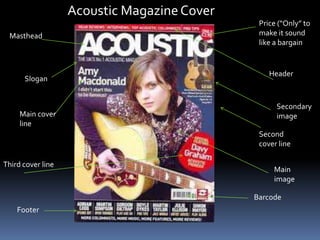
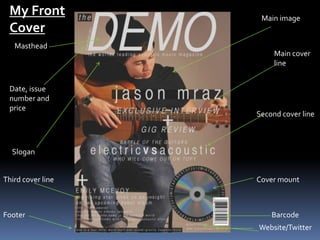
There are many ways in which my magazine front cover used, develops and challenges forms and
conventions of existing magazines. I based my front cover on a magazine called Acoustic, which is of
the same genre as my magazine. The main images of both the existing magazine and mine are very
similar to each other, with the person being photographed sitting down with a guitar, which is a
common convention for this genre of magazine. The reason that they are sitting down is that it gives
out a relaxed atmosphere to the reader, this fits in well with the genre, as Acoustic music also gives out
a mellow and relaxing sound. Also, my cover model has his feet up on a box, again, showing how he is
laid back and chilled. The cover model is supposed to be Jason Mraz, so I have dressed him in classic
casual Mraz: beanie, with a t-shirt and jeans. The cover model from Acoustic is staring directly at the
camera, to show confidence and to seem appealing to potential male buyers of the magazine. My
cover model however, is not looking at the camera, but looking at his guitar instead, showing his
passion for playing music, which is something that a buyer can relate to, their passion for listening to
the music; this is something that challenges the convention of the existing magazine. Also, I have
positioned the cover lines in places that are more likely to grab the readers’ attention. For example, I
have placed the Jason Mraz article cover line in the same direction that the cover model is looking, so it
looks like he is actually looking at the cover line. It is also running down the neck of the guitar; the cover
model is also using his hands as well as his eyes to direct the reader to the cover line, by having his
hands at the beginning and end of the cover line.
I wanted to keep the front cover quite simple, so I kept the text mostly white. However, I don’t think
this is a huge problem as the colour of the guitar and the cover model’s clothes stand out much more
now. I also think the plain white goes well with the creamy colour of the background. Another thing
that stops the white font from becoming a problem is that I've changed the font sizes and boldness of
the text that I want to stand out more, so that the reader is still drawn towards it. Also, the Acoustic
magazine also has used a lot of white for their text.
I also added a cover mount on my magazine, for a free CD. I did this so it would make the reader feel
like they were getting more for their money.
Page number
Features
(Articles
exclusive to this
issue)
Cover story
(The article
that is
advertised
on the
cover of the
magazine)
Masthead
Date/Page
number
Regulars
(articles that
appear every
issue)
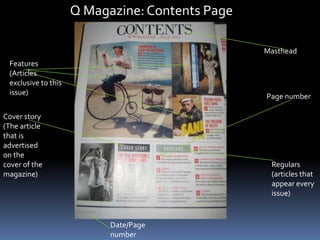
Q Magazine:Contents Page
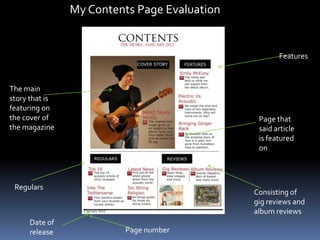
My Contents Page Evaluation
Regulars
Features
The main
story that is
featuring on
the cover of
the magazine
Consisting of
gig reviews and
album reviews
Date of
release Page number
Page that
said article
is featured
on
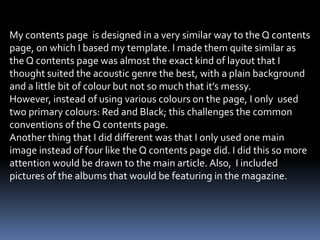
My contents page is designed in a very similar way to the Q contents
page, on which I based my template. I made them quite similar as
the Q contents page was almost the exact kind of layout that I
thought suited the acoustic genre the best, with a plain background
and a little bit of colour but not so much that it’s messy.
However, instead of using various colours on the page, I only used
two primary colours: Red and Black; this challenges the common
conventions of the Q contents page.
Another thing that I did different was that I only used one main
image instead of four like the Q contents page did. I did this so more
attention would be drawn to the main article. Also, I included
pictures of the albums that would be featuring in the magazine.
Dropped
Capital
Pull
quote
Set list Author of
articlePhoto caption
Image
2
Image 3
Main
image/image 1
Date/Page
number
Name of
artist/venue/
rating
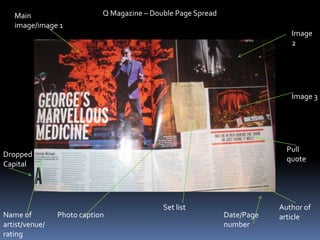
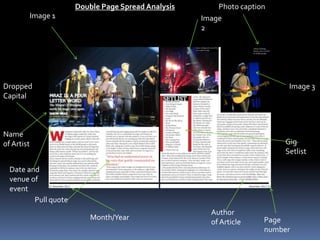
Q Magazine – Double Page Spread
Double Page Spread Analysis
Pull quote
Gig
Setlist
Page
number
Month/Year
Photo caption
Dropped
Capital
Author
of Article
Image 1 Image
2
Image 3
Name
of Artist
Date and
venue of
event
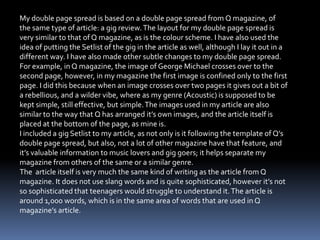
My double page spread is based on a double page spread from Q magazine, of
the same type of article: a gig review.The layout for my double page spread is
very similar to that of Q magazine, as is the colour scheme. I have also used the
idea of putting the Setlist of the gig in the article as well, although I lay it out in a
different way. I have also made other subtle changes to my double page spread.
For example, in Q magazine, the image of George Michael crosses over to the
second page, however, in my magazine the first image is confined only to the first
page. I did this because when an image crosses over two pages it gives out a bit of
a rebellious, and a wilder vibe, where as my genre (Acoustic) is supposed to be
kept simple, still effective, but simple.The images used in my article are also
similar to the way that Q has arranged it’s own images, and the article itself is
placed at the bottom of the page, as mine is.
I included a gig Setlist to my article, as not only is it following the template of Q’s
double page spread, but also, not a lot of other magazine have that feature, and
it’s valuable information to music lovers and gig goers; it helps separate my
magazine from others of the same or a similar genre.
The article itself is very much the same kind of writing as the article from Q
magazine. It does not use slang words and is quite sophisticated, however it’s not
so sophisticated that teenagers would struggle to understand it.The article is
around 1,000 words, which is in the same area of words that are used in Q
magazine’s article.
QUESTIONTWO
How does your media product
represent different social groups?
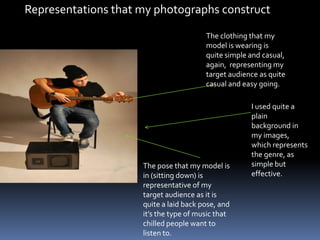
Representations that my photographs construct
The pose that my model is
in (sitting down) is
representative of my
target audience as it is
quite a laid back pose, and
it’s the type of music that
chilled people want to
listen to.
The clothing that my
model is wearing is
quite simple and casual,
again, representing my
target audience as quite
casual and easy going.
I used quite a
plain
background in
my images,
which represents
the genre, as
simple but
effective.
How I demonstrate representation
through copy:
As you can see in my double page spread, I tried to
keep the copy quite sophisticated, using very little , if
any, slang. However, it was still easy enough to
understand.The writing represents my target
audience as being quite mature.
“Wearing his trademark trilby hat, Jason Mraz, aVirginia singer songwriter ,steps onto
the stage of the famous 02 Arena, barefoot, holding an acoustic guitar which is
decorated by nothing but a simple sticker with the word “Love” printed on it; he
silently listens to the 20,000 people in the arena cheer in wild unison for him, and only
then does he begin the show the only way a man who got his start performing in San
Diego coffee houses would: “What’s Up, Dudes?”.And for the rest of the 2 and a half
hour show, Mr.A-Z was holding the crowd in the palm of his hands.”
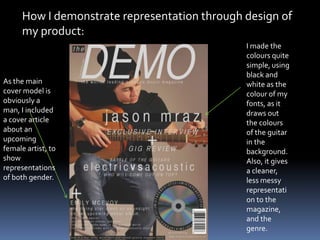
How I demonstrate representation through design of
my product:
I made the
colours quite
simple, using
black and
white as the
colour of my
fonts, as it
draws out
the colours
of the guitar
in the
background.
Also, it gives
a cleaner,
less messy
representati
on to the
magazine,
and the
genre.
As the main
cover model is
obviously a
man, I included
a cover article
about an
upcoming
female artist, to
show
representations
of both gender.
What kind of media institution
might distribute your media
product and why?
Ithink Bauer would be a good choice to distribute my magazine, as it
already distributes Q, the magazine that I have used as a template to
create my own, and also, it does not already publish a magazine that
is specific to my magazines acoustic genre.
My magazine is very likely to be sold in music stores , any post
office,WHSmith, and shops likeTesco and Morrisons etc.
QUESTIONTHREE
Who would be the audience
for your media product?
The target audience for my media product would be ranged from
ages 15-20. Also, it is aimed at all kinds of races and gender, as
Acoustic music is a type of music that can be female and male
friendly, and also has different variations in different cultures. I
would not think that anyone under 15 would be likely to buy the
magazine, as the language in the articles and the layout of the
magazine is quite mature, therefore it may be harder to keep the
attention of a young person.
The Demo would also be targeted at anyone with a passion for
playing music as well as listening to it, as there are many features in
the magazine about different instruments, primarily guitars.
QUESTION FOUR
What have you learnt about technologies from
the process of constructing this product?
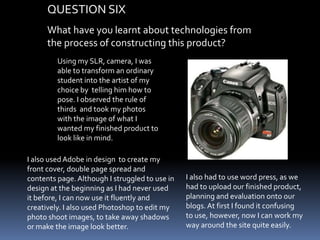
Using my SLR, camera, I was
able to transform an ordinary
student into the artist of my
choice by telling him how to
pose. I observed the rule of
thirds and took my photos
with the image of what I
wanted my finished product to
look like in mind.
I also used Adobe in design to create my
front cover, double page spread and
contents page.Although I struggled to use in
design at the beginning as I had never used
it before, I can now use it fluently and
creatively. I also used Photoshop to edit my
photo shoot images, to take away shadows
or make the image look better.
I also had to use word press, as we
had to upload our finished product,
planning and evaluation onto our
blogs.At first I found it confusing
to use, however, now I can work my
way around the site quite easily.
QUESTION SIX
Other technologies that I had to use during the process:
Youtube – Used to upload a video
Slideshare – Used to publish my evaluation
Microsoft Powerpoint – Used to create my evaluation
Google – Used to research for my magazine
Studio Lighting – Used to remove shadows etc. for my
photoshoot
Iphone 5 – Used to upload to wordpress when I was not in
access to a computer.
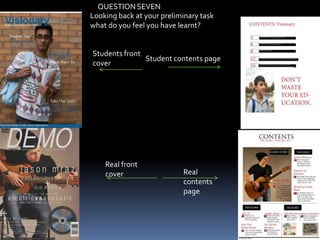
Student contents page
Students front
cover
Real
contents
page
Real front
cover
QUESTION SEVEN
Looking back at your preliminary task
what do you feel you have learnt?
http://soundcloud.com/luke-sgeorgiades/audio-recording-on-
thursday
http://soundcloud.com/luke-sgeorgiades/audio-recording-on-
thursday-1
Question Seven: continued (Soundcloud answer)

Presentation1 media as

  • 1.
    Question One: In whatways does your media product use, develop, or challenge the conventions of existing media products?
  • 2.
    Footer Masthead Slogan Main cover line Price (“Only”to make it sound like a bargain Header Barcode Main image Secondary image Second cover line Third cover line Acoustic MagazineCover
  • 3.
    Masthead Date, issue number and price Slogan Mainimage Main cover line Barcode Cover mount Website/Twitter Second cover line Third cover line Footer My Front Cover
  • 4.
    There are manyways in which my magazine front cover used, develops and challenges forms and conventions of existing magazines. I based my front cover on a magazine called Acoustic, which is of the same genre as my magazine. The main images of both the existing magazine and mine are very similar to each other, with the person being photographed sitting down with a guitar, which is a common convention for this genre of magazine. The reason that they are sitting down is that it gives out a relaxed atmosphere to the reader, this fits in well with the genre, as Acoustic music also gives out a mellow and relaxing sound. Also, my cover model has his feet up on a box, again, showing how he is laid back and chilled. The cover model is supposed to be Jason Mraz, so I have dressed him in classic casual Mraz: beanie, with a t-shirt and jeans. The cover model from Acoustic is staring directly at the camera, to show confidence and to seem appealing to potential male buyers of the magazine. My cover model however, is not looking at the camera, but looking at his guitar instead, showing his passion for playing music, which is something that a buyer can relate to, their passion for listening to the music; this is something that challenges the convention of the existing magazine. Also, I have positioned the cover lines in places that are more likely to grab the readers’ attention. For example, I have placed the Jason Mraz article cover line in the same direction that the cover model is looking, so it looks like he is actually looking at the cover line. It is also running down the neck of the guitar; the cover model is also using his hands as well as his eyes to direct the reader to the cover line, by having his hands at the beginning and end of the cover line. I wanted to keep the front cover quite simple, so I kept the text mostly white. However, I don’t think this is a huge problem as the colour of the guitar and the cover model’s clothes stand out much more now. I also think the plain white goes well with the creamy colour of the background. Another thing that stops the white font from becoming a problem is that I've changed the font sizes and boldness of the text that I want to stand out more, so that the reader is still drawn towards it. Also, the Acoustic magazine also has used a lot of white for their text. I also added a cover mount on my magazine, for a free CD. I did this so it would make the reader feel like they were getting more for their money.
  • 5.
    Page number Features (Articles exclusive tothis issue) Cover story (The article that is advertised on the cover of the magazine) Masthead Date/Page number Regulars (articles that appear every issue) Q Magazine:Contents Page
  • 6.
    My Contents PageEvaluation Regulars Features The main story that is featuring on the cover of the magazine Consisting of gig reviews and album reviews Date of release Page number Page that said article is featured on
  • 7.
    My contents pageis designed in a very similar way to the Q contents page, on which I based my template. I made them quite similar as the Q contents page was almost the exact kind of layout that I thought suited the acoustic genre the best, with a plain background and a little bit of colour but not so much that it’s messy. However, instead of using various colours on the page, I only used two primary colours: Red and Black; this challenges the common conventions of the Q contents page. Another thing that I did different was that I only used one main image instead of four like the Q contents page did. I did this so more attention would be drawn to the main article. Also, I included pictures of the albums that would be featuring in the magazine.
  • 8.
    Dropped Capital Pull quote Set list Authorof articlePhoto caption Image 2 Image 3 Main image/image 1 Date/Page number Name of artist/venue/ rating Q Magazine – Double Page Spread
  • 9.
    Double Page SpreadAnalysis Pull quote Gig Setlist Page number Month/Year Photo caption Dropped Capital Author of Article Image 1 Image 2 Image 3 Name of Artist Date and venue of event
  • 10.
    My double pagespread is based on a double page spread from Q magazine, of the same type of article: a gig review.The layout for my double page spread is very similar to that of Q magazine, as is the colour scheme. I have also used the idea of putting the Setlist of the gig in the article as well, although I lay it out in a different way. I have also made other subtle changes to my double page spread. For example, in Q magazine, the image of George Michael crosses over to the second page, however, in my magazine the first image is confined only to the first page. I did this because when an image crosses over two pages it gives out a bit of a rebellious, and a wilder vibe, where as my genre (Acoustic) is supposed to be kept simple, still effective, but simple.The images used in my article are also similar to the way that Q has arranged it’s own images, and the article itself is placed at the bottom of the page, as mine is. I included a gig Setlist to my article, as not only is it following the template of Q’s double page spread, but also, not a lot of other magazine have that feature, and it’s valuable information to music lovers and gig goers; it helps separate my magazine from others of the same or a similar genre. The article itself is very much the same kind of writing as the article from Q magazine. It does not use slang words and is quite sophisticated, however it’s not so sophisticated that teenagers would struggle to understand it.The article is around 1,000 words, which is in the same area of words that are used in Q magazine’s article.
  • 11.
    QUESTIONTWO How does yourmedia product represent different social groups?
  • 12.
    Representations that myphotographs construct The pose that my model is in (sitting down) is representative of my target audience as it is quite a laid back pose, and it’s the type of music that chilled people want to listen to. The clothing that my model is wearing is quite simple and casual, again, representing my target audience as quite casual and easy going. I used quite a plain background in my images, which represents the genre, as simple but effective.
  • 13.
    How I demonstraterepresentation through copy: As you can see in my double page spread, I tried to keep the copy quite sophisticated, using very little , if any, slang. However, it was still easy enough to understand.The writing represents my target audience as being quite mature. “Wearing his trademark trilby hat, Jason Mraz, aVirginia singer songwriter ,steps onto the stage of the famous 02 Arena, barefoot, holding an acoustic guitar which is decorated by nothing but a simple sticker with the word “Love” printed on it; he silently listens to the 20,000 people in the arena cheer in wild unison for him, and only then does he begin the show the only way a man who got his start performing in San Diego coffee houses would: “What’s Up, Dudes?”.And for the rest of the 2 and a half hour show, Mr.A-Z was holding the crowd in the palm of his hands.”
  • 14.
    How I demonstraterepresentation through design of my product: I made the colours quite simple, using black and white as the colour of my fonts, as it draws out the colours of the guitar in the background. Also, it gives a cleaner, less messy representati on to the magazine, and the genre. As the main cover model is obviously a man, I included a cover article about an upcoming female artist, to show representations of both gender.
  • 15.
    What kind ofmedia institution might distribute your media product and why? Ithink Bauer would be a good choice to distribute my magazine, as it already distributes Q, the magazine that I have used as a template to create my own, and also, it does not already publish a magazine that is specific to my magazines acoustic genre. My magazine is very likely to be sold in music stores , any post office,WHSmith, and shops likeTesco and Morrisons etc. QUESTIONTHREE
  • 16.
    Who would bethe audience for your media product? The target audience for my media product would be ranged from ages 15-20. Also, it is aimed at all kinds of races and gender, as Acoustic music is a type of music that can be female and male friendly, and also has different variations in different cultures. I would not think that anyone under 15 would be likely to buy the magazine, as the language in the articles and the layout of the magazine is quite mature, therefore it may be harder to keep the attention of a young person. The Demo would also be targeted at anyone with a passion for playing music as well as listening to it, as there are many features in the magazine about different instruments, primarily guitars. QUESTION FOUR
  • 17.
    What have youlearnt about technologies from the process of constructing this product? Using my SLR, camera, I was able to transform an ordinary student into the artist of my choice by telling him how to pose. I observed the rule of thirds and took my photos with the image of what I wanted my finished product to look like in mind. I also used Adobe in design to create my front cover, double page spread and contents page.Although I struggled to use in design at the beginning as I had never used it before, I can now use it fluently and creatively. I also used Photoshop to edit my photo shoot images, to take away shadows or make the image look better. I also had to use word press, as we had to upload our finished product, planning and evaluation onto our blogs.At first I found it confusing to use, however, now I can work my way around the site quite easily. QUESTION SIX
  • 18.
    Other technologies thatI had to use during the process: Youtube – Used to upload a video Slideshare – Used to publish my evaluation Microsoft Powerpoint – Used to create my evaluation Google – Used to research for my magazine Studio Lighting – Used to remove shadows etc. for my photoshoot Iphone 5 – Used to upload to wordpress when I was not in access to a computer.
  • 19.
    Student contents page Studentsfront cover Real contents page Real front cover QUESTION SEVEN Looking back at your preliminary task what do you feel you have learnt?
  • 20.