Dall Tube
M. Arslan Khalid
17-ntu-0103
Dep# weaving
Topic
CONTENTS
• Introduction
• Working
• Advantage's
• Disadvantage's
• Application
• Conclusion
Introduction
• A combination of Venturi tube and orifice plate, it features the same
tapering intake portion of a venturi tube but has a ‘shoulder’ similar
to the orifice plate’s exit part to create a sharp pressure drop. It is
usually used in applications with larger flow rates.
• The Dall tube is a shortened version of a Venturi meter, with a lower
pressure drop than an orifice plate. As with these flow meters the
flow rate in a Dall tube is determined by measuring the pressure drop
caused by restriction in the conduit.
• The pressure differential is typically measured using diaphragm
pressure transducers with digital readout. Since these meters have
significantly lower permanent pressure losses than orifice meters,
Dall tubes are widely used for measuring the flow rate of large pipe
works
• Differential pressure produced by a Dall tube higher than venturi tube
and nozzle, all of them having same throat diameters.
working
• Dall Flow Tube has a higher ratio of pressure developed to pressure lost
than the venturi flow tube. It is more compact and is commonly used
in large flow applications.
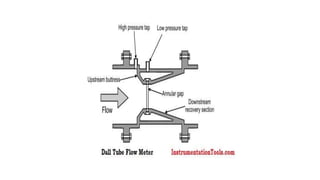
• The tube consists of a short, straight inlet section
followed by an abrupt decrease in the inside diameter of the tube. This
section, called the inlet shoulder, is followed by the converging inlet cone
and a diverging exit cone.
• The two cones are separated by a slot or gap between the two cones.
The low pressure is measured at the
slotted throat (area between the two cones). The high pressure is
measured at the upstream edge of the inlet shoulder.
• The Dall flow tube is available in medium to very large sizes. In the
large sizes, the cost is normally less than that of a venturi flow
tube. This type of flow tube has a pressure loss of about 5%. Flow
rate and pressure drop are related as shown in Equation
Equation
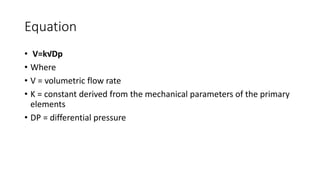
• V=k√Dp
• Where
• V = volumetric flow rate
• K = constant derived from the mechanical parameters of the primary
elements
• DP = differential pressure
Advantages:
• Dall Flow Tube has a higher ratio of pressure developed
to pressure lost than the venturi flow tube.
• It is more compact and is commonly used in large flow applications.
• Overall energy loss in terms of percentage of the Dall meter is about
half that for a Venturi meter for a similar differential pressure loss.
• Very low permanent pressure drop – energy savings
• Easy to install – short overall lengths
• Accurate flow metering of clean gases, liquid and steam
• Negligible wear and erosion therefore require less
maintenance/inspection
Disadvantages
• More complex to manufacture.
• Sensitive to turbulence.
Applications
• Flow measurement in gas transmission pipelines
• Flow metering of clean gasses
• Single phase flow measurement of hydrocarbon gas
• Flow measurement in circular pipes

Presentation1 dall tube

  • 1.
    Dall Tube M. ArslanKhalid 17-ntu-0103 Dep# weaving Topic
  • 2.
    CONTENTS • Introduction • Working •Advantage's • Disadvantage's • Application • Conclusion
  • 3.
    Introduction • A combinationof Venturi tube and orifice plate, it features the same tapering intake portion of a venturi tube but has a ‘shoulder’ similar to the orifice plate’s exit part to create a sharp pressure drop. It is usually used in applications with larger flow rates. • The Dall tube is a shortened version of a Venturi meter, with a lower pressure drop than an orifice plate. As with these flow meters the flow rate in a Dall tube is determined by measuring the pressure drop caused by restriction in the conduit.
  • 4.
    • The pressuredifferential is typically measured using diaphragm pressure transducers with digital readout. Since these meters have significantly lower permanent pressure losses than orifice meters, Dall tubes are widely used for measuring the flow rate of large pipe works • Differential pressure produced by a Dall tube higher than venturi tube and nozzle, all of them having same throat diameters.
  • 6.
    working • Dall FlowTube has a higher ratio of pressure developed to pressure lost than the venturi flow tube. It is more compact and is commonly used in large flow applications. • The tube consists of a short, straight inlet section followed by an abrupt decrease in the inside diameter of the tube. This section, called the inlet shoulder, is followed by the converging inlet cone and a diverging exit cone. • The two cones are separated by a slot or gap between the two cones. The low pressure is measured at the slotted throat (area between the two cones). The high pressure is measured at the upstream edge of the inlet shoulder.
  • 7.
    • The Dallflow tube is available in medium to very large sizes. In the large sizes, the cost is normally less than that of a venturi flow tube. This type of flow tube has a pressure loss of about 5%. Flow rate and pressure drop are related as shown in Equation
  • 8.
    Equation • V=k√Dp • Where •V = volumetric flow rate • K = constant derived from the mechanical parameters of the primary elements • DP = differential pressure
  • 9.
    Advantages: • Dall FlowTube has a higher ratio of pressure developed to pressure lost than the venturi flow tube. • It is more compact and is commonly used in large flow applications. • Overall energy loss in terms of percentage of the Dall meter is about half that for a Venturi meter for a similar differential pressure loss. • Very low permanent pressure drop – energy savings • Easy to install – short overall lengths • Accurate flow metering of clean gases, liquid and steam • Negligible wear and erosion therefore require less maintenance/inspection
  • 10.
    Disadvantages • More complexto manufacture. • Sensitive to turbulence.
  • 11.
    Applications • Flow measurementin gas transmission pipelines • Flow metering of clean gasses • Single phase flow measurement of hydrocarbon gas • Flow measurement in circular pipes