SOLAR AND WIND ENERGY
WIND ENERGY STATISTICS
Prepared by:-
Sonu kumar bairwa
Wind Speed Distribution:-
• If one knows the average wind speed for a
location and has corrected it to the desired
height, then a wind speed distribution can be
calculated using either Weibull or rayleigh
distribution.
• Rayleigh distribution is a special case of Weibull
distribution and is used for most land-based wind
turbine sites. The International Small Wind
Turbine Standard IEC 61400-2 recommends use
of the Rayleigh distribution which is given as
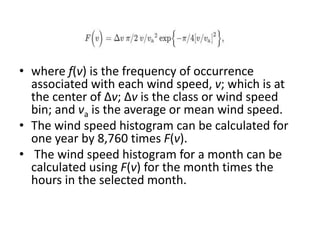
• where f(v) is the frequency of occurrence
associated with each wind speed, v; which is at
the center of Δv; Δv is the class or wind speed
bin; and va is the average or mean wind speed.
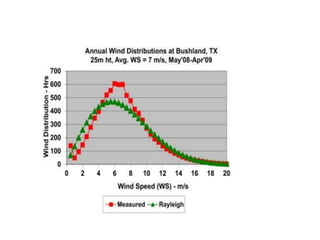
• The wind speed histogram can be calculated for
one year by 8,760 times F(v).
• The wind speed histogram for a month can be
calculated using F(v) for the month times the
hours in the selected month.
Cumulative power distribution
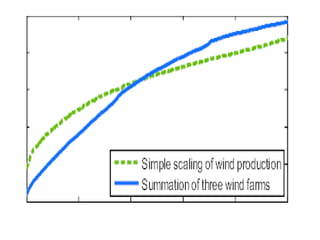
• The wind generation is assumed as a base case
split on three offshore wind farms some +100 km
apart
• feeding into the regional grid. Applying one year
of measured hourly wind speed from 2001 at
these sites,
• and scaled to give 3000 full load hours (FLH) with
the assumed wind farm power curve, a significant
smoothing effect is observed, see Figure 1.
• It is observed that the probability of zero power
output is almost 20 % for a single wind farm,
while the corresponding value for the sum power
output from three wind farms is less than 5 %.
• Thus, the smoothing effect will have a positive
impact on the contribution of wind power to
meet the maximum load.
• The smoothing effect is also evident for the
periods with high wind speed; the three wind
farms generates at full power at the same time
less than 1 % of the year,
• compared to 10 % of the year for a single wind
farm.
• maximum and minimum wind speed at the day
with the lowest measured temperature at the
reference sites has been collected, as it is
assumed that the maximum load occurs at that
day.
• This assumption is justified for the case study
system using electricity for heating.
The data is then compared with the average
yearly wind speed for every day between 1961
and 2005 in order to see whether the wind speed
at the maximum hour is typically lower or higher
than the average wind speed over the year.
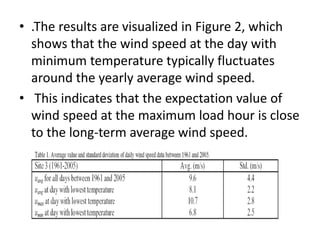
• .The results are visualized in Figure 2, which
shows that the wind speed at the day with
minimum temperature typically fluctuates
around the yearly average wind speed.
• This indicates that the expectation value of
wind speed at the maximum load hour is close
to the long-term average wind speed.
Wind energy statistics

Wind energy statistics

  • 1.
    SOLAR AND WINDENERGY WIND ENERGY STATISTICS Prepared by:- Sonu kumar bairwa
  • 2.
    Wind Speed Distribution:- •If one knows the average wind speed for a location and has corrected it to the desired height, then a wind speed distribution can be calculated using either Weibull or rayleigh distribution. • Rayleigh distribution is a special case of Weibull distribution and is used for most land-based wind turbine sites. The International Small Wind Turbine Standard IEC 61400-2 recommends use of the Rayleigh distribution which is given as
  • 3.
    • where f(v)is the frequency of occurrence associated with each wind speed, v; which is at the center of Δv; Δv is the class or wind speed bin; and va is the average or mean wind speed. • The wind speed histogram can be calculated for one year by 8,760 times F(v). • The wind speed histogram for a month can be calculated using F(v) for the month times the hours in the selected month.
  • 5.
    Cumulative power distribution •The wind generation is assumed as a base case split on three offshore wind farms some +100 km apart • feeding into the regional grid. Applying one year of measured hourly wind speed from 2001 at these sites, • and scaled to give 3000 full load hours (FLH) with the assumed wind farm power curve, a significant smoothing effect is observed, see Figure 1.
  • 6.
    • It isobserved that the probability of zero power output is almost 20 % for a single wind farm, while the corresponding value for the sum power output from three wind farms is less than 5 %. • Thus, the smoothing effect will have a positive impact on the contribution of wind power to meet the maximum load. • The smoothing effect is also evident for the periods with high wind speed; the three wind farms generates at full power at the same time less than 1 % of the year, • compared to 10 % of the year for a single wind farm.
  • 8.
    • maximum andminimum wind speed at the day with the lowest measured temperature at the reference sites has been collected, as it is assumed that the maximum load occurs at that day. • This assumption is justified for the case study system using electricity for heating. The data is then compared with the average yearly wind speed for every day between 1961 and 2005 in order to see whether the wind speed at the maximum hour is typically lower or higher than the average wind speed over the year.
  • 9.
    • .The resultsare visualized in Figure 2, which shows that the wind speed at the day with minimum temperature typically fluctuates around the yearly average wind speed. • This indicates that the expectation value of wind speed at the maximum load hour is close to the long-term average wind speed.