The Classification of
AnticancerDrugs
According to biochemistry mechanisms of
anticancer action:
Block nucleic acid biosynthesis
Direct influence the structure and function of
DNA
Interfere transcription and block RNA synthesis
Interfere protein synthesis and function
Influence hormone homeostasis
Others
2.
The Classification of
AnticancerDrugs
According to the cycle or phase
specificity of the drug:
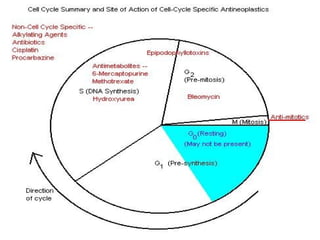
cell cycle nonspecific agents (CCNSA)
cell cycle specific agents (CCSA)
3.
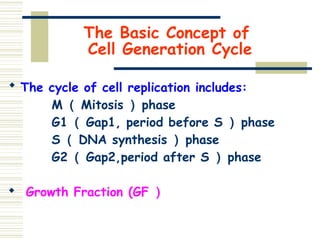
The Basic Conceptof
Cell Generation Cycle
The cycle of cell replication includes:
M ( Mitosis ) phase
G1 ( Gap1, period before S ) phase
S ( DNA synthesis ) phase
G2 ( Gap2,period after S ) phase
Growth Fraction (GF )
5.
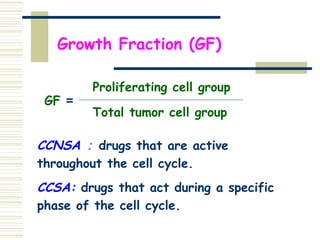
Growth Fraction (GF)
GF=
Proliferating cell group
Total tumor cell group
CCNSA : drugs that are active
throughout the cell cycle.
CCSA: drugs that act during a specific
phase of the cell cycle.
6.
Cell cycle specificagents and Cell cycle
Non-specific agents
Cell Cycle Nonspecific Agents (CCNSA)
drugs that are active throughout the cell
cycle
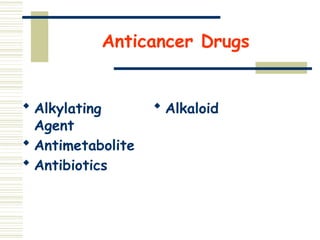
Alkylating Agents
Platinum Compounds
Antibiotics
7.
Cell cycle specificagents and Cell cycle
Non-specific agents
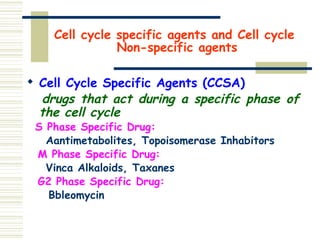
Cell Cycle Specific Agents (CCSA)
drugs that act during a specific phase of
the cell cycle
S Phase Specific Drug:
Aantimetabolites, Topoisomerase Inhabitors
M Phase Specific Drug:
Vinca Alkaloids, Taxanes
G2 Phase Specific Drug:
Bbleomycin
8.
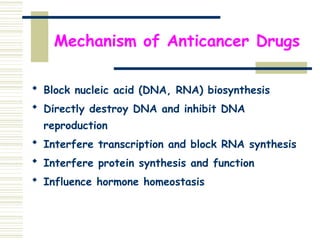
Mechanism of AnticancerDrugs
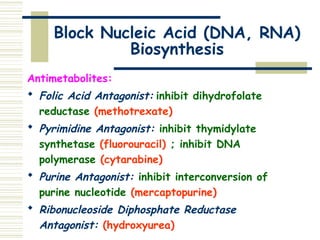
Block nucleic acid (DNA, RNA) biosynthesis
Directly destroy DNA and inhibit DNA
reproduction
Interfere transcription and block RNA synthesis
Interfere protein synthesis and function
Influence hormone homeostasis
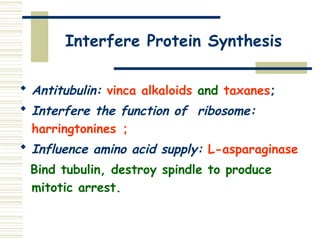
Interfere Protein Synthesis
Antitubulin: vinca alkaloids and taxanes;
Interfere the function of ribosome:
harringtonines ;
Influence amino acid supply: L-asparaginase
Bind tubulin, destroy spindle to produce
mitotic arrest.
Influence the Structureand
Function of DNA
Alkylating Agent: mechlorethamine,
cyclophosphamide and thiotepa
Platinum: cis-platinium
Antibiotic: bleomycin and mitomycin C
Topoismerase inhibitor: camptothecine and
podophyllotoxin
13.
Influence Hormone Homeostasis
Thesedrugs bind to hormone receptors to block
the actions of the sex hormones which results in
inhibition of tumor growth.
Estrogens and estrogen antagonistic drug
Androgens and androgen antagonistic drug
Progestogen drug
Glucocorticoid drug
gonadotropin-releasing hormone inhibitor:
leuprolide, goserelin
aromatase inhibitor: aminoglutethimide,
anastrazole
The Main Stepof Anticancer
Drug Research
Non-clinical Research :
1.Anticancer Drug Screen:
in vitro : tumor cell culture, tumor
inhibitor/kill test
in vivo : animal xenograft model
e.g.Ehrlich ascites tumor, S180
lymphosarcoma
2. Pharmacodynamics, pharmacokinetics and
toxicology test
16.
The Main Stepof Anticancer
Drug Research
Clinical Research:
Phase 1 clinical trial
Phase 2 clinical trial
Phase 3 clinical trial
Phase 4 clinical trial
17.
The Main Stepof Anticancer
Drug Research
Phase 3 clinical trial
In Phase 3 studies, the study drug or treatment
is given to large groups of people (more than
200) to further determine its effectiveness,
monitor side effects, compare it to commonly
used treatments, and collect information that
will allow the drug or treatment to be used
safely.
18.
The Main Stepof Anticancer
Drug Research
Phase 4 clinical trial
Phase 4 studies are done after the drug or
treatment has been marketed. These studies
continue testing the study drug or treatment to
collect information about their effect in various
populations and any side effects associated with
long-term use.
Alkylating Agents
Oneof the frightening developments of World
War I was the introduction of chemical warfare.
These compounds were known as the nitrogen
mustard gases. The nitrogen mustards were
observed to inhibit cell growth, especially of
bone marrow. Shortly after the war, these
compounds were investigated and shown to inhibit
the growth of cancer cells.
21.
Alkylating Agents
Mechanism ofAction
Nitrogen mustards inhibit cell reproduction by
binding irreversibly with the nucleic acids (DNA).
The specific type of chemical bonding involved is
alkylation. After alkylation, DNA is unable to
replicate and therefore can no longer synthesize
proteins and other essential cell metabolites.
Consequently, cell reproduction is inhibited and
the cell eventually dies from the inability to
maintain its metabolic functions.
Resistance of AlkylatingAgents
Resistance to alkylating agents has several
causes:
Membrane transport may be decreased.
The drug may be bound by glutathione (GSH)
via GSH-S-transferase or metallothioneins
in the cytoplasm and inactivated.
The drug may be metabolized to inactive
species.
24.
Adverse Effects ofAlkylating Agents
Myelosuppression is the dose-limiting
adverse effect for alkylating agents.
Nausea and vomiting are common as are
teratogenesis and gonadal atrophy,
although in the latter cases these are
variable, according to the drug, its
schedule, and route of administration.
Treatment also carries a major risk of
leukemogenesis and carcinogenesis.
25.
Alkylating Agents——Mustine
Mustinemust be injected intravenously
because it is highly reactive. It
disappears very rapidly from the blood,
the activity of Mustine lasts only a few
minutes.
The main indication for Mustine is in
treatment of Hodgkins disease and
lymphomas, but it may also be useful in
other malignancies.
26.
Alkylating Agents——
Cyclophosphamide
Cyclophosphamide canalso be given orally.
Indications :
It is used in the treatment of chronic lymphocyctic
leukemia, non-Hodgkin’s lymphomas, breast and
ovarian cancer, and a variety of other cancers.
It is also a potent immunosuppressant, it is used in
the management of rheumatoid disorders and
autoimmune nephritis.
Adverse Effects:
Alopecia, nausea, vomiting, myelosuppression, and
hemorrhagic cystitis.
27.
Alkylating Agents——Nitrosoureas
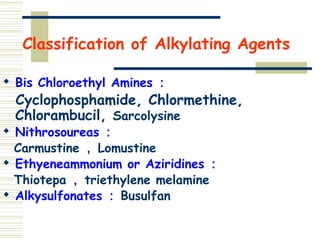
Carmustine, Lomustine,Semustine
Pharmacokinetics:
Nitrosoureas are highly lipophilic and
reach cerebrospinal fluid concentrations
that are about 30% of plasma
concentrations.
Indications:
Because of their excellent CNS
penetration, carmustine and lomustine
have been used to treat brain tumors.
28.
Alkylating Agents——
Phenylalanine NitrogenMustard
Melphalan is a nitrogen mustard that is
primarily used to treat multiple myeloma
(plasma cell myeloma), breast cancer, and
ovarian cancer.
29.
Alkylating Agents——
Alkysulfonates
Busulfan [Myleran]
Indications:
Busulfan is administered orally to treat chroic
granulocytic leukemia and other
myeloproliferative disorders.
Adverse Effects:
Busulfan produces advers effects related to
myelosuppression. It only occasionally produces
nausea and vomitting. In high doses, it produces
a rare but sometimes fatal pulmonary fibrosis,
”busulfan lung”.
30.
Alkylating Agents——Thiotepa
Thiotepa isconverted rapidly by liver
mixed-function oxidases to its active
metabolite triethylenephosphoramide
(TEPA); it is active in bladder cancer.
31.
Antimetabolites
General Characteristics :
Antimetabolites are S phase-specific
drugs that are structural analogues of
essential metabolites and that interfere
with DNA synthesis.
Myelosuppression is the dose-limiting
toxicity for all drugs in this class.
Antimetabolites——
Folic Acid Antagonist
Methotrexate( MTX )
Mechanism of Action :
The structures of MTX and folic acid are
similar. MTX is actively transported into
mammalian cells and inhibits dihydrofolate
reductase, the enzyme that normally converts
dietary folate to the tetrahydrofolate form
required for thymidine and purine synthesis.
34.
Antimetabolites——
Folic Acid Antagonist
Methotrexate( MTX )
Indications :
The use of MTX in the treatment of
choriocarinoma, a trophoblastic tumor, was the
first demonstration of curative chemotherapy.
It is especially effective for treating acute
lymphocytic leukemia and for treating the
meningeal metastases of a wide range of tumors.
35.
Antimetabolites——
Folic Acid Antagonist
Methotrexate( MTX )
Adverse Effects :
MTX is myelosuppressive, producing severe
leukopenia, bone marrow aplasia, and
thrombocytopenia.
This agent may produce severe gastrointestinal
disturbances.
Renal toxicity may occur because of precipitation
(crystalluria) of the 7-OH metabolite of MTX.
36.
Antimetabolites——
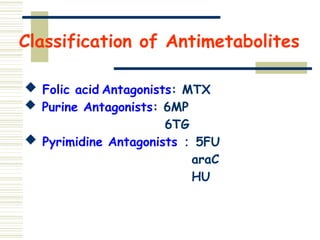
Purine Antagonists
6-Mercapapurine (6-MP )
The drugs are believed to act similarly to inhibit
purine base synthesis, although their exact
mechanisms of action are still uncertain.
Indications:
Mercaptopurine is used primarily for the maintenance
of remission in patients with acute lymphocytic
leukemia and is given in combination with MTX for
this purpose.
Adverse Effects:
Well tolerate.
Myelosuppression is generally mild with
thioguanine.Long-term mercaptopurine use may cause
hepatotoxicity.
37.
Antimetabolites——
Pyrimidine Antagonists
5-Fluorouracil (5-FU)
Mechanismof Action :
Fluorouracil is an analogue of thymine in which the
methyl group is replaced by a fluorine atom. It has
two active metabolites: 5-FdUMP and 5-FdUTP. 5-
FdUMP inhibits thymidylate synthetases and prevents
the synthesis of thymidine, a major building block of
DNA. 5-FdUTP is incorporated into RNA by RNA
polymerase and interferes with RNA function.
Antimetabolites——
Pyrimidine Antagonists
5-Fluorouracil (5-FU)
AdverseEffects :
Fluorouracil may cause nausea and vomiting,
myelosuppression, and oral and gastrointestinal
ulceration. Nausea and vomitting are usually mild.
With fluorouracil, myelosuppression is more
problematic after bolus injections, whereas
mucosal damage is dose-limiting with continuous
infusions.
40.
Antimetabolites——
Pyrimidine Antagonists
Cytarabine
Indications :
Cytarabine has a narrow clinical spectrum and is
primarily used in combination with daunorubicin or
thioguanine for the treatment of acute
nonlymphocytic leukemia.
Adverse Effects:
High doses of cytarabine can damage the liver,
heart, and other organs.
Antibiotics
Adriamycin and Daunorubicin:
Properties:
Adriamycin and Daunorubicin are tetracycline rings
with the sugar daunosamine. They are DNA
intercalating agents that block the synthesis of DNA
and RNA.
These agents are primarily toxic during the S phase
of cell cycle.
These agents imparts a red tinge to the urine.
Adramycin is used to treat acute leukemias,
lymphoma, and a number of solid tumors.
43.
Antibiotics
Mitomycin C:
Mechanism:
MitomycinC is an antineoplastic antibiotic that
alkylates DNA and thereby causes strand
breakage and inhibition of DNA synthesis.
Indications:
It is primarily used in combination with
vinvristine as salvage therapy for breast cancer.
Adverse Effects:
Mitomycin produces delays and prolonged
myelosuppression that preferentially affects
platelets and leukocytes.
44.
Antibiotics
Actinomycin D:
ActinomycinD intercalates DNA and thereby
prevents DNA transcription and messenger RNA
synthesis.
The drug is given intravenously, and its clinical
use is limited to the treatment of trophoblastic
(gestational) tumors and the treatment of
pediatric tumors, such as Wilms’ tumor and
Ewing’s sarcoma.
45.
Antibiotics
Bleomycin:
Mechanism:
The drughas its greatest effect on neoplastic
cell in the G2 phase of the cell replication
cycle.Although bleomycin intercalates DNA, the
major cytotoxicity is believed to result from
ironcatalyzed free radical formation and DNA
strand breakage.
Indications:
It is useful in Hodgkin’s and non-Hodgkin’s
lymphomas, testicular cancer, and several other
solid tumors.
Adverse Effects:
Bleomycin produces very little myelosuppression.
The most serious toxicities of Bleomycin are
pulmonary and mucocutaneous reactions.
46.
Anti-Cancer Plant Allaloids
Tubulin-Binding Agents
Vinca Alkaloids: The cellular mechanism of
action of vinca alkaloids is the prevention of
microtubule assembly, causing cells to arrest
in the late G2 phase by preventing formation
of mitotic filaments for nuclear and cell
division.
47.
Platinum Compound
Cisplatin:
Mechanism ofAction:
Cisplatin binds to guanine in DNA and
RNA, and the interaction is stabilized by
hydrogen bonding. The molecular
mechanism of action is unwinding and
shortening of the DNA helix.
48.
Platinum Compound
Cisplatin:
Indications:
Cisplatinhas efficacy against a wide range of
neoplasms. It is given intravenously as a first-
line drug for testicular, ovarian, and bladder
cancer, and it is also useful in the treatment of
melanoma and a number of other soild tumors.
Adverse Effect:
Cisplatin produces relatively little
myelosuppression but can cause severe nausea,
vomiting, and nephrotoxicity.
Hormones
Several typesof hormone-dependent cancer
(especially breast, prostate, and endometrial
cancer) respond to treatment with their
corresponding hormone antagonists.
Estrogen antagonists are primarily used in the
treatment of breast cancer, whereas androgen
antagonists are used in the treatment of
prostate cancer. Corticosteroids are particularly
useful in treating lymphocytic leukemias and
lymphomas.
51.
Hormones
Estrogens:
Estrogens inhibitthe effects of endogenous
androgens and androgen-dependent metastatic
prostatic carcinoma. Diethylstilbestrol is usually
the agent of choice.
Cardiac and cerebrovascular complications and
carcinoma of the male breast are potential
adverse effects.
52.
Hormones
Progenstins:
Progestins areuseful in the management of
endometrial carcinoma and back-up therapy for
metastatic hormone-dependent breast cancer.
53.
Hormones
Antiestrogen: Tamoxifen
Tamoxifenis the drug of choice in
postmenopausal women with or recovering from
metastatic breast cancer. It is most effective in
patients who have estrogen receptor-positive
tumors.
Tamoxifen is also used as adjunvctive therapy to
oophorectomy to leuprolide or goserelin in
premenopausal women with estrogen receptor-
positive tumors.
54.
Hormones
Androgens:
Androgen activityin breast cancer is similar to
that of estrogens, perhaps for the same
mechanistic reasons.
Virilizing effects and hepatic toxicity make them
unacceptable to most patients.
Fluoxymesterone is the most widely used agent.
Danazol has use in hematology in aplastic anemia
and congenital anemias.
55.
Hormones
Glucocorticoids:
They areintegral components of curative therapy
for acute lymphoblastic leukemia, non-Hodgkin’s
lymphoma, and Hodgkin’s disease.
Glucocorticoids have essential roles in the
prevention of allergic reaction, emesis control,
relief of intracranial hypertension or spinal cord
compression in neurologic complications, and pain
relief.
Drug Resistance
De novoresistance:
De novo resistance can be de novo genetic (i.e.
the cells are initially inherently resistant), or can
arise because drugs are unable to reach the
target cells because of permeability barriers
such as the blood-brain barrier.
59.
Drug Resistance
Acquired Resistance:
Acquired drug resistance may result from
genomic mutations, such as the induction or
deletion of enzymes involved in drug inactivation
or drug activation, respectively.
60.
Drug Resistance
Multidrug Resistance(MDR):
P-glycoprotein transports many naturally
occurring drugs out of neoplastic cells, and its
induction may lead to multidrug resistance.
As scientific understanding of the mechanisms of
drug resistance increases, new treatments may
be developed to counteract resistance.
61.
Drug Toxicity
Themost common toxicities of antineoplastic
drugs result from inhibition of cell replication in
the bone marrow, gastrointestinal epithelium, and
hair follicles. Many antineoplastic drugs also
stimulate the chemoreceptor trigger zone in the
medulla and thereby elicit nausea and vomiting.
62.
Immunomodulating Drugs
Immunosuppressive Agents:
Act to suppress immune mechanisms and are used
to treat autoimmune diseases or to prevent graft
rejection following tissue transplantation.
Ciclosporin, Tacrolimus, adrenocortical hormones,
antimetabolites, alkylating agent, antilymphocyte
globulin, Mycophenolate Mofetil
![Alkylating Agents——
Alkysulfonates
Busulfan [Myleran]
Indications:
Busulfan is administered orally to treat chroic
granulocytic leukemia and other
myeloproliferative disorders.
Adverse Effects:
Busulfan produces advers effects related to
myelosuppression. It only occasionally produces
nausea and vomitting. In high doses, it produces
a rare but sometimes fatal pulmonary fibrosis,
”busulfan lung”.](https://image.slidesharecdn.com/111-250421050238-0359461e/85/anticancer-chemotherapy-drugs-and-classification-29-320.jpg)