Alkylating
Agents
Dr.Neenu Thomas
1st Yr PG, Dept. Of Radiotherapy
HISTORY
• Mechlorethamine-
first alkylating
agent-1942
• Analogue of
Sulphur mustard
gas
• Weapon in first
world war-1917
Alkylating Agents
Nitrogen
Mustards
Carmustine
Lomustine
Streptozotocin
Busulfan
Cyclophosp
hamide
Ifosfamide
Melphalan
Chlorambuc
il
Mechloretha
mine
Aziridines
Alkyl
Sulfonate
s
Nitrosour
eas
Triazenes
Dacarbazi
ne
Temozolo
mide
Thio
TEPA
Mechanism of DNA alkylation by a reactive
nitrogen mustard molecule and formation of
interstrand cross-link
M
O
A
Monofunctional adducts and 1,2- and 1,3-
interstrand and intrastrand cross-links induced
by DNA interactive agents. X = antitumour agent.
M
O
A
CYCLOPHOSPHAMIDE
• Inactive in parent form
• Activated by liver cyt-
p450 to cytotoxic
metabolites PM &
acrolein
• DNA adduct
M
O
A
Mechanism of Action
PHARMACOKINETICS
• ROA- iv in Dextrose 5%
or NaCl 0.9 %, Oral
• Absorption
bioavailability 90%
• Vol of Dist-0.6L/Kg
• Distribution-including
brain & csf,also in milk
& saliva
• Protein binding- <20%
Cyclophosphamide
& Ifosfamide
PHARMACOKINETICS
• Metabolism- Prodrug
activation by Cyt-p450
active forms are 4
hydroxycyclophospham
ide phosphoramide
mustard & acrolein
• Elimination-t1/2- 4-6
hours parent drug &
metabolites exclusively
in urine
Cyclophosphamide
& Ifosfamide
Indications
• Breast Cancer
• Ovarian Cancer
• Sarcoma
• NHL
• High dose regimen-in bone
marrow transplantation and
for other autoimmune
disorders
Dosage range
• Breast cancer 100mg/m2 po
days 1-14 every 28 days,iv
600mg/m2 every 21 days
AC or CMF
• NHL 400-600 mg/m2 iv
every 21 days
CVP,750mg/m2 every 21
days CHOP
• High dose BMT 60mg/kg iv
for 2 days
DRUG INTERACTION
• Inhibit Activation of CP
– Antifungal Agents
– Allopurinol
– Chlorpromazine
– Thiotepa
• Enzyme inducers
– Steroids
– Anticonvulsants
• Cp increase the effect Anticoagulants
• Dec. the plasma levels of digoxin
• Inc. the risk of doxorubicin induced cardiotoxicity
• Caution in patients
with abnl renal
fuction
• Encourage fluid
intake 2-3l/day
• Empty bladder
several times daily
Special consideration
• Myelosuppression- dose limiting
mainly leukopenia 7-14 days
• Nausea & vomiting 2-4 hrs
• Alopecia 2-3 wks
• Amenorrhoea with ovarian failure
• Cardiotoxicity
• Sec malig AML & bladder cancer
• SIADH
Toxicity
T
O
X
I
C
I
T
Y
• Hemorrhagic cystitis- Excretion
of Acrolein
–Rx
• Adequate hydration
• Continuous irrigation of bladder with
MESNA (2mercaptoethanesulfonate)
• Frequent bladder emptying
–MESNA
• Free sulfhydryl
• Divided doses every 4 hrs- 60% of
alkylating agents
T
O
X
I
C
I
T
Y
IFOSFAMIDE
• ROA- oral or iv
• Absorption-
bioavailability 100%
• Distribution- Widely
distributed
• Protein binding 20%
• Metabolism in liver
• Elimination- 50-70%
excreted in urine
• T1/2- 3 -10hrs
PHARMACOKINETICS
Indication
• Osteogenic sarcoma
• Ewing sarcoma
• HL &NHL
• Non small cell & small cell lung
cancer
• Bladder cancer
• Recurrent germ cell tumors
Drug Interaction
• Anticonvulsants, cimetidine &
allopurinol increase the
metabolism –enhanced toxicity
• Cisplatin increases renal toxicity
• Enhances anticoagulant effects
of warfarin
• Caution in patients
with abnl renal
function
• Uroprotection with
mesna & hydration
• Monitor coagulation
parameters
Special consideration
Toxicity
• Myelosuppression
• Bladder toxicity dose limiting
• Alopecia >80 %
• Amenorrhoea oligospermia
• High dose ifosfamide
–Neurotoxicity
• Seizures, altered mental status,CN
palsies, coma
• Painful and acute exacerbation of
peripheral sensory neuropathies
and motor dysfunction of distal
extremities
• N-linked Chloroethyl
Chloro Acetaldehyde
T
O
X
I
C
I
T
Y
Oxidation
N-Deethylation
Recommendations
 High risk - S.Cr>1.5mg or S.Albumin <3g/dl or both
 Multiple day regimens reduce risk
 Monitor-early signs(irritability,anxiety,hallucinations)
 Terminate ifosfamide  Palliative therapy
Mechlorethamine
• Absorption- not
orally bioavailable
• Metabolism- rapid
hydrolysis in plasma
• Elimination- >50% in
urine
• T ½- 15-20 min
PHARMACOKINETICS
Indication
• HL
• NHL
• Cutaneous T cell lymphoma
• Intrapleural intrapericardial
intraperitoneal treatment of
metastatic disease
• HL 6 mg/m2 iv D1
&D8 every 28 days
MOPP regimen
• Cutaneous 10mg in
60ml sterile water
• Intracavitary use
0.2 0.4 mg/kg
Dosage range
• Sod thiosulfate inactivates
Drug Interaction
• Potent vesicant
• Inflammation &
necrosis pvt by
instillation of
2.6 % sod
thiosulfate
solution
Special consideration
Melphalan
Phenylalanine
Mono &
Bifunctional
DNA Adduct
Mechanism of Action
Melphalan
PHARMACOKINETICS
• ROA- Oral & iv
• Absorption-oral
absorption poor
Bioavail 60% Food
Reduces
• Vol of Dist- 0.5L/Kg
• Distribution-Protein
binding >50 %
Melphalan
PHARMACOKINETICS
• Elimination – via
Hydrolysis of chloro
ethyl sidechains to
mono and dihydroxy
forms
• 25-30% in urine
• 13-40 min (iv)
Melphalan
• Multiple Myeloma
• Ovarian cancer
• Myeloablative therapy
–Bone marrow
transplant
CLINICAL USE
Melphalan
• Multiple myeloma -
9mg/m2 iv D1-D4
every 4 weeks
melphalan prednisone
regimen
• Transplant 140mg/m2
single agent
Dosage range
DRUG INTERACTION
• Cimetidine
– 30% reduction in
Melphalan
Absorption
– Steroids enhance
antitumor activity
– Cyclosporine
enhance renal
toxicity
Melphalan
Chlorambucil
Aromatic Mustard
PHARMACOKINETICS
• ROA- Oral
bioavailability 75%
• Absorption- Food
Reduces
• Distribution-Protein
binding >98 %
• CNS Penetration- low
con in CSF
Chlorambucil
PHARMACOKINETICS
• Metabolism-liver cyt
p450 Phenyl acetic
acid
• Elimination – 60% of
drug metabolites
eliminated in urine
• T1/2 1.5-2.5 hrs
Chlorambucil
•CLL
•NHL
•HL
Indication
• CLL 0.1
0.2mg/kg Po
daily 3-6 wks-
initiation
• 2-4mg po daily
maintenance
Dosage range
• Anticonvuslants increased
formation of toxic metabolites
Drug Interaction
Special consideration
• Caution when
combined with
allopurinol –drug
induced hyperuricemia
• Closely monitor CBCs
• Discontinued if
generalised skin rash
develops-EM,TEN,SJS
• Myelosupression
• Nausea & vomiting
• Hyperuricemia
• Pulmonary fibrosis & pneumonitis
• Skin rash urticaria
• Amenorrhoea ,oligospermia
• Sec malig
Toxicity
Neurotoxicity
–Phenylacetic acid
–Oxidative N
dechloroethylation
T
O
X
I
C
I
T
Y Chlorambucil
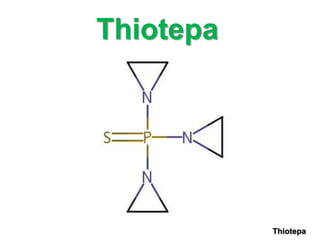
Thiotepa
Thiotepa
PHARMACOKINETICS
• ROA- iv intravesical
Absorption oral
incomplete
• Protein binding- <10%
• CNS penetration-
CSFcon equivalent to
plasma
• Distribution- 0.7L/Kg
Thiotepa
PHARMACOKINETICS
• Metabolism
–Thiotepa TEPA
–inactivation by CYP2B
• Elimination- 60%in
urine
– t1/2 < 2hr
Thiotepa
• Breast cancer
• Ovarian cancer
• HL
• NHL
Indication
• 10-20mg/m2 iv
every 3-4 weeks
• Intravesical
instillation 60mg in
60ml sterile water
weekly upto 4
weeks
Dosage range
• Monitor cbc after intravesical
adm –bone marrow depression
from systemically absorbed
drug
• Resuscitation equipment
should be available-
hypersensitivity
• Caution about the chance of
skin changes urticaria,
bronzing, flaking
Special consideration
Busulphan
Busulphan
PHARMACOKINETICS
• Highly variable
–Age
–Circadian variation
–Disease type
• ROA- Oral
• Absorption- excellent
bioavailability
Busulphan
PHARMACOKINETICS
• CNS Penetration- Enter
Easily
• Vol of Dist- 27+/- 11L/m2
• Metabolism- By liver cyt
p450
• Elimination-t1/2 2.5hrs
• Higher clearance rate in
evening in young
– Faster in Children
–Less rapidly in leukemic
patients Busulphan
CLINICAL USE
• CML
• Myeloablative
treatment- prior
to BMT
Busulphan
• CML remission
induction 4-
8mg/day po
• Maintenance dose
1-3mg/day po
• Transplant 4mg/day
iv 4 days
Dosage range
• Pretreatment with Anti convulsants
increase rate of elimination by 20%
• Concurrent treatment with CP
increases clearance
• Acetaminophen& itraconazole
decrease metabolism enhanced
toxicity
Busulphan
Drug Interaction
Special consideration
• Monitor patients
for pulmonary
symptoms
• Ingestion on an
empty stomach
decrease the risk
of nausea
Toxicity
• Myelosuppression
• Nausea and vomiting >80%
• Mucositis
• Impotence, male sterility
,amenorrhoea
• Interstitial pulmonary fibrosis
busulfan lung may occur 1-10 yrs after
therapy
• Hepatovenoocclusive disease
>16mg/day
Nitrosourea
Nitrosourea
Carmustin (BiCNU)
Nitrosourea
By alkylation of
DNA and
possibly by
carbamoylation
of protein
Mechanism of Action
Nitrosourea
PHARMACOKINETICS
• ROA- iv
• Absorption- not absorbed
orally
• Distribution lipid soluble
drug cross BBB >50%in
plasma
– Metabolism- Spontaneous
decomposition to
chloroethyl carbonium ion
– Isocyanate may also form
Nitrosourea
PHARMACOKINETICS
• Vol of Dist- 3-5 L/kg
• Elimination-60-70% in
urine
– mostly as metabolites
–t1/2 0.4-4.3 h
Nitrosourea
CLINICAL USE
• Brain tumour-
GBM,glioma
• Multiple
Myeloma
• Hodgkins
Lymphoma,NHL
Nitrosourea
• 200mg/m2 iv
every 6 weeks
• Implantable
BCNU
impregnated
wafers at the
surgical resection
Dosage range
• Cimetidine & amphotericin B
enhances toxicity
• decrease the plasma level of
Digoxin & phenytoin
Drug Interaction
• Administer slowly
over a period of 1-2
hrs to avoid
intense pain &
burning
• Pfts should be
obtained at
baseline
Special consideration
Toxicity
• Facial flushing & burning
sensation at the iv site
• Hepatotoxicity with elevated
LFT 90% within 1 week
,hepatovenoocclusive d/s 5-20%
• Pulmonary toxicity at
cumulative dose >1400
Lomustin (CCNU)
Nitrosourea
• Absorption- completely
orally
• Distribution- Lipid soluble
drug with broad tissue
distribution
• Cross BBB and csf con
15-30 %of plasma levels
• Metabolism- in liver
• Elimination- 50% in urine
• T1/2- 72 hrs
PHARMACOKINETICS
•Brain tumor
•HL
•NHL
Indication
130mg/m2 po
every 6 weeks
Dosage range
• PFTs monitored
periodically
• Administer drug
on empty
stomach
Special consideration
• Decreased cellular uptake of
drug
• Decreased expression of drug
activating enzymes of the liver
p450 system
• Increased expression of
sulfhydryl proteins including
gluthathione and asso enzymes
• Increased expression of
aldehyde dehydrogenase
resulting in enhanced enzymatic
detoxification of drug
• Enhanced activity of dna repair
enzymes
Mechanism of Resistance
Dacarbazine
Nonclassic alkylating agent
• Methylates
nucleic acids
and inhibits
DNA RNA &
protein syn
Mechanism of Action
Mechanism of Resistance
• Increased
activity of DNA
repair enzymes
O6alkyl guanine
DNA alkyl
transferase
(AGAT)
• ROA- iv
• Absorption- slow & variable
• Distribution- widely
distributed
• Protein binding- 20%
• Metabolism- in liver to MTIC
AIC
• Elimination- 40 -60%
unchanged in urine
• t1/2- 5 hrs
PHARMACOKINETICS
• Metastatic malignant
melanoma
• HL
• Sarcoma
• Neuroblastoma
Indication
• HL 375mg/m2 iv
D1 D15 every 28
days ABVD
Dosage range
• Heparin lignocaine
hydrocortisone incompatible
with dacarbazine
• Anticonvulsants decrease the
efficacy
Drug Interaction
• Potent vesicant
• Use of
aggressive
antiemetics
• Avoid
sunexposure
Special consideration
Toxicity
• Flu like syndrome
• CNS toxicity paresthesia
neuropathies,
ataxia,seizures
• Photosensitivity
• Teratogenic
Temozolomide
Temozolomide
Spontaneously releases
the cytotoxic species 3-
methyl-(triazen-1-yl)
imidazole-4-
carboxamide(MTIC)
Dacarbazine
Requires metabolic
activation mediated
by microsomal
enzymes
CH
3
• Imidazotetrazine analog
• Methylates guanine
residues(N7,O6) in DNA
and inhibits
DNA,RNA,protein syn
• Cytotoxicity-formation
of O6 methyl guanine
adducts
Mechanism of Action
Mechanism of Resistance
• Increased
activity of DNA
repair enzymes
O6alkyl guanine
DNA alkyl
transferase
(AGAT)
PHARMACOKINETICS
• ROA- Oral,iv
• Absorption-
–oral bioavailability
100%
–Food reduces
• Peak con- <1 h
Nitrosourea
PHARMACOKINETICS
• CNS Penetration- High, CSF
con 30-40% Selective
distribution over tumour in
brain
• Metabolism- MTIC &AIC
• Vol of Dist- 3-5 L/m2
• Elimination-
– Majority in urine 40-50%
• t1/2- 1.8h
Nitrosourea
• 150mg/m2 po
daily for 5 days -
28 days
• 75mg/m2 po
daily for 42 days
with RT- GBM
Dosage range
CLINICAL USE
• Glioma
• Astrocytoma
• Melanoma
Busulphan
DRUG INTERACTION
Toxicity
increases in
prior exposure
to nitrosureas
• Moderately
emetogenic agent.
• Avoid sun
exposure after Rx
• Caution in elderly
patients
Special consideration
Toxicity
• Myelosupression-Dose
limiting toxicity
• Photosensitivity
• Teratogenic
Alkylating agents by Dr.Neenu Thomas

Alkylating agents by Dr.Neenu Thomas