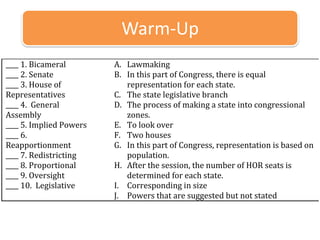
Warm-Up
SW analyze the law making process in order to explain the difficulties in making laws. Agenda
AgendaStructure and Organization of the Executive BranchReapportionment and RedistrictingRegulatory Agencies of the Exec BranchStructure and Organization of CongressHow a Bill becomes a LawPower and Roles of the Executive BranchElectoral College and Electing the PresidentState and Local Government
Objective and Warm-UpINM: How does a Bill become a Law?GP & IP: Outlining the ProcessGP & IP: Lawmaking Board GameExit SlipAgenda
Congress is the ______________ branch at the National level. Congress makes ________________ for the entire country.The two houses are: _____________ and House of Representatives.What is Congress?
Congress is ____________________________, which means there are two houses. Both houses have a similar structure. The Senate and House of Representatives have committees and subcommittees. Committees have the main responsibility of writing, debating and detailing out specifics of a bill.  Representatives chose to be on different committees based on their legislative and constituents’ interests.  How is Congress Structured?
Why is it hard to make laws?It is hard to make bills into laws because: Procedure: There are ton of steps Majority Rules: Two houses of Congress have to approve itwith a 2/3 majority vote! Politics: The United States is a two party system. It is hard for the Republicans and Democrats to agree on things.
Why is it hard to make laws?Checks and Balances: The two houses check each other. The president checks the powers of Congress.  Society and Culture: People and ideas are slow to change. For example, it took the U.S. 125 years to give women the right to vote.
Members of Congress, the Executive Branch, and even outside groups, such as interest groups can make (write or draft up) bills.Bill is introduced and assigned to a Committee, which refers to a Subcommittee. Only members can introduce bills.Bill is introduced and assigned to a Committee, which refers to a Subcommittee. Only members can introduce bills.Members study the bill, hold hearings, and debate provisions. Marks up the bill. If it passes goes to Committee. Members study the bill, hold hearings, and debate provisions. Marks up the bill. If it passes goes to Committee. 
House: Committee  Full Committee considers the bill. If it approves the bill in some form, the bill goes to the Rules Committee.Senate: CommitteeFull Committee considers the bill. If it approves the bill in some form, the bill goes to the Rules Committee.How a Bill Becomes a Law
House: Rules Committee It issues a rule to govern debate on the floor. Sends it to the Full House.Senate: Full Senate Debates the bill and may amend it. If it is different from the House version, it must go to a Conference Committee. How a Bill Becomes a Law
House: Full House Debates the bill and may amend it. If it is different from the Senate version, it must go to a Conference Committee.Senate: Conference Committee  Senators and Representatives meet to reconcile differences between bills. When agreement is reached, a compromise bill is sent to Full Senate.How a Bill Becomes a Law
House: Full House If there are no differences between the House and Senate versions, then they vote on the bill. If it passes, it moves to the President to be signed or vetoed. Senate: Full House  If there are no differences between the House and Senate versions, then they vote on the bill. If it passes, it moves to the President to be signed or vetoed. How a Bill Becomes a Law
PresidentCan sign or veto the bill. Congress can override it by 2/3 majority vote in the House and Senate. President can sign the bill, veto it, or do nothing.How a Bill Becomes a Law
Let’s check our understanding by writing out the correct answer.It’s time to see what you know.
Checks for UnderstandingWhich of the following lawmaking actions is an example of a check and balance?  A. In order to send a bill to the President, both houses of Congress must pass it.  B. A majority is needed to pass a bill into a law.  C. Congress has the powers to make laws D. Committees review bills before sending them to the full house of Congress.
Checks for Understanding2. What is an example of something Committees do? A. Hold hearing on laws. B. Vote to pass laws C. Sign bills into lawD. Make up the rules about debating a law.
Checks for Understanding3. Which is the following is NOT an accurate statement about why it is so hard to pass bills into laws.  A. There are two political parties in the US and they often can’t come to an agreement when making laws. B. It requires a 2/3 majority to pass a bill into law. C.  Americans don’t want many laws passed during the year. D. There are many steps to passing a law.
Checks for UnderstandingOrder the Following Steps (1-5)  ____ President Signature____ Bill Introduction____ Committee and Subcommittee Hearing ____ House Debate and Vote____ Conference Committee
You will be playing a board game on how a bill becomes a law. It is similar to Chutes and Ladders. I need a volunteer to play this game with me on the board. You will then be broken up into groups of 4 to play this game together. The first team to win, will win a PRIZE!!! Guided Practice
Play the Board Game.  Your group MUST read each step.I will be around to see that you are working… if you aren’t, you will write the paragraph prompt in ECR format. Independent Practice
HOMEWORKTurn in your review packets for 80% credit by Friday.Packets must be completed in full to receive any credit.B DAYTurn in your review packets for 80% credit by Friday.Packets must be completed in full to receive any credit.A DAY
You will have 5 minutes to complete today’s exit slip.Please circle only one answer.Complete it in silence.When you are done, carefully check over your answers.After checking your answers, please begin your homework.Exit Slip
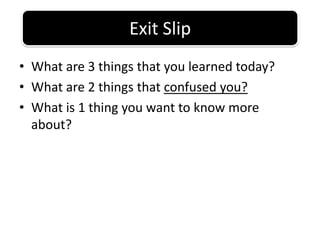
What are 3 things that you learned today?What are 2 things that confused you?What is 1 thing you want to know more about?Exit Slip

U4.LP3.BillBecomesALaw

  • 1.
  • 2.
    SW analyze thelaw making process in order to explain the difficulties in making laws. Agenda
  • 3.
    AgendaStructure and Organizationof the Executive BranchReapportionment and RedistrictingRegulatory Agencies of the Exec BranchStructure and Organization of CongressHow a Bill becomes a LawPower and Roles of the Executive BranchElectoral College and Electing the PresidentState and Local Government
  • 4.
    Objective and Warm-UpINM:How does a Bill become a Law?GP & IP: Outlining the ProcessGP & IP: Lawmaking Board GameExit SlipAgenda
  • 5.
    Congress is the______________ branch at the National level. Congress makes ________________ for the entire country.The two houses are: _____________ and House of Representatives.What is Congress?
  • 6.
    Congress is ____________________________,which means there are two houses. Both houses have a similar structure. The Senate and House of Representatives have committees and subcommittees. Committees have the main responsibility of writing, debating and detailing out specifics of a bill. Representatives chose to be on different committees based on their legislative and constituents’ interests. How is Congress Structured?
  • 7.
    Why is ithard to make laws?It is hard to make bills into laws because: Procedure: There are ton of steps Majority Rules: Two houses of Congress have to approve itwith a 2/3 majority vote! Politics: The United States is a two party system. It is hard for the Republicans and Democrats to agree on things.
  • 8.
    Why is ithard to make laws?Checks and Balances: The two houses check each other. The president checks the powers of Congress. Society and Culture: People and ideas are slow to change. For example, it took the U.S. 125 years to give women the right to vote.
  • 9.
    Members of Congress,the Executive Branch, and even outside groups, such as interest groups can make (write or draft up) bills.Bill is introduced and assigned to a Committee, which refers to a Subcommittee. Only members can introduce bills.Bill is introduced and assigned to a Committee, which refers to a Subcommittee. Only members can introduce bills.Members study the bill, hold hearings, and debate provisions. Marks up the bill. If it passes goes to Committee. Members study the bill, hold hearings, and debate provisions. Marks up the bill. If it passes goes to Committee. 
  • 10.
    House: Committee  FullCommittee considers the bill. If it approves the bill in some form, the bill goes to the Rules Committee.Senate: CommitteeFull Committee considers the bill. If it approves the bill in some form, the bill goes to the Rules Committee.How a Bill Becomes a Law
  • 11.
    House: Rules CommitteeIt issues a rule to govern debate on the floor. Sends it to the Full House.Senate: Full Senate Debates the bill and may amend it. If it is different from the House version, it must go to a Conference Committee. How a Bill Becomes a Law
  • 12.
    House: Full House Debatesthe bill and may amend it. If it is different from the Senate version, it must go to a Conference Committee.Senate: Conference Committee  Senators and Representatives meet to reconcile differences between bills. When agreement is reached, a compromise bill is sent to Full Senate.How a Bill Becomes a Law
  • 13.
    House: Full House Ifthere are no differences between the House and Senate versions, then they vote on the bill. If it passes, it moves to the President to be signed or vetoed. Senate: Full House  If there are no differences between the House and Senate versions, then they vote on the bill. If it passes, it moves to the President to be signed or vetoed. How a Bill Becomes a Law
  • 14.
    PresidentCan sign orveto the bill. Congress can override it by 2/3 majority vote in the House and Senate. President can sign the bill, veto it, or do nothing.How a Bill Becomes a Law
  • 15.
    Let’s check ourunderstanding by writing out the correct answer.It’s time to see what you know.
  • 16.
    Checks for UnderstandingWhichof the following lawmaking actions is an example of a check and balance?  A. In order to send a bill to the President, both houses of Congress must pass it.  B. A majority is needed to pass a bill into a law.  C. Congress has the powers to make laws D. Committees review bills before sending them to the full house of Congress.
  • 17.
    Checks for Understanding2.What is an example of something Committees do? A. Hold hearing on laws. B. Vote to pass laws C. Sign bills into lawD. Make up the rules about debating a law.
  • 18.
    Checks for Understanding3.Which is the following is NOT an accurate statement about why it is so hard to pass bills into laws. A. There are two political parties in the US and they often can’t come to an agreement when making laws. B. It requires a 2/3 majority to pass a bill into law. C. Americans don’t want many laws passed during the year. D. There are many steps to passing a law.
  • 19.
    Checks for UnderstandingOrderthe Following Steps (1-5) ____ President Signature____ Bill Introduction____ Committee and Subcommittee Hearing ____ House Debate and Vote____ Conference Committee
  • 20.
    You will beplaying a board game on how a bill becomes a law. It is similar to Chutes and Ladders. I need a volunteer to play this game with me on the board. You will then be broken up into groups of 4 to play this game together. The first team to win, will win a PRIZE!!! Guided Practice
  • 22.
    Play the BoardGame. Your group MUST read each step.I will be around to see that you are working… if you aren’t, you will write the paragraph prompt in ECR format. Independent Practice
  • 23.
    HOMEWORKTurn in yourreview packets for 80% credit by Friday.Packets must be completed in full to receive any credit.B DAYTurn in your review packets for 80% credit by Friday.Packets must be completed in full to receive any credit.A DAY
  • 24.
    You will have5 minutes to complete today’s exit slip.Please circle only one answer.Complete it in silence.When you are done, carefully check over your answers.After checking your answers, please begin your homework.Exit Slip
  • 25.
    What are 3things that you learned today?What are 2 things that confused you?What is 1 thing you want to know more about?Exit Slip