#opendata
Back to the future
Slim Turki, Prune Gautier
Open data & Data Ecosystems
slim.turki@list.lu
prune.gautier@list.lu
June 29th,2021
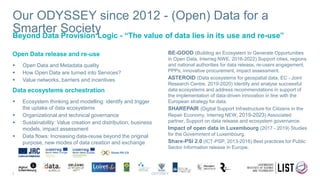
Our ODYSSEY since 2012 - (Open) Data for a
Smarter Society
Open Data release and re-use
 Open Data and Metadata quality
 How Open Data are turned into Services?
 Value networks, barriers and incentives
Data ecosystems orchestration
 Ecosystem thinking and modelling: identify and trigger
the uptake of data ecosystems
 Organizational and technical governance
 Sustainability: Value creation and distribution, business
models, impact assessment
 Data flows: Increasing data-reuse beyond the original
purpose, new modes of data creation and exchange
BE-GOOD (Building an Ecosystem to Generate Opportunities
in Open Data, Interreg NWE, 2016-2022) Support cities, regions
and national authorities for data release, re-users engagement,
PPPs, innovative procurement, impact assessment.
ASTEROID (Data ecosystems for geospatial data, EC - Joint
Research Centre, 2019-2020) Identify and analyse successful
data ecosystems and address recommendations in support of
the implementation of data-driven innovation in line with the
European strategy for data.
SHAREPAIR (Digital Support Infrastructure for Citizens in the
Repair Economy, Interreg NEW, 2019-2023) Associated
partner, Support on data release and ecosystem governance.
Impact of open data in Luxembourg (2017 - 2019) Studies
for the Government of Luxembourg.
Share-PSI 2.0 (ICT-PSP, 2013-2016) Best practices for Public
Sector Information release in Europe.
Beyond Data Provision Logic - “The value of data lies in its use and re-use”
ODYSSEY
2
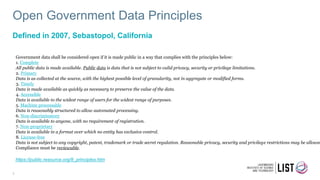
Open Government Data Principles
Defined in 2007, Sebastopol, California
3
Government data shall be considered open if it is made public in a way that complies with the principles below:
1. Complete
All public data is made available. Public data is data that is not subject to valid privacy, security or privilege limitations.
2. Primary
Data is as collected at the source, with the highest possible level of granularity, not in aggregate or modified forms.
3. Timely
Data is made available as quickly as necessary to preserve the value of the data.
4. Accessible
Data is available to the widest range of users for the widest range of purposes.
5. Machine processable
Data is reasonably structured to allow automated processing.
6. Non-discriminatory
Data is available to anyone, with no requirement of registration.
7. Non-proprietary
Data is available in a format over which no entity has exclusive control.
8. License-free
Data is not subject to any copyright, patent, trademark or trade secret regulation. Reasonable privacy, security and privilege restrictions may be allowed
Compliance must be reviewable.
https://public.resource.org/8_principles.htm
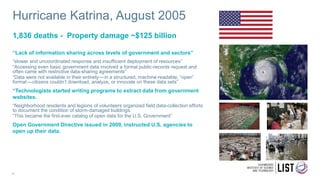
Hurricane Katrina, August 2005
“Lack of information sharing across levels of government and sectors”
“slower and uncoordinated response and insufficient deployment of resources”
“Accessing even basic government data involved a formal public-records request and
often came with restrictive data-sharing agreements”
“Data were not available in their entirety — in a structured, machine-readable, “open”
format — citizens couldn’t download, analyze, or innovate on these data sets”
“Technologists started writing programs to extract data from government
websites.
“Neighborhood residents and legions of volunteers organized field data-collection efforts
to document the condition of storm-damaged buildings.
“This became the first-ever catalog of open data for the U.S. Government”
Open Government Directive issued in 2009, instructed U.S. agencies to
open up their data.
1,836 deaths - Property damage ~$125 billion
4
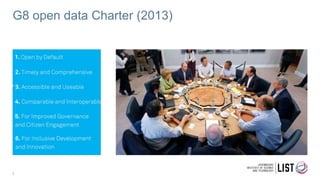
G8 open data Charter (2013)
5
Why is data made open?
6
Release of open data motivated by:
government transparency (citizen access to government data)
development of services by third parties for benefit for citizens and companies, typically smart city
approach, or
development of new services that stimulate the economy
PM Cameron (UK) “Release of PSI as a way to foster an “army of armchair auditors””
“Open data: an instrument to power services and build businesses” (2013)
Open data and Digital Economy: Promises and
hopes
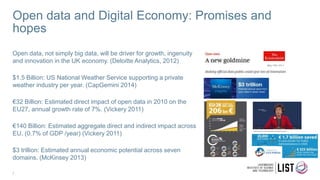
Open data, not simply big data, will be driver for growth, ingenuity
and innovation in the UK economy. (Deloitte Analytics, 2012)
$1.5 Billion: US National Weather Service supporting a private
weather industry per year. (CapGemini 2014)
€32 Billion: Estimated direct impact of open data in 2010 on the
EU27, annual growth rate of 7%. (Vickery 2011)
€140 Billion: Estimated aggregate direct and indirect impact across
EU, (0.7% of GDP /year) (Vickery 2011)
$3 trillion: Estimated annual economic potential across seven
domains. (McKinsey 2013)
7
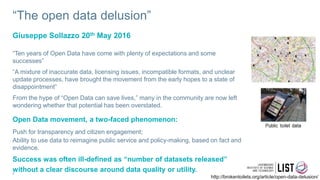
“The open data delusion”
“Ten years of Open Data have come with plenty of expectations and some
successes”
“A mixture of inaccurate data, licensing issues, incompatible formats, and unclear
update processes, have brought the movement from the early hopes to a state of
disappointment”
From the hype of “Open Data can save lives,” many in the community are now left
wondering whether that potential has been overstated.
Open Data movement, a two-faced phenomenon:
Push for transparency and citizen engagement;
Ability to use data to reimagine public service and policy-making, based on fact and
evidence.
Success was often ill-defined as “number of datasets released”
without a clear discourse around data quality or utility.
Giuseppe Sollazzo 20th May 2016
8
http://brokentoilets.org/article/open-data-delusion/
Open data and Digital Economy: Promises and
hopes
Lie to a large extent in the development of new services
Results below the expectations of open data promoters
Mainly a data provision movement
Rare demand driven initiatives but rather an initiative of data
providers, hoping for a possible impact in terms of service creation
Inadequacy between released datasets and created services as well
as between the claims of huge potential service creations and the low
demand from service creators, particularly companies
Most services created are not sustainable and relying on a limited
number of popular datasets.
9
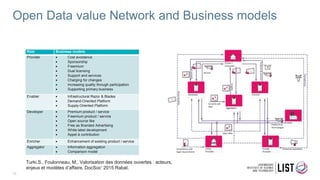
Open Data value Network and Business models
10
Role Business models
Provider  Cost avoidance
 Sponsorship
 Freemium
 Dual licensing
 Support and services
 Charging for changes
 Increasing quality through participation
 Supporting primary business
Enabler  Infrastructural Razor & Blades
 Demand-Oriented Platform
 Supply-Oriented Platform
Developer  Premium product / service
 Freemium product / service
 Open source like
 Free as Branded Advertising
 White label development
 Appel à contribution
Enricher  Enhancement of existing product / service
Aggregator  Information aggregation
 Comparison model
Turki,S., Foulonneau, M., Valorisation des données ouvertes : acteurs,
enjeux et modèles d’affaire. DocSoc’ 2015 Rabat.
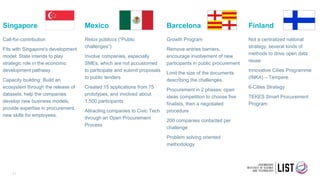
Singapore
Call-for-contribution
Fits with Singapore's development
model: State intends to play
strategic role in the economic
development pathway
Capacity building: Build an
ecosystem through the release of
datasets, help the companies
develop new business models,
provide expertise in procurement,
new skills for employees.
Mexico
Retos pùblicos (“Public
challenges”)
Involve companies, especially
SMEs, which are not accustomed
to participate and submit proposals
to public tenders
Created 15 applications from 75
prototypes, and involved about
1,500 participants
Attracting companies to Civic Tech
through an Open Procurement
Process
Barcelona
Growth Program
Remove entries barriers,
encourage involvement of new
participants in public procurement
Limit the size of the documents
describing the challenges.
Procurement in 2 phases: open
ideas competition to choose five
finalists, then a negotiated
procedure
200 companies contacted per
challenge
Problem solving oriented
methodology
11
Finland
Not a centralized national
strategy, several kinds of
methods to drive open data
reuse
Innovative Cities Programme
(INKA) – Tempere
6-Cities Strategy
TEKES Smart Procurement
Program
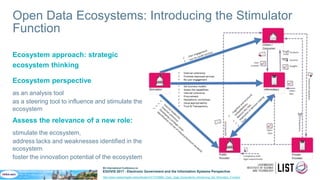
Open Data Ecosystems: Introducing the Stimulator
Function
Ecosystem approach: strategic
ecosystem thinking
Ecosystem perspective
as an analysis tool
as a steering tool to influence and stimulate the
ecosystem
Assess the relevance of a new role:
stimulate the ecosystem,
address lacks and weaknesses identified in the
ecosystem
foster the innovation potential of the ecosystem
6th International Conference on
EGOVIS 2017 - Electronic Government and the Information Systems Perspective
http://www.researchgate.net/publication/317278860_Open_Data_Ecosystems_Introducing_the_Stimulator_Function
Establishment of
Sustainable Data
Ecosystems
Prune GAUTIER
Sébastien MARTIN Alexander KOTSEV
Slim TURKI
Data ecosystems for geospatial data - JRC/IPR/2019/MVP/2781
Summary
Overall
representation of
the ecosystem key
aspects
Value
Dynamics
Interactions
between
stakeholders
Data
flows
Associated data
flows / Data life
cycles
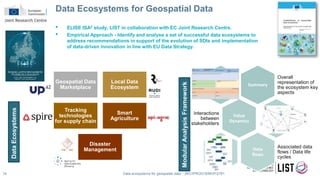
• ELISE ISA2 study, LIST in collaboration with EC Joint Research Centre.
• Empirical Approach - Identify and analyse a set of successful data ecosystems to
address recommendations in support of the evolution of SDIs and implementation
of data-driven innovation in line with EU Data Strategy.
Data Ecosystems for Geospatial Data
14
Geospatial Data
Marketplace
Local Data
Ecosystem
Tracking
technologies
for supply chain
Smart
Agriculture
Disaster
Management
Data
Ecosystems
Modular
Analysis
Framework
Recommendations
15
Governance
 Building a collaborative governance
 Identifying most relevant actor(s) to orchestrate
 Consideration (roles, benefits, needs and means)
for all stakeholders ensure the willingness to make
the data ecosystem sustainable.
 Creation of a platform provides to structure
ecosystem.
 Considering/aligning stakeholders' cultures
 Exploring local authorities role over time
Stakeholders Engagement
 Distributing value between the stakeholders
 Considering citizen as true stakeholders
 Promoting data literacy among all stakeholders
 Organising events to increase awareness in the ecosystem and
interactions frequency.
 Building a data social network.
Technical issues
 Problem solving approach, leading to new data cycles
 Strengthen the relationship between the data ecosystem
development and the digital transformation of stakeholders
 Stimulate the datafication of a broader range of sectors
 Grasp the opportunities for data sharing by private companies as
result from the GDPR entry into force.
 Integrating data ecosystems and data cooperatives & trusts
 Put the APIs at the core of the approach.
 Integrating not only data but services and computational
infrastructure.
 Aligning the data ecosystem with other components such as cloud
and software ecosystems
 Facilitate the access to real time and Time series data.
Economic sustainability
 Integration of Open Access, Open Source, Open
Innovation and Open data Paradigms
 Adaptive & agile orchestration for evolution,
especially for data collection
 Synergies between individual stakeholders BMs
 Long term engagements.
 Strong political and societal support.
 Extracting the value of personal data.
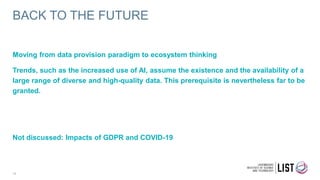
BACK TO THE FUTURE
16
Moving from data provision paradigm to ecosystem thinking
Trends, such as the increased use of AI, assume the existence and the availability of a
large range of diverse and high-quality data. This prerequisite is nevertheless far to be
granted.
Not discussed: Impacts of GDPR and COVID-19
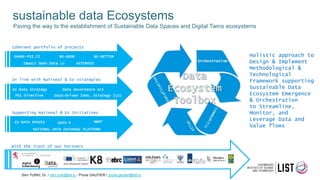
sustainable data Ecosystems
Paving the way to the establishment of Sustainable Data Spaces and Digital Twins ecosystems
Coherent portfolio of projects
BE-GOOD BE-BETTER
ASTEROID
Impact Open Data LU
SHARE-PSI.II
In line with National & EU strategies
EU Data Strategy
Data-Driven Inno. Strategy (LU)
PSI Directive
Data Governance Act
Supporting National & EU Initiatives
EU DATA SPACES GAIA-X NWDT
NATIONAL DATA EXCHANGE PLATFORM
With the Trust of our Partners
Holistic approach to
Design & Implement
Methodological &
Technological
Framework supporting
Sustainable Data
Ecosystem Emergence
& Orchestration
to Streamline,
Monitor, and
Leverage Data and
Value flows
Slim TURKI, Dr. / slim.turki@list.lu - Prune GAUTIER / prune.gautier@list.lu
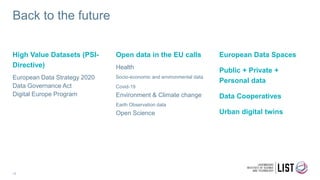
Back to the future
High Value Datasets (PSI-
Directive)
European Data Strategy 2020
Data Governance Act
Digital Europe Program
Open data in the EU calls
Health
Socio-economic and environmental data
Covid-19
Environment & Climate change
Earth Observation data
Open Science
European Data Spaces
Public + Private +
Personal data
Data Cooperatives
Urban digital twins
18
thank you contact information
For more info, please
contact us at
slim.turki@list.lu
prune.gautier@list.lu
#opendata Back to the future

#opendata Back to the future

  • 1.
    #opendata Back to thefuture Slim Turki, Prune Gautier Open data & Data Ecosystems slim.turki@list.lu prune.gautier@list.lu June 29th,2021
  • 2.
    Our ODYSSEY since2012 - (Open) Data for a Smarter Society Open Data release and re-use  Open Data and Metadata quality  How Open Data are turned into Services?  Value networks, barriers and incentives Data ecosystems orchestration  Ecosystem thinking and modelling: identify and trigger the uptake of data ecosystems  Organizational and technical governance  Sustainability: Value creation and distribution, business models, impact assessment  Data flows: Increasing data-reuse beyond the original purpose, new modes of data creation and exchange BE-GOOD (Building an Ecosystem to Generate Opportunities in Open Data, Interreg NWE, 2016-2022) Support cities, regions and national authorities for data release, re-users engagement, PPPs, innovative procurement, impact assessment. ASTEROID (Data ecosystems for geospatial data, EC - Joint Research Centre, 2019-2020) Identify and analyse successful data ecosystems and address recommendations in support of the implementation of data-driven innovation in line with the European strategy for data. SHAREPAIR (Digital Support Infrastructure for Citizens in the Repair Economy, Interreg NEW, 2019-2023) Associated partner, Support on data release and ecosystem governance. Impact of open data in Luxembourg (2017 - 2019) Studies for the Government of Luxembourg. Share-PSI 2.0 (ICT-PSP, 2013-2016) Best practices for Public Sector Information release in Europe. Beyond Data Provision Logic - “The value of data lies in its use and re-use” ODYSSEY 2
  • 3.
    Open Government DataPrinciples Defined in 2007, Sebastopol, California 3 Government data shall be considered open if it is made public in a way that complies with the principles below: 1. Complete All public data is made available. Public data is data that is not subject to valid privacy, security or privilege limitations. 2. Primary Data is as collected at the source, with the highest possible level of granularity, not in aggregate or modified forms. 3. Timely Data is made available as quickly as necessary to preserve the value of the data. 4. Accessible Data is available to the widest range of users for the widest range of purposes. 5. Machine processable Data is reasonably structured to allow automated processing. 6. Non-discriminatory Data is available to anyone, with no requirement of registration. 7. Non-proprietary Data is available in a format over which no entity has exclusive control. 8. License-free Data is not subject to any copyright, patent, trademark or trade secret regulation. Reasonable privacy, security and privilege restrictions may be allowed Compliance must be reviewable. https://public.resource.org/8_principles.htm
  • 4.
    Hurricane Katrina, August2005 “Lack of information sharing across levels of government and sectors” “slower and uncoordinated response and insufficient deployment of resources” “Accessing even basic government data involved a formal public-records request and often came with restrictive data-sharing agreements” “Data were not available in their entirety — in a structured, machine-readable, “open” format — citizens couldn’t download, analyze, or innovate on these data sets” “Technologists started writing programs to extract data from government websites. “Neighborhood residents and legions of volunteers organized field data-collection efforts to document the condition of storm-damaged buildings. “This became the first-ever catalog of open data for the U.S. Government” Open Government Directive issued in 2009, instructed U.S. agencies to open up their data. 1,836 deaths - Property damage ~$125 billion 4
  • 5.
    G8 open dataCharter (2013) 5
  • 6.
    Why is datamade open? 6 Release of open data motivated by: government transparency (citizen access to government data) development of services by third parties for benefit for citizens and companies, typically smart city approach, or development of new services that stimulate the economy PM Cameron (UK) “Release of PSI as a way to foster an “army of armchair auditors”” “Open data: an instrument to power services and build businesses” (2013)
  • 7.
    Open data andDigital Economy: Promises and hopes Open data, not simply big data, will be driver for growth, ingenuity and innovation in the UK economy. (Deloitte Analytics, 2012) $1.5 Billion: US National Weather Service supporting a private weather industry per year. (CapGemini 2014) €32 Billion: Estimated direct impact of open data in 2010 on the EU27, annual growth rate of 7%. (Vickery 2011) €140 Billion: Estimated aggregate direct and indirect impact across EU, (0.7% of GDP /year) (Vickery 2011) $3 trillion: Estimated annual economic potential across seven domains. (McKinsey 2013) 7
  • 8.
    “The open datadelusion” “Ten years of Open Data have come with plenty of expectations and some successes” “A mixture of inaccurate data, licensing issues, incompatible formats, and unclear update processes, have brought the movement from the early hopes to a state of disappointment” From the hype of “Open Data can save lives,” many in the community are now left wondering whether that potential has been overstated. Open Data movement, a two-faced phenomenon: Push for transparency and citizen engagement; Ability to use data to reimagine public service and policy-making, based on fact and evidence. Success was often ill-defined as “number of datasets released” without a clear discourse around data quality or utility. Giuseppe Sollazzo 20th May 2016 8 http://brokentoilets.org/article/open-data-delusion/
  • 9.
    Open data andDigital Economy: Promises and hopes Lie to a large extent in the development of new services Results below the expectations of open data promoters Mainly a data provision movement Rare demand driven initiatives but rather an initiative of data providers, hoping for a possible impact in terms of service creation Inadequacy between released datasets and created services as well as between the claims of huge potential service creations and the low demand from service creators, particularly companies Most services created are not sustainable and relying on a limited number of popular datasets. 9
  • 10.
    Open Data valueNetwork and Business models 10 Role Business models Provider  Cost avoidance  Sponsorship  Freemium  Dual licensing  Support and services  Charging for changes  Increasing quality through participation  Supporting primary business Enabler  Infrastructural Razor & Blades  Demand-Oriented Platform  Supply-Oriented Platform Developer  Premium product / service  Freemium product / service  Open source like  Free as Branded Advertising  White label development  Appel à contribution Enricher  Enhancement of existing product / service Aggregator  Information aggregation  Comparison model Turki,S., Foulonneau, M., Valorisation des données ouvertes : acteurs, enjeux et modèles d’affaire. DocSoc’ 2015 Rabat.
  • 11.
    Singapore Call-for-contribution Fits with Singapore'sdevelopment model: State intends to play strategic role in the economic development pathway Capacity building: Build an ecosystem through the release of datasets, help the companies develop new business models, provide expertise in procurement, new skills for employees. Mexico Retos pùblicos (“Public challenges”) Involve companies, especially SMEs, which are not accustomed to participate and submit proposals to public tenders Created 15 applications from 75 prototypes, and involved about 1,500 participants Attracting companies to Civic Tech through an Open Procurement Process Barcelona Growth Program Remove entries barriers, encourage involvement of new participants in public procurement Limit the size of the documents describing the challenges. Procurement in 2 phases: open ideas competition to choose five finalists, then a negotiated procedure 200 companies contacted per challenge Problem solving oriented methodology 11 Finland Not a centralized national strategy, several kinds of methods to drive open data reuse Innovative Cities Programme (INKA) – Tempere 6-Cities Strategy TEKES Smart Procurement Program
  • 12.
    Open Data Ecosystems:Introducing the Stimulator Function Ecosystem approach: strategic ecosystem thinking Ecosystem perspective as an analysis tool as a steering tool to influence and stimulate the ecosystem Assess the relevance of a new role: stimulate the ecosystem, address lacks and weaknesses identified in the ecosystem foster the innovation potential of the ecosystem 6th International Conference on EGOVIS 2017 - Electronic Government and the Information Systems Perspective http://www.researchgate.net/publication/317278860_Open_Data_Ecosystems_Introducing_the_Stimulator_Function
  • 13.
    Establishment of Sustainable Data Ecosystems PruneGAUTIER Sébastien MARTIN Alexander KOTSEV Slim TURKI
  • 14.
    Data ecosystems forgeospatial data - JRC/IPR/2019/MVP/2781 Summary Overall representation of the ecosystem key aspects Value Dynamics Interactions between stakeholders Data flows Associated data flows / Data life cycles • ELISE ISA2 study, LIST in collaboration with EC Joint Research Centre. • Empirical Approach - Identify and analyse a set of successful data ecosystems to address recommendations in support of the evolution of SDIs and implementation of data-driven innovation in line with EU Data Strategy. Data Ecosystems for Geospatial Data 14 Geospatial Data Marketplace Local Data Ecosystem Tracking technologies for supply chain Smart Agriculture Disaster Management Data Ecosystems Modular Analysis Framework
  • 15.
    Recommendations 15 Governance  Building acollaborative governance  Identifying most relevant actor(s) to orchestrate  Consideration (roles, benefits, needs and means) for all stakeholders ensure the willingness to make the data ecosystem sustainable.  Creation of a platform provides to structure ecosystem.  Considering/aligning stakeholders' cultures  Exploring local authorities role over time Stakeholders Engagement  Distributing value between the stakeholders  Considering citizen as true stakeholders  Promoting data literacy among all stakeholders  Organising events to increase awareness in the ecosystem and interactions frequency.  Building a data social network. Technical issues  Problem solving approach, leading to new data cycles  Strengthen the relationship between the data ecosystem development and the digital transformation of stakeholders  Stimulate the datafication of a broader range of sectors  Grasp the opportunities for data sharing by private companies as result from the GDPR entry into force.  Integrating data ecosystems and data cooperatives & trusts  Put the APIs at the core of the approach.  Integrating not only data but services and computational infrastructure.  Aligning the data ecosystem with other components such as cloud and software ecosystems  Facilitate the access to real time and Time series data. Economic sustainability  Integration of Open Access, Open Source, Open Innovation and Open data Paradigms  Adaptive & agile orchestration for evolution, especially for data collection  Synergies between individual stakeholders BMs  Long term engagements.  Strong political and societal support.  Extracting the value of personal data.
  • 16.
    BACK TO THEFUTURE 16 Moving from data provision paradigm to ecosystem thinking Trends, such as the increased use of AI, assume the existence and the availability of a large range of diverse and high-quality data. This prerequisite is nevertheless far to be granted. Not discussed: Impacts of GDPR and COVID-19
  • 17.
    sustainable data Ecosystems Pavingthe way to the establishment of Sustainable Data Spaces and Digital Twins ecosystems Coherent portfolio of projects BE-GOOD BE-BETTER ASTEROID Impact Open Data LU SHARE-PSI.II In line with National & EU strategies EU Data Strategy Data-Driven Inno. Strategy (LU) PSI Directive Data Governance Act Supporting National & EU Initiatives EU DATA SPACES GAIA-X NWDT NATIONAL DATA EXCHANGE PLATFORM With the Trust of our Partners With the Trust of our Partners Holistic approach to Design & Implement Methodological & Technological Framework supporting Sustainable Data Ecosystem Emergence & Orchestration to Streamline, Monitor, and Leverage Data and Value flows Slim TURKI, Dr. / slim.turki@list.lu - Prune GAUTIER / prune.gautier@list.lu
  • 18.
    Back to thefuture High Value Datasets (PSI- Directive) European Data Strategy 2020 Data Governance Act Digital Europe Program Open data in the EU calls Health Socio-economic and environmental data Covid-19 Environment & Climate change Earth Observation data Open Science European Data Spaces Public + Private + Personal data Data Cooperatives Urban digital twins 18
  • 19.
    thank you contactinformation For more info, please contact us at slim.turki@list.lu prune.gautier@list.lu

Editor's Notes