Rapid Health Transitions:
Lessons from the Global Burden of Diseases, Injuries, and
Risk Factors 2010


Dec. 13, 2012
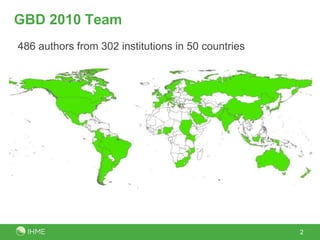
GBD 2010 Team
486 authors from 302 institutions in 50 countries


                                                    2
Amassing the best evidence on the state of the
world’s health
• 291 diseases and injuries
• 1,160 disabling sequelae of these diseases and
 injuries
• 67 risk factors
• 20 age groups, two sexes
• 187 countries
• 1990-2010


                                                   3
Enhanced scientific rigor for global descriptive
epidemiology
• Statistical methods designed for the challenges of
 global health data developed and applied.
• All figures have 95% uncertainty intervals.
• Multiple efforts at validation, e.g., deaths by cause
 must add up to 100%; anemia by cause must add
 up to total anemia.
• Data visualization environments used as quality
 control tools.


                                                          4
Five high-level observations and 650 million
results

• GBD 2010 has 650 million different findings.
• Bird’s-eye view provides five main messages, but
 detailed findings are important for many diseases,
 injuries, risks and for different regions and countries.


                                                       5
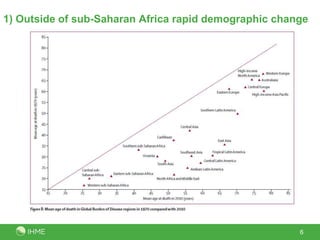
1) Outside of sub-Saharan Africa rapid demographic change


                                                       6
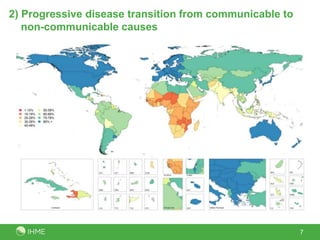
2) Progressive disease transition from communicable to
   non-communicable causes


                                                         7
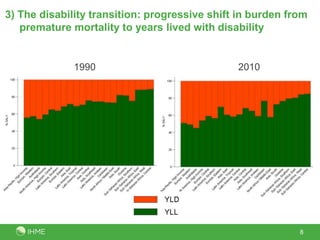
3) The disability transition: progressive shift in burden from
   premature mortality to years lived with disability


              1990                             2010


                                                            8
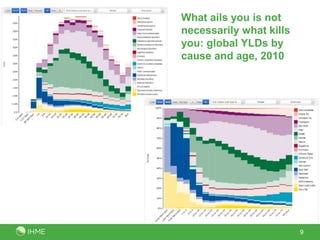
What ails you is not
necessarily what kills
you: global YLDs by
cause and age, 2010


                         9
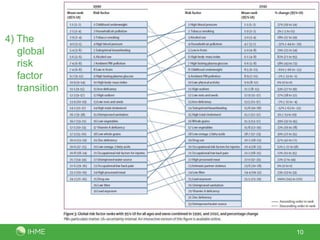
4) The
   global
   risk
   factor
   transition


                10
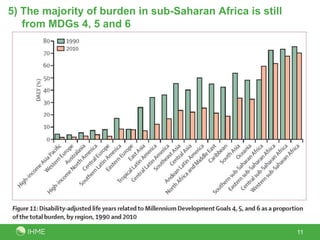
5) The majority of burden in sub-Saharan Africa is still
   from MDGs 4, 5 and 6


                                                           11
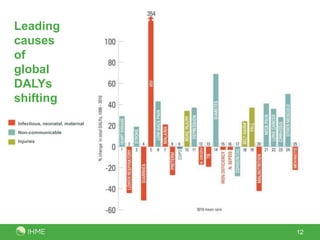
Leading
causes
of
global
DALYs
shifting
Infectious, neonatal, maternal
Non-communicable
Injuries


                                 12
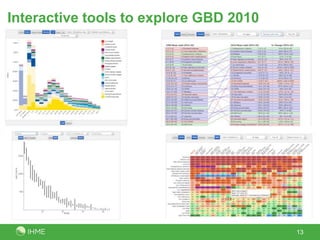
Interactive tools to explore GBD 2010


                                        13

GBD 2010 press conference

  • 1.
    Rapid Health Transitions: Lessonsfrom the Global Burden of Diseases, Injuries, and Risk Factors 2010 Dec. 13, 2012
  • 2.
    GBD 2010 Team 486authors from 302 institutions in 50 countries 2
  • 3.
    Amassing the bestevidence on the state of the world’s health • 291 diseases and injuries • 1,160 disabling sequelae of these diseases and injuries • 67 risk factors • 20 age groups, two sexes • 187 countries • 1990-2010 3
  • 4.
    Enhanced scientific rigorfor global descriptive epidemiology • Statistical methods designed for the challenges of global health data developed and applied. • All figures have 95% uncertainty intervals. • Multiple efforts at validation, e.g., deaths by cause must add up to 100%; anemia by cause must add up to total anemia. • Data visualization environments used as quality control tools. 4
  • 5.
    Five high-level observationsand 650 million results • GBD 2010 has 650 million different findings. • Bird’s-eye view provides five main messages, but detailed findings are important for many diseases, injuries, risks and for different regions and countries. 5
  • 6.
    1) Outside ofsub-Saharan Africa rapid demographic change 6
  • 7.
    2) Progressive diseasetransition from communicable to non-communicable causes 7
  • 8.
    3) The disabilitytransition: progressive shift in burden from premature mortality to years lived with disability 1990 2010 8
  • 9.
    What ails youis not necessarily what kills you: global YLDs by cause and age, 2010 9
  • 10.
    4) The global risk factor transition 10
  • 11.
    5) The majorityof burden in sub-Saharan Africa is still from MDGs 4, 5 and 6 11
  • 12.
  • 13.
    Interactive tools toexplore GBD 2010 13