Financial Inclusion
Definition
‘Financial inclusion’ or inclusive financing is the
delivery of financial services at affordable costs to
sections of disadvantaged and low-income
segments of society, in contrast to financial
exclusion where those services are not available or
affordable.
An estimated 2.5 billion working-age adults globally
have no access to the formal financial services .
Background
 The Reserve Bank of India (RBI) set up the Khan
Commission in 2004 to look into financial inclusion
 In the report RBI exhorted the banks to achieve
greater financial inclusion with basic "no-frills"
banking account.
 In India, financial inclusion first featured in 2005,
when it was introduced by K.C. Chakraborthy, the
chairman of Indian Bank.
 Mangalam became the first village in India where all
households were provided banking facilities.
 In January 2006, the Reserve Bank permitted
commercial banks to make use of the services of
non-governmental organizations (NGOs/SHGs),
micro-finance institutions, and other civil society
organizations as intermediaries for providing financial
and banking services.
 Reserve Bank of India’s vision for 2020 is to open
nearly 600 million new customers' accounts and
service them through a variety of channels by
leveraging on IT.
Steps taken by Government & RBI
In India, RBI has initiated several measures to
achieve greater financial inclusion
 Opening of no-frills accounts: Basic banking no-
frills account is with nil or very low minimum balance
 Relaxation on know-your-customer (KYC)
norms:KYC requirements for opening bank accounts
were relaxed for small accounts in August 2005,
details of name, address and Aadhaar number.
 Engaging business correspondents (BCs):In
January 2006, RBI permitted banks to engage BF’s
and BCs as intermediaries for providing financial and
banking services. It allows banks to provide doorstep
delivery of services, especially cash in-cash out
transactions.
 Use of technology: to make effective use of information
and communications technology (ICT), to provide doorstep
banking services through the BC model.
 Opening of branches in unbanked rural centre's: To
further step up the opening of branches in rural areas so
as to improve banking penetration and financial inclusion
rapidly
 Ensuring reasonableness of bank charges:
Accordingly, and in order to ensure fair practices in
banking services, the RBI has issued instructions to banks
making it obligatory for them to display and continue to
keep updated, in their offices/branches as also in their
website, the details of various services charges.
Financial Stability Development Council
(FSDC) has explicit mandate to focus on
financial inclusion and financial literacy
simultaneously. ™RBI has issued revised
guidelines on the Financial literacy Centres
(FLC) on June 6, 2012, for setting up FLC’s
 Financial Inclusion Initiatives by Private
Corporates: ™A few large private corporate
have undertaken projects such as
 EChoupal/ E- Sagar(ITC),
 Haryali Kisan Bazaar (DCM),
 Project Shakti (HUL), etc.
Financial Inclusion Index
 On June 25, 2013, CRISIL , India's leading credit
rating and research company launched an index to
measure the status of financial inclusion in India.
 The index- ‘Inclusix’ - along with a report, was
released by the Finance Minister of India, P.
Chidambaram at a widely covered program at New
Delhi.
 on a scale of 0 to 100, and combines three critical
parameters of basic banking services —
 Branch penetration,
 Deposit penetration, and
 Credit penetration
 The all-India CRISIL Inclusix score of 40.1 is
low, though there are clear signs of progress – this
score has improved from 35.4 in 2009.
 Deposit penetration is the key driver of financial
inclusion – the number of savings accounts (624
million), is almost four times the number of loan
accounts (160 million).
 618 out of 632 districts reported an improvement
in their scores during 2009-2011.
 The top three states and Union Territories are
Puducherry, Chandigarh, and Kerala; the top three
districts are Pathanamthitta (Kerala), Karaikal
(Puducherry), and Thiruvananthapuram (Kerala).
CRISIL Financial Inclusion Index (Inclusix) :
The CRISIL Inclusix indicate that there is an overall
improvement in the financial inclusion in India.
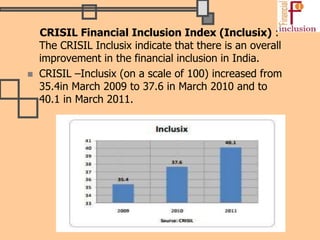
 CRISIL –Inclusix (on a scale of 100) increased from
35.4in March 2009 to 37.6 in March 2010 and to
40.1 in March 2011.
Government of India Population Census 2011 ™
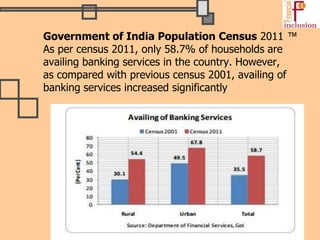
As per census 2011, only 58.7% of households are
availing banking services in the country. However,
as compared with previous census 2001, availing of
banking services increased significantly
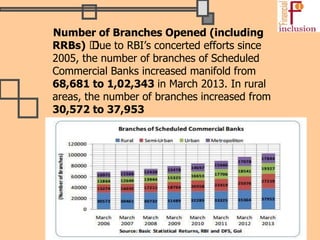
Number of Branches Opened (including
RRBs) ™Due to RBI’s concerted efforts since
2005, the number of branches of Scheduled
Commercial Banks increased manifold from
68,681 to 1,02,343 in March 2013. In rural
areas, the number of branches increased from
30,572 to 37,953
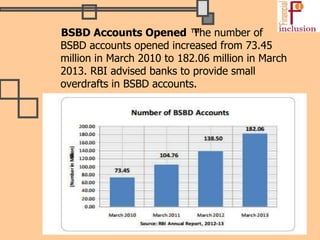
BSBD Accounts Opened ™The number of
BSBD accounts opened increased from 73.45
million in March 2010 to 182.06 million in March
2013. RBI advised banks to provide small
overdrafts in BSBD accounts.
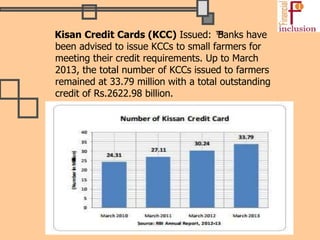
Kisan Credit Cards (KCC) Issued: ™Banks have
been advised to issue KCCs to small farmers for
meeting their credit requirements. Up to March
2013, the total number of KCCs issued to farmers
remained at 33.79 million with a total outstanding
credit of Rs.2622.98 billion.
 launched by the PM of India, Narendra Modi on 28
August 2014
 Run by Department of Financial Services, Ministry of
Finance, on the inauguration day, 1.5 Crore (15 million)
bank accounts were opened.
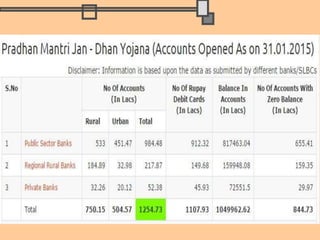
 By 28 January 2015, 12.58 crore accounts were opened,
with around 10590 crore (US$1.7 billion) were deposited
under the scheme.
Pradhan Mantri Jan
Dhan Yojana
 Interest on deposit.
 Accidental insurance cover of Rs.1.00 lac (to be given by HDFC Ergo)
 No minimum balance required.
 Life insurance cover of Rs.30,000/- (to be given by LIC)
 Easy Transfer of money across India
 After satisfactory operation of the account for 6 months, an overdraft
facility will be permitted
 Accidental Insurance Cover, RuPay Debit Card must be used at least
once in 45 days.
 Overdraft facility upto Rs.5000/- is available in only one account per
household, preferably lady of the household.
Benefits under PM JDY Scheme
Financial inclusion in India

Financial inclusion in India

  • 1.
  • 2.
    Definition ‘Financial inclusion’ orinclusive financing is the delivery of financial services at affordable costs to sections of disadvantaged and low-income segments of society, in contrast to financial exclusion where those services are not available or affordable. An estimated 2.5 billion working-age adults globally have no access to the formal financial services .
  • 3.
    Background  The ReserveBank of India (RBI) set up the Khan Commission in 2004 to look into financial inclusion  In the report RBI exhorted the banks to achieve greater financial inclusion with basic "no-frills" banking account.  In India, financial inclusion first featured in 2005, when it was introduced by K.C. Chakraborthy, the chairman of Indian Bank.  Mangalam became the first village in India where all households were provided banking facilities.
  • 4.
     In January2006, the Reserve Bank permitted commercial banks to make use of the services of non-governmental organizations (NGOs/SHGs), micro-finance institutions, and other civil society organizations as intermediaries for providing financial and banking services.  Reserve Bank of India’s vision for 2020 is to open nearly 600 million new customers' accounts and service them through a variety of channels by leveraging on IT.
  • 5.
    Steps taken byGovernment & RBI In India, RBI has initiated several measures to achieve greater financial inclusion  Opening of no-frills accounts: Basic banking no- frills account is with nil or very low minimum balance  Relaxation on know-your-customer (KYC) norms:KYC requirements for opening bank accounts were relaxed for small accounts in August 2005, details of name, address and Aadhaar number.  Engaging business correspondents (BCs):In January 2006, RBI permitted banks to engage BF’s and BCs as intermediaries for providing financial and banking services. It allows banks to provide doorstep delivery of services, especially cash in-cash out transactions.
  • 6.
     Use oftechnology: to make effective use of information and communications technology (ICT), to provide doorstep banking services through the BC model.  Opening of branches in unbanked rural centre's: To further step up the opening of branches in rural areas so as to improve banking penetration and financial inclusion rapidly  Ensuring reasonableness of bank charges: Accordingly, and in order to ensure fair practices in banking services, the RBI has issued instructions to banks making it obligatory for them to display and continue to keep updated, in their offices/branches as also in their website, the details of various services charges.
  • 7.
    Financial Stability DevelopmentCouncil (FSDC) has explicit mandate to focus on financial inclusion and financial literacy simultaneously. ™RBI has issued revised guidelines on the Financial literacy Centres (FLC) on June 6, 2012, for setting up FLC’s  Financial Inclusion Initiatives by Private Corporates: ™A few large private corporate have undertaken projects such as  EChoupal/ E- Sagar(ITC),  Haryali Kisan Bazaar (DCM),  Project Shakti (HUL), etc.
  • 8.
    Financial Inclusion Index On June 25, 2013, CRISIL , India's leading credit rating and research company launched an index to measure the status of financial inclusion in India.  The index- ‘Inclusix’ - along with a report, was released by the Finance Minister of India, P. Chidambaram at a widely covered program at New Delhi.  on a scale of 0 to 100, and combines three critical parameters of basic banking services —  Branch penetration,  Deposit penetration, and  Credit penetration
  • 9.
     The all-IndiaCRISIL Inclusix score of 40.1 is low, though there are clear signs of progress – this score has improved from 35.4 in 2009.  Deposit penetration is the key driver of financial inclusion – the number of savings accounts (624 million), is almost four times the number of loan accounts (160 million).  618 out of 632 districts reported an improvement in their scores during 2009-2011.  The top three states and Union Territories are Puducherry, Chandigarh, and Kerala; the top three districts are Pathanamthitta (Kerala), Karaikal (Puducherry), and Thiruvananthapuram (Kerala).
  • 10.
    CRISIL Financial InclusionIndex (Inclusix) : The CRISIL Inclusix indicate that there is an overall improvement in the financial inclusion in India.  CRISIL –Inclusix (on a scale of 100) increased from 35.4in March 2009 to 37.6 in March 2010 and to 40.1 in March 2011.
  • 11.
    Government of IndiaPopulation Census 2011 ™ As per census 2011, only 58.7% of households are availing banking services in the country. However, as compared with previous census 2001, availing of banking services increased significantly
  • 12.
    Number of BranchesOpened (including RRBs) ™Due to RBI’s concerted efforts since 2005, the number of branches of Scheduled Commercial Banks increased manifold from 68,681 to 1,02,343 in March 2013. In rural areas, the number of branches increased from 30,572 to 37,953
  • 13.
    BSBD Accounts Opened™The number of BSBD accounts opened increased from 73.45 million in March 2010 to 182.06 million in March 2013. RBI advised banks to provide small overdrafts in BSBD accounts.
  • 14.
    Kisan Credit Cards(KCC) Issued: ™Banks have been advised to issue KCCs to small farmers for meeting their credit requirements. Up to March 2013, the total number of KCCs issued to farmers remained at 33.79 million with a total outstanding credit of Rs.2622.98 billion.
  • 15.
     launched bythe PM of India, Narendra Modi on 28 August 2014  Run by Department of Financial Services, Ministry of Finance, on the inauguration day, 1.5 Crore (15 million) bank accounts were opened.  By 28 January 2015, 12.58 crore accounts were opened, with around 10590 crore (US$1.7 billion) were deposited under the scheme. Pradhan Mantri Jan Dhan Yojana
  • 16.
     Interest ondeposit.  Accidental insurance cover of Rs.1.00 lac (to be given by HDFC Ergo)  No minimum balance required.  Life insurance cover of Rs.30,000/- (to be given by LIC)  Easy Transfer of money across India  After satisfactory operation of the account for 6 months, an overdraft facility will be permitted  Accidental Insurance Cover, RuPay Debit Card must be used at least once in 45 days.  Overdraft facility upto Rs.5000/- is available in only one account per household, preferably lady of the household. Benefits under PM JDY Scheme