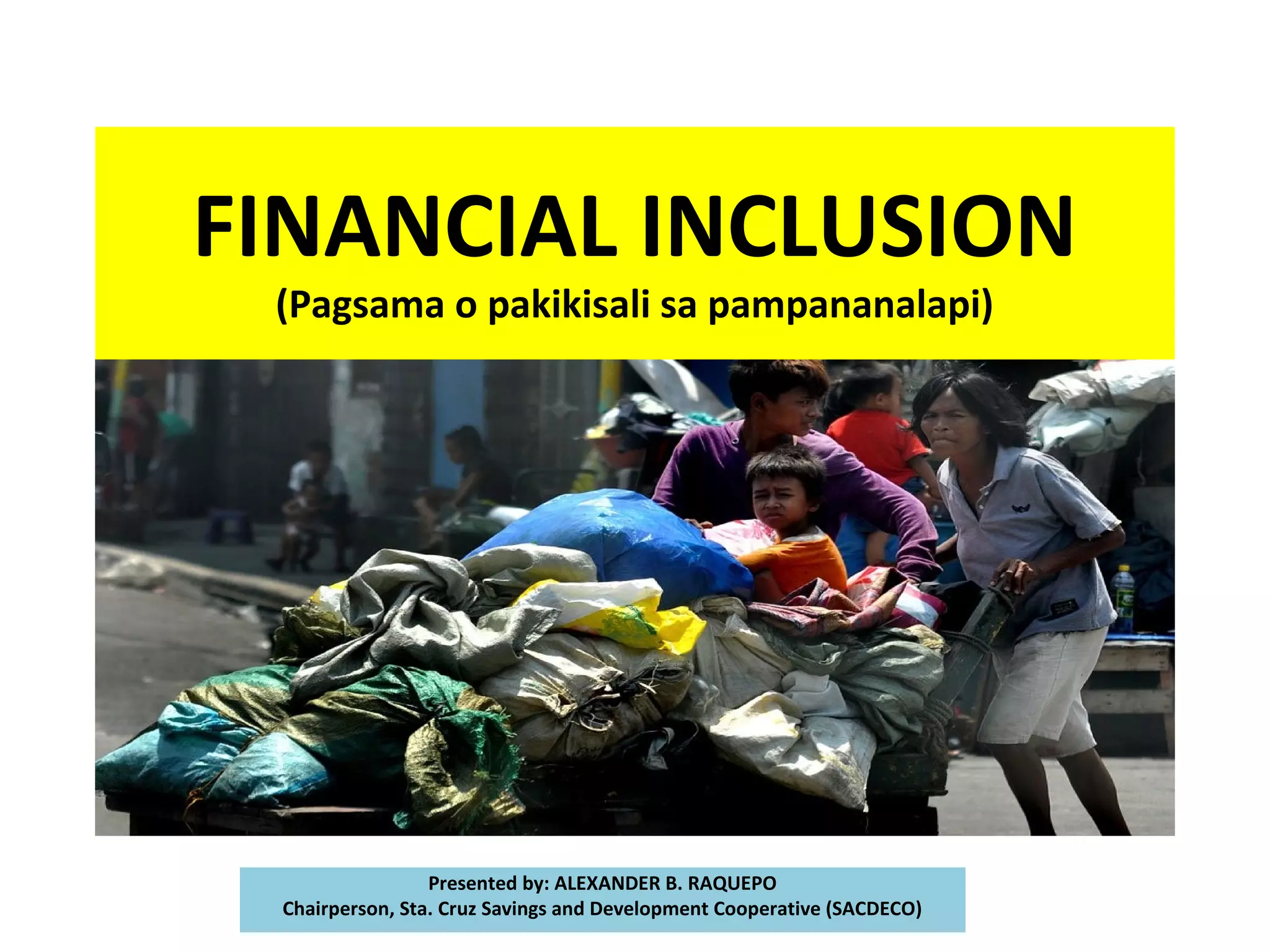




FINANCIAL INCLUSION
(Pagsama o pakikisali sa pampananalapi)
Presented by: ALEXANDER B. RAQUEPO
Chairperson, Sta. Cruz Savings and Development Cooperative (SACDECO)
Financial Inclusion
• - Financial
inclusion is a state
wherein there is
effective access to
a wide range of
financial services
FOR ALL.
What is effective access?
• - ready, available, accessible
and affordable;
• - fits the needs of the poor and
the unbanked;
• - short term and easy
repayment terms;
• - processes and procedures are
easy to understand/do; and
• - delivers positive results and is
sustainable.
What are these Financial Services?
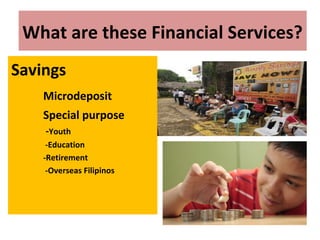
Savings
Microdeposit
Special purpose
-Youth
-Education
-Retirement
-Overseas Filipinos
• Credit
Microenterprise
Micro-agri
Housing Microfinance
Personal/consumer
• Insurance
Micro-insurance
Life
Health
Property
Agriculture
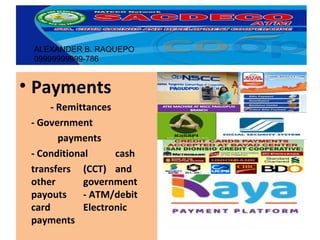
• Payments
- Remittances
- Government
payments
- Conditional cash
transfers (CCT) and
other government
payouts - ATM/debit
card Electronic
payments
ALEXANDER B. RAQUEPO
09999999999-786
What are the Importance of
Financial Inclusion?
1. Access to basic
financial services
suchas savings,
payments and
credit make a
positive difference in
people’s lives.
• 2. It improves the
well-being of
the poor and
the
growth of
micro, small
and medium
enterprises.
3. It contributes to
financial stability
and economic
growth.
FI…Importance
• 4. It reduces
income inequality
and poverty.
Vital Information….
Around 2 billion people don’t use formal
financial services and more than 50% of
adults in the poorest households are
unbanked. Financial inclusion is a key
enabler to reducing poverty and boosting
prosperity.
-World Bank
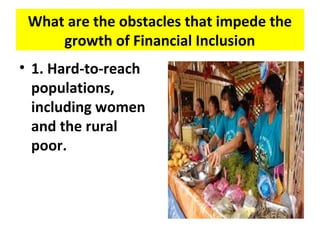
What are the obstacles that impede the
growth of Financial Inclusion
• 1. Hard-to-reach
populations,
including women
and the rural
poor.
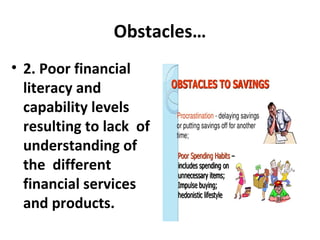
Obstacles…
• 2. Poor financial
literacy and
capability levels
resulting to lack of
understanding of
the different
financial services
and products.
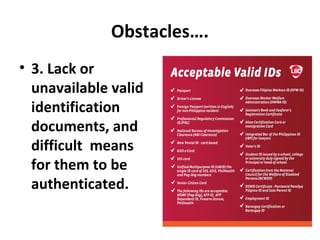
Obstacles….
• 3. Lack or
unavailable valid
identification
documents, and
difficult means
for them to be
authenticated.
Obstacles…
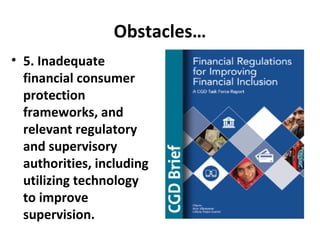
• 5. Inadequate
financial consumer
protection
frameworks, and
relevant regulatory
and supervisory
authorities, including
utilizing technology
to improve
supervision.
Obstacles…..
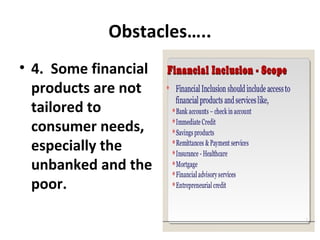
• 4. Some financial
products are not
tailored to
consumer needs,
especially the
unbanked and the
poor.
How is Financial Inclusion
Measured?
• ACCESS: Supply and availability of
financial products and services
• QUALITY: Consumer experience;
relevance of a product or service
• USAGE: Utilization of different products
and services
• WELFARE: Impact of a product or service
on the lives of the consumers
What can Cooperatives do for
Financial Inclusion?
• 1. Financing and Credit
Assistance
• 2. Partnership and Loan
Syndication
• 3. Contract Growing or
Farming
• 4. Loan Guarantees
• 5. Micro Insurance
• 6. Marketing
• 7. Product Value Adding
and Processing
• 8. Payment Centers
• 9. Micro-Savings
Products
• 10. Financial Literacy
Trainings
• 11. Livelihood Trainings
• 12. Cooperative Banking
Conclusion
• Financial Inclusion IS NOT ONLY ABOUT
CREDIT and LOANS (di lang tungkol sa
UTANG, paano makakautang, saan
makakautang, magkano pwedeng mautang,
atbp), it is about being Financially Literate
and being certain about one’s economic
future.
• Be counted as a “Financial Inclusive”
participant and contributor.
• Be an active COOP MEMBER
and you will be financially
inclusive.
• Mabuhay ang
Kooperatiba, Mabuhay
tayong lahat.
Financial Inclusion

Financial Inclusion

  • 1.
    FINANCIAL INCLUSION (Pagsama opakikisali sa pampananalapi) Presented by: ALEXANDER B. RAQUEPO Chairperson, Sta. Cruz Savings and Development Cooperative (SACDECO)
  • 2.
    Financial Inclusion • -Financial inclusion is a state wherein there is effective access to a wide range of financial services FOR ALL.
  • 3.
    What is effectiveaccess? • - ready, available, accessible and affordable; • - fits the needs of the poor and the unbanked; • - short term and easy repayment terms; • - processes and procedures are easy to understand/do; and • - delivers positive results and is sustainable.
  • 4.
    What are theseFinancial Services? Savings Microdeposit Special purpose -Youth -Education -Retirement -Overseas Filipinos
  • 5.
  • 6.
  • 7.
    • Payments - Remittances -Government payments - Conditional cash transfers (CCT) and other government payouts - ATM/debit card Electronic payments ALEXANDER B. RAQUEPO 09999999999-786
  • 8.
    What are theImportance of Financial Inclusion? 1. Access to basic financial services suchas savings, payments and credit make a positive difference in people’s lives. • 2. It improves the well-being of the poor and the growth of micro, small and medium enterprises.
  • 9.
    3. It contributesto financial stability and economic growth. FI…Importance • 4. It reduces income inequality and poverty.
  • 10.
    Vital Information…. Around 2billion people don’t use formal financial services and more than 50% of adults in the poorest households are unbanked. Financial inclusion is a key enabler to reducing poverty and boosting prosperity. -World Bank
  • 11.
    What are theobstacles that impede the growth of Financial Inclusion • 1. Hard-to-reach populations, including women and the rural poor.
  • 12.
    Obstacles… • 2. Poorfinancial literacy and capability levels resulting to lack of understanding of the different financial services and products.
  • 13.
    Obstacles…. • 3. Lackor unavailable valid identification documents, and difficult means for them to be authenticated.
  • 14.
    Obstacles… • 5. Inadequate financialconsumer protection frameworks, and relevant regulatory and supervisory authorities, including utilizing technology to improve supervision.
  • 15.
    Obstacles….. • 4. Somefinancial products are not tailored to consumer needs, especially the unbanked and the poor.
  • 16.
    How is FinancialInclusion Measured? • ACCESS: Supply and availability of financial products and services • QUALITY: Consumer experience; relevance of a product or service • USAGE: Utilization of different products and services • WELFARE: Impact of a product or service on the lives of the consumers
  • 17.
    What can Cooperativesdo for Financial Inclusion? • 1. Financing and Credit Assistance • 2. Partnership and Loan Syndication • 3. Contract Growing or Farming • 4. Loan Guarantees • 5. Micro Insurance • 6. Marketing • 7. Product Value Adding and Processing • 8. Payment Centers • 9. Micro-Savings Products • 10. Financial Literacy Trainings • 11. Livelihood Trainings • 12. Cooperative Banking
  • 18.
    Conclusion • Financial InclusionIS NOT ONLY ABOUT CREDIT and LOANS (di lang tungkol sa UTANG, paano makakautang, saan makakautang, magkano pwedeng mautang, atbp), it is about being Financially Literate and being certain about one’s economic future. • Be counted as a “Financial Inclusive” participant and contributor.
  • 19.
    • Be anactive COOP MEMBER and you will be financially inclusive. • Mabuhay ang Kooperatiba, Mabuhay tayong lahat.