

ELECTRICITY WITH 
WITRICITY 
Presented by : 
K.S.NIKHILESH 
DEPARTMENT OF ELECTRICAL & 
ELECTRONICS ENGINEERING. 
SNIST
Definition is : “Transmission of 
energy through air.” 
Cables are going to replaced by 
Witricity. The transmission of 
electrical energy without wires to any 
place on the earth .
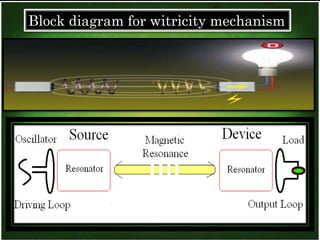
Block diagram for witricity mechanism
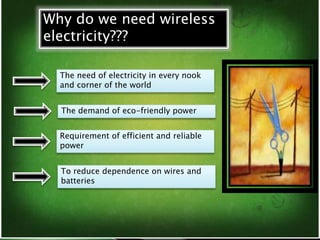
Why do we need wireless 
electricity??? 
The need of electricity in every nook 
and corner of the world 
The demand of eco-friendly power 
Requirement of efficient and reliable 
power 
To reduce dependence on wires and 
batteries
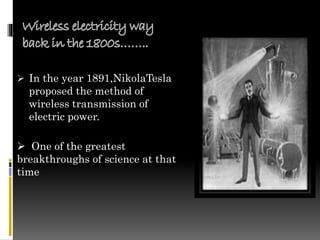
 In the year 1891,NikolaTesla 
proposed the method of 
wireless transmission of 
electric power. 
 One of the greatest 
breakthroughs of science at that 
time
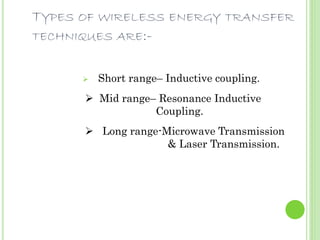
TYPES OF WIRELESS ENERGY TRANSFER 
TECHNIQUES ARE:- 
 Short range– Inductive coupling. 
 Mid range– Resonance Inductive 
Coupling. 
 Long range-Microwave Transmission 
& Laser Transmission.
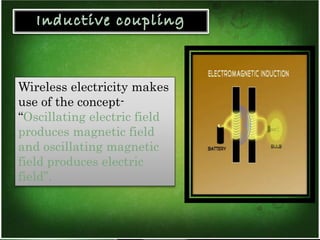
Wireless electricity makes 
use of the concept- 
“Oscillating electric field 
produces magnetic field 
and oscillating magnetic 
field produces electric 
field”.
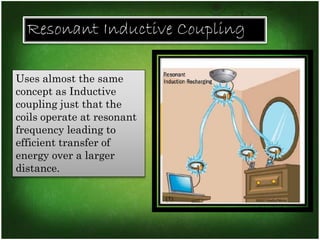
Resonant Inductive Coupling 
Uses almost the same 
concept as Inductive 
coupling just that the 
coils operate at resonant 
frequency leading to 
efficient transfer of 
energy over a larger 
distance.
Di f f e r e n t F r e q u e n c y 
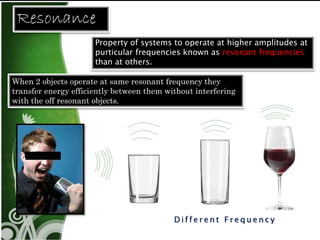
Resonance 
Property of systems to operate at higher amplitudes at 
purticular frequencies known as resonant frequencies 
than at others. 
When 2 objects operate at same resonant frequency they 
transfer energy efficiently between them without interfering 
with the off resonant objects.
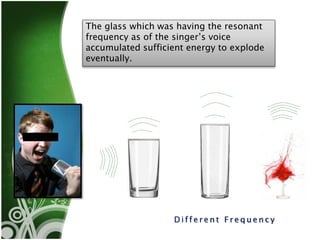
The glass which was having the resonant 
frequency as of the singer’s voice 
accumulated sufficient energy to explode 
eventually. 
Di f f e r e n t F r e q u e n c y
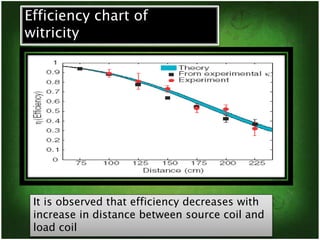
Efficiency chart of 
witricity 
It is observed that efficiency decreases with 
increase in distance between source coil and 
load coil
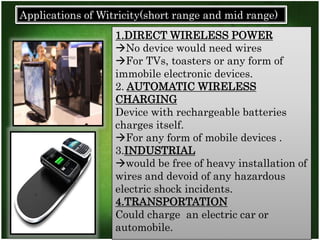
Applications of Witricity(short range and mid range) 
1.DIRECT WIRELESS POWER 
No device would need wires 
For TVs, toasters or any form of 
immobile electronic devices. 
2. AUTOMATIC WIRELESS 
CHARGING 
Device with rechargeable batteries 
charges itself. 
For any form of mobile devices . 
3.INDUSTRIAL 
would be free of heavy installation of 
wires and devoid of any hazardous 
electric shock incidents. 
4.TRANSPORTATION 
Could charge an electric car or 
automobile.
Types of Long range/Far field 
transmission techniques 
Microwave Transmission 
extracts small quantities of 
energy in the range 902 and 928 
MHz 
Disadvantage—interference caused 
by metal surfaces. 
Laser Transmission 
Highly directional and coherent 
Inefficient for wireless power 
transmission
MicrowaveTransmission 
Aims at higher power transfer over longer distances 
practically in the range of some miles 
Requires a microwave source, antenna and rectenna. 
operates in the frequency range of 1-40GHz 
operates at the highest efficiency at 2.45GHz 
Steps: 
1.conversion of electrical to microwave 
Energy. 
2.Capturing of microwave beams by 
Recttena. 
3.conversion of microwave to electrical 
Energy
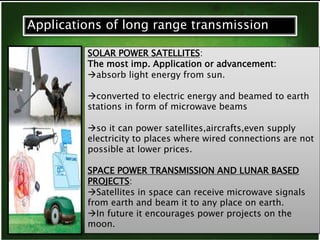
Applications of long range transmission 
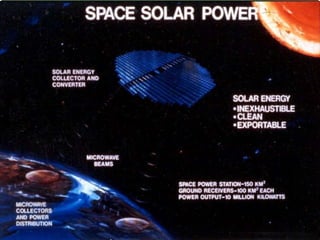
SOLAR POWER SATELLITES: 
The most imp. Application or advancement: 
absorb light energy from sun. 
converted to electric energy and beamed to earth 
stations in form of microwave beams 
so it can power satellites,aircrafts,even supply 
electricity to places where wired connections are not 
possible at lower prices. 
SPACE POWER TRANSMISSION AND LUNAR BASED 
PROJECTS: 
Satellites in space can receive microwave signals 
from earth and beam it to any place on earth. 
In future it encourages power projects on the 
moon.
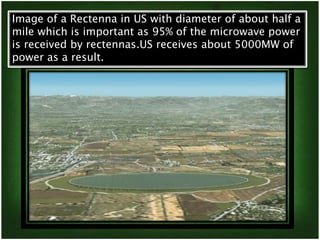
Image of a Rectenna in US with diameter of about half a 
mile which is important as 95% of the microwave power 
is received by rectennas.US receives about 5000MW of 
power as a result.
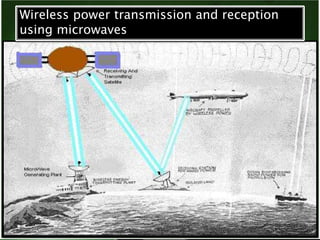
Wireless power transmission and reception 
using microwaves
 Unlimited energy resource 
 Energy delivered anywhere in the world 
Zero fuel cost 
Zero CO2 emission 
Minimum long-range environmental impact 
Solar radiation can be more efficiently collected in space
Launch costs . 
 Capital cost even given cheap launchers . 
Would require a network of hundreds of satellites . 
The size of the antennas and rectennas. 
Geosynchronous satellites would take up large sections of space. 
Interference with communication satellites
Conclusion: 
Wireless electricity is not just a great idea but an urgent 
measure that has to be taken to deal with the current 
energy crisis. 
Even the smallest entity can lead to one of the most 
mindboggling dilemmas of the world. Electrons the source 
of electricity puts us in a similar fix. It is on us to decide 
how to tap these electrons to be useful in our lives. 
Wireless electricity comes with its baggage but no can 
deny that it is here to stay. 
Prospects & Issues: 
From the discussion its clear that this idea needs 
awareness to remove doubts from minds of the people 
about safety issues. 
It requires both support from government and the people 
financially and psychologically.
Presentation on WITRICITY

Presentation on WITRICITY

  • 1.
    ELECTRICITY WITH WITRICITY Presented by : K.S.NIKHILESH DEPARTMENT OF ELECTRICAL & ELECTRONICS ENGINEERING. SNIST
  • 2.
    Definition is :“Transmission of energy through air.” Cables are going to replaced by Witricity. The transmission of electrical energy without wires to any place on the earth .
  • 3.
    Block diagram forwitricity mechanism
  • 4.
    Why do weneed wireless electricity??? The need of electricity in every nook and corner of the world The demand of eco-friendly power Requirement of efficient and reliable power To reduce dependence on wires and batteries
  • 6.
     In theyear 1891,NikolaTesla proposed the method of wireless transmission of electric power.  One of the greatest breakthroughs of science at that time
  • 7.
    TYPES OF WIRELESSENERGY TRANSFER TECHNIQUES ARE:-  Short range– Inductive coupling.  Mid range– Resonance Inductive Coupling.  Long range-Microwave Transmission & Laser Transmission.
  • 8.
    Wireless electricity makes use of the concept- “Oscillating electric field produces magnetic field and oscillating magnetic field produces electric field”.
  • 9.
    Resonant Inductive Coupling Uses almost the same concept as Inductive coupling just that the coils operate at resonant frequency leading to efficient transfer of energy over a larger distance.
  • 10.
    Di f fe r e n t F r e q u e n c y Resonance Property of systems to operate at higher amplitudes at purticular frequencies known as resonant frequencies than at others. When 2 objects operate at same resonant frequency they transfer energy efficiently between them without interfering with the off resonant objects.
  • 11.
    The glass whichwas having the resonant frequency as of the singer’s voice accumulated sufficient energy to explode eventually. Di f f e r e n t F r e q u e n c y
  • 12.
    Efficiency chart of witricity It is observed that efficiency decreases with increase in distance between source coil and load coil
  • 13.
    Applications of Witricity(shortrange and mid range) 1.DIRECT WIRELESS POWER No device would need wires For TVs, toasters or any form of immobile electronic devices. 2. AUTOMATIC WIRELESS CHARGING Device with rechargeable batteries charges itself. For any form of mobile devices . 3.INDUSTRIAL would be free of heavy installation of wires and devoid of any hazardous electric shock incidents. 4.TRANSPORTATION Could charge an electric car or automobile.
  • 14.
    Types of Longrange/Far field transmission techniques Microwave Transmission extracts small quantities of energy in the range 902 and 928 MHz Disadvantage—interference caused by metal surfaces. Laser Transmission Highly directional and coherent Inefficient for wireless power transmission
  • 15.
    MicrowaveTransmission Aims athigher power transfer over longer distances practically in the range of some miles Requires a microwave source, antenna and rectenna. operates in the frequency range of 1-40GHz operates at the highest efficiency at 2.45GHz Steps: 1.conversion of electrical to microwave Energy. 2.Capturing of microwave beams by Recttena. 3.conversion of microwave to electrical Energy
  • 16.
    Applications of longrange transmission SOLAR POWER SATELLITES: The most imp. Application or advancement: absorb light energy from sun. converted to electric energy and beamed to earth stations in form of microwave beams so it can power satellites,aircrafts,even supply electricity to places where wired connections are not possible at lower prices. SPACE POWER TRANSMISSION AND LUNAR BASED PROJECTS: Satellites in space can receive microwave signals from earth and beam it to any place on earth. In future it encourages power projects on the moon.
  • 18.
    Image of aRectenna in US with diameter of about half a mile which is important as 95% of the microwave power is received by rectennas.US receives about 5000MW of power as a result.
  • 19.
    Wireless power transmissionand reception using microwaves
  • 20.
     Unlimited energyresource  Energy delivered anywhere in the world Zero fuel cost Zero CO2 emission Minimum long-range environmental impact Solar radiation can be more efficiently collected in space
  • 21.
    Launch costs .  Capital cost even given cheap launchers . Would require a network of hundreds of satellites . The size of the antennas and rectennas. Geosynchronous satellites would take up large sections of space. Interference with communication satellites
  • 22.
    Conclusion: Wireless electricityis not just a great idea but an urgent measure that has to be taken to deal with the current energy crisis. Even the smallest entity can lead to one of the most mindboggling dilemmas of the world. Electrons the source of electricity puts us in a similar fix. It is on us to decide how to tap these electrons to be useful in our lives. Wireless electricity comes with its baggage but no can deny that it is here to stay. Prospects & Issues: From the discussion its clear that this idea needs awareness to remove doubts from minds of the people about safety issues. It requires both support from government and the people financially and psychologically.