By Brian Dsouza
Ec - 8th sem
WITRICITY
SCEM DEPT OF EC 1
Contents:
Why wireless power?
Brief history
Introduction
Ways of electricity transmission
Illustration of wireless electricity
Applications
Future implications
Conclusion
SCEM DEPT OF EC 2
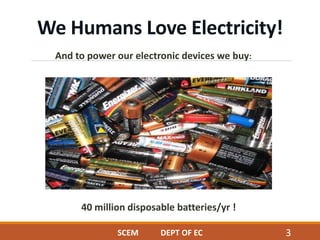
We Humans Love Electricity!
SCEM DEPT OF EC 3
And to power our electronic devices we buy:
40 million disposable batteries/yr !
SCEM DEPT OF EC 4
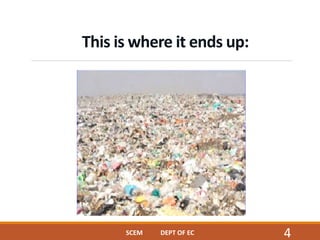
This is where it ends up:
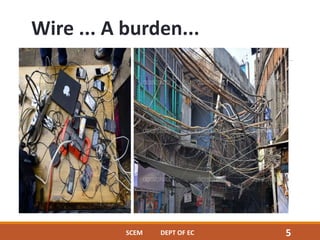
Wire ... A burden...
5SCEM DEPT OF EC
SCEM DEPT OF EC 6
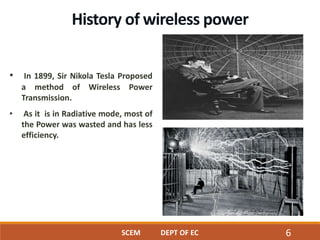
History of wireless power
• In 1899, Sir Nikola Tesla Proposed
a method of Wireless Power
Transmission.
• As it is in Radiative mode, most of
the Power was wasted and has less
efficiency.
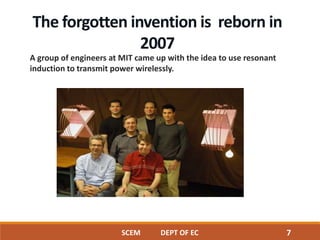
A group of engineers at MIT came up with the idea to use resonant
induction to transmit power wirelessly.
The forgotten invention is reborn in
2007
SCEM DEPT OF EC 7
SCEM DEPT OF EC 8
Ways of Transmission
Near field
1. Induction
2. Resonant induction
Far field
1. Radio and microwave transmission
2. Laser
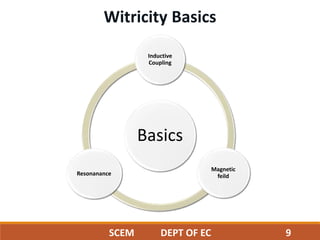
Basics
Inductive
Coupling
Magnetic
feildResonanance
Witricity Basics
SCEM DEPT OF EC 9
Witricity Basics
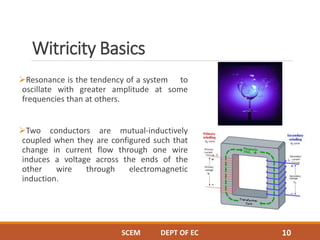
Resonance is the tendency of a system to
oscillate with greater amplitude at some
frequencies than at others.
Two conductors are mutual-inductively
coupled when they are configured such that
change in current flow through one wire
induces a voltage across the ends of the
other wire through electromagnetic
induction.
SCEM DEPT OF EC 10
Basic Principle of Resonant Induction
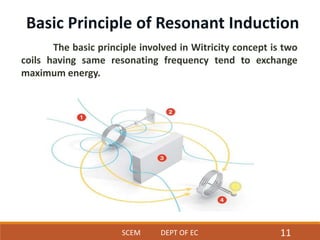
The basic principle involved in Witricity concept is two
coils having same resonating frequency tend to exchange
maximum energy.
SCEM DEPT OF EC 11
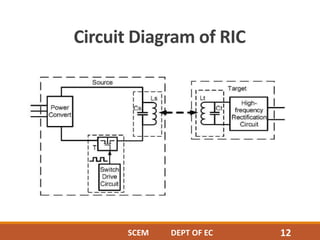
Circuit Diagram of RIC
SCEM DEPT OF EC 12
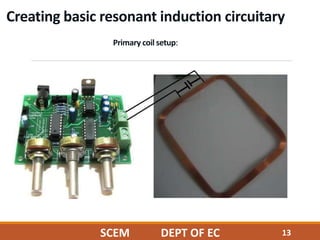
Creating basic resonant induction circuitary
Primary coil setup:
SCEM DEPT OF EC 13
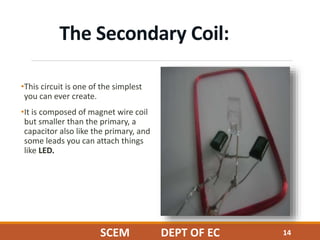
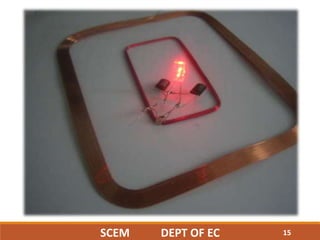
The Secondary Coil:
•This circuit is one of the simplest
you can ever create.
•It is composed of magnet wire coil
but smaller than the primary, a
capacitor also like the primary, and
some leads you can attach things
like LED.
14SCEM DEPT OF EC
15SCEM DEPT OF EC
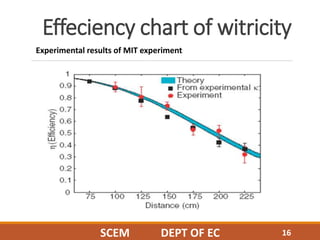
Effeciency chart of witricity
16SCEM DEPT OF EC
Experimental results of MIT experiment
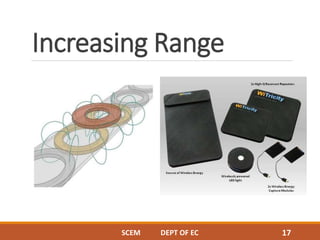
Increasing Range
SCEM DEPT OF EC 17
18
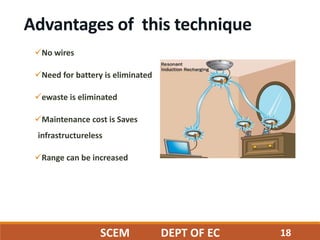
Advantages of this technique
No wires
Need for battery is eliminated
ewaste is eliminated
Maintenance cost is Saves
infrastructureless
Range can be increased
SCEM DEPT OF EC
Disadvantages of Resonant Wireless
electricity:
19
Distance constraint
Initial cost is high
In RIC, tuning is difficult
High frequency signals must be the supply
SCEM DEPT OF EC
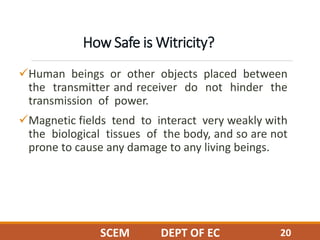
How Safe is Witricity?
Human beings or other objects placed between
the transmitter and receiver do not hinder the
transmission of power.
Magnetic fields tend to interact very weakly with
the biological tissues of the body, and so are not
prone to cause any damage to any living beings.
20SCEM DEPT OF EC
21
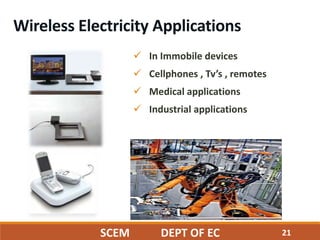
Wireless Electricity Applications
 In Immobile devices
 Cellphones , Tv’s , remotes
 Medical applications
 Industrial applications
SCEM DEPT OF EC
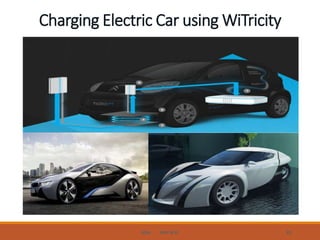
Charging Electric Car using WiTricity
SCEM DEPT OF EC 22
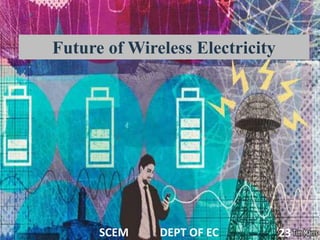
Future of Wireless Electricity
23SCEM DEPT OF EC
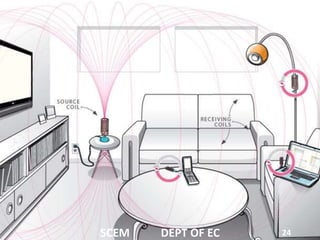
24SCEM DEPT OF EC
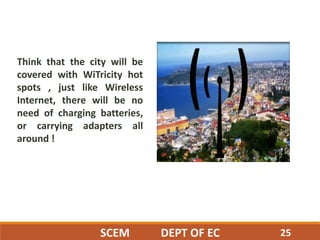
Think that the city will be
covered with WiTricity hot
spots , just like Wireless
Internet, there will be no
need of charging batteries,
or carrying adapters all
around !
25SCEM DEPT OF EC
26SCEM DEPT OF EC
27
Queries….
SCEM DEPT OF EC

Wireless Electricity

  • 1.
    By Brian Dsouza Ec- 8th sem WITRICITY SCEM DEPT OF EC 1
  • 2.
    Contents: Why wireless power? Briefhistory Introduction Ways of electricity transmission Illustration of wireless electricity Applications Future implications Conclusion SCEM DEPT OF EC 2
  • 3.
    We Humans LoveElectricity! SCEM DEPT OF EC 3 And to power our electronic devices we buy: 40 million disposable batteries/yr !
  • 4.
    SCEM DEPT OFEC 4 This is where it ends up:
  • 5.
    Wire ... Aburden... 5SCEM DEPT OF EC
  • 6.
    SCEM DEPT OFEC 6 History of wireless power • In 1899, Sir Nikola Tesla Proposed a method of Wireless Power Transmission. • As it is in Radiative mode, most of the Power was wasted and has less efficiency.
  • 7.
    A group ofengineers at MIT came up with the idea to use resonant induction to transmit power wirelessly. The forgotten invention is reborn in 2007 SCEM DEPT OF EC 7
  • 8.
    SCEM DEPT OFEC 8 Ways of Transmission Near field 1. Induction 2. Resonant induction Far field 1. Radio and microwave transmission 2. Laser
  • 9.
  • 10.
    Witricity Basics Resonance isthe tendency of a system to oscillate with greater amplitude at some frequencies than at others. Two conductors are mutual-inductively coupled when they are configured such that change in current flow through one wire induces a voltage across the ends of the other wire through electromagnetic induction. SCEM DEPT OF EC 10
  • 11.
    Basic Principle ofResonant Induction The basic principle involved in Witricity concept is two coils having same resonating frequency tend to exchange maximum energy. SCEM DEPT OF EC 11
  • 12.
    Circuit Diagram ofRIC SCEM DEPT OF EC 12
  • 13.
    Creating basic resonantinduction circuitary Primary coil setup: SCEM DEPT OF EC 13
  • 14.
    The Secondary Coil: •Thiscircuit is one of the simplest you can ever create. •It is composed of magnet wire coil but smaller than the primary, a capacitor also like the primary, and some leads you can attach things like LED. 14SCEM DEPT OF EC
  • 15.
  • 16.
    Effeciency chart ofwitricity 16SCEM DEPT OF EC Experimental results of MIT experiment
  • 17.
  • 18.
    18 Advantages of thistechnique No wires Need for battery is eliminated ewaste is eliminated Maintenance cost is Saves infrastructureless Range can be increased SCEM DEPT OF EC
  • 19.
    Disadvantages of ResonantWireless electricity: 19 Distance constraint Initial cost is high In RIC, tuning is difficult High frequency signals must be the supply SCEM DEPT OF EC
  • 20.
    How Safe isWitricity? Human beings or other objects placed between the transmitter and receiver do not hinder the transmission of power. Magnetic fields tend to interact very weakly with the biological tissues of the body, and so are not prone to cause any damage to any living beings. 20SCEM DEPT OF EC
  • 21.
    21 Wireless Electricity Applications In Immobile devices  Cellphones , Tv’s , remotes  Medical applications  Industrial applications SCEM DEPT OF EC
  • 22.
    Charging Electric Carusing WiTricity SCEM DEPT OF EC 22
  • 23.
    Future of WirelessElectricity 23SCEM DEPT OF EC
  • 24.
  • 25.
    Think that thecity will be covered with WiTricity hot spots , just like Wireless Internet, there will be no need of charging batteries, or carrying adapters all around ! 25SCEM DEPT OF EC
  • 26.
  • 27.