VERBS
Definition
A word used to describe an action, state, or
occurrence, and forming the main part of
the predicate of a sentence.
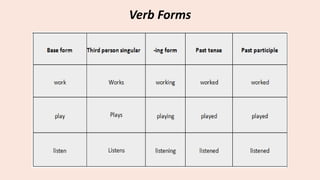
Verb Forms
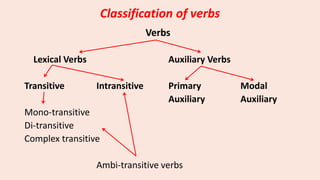
Classification of verbs
Verbs
Lexical Verbs Auxiliary Verbs
Transitive Intransitive Primary Modal
Auxiliary Auxiliary
Mono-transitive
Di-transitive
Complex transitive
Ambi-transitive verbs
Find the differences between,
1. Lexical vs. Auxiliary verbs
2. Transitive vs. Intransitive verbs
3. Primary vs. Model auxiliary verbs
4. Finite vs. Non-finite verbs
5. Regular vs. Irregular verbs
6. Stative vs. Dynamic verbs
Lexical Verbs
Lexical verb or full verb is a member of an open
class of verbs.
Typically expresses action.
EX: She comes usually.
I wrote a letter.
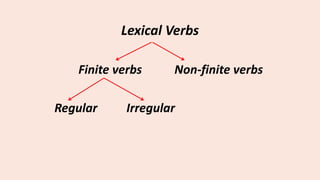
Lexical Verbs
Finite verbs Non-finite verbs
Regular Irregular
Finite Verb
• These have a definite relation with the subject. These
verbs are usually the main verb of a clause or sentence.
• They can be changed according to the number, person of
the subject.
• They are indicative of passive or active voice and tense.
Ex:
• She walks home.
• She walked home.
Non-Finite Verb
• They do not present the main action.
• They do not change according to the number
or person of the subject.
• They do not show tense or voice.
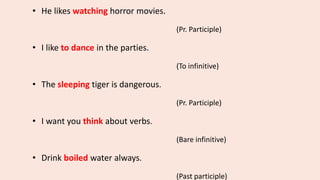
• He likes watching horror movies.
(Pr. Participle)
• I like to dance in the parties.
(To infinitive)
• The sleeping tiger is dangerous.
(Pr. Participle)
• I want you think about verbs.
(Bare infinitive)
• Drink boiled water always.
(Past participle)
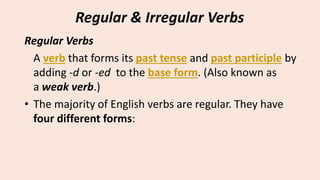
Regular & Irregular Verbs
Regular Verbs
A verb that forms its past tense and past participle by
adding -d or -ed to the base form. (Also known as
a weak verb.)
• The majority of English verbs are regular. They have
four different forms:
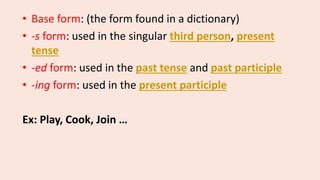
• Base form: (the form found in a dictionary)
• -s form: used in the singular third person, present
tense
• -ed form: used in the past tense and past participle
• -ing form: used in the present participle
Ex: Play, Cook, Join …
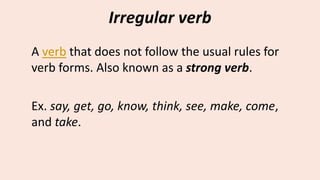
Irregular verb
A verb that does not follow the usual rules for
verb forms. Also known as a strong verb.
Ex. say, get, go, know, think, see, make, come,
and take.

Verbs.pptx

  • 1.
  • 2.
    Definition A word usedto describe an action, state, or occurrence, and forming the main part of the predicate of a sentence.
  • 3.
  • 4.
    Classification of verbs Verbs LexicalVerbs Auxiliary Verbs Transitive Intransitive Primary Modal Auxiliary Auxiliary Mono-transitive Di-transitive Complex transitive Ambi-transitive verbs
  • 5.
    Find the differencesbetween, 1. Lexical vs. Auxiliary verbs 2. Transitive vs. Intransitive verbs 3. Primary vs. Model auxiliary verbs 4. Finite vs. Non-finite verbs 5. Regular vs. Irregular verbs 6. Stative vs. Dynamic verbs
  • 6.
    Lexical Verbs Lexical verbor full verb is a member of an open class of verbs. Typically expresses action. EX: She comes usually. I wrote a letter.
  • 7.
    Lexical Verbs Finite verbsNon-finite verbs Regular Irregular
  • 8.
    Finite Verb • Thesehave a definite relation with the subject. These verbs are usually the main verb of a clause or sentence. • They can be changed according to the number, person of the subject. • They are indicative of passive or active voice and tense. Ex: • She walks home. • She walked home.
  • 9.
    Non-Finite Verb • Theydo not present the main action. • They do not change according to the number or person of the subject. • They do not show tense or voice.
  • 10.
    • He likeswatching horror movies. (Pr. Participle) • I like to dance in the parties. (To infinitive) • The sleeping tiger is dangerous. (Pr. Participle) • I want you think about verbs. (Bare infinitive) • Drink boiled water always. (Past participle)
  • 11.
    Regular & IrregularVerbs Regular Verbs A verb that forms its past tense and past participle by adding -d or -ed to the base form. (Also known as a weak verb.) • The majority of English verbs are regular. They have four different forms:
  • 12.
    • Base form:(the form found in a dictionary) • -s form: used in the singular third person, present tense • -ed form: used in the past tense and past participle • -ing form: used in the present participle Ex: Play, Cook, Join …
  • 13.
    Irregular verb A verbthat does not follow the usual rules for verb forms. Also known as a strong verb. Ex. say, get, go, know, think, see, make, come, and take.