Indian Removal Michael
Westward Expansion in US Beginning of 1800’s United States was growing west and south Indian tribes already inhabited the land Settlers asked government to remove the tribes
Government Policy Up until Jackson’s Presidency, government had let Indians stay Many tribes had become “civilized” Creeks, Choctaws, Chickasaws, Seminoles, and Cherokee Cherokee formed their own government, with a constitution and a three branch system of government Opened schools Some Indians became slaveholders Some accepted Christianity
Indian Removal Act In 1830 Congress passed the Indian Removal Act Said government would negotiate treaties with Indian tribes to buy their land Indians would be granted land west of the Mississippi Indians would receive food and transportation, and would live on their newly acquired land under the government’s protection forever Was a chance for Indians to move West if they wanted to
Indian Removal Act Many tribes were reluctant because they had lived on that land for a long time Their ancestors were buried on their land They would be leaving behind their heritage and history
Treaties By the end of Jackson’s presidency, over seventy treaties had been negotiated  Cherokee refused to negotiate a treaty Went to court against the State of Georgia
Indians vs. State of Georgia Went to Supreme Court Case was tossed by John Marshall because he said the tribes were domestic dependent nations Later the Supreme Court corrected itself and said the Cherokee were sovereign and were immune from Georgia laws
Indians vs. State of Georgia Jackson refused the courts decision Negotiated a treaty with Cherokee to leave Georgia Under military force, Cherokee were led to Oklahoma on the “Trail of Tears”
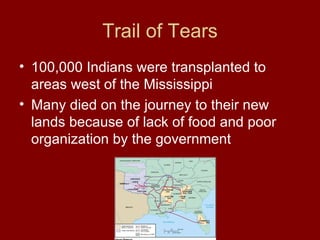
Trail of Tears 100,000 Indians were transplanted to areas west of the Mississippi Many died on the journey to their new lands because of lack of food and poor organization by the government
Rebellion Sauk and Fox braves from Illinois and Wisconsin refused to leave their lands Crushed by U.S. troops Seminole Indians in Florida waged guerilla warfare against soldiers Seminoles lost when their leader, Osceola, was captured, although fighting continued for two more years
Effects Other than the Seminole tribe, all Indians in the South negotiated treaties and moved west of the Mississippi The five “civilized” tribes suffered the most by the Indian Removal Act

Indian Removal

  • 1.
  • 2.
    Westward Expansion inUS Beginning of 1800’s United States was growing west and south Indian tribes already inhabited the land Settlers asked government to remove the tribes
  • 3.
    Government Policy Upuntil Jackson’s Presidency, government had let Indians stay Many tribes had become “civilized” Creeks, Choctaws, Chickasaws, Seminoles, and Cherokee Cherokee formed their own government, with a constitution and a three branch system of government Opened schools Some Indians became slaveholders Some accepted Christianity
  • 4.
    Indian Removal ActIn 1830 Congress passed the Indian Removal Act Said government would negotiate treaties with Indian tribes to buy their land Indians would be granted land west of the Mississippi Indians would receive food and transportation, and would live on their newly acquired land under the government’s protection forever Was a chance for Indians to move West if they wanted to
  • 5.
    Indian Removal ActMany tribes were reluctant because they had lived on that land for a long time Their ancestors were buried on their land They would be leaving behind their heritage and history
  • 6.
    Treaties By theend of Jackson’s presidency, over seventy treaties had been negotiated Cherokee refused to negotiate a treaty Went to court against the State of Georgia
  • 7.
    Indians vs. Stateof Georgia Went to Supreme Court Case was tossed by John Marshall because he said the tribes were domestic dependent nations Later the Supreme Court corrected itself and said the Cherokee were sovereign and were immune from Georgia laws
  • 8.
    Indians vs. Stateof Georgia Jackson refused the courts decision Negotiated a treaty with Cherokee to leave Georgia Under military force, Cherokee were led to Oklahoma on the “Trail of Tears”
  • 9.
    Trail of Tears100,000 Indians were transplanted to areas west of the Mississippi Many died on the journey to their new lands because of lack of food and poor organization by the government
  • 10.
    Rebellion Sauk andFox braves from Illinois and Wisconsin refused to leave their lands Crushed by U.S. troops Seminole Indians in Florida waged guerilla warfare against soldiers Seminoles lost when their leader, Osceola, was captured, although fighting continued for two more years
  • 11.
    Effects Other thanthe Seminole tribe, all Indians in the South negotiated treaties and moved west of the Mississippi The five “civilized” tribes suffered the most by the Indian Removal Act