
By
Gaurav Kale.
Sponsored Industry: KOSO INDIA, Pvt. Ltd,
Nashik.
K.K. Wagh Institute of Engg. Education & Research, Nashik
Hardfacing is a metalworking process
where harder or tougher material is applied
to a base metal.
WHAT IS HARDFACING?
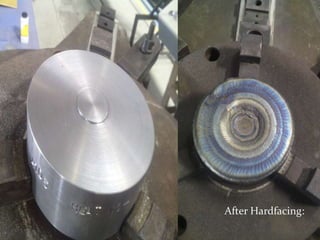
Before Hardfacing:
After Hardfacing:
Hardfacing Materials:
1. Stellite:
• Grade 6
• Grade 12
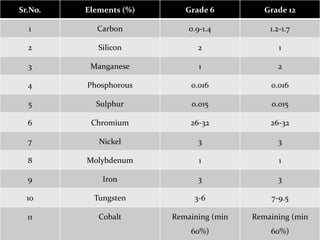
Sr.No. Elements (%) Grade 6 Grade 12
1 Carbon 0.9-1.4 1.2-1.7
2 Silicon 2 1
3 Manganese 1 2
4 Phosphorous 0.016 0.016
5 Sulphur 0.015 0.015
6 Chromium 26-32 26-32
7 Nickel 3 3
8 Molybdenum 1 1
9 Iron 3 3
10 Tungsten 3-6 7-9.5
11 Cobalt Remaining (min
60%)
Remaining (min
60%)
FLAWS DURING HARDFACING:
Currently the industry is facing some problems in this
(Hardfacing) processes such as,
1. Cracks.
2. Porosity
3. Blowholes..
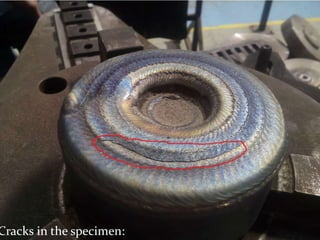
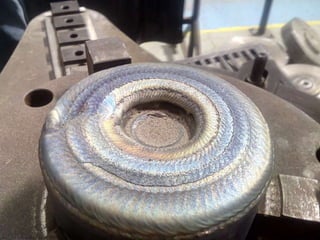
Cracks in the specimen:
Flaws overcome strategies:
 Modify the present Welding Process
Specification(WPS).
 Suggest the new procedure according to the
metallurgical properties of work piece if any.
Our Research and study:
 Removing flaws not possible just by modifying the
present WPS.
 We found a process in which the base metal is welded
first with intermediate hardness material.
• The process is known as Buffering Process.
 In buffering process, the material of intermediate
hardness between alloy steel and stellite is hardfaced
first on valve part and then hardfacing of stellite is
done.
 Here, we are using stainless steel for buffering.
Buffering Process:
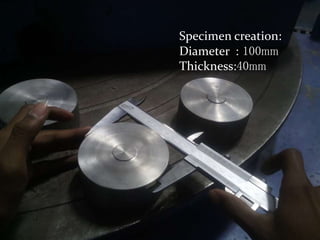
Specimen creation:
Diameter : 100mm
Thickness:40mm
OUR OBSERVATIONS:
Stellite reacts differently with alloy steels.
Alloy steel is softer compared to cast steel
Hardfacing on alloy steel job with conventional
method:
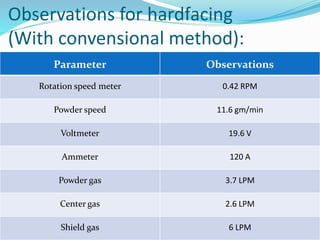
Observations for hardfacing
(With convensional method):
Parameter Observations
Rotation speed meter 0.42 RPM
Powder speed 11.6 gm/min
Voltmeter 19.6 V
Ammeter 120 A
Powder gas 3.7 LPM
Center gas 2.6 LPM
Shield gas 6 LPM
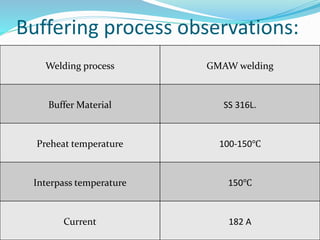
Buffering process observations:
Welding process GMAW welding
Buffer Material SS 316L.
Preheat temperature 100-150℃
Interpass temperature 150℃
Current 182 A
•Stainless Steel.
•Manganese Steel.
•Nickel based steel.
•Copper based steel.
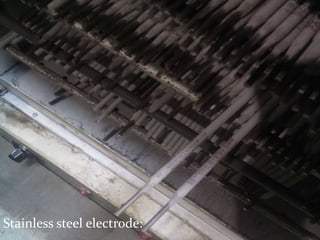
Stainless steel electrode:
BUFFERING ANALYSIS:
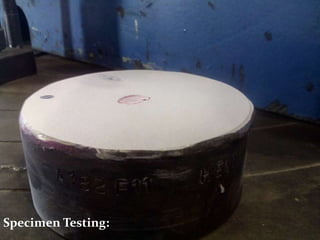
Specimen Testing:
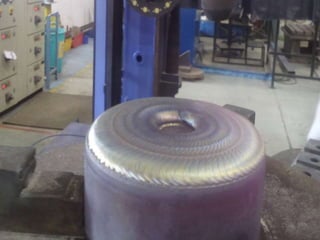
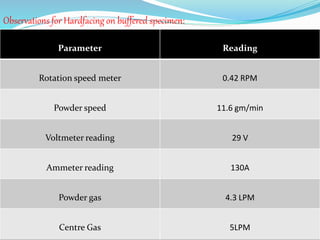
Hardfacing on buffered specimen:
Parameter Reading
Rotation speed meter 0.42 RPM
Powder speed 11.6 gm/min
Voltmeter reading 29 V
Ammeter reading 130A
Powder gas 4.3 LPM
Centre Gas 5LPM
Observations for Hardfacing on buffered specimen:
CONCLUSION
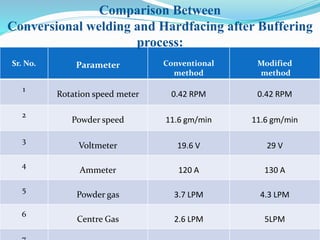
Sr. No. Parameter Conventional
method
Modified
method
1
Rotation speed meter 0.42 RPM 0.42 RPM
2
Powder speed 11.6 gm/min 11.6 gm/min
3
Voltmeter 19.6 V 29 V
4
Ammeter 120 A 130 A
5
Powder gas 3.7 LPM 4.3 LPM
6
Centre Gas 2.6 LPM 5LPM
Comparison Between
Conversional welding and Hardfacing after Buffering
process:

Presentation on Stellite hardfacing repair

  • 1.
    By Gaurav Kale. Sponsored Industry:KOSO INDIA, Pvt. Ltd, Nashik. K.K. Wagh Institute of Engg. Education & Research, Nashik
  • 2.
    Hardfacing is ametalworking process where harder or tougher material is applied to a base metal. WHAT IS HARDFACING? Before Hardfacing: After Hardfacing:
  • 3.
    Hardfacing Materials: 1. Stellite: •Grade 6 • Grade 12 Sr.No. Elements (%) Grade 6 Grade 12 1 Carbon 0.9-1.4 1.2-1.7 2 Silicon 2 1 3 Manganese 1 2 4 Phosphorous 0.016 0.016 5 Sulphur 0.015 0.015 6 Chromium 26-32 26-32 7 Nickel 3 3 8 Molybdenum 1 1 9 Iron 3 3 10 Tungsten 3-6 7-9.5 11 Cobalt Remaining (min 60%) Remaining (min 60%)
  • 4.
    FLAWS DURING HARDFACING: Currentlythe industry is facing some problems in this (Hardfacing) processes such as, 1. Cracks. 2. Porosity 3. Blowholes.. Cracks in the specimen:
  • 5.
    Flaws overcome strategies: Modify the present Welding Process Specification(WPS).  Suggest the new procedure according to the metallurgical properties of work piece if any.
  • 6.
    Our Research andstudy:  Removing flaws not possible just by modifying the present WPS.  We found a process in which the base metal is welded first with intermediate hardness material. • The process is known as Buffering Process.
  • 7.
     In bufferingprocess, the material of intermediate hardness between alloy steel and stellite is hardfaced first on valve part and then hardfacing of stellite is done.  Here, we are using stainless steel for buffering. Buffering Process:
  • 8.
    Specimen creation: Diameter :100mm Thickness:40mm
  • 9.
    OUR OBSERVATIONS: Stellite reactsdifferently with alloy steels. Alloy steel is softer compared to cast steel
  • 10.
    Hardfacing on alloysteel job with conventional method:
  • 11.
    Observations for hardfacing (Withconvensional method): Parameter Observations Rotation speed meter 0.42 RPM Powder speed 11.6 gm/min Voltmeter 19.6 V Ammeter 120 A Powder gas 3.7 LPM Center gas 2.6 LPM Shield gas 6 LPM
  • 13.
    Buffering process observations: Weldingprocess GMAW welding Buffer Material SS 316L. Preheat temperature 100-150℃ Interpass temperature 150℃ Current 182 A
  • 14.
    •Stainless Steel. •Manganese Steel. •Nickelbased steel. •Copper based steel. Stainless steel electrode:
  • 15.
  • 16.
  • 17.
    Parameter Reading Rotation speedmeter 0.42 RPM Powder speed 11.6 gm/min Voltmeter reading 29 V Ammeter reading 130A Powder gas 4.3 LPM Centre Gas 5LPM Observations for Hardfacing on buffered specimen:
  • 18.
  • 19.
    Sr. No. ParameterConventional method Modified method 1 Rotation speed meter 0.42 RPM 0.42 RPM 2 Powder speed 11.6 gm/min 11.6 gm/min 3 Voltmeter 19.6 V 29 V 4 Ammeter 120 A 130 A 5 Powder gas 3.7 LPM 4.3 LPM 6 Centre Gas 2.6 LPM 5LPM Comparison Between Conversional welding and Hardfacing after Buffering process: